MONDAY 27th April, 2020
Gov’t ups fight against COVID-19 No. 105982
PAGE
03
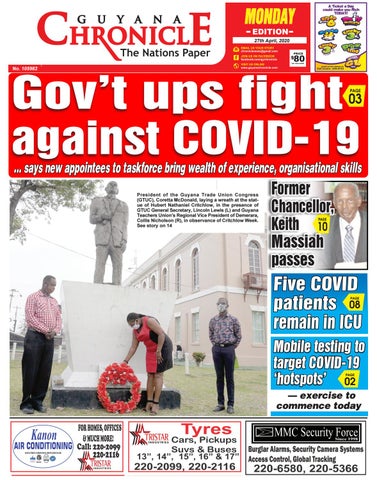
... says new appointees to taskforce bring wealth of experience, organisational skills President of the Guyana Trade Union Congress (GTUC), Coretta McDonald, laying a wreath at the statue of Hubert Nathaniel Critchlow, in the presence of GTUC General Secretary, Lincoln Lewis (L) and Guyana Teachers Union’s Regional Vice President of Demerara, Collis Nicholson (R), in observance of Critchlow Week. See story on 14
Former Chancellor, Keith 10 Massiah passes PAGE
Five COVID patients 08 remain in ICU PAGE
Mobile testing to target COVID-19 ‘hotspots’ 02 PAGE
–– exercise to commence today
2
GUYANA CHRONICLE Monday, April 27, 2020
Mobile testing to target –– exercise to COVID-19 ‘hotspots’ commence today AS cases of the novel Coronavirus (COVID-19) disease continue to increase, local health authorities have taken a pragmatic approach to increase the rate of testing by ‘rolling out’ mobile testing units, which will target areas considered COVID-19 ‘hotspots’. Guyana has already recorded about 75 cases of COVID-19 and statistics have shown that the infection rate continues to rise daily, but health authorities believe there are infected persons, who have not presented themselves to medical institutions. “We are trying to make testing more widely available and the teams will be going out and targeting hotspots, where they will take samples from persons in communities, where we find there may be people who are at higher risk of contracting the disease,” Deputy Chief Medical Officer (DCMO), Dr. Karen Boyle, told Guyana Chronicle on Sunday. Guyana Chronicle had reported that health authorities, in ramping up their response to the deadly COVID-19 pandemic, will be introduc-
ing mobile testing units at various health centres across the country. “As of Monday 27th April, 2020 in Georgetown, the MoPH (Ministry of Public Health) will launch its mobile units at the East La Penitence Health Centre. On the East Bank of Demerara at Herstelling; and on the East Coast of Demerara at Paradise, our COVID-19 health facilities will begin to provide services to persons along those corridors,” said Minister of Public Health, Volda Lawrence, during a virtual update on the COVID-19 pandemic on Friday. Dr. Boyle, while not directly saying those specific communities are high-risk, said the mobile units are targeting communities where persons, who tested positive for the disease, are from. “We are going to places where there have been COVID-19 cases before… so we are checking to see if other persons in the areas or communities might have the disease,” said the DCMO. The mobile units will, however, only be utilised to take samples, which will then be transferred to the
MoPH’s National Reference Laboratory- the first local institution authorised to conduct COVID-19 tests. When asked if the mobile units will be a staple in the ministry’s menu of measures, Dr. Boyle said the continuation will be simultaneous with how long the COVID-19 pandemic is around, since the exercise will assist with getting more persons tested for the deadly disease. Minister Lawrence had said operations, from the mobile units, will take place between 09:00hrs and 15:00hrs. In addition to introducing these services at health centres, health authorities will be partnering with private institutions and supplying them with medical supplies for sample collection. Sample collection will be done on inpatients and outpatients, who may present signs or symptoms of COVID-19. “As part of this exercise, we will also be screening our frontline workers (health and non-health) both public and private across the ten administrative regions,” said the minister. These measures are being established at a time when
COVID-19 continues to spread all across the world and right here in Guyana. Globally, there are over 2.6 million cases of COVID-19, with approximately 200,000 deaths. And with no approved treatment or cure, there is no assurance that persons will survive after contracting the disease. In the absence of approved medications, governments and authorities across the world have employed a number of preventative measures to contain the spread of the disease. The Guyana Chronicle had reported, recently, that Guyana is on course to “flattening the curve” and reducing the spread of the COVID-19 disease. This was according to Resident Pan American Health Organisation/ World Health Organisation (PAHO/WHO) Representative, Dr. William Adu-Krow, who noted that this will only be possible if the government maintains the existing containment measures. Locally, the government has extended its emergency measures to combat the dreaded disease, with the
imposition of a 12-hour curfew on citizens. These emergency measures were taken pursuant to paragraphs (1) and (2) (b) of the directive issued by the President, in accordance with the Public Health Ordinance, Cap. 145, and published in the Official Gazette, Legal Supplement B, on March 16, 2020. The measures at reference took effect from April 3, 2020, and are expected to last one month, unless earlier terminated, extended or amended by notice of the Minister of Public Health, after an assessment of the prevailing public health conditions. “The measures in place are working, and individual measures are working too, but we need to ensure that government enforces the existing measures… The few persons who do not go by these measures need to comply; we need to see more improvement,” said Dr. Adu-Krow. REVISED PROJECTIONS Already, there have been revised projections which show a reduction in the probable cases, but Dr.
Deputy Chief Medical Officer, Dr. Karen Boyle Adu-Krow said this new forecast can only be maintained if the measures that have been put in place are adhered to. Dr. Adu-Krow, with the aid of graphs, showed journalists how the projected cases moved from reaching 20,000 in a month to just under 1,000 in a month, with the implementation of the containment measures. If these measures were to be relaxed, however, Guyana could see about 5,000 cases in no time.
Buxtonian is country’s latest centenarian
Ms. Elaine Grenada, who turned 100 recently
ON April 15, 2020, Elaine Grenada of Penny Lane, South Ruimveldt Gardens, celebrated her 100th birthday. The eldest of five children, ‘Granny Elaine’ was born in Friendship, just next door to Buxton, a little over 11 miles from Georgetown, on the East Coast Demerara. The new centenarian is a mother of four, grandmother of 16, and great-grandmother of 12. Her children describe her as loving, caring and compassionate; “All you could ask for in a mother.” She is reputed to have spent a significant portion
‘Granny Elaine’ and her four children of her younger life as a supervisor at the Trent House, a once popular guest house among expatriates and the elite on down-town Main Street. She currently fellowships at the South Road Full Gospel Church, where she said she is constantly in receipt of love and support.
And though a vegetarian, she insists that she does have a specific meal plan; which is mainly a form of lacto-vegetarian plan. But she does indulge, from time to time, in a few eggs and a bit of fish, primarily for their nutritional benefits. Asked what advice she’d like to pass on
to the younger generation, in terms of how they could live to a ripe old age as she did, Ms. Grenada said, it would be that they should try to maintain a healthy relationship with God, as without His guiding hand, she would not have been able to achieve such a significant milestone.
GUYANA CHRONICLE Monday, April 27, 2020
Gov’t ups fight against COVID-19
3
... says new appointees to taskforce bring wealth of experience, organisational skills
THE Ministry of the Presidency (MOTP) said the recent appointees to the National Coronavirus (COVID-19) Task Force (NCTF), towards the establishment of an NCTF Executive Secretariat, possess the necessary expertise to strengthen Guyana’s fight. In a statement on Sunday, MOTP explained, in detail, the professional experience of the individuals and their plan of action in the coming days. It comes on the heels of an announcement on Friday that former Director General of MOTP, Joseph Harmon, had been appointed Chief Executive Officer (CEO) of the NCTF. Senior Executive Director of the Bertram Collins College of the Public Service, Colonel Lawrence Paul, was seconded to the NCTF and his previous position taken up by Dr. Mark Kirton. Former Director of the Public Information and Press Service (PIPS) Unit, Mark Archer, was also seconded to the NTCF on a full-time basis. According to the Ministry, Harmon, Paul and Archer possess expertise that is vital to the country’s fight against the disease and their appointment is purely administrative. It was explained that
their skills are necessary to help to “speed up the tempo” on the COVID-19 remediation campaign and the Task Force which will now benefit from their exceptional logistical and planning skills. MOTP noted that all three executives were serving in different departments of the Ministry of the Presidency and will retain their entitlements and emoluments. Harmon brings years of
Mark Archer experience and is Guyana’s first Minister of State in the MOTP since 2015. He is an attorney-at-law and retired Lieutenant Colonel of the Guyana Defence Force (GDF) and has experience in disaster risk management and has worked over the years with the
Civil Defence Commission (CDC). “President Granger explained that he was confident in Mr. Harmon’s organisational and operational competence and managerial experience, which make him best suited for the post of CEO,” the Ministry said. It added that the President described Harmon as a team player who has a clear vision of the objectives and urgency of the counter COVID-19 campaign and a commitment to overcome the challenges facing the country at this time. It was noted that Harmon has led the Government on previous crises and emergencies and is familiar with the mechanisms needed to address the effects of the COVID-19 disease and is skilled at mobilising and managing manpower and material resources. He has been tasked by President Granger with establishing a permanent National Task Force Secretariat; assigning permanent staff to manage the national campaign; creating preventive measures against the disease to safeguard citizens’ health and collaborating with regional task forces and stakeholders to safeguard citizens’ health. The CEO is also responsible for directing the NCTF
operations and initiating all important logistical measures necessary to prevent the disease from spreading further; directing rapid responses to unexpected and emergency incidents; developing short-term plans for disease prevention and safety of the people; com-
Colonel Lawrence Paul municating directly with agencies, ministries, regional task forces, agencies and stakeholders and disseminating accurate information to the public. Meanwhile, Colonel Paul served as Deputy Chief of Staff of the GDF and holds a Bachelor’s degree in Public Management from the University of Guyana and a Master’s degree in National Resource Strategy from the National Defence University in Washington
DC. Archer, on the other hand, has three decades of experience as a medical professional at the clinical, research and managerial level and has stated that he is pleased to be part of the “very important Task Force”. “My training is in medical technology and pharmacology, but I am not on this Task Force in a clinical capacity. I am here because I think I have the experience and knowledge to assist in the national effort to combat this disease. The Ministry of Public Health has professionals who are capable to test, track and treat. I will be assisting in the mobilisation of resources and helping to put plans together; short, medium and long-term plans for disease prevention and safety of the people,” Archer said. He explained that although he is a trained medical professional, he believes that his focus will be on planning, managing and coordinating, skills which he thinks are most needed in the operationalisation of the NCTF. “The President was aware of my interest and my experience and the fact that I was ready to be a part of the fight against this disease. I have worked
Chief Executive Officer (CEO) of the NCTF, Joseph Harmon with Mr. [Joseph] Harmon before and I was anxious to get started,” he said. Archer will be assisting Harmon with the staffing of the NTCF Secretariat so that it can be functional in the shortest possible time. On Saturday, the trio visited the National Gymnasium which will now be used as a storage, packaging and distribution centre for the items currently stored in containers at the CDC’s offices. “COVID-19 is a global pandemic which requires the highest level of attention. The NTCF will be drawing on the experiences of a cadre of persons who are well poised to help Guyana fight the disease,” the MOTP stated.
GTA introduces guidelines to beat back COVID-19 By Naomi Parris AS Guyana continues to grapple with the deadly COVID-19 pandemic, the Guyana Tourism Authority (GTA) has introduced a Hygiene and Sanitation Protocol to ward off the spread of the virus. The protocol is designed to help the tourism sector prepare for the new norm and meet visitors’ elevated expectations. Tourism stakeholders are advised to engage their staff in various workshops and training sessions to combat the deadly virus, and as such, they are urged to consult with the government’s health departments to determine appropriate actions if a guest or worker presents symptoms of COVID-19, as well as how to respond if
asked to quarantine guests. All staffers are to be trained on guest management and must increase sanitation procedures when dealing with colleagues and guests who have or may have been exposed to the COVID-19 infection. Housekeeping staff should also be trained to use disinfectants safely and correctly, and to wear gloves when cleaning since these cleaning products need to remain on hard surfaces for several minutes in order for them to work. The GTA noted that stakeholders should ensure that their employees are educated on the most common signs and symptoms of COVID-19. Stakeholders are advised to maintain records of guests, staffers, and movement of drivers. These records should be kept
for a minimum of 90 days. This includes maintaining guest registration records, employee work assignments and documentation of key control procedures, including the electronic lock records, and security camera closed circuit tapes. Additionally, restaurant owners and staffers are advised to provide only delivery services; however, if customers are to dine in, persons are required to use hand sanitisers in the dining area before sitting. Guests are advised to eat alone or with their travel companions at their own table. In addition, all dining tables should be positioned to ensure social distancing. Further, all buffet services should be discontinued, and food should be ordered from guest rooms and placed on the table before the guests are seated, so there is no
or limited staff or guest interaction. Dining areas must also be sanitised before and after dining. As for hotels, staffers are advised to conduct routine room cleaning more frequently. All mattresses and pillows should be covered with removable water-resistant mattress and pillow protectors to the extent possible. If such is not possible, the GTA advises that mattresses can be sanitised using steam, noting that garment steamers are ideal for sanitising mattresses and drapes, which are also difficult to wash. Housekeeping staff must schedule and perform routine cleaning and disinfection of all contact surfaces in guest rooms, television remote controls, toilet flush handles, door handles, water faucet handles, light switches, and flooring.
4
GUYANA CHRONICLE Monday April 27, 2020
Coronavirus: Spain records lowest daily death toll as lockdown eases
(BBC) Spain, which has been one of the countries worst hit in the coronavirus pandemic, has reported its lowest daily death toll in more than a month. Its health ministry said earlier that 288 more people had died of the virus, the lowest number since 20 March. The figure is a steep drop from the 378 deaths recorded on Saturday. On Sunday, children under the age of 14 were allowed to leave
their homes for the first time in six weeks. They are now allowed outside for one hour a day. The health ministry said the total number of fatalities now stood at 23,190. Fernando Simon, director of the Spanish Health Alert and Emergency Co-ordination Centre, said: "For the first time in a long time, we are below 300. "Although it may be hard to give these statistics, it's a figure which indicates a clear, positive
direction in the evolution of the epidemic." What has changed for Spanish children? The new lockdown conditions allow Spain's 6.3 million under-14s to leave their homes each day for a total of one hour between 09:00 and 21:00, but without going further than a kilometre (0.6 mile). Those over 13 are allowed to carry out errands for their parents, as has been the case throughout
the lockdown. However, parents tend to prefer not to send their children out, especially to enclosed places such as supermarkets, where there is more risk of contagion. Bicycles, skates and skateboards are allowed, but public parks remain off-limits. The lockdown's other conditions remain in place for the moment and schools remain closed; the government is considering loosening the lockdown further in the second half
of May. Psychologists have welcomed the lifting of restrictions for smaller children, saying that even one hour outside each day can provide an important boost to their state of mind. "The change of routine, being outside and being in the sunlight - all of that is extremely important," says Laura PiĂąeirspo, a psychologist and the director in Madrid of the charity AsociaciĂłn Bienestar Desarollo.
Coronavirus: Italy's PM outlines lockdown easing measures
BBC) Italy's Prime Minister Giuseppe Conte has given a televised address outlining how the country will begin "Phase Two" of easing its coronavirus lockdown. Restrictions on daily life will start to be eased from 4 May, he said, and people will be allowed to visit their relatives in small numbers, in masks.
Parks will reopen, but schools will not restart classes until September. Italy has endured the world's longest active coronavirus lockdown, and has Europe's highest official death toll. The country has suffered 197,675 cases of the virus, according to data from Johns Hopkins
University, and 26,644 people are confirmed to have died with it. The number of cases has been falling, however. Italy reported 260 new deaths on Sunday - the lowest daily toll since 14 March. Authorities now believe Italy's contagion rate - the number of people each person with the virus infects - is low enough to justify a
cautious easing of curbs. Italians have been living under a national stay-at-home order since 9 March, with everyone required to stay within a few streets of their door. The country brought in very limited easing of its virus control measures on 14 April, permitting some small shops - including book-
stores, dry cleaners and stationers - to reopen. There was no announcement on the possibility of Italy's premier football league Serie A resuming, even behind closed doors. Mr Conte stressed that social distancing measures would need to continue for months to come. out of coronavirus lockdown
More US states begin lifting virus lockdown orders (BBC) More US states are beginning to lift lockdown orders even as US leaders say social distancing guidelines will be necessary throughout the summer. But governors warn that life will not quickly return to normal, and that restrictions will remain in some places to keep the virus from resurging. On Friday, the US saw its largest single-day spike in cases. But the infection rate has dropped significantly in several
hotspots, including New York, the US epicentre. As of Sunday, the US has over 940,000 recorded coronavirus cases, according to Johns Hopkins University, and more than 54,000 deaths. Public health experts warn that lifting restrictions too soon could cause a second wave of infections. The decision to end mandatory orders comes as over 26m Americans seek unemployment protection, and the jobless rate climbs to around 16% of the
population. Even as state governors allow orders to expire, some city mayors have issued their own separate plans to end local lockdowns rules. How are states reopening? At one point, over 90% of the US population was under mandatory lockdown orders, but some states began lifting orders over the weekend allowing some Americans to return to hair salons and tattoo parlours. Georgia, Oklahoma, Alaska
and South Carolina have already allowed some businesses to reopen. They and other states have issued plans that call for more rules to be relaxed in the coming week. Colorado's Democratic Governor Jared Polis has said kerbside retail pickup can begin on Monday, with hair salons, barbershop and tattoo parlours allowed to reopen on Friday. Tennessee will allow restaurants to reopen on Monday, the same day that Mississippi's
mandatory lockdown order expires. Montana's governor has allowed churches to reopen starting on Sunday, with social distancing measures still required. Restaurants and schools will be allowed to reopen on 7 May. Eight states led by Republican governors - Arkansas, Iowa, Nebraska, North Dakota, Oklahoma, South Dakota, Utah and Wyoming - never issued mandatory orders to stay at home.
01-04-2020
10 12 13 14 20 23 17
B
03-04-2020
08 09 17 23 24
03 05 07 10 12
876
820
08 12 15 19 21
GUYANA CHRONICLE Monday April 27, 2020
How the 1918 Spanish Flu decimated British Guiana
…more than 6300 deaths were recorded
5
…social distancing, wearing of masks, home remedies return with COVID-19
By Alva Soloman THESE days, before Guyanese leave the confines of their homes, they pull on their masks; the authorities are appealing almost daily for persons to practice social distancing; pictures of home remedies such as lemon-grass tea and ginger are popping up frequently on Facebook. Rewind way back to the months between 1918-March to 1919. The home remedies, the masks and messages urging no more than 10 persons to gather were on the front burner back then. The disease was the Influenza, known as the Spanish Flu, a pandemic which killed approximately 500 million people. It left many homes without parents and a wave of poverty beyond economic proportions in its wake. Today, scientists and global health experts are cautioning the world that the Coronavirus (COVID-19) should be taken seriously and any plans to reopen world economies soon should be re-considered. Their advice may be linked to the lessons learned from the Spanish Flu. The influenza came in three ‘waves’. The first occurred around March 1918, but in August that year, the second wave proved to be the most devastating, killing thousands. During the latter years of the first World War, which ran from 1914 to 1918, the flu emerged in parts of Europe and quickly spread throughout the world. The flu crept into the Caribbean around October 1918 and resulted in the deaths of approximately 100,000 persons, although stricter record keeping could have seen that number climbing. The Spanish Flu in Guyana According to British Professor, David Killingray , along with Belize, Guyana was severely affected by the pandemic. Writing in “The Society for the Social History of Medicine” journal of 1994, Killingray said that a mild outbreak was first observed in Guyana , then British Guiana, around July
of 1918.It most likely was brought on a ship from Trinidad and Tobago. After its arrival, many cases were recorded at communities on the East Bank and West Bank of Demerara. At the time, there were a few deaths. The population at the time stood at 310,000. Of this number, 6,378 deaths were recorded between the months of December 1918 and February 1919, but the estimated number of deaths were as much as 12,000, since record keeping , especially in outlying and Hinterland communities, was so difficult that putting ink to paper was a challenge, more so updating the figures. Later that year, around December, a second, devastating wave of the flu swept through the country. The flu emerged on the coastland at epidemic proportions, with “extreme rapidity almost simultaneously”, wreaking havoc in communities between Skeldon and Anna Regina. The railway system, which was a preferred means of transportation at the time, as well as boats and village canoes, speeded up the spread of the pandemic. Crowded housing in Georgetown, Anna Regina and New Amsterdam, as well as the packed, ill-ventilated huts on the sugar plantations, were the perfect breeding ground for the influenza. “Plantation labourers fleeing the estates helped to spread the virus. By the fourth week of December, the epidemic had reached inland to the Canje River, and, by early January, the Upper Berbice River area, and also up the Essequibo and the Potaro rivers to Tumatumari. In the next few weeks of the new year those places which the virus reached last were among the hardest hit. In most districts, the infection lasted for about one month; the pandemic declined in February and by March 1919, only a few isolated cases were recorded,” Professor Killingray noted. He said that the flu notably affected East Indian labour camps and villages, and the highest numbers of mortality were recorded there.
Indigenous population impacted heavily It was noted that Guyana’s indigenous communities felt the brunt of the Spanish flu. In his diary, the Jesuit missionary, C. Carey-Elwes recorded that some of his Indo-Guyanese mission workers had gone to Georgetown which had become 'a regular death trap'. When they fell ill, they left the capital and started up the Essequibo in their boat. A few days later, balata tappers found their bodies on the river bank where all but one had died in their hammocks. At Tumatumari in Region Eight, the number of deaths were so high that no one was left standing to bury the dead, with an average of three deaths per day recorded. More males than females According to Professor Killingray, the Registrar General recorded that 3842 East Indian Guyanese died from influenza and 2190 from pneumonia and bronchial complaints. He said that more males than females died. It was noted, too, that the most vulnerable section of the population was the 20-30 age group. Said Professor Killingray, “In his official report, the Acting Surgeon General concluded that 'this epidemic of influenza has been the most severe visitation of disease within the memory of any colonist, the almost universal prevalence and high mortality have caused untold suffering.” He said that the impact was so heavy that three hospitals on the coastland
at Georgetown, New Amsterdam and Suddie were overwhelmed with patients. In addition, records indicate that one-third of all medical staff were down with the flu. “In the Public Hospital, Georgetown, where many cases of a severe type were being treated, a visit to an influenza ward was most distressing: frequent and noisy coughing, combined with the ravings of delirious patients created such a din that it was difficult to make oneself heard. Added to this, the attempts of the delirious to leave their beds or even to fall out of them if not closely watched, made the work of the nurses, whose members had been sadly depleted by the disease, very anxious, trying and laborious,” said Professor Killingray. Emergence of a vaccine and Emergency measures Among the measures put in place by the authorities, at the time, were the banning of wakes and such public gatherings here in Guyana. A group of no more than 10 persons were allowed. In addition, the widespread wearing of face masks was urged by the health authorities. He said that official attempts to prevent the spread of the virus, once it had entered an area, ranged from leaflets with advice on basic hygiene and ideas about how to avoid or cure the disease, restrictions on the movement and gathering of people, and the isolation of those who were infected. It was noted that in late 1918, the Government Bacteriological Department in
Georgetown produced its own vaccine which was made available for prophylactic inoculations. By the second week of January, 1500 doses had been used, mainly on plantation workers but without its desired effect. By this time, a number of local remedies came to the fore and they included the gulping of rum and honey, stimulants and creosote; digesting 30 grains of citrate of potash and 30 grains of bicarbonate of soda. As is the case today, the fumigation of buildings and a daily cold bath, and a mild laxative were among the remedies. As has been the case today with the COVID-19, business for drug stores soared with many offering various services to customers. While the period 1918-
1919 contrasts sharply to today’s 2019-2020 period of the coronavirus, the similarities in measures cannot go unnoticed. COVID-19 vaccine While no vaccine has been developed for the deadly coronavirus, clinical tests on the development of vaccines have begun in the more advanced countries including the United Kingdom. According to Professor Killingray’s report, a deep sense of humanity emerged as a notable positive from the Spanish Flu. Today, with Youtube , Facebook and social media apps, that message of humanity circulates 24-7, with the advice to observe social distancing , wear a mask and wash one’s hands being the key messages.
Monday, April 27, 05:00hrs - 06:30 hrs
6
GUYANA CHRONICLE Monday April 27, 2020
Alcohol abuse and domestic violence
ALCOHOL abuse is one of the biggest social and health problems among Guyanese. Alcohol-abuse disorder is defined as “problem drinking that affects a person’s social, economic, or physical wellbeing.” And, having been identified as a disease by medical experts, it must, and can, be addressed as such by medical professionals. According to a report by the World Health Organisation (WHO), 15.2% of male drinkers in Guyana consume more than 60 grams of alcohol at least once per month. This, according to the WHO, constitutes heavy drinking. According to their statistics, 15.9% of heavy drinkers have alcohol-abuse disorder, while 3.9% may be considered alcoholics. Among Guyanese youth, males, on average, take their first drink at 11.9 years old, and females at 12.5 years. Those statistics are the worst in the Caribbean. Guyanese are all too familiar with the negative health effects of alcohol abuse. While vehicular accidents and related fatalities may be the most obvious results, falls, death by fire, homicide, drowning, and suicide are also effects caused by acute (immediate) intoxication. Long-term (chronic) effects include liver disease, pancreatitis, suicide, stroke, bowel dysfunction, brain disease, psychiatric disorders, cancers, and sexually-transmitted diseases among others. Considering all of those factors, the WHO concludes that problem-drinking cuts 15 years from one’s life expectancy, compared with eight years for cigarette smoking. The destructive effects on families and relationships, and the social consequences are well known. Children are often most severely affected, as they may go hungry or be subject to abuse or neglect due to having alcoholic parents. Families can be torn apart; they may become homeless, and children may become orphans.
Alcohol does affect the user’s ability to perceive, integrate and process information. This distortion in the user’s thinking does not cause violence, but may increase the risk that they will misinterpret their partner or another’s behaviour, one researcher has found. Some research indicate that a large quantity of alcohol, or any quantity for alcoholics, can increase the user’s sense of personal power and domination over others. An increased sense of power and control can, in turn, make it more likely that an abuser will attempt to exercise that power and control over another. Violence may be triggered by conflict over alcohol use (or ending such use), or in the process of obtaining and using substances, particularly illegal drugs. Research indicates that there may be a correlation between the risk of domestic violence and certain personality characteristics. For example, alcohol abuse may increase the risk of violence in men who think abuse of women is appropriate, and are also under socioeconomic hardship. While the causes of problem-drinking are complex and not well understood, medical experts agree that heredity plays a major part; having a parent who has an alcohol problem increases one’s likelihood of developing the disease. Studies of twins support this view. Scientists believe that peer influence, alcohol availability, and cultural factors also contribute to the fact that at least 25% of the global population are considered to be chronically dependent on alcohol, while a minimum of 10% of men and 5% of women may be considered alcoholics. Another major consequence involves effects on the foetus when alcohol is consumed by a pregnant woman. Such a baby, if it survives, may be born with foetal alcohol
syndrome (FAS). This disorder is characterised by low birth weight, deformities of the face, head, and limbs, mental retardation, malformation of the heart, lungs and other organs, and stunted growth. No amount of alcohol is considered safe during pregnancy, or while breastfeeding. While there is medical evidence that concludes that moderate drinking has some health effects, such as prevention of heart attacks and ischemic strokes, such benefits are lost when alcohol is used in excessive quantities. Clearly, alcohol abuse is a problem that can destroy individuals, families, communities, and by extension, affect entire countries because the cost of addressing alcohol-related issues takes a major toll on national economies. Absenteeism from work alone is estimated to cost billions of dollars worldwide. Having recognised the problem, what can we do about it? While the government has a responsibility to provide healthcare services to those affected by this disease, it is up to individuals to take advantage of the available opportunities being offered. First, affected persons and families must recognise the disorder and make a decision to seek help. Second, afflicted persons should be assessed by medical professionals, who will then recommend a course of treatment. Third, the problem-drinker needs to stick with the programme. Fortunately, in Guyana, help is available. Medical aid for alcohol-related issues is offered at any hospital. At the Georgetown Public Hospital Corporation(GPHC), psychiatric and counselling services are obtainable at no cost; persons who want more information may call any public hospital, or the suicide prevention hotline at: 2230001, 223-0009, 623-4444, or 600-7896.
GECOM has stood its ground against the dark forces
Dear Editor
THE Gerry Gouveia, PPP/C arm of the Private Sector Commission (PSC) is a classic example, when the pursuit of political power by any means, drives the pursuer to insane levels of shameful behaviour. This latest act, of political surrogacy, to present a list of demands to the Guyana Elections Commission (GECOM), when that constitutional body would have virtually finalised its draft order and operational plan for execution of the national recount of the March o2 national and regional ballots, typifies Gouveiaís perception of the national electoral body, as one to be bullied, to do the biddings of the political underlings of the PPP/C. And how well, he has honed the dark rudiments of the PPP/C political culture!
Just look at the deviousness of its strategy of such demands, that is intended to not only create the impression of a clamour, on behalf of the national business and commerce, to give it the semblance of a thousand voices so as to cow GECOM to its dark bidding, and of course, to mislead the international community; but also to become a proxy. In fact, his demands are reported to mirror those of the PPP/C. These political deviants of all shades have misinterpreted GECOMís patience and accommodative posture, for consensus for the conclusive end of the national and regional ballot count, as timid. But they have been mistaken, as exemplified by the decisiveness of the Madame Chairís ruling on the final issues for the draft order and work plan. Gouveiaís entire role in the plot to portray GECOM as an agency of fraud, is quite estab-
lished, and need no elaboration here; except that his statement describing ìas a waste of timeíí, the entire recount process, had obviously been the duplicitous proxy for Jagdeo, who, because of initially agreeing with the President to do a recount of all the regions, could not have publicly reneged. How in the name of good heavens could this dangerous mouthpiece of a PPP/C premier supporter, from which he would have waxed rich, be described as impartial and a patriot by another well-known PSC front-liner defies all moral decency and character reference. How could such a brand of being apolitical be given to such an infamous purveyor of the PPP/C politics of blatant interference in an autonomous, constitutional body, for example, when he had the temerity to write GECOM ordering that it ceases the House-to- House registration process, which legality has always been there
in the National Registration Act? And where is Gouveia going to wear that patriot badge, as stated above, by that same person, as a Guyanese, who would have sought to write a missive to the Organisation of American States (OAS), without the consent of many of his fellow members, and anti-national in nature, advocating sanctions for his own country and people, off of whose patronage, labour and sweat he and his political acolytes have made their multi-billions throughout the decades? This is the man whose dark role in the fomenting of social tension in this Republic is well-known, and chronicled, for the damage that he and others would have done to this country. Regards, Carla Mendonca
7
GUYANA CHRONICLE Monday April 27, 2020
CXC needs to revise current exam strategy Dear Editor,
I AM a recently-turned 18-year-old Upper Sixth student of Guyanaís premier secondary institution: Queenís College. My ambitions lie in the medical field. However, do note this: The contents of this letter were neither vetted nor altered by any teacher at the aforementioned institution, for I will not be anyoneís propaganda doll. This is my independent opinion. The Caribbean Examinations Council (CXC) has proposed a July time frame for the upcoming CAPE and CSEC examinations. More notably, the examination structure has been modified. The essay style component (Paper Two) has been completely removed, leaving our final grades to be determined by our SBA score and a multiple choice exam (Paper One). I assume that the Council is familiar with the countless objections to this strategy, our teachersí union being one notable critic. The
Jamaica Association of Principals of Secondary Schools (JAPPS) being another. With the utmost respect, I must add my voice to the chorus of disapproval. I too, am asking the Council to reconsider their strategy for the upcoming examinations. First and foremost, I do understand that these are trying times and that the Council is under pressure right now to deliver credible and fair examinations. After all, we are in the middle of a global pandemic, unaware of when this crisis will end. However, I do believe I speak on behalf of countless students regionally when I say that the proposed strategy will be a grave disservice to all of us writing the examinations. We have been preparing since the beginning of the academic year to get our SBAís out of the way to tackle both the multiple choice as well as the essay style examination. Are we supposed to accept that we must dump all our hard work for the past months down the drain? The Paper Two component
is an absolute necessity. We, the student population, take in and process our knowledge differently. The Paper Two allows us to organize and project our thoughts in a way that is unique to us. We are the creative youth of today, let us express ourselves! The same Paper Two allows us to link our responses to other concepts resulting in a delivery demonstrating greater proficiency. It separates the sheep from the goats. A multiple choice exam being the only source of validation of our knowledge puts us at a disadvantage. Moreover, I do not believe that any recognized University will accept students based on the results of a multiple choice examination. It simply is not a true reflection of the studentsí potential. The Council can repeat the fallacy that a valid grade can be determined using the SBA and a Paper One, but it would only be like trying to convince an ostrich that it can fly. In addition to this, we have already paid our exam fees. We
paid to write both papers. At the time of writing this (26th April, 2020) I have not been made aware of any provisions made by CXC to reimburse the students due to the removal of the Paper Two. If this new exam structure will not change then I believe that we should be refunded for the Paper Two. After all, our parents did work hard for that money to write those exams. It must not be blatantly disregarded. Further, if we really are to sit these exams in July at a centre then we are still breaking quarantine. We are still leaving our houses and placing ourselves at risk of contracting COVID-19. And for what? To take a multiple choice examination that is highly unlikely to be recognized? Is it not best we just write the whole examination (Paper one and two) and get it over it? Why put ourselves in danger for the sake of an examination that will not reflect our true potential? CXC believes that their strategy is a good one as it allows the students to
write the exams within a shorter time frame and have the papers marked and results released quicker-much like a driverís exam. But anyone can read my previous sentence and realize the only party benefiting from this strategy: CXC. The only logical solution is to have the students write the complete examination (Paper One and Two) at a postponed date, after the pandemic subsides. The curve will flatten, and soon it will be safe for us to leave our homes without the risk of contracting COVID-19. Once again, I am calling on the Council to respectfully reconsider their current proposal for the upcoming CSEC and CAPE examinations. It is the only way forward to write credible examinations to ascertain bright futures for us, the students. Regards, Nikhil Sankar, Concerned Student
PPP/C does not believe in shared governance Dear Editor I REFER refer to Oliver Thomasí ìThe shared governance debateî of April 25, 2020 in the Guyana Chronicle, particularly the paragraph which reads, ìWhy is shared governance only discussed when there is a major dispute as to the victor of the election? Though I certainly do understand the thrust of Mr. Thomasís letter, I beg to differ somewhat with his observation, as to the moments in our political milieu when such calls are made. Yes, he is certainly correct in identifying that particular time of such calls, since they have been a prominent feature of public debate, post March 02. But it is a topic, which always comes to the fore whenever there are socio-political instances that threaten the national fabric. In fact, it has been a very vocal call following the No-Confidence Motion. However, there is a reality which must be accepted, depending on oneís understanding of our historical problems ñ it is certainly an idea which time has been long overdue, and which should be initiated as a key topic for a national conversation. Further, I agree with Thomasí questions as to what I interpret as to its method of implementation, which one believes can only be further examined, and discussed in the larger ambit of Constitutional reform.
Having said that, there are some hard realities, which must be understood about the question of shared governance, in our historical circumstance. First, there has to be political will, to pursue a process which can only be brought to a successfully conclusive summit, with both the major political stakeholders as willing participants. And here is where the root of the problem lies. As an example, one refers to the 2006 national and regional elections, immediately after which, there was a meeting between a high representative of the Afro Guyanese cultural community and then president Bharat Jagdeo, where the issue of inclusivity ñ is this the same as shared governance? - was discussed. I stand to be corrected by saying that Jagdeo, in a publicly aired statement, immediately after, said that he believed in an ìenhanced frameworkî for dealing with such a matter. This was a counter to the emissaryís proposal, which effectively threw the latter through the window. It was not a surprise, given the fact that there were already rumours of prior, similar engagements with the leader of the then PNC/R on such a question, but with no conclusive result. One must now come to the 2015 polls, its results, and President Grangerís public offer of unity talks with the PPP/C, given the fact of the message of the narrow
margin of victory, and its reflection of a divided country. It was a proposal, which none other than Ralph Ramkarran, welcomed; but concluded that since it had been rejected by Jagdeo, suggested that President Granger take it to the people, instead. No wonder Jagdeo did his utmost to heighten the racial tension for the entire period from 2015. In seeking to understand Jagdeoís refusal, one must understand the historical mindset of the PPP/Cís politics of governance: That they have the self-endowed belief of the divine right of rule, because of the perception of statistical dominance of their ethnic base. In other words, this was also politically cultural, as it became the Partyís masthead for the policy of institutional racism, that underpinned racial dominance. This was clearly seen during their 23-year regime, in their ethnic strategy of ethnic marginalization. This was a decided policy of governance, nailing the pretence and lie of former president Donald Ramotar, that inclusive government could only occur, after ensuring ìtrustî. It was a most sordid excuse for his party and succeeding government, not to even attempt to explore such a possibility. Even in the wider mainstream of the PPP/Cís support base, it is noticeable that none of their senior spokespersons, and even daily horde of letter writers, have
made a pitch for inclusive government in their often scurrilous paragraphs. Well, how can they, when their missives are often written from the cesspool of misinformation, lies and fake news! To highlight the PPP/Cís singular belief in the politics of dominance, one only has to observe the deviousness of their dealings with some of the smaller parties that contested the March polls. Rather than make an offer of a genuine agreement of a joint slate, they simply inveigled them into the net of being surrogates, to execute their treacherous bidding. For the PPP/C, it is ALL THEIR WAY, AND NO ONE ELSEíS. Nothing in the PPP/Cís modern political track record reflects a belief in shared governance/inclusivity. Let us understand that the question of inclusive governance/shared governance, is very much pertinent to the political future of Guyana. But it must not be held hostage, to the politics of ethnic domination, and become a bargaining chip for those who have since post - May 2015, been seeking to exonerate themselves from the venalities of the criminal state, experienced during their stewardship for over two destructive decades. Regards, Earl Hamilton
8
GUYANA CHRONICLE Monday, April 27, 2020
Five COVID patients remain in ICU
MORE than a week after recording a consistent increase in the number of novel Coronavirus (COVID-19) cases, Guyana has gone 24 hours without recording any, as the number of confirmed cases remain at 74. According to the latest statistics from the Ministry of Public Health, some 455 persons have been tested for the COVID-19 disease, and while 74 persons have tested positive, 381 have tested negative. While the number of deaths due to COVID-19 remains at eight, five infected persons are fighting for their lives in the COVID-19 Intensive Care Unit (ICU). Additionally, 53 persons are in institutional isolation and 24 are in institutional quarantine, while 12 persons have recovered. Globally, there are over 2.7 million cases of COVID-19, with approximately 200,000 deaths. And with no approved treatment or cure, there is no assurance that persons will survive after contracting the disease. In the absence of approved medications, governments and authorities across the
world have employed a number of preventative measures to contain the spread of the disease. Locally, the government has extended its emergency measures to combat the dreaded disease, with the imposition of a 12-hour curfew on citizens. These emergency measures were taken pursuant to paragraphs (1) and (2) (b) of the directive issued by the President, in accordance with the Public Health Ordinance, Cap. 145, and published in the Official Gazette, Legal Supplement B, on March 16, 2020. As the country wages war against the deadly disease, President David Granger is on record as saying that the efforts of the country’s frontline workers, in particular, those within the medical field, should not go unnoticed. “I ask you… to think tenderly of our public health professionals and service providers; that is to say, our doctors, nurses, respiratory therapists and all other supporting staff, medical and non-medical, who are providing the required care for those in distress,” President Granger said, adding: “Public
health practitioners are on the frontline of protecting those stricken by the disease; they have been working tirelessly, through this very difficult situation, to provide quality healthcare to those who have been infected and afflicted. Everyone in the public health system has played a vital part in the fight against this disease.” According to the WHO, COVID-19 is an infectious disease caused by the newly-discovered coronavirus. The WHO said most people infected with the COVID-19 virus will experience mild to moderate respiratory illnesses and recover without requiring special treatment. Older persons and those with underlying medical problems such as cardiovascular disease, diabetes, chronic respiratory disease, and cancer, are more likely to develop serious illness. The WHO believes that the best way to prevent and slow down transmission is to be well-informed about the virus, the disease it causes and how it is spread. “Protect yourself and others from infection by washing your hands or using an alcohol-based rub frequently
Two crises but still standing
and not touching your face. The COVID-19 virus spreads primarily through droplets of saliva, or dis-
charge from the nose when an infected person coughs or sneezes, so it’s important that you also practise
respiratory etiquette (for example, by coughing into a flexed elbow),” the WHO has advised.
––Guyanese from 2019 Bahamas hurricane going strong
–– encourage Guyanese to be resilient during COVID-19 By Lisa Hamilton IN less than a year, the Simons have been a part of two major crises but neither has hindered their determination or snuffed out their faith. On September 30, 2019, Cecil and Olive Simon arrived at the Cheddi Jagan International Airport (CJIA) with nothing but two small suitcases. Fleeing the ruins of Category Five hurricane Dorian that had hit The Bahamas, they were welcomed home by the Government of Guyana. Before that day,Cecil and Olive had spent 23 years building a life as teachers on the island nation. “That’s a long time,” Cecil told the newspaper on Sunday, as he reminisced on how he and his wife had worked their way up the ladder towards becoming well-accepted teachers. Cecil started off as a primary school teacher and later
moved on to teach English Language, History and Literature to High School students after graduating from university. Meanwhile, Olive was trained as an Infant Education teacher and also studied Primary Education at the university level, last working as a primary school teacher. Since being back, Cecil has applied to teach in Guyana’s education system but the elections impasse has slowed the process. He now works part-time as a teacher at the Morgan's Learning Centre (MLC), while Olive has made the choice not to work. It has not been easy, but he is happy for the sturdy base of his family here in Guyana. Cecil is also pleased that, now with the COVID-19 pandemic, he is closer to his family here in Guyana in one of the world’s most challenging times. “Look how things happened, we moved from one crisis and then something
else occurred. Even if we had remained in The Bahamas, we could not have worked because it’s the same scenario of having to do teaching through e-learning,” he said. “It’s a blessing in disguise…everything happens for the best in God’s own time It’s more time spent with family. You get to value family time much more.” With the COVID-19 measures in place, they are making use of their land space where they have successfully planted a thriving kitchen garden which supplies them with a range of vegetables. They have no plan to return to The Bahamas as they believe that there is so much they can do right at home rather than elsewhere. They also believe that Guyana is now in a much better state than when they left Buxton 23 years ago. Re-examining the hurricane, the two said that they had experienced others,but none of that magnitude.
Minister of Citizenship Winston Felix (left) meets Cecil and Olive Simon at the Cheddi Jagan International Airport (CJIA) on September 30, 2019. “Our once comfortable home became a sodden mass of books or papers, broken glass and furniture along with torn, drooping drapes. The once majestic house became a leaky, shaky and moldy waste land,” the couple described it. They said that the onslaught of the storm defied every possible preparation made and surviving it will forever be their greatest testimony of God’s presence in their lives. In a message to Guyanese and who may feel as if they cannot get through the current
COVID-19 crisis, the couple said that nothing is impossible with God. “I believe that in every situation you should put God first. I think what brought us out of that situation in The Bahamas safely is because we did put God first,” Olive said. “Our bedroom was untouched all because of prayers being sent up there. There are going to be challenges and difficulties, but put your faith and trust in God and he will see you through.” Meanwhile, Cecil said that the biggest lesson he learnt from his first major cri-
sis was the importance of life. He said that he and his wife could have lost their lives. The fact that they survived is testimony to God’s work. In his advice to Guyanese in the current crisis, he said: “Trust in God and trust the people who have been entrusted with powers in terms of ruling over you to make the right decisions. Follow whatever instructions have been given to you and you’ve got to hope and pray that the people in authority over you make the right decisions. That’s all we’ve got to pray for.”
9
GUYANA CHRONICLE Monday, April 27, 2020
Trade Unions should join the COVID-19 fight – Min. Scott TRADE Unions in Guyana can play a significant role in combating the health, economic and labour market issues which have come about as a result of COVID-19. This was the message of Minister of Social Protection with responsibility for Labour, Keith Scott, on Sunday, in observance of the commencement of Critchlow Week. Scott said that even though the presence of COVID-19 has hindered the observance this year, workers can still turn their sight towards the new challenges that the virus has posed to their working conditions and measures which can be taken to fix this. COVID HAS IMPACTED WORKERS “The fact that much attention is being placed on the extent to which COVID-19 has impacted the lives of workers,
and the fact that Unions are unable to meet in the usual manner, the legacy of comrade Critchlow should not be down played or treated with any less importance,” he said adding that “the Trade Unions certainly have a key and critical role to play in managing the current situation and its aftermath.” The Minister stated that the COVID-19 catastrophe has given rise to renewed and dynamic challenges for trade unions to confront and resolve. He explained that the world is plagued by wide-ranging levels of inequalities and COVID-19 has exacerbated these inequalities much to the detriment of the most vulnerable citizens, and therein lies additional challenges for trade unions to overcome. He said that there is no doubt that the future of work, quality of work, quantity of work, nature
of work, unemployment, under-employment, wage rates, social protection and health, life and survivability of workers and their families are now greater affected. “Unions have a significant role to play in combatting the challenge associated with the COVID-19 pandemic which can be regarded as humanity’s worst enemy at this time,” he further stated. Minister Scott added: “All successful and progressive trade unionists, including Hubert Nathaniel Critchlow, recognise that they cannot function in isolation of the prevailing and over-arching political climate. They must approach trade unionism and labour-management relations holistically, yet neutrally, and objectively from a nationalistic standpoint. They are required to function in defence of our sovereignty.” He called on all trade
unions to take on a holistic and unified approach to mitigating these effects, through social dialogue, for the development and implementation of sustainable solutions. He urged them to factor in all possible solutions which are the ideals of the Decent Work Country Programme and meet the commitment to the United Nations 17 Sustainable Development Goals and the government’s visions of a good life for all. GIVE DUE RECOGNITION Minister Scott also used the opportunity to point out an act or lack thereof, which deemed as a “major injustice”. He said that although the National Assembly has declared November 28 as Hubert Nathaniel Critchlow Day and a 1992 Committee, July 3 as Critchlow Day, it is not being observed by trade unionists in Guyana.
Scott stated: “These are two feats worthy of annual observation and celebrations but it is most unfortunate that since then [2005] the trade union fraternity seemed to have forgotten that there is a day which is officially designated as Hubert Nathaniel Critchlow Day. In this sense a hero has been abandoned.” He put forward that similar to the way Enmore Martyrs who benefitted from the works of Hubert Nathaniel Critchlow are recognised every year, Critchlow likewise deserves recognition. He urged trade unions to take steps to correct the deficiency. Critchlow Week is celebrated annually during the last week of April and the first week of May while May Day, also known as Labour Day, is observed on May 1. Scott noted that May Day was first initiated by the then British Guyana Labour Union (BGLU)
Minister of Social Protection with responsibility for labour, Keith Scott during the 1930s when it was referred to as “MayDay Demonstrations”. It served then as a means to highlight the unfavourable working and living conditions of workers. He said that it was during these years that the achievements of the Father of Trade Unions in Guyana, Hubert Nathaniel Critchlow, fell under the spotlight. After his demise, the celebrations evolved to wreath laying ceremonies, marches through the city of Georgetown and rallies bringing together of thousands of ordinary citizens.
Rapid testing a ‘game changer’ in battling COVID-19 –– two such tests endorsed by WHO, says deputy CMO
By Navendra Seoraj THE introduction of rapid testing could be a “game changer” in the fight against the Novel Coronavirus (COVID-19) pandemic, as this method will allow health authorities to conduct more tests and diagnose persons quicker. Guyana could soon see the introduction of this method of testing, now that the World Health Authority (WHO) has endorsed two models of rapid testing, said Deputy Chief Medical Officer (DCMO), Dr. Karen Boyle. As it is now, Guyana is using the Polymerase Chain Reaction (PCR) method to test persons for COVID-19. And, according to health authorities, this type of testing is done in a laboratory and it takes about seven hours to produce results, The likelihood of rapid tests supplementing the PCR method is high, but will most likely be introduced by private institutions first. “The Ministry of Public Health is willing to partner
with private agencies once they are in a position to provide quality testing… the only types of the test we are willing to accept right now is PCR, but we noticed that WHO has endorsed rapid diagnostic test, today (Sunday),” said Dr. Boyle. She said the WHO has endorsed two rapid testing models, and it is expected that, with this endorsement, the ministry will be willing to consider those models of rapid testing. “Once they (private institutions) bring those diagnostic kits in, we can test it because once the WHO endorses it we won’t have a problem,” said Dr. Boyle. Earlier this month, the WHO had said multiple diagnostic test manufacturers have developed and begun selling rapid and easy-to-use devices to facilitate testing outside of laboratory settings. The international health organisation said these simple test kits are based either on detection of proteins from the COVID-19 virus in respiratory samples (e.g. sputum, throat swab) or detection, in
blood or serum, of human antibodies generated in response to infection. “However, before these tests can be recommended, they must be validated in the appropriate populations and settings. Inadequate tests may miss patients with active infection or falsely categorise patients as having the disease when they do not, further hampering disease control efforts,” said the WHO. At that time, the WHO had only recommended the use of these new point-ofcare immunodiagnostic tests in research settings, noting that they should not be used in any other setting, including for clinical decision-making, until evidence supporting use for specific indications is available. Dr. Boyle confirmed that this method of testing was not used in the past for reasons stated by WHO, but when asked if the Ministry of Public Health will be looking at the possibility of utilising the new method in public institutions, the DCMO said it is a possibility which will be explored,
since it will allow them to do point-of-care-testing. This means that persons can be tested on the spot instead of sending samples to the National Reference Laboratory. LOT OF POSSIBILITIES “A lot of possibilities can be opened up with this,” said Dr. Boyle, adding that the new mobile testing units can even be utilised for actual testing instead of just sample collecting, once the rapid-testing kits are acquired. The Guyana Chronicle reached out to Resident Pan American Health Organisation (PAHO)/WHO Representative, Dr. William AduKrow, to shed some more light on the new development, and while he said he has seen the document from WHO, Dr. Adu-Krow said he needs further clarity from the WHO’s head office. “WHO has always endorsed rapid testing for research, but not for diagnostic testing…so I reached out to Washington for more clarity on this,” said the represen-
tative. However, when asked about the potential impact of rapid testing, Dr. Adu-Krow said it would be a “game changer” in the fight against the pandemic, since testing would be done anywhere in Guyana. Local health authorities have so far tested 455 persons, of which 74 were positive and 381 were negative. There is no optimal testing rate, since it would vary for different countries, but Dr. Adu-Krow had said that Guyana’s is about 20-25 per cent, which is what obtains globally. This means that if 100 persons are tested, 25 per cent would be positive. “If you open it up too wide, you would be testing a 1,000, and only get 20; so you will be wasting test kits… On the other hand, if you are too rigid, you will be testing 10, and eight are positive. But you will be missing a lot,” Dr. Adu-Krow said. As things stand now, Guyana, according to WHO guidelines, is within range for testing, but according to Dr. Adu-Krow, if needs be,
the range “could be widened a little more”. There could, however, be a natural widening of the testing range, since private institutions were given the “green light” to test for COVID-19 and treat infected persons. And, PAHO has since expressed its willingness to assist private institutions in preparing themselves to test for the disease. PAHO SUPPORT The international health organisation had “brought in” an expert to train technicians at the reference lab to test for the COVID-19 disease. “We are prepared to train other ‘labs’ and private hospitals to have the same quality assurance as the reference ‘lab’; they will have to go by the standards we have set up for the government,” said Dr. Adu-Krow. He said that PAHO normally supports Guyana by supporting the Ministry of Public Health, and they will continue to do so by giving them testing kits and now by supporting private institutions, which will have to follow WHO guidelines.
10
GUYANA CHRONICLE Monday, April 27, 2020
Recognising the cycle of child abuse THERE are no real ‘bad’ parents; only adults who need to learn how to treat children properly; because children have rights and they need love and respect. It is a parental duty to enable children to reach their fullest potential. Parents can help children reach their potential by recognising their needs. Children need attention, security, encouragement, affection, understanding, direction, guidance and nurturing. Many adults fail to bring these simple but important attributes into their children’s lives and some adults end up abusing them. Abused children usually become troubled adults and the level and type of abuse, along with the length of time over which the abuse occurred, is indicative of the impact that is left on the victim/survivor. That is, unless there is a form of intervention from a well-meaning, enlightened adult such as a neighbour, family friend or teacher, or the Childcare and Protection Agency (CPA). Unfortunately for children, some parents are the ‘survivors’ of childhood abuse; and are still afflicted by negative aspects of their childhood. They are parents who did not grow up healthily and who did not reach their fullest potential. Parents who may have been physically or sexually abused, or felt unloved, unwanted or neglected. And although they may seem fine on the surface, and can function pretty much the same as
the next person in everyday life, deep inside scars and unresolved issues may have shaped their lives. These issues can reflect the way they behave and subsequently treat their families; they can also prevent them from understanding their parental role; thus repeating the same negative traits (with their loved ones) to which they were subjected when young. In some families, the dysfunction of child abuse continues generation after generation. By now everyone should know what constitutes child abuse: “child abuse is any negative behaviour of a physical, sexual, psychological or emotional nature resulting in harm towards a child, or that puts a child as risk”. Here are three types of child abuse that can be disregarded and are somewhat undetectable. DOMESTIC ABUSE: Children are harmed psychologically and emotionally when they witness domestic abuse. Even if they are not physically attacked, the mere fact that the adults they love and look up to, are engaged in an aggressive, unhealthy dispute can affect a child greatly. It might have a psychological effect on how the child views himself and how he treats women in the future. (if it’s a girl child, vice versa). If domestic abuse is a consistent part of his/ her upbringing, it might even affect his/her physical and mental development.
Quarrelling, fighting, swearing, shouting and constant drama create a toxic environment-- one that will certainly affect a child’s outlook on life and his outcome. DRUGS AND EXCESSIVE ALCOHOL: Children whose parents spend a lot of time ‘high’ on recreational drugs or ‘passed out’ through excessive alcohol consumption, are at risk. It is unlikely that these children receive the care, guidance, security and nurturing they need to reach their potential. These homes usually lack good role models and a stable structure, leaving very little for the child to emulate and learn from. The child will strive despite the odds; children are resilient, but what type of characteristics will the child learn along the way and how will they shape the personality of the adult that he or she will become? SEXUAL ABUSE: People tend to believe that child sexual abuse must involve some form of penetration but this is not true. Inviting a child to watch pornography or consistently exposing children to ‘adult’ paraphernalia is a form of child sexual abuse. Some adults get their ‘kicks’ out of sharing sexually explicit material with children.
Sometimes because they have no boundaries or decency, and sometimes in the hope of luring the child into a sexual world, for which the child is far from ready and unprepared. Inciting a child to do anything or to touch anywhere that has sexual connotations is child sexual abuse. Children may be gullible; not knowing how to think or behave in situations such as these. However, it is the adult who is culpable of inciting child sexual abuse and can be charged and imprisoned for same. These are examples (of areas of child abuse) that can be reported, investigated and even rectified, in the child’s best interest; with timely intervention and cooperation between parents, family members and the CPA. When children are neglected and abused or exposed to negative circumstances, materials and people that they should never encounter, it is time for someone to step in on their behalf. Don’t be afraid to report child abuse, do so before it escalates, do it because it’s the right thing to do; do it to break the cycle; do it for the children. If you are concerned about the welfare of a child call the CPA hotline on 227 0979 or write to us at childcaregy@gmail.com A MESSAGE FROM THE CHILDCARE AND PROTECTION AGENCY,MINISTRY OF SOCIAL PROTECTION
Former Chancellor, Keith Massiah passes FORMER Chancellor of the Judiciary, OR, SC Keith Massiah has died after a period of illness. Massiah, 93, died on Friday, April 24, 2020 at a city hospital. He served as the Chancellor of Judiciary from 1984–1988. He had also served as the country’s Attorney General and Minister of Legal Affairs from 1988-1992. In a statement on Sunday, the Ministry of the Presidency conveyed a message of condolence from President David Granger who was saddened by Massiah’s death. “President Granger expresses heartfelt
sympathy to Mr. Massiah’s wife, Mrs. Maureen Mae Massiah, CCH, his three children, three grandchildren, other relatives and friends,” the statement said. In that statement, the President acknowledged that the former Chancellor was awarded Guyana’s second highest honour — the Order of Roraima (OR) — for service of an exceptionally high quality and beyond the normal call of duty in the administration of Justice and in the field of law. In a message on his social media page, veteran journalist and playwright, Francis
Former Chancellor of the Judiciary, Senior Counsel Keith Massiah (SN photo)
Francis Quamina Farrier’s photo of Keith Massiah (extreme right) in his younger days during the production of the play ‘Happy Holiday’ at the Theatre Guild Playhouse in 1965 Quamina Farrier shared a picture of Massiah reading Law at the University of Guyana. He in his younger days during the production of took over our ‘Jurisprudence’ course after the play ‘Happy Holiday’ at the Theatre Guild Professor Calvin Eversley passed. Professor Playhouse in 1965. Massiah was a delightfully beautiful human Farrier noted that Massiah had also been being and we will miss him very much.” a part of two other plays he directed at the Attorney-at-Law, Kalesh Loakman stated: Theatre Guild. “Guyana and the legal fraternity lost Professor “May his soul rest in peace. Condolences Keith Massiah SC, a legal luminary. Your conto his wife Rev. Maureen Massiah and other tributions to the fraternity were invaluable.” relatives and friends,” he stated. A known colleague, Deomatti Cheddie Meanwhile, Alliance For Change (AFC), said: “He was such a wonderful person. I Public Relations Officer, Sherod Duncan, have known him as a lecturer at UG Law stated: “Professor Massiah taught me ‘Law Department since early 1990. May his soul and Society’ while I was an undergraduate RIP.”
11
GUYANA CHRONICLE Monday April 27, 2020
Parents worried about value for money --as private schools cash in on COVID-19 arrangements with offer of generous discounts
By Tamica Garnett WITH the announcement that schools will remain closed indefinitely, even as the new school terms begins, both the private and public school systems are working to put improvised structures in place to ensure continued learning even as the students remain at home. At some private schools, management has been utilising interactive learning platforms such as Zoom, Edmodo, Google Meetings, Google Classroom and Abeka Academy, as well as social media platforms such as Whatsapp. However, some parents with children at those schools are questioning the feasibility of those arrangements, as they do not believe they are getting value for their money. GENEROUS DISCOUNTS Several private schools have announced discounts in light of the new arrangements. In the city, the New Guyana School and Mae’s Schools earlier this week announced a 20 per cent discount on their fees, while Premier Academy over on the West Bank Demerara is offering a 35 per cent cut for the current term. School of the Nations, on the other hand, is offering a discount of between 12 – 50 per cent, according to Dr. Brian O’Toole, the school’s Director. However, some parents are not entirely pleased with the programmes being offered at the price at which they come. “We’re not getting 80 per cent quality work, so if you have to pay 80 per cent of the school fees, that’s not fair,” said one parent with two children at Mae’s Schools, where fees are $90,000 and $100,000 per term per child respectively. And neither does she believe that Mae’s is doing enough by way of offering a comprehensive alternative to the regular classroom sessions. “At the primary level, you don’t get daily work,” she said. “There’s no classroom; no interaction. Just a sheet of paper with 60-something
questions, and a sheet of paper with 40-something questions; they’re not even spending half the amount of time with the students. A teacher comes Online and spends two minutes to post work, and then you don’t see that teacher again until the next session... But the timetable has the teacher down for a double period,” the concerned parent noted. Another parent with a child at Premier Academy noted that while the teacher has created a Whatsapp group with the children’s parents, and has been sending them regular worksheets, she is not at all happy with the payment arrangements, as she does not feel she is getting value for the price the school is asking. She pays $35,000 per term under normal circumstances. “For this month,” she said, “we are paying 65 per cent, but they said it will start back full-time from next month. I don’t agree with the reduction; last month we had to pay 65 per cent for only 10 days of school.” A CONSUMER AFFAIRS MATTER Consumer Affairs Officer at the Competitions and Consumer Affairs Commission (CCAC), Feona Austin-Paul, says that the issue does qualify as a consumer issue, and notes that parents concerned about not getting their money’s worth can make a report to the Commission. “We would just have to carry out an investigation to look at what is being offered, and what should have been offered and all the different logistics,” Austin said, adding: “But, it’s a service, so it would be a ‘Consumer Affairs’ matter.” She noted, however, that it is not within the CCAC’s remit to mandate private schools to offer reduced fees in cases where classes and services are being offered. At the New Guyana School and School of the Nations, notwithstanding a reduction in fees, both schools have put in place daily Online classes, with continuous work. At the New Guyana
School, the arrangements include worksheets being sent home every two weeks, with live classes being conducted via the Google Meet platform, and timetables being posted. Classes are conducted daily, from 08:30hrs to 13:00hrs for the K4 and K5 levels, while the Primary and High School work from 08:30hrs to 15:30hrs. “The biggest challenge is we are not used to using technology to deliver and receive education, so the first few days are going to be challenging,” said ‘New Guyana’ Director, Alfonso De Armas. He said, however, that the school had been working with the teachers to ensure they are up to speed with the new method. “Since we closed, we’ve been doing training with them to prepare them for this. It has been a learning curve; some teachers, especially the younger generation, have proved quick learners, but we find that other teachers have had a little bit of a challenge in adapting,” De Armas shared. He said that notwithstanding the reduction in fees, the school has taken a decision to not reduce salaries or terminate any of its employees. “We’re absorbing the 20 per cent; we’re trying hard not to pass it on, or reduce staff salaries and such,” he said, adding: “Obviously, for some teachers, like our Physical Education teachers, it’s a challenge, so we’re still trying to figure out how to make the best use of our extracurricular teachers.” TEACHER TRAINING At School of the Nations, Dr. O’Toole said they used the Easter holidays to train teachers to conduct classes Online. The school invested in a number of paid Zoom accounts to arrange the system, and according to Dr. O’Toole, attendance has been very high; between 70 to 80 per cent. He noted that the school has been getting a lot of positive reviews from parents on the system that has been implemented. “The technology is brilliant; I’m so impressed with it.
It’s also recorded, so the parent can then go on later on in the day,” he noted. Some private schools, however, have not yet indicated their plans for the new term, or whether or not parents would be required to pay the full fees. In cases where schools have not yet implemented an alternative programme, parents are making the best they can with the situation of working at home with their children. “We have to do what we
have to; I get to spend more time with my son, and teach him myself. So I'm comfortable until further notice; most importantly, he gets more ‘mommy time’,” said one parent with a five-year-old at Green Acres, where she pays $54,000 per term. At Genesis, at least one parent said she’s awaiting word on the way forward for that institution as well. “I am not sure the school has done anything other than arrange for parents to uplift
their children's Abeka workbooks. However, my son's K4 teacher gives parents weekly guidance, via WhatsApp, as to what lessons to work for the week. She is also available for questions parents may have when working with their children. However, they have not communicated anything about payment to us as yet; I asked the teacher, but even she doesn't know,” the parent noted. She has a four-year-old son at the school, where she pays $48,000 per term.
12
GUYANA CHRONICLE Monday April 27, 2020
– WHO says Re-infection not ruled out …. recovered patients should continue taking precaution
THE World Health Organisation (WHO) has cautioned world governments and patients who have recovered from COVID-19 that there is no hard evidence to prove that reinfection of the virus cannot happen. In a recent scientific brief, the WHO cautioned countries against operating as if those recovered can face no new threat and therefore pose no threat to others, as this could add to the spread of the virus. “At this point in the pandemic there is not enough evidence about the effectiveness of antibody-mediated immunity to guarantee the accuracy of an ‘immunity passport’ or ‘risk-free certificate’,” WHO stated. It added: “People who assume that they are immune to a second infection because they have received a positive test result may ignore public health advice. The use of such certificates may therefore increase the risks of continued transmission.” Guyana’s health authorities continue to encourage all Guyanese to take the necessary COVID-19 precautions. It has not made a pronouncement that any person could be immune to the virus. The WHO said that as new evidence on antibody-mediated immunity becomes available, it will update this scientific brief. However, it has noticed that some governments have suggested that the detection of antibodies to the SARS-CoV-2 --- the virus that causes COVID-19 ---- could serve
Guyanese maneuvering through the capital city of Georgetown wearing gloves and face masks, as they take precautions to prevent the spread of coronavirus (Delano Williams Photo)
as the basis to enable individuals to return to work assuming that they are protected against re-infection. “There is currently no evidence that people who have recovered from COVID-19 and have antibodies are protected from a second infection,” WHO reiterated. It explained that the development of immunity to a pathogen through natural infection is a multi-
step process that typically takes place over 1-2 weeks. While studies conducted show that people who have recovered from infection have antibodies to the virus, it must be noted that some of these people have very low levels of neutralizing antibodies in their blood suggesting that cellular immunity may also be
critical for recovery. WHO stated that as of April 24, 2020, no study has evaluated whether the presence of antibodies to SARS-CoV-2 confers immunity to subsequent infection by this virus in humans. Laboratory tests that detect antibodies to SARS-CoV-2 in people, including rapid immunodiagnostic tests, need further validation to
determine their accuracy and reliability. Even so, inaccurate immunodiagnostic tests may falsely categorize people by falsely labelling people who have been infected as negative, or labelling as positive, people who have not been infected. The Organisation said that these tests also need to accurately distinguish between past infections from SARS-CoV-2 and those caused by the known set of six human coronaviruses. “Four of these viruses cause the common cold and circulate widely. The remaining two are the viruses that cause Middle East Respiratory Syndrome and Severe Acute Respiratory Syndrome. People infected by any one of these viruses may produce antibodies that cross-react with antibodies produced in response to infection with SARS-CoV-2,” WHO stated. “Many countries are now testing for SARS-CoV-2 antibodies at the population level or in specific groups, such as health workers, close contacts of known cases, or within households. WHO supports these studies, as they are critical for understanding the extent of – and risk factors associated with – infection. These studies will provide data on the percentage of people with detectable COVID-19 antibodies, but most are not designed to determine whether those people are immune to secondary infections.”
Vending fees at Bartica Market waived for two months THE Bartica Municipal Market and the Mayor and Town Council have come to the aid of vendors by waivering their vending fees for two months. With the deadly coronavirus threatening the world, Bartica has instituted a curfew and ‘stay-home’ mandate. These have resulted in losses for vendors, since persons are not coming out to shop. Recognising the strains that will be placed on these vendors to make ends meet in their homes, the council decided to intervene and lend a helping hand. With over 150 vendors at the market, the waiver amounts to a $2M loss for the council. However, the Mayor, Gifford Marshall, said the well-being of the residents precedes that of financial benefits of the council. “The effect of COVID-19 on the world is grappling and we have all been able to see how this disease has crippled the healthcare system and has the potential to cripple economies as well. My councillors and our administration, in an effort to ease the pressure within our business community, particularly our market facilities, took a decision to waive all vending fees for period of two months. This will allow some cushioning for our vendors as we all struggle to manage our affairs in the midst of this pandemic,” Marshall told the Guyana Chronicle.
The fees for vending at the Bartica Municipal Market has been waived for two months
He noted too that the move is a major sacrifice for the municipality but sacrifices have to be made to ensure that the people are able to cope with the crisis. Vendors at the market are saddened by the financial stresses they now face, but in the
same breath, are thankful for the kindness of the Mayor and Town Council. Vashti Layne, who has a meat centre, said it has been really hard on her and family because of the significant decline in sales over the past weeks. While it is understand-
able why persons are staying away, she said a lot of people’s livelihood and survival are solely dependent on sales, and that cannot be ignored. “Now we have the market closing early, the place is dead, only one and two people coming in the market, but we still have to continue to vend. We have expenses like light bill and so forth, and we are also buying to sell back, so we have to accumulate the money to pay our suppliers. Now that we are not getting normal sales, we’re not selling the amount to clear our overhead expenses, much less to carry on with other aspects of our lives,” Layne lamented. However, she said that the gesture of the council is very beneficial, as it will lower her expenses. “We are ever so thankful to the council for being lenient with us and understanding our plight at this time. Two months of not having to worry about finding rent is definitely an ease to our burden and we hope that this virus can get under control soon so that we can go back to our regular lives. I really don’t want this situation to worsen for anyone, because it is already hard as it is,” Layne stressed. Other vendors echoed same sentiments and thanked the council for the kind gesture.
13
GUYANA CHRONICLE Monday, April 27, 2020
Finding crafty things to do in quarantine
–– aunt and nephew duo keeping themselves busy with art
By Naomi Parris
WITH many self-quarantining to protect themselves and their families and to slow the spread of the deadly coronavirus, an aunt and nephew duo are keeping themselves busy working on their art and craft during the pandemic. Roxanne Austin, 19, an aspiring artist, is spending her days drawing and penning her ideas on paper. The self-taught artist told Guyana Chronicle that her interest in art sparked when she was in primary school. “I always loved drawing. I could remember from when I was younger, in primary school, I was just making funny sketches in the back of my book. And then I saw a cartoon spider on this story book, and I drew it. And I loved it. The image stuck with me ever since. Ever since then, I have been drawing. Just random little people in my books,” Austin stated.
She added that, it was not until she began secondary school that she took an interest in drawing more complex things like portraits of persons and adding shadowing and other techniques to her drawings. Austin noted that she hopes to make drawing a career, and to one day have
her work recognised internationally. “It’s one of my dreams that one day my art won’t only just be portrayed all over Guyana, but it would be recognised internationally,” the teen stated. Recently, Austin had started experimenting with portraits and has managed
Roxanne with some her portraits Young Leroy Austin sawing a piece of wood with a battery operated saw he made to draw several portraits and colored drawings as a means of expanding her artistry. One of Austin’s recent artwork shows a drawing of the Guyana flag in what she translates to be the hands of God as Guyana is one of the many countries battling the deadly coronavirus.
One of Roxanne Austin’s recent artwork shows a drawing of the Guyana flag, in what she translates to be the hands of God as Guyana is one of the many countries battling the deadly coronavirus
A FAMILY TRAIT On the other hand, Austin’s 14-year-old nephew, Leroy Austin, who also resides in the same home as his aunt, is following in his aunt’s footsteps, making use of his artistic skills to kill boredom since schools are closed due to the pandemic. The young man, who is an aspiring architect, stated that he fell in love with art since he was at kindergarten. The oldest of three sib-
A model of an electrical blender made by Leroy lings, Austin told Guyana Chronicle that he stumbled upon a video on YouTube where he saw someone making a toy car out of cardboard cut-outs and thought to himself that he could do the same. He then went around his home and found a few materials and started making his own toys, from cardboard boxes, Styrofoam and small pieces of plywood for him-
self and siblings. “When I first started making these toys I was 12; I was watching something on YouTube and I saw this video where someone was making all kinds of things with cardboard and I said I could do that too,” he related. Austin stated that when he would get bored or tired of watching cartoons, he would sit with his pieces of cardboard and some hot glue and just build things. “When I’m bored, I would look for cardboards and start making all kinds of things; one time I made a helicopter and I got a small motor to make it fly,” he stated. GREAT TALENT The young man, who is deemed a born artist destined for great things, was at the top of his nursery school class when it came to art. He always coloured inside the lines and drew the most outstanding pictures. Aside from making toys
out of recyclable materials, Leroy has also developed an eye for sculpting. The young man recently found a new form of art and started making sculptures from bath soaps. The young man stated that he sometimes surprises himself with how much he can do and can create with just his bare hands. He stated that one day he would love to take his art to a higher level and perhaps work in the field of architecture and design buildings and so forth. Leroy has become extremely popular for his art in his school and community since he would get orders for school projects and toys. The young man has turned his art into a business and would sell toy cars and trucks to his friends and adults who would wish to purchase toys for their little ones. The young man noted that one of his greatest inspirations is his aunt, Roxanne, who also has an eye for art.
14
GUYANA CHRONICLE Monday, April 27, 2020
Critchlow Week begins –– under the theme ‘Economic, political and social transformation post COVID-19’
AMIDST the COVID-19 pandemic, trade unionists have held steadfast to acknowledging the works of Hubert Nathaniel Critchlow, by laying a wreath at the feet of his statue, at the commencement of Critchlow Week on Sunday. At the small wreath-lay-
ing ceremony in the compound of Parliament Building, General Secretary of the Guyana Trades Union Congress (GTUC), Lincoln Lewis; President of the GTUC, Coretta McDonald; and Regional Vice President of Demerara GTU, Collis Nicholson, assembled to pay
respect on behalf of all of Guyana, to the statue of the revolutionary man. Lewis, in his remarks, highlighted that 2020 came at a time when the country and world is challenged with a pandemic. However, he pointed out that the union was adamant about recognis-
ing the week, and so they adjusted the usual programme. “We come today primarily to remind everyone that as a labour movement, we have permanent interest and that interest includes protecting and advancing the gains of our predecessors, our forebearers in fact, who
President of the GTUC, Coretta McDonald laying a wreath at the statue of Hubert Nathaniel Critchlow have fought and have made “Trade union struggles this country acquire Indepen- have been part of our fight for dence and Republican status. freedom and justice for many While we are observing and years. Hubert Nathaniel calling on every worker, Critchlow – the founding faevery Guyanese, to observe ther of trade unionism in the the measures in the fight Caribbean and Guyana - has against this pandemic, we led this struggle undoubtedly feel compelled that today we and we as workers can ride will have to come out here on this premise proudly. and lay at least one wreath Consequently, comat the foot of the statue of posed of his sacrifice, we Hubert Nathaniel Critchlow, won our greatest victory, Father of Trade Unionism in the election of a democratic the British Empire. It is he work force but while that who had made it possible for is established, do we see us to start electing persons ourselves as championing who will enter the National his cause?,” he posited in Assembly to advance our in- his remarks. terest and protect our rights,” Lewis said. MUST BE UNITED Nicolson delivered the To this end, Nicholson main address at the short pro- pointed out that there were gramme, giving brief history various occasions where on the momentous event. leaders have been divided, “Each year, as we join especially with instances thousands across the country relating to liberation and to celebrate the victories justice. He noted too, that of workers, our own Free- in the face of this pandemic, dom Day is still fresh in our leaders must unite. minds. The achievement of “While as leaders we our rights as citizens and our often fight in different avrights as workers should in- enues, it is the wish for deed be celebrated together. all leaders to be united so Our history has made them that workers can have a inseparable. Comrades with full representation of trade that being said, let me high- unionism in its full effect. light this year’s theme which This points to the many pilis ‘Economic, Political and lars as leaders we ought to Social Transformation Post emulate from the struggles COVID 19’.” This theme of Critchlow. Hubert Nasets the midpoint for intro- thaniel Critchlow expressed spection by all, more imporSee page 16 tantly trade union leaders.
15
GUYANA CHRONICLE Monday April 27, 2020
Supreme Court updates emergency directions --- urgent matters, applications to be facilitated THE Supreme Court of Judicature has updated its COVID-19 emergency directions to include the suspension of court sittings and hearings with immediate effect save and except for those which qualify as urgent matters and applications. In a statement on Sunday, the Supreme Court listed the matters deemed as urgent for purposes of applications pursuant to the Practice Direction No. 1 of 2020 – COVID-19 Emergency Directions. They include custody applications; domestic violence and related matters; maintenance applications; habeas corpus applications; Public Health Ordinance, Cap. 145; applications for extension of time to detain persons; matters related to the national and regional elections; matters under the Interception of Communications Act, Cap 47:03 and curfew and related matters. The measures shall last for one month unless revoked or extended by notice after an assessment of the prevailing public health circumstances. Notwithstanding the above list of urgent matters, all guilty pleas for traffic cases and new charges will be facilitated. The Emergency Directions were signed into effect by Chancellor of the Judiciary (ag), Justice Yonette Cummings-Edwards. When it comes to court sittings, the measures state that all ‘in person’ hearings shall continue to be suspended for the one-month period; sittings of the courts shall continue to be conducted remotely and the court shall include any place, whether or not at a designated court house, where a judge or magistrate elects to sit to conduct the business of the court. Meanwhile, all time-sensitive filings pursuant to Rules of Court or Orders of Court are suspended during the onemonth period and affidavits in support of applications must be sworn to and subscribed as required by law with exhibits to affidavits similarly marked as required. “Where a matter is due to become statute barred under the Limitation Act, Chapter 7:02 or any other legislation during the one-month period when the Emergency Directions are in force, it may be filed by electronic means notwithstanding
COVID-19 Emergency Directions Gazetted on March 23, 2020 and updated by Notices on April 3, 2020 and April 5, 2020.
Days on which the Magistrates’ courts offices will be open from 08:30 to 12:30 hours.
it is not urgent. The matter must be accompanied with an affidavit explaining the circumstances,” the Supreme Court stated. At the Court of Appeal, all chamber matters and Full Bench sittings are further suspended for the one-month period subject to the directions of the judge or the court. Hearing of urgent applications by the court will be conducted remotely. At the High Court, regarding civil trials, the hearing judge has decided that all pending civil matters in the High Courts in Essequibo, Demerara and Berbice are further suspended for the one-month period. These sittings will resume after the one-month period but will be subject to an assessment of the prevailing public health conditions. Regarding criminal trials at the High Court, the opening of the Demerara Criminal Assizes for the April session is further postponed for the one-month period; the Berbice and Essequibo Criminal Assizes are further suspended for one-month and after the period has ended, the reopening of sessions will be reviewed. The Supreme Court stated too, that the registries in Georgetown, Demerara, and the sub-registries at New Amsterdam, Berbice and Suddie, Essequibo remain in operation. However, the counter and ‘in person’ services continue to be suspended until Friday, May 22, 2020. Unless otherwise advised, these registries will re-
open to the public on Monday, May 25, 2020. When one is filing urgent matters or pleadings to the Court of Appeal and High Courts, as directed by the court, he or she must do so by email until May 24, 2020. The emails to these courts are included below. Where urgent matters are required to be filed, litigants and/or attorneys-at-law must file an undertaking to present hard copies of their documents and pay the requisite filing fees on a date, as directed by the registry, which shall be on or after May 25, 2020. Registry staff will be working remotely to provide services to attorneys-at-law, litigants and other court users. From, May 4 - 22, 2020, sittings of the Magistrates Courts will continue to be by electronic means – Zoom, Skype or Whatsapp Video and teleconferencing. Magistrates’ courts offices will be opened on specific days from 08:30hrs to 12:30hrs. The filing of all urgent matters must be on the dates the court offices are open, and where urgent matters are required to be filed on the days when the court offices are not open, contact can be made with the Clerks of Court for the relevant magisterial districts for the matters to be filed. The changes are in addition to the Supreme Court of Judicature Practice Directions
COURT EMAILS: Judicial Registry, High Court, Georgetown, Demerara - supremecourtguyana@ gmail.com Sub-Registry, New Amsterdam, Berbice High Court - subregistryberbice@gmail. com Sub-Registry, Suddie, Essequibo High Court – subregessequibo@gmail.com Family Court Registry, High Court, Georgetown – registryfamilycourt@gmail.com Land Court, High Court, Georgetown - landcourtgy@ yahoo.com Probate Registry, High Court, Georgetown – probateregistrygy@gmail.com
16
GUYANA CHRONICLE Monday, April 27, 2020
COVID-19: Reg.10 RHEC head calls on residents to adhere to emergency measures WITH three COVID-19 cases now recorded in Linden, Region 10, its Regional Health and Emergency Committee (RHEC) Chairman, Orrin Gordon, is pleading with residents to adhere to the Emergency Measures instituted by the
Government to suppress the spread of the dreaded Coronavirus (COVID-19) disease here in Guyana. The cases were recorded within a period of three weeks on April 8, 14 and 24. One person – Sydney ‘Jacket’ Trellis – has since died.
In an address to the people of Region 10, shortly after the third case was confirmed, Gordon said that it was not the time to let up, stressing that they must remain vigilant and aggressive in protecting themselves, families, friends and loved ones.
“We can’t let up, our responsibilities as persons who are involved in this fight mean that we can’t let up as we are at a very critical and crucial juncture and any letting up now could create a false sense of security which, as we have seen across the
world, is not a chance to be taken with this pandemic,” Gordon said. The RHEC Chairman, who also serves as the Regional Executive Officer (REO), said that the aggressive, effective and efficient approach by healthcare professionals and other stakeholders working on COVID-19 within the region is significantly helping in the fight against the pandemic. This, he said, was evident in the region being able to track a positive case through contact tracing efforts. He reminded residents that COVID-19 is deadly, and, as such, they must continue to be alert and adhere to all of the Emergency Measures. Meanwhile, Regional Health Officer (RHO) Dr Pansy Armstrong, praised
the efforts of the nurses tasked with conducting contact tracing within the region. She said that remaining vigilant and effective will only yield more results through contact tracing. “Contact tracing is the key in helping to flatten the curve in identifying cases early...I want to continue appealing to the general public to adhere to all the instructions that the Ministry of Public Health is putting to them, which include stay home, washing of hands, practise social distancing, as all of that will help in flattening the curve. The REO has been making appeals over and over and I join with him again in reiterating those appeals to the public,” the RHO iterated.
Critchlow Week ... From page 14
dynamic leadership which perpetuated humility, cohesiveness, charisma, and endurance for the platform on which we currently embrace our struggles. Those characteristics define quite humbly as a united people and more so commonly trade unionism. Given, the recent pandemic and political climate of our country, it is for our leaders to reflect heavily on Critchlow standards and constantly make reference to them as we seek to move forward in unity facing all challenges. It also behooves us to stand strong and united as proud Guyanese in these times making sure that we preserve our rich heritage and heart-warming history,” he said. But this year’s theme for Critchlow Week, he said, seriously speaks to transformational prospective; Economically, Socially and Politically amid COVID 19. “It is for all of us to be mindful of the massive development and possible under-development if correct postures are not administered. Our beloved country is on a path for dynamic greatness and as proud Guyanese despite our varying intellectual objective perspective – we must unite and solidify those endless possibilities… Let us remind ourselves that in unity there is strength and as we journey through this difficult period let us show gratitude to the essential workers and encourage them with motivation as they seek to stabilise the country’s most precious treasure – the human population - while we reflect and reshape the essence of trade unionism and the workforce essentially. The foundation for a better life has been laid, and the building has begun,” Nicholson said. Following his remarks, President of the GTUC, Coretta McDonald laid the sole wreath at the statue, while Lewis and Nicholson kept their social distance for a photo opportunity.
17
GUYANA CHRONICLE Monday, April 27, 2020
Dharmic Sabha distributes 1,400 food hampers THE Guyana Hindu Dharmic Sabha (GHDS), through its ‘Feed a Family’ initiative, successfully distributed 1,400 food hampers in Georgetown and on the East Bank and East Coast of Demerara. According to President of GHDS, Dr. Vindhya Persaud, the hampers were distributed to the elderly, single parent families, families with children, and without breadwinners. Food Hampers were distributed in Kitty, Sophia, Cummings Lodge, Industry, Vigilance, Enterprise, Bladen Hall, Non Pareil, Strathspey,
Prospect, Coldingen, Herstelling, Providence, Covent Garden, Foulis, La Bonne Intention, Montrose, Better Hope and Good Hope. The hampers included basic food items. Dr. Persaud said her heart goes out to persons who are struggling and experiencing serious hardship during the pandemic. In the coming weeks, the Sabha will be distributing more food hampers in other communities. The Sabha President said she would, therefore, like to sincerely thank all those who contributed to Guyana Hindu Dharmic Sabha’s “Feed a Family” initiative.
President of GHDS, Dr. Vindhya Persaud
The food hampers that were distributed
The Sabha has also been distributing face masks to residents of various communities.
Some of the items that were in the hampers
18
GUYANA CHRONICLE Monday, April 27, 2020
GDF Coast Guardsman dies in Herstelling accident THE Guyana Defence Force (GDF) has convened a Board of Inquiry to investigate the motorcycle accident at Herstelling Public Road, East Bank Demerara (EBD) which claimed the life of Coast Guardsman, Theotroy Mc Donald Phil-
Guyana Defence Force (GDF) Coast Guardsman, Theotroy Mc Donald Phillips lips. According to reports, on April 25, 2020, at 14:30hrs, Theotroy Mc Donald Phillips, 42, was riding his motorcycle at a fast rate, along the roadway, when it is alleged that he lost control of the motorcycle while navigating a turn. As a result, Phillips collided with the concrete median and was flung into the air and landed on the road surface, some distance away. He sustained injuries about his body.
He was picked up in an unconscious condition by a public-spirited citizen and taken to the Diamond Diagnostic Centre, where he died while receiving treatment. Police investigation is still ongoing. Phillips enlisted in the Guyana Defence Force in 2001. The chief of staff, officers and soldiers extend sincere condolences to his five children, family and other close relatives. On April 9, 2020, 20-year-old Guyana Defence Force Private, Jermain Jones, lost his life in a motorcycle accident at Line Dam, Queenstown, Essequibo Coast. Jones of Sand Reef, Queenstown, Essequibo Coast, was riding a red and white 150cc Honda XR motorcycle on April 9, 2020, at the time of the accident. According to reports, Jones was proceeding east along the centre of Line Dam at a fast rate of speed, and, as he approached a speed bump, he lost control of his motorcycle. As a result of the impact, Jones was flung into the air and landed on the roadway some distance away. He received injuries to his head and about his body. The soldier was picked up in an unconscious condition by passersby and taken to the Suddie Hospital where he was pronounced dead on arrival.
Calabash Alley man commits suicide –– after stabbing reputed wife A CALABASH Alley, North East La Penitence man, on Saturday, took his own life, after stabbing his reputed wife about her body with a knife. Dead is Glen Forde, called “Black-Boy”, a fish vendor, who shared four children with his reputed wife, Colleen Daly. According to reports, the incident took place around 16:45hours at the couple’s home. The children were not at home at the time. The Guyana Chronicle understands that the couple would frequently have disagreements which would become physical. According to neighbours, on the day in question, the couple had a heated argument, during which loud screams were heard coming from their home. Daly was stabbed multiple times about her body by Forde who attempted to
Colleen Daly kill her. He then reportedly climbed onto the roof of his home, slit his throat and fell to the ground. The injured woman was rushed to the Georgetown Public Hospital Corporation (GPHC) and is being treated for her wounds. Forde was pronounced dead at the scene. Police are investigating the incident.
GUYANA CHRONICLE Monday, April 27, 2020
19
20
GUYANA CHRONICLE Monday, April 27, 2020
Pardew denies bonus for avoiding relegation (Reuters) - ADO Den Haag manager, Alan Pardew, has denied reports stating he will receive a bonus for avoid-
ing relegation after the Dutch season was terminated this week because of the COVID-19 pandemic.
the 58-year-old Pardew said: “If I was formally entitled to an amount, I would never want to receive it. In this difficult
gation. Yet with the relegation battle and the title fight being scrapped, the English coach can be said to have succeeded.
Coach Alan Pardew of ADO Den Haag during the Dutch Eredivisie match between AZ Alkmaar v ADO Den Haag at the AFAS Stadium on March 7, 2020 in Alkmaar Netherlands (Photo by Laurens Lindhout/Soccrates/Getty Images)
The decision to scrap the season meant ADO Den Haag, who were second from bottom in the table, seven points from the safety zone, will survive, having looked like going down. One British newspaper reported former West Ham United, Newcastle United, Southampton and Crystal Palace boss, Pardew, would receive a 100,000 pounds bonus payment. In a statement on the club’s website, however,
y, 0 a d n 2 Mo 7, 20 il 2 r p A
C
KET
CRI
period, I would always return any bonus to the club, which will certainly find a good destination for it.” Pardew said he wanted the money given to Den Haag’s non-playing staff or donated to the Dutch health service. “I hope this clears up any misunderstandings caused by press reports,” he added. Pardew was appointed as manager of the Dutch minnows in December tasked with saving them from rele-
Although he admitted: “Of course there is relief, but modesty is in order. I had the belief that we could accomplish our mission, we were not in good shape and we will never know if we would have succeeded. “We count our blessings and understand the frustrations at SC Cambuur and De Graafschap.” SC Cambur and De Graafschap were both set to gain promotion to the top flight from the Dutch second tier.
R E N OR
C Z I QU
COMPLIMENTS OF THE XTRA ENERGY DRINK – STABROEK BAZAAR (Tel: 683-9500) & CUMMINGS ELECTRICAL COMPANY LT -83 Garnett Street, Campbellville, Georgetown (Tel: 225-6158)
ANSWERS TO YESTERDAY’S QUIZ: (1) Kusal Perera; Niroshan Dickwella (9 dismissals each) (2) Dinesh Ramdin (26 dismissals) TODAY’S QUIZ: (1) Who is the first Sri Lankan player to register a century on his Test match debut? (2) Who is the first West Indian to hit a hundred in his very first Test match?
Answers in tomorrow’s issue
21
GUYANA CHRONICLE Monday, April 27, 2020
CWI delay in renewing broadcast rights will be costly
CMC – JAMAICAN businessman and former cricket executive, Chris Dehring, believes Cricket West Indies’ delay in renewing its broadcast rights deal will prove a stumbling block when they eventually approach a market reeling from the fallout from the novel coronavirus pandemic. CWI’s rights deal expired last December and CWI are yet to conclude negotiations on a new long-term deal, despite entering the market a year ago. Dehring, a former leading marketing executive with the regional governing body, said the chaos created by COVID-19 had created such a high level of uncertainty that CWI would find great difficulty negotiating deals in coming months. “Right now, not having a television agreement, I think you’re much worse off than having a television agreement,” said Dehring, a key figure in helping the Caribbean deliver the 2007 Cricket World Cup when he served as chief executive of the organising committee. “It is much easier to try and negotiate
or fight off somebody trying to reduce it on you versus now having to go into the market where there’s so much uncertainty. “First of all, to get people to come to the table is going to be difficult, even if you have the greatest deal on the table – whether it’s England coming here or India coming here and you want to sell back television rights into those markets – the challenge is everybody is so uncertain, nobody wants to move. “You have oil being sold at minus-40 dollars a barrel – imagine that. So this is not the time to be out of contract so they (CWI) really had bad luck there or bad planning.” Only recently, CWI president Ricky Skerritt said the absence of a broadcast deal had contributed to the organisation’s lean finances and left it badly disadvantaged. Also, the former St Kitts and Nevis cabinet minister conceded CWI had only begun negotiations around the time he assumed office last year March, which had been a less than ideal situation for the board. “We’ve not had enough time in the market
and to make it worse, the market has become very, very uncertain,” Skerritt said in a recent interview. “So revenues which under normal circumstances we would have already begun collecting from broadcast rights, we have not done as yet.” Dehring, co-chief executive of Ready TV in Jamaica, contended that timing was always key when negotiating rights deals, especially since the market often suffered from unforeseen shocks which could impact the worth of the deal. “I have not been in the television rights sales in the international market in a while but there are certain experiences that I had and lessons that were taught, one of which I totally lucked out on,” the Jamaican told the Mason and Guest cricket radio show here. “It was hailed as a brilliant deal but to be brutally frank it was so lucky because of the circumstances. “When we (West Indies Cricket Board) did that rights deal with Sky back in 1998,
Former cricket marketing executive, Chris Dehring
we went early to the market mainly because we were in a dire financial situation. We were desperate, we wanted to conclude some things fast to get some funding up front.” He continued: “About six months after we signed that deal we had the ‘dot.com’ bubble bursting and all of a sudden, television rights for sports was depressed because a lot of what had been fueling television rights was advertising by all these ‘dot.coms’ that had come to the fore. “So timing is something you can luck into or you can plan it.” The cash-strapped CWI faces an uncertain period especially with the COVID-19 pandemic having disrupted cricket worldwide and already forced the postponement of the three-Test tour of England scheduled for June. Further, money-spinning visits from New Zealand and South Africa between July and August are both now in jeopardy, with the pandemic showing no sign of abating.
La Liga unlikely to return until summer (REUTERS) - THE Spanish soccer season, halted like most major sporting competitions due to the novel coronavirus pandemic, is unlikely to return until the summer, the country’s health minister Salvador Illa said on Sunday. La Liga president, Javier Tebas, has been bullish about the need to complete the campaign in order to avoid collective losses of up to one billion euros (873.3 million pounds) and has given three potential re-start dates: May 29, June 7 or June 28. The league has produced a protocol with strict guidelines for clubs to follow when training resumes while Spain’s sports ministry has also set out a plan for a return to action in closed stadiums to boost the local economy. But in Sunday’s daily coronavirus briefing, Illa was careful not to set any date for a return. “I cannot say now if professional football will be able to restart before the summer, it would be imprudent of me,” he told a news conference. The health minister added that La Liga’s plans to provide daily COVID-19 tests for players, which have been
Spanish Health Minister Salvador Illa during the plenary season at Lower Chamber, in Madrid. The Parliament is to debate to extend the ‘state of alarm’ until 11 April (Photo by Mariscal / EFE Agency – Pool/Getty Images)
criticised by the Spanish players’ association for diverting resources from groups with greater need, requires government approval. “There is an order from the health ministry which is in place for all types of groups, including professional football,” he said. “They have to put whatever type of diagnostic tests they have at the disposition of the regional governments.” Over 23,000 people in Spain have died from the coronavirus but on Sunday the country posted its lowest daily death toll in over a month as children were allowed out to exercise in a relaxation of one of the strictest lockdowns in Europe. But Illa urged citizens to remain cautious and realistic about the immediate future. “We are going to see how things evolve before we decide how different professions will resume activities,” he said. “Things will not be like they were before. Until we get a vaccine we’re going to have to learn to live with this virus which I insist is dangerous and we cannot afford to show it a lack of respect.”
22
Mohammed backs ICC ball-tampering proposal ―local umpire says players’ safety priority
By Clifton Ross LOCAL cricket umpire, Zaheer Mohammed, said he’s advocating for the new International Cricket Council’s (ICC) proposal to legalize ball-tampering in the wake of the COVID-19 outbreak. The ICC recently proposed to make ball-tampering legal by means of allowing the application of substances such as wax or shoe polish. The move, if approved, will be done under the supervision of the umpires, resulting in the once illegal process of tampering with the ball now legal. Mohammed, a veteran journalist and one of Guyana’s fully qualified cricket umpire, told Guyana Chronicle, on Saturday, that he was in support of the move by the ICC should it come into full effect. “In the wake of Covid-19, it is something worth considering, especially in Test matches. Some pitches around the world offer little help to fast-bowlers; so not being able to shine the ball as they used to will make things difficult for
them”. Mohammed opined. From an impartial perspective, Mohammed said that although the rule could be beneficial given the circumstances, it is important to create an atmosphere where it’s fair for both batsmen and bowlers. “I think the idea is good but at the same time, you do not want to create an unfair advantage for the bowlers so, in the end, balance must be there”. Regarding the faster bowlers, the veteran cricket Journalist further pointed out that the pacers, in particular, will be in the limelight should this new rule come into play. “The fast-bowlers do rely on movement early on in the innings, so it is something worth looking at; but overall I think the safety of the players is the real priority”, he ended. It will be left to be seen if this new proposed rule will help or hurt the flow of the game but, with health being the primary focus in every aspect, the ICC could likey break new ground as they seek to preserve the welfare of the players and the sport.
iBET Supreme FIFA 20 League of Champions under way ―exciting matches expected THE iBet Supreme FIFA 20 ‘League of Champions’ eSports Tournament got underway on Saturday night with two thrilling encounters, one of which included Caribbean Table Tennis Men’s Singles bronze and U-21 Men’s silver-medallist, Shemar Britton. The tournament, which will see over $100,000 up for grabs, will run over two weeks, with competitors battling out on the Playstation 4 platform. The opening game saw Marvin Johnson (Liverpool FC) facing Akil Harper (FC Barcelona) and coming out victorious with the score at 3-2. Meanwhile, Britton (FC Barcelona) took on Jonathan Hutson (Manchester City FC) and that match finished at 2-2. The tournament is presently at the Round of 16 stage and will see participants playing home and away fixtures with the aggregate (away goals rule) deciding the winner. Persons who are interested in looking at the matches can check our Facebook page: https://www.facebook. com/iBetSupreme/ where we will be streaming all the games. Meanwhile, iBet’s Marketing and Business Development Manager, Dustanni Barrow noted; “We had two competitive games, especially the second one, and we are looking forward to the games tonight (Sunday night), we had a bit of a difficulty streaming the live videos but we have fixed that and we are at the green light for tonight’s fixtures. Everybody is excited so far and iBet is happy to bring this new form of entertainment during this time, and we continue to encourage people to stay at home and take all the necessary precautions needed to fight the Covid-19.” Winner of the event will pocket $50,000, two pen-
nyweights of gold, a trophy, a case of Monster Energy Drink and a special Church’s Chicken Meal. Meanwhile, the second place finisher will collect $25,000, a case of Monster Energy Drink and a Church’s Chicken meal. On the other hand, the third place finisher will receive $15,000, a case of Monster Energy Drinks as well as Church’s Chicken meal. Sponsors of the event are Banks DIH, under their Monster Energy Drink; Church’s Chicken, A&A Gamespot, Smoke Shack and NCN, who will be streaming the semifinals, the third place game and the final. iBet League of Champions FIFA 20 eSports Tournament Day 1 Results Marvin Johnson: Liverpool 3-2 Akil Harper: FC Barcelona (First Leg) Shemar Britton: FC Barcelona 2 - 2 Jonathan Hutson: Manchester City (First Leg) Day 2 Fixtures (April 26) Match 3: 7:00PM- Tariq Dakhil (Juventus) vs Lorenzo Forde (PSG) Match 4: 7:30PM- Dane Haynes (FC Barcelona) vs Emuwnah Pross (Real Madrid) Match 5: 8:00PM- Vance Validum (Liverpool) vs Travis Hart (FC Barcelona) Match 6: 8:30PM- Carlton Cummings (FC Barcelona) vs Tevin Bremner (Liverpool) Match 7: 9:00PM- Akeem Allicock (FC Barcelona) vs Osase Barclay (Juventus)
GUYANA CHRONICLE Monday, April 27, 2020
Serie allowed to resume team training on May 4 (BBC) - Serie A sides will be allowed to return to individual training on 4 May and team training on 18 May after the Italian prime minister announced the first steps in lifting the country’s coronavirus lockdown. There are hopes Serie A fixtures could resume between 27 May and 2 June - with an end date for the season of early August. However, there was no formal announcement on the possibility of when Serie A might resume, even behind closed doors. Parks will also reopen in the country, which has Europe’s highest official death toll. Italy reported 260 new deaths on Sunday - the lowest daily toll since 14 March. Prime Minister Giuseppe Conte said in a televised address that players would be able “to undertake training individually from 4 May, in groups from 18 May, and then we’ll evaluate if there are the conditions to allow the season to be completed”. He added: “Right now, we need to complete all the discussions to ensure that if we do reach that stage, we’ll do so in the utmost safety and security. We are passionate about sport and don’t want our athletes to get sick. “I’m passionate for football. Like many Italians, I initially found it strange that the championship could be interrupted or suspended but I think that even the most ardent fan understands that there wasn’t an alternative.” Conte added that when “phase two” of the the lockdown plan begins on 4 May with the easing of restrictions, social distancing of at least one metre must be maintained and this extends to two metres when exercising. The lifting of measures in Italy will be watched with interest by other countries in Europe. In the UK, the government is this week planning to set up the first of a series of regular meetings involving senior medical directors of the major sports in a bid to return to action as soon as possible. The Italian Football Federation (FIGC) hopes to begin testing players for the virus at the start of May to allow for a safe return to training and has already drawn up a medical protocol. For the start of training, each club will form a group of players, technical staff, doctors and physiotherapists who will be tested and then isolated in a summer-style training camp. There are also plans to donate five Covid test kits for each kit used by clubs to avoid the criticism that football is taking away much-needed resources from other areas. Serie A was suspended on 9 March and a number of players tested positive for the virus. The league has insisted it is committed to finishing the season. The FIGC said on Thursday it would push back the formal end of the season from 30 June to 2 August to allow time for remaining games to be completed. There are 12 full rounds and four outstanding fixtures still to play, with Juventus top, a point ahead of Lazio. There have been voices against a resumption, including Brescia president Massimo Cellino, whose side are bottom of the table. He has said he is ready to forfeit the club’s remaining games if the season resumes.
23
GUYANA CHRONICLE Monday, April 27, 2020
BCB/RHTY&SC, hosts massive Covid-19 Food-Hamper drive ―number of players, corporate sponsors on board
THE Berbice Cricket Board (BCB) president, Hilbert Foster, joined hands with the ten cricket teams of the Rose Hall Town Youth and Sports Club, to assist hundreds of families with food hampers as part of its Covid-19 community outreach project. The BCB President, in his swearing-in speech in 2018, had pledged that under his leadership, the board would not only become the best in cricket administration, but would reach out to touch the less fortunate, elderly and youths. Foster recalled, on Tuesday last, he visited the club’s office after an absence of three weeks and observed that the club’s telephone service had over one hundred missed phone calls. He soon realized that all of the callers were seeking assistance in the form of food hampers as most families were unable to provide meals for themselves. After consulting with some senior members of both the BCB and Rose Hall Club, the COVID-19 programme was launched with the objective of sharing out at least 500 food hampers at the value of about GYD$3000 each. West Indies Middle order batsman, Shimron Hetmyer, was the first contributor to the project while other donors include Mr.
Bish Panday of P and P Insurance; Shabeer Baksh of Big ‘B’ Restaurant; former BCB Secretary, Mortimer George; USA-based
Crandon, Junior Blair, Royston Crandon, Mahendra Gopilall were among those who helped with the project.
Some of the Hampers on deck as part of the COVID-19 drive
CEO of Cricket Zone, Ravi Etwaroo; cricketers Shemaine Campbelle, Sheneta Grimmond, Shabika Gajnabi, Clinton Pestano, Tremayne Smartt, Adrian Singh, Gregory
Corporate sponsors included the National Milling Company—Namilco, the official sponsor of the RHTYSC first division team; Poonai Pharmacy, Caribbean International Distributor Inc,
Bakewell and RL Construction. Other donors included the Edinburgh Cricket Club, Rana Persaud, Dr. Puran Singh, Victor Takurdeen, Terry Pike, Ryan Tillak, Linden Jones (Ojay) of Juggernauth Entertainment, Royston Crandon, Timothy Sandia, Regional Vice Chairman Dennis Deroop, Dennis D Andrade, Sunil Marimoothoo, Joy Papannah (Tate), former BCB President Anil Beharry. The Management of Bounty Farm Ltd donated a large quantity of chicken parts and has committed to doing so for the next two months. Foster expressed total satisfaction at the success of the ongoing project and noted that it would continue as long as donations come in. Among the clubs that receive food hampers for their members are Kildonan, Whim, Port Mourant, Albion, Chesney, West Berbice, Blairmont, Mt. Sinai, Rose Hall Canje, Young Warriors and Guymine. RHTY&SC also donated hundreds of face masks to residents as part of the Covid-19 response. BCB Secretary, Angela Haniff, expressed gratitude to the donors for coming on board with Guyana’s leading cricket board and RHTY&SC cricket teams. She urged other donors to join the hampers project.
1988 CARICOM Basketball Championship was the best ever
THE 7th CARICOM Basketball Championship was hosted by Guyana in August 1988. The National Sports Hall, the venue that hosted the inaugural tournament in 1981 once again played host to the Caribbean Premier Hoop Championship. Trinidad &Tobago won the men’s championship, while Suriname took home the female honours. At the presentation of awards, newly elected president of the Caribbean Basketball confederation Mr. Gilmore Steward of Barbados proudly announced that the 1988 tournament was the best ever since the inaugural championship in 1981. In the male championship final Trinidad &Tobago defeated the mighty Bahamas 106 to 67. The outstanding players for the champs were:- skipper and MVP Deryck (Cornbread) James, Garnett Stewart, Anthony Tannis, Lennox Sobers, Patrick Joseph and Bertrand Brisbane. Game # 1 - Guyana vs Suriname Guyana won 90 to 74, Auric Tappin 21 pts, Gavin Cummings 15 pts, 10 rebs, Heinrod David 12 pts, Nigel Hinds 11pts. For Suriname Marilana Zalman 18 pts, Captain Iaacs Campbell 10 pts. Trinidad & Tobago vs Jamaica Trinidad & Tobago won 79 to 44, for Trinidad Skipper Deryck James 15 pts, Bertrand Brisbane 13 pts, for Jamaica Dave Johnson 13 pts. Bahamas vs Antigua & Barbuda Bahamas won 75 to 67, for Bahamas Keith Roy Russel 20 pts, Hilton Pinder 15 pts, Jeff (Cheese) Pinder 12 pts, 11 rebs. For Antigua Wayne Harris 14 pts, Deon Joseph 13 pts 11 rebs. Barbados vs Aruba Barbados won 90 to 65, for Barbados Dwight Ruse 17 pts, Hallam Stuart 11 pts, Dale Weeks 11 pts. For Aruba Deon Gumbs 17 pts, Rayburn Didber 8 pts, Orlando Maxwell 8 pts. Guyana vs Antigua & Barbuda Antigua & Barbuda won 77 to 55, for Antigua Deon Joseph 13 pts, Wayne Harris 13 pts, Carl Knight 8 pts. For Guyana Auric Tappin 25 pts, Skipper Leon Christian 8 pts. Barbados vs Jamaica Barbados won 62 to 54.a (Charwayne Walker)
West Indies women placing heavy emphasis on fitness
CMC – WEST Indies women have been placing heavy emphasis on personal fitness, even though the novel coronavirus pandemic has ruled out any possibility of on-field action for the foreseeable future. Lead selector Ann Browne-John said each member of the squad had been issued with fitness plans, allowing them to remain in shape in preparation for the resumption of international cricket. “In the interim from a senior team perspective, I’m aware that all the coaches and all the training staff have given the girls work to do that they can be doing at their home even if they’re on lockdown,” Browne-John told DBS Radio here. “We’ve seen videos where so many people are doing work in their home gyms, on their balconies, in their yards; so our girls are doing the same, and they have their programmes and we hope when they’re able to come back
to camp or when we’re able to start back any ed to feature in World Cup qualifiers in Sri series, that they’ll be fit, raring and ready to go. Lanka in June and July, in preparation for next “So, I know the coaches are in contact year’s 50-overs World Cup in New Zealand. with them constantly and we hope that we While neither international assignment all will get through this safely.” has been officially cancelled, they are highly West Indies Women were preparing for unlikely to take place, leaving the Caribbea hectic schedule before the outbreak an side devoid of match practice. of the COVID-19 crisis, which disHowever, Browne-John said the rupted the Caribbean and global safety of all players amidst the pancricket itinerary. demic remained the priority for adThe regional side were ministrators. scheduled to be involved for “The coronavirus is affecting their respective territories in the all aspects of life in the entire Regional Super50 Cup in Guyworld. This is something that is ana starting last month, before unprecedented and it is also aftaking on South Africa Women fecting sports, sportsmen and in a five-match One-Day Intersportswomen worldwide,” she national series from May 30 to explained. June 10 in Jamaica and Trini“As the Caribbean public dad and Tobago. West Indies women’ chief selector, would be aware, cricket has They were also expectnot been spared, so it has Ann Browne-John
badly affected not only men’s cricket,but girls cricket, boys, juniors and everybody. “It has come at a time when West Indies women had a lot of cricket ahead of us because South Africa was supposed to come … and then we were supposed to have the World Cup qualifiers and before that we had the regional tournament … and the Under-19 girls’ tournament that was to be held in Trinidad and Tobago.” She continued: “But it has affected everyone and we just have to ensure that the players remain safe, that when this is all finished, we have all the players available to return to cricket.” West Indies Women are coming off a poor showing in the T20 World Cup in Australia earlier this year when they failed to reach the semi-finals for the first time in six appearances, after winning just one in four matches to finish third in their group.
Mohammed backs ICC ball-tampering proposal PAGE 22
Local cricket umpire, Zaheer Mohammed is willing to give the new ball-tampering rule a try
CWI delay in renewing broadcast rights will be costly PAGE 21 Former cricket marketing executive, Chris Dehring
iBET Supreme FIFA 20 League of Champions under way ―exciting matches expected PAGE 22 Marvin Johnson
―local umpire says players’ safety priority Shemar Britton
BCB/RHTY&SC, hosts massive Covid-19 Food-Hamper drive PAGE 23
Printed and Published by Guyana National Newspapers Limi ted, Lama Avenue, Bel Air Park, Georgetown. Telephone 2 2 6- 3243-9 (General); Editorial: 2 2 7- 5204, 2 2 7- 5216. Fax:2 2 7- 5208
|
MONDAY, APRIL 27, 2020