SUNDAY AUGUST 21, 2016
No. 104650
Price: $140
Sugar has bright future (VAT INCLUSIVE)
- Komal Chand tells GAWU congress - Asks for ‘special effort’ by GuySuCo
Page
3
African memorial to be set up at Parade Ground Page
14
-President says freedom was bought at a high price
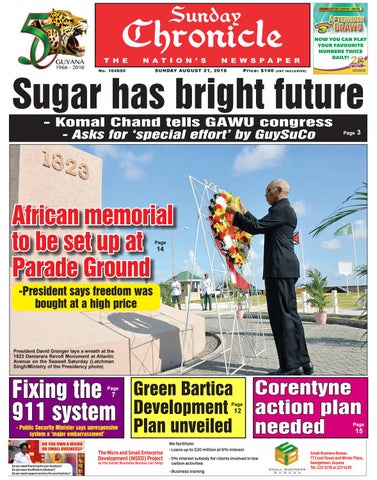
President David Granger lays a wreath at the 1823 Demerara Revolt Monument at Atlantic Avenue on the Seawall Saturday (Latchman Page Singh/Ministry of the Presidency photo)
3
Fixing the 911 system
Page
7
- Public Security Minister says unresponsive system a ‘major embarrassment’
Green Bartica Development Plan unveiled
Page
12
Corentyne action plan needed
Page
15
2
SUNDAY CHRONICLE August 21, 2016
Gun-toting bandits terrorise Peter’s Hall family looking for ‘doctor’ - Family closes business after bandits killed patriarch in 2009
ACCORDING to Shoba Roshan, a chef at a city restaurant, she was asleep in her Peter’s Hall, East Bank Demerara home at about 03:30 hrs on Saturday when five masked, gun-toting men, who had apparently invad-
ed the wrong house, awoke her, her husband and his aunt, demanding to know where “the doctor who live here” was. She said the men gained entry into the house by prying open a back door at the
bottom flat and screwing out the bolts from the grill there. At the backyard, she pointed to a trench which is filled with thick vegetation and a track leading to the bank of the Demerara River. There, a ladder which is used by the Dewans to check their water tank on a trestle was lying across the trench. Roshan said she does not know that any doctor lives in the street; but the men ransacked the home for approximately half of an hour,
all the while asking for “the doctor who lives here”. Roshan said one of the men hit her husband on his foot while demanding the family’s valuables and the “doctor’s” whereabouts. She said the men took away four mobile phones, two of which belongs to her husband’s place of employment, as well as hers. The men also took a small sum of money from the family. Roshan said the men “leff the house in a mess,” making
their escape quietly through the back door. The young lady said several attempts were made to contact the Providence Police Station, but the phones rang out repeatedly. A friend, however, managed to call the police at Eve Leary and alert the lawmen. Officers then directed her to the police at Providence. She said she was disappointed that since the family reported the matter to the police, the investigators were
yet to visit the home, even as she spoke with this publication at about midday on Saturday. Family patriarch Dewan Roshan had succumbed to gunshot injuries he sustained at the hands of bandits while closing his business place one Saturday afternoon in June 2009. Two men attacked the 49-yearold man and shot him in the region of his abdomen. The family’s grocery has since been closed.
The trench aback the Dewans’ home. Residents are calling on the authorities to clean the area in the wake of Saturday morning’s attack
The grill which the men unscrewed
3
SUNDAY CHRONICLE August 21, 2016
Sugar has bright future - Komal Chand tells GAWU congress - Asks for ‘special effort’ by GuySuCo
By Alva Solomon PRESIDENT of the Guyana Agricultural and General Workers Union (GAWU) Komal Chand, Saturday said the union is confident that it will overcome the challenges it faces and that its members will play a critical role in the future of the sugar industry . Speaking at the 21st Delegates Congress of the union at the Bath Primary School, West Coast Berbice , Chand said that the sugar industry, which he said remains the country’s single largest source of employment, has a healthy future . “Indeed, we believe that the industry has a bright and sustainable future,” he declared. The congress, which runs until August 23, is being held under the theme “United Struggles for Workers’
Rights, Democracy and a Secure Future.” Addressing a packed audience dressed in red, Chand said that the union had faced its share of challenges in the past and overcame those, and the current challenges would be dealt with in similar fashion. He said that GAWU is confident of its strength and that the union remains “unshakeable.” “GAWU is of the view that the situation requires special efforts of [the] corporation,” he said of relations with the Guyana Sugar Corporation (GuySuCo). Chand said the corporation continues to refuse to engage the union on matters of concern to the body, especially its demands for pay increases for sugar workers. He called on the interim management committee of GuySuco to bring an end to the decisions which it took
President of the Guyana Trades Union Congress , Lincoln Lewis, makes a point as former President Donald Ramotar , GAWU leader Komal Chand and PPP MP Frank Anthony look on in recent times. He called for dialogue with the corporation in order to bring an amicable end to problems affecting workers. President of the Guyana Trades Union Congress (GTUC), Lincoln Lewis, addressed the gathering, which included Former President Donald Ramotar and several
A section of the gathering at the opening of the congress
Opposition Members of Parliament. According to Lewis, the APNU +AFC government and Guysuco “must talk” on wages issues affecting the workers. He recalled the actions of the previous administration and its treatment of issues affecting workers , including the
issues affecting workers at RUSAL , the bauxite firm in Region 10. “It happened when Bharrat Jagdeo was president of this country,” he said of the problems which have been affecting the bauxite workers. As the Opposition MPs looked on, Lewis noted that the Donald Ramotar Administration had resorted to arbitration in its attempt to iron out the problems at RUSAL, but according to him, the issue remains unsolved. “Same thing happening all the time,” he said. Lewis called on the sugar workers to face their “struggles,” noting that GAWU will continue to ensure that their well -being, including those from the past , present and future , are addressed. But he called on the workers to take on the mantle without fear. “Don’t depend on anybody to do it for you”, he said noting that the workers must
“struggle “since it’s a matter of necessity. Lewis recounted the history of the trade union movement in Guyana, noting that while the country attained 50 years of independence from Britain this year,the struggle for independence started with the trade union movement way before the political parties came to prominence. He went as far back as 1926 when the Caribbean Trades Union Congress commenced. He said that the rights of workers today continue to be under threat by politicians as he called for the rights of workers to be respected. The opening of the congress lasted for several hours as several Opposition MPs, including Indra Chandarpal, Chief Whip , Gail Teixeira and Frank Anthony took swipes at the government while commenting on GAWU and its mandate.
4
SUNDAY CHRONICLE August 21, 2016
CCWU triennial conference…
Government committed to collective bargaining process, says Prime Minister THE coalition government has committed itself to restoring and respecting the collective bargaining process, as can be seen from the fact that the Guyana Public Service
Union (GPSU) and the Government are in talks on salary increases and benefits for public servants, Prime Minister Moses Nagamootoo has said. The Prime Minister
made these remarks in delivering the feature address at the fourth triennial congress of the Clerical & Commercial Workers’ Union (CCWU) at the Cara Lodge, Quamina Street
Georgetown on Saturday. The conference was held under the theme “Pursuing a new approach in this changing environment while protecting workers hard earned gains.” The Prime Minister said the CCWU never thought that labour alone could have brought the results that workers want. He said the CCWU learnt very early that the economic struggle must be integrated with
defining aspect that, as much as you can have it and you can exploit and suppress, you can use power to liberate and free up the human values, human creativity, the splendour of human life. If you have power, it can bring you the vista of new hope,” the Prime Minister said. He said the right to collective bargaining based on agreement, entitlement and benefits have been won by
Prime Minister Moses Nagamootoo arrives for the CCWU Congress. He is escorted by the Union’s president, Sherwood Clarke the political struggle for change, “or else you will just be fighting for bread and butter, and the people in power will always take the cheese away from you. Power is the ultimate goal of the worker.” “…power also has the
DATE: 20/08/2016 N
09 17 18 19 27 28 26
20/08/2016
01 08
13 16 19
20/08/2016
0
0
3
struggle, and this should not be taken away. CCWU President Sherwood Clarke said the existence of strong and vibrant trade unions is essential to the wellbeing of society, particularly at this time as Guyana reaches out in ear-
20/08/2016
8
4
5
nest to attract Foreign Direct Investment, which has the potential to attract investors who are not familiar with our industrial relations culture. “Most of our recent foreign investors came in search of fast money in the extractive sector; and from my experience, people going after fast money are not angels; their presence most often demand an established social setting in which economic growth can be achieved within the framework of the culture and aspirations of the country in which they operate. Therein lies the role of the trade union movement,” Clarke stated. He said this is why the constitution guarantees the right to trade unions to exist and envisage active and constructive involvement in all sectors of national life. Adding that the labour movement will always be a prominent structure in the life of Guyanese, Clarke said it is therefore in the national interest that trade unions should flourish. “Our unions have the capacity to realize our potential as national institutions with a creative power to influence constrictively the direction and quality of national life,” the CCWU President noted. This, he said, requires maximum involvement of all members in the activities of their respective unions. As such, successful unions require more than their members’ money, they requires their time, energies and talent. He added that members need to take an active involvement in the work of the union at all levels.
01 03
20/08/2016 04 05 06 14
18
5
SUNDAY CHRONICLE August 21, 2016
‘I believe in empowering women to speak for themselves’ – First Lady tells Port Kaituma Self Reliance graduates
THIRTY women were Friday awarded certificates after completing Frist Lady Sandra Granger’s Self Reliance and Success in Business Workshop at Port Kaituma, Region One. “Your education is a life-long process, while you would have completed this workshop you will continue to learn, to grow, to support each other… Go back to your communities and help other women to develop, not only in the business sense, but also in all the things you would have [acquired from] the programme,” Mrs Granger told the graduates, who hail from Matthews Ridge, Baramita, Arataka, Four Miles and other communities. The First Lady then encouraged the women to share
what they have learnt with the other women in their communities. “I don’t believe in speaking out for women. I believe in empowering women to speak for themselves. We believe that when women become empowered they empower their families and they are able to contribute in a much better fashion to the communities in which they live,” she said. Facilitator of Interweave Solutions, Mr Yohann Sanjay Pooran, said the workshops focus on ensuring that each woman knows the importance of conducting legal and legitimate business. “We talk a lot about the importance of getting legal, registered businesses, conducting your business through the proper tax re-
Toddler killed in Mahaicony smash-up A three-year-old boy was killed and several persons injured following an accident at Mahaicony, East Coast Demerara early Saturday. A woman named Latoya Wayne and three other passengers, including the toddler, were travelling in a taxi along the East Coast Demerara road when, at Mahaicony, the taxi was allegedly hit by an oncoming vehicle which had suffered a blowout of one of its wheels, causing it to topple. In the resulting smash-up, seven
persons were rushed to the Georgetown Public Hospital Corporation (GPHC), where the toddler was pronounced dead on arrival. Speaking to the Guyana Chronicle, Wayne’s brother-in-law disclosed that he received a call at about 1:30 pm stating that she was involved in an accident. A source at the hospital indicated that five persons remain in serious condition and are currently receiving medical attention.
Region One Chairman Mr. Brentnol Ashley presents a certificate to Ms Nevita Poliah, who said that she intends to use her newly acquired knowledge to open an electronics business. (Ministry of the Presidency photo) gime as established by the Guyana Revenue Authority (GRA), ensuring that you follow through with [the] National Insurance Scheme (NIS), ensuring that the busi-
ness you operate is not only successful, but legal,” he said. Echoing a previous remark made by the First Lady about the link be-
tween empowering women and an overall enhanced standard of living for families and communities, Mr Pooran said this theme is central to the training.
6
Editor-In-Chief
Nigel Williams Sunday Editor
Neil Marks
Editorial: 227-5216; 227-5204 guyanachronicle.com wnigel10@hotmail.com gnnleditorial@gmail.com
Editorial
Our education system CONGRATULATIONS to all the students who sat this year’s CSEC! Each and every one has succeeded in a complex world which includes negative influences, socio-economic challenges in household and society, and an imperfect education system. It took steadfastness and determination to persevere, and such would have also been impacted by peers, teachers, parents and other positive influences. This newspaper sees each and every student as a success, with the world as their oyster, to create their own endless possibilities and opportunities. Special congratulations to Fatima Karim of St Rose’s High, who gained 19 Grade Ones and a Grade Two; and Kayshav Tiwari of Queen’s College, who obtained 19 Grade Ones. It is instructive that both students have an interest in pursuing petroleum engineering at the tertiary level at a time when Guyana is preparing to drill for oil. Such interest and pursuits are worthy of the attention of the policy makers. The statistics of the pass rates, including national percentage and per subject, have been made known by the Ministry of Education. These results, though yearly critiqued by representatives of the ministry and dissatisfaction is expressed, will be meaningless in the presence of non-acceptance that the national policy in addressing the education sector may have serious deficiencies. What the nation puts into education will determine the results received. President David Granger is on record as saying that the teachers must be the nation’s highest paid public servants. And this statement is indicative of the premium the nation’s Head of Government places on education in the nation’s developmental thrust. Making this possible requires a meeting of minds between the policymakers and planners to address, in a holistic manner, various aspects of education. It should be said that when education is seen through holistic lenses, it will factor in the diverse abilities and preferences of students, and put systems in place to meet the various talents and potentials. Where development takes a holistic approach, it would factor in the truism that one size does not fit all. The establishment of community high schools was aimed at educating students that are industrial arts and technically inclined, and at meeting an aspect of the nation’s human capital diversity. That this form of education was disbanded without similar replacement is not only tantamount to throwing
SUNDAY CHRONICLE August 21, 2016
The state of the National Art Collection Dear Editor,
own of the events of this period.
WHAT’S that old joke? “It’s déjà vu all over again!” That was what I thought reading in the Sunday Chronicle of August 7 an article which sought to regurgitate a shock-horror-scandal story first aired a little over two years ago in sections of the press, between May and August 2014, about damage supposedly caused to works in the National Collection of Art by wood ants (termites) at the National Gallery, Castellani House. It is not a coincidence, however, that, two years later, these detractors felt it necessary to suddenly spring into action once again, insisting that ‘neglect, neglect, neglect!’ had still caused damage to art works, though now identified as being caused not by wood ants -- a notable change of detail -- but by woodworm. The reason for this sudden activity was that, after two years of restraint on my part in not responding publicly to the unethical misrepresentation of matters of government administration regarding my work as Director and Curator of the National Gallery -which featured in the media well into 2015 -– I finally, quite recently, submitted to the Government of Guyana a detailed report of my
ONLY ONE ASPECT In responding to your article, and for the first time also correcting a significant fact that has stood in the public record since 2014, let me state that only one aspect of this report dealt with the critical matter of a false report of wood ants ‘infesting’ art works, submitted from within the gallery in mid-May 2014 to those in authority; which Mr. Gajadhar, as a gallery committee member, would have received at that time. Very soon after, this allowed his friend and close colleague, prominent artist Mrs. Bernadette Persaud, at the time with a major exhibition on show at the gallery, to complain in another section of the press that her painting had been left ‘propped up’ for four years and allowed to be destroyed by wood ants at the gallery. Returning to work in July 2014 after many months of leave, my receipt of this appalling, barely onepage report made understandable the vehement hysteria and confidence with which Mrs. Persaud had hurled her accusations into the public domain in May 2014. Though it did not make excusable, I submit, the editors of the highly regarded and highly believed newspaper, in an astonish-
out the baby with the bath water, but denying those so inclined, or interested, the needed opportunities. There is a need for labour from the least to the most skilled, and for students that are interested, motivated and alert. Where a society looks at increasing life expectancy as part of the developmental agenda, education should factor in health and wellness, such as returning some form of physical education to the curriculum. It should not be lost on society that the high achievers have attributed extra-curricular and physical activities as part of their intellectual regimen. Our teachers are vital in education delivery, and any developmental strategy must factor in giving them the deserving attention, not merely to ensure they are being equipped with the knowledge and facilities to teach, but also examining incentive schemes that will attract and retain a professional corps that is second to none. Where actual salary increases may not reach the level touted by the President, the Ministry of Education can enter into agreement with the Guyana Teachers Union (GTU) on deferred income arrangements, as was done in the late 1970s and saw the issuance of Defence Bonds. These bonds were issued to teachers, and were later redeemable for cash. The issue of duty-free motor vehicles for head teachers can see the pool expanding to other teachers, inclusive of looking at motorcycles, lower motor vehicle cylinder capacity, and aiding in the provision of
ing editorial some days after, had backed up her complaints word for word and had thrown in a few other issues for good measure in late May 2014. MY INITIAL RESPONSE I am obliged to repeat here what I had stated in my initial response to this matter in June 2014 in the Stabroek News, and in my recent report of 2016; that is, that the woodworm is a very manageable, localised problem found in sections of woods used for frames or stretchers of some paintings, which had been identified, reported to me, and treated by necessary spraying by gallery staff over many years; there had been no reports for several years about the far more deadly, spreading scourge of wood ants colonies. It is therefore amusing and significant that Mr. Gajadhar, taking over from Mrs. Persaud in 2014, has now switched the vehement public accusations from wood ants to talk about woodworm. Incidentally, woodworm is caused not by a worm, but by a beetle which lives in some woods but whose damage can be seen after several months, or sometimes several years, depending on the See page 7
access to affordable payment plans. The last agreement signed by the GTU and the Government of Guyana has seen complaints from the union that this administration is reluctant to implement it, which in itself serves as a disincentive and demotivation, and poses the question as to premium placed on teachers in education delivery and nation-building. It takes a village to raise a child, borrowing from the Ghanaian proverb, and here is where, outside of the policymakers, teachers and the staff in the education system, the parent and community have their roles. Parent Teachers Associations need the technical support in examining and understanding why this critical partnership in the child’s development is no longer seen and/or treated with deserving seriousness, and thereafter systems put in place to correct the anomaly. Education forms the bedrock in the development of every society, and we have to get it right with our education system. And this requires approaching education frontally, making the needed investments that would always factor in what the nation intends to be the desired results. Our children live and act out what they see and learn, and where any child is so denied, work had to be done. The celebration for those who have reached this far must also see efforts being put in place to bring within those from out of the fold, thereby leaving none out from the yearly celebration, recognition and accolades.
SUNDAY CHRONICLE August 21, 2016
Fixing the 911 system
7
- Public Security Minister says unresponsive system a ‘major embarrassment’
PUBLIC Security Minister Khemraj Ramjattan has said that the police emergency hotline 911 “continues to be a major embarrassment” to the security forces, but said efforts are underway to fix the problem. The security minister’s statement comes in the wake of findings from the recently completed Commission of Inquiry into a fire at the state-run Dropin Centre for disadvantaged children. The fire caused the death of two small
boys. The investigation, which was completed by retired Colonel Windee Algernon, confirmed statements by the centre’s staffers that calls to the 911 service went unanswered. The reliability of the 911 service has been a matter of concern for years with the former government blaming Guyana Telephone and Telegraph (GTT) for their poor service and the company denying responsibility, saying that the 911 service is controlled by the police
force. Ramjattan told the Guyana Chronicle that the police force continues to experience problems with the system and efforts are being made to secure the necessary equipment to improve it. “We continue to experience major difficulties with the 911 system. We have to get more equipment that will facilitate the system,” the minister stated. He said the acquisition of the necessary equipment and the improvement
of technical aspects of the system “has proven to be costly”, and thus he could not say how soon there would be an improvement. He noted, however, that platforms necessary for the system are being laid, and he has received a proposal from Police Commissioner Seelall Persaud to deal with the matter. Ramjattan said a proposal was also available from cellphone giant, Digicel. (Zena Henry)
The state of the National Art ... From page 6
type or species of wood so infected. This includes the famed silverballi which Mrs. Persaud so proudly described as the wood used for her paintings in her letter of response to mine in early July 2014: there being several types of silverballi, at least five or six, some are more resistant to insect damage and decay than others. Responding further to your article, I note with some bemusement the information that a ‘priority list’ of some 27 works had been noted for ‘urgent attention’ in 2014, but that since then another 29 works had been added (my emphasis) to the list. Why then was nothing done, it seems, in the interim to the first priority list? How can this be, after two years and all the hysteria of concern and accusation, and the ‘urgent attention’ that was needed at the time? What were the problems that made these works a priority, and why are there no details? And why has there been no action, supervised by a management committee of which Mr. Gajadhar was a member?
DELIBERATELY VAGUE The alarm is raised, again with no details, about Dr. Denis Williams’s ‘Human World’, regarded as the founding work of the Collection. Why the reference to ‘something’ being wrong with the ‘state’ of this work, which ‘the untrained eye’ might not see, yet which was still exhibited for some months despite needing ‘urgent repair’? Once again, we have a description which is deliberately vague yet possibly sensational enough for an impressionable public. Additionally, the ‘three storage rooms’ in the gallery, so glibly referred to, were always considered temporary and far from ideal. The two garages in
the gallery compound were upgraded and adapted with the installation of storage racks for works by 2000, and after not one, but two expert conservation projects on the collection, in 1997 and 2000. At this point (2001) I informed the Management Committee that we needed more storage -- which I saw as a short-to-medium term requirement and which would have given us not only a two-level facility which was designed, but critically, a large enough space for an examination room and further workshop space, where all art works in or coming into the gallery for whatever purpose would be examined for cleaning, damage, repair, reframing, fumigation, before being taken for display into the gallery. The cost of such a facility, to be built at the far end of our back lawn, was projected at $18 million, a whopping sum at the time, which the government simply did not have in an era of rigid IMF oversight. I remember the chill within me as we were told at our meeting that we would have to make do and make the best of the available facilities; which we did, with further upgrades referred to in my letter of June 2014. This work has, however, been excruciatingly slow, delayed over several years by many matters that were out of our control; but this certainly does not make acceptable Mr. Gajadhar’s sweeping and vehement description of storage as ‘very very poor’ (again with no details). Storage is only one crucial and necessary part of collections’ preservation. A look at the interiors of our storage garages will reveal no space, nor should there be in storage for proper examination, let alone repair, cleaning or (re)framing of art works. And the space outside the facility is completely restricted now by structures relating first to a security building to the east, and much closer
to the gallery building and our storage, the structures of a national egovernance project. Both occupy the wonderful space which years before I had hoped would be established as a secure site to do our important work of ‘routine maintenance’, and thus the care and preservation of the National Collection.
SELECTIVELY BLIND Has Mr. Gajadhar been selectively blind, seeing only woodworm but not the highly limited space which Castellani House now must operate in? How relevant, moving and painful, then, was it for me to read the recent comments of Ms. Jennifer Wishart, longterm administrator and the institutional memory of the Walter Roth Museum of Anthropology, on August 13 last, that ‘over the years’ she had learnt that ‘in order to change something, we need to build something’. I dare to say here that these were things that I had dared to see ahead of me, hence my advice and urging to literally build a space to those with whom I worked and to whom I had to report regarding the current and future work of the National Gallery. Indeed, I must repeat here an earlier wish that such plans for critical workspaces might be incorporated in plans in the foreseeable future for a new, dedicated National Gallery complex. I note, in closing, the negatively crafted messages that seem to have been sent out from those in authority, such as then Director of Culture Dr. Rose in 2015, characterising ‘infestation’ and our lack of ‘technical competence’ to manage this in a project proposal for conservation experts. But expert conservators are not needed for insect extermination when competent local companies do this job. Indeed, my own draft proposal to another Latin American country some
years ago, referred to in 2014, was for conservators to work on specific areas and common issues of repair of paintings, incorporated with a basic introductory training programme in this field for promising young people who might form a future conservation work force serving our local/national institutions. But with such woeful melodrama regarding our dire needs, no wonder the Argentine ambassador is quoted, speaking poetically about ‘the long road to bring back to life’ (twice mentioned) the National Collection. What information was given to the ambassador to lead him to such characterisation of the National Collection, I wonder? The tone of your article, finally, is another example of misrepresentation. The description of the ‘horror story’ of the collection is used more than once in breathless scandal sheet style, enhanced by unnecessary exclamation marks and a large, shocking pink headline which turns out to be possibly unjustified, as the ambassador is quoted as saying that a team might not come from his country after all to provide conservation services to Guyana. My disappointment overall has been that your article was the work of a professional journalist indulging in the option of hyperbolic language, repetition, and a lack of critical detail; added to a bold and possibly inaccurate headline, rather than employing professional practice and standards which would guarantee always the independent and balanced purveying of information that the reading public deserves. I trust that my comments here might go some way to redressing the unfortunate bias of this article, whose sole purpose seemed to be to mislead rather than to enlighten its readers. ELFRIEDA BISSEMBER
HINDS’SIGHT
8
Dr David Hinds
I
SUNDAY CHRONICLE August 21, 2016
It is healthy for all ethnic groups to make policy demands on Government
N my remarks at the recent Cuffy250 State of the African-Guyanese Forum, I called on African-Guyanese to make demands of the government for policies that would be directly and indirectly beneficial to that community. Those remarks came after President Granger had challenged African- Guyanese organizations to devise a plan of action consistent with the mandate of the United Nations International Decade of the People of African descent and committed his government to satisfying five of the 10 points laid out by the UN. In effect, the president has joined with the world community in acknowledging the case for reparative policies aimed at correcting the socio-economic and cultural damage done to people of African descent as a result of centuries of enslavement. As I said in last week’s column, the president must be commended for frontally addressing an issue that has been quite controversial in Guyana. My call for African- Guyanese to pressure the government to institute policies favourable to them does not ignore the gesture by the president. Rather, it is meant to reinforce the president’s challenge. There are two major considerations that inform my call. First, it is grounded in the age-old truism that governments seldom initiate policy for any group without direct demands from that group, or unless it feels that the absence of such policy will negatively affect its chances of retaining power. We in Guyana have long abandoned the tradition of making demands of government, partly because in our tribal politics those demands have often been ignored or deemed a form of ethnic betrayal. So government policy choices have been driven less by demands from the groups and more by what guarantees the party’s or parties’ survival in power.
The second related consideration that informed my call was the simple fact that the vast majority of African-Guyanese voted for the present government and has a right to expect the government to implement policies favourable to them. It would be stupid for a community to vote for a government and not expect that government to advance policies favourable to it. The problem is that it is difficult for a government of a particular ethnic group to implement policies that directly benefit that group without facing the sometimes fatal charge of racism. That is the bind the present government finds itself in. It is easier for the government to articulate a policy that favours the survival of the sugar and rice industries or the empowerment of hinterland communities. Note that the massive subsidy for sugar in the form of the bailouts, which benefits the Indian-Guyanese and Amerindian communities, was not a controversial issue. But as soon as the President hinted that the government would look into issues that affect African-Guyanese, charges of ethnic favouritism begin to surface. Let’s be frank-- In an ethnically divided political economy such as ours, no government policy is ethnically neutral. Given the ethnic architecture of our political economy, public policies logically have ethnic impact. Ravi Dev has long called for Ethnic Impact Statements to accompany public policy. The APNU+AFC included it in their election manifesto. If such statements are issued, the country would be publicly notified about the impact of the policy, which then forces the government to ensure that all ethnic groups benefit from its menu of policies. I have come to the conclusion that we have to move past that section of the society which refuses to accommodate the fact that our electorate and economy are divided and as such, government policy has to respond to that reality. Ethnic Unity and Social Cohesion are ideals and goals that we must always strive for; we cannot escape that imperative. But while we move in that direction, initiatives to that effect cannot and should not become substitutes for the socio-economic security of the individual groups.
Our society is stalled partly because we have refused at the level of policy to openly address the particular needs of our ethnic groups. The idea of “one tide lifts all” has been a colossal failure—time to move away from it. The experience of enslavement has left in its wake particular socio-economic challenges for African-Guyanese. Indentureship has left its particular scars on the Indian-Guyanese community. Marginalization to the physical and socio-political edge of the society has affected Amerindians in particular ways. The correction of these maladies will take particular policies. We have to come to grips with these realities and move on. This does not mean that government must initiate ethnic policies outside of a national framework; to the contrary, those policies must fit into a larger national developmental framework. So when the government fixes sugar, it benefits the mainly Indian-Guyanese sugar workers and the larger Guyanese economy. When the Village Economy is restored through policy and African-Guyanese and Amerindian Entrepreneurship is encouraged, all of Guyana benefits. So I reiterate my call to African-Guyanese to demand favourable policies from government. The answer to government sloth in this regard is not to say you wouldn’t vote in 2020, but to demand value for your 2015 vote. And note, the demand must not be for handouts, it must be for policies from which the entire community would benefit. To the leaderships of the other ethnic communities, rather than charge the African-Guyanese with wanting favoured status, you should make your own demands on government.
A POLICEMAN is currently being investigated, including by the Police Office of Professional Responsibilities, after shooting a man outside of the Georgetown Prison at Camp and Durban Streets on Saturday night. Police say the man visited the back of the prison at John and Durban Streets, where he behaved disorderly and threw down some steel barriers in the presence of ranks guarding the perimeter of the prison. Ranks of a police patrol then took the man into custody; but after his release, he returned to an area south of the prison and resumed behaving in a disorderly
fashion, prompting a constable armed with a service weapon to intervene. Reportedly under supervision of a subordinate officer, the constable approached the unarmed man and was allegedly attacked. In defence, the constable discharged a round, hitting the man in the lower abdomen. He was immediately rushed to the Georgetown Public Hospital Corporation (GPHC), but died while receiving treatment. Police investigations are reportedly in progress, including one by the Office of Professional Responsibility.
Dr. David Hinds, a political activist and commentator, is an Associate Professor of Political Science and Caribbean and African Diaspora Studies at Arizona State University. More of his writings and commentaries can be found on his YouTube Channel Hinds’ Sight: Dr. David Hinds’ Guyana-Caribbean Politics and on his website www.guyanacaribbeanpolitics.com. Send comments to dhinds6106@aol.com
Disorderly man shot and killed outside Camp St Prison
9
SUNDAY CHRONICLE August 21, 2016
UN “Decade for People of African Descent” must not only see a plan, but working of the plan THE United Nations (UN) has designated 2015-2024 “International Decade for People of African Descent.” It is expected that Guyana as a member state with a population that comprises the identified demographic will see Government moving to ensure, after working with stakeholders, that a Plan Of Action is put in place to bring about what the UN seeks to achieve. A Plan of Action does not mean having a document to say “look, we have a plan,” it means putting the necessary mechanisms in place that will bring about results and impact people’s lives in positive ways. When in 2011 the UN declared it “International Year for People of African Descent,” the Guyana Trades Union Congress (GTUC) wrote then President Bharrat Jagdeo outlining a menu of measures worthy of consideration and implementation by the Government. Not unexpectedly, with Jagdeo’s racist outlook to life, he neither sought to engage the GTUC or implement any measure, opting instead to have the State host a couple of fetes, in the usual trivialising of matters of import to this community. Reproduced below, in part, is what the GTUC wrote Jagdeo. It should be said that these remain matters of import to the GTUC and those not implemented, it is desired that they be. January 17, 2011 His Excellency: Re: Matters deserving of the administration’s attention as Guyana marks International Year for People of African Descent The Guyana Trades Union Congress (GTUC), in meeting its responsibilities to the communities within which it operates, embraces the vision set out in the United Nations Declaration on the International Year for People of African Descent.…Having considered the positions articulated by the UN and leaders of the international community, the GTUC believes that Guyana, as a member state, is aptly positioned to rise to the challenges by incorporating in its agenda pertinent issues to the African community. We are forwarding herein for urgent consideration, a list of issues to be addressed in the African community which requires your government’s urgent attention in this International Year for People of African Descent. Conscious that our list below does not include every area the community would like to have addressed, the government is urged to pay special attention to these herein identified, in the development and execution of an agenda consistent with the UN’s charge and goals….
The following issues are brought to your attention: 1. Respect for African Rights consistent with international conventions and charters, Universal Declarations of Human Rights, international laws, the Guyana Constitution and the Rule of Law. 2. Respect for the rights to Collective Bargaining and Freedom of Association in the Public Service, Public Sector and Bauxite Industry. 3. Accurate recording, respect and acknowledgment of Africans’ contributions towards the development of Guyana. 4. Engaging African organisations and those who represent Africans’ interests in accordance with the Constitution and Secretary-General Mr Ban Ki-moon’s calls that “the success of the International Year requires concerted efforts across the United Nations system and at the regional and national levels, with the widest possible engagement and participation, and the full integration of Africans into their social, economic and political life and at all levels of decision-making.” 5. Recommit to parliament the Opposition’s 2007 Motion “That an African Land Commission be established, similar in status to the Rights Commission established under Article 232G of the Constitution of the Cooperative Republic of Guyana to determine the issue of ancestral land rights of African-Guyanese,” and pass same into law. 6. Establish a Commission similar to the June 1948 Commission that enquired into the shooting of striking sugar workers, to enquire into the May 1999 police shooting of unarmed striking public servants who were picketing peacefully in the vicinity of John Fernandes Wharf. 7. Establish the Rights Commissions Secretariat. 8. Establish a Commission to enquire into the hundreds of extra-judicial murders from 2002-2006, as already called for by the Joint Opposition People’s Partnership and the international community. 9. Implement the recommendations of the 2004 Disciplined Forces Commission Report. 10. Implement recommendations made by the UN Independent Expert on Minority Issues, Gay Mc Dougall, from her visit to Guyana in 2008. 11. Release to the relevant authority the tapes of opposition politicians engaging criminal elements as a measure to aid society’s efforts to get to the bottom of the mayhem that held the East Coast of Demerara under siege and which has served to escalate racial tensions, resulting in the loss of economic livelihoods, the dislocation of families and loss of lives of hundreds of women and children inclusive. 12. Develop and implement regulations to give effect to the 1997 Occupational Safety and Health Act, necessary to protect the workers of Guyana. 13. Implement the 2001 Hoyte/Jagdeo Agreement to address the concerns of the Depressed Communities of Fyrish/ Gibraltar; Hogstye/Lancaster; Blueberry Hill/Victory Valley; West
Watooka; Enterprise; Buxton; Meten-meer-zorg and De Kinderen. 14. Implement the 8th March 2000 Guyana Trades Union Congress(GTUC) /Government of Guyana Agreement which dealt with addressing crime and the development of housing complex for workers. 15. Honour the 12th December, 2008 Chief Justice (ag.) Ian Chang’s ruling to “stop discriminating and penalizing Lindeners by denying them a broadcasting licence” (Stabroek News, December 13, 2008). 16. Institute compulsory arbitration on the Guyana Bauxite and General Workers Union (GB&GWU) and / Bauxite Company of Guyana Inc (BCGI) impasse which commenced in 2009. 17. Return tax-free overtime achieved by bauxite workers in 1988 through their single-handed struggle which has been taken away from them by this administration, even as it is maintained in the Indian-dominated sugar sector. This was awarded to the sugar sector simultaneously as it was awarded to the bauxite sector by the Hoyte administration; 18. The establishment of a national stakeholders committee to look into the vendors’ problems that respect their right to work and participation in decision-making that impact their lives. 19. Return the yearly grants to the Guyana Trades Union Congress and Critchlow Labour College (CLC), withheld since 2000 by the Guyana Government, since the opportunities granted by the CLC are predominantly accessed by African-Guyanese and offer youths a second chance. 20. Conduct a public inquiry into the GB&GWU’s charges of discrimination against bauxite workers and their communities based on their race, political geography and perceived political allegiance. 21. Establishment of a Guyana Presidential Research Institute, where information on the work and lives of all past presidents can be available to the public. 22. Establish the Procurement Commission to ensure equitable allocation of contracts. 23. Establish a national stakeholders commission for the distribution and re-evaluation of lands and houselots. 24. Resizing and relocation of the Georgetown Prison and the revamping of the penal and custodial system to facilitate more community services as penalty for minor offences. 25. The re-introduction of National Service to provide opportunities to youths and those in need of second chances. As citizens of this world, it is opportune to reiterate the Universal Declaration of Human Rights which affirms, “All human beings are born free and equal in dignity and rights.” To this end, Guyana as signatory to the Universal Declaration of Human Rights, and your administration as the manager of the state’s business, are expected to work meaningfully towards the realization of the UN Secretary-General’s call to eradicate racism once and for all.
10
SUNDAY CHRONICLE August 21, 2016
Corruption as a form of structural violence: a critical obstacle to the Good Life By Clement Henry, Ph.D candidate, University of the West Indies CORRUPTION and violence have captured the headlines in Guyana for over a decade and a half, or probably longer; and perhaps will continue to steal the headlines for some time in the future. Both issues have serious consequences for development and human security. Transparency International (TI) defines corruption as “the abuse of entrusted power for private gain.” According to TI, corruption undermines the rule of law by eroding democratic institutions essential for fair and equitable societies; depletes national wealth, since vital resources are misdirected away from important developmental projects; ravages entire ecological systems through careless exploitation of natural resources; weakens people's trust in the political system, its institutions and its leadership; and corrodes the social fabric of society. Yury Fedotov, Executive Director of the United Nations Office on Drugs and Crime (UNODC), speaking at a high-level meeting of the sixty-seventh session of the UN General Assembly in New York, declared that corruption circumvents fair tendering processes, and the consequences are severe: funding meant for important development and human security projects are diverted into the hands of corrupt officials; and failure to win contracts on the part of some firms can cause businesses to fail, creating unemployment. Dr Carl Stauffer explains that corruption develops a self-perpetuating life of its own, like all other forms of systemic violence do. Drawing on rational choice theory, he further explains that corruption originates from individuals making calculated choices of self-interest -– a kind of cost-benefit analysis regarding the risks and advantages of participating in corruption. Many enter into pseudo-collaborations, convincing themselves and others that participation in the corrupt system is the only way to personally survive, and even to preserve societal order. Corruption is a form of structural violence, and therefore must be addressed in the effort to promote the ‘Good Life in a Green Economy’. Structural violence is a term coined by Johan Galtung to refer to any constraint on human potential due to economic and political structures. Galtung differentiates between two types of violence.
Firstly, direct violence is the type of violence where there is an actor committing the act; and secondly, indirect or structural violence is the type of violence where there is no such actor. Structural violence finds its genesis in the social, political, and economic institutions and structures, and generally leads to comparatively similar amounts of death and harm to individuals as direct violence. Structural violence is as dangerous as direct violence, because it often leads to direct violence of greater intensity and the fracturing of society. According to Galtung, even though direct violence tends to be more visible and easily perceived, there is no reason to believe that structural violence amounts to less suffering than direct violence. In fact, structural violence can create fertile conditions for direct violence to thrive. Violence, direct or structural, is a major obstacle to people’s survival prospects, well-being and quality of life. Violence limits people’s choices, and robs them of opportunities for meeting their basic needs and personal development. Human deprivation and suffering, poverty, inequality, social exclusion, and inter-ethnic and inter-communal conflicts will be significantly reduced when individuals and communities feel secure and protected from threats that originate from direct and structural violence. In contradistinction, violation of the basic human needs of individuals, exclusion and immiseration of entire communities lead to human suffering and social and communal deterioration, leading to more violence in its direct and structural manifestations. These direct structural and manifestations in turn lead to the worsening of peoples’ life chances and survival prospects, greater misery and human sufferings. Breaking this cyclical relationship is contingent on the authority’s willingness and ability to reduce or avoid violence in all its manifestations, and thus provide human security. How can we address corruption? I supply two simple but necessary solutions. Firstly, government should endeavour to ensure transparency and openness in its spending. Citizens should be given opportunities to scrutinize government activities and spending. In this regard, attention must be given to improving literacy across the society and improving press freedom. Secondly, accelerate efforts in e-governance. E-governance reduces corruption by taking away discretion and replacing it with automated processes; making
Towards a Good Life in a Green Economy decisions traceable; providing documentation to citizens for follow-up; fostering accountability by guaranteeing citizens’ access to information through the Internet; and creating the conditions for the simplification of rules and processes. In sum, because corruption as a form of structural violence has consequences equivalent to, or worse than, direct violence, it is essential for government and its partners to take drastic measures to combat corruption. In the absence of these measures, there can be no human security, no inclusivity, no social cohesion, and no good life in a green economy. (Comments can be sent to towardsagoodlife@gmail.com)
CLEMENT HENRY is a Ph.D candidate at the Institute of International Relations, University of the West Indies, St Augustine Campus. His doctoral dissertation is entitled “A Theoretical and Empirical Analysis of the Dimensions of Human Security: the Case of Guyana”. Clement is currently the Project Coordinator of the Citizen Security Strengthening Programme (CSSP). His publications include: “An Analysis of the Effectiveness of Foreign Aid Flows to Guyana” in Selected Essays in Contemporary Caribbean Issues (eds., Anatol & Kirton). His research interests include human and citizen security, poverty, development, economic growth, and development finance.
11
SUNDAY CHRONICLE August 21, 2016
More facilities Granger eyes more entrepreneurship schemes to encourage CITING existing models, President David Granger has expressed the hope of having financial schemes established across the country to satisfy the needs of budding entrepreneurs. “I hope that every single town…could have schemes by which young people could access credit, access training and set up their own businesses,” the President said, as he spoke to reporters on his weekly television programme, The Public Interest. Government will continue to create the environment needed to empower the young generation, he emphasised while alluding to the three primary initiatives – the Sustainable Livelihood and Entrepreneurial Development (SLED); the Hinterland Employment and Youth Service (HEYS) Programme; and the Linden Enterprise Network (LEN) – that are equipping young people with the requisite skills, knowledge and
“I hope that every single town… could have schemes by which young people could access credit, access training and set up their own businesses.” – President Granger finance needed to become entrepreneurs. Last week, more than 100 young entrepreneurs from across Guyana graduated from the Ministry of Communities SLED initiative. Two of the beneficiaries, one of whom was freed from jail after being pardoned by the President and the other formerly of the New Opportunity Corps (NOC), testified to having been given another opportunity to change their lives for the better. Through the SLED initiative, young Guyanese are being equipped with the
relevant skills to enter the world of business with special emphasis on innovation. Additionally, the programme provides grants to registered groups and associations, who need the financial or economic boost to improve their enterprises. However, it is operationalised after the prospective entrepreneur undergoes training, provides a business plan/ proposal and is identified as a successful applicant. SLED has partnered with non-profit organisations, such as the Canada-funded Caribbean Local Economic Development Project (CARILED),
the Skills and Knowledge for Youth Employment (SKYE) and the Swine Producers Association to provide training and capacity-building to beneficiaries of the grant. Like SLED, which aims to assist those at the grassroots level by providing training, mentorship, business development skills and start-up grants for individuals and for groups, President Granger during another forum had explained that LEN, which was launched last December in the mining town of Linden,is designed to provide financial assistance to persons with ideas for small business ventures. A government subvention of $155M from the 2015 national budget has been made available to assist those persons. The HEYS Programme, which caters for 2000 youths in 106 communities, is also testimony of the government’s plans to create employment opportunities.
Remote Kurutuku village to get health post PUBLIC Health Minister Dr. George Norton (second from left) turns the sod for the construction of the new Health Post at Kurutuku, Region 7. Some 100 residents of this village and those from contiguous villages are expected to benefit from this Health Post. Also in photo are residents of Kurutuku, Region 7; Engineer Adrian Ragoobeer (fourth from left); Director of Regional Health Services, Dr. Kay Shako (third from right); and other officers from the Public Health Ministry. The Minister said basic deliveries will be done at the new Health Post, which would also provide pre and post-natal care and other in-patient services, particularly for those who may contract malaria.
studies in science, technology
- Granger says these will help country ‘take off’ PRESIDENT David Granger has said his government will do more to encourage young people to get involved in the science and technical fields. On his weekly television programme, The Public Interest, the President underscored the importance of investing in the development of more technical and vocational institutes, in addition to creating opportunities in the world of science. “You give the schools laboratories in botany, in chemistry, in physics, in biology, in zoology and you will see this country take off. And those students who seem not to have the aptitude, you will see how well they perform. So my approach and the Government’s approach is to provide facilities,” President Granger explained. As such, he said the foundation must be laid at the level of the Cyril Potter College of Education, explaining that teachers must be granted the opportunity to explore even more in the sciences, vocational and technical fields. In this year’s Caribbean Secondary Education Certificate (CSEC) examination, the overall results indicated excellent performances in 15 subjects where the Grades One to Three passes exceeded 75 per cent. Those subjects were: Agricultural Science (DA), Agricultural Science (SA), Biology, Food & Nutrition, French, Home Economics Management, Information Technology, Principles of Business, Religious Education, Theatre Arts, Electronic Document Preparation and Management, Physical Education & Sport, Music, Building Technology (Const.) and Building Technology (Woods). Significant improvement was also noted in Biology and Physics. Grades One to Three passes in Biology moved from 59.3 percent last year to 76.38 percent this year, while Physics moved from 44.81 percent last year to 55.83 percent this year. Human & Social Biology showed improvement in Grade One to Three passes from 49.35 percent last year to 58.42 percent this year. In addition to focusing on the sciences, President Granger said his Government will continue to place emphasis on Information and Communication Technology (ICT), noting that more IT laboratories will be established in schools across the country. “I have been into some hinterland schools, you have got the machines, the computers there, but you don’t have internet connection, so overall, we hope that by liberalizing the telecommunication sector…children in all schools [would be]…able to access the information they need.” Teachers, he said, upon entering the Cyril Potter College of Education, will be provided with laptop computers to aid in their studies.
12
SUNDAY CHRONICLE August 21, 2016
Green Bartica Development Plan unveiled GREEN jobs and income growth that promote clean energy and reduce carbon emissions and pollution are among key benefits that will be materialized when the Government rolls out the Green Bartica Development Plan -– an initiative that was unanimously endorsed by the Bartica Town Council. Crafted by the Ministries of the Presidency and Communities based on a series of consultations with stakeholders, including the Central Housing and Planning Authority (CHPA) and the Guyana Lands and Surveys Commission (GLSC), the plan has been designed to transform Bartica and all Region Seven (CuyuniMazaruni) into a model green town, in keeping with President David Granger’s vision to drive Guyana’s development through sustainable initiatives. The Town Council has adopted the plan at its statutory meeting, held last
Wednesday in the boardroom of the Regional Democratic Council office. In his address to the Town Council, and later to representatives of the business community and private sector, Presidential Advisor on the Environment, Rear Admiral (ret’d) Gary Best, explained that the plan would aid in creating policies that would lead to the sustainable development of Bartica. “In ‘greening’, what we expect the Government will do is use both private and public investment to… drive green jobs and income growth, which promote clean energy and reduce carbon emissions and pollution to [prevent] the loss of biodiversity and eco-system services,” Advisor Best explained. Government would also be keen to mainstream adaptation and mitigation into development; meet international standards and indicators; select and utilise alternative energy sources (solar,
hydro-power and biomass) that are most economically feasible; and manage and value natural capital and land use planning, among other actions. Adapting to a green pathway also entails sustainable harvesting of natural capital, environmental security, economic prosperity, and social cohesion and other measures. “Sustainable means that you harvest your natural capital so that generations in the future can benefit from the same natural capital,” Advisor Best said. He also noted several benefits -- principally social, economic and environmental -- that would accrue and make Guyana an upper-middle income country by 2025. Meanwhile, Agricultural Engineer Charles Griffith, in his presentation on the industrialisation and modernisation of Bartica, said his group considers the proposed Land Use Plan to be one of the most important compo-
nents of the overall Green Bartica plan. The group has created an inventory of all the resources, analysed that data, then developed a strategy and a strategy proposal to provide an overall concept of the plan that covers Bartica’s extended demarcations, which measure about 68 square miles, a figure that is subject to verification by the GLSC. “You need to have a vision of what you want this place to look like 20 years, 15 years, 5 years down the road…there are matrices that you can develop to assist you to put together a master plan of where you want to go in terms of improving your standard of living, the municipality being able to sustain itself…being able to take care of its debt…being able to provide benefits for both industries and the people of Bartica; that is the overall objective -- improved standard of living, but it must be sustained,” Griffith explained.
The plan proposes to diversify the Bartica economy so that the main source of income would not be primarily from the mining sector. “Bartica is very fortunate… it has water, it has forest products, it has minerals, it has quarrying; and with the combination of productive land and water, there come agricultural enterprises. In that context, those are the major resources,” he said. With regard to the modernisation component, it proposes a restructuring of the drainage and sanitation system; development of recreation, tourist, light commercial, business and other areas; and expanding transportation corridors with a view to facilitating trade and connectivity to other communities, including at Goshen -- to link Bartica to the Coast and to Linden, Upper Demerara/Upper Berbice. It also proposes alternative energy options and smart metering; the agri-
Bartica Mayor Gifford Marshall and the town’s councillors pay keen attention to Presidential Advisor on the Environment, Rear Admiral (ret’d) Gary Best, as he makes his presentation
cultural cultivation of about 10,000 acres of land in the eastern section of the community; expanding and diversifying the quarrying sector in the mineral belt on the western side; and building factories. The plan proposes several financing options, such as diaspora investment; public/ private partnerships; seed capital; loans; equities and others. The GLSC has already indicated an interest in starting to zone the industrial and new residential areas. According to the plan, zoning will be done on 70/30 agriculture to nature ratio and 50/50 development to nature ratio. Lands for pasturing have also been identified, and a recommendation has been made for some State lands to be vested into the township to attract revenue. Bartica Mayor Gifford Marshall has expressed great optimism, positing that “the plan would bring major transformation to Bartica.” “The plan…is timely. We know that it will give some amount of direction going forward,” Marshall noted. However, he made it clear that the Government and the Council cannot do it alone, as he underscored the importance of having the private sector buy into the initiative. Businesswoman Elizabeth Moonsammy expressed similar sentiments: “I am very happy with the proposed land development plan… Some of what you have presented here reflect some of the vision our foreparents had for Bartica many, many years ago… This … gives businesses here something to really think outside the…box,” she said. Devon Schroeder of Dino Investments was also enthusiastic about the plan. “Bartica is going places!” he said.
13
SUNDAY CHRONICLE August 21, 2016
President plugs national unity and celebration of Guyana’s diversity -at Blairmont consecration of Lord Hanuman murti
S
PEAKING at the prana pratistha, or consecration ceremony, of a 4.5 metre tall murti (statue) of the Hindu God Lord Hanuman at the Blairmont Mandir, West Bank Berbice, President David Granger urged Blairmont residents to use their religious faith to promote peace, unity, and harmony, even as the administration continues to work to transform the country into a more cohesive society. Saying he was extremely happy to receive an invitation to worship with them on this important occasion, which he said is evidence of the deep roots of Hinduism in Guyana, President Granger reminded the gathering of his oath to serve as President of all Guyana, and said Guyana is a strong country because each ethnic group brings different strengths which are necessary for national development. “The Blairmont Mandir stands on sacred ground. It is central to the spiritual life of residents on the West Bank of Berbice. Devotees assemble there to worship and to enrich their spirituality, so that they can learn and live according to the precepts of Hinduism…. [This mandir] provides services to the community, and brings residents together to improve their own lives. It must continue to be a beacon to guide this community,” the Head of State declared. Speaking of Guyana’s culturally diverse society, the President said he is of the firm view that the different ethnic and religious
A member of the Blairmont Mandir applying the chandan tika on President David Granger’s forehead upon his arrival at the prana pratistha ceremony of the Lord Hanuman Murti groups in Guyana need to develop greater understanding of each other, so as to fully appreciate the richness of the nation’s diversity and the strength of the country as a whole. “We cannot be strong if we are ignorant. We cannot be strong if we misunderstand each other. But, through understanding, we will be better able to combine our energies and our strengths and ensure that our children live in an age of enlightenment, rather than an age of darkness,” he said. He also spoke of the importance of Hinduism in Guyana, which dates back 178 years. He said it was brought to the country by Indian indentured labourers in 1838, and today constitutes a significant demographic element. “This magnificent murti of Lord Hanuman is a public manifestation of private devotion. It is a physical expression of a divine spirit. It can be seen far and wide by anyone approaching Blairmont. It is proof that the adoration of Lord Hanuman is widespread. It is a reminder that his own grace is cast
over the entire community,” President Granger said. The officiating priest, Pandit Rajin Lallaram, in his remarks, said the erection of the murti must serve as a source of motivation and strength for people as they deal with the everyday challenges that life presents.
“Every day we awake we are greeted with some trial, some difficulty for which we have to be in the unending process of finding solutions. So today, with this establishment of this murti, I am sure that it will give us an opportunity to reflect on the strengths that lie within us, and to use that
President David Granger looking up at the 4.5 metre murti strength, courage, inner will and power to contribute to a better society, a better nation, and the world by extension,” Pandit Lallaram said. Standing on a concrete platform immediately next to the mandir, the murti was constructed by a privately owned compa-
ny located at Strathspey Village, East Coast Demerara at a cost of more than $900,000. Minister of Social Cohesion, Ms. Amna Ally; Regional Chairman Mr. Vickchand Ramphal and other regional officials were present at the ceremony. (Ministry of the Presidency)
Minister of Social Cohesion, Ms. Amna Ally, assisting in the cutting of the ribbon to officially mark the unveiling of the Lord Hanuman Murti at Blairmont, WBB
14
SUNDAY CHRONICLE August 21, 2016
African memorial to be set up at Parade Ground -President says freedom was bought at a high price
FREEDOM from the horrific episode of slavery in British Guiana was bought at a high price - the martyrdom of hundreds of Africans – and the government will set up a monument at Independence Park (Parade Ground) to remind Guyanese of this chapter in history. This was announced by President David Granger on Saturday morning at the 1823 Demerara Revolt Monument at Atlantic Avenue on the Seawall. The early-morning event was the commemoration ceremony of the 193rd Anniversary of the 1823 Demerara Revolt. The seawall monument was commissioned in August, 2013, but prominent African groups had fa voured Parade Ground as the most suitable location for a monument. The Demerara Revolt is remembered in the village of Bachelors’ Adventure, where the massacre occurred. In this village, a memorial to remember the Demerara Martyrs was built by the residents. However, President David Granger, during his address, said the government will erect a memorial at Independence Park (Parade Ground) to commemorate the executions during the 1823 revolt. The intention of erecting this monument, the President said, was to remind Guyanese of the price paid for freedom. “Future generations must not forget that freedom was bought at the high price of the martyrdom of hundreds of Africans on 20th August, 1823,” he said. According to the Head-
of-State, this “atrocity” is perhaps the single most significant event that hastened the abolition of slavery in the British colonies during that time. He noted that the Demerara Revolt was the turning point in slave society and is commemorated as one of the most important events in Guyanese and Caribbean history. “The Revolt’s historical role in the passage of the Emancipation Act by the British Parliament in 1833, a decade later, is undisputed.” The Demerara Revolt broke out on Monday, 18th August, 1823. Brigadier General John Murray, the Governor, proclaimed martial law the next day and mobilised a formidable military force. The massacre took place at Plantation Bachelors’ Adventure, where over 2,000 rebels confronted the main body of troops under Lieutenant Colonel John Thomas Leahy. President Granger then went on to reference one account which stated that, “The soldiers poured in volley after volley. The slaves returned fire but soon began to run, leaping the trenches into which many tumbled lifeless. Many were shot down on the road and in the cotton fields. By noon, the roadside was littered with dead bodies. About two hundred slaves had been killed.” He went on to explain that the troops triumphantly moved from plantation to plantation, pursuing fugitives and releasing the planters who, for the most part, were unharmed. They had been placed in stocks to prevent them from obstructing the freedom, which the Africans
President David Granger delivers his address at the commemoration ceremony of the 193rd Anniversary of the 1823 Demerara Revolt believed that King George had granted them. However, he noted that retribution was swift and severe. History records that Colonel Leahy and his o ff i c e r s h e l d s u m m a r y “drum-head” trials, each lasting only a few minutes. The courts reached hasty verdicts based on hearsay evidence, and according
to him, the accused, invariably, were found guilty, tied to trees and shot, immediately. Their corpses, the president said, were laid side by side on the ground, decapitated and their heads placed on poles on the public roads in front of the plantations. On August 25, the formal Court Martial was convened in Georgetown under
Lieutenant Colonel Stephen Arthur Goodman. The Militia Parade Ground (now Independence Park) in Cummingsburg was the scene of the public executions. Here, President Granger said, the rebels’ corpses were hung in chains along the public roads or were decapitated and the heads stuck on poles, after the hangings.
In addition, expeditions scoured the backlands in search of fugitive rebels, particularly, the assumed ringleader, Quamina. He was found by a mercenary who shot him dead on September 16 and his body was carried back and hung in chains outside Plantation Success on the East Coast. The President, also a historian, further pointed out that the planters and populace were exultant. He said that the very excesses for which the planters congratulated themselves in Georgetown were condemned in London. “The Demerara Revolt caused an uproar in the British House of Commons and, although a vote to censure the Government failed, public opinion shifted further in favour of the complete abolition of slavery” he said. Subsequently, Brigadier- General John Murray was recalled and replaced as Governor by Major-General Sir Benjamin D’Urban in April 1824. The Emancipation Act was then passed a decade later. Against this eventful, but horrific backdrop, the Head-of-State underscored the need for Guyanese to remember the price paid for freedom by the Africans. Preceding the President’s featured address was the traditional practice of wreath-laying. The ceremony was punctuated with cultural items, including a dance by the National School of Dance and a melodious rendition of a national song. The short ceremony was attended by Government Ministers, Speaker of the National Assembly Dr Barton Scotland and other officials.
SUNDAY CHRONICLE August 21, 2016
Corentyne action plan needed - President urges leaders to develop resource-rich region
THE sprawling resource-rich Berbice region needs to develop its potential and for that to happen, its leaders must come up with an action plan, President David Granger said Friday evening at the opening of the annual Berbice Expo. “East Berbice-Corentyne needs to start planning if it is to translate the economic potential of this great region into economic prosperity,” the President stated. “You need a Corentyne action plan and the stakeholders must work together to produce that plan to transform this region, a resource-rich region, which paradoxically is a production-poor region. “Corentyne you can enjoy sustained growth and you can give your people a good life if you are prepared to examine your tremendous potential and put your resources to work for you.” The President’s statement came amidst a consensus by speakers at the opening of the expo that there is need to diversify the economy of Berbice. “Corentyne faces a challenge and that challenge is
of change and the leaders of this great region from the RDCs, the various NDCs, NGOs, Chambers of Commerce, the Rotary, and the Lions Clubs have to knock their heads together if they are to put Corentyne’s tremendous resources to work and make this entire region, a prosperous and productive one. Corentyne has to choose and this is the time for that choice,” President Granger said. The expo, which runs until Monday, is the12th edition which is being held under the theme: ‘Promoting entrepreneurship for a diversified economy.’ The President underscored the importance of diversification as he delivered the feature address at the Albion Sports Complex, Corentyne. “You have to change, because even if you are depending on rice and sugar and you are getting good prices for a year, you can almost guarantee that you will get unsatisfactory prices another year due to fluctuating world market prices,” he said. Berbice has been described as Guyana’s largest agro-producing region with
President David Granger with two of the students who were awarded by the Central Corentyne Chamber of Commerce for excelling at this year’s National Grade Six Assessment. (Ministry of the Presidency photo) economic activities centred on rice and sugar, fishing and cash crops. For 2015, the region produced a quarter of the national production for rice and just over quarter of
the national production for fish. However, the President sought to urge residents to adopt new avenues and diversify its activities in order
to stimulate growth of the economy. “This is a vast region. You have the potential to give your residents the good life. You are gifted with a strong
15
production base and an abundance of talent,” President Granger said. President of the Central Corentyne Chamber of Commerce, Mohamed Raffik, said diversification could only be achieved with citizens’ willingness to be imaginative. “We are producing sugar at US 40 cents per pound and selling it for US 20 cents per pound. It is unfortunate that we are in this state. For too long sugar has been a political football and it is time the people of this region wake up and stop making sugar a political football” Raffik said. Patricia Bacchus, Chairman of the Guyana Office for Investment (GoInvest), noted that industries such as rice and sugar are susceptible to a number of factors such as world market prices, and as such, underscored the need once again for diversification. “Do not put all your eggs in one basket. I see diversification as simply adding more baskets to put your eggs. Re-engineering the way we do business is as important as diversification, given the integrated world economic trade arena” she said.
Jonas Bridal House enters event-planning industry
THE event-planning industry is likely to become more competitive with the recent launch of Jonas Bridal House. Located at lot 59 Hadfield Street, just behind the parking lot of Ashmins store, the small business officially opened its doors on Thursday last, offering products and services for events such as weddings, anniversaries, birthdays and bridal showers. Creative director, Kurt Jonas, who has worked in events management overseas for the past 15 years, said he was delighted that he was able to bring such services and products to Guyana. Despite his years in the industry, it was only in 2009 that Jonas actually planned an event - his sister’s wedding. He said his sister has looked at her wedding video every Sunday since that day
and that in itself is satisfying. “I get joy from that because it says I did something right,” he said, adding that what he brings to Guyana is not new, but it is definitely unique. As he appealed to Guyanese to support local businesses, he explained how difficult his journey was in making the business a reality. “It has been a difficult journey for me. It has been a very emotional one and I’ve had some major setbacks in making this become a reality. I made this happen in a month and it was with the support of my family,” he said. Meanwhile, President of the Georgetown Chambers of Commerce and Industry , (GCCI), Vishnu Doerga, expressed how timely such an entry was to the business community in Georgetown.
He noted that with increased spending power and buyers’ sophistication, people demand better from service providers. As such, he noted that the entry of Jonas Bridal House into Guyana’s business sector increases competition which benefits consumers. He also took the opportunity to urge the proprietors to ensure that they keep their consumers’ interest at heart and strive to provide highly competitive products and services. The business offers rentals of bouquets, centrepieces, chairs, tables, cake stands, decorations including flowers and balloons, tablecloth and chair covers, champagne glasses, cushions, and other items. The only items for sale are wedding gowns and accessories. According to Operations Manager Kurt Campbell,
The ‘His and Hers’ bridal chairs which will be available free of cost to brides who book with Jonas Bridal House from now until Friday persons who intend to host 20 percent off any event custom-made ‘His and Hers’ an event can sit with their booked and 10 percent off Bridal chairs free of cost. consultants and design the all wedding accessories until Jonas Bridal House event to their likeness. this Friday. will be open every day He also revealed that In addition, he noted that except Sundays. They can presently, Jonas Bridal any bride that books with also be accessed through House is offering 50 per- the company from now to their Facebook page, Jonas cent off all wedding dresses, Friday will be able to use the Bridal House.
16
SUNDAY CHRONICLE August 21, 2016
I was born to be on the stage - leading theatre personality Simone Dowding shares her story
By Telesha Ramnarine JOINING the Theatre Guild some 30 years ago was the best thing that ever happened to Simone Dowding. In fact, she has concluded that getting into drama was what she was born to do! But things were not always smooth sailing for Simone, as there was a time in her life before she joined the Guild, when she had no clue just which way to go. Having to face “harsh” financial living conditions did not by any means make life easier for her. To make matters worse, just after having her second child, she had to deal with the death of her mom, her greatest support back in the days, and this left her to fend for herself and children. Shortly after, the wedding proposals started coming Simone’s way. But none of the five proposals came from the father of her children. “I was a single parent for over 20 years. I wanted my children to always be safe. And my idea of being a wife was being devoted to my husband; I wanted to be able to look after my children,” Simone, now 52, told the Chronicle recently. With these circumstances, Simone said there were times when she would just bundle up and cry, and then on other days, just stand tall and laugh. “It was difficult,” she recalled. She got a job at Guyana Stores, but found that the money she was getting could not adequately maintain her and the children. “So I resorted to doing laundrying and house- cleaning on the side. As a single parent, I never put my children through begging on the streets and so on. I washed people’s clothes on Friday afternoons after Guyana Stores and then I went back and cleaned the next day. That’s how we got through for a very long time.” BEST DECISION EVER By joining the Theatre Guild, Simone said she was able to do what she was born to do – get into drama. “The step that I took to join the Guild was the best decision in my life that I ever made. I am who I am because of Theatre Guild. Getting into the arts was really the thing for me, the thing that really brought me out of the hostile environment
other institutions, she ended up with a total of 13 certificates, and won Theatre Guild’s Best Actress in 2012 for the play “Old Story Times.” Furthermore, Simone now has her own production company called “Purple Arts Production,” through which she works primarily with children, providing them with opportunities she never had as a child. The First Ladies of both the previous and current administrations have been rendering their support to the children. Having worked on the popular Link Shows, Simone has also done House of Pressure, Miriamy, Eleventh Finger, and Jezebel, just to name a few.
Simone Dowding that I was living in, to a place where I learned how to be who I really wanted to be.” In those days, Simone participated in many workshops, as members of the Guild had to be trained properly before they went on stage. “You had to learn the different disciplines of drama. I was costume mistress for the late Eulita Anthony; she taught me costume management. And I was costume mistress for Patty Gomes; when you are costume mistress for Patty Gomes, you had to know what is going on, you had to press costumes, make sure they were neat and clean; and then I learned stage management. So I had the opportunity to work with the great people of the Guild and to be taught by them.” But Simone always knew she would make it someday and get into the entertainment industry. She recalled standing in front of the mirror saying, “I have to be on that radio!” Having graduated from the Burrowes School of Art and
“I’m not where I want to be as yet, but thank God I’m not where I used to be. I would like to write, direct and act in a full-length play. Just finding the time to sit and do it is keeping me from accomplishing this. I would also like to write and act my bio.” Simone also finds pleasure in giving of herself to others. “I like to see others live. I love to give without expecting anything in return. I give because I know how it feels to live without certain things. If I can do something for you and you smile and you’re happy about it, that’s what makes me happy. I give my heart and don’t mind if I get very little in return. My happiness comes from seeing other people happy.” Simone is also a marketing representative for Channel Nine and Assistant Producer for the First Look Show.
SUNDAY CHRONICLE August 21, 2016
212 Amerindian leaders for National Toshaos Conference
THE National Toshaos Conference (NTC) -- an annual forum at which all of Guyana’s toshaos, leaders of Indigenous communities, gather to discuss with government officials and various organisations issues and policies which affect the nation’s first peoples - will begin next Monday at the Arthur Chung International Convention Centre at Liliendaal, East Coast Demerara. There will be a series of activities aimed at improving the lives of the country’s Indigenous peoples. According to Minister of Indigenous People's Affairs, Vice President Sydney Allicock, the National Toshaos’ Council will take place from August 22 to 26 under the theme “Guyana’s First People - Preserving our Culture and Land for life”, and will address key issues such as food security, health, education, land titles, energy, infrastructure, and culture and tourism. Speaking at a press conference on Friday last, Minister Allicock, an ex-officio to the Council, pointed out that the Conference will address the 10-point plan of action for development of the hinterland, which was proposed by President David Granger at last year’s conference. He noted that work has already commenced in several areas of the plan, such as in education, health, energy, agriculture, culture etc. Stressing development, Minister Allicock further noted that the NTC plans to address the Amerindian Act of 2006, which needs strengthening. “We also plan to target the issues of trafficking in persons, mining, and logging, which affect several Amerindian communities,” he said Joel Fredericks, Chairman of the NTC, was present at the press conference. He explained that more than 212 toshaos are expected to be at the conference. “It’s a good opportunity meet with the Government and members of the Cabinet to address issues affecting the Indigenous communities and find solutions” the NTC chairman said. “We want to hear from various ministers on their plans for the Indigenous People…. We are people of a different culture who are advancing,” Fredericks pointed out.
Sunday August 21st, 2016 - 05:30 hrs Monday August 22nd, 2016 - 08:30 hrs Tuesday August 23rd, 2016 - 08:30 hrs
17
Minister of Indigenous People’s Affairs, Sydney Allicock; and National Toshaos Council Chairman, Joel Fredericks
18
SUNDAY CHRONICLE August 21, 2016
SUNDAY CHRONICLE August 21, 2016
19
20
SUNDAY CHRONICLE August 21, 2016
SUNDAY CHRONICLE August 21, 2016
21
22
SUNDAY CHRONICLE August 21, 2016
ENGLISH RACING TIPS Brighton 09:00 hrs Tullinahoo 09:30 hrs Extrasolar 10:00 hrs Novoman 10:30 hrs Kath’s Legacy 11:00 hrs Unsuspected Girl 11:30 hrs Vincentti 12:00 hrs Wordismybond CHEMSFORD CITY 09:10 hrs Saxagogo 09:40 hrs Accento 10:10 hrs Misty Lord 10:40 hrs Brother Tiger 11:10 hrs Elusivity 11:40 hrs Peeps 12;10 hrs Beauty Sleep IRISH RACING TIPSCURRAGH 09:15 hrs Ambiguity 09:45 hrs Churchill 10:15 hrs San Remo 10:45 hrs Army Ranger 11:15 hrs Brave Anna 11:45 hrs Dalton Highway 12:15 hrs Tree Of Knowledge 12:45 hrs Topaz Clear SOUTH AFRICA RACING TIPS Scottsville 08:30 hrsPutchini 09:05 hrs Respect At Bay 09:45 hrs Seventh Moment 10:20 hrs Shogun 10:55 hrs Ho’Oponopono
23
SUNDAY CHRONICLE August 21, 2016
Steyn strikes twice before rain cuts short day two
(REUTERS)-A fired-up Dale Steyn removed both New Zealand openers to leave the tourists on 15 for two before rain ended day two of the first Test against South Africa yesterday.. Steyn, playing his first Test of 2016 after injury, had Tom Latham (four) caught by
to find prodigious swing and movement off the wicket in what is a first ever winter test in Durban. Captain Kane Williamson and the experienced Ross Taylor, both on two not out, will resume on the third day, when early morning rain is expected to give way to sunshine for the remainder of the test. They had some good fortune in battling their way to lunch, which arrived six minutes early when rain forced the players from the field. No further play was possible. Steyn was not only threatening but miserly too, conceding just three runs from his six overs. Seamer Vernon Philander also made an impressive return to test cricket after 10 months on the sidelines through injury and was unlucky not to get the wicket of Latham when Dean Elgar dropped a simple chance in the slips. Earlier, New Zealand needed 10 overs to take the final two South African wickets after the hosts re-
sumed on 236 for eight following a 50-minute rain delay. They were held up by a career-best unbeaten 32 from young fast bowler Kagiso Rabada, who looked composed before running out of partners. Seamers Trent Boult (3-52) and South African-born Neil Wagner (3-47) were the pick of the New Zealand bowlers.
SCOREBOARD
SOUTH AFRICA 1st innings (Overnight: 236-8) S. Cook c Watling b Boult 20 D. Elgar c Guptill b Bracewell 19 H. Amla c Watling b Boult 53 J. Duminy c Boult b Wagner 14 F. du Plessis c Williamson b Wagner 23 T. Bavuma lbw b Santner 46 Q. de Kock c Bracewell b Santner 33 V. Philander c Southee b Wagner 8 K. Rabada not out 32 D. Steyn b Southee 2 D. Piedt c Watling b Boult 9 Extras (lb-4) 4 Total (all out, 87.4 overs) 263 Fall of wickets: 1-33 S. Cook,2-41 D. Elgar,3-102 J. Duminy,4-106 H. Amla,5-160 F. du Plessis,6-208 Q. de Kock,7-208 T. Bavuma,8-228 V. Philander,9-236 D. Steyn,10-263 D. Piedt Bowling: T. Southee 23 - 3 - 80 – 1,T. Boult 21.4 - 5 - 52 – 3, D. Bracewell 16 - 6 - 53 – 1, N. Wagner 15 - 4 - 47 – 3, M. Santner 11 - 2 - 22 – 2, M. Guptill 1 - 0 - 5 - 0 NEW ZEALAND 1st innings M. Guptill lbw b Steyn 7 T. Latham c Amla b Steyn 4 K. Williamson not out 2 R. Taylor not out 2 Extras 0 Total (for 2 wickets, 12 overs) 15 Fall of wickets: 1-7 T. Latham,2-12 M. Guptill To bat: H. Nicholls, B. Watling, M. Santner, D. Bracewell, N. Wagner, T. Southee, T. Boult Bowling: D. Steyn 6 - 4 - 3 – 2,V. Philander 6 - 1 - 12 - 0
U.S. win sixth straight gold in women’s 4x400 relay (REUTERS)-THE United States won the Olympic women’s 4x400 meters relay gold medal yesterdayin 3 minutes 19.06 seconds, their sixth straight victory in the event at the Games. Jamaica took silver and Britain the bronze. American Courtney Okolo grabbed the lead in the opening stage and her team never relinquished it, opening a big gap on the rest of the field with Jamaica by the halfway point. The U.S. gold streak in the event started at the 1996 Atlanta Games. American Allyson Felix claimed her third medal of the Rio Olympics having won gold in the 4x100m relay and silver in the individual 400m.
Brilliant Mo Farah wins 5,000m to achieve Sept. 11 is closing date for Kennard’s Turf ‘double-double’ DALE STEYN
Hashim Amla at first slip before trapping Martin Guptill (seven) lbw. New Zealand are replying to the home side’s 263 all out and will hope for better batting conditions today after the South Africans were able
Club’s Post Emancipation Day race meet
EXECUTIVES of the Kennard’s Memorial Turf Club has informed that September 11 is the closing date for entries for the club’s Post Emancipation six-race horse meet scheduled for the Bush Lot Farm, Corentye, Berbice, facility on September 18. The feature event on the day’s programme will be a seven-furlong race for horses classified `A’ 3 and Lower’ with the winner taking home $1M and the winning trophy. The second, third,and fourth place finishers will earn $500,000, $250,000 and
$125,000 respectively. The co-feature event is another seven-furlong race that is opened to horses classified `D 3 Maiden and E and Lower ‘ and the winner of this event will receive $600,000 and the winner’s trophy, while the other top three finishers will earn $300,000, $150,000 and $75,000 respectively. Three five-furlong races are also on the day’s card with one opened to horses classified `L’,where the winner will earn $120,000.The second place finisher will receive $60,000, while the third and fourth place finish-
ers will receive $30,000 and $15,000 respectively. Horses classified `K and Lower’ will do battle in the next five-furlong race for a first prize worth $140,000. The other top three finishers will receive $70,000, $35,000 and $17,000 respectively. The final five-furlong race is opened to twoyear-old Guyana bred horses wherethe winner will receive $200,000, while the second, third and fourth place finishers will take home $100,000, $50,000 and $25,000 respectively. Two six-furlong races
make up the day’s card with one being for horses classified `H and Lower’ and carries a first prize worth $240,000. The second place finisher will receive $120,000,while the third and fourth place finishers will take home $60,000 and $30,000 respectively. The final race on the day’s card brings together horses classified `J and Lower’ where the winner will take home $160,000. The second place finisher will receive $80,000,while the third and fourth place finishers will earn $40,000 and $20,000 respectively.
Rain-hit West Indies, India Test heading for draw (REUTERS)-RAIN and a soggy outfield continued to ruin the fourth Test between West Indies and India in Trinidad and Tobago yesterday. After a total of 22 overs were bowled on the
first two days, there was no morning play on the scheduled third day at the Queen’s Park Oval in Port of Spain. The final match of the series now seems destined for a draw, with India al-
ready 2-0 up in the contest. Former West Indies captain Viv Richards is among those critical of the apparent lack of modern equipment on hand to speed up the process of drying the outfield. “Folks here have some
questions to answer,” he said on television commentary. “Not having a super sopper is unacceptable.” West Indies were 62 for two in their first innings when play was halted on Thursday.
GREAT Britain’s Mo Farah won his fourth Olympic gold medal as he became only the second man in history to retain the 5,000m and 10,000m titles. The 33-year-old won yesterday’s 5,000m final in Rio to extend his tally as Britain’s most successful Olympic track and field athlete of all time. Farah won in 13 minutes 3.30 seconds as Scot Andrew Butchart finished fourth. “It shows I didn’t just fluke it in London. To do it again is incredible. I can’t believe it,” said Farah. Farah’s was GB’s 27th gold in Rio and their 65th medal, matching the haul at London 2012. They surpassed that tally when the women’s 4x400m relay team won bronze shortly after. Ethiopians Dejen Gebremeske and Hagos Gebrhiwet took turns to set a quick pace in the first half of the race. Farah moved to the front shortly after the 3,000m mark, taking control of the pace before accelerating to hold on in the final straight. “I was surprised by the first lap; I thought it was going to be a slow race,” said Farah. “They had a plan - they wanted to take the sting out of me. But when I hit the front, I wasn’t letting anyone past me.” Farah finished 0.6secs clear of American Paul Kipkemoi Chelimo, who was disqualified along with fourth-placed Muktar Edris of Ethiopia and Canada’s Mohammed Ahmed in fifth. Gebrhiwet, who crossed the line in third, won silver, and Bernard Lagat of the United States was promoted from sixth place to bronze. The disqualifications pushed Butchart, who ran a personal best of 13:08.61, up to fourth.(BBC Sport)
24
SUNDAY CHRONICLE August 21, 2016
Guyana’s U-15 team wing out for Puerto Rico today By Daniel Haynes
THE Guyana Male Under15 basketball team is set to depart Guyana today for the Under -15 Centro Basket Tournament in Puerto Rico. The team played its first warm-up game Thursday night at the Cliff Anderson Sports Hall where they took on The Bishops’ High School Under -16 team. They made light work of the Bishops’ side with a scoreline of 52-34,winning by 18 points. According to Willon Camera, coach of the team, the team looked confident throughout the encounter. “It was a very good effort from them; being their first game together and having(just) a few days at training camp,” stated Cameron. “They were efficient on offence and communicated(well) on defence, and that’s something I’m happy to see,” he added. Willon compared the team to the U-16 silver medal winner in the Caribbean Basketball Championships, stating that mentally, this current U-15 team is tougher.
– confident ahead of basketball tournament
Ramdhani siblings advance to semi-finals in CAREBACO C/ships NARAYAN and Priyanna Ramdhani advanced to the semi-finals in the boys and girls events respectively, as well as the Under-19 mixed doubles when the Caribbean Badminton International Championships (CAREBACO) continued on Friday in Aruba. No. 1 seeded player, Narayan Ramdhani defeated Jehu Gaskin of Barbados 21-11, 21- 12 to reach the semi-finals in the singles event while on the distaff side, Priyanna Ramdhani, the youngest player in the championships, defeated Cheyanna Burnett-Griffith of Barbados 21-5, 21-2 to reach the semi-finals. In the Under-19 mixed doubles, the Ramdhani’s defeated Jascha Atmodikromo and Santusha Ramzan of Suriname 21-10, 21-10 to qualify for the semi-finals. Meanwhile, their Guyanese counterpart, Jonathan Mangra lost to Shea Michael Martin of Barbados 21-16, 21-18 in the quarter-final singles event. The championships continued yesterday with the finals in the singles, doubles and mixed doubles events.
L-R Coach Willon Cameron, alongside Guyana’s Male U-15 team “These guys don’t ever give up and they always find a way to adapt to every situation; they might be facing tall obstacles but they put their heads down and fight to overcome obstacles,” Cameron stated. He added that the CBC U-16 team relied heavily
on their talent to get them through games but did not have the same level of fight. When asked about the team’s chances at the tournament and his expectations, he stated: “Well, it being our first time at Centro Basket level and U-15, it’s tough to pre-
dict what will happen, but despite that I will be proud of any outcome and with what I am seeing from this group of youngsters, basketball in Guyana has a bright future.” The championships will take place from August 24 to August 28 in Patillas, Puerto Rico.
Part of the action in the Under-19 mixed doubles.
Rio 2016 was an ‘iconic Games,’ says IOC’s Bach Adams retains women’s flyweight title By Karolos Grohmann RIO DE JANEIRO,(Reuters)-The Rio de Janeiro Olympics, which come to an end today, were an iconic Games despite a long list of problems and a lack of cash, International Olympic Committee (IOC) President Thomas Bach said yesterday. A day before the closing ceremony of the first Olympics in South America, Bach said the performances of athletics combined with the purpose-built venues had made the Games a success and proved less affluent nations could host the Olympics. “These were and still are iconic Olympic Games in many respects,” Bach told reporters. “We have seen iconic athletes across all sports, seen athletes who were icons and even strengthened their positions like Michael Phelps and Usain Bolt. And others who became icons here. “We all saw the level of competition over all sports was extremely high, with stunning performances from the athletes. This
really is the spirit of the Games,” he said. Rio organisers struggled with transportation, security, empty stands and a shortage of funds as Brazil was gripped by its worst recession since the 1930s, with political turmoil further hampering preparations. Rio won the right to host the Games in 2009 amid a booming economy but due to a severe economic crisis over the past few years organizers had to get advance payments from the IOC while also asking for public funds to complete preparations. Bach defended the IOC’s choice of Rio saying it would have again chosen the Brazilian city because the Olympics were staged “in the middle of reality”. “I think this is a really iconic Games. It is also Games in the middle of reality. They were not organized in a bubble. They were organized in a city where there are social problems, social divides, where real life continued and I think it was very good for everybody. “To be close to reality and not to have it in a bub-
ble for 16 days, the Games somehow being isolated. To be in the middle of it, to see reality and by seeing this to put sport into perspective.” Organisers, who had pledged Rio would be the safest city in the world during the Olympics, repeatedly had to apologize for incidents of crime involving athletes, media or visitors. Critics had said the Games were the last thing Brazil needed, with money better spent on social welfare projects instead. An ongoing political crisis with suspended President Dilma Rousseff facing an impeachment trial and interim President Michel Temer being deeply unpopular, only added to the Games’ problems. “The IOC has shown that it is possible to organise Olympic Games also in countries which are not at the top of the GDP (gross domestic product) ranking,” Bach said. “It has shown great solidarity and seen great solidarity. “We have shown that we are ready to face social reality and to address this.”
(REUTERS)-THE first woman to win an Olympic boxing gold medal became the first to repeat the feat yesterday when Britain’s Nicola Adams retained her flyweight title by beating France’s Sarah Ourahmoune.
Nicola Adams (GBR) of Britain reacts after winning her bout. REUTERS/Peter Cziborra Adams, 33, became the first British boxer to win two successive golds since London policeman Harry Mallin won the middleweight division at the 1920 Antwerp and 1924 Paris Games. “I’m absolutely over the moon,” said Adams. “I’m now the most accomplished amateur boxer in Britain that we’ve ever had... it’s been an amazing journey. I’ve made history.” Ourahmoune’s silver was France’s fifth
medal of the tournament. Ren Cancan of China, the 2012 silver medallist, and Colombia’s Ingrit Valencia Victoria took bronze as losing semi-finalists. Women’s boxing was introduced to the Olympics at the 2012 London Games, with Adams the first of three champions. Adams had fought the shorter Frenchwoman on four previous occasions, winning every time, but she still needed to use her jab to maximum effect to see off an opponent who won the third round after losing the first two. “It was always going to be tricky when you’ve boxed somebody that many times, they know a lot of your movement and you just have to keep changing things up and try to make it different through the bout,” said Adams. Fighting out of the red corner, the Briton was clearly ahead in a brisk first round and used her longer reach to good effect in the second. The third saw Ourahmoune getting in some combinations to narrow the gap but it was all too late. “You still keep trying, keep hoping that the points add up,” said the French fighter. “There’s always a little hope but that’s sport. Without regrets, I did all I could.” Adams said her second Olympic gold was “well up there” with her first. But the world champion would not be drawn on whether she might be tempted to try for a third in Tokyo in 2020, even if her age would surely be against her. “I’m going to go on a nice holiday, take some time out and think about what comes next,” she said.
25
SUNDAY CHRONICLE August 21, 2016
Usain St. Leo Bolt – greatest sprinter ... first triple-treble winner in history By: Ras Wadada HE is the first and only human to win three consecutive treble-Gold at the world’s most prestigious sporting event - the Olympics, and to underline his genius, Usain St. Leo Bolt holds the world records for both the 100M and 200M events,;making him the fastest human being and undoubtedly the greatest sprinter to ever grace an athletic track. The supremely talented 6 feet 5 inches tall Jamaican has captivated and enthralled the world with his more than often effortless dominant runs, infectious charisma and unmatchable showmanship, over an eighyear period. Now that he has indicated that Rio 2016 isthe final chapter of his illustrious Olympics career, the big question no one seems to have an answer for is, who will fill ‘the Big-man’s shoes? He surely will be missed. The four-time Olympian is arguably the most talked-about person in the world currently, and Jamaicans back home are beginning to compare him with another of their international superstar, the legendary Robert ‘Nesta’ Marley. Today, ‘King Bolt’ celebrates another milestone
in life – his 30th birthday - and one can only imagine the millions of well- wishers he has worldwide and via the cyber world. This legendary journey all began in the tiny village of Sherwood Content, Trelawny, with two very special persons who gifted to the world this very special ‘Lightning Bolt’. The head foundation of this world-class speedster is none other than Mr. Wellesley Bolt who skillfully planted this powerful seed that was specially blessed by the Almighty and then lovingly nurtured by Jennifer who delivered this unique gift to the world,one week past his due date, on this day in 1986. Bolt’s athletic prowess was spotted at an early age while playing football and cricket in the streets, and at age 12, he was his Primary school’s fastest runner.Waldensia Primary is where his athletics career began. Three years later in 2001, he copped a Silver in the 200M, representing William Knibb Memorial High at the annual inter-schools athletics meet,and at the regional CARIFTA annual championship the same year, he won a silver in the 200M, in his first outing for Jamaica. The man chiefly respon-
sible for honing Bolt’s gifted talent and shaping it into making him the undisputed ‘Sprint King’ of the world, is Coach Stephen Francis, whose expertise is also responsible for guiding 2-time
returned four years later to light up the world at the 2008 Beijing Olympics with record-breaking performances in the 100M and 200M on his way to his first triple-Gold, which he replicated four years later at the London Games. Amid wild speculation that he cannot achieve the
Mr. Wellesley and Jennifer Bolt –parents of Usain St. Leo Bolt Olympic 100M Gold Medalist Shelly Ann Fraser-Pryce. Bolt first introduced himself to the world when he captured Gold in the 200M at the world Junior Track and field, staged in Kingston, Jamaica in 2002, and two years later he ran 19.93 at the Junior CARIFTA Games in Hamilton, Bermuda, for a new Junior World record. After an ordinary outing in his first Olympics at Athens in 2004, Bolt
triple-treble Gold at the Rio Games, the imposing Bolt silenced his few critics while disdainfully obliterating all opposition there was to offer, consequently placing himself among an ‘elite three’ of track and field Olympian athletes to have won nine Gold Medals, the most by an athlete. American Carl Lewis and Finland’s Paavo Nurmi are the other two track athletes with nine Gold medals to their credit. The Finnish
Liverpool stunned by Burnley, Chelsea rally to win (REUTERS)-LIVERPOOL were sent spinning to a 2-0 defeat at promoted Burnley in the Premier League yesterday while Chelsea came from behind to win 2-1 at Watford thanks to late goals from Michy Batshuayi and Diego Costa. Elsewhere, Sergio Aguero and Nolito scored twice apiece as Manchester City won 4-1 at Stoke City to give Pep Guardiola’s men their second straight victory while champions Leicester City were held to a 0-0 home draw by Arsenal. Sam Vokes and Andre Gray scored first-half goals to put Burnley in command against Liverpool who were a pale shadow of the team that beat Arsenal 4-3 in their opening game of the season last weekend. “How can I be happy with this?”, said Liverpool manager Juergen Klopp. “Everybody needs to be more clinical. “Burnley deserved to win with a very passionate
performance. We have to say it wasn’t enough today.” Vokes netted with a rasping shot in the second minute before Gray bagged his first top-flight goal with a crisp low strike from 18 metres. Etienne Capoue gave Watford a 55th-minute lead against Chelsea after smashing a swerving shot into the top corner of the net. Substitute Batshuayi equalised in the 80th minute with his first goal for the club before Costa, who scored a late winner against West Ham United on Monday, finished calmly three minutes from time after being found by another sub, Cesc Fabregas. “I’m pleased to see a reaction from my players,” said Chelsea manager Antonio Conte. “This win’s very important for us as it gives everyone confidence.” Manchester City were arguably flattered by the 4-1 scoreline at Stoke.
SHAWCROSS FOUL Aguero, who missed two penalties in City’s 5-0 Champions League playoff first-leg victory at Steaua Bucharest in midweek, opened the scoring from the spot after Ryan Shawcross impeded Nicolas Otamendi. The Argentine then doubled his tally after 36 minutes, meeting a sumptuous Kevin De Bruyne free kick to send a fine header into the far corner of the goal. Stoke fought back when Spanish forward Bojan beat keeper Willy Caballero from the spot but substitute Nolito struck twice late on for Manchester City. “I am really impressed with the players as human beings and with their performance,” said Guardiola. L e i c e s t e r w e re l e f t fuming after they had two strong penalty appeals denied against Arsenal. A staid first half came to life in the final minutes when Danny Drinkwater was felled by Laurent
Koscielny but referee Mark Clattenburg waved away frantic appeals from Jamie Vardy and Riyad Mahrez, prompting a cacophony of boos from the home fans. Substitute Ahmed Musa was then brought down by Hector Bellerin in the 88th minute as Leicester’s counter-attacking pace put Arsenal under pressure, only for Clattenburg to again wave play on. “I don’t want to talk about the decisions,” said City boss Claudio Ranieri. “The managers make mistakes, the referees make mistakes, the players make mistakes.” Victor Wanyama netted in the 83rd minute as Tottenham Hotspur beat Crystal Palace 1-0 while Everton won 2-1 at West Bromwich Albion. Hull City became the first promoted side since Bolton Wanderers in 2001 to win their opening two matches when they triumphed 2-0 at Swansea City.
cross country and long distance runner won five Golds at the 1924 Paris games, a feat yet to be equaled by an athlete. While King Bolt sits alone at the top of an unreachable pedestal of 3 consecutive victories in the 100M, 200M and 4x100M relays, three other athletes did the triple-Gold at an Olympics at different times. Americans Jesse Owens in 1936, Bobby Joe-Morrow in 1956, and Carl Lewis in 1984,have all won the triple Gold at one ‘Olympic Games’, but the ace sprinter of all times has done it thrice. Owens and Lewis both also got Gold in the Long Jump in 1936 and 1984 respectively. Bolt’s only blemish at a major International meet during his eight year reign of 2008 to 2016 is his disqualification for a false start in the 100M final at the World Athletics Championships in Korea in 2011. The year 2008 marked his introduction to the 100M,and in only his second International race, he smashed the world record in New York with a time of 9.72 and broke that record two more times after. He has brokenthe world record for the 200m twice also. The present world record for the sprints were set in Berlin at the World Track and Field Championships in 2009, where ‘Lightning Bolt’ struck twice – 9.58 secs. in the 100M and 19.19 secs.
in the 200M. This marks the first and only time, since fully automatic time became mandatory,that one athlete holds both world records. The six-time Jamaican Sportsman of the year winner was also awarded the Laureus World Sportsman of the year in 2009 and 2010 and named IAAF’s Male Athlete of the year in 2008, 2009, 2011, 2012 and 2013. The world will get a last glimpse of one of Athletics’ most loved champion next year February when he appears in his final World Track and Field Championships, in London. His present all-time tally of Gold at the World Track and Field Championships stands at three in the 100M, and four each in the 200M and 4x100M relays. Considering what he just comfortably and gracefully delivered in Rio, one would be tempted to say that the World’s greatest sprinter can do it one more time, but he is adamant that it is his last Olympics. Indeed, millions are heartbroken at his decision to end his electrifying and entertaining exploits on the Olympics track. I totally respect his timing to call it quits while at the peak of a most rewarding career, but for the majority of the World and the sport of athletics, it would be the best thing ever to have Usain St. Leo Bolt for one last time at an Olympics,which will be in Tokyo 2020.
Cobb stars as Northants beat Durham to win T20 Blast NORTHANTS won the T20 Blast for the second time as brilliant batting by Josh Cobb steered them to a four-wicket victory yesterday over Durham at Edgbaston. After Ben Stokes went early for 18, Keaton Jennings hit 88 off 58 balls before Cobb pulled off a stunning catch to remove him as Durham made 153-8. Northants were 9-3 in reply, but Cobb hit three sixes in a 26-ball fifty. He put on 120 with Alex Wakely (43) and departed for 80 just before Northants reached 155-6 with five balls to spare. It was an audacious exhibition by Cobb, who turned 26 three days ago, and had earlier taken a stunning one-handed catch at cover to dismiss Jennings, whose score was the highest in Finals Day history - and his first half-century in a T20 game. A member of Leicestershire’s winning team in 2011, Cobb top-edged Chris Rushworth to the keeper as he tried to win the match with a six. Needing three off the final over, however, Northants needed only one delivery as Rob Keogh struck Usman Arshad to spark scenes of celebration as they repeated their 2013 Finals Day triumph. It was a major disappointment for Durham, whose chief executive had to reassure the players that the club was not going bust earlier this month, after overcoming Yorkshire by seven runs earlier in the day. (Scores: Durham 153-8 (20 overs): Jennings 88; Sanderson 3-31, Kleinveldt 2-40 Northamptonshire 155-6 (19.1 overs): Cobb 80, Wakely 43).(BBC Sport)
26
SUNDAY CHRONICLE August 21, 2016
Leal cops Malta Supreme feature 35-lap event TEAM Evolution’s cyclist Raul Leal clocked one hour, 19 minutes and 36.40 seconds in winning the feature 35-lap race of the Banks DIH Limited sponsored 11-race cycle programme in the National Park yesterday. The event, which was organised by cycle coach Hassan Mohammed in collaboration with Banks DIH Limited for the fourth year, saw Leal breaking away with Paul DeNobrega, Raphael Leung, Mark Harris and Andrew Green, after the completion of 18 laps and were never caught by the chasing pack which included Michael Anthony, Paul Cho-Wee-Nam, Jevon Crawford, Shaquille Agard, Andrew Hicks and Junior Niles. However, three laps after breaking with the front runners, Green was left behind by the other four cyclists and struggled in the end,to finish in fifth position. With three laps remaining, Leal led the other three front- runners,and with about 125 metres left from the finish,Leung started the sprint but was outgunned by Leal, who maneuvered on the outside to overcome him (Leung) and romped home the winner. DeNobrega,who re-
sponded to Leal’s attack,placed second while Leung had to settle for third. Mark Harris placed fourth, Green fifth and Junior Niles sixth. Leal also won three of the prime prizes that were
man respectively, while in the five-lap race for veterans under 50 years of age, Niles won in a time of 11 minutes 42 seconds. Second was jaikarran Sookhai,while Marc Sonoram placed third.
the former, he won ahead of Zab James and Shane SueHang respectively, while in the latter event,he won ahead Taran Garbarran. In the BMX boys and Girls 12-14 three-lap race, Adelais Hodge won the event
From left: Mortimer Stewart and Hassan Mohamed pose with the respective winners in the National Park. up for grabs, while Harris, Raymond Newton, Hicks and Anthony won one prime each. Earlier in the day, Hicks clocked 22 minutes 44.49 seconds in winning the 10-lap race for juniors and juveniles, ahead of Leung and Deoraj Garbarran respectively. In other results from the day’s programme, Newton won the veterans’ five-lap race ahead of Kennard Lovell and Linden Black-
Nicholas Alphonso won the five-lap race for mountain bikers ahead of Shane Bourne and Seon Budhan respectively. Alexander Leung was first in the BMX two-lap race for boys 6-9 years old. Second was John Niles and finishing third was Tared Barrington. Sherwin Sampson continued his dominance of the BMX boys’ 9-12 and 12-14 three-lap BMX races. In
in seven minutes 50.22 seconds. Second was Ronaldo Narine and finishing third was Jerome Stephens. The presentation of prizes to the respective winners was done by Banks DIH Outdoor manager Mortimer Stewart, who, before making the presentation, thanked the cyclists for their participation and reminded that his company is committed to the development of sports locally.
‘Velodrome still at discussion phase’-Director of Sport OF the questions asked of sport infrastructure within Guyana, the one frequently asked by the cycling fraternity is: “When will we get a velodrome?” For months there has been chatter concerning a velodrome being built in Guyana to further the advancement of cycling within the country. There has been an overwhelming amount of letters sent to high offices within the country with this theme. In a recent Chronicle Sport article, former national cycling coach and two-time Olympian, Victor Rutherford, had some input in the discussions. “Guyana is the only major country in the Caribbean and South America that doesn’t have a track; Suriname has, Barbados has, Jamaica has, Trinidad and Tobago has at least five. We have the potential for cycling,and history shows that,” Rutherford
Christopher Jones, when asked by Chronicle Sport about the velodrome, stated that talks relating to the velodrome were still at the discussion phase. “The biggest issue at hand right now is (that) of space to house the velodrome, as well as funding for the project.” Jones also added that
he was open to discussions with the Guyana Cycling Federation with regard to the velodrome and funding. “Once funding can be identified along with the space, the plans for a velodrome can become a soon reality,” stated Jones. A velodrome is an arena for track cycling which is done indoors.
CRICKET QUIZ CORNER (Sunday August 21, 2016) CHRISTOPHER JONES contended. Rutherford also recounted his days of cycling,which attracted large crowds at the Seawall Bandstand, and his belief that those days can return with the construction of a velodrome. His organisation is the Guyana Cycling Association of North America (GCANA). Director of Sport,
COMPLIMENTS OF THE TROPHY STALL-Bourda Market & the City Mall (Tel: 225-9230) &AUDREY’S TASTY SNACKETTE-176 Charlotte Street, Georgetown (Tel: 226-4512)
Answers to yesterday’s quiz:
(1) 6 ducks (2) Alzarri Joseph (third WI to make a pair on debut)
Today’s Quiz:
(1) Which WI batsmen were dismissed ‘run out’ in the just-concluded third Test of the WI/India series? (2) What were Bhuvneshwar Kumar’s match figures in the recent WI/India third Test?
Answers in tomorrow’s issue
Franchise League will boost Essequibo cricket- Bacchus By Rajiv Bisnauth President of the Essequibo Cricket Board (ECB), Faizal Bacchus says the Jaguars Franchise League Three-day competition would definitely boost the development of the game and its players in the Cinderella County. The Guyana Cricket Board (GCB), in partnership with Cricket Guyana Inc. (CGI),on Thursday revealed the new franchise system which will see in excess of 100 quality players competing against each other. Bacchus,in an exclusive interview on Friday, was unequivocal in stressing that the initiative is the way forward as it pertains to the development of the game and the players in Essequibo. “I think the game and players will benefit immensely from such initiative because more cricket will be played,” he pointed out. Bacchus, who is also Vice-president of the GCB, said the individual ability of cricketers in Essequibo and ultimately the quality of the game there will improve once players are exposed to a sustained professional set-up. “Definitely it will bring a lot more competition,;something that FAIZAL BACCHUS we need in Essequibo in order to develop our game,” Bacchus pointed out. Bacchus is of the opinion that the GCB is heading in the right direction when it comes to development. Meanwhile, Bacchus feels that veteran batsman, Shivnarine Chanderpaul’s inclusion in the Essequibo line-up will definitely boost the morale of the squad. Bacchus believes the obdurate left-hander’s contribution to the squad is more of a motivating factor for the rest of the players. The league replaced the traditional SHIVNARINE Inter-county compeCHANDERPAUL tition, and comprises eight franchise teams countrywide,namely: Upper Corentyne (Nigg to Skeldon), Lower Corentyne (Albion to New Amsterdam), West Berbice, East Coast Demerara, Georgetown, East Bank/Upper Demerara, West Demerara,and Essequibo. Each squad will consist of 18 players, five of whom are standbys, as well as a coach and manager. Each franchise will have its own base ground facility for practice, training and matches. It was confirmed that the Essequibo franchise will have the Imam Bacchus ground as their base ground facility. Essequibo franchise reads: Anthony Adams, Ronsford Beaton, Kevon Boodie, Keemo Paul, Shivnarine Chanderpaul, Ricardo Adams, Ricardo Peters, Parmesh Parsotam, Avenish Persaud, Royan Fredericks, Akinie Adams, Looknauth Chinko, Kevin Gordon, Hemchand Persaud, Sachin Persaud, Neiland Codogan, Joshua Jones and Nokta Moses. Michael Franco Hyles (Coach) and Forbes Daniels (Manager).
27
SUNDAY CHRONICLE August 21, 2016
Neymar’s penalty wins Olympic gold for Brazil By Michael Emons
NEYMAR scored the winning penalty as hosts Brazil beat Germany 5-4 on penalties in Rio to win their first men’s Olympic football gold medal. The game finished 1-1 after extra time, with Neymar’s first-half free-kick cancelled out by Max Meyer’s strike. In the shootout, Germany’s Nils Petersen had his penalty saved by Weverton before Neymar won it. It comes two years after Germany thrashed Brazil 7-1 in the 2014 World Cup semi-finals in Belo Horizonte. In front of 78,000 at the Maracana, Brazil got a measure of revenge as they
ry, opened the scoring with a fine 25-yard free-kick, but the hosts were lucky to go in at half-time with the lead. Germany hit the woodwork three times in the first half - through Julian Brandt’s 25-yard effort, a deflection off a Brazilian defender and Sven Bender’s header - before they scored a deserved equaliser shortly after the restart. Bender passed to the overlapping Jeremy Toljan and he found the unmarked
Neymar of Brazil is mobbed by teammates as Marquinhos jumps in the air when Brazil won the penalty shootout during Brazil versus Germany in the Men’s football final match at Maracana Stadium on August 20, 2016 in Rio de Janeiro, Brazil. (Photo by Ian MacNicol/Getty Images) finally won the Olympic title after losing in the finals
in 1984, 1988 and 2012. Barcelona forward Ney-
mar, who missed the World Cup semi-final through inju-
South Africa’s Semenya American Centrowitz claims takes 800 meters gold shock 1,500m gold medal (REUTERS)-CASTER Semenya of South Africa took the gold medal in the Olympic 800 meters yesterday in a personal best time of 1:55.28 seconds. Burundi’s Francine Niyonsaba finished in 1:56.49 seconds to claim the silver, her country’s second medal in any sport at the Olympics. Kenya’s Margaret Wambui took bronze in 1:56.89. Semenya has dominated the 800m this season and there had been speculation she could take down Czech Jarmila Kratochvilova’s 1983 time of 1:53.28 seconds - the longest standing athletics world record, set in an era when eastern European doping was rife. After winning the silver medal in London four years ago, the 25-year-old South African has recorded three of the four fastest times in the world this year.
Meyer, who arrowed a low shot into the net. Neither side could find a winner before the drama of the penalty shootout gave Brazil the gold. Goalkeeper Weverton said: “The gold is ours, but it belongs to God. God loves Neymar like he loves all this team.” Neymar added: “This is one of the best things that has happened in my life. That’s it.”(BBC Sport)
Cuba adds two more boxing gold
CUBA added two more boxing golds to their collection as Nicola Adams’ victory strengthened Britain’s grip on second in the medal table. Cuba’s Ramirez was men’s flyweight champion in London four years ago, and beat Shakur Stevenson on split decision to add a bantamweight title to his collection. Greek judge Evangelos Bougioukas scored the bout in the American’s favour, but Ramirez had done enough in the eyes of Bougioukas’ colleagues from France and Vietnam. “I am really happy to win this gold medal. A lot of people didn’t expect me to win, but I did,” Ramirez said. “I want to thank my family, my girlfriend and my grandfather who is sick and we thought he was not going to see me fight. But he was watching.” Cuba secured another gold in the men’s middleweight division as Arlen Lopez beat Bektemir Melikuziev of Uzbekistan by unanimous decision
USA win their sixth successive Olympic women’s basketball title Matthew Centrowitz (USA) of USA celebrates. REUTERS/Dominic Ebenbichler
Caster Semenya (RSA) of South Africa celebrates winning the gold medal. REUTERS/Dominic Ebenbichler
(REUTERS)-American Matthew Centrowitz claimed a surprise victory in the men’s Olympic 1,500m final yesterday, stunning former champion and favourite Asbel Kiprop of Kenya. Kiprop, who has won the past three world championship titles, had been in dominant form throughout the season and was widely expected to add to his Beijing Games gold but it was Centrowitz who pulled off a shock win in a time of 3:50:00. Centrowitz became the first American to win the Olympic 1,500m gold since 1908. Defending champion Taoufik Makhloufi of Algeria had to settle for second and Nick Willis of New Zealand took bronze. Kiprop finished in sixth place.
ACTION continued on Friday evening in the Guyana Hockey Board (GHB) Lucozade Indoor league at the National Gymnasium. In the first game, The GCC pitbulls beat St Stanislaus College 4-1,in a game which saw no scoring in the first half. Mark Sargent’s Hatrick (31st, 36 th and 40 th),coupled with Meshach Sargeant’s 25th minute
take advantage of Old Fort Knockers 8-1. Eric Hing opened the scoring in the 1st minute for the Vintage side before Dehron Wilkinson’s 2 nd minute goal levelled it up. However, Hing returned in the 6 th minute to complete his double before Devin Hooper (7th) and Philip Fernandes (12th and 15th) ended the half 5-1.
DIANA Taurasi and Lindsay Whalen scored 17 points apiece for USA, gold medallists for the eighth time in 10 appearances. Victory extended USA’s Olympic winning streak to 49, dating back to the bronze-medal match at Barcelona 1992. Spain’s silver was their first Olympic medal of any colour in women’s basketball. The world’s third-ranked team had lost 103-63 to the United States in the group stage. Spain’s Alba Torrens scored a game-high 18 points, but USA were comfortable winners, leaving coach Geno Auriemma in tears. Victory brought a fourth consecutive Olympic gold for Taurasi, captain Sue Bird, and Tamika Catchings. Earlier, Serbia won bronze by beating France 70-63.(BBC Sport)
Vintage, Pitbulls among big winners on Friday strike accounted for the win. Hilton Chester,in the 23rd minute,accounted for the lone St Stanislaus goal. In game two, a women’s game where Hikers took on Old fort, the former won 3-0. Maria Munroe (15th), Annalisa Singh (31st) and Latacia Chung (38th), each converted successfully In the win. Game three saw Vintage
Dwayne Scott (26 th and 33rd) took the lead further in the second half before Fernandes completed his hat-trick in the 38th min. Game four saw a 3-3 draw between the GCC Pizza Hut ladies and their Spartan counterparts. Pizza Hut’s Tricia Feidtkou opened the scoring in the 3rd Minute before Shebiki Baptiste’s 8th
Minute strike evened up the scoring, before the Spartans took the lead through Marzana Feidtkou in the12th Minute. Leading at the half-way point, Dominique DeGroot (29th) extended the Spartan lead but Dacia Woodroffe (35th),and Rebecca Xavier (38th),brought the game level and denied the Spartans a win.
Game five was a tense affair between the Pepsi Hikers and the Old Fort Stallions;with the former winning 2-1. Jason Clarke’s 3rd minute strike was cancelled two minutes later by Randy Hope with no further strikes coming. It would take a Jamarj Assanah’s 38th minute strike to tilt the game in favour of the Hikers.
United States reclaim men’s 4x400m title
U.S. win sixth straight gold in women’s 4x400 relay See story on page 23
fourth
Lashawn Merritt of the United States reacts after winning gold in the Men’s 4 x 400 meter Relay on Day 15 of the Rio 2016 Olympic Games at the Olympic Stadium yesterday in Rio de Janeiro, Brazil. (Photo by Ian Walton/Getty Images)
USA’s Allyson Felix celebrates as she crosses the finish line to win the Women’s 4x400m Relay Final during the athletics event at the Rio 2016 Olympic Games at the Olympic Stadium in Rio de Janeiro .. / AFP / OLIVIER MORIN (Photo credit should read OLIVIER MORIN/AFP/Getty Images)
Brilliant Mo Farah wins 5,000m to achieve ‘double-double’ See story on page 23 Printed and Published by Guyana National Newspapers Limi ted, Lama Avenue, Bel Air Park, Georgetown. Telephone: 2 2 7- 5204, 2 2 7- 5216.
(REUTERS) LASHAWN Merritt ran a blistering anchor leg to return the men’s 4x400m title to the United States, and win his third Olympic gold medal, in the final athletics event of the Rio Games yesterday. The Americans have never gone more than two Games without winning the men’s one-lap relay and after being upset by the Bahamas in London four years ago, were determined to secure the title for a record 17th time. Arman Hall, Tony McQuay and Gil Roberts combined to give Merritt a two meter lead and the former 400m Olympic and world champion extended that to seven to win in two minutes, 57.30 seconds. Javon Francis stormed down the final straight to give Jamaica silver in 2:58.16, while the Bahamas ran 2:58.49 to pip Belgium for bronze.
Mohamed Farah of Great Britain reacts after winning gold in the Men’s 5000 meters final on Day 15 of the Rio 2016 Olympic Games at the Olympic Stadium yesterday in Rio de Janeiro, Brazil. (Photo by Alexander Hassenstein/Getty Images) SUNDAY, AUGUST 21, 2016