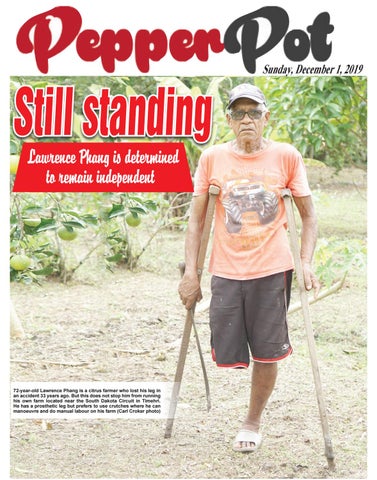
Still standing Lawrence Phang is determined to remain independent
72-year-old Lawrence Phang is a citrus farmer who lost his leg in an accident 33 years ago. But this does not stop him from running his own farm located near the South Dakota Circuit in Timehri. He has a prosthetic leg but prefers to use crutches where he can manoeuvre and do manual labour on his farm (Carl Croker photo)
Sunday, December 1, 2019
2
Chronicle Pepperpot December 1, 2019
Reflecting on the PAHO Awards
SIX years after it was reintroduced to Guyana, the Clare Forrester PAHO/WHO Media Awards for Excellence in Health Journalism has certainly raised the standard of health reporting in the country. It has resulted in increased awareness about Communicable and Non-Communicable Diseases, health policies and issues plaguing the local health sector. It was Dr William Adu-Krow who resuscitated the awards in December 2014, months
after he had presented his Letters of Credence to the Government of Guyana accrediting him as Pan American Health Organisation/ World Health Organisation (PAHO/WHO) Country Representative. Prior to 2014, the awards were held biennially from 1990 to 2008, giving due recognition to some of the country’s best writers such as Melanie Allicock, Ruel Johnson, Oluatoyin Alleyne, Iana Seales and Shirley Thomas. Cognisant of the role of the media in safeguarding the health
The 2015 PAHO/WHO Media Awardees standing in the presence of PAHO/WHO Country Representative Dr William Adu-Krow (second from right); the Chief Judge Dr Paloma Mohamed (seated extreme right); Minister George Norton (centre); Minister Karen Cummings (seated third from left); then Cuban Ambassador Julio Cesar Gonzalez Marchante (seated second from left)
PAHO/WHO Country Representative Dr William Adu-Krow (centre) flanked by the 2014 awardees. Also in photo is Chief Medical Officer Dr. Shamdeo Persaud (fourth from left)
PAHO/WHO Country Representative Dr William Adu-Krow (seated to the extreme right); the 2016 overall winner of the Media Awards for Excellence in Health Journalism, Svetlana Marshall (seated second from right); Chief Judge and Dr Paloma Mohamed (seated second from left) seated among other judges and awardees of the nation, Dr Adu-Krow made the awards by the local media. an annual feature as was done in the past by “Clearly, the PAHO media awards have his predecessors. greatly improved the visibility, number, “The media plays an important role in diversity and quality of health reporting in highlighting public health issues and is a Guyana. When we assess also the number strong tool for advocacy, communication and of media houses who have assigned health education,” Dr Adu-Krow had said in 2014 beats to journalists and the number of column when he delivered his address during the first inches in print media, in particular, allocated Clare Forester PAHO/WHO Media Awards on average, we might be looking at a 30-40 held under his watch. “In Guyana, we are per cent increase in coverage over the last five challenged with the increase in communica- years; this is significant,” Dr Mohamed told ble and non-communicable diseases such as the Pepperpot Magazine. Chikungunya, Malaria, and Mental Illness inIn acknowledging the work done by Dr cluding Suicide; also, Hypertension, Diabetes Adu-Krow and his team at the PAHO/WHO and many other diseases. These diseases and Country Office in improving health journaltheir contributing factors must be highlighted ism in Guyana, Dr Paloma said in addition to get the attention of all stakeholders for to the awards, the health organisation has them to take action, for prevention and con- facilitated greater access to information, trol of these diseases in order for us to address conducted ‘brown bag’ lunches and panel the social determinants of health and have a discussions on topical health issues, and held healthy society. The media is well positioned a number of workshops targeting both editors to disseminate health information and raise and reporters. awareness about public health issues,” Dr “I really think that we began to design Adu-Krow had said. the awards as a developmental process of Initially focusing on the traditional media strengthening the local media corps in ev– radio, print and television – the awards have ery way,” Dr Mohamed said, while adding evolved to include multimedia, and span a that the comprehensive chief judge report, wide range of topics. Offering her analysis, produced annually, includes recommendaBehavioural Scientist and Chief Judge Pro- tions for enhanced health reporting. It was fessor Dr Paloma Mohamed, said the awards Turn to page IV►►► have enhanced health coverage in the country
Chronicle Pepperpot December 1, 2019
III
The Christmas songs of Little Mario By Francis Quamina Farrier
TODAY is observed internationally as World AIDS Day, and in this feature article, I share with you the story of Little Mario who was born with AIDS and how he sang some Christmas songs on TV for thousands of viewers. The story began when, in my capacity as a journalist attached to the VCT Evening News, I was on a tour of Linden in Region 10, with a team from the Public Relations Department of the National Insurance Scheme (NIS) headed by then Head of the Department Ms Deborah Carter, to the bauxite town.
was just about three years old. As such, his aunt was struggling with the care of the three orphan siblings and needed all the help she could receive. The NIS Public Relations Officer, recognising the situation, took immediate action. She requested that all members of the visiting team go deep into their pockets and make contributions for little Mario and his two sisters. We all did as requested by Ms Carter. The total contribution was somewhat impressive. Before we left, a number of photographs were taken. The one published along with this article was also published in the NIS calendar of the following year; Little Mario had become a celebrity. However, I have to let you know that his celebrity status was so not only because he was a charming young AIDS victim whose image was displayed on the NIS calendar, but for another reason as well. Little Mario was a talented singer; he knew many religious and secular songs. Added to that, his two sisters would sing along with him as his back-up singers. Had there been a TV talent show “Guyana’s Got Talent” at that time, little Mario with his two sisters would have been strong contenders for the first prize. So I was drawn to visit with Carol Bagot who, with her colleague little Mario on a number of occasions Patricia Trim, had sent a package of during his short life. items for Little Mario (Photo by Francis Q. Farrier) CHRISTMAS SONGS BY LITTLE MARIO The official tour was intended to be One of my visits to little Mario at only to the NIS Office at McKenzie, Blueberry Hill, Christianburg, Linwhich is on the eastern bank of the De- den, was at this very time of the year merara River. As the official part of the -- World AIDS Day. tour was wrapping up, Ms Carter was On that particular visit, little Mainformed of a little orphan boy who lived rio, with his two sisters doing back-up, at Blueberry Hill at Christianburg, one of sang a number of Christmas songs the three wards of Linden, located on the which I recorded on camera and inwestern bank of the Demerara River. She cluded clips in my TV news item on the decided that the team will go across the VCT Evening News. I can tell you that river and visit with the little fellow who I received many positive comments was being cared for by his aunt. from viewers of that news item. Little For all the members of the team, it was Mario’s celebrity status was expanding love at first sight. Little Mario wearing a far beyond Linden. Superman t-shirt, greeted us with the warmest smile you can imagine. His aunt, GIFTS FOR LITTLE MARIO who was probably in her mid-20s and his FROM NEW YORK two older sisters, were also very welcomLater the next year while on a visit ing. But Little Mario melted our hearts; to New York, I was in the office of New there was a special charm about him. The York State Senator John Sampson, young aunt, who experienced the death whose father is Guyanese. of both her sister and brother-in-law to His secretary Carol Bagot, also a AIDS, had the heavy responsibility of Guyanese, took immediate action when taking care of the three siblings. The two I mentioned the story of little Mario. sisters of little Mario were not infected Along with another colleague, Patricia with the AIDS virus, no doubt because Trim, who is the founder of the Tots and their parents became infected after their Teens organisation, they went across the birth. Sadly, Little Mario was conceived street to a store and bought a number of after his parents became infected. At that gifts for Little Mario which I took from time there was no preventative means Region 11 to Region 10 and delivered to of Mother to Child Transmission. Both my little AIDS-afflicted ‘nephew.’ The parents passed away when little Mario news item which I produced for the VCT
Then NIS PRO Deborah Carter, Little Mario and Farrier at Blueberry Hill, Linden
Evening News was split into two parts: the first part was in Brooklyn, New York, showing me receiving the gifts from Ms Bagot and Ms Trim. The second part was at Blueberry Hill, Linden, showing me handing over the gifts to little Mario. I was serious about accountability and the viewers saw me handing over the items which I had been given by Ms Bagot and Ms Trim, to Little Mario. Two of the items were a baseball bat and ball. Little Mario was given the bat. I pitched underhand, he missed the first two times. On the third pitch, he hit that ball so hard that he received a loud round of applause from everyone looking on. One of the things which I always did in news items about little Mario, was to have clips of me holding him in my arms. That physical contact on display on television was inculcated in me when there was a series of HIV and AIDS education programmes from Artistes in Direct Support -- AIDS -- a group founded by Margaret Lawrence, Desiree Edghill and the late Andre Subryan. So in every TV news item featuring little Mario, I was seen holding the little fellow in my arms. I also put my arms around a grown AIDS victim when I did a news item from Manhattan, New York. BYE-BYE LITTLE MARIO Then came the day when I received the expected phone call informing me that little Mario had died. Yes, I cried. But I was not the only one who cried for the passing of little Mario. When I edited the TV news item about his passing, I commenced by giving the viewer the impression that it was just an update on the activities of the celebrity, little Mario. The news item started with little Mario and some updates. No mention was made that
little Mario had flown away to a better land I know. In had little Mario and his two sisters singing the first stanza of “Yes Jesus Loves Me.” Then came the second stanza which was the scene of a large group of children gathered around a small white coffin singing “Yes Jesus Loves Me.” There was no need for me to mention that little Mario, who had become such a TV star and young Guyanese celebrity, was now a shining star up in Heaven. It was one of the most unusual TV news items I have ever done. The following day after the TV news item was aired, I received a phone call at the VCT studio. The deep male voice with a slight quiver at the other end of the line said, “Mr Farrier, I call to tell you. I’m a big, tough man. But that news item last night about Little Mario made me cry. I’m not shame to tell you.” Executive Director of Artistes in Direct Support, Desiree Edghill, related the support received from President of the USA, George Bush, with the fight against HIV and AIDS in the Caribbean, Guyana included. “The President’s Emergency Plan for AIDS Relief (PEPFAR) funding started in Guyana in 2005 under the Guyana HIV and AIDS Prevention and Reduction Project (GHARP) in which 18 NGOs participated and worked in all the regions of Guyana.” It was a massive national effort to educate Guyanese about the deadly disease. “The Project built the capacity of the NGOs in Programme and Financial Management as well,” said Ms Edghill. Today HIV and AIDS are on the wane and mother-to- child transmission is now almost gone. Little Mario is gone, but for myself and many others, he will always be remembered for his charm and talent and zest for life during his short time on earth.
IV
Chronicle Pepperpot December 1, 2019
Reflecting on the PAHO ... ◄◄◄ From page II
based on those reports and more so recommendations, that PAHO funded training on online and multimedia journalism, in addition to the other informative sessions. Dr Mohamed has been the Chief Judge for the awards since 2015, judging alongside radio and television personality Russel Lancaster; Director of the Centre for Communication Studies at the University of Guyana, Nelsonia Budhram; Dr Vasha Bachan and Volderine Hackett. For journalists, the Clare Forrester PAHO/WHO Media Awards for Excellence in Health Journalism present an ideal opportunity for them to gain recognition for the work they do in raising awareness and influencing change on all matters pertaining to health. “PAHO has played a meaningful role in encouraging and celebrating outstanding works in journalism. This has helped many reporters to gain public recognition and encourage many more to write about health. In doing so, the awards have succeeded in raising awareness of a multitude of health issues reaching a diverse audience,” Tajeram Mohabir told the Pepperpot Magazine. Mohabir, a News Editor at the Guyana Chronicle, was the overall winner of the 2014 Clare Forrester PAHO/ WHO Media Awards for Excellence in Health Journalism. Additionally, he was the winner of the Best News Story Award and the second-place winner of the Best News Feature Award. Since then, Mohabir has received
The 2017 PAHO/WHO Awardees standing in the presence of PAHO/WHO Country Representative Dr William Adu-Krow (seated fourth from right); members of the diplomatic community and Minister of Public Telecommunications Catherine Hughes, seated at the centre more than 10 awards from two awards: one for her re- the United Kingdom. She 2018 won the Best Online my stories for the online platPAHO/WHO, the United Na- porting on Chikungunya. In is among 11 Guyanese who Feature Story Award and a form and how to add various tions (Guyana Office) and the 2015, Rampersaud gained were awarded Chevening Special Award for the Best media elements to make my Guyana Press Association. third place in the awards for Scholarships this year. Coverage of the Mass Drug story much more impactful For Mohabir, who, de- a feature she had done on In December 2016, the Administration campaign for in this contemporary medium spite being an editor, sees the National Public Health Guyana Chronicle’s Svetla- Lymphatic Filariasis. Known of reporting and reaching himself as an active journal- Reference Lab. na Marshall was honoured for exceptional stories, the target population,” she ist, said the PAHO Awards “I remember doing a fea- by PAHO/WHO after being Ragobeer, who just months explained. have given him a greater ture on the National Public adjudged the overall winner ago copped the GPA’s Young For Broadcast Journalist appreciation for research and Health Reference Laboratory of the PAHO/WHO (Guy- Journalist of the Year Award, Handell Duncan, the award healthy living. “Personally, (NPHRL) and the services ana Office) competition for attributes her success, in part, is a stepping stone to where there are two standouts about they offered, only to have Excellence in Health Jour- to the training offered by he wants to be in the field the awards. One, through someone say to me that the nalism. However, she had re- PAHO/WHO. of journalism. “Every trainresearch, I got to understand piece provided them with ceived her first award in De“I believe that the training ing I attended brings about the importance of things like information that they were cember 2015 after one of her I received from PAHO has positive changes to the way eating healthy, exercise and never privileged to. The piece many articles, “Enough not allowed me to garner more I do my work, even the conyoga in health and wellness; went on to win third place in being done for ‘sicklers’ – practical skills and improve versations on the sidelines and two, I was able, through the online feature category says victim, Dr Norton pledg- not only my writing, but the of the training helps me. my writings, to support ef- that year, and I’m glad it was es gov’t support,” emerged as ways in which I create con- Journalism is a part of my forts nationally aimed at en- impactful,” Rampersaud told the best News Feature Article tent for readers. Reporting DNA. I am always looking suring a healthy population,” the Pepperpot Magazine. for the PAHO/WHO Health on health journalism, in my at opportunities to better my he explained. In 2015, Kaieteur News’ competition that year. In opinion, requires a great de- craft. I am nowhere where I Though she is no longer Desilon Daniels copped the 2017, she also dominated the gree of diligence, particularly want to be in this profession; a journalist, Shivanie Ramp- overall award after raking in PAHO/WHO Health awards. if you are edifying the public I am always listening and ersaud said she is pleased to several awards in the print To date, Marshall, who is on a matter that should be seeking to make adjustments have made her mark before and online categories. Ac- now an Assistant Editor at the important to all of them-- not only to stay relevant, but exiting the media fraternity. cording to the Chief Judge’s Guyana Chronicle, has won like the MDA for Lymphatic to see a better health care Rampersaud and Tajeram Report, a total of 78 submis- a total of nine awards during Filariasis, for example. And it system locally,” he told the were among the few jour- sions were made that year the three years she partic- was because of the very first Pepperpot Magazine. nalists who had participated with 48 from print alone, ipated in the competition. PAHO training I attended Duncan, who hails from in the PAHO/WHO media three radio, two television Notably, it was after winning in 2017 that I became very the Pomeroon and has beawards in 2014. In the case and 21 online entries. Dan- her first award that Marshall keen on this MDA (which come a household name in of Rampersaud, she received iels is currently studying in was allowed to collaborate was restarted in that year) and the capital city Georgetown, with the Guyana Nurses As- using my work to educate the has been entering the compesociation to produce her first public on why they should be tition since 2014, and though magazine – “Nurses in Guy- part of it,” Ragobeer told the he won several awards, it was ana 1966-2016: Reflection, Pepperpot Magazine. not until 2018 that he was Celebration and Inspiration.” She added: “Since then, adjudged the overall winner In 2018, she became a U.S. I’ve become so immersed in of the PAHO/WHO Awards State Department Interna- Lymphatic Filariasis and the for Excellence in Journalism. tional Leadership Visitor MDA that I make it my duty In total, Duncan won seven Programme (IVLP) fellow. to provide in-depth coverage awards in the television and Twenty-year-old Vishani of this each year when the radio categories. The HGP Ragobeer was just 18-years- annual round of the MDA Nightly News journalist said, old when she entered the is initiated.” Ragobeer not- for him, winning an award competition in 2017. That ed too that the skills and is just the icing on the cake, year, she won the Best On- knowledge garnered during but effecting real change is line Feature Story Award training conducted by PAHO/ paramount. and a Special Award for WHO, are also applied to “I remember covering a the Best Coverage of the her general work, not just in story relative to a young man Mass Drug Administration reporting on health. who needed a liver transparCampaign of Lymphatic “Aside from that, a major ent[sic], the story helped him Filariasis. Additionally, the area of growth and develop- to get the transplant and when Guyana Chronicle Freelance ment for me has been the dig- he returned from India where Journalist placed second in ital media/ online component it was done, we talked again. the Best News Feature (Print) of the training sessions. A But months later he died. Category. few years ago, online journalThat really impacted From L-R: PAHO/WHO 2018 overall winner for Excellence in Health Journalism, Ragobeer, who is now ism was just something I was me and serves [sic] as an Handell Duncan; Chief Judge, Dr Paloma Mohamed; Minister of Telecommu- studying at the University fascinated by, but now I can encouragement to keep nications, Catherine Hughes; Minister Karen Cummings; Dr William Adu-Krow of the West Indies (UWI) say I believe I have a fairly Turn to page VI►►► and Newsroom Journalist Bibi Khatoon. Standing, are the other awardees St. Augustine Campus, in good grasp on how to tailor
Chronicle Pepperpot December 1, 2019
V
Fetal Alcohol Syndrome
AN avid reader wrote to me, telling me that her neighbour is pregnant but is still drinking alcohol heavily. She says they both read my column (thanks for that) so maybe some education on the harms of this may help. I’m actually not very surprised to learn that expectant parents do not know the harms that alcohol may cause because it is not something that is taught in schools. I hope this piece brings awareness, acceptance and prevention of these harms. Drinking alcohol while pregnant puts your unborn child at a high risk of developing Fetal Alcohol Syndrome (FAS). FAS is a medical condition that a child develops through alcohol exposure while in the womb. This means when the pregnant mother consumes alcohol. Drinking alcohol during pregnancy results in damage to both the brain and body of the child. While it would take frequent consumption for FAS to occur, there are no safe amounts of alcohol to drink during pregnancy. WHAT ARE THE SIGNS OF FETAL ALCOHOL SYNDROME? There are numerous physical deformities and mental illnesses associated with FAS. Physically, a baby born with FAS will have a small head, small and wide-set eyes and very thin upper lips. They would be below-average birth weight and height. In the womb, a baby does not have a fully developed liver and therefore cannot process the alcohol that can easily spread and damage vital organs. They often present with heart, kidney or limb problems. Heart murmurs and seizure disorders are also possibilities. During development, there would be issues with sight and hearing as well as thought processing, impulse control and judgement. There will be learning and memory disabilities fuelled by hyperactivity, poor concentration, intellectual disability and low motivation. All of the above affects their ability to properly communicate, have normal social skills and form healthy relationships. All of the above symptoms affect mental health. Any change in routine causes an unusual amount of stress. There is depression and anxiety if the condition is severe. Many social issues such as legal problems, inappropriate sexual
behaviour and drug use are also common in those with FAS. This usually results in school drop-out or unemployment. Unfortunately, the symptoms of FAS tend to get worse as the child ages. Please also keep in mind that heavy drinking during pregnancy can increase the chances of a miscarriage altogether. Please keep in mind that it is also dangerous to consume alcohol while breastfeeding/nursing a baby. It may not cause FAS but it may affect their sleep/wake pattern as well as slow down weight and motor development gain.
HOW IS FAS DEVELOPED? Through the mother, the alcohol reaches the baby through the placenta, the organ that is supposed to only nourish the baby. Therefore, you can prevent FAS by not consuming alcohol during pregnancy. Basically, the alcohol that is absorbed by the fetus prevents sufficient nutrition and even oxygen from getting to its vital organs. If you are planning to become pregnant, it is beneficial to stay off of alcohol completely as you could not know when conception actually happens. While any amount of alcohol is dangerous during pregnancy, studies show that consuming alcohol during the first three months pregnancy is the most dangerous. Of course, the intensity of FAS will depend on what, how much and how often alcohol is consumed. Studies also show that if the pregnant mother is over age 35, smoking cigarettes and has a poor diet, the child is more likely to develop FAS. If you believe that your child may have FAS, there are a few things you can look for. 1. Alcohol was consumed during pregnancy, especially during the first three months 2. They have abnormal facial features such as those mentioned above 3. They have a growth deficiently – are they much smaller than those their age? 4. Do they have any central nervous system damage? If the child has three or more out of the following 4 criteria, it is strongly recommended that they go into their nearest health centre. HOW IS FAS TREATED?
FAS cannot be cured but can be managed. The earlier the diagnosis is made, the more progress can be made. Prescription medications may be beneficial as it lowers existing and additional symptoms which include aggression, lack of focus/attention, inability to sleep or eat well, anxiety or depression. Physical therapy and early intervention also appear to lower the degree of FAS. Counselling has been proven beneficial for those with FAS. Counselling and behavioural training that focuses on social skills, coping skills, lowering stress and anger management are a great help to the affected individual. Alternative, home treatments such as exercise, herbal supplements, relaxation therapies, yoga and massages have also proven effective. Creative art sessions have shown to help with attention, aggression and lowering stress overall. Those with FAS can live at home with their families but a large percentage requires dependent living which means inpatient treatment in a group centre or home. Seeing as though every child is different, it is also recommended that you
schedule an appointment at your nearest health centre to discuss the best way to deal with your specific case. If a child has developed FAS, studies show that there are a few protective factors that reduce the secondary symptoms of the condition. These include being diagnosed at an early age, living in a healthy, non-violent home, having a hobby such as art or music and participating in community activities. There is a fear that admission of consuming alcohol during pregnancy and breastfeeding can result in shame, guilt or judgement. Do not let that fear stop you from reaching out for help. Please go to your nearest health centre if you feel your child is at risk for Fetal Alcohol Syndrome. Thank you for reading and please send in any topics to caitlinvieira@ gmail.com. Suicide Prevention Helpline Numbers: 223-0001. 223-0009, 623-4444, 600-7896 Say Yes to Life and No to Drugs! Always!
VI
Chronicle Pepperpot December 1, 2019
Reflecting on the PAHO ... ◄◄◄ From page IV
telling stories with the hope of making Guyanese more health-conscious,” he told this newspaper. This year, Evening News Editor Devina Samaroo and Guyana Chronicle’s Senior Reporter Vanessa Braithwaite are among finalists for the 2019 PAHO/WHO Media Awards for Excellence in Health Journalism. Samaroo and Braithwaite have won a number of awards since entering the competition in 2016. “This year, I was nominated in three categories but for two stories (one story was done for both online and television). The first story is about access to abortion care in Guyana. I was inspired to do this story based on conversations I had with friends and colleagues, and it dawned on me how taboo the topic of abortion still is. So, I did some research and realised that access to abortion services in Guyana is very limited, mainly because not many people talk about it,” Samaroo shared. She added: “Persons are scared to even ask, because of the stigma attached to getting an abortion; so, I wanted to do a story to
mount pressure on the authorities to make it more accessible and to show women the dangers of an unsafe abortion, so they can be encouraged to get it done safely, if need be.” Outside of the awards, Samaroo said she writes stories with the anticipation of influencing decisions at the policy level and as well as behavioural change at the level of the regular man in the street. In the case of Braithwaite, she has written extensively on Toxmoplasmosis, Teenage Pregnancy, Lymphatic Filariasis and Air Pollution, among others. Like Samaroo and the other journalists, Braithwaite, who was GPA’s 2018 Young Journalist of the Year, said she is pleased to be a change agent. “I am confident that my stories have been very impacting because I learnt that several other health facilities would have adopted a teenage antenatal clinic to help these teens cope with the extra challenge of carrying a child, at a very young age. Ronella, the mother of the children who were visually impaired has since received overwhelming support from both civilians, corporate society
and medical facilities. PAHO/WHO, in collaboration with the Ministry of Public Health has also romped up its sensitisation campaign against stigma and discrimination, which no doubt has played a major role in educating the public about the support they should give to those suffering from the disease,” Braithwaite told the Pepperpot Magazine. Since 2015, the Guyana Chronicle has dominated the awards and has been recognised by PAHO/WHO as the media outfit with the most winning entries. This year, more than 100 entries have been submitted for the awards from across media houses. Looking ahead, the Chief Judge believes that journalists would do even better if they widen their coverage of health-related matters. “With regard to the specific field of health, accuracy and more in-depth knowledge of some of the technical areas of the fields of coverage can be improved. There are mental health and ecological interactions with natural environmental factors and social factors with health, which are so far generally neglected. For instance, some health journalists may have begun to think about how changing climate affects health or violence as a health concern or oil and gas as a driver of changes in lifestyle,” Dr Mohamed explained. She said it is important to be analytical rather than descriptive when reporting on critical issues. Weighing in on the matter, Lancaster, who is among the judges, said that while there are some exceptional writers, there are others who are in need of help, particularly in news and feature writing and multimedia reporting.
He said from all indications, some reporters do not know the difference between a news story and a feature story or the difference between a newspaper story online and an online or multimedia report. He was keen on noting that in addition to texts and photographs, online or multimedia reports feature hyperlinks, charts and graphs, interactive maps and even videos. Turning his attention to radio and television stories, Lancaster said some reporters have not learnt just yet how to maximise the use of the two media. “If you are going to concentrate on a medium, you really need to understand its possibilities. Print is a visual medium, but you have it with you, so we could afford to write long stories that really go into a lot of detail… Radio is about your ears, so I want to hear different sounds, I don’t want to hear one voice for the entire thing, I want to hear vox pop with somebody that you interviewed, I want to hear the ambient sound in the background, I want to hear some traffic if you are out on the road…Television on the other hand, is very visual and it’s moving visual, so I don’t want still shots, leave the still shots for the newspaper where they can’t move; in television, it’s about moving shots because it is about moving medium,” Lancaster explained. He also urged that editors pay greater attention to the reports produced by journalists, noting that too often there are grammatical mistakes and inaccurate information embedded in reports. The PAHO/WHO Awards are named after Clare Forrester, who was the Media and Communication Adviser with PAHO, serving in both Jamaica and Barbados.
Chronicle Pepperpot December 1, 2019
VII
Art and Production
PRODUCTION has several meanings. It is the making of a theatrical performance which may include drama, poetry and musical entertainment; the provision of something for consideration, inspection or use; the process of manufacturing goods for sale. Our focus here is on some aspects of the first definition. Art is at the heart of making a good production. Artists have always acknowledged the importance of production both as an artistic action and an idea to be explored. The recent Rupununi Music and Art Festival is a clear demonstration of how local artists help to enhance production. The Rupununi Music and Arts Festival is an annual event that started in 2014. It usually takes place in the Rupununi during three nights of camping. Occasionally, there is a Georgetown version to raise awareness on the coastland. The festival aims to create a unique experience through a combination of art and music. Invitations are extended beyond our borders to encourage cultural fusion and domestic and international tourism. The Rupununi Music and Arts Festival acts as a vehicle to help develop the creative industries of Guyana. The festival involves all aspects of the creative industry - music, visual art, craft, fashion, tourism, hospitality and transport. It also highlights the beauty of the Rupununi. While the Festival is
heavily focused on promoting persons involved in the performing arts, visual arts is one of the most important pillars of the festival. The work of the artist is to ensure that the aesthetics of the festival site would create an atmosphere that encourages positive interactions among artists and artisteS. The Rupununi Music and Arts Festival was held at Theatre Guild on November 22nd and 23rd. Artists have a new professional and creative platform to showcase their work and to earn. The festival encourages out-of-the-box thinking. It also provides an opportunity for persons to network with other creatives from around the world. Local Artist Nigel Butler of the moving Circle of Artists spearheads the creative team for the festival. His team includes Ransford Simon and Nadia Salick. Gavin Mendonca, Programme Director, Rupununi Music and Arts Festival said, “Artists are the most valuable contributors to the festival being a success. It is their creative vision and input that gives the festival space a magical aura”. In addition to this, artists and craftsman are invited to display their work. This year seven crafters grabbed the opportunity to exhibit their work. These included The Real Thing by Mighty Chief, Vanda Designs, Jah Works and Selena’s Craft. The festival was such an interactive experience for its audience that with the guidance of artists
Painting on 4ftx8ft ply entitled GT Connection. (Photo by Nigel Butler) they created a masterpiece. The painting entitled GT Connection is, in fact, two paintings on one sheet of ply. On the right, there is a map of Guyana surrounded by nails and thread. Willing persons were asked to criss-cross the threads and create a web, turning many single strands into a whole network of “connections”. Spray paint was used to make spots to indicate where persons lived in Guyana. This showcased the visual reach of the festival. On the left, persons were invited to use a brush and add to the painting. However, Nigel and Ransford added the finishing touches. Just in case you missed this year’s festival, or if you want to relive the experience start saving for 2020. The Rupununi Music and Arts Festival will be held on November 13th -15th, 2020 at Manari Ranch in the Rupununi.
VIII
Chronicle Pepperpot December 1, 2019
Evidence-based dentistry
EVIDENCE based dentistry and the assessment of dental care within the community have become of greater interest since the introduction of the purchaser-provider split. There seem to be so many definitions of health services research that health professionals providing the care to patients are unsure of what this new subject is all about. Indeed, some of the more cynical have suggested that it is a surrogate measure for rationing health care. When the Minister of (Public) Health initiated the formation of a National Oversight Committee for Chronic Non-Communicable Diseases, I recall writing in this column in late 1998 with a very similar suggestion. I had proposed the formation of a National Centre for Disease Control which would combat and control chronic diseases in a holistic manner. Obviously, dental caries and periodontal disease would be included. One major reason is to equilibrate priority at the administrative level and another is to emphasise the interrelation among the conditions. Health services research for developmental change is an important key to success. There is no doubt that ‘doctor knows best’ is no longer an acceptable reason for offering a particular solution to a patient’s ills. Governments and insurance companies want to know that a clinical treatment actually works and are looking for a treatment which gives the most benefit for the least cost. Detailed studies must be done before huge health care investments to ensure a balance between maximum population coverage, minimum costs and best clinical care. Dental health services research may well be able to help all concerned by making sure the practitioners, patients and funding agencies work together for the greatest health gain. This may be a Utopian
ideal but there is no doubt that health services research has much to offer. One point should be made quite clear. Health services research is not a management tool dealing with the collection of data. What the discipline represents is an ethos of accountability and inquiry in relation to dental health services. It is about trying to define and redefine the best way in which optimal oral health can be delivered to the greatest number of people. It, therefore, encompasses health promotion, disease prevention and service delivery involving general health – in both the public and private sectors. The development of health services research has been driven by a growing recognition amongst health care administration, politicians and clinicians that increasing the resources dedicated to a service does not necessarily lead to greater ‘health output’. For example, having more dentists per head of population does not necessarily decrease the amount of dental ill-health suffered by the public. Brazil is a classic example. Many factors impinge upon this mission to find the means of providing dental care to as many people as possible at the most acceptable cost. Dentistry cannot expect to command national resources unless the amount of benefit accrued per dollar spent can be measured and even more importantly justified. The ultimate assessment of any dental health service to instituted, therefore, should be expressed in the form of the benefit and the cost to the patient and the funding agency providing it. In the final analyses, all chronic diseases affecting the population should be equally considered and there must be an absolute justification from all angles viewed based on the input of all involved.
Chronicle Pepperpot December 1, 2019
IX
16 Days of Activism against Gender-Based Violence, take one AS PER my schedule for my weekly column, I intended on writing about Climate Change and the upcoming ban on single-use plastics based on two recent fora I attended that focused on this. But then, I saw that November 25 was the first day of the annual international campaign, “16 Days of Activism against Gender-Based Violence”, and thought it fit to share an experience I had. According to the International Women’s Development Agency (IWDA), this specific campaign calls for collective action against one of the world’s most persistent violations of human rights, which is violence against women. On observances like these, the countless and continuous stories of the injustices against women everywhere are made known. For us though, we don’t have to look any further that through the pages of this very same newspaper. Gender-based violence, and specifically, violence against women and young girls is, unfortunately, ubiquitous. Earlier this year, I was made aware of one such incident. A colleague contacted me and asked if there was any way I could provide any assistance for a family member of his who was in an abusive relationship. The woman (let’s use Shanti as her pseudonym) had moved out of the home she shared with her husband of several years because she was subjected to constant verbal, emotional and physical abuse. She took some of her belongings and her four-year-old son and began staying by her sister. A mere few days later, her husband, allegedly intoxicated, went to the sister’s home and broke all of the window panes, threatening to do more harm if Shanti did not return home. When I visited that home, two days after the incident had occurred, the broken pieces of glass were still scattered around the yard. My initial intention was to report on Shanti’s story to get some help, some way, for her because the few police stations she visited weren’t providing her with any redress. She claimed that they were very lethargic in their approach to dealing with her reports of abuse. There were instances where they would not be able to visit her home due to a lack of transportation, or simply because an officer’s shift was coming to an end (opinion: this is highly believable). She also
indicated that she did try to reach out with a government ministry, so she felt as though her efforts would be futile, and no longer pursued that avenue. Listening to all that she had to say, over the phone, I spoke to my editors who did not hesitate to send me to Shanti’s home. Another colleague and I travelled to the place Shanti was staying so we could talk to her, and I listened to her recount the years of abuse she endured at the hands of this man. Realising the gravity of the situation, and how abusive her husband was, my colleague made contact with someone at Help & Shelter, who told Shanti to come into their office the very next day. She was serious about getting help, and the next day, she did go and she called me every step of the way to say “I’m taking a taxi to go”, “I’m here going into the office”, etc. I was relieved that at least she started the process of getting help, but Lo and behold, two days later, a Saturday morning, I got a phone call from Shanti’s sister. The sister, barely able to formulate words in her frantic state, told me that as Shanti went to wash the wares at the pipe stand in the yard, her husband stopped, took her into the vehicle and drove off. I spent the day making calls and checking in with the sister, trying to make sure we could save Shanti. Matters went from bad to worse, in my mind, when I got a call a few hours informing me that Shanti came to her house, took her belongings, and her son, and willingly went back home with her husband. I refused to believe that she just opted to return. I wanted to believe that she was being pressured or forced or something. But it was apparent that Shanti truly believed that her husband was remorseful and that he was going to mend his ways. I was asked to disregard the conversation we had, and our contact soon became non-existent. My colleague and her family member told me that this was her decision and even if I don’t agree with it, I have to respect her wishes There are a lot of underlying causative factors and ramifications here, all of which I am, in no way, qualified to talk about. If nothing else, however, what I can say is that collective action is required to stamp out this kind of action. Law enforcement, families, not-forprofits, and every stakeholder need to work in tandem to prevent this disgusting scourge of violence from continuing.
X
Chronicle Pepperpot December 1, 2019
Glimpses of hell on earth Part III
The wafer & incense of hell and its devoted congregation in pursuit of cheating salvation NOT all who, from my micro-witnessing and awareness of addiction engaged it for financial gain. Though most did, I remember exchanging a biography of Albert Speer, the Nazi architect with the late Architectural Analyst of the then Ministry of Housing Compton Dick for his copy of Trevor Ravenscroft’s incredible mystical narrative of WWII and Adolf Hitler; The Spear of Destiny. I had discussed in the gym about a script and artwork I was working on for a graphic novel series. Compton suggested that this book was in a similar vein, and it would be good reading, so we did the exchange. Compton was a part founder of the gym I attended; it was indeed incredibly interesting, but not common with my script. I had made bookmarks on passages I found necessary in the novel. Another relative came by the novel; he was cued beyond my curiosity to certain narratives and not its foreboding warnings that were also included in the novel. Years later, in 2015, I learnt from a colleague of his, who was closer to him than I was, who back then worked at the Guyana Forestry Commission, that he was hooked on cocaine and they had him locked in a room in a popular hotel. This blew my mind, as I pondered arguments and discussions we had in the late 70s to early 80s. I should have put it together since then, but I didn’t understand the symptoms. I considered his delusional assumptions as belonging to a blown-up ego. I was so wrong, though right in the obvious ego observation, and so are many others in similar situations, for the ego is the arrogant rush that ignores the quiet voice of reason and the temperament of patient exploration. One of the essential narratives of addiction is a promise of transference from a sedentary mental situation to a more enhanced mental consciousness, or even to the creative exotic,
to also provide aphrodisiac sensual bliss. This has lured the ailing, the gullible and ego-tripping for ages, possibly with placebo successes in some areas, but also incited entrance into the imagination of diabolical charlatans such as ‘Jim Jones.’ But in the case of my relative, it was to provide passage to the mind-piercing entrance into other echelons of time and consciousness, to become a formidable mystic, and my book had defined one such historic figure, Adolf Hitler. The histor-
ic social background was not taken into account: that everything Hitler had used were long before perfected by the dark side of western civilisation; that with the aid of an incredibly gifted public relations creature in the name of ‘Joseph Goebbels’ and the defeated Germany of WWI in economic shambles, low national self-esteem, the atmosphere was right for a Wagnerian Messiah. So to twist culture, mythology and colonising racism into an ego brew that instilled a rush of self-importance
and a dangerous national resurgence, with an ethnic scapegoat and all. My relative ignored the social clay waiting to be moulded into animation; the interest was only directed and concerned with the part in the book where Hitler met a dramatic herbalist who induced him to a shortcut to higher consciousness through the drug peyote. This drug and cocaine spiralled centuries of Aztec priests to tear the living heart out of drug-induced sacrificial victims and offer them as sweet cakes to a
pantheon of so-called ‘gods,’ who had descended on earth from a distant galaxy, that alone should have awakened serious caution. I had dismissed this fantastic book for years until I came onto Werner Maser’s biography of Hitler that dealt with Hitler’s drug addiction. I was amazed at the details of his damaged physical and mental health and the strange physician Dr Morell with his formula of drugs that he administered to his leader, what I considered was his balancing element
was his artistic talent, which was dismissed by western writers; but on witnessing his watercolours in books, they were confirming to the agenda of the day. Amidst the abundance of narratives on mind-altering drug use in Ravenscroft’s book, I will extract one of the more direct; “Adolf Hitler, who actively aspired towards Luciferic Possession was to experience the very reverse of “Grace”, for the drug-induced awareness now channelled into his consciousness served to guide him towards his sinister and inhuman goals.” The hippie movement was not restricted to North America, it happened here too. Those old enough and able to witness ‘PAPALONG’ on D’Urban Park, can remember the barefoot crew with frilled-out bell-bottomed jeans, with slogans on T-shirts and other clothing like ‘Satan’s Angels’ among other imported sentences written on clothing, would now recognise the earliest most serious mind-altering drug presence in our midst. The cult wave of the Hippie movement is attributed to the English philosopher Aldous Huxley, who was its herald through the record of his experiment with the very ‘peyote-mescaline’ and his luring analogies in the enticing book, ‘The Doors to Perception -- Heaven and Hell’ There is a functioning obsession inherited from our colonial past that every action could only be considered if it is in the law books. We do not chronicle our cultural evolution and the accompanying social revolutions. There is a dangerous obsession that experiences that are not certified are not to be considered as worthy of discussion and merit; we are still colonial because we need to be instructed to do what do for themselves, but understood that it was no expedient to teach us to do for ourselves; this we need to have the courage to change.
Focus Chronicle Pepperpot December 1, 2019
XI
on the Village
A visit to Timehri The people and the lives they lead
By Michel Outridge THIS week the Pepperpot Magazine visited the community of Timehri which is divided into sections: Timehri North, a squatting area behind the Cheddi Jagan International Airport (CJIA); the Timehri Docks area, which has the wharf and the old government housing scheme; Lions Road, which is home to many
Indranie Rajkumar citrus farms; the South Dakota Circuit area; the Ice House Road; the Guyana Defence Force Camp Stephenson Base and Red Road. Timehri is a hotspot for many roadside businesses and is home to hundreds of Guyanese and has the nursery and primary schools, a police station, Bounty Farms Limited (BFL), a new Timehri neighbourhood market and the CJIA, which employs many residents. The Lions Road extends for about a mile from the main road to Haruruni Creek. The Pepperpot Magazine went on a walkabout in Timehri, East Bank Demerara and spoke to many residents about their ways of life and developments.
Adrian Allicock One such person was Adrian Allicock, who even though he is not a resident of Timehri, is there almost every day for work. He is from Sandhills, a small community located on a bluff (hill) in the riverine area of the Demerara River and is a small-scale logger like most folks in those communities. Allicock, like most of his fellow villagers of Princess Carolina, Demerara
River, utilises the Timehri Docks wharf to ferry goods, logs and other things to and from their villages. In a sit-down with the Pepperpot Magazine at Timehri Docks wharf, Allicock related that he is a native of Princess Carolina and has never left the village for very long periods, as it is his home. As mentioned earlier, he is a small-scale logger and would ferry logs from his village to the wharf where he would arrange markets for the logs. Allicock added that for some time he used to work with the bauxite company at Sandhills but quit and re-grouped and formed an association of small-time loggers, which has about 30 members -- all from that community. “We pall off the riverside and tried to make it Turn to page XII ►►►
Timehri signage (Carl Croker photos)
Residents that journeyed via boat from the Demerara River to Timehri Docks Wharf
Indranie Rajkumar tending to her potted plants
XII
Chronicle Pepperpot December 1, 2019
Making a living at Timehri
By Michel Outridge THE Loncke family are residents of Timehri Docks old Government Housing Scheme which consists of more than 30 houses. The family consists of three siblings and their mother. Nicola Loncke stated that the village has only one street and one shop and if they need things, they have to go to the “Road Front” to make the necessary purchases, or go by the Timehri Neighbourhood Market. She only returned to the village recently and has constructed a house aback her sister’s property; the house in which she grew up. “I wasn’t here for years because I moved away to Albouystown and I only came back recently and I am trying to adjust to this country-life setting,” she said. Nicola explained that the houses in her small village were built by the then gov-
Nicola Loncke ernment and members of the Disciplined Services. Senior postal workers and other government workers used to reside in the houses, but over the years they passed away and their children and other family members now occupy the houses. She added that her father used to live in the house her sister now occupies. He worked with the region for
Mark Loncke 40 years and after his retirement, he passed away some years ago. The village has electricity and potable water services and most people who live there grew up at the location; while some of the houses were modified, some have remained the same. Her sibling Mark Loncke told the Pepperpot Magazine
that he would like to benefit from the basic necessities such as potable water and electricity, but the documents to the home are in his late father’s name; as such, the utility companies are very reluctant to offer their services. Mark Loncke is a corporal attached to the Guyana Defence Force (GDF) Camp Stephenson and is a native of the old Government Housing Scheme. He stated that the Loncke had family moved to the village since 1979 and the small village has taken on an aged look, as the condition of the buildings has since been subject to deterioration over the years. On the next corner is Lions Road. This stretch is a mile long in which a section of the road is loom and is impassable. However, a contract for road works was awarded to Puran Brothers Company and the project is expected to commence soon.
Lawrence Phang Down Lions Road, Magazine met Lawrence Timehri, the Pepperpot Phang, a citrus farmer, Turn to page XIII►►►
The people and the lives ...
◄◄◄ From page XI
presentable, because we does spend a lot of time here when we bring out our produce, logs etc., and it is a main point in and out from the Demerara River to Timehri Docks,” he said. Allicock noted that there are a handful of villages along the Demerara River such as, Sandhills, Low Wood, Princess Carolina, Elizabeth Ann and others. He stated that residents of these villages are mostly farmers and loggers and the riverine communities have no potable water, no electricity, no landline phone service and they rely heavily on generators to do a lot of work. Allicock, however, expressed his disappointment with the way some things are going in which a businessman, who is not from the area, is getting special preference over the locals in the logging business. “Imagine we live there and we can’t get approval to
extend our logging concessions, but an outsider is there and getting parcels of land and is putting us small peo-
we does be here a lot and we like to keep the environment clean and we even put logs as a seating area for your
ri Docks who lives within close proximity of the wharf, expressed her displeasure at the behaviour of some
Paddling in the Demerara River
Bounty Farms Limited ple out of business because we have no logs right now,” he said. Another issue he highlighted is the illegal daily dumping of garbage, by a particular individual at the wharf. “We does maintain and clean up this area because
Timehri Docks Wharf
convenience, but some people coming here and dump garbage and it makes the place filthy because when the tides come in it pushes the empty bottles and so under the wharf, it goes nowhere,” he said. Meanwhile, Indranie Rajkumar, a resident of Timeh-
of the men who utilise the wharf, especially at nights, because they are loud and their language is not suitable for children. “Sometimes it gets so bad we cannot sleep because of the disturbance and the children cannot study for classes; so I wish they can
exercise consideration for us to co-exist because the police does nothing about it,” she said. The mother of three told the Pepperpot Magazine that apart from that issue, Timehri Docks is a nice place to live and earn. Rajkumar is a homemaker and in her spare time, she tends to her potted plants and flowers. She also makes ice for sale. She also lives next door to her extended family and is very comfortable in the village. TIMEHRI DOCKS WHARF
Timehri Police Station
Last September the construction of the new timber wharf at the Timehri Docks was completed and it is a major point for residents from the Demerara River. The wharf construction was pegged at $13.9M, according to Chairperson of the Regional Democratic Council for Demerara-Mahaica, Genevieve Allen, which forms part of the region’s approved capital works for the current financial year. The wharf replaced a dilapidated facility and brought relief to farmers and others who reside in the riverine communities.
Chronicle Pepperpot December 1, 2019
XIII
Making a living at ... ◄◄◄ From page XII
who, despite having only one leg, is not prevented from performing his chores. The 72-year-old, before the accident that cost him his leg, used to work as a driver and also worked with Texaco, re-fuelling planes at the CJIA. Phang reported that 33 years ago they had a large farm at the South Dakota Circuit area and his brother set up a gun trap for wild animals that were invading the farm and he
didn’t tell anybody. Phang went into the farm and the gun trap went off and it hit his leg but caused no broken bones. However, he said that his injuries were not tended to as they should have been and his leg became infected and it had to be amputated. He explained that he has a prosthetic leg, but it is not very comfortable and it doesn’t allow him to perform certain tasks; as such,
he prefers to be aided by crutches, so he can manoeuvre and do manual labour on his farm. “This is an everyday job, keep our selves occupied by doing our own land clearing, planting and moulding among other things. Is just me and my wife and it is hard work to maintain a farm,” he said. Phang has crops of tangerines, oranges, limes, coconuts and some fruit and said the market isn’t readily available for his produce.
The pensioner related that farming is his only source of income and he is originally from the North West District. He grew up at Friendship, East Bank Demerara and after marriage settled at Lions Road, Timehri. “Most people that live here are natives and they work at sawmills, Bounty Farm Limited and other places; we have a few farmers here and it is a very quiet place to live,” he said.
A section of the old Government Housing Scheme at Timehri Docks (Carl Croker photos)
Mark Loncke’s house
Lions Road, Timehri
Phang’s citrus
One of the houses at the old Government Housing Scheme
Some of Nicola’s dogs
Lawrence Phang’s house and farm
XIV
Chronicle Pepperpot December 1, 2019
Timehri, a place of budding small businesses
By Michel Outridge RAMRATIE Itwaru has established her small business as a seamstress at the Timehri Neighbourhood Market, where she has a stall vending school supplies and ready-made school uniforms. She is among several vendors selling from fresh fruits, to meats, greens, salted fish and other items, including pointer brooms and
other locally produced items. At 58 years old Itwaru has been in the sewing business for the past 20 years. Although small, she gets by making readymade school uniforms for mostly East Bank Demerara schools and welcomes orders for other schools as well. “I been here for six years, but I have been doing my sewing business since the old market and this new market was established
Marcus Nedd, the sno-cone vendor
Ramratie Itwaru, the seamstress of Timehri Neighbourhood Market (Carl Croker photos) around the same time when the road was exThe Pepperpot Magazine met a very tended and business has been fair,” she said. enterprising young man, Marcus Nedd; he is Itwaru noted that the old market, which the local sno-cone vendor at Timehri Docks was in existence since in the 1980s, was Primary and Nursery Schools. demolished and was replaced by a new one The 19-year-old said he started the busiwhich is more conducive to vending. ness recently, selling snow cones during the “I grew up here and went to schools and break periods by the school; he added that so on; then I managed to start my own busi- it keeps him busy tending to school hildren, ness because I wanted to work with myself who would gather around his sno-cone biagainst having to work as a cashier at CJIA cycle. like I used to,” she said. Nedd noted that he bought the sno-cone Itwaru told the Pepperpot Magazine that machine a year ago and when he had garnered she has since registered her business as Shan- enough money, he had it welded to a bicycle ta’s Dressmaking Shop and her niece-in-law which was custom made and was able to start shares a part of the shop; she also does her bit doing business. as a seamstress. “I used to sell up by the airport and then “We don’t pay a rental but we have to pay went by the schools and business is good weekly market dues of $1,100 which goes there because it is a big hit with the children,” towards the provision of security and elec- he explained. tricity. We are comfortable here because the Nedd reported that a sno-cone starts as government build a part and we did the rest; low as $100 and goes up to $400, all is with they gave us the tarmac, with shed and posts condensed milk and the varying syrups, and we had to enclose it. Before the road was water and crushed ice, that are purchased extended we were at the old market and the from the city. conditions wasn’t nice,” she said. “On weekends I does do weeding Itwaru is selling complete school uniforms work up by the airport and I am from a from$1,500 and up and welcomes orders. The large family of 19 brothers and six sisplace is open from 07:00hrs to 17:00hrs from ters, and I have been working since I left Mondays to Saturdays. school from Form Four doing various “We live well here and join to pay for jobs such as carpentry and welding,” the weeding and cleaning of this market and he said. things ok so far,” she said. Nedd starts working from 11:30hrs up Itwaru added that she resides at Lions until 13:00hrs and would get something to Road, Timehri and is optimistic her small eat from the nearby snackette, after which business will flourish. he would ride his bicycle up to the Cheddi Jagan International Airport (CJIA) to WHO WANTS A SNO-CONE? vend his sno-cone.
Marcus Nedd is surrounded by schoolchildren
Chronicle Pepperpot December 1, 2019
XV
XVI
Chronicle Pepperpot December 1, 2019
Keeping busy in Timehri By Michel Outridge GAURI Kalnarine, a young woman with a mind for business, embarked on her own small- business venture recently and established a store at Timeh-
ri Public Road Junction, moving away from her family’s business, a supermarket. She told the Pepperpot Magazine that she started her small store about six months ago with the help of
Fay Seaton at her roadside food stall
her father, a businessman, and he gifted her the capital and she got established at Timehri Junction, where she is renting the lower flat of a building. “I started this business because I wanted to move away from the family business and do my own thing; and I pitched the idea and my generous father gave me the start-up money to realise my dream,” she said. Over the past six months, Kalnarine, a resident of Base Road, pointed out that business has been fair, recognising that she is located at a good spot, on the public road and is hoping to expand as her business grows. “When I acquire the capital I intend to install cameras for security purposes, because is me alone here. I can’t afford to employ anyone right now and everybody does be scared for me, being here all alone,” she said. Kalnarine related that the store isn’t a fast earner, but she is patient and hoping that things will work out even-
tually. She sells hardware, stationery, electrical items, and haberdashery, among many other things. She also has a printing section where she prints and photocopies for mostly schoolchildren; with two schools nearby, she thought it was a good idea. Having finished school, this 19-year-old is studying business management at Nations University and opens her business from 08:00hrs to 17:00hrs, except on the days she has classes in the city. Kalnarine described life in Timehri as quiet and peaceful and living near the CJIA doesn’t bother her at all. Chill Spot Snackette at Timehri Junction Fay Seaton, a mother of three, has her own small food business at Timehri Junction, vending from a roadside wooden stand she is renting. The resident of the old Government Housing Scheme at Timehri Docks told the Pepperpot Magazine that she is paying $17,000 rent per month for the stand, but she “makes do.” She has been in the food
Gauri Kalnarine in her store (Carl Croker photos) business for the past two years and prepares meals in the form of lunch, breakfast and afternoon snacks of fish, chicken and chips and on weekends she does bar-bque. She would start her day preparing meals from 04:00hrs and would open until 19:00hrs on weekdays and on weekends; depending on how customers flow, she would close around
Ongoing works at the CJIA
The Timehri Prison
21:00hrs. “Being self-employed is difficult but rewarding and it entails hard work and dedication to keep a business operational; but at the end of the day it feels good to achieve something on your own,” she said. Seaton handles the business single-handedly and prepares all meals at the same location.
Chronicle Pepperpot December 1, 2019
XVII
The women of Timehri North are empowered
By Michel Outridge THE community of Timehri North, located behind the Cheddi Jagan International Airport (CJIA) is home to more than 2,000 persons. The Pepperpot Magazine spoke with Chairperson for the Community Development Council (CDC) Carmen Simon. According to Simon, the area has more than 400 houses and the regularisation of this village has started. She added that some residents benefit from potable water, electricity and landline phone service, while others are without and they are trying to have
and they are trying to work with us and for that we are grateful,” she said. Simon reported that they have come a long way and the residents are determined to make a life for themselves and they are employed at sawmills, the airport and Bounty Farm Limited. Some are teachers, they have some soldiers and others even journey to the city for work. Although Simon is not originally from the area, she moved there some years ago from Kitty, Georgetown, and has made Timehri North her home. “People around here have no real issues and we live in unity and every-
were empowered when the Government of Guyana (GoG) through the Ministry of Social Protection established the Timehri North Co-operative Society Limited Salted Fish Processing Facility; it is funded by the Sustainable Livelihoods and Entrepreneurial Development (SLED) Project. Since the start of this project, 10 women who were unemployed have become gainfully employed and are now equipped with a skill to earn a living. The women, all from the community, prepare the different types of fish after which it is salted, dried and
CDC Chairperson Carmen Simon
Timehri North (Carl Croker photos)
The Cheddi Jagan International Airport (CJIA)
Some of the women at work at the Salted Fish Facility in North Timehri
The Salted Fish Processing Facility
the entire area regularised. “Timehri North is a big area; we are trying to make life but development has been slow, but we are patient because the previous government wanted to relocate us but this administration informed us that we can stay
body here does do something for work and it is a mixture of people reside here,” she said. Timehri North has many shops, churches, small businesses and an active Community Policing Group. Simon said the unemployed women
packaged for sale to mostly wholesale buyers, then distributed countrywide to be retailed. The Pepperpot Magazine visited the facility and spoke to some of the women, who were busy preparing the fish. They shared similar sentiments of
being happy because they are earning and are able to contribute to their households. Behind this village, are the Timehri Prison, the Guyana Fire Service (GFS) and other companies including the Laparkan Shipping section.
XVIII
MEN ACROSS BORDERS
Chronicle Pepperpot December 1, 2019
Telling Their Stories
I CALLED him one the coolest British High Commissioners who ever came to Guyana. I often thank him for his contributions to our society. The Honourable Greg Quinn and his beautiful wife Wendy hosted the launch of the Men Across Borders Anthology at their residence which attracted a wide
cross-section from the diplomatic corps, the business community and the private sector. After publishing Women Across Borders, I knew I had to also publish Men Across Borders. I mentioned it to High Commissioner Quinn and he was excited to contribute to this project. International Men’s Day was the
opportune time to highlight this anthology. MC Russel Lancaster did the welcome and invited remarks and Jo Anne Forde to open with prayers. I shared my vision of why I decided to provide a platform for men to tell their stories. Growing up, the lack of good male role models influenced me not to have a desire for sons. I am witness-
ing many young men falling through the cracks because of a lack of that male figure to guide them. Many days my mind was consumed with many questions during my brother’s illness before he died. Would he have made better decisions if he had male figures who were a good influences on his life? My mom did her best with the limited resources she had, but it was very difficult. I know my brothers have never heard “I love you” or “I am proud of you” from my dad and neither have I. My dad was not there for the better part of our lives, but
I am also aware that even fathers who are present in the house don’t always father their children. I was listening to one of the conferences of the late Myles Munroe and I was in awe of something he shared. “The greatest social, economic and psychological course on Humanity today is fatherlessness in every country.” Disastrous statistics show that 92 percent of all problems in society are related to the absence of fathers. Maybe some of the males are struggling with their manhood and image and struggling with their purpose. When they lost authority they sometimes try to regain with violence, because in some cases that is all they know. It was probably easier years ago, because they had more authority in the house and less now because of the rapid advancement of women. High Commissioner Quinn spoke about the importance of gender equality in any society Men Across Borders will feature 12 co-authors from different part of the globe telling their stories: Guyanese Rawle Dundas, Diego Alphonso, Cleveland Bradford, Ganesh Singh, Shiv Dindyal who resides in Canada and Will Pluck, who resides in The Bahamas, Caribbean Fashion Guru, Richard Young and Sohan Badal
Beyond the Runway with Dr. Sonia Noel ... Inspiring lives through fashion
from Trinidad, Barbadian Ronnie Morris – Founder of the Barbados Music Awards, Antiguan Calvin Southwell, Apostle Felix Figuera from Venezuela and Elliot Tommy, an entrepreneur who was born in Nigeria and who now resides in China. Like the Women Across Borders Series, this anthology seeks to provide an opportunity both for these exceptional men to tell their stories and for these stories to be an example for other men, both young and old, to find purpose for their own lives. Each of these men has committed to providing mentorship for young men and we intend for the mentorship programme to be launched at a later date. I met a lot of men who are angry and resentful at their fathers and society which most times manifested in violence. Men don’t like to admit they need help because society expects him to be macho. We have to find a way to have joint conversations with males and females to find solutions. A large number of women attend conferences that assist in their growth, but most men don’t think it is important to their lives. Social activist Ganesh Singh and Caribbean Fashion Guru Richard Young shared excerpts from their chapters with the audience; Dr Quincy Jones shared vital info on men’s health. Impressions contributed a blown-up poster
of the book cover which was painted by artist Compton Babb. Men’s fashion closed off the evening’s celebration for International Men’s Day. I was also impressed with another event that featured a man that left a legacy. The British High Commissioner hosted a reception in honour of Cyril Grant. When I received the invite I had no idea who Cyril Grant was, but that evening I was captivated by the legacy he left. It was like a history lesson for most people at the reception. Francis Quamina Farrier who knew him recited one of his poems at the reception. The event celebrated his100 birth anniversary. Cyril Ewart Lionel Grant (8 November 1919 – 13 February 2010) was a Guyanese (born in Beterverwagting) actor, musician, writer and poet. In the 1950s, he became the first black person to be featured regularly on television in the United Kingdom, mostly due to his appearances on the BBC current affairs show. In November 2017, a Blue Plaque celebrating his life was unveiled at his home in Highgate, North London, where he lived for 50 years before his death, aged 90, on February 13, 2010. Let’s find creative ways to add value to all because empowerment has no gender as we continue to celebrate this beautiful journey called life BEYOND THE RUNWAY.
Chronicle Pepperpot December 1, 2019
XIX
No parking? No problem!
Couple operates car park facility as post-retirement job By Wendella Davidson THERE is nothing more comforting to the owners of motor vehicles or motorcycles, who have reasons to leave their machine behind, be it for business or pleasure for a day or days, who do not have to worry about the vehicles’ safety. Some people have developed a relationship with their vehicle to the extents that they see it as an extension of themselves. There have been known tales of vehicles being vandalised by persons unknown, even when left at places where one thought to be safe. It the need for this `safe parking’ that nu-
of Essequibo in the Essequibo Islands-West Demerara region. Parika, considered as the gateway to the mining communities, has seen considerable developments and investments by the private sector, especially in the area of financial services. The facility is managed by John Barnes and his wife, both of whom had worked in the banking industry before proceeding into retirement. Speaking with the Pepperpot Magazine recently, Barnes, who was born at Parika but had left some 50 years ago to seek employment, said the plot of land where his facility is situated is a family legacy. He built his retirement home on
The Barnes Secure Parking facility located at Parika, East Bank Essequibo (photos by Wendella Davidson) merous parking facilities have been established locally and internationally, with the owners being asked to pay a fee with the amount paid being tallied according to the length of the stay. One such facility is `Barnes Secure Parking’ located at the junction of Parika, a port on the East Bank
another plot which is adjacent to the business place and where previously stood the family home. According to Barnes, prior to retiring, he thought of establishing some business where he can earn some income and came up with the idea of a parking lot. Construction Turn to page XX►►►
XX
Chronicle Pepperpot December 1, 2019
No parking?... ◄◄◄ From page XIX
Proprietor John Barnes (right) and wife Patricia (centre) in discussion with a potential customer
started in 2013 and when completed he used to manage the facility from Nandy Park, a community on the East Bank of Essequibo where he lived at the time. It, however, proved stressful because of the distance of travel, hence, he sold that home and constructed the one at Parika where he now resides permanently. Barnes said when he opened the facility in 2014, business was pretty slow because a competitor
who operated there before him was located right next door to his business. Nevertheless, Barnes says business has been reasonable since he has his own `loyal’ clientele, among whom are businessmen and women, some of whom leave their vehicles for days. Then there are persons travelling to the island for a day or those going on day tours, or boat excursions/ cruises, in particular, the popular `Yankee All White’ which attracts a large following including visitors from overseas. The car park facility which is fitted with 24hour surveillance cameras, operates daily with the opening hours from 05:30hrs to 20:30hrs and the fees are quite reasonable, but Barnes said he
has developed such a relationship with his regular customers that should the need arise for the use of the facility earlier than the opening hours, or to collect a vehicle after closing time the customer is accommodated. “We have two fulltime staff who have been trained in aspects of courtesy to customers and when they are unavailable my wife and I take over as we live right next door. We try to meet our customers to the best we can and make them feel comfortable, such as ensuring the washroom is always clean. With continued development within the community, Barnes says he anticipates the business will continue to bloom.
The welcome sign at the entrance to the business
Chronicle Pepperpot December 1, 2019
XXI
Beauty at its finest
Urban Oasis Beauty Salon and Cosmetology School By Naomi Marshall FOCUSED on taking cosmetology to a whole other level in Guyana is Jennelle Blackman Jones, proprietor of the Urban Oasis Beauty Salon and Cosmetology School. While growing up, cosmetology was never something Jones thought about doing, instead, she saw herself attending a university overseas then obtaining a job in the corporate world where she would wear uniforms with the logos of a professional organisation, which then indicated her status in society. However, things did not go as planned for her. After excelling at CSEC, Jones went on to writing the Caribbean Advanced Proficiency Examinations (CAPE) and SAT at which she did exceptionally well. She would
doing you still need to do it to the best of your ability regardless,” Jones told the Pepperpot Magazine. Time passed and Jones never got a job in the corporate world but on the other hand, she grew to love cosmetology and “never looked back.” During her cosmetology journey, she worked for five years in a salon that she described as a “toxic environment.” “It is more of a culture in the cosmetology industry where it is most times toxic with frivolous misunderstandings. It’s issues that they are most times comfortable with and it’s just a part of them,” Jones explained. “But that was never me, I knew better. I kept focused on what I was doing and I tried to avoid being a part of it or letting my mind be strayed towards any negativity,” she added.
Jennelle Blackman Jones and some of her students during a class session then get accepted to numerous colleges in the United States of America but on the other hand, she lacked the financial resources to attend college and make her dreams come through. So Jones spent over two years at home sending job applications into companies, never getting a call from the entities and being “helpless.” One day, the determined young lady stumbled across an advertisement of a salon offering cosmetology classes and although she thought that was not her niche, she still wanted something productive to do, so she joined the cosmetology course. One month after completing the course, Jones would get a job as a nail technician, which was the beginning of a few miserable years of her life because she was doing something she did not enjoy. “Nobody knew that I did not like what I was doing unless I told them because in my mind I have that if you are doing something that you don’t like
Jones used the “toxic environment” as motivation to open her own salon in 2015 which she named Urban Oasis. At Urban Oasis she not only strived to create a peaceful environment for her clients but also for her employees, which was important for her to do. She said, “for me, being happy at the place you work is important because you spend most of your productive hours there and if you are not happy nor comfortable there it filters to every other part of your life.” Also in 2015, she began teaching the art of doing nails in her small salon with the intention to share the knowledge that she gained through trials and errors. “I decided that I wanted to start teaching how to do nails because I think if you were to learn certain things early it would eliminate a lot of mistakes you would have to make,” the young lady noted. On September 5, 2019, Jones opened her Cosmetology School which she said her past students motivated her to do.
Jones conducting a class The school offers two to three-month courses in the art of facials including microcar oration and chemical peels; nails; hairdressing; waxing; massaging and braiding. In addition, students benefit from free customer service and business management training. At the end of each course, students receive certificates accredited by Technical and Vocational Education and Training (TVET). Students are taught by specialists in the cosmetology industry who are passionate, experienced and willing to share their knowledge. Jones noted that the school is looking to partner with governmental and non-governmental organisations to offer subsidised training and assistance with job placements to students. The cosmetologist of 12 years is hoping that her school would be the school of choice for persons undertak-
ing the cosmetology industry “and more so because of the quality of education, the standards, the professionalism and comfort they know they will receive.” She also sees her school partnering with international schools to offer more advanced training. Jones is encouraging persons to do their best at whatever they pursue so that they can only obtain the best results. “Everyone knows where their faults are; where their weaknesses are and it’s up to you to at least try to improve the,” she added. The Urban Oasis Beauty Salon and Cosmetology School is located on 234 South Road and can be reached on Instagram and Facebook @ Urban Oasis Beauty Salon. They can also be contacted on telephone numbers 2312058, 6911512 or 678051.
One of the classrooms at the Urban Oasis Cosmetology School
XXII
Chronicle Pepperpot December 1, 2019
Public Servants closer to enjoying the ‘good life’ with latest wage increase
ON November 13, 2019, President David Granger announced a nine per cent increase in wages and salaries for Public Servants earning less than $100,000 per month. This includes those earning a minimum wage of $64,220, who will now earn $70,000 per month.
Guyana Defence Force (GDF) Warrant Officer Class 1, Tyronne Goodridge
The new salary structure is unparalleled and represents a 77 per cent increase in the minimum wage since 2015; which at that time was $39,540. The President, in an address to the nation, said the Government is committed to creating a proficient, professional, highly motivated and well-paid Public Service, which is essential for good governance. “Personal allowances have increased significantly, the income-tax rate has been reduced and the tax on employees’ contribution to NIS was removed, over the last four years. Special attention was given, also, to certain categories of workers such as teachers, sweeper-cleaners and engineers, among others,” President Granger said. These increases, the President said, have been consistent since 2015, and they have had a positive impact on the performance of public servants themselves, on their households and on the national economy. COMFORTABLE LIVING For two members of the healthcare profession, the wages and salaries increase will go a long way. Ms. Nikesha Primo, student of the Georgetown School of Nursing, in a recent interview told the Public Infor-
Guyana Defence Force (GDF) Sergeant Kessa Messiah mation and Press Service (PIPS) that as a young adult and a prospective public servant, she feels comfortable going into the nursing profession knowing that she can utilise her salary to meet her needs. “I think it’s a good initiative. We as student nurses, will benefit from it a lot when we get into the profession, because we would have more resources
to further our studies and it’s going to help us to provide for our families,” Ms. Primo said. Meanwhile, Mrs. Carol Persaud-Douglas, Senior Nurse Coordinator, Ministry of Public Health, believes that initiatives such as these can help to deter professionals from leaving Guyana in search of better paying salaries. She explained that after working overseas for ten years, she returned to Guyana in 2018 because she believed that things had gotten better. Her view is that the continuous revision of the salary structures can have a positive impact on reducing human capital flight. “I think it is very good because it would help to prevent … brain drain. Years ago, Guyana went into a brain drain because of low salaries, but now that the salary is being increased you will find that less persons would want to migrate to other countries… I think it’s a good way of attracting those qualified people back within the Government system,” she emphasized. Several members of the Guyana Defence Force (GDF) have also given the consistent salary increases positive reviews, while maintaining that extra money improves one’s standard of living, ensures money is available for emergencies and enlarges one’s saving
Chronicle Pepperpot December 1, 2019
Student of the Georgetown School of Nursing, Ms. Nikesha Primo capability. In an invited comment, Sergeant Kessa Messiah expressly said the increase in salary will allow her to save more. “What I do is I utilise the Credit Union to save, so if I am given five per cent or nine per cent, automatically my savings go up. I do not change the way I live; I accommodate the increase by adding it to my savings,” she said. According to Warrant Officer Class 2, Mirza Shah, a salary increase means that he has more cash in hand. He said he has realised that one of the most common welfare issues that soldiers are faced with are financial emergencies. Salary increases, he said, have helped in that regard. “It reduces the amount of financial challenges that they may have in and out of the GDF,” Officer Shah posited. SALARY INCREASE IS BETTER THAN BONUS Prior to 2015, members of the Disciplined Services were the frequent beneficiaries of a yearend bonus equivalent to one month’s salary. However, Minister of Finance, Mr. Winston Jordan recently expressed the belief that this was an unfair practice given that there are many other categories of Public Servants. He emphasized that the Government prioritises continuous salary increases given the long-term benefits they can yield. “When I am calculating your vacation allowance, I don’t include bonus, it’s your salary, one month’s salary. When I’m calculating your gratuity, it doesn’t take in bonus, it’s your salary and when
I’m calculating your pension, it’s not bonus, it’s your salary … I can easily pay you a bonus my friend because it’s the least of my headaches because (a) it’s one-off, but when I pay you a nine per cent, I have to ensure that I can sustain it…If you think you have monies and maybe we will get monies five years down the road when the oil really starts flowing and so on and we think that a bonus is something that can be in addition to of, course, your well-earned increases, then we will do so for all employees, not some employees,” Minister Jordan said. GDF Warrant Officer Class 1, Tyronne Goodridge, shared similar sentiments to those of the Minister. “From a welfare perspective, a bonus is one-off and after that you have nothing more to benefit from it,” he said, adding that a salary increase significantly boosts the morale of the Force. “When you have a soldier who is satisfied financially, it simply means that you have a soldier and an army that will be more effective and more efficient and you will have a soldier who will perform his duty regardless of sun or rain,” Warrant Officer Goodridge said. Minister Jordan said the 77 per cent increase in minimum wage since Government took office is reflective of the progress made towards the creation of a liveable wage. “I will arrive [at] that liveable wage faster. As you can see, we have climbed 77 per cent; we’re more than half way up the ladder,” he said. The Minister emphasized that while the Government can provide bonuses, its intention is to create a better salary structure for Public Servants so that their standard of living can be improved. The Government, he said, is looking at a structured approach to salaries and that in addition to across-the-board-increases, once base salaries get within a comfortable range, the Government would endeavour to implement an appraisal-based structure where Public Servants will get incremental salary increases. “We have to go back to the increment system and this will help to reduce the bunching that has taken place with across-the-board increases. You have people who come in [the job] today and they are working for your salary even though you’ve been working there for five years,” Minister Jordan said. Not only has salaries increased, but also several categories of allowances. President Granger announced that “Station Allowances will be increased by over 260 per cent from $2,800 to
$10,000; Hinterland allowances will be increased by between 100 per cent and 600 per cent from between $4000 and $12,000 to $24,000; Risk allowance will be increased by nine hundred percent from $500 to $5000; Uniform allowance for health sector workers will be increased from $13,000 and $22,135 to $15,000 and $30,000; and On-call allowance for doctors will be increased”. The Minister of Finance said that with the next round of increases, the Government will be looking at allowance packages for the rest of the Public Service. He informed that the allowances for the Disciplined Services will be considered separately. NEW 2019 PUBLIC SERVANTS WILL BENEFIT TOO Minister of Public Service, Mrs. Tabitha Sarabo-Halley, said she believes that Public Servants are generally elated about the increase in their salary structure over the last four years and are eagerly awaiting their retroactive pay. She also reassured persons who were employed this year that they too will benefit, equally, from retroactive salaries. This means that the Public Servants hired during 2019 will be paid a retroactive increase from the date of their
XXIII
assumption of duty, while persons who were promoted will be paid the increase in accordance with their previous salaries from January 1, 2019 to the date of their promotion. Thereafter, the increase will be calculated using their new salary amount. Minister Sarabo-Halley said she has been working to eliminate unnecessary hurdles within the Public Service system. One of those hurdles is the normative three-month waiting period for new staff to access their salaries. She said that a circular will soon be dispatched from her office to ensure that all Public Servants are paid on time. “No matter which public agency you’re in, the personnel should recognise that there is nothing positive about having staff wait three, four, five months before they get paid. That does not help to get the best out of them, if you want productivity, then give them what they duly deserve,” she said. President Granger regards the Public Service as a very important state mechanism for national development and prioritises the continuous reform of the sector to efficiently cater to the needs of Guyana. A major achievement of his Government since 2015 is the unparalleled increases of wages and salaries that it has given to Public Servants.
XXIV
Chronicle Pepperpot December 1, 2019
Chronicle Pepperpot December 1, 2019
XXV
Guyanese cops ‘Hairstylist of the Year’ at Caribbean Beauty Awards “Look no further because Stacy is the real deal! Gentleness, patience, knowledge and quality runneth over! It’s rare in these streets to find a courteous and consistent service provider with a vast ability and passion for their craft. Phenomenal woman,” was how one online reviewer described the experience. “Her hands are truly blessed!” said another. Though Small is mostly famous for her work with hair, the 34-year-old is an
A silk press done by Madam Slay (photo credit Stacy Small) By Tamica Garnett WITH over 11 years in the business, and an ever-rising drive to better her craft, overseas-based Guyanese Stacy Small is very proud of how much her hairdressing and beauty business has grown over the years. Small, who has been living and working in Trinidad for the past two years, is best known by the title of her business “Madam Slay”, admired for her work with natural hair women, especially her “miracle-working” silk presses. Her business has become so acclaimed that last September she copped the “Hair Stylist of the Year” at the third annual Caribbean Beauty Awards, in Trinidad and Tobago (TT). Small said she has come a long way since she first decided to take up the art of being a stylist. “My career actually started in the field of nursing, since I always had a love and dedication for taking care of people. It was the personal revelation of my excitement and affection for hair that led me to become a stylist and over the past few years, taking care of women so they can look and feel their best. I realise I just don’t feel comfortable doing anything else,” Small shared with the Pepperpot Magazine. “Since winning the award my brand has already begun growing, a few reputable companies have reached out asking that I represent their brands.” Started in 2017, the Caribbean Beauty Awards (CBA) is a civil society organization, dedicated to recognising professionals of the beauty sector in Trinidad and Tobago, and the wider Caribbean. For the 2019 awards, the competition honoured persons in the
Madam Slay beauty industry including categories in hair, makeup, skin, nails, lashes, wigs, barbering and spa aesthetics, among others. Small’s award was not without merit, she’s a professional who is all the rage among her customers, for her services and her warm personality.
all-rounded cosmetologist, providing a number of other services. She believes what sets her apart in her industry is her focus on her customers. “I’m passionate about hair care and specifically, hair education. Education is essential and it’s what differentiates my approach as a stylist from the rest. My hope is that I am able to positively Turn to page XXVIII►►►
XXVI
Chronicle Pepperpot December 1, 2019
Addressing the ‘man-is-dog’ stereotype Part II
THE response from last week’s column was very vocal and encouraging: it started a conversation amongst people and their opinions on the said topic.
I was also surprised by men’s response and their disagreement with the statement. We oftentimes think that men are the ones who bottle up their feelings, thoughts
and behaviours; but we never stop to think that maybe we aren’t openly inviting them to the table to have these conversations with us; we aren’t as approachable as we’d
like to believe. By writing articles such as these, creating discussions, creating online comment section discussions and so forth, we allow both sides to share their ideas in a respectable setting, while learning at the same time. Nonetheless, today I am here to help women to share their side of the same coin. I do not
want to be biased in this discussion, but I think it’s safe to add my opinion on the topic, not for points, but for better clarity to the men on how and why women might use the said term. Experience—it has a whole lot to do with how women feel. When we as human beings are emotionally and even physically hurt, we can do questionable things. While calling men dogs is no excuse, there must be valid reasons as to why women say it. Perhaps that woman has been hurt tremendously by the men in her life, not just her partner, but her own father who probably walked out of her life and so forth. Some women also refuse to think that men are actually ‘playing victims.’ What about the endless name-calling of women for centuries? Can we forget how loosely men would call women that word that starts with ‘S’ and ends with ‘T,’ or how about the other name for a female dog? Surely, to some women being called those names with them having a disgusted meaning behind them cannot be compared to a dog. On the other hand, some females agree to disagree. They believe that two wrongs do not make a right. As such, they agree that calling all men or even some men the word ‘dog’ should not be justified and used. I invited two females to state their perspectives on the said topic. Ashminie Persaud, a high school teacher shared her thoughts by saying, “Based on the trending phrase ‘man is dog,’ I believe that some women who have had bad experiences with a particular male tend to label the majority of men as ‘dag’ or ‘dogs.’ Although many of us women AND men find humour in this phrase, it is quite derogatory to label or transfer troubling emotions and experiences onto other men. Based on my opinion,
the word ‘dog’ is used in comparatively, because it is believed that dogs, as well as men, would chase after many females. While some persons may define it differently, I do think that the use of this phrase gets ‘over the top’ at times, no matter how much humour it may possess based on many other views.” Seeta Dalloo, a certified social worker also shared her opinions by saying, “The use of the slang ‘Man is dog’, though not always justified, can be explained by the sad reality we live in. As a young woman who has often had to deal with street harassment of men, I see this phrase fitting for them. I think that, like every other stereotype that exists in society, this also is a result of behaviours portrayed by some men. Unfortunately, this places those men who possess better values at a disadvantage because understandably, women like us who have been victimised one too many times have to be extra cautious with whom we can trust.” Both women shared their thoughts based on experiences and I must say it’s the same for me. In the end, personally, I still believe two wrongs do not make it right. That saying goes for both sides of the coin, for every situation, not just name-calling. All in all, personally, I do not think that there will ever be a definite right side to pick or to be on when it comes to this argument; however, I’ll leave that up to you to decide with all the information I have given you in these discussions. I also hope that you now see this as a form of reference for the said topic. Finally, to all men out there, dogs are fluffy, loyal and protective animals—they are a man’s best friend. So next time someone calls you a dog, just remember that; it’s all about perspective!
Chronicle Pepperpot December 1, 2019
XXVII
‘Nursing in sunshine and shadow’ Retired Nurse chronicles her experiences in Guyana as a healthcare professional
By Naomi Marshall
SHARING her experience as a Nurse in Guyana through her book, “Nursing in sunshine and shadow,” is now retired Nurse, Gloria Elizabeth Noel, AA. Noel served as Guyana’s first Principal Nursing Officer(PNO) (now Chief Nursing Officer) during the period 19701979. During her tenure as PNO, she contributed significantly to the strengthening and development of nursing in Guyana and the Caribbean and was instrumental in raising the image of nursing and the professional status and morale of nurses. The lady of vision and profound sense of mission also received several awards in recognition of her outstanding contribution to the health and nursing sector including Minister of Health Award for “Leadership in the field of Nursing 1975;” Dame Nita Barrow Memorial UK’s Nursing visionary 2009, and the National Award ‘Golden Arrow of Achievement’ in 2016, amongst others. Noel’s memoir of nursing in Guyana gives readers an insight into the challenges and the highpoints she experienced as a nurse during the 1990s. According to Noel, the book was made with the intent to record the milestones made in the nursing sector and to articulate “how the love of people, the desire to be of service to one’s country, hard work, and leadership can influence the achievement of one’s personal and professional goals.” The book “Nursing in sunshine and shadow” got its name from the first two lines of the old poem “El Dorado” that is well known from the history of Guyana, based on an assortment of
buccaneers and bureaucrats who pursued fantastic cities of gold and glory in Guyana. “But as we know in nursing, there is no golden bounty of easy riches to be found, only hard work and sacrifice. The real “El Dorado” or treasure is to actually promote health and wellness to individuals, families and communities, and to help bring about healing, recovery and rehabilitation of the sick,” Noel stated. She added that the ultimate ‘gold’ of nursing is “to receive the thanks of a grateful parent, or stop the tears of a suffering child, or help implement effective health measures that will improve the life chances of thousands.” Meanwhile, the ‘shadow’ represents economic deprivation, shortages of essential equipment and supplies, inadequate salaries, amongst others. However, the retired nurse expressed that she is gratified to see the advancements made in the nursing sector which CARICOM through the Regional Nursing Body have played a major role in determining and influencing policies that affect nurses, nursing and related issues. Noel was also happy to know that she was involved in the development of the nursing curricula, the implementation of continuing health and nursing education programs, the development of systems of nursing and manpower studies. Noel is encouraging the nurses of Guyana to be the best they can be, in spite of the many challenges, adding, “strive to maintain good relations with each other. Be forgiving, avoiding harm or unwarranted criticism and negativity, though we must also be honest and candid as the situation demands. It takes a special person to be a
nurse. You are the unsung heroes, the unseen angels. Take care of yourselves emotionally and physical-
ly. Remember you are the fabric and future of health care in Guyana. Continue to pray for wisdom and guid-
ance daily as you provide needed health and nursing care.” All proceeds from the
sale of the book, “Nursing in sunshine and shadow,” will go to the Guyana Nurses Association.
XXVIII
Chronicle Pepperpot December 1, 2019
Guyanese cops ‘Hairstylist ... ◄◄◄ From page XXV
impact and elevate each and every client that sits in my chair. When clients leave my chair I want them to not only look and feel great but walk away being knowledge about their individual hair type,” Small said. It was the development of her craft that led Small to Trinidad, travelling there in 2017 to attend a course with House of Kathy Salon. She went for the training and stayed for the business opportunities. “The beauty industry in Trinidad is large. This country offers an opportunity to network with other renowned hairstylists in the Caribbean and internationally. So I decided to take a leap of faith and bring my talent to Trinidad,” she notes. The journey for Small as a cosmetologist, however, started in Guyana, on the East Bank of the Essequibo to be exact, in the small village of Farm, where she grew up. She also spent some six years plying her craft in the Barima Waini village of Port Kaituma before she eventually migrated to Trinidad. Even as she basks in the glow of her achievement, Stacy knows her development is still far from over and she’s looking forward to building on this accolade as the years go by. “Leaving a legacy is important to me and continuing to build my brand over the next few years will play a critical role in my contribution to the local beauty industry,” she says. “I’ve spent years working on my own technical competence as well, becoming an expert in working with all different types of hair; spending time exploring different cultures of various Caribbean and Latin American countries.” She’s also looking forward to one day helping others in the industry develop their skills. Small recently spent time while in Guyana, providing coaching to teenagers, helping build their technical competence, for those who are interested in turning a hobby into a career choice. “Passing on this knowledge and coaching young and upcoming potential stylists in the industry is something that is also dear to my heart. This has been an incredibly fulfilling experience for me and it’s something that I have started doing in Trinidad as well,” Small said.
Stacy “Madam Slay” Small receiving her award at the Caribbean Beauty Awards in September
Chronicle Pepperpot December 1, 2019
XXIX
The value of Environmental/Nature Clubs
“EDUCATION is the most powerful weapon which you can use to change the world.” Nelson Mandela. Moreover, according to the USEPA, “Environmental education is a process that allows individuals to explore environmental issues, engage in problem-solving, and take action to improve the environment.” As a result, individuals develop a deeper understanding of environmental issues and have the skills to make informed and responsible decisions. We often teach children about various environmental issues but they leave the classroom and perpetuate the same negative habits they were just taught to repulse, a few moments ago. Why does this happen? Could it be that for most children learning is just abstract and there is no deep understanding of the issues/problems? Do we stimulate children to be problem solvers, rather than part of the problem? Do we evoke critical-thinking which would propel them to action? If your answer is no, then you should examine the core components of environmental education listed below and analyse the results of this new approach to teaching: * Awareness and sensitivity to the environment and environmental challenges; * Knowledge and understanding of the environment and environmental challenges; * Attitudes of concern for the environment and motivation to improve or maintain environmental quality; * Skills to identify and help resolve environmental challenges; and * Participation in activities that lead to the resolution of environmental challenges. Environmental education allows the teacher to facilitate the learning process and students to analyse the empirical evidence presented from various perspectives to arrive at their positions. Promoting sustainability through environmental/nature clubs Environmental/nature clubs within schools, though not limited to schools, is an excellent avenue to develop attitudes, skills and behaviours needed to combat the negative environmental culture in Guyana. One might argue that this is a just a small drop in the ocean, but you would concur, several, frequent, consistent drops can create larger ripples. We are aware that complementary systems and enforcements of regulations need to be put in place to address pervasive issues such as waste management; however, systems can also be ineffective if we are not properly educated on how to make the best use of them.
A BRIEF HISTORY OF ENVIRONMENTAL CLUBS IN GUYANA The Environmental Protection Agency (EPA), with the support of the United Nations Development Programme (UNDP) launched an Environmental Education, Awareness and Capacity Building Programme in 1999. One of the major activities of this programme was the involvement of communities and youths in environmental activities through the formation of environmental clubs and groups. From 2001 to 2002, over sixty clubs and community environmental groups were developed in all the regions of Guyana. The first environmental club to be affiliated to the EPA was the Santa Rosa Conservation Club in September 2000. These have since grown to over 100 hundred, however, keeping the clubs active and relevant has been a challenge and the Agency along with its partners over the years continue to provide much-needed support to clubs. COLLABORATION WITH THE PROTECTED AREAS COMMISSION TO REVIVE/INITIATE CLUBS The EPA in collaborated with the Protected Areas Commission (PAC), conducted a two-day training during November 26-27, 2019, in Santa Rosa for teachers of schools in the Moruca sub-region, Region 1. The training aimed to equip teachers with the knowledge or skills to form new clubs, revive existing ones and share experiences for overcoming challenges and sustaining environmental clubs. Sixteen teachers from seven schools and five Rangers attached to the Protected Areas Commission (PAC) were exposed to topics such as: the Sustainable Development Goals (SDGs), the Green State Development Strategy and Education, climate change, waste management, biodiversity loss, water and sanitation, leadership, environmental games and programme planning, among others. Delivering remarks at the simple opening ceremony was District Education Officer, Moruca Sub-region, Ms. Cliva Joseph who encouraged the participants to make good use of the opportunity. She also reinforced the value of sharing ideas and being bold about it. As the Agency continues to underscore the value of environmental education in the early developmental stages of a child’s life, we will continue to work with Agencies, groups and individuals who want to see Guyana evolve as a spectacle of sustainability. In order
to safeguard our myriad of resources and ensure a promising future, we must take stock of our actions and how we interact with our environment. The time to act is not tomorrow, the time is now!!!
You can share your ideas and questions by sending letters to: “Our Earth, Our Environment”,
C/O ECEA Programme, Environmental Protection Agency, Ganges Street, Sophia, GEORGETOWN,
or email us at: eit.epaguyana@gmail.com or follow us on Facebook and Instagram
XXX
Chronicle Pepperpot December 1, 2019
#SupportCreativity
By Subraj Singh
The Language of Loss in Lulu Wang’s ‘The Farewell’ “THE Farewell” is a 2019 dramedy about a Chinese-American woman named Billi who travels to China, along with an assortment of other family
members and relatives, to visit her grandmother, Nai Nai, who is unaware that she has a terminal illness with only a few months left to live.
According to Chinese customs, the family must not tell Nai Nai that she is dying because the family must bear the burden of grief and death. Nai Nai is meant
to remain ignorant about her situation until the time comes when she passes on from this world. Lying – or, rather, withholding the truth of the diagnosis from her
“The Farewell,” 2019, A24 – Image via: IMDB grandmother, is something and director, based the story that Billi struggles against. on aspects of her own famiShe believes that Nai Nai ly, and this could be one of deserves to know the truth, the reasons for the intimacy and this is the central conflict and naturalness that are conwithin the film – the protago- veyed onscreen whenever nist’s inner struggle between the actors get together. The doing what she believes is wedding scene, the dinner right and what everyone else scene, the memorial scene in believes to be right. There the graveyard – all moments are other conflicts too, such where Billi, her parents, Nai as verbal battles between Nai, and her family, come Billi and other members of together, seem like natural her family, and between Bil- moments, rather than delibli’s family who left China erately choreographed shots for America and the rela- decided upon in a screenplay tives who chose to remain. and then shaped by a director These themes all transmit before the actors are put into the central theme of loss, position. It is as if the camera evidenced not only through is simply documenting the the predicted loss of the be- dialogue and interactions of loved Nai Nai, but also in an actual Chinese family. the loss of Chinese traditions The screenplay is one of that are manifested mostly the strongest elements of the through the Americanised movie. Billi, who, for example, can The language is incisive, barely speak any of her na- funny, witty, and loaded tive Mandarin, emphasising with undertones. Furtherhow she represents the loss more, the dialogue not only of culture as much as the serves to entertain or to family-gathering is meant to move the plot along, but it highlight the loss of a loved also enhances the relationone. ship between the characLulu Wang, the writer ters. For example, when Turn to page XXXII►►►
Chronicle Pepperpot December 1, 2019
XXXI
DDL PIONEERS WELCOME GUYANESE ENTRY INTO OIL AND GAS SECTOR
DEMERARA Distillers Ltd (DDL) has earned for itself the reputation of quietly pioneering new industries, helping in import substitution, earning much needed foreign exchange and providing employment for hundreds. Among the industries which DDL had conceptualised and created are Paper recycling done today by Caribbean Containers Ltd to produce cardboard boxes used by manufacturers; production of genuine fermented vinegar which replaced the diluted acetic acid passed off as vinegar; dry ice for the fishing industry; yeast; Co2 gas used in the aerated drinks industry; a rum-based fruit cake mix which is widely used by pastry makers, both locally and abroad and so on. Whatever goods and services DDL produces have the reputation of being of the highest quality and world-class and the Company was among the first in Guyana to achieve ISO ratings. A good example of the quality of products DDL offers is its El Dorado Rums. These rums are universally acknowledged to be the best rums in the world and have consistently won every notable international prize. The El Dorado rums are an achievement of both national and historical importance: They have won for Guyana the same flavour of prestige which Scotland enjoys as the producer of whiskeys and they are the culmination of the perfection of rum which rum producers have been striving to achieve for over 300 years. The creativity and remarkable success which DDL has achieved was not adventitious but is attributed to Dr Yesu Persaud and his successor Mr Komal Samaroo, two unique CEOs and leaders. Both leaders have been supported by a staff who are known Caribbean-wide as high-level performers. It was, therefore, no surprise when it was recently announced that DDL would be entering the Oil and Gas Sector through its newly formed subsidiary Demerara Offshore Inc. Oil and Gas is a distinctly new industry in Guyana and indeed, there are comparatively few countries in the world where the industry exists. DDL, accordingly, in its well known and well-tried style, did not enter the Industry precipitately but did so after
thorough research into the various aspects of the Industry, built up international industrial contacts and cultivated relationships with world-leading products, finally entering into partnership with Caribbean Welding Supplies Ltd (CWSL), a Trinidad-based company very experienced in the Oil and Gas industry. Actually, it was the DDL subsidiary Demerara Contractors and Engineering Ltd (DCEL) and Trinidad’s CWSL which partnered in the joint venture to create Demerara Offshore Incorporated. At the launching of Demerara Offshore Inc, DDL detailed the main activities of the Company: “Demerara Offshore Inc will be providing a wide range of services to the Oil and Gas Sector, that includes the development of a worldclass shore-based facility, welding and fabrication, electrical, mechanical, instrumentation, blasting and painting, specialised coating, non-destructive testing and inspection, valve repairs, pressure testing, waste management and disposal, catering, equipment rental and human resource development”. The services which Demerara Offshore are offering are not only comprehensive but more competitive than foreign-based companies could offer. Mr Komal Samaroo, as Chairman of both DDL and Demerara Offshore Inc, visualised the national and patriotic benefit which DOI could bring by earning foreign exchange for the nation, by “nativising” the Oil and Gas Sector and by training a large number of Guyanese in the technology and other needs of the Oil and Gas Sector. In Mr Samaroo’s words:. . .”We hope we can add to the local content of the Oil and Gas Sector through the various contracts we will be entering into and through the development of the human skills in the country to meet the standards required by the Industry . . . Demerara Offshore will bring real value-added opportunities to Guyanese and the Guyana economy. Through our partnerships with companies providing world-leading products and services, Demerara Offshore will leverage substantial knowledge and expertise to develop the Guyanese capacity”. Mr Nigel Bennet the
CEO of CWSL, in his remarks at the launching of Demerara Offshore Inc, was congratulatory to DDL and looked forward to the Industry being “Guyanised”. Mr Bennet remarked:. . .”In Trinidad and Tobago, given our long industrial and Oil experience, we have a lot to offer Guyana as our CARICOM family. We are
delighted to support our lead partner DDL. This is an initiative for Guyana’s development and DDL has a long history of serving this country . . . The efforts of Demerara Offshore will allow for the development of both the technologies and the human resources required for the development of the Guyana Oil and
Gas Industry. It is important that Guyanese themselves are trained and prepared to take the Sector forward with Guyanese character”. We are confident that Demerara Offshore would be a catalyst for other Guyanese companies to enter the Oil and Gas Sector and they could now do so more quickly since Demerara
Offshore would have provided them with the organisational template for such new companies. The Guyanese business and entrepreneurial community should not allow the opportunities offered by the Oil and Gas Sector to slip out of their hands to foreign-based companies.
XXXII
Chronicle Pepperpot December 1, 2019
The Language of Loss in Lulu Wang’s ... ◄◄◄ From page XXX
Nai Nai complains about her grandson’s Japanese bride-to-be, Billi defends the girl, pointing out that the new addition to the family does not speak their language. This highlights Billi’s awareness of what it means to be an immigrant, while also underscoring her personality as generally kind and sensitive. Nai Nai’s retort, that, no, the bride-to-be is just stupid, showcases her sense of humour. Moreover, this conversation cements in our minds the fact that Billi and Nai Nai are extremely close – they banter like friends, they confide in each other, they laugh together, and they generally have a beautiful and intimate relationship as granddaughter and grandmother. “The Farewell” is a showcase for some of the Asian talent that can be found in Hollywood. Awkwafina, who plays Billi, may be well-known for her comedic roles, and this is exactly why her performance in this film stands out as one of her finest. In this movie, she sheds her popular avatar and embodies the role of a thirty-year-old artist who is guilted into lying to the family member who matters to her the most. She carries this guilt around like it is a physical weight in the movie. The impending loss is expressed through her entire body, as she repeatedly tries and fails to hold her head high and smile and pretend to be happy when she cannot be. This physical expression communicates the loss more than anything the character says. Her performance in this film is fine work and I do hope that she gets nominated for next year’s Oscar for Best Actress. If she manages to land the nomination, she will be the first woman of Asian descent to do so in 84 years, since Merle Oberon in 1935’s “Dark Angel.” Equally deserving of an Oscar nomination, but in the Best Supporting Actress category, is Zhao Shuzhen who plays Nai Nai. This performance is one that encapsulates everything it means to be a grandmother, which means that Nai Nai is someone that everyone in the audience will find relatable. She can be stern and upright, but for the most part, she is warm, comforting, funny, and the kind of woman who loves her family very deeply. Although Awkwafina has some scenes in the movie that makes the viewer teary-eyed, it is Zhao Shuzehn who ultimately breaks our hearts into little pieces at the end of the film. Her role reminds us of the mortality of our loved ones, but also of their resilience, their strength, the role that so many older people have played in securing us and shaping us into worthy individuals, and, of course, the pain of having to say goodbye. I’m honestly hoping that both of the actresses, and the film, are rewarded well when the Oscars come around, especially because Asian representation is essential in Hollywood and the Oscars can give that a boost, but more so because “The Farewell” is a darn good film, with impeccable talent both behind and in front of the cameras.
Chronicle Pepperpot December 1, 2019
XXXIII
XXXIV
Chronicle Pepperpot December 1, 2019
Chronicle Pepperpot December 1, 2019
XXXV
XXXVI
Chronicle Pepperpot December 1, 2019
Chronicle Pepperpot December 1, 2019
XXXVII
XXXVIII
Chronicle Pepperpot December 1, 2019
Chronicle Pepperpot December 1, 2019
XXXIX
XL
Chronicle Pepperpot December 1, 2019
Chronicle Pepperpot December 1, 2019
XLI
English
XLII
STUDY SUCCESS Dear Student,
WISE UP! Efficient revision has great foolproof features. Coin clear-cut and specific targets; set time scales for tasks; and make tasks sufficiently demanding for the moment (I must cover summary writing by X time). Also, stick closely to targets and then verify your study success both to yourself (by testing yourself in maybe two ways), and/ or to others (by using them as testers, for example). Now enjoy your feeling of accomplishment after reaching each specific target. Perseverance is the key. Love you.
IMPRIVING YOUR WRITING Developing a fictional narrative Like any other narrative, a fictional narrative tells a story built around a complication. Read the extract below. It has characters, setting, events that form the plot, and a point of view that you need to follow closely. It is good writing; admire it. Note how superbly the author handles his kind of expression. Note too, that the characters are not using standard language. In the short story, common everyday language is permitted only in its dialogue. Now read: …. They went out from the house. The sun turned the sweat of Durante to hot water and
Chronicle Pepperpot December 1, 2019
then dried his skin so that his clothes felt transparent. “Tony, I gotta be mean,” said Durante. “Stand right WHICH of us …. is to do the hard and dirty work there where I can see you. Don’t try for the rest – and for what pay? Who is to do the to get close. Now listen. The sheriff’s pleasant and clean work, and for what pay? gonna be along this trail some time JOHN RUSKIN (1819-1900) Sesame and today, looking for me. He’ll load up Lilies (1865), Lecture i. Of King’s Treasuries, himself and all his gang with water 30, note out of your tanks. Then he’ll follow 3. Why do you think the writer made Tony my sign across the desert. Get me? He’ll follow if he finds water on the place. But fall to his knees? 4. The story runs uncluttered. What does it he’s not gonna find water.” “What you done, poor Dick?” said Tony. mean for this story? 5. Write a short story emulating all you “Now look, I could hide you in the old wine have learned from Max Brand’s writing. cellar where nobody …” He put the rifle to his shoulder, aimed, GRAMMAR fired. The shot struck the base of the nearest A). The Use of Pronouns tank, ranging down through the bottom. A See how pronouns are used. Remember semi-circle of darkness began to stain the soil that pronouns are used instead of nouns. They near the edge of the iron wall. Tony fell to his knees. “No, no, Dick!” he can do all the things nouns can do. They are said. “Look, all the vineyard. It will die. It short words and are called the noun’s antecedents. A pronoun can act as a subject, direct obwill turn into old, dead wood, Dick.” “Shut your face,” said Durante. “Now I’ve ject, indirect object, object of the preposition, and more and takes the place of any person, started, I kinda like the job.” place, animal or thing. (Max Brand, “Wine on the Desert”) The following is a set of sentences containing pronouns demonstrating how to use ABOUT THE PASSAGE As demonstrated in this chosen passage, them correctly. 1. Francis and he have been awarded passes someone is fleeing from someone else. It is Durante fleeing from the sheriff, a movement for the Bible Study Championships. 2. Somebody probably knew about the which forms the basic action. Basic action is a vital characteristic in fictional narratives – scam besides Johnson and me. Who do you check for basis action wherever you can in the suppose informed on us? 3. He is a stout-hearted fellow whom the countless short stories and novels. Look at the village believe will bring home the cup this first paragraph for this evidence. Note the attitude of one character towards time around. 4. Employ whomever has met the requirethe other. See how Durante takes his time to put his words together for Tony to understand ments for the short story competition. 5. Georgette has promoted us girls. Do them. Note the simplicity and helplessness in Tony’s responses. He too, has put his words you mind? 6. Help Johnny and me tie the welcome together well for Durante to understand them. In short, the story tells how the ruthless letters upon the baskets for the new guests. 7. I have called to say goodbye to Shantell. and single-minded Durante confronts kind, trusting Tony. Through the ages, writers have Can you call her? 8. Who do you think deserves the women’s told stories about the struggle between good and evil. This story is one of them. Witness title in the 100 yards sprint category? 9. Everyone except Shantell’s brother the substantive evidence from the last two short paragraphs. Look at how the writer positions thinks she deserves the title. 10. Let Danny and Carpen help him. the two opposing parties. “Tony fell on his 11. Hanna though me to be him. knees … I kinda like the job.” 12. It proved to be he. SUMMIMG UP: The short story is one 13. I should like to be she. kind of fictional narrative which is created 14. Sometimes he finds her a little conin the writer’s imagination. It tells about a made-up event or series of events which forms trolling. 15. We boys arrived ninth; they came in the plot. The events happen to characters, usually people. Things happen in a time and eleventh. [Look out for the use of the possessive case place -- setting – and are told from an angle, of pronouns.] or point of view. B). Prepositional Phrases [Other elements of what a story centres A prepositional phrase is a group of words on beside a problem, or complication such as its solution, or resolution will soon be that begins with a preposition and usually ends with a noun or another preposition and is dealt with.] called the object of the preposition. Look at the prepositional phrases in the following THREE WHAT TO DO Respond to these questions explicit lan- sentences. They are put in italics for you. 1. They rallied around the GSY president. guage. 2. An elevator is very necessary for our 1. What could the first two sentences in the wheelchair participants. passage tell you? 3. The Deaconess, Mayfair Danny, was 2. What does “get me” in the first paraborn in 1975. graph mean?
THOUGHT FOR THE DAY
Chronicle Pepperpot December 1, 2019
Eggnog Cheesecake
Ingredients 1 cup graham cracker crumbs 2 tbsp sugar 3 tbsp butter, melted Filling 3- 8oz package cream cheese(room temperature) 1 cup sugar 3 tbsp all purpose flour 2 eggs beaten 3/4 cup eggnog 1/2 tsp rum extract 1/2 tsp pure vanilla extract dash of nutmeg fresh whipped cream or whipped topping
Method Preheat oven to 325 degrees. MIx graham cracker crumbs, sugar and butter in a small bowl. Place into a 9 inch spring form pan and press to form a crust. Place into preheated oven and bake for 10 minutes. Remove from oven an allow to cool. In a large bowl add room temperature cream cheese and beat with a mixer on high until smooth and fluffly. Add sugar and flour and beat for an additional 30 sec onds. Add egg and beat until incorporated then add eggnog, rum and vanilla extract and nutmeg and mix until in corporated. Pour mix over the crust then place in preheated oven. Bake for 1 hour until the top is set but the center will still jiggle a bit. Cool on a rack for 10 minutes then run a knife around the edge of the pan to loosen cheesecake. Allow to cool until it’s room temperature then place in refrigerator overnight. When ready to served top with whipped cream and a pinch of nutmeg. jehancancook.com
XLIII
XLIV
Chronicle Pepperpot November 10, 2019