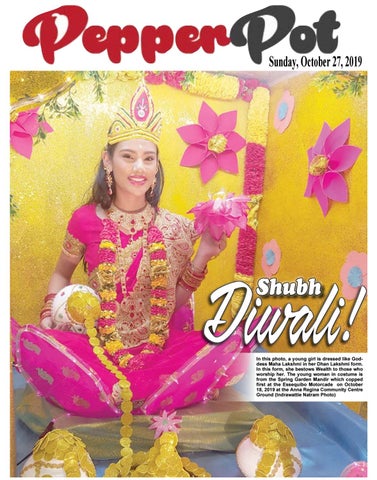
Sunday, October 27, 2019
Diwali! Shubh
In this photo, a young girl is dressed like Goddess Maha Lakshmi in her Dhan Lakshmi form. In this form, she bestows Wealth to those who worship her. The young woman in costume is from the Spring Garden Mandir which copped first at the Essequibo Motorcade on October 18, 2019 at the Anna Regina Community Centre Ground (Indrawattie Natram Photo)
2
Chronicle Pepperpot october 27, 2019
Diwali fosters creativity among children
Children expressed joy participating in Rangoli Competition By Indrawattie Natram Artistic skills were displayed by Secondary School students this year at the Guyana Hindu Dharmic Sabha Inter-Secondary School Annual Rangoli competition held on October 17 at the Anna Regina Multilateral Secondary School (ARMS). The competition is organised annually by the Sabha and is coordinated in the various regions by the respective Praant. Hundreds of students from seven Secondary Schools in Region Two were excited to participate in the competition. The secondary schools that participated were Anna Regina Multilateral, 8th May, Abram Zuil, Aurora, Johanna Cecelia and Charity Secondary Schools. Their excitement filled the air as the competition began at 11:30 hours. Children were seen colouring rice, sketching and also making creative designs on ply boards. Teachers were seen nearby giving guidance to the children. Sohini Dass from the Abram Zuil Secondary School said that the competition has allowed students to showcase their artistic skills and to unlock their true potentials. She
said last year she was also part of the competition and had planned that this year the team would improve on their artistic design and neatness. The school’s rangoli depicted a peacock which signifies the cycle of time in Hinduism. The rangoli was adorned with flowers and diyas showcasing the significance of the festival. Rea Ramlall from Charity Secondary school said that it was her first time and it was fun for her. She thanked the Guyana Hindu Dharmic Sabha for allowing her to be part of such activity. Ramlall said it was a nice experience to be among other children. Amalika Persaud from the Anna Regina Multilateral Secondary School said that she enjoyed the moments spent with her peers. She said the competition had a maximum of two hours and 12 students from her school were busy making the design. Their design depicted an instrument that is linked with Hinduism and also had diyas. Renhasa Featherson who represented the 8th May Secondary said their rangoli depicted the peace and goodwill of the festival. Aurora Secondary School children Charity Secondary School students and their rangoli
The Aurora Secondary School Rangoli design
Abram Zuil Secondary students making a design
Turn to page IV ►►►
Johanna Ceclia Secondary students designing this rangoli
students being creative
Chronicle Pepperpot october 27, 2019
III
Diwali
A festival brought to the shores of Guyana from India
By Indrawattie Natram
A female dressed as the Dhanya form a depiction of Goddess Lakshmi
IT has been 181 years since the Indian Ancestors stepped foot on the shores of Guyana. Travelling with them were their traditions and customs that are still preserved in Guyana by the Hindu community. Emerging from their traditions was the festival of Diwali that is proudly celebrated in Guyana by all Guyanese. According to President of the Guyana Hindu Dharmic Sabha (GHDS) Dr. Vindhya Persaud, the festival was brought to the shores of Guyana by the Indian ancestors and is still practised by the younger generations. She was at the time addressing hundreds of Essequibians at the Sabha Annual Diwali Motorcade held on October 18 at the Anna Regina Community Centre Ground. Speaking on the auspicious occasion Dr. Persaud said Diwali, the brightest festival, is celebrated throughout Guyana
Youths dressed as demons and Gods churning the milky ocean for the restoration of peace. Emerging from the Ocean after 1000 years was Goddess Lakshmi.
with much zest and pomp. She said the occasion marks the illumination of one’s inner self and the riddance of negativity. The festival teaches mankind to destroy the dark desires and thoughts and to have a deeper inner illumination of self- reflection. She added at the Sabha level, Inter-Secondary School Rangoli and Motorcades countrywide were planned to coincide with the festival. The Sabha’s President, therefore, used the opportunity to extend Diwali Greetings to all of Guyana. Significance of Diwali Speaking on the significance was President of the Essequibo Coast Praant of the Guyana Hindu Dharmic Sabha Pandit Kaydar Persaud. Pandit Persaud said Diwali means a row of lights and is celebrated on the 15th Day of the Hindu month of Kartik. It is known as the darkest night
and as such the Goddess Lakshmi who is the giver of health, wealth and prosperity, is adored. Pandit Persaud, who is the religious leader for many Mandirs in Region Two, said that the festival is celebrated during a five-day period. The first day is referred to as Dhanteras (day of fortune), the second day is Naraka Chaturdasi (day of knowledge), the third as the day of light; the fourth day as Annakut which is the New Year and fifth day Bhai Dui, a day when brothers and sisters renew their love. Pandit explained that the story surrounding Diwali is the return of Lord Rama after 14 years in exile. To welcome him diyas were lit in the pathway; as such the festival has gained its significance. “Diwali is a celebration of prosperity, it gives us strength to carry on our work with goodwill for the rest of the year, it’s a new year and thus persons are given the
Pandit Kaydar Persaud, President of the Essequibo Praant of the Guyana Hindu Dharmic Sabha opportunity to prosper throughout the year,” Pandit said. Celebrations In Guyana before the celebration, residents clean their houses before the observance of the festival. Many females shop for new clothes, jewellery and, utensils. On the day itself, rangoli is made in the Turn to page IV ►►►
Females dressed as Goddess Lakshmi displaying the eight forms she came in. These females were on the Golden Fleece Vishwa Jhotir Mandir float at the Annual Motorcade
IV
October is celebrated globally as National Dental Hygiene Month. During this month the world is made aware of what is oral health. Is it the same for everyone since many people have different oral conditions, such as missing teeth, restored teeth, and so on? There are good questions to consider since
Chronicle Pepperpot october 27, 2019
National Dental Hygiene Month
everyone has different existing conditions. According to the World Health Organisation, “Oral health is a standard of the oral and related tissues which enables an individual to eat, speak and socialise without active disease, discomfort or embarrassment and which contributes to the general well-being.” Society,
Diwali ◄◄◄ From page III
entrance of the home and diyas are lit along the doorways. Vegetarian meals and sweetmeats are prepared on the day as well. These are shared with family and relatives. A ‘puja’ – a religious ceremony- in honour of Goddess Lakshmi is performed by families before the grand lighting up. After families are finished with the lighting up then they walk around the villages exchanging Diwali greetings with each other. Special services are also conducted at various temples in observance of the celebration. Shubh Diwali to all of Guyana!!
in general, has always viewed a pretty smile as an indicator for good teeth and healthy gums. Yet statistics are indicating otherwise, and all professional dental organisations are advocating for optimal oral health. When the author of the biblical verse declared that it is what comes out of a man’s mouth that defiles him and not what enters, in a literal context, he was unaware of the fact that it is precisely the opposite that is true. In the late 1990s, the dental and medical communities were hit with a revolutionary research outcome that showed a link between oral health and systemic health. The culprit: bacteria. Today, it all seems second nature. Many say that the eyes are the windows to the soul, which means that they could be the window to the body – or better yet, the door. It only makes sense that what a person ingests will lead to
either a healthy lifestyle or an unhealthy lifestyle. We, dentists, are taught that we should not treat the oral cavity but people with an oral cavity. The mouth is not separated from the rest of the body and why it took centuries to realise that oral bacteria could contribute to declining health may forever be a mystery. There will be short-term and long-term effects of what one does today because of their diet and exercise routine. Yet many people would rather live for today than worry about tomorrow. For the dental professional it will be imperative to influence patients to make a change in their eating habits if they want to save their teeth. For other health care providers, it will be imperative to influence patients to make a change in their lifestyle to live a longer, healthier life. While it certainly occurs, few people die from oral diseases, yet the costs of treat-
ing it are astronomical at all levels: individuals, families, third party insurance companies, and government agencies. For example, in the United Kingdom, costs for treating dental disease overweigh the cost of treating all cancers and heart disease. (East Sussex, Brighton and Hove Health Authority, 2009). The American Academy of General Dentistry is among those to promote the importance of oral health, recognising that more than 90 percent of all systemic diseases have oral manifestations and that oral infections can affect major organs (bacterial endocarditis). The Surgeon General reported that some type of periodontal disease or gingivitis affects more than 75 percent of the population. The statistics reveal the significance of the dental professional in preventing and treating oral diseases, as they may be the first health care provider to diagnose a
Diwali fosters creativity ... ◄◄◄ From page II
were excited and very creative. Their rangoli was adorned with lighting diyas. Some of the schools finished before their allotted two hours. The Winner of the competition was Abram Zuil Secondary School while second was Anna Regina Multilateral Secondary and Third, Aurora Second-
ary. The other schools received a certificate of participation and all participants will receive a certificate from the Guyana Hindu Dharmic Sabha. Rangoli is an art form originating in the Indian subcontinent in which patterns are created on the floor or ground using materials such as coloured rice, dried flour, coloured sand or flower petals.
President of the Guyana Hindu Dharmic, Sabha Dr. Vindhya Persaud handing over a prize to a young female dressed as Mother Lakshmi at the Essequibo Motorcades
Children from the Abram Zuil Secondary School with their rangoli
problem. The importance of regular oral health care and education becomes imperative for improving oral health and will impact the well-being of all. Since the late 1990s, as previously mentioned, it has become more apparent with continued research that not only is cardiovascular disease linked to oral disease, so is respiratory disease and preterm low birth weight (PLBW) babies. There are good or normal bacteria thriving in the same environment as infectious microorganisms. As medical research continues to assist in better understanding this link, oral health practitioners must continue to educate patients in the relationship that exists between oral and systemic health. Of course, bacteria are not the single influence on systemic diseases that take the lives of millions each year. Other known risk factors still include stress, tobacco use, high blood pressure, family history, genetics, weights, alcohol use, and lack of physical activity. There are more and more risk factors being discovered each year that can shorten one’s lifespan. Cardiovascular disease may be exacerbated by periodontal inflammation. The National Institute of Dental Craniofacial Research (NIDCR) reports that scientific theories site opportunistic infectious bacteria that colonise in the mouth form biofilms. These biofilms can activate white blood cells releasing inflammatory mediators that can enter circulation and either enhance or perpetuate systemic effects. This inflammation, along with other risk factors, taxes the body’s ability to fight systemic disease. In a periodontal pocket, bacterial biofilm directly contacts ulcerated epithelium. The more advanced the periodontal condition, the more surface area for bacteria to enter the bloodstream. According to the American Academy of Periodontology, more recent studies are now indicating that elevated levels of C-reactive proteins are better at determining the risk for cardiovascular disease associated with periodontal disease. The liver makes c-reactive proteins after being triggered by the number of bacterial by-products in the bloodstream. This trigger response system causes increased arterial inflammation.
Chronicle Pepperpot october 27, 2019
V
Nature bloom: Not a replica but a representation MANY artists capture the beauty of God’s creation in their work. Nature serves as a source of inspiration and therapy. Presently the National Gallery is hosting an
sure of talking with Sandra Bell-LaRocque about her first exhibition. Sandra is a Dominican born, Guyanese trained artist. Although Sandra is a mature person, she is a young artist who
we destroy that order. The antibodies and minerals that are naturally produced in fruits and vegetables will degrade, resulting in a weak production and a weak human system. I am
Painting by Sandra Bell-Larocque entitled ‘Koker.’ exhibition of paintings by two women artists, Sandra Bell-LaRocque and Aelisha Garnett-Williams entitled Nature Bloom. As you enter the gallery space, you walk into a serene environment of visual representations of Guyana’s landscape and a glimpse of Dominica. The earth tone palette sets the tone of the room. The artists capture our seawall, canals, sunsets, sluice (koker), flowers and more. Rather than displaying a replica of our environment, the artists choose to depict a representation of it. It’s always stimulating to be in conversation with young artists. I had the plea-
believes that now is the time for her to follow her dreams. Captivated by nature, Sandra reminisces on her upbringing, that she believes would have sparked her passion for nature. “I grew up in a small farming village in Dominica. I spent most of my days outside enjoying the fresh air and admiring the beautiful sunsets. Surrounded by an organic environment, I came to understand how the environment works. I witnessed nature’s power to regenerate itself. In my opinion, the soil has a lifecycle where the micro and macro organisms do what they have to. When a chemical is added,
Painting by Sandra Bell-LaRocque entitled ‘Essequibo at Iwokrama.’ hoping that my work can cause people to do some reflection”, she stated. Passion makes a person pursue his/her dream. Passion, coupled with discipline motivates persons to practice. It is through practice that artists develop their skills and apply their theoretical knowledge. As knowledge increases, artists grow to a point where we teach ourselves; where we can move beyond traditional boundaries and create our own techniques. It is a continuous learning process because the work is always expanding and as artists, we are free to express ourselves
with more clarity. However, for some of us, the ability to practise is limited. In Sandra’s case, her current environment limits her from practising sculpture. But for now, she is content with her ability to paint and explore her artistic desires. Nature Bloom is a painting exhibition to visit. I admire Sandra’s determination to express her actual experience in her paintings. ‘A Cut into the Forest’ is an acrylic painting based upon her experience at Iwokrama. ‘Embracing City Life’ is a representation of the canals in Guyana. This piece is quite fascinating because
it depicts our canals as a tranquil environment where our beautiful lotus flowers can flourish, rather than a harsh one. She painted an abstract representation of Kaieteur Falls and entitled the piece: Beauty and Fury. It represents the captivating beauty of water, coupled with the stories of death by suicide at the falls. These pieces are beautiful representations of nature and life experiences. In her closing remark, Sandra stated, “If it satisfies your soul, go for it”. The exhibition continues until Saturday 2nd November 2019.
VI
Chronicle Pepperpot october 27, 2019
DOMESTIC VIOLENCE IS NOT A PHENOMENON –– It’s a consequence of male economic emasculation and abuse
I READ that Guyana is going to get a Billion dollars from a UN-EU initiative to fight physical persecution against women and girls by males and in some cases females. Such an initiative will require to fulfil its mandate a quantum leap away from the crusader mythologies that revolve around domestic and underage abuse of females and must also include the silent -parallel realm of the same abuse against males, by both males and females, because deformities in the social , cultural and mental organised chaos, at times, if left unrecognised, or unattended, do tip the balance, and we have hardly ever
based on demands based on the ‘Rush’ to get rich quick, with the option of drug trafficking that seemed to provide a phenomenal creation of the ‘Joneses’ without any obvious trail of sweat and ideas, though there was plenty of the ‘Blood’ with the backup option that if you had enough bribe money, one could literally get away with murder. This was obvious all around and preached like a mantra Guyana had retrogressed in that period as never before in our post abolition history. What was also obvious is that the hitmen could be contracted from the very Police of that day, not so long ago, or from the state and sections of the private sector managed ‘Phantom’ or any jobless
in respect to this problem, which President Granger had referred to in opposition, the significant numbers of dropouts, which the then PPP government had denied. As President David Granger has now deployed the Volunteer youth corps, and several Skill training programmes for teen pregnant dropouts, ongoing education, and the shift in the perception from job employment to self-employment, an uphill task that will require a national reorientation. The most recent is an article on the subject of domestic abuse in Guyana Chronicle May 19, 2019 “Socialise males better” that touches on several contributors to domestic abuse, but is yet incomplete
Sunday, August 5, 2007, page 11, Kaieteur News carried an article “Battered men are coming out of the shadows” featuring the observations of Senior Public health officer at Help and Shelter Dennis Cuffy Jr. That noted from 1995 when they opened doors, 1,007 men had visited Help and Shelter. I have written numerous articles, to help avoid cosmetic responses to an obvious serious deficiency in the analysis of this social development, even recommending a men’s hostel, for men who earn low wages and have no options but to sleep on the sea wall and the pavilions of the Parade ground. The courts are also in neglecting imbal-
seriously contemplated the consequences of any social or cultural deformity on the neural balance of our humanity. The predicament of most males cannot be brushed under the guilty by gender carpet because of the challenge to explore the labyrinth of social, traditional and cultivated machismo that they are entangled in, and are unaware of the hostile currents that drag them to and fro. National culture has changed drastically. Once beyond Georgetown and in some wards of old Georgetown it was not uncommon for youngsters to walk barefoot, now habits and street culture vocabulary has extended, the countryside isn’t the countryside anymore, and this process had begun before social media entered the dynamics. The question is what are the economic implications? It was not invisible, it was unfolding right before us and no initiatives were taken until now. The crisis of brutal domestic murders have always existed, but there seems to have been a direct escalation around the turn off the century, and it can be linked to the bloat of conspicuous consumption, coupled with possibly the most violent period which I have titled the Jagdeo/Roger Khan era, which carried statistics of an increase of youth murders and fatal domestic upheavals. Over 70 percent were
underprivileged youth, broke and vulnerable. Economic and any kind of domestic ownership contentions that provided an escape from want led to murder because it was a trend ignored and scoffed at by those authorities. One young writer - Alissa Trotz, in Stabroek News Oct. 11. 2010 called it ‘An epidemic of Violence’. Stabroek News March 30, 2014, Audrey Benn, Lecturer in the women’s study unit stated: “Guyana has not developed a consolidated response to domestic violence- there are many problems that are contributing to the increase in domestic violence- while nothing gets done, women and children especially, continue to die.” This confirms the toll of the previous year, see-Kaieteur News, December 28, 2013 page 10- “ Twenty three women brutally killed by men during 2013.” Almost two domestic murders per month alone in a wider murder toll. Monsignor Terrence Montrose advised that “Men must be taught to speak about their pain lest they erupt in violence against their partners” 2012. in 2010 the GHRA had suggested “ Men can stop the violence but women must empower themselves” but there are more down to earth social, cultural and traditional problems that contribute to domestic upheavals than mentioned there, that are not taken into the reference pool
towards narrowing down to salient realities, which despite visibility are so accepted that they are overlooked. Many men were taken out of school to become surrogate fathers, denying them important social evolution development and skills, even functional literacy. Guyana has lost some 60 percent of its semiskill labour employment. Modernisation has created ‘less human spaces’. Culturally we share two cultures that of Matriarchal and Patriarchal with differing innate views on relationship positions. I can speak from experience on the stress that invades when unable to fulfil family expectations. Men drift into loneliness, women too, I have had several friends who were found dead living alone, because they were unable to earn enough to sustain relationships, yet others prefer to take the chance alone rather than go through the stress of a nagging spouse in a relationship as is said ‘with issues’ women submit to Popes, Prophets and High Priestesses to alleviate loneliness, men don’t. Domestic violence has revealed a paradox opposing mere spite or explosion of rage, men are tipped into an abyss that compels them across cultural origins to commit suicide in the act of many domestic killings, I’m talking about young men, check the statistics.
ances contribute to male deterioration, I used as a reference, a young man who was brought before Magistrate Ann Mc Lennon (Talking Culture Guyana Chronicle, June 22, 2018 pg. 23) for assaulting his mother over $500. The details of that incident in December 2014 raised questions about this young man’s options. He was a breadwinner at 10 years old and worked in the bush. Now his aunt had moved in, he took care of his mother and they all benefitted. If things change negatively, will he be condemned for not saving money? The magistrate did not even recognise that he may be illiterate, he was over his head. He was 17 years old at the time of this incident. This boy-man was seen as the catch-cow by his family, but no intervention came. I have known men who put their money into buying houses and because of illiteracy and misplaced trust end up committing arson or murder, when realising they were swindled legally. Domestic contentions are a lethal problem. How they are managed will determine its containment or further escalation, as the world continues to change. Last but not least, with drug abuse pervading this society, another macabre dimension has attached itself.
Focus Chronicle Pepperpot october 27, 2019
VII
on the Village
Welcome to Experiment Village
By Michel Outridge This week the Pepperpot Magazine visited Experiment Village in West Coast Berbice, Region Five (Mahaica-Berbice). Experiment is a village located about 56 miles from the city and it is bordered by Naarstigheid and Plantation Hope villages. Chairman of the Bath/ Woodley Park Neighbourhood Democratic Council (NDC) Krishna Sewlall told the Pepperpot Magazine that Experiment Village falls within the Bath/Woodley Park NDC and the village was established in the 90s. He related that within Experiment an area was earmarked and developed for a housing scheme in which a cottage industry was expected to rise with 100 house lots for mainly large
about 150 families with about 250 residents, who work in offices, are cash crops farmers, business people and cane cutters employed by the Blairmont Estate. Sewlall added that the village has potable water supply, electricity, a health centre, churches, a community centre ground and shops. He pointed out that within the NDC area of Bath and Woodley Park there about 1,500 sugar workers and the villages are the largest producers of eschallot and celery which are wholesaled across Guyana. In the rural development plan, the area saw the re-paving of roads and the clearing of drains within the communities which was spearheaded under the NDC. However, Sewlall report-
Sieta Crisendatt and presently they are utilising private lands at Bath. Sewlall added that often taxpayers monies are being used to execute many developmental projects within the villages and there is the need for the re-paving of internal streets
Experiment signage (Adrian Narine photos) The Suriname-born woman explained that she is living at her deceased mother’s property, which is the last house in the village and her life is very hard because she has to take care of two children in her care. This 39-year-old has another job as a domestic worker and she would also get up as early as 03:30hrs and use the light from her cell phone to tend to her garden. “I prefer to work when the place is cool than in the sun but the sandflies usually bother me a lot but I have to work anyhow,” she said. At first, Crisendatt used to plant only greens and she was tasked with walking and selling after reaping the produce but with the
celery and eschallot she has a ready-made market for it and doesn’t have to go anywhere to sell. “The buyers usually come to my house to make purchases so that is easy on me after I weigh it, it is sold at the market price per pound and I get my money, used is often used to replant,” she said. “You see with this country life you can’t sit down, you have to do something because, with children to mind, you can’t afford to be lazy or get sick.” She related that she used to work at a store but the pay was low and she later became self-employed and started her own small business. Crisendatt added that she doesn’t use any fertiliser on
her crops only manure and she is happy there are no pests or blight problems in her garden. She also uses pipe water to water her crops and said it is wholesome and of good quality, because it is organic. Crisendatt told the Pepperpot Magazine that eschallot takes six to seven weeks to fully grow, lettuce takes five weeks and celery grows faster if the soil condition is good. Crisendatt says that she does what she has to do even ‘with two jobs and she still has to contend with household chores because she wants to provide a good quality of life for her children while doing so alone.
Crisendatt’s watering her eschallots businesses but the area was converted by this administration earlier this year into a residential area. The housing scheme in which 20 units (houses) were constructed by the Central Housing and Planning Authority (CH&PA), was commissioned in April this year but remains unoccupied. Experiment is home to
ed that four years ago they had 54 Strategic Investment Programme (SIP) workers and to date, they only have 11 and it is not adequate because the area is large for the SIP workers to manage in the community enhancement programme. He disclosed that the NDC needs a landfill site to dump refuse from the villages that fall under the NDC
within Experiment Village. Cash crop farmer The Pepperpot Magazine encountered a single mother of two, Sieta Crisendatt, who has a vibrant kitchen garden in her yard and is planting crops of lettuce, celery, eschallot and calaloo.
Sieta Crisendatt’s crops of lettuce in her yard
VIII
Chronicle Pepperpot october 27, 2019
Experiment Health Centre Providing adequate care for its residents
By Michel Outridge Headed by Dr. Reenika Veerasammy and other staffers, the Experiment Health Centre, West Coast Berbice provides efficient child and reproductive health services among others for its residents. Dr. Veerasammy stated that she has been at the health centre since last November and she is there for two days
Experiment Health Centre (Adrian Narine photo)
Dr. Reenika Veerasammy per week since she shares her services at two other health centres on the West Coast Berbice division.
The Berbician added that she is at Experiment Health Centre on Mondays and Tuesdays for the chronic diseases and ante-natal clinic days where she sees more than 40 patients collectively. On Wednesdays, Thursdays and Fridays, Dr. Veerasammy is at Woodley Park and Bush Lot Health Centres. “I am from Bath Settlement and this is the first time I am actually out of the hospital setting. I was at the Foot Centre at Fort Wellington Hospital for eight years
but it is a process and am I am adjusting so far,” the doctor said. She stated that the transformation has been good even though she is not accustomed to being at the forefront of a primary health care facility where more emphasis is being placed on prevention of chronic diseases, which sees a large turnout of patients with hypertension and diabetes. Dr. Veerasammy has been able to share her expertise with patients she encounters daily in a one-on-one set-
ting at the three health centres she is at on the weekdays. “I am doing a post-graduate in diabetes so I am trying to pass on some knowledge to patients, the clinic is getting bigger, and we get like 40 patients fa week, and at Woodley Park, Health Centre is even bigger with 60 patients,” she said. She related that even though the facility is fairly new they have had two visiting doctors and it is adequately staffed with a midwife, a nursing assistant, two community health workers,
a visiting pharmacy assistant on Tuesdays, which is chronic diseases clinic day. “We try to shorten the waiting time for patients, so they don’t have to be here all day here for services even though we see patients from neighbouring villages such as Bath Settlement, Plantation Hope and Experiment,” she said. She stated that at Experiment Health Centre doesn’t turn away any patients and even on clinic days people show up with seasonal illnesses, acute sickness as well as asthma, among others and
they would treat them too. The facility is opened from 8: 00hrs to up until 16:30 hrs on Mondays to Fridays, where professional and friendly health care services await you. Dr. Veerasammy said at times the clinic is large and the days are limited and with her being a home-care specialist she cannot provide that service there but refer patients to the Fort Wellington Hospital. In 2016 officials of the Basic Needs Trust Fund (BNTF) handed over the $32.2 million Experiment Health Centre to the Regional Public Health Department in Region Five (Mahaica/ Berbice). With funding from the Caribbean Development Bank (CDB), the BNTF had undertaken the construction of the health centre at Experiment, West Coast Berbice, in May 2013. The overall cost of $32.3 million comprised $23.2 million from the CDB and $9.1 million in counterpart funding from the Government of Guyana. The facility has a floor space of 3,060 square feet, provides primary health care for at least 4,000 persons living in several villages.
Making Experiment Village his home By Michel Outridge Cecil Ramdatt, who has attained the position of Justice of Peace in his village, is one of the respected elders in the community, which has seen development. The elderly gentleman told the Pepperpot Magazine that he first came to Experiment Village in 1971. He is originally from Bartica but relocated to Essequibo Coast after which he settled in Experiment Village as a result of work. “I was stationed at the District Commissioner’s Office at Fort Wellington and it
wasn’t the regional system yet then I moved over to MMA in 1978,” he said. Ramdatt told the Pepperpot Magazine he has seen some development within the area including the establishment of the Bath/Woodley Park housing scheme which is said to be the largest in Region Five. “I have seen where I live here in Experiment converted from thick seen crabgrass into a housing area and we have good roads and drains here which is a plus,” he said. Ramdatt reported that back in the days, they didn’t have any potable water sup-
ply, electricity and telephone services and when he became chairman for the Bath/ Woodley Park NDC from 2003 to 2013, he lobbied for those things, he said. He added that he had to resign from NDC because he became a Justice of Peace and couldn’t manage both jobs at the same time. “I am comfortable with this as a Justice of Peace because riding two horses at the same time wouldn’t have been easy. At times people used to be at my house waiting on me to provide services and I felt bad about that so I did the right thing,” he said.
Ramdatt stated that he retired at MMA in 1997 and he is now enjoying his retirement as a pensioner. However, he said there is a need for improved water service. Since the population grew in the housing schemes the water pressure is very low and it needs to be reliable and adequate. Ramdatt bragged about the potential of Experiment Village as being the biggest supplier of cash crops across the country and said too, that some people are farming to make ends meet, which shows their resilience in surviving. He pointed out that there
isn’t a prevalence of drug use among the youths in the village but they too need jobs and to be empowered with a life skill to earn. Ramdatt said the village has the necessary facilities for enhanced life and schools are nearby and the villages of Experiment/Hope/Waterloo all go together in terms of community relations. He disclosed that before the housing schemes were established, the lands were owned by Guysuco and later the government took possession of it and housing areas were developed to promote housing developed.
Justice of Peace, Cecil Ramdatt of Experiment Village (Adrian Narine photo)
Chronicle Pepperpot october 27, 2019
IX
The milkman of Experiment Village
By Michel Outridge THE village Experiment didn’t happen as a result of an experiment gone wrong, however, the place got its name many moons ago and the records would reflect it had its name long before some of us were even born. This community has some good features and one of them is the countryside milkman, who has a serving of fresh cow’s milk for the taking. Shaun Bridgemohan is the village milkman. He is from Experiment and is staying at his grandmother’s place with his family.
Sanjay and Janet Snackette
Experiment Village, Milkman, Shaun Bridgemohan (Adrian Narine photo) Owner of the Snackette, Janet Tirbohan The milk is taken from his herd of 23 cows which is located in the backlands of the village by the six-door sluice and he would visit them daily, early in the morning for feeding and milking. The 21-year-old told the Pepperpot Magazine that he
doesn’t sell milk every day but does on most days. He rides around the entire village on his bicycle with a five-gallon plastic bucket and a pint enamel cup to measure the milk which he sells at $100 per pint. Bridgemohan reported that his milk is always fresh and is not diluted with water, as such, it is wholesome and healthy for consumption.
“The idea of working with people didn’t sit right with me so I knew I had to do something and with the cows in hand, I made it my small business of rearing cattle and selling the milk to support my family,” he said. Bridgemohan stated that he would sell five gallons of milk whenever he milks the cows and would go around the village before 10:00hrs.
“Walking around the place in this sun isn’t easy so I have my bicycle and I use it to do my work and it is simpler and by 11:00hrs I done sell and gone home to do other things to supplement my income as a family man. You got to work,” he said. Bridgemohan explained that he has his own customers within the village and when he is done he has time to do other things since he doesn’t have to leave the village for work. Sanjay and Janet Snackette The Pepperpot Magazine met Janet Tirbohan, a mild-mannered businesswoman, who is enthusiastic about her role managing her business, which is a roadside food place called “Sanjay and Janet Snackette”. The business is located at Experiment Public Road and
it is the spot for travellers to recharge on their journey to Suriname especially those going by bus. “We open very early in the mornings to facilitate all the passengers travelling by buses that go to Suriname and they stop here to get something to eat with tea or coffee or a beverage and continue their journey,” she said. She explained that four years ago when the Berbice Bridge began its operation, they were forced out of business at Rosignol Stelling, where there was a thriving food business. Tirbohan added that they purchased a canter truck and converted it into a food truck where they were vending and it was called “Meals on Wheels” and then she bought the property at the roadside location and opened the business there.
“Having a business where you live is very convenient because you don’t have to go anywhere and it is better to prepare your foods here,” she said. Tirbohan stated that her day starts very early from 03:00hrs she would get up to prepare meals and by 03:30hrs, she opens the shop to welcome travellers going to Suriname via bus. She has in her employ three persons, one of whom sells in the shop and she would take her place in the kitchen to cook. “Everything is prepared fresh every day- the foods are hygienic and halaal-certified and prepared in good condition. Our foods are halaal and we don’t serve any beef or pork here and no alcohol or cigarettes just beverages,” she said.
Thrift savings are very much active in the school system in Region Five By Michel Outridge Coop Officer for Thrifty Society Association in Region Five, Thakoor Singh is optimistic about the development of thrift savings in the school system. He related that in the 1980s he became the Coop Officer in which thrift savings are encouraged in schools where students have two types of savings can be opened such as ordinary savings and special savings which is manned by teachers. Singh added that it is similar to the old “Penny Bank” system but with this thrift savings, in schools, teachers are held accountable for the money. He stated that the thrift savings are in more than 30 schools, both primary and secondary in Region Five
(Mahaica-Berbice). Singh explained that in some cases pupils were known to have saved up to $1 million but there are some loopholes. As with any system, nothing is perfect because some teachers have relocated and caused a lapse in the thrift savings. He disclosed that to form a Coop Society, no less than seven members are allowed and they come together and agree on achieving common goals by pooling their resources. Singh reported that he is the Coop Officer which manages the entire region from Mahaica to Ithaca. The Coop Officer noted that the community of Experiment is lacking a few things including that education being placed on the back-burner, so to speak, while others
simply cannot afford to send their children to school. Singh, a resident of Experiment Village stated that they have a lot of school drop-outs within the community and some have found jobs being self-employed rearing cattle on a small scale, a few people are fishermen and most villagers are employed at the Blairmont Estate. He added that more emphasis needs to be placed on youth development in that region where the young people can be gainfully employed and training programmes are welcomed. Singh is of the view that the region has a lot of potential but needs a boost in terms of youth empowerment since most young people do not want to go into farming.
One of the many streets in Experiment Village
X
Chronicle Pepperpot october 27, 2019
WORLD FOOD DAY “Those who think they have no time for healthy eating will sooner or later have to find time for illness.” On October 16, World Food Day was observed under the theme “Our Actions Are Our Future. Healthy Diets for A Zero Hunger World”. Focused was placed on tackling global hunger. Due to globalisation, urbanisation and income growth, our diets and eating habits are changed. Instead of seasonal, fibre rich food and plant-based food we are shifted to refined, starches, sugar, fats, salt, processed food, meat, etc. It has been seen that in urban areas time spent on preparing food or meals is very less because people these days rely on ready-made food, supermarkets, fast food, street food, etc. WHAT IS AN UNHEALTHY DIET? A diet is called unhealthy if it is high in refined starches, sugar, fats, salts, processed foods, meats, and other animal source products. The major reasons behind these unhealthy diets can be attributed to less time spent at home due to changing family dynamics, leading to a high dependence on fast food. The major disadvantages of unhealthy diets are: · The unhealthy diet causes obesity which affects approximately one in three people; · The unhealthy diet is one of the leading risk factors of death due to non-communicable diseases like cardiovascular diseases, diabetes, and other factors; and
· Unhealthy eating habits also take a heavy toll on national health budgets. WHAT IS A HEALTHY DIET AND WHY IT IS IMPORTANT? A diet can be a healthy diet if it meets the nutritional needs of individuals by providing required nutritious and lead an active life. A healthy diet also reduces the risk of disease. It contains fruits, vegetables, legumes, nuts, seeds, and whole grains, and foods that are low in fats (especially saturated fats), sugar and salt. WHAT ARE THE REASONS BEHIND HUNGER AND POVERTY? The major reasons behind the hunger are poverty, food shortages, war & conflict, climate change, unstable markets, poor infrastructure, poor nutrition, poor public policy, economy, food shortage waste, job instability, poverty, gender inequality, forced migration, discrimination, nutritional quality
Why zero hunger changes the world 1. Zero hunger could save the lives of 3.1 million children a year; 2 . Well-nourished mothers have healthier babies with stronger immune systems; 3. Ending child undernutrition could increase a developing country’s GDP by 16.5 percent; 4. A dollar invested in hunger prevention could return between $15 and $139 in benefits; 5. Proper nutrition early in life could mean 46 percent more in lifetime earnings; 6. Eliminating iron deficiency in a population could boost workplace productivity by 20 percent; 7. Ending nutrition-related child mortality could increase a workforce by 9.4 percent; and 8. Zero hunger can help build a safer, more prosperous world for everyone. Achieving Zero Hunger is not only about addressing hunger, but also nourishing people while nurturing the planet. This year, World Food Day calls for action across sectors to make healthy and sustainable diets affordable and accessible to everyone. At the same time, it calls on everyone to start thinking about what we eat. What we can do: 1. Don’t waste food and put only that much food on your plate which you can eat; 2. If you have extra food, then instead of throwing food, give it to needy persons; 3. Use local and in-season fruits and vegetables as part of a healthy diet; 4. Remember a healthy diet is one part of a healthy lifestyle. Sources https://www.jagranjosh.com/general-knowledge/ world-food-day-1571143457-1 http://www.fao.org/world-food-day/wfd-ceremony/en/ https://versionweekly.com/news/world-food-day-2019theme-history-and-objectives/ You can share your ideas and questions by sending letters to: “Our Earth, Our Environment”, C/O ECEA Programme, Environmental Protection Agency, Ganges Street, Sophia, GEORGETOWN, or email us at: eit. epaguyana@gmail.com or follow us on Facebook and Instagram.
Chronicle Pepperpot october 27, 2019
XI
Mental Health knows no race AS many of you know, Guyanese are racially divided when it comes to many important issues. After reading some news articles and subsequent comments that some people thought were appropriate, I realised that many people don’t understand what racism is, let alone identify and stop when it is happening. Racism means prejudice or discrimination towards an individual or group of people simply because of their race. It’s based on social perception of biological differences between people. When the term ‘race’ was created, it was intended to classify individuals and respect their differences and dispositions. The root of the word can today be translated as ‘beginning’ or ‘origin’. However, over time, we have turned it into the belief of superiority or inferiority in a socially unjust and morally incomprehension way. Racism means that a personally perceived, dominant group benefits from the oppression of others. It’s an unjust power structure that hurts an entire society with active discrimination. It promotes hatred and it is not far from racial segregation that our ancestors fought years to overcome. Racial segregation is the separation of humans based on their race. It used to apply to daily activities such as where one can eat, attend school and generally socialise. While segregation has been largely outlawed, it is still noticeably prevalent in Guyana. We see it in certain villages, politics and even in some modern social norms. It caused me to think about it in regards to my field; just how much racism can affect mental health. Even though racism is one of our oldest and most serious concerns, the study of racial trauma in the field of psychology is fairly new. However, we certainly do know that exposure to racism does have a detrimental effect on our entire well-being. It can cause issues ranging from low self-esteem to mental health illnesses such as depression or anxiety to even suicidal thoughts and behaviours. I have so many clients who have also turned to aggression, violence, isolation and substance abuse due to racism. Personal perception is vital in regards to mental health. It focuses on the belief that our moods, thoughts and emotions begin and end with us. Many people need validation from others but having good mental health means positive self-awareness as well as a realistic view of your strengths and weaknesses. This is greatly affected in those who are exposed to and experience racism. Many of us tend to believe what others say or think about us or those like us.
Our self-esteem is greatly lowered when we feel judged and ridiculed by things we cannot change – colour of our skin being only one factor. The key to making a difference is to know that it is happening and even more so, it is damaging. Something I think that we all too often forget- when on a table, it is much easier to go down to someone’s level rather than pull them up to your higher ground. When we become aware of what is going on and do something about it, it gives us a great feeling of power and completely diminishes the possibility of hopelessness. When one is properly educated, they never feel like there is nothing that can be done. It is hard (or at least should be) to accept that we play a role in the diminishing of our own and other’s self-worth. We know that if we have a certain view about others, we have an underlying fear that others equally critique us. Having good mental health does not simply mean living without a diagnosis but rather the ability to have healthy views, relationships and the ability to make a worthwhile contribution to society. This kind of racism affects both those perpetrating and being victim to it. It increases substance use and abuse, and violence such as assaults, homicides, suicides within an entire community. It brings out hopelessness that we are so used to seeing, that it almost goes unnoticed. I believe the biggest problem that we face is that we assume race comes with a moral defect. We believe that people act in certain ways or have certain values due to the colour of their skin. In Guyana, race is the focus of the discussion on everything – violence, crime, substance abuse and even suicide. A famous philosopher John Locke coined the term Tabula Rasa which means blank slate. It is a term that expresses the view that people are not born good or bad but without any predetermined rules of how or what they will process. This means that everything, including racism, are learned behaviours- one that can be stopped in its tracks. Appreciate people for who they are and what they can bring to the table, not the colour of their skin. Diversity brings out more knowledge and advancement, for individuals as well as an entire society- never forget that. Thanking you for reading. Please keep sending any topics you’d like to talk about to caitlinvieira@gmail.com Suicide Helpline numbers: 223-0001, 223-0009, 623-4444 or 600-7896 Say Yes to Life and No to Drugs! Always!
Miss World Guyana 2019 and Developers Circle collaborate on Glow Camp initiative in Berbice by Marissa V. Foster. GUYANA’S representative for the Miss World 2019 pageant; Joylyn Conway, hosted another one of her STEM Girls Glow Camps. It was in collaboration with Developers Circle Guyana a group on Facebook. The camp was facilitated at the Berbice High School on September 28. Young girls from the New Amsterdam Technical Institute and the Berbice High school were the recipients of knowledge on the said day. The facilitators of the day’s activities were Joylyn, Bradley Downer from STEM Guyana and Samantha Sheoprashad from Developer Circles from Facebook. Together, they highlighted the technology currently available to Guyana and the Caribbean- STEM and its importance to girls and women in our country and even the world at large. Samantha Sheoprashad is a well-known Turn to page XIII►►►
Joylyn Conway and Samantha Sheoprashad facilitating a session with the girls
XII
Chronicle Pepperpot october 27, 2019
What is my identity? HOW would you define your identity? Would you describe it as your physical characteristics? Is it based on your culture and heritage? Or perhaps, could it
be a combination of both? In this small but incredibly diverse region called the Caribbean, identity (particularly identity based on one’s culture) remains a
conversation with an elusive conclusion. I’ve been in Trinidad for just over two months, and during that time there have been countless occasions
where I wished I was back home in Guyana. Candidly speaking, this is largely because cooking for myself all the time is- as we say in standard millennial vernacular-
not it, chief. Last week, however, a friend from back home asked me if I was counting down the days until I would be back home for Christmas and, for the first time since being here, I realised that I did not find myself yearning to be back home as much as I did before. At my Hall of Residence, I’m known for my Guyanese-ness (which, in no small part, is attributed to my obnoxiousness resulting from Team Guyana’s success in their recent cricketing exploits). And this isn’t something that specific to just me or most regional students for that matter. We’re a minority on campus, but it is not uncommon to find us being involved in, literally, every activity- particularly those presented by and/or for other regional students. Perhaps we do this because we understand that we are ambassadors for our country during our time away, and it is our civic duty to be the best ambassadors of the country we hold so dearly. Or perhaps, this is how we maintain our sense of identity, while away from home. And, for me, being surrounded by the promotion of Guyana and being immersed in a shared Caribbean culture has caused me to ‘feel at home’. It just so happened that this past week, as well, the concept of a ‘Caribbean Identity’ and how we define what it means to be a Caribbean person was the focus of my Caribbean Civilisation lecture. Abrahim Khan (1996), in his study: “Identity, Personhood, and Religion in the Caribbean context”, postulated that there are two dimensions of identity. The first is the fact of identity, which one’s characteristics are shared and fixed objective attributes; and the second is the sense of identity, which involves who one sees themselves and the world. Being at the University of the West Indies (UWI) has led me to understand that I may very well be part of a privileged few, because I am exposed to more liberal ways of thinking which leads to question (inter alia) the ways in which the Caribbean region, as a whole, approaches development in all facets. And, I’ve come to believe
that the development of this space is intrinsically tied to that ‘sense’ of Caribbean-ness or identifying ourselves as Caribbean people. Khan noted, “To talk, however, about Caribbean identity or any national cultural identity for that matter, is to refer to fact identity and not necessarily sense identity.” Drawing from Khan it was quite easy for me to be proud of my Guyanese identity because that is readily my “fact” identity, but before now, I was not able to readily cloth myself in my Caribbean “sense” identity. So then, how easy would it be for us (Caribbean people) to clothe our national identities, with a more regional one, in the interest of the entire region? In black and white, the concept of ‘One Caribbean’ and ‘Regional Integration’ seems like the ideal solution to advance the entire region’s development. But this begs the question, how then do we easily integrate our nations, which, although they have similar underpinning socio-economic, political and cultural tenets, are still largely very individualised? In my opinion, this is where the brilliance of making Caribbean Civilisation a compulsory foundation course at UWI shows itself. In the few short weeks I’ve been exposed to this course, more and more I’ve come to appreciate the interconnectedness of the Caribbean and how our individual experiences have shaped our regional reality. Think for a minute about what the region would be like without Haiti’s struggle and subsequent independence, or what the region would be like if the West Indies Federation did not fall apart. What would the landscape of the Caribbean look like without the dynamics of the sugar plantations and the various immigration schemes? I don’t have the answers to many of these questions, but I do hope that I can use my privilege of being here to learn more, not only in the interest of Guyana but in the interest of the Caribbean. And at least right now, for certain, I’m discovering that my Caribbean identity goes hand in hand with my Guyanese identity.
Chronicle Pepperpot october 27, 2019
Miss World Guyana 2019 and Developers Circle ... ◄◄◄ From page XI
Samantha Sheoprashad, Bradley Downer and Joylyn Conway alongside the girls in attendance of the camp and Developers Circle-Facebook associates
youth advocate in our country. She also spends her time using her platform to enlighten the young and old of Guyana’s population on an array of topics. STEM and girls in STEM are major parts of her work. Developers Circle was introduced by Sheoprashad and team in hopes of forming new conversations and analyzing options of STEM and technology. This initiative seeks to empower those interested in STEM and hopes to be a stepping stone for great technological advances in our country. Utilising her platform with youth, she linked the purposes of the girls in attendance, their ambitions and visions and how STEM can help to broaden and further strengthen them. In return, Samantha stressed that it not only helps the girls with their
XIII self-improvement, it can also help the community at large and inspire other young girls to dabble into STEM. Bradley Downer also facilitated a session of building robotics with the girls in attendance. He stressed that teamwork is important and as such, the girls worked together to get the task done. Joylyn Conway shared her experiences in pageantry and Miss World and encouraged the girls to go for it if they ever feel the need to. The STEM Girls Glow Camp seeks to empower and enlighten young girls and women across Guyana on the importance of their role in it and the available resources we have at hand. This is one of many camps hosted by Miss World Guyana 2019 and it certainly won’t be the last.
XIV
Chronicle Pepperpot october 27, 2019
#SupportCreativity
By Subraj Singh
Alternative History in Christopher Castellani’s ‘Leading Men’ THE concept of ‘alternative history fiction’ is an interesting one for writers due to the fact that it presents both an opportunity for the imagination to run free and also a challenge in the ways we must rein in the imagination before we are faced with a lawsuit or some other kind negative response that can be a hindrance to the writer and his/her writing career. Alternative history refers to a retelling or a version of a segment of history where known historical events occur in different ways. So, a theoretical example of a work of alternative history
novel, World War II ends differently and Imperial Japan and Nazi Germany are in control of the United States of America. Another example of this type of fiction – though one where the change in history is much smaller than the outcome of World War II – is the novel, “Leading Men” by Christopher Castellani. This particular novel tells the story of the great American playwright, Tennessee Williams and his lover, Frank Merlo, as they holiday in Italy, detailing the ups and downs of their relationship, the impact they had on each other, and the tragic end to
“Leading Men” by Christopher Castellani, published February 12, 2019, by Viking – Image source: Goodreads” could be a stage-play that envisions a Guyana where Burnham and Jagan stay friends and come together to rid the country of racism. A real example of a work that uses alternative history is Philip K. Dick’s “The Man in the High Castle” (adapted into a TV show of the same name by Amazon Studios) where, in the world of the
their love story. Castellani’s book is rooted in many facts, as the writer conducted a lot of research in order to ensure the authenticity of his central relationship. His major addition to the life of Williams in his novel, and the element that makes the work alternative history, is the creation of the character of Anja
Turn to page XV►►►
Chronicle Pepperpot october 27, 2019
Alternative History ... ◄◄◄ From page XIv
Bloom – a fictional actress who subsequent to her meeting with Williams and Merlo in the novel becomes a movie star and a central figure that is used to demonstrate the depth and true nature of the relationship between the two men. Castellani came up with the idea for this particular character during his research when he stumbled across a letter that Truman Capote (another figure from real life, author of “In Cold Blood) wrote to a friend while staying at the same place that Williams and Merlo were at during the beginning of the novel. A part of the letter (dated 23 June 1953) tells of the presence of a certain unknown girl: “There is…a Swedish mother and daughter who share a fisherman between them…” and thus, the character of Anja Bloom was born. The intersection of the fictional Anja Bloom and the very real Ten-
nessee Williams, Frank Merlo, and even Truman Capote is a blending of reality and fiction that makes “Leading Men” an ideal case study for the literary style that has come to be regarded as alternative history fiction. The book begins in the summer of 1953 with Tennessee Williams at the very prime of his career. The playwright and tall, strapping Frank Merlo are enjoying their holiday in Italy. One night, they attend a party with Truman Capote and it is here that they all come across the shy but beautiful, Anja, and her mother. Eventually, Anja, Williams, and Merlo become very close friends as they travel around Italy, enjoying the food and the architecture and the atmosphere, and Williams takes it upon himself to assist both Anja and Merlo in becoming actors. Anja becomes a massive star, while Merlo finds that his health and his relationship
with Williams are beginning to fade away. The brilliance of Castellani’s writing comes to the fore when, at various points throughout the text, one remembers that Anja Bloom, despite the writer’s careful crafting of her character from sweet, teenage protégé trying to escape her mother into old, fading meteor of an actress who is running from different demons, does not exist and has never existed. The skill with which Castellani is able to track her development throughout the novel is truly impressive. He imbues this character with the potency of a rising starlet, giving her a confidence and carefree nature that reminds the reader of several young movie stars, and yet, Anja is not a version of the stereotypical ‘cool girl.’ She is level-headed and intelligent, sharp and focused, and brimming untapped emotions, especially concerning the principal male figures in her life: Merlo, Williams,
and her father. By the end of the novel, you will end up googling her name, just to see if you had misread this article and that there really existed a beautiful blonde Swede by the name of Anja Bloom who was a companion of Tennessee Williams and Frank Merlo, who became a star in the Golden Age of Hollywood, and now lives out her days in retirement and isolation. On the flip side, it is sometimes difficult to remember that Williams and Merlo were actually real people, especially with the otherworldly sense of beauty and nuance that Castellani imbues their relationship with, making them star-crossed and as iconic, as unreachable, as firmly fixed in the element of fiction – except that they actually are not fictional – in much the same way that Ro-
XV meo and Juliet or Tristan and Isolde exist in our minds and our literature. There is depth and beauty and heartache with the two men. Williams and Merlo cruise the streets of Rome for young men that they share together, that they use against each other. They love each other hard and, sometimes, abandon each other in times of need. They do not say ‘I love you’ to one another and yet, it is there, in every touch, every whispered word, every time they come together in public, the electricity between them crackling continuously, until the end, until the ultimate tragedy consumes them and their tempestuous relationship, until nothing but regrets are left – and then, at the end of the book, in the last line, you remember and you ask yourself how you could have
forgotten that all this time, you were reading a love story, and like all good love stories, this one too ends tragically. I suppose Castellani could have written a fictional novel about Anja Bloom, and then a separate novel about Williams and Merlo. If he had done that, then neither of those hypothetical novels would have been anywhere as strong as “Leading Men.” The two tales are intertwined, yes, but they also complement and impact each other, so that there would have been no Tennessee Williams without Frank Merlo and no Anja Bloom without either of the two and that is the final and most important line on how “Leading Men” lets us know that alternative history fiction matters – and that it is an important element in modern literature.
XVI
Chronicle Pepperpot october 27, 2019
DIWALI SHUBH! HAPPY DIWALI!
A SYMBOL OF THE PLURAL SOCIETY AND CULTURE THE date of Diwali or Deepawali, like Easter and all other ancient holy days, is arrived at based on formulae laid down by ancient astronomers in their observation of the movements of the moon. Accordingly, these ancient holy days fall on different calendar dates each year since the calendar is solar and not lunar. Diwali is said to fall on the darkest night of the year and this tradition is unchallenged. Christmas, on the other hand, is a solar holiday and falls immediately after the Winter Solstice which is the shortest day of the year though not necessarily the darkest. Christmas and Diwali are
the two most colourful and celebratory festivals in the Guyanese holiday calendar and both are underpinned by strong moral and ethical foundations. Diwali has been celebrated for over 5,000 years and over these many millennia, various traditions would have become attached to it. In Guyana, the two most popular of such traditions are firstly its association with Maha Lakshmi, one of the most important deities in the Hindu tradition. She represents Light and Enlightenment and those who desire wisdom and Salvation would worship her. At Diwali, there are lights everywhere symbolizing the elimination of the darkness of ignorance. Maha Lakshmi also represents the Economic
aspects of God - finance, business and money in general. This aspect of Maha Lakshmi is represented by one of the hands of her icon from which there is a continuous flow of gold coins. The ubiquitous lights of Diwali represent the elimination of the darkness of ignorance from the world. To express this economic aspect of God, on Diwali, financial accounts are closed and the new financial year is opened and investments are made and business plans are worked out. Many would also spend the night indulging in games of chance. Those who would wish to become wealthy would worship Maha Lakshmi with full devotion. Another tradition of Diwali is associated with Lord Rama who was both an incarnation of God and a mod-
el king. Owing to a promise which his father the reigning king was forced to make that the heir apparent Rama would not succeed to the throne, but instead his brother Bharat, Lord Rama had to go into exile in the forests for 14 years when his father died. Bharat was, however, a man of great moral strength and governed the kingdom of Ayodhya in Rama’s name and as his representative. After 14 years of exile, Lord Rama returned and on the night of his return, the citizens were so overjoyed that they spontaneously lit thousands of diyas throughout the kingdom to celebrate - the tradition of the Diwali lights date from Rama’s return from exile. These two traditions of the origin of Diwali are the most popular in Guyana and like Christmas, it is celebrated with a Guyanese flavour. People would keep open house where visitors could call and celebrate with eating sweetmeats or even a full meal. Boxes of sweetmeats would be sent to friends
and relatives and all neighbours. Fireworks are shot off everywhere and homes are lit up with fairy lights as well as diyas but the most spectacular event of the Diwali evening are the motorcades in each of the three counties where lorries, agricultural machines and other motor vehicles are transformed into artistically created Diwali themes in lights. These motorcades attract tens of thousands of spectators. Diwali is the most widely celebrated and colourful festival celebrated in Guyana second only to Christmas. Until Independence, the festival was celebrated largely only by members of the Indian community. When it became a public holiday, there was a steady involvement of all communities and cultural groups in it and they soon began to possess it. For instance, though the festival has a religious genesis, even this is beginning to be transcended as when Roman Catholic Bishop Guilley, some years ago,
enjoined Catholics to place a lighted candle in their window on Diwali night. Diwali has helped to enrichen the total cultural and social life of Guyana and is an example of the integrative benefit which pluralism in culture and social life offers. All governments of Guyana since Independence have been committed to building a truly plural society but they have never done enough to articulate it. For instance, during Indigenous Peoples’ Month (i.e. Indigenous Heritage Month) in September, much was done to promote the Indigenous Peoples’ way of life including their languages but absolutely nothing was said that those activities were part of the movement to build a creative plural society. There is a need for the mainstream political parties and government to emphasise that their social and cultural policies are directed to building a creative plural society in Guyana.
Chronicle Pepperpot october 27, 2019
Having ‘links’ can sometimes be a good thing
Sometime back, in one of my classes at the University of Guyana, a lecturer of mine was discussing the importance of Social Capital. That term left an impact in this mind of mine. A mind that is creative, always thirsty for new information and ways of self-improvement. As someone who loves to dabble in the field of art for both business and relaxation, I started to realise how important this fancy term ‘Social Capital’ can be. In case you did not know already, Social Capital is the value that comes from social interactions
it’s that people love to be heard but they never want to listen. If by chance, you take a step back and listen to others and their opinions as well, they will sense your energy and it can blossom into a beautiful interaction. You should also be approachable; in the sense where people will want to speak and have a conversation with you. Another tip for good networking is to be honest and also your authentic self; be true to who you are and your word. No one wants to form a healthy professional tie with a liar, at least not that I know of.
and networking. Think of it as the positive outcome that comes out of human interactions. Now, did you note that word before? A small but impactful word it is—networking! If by chance, you’re interested in expansive methods of yourself, small business, art, ideas, initiatives and even views then networking is very important. In Guyanese terms, we may even refer to networking as having “links”. However, there’s usually a misconception of having “links”. Many see it as just knowing persons in “high offices” and calling them for a favour or two when you need it. It can also be seen as an abuse of power but remember, Social Capital is the positive outcome human interactions produce. Hence, having “links” can be a good thing if it’s for the right reasons. Networking or “linkage” is more than just knowing someone. It is interacting with people while developing/ building your professional and social ties with them or people they may know. A good “networker” equates to a good listener. If it’s one thing that I’ve learned,
Lastly, you need to be very social to be successful at networking. Attend dinner parties, expositions and social gatherings that relates to your interests. Utilize your social media outlets to your advantage and be sure to find creative ways such as business cards, flyers, social media pages, advertisement etc. to promote your ideas. It is also important to note that you should also offer to help others in whatever way you can. ‘Giving’ is just as important as ‘receiving’. Networking opens new doors of opportunities, it gives you an array of options to choose from, it promotes your brand or the idea you stand for/against, puts you and your brand in the spotlight, it opens you up to new ideas and it can even give you an opportunity to help others like yourself in the process. Networking does not also necessarily mean meeting new people. You can start with your circle of friends and use that old “linkage” phrase; ‘tell a friend to tell a friend’. We’re all connected by the people we know in some way or the other. I like to think of the term “links” as a chain,
a chain that is created by the bonds we make. Our success can be highly dependent on how strong or weak that chain is. An old African proverb was worded to say, “if you want to go fast, go alone. If you want to go far, go with others.” How do you plan on gaining your Social Capital? Are you ready to network and have links?
XVII
XVIII
Chronicle Pepperpot october 27, 2019
The importance of organ donation I have given blood and always encourage others to do so. My Friend Ron Robinson has given more blood than anyone I know. I decided years ago I will donate all the organs they can utilise on my body when I die. Recently I become even more passionate about that decision. A couple of years ago I attended the Professionally Fabulous women group meeting and met some phenomenal women. De Ann Connolly was one of them and we reconnected on my recent trip to Florida. During our conversation, we learnt so much about each other. Cancer (she is a survivor) and organ donation were part of the content for a wonderful evening together.
She came from a family of donors. Her grandmother donated her eyes at age 100, while both her mother and father donated their bodies to cancer research. One single organ and tissue donor can save or improve the lives of more than eight people, helping to restore eyesight, damaged tissues or vital functions. Her late husband Graham died at age 33 and his after-death story is so impressive. His donation contributed to 70 lives and among them, five lives were immediately saved. Imagine, after death, you contributed to 70 lives - wow. I am so captivated by this story and needed to know how she felt. This is what she had to say:
Beyond the Runway with Dr. Sonia Noel ... Inspiring lives through fashion “April 5, 2001, was the worst day of my life. On that day, my strong healthy 33-year-old husband was declared brain dead after jumping from my vehicle while I was driving about 25 mph a block away from my home. My husband suffered from a bipolar disorder, and this action was one of many irrational decisions he had made in his young life. This time he didn’t survive. When he fell, he hit his head on a rock. Although inconsolable when I realised I had lost my husband, I didn’t hesitate when asked if I would donate his organs for life-giving surgeries. What I didn’t find out until later was that because my husband was so incredibly healthy, he became the largest single organ donor in the history of Jackson Memorial Hospital in Miami. Within 48 hours of his death, the hospital performed a record seven transplants of my husband’s major organs on five patients. Larry Buhrman, 55, of Parkland, received his liver. Richard Jackson, 42, an auto mechanic from Lake Wales, received his lungs. Michael Marteli, 34, a Tampa paramedic, received a kidney and a pancreas. Diego Grimaldo, 13, of Miami, received a kidney. Kevin Roy, 45, a construction worker from Loxahatchee, received a heart. None of the organs was rejected. My husband’s death saved five lives and gave a better quality of life with his tissue, skin and bone for 70 other surgeries. I was fortunate to have been educated about the importance of organ donation my whole life. My entire family was organ donors. My 100-year-old grandmother was able to donate her eyes when she passed. My mother and father donated their bodies for research because their organs were not suitable for donation due to disease. I encourage families to discuss the importance of organ donation. An average of 20 people die every day waiting for an organ transplant. While devastated by my husband’s death, it’s a blessing to know he gave life and quality of life. It makes the pain of loss easier to bear. Even in death, we can give life.” I was listening to her and thinking, imagine those recipients did not care at that moment what race, sex, where the person was from or how many degrees that have. A few nights ago I reminded my daughter Marisca of my desire to be a donor and she said it is something she wants to do also. I am intentional about making a significant contribution while I am alive and if I can do it in death as well, WHY NOT? Every part of me they can use for another person I give full permission. This is something we all should think about and discuss with your families. None of us are getting out of here alive and that is why we need to live every day capturing the full capacity of life. Recently, I reminded someone who was fuming about a parking space that we take nothing with us and some things, not even the organs we were born with. Although death is inevitable it is a discussion we try to avoid. Although my brother knew how ill he, he never discussed death in all our conversations. “The greatest tragedy in life is not death, but a life without a purpose.” Those were the words of the late Dr Myles Munroe. He certainly lived a life of purpose and left a legacy that will live on. Take a few minutes to think about what else you can do to contribute to humanity with your allotted time on earth. I encourage us to leave a legacy as we continue this beautiful journey called life BEYOND THE RUNWAY.
Chronicle Pepperpot october 27, 2019
XIX
‘Treat everyone equally’ Social cohesion officer encourages
By Telesha Ramnarine SHONELLE Smith-Daniels is a beautiful, feisty, young politician, who says she believes in treating everyone equally irrespective of their race or the type of work that they do. She grew up with relatives who instilled in her the importance of being respectful to everyone she meets. And it is this upbringing that makes Shonelle very passionate about the issue of racism in Guyana, and that makes her dream of a time when it will end. “I want to see racism ended. I don’t believe it is impossible. That’s all I would like to see. If we could have that, I think everything else will fall into place,” she expressed during an interview with the Pepperpot Magazine a few days ago.
Having fun with fellow city councillors and Mayor Ubraj Narine is the biggest thing. You meet someone and they ask where you work. Why? Because they want to judge you from that; that’s how they know how to treat you. I’m not that type of person. I can care less about what you do for work. I grew up with my grandmother who always taught me, you don’t know who is going to give you a cup of water. So I don’t disrespect anyone; I love people.” ‘The Silly Season’
interest in politics and remembers the days when she thought that voting made no sense. “Growing up as a teenager I would say I don’t have time with voting,” she said, but things took a change for her when she got her daughter, Tamera, and realised that she wanted a bright future for her. Her son Tevon was later born. “I actually got a party card when I was about 18 and I decided to stay with the PNC because of what they had to offer in terms of their vision. I wasn’t even working when I got her and couldn’t get a job. In fact, there were so many other persons who couldn’t get a job although we were studying, and that’s when I got really serious about making a change,” she said.
Shonelle is a beautiful young politician who says she believes in treating everyone equally “People call this the silly season [elections period], but there is no silly season for me, because at the end of the day, we are all Guyanese. That’s how I see it,” she said.
Shonelle Smith-Daniels Shonelle, who looks way younger than 37, has been a ‘Georgetown girl’ all her life, although she has her roots in New Amsterdam, Berbice, where she was born. Her vibrant personality makes it easy for her to carry out her functions as Georgetown City Councillor for Constituency Nine (Lodge/Meadow Brook), and further, as a social cohesion officer for Region Four at the Ministry of the Presidency. “I love what I do because I get to meet different people. It’s exciting meeting them,” Shonelle said, adding, “I am someone who cares about everyone despite their race, gender, colour, creed; and I want everyone to look at each other as equal. I don’t look down on anyone, anyone!” Shonelle said nothing matters more to her than receiving the respect she knows she deserves. “Respect for me
Shonelle is longing for the day when she will see an end to racism Shonelle can still recall the days her grandmother would take her to meetings that the People’s National Congress (PNC) would hold under the late President Forbes Burnham. “I am a very active member of the PNC. I was actually born into it, but I like the policies and they have a vision and that’s why I remained. I want to make a change and I see a change being made with the party,” she expressed. But Shonelle has not always had an
With her mom Carol Smith-Joseph at a party meeting
XX
Chronicle Pepperpot october 27, 2019
Preserving Guyana’s Hindu culture: Diwali
In 2015, when President David Granger established the Department of Social Cohesion, he tasked it with the responsibility of creating an accurate cultural manifestation of Guyana’s motto, ‘One People, One Nation, One Destiny’. Since its establishment, the Department, which also holds responsibility for Culture, Youth and Sport, has worked tirelessly to ensure that all groups, regardless of race, creed or culture, are represented on the national level. This edition of Government in Action explores one aspect of our country’s rich and diverse culture brought to Guyana by our Hindu brothers and sisters. Today Hindus across the country will celebrate the Festival of Lights, Diwali. The cultural and historical significance of Diwali There are many legends surrounding the origin of Diwali, but the most popular is the story of the return of Lord Rama’s wife, Mata Sita, and his brother, Lakshmana to the city of Ayodhya after a 14-year exile. Mayor of the City of Georgetown and Hindu Priest in charge of the Sanatan Dharma Maha Sabha, Pandit Ubraj Narine explained the cultural and religious significance of the celebration. “It is [stated] in the Ramcharitmanas that when Mata Sita was kidnapped by a very great and powerful demon by the name of Ravana, her husband, who is the Lord himself had manifest to operate as a common man… The lighting of the clay lamps, diyas, is especially significant and sentimental as Diwali falls annually on the last night before the new moon, which is the darkest night of the year, Amavasya. The diyas helped alleviate the fear of darkness and cold by bringing light and warmth and marked the path for Lord Rama’s, Mata Sita, and Lakshmana return,” the Pandit said. Pandit Narine also explained that the diya is very symbolic of the human body and mind. “Our fore parents on the 5th of May, 1838 brought with them their culture, their religion, their scripture and… this [is especially] important festival, which we are all, as Guyanese, and the diaspora worldwide celebrate… Diwali has a very powerful meaning [for] us. It’s where we ignite the light… on the darkest night of the year… called Amavasya. There is no moon, or star and that is the reason why the diya is lit or ignited because the flame has a very powerful meaning… The clay represents the human body. The oil in the diya represents the flow of… blood [in] the human body. The wick represents the mind and the flame represents the way the mind thinks, whether good or bad… It’s a triumph over darkness, which many people [want] in their lives because if you place the diya in a very dark place… it will bring a big difference,” he said. On the darkest night of the year, the lit diyas help alleviate fear of darkness and cold by bringing light, warmth, and guidance. During Diwali, rangolis, traditional Indian decorations made with colourful ground rice, are also put
A colourful Rangoli on display at this year’s State House Diwali Utsav, hosted by President David Granger.
on display to bring positive energy, not only physically, but spiritually, to all Guyanese. This renewal of the mind, the Pandit said, has implications for Guyana’s people and leaders. “As Guyanese, as leaders, as community servants, as religious leaders, people that want to see Guyana built, we have to ignite that special light within us so that we can… be like that flame and think positively so that we would [be] able to [not only] eradicate that darkness [from] our own life, but that darkness from others’ lives as well,” he said. Pandit Narine also explained the significance of Goddess Lakshmi, the Goddess of wealth and prosperity, both material and spiritual. Goddess Lakshmi abides within the home to bring prosperity. As a sign of admiration Hindus would refer to women in their households by the name Lakshmi because of the divine power women bring to the home. The Pandit offered this wish for Guyanese during Diwali. “I want to say to my Guyanese brothers and sisters [that] at this moment our nation, our city is blooming. Let it… continue to be like the flowers. Continue to be like the diya
Ms. Dhanwanttie Amisha Tajeshwar, Guyana Divya Jyoti Association’s 2019 Sari Queen. and we all can work to have a better nation, every single one of us. Let us utilise our wisdom, our intellect, our intelligence to make judgement. We must not worry and be fooled by the propaganda that’s spread out there by those… asuras… Let the light awake within your mind and let no one dictate your life… Let us work together with this great Government, with our Ministers, with the Mayor and City Council and let us keep Guyana like a diya to continue in that flame, in that frame of mind to better all Guyanese so that we can have a better life. Shub Diwali,” he said. Diwali: a Guyanese cultural cornerstone Diwali has been a cultural cornerstone in Guyana for many years. Guyanese around the country dress in traditional Indian wear and light their diyas to welcome in the celebration. The festival is a special time for Guyanese, as it is a celebration that shows Guyana’s rich diversity. Technical Officer at the Department of Social Cohesion, Ms. Pamela Nauth explains.
Pandit Ubraj Narine, Mayor of the City of Georgetown and Hindu Priest in charge of the Sanatan Dharma Maha Sabha. “Here in Guyana… we celebrate it… with a lot of excitement and pomp. We look forward to the motorcades… The different Mandirs would host the motorcades in different regions… The Grand Motorcade happens on the evening [before] Diwali… This is something that brings people together again. At Social cohesion we talk about unity, harmony, coexistence, people uniting and coming together. When you look at people coming out [to see] the motorcade on that specific night… you would see the see walls are lined [with people]. The streets are lined,” she said. Diwali, not only represents new beginnings for our Hindu brothers and sisters, but it can bring newness into the lives of all Guyanese. “The Hindus believe it’s a new year, so, its new beginnings. It’s an opportunity for us to forget and to forgive people and look forward to things that can build our country [and] build us as individuals, build our communities… Diwali has a strong message in terms of Social Cohesion, fostering and promoting wellbeing in communities and in the individual. We see this as an opportune time for people to really come together for a common cause, not only for Diwali, but after Diwali because its [a] new beginning. Let’s look at things from a different perspective. Let’s look and see how we can develop further. What are the things that we can do to bring us [together] as a nation,” she said. Diwali, Ms. Nauth said, provides us with a much-needed time of reflection. “That inner light in each one of us, often times we don’t take it upon ourselves to reflect what [it is] that we have to offer [or] what it is that we as the individual can contribute… I think this is a great time for us to do that reflection, look at that inner light in each one of us, realise that we have people that we can depend on and count on, our family members, our colleagues, our friends, the extended environment. These are people that, if we are struggling with something, we can… say [that] there is somebody that I know that can assist me, someone I can reach out to. And this is what social cohesion is about. If we’re going to have a socially cohesive society, we need to depend on each other. We need to know that there are people there for us,” she said. A message from the Sari Queen Many years ago, the Guyana Divya Jyoti Association hosted an annual pageant during the days leading up to Diwali to ring in the Festival of Lights. The aim of these pageants was to crown a Sari Queen, who would be the
Chronicle Pepperpot october 27, 2019
XXI
W E R D N A G N I R E B M E M RE A S A E I G E CARN A N A Y U G F O R O T C A F BENE
President David Granger greets and shares a light moment with attendees of the 2017 Diwali Utsav held at the Baridi Benab, State House.
President David Granger helps his granddaughter, Faraa, place a diya at the 2017 Diwali Utsav held at the Baridi Benab, State House. cultural representative for the year to come. After a nine-year hiatus, Ms. Dhanwanttie Amisha Tajeshwar was crowned Sari Queen. Ms. Tajeshwar fondly recalled her favourite parts of the festival. “The Guyana Divya Jyoti Association, last Saturday, hosted their Sari Pageant 2019 along with their
motorcade and there… I was crowned as 2019 Sari Queen… What we were hoping to put out there is… a queen who would be able to spread culture, Indian culture, Hindu culture… Diwali is a very good platform for me to do so… So, we as Hindus believe the lighting of the diyas dispels all darkness and it basically
brings peace into the home,” she said. The Sari Queen encouraged Guyanese of all backgrounds to embrace the meaning behind Diwali, embracing the light that shines in person. “Diwali is… one of my most favourite holidays and I love the food! I can tell you. I just love the sweet
meat especially! [The] advice I’d give to the public out there, Hindus or non-Hindus, I would just say let’s come together [to] celebrate Deepavali… It signifies… ‘deep’ meaning light and ‘avali’ meaning a row. [It’s] a row of light and that means we’re dispelling all darkness. Let us celebrate unity. Let us celebrate love… The lighting of the Diya represents purity… I think every human being has some good in them and this diya ought to burn or… ignite
all negative influence in our body… in our thoughts and in the people around us because everyday we tend to be in some sort of negative energy,” she said. Ms. Tajeshwar offered this message to all Guyanese. “I would like to wish [Guyana] a Happy Diwali because Diwali means we ignite all darkness and I wish that your home may be filled with only purity. Happy Diwali,” she said. Through the celebration of Diwali and the gift of
light, our Hindu brothers and sisters have given us an opportunity to come together and dispel hostility and replace it with peace that promotes and preserves our national unity. Let us continue to overcome social evils that would pull Guyana and her people apart. Instead, we will ignite the Light of Unity in each one of us and continue to embrace the contributions that all of Guyana’s peoples make to this nation’s cultural mosaic.
President Granger offers a prayer along side the students of the Saraswati Vidya Niketan Secondary School at the 2017 Diwali Utsav held at the Baridi Benab, State House.
XXII
Chronicle Pepperpot october 27, 2019
Fourth Annual Agriculture Research Conference
On October 29 and 30, 2019 the National Agricultural Research and Extension Institute (NAREI) will be hosting the Fourth Annual Agriculture Research Conference at the Guyana School of Agriculture, East Coast Demerara. Our current and future research agenda must continue to give priority to strategies for sustainable and economic development. It is therefore necessary that our researchers and extension personnel become fully acquainted with sustainable agricultural development. According to the Brundtland report titled ‘Our Common Future, Sustainable Development is development that meets the needs of the present without compromising the ability of future generation to meet their own needs”. In simple terms, Sustainable Development is economic development that is conducted without the depletion of natural resources. Some examples of sustainable development include the utilisation of solar and wind energies, practicing crop rotation and the creation of green spaces. It is within this background that this Research Conference is being commenced under the theme “Paving the way for Sustainable Development through Innovative and Adaptive Research”.
PRESENTATION CATEGORIES: The 2030 Agenda for Sustainable Development, adopted by United Nations Member States in 2015, provides a shared blueprint for peace and prosperity for people and the planet, now and into the future. At its heart are the 17 Sustainable Development Goals (SDGs) which are an urgent call for action by all countries-developed and developing-in a global partnership. There SDGs related to agriculture are Goal 2: Hunger and Goal 3: climate action. Sustainable Soil Management Practices Sustainable soil management is fundamental to effective soil functions, particularly in intensive production systems where optimal plant growth is required to deliver maximal crop yield and quality. It is also recognised that sustainable management of agricultural soils is necessary to enhance food and nutrition security as well as to meet the demands of present and future generations. Agricultural research, both innovative and adaptive, is crucial in ensuring Sustainable Agricultural Development. Agriculture often places significant pressure on natural resources and the environment. Sustainable Agricultural practices are intended to protect the environment, expand the earth’s natural base, and maintain and improve soil fertility. Agricultural research is one of the main factors contributing to shifts in agricultural production systems and changes in the rural world. In particular, it is helping to improve productivity, to increase agricultural incomes and to change agricultural practices. Various assessments have shown that it is one of the most effective investments for both the rural and urban populace by protecting the environment, preserving landscapes and creating rural jobs. Improving Production/Productivity This is to enhance food and nutrition security, promoting increased exports as well as satisfying the demands for the agro-processing sector. Climate Smart Practices Climate Smart Practices include the use of shaded cultivations, hydroponics, utilisation of raised beds, water use efficiency, climate smart housing and greenhouse gas reduction practices, etc. Over the decades several key sustainable farming practices have emerged. These include: Rotation of crops and embracing diversity; Planting of row crops; Reducing and eliminating tillage; Applying Integrated Pest Management (IPM) techniques; Integrating crops and livestock; Adopting agroforestry systems; and Utilisation of composts/vermicomposts. Integrated Pest Management Integrated Pest Management (IPM) is a process utilised to solve pest problems while minimising risks to people and the environment. The methods used in IPM include cultural and biological control. Adoption of IPM strategies benefit economically due to sustained development, increased productivity and reduced pest damage. The further development of agriculture in Guyana requires the full implementation of agricultural health and food safety systems that would provide the necessary safeguards and assurances about the nature and wholesomeness of our agricultural produce. As our agriculture sectors continues to expand, we need to be cognisant of local and international market demands, rapid pace of globalisation, and the increased pressures placed on food production systems. The various and increasing risks/challenges associated with rapid food production have also increased exponentially, hence the need for effective planning, production and processing systems that will cushion these challenges and risks.
Chronicle Pepperpot october 27, 2019
XXIII
XXIV
Chronicle Pepperpot october 27, 2019
Chronicle Pepperpot october 27, 2019
XXV
XXVI
Chronicle Pepperpot october 27, 2019
Chronicle Pepperpot october 27, 2019
XXVII
XXVIII
Chronicle Pepperpot october 27, 2019
Chronicle Pepperpot october 27, 2019
XXIX
XXX
Chronicle Pepperpot october 27, 2019
Chronicle Pepperpot october 27, 2019
XXXI
XXXII
Chronicle Pepperpot october 27, 2019
Chronicle Pepperpot october 27, 2019
XXXIII
XXXIV
Chronicle Pepperpot october 27, 2019
Chronicle Pepperpot october 27, 2019
XXXV
XXXVI
Chronicle Pepperpot october 27, 2019
Chronicle Pepperpot october 27, 2019
XXXVII
XXXVIII
Chronicle Pepperpot october 27, 2019
STUDY SUCCESS
THOUGHT FOR THE DAY
English
Dear Student, Students, upon the wisdom of underlining key words, please note that this technique ensures that you read the question properly and note exactly what it is asking. For instance, careless reading of a question leads to a careless response. Underlining draws your attention to the approach that examiners want you to take. Note the type of question before you. Underlining also provides the key words to start a brief outline answer plan. Go briskly along. Study with effective strategies. Love you. THE PASSAGE One morning shortly after breakfast, Ahab, as was his wont, ascended the cabin gangway to the deck …Soon his steady, ivory stride was heard, as to and fro he paced his old rounds, upon planks so familiar to his tread, that they were all over dented, like geological stones, with the familiar mark of his walk… But on the occasion in question, those dents looked deeper, even as his nervous step that morning left a deeper mark. And so full of his thought was Ahab, that at every uniform turn that he made, now at the mainmast and now at the binnacle, you could almost see that thought turn in him as he turned, and pace in him as he paced; so completely possessing him, indeed, that it all but seemed the inward mold of every outer movement. “Dye mark him, Flask?” whispered Stubb, “the chick that’s in him pecks the shell. Twill soon be out.” The hours wore on – Ahab now shut up within his cabin; anon, pacing the deck, with the same intense bigotry of purpose in his aspect.
It drew near the close of day. Suddenly he came to a halt by the bulwarks, and inserting his bone leg into the auger hole there, and one hand rasping a shroud, he ordered Starbuck to send everybody aft. “Sir!” said the mate, astonished at an order seldom or never given on shipboard except in some extraordinary case. “Send everybody aft,” repeated Ahab, “Mastheads, there! Come down!” ….. “What do ye do when ye see a whale, man?” “Sing out for him!” was the impulsive rejoinder from a score of clubbed voices. “Good!” cried Ahab, with a wild approval in his tones; observing the hearty animation into which his unexpected question had so magnetically thrown them. “And what do ye do next, men?” “Lower away and after him!” “And what time is it ye pull to, men?” “A dead whale or a stove boat!” More and more strangely and fiercely and glad and approving, grew the countenance of the old man at every shout; while the mariners began to gaze curiously at each other, as if marveling how it was that they themselves became so excited at such seemingly purposeless questions. …. (Herman Melville’s “Moby-Dick”) What to Do Study the writer’s way of expression. Note what technique(s) can be of use to you to improve your writing, and then try writing an adventure story that comes from your wild imagination. AT YOUR FINGERTIPS Language Work (Revision) Sentences: 1. Which group of words is not a sentence? a) Come here! c) Puppetry is still a popular teaching method.
b) Giving your attention. d) Some people like cotton fabrics. Reader, behold! This monster 2. Pick out the sentence wild, that is interrogative. Has gobbled up the infant child. a) He likes Georgiana. The infant child is not aware, c) He yelled at her. It has been eaten by the bear. b) What was he saying? ALFRED EDWARD HOUSMAN (1859-1936) Infant Innocence d) Tell the teacher quickly. 3. Pick out the simple c) I learned to prepare cheese subject in the sentence folscones for my lunch kit. lowing: d) Mother said that I should Canine owners and lovers voted to have an annual dog ex- like to eat cheese scones every now and then. hibition. 7. Look again at the mixed-up a) owners c) canine b) voted d) exhibition paragraph above and pick out the 4. Pick out the simple predicate closing sentence. a) Mother showed me how in the sentence following: The children and their cousins to measure out the cheese scone visited and swam in the new pond ingredients. b) I think that baking a pastry all morning. for lunch snacks is good and ena) children and their cousins joyable. c) all morning c) I learned to prepare cheese b) visited and swam d) in scones for my lunch kit. the new pond d) Mother said that I should 5. Pick out the word that joins the two clauses in the following like to eat cheese scones every now and then. sentence: 8. Read the two sentences beSimeon Duff and Daphne Neplow, and then chose which words tune are here because it is their tell about time order in them. family reunion. Kite flying began long ago. a) and b) here c) because For thousands of years people d) their. 6. The following simply writ- have sent kites soaring into the ten paragraph has its sentences sky. a) long ago; into the sky. mixed up. Can you tell which is b) long ago: thousands of the opening sentence? years; Mother showed me how to c) thousands of years; into the measure out the cheese scone ingredients. I think that bak- sky. d) kite flying; have sent kites. ing a pastry for lunch snacks is 9. Which sentence below tells good and enjoyable. I learned to prepare cheese scones for my that the “I” narrator is telling the lunch kit. Mother showed me story. a) Harry James loved the yelhow to do the rubbing-in method. low and blue wedding bouquets Mother said that I should like to eat cheese scones every now and held by the mannequins in the show window. then. b) He became the centre of a) Mother showed me how attention at the floral exhibition. to measure out the cheese scone c) I felt the joy of being in his ingredients. b) I think that baking a pastry company at this time. d) Harry showed Sheila how for lunch snacks is good and ento make different types of scone. joyable.
Chronicle Pepperpot october 27, 2019
Pholourie Ingredients
1 tsp crushed garlic 2 scallion 1 hot red pepper 1 cup all purpose flour 1/4 cup yellow split peas flour or 1/2 cup yellow split peas soaked overnight 1/4 tsp cumin 1/2 tsp turmeric 1 tsp salt 1 scallion finely (optional) 1 cup water 2 tsp yeast
Instructions If using split pea flour: in either a mortar and pestle or food processor, grind scallion, pepper and garlic into a fine paste, set aside. Mix flours, cumin, turmeric and salt. In a separate bowl mix 1 cup warm water with yeast, leave for 10 minutes. Mix yeast, crushed garlic/scallion/pepper paste into dry ingredients. Allow it to rise for 40
minutes. Heat enough canola oil in a pan to allow deep frying, about 3 inches of oil. When oil is hot, drop tablespoon amounts into hot oil, turn when edges are brown. Fry for about 2-3 minutes, remove from oil and drain. Serve with mango sour or apple chutney. **If using fresh split peas: Place split peas that’s been soaked overnight in a blender with 1/2 cup water, garlic, pepper and scallion and puree. Mix all purpose flour, cumin, turmeric and salt. In a separate bowl mix 1/2 cup water with yeast, let proof for 10 minutes. Place split pea mixture in a bowl and stir in the yeast. Next stir in the dry ingredients and let it rise in a warm place for 40 minutes. Drop small spoonfuls into hot oil and fry until golden brown. Hot Apple Chutney 1 medium apple, finely grated 1 tbsp distilled vinegar about 3 tbsp water salt to taste 1 tbsp hot pepper sauce (not tabasco sauce) Place all ingredient in a pot over a medium fire and cook until reduced, about 10 mins to 15 mins. Cool and serve. jehancancook.com
XXXIX