Sunday, APRIL 12, 2020
A call to live as ‘Easter people’
Religious leaders remind Guyanese to have hope
SEE PAGE 2
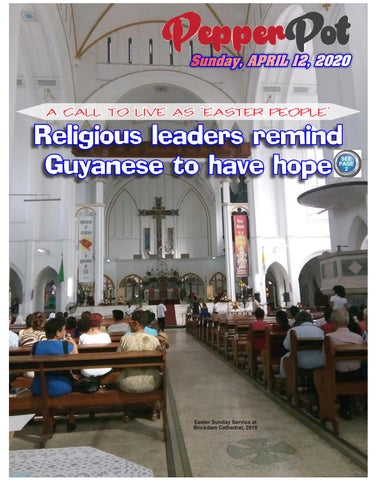
Easter Sunday Service at Brickdam Cathedral, 2019
II
CHRONICLE PEPPERPOT ― April 12, 2020
A call to live as ‘Easter people’
Religious leaders remind Guyanese to have hope By Ravena Gildharie
T
H I S year as Easter 2020 is observed, the Coronavirus pandemic has created much distress. But as the restrictions remain, Guyanese are reminded of the meaning of Easter – hope; and the fact that this observance,
unlike those before, can promote togetherness; family bonding; the reawakening of compassion; community values and greater spiritual awareness. According to Father John Persaud, this season is a “…calling for us to live as ‘an Easter people.’ It is a waking-up call to live as a family, whether
as a family in our homes; with our extended families and relatives; as a family at work, at church, in our communities, our country and the world as a whole.” To reduce the spread of the Coronavirus, Guyanese, like the rest of the world, are encouraged to stay at home, as most activities remain suspended and public gatherings in-
cluding Church services, are strictly prohibited. Easter, being a very popular Christian observance in Guyana, is marked annually by grand Masses and Church services especially on Palm Sunday, Good Friday and Easter Sunday. However, while there are no congregations this year, there have been other
encouraging indications as Father John observed that people are showing more concern, respect and value for each other as they ponder ways of reaching out and extending support to others while maintaining social distancing. Whether it is calling or messaging to inquire about their friends’ and neighbours’ wellbeing, or mobilising food and basic supplies for distributing to the most vulnerable, Father John
ness. TIME OF CHANGE Ordained in the Catholic Ministry more than 30 years ago, Father John believes this is a momentum which should be encouraged beyond Easter and the COVID– 19. “It is has been a season of lent for us….and people are of the view that lent is over now, so let’s go back to normal. But it shouldn’t be going back to Father John Persaud
Easter is a time of hope
acknowledged that this is “a time of new beginnings.” He also referred to public speeches including from powerful heads of state that highlight some aspects of spiritual aware-
normal. It should be about how do we live differently having lived through this period…how do we live Easter,” he indicated to this publication. According to the Catholic Priest, people should
TURN TO PAGE XII →
CHRONICLE PEPPERPOT ― April 12, 2020
Easter with e
a
c n e r e f f i d
By Ravena Gildharie
T
HERE will be no Bartica Regatta, no Rupununi Rodeo, no hat shows and most likely no crowded seawalls, parks or beaches this year as Guyanese observe Easter 2020 in ‘lockdown’ amidst the Coronavirus pandemic. Confined to their homes, there will be little to no kite flying particularly in the city and its environs. Despite this, Guyanese across the country are determined to keep the observances special though with a difference. For Candace Fields, an East Bank Demerara mother of four, and teacher of the Covent Garden Secondary School, this is a time of family bonding with her kids, as they spend their Easter watching family movies and playing family games such as scrabble and monopoly. Instead of the kite-flying tradition with families and friends at Carifesta Avenue, the family for the first time in years would remain indoors this weekend with the 10-year-old twin boys given a chance to further their skills in the kitchen while following online recipes. The boys have taken a liking to experimenting with the preparation of different dishes, but they still miss the kite-flying sensation. When asked if there will be any kites at all this Easter, Fields responded: “well only to fly from their own verandah and that would have to be the bird kites if we even bother.... as we’d have to look at safety too because there are tons of electrical wire around this place.” Similarly over in Kitty, there would be no kites this year for 11-year-old Samara and three-year-old Zendaya. To ensure some fun and adventure at home this Easter though, their mom, Suzanne McRae, is busy thinking up innovative ways to mark the observance with fun and adventure. “We usually fly kites the few days leading up to Easter, but we are not doing it this year. They understand...instead of pasting kites, they are pasting face masks,” Mc Rae related. This weekend the girls and their mom will be engaged in an Easter hunt around their home. While there is not much demand for kites around Georgetown this year, the expert kite-makers like Trevor Osborne is still dedicated to the task, but instead of lining the pavement with his beautifully-crafted creations in a wide assortment of sizes, colours
III
Kite flying on the Georgetown seawall last Easter 2019
and design, he has stocks available from home. “I don’t want to break the law or encourage people to break the law or to put myself or others at danger, so I am not going out to the spot where I normally go each year with the kites….I have my house stock up here with the kites and people who want can call to
A young man flies his kite at home in Pomeroon
get their kites or make orders,” Osborne related to this publication from his Kitty home. Popularly known as ‘the kite man,’ Osborne said he would usually make about 600 to 700 kites each Easter since a lot of companies, groups and individuals around Georgetown would place orders for kites as part of charitable distribution drives. This year, he has only produced about 380 kites. EASTER WITH A DIFFERENCE In the countryside, where there are residences with wide backyards and open spaces, kids are still enjoying some amount of kite flying from the confines of their home. However, according to Guyanese like Sharon Isurdeen of the Essequibo Coast, there remains a longing for the usual Easter mingling with families and friends. “We normally will picnic at the ballfields – fly kites, play games with villagers etc… (Now) it’s like we are not even feeling the holiday vibes. We are so scared to even talk to our neighbours,” Isurdeen stated. This year, the Isurdeens
will remain indoors cooking some fried rice and bar-b-que chicken. One of the most popular Easter spots for Essequibians is the Zorg beach, where hundreds of residents from as far as the Pomeroon River would usually converge to “catch-up” with friends and relatives especially those whom they haven’t seen in a long time. Across in the county of Berbice, the Number 63 Beach is the place for community bonding at Easter time and usually attracts hundreds of locals and visitors including residents of Georgetown who look forward to the occasion. Marizo Bissessar, a father of three, usually looks forward to the beach hang with his family, but this year they would be at home in Skeldon spending quiet and quality time together. For other Berbice-born citizens like Kevin Budhan, who currently lives and works in Georgetown, Easter is a time to return home for family and adventures of life in the country. “Most Easters we would head back to Berbice and spend it on our land. We have a big land so we would fly kites and BBQ with friends and fami-
lies…I’ve had my best years there. There is rice land, cane land. The Canje Creek at the back of our lands, so there was always something outdoors to do,” stated Budhan as he reminisced of Easter gone by. Instead of the large gathering at Vryheid Village in Berbice with his parents, siblings, nieces and nephews, Kevin would spend this Easter in the City at home with a grill and few relatives. ECONOMIC LOSSES AT EASTER In the meantime, Barticians are missing the annual Bartica Regatta for the first time in 6o years. A calendar event and a usual boost for Guyana’s tourism each year, the absence of the regatta is likely to cause economic loses, but according to Secretary of the Bartica Regatta Committee Lydia Moonsammy there is a lot of understanding. “In light of the current health pandemic, Barticans understand that our health
is primary. Together we will get through this,” she related. This weekend Moonsammy will spend Easter with family tuned into the Catholic Church’s online mass. Similarly, the absence of the Rupununi Rodeo this Easter is having an impact on livelihoods. According to Rupununi Rodeo Committee Member Michelle Joseph, “the entire commercial zone is locked down except for a few essential stores. Hotels and Restaurants are definitely hit the most.” The rodeo is another calendar event that is attended by thousands annually including scores of Brazilians who cross the border to join in the fun. This time around, the border is closed and Rupununi residents remain at home. “I don’t think there are any plans to get out of the house given the circumstances. We will more than likely have a quiet Easter. Rodeo was the one thing we look
forward to followed up with trips to the falls. I think it would just be about keeping the cross buns tradition going,” Joseph said. A mother of two, Joseph indicated that her two sons usually enjoy the time out at the park so being restricted to kite flying in the yard is not making them too happy. In the South Rupununi, where the Aishalton and Sand Creek Easter Rodeos have been gaining popularity in recent years, the mood is damp especially since there is no Church service, a feature which everyone looks forward this time. “As Christians, we observe holy week, fly kites for Easter Sunday and Monday. Later year Aishalton had a mini-rodeo. It's sad this cannot happen this year… Everyone is now on their farms. Families are going fishing today and tomorrow,” according to Immaculata Casimero of Aishalton.
IV
CHRONICLE PEPPERPOT ― April 12, 2020
Looking beyond the health effects of COVID-19
T
HE novel coronavirus (COVID-19) has proven to be a pervasive, catastrophic force this year, globally. At home in Guyana, it has already claimed less than 10 lives in the short period it has been here. In addition to its devastating impact on health and the health system,
however, COVID-19 has wider social and economic implications, which we are now beginning to feel the brunt of. This pandemic has been a topic of constant and seemingly relentless discussion in my academics, and it just so happened that this semester I ventured into the world of macroeconomics
for the first time. For a greater part of this semester, right up until physical, realtime classes were cancelled, understanding inflation and recession in the economy were major focal points. For me, earlier on, my mind raced drawing the connection between Guyana’s burgeoning petroleum sector and how inflation could taper the benefits of that. But now, all I seem to think about is how the threat of a recession in the global economy and how that would filter down to the local economies. Now, a textbook (or, textbook-inspired) definition of a recession is a period of economic decline in an economy, generally indicated by a reduction in the economy’s Gross Domestic Product (GDP)- which is the total output of the economy. I think we’re currently in a pre-recession area, where productivity is gradually (but perhaps exponentially) declining. In response to the pandemic, governments have restricted the operations of businesses and these have only intensified as the weeks went by. Right in Guyana, we saw that first the ports of entry were shut, then business operations were limited to certain hours, and then non-essential businesses and workplaces were slowly shutting. Just as with the rest of the world, productivity in almost every sector has been on the decline, and it doesn’t take an economist to understand that this reduction in productivity could have a large negative impact on local economies and citizens. In situations like these (even though this is an unprecedented situation), resources will gradually become more and more scarce and when that happens, the glaring inequities in society will be exposed. The longer the pandemic pervades, and the longer Guyana goes without resuming productivity at the level it was before, more and more people will be disproportionately affected in society. Think about the reality of a middle-level worker who has been able to amass some amount of savings that can aid him/ her even if there is a pay cut versus the reality of a low-level worker who isn’t, perhaps, part of the more formal job sector- and how this slowdown in productivity across the board affects their survival. In education, consider that internet penetration is not at a very high level in Guyana and not every student has the means to attend online classes. The economic impact of COVID-19 disproportionately affects people at different levels of society and I cannot stress enough how necessary it is for some stimulus package or some other social safety net to be brought out by the government to help keep the economy, and (hopefully) by extension, the citizens afloat. Then, there’s the interplay between the economic impact and social impacts. This interplay is one that I am very much interested in, and I hope academia in Guyana will be quick on the draw in elucidating this further. For now, though, I have a few banal thoughts guided by what I’ve gathered on this academic journey so far, and from keeping in the know. The social impact resulting from the pre-recession conditions aside, I’m interested in the relationship between COVID-19 and mental health. Over this past week, I was fortunate to be able to join an online seminar hosted by the Rotary Club of San Fernando South (in Trinidad) on this topic. During this session, Trinidadian Clinical Therapist and Traumatologist, Hanif Benjamin highlighted that two major diagnoses that can stem from COVID-19 are depression and anxiety. Both of these could be triggered by a myriad of factors including the social distancing occurrence, the isolation, the barrage of information via the news and social media platforms and also, the fear of uncertainty as to when this pandemic will be over and what damage it would have caused by then. I believe that while most of us are at home and are trying to ‘flatten the curve’ by reducing the possibility of the transmission of the coronavirus, we should take the time to focus on ensuring that we maintain good mental wellness. I can tell you, I have had days where I couldn’t find the zeal to do anything productive because I wasn’t able to return home in time. The therapist gave a few simple suggestions on how to take care of your mental health during this time. He noted that as much as reasonably possible, we should try to maintain a semblance of the daily routine we had before, limit exposure to the barrage of information and refer only to trusted sources and find the time to engage with your loved ones, even if it is a simple five-minute phone call every few days. We are in uncertain times, for sure. But I hope we can take the time to think about ourselves and the people around us.
CHRONICLE PEPPERPOT ― April 12, 2020
V
The importance of Easter
I
researched online how Easter came to be and found that there were three very important happenings in the Christian faith. These events were the trial of Jesus, the death of Jesus, and finally the resurrection of Jesus.
“The Trial Jesus went through six trials. In that one night, he was brought before Annas, Caiphas (the high priest), the Sanhedrin (the religious Supreme Court), Pilate (the governor of Jerusalem), Herod (the governor of Galilee), and then back to Pilate. At the end of those six trials, what did they find to accuse him of? Nothing. He had done nothing wrong. They brought in people to make up phony charges, but those didn’t stick. Finally they convicted him on one count: claiming to be the Son of God. That’s the sole reason Jesus went to the cross. They didn’t like that claim. Jesus claimed to be the Savior of the world. In John 12:47, he is recorded as saying: “I didn’t come to judge the world, I came to save it.” He allowed himself to be put on trial so there would be no doubt about who he was. He could have stopped the trial at any moment. He knew he would be proven guilty and put on the cross -- but he allowed it to happen. It was all part of the plan. The Death After a night of beatings and mocking, after being crowned with painful thorns, Jesus was crucified. Crucifixion is probably the most brutal and torturous death penalty ever devised by men. His hands were stretched out wide against the cross and nailed through the two bones in each wrist. The Resurrection After Jesus died, they took his body down and put him in the tomb, and a giant millstone was set in front of the cave. The religious leaders -- worried that Jesus’ body might be stolen -- asked for Roman guards to be posted in front of the tomb. They didn’t want him coming out! But of course, he did. You know the story. “But it’s important to remember that Easter is not some memorial to a nice, good religious teacher who lived 2,000 years ago. It’s a celebration of the fact that he is alive today. I’m living proof -- and so are the approximately 1 billion Christians who will celebrate Easter this weekend” Easter follows a period of fasting called Lent, in which many churches set aside time for repentance and remembrance. Lent begins on Ash Wednesday and ends on Good Friday, the day of Jesus' cruci-
fixion. The 40-day period was established by Pope Gregory 1 using the 40-day pattern of Israel, Moses, Elijah and Jesus' time in the wilderness. The week leading up to Easter is called The Holy Week, or "Passion Week", and includes Palm Sunday (the day Jesus entered Jerusalem and was celebrated), Maundy Thursday (the "Last Supper" where Jesus met with his disciples to observe Passover), and Good Friday (when Jesus would be crucified on the cross). Whether you’re of this faith of not, knowing the history and celebrating is such a pleasure. Much like how the majority of Guyana (regardless of beliefs) comes together to celebrate Holi. Lent ends and the celebrations begin. These holidays do worry people in my profession as the end of lent typically means overindulgence but hey, if it’s just for one day, celebrate your faith. I know with what’s going on there is hardly going to be family time spent or much outdoor celebration. We might miss out kite flying that was originated in Guyana. But there are still things we can do. We can still buy and eat chocolate – ever wondered why Easter egg chocolate are a so popular? That’s because the egg is an ancient symbol of new life and rebirth. In Christianity it became associated with Jesus' crucifixion and resurrection. The custom of the Easter egg originated in the early Christian community of Mesopotamia, who stained eggs red in memory of the blood of Christ, shed at his crucifixion. As such, for Christians, the Easter egg is a symbol of the empty tomb. The oldest tradition is to use dyed chicken eggs, but a modern custom is to substitute decorated chocolate, or plastic eggs filled with candy. In some traditions the children put out their empty baskets for the Easter bunny to fill while they sleep. They wake to find their baskets filled with candy eggs and other treats. Also interesting, how did a rabbit distributing eggs become a part of Easter? There are several reasons for the rabbit, or hare, to be associated with Easter, all of which come through pagan celebrations or beliefs. The most obvious is the hare’s fertility. Easter comes during spring and celebrates new life. The Christian meaning of new life through Christ and a general emphasis on new life are different, but the two gradually merged. Any animals – like the hare – that produced many offspring were easy to include. The hare is also an ancient symbol for the moon. The date
of Easter depends on the moon. This may have helped the hare to be absorbed into Easter celebrations. Also remember during this time of lockdown, we
can still get and appreciate flowers. We can still make home- made kites, if even if you can’t fly them during this period. Most importantly, you re-
member that you have those who love and appreciate you and wish they were around you. Thank you for reading. Please continue to send top-
ics to caitlinvieira@gmail. com. If you would like to make a private appointment with me, please contact me at 623 0433
VI
CHRONICLE PEPPERPOT ― April 12, 2020
CHRONICLE PEPPERPOT ― April 12, 2020
Focus
VII
on the Village
Life is a beach in
Mark Smith and his daughters
Bushy Park The main access street in Bushy Park
Mark Smith on his verandah (Carl Croker photos)
By Michel Outridge
T
HIS week the Pepperpot Magazine visited the countryside community of Bushy Park, East Bank Essequibo and spoke to residents, who highlighted their way of life. The small village is bordered by Hydronie and Parika and is home to about 100 residents, who are farmers, fishermen, small business operators, public sector employees and some self-employed. Among the villagers are two small business owners who operate their businesses by the beach area, where chairs, table, washroom facilities and changing rooms were erected for visitors. Customers pay a small fee to
Shady trees with the chairs and tables at Bushy utilise the services but use of the beach is free. Bushy Park has a long stretch of beach which overlooks the Essequibo River and is visited by hundreds on weekends and holidays. It is touted the ideal place for recreation and family picnics and outings, it is very breezy and once there a sense of serenity envelopes you, capturing a feeling of peace and quiet to calm the nerves of the everyday hassles of life. The hub of businesses is in Parika, which is a walk away to where the Transport and Harbours Department TH&D) Ferry Stelling is located, at the end of the road and many small businesses lined the shoulders of the main road including, vendors, who ply their trade
around the clock. Bushy Park has two streets apart from the main road and is home to Kares Engineering and has a hotel obliquely opposite the beach. Bushy Park can be accessed via Hydronie Market Road or Parika Junction Road. The Pepperpot Magazine met Mark Smith, a resident, who resides on the beach with his family and operates a small shop and manages the beach front. He told the team that 30 years ago, he and some had nowhere to go on Mashramani day, because they didn’t want to go to the city and decided to visit Bushy Park beach. Smith explained that it they had a good time even
though he was young he realised it could become a place of business because there was a lot of people there. “So the following Sunday I brought an old fridge and got some ice with some beverages and began selling on the beach and I decide to make it my living,” he said. He now lives here with his wife and three children. Smith constructed a greenheart cottage which sits on the beach and made the place comfortable with wooden chairs and adjoining tables under large trees and washroom and changing room facilities. It is the perfect recreational facility to unwind after a long day or week and the right place to gaze at the shoreline into the Atlantic
Ocean. While visitors have to pay to use the tables/chairs and washroom and changing room facilities and it is a cosy family setting atmosphere. Smith, a speed boat operator told the team he has a license to operate the business, it is legitimate and he is against all lewd behaviour at the beach because it is a place for children, as well. The father of three stated that presently the business is closed until further notice of the coronavirus (COVID-19) but once open people can bring their own foods and beverages. “This place is nice, always breezy even when the sun is out in all its glory the trees provide adequate shade and depending on the
dry weather the water in the Essequibo River is both fresh and saltwater at times,” he said. Smith related that taking care of the environment is a tall task because many visitors would use the place and leave behind all their garbage and the onus is on him to keep the place tidy and refuse-free. “I never feel good working for others because the returns are small and can’t suffice so it is always better to work for yourself, that way you can earn and still make a small profit,” he said. Smith added that despite it all, life in Bushy Park is good because the village is small and people know each other and the place is quiet and people ‘hustle; for a living.
VIII
CHRONICLE PEPPERPOT ― April 12, 2020
The self-sufficient Focus people of on the Village
Bushy Park M By Michel Outridge
eet Gwendolyn Hopkinson, a grandmother, who was taking care of two grandsons, while, tending to household chores and cooking when the Pepperpot team visited. The 60-year-old related that before the coronavirus (COVID-19) she used to prepare home-made foods in the likes of black pudding, fried fish, channa and cookup-rice with meats in front of her house for visitors utilising the beach area. But these days, since the beach is closed for business, she has put a hold on her small business and is focusing on her kitchen garden where she has fine leaf thyme, broadleaf thyme, married man pork, lemongrass and some vegetables. She has a striving flower garden as well and tries to maintain it as best as she can. She is, however, upset about the state of a trench that runs along her property which is in dire need of cleaning which is overrun by thick vegetation and bushes causing the water to become stagnant. “The drains and trenches in this village don’t be maintained or cleaned as such, the water don’t go anywhere and it stinks,” she said. Although she is not well, Hopkinson stated that she tries to boil some ‘bush’ and make tea to aid in the promotion of good health because it helps. The mother of three related that things are not nice right now but she is trying to stay positive and survive the coronavirus like everyone else.
In the meantime, she is selling some ice and icicles from home to offset expenses and gets assistance from her siblings abroad. The Pepperpot Magazine also met John Raggobwer, he was at the time going home after visiting the mandir in Bushy Park, to observe Hanuman Jayanti (a Hindu religious ceremony). “I am a stranger to the village but been living here for some years after marriage and life here is fair because most people here are self-sufficient with their small businesses,” he said. He stated that most people don’t depend on government work and try their hands at their own businesses be it vending or farming. Raggobwer is a vendor at Hydronie Market, selling fruits but with the coronavirus and the curfew things are not good for business and he is forced to close and stay home. He is a dad of two and said he is bored at home and decided to go to the mandir to pray because with the coronavirus there isn’t much he can do but pray with the hope the virus passes on for normalcy to return. “Right now we are living by the grace of God because of the pandemic we cannot do anything even make a living and look how this place like a ghost town because people are afraid to go out and mingle with others, you don’t know who has the virus," he explained. Raggobwer related that right now staying home is the best option because we want to flatten the curve of the virus and advise others to take heed to safeguard themselves when going out, to use a mask.
Gwendolyn Hopkinson cutting some lemongrass for tea (Carl Croker photos)
Gwendolyn Hopkinson in her kitchen garden
John Raggobwer
CHRONICLE PEPPERPOT ― April 12, 2020
Focus
IX
Staying hopeful during the pandemic
on the Village
Samuel Williams and his family heading home
Desiree Satnarine inside the shop (Carl Croker photos)
Samuel Williams with his baby, out for a stroll in Bushy Park
By Michel Outridge
D
ESIREE Satnarine is spending all the time at home, hoping to survive the pandemic (COVID-19) and is in her small shop assisting in selling items that are in stock. She is a resident of Bushy Park, East Bank Essequibo and has been there for the past 50 years. In addition, she is also selling home-made ice, icicles and custard and resides with her extended family. “We got to do things from home to earn because with the curfew, my family members are not working and things not easy at this time,” she said. The mother of three related that Bushy Park is a very quiet place where the residents work with themselves doing ‘buy and sell’ or farming. She considered life as being fair despite the challenges and
is living by the motto “Pray and Spray” as she held up a spray bottle which contained rubbing alcohol. “In an extended family setting we assist each other because this is not a normal time and we have to stick together to fight the coronavirus by doing simple things like practising good hygiene,” she said. This village is small so we all know each other and it is a nice place to live, it is away from the city and we have everything in Parika, which is relatively close by. The 61-year-old is a very friendly woman, who is very much family-oriented and from her disposition, it was evident she loves her family a lot. When the team visited she was in the shop and spoke to us from in there, as such, maintaining social distancing. The Pepperpot Magazine also spoke to Samuel Williams, who was on his bicycle with his 10-month old son, who was in a stroller.
While, his wife was walking behind him, they were out to go to the shop to make a purchase then to visit a relative after which the trio was expected to return home. The welder added that he does usually work in the Mazaruni area (interior) and was out for a bit and was supposed to return to work where he is a contractor on a project. “I came out to spend some time with my only child, Teon because of the coronavirus and so but I will have to return to work,” he said. Williams decided to take a quick walk and to buy a snack for his son at his neighbour’s shop. The father of one stated that life in Bushy Park is alright because the place is nice and life is very quiet for most people, who earn from their small businesses or by working with others. “We live right by the Junction so it’s not far away and we trying to stay put and still try to get out for a little bit, abiding by the curfew, as well,” he said. As for 10-month old Teon, he had no care in the world and was smiling all the while, peering from the comfort of his stroller.
X
CHRONICLE PEPPERPOT ― April 12, 2020
n i g n i v i l a g Makin Bushy Park
Focus on the Village
By Michel Outridge
P
AT R I C K McCloud is a resident of Bushy Park, East Bank Essequibo and when the team caught up with him, he had just returned home from work. With his mask, he related that he is a security guard at one of the big stores in Parika and just made a dash home for a quick bite. He is originally from the North West District and had been residing in Bushy Park for the past two years with his wife, in a well-kept house. “I just come home for a quick bite, I hungry bad and can’t talk now because I have to go back to the worksite, a store before the lunch period is over,” he said. At 70 years old McCloud said he still has
to work for a living to support himself and wife since all the children are grown and doesn’t live with them. The Pepperpot Magazine also encountered another resident, Kenrick Ifill, who was operating his manual pushcart, going on a job. “I doing this work for 13 years now simply because I wanted to work with myself and I made this wooden cart to push and carry load,” he said. Ifill added that he is from Meten-Meer-Zorg, West Coast Demerara and has two children and a wife to support. “I does operate from Parika Junction, just by the bus park and carry whatever goods or bags for people at a reasonable price,” he said.
Kenrick Ifill and his manual push-cart (Carl Croker photos)
He e x plained that he never wanted to do any government work and feels better as a self-employed person even though it is hard, back-breaking labour. Ifill, a very approachable and patient man told the team that he does charge a fair price depending on the load he has to carry via his
Patrick McCloud
manual pushcart named “One More Night” and is number 43. He told the Pepperpot Magazine that at Parika Junction there are about 120 manual push-carts in operation and one has to vie for work, especially people taking the ferry or came off the ferry. Ifill noted that despite the pandemic he remains optimistic that
we will survive to see better days even though things area at standstill presently. He related that the name “One More Night” on his push-cart means he lives to see another night or day and it suits him. The team also met Medwin Gibson, who was with a friend on a bicycle with a mixed game bird (fighter
fowl). The young man said his bird is not a game one and was a pet, he has a few birds in his yard and he is very fond of them. “I does mind these birds and I am not involved in game fighting at all,” he said. When the team net him, he was on his way home to take his bird which he was holding.
CHRONICLE PEPPERPOT ― April 12, 2020
40 pets and counting! By Michel Outridge
D
rupattie Somariah is taking care of 40 dogs in Bushy Park, East Bank Essequibo and is a resident of Tuschen, also on East Bank Essequibo, a few villages away. She has been tasked with caring for the pets, who belong to an overseas based-Guyanese, who resides in England. She is an animal activist, who takes care of stray dogs and would also feed street dogs. Somariah was left to care for the dogs in Bushy Park where she would visit the premises daily to cook two large pots of food for the dogs and clean up then leave for her residence. The next day, she would repeat the routine, she is being paid to do by the animal activist but with the coronavirus (COVID-19) there is a lock-down in England so the woman is unable to send money here.
As such, Somariah has put a hold on feeding street dogs because funds are done and she is ‘hanging in by threads’. The mother of three stated that she is scared to leave her house because of the coronavirus but has to work since her husband is ill and she is tasked with supporting the family until he can work. “My children are 9, 11 and 13 years old and they are staying at home and I took the decision to come out and work in an effort to feed the family and had on a makeshift mask make out of a jersey,” she explained. Somariah told the team that she is trying to finish her chores to leave for home for 1pm where she has to cook and do other household duties since her husband is 60 years old and very unwell. “It is simple, stay home and starve or come out and work to feed my family”, she said. The mason of Bushy Park The Pepperpot Magazine also met Anthony Atwell, a mason, who moved to Bushy Park, three months ago. When the team went to his doorstep he was in a hammock taking rest before he returned to work, right in the village, where they are constructing a house. He had returned home on his bicycle for lunch and was taking a rest before he re-joined a group of men, who are also working to build a new house in Bushy Park. “I am originally from Mon Repos, East Coast Demerara but I take a girl from here and I moved to this village where we reside in this cottage and things are ok, so far,” he said. Atwell added that the place is very quiet and the people mind their own business and it is not a normal time now but they are trying to overcome things but staying positive and praying,” he said. He however, apologised he couldn’t chat longer because he had to rush back to work and hurriedly left via his bicycle for the worksite, a short distance away. “I came home for lunch and after that I fell asleep is when you called I jump up and now I late so I got to hurry back to work but I sorry I can’t talk more,” he explained. Atwell however, was kind enough to cut some lemon grass from his yard and give the team to make tea to fight the coronavirus.
Anthony Atwell at his house (Carl Croker photos)
XI
XII
CHRONICLE PEPPERPOT ― April 12, 2020
Religious leaders remind ... begin to accept that life may not return to the way it was before, as there have been changes, both in the population and on the planet, and there is need to now examine what lessons are learnt from these changes and how to move ahead living differently with the new experiences. Before Coronavirus, Father John, the current Vicar for Clergy in Guyana, acknowledged that
there have been challenges in maintaining family values and connections due to rise in the use of digital media. He highlighted situations where parents have lamented that their kids would message them instead of having face-to-face conversations while at home. Such issues pose a challenge to families, the society and the Church. This time around though with the Church
FROM PAG
A group of young Guyanese depicting ‘The Easter Story’ during a past Easter Day at the National Park in Georgetown
struggling to maintain its community and teachings of spiritualism without congregating, the digital media is being used in a positive way. The Catholic Church has been streaming its masses, services and daily prayer services with hundreds of Guyanese joining in from across the country including the hinterland areas, despite limited access to ICT technology and infrastructure. In Georgetown, the Diocese has been meeting to review and plan its strategy to maintain the community via online media while in each parish, the Priests are exploring local ways of reaching their followers. Similarly in the Anglican Diocese, Reverend Monsell Alves is of the view that this Easter encourages everyone to examine their lives and to make adjustments, both individually and collectively, for the greater good to be realised and maintained in society long after COVID – 19. “It is a time to humble ourselves and to turn from whatever is preventing us from expressing love and what is causing us to express hate. It is a time when our heart must change from selfish to selfless; to become charitable,” he said while speaking to this publication from his home in Linden, Region 10. SPREADING HOPE Reverend Alves noted that there is a lot of distress and frustration this time around and the anxieties are growing. Therefore, with Easter in observance, he believes the season can be used to teach hope and to allay
E II ←
the fears. “We are encountering anxieties as change is constant in the world, and this is causing uncertainty of life in our contemporary society. The world is being challenged, but there exists room for hope. We are called to share that resurrection hope with those who are hopeless and to give assurances to those in despair,” Reverend Alves stated. He urged that this Easter hope can be promoted to help Guyanese maintain the level of patience that is needed to overcome the pandemic and also to support the medical personnel leading the battle against the deadly disease. The Reverend noted that some Christians have been using the pandemic to spread fear with references of “end time apocalypse” and this, he worries, may add to the frustrations people are already encountering. “We must remember perseverance…we need to practice patience with ourselves, with each other…remember the need for informed actions to act against this disease,” Reverend Alves stated. He added that: “while COVID – 19 affects us physically, a spiritual dilemma can be prevalent and we must look to celebrate Easter 2020 with calm and praise,” the Reverend added. He expressed that the concept of social distancing is against the spiritual teachings and makes it difficult for the Church to maintain that community. Despite this, the Anglican Diocese, like the Catholic, have been turning to internet and communication technology to maintain the spread of its spiritual messages. Reverend Alves has been recording and disseminating audios of sermons and teachings to mark Easter observances particularly for Good Friday and Easter. Some of these messages have been shared via WhatsApp and Facebook.
CHRONICLE PEPPERPOT ― April 12, 2020
XIII
Easter Monday, even kites are grounded, as never before By Francis Quamina Farrier
N
EVER before in living memory will the Georgetown Seawall and the hundreds of other popular kite-flying locations all around Guyana remain empty on Easter Monday, as they will be tomorrow, Easter Monday 2020. Never before have so many Christian churches had their doors closed on Easter Sunday. Never before in living memory has the results of a General Elections in Guyana taken over a month to be declared. Never before did so many CARICOM Heads-of-State rush down to Guyana to offer help to this nation now in Political turmoil. Never before have so many former friends written open letters chastising their former friends. Never before has Guyana joined the rest of the world to order its people to stay at home. And never before have I written a feature article in which I mentioned “never before” so many times.
People must go one side”, will be confounded - as never before. Let’s now flashback to a scene I will always remember. It was about 16 years ago on the left bank at the mouth of the Supenaam river in Region two. There was a group of men playing dominoes by the side of the river, just off the (then) muddy speedboat landing. The noise which they were making attracted my attention. There was constant loud laughter and the sound of dominoes being slammed to the table around which the players were seated. Over a dozen other men were looking on and everyone was certainly enjoying the game and each other’s company. That was years before the current COVD-19 pandemic struck the world and so there was no need for social distancing. Those looking on at the game were all over each other in glee, rubbing one-another’s heads. Slapping backs. Hugging each other from time to time. There was even some jokey punching. Very entertaining though it was, that is not the real reason for me
Two friends at the spanking new Esplanade at Supenaam, Region 2 (Photo by Francis Q. Farrier)
The history of Guyana and where it is at this time, is cause for careful analysis, as never before. Yes, there have been many previous efforts to bring a sense of, “We are all in this together.” “We have a nation to Build.” “There is enough wealth in Guyana for everyone to live the good life.” “Time to stop the racial voting.” “Time to terminate the cussin’ out and hate-mongering.” Also at this time, there is so much more finger-pointing, here, there and everywhere, as never before. As an elder in our beautiful Guyana, I have been asked to speak up, as never before. USAbased Guyanese Columnist Dr. Dhanpaul Narine implored that elders should not remain silent. In a recent article of his, which had the headline, “When good men become silent”, he specifically referred to Dr. Clive Thomas, Sir Shridath Ramphal, Major General (Rt.) Joe Singh and Dr. Rupert Roopnarine. They were all called out for “being silent” regards the March 2, 2020, Post Elections fiasco. Sir Shridath Ramphal and Major General Joe Singh have both spoken out since the publication of that article by Dr Dhanpaul Narine. Elderly Guyanese have the RIGHT to speak out. And those who express the view that “Ol’
always remembering those men playing dominoes; it was the fact that the players and those observing the game, were very varied racially. Almost every race and mixed-race in Guyana was in that group of about 16 men. They were enjoying each other’s company in such a way that I will always remember that particular domino game - as never before. Now, fast forward to February 2020. I was again at Supenaam where the muddy speedboat landing was recently transformed to a beautiful esplanade. There were no men playing dominoes during my visit in February 2020, but the image and the memory of that domino game are still very sharp in my mind. Also indelibly etched now in my memory from the recent visit, are two lads who I saw pleasantly interacting with each other on the new esplanade. Today, I am wondering whether those two youngsters are flying their kites in the wide-open spaces in that Supenaam Essequibo Coast community. There have been a few Guyanese in the United States of America who have died after contracting the COVID-19. I knew one of them. On this unusual Easter Sunday, when so many churches are closed - as never before - and
people all around the world are in LOCKDOWN MODE and confined to their homes, I thought it timely to have a glance back to when British Guiana had the Deadly Cholera which was brought from abroad, in a similar way in which the current coronavirus came to Guyana. I am reflecting on the cases of mass deaths when Guyanese were literally dropping dead like flies all over the place after an insecticide was sprayed on them. Burial was quick for all the dead. It was reported that some victims of that cholera epidemic in British Guiana, were buried even before they drew
their last breath. I was told of a man who was in a deep sleep and his relatives thought that he was dead. They hurriedly placed him in a coffin. While on the way to Le Repentir for burial, the man woke up kicking and screaming. The coffin was dropped and some kind-spirited citizens opened it for the poor man to get out and return to his family. Many of the dead were buried in mass graves at the extreme north-western area of Le Repentir cemetery at St. Stephen and Princes Street, Charlestown. You will observe that there have been no burials in that area of Le Repentir cemetery in your
lifetime. In colonial British Guiana, there were illnesses such as typhoid, malaria, tuberculosis, mumps, pneumonia, jaundice, yellow fever, elephantiasis (bigfoot), hydroseed and also the dreaded Leprosy. It was known and called locally, Kokabae. It is now known as Hanson’s Disease. Later came the sexually transmitted syphilis and gonorrhoea, also HIV and AIDS. All initially regarded as DEATH Sentences. But Guyana survived - as never before. The West Indies Cricket Team, playing the Austrians at Brisbane in 1960, ended
with a TIE when the great Guyanese test cricketer, Joe Solomon, accurately threw a ball which hit the stumps of the Australian batsman, Ian Mecloff, sending him OUT and resulting in the first-ever TIE in the history of Test Cricket. With swirling thoughts like a kite dancing in the strong breeze on the Georgetown seawalls on Easter Monday, I wondered what would all the stakeholders think and do, if the March 2, 2020, General Elections recount results in an announcement that it was a TIE! That would be a result, as never before.
XIV
I
N the last few weeks I found myself being the source of advice for many persons around me who sought writing feedback on various types of work: school essays, newspaper columns, OpEds and even reports. In my early days, I use to be shy about giving critiques in spite of my own sensitivities about my work. But if it’s one thing that almost six years of writing a novel will teach you: critiquing will never stop and you must learn to take it and give it all the same. Best-selling author Sidney Sheldon advises that before you look for any feedback on your work, first, become your own critic. Get all your words down on paper during what he calls the “creative phase” then when you are finished, be “ruthlessly critical” with what you have done. This helps you to have a more open mind to where you think gaps may lie so that when third parties start to give you advice on your work, you can match those with the flaws that you may have pointed out on your own. RECEIVING FEEDBACK It is not personal. I had to learn this very early on, and it still took some time. Writing often starts as a personal thing. We jot some notes or poetry down in the pages of our journals and keep them tucked away for personal
CHRONICLE PEPPERPOT ― April 12, 2020
d n i M e t i The Wrby Jasmaine Payne pleasure o r emotional release. It is a part of the writer because of its often-emotional origins, so stabbing at the work is like taking a stab at the person. What new writers need to keep in mind, however, is that the moment you decide to share that work, understand that it is no longer just yours. Opinions will be derived and some of them will be useful, or even critical to your survival and progress as an artist in the public domain. So rather than getting offended, as if they stole a piece of your soul, remember that useful critiques simply aim at making you better while correcting mistakes or revealing blind spots you may not have known you have. In the end, be open and thankful for receiving helpful feedback that can improve your work. Weed out the good from
Re
the bad.
ce ivi in ng a th nd ew g rit ivin ing g fe wo ed rl bac d k
There will be some times when persons do seek to harm you with their feedback, be it out of animosity, idleness or downright trolling in this digital age. As a writer, learn to pay attention to the feedback that matters. Choose your platforms carefully. Rather than falling prey to trolls that are likely to flock on your social media, give your work directly to persons who you know will be helpful and objective. Compliments are less use-
ful t h a n criticisms. New writers always seek validation in hearing how good their work is, and fold up in contempt when they hear anything negative. I have learned that it is the negative critiques (from good sources, of course) that are more helpful. I know what my strengths are; I need to know my weaknesses. What have I missed or overlooked? Where can my language be tightened? I want to know how my writing can be better tomorrow than it is today. It is all part of the process. You don’t have to agree with everything. At the end of the day, it is your work. You know it better than anyone else. Sometimes critiques miss the mark because people misinterpret what you say. Take all feedbacks openly, then decide what you think is the most useful to your work. That calls for a very open mind. Know where your weaknesses lie and be open to finding out how people see your work from the other side. Then incorporate the most useful bits of feedback into making your work better. You don’t have to do everything they say.
GIVING FEEDBACK Be honest, not brutal. I now realise that my initial dread of receiving feedback as a writer was because I was first introduced to brutal critics who felt that was the best way to make artists better. It is not. I was not looking to be flattered, but I did not want to be battered in the process either. I was looking to learn. When writers ask for feedback on their work, there is no need to be scathing. They need help, so don’t kick them when they are down. Be honest about what works and what doesn’t and move from there. Let the helpful aspect of what you tell them be clear in the gaps that you point out in their work. A truly willing writer will be grateful for it. Do not think about feelings too much. On the flip side, I have also found that some persons are too passive and patronising in their feedbacks. That can be just as unhelpful as a brutal critic. The most useful feedback gives areas of improvements more than acco-
lades. Always include some positives, somewhere. I attended a writing group while in New York for a few weeks. There, I learned that positive feedback still has its place. So try to fit that in somewhere for a bit of encouragement. After all, your writer is vulnerable the moment they open up to you about their work, so a kind word could go a long way. Sometimes it could be hard to find the positive, but there is always something in there I find to point out that they did well. Then you can go ahead listing everything else they need to improve on. These are all personal tips I have learned along the way and they have really helped me as a writer and as an editor when giving feedback to other writers. We are all just trying to make it out there, so helping someone along the way never hurts. Interested in contributing to this column on writing? Email me at thewritemind592@gmail.com.
CHRONICLE PEPPERPOT ― April 12, 2020
XV
Racism, like the flu, is a family of viruses ― Deceitful, treacherous, incapable of gratitude and pretentious
O
NE of the most pronounced elements of racism is the arrogant effort to tell the story of another without consulting him about himself, to define his world in the context as Edna .G. Bay outlinedd in her book ‘Wives of the Leopard’ about writers defining by speculation, what they don’t understand or have not explored through the council of the other: “to explore the ways in which their apparent observations are moulded by the cultures of their birth and their life experiences. Like Joseph Conrad’s Marlowe, we have learned in such analyses the truism that the horrors we perceive tend to be the reflections of our own inner darkness, and that human beings can rarely transcend [their own-my insertion] culture and history”. In Guyana rarely are engagements employed to fix into narratives opinions and castigations made, through enquiry, bigotry is the impetus to conclude definitions about areas where complete cluelessness prevails. Stabroek News on December 9, 2019 carried an article about the removal of the plaque previously placed at the entrance of the National Archives stating ‘The Walter Rodney Archives’. The two gentlemen requested to voice their opinions were opposition Lawyers Anil Nandlall and Kamal Ramkarran. The article began with the argument about the legality of gazetting the said name but was then consumed by the usual malice tirade
A
of political castigations, all having nothing to do with the preservation of Walter Rodney’s memory. The fact is, I doubt any of the two gentlemen ever read any of Walter Rodney’s works, or are interested in his legacy. During that time, I had written a letter about the advice a UNESCO presenter at a Culture Policy three-day workshop had ad-
Free Press Book publications and Emancipation Magazines, UG’s History Gazette, authors like Mary Noel Menzes, Clem Seecharan, Kean Gibson, Jai Narine Singh, Tyrone Ferguson, Winston Mc Gowan, Kimani Nehusi and numerous others across topic fields and genres that encompass and reflect the Guyanese evolution, including Foreign
cultural mythologies and dogmas do not have inherent racist religious, mythical and learned customary narratives repeated as references as a regular mantra towards everything disagreed with, a fixed stereotype of hate. There have been no people on this planet over the past five hundred years like Africans and in some cases like
launched, that caused injury to many including children, to which he was hypocritically silent about, but his duel personality was evident before, however, I wish to thank Colonel Ret’d Desmond Roberts and other Military officers, and especially the young grounded APNU parliamentarian Jemaine Figueira for his contribution in unmask-
vised concerning the sudden name changing of buildings. Following that, I saw Walter’s brother and had a discussion on the subject with him, because I had some suggestions and I wanted his take on them. The suggestions were as follows, Walter Rodney’s works revolve around the working class, Afro-New world and African social and historical experience. There needs to be a WALTER RODNEY ARCHIVES of the fundamentalbBeginnings of the shaping of Guyana. The suggested Archive would be a reservoir of related works by other such writers like, Brian Moore, Eusi Kwayana,
writers like Michael Swan , Emilia V. da Costa and those biographers from further back as well as cultural magazines. A public entity like this does not now exist, never has, especially supported with visuals across any particular Timeline of the Guyanese experience, and in that conversation, his brother agreed. This is the nature of the discourse that should have been encouraged to develop a real and sincere platform as a memorial for Walter Rodney, not a baited opportunistic political ‘stock’ rhetoric diatribe. Racism can be practised against a people like Afro and Amerindian Guyanese whose
the resident Mongolians of the Americas that we call Amerindians, who have endured demeaning subliminal definitions as colonising policy of justification. This era is not yet over, others have embraced this mechanism towards their own interest with vigour. A great example is the assault declaration by Major General Ret’d Joe Singh against President Granger and the APNU-AFC supporters in Stabroek News March 19, 2020. Is one such direct transference of guilt by the imposition of public accusation and posture, to bury the facts that an opposition putsch along ethnic lines was
ing Joe Singh. I knew Linden London, we shared the 16th November birthday, but different years. I also know Captain Mc Allister and understood well how he was placed in harm’s way and understood why silence followed. Once you realise that social accommodation must be guarded not from one’s own cultural niche, there will be in discourse easier to understand looming agendas against human honesty, I’ve always advised friends to understand African history and Cultural Revolution you must study European history and Cultural Revolution, likewise, all else must be
S we venture deeper into this pandemic of COVID-19, there is no doubt that more questions and issues will arise. Of recent, I have noticed the media and the authorities urging persons to “stay home” or “stay inside”. Yes, we should do that. Social distancing is very important at this point to protect ourselves and others around us and to also stop the overall increase of infected persons in Guyana. However, “stay at home”, is an ironic phrase to use to ALL Guyanese, when many are without an actual home. I say that to now say that more than ever now, the people of our country need our social help. If you had asked me before this pandemic, “How is housing related to health?” I probably would’ve had to ponder a bit on it before I answered (if I could answer the question). If you ask me that question now, I
applied. Rely on the words of our ancestors, “By a man’s works, shall he be known”, not by his smiles and gifts (Bribes). Hitler used Aryan supremacy within the arena of the colonising doctrine of white supremacy to lift German self-esteem to reclaim the losses of the treaty of Versailles at the end of WWI, and to justify the mass slaughter of Russians to steal their oil fields and spaces of farmlands for his mythical Aryans, to which historians and Archaeologists cannot yet find an ancient civilization and its monuments to point to, as an Aryan civilization, faith in fictional dogmas can also move social mountains. In the context of Guyana, the efforts and successes of the colonial plantocracy colony management that destabilised post-emancipation African businesses has left a narrative and propaganda template that is still used today. The secret today is in the absence of Laws and contract frameworks supported by the consciousness to assist and protect ideas, and businesses against commercial theft. The racism manifests as a consolidated effort to marginalise and insert the financial self into all innovative efforts, understand the racism and leave nothing unguarded, pay attention to “Greeks bearing gifts” and protect the legacy you wish to leave with your descendants, guard against the enemy without; and his slithering eunuchs within.
The homeless, less fortunate and the COVID-19 pandemic—let’s talk would be rambling on and on due to my experience thus far. Before COVID-19, I doubt we’d reflect on how housing is important with health and how it can affect our physical health. Currently, as you can tell, our homes are individually considered the safest places to dwell in. But, we need to ask ourselves; what happens when a person does not have a home to live in? What happens when the sole breadwinner is laid off for months due to a company shutdown? Or when a family can barely afford essentials, much less protective gear and recommended vitamins/food supplies? “The poor man” is left to fend for themselves unless those who are in positions to help; help. I am calling on all NGOs and government offices to do their part in giving back to the less fortunate. Utilise shelters to house these persons, reallocate funding for initial postponed 2020 projects in aiding for
the less fortunate or even advocate for the rights of these persons. While we cannot give all the homeless a house, all the destitute money and all the low-income household vouchers; we can give them the essentials they’ll need during this tough time. However, hygiene and health are of the utmost importance. Hence, vitamins, water supply, preserved food items, hand sanitisers and face masks are all items we can give to those in need. These persons are at risk due to their situations. These are the people who need our help and attention, these are the people who are most likely to contract this virus. This is no longer a social issue, it is EVERYBODY’S issue. Homelessness and poverty now transcend social protection into public security and health. It should be one of our main priorities right now as we battle against the infamous COVID-19. Nobody should be deemed second class
citizens and I am here to speak up for those who do not have a platform or even the ability to share their voices. If you are a true humanitarian and helper, you’d find it in your hearts to reach out (not physically) and find a way to give back. Advocacy without action has little to no effect. You can sit behind a laptop and post all day but it can only do so much for persons. If it was us who was without a home or necessities, we’d look at life differently and truly understand the struggles of the minorities. With all of that said, I do hope that as you reflect on this topic, you also think of ways on how you can also lend a helping hand. Lastly, I will leave you with a question to answer for yourself; “Who are we as human beings if we ignore the suffering of others?” Will you ignore it? Will you ignore their suffering?
XVI
CHRONICLE PEPPERPOT ― April 12, 2020
#SupportCreativity
By Subraj Singh
On Spending Time in Quarantine
L
IVING in the time of COVID-19 means living in a time of immense crisis. A global pandemic is no easy thing to deal with for the average person, and for those of us in Guyana, the situation is made worse due to our shoddy health care system, poverty, an apathy to sickness that besieges a large population of the country, as well as our oldest companion – the political instability that is a large part of the general combustion that Guyana is currently steeped in. The situation is dire and tense. There is the possibility that hundreds of people might become infected and there is the possibility that people we know may get infected. Following the trend of what has happened in the rest of the world, it is possible that there might come a point where supermarket shelves might start to go empty and, depending on the rise in cases of confirmed infections, hospitals will not be able to adequately provide for all of its patients. People might be laid
off from work, others might be evicted, families and friends could be separated from each other for long periods of time, and it might take several months for the situation to improve. Naturally, a lockdown has been imposed, and many people across the world, particularly artists are using this time to create, to craft, to edit, or to indulge in some artistic pursuit that has been neglected. People are writing, painting, and videoing. Even those who do not pursue skills in the arts are fine-tuning other skills, such as language learning, make-up, or cooking (there are so many pictures of bread on social media right now), and, in a way, it makes a lot of sense for people to utilise their time in this manner, Not only are they distracted from the morbid nature of the situation the world is in, but they are also able to achieve some sort of catharsis, some kind of emotional relief from pursuing and practising certain skills. This narrative of keeping busy and dedicating oneself to creativity in a time of crisis is a very old coping mechanism.
For example, our very own, Martin Carter, wrote some of his best pieces when faced with both the duress of colonisation and imprisonment during a particularly turmoil period in the country’s history. Another example, one that has been floating around on social media, is the theory that William Shakespeare probably wrote some of his plays (King Lear, etc.) while under quarantine during a plague that occurred in the Elizabethan era. The motivation behind the spread of this idea of Shakespeare’s productivity during a time of crisis was, I think, meant to inspire creative people by pointing out that Shakespeare created iconic work during a trying time and, therefore, you too should write your bestseller in the time spent in lockdown. However, this is a simplification of a complex situation that people, particularly those of us in Guyana, cannot always adhere to.
‘William Shakespeare, English Poet and Playwright’ – Image source: Wikipedia, ‘Chandos Portrait’ by John Taylor It must be noted that while it is definitely possible for some people to do creative work while in COVID-19 lockdown, it is not the same for every single person because we all view this experience differently and we all live in unique situations that others may not have to encounter. With this in mind, I think that the artist who, for example, is unable to create during this time because he/she lives in a house filled with several other family members should not be made to feel less than those who utilise their time in a particular way. Similarly, there are creative people who still have to go to several jobs, people who are experiencing severe mental anguish because they and their loved ones are trapped in a pandemic, people with depression and anxiety whose symptoms might become more profound at this time due to everything that is going on in Guyana, and people who simply do not, or cannot, do their best work when they are unhappy. These people, from my point of view, should not allow themselves to feel guilt or any pressure to conform to society’s expectations of artists during this time. There is more than enough to worry about without adding the pain of having to complete a short story or editing a photograph. My advice is to simply spend this time doing what you need to do and what you want to do. Read that book, watch that movie, eat that food, stare at the sky, walk around in your yard, call all your girlfriends, message your boyfriends, have those Zoom conferences for work, catch up with your family and remind them to stay safe, drink that wine, play with your dogs, drink lots of water, have lots of sleep, and tell yourself that a new world will be born when all of this is over.
CHRONICLE PEPPERPOT ― April 12, 2020
XVII
STAY HOME!!
S
TAY Home, Stay Safe, is a pencil drawing done by artist Courtney Douglas on April 2, 2020. Courtney is an Artist and Cartoon Animator at Tinninben Animation studio. Courtney explained, ‘in light of the coronavirus pandemic, I decided to create a sketch to encourage my fellow Guyanese to stay home and support each other. In time, this too shall pass, and we can have hope for a brighter tomorrow.’ This drawing represents the cry to persons to stay home, made by many of our leaders and frontline workers during this COVID 19 global health crisis. In the foreground, we see a family at home. The home represents a haven, protecting them from the elements outside; elements that aren’t seen with the naked eye - the elements of sickness and death. The virus takes the form of a creature with tentacles that moves around and grasps objects. Its placement in the foreground is a subtle demonstration of how the virus spreads. In the middle ground, we see a health care worker treating a patient whose soul slowly leaves his body as life is snuffed out. The patient appears to be a young person. This emphasises the fact that many young people believe that the virus would not kill them. Please note, the virus is no respecter of persons. The placement of the healthcare worker behind the home cements the message that by staying home you are protecting yourself and others. There is also a portion of the world map which gives insight to this pandemic being a global crisis. In the background, souls ascend. They represent all those who have lost their lives to the virus. These souls create a separation of night and day. A black beast which represents death is strategically placed behind the house as an element of surprise, patiently waiting for an opportune time to devour its prey. The artist uses the elements of lines, shapes and value in this drawing. STAY HOME!! STAY Home, Stay Safe, is a pencil drawing done by artist Courtney Douglas on April 2, 2020. Courtney is an Artist and Cartoon Animator at Tinninben Animation studio. Courtney explained, ‘in light of the coronavirus pandemic, I decided to create a sketch to encourage my fellow Guyanese to stay home and support each other. In time, this too shall pass, and we can have hope for a brighter tomorrow.’ This drawing represents the cry to persons to stay home, made by many of our leaders and frontline workers during this COVID 19 global health crisis. In the foreground, we see a family at home. The home represents a haven, protecting them from the elements outside; elements that aren’t seen with the naked eye - the elements of sickness and death. The virus takes the form of a creature with tentacles that move around and grasps objects. Its placement in the foreground is a subtle demonstration of how the virus spreads. In the middle ground, we see a health care worker treating a patient whose soul slowly leaves his body as life is snuffed out. The patient appears to be a young person. This emphasises the fact that many young people believe that the virus would not kill them. Please note, the virus is no respecter of persons. The placement of the healthcare worker behind the home cements the message that by staying home you are protecting yourself and others. There is also a portion of the world map which gives insight to this pandemic being a global crisis. In the background, souls ascend. They represent all those who have lost their lives to the virus. These souls create a separation of night and day. A black beast which represents death is strategically placed behind the house as an element of surprise, patiently waiting for an opportune time to devour its prey. The artist uses the elements of lines, shapes and value in this drawing. The straight lines are used to give stability to the home, the only unshaken object in the composition. The curved lines vary in direction and add a sense of busyness to the piece. The variation of value, that is, moving from light to dark, adds contrast. It also creates emphasis. The roughness of the shading technique heightens the message of the difficulty of this season. The drawing, in my opinion, captures the essence of what staying home means in this season. We stay home to avoid the dangerous elements that surround us; to protect those who are fighting on the frontline; to comfort each other during this uncertain time. Staying home could mean choosing life over death. I hope that as you examine this piece that its message is clear and your appreciation of it is demonstrated through your actions. If for some reason you have to go out, please be responsible and take all necessary precautions. “My faith in Jesus Christ has comforted me in these trying times. Though I am weak, HE has strengthened me to conquer all things. For the thousands who died, no family was there to visit or comfort them. The doctors were the only ones there to hold their hands as they faded out in agony. While we are all at home let us build better family relationships, learn to forgive, teach each other with kindness, and share with the less fortunate. If we want to make the world a better place, we have to be the change today because tomorrow might be one day too late.” Courtney said. The straight lines are used to give stability to the home, the only unshaken object in the composition. The curved lines vary in direction and add a sense of busyness to the piece. The variation
of value, that is, moving from light to dark, adds contrast. It also creates emphasis. The roughness of the shading technique heightens the message of the difficulty of this season. The drawing, in my opinion, captures the essence of what staying home means in this season. We stay home to avoid the dangerous elements that surround us; to protect those who are fighting on the frontline; to comfort each other during this uncertain time. Staying home could mean choosing life over death. I hope that as you examine this piece that its message is clear and your appreciation of it is demonstrated through your actions. If for some reason you have to go out, please be responsible and take
all necessary precautions. “My faith in Jesus Christ has comforted me in these trying times. Though I am weak, HE has strengthened me to conquer all things. For the thousands who died, no family was there to visit or comfort them. The doctors were the only ones there to hold their hands as they faded out in agony. While we are all at home let us build better family relationships, learn to forgive, teach each other with kindness, and share with the less fortunate. If we want to make the world a better place, we have to be the change today because tomorrow might be one day too late.” Courtney said.
XVIII
O
N April 7, 2020, Guyana joined t h e re s t o f the world in celebrating World Health Day;
CHRONICLE PEPPERPOT ― April 12, 2020
Our Health & the Environment this observance is usually spearheaded by the World Health Organization (WHO). It is a time to recognise the invaluable contributions of our
healthcare workers to the development of a healthy and productive society. The observance usually serves as an opportunity to focus worldwide
attention on important aspects of global health. Undoubtedly, 2020 is a critical time for health care, as no one can ignore the tremendous pressure
the COVID-19 pandemic has placed on our healthcare systems and healthcare workers, battling at the forefront to save lives. Follow the instructions: Remember your health is priceless and the healthcare professionals need your help to fight this pandemic; follow the recommendations to; * Practice social distancing; * Wash your hands properly and frequently; * Use hand sanitisers; * Cover your coughs and sneezes; and * Call the authorities if you are not feeling well and let them advise you. KEEP YOUR ENVIRONMENT CLEAN While you are at home, it is paramount that you maintain a clean and healthy environment: * Clean and sanitise your vehicle and house; * Clean your yards and drains; * Reduce the amount of waste you generate by choosing reusable over disposal items; * Start working on that kitchen garden; * Get crafty and convert waste materials into artistic masterpieces; and * Plant some flowers to beautify your yard. Be considerate of others While you are at home, you may want to entertain yourself or even work
longer hours on projects. Kindly be considerate in your actions; remember both physical and mental health are important. * Keep the noise down! – this is a time where we need to be sensitive and helpful. Many persons are working from home and have adapted to an environment with many distractions. Remember noise pollution is an offence. * Keep your noise within the confines of your home and do not disturb your neighbours. * Operation of heavy-duty and noisy equipm e n t should b e within the regular daylight hours and within the 75-decibel limit during the day, for residential areas. * No burning! – Please refrain from unauthorised burning of waste. It is both unhealthy and dangerous. Burning of waste can result in the release of highly toxic pollutants which include particulate matter, nitric oxides, dioxins and many other dangerous chemicals. Remember to protect yourselves and others! You can share your ideas and questions by sending letters to The Environmental Protection Agency, C/O Communications Department, Ganges Street, Sophia, GEORGETOWN, or email us at eit.epaguyana@gmail.com or follow us on Facebook, Instagram and YouTube.
CHRONICLE PEPPERPOT ― April 12, 2020
XIX
A BLESSED AND HAPPY EASTER TO ALL
E
ASTER 2020 has arrived and we would like to wish our readers and all consumers “A blessed and happy Easter!”. Easter encapsulates four days - Good Friday (the day Lord Jesus was crucified), Holy Saturday (day of solemn waiting ), Easter Sunday (the day Lord Jesus rose from the dead and ascended to Heaven asserting the core meaning of the Christian Faith) and Easter Monday (purely celebratory and not religious). Religious people recognise Sunday only as Easter. Easter, like all ancient religious holy days, has had many secular celebratory customs being attached to it over the centuries. This is so for example, with Phagwa which we celebrated a few weeks ago. Thus these holy days have both a religious and a secular aspect, thus our greeting “blessed” refers to the religious and “happy” refers to the celebratory. Since most writings on Easter of recent decades tend to focus on the secular and celebratory, it would be appropriate to also mention the religious. Before we do so, however, we would like to dismiss the nonsense that because Easter derives its name from the old Anglo-Saxon deity Eostre, it is a pagan festival and has nothing to do with Christianity. In the Latin speaking countries, the name of Easter tends to be derived from the Jewish Passover. In French, for example, it is ‘Pascal’ but the way it is celebrated in English-speaking countries is much the same as in other European countries. Lord Jesus was born in Bethlehem in Palestine and at his birth, many miracles occurred: He was born of a virgin, the three Kings or Magi in faraway lands knew of his coming birth and set out for Palestine to pay him worship at his birth, or on the night of his birth the hills around Bethlehem became brightly lit with shekinah light and so on. Miraculous occurrences at the birth of other incarnations of God, over the millennia, have been similarly reported, Lord Krishna’s being an example with which many are acquainted. Lord Jesus, from his childhood, showed great learning and was able to hold discussions with the High Priests. As he entered adulthood, he began to teach an ethical and spiritual message which was novel and revolutionary in the Middle East and as he taught from town to town, the number of his followers kept growing. As he wandered over Palestine, he also performed many miracles to alleviate human suffering. These included bringing back the dead to life, healing the sick
L
including the blind, saving the lives of fishermen by quelling a storm, feeding those in hunger and saving the life of a woman who was on the point of being stoned to death by a mob. The Jewish Establishment of High Priests, began to have serious fears that Jesus and his message would destroy the Jewish faith as they knew it and conspired to have him charged for treason and brought before the Roman Governor, Pontius Pilate. At that time Palestine was a Roman colony. Pilate, on hearing the charge, felt that Jesus was innocent and was ready to release him but the High Priests brought pressure to bear on Pilate and he was forced to sentence Jesus to death by crucifixion. Crucifixion was the type of execution practised in Palestine and other parts of the Middle East; in Rome, executions were done by strangulation or hanging. Jesus was crucified on a Friday and the Gospels describe the terrible sufferings and humiliations he suffered before being nailed upon the cross where he suffered a painful and slow death over several hours. When he was dead and the crowd and soldiers had dispersed, his family took his body down from the cross and buried it in their family vault. In Jerusalem, a large circular church is built over the sarcophagus in which Jesus was buried and thousands of people visit that ‘Church of the Holy Sepulchre’ each year to view it. Saturday was a time of sorrowing and anxious wait and when Sunday dawned, it was noticed that the large stone which blocked the entrance of the vault in which his sarcophagus had been placed, had been mysteriously shifted. The family went into the vault and found that Jesus had left it. Several persons subsequently saw Jesus and knew he had risen from the dead. One of his disciples, Thomas, however, did not believe that he was seeing Jesus until Jesus had him put his hand on the wounds that were on his body. Lord Jesus had conquered death and this victory over death is what Easter celebrates. He ascended to Heaven on the same day. The early Church felt that since Jesus was crucified on a Friday, that Friday should be commemorated as his death anniversary as well as the Sunday following when he victoriously rose from the dead. The lunar calendar was in use at the time and it is this use of the lunar calendar which accounts for Good Friday being commemorated on different dates from year to year. Unlike Christmas, the date of which was fixed on the solar calendar. Easter is celebrated traditionally in Guyana but in some
years, social circumstances may restrain its celebration. This year, for instance, the Easter celebrations had been restrained by the coronavirus pandemic and by distressing political tensions. We will, however, reminisce on a few of Guyana’s main Easter customs. The Easter church services in Guyana do not differ very much from those in other Western countries. The established mainstream churches such as the Roman Catholic and Anglican have dramatic and colourful Good Friday and Easter services and they often use traditional church music. The services of the smaller churches are not as elaborate but they are equally suffused with sadness on Good Friday and uplifting joy on Easter. In Guyana, there is a unique custom where Hindus and Muslims attend the Easter services, often invited by their friends and relatives. Hindus participate fully as they believe that God incarnates Himself whenever there is a decline in morality and evil would have overtaken society and Lord Jesus is another of the autars who have been incarnated just as Lord Krishna was. Special food is associated with festivals. For example, turkey is associated with American Thanksgiving. Fish is a favourite Easter fare and desserts tend to be made with eggs such as custards and sponge cakes are preferred as against black cakes. Many families still prefer homemade drinks such as sorrel, jamoon wine and rice wine. A number of foreign Easter customs have been grafted on to the Guyanese Easter and these include the Easter bunny or rabbit and the Easter egg. Eggs are boiled and coloured mostly with red and children have the fun of discovering them. Of more recent years, chocolate eggs have replaced the coloured boiled eggs and children are more enthusiastic in finding them. Chocolate Easter eggs and other types of chocolates have also become common Easter gifts. Kite-flying is unique to the Guyanese Easter. On the seawalls, on the sports grounds and on all open spaces thousands of kite flyers from dawn on Easter Monday come out to “raise” their kites. Kite-flying is always accompanied by picnicking and whole families come out to enjoy the day. Most children and even adults prefer to make their own kites and there are many types of kites which are seen: frill kites, singing engines, bird kites, box kites, dragon kites, snake kites, caddies and kankawas. Most kites are over two feet in height though some youths create kites of six feet and over!
Limes
IMES (Citrus aurantifolia and Citrus latifolia) are the third most important type of citrus produced in Guyana in terms of production volume and are the leading citrus export. The West Indian lime (also known as Mexican lime or Key lime) is the kind most widely grown. Small quantities of the seedless Tahiti lime (also known as Persian lime) and tle-Bears lime are also produced. Nearly all the limes are sold as fresh fruit in the domestic fresh market, although small volumes are exported to Barbados. HARVEST MATURITY INDICES The quality of limes does not improve during storage, so it is important to harvest the fruit at the correct stage of maturity. Fruit size is not always correlated to maturity and due to the extended period of flowering and fruit set, days from flowering is not a reliable index of harvest maturity either. Several different external and internal indices may be used to determine harvest maturity. The most commonly used indices are external appearance and juice content.
The ideal harvest stage for export market limes is when the peel colour has changed from dark to light green the surface is smooth, and the fruit feels slightly soft to the touch. If the fruit is picked too soon, the peel is likely to develop a dark rind scald. On the other hand, limes that are left on the tree for extended periods will start to turn yellow and are subject to stylar-end breakdown. Yellow coloured fruit are acceptable for the domestic market, but generally not for export' The postharvest life of yellow limes will be less than green coloured fruit. Limes that have over-matured and fallen to the ground are not acceptable for the fresh market. Juice content should also be determined before the beginning of harvest. Random samples of fruit from various trees should be picked and separated into different size categories. The juice content (by volume) should be determined for each size category. Limes are mature enough for harvest when the juice content is 30 percent or higher. Limes of the size categories meeting the minimum juice content should be harvested. Harvest Methods Limes should be harvested by carefully twisting and pulling the fruit from the tree so the but-
ton (calyx and disk) remains attached to the fruit. Stems left on the fruit at picking should be cut off to avoid puncture damage to adjacent fruit. Careless picking can result in plugging and is unacceptable. Plugging is when part of the peel tissue pulls loose from the rest of the fruit, creating an open wound at the top of the fruit. Avoid rough harvesting practices that cause fruit bruising. Pickers should wear protective gloves. Never shake the tree to harvest the fruit. Any fruit that falls to the ground is likely to be severely bruised and subject to postharvest decay. Ladders may be needed to facilitate harvesting of fruit borne on tall trees. The harvested fruit should be carefully put into padded field crates, well ventilated plastic containers, or picking sacks equipped with a quick-opening bottom. When filled, the sacks are emptied into larger field containers or the fruit may be taken to a collection site for preparation for market. At the collection site, the limes are separated by colour, cleaned, graded, and packed for market. The initial step in preparing the fruit for market involves eliminating the unmarketable fruit and separating the fruit by colour.
XX
CHRONICLE PEPPERPOT ― April 12, 2020
CHRONICLE PEPPERPOT ― April 12, 2020
XXI
XXII
CHRONICLE PEPPERPOT ― April 12, 2020
English APRIL - 12 - 2020
STUDY SUCCESS Dear Student,
I
T is considerably good to have a broad vocabulary; and this is not difficult to cultivate
when you really think about it. The best way to broaden yours is by reading widely to meet new words in a variety of contexts. Of course, it is not good enough to read in one field for there would
not be many words in a sufficient range of contexts to clearly establish them in your own vocabulary. Think carefully about yourself and a bright future! Love you.
THOUGHT for TODAY:
M
r Turnbull had predicted evil consequences… and was now doing the best in his power to bring about the verification of his own prophesies. ANTHONY TROLLOPE (1815-1882) Phineas Finn (1869) ch. 25
THE EXCERPT Tears of frustration and despair blinded me more than the stinging wind and snow. For 24 hours a storm had pinned us in our camp only 16 miles from our goal - the far edge of Antarctica. We had come too far, endured too much suffering, to lose a man now, I thought bitterly. We had to find him. We clung to a strong rope as we searched. “Keizo!” I yelled into the blizzard. “Keizo!… Keizo!” Faintly I heard the others shouting his name as they too groped in a tethered arc around the tents and sleds. Our Japanese teammate, Keizo Funatsu – gentle, compassionate Keizo – had crawled out at 4:30 the afternoon before to check on his dogs. By six he knew he was lost. We searched into the night, calling and listening, flashing beams futile against the swirling snow. Now in the first faint wash of daylight we were searching again. It was unthinkable that one of us could be gone after what we had come through together for nearly seven months: Trudging, antlike, across 3,700 miles of brutal terrain, from sea level to lonely elevations above 11,000 feet … battered for weeks by continuous storms … winds that howled at 90 miles an hour. We had challenged a foreign place, a place not meant for warm-blooded animals. Antarctica’s terrible interior tries to turn men into its own image - frozen. Yet this endurance test had forged a deep and permanent bond among us: six dissimilar men from six nations, attempting to complete the first crossing of the continent by dogsled… I couldn’t believe it when I glimpsed him - a wraith emerging from the riving curtain of snow. “I am alive,” he said. In seconds we were clutching each other. Both of us were crying. Keizo was a skilled survivor. Once lost, he scraped
a shallow trench with pliers, the only tool he had, and curled up in it like a sled dog, allowing the blizzard to bury him. And there, with Zen-like calm, he waited for 13 hours, until he heard our calls. It was then – but only then – that I was certain our expedition was a success. (Will Steger, “Six Across Antarctica," National Geographic) About the Excerpt The passage is an anecdote, a narrative writing. It is a brief story that makes a point. This anecdote’s underlying message is spelt out plainly for you to grasp. What to Do Read the excerpt carefully and point out places where the following characteristics are noticeable: a) How is this anecdote a story within a story? b) Why do you think the writer used this anecdote as the introduction of his story? c) Why does Steger use a direct quotation in his anecdote? Why didn’t he say, “I called Keizo by name” and be finished? d) Do you think the last sentence suggests the point of the anecdote? Why? Write it in your own words. GRAMMAR: Remember how pronouns are used Pronouns are used instead of nouns. Here we have prepared a list of sentences as a reminder of what you are supposed to have mastered over the months. Pay careful attention to those pronouns in bold print. Go them over with a study partner. 1. Fredericks and he have been awarded certificates of attendance at the IT course. 2. Somebody probably went there besides you and me. Who do you suppose came into the dining room after us? 3. She was a kind-hearted person whom they could have depended upon without having to peep over her shoulder. 4. Recommend whoever has met the scholarship re-
quirements. 5. Desmond Francis has chosen us boys. Do not be jealous. 6. Please help Pompey and me complete the early dinner. 7. I’ve called to say goodbye to Saunderson. Do you mind calling him? 8. Who do you think deserves to be promoted? Is it he? 9. Everyone except me said that Harry deserves the medal. 10. Let Mignon and her help you, Joyanne. 11. Did anyone phone for us, Joyanne and Joanne? 12. Paulette planned to raise exactly as much as he. 13. The principal thought me to be him. 14. It proved to be she. SKILLS OF STUDY Get quickly into the habit of using/practicing whatever you have learnt or else you will quickly lose the capacity to remember it well. You may find that sometimes things get so bad that you do not even remember anything you learned by the end of the day. This happens when you try to learn too much at one sitting. Try to understand what you are attempting to learn. You will observe that some students obviously have better memories than others. They do much practice; and find it a very easy exercise memorizing things like theories, poems, sketches, and almost any kind of information they need to learn. You also have good memory. But you might take a little longer to digest information. No matter what it is with you, you also can get into the act of committing things to memory, but smaller bits at a time. Good study is active. It results in an improved memory capacity. Also, be good and understand the need to complement each study area with a lively interest in the subject outside study hours.
CHRONICLE PEPPERPOT ― April 12, 2020
Hot Cross Buns
Ingredients Θ Θ Θ Θ Θ Θ Θ Θ Θ
1 lb flour 1 oz instant yeast ½ tsp salt 3 tsp sugar 2 oz lard or margarine ½ – ¾ pt lukewarm milk 1 tsp mixed spice 1 oz candied peel 2 oz currants
Preparation Θ Θ Θ Θ Θ Θ Θ Θ Θ Θ
Sift the flour then mix together with spice, salt and sugar; Rub the lard or margarine into the mixture; Add the candied peel and currants; Add yeast and enough milk and mix to a soft dough, just firm enough to be shaped after it is risen; Knead the dough well until it is smooth and elastic; Put to rise until it is twice its size- this will take about 45 minutes; Knead and shape into buns. Flatten slightly and make a deep cross on top with a knife; Allow to rise again for 15 minutes; Bake in a hot oven for about 20 minutes, lowering the heat slightly after 5 minutes; Rub over with butter to glaze.
XXIII
XXIV
CHRONICLE PEPPERPOT ― April 12, 2020