Sunday, March 22, 2020
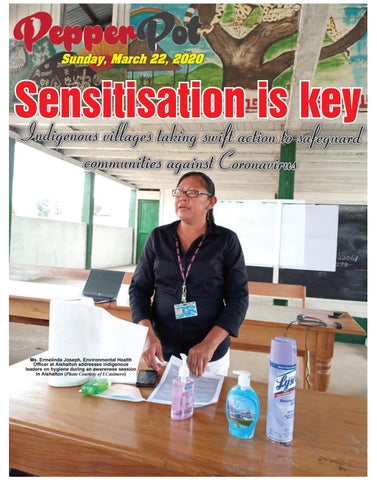
Sensitisation is key Indigenous villages taking swift action to safeguard communities against Coronavirus
Ms. Ermelinda Joseph, Environmental Health Officer at Aishalton addresses indigenous leaders on hygiene during an awareness session in Aishalton (Photo Courtesy of I.Casimero)
II
CHRONICLE PEPPERPOT ― March 22, 2020
n e r d l i h c g n i g a r u y o r c t n e E o P e v o r e i l r r a o F t rancis Quamina by F
at the ions n s s e S w -back rgeto ck-to y in Geo a b o m e tw I did rian Acad Ma
in pirit, oly S at right H e h T arrier ol of Scho , Ghana. F y n Suna
the . John he St ion Seven t f o ts eg tuden ica, R with s ol at Bart t f e l r at cho Farrie Primary S t s i t Bap
he 0 ts of t tuden n, Region 1 s h it w e d w o in kr tL e bac ool, a r in th rimary Sch ie r r a F rd P ’s Wa melia
ts uden he st One t h t i w ion nt row , Reg he fro ry School t f o entre sa Prima r at c o Farrie e Santa R of th
he with t t row ool in n o r f ch he igh S e in t hed centr . Rose’s H s demolis t a r e t i a r S r w f a t F nts o ore i stude etown bef g r o Ge
A
T
HIS time around on World Poetry Day - March 21 - I have decided to publish some photographs of my on-going (FREE) Poetry and Storytelling Sessions at schools around the nation. While I enjoy this Golden Years hobby of mine, I have to let you know how much the students also enjoy my poetry sessions. World Poetry Day was inaugurated by UNESCO in 1999 to reflect on the power of language. “Poetry reaffirms our common humanity by revealing to us that individuals, everywhere in the world, share the same questions and feelings,” according to UNESCO. That world organisation which is a part of the United Nations encourages the reading of poetry in schools and other institutions.
One of the elements which I have injected into the sessions which I do at schools is to include poems which were written by poets from the community in which the school is located. For example, when I held sessions at Leguan Island in the Essequibo River, Region Three, I said some poems which were written by Rosetta Khaledeen who is from Leguan. Similarly, my sessions at Linden in Region 10, included poems by Dr. Carmen Subryan and Dmitri Allicock who are both from Linden. At Santa Rosa in the Moruca in Region One, I said poems by Educator Basil Rodrigues who is from that historic Indigenous community. So, here now, are a few photographs which were taken after my Poetry and Storytelling Sessions at some of the many schools.
CHRONICLE PEPPERPOT ― March 22, 2020
III
Sensitisation is key Indigenous villages taking swift actions to safeguard communities against Coronavirus
Residents of Yupukari, Rupununi, at a Coronavirus awareness session (Photo Courtesy of Russian Dorrick)
By Ravena Gildharie
A
S Guyana like the rest of the world ups national precaution and response to the Novel Coronavirus (COVID-19), indigenous communities, even the most remote, are taking their own measures to safeguard their communities and people. Led by their village leaders and local public health officers, the majority of the communities are involved in Coronavirus awareness, while a few are prohibiting or restricting visitors. Crucial at this time are heightened concerns about hinterland villages with porous borders such as the North Pakaraimas and the Rupununi, where there is an influx of illegal Brazilian migrants mainly into the mining sector. Issues of this nature also exist in the North-West District of Region One, where masses of Venezuelans continue to enter Guyana. Brazil recently announced that it has closed its borders with Guyana and other bordering countries, but this closure of the ports of entry is adding to the worries for bordering indigenous communities, which may have to deal with an increase in illegal arrivals, residents say. In other villages that are positioned relatively remotely, the concern is low as regards the potential risk of infection of COVID–19, but on the other hand, residents are facing economic downturn. Halt and/or restrictions to tourism services, businesses and other public activities have driven in some cases, the shutdown of local transport services and supplies of goods to the villages. Risks of Coronavirus at ‘open’ borders In Region Nine, South Rupununi village leaders, under the guidance of their umbrella body, the South Rupununi District Council (SRDC), teamed
up with the police, doctors, environmental officers, and others to monitor the illegal entry points in that part of the country, as a precaution against the Coronavirus. SRDC’s Immaculata Casimero told the Pepperpot Magazine that a team comprising toshaos, SRDC monitors and the police will conduct the checks, a measure put in place after toshaos and senior councillors of Bashaizon complained about vehicles crossing into Guyana night and day from Brazil. This mounted fears among the predominantly Wapishan territory that the illegal migrants can bring into Guyana undetected cases of the deadly Coronavirus. These issues were discussed this week when the toshaos, senior councillors and health workers from villages such as Shea, Maruranau, Awarewaunau, Aishalton, Karaudarnau, Achiwib, Bashaizon and Parabara convened in Aishalton for a COVID-19 (Coronavirus) sensitisation workshop. Organised by SRDC, the session was facilitated by Dr. Rosha Coylessar and staff of the Aishalton District Hospital and also included the police stationed in the area. Casimero said the leaders were advised on necessary sanitation and precautionary activities, and were also cautioned by the police to avoid large gatherings, except for Coronavirus awareness sessions led by the communities’ health workers. Across the highlands into Region Eight, North Pakaraima communities also share ‘open’ borders with Brazil, and leaders are worried about the risk of Coronavirus among the largely Patamonas population there. Kato’s Toshao Cliff Pereira, who is also Chairman of the North Pakaraimas District Council (NPDC), reminded that the porous border sees daily movement of people in and out of
Village leaders of the South Rupununi engage on the presence of Coronavirus in Guyana (Photo Courtesy of SRDC)
the indigenous communities, making it difficult to impose stringent precautions against the Coronavirus. Efforts are instead dedicated to making villagers aware of the virus, informed of what they can do individually to safeguard themselves, and telling them what steps they should take if they or someone nearby is suspected of having the virus. The Kato Village Council held an emergency meeting this week, when the health worker and medex engaged villagers on the COVID-19. A medical team from the Mahdia Hospital was expected to soon visit the North Pakaraimas and conduct screening for the Coronavirus, while the indigenous leaders ponder further measures. “As for the inflight from Georgetown for example, we are thinking about restricting certain people from entering… example, postponing people coming to hold workshop etc.,” the toshao related, adding that, “we are still working on it. I
know it’s very complicated when it comes to that, but will see what happens.” Pereira is aware that some of his colleagues has closed their villages to visitors. ‘No visitors’ In Region One, the Santa Rosa Toshao and Village Council agreed to prohibit visitors from accessing the Moruca Sub-District community as a result of the Coronavirus presence in Guyana. In communicating the move to the Region Two administration earlier this week, Toshao Whanita Phillips reported that the Charity-Moruca speedboat route would be closed to all passenger boats from Monday, March 23, 2020 to April 5, 2020. Phillips’ action comes just days after fellow Toshao, Beverley Clenkian of St. Cuthbert’s Mission also announced the closure of her village to visitors. The lone indigenous
SRDC awareness on Coronavirus in South Rupununi (Photo Courtesy of SRDC)
village in Region Four, St. Cuthbert’s is the closest in proximity to Georgetown and the measure, Clenkian told this publication, was taken after the council had carefully discussed the issue. A public notice was mounted at the village entrance, advising persons that St. Cuthbert’s was not accepting visitors until further notice. Accessible just a few miles off the Soesdyke-Linden Highway, the village is usually a major attraction for local and foreign visitor, who find it an ideal spot for weekend getaways. A ban on visitors is sure to affect the community’s economy, but when questioned about this effect, Clenkian responded that “everything is slow up here.” In the meantime, she said the council and the local doctor were conducting awareness sessions with residents on the Coronavirus. Similarly, in Region Six and in the upper reaches of the Corentyne River, the Vil-
lage Councils of Orealla and Siparuta have imposed on both residents and visitors strict measures for leaving and entering the villages. In a social media post, Orealla Toshao Carl Penuex said some residents were “scoffing at these measures and deliberately want to defy these measures.” He pondered whether the police could support the villages to enforce the measures. Awareness While these issues persist, the awareness of Coronavirus among indigenous communities remains vibrant. In Central Rupununi, Toshaos and Councillors led by Vice Chair of the National Toshao Council (NTC) Russian Dorrick, is on a sustained mission to update each and every community about the COVID-19. “Each village have a task force to monitor the visitors especially persons coming from Brazil,” related Dorrick, who is the Toshao of Yupukari. He explained that indigenous leaders of Region Nine met and discussed regionally their approach for community awareness on the Coronavirus. Shulinab Toshao Nick Fredericks, who also Chairman of the NTC and SRDC, is responsible for awareness in the South Rupununi while Annai’s Toshao Zacharias Norman is tasked with the North Rupununi. Dorrick himself, who is overseeing the Central communities, has spearheaded Coronavirus sensitisations in Quatata, Yupukari, FlyHill and Kaicumbay. He said some councils were making efforts, utilising their own village finances, to purchase and distribute to communities necessary sanitation items. At the level of the NTC, Toshao Dorrick indicated that the executives are collaborating and keeping each other updated on the Coronavirus issues via a WhatsApp group.
IV
CHRONICLE PEPPERPOT ― March 22, 2020
‘Parents, work with your children at home’
Ministry, educators looking for alternative ways of teaching during COVID-19 school closure
By Telesha Ramnarine HILE local authorities have decided to close all schools in the country for two weeks, there is still a lot that parents and guardians can do to ensure that children continue learning and not become complacent with the books. For some parents, helping their children in this manner can be especially difficult. For many, their minds are preoccupied with major developments in the country, such as this year’s contentious elections process and the outbreak of the novel coronavirus. Helping their children with their books may, therefore, require mental and physical energy, along with emotional stability. It is all too easy for parents with young children to allow themselves to focus on their jobs (if they work from home) and other tasks by handing their child a phone or tablet. But before they know it, the child has become exposed to hours of screen time; something which experts believe does more harm than good. Chief Education Officer (Ag) at the Ministry of Education, Carol Benn, believes that now is the right time for parents to sit with their kids and read to and with them. Parents, she advised, can visit the ministry’s website to access a number of worksheets for all age groups. “Ensure your child reads each day and ensure you go through the work they would have already covered in school,” she further advised, adding, “It’s not enough to give them books; you must question them to ensure that they understand what they are reading.” Benn noted that even the materials children are using to work at home, and their books, ought to be sanitised. “From
W
groups that allow them to be in contact with parents and children. The Education Ministry has since asked teachers to see what they can do to continue the learning process with their children, and many teachers have been using their initiative. This measure is especially proving helpful to the Grades Two, Four and Six children who are preparing for exams. EXERCISING PATIENCE “Be very, very patient and try to let the situation look normal; it’s a little technical, b u t reHead Teacher Sunita Durgah
Chief Education Officer (Ag) Carol Benn
A father fixing a puzzle with his child (cnn.com)
our end at the ministry, we are doing our part, and we expect parents to do their part also.” REMOTE TEACHING MEASURES Headteacher of St. Margaret’s Primary School Sunita Durgah, has been in the teaching profession for the past 25 years, and she believes that parents should refrain from taking out their current frustration on their children, and instead try to be very patient with them. Many schools have implemented a system that allows teachers to do remote teaching, such as using WhatsApp
KEEP THEM OCCUPIED Here are some things that Durgah advises parents can do with their children at home: cooking, laundry, sewing, gardening, working on the car, completing a family tree, playing indoor games, fixing puzzles, watching national geographic and documentaries, filing mails and other important documents, rearranging the house, and doing experiments such as mixing colours, float and sink activities, and exploring magnetic and non-magnetic objects. While the circumstances of some parents allow them to be at home with their kids, others have jobs that require them to be physically present at the workplace.
WHAT PARENTS SAY Heather Morris-Wilson has two young sons to care for, but as a medical doctor, she cannot afford to stay at home. But she said she and her husband, who Medical Doctor Heather is also a doctor, try to ensure Morris-Wilson that they work with their children in the nights after work. One of their sons, Josiah, attends Rhema Global Academy in Kitty, while their other son, Jonathan, attends Success Elementary School. Fortunately for Heather and her husband, both of these schools make it a priority to daily send work for the children via a WhatsApp group. “So we try to complete each day’s work with the boys, and also to set aside some time each week to complete whatever could not get done,” Heather said, adding, “It’s really hard to get them to sit down and do their work but as parents, we have to ensure that they get it done.” Heather is grateful for the interest that the schools have been taking to help the children continue their school work. “In every school, good or bad, there is always a lazy teacher, but a lot depends on their motivation and how much they are
A mother doing schoolwork with her children at home (The Indian Express)
assure your children that this situation will not last forever. We’ve observed that many parents do not have the patience to work with their children, and leaves it up to the children to find things to do, but it’s a must that they help the children,” Durgah expressed. Her advice to parents is to enlighten their children on what is happening, even if it means looking at news with them and explaining. However, she cautioned that it may not be the best thing to allow the children to be too consumed with what is happening.
interested in helping their children.” Meanwhile, according to the Chief Education Officer, arrangements are now in place for all schools across the country to be sanitised and fumigated, so that children can return to buildings that are clean. Benn said it is also hoped that when children are ready to return to school, parents will continue to ensure their safety by giving them a clean rag/tissue and soap to walk with. The administrations of private schools are expected to follow the same measures as the public schools in the interest of their learners and staff, Benn added.
CHRONICLE PEPPERPOT ― March 22, 2020
V
Intent on changing the outlook of STEM in Guyana
S
Bradley Downer in an interactive session with participants of the STEM Girls Glow campaign
and others as a child. Bradley attended the Hopetown Primary School and it was here that his love for science blossomed even more. He subsequently attended the Mahaicony Secondary School and was determined to enter this science stream from his first day of admission. There was a shift of events and Bradley eventually joined the technical stream. Nonetheless, he still completed subjects such as Biology, Physics and Chemistry. He also developed a love for writing in the fourth form. He later received a scholarship to pursue environmental health at the Ministry of Public Health. One day after he finished high school he read up on STEM Guyana and he was determined to join. After many applications, he finally received an email in August 2018 to be introduced to it. Bradley was trained and he gained a wider understanding of the different areas of STEM and he realised that career choices can be more than just a doctor or lawyer. His mother is his role model because of how well she adapted and thrived with having little to no resources—he was inspired to excel at whatever he put his mind to. Thus far, on his journey, he has met and interacted with many persons who have helped to shape him into the person he is today. He has worked alongside Joylyn Conway (Miss World Guyana 2019) with her STEM Girls Glow campaign. This man of science and technology also learned how to do website designing with Samantha Sheoprashad. He was introduced to robotics and how to programme robotics with STEM Guyana. Bradley says that he accepts that he does not know everything there is to know of this field, but he’s always open to learning. This aspiring motivational speaker now uses his platform to enlighten oth-
ers on STEM in Guyana as he was a part of many talks and outreaches across the country in churches and schools. As a youngster of science who sees the need to give back to the community, he is also a committed STEM volunteer to many NGOs. Downer was the victim of discrimination many times before. “You’re not smart enough,” “STEM is not for you,” or “You did not attend an ‘A’ grade school” are some of the harsh things he heard against him. Nonetheless, this did not deter him from pursuing his aspirations in life. Currently, he is employed under the Ministry of Public Health as an Environmental Health Inspector/ Sanitary or Public Health Inspector in Region Five. His job seeks him to inspect house lots, complaints of unsanitary conditions in a neighbourhood, food-handling training, water sampling and how to keep the environment on a whole. Some of his accomplishments thus far include: an internship with STEM Caribbean, participated in the ‘I love STEM’ competition from STEM Caribbean and gained third place and was a finalist in CARICOM’s energy competition. Downer plans on studying at a University in the field of medicine, computer science or journalism. His end goal is to gain a PhD in one of the mentioned areas. Bradley advises youth like himself by saying, “You can do anything as long as you put your mind to it and focus. My favourite quote from the bible is: ‘I can do all things through Christ who strengthens me’, this helps me throughout the day.” He continued by saying: “Nothing in life comes easy, do not limit yourself, because only you can determine what you can do and how you can do it.”
STEM motivational speaker, Bradley Downer
Bradley Downer
One youth’s drive to make a difference
By Marissa V Foster TEM has been continually gaining momentum in Guyana over the past few years; however, there is still a need to delve into the horizons and depths of STEM among Guyanese people. Bradley Downer, an advocate for STEM, promises to bridge that gap with his love for coding, programming, environmental science and writing. He is a quick-witted and cleve, promising young advocate of STEM in Guyana and the potential it holds for young people. His story did not begin with a royal title, but he is insistent on changing his path for the better with the use of Science, Technology, Engineering and Mathematics. Bradley did not have the luxuries and opportunities as others had while growing up. He had no access to a computer and other technologies. He would oftentimes visit his cousins just to watch television and as expected, the only programmes that he was interested in were science and technology-related. He was always the child who’d question his environment. “Why are there shooting stars?”, “How are websites built?” or “How can Guyanese make mobile apps?” are all questions he asked himself
VI
CHRONICLE PEPPERPOT ― March 22, 2020
COVID-19
C
OVID-19, much like the recently concluded Regional and General Elections in Guyana, has caught me off guard and seems as though there is no end in sight, at least for the foreseeable
future. Just about two weeks ago, Guyana recorded its first confirmed case of the novel Coronavirus disease 2019 (COVID-19), which turned out to be fatal. In the days after that, due to the incredibly charged political climate we are all confronted by right now, the matter easily became politicised and ignorance prevailed. Soon after, we saw that this ignorance had damning consequences, and the number of the currently untreatable COVID-19 cases spread.
reported illnesses of the ‘coronavirus’ have ranged from very mild (including no symptoms at all) to severe, including illnesses resulting in death. It has been reported that most COVID-19 cases are mild, with an approximate figure of about 16 percent of serious illnesses. Yes, older people and persons (of all ages!) with severe chronic medical conditions, such as heart and lung disease or diabetes, have a higher susceptibility. In my personal opinion, the first and most important thing that we should all be doing right now is to stop panicking. And then, wash your hands with soap for 20-30 seconds (I usually sing whatever song comes to mind, but the ABCs are always a safe alternative).
Being the responsible adult I am, I told myself that for my column this week, I’ll try to provide concise information on the new disease amidst the clutter of misinformation and fake news. The epicentre of the outbreak was in Wuhan, Hubei Province, China- months ago. Since then, this disease has spread across the globe, claiming many lives. In Guyana, we have every reason to be cautious. That aside though, I’m sure what we’re all concerned about is the implications on our health. Now, according to the Centre for Disease Control and Prevention (CDC), the
Social distancing is another good way of protecting yourself. Particularly if somebody is sneezing or coughing near to you, make sure to keep safe from them lest we become exposed to small water droplets, infected with the virus (better safe than sorry). If it wasn’t a good idea before, please practise good respiratory hygienethat is, cover your mouth when you cough or sneeze. Also, stop touching your eyes, nose, and mouth. And though it is not part of our nature as Guyanese, how about if we try social distancing- you know, keeping your distance from people so that you safeguard
against the spread of the disease. That said, let me take some time to address what else is important here. No doubt, the pandemic has brought with it an enormous social and economic burden. I know I feel the real ramifications of this. As I write this article in my bedroom, of the Hall of Residence where I am staying, located at the University of the West Indies campus in Trinidad, it was just announced that I have just over 24 hours to get into Guyana before the two-week travel ban kicks in. That is not happening, so I’ll just sit tight in my single room (my roommate already went home) and wait. On the other hand, I have already spent much of the past few days waiting to hear if my final examinations will be cancelled, so that I would know when to leave the UWI (because they “strongly advised” that all non-nationals go back home). Trust that when I say I have no real idea about what is going on, I genuinely mean that I have no real idea about what is happening. My confusion is no different from what many others are feeling. The panic-shopping crisis has unfolded and face masks are the new thing. This semester, I’m doing macroeconomics and I have a better appreciation for the ramifications COVID-19 will have on the global economy, including the seemingly inevitable global recession. These aren’t things that bode well for our petroleum sector, which has only just begun. And when the global economy is impacted, our economies will, in turn, be impacted. I say this not to create panic, even though I’m wary that this is anxiety-inducing. I saw this all to say that we should prepare ourselves for a shift in the way we live our lives for the next year or so. COVID-19 isn’t a political matter, it is a health concern that has damning consequences in the socio-economic spheres. Let’s not be ignorant and politicise matters unnecessarily. Instead, let’s take the time to keep well-informed (information is readily available, and credible sources such as reputable news outlets at PAHO/WHO are always great) and safe and sound.
CHRONICLE PEPPERPOT ― March 22, 2020
VII
I can’t ha v e children – how do I h andle this A ?
FTER my column on teenage pregnancy, I received an email from a woman who is unable to conceive a child. She told me about the mental health issues which arise from this and asked me to write about it anyway I see fit. I hope this helps. Let’s get the technicalities out of the way. Primary infertility refers to the inability to give birth, either because of not being able to become pregnant or carry a child to live birth, which may include miscarriage or a stillborn child. Secondary infertility refers to the inability to conceive or give birth when there was a previous pregnancy or live birth. Men who don’t have sperm in their semen have a condition called azoospermia. There aren’t really any symptoms that you’d notice, but if you’ve been trying to get pregnant without success, these conditions could be the cause. Many people, like my friend who wrote to me, begin to question everything when there isn’t a child in the picture. They question their existence, legacy, old age and everything in between. However, there are many others who have either chosen the route of no children, or were unable to conceive and went on to happy and fulfilling lives. First of all, if you have been trying to get pregnant for a while without any success, I would advise you to visit your nearest health centre so they can tell you what options you medically have. What can you do if you
know for a fact that you cannot birth your own child? First and very importantly, allow yourself to grieve. Grieve for the children y o u wanted, the hopes y o u had for them and the life you had planned. Yo u c a n not move on unless this is properly dealt with. When children are strongly desired and you learn you can’t have them, it is a deep and profound loss. It requires the process of grieving every bit as much as the death of a loved one does. Remember that healing is a process, not a one-time event. Be gentle with yourself and don’t pressure yourself to fill that gap immediately. As counterintuitive as it seems, befriend that empty space in your heart. Explore what that loss and emptiness feel like in your body. This empty feeling is not your enemy. It’s a natural response to this deep and profound loss and is a necessary part of healing. Find comfort in little things every day. Consider starting a gratitude jar and writing down one thing each day that you are grateful for. These don’t have to be big or insightful
things; they can be as simple as
being grateful for your coffee in the morning or the sunshine on your face. Allow yourself to notice and appreciate the things about your life that perhaps you wouldn’t be able to enjoy if you had been able to have children. This doesn’t dismiss your longing or love for your potential children. As humans, we are powerful beings, and we have space to both miss what could have been and be appreciative for what is. GIVE YOURSELF THE GIFT OF SUPPORT If you are fortunate enough to have family or friends who understand this kind of loss and can be supportive, lean on them. Allow them to be there for you and
to love you. Seek out support groups, women’s groups, or men’s groups to surround yourself with others who can support and encourage you on your journey. Start your own group with those you k n o w who are struggling with this issue too. Find a counsellor or mental health professional who can help you through
this time. Sometimes, finding the right support takes work. You deserve, however, to be supported and loved as you grieve.
MAKING MEANING OUT OF YOUR LIFE It’s not about finding a reason why this may have happened. The cliché “there’s a reason for everything” isn’t really all that helpful to many people. However, choosing to make meaning out of the events of our lives is empowering and healing. Decide what you want to make this loss mean in your life. Decide how you want to use it to create a new life going forward. Life isn’t what you ex-
pected it to be. You may not get to be the person you wanted and planned to be. Choose to make this unexpected and unplanned life meaningful and fulfilling anyway. You can’t bear children. That is painful and heartbreaking, but it is still possible to live a meaningful, fulfilling, and happy life. Also, when you have healed, you can also consider adoption! Thank you for reading and please continue to send topics to caitlinvieira@ gmail.com. If you would like to book a private appointment, please WhatsApp or text 623 0433.
VIII
CHRONICLE PEPPERPOT ― March 22, 2020
CHRONICLE PEPPERPOT ― March 22, 2020
IX
Finding hope in Focus Hope Village on the Village
The one-and-a-half-mile road to Hope Village
By Michel Outridge HIS week the Pepperpot Magazine visited the agricultural community of Hope Village, East Coast Demerara. This village is divided into two sections, Hope Village and Hope New Housing Scheme. The community is tucked away in a mile and a half of all-weather road and is between Lowlands and Bee Hive, also on the East Coast of Demerara. Hope is home to Hope Coconut Estate, an arm of the National Agricultural Research and Extension Institute (NAREI), which has an abundance of coconut plants for sale. The place has potable water supply, electricity, non-functioning landline services, cellphone service and internet. It has a few shops and most of the residents are large-scale farmers and some have livestock. Hope Village has predominantly Indo-Guyanese, while the nearby Hope New Housing Scheme has a mixed population. The village has a Police Outpost, with a nursery and primary school that are housed in one building. The Pepperpot Magazine first went to the home of Pamela Boodhoo, she has a grocery
T
shop in her front yard, providing basic foodstuff to villagers, all reasonably priced. Boodhoo stated that she has lived all her 54 years in Hope Village, her parents
were farmers and she grew up in the community. In July this year, she will observe her 55th birth anniversary and is looking forward to that occasion.
The grandmother explained that she resides in an extended family setting where about 15 persons share a home, including her grandchildren.
Pamela Boodhoo in her hammock (Carl Croker photos)
Hope Coconut Industries Limite
The Hope Police Outpost
“Things not like longtime, it’s different these days because goods are pricey and when you buy to re-sell, it’s not profitable, but we trying to stay afloat with this small shop,” she said. Boodhoo has a kitchen garden and the produce is for their kitchen and they do their shopping outside the village to stock the shop. “This village is the only place I have lived and it will remain that way because this is home for me and my family and we are here to stay,” she explained. When the Pepperpot Magazine visited Boodhoo she was relaxing in her hammock with a grandson, just after breakfast and was thinking up a menu for lunch.
She related that the country life is simple, but it entails a lot of hard work to make ends meet and living as a family is best because they can look out for each other. Boodhoo, the elder of her home, oversees the daily function of the business and ensures that all is well with the large family. “Long time things were good, because almost everybody in this village used to work with the Hope Coconut Estate and those were the days when you worked right in the community and walk home after,” she said. Boodhoo added that these days most villagers are planting the lands and they depend heavily on that to maintain their families.
X
CHRONICLE PEPPERPOT ― March 22, 2020
Hope residents taking it easy Focus on the Village
wcase cover Sunita Premdass sewing a pillo er photos) Crok l (Car h by hand in her veranda
Carl De Roache at his roadside shop
By Michel Outridge OPE New Housing Scheme, East Coast Demerara, is fairly a developing community with about 13 streets and a mixture of Guyanese of all ethnicities. It was established about 11 years ago and it has the basic infrastructure with electricity, potable water and cellphone services. The Pepperpot Magazine met Carl De Roache, the village cobbler, who plies his trade at the Hope Main Access Road, where he has a small roadside stand, selling some cold beverages, sweets and biscuits. He has been residing in Hope New Housing Scheme for the past three years with his wife, but is originally from Stevedore Housing Scheme, in the city. “The price is reasonable and pocket-friendly, because it’s in the countryside and you try to meet the pockets of regular people because it’s a farming community and people are hustling for a daily bread, so I am fair,” he explained.
H
The 46-year-old stated that he is managing to fit in and he is open for business from 08:30hrs to up until 16:00hrs, after which he gets on his bicycle and makes the journey home. “I am a mason by profession but work is out right now, so I have to do something else to bring in an income in the home,” he said. Sewing by hand The team also talked to Sunita Premdass, who was on her verandah sewing by hand a pillowcase cover, after finishing some chores. The 48-year-old reported that following the death of her husband, she moved in with her daughter and son-in-law and does domestic work within the village, a few days per week for her general upkeep. Premdass added that earning an income has been difficult for her since she depended on her husband to provide for her when he was alive. “If I get any work cleaning houses I does take it even if it’s half-day because I need the money to look after myself,” she said.
Grazing cows The Pepperpot Magazine also spoke to George McDonald, at the time he was home for a cold beverage after which he was off to graze his cows. With the use of his motorcycle, it was easy for Mc Donald to move his cows from their pens in the backlands area to another location to graze. He looks after his cows during the week and on weekends he has a small business of fish and chips and chicken and chips with some beverages, all in a small roadside shop he erected. He is originally from Ann’s Grove, also on the East Coast Demerara, but relocated at Hope New Housing Scheme to assist his sister. McDonald reported that so far, things are going good for the past six months he moved there and doesn’t have time to complain but work. The young man added that the place is nice, because people mind their own business and things are quite normal as is. McDonald told the Pepperpot Magazine that the place is quiet and peaceful, an ideal location for a good, simple life.
George Mc Donald on his motorcycle grazing cows
CHRONICLE PEPPERPOT ― March 22, 2020
XI
The hard-working farmers of Hope Village Focus
Farmer, Mahadeo Mohabir upon his return home from spraying his farm (Carl Croker photos)
on the Village
One of those persons is Handso Rammit, a stay-at-home wife, who was in her front yard enjoying some good country breeze after completing some household chores. She stated that at present things are a bit worrying because of the elections debacle and the Novel Coronavirus (COVID-19), causing people to panic and economically it’s a bit stagnant. Rammit related that their community depends heavily on farming and with the existing limitations on certain things, it is a real struggle for them to sell their produce and still make a profit. “We make do with
By Michel Outridge
T
H E Pepperpot Magazine during its visit to Hope Village, East Coast Demerara, spoke with several residents, who shared their stories.
the farming and I have a son, who is an operator, but he don’t get everyday work so we trying as is,” she explained. She stated that they would sell their produce at Annandale Market on weekends and would buy groceries outside the village. The 59-year-old said they never had any real all-weather road in the streets in that village, except for the main access road which is asphalted and lived all her life in Hope Village, since in the days when her house was a logie. Rammit reported that over the years they were able to demolish the old structure and construct the
flat concrete house they currently reside in. She pointed out that sometimes one just needs to pray instead of worrying. The team also met Shoba Sookraj and her husband, Mahadeo Mohabir; the couple has a farm and that’s their only source of income. They are also residents of Hope Village, who has several acres of farmland in front of their home. Sookraj told the Pepperpot Magazine that she is a housewife but would assist her husband on the farm. She disclosed that they have wholesale buyers for their crops of squash, boulanger, fine leaf thyme, papaya, ochro and passion
Handso Rammit Shoba Sookraj and her husband, Mahadeo Mohabir
The farm
Shoba Sookraj going to her farm
fruit. The mother of three related that the farming life is not one of glitz and glamour, but is hard manual labour and long hours of toiling in the humid weather conditions that exist presently. Her husband Mohabir said that he would get up early and begin work on the farm. That day, he was engaged in spraying pesticide and was on a break, after which he was expected to return at 17:00hrs to continue the task. “In this business of farming the middle man makes the money, that is, the people, who are buying from us, because they pay you small and sell at market price which fluctuates as a result, we carry a loss,” he said. Mohabir however, remains optimistic and his motto “You can’t give up” keeps him going and his family are his helpers and constant prayers often carry the burdens of life. He stated that life is how one sees it and for him his vision is through his children and that is his motivation: to keep working to provide for his family, which is his priority.
XII
CHRONICLE PEPPERPOT ― March 22, 2020
‘Hope Estate’ working toward sustainability and development of the coconut industry
Focus on the Village
HCIL Accounts Clerk Trishwantie Jagdeo (Carl Croker photos)
Hope Coconut Industries Limited
Coconut plants in nursery bins
By Michel Outridge
G
ENERAL Manager Ricky Roopchand of Hope Coconut Industries Limited (HCIL), commonly called ‘Hope Estate,’ told the Pepperpot Magazine that the entity is working assiduously towards achieving its goal. He stated that HCIL’s current drive is to better serve farmers’ needs and at the same time work towards achieving financial sustainability and wean itself off government’s subvention. He reported that it is no secret and is unfortunate that the estate suffered almost two decades of mismanagement. However, with the support of the present government, the situation has changed for the better over the past three years. This was made possible through the support received from the Ministry of Agriculture. He stated that in an effort to address many of the setbacks and overcome several hurdles that hindered progress, the estate has embarked on several income-generating projects with the aim of creating the pathway for development. Roopchand added that one such project is its fully established and functional coconut nursery which, over the past three
years, has become one of the estate’s main income streams. It has the capacity to produce 100,000 coconut seedlings per year and is one of the most productive nurseries, not only in Guyana, but in the entire Caribbean. “This intervention augurs well for farmers since they now have easy access to high-quality seedlings at an affordable cost. As a direct result of the nursery’s robust, sustainable and commercial drive, the estate was able to win both technical and financial support from several international development agencies such as the CARICOM Development Fund (CDF) through the Rural Agricultural Infrastructure Development Project (RAID) which falls under the umbrella of the Ministry of Agriculture, The Caribbean Agricultural Research and Development Institute (CARDI) and ITC, which is funded under the 11th European Development Fund (EDF),” he said. He disclosed that Hope Estate is now turning the corner and farmers’ needs are better served. The support received is now acting as a “springboard” for the continued development and expansion of the coconut sector of Guyana, making it commercialised and productive for the benefit of all involved. Roopchand pointed out that today, the tide has turned for the better, since over the past three years close to $35 million was
expended to fix several bridges, dams, the main access road, extension and repairs of the main office building, establishing of a coconut nursery and coconut demonstration plot, to name a few. In addition, HCIL has embarked on a programme to continue to improve and maintain the essential infrastructure of the estate, he said. The Pepperpot Magazine also spoke to HCIL Accounts Clerk Trishwantie Jagdeo, who said that they sell coconut plants which are sourced from farmers in Demerara, Essequibo and Berbice. She disclosed that they have a staff of seven and they open from Mondays to Fridays from 08:00hrs to 16:00hrs The accounts clerk stated that they have a wide array of coconut plants housed in nursery bins from 18 months, three years and five years old. Jagdeo pointed out that they have three species of coconut plants, namely: the St. Lucian green, the St. Lucian yellow and the Malaysian dwarf. “We sell the coconut plants as low as $300, $350 and $700 per plant and per month we buy about 1,500 coconut plants from farmers, but we have a lot of five-year-old coconut plants presently, since it [sic] takes a while to sell,” she said.
CHRONICLE PEPPERPOT ― March 22, 2020
XIII
Focus Maki n g th most e of li fe in Hope Villa ge on the Village
Singh among her flowers in her yard
By Michel Outridge
H
emwantie Singh, better known as “Aunty
Hemwantie Singh called “Aunty Leila” (Carl Croker photos)
Leila,” resides alone but is thankful for her neighbours who look out for her. She recalled one day when she was feeling unwell and fainted in
the house and fell. She was unable to get up and called out for help and the neighbour responded and took her to get medical attention. She suffers from hypertension and diabetes and also underwent surgery to remove her left breast after cancerous tissues were found. As such, she is unable to lift her left hand because she isn’t fully healed, but is trying to do things on her own. T h e 6 5 - y e a r- o l d said her husband collapsed one morning in the washroom and died
TURN TO PAGE XXI →
XIV
CHRONICLE PEPPERPOT ― March 22, 2020
Crisis? Time for Creativity
A
FEW weeks ago, I interviewed an artist who said recently that I’ll share with you as a means of encouragement she had created her best works during a period during this season. of unrest. This period was by no means pleasant, however, she was confined to her home and that Guyana Dreaming gave her much time for experimentation. In the light of (for Aubrey Williams, Guyanese artist) the current political and social climate of this nation, the artist must seize every opportunity to work. We have a reSmell of old ancestor blood sponsibility to document history but more so, to be a voice smell of conquistador for the people. As we are being cautioned to practise social colour of the bible distancing to prevent the spread of the COVID-19 virus, we colour of the sword can use the time apart to get our creative juices flowing and to create. There are quite a few global issues that can be Turquoise blue of morning portrayed, and our works will bring awareness to matters dark of jungle night affecting society. With regard to the virus, we can also use yellow breast of toucan our creativity to showcase possible preventative measures. green of parrot flight Some of the best pieces of art were created in seasons of much distress; this time is no different. While the year 2020 Red of Mayan warning hasn’t presented what many of us envisioned for ourselves, Kaieteur smoking white we still have much to look forward to. To the art teachers that rituals of colour are currently at home, work towards the exhibition slated for in dawn of forest-light. later this year. To the photographers, work towards Vision 2020 exhibition. You have until April 17 to submit entries for The jugular of the heartland. the photography exhibition. To persons who love to create, This is what you go for – do just that. The creative industry encompasses everyone within the Paintings arising like fields of visual, literary and performing arts. I read a poem great forest-spectres or faces emerging from the brushstrokes of a dreaming archaeologist artefacts brought forward from fall of old empires – a resonance of colours and always that space you reserve for fire – holding the landscape like your palette while speaking with the stars. Octaves of the interior This is what you go for –
Inviting us through bone-flute of rivers down crescendos of rapids past that Olmec head standing guard at the entrance of your painting’s music – sometimes growing apocalyptic as your love of Shostakovich or soft as the sound of a far-off-waterfall – the invisible presence of birdcall as you conduct your brush’s wand – your symphonies between a burning present and a dreaming past. The man who comes to shake your hands on the streets of Georgetown. The man who, once a month, brings down his dray-cart packed with country folk to see your exhibition – and you, moved, humbled to tears by this simple paean – this salty gaze that sustains your own renaissance you on going epic of the Amazon
Your striking African-Mayan face that captured Picasso, old-world maestro, whose first words by way of introduction were: “You have a fine head. You must pose for me.” But you wanted a dialogue, not a sitting between master and exotic. So you moved out of his eyes’ hypnotic orbit, his well-known fascination with African masks. And as you moved away, all the old gods of the New World rank forming a ruing of fire around you – young, proud, already carrying the seeds of your own masterpieces. By Grace Nichols
CHRONICLE PEPPERPOT ― March 22, 2020
XV
Music in his soul
Singer Tony Cuttz
How ‘Tony Cuttz’ found his melody By Tamica Garnett
G
ROWING up to his grandfather singing to him before he slept at nights, music was always a part of life for 31-year-old Remesh Brijnauth, or ‘Tony Cuttz’ as he’s known when he hits the stage, so eight years ago he decided to get serious about the business and started singing professionally. Known widely for his skillfulness as a barber, Cuttz has been showing that he is just as skillful on the mic as he is with the blade. His musical pursuit hitting a high point for him when he brought third place at the Mashramani Chutney Monarch last month, on his first try in a singing competition. For his third place finish, Cuttz walked away with $400,000 and the confidence boost. And now Cuttz feels all the more encouraged to continue down the path of a musical career, where he sings mostly soca and chutney. “My goal is for my music to play all over the world, and for me to make a positive impact with my music,” said Cuttz, who is currently working on his newest single “Give We The Soca”. Cuttz entered the competition with his original single “Neighbor Roti”, and though he was confident of his track going in, finishing third was still left him in happy disbelief. “When the judge called me up as third I wasn’t sure I heard right. I was so surprised, as a newcomer to get a space it was a big deal to me,” Cuttz express. Finishing behind big wigs like Bunty Singh and Steven Ramphal has now made Cuttz even more determined to build his reputation and develop his career as a singer. “I was so grateful to be on the same stage with the other singers,” Cuttz shared of his experience at the annual competition. Cuttz, who is from Lusignan, decided that 2020 was going to be the year that he stepped out on stage in the competition, after following the competition in 2019 and believing he had what it took to be among the level of rivalry put forth. And so it was at last month’s competition Cuttz was among 17 singers that were vying for the $1 million grand prize. Cuttz said being in the competition was a long way from when he first started out and would get stage fright. “When I go on stage I used to get scared of the crowd and be really nervous, but soon as I start to sing I would be ok,” he shares. Though he has always had an affinity for singing, i t really got started for Cuttz during church singing gospel and playing instruments. Aside from his vocal ability, Cuttz is also quite the hand on the keyboard and guitar. Cuttz credited the encouragement that he has gotten over the years from his friends and family as the reason behind why he has been able to persevere and develop as a singer. “My biggest inspiration I believe is my grandfather, and my grandmother, who bought me a keyboard, and my friend [fellow G u y anese singer] Vicadi Singh who give me that encourage-
ment, and who saw something in me when it came to music,” Cuttz expressed It was with his grandparents that Cuttz grew up with, in the quiet Mahicony Village of Little Abary, along with his three brothers and a sister. Growing up, life wasn’t easy for the family, leading to Cuttz having to drop out of secondary school. Nonetheless, the family was never short on love and support for each other. “Well, we didn’t have a fancy life, with money or a big house or a fancy job. My grandfather would walk around and sell disinfect, fly and rat poison and so on,” Cuttz shared. In 2005, at the age of 17, Cuttz moved to Trinidad to live with his mom and soon took up music. It was also in Trinidad that his love for singing soca and chutney developed. “I lived in Trinidad for 12 years, and chutney and soca are very big deals in TT, so living there that long made me get more into those kinds of songs,” Cuttz explained. Cuttz eventually took up the trade of barbering, currently operating at Elegance Cuttz in Lusignan. “I love my job. When somebody comes for a haircut, when I’m finished and I can see the customer happy that is the best part of my job,” said Cuttz, who comes from quite the barbering family. “My dad is a barber, there’s me, and my second brother and right now my small brother is training to become a barber as well. I grew up seeing my dad cutting everybody hair in the neighbourhood, so I was trained in Trinidad to become a barber,” Cuttz said. Nevertheless, Cuttz said that he is excited to see where his music career takes him in the future.
Cuttz at work in the studio at DP Studios (Photo credit: Wally Bedlow)
Aside from being good on the mic, Cuttz is also a skillful barber (Photo credit: Remesh Brijnauth)
XVI
CHRONICLE PEPPERPOT ― March 22, 2020
We encounter FEAR to rediscover our FAITH
I
PICKED up The Open Bible (Nelson KJV) a few days ago to study the book of Ephesians because that is what we are discussing for bible study. My instinct or divine order directed me to the book of Esther instead and I am happy it did. “God’s hand of providence and protection on behalf of His people is evident throughout the Book of Esther, though his name does not appear once.” This is how the book began. I decided to ponder on the statement. “God’s hand of providence and protection on behalf of His people.” I have a creative mind and sometimes it refuses to shut off. I thought about the many times I felt protected because I believed God’s hand is always protecting me and my family. We like to feel loved, protected and cared for because that lessens our fears. Hebrews 11:1 “Now faith is the assurance of things hoped for, the conviction of things not seen.” Sometimes when we encounter FEAR we rediscover our FAITH. It is not always easy to believe in the unknown with a strong conviction. Believing in God, yourself and people can overwhelm us sometimes. Faith in God to do the impossible; faith in yourself to take that risk and go beyond your human capacity. Also, faith in others- believing people have a desire to be good to each other. Some people have faith in God, but none or little in themselves and sometimes faith in others but not in God and vice versa. Presently, many people all over the world are fearful because of everything that is happening around us. CRISIS! CHAOS! and CONFUSION! are words I heard so many times in the last few weeks. I am an optimist so I tend to look at a glass half full, so I thought of
Beyond the Runway with Dr. Sonia Noel ... Inspiring lives through fashion
three more C words: Courage, Conviction and Clarity. We all can discover courage, conviction and clarity in the crisis, chaos and confusion if we are intentional about finding them. Sometimes we have to go through trials and tribulations to get to triumph. If we have a choice most of us will omit those two T words from our journeys. One of the things that help me is my faith which assisted me to develop a resilient mindset as I go through a tumultuous season. We are all under construction and the foundation can determine how strong we are. I believe God is laying a strong foundation for the construction he has planned for me. He is the master architect and I trust him. I am no architect or builder, but I would say skyscrapers require a more solid foundation using more steel and other materials and going deeper in the ground because they have to withstand strong winds, etc. I believe my construction is not a house but a skyscraper, so my trials will be deeper, but I will endure because I am courageous. Nelson Mandela said, “I learned that courage was not the absence of fear, but the
triumph over it. The brave man is not he who does not feel afraid, but he who conquers that fear. Something else I read somewhere about is ”Courage is not the absence of fear, but the presence of faith.” I read that somewhere and it stuck in my head. Feeling discouraged and feeling to quit will happen to all of us, but we need to stop thinking about the people or things we need and think about the people who need us. One of the greatest things we can do is not get help from God or people for yourself but reach out for help for someone else. We have become so consumed with self and it is contributing the first sets of C words mentioned above. We have to find a way to care more for each other because we have a world full of hurting people. We also have to find a way to feed our faith and starve our fear. Fear causes us the despair of our future, but faith enables us to depend on God for the future. Fear is a result of being self-dependent and faith is a result of being God-dependent. Energy grows where energy goes and I will have to be intentional to chart that course by creating the right atmosphere. Be selective of the things you listen to or the people you share your space with. Try to stay away from people who exaggerate and instil fear in others. Never let fear decide your future, because it can be crippling and will make you settle for less. You may be thinking, “Is she preaching because it is Sunday”? That is okay for you to think that, because these words are a reminder for me. I refuse to settle because I believe we all were created to fulfil a purpose and I encourage you to believe the same as we continue to celebrate this beautiful journey called life BEYOND THE RUNWAY.
CHRONICLE PEPPERPOT ― March 22, 2020
XVII
a m m e l i d c i n h t e The
― An existing political tool towards 2020, rather than a group obsession
T
HE elections mode began in all earnestly with the plot of the no-confidence vote in 2019, driven by a deliberate economic/race-based putsch against mainly the non-PPP constituency who had endured 23 years of PPP aggression, covert plots, economic isolation and extra-judicial killings with no resort to justice. The reality of our newly acquired oil to the collective consciousness of the out-of-office political culture accustomed to abusing state powers and assets. This prospect was insufferable to bear, apart from the fact that not only the public servants but they and their business allies would also have to pay their fair share of bills and taxes. Also with Guyana under the APNU+AFC embracing the Anti-Money Laundering Bill, passing it and taking the country off the ‘blacklist’ and strange enough one of the contentions also lay with the APNU+AFC’s cohesion programme, according to a little frog whose croaking language I can interpret.
Jagdeo and the PPP have made are not new. What is new are his emotive appeals to defend Indians in these dark times and promise to take back Guyana for them.” And from Jagdeo’s extract from a video made in his address to the Queens, New York PPP diaspora-“Whenever the elections come again, we’re going to take it back from these people.” I was astonished by this utterance, it was more than racist, it was ‘Evil.’ I belong to the “these people.” Since when were my ancestors and I intruders to be determined “these people”? Where does this contempt come from? From what historical heritage, cultural status and national identity does Mr Jagdeo’s entitlement emerge? Isn’t teacher Payne from Buxton one of “these people”? Dishonesty, race hate and deception moulded into a tainted, but easily exploitive doctrine, drawn from the ancient origins of his .constituency. I saved this article and explored when will this witches cauldron of exploiting the racist mythologies brought here during
towards execution against the GECOM staff. It must be observed that none of the protests highlighted issues; they were driven instead by racist assaults against Afro Guyanese and physical assaults against children and the police. The PPP’s campaign meetings were also driven by race-baiting innuendoes and mimicry of APNU+AFC declarations against proven and sound projections, even the idea from an ERC PSA was adopted. Nothing that can be accredited to an iota of vision was presented, so racism was substituted; thus, a reach-out to activate the 1960s became relevant and the consciousness and lives of people were to be sacrificed. The opposition leader did earlier attempt to create unsuccessfully a smokescreen, as Lincoln Lewis and David Hinds defined as “No Window Dressing” see Chronicle January 22, 2019, when he said that the PPP must learn to accept “black people” which in itself was an admission of the traditional irrational anti-Afro Guyanese position of the PPP unless they are the unusual
Witnessing the programme that the ministry conducted I clearly understood why that confederacy would find it offensive. It attacks the group stereotypes and arcane religious dogmas that have become proverbial in creating the negative perspectives on ethnic separation, executed by an audience of multi-ethnic citizens; the cohesion programme was not superficial, offensive or its intent unclear. But same as the election mode began with the conspiracy of the no-confidence motion, the decision to fester a national racial divide was invoked in 2016, the originator none other than Bharrat Jagdeo, leader of the opposition, who had decided that this venue was the only one that could provide him with continued relevance. We owe the revelation of this dark declaration to Ralph Ramkarran via a publication ironically on August 1, Emancipation Day 2016, Kaieteur News. Quote “Jagdeo turned out several of his adherents, such as PPP General-Secretary Clement Rohee, Chief Whip Gail Teixeira and Member of Parliament Anil Nandlall as he usually does when under pressure to prove discrimination. But charges of discrimination which Mr.
indentureship was going to be looked upon with maturity and replaced with genuine ideas and put to rest. Freddie Kissoon in his column January 22, 2015, Kaieteur News, declared “The PPP has never won an election using ideas.” This article was up Freddie’s expertise realm.’ He definitely wrote that column unhindered and without external directions, and it should be sourced for its relatedness to 2020. In returning to the present, the manifestations of the PPP protests a mere 12 days ago demonstrated an exact surprising racist tone, similar to the 1960s, except this is the 2020s. But its trial was when the GECOM personnel, many of them young people went to PPP districts in the house-to-house registration drive and were racially abused and in some cases dogs were released on them. I hope GECOM took reports from those young people and created records. It was initiated by Mr. Jagdeo’s call to chase them because the government was illegal. Fact is, he knew the government was not illegal, but the ‘2016 Witches Pact’([named so for the cartoon that accompanied the Kaieteur article in 2016) of racial division towards power experimented
abnormality like Sam Hinds. ACDA had given me a presentation by Mr. Hinds for the 155th Emancipation commemoration years ago. They expected me to do a review of it. It was embarrassing, and I promised to do it but never did, because I had concluded, how could a man emerge from an oppressed people, and know nothing about their struggles, sensibilities or historical memory in the context of emancipation? That was my grim conclusion on reviewing that submission. The way forward will require tact and the acknowledgement that no scriptures or ancient religions (mythologies) has ever indicated a fallen angel redeeming it-self. It is what it is, and it must be so contained in our consciousness. What must also be understood, is that the ways of the world have changed, but remain the same. There was a time when entities like ‘Executive outcomes’ and ‘Black Water’ would have been readily used to usurp and undermine governments. Today, their clerical alter egos present themselves in my opinion-Mercury PR & Planning.
XVIII
O
CHRONICLE PEPPERPOT ― March 22, 2020
PROTECT YOURSELF FROM COVID-19 (CORONAVIRUS)
VER the last month, the Guyanese population had been distracted by election politics and had not been able to turn their attention to two issues of immense national importance. The first is the Guyana-Venezuela controversy which will be coming before the International Court of Justice (ICJ) on 23 March, and the other is the Coronavirus pandemic which had reached Guyana and has already caused several deaths. The coronavirus pandemic, now known as COVID-19 is one of the most fearsome diseases which has afflicted the world for a century. The last time there was a pandemic was after World War II when the influenza pandemic killed off millions of people all over the world. A pandemic should not be confused with an epidemic: an epidemic is when a disease affects one country or a limited area; a pandemic is when a disease affects the whole world. There is pervasive fear of the disease all over the world because an infected person could die within days of contracting it and at the moment, no effective treatment or medication has so far been developed to deal with it. The disease first originated with human beings consuming the meat of wild animals which contains viruses which the human body had never encountered and as such, had never developed the capability of defending itself against them or developing any kind of immunity. The beginning of the coronavirus disease is traced to a wet-meat market in the Chinese city of Wuhan, where the meat of all kinds of wild animals is sold. The first deaths from the disease occurred in the district around the market and soon Wuhan became the epicentre of the disease. . Coronavirus is a large family of viruses which includes from the common cold to more serious respiratory diseases such as MERS (Middle East Respiratory Syndrome) originating from camel meat and SARS (Severe Acute Respiratory Syndrome) originating from the civet cat. The animal from which COVID19 has originated has not been conclusively identified, but bats have been suggested. Eating the meat of wild animals is unsafe for wild animals are far more diseased than farm animals. The symptoms of COVID-19 are fever, tiredness and dry cough. Some patients also have aches and pains, nasal congestion, runny noses, sore throats and
diarrhoea. These symptoms usually begin very mildly but if one has fever, cough and difficulty in breathing one should seek expert medical help. COVID-19 is very easily spread: If a patient coughs or exhales, minute droplets are emitted and when these fall on surfaces which others may touch, they would have had the virus on their bodies and if they touch their eyes, nose or mouth they would be infected. Also, if one stands less than three feet away from an infected person, one could be infected when that person coughs and exhales. Several measures could be taken to protect one’s self against the disease: O n e should
keep abreast with the statements and advisories made by the various health authorities. Such statements may give the most recent developments about the disease, developments in treatment, areas where the disease is prevalent and protective measures. Hands should be washed regularly with soap or rubbed with alcohol to kill the virus. Shaking of hands should be avoided and could be replaced by a bow or by placing palms together as is the usual greeting in
South and South-east Asia. Avoid touching eyes, nose or mouth since one’s hands may have touched an infected surface. Avoid crowds or gatherings of people and avoid unnecessary travel since the disease could easily be transmitted on buses, at airports and on aeroplanes. Standing about three feet away from infected persons could avoid inhaling infected droplets from their exhalations or having droplets on one’s person if they cough. COVID-19 outbreaks could be contained but it is the efforts of governments which have achieved such relief. China is the main example of such recent containment. Though the disease could be contained, it could quickly resurge. There are various reports that scientists in various countries hope to produce a vaccine in a month or two. Citizens should therefore be aware of the pronouncements of the health authorities and cooperate with disease-control efforts since these will then reduce the risk of contracting or spreading the disease. It is estimated that 20 percent of those infected would be in a serious enough condition to require hospitalisation. Older persons, and especially those suffering from pre-existing medical conditions such as heart disease, high blood pressure, diabetes and lung diseases, are more liable to contracting the disease than children and younger persons. The incubation period of the disease, that is, from the time the virus infects the body to the time when the symptoms begin to appear, takes from one to 14 days. Accordingly, one should be in a position to very roughly evaluate whether one is infected or not. The virus survives from one to several days, depending on the surface and in the conditions it is in. Before we end this offering, we would reiterate protective measures: pay attention to the advisories from various health authorities; keep away from crowds or gathering of persons; stand or sit at least three feet away from infected persons; do not shake hands, but bow or put palms together in Asian style; do not touch eyes, mouth or nose, since by so doing one may be placing the virus in the body; wash hands regularly with soap or rub down with alcohol; do not travel unnecessarily; and lastly, if one is afflicted with body pains, nasal congestion or runny nose, fever and headaches, seek medical help.
CHRONICLE PEPPERPOT ― March 22, 2020
XIX
#SupportCreativity
By Subraj Singh
A
Season 3 of ‘Elite’ and a properly resolved narrative
S MANY of us practise social distancing, I am hopeful that more people will become aware of the value and benefit of the arts. When the world seems to be ending and we are unable to be with our loved ones, it is to art that we must turn to find solace. For this reason, many people in quarantine will find joy and happiness, anger and sorrow, as well as vast amounts of humour and knowledge in the arts. People will read more and people will draw or paint. The Italians have already demonstrated how to use music by playing and singing from their balconies, while the COVID-19 virus stalks the streets. Many, many people will turn to Netflix and other online sources of television shows and movies. For example, we in Guyana face a crisis in the form of a global pandemic, along with political turmoil stemming from GECOM’s handling of the results from the March 2nd general elections, and to cope I have been watching ‘Kingdom,’ a Korean show about political intrigue and upheaval among the royal family, while a plague of zombies rampages across the kingdom. I suppose that the fantasy involving emperors and queens caught up in a pandemic involving the undead is better than the reality of local politicians trying to hoard power amid the escalation of the coronavirus in Guyana. Whatever the case, many other people will be using Netflix to overcome the trauma of their realities in the upcoming weeks, and that is okay. Another show that I watched is the third season of the popular Spanish series, ‘Elite.’ I have written about ‘Elite’ before and addressed specifically its entertainment value and the fierce performance of the actress, Ester Exposito, and the importance of viewing her character as a modern-day Lady Macbeth. Even in those previous articles, there is still much left to unpack from ‘Elite,’ which might be a testament to how strong the show is and the fact that it should definitely be regarded as a far superior and more challenging undertaking than other similar English-language shows, like ‘Riverdale’ or ‘Gossip Girl.’ As in the previous seasons,
the new season focuses on a group of students who attend a prestigious private school in Spain, and like the previous seasons, a murder of one of the core members of the group forms the focal point of the season. While definitely relying on a formula of murder, sex, lone-
‘Elite,’ Season 3 Key Art – Image Source: IMDB
liness, anger, drugs, friendship, and teenagers, ‘Elite’ is truly anything but formulaic as it barrels through the season, taut with excellent writing, bold twists, strong direction, and fantastic, out of this world, performances by the main actors. Much can be said about
the fine acting work done in this newest season of ‘Elite.’ It seems as if the acting of the main cast has gotten even better as their characters developed, or perhaps their skills are better manifested now that there are more complexities and nuances to their characters. Mina El
Hammani, for example, who plays Nadia, truly excels in this season, where her depiction of a bright Muslim teenager, battling her devotion to her parents and religion alongside her sexual desires and need for freedom and acceptance, comes across as particularly strong
with a fervent flare of energy, giving the performance her all as the character she plays rises and gains the strength to stand up for herself and demand the things she desires. Danna Paola could have been stuck playing the trope of the spoilt rich girl who is out to cause trouble, but the actress surpasses everyone else in the show by peeling back her character to reveal layer after layer of emotions and an entire history of longing and loneliness. Paola’s performance as Lucrecia cements her status as one of the most formidable actresses in the show, particularly in the very last episode, and she is definitely the MVP of the season. Similarly, Alvaro Rico, whose character, Polo, murdered one of the most-loved characters in a previous season as he subsequently became the most reviled character on the show gave us an arc and an inside look at the way his character’s guilt led him to be transformed into an individual who was worthy of our love and pity rather than resentment. None of the roles in this show are particularly easy to essay and credit must be given to the actors and writers who constantly defy the audience’s expectations and always ensure that their characters are always rooted in reality. The other important thing about this season of ‘Elite’ is its ending. I am not certain if this is the final season of the show, but almost all of the narrative threads have been so neatly, and satisfyingly, wound up that I would actually not mind if this is the end – and I say that as a fan of the show. It is difficult to end a story that has eight other stories within it. I’m sure that we can all remember the travesty that was the final season of ‘Game of Thrones’ or the surprise cancellation of the fantastic, ‘Penny Dreadful’ after its last season ended on a splendid cliffhanger. The truth is that in the world of pop culture, audiences are not always guaranteed a satisfying ending to the shows that they love and dedicate their time to, and this is why I am so grateful for the conclusion of the third season of ‘Elite,’ where, without spoilers, I can say, without a doubt, that it is one of the most fulfilling, though not entirely happy, episodes of television that I have seen this year.
XX
CHRONICLE PEPPERPOT ― March 22, 2020
'Busting' myths
W
ITH all that’s happening around us today, fear and anxiety are common and natural emotions. To think we’d usually view this kind of epidemic on our television sets at home, telling ourselves that a crisis can only happen continents away. That is perhaps one of the biggest misconceptions about this virus. Some countries that had secure borders and pre-virus crisis strategies are currently still faced with this crisis. What makes us think Guyana is an exception? From when the Ministry of Public Health first confirmed the first case to now,there has been some myths about this virus. After March 2nd, by now I expected the majority of us to understand the importance of not only having sources for your information, but to also be mindful of what and who they are. Apart from the spread of COVID-19, there’s also a deadlier virus that breeds and grows in times like these; ignorance. I urge us all to rise above that and educate ourselves better on what we don’t know. COVID-19 is just one of many viruses that belong to the group type: ‘Coronaviruses’ or (CoV). Coronaviruses can be found in animals and in rare cases such as these, they’re transmitted from animals to humans and later human to human. This virus can be spread through contact with bodily fluids (saliva, mucus, cough droplets, etc.) from an already infected person. It can also be spread to another person who comes into contact with an object with the virus on it. As it relates to myths, the Corona Beer is perhaps the most popular one. No, you cannot be infected with COVID-19 by consuming this alcoholic drink. There is also another popular myth about the virus not being able to spread in cold-climate countries and the opposite for hot-climate countries. According to the World Health Organization (a trusted source for updates and facts on the virus), COVID-19, this virus can spread to any temperate zone and adapt to any climate, despite the varying numbers of degrees. Currently, there is no known cure, so if you heard there’s a specific medication or vaccine you should take, it is not true. However, medication can be used to treat
about COVID-19 the symptoms of the virus, not the virus itself. There is also no scientific evidence that proves that garlic, honey, turmeric, essential oils, gargling saltwater and other home remedies can cure the virus. If you think people can be immune to this virus then that is false as well. This virus was only discovered in
humans late last year (2019). There is no history of it prior to human existence. Hence, the immune systems our ancestors as well as, ours have no genetic code to fight it off; we are not immune to it--at least not yet. As it relates to face masks, it is recommended that only the infected persons do so and if
the general public wants to, you do so at your own risk because it might increase your chances of infection rather than decrease it. When a person sneezes or coughs, the droplets can remain in the air up to a few feet away for about 10 minutes. Then, and only then, is the virus airborne. WHO
outlined that the common symptoms of COVID-19 are: respiratory symptoms, fever, cough, shortness of breath and breathing difficulties. In more severe cases, the infection can cause pneumonia, severe acute respiratory syndrome, kidney failure and even death. Believe it or not, the mortality rate of
this virus is quite low at just a mortality rate stands at 2.4 percent, compared to its sister-virus SARS, which killed 9.6 percent of those infected. The elderly are not the only ones who can contract this virus. Anyone can! Anyone, at any age, can contract this virus. However, the elderly and persons with pre-existing medical conditions (asthma, diabetes, heart disease, etc.) might be more vulnerable to becoming severely ill with COVID-19. The only known ways of combatting this virus are through preventative methods. Some of which are: regular hand-washing, covering mouth and nose when coughing and sneezing, thoroughly cooking meat and eggs. You should also avoid any close contact with anyone showing symptoms of respiratory illness, such as coughing and sneezing. I can go on and on about “busting” the many myths but these are the general few that are necessary to know the truth about. This column piece is quite different for me because it was more of an informative one, rather than my regular storytelling articles. Nonetheless, it is of utmost importance that we educate ourselves as much as we can about this pandemic. Dousing yourself down with hand sanitisers and alcohol will mean nothing if you do not practise basic hygiene. Washing your hands up to your elbow with soap is just as effective as using the sanitisers—save your money. We should also take into consideration others when we’re out panic shopping (toilet paper is now an endangered species). Also, to prevent the spread of this virus, stay away from others if you suspect yourself of being ill with a respiratory illness. If you or someone you know might be a suspect of this illness, stay in self-quarantine, do not go to a hospital or doctor and call the national hotline for help; 227-4986 (EXT. 215) OR 624-3067 and they will come to you. Keep a lookout for more articles on COVID-19 as I try my best to keep you updated. Don’t forget to wash your hands and choose your sources of information carefully. Stay safe! (INFORMATION AND FACTS REGARDING THE C O V I D -19 V I R U S WA S TAKEN FROM THE WEBSITE OF THE WORLD HEALTH ORGANIZATION AND ALJAZEERA NEWS).
CHRONICLE PEPPERPOT ― March 22, 2020
Making the most ... left her tramautised. When the Pepperpot Magazine visited she was in the process of preparing some vegetables for a meal. Though it seemed she was not well, she was still very pleasant. Before her surgery, Aunty Leila used to be active in her yard where she has a wide array of flower plants and fruit trees. She added that living alone isn’t always best, but she has
and adjusting has been good. She added that she has one school-aged daughter and the other one is a teacher and with schools closed, they are at home assisting with daily household chores. “As you can see we fork up some banks here in the yard to plant some callaloo and water melons and we had to build up the land, because it was very low and before
Deodat Hemraj
no other choice because her only child, a daughter, who was 19 years old committed suicide by ingesting a poisonous substance. “Right now if people come and buy a few plants, I sell, because it helps with my expenses because I cannot work,” she said. The team also met a family of four, who entertained us in a friendly chat at their home at Hope New Housing Scheme. Monica Hemraj said she is originally from Mahaica, also on the East Coast of Demerara, but moved to Hope New Housing Scheme two years ago
we came here it was a swamp,” she said. Hemraj does her shopping at Mahaica since she is familiar with the area. Meanwhile, her husband Deodat Hemraj is a mason, but was at home preparing to go fishing. He stated that whenever there is no work he would take his car and do a few trips to bring in money to his household, because they have to take their daughter to school, among other expenses. “You does have to try one thing or another to earn and we are doing things to make life better,” he said.
The couple has some land space which can be used for smallscale farming and they will begin soon. Their plot sits at the end of a street and it is one of the cleanest places one can come across.
XXI FROM PAGE XIII ←
Monica Hemraj
XXII
CHRONICLE PEPPERPOT ― March 22, 2020
A
S we move forward to a cleaner, greener environment, let us keep the present but also the future in mind. As individuals, we need to take responsibility for what we can and must do to take care of our environment. It is not good enough to just rely on others to help solve environmental problems that affect us all. It is no secret that as people we all depend on the natural environment and taking heed of our national motto “One People, One Nation, One Destiny” will guide us in making our country Guyana better and by extension the world. Everyone should be concerned about their health and that of their community. It is important to think before we act, since our actions directly or indirectly affect the environment. Our actions could have a positive or negative effect on the environment. Evidently, any action that hurts the environment will be detrimental to our well-being and well as other forms of biodiversity. One might ask, why worry about the environment? What does it have to do with health? After all, people are paid to clean the streets, drains and it is the view of many that the water in trenches and
Your health and the environment rivers will carry our waste “out of sight” and far away. We need to stop this way of thinking! It is negative for us and the environment. We should stop to think then act because every positive action will lead to a positive result. ZONING IN ON LITTERING - DOES LITTERING AFFECT OUR HEALTH AND ENVIRONMENT? LITTERING IS A NEGATIVE ACTION AND IT LEADS TO NEGATIVE RESULTS SUCH AS: * A smelly and unsightly environment; * Harming animals and plants on which we depend for food and air; * Contribute to vector, air and water-borne diseases. Food waste affects our environment because a lot of food is thrown out in today’s society. Food is the single most abundant item in landfills, and when it breaks down it creates carbon dioxide and methane, both of which are greenhouse gases that help to contribute to global warming. If we can reduce the amount of food waste by half, this simple step would greatly improve our environment and hence our health, allowing us to live longer, healthier lives.
HOW CAN I CONTRIBUTE TO WASTE REDUCTION? * Purchase eco-friendly products. * Practise the 3Rs, Reduce, Reuse, Recycle! * Do not litter - it is an Offence with a fine of up to $50,000. * Shop in bulk – this reduces packaging waste. * Practise composting. * Carry your own shopping bag to the market. * Dispose of waste properly in bins. It is the responsibility of each individual to be aware of her or his impact on the environment. Everyone should try to reduce their carbon footprint as much as possible, by reducing waste; disposing of waste properly, conserving water and electricity. The best time to start is now. Remember your environment reflects you and negative actions have negative consequences, exercise wisdom. Let’s make the change today! ‘It’s our health, it’s our environment, so let’s protect it today’ You can share your ideas and questions by sending letters to: The Environmental Protection Agency, C/O Communications Department, Ganges Street, Sophia, GEORGETOWN, or email us at: eit. epaguyana@gmail.com or follow us on Facebook, Instagram and YouTube.
CHRONICLE PEPPERPOT ― March 22, 2020
T
HE first thing a physician or dentist learns during his training is the characteristics of normal organs. Studying diseased organs then becomes easy. Let us look at the most common diseases of the teeth and how they are cured. First, let us examine what causes dental caries, also called tooth decay, cavities or rotten teeth. The biggest dental problem we face is plaque. What is plaque? Plaque is a soft, sticky, colourless film made up of germs constantly forming on the surface of your teeth. It combines with sugar and starches to form acids, which melt the enamel of the teeth resulting in cavities. WHAT CAN YOU DO TO AVOID TOOTH DECAY? YOU CAN DO THE FOLLOWING: * Brush your teeth thoroughly, carefully and regularly. * Floss at least once a day. * If you can, avoid sticky, sugary foods. * Visit your dentist for a check-up at least every three months. * Eat a balanced diet. In other words, use plenty of greens, milk, and fish or meat. How would you know if you have cavities? The first thing that happens when your tooth starts to rot is that it changes from its normal colour at that spot. You may observe dark streaks on the biting surfaces, or brown to chalky patches on the smooth surfaces. Instead of being intact, the spot may be soft or presenting a hole. Pain may or may not appear at this stage. What should you if you think that you have cavities? Act right away before its
XXIII
s u l u c l a Combating c d n a e plaqu
too late. See a dentist as soon as possible. Right now, there are one hundred and thirteen registered dentists in Guyana and nearly all are accessible. They may be able to fix the problem either permanently or temporarily. Perhaps what you thought was tooth decay may not be. Let the professional confirm it. Plaque also causes tartar or calculus. What is calculus? Minerals in saliva combine with plaque and harden into a rough deposit called calculus. This is mostly mineral, and it provides a rugged surface to which more plaque can attach, making thorough plaque removal impossible for the victim. Your toothbrush and floss cannot remove calculus. Only by regular prophylaxis (cleaning and polishing) performed by a trained person with adequate equipment and instruments can calculus be properly removed. Calculus is a major factor that results in people losing their teeth the world over. How does this happen? It happens because calculus causes gum disease (also called periodontal disease). When the hard, infected calculus penetrates beneath the gumline it destroys the delicate fibres and tissues there. Also, the supporting bone around the neck of the teeth is forced into absorption due to the constant presence of the germs and their poisons. The sick gum then swells and produces spongy tissue filled with blood vessels. These burst with the slightest of pressure hence the typical “ bleeding gums” is evident during normal brushing. Eventually, pus may ooze from around the teeth as the process of a gingival abscess may emerge it the situation becomes chronic.
Though not a usual symptom of gum disease,
the condition is commonly allowed to progress to its
worst stage whereby the tooth loses its strong sup-
port in the jaw bone and must be extracted.
XXIV
CHRONICLE PEPPERPOT ― March 22, 2020
CHRONICLE PEPPERPOT ― March 22, 2020
XXV
XXVI
CHRONICLE PEPPERPOT ― March 22, 2020
English 2020 - 03 - 22
Had I but serv’d my God with half the zeal
GHT I serv’d my King, he would not in mine age THOU DAY: Have left me naked to mine enemies. for TO WILLIAM SHAKESPEARE (1564-1616) Henry VIII, Act 3, Scene 2 STUDY SUCCESS Dear Student, ow is the time to search yourself for problems you
N
think you have in your study. Try these check points: When to start revising which topics; How to use notes and books for revising; Listing or-
der of topics; Deciding how many hours a day or week to revise each. It is advisable to use the revise-as-you-go technique which is very effective for
young people. It lessens examination anxiety and supports more intense study shortly before the examination. Be wise. Love you. THE PASSAGE It was getting close to three o’clock, and Elizabeth “Buddy” Willsher was hustling around in the kitchen. Years before, her British-born husband John, had taught her to make a proper tea. Ever since, she looked forward to that hour, sitting next to him at the kitchen table, their arms touching, talking about everything and nothing. The minute she heard John’s pick-up in the driveway of their home in Woodridge, Conn., she’d turn on the kettle. Outside, snow melted under a gritty sky on that Saturday afternoon in February 1995, but in the house smells of baking filled the air. The Willsher’s daughter, 18-year-old Jennifer, came into the kitchen and sampled the cake batter with a finger. “I almost forgot,” she said. “I have to get Dad a present.” That reminded Buddy of the celebration she planned for her husband’s birthday. Where has the time gone? John seemed as young and energetic as ever, apart from the painful bursitis in his shoulder. Just that morning as he was getting dressed, it flared up, and she had to help him tuck in his shirt…. Buddy’s thoughts drifted back to the first time she met John over 30 years earlier. Mrs. Martin, her match-maker neighbor, had thought that her boarder, a 27-year-old bachelor, and the striking blue-eyed Buddy would make a perfect couple. And so, after a little cajoling, here was Buddy at Mrs. Martin’s playing the piano. Moments after the piece had ended, Mrs. Martin introduced her to a strapping, sandy-haired man. John Willsher was
heading out late to a party. So, after a polite but hurried “Pleased to meet you,” John rushed off…. She strolled home disappointed, thinking, “He’s not my type.” That seemed to be the end of it, until one day she and John waved to each other from across the backyards and started talking…. About the Passage The story from which this passage was taken tells about the thoughtful family of John Willshire’s. 1. Have you ever met a family of thoughtful and caring members? Well, you have just met one. Discuss the family and then write a letter about them to a friend who would appreciate the story. Do try to write well. 2 . Think ab ou t th e terms, ‘satisfaction’ and ‘cohesiveness.’ Read this beautiful story again and underline phrases that tell or describe that knowing feeling. Keep them in a Commonplace Book with the intention of using them in one of your own stories. 3. Look at what the writer says: “And so, after a little cajoling, here was Buddy at Mrs. Martin’s playing the piano.” How does what she says help build story line and atmosphere? (For those who do not know or have never tried it: A Commonplace Book is a collection of items that has some personal special significance for you, and which may eventually become a source of writing ideas.) GRAMMAR and USAGE Today we’ll continue with agreement to continue sharpening your skills of agreement. 1. Remember that the subject of a verb is never the object of a preposition. The verb must agree with the simple subject of the sentence, not with the object of the preposition.
Examples: 1. The colour of the African lace dresses pleases us singers greatly. [The subject, colour, is singular; ‘of the African lace dresses’ is a prepositional phrase; and the verb, pleases, is singular because it agrees with the singular subject. 2. The frills for the mosquito net are broad and silvery. [ The subject, frills, is plural; ‘for the mosquito curtain’ is a prepositional phrase; and the verb, are, is plural because it agrees with the plural subject.] NOTE: 1. Do not mistake a word in a prepositional phrase for the subject of a sentence. 2. Do not be confused by a predicate nominative that is different in number from the subject. Only the subject affects the number of the linking verb. Examples: At dinner, the last course was green and red cherries with cheesecake. [The singular verb, was, agrees with the singular subject, course, not with the predicate nominative, cherries.] The main courses for the dinner were a selection of Caribbean seafood dished. [The plural verb, were, agrees with the plural subject, courses, not with the predicate nominative, selection.] Buckets of ice cream were the attraction at the little girl’s birthday party. [The plural verb, were, agrees with the plural subject, buckets, not with the predicate nominative, attraction.] My favourite part of the concert is the Mexican dances. [The singular verb, is, agrees with the singular subject, part, not with the predicate nominative, dances.]
CHRONICLE PEPPERPOT ― March 22, 2020
Black Pudding
Ingredients √ √ √ √ √ √ √
4 yards runners Filling 2 pts rice 1 coconut, grated Eschallot Celery Thyme, broad and fine leaf
√ Married Man Pork √ 1 tsp ground √ √ √ √
cinnamon Salt Sugar 1 pint blood of cow Limes or lime juice
Preparation
» Clean the runners with lime juice and salt until free from mucus.
» Cook the rice with the grated coconut. » Allow to cool when finished. » Mix the rice with chopped herbs, spice,
salt and sugar to taste. » Strain the blood over this mixture and mix together until rice is evenly coated and free of lumps. » Fill the runners using a funnel, making sure that there is no space left after filling. » Tie the ends of the runners and boil gently for about 20 minutes. Prick with a skewer to test for “dampness”. When thoroughly cooked, the blood is con gealed around the grains of rice. » When quite finished, allow to cool and darken before brushing with oil. Serve with sour.
guyanaoutpost.com
XXVII
XXVIII
CHRONICLE PEPPERPOT ― March 15, 2020