Sunday, March 1, 2020
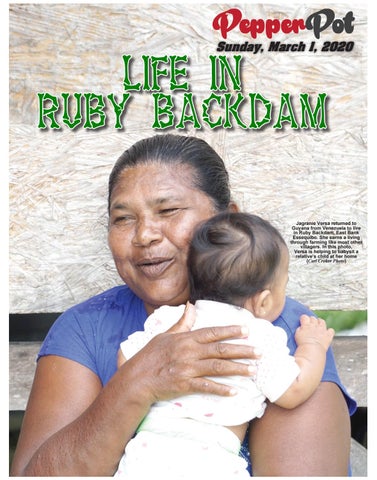
Life In Ruby Backdam Jagranie Versa returned to Guyana from Venezuela to live in Ruby Backdam, East Bank Essequibo. She earns a living through farming like most other villagers. In this photo, Versa is helping to babysit a relative’s child at her home (Carl Croker Photo)
II By Francis Quamina Farrier
T
HE Guyana Ambassador to the USA and the OAS, His Excellency Dr Riyad Insanally, along with the staff of the Guyana Embassy in Washington DC, hosted scores of Guyanese and friends at a special reception to celebrate Guyana’s 50th Republic Anniversary. The event was held on Saturday, February 22 in the Grand Hall of the Americas, at the Headquarters of the Organization of American States (OAS), in Washington DC, which is just a stone’s throw from the White House. Addressing the packed Hall, Guyana’s Ambassador to the USA and the OAS, Dr Riyad Insanally, stated, “Fifty years ago I had the special joy of participating in Guyana’s first Mashramani celebration, mashing in Godfrey Chin’s spectacular ‘Birth of a Nation.’ Reflecting on his boyhood thoughts at that time, the career diplomat stated, “Fifty years ago, I was taught that we were a country of enormous potential, and in the first blush of republican status, my schoolmates and I thought that the future was very bright indeed. But, as you all know, growing up has its trials and tribulations.” Ambassador Insanally also read a message sent by His Excellency President David Granger specially for the event, which stated in part, “The Republic expresses its appreciation to the members of the diaspora for their continuing interest and contribution to national development. It will continue to engage with them on mat-
ters of national importance, recognising the integral role they play in supporting our nation’s quest to prosperity and unity.” With reference to the recent oil and gas extractions from a portion of Guyana’s offshore territory, the President’s message stated that, “The Republic will continue to expand the gains made in Education, Electricity, Health, Housing, Public Infrastructure, Public Security, Public Telecommunications and Social Protection. It will work to ensure the Good Life for all,” the president’s message concluded. In true Guyanese celebration at such events, there were Guyanese food and drinks including the popular eight and 15-year old XM rums. Guyanese national patriotic and folk songs were also sung by the entertainers. On this occasion celebrity Guyanese singer/songwriter Courtney Noel presented some of his favourite compositions, including his ever-popular “My Golden Arrowhead” which was composed 20 years ago. The other star performer of the evening was Sista Pat, who delivered some of the best-known and loved Guyanese and Caribbean songs. She was so dynamic, and not knowing her, I had to find out more about that Guyana-born, America-based performer. Patricia Anne Callender, professionally known as “Sista Pat,” was born at the St Joseph Mercy Hospital in Georgetown, British Guiana. Her father was Trinidadian of African heritage and her mother a Guyanese of Portuguese heritage. Although as a young child she migrated to the USA with her parents in 1960, her interest
CHRONICLE PEPPERPOT ― March 1, 2020
Farrier with Guyana-born Antigua and Barbuda Ambassador to the USA and OAS, Sir Ron Sanders and celebrated Guyanese artist Stanley Greaves
Guyanese celebrate
Republic Jubilee in Washington, DC
Celebrated Guyanese entertainer, Courtney Noel rendering his ever-popular national song, “I Love My Golden Arrowhead”, seen at his right side
and love for the land of her birth never waned. She knows and sings all the national and folk songs of Guyana, including those she sang at the Guyana Republic Jubilee celebration in Washington DC. After over half a century, Sista Pat visited Guyana in 2018. There is so much more about this talented daughter of Guyana, that I will have to continue at another time. Patricia Anne Callender is such a fine example of the tens of thousands of Guyanese in the diaspora who continue to love and cherish their childhood memories as is stated in the Guyanese folk song, “Small Days”.
The dynamic Sista Pat who kept the audience entertained with many Guyanese and Caribbean iconic songs (Photos by Francis Q Farrier)
CHRONICLE PEPPERPOT ― March 1, 2020
III
Young Guyanese poet’s work to be included in global poetry anthology
By Gibron Rahim
“
Quanisha Patterson poses with various trophies and her honorary certificate from The League of Poets (Photo courtesy of Quanisha Patterson)
THERE is no greater agony than bearing an untold story inside you.” The aforementioned words belong to Maya Angelou, a favourite writer of Quanisha Patterson, a young Guyanese poet. One of her pieces will soon be published in “Songs of Peace: World’s Biggest Anthology of Contemporary Poetry 2020”. Through her poetry, Quanisha is sharing stories that inspire and evoke emotions. It is only over the last three years that Quanisha has begun pursuing poetry seriously. As she told the Pepperpot Magazine, it was in Fourth Form at The Bishop’s High that her poetic journey truly began. She related, “When I first started writing I never shared my work.” The 17-year-old explained that, at that point, she was not writing to be heard but rather, as a form of catharsis. As a result of being involved in various productions as a theatre arts student, Quanisha’s confidence in her writing grew. Writing poetry started out as a coping mechanism for Quanisha. “It was my way of overcoming low self-esteem,” she recalled. “Maya Angelou was definitely one of my inspirations to pursue poetry, especially because of her poem ‘Phenomenal Woman’.” The themes of Quanisha’s poetry focus on societal issues. “I examine love, feminism, religion, discrimination,” she related. “I also look at the effects of family structure on children’s health.” Quanisha was fortunate that she made the deadline for submissions to the anthology competition. She explained that the original deadline was December 31, 2019, but was extended to January 31, 2020. “To my luck, I found out about the competition literally on January 20 from a fellow poet,” she said. The anthology competition is a project for global peace devised by The League of Poets, an international organisation committed to promoting world peace through poetry. To even be considered, Quanisha’s entry had to satisfy a number of criteria. The poem needed to be 14 lines long, 50 characters per line. The poem is titled “The Sovereignty of Peace” and focuses on the beauty of the earth. This past February 10, Quanisha received an email from The League of Poets stating that she was a winner in the competition. Then, on February 18, she was exhilarated to receive her honorary certificate. As its full name suggests, Songs of Peace is the world’s largest anthology of contemporary poetry. Quanisha’s poem was among those selected from among thousands of entries from 139 nations. The anthology itself will be published on March 10, 2020 and will be shipped in bulk free of charge to institutions all across the globe. Writers and other artists have an important role in society. As Quanisha pointed out, “Not only do they entertain us, but they also raise awareness of camouflaged societal issues and they’re like the voice for people.” She questioned how any kind of positive change can occur in a society if there are no artists to play this crucial role. “You find that a lot of artists and a lot of poets not only write about their experiences,” Quanisha said, “They tend to cover what they observe, [such as] societal issues that need to be spoken on.” Even as the artist influences society, they are influenced by their art. Quanisha related that she uses the sociological imagination, a way of looking at personal experiences and linking them to social and historical forces. In terms of mental health, this has taught her that many of us share similar experiences without realising it. “That is so important to note because sometimes when you try to keep things in, it doesn’t help you nor does it help another person,” she related. “But, when you speak about it and actually raise awareness of it, it helps so many people, just by you performing one piece.” Quanisha’s feelings about being a part of Songs of Peace go beyond elation. “Not just because my work was selected but also because I am one of the poets that they chose to promote peace and that means a lot,” she said. “I feel extremely happy because I’m only 17 as well and I know how I started. When you enter a worldwide competition and you’re chosen, that shows you the level of your writing. And if you’re at such a high level at such a young age, it encourages you to write more, to help others through your writing and, moreover, to encourage others to utilise their talents.”
IV
CHRONICLE PEPPERPOT ― March 1, 2020
A dream to change Guyana’s music industry...
Young musician with a different sound
By Marissa V. Foster NTHONY Baynes grew up in the village of Agricola. His childhood there was really quiet despite all the perceived stereotypes of that area. One thought that kept him on track during his childhood was his passion for a better life for himself and family. He grew up with his parents and siblings; they were very church-oriented and were not the wealthiest. In church, his passion for music developed and grew. At age 10, he could play the drums and since then he has been learning to play other musical instruments. He describes his childhood as fun and interesting, because he never felt as though he missed out on anything despite his circumstances.
A
motivation to make his mother proud. He expressed that his mother has been his biggest supporter and continues to support him. She has truly inspired him to become the person he is today. After finishing secondary school, Baynes took his hobby of music more seriously. He’d use his spare time to write songs and create melodies. Eventually, he started to record and produce his own music. By the end of 2017, he had about five recorded songs out on YouTube. He started to gain recognition and attention by a small audience for his outstanding vocals and musical creativity. He has also networked with other local artistes and created music with them. With the support of local radio stations and DJs in Georgetown, he was able to showcase his music and story to a larger audience. Thus far, he has faced a lot of challenges. One of those
able to perform for thousands on an international stage, or even winning a Grammy Award-- this is his driving force. For the future, he plans to be successful as an artiste in every way possible. He would like to collaborate more with other local and international artistes and travel the world sharing his talent with those he comes in contact with. He plans to put in work as hard as he can to make his dreams come true; he believes he has the potential to do so. He would like to be able to give his family the life they deserve after all the sacrifices they’ve made for him. Apart from music, Anthony would also like to complete his degree at the university. After all, two dreams are better than one. This gifted musical artiste would like to advise other young upcoming artistes by saying, “Your circumstances now may cause you to feel like giving up or it
Guyanese musical artiste Anthony Baynes (Credit: Ken Bacchus Photography)
Anthony Baynes
Baynes attended the Agricola Primary School and after writing the Common Entrance exam, he obtained a place at the North Ruimveldt Multilateral School. There, he graduated in 2016 and is currently furthering his education with a Degree in Communication Studies at the University of Guyana. He is the first person from his family to pursue a tertiary education and every day he uses this as
challenges being the lack of basic resources he needed to pursue his dreams. He always wanted to have his songs recorded, but was financially unable to attend professional studio recording sessions. Nonetheless, he managed to start purchasing his own small-scale equipment by working two jobs. Now, he can record his own music from the comfort of his bedroom. He has a vision of himself one day being
may make you feel like your dreams are impossible to reach, but if you are passionate about something, you would have to put in the extra work to make it your reality. You may not be financially able to support your dreams, but that doesn’t mean that you would never be there one day. Patience, dedication and hard work is the key to making your dreams a reality.”
CHRONICLE PEPPERPOT ― March 1, 2020
V
Linden costume designer now securing major Mashramani contracts
By Vanessa Braithwaite
L
OOKING back 14 years ago, Ryan Dasilva, a tattoo and airbrush artist from Linden, was only designing basic costumes and small floats for Mashramani festivities in the mining town of Linden, particularly those that are school-related. It was his uniqueness and the superb creativity of his floats, coupled with his armoury of artistry and skills that seemed to be scarce in Guyana, that allowed him to be given national recognition. Ryan has now evolved from a regular designer that worked at his tattoo and airbrush shop aback the Mackenzie Market, to raking in contracts for some of the leading companies in Guyana, sending off the largest bands, such as Digicel, at the national float parade. He described it as the most successful job he has ever done and never saw himself at the top of his game, employing people in an industry he did not intentionally set out to master. “When I first started, it was just with drawing and painting for particular school kids and then that went on a higher demand. Then I started making small objects for people and it grew into larger ones, but now I am designing and creating some of the largest floats on that are on the road,” Dasilva said. He also boasted about his ability to do unique carvings and other aspects of the job that most people in Guyana cannot do.
Ryan designing a reveller’s chest plate
FIGHTING THE ODDS What is more phenomenal about Ryan, is that he does all of this demanding work, while fighting diabetes, a disease that takes a toll on him mentally, emotionally and physically. In fact, it is just by his own persistence to have longevity in life and a major change to his lifestyle that he is alive today. For the past four years, while trying to reach the pinnacle of his career, Ryan had to endure many hospital visits, tired days, trying to ignore discriminatory rumours and countless shots of insulin. He admitted that he led a life of partying and drinking, something he had to drastically change if he wanted to live and is today urging other youths to do the same. “The speed that I was going with, I ask God to take my habits in any way. I use to drink a lot, come to work and work from 06:00 hrs to midnight, drinking all the time while working and harassing my body and I used to pray for it to go away and now the habits are gone,” Dasilva said. It is because of this that makes him more determined to be the most sought-after designer in Guyana. He dreams of owning his own company, where he will be giving smaller contracts to persons from his mega ones. His encouragement to youths is to always challenge your self, be dedicated and be strong. “Despite what you are going through, just stay strong and focused; focus on giving the people what they want, meet the needs of your customers, relate to them because I relate to a lot of young people and keep the goal of going higher in mind,” Dasilva said.
Ryan putting some finishing touches to some floats that were displayed at Mash 2020
VI
W
E ARE hours a w a y f ro m Guyana’s modern-day ‘Mother of all Elections’, the 2020 Regional and General Elections. These are the elections that will herald in Guyana’s development, in the context of the wealth of natural resources the country has right now and building upon the past 50 years of the cooperative developmental trajectory envisioned. For more than a year, I have been holding my breath, waiting for tomorrow’s Regional and General elections. On that fateful December 21, 2018, I was there in the Parliamentary chambers. I was there when the first “yes” was said and my colleagues and I
didn’t even realise the gravity of what was about to unfold until the second “yes” (well, the second set of “yesses”) were said so strongly. In the weeks to follow, I watched Guyana move from a debate on whether this was a vote of consciousness or not; to spotlighting the dishonesty perpetuated by elected political leaders based on dual citizenship; and, a ‘simple’ constitutional argument with groundings in mathematics. Then, I have seen the argument being made that because of that vote, there was a slow-down in the work of the government, in placing some institutional prerequisites in place to prepare for the acquisition of oil wealth. But all that is gone now.
What remains now is our ability to place an ‘X” next to the political party and the political leaders we want to govern our country, at least as per the constitution, for the next five years. This is the Mother of all Elections, at least in my opinion, because Guyana finds itself at an epicenter of global attention due to its massive oil finds. Yes, oil is merely one sector, but for decades, oil has been the world’s most prized resource and an onslaught of foreign attention (and scrutiny) was always inevitable. Then, the stark reality is that our country is but little Guyana, a country plagued by racial divisions and poor management of natural resources in the past. But now,
CHRONICLE PEPPERPOT ― March 1, 2020
this small country of about 700,000 people is expected to have its per capita wealth quadruple in the years to come, making it the richest country in the world on a per capita basis.
stitutions first and to safeguard from the wastage of resources. This sort of practical thought, that guides these promises and plans, is what is necessary, in my opinion, if we are to hold
loub, an independent geopolitical risk analyst based in Caracas has opined that Guyana should keep politics and ideologies aside from the dynamics of the oil sector and promote a correct
And at stake at these elections, is the developmental trajectory that Guyana will take in light of the massive revenues at her shore. Will Guyana be able to achieve its highly ambitious “green” agenda that all of the political leaders seem committed to? Or will it be another corrupt, failed oil economy? That’s the context here. I am a young Guyanese, and I am quite optimistic about the wealth that can be garnered from these massive oil revenues. Simultaneously, however, I am wary about the threat of corruption and the mismanagement of funds. I mean, a fresher of this is just west of us. Already, we’ve seen lavish promises along the campaign trail. Free tertiary education has been one of those lavish promises. I am not against free education, in fact, I really would like to see it happen. However, this promise of free education must be accompanied by a sound plan to develop the University of Guyana (UG) and other tertiary in-
our elected representatives accountable. As reported in the Petroleum Economist, America’s analyst for political risk consultancy Verisk Maplecroft, Christian Wagner highlighted that in Guyana, the issue is less with which political party holds power, and more with the systemic lack of transparency in publishing contracts. This, he said, limits openness around Guyana’s oil sector and creates corruption possibilities. I have written in this space, time and time again that this March 2 Regional and General election is practically the modern ‘mother of all elections’ for Guyana. This is my firm belief. Our petroleum sector is not the only sector in our economy, but due to the vast discoveries of the former number one most prized resources in the world, it is definitely the harbinger of our development. And paramount, in this situation, is the absolutely critical need for good governance. Borrowing from the Petroleum Economist again, it was noted that Jose Cha-
wealth distribution from oil revenues. More importantly, he, however, highlighted that regardless of the eventual electoral winner, Guyana should pursue long-term strategic planning for these oil reserves, which included management of its Sovereign Wealth Fund (known locally as the Natural Resources Fund) and it should look towards pursuing further regional cooperation. Long Term strategic planning requires mature leaders (and I don’t mean in age), and it requires us to vote for these leaders. I want to be home so badly right now so that I can actually, physically exercise my franchise and cast my first vote. It is almost unimaginable how much of Guyana’s future depends on the outcomes of these elections, and our votes get to decide who are the people that bring forth this development for us. Before I rest my case, I am urging you, I am pleading with you… go out tomorrow and cast your votes.
CHRONICLE PEPPERPOT ― March 1, 2020
VII
VIII
CHRONICLE PEPPERPOT ― March 1, 2020
Who do we vote for?
I
DON’T need to explain how important this topic is for our society. First I’m going to talk about the organisation which brought me to this topic. Heal Guyana is a notfor-profit organisation which
was formally registered in December of 2017. The concept was born out of a personal call to serve a higher purpose to our society. It is an organisation built on fairness, compassion, equality, the preservation of human dignity, deep re-
spect for the mother-nature, non-violence, integrity and most importantly, unity. Its founder Sharon Lalljee-Richard, says “This ideal eventually took the form of a modern-day civil society platform, focusing on empowering Guyanese
and influencing positive behaviour change within Guyana. Our approach is to listen and network with others, in a way that forms a collective, solutions-based approach to the challenges we face as citizens who possess the power to make
the ultimate difference we hope to see in our country. Our slogan is “Starting with ourselves.” All members, myself included recently sat down with President David Granger in a discussion of why people should not vote based on race, a concept fully supported by our current President. The initiative was called ‘Call for Peace & Unity’ which seeks to reduce racehate and violent conduct between the two historically divided ethnicities, before and during this Election, through advocacy that uses the power of strategic storytelling, public education, monitoring of hate speech and engaging political leaders and citizens, across the divide. This made me want to discuss the reasons why people vote and how to pick the right candidate. FIRST, WHY DO WE VOTE? The first and by far the most important reason to vote is that, regardless of what anyone might tell you, it matters. If no one votes, it is no longer a democracy. Voting is a part of our independence, a chance to diminish others from making our own decisions. Some people take the stance that refusing to vote is rebellious and standing up for what you do or do not believe in but instead, it is surrendering your voice. Voting is a powerful equaliser where everyone gets one, and it counts just the same. You do have the power to decide what quality of life you are going to have, not only for yourself but
our future generations. Do not give up an opportunity of being heard, no one but you will look after your own interests. NOW, HOW DO WE MAKE THE RIGHT VOTING DECISION? In our society today, it’s easier than ever to be an educated voter. Read the newspapers, go online and research what each party stands for; what their missions are. Do they align with yours? Decide what you are looking for in a candidate. Gather materials about each candidate; do you believe in what they are saying? Do they take the same stance as you do on important issues within our society? Second, filter out the noise – this includes pressure from families, the long stem pressure of race votes and so on. Ask yourself the important questions. ■ Who fights for what’s best for you? ■ Who ran the fairest and most honest campaign? ■ Which candidates/party demonstrated the most knowledge on the issues? ■ Which candidates/party has the leadership qualities you are looking for? ■ Who in general is most qualified? Remember to vote the platform, not the person. We may all like a specific person but the party’s goal overall may not be what’s best. Thank you for reading. Please send any topics you would like to discuss to caitlinvieira@gmail.com. If you would like to book a private session with me, please WhatsApp or text 623 0433.
CHRONICLE PEPPERPOT ― March 1, 2020
You don’ t social wo need a to help th rk degree ose in ne ed
I
F YOU’VE been regularly reading my column pieces then by now you’d know that I am currently a social work student at the University of Guyana, pursuing my bachelor’s degree. Most of my writings are geared towards the knowledge that I have obtained because of my studies. From applying theory to real life to addressing current topics and issues, I have been constantly applying my academic experiences to my literature. When I was in the first year of my studies, a lecturer of mine asked the entire class, “what is the meaning of the term ‘social work’ ?”. Everyone, to my dismay, gave their answers and it was based on the definition of books. In contrast, my answer mimicked that of personal experiences, pure human emotions and the ‘art of giving’. Neither I nor my class was wrong. In fact, their answers were more appropriate for the setting. It was the academic idea of what social work is and who a social worker is. I’m sure we’re all aware of those definitions too.
As such, this week I’d like to back away a bit from books for a while and head towards something a bit more deep and meaningful; human compassion. To be clear, what I am actually trying to say is that within us all, there is a candlelight that is shining. Some lights, however, might be brighter than others. If we are in a state or position to lend or give others some of that light we have then we should, despite who we are. We can also teach others how to make their own light or how to make it brighter so that they can always fend for themselves even when we aren’t around. Mind you, I am not saying that the average person without the necessary skills and training should go counsel others, plan interventions and give advice. Those jobs need to be done by professionals. However, it still does not mean that we should not be kind, warmhearted and benignant towards those in need. Giving to the destitute, helping an elderly to cross the road every morning on your way to work and even giving the ‘weeder man’ a glass of water to drink can go a long way. A little bit
of kindness can truly go a long way. I often wonder how things like poverty, homelessness and violence are still rampant in our society. A society that is socalled thriving and on its way to becoming wealthy and developed. Yes, Guyana, I am speaking about you. I am unapologetic when I say, “the rich will get richer and the poor will only get poorer”. Many will enjoy their wealth, alone, without realising that they are standing on the shoulder of support from those people below them. I plead with ‘wealthy Guyana’ to give some of your candlelight to others in need. Yes, you have worked for what you get but at the same time, many aren’t as privileged as you are. I believe humility isn’t something we were born with. It develops over time and for some, it’s there but we never allow ourselves to feel it. I am not one to tell people how to spend their money or time but at the same time, I will tell you when you’re being a hypocrite. So if by chance, we speak about Guyana’s upcoming riches and prosperities we should also speak about the 99 percent of our
IX
country that will not be enjoying it. With all of that said, I can only hope that you realise that we all have compassion within us. We all can give back to the society that has made us into the persons we are today. Kindness should not be measured by the type of act you do. I believe that kindness should be done based on the sincerity of that act. Yes, I am a prospective social
worker and one day I will be using my theoretical perspectives to help others. However, the fact that I am yet to obtain a degree does not deter me from helping others. In fact, even if I had chosen a different career path, I am sure I would still find time and effort to help others. Basic human connection and emotion should be enough motivation to give and help; nothing more, nothing less.
X
CHRONICLE PEPPERPOT ― March 1, 2020
An odyssey into the historical memory to salvage the future
I
N 2004 Eusi Kwayana had an essay published in the Sunday Stabroek, September 5 Edition. It was titled “We need a nation conversation” and it should be revisited and explored. Eusi by far has had profound experiences in the fragmented suddenness of the Guyanese identity, with impulses and interpretations from what I have witnessed, experienced and known and though we live in the same age, say encompassing three generations. Yet, in the context of his essay though I understand, and culturally do empathise and laud the work done by him and his comrades; that conversation cannot happen unless we face the preliminary challenges of an Odyssey into the historical mind and the specific currents that direct its nature.
of the mirages that are active, and like the craft of the magician are spoken into ectoplasm life. The dangerous response is to feign and avoid confrontation in the hope that it will dissipate as people move on. Instead of like a Hollywood movie Delilah, she serves her romantic emotional purpose, rather than as the Biblical narrative reports, she commits her treachery, then just disappears, nothing more was said about her, but the movie lie of Delilah (justified at the ticket returns) becomes the emotional substance of a heroine. In fact, it is the public’s fault that it does not separate the two. Fact is in the Guyana context there was no Wismar massacre, there were arsons and evictions and ugly things, in an ugly time that happened there as a result of horrible things that happened elsewhere.
Office in London and private entities and persons in possession of documents and imagery connected to the Guyanese-Identity will have to be pursued. The deeper historical and cultural disparities that manifest from the perspectives of separate interpretations of ‘world view’ practices that are summoned at times by innate expressions; whether brought as teachings from the old countries or cultivated here by colonial manipulation are what present the most serious triggers for potential retreat into cultural/philosophical groups with the propensity for confrontations and social hostilities. Take for instance ‘The Bribe’ in some cultures within the historical memory, this, if proven, is punished by death, while among others it is a common practice to seek to bribe even a ‘blessing’ and the outcome is all that is important, no
That Odyssey must begin with an attack on the peripheral propaganda ‘Trojan’ horses that have been allowed to exist and poison minds and create mirages in the imagination without challenge for too long. These contorted events must be identified, as they remain unaddressed, with supporting narratives from endorsing forces that have aided and quietly condoned and supported these peripheral Harpies and their Siren melodies that offend, tempt and consume the targeted mass into self-hating submission. I should illustrate what I mean by presenting an example of what I wish to be understood. Almost two years ago with a company of my peers we visited an important stakeholder group, it was wrongly agreed that we would not engage in exchanges but would take the postures as ‘sacrificial sheep’ and listen to what is said. Regardless, without rebuttal, this was against my nature, and I still regret it, but my word is my word. This event is etched in my mind, so I know the month was May, possibly days before our Independence Jubilee. When a prominent member of that group expounded on the insult of May as the Independence date when the Linden massacre had forced ‘the people’ away from their homes... and he continued with his loud one-sided diatribe. None of his colleagues interrupted, their body language was of agreement and with the few whose group he was subliminally referring to, seemed speechless and immobilised as the tirade continued and concluded. This was an example
After Independence Prime Minister Burnham gave those citizens lands for resettlement on the east coast, the Inquest into the Wismar, Christianburg and Mackenzie disturbances was headed by Chairman- Magistrate Sohan Roopan Singh. The problems were generated in the first instance by the murder and mutilation of the Sealeys at Buxton, ont May 21, 1964 and in the second instant on June 6, 1964 by the bombing of the launch ‘Sun Chapman’ where 38 to 47 men, women and children perished from one group of Guyanese, all evidence led to others. In the end, the official conclusion was words to the effect that there was no ‘blood lust’ when considering the population by the ethnic majority and minority, total retaliation deaths were less than 10 persons. There are imbalances like the cited case that are callously entered into historical events to mainly serve political egos and the emotional impulses of victimhood with its array of dangerous pretensions. There are other inquests like that of the Sun Chapman and the Abrahim family arson murder that need to be place0d in their relevant historical context. This is what a ‘Heritage Commission’ should house among its itemised human detail research and pictorial political and social display formats, as an effective support asset to the National Archives, and more so, culturally, to filmmakers and publishers of the now and near future; to this effect, an intense collaboration with the Colonial
moral guidelines impact on anything, only contrived postulations. This when identified summons resentment from both sides which are as deep-seated as any tribal, ethnic or religious animosity, upon this context emerges the bitter stereotypes and close-mindedness. To the credit of the APNU-AFC administration, the Ministry of Social Cohesion has done sensitive and important work I have witnessed this, but the divisive politics had no doubt recognised the neutralising effects of open discussions on separate ethnic definitions of each other. Explored in a workshop with Guyanese of diverse origins and geographic cultural roots, thus sadly, this programme was not supported by the opposition. What those workshops presented and achieved as a witness, is a desire to know more from its participants about each other, who had never experienced that kind of exchange before. The serious threshold data has been presented in books, articles, journals; essays even letters, but remain elusive to researchers from diverse disciplines, because of the lack of centralised topic cataloguing and a national reservoir of relevant literature. But from what has begun will inevitably lead to the further desire towards the more complex Odyssey into the historical memory, the real and imagined landscape and its denizens, with a conclusion of enlightenment, with a lessening of fictional biases.
CHRONICLE PEPPERPOT ― March 1, 2020
XI
Focus on the Village
Jagranie Versa (Carl Croker photos)
A placeRuby of large
Backdam s cale farming
A cleared canal in Ruby Backdam
By Michel Outridge
T
HIS week the Pepperpot Magazine visited the farming community of Ruby Backdam, East Bank Essequibo. There, the team spoke with residents, all of whom are farmers, who highlighted their way of life and development within the community. Ruby Backdam is between Parika and Farm villages. From the Public Road, the community can be accessed by road which is about three miles long. Within the Ruby Backdam main road, there is a road that takes you to Parika Backdam, a relatively large village of mostly farmers too. The village has electricity but up to a certain point and two wells that supply the nursery and primary schools which are located in one building. Residents would make use of the black water canal or store rainfall water and some would buy drinking water. The village has a good asphalt road which was paved about five years ago and most residents have their own vehicles. The people of Ruby Backdam are predominantly Indo-Guyanese and they are friendly and welcoming. Ruby Backdam also has a health post where a doctor would visit every second Wednesday in the month. It has one Mandir and two churches and less than 100 residents with about 50 houses and the place has vast lands, all owned by the state and leased to farmers. Upon arrival in the community, the team met Jagranie Versa who was living in Venezuela but returned home six months ago. She has erected
a small house and is residing in Ruby Backdam with her husband and two sons. Versa told the Pepperpot Magazine that she was forced to return to her home country after working and living in Venezuela for more than 20 years due to the hardships there. Now, Versa said she has to start building her life from scratch. She said that her husband is working on a chicken farm right next door and her sons are also employed. “I have 11 children in total, some of whom born in Venezuela and are still there but I had to come home and re-start my life and we are making it possible,” she said. The 63-year-old has a garden of calaloo and corilla which is used for her kitchen and while, the men are away
Ruby Backdam Mandir
Ruby Backdam Primary School
at work she takes care of the household chores and ensures they get a hot meal when they return home. “We are trying to make a life for ourselves and we will make it better in time, as is, we are good and happy to be back,” she said. Versa added that Ruby Backdam is a good place to live but it entails hard work and the life of a farmer is not easy. When the Pepperpot Magazine visited she was babysitting her niece’s baby and had just returned home from shopping in Parika, the nearest central point of businesses. Her husband was home from work for lunch and was resting before he returned to work and her sons were away at work on a large farm right in the village.
XII
The farming life Pt I
CHRONICLE PEPPERPOT ― March 1, 2020
The smiling Sarika Samaroo
Home of Sarika Samaroo
Focus on the Village
Elvis Charles’ farm at Ruby Backdam
By Michel Outridge ARIKA Samaroo is a farmer and has been living in Ruby Backdam for eight years, a place that has become her home, over time. The mother of three has settled with her family and together they have a thriving farming business of potatoes, cabbage, cassava and tomatoes. She reported that depending on the ‘road’ price at the market they would make a profit but often wholesale buyers would only want to offer a mere $15 per pound for cassava and it is not a very profitable gain. Being a farmer’s wife is no ‘walk in the park’ it is hard work and constant labour to tend to crops and after reaping, the other task is to sell the produce. “We depend on farming to provide for us and even though sometimes things don’t always go your way, we still try,” she said. The Samaroos have a few acres of farmland in Ruby Backdam and they collectively work on it to get a good harvest. She related that once they have a good crop they would make their way to Parika Market on Sundays to sell via their canter truck. Samaroo told the team that she is used to the farming life which is not glamorous but rewarding and she likes the eerie quiet of the place. She stated that she came to Ruby when she got married
S
and stepped in to assist her partner in farming. Apart from farming they rear a few sheep and some chickens for home use only. “This place nice to live and it is a place of farmers, hardworking people and we have no real problems here because people live far off from each other and we have a lot to do so there isn’t time for idle behaviour,” she explained. The team also met Elvis Charles, a friendly man, who was tending to his farm single-handedly planting some ‘baby’ calaloo plants into the soil, he had already prepared. The 38-year-old has several acres of pak choy, ochro, calaloo and bora and was also ensuring his plants are watered since the dry season is upon us and the drainage canal is almost dried up so he was sourcing water from another canal. Charles’ farm is located almost at the end of the village but he wasn’t afraid since nothing much happens in the village. He feels safe among his fellow farmers, he said. “In this village from young to old does farming, it was handed down from generation to generation and most of us have been doing this since boyhood days so we are comfortable with our life here,” he said. Charles is originally from Hague Village but came to live in Ruby Backdam eight years ago through marriage. “Today, I have to put down 3,000 calaloo plants so I have a big task ahead and I must finish before sundown or if not I have to start early in the morning the next day. You have to like being a farmer to do this job or it will be difficult for you to cope,” he said.
Elvis Charles on his farm (Carl Croker photos)
CHRONICLE PEPPERPOT ― March 1, 2020
XIII
g n i m r a f e h T I I t P life
Focus on the Village
Farmer Rampersaud
By Michel Outridge
R
ampersaud [only name] and his family are residents of Ruby Backdam, East Bank Essequibo and, like the majority of residents, are farmers. He has been residing in the village for the past 39 years and has four children and a wife, all of whom assist in the farm. The 40-year-old has a cultivation of cash crops which sits on 10 acres of land and a 12-acre rice crop, right in the community. Rampersaud stated that two of his children attend Parika Secondary School and the younger one is a pupil of Ruby Primary School, which is located in the village. When the Pepperpot Magazine caught up with him he was relaxing after hours on the farm and was expected to return to tend to his crops. Rampersaud added that life is simple in Ruby Backdam because is only farming is done there but he has an issue with
a blocked canal that he would source water for his crops, especially his cabbage, which requires a lot of water for proper growth. He will, however, engage the Neighbourhood Democratic Council (NDC) for redress in the matter and apart from that, he is quite pleased with his life there. The team also encountered Indira Narine and her extended family, at the time, they were under their house relaxing in hammocks after a day of farming. The mother of three reported that they have a farm of bananas and fruits and they would sell it at the La Penitence Market once weekly and it is their only source of income. Narine said apart from farming she has some creole fowls for her own home use and a garden of vegetables. She has been residing in Ruby Backdam for the past 27 years and described life there as comfortable with no real issues but the need for potable water. “Life okay here and we don’t have to worry about bandits or anything because people look out for each other and the life of
Indira Narine (Carl Croker photos)
farmers is hard but we does try to make our life good,” she said. Narine comes from an extended family setting in which her mother resides with her family and she is quite pleased to have her lived one with her. She added that since they farm on a large scale they spend a lot of time tending to crops and it is a job they have been doing for as long as they can remember. “People around here don’t idle because farming means a lot of time in the farm and we don’t waste time,” she said. Narine told the team when Market Day they would journey to the city with the hope of selling all their produce and her sons would assist in the process of transport. “This is home and our life is here and we are satisfied with it and one would be content once they work and provide for the household,” she explained. Narine had finished preparing lunch and was engaged in a family chat with several relatives and a neighbour to have lunch before returning to the farm, which is aback their property.
XIV
s i e Lif
CHRONICLE PEPPERPOT ― March 1, 2020
quiet and simpleam d k c a B y b u in R T By Michel Outridge
HE Pepperpot Magazine met Rameena Khan, whose brother is the lone large scale poultry farmer in Ruby Backdam, East Bank Essequibo. “I am very happy you came because we don’t normally get visitors here and it’s nice to see you,” she said as she welcomed the team to her house. Khan stated that her house is next door to the chicken farm which has nine large pens and they rear more than 50,000 at any given time. “This is my brother’s business but we live and work with him and we oversee the operations when he is not around,” she said She is originally from Leguan, Essequibo River and has been residing at Ruby Backdam for the past five years with her family. The mother of two related that both she and her husband works on the chicken farm along with three other employees daily. Their job includes feeding the
lives would be enhanced greatly. The team also met Jagmohan Singh, a resident, who has lived all his life in Ruby Backdam and is no stranger to farming. He is also a farmer, like his parents and that is helping him to take care of his children and wife. Singh pointed out that from way back then to now a lot of changes took place, like a good asphalt road was paved because they had a mud dam as a road then a crusher/run kind of road to the now all-weather road. He added that they have good drainage and irrigation in the village and people co-exist in peace and live in unity even though the next door neighbour is some distance away. “I born and grow here and I am making a living here as well, and I am contented with my life even though framing is not an office job but it is back-breaking work around the clock I do it because I get to like it a lot,” he said. The 46-year-old told the team that life is quiet and simple at Ruby Backdam but one must work to provide for their family and he is comfortable residing there. The father
Rameena Khan
One of the nine large chicken pens on the farm at Ruby Backdam
Jagmohan Singh
chickens and ensure they are hydrated via an automatic system (water distribution) which was set up for that purpose. “This business is a give and take one because sometimes some chickens die depending on the weather and it carries a loss,” she said. Khan related that her brother has a place on Ruby Public Road where he would pluck the chickens and sell once they are fully grown. “Life is very nice here because as you can see we have a lot of space and your nearest neighbour is some distance away and here we don’t have to worry about thieves or anything because one can leave their door open and go out and nothing would be missing,” she said. Khan stated that despite a few challenges they make do quite well and enjoy a very quiet and peaceful life at Ruby Backdam. Her house is without electricity and they would make use of the solar panels they installed and they also have a battery to assist in charging their cell phones and other electrical appliances. Khan pointed out that once they get electricity and potable water supply their
of two stated that he has a plot of land behind his house he utilises for farming and some land about two miles away where he has a cultivation of cash crops. Singh added that all produce is sold to wholesalers in bulk quantities at Bourda and Parika Markets. “This road is about three miles long from the Public Road and there is no taxi service here or buses that would transport passengers like regular villages so most people have their own vehicles and we would assist those who don’t have,” he explained. The farmer disclosed that he has electricity and it is just a matter of time before they get landline phones, internet and potable water supply. Singh disclosed that Ruby Backdam is the ideal place for farming and of the 50 families that reside there are all farmers except for one poultry farmer. He told the team that the life of a farmer is hard but he is accustomed to it and he would wake up early to tend to his crops and try to return home by midday before the sun gets really hot.
Villagers on tractors on their way to their farms in Ruby Backdam (Carl Croker photos)
CHRONICLE PEPPERPOT ― March 1, 2020
XV
‘Life is too short to sit idly by’ 73-year-old farmer advises By Michel Outridge
Shameer Baksh (Carl Croker photos)
S
hameer Baksh is an elderly farmer and resident of Ruby Backdam, East Bank Essequibo, who is probably one of most senior folk within the community, who is still very much able-bodied. When the Pepperpot Magazine caught up with him, he was assisting his son to revive a tractor engine in his front yard. “When you are accustomed to hard work it is not easy to sit idly by and waste time, I have no time for that because I always have something to fix or to tend to crops on my property,” he explained. T h e 73-year-old has a bountiful farm of ground provisions and plantains on several acres of land within the sprawling Ruby Backdam. Baksh disclosed that the village was once one of the largest land co-ops which started in 1959 with nine farmers
when it was just dense jungle. He reported that over time the village developed and turned into a striving farming community and the place is also noted for its rich soil composition which yields good crops. The senior citizen told the team that state lands were leased to residents for farming purposes at Ruby Backdam and other villages such as Parika Backdam, Good Hope, Farm, Hydronie, Ruby, East and West of Naamryck. Baksh added that over the years the village has seen some developments in the form of an asphalt road, they have good drainage and irrigation suitable for farming, cleared canals and some basic necessities. The father of two pointed out that the community is virtually crime-free and they are quite happy with their unbothered way of life even though it is hard work they don’t mind. Baksh stated that although they don’t have potable water supply they have two wells at the Ruby Back Primary School, which was dug by overseas church members during their visit to Guyana some years ago. He explained that water can be accessed there but the onus is on villagers to transport it to their respective homes. The elderly man noted that most people have equipped their homes with black tanks and rainfall water is stored for personal use. Most people use water from the canals to wash, use on their farms and do other household chores via pumping of the water to their homes. Baksh added that the village has schools, a Mandir and three churches and they benefitted from electricity when the road was paved some years ago. He explained that the health post and schools get potable water supply from the two wells at the location. “Life here is very simple, stress-free but it is very hard Shameer Baksh and his son fixing the work, we farmers don’t engine of a tractor get a day off because we work endlessly to ensure our crops are safe but it is what we do,” he said. Baksh stated that in Ruby Backdam even the young men are involved in farming longside their parents and they are proud of it. “Nothing is wrong with being a farmer, it is honest work and it is good to use your hands to plant the lands and provide crops, which amounts to food,” he said.
XVI
A
LT H O U G H i t can be said that the major problems encountered in dentistry generally commensurate with the ageing of the patient, there are widespread misconceptions about such implications. Interdisciplinary research in the human ageing process ( gerontology) has demonstrated that it is the effects of disease and not ageing itself, that is most significant for the perceptions of ourselves
CHRONICLE PEPPERPOT ― March 1, 2020
Ageing and the risks of dental disease and others as either “youthful” or “elderly.” We should therefore not be afraid of age, but we should be aware of health hazards. We often become demure about our age as we grow older. We are so influenced by today’s youth culture that youthfulness remains an ideal for us. But this is not necessarily so. One of the first questions that patients must answer at a visit to the dentist is how old they are! We love to classify people by age.
There is a risk, however, that the date of birth becomes more significant than the individual The elderly person does not lose his or her teeth because he or she has grown old. They lose them because of diseases, the oral ills frequently mirroring the general ones. Remember the risk for disease increases with age. Dental disease and alterations in saliva and mucous membranes may be early symptoms of a decrease of
the general health status of elderly persons. These may indicate a weakening of the tissues’ biological defence thresholds for different stresses. Few tissues in the human body must withstand what the oral tissues must, not only in terms of possible dryness, but also mechanically, chemically, thermally, microbially, and galvanically (electrically). Oral tissues occasionally show relatively specific signs of system illness and negative social habits, but,
most frequently, less characteristic reaction patterns are seen that cannot immediately be diagnosed. These are, however, usually specific for the individual and thus form a kind of biological “ fingerprint” which changes with variations in health. The vital point to note is that we are all biologically unique individuals from birth and become functionally, increasingly diverse until we are very old. We must sooner or later “pay” for the way we
have used our biological resources. The way we pay has to do with our genetic makeup, and the combined influence of the accumulated consequences of many years of physiological age changes, bouts of illnesses, uses and abuses of medications, risky lifestyles and wanton neglect to care our bodies. From a psychological point of view, we become caricatures of ourselves in later years and invariably we must take the blame.
CHRONICLE PEPPERPOT ― March 1, 2020
XVII
#SupportCreativity
By Subraj Singh
On Finally Seeing ‘Hamilton’
I
S ‘Hamilton’ the greatest play ever staged? The current answer to this question is probably in the negative. It is not THE greatest play ever staged. William Shakespeare’s ‘Hamlet’, Tennessee Williams’ ‘A Streetcar Named Desire’, Sophocles’, ‘Oedipus Rex’, Anton Chekhov’s ‘Uncle Vanya’, Lorraine Hansberry’s ‘A Raisin in the Sun’, Eugene O’Neill’s ‘Long Day’s Journey Into Night’, Arthur Miller’s ‘Death of a Salesman’, and Henrik Ibsen’s ‘A Doll’s House’, are just a few of the great works of theatre that would be perceived as outranking ‘Hamilton.’ However, there is no doubt that the success of ‘Hamilton’ in its current incarnation, written by Lin-Manuel Miranda, with its inherent beauty, stylistic music and lyrics, and well-developed characters, is destined to become a classic. Within the next few decades, there is no doubt that ‘Hamilton’ will come to be regarded as one of the greatest plays ever staged. This destiny is predicted not only in the universal acclaim and the number of awards (for example, winning 11 Tony Awards out of an astounding 16 nominations) the show has received but more in the way that the music has had an impact on various aspects of culture. This show also not only helped to highlight the value of the musical form of rap to those who were previously unaware of it, but it also managed to bring back to the forefront some of the elements of theatre that had been lost in recent years. Casting actors of colour to play white characters, for example, or generating such a storm of attention in the world of pop culture, among the people, and even making it cool to go to the theatre again are all attributes that can be bestowed on ‘Hamilton.’ Indeed, whether existing only in the mind or not, it does seem as if there are two periods in which modern
musicals exist: those that came before ‘Hamilton’ and those that came after. Such is the impact of this particular play on the modern musical scene. The play tells the story of the real-life historical figure, Alexander Hamilton, one of the founding fathers
production because it was this kind of gigantic artistic decision that helped propelled the musical to fame and acclaim, which undoubtedly brought attention to the (lack of) presence of people of colour in the popular musical scene. This casting decision is also significant
valuable theatrical production. The moving stage, for example, amplifies both the reversal of time in ‘Satisfied’ when Angelica rewinds time to let us know how she felt upon meeting Hamilton, and then later in the play when the final duel between Hamilton and Burr takes place.
accessible (through YouTube and streaming sites), and it is the music through which people not living in NYC can first access a Broadway musical. Perhaps we hear a specific song on social media or we read an article about it, and when this happens, the gives us our first taste of the
matches it at the same level. On a third level of artistry, the use of dance is also outstanding, conveying balls and battle scenes with equal ease and beauty. The ensemble carries the play along, essaying a variety of roles, managing to rove between specific people and the horde
The ‘Hamilton’ cast and crew greets President Barack Obama on July 18, 2015. Image by Pete Souza, Wikipedia
of America, detailing his life and his relationships with various other historical figures, including George Wa s h i n g t o n , E l i z a b e t h Schuyler, Aaron Burr, Thomas Jefferson and Gilbert du Motier, Marquis de Lafayette. One of the important elements regarding the dramatis personae of the play has to do with the fact that almost all of the main roles were played by black, Latino, Asian, and mixed-race actors. This reversal of ethnicity of real white historical figures is noteworthy in the
to the play itself because it brought attention to the fact that Hamilton himself was a (white) immigrant from the Caribbean who moved to the United States, and the theme of immigration becomes more pronounced and emphasised in a cast, with various ethnicities representing modern immigrants and, by extension, as stated by Lin-Manuel Miranda, modern America itself. Several technical elements work along with the plot structure and conflicts to make ‘Hamilton’ an in-
The set, as another example, provides room on the stage, as well as on elevated structures for the ensemble to use as well, for the staging of the battle and dance sequences, and this adds to the grandeur and awe-inspiring nature of the play. The music in a musical is undoubtedly one of the most important parts of the production and in ‘Hamilton’ the music is one of the elements that stand out the most. Often, when it comes to Broadway shows, it is the music that people find most
musical. Truly, in ‘Hamilton’ there is something for everyone, whether it’s the warm, emotional ballad of ‘Helpless,’ the aching and sorrowful, ‘Satisfied’ or ‘Wait for It’ or even fun and raucous numbers like ‘You’ll be Back.’ Even though it is a play, the music can sometimes make one feel as if one is in a concert. The songs are catchy and alive and are really the kinds of tunes that you never forget. It is a doubly artistic experience in that the play is excellent, and the music
seamlessly. ‘Hamilton’ is a truly great play. It is beautiful, arresting, fantastic, and emotional all at once. I do believe that it will be on Broadway for a very long time and I do hope that people continue to support it, because, like all classics, more than anything else, ‘Hamilton’ is simply too important, too valuable of a contribution to the arts, and too well-executed as a mechanism that captures and represents the human experience, to be missed.
XVIII
I
CHRONICLE PEPPERPOT ― March 1, 2020
Agent of Transformation
RECENTLY visited the latest exhibition at the National Gallery, Castellani House, entitled ‘Agent of Transformation’. The exhibition displays an array of fine art by Guyanese
artists. As you explore the walls and floor of the gallery you notice how styles, techniques, influences and the execution of subject matter by the artists of the different eras vary. It’s a combination
of nature, architecture, still life, people and culture. What piqued my interest was the people behind the work; the agents of transformation whose search for identity led to the creation
of the works that we have an opportunity to view and experience. We are made to embrace our diversity with the notable depiction of African, Indian and Indigenous heritage. As you observe the year in which works were created you get a sense of the various influences that may have contributed to their creation. Some of the artists would have been influenced by their training in Europe and other Caribbean countries. While others would have been influenced by interacting with people of a different culture. I admire the tenacity of the artists who created between the 1960’s – 1980s because their presence in a complex emerging post-colonial society that had been British Guiana paved the way for this generation. In today’s column, I will highlight a few of them and note some of their major contributions. Stephanie Correia was taught by E.R. Burrowes during her years at the Guyana Teacher’s Training College in the 1950s. Her dedication to the arts and her creative use of indigenous materials and design made her a recipient of the Medal of Service (M.S) in 1980 and the Golden Arrow of Achievement (A.A) in 1996. She spent a lot of time researching archaeology, anthropology and mythology which informed her work. Stephanie is set apart because of her interpretations, adaptions and the designs she created. Ian Ivor Thom graduated from the E.R. Burrowes School in 1979. His role in the construction of a larger than life-size bust of the late President L.F.S Burnham, two bronze panels in the Mausoleum, also for the said president and the Damon Monument, honouring the slave leader Damon of the 1834 slave uprising in Essequibo, made him a recipient of the Medal of Service (M.S). He also created the 1823 Monument commemorating one of the largest slave revolts in the English Caribbean. The wooden sculpture entitled ‘Pregnant Woman’ in the National Collection is another testimony of his GREATachievements. Gary Thomas, a selftaught artist came into prominence in the 1960s. Using the human form as a basis for distortion and variation was able to create dynamic compositions and movement
in wood. ‘Retrogression’ is a simple reflection from his secular life. Winston Strick studied architectural drafting and fine arts in the U.S.A. He worked in a style that stressed a kind illusionism rather than mass. His subjects range from simple dignified genre and figure studies to landscape, all with an emphasis on abstraction.
‘Woman’ is a result of his constant striving for innovation and originality in working with leather in a direction away from functional craft to that of fine craft. The ‘Agent of Transformation’ exhibition will be on display until March 28, 2020. Aiesha Scottland is a trained artist and former art educator.
Emerson Samuels, Abstract 1966
Dudley Charles, Image Old House #11 1976
CHRONICLE PEPPERPOT ― March 1, 2020
Let’s respect our elders and appreciate persons with disabilities!
W
E are going f r o m young people to the senior citizens. The Living with Intention mission, under the auspices of the Sonia Noel Foundation for Creative Art recently reignited its Love Revolution campaign, spreading the philosophy of
Against this backdrop, the SNFCA has partnered with Tower Suites Hotel to host a luncheon for senior citizens and persons with disabilities at the Tower Suites. My excitement grew leading up to this event because they have cemented a special place in my life. When I looked at the seniors all dressed up
activities suitable for seniors and people with disabilities for the Jubilee Anniversary, so we were intentional about creating an event with an atmosphere they will enjoy. The National Steel Orchestra set the pace with some pan music, welcoming the invitees. Richard Young who is one of the members of
given to everyone who attended. Uttamkumar Isurdeen is a young man who impressed and inspired me after a few minutes. He is in a wheelchair because of a mini-bus accident 10 years ago. He was the first to arrive and light up the room with his smile and warm greetings. His story motivated me and he will be joining
love for each other and for the environment, as a proactive practice of bettering sustainable life chances, as well as promoting an empowering vision for a progressive future. This initiative was timely for, at this Golden Jubilee celebration of our status as a republic, we ought to change the narrative for a more harmonious and integrated coexistence, as a citizenry. In keeping with this movement, we need to integrate an all-inclusive premise to spread the word of love among a wide cross-section of our society.
(my mom included) and chatting and hugging each other it was a great sight. My mom seldom attends my events because she lives at Bartica, so having her there was special and she even shared some inspiring bible scriptures with us. During my brief remarks, our eyes met and one of my favourite quotes came to mind. “All that I am, or hope to be, I owe to my angel mother.”- Abraham Lincoln She is a truly phenomenal woman and inherited her heart for caring and sharing. They were not many
the SNFCA hosted the proceedings. Sister Beverley from Love and Faith opened with prayers followed by dramatic poetry by my talented cousin Clemencia Goodette. I experienced a very emotional moment when Joanne Forde sang, ‘Great is Your Mercy’ by Donnie Mc Clurkin. A few years ago I listened to that song many times a day through some difficult times and that brought back many memories. Tower master chef Pretti prepared the delicious meal we all enjoyed. A big thank you to the Beharry Group of Companies and Sterling Products for the hampers
me on the Living with Intention Tour. Former Minister Benn expressed how happy she was to join us and encouraged me to keep my light shining, because I am making a difference. She said the initiative was relevant and timely. It was a pleasure to see persons chatting about why love is important while pinning the Love Revolution buttons sponsored by Pastor Persaud’s Liberty Church New York. Dr Raquel Thomas, to whom I refer as the ‘Love Ambassador’ and Sabanto Tokoroho enjoyed sharing the pins with the attendees. Raquel
XIX
Beyond the Runway with Dr. Sonia Noel ... Inspiring lives through fashion
is responsible for Iwokrama partnering with us for the love campaign. I must commend Tremane Thomas who is a young talented photographer; he volunteered his time to capture these memorable moments. I am still receiving messages and calls from persons who attended and they expressed how special and wanted they felt. They shared some of their plans with me, which reminded me of the Henry Ford quote: “Anyone who stops learning is old, whether at 20 or 80. Anyone who keeps learning stays young. The greatest thing in life is to
keep your mind young.” I have been enjoying the presence of the seniors for decades and it adds so much value to my life with the love always expressed. It’s all part of the Love Revolution’s campaign to instill notions of compassion, empathy and benevolence to the marginalised in the community on the threshold of the second half of a century as a Cooperative Republic. L e t ’s re s p e c t o u r elders and appreciate persons living with disabilities, as we continue to celebrate this journey called life BEYOND THE RUNWAY.
CHRONICLE PEPPERPOT ― March 1, 2020
XX
Redefining Wo E
VERY person, both men and women, can make contributions on the road to gender equality. In fact, we all have a duty to challenge and dismantle the archaic stereotypes that allow for the growth, development, and success of one gender at the expense of the other. Guyana’s women are making bold strides to level the societal playing field. This edition of Government in Action, in honour of International Women’s Day, observed globally on March 8th each year, features the stories of Guyanese women redefining womanhood as broad, modern, powerful, and equal. THE WOMEN OF C.O.R.E The Ministry of Public Infrastructure (MoPI) has mobilised women from communities across Guyana through a programme called the Community Organised for the Restoration of the Environment (C.O.R.E). These women have broken stereotypes by taking on jobs such as the restoration and maintenance of community grounds, trenches, and parapets, which are still considered ‘men’s work.’ While they often receive negative comments that reflect the stigma surrounding their jobs, the women have actually described their work as a very empowering experience. Ms Karen McLean, mother of four: “I am a single mother of four kids. I am presently employed by C.O.R.E… We go to school or wherever the ministry requires us to go and we do basic stuff, like cleaning of drains, cleaning the fence… There are times we go out and we clean pensioners’ yards. If somebody in the community requests [that we] do something, we also assist them in that area… Being a woman is not an easy road. There are lots of challenges, [in] relationships, [in] finances. Every area [has] challenges. Some are easy to get over; some are not… I’ve faced a lot of challenges in relationships, on the job, at home… But I just live each day as it is and I strive… to perfect the day before. What I fail to do the day before, I try to do it the next day.” Ms Nalishia Holder, mother of three: “I am the beautiful Ms Nalishia Holder, a single mother with three kids. [I’ve been] working with the C.O.R.E for four years… A woman is [one of] the most beautiful people God put on this earth, beautiful, sexy, loving, caring, [a] wonderful thing God has made… I’m a… strong Black woman. [I] can do anything for my kids. [I can do] any work to make ends [meet and I] try my best to become whoever I want to be…” Ms Asante Ries, mother of two: “I’m 42, a mother of two… Women are strong, independent, go-getters. Despite frequent comments from those who look down on their work, these ladies continue to see this opportunity as a means of self-empowerment.” Ms McLean: At times, people do look down on you… Sometimes we would clean trenches and by the roadside… Some people will pass and make funny remarks, but for me, I’m proud of it because I like my work. I love my job. And that has empowered me as a woman. I [am] able to provide for my kids, give them things that I’ve never been able to give them before… When I put on my uniform for work… I [wear] a helmet because that’s part of our uniform-a helmet and overalls. So, the general outfit for the job is like a man’s outfit, but I’m a woman and I’m wearing it. So, I’m happy.” Ms. Ries: They seem to think that because we’re women we should not be doing [this job]. People would be saying things to you on the road and things like that. They seem to think that only a man should do it. And I want to know why is it that only a man should do it? I don’t understand that… I [think] they feel threatened… because we no longer have to depend on them to bring something and give us. We go for it no matter what… Because of this job, I have a roof over my head. I’m providing. It might not be the best life, but we have a life. We have food in the belly, electricity on the TV that they’re watching. So, why must I be ashamed”? Ms. Holder: I’m a single parent, a mom and [because] I’m working for my own money, I am a boss. I will not sit there and take any nonsense or any [stupidity]. I am not here to fetch [anybody’s] burden, no one, but myself and my three kids.” The C.O.R.E. ladies, while offering advice to the women of Guyana, said that it takes, strength, self-confidence, and resilience for women to be self-sufficient. These values, they said, should be
passed down to their daughters and the next generation of women. Ms Ries: I make sure [my daughter] goes to school every day because I explained to [ her that] it’s better to have your own as a woman and you don’t have to depend on anybody … So I teach her to be independent. I let her do things like choose her own clothes, but [nothing] too [crazy]… Freedom of speech, to say exactly what is on her mind. Sometimes it doesn’t come out right, but… I would correct her and say, you know what, that wasn’t the way to say it, but I understand what you were trying to say… [Women] stay strong. Keep your head high. No matter what anybody says, keep going. Ms McLean: As women, we shouldn’t look down on ourselves. I used to do it [and I’d] think [to] myself that I can’t do certain
Ms Jacqueline Greene: “[I’m] the first female to have attained such a position in Guyana and [in] the Commonwealth. I am the mother of an 11-year-old son. I’m a daughter, the last of six children, six girls. I’d say I’m a humble person… I joined [the GFS] and moved through the ranks until I’ve now attained this position, which, for me, is an honour. To have come this far in a male-dominated organisation, to be a female in this position is an honour and a privilege.” “Ms Padmini Lakhram, Emergency Medical Technician (EMT): “I’m an Emergency Medical Technician working here at the Guyana Fire Service for a year now. I really love helping people. It’s a passion. I’m very outgoing but shy at the same time. You can say I’m an introverted extrovert.” Deputy Chief Fire Officer and EMT Lakhram defined womanhood very differently: one emphasises maturity and the other authenticity. However, although at every different stage of life and career, they both agree that a significant part of womanhood is learning to overcome hardships.
Ms Padmini Lakhra Medical Techni Guyana Fire
Ms Jessica Corlette, mother of two, a full-time university student and full-time employee things and I’m not privy to certain ways of life, but that’s not a good mentality, as a woman, to go about with. We should always place ourselves up there, treat ourselves well as women. Don’t look down on yourself. Don’t let anybody tell you you’re not good enough.” Ms Holder: As the President has [said] if I’m capable of plaiting hair, let my hands pay me. I cannot depend on the President to find a job, come and say, ‘oh Ms. Holder, I have a job for you. Sew your clothes, get your shoes and you can work at the President’s Office.’ No way! You have to get up, go, and get [it]. Some may [have] education, some may [not]. If you know how to plait hair, let your hands pay you. You can plait hair and get paid. So, I encourage women to get up and go. Don’t sit! You have to get up and go… Giving up is never an option. Never! No way! Women may fall, but you can get up, go on your knees, breathe in, breathe out and go. A woman can make it on [her] own. One hand can’t clap. I know that for sure and real. THE WOMEN OF THE GUYANA FIRE SERVICE Deputy Chief Fire Officer at the Guyana Fire Service (GFS), Ms Jacqueline Greene, has shattered several glass ceilings during her 34-year career and she has achieved several firsts as a woman in a male-dominated field. Having paved the way, herself, she is now training up young female recruits to do the same.
Deputy Chief Fire Officer: “Womanhood I think, is not just necessarily being female, but womanhood is that maturity, knowing that you have that sense of maturity to have been able
CHRONICLE PEPPERPOT ― March 1, 2020
omanhood
am, Emergency ician (EMT), e Service
to grow, to overcome issues, to understand that you’re at a different level, different point [that encompasses] all the things that come with it, motherhood, being a daughter, a wife. Womanhood, I think it encompasses all of these things. You strive to do all of these things. You have… a multiplicity of tasks that you have to try to master as a woman.” EMT Lakhram: “Womanhood is just being a woman, doing your own thing in whatever way you want to, expressing yourself however you want to without considering the fact that you might be judged for it. It’s basically doing you, when everyone is telling you to not be you. While the deputy chief fire officer has spent her entire career overcoming barriers and gender biases to excel, EMT Lakhram is learning to do the same by knowing her own worth and ability and focusing on the task at hand. Deputy Chief Fire Officer: “At the beginning, we were never allowed to go out in the fields like these women now have the privilege of doing. We had to remain in the control room or in the offices… So, there were times when I, after
(From left to right) Ms Karen McLean, Ms Anika Joseph, Ms. Nalishia Holder, women of the Ministry of Public Infrastructure’s C.O.R.E: Community Organised for the Restoration of the Environment
having done my stint in the control room… I used to be sitting outside with the males trying to understand what they did. There were times when I just got away. I got on the fire appliances, some-
times after hours when the officers were not there… Two of my training officers [gave] me that support, but afterwards there were men who sometimes [thought] you would not make it, seeing you as a female… But I have been able to work with men side-by-side doing everything that they did.” EMT Lakhram: “If we listen to [stereotypical thinking], we might not be able to achieve the things that we want to achieve… If you want to go higher places or, at least, [have] equal [opportunities] you must stay focused and do what you have to do. You must not listen to the way they might bring you down and tell you… you don’t deserve this job [because] this is a man’s job. You just show them that you can be a ‘man’ also, but with female parts… It’s really great, picking up patients, managing them before they
Ms Jacqueline Greene, Deputy Chief Fire Officer, Guyana Fire Service
reach to the hospital, giving them pre-hospital care. It’s really great [for us] because if the patient is critical and we take them to the hospital and they [survive,] it’s like… wow! I helped with this”! Going forward, Deputy Chief Fire Officer Greene and EMT Lakhram both hope that women across Guyana will learn to believe in themselves and be true to themselves. Deputy Chief Fire Officer: “The first thing they have to do is know themselves, have high self-esteem. Do not look for gifts from the male counterparts. Let them know that you can do it. Once you get into a male-dominated organisation… you know that sometimes from time to time they may come and say stuff to you. You have to got to be able to stand up to them. If somebody says something to you that you do not like, let it be known… Stand up for what you believe in. And if at any point you have to say no to anybody, no must mean no. And they must be able to look at you and know that you’re saying no and that you mean no… Women, I think they have strong will. We have strong will. And once we put our minds to something we can get it done… you don’t need to be afraid and say… you can’t do it. Tell yourself, “I can do this once I make the effort. I can do it.” That determination, once you have it, you can do anything. EMT Lakhram: I would just like to say happy International Women’s Day. We, as women, should support each other and not speak of support and then go and do the exact opposite. We should
XXI
Ms Asante Ries, mother of two
speak of it and mean it. SUPERWOMAN As a mother, full-time university student, and full-time employee, Ms Jessica Corlette has a lot on her plate. While the responsibilities are mounting, Ms Corlette draws encouragement and drive from her children whom, she says, have helped her become the ‘super mom’ she is today. “I am currently employed with the Ministry of the Presidency. I’m also a full-time student at the University of Guyana and a mother of two beautiful children… How I view a woman is like a superhero, like the real definition of a superhero. We as women, we juggle everyday life 100 per cent. We take care of our children. We go to school. We do work. We go home. We provide for our families and we do that without complaining much… I view womanhood in a spectacular light, one that enables me… and other women out there to be something more than just a regular person,” she said. Ms Corlette’s decision to attend the University of Guyana full time while pursuing her career and taking care of her children was met with much criticism from those who thought that it was, perhaps, too much too soon. Rather than see her motherhood as a burden or hindrance, her children became a major source of encouragement for her success. “The main challenge I face is time, spending time, extra time with my children... I mean, they too have school, which means they have homework. I also have homework. And that would be the main challenge I’m facing, seeing that we’re going home very late at nights… Second, would be the fact that you’re always tired… I see [my children] as my [encouragers]. They are my encouragement to go forward. I look at myself and say… I’m not going to be the one to quit on anything. I’m going to go forward. I’m going to do great, so that my daughter would look at me and saw [sic] a woman can go forward… Children are not a burden, they are my blessings. I look forward to going home to them every day. I look forward to entertaining them and telling them about my day… They see how I study. So, hopefully they’re motivated to go forward and study like I do and try to make better of themselves,” she said. Ms Corlette said many women feel guilty for pursuing their passions whole-heartedly, because that pursuit can sometimes be seen as a distraction from the more traditional hallmarks of womanhood, marriage and motherhood. Ms Corlette said the best thing women can do is pursue their passions to honour the women trailblazers, who have opened doors for future generations. “Women are not aware of… their privileges… We are freely going to school. We are participating in sports and other activities. These things were not done in the past… We can acknowledge the past, strong women [who] paved the way for our future and our future generations. I don’t know what the future holds for my daughter as yet, but what I wish for her is that she seizes opportunity… goes after what she wants and she acts on it. I think many women today are not cognisant of the fact that it wasn’t an option for us back then,” she said. Ms Corlette added that “[Women] should just do what pleases [them]. If you want to be a career woman, you go ahead and you do that. Don’t let anyone deter you from that. Don’t let them tell you that… you should stop now and have children. Or if you accidentally get pregnant… It’s not the end of the road. You will find out that these children are not burdensome. They are your blessings. They will motivate you to go beyond what you would expect for yourself… I don’t think you should take any shameful comments or negative comments from anybody. You just do you and be yourself and move forward,” Ms Corlette said. This year, International Women’s Day will be observed under the theme, ‘Each for equal, an equal world is an enabled world.’ On social media, the hashtag #EachForEqual will be used to raise awareness, challenge stereotypes, fight bias, and improve the situations of women around the globe. The Government of Guyana will continue to support Guyanese women by nurturing a society that is inclusive and progressive with true gender equality.
XXII
CHRONICLE PEPPERPOT ― March 1, 2020
n o t l i m a A Tribute to H d n a l e Clev
CHRONICLE PEPPERPOT ― March 1, 2020
―A Visionary Guyanese and Author of the Song of the Republic
(Contributed by Jasmine Hamilton)
I
WAS sitting in the living room of a house in West Ruimveldt on February 21st, 1991, when my family received the news that my grandfather, Cleveland Wycliffe Hamilton, had died. Silence invaded the house. I saw my father’s tears for the first time. While I was too young to understand the contributions grandad had made to Guyana, I knew that he was a pillar in my family, a source of strength for my mother and a firm believer in the good destiny of his grandchildren. He was the first experience I’d had with what I now know to be a good, honourable man. He was gentle and stern, kind, and hardworking. He smelled like Old Spice. I would learn later that his voice was a powerful tool that he used to encourage the people of Guyana to recognise their agency and responsibility in charting the future of the land which gave them birth. My family, like the rest of the nation, mourned the loss of a giant, a powerful orator whose words still give me chills these 29 years later. Among his many literary contributions, this Grandfather Extraordinaire, teacher, lawyer, poet, deputy mayor, journalist, and World War II Royal Air Force veteran, wrote the words to the Song of the Republic in 1970. I learned the words during my years at St. Margaret’s Primary, but I understood their meaning much later. From Pakaraima’s peaks of pow’r To Corentyne’s lush sands, Her children pledge each faithful hour To guard Guyana’s lands. To foil the shock of rude invaders Who’d violate her earth, To cherish and defend forever The state that gave them birth. We’ll forge a nation’s mighty soul Construct a nation’s frame, Freedom our everlasting goal Courage and truth our aim. Unyielding in our quest for peace Like ancient heroes brave, To strive and strive and never cease With strength beyond the slave. Guyana! climb that glorious perch To fame prosperity. Join in the universal search For world wide comity. Your people whatsoe’er their breed, Their hue or quality. With one firm never-changing creed; The nation’s unity. From the first line of verse one, we glimpse the admiration grandad held for Guyana’s rich, natural beauty. He conveys the relationship between country and citizen gently, using the image of a TURN TO PAGE XXVI →
XXIII
XXIV
I
CHRONICLE PEPPERPOT ― March 1, 2020
Threats and Impacts of Single-Use Plastics (SUP)
N A world of convenience, many persons use plastic straws, plastic cups, plastic spoons, forks, knives, plastic food containers, plastic bags or plastic bottles on a daily basis. More often than not, these items are disposed of after just a few minutes of being in use. Have you ever thought about what happens after they are disposed of? I guess you have an idea because you see them sometimes in the drains or on the road or in garbage heaps. Are you aware that the single-use plastics we discard doesn’t simply disappear when they are thrown out? Rather, they persist in the environment for a very long time; in most cases, hundreds of years. These “single-use” plastic items account for more than 7000 tonnes of solid waste discarded annually at the Haggs
Bosch Landfill, according to the Mayor and City Council 2016 statistical data. Each year about 8.8 million tonnes of the world’s discarded plastic flows into the ocean. While it is an indisputable fact that plastics play an important role in our economy and daily lives, the way it is currently produced, used and discarded harms the environment; it has created one of the greatest environmental challenges of our generation. Now we see the consequences of our irresponsible use, improper waste management, limited recycling, and disregard for the environment and ecosystems. PLASTICS ARE NON-BIODEGRADABLE Whether plastic is discarded in landfills or in the environment, it can take hundreds of years to decompose; and this
is the key issue - synthetic materials such as plastics contain chemicals which are designed to make them take longer to decay. A plastic fork used for 15 minutes can take 450 years or more to decompose. What makes it even more challenging is the combination of plastic with other materials and the various types. The main differentiation is: 1. Macro-plastics such as bags, cigarette filters, bottles, caps, food containers, straws are the most visible form of plastic pollution. 2. Micro-plastics are the bits smaller than one-fifth of an inch. SPUS AND WILDLIFE World Wildlife Day will be celebrated on March 03, 2020,
under the theme “Sustaining all life on Earth”. It is a time to celebrate the immense value of wildlife and to take stock of our unsustainable practices which are accelerating biodiversity loss. Further, the United Nations have estimated nearly a quarter of all species are presently at risk of going extinct in the coming decades if we don’t take action. Guyana has a myriad of species which are crucial to sustaining life on Earth and in joining the fight against biodiversity loss, the country has made significant strides; however, much more still has to be done. The proposed ban on some single-use plastics items in 2021 is one further step to protect our wildlife and the environment. IMPACTS ON WILDLIFE AND THE ENVIRONMENT One of the most appalling single-use plastics facts is that 91 percent of the plastic is not recycled. Rather, it’s burnt, sent to landfill, or makes its way into our waterways and eventually the ocean. On land, plastic waste pollutes the water; clog our drains; contributes to flooding, and make us vulnerable to mosquito-borne diseases; endangers wildlife; consumed by animals like cows, goats and pigs; making its way into our food chain and puts human health at risk. Birds usually confuse shreds of plastic bags for food and end up eating the toxic debris. Plastics that are discarded in the ocean are consumed by fish, ultimately transferring it up the food chain to marine mammals and eventually, to humans. World Wildlife Fund (WWF) claims that a person could be consuming 5 grams of plastic a week. Plastic kills an estimated 1 million sea birds every year and affects around 700 species which get infected by ingesting plastics. So let’s remember plastic never goes away, plastic affects human health, plastic spoils our ecosystem, plastic attracts other pollutants, plastic threatens wildlife, and plastic poisons our food chain. Join us in our series of articles as we continue to examine SUP and some of the sustainable alternatives. Photo credits: google images You can share your ideas and questions by sending letters to: “Our Earth, Our Environment”, C/O Communications Department, Environmental Protection Agency, Ganges Street, Sophia, GEORGETOWN, or email us at eit.epaguyana@gmail.com or follow us on Facebook and Instagram.
CHRONICLE PEPPERPOT ― March 1, 2020
XXV
Visually impaired singer makes history on Soca stage
I
T continues to be evident that since Mashramani originated in Linden, Lindeners continue to represent at all the national events and in many cases, bring home the crown. Other Lindeners who have proven to do this include Brandon Harding and Dianna Chapman. This year, however, the junior calypso monarch was no ordinary Lindener; he made history as the first visually impaired youth to master a soca stage and outperform his competitors. Relon Sumner, of of Blue Berry Hill, Linden, continues to make waves in the music industry and only recently proved that he is up for the challenge of great things, despite being visually impaired. In fact, he is determined to use the stage to break down the barriers of what is needed to make it in the entertainment industry,
unbeatable performance for the judges. He was brave, energetic, consistent and vibrant. He mastered stage performance well with the help of a guide and kept the crowd entertained. “The reason why I entered was to showcase persons with disability, showing them that don’t limit your self, don’t stay down and say you can’t do it, despite you have any kind of disability,” he said. Following closely behind him is his brother Roell, who also performs. The duo goes by the stage name ‘Original Lyrics’ and made their debut stage performance at the 2019 Linden Town Week opening with their first recorded song ‘Is town week time again.’ They have written over 25 songs and have also mastered the art of freestyling, wowing crowds with their ability to flow and rap in swift seconds. The brothers have also mastered the art of delivering music of different genres, including
more so the loRelon Sumner cal one. He sees himself as the Stevie Wonder of Guyana, where he will continue to put Blue Berry Hill, Linden and the visually dancehall. impaired community on the While Roell is a high map, on regional and inter- achiever at the Mackennational stages. zie High School, Relon, At this year’s event, unfortunately, had to drop Sumner walked away as out of Mackenzie High in the junior calypso monarch, the fourth form because of with his song ‘Celebrating’, his disability. Despite not which he wrote and com- being able to complete his posed himself, in one week. secondary education, he He competed against eight believes that music will be young people and raked his gateway to success. “I in 251 points for his debut always say, I want music to Mashramani performance. carry me at the top to really It was his determination build my life… I’m just to prove he is equal to ev- hoping to get to the top beeryone else on the stage, cause that’s what everybody that made him put out an wants, to get to the top,”
Relon posited. The two of seven siblings work as a team since two others also suffer from low vision. Their mother Ronella Waldron was diagnosed with toxoplasmosis, a disease that occurs in foetuses infected with Toxoplasma gondii, a protozoan parasite, which is transmitted from mother to foetus. In cases
where the mother does not miscarry, the child may be born with severe and progressive visual, hearing, motor, cognitive, and other problems. Impaired vision, however, is most common. Her third son, Dimitry Waldron, also a high achiever at the Mackenzie High School, has low vision, but assists his brothers with writing
their songs when they create and memorise the lyrics in their heads. “If we get a song that we want [to] write, we does memorise it first in we head and whenever it done fix up, we does sit with him and he does write it. Sometimes we do it by verse and then the chorus,” he said. With assistance from their family circle, being
visually impaired is far from a deterrent to the brothers who believe they will take Guyana’s music industry by storm. Relon also placed in the top five of the senior soca monarch competition, raking in more points than veteran artistes who performed. He was also awarded best newcomer.
XXVI
CHRONICLE PEPPERPOT ― March 1, 2020
A Tribute to ... FROM PAGE XXIII ←
parent and her children. He follows with a petition for unity among Guyanese, a reminder that Guyana’s precious earth needs defence and that those most suited to the task are those who sprung from its loins. Most striking in this verse is his use of the phrase, “each faithful hour,” which implies that there is not, nor will there ever be a time that Guyana’s children can relax from their duty to defend her. In verses two and three, the emphasis moves inward toward defining and developing the values and soul of the country. The verse is punctuated with an invitation to each Guyanese to participate in the building of a nation that has a soul, a soul that values courage and truth. Fifty years later, as Guyana sits on the brink of momentous economic, social and environmental change, these words are as potent and relevant as they were in 1970. He could not have precisely predicted that this beautiful country would be on the brink of such irreversible transformation, that within her loins would dwell riches which held the potential to elevate people and nation, while also attracting large powers from beyond its borders who would seek to exploit its riches. Nevertheless, it is clear that he understood the inexhaustible riches which could be present in a country which, in his day, had already revealed itself to be decked out in the finest gold and diamonds, overflowing with geological and ecological wonders. It is said that he who knows his history knows his future; this certainly appears to have been true of
grandad. In the last verse, grandad casts his net for unity wider and explicitly addresses the ideological problems which can hinder progress. It is worth reviewing here, Your people whatsoe’er their breed, Their hue or quality With one firm never changing creed The nation’s unity Here he invites all Guyanese to work to move beyond racial differences to build unity. It is clear that he does not leave this work to the leaders, that he sees a role for every person and that he envisions a future in which the small-mindedness of racism has no place in a nation that values courage, truth and freedom. Guyana celebrated its 50th Republic Anniversary and even as we stare down this barrel of momentous change, each Guyanese at home and abroad would do well to re-acquaint herself/himself with the words and meaning of this great national song. We should take it to heart because while there is much opportunity for growth in positive directions, the sons and daughters of Guyana must act to make a good future a reality. They must act in order to continue moving forward. Moreover, this action must not come from selfish ambition, which can so quickly derail progress. This action must be rooted in our commitment to a future in which old, useless ideologies are deracinated, sincere respect for each other, and a deep value for the beautiful country that gave us birth.
CHRONICLE PEPPERPOT ― March 1, 2020
XXVII
XXVIII
CHRONICLE PEPPERPOT ― March 1, 2020
Facebook cancels F8 developers conference over coronavirus concerns
F
ACEBOOK says it will cancel its annual F8 developers conference this year, citing concerns with the spreading coronavirus outbreak. According to an update on the social network’s Facebook for Developers website, the company said they will use a combination of locally hosted events, videos and livestreamed content to bring developers together.
The future is private.
“Celebrating our global developer community at F8 each year is incredibly important to us at Facebook, but we won’t sacrifice the health and safety of our community to do so,” said Konstantinos Papamiltiadis, Facebook’s director of developer platforms and programmes, in a statement obtained by USA TODAY. The F8 conference is typically held in San Jose, where developers congregate to learn about the next wave of features arriving on the platform. Coronavirus misinformation:That Facebook ad promising a cure? It’s fake and Facebook’s cracking down Facebook is the latest company taking precautions to protect its workers as the coronavirus outbreak spreads beyond China. Microsoft revealed Thursday it was skipping March’s Game Developers Conference in San Francisco “out of an abundance of caution.” Meanwhile, organisers of the Mobile World Congress (MWC) in Barcelona announced earlier this month it was cancelling this year’s show. As of Thursday afternoon, there were more than 82,000 confirmed cases of coronavirus, and 2,808 deaths. The Centers for Disease Control and Prevention confirmed a COVID-19 case in California that was the first of “unknown origin.” (BRETT MOLINA, USA TODAY)
CHRONICLE PEPPERPOT ― March 1, 2020
XXIX
XXX
CHRONICLE PEPPERPOT ― March 1, 2020
GUYANA SOCIETY NO LONGER VICTIM OF RACIO-POLITICAL SYNDROME
T
HE Guyana Consumers Association, by its Constitution, does not make pronouncements on politics and does not have persons who are political practitioners holding office in the Association, though such persons may be members. Since race and racial prejudice have become a political issue and of public political discourse, we have avoided speaking on this topic since it is inevitable that we would be misunderstood. Several members of our Committee have however pointed out that the concept of race is sociological and not political and that we should speak about it to enlighten the public and to let them know the Association’s position. An article of this size cannot accommodate with adequacy the subject of race; we will, therefore, content ourselves with stating some salient points. Race and racism as we know it today in Guyana were unknown before the 1940s. The ancestors of the bulk of the population were brought here in bondage to provide labour for the sugar plantations and they all, therefore, passed through the plantation which put its indelible stamp on them. They all became very much alike despite they themselves or their ancestors deriving from different parts of the world. Further, the socialisation process was the same - they all had to speak English, they went to the same schools and they all ate much the same food. They all recognised themselves as Guianese, belonging to the then British Guiana, whatever may have been their ancestral origin. After World War II, Britain the colonial power had decided to withdraw from their West Indian colonies and grant them Independence. The colonial power introduced electoral poli-
tics in the late 1940s and granted advanced Constitutions every few years until they were in a position to withdraw and hand over power and control over the colony to the local politicians who had been groomed for this role. These politicians formed themselves into political parties which began to vie for electoral support to win seats in the “Parliaments” and they soon discovered that the easiest way of mobilising support was by appealing to racial affinities. This syndrome of exploiting race to achieve political office reached its climax in the early 1960s just before Independence was granted in 1966. After Independence, there was rapid economic decline and there were shortages of food and consumer goods and a great proportion of the population emigrated to North America and other parts of the world. People no longer trusted the promises of politicians and the appeal to race for political support declined. But the political parties and their cheer-leaders anachronistically continued to speak of race until today, using the same cliches like “discrimination” and “marginalisation”, oblivious of the fact that the population had ceased being exited by race-talk. The country is now approaching another electoral cycle and the political parties are blaming each other for the woes of the society, oftentimes with racial undertones. Guyanese people are not influenced by the blame-game and there is no racism and racial animosity among them. In the streets, in the shops and markets and in the public transport one never hears any racial remarks. Indeed, in their relations with each other, people of all races treat each other with courtesy, kindness and consideration. There is very little
or no talk of racial politics. The political propagandists do not seem to have grasped the fact that Guyanese life and society had changed over the last half-a-century, A completely new generation of voters have appeared with the population being far more integrated and far less trusting of political promises than they once were. Race and racism as we know it today emerged in the 19th century with the advent of European Imperialism and the Darwinian Theory of Survival of the Fittest and from these, it was deduced that the darker-skinned colonised peoples were inferior to their colonisers and were treated as such. Ironically, the colonised peoples themselves adopted these European racist attitudes and the evolution of Guyanese racism from the 1940s was influenced by European racial attitudes. After World War II, European Empires were dissolved and Imperialism came to an end. Darwinism became less popular and Western Societies, with memories of the Nazi racial policies and the Endlosung were transformed into anti-racists. Racial discrimination was made a criminal offence and the Laws and education content on race were liberalised and persons of colour began to be elevated to the highest offices in Western countries. Guyana, as a western society, has been deeply influenced by these anti-racist Western trends which have further strengthened the anti-racist forces at work in Guyanese society. Talk of race and racism has survived among some politicians and their supporters and the media which support them, oblivious of the fact that Guyanese people now objectively adjudge political performance and are no longer taken in by political propagandists.
CHRONICLE PEPPERPOT ― March 1, 2020
XXXI
XXXII
CHRONICLE PEPPERPOT ― March 1, 2020
CHRONICLE PEPPERPOT ― March 1, 2020
XXXIII
XXXIV
CHRONICLE PEPPERPOT ― March 1, 2020
CHRONICLE PEPPERPOT ― March 1, 2020
XXXV
XXXVI
CHRONICLE PEPPERPOT ― March 1, 2020
CHRONICLE PEPPERPOT ― March 1, 2020
XXXVII
March 01, 2020 XXXVIII
English
CHRONICLE PEPPERPOT ― March 1, 2020
GHT THOU DAY: O T r fo STUDY SUCCESS Dear Student,
O
h dear, you are already getting problems staying up to study! Try
this exercise to relax your head and neck. Let your head drop forward. Try not to pull it down. Are you feeling muscles at the back of your neck being stretched by the weight of your head?
Yes? That should happen. Now allow your head to drop backward, then to the left and right. Be relaxed. Your whole future hangs on this season’s performance. Love you.
Down by the salley gardens my love and I did meet. She passed the salley gardens with little snow-white feet. She bade me take love easy, as the leaves grow on the tree; But I, being young and foolish, with her would not agree. W.B. YEATS (1865-1939) Down by the Salley Gardens
THE PASSAGE “But, Alan,” cried I, “that will take us across the very coming of the soldiers!” “I know that fine,” said he; “but if we are driven back on Appin, we are two dead men. So now, David man, be brisk!” With that he began to run forward on his hands and knees with an incredible quickness, as though it were his natural way of going. All the time, too, he kept winding in and out in the lower parts of the moorland where we were the best concealed. Some of these had been burned over or at least scathed with fire; and there rose in our faces (which were close to the ground) a blinding, choking dust as fine as smoke. The water was long out; and in this posture of running on the hands and knees brings an over mastering weakness and weariness, so that the joints ache and wrists faint under your very weight. Now and then, indeed, where there was a big bush of heather, we lay a while and panted, and putting aside the leaves, looked back at the dragoons. They had not spied us, for they held straight on; a half-troop, I think, covering about two miles of ground, and beating it mighty thoroughly as they went. I had awakened just in time; a little later, and we must have fled in front of them, instead of escaping on one side. Even as it was, the least misfortune might betray us; and now and again, when a grouse rose out of the heather and with a clap of wings, we lay as still as the dead and were afraid to breathe…. At length in the gloaming of the night, we heard a trumpet sound…. A little after, they had built a fire and camping for the night, about the middle of the waste. At this I besought that we might lie down and sleep.
“There shall be no sleep the night!” said Alan. “From now on, these weary dragons of yours will keep the crown of the moorland, and none will get out of Appin with winged fowls. We got through in the nick of time, and shall we jeopardy with what we’ve gained? Na, na, when the day comes, it shall find you and me in a fast place in ben Alder.”
Something to Do
1. Read the passage again and determine which single words and phrases sum up each of the two characters’ mid-set. Then, write a clear and concise description of their situation. Remember you are dealing with mindset. What is mindset? By definition, mindset is the established set of attitudes held by someone. [There are about 15 of these spoken about: social, growth, fear, lazy, envy, business, dreamer, follower, greed, gratitude, confident, creative, short-term, angry, productive. See how you can use them to find the single words and phrases to sum up the mindset of each character.] 2. Suppose Alan and David were conversing as they scampered along; write a short exchange between them on this crucial flight. 3. Attempt to bring closure to their situation by writing a few workable paragraphs to the complete the situation in the excerpt. GRAMMAR Pronouns A pronoun is a word that takes the place of a noun or stands for a word that takes the place of a noun. It also takes the place of a group of words acting as a noun or takes the place of another pronoun. The word or group of words that a pronoun refers to is called antecedent.
When John King was a young student, he decided to become a confectioner. (The pronoun ‘he’ replaces the noun John King.) Pamela Joe designed her first gown at the age of 16 and soon found herself a celebrity. (The pronouns ‘her’ and ‘herself’ take the place of the noun Pamela Joe.) Today we will pay attention to pronouns with the following descriptions: personal, demonstrative, interrogative, or indefinite. The term, personal pronoun, refers to these: 1) The person speaking; 2) the person spoken to; or 3) the person, place or thing spoken about. Peter plans to earn exactly as she. A demonstrative pronoun directs attention to a specific person, place or thing. ‘These’ are the best answers to the crossword puzzle. An interrogative pronoun begins a question. ‘Who’ is the owner of the stolen Dalmatian puppies? An indefinite pronoun refers to a person, place or thing often without specifying which one. ‘Many’ of the applicants for house lots were single mothers.
Something to Do
Find the pronouns in each sentence and label them according to example. 1. Employ whoever has met the requirements. 2. Everyone except me said that John deserved to be chastised. 3. Let Florence and her help him. 4. Who telephoned for us girls? 5. The operator has promoted us boys. 6. Help Jean and me assemble the puzzle. 7. Many persons witnessed the wedding of last weekend.
CHRONICLE PEPPERPOT ― March 1, 2020
Raisin rice
Ingredients √ √ √ √ √ √ √ √ √ √ √ √ √ √ √ √
2 cups rice 1 cup raisins 1/2 onion 4 cloves garlic 2 stems scallions 1 stem celery 2 stem fine thyme 1/2 cup corn approx 3 sweet peppers different colours carrot chicken cube to taste paprika 1/2 tsp. mustard 2 tsp. margarine black pepper pepper to taste
Method
1. Boil rice and let cool, you can prepare hours before 2. chop and prepare all seasonings 3. heat pan and add the margarine 4. add onion, sweet peppers and carrots and fry for 2 mins 5. add raisins, mustard and all the rest of seasonings, fry for a little bit, add salt to taste 6. add rice and fry for a bit . 7. make adjustments
realniceguyana.com
XXXIX
XL
CHRONICLE PEPPERPOT ― March 1, 2020