Sunday, September 22, 2019
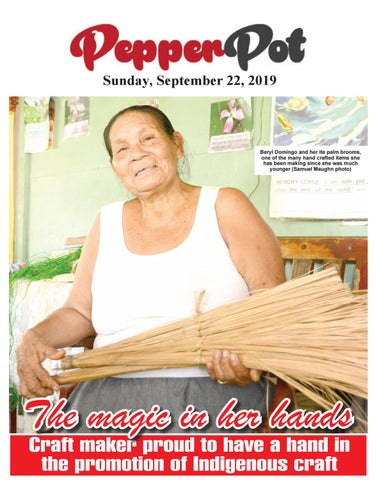
Beryl Domingo and her ite palm brooms, one of the many hand crafted items she has been making since she was much younger (Samuel Maughn photo)
The magic in her hands Craft maker proud to have a hand in the promotion of Indigenous craft
II
Chronicle Pepperpot September 22, 2019
When Johnny comes marching home again By Francis Quamina Farrier
Hurrah, Hurrah!
MOST of my feature articles which are published here in the Pepperpot Magazine are planned and researched weeks in advance. A few are not. This is one which was written many years in advance - in my brain – and was recently completed for publication today. The headline is from the lyrics of an American war-time song about soldiers returning home from the war front. The people were glad to see them return safe and sound from the battlefields. Ah, such a song was written about that sentiment and gratitude by those who know that the sacrifices made by the soldiers were beneficial to the nation. So, what has that song got to do with this article? Please read on, and you will find out. I have known Guyanese, Dr. Henry Muttoo, MBE, for over 45 years. In the early years, he was a budding theatre practitioner just out of the Charlestown Secondary School in Georgetown, where he had already been shining under the guidance of Headmaster Edgar Wilson; a Headmaster who was known to have offered his lunch, from time to time, to a student who he observed had none. Henry grew up in a very humble home in Albouystown and to this day, Albouystown is still very dear to him. This brilliant and very creative son of the soil has impressed all who have had the pleasure of seeing his work in the theatre, first here in Guyana and later
throughout the Caribbean. While studying in England, he also staged plays - especially by his hero, Derek Walcott - at the Kiskadee Club in London, to very appreciative audiences. It was my good fortune to have seen his production of “Remembrance” by Derek Walcott, at the Kiskadee Club. His choice of plays was always those of quality and not those with unadulterated violence and vulgarity - plays referred to as ‘crutch theatre’- none of that for Henry Muttoo. Yet his productions drew packed houses. Sadly, Henry Muttoo was not welcomed by some power brokers in his homeland, when he returned after his studies in England. Like another of his theatre contemporaries, the dynamic dramatist, Ken Corsbie, he was quietly classified as “Persona Non-Grata” by some powerful people in his own country, because he was very out-spoken, and made it clear what were the obstacles towards the genuine progress of his beloved Guyana. He had returned to serve, but was denied employment for which he was highly qualified. He had no alternative but to migrate to other countries in the region and finally settled in the Cayman Islands. A reversal of a popular saying would be “One man’s poison, is another man’s meat.” Dr. Henry Muttoo, MBE, has done Guyana proud over the decades. During his years
Queen Elizabeth ll, pinning the insignia of Member of the British Empire (MBE) on Henry Muttoo at Buckingham Palace
in the Cayman Islands, he rubbed shoulders with another Guyanese creative hero of his - and thousands of others - Dave Martins, who spent some years in the Caymans. Dave Martins returned to Guyana some years ago and made history by receiving TWO ‘AAs’ - The National Award of The Golden Arrow of Achievement (AA), and the love of the beautiful and talented Annette Arjune (AA). They have been married for some years now. Meanwhile, Henry Muttoo has received the prestigious British Award of Member of the British Empire (MBE) and an honorary Doctorate from the University College of the Cayman Islands in 2015. There are hundreds of highly qualified Guyanese in every field of human endeavour, in almost every country in the world, who have been giving service to the development of other countries. Some desire to return to their native Guyana. Will the traditional red
carpet of welcome be rolled out for them, also a song of welcome, probably composed by our own Dave Martins? With Guyana’s oil and gas revenue to take this country “From Rags to Riches” - another uplifting song with an important question. Is Guyana preparing to take this country to the million-plus population with Guyanese re-migrants from the Diaspora? Will there be a pleasant reintegration? Are we about to organise a Commission with the task of educating those of us who are already here, and those returning? How will the two sets of Guyanese co-exist in peace and prosperity, with everyone getting their fair share of the oil and gas pie? Like the humble boyhood home of Dr. Henry Muttoo, MBE, in Albouystown, many Guyanese left these shores for various reasons. While some would never return for permanent residence, some will return in a year or more. They will have to learn to live in a different Guyana than the one they left. Many like Henry Muttoo, who left and made a great success of his life, will want to give unselfishly to the rapid development of oil and gas Guyana. He left as a young man, and by dint of hard work, took a journey from Albouystown, that “demonised” ward of the city of Georgetown, to the magnificent Buckingham Palace in London, England, and had a prestigious Medal pinned on him by Her Majesty Queen Elizabeth ll. It must also be mentioned that the oldest son of the Queen, Prince Charles - a man who will be king - also walked the streets of Albouystown in February 2000. Buckingham Palace went to Albouystown, and Albouystown later went to Buckingham Palace. Guyanese who demoniSe Albouystown should consider that. A person, a community and a country, can go from “Rags to Riches”. What is necessary after all of that, is a mutual adjustment and mutual respect, each citizen, one for another.
Chronicle Pepperpot September 22, 2019
III
Nothing but Excellence Becoming one of Berbice’s best Industrial Technology teachers
By Marissa V. Foster TAMESHWAR Mohabir, better known to his students as ‘Sir Tamesh’ or simply ‘Tamesh’ in social circles, is a teacher at the New Amsterdam Multilateral Secondary (NAMS). He is perhaps one the most inspiring and self-motivated teachers and works beyond class hours to provide quality education for his students. Unlike many, his childhood was like a chapter of a story. At the tender age of three, his father died and left Tamesh and his mother with no steady source of income. Luckily, his paternal aunts and grandmother who resided overseas took the mantle up to take care of them. Through their support he was able to have the basic childhood necessities. His educational journey began at the Adelphi Nursery School, later the Rose Hall Estate Primary School where after writing SSEE in 2003 and was awarded a place at St. Roses High School. Due to several constraints, he took a transfer and began his secondary education at the New Amsterdam Multilateral School. Here, Tamesh completed CSEC Graduating with Nine subjects from the Industrial Technology Stream after which he completed one year in CAPE Studies. It was during his time in fourth and fifth form at NAMS that his profound love for the Industrial Technology field started to nucleate. This love stems from the amazing work that was done by his teachers especially, Romel Hughes -who to this day is his biggest role model. Tamesh was inspired to become an engineer or architect. Unfortunately, he had to put that dream on pause for a while. After consulting with the then Principal of NAMS, Jackie Benn along with the then Head of Department of English, Shaundel Phillips, he decided to gravitate towards teaching and as such, his career began in September 2009 at the New Amsterdam Multilateral School.
MEMORIES AND CHALLENGES Over the last 10 years, he had many memorable experiences with some of the most amazing students. The most satisfying thing about this journey thus far is hearing a student thank him for his guidance as a teacher and for having a positive impact on their lives. In addition, teaching gave him amazing opportunities to be a part of activities and events which helps to foster all-round development of youths such as sports and other co-curricular and extra-curricular activities. On the other hand, there have been several challenges none more so than having to deal with difficult parents who for some reason or the other seem not to understand the key role(s) they, as parents, have to play in the teaching-learning process as well as, some major shortcomings of our educational system. Nonetheless, these challenges did not deter his mind from excelling at his work. To help him with these challenges, he developed a philosophy— “P.U.T” – Patience, Understanding and Tolerance While teaching has its ups and downs, one of his greatest life challenge was accepting the fact that he would not become an architect/ engineer. Initially, he planned to become a teacher and then later venture off to become the first architect in his family. However, Mohabir realised that in life we cannot always get what we wish for and after things did not go according to plans, he felt as though a part of him was lost by losing this dream. He was quite low on confidence and self-belief. Tamesh felt as though he would have disap-
pointed himself, his family, his teachers and friends and everyone else who was associated with him. That lasted for a while until of course he met and gained support from those closest around him. He is filled with gratitude for the amazing students at NAMS as well as, his beautiful wife, his mother, aunts alongside his friends/colleagues. Tamesh stressed that was able to embrace that challenging phase with those names mentioned. Their words of wisdom, encouragement, along with their belief in him repaired the part of him that was broken through disappointed. They inspired him to embrace the teaching profession fully and use it to channel everything he stands for and believe in. He was reminded that one day through this teaching job, he will be able to live his dream and subsequently he joined the Cyril Potter College of Education in September 2013. Currently, ‘Sir Tamesh’ is functioning in the capacity as Head of Department Industrial Technology at the New Amsterdam Multilateral School – a position he held since September 2015. In the said academic department, he teaches Mechanical Engineering Technology, Technical Drawing, Building Technology and Mathematics at the CSEC level and Building and Mechanical Engineering Drawing at the CAPE level. He also works in collaboration with the sports council at NAMS to oversee the execution of sports activities within the school. He is also currently pursuing studies in Education Mathematics at the University of Guyana. THE UPSIDE Apart from challenges, life has also been quite fruitful for Mohabir with the biggest accomplishment of having a family of his own- a wife and son. He also regards being able to produce excellent pass rates at the CSEC/CAPE for over the last ten years, in particular being able to produce the top student in the Caribbean in Mechanical Engineering at the CSEC exams in 2018. The Industrial Technology teacher has also crowned CPCE Valedictorian in the year of 2015 as well as, the Best Graduating Student in Mechanical Engineering Technician Certificate 1 program at the New Amsterdam Technical Institute in 2018. As if he has not accomplished enough already, he collaborated with Andrew Williams to take his school team to participate in the prestigious Sir Garfield Sobers International School’s Cricket Tournament in Barbados in 2011-2013 and 2016. As of now, his immediate goal for the future is to be the best father he can humanely be for his son and to successfully complete his studies at the University of Guyana. He also wishes to complete the restoration of the Industrial Technology Department at NAMS to suit the needs of the incoming oil and gas industry. Finally, he will continue to strive to be the best teacher he can in moulding the nation’s children, he said. ADVICE Mohabir would like to advise teachers in general to “Try and be the best teacher that they can be. Don’t let the system get to you, be patient, understanding and tolerant. Remember that no child is ‘dunce’. Children learn at a different rate and while some of them may test our patience, at the end of the day we have to be the guiding light that illuminates their path to success. I would encourage my fellow teachers to strive to foster the all-round development of students; it’s not all about the books.”
He continued his advice by saying, “To my male colleagues, I know often times we hear the cliché that ‘teaching isn’t a male thing’, but I say to you today that that isn’t true. There is a great need for men in the teaching profession as a large portion of our students comes from homes where the father is absent, so we now need to step in and play the role of a father and guide and mentor these kids as far as possible. We have to be role models for these kids - aid in developing their self-discipline. Yes, I know the money you will get from another pro-
Tameshwar Mohabir aka “Sir Tamesh”
fession might be significantly higher but at the end of the day the reward of being able to guide and mentor a child if not more is equally as fulfilling.”
IV
Chronicle Pepperpot September 22, 2019
‘The Indigenous Peoples are very important to Guyana’s Development’ Minister Ferguson says at Region Two Heritage Day celebration
By Indrawattie Natram GUYANA’s Indigenous Peoples are very important to the country’s development and are equally important to any other race. These were the words uttered by Minister within the Ministry of Communities Annette Ferguson at the Pomeroon-Supenaam (Region Two) first Heritage Day celebration. The celebration was held on September 13 and kicked off Indigenous Heritage observances in the region with a grand cultural show and exhibition. The programme was organised by officials from the adminis-
The minister said that the current administration has high regards for Guyana’s first peoples and will continue to support all the communities within Guyana. Speaking about the government’s investments, the minister said that the government has invested in many Indigenous communities in Guyana. She also commented that five of Guyana’s parliamentarians in the government are of Indigenous descent. She, therefore, extended heritage greetings to all Indigenous Peoples throughout Guyana on behalf of her ministry and also the Government of Guyana. REO Jaikarran, who was instrumental in organising the programme, said that he
The Mainstay Dance Troupe performs on stage
society. The day, he explained, came about because of a great Indigenous leader Stephen Campbell. He said that on September 10, 1957, Stephen Campbell became the first
At the end of the programme, staff members viewed the exhibits and also got the opportunity to partake in traditional dishes. Heritage Day celebrations will be A young girl from Mainstay recites a poem
Members of the Mainstay Dance Troupe pose for a picture during the celebration
tration under the stewardship of Regional Executive Officer (REO) Denis Jaikarran. The programme was celebrated under the theme, “Maintaining our traditional practices while promoting a Green Economy” in the compound of the Regional Democratic Council. The cultural programme featured live performances by the Mainstay Dance Troupe, poems and speeches. Speaking to a large gathering, Minister Ferguson who was at the time in the region, said she was happy that the REO extended an invitation to her.
admired the unity he saw from the staff of the regional administration. He extended greetings on behalf of the administration to everyone. He also said that the Government of Guyana will continue to support the communities by providing the necessary resources needed for their development. Delivering the feature address was the Toshao of Mainstay/Whyaka Milton Fredericks, whose speech was centred on the significance of Heritage Day. He said that Heritage Day is something that was inherited and it continues to be practised in today’s
Indigenous artwork showcased during the celebration
Indigenous parliamentarian in Guyana and in 1995, the then President Cheddi Jagan declared the month of September Amerindian Heritage Month.
held in all nine Indigenous communities in Region Two in September. The activities will be spearheaded by the respective Village Councils.
Chronicle Pepperpot September 22, 2019
Jamaica
An island paradise By Tajeram Mohabir BEAUTIFUL, touristy and serene Montego Bay is Jamaica’s second city, in the sense that it is the tourism capital of the land of wood and water. Commonly referred to affectionately as “Mobay”, the area is the capital of the parish, St James, and can be accessed through some channels, including the Donald Sangster International Airport, which is said to be one of the busiest in the Caribbean. Mobay is a tourism hotspot because there in Jamaica, one will find well-paved roads, beautiful gardens, recreational parks, breathtaking views of the Blue Mountain, the hilly plains of Jamaica and the Caribbean sea, and of course, an abundance of rooms. The rooms include all-inclusive, high-end luxury properties, boutique hotels, small intimate properties and villas that cater to everyone - adults-only and family-friendly accommodations, international chains and home-grown properties. According to President of the Jamaica Hotel and Tourist Association, Omar Robinson, tourism is not new to Jamaica. “In fact, we are one of the most seasoned, and recognised tourism destinations in this hemisphere, and our popularity continues to increase from year to year. This is not happenstance. A lot of hard work by the Jamaica Hotel and Tourist Association, the Jamaica Tourist Board and our partners in hospitality and tourism is what helps to keep Jamaica top of the international tourism scale,” he said. Jamaica knows that to remain the number one tourist destination in the Caribbean and a leading player in the world, their resorts and attractions must maintain the highest possible standards and Montego Bay has been leading the way in this regard. It boasts of attractions for the adventurous, the nature lover and the vacationer in search of more serene pursuits. HIP STRIP “No visit is complete without a night out on our ‘Hip Strip’ where the famous Margaritaville holds sway with a host of other clubs and restaurants such as the newly renovated Coral Cliff Gaming Lounge, Starbucks, the Brewery, 27/27 marijuana lounge, and Usain Bolt’s Tracks and Record Restaurant,” Robinson told journalists. Nearby, in Trelawney, the Amaterra group has broken ground for the first of 1,200 rooms in a multibillion-dollar integrated resort development, one of the largest developments in Jamaica in recent times. Once completed, it will include 5,000 hotel rooms,
an industrial park and an entertainment and shopping complex. Negril in western Jamaica, known as “the capital of casual” is world-famous for its seven miles of white sand beach, shallow bays with calm turquoise waters and the beautiful sunset at Rick’s Café. And for those who love the outdoors, informal, easy, no-frills, with a mix of contemporary and rustic accommodations, Negril is definitely the place they would want to visit. This apart, there is the Island Lux Beach Park. There, visitors can get jerk chicken, Blue Mountain Coffee, listen to Reggae music, enjoy the white sand beach and play water sports. Not far away is the Jamwest Motorsports and Adventure Park which features the largest race car driving speedway and the only drag and circuit track in the Caribbean, rock climbing, zipline, horseback riding, safari tours and more. RUM TOUR On the south coast of the island juts out bubbling natural mineral baths known for their healing powers. It is also home to the Joy Spence Appleton experience rum tour. Then there is Ocho Rios, the once sleepy fishing village, now a vibrant resort town with a busy cruise ship harbour and a beautiful bay beach lined with a wide array of top-notch hotels and attractions. “You can choose to climb the nearby world-famous Dunns River Falls, swim with the dolphins at Dolphin Cove or drive through fern gully which stretches through three miles of great rocky gorge with over 540 variety of ferns. There are lots to see and do in this town. The newly built promenade connects the cruise ship port to the heart of the town. “We’re also seeing a lot of new development in Ochi. The 865-room RIU Ocho Rios, built in 2005, is putting the finishing touches on a massive renovation and expansion programme and will unveil next month, 145 spanking new rooms,” Robinson said. East of the island is Port Antonio known as a gateway to nearby tropical jungles, mountains and waterfalls. The famous blue lagoon fed by the Caribbean Sea and underground springs is a popular bathing site and not many could resist the joys of rafting on the Rio Grande. And of course, there is Kingston, the capital of Jamaica and seat of government, epicentre of business and home of foreign diplomatic embassies, museums, restaurants and the seventh largest harbour in the world, among others, which combined, make Jamaica the tourist paradise is it.
A breathtaking recreational park at Trelawney, northwest Jamaica
V
VI
Chronicle Pepperpot September 22, 2019
Chronicle Pepperpot September 22, 2019
VII
Safety of dental materials
FOR many years the dental profession worked mainly with rather inert (stable) materials that had limited contact with living tissue. The exception was dentures. The opportunity for local and systemic complications was therefore quite minimal. Now materials and devices are being treated more like drugs. They must meet the safety and efficacy requirements of drugs and medical devices. For example, the government of Sweden banned the use of silver (amalgam) fillings. This was after the whole world was using it for two centuries. More than 90 percent of the times that someone has dental treatment, the attending dentist uses a drug or material characteristic to dentistry. But ask yourself this, are they safe? Are there any side effects of dental materials? Since these substances are not generally known to the public how can one make a biological evaluation of them? This is especially true for Guyana where 100 percent of the dental materials used are imported. We in Guyana are fortunate in the sense
that we are relatively protected by restrictions existent for the manufacture of dental materials in some countries like the United States and Britain. This cannot be said for dental materials originating in many Third World countries where the standardisation system does not require protracted testing before the laboratories can release the materials on the market. Since every single dental drug and material is imported and because local legislation now does not regulate in any way the use of any of these substances, dentists should be careful about their utilisation. Certain dental materials such as composite resin (used for anterior teeth fillings), are chemically active compounds and may have a detrimental effect on the pulp. Amalgam (silver filling material) because of its mercury content and impression materials because of their former lead content also stimulated considerable interest. Endodontic (root canal) therapy involves the most dangerous drugs in dentistry. Many of the medications used are very poisonous. The procedures require canal obtrusion with drugs and materials that
remain in constant contact with living tissues. The most common drug used in dentistry is lidocaine which is used as a local anaesthetic mainly for extractions. The active ingredient is chemically like the illicit drug cocaine but the part of the molecule which is toxic and causes addiction was removed. Cocaine was discovered by the Incas, an indigenous tribe of South America who used this extract from the coca plant to numb wounds on the skin. However, it was not until 1884 that Dr. Carl Koller used cocaine medicinally as the first local anaesthetic. It is interesting to note that even after the nearly a century in which a weak solution of cocaine ceased to be used for anaesthetic, Guyanese remain the only people that I know who refer to dental anaesthetic as cocaine. Even though we do not manufacture dental materials and drugs there is a need to legislate and regulate their use. Biocompatibility is the keyword. The history of the development of controls, standards and guidelines began almost 500 years ago and is detailed chronologically up to the present time. An
outline of the latest revised draft of the International document (ISO Technical Report No. 7405), completed recently for the harmonisation of human standards within the EC has been presented. The Bureau of Standards needs to include dental materials in its list of controlled drugs because “dental quacks” have a field day in importing sub-standard materials from questionable sources. In fact, a way to eliminate these illegal practitioners is to restrict the availability of dental material by making its possession illegal for persons not licensed to practice dentistry. No amount of experimental study can guarantee absolute safety for any substance. However, toxicological investigations provide data from which reasonable projections and predictions can be made about the conditions under which the product can be safely used. In today’s world in which the development of a country is measured by how serious it views standards, it would be a boost in this context for the authorities to examine this question.
VIII
Chronicle Pepperpot September 22, 2019
#SupportCreativity
Local writers should enter more writing competitions HOW do writing competitions benefit writers? Well, for starters, winning one can help to promote one’s writing to the world and they can attract the attention of publishers and agents. Submitting to writing competitions (especially those hosted by literary journals and magazines) often leads to being published in a journal or magazine that is of some note. The Commonwealth Prize, for example, partners with noteworthy literary journal, “Granta,” to publish the winning entries each year. Competitions can lift a common man (or woman) to instant literary fame, and, if one is lucky, they can also reward the writer in one of the most underrated ways: financially.
Furthermore, winning a writing competition, or even being shortlisted or longlisted, can be important for a writer in the sense that the writer is given a pat on the back, one of reassurance, something that reminds him/her that he/she is talented and worthy and should definitely continue on the path of writing despite what other people might say. Winning a writing competition can lead one from a place where he/she is just about to give up on writing altogether to a place where he/she feels confident enough to continue on with the work. I am speaking from personal experience on this last point. There is nothing that builds back your self-esteem and self-confidence like when you are judged by your peers or
By Subraj Singh
Kevin Garbaran, Guyanese writer shortlisted for the 2019 Commonwealth Short Story Prize
people respected in the profession (your literary heroes or the heroes of others) and being found to be one of the best. I suppose the reason why many writers choose not to submit to writing competitions is because of fear – fear that not placing in a competition will mean that the writing is not good enough. However, I think this kind of uncertainty about one’s writing is something that every single writer battles with. I have never met a good writer who did not panic about whether his/her work was up to par. Good writers worry and beat themselves up because the writing matters to them. It matters to them what people think. It matters to them that the writing is good. It matters to them that the writing receives some validation. Maybe this is not the healthiest way to deal with art, but the point remains that this kind of uncertainty and fear regarding the quality of one’s writing is pretty universal and that the only way to surpass it is to acknowledge the fear, but not let it stop you from moving ahead and trying something that may or may not be fruitful, something that won’t let you know how much it yields for you unless you go out on a limb and give it a chance. With all of this in mind, I would like to present a list of writing competitions that the budding or established Guyanese writer can enter before the end of 2019. Given that Guyanese writers have experienced success at regional and international writing competitions in the past, I would like to urge anyone who has completed manuscripts to consider submitting their work to any of the following. 1) The Commonwealth Short Story Prize – This is one of the most well-known prizes in the world, which should be obvious considering that it features writers from all of the Commonwealth countries in the world. It receives thousands of entries each year and it offers up to £5,000 in prize money – although the real benefit is that it allows one writer to bring some amount of attention not only to his/her work but to the entire literary oeuvre of the country that the winning writer is from. The Chair of this year’s judging panel is Nii Ayikwei Parkes and the deadline for submission November 1, 2019. 2) The Johnson and Amoy Achong Caribbean Writers Prize – This is a prize coming out of the Bocas Lit Fest in Trinidad and Tobago. The prize caters for Caribbean writers and this year a writer who engages with non-fiction will be awarded, according to the Bocas website, $20,000TT, mentoring by an established writer, a trip to London to attend an Arvon writing course, and the chance to be represented by Rogers, Coleridge & White – one of the most respected literary agencies in the UK. This is the perfect opportunity for writers who have written a memoir, essays and other types of literary non-fiction. The deadline for entries is September 30, 2019. 3) The National Drama Festival of Guyana – This is a good opportunity for budding playwrights in Guyana to have their work staged. It is the only time when venues (such as the National Cultural Centre and Theatre Guild) are free for the playwrights and directors to use because the Festival has, in the past, been sponsored by the government and Digicel. The Festival offers prizes for acting, directing, and other theatre elements, in addition to a cash prize for Best New Guyanese Play. Al Creighton, Director of Studies at the National School of Theatre Arts and Drama (NSTAD), recently announced at a performance hosted by the NSTAD that the National Drama Festival will be returning this year. It is usually hosted in November.
Chronicle Pepperpot September 22, 2019
IX
For someone who has been cheated on MY column last week on commitment issues lead to a few emails from people sharing their pain of being with people who are afraid of commitment and those who choose to be unfaithful. I know this is quite a common thing so I thought maybe talking about it can help so many people release the pain, burden or even guilt that they may feel. If you’ve been cheated on, then you know how violating, disrespecting and devastating the feeling can be. Your sense of safety is depleted and all your trust has disappeared. According to Psychology Today, the rates of infidelity affect between 10-25 percent of today’s relationships – although it seems like a lot more. Everyone wants to know why their partner cheated but there is a wide range of possibilities; it could be something related to your partner’s past, issues within the relationship, or it could have nothing to do with the relationship at all. There are a few things that I would like the victims of infidelity to know. Whatever you are feeling, feel it. Don’t hide from your feelings, they will find you. I know so many people who drown their sorrows in alcohol or beat themselves up in other destructive ways. Coming to terms with something like this is difficult and it takes as long as it takes. Don’t make any rash decisions when you’re in that amount of pain. People who experience this will jump right into legalities, leaving the home or deciding who takes the children etc. If that’s the route you decide
to take, there is plenty of time for that. Let yourself heal a bit first to make more level headed decisions. It’s not your fault and may not even have been about you. Being cheated on can break your self-esteem in so many ways and cause you to blame yourself. Yes, you could have done this more or done this better but your partner could have also chosen to communicate these things with you or end the relationship altogether. No one else’s behaviour is a reflection of your character, level of attractiveness or desirability. Your self-worth and self-respect can never be taken away from you unless you let it. Don’t count on your partner for closure or ‘acceptable’ reasons why the cheating occurred. Most likely, it will be a half-truthh to spare your feelings or something that will make you feel even more pain. Either way, the answer will never satisfy you and you can move on without it. Move forward being your best self. Don’t practice self-destructive behaviours or beliefs, take care and nurture yourself. Some people have so much stress that physical symptoms such as nausea, stomach issues, not wanting to sleep or eat and even head, back and neck aches. These can be avoided if you practice healthy coping skills and take care of the symptoms by eating well, sleeping well and exercise. You will trust and love again one day, once you don’t take your bad experiences into the next relationship with you. I also know many couples who have been to coun-
selling for infidelity and have healed their relationship into healthy again. Forgive yourself for the signs or red flags you saw but possibly ignored- there is nothing wrong with trying to see the good in people or giving them the benefit of the doubt. Forgive the cheater even, not for them but for you to healthily move forward. Remember that things fall apart for new and better things to fall into place. Even if it’s just the lesson from the situation. When we are hurt and have to find strength, we build resilience and make ourselves more resourceful in times of adversity. There is something to gain from any situation or experience. Surround yourself with the people who make you feel good, those who won’t offer
unsolicited opinions or advice, and those who will just listen and be there for what you need. Those that remind you how wonderful you are and take you to do activities which would fall under the category of healthy coping skills. Finally, you will be okay- it may not seem so right now but the only thing that can really heal a broken heart is time. You are wonderful, you are worthy and you’re a warrior. Thank you for reading and please continue to write in to caitlinvieira@gmail. com and let me know what you would like to talk about. Suicide Helpline numbers – 223-0001, 223-0009, 623-4444 or 600-7896. Say Yes to Life and No to Drugs! Always
X
Chronicle Pepperpot September 22, 2019
GCAA AND ITS ALLIED AVIATION INDUSTRY OFFER REWARDING CAREERS SOME years ago when Tourism began to be seriously promoted by the Private Sector and Government, it was recognised that Aviation was a sine qua non of that Industry. Similarly, today it is recognised that without aviation there would be no Oil and Gas Industry The importance of these two industries has led the majority of the population who had taken the Aviation Industry for granted to now realise its importance. More and more students of the school and university systems have now grasped how important is the industry to national social and economic development and more young people are being enthused to make a career of aviation breaking out of the old mould of Law, Medicine, Engineering and ICT. Very early after Independence, Venezuela felt it was an opportunity to seize a large part of Guyana’s territory and in addition to sabre-rattling and blocking investments from being made in Guyana, organised the so-called Rupununi Rebellion to annex a large part of Essequibo. The small number of aircraft the country possessed at the time was able to do yeoman service in linking the Coast and the Interior and transporting the Police and Military in time to quell the socalled rebellion. The importance of aviation to unifying the country and protecting our territorial integrity was emphatically realised for the first time. Aviation has also played crucial roles in the development of the mining industry, forestry, tourism and agriculture and other aspects of economic development and has been quietly helping in social integration. All these activities, in a greater or lesser degree, come under the aegis of the Guyana Civil Aviation Authority (GCAA). At this crucial juncture when Guyana is at the threshold of a social and economic revolution and when the GCAA has a pivotal role to play, Lt Col Egbert Field, the Director General of the Authority has risen to the occasion. Indeed, for each of the approximate four years since he assumed the post of DG, he has quietly worked to strengthen cooperation and cohesion with the various Ministries and other segments of the Administration. To work with disparate entities so successfully is attributable to Director General Field’s professionalism, helpfulness and ability to always arrive at an acceptable compromise. Director General Field’s most recent high profile achievement has been the organisation and hosting of the International Civil Aviation (ICAO) Air Transport Meeting in November last. Guyana was chosen to host
this prestigious global event not because of its new-found Oil and Gas potential but for the significant strides the country had made in its aviation in recent years. The meeting was a memorable success and new doors of opportunity were opened. A notable feature of the ICAO meeting was that it was held in conjunction with the African Diaspora Conference. The Guyana Chapter of the International Decade of People of African Descent Assembly hosted the African Diaspora Conference and decisions were taken to strengthen air connection between Africa and the Caribbean including Guyana. In the five sections into which GCAA divides its activities - General, Safety Directorate, AYSEC Department, Air Navigation Services Directorate. Air Transport Management and Finance and Administration - there have been notable successes: 10 acres of land at Providence, EBD were acquired to construct a modern GCAA headquarters; a new Civil Aviation Act was passed by Parliament to strengthen GCAA’s oversight and enforcement capability; significant work was done to achieve safety compliance with ICAO which will move from 66 percent to 85 percent by end of year 2019; a Drone Unit has been established and regulations have been compiled to control this new form of aircraft; GCAA and ICAO have successfully worked on an Aviation Improvement Security Plan; Phase II of the Aeronautical Surveillance Infrastructure was established at Port Kaituma, Kamarang, Kaieteur and Annai; as part of continuous training, over 40 young persons were trained in Aeronautical Information Management, Air Traffic Control Assistants and others received upgraded training in the same field; a CO2 action plan was submitted to ICAO, and Air Services Agreements were negotiated with 17 states. The Financial and Administrative section of GCAA was well conducted and audits were up-to-date. We took the unusual step of mentioning the activities and indeed, achievements of GCAA to give readers an insight into work of the Authority and to give aspiring entrants an indication of the interesting and worthwhile careers in the Aviation industry and GCAA. With the expansion of the economy, the rapid expansion of the Aviation industry will take place. For instance, Guyana from its geographical location could be the aviation hub between South and North America. Guyanese will have to qualify themselves for these rewarding jobs or the Industry will have to depend on expatriate personnel.
Chronicle Pepperpot September 22, 2019
ocus F
XI
on the Village
Swan Village – a place of development Swan Village Chairman Norbert Charles
Swan Village (Samuel Maughn photos)
By Michel Outridge THIS week, the Pepperpot Magazine visited the close-knit community of Swan on the Soesdyke-Linden Highway, an Indigenous village which is home to mostly residents of Regions One (Barima-Waini) and Five (Mahaica-Berbice). The quaint village is tucked away just off the highway and can be accessed through the Marudi Resort main road. It is home to less than 500 mostly Indigenous residents with a few East Indians and Africans, who are construction workers, coal miners, loggers, gold miners; some work on large-scale poultry farms along the highway. The Village Chairman of the Community Development Council (CDC), Norbert Charles, who is the first resident, said Swan is a registered Indigenous community and he has been in the position for more than four years. Charles moved to Swan from Kamwatta Village, Region One (Barima-Waini) and is one of many villagers who reside on a 40-acre plot of land which was allocated to them. Within the village, residents live in the 65 Food For The Poor (FFTP) houses. Each
cottage-style structure is outfitted with a solar panel which provides a single light for the edifice. The building which houses the Community Centre was also built by FFTP and handed over to the villagers on November 4, 2013. DEVELOPMENT Charles related that the village’s development is based on presidential grants and they do works within the village to enhance the lives of residents. “We have seen development works such as the water-extension project, so every household has a standpipe in their yard; and works to roads in the village, because when it rains there is erosion and the loam roads are destroyed and often need repairs. We bought some culverts and pipes but it didn’t work,” he said. The village chairman of the CDC added that they will soon benefit from electricity, but he is not sure when. Utility poles with transmission power lines were however evident within the village. Initially, Charles reported that FFTP built houses for 40 families, but over time, the population grew bringing it to about 75 families to date with about 415 villagers.
“The community has developed a lot over the years and we continue to see advancement as a result of government’s allocation of yearly Presidential Grants,” Charles said. He pointed out that the Presidential Grants were used to develop the community, in which roads, drainage, and water-extension projects were done. Charles added that the money was also utilised to construct a concrete trestle on which four more black tanks were installed in addition to the existing four, to provide water to residents within the village. The village chairman stated that low water pressure has been a bugbear for them and water is rationed and supplied by sections from the FFTP-built well. Charles said at one time they had an outbreak of diarrhoea, causing Guyana Water Inc. (GWI) officials to visit the village and they conducted some tests on the water; they were informed that the water was good for consumption. He said they have asked for another well but they are awaiting a response from the relevant authorities. Charles also highlighted the need for a library for the schoolchildren since they have a large number of school-
aged children in Swan; there is also need for an outpost for the Community Policing Group. There are no schools or a health post in Swan and children journey to nearby schools daily. HERITAGE CELEBRATIONS When the Pepperpot Magazine visited the village recently, Charles and two other men were engaged in repair works to the steps, verandah and foundation of the wooden building which houses the Community Centre. The centre sits on a sizeable piece of land that serves as the playfield. This area will be transformed into a hive of activities beginning today for the Swan Village Heritage celebrations and a cultural programme will be the high point of the day. Charles told the Pepperpot Magazine that the students of Swan will participate in dancing and other stage performances during their live stage show and the locals will have their foods and beverages on sale. Charles explained that funds garnered will go towards paying the village coordinator, the dancers, security guards and owners of the music system. This year, he reported that they have a sponsor on board and he was very thankful for that.
The Swan Community Centre
The Marudi Resort access road which leads to Swan Village
XII
Chronicle Pepperpot September 22, 2019
Swan Village – Where you can find the best home-made jamoon wine
Fenton Ragonauth
By Michel Outridge SWAN Village is home to one of the best home-made jamoon wines. Just ask Barbara Debideen, who told the Pepperpot Magazine that every year she would make jamoon wine to sell at the heritage celebration in the village and this year it is no different. She had buckets of the brew preserved for the occasion and explained that the longer it ferments and more sugar is added, the stronger it gets, making it a very strong wine for only adult consumption and in moderation. “Jamoon wine is home-made and it is very strong wine and one must use it in moderation and to their limit or the effect can be damning,” she said. Jamoon is sourced from within the village to make the brew and used bottles are recycled to store the wine. “Jamoon wine is a serious drink, it will have you ‘wine’ out
of your clothes and that’s how some people end up the morning after heritage,” Debideen said. Apart from jamoon wine, Debideen made portions of apple wine, fly and piwari to go along with some creole foods such as fried rice, cook-up rice and meats. The shop owner, who also rears chickens told the Pepperpot Magazine that she looks forward to the heritage celebration because she earns funds to assist her in her daily life since lots of people are usually there. Debideen noted that she has been living in Swan Village for the past six years and she is originally from Mabaruma, Region
One (Barima-Waini), but moved to Berbice as a young girl. She added that by next weekend she will have 200 chickens which have to be sold so she can continue rearing as her livelihood. Another villager, Fenton Ragonauth, a labourer who works on a farm at Long Creek, also on the Soesdyke-Linden Highway told the Pepperpot Magazine that life for him in Swan is very challenging; this is because the roads are bad and taxis take $1,000 to go into the village. He reported too that a short drop from Swan to the junction is $200 and with the children going to
Barbara Debideen
Villagers of Swan Village engage in a ‘gaff’ (Samuel Maughn photos)
school outside the village, it is not easy and highlighted the need for a school bus to transport children to and from school. “Our water system is terrible, it is dry often and we rely on rainfall for drinking and cooking water, because we get water from our standpipes every four hours per day,” Ragonauth said. In the dry spell, they have to walk about half a mile to get to the nearest creek to bathe and wash and would like to benefit from a reliable water supply within the village. A plus for the village though is that they will soon get electricity and for that they are pleased and genuinely welcome this development. For the heritage celebration, Ragoonauth will sell wild-meat Pepperpot with other traditional Indigenous foods. He stated that Swan Village is a peaceful place where folks are simple and their way of life is even simpler.
The magic in her hands Craft maker proud to have a hand in the promotion of Indigenous craft By Michel Outridge FOR 65-year-old Beryl Domingo making Indigenous craft is her way of life since in her school days she practised until she mastered the acquired skill and today she is making a living from it. This elderly woman takes the time to make her excellent craft pieces in the form of clothing, handbags, baskets, headdresses, hats and even car seats. Although she is a housewife, in her spare time she utilises the time to complete orders and does it all in the comfort of her home. When the Pepperpot Magazine met with her, she was in the process of making a coloured brassiere to go with a tibisri skirt, which will be on sale at the village heritage celebrations this weekend. “Depending on my orders, I make things because it takes time to make these things and to get the materials to make it from scratch,” she said. Domingo reported that she is originally from Moraikobai and now resides in Swan Village where her life is simple and quiet. She related that most of her products are based on orders and some go to a buyer in the city and other persons who re-sell it
Beryl Domingo engrossed in her craft-making at her home in Swan Village (Samuel Maughn photo)
across the country. Even though her craft-making is on a small scale, she stated that it is enough be-
cause she can work at her own pace without having to employ people to assist her but added that at times her husband would step
in to lend a helping hand. Domingo said tibisri is sourced from within the village in the backlands area from the ite` palm where the shoot is cut then stripped and boiled. She added that it is then dried before use and it takes two days for this process to be completed and stated that the ite palm is also used to make house brooms. “I does buy cotton and other materials but the feathers for headdress are taken from creole fowls here in my yard and painted while, buck beads are picked from the plant right in the village,” she said. Domingo was one of the few women from Swan Village, who were at the In digenousVillage at Sophia to showcase and sell her craft earlier this month in observance of Indigenous Heritage Month. She told the Pepperpot Magazine that she had some sales at the Sophia Exhibition Site but often end up selling her craft at a much cheaper price than she had set because people wanted to buy and some asked for a reduction in the price. “Craft-making has turned out to be a hobby for me more than a job because I enjoy doing it and it has become a part of my everyday life,” she said.
Chronicle Pepperpot September 22, 2019
XIII
Home away from home By Michel Outridge WHEN he left his hometown of Moruca, Region One in search of work and a better life in his youthful days, James Domingo did not know what awaited him but today he has settled in Swan Village and has a family. The 64-year-old told the Pepperpot Magazine that when he left his village he was unsure of the outcome of his decision but was determined to make something of his life and that he did. Domingo is the former Village Chairman of the Community Development Council (CDC) for four years and the founding leader of Swan Village. “Most people that live here came from Region One because their children came out for school others for work and some seeking betterment,” he said. He related that he spent all his youthful days in Laluni Village, also on the Soesdyke/Linden Highway, where he worked with the then Demerara Tobacco Company and when that company folded he exited the village. It was then he met a young woman, who became his wife and settled in Swan Village and make a living by assisting his other half to make craft products and would leave home for two months at a time to work in the interior cutting logs to make utility poles. Domingo said that he has been residing in Swan for the past 10 years and he finds it very comfortable and peaceful but recently he had an accident on his front stairs and suffered a broken leg so he is laid up until it heals.
there is no cold storage in Swan. Villager Fernando Wells said he has been residing in Swan for a year now and plans to go home for the Christmas holidays. He is from Mabaruma and came to Swan seeking a job because he was tired of ‘bush’ work and came to garner funds to get back home to his family. He is staying with his aunt and is employed with the Soesdyke Neighbourhood Democratic Council (NDC) cleaning drains. The 20-year-old said his life in Swan is good for now but he is also glad to whenever he goes back home to Mabaruma. James Domingo, former Village Chairman
“When I first came here we had about 85 families with 310 villagers but since the population grew. Food for the Poor built 65 houses and it has enhanced the lives of the people here and we have had some developments within the village, over time,” he said. Domingo stated that with electricity on the horizon things will be better since they can store meats and vegetables and do other things to uplift their lives. He told the Pepperpot Magazine that with no minors at home right now they manage but there is a need for better roads and at least a school bus for the children since the nearest school is in Kuru Kururu. The Pepperpot Magazine also met Carlotta Houser, a mother of eight, who was erecting a stall alone on the confines of the Community Centre Ground for Sunday’s heritage celebrations.The wood was cut
Fernando Wells
from trees from aback the village and used to construct a makeshift stall and it was done single-handedly by Houser, who said she can manage. She related that she would be selling wild meat Pepperpot and some cold non-alcoholic beverages. The Pepperpot Magazine then met the Alleynes, the couple lives in the last house in the village and they said it suits them just fine. Jennifer and her husband, Ronald Alleyne said they are good but with electricity and water they would be better. They said Swan has been their home for the past eight years and it is a place where people mind their own business and do what they have to. At times, vans carrying goods, meats and vegetables would come into the village to sell, making it convenient for Carlotta Houser in the process of erecting residents to make the necessary purchases. her stall at the Community Centre ground Meats are either boiled or fried since for the heritage celebrations this weekend
A long road to recovery
Swan woman still haunted by October 2018 cutlass attack By Michel Outridge FOLLOWING the brutal October 2018 cutlass attack on mother of six, Malicia Andrews at her mother’s home in Swan, Soesdyke-Linden Highway, it has been a long road to recovery and she is still trying to lead a normal life. The Pepperpot Magazine caught up with Andrews at her home in Swan, which is just next door to her mother--Janet Domingo’s--home. She said the scars are healing but she cannot forget what had occurred, causing her to be left physically and emotionally scarred for life. Andrews, a soft-spoken woman, related that the extensive damage to her right hand included severed fingers and though some were re-attached after the incident, she has lost feelings in them; as such, she is unable to use them and cannot work to support her children. “I tried getting public assistance but I didn’t get through because of the loads of paperwork, so what little is given by my family, especially my mother, I have to make do in sending the children to school, since my eldest is only 16 years old,” she said. Presently, four of her six children are attending school and the transportation cost to and from school every day is adding up. Andrews received 12 chop wounds to
several parts of her body, including on her head, hands, arms, chest, ear and her neck, which was almost severed. She explained that she is presently residing in her brother’s house and he is living in hers, because they wanted her close to her mother--who lives in the same yard--given her condition after the incident. “I feeling better, but I does get numb by the nerves in my hand are damaged and I cannot get a job and I finding it difficult since my family is also struggling with their own. I spend a month in hospital and it was very hard for me. I didn’t know my child father had died until after I recovered and know myself,” Andrews said. She told the Pepperpot Magazine that the incident is still fresh in her mind, but for the sake of her children she is trying to get over it. “I does still remember and know everything – I does try not to think about it because of how it happened; we had no big problem, the hardest is trying to think why he did it, he was never at home and told me that people were sleeping at me and told him it was not so and he vex. I walked away and came to my mother’s and he followed and he start to misbehave,” she said. Andrews explained that she didn’t tell her family what she was going through and she and her child father, Ian English, had a disagreement; he looked her in the face before he went up to the house and got a cutlass and
Malicia Andrews (Samuel Maughn photo)
began inflicting wounds on her. She related that it was after he blurted out, “Oh is done you done with me,” and she tried fighting back but he overpowered her and chopped her multiple times. Andrews, who was a cricketer for her village, is unable to play any matches to date
and was asked to attend games, but prefers not to, since she would not be playing. The incident The incident happened when Andrews left her home after a row with 39-year-old Ian English, with whom she has a threeyear-old child, when he accused her of being unfaithful. The woman went to her mother’s house, a short distance away and English followed. There they had an argument which quickly turned heated when she refused to return home with him. Janet Domingo, Andrews’ mother, tried to save her daughter but she was lashed twice by English who had a cutlass and pushed her down on a chair, after which he fired the first chop; it was then the elderly farmer began begging him to leave her alone and she escaped. She ran to neighbours to alert them of what was happening in her house and they took Andrews to the hospital. The chops almost severed her neck, and English, after committing the act, fled into some nearby bushes and hung himself. His body was removed late that night by undertakers in the presence of the police. English and Andrews had been living together for the past four years but he was married with eight children, the youngest being eight months old. While Andrews has six children, only one was fathered by the deceased.
XIV
Chronicle Pepperpot September 22, 2019
Chronicle Pepperpot September 22, 2019
XV
FILES E S A C COURT
Appellate Court freed convicted robber because of bad identification By George Barclay
IN 1975 a married couple was on a sight-seeing exhibition in Le Repentir Cemetery when the wife was attacked and robbed of her wristwatch and gold finger ring by a gold-toothed robber. Later at a police identification parade, that gold-toothed robber was identified to be Vibert Hodge. He was subsequently arrested and charged, tried, convicted and was sentenced to prison. Dissatisfied with the decision, the prisoner represented by lawyer Malcolm Taharally, appealed to the Guyana Court of Appeal. The state was represented by Mr Nandram Kissoon, a Senior State Counsel (who later became a Justice of Appeal). The appellant complained to the Appellate Court that since he was the only man on parade with gold teeth, he considered himself wrongly identified at an identification parade which was unfairly conducted. The appellate court constituted by Chancellor J.O.F. Haynes, with Justices of Appeal VIctor Crane and Keith Massiah, heard the appeal which lasted three days. They allowed the appeal and set aside the conviction and sentence, after finding that the identification parade at which the prisoner was identified was unfairly conducted. The facts of the case disclosed that the appellant, armed with a knife, attacked and robbed one Violet Ramadan of a wrist-watch and a finger-ring. When removing the ring he opened his mouth as if to bite her finger to get it off; it was then that she saw he was wearing a gold tooth. Some five weeks later, Ramadan identified the accused at an identification parade as the robber. At the trial, there were three different versions as to how the appellant was identified at the parade. The first was given by Violet Ramadan, who said she identified him initially by his appearance, but in order to make doubly sure, she asked him to open his mouth. The second was by Inspector Troyer who conducted the parade. Troyer said Ramadan asked him to cause the men on parade to open their mouths, and that when they did so, she then touched the accused on his shoulder. The third version, which was given by the accused, was substantially the same as that given by Inspector Troyer, with this difference: that whereas Troyer said that there were others with gold teeth, the accused insisted he was the only man on parade with gold teeth, which meant he was urging that the parade was unfairly conducted, in that he was identified solely by his gold tooth. The Appellate Court found that In his summing up the trial judge did not bring to the jury’s attention the apparent conflict between Ramadan’s and Inspector Troyer’s evidence, nor the fact that Troyer’s evidence that the accused was identified after he had opened his mouth, tended to support the evidence of the accused. The judge merely left it to the jury to find as a question of fact, if they were minded to believe Ramadan and Troyer, whether the identification parade had been
Robber identified by gold tooth properly conducted. The accused also said in defence that the charge against him was a trumped-up one, that he had been “framed” by the police because he and the policeman who charged him had an altercation over a girlfriend, and that the policeman threatened “to throw the book at him.” Nothing was said about this important aspect of the defence to the jury, the Appellate Court had found. The Appellate Court held : (1) That the apparent conflict between Ramadan and Troyer’s evidence should have been pointed out to the jury, who ought to have been advised to be cautious about accepting Ramadan’s testimony that she had primarily identified the accused apart from his gold teeth. (2) The jury should have been told that if they accepted Troyer’s evidence, then Ramadan’s identification at the parade was unsatisfactory; hence, they should attach little weight to her identification in court. (3) The jury should have been directed that if they believed that the accused was the only man on parade with gold teeth, the parade would have been unfairly conducted and they should attach little weight to it. (4) The defence was not properly left to the jury. The accused was alleging oppression and victimisation on the part of the police and the judge should have told the jury to acquit, if they believed this was so. (5) The trial judge was in error when he allowed the accused after conviction to plead to six other charges forming the subject of five outstanding indictable offences, with a view to having them taken into consideration and to proceed to sentence him in respect of those charges. (6) The correct procedure is for the judge merely to ask the accused whether he admits his guilt on the outstanding offences. The accused must be sentenced only once, i.e., in respect of the offence for which he was tried and found guilty. The idea of taking other offences into consideration is merely to measure the appropriate sentence. The Appellate Court allowed the appeal and set aside the conviction and sentences. Delivering the judgment of the Court, Justice of Appeal Mr. Keith Massiah had said: “The appellant was indicted with and convicted of robbery under arms, contrary to section 222 © of the Criminal Law (Offences) Act Chapter 8:01. The allegation of the State was that while armed with a knife, he had robbed one Violet Ramadan of a wristwatch and a ring. There was evidence that while she was in Le Repentir Cemetery with her husband on March 30, 1975, at about 4.15 p.m., the appellant went up to her, placed a knife to her chest, pulled her wristwatch from her left hand and opened his mouth as if to bite her finger to get off the ring . Ramadan told him not to bite her and in fear handed the ring to him. “Five weeks later, on May 4, 1975, at an identification parade conducted at Ruimveldt Police Station, Ramadan identified the appel-
lant as the person who had taken her watch and ring. Counsel for the appellant contended in this court, as the appellant had complained in the court below, that the identification parade was unfairly conducted. “At the trial, three different versions were given as to how the appellant came; to be identified. Ramadan said that she identified the appellant and they asked him to open his mouth “to be doubly sure” and that “the gold teeth in (his) mouth made (her) doubly sure”. Inspector Hubert Troyer, who conducted the identification parade, said something different. He testified that Ramadan “looked at the parade and asked (him) to cause the men on the parade to open their mouths” and that when they did so, Ramadan “then touched the accused on his shoulder”. The appellant, in his statement from the dock, said that the men on parade were first asked to show their
teeth and that he was the only man who had gold teeth. He was clearly saying that he was identified by his gold teeth. “The sum total of Ramadan’s evidence on this issue is that she identified the appellant partly by his gold teeth, whereas Troyer’s evidence suggests that she identified him wholly by them. What must be noted, is that Troyer’s version was the same as the appellant’s, save that whereas the appellant claimed that he was the only person on the parade with gold teeth. Troyer said that there were others. After citing a number of similar cases in which the Court of Appeal had allowed appeals and quashed the convictions, justice of Appeal Massiah, who later became Chancellor of the Judiciary, allowed the appeal, quashed and set aside the conviction and sentence. Chancellor Haynes and Justice of Appeal Crane concurred.
XVI
Chronicle Pepperpot September 22, 2019
THE SUBTLE FORCE OF EDUTAINMENT The tool of warriors, colonisers, educators and change...
WHETHER recognised or ignored by the public -- confirmed and the indifferent -- the developments of ‘Educational-Entertainment’-- whether used to intentionally misguide and misrepresent or as a placebo, or to enlighten-- exist as an essential and formidable tool. From the time of our most ancient recorded ancestors in Khemet to West Africa, India, China, Europe, the Americas, they have used imagery, expanding as they traded and shared with each other, to illustrate in marble, wood and frescoes against walls in caves on amulets, shape into ballads and traditional music. We rely on their ancient religious and propaganda art as guides to how they lived, worshipped and partied and as with the Kama Sutra, much more. Edutainment is conceptualised in the creative sphere of our faculties and given visual and oral life towards nourishing the imagination of the tribe, it has been the sustenance of mankind and has earned its modern name of Edutainment with a more direct sense of attention only recently. As a young man in the early 80s without any technical direction, but with a know-it-all attitude, I entered the world with my talents after some harsh awakenings, though I had to make efforts to ignore this art and writing thing that persisted as one grassroot sage informed me, “ Yuh either follow yuh gift or yuh guh mad.” So I did and over the years, I learnt why Forbes Burnham wanted The Phantom, Mandrake and Tarzan replaced with local adventure comic strips. The latter name (comic strips) is misguiding. There was nothing comical about ‘Tarzan’,’ Mandrake’ and the ‘Phantom.’ These were powerful characters as well as subliminal concepts of indoctrination that were cultivating the very inferior complexes that were hidden in the subconscious mind, but were navigating and didactic in the active consciousness. These were not as I have learnt, fly-bynight, quick put-togethers. It required talent, a source of inspiration and access to historical, geographic, mastery of techniques and cultural understanding of the subject first, even to misrepresent it, an awareness of the foundation had to exist. The popular culture and edutainment works of the colonial day mentioned were authored by an all- American league, Robert E. Howard, the creator of ‘Conan the Barbarian’; his is an interesting and tragic life. Lee Falk created ‘Mandrake The Magician’ and ‘The Phantom’ and Edward Rice Burroughs created ‘Tarzan.’ These evolved to become exceptionally influential and popular comic books, toys, T-shirts, movies and graphic novels that were created during the segregated period of American history and carried themes that appealed to the racist folk culture beliefs of the majority of white Americans at different levels. I
am positive that the influence of external concepts from sources who had recognised the psychological usefulness of these creative works were involved. The fact is, any opposing themes would not have resulted in the possibility of being published. The reality about all of the latter creative works mentioned is that they severely altered historical facts, climate versus biological realities and were blatant in the uniformity of accommodating while instantly regimenting the social order according to the racist prejudice of that day, which is not completely gone. But this does not take away from the persuasive force of edutainment as a potent tool. When the series CSI began, apart from its high TV ratings, there was the obvious increase of young people with an awakened interest in pathology and related fields. Likewise, in the interviews with astronauts, many of them admitted to being young fans of Sci-Fi galaxy
roving comic books and movies, thus the twin edges of the spear of edutainment. The first local direct experience of edutainment propaganda material I can recount was as a child, were comic books distributed by the United Force. I did enquire from one of the last genuine members of that party which has had opportunistic infiltrators that used the political platform to kickstart their own political hustle, but though he knew of these books, as a child, because we both had to be, he remembered them, but couldn’t recall seeing them as an adult. Some comics illustrated the dismal sides of communism, and obviously were not published in British Guiana at the time. Edutainment can be used to misrepresent, to enlighten and to twist history and demonise. That occurred in post1992. Janet Jagan authored an illustrated booklet, remarkably titled, the ‘Children’s Stories Of Guyana’s Freedom Struggles ’
that unashamedly reversed the lethal activities of the PPP and replaced all aggression to Afro-Guyanese with special malevolence directed at the PNC--‘for children.’ This act of distorting history and racist demonisation was intercepted and the booklet was pulled back but came out later with small changes. That this could have been attempted knowing that people like Eusi Kwayana, former President Desmond Hoyte, Hamilton Green among others who had lived through that period and were all alive is a reference on intense malice and more, for deep contemplation. World War II (WWII) launched the full recognition of the usefulness of edutainment material in graphic posters, comic books and movies. Any student of entertainment arts with a bias to edutainment practices must reflect on that period to fully grasp the responsibility of edutainment, and in the ‘now context,’ the depth of perception required. With copyright now a global reality, it doesn’t matter that because Guyana is lax in that area that should your work reach the shores of any country that has that enforcement, you are not going to pay the price. After WWII, it was edutainment that ushered in a slow, but the new era of attacking old spectres, anti-racist comics, articles, movies all became en vogue. The civil rights movement in America emerged, but the old ‘EVIL’ dies hard, and both Black and White civil rights activists were murdered, but it was in the 70s that the cold war forged a necessity for change, and the instructive arts of education evolved. In Guyana, the generation under Burnham understood what had to be done. We were schooled in cooperatives, bookkeeping and managing a bank account. We were among the first on the Soesdyke-Linden Highway to raise chickens, pigs, tomatoes, etc.; we were the victims of the ‘Oil crisis.’ Then came another generation that is still with us: I did an interview recently with the representative of an institution. I made some queries about the lack of a specific quality in current administrators. His take on it is that “We’ve educated people from the 80s to become managers within a specific mandate, not to apply initiative or be innovative.” I kept silent because we had been at it for a while. My thoughts raced to an A.I. article I had seen on 60 Minutes and realised that, that kind of person will be replaced by robots in another 20 years. The edutainment creator, however, is one of the areas that the A.I. expert related will not be touched by A.I. We’ve got to work fast In Guyana. We closed with me telling him that over the last 27 years I’ve tried to get subsequent authorities in the Ministry of Health and Education to put up a poster. One of the posters I designed to tell schoolchildren about the dangers of marijuana, to date, to no avail, and we departed.
Chronicle Pepperpot September 22, 2019
XVII
National Integration
THE awareness of a common identity amongst the citizens of a country is referred to as national integration. Despite our varying ethnicity, language, cultural and spiritual practices we are cognizant of the fact that we are all ONE. In a previous column, I mentioned that art has an innate ability to create an appreciation of diversity in a multicultural society. Every time I visit an exhibition this concept is further understood. The Moving Circle of Artists Retrospective Exhibition (1988-2019) currently at The National Gallery of Art, Castellani House, has captivated me in more ways than one. Today I’ll be discussing the works of artist Oswald Hussein and how his work, though strong in its Indigenous roots, connects me to my faith and belief. Oswald Hussein is a founding member of the Lokono Artist Group, a group of Indigenous artists whose pioneering work has led to a new movement of Indigenous art in Guyana and a solid foundation for the Moving Circle of Artists in Guyana. Oswald Hussein came from a rich cultural background of the Indigenous people who, while they engaged in basket, canoe and pot making, were never seen as sculptors. Hussein has become a model for a rich vein of Indigenous sculptors, winning the sculpture prizes in the National Visual Arts Competition with Massasekere in 1989, Wegelly in 1993, Communicate in 2014, and Silence in 2017. Indigenous rock paintings serve as the virtual window to the rich tradition. They contain clues to important social, economic, and spiritual insights about the life of the people. For the Indigenous people, however, these art forms are key to the religious tradition of their ancestors. As a sign of continuity,
the Indigenous make an effort to reconstruct these images to preserve their tradition. This brings me to four interesting wood pieces entitled Rock Carving 1-4, currently mounted on the walls of Castellani House. They are in the entryway of the main hall in which the exhibition is being held. These pieces are replicas of Indigenous rock carving done on Saman wood. The fascinating thing about it is that I have no idea what they represent. I spent some time looking at it and pondering - what does this even mean? It wasn’t until a few days later while reading God’s great blessings devotional by Patricia Raybon, that I received a revelation from God about how I should view art. “All art forms attempt to translate what is unseen into what is seen,” Painter Joel Sheesley states. Author Michael Card in his book Scribbling in the Sand: Christ and Creativity suggests that “the definition of content in art is very much like that New Testament definition of faith that calls faith `the substance of things hoped for. Art, especially as we engage in it with a redeemed vision, becomes an activity of faith, translating the “substance of things hoped for” with words, paint and other materials into the content and form of art.” Card further explained that: “Whatever stops the world is art. Whatever makes the world pause and pay attention to something greater. Whatever shows the world’s busy people – so self-absorbed and angry with their self-ness – that their world is not the only world that existed. And so, they were liberated. And that, too, is art.” For Carl, his creativity is inspired by the creativity embodied in Christ. He uses the example of when Jesus interrupts a howling mob of Pharisees eager to stone to death the adulterous woman – by stooping down and scribbling in the sand with
Rock Carving 1-4 by artist Oswald Hussein
his fingers. Twice. To this day, Card writes, “We have not the slightest idea what it was Jesus twice scribbled in the sand. It was not the content that mattered but why he did it. Unexpected. Irritating. Creative.” As I look at the images, I think of Hussein’s work and I can’t help but visualise the markings on the sand. His craftsmanship makes it appear as if the motifs were engraved with the simple stroke of one’s finger. His choice of the Saman wood because of its colour helps to create the
contrast needed to appreciate the design of the motifs. So, even as you look at the works of our Indigenous people, don’t get consumed with the interpretation of the pieces rather focus on why they did it. If you are fortunate to hear the story behind the ‘madness’, that’s great. Understand this though - the Indigenous people create, as a means of preservation. And I must say, I’m loving this year’s theme: Maintaining traditional practices while promoting a green economy.”
XVIII
Chronicle Pepperpot September 22, 2019
Chronicle Pepperpot September 22, 2019
XIX
Indigenous Heritage and Education Month EACH year, during the month of September, we observe Education month and Indigenous Heritage Month. The simultaneous observances allow us the opportunity to recognise the progress we have made over the years in both areas, but also to work towards further development. Last week, I read a beautifully written feature by the Newsroom on Minister of State, within the Ministry of the Presidency, Dawn Hastings- Williams. It made known that the humble Akawaio woman braved through less than optimum circumstances throughout her life to earn the position she is in today. More than that, however, I believe the Minister Hastings-Williams’ story is one which points to a deeper connection between access to education and how this either promotes or limits the development of Guyana’s Indigenous peoples. Now, Minister Hastings-Williams is the woman who currently bears the highest set of responsibilities within a ministry, which of itself has wide-reaching functions. But her story took shape in a humble classroom, which was an entire school, where she and the other students had limited resources. Some disparities exist due to the geographic differences between indigenous com- munities and
coastal communities. There is also the cultural difference and the need to adapt when indigenous persons leave their communities and come to the coast to study or for work. These were both circumstances Minister Hastings-Williams, and so many other Indigenous persons endured and continue to endure. I’d also like to direct focus to one of the top performers of this year’s Caribbean Secondary Education Certificate (CSEC) examinations, Amisha Ramdin. When the results were announced last month, I interviewed Amisha over the phone that very night. She attended the St. Ignatius Secondary school in Region Nine, and secured 15 Grade One passes and Five Grade Two passes (that’s 20 subjects in total!). Amidst her relief and excitement, the young woman highlighted that she intended to show that even with fewer resources, she could be a top performer. Added to that, she wanted to bring some recognition to her indigenous community. Frankly speaking, I have personally never heard of someone from any of the hinterland regions achieve such a feat. I’ve heard of many students from the hinterland who excelled at the National Grade Six Assessment (NGSA) and subsequently came to Georgetown to
Heritage
pursue their secondary education. But, I don’t recall ever hearing about someone from a hinterland region push past hundreds of students on the coast who have access to more resources. I believe the reason it made me so happy to hear about her accomplishment was because of my own experiences at secondary school. I had a place in a top school, which provided me with access to a plethora of opportunities that made learning easier for me. And, I have travelled to a few indigenous communities to learn about their academic institutions and the educational opportunities there. When I was in Moruca, I can recall a Deputy Headteacher sharing
with me how long it takes for the school to get past papers to practise questions from. According to her, these papers are packed into boxes and sent on boats from Georgetown to this community. And at the time when I visited the community, internet connectivity was limited to the data connection provided by Digicel. Do you see why it is essential to have ICT hubs and other resources placed in regions like these? Meanwhile, I just had to walk a few steps over the Education Ministry’s Examinations Division, located right in my school’s compound, to collect past papers. Or, I could just go online and search for past papers, solutions and even textbooks. It’s
the simple things like these that help me to remain grateful, and appreciative of efforts that are being made to provide easier access to educational opportunities for all. The formal academic system is not the only avenue that facilitates learning; the indigenous people have- for aeons- had their own ways of engaging in knowledge transfer. I must acknowledge that the formal academic system may have led to the erosion of some indigenous culture due to its European influences (and this is why we have this push to relearn and reclaim indigenous languages now). But the point I’m trying to make, nonetheless, is that education (whether in the formal academic system or not) is essential to the development of a person. And it is especially important in indigenous communities where there are disparities that exist in their access to education and livelihood opportunities. Maybe there’s some great symbolism that underlies why we as Guyanese observe Education Month and Indigenous Heritage month together. And I believe that advancing avenues to promote the education of indigenous people and communities will only function to show that the education system is working and it is inclusive.
A genius in the art of chess RUSSIAN C h e s s Grandmaster, Anatoly Karpov has said: “Chess is everything: art, science and sport,” a sport which local chess star, Sheriffa Ali has mastered in her own way. Ali, a law student at the University of Guyana, said she started to play chess 13 years ago and won her first chess tournament at the age of 8 years old. “Since then I have competed in numerous chess tournaments. I have represented Guyana in the Inter-Guiana Games multiple times from 2011-2014. In 2016, at the 42nd Chess Olympiad that was held in Baku, Azerbaijan, I gained my Woman Candidate Master Title (WCM). Currently, I am the only holder of a WCM
title in Guyana. I also represented my country in the 43rd Chess Olympiad that was held last year in Batumi, Georgia,” said Ali. She believes that all her accolades have given her the right to call chess her game. And though some may say the sport is boring and complicated, she finds it as an intricate battle of the mind. “I love playing chess, it takes my imaginations to extraordinary lengths. I love that chess challenges me to think harder and strengthens my analytical skills. I also love reading and learning new openings. In the evolving world of chess there is always a new and better variation of an opening,” said the young chess star. Continuing along the path to success, she hopes to one day be the holder of a Grandmaster title,
preferably before she reaches the age of 30. Ali said chess has moulded her into the person she is and it has taught her how to be patient and how to manage her time. “When I am about to begin a chess game I envisage myself being the protector of a kingdom, this makes me very competitive. As a woman, chess is my way of showing boys that we can be competitive as well,” said Ali. For budding chess champions, she encouraged them to practice since practice is key. She also said that solving puzzles helps persons to think outside of the box. “Stay focused and remember that anything is possible. Try to work out the idea behind your opponents’ move and also don’t forget to castle.”
Sheriffa Ali
XX
Chronicle Pepperpot September 22, 2019
Hinterland working to reduce disparities development: in the education sector IN August 2015, three months after entering office, President David Granger unveiled a Ten-point Plan of Action for Hinterland Development, which strategically aims to reduce the inequalities between the hinterland and the coastland, by providing better infrastructure and a better quality of life. The first point on the list concerns education. In Guyana, the month of September is designated Indigenous Heritage Month as well as Education Month. While President Granger holds both occasions in high regard, he prioritises education as the catalyst for development. In his address at the launching of Amerindian Heritage Month, on September 1, 2019, at the Sophia Exhibition Centre, Georgetown, the President described education as “the cornerstone of Government’s plans to ensure greater equality between the hinterland and the coastland, to reduce poverty and to provide greater economic and employment opportunities for Indigenous communities”. He said his government inherited an education system beleaguered with several challenges and that hinterland schools and dorms were in a “sad state,” plagued by substance abuse, interpersonal violence, bad infrastructure, poor sanitation, the absence of potable water, among other ills. President Granger on that occasion, also emphasised that “Parents and residents no longer need to protest against the conditions at Hinterland dormitories and schools”. Further, he said, “students feel safer and are more
President David Granger (third from right) at the July commissioning of the tertiary dormitory for hinterland residents at Liliendaal, East Coast Demerara. Also present for the simple ceremony were (from right) the Minister within the Ministry of Social Protection, Mr. Keith Scott; Minister of State, Mrs. Dawn Hastings Williams; Minister of Education, Ms. Nicolette Henry; Fourth Vice President and Minister of Indigenous People’s Affairs, Mr. Sydney Allicock and Minister within the Ministry of Indigenous People’s Affairs, Ms. Valerie Garrido-Lowe.
comfortable because of the interventions and improvements which have been made,” since his Government assumed office in 2015. Investing in education “[The] investment in infrastructure and Information Technology, the expansion of [the] school feeding scheme and the provision of transportation and scholarships have all helped to reduce the number of hinterland
school dropouts from 10 Primary School students per week in 2014 to an average of three students per week in 2017, an average of 17 secondary school students dropped out weekly from hinterland schools in 2014, this has dropped to five per week in 2017,” President Granger informed during his address at the September launch. The Head of State asserted that “Hinterland education, therefore,
President David Granger cheerfully greeted this young lad in August 2019 as he arrived to a children’s welcome at Jawalla Village, Cuyuni-Mazaruni (Region Seven), for the Upper Mazaruni Games.
is being established on a firm footing,” and will continue to be prioritised in what he has described as a new Decade of Development, spanning from the year 2020 to 2029. In 2019, the Ministry of Education commissioned five schools in the hinterland. In February, two nursery schools were commissioned in Upper Takutu-Upper Essequibo (Region Nine), one at Parikwaranau, and another at Tabatinga. In March, a secondary school was commissioned at Kato, Potaro-Siparuni (Region Eight) and in September two new schools were commissioned in Cuyuni – Mazaruni (Region Seven), one at Kamarang and another at Paruima. Access to Information and Communication Technology (ICT) has also been boosted as a result of the establishment of ICT Hubs. A total of 17 ICT hubs were established in several communities spread across Barima-Waini, (Region One); Cuyuni – Mazaruni (Region Seven); Potaro – Siparuni (Region Eight) and Upper Takutu – Upper Essequibo (Region Nine). A smart classroom was commissioned at the Lethem Learning Resource Centre at the Tabatinga Annex, Upper Takutu-Upper Essequibo (Region Nine) and over 20,000 students from 216 hinterland nursery and primary schools benefited from school feeding programmes. In addition to upgraded schools and healthy meals, the Government introduced the Public Education and Transportation Service (PETS) in the hinterland, since navigating through the rough terrain and the long distances between homes and schools were among the main deterrents to school attendance. Government through PETS, formally
Chronicle Pepperpot September 22, 2019
First Lady, Mrs. Sandra Granger (left) donated two Robotics kits to the Kurupukari Primary School. Pictured at this simple handing over are (from right), STEM Guyana Master Trainer, Ms. Aisha Peters; the school’s Head Teacher, Mr. Quado Vancooten and STEM Guyana Master Trainer, Mr. Horace Moseley, along with two students.
known as the Five Bs initiative, handed over eight boats and a similar number of buses to several Indigenous communities, to provide hassle-free transportation for school children. EQUAL ACCESS TO EDUCATION President Granger assured that the new Decade of Development will ensure that there is free, easy and equal access to education for all. “The decade will restore free education as an entitlement as mandated by our Constitution which states every citizen has the right to free education from Nursery to University…. Indigenous people can be assured that they will not be left behind when petroleum production commences next year, they can be assured that the national natural resources will be developed in a manner to ensure greater equality between the Hinterland and Coastland,” the President said. Since taking office, the Government has also increased the number of scholarships given out to hinterland students by 41 per cent, moving it from 110 scholarships in 2014 to 187 in 2018. Students who either needed to leave the hinterland to study on the coastland or leave their village to study in another hinterland village, also now enjoy better accommodations.
law,” Ms. Fredericks said. Preparing for advance technology In addition to President Granger’s dedication to Hinterland Development, First Lady, Mrs. Sandra Granger has been contributing significantly to this cause. This year, through her Information and Communication Technology (ICT) Workshops, Mrs. Granger has certified a total of 148 Hinterland residents in ICT and trained a total of 98 Hinterland children in Robotics. Barima-Waini (Region One), CuyuniMazaruni (Region Seven), Potaro-Siparuni (Region Eight) and Upper Takutu – Upper Essequibo (Region Nine) were targeted. “This ties in with my husband’s concept on education. Education has to be relevant and the children of today will require education in ICT; this is what everybody calls the fourth industrial revolution. You have to know ICT…I mean already you have drones in agriculture, you have, artificial intelligence
XXI think we owe it to our young people to train them so that they know they can be very comfortable in the world of ICT,” Mrs. Granger said during an interview with PIPS last year. Additionally, 46 adolescent and outof-school youths from 14 communities in Cuyuni-Mazaruni (Region Seven) participated in the First Lady’s last ICT Workshop, which was held in July this year. Participant of that workshop, Ms. Barbalee John, speaking on behalf of her colleagues, had said that they were now excited about technology and its use in the community as well as its use in business development. “We are now confident to work and develop our communities and our country … I want to say that we the youths of Upper- Mazaruni will become successful business owners and I have learnt that as business persons we sell solutions,” Ms. John had said. As Guyana continues on its path of growth and development, Government’s
Thirteen-year-old Master Julius Marks of Port Kaituma, Barima-Waini (Region One), STEM Guyana Master Trainer, Mr. Horace Moseley taught this group of gained a Government scholarship to attend excited Kurupukari Primary School students computer programming during a two-day robotics workshop held at the school in May, 2019. the Brickdam Secondary School in 2017. He now resides at the Hinterland Students Dormitory at Liliendaal, East Coast Demerara. According to the young man, being given the opportunity to study in Georgetown made him feel special. “For me it’s a great privilege because since I was small, I wanted to become a physician and now that I have the opportunity to pursue my dream, it makes me feel happy … I would like to encourage other persons living in the Hinterland, to study hard so that one day they could be here,” Julius told the Public Information and Press Service (PIPS) Unit of the Ministry of the Presidency. Meanwhile, for thirteen-year-old Miss Anasie Fredericks of Tapakuma Village, Pomeroon-Supenaam (Region Two), it is a “life-changing” experience to be given the opportunity to attend the Bishops’ High School. “I’m thankful that the Ministry has provided this scholarship [and] the opportunity for a better education. So far, I’m really enjoying it … I would like to continue from in medicine, in manufacturing, in every- focus continues to be on ‘an education naSecondary School onto University and I hope thing... especially when you think of where tion’ and ensuring equitable development to become a Magistrate, so I hope to study Guyana is now and where we want it to be. I in the sector countrywide.
Two of the 50 students of the Kurupukari Primary School, located in Potaro- Siparuni (Region Eight), who participated in the STEM Guyana Robotics Workshop, in May 2019, demonstrate the capabilities of the robots they built.
XXII
Chronicle Pepperpot September 22, 2019
NAREI’s Mon Repos Plant Nursery THIS week NAREI in Focus will be highlighting the Mon Repos Plant Nursery, which is situated in the headquarter compound, Agriculture Road, East Coast Demerara. The nursery covers approximately one acre and is divided into different areas: housing and storage areas, seed bins, shade houses and hardening floor. It also includes an orchard for the supply of
propagation materials. The nursery is staffed with a Supervisor and nine employees, who work tirelessly to ensure the farming community, organizations and individuals access quality planting materials. They collaborate to ensure that customers receive prompt and reliable service. On any given day the nursery is always
bustling with activities. Therefore, it is no surprise that currently there are approximately 16,000 mixed plants on the hardening floor, with an additional 6,000 seedlings that will be ready for sale in a few months. Every month, approximately 2,000 to 3,000 plants are sold. This figure varies depending on factors such as weather, the season for a particular fruit, among others. However, the main crops that are usually in
high demand are: *Citrus which includes Rough Lemons, Tangerines, Oranges, Grapefruits and Shaddock, etc. *Grafted Mangoes- the main varieties are Julie and Spice. *Soursop *Hybrid Papaw * Dwarf Golden Apple *18 months Coconut
Chronicle Pepperpot September 22, 2019
XXIII
FASHIONING THE FUTURE YOU
‘THE youth of today are the leaders of tomorrow’ is the underpinning mandate of the recently concluded programme, The Model Image -- Fashioning the future
Training International -- the students underwent a concise and comprehensive introductory course that has prepared them to be better human beings. “It’s all about social transformation and human development,” says Richard Young. “When I envisaged the programme, I saw it as a means of creating “model” citizens and exemplary individuals who can improve their life chances to access better opportunities. That’s why I designed the programme.” I wish I had an opportunity at that age to experience such a programme and that propels me to be more intentional about encouraging children to give the world the best possible versions of themselves. It was a great feeling admiring the children hungry to learn more and the parents in awe of their children’s progress. These moments remind me of the words of my mentor John Maxwell: “I want to make a difference with people who want to make a difference, doing something that makes a difference, at a time that makes difference.” The programme closed with a dinner and presentation of certificates, which allowed them to practise their newly acquired skills of manners and good graces. Parents were
you, a concept devised by Richard Young in collaboration with the Confidence Becomes You programme I started a few years ago. This programme is part of her ‘Living with intention’ mission. Sixteen young persons participated in the first installment of this programme including children from the orphanage. This programme is geared towards the youth of Guyana and is essential their development. Along with contributions from Phillipa Morrish – certified Social Protocol consultant and the Founder of Etiquette
present and were pleased as punch with striking testimonials of the metamorphosis they witnessed with their children. If God’s willing, this programme will be executed throughout Guyana and online; please allow me to share some of the feedback we received from some of the parents: Ronda Graham: “My children are so honoured to be a part of the programme ‘THE Model Image Fashioning the Future you.’ At an early age, they were exposed to this programme which would enhance and equip them in becoming amazing young
Beyond the Runway with Dr. Sonia Noel ... Inspiring lives through fashion ‘It is easier to build strong children than to repair broken men.ʼ — Frederick Douglass
men and women. I was not exposed to such a programme, but I am so overjoyed that my children were given the chance to be a part of such an incredible programme and information. Parents in the next programme send out our children. I would like to see more children be a part of this programme because it will mould them for a brighter future. Thanks, Dr Sonia Noel and Fashion Guru Richard Young.” Nicola Amanda Dover Roberts: “Invest in your children. Blessings always to Dr Sonia Noel. My daughter Naomi says she feels better equipped to start a conversation when meeting new people. I’m attributing this to the confidence-building session of the programme. I’m so looking forward to the future Naomi Jelesha, my beautiful daughter.” I can assure you that the moments when I feel like giving up I will be reading some of these testimonials, especially the one below. Jo-Ann Forde: “Sonia Noel, if you ever have a double mind of what you do, I’ll tell you a story to show that if you ever stop being you and doing what God called you to do, you’ll let a lot of people die. I was hurt, rejected and told nothing good will ever come out of me (and that’s what I believed for most of my early life) but six years ago, I met you and your words of encouragement, love, mentorship, friendship and even words of correction helped to mould me into the
confident and powerful woman I am today. You came into my life at the right moment ( the moment I was about to give up). God ordered our meeting for his purpose and will to be done. You not only saved a life, but a generation!!! “Sonia Noel to know my daughter had the opportunity to BE at this early age is the best gift I could afford, and because you thought of her is beyond. All I’m trying to say is please never stop !!!!! There are a million Jo-Ann’s and Edens out there. Keep going, keep pressing, keep dreaming, keep praying, keep creating, keep being Sonia Noel. Love you dear !!” Much appreciation must also be given to Tower Suites Hotel, Spotlight Productions and Eclipse Banquet Hall and Ann’s Country Style Cooking for graciously partnering in bringing the Model Image..... Fashioning the future you to the youth of Guyana. The new programme commences soon and if you believe this programme can add value to someone you know, please share the link below as we continue to celebrate this beautiful journey called life BEYOND THE RUNWAY. http:// www.123formbuilder.com/form-5034706/ model-image-fashioning-the-future-you?fbclid=IwAR1jHKqYVyz7Qn-n0LCWD5jeXaElZf_PnLI0eLCbkSyS37G0k8IXtkmdwyE
XXIV
Chronicle Pepperpot September 22, 2019
International Coastal Cleanup (ICC)2018 report LAST week we took a break from coverage of the upcoming coastal cleanup to bring attention to the importance of preserving the ozone layer. This week our focus will be on the findings of last year’s cleanup found in a report compiled by the Environmental Protection Agency (EPA), Guyana. It’s important to note that, ICC is more than just volunteers picking up trash. Data collection is at the heart of ICC; before the cleanup starts, volunteers are instructed on how to go about collecting data using specially designed cards. In 2018, there were a total of two hundred and eighty-eight (288) volunteers from religious groups, NGOs, schools, and civic-minded citizens, who participated in both Berbice (#63 Beach) and Georgetown (Kingston Seawall). Approximately five kilometres of beach were cleaned, with approximately 1465 kg of trash being collected. The invitation to join the cleanup is open to all persons who are desirous of seeing a cleaner coastal landscape. COUNTRY TOTALS Six of the top 10 items collected were single-use plastics including a total of five thousand, two hundred and fifty two plastic beverage bottles. This snapshot speaks to the larger problem of the public’s attitude towards the environment and the spaces which they occupy and the systems which exist for the proper and timely disposal of waste. As the Government of Guyana prepares to ban some single-use plastic items, you can do your part by reducing the amount of waste you produce, use waste receptacles, and encourage businesses to start using paper and other alternative materials products. With every cleanup, there are some unusual items picked up by volunteers from appliances to religious items. In the 2018 report, records show baby car seats, baby bags, toothbrushes, and even candles making the unusual finds list. What will we find this year? Come out and join the hundreds of volunteers this Saturday and Sunday as we strive to improve Guyana’s environment. You can share your ideas and questions by sending letters to: “Our Earth, Our Environment”, C/O ECEA Programme, Environmental Protection Agency, Ganges Street, Sophia, GEORGETOWN, or email us at: eit. epaguyana@gmail.com or follow us on Facebook and Instagram.
Chronicle Pepperpot September 22, 2019
TEACHING-- it’s perhaps the oldest profession known to mankind. From Jesus, Anne Sullivan and even Socrates; teachers come in many forms. In present-day, it’s a profession that is known to create other professions and helps to pass down the knowledge in all subject areas of human life. I think it’s safe to say that teachers do not feel as valued as we’d like to think. But I can assure you that I have many teachers whom I hold close to my heart. They’re the reason I am who I am today. In fact, you would not have been reading this or wouldn’t have even seen my name in this newspaper, were it not for the tremendous work of my past and present teachers. The sharing of knowledge from one mind to another, better known as teaching, has moulded us all in all of its forms. From your mother teaching you the alphabet; your grandmother teaching you table manners; your father teaching you to drive and even your coaches at sports, teaching has always been a part of your life. I can personally say that I was not the best student to many teachers, not because of something they did, but because of my attitude towards their class. I know many students can attest to this; when there’s no emotional connection or humanistic approaches to class sessions, you pay less attention. It is safe to say that, that is not entirely our fault because humans in most ways are very emotional beings. In no way am I trying to devalue the hard work and efforts of teachers. However, as a youth writer, I am driven by the “not-talked- about” issues. I’m writing this mainly because I believe teaching is of utmost importance to us all, young and old, black or white. As such, just as we, your students who always listen to you as you teach in front the classroom— I kindly ask you to listen to us now as we form a conversation on finding ways of improvement for both sides of the table. Constructively criticising and appreciating something or someone at the same time can be tricky, because words and their meanings can get lost in translation through emotions. However, I’ll try my best to make this as simple as possible. If you’re a teacher reading this, I’ll need you to be honest with yourself and acknowledge the fact that perhaps you or a colleague you know may not be the best teacher in terms of attitude to work and execution of curriculum. As any human being, we tend to generalise most aspects of our lives. As such, you’d find some students holding a somewhat negative attitude towards all teachers because of one or two ‘not-sogood’ experiences. That is not the only reason for students’ reactions to teachers— there are countless. From disliking the country’s current education system to being a reminder of a very strict parent and even for simpler reasons such as giving frequent amounts of homework! As a teacher, not every child will appreciate your approach to teaching and vice versa and that’s fine to an extent. The point I’m trying to make is that some of the negative responses students may have towards you are deeper than you think. And even if we do find out these reasons, what do we do? Well, that is where there’s a bridge between us--social workers--and you, teachers. I need all teachers reading to remember that every child is different, has different learning styles and coping mechanisms. There are children in your classrooms from all walks and classes of life. Some are without parents, some have been hurt by their parents. Many are without physical and financial resources for a better education. Believe it or not, your classroom sometimes is an escape from life’s problems for most students. Your classroom should allow students to have hope and in the moment they can envision and become whatever or whoever they strive to be. With that said, I do hope all the teachers of Guyana have a wonderful Teacher’s Month and may you continue to be an inspiration for your students, may you continue to plant the fruits of knowledge for all generations to come.
XXV
The misconception of students not appreciating teachers
XXVI
Chronicle Pepperpot September 22, 2019 The breathtaking Half Moon Hotel, Montego Bay, Jamaica
Inside one of the soon-to-be-opened beachfront villas
Half Moon The ultimate destination for luxury, nature, fine foods and sport
By Tajeram Mohabir WHAT comes to mind when you hear the name “halfmoon”? Some thoughts that might immediately grip your attention perhaps would include a place that comes alive at night, somewhere romantic or an ultimate escape from the hustle and bustle of daily life. If any of these suggestions crossed your mind, you should pat yourself on the back, because, it aptly captures in essence what the Half Moon Hotel is all about. Comfortably nestled in Montego Bay, along Jamaica’s northern coastline, overlooking the blue and crystal clear Caribbean Sea and a sprawling beach, dotted with coconut trees, the Half Moon Hotel is among the finest tourist destinations in the Caribbean and around the world. This scenic, ultimate escape of a paradise features a blend of British colonial and modern architecture, a perfect representation of old meets new. Though located a three-hour drive from the graceful and picturesque Kingston, the Capital of Jamaica, every minute of the journey is worth the while. The well-paved highway and roads, connecting Kingston to tourist hotspot Montego Bay, snake their way through the mountainous terrains of rural Jamaica and cut through the parishes of St Ann and St Catharine, the two largest in the island nation of wood and water. Trees jut out at the shoulders of the narrow stretches of the roads, forming seemingly welcome arches over them even as birds sing and dance in the thick nearby vegetation. Visible are houses perched on the cliffs of hills, children playing in the streets, adults busy going about their daily chores, huge shopping villages and breathtakingly beautiful hotels, resorts and parks. WARM GREETING The drive seems an apt prelude to the hidden paradise, Half Moon, where guests on arrival are greeted and served with Jamaican rum punch or beverages of their choice. Once there, guests at the just below five-star hotel that sits on 400 acres of manicured lawns and two miles of beachfront, can enjoy a range of facilities at their disposal. Among them include the largest award-winning spa oasis in Jamaica, an 18-hole par-72 championship golf course, a private equestrian centre with 28 horses and the Sugar Mill, Jamaica’s best restaurant. Turn to page XXVIII►►►
Chronicle Pepperpot September 22, 2019
Footprints of the giant ‘Jake’ Croker, in the sand of journalism
A photo of ‘Jake’ Croker printed in a past publication
‘JAKE’, as he was fondly called, began working at the Daily Chronicle in 1942 where he spent 15 of his journalistic years as a sub-editor. Current chairman of the Guyana National Broadcasting Authority (GNBA), Leslie Sobers and his fellow reporter Nills Campbell wrote an extensive feature 33 years ago in the February 9, 1986 edition of the Guyana Chronicle. The feature titled “Jake Croker, A life lived for others”, was done as a tribute honouring Jake who had died the week before February 9 1986, at the age of 70. The duo reporters went on to describe him as a good man, a bright man, a man of peace, an unsung hero, an author, folklorist, historian, and a true son of Guyana. They explained that the name “Jake” was trussed upon him because of the way he made the letter ”I” resembled a “J”, this caused his colleges to refer to him as “Jac” which after a while his friends ended up calling him “Jake”. Nicknamed “the walking archive” Jake, started his journalism career in his early twenties and chalked up an ambitious and credible performance after attending a journalism course at the University of the West Indies in 1950, This and other achievements propelled him into a range of appointments which included having spent two short stints at two Trinidadian Newspapers, two years as editor of the “Sentinel”, editor for the “Torch” and he was appointed Information Officer at the Ministry of Information in 1968 where he edited and produced the Forward newspaper-which was a rural pullout of the Chronicle. His other achievements include being the recipient of the Medal of Service awarded to him in 1979 for service with exceptional
distinction in the field of Journalism, Local Government and Culture. He also served several years as secretary of the Guyana Press Association (GPA) which saw him organising a number of training courses for journalist and layout men in the fraternity. His work in the area of sports saw him being the author of “The Cricket Book” and apart from sports, his favourite columns were those which captured the mood of parliamentary debates. This made him one of the best parliamentary journalist of his time. Born and bred in the village of Bagotville on the West Bank of Demerara Joseph Issac Augustus Croker, which is his birth name, served as overseer and village chairman in his village. Known for being an activist for African rights and being the descendants of the Oku tribe from Nigeria, he initiated the teaching of the Yoruba Language – one of the hundreds of African dialects, in his village. His fore-parents who were transported from Nigeria across the Atlantic as slaves were lucky to not serve one day on the plantation as slaves since it was in the middle of their voyage slavery was abolished which caused them to be set free on arrival in British Guyana. This would have inspired him to continue the tradition of his forefathers by organising “Forefathers’ Day” on the first of August in Bagotville. That day exhibits of African foods, dance, drumming and many more activities took centre stage. Bold, sharp and detailed writing was how many described his work as a journalist many of which found its way on the pages of two black and American newspapers. “With his bag slung over his shoulder as he made his daily journey during his last days, he carried with him valuable manuscripts on which he was working,” the article chronicled. Joseph Issac Augustus Croker was respected by government officials, including every colonial governor in his time because of his journalistic and other abilities. The foundational roots in journalism he planted at the Guyana Chronicle and elsewhere continues to blossom and bear the good fruit of professionally high standards.
XXVII
XXVIII
Chronicle Pepperpot September 22, 2019 ◄◄◄ From page XXVI
A section of the beautiful beachfront at the Half Moon Hotel
Guy Stuart, Chairman of Half Moon Board of Directors told a team of local and international journalists that the luxury of space and tranquility offered at the 65-year-old, multibillion-dollar hotel are second to none, be it the panoramic view of the horizon to sunrise yoga meditation in an overwater bungalow. At the Half Moon, guests can choose to lounge on the beach, play a round of tennis or golf, visit a local art gallery, or go horse riding along the beach. And with an abundance of space for comfort and relaxation, they have either patios or balconies, allowing them to enjoy the peaceful views of gardens, pools and the sea from which a sweet and gentle breeze blows constantly across the resort. Rooms and suites are near to the sea, and within walking distance (or a short bike ride) to all the resort’s facilities. IDYLLIC Quite idyllic and impressive but these are not all. Stuart said soon a suite of rooms will be coming on stream, 57 in all, along with an expanded beachfront with natural swimming cove, restaurants, market cafes and grills, among others as part of a US$75M investment to upgrade the hotel’s facilities. The rooms have been categorised. These are Estate Ocean Rooms offering views of the Caribbean Sea and private outdoor living spaces; Ocean Junior Suites which are steps away from the beach; Prestige Ocean Junior Suites which are beachfront suites with living areas and expansive bathrooms; and Pool and Ocean Suites uniquely-designed to offer the luxury of space and privacy. Also coming soon are Prestige Ocean Suites which exudes style and charm, complete with spacious living rooms and bedrooms; Estate Ocean Suites which offer views of the Caribbean Sea and are ideal for guests looking for more indoor and outdoor living space; and the Great House Ocean Suite, the resort’s signature suite, the only of its kind and the largest on the resort. And to top it off, guests can enjoy the best of Jamaican cuisines as well as Italian and vegan dishes; coffees and teas from around the world; smoothies, sandwiches and bakery treats; and cocktails, a wide selection of Caribbean rums and premium brands. All these, coupled with luxurious spas, golf courses, water sports, wellness activities, an equestrian centre, tennis, squash, beach volleyball and other sports and a children’s village, leave visitors with a memorable experience and a passion to experience it all over again.
Chronicle Pepperpot September 22, 2019
XXIX
XXX
Chronicle Pepperpot September 22, 2019
Chronicle Pepperpot September 22, 2019
XXXI
XXXII
Chronicle Pepperpot September 22, 2019
Chronicle Pepperpot September 22, 2019
XXXIII
XXXIV
Chronicle Pepperpot September 22, 2019
Chronicle Pepperpot September 22, 2019
XXXV
XXXVI
Chronicle Pepperpot September 22, 2019
Chronicle Pepperpot September 22, 2019
XXXVII
English
XXXVIII
Dear Student, Recently some students huddled and talked about their feelings, worries, health, careers ahead… Not a few felt they started seriously studying too early and apparently now had no zest for continued study. This is self-produced stress which is not uncommon among some students. When you are revising for an examination, please see the need to have effective focusing on TASKS, particularly those that are manageable and can be tackled immediately. Never get
tired; think about your success always. Love you. IMPROVING WRITING Point of View Point of view is the angle from which you see people, objects, or events. In a short story or novel, point of view controls what the reader knows. Read the paragraphs below, they tell the same story from a different point of view each time: first-person, third-person limited, and third-person omniscient (all-knowing). Each
Chronicle Pepperpot September 22, 2019
THOUGHT FOR THE DAY
paragraph is a part of a mystery story involving a police investigation. For If you gaze for long into an abyss, the each version ask the questions: Who abyss gazes also into you. is the narrator or teller? How much is known to the narrator and therefore FRIEDRICH NIETZSCHE (1844-1900) Jenseits von Gut und Böse, IV.146 the reader? First-Person Narrator would reach all the way to where we were We walked to the swimming pool. I leaned against the diving board, wondering standing, and my aunt would come up the bank if now were the moment to spring my trap, drenched and exultant. “I have to show him to ask Carson just how his emerald stick-pin who’s boss,” she would tell us. Later, Aunt Belle taught that alligator had wound up on the floor of Jasmine Tsang’s abandoned car. Carson sank into the chaise to below on command. She would drive the longue, clearly puzzled by my silence. He truck down to the edge of the pond and gun thought that he’s left no clues, no evidence the engine. We would sit in the back, craning along the stretch of Evergreen Road. Time our necks to see him coming. He would come and time again, he told me that he’d never fast across the pond, raising two diagonal met Jasmine Tsang. Carson had no idea that waves behind him as he came. He would haul a small chunk of fiery green crystal was about himself into the shallow water and get situated just right. His back was broad and black. His to call him a liar. In the paragraph just read, the writer has head was as broad as a single bed. His tail Rivera tell the story from his point of view. would disappear into the dark pond water. He He uses the first-person pronouns “I” and was the biggest alligator anyone had ever seen. She would turn off the engine. We “me.” This point of view allows readers to view the character better and gives a “close- would all stop breathing. The alligator would swell up. He would lift his head, arch his tail, up” feeling. and bellow. The sound would come from deep Third-Person Limited Narrator They walked to the swimming pool. inside. It was not loud, but it had a carrying As Rivera leaned against the diving board, quality. It was like a roar, but with more Carson sank into the chaise longue. Why, authority than a lion’s roar. It was a sound he wondered, was Rivera so silent? Carson you hear in your bones. If you were lucky, was certain he had left no clues, no evidence he would bellow ten times. Then Aunt Belle along that solitary stretch of Evergreen Road would throw him a dead chicken. A day came where Jasmine Tsang’s abandoned car had when she would just walk down to the pond been discovered. No, he told himself, Rivera and look across the water. The alligator would couldn’t possibly suspect him. Hadn’t he told come surging up to the bank, crawl out, and the police more than once he had never met bellow. By this time, he was very old. My aunt got old, too. Her children had all grown Jasmine Tsang? In this second paragraph, a third-person up… (Bailey White, “Alligator”) limited narrator tells the story from one charAbout the Passage: Today’s piece was acter’s point of view. Carson is used. What does the reader learn about the other charac- chosen to let you see how humour can be ter’s thoughts and feelings? What clues are written. Of course, a situation that makes one person laugh out loud may not even seem given? humorous to another person; but there is no Third-Person Omniscient Narrator They walked to the swimming pool. Rive- doubt the humour in this passage. How does this “plain speaking” passage ra leaned against the diving board, wondering if now were the moment to spring the trap, make you laugh? The author, Bailey White, to ask how Carson’s emerald stick-pin had uses seemingly ordinary words that come wound up on the floor of Jasmine Tsang’s over as untainted truth from the eyes of a abandoned car. Carson sank into the chaise child. Have you ever tried developing humour longue. He was puzzled by Rivera’s silence through characters you present to your readbut certain he’s left no clues, no evidence ers? Okay, but try what Bailey White has done along that secluded stretch of Evergreen Road. with her description of people and situations. Hadn’t he told the police more than once he’d Read and note the comic details in the descriptions and actions of Aunt Belle. never even met Jasmine Tsang? This third-person omniscient narrator PERSONAL JOURNAL WRITING knows the thoughts and feelings of all the Writing a personal journal is creating a characters. Find out how this affects the way personal record of your thoughts and memreaders view the characters? ories, whatever you choose to record. It’s a place where you can record writing ideas in THE PASSAGE I remember as a little girl watching my private. You can take pattern from some writers Aunt Belle’s wide rump disappear into the cattails and marsh grass at the edge of the who write daily entries at a fixed time of pond as she crawled on her hands and knees day, like mid-afternoon or before bedtime. to meet a giant alligator face to face. She was Or, you can take your journal with you evtraining him she said. We children would wait erywhere just in case there is need to use it. high up on the bank with our eyes and mouth Jot ideas down as best you can at the time. wide open, hoping that the alligator wouldn’t No need to look at syntax and spelling. eat her up, but not wanting to miss it if he did. Getting those interesting ideas are more Finally, Aunt Belle would get as close important. Writing a personal journal is to him as she wanted, and they would stare at not only for helping with this examination; each other for some minutes. Then Aunt Belle it can go with you throughout life. You can would jump up, wave her arms in the air, and later explore drafting the topics, which will shout “Whoo!” With a tremendous leap and hopefully spark other writing ideas, which flop the alligator would throw himself into can spur on further drafting. The personal the water. The little drops from the splash journal idea is worth your trying out.
Chronicle Pepperpot September 22, 2019
CHICKEN CHOW MEIN
INGREDIENTS 1 12 oz pack chowmein noodles 1 lb boneless chicken thighs cut into thin strips 1 tbsp crushed garlic 1 tbsp grated ginger 3 tbsp soy sauce ½ tsp 5 spice powder 1 wiri wiri pepper, finely chopped ¾ red bell pepper, thinly sliced ¾ green bell pepper, thinly sliced 1 carrot, cut into thin strips ½ tsp black pepper Canola oil 5 scallion, finely chopped Shredded cabbage for garnish Powered by Chicory INSTRUCTIONS Cook chow mein noodles according to directions and set aside. Season chicken with garlic, ginger, 2 tbsp soy sauce and 5 spice powder. Mix well to coat evenly. In a large frying pan or wok, add 1 tbsp canola oil. When oil is hot add chicken and cook on high for 5-7 minutes. Add peppers and onion to the pot and stir fry for an additional 3 minutes. Add remaining 1 tbsp of soy sauce and black pepper to the chowmein and mix using a large fork to coat the chowmein with the soy sauce. Add chicken and vegetable mix to the chowmein and repeat. Mix until well coated then taste to see if additional salt is needed. Add 1 tsp oil to the pan or wok and fry chowmein in 2 batches. Combine, then add scallion. Serve with thinly sliced green cabbage. jehancancook.com
XXXIX
XL
Chronicle Pepperpot September 22, 2019