12th July, 2020
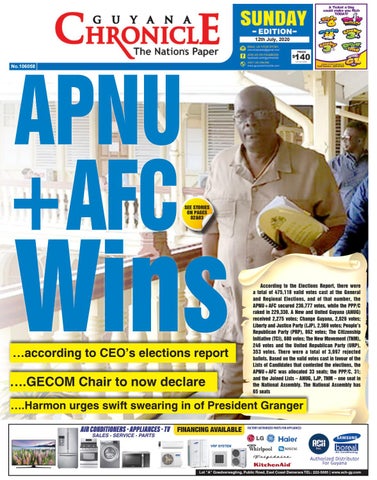
APNU +AFC
'
No.106058
SEE STORIES ON PAGES 02&03
Wins
…according to CEO’s elections report
….GECOM Chair to now declare
According to the Elections Report, there were a total of 475,118 valid votes cast at the General and Regional Elections, and of that number, the APNU+AFC secured 236,777 votes, while the PPP/C raked in 229,330. A New and United Guyana (ANUG) received 2,275 votes; Change Guyana, 2,026 votes; Liberty and Justice Party (LJP), 2,569 votes; People’s Republican Party (PRP), 862 votes; The Citizenship Initiative (TCI), 680 votes; The New Movement (TNM), 246 votes and the United Republican Party (URP), 353 votes. There were a total of 3,997 rejected ballots. Based on the valid votes cast in favour of the Lists of Candidates that contested the elections, the APNU+AFC was allocated 33 seats; the PPP/C, 31; and the Joined Lists – ANUG, LJP, TNM – one seat in the National Assembly. The National Assembly has 65 seats
….Harmon urges swift swearing in of President Granger
2
SUNDAY CHRONICLE, July 12, 2020
‘Nothing stops a declaration’ …Coalition ups calls for GECOM Chair to accept CEO’s report ….urges swift swearing in of President Granger
By Svetlana Marshall WITH the Chief Elections Officer’s Elections Report showing a win for the A Partnership for National Unity + Alliance For Change (APNU+AFC), the Coalition’s Chief Spokesman, Joseph Harmon wants the results of the General and Regional
Elections be declared, and President David Granger sworn in for a second term in Office. The Elections Report, the third of its kind within the past four months, was submitted to the Chairman of the Guyana Elections Commission (GECOM), Justice (Ret’d) Claudette Singh on Saturday (July
11) by the Chief Elections Officer (CEO), Keith Lowenfield. According to Harmon, there is nothing stopping the Chairman and her commission from accepting the report, and as such, they must act with alacrity. “We are calling on her to accept the report as required under Section 96 of the Representation of the
APNU+AFC spokesman Joseph Harmon
People Act and for her to declare David Granger as the President,” Harmon told the Guyana Chronicle. In dismissing allegations that the CEO defied the orders of the GECOM Chair, the APNU+AFC spokesman said the Elections Report was compiled and submitted
in accordance with the Article 177 (2) (b) of the Constitution, Section 96 of the Representation of the People Act and ruling of the Caribbean Court of Justice (CCJ). Further, he said it is a reflection of the will of the people of Guyana as expressed during the General
and Regional Elections held last March, and confirm that the APNU+AFC won the elections. “It is basically a confirmation that at all material stages, that the APNU+AFC had won these elections, and all of the processes through which we had gone, coming back to this point, have actually confirmed that,” Harmon said. The Elections Report submitted is reflective of the declarations made by the Returning Officers in the 10 Electoral Districts in March. While the High Court had invalidated the March 5, 2020 declaration made by the Region Four Returning Officer, Clairmont Mingo; his second declaration made on March 13, 2020 was never invalidated by the Court. TURN TO PAGE
03
3
SUNDAY CHRONICLE, July 12, 2020
CEO submits elections report …showing victory for APNU+AFC ….GECOM Chair to now declare
Elections Commissioner Sase Gunraj
By Svetlana Marshall GUYANA’s Chief Elections Officer (CEO) Keith Lowenfield has submitted his Elections Report to the Guyana Elections Commission (GECOM), showing a win for the A Partnership for National Unity + Alliance For Change (APNU+AFC). The Elections Report, the third of its kind since the conduct of the March 2, 2020 General and Regional Elections, was submitted to
the Chairman of GECOM, Justice (Ret’d) Claudette Singh on Saturday at around 11:00hrs by the Chief Elections Officer. It is reflective of the declarations made in March 2020 by the Returning Officers in the country’s 10 Electoral Districts. According to the Elections Report, there were a total of 475,118 valid votes cast at the General and Regional Elections, and of that number, the APNU+AFC secured 236,777 votes,
Chief Elections Officer Keith Lowenfield
while the PPP/C raked in 229,330. A New and United Guyana (ANUG) received 2,275 votes; Change Guyana, 2,026 votes; Liberty and Justice Party (LJP), 2,569 votes; People’s Republic Party (PRP), 862 votes; The Citizenship Initiative (TCI), 680 votes; The New Movement (TNM), 246 votes; and the United Republican Party (URP), 353 votes. There were a total of 3,997 rejected ballots. Based on the valid votes cast in favour of the Lists of
Candidates that contested the elections, the APNU+AFC was allocated 33 seats; the PPP/C, 31; and the Joined Lists – ANUG, LJP, TNM – one seat in the National Assembly. The National Assembly has 65 seats. LAWFUL COMPILATION In submitting his Elections Report, the Chief Elections Officer told the GECOM Chair his Report was consistent with Article 177 (2) (b) of the Constitution,
GECOM Chairperson, Justice (Ret’d) Claudette Singh
and the Elections Laws governing the country. “It is my understanding that Article 177 (2) (b) of the Constitution affords the technical officer the right to advise the Chairman of the elections result that ought to be declared. In this regard, I have prepared and submitted the results of the General and Regional Elections in accordance with my statutory and constitutional duties, and all applicable laws,” Lowenfield said in a signed letter to Justice Singh.
‘Nothing stops a ... In fact, while the People’s Progressive Party Civic (PPP/C) had initiated contempt proceedings in the High Court against Mingo on March 12; it withdrew the case in June over lack of sufficient evidence. That decision, which came three months after the matter was initiated, did not sit well with the Chief Justice (ag) Justice Roxane George-Wiltshire, who chided Attorney-atLaw Anil Nandlall for wasting the court’s time when he was fully well aware that the application, as filed, did not meet the threshold for contempt of court proceedings. As such, the declaration made on March 23 stands. However, in March and later in April, amid the PPP/C’s consistent claim of electoral fraud, GECOM agreed to facilitate a
national recount, which was conducted in May-June. But the CCJ, in its July 8 decision, said that not only should the President and the members of the National Assembly be elected based on the declarations made by the Returning Officers, it made it clear that only High Court has exclusive jurisdiction to adjudicate on the validity of an electoral process. “If the integrity of a ballot, or the manner in which a vote was procured, is questioned beyond this transparent validation exercise, say because of some fundamental irregularity…then that would be a matter that must be pursued through Article 163 after the elections have been concluded,” the CCJ said. An Elections Petition could only be filed within 28 days of a declaration of
the election results. The CCJ, at the time, was ruling in a case brought by PPP/C’s Bharrat Jagdeo and Irfaan Ali against North Sophia Voter Eslyn David and others. In that case, Harmon had pointed to the widespread irregularities and cases of dead and migrant voters that had been detected during the national recount, which showed a win for the PPP/C, but the Court reminded that any challenge to the validity of the elections must come by way of an Elections Petition in accordance with Article 163 of the Constitution and the National Assembly (Validity of Elections) Act. It is believed that the Chief Elections Officer submitted his latest Elections Report in accordance with the Representation of the People Act, on the basis
that the national recount, conducted under Order No. 60, had corrupted the Electoral Process, and notably was not facilitated by Returning Officers as stipulated by the Representation of the People Act. Notwithstanding the challenges, Harmon said Guyanese should accept the CEO’s Elections Report. Such a move, he said will bring an end to the ongoing electoral impasse, and move the country forward. “The Guyanese people are tired, they have waited for months; they have to deal with COVID-19 and all of these things are weighing [them] down; they are like the knee on the neck of the Guyanese people. And so we have to release them, we have to free up this country; we have to be able to let normalcy return to our country, and this is
Lowenfield, on Friday, July 10, had sought clarification from the GECOM Chair, based on a request she had made but instead of providing the required clarity, Justice Singh insisted that the Elections Report be submitted in accordance with Article 177 (2) (b), Section 96 of the Representation of the People Act; and the Certificates of Recount, which were generated during the 33-day National Recount. TURN TO PAGE
FROM PAGE
an important step in that direction, and everything has been done according to the law, and in accordance with the Constitution,” the APNU+AFC spokesperson said. To Lowenfield and his staff, Harmon offered his deep gratitude for their demonstration of great professionalism. “We want to thank the Chief Elections Officer and his staff for a professional job,” he posited while iterating that Lowenfield’s Report is consistent with the Constitution, the Electoral Laws and the rulings of the court. It is unclear at this stage if the Justice Singh will accept the report, and proceed with a declaration, however, the oppositionnominated Elections Commissioners, are up in arms against the report. As the country awaits
5
2
the decision of GECOM, Harmon is urging Guyanese to remain calm. “We have waited a long time, we have been very patient and I would like to exhort all of Guyana to remain patient and to allow the commission to do its work, but even though I say that, I am saying to you that the commission must not sleep on its feet. The commission must act with alacrity; the chairman must do what she has to do, and let our country return to normalcy by next week,” he said. According to the Elections Report, the APNU+AFC secured 236,777 votes while the main Opposition – the People’s Progressive Party/Civic (PPP/C) got 229,330 votes.
4
Sunday July 12, 2020 –– 10:00hrs
SUNDAY CHRONICLE, July 12, 2020
5
SUNDAY CHRONICLE, July 12, 2020 FROM PAGE
3
CEO submits ... A COLLISION WITH THE CONSTITUTION, ELECTION LAWS In his Friday, July 10, 2020 letter, the Chief Elections Officer had said that the July 8, 2020 judgment of the Caribbean Court of Justice (CCJ) in the case – Irfaan Ali and Bharrat Jagdeo v Eslyn David and others ruled out the notion that the Elections Commission could determine the credibility of the Elections. On that basis, he said Order No. 60 – the legal instrument used to trigger the National Recount – could not be executed in its entirety. The primary objective of the National Recount was to determine a final credible count as provided for in Order No. 60. Further, Lowenfield sought clarity on the request for another Elections Report under Section 96 of the Representation of the People Act. “Kindly provide guidance on how Section 96 (1) of the ROPA could be properly operationalised,” the Chief Elections Officer asked, while noting that “of particular relevance are two facts: 1) that the election law envisages that “the votes counted, and information furnished” would be provided by statutory officers and 2) the allocation of seats is premised on the statutory report of the Returning Officers.” On March 14, the Chief Elections Officer had submitted to the GECOM Chair an Elections Report on the basis of declarations made by the Returning Officers in the 10 Electoral Districts, in accordance with Section 96 of the Representation of the People Act, but those declarations and the Elections Report were placed in abeyance to pave way for a national recount, after allegations of electoral fraud had erupted during the tabulation of the Statements of Recount in District Four. The Elections Commission had relied on Article 162 of the Constitution, and Section 22 of the Elections Law (Amendment) Act to bring Order No. 60 into effect, but the CCJ, in its ruling, said the allocation of seats in the National Assembly and the identification of the successful presidential candidate could only be based on the reports of the Returning Officers. Paragraph 37 of the judgment reads: “Both the allocation of seats in the National Assembly and the identification of the successful presidential candidate are determined on the sole basis of votes counted and information furnished by Returning Officers under the Representation of the People Act.” Against this background, the Chief Elections Officer reminded the Chair of the Elections Commission that the National Recount was not undertaken by Returning Officers. “The concluding opinion [Paragraph 52] of the CCJ’s judgment states that Order 60 is in tension with the Constitution of Guyana, and could not create a new election regime,” Lowenfield had said. The Chief Elections Officer had also informed the GECOM Chair that her “missive” dictating how the Elections Report should be compiled was contrary to the historic practice, since Article 177 (2) (b) states that it is the Chief Elections Officer who must advise the GECOM Chair. EYE-PASS But Lowenfield’s Elections Report
did not sit well with the PPP/C nominated Elections Commissioners. In an interview outside of GECOM’s High and Cowan Streets Headquarters on Saturday, Elections Commissioner Sase Gunraj said it was disrespectful for the Chief Elections Officer to defy the instructions of the Chair of the Elections Commission. “I view this as a very clear and flagrant violation of the specific instructions as were contained in two letters; two letters under the hand of the Chairman to the CEO. Now, I could choose to use all of the nice words, like contemptuous, or the violation of the instructions, but you know what word came to mind this morning when I saw that [report], it is that the CEO eye pass this Commission,” Gunraj told reporters. He pointed to the fact that the Elections Report was not reflective of the votes tabulated during the National Recount at the Arthur Chung Conference Centre in MayJune. “That report does not contain the correct numbers as was generated by the recount exercise, and those numbers; I have not checked them in detail, but I can tell you definitively they do not reflect the numbers that were generated by the recount exercise,” he said, while accusing the Chief Elections Officer of rigging the elections in favour of the Coalition. While the Chief Elections Officer’s Report on the National Recount showed a win for the PPP/C by 15,000 votes, the accompanying Observation Reports, which were stipulated by Order No. 60, revealed that there were widespread irregularities and cases of voter impersonation during the elections. At Saturday’s meeting of the Commission,
the Government-nominated Commissioners were not present, and as such there was no quorum; the meeting was therefore
adjourned. An official statement from GECOM has not been issued on the recent developments; however, the Guyana
Chronicle understands that the Elections Commission is expected to meet early this week to discuss the submitted report.
6
SUNDAY CHRONICLE, July 12, 2020
The CCJ Ruling: Unintended Consequences WHAT a difference a few days could make in a journey that has lasted over four months. On Wednesday last, the Caribbean Court of Justice (CCJ) handed down what many consider to be a defining decision. First, the CCJ was asked to determine whether it had jurisdiction to hear a case which emanated from the Guyana Court of Appeal (CoA). Second, if it found it had jurisdiction, it was asked to determine whether the CoA itself has jurisdiction to hear the contested case. These matters, of course had great significance for the outcome of the ongoing election impasse in Guyana. To the surprise of many observers, the CCJ ruled that it had jurisdiction to hear the case and proceeded to strike down the CoA’s ruling and invalidate all actions that flowed from it. We say surprising, because both the Guyana constitution and the CCJ Act explicitly barred the CCJ from jurisdiction to hear the matter. The Constitution gave the CoA final
jurisdiction over any matter that fell under Article 177 (4), which the CoA relied on to hear the case in question. Further, Section 4 (3) of the CCJ Order prohibits the court from hearing any matter decided on by a final court in a Member State. Yet, despite the above barriers, the CCJ found that it had jurisdiction by invoking its standing as Guyana’s court of last resort. It reasoned that this standing gave it jurisdiction to hear matters of great importance. In so doing, it used a narrow reading of both Article 177 (4) of Guyana’s Constitution and Part 4 (3) of the CCJ Act. Many legal scholars have since described the ruling as a form of judicial activism that has the effect of legislating from the bench. Some political scientists have gone even further, by labeling it a political act that could be viewed as both direct and indirect entanglement in Guyana’s partisan politics. Having said that, the CCJ steered clear of making any coercive orders as was requested by the
lawyers representing the PPP/C and the smaller parties. Those parties had asked the court to instruct the Chief Elections Officer about what should be considered a valid vote. Further, the court virtually invalidated the Recount Order (60) which the CoA had used to arrive at its conclusion that “more votes” in the Constitution means “more valid votes”. The Order had in effect changed the definition of a valid vote from the standard definition in the Representation of the People’s Act to “a credible vote”. By invalidating the Recount Order, the CCJ has also invalidated any outcomes of the recount exercise. So, when the GECOM Chair requested a report from the CEO, based on one of the reports from the recount, she was actually asking him go against the ruling of the CCJ, which said that the Recount Order cannot usurp the Constitution or the Representation of the People’s Act. The CEO duly pointed that out in his response to her request. He also drew to her
attention that the CCJ ruled that any certified votes must be those certified by the Returning Officers. In any case, it should be clear that the Chair cannot ask the CEO to produce a report, based on her advice. As Attorney-General Basil Williams pointed out, she would be acting on her own advice, which is prohibited. One would have expected the Chair to recognise the conundrum in which the Commission was placed by the CCJ ruling and change course. But she virtually resubmitted the identical request to the CEO. And the CEO submitted a report which, from all indications, is based on the certified declarations of the ten Returning Officers which had been put in abeyance by GECOM when it embarked on the recount exercise. The report gave the APNU+AFC a one-seat majority. In many respects, the CCJ ruling has had unintended consequences. Instead of producing the outcome that
the PPP/C and presumably GECOM’s Chair were hoping for, it has walked the election way back to the pre-recount period. In hindsight, maybe, Ulita Moore and her lawyers were correct in their reasoning that the recount was unconstitutional. Although the CCJ did not explicitly say so, one can imply that from its ruling. It is now up to GECOM to proceed. The straightforward thing to do is to accept the CEO’s report and declare the winner of the election. But after all we have seen in these four months and more, that may not be that straightforward. So, Guyana awaits GECOM. Clearly, the PPP/C would be disappointed at the turn of events, but decisions have consequences. That Party may well rue some decisions it made along the way. As for GECOM, the Chair and her majority in the Commission must take responsibility for their decision not to annul the elections when that opportunity arose.
Opposition can’t dismiss Mr Pieters’ testimony as APNU+AFC propaganda or disinformation Dear Editor, THE Kaieteur News July 6th edition carried a report of an interview Kaieteur Radio did with Canadian- Guyanese Attorney -at- Law Selwyn Pieters who was an accredited local observer for the Guyana Bar Association at the March 2 General and Regional Elections. The article was captioned, “New details emerge about Clairmont Mingo’s fraudulent declaration.” In its attempt at exposing Mingo’s conduct in the tabulation process at the Media/ Command Centre during the Region Four declaration, the article also exposed the PPP/C’s control of employees of the Guyana Elections
Commission (GECOM ) who were at the call of that party throughout the electoral process. It is this control of important GECOM officials that enabled that party to engage in massive electoral fraud on the ground on Election Day. Back to the article, it reads, “ The attorney stated that the opposition at that point contacted their own returning officers after the commission had some difficulties finding replacements, but this did not sit well with the chief elections officer who got into a heated discussion with the former Attorney General and PPP top brass, Anil Nandlall. “ When Lowenfield said well, we don’t have the two DRO’s [sic],”Pieters related, “ there
became a debate with Mr. Ali and Mr. Nandlall and Mr, Lowenfield and Mr. Mustapha. And other observers were there and what was interesting was, you saw that, if you look at the videos, you’ll see about 30 or 40 cameras recording. Mr. Lowenfield basically claimed that he could not trust the DRO’s [sic] that were there that the PPP brought, and these were his employees. “ According to Pieters, all the above took place in the presence of the international observers, representatives of the diplomatic community and an array of local observers, including representatives of the smaller parties. It is revealing that no one in this distinguished group of
democrats and impractical election observers saw anything wrong, suspicious or questionable that the opposition PPP had effective control of GECOM employees and could summon them as need be. Or it damn well didn't matter to these disciples of democracy, bearing in mind that these employees are by law and convention in the electoral process, accountable only to GECOM and not political parties. The fact that the PPP was able to provide two replacement DROs in terms of electoral malpractices speaks volumes. When observers, local or foreign, are observing an election with a vested interest in the outcome, these matters are deliberately overlooked – expediency becomes the rule of
the game. Their lens was focused on the APNU+AFC and not on the PPP/C. In Guyana we have a proverb that says, “Mouth open story jump out.” Attorney Selwyn Pieters in opening his mouth has done a great service to the coalition and its supporters by unwittingly exposing the PPP/C’s corrupt control of some GECOM officials. Mr Pieters’ testimony can’t be claimed by the opposition as APNU+AFC propaganda or disinformation. I end by making this observation, “ The road to hell is paved with good intentions.” Regards Tacuma Ogunseye
7
SUNDAY CHRONICLE, July 12, 2020
GECOM Chair must now follow the law Dear Editor THE Guyana Elections Commission Chief Elections Officer Mr. Keith Lowenfield has submitted his report to the chairperson. Mr. Lowenfield has done so within the constitutional provisions and the law; he has acted prudently, judiciously and legally. It is now imperative that Madam Justice (Rtd) Claudette Singh conclude the process by also acting within the law and declaring the results of the March 2nd General and Regional Elections. Chairperson Singh cannot delay any longer. She is learned in the law and knows well that no court can instruct the CEO how to act, nor can she do so. The CEO must act strictly within the constitution, Guyana’s supreme law -- and he has done so. Failure by the chairperson to act on the report submitted by the CEO can see
her cited for misconduct in public office and action taken to remove her from her post. Certainly Madame Justice Singh would not wish for her otherwise stellar career to be tainted by acting in contravention of the law. Should she stray from the law it would be a grave injustice and devastating wound to Guyana’s democracy. Once she acts in accordance with the law, aggrieved parties will have recourse by way of elections petition as affirmed by the Caribbean Court of Justice. There is only a singular course of action now for the chairperson and she must act accordingly. Yours sincerely, Earl Hamilton
Continued abuse of women, girls due to society shirking responsibility to address this behaviour Dear Editor, ONCE again we are witnessing the abuse of power by two public figures, Ruel Johnson and Glen Lall, who appear to think that the laws of Guyana do not relate to them. In the case of Ruel Johnson, since he touts himself as intelligent, articulate and sensible, he must be aware that he falls within the spectrum of abuser if not paedophile, even if he is safe under the letter of the law. His unctuous ‘apologies’ ring shallow, self-serving and less than credible, in a statement that was used simply to advertise himself once again. Meanwhile, Kaieteur News publisher and owner Glen Lall presents himself as an apologist for abusers in his characterisation of Ruel Johnson’s abuse as “bedroom story,” some kind of private matter between individuals that the newspaper and the wider public need not concern ourselves with. Mr. Lall is clearly out of touch with the fact that domestic and sexual violence have been understood for more than two decades to be public social concerns and they are in fact everybody’s business. Abuse of women and girls keeps happening because we
continue to refuse to accept our societal responsibility to address this behaviour that is violent and downright illegal. Abuse of women and girls keeps happening when we see abusers as ‘too respectable’ and ‘nice’ to engage in violence. Abuse of women and girls keeps happening when state institutions responsible for prevention and protection are under-resourced and less than active. Abuse of women and girls keeps happening when we find it easier to blame and disbelieve the survivors, even when they don’t survive the violence. The fallout from domestic and sexual violence is not limited to survivors and victims; it affects the entire community, particularly the younger generation growing up in a society where violence and the trauma it causes are deep-seated. They learn early on who has power, how power is used against others and how power is used to manipulate and silence others. Violence and secondary trauma affect their ability to form healthy, consenting relationships now and later on as adults. We must not continue to accept and excuse the normalising of violence. Sincerely, Red Thread
GECOM needs to move ahead so Guyana can be governed by a President identified through a fair process Dear Editor AS human beings, we all have our beliefs and interpretations of past and current events. This shapes our attitudes and in the case of the media, editorial policy and proclivities. The present situation in Guyana requires all of us to leap beyond these proclivities or, if we prefer, prejudices, for the sake of a secure and viable Guyana. In view of the above, I can see no difficulty with you publishing this letter, which seeks ultimately to mend and not rend, to heal and not peel a wounded and unhappily divided nation. I had earlier pleaded long before the elections that there is urgent need for our political leaders to talk and find a modus vivendi. It is the only, and I repeat, only mechanism to salvage and save Guyana. This need to sit and talk without the media is a matter of grave urgency. I say urgent, since COVID-19 has exacerbated conditions globally and is having an adverse effect on Guyana. Yesterday, the Director General of WHO made an impassioned plea for solidarity in dealing with this murderous health pandemic. In similar vein, this need is for good sense and solidarity among our leaders. COVID-19 may subside in the nottoo- distant future, but unless every side of the political divide recognises that in the present charged environment, neither the courts nor even GECOM can really help us to settle down and move forward as one people. We need to sit and talk to and with each other with civility and sincerity. A prerequisite to talks must be a public affirmation to subscribe to an unchangeable moral code, which we cannot get from any judiciary, internal or external. For much is left in the hands of judges and those identified to interpret man’s constructed laws. In this regard, we need to leap beyond human moral sense. We have been reminded in an Encyclopedia of Philosophy, “The moral sense is also an influencing motive in our pursuit of virtue and our avoidance
of vicious behaviour, and it plays a part in our bestowal of praise and blame.” The key issue and the real challenge is to find some uniformity which will invest all of our leaders with a sense and passion for morality, where the theology of some folk is “thiefology,” and therefore see nothing wrong with stealing, corruption, the manipulation of institutions and our man-made laws and regulations. It is now popular for us to lean on the experiences and principles of two countries that have generally influenced Guyanese of every generation. These are USA and the UK. Today, we regard them, and rightly so, as great nations and bastions of democracy and justice. It is their history, prowess and internal conditions that propelled them to greatness. We must not forget that in the UK, for example, they traversed a road where they once beheaded their King and saw the suspension and the restoration of Parliament. Great Britain controlled a vast empire over which they boasted, the sun never sets. In the United States we find a few who make simplistic statements about democracy in Guyana. They ignore, for example, that the United States maintains the largest and most powerful military in modern history, which in essence has always supported their interpretation of democracy. Rightfully, the Americans rose up against King George III, which led to their declaration of Independence in 1776, making a solemn promise for equality and justice for all men. But less than 100 years later, the American Civil War broke out between the north and the south. The issue of enslaved Africans was foremost, yet 100 years later, black people are still struggling to enjoy the promise or democracy which presupposes equality of opportunity in every aspect of life and the true meaning of their creed that all men are created equal. We witnessed the
war in Mexico which was anchored upon expanding the Anglo-Saxon concept of democracy. Of course, in this Region, we had the invasion of Grenada in 1983, which almost split CARICOM in two, all in the name of democracy. Grenada is a tiny island of 110 citizens, less than the number who lives in Georgetown and less than those who congregate in a shopping mall on any day in any European or North American city. Guyanese must work tirelessly to agree on morals and an uncompromising code of conduct for all persons in positions of influence and authority. Political leaders, religious leaders, public officials including teachers and the security forces must be men and women with strength and good character. Guyana, thanks to our colonial history, is suffocating because of this question of ethnic identification, where from my analysis, perhaps 80 per cent of voters are influenced by race. Happily, we have 20 per cent of our population who have risen above considerations of race and religion. The above is not the result of a scientific analysis but my own conclusion, having traversed every part of Guyana for over six decades. Talks must therefore not seek to avoid this real issue. We have today an interesting situation where to my mind, the CCJ for whatever reason has cast aside our laws and assaulted our sovereignty, commenting on matters suggesting a bias and avoiding what is the crucial issue of the integrity of ballots cast in our 2020 elections. As a lay person, I find completely irrelevant the CCJ’s reference to the December 15, ‘No Confidence” motion. They side-stepped the circumstances,which led to the ballot recount and what ought to be the consequences of that ballot recount. The agreement for the recount was brokered by CARICOM and signed by the representatives of the two principal players
of the 2020 elections, the PPP represented by Leader of the Opposition Bharrat Jagdeo and Leader of the Coalition, David A. Granger. That agreement states as follows: “There must be reconciliation of the ballots issued, with the ballots cast, destroyed, spoiled, stamped and as deemed necessary their counterfoils/stubs: authenticity of the ballots and the number of voters listed and crossed out as having voted; the number of votes cast without ID cards; the number of proxies issued and the number utilised; statistical anomalies; occurrences recorded in the Poll Book.” Me, as a layman, the vital word is “authenticity.” If during the recount documents required to satisfy the above spirit of the agreement and to achieve authenticity are missing for whatever reason, then those purported ballots found in the box ought not to be given any credence. As a lay person I can only deal with simple logic and reasoning. Whoever and whatever are responsible for these vital and necessary documents being missing are of course, another serious matter. How could Justice Saunders claim that a number of persons’ votes were excised by the chief elections officer is worrisome, or is he giving credit to votes cast for the dead and names of persons not qualified to vote, but whose names appeared on the voters’ register used on March 2? In life’s journey, you experience many examples of what we term collateral damage, but that has always been vagaries of life on earth. I am a simple man and could abide by simple answers. I hope that by the time this letter is published we can see GECOM moving ahead, so that the nation can settle in to be governed by a President identified as a result of a fair process. Regards Hamilton Green
8
Dear Editor, ONE of the best things that could have happened for me is for the United Nations Secretary- General (SG) Antonio Guterres to comment on the Guyana March 2, 2020 General and Regional Elections. Firstly, let me state that I have the utmost respect for the United Nations and the secretary-general, as well as the office. I have great respect for the Caribbean Community (CARICOM), the Organisation of American States (OAS) and the international community. I have always been a law-abiding citizen of Guyana -- I pay my taxes, I am honest, have never been corrupt neither would I ever become corrupt; I conform to the National Pledge of Guyana, so I would say that I am a good citizen. In 2015, I voted for the APNU+AFC government as a part of the movement for change in administration. Prior to 2015, I had criticised the PPP/C government when I thought that it fell short of the expectations of the people. After 2015 I challenged the APNU+AFC government viciously and openly throughout the past five years because I felt that what was wrong for the PPP/C, I could not accept as right from the APNU+AFC government; essentially, life operates on principles. I did not plan to vote on March 2 for neither the PPP/C nor the APNU+AFC, because I felt that both leaderships operated from their lower self and the people of Guyana deserved a better quality of leadership. After the March 2, 2020 incidents surrounding the tabulation of the Region Four votes, I would have lead a ‘campaign,’ if it had become necessary, against the APNU+AFC government for them to demit office in the interest of protecting the rule of law and democracy in Guyana. However, after all of the discrepancies were unearthed from the national recount process, I realised that while the APNU+AFC was being accused of questionable acts during the tabulation process for Region Four, the PPP/C members were not in church singing in the choir or attending bible study on March 2, or prior. Both parties are guilty, in my view, of significant malpractices. As a child growing up, my parents taught me that honestly is the best policy, therefore, I find it extremely baffling the stance which the international community has taken to accuse one party of wrong and not the other. Just in case Mr. secretarygeneral, you were not provided with this information before making your statement, I would like to humbly and respectfully state that both of our political parties, in my view, have wronged the Guyanese people in these elections. There is a wide view that the international community seems to be leaning towards a change of regime in Guyana, hence the seeming blindness
to the wrongs committed on both sides. While I understand the arguments on the rule of law, democracy and that decisions of the courts ought to be adhered to, a fundamental point that I think the international community is missing or do not care to pay attention to, is that the current regime represents a constituency as well as the opposition represents a constituency; and ethno-politics has been perhaps the main governance challenge in Guyana from as early as 1953. Additionally, the main threat to Guyana’s security are internal racial issues. From my vantage point, the current situation in Guyana Mr. secretary-general, at this point, is probably equivalent to Rwanda just before the civil war broke out. What, in my view, is best for Guyana at this stage, is not a declaration but rather a solution. A declaration would not be the solution; instead, it may be the final trigger for widespread civil unrest. Some of us have been working behind the scenes to try to get our political leaders to explore and consider a solution, where both of the major parties could form a government for an interim period, with a specific mandate to conduct constitutional reform, electoral reform (to facilitate a new electoral culture in the country) and to have consensus on an economic development policy and strategy with relevance for 30 - 40 years. I must also state that what I find extremely baffling, is the reluctance of the international community to assist the Guyanese people to find a solution to our almost 70-year old ethno-political problem. The United Nations, the OAS, CARICOM, and individual countries have a huge wealth of knowledge and expertise at their disposal, yet they are seemingly hesitant to help us. Democracy is certainly not perfect, as a matter of fact, I see the lack of interest in a preventative approach to the escalation our current situation as being a fundamental flaw in democracy. As I read the public statements from the Mandela ‘Elders Group’, the former President of Liberia and other significant regional and international personalities and organisations, I can’t help but wonder how much do they understand and care about what is really happening in Guyana. My humble request to the United Nations Secretary General, as a citizen who has literally worked in the gutters fighting for a better country and has challenged governments on both sides, to my own peril at times, can you help us to find a solution to our country’s 67-year-old ethno-political problem, so that we can hand our next generation a better Guyana than the one that was handed to us… PLEASE, PLEASE, PLEASE Mr. SG? Yours faithfully, Citizen Audreyanna Thomas
Op Ed
What is critical for Guyana at this point is not a declaration but a solution!
SUNDAY CHRONICLE, July 12, 2020
The final report on the elections is in: the ball is with the GECOM Chairperson
By Adam Harris THIS past week has seen a variety of legal opinions. There was the ruling by the Caribbean Court of Justice. It appeared to suggest that the Chief Elections Officer cannot, on his own, and using information at his disposal, determine valid votes. Then there was the most recent spate of communication between the Chairperson of the Guyana Elections Commission and the Chief Elections Officer. The Chairperson directed the Chief Elections Officer to present a report that reflects the tabulated votes from the recount. This prompted a request for direction. He contended that the order created by the elections commission was in conflict with the Representation of the People Act which talks to figures provided by returning officers. He noted that the recount was not undertaken by returning officers. The Chairperson, however, was adamant that he use the recount tabulation. In the wake of his request, Chief Elections Officer Keith Lowenfield found that there were calls for his dismissal. Imagine being sacked for seeking clarification. But then again, the state of affairs in the wake of the ruling by the CCJ the rule of law seems to have gone through the window. But there are clear rules and using these rules the Chief Elections Officer presented his report to Justice Claudette Singh yesterday. Under the Representation of the People Act (ROPA) the CEO presents the winner of an Elections in Guyana. Under the Article 163 of the Constitution any Party which disputes the result must go to an Election Petition. That was not done by the PPP/C. When the count was being declared on March 13, last, immediately the PPP/C made a noise. Joining that party were the diplomats based in Guyana. They began to talk about sanctions. However, the PPP launched a set of legal battles which led to a decision from the CCJ. That decision questions Order 60 and puts the ROPA back in focus. This dictated that the CEO must stand firm on the laws, constitution and the judgement of the CCJ. He provided a report consistent with the CCJ’s decision. That report must now reflect what the ROPA and constitution demand and the law further states that the GECOM Chairperson must accept the advice of the CEO. The Chairman is removable from office for misconduct or misbehaviour. The President has the authority under Article 225 to remove any Chairman of a Commission for misbehaviour, infirmity of body or mind or any other cause. In the case of the Chairperson of the Elections Commission, that tribunal to investigate and report to the President will be headed by the Prime Minister under Article 161. The tribunal’s report will say yes or no to the removal of the Chairman. For all it is worth the PPP/C has been seeking to dominate the GECOM Chairperson. When those ballot boxes with tinted ballots were questioned, the initial decision was that the boxes be put aside. And they were until the PPP/C began to talk about people being disenfranchised. Those boxes featured voter impersonation among other things. By a majority vote the commission opted to count the ballots in those boxes. This meant that fraudulent votes were being accepted into the recount. That decision came back to taint the issue. The CCJ decided that once those votes were counted they were valid. Fraudulent votes were being used to determine the outcome of the elections. Of interest is the role played by the diplomatic community. To some the diplomats have overstepped
Adam Harris
their boundaries. Their action is reminiscent of 1992 when the United States ambassador at the time, George Fleming Jones, literally took over the elections commission and Guyana is aware of that outcome. This time around, it is as if the diplomats desperately want a change in Government. And while all this is going on the PPP/C has been also, in social media. It posted some news that boggled the mind. In one post, it claimed that Director-General, Joseph Harmon and businessman Brian Tiwarie loaded two aircraft with sacks of money and flew to a Caribbean destination. In this day and age with the focus on money laundering one must wonder how people with sacks of money would be allowed into any port of entry. Banking is another matter. The truth is that no aircraft associated with Mr. Tiwarie left these shores. Then there was a report that Mr. Tiwarie had taken the Chief Elections Officer to his resort in the Teperu Quarry to hide him. No authority saw the Chief Elections Officer, Mr. Keith Lowenfield, in the vicinity of any airport. Besides, the man was there for every meeting of the elections commission. There were attacks on Mr. Tiwarie’s children and family. It is one thing to target a man but when you also target his family then somebody had no moral. It didn’t end there. There was a report that former magistrate Geeta Chandan and I were hired to terrorise the GECOM Chairperson. I cannot understand why the police were not involved. I should have been arrested. There have been other posts equally ludicrous. Every attempt is being made to have the chairperson install a PPP/C Government. They have applied pressure on her in every quarter. It began with some ad hominen attacks on the woman. They accused her of electoral irregularity and actually called her Fraudette. They have attacked every election official who had to deal with the votes. And worse of all they have threatened to imprison anyone who is opposed to the PPP/C. The Chief Elections Officer has submitted his report with a detailed explanation. The commission will meet tomorrow. The nation now awaits that meeting.
SUNDAY CHRONICLE, July 12, 2020
THE WAY FORWARD FROM my exposure to elementary Latin in high school, I remember the fable from Greek mythology about Minotaur. That was a fictional monster with the head of a bull and the body of a man, locked away in what was called The Labyrinth. In Guyana, elections hitherto were primarily a potent power for social change and transformation. The right to universal adult suffrage – one man/woman, one vote – was won in struggles since 1953. Over time, however, desperate but powerful interests have tried to place elections into a political labyrinth and to bury their true purpose in a maze of dirty money and corrupt influences. CYCLE OF LITIGATION That has been the fate of the 2020 elections for which final results are yet to be declared due to a concatenation of chicanery, styled electoral fraud, that may yet attract another cycle of litigation. The leader of the cluster of miniscule parties that may get one seat in the National Assembly from what are
commonly deemed “leftover votes”, has already pompously confronted the Caribbean Court of Justice (CCJ) with this possibility. “We coming back right hey!” he bawled in the face of the court. The elections commission, the only body that is entitled by law to declare the results, has already been dragged before several courts at various stages of the electoral process. The CCJ, Guyana’s apex court, has in turn returned the matter of making the final declaration to the commission. The commission has received a report on the outcome of these elections, and is expected tomorrow (July 13) to chart what has been described in a section of the local media as “the way forward”. That report, it is common knowledge, gives the incumbent APNU+AFC Coalition a razor-thin, oneseat win. WAY FORWARD “The Way Forward” may sound like a worn-out cliché, but it is intended as a road-map that seldomly works well or smoothly, but it is always useful if
only to momentarily steer antagonists away from the dangerous precipice. It has always been feared that in Guyana interethnic and civil conflict, the cauldron for which has been for decades on slow fire, would be that point of no return. I had feared that that could happen after the 1997 elections. In a previous article, I referred to those elections when “the dark and ominous shadows of open and bloody ethnic conflict had loomed over Guyana”. It may be useful to share how I had seen the situation then when I was asked to give guidance on “the way forward”. I advocated a power-sharing political solution under which, except the presidency, “everything else should be on the table for dialogue and negotiation between the government and the opposition”. More recently many well-meaning persons have contacted me to re-state my position which, post 1997, was consumed in the flames of opportunism and unprecedented hubris. NATIONAL DIALOGUE They have also been
suggesting inter alia that:(a) the President and the leader of the opposition should urgently engage on the way forward; (b) a multi-stakeholders national commission be established to prepare for transition to a multi-party/ multi-ethnic interim national government based on 50/50 parity in Cabinet; (c) the constitution ought to be amended to depoliticise and broaden the elections commission; (d) l a w s m u s t b e made to regulate campaign financing and foreign interference in the electoral process; (e) personal data of all Guyanese nationals should be protected from unauthorised access and manipulation for electoral purposes; (f) there should be a thorough revision of the voters list to weed out the names of deceased persons, and those who are living
permanently in foreign countries; and (g) fresh elections to be held under the aegis of the United Nations within three years. These are by no means novel or new ideas, but I share them today with a view to stimulating a national dialogue on the way forward so that we could avoid the pitfalls that would attend zero-sum, winner-takes-all elections. STEP OUT For too long Guyanese have been trapped in these ethnic silos in which we have found it difficult to breathe and to grow. We have to step out and away from our collective self-entrapment, and literally escape from the political labyrinth. Together we must face our many challenges and enjoy our new opportunities as an enviable, rich petroleum state. Our immediate challenge is not who rules us at home,
9
but those who fool us from abroad. Our biggest threat is not the next-door neighbour whose ethnicity is different from ours, but the invisible COVID-19 enemy that has already invaded our villages, targeted our homes, and has put our families in danger. Our enemy is the conquistador sitting at our border, to borrow the words of Martin Carter, watching us sleep and aiming at our dreams. The only way forward is the road to unity. National unity is not only a form. It is content of what we can do to protect our people and to safeguard their interests. Tomorrow goes beyond elections. If we decide wrongly, it could take us back to the past; if we decide wisely and courageously, it will propel us into a bright, bountiful and beautiful future.
Elderly ‘West Dem’ patient dies from COVID-19 THE dreaded Novel Coronavirus (COVID-19) has claimed the life of 67-year-old Geerjadai Jagnarine, making her the 17th person here to have lost their life to the disease. This newspaper was reliably informed that Jagnarine was being treated for COVID-19 at the Georgetown Public Hospital Corporation (GPHC), but was deemed stable and recently transferred to the West Demerara Regional Hospital. The Guyana Chronicle understands that the patient was stable, despite having uncontrolled Diabetes, High Blood Pressure and Hypothyroidism. It is, however, unclear what happened while the patient was at the West Demerara Hospital, but her demise was confirmed by the Ministry of Public Health on Saturday as having been COVID-19-related. Jagnarine became the fifth person to lose their life to the disease in a short space of time, with the prior victim being 76-year-old May
Portsmouth, who died while receiving treatment at the GPHC.
life is never pleasant, doctors had said most of the persons who died had co-morbidities.
have mild symptoms, while 14 per cent will have severe symptoms, and another five
related to COVID-19, can be dangerous,” said Head of the Department of Internal
The Guyana Chronicle had earlier reported that the COVID-19 disease has proven to be a “real killer”, especially in cases involving persons who have co-morbidities. This was according to doctors of the GPHC. At the time, Guyana had recorded six deaths due to the COVID-19 disease, and while the loss of
In medicine, co-morbidity is defined as the presence of one or more additional conditions co-occurring with a primary condition; in the countable sense of the term, a comorbidity is each additional condition. The World Health Organisation (WHO) has said that 81 per cent of the persons who contract COVID-19 will
per cent will need intensive care. “Most of the people who passed, have [sic] co-morbidities; some had diabetes, hypertension, asthma, and one of them even had severe pneumonia, which, without COVID-19, can also cause death… These, coupled with the complications
Medicine at GPHC, Dr. Genellys Camps, during a past interview with the Guyana Chronicle. Among those who lost their lives to the deadly disease are, 25-year-old Lethem schoolteacher, Donna Ambrose-Greaves; 34-year-old Abdool Khan, a resident of Bartica, who was
asthmatic; and local ‘dragracer’, Deryck Jaisingh, called ‘Mad Dog’. Guyana’s first COVID-19 victim, 52-year-old, Ratna Baboolall, was also hypertensive and a diabetic. Jermaine Ifill, an emergency medical technician (EMT), who had also succumbed to the dreaded disease, was also being treated for pneumonia. Two other persons who died from the disease were Osa Collins, a 78-year-old resident of New Amsterdam; and 77-year-old Colonel John Percy Leon Lewis. Forty-fiveyear-old Lennox Williams, who also had underlying conditions, died because of COVID-19. And most recently, a diabetic patient, 67-year-old Samuel Morris, also lost his life. It was last reported that Guyana has so far recorded 290 positive cases of the Coronavirus to date. There are 140 active cases of the virus, while 134 persons have recovered from the ailment.
10
SUNDAY CHRONICLE July 12, 2020
Red Thread calls out Johnson for abuse
PROMINENT women’s rights organisation in Guyana, Red Thread, took a firm, public stance on Saturday, against the alleged predatory actions of Kaieteur News’ sub-editor, Ruel Johnson. Johnson who was accused of being a manipulator has since issued what he deems an apology to his victims, and to his family. However, no further actions were taken to hold him accountable. As such, several influential women and members of society, are calling for a diligent probe into the matter. Red Thread, by way of a letter to the editor of Guyana Chronicle, said that, once again, society is witnessing the abuse of power by two public figures, Ruel Johnson and Glen Lall, who appear to think that the laws of Guyana do not relate to them. “In the case of Ruel Johnson, since he touts himself as intelligent, articulate and sensible, he must be aware that he falls within the spectrum of abuser if not paedophile, even if he is safe under the letter of the law. His unctu-
ous ‘apologies’ ring shallow, self-serving and less than credible, in a statement that was used simply to advertise himself once again,” the letter said. “Meanwhile, Kaieteur News publisher and owner Glen Lall presents himself as an apologist for abusers in his characterisation of Ruel Johnson’s abuse as bedroom story, some kind of private matter between individuals that the newspaper and the wider public need not concern ourselves with. Mr. Lall is clearly out of touch with the fact that domestic and sexual violence have been understood for more than two decades to be public social concerns and they are in fact everybody’s business,” it further stated. The organisation took the firm position, that abuse of women and girls keep happening because society continues to refuse to accept the responsibility to address this behaviour that is violent and “downright illegal”. “Abuse of women and girls keeps happening when we see abusers as ‘too respectable’ and
‘nice’ to engage in violence. Abuse of women and girls keeps happening when state institutions responsible for prevention and protection are under-resourced and less than active. Abuse of women and girls keeps happening when we find it easier to blame and disbelieve the survivors, even when they don’t survive the violence. The fallout from domestic and sexual violence is not limited to survivors and victims. It affects the entire community, particularly the younger generation growing up in a society where violence and the trauma it causes are deep-seated. They learn early on who has power, how power is used against others and how power is used to manipulate and silence others. Violence and secondary trauma affect their ability to form healthy consenting relationships now and later on as adults. We must not continue to accept and excuse the normalising of violence,” Red Thread stated resolutely. Just two days ago, First Lady Sandra Granger said that his actions are inexcusable and society must not
turn a blind eye because of his social status. In fact, she said an investigation must be launched to hold him accountable. “Those who are aware would know that victims of trauma sometimes take years to express their pain and anguish, or internalise their abuse, and sometimes blame themselves for it. Where are we as a nation when, for some, the instinctive response is to attack the person(s) making these allegations? Worse, implying that she/they are less; that she/ they ‘looked for it’? Let us get to the bottom of this matter and listen to both sides. We need a group of dedicated professionals who will help our abused and battered victims to heal. At the same time, the perpetrators should be brought to justice and also counselled about the damage they have done. Just my two cents,” The First lady said. Historian doctor, Melissa Ifill, has also condemned Johnson’s behavior. Dr Ifill, in a letter, said she is disgusted that a “grown man who admitted a ‘fling’ with a child
… says society must not normalise his actions
would then try to skillfully blame the child for his inexcusable, sickening predatory behaviour.” She said that she could not make it to read the entire statement Johnson issued on the matter. “I couldn’t make it to the end. I was disgusted that a grown man who admitted a ‘fling’ with a child would then try to skillfully blame the child for his inexcusable, sickening predatory behaviour. No! You will not come out of this scandal with any assumed reputation intact! You sir are pathetic! Any grown man who can only find intellectual and sexual stimulation from a child is both pathetic and abusive! Your attempts to gloss over the abuse by ‘blaming’ your self-described ‘intellect’ and the victims’ mental state are pathetic! More hilarious, in every statement you make, you exhibit all the classic symptoms of predators and abusers as Akola Thompson so well expected and articulated,” Dr Ifill said. Last Monday, Activist and Columnist at the Stabroek News, Akola Thomp-
Ruel Johnson son, broke her silence against Johnson by way of a Facebook post. Following her post, a German ex-girlfriend, Sinah Kloss, also came forward and shared with the public her years of abuse with the ‘disturbed’ man. Both recounts were harrowing and society is being called upon to not be sympathetic of Johnson’s behaviour, but rather, bring justice to these victims.
‘Avoid behaviour that would bring this organisation into disrepute’ … Brigadier Godfrey Bess charges ranks GUYANA Defence Force Chief-of-Staff, Brigadier Godfrey Bess, charged ranks to maintain the values of the GDF with a high level of professionalism and highlighted the importance of training, when he made a virtual address to staff on July 2. In his first address since being named Chief of Staff, Bess emphasised that the Force must continue to improve, and he would do all that he could to ensure that that was done. “We are the guardians of the country’s patrimony. Now, more than ever, given the current political economic and social factors, and at a time when no country is immune to the COVID-19 pandemic, we must strive for excellence, show strength, resilience and extraordinary high level of professionalism in the execution of our duties,” Bess urged. He added that: “As service men and women of GDF I wish to underscore our purpose and services to the nation. We must protect our citizens and defend the country against all enemies. The GDF has been and
will continue to be ready to deter aggression, defend our national sovereignty, and ensure the development of our country as a safe and secure place.” Bess said the GDF will continue to support of the police in the maintenance of public order. Bess was appointed last June to perform the functions of chief-of-staff, after approval was granted for Chief of Staff, Brigadier Patrick West to proceed on accumulated leave. “I am elated to be at the helm at this time, as Brigadier West, who served admirably enjoys his retirement leave,” Bess conveyed. Brigadier West’s accumulated leave will conclude in March 2021, at which point Bess would be appointed substantively as chief-of-staff. Bess thanked the members of the GDF for their contributions, but further counselled the ranks to remain alert and remain uncompromising in their integrity and professionalism. “Avoid behaviour that would bring this organisation into disrepute, be abreast with the current situation and I
implore you to be professional and prepared at all times. Maintain the values of the GDF, which are duty, discipline, identity, integrity and loyalty. Serve with distinction,” Bess instructed Bess committed himself to aiming for improvement of the Force, both in its infrastructural developments and human resources advancement. He stressed that training was important. “Training is essential and pillar of a professional and capable Force. It is critical for the accomplishment of military missions, for improvement in operational successes and enhancing physical fortitude. During challenging times, training will ensure the continued growth of the Force resulting in excellent standards and high level of discipline and increased morale,” Bess noted. Bess underscored that the GDF has done much to increase its national reach and responsiveness, and declared his intentions to continue the Force on its path of development. “I will continue to lead the officers and ranks towards effective transformation
Chief-of-Staff of the Guyana Defence Force, Brigadier Godfrey Bess within the Force. I will continue to represent the Force on the Guyana Defence Board to ensure we are provided with the necessary resources for both regular and reserved forces to achieve their mission,” he said, adding that: “More importantly, I will engage the instruments of national power to protect Guyana’s integrity and ensure the safety of the citizens. Infrastructure will continue to be improved for the combat units, and combat support units. The force will continue to build on its strong civil relations, which is the core of democracy,” Bess said.
B
11
SUNDAY CHRONICLE, July 12, 2020
ook review:
A heritage of service: A review of David Granger’s The British Guiana Volunteer Force, The Guyana People’s Militia and The Guyana National Service
P
ublic order was essential to the existence of the colonial state, the officials of which were grossly outnumbered by their colonial subjects. Control of the masses through the use of force helped to sustain colonial rule for more than 350 years. Volunteer militias and police forces were among the principal organisations established to protect planter and imperial interests in the British West Indies. The newly-independent states of Caribbean inherited these coercive organisations but did little to change their essential character, thereby perpetuating a model of social control designed by the colonial regimes. Some governments attempted to create their own organisations as a means of addressing the problems of chronic unemployment and defence but, often, fell into the trap of seeing their new creations mirroring the old colonial forces.
David Granger’s military trilogy – the British Guiana Volunteer Force; the Guyana People’s Militia and the Guyana National Service – examines three such organisations. The first, the British Guiana Volunteer Force, was a colonial creature aimed at supporting the police in maintaining public order. The second and third were institutions patterned, in some measure, after European, Eastern European and Middle Eastern (possibly Israeli) models during the era of socialist experimentation. The British Guiana Volunteer Force, which succeeded the British Guiana Militia, was established in 1948 and is considered the progenitor of the Guyana Defence Force which came into being in 1966. Some of its members were incorporated into the Defence Force. Its brief existence – a mere 18 years – is a fascinating story, especially since it encompassed one of the most tumultuous pre-Independence
periods in the country’s political evolution. David Granger provides an excellent account of the establishment and experience of the Volunteer Force but, however, is restrained in his criticism. He alludes to a report which raised concerns about the Force’s operational capability and how its limitations were linked to the type of training it received, but the Force had other limitations, not least of which was the lack of popular enthusiasm for volunteerism. One source, for example, pointed to how the absence of public support constrained recruitment and attendance at parades
during the Force’s first three years. The Guyana People’s Militia and the Guyana National Service, on the other hand, suffered more from the effects of political perceptions rather than from popular support for their objectives. The Militia was established in December 1976 and the National Service in October 1974. Both reflected the ideological orientation of the government of the day and the threat to the country’s territorial integrity posed by Venezuela. The Militia was established primarily as a source of support for the
regular Defence Force and as a means of responding to national emergencies. The Guyana National Service emerged from a proposal by a United Nations Consultant which was intended to alleviate youth unemployment and poverty through vocational training. The need to establish such an organisation was laudable enough and, at first, the Guyana Youth Corps was created for those purposes. A visit to the Israel Defence Force by a Guyana Defence Force delegation to study the ‘Nahal’ and ‘Kibbutz’ systems of militarised border settlements, however, explains why this Service developed along paramilitary lines in order to contribute to border security. The National Service aimed at training persons with the skills necessary for development as one of its principal objectives. It was viewed, also, as a means of accelerating hinterland development through the establishment of farms which
cultivated cotton and legumes. Both organisations were burdened with undertaking social and economic objectives. They were both criticized as being used for partisan political purposes. Kenn Danns, in his book- Domination and Power in Guyana: A Study of the Police in a Third World Context – observed that while membership in the Militia was open to all, the main source of its recruitment was from the ruling People’s National Congress political party. He concluded that the People’s Militia was one and the same as the PNC militia. Danns argued that, despite its seemingly laudable objectives, the National Service acquired a dubious reputation because the military top-management was ill-equipped by training and disposition to manage such an organisation. His assessment was that servicemen were engaged in tireless and purposeless drilling. TURN TO PAGE
12
12
SUNDAY CHRONICLE, July 12, 2020
A heritage of service: A review of David Granger’s ... Granger does not shy away from the criticisms levelled against both the People’s Militia and the National Service, which he acknowledges but, surprisingly, does not contradict. The three books are smartly sectionalized along more or less similar lines. They each provide information of each Service’s origins, objectives, organisation, mobilisation, consolidation, training and, ultimately, their dissolution.
Granger, while not declaring explicitly who was responsible for the demise of the National Service and the People’s Militia, leaves little doubt as to the role of the post-1992 government in the dissolution of both organisations. He acknowledges, however, that both were affected by a declining economy in the 1980s. Readers will have to arrive at their own judgement as to whether these organisations would have become defunct regardless of the
position adopted by the post-1992 government. This trilogy – The British Guiana Volunteer Force, The Guyana People’s Militia and The Guyana National Service – fills a void in understanding the role of coercive organisations during the later years of the colonial regime and the early period of newly-independent statehood. The books are an invaluable source of information which ought to be preserved for posterity because of
the significance of security in the country’s history. The three books are highly recommended. They represent an important addition to political studies. Guyana still faces the challenges of fashioning mass organisations which allow for citizens’ participation in defence, development and public order. The experiences of the British Guiana Volunteer Force, the Guyana People’s Militia and the Guyana National Service are instructive
FROM PAGE
11
about the successes, failures, costs and benefits of such organisations. The past is a weathervane for the future. The experiences of the three services can be a kernel from which can spring new organisations geared to address the age-old problems associated with national security and national development. What cannot be disputed is that all three epitomize the country’s rich heritage of service.
THIS IS A PAID POLITICAL AD
13
SUNDAY CHRONICLE July 12, 2020
14 persons recover GDF high command holds talks with diplomats from COVID-19 – one new case recorded
GUYANA lost another life to the Novel Coronavirus (COVID-19) within the past 24 hours, and while the loss of life is never pleasant, the country has much to be grateful for, as 14 persons recovered from the disease and were medically cleared, on Saturday. According to the World Health Organisation (WHO) 80 per cent of the persons, who become infected, recover from the disease without needing special treatment, and for the majority – especially for children and young adults – illness due to COVID-19 is generally minor. WHO also said around one in every five people, who are infected with COVID-19, develop difficulty in breathing and require hospital care. People who are aged over 60 years, and people who have underlying medical conditions such as diabetes, heart disease, respiratory disease or hypertension are among those who are at greater risk. Locally, some 148 persons have recovered from the disease, but the country lost 17 lives to the disease and still have 126 active cases to deal with. Health authorities said six of those active cases are being treated in the COVID-19 Intensive Care Unit (ICU), while the others are in institutional isolation. With cases of the disease on the rise, health authorities here continue to work towards strengthening the healthcare system to respond to COVID-19 on a longterm basis. The potential and existing activities are part of a plan to have a comprehensive COVID-19 health network, whereby patients across the country’s 10 administrative regions will be able to access these services. Cases of the disease have been detected in nine of the country’s 10 administrative regions, with Region Eight (Potaro-Siparuni) being the latest one to record a case of the disease. Health authorities believe that there are more unknown cases of the disease, and it is important for persons to utilise the mobile testing units and COVID-19 facilities, so that those unknown cases can be detected. “Just remember that the earlier you seek medical assistance, the easier it is for the health personnel to provide the timely care and treatment you need,” said Deputy Chief Medical Officer (DCMO), Dr. Karen Boyle, in a recent report. Regarding the testing capacity in Guyana, she assured the nation that the country compares favourably when compared to some of the other countries in the region. Jamaica and Trinidad & Tobago are the only two countries ahead of Guyana in terms of testing rate, but the country is doing better than Suriname, Antigua and Barbuda, Anguilla, St. Vincent and the Grenadines, Haiti and Grenada. “So, bravo to the staff at the Reference Lab who are going above and beyond to ensure that the tests are run, and the results are available in a timely manner,” Dr. Boyle said. It is, however, evident that Guyanese are still taking the disease lightly, and this is proven by the findings of a survey conducted by the Ministry of Public Health in collaboration with UNICEF. The two main results of the survey were that the level of fear of becoming infected with COVID-19 has decreased from 81.6 per cent to 53.5 per cent; and that 30 per cent of respondents reported their unwillingness to give up their daily practice and adhere to guidelines provided. “I wish to emphasise that the decline in your fear factor may be as a result of your tiring from the constant messages concerning COVID-19. Nonetheless, I wish you to recognise that our cases are still on the increase, and that we all are susceptible. COVID-19 is a ‘smart Alec’, according to our Guyanese parlance, so the best approach is not to behave as the 30 per cent of those persons in the survey who are unwilling to give up their free lifestyle; rather, let us try to avoid being infected, and to safeguard ourselves from the potential damage that COVID-19 can cause,” Dr. Boyle advised. COVID-19 remains a serious issue not just here in Guyana, but globally as well, and according to global statistics, there are 11.8 million cases of COVID-19, with over 545,000 deaths. And, with no approved treatment or cure, there is no assurance that persons will survive after contracting the disease. In the absence of approved medications, governments and authorities across the world have employed a number of preventive measures to contain the spread of the disease.
CHIEF-of-Staff Brigadier Godfrey Bess and other officers on Saturday met with senior diplomats of the USA, the UK, Canada and the EU during a courtesy call on Defence Headquarters, Base Camp Ayangana. During the meeting, which was held in the Force’s Conference Room, Brigadier Bess stressed the apolitical nature and posture of the Guyana Defence Force (GDF). According to a statement issued by the Guyana Defence Force (GDF), “Brigadier Bess emphasised to those gathered] that the GDF is fulfilling its mandate, and will continue to abide
Chief-of-Staff, Brigadier Godfrey Bess (seated second right) during his meeting on Saturday with senior diplomats of the USA, the UK, Canada, and the EU by its role as stipulated by Guyana’s Constitution. For their part, their Excellencies pledged continued military support for the GDF.” At the meeting were United States Ambassador, Ms. Sarah Ann Lynch; British
High Commissioner, Mr. Greg Quinn; Canadian High Commissioner, Ms. Lilian Chatterjee; and the EU’s Ambassador Fernando Ponz-Canto. Among Senior GDF officers present at the meeting were, Inspector-General,
Colonel Trevor Bowman; Quartermaster-General, Colonel Sherwin Anderson; Adjutant-General Colonel Raul Jerrick; and Staff Officer One, Special Duties, Lieutenant-Colonel Colin Henry.
14
SUNDAY CHRONICLE, July 12, 2020
15
SUNDAY CHRONICLE, July 12, 2020
Kato Village now on lockdown
- Residents no longer doing business with neighbouring Brazil By Telesha Ramnarine PERSONS wishing to leave or enter Kato Village in Region Eight (Potaro-Siparuni) are now required to get written permission from the Village Council. This is so even as the village has not yet recorded any case of the dreadful Coronavirus Disease (COVID-19). Kato has recently been placed on lockdown, and a COVID-19 taskforce has been set up to further monitor the movements of residents and those from bordering villages. The problem though, is that there are many shortcuts in and out of the village. Notwithstanding, the village authorities are doing their best to prevent a breakout of the disease in Kato, which is home to some 480 persons. Gates have been put up at the main entry point of the village and anyone leaving or entering first has to obtain permission. Head Teacher of the Kato Primary School, Karen Abraham, has been working recently in the region to help monitor schools in preparation for the just concluded National Grade Six Assessment (NGSA). In an interview with the Guyana Chronicle on Saturday, she shared her thoughts and concerns on how life is progressing in the rather picturesque village. She, like many others, is concerned about the activities in the bordering communities. “The border communities in Brazil have about 600 confirmed cases, so it is out of concern that the Village Council took the initiative to lock down the village,” she expressed,
A sign in Kato encouraging good safety habits
Social distancing was also observed while writing the exams
adding, “They’re trying to work hard to prevent the virus from getting there, but what is worrisome is that despite having the gates, people are still moving on foot and bicycles. There are other ways of entering the community as there are a lot of shortcuts around the place. So they have to be very vigilant.” Abraham recalled that on her recent visit to the village, she was quite impressed from the moment she stepped off of the aircraft to see that every single villager was wearing a face mask.
All engagements with neighbouring Brazil, such as shopping, have been put on hold and villagers are now relying on items being taken into the area by aircrafts from Georgetown. “It might be a little more expensive, but not anything major,” she offered. According to her, 11 pupils from the Kato Primary School were able to write NGSA, thanks to the hard work and dedication of the teachers in the village. The Education Ministry has also been very helpful in supplying materials that were needed, such as a compilation
Head Teacher of Kato Primary School, Karen Abraham
Handwashing and screening exercises were organised for the pupils who wrote NGSA recently
of past exam papers for the students to work with. The schools also complied with directives to protect against COVID-19. “Everyone wore face masks, and there was a sanitary area for children to wash their hands at school. They didn’t have much, but they improvised. For instance, they had a bucket with water and they used cups to throw water on each child’s hands and ensured they washed properly,” Abrahams reflected. Meanwhile, apart from keeping a check on all those leaving and entering the
village, Abraham had said in a previous interview that the Village Council is also trying to quarantine those going back into the village. “While they have no control over the persons going to work on the ‘hydro’, they ask them to remain on the worksite.” Closure of schools has also affected the livelihood of some farmers who plant to sell to the school-feeding programme. With school out, the farmers would need to find alternative markets. “This becomes an issue, because everybody in the village plants,” Abraham said.
“If the disease gets there, we are going to see some unpleasant things, because they don’t have the facilities there to deal with it. I’m not sure there’s anything in place to deal with a possible positive case; they’re not prepared to handle an outbreak there,” Abraham said. Out of concern for the people in Kato, Abraham said she tries her best to keep them abreast of what is happening because many of them do not have access to the internet and international news.
WBD man gets seven years for bludgeoning ‘Buby’ to death TWENTY-year-old Christopher Cheong, called Chris, was, on Friday, sentenced by High Court Judge, Sandil Kissoon, to seven years in prison for the murder of 49-yearold James Stewart, called “Buby.” Cheong’s sentencing comes four months after he pleaded guilty to manslaughter, though being charged with the capital offence of murder. He had confessed to Justice Kissoon
at the Demerara High Court, in mid-March, that he had killed Stewart. On Friday (July 10), Justice Kissoon started at a base of 25 years, however, 1/3 was deducted because Cheong had pleaded guilty to the offence early. However, two (2) years were added for aggravating factors presented by the State, and eight (8) years subtracted for the mitigation plea by the Defence, and another four (4) years subtracted for time served on remand.
Dead: James Stewart
Thus, the 20-year-old was sentenced to serve seven years imprisonment for
manslaughter. According to the records of the court, Cheong committed the act at the age of 16. The records show that at about 2:00hrs on July 17, 2016, Cheong, while under the influence of alcohol, went to his cousin’s house at David Rose Street, Bagotsville, West Bank Demerara, and strapped himself with a hammer. He then made his way to Unity Street, La Grange where Stewart was at the
time, and dealt him a lash to head with that hammer. After hammering Stewart to death, the teenager then made his way back to his cousin’s David Rose Street home, and disclosed that he had killed someone. According to the court records, at the time of the conversation with his cousin, Cheong’s clothing was bloody, as well as the hammer he was holding. At about 05:00hrs on July 17, 2016, police found the
lifeless body of Stewart lying in a pool of blood on Unity Street. According to the post mortem report, the 49-year-old man died from cerebral haemorrhage as a result of multiple blunt traumas to the head compounded by bronchoaspiration of blood. On July 6, 2017, Cheong was committed to stand trial. He was represented by Max McKay. The State was represented by Nafeeza Baig and Tuanna Hardy.
16
SUNDAY CHRONICLE, July 12, 2020
PPP/C says CCJ never invalidated recount process OUTRAGED over the fact that the Chief Elections Officer Keith Lowenfield reverted to the declarations made by returning officers in March, the People’s Progressive Party/Civic (PPP/C), on Saturday objected to the Elections Report which was submitted to Chairperson of the Guyana Elections Commission (GECOM), Justice (Ret’d) Claudette Singh. The chief elections officer, ahead of his submission on Saturday, had expressed concerns that there could not have been a declaration from the national recount on the basis that the Recount Order – Order No. 60 – contradicts the constitution and the Representation of the People Act. He had pointed to the written judgment of the Caribbean Court of Justice (CCJ) made on July 8, but the PPP/C said the country’s apex court in the Eslyn David case never invalidated the Recount Order or the recount process. “Of course, the
judgment contains no such pronouncement. In fact, the court thoroughly examined the Recount Order and endorsed the recount Pprocess..,” the PPP/C said in a statement on Saturday. It pointed out that the CCJ only granted three orders – one, granting special leave to Irfaan Ali and Bharrat Jagdeo to appeal the decision of the Court of Appeal; that the appeal of the appellant was allowed; and that the said decision of the Court Of Appeal was made without jurisdiction, is invalid and of no effect. The court had also invalidated the second Elections Report submitted by the chief elections officer on June 23, 2020. In his quest to determine “a final, credible count,” as mandated by the Recount Order, Lowenfield had excluded 115,000 votes from his Elections Report because they were affected by a range of irregularities and cases of voter impersonation. However, the court ruled that only the High Court has exclusive jurisdiction to determine the validity
Presidential candidate of the PPP/C, Dr Irfaan Ali
of elections, and as such it invalidated the report. It was after the ruling of the CCJ that the Chairman of GECOM on Thursday (July 9) requested a third Elections Report from the chief elections officer. The first Elections Report was never invalidated but was placed in abeyance by the elections commission to facilitate the national recount. His third Elections Report is reportedly reflective of the first, though the GECOM Chair had insisted that the
report be compiled using the valid votes tabulated during the national recount. “Lowenfield’s conduct not only amounts to gross insubordination and an egregious dereliction of his duty, but his report constitutes intentional fraud in that he included numbers which he knows to be fraudulent and fictitious. For example, he tabulated the ten (10) Certificates of Recount and submitted in a previous report to the commission 460,352
as the total valid votes cast and in the fraudulent report now submitted to the commission, he states that the total number of valid votes is 479,118, a difference of nearly 20,000 votes , and this is only the tip of the iceberg,” the PPP/C said. But the chief elections officer from all indications did not use the data from the recount, but from the declarations made by the returning officers, which is stipulated in the Representation of the People Act and reinforced by the CCJ. Paragraph 37 of the judgment reads: “Both the allocation of seats in the National Assembly and the identification of the successful presidential candidate are determined on the sole basis of votes counted and information furnished by returning officers under the Representation of the People Act.” Against this background, the chief elections officer, in one of his letters, had reminded the Chair of the Elections Commission that
the national recount was not undertaken by returning officers. But the PPP/C said Article 162(1) (b) of the constitution empowers the elections commission to, “issue such instructions and take such actions as appear to it necessary or expedient to ensure impartiality, fairness and compliance with the provision of this constitution or any Act of Parliament on the part of persons exercising powers or performing duties connected with” the electoral process. It also made a case for the dismissal of Lowenfield, noting that under Article 161 (a), it has the powers to do so. “…GECOM has a constitutional mandate and duty to dismiss Lowenfield forthwith for his fraudulent conduct, his dereliction from duty and his vile insubordination and to immediately appoint another chief elections officer to carry out its directions contained in its various letters to Lowenfield,” the party said.
Small parties urge swift declaration
…criticise CEO for delays SEVERAL of the small parties that participated in the March 2, 2020 elections on Friday urged a swift declaration of the results of the polls, even as they criticised the Chief Elections Officer for holding up the process. On Friday, the CEO, Keith Lowenfield, instead of submitting an Elections Report, sought clarity from the Chairman of the Guyana Elections Commission (GECOM), Justice (Ret’d) Claudette Singh, on the basis that the request for the preparation and submission of that report collides with the Constitution of Guyana and the Representation of the People Act. Justice Singh, on Thursday (July 9), had instructed the Chief Elections Officer to submit the Elections Report in accordance with Article 177 (2) (b) of the Constitution and Section 96 of the Representation of the People Act, Cap 1:03 no later than 14:00hrs on Friday (July, 10).
According to the instructions of the GECOM Chair, the report ought to be compiled using the valid votes counted during the 33-day national recount as indicated on the Certificates of Recount. But Lowenfield said there was need for much clarification, and though he met with the Elections Commission at GECOM’s High and Cowan Streets’ Headquarters, there was no report. In his letter to Justice Singh, the Chief Elections Officer said having read the judgment of the Caribbean Court of Justice (CCJ), it was imperative for him to have a clear understanding ahead of the preparation and submission of the report, to safeguard against any action deemed to be unilateral. The CEO eventually submitted his report on Saturday and the commission is to deliberate on it on Monday. Despite expressing frustration over the matter, The Citizenship Initiative (TCI) lauded what it said was
the effort of Justice (ret’d) Singh to move Guyana’s election process swiftly along to its conclusion. “We note with concern, however, that it now appears that the Chief Elections Officer is unsure of how to comply with clear directives received from the head of the Commission. This position has forced The Chair to now reissue her request a third time. TCI is of the opinion, that with previous elections experience under his belt, the CEO is more than aware of how his job should be done. In light of this background, the CEO’s action can possibly be construed as insubordinate action against Madame Chair.” The TCI posited: “We posit that Guyana’s constitution in article 161A (1) gives the Elections Commission responsibility for the efficient functioning of the Secretariat, and appointment of its officers. The Commission therefore has the power
to remove and to exercise disciplinary control over such staff. Section 18 of the Election Laws Act No 15 of 2000 stipulates that the CEO is subject to the direction and control of the Commission.” TCI proposes that should CEO Lowenfield appear to continue to be reluctant or perhaps even appear unable to efficiently complete his duties as per deadline issued, that Madame Chair exercises disciplinary control as the case may warrant. “TCI respectfully requests this action from the Commission, for efficient functioning of the Secretariat and so that its work may be completed in a timely manner. We are now operating on a limited budget during a pandemic and our people require assistance and only a legally elected government can offer assistance to them. It is time to bring the curtains down on a protracted electoral process in order for the country to move on,” the TCI stated. For their part the leader of the United Republican Party (URP) Dr. Vishnu Bandhu called for the sacking of Lowenfield. Dr.
Bandhu emphasised that the Caribbean Court of Justice (CCJ) ruling was clear and the Chair needs to act accordingly if her instruction continues to be disobeyed. The New Movement group said Guyanese and the International community have witnessed yet another vile attempt to derail the declaration of the winner of the General and Regional Election (GRE). “This, we will say, does not sit well with the members of The New Movement and definitely not with the people of Guyana who we represent. Today marks the one hundred and thirtieth (130th) day since the people all across Guyana went out to exercise their democratic right. Within this one hundred and thirty (130) days period, much twiddling and unceremonious fondling of the law has occurred via the incumbent government’s members and even Guyana Elections Commission’s (GECOM’s) employee, Mr. Lowenfield.” The party said just this week on June 8, 2020, the highest court of the land, the Caribbean
Court of Justice (CCJ), came to a united decision and handed down specific order that related to the GRE2020. “The specific court orders discredit and nullify the Court of Appeal’s (CoA) ruling and also discredit and nullify Mr. Lowenfield’s report he had promptly submitted on June 23rd, 2020 following the CoA’s orders. Mr. Lowenfield has acted Ultra Vires on numerous occasions and has done so once again today, June 10th, 2020 after he was written to with specific instruction from his employer, GECOM on June 9th, 2020. His very actions has held an entire nation at ransom and snatched the people’s democratic freedom. Mr. Lowenfield has been noted to peddle an erroneous statement in June 2020 saying that he is not bounded by the directives of GECOM but has stated publically in 2019 that it was GECOM who by constitutional order, instructs him.”
17
SUNDAY CHRONICLE July 12, 2020
NACTA Poll shows no real threat from third parties in safe seats for upcoming election (TRINIDAD GUARDIAN) The following is an official statement issued by the North American Caribbean Teachers Association (NACTA), concerning its latest tracking opinion poll in the runup to the 2020 General Elections in Trinidad and Tobago… POLL: NO THIRD PARTY THREAT IN SAFE SEATS IN SPITE OF UNPOPULAR NOMINEES Although supporters of both major parties, PNM and UNC, are displeased with candidate selection in several of the so-called ‘safe seats’ in their heartland, neither party is under threat of losing any of them to challengers or threats posed by the entry of third or minor parties. However, marginal seats could be impacted by the entry of third parties enabling one of the major parties to win with less than a majority of the votes. This is one finding of the ongoing opinion tracking poll of voters conducted by NACTA. Both PNM and UNC go into the elections with 15 safe seats each in Trinidad and nine marginal seats; Tobago is not polled. The poll finds widespread dissatisfaction and disappointment with candidate selection in some safe seats that could see a lower than usual turnout impacting on the so-called ‘marginal seats’ that border them. Several nominees in ‘safe’ seats, more of them in UNC strongholds than in PNM strongholds, do not find widespread favour among voters in their constituencies and nationally. Voters say some are not “parliamentary material”. Many voters are turned off, and many traditional supporters say they will not vote because they do not like some of the nominees. Voters are irate with unpopular and unknown nominees being foisted upon them and of ‘carpetbagging’, nominees not living or working in or near the constituency or even known by voters. Some of the nominees have extremely high negatives running in the 70th percentile and higher. Voters have utmost disdain for some of them. The poll finds both major parties are experiencing disgruntlement and internal rebellion among voters in their rejection of likeable
incumbents and / or in the selection of challengers in some marginals and safe seats. This could put ‘pressure’ on a party’s nominee say in Moruga / Tableland, Tunapuna, St. Joseph, Barataria, Chaguanas East, Pointe-A-Pierre, and Toco / Sangre Grande—either because of unpopular selections in the seats themselves, or in neighbouring constituencies where lower than normal turnout is projected. The expected low turnout in some safe (UNC controlled) seats could have a ripple effect in the marginals, shaping their outcome. The poll also finds that voters are very angry for being ‘under-serviced’ and neglected for decades in some constituencies. There are more complaints in the opposition-held than in incumbent safe seats. In the university town of St. Augustine, for example, not the least among several ‘safe’ constituencies, voters are extremely upset with what they describe as ‘neglect’ and ‘abandonment’ by elected representatives. Many older voters say that over the last forty years, their best period of parliamentary service was between 2007 and 2010 when the seat was held by Vasanth Bharath. Voters have virtually nothing positive to say about the representation of John Humphrey, Gerald Yetming, Winston Dookeran, and Prakash Ramadhar, all of whom held the seat at different times, since 1981. In safe seats, as St. Augustine illustrates, parliamentarians tend to hardly service their constituents. And no matter the kind of representation by the incumbent party or the quality (popularity and likability) of the challenger, the reigning party is likely to retain safe seats where any ‘crapaud’ is accepted. Not surprisingly, the poll finds that independent or third party candidates do not find much favour among voters in this two party political system. Thus, as an illustrative example, the well-known Carolyn Seepersad Bachan and Inshan Ishmael—and any prospective Patriotic Front candidate—are not getting traction at this time to seriously threaten the UNC’s hold on St. Augustine. But in neighbouring Tunapuna and St. Joseph, third party entry could hurt the UNC’s prospect where its candidate is closing the huge electoral
gap of 2015. Third party candidates could also impact the outcome in the marginals of Barataria, Pointe-A-Pierre, and Chaguanas East where close contests are forecast. With the elections four weeks away, the outcome in several of these seats is up in the air.
In a race to election victory? PNM political leader, Prime Minister Dr Keith Rowley (left); UNC political leader, Opposition Leader and former Prime Minister, Kamla Persad-Bissessar SC (right).
18
SUNDAY CHRONICLE July 12, 2020
SUNDAY CHRONICLE July 12, 2020
19
Being first Zimbabwe player in the CPL excites Raza ZIMBABWE allrounder Sikandar Raza is excited by the prospect of being the first from his country to play in the Hero Caribbean Premier League (CPL). Raza was picked up by the Trinbago Knight Riders in the competition’s draft on Monday. “CPL was missing from the CV and I’m glad it’s
Zimbabwe allrounder Sikandar Raza now there. But most importantly, I’m glad that there will be Zimbabwean representation,” said Raza. According to Raza, the decision by the TKR could now help open the door for other Zimbabwean cricketers trying to break into the major T20 competitions around the world. “What I believe in is that if one goes, then he’ll bring another one and then if the two impress, the number will double. I’m hopeful that more Zimbabweans can be snapped up next season,” said Raza. The TKR failed to defend their title in 2019, with the Barbados Tridents claiming the top spot ahead of the Guyana Amazon Warriors. The CPL, this year, will run from August 18-September 10 and be held entirely in Trinidad and Tobago.(Sportsmax).
20
SUNDAY CHRONICLE July 12, 2020
Serena may benefit from lockdown as she chases 24th Grand Slam - Evert SERENA Williams can turn lockdown to her advantage and finally win a 24th Grand Slam title, says Chris Evert. Williams, 38, has lost her last four major finals, prompting questions over whether the burden of chasing Margaret Court’s record is weighing heavily. Tennis great Evert says the break in the season because of the coronavirus pandemic could help Williams’ mindset. “Maybe she will be calmer out there,” she said. “I think she will have a fresh perspective and approach.” Williams’ age is against her and the cancellation of Wimbledon - widely seen as
the American’s best opportunity for another trophy because of the way her game is suited to grass - was unfortunate for her. But Evert says there is another way of looking at it. “She looks really fit and in great shape and she seems to be really eager to get back,” the 18-time Grand Slam singles champion told BBC Two’s Wimbledon: The Best of the Championships. “So that’s the danger zone for a lot of the other players because if anyone can get through these difficult times and these challenges it’s Serena Williams, with what she’s had to go through in her life. This will be a
like piece of cake for her, so watch out for her.” Williams has in the past spoken about how she nearly died because of a series of complications after giving birth. She returned to the tour six months later - in March 2018 - and went on to reach the Wimbledon and US Open finals that year. Two more finals at the same Slams followed in 2019 as a pattern of performing impressively for the fortnight before falling short in the end emerged. “There is enough time lapse between those Grand Slam finals where she lost to now,” Evert said.
“That was then, and this is now. Don’t you think (the lockdown) has changed perspectives for people? I want to do more than ever now things that I’ve been postponing and I want to get to my bucket list. “I’m a little bit calmer and living a bit simpler than before. And maybe that has changed Serena too. When she does come back and play I think she could use it to her advantage.” Williams’ first opportunity to once again try to equal Court’s record will be the US Open, which is scheduled to be held behind closed doors from August 31. (BBC Sport)
Gabriel, Joseph inspire late ... From back page delayed. Denly, who kept his place at number three, appeared to be the man in possession, yet he failed to capitalise on another start, while Crawley went on to make the highest score of the match - and his Test career. Denly, aged 33 and playing his 15th Test, veers from looking composed to edgy. When he tamely chipped Chase to short mid-wicket for 29 it was the sixth time in eight innings that he had passed 25 but not reached 40. Crawley can be loose, but has youth on his side. His strokeplay is elegant, and this innings was built on on-drives, back-foot punches and the occasional reverse sweep. He added 98 with the typically authoritative Stokes, but when Stokes pushed a Holder wide one to gully and Crawley was sharply caught and bowled by Joseph in successive overs, West Indies grabbed control. ‘It’s going to be a riveting last day’ WHAT THEY SAID: Former England captain Michael Vaughan on BBC Test Match Special: “I wouldn’t want to chase over 200 on this wicket. I think 171 will be difficult with England’s bowling. “If one player gets you 60 or 70, West Indies should win the Test match. “It’s been a terrific Test. I’ve loved it and just wish there was a crowd here to watch it.” West Indies limited-overs all-rounder Carlos Brathwaite: “West Indies have their noses in front. They will sleep sweeter tonight than the England team would. “I think 200 seems to be the target. Any less than that, West Indies will be happy. If not, England will feel like they have a chance. It’s just going to be a riveting last day of Test cricket.”
SCOREBOARD
ENGLAND 1st innings 204 WEST INDIES 1st innings 318 ENGLAND 2nd innings (overnight 15 without loss) R. Burns c Campbell b Chase 42 D. Sibley c wkp. Dowrich b Gabriel 50 J. Denly c Holder b Chase 29 Z. Crawley c & b Joseph 76 B. Stokes c Hope b Holder 46 O. Pope b Gabriel 12 J. Buttler b Joseph 9 D. Bess b Gabriel 3 J. Archer not out 5 M. Wood not out 1 Extras: (lb-9, nb-2) 11 Total: (8 wkts, 104 overs) 284 To bat: J Anderson. Fall of wickets: 1-72, 2-113, 3-151, 4-249, 5-253, 6-265, 7-278, 8-279. Bowling: Roach 22-8-50-0, Gabriel 18-3-62-3, Holder 20-8-43-1, Chase 25-6-71-2, Joseph 16-2-40-2, Brathwaite 3-0-9-0. Position: England lead by 170 runs with two second-innings wickets remaining.
21
SUNDAY CHRONICLE July 12, 2020
English counties to play for Bob Willis Trophy ALL 18 first-class counties will compete in a shortened red-ball tournament named in honour of Bob Willis, the ECB has confirmed. A majority of counties voted to play both red-ball and white-ball cricket when the season resumes on August 1. Some had hoped to play white-ball cricket only, but the ECB says all counties will take part in both. The truncated T20 Blast will begin on August 27, although a full fixture schedule is yet to be announced. Neil Snowball, ECB’s managing director of county cricket, said: “The enforced break due to COVID-19 has provided a
challenging period for the county game, during which time the 18 first-class counties have been united with a common goal to get back to our core function of playing cricket. “The commitment of the chairs and chief executives of the first-class counties to work together to achieve that ambition has been resolute, and we will remain in close discussion as we continue to assess risk factors that need to be mitigated in order to ensure the safety and welfare of their players, coaches and staff. “We are all delighted that agreement has been reached across the game and we are now in a position to look forward to and prepare for a
Pakistan reject Kaneria and Malik’s pleas to help lift bans Karachi , Pakistan (AFP) — The Pakistan Cricket Board (PCB) yesterday rejected pleas by two former national players for help in overturning lifetime bans for charges related to match-fixing. Former spinner Danish Kaneria was banned by the England and Wales Cricket Board (ECB) in 2012, while ex-skipper Saleem Malik was struck off in 2000 by the Pakistan board on the recommendation of a judicial commission. Kaneria, charged for inducing his Essex county teammate Mervyn Westfield to concede runs in a 2009 match, was left unable to play or coach in any country under International Cricket Council (ICC) rules and lost a subsequent appeal. “The life ban was imFormer Pakistan posed by the ECB and captain Salim Malik upheld by all ICC members, you have lost an appeal so as such, you are advised to approach the ECB as per the rules,” the PCB said in a statement following his request. Pakistan’s most successful spinner with 261 wickets in 61 Tests, Kaneria has previously accused the country’s cricket authority of targeting him for being a minority Hindu — a charge vehemently denied by the PCB. Malik also sought the PCB’s help to start a coaching career. But the board ruled that Malik has refused to respond to separate ICC claims that he was recorded telling an undercover reporter how to fix matches. t said it “will be unable to proceed any further until such time you respond on the said matter”. Malik’s ban was lifted by a Pakistan civil court in 2008, but the move was not endorsed by the ICC. Malik, 57, played 103 Tests and 283 One-Day Internationals for Pakistan.
Only three players - James Anderson, Stuart Broad and Sir Ian Botham - have taken more Test wickets for England than Bob Willis. new men’s domestic season starting on August 1.” Yorkshire chief executive Mark Arthur confirmed in an interview with BBC Test Match Special on Friday that the plan is for the red-ball tournament to start the shortened season. The leading two teams from a regionalised opening phase would then progress to a Lord’s final, which is likely to take place after a rescheduled T20 Blast Finals Day and go into the beginning of October. The latest previous fin-
ish for an English domestic season was September 29, in 2017. ‘GREAT GESTURE’ Before Friday’s announcement, Lancashire cricket director Paul Allott had said naming the red-ball competition after Willis, who died in December aged 70, would be a fitting tribute to the legendary England fast bowler and former captain. “What a great gesture it would be,” he said. “Bob was always championing a truncated county season with
a final involved in it as well. “It might fit both poignantly and be in the right way he would have wanted.” Allott, who made his England Test debut alongside Botham and Willis at Old Trafford in the fifth Test of the famous 1981 Ashes series, then worked alongside the pair in his later career as a commentator. “He may have come across as a bit of a curmudgeon on the TV and he cultivated that persona quite beautifully, actually,” said Allott. “But there was nobody more delighted if England did well or if players performed well. “It would be great and wonderful recognition for Bob, who was a champion of the game in every aspect. He was an attempted reformer of the game. “He was part of the Cricket Reform Group in the early 2000s. I remember he and I sat on the boundary edge in India 40 years ago trying to devise a method and a structure for county cricket to make it more productive both for players and for England. “That would be streamlining the County Championship and getting one-day cricket in blocks so that you
could concentrate on each format. It never quite came to fruition. But for Bob to have a tournament named after him would be very fitting.” Willis took 325 wickets in 90 Tests between 1971 and 1984. He made 170 first-class appearances in county cricket for Surrey (19691971) and Warwickshire (1972-1984) and took a total of 449 wickets, including 353 for the Bears, whom he captained for four years. LANCASHIRE HOPE TO PLAY AT LIVERPOOL Allott also revealed that, with Old Trafford in use as a bio-secure venue for England’s international matches until mid-September, Lancashire intend to play their red-ball games at Aigburth, Liverpool. “We are hopeful we can set Liverpool up to be our home venue,” said Allott. Liverpool was a successful home venue for three quarters of the 2011 season when, with Old Trafford under reconstruction, Lancashire won their first outright County Championship for 77 years. (BBC Sport)
Liverpool’s home winning streak ends in draw with Burnley LIVERPOOL, England (Reuters) - Liverpool’s 100 percent Premier League home record ended on Saturday as the champions were held to a 1-1 draw by Burnley at Anfield. Jay Rodriguez equalised for Burnley in the 69th minute after Andy Robertson had given Liverpool a first-half lead. Liverpool, on 93 points, must win their last three games if they are to beat Manchester City’s record total of 100 points from two years ago. Burnley are ninth on 50 points. The last time Liverpool failed to win at Anfield in the league was in January, 2019, when they drew 1-1 with Leicester City. Burnley could even have pulled off a famous victory when Johann Berg Gudmundsson stuck the bar three minutes from fulltime. Burnley keeper Nick Pope, continuing to make the case for promotion to the England number one spot, kept Liverpool at bay with a series of good saves, including a brilliant reaction
to keep out a powerful close-range effort from Mohamed Salah in the 18th minute. But Liverpool’s domination finally came to fruition in the 34th minute when Fabinho floated in a cross from the left and Andy Robertson met it with a perfectly angled header into the top corner. Pope was outstanding again to keep out a Sadio Mane drive with the Burnley keeper largely responsible for the Clarets heading in at the break only a goal down. Liverpool’s Roberto Firmino should have had his first league goal at Anfield this season but scuffed his shot against the post in the 49th minute. Burnley gradually grew into the game and drew level with a superb finish from Rodriguez after James Tarkowski had headed down a deeply hit free kick. Liverpool had one more opportunity in stoppage time but Salah’s weak effort was easy for Pope.
“We should have scored two, three or four goals at least,” said Liverpool manager Juergen Klopp. “The referee let a lots of challenges go so it was clear that if the ball comes into the box it was dangerous. They did what they are good at and I respect that,” “For moments it was Liverpool against Pope, he did really well, but we should have scored. We didn’t close the game and they took their moment. It feels like we lost a game,” he said. Burnley boss Sean Dyche hailed the way his side approached the second half. “Second half I reminded them that the pressure was off, just go and play. Get it forward and ask them more questions. You’ve got to find a moment, and we’ve been great at that,” he said. “We hit the bar late on but I think three points would have been over-egging it, we defended well and our keeper played well,” he said.
22
SUNDAY CHRONICLE July 12, 2020
Jack Charlton dies at 85:
Player, manager, pundit - a football life lived to the fullest By Phil McNulty
JACK Charlton, who has died aged 85, will always be remembered as one of the group of 11 England players who won the World Cup against West Germany in 1966. And yet there was so much more to the rounded, wonderful career of one of football’s legendary characters - as a player with Leeds United, manager at club and international level and also as one of the first generation of television pundits, going on to enjoy a long and distinguished career in broadcasting. Playing alongside younger brother Bobby, the Ashington-born centre-half was the late developer who went on to the greatest glory with his country. The man simply known as ‘Big Jack’, of great football stock as a cousin of Newcastle United legend ‘Wor Jackie’ Milburn, also won the game’s major club honours as part of Don Revie’s Leeds United side and was a fine manager with the likes of Middlesbrough, Sheffield Wednesday and Newcastle before his wonderful spell in charge of the Republic of Ireland. Charlton’s spiky, outspoken nature was allied to a genuine, humorous, honest personality which ensured him iconic status not just as an Englishman but also as an honorary Irishman. The giant Charlton, nicknamed ‘the Giraffe’ because of his long neck and the stature that made him the scourge of forwards and goalkeepers alike - almost inventing the ploy of standing in front of keepers at corners - had a slow-burning playing career. And rather like his great Leeds central defensive partner Norman Hunter, who also sadly died recently, his no-nonsense approach often disguised the great ability he had as a footballer. Charlton’s career, if not exactly going nowhere, was lacking in direction until he fell under the guidance of Revie, who was able to harness the more maverick nature of his personality with his talent to make him an
essential element of a wonderful side, going on to make a record 773 appearances for Leeds over a 23-year period as a player. He also scored 96 goals for the club, making him ninth on their list of all-time scorers. Revie brought together a group of young players and experienced hands such as Charlton alongside the likes of Hunter, Billy Bremner, Peter Lorimer and shrewd signings such as the veteran Bobby Collins and John Giles, signed from Manchester United for a paltry £33 000. After gaining promotion to the former First Division in 1964, Charlton helped Leeds reach the 1965 FA Cup final, where they lost to Liverpool, but success was
more colourful presence in the game. He once courted trouble with the authorities by revealing he had “a little black book” of players he intended to, shall we say, meet again on the pitch, if they had ever crossed him - one of whom was believed to be former Everton hard man Johnny Morrissey, a tough Scouser who even his ruthless teammate Giles suggested was an adversary best avoided. The great Leeds team, and this was a great team, was somewhat overshadowed by their reputation for a physical approach, and should have won more than the honours that came their way - but his presence ensured Charlton still became one of the most decorated players of his era.
Jack Charlton, in action for Leedsg against younger brother Bobby, spent his entire 21-year playing career at Leeds, making a joint club record 773 appearances, before retiring as a player in 1973. just around the corner and after another losing final, the brutal two-game affair against Chelsea in 1970, they finally won the coveted trophy by beating Arsenal in 1972. The Holy Grail, the league title, was won in 1968-69, and there was silverware elsewhere such as the League Cup in 1968 and the Inter-Cities Fairs Cup (the forerunner of the UEFA Cup and Europa League) in 1967-68 and 1970-71. Charlton was never bound by the usual conventions, making him an even
It was with England, however, that Charlton wrote his name indelibly into the history books. And, like his development at Leeds, his emergence as an international came later in his career. Charlton had turned 29 when he made his England debut in a 2-2 draw with Scotland at Wembley in April 1965. He was so surprised at his call-up he subsequently asked manager Sir Alf Ramsey why he had picked him. Charlton revealed Ramsey’s deadpan response was: “I pick the best team for
my pattern of play, Jack - I don’t always pick the best players.” It was a team that became champions of the world on July 30 the following year, with one of the enduring images of England’s 4-2 win after extra time against West Germany a picture of Charlton sinking to his knees, overcome by emotion, before embracing his tearful brother Bobby. “People say to me ‘was that the most memorable day of your life?’ and I say ‘not really’ because unlike our kid (brother Bobby) and Bobby Moore, I hadn’t been with them for years and years aiming for this,” Charlton told Desert Island Discs in 1996. “I’d just come in, done it and gone. The most joy as a player was winning the league championship with Leeds at Liverpool.” Charlton, who won the Footballer-of-the-Year award in 1967, went on to win 35 caps for England, the last of which came in a 1-0 win over Czechoslovakia in a group game at the 1970 Mexico World Cup in June 1970, aged 35. Following his retirement from playing at Leeds, Charlton was appointed manager of Middlesbrough in May 1973, his character proving more suited to the job than his quieter and more reserved brother, who had an undistinguished spell in charge of Preston North End. Legend has it he declined to be interviewed, simply handing the Middlesbrough board a list of what his responsibilities would be and warning any interference on the playing side would not be tolerated. Charlton was an instant success, winning promotion to the First Division with a top-class Middlesbrough side boasting a host of very fine players such as Graeme Souness, Willie Maddren, David Armstrong and many others. He stayed at Middlesbrough for four years before moving on to Sheffield Wednesday, during which time he took the Owls from the bottom of the old Third Division to promotion, reaching the FA Cup semi-final in 1983, only for defeat
Jack Charlton arrives for the funeral of former England World Cup winning goalkeeper Gordon Banks March 4, 2019. (REUTERS/Phil Noble) to soon be followed by his departure. Charlton had a short spell back at Middlesbrough as caretaker before taking over at Newcastle in June 1984 but it was unproductive and he left in 1985 - before what many consider to be the crowning glory of his managerial career. He had applied for the England job when his old boss Revie resigned in 1976 but never received a reply - instead he was appointed manager of the Republic of Ireland in February 1986. What followed was a glorious thrill ride that provided a thousand tales of Charlton’s eccentric approach (although he was perhaps wily enough to use some of that to cover up an incredibly shrewd tactical mind and superb knowledge) and a period of success that still brings a warm glow to Ireland whenever it is recalled. Charlton made good
use of eligibility rules to build a formidable side with players born outside the Republic of Ireland, such as central defender Mick McCarthy and forwards Tony Cascarino and John Aldridge among others. The first sign of things to come was delivered at the 1988 European Championship when, despite losing world-class players such as Mark Lawrenson after his retirement through injury, Charlton’s side beat Bobby Robson’s England 1-0 in a group game. Ireland just failed to make it out of the group but Charlton master-minded a run to the quarter-finals of the Italia 90 World Cup, qualifying from a group that included England and The Netherlands, both games drawn 1-1, before a win on penalties over Romania and then a narrow 1-0 defeat against hosts Italy in the last eight. (BBC Sport)
CRICKET QUIZ CORNER (Sunday July 12, 2020)
COMPLIMENTS OF XTRA ENERGY DRINK - STABROEK BAZAAR (Tel: 683-9500) & CUMMINGS ELECTRICAL COMPANY LTD-83 Garnett Street, Campbellville, Georgetown (Tel: 225-6158)
Answers to yesterday’s quiz:
(1) 8 (2) 8
Today’s Quiz:
(1) When was the last time the WI defeated ENG in a Test series in England? (2) What was the margin of victory?
Answers in tomorrow’s issue
23
SUNDAY CHRONICLE July 12, 2020
Wells reaches 20-goal mark after hitting brace LONDON, (CMC) – Bermudian striker Nahki Wells took his season tally to 20 goals on Saturday after bagging a brace that lifted Bristol City to an emphatic 3-1 away victory over Middlebrough at the Riverside Stadium and kept alive their slim English Championship play-off hopes. Wells, 30, opened the scoring with a sixth-minute gem, curling the ball into the net from outside the box via a post, after being found by Andreas Weimann, who provided the assist for all three of his side’s goals. Wells put the icing on the cake, stabbing home from close range in the 79th minute after a Jamie Paterson rocket had given the visitors a 2-0 interval lead.
Bolt says open to comeback ... if coach asks
Bermudian Nahki Wells celebrates his second goal against Middlesbrough on Saturday.
Britt Assombalanga scored a late consolation goal for the hosts, who have not won at the Riverside in 2020 and remain in a scrap to avoid relegation following a third successive home defeat. The win – the second for City’s caretaker boss Dean Holden following the sacking last week of head coach Lee Johnson – left the Robins in 11th place but only three points out of the play-offs with three games remaining. Wells has now scored five goals for City to add to the 15 he netted earlier in the season while on loan at Championship rivals Queens Park Rangers before being sold by Burnley,
his former Premier League parent club, for £4 million (US$5 million) to City in the January transfer window. Said Holden afterwards: “I enjoyed the performance, the boys have gone out in the last couple of games and the pressure has been lifted really. “We scored three fantastic goals. All in all, I don’t know how many chances we created, but we created enough to warrant the victory.” Before kick-off tributes were paid to Jack Charlton, the former World Cup-winning England defender, who has died aged 85. Charlton led Middlesbrough to top-flight promotion in his first managerial job 46 years ago.
Ronaldo scores two penalties to save point for Juventus CRISTIANO Ronaldo scored two penalties as Juventus survived a scare to move eight points clear at the top of Serie A with a draw against Atalanta. The visitors, who controlled long periods of the game, twice went ahead in Turin, via Duvan Zapata and Ruslan Malinovskiy. However, Ronaldo took his tally to 28 goals in 28 league games with his second penalty in the 90th minute. Second-placed Lazio had earlier fallen to a shock 2-1 home defeat by Sassuolo. Atalanta, who have scored 19 goals more than any other side in Italy’s top flight this season, twice appeared on course to move up to second in the table with a 10th straight win. Alejandro Gomez’s clever turn and pass released Zapata to open the scoring - with the Colombia forward
Cristiano Ronaldo has now scored 32 goals for Juventus in all competitions this season. But the Portuguese forfending off Matthijs de Ligt Ronaldo with his first goal of and then sliding his shot past the evening from the penalty ward capitalised from the spot after another handball Juve goalkeeper Wojciech spot. Szczesny. Malinovskiy’s low drive - this time from Luis MuHowever, Marten de saw Gian Piero Gasperini’s riel - to rescue a point for Maurizio Sarri’s side. Roon’s handball presented side regain the initiative.
KINGSTON, Jamaica (AFP) — Jamaican sprint king Usain Bolt has hinted he could be tempted out of retirement if former Coach Glen Mills asked him. The world 100m and 200m record holder and eight-time Olympic champion told Variety magazine he had no plans to resurrect his sprinting career. However, the 33-year-old told the magazine in a
Usain Bolt (right) wih coach Glen Mills (Photo: Joseph Wellington video interview he would at least consider a comeback if veteran Coach Mills asked him. “If my coach came back and told me, ‘Let’s do this,’ I will, because I believe so much in my coach,” Bolt said. “So I know if he says we’re going to do this, I know it’s possible. Give Glen Mills a call, and I’ll be back.” Bolt, who last competed internationally at the World Championships in London in 2017 where he won bronze in the 100m, said he does not visit the track any more. “My coach gets too excited when I come to the track, so I stay away,” he said. Bolt, meanwhile, said he is adjusting to life as a father after he and partner Kasi Bennett welcomed a baby girl in May. Bolt said fatherhood was “harder than breaking a world record”. “I got sick that first week as I was scared to fall asleep, so I stayed up at nights just watching her,” he said. “I am a heavy sleeper but I have learned that I am going to wake up, I am going to get up no matter what; I am getting better and I am learning.”
First Test at Ageas Bowl ...
Gabriel, Joseph inspire late England slump to leave Windies on top ENGLAND lost five wickets for 30 runs late on the fourth day to leave West Indies as favourites to win the first Test at the Ageas Bowl in Southampton. Zak Crawley’s 76, allied to 46 from Ben Stokes, looked to be batting England into a winning position. Both fell in successive overs to begin the England slide as the tourists lifted themselves with the second new ball late in the day. Pace bowler Alzarri Joseph removed Crawley and Jos Buttler after Jason Holder struck another blow in his battle with fellow captain and all-rounder Stokes. Dom Bess survived being dropped and a tight lbw shout, only to be bowled by Shannon Gabriel, who had Ollie Pope play on four balls later. Overall, England fell from 249-3 to 279-8, ultimately closing on 284-8 - a lead of 170. With the pitch showing some uneven bounce, particularly from one end, England will have a chance of defending whatever
target they set. However, West Indies have been impressive throughout the match, and they have a superb opportunity to go ahead in the three-match series. NO CROWD, NO PROBLEM While there have been times when the behind-closed-doors environment has felt eerie and lifeless, a day when the two sides arm-wrestled for the initiative has set up what could be a grandstand finish. England deserve credit for the way their batting improved from their first-innings 204 all out, albeit in conditions where they would have had no excuse for failing again. There were times when West Indies were forced to retreat, but they never lost control, meaning they were only ever one or two wickets away from being on top. This morning will see England wanting to eke out as many runs as they can, but, whatever they set West Indies, all four results will be possible.
Ben Stokes congratulates Zak Crawley on his half-century (AFP via Getty Images)
South American FIFA World Cup qualifiers to begin in October FOLLOWING Consultation with the South American member associations, FIFA and CONMEBOL have agreed to postpone the upcoming South American qualifiers for the FIFA World Cup Qatar 2022, initially planned to be played in the international window of September 2020. The qualifiers are now planned to start in October 2020. Taking into account the outcome of the discussions held in the COVID-19 FIFA-Confederations Working Group, the CONMEBOL Council has today requested FIFA to include a replacement international window in January 2022 in the International Match Calendar in order to complete the South American qualifiers in March 2022. This request will be dealt with by the Bureau of the FIFA Council at the next possible occasion.
Bowling fast and straight, Shannon Gabriel bowled Dom Bess (3) and Ollie Pope (12) in the space of five balls in one over to complete the turnaround for West Indies. Bess had his off stump rattled with a ball that shaped in. The final day will also reveal if England’s spooned Chase to point. Dom Sibley scored strategy of batting first and omitting Stuart almost exclusively off his pads and was evenBroad was correct. tually caught down the leg side off Gabriel By choosing to bat on a damp first day, for 50, while Joe Denly’s surrender to Chase the hosts hoped they would reap the benefit was a gift. of bowling last on a dry surface that would When Crawley and Stokes were togethsuit the extra pace of Mark Wood and Jofra er, West Indies began to look tired and Archer, and turn for off-spinner Bess. frustrated in the heat, but found inspiraWe will soon know if they were right. tion when Holder got Stokes for the second time in the match. WEST INDIES REWARDED LATE ON Joseph yorked Buttler and could have West Indies started the day in a strong had Bess twice, only for the fiery Gabriel to position - England were 99 behind with all 10 swing the match in his team’s favour with a second-innings wickets in hand. double strike. If the tourists were hoping to ram home their advantage, they were thwarted by CRAWLEY MAKES HIS CASE some dogged England resistance in lovely With captain Joe Root isolating after batting conditions. being at the birth of his second child, EnWest Indies maintained their discipline, gland’s choice between Kent team-mates though. All of Holder, Kemar Roach and Denly and Crawley - both part of the team off-spinner Roston Chase kept a lid on En- that won in South Africa last winter - was gland’s scoring, and the rewards came. See page 20 Rory Burns was fluent for his 42 before he
Jack Charlton, England World Cup winner and Irish hero, dies at 85
Jack Charlton, who died at age 85, is survived by his wife Pat Kemp and their three children. His death has prompted a cascade of tributes from the footballing world. Pictured: The star (right) lifting the old World Cup trophy above his head after England’s victory in 1966 at Wembley.(See Story on page 22.
Printed and Published by Guyana National Newspapers Limi ted, Lama Avenue, Bel Air Park, Georgetown. Telephone 2 2 6- 3243-9 (General); Editorial: 2 2 7- 5204, 2 2 7- 5216. Fax:2 2 7- 5208
SUNDAY, JUNE 12, 2020