WEDNESDAY 1st July, 2020
’ No. 106046
Guyanese united in defence of their sovereignty
PAGES
03&13
… Sir Shridath tells ICJ in historic border controversy case
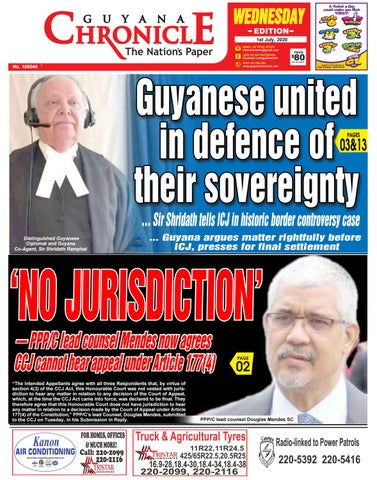
Distinguished Guyanese Diplomat and Guyana Co-Agent, Sir Shridath Ramphal
... Guyana argues matter rightfully before ICJ, presses for final settlement
‘NO JURISDICTION’ –– PPP/C lead counsel Mendes now agrees CCJ cannot hear appeal under Article 177(4)
“The Intended Appellants agree with all three Respondents that, by virtue of section 4(3) of the CCJ Act, this Honourable Court was not vested with jurisdiction to hear any matter in relation to any decision of the Court of Appeal, which, at the time the CCJ Act came into force, was declared to be final. They therefore agree that this Honourable Court does not have jurisdiction to hear any matter in relation to a decision made by the Court of Appeal under Article 177(4) of the Constitution,” PPP/C’s lead Counsel, Douglas Mendes, submitted to the CCJ on Tuesday, in his Submission in Reply.
PAGE
02
PPP/C lead counsel Douglas Mendes SC
2
GUYANA CHRONICLE Wednesday, July 1, 2020
‘NO JURISDICTION’ –– PPP/C lead counsel Mendes now agrees CCJ cannot hear appeal under Article 177(4) By Svetlana Marshall THE People’s Progressive Party/Civic (PPP/C), through its lawyers, has conceded that the Caribbean Court of Justice (ICJ) cannot hear an appeal to the Court of Appeal’s decision made under Article 177 (4). It was under Article 177 (4) that the Court of Appeal interpreted the words “more votes are cast” in Article 177 (2) (b) to mean “more valid votes are cast,” thereby reminding the Guyana Elections Commission (GECOM) of its responsibility to ensure that the election of a President is done on the basis of valid votes. Notwithstanding the fact that Article 177 (4) states that any decision made by the Court of Appeal, thereunder, is final, the PPP/C, through its General Secretary, Bharrat Jagdeo, and Presidential Candidate,
Irfaan Ali, moved to the CCJ, seeking special leave to appeal the Court of Appeal’s decision. On Tuesday, Ali and Jagdeo’s lawyers, led by Trinidad and Tobago’s Senior Counsel Douglas Mendes, agreed with North Sophia voter, Eslyn David; the Attorney General, Basil Williams; and A Partnership for National Unity + Alliance For Change (APNU+AFC) Representative, Joseph Harmon – respondents in the case – that any decision made by the Court of Appeal under Article 177 (4) of the Constitution cannot be appealed. “The Intended Appellants agree with all three Respondents that by virtue of Section 4(3) of the CCJ Act, this Honourable Court was not vested with jurisdiction to hear any matter in relation to any decision of the Court of Appeal, which, at the time the CCJ
Act came into force, was declared to be final. They, therefore, agree that this Honourable Court does not have jurisdiction to hear any matter in relation to a decision made by the Court of Appeal under Article 177(4) of the Constitution,” Mendes submitted to the CCJ on Tuesday in his Submission in Reply. He said David, Williams and Harmon were correct when they indicated, through their lawyers, that any decision made under Article 177 (4) is final and un-appealable, and as such the CCJ does not have jurisdiction to grant special leave to appeal. “It is therefore unnecessary to traverse the long list of authorities which the First Respondent’s cites on the lack of jurisdiction of the Privy Council to grant special leave to appeal, in the face of a statutory provision making decisions of the
Court of Appeal final in election petitions or otherwise,” Mendes and his team told the CCJ, Guyana’s apex court. But while admitting that the CCJ does not have jurisdiction to hear an appeal under Article 177 (4), Mendes contended that the Court of Appeal did not make a decision under Article 177 (4), “since, in the circumstances of this case, it had no jurisdiction to act under Article 177 (4).” The Court of Appeal, in handing down its decision on June 22, had first established jurisdiction before proceeding to interpret the Constitution,as sought in the case – Eslyn David v the Chief Elections Officer and others. CLEAR DISTINCTION High Court Judge, Justice Brassington Reynolds, who had formed part of the panel of judges at the Court of Appeal, had said that there is clear distinction between the jurisdiction of the Court of Appeal as outlined in Article 177 (4), and the jurisdiction of the High Court under Article 163 with respect to the validity of the elections. It was explained that while Article 163 and the National Assembly (Validity of Elections) Act could only lead to the invalidation of a person elected to the National Assembly. AG Williams from the outset had said that the decisions of the Court of Appeal made under Article 177 (4) are final as indicated by the Constitution, which ousts all other courts including the Caribbean Court of Justice. He submitted that while Parliament, under Article 123 of the Constitution, established the CCJ as Guyana’s final Appellate Court with the enactment of the Caribbean Court of Justice Act, the court’s jurisdiction is limited. In support of his argument, the Attorney General pointed to Section 4 (3) of the Caribbean Court of Justice Act, which states that “Nothing in this Act shall confer jurisdiction on the Court to hear matters in relation to any decision of the Court of Appeal which at the time of entry into force of this Act was declared to be final by any law.” “It is submitted that Section 4 (3) preserves the jurisdiction of the Court of Appeal and has overriding effect over any oth-
er provision in the CCJ Act. Through the use of the words ‘Nothing in this Act shall confer jurisdiction on the Court…’ the Parliament of Guyana saved the law which speaks to the exclusive jurisdiction of the Court of Appeal and reaffirmed the Court of Appeal as the only Court to adjudicate on those matters stated in Article 177 (4),” Williams told the Court. He explained that while the Caribbean Court of Justice Act clothes the CCJ with both an original and appellate jurisdiction, the exclusive jurisdiction of the Court of Appeal is preserved under Section 4 (3) with regards to cases brought under Article 177 (4). From all indication, he said the decisions made by the Court of Appeal under Article 177 (4) of the Constitution are final. In support of his position, the Attorney General referenced to Thornton’s Legislative Drafting (5TH Edition) and Halsbury’s Laws of England/Statutes and Legislative Process (Volume 96).“Section 4 (3) of the CCJ Act is a saving provision, the intention of which is to narrow the effect and general operation of the CCJ Act in order to preserve the existing jurisdiction conferred on the Court of Appeal under Article 177 (4) of the Constitution from its general operation,” Williams further submitted, noting that the intention of Parliament is unambiguous. He noted that while Sections 6 and 8 of the Caribbean Court of Justice Act, deal with matters of procedures with respect to the appeals to the Court, those sections are subject to Section 4 (3) which is the substantive provision under the rubric of the “Jurisdiction of the Court.” VALIDITY OF ELECTIONS David’s battery of lawyers, led by Trinidad and Tobago’s Senior Counsel, John Jeremie; and the Attorney-General had both submitted that the President does not form part of the National Assembly, and as such, the validity of the election of any person to the Office of the President cannot be determined under Article 163, as such could only be done under Article 177(4). The attorneys also rejected Mendes’ contention that Article 177 (4) could
Senior Counsel Douglas Mendes, of Trinidad & Tobago only be invoked following the declaration of the result of the election. Such a move, they warned, could lead to an absurd result with unintended consequences, Jeremie told the CCJ in his submissions. Further to that, it was submitted that the ouster clause in Article 177 (6), which is triggered after the election, clearly demonstrates why Article 177 (4) provides for questions as to validity of an election to be raised before the Chairman of GECOM declares the election of a President. “A Constitution is not interpreted to have its provisions collide with each other, especially when that would make a mockery of both Article 177 (4) and Article 177 (6),” Jeremie and team submitted. They added: “Article 177 (4) does not require a completed election of a President in order for the Court of Appeal’s jurisdiction to be invoked to interpret the Constitution, particularly in relation to matters concerning the election of a President. There is simply no qualification placed on the jurisdiction of the Court of Appeal, other than that it must concern issues related to the election of a President. The Court of Appeal may interpret the Constitution at any time, upon an application by anyone in this regard. The Court of Appeal has done so here.” On that as the basis of their arguments, the batteries of lawyers said it is clear that there can be no appeal to the CCJ with regards to matters determined under Article 177 (4) of the Constitution, and lobbied the CCJ to refuse the application for special leave filed by Ali and Jagdeo. Today, the CCJ will hear arguments on the issue of jurisdiction, the application for special leave, and the substantive matter. It will decide on the issue of jurisdiction first, before proceeding to pronounce on anything else.
3
GUYANA CHRONICLE Wednesday, July 1, 2020
Border controversy matter rightfully before ICJ … Guyana argues in presenting case for full and final settlement
By Svetlana Marshall IN rejecting Venezuela’s contention that the International Court of Justice (ICJ) has no jurisdiction to confirm the legal validity and binding effect of the 1899 Arbitral Award, Guyana, in a presentation before the Court, said the 1966 Geneva Agreement, in unambiguous terms, empowered the United Nations (UN) Secretary-General to determine an appropriate dispute resolution mechanism to enable a peaceful settlement. It was on that basis, the country argued, that the UN Secretary-General, António Guterres, rightfully referred the border controversy, which stemmed from Venezuela’s contention that the 1899 Arbitral Award was null and void, to the ICJ in 2018 for final settlement. Guyana, in its virtual presentation before the panel of judges led by the President of the ICJ, Abdulqawi Yusuf, in the case - Arbitral Award of October 1899 (Guyana v. Venezuela), said that, not only is Venezuela’s current interpretation of the Geneva Agreement illogical and erroneous, but it is in stark contrast to the interpretation the Spanish speaking country had when it signed the very agreement in February, 1966. Guyana’s Co-Agent, Sir Shridath Ramphal, and a battery of international lawyers, told the ICJ, on Tuesday (June 30), that the UN Secretary-General resorted to the Court after the Mixed Commission (1966-1970), a 12-year moratorium (19701982), a seven-year process of consultations on a means of settlement (1983-1990), and the Good Offices Process (1990-2017) failed to resolve the controversy. Venezuela, after more than 60 years of the issuance of the 1899 Arbitral Award, contended that it was null and void. The 1899 Arbitral award legally established the location of the land boundary between then British Guiana and Venezuela. Guyana has long maintained that the award was a full, perfect and final settlement and therefore remains valid to this day. RESOLVING THE CONTROVERSY Internationally recognised Legal Counsel, Paul Reichler, who formed part of the battery of lawyers repre-
Attorney-at-Law Paul Reichler senting Guyana, told the ICJ that the primary purpose of the 1966 Geneva Agreement was to resolve the controversy between Venezuela and the United Kingdom of Great Britain and Northern Ireland over the frontier between Venezuela and British Guiana. Key in the agreement, he emphasised, was the objective to resolve the controversy. In laying the foundation of his arguments on the issue of jurisdiction, Reichler explained that Articles 1, 2 and 3 of the 1966 Geneva Agreement outlined the role and responsibilities of the Mixed Commission. Under the agreement, the Mixed Commission was tasked with the responsibility of seeking satisfactory solutions for the practical settlement of the controversy. But the Geneva Agreement, he pointed out, did not stop there, it entails five other articles, and of significant importance to the case, Article IV (2). Article IV (2) states: “If, within three months of receiving the final report, the Government of Guyana and the Government of Venezuela should not have reached agreement regarding the choice of one of the means of settlement provided in Article 33 of the Charter of the United Nations, they shall refer the decision as to the means of settlement to an appropriate international organ upon which they both agree or, failing agreement on this point, to the Secretary-General of the United Nations. If the means so chosen does not lead to a solution of the controversy, the said organ, or, as the case may be, the Secretary-General of the United Nations shall choose another of the means stipulated in Article 33 of the Charter of the United Nations, and so on until the controversy has been resolved or until all the
The panel of judges led by President of the ICJ, Abdulqawi Yusuf, that heard the jurisdictional aspect of the case - Arbitral Award of October 1899 (Guyana v. Venezuela) means of peaceful settlement contemplated have been exhausted.” Reichler told the judges that it was key to note that Guyana and Venezuela have not disputed the fact that the Mixed Commission did not arrive at an agreement for the solution of the controversy, and that the governments had not reached an agreement on the means of peaceful settlement under Article 33 of the Charter. These facts, the Legal Counsel said, are confirmed in Venezuela’s Memorandum, which was submitted in November, 2019. In support of his argument, Reichler pointed to paragraph 32 of Venezuela’s Memorandum, in which it said: “Venezuela and Guyana failed to agree on the choice of a means of settlement and to designate an ‘appropriate international organ’ to proceed to do it, as provided for in the first subparagraph of Article IV (2) of the agreement…” Embedded in the Article he said is procedure for resolving the controversy in the event of an impasse. The Legal Counsel said not only that the countries had failed to reach an agreement on an international organ to choose the means of settlement, but in compliance with Article IV (2) they jointly referred the decision as to the means of settlement to the Secretary-General. Added to that, he said it is an undisputed fact that the Secretary-General formally accepted the parties’ conveyance of authority to him to decide on the means of settlement under Article 33 of the Charter, and agreed to exercise the responsibilities conferred upon him. Notably, in a letter dated April 4, 1966, the then UN Secretary-General, U Thant, accepted the functions outlined in Article IV (2) of the Geneva Agreement.
In accordance with the agreement, in 1990, the UN Secretary-General, at the time, identified Good Offices Process as the first means of settlement – a decision that was embraced by the parties involved. However, the Good Offices Process, which spanned from 1990-2017 bore little or no fruit. Reichler said it was after the Good Offices Process, after 27 years, failed to resolve the controversy that UN Secretary-General António Guterres invoked his authority under Article IV (2) and decided that the next means of peaceful settlement of the controversy under Article 33 of the Charter, shall be judicial settlement by the ICJ. These facts, he submitted to the Court, are included in Venezuela’s Memorandum of November, 2019. The Secretary-General’s decision, he further submitted, is binding on both Guyana and Venezuela and ought to be respected. “It (Article IV (2) does not say that the decision
of the Secretary General is subject to the subsequent agreements of the parties or that such agreement is required for his decision to be final or binding upon them,” the Legal Counsel told the Court. VENEZUELA’S INITIAL POSITION Reichler told the ICJ that Venezuela’s objection to the Secretary-General referring the controversy to the ICJ is not only illogical but goes against the position of its Minister of Foreign Affairs, Ignacio Iribarren Borges, who had signed the agreement in Geneva in 1966. The Legal Counsel pointed out that the Venezuelan Foreign Minister, in his address to the Venezuelan National Congress in March 17, 1966, in his quest to have the Geneva Agreement ratified, said: “Finally, in an attempt to seek a respectable solution to this problem I put forward a third Venezuelan proposal
Attorney-at-Law Philippe Sands that would lead to the solution for the borderline issue in three consecutive stages, each with their respective timeframe, with the requirement that there had to be an end to the process: a) a Mixed Commission, b) Mediation; c) international arbitration.” Borges, Reichler said, was keen on pointing out to the Venezuelan National Congress at the time, “that there exists an unequivocal interpretation that [the] only person participating in the selection of the means of solution will be the Secretary General of the United Nations and not the Assembly.” The Legal Counsel submitted to the ICJ that it was Venezuela who had proposed that Article IV be drafted so as to ensure a definitive resolution of the controversy ultimately, if so decided by the Secretary General by arbitration or recourse to the International See page 9
4
GUYANA CHRONICLE Wednesday, July 1, 2020
‘Let us await the outcome’ –– President Granger confident Appellate Court ruling will be upheld
–– says contaminated ballots cannot be counted as valid By Lisa Hamilton PRESIDENT David Granger has stated that while the journey towards an acceptable end to Guyana’s election process has undoubtedly been lengthy, the pending decision of the Caribbean Court of Justice (CCJ) is a straightforward and legal process which will lead towards the declaration of the elections results. On Monday evening, the President appeared as
a guest on the ‘Straight Up’ programme on Radio 107.1 where he spoke to the approaching CCJ case; the irregularities uncovered during the national recount and the involvement of the international community. A LEGAL PROCESS “We are now in a situation in which the movement forward is quite logical, although it is taking a long time and it’s a bit slow,” the President began, address-
ing a live audience of over 10,000 listeners. “As we know, the opposition has taken the issue of the validity of the votes to the Caribbean Court of Justice and, the day after tomorrow, Wednesday July 1, the CCJ is expected to hear arguments.” Though the President views the pursuit of the matter already declared as final by the Appellate Court as “an act of desperation” by the opposition, he nonetheless remains confident that
the ruling of the Guyana’s Appeal Court will be upheld. Come July 1, 2020, the CCJ will first determine whether it has jurisdiction to rule on the matter given that Article 177 (4) of the Constitution states that the Appellate Court’s previous ruling, that valid votes must be used to declare the election, is final. Even so, the President said that he is pleased that, thus far, nothing has been done to remove the process from the authority of the Elections Commission; the courts continue to be respected and the Constitution still prevails. “I have no doubt that in a very short time, and I hope that by this weekend, we will be able to announce to the Guyanese public that the elections process has been brought to an end and a president will be declared,” he said. INTEGRITY MATTERS Presently, the recount is only at its Third Phase and the Head of State said that the possibility of the contamination of the ballots cast, as made evident during phase one of the process, must be taken into consideration. Phase one of the recount involved the physical counting of the ballots; Phase two saw the preparation and
submission of an Elections Report by the Chief Elections Officer (CEO); Phase three should see deliberation on the said report at the commission level and, phase four, a declaration. “The process is quite straightforward that the report is not simply an arithmetic report, it is also a qualitative report,” the President said. Pointing to the report and recommendations of the CARICOM Scrutinising Team which was present during phase one of the recount, he said that one can easily discern how seriously they stressed the issue of determining the integrity of the elections process. He expounded: “The team recommended an investigation into missing documents, it recommends total re-registration of all voters in Guyana, it recommends that the structure of the Election Commission be changed, they said that it simply will not work. It finally recommended that, given all the irregularities which occurred during the period of the electoral cycle, ‘we highly recommend that a political audit be conducted of the operations.” The President urged those both in and out of the country not to run away with the impression that because the numerical tally favored one political party over the
Wednesday, July 1, 01:30hrs - 03:00hrs
President David Granger other that concerns were not raised by those who were part of the process, such as the CARICOM Team and the CEO. The irregularities highlighted during the recount include counterfoils and ballots carrying the same number; ballots for one region cast in another; ballots cast for the dead and persons who have migrated; persons voting without proper identification; persons voting outside of their districts without employment documents; large numbers of improperly stamped ballots at locations where disciplined services members voted; missing poll books; documents from one polling station being found in the ballot boxes of another and ballot boxes with no single statutory documents. “This is the reason why, on Monday the 22, the Guyana Court of Appeal ruled that votes must mean ‘valid votes’. If votes are fraudulent or votes exceed the number of people on the [Official List of Electors], they can’t be valid and this is the lesson that the Guyanese population has learnt, that people were meticulously and methodically tampering with the votes,” the President said. He has previously called out the People’s Progressive Party Civic (PPP/C) for applying a “flaking off” strategy through which ‘a little here and a little there’ amounts to a significant total of the ballots cast. A HOST OF MISINFORMATION The President said that there has been a host of See page 5
5
GUYANA CHRONICLE Wednesday, July 1, 2020
Private criminal charges brought against Lowenfield
THE People’s Progressive Party Civic (PPP/C), on Tuesday, filed private criminal charges against Chief Elections Officer (CEO), Keith Lowenfield, for alleged fraud, based on his Elections Report submitted on June 23. Filed by General Secretary of The New Movement (TNM), Daniel Josh Kan-
hai, and PPP/C activist the charge accuses Lowenfield of committing “Conspiracy to Commit a Felony contrary to Section 34 of the Criminal Law (Offences) Act”. Particulars of the alleged offence states that “the accused between the 5th day of March and 23rd day of June 2020, at Georgetown, in the Georgetown Magisterial
District, County of Demerara, State of Guyana conspired with person(s) unknown to commit the common law offence of fraud, to wit, by representing to the Guyana Elections Commission, that tables attached to his Election Report dated 23rd June 2020 accurately reflected the true results of the said election, in order to materially alter
‘Let us await ... From page 4
misinformation about the elections in Guyana and, frankly put, this must be clarified to truthfully represent the issues facing the country. He said that though his government disagrees with the sentiments shared by some from the international community, it should not be viewed as “international hostility” but as a misunderstanding of what has unfolded in Guyana, the country’s electoral system and its Constitution. Speaking on the recent input of CARICOM through its Chair, Prime Minister of Barbados, Mia Mottley, he said: “I have great respect for my Caribbean colleagues. They are concerned, Guyana is the headquarter of the Caribbean Community and, to use a cricketing expression, they stepped out of their crease to come here to bat for Guyana and I think they understand the complexity of the elections in Guyana. I don’t see them
as interfering.” Later, addressing the matter generally, he added: “The critics of the government over the last 119 days must accept that the electoral process was corrupted by the People’s Progressive Party and that has to be brought to an end.” The Head of State said that he has never interfered in the internal workings of the Guyana Elections Commission (GECOM); his government remains entirely compliant with the Constitution and he is pleased that Guyana’s election management is being left entirely in the hands of GECOM. He stated “The process is in the hands of the commission, I cannot intervene at this stage, I’ve never intervened before and I will not intervene now. We have a legal process, it is taking a long time, but it is a legitimate process and let us wait to see the outcome.”
the results of the said election with intent to defraud, knowing the said tabulation to be false”. Utilising valid votes, as ordered by the Court of Appeal, Lowenfield, last week Tuesday, had submitted his Election Report, which reflected a total of 344,508 valid votes being cast at the March 2 General and Regional Elections. The Report came months after delays brought about by several court cases and a National Recount. Lowenfield, in his report, noted that in coming to the numbers he took guidance of the ruling of the Court of Appeal in the “Eslyn David v Chief Elections Officer”, whereby it was ordered that the words “more votes are cast” be interpreted to mean “more valid votes are cast” in relation to the General and Regional Elections. Ac-
cording to the CEO’s Report, of the 344, 508 valid votes the APNU+AFC secured 171,825 valid votes while the People’s Progressive Party/ Civic (PPP/C) raked in 166, 343 valid votes. This was in contrast to the National Recount Report Lowenfield had submitted to the Elections Commission on June 13, whereby the Statements of Recount (SORs), showed that the PPP/C secured 233,336 votes, while APNU+AFC raked in 217,920 votes. However in the Elections Report the CEO was keen on pointing out to the Elections Commission that thousands of votes were compromised as a result of widespread irregularities, and alleged cases of electoral fraud. The declarations of the elections have since been stayed by the Caribbean Court of Justice pending
Chief Elections Officer, Keith Lowenfield its decision on whether or not the Court of Appeal had jurisdiction to interpret Article 177 (2) (b) of the Constitution to mean “more valid votes are cast”. The appeal was filed by People’s Progressive Party/Civic (PPP/C) General Secretary, Bharrat Jagdeo and its Presidential Candidate, Irfaan Ali.
6
GUYANA CHRONICLE Wednesday, July 1, 2020
CARICOM at 47 C ARICOM on Saturday July 4, 2020 will mark 47 years as a functioning and unified body, notwithstanding challenges from within and without, is deserving of commendation for the peoples and leaders. Where CARICOM was founded on the principle that the peoples stand to gain more through collective involvement, exploitation and development of the resources within the region, this year amidst global challenges posed by the COVID-19 Pandemic and increasing competition, it behooves intensified focusing on the principles that established the community. The success of CARICOM beyond its establishment and attendant arms is dependent on the involvement of its peoples. It may help to remember that when the conceptualisation of such a feat was being thought of and apprehension existed among the people, the Caribbean Festival of Arts (CARIFESTA) which in 1972 was first hosted here, provided the surety of the people’s abilities and endless possibilities. Given that the intent of CARIFESTA was to harness the unique cultural skills and talents within the region in a unified way, it set in train not only the celebrating of, but also employment and economic opportunities. At an international level, the Caribbean’s cultural products form part of free trade within the European Union (EU) Economic Partnership Agreement with CARICOM and The Dominican Republic (CARIFORUM). Intra-regionally, the establishment of the CARICOM Single Market and Economy (CSME) which aims to foster free movement of
goods, services and people, knowledge of its working has to become widespread and understandable to the ordinary man and woman, lest the region’s peoples continue to harbour perceptions about each other and countries, not informed by facts. While the CSME has been heralded and pursued by member-states, there still exists deficiencies and to some extent, disconnection of its aim among the people. A principal benefit citizens see is that of free movement, yet many are unaware that free movement within the community is guided by two rules: 1) normal movement around the region; and 2) movement of skills around the region within the confines of the CSME rules. Each country, as a matter of importance, should ensure its populace appreciates that free movement is not without obligations on the part of persons moving, participating countries, and host countries. Where free movement is seen as an immediate benefit to the people and opportunities for empowerment, when perceptions are held that such benefits come at the expense of respect for others, or persons can do as they choose without regard to existing laws, it creates angst and imbalance in the system. Allowing this to happen goes against the grain that established the community in the first place. Amidst grumblings of persons in some countries who feel that they are being overtaken and losing control of their way of life due to free movement, and questioning the wisdom of association in the community, the United Kingdom referendum to exit the EU and the chaos that ensued in the aftermath should serve as
Wait on the court to decide Dear Editor,
F
IRST and foremost, we congratulate the Guyanese people on their patience with what is a frustrating process for all. Guyana is a beautiful country with wonderful, hospitable people and deserves the prosperous future for all that is awaiting her. However, there is a path, if pursued, that could exacerbate divisions and lead to even greater income disparity and unhappiness. The CPSO sees the current impasse over the Elections as an opportunity for Guyana to recognise and choose a fair, inclusive, and righteous path forward. The CPSO is a non-political organisation and takes no sides in the outcome of the elections. We wish to express our concern for, yet confidence in the democracy of the Cooperative Republic of Guyana. The strength of all democracies lies in the hands of the institutions and leaders who guide and protect them. There has clearly been a breakdown in the election process and systems in Guyana and the current dispute should serve to increase our resolve to strengthen the governance and operations of the Guyana Elections Commission to ensure that never again would an election in Guyana be enveloped in such dispute over the validity of the results. The ruling party APNU+AFC has declared victory based on a June 23 report issued by the Chief Elections Officer which showed 171,825 of the votes deemed valid for the ruling party and 166,343 of the votes deemed valid for the opposition PPP/C party. However, over 115,000 votes were deemed invalid, which if counted would show the opposite result as reported by independent observers. The current conundrum is set up for rejection and invalidation of any result that eventually prevails. How can this deadlock be broken? In any election, parties compete on the basis that the outcome must be accepted as the will of the people. While each side accuses the other of trying to manipulate the result, ultimately it is the will of the people that confers legitimacy on any winner to lead the country. Since the electoral process in Guyana has clearly demonstrated its vulnerability to interference, the CPSO believes it is vitally important to the legitimacy of any declared winner and for the sake of the people and the economic future of Guyana,
for the courts to rule on the recount of votes (including the issue concerning the validity or invalidity of the disputed votes). A failure to lawfully and definitively resolve this issue will leave some 50 per cent of the people in Guyana certain that the elections were stolen by one party or the other. Guyana is a founding member of the CARICOM and hosts its Secretariat Headquarters. Both parties agreed to rely on CARICOM Observers to monitor the conduct of the elections process as well as the recount of votes cast. Given the current impasse and the necessity for Guyana’s 2020 elections to have legitimacy, it is appropriate that the Caribbean Court of Justice (CCJ) be used as the final arbiter in this matter. The CPSO appeals to the leaders of both parties to have recourse to the Court of Appeal or the Caribbean Court of Justice (CCJ), if the latter finds that it has jurisdiction to hear and determine the issue concerning the validity or invalidity of the disputed votes. This moment of great uncertainty could potentially exacerbate divisions in Guyana. However, the moment can be seized instead to bring Guyana together responsibly and to take action on building stronger governing institutions. We have faith and confidence that the leaders of both the ruling party and the opposition recognise the need for their leadership to be validated by the voice of the people of the Cooperative Republic of Guyana; and that must be ruled upon by an independent and trustworthy institution. ABOUT THE CPSO: Acting in accordance with Article 22 of the Revised Treaty of Chaguaramas (RTC), the Heads of Government, at the Fortieth Regular Meeting of the Conference of Heads of Government in July 2019, designated the CARICOM Private Sector Organisation (CPSO) an Associate Institution of CARICOM. The CPSO is to act as the “apex” institution for the private sector in CARICOM, with a mandate to contribute to the full implementation of the CARICOM Single Market and Economy (CSME). The Membership of the CPSO is comprised of private sector entities operating in the CARICOM space, including Micro Small and Medium Sized Enterprises (MSMEs). Regards
a lesson as to how little information can hurt the best collaborative intent. It is important that as regional leaders deliberate to not ignore the evaluation of the community’s performance outside of its peoples it was established to benefit, and in planning ahead ensure systems to realise same. For instance, the recognition that working together will realise benefits for each country did not commence with the establishment of CARIFORUM, but has its genesis years before through initiatives such as a smelter in Trinidad and Tobago, where it was proposed that its electricity capability and Jamaica and Guyana’s bauxite will be used to produce aluminum. A similar initiative was examined in the 1980s on agriculture. And this was in recognition that regional food security in addition to maximising natural resources would prevent food being used as a weapon to destabilise through the consumption of scarce foreign exchange. It was the intent that Guyana would have produced the agricultural products and, Trinidad, using its manufacturing prowess would produce food, thereby minimising importation and diverting exchange to other more deserving areas. The region’s food-import bill presently is over US$2B. The Food and Agriculture Organisation 2015 Report warns that “A continuation of the current CARICOM food import bill trends can only lead to further nutritional and economic impoverishment for the people of the region for generations to come.”
Examples of political immorality Dear Editor,
L
ET us go down memory lane of not so long ago. Remember opposition leader Bharat Jagdeo’s statement when he tabled the NCM? That the debate would be beneficial to Guyana? Of course, there was a debate that preceded the act of parliamentary treachery – the now infamous Charandass betrayal. We must further remember that what had been significant about this political Judas’ contribution to the NCM motion debate, was his fulsome praise of the coalition party’s socio-economic record of achievements, which in any objective House examination for such a reason of motion, would have been difficult to defeat, or fault. However, Charandass’ shocking somersault, not only contradicted what he had defended on the floor as his then party’s record of successful national development, but also
equally nail the lie that was the pretense of Jagdeo’s motion. The latter was nothing else but a naked act of seeking to remove a government by way of extra parliamentary, under the guise of constitutional means. Editor, ad nauseam, this has been stated many times over in your Letters column, for persons to understand clearly that this particular act had been the culmination of an orchestrated movement, as evident by the gradual, growing collective of disparate elements, inclusive of the Private Sector and media, spearheaded by the PPP/C opposition, that aimed at fomenting social unrest. It was evident that the resort to racism as a major tool was a means of heightening national stress, as can be clearly seen today. Yet, it must be understood that the above was a clear manifestation of what had been the new morality of fraud as the national means of justifying whatever ends TURN TO PAGE 7
GUYANA CHRONICLE Wednesday, July 1, 2020
7
We need to conscientiously embrace that human touch in dealing with our seafarers Dear Editor,
T
O the many citizens of our country, seamen and seafaring has only recently been put under the spotlight with the advent of our oil and gas industry, which is much to my satisfaction, but throughout my many conversations with my fellow citizens, there still remains uncertainty and misinformation about this industry. However, this is understandable and it is my duty to help educate my fellow citizens, to gain a better appreciation for this industry that is and has always been a necessary service/goods provider to our nation and all countries around the world. All countries worldwide import goods such as - farming and mining equipment; household amenities; food items; clothing; building materials; medical supplies; fuel to operate power grids and production industries, via the sea route. To many, these items may seem insignificant but let me hasten to add that some countries do not have an Industrial Manufacturing Sector that can produce these essential items, which by no fault of their own may be caused by the unavailability of natural resources, and should the shipping industry come to a halt, we would starve for these very items, and even stagnate as a country because of shortages of what we sometimes term as “everyday goods”. Many people do not realise that more than 80 per cent of the world’s trade is carried by sea (www.imo.org), and without the daily/weekly shipment of these supplies, many countries would face severe consequences. And this is why the old saying that “the sea is the giver and sustainer of life”, holds true from the beginning of time to this day.
At this time in our World’s history, we as the world at large are facing the existential threat of the COVID-19 virus, which has become a crippling pandemic threatening our very way of life, and everyone has banded together to do our best against this deadly pandemic. We have utilised every available means and method available to battle this virus on every front, and it is up to us to be thankful to all of our essential workers who are on the frontline in this deadly war. But sometimes, we do not recognise our other equally essential industries who are silently facing and backing up our frontline workers, and the important service they render us and by this I mean our shipping industry. I proffer this thought to all readers - medicine and medical supplies are being shipped daily at record number and speeds at this point in history to all parts of the world. It is with the gravest of considerations that I ask this question - what would happen if even for a day this integral and essential shipping industry was held up and medical goods could not be delivered? What would be the effects? I cannot even begin to fathom the immense ricochet effect this would have on the world at large, and this is why I crave that special emphasis and care be placed on this industry and by extension on the back bone, heart and lifeblood of this industry- the seafarers. I hasten to inform that some seafarers were contracted to work on board vessels for some six-eight or more months prior, and would have completed their sea service at or around January 2020, which is when China began instituting lockdowns, of which the world was to soon follow. This would have halted the many crew changes that would have occurred at that time. We are now in June of 2020 and
Examples of political ... envisaged, as a way of life, as far as the political opposition and sections of the national demographics. The experience of two decades plus of bad governance, with all acts of criminal manifestations, supports the conclusion of distortion to the national psyche, out of which the new morality has been born. It further underlined the reasons behind the numerous initiatives by the coalition government to explain the deleterious effects of such a cancerous sub social behavior to the future development of the State. We must now come to the second aspect of this course of dishonest political behaviour – the vehement objections to a new voters’ list that was to have been made possible by houseto-house registration. In this unusual protest, by the political opposition that had always supported such an electoral process, the daily frenetic clamour by the PPP/C and its phalanx of all sorts – mercenaries of varied types – signalled yet another desperate manifestation that playing according to the rules, the principles of political morality, were no longer the gold standard of accepted basic political behaviour. But this objection to house-to-house registration, which even occasioned a challenge to the court on its Constitutionality, and witnessed the hypocritical silence of the so called moralists – finally exposed by their public pronouncements that reeked of duplicity and high hypocrisy – was still another act that underlined how deeply engrained the use of intended fraud, and its actuality was becoming standard, as part of opposition electoral politics. Therefore, the third significance of this effortless use of fraud that has been brutally exposed by the coalition insistence of a full national recount of all ballots cast on March 2, and facilitated by ORDER NUMBER 60 OF THE GAZZETTED ORDER, must now be examined. The unearthing of the numerous acts of political venalities, speaks of an unbridled recklessness that was extended to what must be described as a nation’s marquee constitutional exercise of its citizens exercising THE FREE WILL. It speaks to the GROSS DISRESPECT OF THE CITIZENS, IN ADDITION TO THE DISREGARD FOR THEIR RIGHT OF ELECTORAL CHOICE. Editor, it cannot be lost on any political leader, and their followers, and the nation at large, how important a sanitised list is, and must be for the purpose of a national election, and its necessity for free and fair elections which must be transparent. But the mere fact that a major political party would have put up such a life and death struggle to abort this process, speaks as much for its political social orientation as being a promoter, supporter and upholder of electoral fraud. For any political opposition party, or any other associated type to be so recklessly bold, and brazen in utilising the method of fraud in its quest for political power, points to a disregard for the untold consequences which it must hold for national stability. The fourth example, of the political opposition deceptively ignoring the raison d’etre of the national recount, as exemplified by the dictates of the forte of NUMBER 60 OF THE GAZZETTED ORDER, EMPOWERED BY ARTICLE 162 OF THE CONSTITUTION, is another beastly example of the citadel of fraud, as a normal guide for critical solutions to na-
TURN FROM PAGE 6
tional affairs. It is an absolute defiance of one’s mental health in comprehending just how could such a signatory to a mechanism for determining credible votes, should subsequently decide to repudiate such findings, and uphold the initial tainted process, as what is legitimate.
some five months would have passed since the initial lockdown, which means some seafarers would now have been on their respective vessels for some 11-13 months due to travel restrictions, not at home with family but 11-13 months on a floating metal contraption measuring approximately 50-300ft in length and 10-50ft width, with minimal access to family, comfort and support, and with an average work day of eight-12 hours day in day out, month in month out; a full 11-13 months of scheduled wake, eat, work, sleep, repeated ad infinitum. Now, take a moment to imagine that... With lockdown being as uncomfortable as it is for all of us who are ashore, imagine how it must be for seafarers and even their families who have been without them during this trying period. Mental health is important and to have our essential personnel face such an enervating situation for 11-13 months with almost no end in sight, is agonising. My only request is that Maritime Authorities the world over be more proactive in effecting crew changes for the wellbeing and comfort of our essential human resource - the Seafarers, as they create and enact guidelines and laws in this COVID-19 era, or we may begin to have extremely undesirable experiences when it comes to the physical and mental well-being of our Seafarers as they carry out their respective duties onboard. We need to conscientiously embrace that human touch in dealing with our Seafarers, even as we observe the new normal of social distancing. Regards Garry Palmer, Marine Cadet Officer. Editor, the above are four significant and irrefutable examples that supports the fact of an anatomy of political opposition fraud, beginning with the NCM. This socio-political immorality, of course, having its genesis and growth during over two decades of degrading governance. Regards Carla Mendonca
8
GUYANA CHRONICLE Wednesday, July 1, 2020
Jagdeo agrees that valid votes must determine declaration –– but pushes for recount data with anomalies, irregularities, voter impersonation
LEADER of the Opposition, Bharrat Jagdeo says that the People’s Progressive Party/Civic (PPP/C) agrees with the APNUI+AFC that an election declaration must be made based on only valid votes, but believes that the version of the recount data which shows over 4,000 cases of voter impersonation, and over 2000 anomalies should be used to make a declaration in his Party’s favour. “We’re not challenging the validity of the votes; the Court of Appeal ruling that ‘votes’ in our Constitution mean ‘valid votes’ is a non-issue, because it couldn’t mean invalid votes,” the Opposition Leader said on Tuesday during an Online briefing. However, he went on to argue that the Guyana Elections Commission (GECOM) has already determined what the valid votes are through the national recount, and based on and in accordance with the Representation of the
People Act. Yet, the Opposition Leader failed to take into consideration Order No. 60 (the recount Oder) which speaks to the determination of “a final credible count” based on the “reconciliation of the ballots issued with the ballots cast” against a number of statutory documents. NO ISSUE WITH VALID VOTES High Court Judge, Justice Brassington Reynolds, who formed part of the panel of judges at the Court of Appeal in the Eslyn David v Chief Elections Officer (CEO) et al case, drew attention to the fact that under Order No. 60, the objective was set to determine the “final credible count”. “Accordingly, I find that GECOM does have a responsibility to determine the final credible count of the results. It would be reasonable to presume that
the final credible count would require both quantitative and qualitative assessments of reports, and the summary of observations submitted to the Commission in compliance with Order No. 60 of 2020,” Reynolds had stated. However, though supporting a declaration based on valid votes on Tuesday, the Opposition Leader simultaneously pushed for the version of the recount data highlighted by the CEO as having over 4,000 cases of voter impersonation and over 2000 anomalies. He argued that the results should be declared on the recount data as is; that any contention should be made through an elections petition, and the Court of Appeal had no jurisdiction to rule on the matter. “We don’t have any issue with any Court saying that ‘more votes cast’ means ‘more valid votes’, because we agree with that, in principle; it
Gold mining restricts Amazon Rainforest recovery —new study THE ability of tropical forests to recover from gold mining activities has remained largely unquantified, an international study led by the University of Leeds has revealed. The study is said to be the first to provide detailed field-based information on the regeneration of forests in Guyana after gold mining, and the first ground-based estimate of carbon sink lost as a result of gold mining activities across the Amazon. The study estimated that mining-related deforestation results in the annual loss of over two million tons of forest carbon across the Amazon. The lack of forest regrowth observed following mining suggests that this lost carbon cannot be recovered through natural regeneration. The team’s findings, published in the Journal of Applied Ecology, found that forest recovery rates on abandoned mining pits and tailing ponds are amongst the lowest ever recorded for tropical forests. At some sites there was nearly no tree regeneration even after three to four years since mining had stopped. Lead author, Guyanese Dr Michelle Kalamandeen, now a post-doctoral researcher at the University of Cambridge (UK) and Laurentian University (Canada) said: “This study shows that tropical forests are strongly impacted by mining activities, and have very little capacity to re-establish themselves following mining. Our results clearly show the
extraction process has stripped nitrogen from the soil, a critical component to forest recovery, and in many cases directly contributed to the presence of mercury within neighbouring forests and rivers. Active mining sites had on average 250 times more mercury concentrations than abandoned sites. “Not only does this have serious consequences for our battle against global warming by limiting Amazonian forests’ ability to capture and store carbon, but there is also a larger implication of contaminating food sources, especially for indigenous and local communities who rely on rivers. A positive finding from this study shows that overburden sites, areas where topsoil is deposited during the mining process, recorded similar recovery rates as other Central and South American secondary tropical forests abandoned after agriculture or pasture. “We could be facing a race against the clock. The current crisis is significantly increasing the demand for gold, given its perceived role as an economic stabiliser. With current gold price more than US$1700 per ounce and estimated to reach US$2000-3000 in the coming months, many artisanal and small-scale miners are already rapidly responding to this increase in pricing, and the weakening of environmental laws and policies as we’ve seen in Brazil, leading to further deforestation in the Amazon…”
couldn’t mean otherwise. What we have gone to the Court on is because [the Appeal Court] exceeded that jurisdiction, and interfered with the process of how a President could be challenged, and how the results of the elections could be challenged, and took jurisdiction in areas where they had none,” he said. JURISDICTION JUSTIFIED His party’s position, which it has brought to the Caribbean Court of Justice (CCJ), is that GECOM is a Constitutional body, and therefore the Court cannot give the Commission orders on what it should do. However, it is based on this position, shared by the Court of Appeal, that it clearly stated during Eslyn David’s case that it has jurisdiction, and subsequent ruling on the matter was based on the powers vested upon it in Article 177 (4) of the Constitution to provide an “interpretation” of Article 177 (2) (b). Article 177(4) of the Constitution states: “The Court of Appeal shall have exclusive jurisdiction to hear and determine any question as to the validity of an election of a President, in so far as that question depends upon the qualification of any person for election, or the interpretation of this Constitution; and any decision of that Court under this paragraph shall be final.” As was later explained by APNU+AFC Elections Manager Joseph Harmon in a written submission to the CCJ by his Trinidadian attorneys, Reginal T.A. Armour and Raphael Ajodha: “In other words, the Court of Appeal made no determination as to whether the votes cast were valid or not, and, imposed no criteria by which the validity of votes would be determined. The Court of Appeal
simply exercised its jurisdiction in a limited manner to interpret Article 177 (2) (b) of the Constitution to mean ‘more valid votes are cast’.” AGAINST ‘VALID VOTES ONLY’ REPORT It was on that basis that CEO Keith Lowenfield submitted his Elections Report to the Elections Commission, using only votes which could be validated. “I have taken note of the guidance of the Court of Appeal in Eslyn David v Chief Elections Officer et al in the preparation of my Report under Section 96 of the Representation of the People Act and providing advice as required by Article 177 (2) (b) of the Constitution of the Cooperative Republic of Guyana,” Lowenfield said in his Report submitted to GECOM Chair, Justice (Ret’d) Claudette Singh on June 13. However, during his Online briefing, Jagdeo maintained his party’s challenge to Lowenfield’s report, contending: “The Court never established the criteria by which the validity of votes would be determined, so, how then would Lowenfield determine that he, unilaterally, citing the Court of Appeal decision, can invalidate 115,000 valid votes. What criteria did he use?” To answer this question, one must return to the Court of Appeal’s ruling that the words “more votes are cast” should be interpreted to mean “more valid are votes” --- which the Opposition Leader states his Party agrees with. One must note the basis upon which the Court made its ruling, as stated by High Court Judge, Justice Brassington Reynolds. He said that under Order No. 60, the objective was set that “…the final, credible count would require both quantitative and qualitative assessments of re-
Leader of the Opposition, Bharrat Jagdeo ports and the summary of observations submitted to the Commission in compliance with Order No. 60 of 2020.” Therefore, in answering the question of what constitutes a “valid” vote, one must return to Order No. 60 and which was made by the Elections Commission pursuant to its powers under Article 162 of the Constitution and Section 22 of the Elections Laws (Amendment) Act, No. 15 of 2000. The Order outlines the need for the “reconciliation of the ballots issued with the ballots cast, destroyed, spoiled, stamped, and as deemed necessary, their counterfoils/stubs; authenticity of the ballots and the number of voters listed and crossed out as having voted; the number of votes cast without ID cards; the number of proxies issued and the number utilised; statistical anomalies; occurrences recorded in the Poll Book.” The Merriam-Webster Dictionary defines the word ‘reconcile’ as “to make consistent or congruous”. If this is not achieved in some cases during the process, then reconciliation in those cases is not achieved. Even so, the Opposition Leader maintains that the Commission is not bound to accept the CEO’s report, and that “a decision has already been made by the Commission to use the recount data”.
9
GUYANA CHRONICLE Wednesday, July 1, 2020
10 new COVID-19 cases in 24 hours – CMO says full effect of the disease on the human body still unknown
GUYANESE continue to underestimate the severity of the novel coronavirus (COVID-19), and as result of their callous behavior, there is a consistent rise in the number of cases. Testimony to the consistent increase are the 10 new cases which were discovered after authorities tested 26 persons between Monday and Tuesday. Chief Medical Officer (CMO), Dr. Shamdeo Persaud, said authorities have so far tested 2,578 persons, with 2,333 being negative and 245 being positive. Of the positive cases, 114 persons have recovered and 12 persons have died, but authorities are contending with 119 active cases, of which 118 are in institutional isolation and one in the COVID-19 Intensive Care Unit (ICU). “Fellow Guyanese, you can see what the current statistics are saying to us. I wish to reiterate that we are a long way from returning to normal as a result of the continuous spread of this disease,” said Dr. Persaud during a virtual COVID-19 update, on Tuesday. With this disease being embedded in some of the “hardest to reach” areas in the hinterland region, and even along the coastland, the behaviour pattern, which is a part of the local culture that persons choose not to change, continues to be the platform that is fuelling the transmission. The CMO reminded persons that they have the option to change this pattern, but it requires personal sacrifice from everyone. In sharing his advice,
Dr. Persaud said: “We understand that Guyanese are very hospitable and friendly, it’s what we are known for around the world, but I am asking that we do this from a distance and with our masks on.” There are examples of what is needed to stop the spread of this disease, some right in the Caribbean region. “If you have been paying attention you will recognise that the longer this disease is around, the more our economy will be affected, the longer our health workers and health system will be under a lot of pressure, the longer our children’s education will be affected,” Dr. Persaud lamented. Local and international authorities have no yet ascertained the full effect of COVID-19 on the human body. But, it is certain that persons can recover from the coronavirus disease although they may develop other conditions that they did not have. In some cases, those new conditions can lead to death. The safety of every Guyanese is dependent on the compliance with control measures, which were implemented by local health authorities to contain the spread of the disease. Region Four (Demerara-Mahaica) is still the epicentre of the disease, and there are a number of communities outside of Georgetown which have recorded cases. Among communities on the East Coast of Demerara (ECD) where cases have been recorded are: Atlantic Gardens, Friendship, Golden Grove, Good Hope, Lusignan, Plaisance, and
Strathspey; among those on the East Bank of Demerara (EBD) are: Diamond, Grove, Land of Canaan, Providence, and Timehri. There is, however, a worrying development in Moruca, Region One (Barima-Waini), where over 20 cases have been recorded in a short space of time. This has prompted health authorities to label the community as the epicentre for Region One. “We call again on the residents of Moruca and those of the mining communities in Region Seven (CuyuniMazaruni) to heed the warning. This disease is easily transmitted when you are in close contact with someone who is positive,” Dr. Persaud warned. Health authorities have found that a large number of positive cases, in both of these regions, have no signs and symptoms, so they are asymptomatic. These persons can transmit this disease and the infected person will not even know that they are sick because there is no sign. Toshaos and village councillors, operations owners all have a role to play in this pandemic. Dr. Persaud called on them to impress upon villagers and workers the importance of what is being said. All of the evidence points to the fact that if the guidelines are followed, the disease will be contained. Considering the situation, Dr. Persaud had said residents of the community need to “be on guard” and take all necessary precautions in order to prevent further spread of the disease. “We are urging you to support the health team in
Chief Medical Officer, Dr. Shamdeo Persaud this area by coming forward for testing if you have been in contact with anyone who has tested positive; by staying home unless it is necessary for you to come out, and if you must come out, ensure that your noses and mouths are covered. “We ask that there is no congregating of persons, and that all passenger vehicles adhere to the guidelines that were provided. “We wish to also remind you of the runaway situation in neighbouring Brazil that has climbed to the position of being the second country in the world to have reported cases with an alarmingly high number of deaths registered,” said Dr. Persaud. COVID-19 remains a serious issue not just here in Guyana, but globally as well, and according to global statistics, there are ten million cases of COVID-19, with over 499,000 deaths. And, with no approved treatment or cure, there is no assurance that persons will survive after contracting the disease. In the absence of approved medications, governments and authorities across the world have employed a number of preventive measures to contain the spread of the disease.
IRO calls on political parties to help foster peace THE Inter Religious Organisation (IRO) is calling on the respective political leaders of Guyana to take charge and urge their supporters to remain calm and peaceful as the Caribbean Court of Justice (CCJ) hears arguments in the elections challenge case. The organisation, in a statement wrote, “IRO continues to pay close attention to the political situation in Guyana. We understand the enormous implications of these elections and we continue to pray and thank God for keeping the citizens engaged, yet calm and respectful. It is obvious that the
COVID-19 threat and the political impasse, present a perfect storm of stress for the citizenry.” Additionally, the organisation stated that to reduce the likelihood of any potential fallout, suggested that the political leaders meet publicly and address the issue of peace and calm and the acceptance of the results, regardless of which party wins and also that the followers of political parties tone down their vitriolic statements on social media and other means of expression. IRO further stated that persons should refrain from wearing party colours to avoid conflict among each other.
The organisation also made a call to media outlets to do their part in publishing content that lends to peace and unity, as well as promote unity and love by playing unifying music, particularly until the results are announced and the dust has settled. Additionally, they urged all religious bodies in the country to uplift the country in prayers. “The IRO believes that in unity there is strength and that if as Guyanese we remain prayerful and join hearts, these difficult times will pass without any escalation of violence or civil unrest, With God’s help we can do this!”
Border controversy matter rightfully ... From page 3
Court of Justice. “There is thus no doubt, Mr President, from the terms of the agreement, the negotiating history or the statements by the parties immediately following its conclusion that Article IV (2) was intended to assure that there would be a final resolution of the border controversy, that the Secretary General was empowered to decide on the means of settlement to be employed, choosing among those listed in Article 33 of the Charter and that the parties understood and intended that if the Secretary-General so decided that the controversy would be settled by the ICJ,” Reichler said. He added: “This was Venezuela’s understanding of the Geneva’s agreement and of Article IV (2) in particular at the time it signed and ratified the agreement in 1966 that he Secretary General was empowered to decide on the means of settlement including recourse to the ICJ and his decision would be final and binding on the parties.” Reichler told the Court that Venezuela’s President, Nicolás Maduro, was therefore wrong to suggest that the Geneva Agreement provides for border controversy to be resolved by the two countries only through friendly negotiations. He noted that none of Venezuela’s objections to the Court’s jurisdiction have merit. Attorney-at-Law Philippe Sands, in his presentation, told the ICJ that all the conditions established by the Geneva Agreement were properly implemented and in accordance with those provisions, the UN Secretary-General, from 1983, was entrusted by the parties to determine the means of settlement of the controversy. He too pointed out that it was after more than 25 years of the Good Offices Process, that the UN Secretary-General, in 2018, selected the ICJ as the means of settlement. Such decision was carefully considered and most importantly lawful, Sands told the Court. “The Secretary-General’s decision was appropriate and inevitable. It was a recognition of the need to bring a fair and final end to a long-standing and destabilizing controversy,” Sands told the judges. He submitted that the UN Secretary-General could not have gone on with the Good Offices Process indefinitely even as Guyana stood a victim of acts of aggression at the hands of Venezuela. “Mr President, Members of the Court, the record is clear, more than 50 years have passed since the signing of the agreement. Four years were fruitlessly spent before a Mixed Commission (1966-1970); 12 years were then spent on an equally unavailing suspension of the Geneva Agreement from 1970-1982; 37 years ago this week, Guyana and Venezuela jointly entrusted the Secretary General with exclusive, unfettered and irrevocable responsibility of selecting the means of settlement of the controversy. After six years of further discussions between the parties and the Secretary General’s representatives, the Good Offices Process was established in 1990 with enhanced mandate of mediation for the year 2017. That means of settlement ran its course for more than a quarter of a century [and] it has produced no progress whatsoever,” Sands told the Court. During the Good Offices Process and the other dispute resolution mechanisms, which were employed, there have been several incidents involving military force, coercion and bullying by the Spanish-speaking country against Guyana. Military Force and the threat of force included Ankoko Island, Cuyuni occupation (1966); the Sponsored Rupununi uprising 1969; the Leoni Decree – the attempt to seize territorial sea (1968); assault on Eteringbang outpost 1970 and innumerable subsequent military acts; the military seizure of Technics Perdana — seismic survey vessel of Anadarko in 2013; and most recently, the attempted boarding of seismic vessel Ramform Tethys (December 22, 2018). Meanwhile, in offering opening remarks, Sri Shridath told the ICJ that the case is of significant importance to the people of Guyana who are united in their defence of their sovereignty and territorial integrity of their homeland. Reichler, Sands and Sir Shridath presented alongside Payam Akhavan, and Alain Pellet – all of whom are international recognized legal luminaries. In a string of convincing arguments, they submitted that the ICJ had jurisdiction to hear the case, and should proceed to hear the substantive matter. The hearing was conducted at the Peace Palace in The Hague with virtual presentations being done by Guyana in light of the COVID-19 pandemic. Guyana’s Agent, Carl Greenidge, who led the delegation and Representative of the Opposition, Gail Teixeira; Ambassador Audrey Waddell; former Minister of Foreign Affairs, Rashleigh Jackson and Ambassador Cedric Joseph, listened to the hearing from the Ministry of Foreign Affairs, Georgetown. The ICJ said it will announce a date for the ruling on jurisdiction shortly.
10
GUYANA CHRONICLE Wednesday, July 1, 2020
Mayors say Court of Appeal ruling final … urge swift swearing-in of President Granger
THE Mayors of Mahdia, New Amsterdam, Bartica and Linden, have jointly stated that the Guyana Elections Commission (GECOM) is in its right to declare President David Granger as President of Guyana based on the report of the Chief Elections
Officer (CEO), following the guidance of the Court of Appeal which is final. This was their message in letter released on Tuesday and signed by Mayor of Bartica, Gifford Marshall; Mayor of Linden, Weneka Arrindell; Mayor of Mahdia, David Adams and Mayor
Mayor of Bartica, Gifford Marshall
Mayor of Linden, Weneka Arrindell of New Amsterdam, Winifred Heywood. Though the Caribbean Court of Justice (CCJ) case challenging the Court of Appeal’s jurisdiction to rule that the election of a President must be made on valid votes cast comes up for arguments today, the Mayors pointed to Article 177 (2) (b) of the Constitution as proof that the Appellate Court’s ruling is final. In deciding that it has jurisdiction in a case brought by Eslyn David on June 18, 2020, the Court of Appeal had ordered that the words “more votes are cast” in Article 177 (2) (b) of the Constitution be interpreted
Mayor of Mahdia, David Adams
Mayor of New Amsterdam, Winifred Heywood
to mean “more valid votes are cast”. Article 177 (4) of the Constitution makes the court ruling final, though the opposition wants the Appellate Court’s decision to be set aside by the CCJ. However, the Mayors put forward that it is based on the ruling of the court, which is final, that the CEO prepared and submitted his report of only valid votes cast, which should stand as the guidance from which a declaration is made. “After the completion of this verification, the Chief Elections Officer, Mr. Keith Lowenfield, guided by Section 96 of the People’s Rep-
resentation Act, Article 177 (2) (b) of the Constitution of the Cooperative Republic of Guyana and the Court of Appeal in Eslyn David v Chief Elections Officer et al, submitted his repot on June 16, 2020. This report, which is solidly undergirded by the law, clearly shows that the APNU+AFC Coalition won the March 2, 2020 elections,” their statement indicated, adding: “Having regard to the aforementioned, we call on GECOM to complete this election process by making a declaration based on the Chief Elections Officer’s report.”
Commonwealth floats rapid mapping technology to help Caribbean during hurricane season POWERFUL satellite technology can help Caribbean countries better manage natural disasters and boost climate resilience, as the region braces for a busy hurricane season, the Commonwealth Secretariat has said. A virtual event co-organised by the Commonwealth Secretariat and the UN Institute for Training and Research (UNITAR) showed how remote sensing satellite technology was recently used to support Asian and Pacific countries in responding to super cyclones, Amphan and Harold. These cutting-edge tools, provided by the UNITAR Operational Satellite Applications programme (UNOSAT), are even more vital as the Caribbean grapples with multiple threats linked to both climate disasters and the COVID-19 pandemic. Experts predict up to 10 hurricanes in the Atlantic by the end of the year. Commonwealth Secretary-General, Patricia Scotland, said: “Responding effectively to these complex challenges of disease and disaster will rely more than ever on data that is accurate, reliable and timely, as well as country cooperation to share knowledge, experience and expertise. “Our partnership with UNITAR and other key networks through the Commonsensing Project will help generate the data countries need to inform critical decision-making during times of crisis. It will also lead to more effective climate projects in the long-term and more robust applications for climate finance.” UNITAR Executive Director, Nikhil Seth, added: “Satellite data and analyses are very powerful in providing hard evidence to back actions and policy decisions on disaster response and risk management. With
Cyclones Harold and Amphan in the Asia Pacific for instance, UNITAR was able to generate data and analyses within 24 to 48 hours of the crises. “Following analyses included the location and extent of damage to infrastructure and crops. We were also able to provide early and advanced information for crisis planning, such as mapping food security and predicting which areas would be hit the hardest by a disaster.” Through the Commonsensing Project, the data will also help refine applications for climate finance from international donors. This builds on ongoing work by the Commonwealth Climate Finance Access Hub (CCFAH), which has, to date, raised US $33.6 million for 75 climate projects in Commonwealth small states. Additional funding of US$575< has been applied for, pending approval. The Commonsensing Project currently supports Fiji, Vanuatu and the Solomon Islands to strengthen capacity and bridge data gaps to improve access to climate finance, enhance climate policies and reduce the impact of climate-related disasters. The project is funded through a £9.6M grant from the UK Space Agency, supplemented by contributions from project partners, matched with in-kind contributions from the Governments of Fiji, Vanuatu and Solomon Islands. It is implemented by a consortium of international partners, led by the United Nations Institute for Training and Research (UNITAR), in collaboration with the Commonwealth Secretariat, the Satellite Applications Catapult, Devex International, the UK Met Office, Sensonomic, the University of Portsmouth and others.
11
GUYANA CHRONICLE Wednesday, July 1, 2020
TT police say they have foiled plot to destabilise country … at least two killed By Peter Richards PORT OF SPAIN, Trinidad, Jun 30, CMC – The Trinidad and Tobago Police Service (TTPS) Tuesday said that they had foiled a “well-orchestrated plan to destabilize the country” and had arrested 72 people as protesters blocked roads, fired gunshots demanding that the officers involved in the deaths of three men last weekend by police be brought to justice The police confirmed that one person has died as a result of the protest on Tuesday and said that “investigations are underway to determine the cause of her death” Media reports identified the woman as Ornella Greaves, 30, who died while being treated at the Port of Spain General Hospital for gunshot wounds. There were also unconfirmed report that one man also died as a result of the protest. The police said that “so far, 72 persons have been arrested, and others are expected to be charged when investigations are completed,” adding “intelligence has revealed that this was an orchestrated plan that was led by several gang members, whereby the intention was to use the shooting of the three young men a few days ago, as a front to cover the planned plot to shut down the country”. Police Commissioner Gary Griffith is quoted in the statement as wanting to remind the public that he was clear just a few days ago, when he stated that any police officer charged for a violent crime, should be removed from the Service, as we are expected to be at a higher standard. “However, it is unacceptable that some, in their desire for justice, can expect any law-abiding citizen to justify this demand by condoning others to break the law, as was done today. “This was a well-orchestrated plot by certain gang leaders in the hope to get national support, when they commenced their plan to cause mayhem, fear, and destruction throughout the country. This was wishful thinking, as it has only exposed who the real enemy is, when the nation saw it for themselves, via the plan to destabilize the country,
and put law-abiding citizens in harm’s way<” the TTPS said in the statement. It said that based on prior intelligence, mere hours before these criminal elements commenced their act, the TTPS was prepared. “The plan to shut down the country involved setting fire to certain places, from along the Beetham to Port of Spain, and when police officers arrived, they would be fired upon. The plan was to kill police officers and to shoot up police stations. These same criminal elements used the opportunity yesterday and again this morning, to rob law-abiding citizens.” The police said that this sort of illegal conduct “was to continue with wild random shots to be fired throughout the country to cause further havoc. This included shots being fired at the Office of the Attorney General, which was actually done. “On several occasions, shots were also fired at police officers in different parts of the city. The plot was to also block roads in the hope that it would shut down the country.” Griffith said that “their plan failed miserably and the TTPS is in full control” He said with the immediate and strong assistance of the several arms of the security services, “we were able to quell any disturbance within minutes of the commencement of the plan”. National Security Minister Stuart Young had earlier described as “carefully orchestrated and prepalled” the protests that started in the eastern part of the capital and that he was “demanding that the criminal elements who are using the opportunity” to stir up the protest to end their actions. “I understand people being emotionally upset about the incident that may have taken place on Saturday, but it has become very obvious very quickly as a result of human intelligence provided and other means of intelligence that many of these incidents… shooting in particular are being stirred by the criminal elements”. Young also confirmed that the security forces had detained Fuad Abu Bakr, the son of the Muslim leader, Yasin Abu Bakr, who in 1990 had staged an unsuccessful coup here. The elder Bakr, speaking at a news
Yasin Abu Bakr (in white) flanked by attorney Christon Williams at news conference (CMC Photo) conference later demanded the “immediate release” of his son, and calling on the authorities to indicate what crime his son had committed. Bakr told reporters that his son, as the leader of a political party, had every reason to be able to address supporters and that the video of his arrest “clearly shows he is not resisting. “You can clearly see no violation of the law, they just come and take him away,” Bakr said, adding that the whereabouts of his son is ‘causing great concern” to the family. Attorney Christon Williams, said he plans to file a habeas corpus motion in the courts if Bakr, the leader of the New National Vision party is not released on Tuesday. Bakr said he was urging persons to engage in peaceful protest, adding “I would urge all the protesters not to be drawn into a fire fight with the police. “At the end of the day we will achieve some measure of justice,” Bakr said, referring to the deaths of Joel Jacob, Noel Diamond and Israel Clinton last weekend by police as “extra judicial justice”. The police shootings came one day after an officer, Allen Moseley, 32, attached to the Guard and Emergency Branch (GEB) was shot dead in Morvant. But Police Commissioner Griffith has denied any link between the murder of the police officer and the deaths of the three men. In its statement, the TTPS said that the CCTV footage was able to see in “real-time, every incident, of certain gang members lighting fire to tyres and throwing debris and even overturning vehicles to block roads throughout Port of Spain and environs”. It said that the operation “is ongoing” and that Grif-
fith has directed that “the Alert State for the TTPS remains at red, and the nation would be under heavy police surveillance for the next 48 hours. “Police officers would be positioned at strategic locations, both overt and covert, to ensure that
those few criminal elements cannot destabilize the country as was planned. “CCTV footage at every site where fires were started and roads blocked, show clearly the faces of the perpetrators, some known to the police, and would be used to find them and have them arrested,” the statement said. Griffith said that it is “hoped that this incident and plot by a few, to destabilize our great nation, clearly shows who the real enemy of the State is, and it is definitely not the dedicated men and women of the Trinidad and Tobago Police Service”. He has given the assurance that incident involving the deaths of three men “is being thoroughly investigated, both by the TTPS and also the independent body of the Police Complaints Authority (PCA) and when the findings are completed,
the nation would be informed and the TTPS would act in accordance with what was revealed”. Meantime, attorney Williams has sent a letter to Griffith demanding the immediate suspension of the police officers involved in the incident. “The issue we pose is of great public concern. It was widely circulated in the daily newspaper and on social media that officers killed three in or around Second Caledonia, Morvant on the 27 June 2020,” he wrote, adding “forgive my curt tone but our clients were killed on the “police exercise” we term to be an extra-legal arbitrary and/or summary execution”. He told reporters that Griffith has been given a Thursday deadline, following which he would be going to the courts to seek judicial reviews related to the matter.
12
GUYANA CHRONICLE Wednesday, July 1, 2020
Parents in last-minute revision … as national assessment with NGSA pupils gets underway today By Tamica Garnett
IN Belle West on the West Bank Demerara, parents Shivanie and Desmond Garnett spent the day on Tuesday revising as best they could with their son, Jeremiah, who will be among the 14, 730 pupils writing the National Grade Six Assessment (NGSA) which gets underway today. Hoping to be as prepared as possible, Jeremiah spent his final day of studying, reviewing past papers and other notes that he had made over the past few months. “I think I am prepared enough,” the 11-year- old said. The Belle West Primary School pupil is just happy to finally get the exams over with, given the long wait he and his peers endured after the exams were postponed earlier this year. “I feel excited that it’s going to finish soon, but also nervous about not knowing what is coming,” Jeremiah said. “I didn’t feel good when it was pushed back, but I’ve been going through the books and past papers.” Twelve-year-old Sarah Peters from St Angela’s Primary, in the city, said she has been affected by the school closures as a result of the COVID-19 situation, and does not feel that she is at her best. “I don’t feel that I’m as prepared, due to the fact that we’ve been home for a bit of time,” Peters said. The NGSA will see the children writing examinations in Mathematics, English, Science and Social Studies. It is their score in these examinations that will determine how they are placed at secondary school. On Wednesday, the children will write English Papers 1 and 2 in the morning, and Science Papers 1 and 2 in the afternoon. The exams will conclude on Thursday, when they write Mathematics Papers 1 and 2 in the morning session, and Social Studies Papers 1 and 2 in the afternoon. Jeremiah and Sarah both shared that Science is the subject that they foresee being their greatest challenge going in. Jeremiah believes that his best area will be English, while Sarah said she is most looking forward to the Mathematics. “A lot of people don’t like Maths, but I really like it,” Sarah said. “I love the chal-
Jeremiah Garnett doing some last-minute Twelve-year-old Ashley Ram hard at studies with his father, Desmond, ahead work with her mom, Melissa (Photos of the start of his NGSA examinations by Adrian Narine) today Jeremiah’s mother, Shivanie, a schoollenge that it gives me, but science gives me teacher herself, said that during the period at a challenge I don’t like,” she added. home, she created a timetable to ensure that Jeremiah continued to study, even after the VERY TAXING TIME schools closed, and in spite of the distractions The preparation for and writing of the and challenges at times. NGSA is customarily an apprehensive time “Sometimes he would have to be studying for Grade Sixers, but with the situation of when his brothers are playing, or they may schools being closed and the exams being be watching something on TV, so he would postponed for two months, it was an added feel bad about having to be left out of that,” time of anxiety for both the eager parents Shivanie said. and kids. “I feel good about it; I am not too 100% NGSA is customarily written in April, confident about it, because of the break in the and was initially scheduled for April 8 and school,” she added 9 of this year, however, Guyana recorded Lamheimant Ram, of Albouystown, said its first case of the COVID-19 on March 21, that his daughter, Ashley, also struggled with and schools closed indefinitely shortly after. staying focused during her time at home. “It Due to the closure of schools, parents found was a challenge to keep her focused, and we themselves having to step up to the plate and were worried, not knowing if it would’ve play an even bigger role than usual. been cancelled altogether until next year,” the “I never believed in leaving everything up young father said, adding: “Then when they to the teacher, but for the couple of months announced the new exam dates, it was short they lose out on with not going to school, notice, and to get her back in the groove was they weren’t able to push in a lot, because a little challenging.” the teachers would know the curriculum and For the past two weeks, however, to help what they think the student should know for the situation, schools were reopened for the the exam. But what her teacher has been doing Grade Six children to have classroom sessions is giving them little, little quiz,” explained with their teachers, who were also assisted by Denise Peters, Sarah’s mother. teachers from the other grade levels. To fill
Jeremiah Garnett and his mom, Shivanie in the gap, while the children were at home, many teachers worked with their charges remotely, by sending work over the Internet to the parents. However, Ram shared that for his daughter, there was an added challenge, due to difficulties with their Internet. “Other kids had Online classes, but we didn’t, because only two weeks ago we finally got the Internet. We tried our best to prepare her as much as possible with extra home study,” Ram said. He said that Ashley usually scores above 80 per cent during her end-of-term examinations throughout grade school, but had fallen behind a bit last year when there was a curriculum change. Ashley was particularly looking forward to this final school term before the exams to pick up back her grades. Nonetheless, he is confident in his daughter’s ability to perform well, and notes that regardless of how it goes, he knows that Ashley will do her best. “Before, in December term, we were looking at either 85 to 90 per cent. Her teacher did say she could be in the 90s, but then with how we have to rush and teach stuff, my expectation is between 80 to 83 per cent; but I’m not fighting up,” Ram said.
Gov’t rolls out distribution of COVID-19 Public Assistance vouchers
THE Government of Guyana through the collaborative efforts of the Ministry of Finance, the Civil Defence Commission (CDC), the Ministry of Social Protection, COVID-19 Task Force Secretariat and the Guyana Post Office Corporation, has commenced the distribution of the COVID-19 Public Assistance vouchers to eligible persons. Beneficiaries were required to apply online, or by calling the Ministry of Social Protection to register for the COVID-19 Public Assistance Programme. The programme targets single-parent households, households in which one or more persons suffered a loss of income due to COVID-19 and households that are managed by elderly persons or persons living with disabilities. Following a verification exercise by the Ministry of Communities, during Phase One of the programme, 1700 persons were deemed eligible to receive the vouchers on the coastland. Eligible persons living on the coastland will receive the vouchers via the Post Office’s registered mail system and would be required to sign upon receiving them. These vouchers can be en-cashed at several supermarkets
across the country and will provide recipients with fresh foods, dry ration and sanitation items. Eligible hinterland residents will receive packaged hampers, which cater to their Indigenous diets. Recipients would then be required to select a supermarket from the list accompanying the voucher and call ahead 24 hours before they intend to uplift the items covered by the voucher. The name and identification card (ID) number of the recipient must be provided. On the following day, recipients are required to visit that supermarket, taking with them the voucher and their ID Card. These must be presented to the supermarket representative, who will verify the information. Once verification has been completed, the recipient will be issued with a package containing the items covered by the voucher. Recipients must observe the Ministry of Public Health’s COVID-19 protocols including the wearing of a mask, sanitising of hands and physical distancing. The voucher is not transferable and cannot be redeemed for cash. In the meantime, persons who may be eligible but have not yet applied
can still do so. The application form can be downloaded from the Ministry of Social Protection’s website at https:// mosp.gov.gy/ or https://government.gy/eform/241. Persons who do not have internet access, contact can be made with the Ministry of Communities or the Ministry of Social Protection on toll free numbers listed below to have your application form completed by an Officer: Mondays to Fridays 08:00 am to 12:00 noon 264 2690|225 6202| 227 4410| 232 0952| 337 2667 Mondays to Fridays 12:00 noon to 5:00pm: 615 0507| 615 9495| 615 9990| 615 7839|665 2271| 615 9727| 615 7829 Saturdays and Sundays 09:00am to 5:00pm 615 9730| 615 9704| 615 9825| 615 9729| 615 9518| 615 8474| 616 2576 Shortlisted applicants will be contacted for verification purposes before support is released. Only eligible applicants will receive the assistance. (Ministry of Presidency)
13
GUYANA CHRONICLE Wednesday, July 1, 2020
Guyanese united in defence of their sovereignty …Sir Shridath tells ICJ in historic border controversy case
By Svetlana Marshall DISTINGUISHED Guyanese Diplomat and CoAgent, Sir Shridath Ramphal, in leading the arguments before the International Court of Justice (ICJ) in the 1899 Arbitral Award Case – Guyana v. Venezuela, said the case was of significant importance to the people of Guyana, who are united in defense of their sovereignty and territorial integrity of their homeland. Guyana is seeking to obtain a final and binding judgment that the 1899 Arbitral Award, which established the location of the land boundary between then British Guiana and Venezuela, remains valid, and that the Essequibo region belongs to Guyana, and not Venezuela. On Tuesday, in the absence of Venezuela, who opted not to participate in the proceedings, a panel of judges led by President of the ICJ Abdulqawi Yusuf heard legal arguments on the issue of jurisdiction from international lawyers, representing Guyana. Sir Shridath, in his virtual presentation, told the ICJ that contrary to International Law and the binding effect of the1899 Arbitral Award,
Venezuela, Guyana’s neighbour to the west, cultivated a nationalist passion to disavow the Arbitral Award, and in doing so, laid claim to almost three-quarters of Guyana. “It was not always so. The arbitral proceeding in Paris was after all instigated at the behest of Venezuela, and Venezuela enjoyed and continues to enjoy the gains brought to them by the Arbitral Award. Yet the process that brings us here is rooted in Venezuela’s repudiation of that award. Repudiation more than six decades after it was handed down to it,” Sir Shridath told the ICJ. He noted that Venezuela’s contention came on the eve of Guyana’s (British Guiana’s) independence in the early 1960s. Venezuela had contended that the Arbitral Award was null and void. Sir Shridath informed the ICJ that when Venezuela first made the contention in 1962, the United Kingdom, British Guiana and soon after independent Guyana vigorously rejected it while affirming the validity of the award. In Geneva in February 1966 Guyana and Venezuela signed onto the Geneva Agreement with the clear intention of bringing an end to the controversy surround-
ing the Arbitral Award. At the time, Sir Shridath was Guyana’s Attorney General. He said it was under Article IV (2) of the Geneva Agreement that the United Nations Secretary-General António Guterres referred the controversy to the ICJ. He submitted to the Court that Venezuela’s contention that the ICJ has no jurisdiction is simply baseless. “Mr President, almost 60 years of Venezuela trying and failing to spoil the sanctity of the Treaty of Washington and to nullify the Paris Award, the Secretary-General of the United Nations indicated to the Presidents of Guyana and Venezuela in these words and I quote ‘I have fulfilled the responsibility that has fallen on me within the framework set by my predecessor and significant progress not having been made toward arriving at a full agreement for dissolution of the controversy, I have chosen the International Court of Justice as the means that is now to be used for its solution.’ That is why we are here, attended by the faith of the people of Guyana in this international Court of Justice and in the rule of law internationally”, Sir Shridath told the judges. Though Venezuela maintains that the Arbitral Award
is null and void, and that the ICJ has no jurisdiction to hear the case, it was a no show on Tuesday. However, had long indicated that it will not participate in the proceedings. “It is unfortunate that Venezuela has chosen not to participate in these hearings. Undoubtedly, it would have been more helpful to the Court for both parties to appear to fully present their arguments in the first round and respond to each other in second. But at least the Court has not been left to speculate as to what Venezuela might have said had it appeared in this Great Hall of Justice”, Sir Shridath said as he pointed to Venezuela’s submission of a Memorandum. Meanwhile, speaking from the Great Hall of Justice at the Peace Palace in The Hague, President of the ICJ, Abdulqawi Yusuf recalled that it was on the March 29, 2018 that Guyana initiated legal proceedings against Venezuela before the Court to determine the legal validity and binding effect of the 1899 Arbitral Award, which established the boundary between British Guiana and Venezuela. Justice Yusuf recalled that on June 18, 2018, during a meeting he had summoned as President of the ICJ, Venezuela’s Vice President Delcy
Eloína Rodríguez Gómez indicated that the Venezuelan Government holds fast to the belief that the Court lacks jurisdiction to hear the Case, and as such, her country has opted not to participate in the proceedings. During that meeting, the Venezuelan Vice President handed the ICJ’s President a letter from the President of Venezuela, Nicolás Maduro, which conveyed the country’s position. On June 19, 2018, the ICJ via an Order indicated that it was important to resolve, firstly, the issue of whether it had jurisdiction to hear the case. In keeping with that Order, Guyana was required to file a Memorial, addressing the issue of the court’s jurisdiction to confirm the validity of the 1899 Arbitral Award (Guyana v. Venezuela), by November 19, 2018. Venezuela, though it was required to file a Counter-Memorial by April 18, 2019, opted not to so and instead file a Memorandum in November, 2019. That Memorandum, Venezuela said, was intended to provide the Court with “information” during the case. The ICJ President was keen to note that Court does not include, on the bench, a judge of the nationality of either of the parties. However, he said Guyana availed
President of the ICJ, Abdulqawi Yusuf itself of the right conferred upon to choose a judge ad hoc and chose Justice Hilary Charlesworth. Venezuela, however, in line with its decision not to participate in the proceedings, did not avail itself of the right to choose a judge ad hoc in the case. Justice Charlesworth, on Tuesday, made a solemn declaration. In light of the COVID-19 pandemic, the some members of the ICJ inclusive of Justice Charlesworth appeared virtually in addition to Guyana’s delegation led by its Agent, Carl Greenidge. Tuesday marked the first time that the ICJ conducted its hearing with virtual appearances from the party involved.
Region 10 committee lauds work of healthcare workers in containing spread of COVID-19 WITH Region 10 recording just six COVID-19 cases since the virus outbreak, the Regional Heath and Emergency Committee of Region 10 is of the firm view that that perceived success in curbing the spread of the virus within the region has been as a result of the enormous work of its healthcare workers and the general public working together to reduce its spread. Regional Health Officer (RHO) of Region 10, Dr. Pansy Armstrong, stated that very early in the beginning of the outbreak, the Region took responsibility in ensuring that it remains safe. She also noted that a number of initiatives were executed with the primary objective of safeguarding the health and safety of residents. She said that early on, the region decided that a concrete and firm decision
Regional Health Officer (RHO), Dr. Pansy Armstrong had to be taken to ensure the safety of many. “One of the first things that the region did was to institute a curfew, which was done a week or two before the national curfew and thus limited the movements of persons, thus resulting in the
spread also being limited,” Dr. Armstrong said. The RHO stressed that a number of other things were taken into immediate consideration as they were cognisant that if the residents were going to be protected, then immediate and drastic measures would have had to be implemented. She boasted that they were the first region that commenced screening at its entry points, which are many; and screening at all health facilities aided in the region’s success. “We were the first region that commenced screening at the p point of entry into the region while we also commenced screening at all health facilities immediately, which helped us significantly,” the RHO added. She continued that contact tracing was an initiative that was put into action after they
boost our overall efforts in this fight,” Dr. Armstrong added. However, Regional COVID-19 Coordinator, Dr. Marks, in admitting that a concern trend is developing with fewer and fewer persons wearing face marks, said that social media is playing a role in this. He said that through their education programme’s call-in segment, they found that there is a lot of knowledge perception of COVID-19, deRegion 10 COVID Coordi- claring that it is influenced by nator, Dr. Michael Marks the actions internationally. “Nationally we have discovered their first case, stressing that while some re- been preaching one thing gions have implemented this about COVID-19 but we sometime after, Region 10 are seeing that from other continues to fight this disease countries they are adapting to other views of coexisting through contact tracing. “We also had our rapid with the disease, what also response team, which helped contributes to the cavalier us in garnering the samples, approach to COVID-19 is and with a constant educa- that they were phases being tion drive it had helped to placed and as such, persons
were anxious,” Dr. Marks, however, expressed sincere and deep concern that because people are eager to get past these phases, they would become vulnerable and carefree in their behavior. “This is one of our greatest concerns as it maximises our task and it will make our work much harder,” he noted. Dr. Marks disclosed that 106 tests were conducted in the region. The region is awaiting the results of six of those tests, while he said that there was only one death with seven recoveries and only two active cases. This, he stressed, is a testimony that more than half of the region’s cases have recovered. He added that it is evident in the continued hard work by all in ensuring that residents remain safe.
14
GUYANA CHRONICLE Wednesday, July 1, 2020
Guyana lauds UN Refugee Agency for donation of 48 pre-fab housing units
THE United Nations Refugee Agency continues to support Guyana’s fight against the deadly COVID-19 pandemic with the donation of 48 pre-fabricated housing units, the Ministry of Public Health said in a release on Tues-
day. The eight feet by 10 feet units, which can accommodate two COVID-19 patients, have been erected in Mahaicony (Region Five) and Moruca (Region One). According to the ministry, the ‘pre-fab’ units are for Some of the prefabricated housing units
48 pre-fabricated housing units were donated by the United Nations Refugee Agency
temporarily use as isolation and quarantine facilities to accommodate COVID-19 patients where buildings are not available to keep them until they have fully recovered. Currently eight of the housing units are set up in Moruca, Barima/Waini (Region One) which is one of the current hotspots for the COVID-19 pandemic in the country. The Civil Defence
Commission (CDC), which is assisting the MoPH with the setting up of these units, indicated that units will also be sent to locations in Regions Three (Essequibo Islands/West Demerara) and Seven (Cuyuni/Mazaruni) “over the next week”. The MoPH lauded the UN agency for the timely gesture which is a fillip to local efforts to help boost
local resistance against the resurgent virus currently sweeping the globe with deadly effects. On Tuesday, the WHO website said there were 96,286 new cases with 502,278 deaths internationally. Confirmed cases stood at 10,117,687. In Guyana, as of Tuesday morning, official figures stood at 235 confirmed COVID-19 cases with 12 deaths from the
2,552 tests conducted. The government statistics indicate that 109 persons are in institutional isolation, a similar number of persons have recovered and 18 are currently in institutional quarantine. The ministry also thanked all of the partners locally and internationally who continue to contribute to the fight against this disease.
GMSA urges resuscitation of sugar industry … concerned over growing unavailability of molasses to meet local demand THE Guyana Manufacturing and Services Association (GMSA) has renewed calls for urgent action to safeguard the sugar industry which it said provides key inputs to the manufacturing sector. In a statement, the association said it has noted with concern that at least one major manufacturing entity has had to import molasses from overseas to meet its demand for the last two years. In 2018, the association said had cause to write government to guarantee supply of molasses to small-scale manufacturers. “While GUYSUCO had been able to maintain this supply of approximately 32MT per month for small manufacturers, this has not been the case for at least one major manufacturer,” the GMSA said. It pointed out that Demerara Distilleries Limited has had to resort to importation of molasses to meet its demand and this importation has increased due to the inability of the sugar industry to supply. This situation, and the continued decline of the sugar industry, is a major concern of the GMSA.
Apology In our Sunday June 28, 2020 edition we reference a quote which accused Ms Indrawattie Hirai among others for making racist posts and comments related to the Black Lives Matter
According to the GMSA, key manufacturing entities depend on molasses and these include the rum industry, food processors and pharmaceuticals. “The GMSA believes that if Guyana’s manufacturing sector is to grow in the future, urgent attention is needed to ensure the supply of raw materials – in this case, molasses. The importation of molasses, while a short-term measure to meet demand, clearly is not sustainable and could affect Guyana’s competitiveness in the long run.” The association also said that it believes the downscaling of the industry, with the closure of four of seven sugar estates, has had dire consequences to the economy and other sectors which depend on the industry. “The GMSA is calling for a democratically elected Government to give priority to the resuscitation of the sugar industry through an approach which involves public-private partnership,” the statement ended. movement in the United States and the situation in Guyana. We have been able to verify that Ms Hiraj never made such remarks. As such we unreservedly apologise to Ms Hiraj for the embarrassment and injury this reference may have caused her.
GUYANA CHRONICLE Wednesday, July 1, 2020
15
16
GUYANA CHRONICLE Wednesday, July 1, 2020
GUYANA CHRONICLE Wednesday, July 1, 2020
17
18
GUYANA CHRONICLE Wednesday, July 1, 2020
GUYANA CHRONICLE Wednesday, July 1, 2020
19
Sri Lanka probes allegations 2011 World Cup final was fixed SRI Lanka has ordered a
criminal probe into allegations that the 2011 cricket World Cup final was “sold” to India, officials said Monday. “A criminal investigation has begun,” K.D.S. Ruwanchandra, the secretary to the sports ministry, told AFP. “It is handled by the (police) independent Special Investigation Unit on sports-related offences.” Former sports minister Mahindananda Aluthgamage claimed earlier this month that Sri Lanka sold the match to ensure an Indian victory. “I feel I can talk about it now. I am not connecting players, but some sections were involved,” Aluthgamage said. The island nation’s 1996 World Cup-winning skipper Arjuna Ranatunga has also cast doubt on the result and previously called for an investigation. Local media reports said former skipper and chief selector for the 2011 finals, Aravinda de Silva, had been summoned for an interview with investigators yesterday. After starting strongly, Sri Lanka lost the final at Mumbai’s Wankhede stadium by six wickets. Sri Lanka batted first and scored 274-6 off 50 overs. They appeared in a commanding position when Indian superstar Sachin Tendulkar was out for 18. But India turned the game dramatically, thanks in part to poor fielding and bowling by Sri Lanka, who were led by Kumar Sangakkara. Sangakkara had said Aluthgamage should share his allegations with the global governing body the International Cricket Council (ICC). International cricket in Sri Lanka has previously been linked to corruption allegations, including claims of match-fixing ahead of a 2018 Test against England. Earlier this month, Sri Lankan cricket board said the ICC was investigating three unnamed ex-players over corruption claims. Match-fixing was made a criminal offence in November. Offenders face fines of up to 100 million rupees ($555 000) and up to 10 years’ jail.
20
GUYANA CHRONICLE Wednesday, July 1, 2020
Former CONCACAF boss Alfredo Hawit sentenced to time served
THE former president of soccer’s governing body for North and Central America and the Caribbean (CONCACAF) was sentenced to time served for his role in accepting $1.66 million in bribes in the FIFA scandals and will return to Honduras after 4-1/2 years in the U.S. Alfredo Hawit of Honduras, CONCACAF’s president from May 27, 2015, until December 4, 2015, was given the sentence Monday by U.S. District Judge Pamela K. Chen in Brooklyn during a video hearing. The 68-year-old Hawit also was sentenced to two years of supervised release and barred during that time from holding a title in FIFA, CONCACAF or any professional soccer organisation. Chen, who deferred a ruling on restitution for 90 days, said forfeiture will be $950 000 and said he must pay $400 in special assessments. “I do take responsibility and I have changed considerably. I want to ask forgiveness for all those things I did back then,” Hawit said through a translator. “There are no words to express how sorry I am,” he said in a written statement read by the translator to the court. I also regret all the harm I did to soccer, which is the sport that I love. ... From the day of my arrest in Zurich to the time that I spent in jail, and 4-1/2 years so far, I’ve suffered. I’ve felt humiliated and shamed by my behaviour, and I’m paying the price.” Hawit, a lawyer, teacher and former professional soccer player, will be deported when the coronavirus pandemic eases and Honduras reopens its border. Prosecutors said his family is working with the Honduran consulate to arrange transport, and Chen recommended that U.S. Immigration and Customs Enforcement allow him to self-deport. Hawit pleaded guilty on April 11, 2016, to two counts of wire fraud conspiracy and one count each of racketeering conspiracy and conspiracy to obstruct justice. Each count carried a possible sentence of up to 20 years. His sentence showed the impact of a guilty plea early in the case rather than risk a guilty verdict at trial. Former South American governing body president Juan Ángel Napout is serving a nine-year sentence following his conviction and former Brazil federation president, José Maria Marin, was sentenced to four years after his conviction. Marin was given compassionate release about eight months early in April, shortly before his 88th birthday. Chen said Hawit tried to conceal bribes and even used the name of his wife, a superior court judge in Honduras. He also tried to cover up the payments by directing co-conspirators to create a sham contract. “The government’s investigation and prosecution in this case has rightfully served as a wake-up call to the entire professional soccer world and to all of its associations that business cannot be conducted in this manner,” Chen said. She said Hawit did not warrant additional jail time, given that he voluntarily accepted extradition, spent two months incarcerated and about four years under house arrest, and he expressed remorse. “While it is clear that Mr Hawit faltered badly by agreeing for a number of years to take bribes of a significant amount on multiple occasions and covering that up through elaborate schemes,” Chen said, “he did recover after being caught and has since tried to make amends.” Hawit became CONCACAF’s president after Jeffrey Webb was arrested while attending a FIFA meeting in Zurich, but Hawit was arrested in Switzerland on December 3, 2015. He was extradited to the U.S. the following January 13 and released on bond that February 2. He was banned for life by FIFA on December 19, 2016, after the adjudicatory chamber of its independent ethics committee found him guilty of violating FIFA’s code of ethics provisions on general rules of conduct; loyalty; duty of disclosure, cooperation and reporting; conflicts of interest; and bribery and corruption. (Sportsmax)
CRICKET QUIZ CORNER (WEDNESDAY JULY 01, 2020)
COMPLIMENTS OF XTRA ENERGY DRINK – STABROEK BAZAAR (Tel: 683-9500) & CUMMINGS ELECTRICAL COMPANY LTD-83 Garnett Street, Campbellville, Georgetown (Tel: 225-6158) ANSWERS TO YESTERDAY’S QUIZ: (1) Sanath Jayasuriya-5/58 (Trinidad, 1997) (2) Courtney Walsh-5/01 (Sharjah, 1986) (1) (2)
TODAY’S QUIZ: What is the highest individual ODI score made by a SL player against the WI to date? What is the highest score made by a WI player in an ODI against SL to date?
ANSWERS IN TOMORROW’S ISSUE
GUYANA CHRONICLE Wednesday, July 1, 2020
21
Africa Cup of Nations: Men’s competition moved to 2022 … Women’s tournament cancelled
THE 2021 Africa Cup of Nations has been postponed to January 2022 by the Confederation of African Football (CAF) as a result of the coronavirus pandemic, while the women’s version of the tournament has been cancelled. The men’s tournament had been set to take place in January next year. Elsewhere, the African Nations Championship (Chan), which should have been played in April, will now take place in January 2021. Cameroon is to host both competitions. “Health is our number one priority. We must remain vigilant,” CAF president Ahmad Ahmad said in a news conference announcing the move. The decision means the biannual tournament will now be in the same year as the 2022 World Cup - something that last happened in 2010. It was moved to odd-numbered years in 2013 - that year’s tournament coming only a year after the previous one to avoid such clashes, which risked disadvantaging African teams at the World Cup by giving them such an extended season of competition. Traditionally held in January, the most recent Africa Cup of Nations, in 2019, was moved to the summer in an effort to avoid clashing with the major European league competitions. This was meant to be the case for the Cameroon tournament as well, but that was then changed back to January owing to climate conditions in the country and a potential
clash with the Club World Cup. The move means that defending Premier League champions Liverpool will play all of next season without losing their key strike force of Senegal’s Sadio Mane and Egypt’s Mohamed Salah to international duty.
little surprise given the tournament had no host, while not one qualifier had been played. There was a boost for the women’s game however with the launch of a new Women’s Champions League for Africa in 2021.
Algeria are the current holders of the Africa Nations Cup
“I think this is a wise decision because time is very short now and they could not postpone to the summer,” Nigeria coach Gernot Rohr told BBC Sport Africa. “I can understand this decision - we have more time now to prepare our young boys. It is not all bad. “There is a positive side in all this and we have time for some friendlies and also for the beginning of the World Cup qualifiers - normally we will begin in November with this, and I think we can follow the plan and still have time to the AFCON qualifiers starting in October, so it is a wise decision and it will be a big year in 2022.” Meanwhile the cancellation of the women’s Africa Cup of Nations comes as
Analysis - Relief for European clubs but an exhausting 2022 John Bennett, BBC World Service With the uncertainty as to the pandemic situation in six months’ time, it always looked impossible for the Cup of Nations to take place in January and February next year. That is especially the case when you consider that the final qualifying round is nowhere near to being completed, with four match days still left to play. Postponing the tournament for 12 months was the wise option. It’s a decision which, on the face of it, has the biggest impact on international
Whyte could face Fury before Joshua does, says Eddie Hearn PROMOTER Eddie Hearn says he would have “no problem” if Dillian Whyte got a world title shot before Anthony Joshua and Tyson Fury agree to fight. Joshua and Fury have agreed basic terms for a highly anticipated 2021 fight. But Whyte is now using lawyers to push for his right to use his status as mandatory challenger for the WBC title. “If we have to wait until July or August for a Joshua-Fury fight and Whyte fights Fury in February or March, we have no problem,” said Hearn. Fury, holder of the WBC belt, is next expected to face Deontay Wilder for a third time because Wilder had a rematch clause when he lost his title to the Briton in February. But Whyte has been in position as mandatory challenger for around three years and was told his shot would come before February 2021.
“We have written to the WBC along with his lawyers,” Hearn told the 5 Live Boxing podcast. “If Wilder is not ready to fight Fury, Whyte must get that shot. If Wilder does fight Fury, Whyte is due to get that shot at the winner before the end of February. You also have the whole world asking me to make Fury v Joshua. So I can’t win either way.” Whyte is due to face Russia’s Alexander Povetkin on August 22 in what is expected to be the first pay-per-view fight night to be staged behind closed doors in the UK. It represents another risk for the 32-year-old, who was praised for taking on challenging bouts while he waited for a shot at then champion Wilder. “People are getting WBC title shots who haven’t done half of what I’ve done,” Whyte told the podcast.
“It is shameful and whichever way you look at it, it’s disgraceful. It is absurd. “If I would have waited for Wilder I would have waited 1000 days and wouldn’t have earned anything. Unfortunately I was put in a position to keep risking my mandatory status and giving people chances.” Whyte recently had a lengthy social media exchange with Fury in which the former sparring partners traded insults over the prospect of one day sharing the ring competitively. “Fury is a good fighter, a good mover,” Whyte added. “The problem with people who fight Fury is they head-hunt too much. I’m going to target the body. He is saying he will annihilate me. Trust me, I have shared a ring with him before and there wasn’t any annihilating. I can say that for sure.” (BBC Sport)
football but many European clubs will be feeling relieved today. For example, think about what this means for the Premier League title race next season; Liverpool would have lost Mohamed Salah, Sadio Mane and Naby Keita for six weeks in 2020-21 had the tour-
nament gone ahead as planned. That surely would have handed an advantage to their rivals but now those players will be available for the full campaign. That may add weight to the argument that Jurgen Klopp doesn’t need a new forward player and that the decision against trying to sign
Timo Werner isn’t a problem. For Africa’s top players though, 2022 is set to be an exhausting year. Along with their club commitments, many will start the year with the Africa Cup of Nations and then end it with a World Cup in Qatar. (BBC Sport)
22
GUYANA CHRONICLE Wednesday, July 1, 2020
Zimbabwe’s FIFA bans former top official Kattner for 10 years three-match ODI (REUTERS) - Soccer’s world governing body FIFA has banned Markus Kattner, a former leading official in the Zurich organisation, for 10 years and has fined him one million Swiss francs ($1.06M) after a probe into bonus payments. “The adjudicatory chamber of the independent Ethics Committee has found Markus Kattner, former FIFA Deputy Secretary General and Acting Secretary General, guilty of conflicts of interest and having abused his position, in violation of the FIFA Code of Ethics,” FIFA said in a statement yesterday. “The investigation into Mr Kattner covered various charges concerning bonus payments in relation to FIFA competitions that were paid to top FIFA management officials (including Mr Kattner), var-
ious amendments to and extensions of employment contracts, reimbursement of private legal costs, and
former Secretary General Jerome Valcke and the organisation’s ex-President Sepp Blatter had received 79
Former leading FIFA official Markus Kattner (Reuters photo)
Mr Kattner’s duties as an official.” FIFA said in June, 2016, that an internal investigation revealed that Kattner, FIFA’s
million Swiss francs ($81M) in compensation over five years, calling them “massive payouts”. Blatter, who led FIFA
from 1998 until 2015, was banned from football for six years in February 2016, while Valcke is banned until 2028. The 45-year-old Kattner, who holds German and Swiss citizenship, joined FIFA as Director of Finance in 2003 and four years later became Deputy Secretary General. He became Acting Secretary General in September 2015, after the departure of Valcke, but was then fired in May 2016. According to the Ethics Committee’s final judgement, Kattner argued that the ethics process against him had not been fair and that he did not grant any bonus payments either to himself or to anyone else in the top management. The official can appeal the FIFA ban to the Court of Arbitration of Sport in Lausanne, Switzerland.
Premier League CEO says Black Lives Matter a moral cause, not a political one By Simon Evans
( R E U T E R S ) - P re m i e r League CEO Richard Masters defended players’ and clubs’ collective decision to support the Black Lives Matter movement on Tuesday, describing it as a moral cause and not a political one. When the league restarted this month after a three-month stoppage due to the coronavirus pandemic, all players had “Black Lives Matter” on their shirts instead of their names in the opening round of games and they have continued to take a knee before kick-off in support of BLM. At a hearing of the British parliament’s Digital, Culture, Media and Sport Committee, Conservative MP Steve Brine said the the league’s support for the movement appeared to mark a shift from its previous opposition to political messages in the sport. He highlighted previous cases of politics in English football such as when Arsenal distanced themselves from Mesut Ozil’s support for the Uighur Muslim population in China and when the league fined Manchester City manager Pep Guardiola for wearing a yellow ribbon in support of Catalan independence campaigners. “How did we get from Ozil and Pep to Black Lives Matter, and can the Premier League players and managers now be assured that anything goes if they have a cause that they feel strongly about and the Premier League will not take action against them?” he
asked Masters. “I think we are living in unprecedented times,” Masters replied. “Players are used to being the message board for other people’s messages and on this occasion they wanted to make two very clear statements as players, supported by the Premier League and the clubs: Thanking the NHS..and also recognising the issues that are going around the world and the support of the sentiment of Black Lives Matter,” he said. “We listened and are happy to support them. “I don’t think it sets any particular precedent. I think it is perfectly possible to
support Black Lives Matter the sentiment without being seen to support any political organisation,” he said. “We are an apolitical organisation - we don’t support political organisations.” Masters said “all players” had backed the campaign, but he added that there would be a high bar for any future initatives which would have to be agreed upon. “We are drawing a clear distinction between a moral cause and a political movement or agenda. Whilst there may be a difficulty sometimes, dividing the two, our position is clear: Politics no, moral causes yes - when agreed,”
he said. Masters said if players got involved in political messaging on the field without agreement they would remain in breach of regulations and could face fines. Labour MP Julie Elliott said she was concerned about Masters’ explanation. “I think you are opening up a can of worms by how you have responded to those questions,” she said. Masters reiterated that the decision to back BLM was a collective one, saying it had come out of conference call discussions with the captains of the Premier League clubs, and did not set a precedent.
FILE PHOTO: Soccer Football - Premier League - Manchester City v Burnley Etihad Stadium, Manchester, Britain – Burnley manager Sean Dyche and staff take a knee in support of the Black Lives Matter campaign before the match, as play resumes behind closed doors following the outbreak of the coronavirus disease (COVID-19) Michael Regan/Pool via REUTERS
tour to Australia postponed
ZIMBABWE’S three-match ODI tour of Australia in early August has been postponed due to the ongoing impact of COVID-19. Although the series, which was set to be played in northern Australia, had been included in the schedule put out last month, it was always unlikely it would take place. A range of issues have prevented the games from being played including the short length of the series, the significant bio-security measures that would need to be implemented prior to August, and concern for the health and safety of players, match officials, and volunteers. Speaking earlier this month, Justin Langer indicated the matches were not on his radar when he spoke about getting the players ready for a potential return to action in September with the possibility of a rescheduled limited-overs tour to England. The matches were due to be played on August 9, 12, and 15 although only the third game had a venue confirmed with Townsville. It is the first full home series Australia have lost due to COVID-19 although the final two ODIs against New Zealand in March were cancelled after the opening game of the series was played behind closed doors at the SCG. Their Test tour to Bangladesh in June was also postponed. Outside of the 2015 World Cup it would have been Zimbabwe’s first visit to Australia since taking part in a tri-series in 2004 and Cricket Australia said they were committed to finding a future slot for the matches. Since COVID-19 struck, Zimbabwe have also lost series against Ireland, Afghanistan and India. “While we are disappointed to postpone the series, CA and ZC agree that in the best interest of players, match officials, volunteers as well as our fans, that this is the most practical and sensible decision,” CA’s interim chief executive Nick Hockley said. “We are committed to working with Zimbabwe Cricket (ZC) on alternative dates to reschedule.” Acting ZC Managing Director, Givemore Makoni, said: “We were excited about facing Australia but, given the circumstances, deferring the tour was the only option. We are, however, looking forward to the rescheduling of the series as soon as is practically possible.” There are ongoing discussions between CA and the ECB about Australia travelling in September for the ODI and T20I matches that were originally scheduled for July. The next scheduled home cricket for the men’s team is two T20I series against West Indies and India in early October although they are also likely to be moved if, as expected, the T20 World Cup is postponed. (ESPN Cricinfo)
GUYANA CHRONICLE Wednesday, July 1, 2020
NBA to stop season if virus spreads SPREAD of the coronavirus would prompt the NBA to stop the 2019-20 season, commissioner Adam Silver said Tuesday. Speaking on the TIME 100 Talks, Silver said the league is “reasonably confident” about its plan to restart the season in Orlando on the Disney World campus in July. But if the virus spreads among players and personnel in Florida, Silver said the league will have no choice but to pull the plug. “Never full steam ahead no matter what,” Silver said. “One thing we are learning about this virus as much is (it’s) unpredictable, and we and our players together with their union look at the data on a daily basis. If there were something to change that was outside of the scope of what we are playing for, certainly we would revisit our plans. We are testing daily. We haven’t put a precise number on it but if we were to see a large number of cases and see spread in our community, that would of course be a
cause to stop as well.” Dr. Anthony Fauci said Tuesday in testimony in Washington, D.C., that he has become more concerned with the surge in COVID-19 cases in Florida, Texas, California and Arizona.
our community became infected. That will be part of our judgment in terms of whether we should continue. But certainly if we had a lot of cases, we are going to stop. You cannot run from this virus.”
NBA comissioner Adam Silver
The NBA is working closely with medical experts and plans to modify guidance and recommendations based on all available information, Silver said. “We are going to see as we go,” Silver said. “Certainly if cases are isolated, that’s one thing. A lot of the determination will be our understanding of how
“I am absolutely convinced that it will be safer on this campus than off this campus because there aren’t many situations that I am aware of where there is mass testing of asymptomatic employees,” Silver added of the NBA’s plan to resume play at Walt Disney World Resort. “In some ways, this is
maybe a model for how other industries can ultimately open. But I am only going to say we will be responsible and watch what is happening, but the biggest indicator will be if we begin to see a spread in our community.” Fauci previously said the “bubble” approach or a campus environment would give sports the best chance of success without advancing the spread of COVID-19. “I’ll say of course when we designed this plan, we were not seeing the kind of increases in cases, frankly not just in Florida and Texas but at least of the last few days, the majority of states in the United States are seeing increases in COVID cases,” Silver said. “Our model was designed for this. Our model was designed to protect us and our players from the cases in the outside community . Maybe at the time we designed it, we didn’t think it would be as necessary as it is now but at least we are preparing for it.” (Field Level Media)
Sane to join Bayern Munich from Manchester City MANCHESTER City have agreed to sell winger Leroy Sane to Bayern Munich in a deal that could earn them £54.8m. The Germany international will join the Bundesliga champions for an initial fee of about £44.7m, with add-ons which could increase it by more than £10m. Sane, 24, joined City from Schalke in 2016 for £37m and has claimed two Premier League titles with the club. He was a key part of the team that won a domestic treble last year, but has been injured for much of this season. City manager Pep Guardiola said last week that Sane, whose present deal was due to expire at the end of next season, had refused the offer of a new contract and wanted to leave. It is understood City were unwilling to get close to the estimated £20m annual salary Sane will receive from Bayern.
City have negotiated a 10% sell-on clause, with the fee representing their largest ever outgoing transfer deal.
the transfer. Although he cannot play for Bayern in the Champions League this season, it is understood he will not re-
Leroy Sane’s only Premier League appearance this term came in City’s recent win over Burnley
The player is now set to travel to Germany in the next 24 hours to complete
turn to City and has played his final game for the club. The Premier League
club did have the option of keeping him for the final year of his contract, they felt it would have been counter-productive under the circumstances. Quite apart from the player’s desire to leave, and potentially do so for nothing in 12 months’ time, Sane is yet to prove his fitness after suffering a major knee injury during the Community Shield in August. City also believe they have are plenty of strength in wide positions, with Phil Foden, Riyad Mahrez, Bernardo Silva and Raheem Sterling all options. Sane has been in the matchday squad for all four City games since the season resumed earlier this month. However, his only appearance was for 11 minutes as a substitute in the 5-0 win against Burnley last Monday. Sane departs the Etihad having made 192 appearances for City, scoring 52 goals.
23
Holder struggles again with the bat as Windies reach 120-5 West Indies captain Jason Holder
WEST Indies captain Jason Holder continues to struggle to shake off a bit of rust, or allay injury concerns, after being dismissed cheaply in the second and final intra-squad at Emirates Old Trafford, on Tuesday. This time around, the West Indies skipper made it to five, with his innings lasting just 13 deliveries. The disappointment at the crease followed on the all-rounder’s golden duck in the first internal match that ended in a draw last week. In addition to time away from the pitch, Holder has recently been bothered by what is thought to be a mild ankle injury. Despite claims that he has not been hampered by it, Holder has looked less than comfortable at the crease. In fact, he could have departed a lot soon had Preston McSween held on to a relatively straightforward chance when the Windies skipper nudged the second ball of his innings to midwicket. Holder had yet to score at the time. Earlier, intermittent showers had wiped out the first four sessions of the four-day fixture but eased in time to allow play to start at 2:20 pm under lights. Holder and Jermaine Blackwood were, unfortunately, part of a top-order collapse that saw Holder’s side go from 79-1 to 108-5 against a Kraigg Brathwaite-led XI, before ending the day 120-5 when bad light stopped play.
Messi nets 700th career goal with ice-cool penalty against Atletico
Lionel Messi celebrates
BARCELONA (Reuters) - Barcelona’s Lionel Messi scored his 700th career goal by converting a second-half penalty against Atletico Madrid at the Camp Nou in La Liga on Tuesday. The Argentine hit the landmark goal for club and country by netting from the penalty spot to give his side a 2-1 lead in the 50th minute, showing some nerve by chipping the ball into the net to deceive goalkeeper Jan Oblak. Messi had moved on to 699 goals after netting a penalty against Leganes two weeks ago but drew a blank in his last three matches against Sevilla, Athletic Bilbao and Celta Vigo before finally reaching the milestone against Atletico. Messi, 33, is Barca’s all-time leading scorer with 630 goals for the club where he has spent his entire career while he has netted a record 70 times for Argentina.
Sri Lanka probes allegations 2011 World Cup final was fixed PAGE 19
Indian cricketers celebrate after beating Sri Lanka in the 2011 ICC Cricket World Cup (AFP Photo/Manan Vatsyayana)
Wisden names Jadeja as Stokes to captain England in India’s ‘Most Valuable Test first Test against West Indies Player’ of 21st century RAVINDRA Jadeja, the prolific Indian all-rounder, has been named as India’s ‘Most Valuable Test Player’ of the 21st century by Wisden. The 31-year-old southpaw was always an effective bowler, but in the last two years or so, his batting has grown leaps and bounds. Virat Kohli, the Indian skipper, has even promoted him up the order to increase the scoring rate. Last year, he became the second fastest Indian to pick up 200 wickets, accomplishing the milestone in 44 Tests. Ravi Ashwin is the fastest, having done it in only 37 games. To analyse Jadeja’s performance, Wisden used CricViz, a detailed analysis tool in cricket.
They formed an ‘MVP Rating’ and ranked a player’s impact on a game
using a statistical model. In fact, Jadeja is the second most valuable player of the 21st century in the world with an MVP of 97.3, behind Sri Lanka’s Muttiah Muralitharan. “It might come as a surprise to see Ravindra Jadeja, India’s spin-bowling all-rounder, feature as India’s number one. After all, he’s not even always an automatic pick in their Test team. However, when he does play he is picked as a frontline bowler and has batted as high as No.6 – contributing to a very high match involvement,” Cricviz’s Freddie Wilde told Wisden. “ T h e 31-year-old’s bowling average of 24.62 is better than Shane Warne’s
Prolific Indian all-rounder Ravindra Jadeja
and his batting average of 35.26 is better than Shane Watson’s. His batting and bowling average differential of 10.62 runs is the second-best of any player this century to have scored more than 1 000 runs and taken 150 wickets. He is an all-rounder of the very highest quality,” he added. In 49 Tests, Jadeja has 1 869 runs at an average of 35.26 to go with a century and 14 half-centuries. His only ton came against the West Indies back in October 2018 at the SCA Stadium in Rajkot. A strike-rate of 63.76 isn’t a poor one in Test cricket by any stretch of the imagination. In bowling, Jadeja has 213 wickets with eight four-wicket hauls,
n i n e five-wicket hauls and a 10-wicket haul. He made his Test debut back in 2012 and has been an indispensable member of the team in the longer format. (CricTracker)
(REUTERS) - England captain Joe Root will miss the first Test of their threematch series against West Indies to attend the birth of his child, with Ben Stokes set to take the reins in his absence, the England and Wales Cricket Board (ECB) said yesterday. The first Test is scheduled to begin on July 8 at the Ageas Bowl and Root will leave England’s training camp today to be with his wife, Carrie, who is expecting their second child later this week. Root will also miss England’s threeday warmup match that begins today. With the series being held in a bio-secure environment due to the COVID-19 pandemic, the 29-year-old will have to undergo a seven-day self-isolation period at home before joining the England squad ahead of the second Test at Old Trafford on July 13. Stokes, who has served
as England’s Test vice-captain since his appointment in July last year, will become England’s 81st Test captain, while Jos Buttler will assume vice-captaincy duties. Durham all-rounder Stokes has matured since his well-chronicled disciplinary problems early in his career and was inspirational as England won the World Cup last year. Root previously backed the all-rounder to do a “fantastic” job in his absence, while fast bowler Stuart Broad said Stokes would have no problems stepping into the role of England skipper. Before the announce-
ment, Stokes said he had never set a goal to become England captain but he was nevertheless looking for-
ward to the opportunity. “If you look at Alastair Cook he was destined to be captain after Andrew Strauss and Root was destined to be captain after Cook, you know who the next one will be when one is coming towards the end of his career,” he said on Monday. “If I’m being honest, I’m not one of those who people would necessarily associate with being next England captain. But I am looking forward to the opportunity of doing it.”
Durhan all-rounder Ben Stokes
Printed and Published by Guyana National Newspapers Limi ted, Lama Avenue, Bel Air Park, Georgetown. Telephone 2 2 6- 3243-9 (General); Editorial: 2 2 7- 5204, 2 2 7- 5216. Fax:2 2 7- 5208
|
WEDNESDAY, JULY 1, 2020