21st June, 2020
'
‘MONDAY No.106036
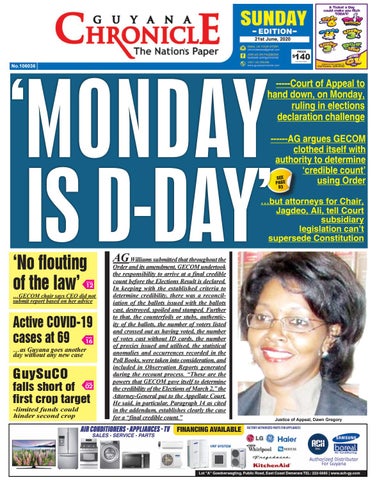
-----Court of Appeal to hand down, on Monday, ruling in elections declaration challenge ------AG argues GECOM clothed itself with authority to determine ‘credible count’ SEE using Order PAGE
IS D-DAY’
03
…but attorneys for Chair, Jagdeo, Ali, tell Court subsidiary legislation can’t supersede Constitution
‘No flouting of the law’
PAGE
12
…GECOM chair says CEO did not submit report based on her advice
Active COVID-19 cases at 69 PAGE
16
…as Guyana goes another day without any new case
GuySuCO
falls short of first crop target
PAGE
02
-limited funds could hinder second crop
AG Williams submitted that throughout the
Order and its amendment, GECOM undertook the responsibility to arrive at a final credible count before the Elections Result is declared. In keeping with the established criteria to determine credibility, there was a reconciliation of the ballots issued with the ballots cast, destroyed, spoiled and stamped. Further to that, the counterfoils or stubs, authenticity of the ballots, the number of voters listed and crossed out as having voted, the number of votes cast without ID cards, the number of proxies issued and utilised, the statistical anomalies and occurrences recorded in the Poll Books, were taken into consideration, and included in Observation Reports generated during the recount process. “These are the powers that GECOM gave itself to determine the credibility of the Elections of March 2,” the Attorney-General put to the Appellate Court. He said, in particular, Paragraph 14 as cited in the addendum, establishes clearly the case for a “final credible count.”
Justice of Appeal, Dawn Gregory
2
SUNDAY CHRONICLE, June 21, 2020
GuySuCO falls short of first-crop target
-limited funds could hinder second crop THE Guyana Sugar Corporation (GuySuCo) has ended its “first crop,” approximately 20 per cent short of the projected output, producing some 37,013 tonnes of sugar. The Guyana Agricultural and General Workers Union (GAWU) has said that the sugar corporation had set a target of 46,475 tonnes of sugar for the first crop, but fell 9,462 tonnes short of that target. Sugar was produced at the three operable estates, Albion, Blairmont and Uitvlugt, and, according to the breakdown of production, Albion produced 16,802 tonnes out of the projected 23,089 tonnes; Blairmont produced 11,867 tonnes out of the projected 13,976 tonnes; and Uitvlugt
produced 8,344 tonnes out of the projected 9,410 tonnes. “Alarmingly, the industry continues to underperform. It was disheartening to learn that no estate achieved even 90 per cent of its target. For our union and more so, the thousands of sugar workers, this is most distressing,” said GAWU in a press statement on Saturday. Additional information obtained by GAWU indicate that, at mid-May, 2020, cane yields were far below the corporation’s planned objective as stated in its strategic plan. The information revealed that Albion produced 57.86 tonnes cane per hectare (TcH) as against a target of 77.59 TcH; Blairmont produced 69.90 TcH versus a target of 82.59 TcH; and Uitvlugt produced GuySuCo had set a target of 46,475 tonnes of sugar for the first crop, but fell 9,462 tonnes short of that target
57.64 TcH compared to a target of 75.76. In addition, GAWU said that overall factory performance was far from acceptable standards. Again, around mid-May, the three factories in operation operated at an average of 95 hours per week against a target of 140. Frequent factory breakdowns has been plaguing the GuySuCo for several crops now. The GAWU had pointed out previously that factory failures continue unabated while the corporation boasts an expanded staff structure at its Factory Operations De-
partment. “Certainly, it brings into serious question the functioning and output of this department which, we have learnt, is loaded with many retirees,” GAWU lamented. With the out-of-crop season now in progress, maintenance activities have commenced at factories. On this score, the GAWU’s anxiety was heightened after it learnt from a GuySuCo document, that, “the lack of adequate funding to procure needed spares for [the] upcoming dull season [out of crop] will pose a challenge to the main-
tenance programme.” “This is an ominous sign for grinding in the upcoming second crop 2020 which is typically longer in duration,” said GAWU. At the Uitvlugt factory, for example, out-of-crop maintenance is in progress for many weeks now and workers have shared that they are instructed to re-use worn parts in areas that required complete replacements. This level of reckless engineering practice directed by the technical team will no doubt eventuate into frequent factory breakdowns during the upcoming grinding operations, said the union. “The GAWU remains are very much disturbed by the laxity on overall management of the sugar industry. The corporations’ performance record over recent years justifies our position,” said GAWU. The cash-strapped GuySuCo was expected to receive much- needed funds last week. It was reported that the novel coronavirus (COVID-19) pandemic and other prevailing national conditions have rendered the national treasury incapable of providing a bailout to the “cash-strapped” GuySuCo, but all hope is not lost, as the company is expected to benefit from $1.5 billion, paid to The National Industrial Commercial and Investment Limited (NICIL) for the sale of land. The Finance Ministry, in response to GuySuCo’s request for a bailout, cited a $30 Billion bond backed by NICIL’s assets and guaranteed by the Government of Guyana, which was secured through NICIL to retrofit and
revitalise the three remaining sugar estates. During the period July 2018 to February 2020, $9,720,759,568 was disbursed to GuySuCo to fund its capital and operational expenditure – much of which was outside the terms of the bond. Additionally, NICIL, through the Special Purpose Unit (SPU), sold lands that were vested to it, and as such garnered deposits of $2.1 billion. According to the Finance Ministry, the full sum was used to offset bond payments that became due in May, 2020, and the balance of $1.5 billion for the lands will be paid over to NICIL when the vesting orders are signed and gazetted. The corporation will benefit from part of this sum. In referring to the current condition of the sugar corporation, President David Granger had said, “it is very unfortunate we are in this position. Throughout the tenure, we have been engaged in trying to resolve the issue of the industry.” “We have done everything possible to return the industry to normalcy and even profitability…we will continue to help and not send anybody home…we want an efficient sugar industry which can produce sugar at competitive prices,” said President Granger. The idea is to compete with Brazil, Cuba and other “heavy” sugar producers, but in order for Guyana to do that, the industry needs to be economically viable and feasible.
3
SUNDAY CHRONICLE June 21, 2020
‘Monday is D-Day’ –– Court of Appeal to hand down ruling in elections declaration challenge on Monday
–– AG argues GECOM clothed itself with authority to determine ‘credible count’ using Order –– but attorneys for Chair, Jagdeo, Ali tell Court subsidiary legislation can’t supersede Constitution By Svetlana Marshall IN a legal battle of words in the Court of Appeal on Saturday, Attorney-General and Minister of Legal Affairs, Basil Williams argued that the Guyana Elections Commission (GECOM) clothed itself with the authority to determine the ‘final credible count’ of the General and Regional Elections when it enacted Order No. 60, but Kim Kyte-Thomas, the Legal Counsel representing the Chairman of GECOM, Justice (Ret’d) Claudette Singh, said no Order can supersede the Constitution, the Supreme Law of the Land, and therefore GECOM cannot pronounce on the validity and credibility of the Elections. A CREDIBLE COUNT In his virtual oral submission in the case challenging GECOM’s failure to decide on the final credible count, the Attorney-General told the panel of three judges, led by Justice of Appeal Dawn Gregory, that the Elections Commission has a duty and responsibility under Article 162 of the Constitution and Order No. 60, to determine whether the General and Regional Elections held last March were fair and credible. Minister Williams submitted that while Kyte-Thomas, in defence of her client, argued that the Elections Commission could not have clothed itself with jurisdiction to determine the credibility of the 2020 Elections, GECOM did just that when it used Article 162 of the Constitution and Section 22 of the Elections Law (Amendment) Act to bring Order No. 60 into legal effect. That Order, he posited, gave GECOM the jurisdiction to deal with credibility during the electoral process. To prove his case, the Attorney-General invited the judges -- Justices of Appeal Dawn Gregory and Rishi Persaud and High Court Judge, Brassington Reynolds -- to have a closer look at the provisions of Order No. 60, the legal cover GECOM used to facilitate a 33-day National Recount. He submitted that
throughout the Order and its amendment, GECOM undertook the responsibility to arrive at a final credible count before the Elections Result is declared. In keeping with the established criteria to determine credibility, there was a reconciliation of the ballots issues with the ballots cast, destroyed, spoiled and stamped. Further to that, the counterfoils or stubs, authenticity of the ballots, the number of voters listed and crossed out as having voted, the number of votes cast without ID cards, the number of proxies issued and utilised, the statistical anomalies and occurrences recorded in the Poll Books, were taking into consideration, and including in Observation Reports generated during the recount process, the Attorney-General pointed out.
T&T Senior Counsel John Jeremie “These are the powers that GECOM gave itself to determine the credibility of the Elections of March 2,” the Attorney-General put to the Appellate Court. He said, in particular, Paragraph 14 as cited in the addendum, establishes clearly the case for a “final credible count.” The amended Order at Paragraph 14 states: “The Commission shall, after deliberating on the report at Paragraph 12, determine whether it should request the Chief Election Officer to use the data compiled in accordance with Paragraph 12 as the basis for the submission of a report under Section 96 of the Representation of the People Act, Cap 1:03, provided that the Commission shall,
Attorney-General and Minister of Legal Affairs, Basil Williams no later than three (3) days keen on pointing out that after receiving the report, the Order provided the make the declaration of the Elections Commission with results of the final credible the option of determining count of the elections held whether or not it should request the Chief Election 2nd day of March 2020.” According to Paragraph Officer to use the data com12 of the Order, the ma- piled as the basis for the trices for the recount of submission of an Elections the 10 Electoral Districts Report. The Attorney-Genmust be tabulated by the eral submitted to the AppelChief Elections Officer, late Court that utilising that and a report submitted to option, GECOM should the Elections Commission nullify the Elections, on together with a summary the basis that the Chief of the Observation Reports Elections Officer, Keith Lowenfield, in his report, for each District. indicated that the credibility of the elections could not GROUNDS FOR have been ascertained due ANNULMENT Minister Williams was to widespread anomalies,
Legal Counsel Kim Kyte-Thomas and cases of voter impersonation that were discovered during the National Recount. He said the Elections Commission should not have requested the CEO to use the data to compile an Elections Report under Section 96 of the Representation of the People Act, knowing very well that the elections were less than credible. The Chair of GECOM, Justice (Ret’d) Claudette Singh, in requesting the Elections Report, said
GECOM does not have the jurisdiction to investigate the anomalies, but the AttorneyGeneral said Elections Commission has a duty to call off the elections, in light of the credibility issues. “GECOM cannot make an order and [revert] from it; GECOM has to stay the course,” Williams argued, while maintaining that under Article 162 of the Constitution, GECOM, upon failing to conduct a credible and fair election, can annul it. “It is a decided principle of law that the Elections Commission, in furtherance of its duty to deliver results that are fair, credible and truthfully reflect the will of the people, can exercise its inherent jurisdiction to cancel an election, on the ground of uncovered manifest and pervasive irregularities, anomalies and discrepancies,” he submitted to the Appellate Court. Should the Elections Commission ignore the evidence of corruption and proceed with a declaration, it, in effect, would be undermining See page 5
4
SUNDAY CHRONICLE, June 21, 2020
John Bolton: Judge rejects Trump bid to ban ex-adviser's book (BBC) A US judge has rejected a request by President Donald Trump to stop the publication of a memoir by his former National Security Adviser, John Bolton. The justice department argued that the book had not been properly vetted. Washington DC District Court Judge Royce Lamberth said the government had "failed to establish that an injunction would prevent irreparable harm". Mr Bolton had "gambled" with US national security and already "exposed his country to harm", the judge said. Hundreds of thousands of copies of the book - The Room Where It Happened - have been printed and distributed, and are due to go on sale on Tuesday. In the memoir Mr Bolton paints an unflattering picture of a president whose deci-
sion-making was dominated by a desire to be re-elected in November. Mr Trump has said the book is "made up of lies and fake stories". What did the judge's ruling say? The justice department's lawyers argued that Mr Bolton had breached an obligation to complete a pre-publication review of his manuscript to ensure that it contained no classified information. Mr Bolton's lawyers dismissed the claim. They insisted that the manuscript was thoroughly examined and that Mr Trump simply did not like the contents. In his 10-page ruling, Judge Lamberth wrote that Mr Bolton had opted out of the pre-publication review process before its conclusion and that he "likely jeopardized national security by
Sunday, June 21, 2020 - 04:30 hrs & 14:30 hrs
As national security adviser, John Bolton was a major figure in US foreign policy
disclosing classified information in violation of his non-disclosure agreement obligations". He nevertheless denied the government's injunction request. "In taking it upon himself to publish his book without securing final approval from national intelligence authorities, Bolton may indeed have caused the country irreparable harm," he wrote. "But in the internet age, even a handful of copies in circulation could irrevocably destroy confidentiality. A single dedicated individual with a book in hand could
publish its contents far and wide from his local coffee shop. With hundreds of thousands of copies around the globe - many in newsrooms the damage is done. There is no restoring the status quo." Shortly after the decision, Mr Trump alleged on Twitter that Mr Bolton "broke the law by releasing Classified Information (in massive amounts)". "He must pay a very big price for this, as others have before him. This should never to happen again!!!" the president added. Later, the president called the ruling a "BIG COURT
WIN against Bolton". A lawyer for Mr Bolton, Charles Cooper, welcomed the judge's decision to deny the injunction request. However, he took issue with the conclusion that his client did not comply fully with his contractual pre-publication obligation to the government. "The full story of these events has yet to be told - but it will be," he added. Mr Bolton's publisher, Simon & Schuster, said: "We are grateful that the Court has vindicated the strong First Amendment protections against censorship and prior restraint of publication." What is in the book? Mr Bolton became Mr Trump's national security adviser in April 2018. He left his post in Sep-
tember 2019, after disagreeing strongly with the president over how to handle major challenges like Iran, North Korea and Afghanistan. In The Room Where It Happened, Mr Bolton portrays Mr Trump as an "erratic", "impulsive" and "stunningly uninformed" leader. Among the allegations, which are based on private conversations and are impossible to verify, are that: * President Trump sought help from Chinese President Xi Jinping to win the 2020 vote, stressing the "importance of farmers and increased Chinese purchases of soybeans and wheat in the electoral outcome" * He also said China's construction of internment camps in the Xinjiang region was the "right thing to do" * President Trump was willing to intervene in criminal investigations "to, in effect, give personal favours to dictators he liked". Mr Bolton said Mr Trump was willing to assist Turkish President Recep Tayyip Erdogan over a case involving a Turkish company * The US leader said invading Venezuela would be "cool" and that the South American nation was "really part of the United States" * President Trump was unaware the UK was a nuclear power and once asked a senior aide if Finland was part of Russia
5
SUNDAY CHRONICLE June 21, 2020
‘Monday is ... From page 3
its own integrity, he further submitted. The public’s confidence in the electoral process, he added, would undoubtedly be eroded. In resting his case, the Attorney-General reminded the court that Article 177 of the Constitution clearly states that the Elections Commission could only act on the advice of the Chief Elections Officer, who would have long indicated that the elections did not pass the credibility test. The Attorney-General appeared in association with Attorney-at-Law Maxwell Edwards. SUBSIDIARY LEGISLATION Vs CONSTITUTION But Kyte-Thomas told the panel of judges, in her virtual presentation, that Order No. 60 –a subsidiary legislation, cannot supersede the Constitution of Guyana – the supreme Law of the land. The Legal Counsel argued that the Constitution, in Articles 162 and 163, clearly and sharply separates the functions of the Elections Commission and that of the High Court with respect to the electoral process. Only the High Court, under Article 163 of the Constitution, has jurisdiction to determine the validity and credibility of the Elections via an Elections Petition. “To ask, through the Recount Order, to take away the jurisdiction of the High Court and place it in the hands of GECOM, your honours, that is an impossibility that cannot be done,” Kyte-Thomas told the judges. Ruling out the notion that GECOM can annul the elections, she again referenced Article 163, emphasising that the High Court
sponded in the positive but said the applicant Eslyn David, through her lead Attorney, Trinidad’s Senior Counsel John Jeremie, is really seeking an interpretation of the Order and not the Constitution, and as such the case in general ought to have been filed in the High Court.
T&T Senior Counsel Douglas Mendes has the exclusive jurisdiction to determine any issue relative to the validity and credibility of an election. Having listened to Kyte-Thomas’ submissions, Justice Reynolds asked, with whom the responsibility resided for the determination of a final credible count and how was that responsibility to be discharged, taking into consideration the fact that the Order gazetted by GECOM has as its objective the determination of a final credible count. In response, Kyte-Thomas said: “The Court has to determine the credibility not GECOM.” She again maintained that the Order, as a subsidiary legislation, cannot amend the Constitution. “It is the Court, it is still the Court,” she submitted while iterating that the Constitution is the supreme law of the land. Pressing Kyte-Thomas, Justice Reynolds further asked: “But you do agree that the Order did set as an objective of the Commission, determining the final credible court? The Legal Counsel re-
JURISDICTION In fact, Kyte-Thomas had submitted from the onset that the Article – Article 177 (4) – upon which the applicant is relying on, clothed the Appellate Court with a “narrow special exclusive” jurisdiction to hear and determine questions relative to the validity of an election of a president with particular reference to qualification and or the interpretation of the Constitution. According to her, the application was premature and misconceived. But both Jeremie and the Attorney-General rejected Kyte-Thomas’ submissions, stating that the case was properly filed under Article 177 (4) of the Constitution. The Trinidad Senior Counsel argued that Article 177 (4) of the Constitution gives the Court of Appeal exclusive jurisdiction to interpret the Constitution with regards to the election of a President, and that, he posited, is distinct from the jurisdiction Article 163 vests in the High Court to exclusively determine any question regarding the qualification and election of a person to the National Assembly. “Parliament does not legislate in vain. The exclusive jurisdiction to interpret the Constitution in accordance with Article 177 (4) is afford-
ed to the Court of Appeal and the Court of Appeal alone. There is no similar provision granting the same jurisdiction to the High Court acting as an election court,” Jeremie submitted. In support of his case, Jeremie relied on the case of Eusi Kwayana’s Application (1980). Among other things, David, through her battery of lawyers led by Jeremie, wants the Appellate Court to interpret, through an order, the words “if more votes are cast” in Article 177 (2) (b) of the Constitution. David’s battery of lawyers said the Appellate Court, in its deliberation, should consider several issues including whether the gazetted Order that triggered the National Recount affected or altered the meaning of the phrase “if more votes are cast” in Article 177 (2) (b) of the Constitution to the extent that it now means more valid and credible votes cast, which would effect lead to the election of a president. ORIGIN OF THE RECOUNT Trinidad and Tobago Senior Counsel Douglas Mendes, who appeared virtually on behalf of added respondents Bharrat Jagdeo, General Secretary of the People’s Progressive Party/Civic (PPP/C) and Irfaan Ali, PPP/C’s Presidential Candidate, told the Court that the Order, which initiated a National Recount, birthed out of an allegation of fraud, allegedly perpetuated by Region Four Returning Officer (RO) Clairmont Mingo during the tabulation of the Statements of Poll (SOPs) just days after the elections. He opined that the applicant in the case is suggesting
The Court of Appeal that GECOM must revert to Mingo’s count – which according to him was fraudulent. “It is against that backdrop that it is easy to appreciate that the application that has been made here is a cynical one; in deed it is a hopeless application for all of the reasons that we have indicated,” Mendes told the Court. He, like Kyte-Thomas, argued that the Court had no jurisdiction to hear the application, and that it was prematurely filed. Interjecting, Justice Gregory, while taking into account Mendes’ submissions on jurisdiction, questioned the status of the Order and its amendment. In doing so, the Appellate Judge drew attention to the fact that it was an allegation of irregularities that led GECOM to facilitate a National Recount under the gazetted Order. “How come those irregularities from before that led to the recount had an impact at this stage but now you are saying the irregularities that now emerge ought not to have an impact at this stage?” the Judge asked. Though not directly answering the question, Mendes, in response, said that while the irregularities
cited during the recount are of concern, they ought to be enquired into via an Elections Petition in the High Court after a declaration of the results of the elections. Oral submissions were also made by Senior Counsel Ralph Ramkarran, the attorney representing A New and United Guyana (ANUG), The New Movement (TNM) and the Liberty and Justice Party (LJP); and Attorney-at-law Kashir Khan, who represented the interest of the Citizenship Initiative and Change Guyana. Both Khan and Ramkarran endorsed the submissions made by Kyte-Thomas and Mendes. On Monday, the Appellate Court will hand down its decision at 13:30hrs.
6
SUNDAY CHRONICLE, June 21, 2020
The CARICOM report fell short of expectations THE CARICOM observer group has presented its report on the just concluded recount of the March 2 elections that were facilitated by a Recount Order enacted by GECOM. Since its submission, the report has sparked intense debate among political parties, lawyers, and the public at large. While the PPP and its allies in and out of Guyana have lauded the report, the APNU+AFC Coalition and some independent observers and commentators have described it as flawed. In our deeply divided environment, that is not unexpected. Having said that, there are a few aspects of the report that are worth highlighting. Firstly, the observers hinted that they were opposed to an audit and preferred a simple recount of the votes. According to the observers, “From the outset then, we recognised that the Order called for an audit rather than a mere counting of the ballots and we do believe that this was a colossal error on the part of the commission, for it facilitated delay, ensuring that the recount
could not be completed within or by the stipulated period. “ That statement betrays a clear bias against the audit and gives a sense of the mindset of the observers. It further gives an insight into how they arrived at their conclusions. Secondly, the observers found that the observations of irregularities and anomalies unearthed by the audit were not “ materially relevant to recounting of the ballots, though these objections, based on the information provided by GECOM to the party agents, signalled the possibility of a padded voters’ list which GECOM as a body must deal with expeditiously.” That statement confirms that the observers were more concerned with a simple recount than an audit which was meant to determine the credibility of the votes cast. Yet, because the irregularities were so overwhelming, they could not ignore that the voters’ list was tainted, an observation that is at the root of the problems. A third disturbing thing about the report was the very small sample of the boxes observed by
the team. It is statistically difficult to make a sweeping determination about the credibility of an election based on such a small sample. In essence, the team missed observing the overwhelming majority of the boxes that were counted. Again, this points to the fact that the observers were there to do a quick count rather that an audit. Fourthly, despite the observers’ preference for a simple recount and the inadequacy of their sample, the report could not ignore the instances of irregularities and anomalies. Towards this end the report documented several of these “problems” which it described as “troubling,” “astonishing” “of concern,” “far more egregious,” “illustrations of failure,” “disturbing” and “pointing to some deliberate malice and/ or mischief.” It is therefore astonishing that after these descriptions of what they observed, that the team concluded that they saw no widespread evidence of fraud. The blatant inconsistency between the observation and the conclusions alerts the reader to a deeper, sinister plot by the observers.
This inconsistency is best manifested by the following paragraph in the report: “The combined absence of used counterfoils in conjunction with the absence of marked OLEs in several work stations (29 ballot boxes) which were manifest in one sub-division of Region Four, led to supervisors observing in their workstation reports that they could not validate the votes cast; some party representatives declined to sign these Observation Reports attached to the workstations. Given the work plan issued by GECOM's secretariat, which was guided by the Gazetted Order of the recount, several thousands of ballots were not validated across more than 20 workstations. This was to prove problematic and required intervention by the commission, which issued a directive on June 05, 2020, to temporarily suspend the tabulation of those affected boxes not yet entered. On June 07, the commission ordered the tabulation of the boxes in question. The systematic absence of these statutory documents in the face of what was an audit is troubling.
However, the team did not view their absence as fatal to the recount, but pointed to the need for a serious investigation by GECOM. If, as the chief elections officer constantly reminded the team, that the workers were well trained, we indeed found it odd that such a significant number of boxes were so impacted.” Finally, the report found that the current GECOM architecture is incapable of producing proper elections. Yet it recommends that GECOM declare the current elections as “reasonably credible.” This characterisation sums up the kind of report that many should find difficult to take seriously in its entirety. Surely, those who speculated that Prime Minister Ralph Gonsalves’ statements may have influenced the report seems to be on solid ground. Given the seriousness which the president and others attached to the CARICOM team, it was quite disappointing that their report fell way short of expectations.
Dominic Gaskin playing to the gallery Dear Editor, Mr. Dominic Gaskin executive member of the Alliance for Change (AFC) and former minister of the APNU+AFC coalition government has distinguished himself by publicly sharing his opinion that Mingo’s declarations were acts of fraud done on the behalf of the coalition. In doing so he is claimed to be a witness to the event. He has now stated his position on the recount
process, calling on the coalition to concede defeat and begin the work to recapture the swing votes for the 2025 elections. I have no problem with Mr Gaskin stating his views on the elections crisis since it is his right to do so, and he must be respected for doing so. However, I am forced to seek an explanation from him on what in his view constitutes a seriously rigged election. This is important since one of the fundamental issues
in the elections was the question of rigging, and the weight to be put on it in deciding the validity of the elections. Mr Gaskin wrote, “The claims of fraud were grossly exaggerated and, unfortunately, designed to fool party supporters, who had placed their faith in the coalition, into believing that there was actual evidence of serious election rigging by the PPP-C”. My contention is with Gaskin’s denial that there was evidence of serious
election rigging by the PPPC. Without taking into account the numerous discrepancies, irregularities anomalies etc, that was pervasive in all ten of the electoral districts: I am asking Comrade Gaskin to state his position on the 41 ballot boxes on the East Coast in strongholds of the PPPC that only had ballots without supporting documents. Is this simply a coincidence that this took place on the East Coast and not randomly across the country?
Mr Gaskin can’t plead ignorance of not knowing that in Guyana even small amounts of rigging can determine which party wins an election. His dismissive approach to PPPC’s rigging despite the evidence unearthed in the recount process points to something other than objective and impartial analysis. As a politician, he can’t be “dum” to the extent of not knowing the importance of exposing PPPC’s electoral fraud to the country and the world. It is
infantile politics for him not to understand that exposing PPPC election wrongdoings is important to capturing the elusive, “swing voters”. While I am willing to give Comrade Dominic Gaskin the benefit of the doubt on the sincerity of his positions, I sense that he is playing to the “gallery” and as a politician, he is entitled to do so. Regards Tacuma Ogunseye
7
SUNDAY CHRONICLE, June 21, 2020
GECOM turned recount into election petition before declaration of winner Dear Editor THE Chairperson of GECOM rejected the case made by the three APNU+AFC commissioners that the March 2 elections be annulled on the grounds that the elections were not credible. The commissioners’ case followed the report by the chief elections officer (CEO) to the full commission in which he reported that given the widespread irregularities unearthed by the recount/audit, he could not recommend a winner. He further reported that he could only validate approximately 40% of the votes in the boxes. In rejecting both the CEO’s report and the APNU+AFC commissioners’ case, the chairperson submitted that GECOM was not a court and as such cannot pronounce on the credibility of an election. She therefore ordered the CEO to prepare a report using the tabulation of the votes in the boxes. Not unexpectedly, her ruling and order have been challenged in court. Eventually, the court would determine whether the chairperson’s reading was correct. We have noticed that the chair and the various parties to the case before the Court of Appeal have cited various articles in the constitu-
tion to bolster their respective arguments. But as is usually the case, one section or clause of a constitution cannot be read in isolation from others that address the issue at hand. Further, constitutions are often not explicit about many issues, thus leaving it to lawyers and judges to interpret what the framers meant. Hence, the concepts of “expressed powers” (those which are clearly expressed in the constitution) and “implied powers” (those which are implied from what is written in the constitution). It is my view that some lawyers and political commentators are arriving at conclusions about these elections without reference to the changing dynamics therein over the last 16 weeks. In other words, they are ignoring aspects of the process as if they never occurred; they are treating the elections as a normal uneventful exercise. But how can an election that has not thrown up a declared winner after 16 weeks be an uneventful exercise? I believe that the recount order set in train by GECOM and signed on to by the electoral contestants fundamentally changed the legal and political dynamics of the elections. The remainder of this letter will introduce some points which I think that the partisan warriors and the seemingly non-partisan
civil society elements should ponder. When the PPP and others detected mis-tabulation of votes in Region Four, they made a huge cry over it—they weaponised it. All the various forces latched on to it; they gave it two names—Mingo and Rigging. The names stuck. The PPP went to court and the court ruled that GECOM could correct the mis-tabulation. The GECOM chair opted for a recount. The two major leaders agreed, and others gave their blessings. But this is where things changed. The Recount Order which became law moved the contention from just the mis-tabulation of the Region Four votes to the credibility of the entire elections. Once that was done the dynamics of the electoral impasse changed forever. A mere recount/tabulation was now changed to a recount/audit. It meant that any fraud that was carried out by the PPP or the Coalition would potentially be detected within a legal framework. In effect, what GECOM did was to turn the recount into an election petition before a declaration of the winner. By the time the recount ended, the mis-tabulation of the Region Four votes by the returning officer was confirmed. But along with that, a whole host of other irregularities and
anomalies were detected and most were confirmed. This potentially compromised many more votes than were compromised by the Region Four mis-tabulation. In effect, the outcome of the recount/audit showed that while the PPP ‘s Region Four votes were restored, it lost far more than that on account of manipulation of the process on polling day. By ordering a declaration based on the numerical tabulation minus the irregularities unearthed during the recount, the GECOM chair is ignoring her own law. Further, she is guilty of giving redress to one party, the PPP, while denying the other contestant, the Coalition, the same. Her argument that GECOM is not a court and that the Coalition should take its case to court via a petition is inconsistent and discriminatory. When the PPP raised the question of Mingo’s mis-tabulation, she did not tell that party to take its case to court—she agreed to turn GECOM into a court via the Recount Order to investigate the PPP’s charge. Now when it is time to inves-
tigate and pronounce on the Coalition’s charges, she divests GECOM of its status of a court. Based on reports she appears to acknowledge serious defects as unearthed by the recount/audit just as the CARICOM Report did, but like CARICOM she is prepared to make a declaration despite these defects. Such action flies in the face of natural law and justice and constitutional law. Further, it is an example of political immorality that is more grievous than the fraud perpetrated by both contestants. Under normal circumstances a valid and invalid vote is an unspoilt and spoilt ballot, respectively. But the Recount Order changed that definition. According to the order which I cannot quote here for want of space, the definition of a valid vote is a vote that is reconciled with the necessary supporting statutory documents. Now to GECOM not having the power to annul an election. Yes, there is no Expressed Power to that effect in the constitution. But the constitution gives GECOM the power to “issue such in-
structions and take such action as appear to it necessary or expedient to ensure impartiality, fairness and compliance with the provisions of this Constitution…”, I am arguing that implied in that article is the power to annul an election if GECOM deems it inconsistent with those standards. Further, if GECOM can make a law to determine the credibility of an election, then inherent in that law is the power to act if the election is not deemed to be credible. Let me end with this quote from Justice Singh’s affidavit justifying the recount/ audit: “Thus , once there is evidence that the electoral process was compromised, then to ensure impartiality, fairness and compliance with the constitution, the commission is constitutionally mandated to intervene to ensure public confidence in the electoral process.” Regards David Hinds
8
SUNDAY CHRONICLE, June 21, 2020
The PPP, the Constitution and GECOM CEO Dear editor, GUYANA and the world are watching and awaiting the outcome of the 2020 elections as they go on and on without a declaration for almost three and a half months. We all want this to end as soon as possible, so that Guyana can move on. Yes, we all wanted this to end and we also want the results of the elections to reflect and be based on the credibility of the elections. The PPP is telling us as Guyanese that the world is watching and they know who is the winner of the 2020 elections and it's the PPP that won. But the world must know that GECOM has not declared any winner as yet. The world must also know that there were serious electoral issues surrounding the elections. The world must also consider that there are serious allegations of electoral fraud in the 2020 elections and both the PPP and APNU+AFC are allegedly involved. The world must know that Guyana has laws and a constitution that govern its land and guide the only body that has the authority to look over Guyana’s elections and declare a winner, is GECOM. Not the PPP, not the APNU+AFC, not CARICOM or the world, but ONLY GECOM can declare
a winner. The constitution also says that GECOM has to deliver credible results/declarations based on valid votes,not all votes. Not all votes cast are valid votes as the PPP is saying and want the world to believe. If, as claimed, all the votes cast are valid votes, then the votes that weren't counted must be counted as valid votes. The army votes that weren't counted must be counted as valid votes, the dead people’s votes must be counted, persons who were out of the country and voted, must be counted. This seems to be the argument of the PPP. We know that not only Mingo of Region Four was accused of fraud, but electoral fraud was unearthed in other regions such as Regions One,Two,Three, Five, Six and Nine. But the PPP won't speak of that for the world to know because they won those regions through electoral fraud. The PPP started to shout out and make the world feel as if Mingo alone was involved in electoral fraud in Region Four. But hello no, we saw at Diamond that people’s names were not on the OLE and they voted; we heard and saw of polling books being missing; we heard of and saw extra ballots missing; we heard of ballot boxes being stuffed at some of the polling stations on the East Coast of Demerara in
Region Four, etc. But wait, it is not Mingo alone that is being accused of committing electoral fraud. The PPP’s Region Four, East Coast Demerara party supervisor on elections day was accused of having hundreds of ID cards in his possession, distributing for people to use and vote. Now we know how the dead were allowed to vote. Now we know how the overseas people were allowed to vote and now we know why the PPP was so negative and was objecting to a new house-tohouse registration. The world must know of those things also. The world must also know that if there is electoral fraud there cannot be a credible result or declaration for any winner of any party. The world must also know that it was Anil Nandlall who during the recount went public on his Facebook page and talks of fraud, whereby the votes cast at a place of poll on the East Coast saw the PPP losing votes. Yes, Mr Nandlall also highlighted those frauds that took place on elections day. It is the same Mohabir Anil Nandlall who took to the television and tells the nation and I quote "ONCE A FRAUD HAS BEEN COMMITTED, IT NULLIFIES OR VOIDS THE ENTIRE PROCESS."
So the world must also know that, or, is it that the world has a deal wih the PPP for a share of Guyana’s oil benefits?. Because I cannot see why some of the well respected international organisations and countries, namely the Organisation of American States (OAS), he Commonwealth, CARICOM, Canada and the U.S. know of all those allegations and is still calling for a winner to be declared on the basis of the recount, when the recount itself brought out all the electoral fraud that took place on March 2. It is surprising because it seems as if none of those organisations and countries want credibility in anything onward or in the future, but just fraud to be the order of the day. Did those organisations and countries know of the laws of Guyana, or are they downplaying the laws for their own benefits?. Many of them loudly say they accept the CARICOM team’s report on the recount and that very report clearly says that the elections were "REASONABLY CREDIBLE." They never said it was credible at all. Where in the world would someone accept "REASONABLY CREDIBLE FOR CREDIBLE." It shows that the CARICOM report was highly corrupted. Again, the world must know that it is the PPP’s Mohabir Anil Nandlall and the PPP’s GECOM Commissioner Sase Gunraj who repeatedly told the nation, CARICOM and the world that the CARICOM report is of no use at this time and is not important to GECOM in making its final report and declaration. Today, it is the same PPP that is changing its stand because they want power at all cost and the world is being blindsided by them to believe that all they say and do is the gospel truth. But let's be guided by the constitution, because it seems the PPP is only using the law in a cut-and-paste manner that will benefit them. So, let's
listen to the constitution and do what it says, rather than to force our way as what the PPP is doing to get into office. In declaring the results of elections in Guyana, Article 162 (1) [b] of our Constitution instructs: "The elections commission shall issue such instructions and take such action as appear to it to be necessary or expedient to ensure impartiality, fairness and compliance with the provisions of this constitution or of any act of Parliament on the part of persons exercising powers or performing duties connected with or relating to the matters aforesaid.” In other words, while it is the "exclusive jurisdiction" of Guyana's High Court to determine the "validity" of an election under Article 163 (1) (b) of the nation's Constitution, it is unequivocally the exclusive constitutional jurisdiction of Guyana's chief elections officer (CEO) to determine the "validity" of every ballot cast in those elections and the CEO is constitutionally obliged to do so, "to ensure impartiality, fairness and compliance with the provisions of [the] constitution or of any act of Parliament." Id. 162 (1) [b] Order No. 60 of 2020 and its addendum dated May 29, 2020, which legally triggered the recount of the votes cast in Guyana's March 2, 2020 national and regional elections states: “AND WHEREAS the Guyana Elections Commission, in exercise of the authority vested in it under Article 162 of the Constitution and pursuant to Section 22 of the Elections Laws (Amendment) Act, No. 15 of 2000, seeks to remove difficulties connected with the application of the Representation of the People Act, Chapter 1:03, in implementing its decisions relating to the conduct of the aforementioned recount of all ballots cast at the said elections, including the reconciliation of the ballots
issued with the ballots cast, destroyed, spoiled, stamped, and as deemed necessary, their counterfoils/stubs; authenticity of the ballots and the number of voters listed and crossed out as having voted; the number of votes cast without ID cards; the number of proxies issued and the number utilised; statistical anomalies; occurrences recorded in the Poll Book.” To "ensure impartiality, fairness and compliance with the provisions of [Guyana's] Constitution" and Chapter 1:03 of the Representation of the People Act, GECOM's Chief Elections Officer Lowenfield is constitutionally bound to reject the "176,709" invalid votes that were cast for the PPP/C and the "92,910" cast for the APNU+AFC. His final report must award the APNU+AFC "125,010" valid votes and the PPP/C’s "56,627". The Chair of GECOM, Justice (Ret’d) Claudette Singh must honour her constitutional duty and declare the winner of our nation's 2020 General and Regional Elections, only with the valid votes cast as outlined above and reported by the CEO. The PPP/C can then file a High Court election petition under Article 163 (1) (b) of the Constitution to nullify the elections. So, brothers and sisters, the law is clear and the CEO must and shall comply with the constitution of this land. I call on the CEO not to be afraid of the PPP’s threats of giving you life in prison, because it is those who are being involved and accused of electoral fraud who have to be afraid, not you sir. You have to work with what the Constitution says in giving your final report and the key word is "VALID"; and only you can determine the valid votes cast. Regards Abel Seetaram
Find alternatives to alcohol consumption Dear Editor
WE are concerned at the numerous promotions of alcohol products by businesses for this Father’s Day. We know that alcohol consumption creates problems for men and their families. The Ministry of Public Health report was clear that men in Guyana are almost four times as vulnerable to COVID-19 as women. In fact, there is wisdom in still opting to close bars during these times of the epidemic, considering all that is known about alco-
hol usage and the clouding of judgment. The World Health Organisation (WHO) has asked countries to take steps to reduce alcohol consumption at this time. BBC’s Megha Mohan in June, 2020, reported that the UN has described the worldwide increase in domestic abuse as a "shadow pandemic" alongside COVID-19 and that there has been a 20% increase in cases during the lockdown, since victims are trapped at home with their abusers. Previous studies by WHO have pointed out the strong links between alcohol use and
the occurrence of domestic violence in many countries, with evidence suggesting that alcohol use increases the occurrence and severity of these cases. Alcohol consumption as a direct cause of intimate-partner violence has often been contested either on the basis of factors such as low socio-economic status, or impulsive personality; and those studies have concluded that frequent, heavy drinking can create an unhappy, stressful partnership that increases the risk of conflict and violence (WHO, 2006). TURN TO PAGE
09
9
SUNDAY CHRONICLE, June 21, 2020
Understanding Energy
Oil-field development is a challenging juggling act
PUTTING together the strategy to develop a massive deep-water offshore oil field on the scale of Guyana’s own Liza field is a bit like playing a (very) high-stake battle of chess while engaging in games of Monopoly and Ludo at the same time. With billions of dollars in investment, and our nation’s economic future at stake, companies developing Guyana’s precious resources must make critical investment and operational decisions years before the oil and gas are produced. And they must balance a host of “above-ground” risks that go beyond geology, such as geopolitical uncertainties and volatile commodity markets. According to Norwegian oil-and-gas consultants, Rystad Energy, Exxon and other
companies invested more than US$8B in Guyana to develop offshore oil production between 2015 and 2019. That money went to massive seismic and underwater exploration campaigns, and the early stages of analysing possible finds, as well as the enormous logistics of drilling and establishing production facilities. With the current production-sharing agreement, the companies took on all the investment risk—if the wells had turned out to be dry or not suitable for commercial development, they would have had to absorb those losses completely, and Guyana would not be benefiting from the revenue or the economic development that has resulted. That kind of investment being made in what was, at the time, a largely unproven
Find alternatives to ...
We appeal to all consumers to resist at this time all efforts to promote alcohol consumption by men. We appeal to all consumers to resist efforts to destroy the health and well-being of men and fathers, in Guyana. Guyana’s alcohol culture does not need any more encouragement. Father’s Day is meant to express one's love and appreciation towards his/ her father. Many place emphasis on the
frontier area is extremely rare. Considering that more than 40 wells were drilled in Guyana before Exxon found oil, much of Guyana’s success so far has been because of the unusually smooth and rapid transition from discovery to production that the companies have been able to achieve here. But that success did not happen by chance. Once hydrocarbons are discovered, companies try to lessen some of the geological risk through appraisal and delineation drilling to determine how big the resource is, and whether it can be commercially developed. And if it can, many more decisions follow, including how many wells should be drilled, and where and what facilities should be constructed above and below the water’s surface to produce
FROM PAGE
worth and value this important figure places in their lives. As such, it is difficult to conceive how a ‘bottle of rum’ can suffice as an ideal gift option for the man who has tremendously impact one's life. We urge all private-sector companies to provide Father’s Day options which will promote health for men and their families, and which shows that it is possible to be a man
08
without consuming alcohol. We urge all fathers and sons to take care during this time, to focus on their mental health and well-being and to find alternatives to alcohol consumption. Happy Father’s Day. Yours sincerely. GOLDEN OM DHARMIC YOUTH ORGANISATION
the oil and gas, and deliver it to market? Deepwater offshore oil development, to be done safely and efficiently, requires significant time and preparation to put into place the necessary infrastructure. Careful, longterm coordination between multiple parties is essential. During the review process, most companies begin to lock in key contractors, suppliers, technical, environmental and safety experts so that they are in place when approvals do come through. This preparation is critical to ensure that the development plan can be carried out, and within budget. The alternative could mean costly lulls in activity that could delay generating government revenue and creating new jobs and economic opportunities for
local companies while stifling investment. That is why Exxon and its co-venturers signed a “FrontEnd Engineering and Design” contract with SBM for the Prosperity, the FPSO that would be deployed to the Payara development, which is pending government approval. This process of design and engineering can take several years, with long gaps between preparation and actual production. These early-stage contracts can include provisions restricting the contracted companies to “limited activities” in advance of final approvals, thus allowing them to prepare without racking up exorbitant costs, while locking in greater efficiencies from previous phases. Throughout the process,
the government and its expert technical consultants review the development plans and environmental impact assessments before it grants the permit to proceed. While the biggest oilprice crash in history earlier this year has delayed and even cancelled many projects around the world, Guyana is well placed to see continued offshore development, the result of years of careful planning and contracting that make the projects resilient to weak markets. But we should take nothing for granted, given the inherent risks associated with finding and producing oil in the deep water off our shores. A transparent permitting and regulatory process is vital to attract continued investment.
10
SUNDAY CHRONICLE, June 21, 2020
Presidential aspirants in the context of elections disputes
THERE is certainly enough evidence to give good merit to the argument that the presidency, in any polity, is mentally and physically draining. Men and women enter the highest office in their lands with energy and vigour, and leave with an abundance of grey and numerous health issues that all bear witness to the stark reality of life on the throne. Also, it is worth noting that in Guyana, seven men and one woman have experienced the daunting challenge of leading a highly-polarised society with a myriad of economic, social and political problems. Considering this, the following question is begged: Who is he/she that would not flinch and proceed with unmoved determination to accede to the presidency with a thick and murky cloud of electoral fraud hovering an electoral process of which he/she is a candidate?
THE PRESIDENCY Guyana possesses a unitary system with an executive presidency, as a consequence, this office holds an omnipotent status. The seemingly indomitable former President, Linden Forbes Sampson Burnham, by all reports, conceded that the weight of the presidency is not easy lifting. During the 1985-1992 period, President Hugh Desmond Hoyte was saddled with the enormous task of transitioning Guyana from a socialist-oriented economy to a free-market economic system. So gargantuan was the task, he confided about the gravity of governing. Dr. Cheddi Jagan looked a far more vibrant and rested man in the opposition in the pre-1992 period, but once he ascended to the seat of power, it was painfully obvious that the management of a difficult and fractured society is no easy venture. All of this is being writ-
ten to make this point: Nobody who is dreaming of acceding to the arguably toughest highest office in the Caribbean should be excited to do so under this thick cloud of irrefutable fraud. It takes an extraordinary mind to remain steadfastly oblivious to this 800-pound Gorilla in the national room.
CHARACTER AND PRESIDENTIAL ASPIRANTS With the aforementioned in mind, it is an opportune time to reference the sage words of Richard Neustadt. Neustadt argued that presidents have very little formal power, far less than necessary to meet the enormous expectations heaped on them during the modern era, and the key to strong presidential leadership lies not in formal power, but in the skills, temperament, and experience of the man occupying the office, and in his ability to put these personal qualities
to use in enhancing his own reputation and prestige. The foundation of presidential power is ultimately personal (Neustadt:1960). This observation was made in the American political context with a federal system, but it is acutely applicable to circumstance with a unitary system that facilitates an executive presidency. Guided by these sentiments, it is easy to conclude that the character of someone who aspires to be President is of utmost importance, especially in a country such as Guyana. If that person proceeds from a position of dishonourable intentions, it is practically over for a nation. Consider this: If a presidential aspirant has no issues with credible claims of fraud over a process that allows him/her to claim victory, this window into his/her character presents an ominous view that teems with frightening implications for the populace if he succeeds.
THE IMPLICATIONS Considering all that I have said, what are the possible implications of a presidential aspirant who is numb to illegality? It is reasonable to assume that if such a person metamorphoses from aspirant to President, he/she may also remain stoic and unperturbed by corruption, human rights violations, extrajudicial killings and wanton government excesses. It is a frightening prospect. Perhaps, this discussion is further well served by asking why the average conscience is not moved by electoral dispute concerns, and just seeks to push on through the noise with fatalistic determination to pursue a controversial dream? Any reasonable deduction would lead to the direction of that person being part of a grand scheme that is well orchestrated by power interests, and he might not be his own man.
Such interpretations are reasonable, because anyone who aspires to be President must know that once you accede to that office under a dark cloud of electoral fraud, you have lost the moral high ground to lead the nation from the outset, and could face a name-andshame campaign, coupled with national disrespect that would make effective rule problematic, if not impossible. If this is not known, considered, accepted and becomes a point of worry, we are dealing with an extraordinary mind that is invariably a danger to citizens. Presidential aspirants and President in a situation where there are serious electoral disputes should seek to ensure all doubts are cleared before they attempt to lead a nation. Any contrary course of action points to a mind that is the least concerned about nation-building.
Parents be careful in whose care you leave your children Dear Editor, OUR children remain vul-
nerable to child sexual abuse. More so in the face of this global pandemic.
Unfortunately, children are mostly abused by adults known to them, for ex-
ample, family members, neighbours, relatives, older siblings and even close
friends of the family. Many parents will have to go out to work and their children will be at home; some with adult supervision and some without any adult supervision. Over the past three months – March, 2020 to May, 2020 – Blossom Inc. and ChildLinK received referrals for 104 cases of child sexual abuse to their Child Advocacy Centres (CAC) in Regions One, Two, Three, Four, Five, Six, Seven and 10. The alleged perpetrators of these heinous crimes are in most cases known to the child and the parents. In two of the many cases that were referred to us during the pandemic, the alleged offenders were neighbours who were aware that the parents had to go to work during the epidemic and leave their children at home. They proceeded to attempt to sexually assault two girls in different families who were at home. Working with and supporting the Childcare and Protection Agency (CPA) in fighting to safeguard the well-being of every child, ChildLinK and Blossom’s approach serves to respond appropriately and holistically to child sexual abuse during this unprecedented time in our world. Nonetheless, as a result of the global pandemic, children are at greater risk of experiencing child sexual abuse. Hence, the wider
collaboration of government and civil society, inclusive of the CPA, law enforcement and CACs, remains critical to ensure that the investigation of reported cases continue by conducting forensic interviews, medical examinations, and providing psycho-social support during the COVID-19 epidemic. Blossom Inc. and ChildLinK have observed that many cases that come into the CACs are cases where there is lack of adequate parental supervision. Some children live in families where the parent(s) are essential workers who are required to work during the partial lockdown; these include security guards, nurses, pump attendants, vendors and call centre agents. As a result, abusers have easier access to the these workers’ children. In a recent report, an adult male was walking along the street in his community when he noticed a single mother leaving her home to go to work. He followed the mother as she walked towards the public road to catch public transportation. After the mother entered the bus, he turned around and headed to the woman’s house where her children were at home. The man was known to both the woman and the children. He engaged one of the children in a conversation. After a few minutes, he forced his way into the home and sexually assaulted the child. TURN TO PAGE
11
11
SUNDAY CHRONICLE, June 21, 2020
OP-ED
Working together to conquer legitimate fears
By Lincoln Lewis THE 2020 elections have once again brought to the fore that fear exists within, between and amongst us that a government could be elected that does not care about us. The fear is legitimate; it is premised on the fear of denial of opportunity to equally participate in the decision-making processes at all levels. What Guyana is fighting for is a national standard that operates, regardless of which group/party is in and out of power. We seek inclusion in our political processes, not only at election but day-to-day, from the Executive right down to the Neighbourhood Democratic Councils, the grassroots. It is the fear of being excluded that often inhibits honest examination of our political system to ascertain what mechanisms could be put in place to conquer that fear. Our quest is made more challenging by forces, local and international, who have found ways to satisfy their self-interest by preying
on our fears. For instance, oppression and suppression still exist in the 244-year old United States. Fifty-four years into their independence, one race was being enslaved, another brutally thrown off their lands, conflicts among the ‘civilised’ were resolved through the barrel of a gun, or at the end of a spear. Comparatively, 54-year-old Guyana is not operating at that level, yet some are expressing intolerance with us seeking resolution to our concerns and grievances in a civil manner, utilising non-violent means. They consider our recourse to the court as frivolous; they take sides in a stampede, and applaud the stampeders. They express impatience at our pace in resolving differences. You listen to them, not knowing world history, it would be hard to believe that they walked this path, and their journey was more rugged than ours. Instead of attacking us and sowing seeds of discord, had they respected our right FROM PAGE
10
Parents be careful...
This is one of many examples where a child was left without adequate adult protection and was manipulated and taken advantage of by an adult she thought she could trust. As in the case above, Blossom Inc. and ChildLinK recommend that parents have practical conversations with their children on how to communicate with others and family members on what are some of the signs that should alert them to danger. Some parents will get support from older siblings. They too need to be given guidance on safeguarding younger children who are in their care. Nevertheless, the reality of the current situation in many homes in Guyana and even outside of the epidemic does not permit adequate protection of children from child sexual abuse. Many families have only one option with respect to leaving their children under the care of an adult. Sometimes it is with an aunt, or a cousin, or grandparents who will provide care in the absence of the parent(s). In one of our cases, a child under 10 years old was left at many different locations. She was unable to relate to the forensic interviewer who had sexually abused her and when it had happened, since she had been left with cous-
ins, uncles, and adult family friends. Parents, we appeal to you to be more aware of who you leave your children in the care of and upon your return, take some time to ask your children about their daily activities and ensure they feel safe with the person providing supervision in your absence. We call on you to be observant of their behaviours, their friends, and who are becoming important to them in order to understand and identify any risk of child sexual abuse. Blossom Inc. and ChildLinK, through our funding from the Government of Guyana, European Union, and UNICEF, continue to provide essential services throughout this epidemic. Please report all suspected cases of child sexual abuse by calling the Childcare and Protection agency Hotline on 2270979 or the nearest police station. Yours faithfully, Blossom Inc. & ChildLinK Inc.
Lincoln Lewis
to sovereignty, our fledgling democracy and quest for peace, within and out of Guyana, they could have helped us to navigate the process by supporting the use of our laws, not interfering because they have a horse in the race. We don't want that in Guyana. In these more developed societies, they change the law depending on who is in power, representing what has become the norm in
their societies. For instance, the incumbent Republican administration continues to seek ways to remove LGBQT rights put in place by a Democratic administration. Last week, the U.S Supreme Court handed down the decision that the “1964 Civil Rights Act, which prohibits discrimination ‘because of sex’, extends to people who face job bias arising from their sexual orientation or gender identity” (CNN Online news). Guyanese do not want to be subjected to the whims and fancies of political leaders; we want a reality where all the people will be secured under the law all the time. Again, as is happening in the U.S., we do not want voting rights to be eroded under one administration and restored under another. Neither do we want any group to be the primary beneficiary of the nation’s resources at the expense of others. We desire equitable opportunities for employment of persons, irrespective of political association, race or
other factors they have no control over, and regardless of who is in office. We have been demanding for the past 54 years, as an independent nation, a national standard and consensus in the management of the State and the treatment of fellow citizens. Where the Constitution vests sovereignty in the people, we want to see this expressed and manifested in all our endeavours. Our diversity is a strength, not a weakness. There ought to be nothing to fear from each other, should we accept that we are all equal, and should be treated with dignity and respect. These are enshrined in our laws, international conventions, United Nations Declarations, and universally-acceptable principles. We owe it to ourselves to get up, stand up, fight for what we believe in, and what has been our pursuit these past decades; decades built on centuries of struggle for human dignity, and borne out of the understanding that our existence and development are in-
tertwined; not exclusive. In pursuit of this, we must be able to hold our leaders accountable, national and political. Holding them to account is not being disloyal to the party or government; it is recognising the party or government has a problem that bothers one or some, and needs to be addressed. Any concern should be addressed, and one should feel free, not fearful, to speak out. When we nurture an environment where freedom of speech and its inherent right to dissent is respected, and not suppressed, where dignity is treated as a right not privilege, where the laws work for all not some, where legal redress is not deemed a right for some, not all, where we produce and strengthen legislation that secure our individual and collective rights, and when we allow the institutions of State to work for all, we can conquer the legitimate fears.
12
SUNDAY CHRONICLE, June 21, 2020
‘No flouting of the law’ …GECOM chair says CEO did not submit report based on her advice
AMID multiple news stories ridiculing the Chief Elections Officer, Keith Lowenfield, Chairman of the commission, Justice Claudette Singh has rebuffed claims that he did not submit his report in defiance of her order. “It would be remiss of the GECOM’s Secretariat not to provide clarity on the reason why the Chief Election Officer (CEO), Mr. Keith Lowenfield did not submit the National Recount of GRE 2020 results report to the Chairperson, Justice Claudette Singh on 18th June, 2020,” GECOM said on Saturday. According to GECOM, contrary to the numerous articles and opinions published in the media and social platforms, the Chief Elections Officer has completed the report and was preparing to submit same to the Chairperson by 13:00hrs on 18th June, 2020. However, before he could have done so, he was served by court Marshalls with a ‘Notice of Motion’ which was filed in the Court of Appeal. According to GECOM, in light of the foregoing, the CEO visited the Office
of the Chairperson with his report and the ‘Notice of Motion’. “It was then that Justice Singh indicated that
the Chairperson at that time.” The motion, which was filed by a private citizen, Eslyn David, is intended to
Chairman of GECOM, Justice Claudette Singh
she was also served with the said document and explained that “as a former officer of the court’ she could not disregard the ‘Notice of Motion.’ As a consequence, the CEO’s report was not submitted to
restrain the Chief Elections Officer from submitting to the Guyana Elections Commission his elections Report, under Article 177 (2) (b) of the Constitution, containing votes which are not credible
within the meaning of Order No. 60 of 2020. The Chief Elections Officer, in his Report on the
10 Electoral Districts, the elections, it would appear, did not satisfy the criteria of impartiality, fairness and
Chief Elections Officer, Keith Lowenfield
National Recount, had informed the Elections Commission that as a result of the anomalies and instances of voter impersonation identified throughout the
compliance as required by the Constitution and Representation of the People Act. Justice Singh, however, while acknowledging that the issues were grave, or-
dered the CEO to compile his Report so as to pave way for the declaration of the results, on the grounds that only the High Court, under Article 163 of the Constitution, has jurisdiction to pronounce on the validity of an election. When Lowenfield submitted his summary/report of the national recount on June 13, noted that, undoubtedly, cases of irregularities, anomalies and voter impersonation were present in the elections. Though the count of the ballots puts the PPP/C in the lead, he outlined 4,864 cases of voter impersonation and more than 2,000 anomalies which have affected over 200,000 votes. The CEO also stated that the presence of these cases hinders him from determining that the elections were credible. He concluded that the election: “... clearly does not appear to satisfy the criteria of impartiality, fairness, and compliance with provisions of the Constitution and the ROPA Cap 1:03.”
OP-ED
GECOM is being pushed to make its own rules
By Adam Harris THE March 2, 2020 elections is creating many precedents for elections in Guyana. The first was a recount of the ballots. When the results were declared in March—there were two declarations, the last being on March 13—the opposition People’s Progressive Party moved to the courts to halt the swearing in of incumbent president, David Granger. The Party was at odds with the declaration of the District Four tabulation. Supported by the international community and the diplomatic community in Guyana, the argument was that the declaration was not transparent, and certainly was not credible. Chairperson of the Guyana Elections Commission (GECOM), Justice Claudette Singh, in her testimony, said that the Guyana Elections Commission was not averse to a recount of the ballots. She convinced the court that GECOM had the power to order a recount. Rather than be sworn in and face an international groundswell,
President David Granger got Opposition Leader Bharrat Jagdeo to agree to a recount. That was to be the first ever recount of an entire election in Guyana. With the support of CARICOM, a decision was taken to have a team come to Guyana to scrutinise the elections. A Coalition member, Ulita Moore, moved to the courts to stop the recount. She argued that President David Granger did not have the authority to order a recount. The Opposition then moved to the court to challenge Ulita Moore’s contention, and to block Justice Franklin Holder from hearing the action. The initial CARICOM team left. But the court ruled that there could be a recount, but that any CARICOM team could not supervise the recount; it could scrutinise. The recount was to be witnessed by the international observers who had been accredited in the first instance. By then, COVID-19 had raised its head in Guyana, forcing certain measures. In the end, a three-member CARICOM team came. It transpired that
there was fraud on both sides, Chairperson said that the aim contrary to the belief that was not to disenfranchise only the District Four votes anyone. were tainted. Lawyers Some now say were quick to that the PPP/C point out that fraud can be one could not ignored. There disenfranchise is a law for the a dead voter, Government or a voter who and another for never voted althe Opposition though records who wants to show that he accede to office did. The counat all costs. try is now at It goes the crossroads. without saying The Chief that there was Elections Ofopposition to ficer presented what turned out a report that to be a forensic detailed the examination of anomalies, beAdam Harris the ballot boxcause GECOM es. Dead people had told the voted; people contesting powho had migrated and were litical parties that the anomanot in the country voted; pre- lies would be listed and dealt siding officers hid poll doc- with at the end of the recount. uments so that the votes cast In the end, the GECOM could not be verified. There Chairperson ruled that the was a long list of anoma- Chief Elections Officer could lies. It boggles the mind that not detail the anomalies, beGECOM would break its rules cause these were allegations. to tabulate votes that were But some of these were provquestionable. The GECOM en to be true. More than 500
people who resided overseas and were not here for the polls, voted. This was confirmed by the Chief Immigration Officer. People came forward to say that they were here, but none of them presented themselves to the police to establish the veracity of their claims. The elections commission is now saying that its people rigged the elections for the PPP/C. In the case of the 29 ballot boxes found without any poll document, the GECOM chairperson asked that the responsible presiding officers be summoned. When they failed to turn up, advice was given that the police be called in. This advice was not taken. At issue is the declaration. The law speaks to valid votes, but who determines which votes are valid? Some say that once the votes are tabulated, they are valid. But there is also the view that those that were not tainted are the valid votes. I spoke with former GECOM Chairman, Dr. Steve Surujbally on his role during his tenure. He said that his commission rarely needed his
vote, because there was almost always consensus. He said that he never had to direct his Chief Elections Officer, and he always accepted the report, because they all had the same figures. But did he have the authority to direct his Chief Elections Officer? He did not believe so. And this is a burning issue at this time. The Opposition was quick to latch on to the fact that the Chairperson instructed the Chief Elections Officer to prepare his report consistent with the recount. This is another precedent, but it is being tested. The Chief Elections Officer knows the law as it pertains to his functions; he is not likely to accept any directive. Can GECOM take a decision and make a declaration outside of the report by the Chief Elections Officer? I don’t know, and I await the outcome of the court challenge.
13
SUNDAY CHRONICLE, June 21, 2020
Written submissions on behalf of the applicant By John Jeremie S.C; Roysdale Forde; Mayo Robertson and Keith Scotland FACTUAL BACKGROUND 1. These Submissions are filed by the Applicant and address the Application filed by the Applicant under Article 177(4) of the Constitution of Guyana seeking an interpretation of Article 177(4) (b) the Constitution. 2. The Guyana Elections Commission after contentions arose concerning the credibility of the Declarations which were made by the ten (10) Returning Officers of the ten (10) Electoral Districts decided that there should be a recount of the Ballots cast at the 2nd March, 2020 General and Regional Elections. 3. The Guyana Elections Commission pursuant to Article 162 of the Constitution of Guyana and section 22 of the Election Laws Amendment Act issued an Order which was duly Gazetted and dated 4th May, 2020 and later amended by an amending Order dated the 29th of May, 2020. These Orders are exhibited as Exhibits “A” and “B” respectively to the Affidavit in Support of the Notice of Motion. 4. During the Recount, the Guyana Elections Commission were written Letters by the A Partnership for National Unity + Alliance For Change, Election Agent, Mr. JOSEPH HARMON in which he pointed out numerous discrepancies and anomalies which impacted on the credibility of the Elections. Some of these Letters are exhibited as Exhibit “C” to the Affidavit in Support of the Notice of Motion. 5. Mr. Joseph Harmon, wrote a Letter dated the 20th day of May, 2020, to the Guyana Elections Commission confirming that in a meeting between the Guyana Election Commission and A Partnership for National Unity + Alliance For Change that the Guyana Elections Commission had confirmed that the credibility of elections was a critical component of the National Recount as provided for in the Gazetted Order which provided for the National Recount. 6. On the 13th day of June, 2020 the Chief Elections Officer submitted his Report as required by Paragraph 12 of the Order No. 60 of 2020 in respect of each of the 10 (Ten) Electoral Districts. That in each of the Reports for the said Electoral Districts the Chief Elections Officer stated: “Finally, the summation of anomalies and instances of voter impersonation identified in Districts [1 to 10] clearly does not appear to satisfy the criteria of impartiality, fairness and compliance with provisions of the Constitution and the Representation of the People Act, Chapter 1:03. Consequently, on the basis of the votes counted and the information furnished from the recount, it cannot be ascertained that the results for the Districts [1 to 10] meet the standard of fair and credible Elections.” 7. On the 16th day of June, 2020, the Elections Commission stated that it did not have the legal authority to determine the credibility of the March 2, 2020, General and Regional Elections and by extension to arrive at a final credible count as required by the aforesaid Orders. A copy of the Statement delivered by the Chairman of the Guyana Elections Commission is exhibited as Exhibit “E” to the Affidavit in Support of the Notice of Motion.
8. The Elections Commission released a press Statement in which it stated inter alia: “After considerable deliberations at the Commission on the report submitted by Chief Election Officer (CEO), Mr. Keith Lowenfield on the National Recount of votes cast in the 2nd March, 2020 General and Regional Elections, Chairperson of the Commission, Justice Claudette Singh has requested for the CEO prepare a report to ascertain the results of the elections under Section 96 of the Representation of the People Act, Chapter 1:03 and in keeping with Order No. 60 of 2020 and its addendum dated 29th May, 2020.” A copy of the Press Statement is exhibited as Exhibit “F” to the Affidavit in Support of the Notice of Motion. THE APPLICATION 9. The Application herein is filed pursuant to Article 177 (4) of the Constitution of Guyana. Article 177(4) provides“The Court of Appeal shall have exclusive jurisdiction to hear and determine any question as to the validity of an election of a President in so far as the question depends upon the qualification of any person for election or the interpretation of this Constitution; and any decision of that Court under this paragraph shall be final.” 10. It is submitted that Article 177 (4) of the Constitution confers the Court of Appeal with a unique, exclusive, original constitutional jurisdiction “to hear and determine any question as to the validity of an election of a President in so far as the question depends upon the qualification of any person for election or the interpretation of this Constitution.” 11. In this Application the Court of Appeal has been asked to interpret Article 177(2) (b) of the Constitution of Guyana and in particular the words “if more votes are cast.” Article 177(2)(b) provides: “Where …there are two or more Presidential candidates, if more votes are cast in favour of the list in which a person is designated as Presidential candidate than in favour of any other list, that Presidential candidate shall be deemed to be elected as President and shall be so declared by the Chairman of the Elections Commission acting only in accordance with the advice of the Chief Election Officer, after such advice has been tendered to the Elections Commission at a duly summoned meeting.” 12. The Application raises before this Court, the interpretation of Article 177(2) (b) of the Constitution of Guyana. The issues which arise for the Court’s consideration are: i) Whether having regard to the decision of the Guyana Elections Commission to undertake a recount to determine the credibility of the March 2nd, 2020 General and Regional Elections the process set out in the Orders providing for the Recount has affected or altered the meaning of the phrase “if more votes are cast” in Article 177 (2) (b) of the Constitution to the extent that it now means more valid and credible votes cast as contemplated by Order No. 60 of 2020? ii) Whether the Chief Elections Officer is to advise in respect of the Presidential Candidate who has been named on such a list which has received more votes than any other list? iii) Whether the Chief Elections Officer can advise the Elections Commission in respect of the Presidential Candidate if the Elections Commission abdicates its responsibility to determine the credibility of the
General and Regional Elections. 13. Prior to the issuance of the Recount Order No.60 of 2020 by the Guyana Elections Commission section 96 of the Representation of the People Act was the basis of the determination of the Results of an Election in so far as it related to the allocation of seats in the National Assembly. 14. Article 177(2) (b) of the Constitution operated on the same or similar basis as the Chief Election Officer who as a Constitutional Officer was empowered to advise the Chairman of the Elections Commission as to the Presidential Candidate that was deemed to be elected, such a Candidate having been named on a list which obtained more votes cast in favour of that list than any other list. 15. The Orders issued by the Elections Commission that ushered the Recount into being established a new and completely different legal regime. 16. It is important to note that the Elections Commission in issuing the Orders that ushered in the Recount resorted to Article 162 of the Constitution and Section 22 of the Elections Laws Amendment Act as the basis of the Recount. 17. In such circumstances, it would be correct to say that the Order established and expressed a new standard for the determination of the March 2, 2020 General and Regional Elections. 18. It is therefore submitted that though the Order expressly refers to Section 96 of the Representation of People Act, it implicitly had a direct effect on Article 177(2) (b) of the Constitution as it required the Election of the President to be similarly based on the declaration of the credibility of the Elections. 19. It is submitted that this conclusion is inescapable as the Electoral System of Guyana as set out in Articles 60, 160 and 177 conceives one composite election for members of the National Assembly and the President. 20. It is therefore submitted that the words “if more votes are cast” having regard to the Orders issued by the Elections Commission for the recount are to be read “if more valid and credible votes are cast.”
21. Thus, under Article 177(2) (b) of the Constitution, the Chief Election Officer is to advise the Chairman of the Elections Commission of the Presidential Candidate who has been named on such a list which has received more votes than any other list in accordance with the Constitutional structure and legal regime established by the Order Gazetted by the Elections Commission. 22. The advice of the Chief Election Officer under Article 177(2) (b) is in respect of a Candidate whose List has received more valid and credible votes than any other List. 23. It is submitted that the Chief Election Officer cannot lawfully advise the Chairman in respect of a Presidential Candidate if the Election Commission abdicates its responsibility to determine credibility. 24. The Chairman of the Guyana Elections Commission subsequent to the declarations by the Guyana Elections Commission that it had no legal authority to determine credibility in accordance with Order No. 60 of 2020 requested that the Chief Elections Officer submit his Report as required by section 96 of the Representation of the People Act Cap. 1:03. 25. The Chairman of the Guyana Elections Commission in letter to the Chief Election Officer dated the 16th day of June, 2020, wrote: “Pursuant to Article 177(2) (b) of the Constitution and Section 96 of the Representation of the People Act, Chapter 1:03 you are hereby requested to prepare and submit your report by 13:00 hrs. on 18th June, 2020 using the results of the recount for the consideration of the Commission.” 26. The Orders as Gazetted by the Guyana Elections Commission had as its objective the determining of a final credible count. See Recital Paragraph 3 of the Order dated the 4th day of May, 2020, Order No. 60 of 2020. 27. Order No. 60 of 2020 also established the methodology for the determination of the final credible count. The Orders required the following:1. The reconciliation of the ballots issued with the ballots cast: (a) Destroyed, (b) Spoiled, (c) Stamped TURN TO PAGE
14
14
SUNDAY CHRONICLE, June 21, 2020
NIS condemns false social media report THE National Insurance Scheme (NIS) has dismissed an article published on June 19, by the media outlet INews, that claimed the insurance agency had stopped the payments of the Sickness and Injury Benefits to sugar workers. In a statement released today, NIS’s Public Relations
Officer, Dianne Lewis Baxter, noted that the agency deemed the article that was published on the INews social media page “as mischievous.” Baxter also explained that though the NIS has reduced its working hours to accommodate a shift due to the COIVD-19 pandemic, “the Scheme continues to honour its obligations by paying out millions
in both sickness and medical benefits to employees of GUYSUCO and all other Agencies. The NIS, she noted, has also offered relief through amnesty for employers who are unable to pay the interest.
Written submissions on behalf ...
2. And as deemed necessary their: (a) Counter foils/stubs (b) Authenticity of the ballots; (c) The number of voters listed and crossed out as having voted; (d) The number of votes cast without ID cards; (e) The number of proxies issued and utilized (f) Statistical anomalies (g) Occurrences recorded in the Poll Book. See Recital Paragraph 8 of the Order dated the 4th day of May, 2020.
28. Paragraphs 12 and 14 of Order No. 60 of 2020 stated: "12. The matrices for the recount of the Ten (10) Electoral District shall then be tabulated by the Chief Election Officer and shall be submitted in a report, together with a Summary of the observation reports for each Districts, to the Commission. 14. The Commission shall, after deliberating on the Report at Paragraph 11, determine whether it should request the Chief Elections Officer to use the data compiled in accordance with Paragraph 11 as the basis for the submission of a report under Section 96 of the Representation of the People Act Chapter 1:03.” 29. Paragraph 14 of Order No. 60 of 2020 was amended by the Order of the 29th day of May, 2020, Paragraph 14 as amended stated: “Paragraph 14 of the Order is hereby amended to read as follows: “The Commission shall, after deliberating on the Report at Paragraph 12, determine whether it should request the Chief Elections Officer to use the data compiled in accordance with Paragraph 12 as the basis for the submission of a report under Section 96 of the Representation of the People Act Chapter 1:03, provided that the Commission shall, no later than three (3) days after receiving the report make the declaration of the results of the final credible count of the Elections held on the 2nd day of March, 2020.” 30. The scheme of the Order as Gazetted required the Chief Election Officer to submit to the Guyana Elections Commission, under Paragraph 12, a Report and the Commission shall then determine whether it should request the Chief Election Officer
in accordance with Paragraph 12 to use such Report as the basis for the submission of a Report under section 96 of the Representation of the People Act. 31. It is submitted that the Guyana Elections Commission arrogated to itself the authority to determine whether the March 2, 2020 General and Regional Elections were credible and only if they were credible, could the Guyana Elections Commission use the data compiled in accordance with Paragraph 12 as the basis for the submission of a Report. 32. The Chief Election Officer in accordance with Paragraph 12 submitted to the Guyana Elections Commission ten (10) Reports in respect of the ten (10) Electoral Districts. These Reports are attached as Exhibit “D 1” to the Affidavit in Support of the Notice of Motion. 33. In the Reports submitted by the Chief Election Officer he states in respect of each of the ten (10) Electoral Districts that having regard to: “….the summation of anomalies and instances of voter impersonation identified in Districts [1 to 10] clearly does not appear to satisfy the criteria of impartiality, fairness and compliance with provisions of the Constitution and the Representation of the People Act, Chapter 1:03. Consequently, on the basis of the votes counted and the information furnished from the recount, it cannot be ascertained that the results for the Districts [1 to 10] meet the standard of fair and credible Elections.”
34. The Guyana Elections Commission by a statement delivered by the Chairman of the Guyana Elections Commission declared that it did not have authority to rule on the credibility of the Elections. See Exhibit “E” to the Affidavit in Support of the Notice of Motion. 35. It is submitted that the failure by the Guyana Elections Commission to rule on the credibility of the Elections amounted to an abdication of a duty and obligation that it had assumed unto itself by Order No. 60 of 2020, a creation of the Elections Commission. 36. It is submitted that the failure to rule on the credibility of the Elections constituted a breach and or an abdication of the very basis
of Guyana Elections Commission issuance of the very Orders for the Recount. It was under Article 162 that the Orders were issued , provisions which required the Guyana Elections Commission to “issue such instructions and to take such action as appear to it necessary or expedient to ensure impartiality, fairness and compliance with the provisions of [the] Constitution or of any Act of Parliament.” 37. The failure by the Elections Commission to determine credibility is of the nature of an omission that the Court of Appeal ruled in ULITA MOORE v THE GUYANA ELECTIONS COMMISSION et al Civil Appeal No.38 of 2020 that the Courts have jurisdiction to correct. The Court of Appeal by majority judgment stated: “[78] Section140 (1) must be construed as not ousting the supervisory jurisdiction where the Court is satisfied that a public body, in this case GECOM, acts as or is about to act outside or in excess of its powers. The clause is effective in excluding the Court’s jurisdiction and shielding from enquiry into their validity, those acts and omissions which are within a public body’s powers. [84] We agree that the Anisminic jurisprudence and the reasoning of the Court in Re Gerriah Serran ought to be applied to section 140 (1) of the RPA. On those authorities, we hold the view that the High Court’s jurisdiction is not ousted by section 140(1) and can be exercised if the Court is satisfied that GECOM has exceeded or is about to exceed its powers by its acts or omissions.” 38. It is also submitted that the determination of credibility was a precondition to the use of the data referred to in Paragraph 14 of Order No. 60 of 2020. 39. It is submitted that to use the data referred to in Paragraphs 12 and 14 of Order 60 of 2020 necessitated that the Guyana Elections Commission found that it had satisfied the standard of credibility and this the Guyana Elections Commission did not do, as it found it had no legal authority to determine credibility. 40. It is submitted that the failure of the Guyana Elections Commission to determine credibility does not mean that the recount figures can be used to determine
FROM PAGE
the results of the Elections. 41. The Letter to the Chief Elections Officer from the Chairman on its face requires that the Chief Election Officer does something that is not only illegal and ultra vires but absurd that is to say to submit the results of the recount for the consideration of the Commission in a Section 96 Report. 42. Section 96 of the Representation of the People Act Cap. 1:03 provides : “ (1) The Chief Election Officer shall, after calculating the total number of valid votes of electors which have been cast for each list of candidates, on the basis of the votes counted and the information furnished by returning officers under section 84 (11), ascertain the result of the election in accordance with sections 97 and 98. (2) The Chief Election Officer shall prepare a report manually and in electronic form in terms of section 99 for the benefit of the Commission, which shall be the basis for the Commission to declare and publish the election results under section 99.” 43. It Is submitted that the Chief Election Officer is required after calculating the total number of valid votes of electors which have been cast for each list of electors on the basis of the votes counted and the information furnished by Returning Officers under section 84 (11) ascertain the results of the election. 44. It is upon the basis of votes counted and the information furnished by the Returning Officers that the Report is submitted to the Commission which forms the basis to declare and publish the elections results. 45. The Elections Commission in issuing Order No. 60 of 2020, did not set aside the Declarations made by the ten (10) Returning Officers and it is submitted that these ten (10) Declarations are valid. Further, the ten (10) Declarations of the Returning Officers by Section 84(2) of the Representation of the People Act are final. 46. It is therefore submitted that Order No. 60 of 2020 did not affect Sections 84 (2) and 96 of the Representation of the People Act and consequently the Chief Election Officer is required to act only in accordance with Section 96
13
of the Representation of the People Act to submit a Report under that Section. 47. It is therefore submitted that the determination by the Chairman under Paragraph 14 of the Order that the data compiled in accordance with Paragraph 12 of the Order be used as the basis of a Report is invalid. 48. In Reeaz Hollader V Returning Officer, Clairmont Mingo and others 2020 – HC- DEM- CIV – FDA 360, George C.J (ag.) on the 11th of March nullified the declaration made by the Returning Officer on 5th March, 2020 of the total votes cast for Electoral District 4 and ordered him to comply with the applicable law in ascertaining those votes. 49. It is submitted that Section 96 is valid and extant and cannot be said to have been amended or modified. 50. In R. v. Mercure, [1988] S.C.J. No. 11 La Forest J. wrote: “ …[S]tringent tests …have been established to warrant a holding that a statute has been impliedly repealed. As the court put it in The India …a prior statute is repealed by implication only” if the entire subject-matter has been so dealt with in subsequent statutes that, according to all ordinary reasoning, the particular provisions in the prior statute could not have been intended to subsist….” 51. It is therefore submitted that valid votes within the meaning of Section 96 are votes which were ascertained by the Chief Election Officer on the basis of votes counted and the information furnished by the Returning Officers. 52. It is submitted that Order No. 60 of 2020 is inapplicable to Article 177 (2) (b) of the Constitution. The Order does not seek to affect it in any way. 53. It is submitted that under Article 177(2) (b) of the Constitution of Guyana the Chief Election Officer is empowered to determine valid votes cast in respect of the election of a President and to tender such advice to the Guyana Elections Commission. CONCLUSION 54. Having regard to the foregoing, the relief sought by the Applicant ought to be granted.
SUNDAY CHRONICLE, June 21, 2020
STRANGE, SAD SAGA
WE are now closer to the end-game of the March 2, 2020 Regional and General Elections in Guyana, after what has been a legal and political roller-coaster for a period of one-and-a-half years. But for many, long after the last legal curtains will have come down and a winner is declared, there would still linger bitterness in this ethnically-polarised country that these elections were neither fair nor credible. The bitter pill in this sad saga dramatically imploded when the Opposition pulled off a brazen parliamentary coup on December 21, 2018, in what Guyanese believe to be a US million-dollar golden “cassareep deal” to secure the vote of a government backbencher for passage of a no-confidence motion by a one-seat majority. RACE-BASED INTERFERENCE No one at that time had suspected any intentional, direct overt or covert foreign involvement in Guyana’s domestic affairs, although the fingerprints of a hitherto friendly Commonwealth country were literally on our symbolic Parliamentary Mace, and subsequent events revealed an organised conspiracy against the elected government of President David Granger. It has since come to light that the opposition PPP had invited foreign interference since 2013, whilst it was still in government, by retaining Cambridge-Analytica, which played a dirty role in the UK Brexit referendum, to conduct race-based interference in our national affairs. According to former Programme Manager, Britanny Nicole Kaiser, President Donald Ramotar paid Analytica US$420,000 (G$80M) to activate a secret campaign to keep the PPP in office. The notorious London-based company invaded the privacy of Guyanese to gather personal data from telephone conversations, Facebook posts, WhatsApp chats, etc. Kaiser, the whistleblower, who is the author of a fantastic book on the misuse of Facebook data that also featured in the movie, “The Great Hack”, described the smart-phone as a “spyware” that allowed the most intimate interference with the behaviour of our people, and set them up for manipulation on the basis of their race,
culture and political persuasion. In effect, the PPP paid handsomely to compromise and undermine what the Guyana Constitution guarantees as the sovereignty of the people.
ELECTORAL RIGGING In addition to Analytica, former President Jagdeo retained Mercury Public Affairs LLC, another controversial and notorious foreign company that sits in the ears of high-ranking members of the Republican National Committee of the United States. He admitted paying sums of in excess of G$80M for what was described in the contract agreement as “strategic consulting and management services.” (KN, September 15, 2019) Stripped of its technical lingua, all of that simply means that Mercury used a mix of personal data on voters and remotely-located propaganda from its socalled troll farms to aid in rigging Guyana’s elections in favour of its client, the PPP. Mercury has been named as “Company A” in one or more of the investigative proceedings by Special Counsel Robert Mueller, who initiated some 40 cases against top American public figures for attempts at foreign-influence peddling and the undermining of US democracy. It is clear that there are foreign footprints all over Guyana’s general and local government elections in 2015, 2016, 2018 and 2020, and since there are no campaign financing laws, it would be, for now, almost impossible to trace the billions lavished by the PPP on dirty tricks. BETRAYAL AND SURRENDER For a party that declared in 1969 membership of the International Communist Movement, and has stoically maintained to this day adherence to Marxism-Leninism, this foray by the PPP into conspiracy with the so-called “economic hitmen” of foreign Big Business is not only baffling, but has set into motion a strange but sad saga of betrayal and surrender. It is clear that the PPP has abandoned history and principle, in order to opportunistically create an artificial bridge between its past radical nationalism and its
present-day unpopularity. After the death of its nationalist leader, Cheddi Jagan, there was a marked decline in his party’s electoral showings. The worse loss was in 2011, when it polled only 166,340 votes after Ramotar was foisted as the presidential candidate, and the PPP had to form a minority government. DECLINE OF VOTES With 220,632 votes in 1997, the records show the decline, as follows: 2001 - 210,013 (10,619) 2006 - 183,988 (26,025), and 2011 - 166,340 (17,548). The PPP cumulatively lost 54,292 voters between the 1997 and 2011 elections. Prima facie, that was its reason for enlisting foreigners to effect voter manipulation. The evidence is emerging that interference and rigging were mainly responsible for the PPP grabbing 202,694
votes in 2015, or 36,354 over its 2011 performance. What is more incredulous is that, having lost 54,292 votes between 1997 and 2011, the PPP boasted of bagging 233,000 votes in 2020, that is, over 77,000 votes more than in 2011. Unless there is a thorough probe, almost akin to a truth-and- reconciliation commission, no one would know how many phantoms had voted in Guyana’s elections for deceased persons and others who had migrated, but whose names remain on the bloated voters list.
tions. So, I am pleased that the outspoken Democratic Congressman Hakeem Jeffries, and Congresswoman Yvette Clarke, Co-Chair of the Caribbean Caucus in the U.S. House of Representatives, have cautioned the international community, including the U.S., about interfering in Guyana’s internal affairs. I am particularly pleased that Congresswoman Clarke, who visited Guyana before the March 2 elections, has intimated that she would hold hearings on foreign interference in Guyana’s elections.
Until recently, there were not many voices that were raised against foreign interference in Guyana’s elec-
LET GUYANA BREATHE Writing on June 19 in the Washington Examiner,
15
Bart Fisher, a lobbyist from the firm JJ&B, which was retained by Coalition supporters to counter anti-government bashing, said that “the U.S. did not appreciate foreign interference in its 2016 election, and should not interfere in Guyana’s election. Let Guyana handle its electoral process. Let Guyana breathe”. Guyana must breathe, and also heal. To avoid disorder and division, Guyana must have shared governance. When the final results come, let these be without triumphantism; without recrimination. For all of us, Guyana matters!
16
Active COVID-19 cases at 69
…as Guyana goes another day without any new cases GUYANA has gone another day without recording a new case of the novel coronavirus (COVID-19), but there remains 69 active cases which are being monitored by health authorities. Some 2,048 persons have been tested so far for COVID-19, and according to the results of those tests, 1,865 were negative and 183 were positive. Of the 183 cases, 102 persons have recovered and 12 persons have lost their lives; the remaining persons are being monitored in institutional isolation. Health authorities here continue to work towards strengthening the healthcare system to respond to COVID-19 on a long-term basis. The potential and existing activities are part of a plan to have a comprehensive COVID-19 health network, whereby patients across the country’s 10 administrative regions will be able to access these services. Region Four (Demerara-Mahaica) is still the epicentre of the disease, and there are a number of communities outside of Georgetown which have recorded cases.
Among communities on the East Coast Demerara (ECD) where cases have been recorded are: Atlantic Gardens, Friendship, Golden Grove, Good Hope, Lusignan, Plaisance, and Strathspey, while among those on the East Bank Demerara (EBD) are: Diamond, Grove, Land of Canaan, Providence, and Timehri. “I wish to remind you that we are at a much higher risk because COVID-19 is rampant in our bordering countries and we have not seen a reduction but a constant increase in the number of positive cases,” said Chief Medical Officer, Dr. Shamdeo Persaud, in a virtual COVID-19 update, on Friday. Regions One (Barima-Waini), Four and Seven (Cuyuni-Mazaruni) are the regions which have been most impacted by the disease. “The mining community is now one of the most vulnerable groups for the spread of this disease…Residents in Region Seven, I wish to make a special appeal to you as the situation in your com-
munity is of grave concern to the ministry,” Dr. Persaud lamented. The Cuyuni -Mazaruni Region, notably Aranka, has the second highest number of confirmed cases; it is a mining community which means that there is continuous movement in and out of the area, making it extremely easy for the disease to spread. The CMO warned that unless residents in this area wish to see an alarming spike in the number of positive cases and even deaths, they need to act responsibly. “Once you are positive you must go to an isolation facility which must be manned by the relevant and competent health workers. The ministry is relying on you to play your part,” said Dr. Persaud. On a national level, the country is approaching another weekend and for many if not, as is customary, it will be a weekend of grand celebration as a way of showing appreciation to fathers and expectant fathers. “I’m sure your burning question is how can you celebrate and not meet in
groups of over five, or how can you celebrate wearing a mask? Those are relevant questions, but you have had the opportunity to acquire new skills and there are many platforms available for celebrating without being there in person. “We do urge you to utilise these platforms, because this is surely one way to ensure that you remain COVID free and are alive next year to celebrate once more. It is one of the ways that we can try to keep another father alive to provide for his children,” Dr. Persaud advised. As everyone is by now aware, COVID-19 remains a serious issue, not just here in Guyana, but globally as well, and, according to global statistics, there are 8.3 million cases of COVID-19, with over 450,000 deaths. And, with no approved treatment or cure, there is no assurance that persons will survive after contracting the disease. In the absence of approved medications, governments and authorities across the world have employed a number of preventive measures to contain the spread of the disease.
SUNDAY CHRONICLE, June 21, 2020
Region 10 stakeholders hail work of regional health committee …in response to COVID-19 REGIONAL COVID Coordinator for Region Ten, Dr Michael Marks, credited the work of the Regional Health Emergency Committee (RHEC) for the region’s ‘small numbers and urged that residents continue to adhere to the emergency measures put in place to combat the dreaded pandemic. “We need to be very cautious as this situation can move from being controlled to uncontrolled,” Dr Marks said, according to a press release from the Regional Administration. He was, at the time, speaking at a stakeholder review meeting to assess the effectiveness of the committee over the months it has been instituted. Regional Executive Officer, Orrin Gordon, who heads the RHEC, commended all for what he said has been their diligent and committed efforts over the past several weeks. He reminded all that the curfew in Linden started a week and a half before the national curfew, noting that the people of Region Ten were diligent, patient and, in a large way, compliant. While it is the view of many that restrictions will begin to be lifted after the 17th, the RHEC members are committed to continue working together until there is a complete flattening and COVID is no longer a major threat to the residents, the release said. Regional Chairman, Renis Morian, stressed at the meeting that evaluating and reviewing the committee’s efforts is very important for documenting their work for future reference. Regional Fire Commander, Courtney Springer, said that there is need for more sensitisation. “We need to do more through sensitisation so that persons would not feel that we are violating their freedom but rather seeking to help them,” Springer said. Regional Health Officer (RHO), Dr. Pansy Armstrong, admitted that the health department could not have done it all by themselves. “What we saw is the importance of an inter-sectoral and intra sectoral approach. COVID-19 has caused us to realize that all these agencies helped in making the work more effective,” the RHO said. District Education Officer, Sonia Fraser-Pearce noted that persons from various sectors and agencies came together. “I would like to see more of the masses understand the urgency of this situation so that we can get more improved behaviours,” the DEdO said. Manager of the Region
Regional Executive Officer, Orrin Gordon, who heads the RHEC
Ten GWI operation, Rawle Friday, said that he remains impressed with the work of the committee. “We know that change for many is difficult but people from various sectors showing this level of commitment is commendable,” he said. The Regional Vice Chairman, Elroy Adolph, said that he was mostly impressed with the level of cooperation that he saw. “There should be stiffer penalties for those wanting to flout the regulations,” Adolph said. Deputy Reginal Executive Officer, Maylene Stephen, expressed the view that COVID-19 will be here for a long time. “We need to ensure that a documentation process begins so that in the future we can review as to the actions we took to address same,” Stephen said. President of the Linden Chamber of Commerce, Victor Fernandes expressed the view that significant gains have been made. “I am amazed by what we have been able to do in Region Ten with several persons asking me how we were able to do such,” the Chamber President said. The Regional Labour Officer, Eleze Benjamin-Hall feels that the unwavering commitment and dedication helped significantly. “We were all prepared to work as a team. We addressed issues like a team as we recognized that regardless of what agency persons represented, they were prepared to work together and remain together,” she said. Deputy Regional Police Commander, Wayne DeHearte, declared that Region Ten stands out based on his assessment of what he has seen in other regions. “The successes in my view were because of the many constructive criticisms and the willingness of various stakeholders working together to ensure that the systems being implemented were successful,” the Deputy Police Commander said.
SUNDAY CHRONICLE, June 21, 2020
17
Book review:
18
SUNDAY CHRONICLE, June 21, 2020
David Granger’s ‘Crime without punishment: The Caribbean case for reparative justice’ AVID Granger’s ‘Crime without punishment: The Caribbean case for reparative justice’ makes a compelling and convincing case for reparations for African enslavement. Even though the resounding arguments which the Guyanese President advances are not necessarily original, they have been assembled and delivered here concisely and with cogency. Millions of mostly young Africans were victims of what has been described as The Trans Atlantic Trade in Captive Africans. The Trade was abolished after over three-anda-half centuries, in 1807, but the system of enslavement persisted in the Americas and the Caribbean for decades thereafter. Enslaved Africans in the British West Indies, for example, had to wait for another three decades, until 1838, for their Emancipation. Africans in America, Brazil, Cuba and elsewhere had to wait even longer. The freed Africans were offered nothing for their centuries of compulsory and cruel servitude; they were thrust into a hostile social, political and economic environment without recompense or resources. The slave-owners, by contrast, were enriched with immediate financial compensation for the loss of their so-called ‘property’. It is this failure to address and redress the inhumane treatment inflicted on the enslaved persons, and the consequences of the system of enslavement on generations of persons of African descent in the western hemisphere particularly, which has driven the demand for reparations. Reparations are based on a simple notion: There should be restitution for the high crimes and injuries which were perpetrated. It is a means towards ensuring equitable justice for victims of crime. A former President of Trinidad and Tobago, Sir Ellis Clarke, arguing for reparations to be a part of the granting of political Independence, said: “An administering power is not entitled to extract for centuries all that can be got out of a colony and, when that has been done, to relieve of its obligations by the conferment of a formal but meaningless – meaningless because it cannot possibly be supported – political independence.” African human enslavement has been acknowledged as the “…greatest crime against humanity”. Yet, even the appeals for an apology have been denied and ignored, particularly in the rich capitals of the countries which perpetrated and prospered from that crime – Britain, France, Portugal, Spain, The Netherlands and the United States of America. The demands for an apology and for reparations were iterated at the World Conference against Racism, Racial Discrimination, Xenophobia and Related Intolerance, held in Durban, South Africa in 2001. The Conference called on the leaders of the United States and Europe to apologise for their countries’ role in the slave trade and slavery. Cuban President Fidel Castro described reparations as “an unavoidable moral duty to the victims of racism.” The Conference’s final ‘Declaration’ was tepid. It acknowledged that slavery and the slave trade were appalling tragedies, and a
crime against humanity, but did not offer either an apology or the promise of reparations. The descendants of the victims of the Trade still suffer dispossession and disempowerment
gained greater impetus following the 34th Conference of Heads of Government of the Caribbean Community, which was hosted in Port of Spain, Trinidad and Tobago in 2013.
traceable to enslavement and its consequences. The international community has acknowledged that Africans still suffer from racial discrimination, and are disadvantaged by the legacy of underdevelopment. They have taken steps to highlight the unique identity of persons of African descent and the challenges they face. The United Nations proclaimed 2011 as the International Year for People of African descent, and the decade from 1st January 2015 to 31s December 2024 as the International Decade for People of African Descent. The Caribbean has been in the forefront of agitation for reparative justice for Africans. These efforts
The ‘Conference’ gave unanimous support for the case for reparations for African enslavement and Native genocide. The Heads agreed to establish national reparation committees, and “…to use all reasonable avenues to reach and an amicable solution” to this issue. A Guyana Reparations Committee (GRC) was established in 2013. It launched the local leg of the International Youth Reparations Rally in May 2016, and invited President David Granger to deliver the feature address. The address constitutes the text of this book, ‘Crime without punishment: The Caribbean case for reparative justice’. The Presi-
dent bases his case for reparative justice on the four grounds that human enslavement constituted a crime punishable under international law; resulted in the illegal expropriation of wealth; bequeathed a legacy of structural underdevelopment; and that precedent exists for reparation to be made. David Granger has made two important interventions in the discourse on reparations with this book. He has insisted that reparative justice was not a mere moral precept but, moreso, a legal obligation. Second, he has shifted the case for reparative justice from a mere appeal to a demand. He writes: “The Caribbean is not begging for handouts or aid. The Caribbean is not soliciting sympathy. The Caribbean is not seeking favours. The Caribbean is demanding ‘reparative justice’ for the greatest crime against humanity in the history of the world – the Trans-Atlantic trade in captive Africans. This book advances logical, practical and rational arguments to support the case for reparative justice, but avoids regurgitating some of the discredited claims made by other advocates of reparations. The reprint of Crime without punishment is timely and topical. Protests are exploding at present across the world, because of the outrage over the murder, at the hands of the police, of yet another African-American citizen. The protesters are demanding greater racial equality. They have begun to deface, dislodge and demolish the monuments and statues of former slave traders and others who benefitted from the Trade. The protesters have made the link between racial justice and correcting historical high-crimes perpetrated during the era of enslavement. The protests are sowing the seeds for the emergence of a new order, one that may be more accommodative of the claims for reparative justice for the victims of the Transatlantic Trade. It has been 182 years since African Emancipation was legalised in the Anglophone Caribbean, during which time the case for reparations has been ignored by the successor governments of the perpetrator states. Those who will be asked to carry forward the case for reparative justice will need to continue to marshal persuasive arguments to support their cause. They can find a creditable catechism in David Granger’s, Crime without punishment: The Caribbean case for reparative justice. This book, published first in 2016, is based on several contemporary sources, including Hilary Beckles’s ‘Britain’s Black Debt: Reparations for Caribbean Slavery and native genocide’; Alfred Brophy’s ‘he case for reparations for slavery in the Caribbean’ and others. It is concise, and written in simple language suitable for all age groups. John Milton, the 17th Century English poet, observed once, “A good book is the precious life-blood of a master spirit, embalmed and treasured up on purpose for a life beyond. David Granger’s, Crime without Punishment is such a book; perceptive and persuasive, and providing irrefutable arguments in support of the case for reparations.
19
SUNDAY CHRONICLE June 21, 2020
Written submission by Attorney General Basil Williams FACTS: 1. On the 2nd March, 2020 Regional and General Elections were held in Guyana. 2. As a consequence of contentions that the declarations of certain Electoral Districts were lacking in credibility the Third Named Respondent undertook a Recount of all the electoral districts. 3. The Third Named Respondent issued pursuant to Article 162 of the Constitution and Section 22 of the Election Law Amendment Act a Recount Order, Order No 60 of 2020 dated the 4th day of May, 2020. 4. The Third Named Respondent on the 29th day of May, 2020, issued an Amended Order. 5. By Order No. 60 of 2020, dated the 4th day of May, 2020, and the amended Order dated the 29th of May, 2020, the Elections Commission undertook a Recount Process of all Ballots cast at the 2nd March 2020, General and Regional Elections. 6. In accordance with the aforesaid Orders and particularly with the criteria set out in Order 60 of 2020 and reproduced in Paragraph 18, objections were made in respect of ballot boxes in every Electoral District by Agents of Political Parties. 7. That the aforesaid objections were recorded in a document named the Observation Report, the said document being a Statutory Document created by the Third Named Respondent. 8. That ballots were counted and recorded on another document named Statement of Recount. 9. On the 13th day of June, 2020 the Chief Elections Officer submitted his Report as required by Paragraph 12 of the Order No. 60 of 2020 in respect of each of the 10 (Ten) Electoral Districts. 10. That in each of the Reports for the said Electoral Districts the Chief Elections Officer stated: “Finally, the summation of anomalies and instances of voter impersonation identified in Districts [1 to 10] clearly does not appear to satisfy the criteria of impartiality, fairness and compliance with provisions of the Constitution and the Representation of the People Act, Chapter 1:03. Consequently, on the basis of the votes counted and the information furnished from the recount, it cannot be ascertained that the results for the Districts [1 to 10] meet the standard of fair and credible Elections.” 11. On the 16th day of June, 2020, the Elections Commission stated it did not have the legal authority to determine the credibility of the March 2, 2020, General and Regional Elections and by extension to arrive at a final credible count as required by the aforesaid Orders. 12. That on the 16th day of June, 2020, the Chairman of the Guyana Elections Commission wrote to the Chief Elections Officer requiring that the Chief Elections Officer submit to the Guyana Elections Commission his Report as required by Section 96 of the Representation of the People Act and Article 177 (2) (b) of the Constitution using the results of the recount for consideration
by the Commission. 13. That on the 17th June, 2020 the Applicant filed a Notice of Motion before this Honourable Court seeking: a) A Declaration that the GUYANA ELECTIONS COMMISSION has failed to act in accordance with the terms of the Order No. 60 of 2020 and the amended Order dated the 29th day of May, 2020, in that the GUYANA ELECTIONS COMMISSION has failed to determine a final credible count and or the credibility of the result of the General and Regional Elections held on the 2nd day of March, 2020, as required to do by Order No. 60 of 2020 and the amended Order dated the 29th day of May, 2020. b) An Order that there be an interpretation of the words “more votes are cast” in Article 177 (2) (b) of the Constitution of Guyana. c) An Order restraining the Chief Elections Officer from complying with the Direction of the Chairman of the Guyana Elections Commission as set out in a Letter dated the 16th day of March, 2020, to submit to the Guyana Elections Commission an Elections Report under Article 177 (2) ( b) of the Constitution of Guyana without the Guyana Elections Commission determining the final credible count and or the credibility of the General and Regional Elections held on the 2nd day of March, 2020, as required by the Order No. 60 of 2020 and the amended Order of the 29th day of March, 2020. d) An Order restraining the Chief Elections Officer from complying with the Direction of the Chairman of the Guyana Election Commission as set out in a Letter dated the 16th day of March, 2020, to submit an Elections Report under Section 96 of the Representation of the People Act without the Guyana Elections Commission and determining the final credible count and or the credibility of the result of the General and Regional Elections held on the 2nd day of March, 2020, as required by the Order No. 60 of 2020 and the amended Order of the 29th day of March, 2020. e) An Order restraining the Chief Elections Officer from submitting to the Guyana Elections Commission an Elections Report under Article 177 (2) (b) of the Constitution containing votes which are not credible within the meaning of Order No. 60 of 2020. f) An Order restraining the Chief Elections Officer from submitting to the Elections Commission an Elections Report under Section 96 of the Representation of the People Act, Chapter 1:03 containing votes which are not credible. ISSUES: The issues to be determined herein are: i. Whether this Court has jurisdiction to deal with this Motion? ii. Whether upon a true interpretation of the Article 162 of the Constitution and the Recount Order, Order 60 of 2020, the Guyana Elections Commission (GECOM) has a duty and responsibility to determine whether the 2020 General and Regional Elections were fair and credible. iii. Whether upon a true interpretation of Article 161 and 162 of the Constitution and
Order 60 of 2020 GECOM has an inherent or implied jurisdiction to cancel the 2020 elections and inform the President of such cancellation. iv. Whether the Guyana Elections Commission has failed to act in accordance with the terms of the Order 60 of 2020 and the amended Order dated the 29th May, 2020 in that the Guyana Elections Commission failed to determine a final credible count or the credibility of the General and Regional Elections? v. Whether the Chairman of the Guyana Elections Commission can direct the Chief Elections Officer to submit an Elections Report under Article 177(2) (b) of the Constitution of Guyana without the Guyana Elections Commission first determining the final credible count and or the credibility of the General and Regional Elections. vi. Whether the Chairman of the Guyana Elections Commission can direct the Chief Elections Officer to submit an Elections Report under section 96 of the Representation of the People Act without the Guyana Elections Commission first determining the final credible count and or the credibility of the General and Regional Elections. LAW i. Whether this Court has jurisdiction to deal with this Motion 1. It is trite law that any tribunal entertaining a matter must first establish that it has the jurisdiction to do so: Francois v Attorney General - [2002] 5 LRC 696 citing Dhajoo v Thom (1939) LRBG 262. 2. In Dhajoo v Thom(1939) LRBG 262, Richards CJ at p. 265 said: “It is, however, the first duty of every Court whether of first instance, or on appeal, before adjudicating upon any given cause or matter, to satisfy itself on its jurisdiction and if the Court is of the opinion that it does not possess jurisdiction, in whatever manner any given matter may be brought before it, it is the duty of the court, whether the question of jurisdiction is the subject of formal appeal or not, of its own motion to pronounce accordingly.” 3. As regards the issue of jurisdiction, the Fourth Named Respondent contends that Article 177 (4) should be read disjunctively. On the one hand, it deals with qualifications of the president and on the other, as it pertains to the interpretation of the Constitution, it relates to questions involving the validity of the elections of the President. The case of Re Eusi Kwayana’s Application 1980 WIR 130 supports this conclusion especially at page 135 per Jhappan CJ. 4. It is therefore submitted that this Court has jurisdiction to deal with the issues of interpretation raised by the Fourth Named Respondent. ii. Whether upon a true interpretation of the Article 162 of the Constitution and the Recount Order, Order 60 of 2020, the Guyana Elections Commission (GECOM) has a duty and responsibility to determine whether the 2020 General and Regional Elections were fair and credible. 5. Order No. 60 of 2020 itself empowers the Guyana Elections Commission to deal with issues of credibility in the recount process. This is reflected in the third and last recitals of the Order as well as paragraphs 6,
12 and 14 of the Order. 6. This power is also reflected in article 162(1)(b) of the Constitution and section 22 of the Elections Laws (Amendment Act) No 15 of 2000. iii. Whether upon a true interpretation of Article 161 and 162 of the Constitution and Order 60 of 2020 GECOM has an inherent or implied jurisdiction to cancel the 2020 elections and inform the President of such cancellation. 7. It is submitted that GECOM as a Constitutional Commission/ Tribunal is a quasi-judical body. This was the ruling made in the case of All Party Hill Leaders' Conferencev Captain M.A. Sangma & Ors on 12 September, 1977 Equivalent citations: 1977 AIR 2155, 1978 SCR (1) 393 wherein it was decided that the Elections Commission of India is a quasi-judicial body. 8. On the 13th June, 2020 the Chief Elections Officer submitted his Report as required by Paragraph 12 of the Order No. 60 of 2020 in respect of each of the 10 (Ten) Electoral Districts. In each of the Reports for the said Electoral Districts the Chief Elections Officer stated: “Finally, the summation of anomalies and instances of voter impersonation identified in Districts [1 to 10] clearly does not appear to satisfy the criteria of impartiality, fairness and compliance with provisions of the Constitution and the Representation of the People Act, Chapter 1:03. Consequently, on the basis of the votes counted and the information furnished from the recount, it cannot be ascertained that the results for the Districts [1 to 10] meet the standard of fair and credible Elections.” 9. It is respectfully contended in light of the evidence that is before the Commission as contained in the Observation Reports and other submissions with supporting documentations, that GECOM ought not to request the Chief Elections Officer (CEO) to submit a report under Section 96 of the Representation of the Peoples Act Cap.1:03 pursuant to paragraph 14 of the said Order, on the ground that the irregularities, discrepancies and anomalies affected the integrity and credibility of the elections. See: - In the case of Chilima anor v Mutharika Constitutional Reference No.1 of 2019, Malawi HC 431, where there were allegations of irregularities and anomalies, it was held that the irregularities and anomalies had been so widespread, systematic and grave that the integrity of the results had been seriously compromised. Further, that the results of the elections could not be trusted as a true reflection of the will of the voters as expressed through their votes cast during the May 21st, 2019 elections. 10. In this case the irregularities, anomalies and discrepancies were occasioned when the following occurred: * submitted, altered, varied and transmitted results in clear disregard of the process recorded in the tally sheet; * accepted tally sheets from centers where the total number of votes cast exceeded the total number of registered voters; * total number of used and unused ballot papers was lower than the ballot paper issued; * the number of votes of candidates was not balancing with the total number of valid votes cast; See page 21
20
SUNDAY CHRONICLE June 21, 2020
Four homeless following Mocha fire FOUR persons are now homeless after a fire, suspected to be electrical in origin, gutted their house at Mocha Arcadia, East Bank De-
merara, on Saturday night. The fire was observed in the single-flat house at Cemetery Road, Mocha Arcadia, sometime after
20:00hrs, and, according to one of the occupants of the house, he lost all his belongings. ”Everything bun up in the place,” the man noted. Firemen at the scene of the fire.(Samuel Maughn photo) He said the fire might have been electrical in origin since there were issues with the wiring at the house. The occupants of the house were renting from another resident, one Amanda Sheckles. Members of the Guy-
ana Fire Service responded but by then the house was completely gutted. The firemen managed to contain the blaze upon their arrival. Fire officials are investigating the cause of the fire.
Residents at the scene of the fire, as firemen responded (Samuel Maughn photo)
Bartica man died from cirrhosis … post-mortem finds
A POST-MORTEM done on the body of a 53-year-old man whose lifeless body was found on his stairs at West Indian Housing Scheme, Bartica, has confirmed that the man died from cirrhosis of the liver. The post-mortem was performed by Government Pathologist Dr Nehaul Singh. The Guyana Chronicle had reported that Chandika Persaud was an alcoholic and lives alone in a two-storey wooden and concrete house. On Thursday, June 18, 2020, around 07:00hrs, Persaud was last seen alive sitting on his veranda. His neighbour Davanand Singh told the police that Persaud had invited him for a drink but he told the man that he would join him after doing some chores around his house. The neighbour explained that after finishing his chores around 09:30hrs, he went to Persaud’s home and called several times for him but got no response. Singh explained that he then went into the yard and found Persaud lying motionless at the bottom of his stairs and he appeared to be dead. He then reported the matter to the police who visited the scene and observed minor abrasions on Persaud’s left shoulder, right elbow, upper right shoulder and swelling on his forehead. Persaud’s body was later taken to the Bartica Regional Hospital where he was pronounced dead on arrival by a doctor.
21
SUNDAY CHRONICLE June 21, 2020
Written submission by Attorney General ...
From page 19
* Presiding Officers failed to prepare and provide summary of the final results Record of the polling process, among others. 11. The five (5) member Bench imposed a duty on the Elections Commission to respond to requests by contesting parties to resolve irregularities, anomalies and discrepancies before declaring the results of the elections. The Court held that a failure to do so can amount to bias on the part of the Commission and a gross and unjustifiable dereliction of duty under the Malawian Constitution (similar to article 162(1)(b) of the Guyana Constitution) to conduct impartial elections. 12. To date, no declaration has been made of the elections’ results. Since this has not occurred, the Guyana Elections Commission has jurisdiction to declare that the General and Regional Elections held on the 2nd March, 2020 are cancelled on the ground of uncovered manifest and pervasive irregularities, anomalies and discrepancies before any declaration of the results of the elections. 13. Pursuant to Article 161 of the Constitution of the Cooperative Republic of Guyana the Guyana Elections Commission is responsible for, inter alia, the conduct of Elections in accordance with the Constitution, Representation of the People Act, Chapter 1:03, Laws of Guyana and such other applicable Laws. 14. Article 162 (1) (a) of the Constitution provides that the functions of the Guyana Elections Commission shall be those set out in the Constitution, or such Act of Parliament as may be applicable, and expressly stipulates that the Commission “shall exercise general direction and supervision over the registration of Electors and the administrative conduct of all the elections of members of the National Assembly.” 15. In the discharge of its functions under Article 162(1)(a) of the Constitution, the Commission is duty bound to deliver results that are fair and credible. However, as stated in the reports of the CEO “it cannot be ascertained that the results for the Districts [1 to 10] meet the standard of fair and credible Elections.” 16. It is a decided principle of law that the Elections Commission, in furtherance of its duty to deliver results that are fair, credible and truthfully reflect the will of the people, can exercise its inherent jurisdiction to cancel an election on the ground of uncovered manifest and pervasive irregularities, anomalies and discrepancies. 17. The case of Mohinder Singh Gill and Anr. Vrs. Chief Election Commissioner, New Delhi & Ors. (1978) 1 SCC 405 is instructive on this issue. In this case, the Court had to determine the amplitude of powers and width of functions to be exercised by the Election Commission under Article 324 of The Constitution Of India 1949 and whether such power included the power to cancel poll in the entire constituency. The Court held answered this issue in the affirmative and stated thus: “The Chief Election commissioner has thus to pass appropriate orders on receipt of reports from the returning officer with regard to any situation arising in the course of an election and power cannot be denied to him to pass appropriate orders. Moreover, the power has to be exercised with promptitude. Whether an order passed is wrong. arbitrary or is otherwise invalid, relates to the mode of exercising the power and does not touch upon the existence of the power in him if it is there either under the Act or the rules made in that behalf, or under Article 324(1).... The Commission is, therefore, entitled to exercise certain powers under Article 324 itself, on its
own right, in an area not covered by the Acts and the rules It is clear even from section 58 and section 64A that the legislature envisaged the necessity for the cancellation of poll and ordering of repoll in particular polling stations where situation may warrant such a course. When provision is made in the Act to deal with situations arising in a particular polling stage it cannot be said that if a general situation arises whereby numerous polling stations may witness serious mal-practices affecting the purity of the electoral process, that power can be denied to the Election Commission to take an appropriate decision. The fact that a particular Chief Election Commissioner may take certain decisions unlawfully, arbitrarily or with ulterior motive or in mala fide exercise of power, is not the test in such a case. The question always relates to the existence of power and not the mode of exercise of power. Although section 58 and section 64A mention "a polling station" or "a place fixed for the poll" it may, where necessary, embrace multiple polling stations. It is true that in exercise of powers under Article 324(1) the Election Commission cannot do something impinging upon the power of the President in making the notification under section 14 of the Act. But after the notification has been issued by the President, the entire electoral process is in the charge of the Election Commission and the Commission is exclusively responsible for the conduct of the, election without reference to any outside agency. We do not find any limitation in Article 324(1) from which it can be held that where the law made under Article 32 / or the relevant rules made thereunder do not provide for the mechanism of dealing with a certain extraordinary situation, the hands of the Election Commission are tied and it cannot independently decide for itself what to do in a matter relating to an election. We are clearly of opinion that the Election Commission is competent in an appropriate case to order repoll of an entire constituency where necessary. it will be an exercise of power within the ambit of its functions tinder Article 324, The submission that there is complete lack of power to make the impugned order under Article 324 is devoid of substance.” 18. The more recent case of Jay Shankar Pathak v The Election Commissioner No. 1801 of 2012 is also instructive. In this case the petitioner alleged that the action of the respondent- Elections Commission in canceling the entire process of election on the allegation of use of money and horse trading and on certain irregularity committed by the three voters during the process of casting their votes, as recommended for canceling of the election process itself, wholly without jurisdiction and is bad. The Court held at paras 26 and 27: “In our opinion, the Election Commission did what the Hon'ble Supreme Court expects from high functionary authority like Election Commission that, even if the law and the rules are absent even then if Election Commission comes across such a situation and he is to tackle that situation then he should not remain with folded hands and pray to God for divine inspiration to enable him to exercise his functions and to perform his duties or to look to any external authority for the grant of powers to deal with the situations… In these cases, we are of the considered opinion that the Election Commission has acted befitting to its office by taking extraordinary steps of stopping the counting promptly and stopping the result of the poll and forthwith recommended for rescinding the election notification to Her Excellency the President of India.” 19. Free and fair elections are the very foundation of democratic institutions. This was stated in Rampakavi Rayappa Belagali
- Vs - B.D.Jatti & Others reported in 1970 (3) SCC 147. 'Free and fair elections are the very foundation of democratic institutions and just as it is said that justice must not only be done, but must also seem to be done; similarly, elections should not only be fairly and properly held, but also seem to be so conducted as to inspire confidence in the mind of the electors that everything has been done aboveboard and has been done to ensure free elections.' 20. In light of the foregoing, it is respectfully submitted that the Guyana Elections Commission, in the execution of their duties to ensure free and fair elections that yield results that are a true reflection of the will of
the people, may exercise the power to cancel the elections in the face of anomalies, irregularities and discrepancies. 21. To ignore evidence of corruption and proceed with a declaration would be to undermine the integrity of the Commission and erode public confidence in the electoral process. 22. When confronted with such extraordinary circumstances the Guyana Elections Commission ought to exercise its jurisdiction and declare that the General and Regional Elections held on 2nd March, 2020 are cancelled. All of the above are most respectfully submitted.
22
Colonial abuses will continue to haunt us all By Melina Harris
UNTIL justice is served for the peoples who have been victims of colonisation, both the colonisers and the previously col-
onised will continue to be haunted by the lasting legacy of oppression. The conversation has been reignited by recent cases of police brutality and racism in the USA and
other western nations but, we here, in the former colonies of old, also continue to live within a system created and maintained by the very slavers and colonisers who now hold themselves up as
the protectors and defenders of democracy and human rights. Details of the abuses which took place during colonial times continue to come to light as the descendants of the colonised and enslaved continue to seek justice for the wrongs of the past which continue to be perpetrated against the same group of people, to this day. Thankfully, revelations are coming thick and fast and many are being enlightened to the vast number of families which profited from slavery and the continued prevalence of their businesses which were directly financed by slave money and which continue to operate today. Although it is now common knowledge that slave owners were compensated when the practice was abolished, very few are actually aware that many of the same families and businesses which were involved in slavery, continued to build on the back of the riches they accrued through the practice, allowing them to remain in places of influence and their businesses in operation for hundreds of years. According to a database by University College London (UCL) which explores the legacy of British slave ownership, Lloyds of London, the world’s oldest insurance market and pub chain, Greene King, were noted as businesses who benefitted from slavery. Companies with links to Lloyds Banking Group, Royal Bank of Scotland and Barclays Bank have also been mentioned. According to the UCL database the family of Simon Fraser, a founding subscriber of Lloyd’s of London, owned slaves on an estate in what is now Guyana. The company, which insured slave ships, has since responded in a statement noting that, “Lloyd’s has a long and rich history dating back over 330 years, but there are some aspects of our history that we are not proud of. In par-
SUNDAY CHRONICLE June 21, 2020
ticular, we are sorry for the role played by the Lloyd’s market in the Eighteenth and Nineteenth Century slave trade. This was an appalling and shameful period of English history, as well as our own, and we condemn the indefensible wrongdoing that occurred”. Other western nations are also feeling the sting of the recent uprising in that many are now being forced to confront their colonial pasts as activists continue to highlight overt and covert forms of oppression, including police brutality and racism, faced by blacks and other ethnic minorities in these nations. France has seen some of the worst protests as activists highlight incidences of police brutality and systemic racism owing to France’s requirement that citizens adopt the history, culture and story of the Republic. Multiculturalism is seen as undesirable as France’s concept of national identity is based around the unity and equality of its citizens. State policies that single out one particular group - based on ethnicity, for example - are seen as damaging. Activists are arguing that racial disparities cannot be quantified adequately in this manner and therefore never adequately addressed. Meanwhile, the recent arrest of Felicien Kabuga, one of the most wanted suspects in the Rwandan Genocide, has highlighted the need for justice to be served, even if it has been delayed. The Rwandan Genocide is a direct result of Belgian’s colonial rule and the damaging policies they instilled, which continue to haunt the Rwandan people, to this day. Rwanda had always been a multi-ethnic nation with numerous peoples living there together however, colonialism had a marked effect on the development of ethnic identities by way of a Belgian policy introduced as part of their control mechanism at the time. The various ethnic groups were
pitted against each other with preferential treatment given to those of Hutu descent. Mr. Kabuga played a crucial role in fostering and inciting ethnic conflict in Rwanda. The allegations are that he was the main financier of the ethnic Hutu extremists who murdered 800,000 people in 1994. He paid for the militias that carried out the killings and he founded the Radio Television Libre des Mille Collines), a broadcaster which encouraged people to search out and kill anyone from the Tutsi ethnic group. Mr. Kabuga was indicted in 1997 on seven counts of genocide, complicity in genocide, direct and public incitement to commit genocide, attempt to commit genocide, conspiracy to commit genocide, persecution and extermination. After 26 years, Mr. Kabuga was arrested on the outskirts of Paris and was apparently living under a fake name. Through the efforts of the governments of Rwanda, Belgium, the UK, Germany, the Netherlands, Austria, Luxembourg, Switzerland, the US, Europol and Interpol, the 84 year old will now answer for his crimes at the International Residual Mechanism for Criminal Tribunals in the Hague. Felicien Kabuga was a symptom of colonial oppression and there are many others out there like him who must be brought to justice. The former colonial nations must also answer for the crimes against humanity they themselves have committed. Where are the international tribunals for slavery? Why has the reparations debate never taken off the ground? Why is it so laughable that descendants of slaves would seek reparations from nations where the businesses that have directly profited from slavery continue to be in operation? We must have justice, delayed or otherwise, we must have justice.
Corriverton
23
SUNDAY CHRONICLE June 21, 2020
A place of self-reliant farmers and entrepreneurs By Michel Outridge
THIS week the Pepperpot Magazine journeyed to the bustling township of Corriverton, Berbice, Region Six (East Berbice-Corentyne). AFTER the closure of the Skeldon Sugar Estate, many residents who depended heavily on the sugar industry for their livelihoods had to seek other jobs. As such, many went into their own small businesses to stay afloat and meet household and personal expenses. There are many cashcrop farmers and large and small-scale rice farmers,
The Corriverton Township Arch
Taking shape – a high-rise building being constructed in the Corriverton Market area (Carl Croker photos)
Sarika Persaud at her roadside stall shop-owners and stay-athome moms and wives. At the entrance to the township, an impressive arch welcomes you to Corriverton which celebrates its 47th anniversary annually on October 28. Large stores, schools and other public buildings are centrally located about a 10-minute drive away by the Corriverton Market, where there is a business hub of various establishments. The Mayor and Town Council has an office near the Municipal Market Street and it was observed that they have quite a few highrise buildings and very interesting edifices. Just opposite the market there is a very large and beautifully constructed mosque which sits just before the foreshore at Corriverton near the Orealla Launch Landing. Your visit would not be complete without seeing or getting a ride in one of the Tapirs (an old model of vans) which is still used for daily commute by locals. This community has a Children’s Park outfitted with wooden benches and four benabs, but it has been abandoned and is overrun by bushes. This facility is not uti-
would only leave the village to go to Skeldon or nearby. “My father is a farmer and we plant our own peppers, that is, bell peppers, sweet peppers and other variety of peppers; so since he has it I decided to make some pepper sauce and sell it,” she said. As a single mother of a five-year-old boy, she is willing to earn and is selling vegetables she would buy from villagers or that garnered from their farm. Persaud also sells bou-
Corriverton Park lised by locals and it is langer and seasonings such situated on the public road as celery, pepper, eschallot, and it is a very good place bora, squash, ground proto enjoy the country breeze visions, callaloo, peppers, and unwind after a day’s cucumber, limes and pepper work sauce in various bottles and The Pepperpot Maga- containers. zine first met a young wom“Life here is very an, Sarika Persaud, a resi- simple; we are harddent who sells farm-fresh working village people produce. who farm and sell what She has a roadside stand we produce for our daivending fruits and vegeta- ly living and we do get bles, along with home-made by,” she said pepper sauce infused with The Persauds own a grey lime juice and blimey. Tapir van that is driven by The 23-year-old re- her father. The vehicle is vealed that she started the still in very good working road-side ‘hustle’ just a condition and is used by the month ago as a means of family to get from one point income for herself and son, to another. since she is separated from Persaud is well-known her spouse. for her signature blimey She is a local of Corriv- with lime juice pepper erton, who has lived all her sauce, which is very flalife in the community and vourful.
24
SUNDAY CHRONICLE, June 21, 2020
SUNDAY CHRONICLE, June 21, 2020
25
26
SUNDAY CHRONICLE, June 21, 2020
SUNDAY CHRONICLE, June 21, 2020
27
28
SUNDAY CHRONICLE, June 21, 2020
29
SUNDAY CHRONICLE, June 21, 2020
GPSU encourages all fathers…
Continue to rise to the challenge --and be the best father you possibly can
GPSU President, Patrick Yarde
THE Guyana Public Service Union (GPSU) has extended a Happy Father’s Day to all fathers in Guyana and the world over. In a message, Union President Patrick Yarde said Father’s Day was founded in Spokane, Washington at the YMCA in 1910 by Sonora Smart Dodd, who was born in Arkansas. In 1909, Sonora, the mother of Father’s Day, was listening to a Mother’s Day sermon when she realised the need for a day to celebrate fathers, especially her own Father, a Civil War veteran, William Jackson Smart, who was a single-parent raising his six children. Its first celebration was in the Spokane YMCA
on June 19, 1910. However, it was not until 1972, some 58 years after United States President Woodrow Wilson made Mother’s Day official, that the day honouring fathers became a worldwide event. Every year since, on the third Sunday in June, time is taken to honour fathers and their role in the family and community. It is noted that the campaign to celebrate fathers did not meet with the same enthusiasm as Mother’s Day, perhaps because, as one florist explained, “fathers haven’t the same sentimental appeal that mothers have.” You are one of the most unsung, unpraised, unnoticed, and yet one of the most valuable assets
CDC extends EOIs deadline
--for COVID-19 assistance programme THE Civil Defence Commission (CDC) has extended the deadline for the submission of expressions of interest (EOI) from suppliers, such as supermarkets and shops to supply items for a COVID-19 Pandemic Assistance Voucher Programme. The cutoff date for submissions is June 24, 2020. EOI forms and selection criteria can be accessed at https://help.mosp.gov. gy/x/#srYALja8. According to the CDC, “The objective of the programme is to provide relief to vulnerable citizens during the COVID-19 pandemic through the supply of hampers and care items.” Interested suppliers should specify their capacity to supply canned and bottled food products, and dry and fresh ration at an estimated value of between $25,000 to $32,000 monthly
per voucher. Those suppliers who are successful will have to ensure that their business has adequate space available, and that said space is in compliance with the Public Health Ministry’s social-distancing guidelines, and the establishment of sanitation facilities. Interested persons, or authorised representatives are advised to submit completed forms, along with their business registration and recent National Insurance Scheme (NIS) and Guyana Revenue Authority (GRA) compliances to the CDC’s office, or at https://help.mosp.gov. gy/x/#srYALja8. The EOIs will be evaluated, based on specific criteria to shortlist qualified suppliers, following which the successful suppliers will be contacted before being confirmed for public listing.
in our society. Fathers tend to be taken for granted. One of the manifestations of the way we take fathers for granted is that there exists many more quotes about Mom than dear Dad. Many fathers themselves acknowledge that they are not doing the best job that they can for their families. Often, the demands of work may keep them out of the home for hours on end each day, or even many days or weeks at a time. However, it is very important for fathers to know that to your sons you are the “North Star”. BEING THE MAN YOU ARE By being the man you are, you set the example for your sons, whether or not you are in the home. The way you dress and present yourself, your work ethics, the way you treat women and others, and the way that you
love and care for your families are all observed and emulated by your sons, even when you are not around. Fathers, when you teach your son, you teach your son’s son. The quality you set as fathers can be seen in the goals, dreams, and aspirations he sets not only for himself, but for his family. Therefore, it is your responsibility to be the best role model for your sons. But, make no mistake dads, you are your daughter’s hero, too. There is no kind of affection so purely angelic as of a father to a daughter. One of the greatest gifts that a father can give a daughter is self-confidence. To raise her to know that she is beautiful, loved and has the capacity to be anything, and do anything that she desires as long as she is determined and prepared to work hard to achieve her goals. Daughters will often look to their fathers for the qualities in a man that
they choose in a partner. So fathers, it is upon us to be the kind of man that we would choose for our daughters. Fatherhood can be both a demanding and gratifying endeavour. Fathers are often looked upon as the pillars of strength in their families; they are expected to be both a provider and protector. Some fathers take on this role as a single-parent, which makes it so much more difficult. In the current environment with the COVID-19 pandemic, many fathers may have lost their jobs, or have to contend with poor or reduced incomes, leaving them feeling helpless, in that they cannot provide for their families nor protect them from this deadly coronavirus. It is important for them not to lose hope during these difficult times. It is also important for fathers to know that it is okay to ask for help, and lean on others
for support. Fathers, let us remember that fatherhood is a gift. It may come with great burdens, and sometimes inconveniences and sacrifices, but the opportunity to mold your children’s lives and be impactful is priceless. While a lot may be required from you as a father, the love, admiration, respect and gratitude you receive in return is the greatest reward. So, on this Father’s Day 2020, I implore every father to continue to rise to the challenge and be the best father that you can possibly be, a mentor, coach, cheerleader, supporter and comforter. In extending sincere Father’s Day greetings to you fathers, my brothers, I implore you to view the challenges in the future as mere hurdles to overcome to the benefits of your love ones mainly your children.
30
SUNDAY CHRONICLE, June 21, 2020
31
SUNDAY CHRONICLE June 21, 2020
Golf champion Persaud eager to dominate . . From back page suffer greatly. The champ who went to Jamaica and Suriname last year to represent Guyana at the respective invitational tournaments, believed that the ripple effect could trickle across the board The harsh reality is that should the course remain close for a few more months, the financial setback which mainly affects caddies and those employed in different positions at the Club, will inevitably end up hurting everyone affiliated with the sport - sponsors, players and grounds-men and others. “It was a good thing (the relief drive) because it helped the caddies and their families as well as those single parents who are facing a tough time during C0VID-19. We will have a good day when things get better but it can affect us because we need golf to keep the club and ground going; along with our sponsors for our weekly tournaments,” the champ pointed out. Wrapping up his interview, the defending champ was optimistic that the future will be kind to gold and that the LGC can host its annual Guyana Open Cup, which usually takes place between October and November. Persaud was further confident that his training and weekly practice sessions can see him get in some putting roughly 4 times a week, which will be enough to capture his 11th title, once the Guyana Cup is hosted. “Not playing competitive golf is tough but it’s not a worry for me (my playing form) because I’m always training and working on my game. But hopefully we can get in a few tournaments when things get safer, before the Open Cup,” Persaud concluded.
32
SUNDAY CHRONICLE June 21, 2020
Stats show how Klopp’s ‘heavy-metal’ Liverpool hit the right notes (REUTERS) - Liverpool are on the cusp of winning their first-ever Premier League trophy and their stellar run has highlighted how manager Juergen Klopp transformed a club struggling to mount consistent title challenges into one of the best teams in the world. With 27 wins and 82 points under their belt after only one defeat all season, red-hot Liverpool set a record-breaking pace to leave teams behind them in their wake and are six points shy of ending a 30-year wait for the top-flight title. Compared to Klopp’s predecessor Brendan Rodgers, Liverpool have vastly improved at both ends of the pitch - creating more chances, converting chances more effectively and conceding fewer shots on goal. In 173 matches after adopting Klopp’s aggressive “heavy metal” approach, Liverpool have scored 2.15 goals per game compared to 1.9 under Rodgers. Their shot conversion rate has also gone
12 assists - second only to Manchester City’s playmaker Kevin De Bruyne who has 16. In defence, Liverpool now concede 8.26 shots per match compared to 10.7 under Rodgers, with the drastic improvement largely due to the club-record £75 million ($92.85 million) signing of centre back Virgil van Dijk in 2018. In 83 games since the Dutchman’s arrival at Anfield, Liverpool have lost only five times and conceded 56 goals - compared to 24 defeats and 100 goals
Liverpool manager Juergen Klopp is thrown in the air by the players as they celebrate after winning the Champions League Final v Tottenham Hotspur at Wanda Metropolitano, Madrid, Spain, June 1, 2019. (REUTERS/Kai Pfaffenbach/ file photo) up from 11.09% to 13.24%, according to Gracenote data. “Liverpool have improved the quality of their chances under Klopp’s leadership,” said Simon Gleave, head of sports analysis at Gracenote. “During the 2015-16 sea-
son in which Klopp took over, the average chance of a Liverpool goal attempt going in was 9.5% according to Gracenote’s statistical modelling. This season, that critical number sits at 12.8%.” Much of that is down to Klopp’s lethal front three of
Mohamed Salah, Sadio Mane and Roberto Firmino, who scored 38 goals and grabbed 20 assists to push Liverpool a whopping 22 points clear at the top. Meanwhile, Trent Alexander-Arnold has redefined the role of a full back with
Dortmund win at Leipzig to guarantee second place LEIPZIG, Germany (Reuters) - Erling Haaland scored twice as Borussia Dortmund beat closest challengers RB Leipzig 2-0 away yesterday to wrap up second place in the Bundesliga. The Norwegian teenager kept up his sensational scoring run since his January arrival with his double, taking his tally to 13 goals in 10 German League starts. The victory guaranteed Dortmund would finish runners-up behind Bayern Munich for the fifth time in the last eight years as Leipzig, the only team that could catch them, needed at least a point to have a chance of finishing second. Instead, Dortmund advanced to 69 points while Leipzig stayed in third place on 63 with just one more match to play next Saturday. However, a berth in next season’s Champions League is all but confirmed for Leipzig despite the defeat, after Bayer Leverkusen also lost yesterday.
Borussia Dortmund’s Giovanni Reyna in action v RB Leipzig at Red Bull Arena, Leipzig, Germany yesterday, with RB Leipzig’s Kevin Kampl and Tyler Adams, following the resumption of play behind closed doors after the outbreak of the coronavirus disease (COVID-19). (Ronny Hartmann/Pool via Reuters) Haaland’s 30th-minute Mats Hummels dribbling opener was a club record past several opponents near 83rd league goal of the sea- the halfway line, setting up a son for Dortmund and was run down the flank and pass arguably one of their best inside from Julian Brandt. of the campaign. Seventeen-year-old It started with defender A m e r i c a n d e b u t a n t
Giovanni Reyna then laid off the ball for Haaland to finish. Haaland, 19, added a second on the stroke of fulltime but could easily have scored more were it not for the goalkeeping heroics of Leipzig’s Peter Gulasci, who denied him three times at pointblank range. Mateu Morey also missed when in front of goal early in the second half, after Haaland played him in but Gulasci did enough to put him off his final effort. It was the final home game for Leipzig’s Chelsea-bound striker Timo Werner, but he proved largely anonymous save for a 40th-minute effort from a tight angle that Dortmund keeper Roman Buerki blocked, and he was replaced with 20 minutes left. There was a late chance for the hosts to equalise but with six minutes left flying fullback Angelino saw his effort blocked by Buerki, leaving Haaland to have the final say.
conceded in the same period prior to the club securing his services. “Since his debut in January 2018, the club have almost cut the number of goals they concede by half and have taken a third more points in comparison to the same number of matches prior to his arrival,” Gleave added. As things stand, the European champions are on course to eclipse league records for most points in a season (100), most points at home (55) and most wins (32).
Australia is ready for a woman to run the game - Perry By Ian Ransom MELBOURNE, Australia (Reuters) - Australian cricket is ripe for a woman to run the board for the first time and has excellent candidates within easy reach, according to star all-rounder Ellyse Perry. Cricket Australia (CA) have appointed Nick Hockley as interim CEO to replace Kevin Roberts, who resigned this week after months of criticism over his leadership, but the board will conduct a global search for a permanent boss. Perry suggested recruiters need only look as far as Western Australia Cricket Association boss Christina Matthews, or at senior women in head office, for a long-term solution. “I think Cricket Australia has been ready for a female CEO for a long time,” Perry told reporters in a video call on Friday. “I know Chris (Matthews) was in discussions for the last round of hiring for the role. “I don’t think it’s something that’s new. “We’ve got a number of women working in high executive roles in Cricket Australia, Belinda Clark and Steph Beltrame to name a couple.” Both Clark and Beltrame are long-time staffers at CA, with former Australia captain Clark running community cricket and Beltrame the broadcasting and commercial portfolio in the executive team. “They are absolutely pivotal in the way that we operate. So, yeah, I think there’s some really strong representation,” said Perry. Australia’s peerless women’s team won the Twenty20 World Cup on home soil in March only days before the coronavirus suspended all domestic cricket. Fears that the women’s game might be diminished as part of a cost-cutting restructure to deal with the impact of COVID-19 were allayed this week, with the board confirming the full summer schedule would be retained. The Australian men’s team lost batting coach Graeme Hick among 40 redundancies announced this week, but Perry confirmed the women’s programme had kept all of its staff. “We’ve been incredibly fortunate in that sense,” said the 29-year-old. “I know from a player and staffing perspective, we feel very grateful given everything that’s been going on.”
33
SUNDAY CHRONICLE June 21, 2020
Dettori top jockey after Royal Ascot treble FRANKIE Dettori landed a 150-1 treble to finish Royal Ascot on a high as the leading rider. It started with Campanelle (9-2) in the Queen Mary Stakes before Alpine Star (9-2) took the Coronation Stakes. The treble was completed with a second Group One win of the day thanks to Palace Pier (4-1) for John Gosden in the St James’s Palace Stakes. It saw the 49-year-old move onto 73 Royal Ascot winners - the same mark as the late Pat Eddery. “To equal Pat Eddery’s record is special,” Dettori said. “I sat next to him for 15 years, he was one of my heroes; his nickname was God so it gives me great satisfaction.” But Dettori was denied in the day’s third Group One when Kevin Stott took the Diamond Jubilee Stakes on Hello Youmzain for his biggest career win. It was the first part of a memorable day for Stott who won the following race, the Wokingham Stakes, on Hey Jonesy, trained, like Hello Youmzain by Kevin Ryan. And there was history made as 150-1 outsider Nando Parrado, ridden by Adam Kirby and trained by Clive
Alpine Star was making her seasonal debut and relished the step up to a mile. Cox, became the meeting’s biggest-priced winner in the Coventry Stakes. Dettori’s treble charge kicked off when the inexperienced Campanelle gave American trainer Wesley Ward his fourth win in the Queen Mary, holding off the challenge of Sacred to score by three-quarters of a length. The daughter of Kodiac, who only made her debut at Gulfstream Park at the end of May, turned in a thoroughly professional performance to lift the Group Two dash for two-year-old fillies over five furlongs.
Speaking from his Keeneland base, Ward said: “We were narrowly beaten last year and we’ve had some near misses this year, so we needed that. “The owners are big supporters of mine, they obviously had Lady Aurelia with me, and with Frankie, who rode such a brilliant race it’s great. “My assistant has done a great job, I’ve such a great team, and words can’t describe how I feel right now - it means more given this is not a normal year. “I had such high expec-
tations for this filly and she came through. To win the biggest race of its kind shows how good she is.” Trained by Jessica Harrington, Alpine Star’s fourand-a half-length win in the Coronation Stakes gave Dettori a complete set of Ascot Group One wins - 30 years after his first Royal meeting winner. “Now I can say I have really conquered Ascot completely now,” he said afterwards. “It’s a big tick in one of my boxes. I’m delighted for all people concerned.”(BBC Sport)
Don’t make Diack a scapegoat, defence pleas
PARIS, France (AFP) - Former global athletics supremo Lamine Diack should not be made a “scapegoat” in a corruption trial in which he stands accused of accepting bribes to cover up positive dope tests by Russian athletes, his defence lawyer pleaded on the last day of the trial in Paris. Simon Ndiaye called on the judges to “ignore appearances, be wary of purely moral judgements” and “resist the temptation to make this case an exemplary case...and Lamine Diack a scapegoat to purify the IAAF”. Diack, who led the International Association of Athletics Federations (IAAF) from 1999 to 2015, faces charges of “giving and receiving bribes”, “breach of trust”, and “organised money laundering”. The 87-year-old Senegalese is accused of delaying punishment for Russian athletes who failed doping tests in return for payment and in order to ensure that prospective sponsors were not discouraged. Prosecutors have called for Diack to serve five years in prison and be fined a maximum of 500,000 euros ($560,000). But another of Diack’s lawyers, William Bourdon, called yesterday
Former global athletics supremo Lamine Diack for empathy should the judges get “carried away by the swell of the ‘judicially correct’” and find his client guilty. Bourdon asked that the judges “do not take a decision that stops him from dying with dignity, surrounded by his loved ones, on his native land”. Diack, he continued, had “already been very heavily punished, chastised”, recalling that he had been unable to leave France since his arrest in November 2015. Diack has told the court he agreed
to delay bans for 23 Russian athletes, but denied he knew that officials from the body had directly or indirectly asked those athletes for hundreds of thousands of euros to hush up their cases. He said he was acting to safeguard “the financial health of the IAAF” because the federation - since renamed World Athletics - was negotiating major sponsorship contracts with Russian bank VTB and a Russian broadcaster at the time. The court has heard that several of the Russian athletes concerned went on to win medals at the 2012 London Olympics. Diack’s son Papa Massata Diack, a former marketing consultant for the IAAF, is also on trial but he remains in Senegal where the authorities refuse to hand him over to French authorities. The court has heard that World Athletics is claiming 41.2 million euros ($46.3m) compensation from the Diacks. It says the doping scandal led major sponsors Adidas and Nestle to sever ties with the federation. A verdict is not expected for weeks.
Pakistan’s Malik gets permission to travel to England late REUTERS) - All-rounder Shoaib Malik has been allowed to join the Pakistan squad in England late, after spending time with his immediate family, whom he has not met for five months due to the COVID-19 crisis, the country’s cricket board (PCB) said yesterday. Pakistan is scheduled to play three Tests and as many Twenty20 Internationals in August-September in a bio-secure environment in England following the COVID-19 pandemic. A 29-member combined squad will depart on June 28 for Manchester, before travelling to Derbyshire for a 14-day quarantine period during which they will be allowed to train and practice as per the standard operating procedure for the series. Malik has been stuck in Pakistan while his wife, tennis player Sania Mirza, and one-year-old son Izhaan, have been in India Former Pakistan captain due to the ban on international travel due to the Shoaib Malik pandemic. “Unlike the rest of us, Shoaib Malik has not seen his immediate family for nearly five months,” PCB chief executive Wasim Khan said in a statement. “As travel restrictions are now slowly easing out and there is an opportunity for a family reunion, it is appropriate that at a human level we show compassion as part of our duty of care and respect Shoaib’s request.” The PCB said they have spoken to their counterparts, England and Wales Cricket Board, who have agreed to make an exception for Malik to enter the country on July 24. Former captain Malik, 38, retired from Test cricket in 2015 and bowed out of the 50-over format last year after the World Cup in England. He has continued to play the shortest Twenty20 format for Pakistan.
CRICKET QUIZ CORNER (Sunday June 21, 2020)
COMPLIMENTS OF XTRA ENERGY DRINK - STABROEK BAZAAR (Tel: 683-9500) & CUMMINGS ELECTRICAL COMPANY LTD-83 Garnett Street, Campbellville, Georgetown (Tel: 225-6158)
Answers to yesterday’s quiz:
(1) 17 (2) 15
Today’s Quiz:
(1) When and where did the WI & NZ contest an ODI game for the first time? (2) When did NZ defeat the WI in an ODI match for the first time?
Answers in tomorrow’s issue
34
SUNDAY CHRONICLE June 21, 2020
Windies batsman Kraigg Brathwaite ready to follow Haynes manual LONDON, United Kingdom (AFP) - Kraigg Brathwaite is eager to put advice from West Indies batting great Desmond Haynes to good use during next month’s Test series in England. Brathwaite was one of the heroes of West Indies’ shock win at Headingley in 2017, with scores of 134 and 95. Yet the 27-year-old has not made a Test fifty for nearly two years. But prior to coming to England for July’s threematch, biosecure series, Brathwaite consulted Barbados and West Indies opening predecessor Haynes, who
West Indies Test opener Kraigg Brathwaite scored over 7,000 runs in his terday from the West Indies’ training base at Old Test career. “I had some words with Trafford, the venue for the Sir Desmond back in Bar- second and third Test after bados,” said Brathwaite a series opener at the Ageas in a conference call yes- Bowl.
“We’ve always had a relationship, he was team manager of the Barbados team when I first started, so I had some chats with him. He was an opener as well so it was beneficial for me. “It was a lot about keeping it simple, not overcomplicating things too much. Spending time is crucial in Test cricket and it’s important for any batsman.” The Headingley match showcased Brathwaite’s patience at the crease, and it’s a quality the tourists are likely to need again after fellow batsmen Darren Bravo and Shimron Hetmyer declined to tour
From the vault: Steve Smith’s epic 239 at Perth By Andrew Ramsey IT was near enough to the centre point of the 2017-18 Ashes that England formally flagged they had run out of ideas to subdue Australia’s captain and resident batting glutton, Steve Smith. The declaration of omnipotence was made by Smith’s rival skipper Joe Root via the field placings he deployed early in the middle session of the middle day of the five-Test campaign’s middle match, as England toiled with a ball barely 10 overs old against a force rarely seen in the five-day game. Of all the players across more than 140 years who have played at the elite level more than 20 times, only one – the statistical aberration that was Sir Donald Bradman – has scored runs with the remorseless consistency that Smith takes to the wicket. His Test average of close to 63 is hardly Bradman’s 99.94, but it’s better than anyone else who’s played the game for any meaningful period. In their desperation to quell Bradman, England famously identified what they saw as the sole weak point in his technique (a skittishness against bowling aimed at his upper body) and devised a strategy that was then unleashed against every hapless Australia batter in the summer of 1932-33. The method that Root and his men devised for Smith, 85 years after the Fast Leg Theory (aka Bodyline) was
Steve Smith struck 30 fours and a six invoked and then quickly outlawed, was similarly designed to contain but was rolled out with neither menace nor consequence. Like Douglas Jardine before him, Root stacked six fielders on the leg side and opened a vast hole on the opposite side of the wicket that stretched from gully to the dispirited bowler, while
most of his troops were scattered on the western flank. If the short fine-leg fielder could have been generously judged to be a catching option then he was one of three (along with a solitary slip and the man at gully) loosely defined as ‘attacking positions. The rest of them could be collectively evaluated as either ‘restrictive’ (the deep cover and the mid-on) or ‘speculative’ (fine leg, deep square and deep mid-wicket) who waited in hope for the game’s dominant Test batter to mis-hit or over-reach. Both of those outcomes were about as likely as Smith declaring his team’s first innings closed while still in deficit to England’s total of 403. For just short of 10 hours of batting on days two, three and four of the match, Smith barely played a false shot. In union with all-rounder Mitchell Marsh, who enjoyed a breakout match in registering his first Test ton that he turned into an imposing score of 181, Smith was in commanding form. He struck 30 fours and a six in a 301-run stand with Marsh, the pair scoring three quarters of the tally England had been relatively pleased with, when they were dismissed by lunch on day two. It was Smith’s second century of the series and the seventh of the 11 hundreds he’s scored in Ashes Tests a tally that looks certain to grow even further. (Cricket.com.au)
England this time around due to the novel coronavirus pandemic. “We’ve got to buckle down and show discipline,” said Brathwaite. “Discipline can carry you a long way in Test cricket as a whole and particularly playing in England when the ball is moving. “If you can be disciplined for the whole day, not just half an hour or an
hour, I think that will lay a platform for big runs.” West Indies beat England 2-1 in the Caribbean in 2019 and Coach Phil Simmons said last week it was vital the likes of Brathwaite raised their game if they were to retain the Wisden Trophy. “There’s a lot of pressure on the batsmen to perform, because the bowling unit have been carrying the Test team for a while now,” said Simmons.
PCB firm over not compromising on Asia Cup for the IPL THE Pakistan Cricket Board (PCB) didn’t mince any words in saying that they won’t be vacating the slot given to the Asia Cup for the Indian Premier League (IPL). The Asia Cup is scheduled to take place in September and if reports are to be believed the BCCI is planning to host the cash-rich IPL from the 26th of the same month. Almost halfway through 2020, the COVID-19 pandemic has made mockery of all cricketing schedules. There’s confusion over hosting the IPL, Asia Cup and the T20 World Cup later this year in October as well. The PCB said that a domestic league shouldn’t get more attention than the Asia Cup. The IPL was scheduled to start on March 29, but had to be postponed for an indefinite time period due to the coronavirus pandemic. Currently, the BCCI is waiting for the ICC to take a call on the T20 World Cup. “How PCB can let go of Asia Cup T20 window for the sake of a domestic PCB chief executive league. Asia Cup T20 will officer Wasim Khan be organised as scheduled and as decided between the members over the last teleconference. It is important and critical for the finances of PCB and also for the growth of ACC member boards,” a PCB source was quoted as saying in Insidesport. “Our stance is absolutely clear, the Asia Cup is set for September and the only reason it should not take place is continued health safety issues. We will not accept that the Asia Cup is moved to accommodate the IPL,” PCB CEO Wasim Khan had earlier said. The source also said that Sri Lanka has been, informally, picked as the host for the Asia Cup. Even the SLC has confirmed that preparations have started for the T20 tournament. According to sources, the board is preparing to take permissions from the government to host the Asia Cup. “We had a discussion with PCB and they have already agreed to our hosting this edition due to the present world situation. We had an online ACC meeting (June 8) and they basically gave us the green light to host the tournament,” SLC president Shammi Silva said. (CricTracker)
35
SUNDAY CHRONICLE June 21, 2020
CWI will get governments’ support but restructuring still needed, says PM Mitchell BRIDGETOWN, Barbados (CMC) — Grenada’s Prime Minister Dr Keith Mitchell is confident regional governments will assist Cricket West Indies (CWI) whose financial woes have been exacerbated by the current novel coronavirus pandemic, but insists restructuring is vital. Mitchell, who has served as chairman of Caricom’s subcommittee on cricket, said while he was “not unhappy” with what CWI has done so far, “they still have some way to go”. “I think there are some initiatives which have been good...Generally speaking, so far, I must say they have been trying. It’s not a finished product yet, but I don’t expect you can dismantle everything overnight,” he said on the Mason & Guest cricket radio show here on Tuesday night. The Grenadian leader said a meeting with CWI leadership and Caribbean leaders is in the works, to discuss the way forward as far as the structure of the regional game is concerned. And given CWI’s financial situation which has worsened as a result of its inability to host revenue-generating matches during the novel cornavirus pandemic, Mitchell said “the whole question of the finances of the board will clearly have to be looked at”.“I am confident that regional governments, despite the fact that they
Prime Minister Dr. Keith Mitchell are all going through enough pressure, they know the value of West Indies cricket and the enormous potential it holds for economic activity,” he said. “So, I honestly believe that we will be prepared to help in whatever way we can. All that will be part of the discussion going forward — how can we help more in terms of the finances and what ideas do we have to aid the structure of Windies cricket going forward.” However, Mitchell believes CWI already has a foundation on which to build the required improved structure. He alluded to previous recommendations which he said should be acted on.
“They have the genesis of a lot of information provided at a regional level, in terms of the structure of the board, and I think they should use a good bit of that in going forward,” he said, stressing that this should be done based not on personalities but on “the structure and the whole system that we set up that is going to determine the success or failure of West Indies cricket going forward”. Mitchell, an avid cricket fan, also pointed to the need for changes in the sport at the community and youth level in the regional cricketing territories. “I think the board has to look at what is happening with the Windward Islands, what’s happening with Grenada, St Lucia, Dominica, and I think at each level of the various boards, I think some serious restructuring has to be done,” he said. “There is not enough information, there is not enough involvement of the players at all levels of the cricket. I think the youth level is an area of further opportunity and work that needs to be done in going forward. “The board has to make that change. The board is responsible for this. They have to restructure the board at different levels and make it more accountable to the people of the region,” Mitchell added.
Mortaza among three Bangladesh players tested positive for COVID-19 MASHRAFE Mortaza, left-arm spinner Nazmul Islam and opener Nafees Iqbal have tested positive for COVID-19 in Bangladesh. Mortaza, 36, is currently in the capital Dhaka after undergoing the test earlier this week. Mortaza, a member of parliament, had been quite active with humanitarian efforts during the pandemic, especially in his hometown and constituency Narail. Islam was also heavily involved in distributing food and other supplies in his hometown Narayanganj, one of the worst-hit areas in Bangladesh. Mortaza posted about testing positive on his Facebook page yesterday evening local time saying: “Today my COVID-19 results came as positive. Everyone please pray for my quick recovery. The number of infected has now crossed one lakh. We all have to become more careful. Let’s all stay
Mashrafe Mortaza is in Dhaka after testing positive. (AFP) at home, and not get out unless it is necessary. I am abiding by the protocol at home. Rather than panic, we need to raise awareness
about corona.” Mortaza only plays ODIs at international level and had stepped down from captaincy earlier this year. Islam, 28 and the youngest of the three, has played one Test, five ODIs and 13 T20Is since his international debut in 2018 and Iqbal, 34, has played 11 Tests and 16 ODIs. COVID-19 cases have crossed 100 000 in Bangladesh with over 1 400 deaths, and the government now planning area-wise lockdown. Bangladesh were scheduled to tour Sri Lanka in July for three Tests (part of World Test Championship) and later host New Zealand in August but both series look unlikely now. The Asia Cup, scheduled for September, is also uncertain currently which could leave the Bangladesh players without any cricket in the near future. (ESPN Cricinfo)
West Indies will find it challenging to beat England - Ganga PORT OF SPAIN, Trinidad (CMC) – Former West Indies captain Daren Ganga is of the view that the Caribbean side won’t get over England easily in the upcoming three-Test series, even though it has an exceptional pace-bowling unit. Ganga, a leading cricket commentator, said the lack of practice during the long break in the sport as a result of COVID-19 and the home advantage of the hosting side, will serve as disadvantage to the visitors. “It is going to be a huge challenge for the West Indies to retain this Wisden Trophy, and I say that because they lack match practice,” he said on i95.5 FM’s ISports programme here on Thursday, adding that players who had not been on the field for months before now, would need time to reach their optimal level of performance in international competition. Although acknowledging that the English cricketers had also been affected by the pandemic-forced hiatus, Ganga said they had the advantage of playing at home. “Playing against any England team in English conditions is always going to be a challenge because these are guys who are much attuned to the conditions,” said the retired right-handed top order batsman and part-time rightarm off-break bowler. “You’re hearing some new names that might be in the new setup for England – guys talking about reverse swing. That is something that the West Indies traditionally haven’t catered for and (they) haven’t played that type of bowling for quite a while. “Once the bowl starts to swing, I think it produces a different type of challenge to batsmen from the West Indies, because we’re accustomed to abrasive surfaces where the ball very rarely swings but you will get a little bit of lateral movement. So, it will test the technique of the batting unit.” On the positive side, however, Ganga said the Windies’ early arrival in Manchester at the beginning of this month to prepare for the series which will include a Test match at the Ageas Bowl in Southampton from July 8 to 12 and two others at Old Trafford, Manchester on July 16-20
Former West Indies captain, now cricket commentator Daren Ganga and July 24-28, would serve them well. “I think it’s a real positive for a touring team to get a chance to be in a host nation to prepare for an upcoming series. I think that’s a positive for West Indies – having a chance to travel to England way before the start of the first Test match in July, to acclimatise with the conditions,” he said. “There’s been a lot of debate around teams now not having the opportunity when they tour to play warm-up matches to get themselves attuned to the conditions, get themselves possibly attuned to the particular format of the game that they’re playing.” Ganga also pointed to the psychological boost the West Indies could get from having a “very experienced bowling lineup that also has the confidence of winning the last Wisden Trophy against England”. “I think that confidence is going to do the West Indies very well because these are guys who have a good track record,” he said, making specific mention of Kemar Roach – the Man-ofthe-Series with 18 wickets in the 2019 contest – who is now closing in on his 200th Test wicket mark. Roach, fellow pace bowlers Jason Holder, Alzarri Joseph and Shannon Gabriel played key roles in last year’s 2-1 series victory in the Caribbean when West Indies lifted the Wisden Trophy for the first time in a decade. The quartet is included in the 25-man contingent that was selected in England, even though Gabriel, who is recovering from an ankle injury, is among the 11 reserves in that group.
Self-belief critical in order for batting to click, says Chase
West Indies batsman Roston Chase
MANCHESTER, England, (CMC) – Off-spinning all-rounder Roston Chase believes West Indies can put their recent modest batting form behind them and excel in next month’s three-Test series against
England, but will need to first rediscover their self-belief. West Indies have struggled in recent times to post competitive totals but Chase said Saturday players needed to back their ability and
adopt the right mentality if they were to see an uptick in their fortunes. “It’s fair to say we haven’t had the best time as a top order but some of the guys I think we’ve played 30 or more Test matches so the guys have that experience and the know-how, how to get runs at this level so we’re ever improving,” the righthander said via Zoom from quarantine at Old Trafford here. “It’s just for us to get that confidence and that belief back in our batting in the top order. I think we’ll be fine because the guys know that we have the ability. Some of the guys have centuries so it’s clear they can perform at this level. “It’s just a case of getting it right – getting that mindset right – and backing your ability, and going out there and doing it.” West Indies stunned England in the Caribbean last year to win the Wisden Trophy but passed 300 only twice in five full innings. Against India later, West Indies failed to reach 230 in either of the two Tests as they slumped to heavy defeats in both. Chase, who has emerged as one of the main cogs of the Windies batting, said of critical importance was posting major first innings totals if pressure was to be brought to bear on England. “For me, the key to winning this series is to get a good first innings total,” the 28-yearold Chase stressed. “I think the first innings is going to be very important. Once we get that good first innings total, there’s always pressure on the other team to come and back that up. “As you know, our bowling is our strength
so once we can get a good target for the bowlers to look after I think we will be in a good position to dominate like how we did in the Caribbean.” The series will be an important one for Chase as well especially after enduring a difficult time on his last tour here three years ago when he scraped together 80 runs from six innings. And while he hit an unbeaten hundred against England last year in the Caribbean, his form tailed off with just 74 runs in the last five innings. A compact, organised player, Chase said his major goal was to notch three figures in the upcoming series. “I’ve always wanted to score a century in England. I’ve scored a century against England in the Caribbean but I would love to get one in England,” he pointed out. “When you score hundreds in England as a batsman I think people take you more seriously and rate you a bit higher … so I would like to get a century. “But I’m just looking to have a good series with the bat scoring as much runs as possible but I would not be happy if I don’t get at least one century.” He added: “Once you do well in England your stock as a cricketer goes up on the international scene so I’m always looking forward to doing well in England.” Chase averages 31 from 32 Tests since making his debut four years ago, and has scored five hundreds. West Indies face England in the first Test at the Ageas Bowl in Southampton on July 8.
Golf champion Persaud eager to dominate greens again … hopes COVID-19 doesn’t ruin 2020 Guyana Open Cup By Clifton Ross REIGNING Guyana Open Golf champion Avinash Persaud said he’s training 4 times a week in hopes of competitive action returning soon, adding that the time-off was good way to mentally refresh yourself as a professional athlete. Guyana’s most successful golfer told this newspaper on Monday, that he has been maintaining his pedigree by
Australia star all-rounder Ellyse Perry
hitting the greens during private practice sessions at the Lusignan Golf Club (LGC) Course a few times every week. Persaud, who has won the country’s top Golf title a record 10 times, with a number of those titles coming consecutively, believes that the little training-time afforded to golfers, who may be working or have other outside commitments; is needed in order to maintain one’s form as a
pro-golfer. “I’ve been keeping and putting in as much practice as I can during the week. It’s good to keep training and go out there, get in some strokes just for a couple of hours a day; it’s good for me”, declared the champ. Although golf is playable during the pandemic due to the way golfers can reduce the number of holes as well as take to the greens without a caddy, the COVID-19 risk
is still high. Persaud, not looking too much on his time away from golf, noted that he was using quarantine as a way to refresh the mind and body, “I always keep on training and practising because I’m hoping there is a tournament sometime time soon. But as a professional golfer, it is a very important time to take some time off and get your mind off golf and ease some stress,” said Persaud. A few weeks ago, the
Australia is ready for a woman to run the game - Perry See story on page 32
Printed and Published by Guyana National Newspapers Limi ted, Lama Avenue, Bel Air Park, Georgetown. Telephone 2 2 6- 3243-9 (General); Editorial: 2 2 7- 5204, 2 2 7- 5216. Fax:2 2 7- 5208
Reigning Guyana Open Golf champ Avinash Persaud executives and members of the LGC gave back to their community of Lusignan on the East Coast of Demerara. The drive was part of many around the country and world, which was specifically geared towards helping those affected by the pandemic. Residents of Lusignan received a hamper among other means of relief, compliments of the LGC family, who said they felt the
need to take care of the single-parent families and families of caddies who are out of work. The champ hailed the move as one which will only help to fight the pandemic going forward. Persaud also believed that should the current state of things remain a daily way of living for the next few months, the sport and its shareholders could See page 31 SUNDAY, JUNE 21, 2020