19th April, 2020
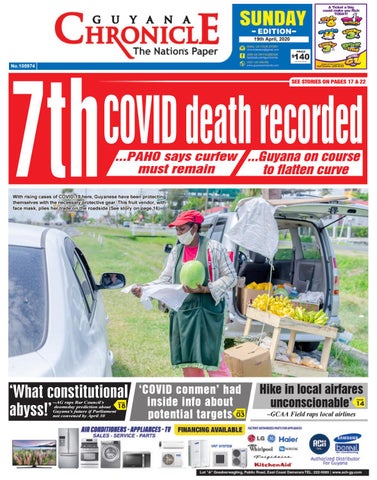
7th
'
No.105974
SEE STORIES ON PAGES 17 & 22
COVID death recorded ...PAHO says curfew ...Guyana on course must remain to flatten curve
With rising cases of COVID-19 here, Guyanese have been protecting themselves with the necessary protective gear. This fruit vendor, with face mask, plies her trade on the roadside (See story on page 16)
‘What constitutional abyss!’ PAGE --AG raps Bar Council’s doomsday prediction about 18 Guyana’s future if Parliament not convened by April 30
‘COVID conmen’ had inside info about potential targets 03 PAGE
Hike in local airfares unconscionable’ 14 PAGE
–GCAA Field raps local airlines
2
SUNDAY CHRONICLE, April 19, 2020
Five COVID-19 patients in ICU …Public Health Ministry says over 300 tested so far
By Navendra Seoraj AFTER recording 18 new cases of the deadly Novel Coronavirus (COVID-19) disease over the past week, Guyana has gone a day without making any such discoveries. Health authorities became more concerned over the past week, after the number of confirmed cases moved from 45 to 63 in just five days. The “rapid” increase pushed health authorities to increase their calls for persons to stay at home and adhere to the containment measures in place. While the advice and instructions remain critical at this time, there seems to be a glimmer of hope, as the cases remained at 63 on Saturday, even though an additional 22 persons were tested in the past 24 hours. Health authorities have so far tested a total of 305 per-
sons, with the results proving 242 negative and 63 positive. Nine of the infected persons have so far recovered. As a containment measure, health authorities have placed 48 persons in institutional isolation, and 14 in quarantine. Additionally, five of the infected persons are being treated in the COVID-19 Intensive Care Unit (ICU). Globally, there are over two million cases of COVID-19, with over 140,000 deaths. And, with no approved treatment or cure, there is no assurance that persons will survive after contracting the disease. In the absence of approved medication, governments and authorities across the world have employed a number of preventative measures to contain the spread of the disease. Locally, the government had extended its emergency measures to combat the
dreaded disease, with the imposition of a 12-hour curfew on citizens. These emergency measures were taken pursuant to paragraphs (1) and (2) (b) of the directions issued by the President, in accordance with the Public Health Ordinance, Cap. 145, and published in the Official Gazette, Legal Supplement B, on March 16, 2020. The measures at reference took effect from April 3, 2020, and are expected to last one month, unless earlier terminated, extended or amended by notice of the Minister of Public Health, after an assessment of the prevailing public health conditions. HELP ON THE WAY President David Granger, in an address to the nation last Saturday evening, said Guyana is in line to receive approximately 30,000 masks, a number of ventilators and other medical equipment
from the People’s Republic of China as it ups its fight against COVID-19. Added to that, the country has turned to the Government of India for financial assistance. According to President Granger, the fight requires unprecedented expenditure and outlay of resources to enable identification and testing, isolation, protection and treatment. These added resources will complement systems already in place to suppress the spread of the virus and provide appropriate medical attention. As the country wages war against the deadly disease, the Head of State said the efforts of the country’s frontline workers, in particular those within the medical field, should not go unnoticed. “I ask you… to think tenderly of our public health professionals and service providers; that is to say, our
doctors, nurses, respiratory therapists and all other supporting staff , medical and non-medical, who are providing the required care for those in distress,” President Granger said, adding: “Public health practitioners are on the frontline of protecting those stricken by the disease; they have been working tirelessly through this very difficult situation to provide quality healthcare to those who have been infected and afflicted. Everyone in the public health system has played a vital part in the fight against this disease.” According to the World Health Organisation (WHO), COVID-19 is an infectious disease caused by the newly-discovered coronavirus. The WHO said most people infected with the COVID-19 virus will experience mild to moderate respiratory illnesses and recover without requiring special
treatment. Older persons and those with underlying medical problems such as cardiovascular disease, diabetes, chronic respiratory disease, and cancer, are more likely to develop serious illness. The WHO believes that the best way to prevent and slow down transmission is to be well informed about the virus, the disease it causes and how it is spread. “Protect yourself and others from infection by washing your hands or using an alcohol-based rub frequently and not touching your face. The COVID-19 virus spreads primarily through droplets of saliva or discharge from the nose when an infected person coughs or sneezes, so it’s important that you also practise respiratory etiquette (for example, by coughing into a flexed elbow),” the WHO has advised.
3
SUNDAY CHRONICLE, April 19, 2020
‘COVID conmen’ had inside ‘info’ about potential targets By Svetlana Marshall DID the COVID-19 scammers tap the telephone lines of their victims? This is among questions being asked by Teacher Iola Jarvis, a resident of Victoria, East Coast Demerara who fell prey to the con artists, having been told that her brother in Canada was dying from the Coronavirus (COVID-19), and needed financial assistance to the tune of $200,000 for treatment. The scammers, two of whom have been arrested, had bona fide information about her family, such as their names and details about where they live. They were strategic, Jarvis said, while disclosing that one of the conmen imitated her brother’s voice perfectly. Her brother has been living in Canada for more than 20 years, and they communicate, many a times via telephone. Chronicling her unfortunate experience with the COVID-19 scammers, Jarvis said she was home on Wednesday (April 15) when she received a telephone call informing her that her brother had been diagnosed with the Coronavirus, and had 36 hours to live, if he did not get treatment to the tune of $200,000. Jarvis said the caller, who sounded exactly like her brother, asked that she speak with a Dr. Bacchus, a Guyanese medical practioner who resides in Canada. She
was then told that her brother was quarantined in a hospital, and was in desperate need of assistance. “He said the virus was at my brother’s throat, and was entering his lungs, and he had 36 hours to live but would survive if he gets the treatment, Teacher Iola recalled, while noting that she became extremely worried. However, with no cash in hand, the East Coast Demerara resident informed the self-professed doctor that she would need to go to the bank, and was unable to do so at that hour of the day. The conversation subsequently came to an end, but the men kept calling back to enquire about the money. “They kept calling, and the voice that was coming through the phone sounded just like my brother’s voice, and he was saying that we would have to try and get the money to him, because he only has $100,000 in his bank account over in Canada,” Teacher Iola recalled. To convince her further that she was speaking to her ‘brother,’ the ‘conman’ started referring to other family members as he discussed possible avenues of getting the money. He would then suggest that Ms. Jarvis, upon sourcing the money, give it to a close friend. They agreed to even accept money in parts. Jarvis said though the scammers sought to convince her that she was speaking to her brother, she decided to call his number, but the call went unanswered. Could
it be true, she wondered, but opted to visit the Cove and John Police Station, upon realising that something was amiss. “The spirit of God started to minister to me,” Jarvis said, noting that though she was unable to contact her brother on his cell-phone, she was convinced that the men were after her money. “They were calling, and calling. I suspected something was not right,” she said. Jarvis’ brother returned her call later that evening. He
that they are part of a larger scheme. “They were well informed,” she said while questioning how they were able to imitate her brother’s voice so perfectly. She is convinced that the men had tapped into her telephone line and were listening in on her conversations. Two of the men, who are allegedly involved in the COVID-19 medical scam, were arrested by ranks of the Cove and John Police Station on Thursday, even
The man, who allegedly teamed up with a fake doctor to solicit monies from people for COVID-19 treatment
This man was seated at the back of the car that the scammer was in. It is unclear what whole he played in the scheme
One of the vehicles used by the scammers
had not contracted the virus, and at the time of her call, he was at work, and was unable to answer. Jarvis said she was pleased to have learnt that two of the scammers were arrested the very next day (Thursday, April 16) by ranks of the Cove and John Police Station, but said that based on information the scammers sourced and were able to provide, she believes
as they were attempting to solicit money from another East Coast Demerara (ECD) woman to save her “ailing” relative in the U.S. Tishana DeSouza, who also lives in Victoria, told the Guyana Chronicle that the con artists contacted her family via telephone on Thursday. They had alleged that her uncle, Kwesi DeSouza, who resides in the U.S, was infected with the
virus, and needed $360,000 to pay for treatment. A story similar to the one that was told Jarvis was told to her, but by a Dr. Raj. According to the man, who reportedly had a deep American accent, the virus was in DeSouza’s uncle’s throat, and would travel to his lungs and kill him if he did not get the treatment within 36 hours. Repeated calls by the self-professed doctor, who had arranged for part of the money to be picked up by his brother at a Gas Station in the village, caused DeSouza to become suspicious. And though she managed to confirm that her uncle was alive and well, DeSouza agreed to meet with the brother of the self-professed doctor. She also had her brother contact the police. DeSouza stalled the alleged scammers, who were seated in a Toyota Fielder PWW 1446 parked a short distance away from the gas station, until the police arrived on the scene. They were immediately taken into custody. It is unclear, whether the fake doctor resides in Guyana
or overseas, and how they identify their targets. Like Jarvis, DeSouza said the men appeared to be well researched. It is alleged that the men, who have been using different models of vehicles, have been soliciting monies from people on the East Coast of Demerara and other parts of the country for COVID-19 treatment. To date, more than four persons have reportedly stepped forward, indicating to the police that they have either given or were in the process of giving the alleged scammers monies for ‘COVID-19’ treatment to be given to their relatives. Assistant Commissioner Royston Andries-Junior, the Regional Police Division #4 (C) Commander, when contacted by Guyana Chronicle confirmed that the alleged con artists were arrested. According to the Commander, the investigation was still ongoing, and upon completion a filed would be prepared and sent to the Director of Public Prosecution (DPP) for advice.
4
SUNDAY CHRONICLE April 19, 2020
Coronavirus: President Trump defends tweets against US states’ lockdowns
(BBC) President Donald Trump has defended tweets
in which he appeared to endorse protests against stringent lockdown measures in several US states. At his Friday briefing, he said some measures imposed by Minnesota, Michigan and Virginia had been "too tough". Earlier, he wrote in a series of tweets: "LIBERATE MINNESOTA", "LIBERATE MICHIGAN" and then "LIBERATE VIRGINIA". The curbs, which include stay-at-home orders, are
Sunday, April 19, 03:00hrs - 04:30hrs
needed to slow the spread of coronavirus. But protesters say they are hurting citizens by limiting movement unreasonably and stifling economic activity. The three states the Republican president referred to in Friday's tweets are all led by Democratic governors. Mr Trump may be seeking to encourage his political base to protest against Democrats, the BBC's Anthony Zurcher says. Demonstrations calling on authorities to end the shutdown have occurred in Michigan, Ohio, North Carolina, Minnesota, Utah, Virginia and Kentucky. But Mr Trump did not
mention Ohio and Utah, which both have Republican governors. His comments came shortly after the US saw its highest daily death toll from coronavirus, recording 4,591 deaths in 24 hours on Thursday. That rise could be because Johns Hopkins University, which records the data, began to include deaths with a Covid-19 probable cause. The US has the highest number of cases and deaths worldwide, with nearly 700,000 confirmed infections and more than 36,000 deaths. More demonstrations against the lockdown measures are planned, including in Wisconsin, Oregon, Mary-
land, Idaho and Texas. The protests have varied in size, ranging from a few dozen people in Virginia to thousands in Michigan. Minnesota Governor Tim Walz responded to the president's tweets, saying he called the White House to ask "what they think we could have done differently" but did not hear back. "The president unveiled a three step plan that mirrors exactly what we're trying to do," Mr Walz told reporters. What does federal guidance say? The president's apparent support for the protests comes a day after his administration unveiled new guidance for re-opening state
economies. That guidance recommends three phases of slowly re-opening businesses and social life, with each phase lasting a minimum of 14 days. It includes some recommendations across all three phases including good personal hygiene and employers developing policies to ensure social distancing, testing and contact tracing. Dr Anthony Fauci, from the White House coronavirus taskforce, cautioned that even as restrictions were eased "it's not game over". He warned that the virus might rebound, and there could be setbacks along the way.
Thomas Thabane: Lesotho’s PM sends army into streets
(BBC) Lesotho's prime minister, who is accused of murdering his estranged wife, has deployed the army on the streets to "restore order". In a TV address, Thomas Thabane accused unnamed law enforcement elements of seeking to undermine democracy. The decision comes a day after the constitutional court ruled against his decision to suspend parliament. The prime minister has so far resisted pressure to resign over the killing of his then-wife Lipolelo Thabane in 2017. The case has shocked many in the small land-
Prime Minister Thomas Thabane (L) and his new wife Maesaiah (R) appeared in court together in February locked kingdom, which olelo when she was shot is entirely surrounded by dead three years ago. South Africa. Two months later, Mr The prime minister Thabane married his curwas involved in bitter rent wife Maesaiah, with divorce proceedings with whom he was living at his estranged wife Lip- the time of the murder.
Maesaiah Thabane was charged in connection with the killing in February and has since been released on bail. Mr Thabane's own lawyers have argued that as prime minister he should be immune from prosecution and cannot be charged with murder. The case has been referred to the High Court, which will be sitting as the Constitutional Court when it decides whether the case against Mr Thabane can proceed. The 80-year-old prime minister has previously said he will step down in July, resisting pressure from his own party to leave office immediately.
04-04-2020
03 06 09 19 20 21 07
03-04-2020
I
08 12 15 19 21 01 14 16 24 25
702
012
01 04 08 12 14
5
SUNDAY CHRONICLE April 19, 2020
Increased traffic over 72 hours prompts roadblocks
(TRINIDAD GUARDIAN) Police Commissioner Gary Griffith says citizens who choose to flaunt the Government’s Stay-at-Home orders and go onto the nation’s road if they are not essential workers or going on essential business will have to prepare themselves to be caught up in daily roadblocks by police. This warning came yesterday, even as his officers caught thousands of motorists in roadblocks set up across the country. The action caused traffic gridlocks for hours throughout the day as the officers did not let up on the roadblocks until late evening. In an interview with Guardian Media, Griffith said the islandwide roadblocks that caused the traffic jams were set to become a daily routine, as he said over the past 72 hours the public had gotten complacent about the Public Health Ordinances in place to stop the spread of COVID-19. He said police have been monitoring traffic on the nation’s road through their Command Centre since Government had ordered non-essential businesses closed and non-essential workers to stay home. The trend, Griffith said, was light traffic between 6 am and 6 pm and mostly clear roads between 6 pm to 6 am. “What we have seen, however, over the last 72 hours, there has been a great increase in traffic and it is obvious it is not because of persons who may be deemed as employees in essential businesses or persons who are going to acquire goods and services from these essential services. It means that persons who are not any of those two are now starting to go along the roadways, so it means obviously that persons
Police officers conduct a roadblock exercise on Lady Hailes Avenue in San Fernando yesterday. are starting to become very going to be quite a long while. the road. It doesn’t mean that Al-Rawi said the roadblocks complacent,” Griffith said. We intend to intensify these you are breaking the law but were part of the COVID-19 He said the change in pat- roadblocks throughout the what you are doing is affecting response. He said the country tern on the roadways led to country, so if you go out there individuals, you are breaching has a very active and aggresthe enforcement of the Gov- it is possible you can remain policies,” the CoP said. sive Police Commissioner ernment’s orders in a way that in traffic for several hours. So “We are here to persuade left many citizens questioning to avoid that, stay at home,” persons to adhere to policies whether it was a repeat of the Griffith said. and to enforce laws. I am not July 2019 ‘Day of Total PoHe said essential work- going to cross it, so in situlicing.’ Back then, there was ers, many of whom yester- ations where persons have a also traffic gridlock across day complained bitterly on legitimate reason for being on the country as police con- social media about being the road, obviously, they will ducted roadblocks at various made late for work by the move out faster than individlocations. gridlock, will be allowed to uals who do not.” But with the Police Ser- pass through the roadblocks Griffith said if there is a vice on Orange Alert, Griffith with less hassle than those marked reduction in vehicuyesterday the latest exercises with no reason for being on lar traffic, the police would may become the new normal the road. reduce the number of roadif citizens fail to adhere to “If you don’t have a reason blocks but if the traffic conrepeated calls to stay at home. or justification, they would tinues on the current trend, the “The more they stay on very well spend some more roadblocks will increase. the street, the longer there time scrutinising and doing Speaking during the daiwould be traffic congestion some investigation to verify ly press conference yesterat times. I would state this is the reason for you being on day, Attorney General Faris
Still no new COVID cases
(NATIONNEWS) Barbados’ youngest COVID-19 patient and her father were released from isolation today after receiving two consecutive negative test results for the viral illness. The seven-year-old girl and
her parent were among 35 people who tested negative yesterday as the number of tests done since February 11 reached the 1000 mark. For the third consecutive day, no-one tested positive for
COVID-19. Since March 16 when the first two cases were identified, 75 people have tested positive for COVID-19, and 17 have recovered. Five Barbadians have died and 53 remain in isolation. (BGIS)
and the exercises were being co-ordinated between the TTPS and the Minister of National Security. On social media yesterday, comments on a Guardian Media online story about the roadblock earlier in the day varied. Many praised the police and chided their fellow compatriots for being outside. “People starting to get restless and idle like they don’t know how serious this thing is until it happen to them once you have food and water, rock back home, play some cards or games clean yuh yard or something don’t risk yuh self being out there,” one user wrote. However, some took the opportunity to criticise the police and the Government, as one user wrote, “Trinidad people stupid, we not under no state of emergency, (SOE) and people have things to do. All yuh studying the wrong thing. Why you have to qualify to get money from the Government. It have a lot of hungry families in this country but this government only studying to put up roadblocks. That not making no sense.”
6
SUNDAY CHRONICLE, April 19, 2020
COVID-19 and our children
AS we continue to take steps to stop the spread of the novel coronavirus, commonly referred to as COVID-19, the Ministry of Education (MOE) has announced that schools will remain closed until further notice. Citizens would be aware that following the discovery here of the first case of COVID-19, on March 11, 2020, the MOE took the decision to close schools until after the Easter vacation period. As the situation surrounding COVID-19 continues to escalate, with Guyana increasingly recording more cases of the virus, the MOE has taken the decision to extend the closure of schools until such time as appropriate for them to be reopened. In the meantime, parents are advised to continue making use of the numerous Online resources made available to ensure your child’s continuous learning. For the most up-to-date information, parents and students are advised to visit the MOE’s website and Facebook page for links to Online learning
resources. Although parents and students might be concerned about the implications of the extended school closures, at this point in the pandemic, there appears to be no other responsible option. Parents must, however, be reminded that formal learning is no substitute for the informal learning that takes place outside of the classroom. Whilst children are home for this extended period, it might be a good idea to create projects for them to undertake in order to learn new and useful life skills. For example, we are increasingly receiving guidance geared at encouraging citizens to start their own kitchen gardens, in order to ensure food security at this time. This could be the ideal project for children and young people, who have become increasingly urbanised in their interactions with nature and the natural world. Gardening is a fantastic outdoor activity, where children and young people are able to learn valuable life skills and take on real responsibilities. According to Human Rights
Regardless of how we got into the ‘mess’, the challenge is for us to get out Dear Editor, I REFER to Mr. Kowlasar Misir’s letter published in the April15, 2020 edition of the Stabroek News, under the caption, “It was Mr. Lowenfield, Mr. Mingo and others from GECOM who birthed us this mess”. He was responding to my letter SA (2020.04.14) in which I called for an apology from critics and letter writers who had viciously ridiculed Lowenfield and senior GECOM members on the proposed workplan. Mr. Misir vehemently objected to my position. on the ground that it was the CEO, RO (Region 4) and other GECOM staffers that got the nation into this mess. I see no sense in challenging his narrative, since he has demonstrated, in the present circumstances, an inability to separate issues, even if a failure to do so deepened the “mess” he is expressing concern about. Reading Misir’s letter, while
he recognised the election crisis as a mess, he seems not to have comprehended the potential negative consequences to the nation. He is driven by emotion, and has not come to grips with the seriousness of the situation. When that realisation clicks in, he will appreciate the wisdom of stepping back, despite one's feelings, and separating issues: That is, the general from the particular. In doing so, he might see the value of civility in our public discourse on this sensitive issue, and refrain from propagandising on every measure GECOM takes to address the crisis. In closing, I hope that Mr. Kowlasar Misir and I will have a meeting of minds on this salient point; regardless of how we got into the “mess”, the challenge is for us to get out with the least damage and pain. Regards, Tacuma Ogunseye
Watch, there are approximately 1.5 billion students who are currently out of school. Owing to widespread job and income loss, coupled with economic insecurity, there is likely to be increased rates of child labour, sexual exploitation, teenage pregnancy and child marriage. We have already covered the impact on families during the current pandemic, and the surge in domestic violence, coupled with the stresses on families, especially those living in quarantine, or lockdowns, and the hugely detrimental impact on children who might be more exposed to traumatic incidents. According to Human Rights Watch, as the global death toll from COVID-19 increases, there will be more children who become orphaned and vulnerable to exploitation and abuse. Furthermore, child abuse is also less likely to be detected during COVID-19, as child protection agencies have reduced monitoring to avoid spreading the virus, and teachers are also less able to detect signs of ill-treatment, as schools are closed.
“The risks posed by the COVID-19 crisis to children are enormous,” says Jo Becker, children’s rights advocacy director at Human Rights Watch. “Governments need to act urgently to protect children during the pandemic, but also to consider how their decisions now will best uphold children’s rights after the crisis ends.” According to Human Rights Watch, the COVID-19 crisis will mean limited or no education, and falling behind their peers. More than 91% of the world’s students are out of school, as they have been closed in over 188 countries around the world. As we have already seen, the COVID-19 crisis is exposing the disparities in nations’ preparedness to ensure students continuous educational development. The infrastructural disparities are also stark, with many children not having access to the Internet and available learning resources. Similarly, schools are not equipped to deliver Online learning, as they do not have the technology or infrastructure.
According to Human Rights Watch, nearly half of the world has no Internet access. Human Rights Watch has made a number of recommendations to governments, in order to safeguard children’s rights at this time. They include, but are not limited to: Prioritising efforts to continue education for all children, using available technology; providing economic assistance to low-income families; and expanding public education and awareness campaigns/services for children at risk of violence and sexual exploitation. As the world continues its fight against COVID-19, we must ensure that those who are most vulnerable within our society are adequately protected. The government is, therefore, urged to provide further support in the way of creating better access to educational materials, and also financial relief for low-income families who are already vulnerable at this time.
Small parties want more workstations for recount Dear Editor,
THE new political parties that contested the March 2, 2020 general and regional elections are deeply disappointed at the decision of the Chair of GECOM, Justice (ret’d) Claudette Singh, who decided that only ten (10) stations should be established for recounting the votes of the ten regions, as has been decided by GECOM. There has been no announcement of the hours of work, but we suggest that there should be two sessions of eight (8) hours each, with one (1) break each for lunch and dinner. With the four months constitutional deadline for the convening of Parliament after its dissolution ending on April 30, GECOM must be seen as making every effort to ensure that the Constitution of Guyana is not once again violated. We urge that more stations should be considered by the
Madame Chair and, in any circumstances, there should be no less than ten (10). It cannot be consistent with good administration and the Rule of Law for more inordinate delays to continue to frustrate the desire of the Guyanese people for an early end to the elections process which started on March 2, and, for all intents and purposes, would have ended on March 4, had the fraudulent activity not taken place that day. The results are now six weeks overdue, and our partners in the international community, including the Commonwealth and the OAS, have noted the delay and urged a speedy resolution. Having regard to the constitutional deadline, we urge GECOM and the Madame Chair to fix a deadline by which the recount should be completed, so as to assure the nation that Guyana will not once again drift into unconstitutionality. The public will recall that
the Court ruled that the first unlawful declaration of the Returning Officer of Region 4 was made with the involvement of several members of the GECOM Secretariat, and the second declaration is under challenge by an action for contempt of court, which is pending. Having regard to the widely-publicised events surrounding these declarations, it is incumbent on GECOM to exclude the RO for Region 4, and the staffers of the secretariat involved in these declarations to be excluded from involvement in the recount. Regards, A New and United Guyana (ANUG) Change Guyana (CG) Liberty and Justice Party (LJP) The New Movement (TNM) United Republican Party (URP)
7
SUNDAY CHRONICLE, April 19, 2020
The OAS is completely out of line --GECOM and its staff must be respected!
Dear Editor, THE Organisation of American States (OAS) has blatantly overstepped its boundary! The OAS seems to have become an additional mouthpiece of the PPP! This organisation that is supposed to be apolitical has decided that it will openly align itself with the PPP, and echo the sentiments of that party as it relates to the proposed "national recount" (which, of course, I don't support) to be undertaken by GECOM. The OAS injecting itself into Guyanese politics in this way must be strongly rejected and condemned by every right-thinking Guyanese, regardless of political affiliation. The OAS’s brazen attack on GECOM's staff is an affront to Guyanese workers, GECOM and the Guyana government! I would hope that the OAS and Bruce Golding do not think that political interference in a sovereign nation is synonymous with OAS’s mission to strengthen political processes and support democracy. What or
who gives the OAS the authority to decide that it can dictate to GECOM, which of its staff must be involved in the recount! What gives the OAS the power to try to label and malign any of GECOM’s staff as "corrupt" or "compromised"! How dare the OAS and those who led its mission to Guyana, disrespect Guyanese workers! The OAS must know that Guyanese see some in this March 2 bunch as partisan participants with parochial interest. The organisation's latest pronouncement seems to have confirmed Guyanese views. Is this how the OAS operates! There are several reports that claim that some who led the OAS’ mission to Guyana to observe the March 2, elections have been compromised, and are biased towards the Opposition because of prior personal friendships. Are these reports true? Maybe it is time the OAS office investigates these reports to determine if there is any truth in them. Guyanese will not tolerate any level of disrespect by operatives of the OAS or any other observer mission. Guyanese people
understand the role the OAS plays in the Americas, and appreciate its importance. However, what the people will not accept is an open attempt by any external agency to disregard Guyanese people and the independent constitutional institutions that preserve democracy in Guyana. The OAS must, as of necessity, review its recent attack on GECOM and its staff, to determine whether it supports or promotes democracy, or whether it retards it. I, therefore, call on the OAS to retract its openly-prejudiced statement and apologise to GECOM and the people of Guyana. The Guyanese people deserve nothing less! GECOM and its staff must be respected! The OAS and every other observer mission must know that Guyana is a sovereign, independent nation, with a Constitution which dictates how autonomous institutions like GECOM operate. The OAS should, therefore, take some time to familiarise itself with those constitutional provisions relating to GECOM. I am quite sure that a brief perusal of that Constitution would inform the OAS that it (the OAS) has
no authority to instruct or dictate to GECOM on any matters relating to its staffing or general operations. In fact, the Constitution does not give any foreign entity any authority to interfere, dictate or make any pronouncement on the functionality of GECOM. The OAS should, therefore, respect the independence of GECOM and the Guyana Constitution. Guyanese deserve this much from an organisation that they invited to their country. Can the OAS go to any First World nation and interfere in its politics in the way it is doing in Guyana! I think not! The OAS must know that GECOM is a national organisation that subscribes to the nation's Constitution. And yes! Guyana does have a Constitution! Regrettably, unless a declaration of the March 2 elections results are declared, this kind of “external bullyism” will continue unabated. Sincerely, Lurlene Nestor
I believe that Granger is acting the role of a true Statesman Dear Editor, THIS week, we note with interest through Facebook and other media, concerns expressed about the leadership of the ‘Coalition’ and, in particular, the leadership of David Granger. No doubt, this concern may be the results of the fulminations and hype consequent to the ‘fak’e news generated by the well-funded and well-oiled Mercury propaganda outfit. One should not be surprised that this has created concerns within the ranks of the ‘Coalition’ Party and their supporters. Already, the PPP propaganda ploy has suggested that: Any recount that fails to give the PPP an electoral victory will be flawed. Mind you, this is before the details of the recount are known; a clear case of “reductio ad absurdum”. This latter ploy is to frighten ordinary people by this nonsense. The additional contention that if David Granger is sworn in as President,
the international community will apply sanctions against Guyana. What sanctions were applied during the height of brutal assassination and the drug trafficking during the administration of the PPP? We know certain top members had their visas cancelled; and remember, when the Late Ronald Gajraj was appointed High Commissioner to India, he had to travel by circuitous route, because his visas to North America were cancelled. Citizens must not, as some have been, frightened by this nonsense about sanctions. More on this later. Perhaps, the above may have caused expressions of concern from the likes of Rickford Burke, who, I believe, has his heart in the right place. But I say to him and others, this is no time to fan the flames of disunity; neither should we panic. In response to Rickford Burke’s charge against the Leader, David Granger and the ‘Coalition’, I have had similar sentiments expressed by former colleagues in the
diaspora. Some of them have understandably stated that the confusion in the political arena today could not, and would not have taken place were Forbes Burnham alive. I have gone to great lengths to explain to them that such a comparison is outof-place, even though it may give those of us who lived through the hellfire of the 50s and 60s, and the post-1992 period some comfort. First, the Cold War has officially ended, even though there are new and difficult dynamics internationally. Second, Forbes Burnham represents the perspicacity and vision that a Nation experiences once in thousands of years. Thirdly, Burnham had the support of many all-time great men and women, who, for whatever reason, are not available to David Arthur Granger. Next, thanks to a challenging environment, Burnham was able to recruit the likes of Ranji Chandisingh, Vincent Rambarran Teekah and others who were part of
the PPP Top-Brass that came over to the PNC, thanks to Burnham’s charisma and understanding of the real world in which we live. David Granger has to superintend a collection of political parties and groups that produce the likes of Charandass Persaud. Burnham, as Leader of the PNC, would have dealt condignly with any ‘Judas’ that appeared on the scene. Finally, Burnham had the support of an all-powerful, energised Party Secretariat that functioned 24/7. Another condition which Rickford Burke and other well-meaning supporters need to recognise is the in-born racists and hypocrites, who, like worms, have come out of the woodwork as a result of this interregnum. As one who has been in the hustings from the early 50s, I disagree with the simplistic position taken that Granger is a weak Leader. I believe Granger has avoided the tedium of replying to every statement made in the media and Facebook by satanic forces. I believe that Granger is acting the role
of a true Statesman who is concerned with securing the peace of our nation-state. I believe that history will honour him; that time will justify his staying above the noisiness of the rabble. To those who accept the evil of the other side, I say, let us get away from our typewriters and talk to the young and old, to explain our history and the danger of weakening in any way the Leader of the PNC and the Leadership of the ‘Coalition’. I understand the frustration of those opposed to the PPP, but feel that the ‘Coalition’ is not sufficiently energised. Valid as this may be, what is now urgently needed is for us to be like a solid chain without a single, weak link; a group where the very young and the old must be allowed to use its various skills to save our beloved Guyana. I end by making a plea to transform the words of the second stanza of the PNC Battle Song, written by Eusi Kwayana, into reality: “Hold the line of battle, comrades,
Link our arms in unity, Organise and charge the forces Of the haughty enemy! Truth shall be our martial weapon Brotherhood, our armour plate Guyanese the breed we’ll cherish Scorning paths of racial hate; From field, office, factory Rally to the PNC”. That this and succeeding generations will not be the victims of corruption, crassness and subtle racism. This is a monumental task, and requires the intellectual vigor of my friend Rickford Burke and those who speak to me on a daily basis. We must not let our noble ancestors who suffered from the wiles of colonialism, discrimination and inhumanity turn in their graves. The struggle continues! Regards, Hamilton Green
8
SUNDAY CHRONICLE, April 19, 2020
POLITICISING THE PANDEMIC
FROM the outset, I had urged that there should be no politicising of the coronavirus pandemic in Guyana, at least not from me and the ministerial group that form the nucleus of a national task force. The task force initially crafted policy guidelines and a national response plan following the death of the first confirmed case last month. What followed has altered the customary way of life of our people, who now have to live with a bundle of restrictions. These measures were codified in Orders that have been authorised by the President, and under which extraordinary powers have been assigned to frontline ministers with responsibility mainly for finance, public health and public security.
SUPERVISORY ROLE The National Coronavirus Task Force (NCTF), of which I am the Chairman, has an over-riding supervisory role to oversee compliance, implement and, as the case may be, to alter these measures. The fight against the virus is an all-of-government, all-of-society task. Unfortunately, this has to happen within the context of a charged political environment. I am fully aware of the decisions of Guyana’s courts of law regarding a national recount of all ballots cast
in the March 2 elections. I am aware also, of the constitutional role of the Guyana Elections Commission (GECOM) to supervise and control all processes of these elections. But the recount will take place during a pandemic when there are in effect restrictive emergency measures, similar to those in all other countries that are battling Covid-19.
MENU OF MEASURES Among the gazette menu of measures, we have in place a closure of our air space to incoming international flights, shut-down of our borders, a dusk to dawn curfew, protocols for quarantining of persons, guidelines for clustering and social distancing. Having made a decision that the recount would be done at a public venue, to wit, the Arthur Chung Conference Centre, it should be common sense that, as a constitutional agency, GECOM would ascertain whether arrangements for the recount would conform to the Executive Orders. We may have our diverse and differing political views on the no-confidence motion, the incomplete electoral processes and, even, our preferences as to the outcomes. But one thing ought to be absolutely clear: there is established under our Constitution a President of the Co-operative Republic of
Guyana, “who shall be Head of State, the supreme executive authority, and Commander-in-Chief of the armed forces of the Republic”. In the present circumstances where the Constitution is the supreme law, this dispensation remains immutable and non-negotiable. SEEKING GUIDANCE So, it should surprise no law-abiding citizen that GECOM’S Chairman, Madam Claudette Singh, a retired Justice of Appeal, should request the NCTF to seek guidance regarding:(a) time at which the daily recount exercise should end; (b) number of persons who should be safely accommodated at the recount venue at the same time; and (c) required protocols for quarantining persons coming from abroad, and who were invited to be part of the recount process. Yesterday, I provided the Chairman of GECOM with the advice of the task force, as follows:1. That GECOM adjusts its desired 10-hour work schedule within the daily 6am to 5pm (06:00hr to 17:00hrs) time-frame, and does not extend it into the curfew period (18:00hrs to 06:00hrs). 2. That all persons who are permitted special entry into Guyana during this period when our air space is
closed to in-bound passengers, must submit themselves to being quarantined at a government institution for a period of 14 days. 3. That GECOM allows four technical experts of the Public Health Emergency Operations Centre (PHEOC) to conduct a site visit to assess whether distancing arrangements conform to the pandemic guidelines and the published Order. PUBLICITY STUNTS Without seeking to grab the limelight as some opportunistic politicians have been doing by handing out face masks as cheap publicity stunts, the task force has been daily dealing simultaneously with a wide range of issues. It monitors the efforts at the critical medical-technical front; follows security enforcement of traffic, curfew and other containment measures; coordinates mobilisa-
tion for and distribution of social care assistance; consolidates recommendations for fiscal or social impact measures, processes requests for non-commercial repatriation flights, etc.. We have kept our hands on the pulse of what’s happening in the society to ensure that there is a balance between social restrictions and the need to keep the economy open. This requires a constant review of measures to give space for continuation of production and distribution of supplies, and to facilitate the uninterrupted delivery of a wider range of essential services. The latest addition to the list of essential service providers are Attorneys-at-Law, my erstwhile colleagues, who invariably venture out late at night to road-blocks, lockups and even quarantine centres in dedicated furtherance of the Rule of Law.
SPIKE IN CASES This pandemic will be with us, whether we like it or not, for quite a while longer. We are experiencing a spike in the confirmed cases, the epi-centre being Georgetown. The efforts must continue to restrict clusters at the markets and in shops, in lines at banks and money transfer branches, and inside road and river transport facilities. Social distancing must be translated to mean physical distancing. We are witnessing the death toll around us, close to 160,000; with over 2,300,000 confirmed cases worldwide. Life is complicated as it is, as almost daily we extend compassion to those who are infected and to those who have lost loved ones, especially in the diaspora. It would be cruel, on top of this, for us to spin dirty politics around pandemic issues in selfish pursuit of narrow partisan ends.
THE people's victory is never easily achieved and is often denied I am not an advocate for Marxism and certainly do subscribe to the notion that we should view the human condition through one theoretical lens. That being mentioned, if history is our guide, it is hard to argue against the idea of the battle between the 'haves' and the 'have nots' in the realm of politics. Even the most ardent anti-Marxist advocate would find it difficult to avoid this measurement for analytical purposes. Since time immemorial, whenever humans have converged to compete for the acquisition of power, there is always one side that carries the hopes and aspirations of the poor and another side that bears the interests of the bourgeoisie or those endowed
with resources. When geopolitics is intertwined with this scenario, in a globalized world, it becomes complex but no less instructive. If the people’s leader is not easily controlled or his/her interests do not align with the wishes of big foreign states and the regards of capital, the triumph of the will of the people is usually never easy. NOTEWORTHY HISTORICAL EXAMPLES In the service of the abovementioned, the examples of Patrice Lumumba and Salvador Allende are unavoidable. If this column had centered its focus on Guyana, Dr. Cheddi Jagan would have been a necessary mention. From all historical accounts, Patrice Hemery
Lumumba was a man of the people. He led the Democratic Republic of Congo to Independence and served as Prime Minister from September 1960. The beloved Prime Minister did not play the geopolitics cards right and was imprisoned and shot under the command of Joseph-Désiré Mobutu who carried out the wishes of the big powerful nations. Perhaps, the most egregious but the ultimate best exemplar is the case of Chile in 1970. Salvador Allende won free and fair Chilean elections and was widely loved by the people. He embraced Communism and incurred the wrath of the mighty United States. The Church Committee Report documented: “Covert United States involvement in Chile in the decade between
1963 and 1973 was extensive and continuous. The Central Intelligence Agency spent three million dollars in an effort to influence the outcome of the 1964 Chilean presidential elections. Eight million dollars was spent, covertly, in the three years between 1970 and the military coup in September 1973, with over three million dollars expended in fiscal year 1972 alone.” (Pg.1) The fruit of this dastardly effort was the violent overthrow of President Allende in 1973. When the US Secretary of State, Henry Kissinger was interviewed by Newsweek in 1974 and asked to explain the reasons for these actions by the US, he replied: "I don't see why we have to let a country go communist due to the irresponsibility of its own people".
FOREIGN INTERVENTIONS Foreign intervention is the method used by countries to advance their interests; this is usually executed overtly or covertly. Research has established the United States as the country with the most interventions at 81 from 1946-2000. Among 938 global elections examined, the United States and Russia were involved in about one out of nine (117), with the majority of those (68%) being by way of secret operations, rather than open manoeuvers (Devin, 2016). It has to be noted, some interventions have been for the greater human good and others have been downright diabolic with little regard for sovereignty and human rights. TURN TO PAGE
9
9
SUNDAY CHRONICLE, April 19, 2020
No more state alignment with immorality and illegality GUYANA’s politics is fractured along the lines of ethnicity, a phenomenon which existed before independence but accentuated since independence as Guyanese fight for control of the state apparatus. In the recent years of the PPP’s Administration, its executive office holders were least concerned about maintaining wider public trust. This was a direct result of a society where a divided electorate did not hold its government accountable. Most people will agree that, to a large extent, Guyana’s politics is ethnically divided and the electorate does not vote on polices but on race. This has allowed the then PPP executive officer olders much leverage to evade accountability and thus became very unethical in their conduct. Good governance had no place in the post Dr Jagan PPP. Ethics refers to values manifested in a choice of action such as a decision making preference, and express a quality or a general standard of conduct. It has a certain weight in the choice of action and is most important to an individual, organisations and the wider society. It is said that morality signifies values and ethics which can be defined as a systematic reflection on morality. In Guyana’s security sector, under the PPP/C government, a significant ethical and legal problem emerged when the then Minister with responsibility for the Security Sector allegedly created a
death squad to “fight crime”. This posed serious questions about the PPP’s ethical conduct and its inclination to act outside of the law, while being the government. CRIMINAL GANG There are those who sought to justify the Minister’s action by using the consequential approach in ethical decision making. The core idea of consequentialism is that what makes an action right is that it brings about better consequences than any of its alternatives. Critics of consequentialism contend that the Minister did not foresee nor estimate all the possible or even probable consequences of his decision to create a death squad which became known by the popular name the “Phantom death squad” The criminal gang unleashed deadly attacks on all ethnic groups, targeted state institutions, and developed links with the drugs underworld. This consequentialist approach to crime fighting saw the then prison escapees and their accomplices turning up dead while there were no witnesses or arrests forthcoming. The death toll of unsolved murders reached an alarming figure of over 400, including innocent women and children caught in the firing line. This period (2002-2003) is considered the bloodiest in the history of Guyana. The use of criminal gangs outside of the state’s legitimate security institutions undermined and compromised the Guyana
Police Force and the Guyana Defence Force, and, consequently, the security of the citizenry. It became the era in which illegality was the order of the day. With the Minister’s creation of the death squad, he undermined the legal mechanism responsible for addressing crimes in the interest of the common good. In the process, the state’s legitimate security institutions were sidelined and Guyana was held hostage by drugs, drug lords and criminal gangs that became the law. The PPP Administration saw the shortterm consequences of this action and not the long-term effect on trust and respect for authority. In the face of mounting pressure from the opposition in parliament, the media and a large fraction of the citizenry, the Minister faced a commission of inquiry. He was reinstated to his post but amid protest from the international community. He was subsequently reshuffled and given an ambassador post in a foreign country, much to the disdain of the Guyanese populace and the International Community. ILLEGAL CONDUCT However, to this day, the PPP still faces serious questions as to their unethical and illegal conduct of selling the country’s security apparatus to criminals. Leaked telephone records show that the minister was in constant communication with the ‘phantom squad’s leaders before and after significant murders and executions. It
was later discovered that he was the co-leader of the gang. The leader of the gang who was serving time in jail for narcotics in the United States had published a full page declaration in the country’s Stabroek Newspaper, boasting of being the head of the phantom gang and claimed that he was working with the government to ‘fight crime.’ The consequences of the Minister’s action no doubt bring into question the PPP’s Government morality and commitment to maintaining law and order. The crime wave had spawned the establishment of the death squad. A Commissioner of Inquiry found ‘serious procedural irregularities in the official conduct of the Minister related to his involvement with individuals who allegedly carried out extra-judicial killings…’ The United Sates issued a statement which stated that it believed significant questions remain unanswered regarding his involvement in serious criminal activities. The USA will do well to remember this sad period in Guyanese history. Minister’s choice of action which was justified as consequential and a Machiavellian approach to deal with criminals was called into question. He acknowledged, during the Commission of Inquiry, that he was in constant contact with a top phantom squad member. He admitted saying “because he was so fed up with the police department’s incompetence that he was forced to use an outsider to gather intelligence to use
in the fight of crime.” In the public sector apparatus, the principle of democratic legitimacy supports responsiveness of public servants to policies laid down by the elected government of the day. There exists no justification then for the GPF and the GDF not to be used as the legitimate security apparatus to deal with crime. There can be no legal justification for the creation of a “death squad” to function as the state’s security institution. SECURITY OF THE STATE It can be said that democratic legitimacy is sometimes expressed in terms of the elected government’s right to determine public interest in relation to the substance of government policy. The PPP government of the day public interest should have been the security of the state, and the democratic responsibility of the minister was to institute polices for the safety of the population using state institutions. How could it be ethical, or more so legal, to institute a criminal network for the governance of the security sector? And do such actions not undermine an impartial Guyana Police Force and Guyana Defence Force in their function of the security of the state? Governments, in an attempt to legitimize public confidence amidst the perception that legislators are not people who command widespread trust, have been instituting parliamentary ethics to build their integrity. It must be
THE people's victory is never easily achieved... Besides, the United States of America has rescued numerous people around the world from the deadly rule of brutal dictators through their interventions. Continuing in this vein, academia has established two types of foreign interventions: process intervention, where the foreign power seeks to support the fair rules of democracy and has no horse in the race and partisan intervention, where the foreign nation-state openly shows support for one side (Corstange&Marinov,2012). Insofar as
the subject at hand is concerned, it has always been about which side leaders find themselves on. They might be on the side of the people but if not aligned with powerful interests and the people’s victory labours along. THE PEOPLE’S VICTORY IN THE AGE OF MISINFORMATION AND DISINFORMATION A political campaign headed by the people’s leader can be well-intentioned and
based on a love of all, but if the other side has a war chest, an unrelenting and aggressive disinformation machinery, all lofty ideals die at the altar of the subversion of democracy. "On average, an electoral intervention in favour of one side contesting the election will increase its vote share by about 3 percent," (Levin, 2016). In 2018, social media and disinformation were used to influence elections in at least 18 countries, according to the democracy advocacy group, Freedom
pointed out that, during the PPP’s Administration, the Guyana parliamentary code of conduct for ministers and parliamentary members was in draft for time immoral and was only signed off when President David Granger’s Administration took Office in 2015. ETHNIC CONFLICT The ethnic conflict in Guyana is exacerbated by political conditions as evident in the aftermath of national elections, where the defeated political leaders swear to undermine the state and the government administration. Guyana must not return to that era of criminal control of the state apparatus. We must not return to an administration which sold the state security apparatus to criminal elements. Lest we forget, do we even need to question the security structure and policies of our nation now? Guyana has blossomed under a credible administration of law and order and shall continue in this vein. Guyana has become more democratic in the last five years. Law and order have prevailed and Guyanese have spoken; we want to continue in this vein. Yes, we will, for our greatest asset - our future generations to sustain Guyana’s developmental agenda - prosperity for all!
FROM PAGE
8
House. It seems this is the new normal. As a consequence, the good leader normally stands on truth but is subject to a blitzkrieg of untruths. Where this obtains, it is never easy to cut through the litany of propagandistic onslaught and this could result in the denial of the real will of the people. All the above-mentioned makes clear, the people’s victory is never easily achieved and is often denied.
10
SUNDAY CHRONICLE, April 19, 2020
Understanding Energy
OPEC’s role in the current crisis and what it means for Guyana THE past few months have been some of the most chaotic that oil markets have seen in years, with the COVID-19 pandemic driving down demand and a Saudi-Russian price war driving up supply. As Guyana becomes an oil exporter in its own right, it’s worth understanding how major industry powers such as OPEC, Russia and the U.S. shale producers can impact Guyana’s future. First, it’s useful to know how the current international landscape took shape. The Organisation of Petroleum Exporting Countries (OPEC) includes 14 of the world’s largest oilproducing nations. It was established in 1960 by five nations -- Iran, Saudi Arabia, Iraq, Venezuela, and Kuwait -- as a way for major producing nations to coordinate and manipulate price and supply. Nations such as Saudi Arabia, where oil production and government are deeply intertwined, dominate the group’s decision-making and have the power to move global prices with a word or two to the media. Although it is often described as one of the world’s most powerful international cartels, OPEC no longer has the dominance in the oil markets that it once did. One of the most significant developments in global markets over the past decade has been the growth of non-OPEC producers. Many large producers - like the United States, Norway, Russia and Canada - are not members of OPEC. Many newer oil produc-
ers like Ghana and Brazil have also declined membership. There has also been a minor exodus from OPEC, with Ecuador, Indonesia and Qatar leaving over the past few years. With much of the world’s new oil production coming from non-OPEC countries, the cartel has seen its power over the oil market diminish as its attempts to limit supply and boost prices have less of a a lasting impact. The organisation is also plagued by the refusal of several of its members to adhere to their production quotas. Guyana itself is adding to the non-OPEC supply and is set to surpass the production levels of several OPEC members, such as Libya, Gabon and possibly even Venezuela by the late 2020s, according to estimates from international analysts. However, Guyana’s production will still be small compared to major players such as the US, Russia and Saudi Arabia, who each produces more than 10 million barrels per day. For comparison, the Liza Phase 1 development will produce around 120,000 barrels per day when it hits its peak. “OPEC+” refers to a newer collaboration between OPEC and non-OPEC producers such as Russia, Malaysia and Bahrain. While these countries are not members of OPEC, they sometimes agree to participate in collective production quotas to drive up prices. A dispute between Russia and Saudi Arabia ignited the recent price war when Russia
snubbed a Saudi-led OPEC plan to cut global production. A supply free-for-all ensued, leading to the massive price fall, before top producers agreed to massive global output cuts on April 10. Many non-OPEC+ members such as the US, Brazil and Norway also independently cut their own production. The cuts could help stop the sharp price decline, but with COVID-19 crippling demand, the impacts have not been as positive as many had hoped. The price war was inextricably linked to the explosive growth of US shale oil over the past few years, a major source of non-OPEC production. Shale oil and other “unconventional” oil produced onshore from rock (shale) through the use of hydraulic fracturing has flooded the market. As a result, the US pushed past Saudi Arabia and Russia to become the world’s largest oil producer in 2018, contributing to the current glut in supply. Many analysts have speculated that part of the reasoning behind Russia’s recent aggressive push to reduce prices might be to drive US shale producers out of business. America’s shale oil is generally more costly to produce. Plus, some shale producers are small, privately held companies focused on a particular state or shale basin and do not have the deep pockets and diverse assets of the major oil companies, or the state backing of Russian companies.
Robert McNally, an energy markets expert and former White House official, addressed what the shifting geopolitics of energy markets mean for Guyana directly, at the University Guyana in January. According to McNally, Guyana would suffer as part of OPEC and OPEC+ since collective production cuts are such a routine tool used by the groups to help prices globally. Countries such as Saudi Arabia have decades of stockpiled revenues to draw on to make sure production cuts or price drops don’t impact their economies too badly. But as an emerging producer, steep production cuts could be difficult and expensive for Guyana. McNally did say that observer status at OPEC could be a good opportunity for Guyana, giving government officials a front- row seat for negotiations and helping them understand the markets and the geopolitics without taking part in mandatory quotas or paying membership fees. While the outcome of the productioncut deal should hopefully stabilise prices, it is also a reminder that global markets are largely out of Guyana’s control. As Guyana works to establish itself as an important and dependable supplier to the market, it is critical to maintain transparent and fair rules of the game that ensure continued investment and development, even during difficult times for the industry.
The Guyanese work ethic
GROWING up in the diaspora, I was always made aware of how hard we, as immigrants, were and are expected to work in the western world. For many immigrants who leave their home countries seeking a better life, the main goal is almost always to find employment, work hard and earn a living for your family who might be with you or for those left at home, here in Guyana. For most Guyanese, the reality is that many of us have families who chose to migrate because Guyana is simply a third world country with poor development and lack of opportunities to progress financially. For decades, Guyanese have been leaving Guyana in droves, seeking a better life and although they have been successful in achieving that, certainly, in terms of job security and wealth accumulation, Guyana has remained stagnant in its development overall.
The vast under-development of many key sectors and the unavailability of well-paid roles has all but forced many Guyanese to migrate in order to earn a decent living. The migration pipeline has undoubtedly contributed to the continuing under-development of key sectors, institutions and the overall levels of productivity which consequently affect the rate of economic growth and development in Guyana. The consequent ‘brain drain’ has all but maintained the status quo along the years. Aside from working professionals like doctors and nurses who are routinely poached from Guyana by organizations in the United States of America, Canada and the United Kingdom, many untrained and service workers also emigrate to these countries in order to find better terms of employment. The effect is that there is an obvious deficit here in Guyana. And in a crisis like the current COVID-19
global health pandemic, we can see the obvious issue with having a health sector that is so severely understaffed and unequipped to deal with any large-scale health crisis. As a young person in the UK, I received my National Insurance number at 16 years old and was deemed ready for work. I found my first job in a sports store but that did not work out and I got sacked after a month. I then found another job in a shoe store, which I adored and stayed there for almost 2 years, following which, I went off to University. At 18 years old, as part of my LLB undergraduate Law degree, I found a work placement with the Treasury Solicitors Department and worked with the Ministry of Defense Private Law team as a Legal Assistant. Whilst there, I worked with a Grenadian Senior Solicitor, who, much like me, moved to the UK as a child and grew up there. I learnt so much from my dear friend Helen and owe
a great debt of gratitude as she was hugely influential on the work ethic I developed under her tutelage. As a professional black woman in the UK, Helen was no stranger to the intricacies and discrimination that came along with her status. She helped to instill many of the qualities that I continue to hold close to my heart and which have helped me to achieve almost all of my professional goals to date. Her work ethic was awe-inspiring and under her tutelage I learnt the importance of integrity, attention to detail and a steadfast and unwavering desire to always do my best in everything that I do. For Helen, work was not just work, but a representation of who you are. As immigrants and ‘the other’, we were always painfully aware of the expectations that were placed upon
us and our precarious position in the companies we worked for. Since moving to Guyana, I can see the effect that mass migration and the brain-drain has had on the development of our human capital and overall economy, institutions and society. It is marked. The Guyanese work ethic at home is markedly different from the Guyanese work ethic in the diaspora. Ask anyone in the diaspora, they will attest to the veracity of my argument. But why is that? TURN TO PAGE
11
11
SUNDAY CHRONICLE, April 19, 2020
OP-ED The Mother of all Elections has attracted the Father of all Protests By Adam Harris FINANCE MINISTER, Winston Jordan, at a press conference, described the March 2, 2020 elections as the Mother of all Elections. He was not wrong. In fact, his comments were echoed many times after. The elections were predicted to be the Mother of all Elections because Guyana was developing an oil economy. Money was expected to be flowing and many in the political arena wanted to put their hands on that money. I remember the disappointment in the wake of the 2015 elections. I remember the People’s Progressive Party crying foul and blaming the Americans for rigging the elections in favour of the coalition. I also remember people from that party saying that the results were skewed because Guyana now had oil. I watched some people in the previous administration wilt, because, in their eyes they could not bear being out of political office for five years. Things started to change when Anil Nandlall began representing farmers who were challenging some Government agencies, including the Mahaica-Mahaicony-Abary Agricultural Development Authority. The high profile given to Nandlall and his association suddenly began to bring people out of the woodwork. Bharrat Jagdeo began to hold regular press conferences, thus getting himself into the limelight. However, he insisted on holding press conferences as Opposition Leader, almost never as General Secretary of the People’s Progressive Party.
I am going to ignore the No Confidence Motion passed on December 18, 2018 except to say that a string of legal challenges delayed the elections. The Guyana Elections Commission which had the power to dictate when elections could be held was suddenly pressured. House-to-house registration to sanitise the voters’ list was challenged and eventually halted. It mattered not that the validity of the elections rested on a clean list. Political parties were prepared to forego any list just to get to the polls. The spoils were too tempting. Ever since the elections there have been court challenges. When they went against the government there were legal appeals; when they went against the main opposition party there were not only attacks against the court but also against anyone who supported the decision. There were severe attacks against the Chairman of the Guyana Elections Commission, against Returning officers and other members of the elections commission. These attacks also came from people who professed to be non-partisan—people like the Private Sector Commission whose secretary became a candidate for the People’s Progressive Party, the Chairman who was a major beneficiary of the PPP largesse, and Kit Nascimento, the consummate representative of anybody against the Granger administration. Some of the attacks were so irrational that even when GECOM took decisions there were attempts to reverse those decisions by some of the parties who have a vested
interest. For example, GECOM decided that there would be a total recount of the March 2 ballots from Region One to Region Ten in chronological order. Yet there were moves to have this decision cancelled. All manner of excuses were proffered. The decision for the total recount was agreed to by both President David Granger and Bharrat Jagdeo as leader of the PPP list of candidates. That is why the party cannot come out and challenge the decision. So it found surrogates. The recent run-up to the recount has also had its fair share of controversy. When the Caricom team came the first time they had agreed to working with four work stations. This time around there was the PPP proposal that there be 20 work stations. Counter arguments were that at this time of COVID-19 too many people would be in the venue rendering it unsafe. At the same time, the commission wanted to prevent the happenings at the Ashmin’s building where there were invasions. The GECOM Chairperson, Justice Claudette Singh, was forced to mediate. She ruled that there should be no more than 10 counting stations. That should have been the end of the matter except elements wanted her to set a timeline for the count. The woman must await the arrival of the Caricom team, make arrangements for the COVID-19 Taskforce to waive the mandatory 14-day quarantine, waive the curfew for the recount and decide on the maximum number of people who could safely be in the Arthur Chung Conference
Centre. And one should not forget that the members of the Caricom team have not been sitting at home waiting on the call from Guyana. They would require releases from their usual jobs. Justice Singh has no control over those things. But people without one iota of understanding the reality are accusing the woman of not doing enough. Not one person has attempted to call Prime Minister Moses Nagamootoo who heads the COVID-19 Taskforce. In pursuit of knowledge they could have asked Nagamootoo to share the letter he received from the GECOM Chairperson. At this time the results of the recount will be accepted as the results of the March 2, 2020 elections. Early in the count when discrepancies surface I am going to hear the surrogates making noise but it would not be the noise of protest. It will be the noise of a group burrowing to get out of sight. Later, these will be the people who would want the support of the general public. Something else must be said for GECOM. In the past protests and objections were not tolerated. The people making the objections were ordered to seek redress by way of an elections petition. This time protests and objections have been heeded and action taken. The desire to please everyone has been overwhelming. I now await the recount.
The Guyanese work ... When I first moved back to Guyana last April, I had to undertake certain official activities in order to stay here legally, obtain documents and ingratiate myself into the society. This entailed having to make several visits to the official channels to obtain a passport, driver’s licence and TIN. I was taken aback by the laissez faire approach that Guyanese workers have with almost everything. The complete disregard for time management, poor customer service and general confusion as to official steps was astounding. I surely was not the first person to re-migrate to this country,
so I could not understand why the process was so laborious and frustrating. What I have come to realize, a year later, is that the lazy, sluggish and lethargic work ethic in Guyana is a direct result of the lazy, sluggish and lethargic response to human capital development. It was only last year that, through the Guyana Tourism Authority, we started to introduce customer service training for frontline and hospitality workers! The importance of developing our workforce is now more necessary than ever before. We are already seeing the effects of the
Fight against COVID-19 needs fully-functioning government- GCCI GUYANA’s fight against the deadly Coronavirus (COVID-19), requires a fully functional Government, the Georgetown Chamber of Commerce & Industry (GCCI) said as it calls for a speedy resolution to the electoral challenges facing Guyana. GCCI’s statement comes even as the Guyana Elections Commission (GECOM) is putting the requisite systems in place to facilitate a National Recount of all votes cast at the March 2020 Elections. “GCCI is extremely concerned about the situation which besieges Guyana at this time – the spread of the novel Coronavirus (COVID-19) and the lengthy delay in the announcement of the Election results,” the Georgetown Chamber said in a statement on Friday. GCCI projects that there will be 19,500 cases of the virus here in Guyana by the end of the first week in May – 500 less that the Pan-American Health Organisation (PAHO) had projected. “It is with this pandemic and its magnitude in mind that the Chamber notes the need for Guyana having to spend a massive amount on the healthcare sector including, but not limited to, more on wages, new facilities and equipment as well as more on consumables. As case numbers increase the Government will have to issue mandatory stay at home orders, which are far more restrictive, and which will shut down the Economy which was already in a slowdown due to caution around the Election,” GCCI reasoned. If the curve does not flatten, and the virus spirals out of control, GCCI said thousands of Guyanese could be laid off. “One only has to look at the devastation done to our Tourism and Hospitality Industry and extrapolate from there. Without fiscal stimulus to help at that time, the economic and social impacts will be devastating. It is noteworthy to mention that in order to have fiscal stimulus, we must have a fully functioning Finance Minister and Parliament convened,” it posited. As such, the Georgetown Chamber is urging that there is a speedy resolution to electoral challenges. GCCI is fearful that, should there be further delays in the declaration of the results by GECOM, the Health Ministry would experience difficulties in meeting the health needs of the country. On this note, GCCI urged that the National Recount be done within 30 days or less. “It is with this and our preceding points in mind that the business community urges to see a recount plan for 30 days or less, and see a Government in place with the full confidence of the people so that all the tools in our Country’s arsenal can be brought to bear in the fight against COVID-19, including both fiscal policy and international loans so that the impact of the pandemic can be lessened and the loss of life reduced,” it said.
FROM PAGE
10
brain drain in our inability to meet the manpower needs of the emerging oil and gas sector. As a result, foreign workers are filling roles that Guyanese should be filling. Despite being pegged as one of the fastest growing economies in the world due to our recently acquired oil wealth, Guyana is still in desperate need of human capital development strategies in order to fully enjoy all of the benefits that come with a growing economy.
12
Book Review
SUNDAY CHRONICLE April 19, 2020
A review of President David Granger’s ‘The magistracy’ and the community: Easier access to justice for everyone, everywhere’
PRESIDENT David Granger’s book – The magistracy and the community: Easier access to justice for everyone everywhere – explains the essential service which magistrates’ courts provide. It makes a compelling case for enhancing the connection between the country’s communities and citizens and the criminal justice system. This connection is not always obvious to citizens who have cause to visit a magistrate’s court. This level of court is often a citizen’s first contact with his or her country’s justice system. The experience could be intimidating and exasperating. Citizens may often have to make multiple visits to the court in order to secure justice. Attending court may incur expense and involve extensive travel over long distances. Magistrates’ Courts are tasked with criminal jurisdic-
tion for minor and non-indictable serious offences and preliminary enquires of indictable offences. They hear claims, also, to determine cases relating to possession and rental of premises, for the recovery of petty debts and the maintenance and support of children and women. The system could be overwhelmed by sloth and encumbered by a backlog of cases. The Modernisation of Justice Improvement Programme, unearthed serious deficiencies in the country’s magistracy in its 2006 review. It found that: Access to justice –understood as the ability of people to exercise their rights or resolve their disputes through the justice system, without distinction based on ethnicity, race, gender, or socioeconomic condition– remains a challenge in Guyana. Access to justice is a benchmark of democratic governance, a necessity for equality before the law and a foundational principle of human rights law. Countries seeking to enhance access to justice have been inclined to place greater emphasis on ensuring See page 13
SUNDAY CHRONICLE April 19, 2020
13
A review of President David Granger’s ‘The magistracy’ and the community: Easier access to justice ... From page 12
systems of legal aid and on instituting alternative dispute settlements. President David Granger has a more holistic understanding of the concept. The Guyanese President undertakes a dissection of the concept in this book. He argues, convincingly, that equality before the law can exist only where all citizens, regardless of place of residence, have access to the law, its benefits and its protection. Access to justice for him is not merely a legal concept but one which can enhance citizens’ rights, ensure their participation in society, assure them of justice and improve the country’s economic environment. He goes on to assert that the right of every person to be heard in a court of summary jurisdiction is a basic right. The State, for him, has an obligation to facilitate access to justice, including ensuring that no citizen has to travel long distances in order to access legal services. Access to justice, from this perspective, is meaningful only to the extent that citizens can access the legal services of the courts, regardless of where they live. Guyana’s geography, topography and demography, however, present special challenges for access to justice. Hinterland communities are often remote and located far from the administrative centres which provide such legal services. An entrepreneur interested in establishing a business in Lethem in the Rupununi Region, for example, has had to make a 500 kilometres journey overland, by road and then by river in order to have the business registered in Anna Regina or Suddie in the Pomeroon-Supenaam Region. A person residing in Kwakwani in the Upper Demerara-Upper Berbice Region, similarly, would have had to travel more than 200 km to access certain legal services in New Amsterdam in the East Berbice-Corentyne. Guyana’s judiciary is independent under the country’s Constitution. It initiated projects to expand the number of magisterial districts and courts, prior to President David Granger’s assumption to the Presidency in 2015. The President committed his government’s continued support for efforts to extend access to justice across the country. President Granger was invited to address the opening of new court houses and the launching of new magisterial districts – at Diamond-Golden Grove, Lethem and Linden. These events afforded him the opportunity to emphasise the importance of access to justice as a central pillar in his country’s justice administration policy. The construction of new magistrates’ courts and the establishment of additional magisterial districts, however, have their limitations. It will not be practical to construct enough courts to ensure that citizens would not have to travel long distances. Guyana is not alone in grappling with this problem. The justice administration, like most sectors, is subject to the iron law of scarce resources. Technology is providing a solution. Many countries are offering online legal services and remote access to justice. Guyana’s provincial justice system, still characterised by face-to-face contact and the longhand recording of evidence, needs the injection of technology to make the system more efficient and accessible. Technology has a pivotal role to play in promoting access to justice. The use of technology to promote access to justice is a surprising oversight of this book. President David Granger’s support for expanding access to justice represents a significant paradigm shift in the country’s legal system. It will guarantee greater respect for citizen’s rights but will make the magistracy less intimidating and impersonal for the average citizen. The magistracy and the community: Easier access to justice for everyone, everywhere is a perceptive work which lays the foundation for reshaping the face of Guyana’s justice system.
14
SUNDAY CHRONICLE, April 19, 2020
Gov’t mulls capping domestic airfare, other ‘accrued’ transportation fares FOLLOWING reports that domestic airlines have been allegedly exploiting consumers during this time of crisis, government has said it is prepared to cap domestic airfare and other “accrued” transportation fares which affect the public. “We are prepared to examine any feasible proposal that would cap the fare and all other benefits accrued to the travelling public,” said Minister of Finance, Winston Jordan, during a recent interview with the Department of Public Information (DPI). According to a DPI report, the minister made this comment in the wake of reports that many transportation providers have increased and sometimes doubled their prices despite a reduction in fuel prices and the removal of Value Added Tax (VAT) on local airfares. According to several reports, many indigenous and hinterland residents are faced with rising transport costs from the usual providers. “Air Services Limited, which operates three weekly flights to Paramakatoi, Region Eight, have increased their prices. For freight, the price has moved from $130 to $290/pound and return airfare from $33,000 per person to $68,000,” one report in a daily newspaper stated. Minister Jordan indirectly
Minister of Finance, Winston Jordan
condemned such actions, noting that despite the measures in place, many have not seen it fit to pass on savings to consumers. He said the government is prepared to sit down with stakeholders and work with them, as far as feasible, during this time to bring relief to citizens. In a recent interview with DPI, the minister reminded of measures implemented by the government to ease the financial burden, due to the COVID-19 Pandemic. These included removal of Value Added Tax (VAT) on local airfares, electricity as well as
the reduction on fuel prices. Guyana Chronicle had reported that to better assist persons who are socially and economically disadvantaged by the threat of the coronavirus (COVID-19) pandemic, the Guyana Revenue Authority (GRA) had implemented additional tax relief measures for Guyanese. With effect from April 01, 2020 to June 30, 2020, Value Added Tax (VAT) on water and electricity has been removed, while VAT has also been removed from domestic air travel with effect from April 08, 2020 to June 30, 2020.
The additional measures come as Guyanese and representative bodies have been calling on the government to do more to address the needs of those challenged due to the nationwide lockdown. Added to the measures above, refunds for businesses and PAYE refunds for employees will be expedited and there has been an extension of the April 30 deadline for the filing of tax returns, to June 30, 2020. “However, estimated remaining taxes using “management financial statements”, for the Year of Income 2019 (Year of Assessment 2020,) must be
paid by April 30, 2020,” the GRA stated. These measures will add to others previously in place such as the waiver of VAT and duties on COVID-19 medical supplies and lab testing kits; the granting of tax deductions for all donations made by local businesses to staff and health institutions for the treatment of the virus; the deferral of the payment of advance corporate and individual advance taxes for the year of assessment 2021 (Year of Income 2020) and PAYE for affected businesses until June 30, 2020 and affected businesses being able to pay advance taxes on the current yearly basis. Meanwhile, some GRA workers have been operating from home with working employees being rotated on a weekly basis. The GRA is now closed every Friday and the entire building is fumigated so that persons returning to work on Monday come to a clean environment. “Despite having employees working from home, the authority continues to provide essential services to the taxpaying public and at the same time, collect vital revenue necessary for the provision of services to the people of Guyana and is also fast tracking the provision of its services electronically including the submission of
documents and payments,” the GRA stated. Globally, there are over two million cases of COVID-19, with over 140,000 deaths. And, with no approved treatment or cure, there is no assurance that persons will survive after contracting the disease. In the absence of approved medication, governments and authorities across the world have employed a number of preventative measures to contain the spread of the disease. Locally, the government had extended its emergency measures to combat the dreaded disease, with the imposition of a 12-hour curfew on citizens. These emergency measures were taken pursuant to paragraphs (1) and (2) (b) of the directions issued by the President, in accordance with the Public Health Ordinance, Cap. 145, and published in the Official Gazette, Legal Supplement B on March 16 2020. The measures at reference took effect from April 3, 2020, and are expected to last for one month, unless earlier terminated, extended or amended by notice of the Minister of Public Health, after an assessment of the prevailing public health conditions.
‘Hike in local airfares unconscionable’ –GCAA’s Field raps local airlines
THE Guyana Civil Aviation Authority (GCAA) has noted with grave concern, several media reports of increased airfares by domestic air operators to transport passengers and cargo to the interior regions of Guyana. Director- General of the GCAA, Lt. Col. (Ret’d) Egbert Field, A.A., in a comment said the development is “unconscionable and unscrupulous,” given the unfortunate prevailing health pandemic affecting the entire world. In light of the global pandemic of the coronavirus disease (COVID-19), the GCAA issued a directive on March
18, 2020, restricting all international flights except for outgoing flights, cargo flights, medivac flights, technical stops for fuel only and special authorised flights for a period of 14 days, in order to enhance public health and stop the spread of COVID-19. This directive was further extended until May 1, 2020. On Thursday April 2, 2020, after a careful assessment of the domestic situation, the GCAA issued another directive to address domestic flights whereby passenger flights to all border locations were suspended, and passenger flights to all other locations will operate
at fifty (50%) of an aircraft seating capacity. There was no restriction on cargo flights throughout the entire country. This directive is in effect until May 1, 2020. In formulating the directive, the GCAA was very conscious of the need for consignments (goods, equipment and supplies) to be transported to various hinterland locations, especially those inaccessible by water or road. Hence, there is no restriction in cargo flights. The GCAA is therefore alarmed that the rates for transporting cargo by air have been significantly increased. In addition, in keeping
Director- General of the GCAA, Lt. Col. (Ret’d) Egbert Field
with social-distancing requirements, the GCAA allowed passenger flights at 50% of the aircraft seating capacity to all non-border locations. In arriving at this decision, the GCAA anticipated that air op-
erators would combine cargo and passengers to ensure maximum utilisation of the aircraft weight capacity which is the dependent factor for operation of an aircraft. This means that the excess weight allowed with
only 50% passenger weight can be utilised by carrying cargo, thus having a full load or combined (passenger/cargo) operation. In addition, the government’s removal of the Value Added Tax (VAT) on domestic travel until June 30, 2020 and the significant reduction in the price of fuel should negate any increase in the cost of domestic air travel. The GCAA condemns this action by air operators and will be investigating these reports to ensure that passengers are not treated unfairly during this unfortunate period. The GCAA strongly encourages domestic operators to cease and desist from this unconscionable conduct.
SUNDAY CHRONICLE, April 19, 2020
ERC urges love, compassion during time of crisis AS Guyana and the world over continue to combat the Novel Coronavirus (COVID-19) pandemic, the Ethnic Relations Commission, (ERC) believes two key components of this fight are love and compassion. The ERC, in a press statement, on Saturday, said it was making a “stirring plea” to all persons, to remain peaceful and demonstrate love and compassion toward each other in the current COVID-19 crisis. The commission reminded persons that the coronavirus is not restricted to any ethnic group(s) and anyone can be affected. “The ERC recognises that the March, 2020 elections impasse and the coronavirus pandemic have dealt a double blow to the social, cultural and economic life of every Guyanese. The ERC, being a non-political body established since 2002 with the support of all sides in parliament, has among its functions, to “Encourage and create respect for religious, cultural and other forms of diversity in a plural society,” said the commission. In this regard, the ERC said that, in maintaining national harmony, everyone should put their head, heart and hands together in their village, neighbourhood or town to fight the disease. The relevant collective actions required of all citizens will hopefully overcome the threats confronting the nation. The ERC said it was ready to endorse any initiative which fosters cohesion and understanding at this time when society grapples with the COVID-19 pandemic in the months ahead. The commission lauded the actions of many agencies and individuals both in the public and private sectors, which are already rendering selfless service to preserve the health and well-being of everyone. The Commission, mindful of the inundated tasks to manage and safeguard lives, commended all medical practitioners on the front line for their relentless dedication to curb the spread of the deadly coronavirus. Locally, there are more than 60 cases of COVID-19, with six deaths. And, with no approved treatment or cure, there is no assurance that persons will survive after contracting the disease. In the absence of approved medication, governments and authorities across the world have employed a number of preventative measures to contain the spread of the disease. Locally, the government had extended its emergency measures to combat the dreaded disease, with the imposition of a 12-hour curfew on citizens. These emergency measures were taken pursuant to paragraphs (1) and (2) (b) of the directions issued by the President, in accordance with the Public Health Ordinance, Cap. 145, and published in the Official Gazette, Legal Supplement B on March 16 2020. The measures at reference took effect from April 3, 2020, and are expected to last one month, unless earlier terminated, extended or amended by notice of the Minister of Public Health, after an assessment of the prevailing public health conditions. According to the World Health Organisation (WHO), COVID-19 is an infectious disease caused by the newly-discovered coronavirus. WHO said most people infected with the COVID-19 virus will experience mild to moderate respiratory illnesses and recover without requiring special treatment. Older persons and those with underlying medical problems such as cardiovascular disease, diabetes, chronic respiratory disease, and cancer, are more likely to develop serious illness. The WHO believes that the best way to prevent and slow down transmission is to be well-informed about the virus, the disease it causes and how it is spread. “Protect yourself and others from infection by washing your hands or using an alcohol-based rub frequently and not touching your face. The COVID-19 virus spreads primarily through droplets of saliva or discharge from the nose when an infected person coughs or sneezes, so it’s important that you also practise respiratory etiquette (for example, by coughing into a flexed elbow),” the WHO has advised.
15
16
Vendors making the best of the situation By Jared Liddell
SINCE news of the COVID-19 pandemic in Guyana, many business personnel have been affected, including those vendors who operate in the varying markets across the region, many of whom have relocated their businesses in an effort to continue sustaining themselves and families. The Guyana chronicle reached out to several per-
on Vlissengen road. “Making the move to come here was a little difficult for me. My stall in the Kitty market was passed down from my grandmother to my mother and then to me… I have been in that spot working for all my life, but I had to find a way to make money to take care of my family.” When asked, Ferguson stated that business is indeed slow, but that she can man-
road strip has its advantages. she explained that her customers are able to simply pull up and call for the items they wish to purchase and quickly continue on their way. She further said that it is so spacious out there that it is easy to observe the COVID-19 social distancing guidelines. Ferguson made a special plea for the constables not to remove her from her spot. She pointed out that she is a single parent trying to make
Mrs. Doodnaught washing her hands before attending to her produce. (Delano Williams Photo) sons who have recently set up temporary stalls along the Vlissengen Road in order to capture what the new system of business is for these entrepreneurs and how their businesses have been affected since the COVID-19 outbreak. The Guyana Chronicle spoke to Bibi Ferguson who stated, that she relocated her business, temporarily, from the kitty market to the Vlissengen main road, following the closer of the markets to facilitate sanitation and promote social distancing, in an effort to combat the COVID-19 virus. She had concluded that the prospects of sustaining herself was becoming less. Ferguson explained that she had the idea, then, to take a portion of her items, mostly fruits, to a spot
age on what she has been making out there so far. She explained that, had she not made the move to relocate and been able to sell her perishable items, it would have been difficult for her to sustain herself. “I had to come out here, not only would I not have been able to receive any money from my usual selling, but I would have lost financially. I don’t have any items like stone or sand or anything that I can pack up and sell after this is all over. I have fruits; if I do not get them off my hands after I would have already paid for them, then I would be losing two times.” Ferguson said that although business is not as high as before, she believes that being on the Vlissengen
SUNDAY CHRONICLE April 19, 2020
a living to sustain herself and daughter. She added that all of the persons who have taken the decision to make a similar move, also, are just trying to take care of their families and the bills they would be required to pay when this all blows over. Mr. and Mrs. Doodnaught are among the new vendors who took up a spot on the Vlissengen road strip. They explained that, prior to the Pandemic, they operated their business at the Bourda Market. Mr. Doodnaught stated that, since the markets were not being opened as per normal, it became increasingly difficult for him to sell his products. Doodnaught stated that himself and wife had been selling at the Bourda Market for over 30 years, and said
Bibi Ferguson selling one of her customers. (Delano Williams Photo) that this period has been very ized, he understands that, at ternet to send them work and difficult for him as a busi- this point, himself and many prepare them for the exam. ness person. He stated that other business persons would If I don’t work and pay for he had moved his business have to make a few changes the internet how will my there some 2 weeks ago. He to ensure that they are able daughter be able to get the explained that he brings out to sustain themselves, their work she needs to study?” buckets of water as well as families and their workers. expressed Ramkissoon. hand soap to ensure that A third vendor, Gieer Ramkissoon stated that himself, wife and his worker Ramkissoon, stated that he this has been one of the most all take the necessary precau- too had relocated from the difficult seasons for busitions against the COVID-19 market, after being there for ness he has ever encountered virus. over ten year. He explained throughout the entire ten The businessman stated that he comes out every day years he has been in business. that the business is their only and works to ensure that he He too is making a special source of income and as such could provide for his chil- plea to the constables and the he had to make the necessary dren. He explained that if he City Council to allow them adjustments as it related to does not make the effort it to continue operating their relocating. He stated that if would be impossible for his businesses until this season they were to be barred from family to survive since that has passed. operating at the site it would was his primary source of He explained that there be financially challenging for income. is a significant portion of himself and family. “I have my daughter and space alongside the VlissenDoodnaught stated that, my son that I have to provide gen road that could accomalthough he wants the virus for. Right now my daughter modate the few vendors to be completely gone and is in common entrance class who would have chosen to business activities regular- and the teacher using the in- relocate.
Gieer Ramkissoon at his temporary business location. (Delano Williams Photo)
SUNDAY CHRONICLE April 19, 2020
Guyana records seventh COVID-19 death ANOTHER Guyanese has succumbed because of the dreaded Novel Coronavirus (COVID-19) disease, taking the number of lives lost, to seven. This was confirmed by a reliable source from the Ministry of Public Health, who also said the victim was a male. The Guyana Chronicle understands that the person succumbed on Saturday evening while receiving treatment in the COVID-19 Intensive Care Unit (ICU). Earlier in the day, on Saturday, local health authorities had said five of the COVID-19 patients were being treated in the COVID-19 ICU. Health authorities had also said a total of 305 persons were tested so far for COVID-19, and the results showed that 242 persons were negative and 63 were positive. Nine of the infected persons have so far recovered. As a containment measure, health authorities have placed 48 persons in institutional isolation and 14 persons in quarantine. Guyana Chronicle had reported that the COVID-19 disease has proven to be a “real killer,” especially in cases involving persons who have co-morbidities. This was according to doctors of the Georgetown Public Hospital Corporation (GPHC). At that time, Guyana had recorded six deaths due to the COVID-19 disease and while the loss of life is never pleasant, doctors had said most of the persons, who died, had co-morbidities. In medicine, comorbidity is defined as the presence of one or more additional conditions co-occurring with a primary condition; in the countable sense of the term, a comorbidity is
each additional condition. “Most of the people who passed, have [sic] co-morbidities…some had diabetes, hypertension, asthma and one of them even had severe pneumonia, which, without COVID, can also cause death…these, coupled with the complications related to COVID-19 can be dangerous,” said Head of the Department of Internal Medicine at GPHC, Dr. Genellys Camps during an exclusive interview with the Guyana Chronicle. Among the persons who lost their lives to the deadly disease was local Drag Racer Deryck Jaisingh, called ‘Mad Dog.’ It was reported that Jaisingh was also being treated for malaria and reports are that he was diabetic. Guyana’s first COVID-19 victim, 52-year-old, Ratna Baboolall was also hypertensive and a diabetic. Jermaine Ifill, an emergency medical technician (EMT), who had also succumbed to the dreaded COVID-19 disease, was also being treated for pneumonia. Two other persons who died from the disease were OSA Collins, a 78-year-old resident of New Amsterdam; and 77-yearold, Colonel, John Percy Leon Lewis. The World Health Organisation (WHO) had said that 81 per cent of persons who contract COVID-19, will have mild symptoms while 14 per cent will have severe symptoms and five per cent will need intensive care. The disease, however, remains a serious concern and so far government has extended its emergency measures to combat the dreaded coronavirus with the implementation of a 12hour curfew on citizens. These emergency measures were made
pursuant to the paragraphs (1) and (2) (b) of the Direction by the President, given under the Public Health Ordinance, Cap. 145, and published in the Gazette, Legal Supplement B, 16th March 2020, government said in a notice Friday evening. The measures took effect from the 3rd April, 2020 and will last for one month unless earlier terminated, extended or amended by notice of the Minister of Public Health, after an assessment of the prevailing public health conditions. According to WHO, COVID-19 is an infectious disease caused by the newly discovered coronavirus. WHO said most people infected with the COVID-19 virus will experience mild to moderate respiratory illness and recover without requiring special treatment. Older persons and those with underlying medical problems such as cardiovascular disease, diabetes, chronic respiratory disease, and cancer, are more likely to develop serious illness. The WHO believes that the best way to prevent and slow down transmission is to be well informed about the virus, the disease it causes and how it is spread. “Protect yourself and others from infection by washing your hands or using an alcohol-based rub frequently and not touching your face. The COVID-19 virus spreads primarily through droplets of saliva or discharge from the nose when an infected person coughs or sneezes, so it’s important that you also practise respiratory etiquette (for example, by coughing into a flexed elbow),” the WHO has advised.
17
CARICOM Security Mechanism working to mitigate threats caused by the COVID-19 Pandemic THE Caribbean Community (CARICOM) Council for Security and Law Enforcement (CONSLE) met for an emergency meeting on 8 April 2020 to discuss matters of security, particularly those related to the COVID-19 pandemic and the upcoming hurricane season, the latter approximately six weeks away. In a release the Caricom Secretariat said the meeting was chaired by Senator the Hon. Dr. Winston Garraway, Minister of State in the Office of the Prime Minister and Ministry of Climate Resilience, the Environment, Forestry, Fisheries, Disaster Management and Information with responsibility for Disaster Management and Information. It was preceded by the Special Meeting of the CARICOM Operational Standing Committees held on 7 April 2020. The virtual meeting was organized by the CARICOM Secretariat. The meeting discussed the current status of COVID-19 in the Caribbean as well as the implications for the region’s response to the hurricane season. To this end, discussions focused on the security outlook, concerns and challenges of those regional agencies on the frontline, and the importance of a collective approach that was effective and efficient. In brief opening remarks, the chair noted that CARICOM has “developed the proper mechanisms, through coordination by the Security Cluster, to deal with dangers before they appear”. The CARICOM Security Cluster comprises the CARICOM Implementing Agency for Crime and Security (CARICOM-MPACS), the Caribbean Public Health Agency (CARPHA), Caribbean Disaster Emergency Management Agency (CDEMA)and the Regional Security System (RSS). Dr Garraway reiterated that the COVID-19 pandemic” was a serious threat to our very survival”, hence the need for an effective and efficient collaborative response. “We need to engage each other to find the most effective and efficient way to mitigate this threat …. and to provide advice that will ultimately reassure our people that the institutions of the Region ….is working assiduously to mitigate all threats” The meeting was attended by representatives of Ministries of Security, including at the ministerial level, Heads of Community Institutions, including CARICOM IMPACS, CARPHA, CDEMA and institutions which enjoy functional relations with CARICOM such as the RSS. The Council for National Security and Law Enforcement (CONSLE) is responsible for the coordination of the Region’s multi-dimensional security agenda, to ensure a safe and stable Community”.
18
SUNDAY CHRONICLE, April 19, 2020
‘What constitutional abyss!’ --AG raps Bar Council’s doomsday prediction about Guyana’s future if Parliament not convened by April 30
By Svetlana Marshall ATTORNEY-General and Minister of Legal Affairs Basil Williams insists that Article 69 of the Constitution is more directory rather than mandatory, as has been established by the Court of Appeal back in 2006. He made the foregoing observation in dismissal of the Bar Council of the Guyana Bar Association’s dire warning that Guyana is headed for a ‘Constitutional abyss’, should Parliament not be convened by April 30. In a statement issued recently, the Bar Council, in urging the Guyana Elections Commission (GECOM) to be quick about the execution of the National Recount, said the Constitution mandates that Parliament be convened no later than four (4) months after its dissolution. Said the Council in its statement: “Article 69 of the Constitution of Guyana mandates that, on disso-
lution, the next session of Parliament must commence no later than four (4) months from the end of the preceding session. The last session of Parliament was dissolved on December 30, 2019. The next session of Parliament must therefore begin no later than April 30, 2020.” Warning that the Constitutional clock is ticking, the Association urged the Elections Commission to declare the results of the 2020 Elections “within the shortest possible time”, so that the next session of Parliament can commence, as constitutionally prescribed, no later than April 30, 2020. Begging to differ, the Attorney-General said that the Bar Council has presented nothing but “half-truths” to the people of Guyana. “The Bar Council had a duty to fully disclose that, though Article 69 of the Constitution provides that on dissolution, the next session of Parliament must be convened no later than four months from the end of the
preceding session, the Court of Appeal of Guyana, in 2006, upheld the decision of Chief Justice Carl Singh that the four-month timeline was directory and not mandatory,” Williams said on Saturday. The case at reference, Civil Appeal No.79 of 2006, was appealed by the Leadership of the Alliance for Change (AFC), challenging the People’s Progressive Party/Civic (PPP/C)’s convening of the new Parliament, not on September 2, 2006, but on September 28, 2006, almost five, and not the prescribed four, months later. NARY A WORD The Attorney-General is contending that back when this occurred, the Bar Council did not make an issue about its constituting a constitutional abyss. The Civil Appeal was occasioned by a decision by the then elected President, Bharrat Jagdeo to convene Parliament weeks after
Attorney-General and Minister of Legal Affairs Basil Williams
the constitutional timeline. The AFC had argued back then that the 9th Parliament should have been convened by September 2, 2006, on the grounds that the 8th Parliament was dissolved on May 2, 2006 to pave way for General and Regional Elections in August that year. “In the 2006 elections,” the AG reasoned, “there was no pandemic that required social distancing, nor Court challenge before the declaration of the results of the elections as at present, and the evidence showed a deliberate intention on the
part of the PPP/C to ignore the four-month timeline in Article 69.” He added: “Jagdeo had thrown the kitchen sink at Article 69 at the 2006 elections.” The Attorney-General also pointed to the fact that Jagdeo was sworn in as President on September 2, 2006, the very date on which Parliament should have been convened. He’d even appointed his Ministers even before their names were extracted by the Representative of the PPP/C’s list, and before the first session
of Parliament commenced. “Despite this blatant noncompliance with Article 69 by these actions coming after the four months required therein,” AG Williams said, “the Court held that they were valid and Constitutional.” The Attorney-General expressed the hope that GECOM’s lawyers would respond to the “vituperation and abuse” directed towards the Elections Commission and its Secretariat by the Bar Council. Nonetheless, he urged GECOM not to be distracted from its constitutional mandate, as envisaged in Articles 62 and 162 of the Constitution, to independently supervise and conduct elections in Guyana, in order to deliver credible elections. The Attorney-General made it pellucid that Guyana would not, in 2020, descend into any constitutional abyss, were GECOM, in all the prevailing circumstances in the pursuit of democracy, unable to meet the April 30, 2020 timeline.
SUNDAY CHRONICLE, April 19, 2020
19
20
SUNDAY CHRONICLE, April 19, 2020
Guyana makes request for eight different types of foreign medical personnel -Chinese medical brigade, Cuba, engaged so far
By Navendra Seoraj AS the fight against the Novel Coronavirus (COVID-19) pandemic continues, Guyana will be looking to strengthen its human resource capacity with foreign assistance, which has since been re-
quested by local health authorities. In building its capacity to respond to the disease, the country has requested the assistance of eight different skillsets of doctors and paramedics “A list was compiled by GPHC (Georgetown Public
Hospital Corporation) and it was shared with me and we are adding it to the list of human resource needs…this was prepared, assuming we were to get 20,000 cases…that is, however, being worked on by the Minister of Public Health,” said Resident Pan American
Resident PAHO/WHO Representative, Dr. William Adu-Krow
Health Organisation/World Health Organisation (PAHO/ WHO), Dr. William AduKrow, during a virtual press briefing, on Friday. Guyana Chronicle had reported that GPHC wrote to the Ministry of Public Health, requesting the aid of foreign medical specialists to assist in the delivery of care, amidst the COVID-19 pandemic. This call for assistance came at a time when a study, done by PAHO, found that Guyana could have as many as 20,000 COVID-19 cases in a month. The Ministry of Public Health, using the PAHO/WHO method, had initially projected 1,400 cases, but a study done by PAHO/WHO found that with every case, another 2.5 persons will be affected within five days, if there is no partial lockdown and if persons do not exercise effective social distancing. “That 2.5, if I infect you, you infect 2.5 others and they infect another 2.5. Within a month we will get over 20,000; it is a simple model but it makes a lot of sense,” said Resident PAHO/WHO Representative, Dr. William AduKrow, in a News Room report. Dr. Adu-Krow had said if this should happen, five per cent or 1000 of those infected, would need intensive care and Guyana simply does not have the capacity for this. This study was, however, done prior to government’s implementation of additional measures, including a curfew. On Friday, Dr. Adu-Krow, with the use of graphs, showed journalists how the projected cases moved from reaching 20,000 in a month to just un-
der 1,000 in a month, with the implementation of the containment measures. If these measures were to, however, be relaxed, Guyana could see about 5,000 cases in no time. Additionally, the past projection of one person infecting 2.5 persons was also revised to one person infecting about 1.5 persons. With the possibility that there could still be a spike in cases, GPHC’s Director of Medical and Professional Services, Dr. Fawcett Jeffery, had said: “We are looking for persons who are specialised, like intensivists and nurses who are trained in intensive care… The main task of GPHC, at this time, would be to manage patients who are critically ill.” He said the hospital was asked to furnish the public health ministry with a list of the types of specialised persons who would be needed to aid in the fight against COVID-19. The list has since been provided to the ministry. Guyana’s Caribbean counterpart, Barbados, had welcomed about 100 Cuban medical practitioners to its shores, as it continues to combat COVID-19. Other countries, such as Italy, which has been devastated by the disease, had also received assistance from Cuban doctors and health workers. Dr. Adu-Krow has since confirmed that Minister of Public Health, Volda Lawrence reached out to Cuba and the Chinese Medical Brigade for assistance. In addition to a request for medical personnel, the PAHO/WHO representative said Guyana has also made a request for 100 ventilators and Personal Protective Equip-
ment (PPE), from WHO. “We are coordinating our response with all partners in the area of procurement, then we will decide who is buying what…PAHO will then make a final decision on what to support Guyana with,” said Dr. Adu-Krow. Asked if the decision by the United States of America (USA) to cut funding to the WHO will affect the organisation’s work, the PAHO representative said any fund cut affects their work. And in this case, it would affect their ability to distribute the amount of test kits and other equipment they would like to provide to this region. Locally, there are over 60 cases of COVID-19 and six deaths. And, with no approved treatment or cure, there is no assurance that persons will survive after contracting the disease. In the absence of approved medication, governments and authorities across the world have employed a number of preventative measures to contain the spread of the disease. According to WHO, COVID-19 is an infectious disease caused by the newly-discovered coronavirus. WHO said most people infected with the COVID-19 virus will experience mild to moderate respiratory illnesses and recover without requiring special treatment. Older persons and those with underlying medical problems such as cardiovascular disease, diabetes, chronic respiratory disease, and cancer, are more likely to develop serious illness. The WHO believes that the best way to prevent and slow down transmission is to be well informed about the virus, the disease it causes and how it is spread. “Protect yourself and others from infection by washing your hands or using an alcohol- based rub frequently and not touching your face. The COVID-19 virus spreads primarily through droplets of saliva or discharge from the nose when an infected person coughs or sneezes, so it’s important that you also practise respiratory etiquette (for example, by coughing into a flexed elbow),” the WHO has advised.
21
SUNDAY CHRONICLE, April 19, 2020
CDB grants for ‘creatives’ hit by COVID-19 event cancellations THE Caribbean Development Bank (CDB) has made available a sum of US$100,000 to support persons in the creative industries within the Region who might have suffered loss of incomes as a result of cancellations of bookings due to the COVID-19 pandemic. The CDB said the Emergency Relief Grants are being offered through its Cultural and Creative Industries Innovation Fund (CIIF). According to the CDB, the grant is aimed at CI entrepreneurs “who can demonstrate loss of incomes for music, festival and carnival events that have been cancelled as a result of COVID-19. The CIIF was established in 2017 with an initial USD2.6 million in capitalisation from the CDB and is intended to be a multi-donor fund, which will support development of the Creative Industries (CI) sector in the Caribbean. “CIIF’s goal is to enable the Region’s cultural and creative industries to be globally competitive,” the CDB said. CIIF provides grant funding for innovative projects within the CI sector. “These projects should be focused on: * supporting an enabling environment for the development of CI; *improving the quality and dissemination of research in the CI sector; * enhancing or creating data intelligence or data-collection methods in ways that can move the sector forward; and * enhancing the technical capacity of creative entrepreneurs,” the project document stated. It said that projects must demonstrate a significant measure of innovation, collaboration and sustainability. The bank said that in light of the loss of revenue by CI practitioners due to the effects of COVID-19, CDB has allocated USD50,000 for the Music sub-sector and USD 50,000
for the Festivals and Carnivals sub-sector for CIIF Emergency Relief Grants. This grant is aimed at carnival at CI entrepreneurs who can demonstrate loss of incomes for music, festival and events that have been cancelled as a result of COVID-19. “This grant is to be used for one of the following: * product development: to produce an online/virtual product or event on an existing platform external to the CDB, that leads to revenue generation. * market distribution & channelling: to on board and promote new Caribbean content from emerging and established producers through existing regional and international electronic platforms. * digital disruptive technologies for music & festivals and carnivals: to support the further development of an existing electronic solution that will facilitate revenue generation through online CI showcases, exchanges and performances. The CDB said that the projects should be community oriented where possible with a percentage of funds raised going towards associations of health care workers or sanitation workers or registered charities. “CIIF is offering a limited number of grants ranging from USD2,500 to USD20,000 each for the Music sub-sector and Festivals and Carnivals sub-sectors. Eligible project costs include expenses incurred facilitating stakeholder consultations, workshops and seminars, technical work, marketing and distribution; research including development of knowledge products for CIs; or new CI products and services and institutional -strengthening activities,” the CDB project document said. Those eligible to apply for the grants are: * Micro, Small or Medium Enterprises (MSME); business owners
with registered businesses who are not employed with established institutions, that is, are not salaried employees of an established institution. * Business owners must be CI practitioners in Music or Festivals and Carnivals; however, CI
practitioners may have partners in other CIIF Priority sub-sectors including Audio-Visual, Visual Arts and Fashion & Contemporary Design. * Entities that have already received grants under CIIF are not eligible
to apply. “Organisations applying must be resident in one of the Caribbean Development Bank’s 19 Borrowing Member Countries: Anguilla, Antigua and Barbuda, The Bahamas, Barbados, Belize, the British Virgin Islands,The Cayman Islands, Dominica,
Grenada, Guyana, Haiti, Jamaica, Montserrat, St. Kitts and Nevis, Saint Lucia, St. Vincent and the Grenadines, Suriname, Trinidad & Tobago, and the Turks and Caicos Islands,” the CDB said. The deadline for applications is May 20, 2020.
22
SUNDAY CHRONICLE, April 19, 2020
Guyana on course to flatten curve
---PAHO Representative, points to drop in projected cases ---warns that early removal of measures could be detrimental By Navendra Seoraj GUYANA is on course to “flattening the curve” and reducing the spread of the Novel Coronavirus (COVID-19) disease, said Resident Pan American Health Organisation/ World Health Organisation (PAHO/WHO) Representative, Dr. William AduKrow, who noted that this will only remain possible if government maintains the existing containment
measures. Locally, there are more than 60 cases of COVID-19, with six deaths. And, with no approved treatment or cure, there is no assurance that persons will survive after contracting the disease. In the absence of approved medication, governments and authorities across the world have employed a number of preventative measures to contain the spread of the disease. Locally, the government
had extended its emergency measures to combat the dreaded disease, with the imposition of a 12-hour curfew on citizens. These emergency measures were taken pursuant to paragraphs (1) and (2) (b) of the directions issued by the President, in accordance with the Public Health Ordinance, Cap. 145, and published in the Official Gazette, Legal Supplement B on March 16 2020. The measures at reference took effect from April
3, 2020, and will last one month, unless earlier terminated, extended or amended by notice of the Minister of Public Health, after an assessment of the prevailing public health conditions. “The measures in place are working and individual measures are working too, but we need to ensure that government enforces the existing measures…the few persons who do not go by these measures, need to comply…we need to see more
improvement,” said Dr. AduKrow during a virtual press briefing, on Friday. Already, there have been revised projections which show a reduction in the probable cases, but Dr. Adu-Krow said the new projections can only be maintained if the measures are maintained. The Ministry of Public Health, using the PAHO/ WHO method, had initially projected 1,400 cases, but a study done by PAHO/WHO found that with every case, another 2.5 persons will be affected within five days if there is no partial lockdown and if persons do not exercise effective social distancing. “That 2.5, if I infect you, you infect 2.5 others and they infect another 2.5. Within a month we will get over 20,000; it is a simple model but it makes a lot of sense,” said Resident PAHO/WHO Representative, Dr. William Adu-Krow, in a News Room report. Dr. Adu-Krow had said if this should happen, five per cent or 1000 of those infected, would need intensive care and Guyana simply does not have the capacity for this. This study was, however, done prior to government’s implementation of additional measures, including a curfew. On Friday, Dr. AduKrow, with the use of graphs, showed journalists how the projected cases moved from reaching 20,000 in a month to just under 1,000 in a month, with the implementation of the containment measures. If these measures were to, however, be relaxed Guyana could see about 5,000 cases in no time. Additionally, the past projection of one person infecting 2.5 persons was also revised to one person infecting about 1.5 persons. “Because of the curfew and other measures we are seeing a drop in the projections…we were seeing a bad curve, but these measures have contributed to a drop in the number of cases,” said Dr. Adu-Krow. The revised projections are also credited to the work of healthcare workers, who, according to Dr. Adu-Krow, have played their role in ensuring that Guyana does not get to the initial 20,000 projected cases. In a breakdown of how Guyana managed to dodge the initial projections, Dr. Adu-Krow said Guyana was projected to have 12 cases on April 1 but had 19; 21 on April 3 but had 22; and post-curfew, the country was projected to have 32 cases by April 5, but had 23; 50 by April 7 but had 35; 81 by April 8 but had 37; 142 by April 11 but had 45; 190 by April 19 but had 47 and 295
by April 15 but had 55. “By the fact that 240 persons were prevented from being infected, we saved 25.2 lives,” said Dr. Adu-Krow. These results are mainly because of the measures in place, but Dr. Adu-Krow believes that there could easily be a retrogression if the curfew and other measures are lifted. WHO has outlined six criteria for governments to meet before lifting measures and this includes having a healthcare system that could deal with any case that may appear. MIDDLE GROUND “My advice to government is that we do not think about removing measures too soon and we should not think about removing measures too quickly…we are now fighting for people’s lives and livelihoods…we need to find a middle ground,” he said. He said society must work collectively towards finding a middle point between saving lives and livelihoods, and determining when the right time for lifting the measures is. As Guyana continues to battle the pandemic, he encouraged persons to adhere to the measures and continue practising social and physical distancing. According to WHO, COVID-19 is an infectious disease caused by the newly discovered coronavirus. WHO said most people infected with the COVID-19 virus will experience mild to moderate respiratory illnesses and recover without requiring special treatment. Older persons and those with underlying medical problems such as cardiovascular disease, diabetes, chronic respiratory disease, and cancer, are more likely to develop serious illness. The WHO believes that the best way to prevent and slow down transmission is to be well informed about the virus, the disease it causes and how it is spread. “Protect yourself and others from infection by washing your hands or using an alcohol-based rub frequently and not touching your face. The COVID-19 virus spreads primarily through droplets of saliva or discharge from the nose when an infected person coughs or sneezes, so it’s important that you also practise respiratory etiquette (for example, by coughing into a flexed elbow),” the WHO has advised.
SUNDAY CHRONICLE April 19, 2020
23
24
SUNDAY CHRONICLE April 19, 2020
SUNDAY CHRONICLE April 19, 2020
25
26
SUNDAY CHRONICLE April 19, 2020
SUNDAY CHRONICLE April 19, 2020
27
Hamilton my No.1 ahead of ‘Golden Jaguars’ Captain Sam Cox Schumacher in the list of F1 greats ‘paying it forward’ By Lance Whittaker
LEWIS Hamilton is revered in Formula One (F1) racing as much for his massive achievements as for tearing down race walls. He is F1’s first and only black driver and only the brilliant German Michael Schumacher compares statistically with the 35-year-old Briton, whose grandfather is from Grenada. Schumacher is the all-time leading seven-time World Championship winner but Hamilton is just one shy with his six triumphs and also not far off in overall F1 victories at 84, seven behind Schumacher’s 91. Some aspects of Hamilton’s numbers are already superior, setting up my view that he can already claim the best-of-all-time label. Hamilton’s winning strike rate in F1 is 33.6% from his 250 starts while Schumacher is at 29.7% from his 306 races. Hamilton is also at 60.4% in podium finishes to Schumacher’s 50.6%. Hamilton’s debut season in 2007 was record-breaking and it was clear then to the F1 world, the 22-year-old was not normal talent. After collecting an unparalleled nine consecutive podium finishes to start an F1 career, Hamilton edged two-time defending World Champion and McLaren teammate Fernando Alonso for second spot while losing the championship by a single point to Finland’s Kimi Raikkonen. Hamilton also established other firsts during a rookie season, collecting the most points ever (109) plus joint-most wins at four for a driver on F1 debut, speeding to victories in Canada, the USA, Hungary and Japan. Schumacher’s first full season in 1992 was far inferior, placing third with 53 points behind champions Nigel Mansell (108 points) and runner-up Riccardo Patrese (56). A study of the quality opposition they toppled for World Championship wins is also instructive. With the exception of 2019 when he topped Valtteri Bottas and Max Verstappen, Hamilton beat World Champions in all of his previous five triumphs. He bested Felipe Massa and defending champion Raikkonen for his first title in 2008 before back-to-back wins in 2014 and 2015 when his Mercedes teammate Nico Rosberg was runner-up. Four-time champion Sebastian Vettel was third in 2015. Vettel was runner-up to Hamilton in 2017 and 2018 and Raikkonen had to settle for third in the 2018 championship. Schumacher also had world champions behind him – like Mika Hakkinen, Damon Hill and Raikkonen -- in his title-winning years, but it is widely accepted there has been more pedigree
for healthcare workers in the UK
Formula One greats Lewis Hamilton and Michael Schumacher champions, but the Brit switched in those conquered by Hamilton. Both January Capricorns, Ham- to Mercedes in 2013 and they have ilton, born the 7th and Schumacher, been Constructors’ World Champithe 3rd, the two are also the same ons every year since 2014. It is no secret that Schumacher’s height at 5’ 8-1/2” but completely opposite in temperament as world- merciless approach always ensured he was his team’s designated No.1 drivclass drivers. Schumacher’s many assets includ- er, unlike Hamilton’s arrangement at ed a fearless and ruthless manner, Mercedes. There was always a clause playing dirty if he needs to because in Schumacher’s team contracts that his was an approach of winning at ensured his partners were resigned to playing second-fiddle to him. all costs. Hamilton, with Rosberg previBut if Schumacher was the fierce and rugged Mike Tyson, then Hamil- ously and now Bottas, are pretty ton has been the silky smooth, com- much on even terms at Mercedes. posed under pressure Muhammad Ali. Indeed, Hamilton lost the 2016 Hamilton is also fearless but title by five points to teammate floats through his F1 assignments Rosberg, the only blemish in Hamwith an uncanny efficiency, result- ilton’s run since 2014 and Bottas, ing in tough victories made to look the Briton’s current teammate is easy amid the often frenzied atmo- given every chance by Mercedes to do well. sphere of an F1 event. There is an annual rotation policy Experts are also amazed by Hamilton’s dexterity in saving his tyres, of mechanics and engineers in the an obvious knack that sets him apart Mercedes team, which means the group that worked with Hamilton in from his rivals. Schumacher towers over Ham- his 2019 championship win are asilton with the number of victories signed to Bottas in 2020. Schumacher and Hamilton are he landed without being on pole. Hamilton – with his 84 lifetime wins from the most dominant countries -- has secured a world record 88 in F1 history, Hamilton’s UK the pole positions while the aggressive leaders with 19 World ChampionSchumacher’s world-leading 91 ship titles and Schumacher’s Gertriumphs have come on the back of many with 12. No other country has double-digit “only” 68 pole positions attained. As the world’s best of their gener- wins, Brazil are next best with eight, ation and comfortably hovering over propelled by triple champions Nelson the pantheon of excellent drivers since Piquet and Ayrton Senna. Fellow Brits Nigel Mansell and F1 started in 1950, Schumacher and Hamilton have had the best machines Graham Hill won World Championships at almost 40 years old and to work with. Six of Schumacher’s seven titles if Hamilton displays their longevity, -- one with Benetton and five with it’s reasonable to think he will soon Ferrari -- delivered Constructors’ erase Schumacher’s world-leading titles. For Hamilton’s first title with marks making it patently obvious McLaren in 2008, Ferrari were the he is the best ever. (Sportsmax)
SAMUEL Cox, Guyana’s Senior Men’s National Football Team captain, who is now a coach at English Premier League’s Tottenham Hotspur, is raising money to help NHS staff at Northwick Park Hospital, joining the line to help healthcare workers on the frontline battling COVID-19. The former Spurs player will give the money to the Harrow hospital for more personal protective equipment (PPE) during the coronavirus outbreak, as a form of continued gratitude for doctors rescuing his mother nearly ten years ago. In 2011, after he was signed to Barnet FC, his mother contracted a rare interstitial lung disease and was rushed to the Intensive Care Unit at Northwick Park. Cox, who currently lives in Elstree, told the Watford Observer newspapers that “at the time I was back home, and my mum had a little sniffle – nothing significant. We went to the doctors and they said to take a prescription. But then one day, I thought I was in a nightmare, I was in my bedroom and I could hear mum struggling for breath.” He explained that he tried his best to calm his mother as his dad called for an ambulance and she was placed in an induced coma. His mother remained at the hospital for fourteen weeks. “Till this day, they can’t pinpoint how she contracted the disease. Everyone in our family owes an awful lot to the NHS, without them she was pretty much a goner,” Cox stated. At the time, Cox continued going into training but decided to thank the hospital by raising around £2,000 by cutting his “trademark” long hair which reached his shoulders. Cox explained, “Seeing my mum in that state, especially after never seeing her ill, it scared me.“She can’t do things as normal as she used to – walking one step on the stairs is equivalent for us walking seven – but she can still get about. They used the money to get equipment at the time and decorate the ward.” Now, Cox is hoping to do the opposite and grow his hair back to its previous length and raise money once more in support of staff at the hospital as they tackle the coronavirus pandemic. “I thought with everything going on I should repay the heroic work the NHS are doing who as they put countless hours at fighting the virus. I think it’s evident the graft they’re putting in, their blood, sweat and tears – I’m hugely grateful and thankful.” The fundraiser was inspired after talking with footballer Danny Rose, who was unveiled as a mystery donor of £19,000 to the North Middlesex University Hospital in Edmonton. (Rawle Toney)
28
SUNDAY CHRONICLE April 19, 2020
Windies legend Michael Holding picks his four best fast bowlers WEST Indies cricket legend Michael Holding has picked his four greatest fast bowlers. Holding played with and against some of the best players in history in an international career that spanned 12 years and saw him make 162 appearances for West Indies and take 391 wickets. Following his retirement, Holding has continued to keep tabs on the sport as a successful and affable commentator, working primarily for Sky Sports. Asked to identify the greatest seamers in the history of the game, Holding named fellow West Indian heroes Malcolm Marshall and Andy Roberts, Australia legend Dennis Lillee and current South Africa star Dale Steyn. He told the Sky Sports Cricket podcast: ‘Australia’s Dennis Lillee and my old West Indies teammates Malcolm Marshall and Andy Roberts. ‘Lillee
Andy Roberts had everything – pace, control aggression. He was extremely quick when he started but had to totally remodel his action after a back injury and find different ways of getting batsmen out after losing a lot of pace. ‘When you see someone can adjust like that you have to rate them highly as a lot of bowlers are nowhere near as effective when they lose pace. ‘Malcolm started with good pace but as time went
on he learnt so much about fast bowling. He could assess opposition batsmen so quickly, so easily. ‘In those days you didn’t have lots of tapes or computers, it was all in his head. He understood how to deal with batsmen. ‘Andy was someone I learnt so much from. He hardly ever talked, used to walk around the field with a surly face and people thought he looked aggressive and must be some miserable guy. But that was not Andy. ‘He was my room-mate for most of my career and we used to talk cricket nearly every night. ‘A lot of the time, we’d order food, stay in our room and talk cricket. You would never believe how much this guy knows.’ Holding added: ‘I have experience of those three guys but from only watching, you can’t leave Dale Steyn out of the picture. ‘He has been one of the great fast bowlers
Malcolm Marshall in an era. You’d pay to watch him.’ take’ England hero Stuart Broad also hailed Steyn, 36, and said he is the ‘best bowler of his generation’. ‘The bowler of my generation is Steyn, without a doubt,’ Broad said. ‘I really enjoy watching him bowl. ‘The action, the pace, the way he can swing it, the skill. If you wanted to be a bowler, you’d want that sort of ability.’ (METRO Sports)
Disappointed with ICC’s decision - Ehsan Mani By Danyal Rasool PCB chairman Ehsan Mani expressed Pakistan’s disappointment with the ICC’s decision to split points for an ICC Women’s Championship series between India and Pakistan that went unplayed after the BCCI were unable to obtain permission from the Indian government to go ahead with the series. The decision meant India qualified for the 2021 Women’s World Cup, while Pakistan were consigned to playing the qualifiers, finishing on 19 points compared to India’s 23. The ruling is particularly significant for Pakistan because had the ICC awarded them all six points, as was the case in a similar scenario in 2016, Pakistan would have qualified for the playoffs automatically, while India would have had to go through the qualifiers for the Women’s World Cup. “We are of course disappointed with the decision, but our team (comprising the CEO, legal department, and other heads) is reviewing the matter. Once that’s done, we will be able to comment,” Mani told Sportstar. ESPNcricinfo understands the PCB has been in touch with the ICC, but there has been otherwise near total silence over the decision, which came on Wednesday. There is anticipation of a statement in the coming days once the PCB conducts a full review, but the prolonged delay after which a reaction may come suggests the statement could be more conciliatory than combative. The PCB had attempted to engage with their Indian counterparts about the series on the sidelines of the last couple of ICC meetings, a series they viewed as a bilateral issue rather than one that needed ICC engagement. It appears they did not receive a meaningful response from the BCCI, either in writing or verbally. In 2016, the ICC decided to give Pakistan full points when India failed to show up for a series, but there is one difference that looks to have secured a more desirable outcome for the BCCI. On
Pakistan’s corner made for grim viewing by the day’s end. (Getty Images/ICC) that occasion, the BCCI offered no written explanation for the failure to proceed with the series, and the technical investigation committee found the BCCI had not been able to establish “acceptable reasons” for non-participation in the series. This time around, the BCCI engaged with the ICC early on, making its stand clear about why it could not play Pakistan in the ODI series scheduled in 2019. ESPNcricinfo understands the BCCI made extensive submissions as early as 2018 demonstrating that it could not get the relevant permission from the Indian government to play Pakistan. That helped the ICC’s technical committee to invoke the force majeure clause on this occasion. “With respect to the India v Pakistan series, the TC (technical committee) concluded that the series could not be played because of a Force Majeure event after the BCCI demonstrated that it was unable to obtain the necessary government clearances to allow India to participate in the bilateral series against Pakistan, which forms a part of the ICC Women’s Championship,” the ICC said in the media release on Wednesday. The technical committee comprises Geoff Allardice (ICC general manager of cricket), Chris Tetley (ICC head of events) and Jonathan Hall (ICC general counsel). (ESPN Cricinfo).
Brathwaite praised for leadership despite poor form BRIDGETOWN, Barbados, (CMC) – Barbados Pride captain Kraigg Brathwaite has come in for praise for his handling of the side during the recent successful campaign in the domestic first class championship, despite his ordinary form with the bat. Pride were declared champions last month after Cricket West Indies aborted the championship following the eighth round, due to the outbreak of the novel coronavirus pandemic in the Caribbean. “Kraigg’s leadership was very good. He’s well respected within the franchise. Sometimes he’s too nice. He was demanding this year. He has set very high standards for himself and he demanded the same from the team,” manager Wendell Coppin told the Barbados Cricket Association website. “At no time this year, even when pundits questioned
Barbados Pride captain Kraigg Brathwaite his scores or lack thereof, did he allow his self-needs influence his decision-making or the team’s desires. I thought he was outstanding on most fronts.” Brathwaite, the side’s most senior batsman, finished the tournament with 468 runs at an average of 33, with only three half-centuries. In fact, the Test right-hander was averaging only 25 following at the seventh round of matches but scores of 48 and 84 not out against deposed champions Guyana Jaguars in the eighth round, pushed him past the 400run mark and boosted his average. The 27-year-old is the Windies’ principal Test opener, having played 59 Tests, but his spot has come under the microscope in recent times after averaging 16 last year from six matches. In contrast, young fast bowlers Chemar Holder and Keon Harding proved to be standouts, grabbing 36 and 29 wickets respectively in a highly successful campaign. “What satisfied me most about their performance was the way both came on from the opening game, when some pundits didn’t see a place for both of them in the same XI. It goes to show how much they know,” Coppin said. “They became roommates during the season and I think the partnership stemmed from their competitive nature. A willingness to outdo each other, but in a supportive way.” Experienced Test seamer Kemar Roach also played a key role with 30 wickets and Coppin also praised his efforts. “Kemar Roach is the consummate professional. I think all of our international players play a major role around the entire franchise, not just within the team environs,” said the former ICC development officer for the Americas. “It is ironic that the two games we lost this season were the games that Kemar missed, due to the directive from CWI regarding his workload. In the dressing room his influence and approach to a willingness for success are infectious.”
29
SUNDAY CHRONICLE April 19, 2020
South and Central Essequibo cricket committees have outplayed the ECB says former captain FORMER Essequibo Senior Inter-County captain Elroy Stephney is of the belief that the Essequibo Cricket Board (ECB) is doing an injustice to the promotion and development of cricket in the Cinderella county. The elegant left-handed batsman contended that as a result, players have become victims of suppression, isolation, hopelessness and the lack of competitive cricket on a regular basis. In a recent interview with Chronicle Sport, Stephney opined that the South and Central Cricket Committees have been shouldering the responsibility of organising competitions for the past three years. In comparison, Stephney blasted the ECB for being disorganised, visionless and without a sponsor for the
same protracted period of time. “I must express admiration and commendation to the two Committees for rescuing the players in such a magnanimous way by providing them with several avenues to display their talent during a difficult time” stated Stephney who is also a CWI Level 11 Coach. He disclosed that a number of competitions (Senior and Junior) were staged by the two Committees and they were instrumental in bridging the gap among the pool of cricketers on the Essequibo Coast. Prior to the adjournment of matches due to Covid- 19, there have been twenty-four (24) teams spanning Charity in the North to Good Hope in the South that are competing. “This is unique in the history of competitions in Essequibo and I am impressed
by the strategic and systematic level of organisation and commitment from the organisers” stated Stephaney who also served as Chairman of Selectors and Cricket Development in the past. The experienced cricketer and administrator was also a member of the CDC of the Guyana Cricket Board(GCB) who has repeatedly exposed the failures of the ECB in the execution of their mandate and governance of the game in the county. Stephney recently lamented about the dilapidating state of the ECB Hostel and the inability of elected officials to function effectively. “There is a Cricket Development Committee but it is toothless and it will not advance the vision of the ECB since there is none” admitted Stephney who also intoned that virtually none
of the sub-committees of the Board are stepping out of their crease. “I am afraid that ECB has become an exclusive club for the boys who are happy enough to tag along and at the exclusion of persons who have intimate knowledge and practical experience”. He further posited that the ominous scenario is reflective of a ship that is currently without a captain while the sailors are hapless. “It is a dire situation currently and not even the GCB has seen it fit to intervene for the sake of the players” Stephney opined with regret. He has since encouraged stakeholders in the Region to continue their collaborative efforts with the South and Central Committees so that aspiring cricketers can realize their dreams of representing their country and by exten-
OMSCC, CPSCL following health directives while preparing for 2020 season By Frederick Halley THE Ontario Masters Softball Cricket Clubs (OMSCC) has said that it is concerned about the safety of its members, their families and friends and sincerely hopes everyone is doing well and adjusting during this very difficult time. According to a press release from president Azeem Khan, “as the cricket season is fast approaching, the board has been communicating regarding the situation as we know it today. As all parks in Toronto will be closed until the end of June, it is certain our cricket season will be delayed. This is an extremely fluid situation and we will continue to monitor it, reviewing and accessing information from Public Health, the Province and our local municipalities. Khan pointed out that ‘should the situation change before the end of June, we will decide on a revised playing schedule and adjust fees, accordingly. If the season is cancelled, you will be able to apply paid fees towards the next playing season or request a refund.” Khan also acknowledged that scheduling an Annual General Meeting (AGM) and season opener, at this time, may be a little premature and therefore,
Patrick Singh “we will wait to re-schedule until more information and direction is provided by government officials. Please continue to access our website (omscc.ca) for updates regarding this season. “We all are looking forward to going back to playing and enjoying our childhood game. Please stay safe and healthy!” Meanwhile, the newly-formed Canada Premier Softball Cricket league (CPSCL) has said it will continue to monitor and follow local and national health directives while preparing to open its inaugural 2020 cricket season. In the meantime, the league is urging players to follow all the necessary health precautions to keep themselves and family safe
during this unprecedented Covid-19 pandemic. According to a Facebook post by president Patrick Singh, “given the uncertainty surrounding our country/world, the commencement of our season scheduled for May 9/10, 2020 has been delayed/postponed until further notice. “Our new opening date will depend on our government and the local authorities to issue permits for playing fields and the lifting of social distancing law implemented recently.” Singh disclosed that “all dates on our cricket schedule which were issued and posted on our website are null and void. A new schedule will be drafted if/when regulations are lifted. The draw for the zones and the other tournaments along for the match-up remain valid until further notice.” Singh said “the Board is still being proactive in planning all events and performing duties/responsibilities to serve all our members. Please help us to be more efficient in serving our league.” Meanwhile, the post also said that registration fees for the 2020 cricket season will NOT be refunded. It pointed out that if the complete 2020 season is cancelled, all paid fees
Azeem Khan will be rolled over to the 2021 season. “If our 2021 cricket season is also cancelled, teams (because of disintegration) which seek any refund will be given after the league overall fees/expenses have been deducted.” Officials and players were advised to download the Zoom app for all our future meetings. Expressing thanks to members, Singh reminded them that “as we face these unprecedented circumstances, we thank you for your support. “We are all one family sharing our similar and common interest which we inherited through our culture. We will continue to help you to enjoy what brings you pleasure during your pastime. Please feel free to contact me if you have questions/concerns involving our league.”
sion the West Indies. “The competition has attracted players from other Regions which has provided further competitiveness among the teams and that augers well for its quality” was Stephney’s observation as he listed Kemol Savory, Kevin Boodie, Ricardo Adams, Parmindra Dindyal, Quintin Sampson, Anthony Ifill and Pavindra Persaud as among those who have suit up for different clubs and have already made an impact. Stephney also singled out Trevis Simon and Rohan Budhram as being the architects in organising, promoting, nurturing and regularising the sport, to which he acknowledged “they have done selflessly and with honour”. “The two Committees have outplayed the ECB in every department and I anticipate even greater in-
Former Essequibo Captain Elroy Stephney novations from them” concluded the veteran cricketer. The two Committees are constituent members of the ECB along with North, Pomeroon, Bartica, Wakenaam, Leguan and East Bank Essequibo.
Sammy helps medical workers in St Lucia stock up FORMER West Indies captain, Daren Sammy, is not being left out of the fight to stave off the spread and aid in the care of persons who have contracted COVID-19. S ammy chos e to help in a fairly unique way, recognizing that medical workers, on the job for long hours do not have the time to stock up on essentials the way other members of the society in St Lu- Former West Indies cia do. captain, Daren Sammy With that in mind, the big-hitting all-rounder visited the Saint Jude Hospital in Vieux Fort, where he donated thousands of dollars worth of supplies to 23 medical workers. “We can all do our part whether it is reaching out to an elderly person in your community or just saying thank you to the many healthcare professionals who are on the front-line,” said Sammy in a press release from his Daren Sammy Foundation. Sammy also made a call for others to find ways of aiding in the fight against COVID-19, saying it was important to appreciate the hard work of the healthcare professionals in what are ‘extraordinary times’.(Sportsmax)
30
SUNDAY CHRONICLE April 19, 2020
CPL eyeing on-schedule start, but wary of potential IPL clash By Matt Roller CARIBBEAN Premier League (CPL) organisers hope that the tournament can still take place as scheduled in September, but plans are being developed to stage it behind closed doors, without overseas players, or in a “social-distancing stadium” in Barbados if required. With the Caribbean in lockdown and attempts to stop the spread of covid-19 proving successful so far the death toll is yet to reach double figures in any of the six countries that host CPL games - it is possible that the CPL fixtures could be among the first staged globally, though chief operations officer Pete Russell confirmed the league would try to avoid a clash with a postponed IPL season. Speaking to ESPNcricinfo, Russell said he hoped that staging the tournament as planned could be “a sign that the Caribbean is open for business again” once the worst effects of the pandemic have passed. “It’s good that the Caribbean has locked down early, and it hasn’t been hit in the same way as the UK, for example,” Russell said. “We’re looking at different permuta-
The Barbados Tridents players celebrate their win. (Getty Images) tions in terms of what could some stage in September or sense for them to play at the or couldn’t happen, but the October, not least with the T20 same time as CPL when a lucky thing is that we’ve got World Cup in October in doubt. lot of their stars are playing a bit of time - we don’t have Russell said that while the CPL with us. That would defeat to force a decision. would not try to compete for the objective. I don’t think “I don’t think there’s any eyeballs with the most lucrative they need to do that, either. question that we’ll be able to T20 league in the world, he They can figure out their own play it. We’re only going to hoped that the IPL could “figure window, for sure.” play if it’s safe to do so, but out their own window”. If the tournament does go we’ve been approached by a “We wouldn’t go up ahead as planned, it is possilot of the countries who want against it,” he said. “While I ble that no overseas players it to happen. The reason [for know the BCCI is all-power- will be involved due to health that] is that it’s a big sporting ful in these things, there has concerns and restrictions event, and it could act as a sign to be some sensible consid- on international travel. The or a marker that the Caribbean eration around what players CPL’s organisers are also is open for business again.” and other leagues are doing. drawing up plans to hold With the IPL season cur“I think IPL would want games while maintaining sorently postponed indefinitely, all the West Indian players cial distancing within a stadiit has been suggested that the to be playing in their tour- um, a situation which would tournament could be staged at nament - it wouldn’t make involve all players staying
Wilder says he was ‘a zombie’ during title defeat to Fury DEONTAY Wilder has continued to push back against the notion that he was beaten by a superior fighter when he lost his heavyweight crown to Tyson Fury. Fury stopped the previously undefeated Wilder to claim the WBC title in February. Wilder initially blamed his heavy ringwalk costume for tiring him out before the fight. Speaking to the Premier Boxing Champions podcast on Wednesday, the 34-year-old said he had not felt his best on the night of the fight. “When I took off my mask, the things that I was doing. I’ve been in this sport a very long time so people automatically know how I am,” said the American. “People that know boxing know that it wasn’t Deontay Wilder on that night. I was a zombie on that night. I wasn’t myself. I felt like a zombie. I’m still reflecting. I can’t believe the things that happened. I’m figuring things out.”
Tyson Fury (left) stopped the previouslyundefeated Deontay Wilder to claim the WBC title in February (Al Bello/Getty Images) February’s fight was the Wilder said he was still second meeting between the positive despite the loss. “In two fighters. The first, in life you lose more than you December 2018, ended in win,” he said. “Some people a split draw. A rematch had don’t know how to bounce been scheduled for July but back from a loss. People has been postponed due to want to see someone lose to the Covid-19 pandemic. see how they get up. I lost “It’s not over. In my eyes in the ring but I’m winning I don’t see Fury as the cham- in life. pion,” said Wilder. “He ain’t “Sometimes you get used the champion yet, we’ve still to things, get comfortable got one more fight left ... with things. You still have and I’m looking forward to hunger, but it isn’t the same giving the world the best of as when you first tried to Deontay Wilder.” get into the rankings and go
on to fight for a world title. This has allowed that hunger to come back. I’m never down about losing because it makes me stronger to come back and overcome.” Wilder also told the podcast that he has had surgery on a bicep injury suffered in the fight. “I ended up injuring [my arm] during my last fight. But everything’s going great with it. Recovery is going well. Once I get healed with my arm, I’m just looking forward to working out and been able to do the things I love to do.” Anthony Joshua has expressed an interest in facing Fury for what would be an all-British heavyweight unification fight, but he will face mandatory challenger Kubrat Pulev first. On Wednesday, Joshua told Sky Sports he would keep an eye on Fury and Wilder’s next fight. “Tyson Fury did a great job tactically and I’m looking forward to their rematch,” he said. (Guardian Sport)
in the same hotels and the tournament being held at one or two venues instead of the planned six. “That’s what people are going to have to look at: how would a stadium look if you were to follow all the guidelines on social distancing? Of course, it’s doable. For instance, in Barbados, we would probably be able to do a social-distancing stadium, and it could be at 25% capacity - there’s a lot of organisation that goes into that, but it’s viable. “The player side is the important bit. It could be that CPL is played without international players this year, and there’s enough Caribbean talent to play without if we have to - that’s not our preferred option, but it’s doable. “And then obviously you have to go through the whole medical process. Would you quarantine players, or put them all in the same hotel? How would that all work? Even if we don’t necessary use [these plans] this year, it’s vitally important that we’ve done them. That’s my biggest focus at the minute.” The picture may become clearer next week, following an ICC meeting via videoconference in which board CEOs will discuss contingency plans, and Russell has been in regular contact
with WICB chief executive Johnny Grave to work out how West Indies’ fixtures might affect the competition’s staging. “[The WICB] obviously want to get back playing. They’ve got the England tour - and I saw headlines today saying that is unlikely to take place - and then South Africa would be the first team in the Caribbean in August. There’s so much juggling to go on that it’s difficult to know what’s going to come out. “We know that in the West Indies, what’s good about CPL is that we’re employing cricketers and locals, while not many of them are getting paid at the minute. We’re an important part of that economic ecosystem, as much as we are about playing cricket. “I wouldn’t put money on it, but we could we be the first cricket back if September is our window. If we don’t play in September, then we can play probably in December. Talking to all the owners, they definitely want to do it, and for players it’s important by that stage that they’re getting some income. Our intention is definitely to play, but we would only ever do it if everything is right from a safety perspective.”(ESPN Cricinfo).
ECB to announce postponement of England, Windies series THE England Cricket Board (ECB) is expected to announce the postponement of the upcoming series against the West Indies, as the body continues to figure out the game’s scheduling in wake of the coronavirus pandemic. The series, which consists of three Test matches, was scheduled to begin in London on June 4, followed by matches at Edgbaston and Lord’s starting on 12 and 25 June respectively. As the world battles to contain the pandemic, playing the series in the heavily hit England looked increasingly unlikely. Initially, it had been suggested that the West Indies would be willing to step in and host the series, but Cricket West Indies CEO Johnny Grave was quick to paint the suggestion as a highly unlikely scenario. With all professional sports Shalted until May 28, the ECB has had to reckon with the prospect of starting the season later than expected. The West Indies could have the option of playing the series in two potential windows, either side of their home Test series against South Africa at the end of July. The series could be squeezed in at the start of that month or in September, which would allow England to play their three-Test series against Pakistan as planned in August.(Sportsmax).
31
SUNDAY CHRONICLE April 19, 2020
'Our football looks bright… let’s work together' – says Coach Dover
By Ras Wadada IN my 35 years of Sports Broadcasting/ Journalism, here in Guyana and around the Region, there is no other adage that I have penned or used more often than “failing to prepare, is preparing to fail”. In an exclusive interview, yesterday, with Chronicle Sport, the National U-20 Head Coach, Wayne ‘Wiggy’ Dover expressed satisfaction with preparation and the performance of the U-20s at the recent CONCACAF Group competition played in Nicaragua and stated, “Guyana’s football is bright and It is a sense of great satisfaction to all who have been involved in nurturing these talents to see 13 players being called up to the senior
Shawn Adonis national team. I am hoping, if not all, most of them go on to form the core of the next generation of senior national footballers. The ‘Dreadlocked’ Coach declared that he was pleased with the approach and preparation by all despite the financial difficulties of the Guyana Football Federation (GFF). “The success of the team is as a result of tremendous team effort, inclusive of the Federation and the entire Technical Staff of the GFF. This is the first time I can safely say that I was satisfied with the preparation. I recall in September of last year the President called me into his office and reminded me that the last time we did not make a good showing, losing 3 and winning one, so we need to start preparations now so that we can make an improvement. I started the process by putting together a budget and proposal to him and within a month a national talent scouting began right across the country with talent who were not on the radar being discovered. We began at the National training centre at Providence where we looked at players from East Bank, East Coast, Georgetown and West Demerara…we then moved to Linden followed by Berbice. Rupununi, Bartica and
Essequibo were not reached due to lack of funding but they were asked to send players. Hopefully funding will be available the next time so we can physically visit these and other areas, including where there is no Member Association(MA). Dover shared with a broad smile his 4 game winning run and was high in praises of the GFF’s Academies. “From 2018 when we defeated El Salvador 2-0 to record our first win in our final game we continued in Nicaragua with three more wins before losing in the final game to the host. We scored 13 unanswered goals in registering 4 consecutive wins. Credit must be given to the GFF’s Academies where most of the players came through so they understood Tactical
Omari Glasgow football and were technically equipped so that was a plus in the preparations”. The Young Golden Jaguars’ arrival in Nicaragua was a very distasteful one as 5 players were refused entry due to replacement Yellow Fever Vaccine Certificates dated the day before arrival when the mandatory amount of days is ten and according to Dover it was an unfortunate issue that was dealt with expeditiously. “One of the factors I honestly felt that caused us not to advance out of the Group is the unfortunate situation that greeted us on arrival in Nicaragua where five players were refused entry, including a starter and our only reserve goalkeeper. It surely impacted on the team but the Management and Coaching staff quickly called a meeting and discussed a collective approach to the players on the situation before we called a general team meeting. We implored them not to dwell on the fact that five of their teammates were not there but to focus on the fact that they have to fight to the death in their upcoming games since they were there as ambassadors of Guyana. We told them that we have every confidence in them representing the country honorably and doing well and in unison their response was we are going to go out there to fight and win”. They responded affirmatively with com-
fortable wins against Montserrat 3-0, St. Vincent and the Grenadines 3-0 and USVI 2-0 before disappointingly surrendering 0-1 to Nicaragua. The aftermath Dover exclaims was very touching. “It was the first time I have seen in all the teams I have worked with a great feeling of disappointment in losing because they knew they gave it their all in front of a hostile crowd and playing with a man down for most of the game and generally inconsistent refereeing. It was heartbreaking for them and I felt it too. It was a task to get them off the pitch as at the end of the game most of them were in tears and immovable. There were so many sad faces and silence in the camp thereafter. I have never experienced anything like that before in any national team I have been around”. “While the entire team performed well and were discipline throughout, I can single out the shining stars to be: Forward, Omari Glasgow of Conquerors who will be eligible
Nicholai Andrews
National U20 coach Wayne ‘Wiggy’ Dover year is over, but that depends on how our present Global situation improves. I would love to see the squad playing as a team in the Elite League or any other league so as to get valuable playing time. International exposure should be included in going forward. These are some of my recommendations”. Dover added that all efforts must be made to include all and sundry to arrive at the best team, while citing the input of the GFF “I know for a fact the hinterland is blessed with many talents and that’s an area we must tap into. I saw an extremely talented 15 yearold in Bartica who should have been part of the last team but unfortunately we could not have him as logistics for him being in the City could not be worked out with his mom. We have seen progress under this current Wayne Forde-led administration with organized structure that was definitely lacking in past Administration and I am proud to be part of this. My urgent call to all stakeholders is to put our differences aside and let’s work together to develop Guyana’s football”.
again in two years’ time, as well as Defender Nicholai Andrews of Santos and Goalkeeper Shawn Adonis from Golden Grove”, the Coach opined. Dover explained that the process of preparation for the Tournament in two years time has already started. “Preparations must start immediately and it begins with me evaluating what we did and what more needs to be added to strengthen the program. I am in the process of completing the proposal for the Technical Director of the GFF so he can forward to the executive so we COMPLIMENTS OF XTRA ENERGY DRINK – STABROEK BAZAAR (Tel-683-9500) & CUMcan have an early start. One of the things that must MINGS ELECTRICAL COMPANY LTD- 83 Garnett Street, Campbellville, Georgetown (Tel: 225-6158) be implemented by the MAs are domestic tournaments so as to keep the players active and mind (1) Wasim Akram (vs SL, Lahore, 1998-99) you that would mean U-17s this (2) Andy Roberts (Sudhir Naik- vs IND, Kolkata, year. This is where the scouting 1974-75) must start since these are the (1) Which PAK wicketkeeper has effected most players who will be eligible to dismissals against the WI in Tests to date? play in the U-20s in 2 years. (2) Which WI wicketkeep A competition among the er has effected most dismissals against PAK in Tests GFF’s Academies will be ideal to date? for the talent scouting to begin Answers in tomorrow’s issue and that could be before the
CRICKET QUIZ CORNER (Sunday April 19, 2020) Answers to yesterday’s quiz: Today’s Quiz:
PM Rowley ignores Wallace, set to use Home of Football for COVID-19 fight
T&T Prime Minister Dr. Keith Rowley TRINIDAD and Tobago Prime Minister, Dr Keith Rowley, has ignored the concerns of ousted Trinidad and Tobago Football Association (TTFA) President William Wallace, and completed negotiations with the organisation’s Normalisation Committee for the use of the Home of Football to house those suffering the effects of COVID-19. Rowley made the announcement while speaking at a post-cabinet media briefing on Thursday, saying the building could accommodate up to 72 people. “It has been offered to the Government and the Government has accepted the offer.
TTFA president William Wallace
It has been evaluated and found to be excellent and my advise is that it can accommodate up to 72 persons of a category that will be designated by the Chief Medical Officer and the Minister. This is as good as any accommodation you can get anywhere in Trinidad and Tobago.” The Prime Minister added that the facility should be available within a week. He also indicated that the Home of Football will be outfitted by the private sector. “Within a week or so, that facility could be available. There are one or two things to be done. I may also add that the private sector has been approached to put
in some put in some outfitting items and the private sector has come forward and has committed to ensure whatever is required to make it comfortable and fully utilised. It is offered to the Government of Trinidad and Tobago at no cost.” The multi-million dollar facility was opened in November 2019, but was temporarily closed one week after by Wallace. Wallace claimed that the facility did not have property insurance or fire approvals. Wallace did not have a problem with the use of TTFA facilities to help in the fight against COVID-19 but believes the government’s negotiations with the Normalisation
Committee means offering legitimacy to it when he is the rightful head of the TTFA. “This Committee has no legal or other standing in Trinidad and Tobago. As you are aware, the TTFA was formed by an act of Parliament(Act 17 of 1982) and is to be governed by its Constitution. The Constitution of the TTFA places the responsibility for negotiating and entering into any contracts or agreements on the President of the TTFA, a post I have held since the 24th November 2019,” Wallace had written in a letter to the Prime Minister. The FIFA-sanctioned Normalisation Committee is being run by Robert Hadad. (Sportsmax)
while has taken to hitting a car tire with a bat to keep up his strength now that he cannot use the automated pitching machines at the training facility of his team, Santiago de Cuba. “I’ve been keeping active at home, doing defense exercises with rubber balls, and also swinging the bat,” he said in a state television report. For such athletes, suspending training until Cuba ends its lockdown is out of the question. “My dream is to get the Tokyo Olympic Games,” said Amat of the games that were postponed from this July/August to next
year due to the pandemic. To qualify for the Cuban team, she still needs to score well in a few races. Meanwhile, this Sunday she is one of the star participants in a “race at home” created by the organizers of the Varadero half marathon. Participants are being asked to run one to three kilometers at home, whether around their garden or on the spot, and to post photos and videos on its Facebook page. “In these difficult times we need to be very creative,” said Amat, “always remember this will pass and continue with our personal goals.”
With tires and rice bags, Cuba’s athletes ‘Golden invent home Jaguars’ workouts Captain Sam
See story on page 27
Elite Cuban triathlete Leslie Amat trains on the roof of her home amid concerns about the spread of the coronavirus disease (COVID-19) outbreak, in Havana, Cuba, April 17, 2020. REUTERS/Alexandre Meneghini By Nelson Acosta, Sarah Marsh HAVANA (Reuters) - A triathlete swims in a tiny above-ground pool on her rooftop, her waist attached to the wall with resistance bands, while a baseball player bats into a car tire and a boxer throws his punches into a bag of rice hanging from a mango tree. In cash-strapped Cuba, famed for its resourcefulness as well as its sporting prowess, professional athletes are inventing ways to work out and practice despite the closure of common training grounds due to the coronavirus pandemic. With most on state salaries of less than $40 per month, they cannot afford professional equipment at home. Nor would that be easy to acquire in a country subject to a U.S. trade embargo where the state has a monopoly on imports. “I’ve had to invent,” said triathlete Leslie Amat, 27, sweating profusely after a full work-
out on her Havana home’s rooftop that is lined with potted plants. In one corner is the 3-meter long aboveground pool that her trainer’s 9-year old daughter lent her when authorities closed down the Olympic-sized pools she usually trains in last month as the virus started to spread in the Caribbean country. Using bands attached to the wall, she swims in it every day for thirty minutes. Then she runs on the spot using the same method, before hopping onto her road bike made stationary with a stand that is her one piece of professional equipment. Amat also created a separate contraption, a wooden board tilted at a 45 degree angle on tubes, to allow her to build up strength in the upper body. She leans against it and pulls herself up and down with straps. A video of her improvised workouts, accompanied by the hashtag #quedateencasa (stay at home), went viral on social media this week. Baseball player Santiago Torres mean-
Cox ‘paying it forward’ for healthcare workers in the UK
Samuel Cox (L) and his mother, after collecting his Ugo Ehiogu ‘Ones to Watch’ Award at the Annual ‘The Football Black List’.
'Our football looks bright… let’s work together' – says Coach Dover
Printed and Published by Guyana National Newspapers Limi ted, Lama Avenue, Bel Air Park, Georgetown. Telephone 2 2 6- 3243-9 (General); Editorial: 2 2 7- 5204, 2 2 7- 5216. Fax:2 2 7- 5208
See story on page 31
SUNDAY, APRIL 19, 2020