

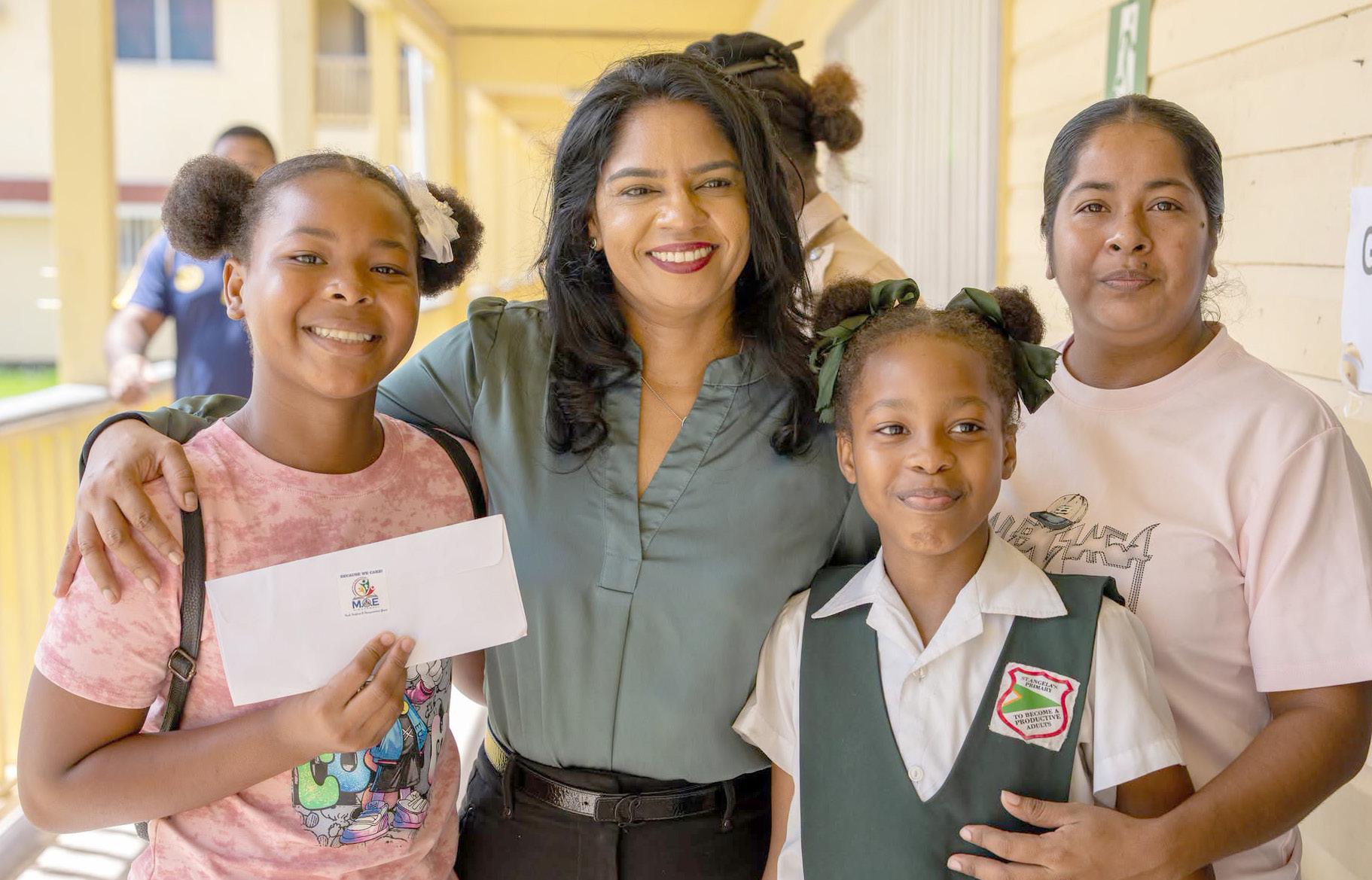


Minister of Education Sonia Parag visited a number of schools on Monday, where she met with parents and school officials as the nationwide rollout of the Because We Care Cash Grant began (MoE photo)

By Shaniya Harding
PARENTS across Guyana are expressing gratitude for the government’s ‘Because We Care’ cash grant, as distribution got underway on Monday at schools nationwide and is set to continue throughout the week.
Mothers and fathers described the initiative as timely and impactful, with many already planning to direct the funds towards uniforms, textbooks, stationery, and backpacks in preparation for the new school year. Several parents noted that the grant eases the financial burden of back-to-school preparations, while others praised the increasingly seamless distribution process.
Parent and teacher at St. Winefride’s Secondary, Peggy Charles-Bynoe, noted that the grant will be dedicated to preparing her child for the school year ahead.
Speaking on the impact it will have on not just her child but the family, Charles-Bynoe added that the support of the grant now allows her to budget for other things.
“It is going to be a great relief to me in terms of not
having to spend my own money. I can now budget for other things. Basically, his money goes towards shopping for his school things in preparation for the new school year,” she said.
Moreover, she cited the increase of the grant to $85,000 as a major benefit, adding, “Seeing that we have had the increase, and his wardrobe needs a little refurbishment, a little of it will also go towards buying a few pieces of clothing for him as well,” she added.
Another parent, Chitradevi Jattan, mother of a child attending J.E. Burnham Primary in Georgetown, shared similar sentiments, noting that the grant will go toward the purchase of school items for the term ahead.
She added that the grant is especially beneficial for parents who may struggle to buy textbooks, highlighting that it adds not just to the items children need, but it directly and positively impacts their learning.
“It has been good, and the money would be beneficial for the child in terms of buying all the school items. Thanks to the government for bringing this initiative. It would be more
beneficial because the cost of living is very high,” she said adding, “I plan to use it for schoolbooks, uniform, and stationery. It is very important because some other parents cannot afford to buy textbooks, so this money would come in handy to enhance the child’s education. Thanks to the government, it is a great input.”
Tatiana Moore, a mother of three, said that the grant will go toward the future of her children, with the funds set to be placed into savings on their behalf. One of her children attends the Novar Primary, while another is at Novar Nursery School in Region Five.
“I find that it benefits a lot. Usually, I would put it into savings for them,” she disclosed.
Moreover, she added that the grant will benefit a number of other parents in helping them prepare their children for the year ahead, saying, “I find that it will help a lot of parents out there, a lot, especially given the economy, and with September coming…they will have a comfortable term at school.”
She added, “I feel good. I feel like we matter and that they listen.”


Peggy Charles-Bynoe, parent and teacher at St. Winefride’s Secondary, says the Because We Care cash grant will go towards preparing her son for the new school year (Delano Williams photos)

Clair Vaughn, whose child attends F.E. Pollard Primary in Georgetown praises the smooth and efficient distribution process, calling this years’ experience amazing
Meanwhile, Clair Vaughn, parent of a child attending F.E. Pollard Primary School, commended the ease of the process in receiving the grant.
She noted that while there may have been challenges in previous years, this year was particularly smooth. “I received my cash grant today. The process was very seamless.

Chitradevi Jattan, mother of a child at J.E. Burnham Primary in Region Four, says the grant is a vital lifeline for parents who struggle to afford textbooks and other school essentials

A parent receives the ‘Because We Care’ cash grant at a school distribution point as the government’s annual education support initiative gets underway nationwide I did not have to wait or anything. I think that the schools are moving in the right direction concerning the process. Before, there might have been hiccups, but they would have fixed them.”
Meanwhile, speaking on her plans for the grant, Vaughn noted that she aims to put it toward preparing her child for the new term and his savings, adding, “I am planning to spend it on a backpack, uniform, books, and stationery, and should there be any left over, and if prices do not go up as they usually do, I will put it towards his savings because it is meant for him. So, I am going to use it wholly and solely for him.”
Grade Five pupils at Long Creek Primary School in Region Four, praised the initiative as a major aid to parents, particularly single mothers, adding, “This cash grant has been a great initiative from the government. I really appreciate it as a mother.”
Further, she noted that she was once a single mother. Williams added that the initiative has been an incredible help to her, saying, “At one time I was a single mother, and when this initiative started, it helped me a lot when it comes to purchasing school uniforms and other necessities.
and
Rafeena Williams, parent of Grade Four
We see it as a great initiative, a good one for us as parents. It is a relief on our financial side.”
THE government will be gin distributing cash subsi dies to rice farmers across Guyana next week, Agri culture Minister Zulfikar Mustapha announced, ful filling a pledge made by President Dr Irfaan Ali during consultations with rice producers in April.
“At the President’s direction, and following consultations with hundreds of rice farmers at the Arthur Chung Conference Centre on April 30, the Ministry of Agriculture will commence direct cash transfers to eligible rice farmers beginning next week,” Minister Mustapha said.
The programme provides GY$15,000 per acre for farmers cultivating 50 acres or less, and GY$10,000 per acre for farmers cultivating more than 50 acres.
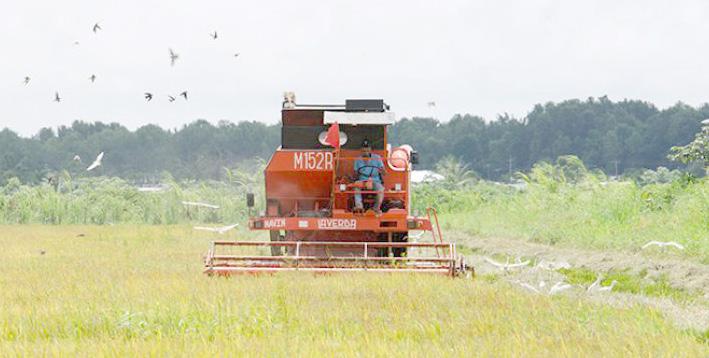
The Guyana Rice Development Board (GRDB) completed registration and a post-harvest verification of claims to ensure transparency and accountability, Mustapha added.
The cash transfer initiative, funded to the tune of
approximately GY$3 billion by the PPP/C administration, is intended to help cushion rice producers from mounting global pressures on agricultural production and markets.
The government framed the assistance as part of a
broader strategy to protect livelihoods, bolster food security, and sustain rural economies.
Rice has long been one of Guyana’s most important agricultural exports and a cornerstone of rural employment.
Since coming to office, the PPP/C government has pursued a series of measures aimed at modernising the sector and improving producers’ incomes, including capital injections through the GRDB, mechanisation subsidies, infrastructure upgrades, and support for value-chain development.
Key PPP/C measures and investments over recent years include direct subsidies and cash support schemes, including fertiliser and input subsidies and targeted cash transfers during periods of price or supply shocks.
There have also been infrastructure improvements, such as rehabilitation of irrigation and drainage networks, improvements to farm access roads, and investments in storage and milling capacity aimed at
reducing post-harvest losses.
The government has also pursued mechanisation and extension support through the fostering of low - cost financing, and training programmes to increase productivity and reduce labour bottlenecks.
There have also been market development efforts, including export facilitation, promotion of brand differentiation (including steps toward geographical indication protection), and assistance to processors to meet international standards.
Analysts say these in terventions have helped stabilise production and support farmer incomes. The ministry said the ver ification process has con cluded and emphasised that payments will fol low strict accountability checks.
PRESIDENT Dr Irfaan Ali has hailed Guyana’s construction sector as a major engine of economic growth, pointing to a multi billion‑dollar surge in cred it, dramatic increases in sand and stone production, as evidence that the wider economy is both expanding and strengthening.
Addressing the 2026 National Building Expo at the National Stadium, Providence, last week, Dr Ali said that the country is “not just constructing buildings, roads, bridges and aerodromes”, but also “building a nation” on the strongest foundations in its history.
The President outlined a series of credit and production indicators which, he said, demonstrate the scale of transformation since 2020.
“For every dollar we spend on construction, for every dollar we spend both in the public and private sector on construction, the economic benefit in value term is $2.5 for every dol
lar… the multiply effect,” he said.
The President used the platform to underscore what he called the “mul tiplier effect” of the con struction boom on the wider economy, insisting that every dollar spent on building activity is rippling across multiple sectors.
He said the scale of that impact is visible in the output data for quarrying and aggregates, with stone and sand production soaring between 2020 and 2025.
According to the figures he presented, combined domestic production and imports of stone stood at 700,000 tonnes in 2020.
By the end of 2025, this had risen to around 5.6 million tonnes. Sand output showed an even more pronounced expansion, moving from 408,000 tonnes in 2020 to approximately 15 million tonnes in 2025. He said that the sheer
volume of material now being absorbed by the economy reflects not only public infrastructural works but also private housing, commercial and industrial projects.
He noted too that real-estate loans have more than doubled over the last five years, climbing from $90 billion in 2020 to $185 billion by 2025.
Loans for private dwellings have also grown sharply, moving from $82 billion to $141 billion over the same period, while lending for industrial development jumped from $7.9 billion to $41 billion.
Crucially, Dr Ali said this expansion in borrowing has not been accompanied by a deterioration in credit quality.
On the contrary, he reported that the level of non-performing loans in the system is now at its lowest point in the history of the banking sector.
“Not only people are borrowing, but they are more capable of paying for the loan, and let me help
those who ask about this type of investment…about the necessity of this type of investment.”
The President used parts of his address to push back against critics of the government’s heavy infra structure focus, accusing sections of the political opposition of failing to un derstand the economics of value creation.
He referred to voices that, he said, are “stuck” in a cycle of constant criticism and opposition.
“There are some who are disinterested in the story because their minds are stuck on one tune… and that tune is: criticise, criticise, criticise; oppose, oppose, oppose; lie, lie, lie, and hope that some of it will stick,” the President quipped.
Linking the construction and credit numbers to a broader development narrative, the President insisted that the current phase is

about much more than physical works.
“We are not just constructing buildings, roads, bridges and aerodromes, we are building a nation, and the foundations of our nation have never been stronger.
The evidence is irrefutable,” Dr Ali said.
He pointed to what he described as a “revolutionised” education system, a fortified rule of law, strengthened
democratic institutions and an expanding, modernised infrastructural network, framed under the “One Guyana” banner of national unity. With housing, indus trial activity and public works all drawing heavily on the same supply chains, he noted that, the sector is now central to job cre ation, wealth generation and long‑term national development.
THE July/August vacation period is about to begin, and many parents are searching for a fun activity that will advance their child/ children’s skills, whether academically, or technical/vocational.
The Emeritus Professor Doris Rogers Art Programme hosted by the university’s Faculty of Education and Humanities will run from July 7 to 17, 2026, and July 20 to 31, 2026, at the Turkeyen Campus. The sessions will be held from 09:00hrs to noon.
Coordinator for the university’s Art Department, and Coordinator of the Emeritus Professor Doris Rogers Art Programme, Michael Khan, revealed that this is the 11th year that the programme is being held.
He also revealed
that the programme was named after Emeritus Professor Doris Rogers, who served as a professor at the University of Guyana.
According to him, the programme allows children from ages five to seventeen years old to attend the daily recreation art workshops where they will be engaged in activities such as painting, drawing, ceramics, sculpture, textile, jewellery making, candle making, resin epoxy letters, tie dye, rock art and fun and games.
“Now the resin, we are going to just do one activity with the resin, because we can’t afford to get enough resin for everyone…that is what we’re going to do, which we call mini courses, a mini course in resin, a mini course in candle making, and a mini course


in sculpture construction,” he said.
The coordinator further explained that when this initiative was started 11 years ago, only 24 children enrolled. Over the years, there has been a notable constant increase
in attendees.
Last year, 98 participants were enrolled in the programme which was held in August. This year, that number is expected to increase as among those participating will be learners from Marian

Academy, The Bishops’ High School and Queen’s College.
The university provides all materials, and the registration fee goes towards the purchasing of those materials.
Khan emphasised that every year, they try to introduce new materials to the participants, so that they can benefit, and have a clearer understanding of art.
“Some children do not like to draw, but they’re good with ceramics, and they can bring out their forms and shape through that. So, we cater for children. Some like construction…we can get pieces of wood, cut wood, and they assemble it into a standing sculpture,” he said.
The instructors for the Art Programme are stu -
dents from the University of Guyana, who are reading for their degrees. The team comprises Natasha Azeez and about six others. These students work with the children, and at the end of the programme they each receive a stipend for their efforts. Further, Khan revealed that come next year, there are plans to host the Art Programme at the University of Guyana’s Tain Campus in Berbice, Region Six.
Registration forms for the programme are available at the Faculty of Education and Humanities office at the Turkeyen Campus, and cost 15,000. For more details, persons can contact Khan on (592) 6478245.

BEFORE the close of the International Building Expo (IBE) 2026, President Dr Irfaan Ali made visits to several banking booths, where he engaged representatives on the seamless integration of digital technology, and faster loans for housing and other services.
He engaged Republic Bank Guyana Limited, Scotiabank Guyana, Demerara Bank Limited, Citizens
exciting for us. The booth has been good, feedback from customers has been good as well, especially when we go through the rates and the requirements and stuff like that,” they said.
The company said through its website, people can apply for loans, or an account, making the entire process paperless.
Scotiabank Guyana on the other hand said that there

Bank Guyana, and Guyana Bank for Trade and Industry (GBTI) personnel.
Citizens Bank Guyana reported that it has seen a tremendous growth in the housing market in recent times. It said that the initiatives that the government has announced have been specifically impactful on young people.
“Many of us would have been waiting for these opportunities, and they are here now, and we are here to help you find facilities, so that you can take that next step forward. The government has done their part, and we are here to help you go the extra mile to help you out. So, we are offering interest rates up to $10 million, 3.5; up to $20 million, 3.7, and then up to $30 million, 3.6,” one of the bank’s officials said. When applicants apply for a loan with Citizens, the bank now takes care of the legal fees.
At Republic Bank, it was said that for them, the mortgage rates are exciting. With the rising economy, and the competition that exists, Republic Bank said it is changing rates as it needs to.
“The expo has been really
has been an enormous increase in home loans access.
The bank said many customers are interested in owning their own home.
Whether people are building, or they are looking to expand, Scotiabank said it has made a number of changes as it relates to their policies and much more.
“So, allowing for a wider scope of customers to be able to benefit from financing. We’ve reduced rates on our mortgages as well to be competitive within the market. So, the drive is there, the push is there and we’ve seen a higher increase of customers coming to seek financing and being able to own their homes,” the bank said.
At the GBTI booth, hundreds of people used the
ket is growing, with more Guyanese wanting to own their own land and homes.
With this comes the need for financing. This bank was the first to increase its loan ceiling and reduce interest rates, making it easier for customers. Customers can now apply online for these loans, with no need to visit the bank to facilitate this.
During the International Building Expo, they were

opportunity to register for housing loans or access other financial services. Many were introduced to GBTI’s newest banking app that shows the total cost for building houses and the monthly installments they would need to pay.
Meanwhile, Demerara Bank Limited acknowledged that Guyana’s housing mar-



online database.
able to provide onsite approval to persons applying while there.
Demerara Bank has fully embraced the use of technology for the services it offers to the public. This means that persons can be at home and apply for loans or any service through Demerara Bank’s
“It’s so fantastic. You can upload all your documents there and you could receive your approval within the same day, within 24 hours. I might want to say, just being at home and having your home loan approved. We were able to do that. A lot of persons came here but they also applied
offsite and we were able to do that within four days,” bank officials said.
Additionally, Demerara Bank introduced “Kaira,” its Customer Service robot. If a customer has any banking related questions, the robot answers them and serves as a guide in the banking area.


AS thousands of parents and guardians this week begin lining up at schools across Guyana to collect the government’s Because We Care cash grant, the initiative once again demonstrates a fundamental principle of public policy: investments in children are among the most effective investments a nation can make.
This year’s $85,000 per child distribution comprising a $60,000 cash grant, a $5,000 uniform allowance and a new $20,000 transportation grant is not just a transfer of funds, but a concerted effort to reduce barriers to education and to support household stability.
The scale and importance of the programme is underlined by the appeal from Minister of Education Sonia Parag to parents to fully participate in the nationwide distribution exercise.
An estimated $12.4 billion will be transferred directly to households across the country this year, benefitting approximately 206,000 children in public and private schools.
Such figures put the Because We Care initiative among the largest social-support programmes currently operating in Guyana.
The programme’s development over the last decade tells an important story about changing ways of educational support in Guyana.
The initiative was first introduced in 2014 by the PPP/C administration as a
$10,000 grant, but it was halted after the change of government in 2015 and was brought back in 2020 when the PPP/C returned to office.
Since then, the grant has expanded incrementally, from $19,000 in 2020 to the current package valued at $85,000 per child. The expansion of the programme to students of private schools in 2021 has broadened its scope and strengthened its universality.
Critics of direct cash-transfer programmes often ask whether these initiatives are sustainable public policy or merely short-term relief. This is not a debate exclusive to Guyana, nor is it without merit. Cash-transfer programmes are increasingly being adopted by governments and international development institutions around the world as effective tools to reduce poverty, improve education outcomes and increase household resilience.
Evidence from developing economies is consistent that direct financial support to families, conditioned on children’s welfare and education, often leads to long-term human capital development in addition to immediate consumption.
However, in the Guyanese context, the Because We Care grant holds a particularly special place.
While Guyana is experiencing unprecedented economic growth fuelled by oil revenues, many households are still grappling with the increasing costs of ed-
ucation, transportation, and daily living.
The start of a school year can often be a huge financial burden on families, especially those with multiple children. School uniforms, books, transportation, stationery, electronic devices and other education-related needs can quickly drain household budgets.
This year, the $20,000 transportation grant is a big bonus. Transportation costs have become an increasingly significant cost for families, especially for those in rural and hinterland communities, where accessing educational institutions often involves substantial travel costs.
Policymakers have shown an understanding that education extends beyond the classroom walls by recognising transportation as a distinct educational barrier.
But programmes like Because We Care should not be judged solely on the amount of money that is distributed.
Questions of efficiency, transparency and long-term impact are also important. The government’s plan to send teams to all administrative regions and have ministers directly oversee the distribution process indicates an understanding that the public’s trust in such initiatives is largely contingent on successful implementation.
There is also a broader economic aspect to consider. The injection of billions of dollars into households means immediate economic activity as families buy school supplies, clothing, transportation
services and other necessities. Money spent locally benefits local businesses and circulates through the economy.
At the same time, policymakers need to be alert to the possibility that times of grant distribution could be exploited for price gouging or artificial inflation of prices of key goods and services, issues that have been raised periodically in the public debate.
The Because We Care programme is, in the end, not just a social programme; it is a manifestation of a broader philosophical question regarding the role of government in national development.
For Guyana’s remarkable economic transformation to yield meaningful and equitable results, investment in education and human capital must remain top of mind. Oil revenues have the potential to fund roads, bridges and infrastructure, but it will be the educated, healthy and supported citizens who will determine whether a country’s prosperity is sustained across generations.
The transaction should be seen as more than just a distribution exercise this week as parents collect their grants. It is a reminder that the real wealth of any nation is not beneath its soil, but in the opportunities it builds for its children.
At the end of the day, it will not just be the revenues that Guyana receives that will determine its future, but how it invests in those who will inherit that future.
Dear Editor,
I WRITE to express my sincere appreciation for the remarkable leadership demonstrated by His Excellency, President Dr Irfaan Ali and Vice-president Bharrat Jagdeo in advancing Guyana’s development and improving the lives of ordinary citizens.
Over the past several years, Guyana has experienced significant transformation through ambitious investments in infrastructure, healthcare, education, housing, agriculture, energy, and public services. These initiatives have contributed to expanding economic opportunities while laying a stronger foundation for sustainable national development. Particularly noteworthy is the govern-
ment’s continued commitment to addressing the concerns of everyday Guyanese. Through community engagements, public consultations, and targetted interventions, many longstanding challenges have been met with practical solutions designed to improve livelihoods and ensure that development reaches citizens across all regions.
Vice-president Bharrat Jagdeo’s outreach engagements deserve special recognition. His willingness to meet directly with communities, listen to their concerns, and facilitate timely responses has strengthened public confidence in governance.
These outreaches have become an important avenue for identifying challenges, resolving issues, and ensuring that citizens have meaningful access to government support and services. The emphasis on practical,
results-oriented solutions reflects a responsive approach to public administration.
Similarly, President Dr. Irfaan Ali’s vision for national development has guided transformative projects that continue to modernise Guyana’s economy and infrastructure, while promoting inclusive growth. Under his leadership, the country has pursued initiatives aimed at expanding opportunities for youth, strengthening healthcare delivery, improving educational facilities, enhancing transportation networks, and positioning Guyana as a leading economy within the region.
The combined leadership of President Ali and Vice President Jagdeo has demonstrated a commitment to balancing economic progress with social development, ensuring that the benefits of national growth increasingly
reach ordinary Guyanese. Their continued focus on investment, innovation, and community engagement has contributed to building confidence in Guyana’s future.
As Guyana continues on its path of rapid development, it is encouraging to witness leadership that remains engaged with the people and dedicated to addressing their needs through constructive dialogue and decisive action.
Such efforts play an important role in fostering national unity, promoting prosperity, and creating opportunities for future generations.
Yours sincerely, Rajiv Kadarnauth Regional Councillor Essequibo Islands/ West Demerara
I AM in my seventies thus I belong to an era in Guyana that I see has disappeared.
I belong to a generation whose folks are getting on into advanced age but it is a vantage point from which to judge Guyana in the 21st century. That zeitgeist that I was born into had ethereal moments that I do not see when I look around Guyana. It is outside the scope of a mere newspaper column to discuss the contents of a previous epoch but one personal occurrence in my life symbolises those ethereal moments that I referred to above.
I grew up on D’urban Street in Wortmanville in a house where the front door and back door and several windows did not have locks. The front door didn’t have a lock or an internal bolt. Even when I got married and left for studies abroad, that house did not have a front or backdoor lock.
We never had a burglary at our house. We experienced only one invasion. One night a man kicked down the door with a cutlass in his hand. It was an easy entrance because only a chair braced the door.
He was looking for his daughter that my brother had stolen from her father’s home in Alexander Village.
Times have certainly changed. You live in a dwelling like that on D’urban Street today and an armed, violent invasion or a rape is inevitable. If times have changed then countries have to change, laws have to change, people must be forced to be civilised. I repeat; people must be forced to be civilised.
I sat as an interviewer next to Jerry Gouveia as the interviewee last week and Mr. Gouveia revealed something that caused me to be livid.
How can Guyana produce such humans? Mr. Gouveia explained that he publicly complained about the noise nuisance behind the Marriott Hotel and its effects on the hotel’s guests. He said he got some insulting posts on his Facebook page with one person saying why the guests don’t plug up their ears.
I am not going to dwell on such an uncivilised person but it brings into question the role of discipline in a country that has achieved 60 years of Independence. It is not that we have not been a disciplined nation.
We have and I saw it in the epoch that produced my generation. I came from a generation that did not inculcate the uncivilised habits I see in today’s Guyana.
A nation must confront uncivilised descent among its subjects.
The US passed legislation several
years ago which is a draconian piece of law but their law makers had discipline in mind.
If you arrive in the US at age five and at age 65, if you are found guilty of a criminal offence, the judge has no discretion under the law; you will be deported.
Here in Guyana, we allowed nasty instincts to go unchecked and maybe it is too late. Guyana must confront these social bestialities.
There is consensus across race and class and political parties and in civil society for drastic action to check these anti-social directions.
Mr. Gouveia in our interview last week, as the security adviser to the President, said that Guyana is dotted with surveillance cameras. We have caught up with other countries. But the cameras are not backed by punishment for breaking the law.
Dangerous driving carries a nominal court fine. Reckless driving carries a paltry court fine. Such behaviour can stop tomorrow if country and government decide on a drastic fine.
Guyana has a law that stipulates the number of decibels a house party or a nightclub or a motorist is allowed.
In Guyana today, I have seen with my own two eyes men have four speakers in their car trunk driving that vehicle in public where people live and the decibels exceed those of a dancehall. This is inexplicable social malignancy. How can someone drive a vehicle with those decibels emanating from the vehicle?
These low-life car owners can be stopped tomorrow if legislation comes in that once the machine of the traffic rank records decibels that is a hundred times (yes, a hundred times) more than the law allows, the equipment is seized there and then.
That is how you instill discipline in a modern country. Which school child in Guyana is not affected by noise nuisance from motor-cycles whose owners have recalibrated the engine to make an unbearable sound?
Which working person is not affected by passing cars in the night and the music simply takes your sleep away. We have reached 60 years of Independence. We must reach for the philosophical instruction that a civilised society can only survive by a code of civilised behaviour.
DISCLAIMER: The views and opinions expressed in this column are solely those of the author and do not necessarily reflect the official policy or position of the Guyana National Newspapers Limited.

GUYANA and Jamaica are moving to deepen collaboration on agriculture, with an emphasis on deploying financing, improving transport and logistics, and building value-added agro-processing as part of a wider regional response to food security threats.
Speaking to reporters last week after Guyana and Jamaica signed a series of Memoranda of Understanding (MoUs), President Dr Irfaan Ali said food security remains one of the region’s most serious long-term challenges, pointing to the combined impact of global politics, economic volatility and
climate change. “Food security is an important challenge for the region, and more and more, the global political environment, global economic environment, and climate change continue to remind us that this is one of the most serious threats to the region, but with that threat come opportunity,” he said.
President Ali underscored Guyana’s geographical advantage, citing abundant fresh water and large-scale arable land as key assets that can anchor regional production and value creation.
Within this framework, Jamaica is seen as a critical
partner, particularly in driving private-sector investment into value-added agriculture.
“Guyana is the land with abundant fresh water, large scale harbour land… What we have discussed with Jamaica is how we can now move the private sector to value added, value creation,” he added.
Guyana’s government is already constructing agroparks and agro-processing facilities, with a clear policy intention to go beyond traditional agriculture and embrace technology-driven, climate-resilient systems.
“The government is building out the infrastruc-

ture for agro parts, agro processing facilities that is not only linked to traditional forms of agriculture, but the technologically driven agriculture… more resilient to climate shocks,” he said.
Dr Ali indicated that the emerging Guyana–Jamaica framework goes beyond simply increasing food production.
It is expected to cover technical support, training, and policy design aimed at strengthening the entire food ecosystem.
Key elements under discussion include, training young people for modern agriculture; increasing the participation of women and youth in the sector; designing policies and programmes to deploy more financing into agriculture.
Addressing the transport and logistics systems needed to keep more of the region’s production within Caribbean markets and expanding value creation and backward link-

ages across the supply chain.
“This agreement goes beyond a system of food production.
They speak about technical support, training of our young people. How are we going to get more women and youth involved in ag -
riculture? How are we going to get more finances? Deploy the type of policies and programmes to deploy more financing to support agriculture.
How are we going to get the region to keep more of what we produce?” he said.
THIS past weekend, The Lotus Cancer Initiative Inc., in collaboration with the Ministry of Health, successfully conducted a comprehensive women’s health outreach in the Essequibo region, reaffirming a shared commitment to improving access to lifesaving preventive healthcare for women across Guyana.
The outreach brought together healthcare professionals and volunteers from several organisations, including the Chinese Medical Brigade and the Rise Foundation at the Lima Regional Hospital.
Through their partnership, a wide range of essential health services was provided to women and men in the community, benefitting approximately 70 persons.
Throughout the day, women participated in interactive educational sessions and one on one sessions focused on the importance of human papillomavirus (HPV) vaccination, cervical cancer prevention, and breast cancer awareness.
These sessions emphasised the value of early detection, routine screening, and vaccination in reducing the burden of preventable cancers among women.
Participants also benefitted from an array of clinical
services, including HPV vaccination for eligible individuals, Pap smear screening, HPV testing, Colposcopy services for women requiring further evaluation, Comprehensive gynaecological consultations, Clinical breast examinations, Mammography referrals for women meeting screening criteria, Family planning counselling and contraceptive services, Individual counselling and health education tailored to women’s reproductive health needs.
Training healthcare professionals was also done to ensure continuity of care. All screening conducted on the outreach on behalf of Lotus Cancer Initiative Inc. will be followed up in a timely manner and patients will be contacted with plans of a second outreach for persons with abnormal results.
For many persons, the outreach represented an opportunity to receive specialised healthcare services that are not always readily accessible within their communities.
Early detection remains one of the most effective tools in the fight against cervical and breast cancer, and initiatives such as this help bridge healthcare gaps while empowering women to take charge of their health.
The success of the outreach reflects the power of collaboration. By working together, the Ministry of Health, The Lotus Cancer Initiative Inc., the Chinese Medical Brigade, and the Rise Foundation demonstrated that partnerships can significantly expand access to quality healthcare and improve health outcomes for women throughout Guyana.
The Lotus Cancer Initiative extends sincere gratitude to all healthcare workers, volunteers, partners, and community members whose dedication made the outreach possible.
Most importantly, we commend Essequibians who attended, asked questions, participated in screening, and took proactive steps toward protecting their health.
As The Lotus Cancer Initiative continues its mission of promoting cancer prevention, early detection, education, and compassionate care, we remain committed to ensuring that every person, regardless of where she lives, has access to the knowledge and services she needs to live a healthier future. Together, we are building healthier communities, one woman at a time. (Ministry of Health)
DURING the latest episode of ‘Community Train,’ broadcasted on EdYou FM, Psychiatrist Dr Devendranand Sharma shared valuable insights into men’s mental health, and the importance of seeking support.
June is widely regarded as Men’s Mental Health Month. This year’s theme, “Partners in care. Advancing men’s health through connection, education, and advocacy across the lifespan for better lifespans,” serves as a reminder that while men’s well-being is a personal responsibility, it is strengthened through positive relationships and supportive communities.
Urging everyone to pay attention to behavioural changes in our friends and loved ones so that we can catch the early signs of depression, Dr Sharma advised that anything that we see that is changing, whether it be a change of behaviour, or abnormal patterns, it usually means that there may be an underlying problem.

“Maybe they weren’t talking enough before, but now completely going silent, or even talking too much. Maybe anything that’s changing, it means that there may be an underlying problem. [It] could be changes in their appetite, losing energy and feeling tired, or talking about feeling extremely tired could be a sign of depression. So many changes in behaviours, along with other type of behaviours that are not so good, like turning to drugs,” he said, adding “They
say I’ve treated my problem. They call it recreational use. It’s not really recreational use. Most people would turn to these drugs to feel better. People go and drink to feel better, that’s why it’s so widely used.”
He revealed that another thing people say, is, “I don’t want drugs,” then they turn to consuming alcohol, which is another bad sign.
According to Dr Sharma, excessive drinking can and would escalate any underlying emotional problems a
THE purpose of the Ministry of Human Services and Social Security’s Difficult Circumstances Unit (DCU) is to provide one-off relief to persons facing challenges.
This means supporting persons with disabilities, victims of domestic violence, and persons who need shelter/ renovation.
The unit also provides some amount of assistance to small-business owners who need assistance.
A few months ago, Darshinie Dabechand was the beneficiary of a small freezer from the DCU’s small-business assistance initiative, which allowed her to start her own small business: selling homemade custard, icicles, and other snacks directly from her home.
Many may ask what is the point or even say that this is part of becoming

Darshinie Dabechand, a Difficult Circumstances Unit (DCU) small-business beneficiary
an entrepreneur. But to the ministry, Dabechand’s story is proof that all it takes is a start. Through its DCU, the ministry is helping people to build sustainable livelihoods, bringing them closer to financial independence.
Ms Dabechand in a recent follow up conducted
person may have.
While stating that he is not against people going to drink and socialise, he warned that anytime it gets to be excessive, people will see warning signs.
“They will say, oh, I never knew that he was suffering so much until something happened. No, many times, people know, or they would have known, but they would never say anything. They don’t want to intrude. They don’t want to interfere with the person’s rights, you know, but they should and they must. That’s the way to go,”
Dr Sharma emphasised.
He stated further that the most important thing for men or boys to understand is that there is an opportunity to change a pattern of behaviour that’s been established for far too long. Not only in Guyana, but across Caribbean cultures and across the wider globe, where men feel that they have to be aggressive in the home to be respected.
Sometimes this is taken too far, and they can’t control their own behaviour, or emotional difficulties.
“They would lash out
at the children and the partner, and that pattern of behaviour is almost inherited. The youngsters who see their father behave abnormally will behave abnormally too. It’s very hard to break that cycle unless they’re educated, unless they understand that this is not the way it should be.
There’s a better way that men should be leaders. They should represent themselves, they should show character and they should show the ability to talk, and to share feelings,” he said.
by the ministry, recalled the first step she took towards starting her business.
“So, I decided to leave the baby with my grandma, and I told her, let me go try to get the help. One afternoon, somebody called me and told me how I can come to pick up the freezer. I was like so happy, because it would help me out so much because I can be home and I can sell my things at home,” she said.
Dabechand shared that there are children who stop by daily to purchase icicles, drinks or even ice. This earns her around $3,000 or $4,000 daily.
She shared that not only does she sell these frozen and ice-cold treats to school children, but she also sells chicken foot, and plantain chips to go along with them.

GUYANA has achieved a historic milestone with its election, for the first time, to the Chairmanship of the Special Committee on Transport of the Association of Caribbean States (ACS).
The election, which took place during the 31st Extraordinary Session of the ACS Ministerial Council on June 21, 2026, marks a significant step in Guyana’s growing leadership within the Greater Caribbean.
Dr. Saheed Sulaman, Deputy Director General of the Guyana Civil Avia -
tion Authority (GCAA), will serve as Chairman of the Committee for the 20262027 term.
The Association of Caribbean States (ACS), established in 1994, is a regional intergovernmental organiation comprising 25 member states and 10 Associate Members, dedicated to promoting co-operation, sustainable development, regional integration, and enhanced connectivity throughout the Greater Caribbean.
Guyana’s election reflects the country’s expanding influence in regional aviation
and transport and aligns closely with the vision of Dr Mohamed Irfaan Ali, President of the Co-operative Republic of Guyana.
One of the President’s Ten Strategic Pillars for Guyana’s aviation sector is to position the country as a regional aviation hub, while strengthening regional connectivity. Assuming the Chairmanship of the ACS Special Committee on Transport represents a significant milestone in advancing that national vision.
The achievement also reflects the strategic leadership
of Deodat Indar, Minister of Public Utilities and Aviation, whose commitment to elevating Guyana’s profile within regional and international aviation has created new opportunities for leadership and collaboration across the Caribbean.
Dr Sulaman brings nearly two decades of aviation leadership and international negotiating experience to the position.
He has successfully negotiated more than 50 Air Services Agreements with over 75 countries across five continents; served for more than

15 years on the CARICOM Technical Negotiating Team on Air Services; held the position of Vice-chairman of the ACS Special Committee on Transport from 2022 to 2023, and was appointed an ICAO Global Ambassador in December 2025.
Welcoming the election, Lt. Col. (Ret’d) Egbert Field, Director General of the Guyana Civil Aviation Authority and Chairman of the Caribbean Aviation Safety and Security Oversight System (CASSOS), stated:
“Our Deputy Director General’s election as Chair of the ACS Special Committee on Transport is a proud achievement for Guyana and the Guyana Civil Aviation Authority. It reflects the growing confidence that our regional partners have in Guyana’s leadership, technical expertise, and commitment to regional integration. I am confident that his collaborative approach will strengthen partnerships, promote practical solutions, and bring the countries of the Greater Caribbean even closer together in building

Deputy Director General of the GCAA, Dr Saheed Sulaman
a more connected, resilient, and sustainable transport system.”
As Chairman, Dr Sulaman will lead the committee’s work to strengthen regional transport co-operation; improve connectivity; promote sustainable and resilient transport systems, and foster greater collaboration among ACS member states in support of the region’s economic and social development.
GUYANA will host the 9th Annual General Meeting of the Assets Recovery Inter-Agency Network of the Caribbean (ARIN-CARIB) on July 15 and 16 at the Marriott Hotel Guyana, bringing together law enforcement officers, prosecutors and judicial practitioners from across the Caribbean to discuss efforts to combat the proceeds of crime.

The event is being hosted by Director of Public Prosecutions (DPP) Shalimar Ali-Hack, SC, in collaboration with Attorney General and Minister of Legal Affairs Anil Nandlall, SC.
The opening ceremony is scheduled for Wednesday, July 15, at 9:00 hrs. Attorney General Nandlall will deliver the feature address, while DPP Ali-Hack will give the opening remarks.
Deputy Director of Public Prosecutions Diana O’Brien, who is serving as the current President of ARIN-CARIB, will chair the proceedings on behalf of Guyana.
According to the DPP’s Chambers, ARIN-CARIB is a regional network comprising Caribbean law enforcement officers, prosecutors and judicial practitioners who specialise in recovering the proceeds of crime. During the two-day meeting, participants will make presentations, engage in interactive sessions and report on their respective countries’ successes in combating the proceeds of crime.
The meeting will bring together delegates from English, Dutch, Spanish and French-speaking Caribbean countries, as well as the Overseas Territories, all of which utilise the ARIN-CARIB network to facilitate the exchange of information. The forum will also be attended by observers, speakers and local experts in the field of asset recovery.
This year’s Annual General Meeting will be held under the theme, “From Tracing to Transformation: Building an Asset Recovery-Ready Caribbean.”
THE GOAL Scholarship Programme is transforming access to higher education for persons living with disabilities across Guyana, according to Ganesh Singh, Programme Coordinator of the Guyana Councill of Persons with Disabilities (GCOPD).
According to him, the programme is removing barriers that kept many people in this vulnerable group from seeking tertiary-level education. Online learning has changed the lives of many, he said.
The Government of Guyana initiative is in its fourth year and saw 3,876 persons walking the stage of the National Cultural Centre when a graduation ceremony was held on June 23, 2026. This was one of the largest graduating classes to date.
The programme has made study possible for persons living with disabilities who were unable to access classrooms.
Online learning removed the physical barriers and extra financial cost for students in remote and hinterland communities as they were no longer required to leave their homes.
Singh stated that students need only an internet connection and a
many people lack the devices they need to study. According to Singh, some learning platforms are not fully accessible for visually impaired users who rely on screen-reader software. Websites must follow accessibility guidelines if more people are to use them, he said, noting that otherwise, online education will leave some learners behind.
The scholarship pro -
gramme is also helping people gain the qualifications they need for work, which will give them some financial independence and improved standard of living.
He highlighted some success stories of some of the people who recently graduated and have gained employment with their GOAL certificates.
As more students complete their studies,
more are finding jobs and building financial independence.
Singh urged persons with disabilities to take full advantage of the free education on offer.
He said GCOPD also provides remedial classes for CSEC exams, which can prepare students for the GOAL programme.
“You’ll be positioning yourself to be more competitive in the job market,
don’t hesitate. Get qualified,” he said, before urging employers not to discriminate against persons because of a disability.
Singh said his vision is for a more inclusive society in Guyana, where persons with disabilities can live independently and thrive in public life.
He added that much of the progress seen today comes from years of advocacy work.
device. The programme has already helped many persons with disabilities enrol in certificate courses, bachelor’s degrees and are currently pursuing master’s degrees. For many, the scholarship opened a path to study, build skills and move forward.
“This opportunity of higher education… online breaks down all the barriers of inaccessibility and all that is needed is an internet connection and a device,” Singh said, adding that there are still barriers remaining.
Some areas still have poor internet service, and


OGLE Airport Inc. (OAI) has reaffirmed its role as a leading aviation gateway for Guyana following its Annual General Meeting (AGM) on Friday, 26 June 2026, where the company outlined strong operational results, expansion plans and a refreshed Board of Directors.
At the AGM, OAI highlighted a year of solid performance and strategic progress. Domestic passenger movements reached a record 267,503 for 2025, a 14.6% increase over the prior year and the strongest year on record.
International passenger numbers totaled 73,119, down 10.7% from 2024 amid lingering pandemic effects on regional travel.
Chairman Michael O. Correia Jnr. told the Board that the year illustrated two clear realities: rapidly expanding domestic aviation demand in Guyana and the need for continued, aggressive investment to match
the country’s broader economic transformation.
He pointed to the airport’s record domestic landings as evidence of the facility’s growing importance in commerce, tourism, healthcare access and hinterland connectivity.
OAI also emphasised the rising importance of non-aeronautical revenue streams, land development, commercial leases, concessions and other fixed‑income sources, calling them fundamental to the airport’s long-term sustainability and its ability to finance modern infrastructure and meet evolving international standards.
The AGM recapped the airport’s evolution since its founding: the Eugene F. Correia International Airport was established in December 2001 after a consortium of local aviation operators entered a long - term lease with the government to build, manage and operate a modern airport to ICAO standards.
What began as a small facility for crop dusting has grown into a fully fledged domestic and international airport, now ranked among the Caribbean’s most dynamic gateways.
A defining milestone came in 2009 when the airport received Port of Entry status, enabling it to handle international arrivals and departures and strengthening Guyana’s regional and global connectivity.
OAI reviewed recent capital projects focused on improving operational efficiency and capacity: apron expansion, drainage improvements, cargo infrastructure, maintenance facilities, roadway access, aircraft parking, perimeter security, and terminal enhancements.
For the coming period the company has scheduled eleven new capital projects totalling G$204 million.
These projects prioritise perimeter security, expanded apron capacity for corporate jets and further
development of the airport’s commercial-corridor infrastructure.
Reiterating its commitment to corporate governance, OAI announced its newly elected Board of Directors at the AGM.
The Board members are: Michael O. Correia, Jnr., AA (Chairman); Anthony Mekdeci, AA; Nicole Correia; Ronald Reece; Marcel Gaskin; Timothy Jonas, LLB.; and Capt. Gerald Gouveia.
In his address, Correia reiterated that domestic aviation demand is expanding “rapidly and sustainably” and stressed that continued investment is essential to keep pace with Guyana’s national development.
Ogle Airport Inc. closed the AGM by reaffirming its strategic focus on infrastructure, safety and commercial development as it supports Guyana’s expanding economy and tourism potential.


THE Guyana Fire Service is investigating the cause of an early morning fire that destroyed a building at Lot 36 Hadfield Street, Lodge, Georgetown.
According to the Fire Service, the alarm was received at 03:33 hrs, with firefighters arriving at the scene just four minutes later, at 03:37 hrs.
Upon arrival, the building was fully engulfed in flames, while a neighbouring building was under immediate threat.
Firefighters quickly launched suppression efforts and managed to extinguish the blaze, preventing the fire from spreading further. However, the neighbouring building sustained partial damage.
The Guyana Fire Service has since launched an investigation to determine the cause of the fire.
A 20-year-old policeman has been remanded to prison after being charged with the murder of his Cuban girlfriend whose body was discovered in the Enmore South Backdam, following an intensive police investigation.
Randy Thomas of Mahaica, East Coast Demerara, appeared before Magistrate Teriq Mohamed at the Vigilance Magistrate’s Court on Monday, where the indictable charge of murder was read to him.
The charge alleges that Thomas murdered 26-year-old Dailen Paneque Gomes, a Cuban national of Mon Repos,

East Coast Demerara, sometime between June 18 and June 24, 2026, at Enmore South, East Coast Demerara. Thomas was not required to plead to the indictable offence and was remanded to prison.
The matter was adjourned to July 21, 2026.
The charge follows an investigation into the disappearance of Gomes, who was reported missing after failing to return home from work.
Police have since alleged that Thomas confessed to the killing and led investigators to the woman’s body in the Enmore Backdam.
Crime Chief Wendell Blanhum had said investigators were told that Thomas used a teddy bear to muffle the fatal gunshot before concealing the body and disposing of several pieces of evidence.
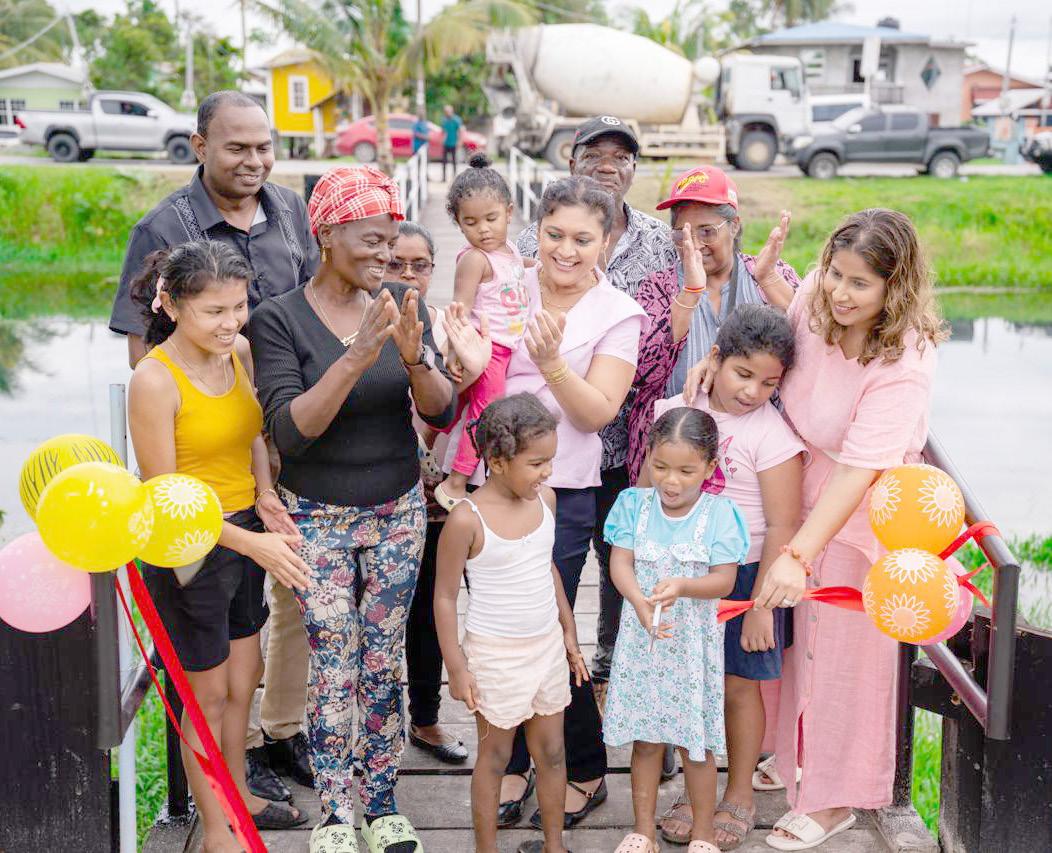
Demonstrating a commitment to rapid community development, Minister of Local Government and Regional Development, Priya Manickchand, officially commissioned a newly constructed pedestrian bridge connecting Unity Street, La Grange, to inner Bagotville at the weekend
DEMONSTRATING a commitment to rapid community development, Minister of Local Government and Regional Development, Priya Manickchand, officially commissioned a newly constructed pedestrian bridge connecting Unity Street, La Grange, to Inner Bagotville at the weekend.
Delivered in fulfilment of a promise, the structure provides safe, immediate access for residents and daily commuters, the ministry said in a press release.
The commissioning ceremony was attended by Regional Executive Officer (REO) for Region Three (Essequibo Islands-West Demerara), Surendra Khayyam, alongside the regional engineer who oversaw the project’s timely execution.
Spanning 63 feet in length and four feet in width, the light-transit bridge replaces previous infrastructural challenges, ensuring residents no longer face disruptions in their daily routes.
The project was born out of a conversation the minister had with a resident during a community
meeting in Bagotville last year. The resident, Jackie, said that the deteriorated bridge had once served as a vital link among Bagotville, La Grange and Canal, allowing residents to access transportation, schools and markets with ease.
Jackie commended Minister Manickchand for being a “woman of her word” and thanked her on behalf of the community for the much-needed bridge.
Recognising the importance of the crossing to everyday life, Minister Manickchand committed to having the bridge rebuilt once she was in a position to do so.
The completion of the project stands as a testament to the minister’s commitment to listening to citizens’ concerns and delivering on promises that improve the daily lives of communities.
During the commissioning, Minister Manickchand emphasised the transformative nature of the new structure for the community.
Regarding the importance of the project, Minister Manickchand
stated, “This is literally a bridge from Bagotville to La Grange from La Grange to Bagotville and so that the people could continue to be good neighbours, continue to enjoy services of each other, so that Canal and La Grange people could come over to Bagotville and Bagotville people could get produce and goods from Canal and La Grange that our school children going to the neighbourhood schools could walk over.”
She further noted, “Together that’s what we can do: we can build bridges we can build infrastructure we can make people’s lives better and we can connect communities.”
For the local residents, the swift delivery of the bridge solves pressing issues such as travelling to and from across the bridge which has made it easier
The execution of this project aligns with the Ministry of Local Government and Regional Development’s ongoing mandate to rapidly upgrade community infrastructure, bringing government and essential services closer to the people.
–– Housing Ministry distributes over 2,100 certificates of title, allocates 1,000 house lots, issues more than $17M in steel-cement subsidy vouchers
THE Ministry of Housing has announced that this year’s International Building Expo exceeded expectations, attracting more than 50,000 visitors while delivering a range of housing services through its “Dream Realised” initiative at the National Stadium, Providence, East Bank Demerara (EBD).
Providing a summary of the June 25-28 expo, Minister of Housing, Collin Croal, declared the
expo a success, stating, “We’ve had at least over 50,000 persons passing through,” while crediting the achievement to the collective efforts of government agencies, private sector partners, volunteers, exhibitors and ministry staff.
Croal said one of the ministry’s major accomplishments during the expo was making available “over 2,100 certificated titles,” noting that “at least over 50% of those were
uplifted” by beneficiaries.
The certificates of title were prepared for residents of Plantation Vriesland, Laurentia-Catherina, Plantation Leonora West, Good Hope and Plantation Lusignan. Persons who were unable to uplift their documents during the event have been encouraged to do so at the ministry’s central office or the relevant regional office.
The minister also highlighted the ministry’s continued land allocation
programme, revealing that “we’ve allocated just over 1,000 lots on the East Coast of Demerara.”
He added that as additional lands become available, “we certainly will go back into our system and pull the pending applicants.”
Additionally, Minister Croal stated, “over 700 persons... turned up to sign for their Agreement of Sale” for properties in Blocks A and B of Vive La Force and De Kinderen

on the West Coast of Demerara. Those who did not complete the process during the expo have been advised to visit the Region Three housing office to finalise the required documentation.
The Dream Realised initiative also saw the distribution of more than 70 steel and cement subsidy vouchers to qualified beneficiaries in Region Three. According to the minister, over $17 million worth of vouchers was distributed under the programme to assist persons constructing their homes.
Croal also pointed to the continued growth of the International Building Expo, noting that there were over 350 exhibitors.
The event featured six model homes, two constructed by the Central Housing and Planning Authority (CHPA) and four by private developers, along with a Small Business Tent, food court, children’s play area and heavy equipment zone.
He further acknowledged the contribution of the Small Business Bureau and the exhibitors who participated in the Small Business Tent, which offered entrepreneurs an opportunity to market their products and services free of charge.
This year’s expo also marked the return of the Building Expo seminars after a hiatus. Over two days, more than 15 presentations were delivered on topics including sustainable urban planning and development, climate resilience in construction, emerging technologies, smart housing solutions, banking services, and the government’s ongoing collaboration with the United Kingdom-based King’s Foundation.
Reflecting on the staging of the event, Croal first acknowledged Minister within the Ministry of Housing, Vanessa Benn, for her contribution to the successful execution of the expo.
He also recognised the Guyana Police Force, Guyana Fire Service, Ministry of Health, Ministry of Public Works, Guyana Power and Light, state and private media houses, more than 50 volunteers, staff of the Ministry of Housing and the CHPA, exhibitors and corporate sponsors for their roles in making the event a success.
SMOOTH EXECUTION
He also recognised the
support of several private companies for providing materials, services and sponsorship that contributed to the smooth execution of the expo.
Croal also highlighted the role of the expo in connecting the public with government services and private sector opportunities under one roof.
He said the event allowed prospective homeowners, contractors, suppliers and investors to engage directly with housing officials, developers and financial institutions, while providing a platform for businesses to showcase the latest products and innovations in the construction industry.
Croal further commended Andrew Tyndall, Director of National Events at the Ministry of Culture, Youth and Sport for coordinating the cultural programme and acknowledged the local performers and artists who entertained patrons throughout the event.
Describing the overall outcome as a success, the minister said that apart from “one hiccup, one incident,” the event was conducted without any major disruptions.
The minister noted that the annual expo has grown into one of the country’s premier housing and construction exhibitions, bringing together stakeholders from across the sector to promote investment, innovation and collaboration. He said the participation of hundreds of exhibitors demonstrated the confidence that both local and international businesses continue to have in Guyana’s rapidly expanding housing market.
“We want to thank everyone who played their part in making International Building Expo 2026 a success,” Minister Croal concluded.


THE University of Guyana (UG), on Wednesday, celebrated the graduation of 12 students from its Elementary Wapichan Language Course (WAP1101).
This is a major milestone in the University’s efforts to preserve, promote, and strengthen indigenous languages through higher education.
The graduates received their certificates during the inaugural GLU Indigenous Languages Awards Ceremony held at the Education Lecture Theatre (ELT), Turkeyen Campus, hosted by the Guyanese Languages Unit (GLU), a unit within the International Centre of Excellence for Modern and Indigenous Languages, Literatures and Linguistics (ICEMILL), Faculty of Education and Humanities.
Vice-Chancellor of the University of Guyana, Professor Paloma Mohamed Martin, during her remarks,
Guyana’s cultural heritage while broadening opportunities for learning and research.
She revealed that the University will be offering approved and accessible indigenous language courses in the 10 indigenous languages of Guyana, including Creolese, and also in Garifuna, an indigenous language spoken along the Caribbean coast of Central America and the Eastern Caribbean. She also encouraged the graduates to continue their language learning journey.
Professor Mohamed Martin also acknowledged the many educators, advocates and indigenous scholars who worked tirelessly to advance the formal teaching of indigenous languages while paying tribute to pioneering figures, including the late Dr Desrey Fox, who was an esteemed Guyanese Akawaio academic linguist, and George Simon, a renowned Lokono-Arawak artist, archaeologist, and ed-
Drawing on her experiences engaging hinterland communities, she spoke about the importance of communicating with people in the languages that best reflect their realities and experiences and noted that language remains closely tied to participation, understanding, culture, and identity.
Coordinator of the GLU and Chair of the programme, Dr Tamirand Nnena De Lisser, said, “This evening is more than an awards ceremony. It is a celebration of the linguistic and cultural heritage that forms an essential part of Guyana’s identity.”
She thanked the audience, noting that “your presence underscores our collective commitment to a future in which Guyana’s linguistic diversity is respected, celebrated, and sustained.”

L-R seated: Lecturer of WAP1101 in the Guyanese Languages Unit (GLU), Dr Adrian Gomes; Vice-Chancellor, Professor Paloma Mohamed Martin; Minister of Local Government and Regional Development, Ms. Priya Manickchand, MP; and Deputy Vice-Chancellor for Academic Engagement, Professor Emanuel Cummings. R-L standing: Dean of the Faculty of Engineering and Technology, Dr Kofi Dalrymple; Lecturer in the GLU, Ms. Charlene Wilkinson; Director of the International Centre of Excellence for Modern and Indigenous Languages, Literatures and Linguistics, Dr Penelope Montfort; 9 students who graduated from the inaugural Wapichan Language Course; Coordinator of the GLU, Dr Tamirand Nnena De Lisser and Principal Regional Development Officer, Ministry of Amerindian Affairs, Mr. Anil Roberts
congratulated the graduates for being among the first to undertake the programme and acknowledged the years of advocacy and effort that made the initiative possible.
“…we also want to thank you for being self-respecting enough, being respectful of the language and your Guyanese-ness, and courageous enough to be the first to have taken the leap to learn this language,” Professor Mohamed Martin said.
The Vice-Chancellor emphasised that the University’s establishment of indigenous language courses reflects its dedication to preserving
ucator from Guyana’s Pakuri Village (St. Cuthbert’s Mission), for their contributions to indigenous knowledge and cultural preservation.
Minister of Local Government and Regional Development, Priya Manickchand, MP, who delivered special remarks at the ceremony, praised the programme and reflected on the importance of language in empowering communities and preserving identity.
“I was once someone who believed that speaking well mattered more than surviving,” Minister Manickchand said.
Ms. Charlene Wilkinson, lecturer in the GLU, described the ceremony as a landmark moment for Guyana.
“This celebration has never happened before in Guyana, in any recorded history that I know of,” Ms Wilkinson said, adding: “I want us all to go home tonight remembering that you are part of something extremely new, first time, and something extremely sacred.”
Ms. Wilkinson noted that the initiative reflects the University of Guyana’s longstanding role in nation-building and emphasised that language remains
TELEMEDICINE is transforming healthcare delivery across Guyana’s hinterland, allowing patients to remain with their families while accessing specialist care from some of the country’s leading medical professionals.
According to Michael Gouveia, Coordinator for Indigenous People’s Communities within the Ministry of Health’s Regional Health Services Department, the programme has expanded significantly since its pilot launch in Region Nine in 2022 and now operates at 131 sites across the hinterland.
“Starting this year, we are putting another 70 sites into operation and that is tremendous because what it does, it closes the divide even further in relation to the disparity that is existing,” Gouveia said.
The system links remote health centres with specialists based at regional hospitals and the Georgetown Public Hospital Corporation, allowing patients to receive consultations, follow-up care and ongoing treatment within their own communities.

CHWs in Guyana’s hinterland in consultation via telemedicine
“Family support is important for the patient to heal, to get well and get better. The consultant is able to communicate with the patient through telemedicine, issue instructions to the nurse, medic, Government Medical Officer or Community Health Worker, and the patient continues to be managed,” he added.
Additionally, the platform also provides access to mental health services, enabling patients in remote villages to receive counselling and specialist support without interrupting their daily lives.
“We have been able to use the ‘telemed’ to do psychosocial support. Somebody in Region Eight, in one of the remote villages, is able to have mental health counselling and see the psychiatrist who is in Georgetown, ” he said.
Beyond consultations, telemedicine units are equipped with advanced diagnostic tools, including EKG machines, ultrasound equipment and otoscopes used for ear, eye and dental assessments, expanding the range of services available within
central to identity, culture, memory, and community.
Representing the Ministry of Amerindian Affairs, Principal Regional Development Officer, Mr. Anil Roberts emphasised the importance of indigenous languages in preserving traditional knowledge and cultural identity.
“The language represents central knowledge of forests, rivers, biodiversity, spirituality, governance, and social life,” Mr Roberts said.
He noted that the protection and promotion of indigenous languages help to strengthen cultural rights and ensure that valuable knowledge is passed from one generation to the next.
Representing the Ministry of Education, Director of the National Centre for Educational Resource Development (NCERD), Mrs. Omwattie Ramdin, congratulated the graduates and pointed to the wider significance of language preservation. “The certificate you will receive today [June 17, 2026] represents much more than the completion of a course. It symbolises commitment, perseverance, respect for culture, and a willingness
to contribute to something larger than ourselves,” Ms Ramdin said.
She reminded graduates that language carries the history, traditions, stories, and identity of a people and encouraged them to continue serving as ambassadors for the Wapichan language.
Director of ICEMILLL, Dr Penelope Montfort, highlighted the educational value of multilingual learning and the role native languages play in shaping identity and understanding. “Native languages form the root of our identity, influencing how we think, how we learn, how we understand the world,”
Dr Montfort said. She told the graduates that they had become part of an important chapter in Guyana’s educational and linguistic history.
Meanwhile, course lecturer Dr Adrian Gomes reflected on the commitment demonstrated by the students throughout the programme, noting that many entered the course with little or no prior experience in speaking, reading, or writing the language.
“Yet, despite these challenges, the students demonstrated a remarkable commitment and perseverance,” Dr Gomes said.
He noted that one of the most rewarding aspects of teaching the course was
hinterland communities. Guyana’s success in telemedicine is also attracting regional interest.
“I understand there are
From page 16
witnessing the confidence students developed as they progressed. “For some, the course became more than an academic exercise. It became a journey of reconnecting with identity, heritage, and community,” he said.
The ceremony also featured personal testimonies from members of the graduating cohort, who spoke about balancing work, family responsibilities, and academic commitments while completing the programme. Several graduates shared that the course deepened their appreciation for indigenous culture and strengthened their connection to their heritage and community.
During his closing remarks, Dr Kofi Dalrymple shared a personal story that underscored the importance of never allowing anyone to silence one’s voice. He encouraged the students to continue learning, speaking, and using their voices in whatever language they choose, while remaining true to their identity, culture, and heritage rather than conforming to someone else’s expectations.
Certificates were subsequently presented to the 12 graduates for their successful completion of the University’s inaugural Elementary Wapichan Language Course.
at least two other countries in the Caribbean that have already approached Guyana for help and partnership in relation to telemedicine. It is something that we are proud of and something we should advertise a little more,” Gouveia said.

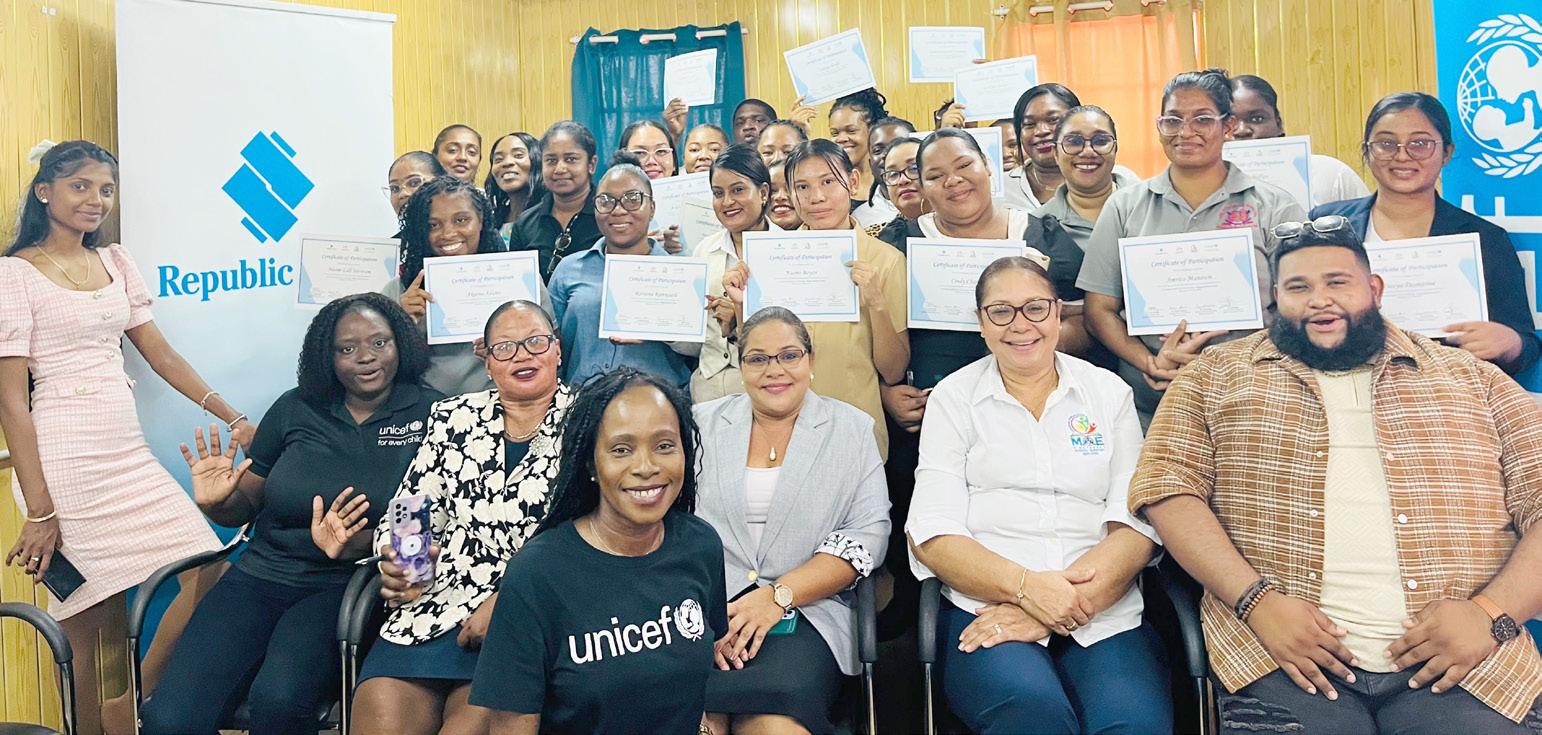
OWING to a partnership between UNICEF Guyana and Republic Bank (Guyana) Limited, more than 25 teachers and guidance counsellors from Region Two have strengthened their capacity to support the mental health and well-being of adolescents.
According to a press release, the Help Adolescents Thrive (HAT) training programme was implemented by UNICEF and funded by Republic Bank (Guyana) Limited in collaboration with the Ministry of Education and the Adolescent Health Unit.
Held from June 17-19, the three-day training provided participants with practical tools and evidence-based approaches to support social and emotional skills building, recognise signs of emotional distress and connect students with appropriate services when needed.
The initiative forms part of ongoing efforts to strengthen support systems
for adolescents and create safe, nurturing school environments where young people can learn, grow, and thrive.
“Mental health is a critical component of adolescent well-being and development,” Health Officer at UNICEF Guyana, Joann Simpson, said. Simpson related: “I am
especially pleased that this training focuses on building the capacity of teachers and guidance counsellors to support adolescents in developing social and emotional skills. This is essential for promoting mental well-being and preventing mental-health conditions. Prevention deserves our focused attention, now more than ever.”
Adolescence is a pivotal period of development and supportive relationships within schools can play a significant role in promoting resilience, well-being, and positive outcomes. Through the HAT programme, educators gain practical knowledge to foster positive interactions with students and create environments where
adolescents feel safe seeking help.
Guitree Ramsamooj, Branch Sales Manager, Anna Regina Branch, Republic Bank (Guyana) Ltd. highlighted the importance of investing in adolescent mental health in the region.
“Republic Bank (Guyana) Limited is proud to support this important initiative alongside UNICEF and our government partners.
Region Two’s young people deserve environments where they feel supported, understood, and empowered to reach their full potential. By investing in the capacity of teachers and guidance counsellors, we are helping to build stronger support systems that can positively impact the lives of adolescents for years to come.”
The ‘Help Adolescents Thrive’ training is one component within the partnership and reflects the shared commitment of UNICEF and Republic Bank (Guyana) Limited, to promote positive
mental health and well-being among adolescents and strengthen community-based support systems.
In April 2026, UNICEF and Republic Bank (Guyana) Limited launched a partnership aimed at strengthening adolescent mental health and psychosocial support across Guyana.
The partnership focused on enhancing awareness, building the capacity of frontline professionals and expanding access to supportive services for adolescents.
Through targetted investments in schools and communities, the collaboration seeks to ensure that young people have the knowledge, resources, and support needed to thrive.
As Guyana continues to prioritise adolescent well-being, partnerships such as this demonstrate the power of collective action in creating healthier, safer, and more supportive environments for every young person.

SCOTIABANK Guyana last week hosted Scotia® Immersa, an elegant evening that brought together clients, partners and distinguished guests for a celebration of Guyanese excellence and the strong relationships that underpin the bank’s local work.
The invitation-only event showcased Scotiabank’s commitment to building meaningful, lasting relationships with clients and creating opportunities for connection, collaboration and mutual growth, according to the bank in a press release.
Against a backdrop of Guyana’s rapid economic transformation, the gathering was both a gesture of appreciation and a statement of confidence in the country’s future.
“At Scotiabank Guyana, relationships are at the heart of everything we do,” said Nafeeza Gaffoor, Country Head, Scotiabank Guyana.
“This evening was our way of expressing appreciation to our clients for the confidence they place in us
and reaffirming our commitment to helping them achieve their ambitions. Guyana’s future is filled with opportunity, and Scotiabank Guyana is committed to helping our clients seize it. Every conversation, every partnership and every investment we make reflects our confidence in this market and our commitment to supporting the ambitions of the people and the businesses driving Guyana’s continued success,” Gaffoor said.
The event also highlighted Scotiabank’s international capacity to support local clients as they scale.
“Guyana is playing an increasingly important role in the Caribbean’s growth story,” said Matthew Parker-Jones, Senior Vice President, International Commercial Banking.
“Scotiabank is committed to supporting our clients with the confidence, stability, and partnership they need to succeed in a rapidly evolving market, bringing the strength of our global platform to unlock opportunities beyond
DEMONSTRATING that meaningful change begins with individual action, employees of One Communications came together on Saturday, June 27, to participate in a community cleanup exercise along the Kingston Seawall, adjacent to the company’s corporate offices.
Approximately 15 employees volunteered their time to remove litter and debris from the area as part of the company’s observance of World Environment Month and its ongoing commitment to environmental stewardship and community responsibility.
The initiative, held under the theme, “The Great Outdoors: Climate Action Starts Here,” reflects One Communications’ belief that protecting the environment requires collective action and that businesses have an important role to play in creating cleaner, healthier communities.
Chief Executive Officer, Abraham Smith, who participated in the cleanup alongside employees, encouraged the team to recognise the impact of small acts of service.
“It’s easy to think that one person can’t make a difference, but when we come together as one team with one purpose, we can make a meaningful impact in our communities. In just one hour, we transformed this space, proving that collective action really does matter.”
The exercise also served as a reminder that climate action extends beyond global discussions and national policies. It is reflected in the everyday choices individuals and organisations make to care for the environment and the communities they serve.
One Communications expressed its appreciation to the Ministry of Local Government and Regional Development for supporting the initiative through the provision of cleanup materials and logistical assistance, helping to ensure the success of the exercise.
The company reaffirmed its commitment to supporting initiatives that promote environmental sustainability, community engagement, and responsible corporate citizenship, noting that building stronger communities goes hand in hand with connecting them.
the country. We have strong confidence in Guyana’s future and in the opportunities that lie ahead.”
Scotia® Immersa reinforced the bank’s dual focus: deepening local relationships while leveraging Scotiabank’s global network to open pathways for Guyanese businesses and entrepreneurs.
For a market experiencing fast-paced development, the event underscored the role of financial partners not
only as service providers, but as long-term collaborators in client ambitions and national progress.
As Guyana navigates its next phase of growth, gatherings such as Scotia® Immersa signal a marketplace in which local ambition is matched by international expertise — and where banks such as Scotiabank position themselves as catalysts for opportunity, investment and sustained success.


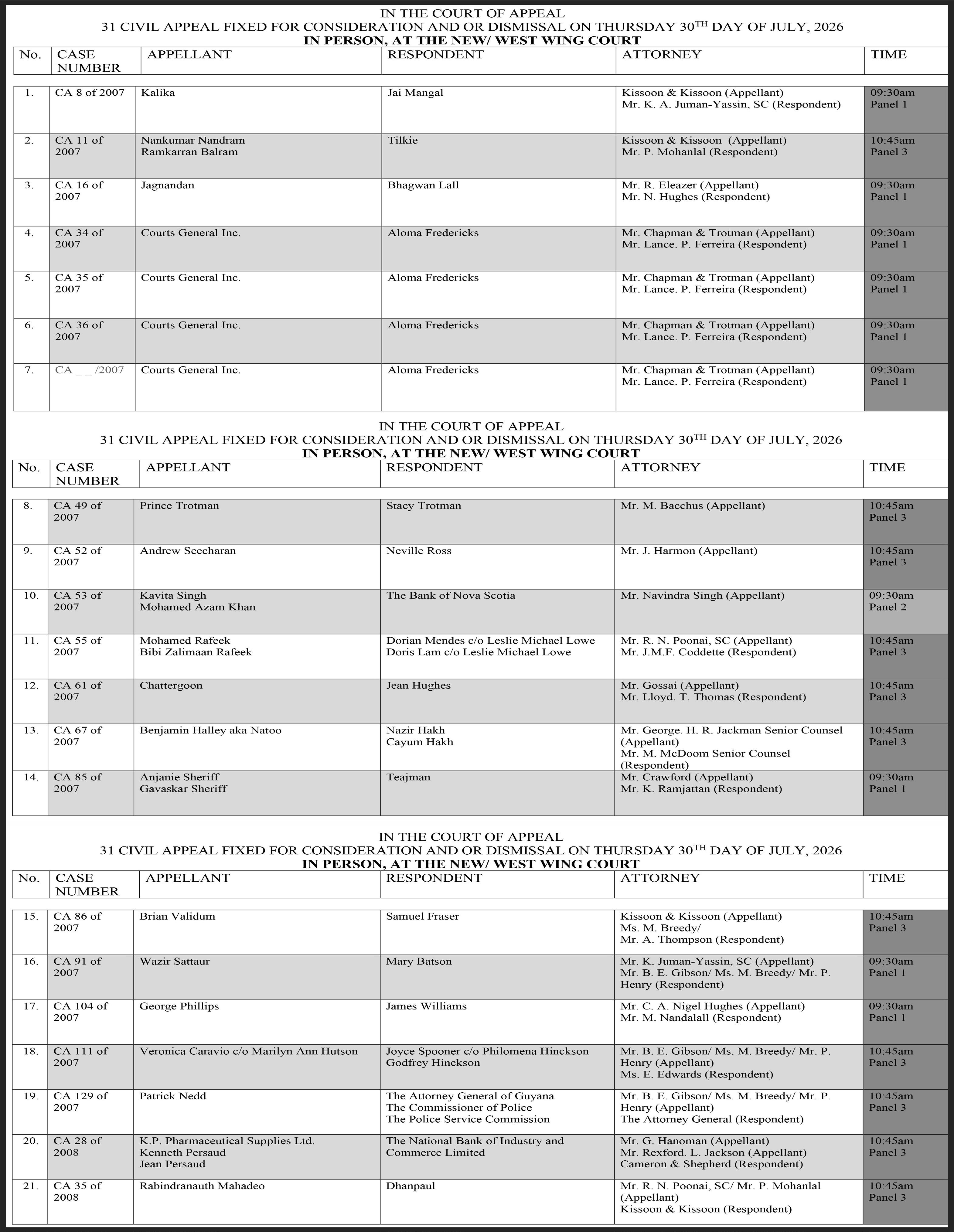
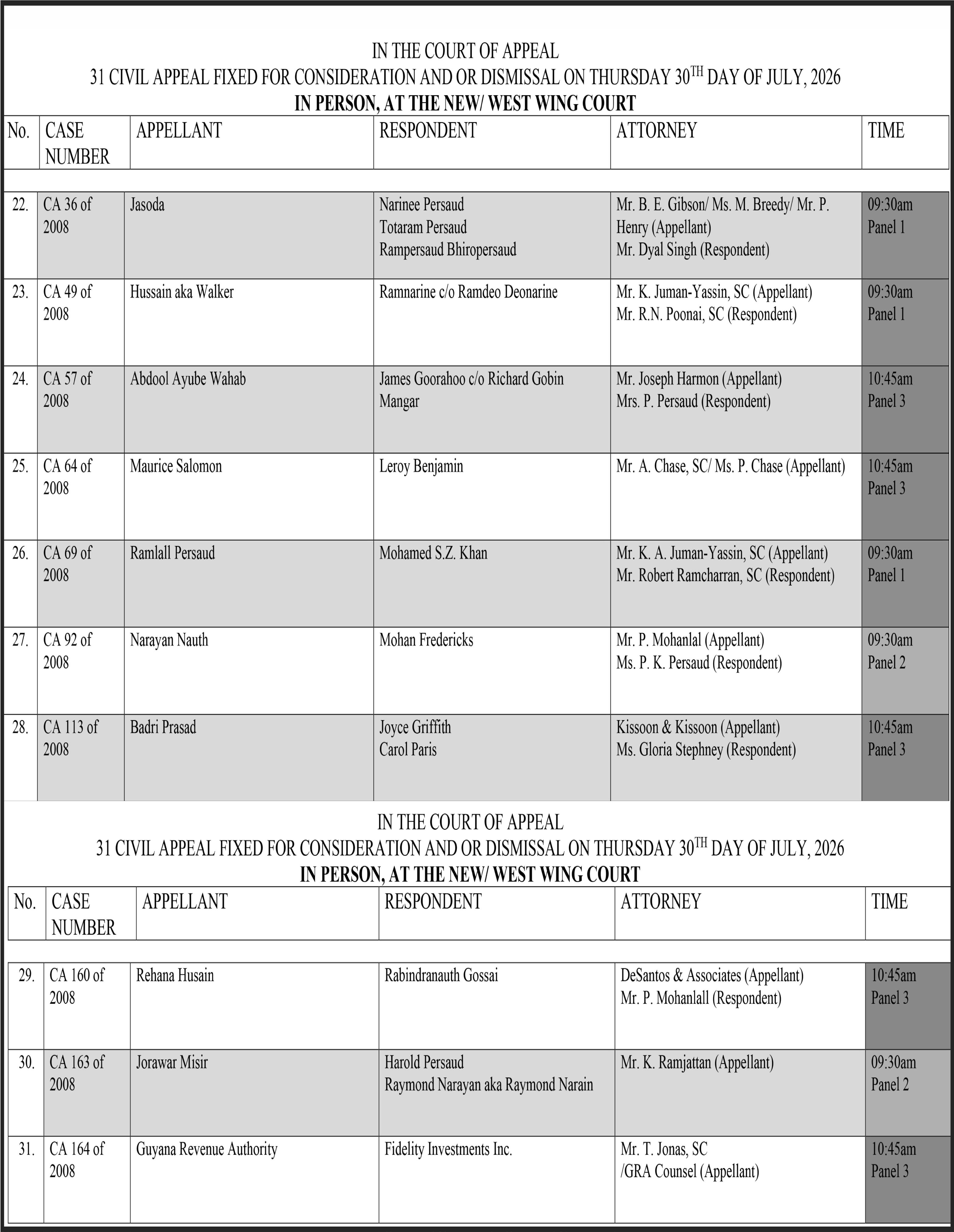

KEMAR Roach was so emotional that he teared up after he became the fourth West Indies fast bowler to 300 Test wickets and fifth West Indies bowler overall to the landmark. Roach, who will turn 38 at the end of this month, joined a club that includes Courtney Walsh, Curtly Ambrose and Malcolm Marshall.
"Thank you very much, everyone. I really appreciate it," Roach said after receiving a special jersey from Jayden Seales following West Indies' innings victory against Sri Lanka in the first Test in North
Sound. "All the people supporting me over the years, I'm glad and very proud in some way. But for me right now, I just want to bask in the moment, celebrate this Test win, and then win the series as well."
Roach reached the landmark when he rifled a full ball into No.10 Asitha Fernando's stumps from wide of the crease after lunch on day four. All up, Roach bagged four wickets in the innings, rushing West Indies to an innings-and-217run victory. Roach paid tribute to his captain and former room-mate Roston
“Our cricket is literally dead, and we have nothing coming through,” Benjamin declared. “We don’t have the patience, and we’re not promoting cricket from the grassroots level upwards. We’re hoping that somebody comes through the crack, and when they come through, they have a lot of incorrect fundamentals.”
Benjamin singled out two promising young talents to illustrate his point about the region’s impatience with emerging players. He cited Windward Islands batsman Alick Athanaze as a player with the raw tools to become an international great, but warned that the system is failing to nurture him properly.
“I’m going to call a name

(From page 24)
now, and I am not plugging for anybody, but let us look at a young guy from Windward Island named Alick Athanaze. He has talent, youth and all that it takes to become an international great, but I think we just don’t have the patience,” Benjamin said.
He also referenced teenage prodigy Jewel Andrew, suggesting that the young player was thrown into the deep end without adequate preparation.
“Then they have a young Jewel Andrew that we throw him in. As we were talking about learning to swim, you just throw him in, and youit’s either sink or swim or hook or duck. Patience again, now he’s on the outside looking in,” he added.
Beyond impatience, Benjamin aimed at what he views as a dangerous trend, which is encouraging young cricketers to gravitate toward the game’s shorter formats far too early in their development.
He argued that this approach undermines the technical foundation required for long-term success.
“We are the ones who are teaching them or encouraging them to go into the shorter version at an early age,” Benjamin said. “We can’t now decide that you don’t have control; you have control, and your control is at this particular age group. We are not
going to encourage or provide the opportunity for you to be playing that kind of cricket at that early age.”
The former fast bowler did not mince words when assessing the current crop of so-called elite players, asserting that their fundamentals are “found wanting.” He placed the blame squarely on the development system, not the youngsters themselves.
“When we look at the fundamentals of the players that we have that we call elite, it’s found wanting so it means that we are failing our youngsters, and then we’re blaming the system,” Benjamin said. “We are not providing them with the necessary tools to face the outside world in terms of cricket.”
Chase, coach and former team-mate Daren Sammy, and the team ‘physio’ Denis Byam.
"It's been a long journey, man," Roach reflected.
"I'm happy the guys won the game, that's the most important thing. I think the win is what we needed to get ourselves on the [World Test] Championship table. So, well done to the team, Roston Chase on his first win as captain. Sammy on his first win as well as coach. But, you know what, it's been a long journey. It took a lot to be here. I want to be here for all these guys, everyone supporting
me, especially Denis Byam.
"I want to mention Denis Byam immensely. He's the team physio and we've had countless conversations for the last couple of weeks. Obviously coming back from injury, a lot of work had to be done to get myself out here to play this Test match. He was phenomenal, man. All my family, I know my mum is watching, she's proud. My kids, all my friends at home. I know everyone's watching now, just this day today. I want to thank all the Antigua fans for coming out and supporting the team."
score (124) and Randolph Ketwaroo of Regal Masters for the best bowling figures in a match (four for 14).
Champions Ariel Trophy Stall Masters were awarded with the Eagle and $3000 (US) while all the players also collected medallions. Runners-up USA Masters took home the runners-up trophy.
An elated Kingston, who also led the then Ariel Masters to championship victories in Guyana, declared at the presentation ceremony that, “we came, we conquered and we destroyed….”
The victory also saw a prompt response from one of the top sponsors, Ramesh Sunich of Trophy Stall fame, who immediately sent out special congratulations to the victorious team on their splendid effort.
Following is the text of
Sunich’s message: “Congratulations to Ariel Trophy Stall Masters cricket team. I extend heartfelt congratulations to the Ariel Trophy Stall Masters Cricket Team on its outstanding triumph in the New York Softball League Masters Over-40 tournament.
The team’s success is a fitting reward for the hard work invested by the players, sponsors and supporters.
(From page 27)
“Congratulations once again on a remarkable achievement. May this success serve as a foundation for even greater accomplishments in the years ahead and continue to inspire the growth of Masters cricket. Best wishes and continued success.”
Among the other sponsors were P&P Insurance Brokers, King’s Hotel & Residences, King’s Jewellery World, HD Brokerage Establishment and Khan’s Enterprise.
“Special appreciation is due to Mr. Ariel Persaud and his company for partnering with Trophy Stall in co-sponsoring the team. I also wish to express sincere gratitude and congratulations to Mr. Samuel Kingston for his leadership of the team. The team’s convincing and well-deserved victory stands as a reward for his leadership and to the collective effort of his players.

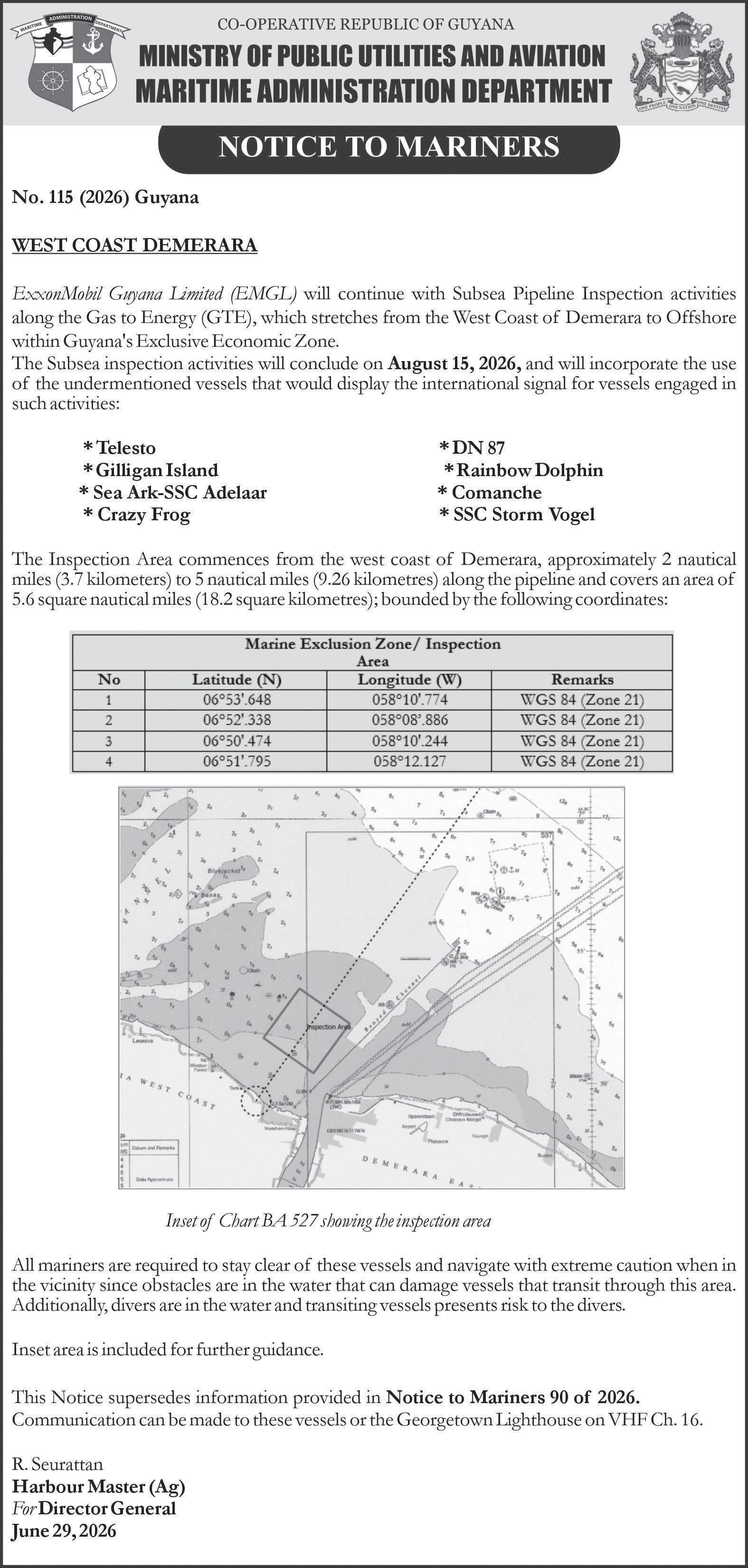

nent Miomir Kecmanovic.
One month on from a seismic second-round loss at the French Open, four-time major winner Sinner recovered from an error-strewn start and an awkward fall to overcome his 50th-ranked opponent 4-6 6-3 6-7 (6-8) 6-2 6-3 after a tense three and a half hours.
Sinner opted against contesting a grass tournament in the lead-up to Wimbledon, with this his first match since an extraordinary collapse against Argentine Juan Manuel Cerundolo, whom he had led by two sets and 5-1 at Roland Garros.
Having appeared to physically shut down in the stifling Paris heat that day, Sinner's durability was thoroughly tested by Kecmanovic, and he was fortunate to escape relatively unscathed after a moment of
genuine concern on Centre Court.
There were gasps in the crowd when Sinner slipped behind the baseline during the third set and took time to return to his feet, with the umpire heading over to check on him.
Blood was also seeping from the Italian's shoe during a must-win fourth set, which he later explained was caused by a problematic toenail.
Sinner had won just one of his past nine matches that had gone to a fifth set - but he raised his level when it truly mattered to stave off Kecmanovic and avoid becoming only the third defending Wimbledon men's champion to lose in the first round.
Sinner, contesting the opening match on Centre Court after beating Carlos Alcaraz last year to win a first Wimbledon title, said: "I
tried to stay there mentally, [but] also trying to enjoy the moment.
"Coming here, [playing in the] opening match on Centre Court, it's a huge privilege.
"It has been an amazing, amazing day for me to feel this way at least once in my life.
"I think I handled the situation still quite well. It was very nervy, but I'm very happy that I found a way today."
With the continued absence of injured main rival Alcaraz, Sinner once again began a major as the strong title favourite.
Renowned for his devastating precision, Sinner made an uncharacteristic 10 unforced errors in the opening eight games, but saved two break points to avoid an early setback.
(BBC Sport)
ST. JOHN’S, Antigua, (CMC) – FORMER West Indies fast bowler, Winston Benjamin, has issued a stark warning about the state of regional cricket, asserting that the game is “literally dead” due to a chronic failure to nurture talent from the grassroots level upward.
The Antiguan, now a Leeward Islands head coach and owner of the Grassroots Cricket Academy, painted a grim picture of the sport’s current trajectory during a recent interview.
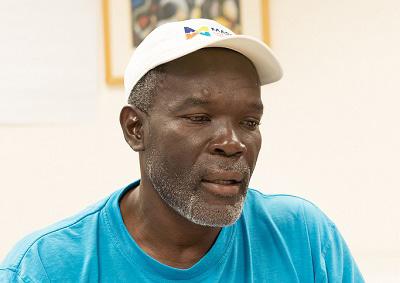
However, he insisted that recovery is possible, provided that patient, structured devel- opment becomes the priority.
placed teams will play for bronze.
A total of 28 matches will be played across the

THE ICC and the IOC have confirmed the qualification pathway for cricket's return to the Olympic Games at Los Angeles 2028, with a new ICC Olympics Qualifier set to determine the final places in both the men's and women's T20 competitions.
Six teams will compete in each event at LA28. Five qualification spots will be decided through existing ICC events and T20I rankings, while the sixth and final berth will be awarded through the inaugural eight-team ICC Olympics Qualifier in 2027.
The ongoing ICC Women's T20 World Cup 2026 has already produced the first four qualified teams for the women's competition. Australia, Great Britain (through England), India and South Africa secured qualification as the highest-placed eligible finishers from Oceania, Europe, Asia and Africa respectively, with qualification limited to one team per continent.
Hosts USA will qualify automatically for both the
men's and women's events provided they feature in the top-15 of the respective ICC T20I rankings at any point between June 30 and December 31, 2026.
If the USA women fail to meet that criterion, the additional automatic berth will go to the highest-ranked non-qualified team in the ICC Women's T20I rankings as of March 1, 2027. For the men's event, the place would instead be allocated to the next highest-ranked eligible team not already qualified by December 31, 2026.
The remaining automatic qualification places in the men's competition will be awarded to the highest-ranked eligible teams from Africa, Asia, Europe and Oceania in the ICC Men's T20I rankings on December 31, 2026.
The 2027 ICC Olympics Qualifier will feature eight teams in both the men's and women's competitions. Seven places will be filled by the next highest-ranked eligible teams in the respective ICC T20I rankings, exclud-
ing those that have already qualified for LA28, with the winner claiming the final Olympic berth.
The ICC also outlined a separate qualification route for the Caribbean. As the West Indies represents multiple sovereign nations and is not recognised as an IOC National Olympic Committee, it cannot compete at the Olympic Games.
However, if the West Indies men's or women's team finishes among the top eight highest-ranked non-qualified teams by December 31, 2026, a Caribbean qualifying tournament will determine which National Olympic Committee will represent the region at the ICC Olympics Qualifier.
Each qualified nation will name a 15-player squad. The six teams in each event will be split into two groups of three, with teams playing the other sides in their group before taking on two teams from the opposite group that finished in different positions. The top two teams will contest the gold medal match, while the third- and fourth-

men's and women's tournaments at a purpose-built cricket venue in Pomona. The ICC said details re -
garding the dates and host of the 2027 ICC Olympics Qualifier will be announced later. (Cricbuzz)
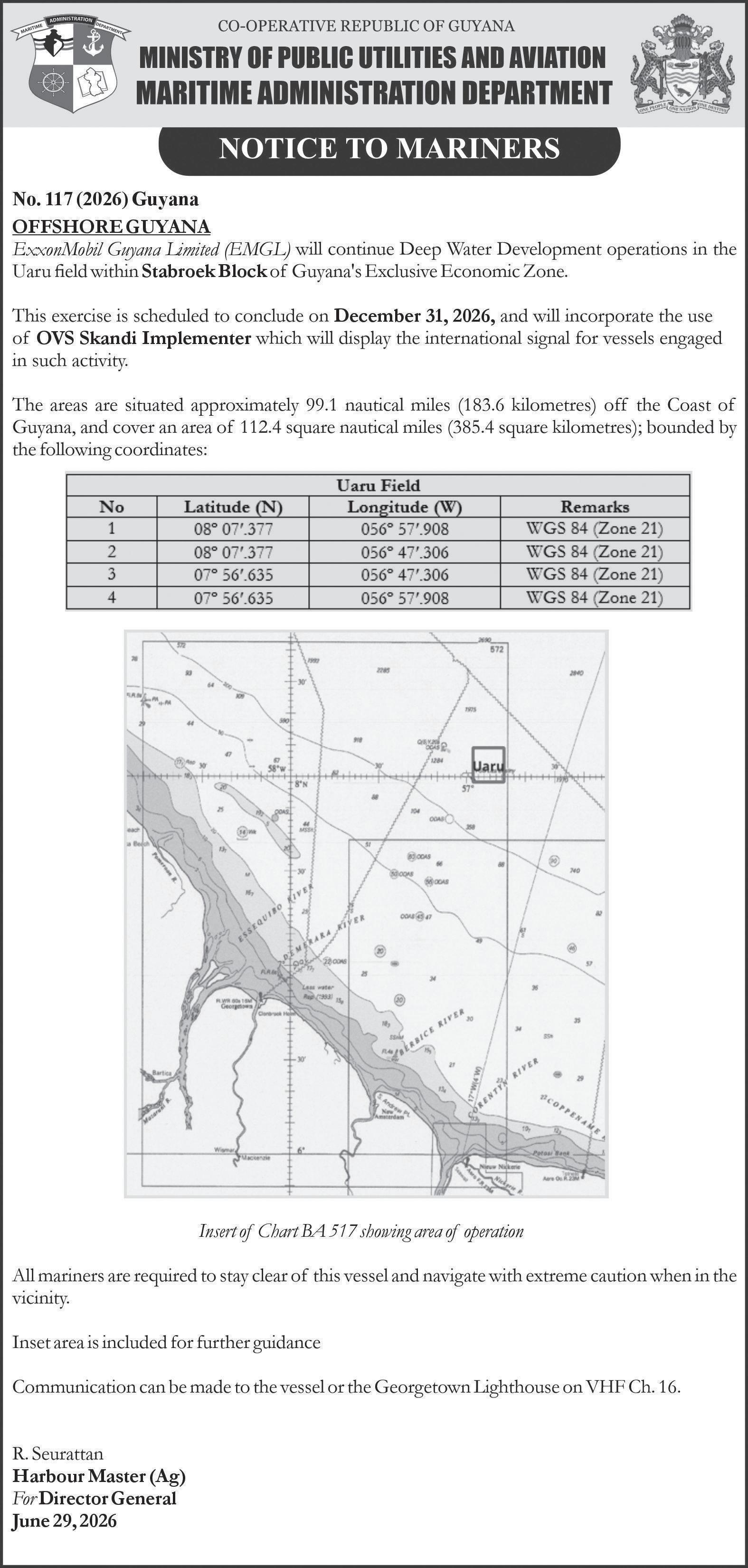
BEN Stokes' storied England career ended in a series defeat by New Zealand, who wrapped up the third and deciding Test on the final day in Nottingham.
The day after captain Stokes announced this Test would be his last, England's 160-run loss at Trent Bridge - and a 2-1 series reversehighlighted the mess they now find themselves in.
In the aftermath of the Stokes news on Sunday, England slumped to a self-inflicted 103-4 by the close of day four, leaving an inevitability about their chances of chasing 373 on Monday.
(Scores: New Zealand 438 (Conway 157, Latham 151; Stokes 4-70) & 288-9 dec: (Mitchell 100*, Ravindra 94; Archer 4-53)
England 354 (Duckett 113, Bethell 74; Smith 4-91)
& 212 (Smith 60; Foulkes 3-42)
And any sense of a prolonged fight was extinguished in the fourth over of the day, when Emilio Gay departed and, crucially, Joe Root was run out by an extraordinary direct hit from Henry Nicholls.
Jamie Smith and Gus Atkinson at least staved off humiliation with a battling stand of 75, ended when Atkinson was out just before lunch.
Smith completed only his second half-century in 11 months, but Josh Tongue was the victim of another sublime New Zealand direct hit, this time by Mitchell Santner, before Smith was caught at long-off to leave England 212 all out.
It means New Zealand, heavily depleted by injuries, have earned a famous series
win, only their fourth in this country.
The Black Caps were the last visiting team to win a series here, in 2021, and now they are the first tourists to win a series of three or more Tests in this country in 14 years.
For Stokes, a four-year captaincy reign ends with his first home defeat, and a 15-year international career ends with England in chaos.
This was their seventh defeat in nine Tests, and extends a run without a series win stretching back to 2024.
In a congested calendar, England begin a whiteball series against India on Wednesday, but a swift return to action will not stop questions over whether further change to the management is required. (BBC Sport)
should go in
FORMER captain Michael Vaughan says England’s coach, Brendon McCullum and Rob Key should resign as part of a "complete clearout" following the retirement of Ben Stokes.
Captain Stokes, McCullum and director of men's cricket Key had all been retained in their roles by England and Wales Cricket Board (ECB) chief executive, Richard Gould, after last winter's Ashes defeat.
The 35-year-old Stokes, who ruled out reversing his retirement, suffered a series defeat by New Zealand in his final game of international cricket on Monday, having announced his shock decision on Sunday.
"Enough is enough. With Ben Stokes walking off into the sunset and
winter Ashes which was so poorly planned, and the failure to beat India last summer, you know something major has to give.
"I take no pleasure in doing this. I don't like calling for heads. At the end of the Ashes I tried very hard not to. But I can't cope with watching English cricket be so wasteful any more.
results getting worse and worse, now is the time for a complete clearout, with the coach Brendon McCullum and director of cricket Rob Key going too," Vaughan told the Telegraph., external
"Results like this do not come along often, and when you put it on the back of the
"There is so much skill and talent in the England changing room but it is not being harnessed at all. If all we have is to just keep going harder, and it's been exposed again, on the back of chaos off the field, which has been happening too regularly, then it is time for change."
Vaughan suggested Stokes could return to the fold if there is change at the top. (BBC Sport)
Kaia's maiden ton, Madhevere and Ervine's fifties extend Zimbabwe's dominance
A CENTURY from opener Innocent Kaia, and fifties from Brian Bennett, Craig Ervine and Wessly Madhevere extended Zimbabwe's dominance on the second day of their one-off Test against Bangladesh. Taijul Islam, the visitors' lone spinner, took 7 for 138 in an extended spell, but a lack of support from the fast bowlers at the other end meant Zimbabwe had grabbed a 270-run lead by the time they were bowled out.
Bangladesh batted out nine overs in their response, reducing the deficit by 40 runs. However, Richard Ngarava dismissed opener Shadman Islam in this passage of play with a ripper swinging away late, underlining Zimbabwe's mastery of the Harare conditions. The game had resumed in Harare with Kaia already past fifty, batting in the company of Brendan Taylor. He passed the century mark in the first session, off 153 deliveries. This was his maiden Test century in just his third game for Zimbabwe.
(Scores: Bangladesh 40 for 1 (Mahmudul 21*) and 140 (Mominul 60, Nyamhuri 4-61, Ngarava 2-18) trail Zimbabwe 410 (Kaia 140, Madhevere 77*, Ervine 60, Taijul 7-138) by 230 runs)

Even as Kaia was nimble on his feet, seeing out some early seam and bounce, Taylor struggled at the other end. He was the first batter to fall, on 17, when Khaled Ahmed got him edging behind in a tangle, looking to defend outside off.
Success for Bangladesh's fast bowlers was few and far between for the rest of the day. In fact, across two sessions and a half, they failed to capture a single wicket. Zimbabwe had gone in with four fast bowlers, while Bangladesh had opted for just three. They all erred in line, straying down leg or being too short and wide through the day. Hasan Mahmud, who did pitch it up as the day went on, went wicketless in his 25 overs at an economy of 4.08. Ebadot Hossain, in his 20 overs, went at an
even more expensive rate of 4.80. Khaled - with his 2 for 68, and an economy of 3.09 - was the most disciplined bowler of the lot, but prone to errors in line and length himself.
Even as Bennett joined Kaia for a 107-run partnership for the third wicket, Taijul held up the other end for a majority of it with his tighter lines: he bowled 40.2 overs in total, and took his 19th Test five-wicket haul. He was particularly effective in using the rough outside the right-hander's leg-stump line, otherwise floating up fuller deliveries on the stumps. In both cases, he beat the outside edge of front-foot defences time and again
Bennett was effective in leaning back and playing behind the square against the fast bowlers, especially when they pitched it short
and wide. He played the quickest knock of the Zimbabwe innings - his 59 runs came in just 67 deliveries, at a strike rate of 88.05and his wicket came off an unforced error. He ran down the track and smashed a length ball right back to Taijul.
This was the theme of the Zimbabwe innings. Kaia was the next batter dismissed, in the 72nd over, for 140 - he looked to flick another innocuous length ball off his pads but turned his bat too soon and bunted an edge to silly mid-off.
Another wicket fell in the same over, just two deliveries later, when wicketkeeper-batter Tafadza Tsiga inexplicably ran back for a fatal second run after punching a delivery to midwicket. He was run out sprinting back, after a pause, for the striker's end.
If Bangladesh had hoped to wrap up the innings quickly, the wickets did not come. Ervine (60) and Madhevere (77*) combined to score a 102-run partnership for the seventh wicket, handing Zimbabwe the decisive advantage for the day. Madhevere, in particular, utilised his big front-foot stride to counter Taijul lobbing it up on a full length outside off, unfurling eight fours - mostly scored in the 'V' - during his unbeaten knock.
The unforced errors kept coming at the other end off Taijul. Ervine was out sweeping a delivery drifting down leg, at fine leg. Brad Evans, uncomfortable at the crease during his tenball stay, was rapped on the pads for a plumb lbw.
With Zimbabwe seven down, the lower-order batters came out with an
intent to hit out. However, from 394 for 7, they added just 16 more runs: Newman Nyamhuri edged an offbreak to second slip, where Towhid Hridoy took an excellent diving catch. Ngarava held the pose after being beaten on the slog sweep, but his stumps had been pegged back. And Blessing Muzarabani, the final batter out, was hit on the pads after missing a dead-bat. Returning to bowl in the final hour of play, Zimbabwe's bowlers immediately extracted more bounce off the surface, if not much movement. Bangladesh's openers - Mahmudul Hasan Joy and Shadman - went for extravagant shots when the ball was pitched fuller. Off just the second ball, Mahmudul launched an ill-advised drive, which saw a thick edge fly over second and third slip.
Anti-climactically, Zimbabwe's sole wicket of the day came in the fifth over with Shadman not attacking, but drawn out into a defense by Ngarava. A full ball swung away ate, and caught the outside edge off his soft hands and flew to slip anyway.
Bangladesh now have nine wickets left and three days of play to come. If the late spell of bowling by Zimbabwe'. (Cricinfo)
LONDON, England, (CMC) – West Indies captain Hayley Matthews has declared her team will enter today’s ICC Women’s T20 World Cup semifinal against Australia with “nothing to lose” and a fearless mindset that could prove dangerous for the tournament favourites.
Speaking at the pre-match press conference ahead of the crucial knockout clash, Matthews exuded confidence despite facing the world’s number one-ranked side, who enter the semifinal in formidable form after brushing aside India in their final group match.
“We certainly feel like coming up against Australia, we have nothing to lose, and that puts us in a position where we can be quite fearless going out there,” Matthews stated.
The West Indies have navigated a challenging path to the semifinals, with Matthews acknowledging both pride in their journey and the belief that her side has yet to reach its full potential.
“It’s obviously been quite
a journey to get here, but I think as a team we’re really proud of the way we’ve played so far, but still know that we haven’t been at our best, which gives us a lot of confidence knowing that we can still get a lot better,” she explained.
When asked about the emotional connection to West Indies’ 2016 World Cup triumph at Eden Gardens, Matthews was pragmatic about drawing inspiration from the past.
“Slightly. That was 10 years ago and a much different group. I also think the game was a lot different at that time.”
Instead, the captain pointed to more recent encounters, particularly a match against Australia in 2023, as a better reference point for tomorrow’s contest.
“I feel like at the Oval, conditions might be pretty similar. We saw the game that England played the other day at home. The wicket was coming on, and the par score we feel is certainly going to be a lot higher than it was so far in the competition.”

Matthews has identified a key lesson from recent encounters with the Australian powerhouse, and that is to never let up.
“You can’t take your foot off the gas at any point in time, I think, especially when you’re bowling. They seem to come hard from ball one and have a mantra where they just want to keep going,” she observed.
The West Indies skipper
stressed the importance of capitalising on opportunities against a team that builds partnerships and applies constant pressure.
“You’re going to have to hold on to your chances for sure and understand that at some point in the game, a partnership likely will build. It’s about trying to control the flow of the runs as much as possible and just trying to build as much pressure as possible.”
Matthews was unequivocal about what it will take to overcome the tournament favourites.
“We’re going to need big performances from big players. I think we’re certainly going to need a standout individual performance, I believe. But I think to beat a team like Australia, you still need more than one player, and we’re going to have to
have our best players really stepping up to the plate tomorrow.”
The captain highlighted the contributions of players like Aliyah Alleyne and Jahzara Claxton, who have provided crucial support throughout the tournament, but acknowledged the need for the team’s established stars to fire.
“I think I said multiple times that we haven’t had our best match yet. We haven’t had the likes of myself or Deandra Dottin in the runs, really. And that leaves a lot of room for improvement for us as a team.”
With expectations firmly on Australia’s shoulders, Matthews believes her team can approach the semifinal with an advantageous mentality.
“When we step out onto that field, everyone’s expecting us not to win, in a sense. And when you go into a game with people probably looking at you thinking that if you do win, it’s going to be a surprise, you certainly feel that you can just go there, be free.”
From Frederick Halley in New York
PLAYING unbeaten in all three days of intense competition, newcomers, Ariel Trophy Stall Masters, justified their pre-tournament rankings to emerge winners of the Masters Over-40 category when the 21st edition of the New York Softball Cricket League (NYSCL) Independence Cup climaxed at the picturesque Baisley Park, New York on Sunday.
Representing the lone Guyana-based team to qualify for one of the three finals, the Guyanese outfit, superbly led by the veteran and wily Samuel Kingston, made light work of USA Masters, winning by six wickets in the 20-over affair much to the delight of their followers at the ground and those in their homeland.
Set a paltry 101 for victory, after restricting the home side to 100 for nine in their allotted 20 overs, Ariel Tro-

phy Stall Masters reached the required target in 13.2 overs, losing four wickets in the process.
The victory was engineered by a fine unbeaten 49
from opener Chien Gittens, who once again displayed his batting prowess after the Ariel Trophy Stall Masters top order lost three of their top order batters, including
the prized scalp of Richard Latiff for 13.
Undaunted by the fall of wickets, Gittens stood tall, playing some delightful shots and looked well set to
complete a well-deserved half-century but was left high and dry on 49 when victory was achieved. He counted five fours and one six in his unbeaten knock.
Earlier, USA Masters, after being inserted by Kingston, lost wickets at regular intervals and at one stage were 58 for seven in the 11th over before Mark Ramkissoon (21) and Shan Persaud (13 not out) added 38 for the eighth wicket to ensure they reached 100, a total that proved inadequate at the end.
Bowling for Ariel Trophy Stall Masters, Harrynarine Dilchand bagged three for 14 and Shawin Hubbard three for 19.
Gittens, who batted consistently throughout the three days of action, copped both the Man-of-the-match for the final and the overall Most Valuable Player (MVP) awards.
Other incentive awards went to Vijay Singh of Central Florida Cricket League for scoring the most runs (150), Nigel Brijlal of USA Masters for taking the most wickets (nine), Pooran Beria of Old School Masters for hitting the highest individual
(Turn to page 23)


IN what has rapidly evolved from a grassroots weekend pastime into a marquee fixture on the Caribbean cricket calendar, the Lotto/Let’s Bet One Guyana T10 Tapeball Blast launched its fourth edition with the structural ambition that completely redefines domestic cricket.
With the Guyana Lottery Company coming on board as the new title sponsor, this year's tournament boasts an expansive field of 80 teams from across the country, all vying for a slice of an unprecedented prize pool.
The tournament’s meteoric rise was the central theme at a star-studded launch, graced by key government dignitaries and sports administrators who have watched the competition evolve from its humble, raw beginnings into a highly organised national spectacle.
"When we first conceptualised this tournament, we started with strong wording and a bold vision, but to see how it has grown into
something truly fantastic is nothing short of remarkable," said Charles Ramson Jr., Minister of Culture, Youth and Sport.
"It has transcended being just a community tournament; it is now a national platform that captures the raw talent of our people and channels it into a structured, elite competition.
The government’s commitment to sports development is reflected perfectly in this growth, and we are proud to see tapeball cricket receiving the prestige it richly deserves."
Echoing those sentiments was Steven Jacobs, Minister within the Ministry of Culture, Youth and Sport, who has been an avid advocate and partner since the tournament’s inception. "To witness the exponential growth of this tournament year after year is incredibly gratifying," Jacobs noted.
"Tapeball is the bedrock of Guyanese cricket culture—it is where our passion is born. By elevating the
infrastructure, increasing the stakes, and expanding the reach to 80 teams, we are not just hosting a tournament; we are creating a sustainable pathway and a professional environment for cricketers across Guyana to showcase their skills on a grand stage."
Speaking at the launch, Guyana Lottery Company General Manager, Kalima Ali, expressed the corporation’s immense pride in aligning with a tournament that so authentically captures the heartbeat of Guyanese cricket.
What sets the 2026 edition apart is a revolutionary prize structure that moves away from the traditional, unforgiving knockout formats in which early exits yield no return.
In a move to financially cushion regional clubs, losing teams at the zonal quarter-final stage are guaranteed G$25,000, while losing semi-finalists at the zonal level will pocket G$50,000.
The stakes escalate progressively from there: the
losing zonal finalist receives G$200,000, culminating in a handsome G$500,000 purse for the respective zonal champions before they even transition into the national bracket.
The crescendo of the tournament will see the stakes reach their absolute peak during the national playoffs. The ultimate crown jewels of the season await the finalists, with the crowned national champions walking away with a massive G$2,000,000 first-prize purse, while the runners-up will secure G$1,000,000.
The two losing national semi-finalists will not leave empty-handed either, with each earning G$500,000.
Registration forms can be accessed via the tournament’s official social media handles or by contacting the organisers directly on WhatsApp at +592 6352235.
The tournament caravan officially commences with the Berbice Zone on August 8–9 across four premier ven-
ues—including the historic Port Mourant Community Centre Ground, the No. 69 Ground, and the Welfare Ground in Canje—before concluding with the zonal finals at the Albion Sports Complex on August 9.
The action then moves swiftly to the East Bank/ West Demerara leg on August 15–16, followed by the Essequibo Zone on August 22–23.
Following a temporary hiatus to accommodate the Caribbean Premier League (CPL) fever, the tournament resumes with the powerhouse Georgetown/East Coast Demerara leg on September 26–27 and October 3–4.
In a historic first for the competition, the national grand finale on October 11, 2026, will be hosted at the Anna Regina National Stadium in Region Two, bringing the absolute pinnacle of Guyanese tapeball cricket directly to the passionate fans of Essequibo.
The massive undertaking has gathered an
unprecedented corporate coalition, including the Guyana Lottery Company, KFC Guyana, Office of the President, Ministry of Culture, Youth and Sport, Banks DIH Ltd, Star Rentals, Avinash Contracting and Scrap Metal Inc., S&K Imports, I&S Trading, Impressions Branding, Regal Stationery, SAWA Investment Inc., Scoop Ride Inc., Betcabana, Shawn Mini Mart, Trophy Stall, ENet, Supreme Transportation Inc., ETS – Environmental Technical Solutions Inc., Windsor Estates, Smart Choice Pharmacy, G Mining Ventures, V-Net Technologies, Guyana Oil Company Limited, Camilles Academy, 3D Lee Hub, Trinchloro, Superbet Guyana, The Laundry Chute Inc., Bernies Pharmacy, Mannol Oil, Montra Restaurant and Lounge, Continental Transportation Inc., D&S Ramdehol and Sons Jewellery, and Navin and Son Construction.

GABRIEL Martinelli scored a dramatic 95th-minute winner as Brazil came from behind to beat Japan and set up a World Cup last-16 tie against Norway or Ivory Coast. With just seconds left, Brazil won possession back on the edge of the Japan box and Bruno Guimaraes slipped the ball into Martinelli, who took a touch before slotting in off the post.
It was a heartbreaking
end for Japan, who had more than matched Brazil in the first half and battled valiantly in the second, but Carlo Ancelotti's side kept pushing and got their reward in final moments.
Japan was comfortable in the first half and Kaishu Sano pounced on Danilo's loose pass to drive past Casemiro and drill the ball into the bottom corner to give his side the lead.
Brazil struggled to re -
spond before half-time but looked a different side after the break with Casemiro rising to power home Gabriel's back-post cross 10 minutes after the restart.
The goal had been coming and the five-time World Cup winners nearly took the lead in stunning fashion three minutes later.
Vinicius Jr received the ball 10 yards inside the Japan half, nutmegged his marker, drove into the box, jinked
past another defender and stabbed his shot towards the far corner - only for Japan keeper Zion Suzuki to tip it on to the post.`
Japan regrouped from there and while Brazil continued to push forward, chances were limited.
That is until Ao Tanaka lost the ball on the corner of his own box and was ruthlessly punished by Martinelli and Brazil. (BBC Sport)