



— ministers mobilised across regions; safety risks flagged
India delivers new aircraft to boost Guyana’s aviation sector
Culture drives unity, national pride
- President Ali
- Gov’t deepens investment in the arts, advances Orange Economy as driver of growth, jobs and global positioning
M&CC blocking progress; residents must choose development
— Manickchand
- Minister
— Second shipment due as bilateral co-operation in aviation deepens



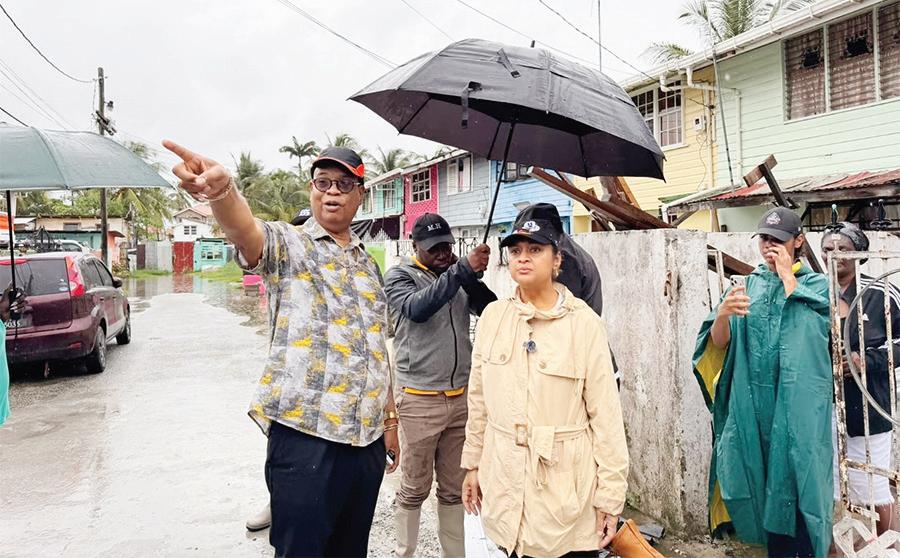
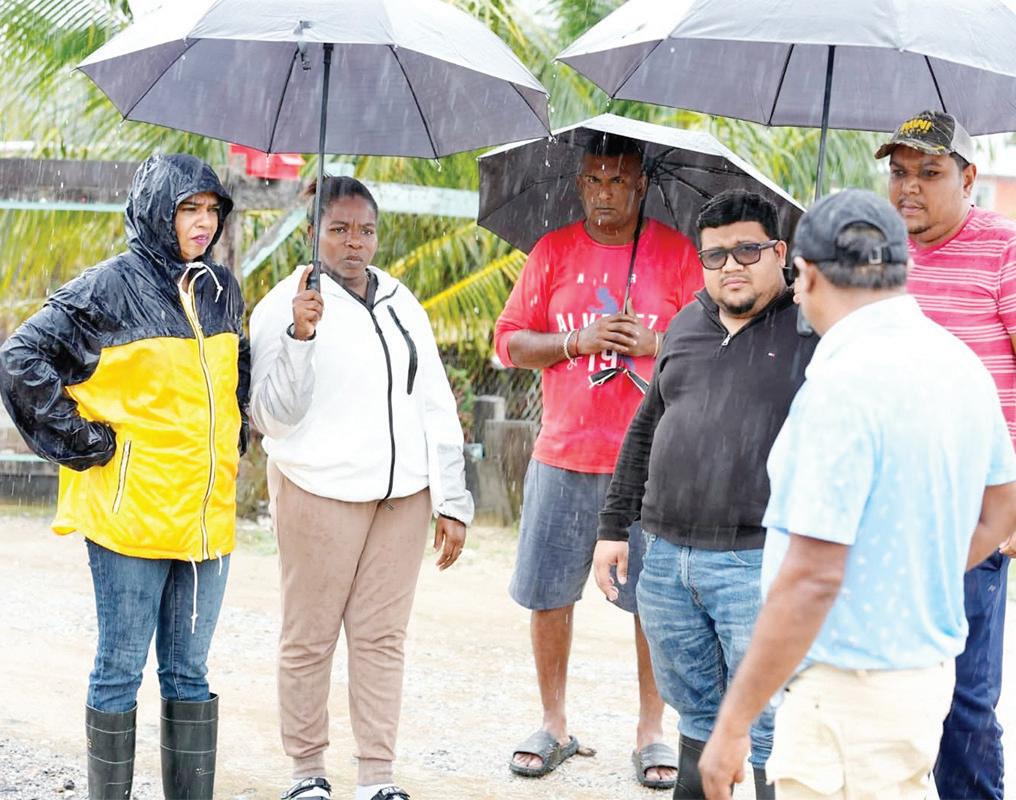
Minister of Local Government and Regional Development, Priya Manickchand, and Minister of Public Works, Bishop Juan Edghill, engage residents during on-the-ground flood assessments in South Ruimveldt on Saturday
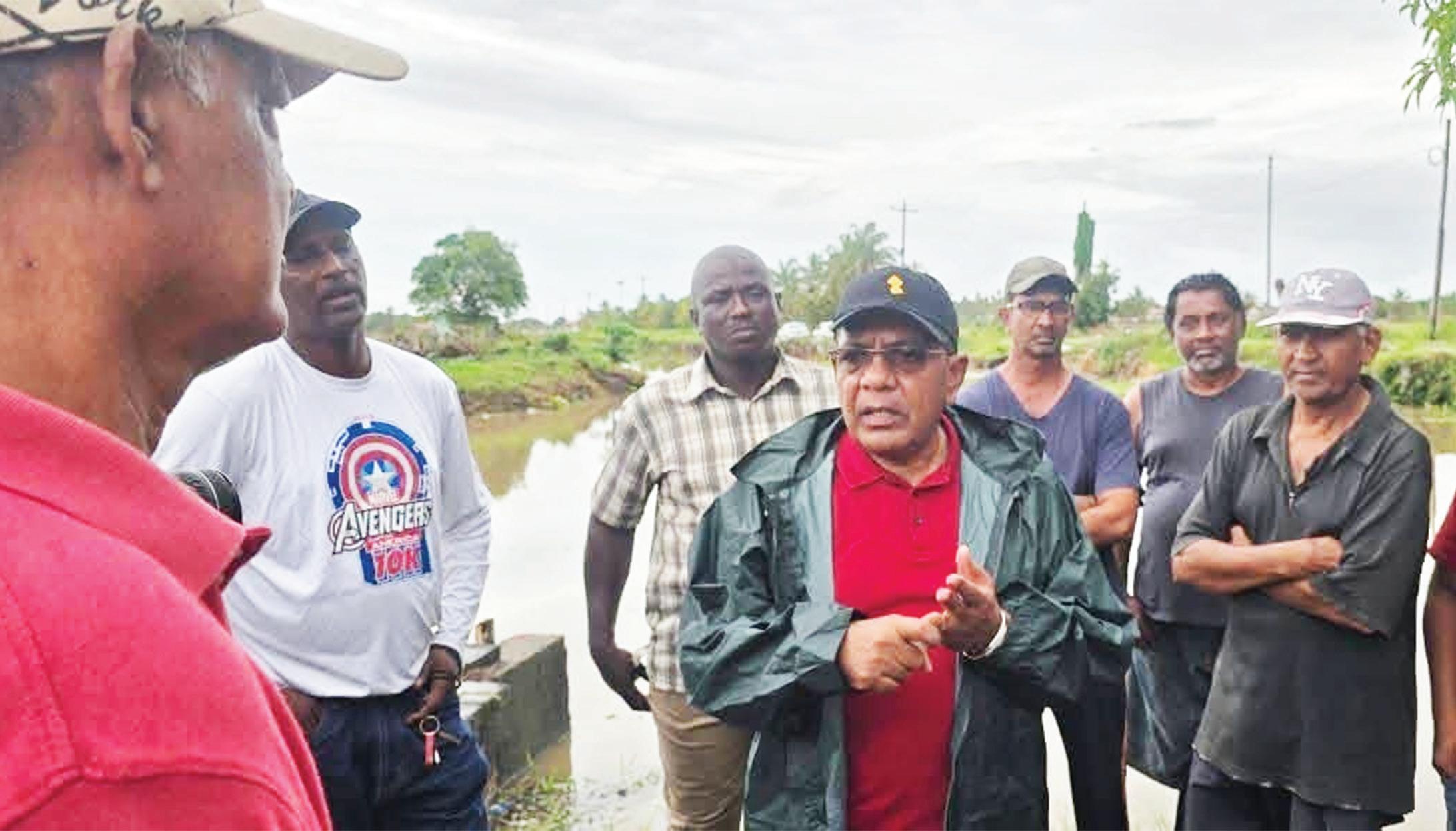
The government on Saturday activated a full-scale, nationwide flood response as persistent heavy rainfall continues to impact communities across Guyana, with ministers deployed across multiple regions to assess conditions, engage residents and ensure that critical drainage and emergency systems are fully operational.
and Regional Development, Priya Manickchand, led field operations in communities including Bagotstown, South Ruimveldt and North Ruimveldt, where residents have been grappling with rising water levels.
She was joined by Minister of Public Works Bishop Juan Edghill, along with Regional Chairmen and technical teams, in what officials described as a
Minister of Education, Sonia Parag, engage residents during flood assessments in Region Five
The mobilisation comes as the Hydrometeorological Service warns that moderate to heavy rainfall will continue until Tuesday, significantly increasing the risk of flooding, particularly in low-lying and poorly drained areas.
The advisory points to unstable atmospheric conditions driving widespread rainfall, thunderstorms, rising water levels and saturated soils, with the potential for localised flooding, hazardous driving conditions and damage to infrastructure.
CABINET-LEVEL
RESPONSE ON THE GROUND
In Regions Three and Four, Minister of Local Government
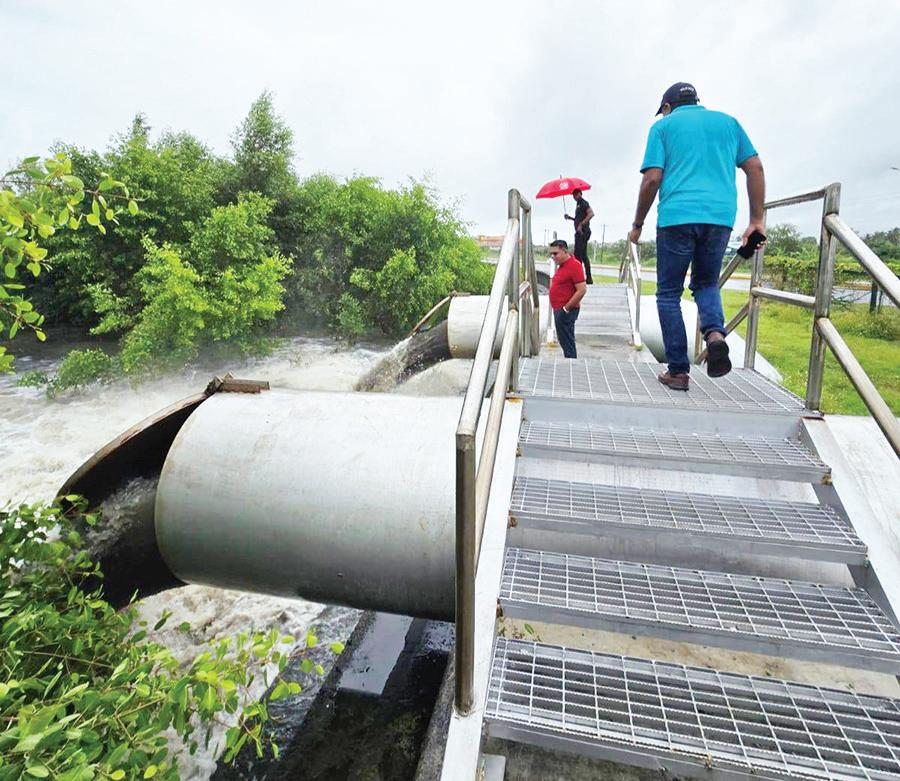
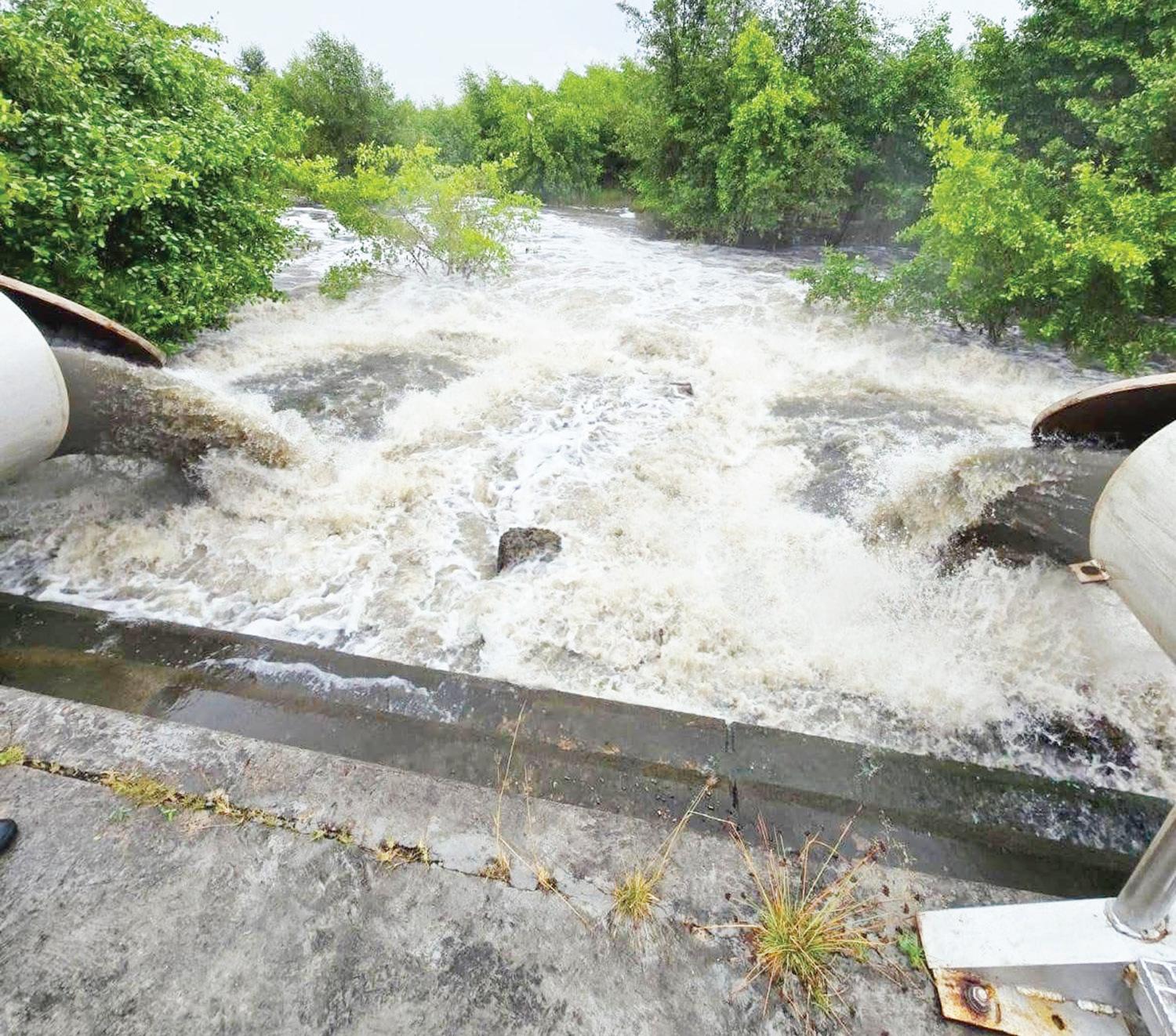
Minister of Agriculture Zulfikar Mustapha, during an inspection at the Liliendaal Pump Station as authorities intensify monitoring of drainage infrastructure
weeks ago, it would be flooded today… I am happy that this intervention has held up. People could get in and out,” he said, pointing to upgraded drainage and roadway works.
He added: “It’s not 100 per cent, but the drainage is much improved,” while stressing that the system must be managed aggressively, particularly through the effective use of pumps and sluices.
Manickchand, in outlining the operational response, noted that teams from Neighbourhood Democratic Councils (NDCs) and Regional Democratic Councils (RDCs) have been mobil-
Three engaging residents and assessing flood-affected communities.
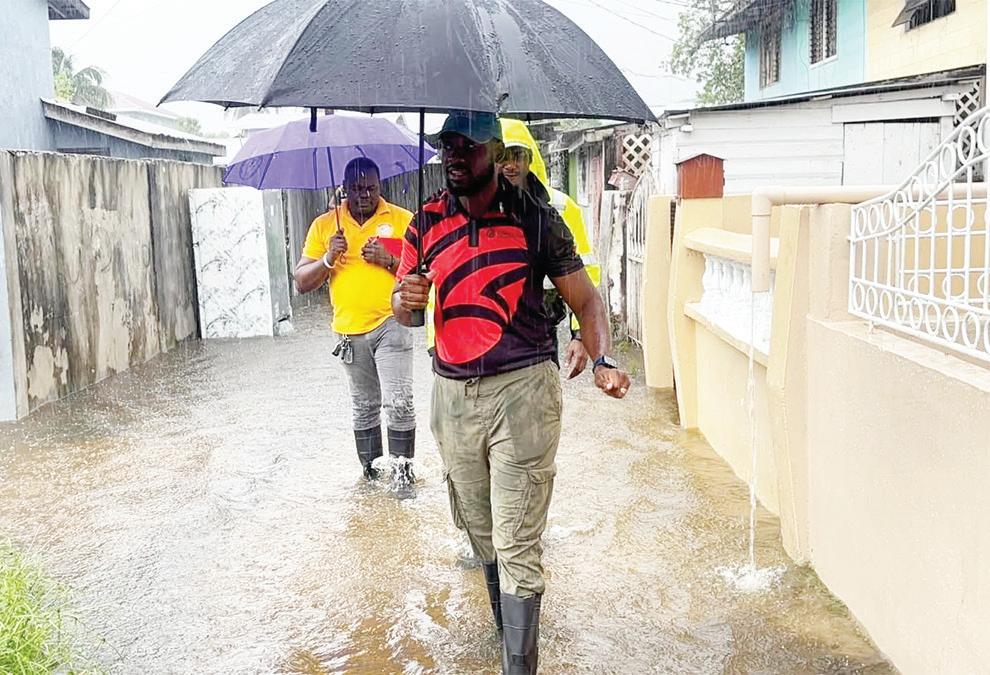
In Georgetown, Minister within the Ministry of Culture, Youth and Sport, Steven Jacobs, visited Kitty; Minister of Tourism, Industry and Commerce Susan Rodridges tackled the Sophia community while Minister of Labour and Manpower Planning, Keoma Griffith, was in East La Penitence and Ruimveldt, interacting with residents and monitoring conditions as part of the coordinated response.
The widespread deployment underscores what officials
coordinated, real-time response to the developing situation.
Ministers and regional officials were actively assessing drainage infrastructure, ensuring that kokers, canals, pumps and drainage channels were functioning effectively.
In areas where existing systems were under pressure, tractor-driven pumps were installed to boost capacity and accelerate the removal of water.
Edghill, during a walkthrough in South Georgetown, made it clear that while the volume of rainfall remains a challenge, recent infrastructural investments are already delivering measurable improvements.
“This street, if rain fell three
Minister of Labour and Manpower Planning, Keoma Griffith, on the ground in East La Penitence engaging residents affected by heavy rainfall
ised and are maintaining active monitoring of drainage systems.
The minister emphasised that ensuring systems function in real time is critical as rainfall continues.
The national response extended beyond the coast, with ministers deployed across multiple regions.
Minister of Education Sonia Parag was on the ground in Region Five, while Minister of Public Utilities and Aviation Deodat Indar was in Region
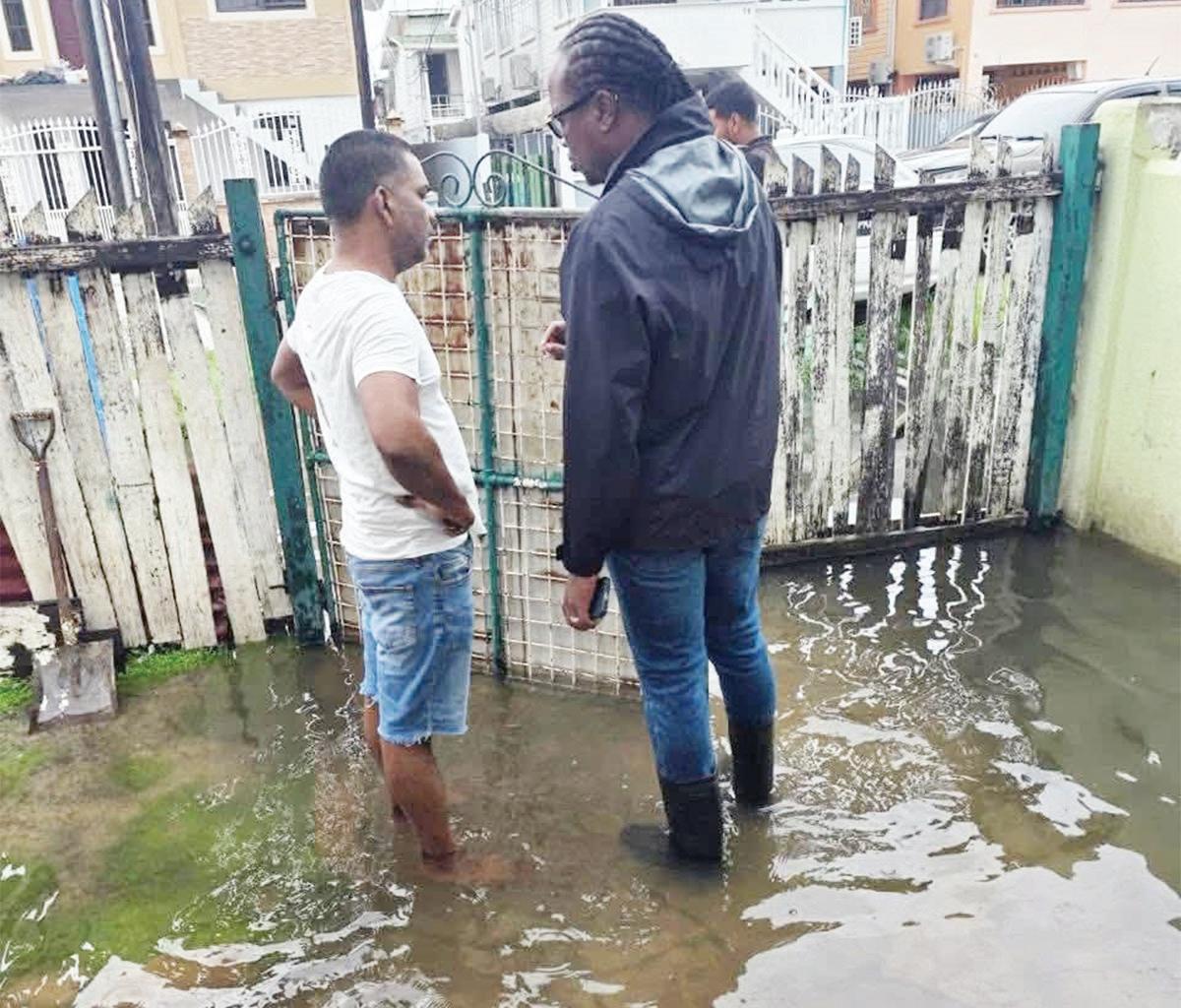
Minister within the Ministry of Culture, Youth and Sport, Steven Jacobs, interacts with residents in Kitty while assessing the impact of flooding
receiving approximately 145 millimetres.
During inspections at the Liliendaal Pump Station and other key drainage sites, Mustapha confirmed that engineers and technical personnel have been deployed nationwide to ensure that all drainage infrastructure remains operational.
“These teams are out there monitoring every system — pumps, sluices, canals — to make sure they are working as they should,” he said.
However, the minister did not shy away from highlighting deficiencies within the system, pointing to a lapse at the Cowan Street sluice.
“The sluice was closed, although the tide was very low. And that shows that there is a serious problem with the City Council, because they are not
HUMAN BEHAVIOUR IDENTIFIED AS KEY CONTRIBUTOR
Attorney General and Minister of Legal Affairs Anil Nandlall added another dimension to the issue, pointing to human behaviour as a significant factor exacerbating flooding.
Following visits to flood-affected communities along the East Coast of Demerara, Nandlall said several contributing issues were identified.
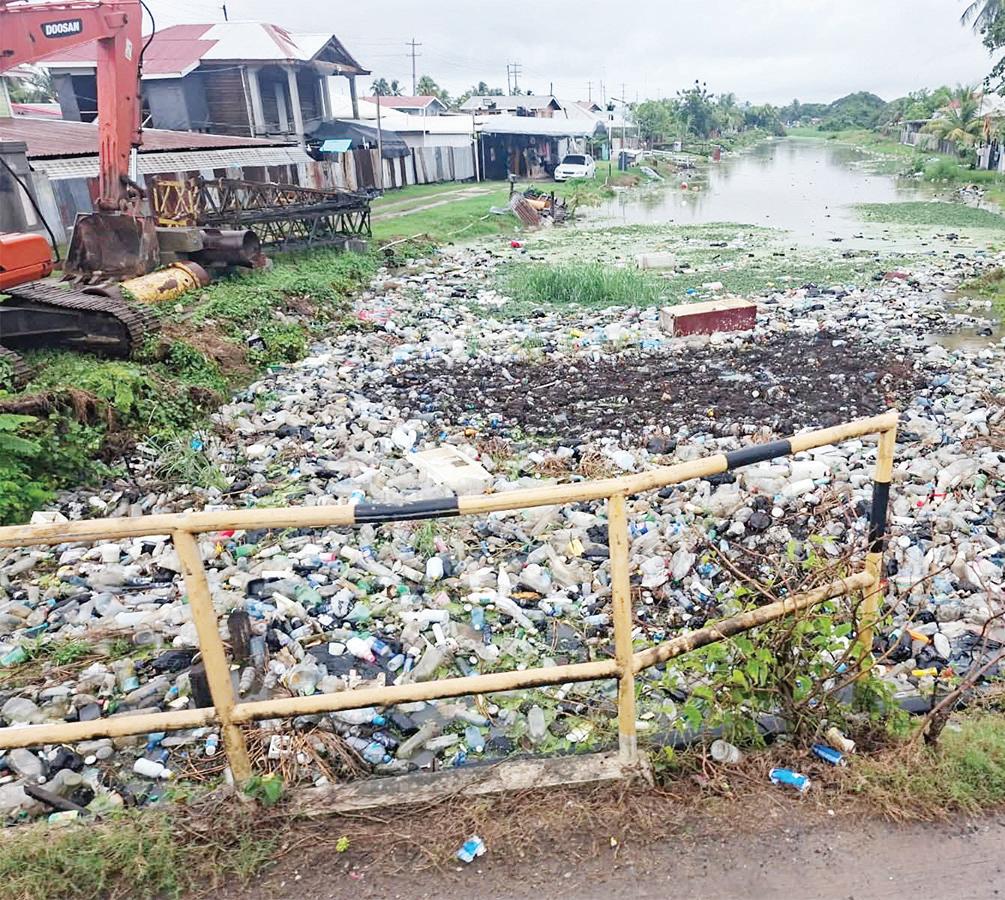
“These include permanent blockages to drains by residents themselves; the expansion of drains to take off the volume of water; the wanton dumping of garbage in drains and canals and in many cases, blockage of drainage kokers,” he said.
describe as a “whole-of-government” approach aimed at ensuring that no community is left unattended as conditions evolve.
RAINFALL INTENSITY TESTING NATIONAL SYSTEMS
Minister of Agriculture Zulfikar Mustapha underscored the severity of the current weather system, revealing that Georgetown recorded more than 3.5 inches of rainfall within a 24hour period, with some areas
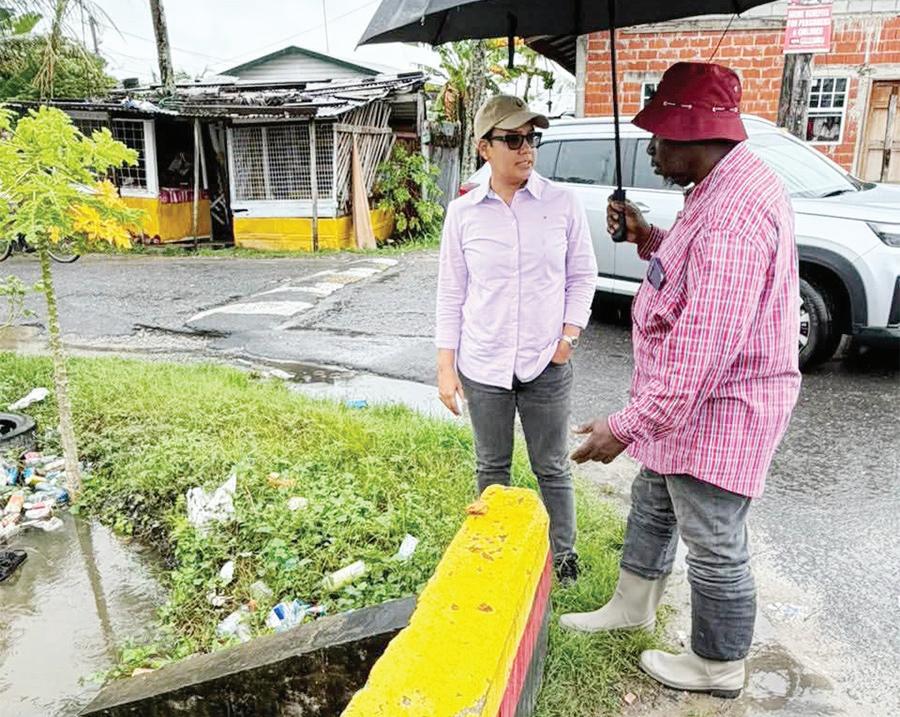
Minister of Tourism, Industry and Commerce, Susan Rodrigues, interacts with residents in Sophia (Sachin Persaud photos)
monitoring the situation,” Mustapha said.
He emphasised that sluices are critical components of the drainage system and, if properly utilised, can discharge water faster than pumps.
He warned that such practices are undermining drainage efforts and worsening conditions.
“The dumping of garbage in the drains and drainage canals by citizens is both callous and criminal. The blatant refusal to clean the small drains in front
– Gov’t deepens investment in Arts, advances Orange Economy as driver of growth, jobs and
PRESIDENT Dr. Irfaan Ali on Friday evening signalled a continued push to position culture as a central pillar of Guyana’s national development agenda, underscoring its role in fostering unity, identity and economic diversification.
Speaking Friday evening at a State reception held in honour of regional and local artistes for last evening’s Clash of the Titans show, the Head of State made it clear that the country’s cultural push is no longer peripheral, but a deliberate, strategic investment aligned with broader national transformation.
Welcoming performers to Guyana, President Ali emphasised the wealth of talent in the region, and the significance of cultural exchange, noting that such engagements go beyond entertainment.
“Let me take this opportunity to welcome all of you to the shores of Guyana, where there are only two things that define us: Rain and sunshine. Regardless of what it is, rain, sunshine, or storm, one

thing we know for sure: This group of artistes would blow your minds anywhere in the world,” he said, adding:
“They are going to perform their hearts out and deliver a performance that will not only bring joy, but ignite in everyone who attends a feeling of satisfaction, movement, vibes, and everything

else. I know most of these performers, and I can assure everyone that if you miss it, you are going to miss something fantastic.”
But beyond the performances, the President used the platform to reinforce a broader national message: Culture is a unifying force, and a vehicle for development.
“Guyana is the home for those who believe in love, unity, and togetherness. That is what we are in pursuit of development, progress, and prosperity that are unifying,” he said, adding:
“The fact that all of you, sometimes competitors, are
coming together on one stage to share one moment and one performance says a lot. The name itself tells you something; you are all champions. You do not need validation, you are all champions coming together for one clash.”
He further highlighted the level of coordination and investment required to execute large-scale cultural initiatives, cautioning against taking such efforts for granted.
“These opportunities of bringing together artistes and talent from around the region are not an everyday occurrence. It takes careful planning, investment, commitment

made in these areas,” he said, adding:
“There are very few places in the world where, upon arrival, you receive a State reception by the President of the country. That shows the level of interest in developing culture.”
Ramson positioned culture as a non-replicable national asset, critical not only to identity, but to economic diversification and global positioning.
“This event is in keeping with the vision for the country. The President has defined how we move forward, investing our resources wisely while diversifying the economy and developing all sectors. Culture is one of the unique areas that cannot be replicated,” he said.
from the artistes and their bands,” President Ali noted.
“We must never take for granted the effort, time, and commitment of these artistes. Tonight, in welcoming you to Guyana, I want you to know that we respect your talent, the time you put behind it, and your effort,” he said in closing.
Meanwhile, Minister of Culture, Youth, and Sport Mr. Charles Ramson Jnr touched briefly on the government’s direct fiscal involvement in hosting events of this nature.
“Over the last five years, cultural development has grown significantly. Our job at the Ministry of Culture, Youth and Sport was made easier because of President Ali and his belief in the development of the Arts and the investment
He added that the increasing frequency of major events signals a clear shift in national positioning.
“This event is very important, because it is one way we see the country developing. Every month, you see major events because we are repositioning Guyana as a premier destination for worldclass events under President Ali’s leadership.”
The reception forms part of a broader push by the administration to elevate Guyana’s cultural footprint regionally and internationally, while strengthening the Orange Economy as a key growth sector capable of generating income, expanding opportunities for creatives, and reinforcing national unity.


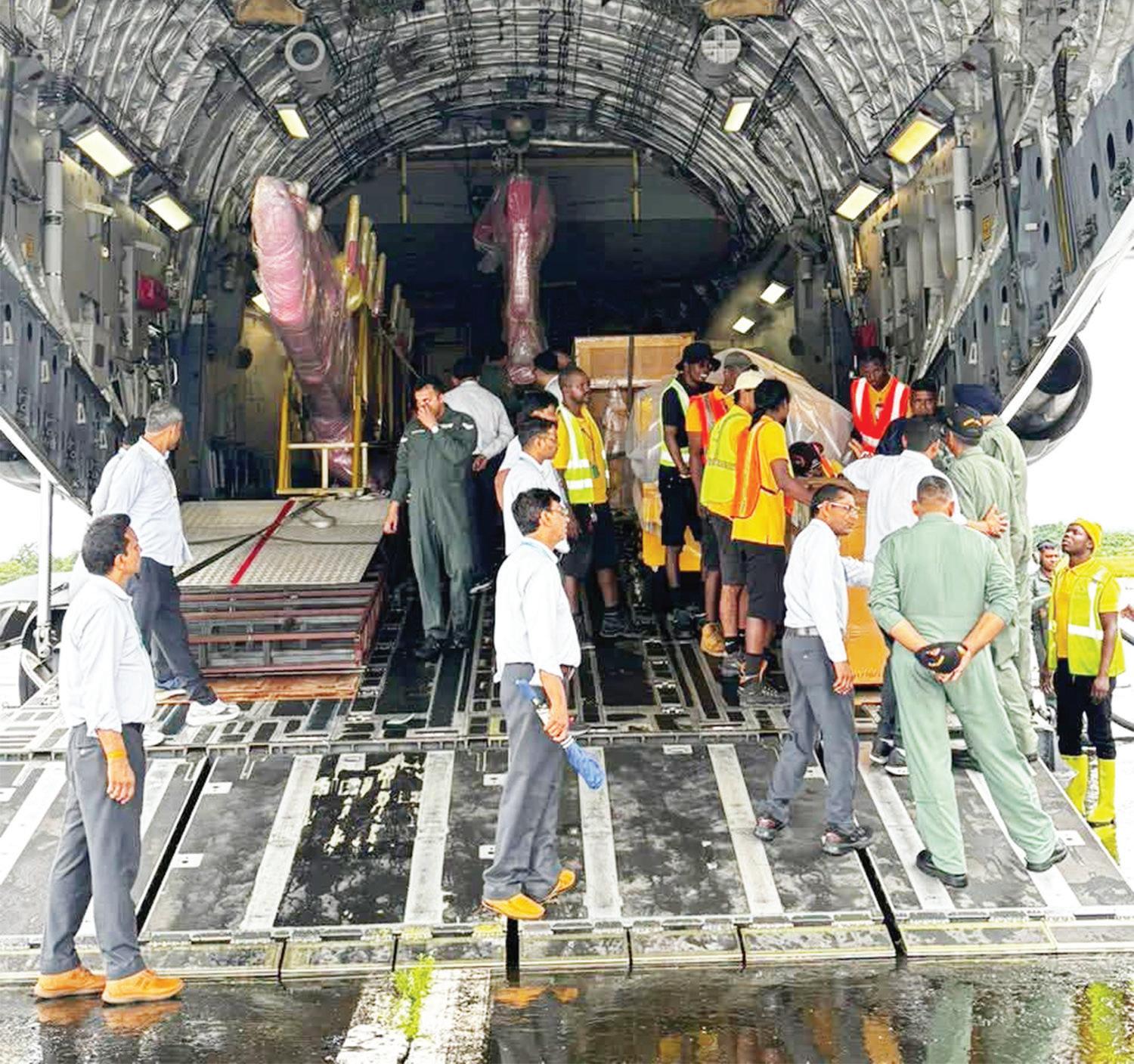
AN Indian Air Force C-17 Globemaster aircraft touched down at the Cheddi Jagan International Airport on Saturday, delivering an H-228 aircraft manufactured by Hindustan Aeronautics Limited (HAL), in a move set to strengthen Guyana’s civil aviation capacity.
The delivery forms part of ongoing co-operation between Guyana and India, building on the earlier provision of two HAL Dornier 228 aircraft in March 2024 under a line-of-credit arrangement.
According to the High Commission of India in Guy-
A second C-17 Globemaster is scheduled to arrive today with another aircraft of the same type, further expanding the country’s fleet.
ana, the initiative reflects the “robust and growing partnership” between the two countries, particularly in advancing aviation infrastructure and regional connectivity.
“This initiative builds upon India’s earlier provision of two HAL Dornier 228 aircraft to Guyana in March 2024 under Line of Credit, reflecting the deepening co-operation and shared
commitment of both countries towards strengthening aviation infrastructure and regional connectivity,” the High Commission stated.
The Acting High Commissioner received the aircraft upon arrival, welcoming the crew and HAL officials while commending their professionalism and operational efficiency.
The induction of the new
electrical risks.
of their homes is reckless and irresponsible,” he added.
Nandlall acknowledged that government agencies must accept responsibility but stressed that meaningful improvement will require stronger public co-operation.
ELECTRICAL
HAZARDS EMERGE
AMID FLOODING
As floodwaters rise, utility
aircraft is expected to significantly enhance Guyana’s civil-aviation capabilities, particularly by improving access to hinterland and remote regions, while supporting broader economic and social development.
Further emphasising the impact, the High Commission noted that “the induction of these aircraft is expected to significantly enhance
Guyana’s civil-aviation capabilities, particularly in improving accessibility and connectivity across regions.”
The continued rollout of aviation assets signals a strengthening of India–Guyana relations, with tangible investments now translating into expanded infrastructure and improved national connectivity.
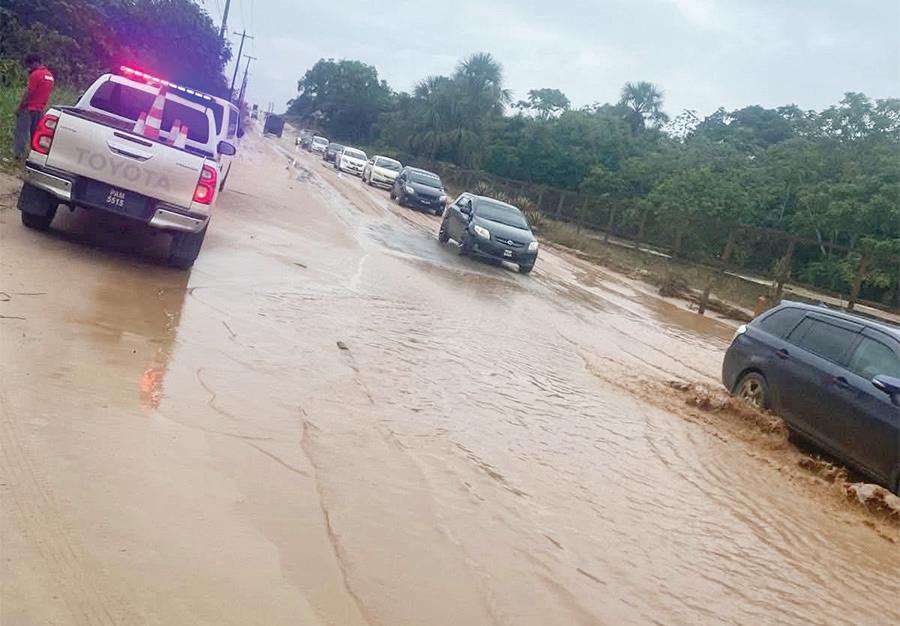
Owing to hazardous conditions along the Soesdyke-Linden Highway and other major roadways, motorists are urged to proceed with extreme caution FROM PAGE 4
The Guyana Power and Light Inc. (GPL) has urged residents to avoid flooded areas near electrical installations and to treat fallen power lines as live at all times.
Residents are advised to turn off main breakers if flooding threatens their homes, once it is safe, and to avoid contact with electrical outlets, appliances and wiring in wet conditions.
porting of hazards, including fallen poles, low-hanging lines, flooded substations and damaged transformers.
Both entities stressed that timely reporting is critical to ensuring rapid response and preventing loss of life.
MOTORISTS URGED TO SLOW DOWN
The Guyana Police Force has also issued a traffic ad -
visory, warning motorists of hazardous conditions along the Soesdyke-Linden Highway and other major roadways.
Authorities said wet road surfaces are reducing traction and visibility, increasing stopping distances and elevating the risk of accidents.
Drivers are being urged to slow down, increase following distance and practise defensive
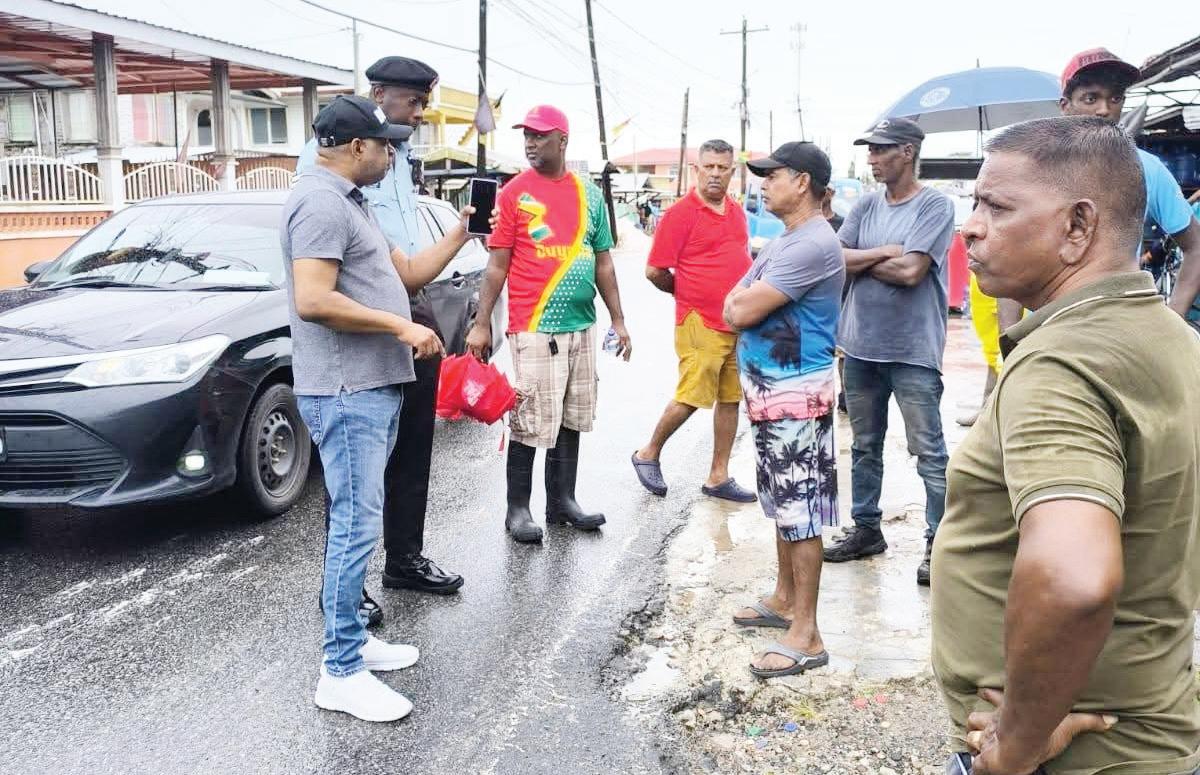
Minister of Public Utilities and Aviation Deodat Indar, joins regional officials in Region Three to monitor drainage systems and flood conditions
driving.
Officials warned that failure to do so could result in serious incidents, noting recent accidents under similar conditions.
With rainfall expected to persist into the new week, authorities say a round-the-clock response remains in effect, with continuous monitoring of drainage infrastructure and emergency systems.
The immediate priority, officials say, is to maintain drainage capacity, address operational gaps and protect


THE current wave of heavy rainfall sweeping across Guyana has triggered a full-scale national response, with ministers, engineers and technical teams deployed across regions to manage rising water levels and protect communities. It is, by all accounts, a coordinated and visible effort, one that underscores the state’s readiness to respond in times of pressure.
But even as pumps are activated, sluices monitored and infrastructure tested, a more uncomfortable truth continues to surface... flooding in Guyana is not driven by rainfall
alone. It is being worsened, in many cases significantly, by human behaviour.
The images are familiar. Blocked drains clogged with plastic waste. Canals choked with debris. Trenches left uncleared. These are not failures of engineering. They are failures of responsibility.
Drainage systems, no matter how modern or well maintained, are designed to function within certain limits. When those systems are obstructed, deliberately or through neglect, the consequences are immediate. Water backs up. Streets flood. Homes are affected and the burden on pumps and infrastructure multiplies.
In recent days, officials have pointed directly to these issues. The indiscriminate dumping of garbage into drains and the failure to maintain basic waterways in front of homes have been identified as key contributors to the flooding being experienced in several communities. This is not new. It is a long-standing challenge that continues to undermine national efforts.
The government is investing heavily in drainage upgrades, pump capacity and infrastructural improvements. Ministers are on the ground, monitoring systems in real time
and deploying additional resources where needed. These interventions are necessary. They are also costly, complex and, in many cases, effective.
Yet, they cannot compensate for avoidable human actions.
Flood management is not solely a government function, it is a shared responsibility. Every household that clears its drains, every citizen who disposes of waste properly and every community that takes ownership of its surroundings contributes directly to reducing flood risk.
Conversely, every act of littering, every blocked trench and every ignored
drainage channel adds pressure to an already strained system.
There is also a broader cultural issue at play. For too long, public infrastructure has been treated as someone else’s responsibility. The expectation is that the state will fix, clean and maintain, regardless of how systems are used or misused. That approach is no longer sustainable, particularly in a country experiencing rapid development and increased environmental pressures.
The current situation should serve as a wake-up call. Rainfall will continue. Climate patterns are becoming more unpredict-
able. Infrastructure will be tested repeatedly. The question is whether behaviour will change.
Guyana’s ability to manage flooding will depend not only on pumps, sluices and engineering, but also on the everyday decisions of its citizens.
The solution is not complicated: keep drains clear; dispose of waste responsibly; respect the systems that are in place.
Because in the end, floodwaters do not distinguish between government responsibility and public negligence. The consequences are shared and so too must be the accountability.
Editor,
THE ongoing debate surrounding the Central Government’s takeover of 22 roads in the Georgetown Municipality provides an opportunity to reflect on the long-standing challenges of municipal governance, management, and efficient municipal service delivery at City Hall. For decades, the PNC-controlled City Hall has failed the people of Georgetown. Residents and businesses have had to endure poorly maintained streets, inadequate drainage systems, frequent flooding, and ineffective road planning. These shortcomings have hampered commerce, reduced mobility, and diminished the quality of life
for citizens. Even as far back as 1964, when LFS Burnham’s party came to power, similar failures were evident, demonstrating a persistent pattern of inefficiency. Today, Georgetown’s infrastructure reflects these challenges, with many areas resembling a “shanty city” where basic services remain inconsistent.
While the Municipal and District Councils Act empowers City Hall to manage internal roads, the Roads Act provides a broader legal framework, allowing the Minister of Public Works to designate certain roads for central oversight. This recognises the fact that while local authorities manage community needs, over time, some roads are of such strategic and economic importance and require na-
tional-level intervention and management.
The 22 roads identified, including Regent Street, Robb Street and Lamaha Street, fall into this category. They are not merely local streets but critical arteries for commerce, transportation, and urban development, linking residential areas, business districts and national infrastructure.
Past interventions under the Central Government, such as the Fiscal Transfers and Miscellaneous Roads Program, have given the city a facelift, upgrading the city infrastructure, improved drainage and enhanced daily life.
The current initiative builds on this principle. Central oversight allows for better coordination of road maintenance, traffic
management, and urban planning. Roads like Regent, Robb, and Lamaha Streets are vital for commuting, business logistics and emergency services. Leaving them solely under the City Hall, with a history of underperformance, risks continued decline.
Critics argue that Central Government intervention undermines local authority. However, the reality is that City Hall has consistently struggled to deliver effective municipal services for the citizens of Georgetown despite collecting rates and taxes and receiving revenue from other sources. Chronic inefficiencies in road maintenance and drainage are well documented.
For Georgetown to develop sustainably, key responsibilities are required
to be elevated to the national level. This should not be seen as political interference but as a practical response to ongoing challenges.
History reinforces this point. Since 1964, issues with municipal management and governance have persisted at City Hall, highlighting the need for intervention when local systems fail. Effective road management reduces congestion, improves safety, supports commerce, and enhances the city’s overall appeal. Roads are the lifelines of any city, shaping economic activity and urban life.
Ultimately, City Hall should welcome this initiative. The takeover of these roads is not a threat but a necessary step towards sustainable development. By working collaboratively,
City Hall can focus on community-level responsibilities, while the Central Government ensures that critical infrastructure is properly maintained and integrated into national development plans.
In conclusion, Georgetown’s urban challenges are long-standing and well documented. The Central Government’s decision to assume responsibility for key roads is justified and necessary to ensure proper maintenance, improved infrastructure, and the city’s overall economic and social well-being.
Sincerely, Mahindra Ishri Former Principal, Municipal Services Officer Ministry of Local Government and Regional Development
By Ambassador Sasenarine Singh, MSc – Finance, ACCA (CA)
THE protracted conflict in West Asia has transcended its geopolitical origins to become a defining force in global commodity markets. With crude oil prices surging past US$110 per barrel in mid-March 2026, the economic reverberations are being felt far beyond the immediate theatre of the conflict. For Guyana, a nation with a burgeoning agricultural sector and a strategic vision to be a leading contributor to the Caribbean’s food security, this untimely external situation presents a “bump in our road”: the significant escalation in the local cost of agricultural inputs.
The foundation of this challenge lies in trade dependencies. According to the UN COMTRADE database, Guyana imported approximately 34,000 metric tonnes of assorted fertilisers in 2025, at a cost of US$51.2 million. Urea constituted the primary component of this import basket. The vulnerability inherent in this reliance
is already being tested by volatile international markets.
In response to past challenges, the Government of Guyana has demonstrated a proactive fiscal strategy. As an example, the 2025 National Budget, as presented by the Hon. Minister Dr. Ashni Kumar Singh, allocated $2 billion in fertiliser subsidies to farmers. This intervention was designed to provide farmers with at least one bag of fertiliser per acre, a direct mechanism to mitigate input costs. As the Minister noted, that programme represents a continuum of support for the farmers and is slated to be carried forward into 2026. Such measures underscore a deliberate approach towards insulating the farmers to an extent.
However, the situation in 2026 is proving to be even more problematic than 2025. At the close of 2025, the average cost of urea stood at US$567 per metric tonne. By mid-March 2026, this figure had escalated to approximately US$700 per metric tonne and is set to increase even further, as a result of the global situation.
The instability in the

Strait of Hormuz, a critical chokepoint for ammonia and fertiliser feedstocks, has tightened international fertiliser markets. The corridor handles roughly one-third of global seaborne nitrogen potassium blends and also supplies 15% of the world’s natural gas. (see table of regional natural gas production).
Natural gas is the primary feedstock for nitrogen-based fertilisers, creating a direct link between natural gas and urea prices. On March 8, 2026, Qatar—the world’s largest liquefied natural gas
(LNG) producer—declared “force majeure” and halted tanker loadings, a move soon followed by the UAE and Oman.
With the Strait of Hormuz effectively blocked, Middle Eastern natural gas supplies have nearly ceased. Countries such as India, which sourced over 20% of its gas from Qatar, now face supply chain challenges, and intensified competition for alternative sources is driving prices upward. The chart below illustrates what has happened in the market since the West Asia conflict started (source Reuters).
In contrast, the Western Hemisphere (particularly the United States, Brazil, Canada, and Trinidad & Tobago), produces substantial natural gas and provide this part of the world with greater supply resilience. Guyana sourced all its fertiliser imports from this region in 2025 and is projected to do so in 2026, insulating it from supply constraints. However, Guyana remains exposed to global pricing pressures, which inevitably translate into higher input costs for local farmers in Guyana.
To address this vulnerability, the Government of Guyana, led by President Irfaan Ali, is advancing a long-term strategy centred on developing a domestic fertiliser production facility at the Wales Industrial Site. With an anticipated capacity of 300,000 metric tonnes, the plant is expected to transform Guyana from a net importer into a net exporter upon completion. Strategically positioned to serve a captive market in northern Brazil (via containerised shipments along the newly paved Lethem Road) the initiative also opens opportunities in other export markets.
To complement its longterm strategy, the government has implemented pragmatic short- to medium-term interventions. These include bulk purchasing agreements for urea to improve pricing predictability, a $2 billion subsidised fertiliser programme that has directly supported all farmers especially the small farmers (those cultivating fewer than 50 acres), and a cash subsidy of $300 per bag of paddy for rice farmers that was paid out in January 2026.
These multi-layered in-
terventions (spanning strategic industrial development to direct fiscal support), reflect a coherent policy framework addressing short-term, medium-term, and long-term objectives. Amid the global disruptions from the West Asian conflict, Guyana is leveraging its resource wealth and strategic geography to ring-fence the non oil economy quite commendably. This approach aligns with many successful development models, like that implemented in Singapore, and prioritises a competitive, profitable, and private sector driven non oil economy as the foundation for long term resilience. The oil-economy is just a facilitator for this transition to occur.
History will prove that these measures go beyond defensive posture since they have already proven to have strategically reposition Guyana’s agriculture to serve the Caribbean and northern Brazil, both amid today’s crisis and for the stable future beyond. History will mark this as the moment Guyana turned vulnerability and disadvantages into lasting advantages.
Dear Editor,
IT grieves me to have to address the increasing use of pavements and walkways as parking lots for vehicles in this country. It grieves me because this is not the occasional breach of the law by a few errant drivers, but translates to utter disregard for pedestrians who use these walkways to safely and comfortably get to where they’re going —schoolchildren, the elderly, pregnant women, and the disabled being among the most adversely affected by this growing epidemic.
For decades, pedes -
trians have been left to fend for themselves on roadways that have poorly painted pedestrian crossings, a lack of sidewalks and poorly constructed and dilapidated walkways. It’s already dangerous and difficult to be a pedestrian. We don’t need to add more to the list of burdens being faced. If we’re aiming towards being a truly developed and progressive society, energy and resources need to be invested into fixing the things that matter, and being able to traverse by foot is one of them.
I request that the authorities responsible for
overlooking this breach of law take this matter seriously, since the health and lives of all those who walk are at stake.
Let’s get our streets safe for those who use them most.
Yours truly,
Darrell A. Carpenay

Dear Editor, REFERENCE is made to a recent letter from Mr. Jonathon Subrian condemning “persistent ad hominem attacks” against a “particular Magistrate within the Georgetown Magistracy”. He stresses that Magistrates and other judicial officials must never succumb to the “approval” of “social media mobs”.
While Subrian’s vague letter never directly names the Magistrate nor addresses the specific criticisms levelled, it is easy to in-
fer that he is defending Magistrate Judy Latchman following criticism over her repeated adjournments in the Mohamed extradition matter.
Subrian, ANUG’s Chair, is known for his public embrace and association with Mohamed following a pre-election merger pact signed with the WIN party. Since then, he has penned several pieces in favour of Mohamed, and has accompanied him to several court appearances. I will not begrudge his freedom of association, but it is important to
address the contradictions in his position.
What Subrian describes as “personalised vendettas” from Government-aligned individuals aimed at assaulting “the integrity of the court” rings hollow in light of Mohamed’s own attacks against multiple tiers of Guyana’s judiciary - all the way to his CCJ appeal. Here are just a few documented examples:
Following his absence from the Magistrate’s Court, Magistrate Latchman revoked Azruddin Mohamed’s bail and ordered his ar-

rest. The younger Mohamed later appeared in court with a grin and handcuffs, declaring: “This is political persecution by the PPP Government.” This is the very Magistrate whom Subrian seeks to defend from supposed Government actors.
On March 24, following the CCJ interim stay, a WIN press statement voiced “deep concern” that the Mohameds were “forced to leave our shores and cross the seas in pursuit of justice that ought to have been fully accessible and protected within our own legal system.” This is a clear attack on the integrity of the Magistrate’s
Court, High Court and even the Appeal Court. This very press statement labelled the decisions by all three spheres of Guyana’s judiciary, Chancellor (ag) Roxanne George, as “troubling.”
On March 25, a post on Mohamed’s “Team Mohamed” page wrote: “Imagine swimming the seas to the CCJ under dengue to get justice, you couldn't even get in your own country as Guyanese citizens.”
Were Subrian to dispose of the politically slanted lens with which he views public affairs, he would see these statements for what they truly are:
Coordinated attacks against Guyana’s Judicial Officers.
Finally, Subrian waxes lyrical on criticism against Latchman as “contempt of the court.” Some clarification is needed here. Is he speaking as a commentator? Or is he speaking as a member of WIN’s legal team? His signature bears the title “Esquire”, yet there is no record of him practising law in any jurisdiction. His GECOM voter registration lists him as a photographer.
Yours faithfully, Nikhil Sankar


I HAVE re-read three times the large letter on me that Nigel Westmaas penned on the day before (March 14), Stabroek News closed on March 15. That outlay of Westmaas is complex and probing and it looks like the anticipated 8 pieces of reaction may be longer. I suggest readers digest Westmaas’ letter because the contents go wider than his attacks on me.
For example, his theory of widening class disparities needs to be confronted because it has implications for understanding how both the state and society should react to increasing wealth. Discussion on widening class contradictions is for another part in this series.
For now, I want to reply to this part of Westmaas offering when he wrote: “Kissoon’s spate of repeated attacks directed against a small number of individuals is strategic. They provide diversions from more pressing issues within Guyanese society.” Sadly, Westmaas will not develop this perspective and tell us who this small group is, what they want, which class they belong to and what their pronouncements are to which Kissoon has replied.
I will now offer what Westmass will refuse to do. This small group of people
(TSG), I refer to as The Usual Suspects (TUS), belongs to the Mulatto/Creole class (MCC). I will now provide evidence of how deleterious their politics are to the preservation of electoral democracy in Guyana and democracy in general.
TSG (to which Westmaas belongs) took a graphic anti-democratic stance during the 2020 election disaster. TSG did not want the return of the PPP. Since then, their instincts and strengths have been directed against the Ali presidency. The action of TSG is based on race and class. My tsunamic reaction against TSG is based on their Freudian, eugenic soul that frowns on Hindu and Muslim Indians and darkskinned Indians running a Caribbean country when that task should have been inherited by the MCC.
I will now lay before the eyes of this nation, the intention, agenda and politics of what Westmaas refers to as TSG that Westmaas believes I am attacking (his word). I am not attacking anyone. I am exposing a social class in Guyana that have cultural, anthropological and ideological objection to the PPP government and wants to weaken that government. And in the process of exposing, I believe I am educating this
young nation. I doubt with the death of Stabroek News, TSG will stop. They will not.
Forty-two of these persons, including Westmaas, sent a letter to President Ali demanding that Guyana stop oil production and advised the President in the letter that greenhouse emissions kill African people. No other race was mentioned. The names included TUS, plus the co-owner of Stabroek News, Isabelle DeCaires.
TUS has bought 13 High Court cases against the oil and gas industry. They have lost all but one, which is being appealed. This group is not stupid. If you are going to weaken the government, then target the economy. They know that with an oil economy, the country has a platform that could propel Guyana into the future and future elections will favour the PPP. They did not get Guyana to stop oil production, so they resorted to court action against EXXON. Those 13 cases involved high profile lawyers, some of whom are from outside of Guyana. I once did a rough estimate of how much those court cases cost TUS. I came up with 90 million Guyana dollars.
Here now is an interesting situation that occurred on Friday. One of

the litigants in those 13 cases is a lady named Danuta Radzik-Veira, from the land-owning Veira clan. This Radzik-Veira activist complained that she cannot get foreign exchange. She noted in the Kaieteur News last Friday that: “This situation is very similar to years ago when, under the PNC Burnham Administration, Guyanese had little access to foreign exchange. In a twist of fate, Guyanese find themselves back to a situation which older folk felt they would not return to.”
This is the same lady, along with another litigant, Sinikka Henry, who asked the High Court to annul
the Environment Permit for EXXON to operate in Guyana. Without oil, where will Guyana get foreign exchange from so that Ms. Radzik-Veira can apply for some?
Briefly, here are some parts of TUS whose activities Westmaas should address. Guyana Human Rights Association - It stayed silent during the election rigging. It instigated trouble during the Cotton Tree double murder in September 2020. It is insanely hostile to the government. Together with Red Thread and Transparency Institute –Guyana Chapter, they
complained to GECOM that through the voting of Bangladeshis and Indian nationals in the 2025 election, the election was compromised. These are dangerous people that Guyana needs to know about. I am not finished with Westmaas, TSG, TUS and MCC. It is my work.
DISCLAIMER: The views and opinions expressed in this column are solely those of the author and do not necessarily reflect the official policy or position of the Guyana National Newspapers Limited.

THE release of the Environmental Impact Assessment for the Longtail development adds an important layer to Guyana’s energy story.
At a time when many countries feel they must choose between economic growth and protecting the environment, Guyana is quietly showing that the two do not always have to clash.
Even as oil production continues to grow through several offshore developments, Guyana is expected to remain a
net carbon sink through 2030. In simple terms, the country will still absorb more carbon dioxide than it produces. This gives Guyana a major advantage, rooted in one of its greatest natural assets, its forests.
Our forests, which

cover 80 per cent of the country, remove an estimated 154 million tonnes of carbon dioxide equivalent each year. By comparison, our total national emissions, including those from the oil and gas sector up to the Longtail project, are expected to peak at about 26.4 million tonnes per year. That is only a small share of the country’s carbon absorption capacity. Even at full production, emissions will amount to roughly 17 per cent of what the forests can remove each year.
This puts Guyana in a rare position globally. For most oil-producing countries, increased production leads directly to rising emissions that are greater than what they can offset at home. In Guyana’s case, the situation is different. The country is expanding as a major oil exporter while still keeping a natural environmental buffer that is far larger than its emissions. This challenges the usual belief that oil development must always come at the cost of environmental protection.
That balance is backed by decades of consistently low deforestation rates, which have helped Guyana preserve its forest cover while many countries in the region have seen major losses. This long record of environmental care now supports the Low Carbon Development Strategy, where forests are not only protected but also used as part of
a wider climate solution.
Countries like Norway have paid millions of dollars specifically because we have kept our forests standing.
At the same time, the oil and gas sector is also changing to better match these environmental goals. The Longtail development, ExxonMobil’s eighth offshore project in the Stabroek Block, is expected to use modern design improvements and operating safeguards. This includes SBM Offshore’s Fast4Ward system, a standardised, pre-engineered approach to Floating Production, Storage and Offloading vessels that improves efficiency, shortens construction time and reduces environmental impact through proven, repeatable designs.
Technological improvements like these are important. They help ensure that as production rises, it does so within a system that puts safety, efficiency and environmental responsibility first. From emissions monitoring to operational controls, the industry is applying lessons from earlier projects to keep improving performance. The result is a model in which growth is matched by greater precision and accountability.
Public scrutiny remains a key part of that process. The Environmental Protection Agency has opened the Longtail assessment for review, giving citizens and stakeholders the chance to study the findings
and raise concerns. This transparency is important to ensure that development moves ahead with public trust and accountability.
What comes out of the Longtail EIA is a clearer picture of Guyana’s unique place in the global energy landscape. We are not only producing oil but doing so while protecting one of the world’s most important environmental assets. It also reminds us that the conversation about energy and climate must be more balanced and thoughtful. Not all producers operate under the same conditions, and not all paths to development look the same.
Guyana’s challenge now is to keep this balance. The upcoming Gas-to-Energy project, for example, reflects this kind of strategic investment by using associated gas that would otherwise be reinjected to produce cleaner electricity for the national grid.
If it succeeds, Guyana will offer a strong example of how resource development and environmental responsibility can work together as two connected pillars of national progress. The world is watching, and so far, the data suggests we are getting it right.
DISCLAIMER: The views and opinions expressed in this column are solely those of the author and do not necessarily reflect the official policy or position of the Guyana National Newspapers Limited.
DURING an address to senior prison officers earlier this month, President Dr Irfaan Ali voiced his concern for what he termed a “pandemic of gangs” here and throughout the Caribbean. He called for interventions in schools, homes and communities in a concerted effort to identify vulnerable youth.
However, this requires an understanding of gangs and why young people would choose to join them. While experts have varying opinions on what constitutes a gang, it is loosely described as a group of people who share a common identity and who generally engage in criminal or antisocial activities.
According to the Encyclopedia Britannica, “Gang behaviour may be more universal and current than is commonly thought. Semi-formalised groups of young adults have existed throughout recorded history”.
So school gangs are not new and, as with street and criminal gangs, their membership crosses socio-economic, ethnic, gender and cultural barriers. Young people join for several basic reasons.
They find safety in numbers, need to be accepted, want to feel part of a family or are searching for a sense of identity. Some seek status among their peers, while others bow to peer pressure or join because other family members are a part of
the gang.
The growth of school gangs is not confined to this region and is a cause for concern in countries across the globe. The National School Safety and Security Services in the US says, "We continue to see an upswing in school and community-based gang activity in our work on school safety across the country".
In the UK, the Metropolitan Police of London last month began an operation to shut down gang-style inter-school violence and authorities are also looking into the 'grooming scandal', involving the grooming of young girls for sexual activities.
In an article by education scholar Adrian H. Huerta, who has studied gangs, he observes that many joined because of “fractured relationships in their homes, schools and communities”.
He points out that youth at the secondary level (in the US middle to early high school) are exploring their identities and "gang membership is an identity”. He cautions against aggressive disciplinary measures, such as suspending or expelling gang-involved youth, saying that this may only add to the student's"educational frustration". But he acknowledges that instances where students have drugs or weapons or are violent towards teachers or fellow students require firm disciplinary
action.
The case of the 14-year-old boy, who was attacked recently by what appears to be a gang of six youths, would certainly fall into the category of requiring firm disciplinary action and perhaps criminal charges.
The teen, from Kitty, was on his way home from school when he was kicked and punched by the gang members (who may or may not be fellow students) and had to be treated in the hospital for his injuries.
The World Health Organisation (WHO) states that 40 per cent of the number of homicides globally each year occur among youth 1529 years of age. Homicide is also among the leading causes of death in this group and the majority involve male victims.
The World Health Organization (WHO) also observes, “When it is not fatal, youth violence has a serious, often lifelong impact on a person's psychological and social functioning”, adding that,” ...for every young person killed by violence more sustain injuries that require hospital treatment".
Risk factors identified include conduct or other behavioural disorders, early involvement with drugs, alcohol and tobacco, exposure to violence in the family and low academic achievement.
Within the family, factors include poor monitoring and supervision of children by

parents, a low level of attachment between parents and children, parental depression, substance abuse or criminality. For intervention to be effective, it must take into account these issues, which also include, at the community level, access to, and misuse of, alcohol and illicit drugs.
In addition, the WHO cites, “the quality of a country’s governance (its laws and the extent to which they are enforced) as well as policies for education and social protection. The problem is multifaceted and requires intervention and action by all stakeholders if

we are to successfully stem the tide of gangs and gang-related activity in our schools”.
After interviewing dozens of gang members, researcher Huerta advises educators to “... try to mentor and show consistent investment in them, that they are not alone, that whatever social context is impacting their home life will pass with time and to not give up on the educational system”. He also recommends
the establishment of peer mentoring groups, “...to create a community and a structural support system for kids who need a safe space to form bonds”.
DISCLAIMER:
The views and opinions expressed in this column are solely those of the author and do not necessarily reflect the official policy or position of the Guyana National Newspapers Limited.

THE main opposition party, the We Invest in Nationhood Party (WIN) is a radical, leftist and a cunning cult.
WIN, after all, is not just a political rival to the governing PPP, PNC, APNU, AFC, and other opposition parties but should be viewed as a dangerous and manipulative organisation in and out of the National Assembly.
It would seem to appear as a ‘Facebook militant group’ who wins over opposition supporters by enticing them with money, material tourniquets, and promises of ‘a better or greener’ life.
The whole superstructure of WIN is dedicated to fooling Guyanese that it is ‘truly’ concerned about helping the poor and unfortunate in society
while fighting for rights and uniting the races, resulting in the unseating of the PPP from office. It has no order, structure or discipline. It has no formula and is only concerned about highlighting anything that could paint the PPP in a bad light and show up the Mohameds. I have no respect for WIN nor the Mohameds. They have not earned my respect either through their actions, political work, or strategy. I think they are only commanding the main opposition slot because the people of Guyana rejected the politics of Aubrey Norton and sought to punish the PNC. I have no difficulty in putting forward the prediction that the PNC will take back its place in Guyanese politics come 2030 and WIN will be
banished to the backbench of Guyanese politics. One thing is certain: the PNC has history on its side, and no Facebook party will ever beat it for long.
I will always be suspicious of them, especially Hana and Azruddin Mohamed. I hold no brief for Nazar, but I do not envy him. He must walk the path he chooses, whatever that might be.
WIN’s leader, Azruddin Mohamed, is a fugitive offender who is accused of wire and mail fraud, gold smuggling, money laundering, tax evasion and other serious crimes. He thinks that by clinging to political persecution, victimisation, and politics will save his skin from facing the serious charges in Trump’s US. He can spend every

penny of Mohamed’s ill-gotten wealth and keep paying the lawyers to hold up or delay the inevitable. One thing is for sure and two things are for certain: he will face the long arm of US Justice because the show is not over until the fat lady sings. And the fat lady is humming, at the moment.
That aside, the PPP faces a myriad of victories and complex battles at home and abroad.
At home, apart from manoeuvring the cult-like Mohameds, the PPP must work harder to silence the people’s fear about the costs of living and standards of living. It must do more to respond in a policy-driven approach to their cries. The government is doing an excellent job with housing, healthcare, security,

foreign trade, socioeconomic matters and local government, so it must do an assessment of what is happening in the other areas that people complain constantly about in their daily lives.
The PPP/C has risen to the public expectation of modernising the economy in every aspect of life, but they must know that once they meet the public’s expectation, the public wants them to do more.
So, I will be keeping an eagle eye on the government and the party. The other promises, which are outlined in the party’s manifesto, slated for implementation this year, must be delivered.
Regionally, the PPP/C government must continue to play its role in CARICOM and regional integration. The party must make a decision on what that role will be like in the years ahead, given the poor pass rate on the CSME and other regional issues over the past 40 years. Then, it has to continue its fundamental principle on the questions of Haiti, Cuba and Venezuela, and their people.
The party and government must see them as allies and not friends. They must maintain their policy of not choosing a side only if it is in the interest of Guyana.
Internationally, the wars in the US, the Middle East and Europe must concern the PPP. PPP/C administration is doing the best job of only taking the side of peace, diplomacy and discussion.
These are the germane issues that party leaders Bharrat Jagdeo and Irfaan Ali, who is at the helm of politics, will address when thousands gather at Babu Jaan to pay homage to their founding leader of the PPP and former president of Guyana, the
late Dr Cheddi Jagan. The event was scheduled to be today but was postponed due to the inclement weather.
The celebration is set to mark his 103rd birth anniversary and 27th death anniversary with a plethora of wreaths, songs and tributes to his legacy of restoring democracy, economic rebuilding, social development and democratic consolidation in Guyana, the headliners are expected to deliver a firebrand of political language that will speak to each issue here and more.
I am expecting these two giants to school the opposition, which they, in my opinion, have been too soft on in the last six months. The big question is, will they whip the WIN party, PNC and what left of defiant civil society? Will they reset the political narrative or shift the political story back to development and away from the Facebook party and its leader? Will they talk things like they see it – frankly, or will they cower instead?
Jagan once said, “We must all remember the lessons of the past as a guide for the management of the present and the planning for the future.” Will Jagdeo and President Ali deliver a performance to remember?
Cheddi Jagan would have done just that and given the opposition something to cry weeks about and much more than ‘extradition’ headache, fever and a concussion.
DISCLAIMER: The views and opinions expressed in this column are solely those of the author and do not necessarily ref lect the official policy or position of the Guyana National Newspapers Limited.
THE Middle East feels far away from our tropical shores, yet in economic terms, it is closer than we imagine. The war between Israel and the United States and Iran is not yet a major topic of public conversation among Guyanese, but it should be, especially because even basic facts about it are hard to trust.
CNN and the American media in general often seem reluctant to criticise Washington once a decision is made to go to war. It is exceptionally hard for me to watch the network’s war coverage. When CNN’s reporters in Tel Aviv are routinely censored from reporting on the damage inflicted on Israel by Iranian missiles, you have to wonder how lesser-resourced media outlets are faring.
Al-Jazeera English (AJE) is doing no better. The international network appears to be struggling to balance its coverage. Qatar, the country that funds it, has come under severe attack from the Iranians’ missiles. From AJE’s own reporting, about 17 per cent of Qatar LNG production has been eliminated, and officials say it will take five years to return to full capacity. Qatar produces 20 per cent of the world’s supply of LNG.
The first casualty of war is truth, we are told, but innocent people are never far behind. And as the death count climbs and the destruction of property and assets is measured in the billions, the real economic impact of this war is already shred -
ding lives hundreds of miles away from its epicentre.
I recently saw several television reports of thousands of poor Indian workers, far from the frontlines, who were forced to return to their home states without pay because their gas-dependent companies have been shuttered or have had to scale back.
In Gujarat, reports say that close to 700 ceramic units have been closed, and another 430 factories have suspended operations due to LNG disruptions.
If disruptions in Gulf routes persist, market experts suggest that energy-intensive manufacturing, aviation, hospitality, electronics, agriculture, and jewellery exports will be adversely affected. And then there is the add-on effect of approximately 10 million Indian expatriates who could soon be out of work in Gulf countries; the remittances they would normally send to support their families in India will eventually evaporate, leaving countless families scrambling for tomorrow’s meal.
One could argue that India’s proximity to the Gulf makes this impact inevitable. Yet even countries much farther east are being hit hard. Thailand, the Philippines, Vietnam and Indonesia are among the most exposed. Some 2.5 million Filipino workers in the Middle East send an estimated $8-11 billion USD in remittances back home, and as it is with Indian expats, that too is likely to dry up, putting thousands of vulnerable families in dire straits.
Thailand depends
on foreign visitors for a fair chunk of its revenue. With hundreds of long-haul flights cancelled or rerouted, the country’s tourism sector is likely to come to a complete standstill the longer the war goes on. With only about 20 days of emergency oil reserves in Indonesia and Vietnam, domestic fuel markets are being shredded. If you want to get a sense of what that means, just look at the “made in” tag on your clothing or the canned products you purchase at Massy.
Malaysia, some 3,500 miles from the Strait of Hormuz, is an oil producer that still relies on refined imports. Its fuel subsidy bill has reportedly jumped from 700 million to 3.2 billion ringgit in a single week as global prices spike. A real sense of panic is beginning to set in, and this war is only a month old.
My point is that the ripple effect of the war in the Middle East is expanding faster than anyone could have ever imagined, much less planned for. For a small, newly oil - rich country such as Guyana, our ‘sound fundamentals’ rest on global markets and shipping lanes that are suddenly less predictable.
We are now seeing that the same forces that are upending energy markets are also reshaping the business of warfare itself. The President of Ukraine, Volodmyr Zelensky, was recently in Qatar, perhaps to negotiate a deal to sell its Sting interceptor drones, which cost about USD$2,000 to make. They can fly 280 km per hour and

have downed more than 3,000 Iranian Shaheds used by the Russian army since mid-2025. By contrast, Western interceptor systems from firms such as Lockheed Martin cost in the millions and take months or years to deliver.
Ukraine can produce 10,000 Stings a month, according to Reuters. For operators with some drone-flying experience, it takes only four days to mas-
ter the Sting. To entice buyers, Ukraine is also apparently selling its battlefield data, unmatched anywhere else in the world. Ukraine’s data includes millions of annotated images gathered during tens of thousands of combat flights.
So, when you think about it, the real contest is no longer over having the single ‘best’ weapon, but over who can mass produce cheap,
precise machines and hurl them into war at frightening speed. That is the new arithmetic of war, and its costs are already washing up on our shores.
DISCLAIMER:
The views and opinions expressed in this column are solely those of the author and do not necessarily reflect the official policy or position of the Guyana National Newspapers Limited.

MINISTER of Local Government and Regional Development, Priya Manickchand, has urged residents to make a clear choice between the Georgetown Mayor and City Councillors (M&CC) and the central government, warning that continued division will stall development efforts in communities such as East Ruimveldt.
Speaking during a community outreach in East Ruimveldt on Thursday, Manickchand said that for years there has been a breakdown in responsibility between the two tiers of governance, resulting in poor service delivery to residents.
“For years, that hasn’t worked… there has been some delight in the City Council, pointing at the government and the government pointing at the City Council and everybody blaming everybody,” she told residents. “The bottom line is, you didn’t get your garbage picked up. You didn’t get your roads built, your drainage built, playground built. That’s the bottom line.”
Manickchand stressed that both the M&CC and the central government have defined roles, but argued that the for-

mer has not been fulfilling its responsibilities.
“In the city of Georgetown, you have the Mayor and City Council, what we all call M&CC, and they’re supposed to run the town. They’re supposed to fix your roads, they’re supposed to fix your drainage, they’re supposed to manage your schools, they’re supposed to pick up your garbage,” she explained.
She lamented that residents have suffered as a result of what she described as ongoing inefficiency and political blame-shifting between the two sides.
“You can’t ask me to

spend all this time in the office and we're just blaming each other,” she said. “I’m not prepared to do that. He’s [President Dr Irfaan Ali] is not prepared to do that.”
The minister revealed that she had personally reached out to Georgetown Mayor Alfred Mentore in a bid to encourage co-operation, explaining that she had first met with him privately to explore opportunities for collaboration.
“I came into office, I met with the mayor privately, no cameras and I said to him, ‘It’s up to me and you. We have an opportunity to break this bad habit if we want to get things
done,” she said.
According to Manickchand, the early discussions with the mayor gave her hope for a working relationship, but she later alleged that there were inconsistencies between private discussions and public statements.
“He said he’s not willing to play that game either. So, I’m telling you frankly, he is willing to work hard and make sure people get benefits,” she recalled. “But then I started seeing some very dishonest… we say one thing privately and then he goes out publicly and says the opposite.”
Manickchand said that
repeated instances of what she considered contradictory statements led her to question the mayor’s intentions.
“By the third time I realised, no, this man is out to make me an idiot and that will not serve you,” she told the gathering.
The minister warned that continued political rivalry could undermine development, stressing that the real cost of such divisions would be borne by residents.
“Let me tell you the risk we run… is that we divide people. “And in that division, nothing gets done, which means you’re wasting my time, you’re wasting your children’s opportunities.”
She further emphasised that the government’s goal was to serve citizens and deliver tangible results, contrasting this with what she described as the shortcomings of the City Council.
“What we want to do is make sure every single resident has good health care, access to solid education,” she said, pointing to ongoing and planned improvements in East Ruimveldt. “You saw what East Ruimveldt started out like in 2020 and what it looks like now in 2026.”

Manickchand said residents would soon be faced with a difficult but necessary decision.
“This afternoon, you are going to be in the uncomfortable place of choosing whether you want us [central government] to fix this thing or you want them [M&CC] to get another chance,” she stated.
She added that political parties exist to serve and must demonstrate their commitment through action.
“Any political party that’s serious exists to be in government… we know we will never rig an election. So, the only way we can go into government is to get your vote,” she said. “And the only way to get your vote is to show you that we are your servants.”
The minister concluded by reiterating that development must not be hindered by political division, calling for unity and co-operation to improve the lives of residents.
Long-standing concerns have been raised about the performance of the People's National Congress-controlled Georgetown Mayor and City Councillors, particularly in areas such as consistent garbage collection, maintenance of drainage networks and the timely rehabilitation of internal roads across Georgetown.
These gaps have contributed to persistent flooding, declining infrastructure and sanitation challenges in several communities.
In light of these issues, the central government has recently moved to take over responsibility for a number of city streets, a step intended to fast track critical repairs and upgrades and ensure that key works are executed without further delay.
The government has moved to restore Georgetown through targeted interventions, including the rehabilitation of major roadways, drainage upgrades, and broader efforts to modernise the city’s infrastructure and improve overall living conditions.
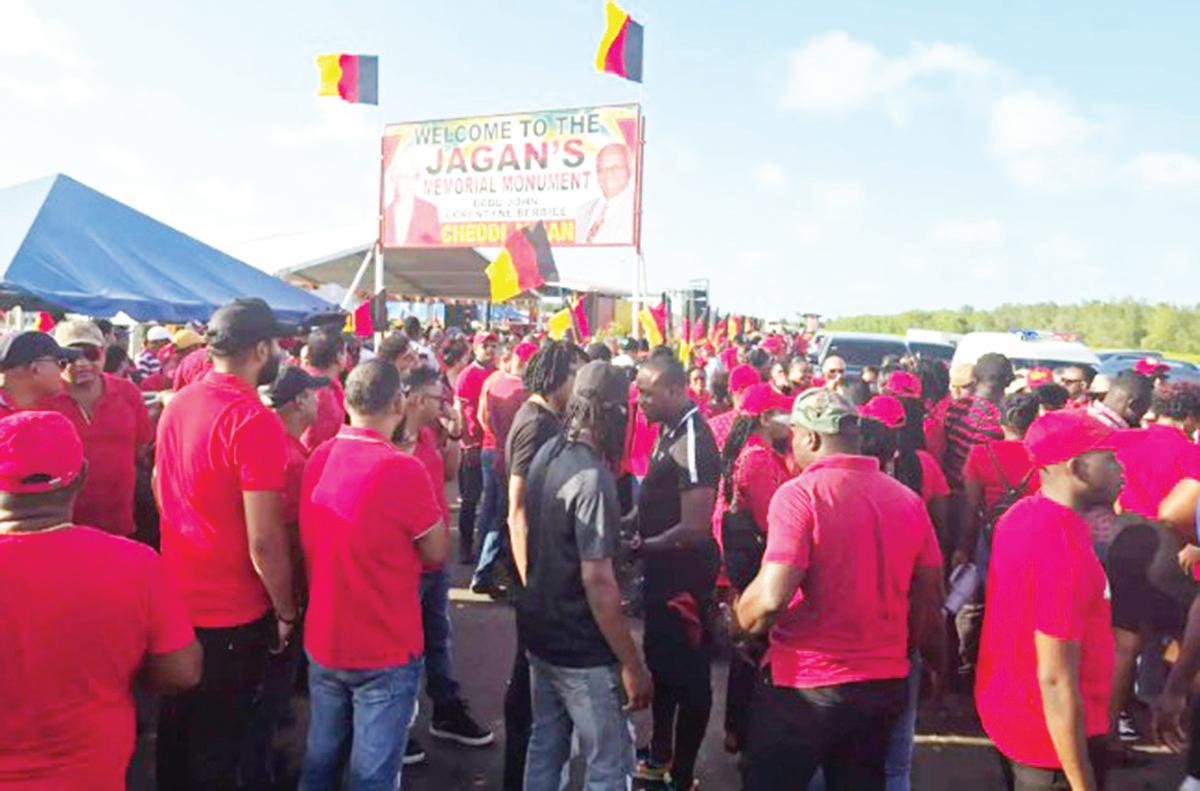
THE People’s Progressive Party (PPP) has postponed its annual observance celebrating the life and legacy of Cheddi Jagan at Babu Jaan, citing ongoing adverse weather conditions and heightened safety concerns.
In a press release issued on Saturday, the party said the event, which was scheduled for Sunday, March 29, 2026, in Corentyne, Berbice, will no longer proceed as planned.
“The People’s Progressive Party (PPP) wishes to inform the general public that its annual event celebrating the work, life, and legacy of its founder, Dr Cheddi Jagan… has been postponed due to ongoing inclement weather conditions,” the statement read.
The party emphasised that the decision was taken with public safety as the primary consideration, noting, “This decision has been taken in the interest of public safety.”
A new date for the observance is expected to be announced at a later time.
The postponement comes against the backdrop of a ‘severe weather’ advisory issued by the Hydrometeorological Service of Guyana, warning of increased risks of flooding across the country.
According to the advisory, persistent rainfall has already saturated soils, raising the likelihood of flooding in low-lying and poorly drained areas. The agency also warned that hilly regions could face potential mudslides, while thunderstorms may bring strong winds and lightning.
Heavy rainfall is forecast to continue from Saturday, March 28, through Monday, March 30, 2026, prompting authorities to urge residents to take precautionary measures to protect life and property.
The PPP, in its statement, expressed regret for any inconvenience caused and thanked the public for its understanding as weather conditions continue to deteriorate.


A PRINCESS Street, Wortmanville, Georgetown resident, Brian Mathieson, 50, has been sentenced to five years’ imprisonment, less time already served, after pleading guilty to the lesser offence of manslaughter in the 2022 killing of 40-year-old Aubrey Baird.
The sentence was handed down by Acting Chief Justice Navindra Singh at the Demerara High Court after considering detailed submissions from both the prosecution and the defence, a probation report, and emotional victim-impact statements from the family of the deceased.
Mathieson had initially been indicted for the capital offence of murder but admitted to manslaughter in relation to the fatal
stabbing, bringing the matter to a close without a full trial.
The court heard that the incident occurred on the night of February 8, 2022, along Hardina Street in Wortmanville. According to agreed facts, Mathieson rode past Baird, a clothes vendor and others gathered outside a residence, shouting in their direction.
Although he initially left, he later returned to the area and continued hurling expletives. A confrontation followed when Baird approached and punched Mathieson in the face.
In response, Mathieson dismounted his bicycle and stabbed Baird twice in the chest with a knife he had in his possession. A struggle ensued, during which both men ended up in a nearby drain. Baird
then armed himself with a piece of wood and struck Mathieson.
A post-mortem examination revealed that Baird sustained two incised wounds to the chest, including one that penetrated the chest cavity and perforated the heart. The injury was described as inherently fatal and caused by a sharp instrument at least eight centimetres in length.
Defence attorney Latoya Roberts told the court that Mathieson has expressed genuine remorse for the incident that had led to Baird’s death. She said that Mathieson was approached and struck first by the now deceased man, suggesting that the circumstances could have supported a defence of self-defence.
However, Roberts noted that

her client chose not to pursue that route. Instead, he opted to plead guilty to the lesser offence of manslaughter, effectively throwing himself at the mercy of the court. She submitted that this decision demonstrated accountability and a willingness to accept responsibility for his actions.


The defence also reminded the court that rehabilitation is an important aspect of sentencing.
Roberts indicated that since 2022, Mathieson’s life has been on what she described as a “certain trajectory,” suggesting a positive change in his behaviour and outlook.
In view of these factors, she urged the court to temper justice with mercy when determining an appropriate sentence.
In outlining aggravating factors, State Counsel Christopher Belfield stressed that the offence was grave and serious, pointing to Mathieson’s decision to leave the scene and later return armed with a knife. The prosecutor argued that this demonstrated escalation rather than a spontaneous act. The court was told that his actions reflected a disregard for human life and set in motion a chain of events that resulted in Baird’s death.
Particular emphasis was placed on the use of a weapon.
Belfield argued that Mathieson’s readiness to resort to a knife significantly heightened the risk of serious harm, noting that such conduct reflected a willingness to inflict grave injury. The court was also asked to consider Mathieson’s actions after the stabbing. The prosecutor noted that he fled the scene without attempting to assist the injured man, despite the severity of the wounds.
He was later seen running along Durban Street before being apprehended by police. This failure to render aid, according to Belfield, demonstrated indifference to the victim’s suffering.
Further aggravating the matter, the court was urged to consider the wider impact of the killing. Victim-impact statements painted a devastating picture of the loss suffered by Baird’s family.
His wife, Devon Grandison, told the court that they had been together for over two decades and shared three children. She described her husband as the backbone of their family and said his death had caused their lives to collapse. She spoke of the emotional and financial hardship that followed, explaining that he had been the primary provider and a source of constant support and guidance.
Grandison said her husband was deeply family oriented and well known in the community for helping others. She expressed that she felt robbed of her husband and best friend, adding that the grief remains constant and overwhelming.
Baird’s sister, Candacie John, also addressed the court, describing him as a loving and supportive brother who played a vital role in her life and in the upbringing of her children. She said he treated her children as his own and was a source of stability and care for the wider family.
She told the court that his

death had left her traumatised and living in fear, noting that even four years later, the pain remains fresh. She explained that the loss had fundamentally changed her life and left a void that could not be filled.
A probation report presented to the court provided insight into Mathieson’s background and character. It outlined that he is an artist who had a relatively stable upbringing and demonstrated academic promise, having attended President’s College.
Over the years, he worked in various fields, including banking, construction, teaching, and the culinary sector. However, the report also revealed troubling accounts of his behaviour within his community. Several individuals described him as confrontational and alleged instances of verbal and physical aggression towards relatives and others. There were also claims of prior violent incidents involving family members.
Despite these reports, prison authorities indicated that since his incarceration in 2022, Mathieson has demonstrated good behaviour. He has complied with institutional rules, maintained a co-operative attitude, and utilised his artistic skills to assist with sign art and graphics within the prison.
In addressing the offence, Mathieson expressed remorse and stated that he never intended to cause Baird’s death. He conveyed sympathy for the victim’s family and acknowledged the hardship now faced by his children and partner. He told the court that, if confronted with a similar situation in the future, he would choose to walk away rather than engage in violence.
Prosecutor Belfield, however, urged the court to impose a sentence that would serve as a deterrent, citing the prevalence of violent crime and the need to send a strong message against the use of deadly weapons in disputes. Reference was made to legal authorities, emphasising the court’s duty to reflect society’s condemnation of such acts.
In determining the sentence, Justice Singh considered the nature and seriousness of the offence, the degree of escalation, the use of a weapon, the impact on the victim’s family, and Mathieson’s personal circumstances, including his conduct while in custody and his expressions of remorse
The judge noted that Baird was the aggressor in the matter. The sentence commenced at 18 years, but several deductions were applied, including credit for an early guilty plea.
This resulted in a final sentence of five years, from which time already spent on remand must be deducted. Justice Singh advised the convict to walk away if he encountered trouble again and wished him well moving forward. State Counsel Geneva Wills also served as one of the prosecutors.
By Shaniya Harding
THE Government of Guyana, through the Ministry of Housing and the Central Housing and Planning Authority (CH&PA), is pushing for the continued development of Guyana’s housing sector by tackling illegal settlements and addressing backlog, steps that will bolster the sector and create more jobs for Guyanese.
Chief Executive Officer of the CH&PA, Martin Pertab, has outlined an aggressive push to eliminate illegal settlements, construct 40,000 houses and clear a longstanding backlog of housing applications, as Guyana continues its rapid transformation.
Speaking at the launch of the International Building Expo, Pertab pointed to major gains over the past five years, including the allocation of more than 50,000 house lots and significant expansion in the construction and housing sectors.
However, he stressed that future success would depend heavily on working against illegitimate settlements and recentring focus on the backlog of applications.
Meanwhile, Minister within the Ministry of Housing, Vanessa Benn, stressed that the housing programme is central not only to infrastructure development but also to creating employment opportunities across the nation.
She highlighted that the construction boom is driving demand for architects, masons, surveyors, plumbers and other skilled workers. The Building Expo, she added, provides a platform for small businesses, entrepreneurs and investors to engage and grow.
At the launch, Pertab took the opportunity to share the success of the sector in recent years.
Highlighting the allocation of 50,000 house lots and the growth of the private sector by almost 100 per cent, he shared
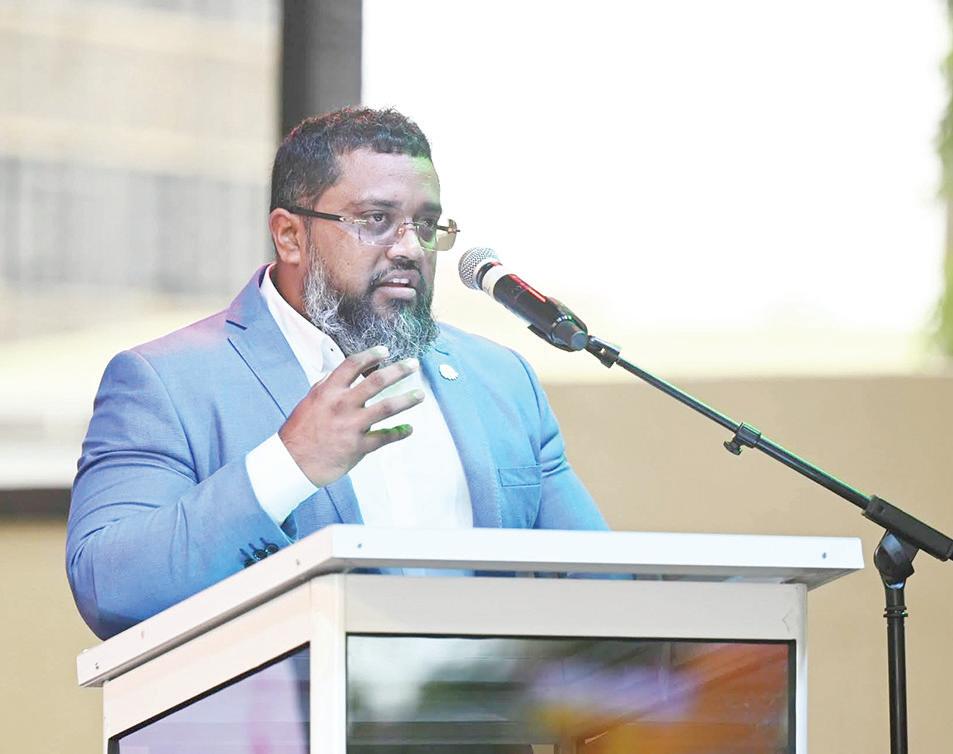
that this shift has had an impact across sectors. Moreover, he noted that the country has seen growth in real estate mortgage loans from $90 billion to almost $185 billion, while at the same time achieving growth in the construction sector by almost 210 per cent to $147 billion.
This rapid development, he explained, was spearheaded by policy, adding, “We have seen the implementation of bold, visionary, and prudent policies over the past five years. And if you look at where Guyana was five years ago to now, Guyana was just an upper middle-income country. And today, we are ranked one of the highest growing economies and a high-income economy.”
Moving forward, he added, the CH&PA aims to construct an additional 40,000 homes.
However, to ensure the continued success of the sector, steps will be taken to tackle unauthorised settlements and communities. Also, in steps to strengthen the sector, the CH&PA will be addressing the backlog of applications.
As Pertab shared, “The commitment is clear for us to eliminate all illegal settlements. The commitment is clear for us to address the backlog and the demand of that application. A commitment has been made for us to expand the housing programme.”
Collaboration is also
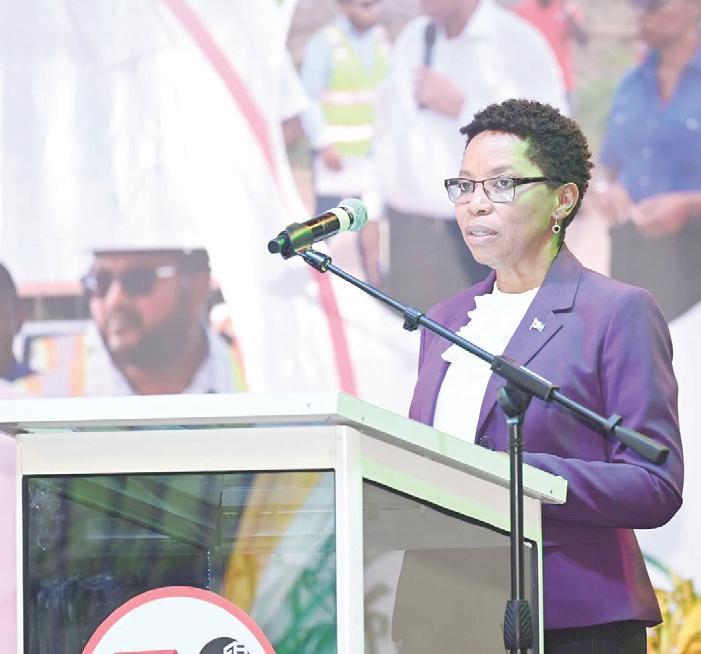
vital in this push, as Pertab explained that the CH&PA aims to partner with the private sector.
As he further shared, “But we realise we can't do this by ourselves. No agency or government can do this by ourselves. We need our partners. We need to rely especially on the private sector, the contractors, the suppliers, the financial institutions,” he added, “All these major stakeholders are important for us to achieve, that we are to achieve as an agency to deliver on our mandate.”
Also speaking at the event, Minister within the Ministry of Housing, Vanessa Benn, said this year’s expo, as in previous years, aims to showcase the transformative development of Guyana and the unwavering focus placed on the rapid growth of the housing sector.
While transformation of the sector is seen in the numbers, Minister Benn added that the shift has also been happening at the national level, as she shared, “Our ministries, programmes, and projects have widened over the years, which primarily service new housing schemes that we are building and really significantly reduce the travel times for people who are taking their children to school, to work, businesses, hospitals, whatever endeavour.”
Highlighting the ministry’s emphasis on urban development, Benn added, “The programme
and projects of our ministries are particularly also aligned with main national projects, one of
which is the Urban Development Programme for Guyana.”
A major pillar of the Ministry’s mandate, however, is sustainable development. As Minister Benn shared, industries like timber are playing a vital role in the sustainability of the sector, while giving hundreds of Guyanese in the forestry sector jobs.
Sharing the impact of this, she added, “At least 20% of our fellow Guyanese are directly employed by the forestry sector, and that timber that is produced from our managed forests, for
which we are internationally recognised, has earned almost one billion United States dollars for the sale of those forest carbon credits.”
Furthermore, she added that ventures like the Building Expo give the public the opportunity to connect with entrepreneurs, contractors and architects.
As the government and by extension, the ministry rolls out plans, Minister Benn emphasised that more sustainable opportunities will grow for the nation’s architects, surveyors, masons and plumbers.

THE Ministry of Education’s Distance Education Unit (DEU) is advancing efforts to deliver equitable, high-quality learning across Guyana through a series of targeted training initiatives, content development programmes and planned technical upgrades.
Central to this push is the recent training of 20 site managers, described as the “eyes and ears” of the system, who monitor and maintain relay stations in remote communities, ensuring consistent transmission of educational content.
These efforts are supported by plans to up -
grade transmission infrastructure and improve signal quality, alongside initiatives to gather feedback and data to guide decision-making.
Speaking to the Guyana Chronicle, Head of the unit, Phillip Williams, shared that by strengthening both the technical and content delivery as-

pects of the system, the Ministry aims to enhance the quality of education for every student, with a clear focus on improving examination performance and access to education.
Following a two-day workshop this week, the Ministry of Education’s Distance Education Unit
TURN TO PAGE 20
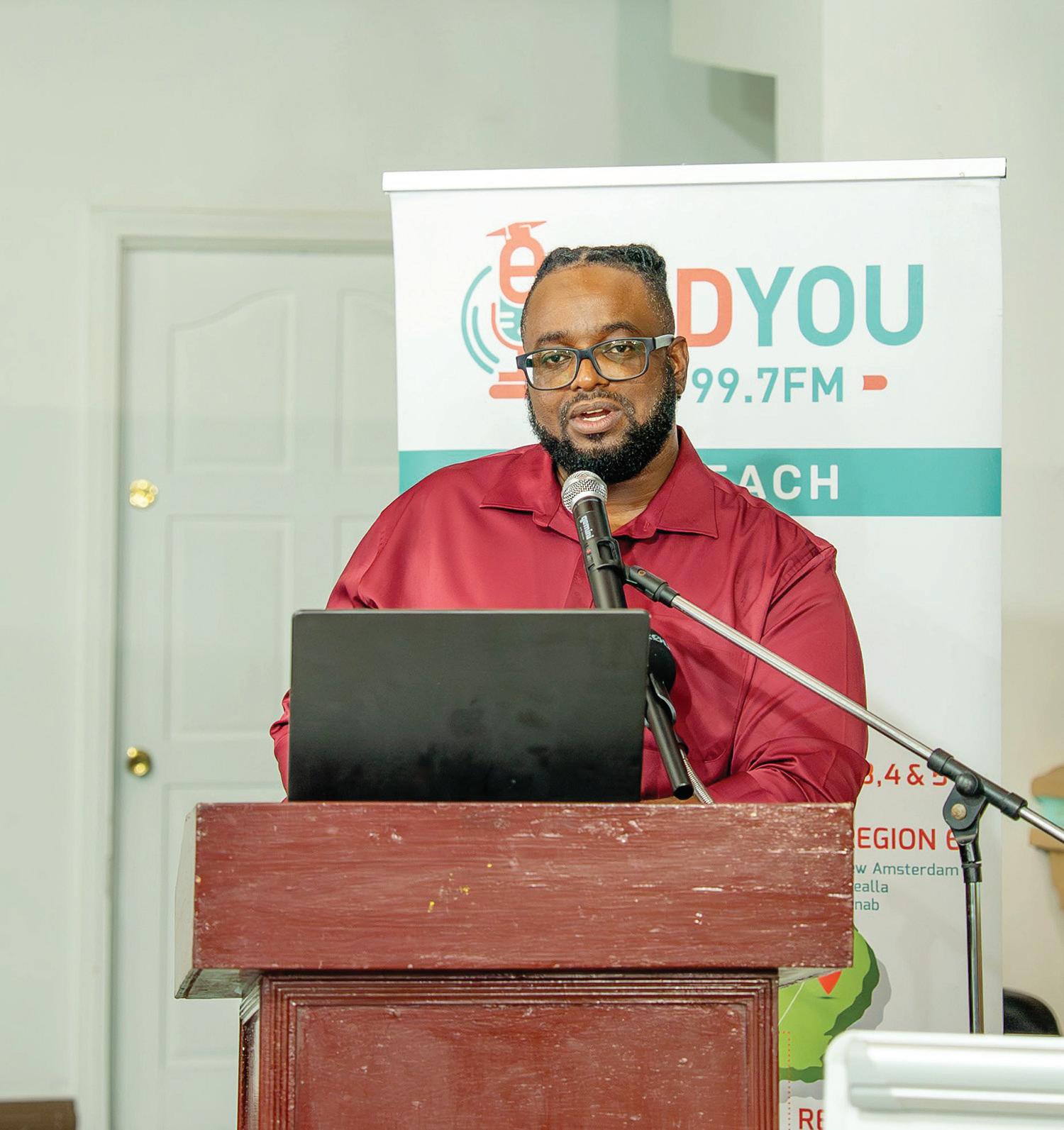

THE Guyana Police Force has issued a fresh advisory reminding minibus operators to strictly adhere to approved fare structures, warning that enforcement action will be taken against those found overcharging commuters.
In a statement from its Traffic Department, the police underscored that under the Motor Vehicles and Road Traffic Act, Chapter 51:02, fares must not be “unreasonable,” and operators are legally required to carry and prominently display the official fare table inside their vehicles at all times for inspection.
Passengers, meanwhile, are being encouraged to familiarise themselves with the approved fares for their respective routes and to report any
breaches without hesitation to the nearest police station or traffic rank.
“Necessary actions will be taken against non-compliant minibus operators,” the advisory stressed.
The warning comes amid ongoing concerns about widespread fare irregularities across several major routes, particularly during peak hours.
Recent reports indicate that commuters have been repeatedly urged to report overcharging, with police noting that such complaints are critical to enforcement efforts.
Authorities have also previously signalled a zero-tolerance approach, with Traffic Chief, Assistant Commissioner Mahendra Singh, warning that operators who impose illegal fare hikes could face arrest and prosecu -
tion.
Enforcement measures have been particularly focused on high-traffic corridors such as the Georgetown to Parika (Route 32) and Georgetown to Timehri (Route 42) routes, where passengers have reported being charged well above the legally stipulated fares.
Overcharging in the minibus sector has long been a source of frustration for the travelling public, many of whom rely on public transportation daily.
In some cases, operators have been accused of demanding fares several times higher than the approved rates, especially during rush hours, placing an added burden on workers, students and other commuters.
While police say enforcement has led to some improvements in certain
regions, challenges remain, including underreporting and the reluctance of complainants to follow through with court proceedings.
The Traffic Department maintains that public awareness and co-op-
eration are essential to curbing the problem. Passengers are advised to note the vehicle number and report any incident of overcharging promptly.
The advisory forms part of a broader effort by law enforcement to restore order and fairness within the public transportation system, ensuring that commuters are not exploited and that operators comply with existing laws.


FROM PAGE 18
(DEU) is now better equipped with some 20 site managers. A simple yet impactful push saw these professionals trained to better facilitate communication across the region.
Giving insight into the work that these professionals will perform, Williams explained that these managers will be stationed at EdYou FM’s
relay stations. “The relay station takes the signal that we transmit to the satellite, pulls it down and then broadcasts it in the local community,” Williams pointed out.
The site manager’s role, he added, is to give a daily report on the equipment so that the main office can assess whether there is a need for maintenance or any other issues.
The training, he added, aimed to equip them with the necessary tools.
“The objective of this workshop was to give them basic troubleshooting skills so that we don’t have to send a team into the region all the time. We wanted to equip them with the ability to make minor adjustments, give us more accurate readings and understand how significant their role is in

the network we have here in Guyana.”
This forms a part of the unit’s main goals and mandate. As Williams shared, the role of the DEU is to ensure that the same quality education that is delivered on the coast is delivered in the hinterland and remote areas.
Site managers, he added, are central to this goal, adding, “If a site is down and the site monitor doesn’t report it, then we wouldn’t know, so it is very important that they report accurately and in a timely manner.”
While access to education continues to develop across Guyana, Williams shared that for a number of remote communities, EdYou FM is vital.
“This is affecting the lives of children and people in the community. In some communities, like Kato, we are the only radio station there, and this is the only source of news or information they get about what is happening outside of that area. They depend heavily on the education radio. It really speaks to the entire community. Our judgement is how well children do at exams, so they are helping to facilitate that by getting information to these areas.”
Moving forward, the DEU also aims to make technological improvements to the quality of its broadcast. As Williams shared, the aim is to upgrade the quality of the signal and revamp the content to better fit a wider demographic of students.
“There is an upgrade plan to improve the quality of the signal that we send. The first workshop
was about improving content and making it more relevant to our demographics. The hardware upgrade and the content upgrade have to work in tandem, and we are pushing both simultaneously as we go through the year,” Williams said.
This comes as the unit has seen a growing response, as Williams highlighted that feedback has underscored the importance of the content delivered.
“When the station is down, you realise how many people depend on it because we receive a lot of complaints. That is one way we understand the impact,” he added.
Moving forward, the unit also has plans to expand its reach to more communities. As Williams explained, the current hurdle is Guyana’s topography and establishing radio stations and strong connections across the country’s hilly terrain.
“Many neighbouring communities to the places where we already have stations still need access. It is challenging because of the topography; you can have high mountains and low valleys. People in the mountains may get the signal, but those in the valleys may not,” he said.
In the year ahead, the unit aims to focus on improving coverage, connectivity, and reliability before shifting to expansion into more communities later in the year.
“For the second quarter, we are focusing on maintenance and improvement where we already have coverage, and later we will look at expanding our reach to neighbouring communities,” Williams said
THE Environmental Protection Agency (EPA) and the Ministry of Local Government and Regional Development are ramping up efforts to confront the growing issue of littering and environmental pollution, signalling a more coordinated and enforcement-driven approach nationwide.
This follows a high-level engagement between the EPA and Minister of Local Government and Regional Development, Priya Manickchand, where both sides aligned on strategies to tackle improper waste disposal more aggressively.
According to a release from the ministry, discussions focused on a unified national response that blends public education with stricter enforcement.
“Discussions centred on a coordinated national approach, including intensified public education, strengthened enforcement mechanisms, and the implementation of practical measures to
more aggressively combat improper waste disposal,” the Ministry said in a statement on Saturday.
The initiative builds on recent engagements between the Ministry and the Guyana Police Force, where attention was placed on bolstering enforcement capabilities. As part of that push, authorities will leverage the Smart City surveillance camera system to identify individuals caught littering.
Officials also examined existing laws and enforcement pathways to ensure that offenders are not only identified but successfully prosecuted.
The EPA delegation included Head of the Investigations and Enforcement Department, Surjpaul Singh; Senior Environmental Officer (Communications) and Litter Prevention Strategy Coordinator, Jomo Tobin; and Environmental Officer and Litter Enforcement Unit Lead, Tethram Persaud. Both agencies have committed to
AN Edinburgh, East Bank Berbice man was, on Thursday, remanded to prison after he was charged with attempted murder and rape.
Christopher Ali, 28, a seaman of Pepper Street, Edinburgh, East Bank Berbice, appeared at the New Amsterdam Magistrate’s Court on Thursday, where he was charged with the attempted murder of a 15-year-old girl, who is the mother of his 11-month-old child.
He was also charged with the rape of a Child under Sixteen Years.
An unrepresented Ali, who appeared before Magistrate Michelle Matthias, was not required to plead to the charges; as such, he was remanded to prison and will return to court on April 16.
A wanted bulletin was issued for Ali, also known as ‘Pinky’, following the stabbing of a teenage mother.
However, Ali had sustained several chop wounds on his body and was hospitalised. The wanted man was escorted via boat by
a results-driven framework that integrates enforcement, public awareness, and inter-agency collaboration.
“Both agencies reaffirmed their commitment to a unified and results-driven approach to tackling littering, recognising the importance of enforcement, public awareness, and inter-agency collaboration in maintaining a cleaner, healthier environment for all citizens,” the ministry noted.
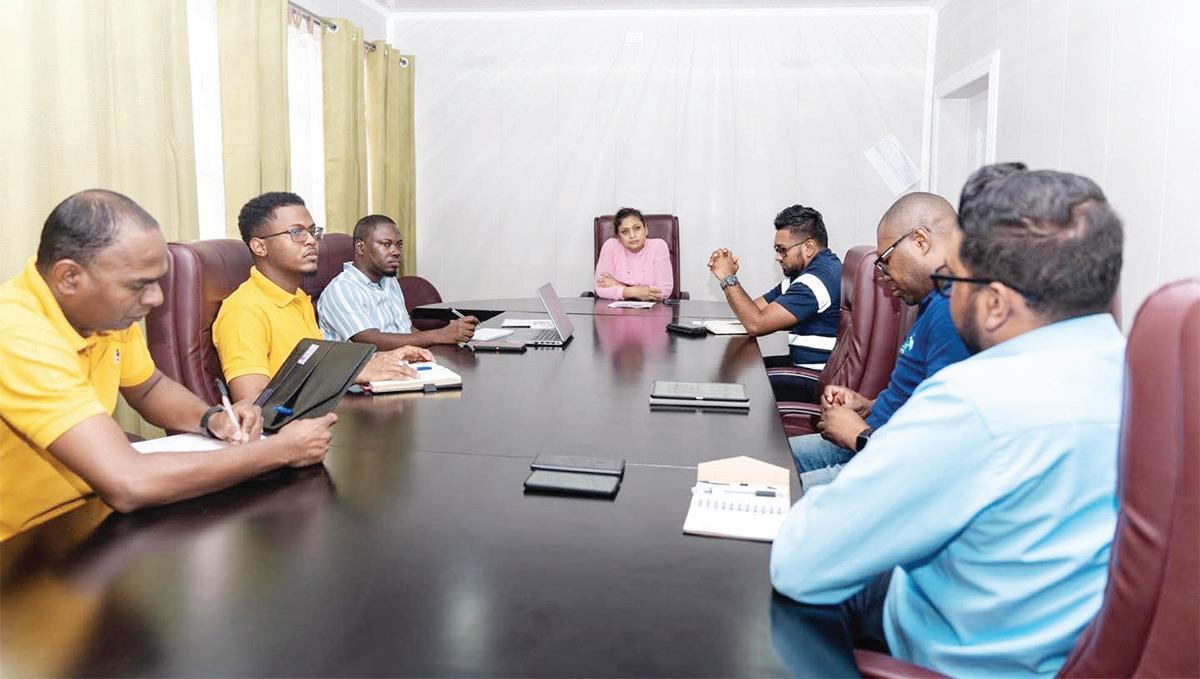
The high-level engagement between the EPA and Minister of Local Government and Regional Development, Priya Manickchand, where both sides aligned on strategies to tackle improper waste disposal more aggressively

REMANDED: Christopher Ali
ranks of the Guyana Police Force from the riverain community to the New Amsterdam Stelling before being transported by ambulance to the New Amsterdam Hospital. According to information gathered, during a dispute at Glasgow Resettlement, known as Pepper Street, East Bank Berbice, the young girl was stabbed multiple times about her body, resulting in her being hospitalised for several days.





Australia Test captain Pat Cummins says there is a growing tension between Test and franchise T20 cricket after several teammates opted out of The Hundred auction because of a home series against Bangladesh in August.
The Hundred organisers hoped to attract major names to its inaugural auction, but none of Australia's Test regulars entered the selection process.
Some Australia white-ball players picked up Hundred deals, with Tim David, Mitchell Marsh and Adam Zampa set to play in this summer's tournament.
"Some of our guys are saying no to a half

a million pounds for 20 days' work to go and play those two Test matches against Bangladesh," Cummins told the Business of Sport podcast., external
"It's at a tension point. It has been for a while, but I think it's only growing.
"Something we speak about is how do we make sure we've got our best Australian guys to choose from when we're picking a Test side or an ODI side, because there is so much demand for them elsewhere."
Fast bowler Cummins is captain of Sunrisers Hyderabad in the Indian Premier League (IPL), and the owners of his franchise bought into Hundred side

Northern Superchargers, renaming them Sunrisers Leeds.
Cummins' wife Becky is from Harrogate, and he said he would be interested in playing for the franchise.
"We spend a lot of time over in England during the summer," said Cummins.
"All the boys that
go and play it love it.
Slightly different format; I think it's less than a month long. It looks good fun, so one day I'd like to play."
Cummins is set to miss the start of the IPL, which begins on Saturday, as he recovers from the back injury that ruled him out of all but one Test in their Ashes series win over

SOUTH AFRICA RACING TIPS
GREYVILLE
08:25 hrs Longsword
09:00 hrs Buttercup
Baby
09:35 hrs Gotta Go Eddie
10:10 hrs Wander Skit
10:45 hrs Catavar
ENGLISH RACING TIPS
ASCOT
08:55 hrs West Hill
Verde
09:30 hrs Sherborne
10:05 hrs Munsif
10:40 hrs Cobbler's Boy
11:15 hrs Hard Dealt
11:50 hrs Gabby's Cross 12:25 hrs Brave Knight
DONCASTER
08:47 hrs Rising Force
09:20 hrs King Of Earth
(Sunday March 29, 2026)
England.
The Bangladesh series - Australia's first Test assignment since the Ashes ended in January - runs from 13 to 26 August, while this year's Hundred takes place from 21 July to 16 August.
The Tests will be the first between the sides since 2017, while Bangladesh have not toured Australia since their first visit in 2003. Played outside the traditional Australian season, the matches will be staged in Darwin and Mackay, with the former staging its first Test since 2004 and the latter hosting Test cricket for the first time. (BBC Sport).
09:55 hrs Grabajabba
10:30 hrs Stanage
11:05 hrs Harvey
11:40 hrs Morbeh
12:15 hrs Sixtygeesbaby
12:50 hrs Charlie Mason
IRISH RACING TIPS
DOWNPATRICK
09:07 hrs He Can't Dance
09:42 hrs Let's Go Mans
10:17 hrs Dairy Force
10:52 hrs Lough Nigara
11:27 hrs Uncle Pat
12:00 hrs Dee's Lady
12:30 hrs Magic Sadler
CUMMINGS ELECTRICAL COMPANY LTD-83 Garnett Street, Georgetown (Tel:225-6158)
Answers to yesterday’s quiz:
(1) Colin Cowdrey (ENG vs AUST, Birmingham, 1968)
2) Sachin Tendulkar (IND vs WI, Wankhede, 2013)
Today’s Quiz:
(1) Who is the first WI to hit a Test match hundred?
(2) Who is the first WI to crack a Test double-hundred?
Answers in tomorrow’s issue
THE Guyana Football Federation (GFF) has officially launched a pioneering twoday seminar, “Children’s Rights in Football: An Introduction to Restorative Practice and Child Safeguarding.”
The event, hosted at the National Centre for Educational Resource Development (NCERD), is the first major output of a strategic partnership between the GFF, the Rights of the Child Commission (RCC), and the Restorative Justice Centre (RJC) Guyana.
The seminar, which ended on March 27, was designed to shift the culture of Guyanese football from simple competition to a holistic, rights-based developmental model.
The event, hosted at the National Centre for Educational Resource Development (NCERD), is the first major output of a strategic partnership between the GFF, the Rights of the Child Commission (RCC), and the Restorative Justice Centre (RJC) Guyana
Key focus areas include: Restorative Practices: Utilising dialogue and accountability to resolve conflicts and strengthen team bonds; Child Safeguarding: Pro -
viding practical tools to recognise and prevent abuse,
exploitation, and harm; and Holistic Mentorship: Training coaches to identify when a child is struggling and how to intervene effectively.
The initiative has drawn strong support from national leaders who view football as a primary vehicle for social change.
"Football is taking the lead on child protection in Guyana," stated Andre Gonsalves, CEO of the RCC. "Coaches are being empowered as trendsetters, proving that success is measured by mentorship and responsibility, not just the scoreboard."
Wayne Forde, President of the GFF, reiterated that safety is the federation’s top priority: "We want every parent to have full confidence in the environment we are building. We are equipping our stakeholders with the tools necessary to protect our children from every form of harm."
This seminar follows a Memorandum of Understanding (MoU) signed in February 2026 between the GFF and the RCC.
This agreement formalises a long-term commitment to align Guyana’s football ecosystem with international safeguarding standards and national legislation.
Orrin Boston, Director of the RJC, highlighted the social importance of the sport: "Football can expose underlying tensions. Restorative justice offers a framework for healing and accountability, ensuring that disagreements don't disrupt the harmony of the community."
Guyana’s Masters hockey teams had a tough day at the office when they battled in the Indoor Hockey World Cup being played in Nottingham, England.
The over 40s, the nation’s strongest team at the ongoing Master Indoor World Cup, again deliver a stinging performance to beat France on Friday.
Guyana edged France
in the Over-40 clashes at the Masters Indoor Hockey tournament.
Orland Semple starred early for the locals, with his field goal coming 3 minutes into the contest, which Kevin Spencer doubled in the second period to make it 2-nil heading into halftime.
Jonathan Roberts sealed the clash when he converted a penalty corner in the third quarter.
France, while aggressive, failed to mount an effective comeback as Guyana kept their winning streak intact with 2 in 2 after beating Wales 8-4 on the opening day.
The country’s over-50 men’s team allowed Canada to claw their way back into a contest to lose 7-4 in their second outing.
Terrence Soloman, Phillip Fernandes, Devin Hooper and Ahyodha Kishna scored for Guyana.
Meanwhile, in the men’s Over 55, the locals came up against Australia in the 40-minute contest.
They would lose the clash 7-1 to Australia, with Dexter Wyles scoring Guyana’s lone successful strike.
Australian Dean Wight-
man had a pair of goals, with the likes of James Abbo, Andrew Bewick, Mark Clayton and Michael Hemsley scoring the other goals for Canada.
The over-40 women’s tough debut campaign continued, albeit it was their best showing, as they lost 4-2 against Team Alliance.
After Jennifer Lingard scored the opener for Alli -
ance, Karensa Fernandes equalised, but Lingard returned to restore the cushion to 2-1, and Marisha Fernandes then made it 2-2.
The alliance pushed harder as Annice Sutton and Heather Kenney scored in,the third and fourth quarters to take the lead
Victoria is closing on the Sheffield Shield title after a dramatic day's play at Junction Oval, punctuated by confusion around an injury substitution.
Reigning champions South Australia (SA) lost five wickets in the evening session on day three of the Shield final, putting the home side in the box seat. SA limped to stumps at 5-94 in its second innings, an overall lead of only 31 with two days left.
Test keeper Alex Car-

ey was 24no and Shield player of the season Liam Scott had made two. Victoria was dismissed
for 261 at tea and as paceman Sam Elliott prepared on the ground, he pulled up with a hamstring injury.
It clearly caught them unawares, with Mitch Perry hurrying to warm up in the nets at the back of the venue.
Assistant coach Ben Rohrer tried to start the innings as a substitute fielder until Perry was ready, but the umpires would not allow him on the ground.
The Victorians had to scramble for a suitable player, before Perry finally joined the game.
Adding to the drama, Perry trapped SA captain Nathan McSweeney lbw
with his first delivery to leave the defending champions reeling at 3-35.
Todd Murphy also claimed a wicket with his first delivery, dismissing Jake Lehmann for one. Lehmann played a terrible pull shot off a nothing ball from the off spinner and edged the ball onto his stumps.
Victorian captain Will Sutherland capped an excellent day by having Jason Sangha caught behind for 34.
Fergus O'Neill and Sutherland had led Victoria's recovery after lunch, wresting the momentum from SA and setting up a first-innings lead of 63.
O'Neill top-scored with an unbeaten 64 from 134 balls, featuring seven fours — his fourth firstclass 50.
After missing out on a batting bonus point by three runs, SA can only claim back-to-back Shield titles by winning the final
Virat Kohli hit an unbeaten 69 as Royal Challengers Bengaluru began the defence of their Indian Premier League title by cruising past Sunrisers Hyderabad.
India great Kohli, 37, batting for the first time since January, played the anchor role perfectly as RCB chased down 202 in just 15.4 overs in the tournament's season opener.
(Scores): Sunrisers Hy-
derabad 201-9 (20 overs): Kishan 80 (38); Duffy 3-22
Royal Challengers Bengaluru 203-4 (15.4 overs): Kohli 69* (38), Padikkal 61 (26)
Devdutt Padikkal added 61 from 26 balls and RCB captain Rajat Patidar 31 from 12, although England opener Phil Salt sliced a catch to cover for eight.
Salt, who comes into the IPL after a quiet T20 World Cup, did take a sensational
diving catch on the deep cover boundary in Sunrisers' 201-9.
Salt's one-handed effort dismissed India's Ishan Kishan on 80 from 38 balls in the 16th over, after which Sunrisers were unable to kick on further on a flat pitch perfect for batting.
New Zealand seamer Jacob Duffy, playing in the place of injured Australia bowler Josh Hazlewood, was impressive for his 3-22.
Gloucestershire and England left-armer David Payne also took 2-35 on his IPL debut - he was signed as a late injury replacement at Sunrisers - but his side were unable to stop RCB's rampant chase.
It was the quickest successful pursuit of a score in excess of 200 in the IPL while Kohli now has 21 scores of 50-plus in successful chases - another record in the competition.

Having retired from T20 internationals, the knock was Virat Kohli’s first since a 50-over hundred against New Zealand on 18 January
JOHN’S, Antigua, (CMC )– Despite this year’s West Indies Championship being significantly shortened, Director of Cricket at Cricket West Indies (CWI), Miles Bascombe is still expecting a competitive tournament.
CWI confirmed on Friday that the four-day competition, which bowls off next month, will feature just three rounds of matches, with the majority of them being played in Antigua.
The tournament has been revamped from its usual round robin format as the financially strapped CWI looks for way to reduce costs.
However, Bascombe said he did not expect the change to affect the quality of play in the competition, while still delivering on performance objectives.
“Despite the reduction in matches, we anticipate keen contests. The change in dates has allowed for an extended preparation period, with most franchises holding mul-

tiple trial matches, setting up intense internal competition for places.
“The West Indies Championship will form a key part of talent identification and preparation for the home series, and the bilateral series format will add an interesting dimension, closer to mirroring the Test cricket
format,” Bascombe said.
In revealing details of the Championship, CWI said the six regional franchises will be seeded one to six based on their final standings at the end of the 2025 edition of the tournament.
The winners of each bilateral contest will be ranked first through third based on
total points accumulated, with the top-ranked team advancing directly to the final.
During the playoff round, the first placed team will take on the West Indies Academy to maintain match readiness and ensure fairness of preparation ahead of the final, while the second and third-ranked teams will meet
in a playoff match to determine the second finalist.
The revised format forms part of CWI’s broader strategy to strengthen player pathways, improve performance outcomes, and ensure the sustainable management of resources across regional cricket.
The review involved extensive consultations with the Cricket Strategy and Officiating Committee, Cricket Department, Finance Department, and Executive Leadership Team.
Guided by a purpose-first approach, the review assessed what each tournament must achieve – whether talent identification, selection finalisation, tour preparation, or pathway progression – and redesigned formats to preserve relevance and competitive impact while managing operational costs.
CWI said it had intentionally scheduled this year’s tournament closer to the start of the international home series, which commences against Sri Lanka in June,
allowing players to achieve optimal match readiness just ahead of a packed summer. It maintained that while the revised structure represents a shift from previous format, participating territories had embraced the change.
WEST INDIES CHAMPIONSHIP FIXTURES
Bi-Lateral Round: (Match 1 – April 12-15; Match 2 – April 19-22; Match 3 – April 26-29) Windward Volcanoes vs Guyana Harpy Eagles in Antigua Jamaica Scorpions vs Barbados Pride in Jamaica Leeward Islands Hurricanes vs Trinidad and Tobago Red Force in Antigua Playoff Round: (May 10-13)
2nd Place vs 3rd Place in Antigua
1st Place vs West Indies Academy in Antigua Grand Final: (May 1720)
1st Place vs Playoff Winner in Antigua
Mexico, (CMC) – Jamaica’s Reggae Boyz are now just one win away from qualifying for the 2026 FIFA World Cup after edging past New Caledonia 1-0 in their intercontinental playoff semifinal on Thursday.
Playing at the Estadio Akron, an 18th minute
strike from Bailey Cadamarteri was enough to give the Jamaicans. The result sets up a winnertakes-all contest against DR Congo on Tuesday, with the winner booking a spot at the World Cup joining Portugal, Colombia and Uzbekistan in Group K.
In his first competitive game in charge,
interim head coach Rudolph Speid handed starts to debutants Ephron Mason-Clark and Andre Brooks, as part of seven changes to the team that drew 0–0 with Curacao at the National Stadium.
Left back Ronaldo Webster, in his first official start for Jamaica, was dangerous in the opening stages and it was
his free kick that led to the opener.
Webster’s powerful low strike from 20 yards proved too much for New Caledonia goalkeeper Rocky Nyikeine, who pushed the ball straight to Cadamarteri who tapped in the rebound from close range.
New Caledonia tried to respond late in the first
half with two efforts from the halfway line trying to catch goalkeeper Andre Blake out, but both failed to hit the target.
In the second half, clear cut chances were hard to come by. However, Webster wasted a perfect opportunity to put the game to bed when he found himself one on one with the keeper, but his
chipped effort was saved by Nyikeine . In their attempt to find an equaliser, Gerard Waia had the best chance for New Caledonia in the 87th minute with a firm strike from close range but Blake managed to push it away and keep the clean sheet.
BASSETERRE, St Kitts, (CMC) – West Indies Women wasted an impressive century from veteran Stafanie Taylor, as Australia Women’s strong showing with the bat propeled them to a dominant 103run victory in the opening One Day International here on Friday.
Taylor scored an unbeaten 105 off 129 balls, her eighth WODI century and first in almost five years, but she got little other support, and the Windies Women limped to 238 for eight in 50 overs in response to their opponent’s 341.
It was the complete opposite of Australia’s innings, where six of their first seven batters scored over 40 to propel them to a massive total after electing to bat first at Warner Park.
Faced with a run rate of almost seven runs an over, it
was always going to require a herculean effort from the home side’s batters to topple the number one ranked Aussies.
They didn’t get off to the best of starts, with Kim Garth trapping Qiana Joseph lbw for 12 with just 18 runs on the board.
Taylor joined captain Hayley Matthews at the crease and the two looked promising during a 40-run partnership in seven overs that carried them to 58 for one in the 12th over.
But Garth struck a huge blow when she had Matthews caught at deep square leg for 22 attempting a pull shot.
They then fell deeper into trouble when Deandra Dottin was unluckily run out for six, with Taylor’s straight drive deflecting off the hands of bowler Ashleigh Gardner and into the
stumps at the non-striker’s end with Dottin out of her crease, to leave them 76 for three.
In need of a partnership, the Windies resuscitated
Henry, back in the side after missing the final T20I with an injury to her left hand, contributed 38 runs in a partnership worth 73 for the fourth wicket.

their chase through the efforts of Taylor and Chinelle Henry.
During that time, Taylor reached her half century off 57 balls by hitting Darcie
Brown over the leg side for a huge six.
They carried the score to 149 for three in the 30th over before Henry, who was dropped on 35, was bowled by Georgia Wareham.
The West Indies lost wickets at regular intervals thereafter, with Jannillea Glasgow, Shemaine Campbelle and Jahzara Claxton all falling cheaply to see them slip to 216 for seven.
Taylor, who was given a lifeline on 94, was not to be denied though, eventually reaching three figures off 125 balls by dabbing Wareham behind third man for a boundary.
By then the outcome was long decided, with the run rate having far skyrocketed out of the reach of the Windies.
Garth was Australia’s best bowler with 3-37, while Gardner took 2-44.
Earlier, the Aussies seized control of the match through a sterling batting performance that put the home side under pressure from the get-go.
Openers Phoebe Litchfield and Georgia Voll put on 75 runs in 10.3 overs to give them the perfect start.
And when Afy Fletcher struck to dismiss the latter after she had scored 42 off 32 balls, Litchfield, who topscored with 77 from 72 balls, along with useful knocks from Nicola Carey (49), captain Sophie Molineux (47), Ellyse Perry (44) and Player-of-theMatch Wareham, who made 42, kept the runs flowing.
Fletcher starred with the ball for the Windies taking 3-83 and Taylor snared 2-31.
The second WODI is scheduled for today at the same venue.
GUADALAJARA, Mexico, (CMC )– Reggae Boyz interim head coach Rudolph Speid has called on his troops to give nothing less than “100 per cent” when they take on DR Congo on Tuesday with a trip to the 2026 FIFA World Cup on the line.
Speid said Jamaica, who edged New Caledonia 1-0 on Thursday, will have to be at their best when they tackle their African

opponents at the Estadio Akron.
“They are a good team, they rank much higher than us. They’ve gone through some important teams in African [qualifying], defeating a team like Nigeria to get here so I think it’s a really good team. There are a lot of similarities to us — physical, fast, and so on.
“I expect everybody to be giving 100 per cent, including us, because the
prize is just a huge prize at the end of the day. Lots of money waiting for the winner and just a national pride for the country, who goes to the World Cup, so I expect both teams to be giving their 100 per cent and I will give no less,”
Speid said.
He said Jamaica will have to be more clinical than they were against New Caledonia where they missed several opportunities.
“I thought if we had scored our goals, we’d have been out of sight. But credit [to New Caledonia], they fought for every single pass, possession and they defended the goal with their lives.
“I thought this was the type of fight they were going to put up — you don’t come this far by not being good. They have some quality and they played very well as a team,” Speid said.
ST JOHN’S, Antigua, (CMC) – Director of Cricket at Cricket West Indies (CWI), Miles Bascombe has no doubt that the regional team will qualify for the 2027 ICC Men’s ODI World Cup.
In the latest ODI rankings, West Indies slipped one spot to 10th to find themselves out of an automatic qualification spot for next year’s World Cup,
which will be hosted by South Africa, Zimbabwe and Namibia in October.
Bangladesh, now occupy ninth place following their recent series win over Pakistan, which would see them automatically qualifying for the marquee event.
The West Indies are seeking a return to the World Cup after missing out on qualifying for the
last edition in 2023 for the first time in its history.
Speaking during CWI’s quarterly press conference on Friday, Bascombe revealed that the West Indies had eight ODI matches remaining before the March 2027 deadline.
He said he was very confident that even if the Windies did not finish in the top nine teams to
secure an automatic spot, they would still advance through the CWC Qualifier, which awards four spots.
“We have eight One Day Internationals between now and March 28, which is the cutoff date. All of those teams outrank us in ODI cricket which is an opportunity and it means that any victories against these teams would
certainly help our cause in terms of automatic qualification.
“So that is what our plan would be, to ensure that we are as prepared as we could be so that we can maximise these eight matches and get as many points as we can,” Bascombe said.
“I’m confident that we will be very prepared. Judging from
what I’ve seen coming out of the World Cup we will try to maintain that momentum. I’m sure we will maximise these eight matches and if that is not good enough and we have to go to the Qualifiers, we will certainly go there and represent the region and get ourselves into the World Cup, so no I’m not nervous.”
BAKEWELL is the second longest of our sponsors after Farfan and Mendes Ltd and is, without doubt, one of the main reasons why the Rose Hall Town Youth and Sports Club (RHTYSC), MS, is the success it is today.
The club and Bakewell are the products of sheer hard work, discipline, and visionary leadership."
Those were the words of RHTYSC Cricket Manager, Robby Kissoonlall, on Wednesday last when long-serving sponsor, Bakewell, renewed their cricket sponsorship of the club for the 26th consecutive year.
Kissoonlall stated that the popular bakery has been sponsoring the club’s Under-17 and Second Division teams since 2000. Bakewell became the second official sponsor of the RHTYSC, joining Farfan and Mendes Ltd, after a visit to the club by its founder, Naeem Nasir, and General Manager, Rajendra Ganga.
The sponsorship started with the Second Division team and later expanded to the Under-17 team. The two teams have won a combined twen -
ty-six titles and reached close to twenty semifinals over the years.
Kissoonlall spoke on the importance of the Bakewell sponsorship as it allows the players to play the game of cricket without worrying about the expenses associated with it.
Club Secretary, Hilbert Foster, noted that membership of the club is totally free and the club stands all expenses of playing the game.
The former President of the Berbice Cricket Board and Director of Cricket West Indies stated that the teams have, over the years, produced three Test cricketers, ten international players, and 130 Berbice players.
The only Berbice players produced by the RHTYSC that have no connection to the Bakewell sponsorship are Ingram Dey and Neil Williams.
Some of the players who played with the Bakewell teams are Kevin Sinclair, Esaun Crandon, Royston Crandon, Assad Fudadin, Kelvon Anderson, Shemaine Campbelle, Eon Hooper, Clinton Pestano, Jonathan Rampersaud, Dominique Rikhi, Akshay Homraj, Delbert
Hicks, Jeremy Sandia, Matthew Pottaya, Junior Sinclair, Keith Simpson, Slyus Tyndall, Sheneta Grimmond, Erva Giddings, and Shabiki Gajnabi.
Foster spoke highly of the role that the Bakewell sponsorship played in the careers of Test players Kelvon Anderson, Assad Fudadin, and Kevin Sinclair. He recalled also that Dominique Rikhi and Akshay Homraj, former players of the Under-17 and Second Division teams, have gone on to play international cricket for the United States of America.
The 2026 Under-17 team would be led by national player Leon Reddi with fellow national player Jayden Ganpat as his deputy. The Second Division team would be led by veteran left-handed batsman Ryan Kissoonlall and he would be assisted by vice-captain Jonathan Rampersaud. The management team for both teams would be Robby Kissoonlall, Keith Hicks, and Tyrone Pottaya.
The two teams under the sponsorship would undertake about fifty community-related programmes and projects during the year. These programmes would be held under a variety of
SENEGAL paraded the Africa Cup of Nations trophy before Saturday's friendly match against Peru at Stade de France - despite being stripped of the title earlier this month.
Morocco was declared the winners of the 2025 Afcon tournament when the Confederation of African Football (Caf) overturned the result of January's final.
Senegal's players left the field in protest when, with the score at 0-0, hosts Morocco was awarded a stoppage-time penalty.
When they returned after a delay of about 17 minutes, Morocco subsequently failed to score the spot-kick and Senegal netted an extra-time winner.
Following an appeal by the Moroccan FA (FRMF), Caf later ruled that Senegal had forfeited the match and Morocco was awarded a 3-0 victory.
Senegal has lodged an appeal with the Court of Arbitra-

Senegal has lodged an appeal with the Court of Arbitration for Sport after being stripped of the Africa Cup of Nations title
tion for Sport (Cas), which has said it will rule on the matter "as swiftly as possible".
Before the match against Peru, captain Kalidou Koulibaly and his team-mates entered the pitch with the Afcon trophy for a lap of honour, before Koulibaly and goalkeeper Edouard Mendy went up to the stadium's presidential box to place the
trophy there.
The friendly in Paris is Senegal's first match since the Afcon final and forms part of their preparations for the World Cup, which starts in June.
They have been drawn in the same group as France, Norway and either Bolivia or Iraq.(BBC Sport)

sub-headings including sports, culture, education, charity, environment, community development, and youth development. Among the main activities to be hosted by the Bakewell teams in 2026 are Tribute to Teachers, Tribute to Students, Cricket Academy, Republic Bank Grade 6 Summer Camp, Basil Butcher Trust Fund, Annual Youth Magazine, Naeem Nasir Memorial Tournament, feeding programmes, and the annual Christmas Village.
General Manager of

Secretary Natasha Bhikhari hands over sponsorship cheque to Nicholas Cameron while Robby Kissoonlall and Balraj Narine look on
Bakewell, Rajendra Ganga, was loud in his praise for the remarkable work of the Bakewell teams over the last twenty-five years.
Ganga noted that the company was pleased to be associated with such a dynamic organisation and was very pleased with the club's ability to produce outstanding players.
He urged the management of the club to uphold the high standards they have set themselves in the past. Apart from the sponsorship of the two cricket teams, Bakewell co-sponsors the RHTYSC annual magazine, Cricket Academy, and the annual Christmas Village.
By Sean Devers
AFTER four nights of the Mac and Cheese skill junior level Squash tournament at the National Raquette Centre (NRC) and two at the Georgetown Club (GTC), President of the Guyana Squash Association (GSA) David Fernandes expressed satisfaction with the format of the tournament.
The tournament commenced on Tuesday Night at the NRC before the location shifted to the GTC from Friday night and concluded yesterday at Headquarters of Squash on Camp Street with a fund-raising hot dog sale.
Fernandes said the format of this tournament was great since it allowed for the players to be evenly matched, adding that he was also impressed how the girls responded to the speed of the shots from their male counterparts.
While praising fast improving standard of the players from the recently formed Queen’s College (QC) Fernandes said that the GSA are exploring the idea of having
Primary School students attend the Saturday morning sessions run by the GSA.
“I am happy with the attendance at these sessions by the youngsters. The NSC is used by the QC Squash Club and along with them coming to our Saturday sessions, their rapid improvement has noticeably by many. I am very pleased with the way we (GSA) are heading” posited Fernandes.
On the last day in which the semi-finals were held yes-
terday morning and the finals in the afternoon, consistence rain and flooding of the Roadways, failed to put a damper on the fundraiser and the competitive Squash on the three Courts at GTC.
A fair sized gathering of mostly parents saw a successful climax to well organised tournament as Ethan Bulkan (BOYS) and Zoey Mc Donald (girls) emerged as the tournament’s best players