

— Belizean jurist to chair probe as inquiry targets accountability, sweeping safety reforms

French divers say zero visibility, powerful currents hampering MV Barima recovery


— Belizean jurist to chair probe as inquiry targets accountability, sweeping safety reforms
French divers say zero visibility, powerful currents hampering MV Barima recovery
— Credits Toshaos, village councils
Dr Bharrat Jagdeo, has commended Amerindian village leaders for their stewardship of billions of dollars in Low Carbon Development Strategy (LCDS) resources, saying communities have outperformed international agencies in implementing development projects while demonstrating the effectiveness of local governance.
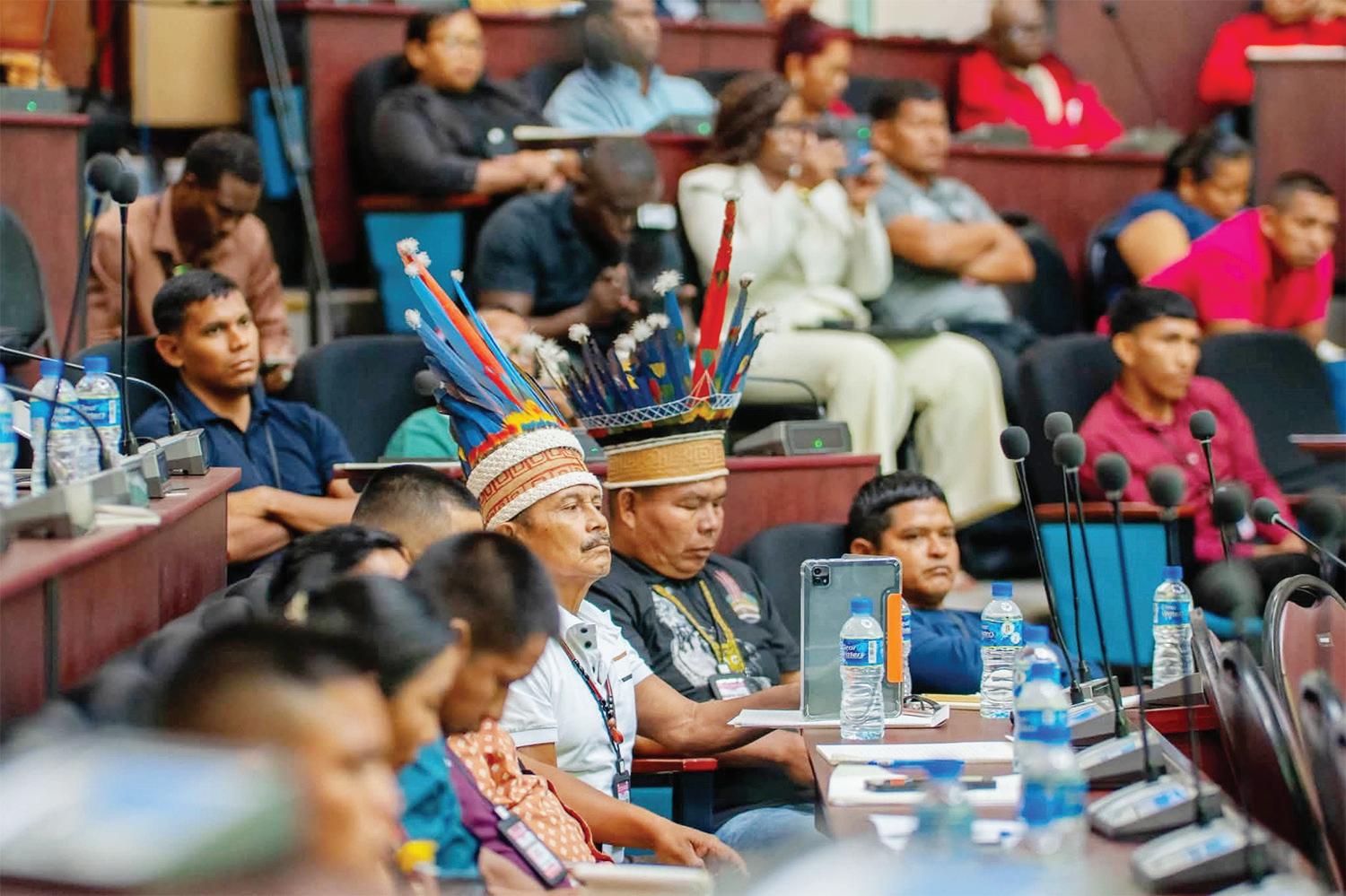
The Vice President made the remarks while addressing Indigenous leaders at the National Toshaos Council (NTC) Conference recently.
He noted that more than $14 billion earned
through Guyana's LCDS has been allocated to over 250 Amerindian villages over the past three years, enabling the successful completion of more than 3,000 community projects.

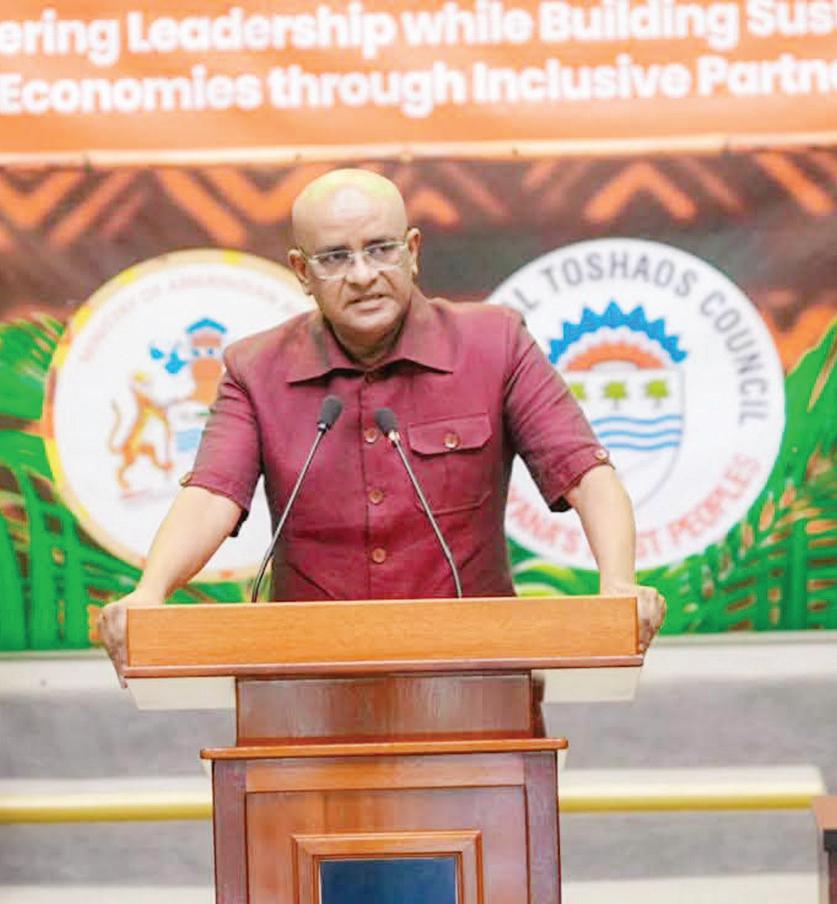
He credited Toshaos and village councils for ensuring that the funds were managed responsibly and spent in accordance with priorities identified by residents.
"We have been able to directly allocate funds to the villages through the LCDS that we earn, for the villages to spend this money in a way that they, the people of the villages, see fit, and that has yielded enormous benefits to people, with over 3,000 projects in these 250-something villages completed," Dr Jagdeo said.
The Vice President described the achievement as a testament to the management capabilities of Amerindian communities, arguing that the results have disproved the belief that development initiatives are more effectively managed by external organisations.
"It's a perfect example of good governance and hard work at the village level," he said, adding that village leaders have demonstrated accountability while delivering projects that directly benefit their communities.
Dr Jagdeo contrasted the performance of the villages with projects managed by international agencies, saying some initiatives funded under the country's first LCDS remain unfinished more than a decade after implementation began.
"We have great faith sometimes in people who come from abroad to manage things," the Vice President said, noting that some interna -
tional organisations were given responsibility for managing projects in Amerindian villages but have progressed slowly.
"We still have projects that we gave to be managed by the UNDP since 2011, when we got the money from the first LCDS, and they have not been completed as yet," he added.
By comparison, he said Amerindian communities have received more than $14 billion through the current LCDS over the past three years and have successfully implemented thousands of projects while ensuring transparency and accountability in the use of public funds.
"You have used the money, and you have used it in an accountable way, based on the wishes of your community, and you've implemented the projects," Dr Jagdeo reiterated.
Against this backdrop, he said Guyana's experience should serve as an example to the international community, demonstrating that Indigenous communities are fully capable of managing development financing and delivering results without relying on external intermediaries.
Dr Jagdeo noted that LCDS investments have complemented wider Government spending on education, healthcare and infrastructure in hinterland communities, ensuring residents benefit both from improved public services and direct financing for projects identified by their own villages.
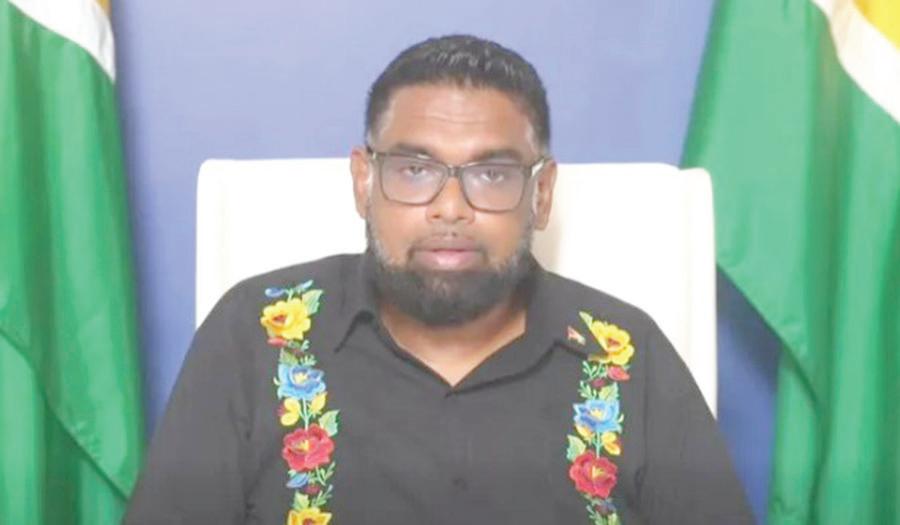

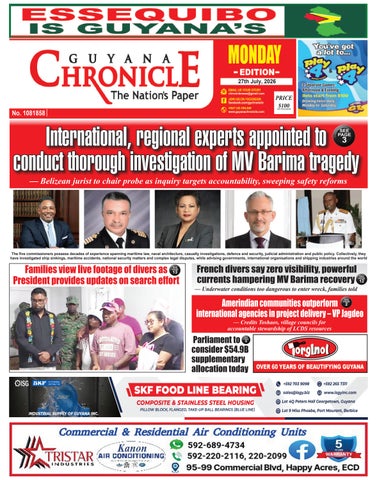
A FIVE-MEMBER international Commission of Inquiry (CoI) has been granted sweeping powers to investigate every aspect of the MV Barima tragedy, including whether negligence, misconduct, institutional failures or breaches of maritime safety laws contributed to Guyana's deadliest maritime disaster.
The commission, whose members will be sworn in on a date to be announced, has been mandated to conduct a comprehensive and independent investigation into the circumstances surrounding the capsizing and sinking of the MV Barima, examine the search, rescue and recovery efforts, identify any shortcomings and recommend legislative, regulatory and operational reforms to strengthen Guyana's maritime safety system.
Announcing the appointments on Sunday, President Ali said the commission was established in keeping with his earlier commitment and under Section 21 of the Commissions of Inquiry Act.
The panel comprises distinguished experts in law, maritime engineering, maritime operations and safety from Belize, Poland, Jamaica, and Trinidad and Tobago.
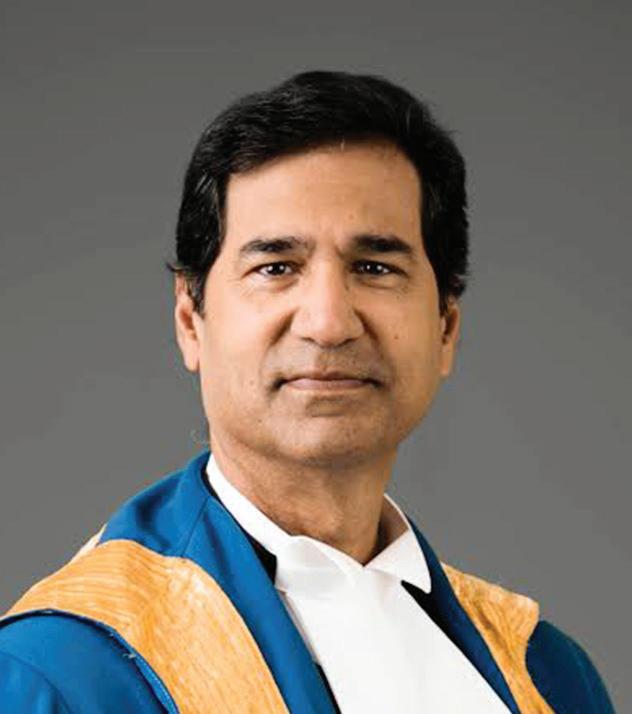
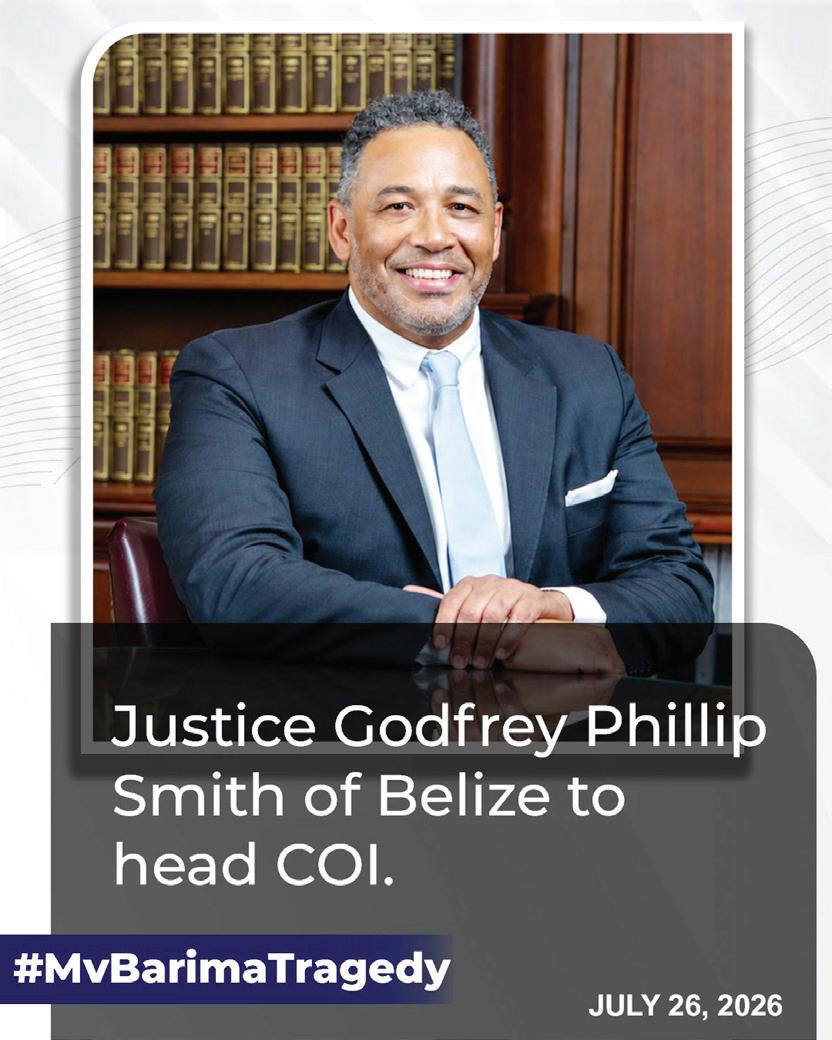
The commission will be chaired by Justice Godfrey Phillip Smith of Belize, CARICOM High-Level Representative for Law and Criminal Justice and an Ad Hoc Justice
of the Eastern Caribbean Court of Appeal.
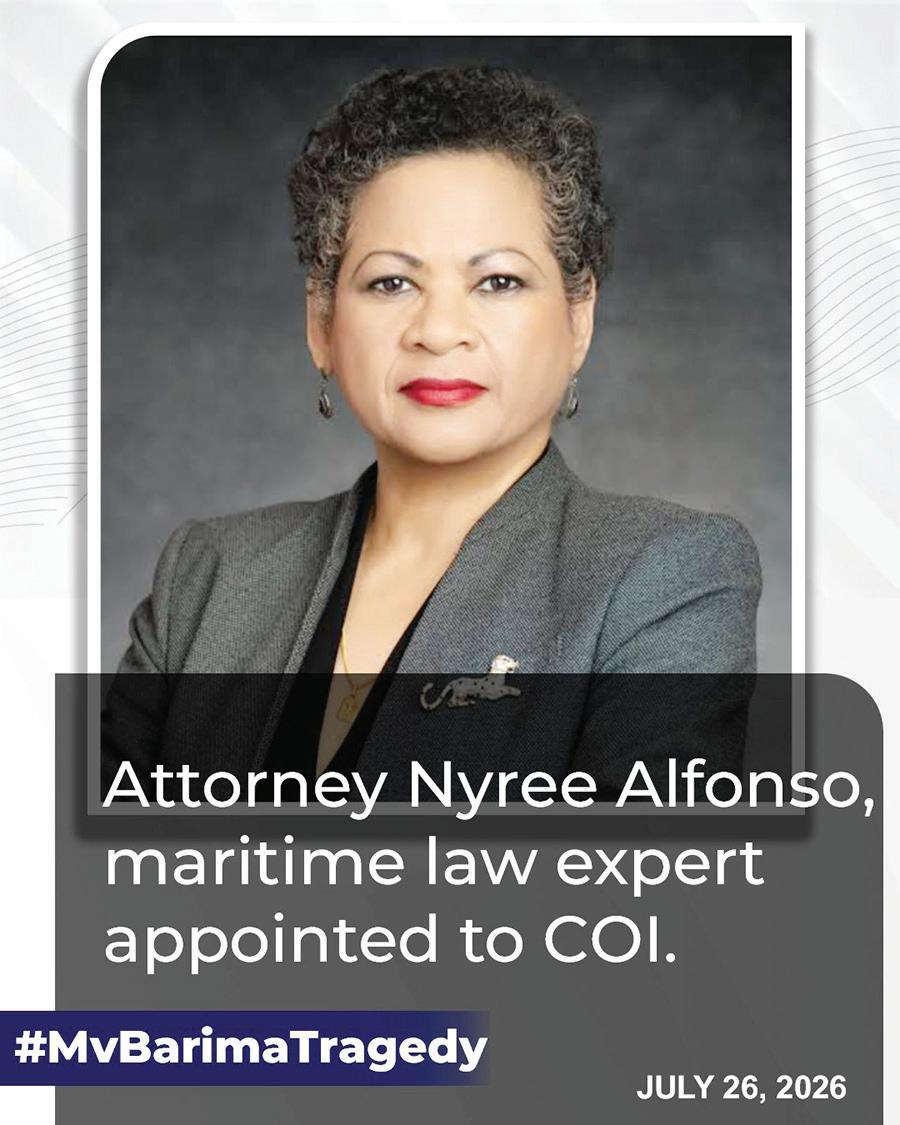
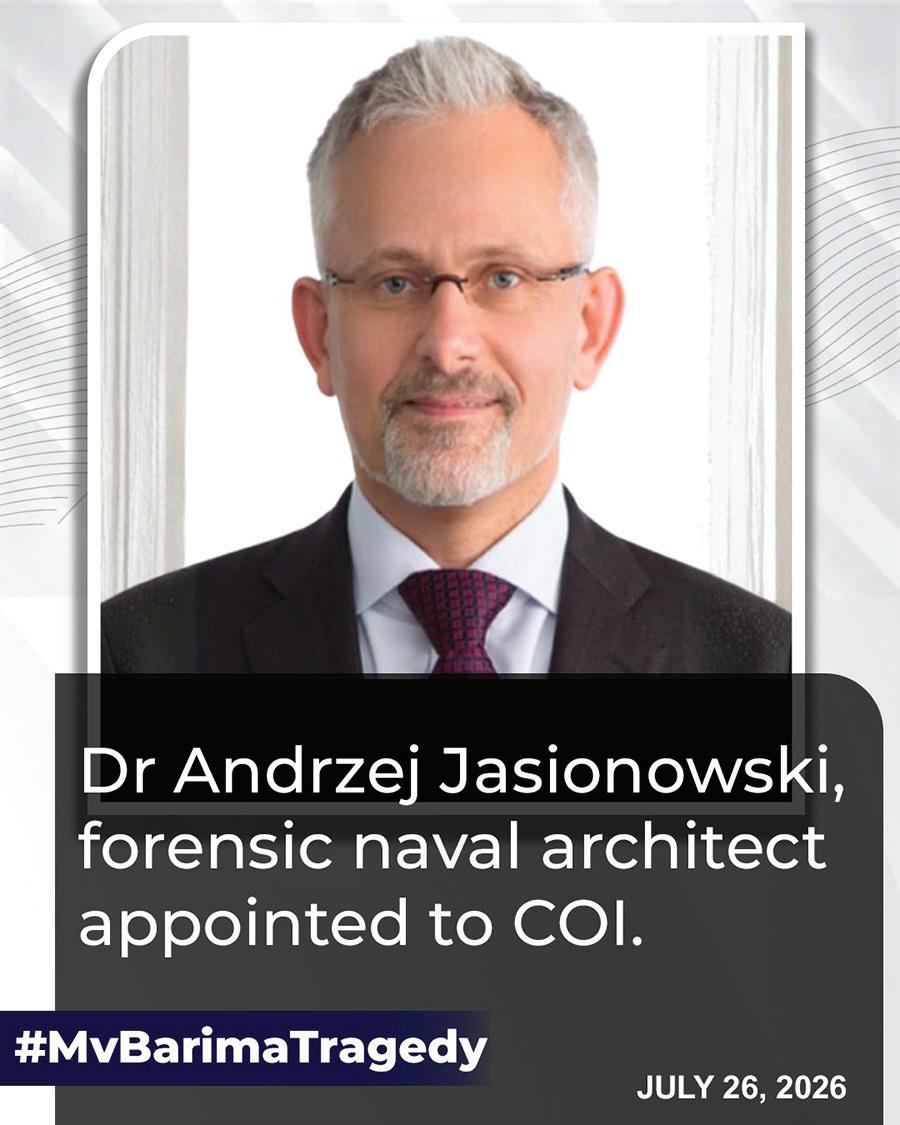
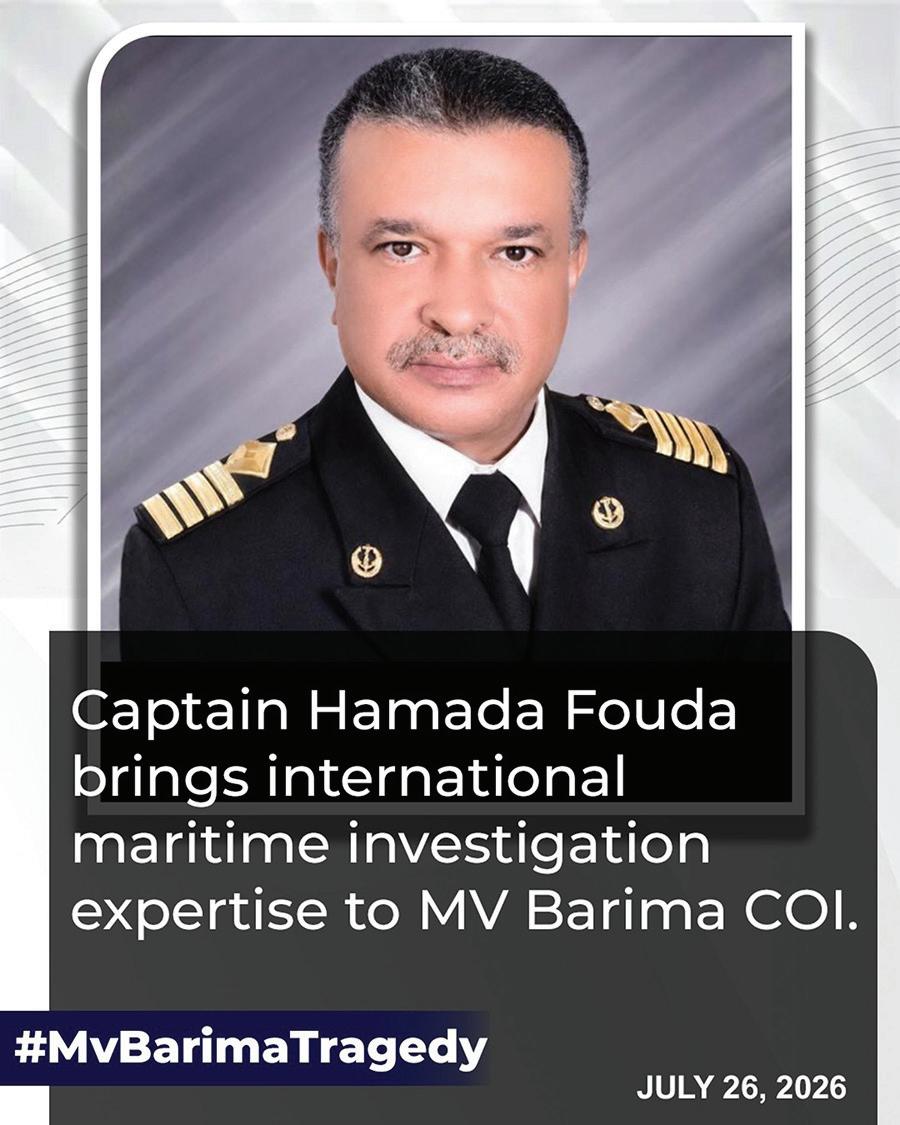
The other members are Captain Hamada Fouda of Jamaica, Senior Maritime Surveyor and Compliance Auditor with the Maritime Authority of Jamaica; Ms. Nyree Dawn Alfonso of Trinidad and Tobago, an attorney-at-law specialising in Admiralty and Maritime Law; Dr. Andrzej Jasionowski of Poland, a Naval Architect and Marine Engineer; and Rear
given extensive terms of reference aimed at establishing the complete circumstances surrounding the tragedy.
The commission will investigate the causes of the disaster, including the loading of the vessel, boarding procedures, passenger conditions, the capsizing and sinking itself, and any other related matters.
It will also conduct a comprehensive review of
ing whether any acts of negligence, misconduct, dereliction of duty or institutional failures contributed to or caused the tragedy.
Among its responsibilities will be inspecting the vessel's condition and maintenance history, including its seaworthiness, while examining the influence of weather, sea conditions, tides, currents, navigation, communications and other environmental or operational factors.
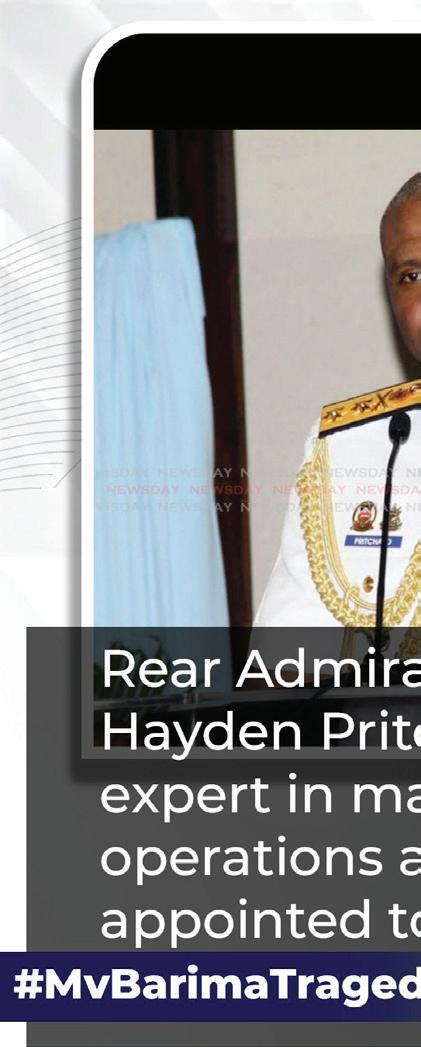
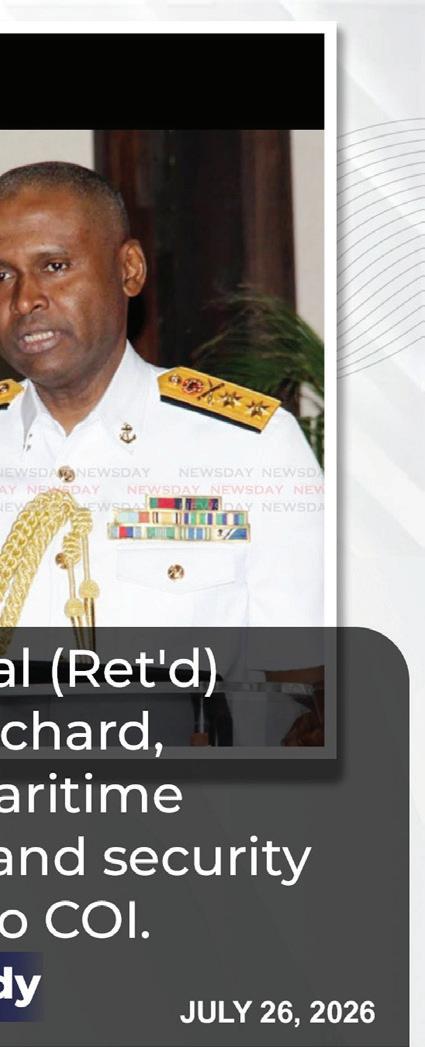
Admiral (Ret'd) Hayden Pritchard of Trinidad and Tobago, an expert in maritime operations and security.
"The commission will determine its own procedures and methods of work consistent with its mandate," President Ali said.
BROAD MANDATE
According to President Ali, the inquiry has been
the search, rescue and recovery operations, assessing the adequacy, coordination and effectiveness of the response mounted by all agencies and stakeholders involved.
The inquiry will evaluate whether applicable laws, regulations, maritime standards and ferry operating procedures were followed, while determin-
The panel will also assess the competence, qualifications, training and conduct of the vessel's master and crew, including compliance with established maritime safety and emergency procedures.
Additionally, commissioners will scrutinise passenger-management systems, including embarkation procedures, prepa-
ration of the passenger manifest, possible overcrowding, cargo stowage, the availability and use of life-saving equipment and compliance with passenger safety requirements.
At the conclusion of its work, the commission is expected to recommend legislative, regulatory, institutional and operational reforms, along with any other measures necessary to strengthen Guyana's maritime safety framework, improve emergency preparedness and response, and reduce the likelihood of similar tragedies occurring in the future.
President Ali said the legal instruments required to formally establish the commission are currently being finalised, after which the inquiry will commence its work in accordance with the law.
The announcement comes just over one week after the MV Barima disaster, which has become the deadliest maritime tragedy in Guyana's history.
The vessel departed Georgetown on July 18 bound for Port Kaituma carrying 116 passengers, 17 crew members and cargo before encountering difficulties and capsizing off the Essequibo Coast.
Since then, Guyana has mounted its largest-ever maritime search, rescue and recovery operation involving the Guyana Defence Force Coast Guard and Air Corps, the Guyana Police Force, the Maritime Administration De -
partment (MARAD), the Civil Defence Commission (CDC), local divers, volunteers, private vessels and international partners, including specialist divers and personnel from France, Trinidad and Tobago, Brazil and other supporting agencies.
As of Friday, au thorities confirmed that 73 bodies had been recovered, with 69 positively identified by relatives. Sixty-three bodies have already been released to their families for burial, while search and recovery operations continue for those still unaccounted for.
Government has also mobilised extensive support for affected families, including transportation, accommodation, funeral assistance, counselling services, medical care, psychosocial support and financial assistance through the Ministries of Human Services, Health and other state agencies.
The President has repeatedly assured families that the government remains committed to recovering every possible victim while ensuring a thorough and independent investigation into every aspect of the tragedy.
The Commission of Inquiry is expected to play a central role in determining accountability and recommending reforms that will shape the future of maritime safety in Guyana.
RESIDENTS in hinterland communities benefitting from Government-funded renewable energy projects will soon see lower electricity costs as savings generated through reduced fossil fuel consumption are passed directly on to consumers, Prime Minister Brigadier (Ret'd) Mark Phillips has said.
Addressing the National Toshaos Council (NTC) Conference, the Prime Minister said President Dr Irfaan Ali has directed that the financial benefits realised through renewable energy investments must be shared with residents in the communities where the projects are implemented.
"We do not only come here and announce that we save so many thousands of barrels of fuel, which is equivalent to so many millions of dollars every year," Phillips said.
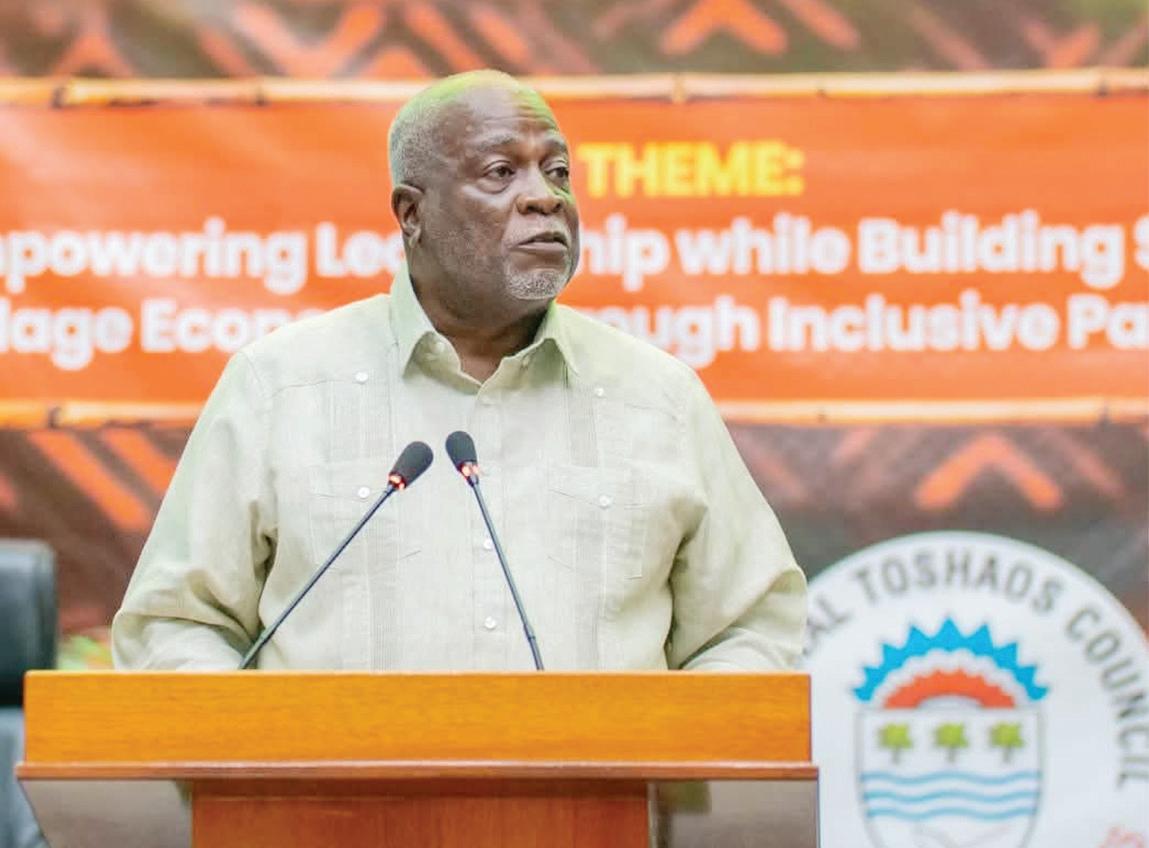
"Our President has directed that we do the analysis to ensure that every member of those communities who is paying a light bill pays lower rates."
He explained that the initiative has already been implemented in Mahdia and is now being expanded to other renewable energy communities, includ-

ing those in Region Two, with similar measures to follow wherever Government investments reduce reliance on fossil fuels.
The Prime Minister said the move reflects the Government's commitment to ensuring that hinterland communities benefit directly from the country's transition to cleaner energy under the Low Carbon Development Strategy (LCDS) 2030.
Phillips highlighted a number of renewable energy initiatives already completed across the hin-
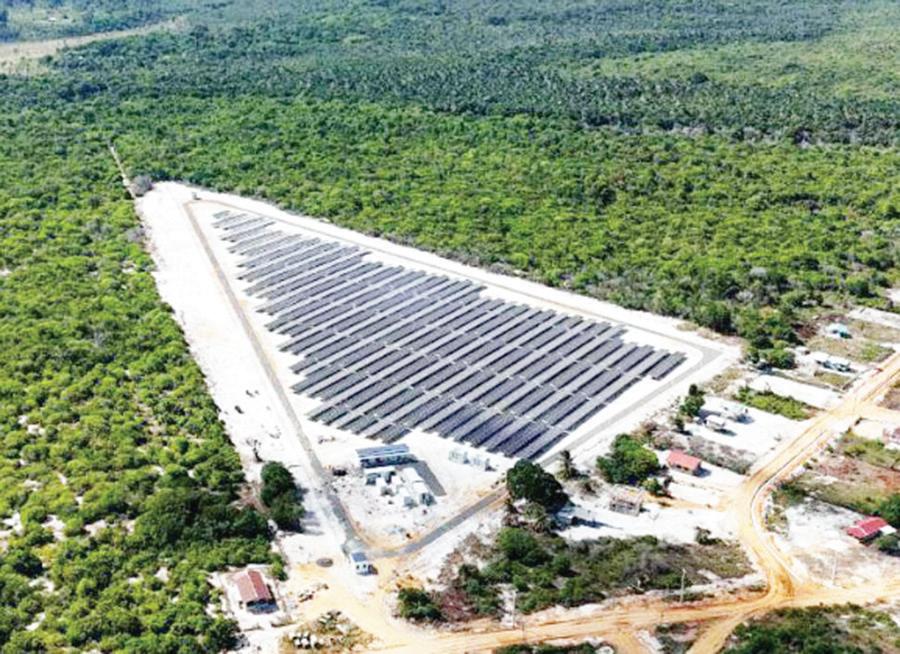

terland, including the distribution of solar home systems to approximately 37,000 households, the installation of community solar projects, utility-scale solar systems, and the construction of two mini-hydropower facilities in Region Nine.
He assured village leaders that these projects are only the beginning of a broader programme of investments aimed at improving the quality of life in Indigenous communities.
Beyond infrastructure, Phillips underscored the importance of building local capacity to manage and maintain the systems being installed.
He noted that residents have been receiving training in information and communications technology (ICT) and basic equipment maintenance, enabling communities to
independently operate ICT hubs, Starlink connectivity and renewable energy systems.
The Prime Minister also commended village leaders for encouraging women to participate in the technical training programmes.
Reaffirming the Government's commitment to equitable development, Phillips said the administration remains focused on ensuring that the same level of progress taking place on the coastland is extended to every hinterland community.
"You have a Government that is working with you and your community to improve the lives and livelihoods of your community... as we seek to develop the whole of Guyana through this One Guyana approach," he said.
THE National Assembly is expected to consider Supplementary Financial Paper No. 1 of 2026, totalling $54.9 billion, today, with allocations aimed at accelerating key government development programmes, including retroactive payments for Guyana Sugar Corporation (GUYSUCO) workers, housing expansion, infrastructural works and the Gas-to-Energy Project.
Senior Minister in the Office of the President with Responsibility for Finance, Dr. Ashni Singh, confirmed on Friday that the supplementary financial paper is listed on the Order Paper for today's parliamentary sitting.
According to the Finance Minister, the supplementary provisions are intended to support a range of critical government initiatives across several sectors.
Among the allocations is $8.3 billion for the Ministry of Agriculture, including $3 billion for GUYSUCO, within which provision has
been made for retroactive payments to sugar workers.
The agriculture allocation also includes $807.5 million for the Guyana Rice Development Board (GRDB) and $4.5 billion for the National Drainage and Irrigation Authority (NDIA) to strengthen the country's drainage and irrigation systems.
The Ministry of Housing is slated to receive $17.5 billion to support its accelerated work programme as government advances its housing agenda.
The allocation aligns with the People's Progressive Party/Civic's (PPP/C) 2026 manifesto commitments to expand affordable housing, construct 40,000 new houses, eliminate the backlog of housing applications across all regions and fast-track pending applications. Budget 2026 had already allocated $159.1 billion to the housing sector to reduce the cost of home-ownership and expand access to house lots and homes.
Meanwhile, the Office of the Prime Minister is expected to receive an additional $19.1 billion, including resources for the government's flagship Gas-to-Energy Project, which is expected to reduce electricity costs by approximately half once op-
erational.
Another $8.5 billion has been earmarked for the Ministry of Public Works to support its expanded work programme. This includes $6 billion for miscellaneous roads and drainage works and $2.5 billion for hinterland roads
as government continues to improve transportation links and connectivity nationwide.
The supplementary paper also provides $600 million under the Ministry of Public Utilities and Aviation for the maintenance of coastal airstrips, while $496.3 million
has been allocated for water interventions, including the establishment of additional water filling stations.
Additionally, $60 million has been requested for the Customs Anti-Narcotics Unit (CANU) under the Ministry of Home Affairs to support its accelerated operational programme.
The government said the supplementary allocations are intended to reinforce ongoing investments made over the past five years to modernise Guyana's infrastructure and public services.
These include expanding and rehabilitating drainage and irrigation systems, supporting agricultural development, improving healthcare delivery, expanding housing and road networks, modernising the education sector, diversifying the country's electricity supply, advancing digital government services and improving the overall quality of life for citizens.
MINDFUL Guyana Inc has extended its deepest sympathy and support to all individuals, families and communities affected by the tragic capsizing of the MV Barima off the Essequibo Coast.
The organisation said the distressing incident has undoubtedly caused emotional pain, fear, uncertainty and psychological strain for those directly involved, as well as for others affected by the tragedy.
In a press release, Mindful Guyana noted that traumatic incidents of this magnitude can have significant effects on the mental health and emotional well-being of survivors, family members, witnesses, rescue personnel and the wider community.
Individuals affected may experience a range of reactions, including shock, anxiety, grief, difficulty sleeping, intrusive thoughts or memories, feelings of helplessness, sadness, fear and emotional exhaustion.
The organisation explained that these are normal responses to an abnormal
and distressing event. However, if left unaddressed, they may interfere with daily functioning, relationships and overall quality of life.
In response to the tragedy, Mindful Guyana said it is making trauma-counselling services available to all persons affected, either directly or indirectly, by the MV Barima incident. Its professional team will provide compassionate, confidential and supportive counselling to help individuals process their experiences, manage emotional distress and begin the journey towards healing and recovery.
Persons wishing to schedule an appointment for immediate counselling support are encouraged to contact Mindful Guyana Inc on 693-4285. The organisation said appointments will be prioritised to ensure that those experiencing urgent emotional distress receive timely assistance.
The organisation stressed that, in times of tragedy, emotional and psychological recovery is just as important as physical recovery.
It noted that the effects of a trauma tic experience can persist long after the event, affecting a person's thoughts, emotions, sleep patterns, concentration, sense of safety and overall well-being.
Seeking professional counselling, it added, is a positive and courageous step towards healing and can help reduce the risk of long-term psychological difficulties.
Mindful Guyana encouraged anyone struggling with the emotional impact of the tragedy—including survivors, family members, witnesses and concerned community members—to seek support.
"No one should have to navigate the effects of trauma alone," the organisation stated.
It added that its thoughts remain with all those affected by the heartbreaking incident and expressed hope that, through understanding, professional support and collective care, healing and recovery are possible.


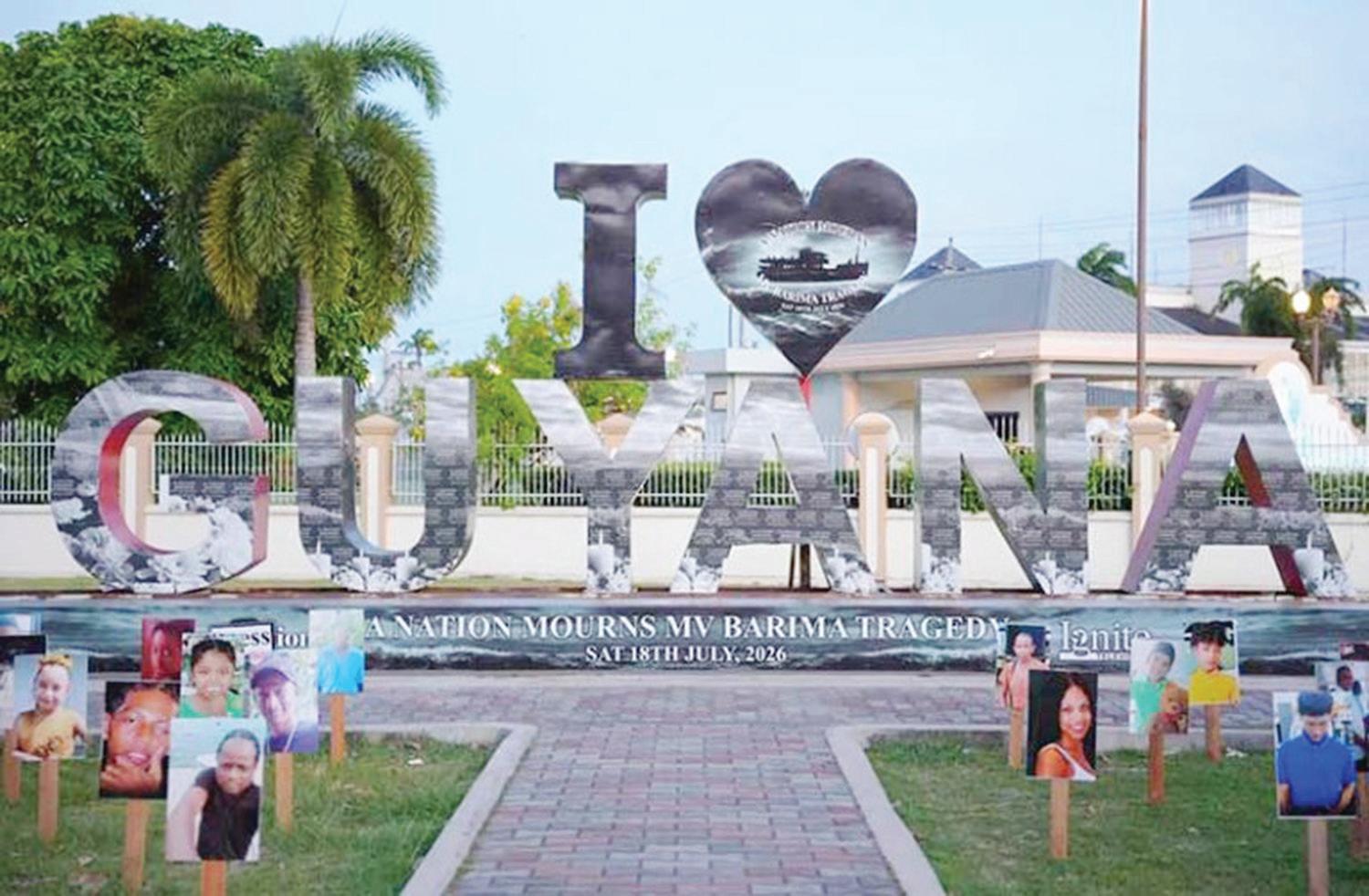
GUYANA has never faced a maritime tragedy of this scale. The sinking of the MV Barima off the Essequibo Coast has claimed dozens of lives and shaken every community, from Georgetown to Port Kaituma.
In moments like this, the true measure of a government is not found in its words but in the speed, seriousness, and integrity of its response. On that score, President Irfaan Ali's administration has risen to meet a national crisis with the clarity and resolve that grieving families deserve.
Within days, the State mounted the largest search-
and-rescue operation in the country's history, pulling together the Coast Guard, Air Corps, Police Force, MARAD, the Civil Defence Commission, and volunteers, while welcoming specialist support from France, Trinidad and Tobago, Brazil, and other partners. This was not a scattered response. It was a coordinated, whole-of-government mobilisation that prioritised one thing above all else: Bringing every victim home to their families.
Equally telling is what the government did for the survivors. Transportation, housing, funeral assistance,
‘A night of quest, when many went to rest’
A dark, troubling Saturday night, At sea in July’2026, there was no light. As the waves grew in height, The water lashed with all its might. It was the 18th, many felt it right, To board the MV Barima, when it was bright. Leaving Georgetown, somewhat in delight, Families looked forward to arrive home, alright. The moon hid, perhaps a sign of blight, Unseen stars, they too, took a flight. No one imagined a moment of fright, When, for their lives, all had to fight!
As danger struck, it became a Titanic plight, A boat, once afloat, was no longer upright. The water rose, it was a sorrowful sight, Cold and callous, fear and despair, alight. Endangerment knew not how to be polite, It did not prejudice the color of black nor white. Drama nor trauma, no one did invite, What remained was a dreadful site!
An SOS call, a distress signal ultimately ignite, Near Iron Punt, an urgent response did incite. Search and rescue teams, in all their mite, Went bravely, not to quit but to unite. Many a soul lost, like a fallen kite, Many will not enjoy another drink or bite. This tragedy will forever excite, A mournful story to write and rewrite. Yours respectfully, Jai Lall
counselling, medical care and financial support were extended to affected families through multiple ministries simultaneously.
A government that merely wanted to manage a news cycle would have offered condolences; this one built infrastructure around grief.
Now comes the announcement that will matter most in the long-run: A five-member international Commission of Inquiry, chaired by Justice Godfrey Phillip Smith, and staffed with maritime engineers, naval architects, admiralty lawyers, and operational security experts from across
the region and beyond.
This is not a symbolic gesture. The composition of this panel, deliberately international, deliberately technical, deliberately independent of any single national interest, signals that the President intends real accountability, not a whitewash.
The mandate given to the commission is sweeping by design. It reaches into vessel loading, boarding procedures, crew competence, weather conditions, passenger manifests, life-saving equipment, and the conduct of the rescue operation itself. Nothing is fenced off from scrutiny, including
the State's own agencies.
A government confident in its handling of a disaster invites this kind of unflinching examination. One with something to hide does not.
Critics will say inquiries take time; that no report can undo a loss this profound, and they are right; No commission can return a single life. But the alternative to a rigorous inquiry is not faster comfort; it is a hollow one.
President Ali has chosen the harder, more honest path: Recover the dead with dignity, support the living with real resources, and subject the tragedy to independent, expert scrutiny so

that its lessons are not lost to time or political convenience.
Guyana's maritime safety framework will be rebuilt on the findings of this commission. That process starts now, under international eyes, because the government chose transparency over expedience.
In a moment that could have produced only grief and blame, it has instead produced a template for how a nation responds when tested: With urgency, with compassion, and with the courage to be held accountable.
It is with profound sadness that we mark the passing of Ian Archie McDonald on July 24, 2026, a true literary icon, celebrated poet, elite sportsman, and revered columnist. His loss is felt all the more deeply as Guyana grapples with the heartbreaking MV Barima ferry tragedy. Below is an overview of his towering life and legacy, adapted from my 2022 book, Biographical Dictionary of Guyana, a project Ian so generously championed, promoted, and praised.
Early Life & Educational Foundation
Born in St. Augustine, Trinidad & Tobago, Ian received his secondary education at Queen’s Royal College (1942–1951) before attending Clare College, Cambridge University (1951–1955), where he earned a BA (Honours) in History and later his MA. Demonstrating early leadership, he was elected President of the Cambridge University West Indian Society. In 1955, Ian arrived in Guyana— the country that would become his home for the rest of his life.
A Colossus of the Sugar Industry & Regional Commerce
For over four decades, Ian was a pillar of Guyana's sugar industry.
• Corporate Leadership: He began his career with the Booker Group in 1955, steadily rising to Administrative Director of Bookers Sugar Estates. Following nationalization in 1976, he served as Director of Marketing and Administration for the Guyana Sugar Corporation (GuySuCo) until his retirement in 1999.
• Global & Regional Representation: He repeatedly represented Guyana and CARICOM at international sugar forums. He served as Chairman of Marketing for the Sugar Association of the Caribbean (SAC) from 1990, becoming CEO from 2000 to 2007, and chaired Demerara Sugar Terminals. In 1995, he addressed the International Sugar Organization in London on Caribbean sugar dynamics.
• Social Impact: For 35 years, he served on the Sugar Industry Labour Welfare Fund Committee, ensuring land, housing, clean water, and welfare facilities for sugar workers.
• Honors: In recogni -
tion of his sterling contributions, he was awarded Guyana's Golden Arrow of Achievement (AA) in 1986 and an honorary Doctorate of Letters (D.Litt) from the University of the West Indies in 1997.
Literary Titan & Cultural Guardian
Ian McDonald was one of the Caribbean’s most defining literary voices, authoring, co-authoring, and editing nearly 30 books.
• The Humming-Bird Tree: Published in 1969 to widespread acclaim, his landmark novel won the Royal Society of Literature’s Winifred Holtby Memorial Prize. It became a standard text in regional and international schools, was adapted into a 1992 BBC film, and saw multiple re-releases over the decades.
• Poetry & Prose: A three-time winner of the Guyana Prize for Literature (1992, 2004, 2012), Ian published nine poetry collections—including Essequibo (1992) and his deeply personal From Silence to Silence (2002)—along with short stories, plays (The Tramping Man), and three essay collections.
• Cultural Stewardship: Elected a Fellow of the Royal Society of Literature (FRSL) in 1970, Ian was instrumental in reviving Kyk-over-Al alongside A.J. Seymour and worked closely with Martin Carter. He served on the founding Management Committee for the Guyana Prize for Literature (1987), sat on the board of Castellani House, and served as Director of the Theatre Company of Guyana from 1980 to 2001.
A Champion on the Court Before his achievements as a statesman of literature and industry, Ian was an extraordinary athlete:
• Tennis Legend: A multi-year junior champion in Trinidad, he represented the nation at the senior level by age 16. He went on to play at Wimbledon in the 1950s—the only player from Trinidad or Guyana to ever do so.
• International Play: He captained Cambridge University (1955), competed in the Prentice Cup, and played for and captained the West Indies in its inaugural 1953 Davis Cup team.
• Guyanese Champion:
MANY unpatriotic attitudes and narrow minds are on display at the moment using the MV Barima tragedy either to stay relevant, either to get some publicity they always crave, either in their insane habits relish the opportunity to lash out at the government but I have to pass commentaries on these unholy intrusions because an iconic Guyanese has just died.
I don’t want to delay my eulogy of Ian McDonald. Intruding events will cause me to postpone it then by the time it is published, it is dated. So, I want to pen a few notes on Mr. McDonald. I have been in social activism for around a long time, mostly in the political field but despite these never-ending years, I never got to know Mr. McDonald.
One reason explains this –in his entire life, he eschewed even an ephemeral glance at Guyana’s politics. Because of my eternal presence in politics, I have interfaced with or knew
a little bit about all the major political players in Guyana, but he avoided political discourse; I did get to know Ian Mc Donald. My first contact with him was an email I sent him about the creeping degradation of the Stabroek News (SN) under its politicised editor, Mr. Anand Persaud. I wrote to him because I know he was one of the most decent Guyanese this land has known and as someone closely associated with the SN since its formation, he would tell me what I believe he would because of his decent mind.
I wrote to him for his opinion on the decision by Mr. Persaud that he cannot carry the letters of presidential adviser, Dr Randy Persaud because Dr Persaud’s submissions attack civil society. Mr. Mc Donald replied and advised that his response was personal. I cannot disclose it out of respect for him even in death. But his essential point was that he disagreed with that decision.
After learning about his advanced age, I told myself I do not think that I would be ever mentally comfortable concluding the Freddie Kissoon Show and not feature one of the most iconic Guyanese and one of the most decent citizens this nation produced. So, I called him and to my surprise he agreed. At the last few minutes of the interview, we brought his wife on camera as she was in the studio. Tonight (Monday) on the Freddie Kissoon Show, we repeat that interview.
The one cherished moment I have of Mr. Mc Donald did not emerge out of any conversation or interfacing moment. I read where he finally took time from his impeccable literary, non-political life and denounced the five months of election rigging in 2020 in his weekly, literary column in SN.
This was a defining moment in Guyanese politics and because of class crudities displayed during those five months
YESTERDAY the president announced the names of the chairman and commissioners for an official presidential commission of inquiry into the MV Barima tragedy. This, I’m sure, is welcome news both far and near. From all accounts, the named commissioners are competent and of good repute; the nation looks forward for a highly proficient and smooth process, followed by a report that substantially answers the questions that are on the minds of Guyanese. Not only answers to our questions, but also a menu of recommendations that will substantially and permanently change Guyanese river transportation and maritime landscape.
The entire team, by qualifications, are experts in some aspects of maritime affairs. My initial reaction to the composition of the commission, without canvassing the views of anyone else, is that the president should consider a sixth member. Someone locally based and, as far as possible, a non-expert. I am afraid that some subtle nuances of local life and experiences of Guyanese may go ununderstood and unnoticed.
While the experts concentrate on the technical details, they may miss certain shades and slants that may be immaterial in their own national
experience, but are of major importance to the Guyanese public. Further, laypeople and experts look at incidents from completely different perspectives.
I dare say that this was an ordinary-people tragedy. They do have passenger expertise of a totally different kind which may never be fully appreciated by international experts, some of whom may have never set foot in Guyana. The named experts are welcome; however, a local person with enough informal experience in the unique Guyanese maritime terrain should be asked to sit on the commission. I wish to use this space to humbly entreat President Ali to consider adding a local person to the commission.
The Terms of Reference announced by the President are, in my opinion, very comprehensive and is designed to get to the heart of all aspects of matters associated with the tragedy. Given those TORs, this CoI cannot be short; Guyanese will have to be extremely patient and forbearing. Let the process work, keep engaged, co-operate and participate as fully as the law allows.
Activists from the opposition had a lot to say, they have been demonising the government at every turn. They claimed that they have evidence of wrongdoing on the

Ian Mc Donald became someone who became close to my heart. To comprehend the seminal importance of Mc Donald’s disclosure one has to understand class structure and cultural anthropology of this nation.
My psyche was lacerated when I saw the final unfolding of the class mentality and cultural bias of the Mulatto/ Creole class (MCC) during the five months of assault on the election of 2020. A majority of these people I knew and trusted their abiding faith in free and fair election because they were involved with me in the long, dangerous, painful struggle for Guyana to get free and fair elections.
I am not the best analyst (far from it) but my analytical mind
told me why the MCC behaved like that in 2020. The question was not Anil Nandlall or Irfaan Ali or Vindya Persaud coming back to power. It was never about any individual Indian PPP leader. It was about what they saw as the non-Creole section of Guyana coming back to run Guyana which they thought had gone forever from Guyana after 2015.
In other words, it was about non-Christian, non Creolese Indians once more having power that they were not supposed to have after the colonials left.
The MCC finally showed their true colours (no pun intended).
The revelation that came to me in March 2020 was these political comrades of mine from the seventies hid their minds and
intentions from me for so long. I was mentally shattered. In the midst of this disturbing display of class entitlement, Ian McDonald did not think of what class be belonged to. His decent mind told him that his country should allow its citizens to vote and for that vote to be counted. For an MCC personality, all his life, Ian McDonald put country above class on March 2020 and for that he has taken his rightful place in Guyanese history.
DISCLAIMER: The views and opinions expressed in this column are solely those of the author and do not necessarily reflect the official policy or position of the Guyana National Newspapers Limited.
part of the Minister of Public Works. I hope that when the appropriate time comes, they will actually go to the CoI and present actual evidence. My guess is that not one of them will show up there, because since tragedy struck, they have essentially only engaged in political talking points and the contortion of facts to suit a particular political narrative.
That is not the sort of thing that could stand the scrutiny of a CoI, and they know that only too well. So, instead of engaging the CoI formally and presenting their dossier of facts, they will stay away and jump on social media with ranting pontification. They will cherry pick the evidence presented to the CoI and frame it in ways to excite the population in the hope of scoring political points. This, of course, is a prediction knowing as I do, the nature of the beast.
With respect to the loud call for Minister Edghill to go, I find most aspects of it comical. The comedy lies is the personage of those that are loudest in their demand for the minister to resign. Perennial sourpusses, they trade in all that’s negative and hawk misinformation as their stock in trade, many of them do not come to the table with clean hands.
On the Freddie Kissoon Show, I had occasion to point

out several areas of misinformation being peddled by known opposition parliamentarians. For example, a trio from APNU were on social media telling the public that the government refused foreign assistance for divers to come and assist with rescue and recovery operations. They also told the nation that a person who recovered a body and took it to the authorities was arrested, because he was associated with the leader of the opposition. Of course, the police were merely doing their job. What kind of police work would it be if a person simply turns up with a corpse and be able to hand it in without question? Law enforcement must detain that person until they can ascertain the true origin of the body. Everyone knows that this is standard and basic police work, but not the opposition leader and APNU – his echo chamber of doom.
Even though rescue crews and Coast Guard personnel reported that the first rescues took place just after 2 a.m. and were delivered on shore just
after 3 a.m. on the night of the tragedy, the opposition ran all over social media and painted the picture of rescue apparatus twiddling their thumbs and never commencing rescue efforts till 4 am. They interviewed two single persons who were rescued just after 5 am and behaved as if those were the first to be rescued. It was calculated to infuriate and excite the public with deliberate misinformation. In the midst of a national tragedy, this is the type and quality of opposition politicians attempting to present themselves as alternatives to this government.
I do not have all the information necessary to be able to offer informed commentary on whether the minister should be relieved of his duties, but if I were to rely purely on the emanations from the opposition, the minister may as well be booked to serve another term. My own preference would be to wait on the conclusions of the CoI and the president, who is empowered to act, I’m sure he will make a determination at that time.
Amazingly, one hour had scarcely elapsed after the president announced the nominees to the CoI before the opposition elements started to demonise every one of them. The opposition has an insatiable, avaricious appetite for feigned contrarian anti-government spittle. They set out to assail and discredit every one of the eminently qualified panelists in an effort to lay the ground to later claim that the whole commission is compromised. Sounds familiar? Where have we seen that before? Ahhhhh! The Adriana Younge postmortem. It is sad that the opposition is converting Guyana into a drubbing pit for the careers and reputations of people with respected expertise everywhere else in the world; a place where professional reputations come to die.
DISCLAIMER: The views and opinions expressed in this column are solely those of the author and do not necessarily reflect the official policy or position of the Guyana National Newspapers Limited.
THE Georgetown Chamber of Commerce and Industry (GCCI) has welcomed the Government's decision to establish a Commission of Inquiry (CoI) into the MV Barima tragedy, describing it as an important step towards uncovering the facts, strengthening public confidence and improving safety within Guyana's transport sector.
In a statement issued on Sunday, the Chamber said the inquiry aligns with its earlier call for a thorough, transparent and evidence-based examination of the circumstances surrounding the maritime disaster.
"The Chamber remains

deeply mindful that this inquiry follows a national tragedy marked by the tragic loss of life and its profound impact on families and communities," the statement said, while extending continued sympathy to the victims, survivors and their families.
The business organisation also expressed confidence in
the composition of the Commission, citing the expertise of its members in judicial affairs, marine engineering, maritime surveying and compliance, admiralty and maritime law, and maritime operations and security.
According to the GCCI, the Commission has a significant opportunity to establish the facts surrounding the disaster, identify lessons to be learned and reinforce public trust in the institutions responsible for safeguarding commuters.
The Chamber said it expects the Commission's findings and recommendations to support stronger public safety measures, enhance regulatory
oversight and contribute to the continued development of Guyana's transport sector.
Looking beyond the inquiry itself, the GCCI stressed that the Commission's lasting impact will depend on the implementation of its recommendations.
It said the tragedy should serve as a catalyst for meaningful reforms that improve public safety, strengthen regulatory systems and better protect those who rely on the country's transport network.
The Chamber also noted that its position follows an
earlier statement issued on July 20, in which it extended condolences to the families of the victims and called for a comprehensive, transparent and evidence-based investigation into the circumstances surrounding the MV Barima tragedy.
COMMUNITY Policing Groups (CPGs) across five regions are now better equipped for patrols and emergency responses in remote and hard-to-reach areas, thanks to a $15 million investment by the Government of Guyana through the Ministry of Home Affairs.
During a handover ceremony Saturday at the Ministry’s Brickdam office, Dep-
uty Permanent Secretary, Dwayne Adams, presented five Kawasaki All-Terrain Vehicles (ATVs) to CPGs serving Mabaruma, Region One; Onderneeming Sand Pit, Region Two; Wakenaam (Zeelandia), Region Three; Cotton Tree, Region Five; and Toka, Region Nine.
The ATVs will improve mobility for routine patrols, enhance access to communities, and support faster responses to incidents. They will also strengthen the efforts of CPGs working alongside the Guyana Police Force and local stakeholders in crime prevention and community safety. This investment is part of the Government’s ongoing support for community policing and initiatives to improve public safety across Guyana.
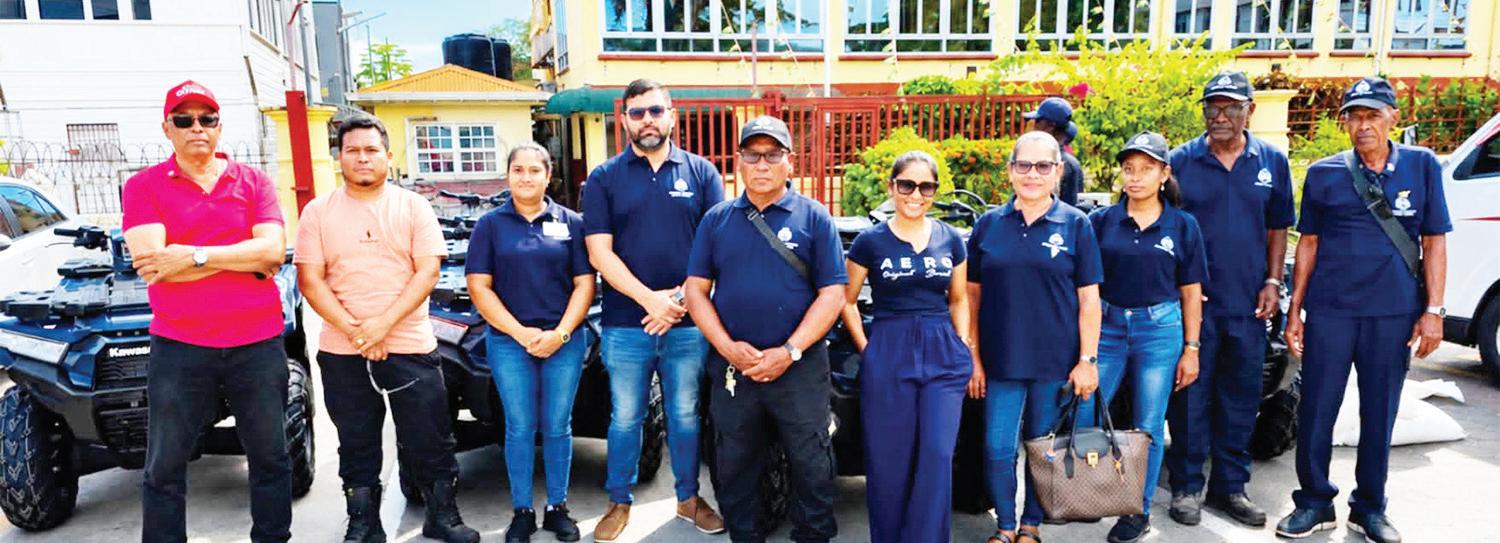
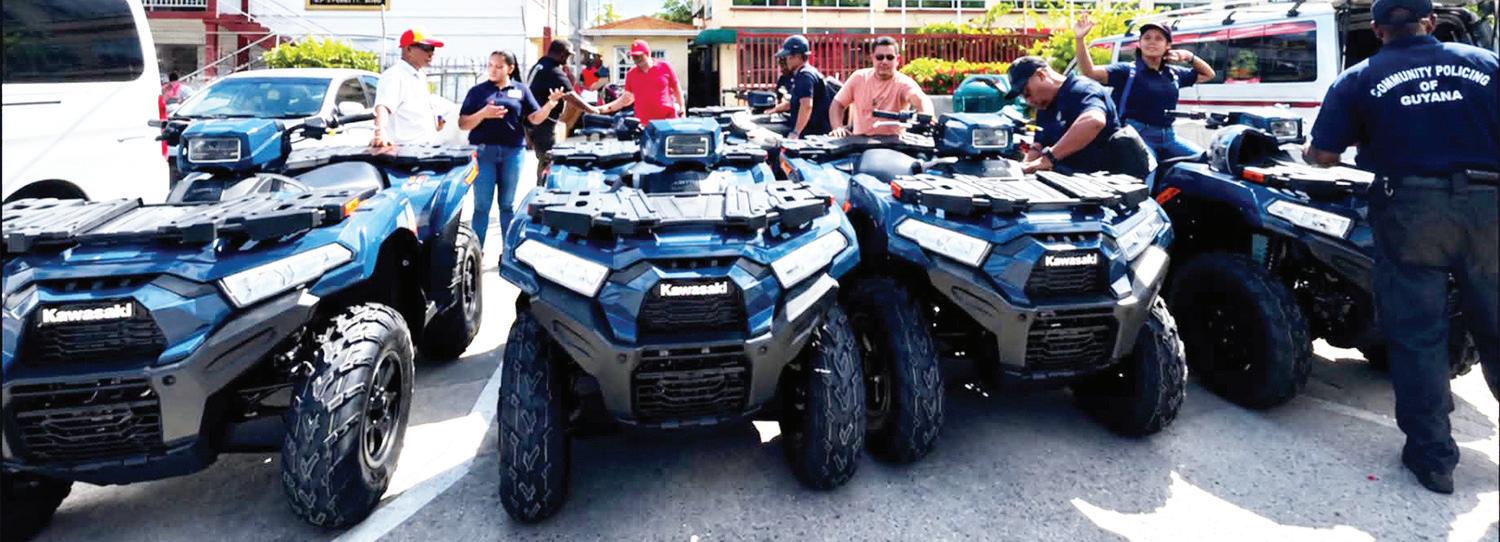
Deputy Permanent Secretary, Dwayne Adams, presents five Kawasaki All-Terrain Vehicles (ATVs) to CPGs serving Mabaruma, Region One; Onderneeming Sand Pit, Region Two; Wakenaam (Zeelandia), Region Three; Cotton Tree, Region Five; and Toka, Region Nine
FROM PAGE 6
From 1956 to the early 1970s, he dominated as Guyana's tennis champion and team captain, earning Guyana’s Sportsman of the Year honor in 1957. He also captained Guyana in squash. Statesmanship, Intellectual Leadership & Public Voice Ian’s intellect helped shape West Indian identity:
• Regional Vision: In 1991/92, he served as Editorial Consultant to the West Indian Commission alongside Sir Shridath Ramphal, drafting the seminal report Time for Action and publishing Bedrock of a Nation: Cultural Foundations of West
Indian Integration. In 1996, he joined the inaugural West Indies 2000 Group think-tank.
• Public Intellectual: From 1986 until its closure in March 2026, Ian was a beloved columnist for the Stabroek News, while also contributing regularly to The Nation (Barbados), The Gleaner (Jamaica), and the Trinidad and Tobago Review. He authored over 400 radio broadcasts covering regional affairs, culture, and sports.
A Lasting Legacy
Over his long and distinguished life, Ian McDonald was honored with the Wordsworth McAndrew Award (2004), in-
duction into the Queen’s Royal College Hall of Honour (2004), multiple sports commission lifetime awards, and recognition from the Olympic Committee for his dual contributions to art and sport.
Ian Archie McDonald lived a life of boundless generosity, brilliant intellect, and unwavering service to Guyana and the wider Caribbean. He leaves behind an indelible mark on our literature, our sports history, and our national conscience.
Lal Balkaran Scarborough, Ontario
CHIEF Magistrate
Judy Latchman and a high-level delegation from the Magistracy visited the Lusignan Prison on Friday as part of efforts to strengthen collaboration with the Guyana Prison Service (GPS) and gain a firsthand
understanding of the prison's operations and challenges.
The visit brought together several newly appointed magistrates and senior judicial officials, who were welcomed by Director of Prisons, Nicklon Elliot.
The delegation in -
cluded Magistrates Ocelisa Marks, Nikkisha Logan, Jimelle Joseph, Shareefah Parks, Taneisha Saygon and Caressa Henry, along with Court Administrator Monique Ifill, Drug Treatment and Mental Health Court Manager, Dion Chase, Administrative Officer
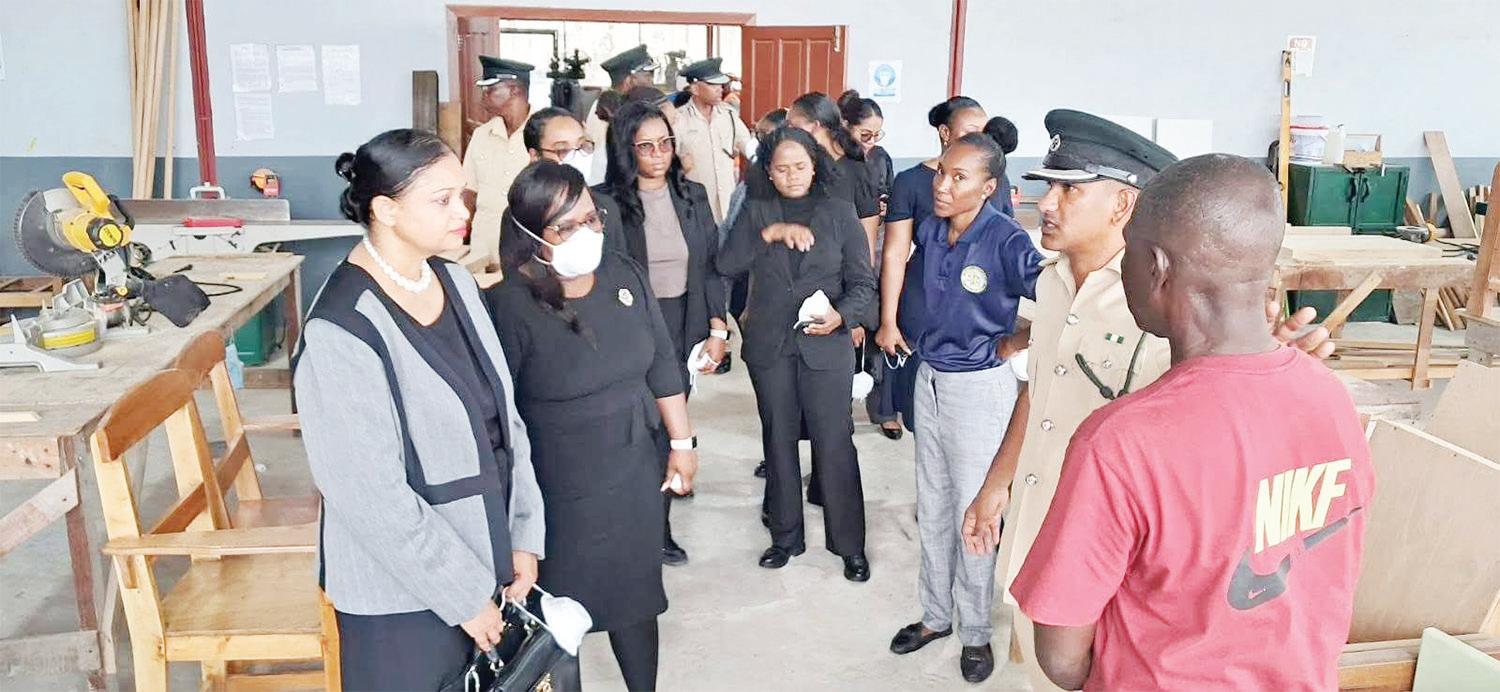
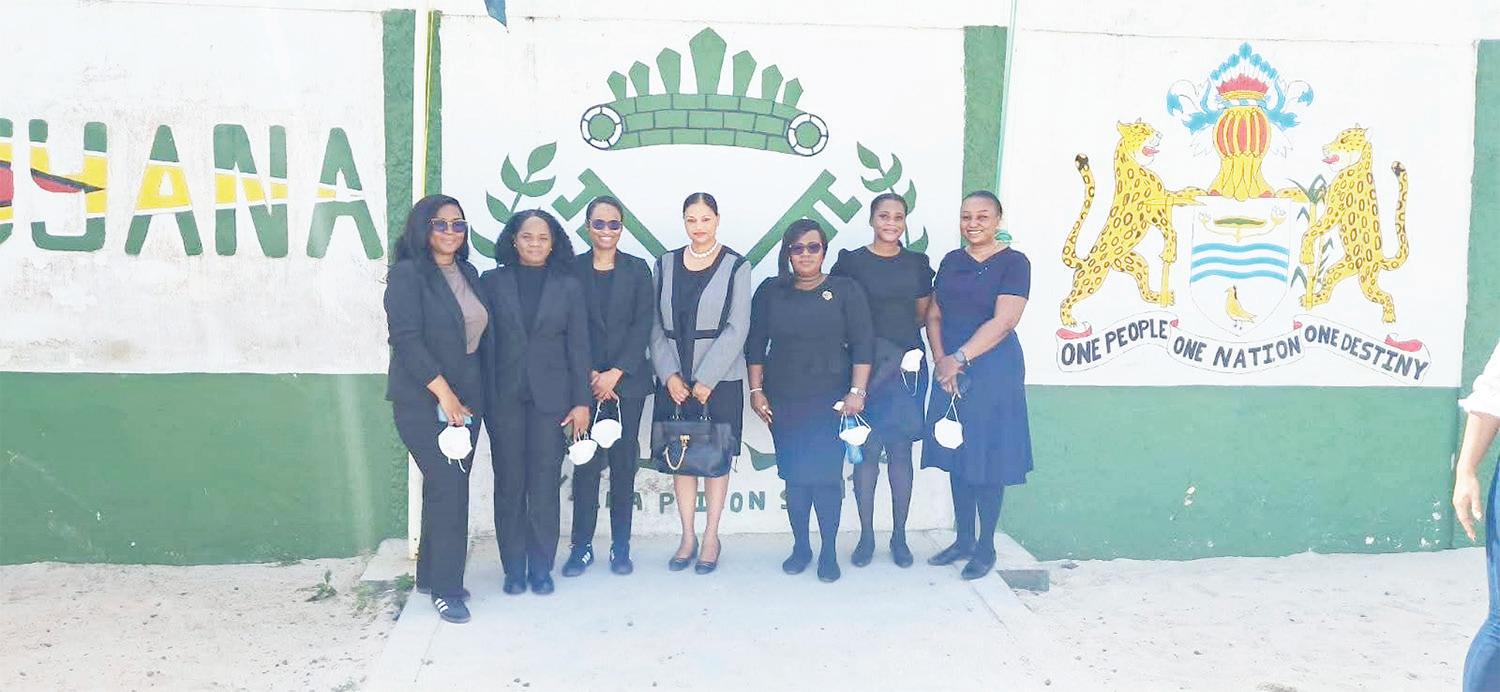
of the Judicial Service Commission, Julianna Hollingsworth, and Assistant Protocol and Communication Officer, Bhanmattie Ramdial.
During the engagement, Elliot highlighted the importance of continued collaboration between the judiciary and the prison service, noting that closer co-operation is essential to advancing the country's correctional system.
He also briefed the delegation on the Guyana Prison Service's ongoing transformation, explain-
ing that the institution has shifted its focus towards a modern correctional model centred on rehabilitation, reintegration and the restoration of human dignity.
Chief Magistrate Latchman welcomed the opportunity to engage directly with prison officials and reaffirmed the Magistracy's commitment to maintaining a strong working relationship with the Guyana Prison Service.
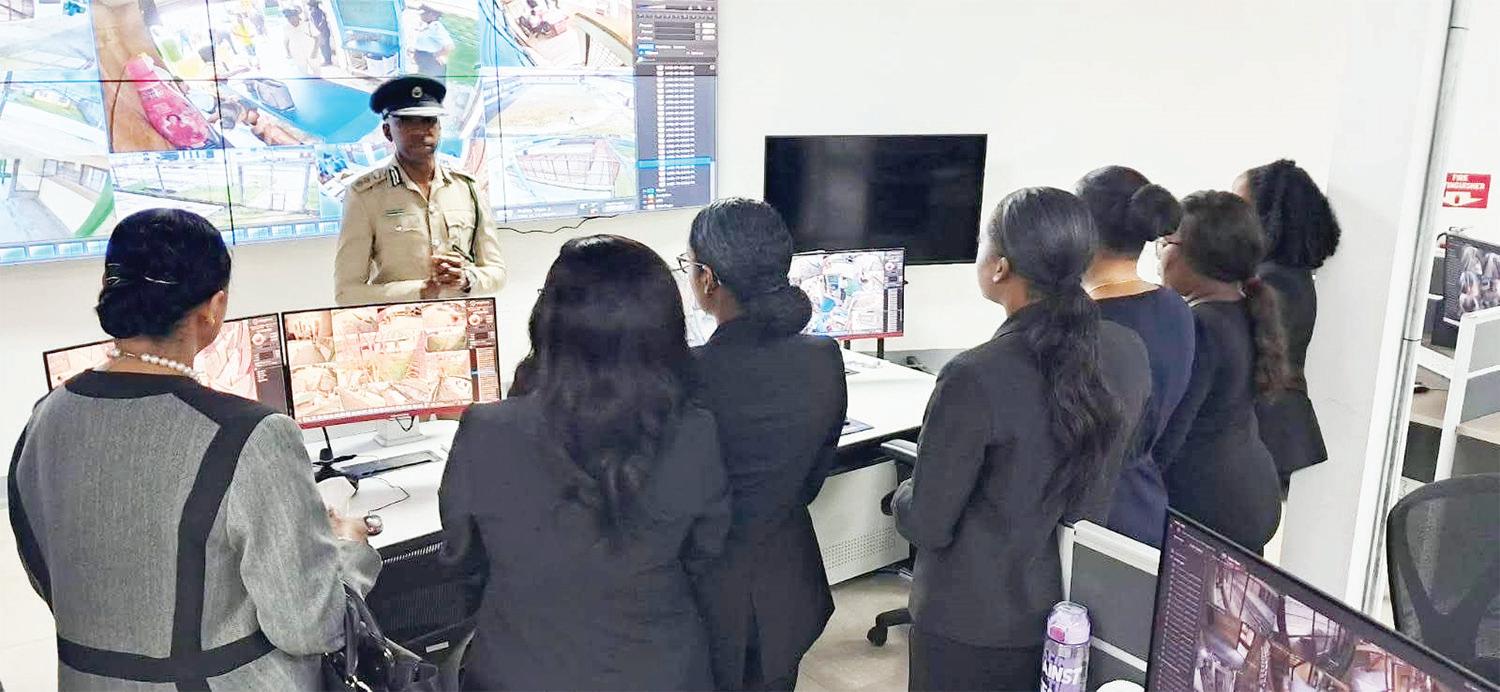
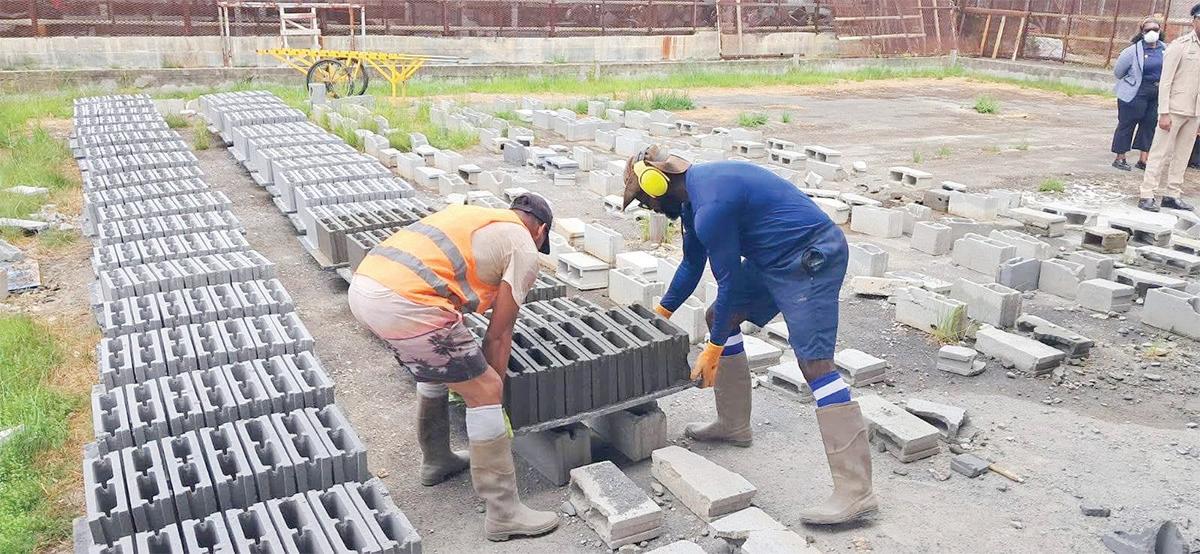
The delegation later toured several key facilities within the pris -
on compound, including the new administrative building currently under construction, virtual courtrooms, the kitchen, medical centre, trade shop, prisoner housing units, the intake processing area and the Command Centre.
The visit provided judicial officers with a closer look at the prison's daily operations and ongoing infrastructural development as the Guyana Prison Service continues efforts to modernise the country's correctional system.
— Public Works Minister says village-led infrastructural model increasing jobs, building skills and keeping resources within communities
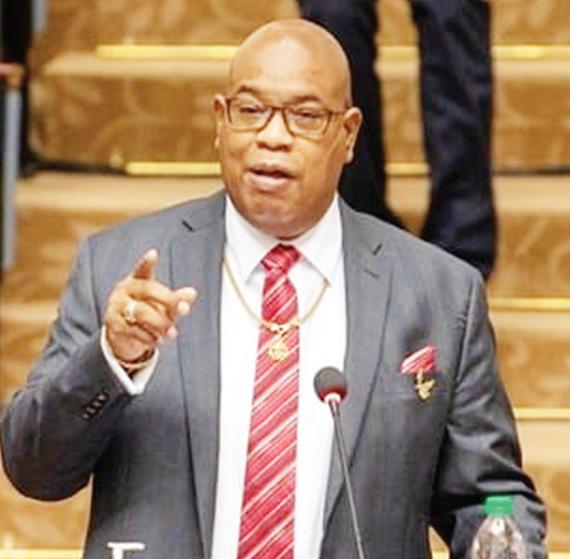
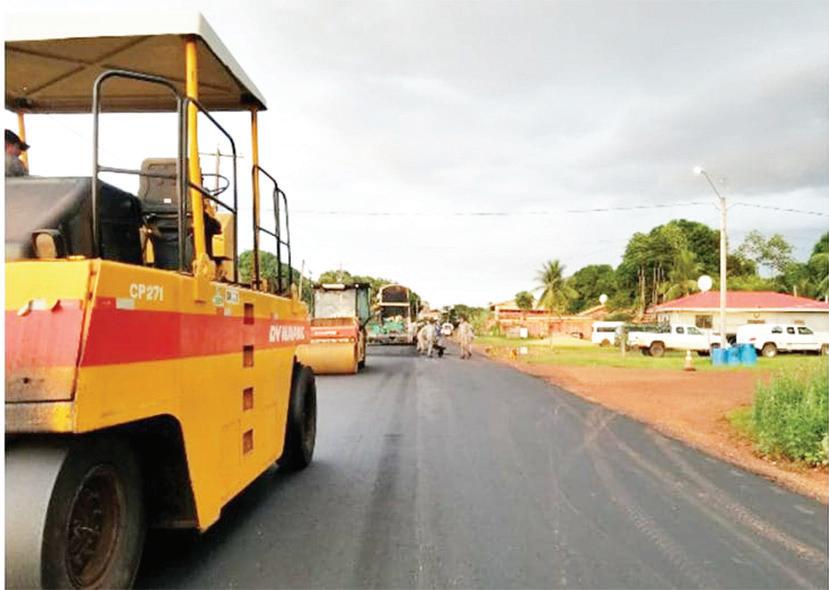
HINTERLAND communities are becoming increasingly involved in delivering their own infrastructural projects, with village councils and residents now taking on greater responsibility for building and maintaining roads and bridges, Minister of Public Works Juan Edghill has said.
The Minister made the remarks during discussions with Indigenous leaders at the National Toshaos Council (NTC) Conference, where he said the Government has shifted from the traditional approach of bringing external contractors into communities to a model in which residents are trained, employed and directly engaged in development projects.
Edghill said the approach was born out of concerns raised by community lead-
to develop skills that can be used beyond individual projects.
According to Edghill, through interventions by the ministry's Special Projects Unit, more than 800 persons have been employed in hinterland communities, with many receiving training and acquiring construction-related skills.
"It's not just about building roads. We have moved the discussion and the understanding from infrastructure
He noted that improved roads and bridges have helped maintain access to essential services, including healthcare, education and the transportation of supplies.
The Minister also outlined the scale of the Government's infrastructural investments since 2020, pointing to increased allocations for hinterland development and the construction and upgrading of roads across several regions.
ers who had complained that contractors would enter villages, complete projects and leave residents with little involvement in the process.
"I am happy to stand here and report to you that, having listened to that, you have become the contractors. You are the ones who are doing the work, and you are making a difference in your communities," Edghill said.
He noted that the community participation model has ensured that investment remains within villages while allowing residents
to sustainable village economies," he said.
The Minister highlighted that the approach has also enabled communities to develop the capacity to undertake future projects, noting that residents who worked on earlier initiatives have been able to transfer their knowledge and skills when new projects are introduced elsewhere.
Edghill said infrastructure investment has been critical to reducing isolation in hinterland communities, particularly during periods of flooding and other emergencies.
He added that the continued involvement of village councils will remain central to future infrastructural development, including bridge rehabilitation projects in communities affected by recent flooding. According to Edghill, the partnership between the Government and hinterland communities is helping to create stronger, more resilient villages where residents are not only beneficiaries of development but also active participants in shaping it.
LANDMARK court decisions from Guyana are among the cases that have influenced the Caribbean Court of Justice's (CCJ) evolving jurisprudence, according to a paper presented by CCJ Judge Peter Jamadar on the development of a distinctly Caribbean body of law.
Delivering a presentation titled Cases, Reflections, and Methodologies: Shaping a Distinctively Relevant Caribbean Jurisprudence during the University of Toronto's Summer Abroad Course earlier this month, Justice Peter Jamadar outlined the CCJ’s vision for developing an indigenous body of law.
In the presentation, Guyana was highlighted as one of the jurisdictions where cases have significantly influenced the evolution of constitutional, commercial and procedural law across the Caribbean.
The judge argued that the CCJ's mandate extends beyond serving as the region's final appellate court. Instead, he said, it was established to develop an indigenous Caribbean jurisprudence rooted in the region's own history, constitutional values and social realities rather than relying uncritically on English legal precedents.
Justice Jamadar said: “The Caribbean Court of Justice plays a significant role in developing a uniquely Caribbean jurisprudence. It is the only indigenous apex court for Anglo-Caribbean states and has been a torchbearer of this principle since its inception.”
“Indeed, the making, interpretation, and application of law is, fundamentally, epistemological. It shapes how peoples come to know and understand themselves and their societies,” he added.
"The main purpose in establishing this court is to promote the development of a Caribbean jurisprudence, a goal which Caribbean courts are best equipped to pursue," Jamadar quoted from Attorney General v Joseph, one of the CCJ's founding judgments, noting that the court has consistently pursued that objective since its establishment in 2005.
Among the Guyanese decisions identified as pivotal was the 2018 McEwan v Attorney General of Guyana ruling, which the judge described as one of the court's most significant constitutional decisions. The judgment affirmed the importance of dignity and equality under
Caribbean constitutions and reinforced the principle that constitutional rights must be interpreted generously to protect citizens.
Justice Jamadar pointed to what he described as one of the CCJ’s most frequently cited pronouncements on dignity and equality, noting that "difference is as natural as breathing" and that "civilised society has a duty to accommodate suitably [sic] differences among human beings."
He said the court made clear that no person's dignity should be undermined or rights denied simply because they are different, particularly where that difference poses no threat to public safety or public order.
Justice Jamadar also highlighted Bisram v Director of Public Prosecutions (2022) as another important Guyanese case that advanced the CCJ's rights-based approach to constitutional interpretation.
The presentation further highlighted Guyana's unique legal heritage, noting that unlike many Commonwealth Caribbean jurisdictions, the country continues to retain elements of Roman-Dutch law alongside the common-law tradition. According to Jamadar, this mixed legal system has contributed to the richness and diversity of Caribbean jurisprudence. In the area of commercial law, the judge described the 2026 decision in Cara Investments Ltd v Ram as a milestone in the development of Caribbean contract law.
He said the ruling advanced the principle of good faith in commercial dealings and demonstrated how constitutional values can influence private law.
Justice Jamadar noted that the impact of the ruling is already being tested in Guyana's High Court through separate de-banking cases, illustrating how legal principles developed by the CCJ continue to evolve as
they are applied by domestic courts.
Throughout the presentation, Jamadar noted that Caribbean courts should interpret constitutions and legislation through the lens of the region's own experiences, cultures and aspirations.
He said the development of an indigenous Caribbean jurisprudence represents an important act of self-determination, allowing Caribbean people to interpret their constitutions "on their own terms, in light of their own histories and futures."
Guyana was among the first countries to adopt the CCJ as its final appellate court and remains one of only five Caribbean Community (CARICOM) member states that currently recognise the regional court as their court of last resort.
The CCJ was inaugurated in Port of Spain, Republic of Trinidad and Tobago April 16, 2005, and presently has a bench of six judges presided over by CCJ President, Justice Winston Anderson.
The CCJ has an Original and an Appellate Jurisdiction and is effectively, therefore, two courts in one. In its Original Jurisdiction, it is an international court with exclusive jurisdiction to interpret and apply the rules set out in the Revised Treaty of Chaguaramas (RTC) and to decide disputes arising under it.
The RTC established CARICOM and the CARICOM Single Market and Economy (CSME).
In its Original Jurisdiction, the CCJ is critical to the CSME and all 12 member states which belong to the CSME (including their citizens, businesses, and governments) can access the court's Original Jurisdiction to protect their rights under the RTC.
In its Appellate Jurisdiction, the CCJ is the final court of appeal for criminal and civil matters for those countries in the Caribbean that alter their national Constitutions to enable the CCJ to perform that role.
At present, five states access the court in its Appellate Jurisdiction, these being Barbados, Belize, Dominica, Guyana, and Saint Lucia.
However, by signing and ratifying the agreement establishing the CCJ, member states of the Caribbean Community have demonstrated a commitment to making the CCJ their final court of appeal.

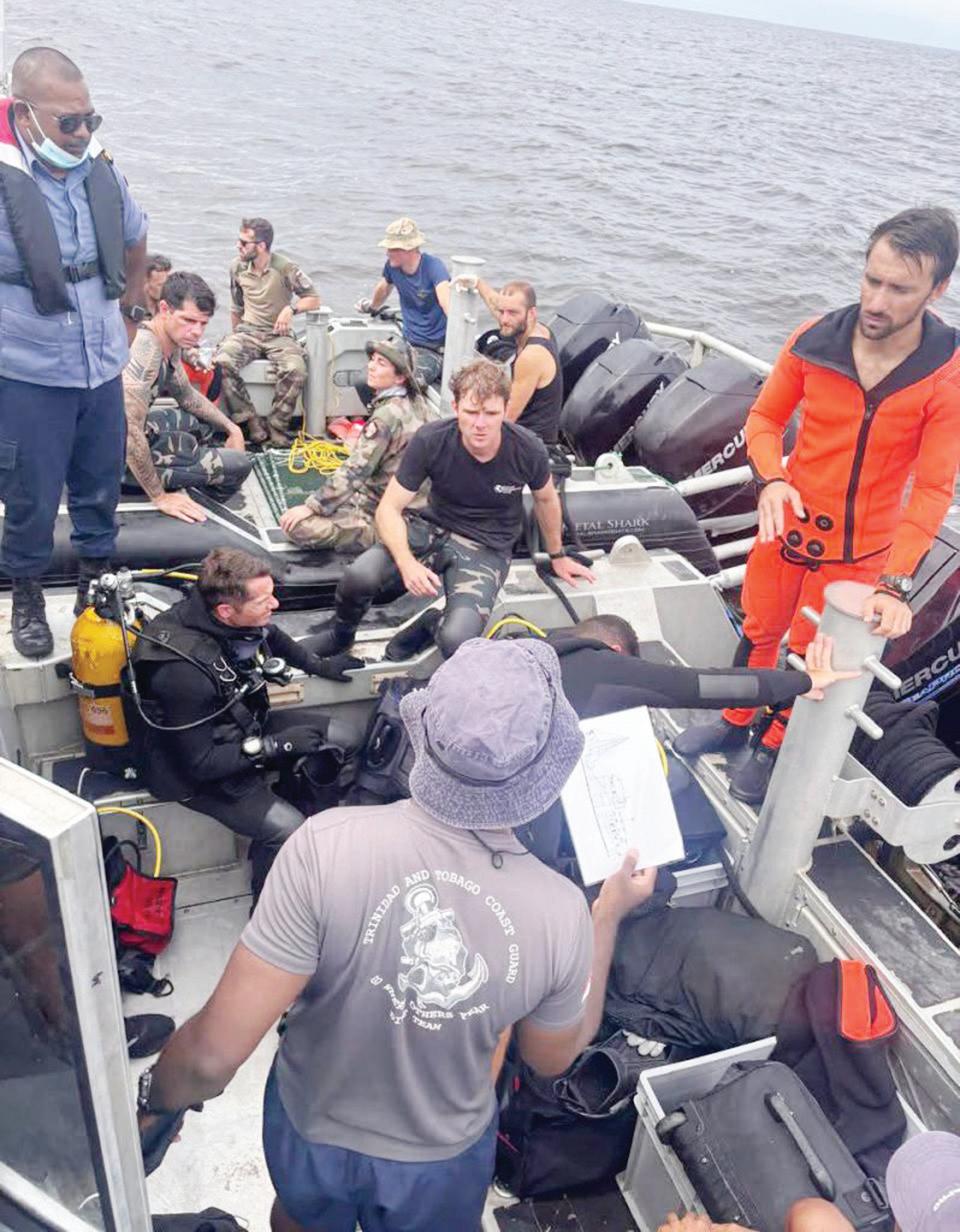
ZERO visibility, powerful curren ts and the maze of ropes and hammocks inside the capsized MV Barima are making recovery efforts extraordinarily dangerous, French military divers told anxious relatives of the missing during a briefing at the Charity Operations Centre on Sunday.
The update came as international dive teams continue painstaking operations at the wreck site, where authorities are racing to recover those still unaccounted for following Guyana’s worst maritime disaster.
Speaking directly to family members, a French military officer explained that the environmental conditions beneath the surface have severely limited what divers are able to do.
“We arrived on Monday, and since Tuesday we have committed about 15 dives on the wreck,” the officer said.
He explained that the operation is being carried out in complete darkness, with strong tides and currents making navigation extremely hazardous.
“It is totally dark there. There are very, very hard environmental conditions, especially because of the tide and the current on the wreck,” he said.
“So, it is very difficult for us to navigate through the wreck. We have to feel the wreck, and it’s like we are blind.”
The officer said divers are unable to rely on visibility and instead must navigate by touch while feeling for the vessel’s structure.
“We follow the rope, arrive on the wreck and try to navigate by searching the characteristics of the wreck,” he explained.
The presence of ropes, hammocks and other obstructions inside the vessel has
made entering the wreck especially dangerous.
“It is too dangerous for us to enter into the wreck, and because of the many ropes and the hammocks, it’s very difficult to see where we are going,” he said.
The officer thanked the Guyana Defence Force for its support throughout the operation, while stressing that the difficult underwater conditions—not a lack of effort—remain the greatest obstacle facing recovery teams.
“I would also like to thank the Guyana Defence Force for all their support, which has allowed us to conduct the dives, but the weather conditions and the environmental conditions of the sea are really, really hard,” he said.
During the briefing, one relative asked whether the condition of the wreck and the underwater environment made it possible to move the vessel.
In response, the French officer acknowledged that such an operation would be extremely challenging.
“I think it is very, very hard to so such a thing… the wreck is not very strong, so it is difficult,” he said.
The French Armed Forces are among several international teams assisting Guyana’s multi-agency operation, alongside specialist divers from Trinidad and Tobago and local dive teams.
Authorities have said recovery efforts remain focused on carefully searching the vessel, while ensuring the safety of divers working in one of the most difficult underwater environments encountered during the operation.
The MV Barima sank on the night of Saturday, July 18, 2026, while en route from Georgetown to Port Kaituma, Region One.
A distress call was received at approximately 23:01hrs (11:01 p.m.), triggering one of the largest maritime search-and-rescue operations in Guyana’s history, supported by the Guyana Defence Force Coast Guard,
local agencies, private vessels, international partners, and specialist diving teams from France, Brazil and Trinidad and Tobago.
Subsequent investigations confirmed that 179 people, including passengers and crew, were aboard the vessel when it capsized.
To date, 76 people have been rescued, while 73 bodies have been recovered and 65 of the recovered victims have now been positively identified
by their families, while 30 persons remain uncounted for. Government has also mobilised transportation, accommodation, psychosocial counselling, medical services, funeral assistance and other support for affected families as recovery efforts continue. Authorities have pledged to continue the operation for as long as necessary to recover those still missing and bring closure to grieving families.

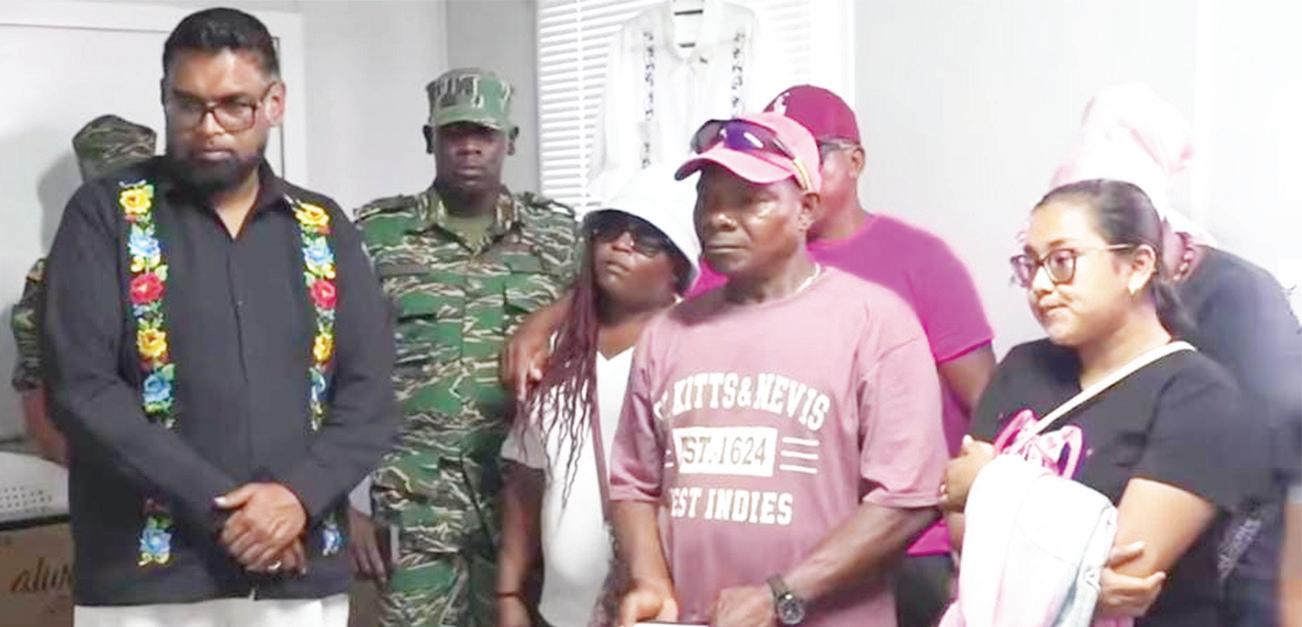
of those still missing following the MV Barima tragedy were on Sunday given a live view of the deep-diving operation at the wreck site as President Dr. Irfaan Ali updated them on the ongoing search and recovery effort.
During a meeting at the Charity Command Centre, families watched live footage transmitted from the operation at sea, providing them with a first-hand look at the challenging work being
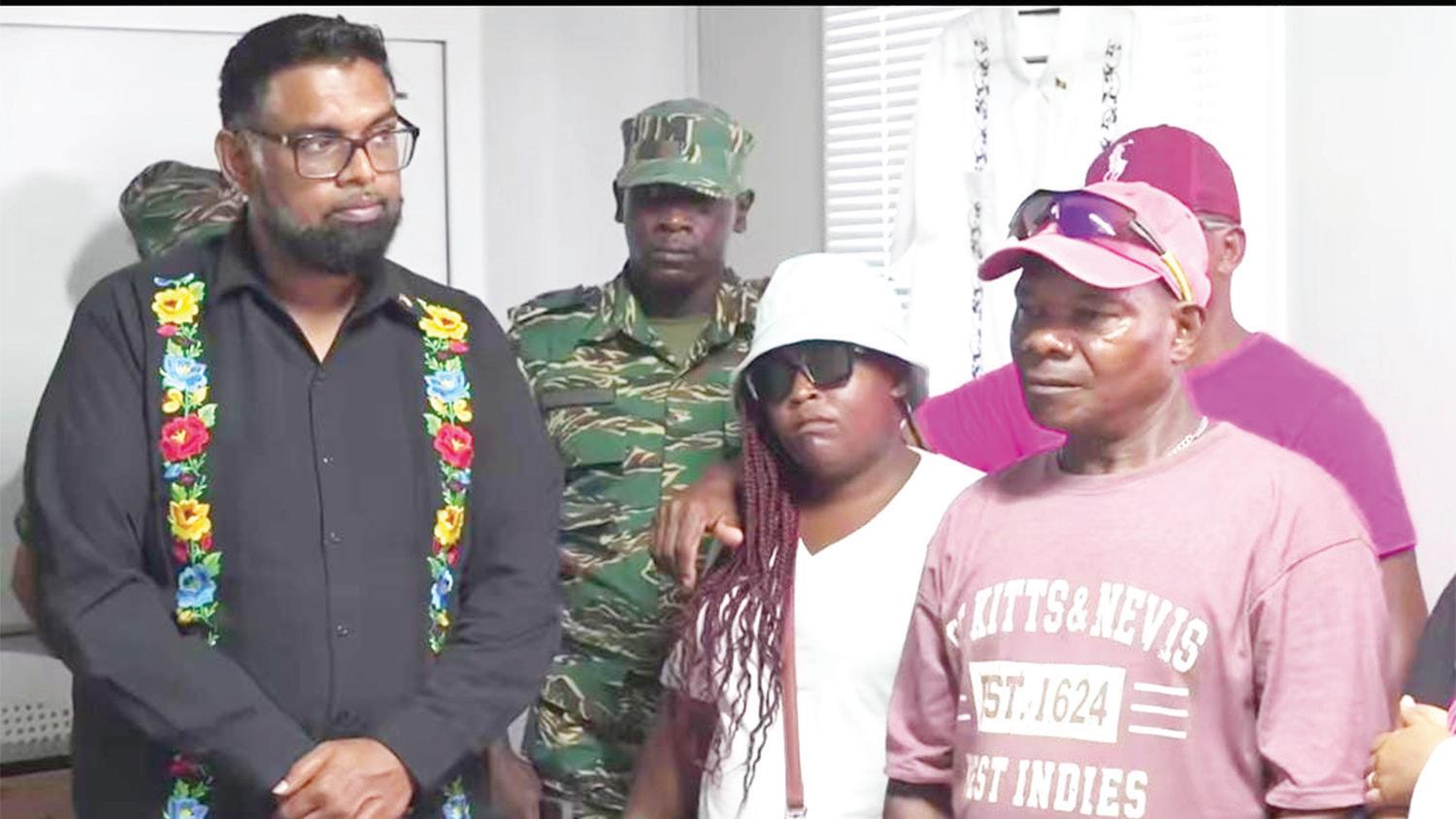
undertaken by specialist divers beneath the water.
The President told
relatives that search and recovery operations would continue through Sunday night
cate those who remain unaccounted for.
would rest entirely with the affected families.
and into Monday, as local, French and Trinidadian dive teams press ahead with efforts to lo-
During the engagement, family members also raised concerns about how the area where the MV Barima sank would be recognised if some of their loved ones are never recovered. They asked whether the wreck site could be designated as a memorial bearing the names of those who perished and those who remain missing.
Responding to the request, President Ali assured the relatives that any such decision
He said the government would honour and respect whatever decision the families collectively make regarding the future of the site.
The President has remained at the Charity Command Centre, receiving regular operational briefings while continuing to meet with grieving relatives as the complex search and recovery mission enters another day.
Meet the distinguished experts tasked with uncovering the truth
THE five-member Commission of Inquiry (CoI) that will investigate the MV Barima tragedy brings together an exceptional blend of legal, maritime, engineering and military expertise from across the Caribbean and internationally.
The commissioners possess decades of experience spanning maritime law; naval architecture; casualty investigations; defence and security; judicial administration and public policy. Collectively, they have investigated ship sinkings, maritime accidents, national security matters and complex legal disputes, while advising governments, international organisations and shipping industries around the world.
Their task is to establish the facts surrounding the MV Barima tragedy and make recommendations aimed at strengthening Guyana's maritime safety framework and preventing similar incidents in the future.
GODFREY PHILLIP SMITH
Veteran jurist to lead Commission of Inquiry
Former Belizean Justice of Appeal and distinguished legal expert Godfrey Phillip Smith has been appointed Chairman of the five-member Commission of Inquiry into the MV Barima tragedy.
Smith currently serves as CARICOM's High-Level Representative for Law and Criminal Justice and is also an Ad Hoc Justice of Appeal at the Eastern Caribbean Court of Appeal. He is a partner at ByronSmith, Arbitrators & Litigation Support Services in St Lucia and Senior Partner at Marine Parade Chambers LLP, Attorneys-at-Law.
His appointment brings decades of judicial, governmental and legal experience to the commission.
Smith previously served as one of the commissioners who examined the events surrounding Guyana's 2020 General and Regional Elections. Beyond his judicial career, he has also undertaken voluntary work with charitable organisations assessing education and health projects in Uganda, Tanzania, the Democratic Republic of the Congo and Afghanistan.
Prior to entering the judiciary, Smith held several senior positions within the Government of Belize, including Attorney General and Minister of Information and Broadcasting; Minister of Foreign Affairs and Foreign Trade; Minister of Tourism and National Emergency Management and Chief of Staff in the Office of the Prime Minister.
He later served as Attorney-at-Law and Head of Chambers at Marine Parade Chambers before being appointed High Court Judge and acting Justice of Appeal of the Eastern Caribbean Supreme Court.
Smith is equally recognised for his literary work. He authored George Price: A Life Revealed, which won the 2012 Bocas Literary Festival Non-fiction Award.
He also wrote Michael Manley: The Biography, which was long-listed for the Bocas Prize in 2016, The Assassination of Maurice Bishop (2020), and Diary of a Recovering Politician (2023), which was also long-listed for the Bocas Prize.
Education
• Master of Arts in International Relations, Fletcher School of Law and Diplomacy, Tufts University, Boston (2001–2002)
• Bachelor of Laws, University of the West Indies
• Norman Manley Law School (1989–1994)
Career highlights
• CARICOM High-Level Representative for Law and Criminal Justice
• Ad Hoc Justice of Appeal, Eastern Caribbean Court of Appeal
• Senior Partner, Marine Parade Chambers LLP
• Partner, ByronSmith, Arbitrators & Litigation Support Services
• Former High Court Judge and Justice of Appeal (Ag.), Eastern Caribbean Supreme Court
• Former Attorney-at-Law and Head of Chambers, Marine Parade Chambers
• Former Minister of Tourism and National Emergency Management
• Former Minister of Foreign Affairs and Foreign Trade
• Former Attorney General and Minister of Information and Broadcasting
• Former Chief of Staff, Office of the Prime Minister of Belize
Published works
• George Price: A Life Revealed (2012 Bocas Literary Festival Non-fiction winner)
• Michael Manley: The Biography (2016 Bocas long-list)
• The Assassination of Maurice Bishop (2020)
• Diary of a Recovering Politician (2023 Bocas long-list)
NYREE DAWN ALFONSO
Maritime legal authority brings more than three decades of experience
Senior Attorney-at-Law Nyree Dawn Alfonso of Trinidad and Tobago joins the commission with more than 36 years of experience in commercial, maritime, insurance and public law.
She is Managing Partner of N.D. Alfonso & Co. and is widely recognised throughout the Caribbean for her expertise in Admiralty and Maritime Law.
Throughout her distinguished legal career, Alfonso has represented clients in complex ship arrests; maritime disputes; collisions; salvage operations; marine casualty claims; marine insurance matters and maritime arbitrations. She has advised international shipowners, insurers, Protection and Indemnity (P&I) Clubs and the Government of Trinidad and Tobago on maritime matters.
Her practice extends to vessel arrests; charterparty disputes; contracts of affreightment; bills of lading; marine cargo claims;
tug and tow disputes; port management; ship sales and purchases; maritime operations; international trade financing and maritime arbitration.
For more than three decades she has also worked closely with the International Transport Workers' Federation (ITF), helping secure wages and repatriation for hundreds of foreign and regional seafarers.
Alfonso has held several senior corporate leadership positions, including Chairperson of the First Citizens Bank Group and Paria Fuel Trading Company Limited, while also serving on numerous boards and organisations.
She is admitted to practise in Trinidad and Tobago, Guyana, Grenada, Saint Lucia and the Eastern Caribbean Supreme Court (St Kitts and Nevis).
Current positions
• Managing Partner, N.D. Alfonso & Co. (1991–Present)
• Chairperson, Paria Fuel Trading Company Limited (2025–2026)
• Notary Public (2018–Present)
• Director, Advertising and Printing Company of Trinidad and Tobago Ltd.
• Director and Corporate Secretary, Firearms Training Institute Ltd.
• Director, Trinidad and Tobago Security Services Ltd. Education
• Bachelor of Laws (Hons.), University of the West Indies
• Legal Education Certificate, Council of Legal Education
• Master of Laws in Commercial and Corporate Law, King's College, London
• Postgraduate Diploma in Maritime Law (Merit), Lloyd's Maritime Academy/London Metropolitan University
• Accredited Director designation Admitted to practise
• Trinidad and Tobago
• Guyana
• Grenada
• Saint Lucia
• Eastern Caribbean Su-
preme Court (St Kitts and Nevis) Areas of expertise
• Admiralty and Maritime Law
• Commercial and Corporate Law
• Marine, Life and General Insurance Law
• Judicial Review and Constitutional Law
• Extradition Proceedings
• Industrial Relations and Employment Law
• Commercial Negotiations and Contractual Disputes
• Personal Injury Litigation
Specialised maritime practice
• Judicial arrest and release of vessels
• Maritime claims
• Ship collisions
• Casualties at sea
• Marine insurance claims
• Marine cargo claims
• Salvage operations
• Tug and tow disputes
• Charterparty disputes
• Bills of lading
• Ship sales and purchases
• Port management
• Maritime operations
• International trade financing
• Representation of international and regional seafarers
• Advisory services to the Government of Trinidad and Tobago on maritime losses and claims
• Maritime arbitration
• Maritime mediation and training
Leadership positions
Among numerous appointments throughout her career, Alfonso has served as:
• Chairperson and President, First Citizens Holdings Limited
• Chairperson, First Citizens Bank Limited
• Chairperson, First Citizens (St Lucia) Limited
• Chairperson, First Citizens Financial Services (St Lucia) Limited
• Chairperson, First Citizens Investment Services Limited
• Chairperson, First Citizens Brokerage and Advisory
Services Limited
• Chairperson, First Citizens Investment Services (Barbados) Limited
• Chairperson, First Citizens Costa Rica S.A.
• Chairperson, First Citizens Bank (Barbados) Limited
She has also served as Vice President/Public Relations Officer of the Lange Park Management Security Committee, Director of PowerGen, Chairperson of Insurance Investigations Services Ltd., Director of Natural Foods Ltd., Corporate Secretary of Caribbean Institute Forensic Investigations Ltd., and Legal Adviser to the Central Trinidad Pistol and Rifle Club.
Publication
Alfonso was the sole contributor for Trinidad and Tobago in The Official Guide to Ship Registries (1998), providing a review of commercial and shipping law.
REAR ADMIRAL (RET'D) HAYDEN A. PRITCHARD
Decorated military leader and maritime security expert
Decorated Trinidad and Tobago Rear Admiral (Ret'd) Hayden A. Pritchard brings more than 38 years of distinguished military service and maritime expertise to the Commission of Inquiry.
Pritchard retired as Chief of Defence Staff of the Trinidad and Tobago Defence Force after a career spanning national security, maritime operations, defence policy, logistics, disaster response and organisational reform. Throughout his service, he became widely recognised for leading major projects in port and maritime operations, ship development, business continuity, crisis management and personnel administration.
His extensive experience also includes policy development, change management and public-sector reform, making him one of the Caribbean's most accomplished security professionals
Following his retirement from military service in 2019, Pritchard transitioned into strategic security and policy consulting, where he has continued
advising governments and public institutions on national security architecture and organisational development.
Education
• Naval Officer Certificate Training, Britannia Royal Naval College, United Kingdom (1987)
• Maritime Officer Certificate Training, Canadian Coast Guard College (1989)
• Bachelor of Science (Hons.) in Management with a minor in Finance, University of the West Indies (2000)
• Certificate in Decision Support Systems Finance, Institute of Finance and Research, Chennai, India (2002)
• Master Certificate in Project Management, Carnegie Mellon University Heinz School (2003)
• Facility and Vessel Security Programme, United States Merchant Marine Academy (2005)
• Master of Defence and Strategic Studies, Royal Military College of Canada (2009)
• MSc in Logistics (Port Development), Aston University, United Kingdom (2010)
• Caribbean Defence and Security Course, National Defense University, Washington, DC (2010)
• PhD Candidate in Governance and Policy, University of the West Indies
• Marshall Center Scholar, Germany (2017)
Professional experience
Pritchard served with the Trinidad and Tobago Defence Force (Coast Guard) from 1985 to 2019, progressing through the ranks from Junior Officer to Chief of Defence Staff. His career included:
• United Nations Mission in Haiti (1994–1996), supporting peacekeeping and nation-building operations
• Commander, Port Security (2005–2007)
• Commander, Operations (2010–2012), where he was responsible for designing the Trinidad and Tobago Defence Force Joint Operations Framework and regional Coastal Surveillance Radar System covering
Trinidad and Tobago, Grenada, St Vincent and Saint Lucia
• Commanding Officer, Trinidad and Tobago Coast Guard (2014–2017)
• Chief of Defence Staff (2017–2019)
• Chair of the Inter-Ministerial Committee for Counter Terrorism Strategy (2018–2019)
• Principal Point of Contact for Trinidad and Tobago's National Security Architecture Reform initiatives with the international community
Since retiring, he has served as a strategic security consultant, leading the development of policy guidelines for Trinidad and Tobago's National Operations Fusion Centre and designing selection instruments for senior leadership positions, including Commissioner of Police, Deputy Commissioner of Police and Deputy Chief Personnel Officer.
Career highlights
Among his many accomplishments, Pritchard:
• Chaired the national committee responsible for implementing Trinidad and Tobago's Counter Terrorism Strategy.
• Led the drafting of the country's first Preventing and Countering Violent Extremism (PCVE) and Counter Terrorism plans.
• Developed the operational policy manual for the National Operations Centre.
• Served as Trinidad and Tobago's lead representative on defence-reform initiatives with the United States Perry Center.
• Led the acquisition of 12 coastal patrol vessels from the Netherlands and two patrol vessels from Australia.
• Directed disaster relief operations in Dominica and Grenada.
• Produced strategic plans for both the Trinidad and Tobago Defence Force and the Trinidad and Tobago Coast Guard.
• Served as Visiting Adjunct Professor in Counter Transnational Organised Crime and the Programme on Terrorism and Security Studies at the George C. Marshall European Center for Security Studies.
• Hosted numerous international security conferences and represented Trinidad and Tobago at regional and international defence forums.
Awards and honours
Pritchard's distinguished service has earned numerous national and international awards, including:
• Chartered Member, Institute of Logistics and Transport (United Kingdom)
• United Nations Peacekeeping Medal (UNMIH)
• United States Army Achievement Medal
• Two United States Army Commendation Medals
• Delaware National Guard Commendation Medal
• Six National Medals
• Trinidad and Tobago Medal of Merit (Gold) Languages
• English
• Spanish DR ANDRZEJ JASIONOWSKI
International forensic naval architect brings decades of ship-investigation expertise
Internationally respected forensic naval architect Dr Andrzej Jasionowski joins the commission with more than three decades of specialised experience in ship stability, vessel survivability and marine accident investigations.
Holding a PhD in Damaged Vessel Hydrodynamics from the University of Strathclyde in the United Kingdom, Dr Jasionowski has specialised since 1995 in applying advanced engineering and numerical modelling techniques to investigate ship sinkings, collisions, groundings and structural failures.
His expertise spans damaged-vessel stability; hydrodynamics; ship-flooding simulations; probabilistic assessment of sinking and capsizing; thermodynamics of liquefied natural gas (LNG) and shaft alignment; propulsion systems and holistic maritime risk assessments.
Throughout his career, he has routinely applied advanced engineering methods—including finite element modelling, boundary element methods, Lagrange collocation and NURBS colloca-
tion—to determine the causes of complex maritime casualties and design failures.
He has advised on disputes involving ship weight, fuel consumption, propulsion systems, structural integrity, unsafe ports, LNG boil-off, heat losses, crane failures and vessel capacity.
Dr Jasionowski is also an accomplished author and contributor to numerous journals, technical conferences and books on maritime engineering and forensic investigations.
Education and professional qualifications
• Associate Member, Singapore Institute of Arbitrators (2023)
• Associate Member, Expert Witness Institute (2022)
• Member, Baltic Expert Witness Association (2021)
• Supporting Member, London Maritime Arbitration Association (2019)
• Member, Royal Institution of Naval Architects (2003)
• Chartered Engineer, Engineering Council UK (2003)
• PhD in Ship and Marine Technology, University of Strathclyde, Glasgow (2002)
• Master of Engineering in Naval Architecture and Ocean Engineering, Technical University of Gdansk, Poland (1997) Professional experience
Since 2019, Dr Jasionowski has served as Director and Forensic Naval Architect at SophusQuorum Pte Ltd in Singapore, providing expert witness services in arbitrations involving ship sinkings, groundings, unsafe ports, design defects, crane failures, LNG systems and numerical simulations.
Previously, he served as Director and Forensic Naval Architect with Braemar Technical Services in Singapore, where he investigated major maritime casualties and design defects, while supporting emergency- response operations.
From 2002 to 2017, he was Partner and Director at Safety At Sea Ltd and Brookes Bell LLP in the United Kingdom and Singapore, leading accident investigations involving ship stability, collisions, groundings and vessel
ty standards. Core competencies
Captain Fouda's areas of expertise include:
• Flag State survey and certification under SOLAS, MARPOL, Load Line and Tonnage conventions
• Port State Control inspections under the Paris MOU and Caribbean MOU frameworks
• Marine casualty and incident investigations
• ISM Code, ISPS Code and Maritime Labour Convention (MLC 2006) lead auditing
• Interpretation and implementation of International Maritime Organization conventions
• Digital certification systems and maritime compliance reporting Professional experience
Senior Surveyor – Maritime Authority of Jamaica (2011–Present)
vulnerability assessments. His work also included supporting sea trials, shipyard inspections, ballast optimisation and regulatory compliance.
Between 1996 and 2011, he lectured and conducted research at the University of Strathclyde, serving as Technical Manager of the Ship Stability Research Centre, Research Fellow and Academic Visitor. During that period he contributed to internationally recognised investigations into the sinkings of MV Derbyshire and MV Estonia, while also supporting arbitration proceedings involving major international companies.
His earliest research career included work with MARINTEK in Norway and the Ship Design and Research Centre in Poland, focusing on ship hydrodynamics, vessel motions, resistance and model testing.
CAPTAIN
HAMADA FOUDA
International maritime safety specialist completes Commission of Inquiry team
Captain Hamada Fouda, an internationally respected maritime safety specialist with more than 35 years of experience in marine regulation, vessel safety and casualty investigations, completes the five-member Commission of Inquiry appointed to investigate the MV Barima tragedy.
A Master Mariner who has spent decades working at the forefront of international maritime safety, Captain Fouda specialises in marine-casualty investigations, vessel inspections and international maritime compliance.
Since 2019, he has led investigations into marine accidents under the International Maritime Organization's (IMO) Casualty Investigation Code, identifying the causes of incidents and developing recommendations aimed at preventing similar tragedies.
His extensive experience in flag State surveys, port State control inspections, maritime audits and regulatory compliance provides the commission with specialised expertise in determining whether vessels and operators complied with international safe-
standing framework.
In that capacity, he conducted inspections of foreign-flagged vessels calling at Jamaican ports, identifying deficiencies relating to SOLAS, MARPOL, STCW, MLC 2006 and the ISM and ISPS Codes.
His responsibilities included verifying vessel certificates, assessing crew qualifications, evaluating vessel conditions against international standards and issuing detention orders where necessary. He also mentored junior Port State Control officers and contributed to inspection quality assurance programmes.
ISM–ISPS–MLC 2006 Lead Auditor
Captain Fouda currently serves as Senior Surveyor with the Maritime Authority of Jamaica, where he conducts statutory surveys and inspections of Jamaican-registered vessels to ensure compliance with international maritime conventions, including SOLAS, MARPOL, Load Line and Tonnage requirements.
His responsibilities include issuing and endorsing statutory certificates, liaising with classification societies, shipowners and vessel operators, and maintaining survey records through the authority's digital certification system.
IMO Consultant
As an International Maritime Organization consultant, Captain Fouda has represented Jamaica before the IMO Maritime Safety Committee (MSC), providing technical advice on the implementation and interpretation of major international maritime conventions.
He has assisted with the development and review of national maritime legislation, prepared technical submissions for IMO committee meetings and delivered training programmes for surveyors and maritime administration personnel on emerging international regulatory requirements.
Marine Investigator (2019–Present)
Since 2019, Captain Fouda has led marine-casualty investigations in accordance with the IMO Casualty Investigation Code.
His work includes gathering evidence, interviewing witnesses, analysing contributing factors and determining the root causes of maritime accidents before preparing formal investigation reports containing findings and safety recommendations.
He has also coordinated investigations involving multiple jurisdictions alongside flag States, classification societies and law-enforcement agencies.
Port State Control Senior Surveyor
Captain Fouda has also served as a Port State Control Senior Surveyor under the Caribbean Memorandum of Under-
Since 2012, Captain Fouda has planned and led audits of ship and company Safety Management Systems under the International Safety Management (ISM) Code, Ship Security Plans under the International Ship and Port Facility Security (ISPS) Code and labour compliance under the Maritime Labour Convention (MLC 2006).
His work includes issuing Documents of Compliance, Safety Management Certificates and Maritime Labour Certificates, identifying non-conformities, verifying corrective actions and maintaining auditor competency in accordance with International Maritime Organization standards. Professional certifications
Captain Fouda holds numerous internationally recognised professional certifications, including:
• Master Mariner (Captain) Licence (held since 1998)
• ISM and ISPS Code Lead Auditor Certification
• IMO Member State Audit Scheme (IMSAS) Professional Training Course
• Maritime Labour Convention (MLC 2006) Lead Auditor Certification
• Port State Control Officer Certification (Caribbean MOU/Paris MOU aligned)
• IMO Model Course –Marine Casualty Investigation
• STCW Master Licence Education
His academic qualifications include:
• Doctoral Candidate in Maritime Conventions – ACACIA University, Louisiana
• Qualifi Level 8 Diploma in Strategic Management and Leadership – Qualifi, London
• Diploma in Marine Arbitration – Egyptian University of Laws
Additional information Captain Fouda is fluent in both English and Arabic and has built an international reputation in maritime safety, casualty investigations and regulatory compliance. His extensive technical knowledge and practical experience in accident investigations are expected to play a significant role in helping the commission establish the facts surrounding the MV Barima tragedy and formulate recommendations to strengthen Guyana's maritime-safety framework
AS Guyana continues to mourn the victims of the MV Barima tragedy, families, friends, communities and government officials gathered across the country on Sunday to bid farewell to loved ones whose lives were cut short in one of the nation’s deadliest maritime disasters.
Eight-year-old Vishawn Ramjattan was laid to rest as grieving family and loved ones gathered to bid him a final farewell. Minister Keoma Griffith joined mourners in paying tribute to the young life lost too soon, and offering condolences to the bereaved family.
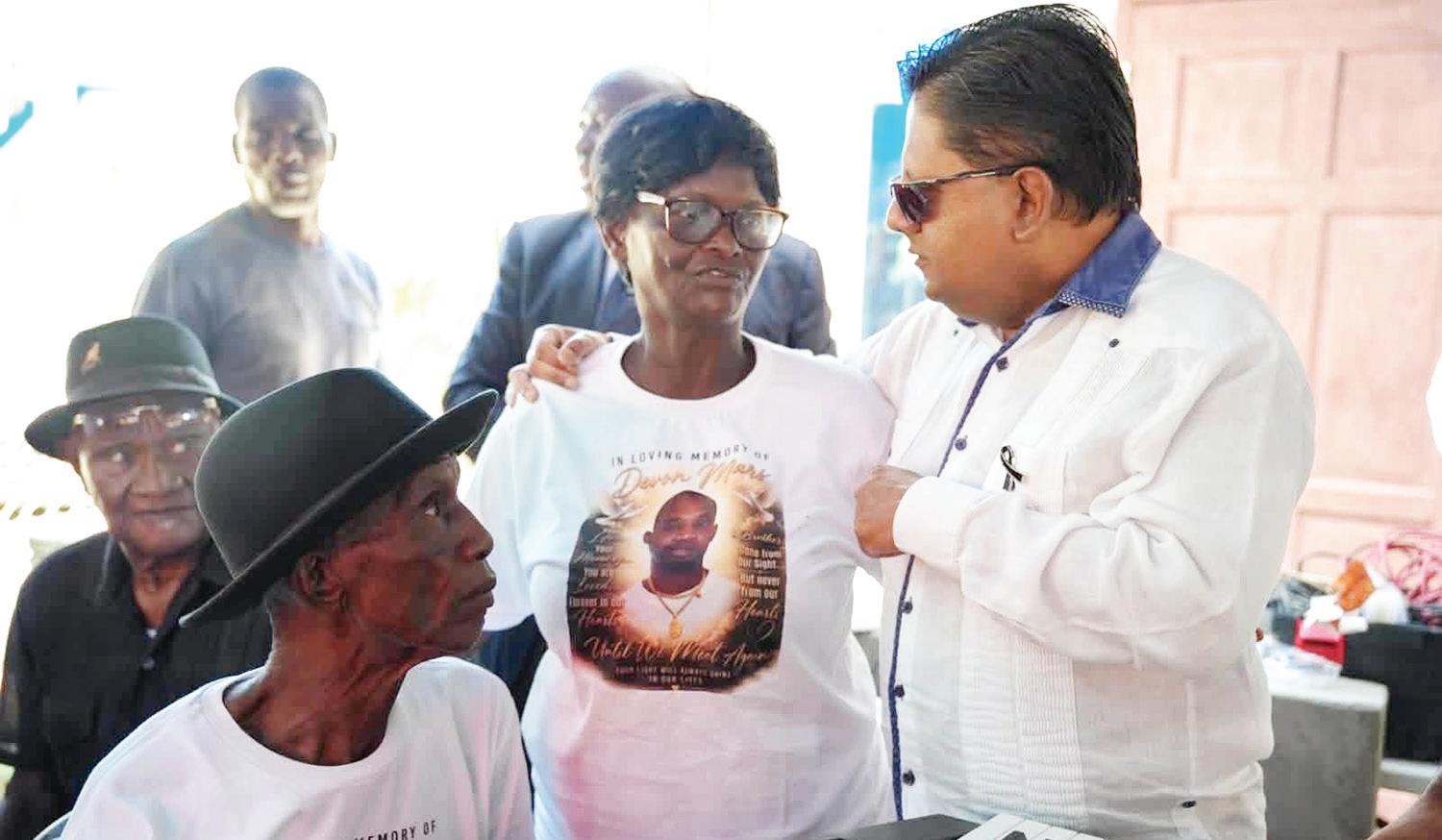
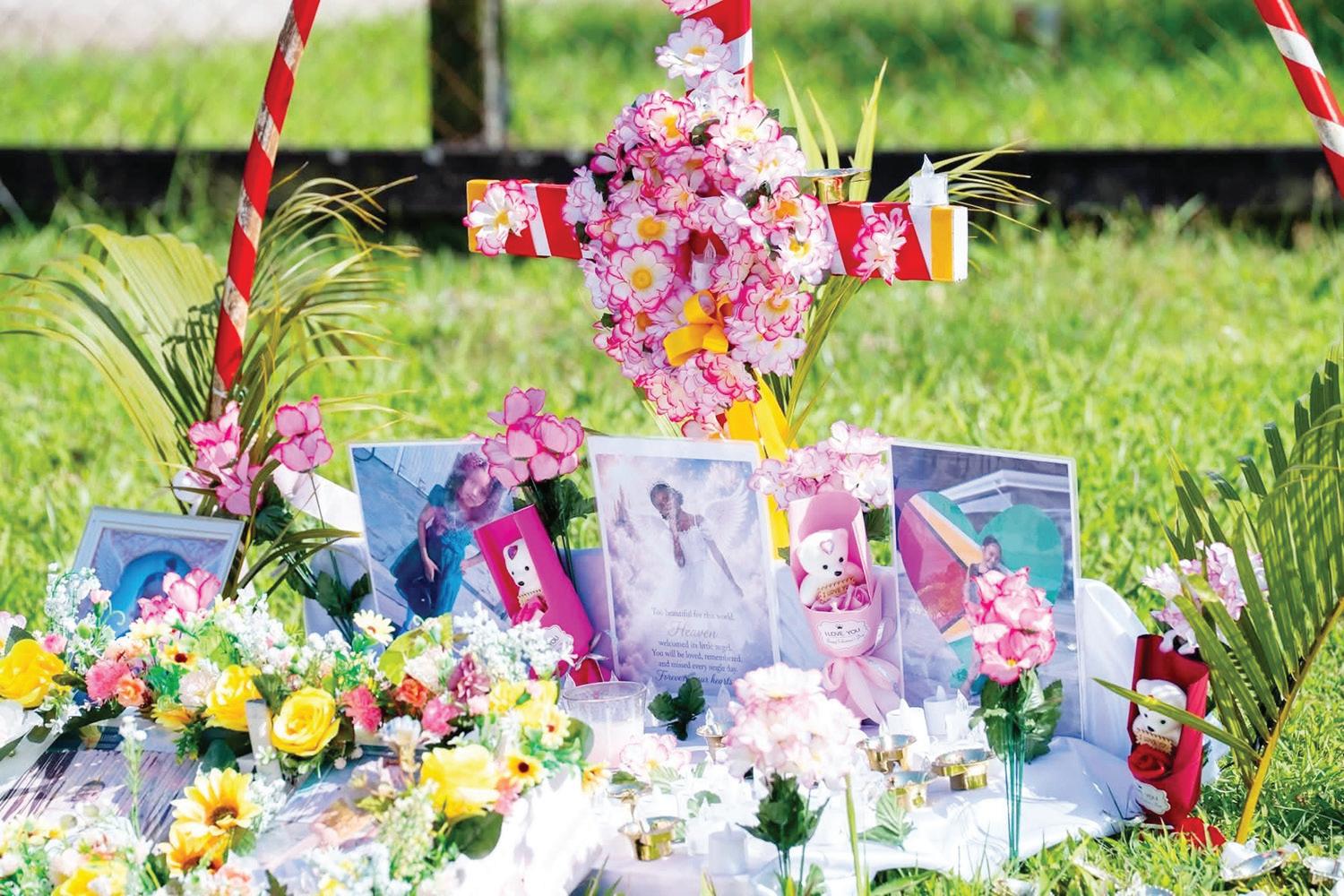
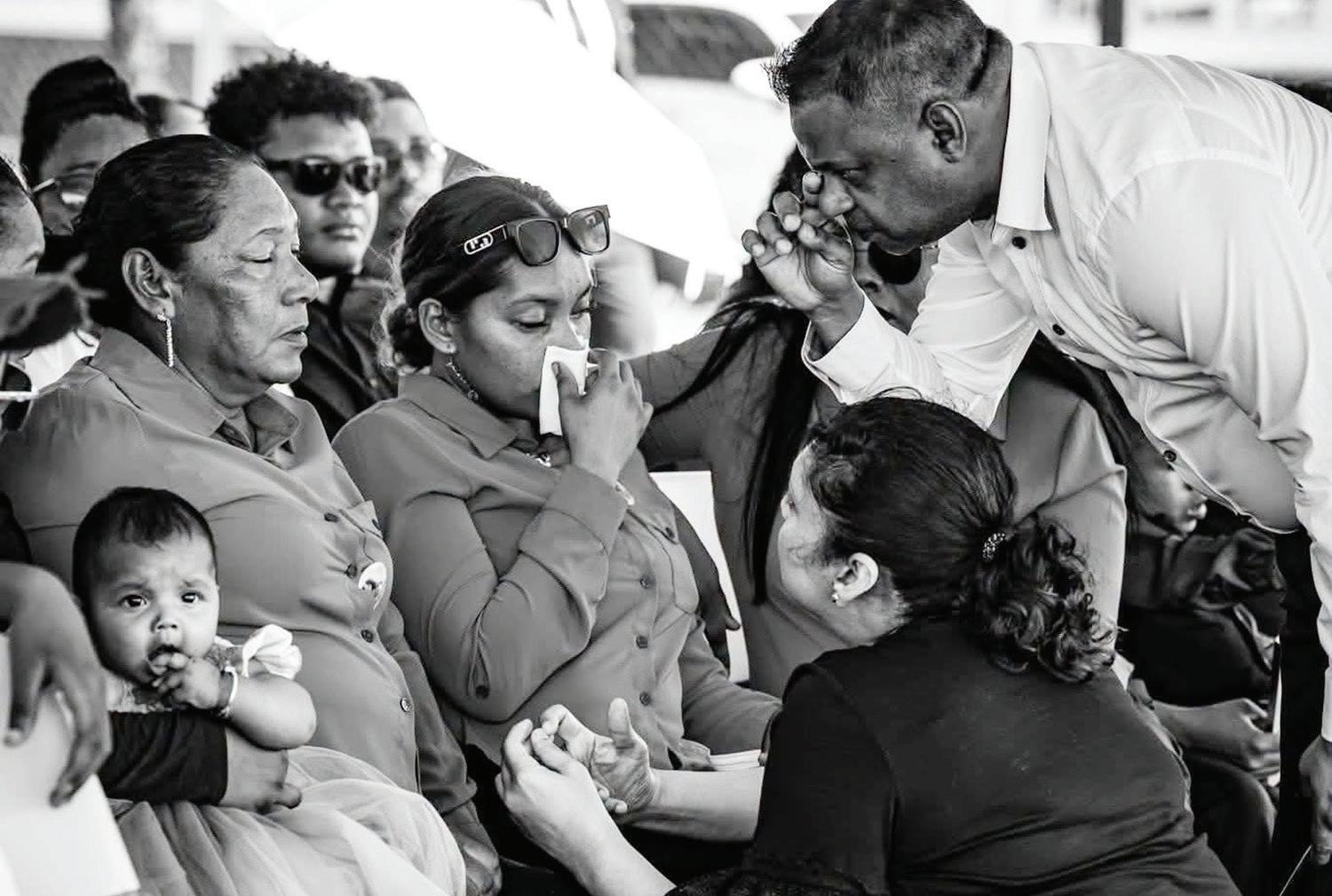
THE government has intensified its support for families affected by the recent river tragedy, with ministers leading a coordinated national response to ensure every impacted family receives continuous emotional, psychosocial and practical assistance.
Speaking from the Umana Yana in Kingston, Georgetown, on Friday, Minister of Labour and Manpower Planning, Keoma Griffith, said the government’s commitment extends beyond the ongoing search and recovery efforts.
He noted that ministers and government officials remain engaged with families at the Umana Yana, where support services have been centralised.
“The efforts continue by the team in the river trying to recover and to rescue. Those searches will continue,” Minister Griffith assured, while expressing condolences to all those affected.
Mi nister of Public Service, Government Efficiency and Implementation, Zulfikar Ally, said President Dr Mohamed Irfaan Ali has directed that every affected family receive personal attention and sustained support during this difficult period
“The president has asked that we personally reach out to every single family to ensure that we continue to provide support, and we will continue to do so in the days and months ahead,” Minister Ally stated.
He explained that government agencies have been working collectively to make direct contact with families, ensuring they receive the assistance they require as the nation mourns.
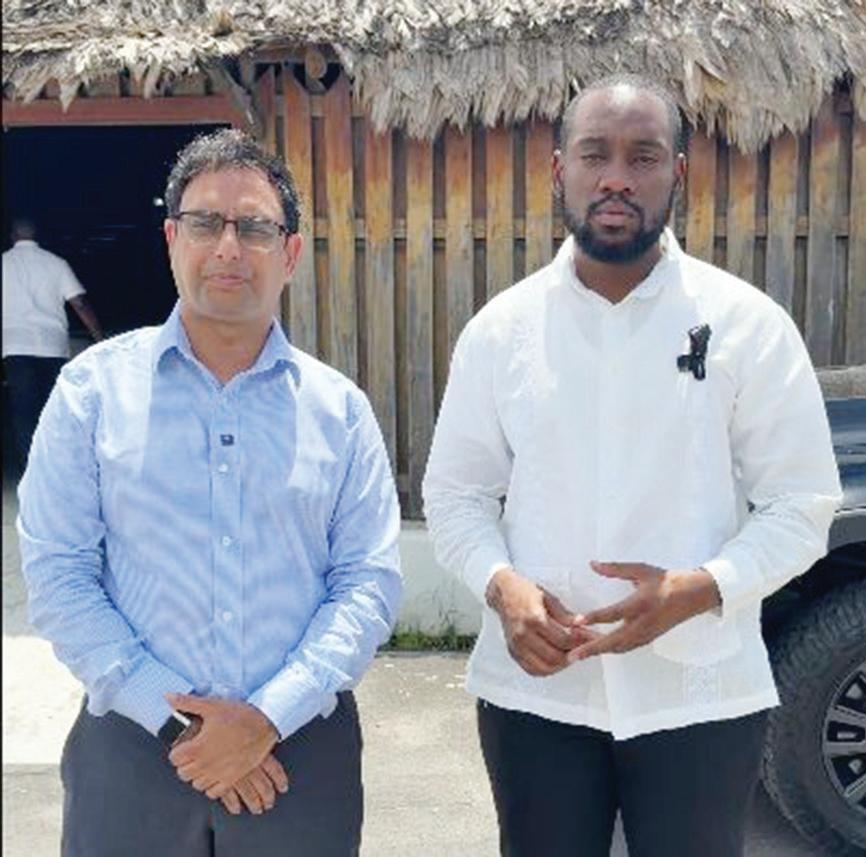
“All of the arms of government, all of the agencies that we have are reaching out to them to provide all of the support that they need. All of Guyana is mourning, but right now we have to be there to support them,” he said.
Minister Griffith further highlighted the government’s comprehensive psychosocial response, noting that counselling services have been activated to help those coping with grief and trauma.
“We want to emphasise that we have an established support base for all the persons who require support, especially psychosocial help,” Minister Griffith noted.
He added that three hotlines were established, and anyone needing assistance or support, can make contact.
The government has maintained that while search and recovery operations continue, every effort is also being directed towards ensuring affected families receive compassionate care, counselling and ongoing assistance throughout the recovery process. (DPI)
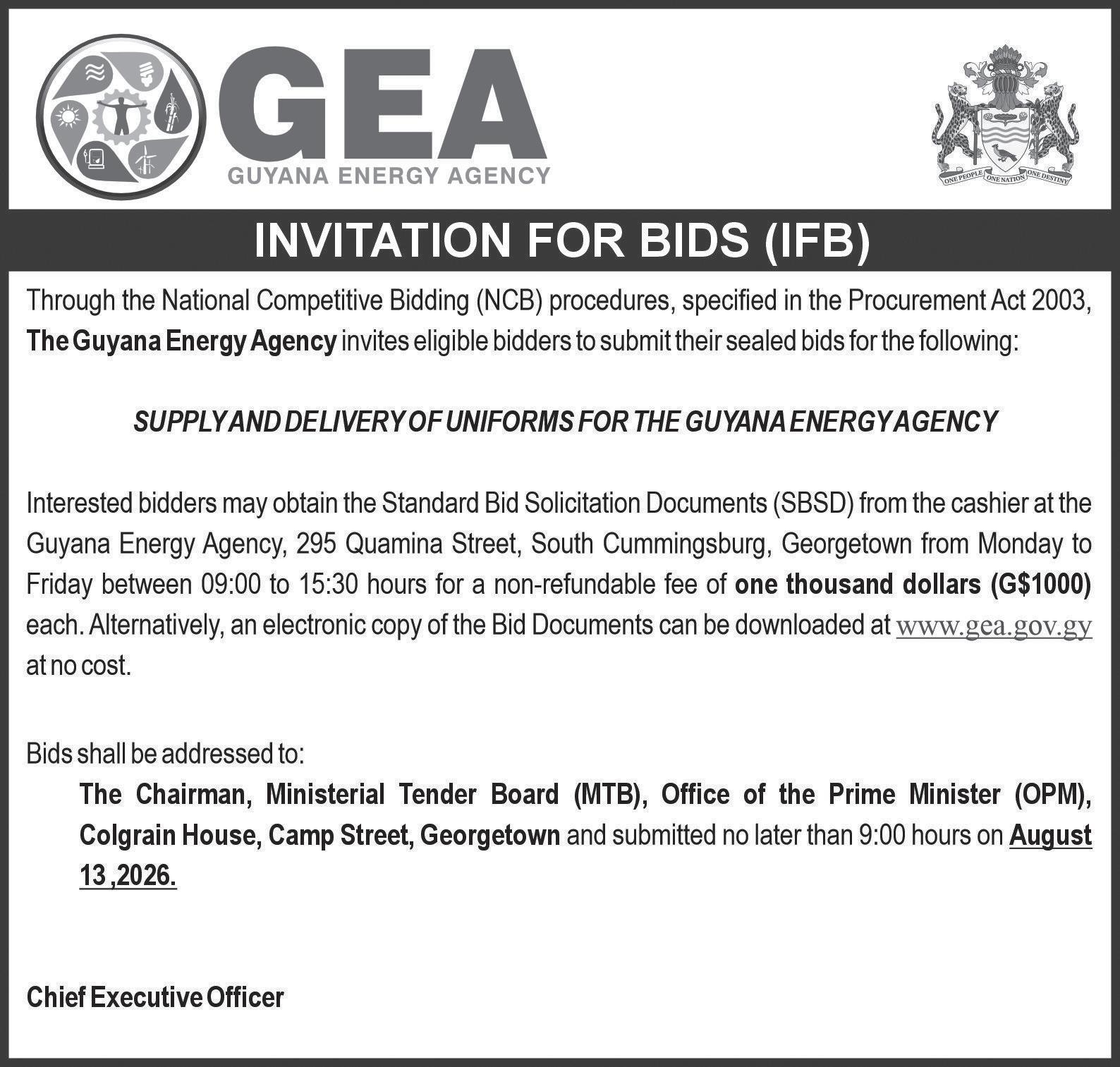
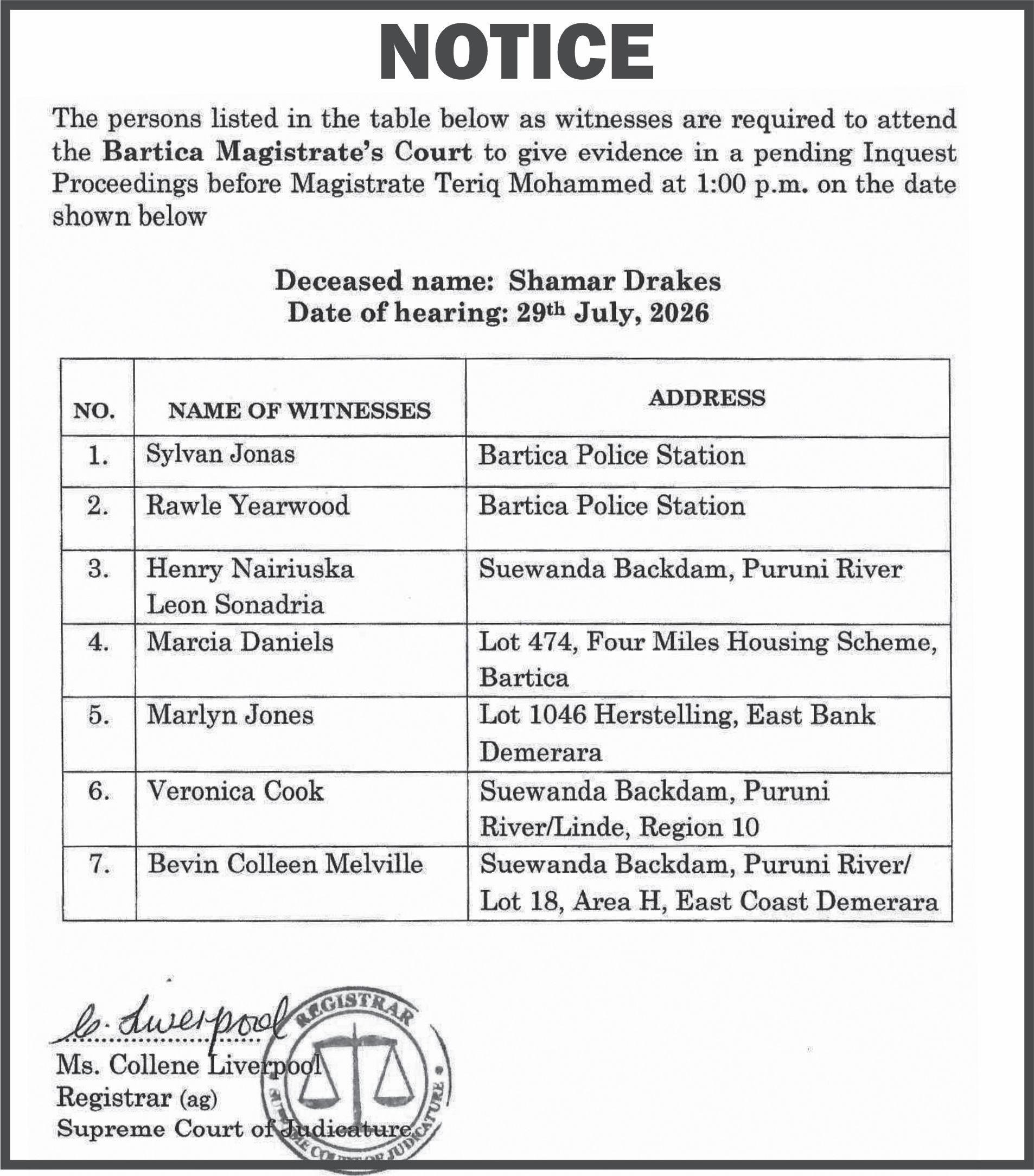
AS Guyana prepares for the effects of El Niño, farmers across several agricultural sub-sectors are already putting measures in place to protect their livelihoods from what is expected to be months of hotter temperatures and prolonged dry conditions.
El Niño, a naturally occurring climate phenomenon caused by the warming of sea-surface temperatures in the central and eastern tropical Pacific Ocean, alters normal weather patterns around the world.
In Guyana, it is typically associated with below-normal rainfall, above-normal temperatures, declining water levels and an increased risk of bush and forest fires.
According to the Guyana Hydrometeorological Service, warmer conditions are expected to intensify from July, with the hottest and driest period forecast between mid-August and October. El Niño conditions are expected to persist through the remain-
der of the year and could extend into early 2027.
The prolonged dry spell is expected to place additional pressure on the agricultural sector, particularly cash crop, rice and livestock farmers, as dwindling water supplies increase the risk of crop stress, reduced yields and shortage of drinking water for animals.
As water levels decline in conservancies, reservoirs and creeks, irrigation systems could also come under pressure, while elevated temperatures are expected to increase the risk of heat stress and wildfires.
Despite the anticipated dry conditions, the Hydrometeorological Service has cautioned that periods of intense rainfall remain possible, meaning the threat of localised flooding in low-lying and poorly drained areas has not been eliminated.
The agency has urged farmers, residents, health officials and disaster-management authorities to prepare
early to minimise the impacts of the expected climate conditions.
While many farmers are concerned about the months ahead, others believe the dry conditions could work in their favour.
For beekeeper Melvin Singh, whose apiaries are located at Parika, East Bank Essequibo, and Bonasika Creek along the Essequibo River, the anticipated dry season is expected to improve honey production.
Singh explained that prolonged rainfall limits honey production because bees are unable to leave their hives to forage for nectar.
Once conditions become drier, Singh plans to supplement his colonies with sugared water to support the bees while nectar sources recover.
He believes El Niño conditions will ultimately benefit local beekeepers by creating more favourable
conditions for honey production.
Small ruminant farmer Abiola "Goldie" Hill of Den Amstel Village, West Coast Demerara, said her farm is better equipped than many others because her sheep and goats are housed in elevated pens.
However, she continues to rely on pasture grazing and says limited access to properly developed grazing lands remains a major concern.
Hill explained that while she utilises backlands in the village, the area lacks fencing, leaving her animals vulnerable to attacks by stray dogs.
She believes authorities should install fencing and improve drainage within the pasture to better protect livestock, while also providing a reliable source of water during the anticipated dry season.
Cash-crop farmer Errol Dealy of Experiment Village, West Coast Berbice, is equal-
ly concerned about access to irrigation water.
His farm, located behind the village, already experiences limited access to water, and he fears conditions will worsen if the dry spell persists.
Despite the challenges, Dealy said he intends to make full use of available resources to ensure his crops receive sufficient water for a successful harvest.
For cattle farmer Shakeem McCalmon, the forecast has forced difficult decisions.
McCalmon, who owns a herd of 63 cattle, said he has been researching ways to prepare for El Niño but has concluded that he will likely have to sell about 20 animals because of limited grazing land and water supplies.
Although farmers have been allocated pasture lands, he explained that the area remains undeveloped and unfenced, making it vulnerable to cattle rustling and other security concerns.
Without secure grazing areas, he said he cannot safely leave his animals unattended.
McCalmon, who lives at No. 22 Bel Air Village, West Coast Berbice, said he hopes to rebuild his herd once he secures properly fenced grazing land.
For now, however, he remains concerned about the months ahead.
He explained that his cattle are currently grazing on land earmarked for a new housing development after rice cultivation in the area ceased because of persistent rainfall.
Once construction progresses and residents begin moving into the housing scheme, that grazing area will no longer be available.
Left with few alternatives, McCalmon said livestock farmers like himself will continue hoping for adequate support to help them weather what is expected to be another challenging El Niño period.
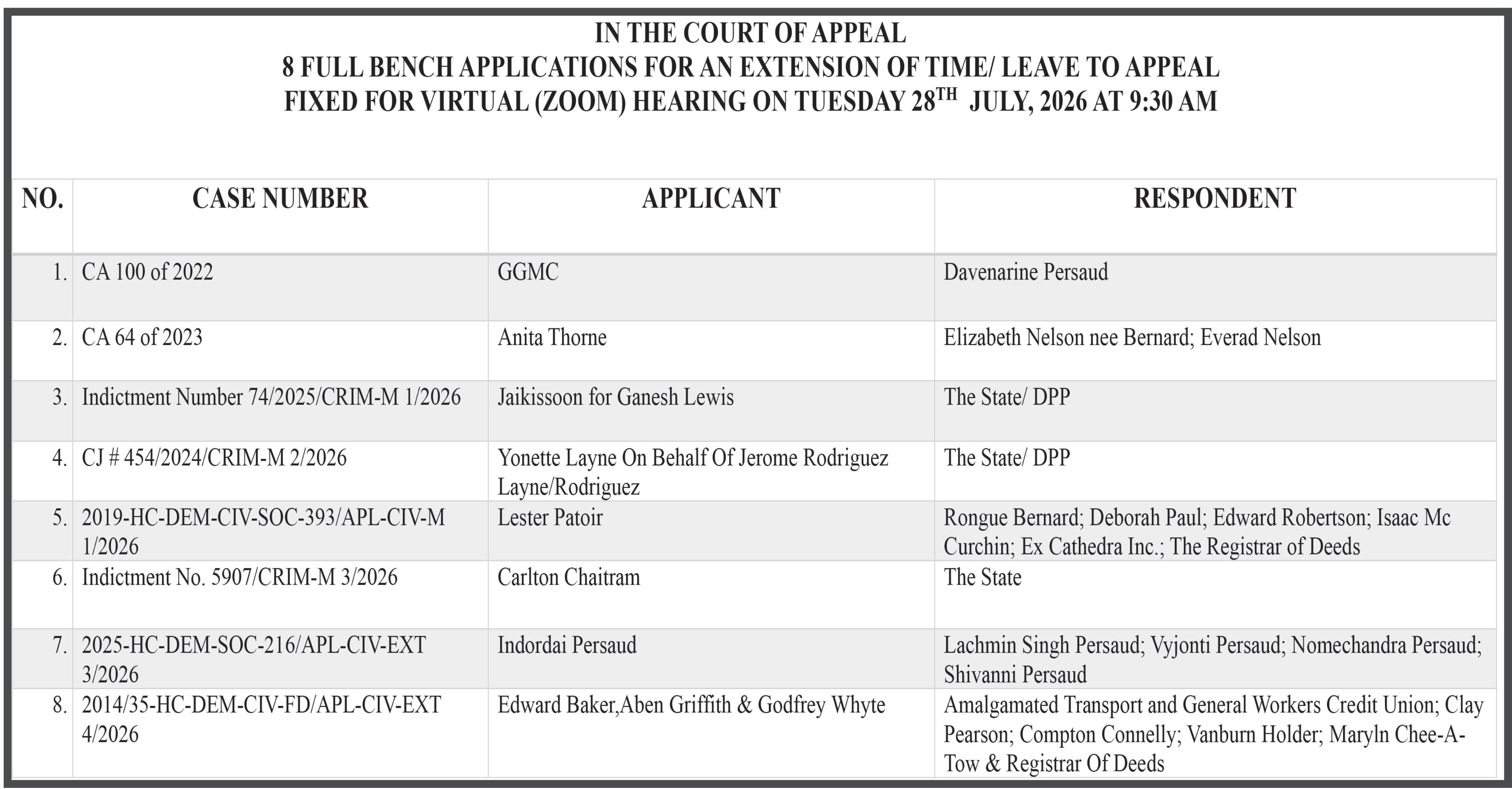
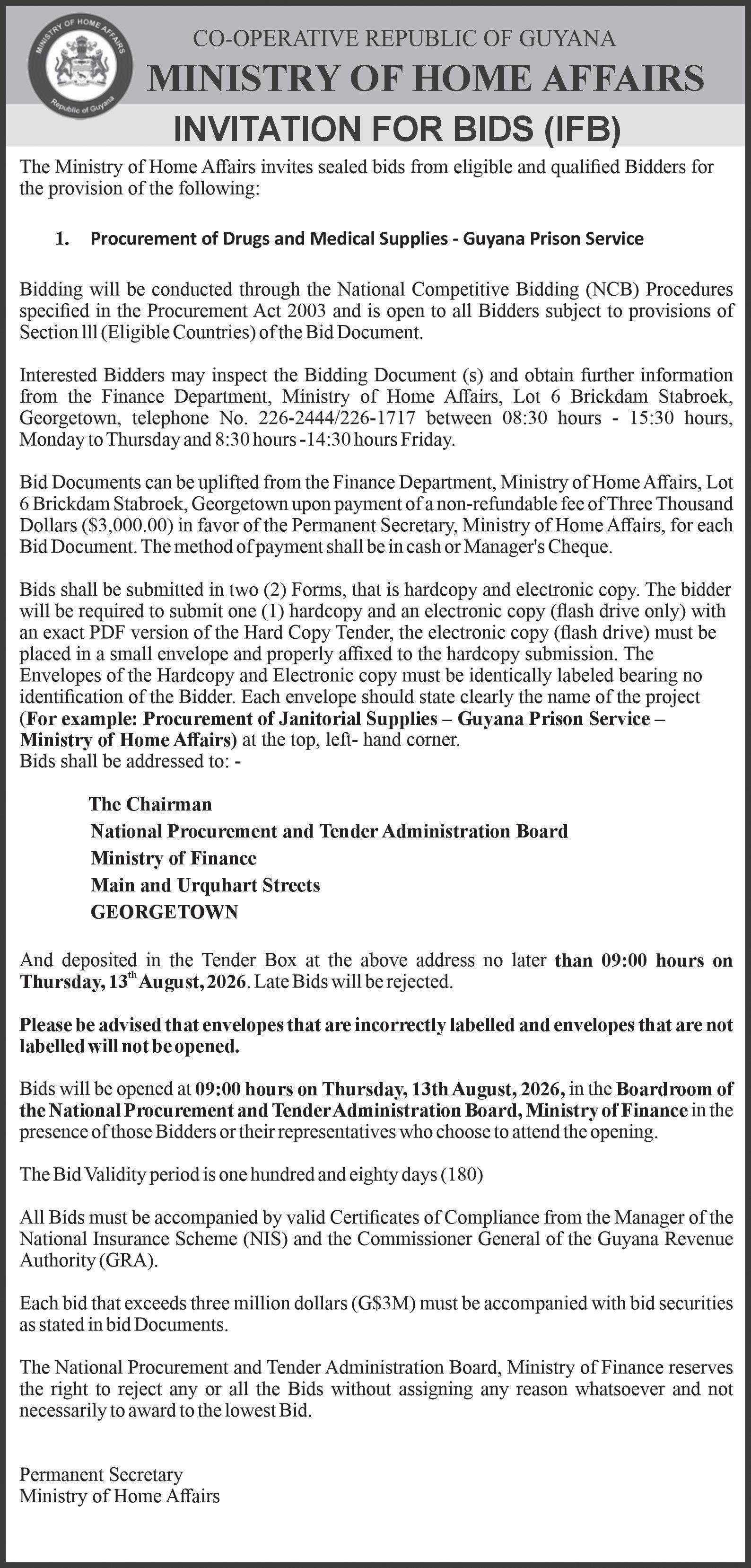



- Vaibhav Sooryavanshi struck his second half-century of the series, Mayank Yadav returned three wickets and Yash Thakur two as India registered a comfortable 35-run win in the third T20I against Zimbabwe in Harare to complete a 3-0 series sweep. The win meant that India continued to hold their position at the top of the T20I rankings, having lost the spot during their series loss against England.
Batting first on a slowish surface - the same one as the second T20I - India lost Abhishek Sharma early but Sooryavanshi and Ishan Kishan added 75 runs off 50 balls for the second wicket. Sooryavanshi fell for 81 but contributions from Shreyas Iyer (27 off 18) and Rinku Singh (25 off 14) took India to an above-par 192 for 5.
In reply, Zimbabwe were never really in the chase. Mayank removed Brian Bennett with the first ball of the match for the second time in the series, while Thakur struck twice in two balls to hurt the hosts in the powerplay.

Ryan Burl (54*) and Wessly Madhevere (28) were the only major contributors as Zimbabwe were restricted to 157 for 7. Mayank was once again rapid, picking up 3 for 29,
while Thakur returned 2 for 45.
While most things went to plan for India, their shoddy fielding was under the microscope again. They dropped five relatively

ENGLISH RACING TIPS
AYR
09:15 hrs March Lilly 09:45 hrs Cotai Starlight
10:15 hrs Imperial Guard
10:45 hrs Spirit Of Nature
11:15 hrs Empirical
11:45 hrs Startling
12:20 hrs Recobella
SOUTHWELL
09:30 hrs Tenison
10:00 hrs Humphrey
10:30 hrs Prince Of Calypso 11:00 hrs Hatamoto
11:30 hrs Rising Tiger
12:00 hrs Spaceman
12:30 hrs Cogitate
13:05 hrs Modern Times
WINDSOR
12:15
15:00 hrs Berlinetta 15:30 hrs My Old Mate
IRISH RACING TIPS
12:10 hrs Witches Familiar 12:40 hrs Let's Go La Fichad 13:10 hrs One Number
hrs Eagle Fang 14:15 hrs Dancing Saxon 14:50 hrs Nod Of Approval 15:20 hrs Power Of Knowledge AMERICAN RACING TIPS GULFSTREAM
straightforward catches - three of Thakur's bowling alone - something which has become a theme in recent times.
Another Sooryavanshi special
It was an un-Sooryavanshi innings, as he completed his fifty off 31 balls, the second-slowest of his short T20 career. But on a surface where throughthe-line shots weren't easy, Sooryavanshi was ready to bide his time. Abhishek became Blessing Muzarabani's victim for the third straight game, edging a full ball to the wicketkeeper, to end his tour with scores of 1, 8, 2.
But Sooryavanshi was up and away. He began his innings with a fortunate thick outside edge off Sikandar Raza before going over covers in the opening over. Muzarabani, with his height generating the awkward bounce and angle, troubled Sooryavanshi but he still managed to smoke a gigantic pull over deep square leg and a four past deep third off him. Even when Brad Evans and Newman Nyamhuri went full to Sooryavanshi, he got into great positions, opening the face of the bat to steer the ball or generating enough power on his on-the-up punches in the V.
Sooryavanshi did slow down post the powerplay but a 103-metre six off Raza and a pull over deep midwicket off Madhevere helped him move into the 80s. It needed a screamer from Evans, running in from long-off to complete the catch inches off the ground, to send Sooryavanshi back for 81 off 49 balls, which included eight fours and four sixes.

(FORMULA 1) - Lando Norris claimed his and McLaren’s first Grand Prix victory of 2026 in Sunday’s Hungarian Grand Prix, taking the chequered flag ahead of Red Bull’s Max Verstappen and Mercedes’ Kimi Antonelli –after mid-race drama and a late retirement for team mate
Oscar Piastri.
Polesitter Norris spent the first half of the race in Piastri’s mirrors, having been jumped at Turn 2 on the opening lap – the latter doing just enough to hold onto the lead thereafter, and McLaren resisting Norris’ calls to be ushered through.
However, the intra-team
battle was flipped on its head just after the midway point when Piastri – fresh from his second pit stop – encountered traffic in the form of Carlos Sainz in the first sector, and dramatically made contact with the Williams.
That moment, added to Norris’ sublime pace in clear air
ahead of his own second stop, swung the race in the reigning World Champion’s favour, before Piastri’s day ended in despair thanks to an apparent gearbox problem.
A Virtual Safety Car (VSC) triggered by Piastri’s stoppage led to more pit lane action, with Verstappen and Antonelli (who

had just swapped tyres) staying out to take second and third respectively, ahead of three-stopping Ferrari pair Lewis Hamilton and Charles Leclerc.
Hamilton had initially emerged from that final stop ahead of Antonelli, only to cede the position after replays showed he had reached the relevant VSC white line at the end of the start/finish straight just behind the Mercedes.
A five-second penalty for speeding in the pits ended any hopes Hamilton had of finishing on the podium, even if he pressed on and harried Antonelli to the flag, with Leclerc also edging ahead for P4 once the sanction was applied.
Isack Hadjar took sixth place in the other Red Bull machine, with George Russell winding up P7 after a dreadful start to the race – due to the anti-stall kicking in – saw him
drop as low as 21st. Racing Bulls scored another double points finish with Liam Lawson and Arvid Lindblad, who placed eighth and 10th, around Audi’s Nico Hulkenberg, while the German’s team mate, Gabriel Bortoleto, just missed out on a reward in 11th. In their most encouraging display of the season so far, Aston Martin pair Lance Stroll and Fernando Alonso took their updated cars to P13 and P14, splitting the Alpines of Pierre Gasly and Franco Colapinto, and beating both Haas and Williams cars.
Piastri was left to watch the final 15 laps from the sidelines following his retirement, with the Cadillacs of Valtteri Bottas (overheating brakes) and Sergio Perez (an issue at the front-left) also failing to finish.
(BBC) - Slovenian Tadej Pogacar won the Tour de France for a record-equalling fifth time.
The 27-year-old UAE Team Emirates-XRG rider crossed the line on Paris' Champs-Elysees in the peloton, to join Jacques Anquetil, Eddy Merckx, Bernard Hinault and Miguel Indurain as the endurance event's most successful male riders.
All-conquering Pogacar raised the idea that his remarkable reality is proving stranger than fiction, describing it as "something you wouldn't even maybe write in a story book".
The three-week Grand Tour's final stage was won by the Netherlands' Mathieu van der Poel of Alpecin-Premier Tech after a frantic charge to the line on the French capital's famous cobbles in which he pipped team-mate Jasper Philipsen of Belgium by inches.
Pogacar's victory means he is positioned by many as the greatest cyclist of all time, superseding the achievements and status of Belgian legend Merckx.
It also marks Pogacar's third Tour win in succession and includes a record-breaking ascent of the iconic Alpe d'Huez on stage 19, when he sealed another dominant victory.
It was the last of five stage wins in a race in which Pogacar used his explosive launch and unmatchable metronomic pace to see off his rivals, who for some time have had virtually no answer. Pogacar has won almost every major race in the sport,

Tadej Pogacar is considered one of the greatest riders of all time
including the Tour of Flanders, Giro d'Italia, Milan-San Remo, Road World Championships, Giro di Lombardia and LiegeBastogne-Liege.
Pogacar was booed by some fans during the Tour, as his performances are often so far ahead of any of his peers that some feel frustrated the sport is losing its competitive edge.
He now has 127 wins in an eight-year elite professional career.
"Victory is really special," said Pogacar. "Thank you to all the fans and my team.
"But the biggest thanks goes to all my family who support me all my life. My parents - without them I would not be standing here five times already.
"Seven Tours and seven times on the podium, and five wins, is something you wouldn't even maybe write in a story book, and it's unbelievable for me.
"It's a magnificent podium with some incredible champions to fight with.
"It's a shame Jonas [Vingegaard] crashed out this time and many others. I hope they have a quick recovery and next year we fight again."
CWI President, Dr Kishore Shallow has expressed his and the body’s condolences on the passing of St Kitts statesman Charles Lucien Arthur Wilkin, CMG, 'KC.
A statement yesterday said, ‘It is with profound sadness that I learned of the passing of Charles Lucien Arthur Wilkin, CMG, KC, a distinguished Kittitian, lawyer, sportsman and thoughtful servant of Caribbean civilisation.
“On behalf of Cricket
West Indies, I extend deepest condolences to his family, friends and the people of St. Kitts and Nevis.
Charles Wilkin understood that in the Caribbean, cricket is a part of our history, our identity and our understanding of ourselves. He also understood that institutions, like the game itself, must constantly be examined, strengthened and renewed if they are to serve future generations.
“It was in this spirit that he led the work which produced the Wilkin Re-
port, laying the foundation for the subsequent Wehby Report, to which he was also a key contributor alongside the late Jamaican Senator Don Wehby. Their work represented a serious reflection on the future of West Indies cricket and the responsibility of those entrusted with its stewardship.
“Mr Wilkin’s contribution was rooted in a life-long relationship with the game. He represented St Kitts in cricket, played for Cambridge University, the combined Leeward and
Windward Islands team, and later played a leading role in the successful hosting of ICC Cricket World Cup matches in St. Kitts and Nevis in 2007.
“His contribution reminds us that the strength of West Indies cricket depends not only on those who play the game, but also on those who dedicate their wisdom, experience and courage to ensuring that the game endures.
“His contribution to West Indies cricket and the wider Caribbean will not be forgotten.”’
(ESPNCRICINFO) - Shan Masood rode his luck and then showed his grit in an unbeaten innings that has left him 12 runs shy of three figures overnight, and put his side slightly ahead at the close of play on the second day. After Mohammad Ali's four-wicket haul bowled West Indies out for 311, half-centuries from Masood and Imam-ul-Haq, who combined to put on a 155-run partnership, cut West Indies lead in half. The hosts hit back with the wickets of Imam and Babar Azam late in the day, but Pakistan still have seven wickets in hand trailing West Indies by 112 runs. When Masood walked out to the crease, he came within a whisker of chopping his first delivery on, and it set the tone for the rub of the green that continued to fall his way. Jomel Warrican put down a sharp chance two balls later, and another burst through the slips early in his innings. But Masood stuck to his game plan, continuing to pick up regular boundaries, whether or not he was in control of the shots they came off. By the time he reached his half-century - at better than a run a ball, his
control percentage stood at 71%, with half of his ten boundaries coming off either the inside or outside edge. Importantly, however, West Indies couldn't find a way to get rid of him, and it was a steelier Masood who emerged post-tea. Most of the flamboyance had been cut out, with the former Pakistan captain realising its purpose had been served, and Pakistan needed to consolidate now. He let Imam, who had played a supporting role until then, take on more of the run-scoring responsibility. With the ball doing less than it was earlier, the pair were coasting to a 150-run stand, making a respectable West Indies attack look toothless.
It was in the final hour that the hosts hit back. Having brought up his half-century, Imam lashed at one from Shamar Joseph well outside off stump to first slip. It left Babar and Masood to try and negotiate a tricky period before stumps. Masood's rub of the green continued as he survived an lbw shout by a hair's breadth, but Babar tentatively pushed at Jayden Seales shortly after, nicking off to the keeper, giving West Indies encouragement to take
into the third day.
In the morning, Pakistan had got the old ball to talk and kept knocking West Indies' batters over regularly, getting four wickets before lunch. They had spent a turgid final session on Saturday wicketless, but West Indies had managed no boundaries either, and thus were by no means out of sight. Khurram Shahzad drew the top-scorer Kavem Hodge into prodding at a wide one that Salman Agha grasped comfortably inside the first three overs of the day which set Pakistan on their way.
Mohammad Ali picked up four wickets for Pakistan, West Indies vs Pakistan, 1st Test, Tarouba, 2nd day, July 26, 2026
It followed an hour of plays and misses as the old ball nipped and swung sharply. Pakistan's seam bowlers have been criticised for lacking pace, but they made up for it with wobble, continually discomfiting the batters. Azan Awais put down a golden opportunity to get rid of Hope when he nicked Mohammad Ali off to the slips, but Ali's persistence eventually paid off as that probing off stump line found Justin Greaves' outside edge,
CPL expresses condolences on the passing of Charles L. A. Wilkin CMG, KC
THE Caribbean Premier League is deeply saddened by the passing of Charles L. A. Wilkin CMG KC, a distinguished St. Kitts and Nevis attorney and lifelong cricket administrator who died on July 25, 2026.
to St. Kitts and Nevis, drawing on his work developing Warner Park into an international-standard venue to help secure matches for the Federation and pave the way for the St. Kitts & Nevis Patriots' entry into the league.
with Agha ensuring he made no mistake once more.
Curiously, the new ball appeared to dilute the threat the seam bowlers posed, but by no means extinguished it. While Hope looked largely comfortable for the rest of the session, he was very much on his own in that aspect. Mohammad Abbas' characteristic accuracy found a feather off Roston Chase's outside edge, while Khurram Shahzad came back to extinguish Kemar Roach's stubborn resistance to reduce West Indies to seven down.
A cameo from Shamar Joseph briefly frustrated Pakistan, but Ali, who had been unlucky earlier in the day when Awais put Shai Hope down, got his just rewards following lunch. It took Ali just two balls to bounce Joseph out and then nipped one in sharply to Hope to trap him dead in front. In two more balls, the innings had wrapped up, which was especially valuable for a Pakistan side that have been guilty of struggling to rip through the tail efficiently of late. Things, as Masood's knock would later illustrate, had perhaps begun to turn Pakistan's way in Tarouba.
Mr. Wilkin was a founding member of the CPL's cricket committee, lending his knowledge of the game and his standing in Caribbean cricket to the tournament as it took shape ahead of its 2013 launch. His guidance in those early days helped establish the structures and standards that underpinned the CPL's growth into the region's premier T20 franchise competition.
He was also instrumental in bringing CPL cricket
A former first-class cricketer who played for Cambridge University and the Combined Leeward and Windward Islands, Wilkin remained devoted to the sport throughout his life, later chairing the local organising committee that brought the ICC Cricket World Cup to St. Kitts in 2007.
The CPL extends its deepest condolences to Mr. Wilkin's family, friends, and the people of St. Kitts and Nevis.

Romario Shepherd and Mohammad Nabi orchestrated a remarkable recovery to guide the Guyana Amazon Warriors to a two-wicket victory over the Desert Vipers in the ExxonMobil Global Super League at the Guyana National Stadium on Saturday.
Chasing a formidable target of 206, the Warriors recovered from a precarious 95 for 7 in the 11th over to complete the chase with two deliveries to spare.
The Warriors’ pursuit began briskly, with Quentin Sampson (35) and Rahmanullah Gurbaz (31) assembling a 55-run opening partnership.
However, their dismissals precipitated a dramatic middle-order collapse. Mohammad Haris managed 12, while Shimron Hetmyer was
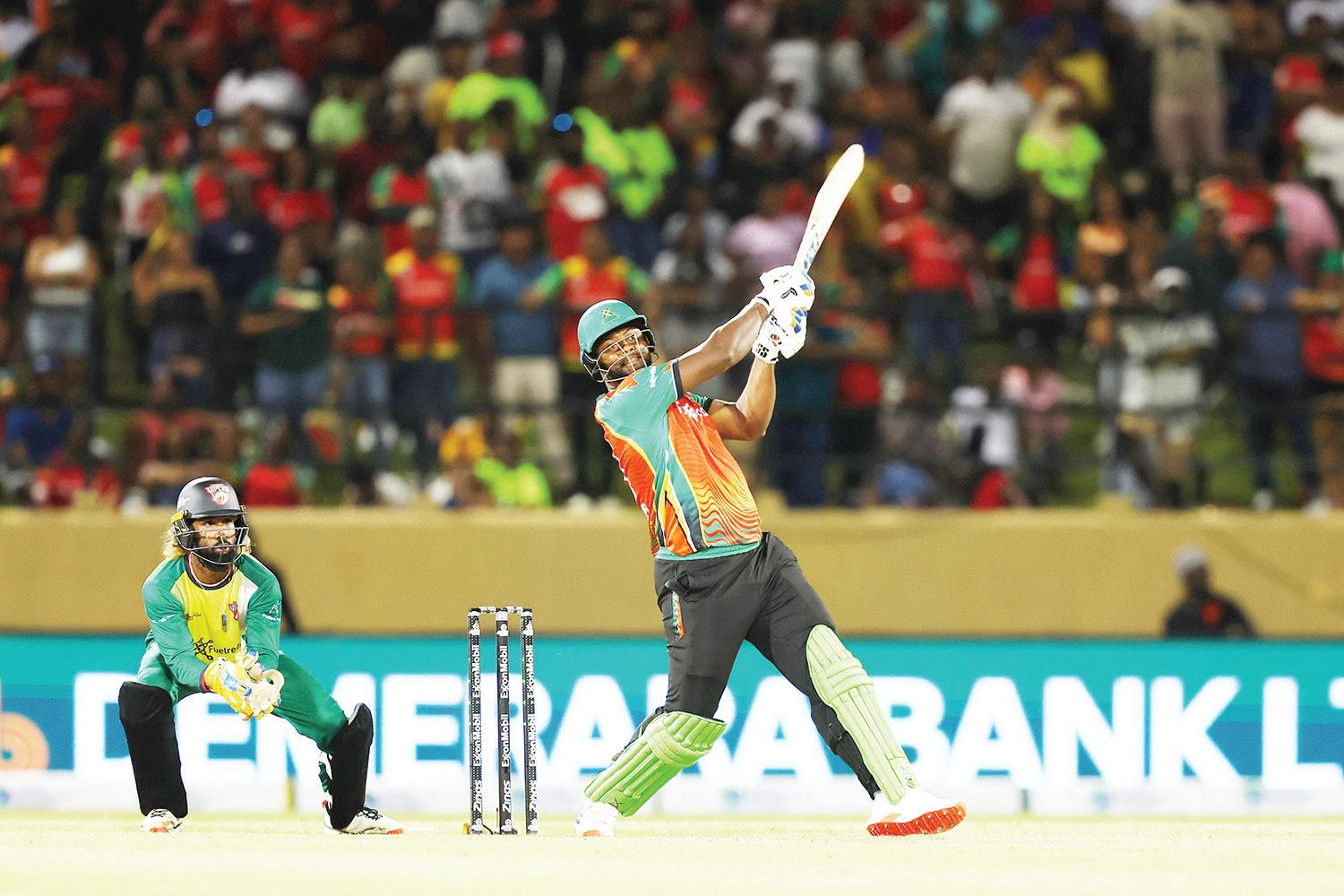
bowled first-ball by Khary Pierre.
Rovman Powell, Gudakesh Motie and debutant Jonathan van Lange fell in rapid succession,
leaving the innings in disarray.
The match turned on a 91-run, eighth-wicket stand between Shepherd and Nabi. Shep -
herd played the primary aggressor, registering a 17-ball half-century to record the fastest fifty of the tournament.
He eventually fell for
a 21-ball 52, an innings that included six sixes and two fours.
Nabi anchored the remainder of the chase, remaining unbeaten on a 29-ball 40 containing three fours and three sixes as Dwaine Pretorius finished on 17 not out to secure the win in the final over.
For the Vipers, captain Shadab Khan took 3 for 40, supported by Pierre’s 2 for 37.
Earlier, having been asked to bat, the Vipers posted 205 for 6, but their start was subdued, losing debutant Zachary Carter to Nabi at extra cover and Andries Gous in the deep early in the innings.
Rilee Rossouw stabilised the innings with a measured 61 off 48 deliveries, an effort that included five fours and a six.
Following Shadab’s
run-out, Kyle Mayers (35) and Bevon Jacobs (30) provided vital middle-order momentum while Vritya Aravind applied the finishing touches at the back end of the innings with an unbeaten 28, featuring six boundaries.
Captain Imran Tahir was the pick of the Warriors’ bowlers, claiming 2 for 37 from his four overs.
The result extends the Warriors’ winning streak to two matches in the five-team competition, while the Vipers remain winless after two outings.
The tournament continues on Sunday with a double-header: the Perth Scorchers face the San Francisco Unicorns from 10:00 am, while the Warriors return to play the Lahore Qalandars from 7:00 pm.
AN unbeaten half-century from Hammad Azam and a decisive four-wicket haul by left-arm fast bowler Ghulam Mudassar guided the San Francisco Unicorns to a five-run victory over the Perth Scorchers in the ExxonMobil Guyana Global Super League at the Guyana National Stadium.
Defending a modest total of 152, Mudassar’s crucial strikes ensured the Scorchers’ late fightback fell short in a tightly contested chase on Sunday.
Electing to bat first, the Unicorns were heavily reliant on Azam’s 64 not out off 46 deliveries, a vital innings that rescued his side from a precarious 46 for 4 during the powerplay.
The innings had begun with early momentum, as Tim Robinson (24) and Connor Esterhuizen (21) established a steady 42-run opening stand.
However, the introduction of left-arm spinner Sufyan Moqim swiftly altered the complexion of the innings. Moqim, who finished
with economical figures of 3 for 31 from his four overs, provided the initial breakthrough and dismantled the top order.
When Brody Couch dismissed Fabian Allen (7), the Unicorns were in danger of a total collapse, but Azam then anchored the recovery, striking five fours and four sixes to dictate the pace of the middle overs.
He found capable support in Anirudh Immanuel (17), with whom he shared a crucial 39run partnership.
Couch managed to
claim three wickets for the Scorchers, though he proved expensive, conceding 49 runs across his four-over spell.
In pursuit of 153, the Scorchers struggled to build sustained momentum as wickets fell at regular intervals.
Opener D’Arcy Short provided the most substantial resistance at the top of the order, compiling a measured 43 from 38 balls, including four boundaries.
However, Mudassar consistently disrupted the chase, removing Cameron Fletcher for
one before accounting for Joel Curtis (16) and Dian Forrester (0).
Reeling at 59 for 4, the Scorchers’ middle order failed to establish significant partnerships against a disciplined Unicorns attack.
Despite the mounting required run rate, Akeal Hosein injected late urgency into the innings with a rapid 19, featuring two massive sixes, to give Perth a glimmer of hope.
Couch also contributed with an unbeaten 23 at the death. Their efforts ulti -
mately proved insufficient, as the Scorchers concluded their 20 overs on 147 for 9.
Mudassar finished with standout figures of 4 for 32, supported capably by veteran seamer Peter Siddle, who returned 2 for 31 from his full quota.
The result leaves the San Francisco Unicorns with one win and one defeat in the competition, while the Perth Scorchers remain winless after suffering their second consecutive defeat.

GLASGOW, Scotland
(July 26, 2026) – Guyana's remarkable Commonwealth Games men's 3x3 basketball journey came to a heartbreaking conclusion on Sunday after a dramatic 20-19 defeat to Nigeria, narrowly missing out on a place in the quarterfinals of the Commonwealth Games.
Needing victory to advance to the knockout stage, the Guyanese quartet produced one of their finest performances of the tournament, displaying grit, determination, resilience, and an unwavering fighting spirit against one of Africa's strongest basketball nations.
With Guyana trailing late in the contest, Anish Ramlall delivered an outstanding performance, finishing with 10 points, including two clutch back-to-back two-pointers that levelled the score at 1919, sending the Guyanese supporters into celebration.
Travis Belgrave added six crucial points, while Kevin Mickle and Christian Hinckson were immense on the defensive end, producing several key stops as Guyana fought their way back into contention. With just five seconds remaining, Nigeria's Marcel Esonwune converted a heavily contested game-winning basket at the buzzer to seal the 20-19 victory, ending Guyana's hopes
of advancing.
Despite the disappointment, Team Guyana leaves Glasgow with its heads held high after making history. The tournament marked Guyana's first-ever appearance in men's 3x3 basketball at a Commonwealth Games, and the team also recorded the nation's first Commonwealth Games 3x3 basketball victory, defeating the Cayman Islands earlier in the competition.
The performances against New Zealand, Scotland, Australia, and Nigeria demonstrated that Guyana possesses the talent, athleticism, and competitive spirit to challenge some of the world's best 3x3 basketball programmes.
Following the match, Guyana Olympic Association Vice President and Director of Sport, Steve Ninvalle, who is in Glasgow representing Guyana along with Minister of Culture Youth and Sport Charles Ramson jr. at the Commonwealth Sports Ministers Ministerial Conference and supporting team Guyana, congratulated the players on their historic campaign.
Team Manager Rawle Toney "Although the result did not go our way, I was tremendously impressed by the character, resilience, and quality displayed by this team throughout the tour-
nament. They represented Guyana with distinction and proved that we belong on this stage. This experience will undoubtedly serve as a platform for even greater success in the future."
I would like to thank, the Guyana Olympic Association the executive members of the GABF Cubie Seegobin Adidas the Government of Guyana and all our sponsors supporters and more particularly the players our Physiotherapist Kevon David for their tremendous support during this journey.
President of the Guyana Olympic Association, Godfrey Munroe, also commended the team and the Guyana Basketball Federation for their outstanding progress.
"This campaign has shown that Guyana has the talent and ability to compete with the very best teams in Commonwealth 3x3 basketball. Our players displayed tremendous heart, discipline, commitment, and belief throughout the tournament and earned the respect of everyone who watched them compete. I wish to congratulate the Guyana Basketball Federation under President Michael Singh General Secretary Patrick Haynes and their enthusiastic team for the tremendous work being done to develop the sport. The programme is clearly moving in the right direction,
and the Guyana Olympic Association remains committed to supporting that growth as we continue building pathways for our athletes to excel internationally.
To Anish Ramlall, Kevin Mickle, Travis Belgrave, and Christian Hinckson— thank you for making Guyana proud. You competed with courage, unity, and determination, and you have inspired a new generation of basketball players across our country."
The Guyana Olympic Association also expressed its appreciation to the Head of Delegation and the team's physiotherapist.
With the Commonwealth Games campaign now concluded, Guyana's men's and women's 3x3 basketball teams will immediately shift their focus to the XXV Central American and Caribbean (CAC) Games in Santo Domingo, where they will aim to build on their international experience and challenge for medals against the region's top teams.
While the final result brought heartbreak, Team Guyana leaves Glasgow having achieved something far greater than a single victory—they have demonstrated that Guyanese basketball has arrived on the international stage and has a bright future ahead.
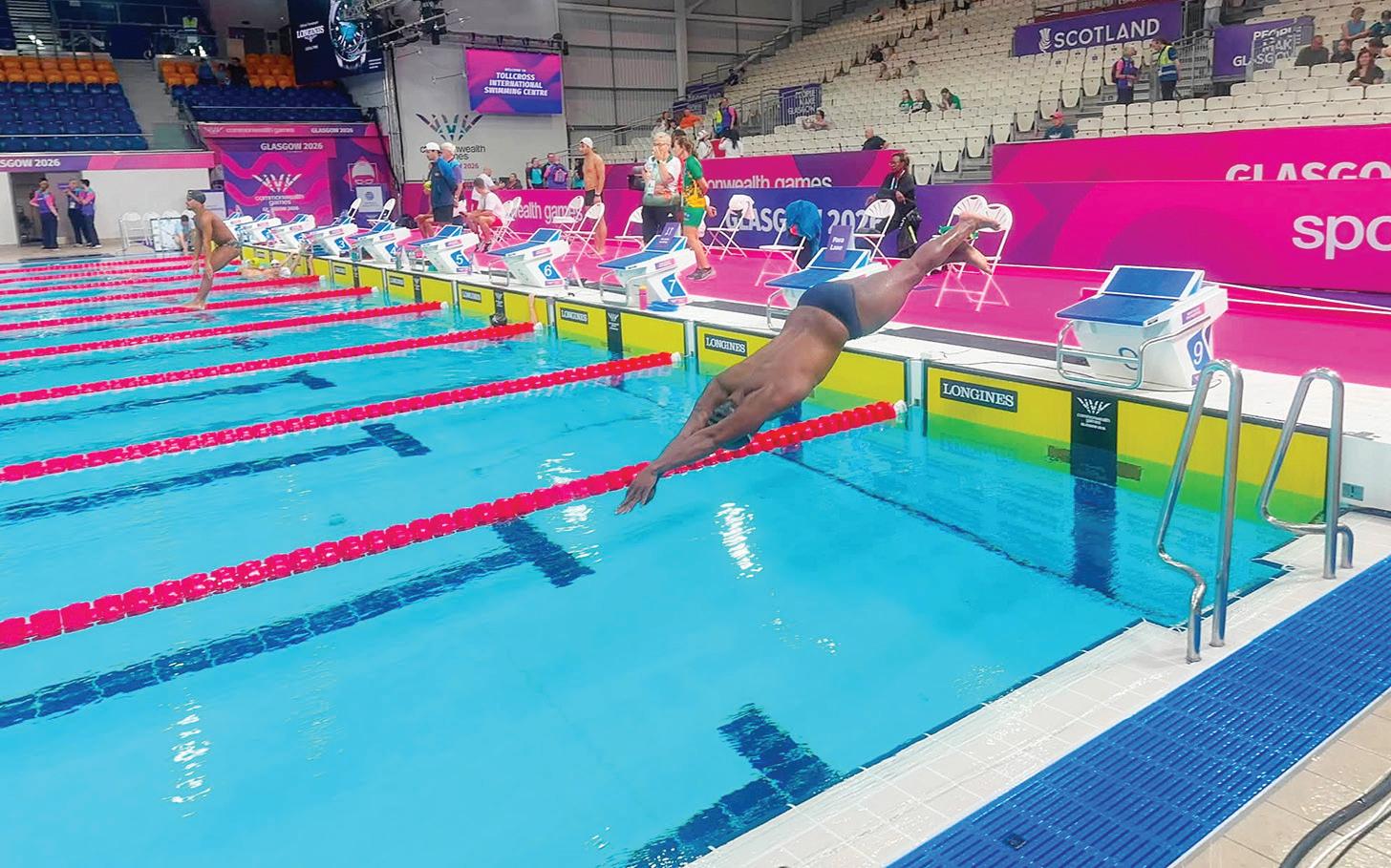
THE Guyanese swimming trio of Olympian Aleka Persaud, Chase Thompson, and Delroy Tyrell put in decent performances, but none advanced out of their heats at the ongoing 2026 Commonwealth Games in Glasgow, England.
Thompson, competing in the men’s 100-metre breaststroke, swam 1 minute 15.06 seconds for third place behind Thomas Chen and Sukumar Rajbongshi.
Thompson also collected fourth place in Heat 2 of the Men's 50m Breaststroke, recording a time of 32.78 seconds.
His 50-metre breaststroke heat was won by Pakistan's Hamza Asif in 29.63 seconds.
National record holder
and Olympian Aleka Persaud also finished in third place in her women’s 100-metre butterfly heat with a time of 1 minute 08.39 seconds.
Noelie Lacour was first, with Hayley Michelle Hoy in second place.
Persaud then claimed sixth place in her 50-metre butterfly event.
Delroy Tyrell had a tough men’s 50-metre freestyle heat as he stopped the clock at 24.76 seconds for fifth place; the race was won by Arvin Shaun.
He would go on to capture second place in his men’s 50-metre backstroke heat, but still missed out on qualification with a time of 27.61 seconds.
lienny Pedraza by a 2-0 margin in the bronze medal contest.
Her podium finish showcased tremendous resilience on the international stage. Following a hard-fought 2-0 semifinal defeat to Colombia’s Andrea Ramírez, Peterson regrouped impressively, returning to the mat with a dominant performance against her Venezuelan counterpart to secure a well-deserved place on the podium.
Reflecting on her landmark achievement, Peterson expressed immense gratitude while keeping
her sights firmly set on her long-term ambitions, which include the Los Angeles 2028 Olympic Games.
"I am truly elated to have won the bronze medal for Guyana," Peterson stated. "While my ultimate goal was to win the gold, I am grateful to have earned a place on the podium and to bring home Guyana's first medal of these Games. This medal is a testament to the hard work, sacrifice, and unwavering support of my family, friends, Coach Carlos Amezcua Blanco, my sponsors, the Guyana Olympic Association, and everyone who has believed
in me throughout this journey."
The standout martial artist made it clear that Sunday's victory is just a stepping stone.
"This is only the beginning," Peterson added. "My eyes are firmly set on winning more medals for Guyana and ultimately qualifying for the Los Angeles 2028 Olympic Games, and my ultimate dream is to win Guyana's first Olympic gold medal. Today's result gives me even greater motivation to continue working hard, improving every day, and pursuing that goal with everything I have."
National Taekwondo Coach Carlos Amezcua Blanco praised Peterson’s historic run, describing her as one of the most dedicated athletes he has had the privilege of mentoring.
"Ceili is a wonderful athlete to work with. She is disciplined, hardworking, dedicated, and always eager to learn," Blanco remarked. "I am extremely happy that we were able to come to these Games and secure a medal for Guyana. This achievement is the result of months of commitment, sacrifice, and teamwork."
While acknowledging the significance of the
milestone, Blanco noted that the focus remains on continuous improvement and the upcoming Olympic cycle.
The achievement sent ripples of celebration through the Team Guyana delegation, whose unwavering support echoed across the Santo Domingo competition venue.
President of the Guyana Olympic Association (GOA), Godfrey Munroe, lauded Peterson’s accomplishment and the overarching progress of the local taekwondo programme.
"Ceili has demonstrated tremendous courage, resilience, and determination
in winning Guyana’s first medal of these Games," Munroe said. " To rebound from a difficult semifinal defeat and produce such a commanding performance in the bronze medal contest speaks volumes about her character and competitive spirit. On behalf of the Executive Committee of the Guyana Olympic Association and the people of Guyana, I extend heartfelt congratulations to Ceili, Coach Carlos Amezcua Blanco, and everyone who has contributed to this outstanding achievement."

2026•AFP/Getty Images
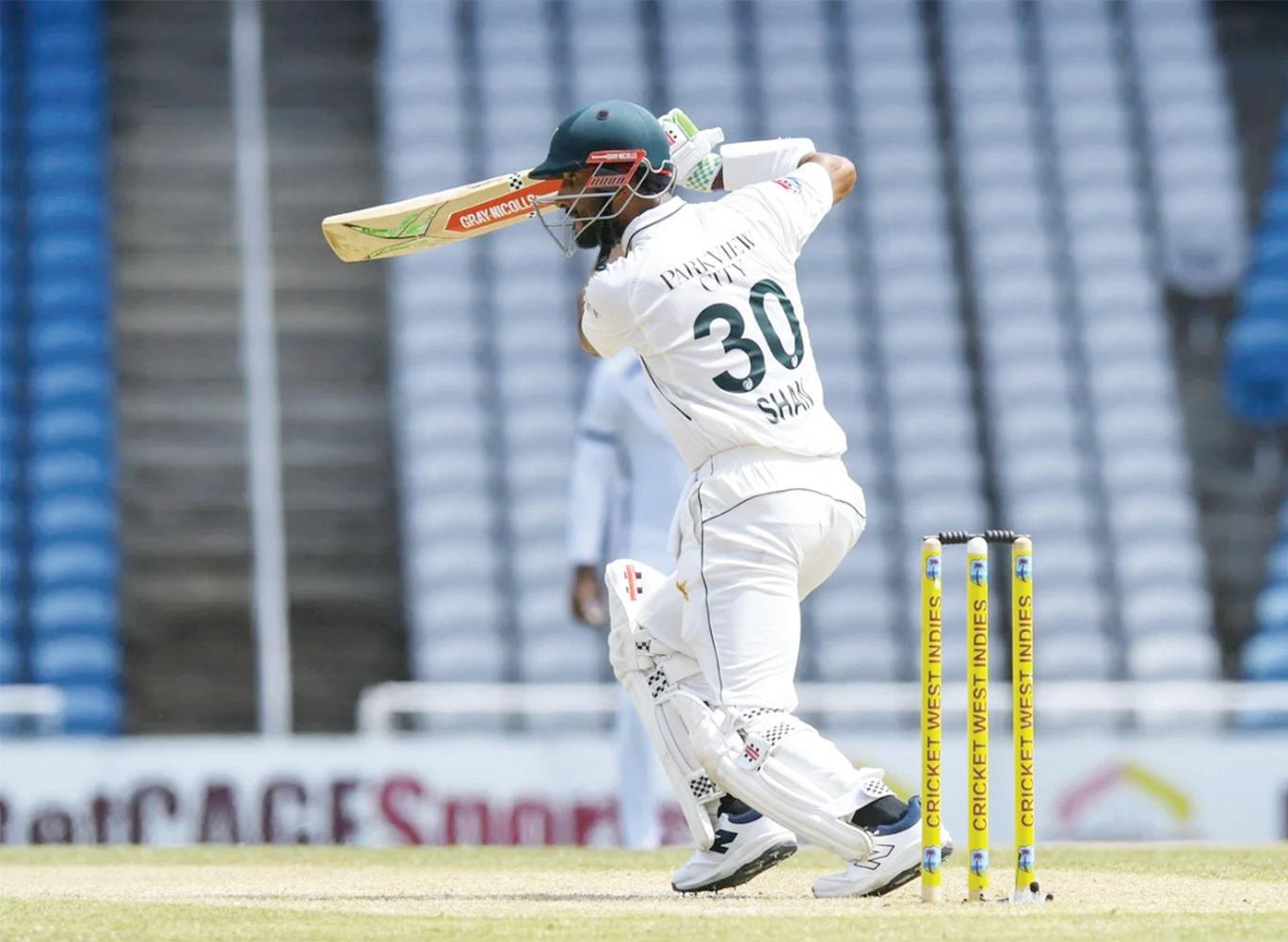

GUYANA’S Ceili Peterson etched her name into the nation’s sporting history on Sunday by capturing the bronze medal in the Women's Under-49kg Taekwondo competition at the XXV Central American and Caribbean (CAC) Games.
The stellar performance earned Guyana its very first medal of the Centennial Games.
Peterson, who proudly served as one of Guyana's flag bearers alongside archer Devin Permaul, delivered a composed and determined performance to defeat Venezuela’s Yu-
TURN TO PAGE 27