




By Shamar Meusa
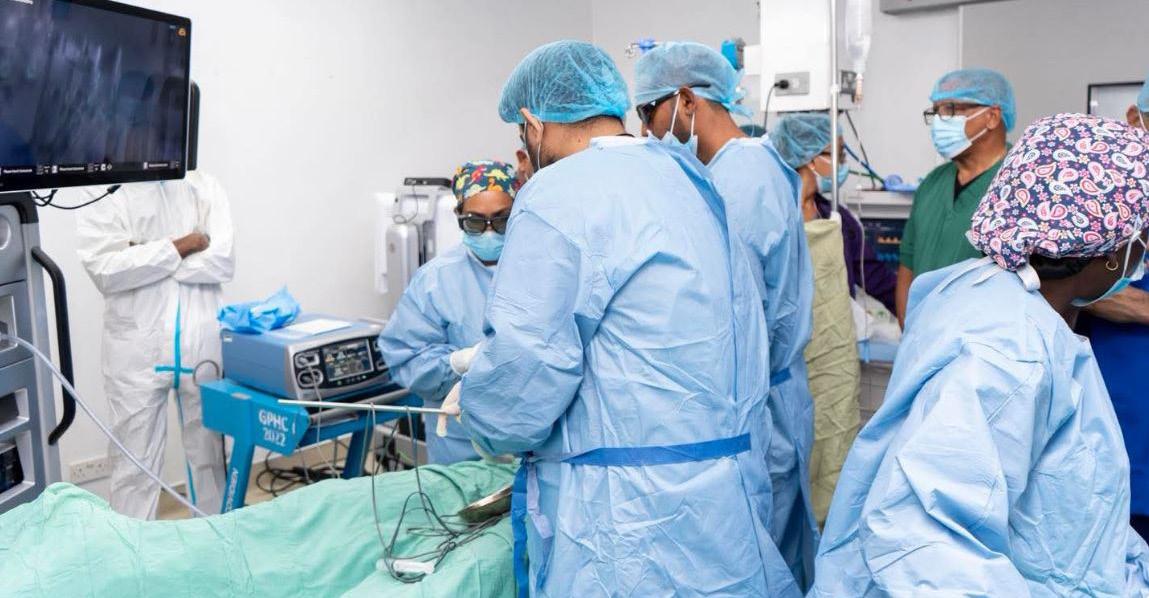
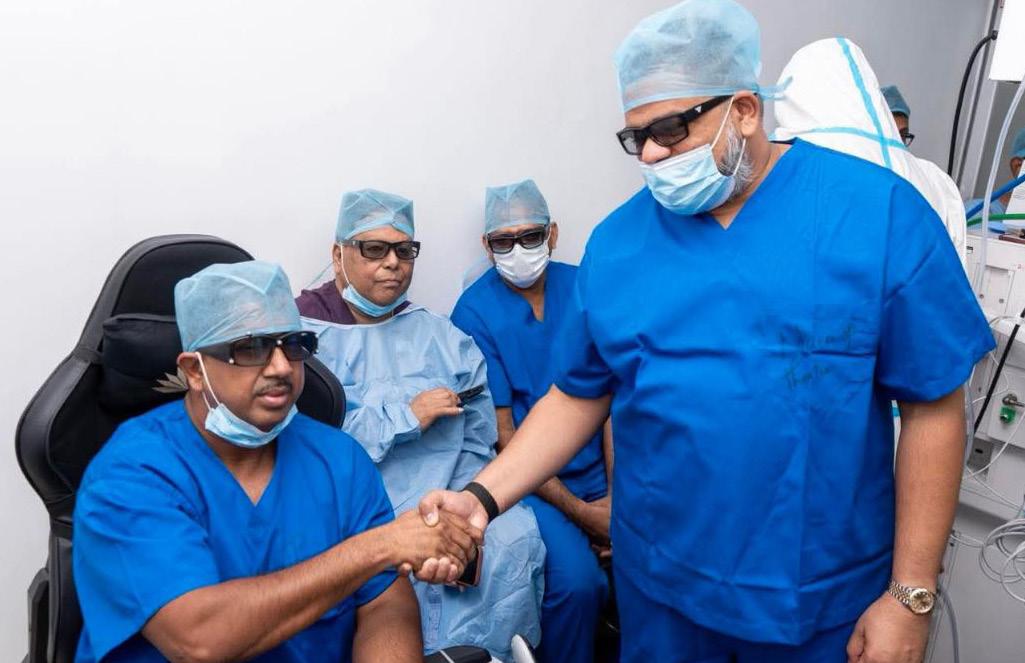
AS Guyana marked its 60th Independence Anniversary on Tuesday, the country also marked a historic breakthrough in healthcare, having successfully facilitated the longest-distance telesurgery procedure using advanced robotic technology.
President Dr Irfaan Ali made the announcement on Tuesday during a press conference, stating that the achievement signalled the country’s intention to become a regional leader in modern healthcare and medical training.
“At 6am, the team performed a coronary artery bypass graft,” the President announced. He explained that the surgery was remotely conducted by internationally
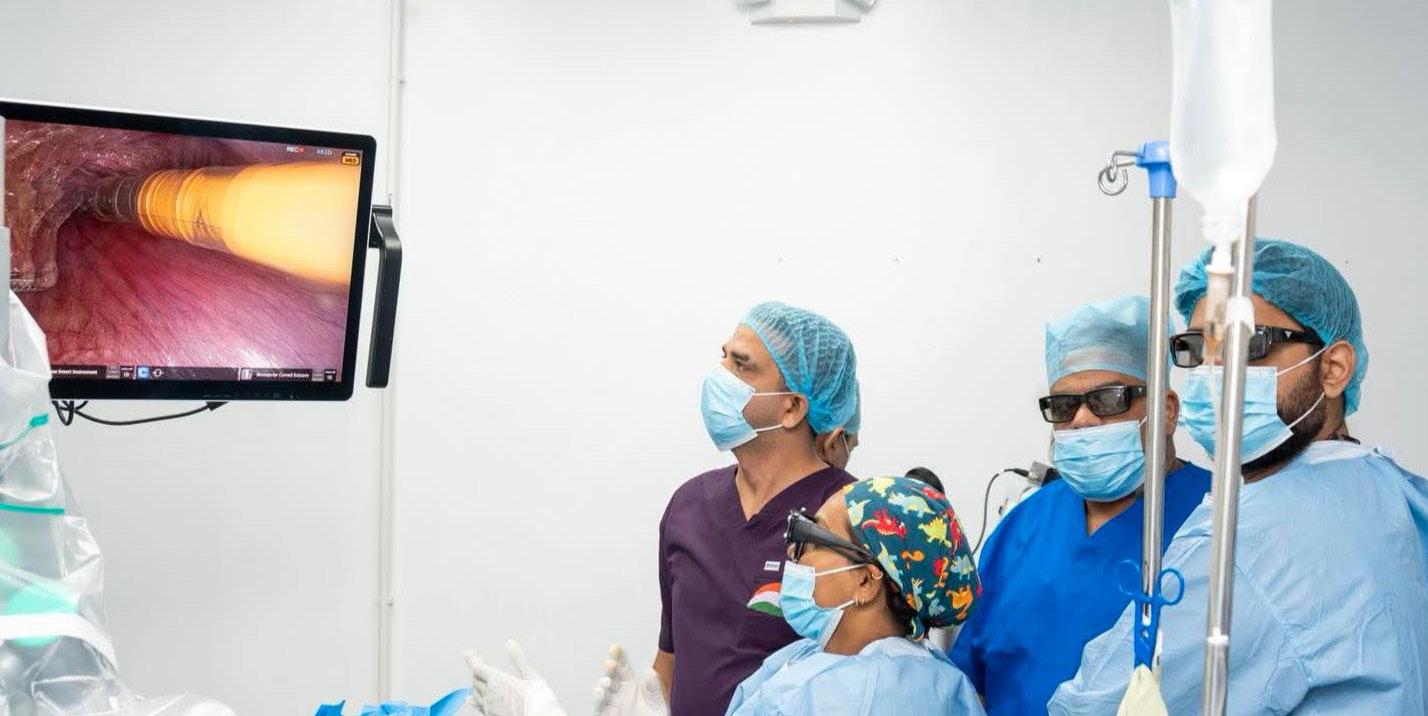
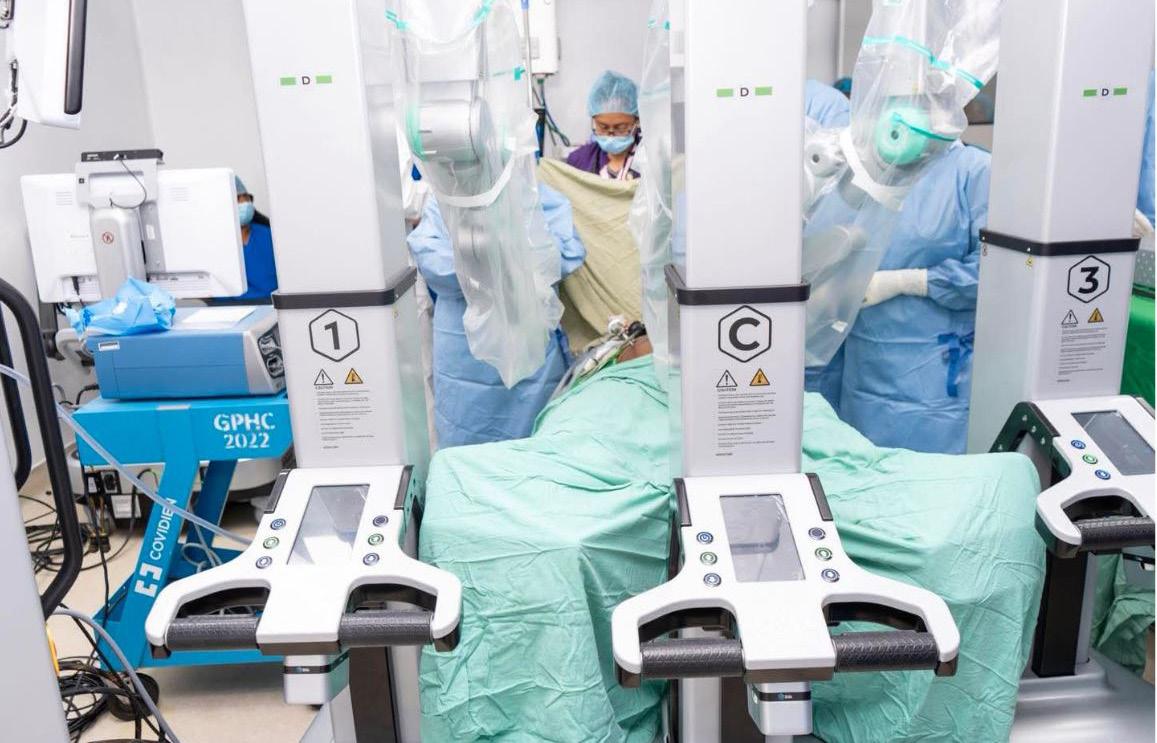
renowned cardiac surgeon Dr Sudhir Srivastava, who operated remotely from Guyana on a patient located in India using the SSI Mantra 3 robotic surgical system.
According to the President, the procedure covered an estimated distance of approximately 20,000 kilometres, making it “the longest-distance telesurgery ever completed in the world.”
He noted that the accomplishment was not simply about making history, but about creating a healthcare system that would benefit Guyana and the wider Caribbean.
“When we embarked on this journey of robotic surgery, we invested not only in the technology, but also in the training,”
See page 4
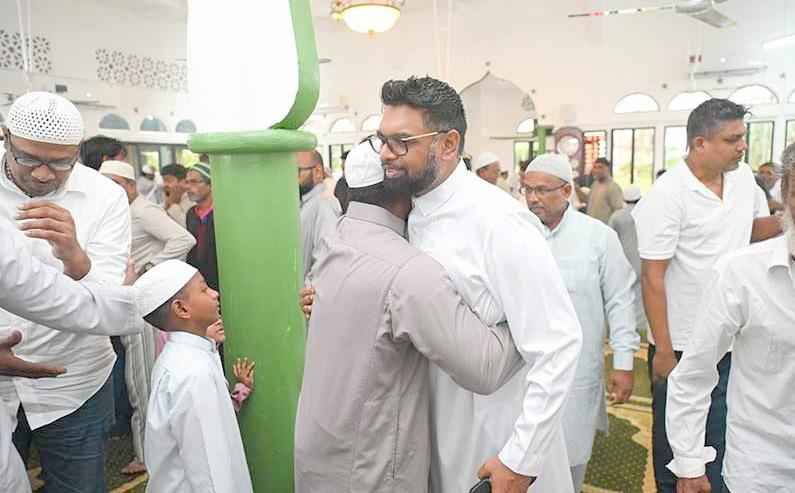
PRESIDENT Dr. Irfaan Ali has called on Guyanese to embrace sacrifice, compassion and service to others as defining principles of both Eid-ul-Adha and Guyana’s national identity, saying the country’s journey to independence was built on the willingness of citizens to give of themselves for future generations.
In his Eid-ul-Adha 2026 message to the nation on Wednesday, themed “A covenant with others,” the Head of State reflected on the story of Prophet Ibrahim and linked the sacred observance to Guyana’s ongoing development and the celebration of the country’s 60th Independence Anniversary.
Addressing the Muslim community and the wider nation, President Ali said Eid-ul-Adha represents more than ritual sacrifice, describing it as a reminder of service, mercy and collective responsibility.
“This festival is not a feast behind closed doors. It is a covenant with others, ensuring especially that the needy, the orphan and the forgotten taste the same blessing as the affluent,” the President stated.
Drawing parallels be-
tween faith and nationhood, President Ali said Guyana’s independence was achieved through sacrifice and perseverance by generations of citizens who struggled for dignity, equality and a better future.
“Independence and sacrifice are not separate chapters of our nation’s story—they are the same verse,” he said. “For what is independence, if not the willingness of a people to sacrifice for freedom.”
The President noted
that Guyana’s foreparents “gave their sweat, their blood, their tears, their very lives,” in pursuit of a nation where every citizen could live with dignity and opportunity.
He said the values of Eid-ul-Adha remain
especially significant as Guyana marks 60 years as an independent nation, urging citizens to ensure that national progress is measured not only through economic growth, but through care for the vulnerable and commitment to justice and unity.
“Today, we have the right to contribute as equals in building our nation. That right was secured by sacrifice. Let us honour it by continuing to sacrifice for each other— not only meat, but mercy; not only charity, but justice; not only prayers, but action,” President Ali said.
The message also referenced verses from the Holy Quran, highlighting the importance of feeding and caring for those in need without expectation of reward or gratitude.
President Ali ended his address with prayers for continued peace, protection and prosperity for Guyana and extended Eid Mubarak greetings to all observing the holy occasion.

President Ali said.
President Ali explained that Guyanese medical teams were sent to India for specialised instruction and that Guyana would now establish an international training hub for robotic surgery in collaboration with the SSI Mantra ecosystem.
He said that the initiative would allow Guyana to serve as the hub for robotic surgery and care within the Caribbean,
while extending training opportunities to regional healthcare professionals.
Against this backdrop, Dr Ali said the country had acquired some of the most advanced robotic surgical technology available globally, describing the investment as a major leap forward for Guyana’s healthcare sector.
Adding to this, Head of Medical Services and Cardiology at the

Georgetown Public Hospital Corporation, Dr Mahendra Carpen, described the development as a transformational moment for cardiac care in Guyana and the wider region.
He stated that cardiovascular disease remains the leading cause of death worldwide and throughout the Caribbean, with many patients requiring bypass surgery for severe blockages.
Conventionally, he said, bypass surgery involves opening the chest through the sternum, resulting in longer recovery periods, increased pain and extended hospital stays.
“This morning, we introduced a cardiac sur-
gery approach using telerobotic surgery where, instead of opening the chest straight down the middle, fine tubes were inserted between the rib spaces,” Dr Carpen said.
He said that robotic-assisted procedures significantly reduce trauma to the body, shorten hospital stays and improve recovery outcomes for patients.
With this, he noted that patients undergoing traditional bypass surgery may spend at least seven days in hospital, while robotic procedures could reduce recovery periods to between three and five days.
“So, we’re saving cost, we’re saving time, but most importantly for

patients, the discomfort is much less,” he said.
Robotic systems, he noted, allow surgeons to operate with enhanced precision and endurance.
“The robots don’t get tired,” he said. As such, he went on to add that the technology enables sustained exposure of delicate tissues during lengthy procedures while allowing surgeons to continue working efficiently.
Such surgeries, it was noted, can cost between US$35,000 and US$45,000 regionally, with prices increasing substantially further north.
Meanwhile, Minister of Health Dr Frank Anthony too noted that the achievement marks a new era of medicine in Guyana.
Dr Anthony said the successful completion of a robotic heart surgery on a beating heart over such a long distance demonstrated the strength and precision of the technology now available in Guyana.
“Because of this operation, that patient is alive and well, and that’s
the power of what has happened here today,” he said.
This technology, Dr Anthony said, could eventually allow specialists based in Georgetown to operate on patients located at regional hospitals across the country, improving access to specialised surgical care.
He noted that robotic systems provide exceptional precision, allowing surgeons to clearly visualise even the smallest anatomical structures in high definition and three-dimensional imaging.
Against this backdrop, he noted that Guyana will be establishing a formal training and accreditation system in partnership with the Ministry of Health, the University of Guyana and the Post Graduate Medical Institute.
According to Dr Anthony, Guyana would become the only country in the region capable of offering fellowship-style robotic surgery training using the advanced systems that are now here.

THE Ministry of Human Services and Social Security is continuing efforts to empower persons living with disabilities through skills training programmes.
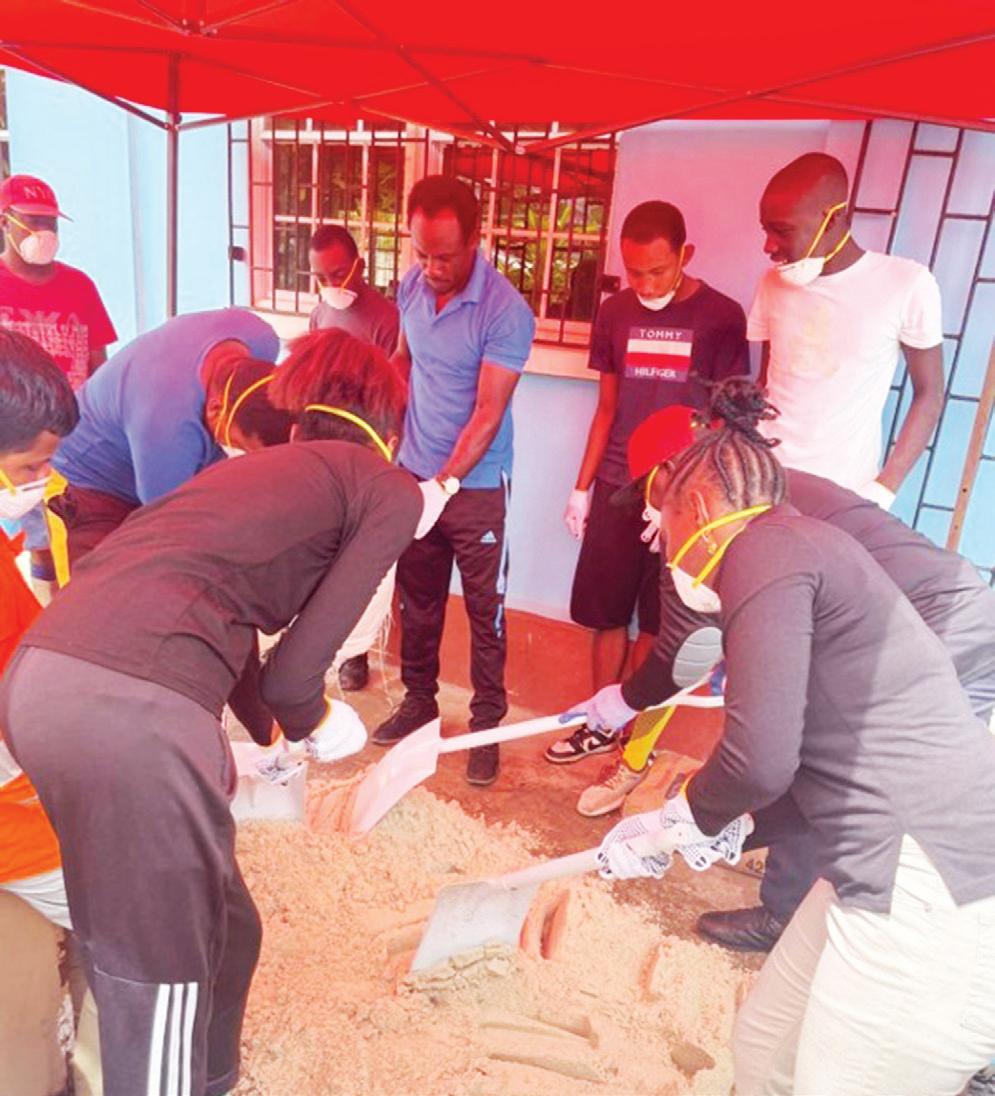
In an effort to create employment and business opportunities for a vulnerable segment of society, the ministry’s Support Services for Persons with Disabilities Unit conducted a five-day block-making training in Region Ten at the Linden Multi-Complex Hall in Wismar.
Twenty persons par-
ticipated in the initiative. The training combined both theoretical and practical sessions, giving participants hands-on experience in mixing materials, making, moving and storing cement blocks.
Training Officer at the ministry, Nicklett Powers-Douglas, explained that the initiative forms part of the ministry’s continued drive to equip persons with practical skills that can improve their livelihoods and promote greater independence.
The ministry hopes
the programme will help participants secure employment, establish or expand small businesses, strengthen income-generating opportunities and improve their quality of life.
Throughout the training, participants were guided by trainers and ministry officials, and each person was allowed to make at least two six-inch concrete blocks, regardless of their disability.
According to the ministry, participants remained fully engaged throughout the sessions
and displayed enthusiasm and interest in learning the trade.
Relatives of several participants also praised the initiative, noting the positive impact it can have on persons living with disabilities.
Participants who completed the programme will receive certificates of participation from the ministry. Officials also indicated that additional levels of training are expected to be introduced in the future as the initiative expands. (DPI)


AS Guyana celebrated its 60th Independence Anniversary, history was made in an operation room at Georgetown Public Hospital, as the nation successfully completed the world’s longest-distance robotic telesurgery.
More than a historic medical achievement; it became a defining symbol of how far the country has come in 60 years and where it now intends to go. The coronary artery bypass graft surgery, conducted between the GPHC and specialists located approximately 20,000 kilometres away in Indore, India, represented something larger than technology. It represented transformation.
For many Guyanese, there was once a time when even basic specialist healthcare felt uncertain. Advanced procedures often required expensive overseas travel, long waiting periods or access that many ordinary citizens simply could not afford. Public healthcare was frequently associated with limitations rather than innovation.
Today, Guyana is performing
globally recognised robotic-assisted procedures with international specialists in real time. But beyond the global headlines and technological accomplishment lies a deeper national significance. The surgery symbolises a country that is no longer thinking small.
As Guyana celebrates its Diamond Jubilee, the healthcare sector has become one of the clearest examples of how rapid economic growth is being converted into real public development. The country is moving away from a reactive healthcare system toward one driven by technology, data, specialised medicine and decentralised care.
This transformation is being supported by a record-breaking $161.1 billion allocation to healthcare in the 2026 National Budget. That investment is financing the expansion of hospitals, telemedicine services, digital health records, AI diagnostics and workforce training nationwide.
The National Electronic Health Records (EHR) system operational at GPHC before expanding across
the country. Artificial intelligence systems are already assisting doctors with interpreting X-rays and imaging faster. Telemedicine networks now connect more than 150 hinterland and Indigenous communities to specialist consultations that were once unavailable outside Georgetown.
At the same time, major infrastructure projects are reshaping the physical healthcare landscape. New facilities and expansions are underway in West Demerara, New Amsterdam, Moruca, Kato and Lethem, alongside the construction of the Maternal and Paediatric Hospital at Ogle.
Importantly, this transformation also reflects changing expectations among Guyanese citizens themselves.
The younger generation is now growing up in a country where robotic surgery, AI-assisted diagnostics and digital healthcare systems are becoming part of national conversation. That changes how people think about opportunity, careers and the future of Guyana itself.
The surgery also demonstrated the importance of international partnerships and local capacity-building. Guyanese specialists trained in India participated directly in the procedure, signalling that the country is not simply importing technology but building local expertise alongside it.
For ordinary citizens, however, the true meaning of this transformation goes beyond medical headlines. It means improved access. Faster diagnostics. More specialised services closer to home. Less dependence on overseas referrals. Greater confidence in public healthcare. And ultimately, a better quality of life.
At 60 years of Independence, Guyana’s healthcare story is no longer defined solely by struggle or shortages. It is increasingly becoming a story of innovation, ambition and national confidence.
And perhaps nothing captures that transformation more clearly than a surgery performed across continents that signalled a new time for Guyana.

FROM the length and breadth of this country, we all agree that after 60 years of Independence, Guyana has arrived. It is rich, modern and looks darn good to the eyes of those watching it.
The physical contents of this country cannot be denied by even the most insane anti-patriotic person. It will take several columns to document the changed physical landscape of Guyana.
Let’s look at the other side of Guyana’s ontology – the psychic horizon. How far have we come psychologically after 60 years of Independence? The answer is that there is an ocean of chagrin within the collective psyche of Guyana. This should never have been after 60 years of Independence.
I wrote in part one yesterday that the 60-year-old journey is best described by someone who lived through those six decades. But in that portrait, there is an ironic spot and that ironic spot needs extensive analysis in this country today, especially on this very day in the calendar where we celebrate 60 years of Independence.
We who are in our seventies saw how “one, one dutty build dam” and that dam, after 60 years, is a futuristic country. We also saw the ubiquitous pride in being non-White, in being anti-colonial, in believing in our own religions and natural cultures, in our own pathways to developmental goals – in a nutshell, 60 years ago, we believed in who we were.
Today, on the achievement of 60 years of Independence, there are frightening moments of acceptance of the remnants of colonial brainwashing; terrifying moments of self –
hate; eager thoughts of us wanting to be what our colonial masters instructed us to be.
It is a nightmare to be driving in Guyana after 60 years of Independence behind a commercial van and on the back door of the vehicle is a White baby face extolling a baby product in a country where the Caucasian race is less than one per cent. It is a nightmare walking your dog on the seawall and as you look at the advertisement board, it’s about a boutique where the clothes are advertised by a woman whose skin is whiter than milk in a country where 99 per cent of the faces of the citizens are not milky white.
It is a nightmare to be behind a customer at the supermarket check-out and the customer in front of you is pushing a trolley in which there is a box of foreign chicken legs so large you think it is a deep-sea monster in front of you. The legs are injected with chemicals that are bound to alter your cell system. This is taking place in a country after 60 years of independence, where scientifically healthier chicken legs are produced by Guyanese companies that employ Guyanese.
Where did we go wrong after 60 years in which Cheddi Jagan, Forbes Burnham, Walter Rodney and Bob Marley took hold of our minds and made us mentally free, intellectually inspiring, and proud to be non-White, Guyanese and West Indian? Did Jagan, Burnham, Rodney and Marley fail us or is that we were genetically incapacitated to understand how their greatness could make us free?
After 60 years of independence, what is the shape of the Guyanese psyche? We can see it in the names of babies. Many African and Indian parents give their newborns En-

glish names. Many Muslims and Hindus give their children English names. As for me, if you had put a gun to my head and demanded an English name for my kid, you would have had to kill me. I am a descendant of Cheddi Jagan, Forbes Burnham, Walter Rodney and Bob Marley.
Twenty years ago, I wrote a story in one of my columns. I am repeating it here. I helped in my mother-in-law’s supermarket. A small block away was a Baptist Church ran by American missionaries. I never saw those people buy any soft drinks and snacks that were produced locally. Every soda was either Pepsi, 7-Up, Coca-Cola, or Sprite. Every chocolate was Cadbury, never a West Indian chocolate.
Where did mental liberation go after Independence came to Guyana? I lived through colonialism and saw the domineering colonial narratives. You can still see those debilitating
thoughts in today’s Guyana. A major newspaper carried a columnist that eulogized the world’s most sadistic state terrorist organisation – the Mossad of Israel. A major newspaper refused to carry solidarity activities in Guyana for Palestine. And Guyanese, not Nigerians, but Guyanese praise this newspaper. Where did mental liberation go after Guyanese got Independence? Five months of election rigging took place in Guyana and there were humans in Guyana that wanted that rigging to be successful because they didn’t like the ethnic makeup of the winner. God is dead! Jagan is dead! Burnham is dead! Marley is dead! And I’m not feeling too well myself!
DISCLAIMER: The views and opinions expressed in this column are solely those of the author and do not necessarily reflect the official policy or position of the Guyana National Newspapers Limited.
UNITED Nations Resident Coordinator in Guyana, Jean Gough Kamau, commended the country’s “remarkable journey of resilience, growth, and development” since attaining independence.
“As Guyana proudly celebrates its independence, the United Nations joins the people of this beautiful nation in reflecting on a remarkable journey of resilience, growth, and
development,” she said, praising six decades of partnership and national progress.
Kamau highlighted that 1966 marked a pivotal year in Guyana’s history, noting that the country not only gained independence in May but also became a member of the United Nations later that year.
“In 1966, Guyana achieved two historical milestones, gaining independence in May and joining the United
Nations family shortly thereafter in September. These two moments are deeply connected, reflecting a young nation stepping confidently onto the world stage,” she stated.
Reflecting on the 60-year relationship, the Resident Coordinator underscored that cooperation between Guyana and the UN has evolved in tandem with the country’s own social and economic transformation.
She said the partnership has supported progress across key sectors, including health, education, climate resilience, governance, gender equality, human rights, and sustainable development in all ten regions of the country.
“On behalf of the United Nations in Guyana, I extend warm congratulations to the government and the people of Guyana on this independence anniversary.”


GUYANA and Barbados are moving to establish a new regional investment fund aimed at allowing ordinary citizens to invest in major development projects, as both countries prepare to officially roll out digital ID card travel from July 1.
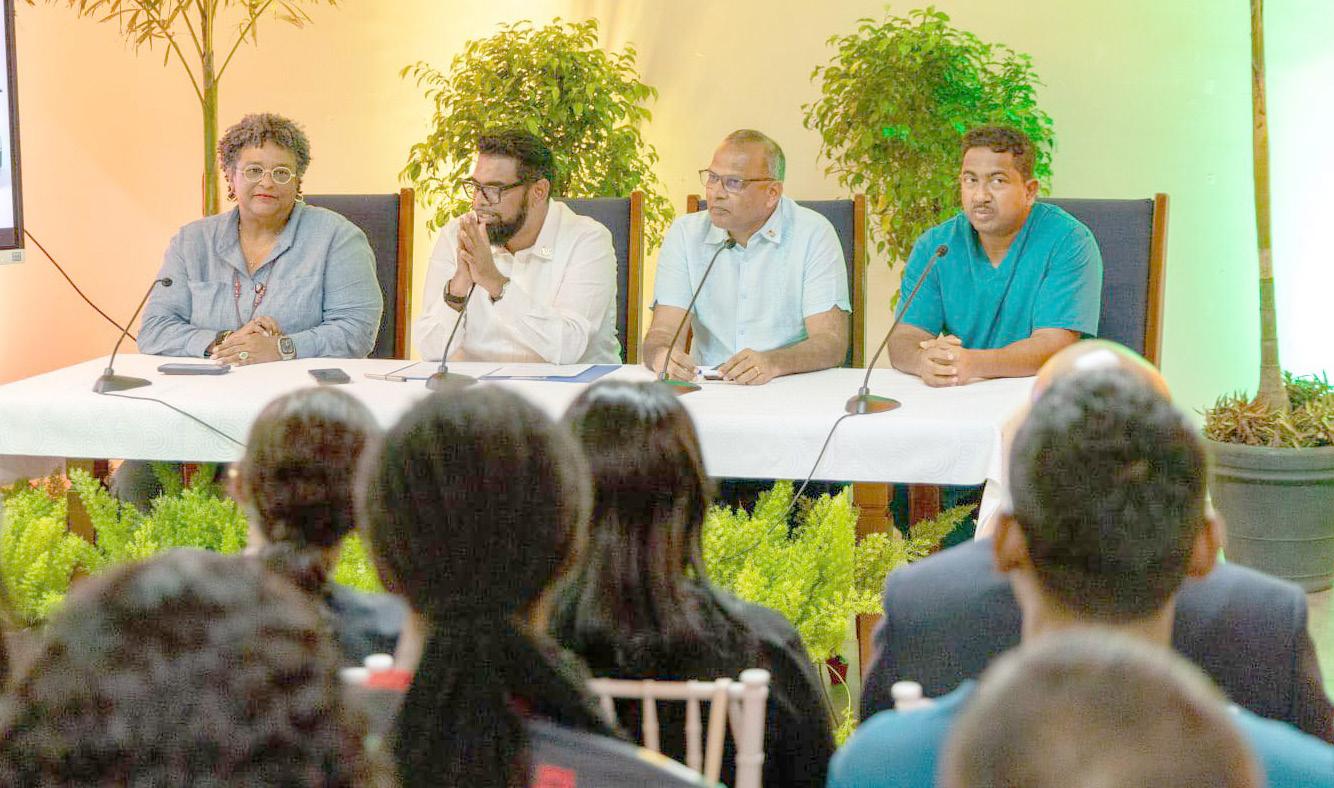
The announcement was made on Tuesday during a press conference at the National Stadium, Providence, where President Dr. Irfaan Ali and Barbados Prime Minister Mia Mottley outlined a broader vision for deeper regional integration through digital systems, investment, and freer movement.
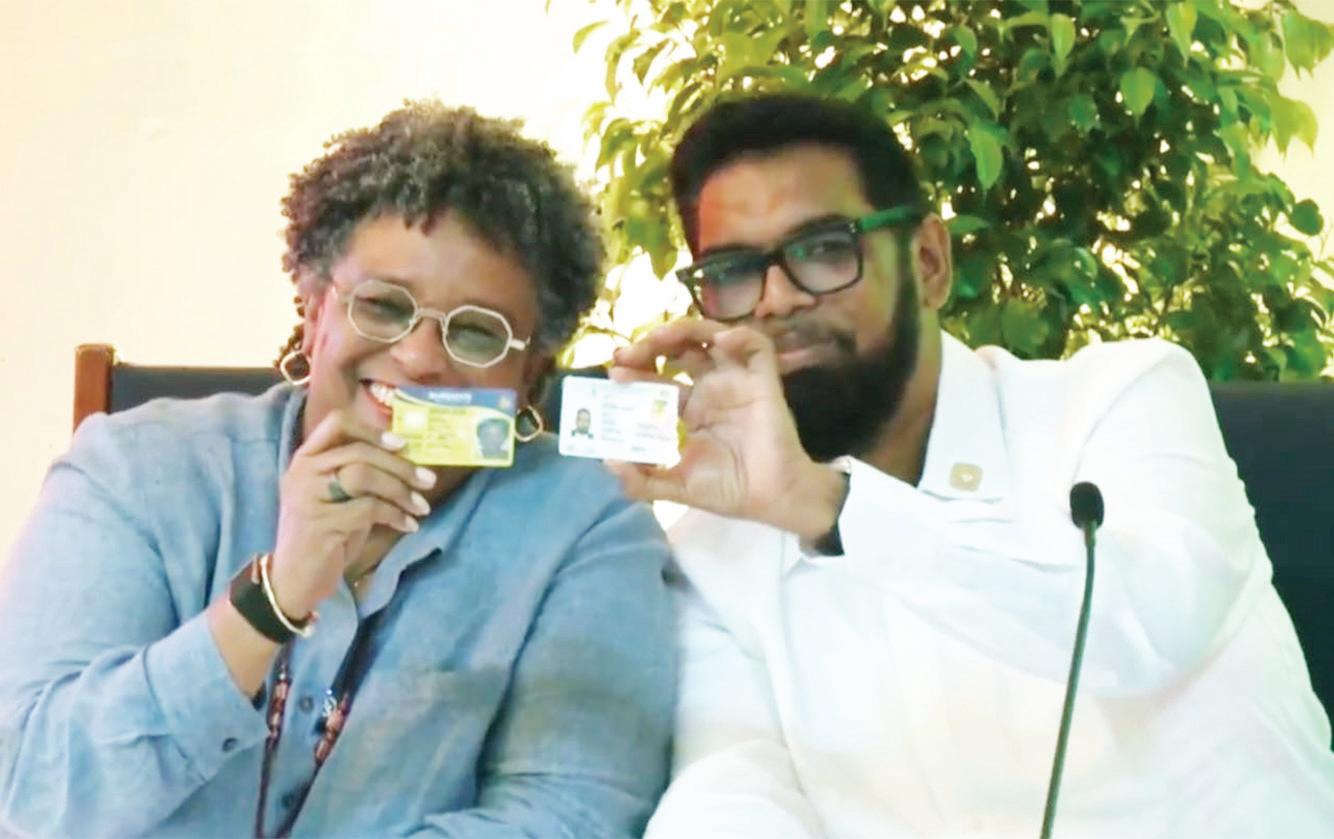
On Monday, Prime Minister Mottley became the first Barbadian to travel to Guyana using a digital identification card instead of a passport, under a new arrangement being implemented by both countries to allow citizens to travel without passports.
Under the new arrangement, citizens of both countries will be able to travel between Guyana and Barbados, using only their digital ID cards instead of passports.
“From July the first, you can forget your passport at home and travel with your digital ID card to Barbados and from Barbados to
Guyana,” President Ali announced.
Prime Minister Mottley said the initiative is intended to directly benefit ordinary citizens, and make regional travel easier and more accessible.
“Even if a person does not have a passport but has a digital ID card, they can now travel between the two countries, and we say simply to you, we’ve only just begun,” she said.
Beyond travel, both leaders revealed that discussions are advancing on a major cross-border investment mechanism known as the “Trident Arrow Investment
Fund”.
According to Prime Minister Mottley, the proposed fund is being designed to allow ordinary Barbadians and Guyanese to collectively invest in medium-and-long-term infrastructure and development projects.
“The second one we want to work on is the Trident Arrow Investment Fund, an investment fund that we want to be able to create that will be open to ordinary Bajans and ordinary Guyanese to invest in critical infrastructure and long-term, medium-to-long-term investment projects,” Mottley said.
She explained that the initiative could support investments in sectors such as util-
ities, technology, and agro-processing while giving citizens greater ownership in regional economic development.
“It allows ordinary people who could not do it on their own, but who, as part and parcel of a collective group, can make it happen,” the Barbadian leader stated.
President Ali said Guyana and Barbados are also advancing talks on stronger digital financial integration to create wider commercial and investment opportunities for citizens of both countries.
“We are now advancing talks on how we would digitally connect our financial systems in a stronger way, creating financial opportunities, business
opportunities, commerce opportunities for both citizens of Barbados and Guyana,” President Ali disclosed.
The President noted that the digital ID initiative also forms part of a wider regional modernisation strategy and could eventually support integrated healthcare systems, allowing medical professionals in either country to securely access patient records when needed.
Both leaders described the developments as a major step towards modernising CARICOM integration through technology, easier movement and expanded economic participation for Caribbean citizens.





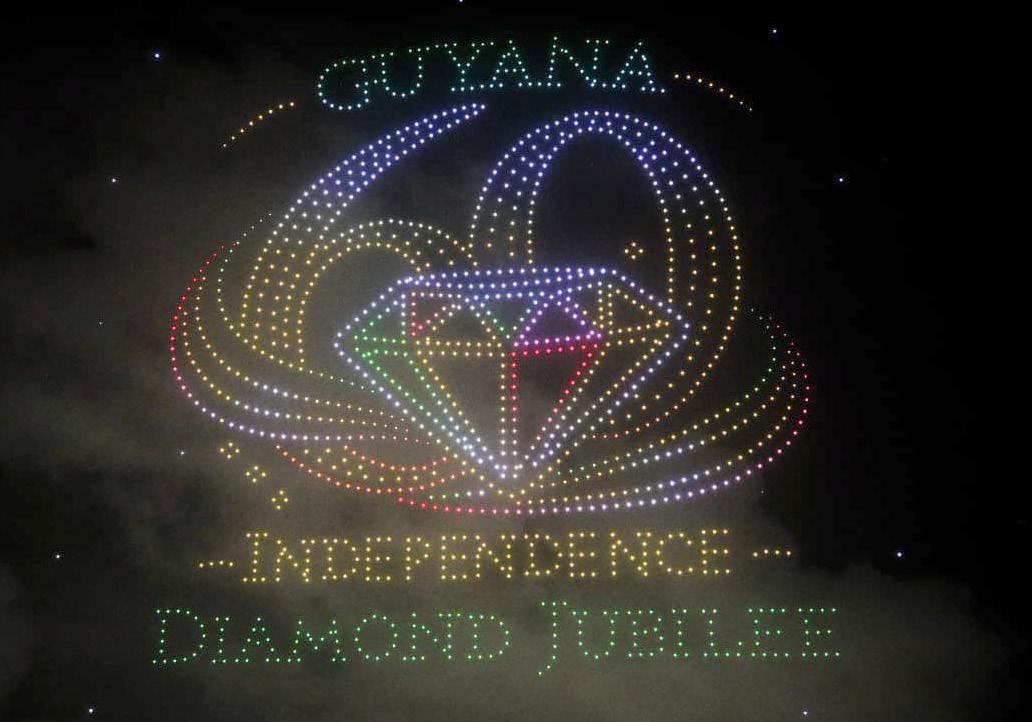
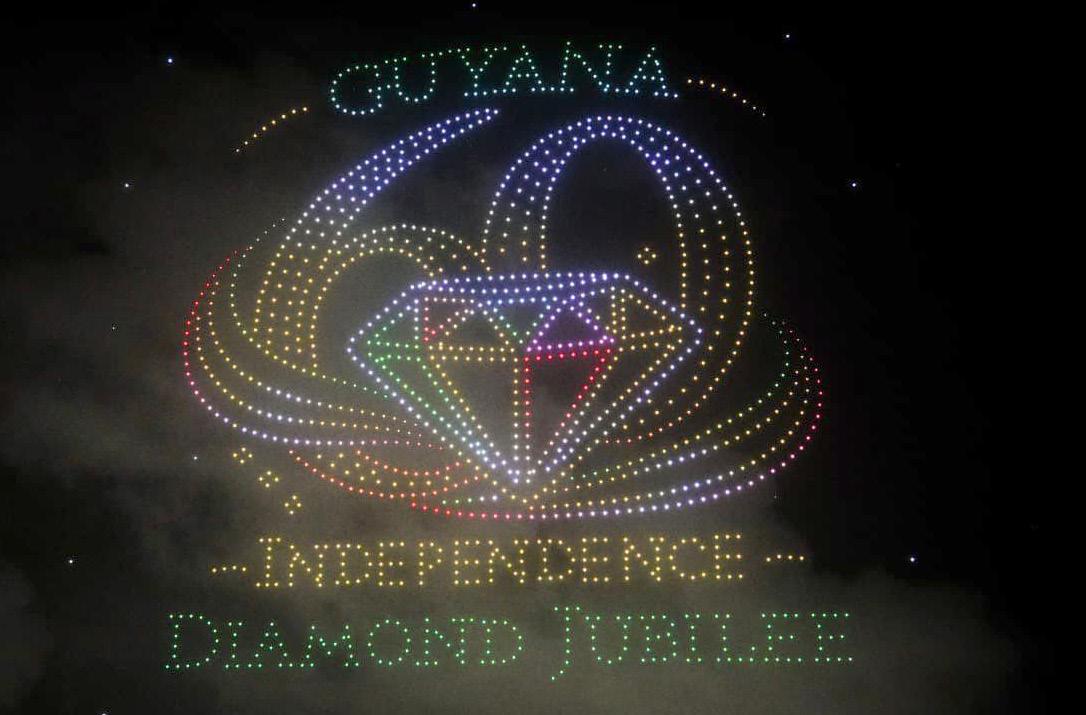
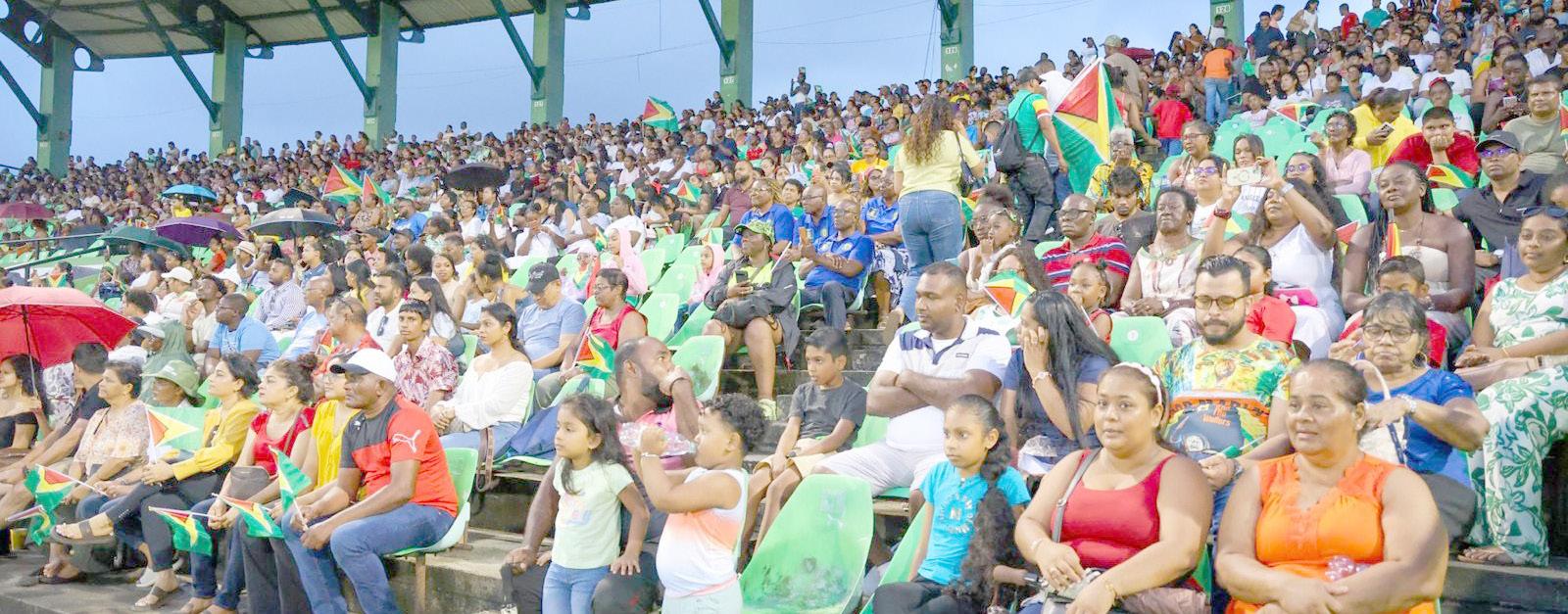
DESPITE intermittent showers, thousands of Guyanese packed the Guyana National Stadium on Tuesday evening as the country staged what organisers described as one of the largest drone and light shows ever held in the Caribbean, marking Guyana’s 60th Independence Anniversary with a sweeping display of culture, patriotism and innovation entertainment.
With thousands of Guyanese, tourist and people visiting from the diaspora, the atmosphere inside the stadium reflected the importance of national celebration. Among the first major performances of the night
was a rendition of “El Dorado” by Calvin Burnett alongside a number of other musicians, with performances centred on Guyana’s natural beauty, growth and identity. Calypso Monarch King 2026, EGO, delivered one of the night’s most energetic performances, using his set to highlight Guyana’s rapid transformation over recent years.
The event also showcased the work and discipline of the joint services through a canine display by the Guyana Police Force and Guyana Defence Force. The dogs performed obstacle routines, obedience manoeuvres and stunt exercises, including jumping through hoops, earning loud ap -
plause from spectators throughout the stadium.
Senior government officials and regional dignitaries were also present for the celebrations. Among those acknowledged in the Presidential Suite were President Dr. Irfaan Ali, Prime Minister Mark Phillips, Minister of Culture Charles Ramson Jr., Minister Susan Rodrigues and other members of Cabinet.
Barbados Prime Minister Mia Amor Mottley was also present alongside several Barbadian officials as part of the regional collaboration surrounding the Independence observances.
A major highlight of the evening came during
See page 13


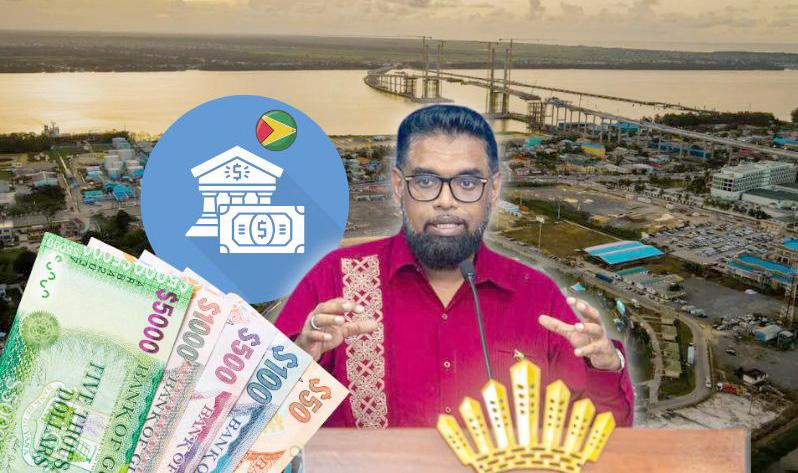
PRESIDENT, Dr Irfaan Ali on Tuesday announced that the Government of Guyana will launch a diaspora bond within one week, creating a new investment mechanism aimed at mobilising overseas Guyanese to help finance major public infrastructural projects.
The announcement, made during a press conference at the National Stadium, Providence, marks what could become one of the government’s most significant diaspora-financing initiatives as Guyana accelerates its national development agenda.
“I want to announce that the Government of Guyana will launch a special bond, a diaspora bond, to raise funds from the diaspora for investment in public infrastructure projects in Guyana. Within one week, we’ll be launching the diaspora bond” President Ali disclosed.
The President said the initiative is designed to give Guyanese living abroad a direct opportunity to participate in the country’s transformation while contributing to national development projects.
“So, members of the diaspora, here is your opportunity to make your contribution and to be part of the massive transformation taking place in our country,” he said.
Although government has not yet disclosed details regarding the size of the bond, expected returns, eligibility requirements or targeted projects, the announcement comes at a time when Guyana is pursuing billions of dollars in investments across transportation, healthcare, housing, energy and digital infrastructure.
The move also signals a broader effort by the administration to deepen financial and economic ties with the
Guyanese diaspora, many of whom have continued to play a major role in remittances, investment and skills transfer.
Diaspora bonds are specialised debt instruments issued by governments to attract investment from citizens living overseas. Several countries, including India and Israel, have previously used such instruments to raise capital for national development initiatives.
The Head of State has long called on the diaspora to return home to invest and participate in Guyana’s development.
Earlier this month, President Ali, while addressing members of the Guyanese Diaspora at the Pearson Centre in Brampton, Ontario, said the government had received hundreds of responses ahead of the engagement, many of which reflected op-

timism about Guyana’s future and a growing desire among overseas-based Guyanese to contribute to development.
“We received close to 600 emails,” the Head of State disclosed. He explained that 420 of those messages were “about complementing development and sharing encouraging words,” while 159 inquiries focused on six major categories, and another 45 involved personal issues, including land disputes and neighbourly concerns.
According to the Presi-
dent, the largest share of concerns submitted by diaspora members related to business investment, finance and economic development.
“Guess what is the top issue today? How can we invest? How can we be part of the development? How can we own a home? How can we be part of the building out of Guyana?” Dr Ali said, adding that the trend signalled a major shift in perceptions of the country.
He explained that 20 per cent of the 159 inquiries fell
into the business investment, finance and economic development categories, while housing, land and property accounted for 16.4 per cent. Travel, tourism, migration and diaspora affairs represented 11.9 per cent, followed by security, infrastructure and public service at 10.7 per cent. Health, education and environmental services made up 7.5 per cent of inquiries.
Dr Ali noted that issues
See page 13

From page 11
the joint military band performance involving the Guyana Police Force Military Band, the Guyana Defence Force Military Band and the Barbados Defence Force Band.
The evening also placed strong emphasis on youth involvement and national identity.
Primary school students from schools across the
East Bank of Demerara participated in a large-scale field display organised through the Ministry of Education and the Unit of Allied Arts. The students formed the shape of Guyana’s map, the number 60 and a heart at the centre of the field, symbolising love for country and the role of younger generations in Guyana’s future.
From page 12
surrounding public trust, transparency, accountability and inclusivity accounted for 10 per cent of the concerns, while another 10 per cent focused on persons offering consultancy, technological and other professional services to support Guyana’s growth.
Reflecting on years of engagement with overseas Guyanese, the President said the decline in security concerns represented a significant turning point.
He stated, “I’ve been coming to diaspora engagement for decades, and the top issue used to be security. Today, it is the last issue on the minds of those persons. “That tells you that the story of Guyana is one that is positive and one that is transformative.”
Dr Ali said the feedback from overseas Guyanese reflected a population increasingly eager to reconnect with the country through business, property ownership and professional expertise, rather than expressing anxiety about instability.
“That tells you a story,” the President said while reflecting on the trend in diaspora inquiries. “That tells you that the story of Guyana is one that is positive and one that is transformative. And this alone tells about the different period in our history.”
The Guyanese leader had also used the forum to encourage diaspora members to consider opportunities in Guyana’s expanding housing sector, particularly through investment in the planned Silica City development.
“We are building a new city. That city is called Silica City,” he said. “It is designed to be a city of sustainability, a city of wellness, a city of the future… basically, it is a city 50 years ahead of its time.”
“This is not a dream. We have already started the work in this city,” he said, noting that the first 200 homes are nearing completion and that additional investment has been secured for future phases
Dance performances by the Joro Dance Company and drumming presentations from visiting Barbadian cultural groups further reinforced the evening’s Caribbean and multicultural spirit, while patriotic songs celebrating sovereignty, heritage and unity kept the audience engaged between segments.
Attention later shift-
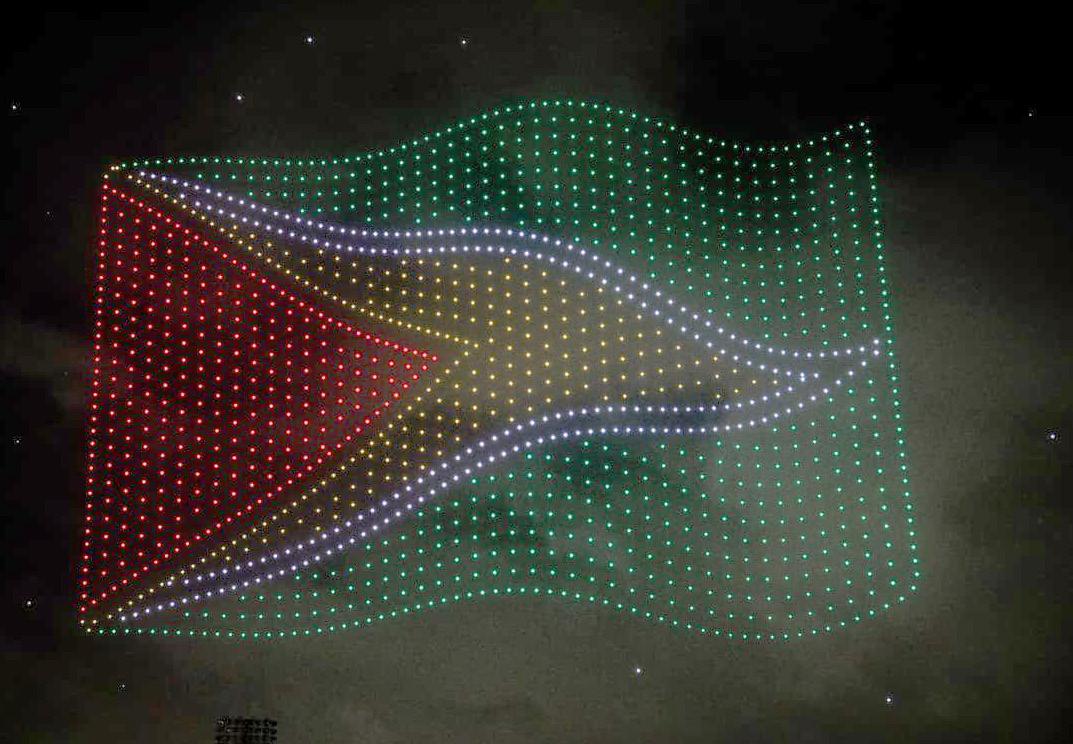
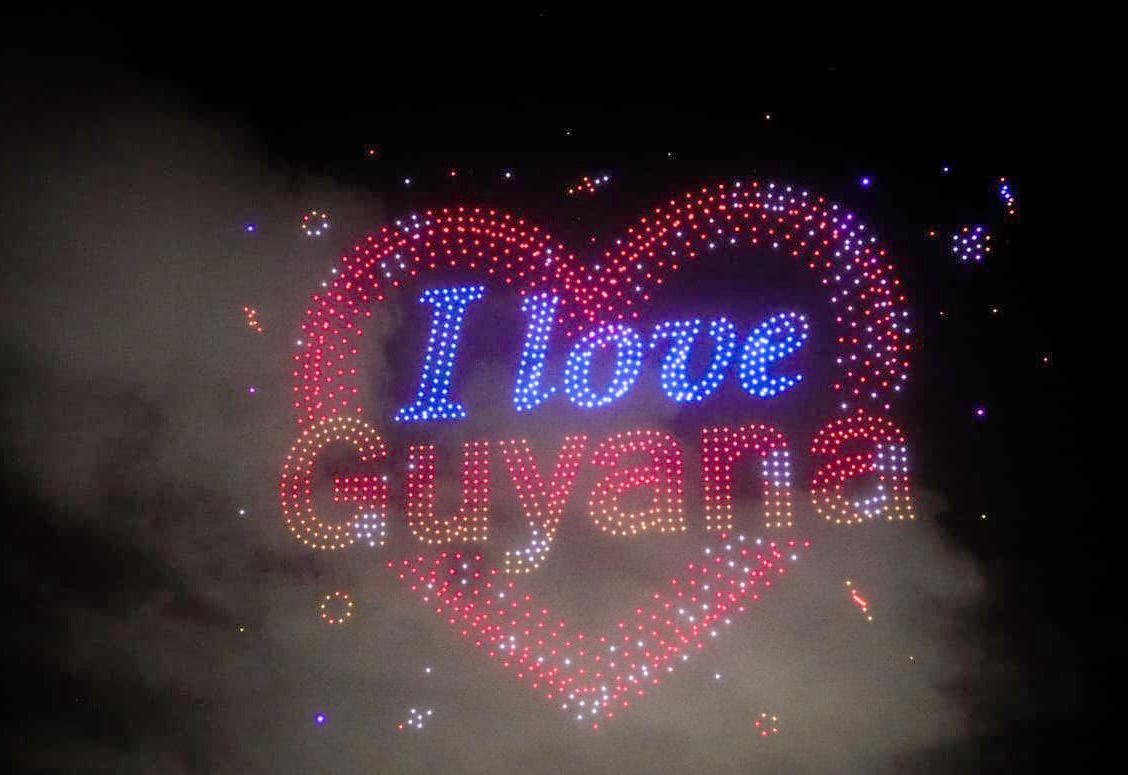
ed to the skies as organisers prepared for the drone and light show, the centrepiece of the evening. As lights across the stadium dimmed, hundreds of drones illuminated the skies above the Demerara Harbour Bridge in synchronised formations depicting aspects of Guyana’s identity, history and culture.
Among the formations displayed were the
Golden Arrowhead in its national colours and a massive jaguar symbolising strength, resilience and economic growth.
The display aimed to highlight Guyana’s multiculturalism, progress and journey over the last six decades as thousands of spectators captured the moment on their phones.
The night ended with a high-energy
performance from Soca Monarch King 2026 Adrian Dutchin as spectators raised cell phone lights across the stadium in a final display of celebration and unity before making their way home after what many described as one of the most captivating aspects of this year’s Independence celebrations.
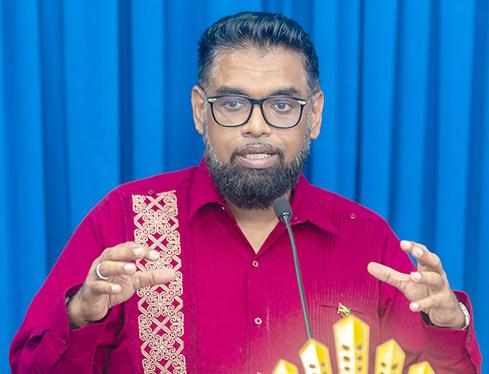
CAUTIONING that Guyana’s remarkable gains and hard-won progress cannot be secured if leaders and citizens cling to divisions of the past, President Dr Irfaan Ali warned that the nation cannot safeguard its future while remaining trapped in ‘zero-sum politics’.
The Head of State, during his address on the eve of Guyana’s 60th Independence Anniversary, said that the sovereign instruments of an independent nation would remain incomplete if division continues to weaken national movements and undermine efforts at nation-building.
He argued that the belief, “that one group can rise only
if another falls” helped fracture the spirit of unity that made independence possible and continues to threaten cohesion today.
“We have a choice before us, either to carry the pain of our history like an open wound, relive each day in bitterness and division, or
—President Ali says, urges united front to
to heal it. Sixty years of Independence calls us towards a higher covenant to build a nation anchored in love, ennobled by honest labour, strengthened by unity and guided by enduring faith, through shared ambition, shared families, compassionate communities, and a deep and abiding pride in country, we can shape a Guyana where democracy and equity are not distant aspirations but living principles,” the President said. While acknowledging the deep scars left by colonial-era manipulation of ethnicity and politics, he insisted that the next phase
of development must be grounded in a new political culture.
He called for a national development platform “rooted in unity, democracy, the rule of law, and respect for each other” and cautioned that institutional arrangements must be stable, practical, fair and fit for the realities of an ambitious nation.
President Ali urged all political, economic and social actors to refrain from exploiting cleavages for gain.
“Do not inherit old prejudices, do not repeat old arguments, do not allow the past to define the limits of your imagination. You are the generation that will finally, fully and irreversibly make Guyana whole,” he said, adding, “At this stage of our national journey, no one should seek to divide Guyana in pursuit of power. Government and opposition, private sector and labour, civil society and citizens, coastline and hinterland, no one should seek to divide.”
President Ali also placed responsibility on the younger generation, telling them they are “not responsible for the divisions of the past” but bear “responsibility for the unity of the future.”
Gov’t invites bids for major works at Parika Port Facility, Supenaam stelling
THE Ministry of Public Works has issued an ‘amended invitation for bids’ for infrastructural works at the new Parika Port facility and Supenaam stelling, with combined engineers’ estimates approaching $1 billion.
The ministry has invited contractors to submit bids for three separate projects aimed at upgrading transport and port infrastructure along key river-transport corridors, with improvements planned for the West Coast of Demerara and Region Two.
At the Parika Port Facility, the government is seeking contractors for the construction of a stelling-access road, waterfront drainage system and a parking apron for the northern section of the facility. The engineer’s estimate for the project is
$499.04 million.
The ministry is also inviting bids for the supply and installation of vehicular scales, or weighbridges, for the project.
The Parika stelling is being converted into an international port facility at a cost of $4.5 billion; construction works on Phase 1 began in late 2025.
Meanwhile, under the Supenaam Stelling Upgrades initiative, bids are being requested for the construction of the northern extension to the Supenaam Ferry Stelling in Region Two. This project, according to an engineer’s estimate, is $489.52 million.
The projects form part of ongoing efforts by the government to modernise Guyana’s transport and maritime infrastructure as economic activity and inter-regional movement continue to ex-
pand.
The notice stated that bidding will be conducted through the National Competitive Bidding procedure outlined in the Procurement Act 2003.
Interested bidders can purchase bidding documents from the Transport and Harbours Department beginning May 19, 2026, for a non-refundable fee of $5,000.
The ministry said bidders must submit valid compliance certificates from the Guyana Revenue Authority (GRA) and the National Insurance Scheme (NIS) as part of qualification requirements.
Bids are scheduled to be opened on June 10, 2026, at the National Procurement and Tender Administration Board (NPTAB) at Main and Urquhart Streets, Georgetown. [DPI]
THE Government of Guyana has officially moved forward with plans for the country’s long-awaited law school, inviting proposals for the design and supervision of the facility following final approval from the Council of Legal Education (CLE).
According to a Request for Proposals issued by the Ministry of Legal Affairs on Sunday, interested firms have been invited to submit technical and financial proposals for the design and supervision of the construction of the law school.
The procurement notice, published by the ministry, stated that interested firms can begin obtaining bidding documents from the National Procurement and Tender Administration Board (NPTAB) from May 28, 2026, between 09:00hrs and 15:30hrs, with proposals set to be opened on June 18, 2026, at the Board’s Main and Urquhart Streets office in Georgetown.
The move follows final approval from the CLE for
Guyana’s law school, which will be constructed on an eight-acre plot at the University of Guyana’s Turkeyen Campus.
Government approved funding for the project in the 2026 national budget, with $100 million allocated for architectural designs and consultancy services, while procurement for the construction phase is already underway.
The establishment of a law school in Guyana has been a long-standing goal, with successive administrations pursuing the initiative for nearly three decades.
Currently, Guyanese law graduates seeking legal education must attend one of three CLE-operated institutions in the Caribbean: the Hugh Wooding Law School in Trinidad and Tobago, the Norman Manley Law School in Jamaica, or the Eugene Dupuch Law School in The Bahamas.
The two-year Legal Education Certificate (LEC) programme can be obtained from any one of the schools. The
LEC is a professional vocational certification required to practice law as an attorney in the Commonwealth Caribbean. It is the final qualification earned after completing an accredited Bachelor of Laws (LLB) degree, qualifying the holder for admission to the Bar.
The planned law school is expected to significantly expand access to legal education locally, reducing financial barriers for students and allowing more graduates to complete the professional training required to practise law in Guyana and the region.
Tuition costs alone at Hugh Wooding exceed GY$7.4 million over the two-year programme, with first-year fees standing at TT$121,718 (approximately GY$3.75 million) and second-year fees at TT$121,418 (approximately GY$3.74 million).
The law schools have also been offering a sixmonth accelerated transitional course for qualified, common-law trained attorneys
and legal professionals from other jurisdictions to earn the LEC, which is the mandatory credential to practice law in the Commonwealth Caribbean.
For years, Guyanese students have faced limited access to legal training opportunities, with only the top
25 law graduates annually securing automatic places at Hugh Wooding, despite the University of Guyana’s LLB programme often graduating more students than that each year.
The high cost of living in Trinidad and Tobago, and in other countries, has also
posed challenges for aspiring attorneys, discouraging some from pursuing the LEC.
In response, the Guyanese government has, in recent years, offered a limited number of fully funded scholarships to support students desirous of pursing their LEC.

THE Guyana Fire Service is undergoing a major transformation as government moves to modernise the country’s emergency response capabilities to meet the demands of rapid urban expansion, industrial development, and the growing oil-and-gas sector.
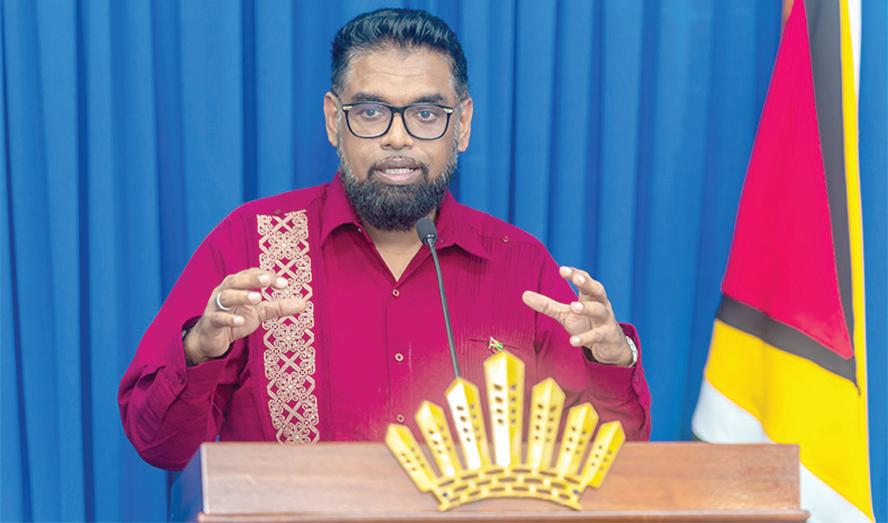
Speaking during a press conference on Friday, President Dr Irfaan Ali said billions of dollars have already been invested in upgrading the nation’s firefighting infrastructure, equipment and personnel as part of the government’s broader national security architecture.
“The Guyana Fire Service is a major area that needs massive reorganisation,” the President said while outlining the administration’s plans for a more technologically advanced
and responsive fire and emergency service.
This year, the GFS was allocated $6.3 billion in the 2026 National Budget to strengthen emergency response and firefighting capacities. This includes
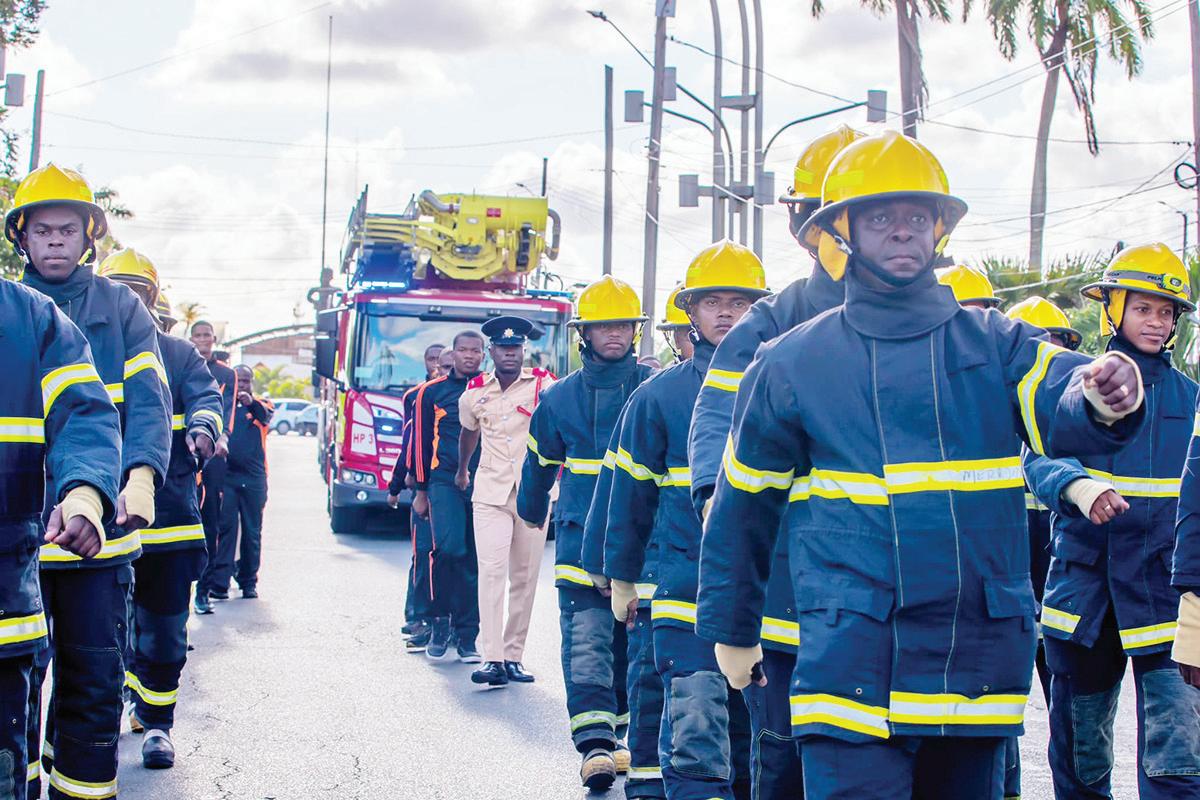
$1.1 billion for new and upgraded fire stations, $1.6 billion for additional firefighting equipment, and $250 million for the procurement of new fire hydrants.
Among the major initiatives announced on Friday is an aggressive nationwide hydrant installation programme aimed at strengthening fire response capabilities in both urban
and expanding residential communities.
President Ali disclosed that the government plans to install more than 25,000 hydrants across the country, noting that several thousand have already been installed.
“I think more than 25,000 hydrants to install, that is the first place,” the President said, while explaining that the expansion
is necessary as communities continue to grow deeper and more densely populated.
The Head of State explained that government is also investing heavily in smart emergency management systems designed to improve coordination, response times and operational efficiency.
These systems will include GIS-enabled command rooms, integrated CCTV monitoring, digital incident tracking systems, real-time GPS fleet management and smart dispatch centres capable of coordinating emergency responses more efficiently.
President Ali acknowledged public concerns regarding response times,
TURN TO PAGE 20
The People’s Progressive Party (PPP) extends heartfelt Eid-ul-Adha greetings to all our Muslim brothers and sisters across Guyana and throughout the diaspora.
Eid-ul-Adha, one of the
holiest observances in Islam, commemorates the unwavering faith, obedience, and sacrifice of Prophet Ibrahim.
The occasion serves as a profound reminder of the importance of devotion to
God, selflessness, compassion, and the willingness to make sacrifices for the greater good.
This sacred celebration also reinforces the values of charity, generosity, humility,
and care for the less fortunate, as families and communities come together in prayer, reflection, and sharing. These timeless principles continue to inspire unity, understanding, and kindness
among people everywhere.
At this special time, the PPP joins with the Muslim community in celebrating the spiritual significance of Eid-ul-Adha and the message of peace, brotherhood, and humanity which it embodies.
May this blessed occasion bring joy, peace, good health, and abundant blessings to every home and family.
Eid Mubarak!
The Ethnic RelationCommission (ERC) extends heartfelt greetings to Guyana’s Muslim community and to all Guyanese as the nation’s Islamic brothers and sisters observe Eid-ul-Adha.
On this sacred and blessed occasion, the Commission joins in prayer, reflection, and celebration. Eid-ul-Adha, the Festival of Sacrifice in Islam, commemorates the steadfast faith, devotion, and obedience of Prophet Ibrahim (AS), whose willingness to sacrifice that which was most dear to him became an eternal testament to faith, surrender, humility, compassion and divine mercy.
Those are the principles which continue to inspire humanity and contribute to the strengthening of peaceful and caring societies. This year’s observance of Eid-ul-Adha carries added significance as it falls just one day after Guyana commemorates its 60th Independence Anniversary on May 26, serving as a reminder
of the shared journey that has shaped our nation through the contributions, sacrifices, and coexistence of people of every faith and ethnicity. The occasion also reflects the beauty of Guyana’s multiculturalism, where religious observances are respected and embraced within a spirit of mutual understanding and national unity.
The Commission further notes that the principles embodied in Eid-ul-Adha, generosity, empathy, and concern for the wellbeing of others, remain important in fostering goodwill, social harmony, and respectful coexistence among all peoples. Such values continue to hold significance as Guyanese collectively work toward preserving unity and strengthening the bonds that connect our diverse nation.
In keeping with its constitutional mandate to promote harmony and good relations among all ethnic groups, the ERC encourages all citizens to continue embracing the ideals

sacrifice, compassion, and generosity


FROM PAGE 16
but said improvements have already been recorded.
“It has improved, I must say, looking at the numbers; tremendously. But we are not satisfied at all with where we are,” he stated.
According to the President, the government’s investment strategy also reflects the changing nature of infrastructure and industrial activity in Guyana, particularly with the rapid growth of the oiland-gas sector and the expansion of high-rise buildings and industrial facilities.
As a result, the administration is procuring more advanced firefighting assets, including rap-
id intervention vehicles, higher-capacity pumps, ladder trucks, hydraulic platforms, industrial rescue trucks, and chemical containment units.
“We are not in the days where it is a two-storey house, you put up a ladder, and you climb up anymore,” President Ali said while discussing the need for modern hydraulic platforms and specialised equipment.
The President further noted that Guyana’s growing petrochemical and industrial ambitions require specialised firefighting capabilities, including foam tenders and advanced suppression systems designed to respond to industrial and oil-related fires.
“We have to look at foam tenders now, be -
cause it’s different types of fires,” he said.
In addition to equipment upgrades, President Ali said government is also investing heavily in training and human resource development within the fire service.
He disclosed that hundreds of new personnel have already been trained as part of the modernisation drive.
The President added that major investments are also being directed toward strengthening airport and port emergency response systems to meet increasing international standards as Guyana expands its aviation and maritime infrastructure.
This includes investments in airport firefighting capacity, port emer-
gency vehicles, offshore platform response systems and fire boats to support expanding port facilities.
President Ali said the modernisation of the Guyana Fire Service forms part of a wider national security and emergency management strategy that integrates technology, surveillance systems, artificial intelligence and coordinated emergency response infrastructure across multiple sectors.
In 2025, five new fire stations were completed in Charity, Parika, Diamond, Soesdyke and Wisroc, complemented by targeted upgrades to existing facilities and living quarters.
In 2026, planned infrastructural investments will encompass the completion and commissioning of
seven additional fire stations in Onderneeming, Campbellville, Ruimveldt, Timehri, Mahaicony and Tarlogie, as well as the construction of the Rosignol and No. 38 Village fire stations and a Marine Fire Station in Port Georgetown. For these and other infrastructure initiatives, a total of $1.1 billion was budgeted.
The acquisition of advanced equipment represents a fundamental component in the enhancement of core firefighting capabilities, and overall operational effectiveness.
To this end, $527.9 million was expended for the procurement of a crash tender, three ambulances, two water tenders, five all-terrain water tenders and one breathing appa-
ratus refilling vehicle, among others.
In 2026, $1.6 billion is earmarked to procure additional firefighting equipment including two airport firefighting vehicles, four water tenders and two water bowsers.
Additionally, in 2025, government expended $503.1 million to advance procurement for more than 430 fire hydrants, and an additional sum of $250 million was budgeted for procurement more hydrants in 2026.
In 2025, a sum of $47 million was expended toward the training of 91 ranks. In 2026, $50 million is allocated for training in basic and advanced firefighting techniques.

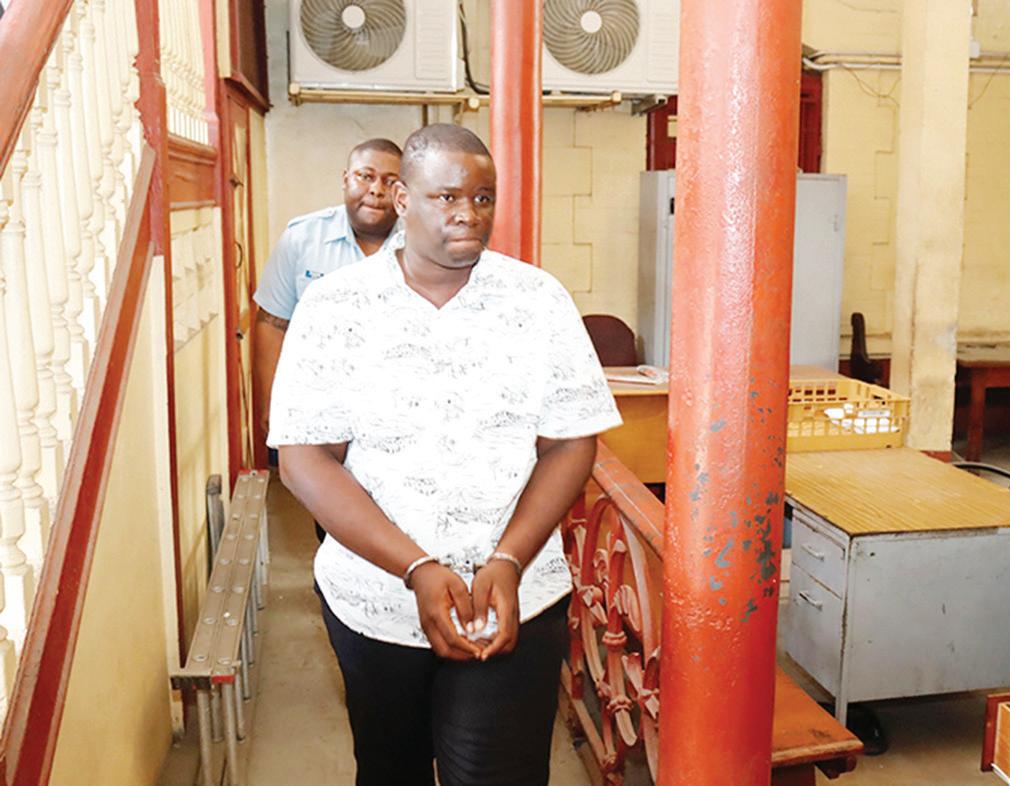
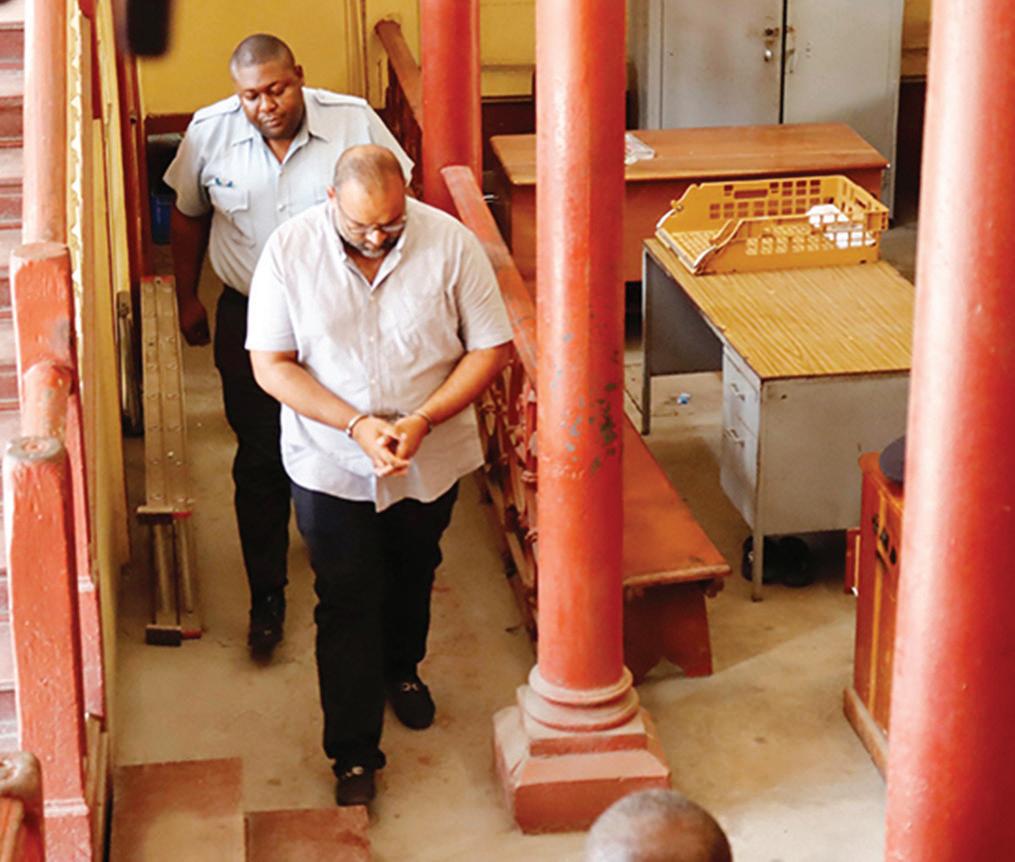
Former Assistant Commissioner of Police Calvin Brutus and several co-accused are expected to return to court on Thursday, May 28, 2026, when their sprawling financial crimes matter moves into another key procedural phase before the Georgetown Magistrates’ Courts.
The matter, which is before the Georgetown Magistrates’ Courts and is being presided over by Acting Chief Magistrate Faith McGusty, is expected to enter a more structured phase at the upcoming report hearing. Given the substantial number of charges, there are indications that the case could be distributed across multiple courts for more efficient trial management.
Brutus appeared in court on Monday when proceedings were adjourned to Thursday, which is expected to determine how the matter will progress in its next phase.
Brutus, an attorney-at-law, is currently facing over 200 criminal charges in relation to financial misconduct involving more than $800 million. Brutus and his co-accused — including his wife, Adonika Aulder; Police Sergeant Kevin George; Latoya Brummell; and businessman Asif Zafarally — are
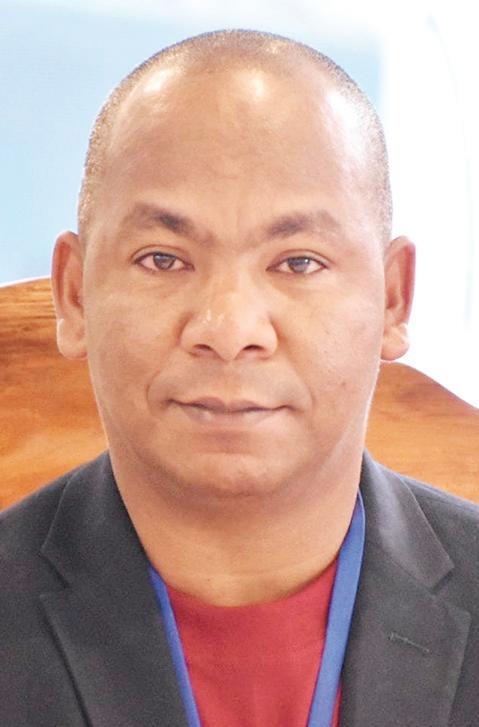
facing a range of serious allegations, among them money laundering offences that could carry substantial fines and lengthy prison terms if proven.
Prosecutors alleged Brutus used his position as acting Deputy Commissioner of Police (Administration) to divert public funds into questionable projects, with a significant portion allegedly redirected for personal gain. Investigations revealed that Brutus and his wife acquired substantial funds through unlawful means, which they then attempted to disguise in multiple bank accounts.
Of this amount, $300 million is associated with proper-

ties and other assets belonging to Brutus and his wife. The remaining $500 million has been frozen in several bank accounts belonging to Brutus, his wife, their businesses, and their young son.
Charges were recommended for the accused persons by the Office of the Director of Public Prosecutions following an extensive probe by the Special Organised Crime Unit (SOCU)—an arm of the Guyana Police Force (GPF).
Brutus has professed his innocence, asserting that the charges are fabricated.
He has maintained that the money in question represented his savings accumulated over the years, as well as wedding and holiday gifts from family and friends.
Brutus has been released on bail amounting to over $16 million, while his co-accused have also posted substantial cash bail. As part of their bail conditions, they are required to report to the police regularly and surrender their passports to the court.
Brutus was dismissed from the GPF by the Police Service Commission (PSC) in February 2025, marking the end of his more than 25 years of service.
The trial management hearing comes weeks after Magistrate McGusty dismissed Brutus’s abuse of process application, ruling that the extant criminal charges differed in scope, nature and penalty from disciplinary charges previously brought against him during internal police proceedings.
According to SOCU, the court found that Brutus’s application “must fail,” agreeing with prosecutors that disciplinary proceedings and criminal charges are separate legal processes and that the continuation of the criminal matter did not amount to an abuse of process.
Brutus had filed the application in January 2026, seeking to stay certain fraud
charges on the basis that they were premised on the same facts which formed the basis of disciplinary proceedings instituted against him under the Police (Discipline) Act and which ultimately resulted in his dismissal.
However, prosecutors
argued that disciplinary proceedings are administrative in nature, while criminal charges are brought by the State and carry distinct legal consequences.
SOCU disclosed that the prosecution also maintained that Brutus failed to establish
any real prejudice, oppression or unfairness arising from the continuation of the criminal proceedings, with the court ultimately agreeing and dismissing the application in its entirety.
Brutus was first formally charged in October 2024.

PRESIDENT of the Georgetown Chamber of Commerce and Industry, Kathy Smith, says Guyana’s local content legislation has transformed the country’s private sector, enabling small businesses to expand, create jobs and invest across multiple industries.
Speaking during a discussion aired on the National Communications Network (NCN) on Monday evening, Smith described the legislation as one of the most important policy decisions made since Guyana became an oil-producing nation.
“Micro, medium-sized enterprises are growing tremendously,” Smith said.

“I have seen businesses that register as micro are now medium-sized enterprises, building their businesses out, creating jobs for employees, and buying assets where they’re investing… So, we have come a long way, and it was intentional.”
Smith expressed her support for the establishment of the Guyana Development Bank.
Smith credited the growth to prudent economic management, strategic investment and the implementation of the Local Content legislation, which was designed to ensure Guyanese businesses and citizens benefit directly from the country’s oil and gas sector.
“The GCCI has always
been a champion of the local content legislation,” she stated.
According to Smith, without the legislation, Guyanese professionals and companies would have had limited participation in the rapidly expanding oil and gas industry.
“What we would have had walking around in Guyana was a lot of executives who are working for international companies, who are giving all their capabilities and capacity, and those strengths would have been taken back out of our country,” she explained.
She said the legislation has empowered even the smallest investors by giving them confidence to participate in national development.
The GCCI President highlighted the provision requiring Guyanese ownership in certain oil and gas ventures, noting that it has encouraged partnerships with major international firms.
“Because of the local content legislation, we say to Guyanese companies and individuals, if you want to get into the oil sector, we must have 51% share,” she stated.
“We are now partnering
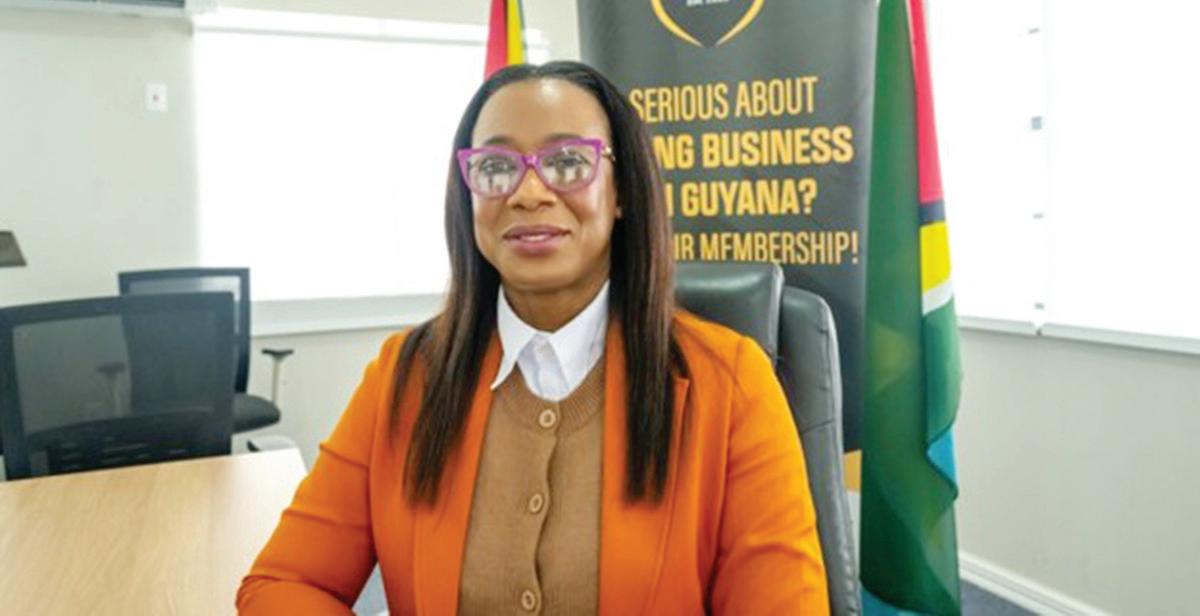
President of the Georgetown Chamber of Commerce and Industry, Kathy Smith
with large companies in North America, in South America, in Europe. If it wasn’t for the local content legislation, that would not have happened.”
Smith revealed that the private sector has already signalled confidence in its growing capabilities by requesting additional categories and higher participation percentages under the legislation.
She noted that revenues from the oil and gas industry are now being reinvested in Guyana’s non-oil economy, particularly construction, tourism and Information and Communications Technology (ICT).
She added that more women and young people are now entering the construction industry, while small tourism-related enterprises continue to emerge across the country.
“More people are getting into small restaurants, small
cafes are being set up around businesses where they are doing tours,” amongst other businesses, we saw last year about 3,000 plus small businesses, small and emerging contractors, became solid contractors on the road, building bridges and roads and all of these things,” she stated.
While praising the sector’s growth, Smith acknowledged that labour availability remains a challenge as the private sector continues to expand.
“We do not have enough people to build out as the private sector grows,” she cautioned.
Nevertheless, Smith maintained that the local content legislation has fundamentally changed the economic opportunities available to Guyanese businesses and citizens. [DPI]
— more than 95% of population already has access to potable water as new treatment plants, wells advance nationwide
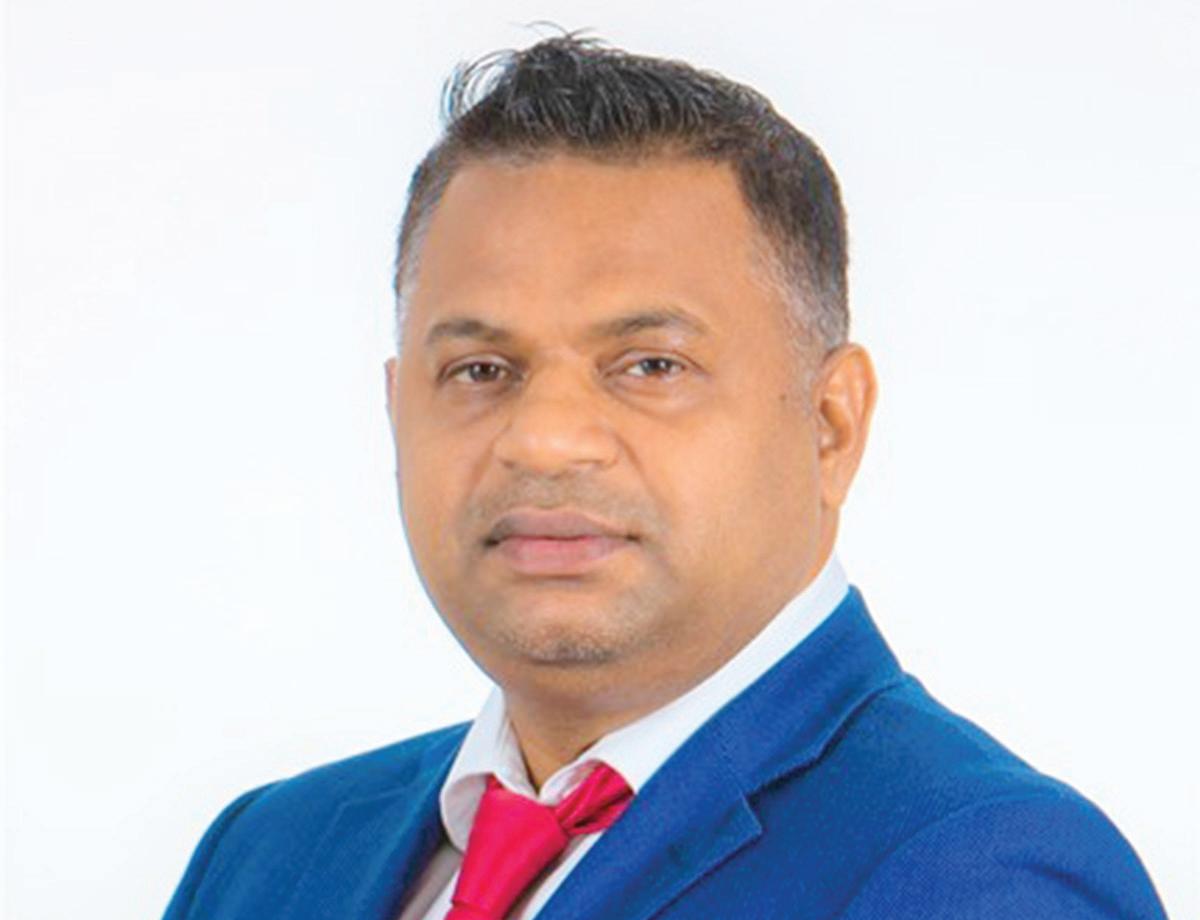
MINISTER of Public Utilities and Aviation Deodat Indar has outlined plans for Guyana to achieve 100 per cent treated-water coverage within the next two years, building on major investments that have already expanded potable-water access to more than 95 per cent of the population.
Speaking recently on the Guyana Dialogue, Indar explained that while access to potable drinking water already exceeds 95 per cent nationwide, treated water coverage, particularly along the coastline, currently stands at approximately 80 per cent.
“The potable drinking water, we have about 95 per cent, but treated water on the coastline is about 80 per cent. And in the next two years, we expect to bring that to 100 per cent,” the minister disclosed.
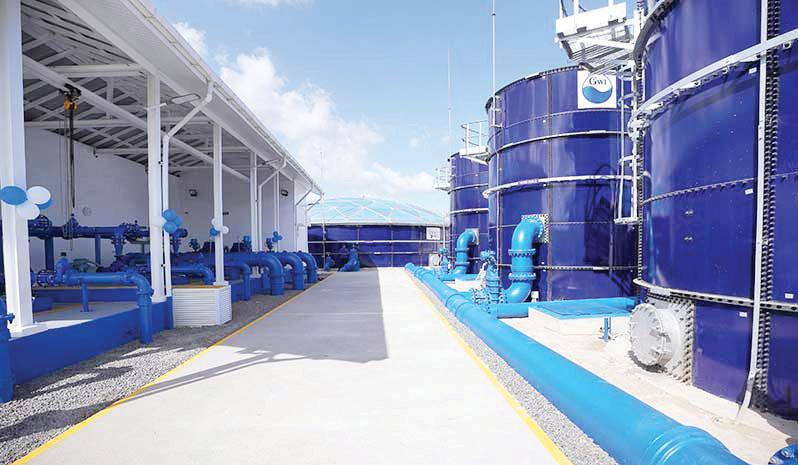
According to Indar, the government has already undertaken extensive infrastructural upgrades over the last five years to improve water access and quality, including the construction of seven new water-treatment plants and rehabilitation works at several others.
He noted that treatment plants have been established in communities, including Caledonia on the East Bank corridor, Onderneeming in Region Two (Pomeroon-Supenaam) and Parika and Wales in Region Three (Essequibo Islands-West Demerara), while additional fa -
cilities are planned in growing communities experiencing rising housing demand.
The minister explained that major population growth on the coastland has created increased demand for water production, particularly in expanding housing areas.
He pointed to planned treatment plants at Stewartville in Region Three and at La Bonne Intention (LBI) on the East Coast of Demerara (ECD), explaining that those areas have seen rapid housing expansion and require greater production capacity.
He said, “Across the entire coastline where there are more houses, more schemes going in, we have to have more production of water and the water has to be treated.”
The minister also highlighted advances in water-treatment technology, pointing to improvements made in communities such as Bartica, where surface water is now being treated to international standards for the first time.
According to Indar, authorities constructed a $607M treatment facility at Four Miles in Bartica using stream water, allowing residents to receive safer and more reliable supplies.
The minister explained, “Look in Bartica, we took for the first time, we took the stream that was running at the back there at Four Miles and we treated the water from the stream, the surface water and we put in a treatment plant there,
and the water is treated.”
He noted that the treated water produced
at the facility meets and exceeds standards established by the
TURN TO PAGE 24
FROM PAGE 23
World Health Organization (WHO), with similar treatment systems expected to be replicated in additional communities as demand grows.
Indar further dis -
closed that the government has allocated approximately $22 billion in the 2026 capital budget for the Guyana Water Incorporated (GWI) to address water production and delivery challenges
across the country.
Indar also highlighted progress in hinterland communities, where water access has now reached close to 100 per cent, with additional wells currently being drilled
in remote villages.
He added, “In the last five years, we have done a number of wells in the hinterland, in areas that some Guyanese people don’t even know the names of the communities…”
The minister explained that delivering water services to remote communities remains challenging because settlements are often spread far apart, requiring additional pressure and production to maintain supply.
He also noted that Guyana’s water system faces challenges with iron content, particularly along the coastline, making treatment necessary to remove discolouration and impurities before the water reaches consumers.
Despite those challenges, Indar maintained that the government remains committed to ensuring every household and community gain access to safe and reliable water.
“We are working with an across-thecountry approach to make sure that every household and every community has [sic] access,” the minister stated.
Minister Indar also pointed to challenges associated with water wastage and leakages, revealing that losses in the water system remain high. According to the minister, the loss factor for water production is close to
60 per cent, often due to broken transmission pipes, unattended leaks and consumer wastage.
“The same thing troubles GWI with leakages and wastage too, because their loss factor on water production is much higher [than that of the Guyana Power and Light]; it’s close to 60 per cent,” he stated.
The government has allocated $21.6 billion in the 2026 budget for improvements across the water sector, including $1.5 billion to expand access to potable water for more than 37,000 hinterland residents through new wells and water-distribution systems in communities such as Port Kaituma, Mabaruma, Mahdia, Batavia, Kumu and Shea.
An additional $8.2 billion has been earmarked to increase treated-water coverage nationwide, including advancing a 24 million litres per day surface-water treatment plant at Hope to serve more than 35,000 residents along the Cane Grove to Cove and John corridor, and the construction of a second 26 million litres per day treatment plant at Diamond to benefit over 36,000 residents on the East Bank Demerara corridor.
Improvements are also planned for the shelterbelt to expand water-treatment capacity for residents in Greater Georgetown.
— Community trust, social stability central to Guyana’s long-term security strategy
Churches, civil society organisations, clubs and community groups must play an important role in Guyana’s evolving national security architecture, as government moves to build a more “people-centric” security system.
Speaking during a press conference on Friday, President Dr Irfaan Ali stressed that national security extends beyond policing and surveillance, noting that stronger communities, social stability and public trust are essential to long-term crime prevention and national development.
According to President Ali, while government is investing heavily in advanced technology, artificial intelligence and integrated security infrastructure,
equal emphasis is being placed on community involvement and social intervention programmes.
“For us in all of this, people-centric community security and social stability is important,” the President said while outlining the broader security strategy planned through 2030.
He explained that key elements of the national approach include strengthening community policing, increasing youth engagement, building trust within communities and implementing anti-radicalisation initiatives aimed at addressing emerging social risks before they escalate.
“So, we want to have where we see communities are at risk with maybe criminal networks and radicali-

sation taking place, in a very proactive way, using the tools, going to those communities, have programmes, build out strategies to counter those anti-radicalisation programmes,” President
Ali said.
The President noted that civil society organisations, religious institutions and community groups are expected to play a collaborative role in fostering
TURN TO PAGE 28
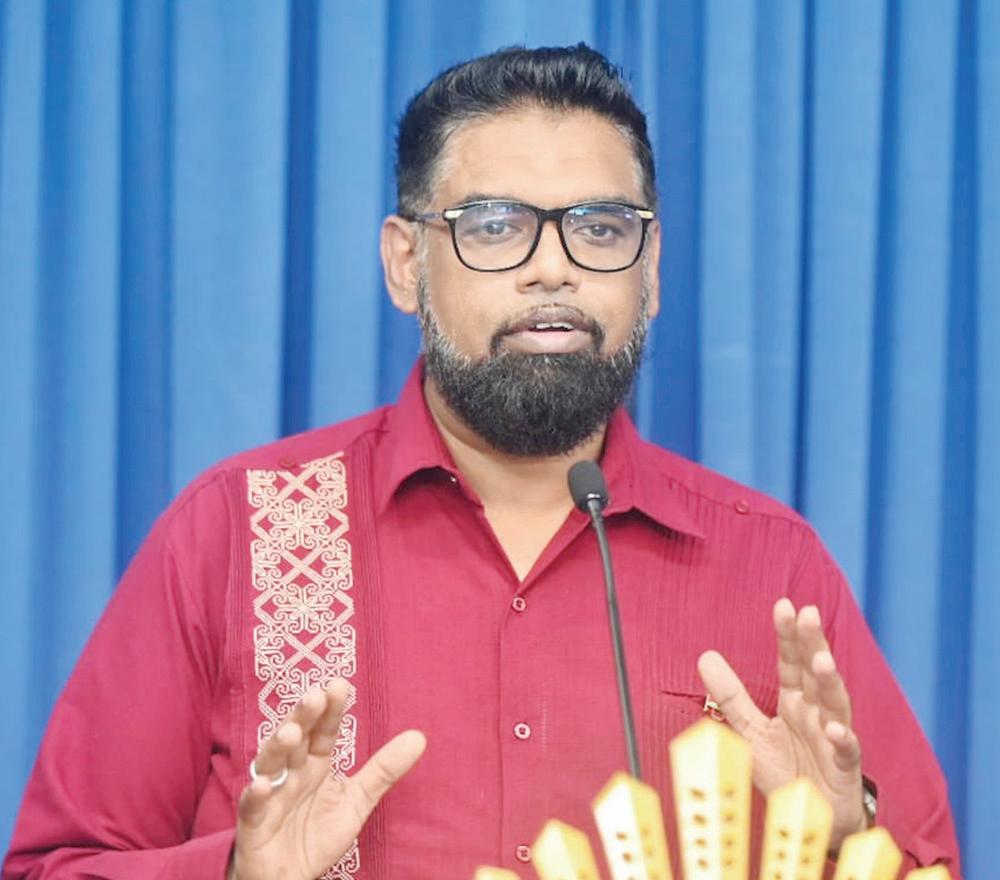

‘There
- Guyana poised for a future without limits, President Ali declares - points to country’s rising global significance, remarkable economic transformation

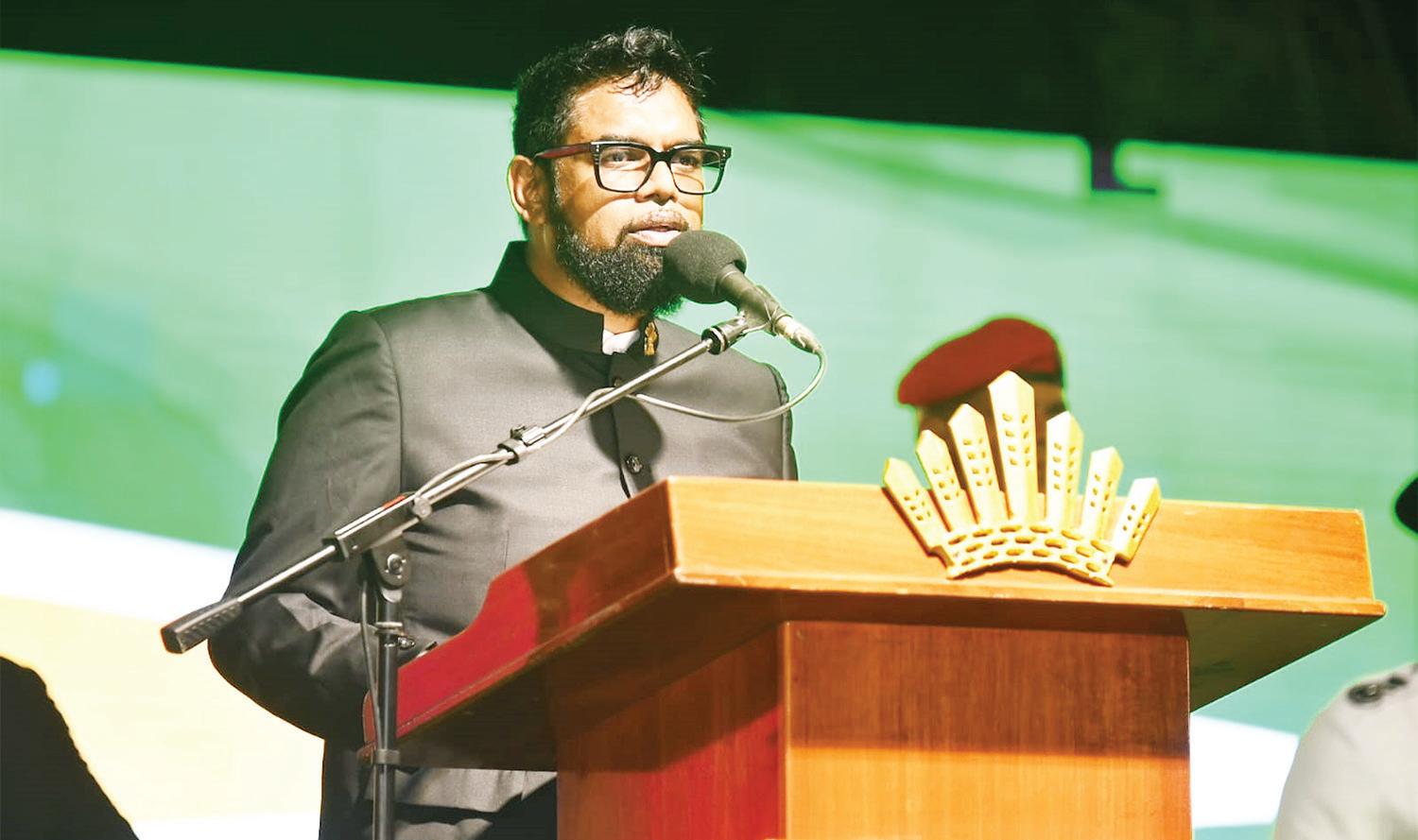
BUILDING on a foundation of boundless national ambition, Guyana is now entering a new era of global significance, President, Dr Irfaan Ali has said.
The Head of State made these remarks on the threshold of Guyana’s 60th ‘Diamond Jubilee’ Independence Anniversary, celebrated at Fort Island in the Essequibo River.
Speaking before patrons, regional leaders and foreign dignitaries, the President noted that this year’s celebration was more than a nostalgic milestone, but it also was a launching pad for the next phase of Guyana’s development.
“Sixty years ago, the Golden Arrowhead rose. It rose above a people long exploited. It rose above a land long claimed by others…we are a nation that has emerged against all odds as one of the most remarkable stories of transformation this century has produced,” the President said.
He reminded the audience how far the country has travelled since independence in 1966, when sugar estates, bauxite mines, banks and major commercial enterprises remained under foreign control, leaving Guyana at that time, a nation with a dependent economy despite its new symbols of sovereignty.
“Our GDP, which stood at $229 million at independence, now exceeds $75 billion in purchasing-power terms. Our per capita income, once $344, is today projected to approach $38,000 per capita by 2028,” he added.
Notably, according to the International Monetary Fund (IMF), Guyana led the world with average real GDP growth of 47 per cent per year between 2022 and 2024.
“In a single decade, we have leapt from the margins into the front ranks of the world’s economies… We are now building our Natural Resources Fund. We are setting aside from day one for the children of tomorrow. It grows with every single additional revenue that comes back to our country.”
On the international front, he pointed to Guyana’s record of service on the United Nations Security Council, where the country has served three times as an elected member and held the presidency of the council.
That record, President Ali said, “demonstrates our capacity, our courage and our skill” and proves “that Guyana belongs in the councils of the world.”
He stressed that Guyana has been raising its voice for the global South, for Africa, for small island states, for the voiceless and the overlooked.
“We are no longer forgotten. We are a force, and we are here to stay,” he told the gathering.
At the same time, the President argued that Guyana’s growing international profile must rest on a solid domestic foundation. He called for a national development platform rooted in unity, democracy, the rule of law, and respect for each other.
Constitutional reform, he said, should not be treated as “a contest for advantage” or “a weapon of division,” but as a solemn national responsibility with the long-term interest of Guyana and future generations at its centre.
“There is no ceiling on what this nation can become. No threat will define our future. There is no boundary, none on the
THOUSANDS of people who rely on social support in Guyana are expected to benefit from upgraded technology, as the government moves to buy new Information Technology (IT) infrastructure.
The Ministry of Human Services and Social Security is seeking suppliers to provide systems aimed at improving the delivery and nationwide management of social services.
The upgrade is designed to streamline operations, cut delays, and improve access to services for women, children, older people, and people with disabilities.
The investment forms part of a wider effort to modernise Guyana’s social-protection system through the ‘Support to Safety Net and Gender Empowerment in Guyana’ initiative, funded by the Inter-American Development Bank with support from the Government of Canada.
In June 2025, the IDB approved a US$350 million policy-based loan to Guyana aimed at strengthening Guyana’s social safety net and expanding services for vulnerable populations.
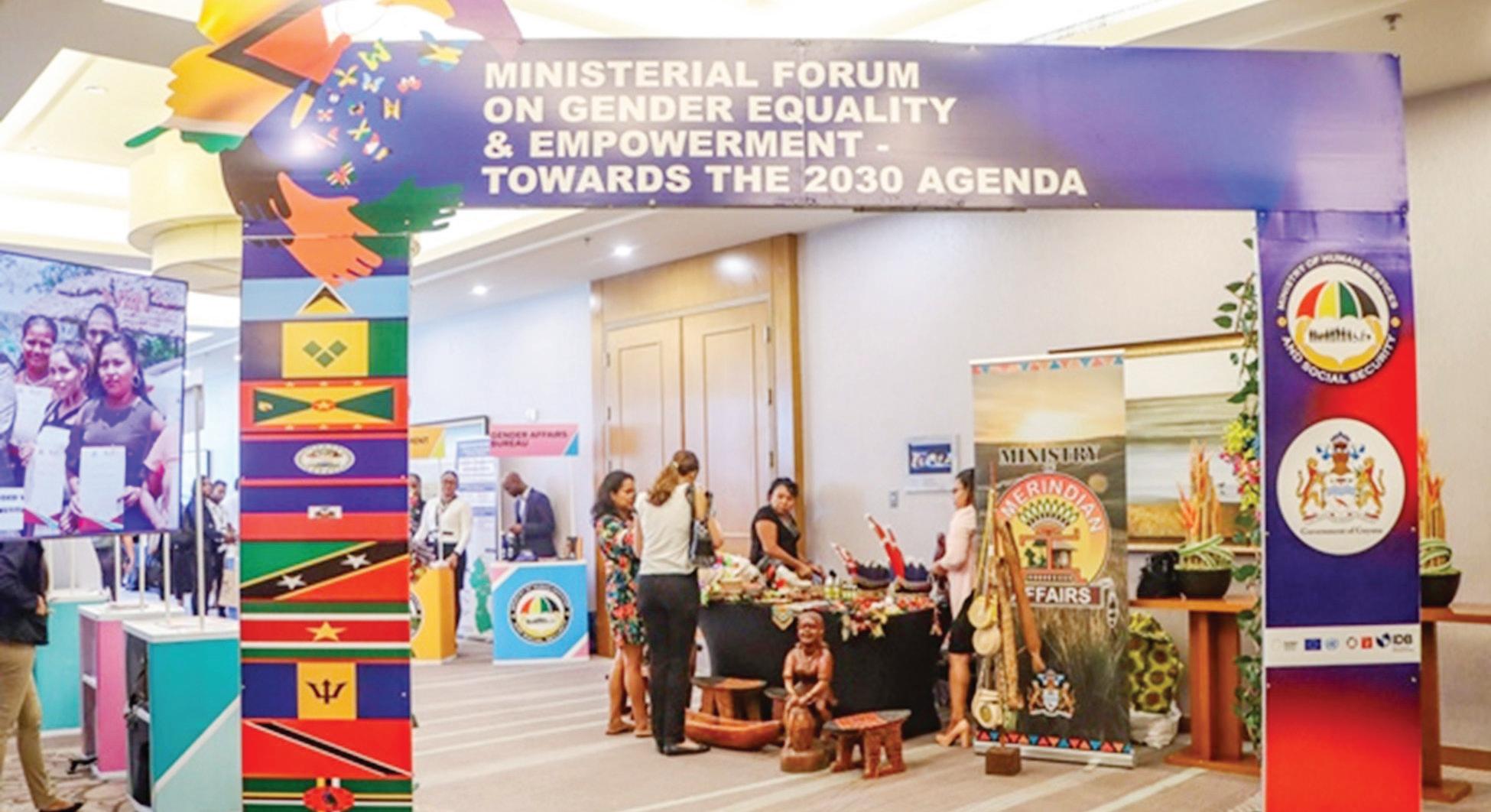
The initiative supports programmes focused on digital transformation, women’s economic empowerment, assistance for persons with disabilities, and support services for survivors of gender-based violence and trafficking.
The ministry has invited bids for the network hardware. According to the procurement notice, the contract will be awarded through national competitive bidding in accordance with IDB policies.
Bids must be submitted to the National Procurement and Tender Administration Board by June 23, 2026.
The broader social-protection initiative has already supported several programmes across Guyana, including the expansion of electronic pension payments for senior citizens, and increased public assistance for persons with disabilities.
In Budget 2026, the Ministry of Human Services and Social Security received an allocation of $78.3 billion, with a significant portion directed towards social assistance and empowerment programmes. [DPI]

FROM PAGE 25
safer and more resilient communities.
“Building trust, building confidence, mentoring and coaching, youth programmes, youth engagement programmes, building out our recreational facilities, channelling energy in positive direction, building stronger families, stronger communities, social protection system, involving the churches, involving civil society, involving the clubs in building stronger communities, more secure, friendly communities,” he stated.
President Ali said the government’s wider security vision seeks to balance technological modernization with social development and citizen participation.
The administration’s broader plan includes the rollout of AI-powered surveillance systems, smart police stations, integrated intelligence-sharing, cyber security infrastructure and expanded CCTV coverage across the country.
However, the President maintained that technology alone cannot guarantee national security without stronger social systems and community trust.
He added that the government’s objective is to create a security model that not only responds to crime and threats, but also proactively addresses social vulnerabilities through partnership and engagement.
The wider national security architecture is being developed with support from regional and international partners and is expected to be implemented progressively through 2030.
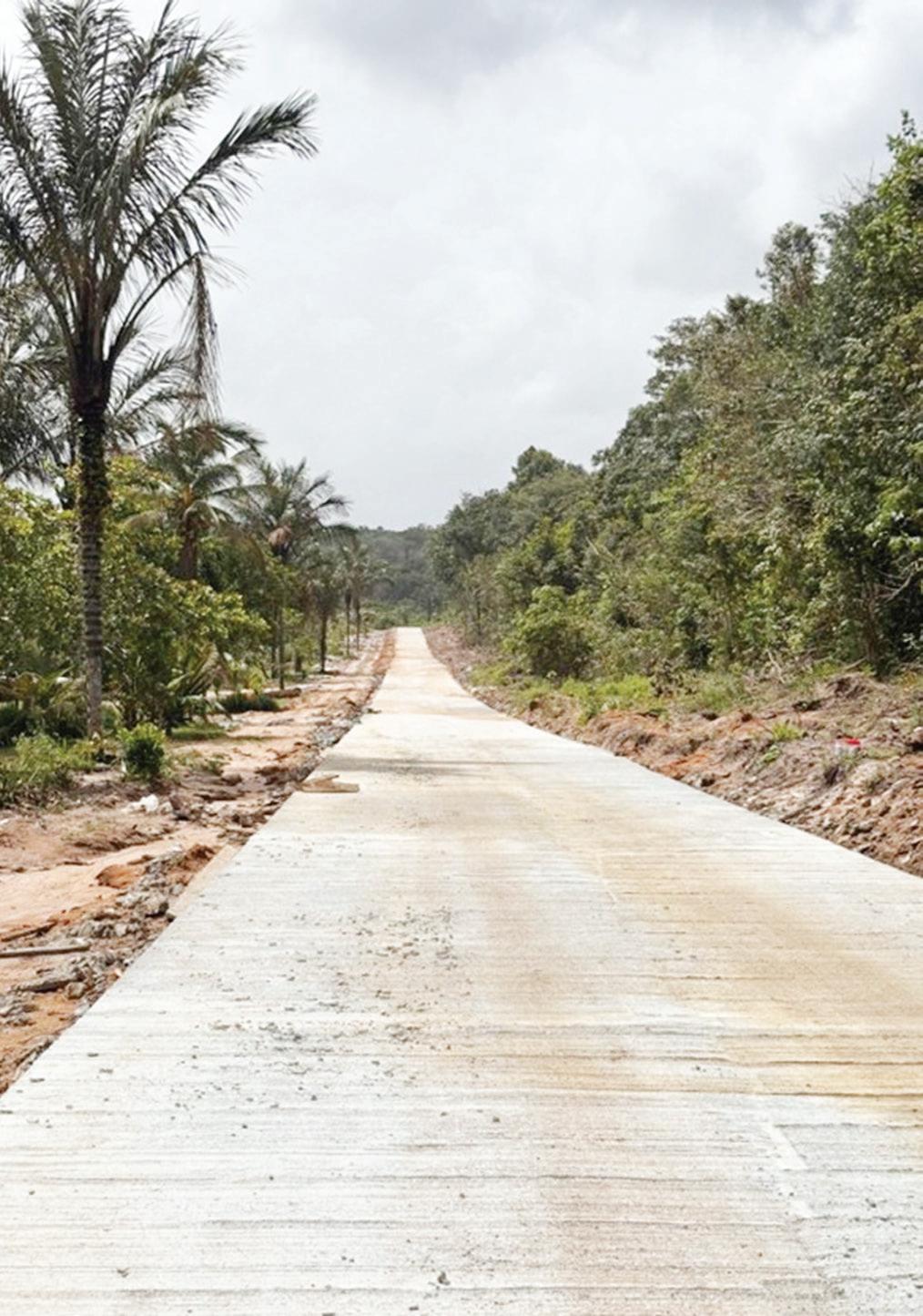
Residents of Adventure and surrounding communities along the Linden-Soesdyke Highway are expected to benefit from a major concrete road project underway in the community.
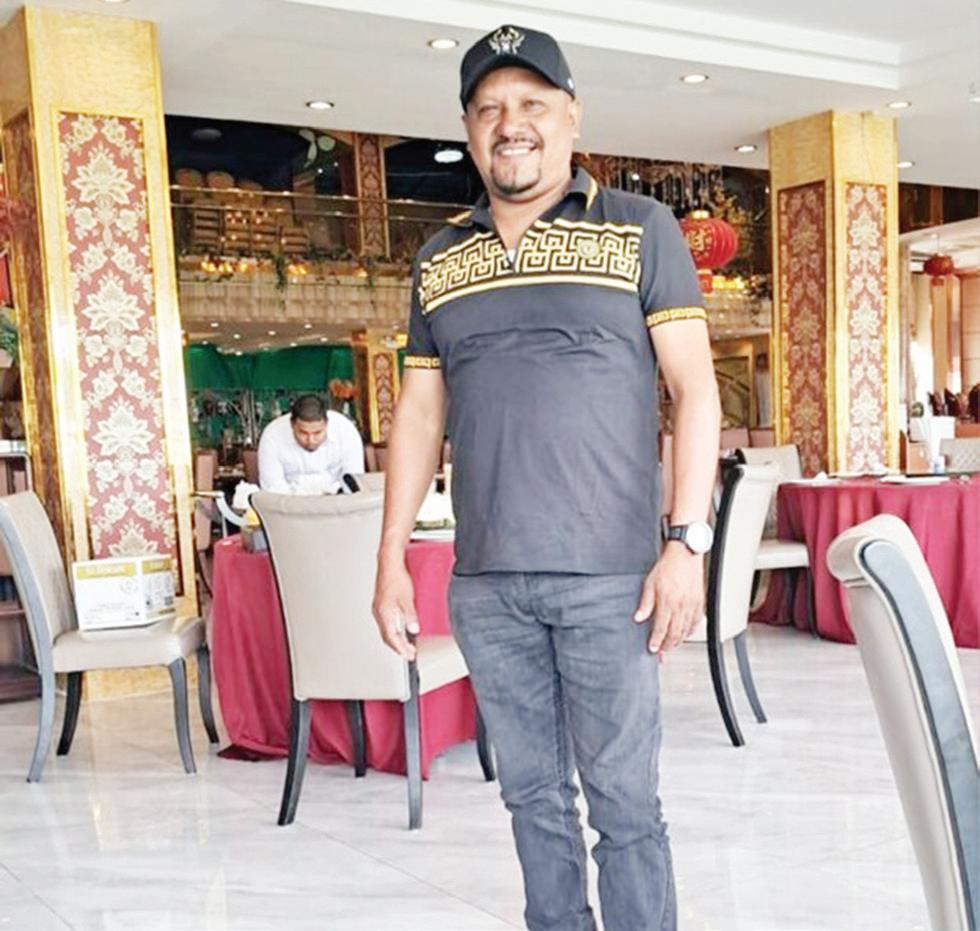
During an interview with the Department of Public Information (DPI) on Monday, Chairman of Adventure, Alonzo Cor -
Cornelius stated.
Approximately 25 households, along with a church and several farming areas, will directly benefit from the project. It will also improve access for school children.
knowing that I would have done my part and every project that I would have lobbied for is there,” he said.
The chairman highlighted additional developments completed in the community, including
improvements to the recreational space, transportation support and water access. He also expressed gratitude to the government for its development initiatives in highway and hinterland communities.
nelius, said that the road was a priority because of long-standing transport difficulties during the rainy season.
He said sections of the existing road consisted of white sand and loam, which made driving difficult in both wet and dry weather.
The village leader noted that farmers and coal producers often had to transport produce manually to the highway to access transportation.
“So having this road, this is really, really a great benefit for them because it will actually allow vehicles to now reach directly to their homes and farms,”
According to Cornelius, the road project is approximately 75 per cent complete, with contractors currently working on the remaining section leading to the highway.
The road was about three-quarters of a mile long and included drainage improvements and a culvert to manage water runoff from nearby hills.
The project is being executed by the Ministry of Public Works, through a public bidding process. It is expected to take about three weeks to complete.
He added that the work was part of a wider development plan for the village during his tenure as chairman.
“And I’m very much elated to know that I will be leaving the community
[DPI]
‘There is no ceiling...
FROM PAGE 26
ambition, the creativity, the enterprise, and the dignity of the Guyanese people,” he said.
President, Dr Irfaan Ali stressed that while Guyana now possesses unprecedented financial resources, the country’s transformation will ultimately be measured not by figures on paper, but by the lasting investments made in people and communities.
The President said that Guyana must “hold it in trust” and “save it with discipline.”
National spending, he stressed, must be guided by long-term priorities and careful planning, with today’s decisions laying the foundation for future generations.
“The roads we are building connect not just communities, but destinies. The schools we are opening do not merely teach children to read and write, they teach children to dream; the hospitals we are building do not merely heal bodies, they affirm that every Guyanese life has worth. That is what it means to govern for all. This is what One Guyana means in practice,” he said.
Highlighting the scale of Guyana’s economic expansion, the President noted that the 2024 national budget surpassed $1 trillion for the first time in the country’s history, while oil production in the offshore Stabroek Block has climbed beyond 915,000 barrels per day, positioning Guyana as South America’s third-largest oil producer.
He pointed to major state investments in education, healthcare and housing as evidence of how the country’s growing wealth is being channelled into development. Between 2020 and 2025, the administration also constructed or rehabilitated more than 10,000 roads and 430 bridges, significantly improving connectivity and bringing infrastructure to communities that had long been neglected.


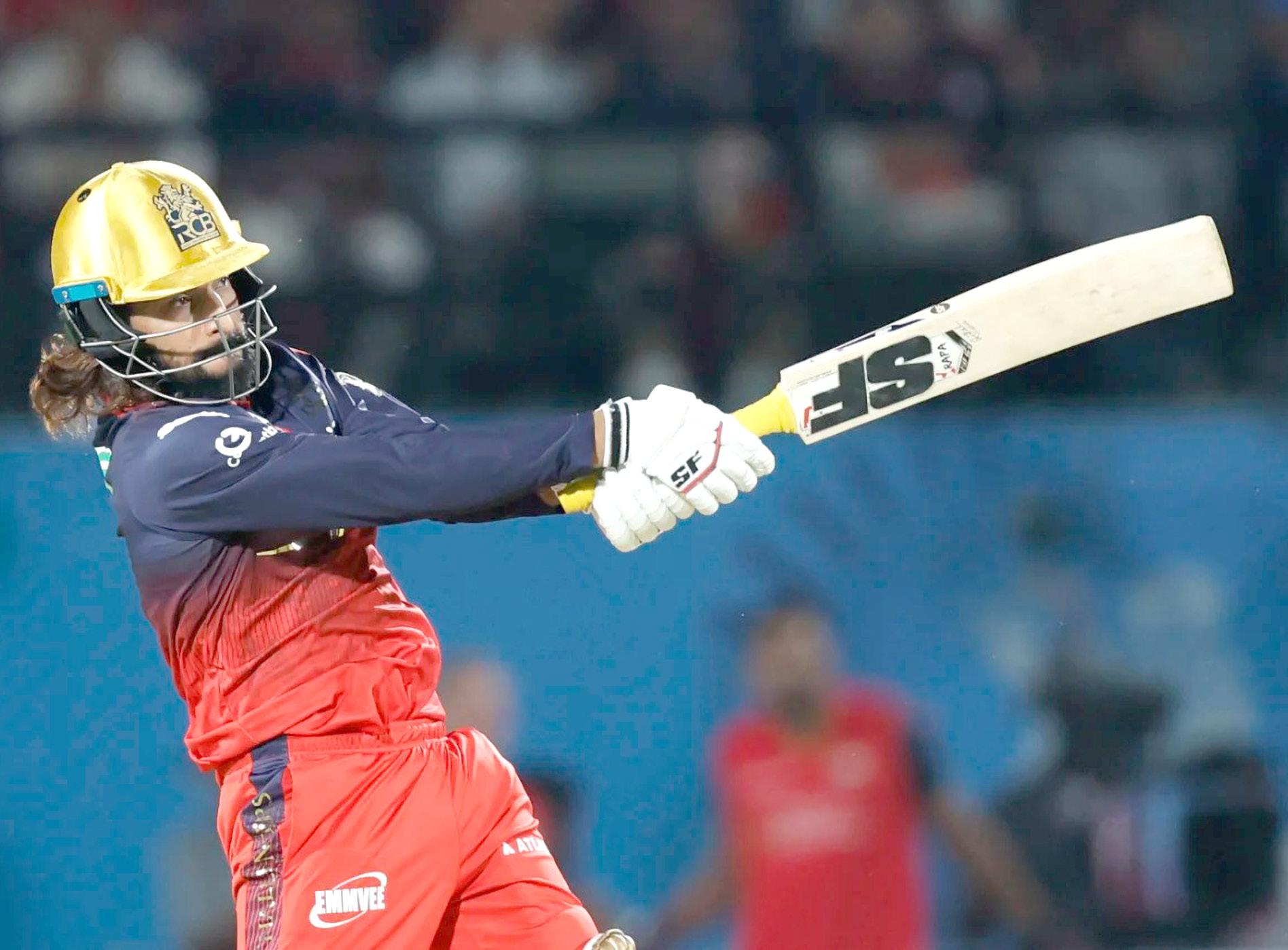
(ESPNCRICINFO) - Rajat Patidar led defending champions Royal Challengers Bengaluru (RCB) into the final with the quickest innings of 90 or more in the IPL, scoring a delightful unbeaten 93 off 33 to take his team to 254 for 5, the highest total in an IPL playoff, against the best attack of the tournament, Gujarat Titans (GT).
Having finished in the top two, GT still have a chance to make the final at their home ground in Ahmedabad in Qualifier 2 as they await the winner of the Eliminator between Sunrisers Hyderabad and Rajasthan Royals. The last eight IPLs have been won by the side winning this fixture: Qualifier 1.
Asked to bat first in chase-friendly Dharamsala, RCB came out full of intent and skill despite missing the injured Phil Salt, but GT nearly snuck back in with a period of 22 balls, 18 runs and two wickets of set batters in a single Jason Holder over. In the time that Patidar scored 93 off 33, the other end, including extras, produced 68 off 37 legal deliveries.
Having never scored more than 233, GT needed something special, and only Jos Buttler came close to
that with 29 off 11. The RCB fast bowlers ran riot and took out half the side within the powerplay.
RCB would have dearly loved to have Salt back, but his absence allowed them to play Jacob Duffy as the fourth overseas player. Venkatesh Iyer started the innings with two fours off the first two balls, moving around in the crease to try to mess with the lengths of the GT fast bowlers.
It took Virat Kohli four balls to lay bat on Kagiso Rabada’s hard lengths, but Venkatesh ramped him for a six first ball even though he got into a tangle.
Even though Rabada came back immediately with the wicket of Venkatesh, the makeshift opener had done his job with 19 off seven. Immediately after the wicket, Kohli charged at Siraj and drove him over mid-off. Some classic batting - a flick off the hip, a late cut and a square cut - from Devdutt Padikkal consigned Rabada to 18 in his second over and brought up the team fifty in just four overs.
Rattled, GT had to move away from bowling Siraj and Rabada through the power-
(Wednesday May 27, 2026)
CUMMINGS ELECTRICAL COMPANY LTD
83 Garnett Street, Georgetown (Tel:225-6158)
Answers to yesterday’s quiz:
(1) MS Dhoni (CSK) & Rishabh Pant (DC)-13 each (2) Ravindra Jadeja-13 catches (CSK)
Today’s Quiz:
(1) How many centuries were struck in IPL 2021?
(2) What was the highest team total made in IPL 2021?
Answers in tomorrow’s issue
play for the first time in eight matches.
THE GT COMEBACK
Holder and Rashid Khan combined to bring GT back into the contest. Holder kept hitting the hard lengths, and Rashid bowled his first two overs for no boundary. In between, Holder managed to remove Kohli and Padikkal for 43 off 25 and 30 off 19. Not big innings but ones that understood the assignment.
THE PATIDAR BLINDER
Having gone funky with their selection - no Romario Shepherd in the batting-first XI so they could play an extra bowler if Shepherd was not needed - RCB promoted Krunal Pandya to likely maintain ideal points of entry for Tim David and Jitesh Sharma. While Krunal did his job with 43 off 28, it was the other batter that led to dropping jaws.
Patidar broke the spell off 22 quiet balls with a pulled six off a Holder ball that wasn’t quite short enough. After a boundary-free first over from Kulwant Khejroliya, playing his first game of
T20 cricket since last April, Prasidh Krishna created two opportunities in the 14th over. The first one, a leading edge, fell between the converging wicketkeeper and deep third. The second one went straight to Rabada at deep square leg, but was dropped with Patidar on 26 off 20. At the end of the 14th over, RCB were an even 140 for 3, the last time you could say the match was even.
Starting with no-balls from Khejroliya in the 15th over, the flood gates opened for 114 runs in the last six overs. Two of his nine sixes were bona fide highlights reels for the year. The first an extra-cover drive off Rashid from the crease, and then a back-foot drive over cover off Rabada, who by now had the purple cap. That shot off Rabada left even Kohli awestruck.
The GT bowlers didn’t quite try a quick bouncer at him, but Patidar nicely steered a slow bouncer over short fine with a delayed hook. At one point, even a century seemed likely, but he didn’t quite get enough strike.

SOUTH AFRICA RACING TIPS
GREYVILLE
08:20hrs Barry’s Boy
08:55hrs Cassandra
09:20hrs Flying Fate
10:05hrs Cappellino
10:40hrs Catch A Penny
ENGLISH RACING TIPS
HAMILTON
09:05hrs Or Another
09:35hrs Bearish
10:05hrs Siouxpersonic
10:35hrs Shipshape
11:05hrs Law Of Average
11:35hrs Light Dreamer
12:05hrs Sanafi Zabeel
NEWTON ABBOT
09:53hrs Lady Kara
10:23hrs Thickthorn Tom
10:53hrs Time To Bite
11:23hrs Scoresby
11:56hrs Ellerton
12:30hrs Supreme Yeats
KEMPTON
12:25hrs Valentine Boy
13:00hrs Moonrise
13:30hrs Erudition
14:00hrs Conspiracist
14:30hrs Water To Wine
15:00hrs Caviar Cowboy
15:30hrs Time Loop
16:00hrs Gooloogong

DESPITE inclement weather conditions at the Victoria ground, the second round of the EDFA/GFF Under-15 Youth Ensemble Tournament delivered an avalanche of goals, with attacking football taking centre stage as several teams produced dominant performances while keeping their opponents scoreless.
The opening encounter saw Ann’s Grove FC produce one of the biggest wins of the tournament, crushing Mahaicony Western Lions 14-0 in a ruthless display of attacking football. Ezekiel George led the charge with an outstanding five-goal performance, while Ronoko Morris added a hat-trick.
Quashaun Hart netted twice, while Quashaun Campbell, Jeremy Fordyce, Anthony Hall, and Kemani Chapman each contributed a goal to complete the emphatic victory in the first game of the second round of the EDFA/GFF U15 Youth Ensemble Tournament.
The second encounter also ended in another one-sided affair as BV/ TU defeated Golden Stars 8-0. Xavier Todd and Mark Glasgow each scored braces, while Lamar Campbell and Deon Benn also found the back of the net. An own goal from Owen Josiah added to Golden Stars’ misery. Following the match, Golden Stars lodged a protest regarding the outcome, alleging the use of overage players by BV/TU.
Game three produced yet
another goal fest as Buxton All Stars overwhelmed Haslington United FC 16-0 in the largest margin of victory on the day. Joel Stephen was unstoppable with six goals, while Shakeil Callender supported with four strikes. Yao Roberts scored twice, and Malachi Jarvis, Malick Sobers, Allan Mc Kay, and Kaheim Henry all added their names to the scoresheet in a dominant, attacking display.
The fourth match proved to be more competitive, with Mahaica Determinators securing a solid 2-0 victory over Plaisance FC. Kaheim Henry scored both goals to lead Mahaica Determinators to victory and continue their positive run in the competition.
In the final game of the day, Melanie FC completed another commanding performance with an 8-0 triumph over Victoria Kings. Trevor De Jonge led the attack with a hat-trick, while Le Bron Semple scored twice. Anthony Rodney, Alberto Milano, and Jaheem Nicholson also contributed goals as Melanie FC closed the day in impressive fashion.
The Victoria ground witnessed an extraordinary day of youth football action, with goals flowing freely despite the difficult weather conditions.
The second round of the EDFA/GFF U15 Youth Ensemble Tournament continues to highlight the tremendous young talent emerging within the East Demerara Football Association.

THE weather condition in Guyana continues to be uncertain and as a result, horsemen are tentative to enter for the Independence horse race.
Eight races are now scheduled for May 31 at the Port Mourant Turf Club and close to $10 million in cash and prizes will be up for the taking.
The Independence Cup will have a purse of G$1,875,000 and it will feature horses in the C Class and Lower, running at 6.5 furlongs. The winner will receive a prize of G$1,000,000.
Other races on the provisional card include the F Class and Lower, and three-year-old Guyana bred non-winners of two races.
The additional races are the H Class non-winners in Guyana, open to WI Bred
non-winners for one year, also open to three-year-old WI bred of two races, the H Class open, I Class and Lower three-year-old and upwards, K and L Class open four-year/old and upwards, and the L Class maidens four-year-old and upwards.
All of the races, with the exception of the K and L Class open to four-year-olds will run at 6.5 furlongs. That particular race will run at 7 3/4 furlongs.
All horsemen are expected to pay 50 per cent of their entry fee by today, Wednesday May 27, ahead of Sunday’s race meet.
The Independence horse race will run under the Guyana Rules of racing. This race is organised by the Jumbo Jet Racing Committee in collaboration with Khris Jagdeo General Contractor.
AS the Co-operative Republic of Guyana marks 60 years of independence, Cricket West Indies (CWI) proudly joins in celebrating a milestone rooted in history, struggle, and the enduring affirmation of self-determination.
“On behalf of the Board of Directors, management, players, and staff of Cricket West Indies, we extend heartfelt congratulations to the Government and people of Guyana, at home and across the diaspora, on this significant national anni -
versary.
“Guyana’s independence in 1966 stood as part of a wider Caribbean awakening, a period in which nations moved from colonial rule toward the assertion of identity, dignity, and political voice.
It was a transformation that shaped not only governance, but also culture, confidence, and the way Caribbean people came to see themselves in the world.
“For decades, Guyana has stood as one of the foundational pillars of
West Indies cricket. From the brilliance of Sir Clive Lloyd, whose leadership transformed the West Indies into a dominant global force, to the elegance of Rohan Kanhai, the genius of Alvin Kallicharran, the resilience of Shivnarine Chanderpaul, and the modern excellence of generations who continue to wear the maroon with pride, Guyana’s contribution to the cricketing legacy and identity of the Caribbean remains immeasurable.
“In that broader historical context, West Indies
cricket itself emerged as both a product and expression of post-colonial Caribbean identity, a space where talent became voice, and where unity across territories became a statement of purpose and possibility.
Guyana’s role in that story has been profound and enduring.
“As Guyana continues its national journey, Cricket West Indies salutes its people for their resilience, achievement, and continued contribution to the advancement of the region.”
(CMC) - With the clock ticking down to next week’s One-Day International series against Sri Lanka, West Indies assistant coach Floyd Reifer says the first couple of days of the team’s 10-day high-performance camp in Antigua have exceeded expectations.
Reifer, who oversees the batting unit, spoke to CWI media on Monday and painted a picture of a squad fully locked in.
FROM PAGE 35
however, appears poised for a Caribbean takeover.
“I suspect we’ll have a few Kiwis this time because they’ve acquired a ton,” Miller teased. “There are some really fun players kicking around there. That’ll be quite exciting.”
While Miller remained tight-lipped on specific names, he hinted that tantalising signings are already locked in behind the scenes.
“There are a few names I’ve been told, which I think will excite people, but I’m not allowed to tell you just yet.
I’ll get in trouble.”
Crucially, the CPL itself is no longer in the business of player recruitment, a departure from the tournament’s early years.
“There was a time, way back when, CPL ran a couple of the teams because they didn’t have owners at the time,” Miller recalled.
“But now all of the teams are in private hands, so that’s very much taken care of by the teams. We find out about who the players are when the teams are ready to tell us.”
“The first two days of the camp went really well,” Reifer said. “The objective for us, the first couple of days, is to get the guys back into a frame of mind for international cricket.”
That mental reset has come with a sharp technical focus. According to Reifer, the batting group has been drilling specifically on neutralising Sri Lanka’s spin threat, a clear signal of the visitors’ likely strategy.
“We focus a lot on really training and batting a lot of spin,” he explained. “Focusing on strike rotation and trying to score off as many balls as possible. Also,
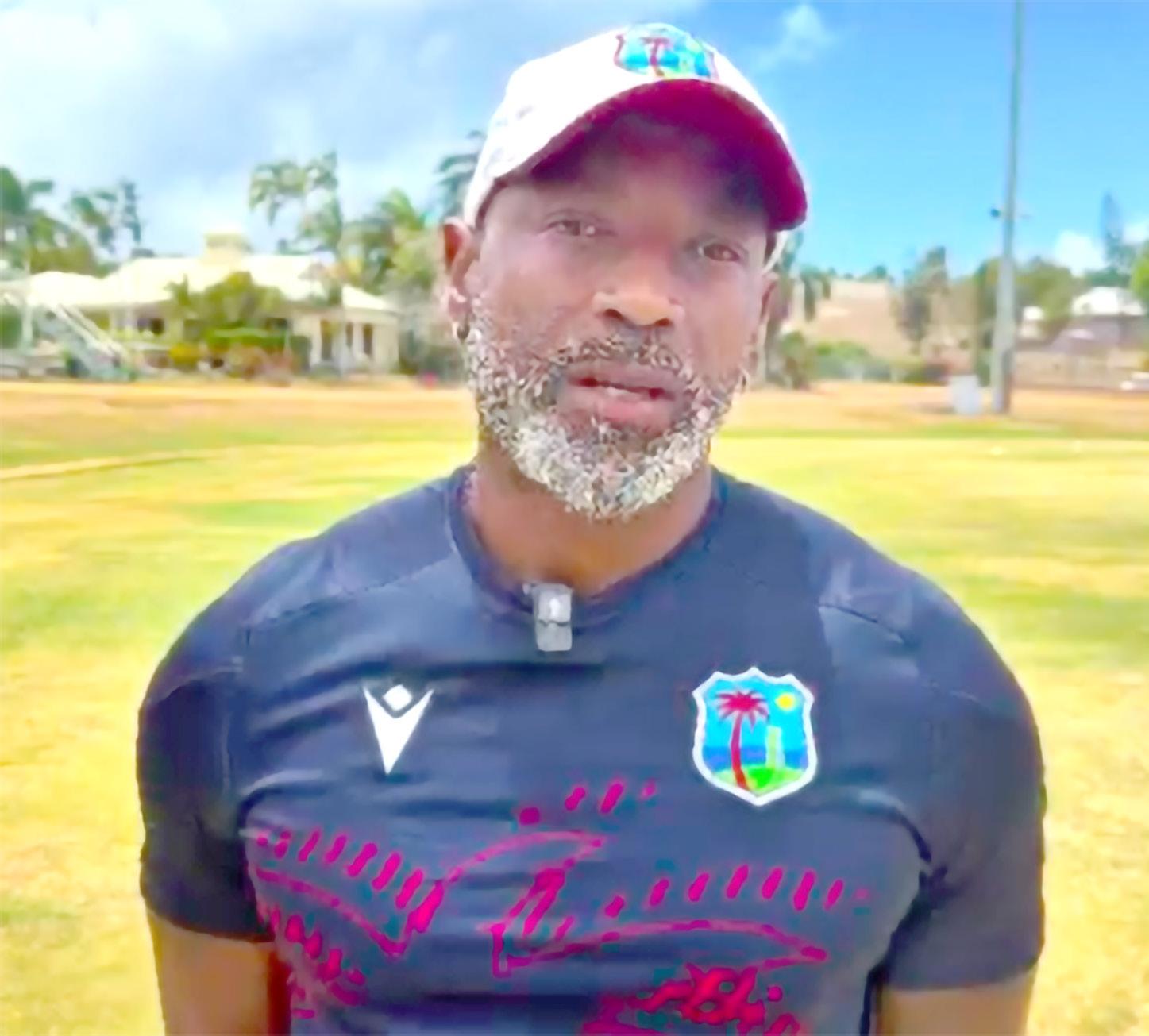
boundary options to spin while batting, especially in the middle overs. So that was one of the main focuses over the first two days.”
While Reifer tends to the batters, veteran fast-bowling coach Otis Gibson has put the pacers through their paces on the other side of the ledger.
“The fast bowlers did a lot of technical work with the coach, Otis Gibson,” Reifer noted.
But beyond individual drills, the former West Indies captain emphasised the collective energy inside the camp.
“Guys coming in, the energy levels are high. The intensity level is very high at practice sessions. So everybody’s on board with what we want to achieve.”
That buy-in is no accident. Reifer pointed to a remarkable two-year run in
ODI cricket that has built genuine momentum.
“This team has been doing really well over the last two years in ODI cricket. And for us to get 18, 19 points over the last two years has been a great achievement.” Perhaps most striking is the West Indies’ recent dominance on home soil, a trend Reifer is determined to continue against Sri Lanka.
“We’ve done well at home. We’ve been unbeaten at home. That’s something that hasn’t been done in years,” he said. “So it’s good for our batting department. We’ve improved in many areas and improved in terms of the middle overs.”
With a couple of days before the series opener, Reifer’s message is clear: no complacency.
“It’s for us now to keep moving forward and in the right direction,” he said. “It’s just a matter now for us to continue to improve.”
The first ODI between West Indies and Sri Lanka is scheduled for next Wednesday at Sabina Park in Jamaica.
ODYLSON Prika and Attoya Harvey were the top distance athletes on Sunday when the Burgett Williams-led Ex-Athletes and Friends Association hosted their annual Independence 10K Road Race on the country’s roadways.
The race kicked off on Thomas Road, proceeded along JC Chandisingh Street to the Rupert Craig Highway from the roundabout, turned onto UG Road and the Northern Bypass, then rejoined JC Chandisingh Street via Kitty Public Road, before finishing at Eve Leary Ground.
In the senior men’s category, defending champion Prika outlasted local Odida Parkinson comfortably to take the top spot by more than two minutes, with Cleveland Thomas having to settle for third place.
Royston Fordyce and Daniel Harvey completed the top five finishers.
On the distaff side, after capturing the 800m and 1500m titles on Saturday, Attoya Harvey put in a superior effort to collect the women’s title, beating out stiff competition from Jelesa Wright and Malika Marques, who
completed the podium slots.
In the male junior category, Ebo McNiel was again in top form to win the ages 16-19 category ahead of top middle-distance athletes Jevon Roberts and Christian Greaves.
The top three in the female junior category were Ester McKinnon, Adanya Glen and Marissa Thomas.
The masters over-40 was won by Kelvin Johnson and Abidemi Charles in the male and female categories respectively, while Oswald Phill won the masters over50 men’s race.

This year’s edition of the CPL is set to commence on Friday, August 7, 2026, and run through Sunday, September 20, 2026
CRICKET fans across the region can expect some familiar faces in this year’s Caribbean Premier League (CPL), which is shaping up to be a fireworks display of international talent, with tournament organisers promising a slew of “big names” ahead of the upcoming season.
In an exclusive interview with Mason and Guest, Peter Miller, PR Manager of the
CPL, revealed that fans can expect a flurry of player announcements within weeks, and a distinct Kiwi flavour to boot.
“I’m hopeful that it’ll be in the next two to three weeks, and we’ll be able to start releasing those names,” Miller said. “Ideally, everyone will know everybody who’s coming by July, for certain.”
The delay, Miller ex -
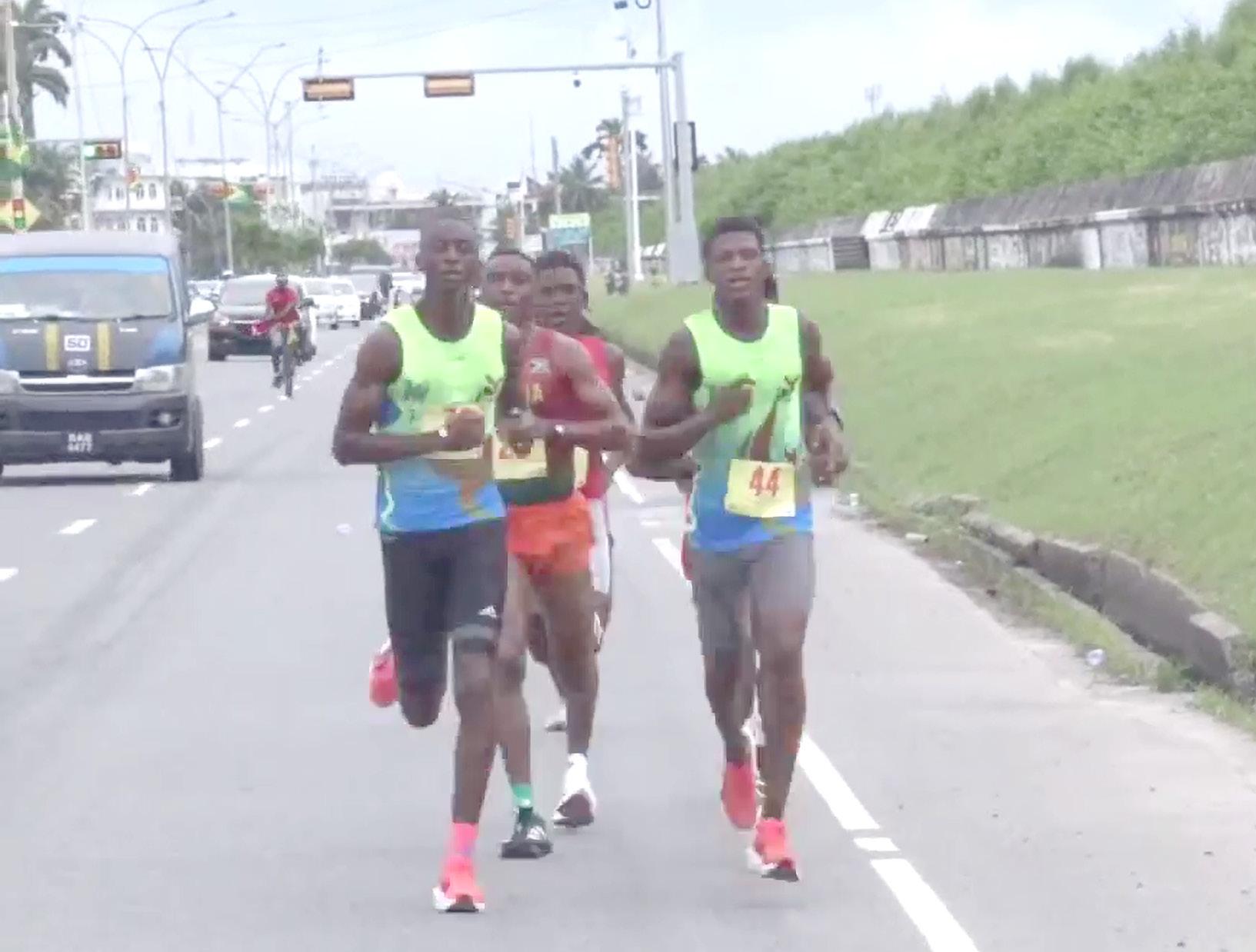
Sukhai was in fine form on Sunday at the National Gymnasium to capture the girls’ U15 singles final in the Guyana Table Tennis Association (GTTA) Diamond Jubilee Independence Championships.
She played a round-robin final against Shackecy Damon, Fabianna John and Ashayla Tixey.
Sukhai was in a dismissive mood as she took clean sweeps in all her clashes to emerge champion, defeating all three opponents 3-0.
She will have a chance to add to her trophy cabinet next weekend when she contests the U19 girls’ singles final.
In the semifinals on Sunday, Sukhai overcame Shackecy Damon 3-0 to book a place against Seona Barker, who had to dig deep to beat Angel Robinson.
In the girls’ U13 final, it was a tough battle in the round-robin final, with Ava Hall coming out on top over Fabianna John and Gabrielle Mohabir. The boys’ U19 singles final saw Malachi Moore showing his growth as he battled hard in a round-robin final. He defeated Akeem Hall, Kayden Meusa, Tylor Bhojedat and Rajha Braithwaite to take the title.
The boys’ under 15 singles reached the semifinals stage, the first of which will
feature Kayden Meusa going up against Vivek Bassoo and Cristiano Jacobis battling Ferreir Abraao in the second.
The ‘C’ class category also got underway with the round of 16: Akeem Hall, Viberet Williams, Shurwain Sahadeo, Dhanesh Persaud, Kayden Meusa, Samara Sukhai, Yeudistir Persaud and Abraao de Oliveira took wins to reach the quarter finals. The eight players will compete in the quarterfinal on Friday at the National Gymnasium. Meanwhile Adam Rodrigues won the U9 category ahead of Jaydon Sookram and Jermaine Peroune in that order.
plained, is a symptom of the modern game’s relentless schedule.
“As I’m sure you know, the cricket calendar doesn’t get any less congested, right? Teams need to find players that not only fit the skill sets they’re looking for, but also guys that are going to be available for the whole of the event. So that takes a little bit of work.” One nation, TURN TO PAGE 34