


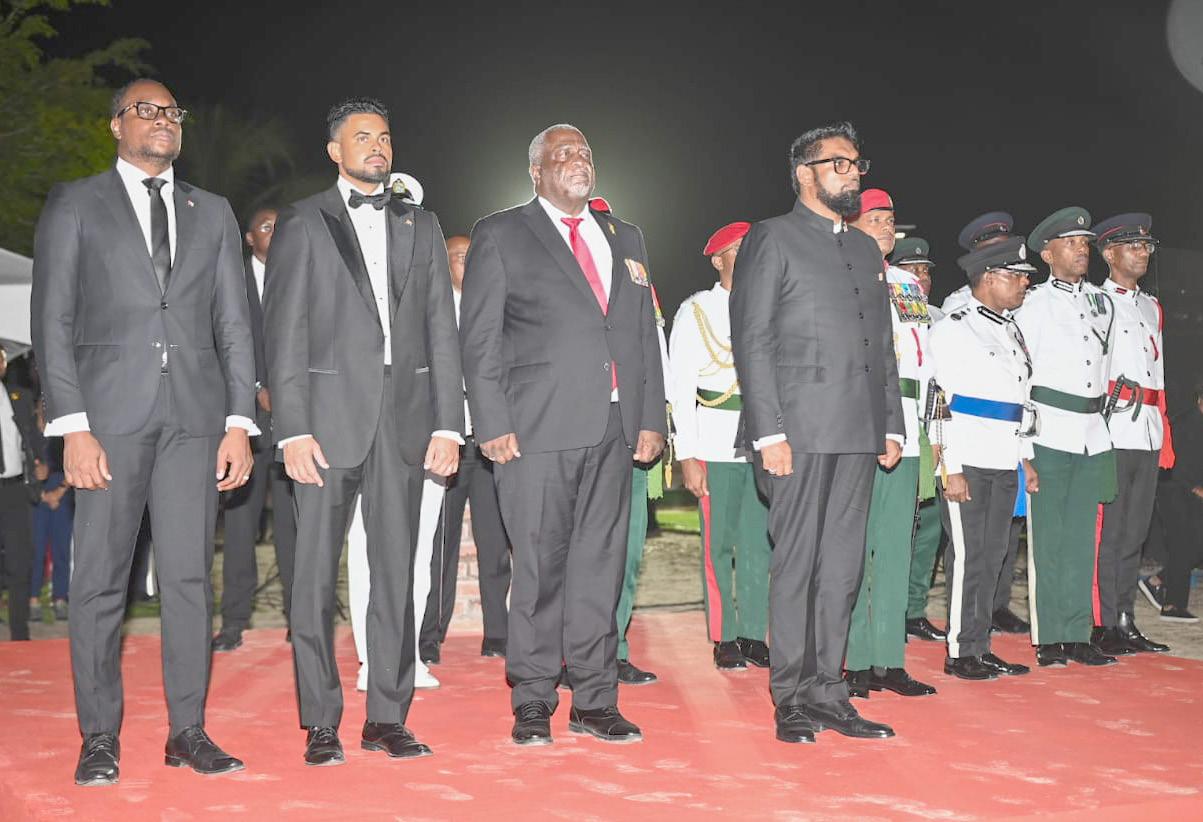
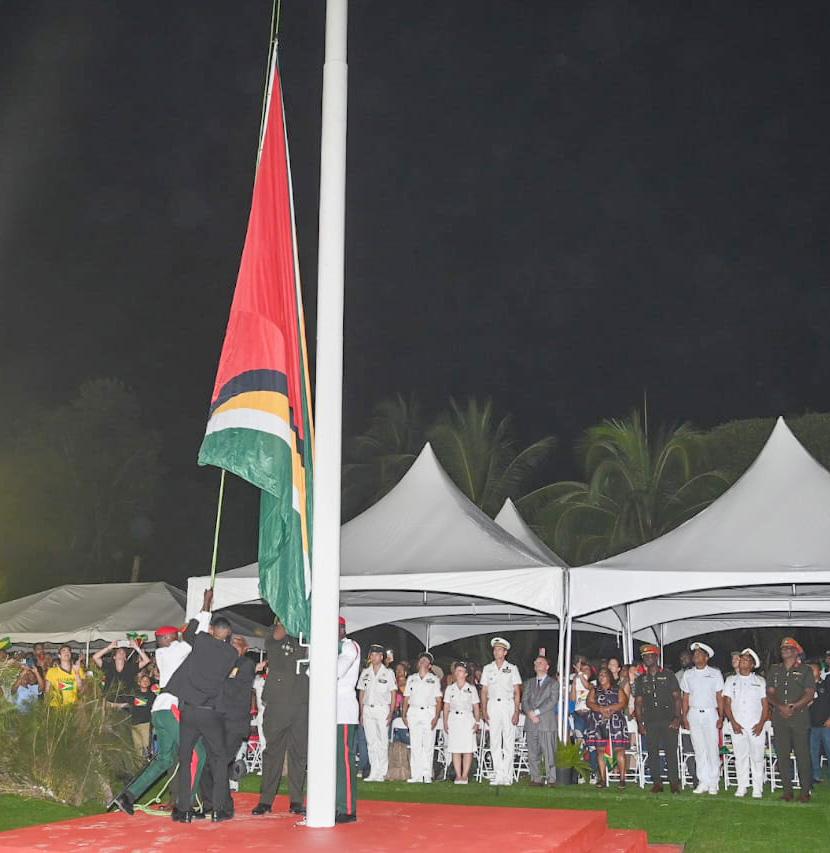
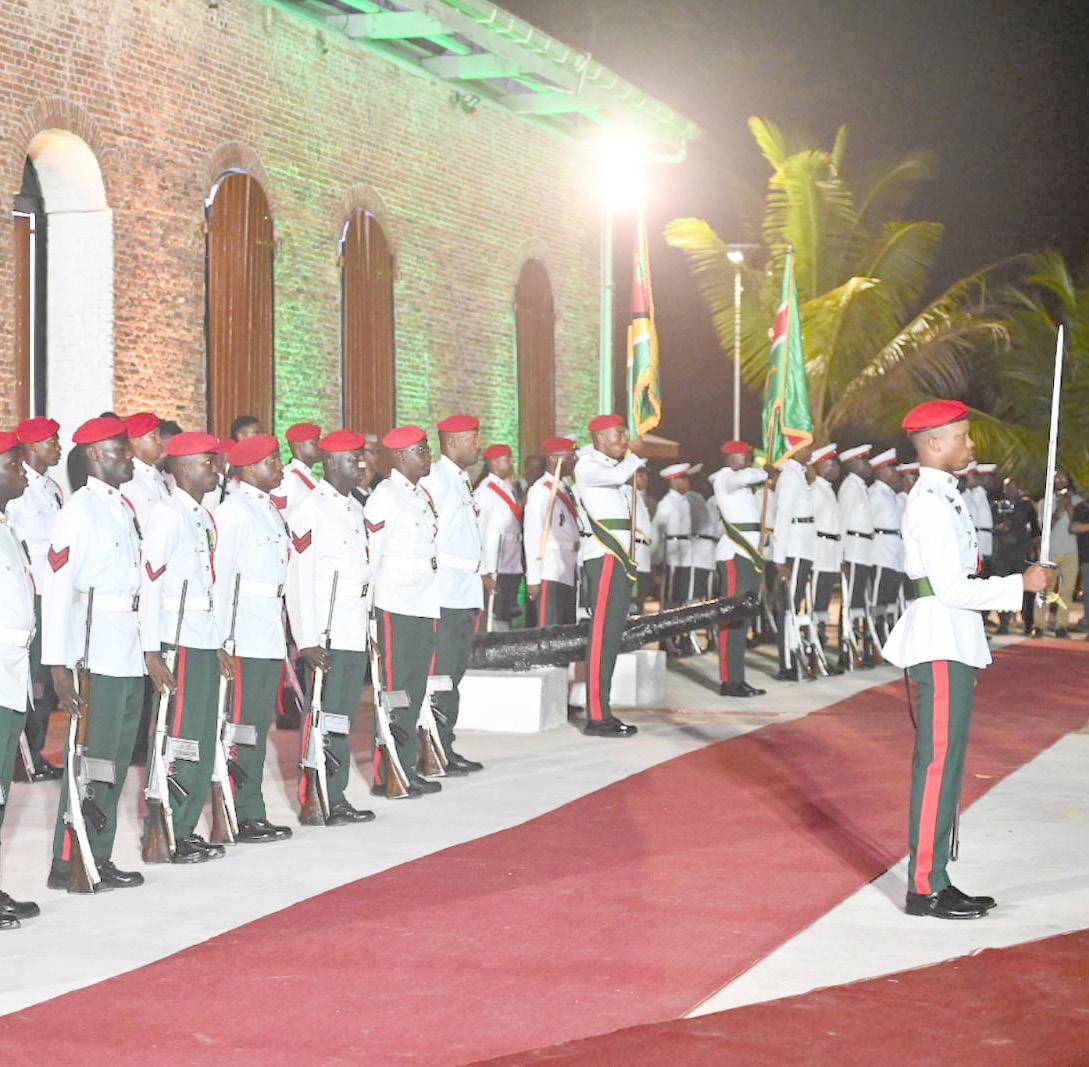



PRESIDENT Dr. Irfaan Ali called on citizens to rise together in unity, faith and dignity as Guyana reflects on its 60-year journey since independence.
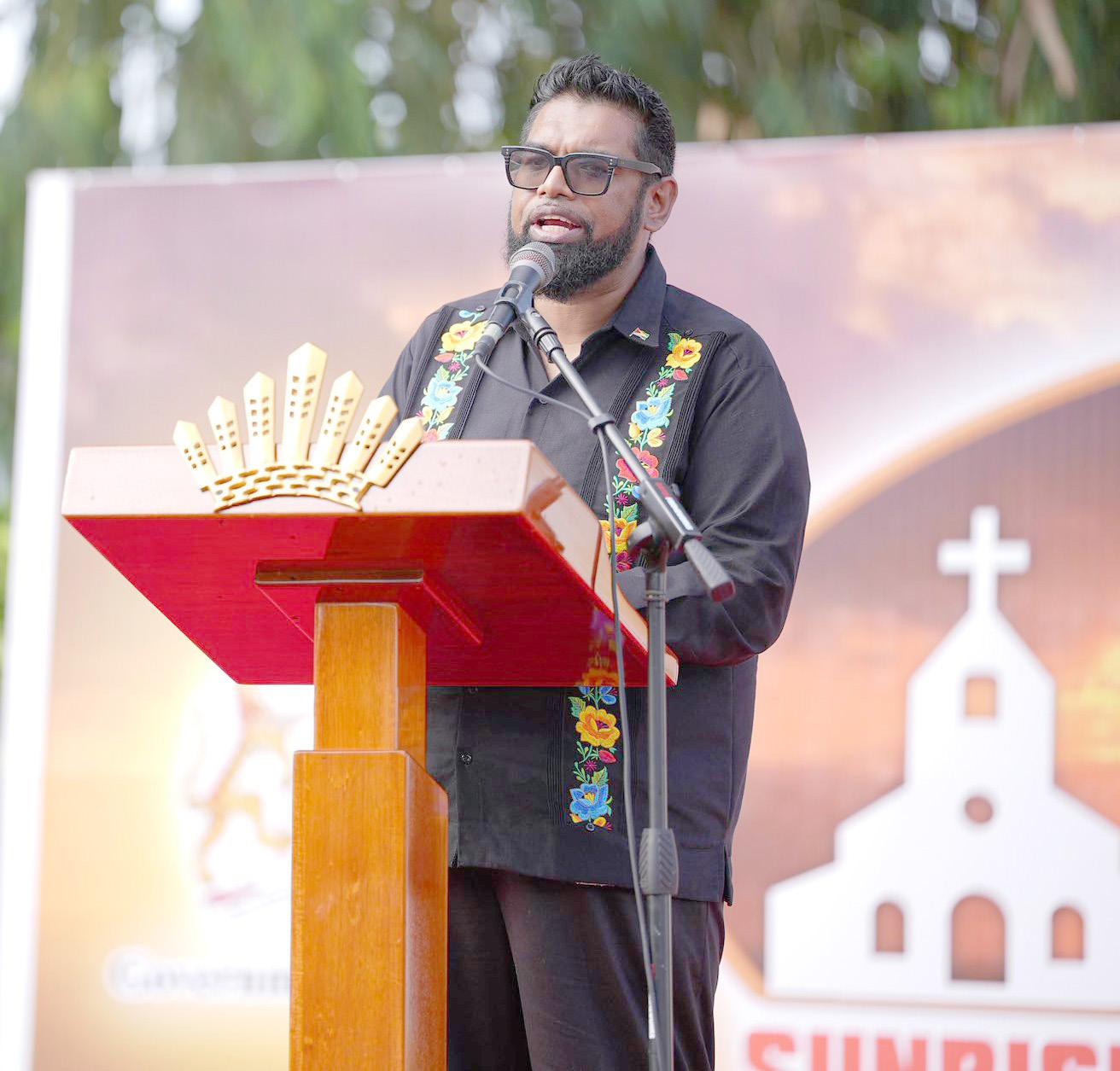
The Head of State made the call while delivering an address at a Sunrise Glorification Service in observance of Guyana’s 60th Independence Anniversary, during which he said the occasion is one of gratitude and reflection.
President Ali noted that national progress must be anchored in shared values and collective responsibility, while adding that Guy-
ana must recognise that its journey continues and that development is not defined by wealth alone.
He emphasised that Guyana is entering a new phase of national development shaped by rapid economic growth but warned that prosperity must be matched with fairness and inclusion.
“A nation can become richer without becoming fairer.”
He urged Guyanese to embrace unity across race, religion and class, saying that compassion and respect remain central to national cohesion.
With this, the President also highlighted the importance of interfaith unity, noting that Christianity, Islam and Hinduism all share common teachings on compassion, discipline and service to others.
He said these shared values are essential to Guyana’s continued development as a diverse and multi-ethnic society.
“Yesterday has ended. It is a new day,” he remarked.
President Ali said Guyana’s history shows a nation that has moved through colonialism, independence and nation-building, and is now entering a period of trans-
formation driven by opportunity and responsibility.
He went on to add that the challenge for Guyana is to ensure that economic growth translates into meaningful improvements in the lives of all citizens.
As such, he said national maturity will be defined by how well the country manages its resources and ensures equitable development across all regions.
“We can, we will, and we are doing.”
He added that Guyana’s development must ultimately be measured not only by infrastructure or income levels, but by dignity, justice and human well-being.

tion towards a more just and inclusive society.
President Ali said Guyana’s future depends on its ability to remain united and focused on shared national purpose.
Against this backdrop, Dr Ali expressed confidence that the country can continue advancing as a peaceful and prosperous nation if citizens work together across differences.
He said Guyana’s Diamond Jubilee celebrations are an opportunity to reflect on progress and recommit to national unity, adding that the nation must focus on ensuring that development benefits every citizen.
He said the country must continue to evolve beyond economic ambi -
President Ali further noted that Guyana stands at a defining moment in its development, where choices made today will determine the quality of life for future generations. As such, he stressed that national progress must be inclusive as Guyana continues to expand economically and socially. He indicated that faith, responsibility and unity must guide decision-making at every level of society, from government to communities and families.
He added that the strength of the nation lies in its people and their willingness to work together in peace and mutual respect.
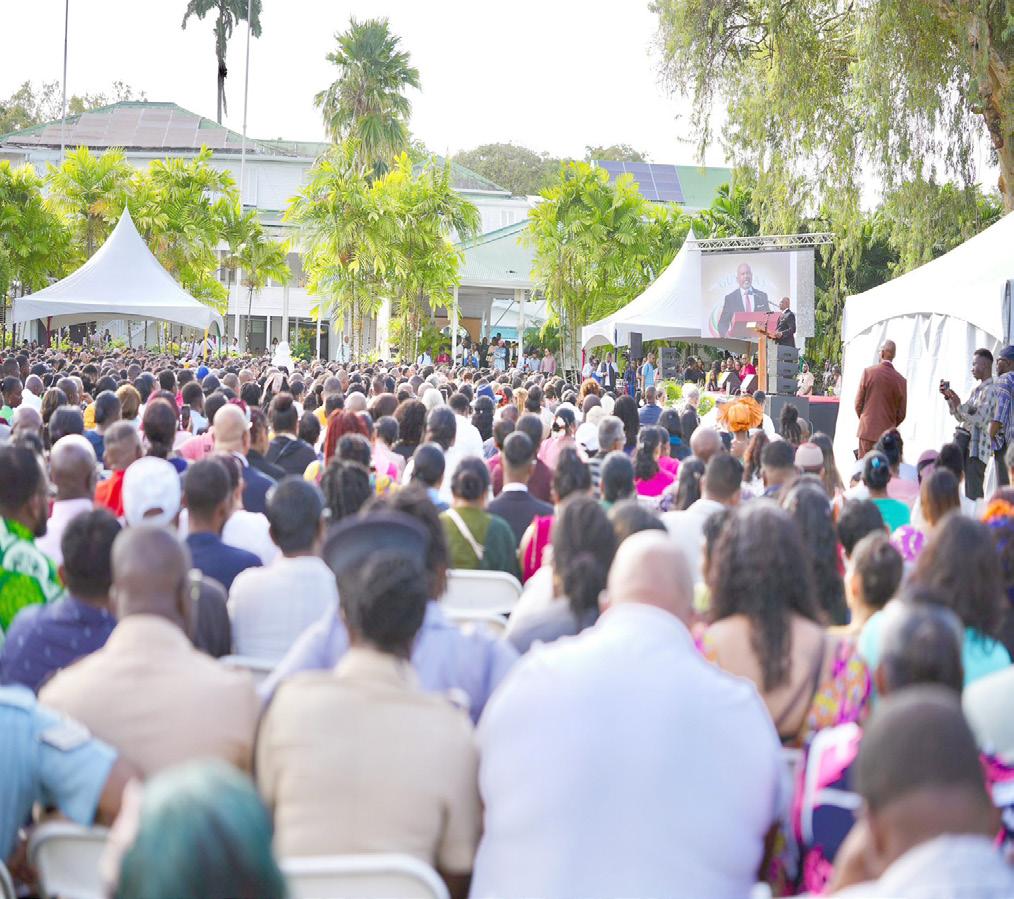
UNDER the glow of fireworks and the echoes of patriotic songs along the Essequibo River, President Dr Irfaan Ali used Guyana’s 60th Independence Anniversary celebrations to cast the nation as a country entering a new era of ambition and global relevance.
Addressing a packed audience of dignitaries, regional leaders and citizens, the President framed Independence at 60 as a moment to measure how far Guyana has travelled from the fragile, divided and economically dependent state that raised the Golden Arrowhead in 1966. He reminded Guyanese that at the moment of independence the commanding heights of the economy, sugar estates, bauxite mines, banks and major commercial interests, were still in foreign hands, leaving the new state “a nation with a de-
pendent economy” despite its new symbols of sovereignty.
“We are a nation that dared a nation that endured division and regression, and yet we are a nation that has emerged against all odds as one of the most remarkable stories of transformation this century has produced,” he said to thundering applause.
Yet, 60 years on, Dr. Ali argued that Guyana now stands before the world “not as supplicants… but as a sovereign people, proud, unbroken, and unafraid.”
Citing International Monetary Fund (IMF) data, he reminded that Guyana is now the fastest growing economy on earth with oil production surpassing 915,000 barrels per day and per capita income projected to approach US$38,000 by 2028.
The President linked
this rapid economic rise to a broader story of resilience and transformation, acknowledging decades in which “Guyanese, by the tens of thousands, packed their bags and left” leaving more citizens abroad than at home.
On this Diamond Jubilee, he said, the country honours both those who stayed and those in the diaspora who carried Guyana in their hearts across borders.
Crucially, the President stressed that Independence at 60 must be seen as a platform, not a destination.
“Sixty years is a great achievement, but it is just the beginning. Sixty years is a foundation,” he told Guyanese everywhere urging them to choose healing over bitterness and to build a nation anchored in love strengthened by unity, and guided by enduring faith.
“60 years of indepen -
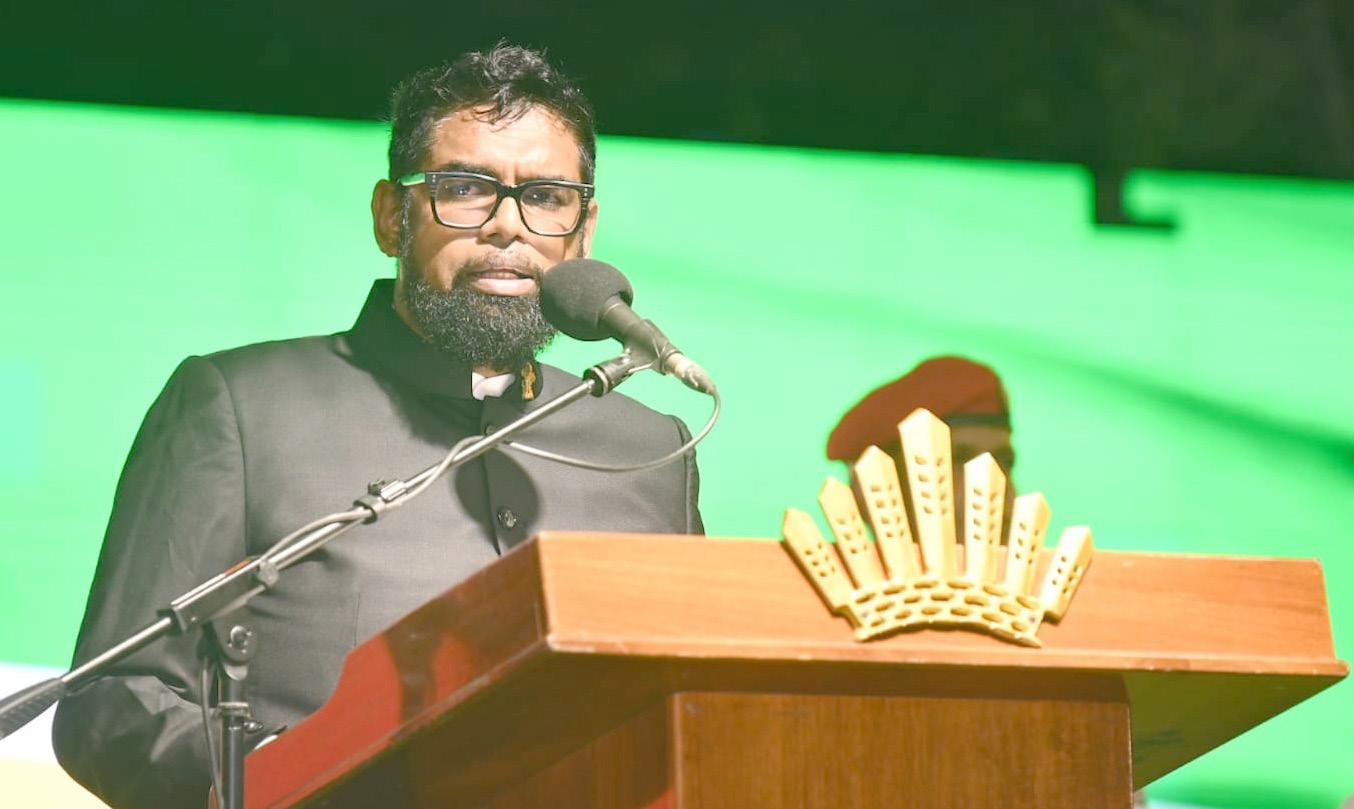
dence calls us towards a higher covenant to build a nation anchored in love, ennobled by honest labour, strengthened by unity, and guided by enduring faith through shared ambition, shared families, compassionate communities, and a deep and abiding pride in country, we can shape a Guyana where democracy
and equity are not distant aspirations but living principles embrace in collective trust by all in that noble undertaking,” he said.
Looking ahead, he urged Guyanese to embrace a shared vision of development.
“You are not responsible for the divisions of the
past, but you hold responsibility for the unity of the future. Do not inherit all prejudices. Do not repeat all arguments. Do not allow the past to define the limits of your imagination. You are the generation that will finally, fully, and irreversibly make Guyana whole,” he said.
AS Guyana marked its 60th Independence Anniversary on Monday evening, President Dr Mohamed Irfaan Ali announced that the country is set to make medical history with a groundbreaking robotic cardiac surgery that will be performed from Guyana by a specialist based in India.
Addressing thousands gathered on Fort Island for the Diamond Jubilee Flag Raising Ceremony, the president said the procedure will symbolise how far the nation has advanced since gaining independence in 1966.

“Tomorrow morning we will formally set our footprints in the history of healthcare. Our new surgeon, Mantra Freedom 60, will perform a cardiac surgery from Guyana to India. The longest-distance surgery in the history of mankind will be performed from the shores of Guyana tomorrow,” President Ali announced to loud applause.
He said the milestone reflects the government’s vision of building a modern and globally competitive nation that embraces innovation and technology.
“This is the country we’re
building, not afraid to embrace any tool that is necessary to position us as not only a player in the global economy but a competitive player looking to take its place in the front row of global stability, resilience and prosperity,” he stated.
The SSI Mantra is a pioneering surgical robotic system designed to democratise minimally invasive care by making robotic surgeries highly accessible, precise, and cost-effective.
Developed by SS Innovations, it is the first modular, multi-arm surgical robot system of its kind. (DPI)
MINISTER of Public Utilities and Aviation, Deodat Indar, has indicated that solar energy cannot be relied upon as Guyana’s primary source of electricity.
He explained that the country’s rapidly growing power demand and the intermittent nature of solar generation make it unsuitable to independently sustain the national grid.
Speaking on the programme “Guyana Dialogue,” Indar stressed that while solar energy remains an important renewable option, it cannot reliably serve as the backbone of the country’s electricity system. “You’ve got to understand, solar, it’s not firm power,” the minister stated.
He explained that solar systems are vulnerable to weather conditions, noting that cloud cover can immediately reduce electricity generation and place pressure on battery storage systems.
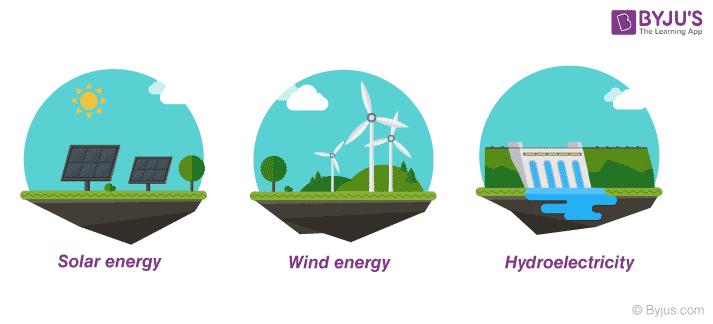
He further explained that even minor cloud cover can reduce solar generation and force the grid to depend on battery storage systems.
According to Indar, battery systems linked to solar infrastructure are limited in duration and expensive to maintain.
He stated, “Battery can only last you two, two-anda-half-hour max. It’s very expensive to replace.” The minister further warned that prolonged periods of rainfall could significantly disrupt a solar-dependent grid and lead to power interruptions across the country.
“If you have a period of a long… maybe all week you’re having rain, what do you think will happen to the country if you use solar? People will get outages; [solar] is what you call intermittent power,” Indar stated.
As a result, he maintained that solar energy cannot be the country’s principal electricity source.
“So, you can’t use solar to be the main source of grid,” the minister asserted.
While acknowledging the role the proposed Amaila Falls Hydropower Project could play, Indar noted that even its planned 165 mega-
watts of electricity generation would not be enough to satisfy Guyana’s future energy demand.
“Hydro can be used, but we’re now building out the hydro… to bring in 165 megawatts, but 165 megawatts are not what the grid would require in a couple of years,” he explained.
The government is moving ahead with the Amaila Falls Hydropower Project under a revised Build-Own-Operate-Transfer (BOOT) model, with firms and consortia invited to submit proposals to develop a facility capable of delivering at least 165 megawatts of renewable energy to the national grid.
The project is intended to become a major component of Guyana’s long-term energy mix, complementing gas-to-energy and solar initiatives while supporting the country’s low-carbon development agenda.
Indar revealed that elec-
tricity demand is expected to increase dramatically in the coming years, with projections indicating the country could require close to one gigawatt of power, several times greater than its present consumption.
The minister disclosed, “We’re projecting that, you know, in another couple of years, it will be close to one gigawatt and above, which is, you know, three, four times the current demand profile that we have.”
Despite noting its limitations, Indar maintained that solar energy still has an important role in Guyana’s energy mix when balanced appropriately with other sources, including fossil fuels, hydro and wind power. “So, solar power, it’s good, you know, it’s renewable, but you got to know how you balance it,” he stated.
The People’s Progressive Party/Civic (PPP/C) government has expanded
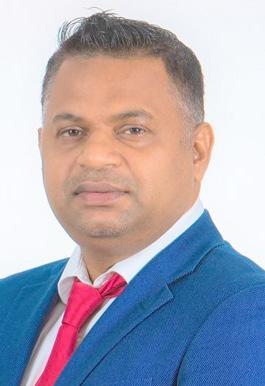
solar energy through the installation of solar farms, mini-grids and solar home systems, particularly in hinterland and riverine communities. Solar power has also been integrated into schools, health centres and other public buildings as part of Guyana’s broader renewable energy strategy.
ana is entering what could become its “finest hour” as the country marks its 60th Independence Anniversary

amid unprecedented economic growth and transformation.
In a message reflecting on Guyana’s economic journey since independence in 1966, Singh said the country has evolved from a small, commodity-dependent economy into one of the world’s fastest-growing nations, driven by disciplined fiscal man-
agement, economic reform and strategic development policies.
“As we come of age as a nation, Guyana’s finest hour beckons,” Singh declared, while extending Independence greetings to Guyanese at home and abroad.
The Finance Minister noted that at the time of independence, Guyana had a

population of approximately 642,000 people, per capita income of about US$350, and an economy heavily dependent on a narrow range of primary commodities with limited value-added production.
He outlined what he described as five major phases in the country’s economic evolution over the last six decades. These included the early dependence on a narrow productive sector, the era of nationalisation and state-dominated economic management that resulted in economic contraction and fiscal collapse, a period of recovery based on liberalisation and fiscal discipline, an interval of economic decline, and, most recently, a period of rapid economic transformation over the past six years.
According to Singh, Guyana’s current economic position is the strongest since attaining political independence.
He highlighted that between 2021 and 2025, Guyana recorded average annual real GDP growth of 36.1 per cent, while non-oil real GDP expanded by an average of 11.3 per cent over the same period. He added that the country’s population has now surpassed one million people
and per capita income exceeded US$26,000 in 2025.
Singh credited the country’s progress to “clear vision, sound policy, steadfast implementation, perseverance, discipline, and hard work,” while emphasising the resilience of the Guyanese people throughout periods of economic hardship.
“We did not get here by ease and convenience, or by good luck and fortuitous circumstances,” he stated.
The Senior Minister also pointed to what he described as restored democratic legitimacy, renewed global credibility, increased attractiveness to foreign and domestic investment, and improved fiscal sustainability as key pillars supporting Guyana’s current economic standing.
While acknowledging the opportunities ahead, Singh cautioned that sustaining the country’s gains would require continued discipline and hard work.
He said the government remains focused on ensuring that national prosperity translates into lasting economic empowerment for all Guyanese as the country advances into what he described as a new era of opportunity and development.
motorists, pedestrians and revellers urged to exercise caution, obey traffic directives and take responsible steps during Independence festivities
AS Guyana begins celebrations for its 60th Independence Anniversary today, the Guyana Police Force’s Traffic Department says it has intensified patrols and traffic management operations nationwide to ensure public safety amid an expected surge in road traffic, entertainment events, and visitor arrivals.
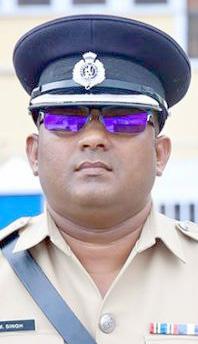
Speaking on the latest edition of Police Round Up, Traffic Chief and Assistant Commissioner of Police, Mahendra Singh, said the force has activated strategic deployment plans aimed at reducing congestion, preventing accidents, and maintaining order during the Diamond Jubilee festivities.
“Our ranks are on patrol, and the dominance patrol is to ensure continuous progression, limiting every opportunity for an accident,” Singh said, while stressing that the department’s operations are focused on ensuring the “general safety of the public” and all categories of road users.
The heightened police presence comes as Guyana prepares for a packed calendar of Independence activities, including cultural showcases, concerts, flag-raising ceremonies, and late-night celebrations expected to attract large crowds across the country.
According to Singh, traffic ranks have already been
strategically positioned at major intersections, busy traffic corridors, transportation hubs, and event venues to guide motorists and pedestrians and to ease congestion on heavily travelled routes.
He noted that the force will rely on a combination of mobile and foot patrols, traffic signage, and increased technological support to manage the movement of people during the celebrations.
The Traffic Chief also pointed to the challenges posed by Guyana’s rapidly expanding infrastructural network and ongoing construction activity, particularly in areas where large crowds are anticipated.
“Across the country where event venues are, we

must factor that construction is taking place as well,” Singh explained, adding that areas with heavy bus traffic and pedestrian movement will see increased police monitoring.
The warning comes at a time when Guyana’s road network is undergoing significant transformation through major highway expansion and urban development projects, particularly along the East Coast and East Bank Demerara corridors. Authorities have repeatedly cautioned that unfamiliar road layouts, increased traffic volumes, and speeding continue to heighten accident risks.
Singh also issued a special appeal to tourists and returning Guyanese expected to travel throughout the country during the Independence celebrations.
He reminded visitors that many roadways have changed significantly in recent years and urged motorists renting vehicles to ensure they are familiar with local traffic regulations, speed limits, and road signage.
“When you were here the last time, you may not have had one of the roads that you presently have,” Singh said, while encouraging motorists to comply with police directions and maintain height-
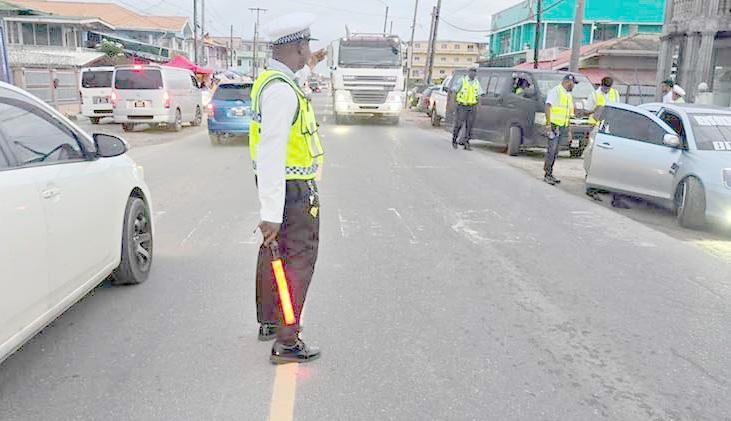
As Guyana’s 60th Independence celebration gets underway, Assistant Commissioner of Police (Traffic), Mahendra Singh, says the Guyana Police Force is prepared and equipped to strategically bolster its presence across the country to ensure public safety
ened situational awareness on the roadways.
He stressed that the force’s efforts are intended not only to protect residents but also to support Guyana’s growing tourism sector by creating a safe and organised environment for visitors.
Police also indicated that special consideration will be given to vulnerable road users, including pedestrians, cyclists, motorcyclists, and persons living with disabilities.
Meanwhile, impaired driving remains a major concern for law enforcement authorities during the holiday period, particularly with late-night entertainment

events expected throughout the anniversary celebrations.
Singh urged revellers planning to consume alcohol to make transportation arrangements in advance by using taxis or designated drivers rather than getting behind the wheel while intoxicated.
“We are not discouraging you from imbibing, if that is the way you celebrate, but we will tell you that is unlawful,” he stated, referring to driving under the influence.
The Traffic Department has in recent years intensified enforcement exercises targeting speeding, reckless driving, and impaired driving, all of which remain leading contributors to serious accidents and road fatalities in Guyana. Authorities are now appealing for collective responsibility from motorists, pedestrians, and revellers alike to ensure the country’s Diamond Jubilee celebrations are conducted safely and without tragedy.

GUYANA celebrates its 60th anniversary of Independence at a critical moment in its history, a moment to reflect on the sacrifices of the past but also one of increasing confidence in the possibilities of the future.
Guyana is undergoing a transformation like no other in its post-independence history, six decades after breaking free from colonial rule.
Massive infrastructure development, rapid economic expansion, technological modernization and rising international prominence have all combined to make the country one of the most watched emerging economies in the region.
There is a general consensus now among Guyanese that the country is no longer just surviving but is finally beginning to step into its potential.
But independence anniversaries are not only days for celebration. They are also moments for clear-eyed reflection. Guyana’s story of independence is not one of smooth transition and unbroken progress. It is the story of struggle, sacrifice, political turbulence and resilience.
Colonialism has scarred Guyanese society. The divisions of race, class and political loyalty nurtured in that era did not disappear with the lowering of the Union Jack in 1966.
Rather, many of those divisions remained, and in some cases became more
pronounced during the tumultuous decades of the post-independence period.
Ordinary Guyanese powered the movement for self-government because they believed they deserved dignity, representation and control over their own destiny.
Leaders like Cheddi Jagan and the first nationalist movement rallied workers and citizens around the ideals of equality and social justice.
The independence was won by organisation, activism and sacrifice, not bestowed as an act of generosity by colonial authorities.
But the promise of independence was soon clouded by political instability and democratic backsliding.
The period from 1964 to 1992 is one of the most tragic chapters in Guyana’s modern political history.
Charges of rigged elections, crackdown on dissent, economic mismanagement, and political intimidation undermined public trust and weakened national institutions.
By the late 1980s, Guyana was in the midst of a deep economic crisis. Poverty was widespread, as was debt and migration, which was hollowing out the social and economic fabric of the country.
If one does not understand the depth of that historical decline, one cannot appreciate the present trajectory of Guyana.
The reconstruction process initiated in the 1990s needed not only economic
recovery, but also the reestablishment of democratic confidence and institutional credibility.
Today, Guyana is once more at a crossroads, but this time with enormous opportunity before it. The oil wealth, greater investment and rising attention on the world stage have created the conditions for unprecedented development.
New hospitals, highways, schools, housing schemes, digital services and energy projects are transforming the physical and economic landscape of the country.
But there is a strong lesson in history too: prosperity isn’t enough to ensure national success.
True development has to be measured not just in economic growth figures but in whether the ordinary citizen feels safer, more secure and more hopeful about his future.
This must be reflected in better healthcare, stronger education systems, reliable infrastructure, accountable governance and equal opportunity across all communities.
At 60, therefore, the challenge for Guyana is bigger than economics. The challenge is to build a society that remains cohesive amid rapid change.
The future stability of the country will depend heavily on whether leaders and citizens alike can resist the forces of division, political extremism, misinformation and ethnic mistrust that have historically under-
mined national cohesion.
The call for unity is particularly relevant in an age where social media, partisan rhetoric and the high stakes of newfound wealth can readily stoke political tensions. Guyana cannot afford to repeat the same mistakes.
There is reason to be optimistic as the nation celebrates and honours its Diamond Jubilee.
Today Guyanese are experiencing opportunities that previous generations could hardly have dreamed of. Young people are increasingly seeing a future for themselves at home, not abroad. The country is becoming more globally connected, economically competitive and technologically savvy.
But opportunity brings responsibility. The next 60 years will be judged by the ability of Guyana to build institutions that are strong enough to survive political cycles, to ensure that national wealth is shared among all citizens, and to protect hard-won democratic liberties.
Independence is more than a date on the calendar This is a permanent national project, one demanding vigilance, sacrifice and collective purpose.
At 60 there is much to celebrate about how far Guyana has come.
But the larger work remains: to turn economic promise into lasting national unity, social justice and shared prosperity for generations to come.
Dear Editor,
AS Guyana proudly celebrates its 60th Independence Anniversary, it is important for us as citizens to reflect on how far our nation has come and the remarkable transformation currently taking place across the country.
Independence is not only a celebration of our freedom, but also an opportunity to appreciate leadership, national development, and the collective efforts being made to improve the lives of all Guyanese.
Over the past few years, the government led by the People’s Progressive Party/Civic has embarked on major development initiatives that are reshaping Guyana’s future. Under the leadership of President Irfaan
Ali and the PPPC government, the country has witnessed rapid infrastructure growth, including the construction of new roads, bridges, hospitals, schools, housing schemes, and expanded opportunities within the oil and gas sector.
These developments are creating jobs, stimulating economic growth, and improving the standard of living for thousands of citizens.
The government’s investments in education, healthcare, agriculture, security, and public services demonstrate a commitment to ensuring that development reaches every region and every community.
Many Guyanese are now benefiting from cash grants, increased salaries, training opportunities, and improved access to technology
and social support programs. These efforts show a clear intention to build a stronger and more inclusive society.
Additionally, President Ali has outlined ambitious future plans for Guyana that continue to inspire confidence among citizens.
These plans include further modernization of the country’s infrastructure, the expansion of renewable energy projects, increased local content opportunities, the development of world-class healthcare facilities, improved public transportation systems, and continued diversification of the economy beyond oil and gas.
The vision presented by the President reflects a desire to make Guyana one of the leading and most developed nations in the Caribbean and South America.
As we celebrate 60 years of independence, we must also remember that national progress requires unity, patriotism, and collective responsibility. Regardless of political differences, all Guyanese should support initiatives that contribute positively to the nation’s growth and prosperity.
Our country possesses enormous potential, and with proper leadership, wise management of resources, and national unity, the future of Guyana can be brighter than ever before.
Guyana at 60 represents resilience, progress, and hope. Let us continue working together to build a nation that future generations will be proud to inherit.
Sincerely, Quincy Anderson
By Ambassador Nicole Theriot, U.S. Ambassador to Guyana
AS Guyana celebrates its 60th Independence Anniversary on May 26, I am honoured to reflect on six decades of friendship, partnership, and shared progress between our two nations.
President Lyndon B. Johnson, welcoming Prime Minister Burnham to the White House just weeks after Guyana’s independence in July 1966, captured the spirit of that moment: “A few days ago we celebrated the 190th anniversary of our independence. You are embarked upon your first year. We know, as you do, that the early years of independence are years of challenge and trial, but they are also of great hope and promise.”
This milestone represents more than Guyana’s remarkable journey since gaining independence on May 26, 1966; it also represents 60 years of diplomatic relations built on mutual respect, democratic values, and a commitment to prosperity for all our citizens. As the United States concurrently prepares to celebrate our own 250th anniversary of independence this year, we reflect with deep appreciation on the enduring bonds we share with democratic partners like Guyana who value the hard-won blessings of liberty and self-determination.
Our partnership represents a time-tested alliance rooted in a rich historical legacy. One of the most enduring symbols of this early co-operation is the construction of the Soesdyke-Linden Highway. Completed nearly six decades ago with U.S. financing and support, this vital artery remains a primary link between Regions 4 and 10 and serves as the essential gateway to Guyana’s interior. Just as that highway opened new frontiers for development, our diplomatic bond continues to pave the way for integration and economic expansion today.
The true strength of our relationship extends far beyond government offices; it is vibrantly alive within the Guyanese American diaspora. This thriving community serves as a powerful connection between our two countries. They are making invaluable contributions to the United States in fields ranging from commerce and medicine to academia and public service. While their achievements strengthen the American tapestry, their steadfast commitment to their homeland continues to drive innovation, philanthropy, and meaningful cultural exchange here in Guyana.
The U.S.-Guyana bond is perhaps most visible in our shared commitment to human development. Through the

U.S. President’s Emergency Plan for AIDS Relief (PEPFAR), we have worked hand-in-hand to turn the tide against HIV/AIDS. Our collaboration during the COVID-19 pandemic, providing vaccines and technical infrastructure, reinforced a simple truth: our security and health are interconnected. Through initiatives such as the United States Southern Command’s Lesser Antilles Medical Assistance Team (LAMAT), we exemplify the unwavering commitment of the United States to the people of Guyana to invest in the health of every Guyanese community.
Exchange programmes are a key part of our partnership, and we are proud to see U.S. exchange program alumni making a profound impact in Guyana. These programs equip Guyanese in a variety of fields - business, community leadership, education, and more, with the skills and contacts to build a better Guyana. From the selfless work of Peace Corps volunteers to the academic exchanges that spark innovation in our youth, these people-to-people connections define the heart of our relationship.
In an evolving global landscape, the security partnership between the United States and Guyana remains steadfast. The United States stands firmly with Guyana in support of its territorial integrity and sovereignty. As Secretary of State Marco Rubio emphasized during his 2025 visit to Georgetown, we are committed to ensuring Guyana can develop its resources and pursue its future free from external pressure.
Our security co-operation reached new heights following that historic visit, which culminated in the signing of a pivotal Memorandum of Understanding to deepen bilateral defense ties. Under this MOU, the United States and Guyana have conducted many training engagements together, including on forensic laboratory procedures, crime scene investigation, and maritime domain awareness.
Through the Caribbean Basin Security Initiative (CBSI) and the Shield of the Americas Coalition, the United States and Guyana will strengthen this co-operation to combat narco-terrorists and transnational criminal organizations, discourage illegal immigration, and support private enterprise – all of which are vital to protecting our citizens and maintaining regional stability.
The United States is proud to be Guyana’s largest trading partner. As Guyana transforms its economy, particularly through its emerging energy sector, the United States remains a committed partner in promoting responsible investment and sustainable development.
U.S. leadership in the energy sector continues to play a key role in supporting Guyana’s impressive transformation. Together, we can unlock new opportunities, create jobs, and
secure long-term prosperity for both our countries.
As President Trump noted in his 2026 Republic Day message to President Ali, “We are united by our shared interest in building a better future for our people.” This future is fueled by the people-to-people connections, the security co-operation, and the economic partnerships that define us.
As the Golden Arrowhead flies high this month…and every month, the United States stands as a resolute partner, ready to support the next chapter of your nation’s story. We look forward to a future of greater security, deeper democracy, and boundless opportunity. Happy 60th Independence Anniversary, Guyana.
May our partnership continue to flourish for the next 60 years and beyond.
By Muhammad Ibrahim
THE extreme variant of the El Niño phenomenon predicted by international weather forecasts, combined with the global fertiliser crisis, poses a dual threat to rural economies, social stability, and agricultural production in Latin America and the Caribbean, a region critical to global food security.
Even separately, both factors pose enormous challenges for regional agriculture. Combined, they could become a perfect storm for millions of producers, affecting food security in quite a few nations.
Forecasts indicate a high probability of El Niño developing this year, with potentially uneven effects: heavy rains and flooding in some regions; prolonged droughts and water stress in others. The common concern is the
uncertainty regarding the phenomenon’s potentially greater intensity.
In the Southern Cone, particularly in Argentina and Brazil, some regions could benefit from increased rainfall and a recovery in crop yields. In Central America, the Caribbean, and northern South America, the outlook is less favourable.
There, the risk of lower yields and crop losses, decreased livestock productivity, disruptions in agricultural markets, and sharp increases in food prices is significant, which can lead to a deterioration in food security and force producers and consumers to face costs running into the millions. These are not potential dangers; recent history bears them out.
These impacts, particularly in rural areas, are often followed by debt, migration, and nutritional decline.
For agricultural producers, especially
small and medium-sized ones, climate uncertainty makes it difficult to decide what to plant, how much to invest, or what level of fertilisation to apply. And when fertilisers become more expensive or scarce, many choose to reduce application rates, decrease the area planted, or switch to less demanding crops, with immediate and negative effects on yields and production.
Unlike in the past, it is now possible to anticipate the occurrence, impacts, and consequences of climate phenomena such as El Niño - or its counterpart, La Niña.
Today, it is unjustifiable to act only on the consequences and limit ourselves to reacting when drought is advanced, floods occur, crops are lost, or prices rise. We must act sooner to minimise negative impacts.
For all these reasons, the time has come to move toward a proactive regional strategy. It is imperative to promote a broad hemispheric dialogue on agri-food resilience that brings together governments, international organisations, producers, the financial sector, academia, and the private sector around a common agenda: developing anticipation capabilities to protect both agricultural production and life in rural areas.
In this context, international technical co-operation, with its capacity for political and technical coordination and its relationships with governments, producers, compa-
nies, and international financial institutions, is uniquely positioned to promote regional co-operation agreements and proactive responses, as well as, if necessary, to coordinate aid and solidarity efforts to address emergencies.
Among the public-private collaboration mechanisms that can be promoted are regional platforms for climate and agricultural coordination; agreements with fertiliser and logistics companies to ensure supply in vulnerable areas; innovative financial instruments in partnership with public and private banks; the expansion of climate insurance; and joint technological adaptation programmes for small and medium-sized producers.
Private sector participation is crucial for these strategies to be viable and scalable, given that chemical companies, agribusiness, banks, technology firms, and export chains play a fundamental role in the shared development of agricultural resilience.
Strengthening early warning systems and transforming climate information into concrete decision-making tools must become a regional priority. Latin America and the Caribbean produce meteorological and agricultural data of immense value, but often that information does not reach producers in a timely manner.
The widespread adoption of drought-resistant seeds and tools for efficient water management, combined with an agronomic management strategy that incorporates advanced technologies (such as GPS, drones, and sensors), should be among the other objectives of this coordination.
The dual challenge posed by El Niño and the fertiliser crisis can also become an opportunity: that of building a new agri-food governance system based on regional co-operation, innovation, and foresight.
Latin America and the Caribbean produce food for billions of people, both within and beyond their borders. Protecting this productive capacity is not merely an economic challenge.
It is a strategic issue for development, rural stability, and global food security.
POLICE in Regional Division 4 ‘A’ have launched an investigation into the alleged murder of a homeless man following a stabbing incident early Monday morning on Hadfield Street, Werk-en-Rust, Georgetown.
The dead man has been identified only as “Gandy,” believed to be between 30 and 40 years old and of no fixed place of abode. The incident reportedly occurred at about 01:30 hrs.
According to preliminary police investigations, the victim was on
Hadfield Street when he was approached by an identifiable male suspect.
Investigators said a confrontation subsequently broke out between the two men.
During the altercation, the suspect, who was reportedly armed with a knife, allegedly stabbed the victim once to the centre of his chest. The injured man collapsed at the scene while the suspect fled north along Hadfield Street, still in possession of the weapon.
Emergency Medical Technicians responded
and transported the victim for medical attention, but he was later pronounced dead by a doctor on duty at the Georgetown Public Hospital Corporation.
Police said CCTV cameras in the area have been identified and footage will be reviewed as part of ongoing investigations into the killing.
The body is currently at the Memorial Gardens Funeral Home awaiting formal identification and a post-mortem examination.
The suspect remains at large as police continue their investigation.
DID you see the interview on the Freddie Kissoon Show with former Cabinet Minister, Joseph Hamilton on Guyana’s 60th year of independence? If you haven’t, then please do, because Mr. Hamilton said he wants the younger generation of Guyanese to know where Guyana came from before it reached 60 years.
There could not have been a wiser saying within the context of Guyana at 60. Guyana has one of the youngest populations in the world. At 60 years of independence, about 90 percent of the population was not born. Give and take a two per cent, that takes you to 88 percent of the present generation that was not born in 1966.
To understand how we arrive at 60, we must know what went on before we ever came close to 40, much less 60. It has been a long journey to 60 and the best person to tell you about that time of travel is someone in the 70s because they have seen it all.
When you are in your seventies and you look back at Independence in Guyana, then that recording of history should be a gift to young people. They don’t know what they have today and they should cherish it. The ride to 60 was almost impossible with twists and turns and deadly boulders in front of you. That how they did not derail you is a miracle.
The journey to 60 should be seen from the perspective of different citizens. There were those in the sugar industry, the public service, the retail trade, the school system, the state medical service, etc. Each person in that realm has a different tale to tell.
For me, it was 26 consecutive years at UG. Before I go there, a few words about the Georgetown Hospital. My mother died there in 1985. There was no attendant to lift her up the stairs. She died because the hospital had
neither staff nor resources. Today, at the hospital, a discharged patient is wheeled outside. There are elevators that patients use without having to climb the stairs.
Here is an incident at UG in 1988. Four of us – Compton Saul, Anthony Teixeira and Theo Morris (the last two are dead) - finished teaching one Friday evening. We decided we will go downtown for a lime. We couldn’t find even a third-rate place to sit and chat. We ended up buying coconut water from a vendor at the junction of King Street and Regent Street.
A homeless man was molesting us and I was the one to accost him. It triggered some mad instinct in the man and he picked up a coconut shell and pelted it at us. The shell missed Theo’s head by a court of varnish. They were all annoyed with me for admonishing the homeless man because of the perennial misuse of my worst characteristic – an aggressive big mouth.
Today, university lecturers each have their own cars and patronise modern restaurants in Guyana. When you look at the prices and the daily packed clientele at these places then, the new generation certainly lives in a Guyana that has left the world of Kings Street and Regent Street behind. There is a restaurant today that sells a beef steak for $72,000.
Each one of us in our seventies has a story to tell about the journey to 60 years. I remember when I came back home in 1984, we had to line up at a place named Coop Complex to buy rationed soap, rice, toilet paper. At that time, I lived at Louisa Row and Hadfield Street, two blocks from Cummings Street and Charloltte Street which had a branch of JP Santos supermarket.
One day, I went into that supermarket and it was not half-empty but almost empty except for preserved carambola (five-finger) that
THE Georgetown Chamber of Commerce and Industry (GCCI), on Monday, engaged representatives of EKAA Hrim Earth Resource Management Incorporated amid concerns circulating in the public domain regarding the company’s human resources practices.
The meeting, held at the GCCI’s boardroom, brought together GCCI President, Kathy Smith and Junior Vice President Kristia Ramlagan-Prescott with EKAA Hrim Earth Resource Management Inc. representatives Jesvin Pradeep Kumar and Karthick Muthuvel.

GCCI President Kathy Smith and Junior Vice-President Kristia Ramlagan-Prescott with EKAA Hrim Earth Resource Management Inc. representatives Jesvin Pradeep Kumar and Karthick Muthuvel

made dates and other foreign preserved fruits tasteless. It was produced by a state company managed by Mrs. Burnham, the president’s wife. The carambola line was personally managed by Ms. Vashti Warner.
That was in 1984. A few years ago I asked my wife if she knows what has become of Ms. Warner. My wife worked with Ms. Warner at Guyana Pharmaceutical Corporation (where now stands Marriot Hotel) which housed Quality Foods, which was a state company that produced the carambola. Does anyone know if Ms. Warner is still alive?
Today, look at Guyana at 60. It is a modern country where you can get anything you want and you don’t have to go in the night searching for a restaurant to eat and end up being killed by the blow of a coconut shell. Part 2 is about the tragic remnants of the colonial mind in Guyana 60 years after independence.
DISCLAIMER: The views and opinions expressed in this column are solely those of the author and do not necessarily reflect the official policy or position of the Guyana National Newspapers Limited.
The Chamber said it remains committed to continued dialogue with the company, emphasising the importance of
According to the Chamber, discussions focused on addressing issues related to the company’s human resources operations that have recently drawn public attention. During the engagement, GCCI executives offered recommendations aimed at achieving an amicable resolution to the matters raised.
adherence to the law and the maintenance of best business practices. The engagement forms part of the GCCI’s broader role in fostering responsible corporate conduct and promoting constructive engagement between businesses and stakeholders within Guyana’s private sector.
THE Guyana Police Force’s Traffic Department says advances in technology, expanded resources, and stronger local and international partnerships have significantly improved its ability to monitor roadways, respond to incidents, and deliver services to the public amid rising traffic demands across the country.
Speaking on the latest edition of Police Round Up, Traffic Chief and Assistant Commissioner of Police Mahendra Singh said the force has evolved substantially over the past six decades, transitioning
from a largely reactive style of policing to a more proactive and responsive model supported by surveillance technology, improved mobility, and enhanced monitoring systems.
According to Singh, the rapid expansion of Guyana’s road network and the dramatic increase in vehicle ownership have placed unprecedented pressure on the Traffic Department, forcing the organisation to modernise its operations and improve efficiency.
“Now we have more than 600,000 registered motor vehicles in the Co-operative Republic
of Guyana that are in use on a daily basis,” Singh disclosed, noting that the growing number of vehicles has increased demand for traffic enforcement, directional duties, accident response, and public awareness services.
Guyana has experienced significant economic and infrastructural growth in recent years, driven largely by rapid urban expansion and increased commercial activity linked to the country’s oil and gas boom. This transformation has resulted in major highway upgrades, new road networks, and heavier traffic flows, particularly

along the East Bank and East Coast Demerara corridors.
Against that backdrop, Singh said the Traffic Department has increasingly turned to technology to improve operations and strengthen accountability.
“Where we usually stand on the road then to receive a report in order to observe an accident or an issue of traffic and then take it to the station to actually provide that service to those affected, now owing to technology and the progress we have experienced as an organisation and a department, we can remotely monitor through the use of technology,” he explained.
The Traffic Chief said the deployment of surveillance cameras and monitoring systems now allows police to oversee larger areas more efficiently while improving response times and enforcement capabilities.
He added that technological advancements have also strengthened transparency and professionalism within the force.
“Technology enhanced our integrity and improved our accountability with which we serve the public and address issues of
enforcement and service delivery,” Singh stated.
The department has also expanded its operational capacity through the use of motorcycles, patrol vehicles, and improved communication systems, allowing officers to respond more rapidly to emergencies, accidents, and congestion.
Singh said the force is also investing heavily in training and development to ensure traffic ranks are better equipped to handle modern policing demands.
“Training and development, a core function of human resource management, that is at its forefront,” he said, while emphasising that officers are continually refining their skills to improve service delivery.
“In short, I can say 60 years on, we are far better than we were then,” he added.
The increased use of technology is particularly significant as Guyana hosts activities marking its 60th Independence Anniversary, with authorities relying on remote monitoring systems and predictive traffic management to oversee large gatherings and busy roadways during the celebrations.
Singh noted that the force can now monitor traffic patterns and anticipate potential issues before they escalate.
“Over time, we have seen we are not standing on the roadside waiting for a report anymore. We can remotely monitor spaces within our country now. We can predict what can happen, will happen or how it happens,” he said.
Beyond technology, Singh credited collaboration and strategic partnerships as major contributors to the department’s development and improved effectiveness.
“Collaboration has enhanced our performance, our reach and how we do things in that we are not operating in an environment as if we are isolated anymore,” he stated.
The Traffic Chief said partnerships with stakeholders and agencies have strengthened the force’s ability to address road safety issues and improve public service delivery.
He also stressed that road safety is a shared responsibility, noting that motorists, passengers, cyclists, and pedestrians all play an important role in creating safer roadways nationwide.

JUST weeks before Guyana’s September 1, 2025, General and Regional Elections, a legal challenge brought by Krystal Fisher of Forward Guyana Movement (FGM) sought to have the polls declared unlawful. The matter was dismissed by both the High Court and the Court of Appeal and is now before the Caribbean Court of Justice (CCJ), according to Attorney General Anil Nandlall, SC.
Speaking recently on his weekly programme, “Issues in the News,” Nandlall outlined the status of the mat-
matter, with the appeal scheduled to be heard on July 16 at 10:00 hours at the seat of the court in Port of Spain, Trinidad.
He explained, “The appeal is coming up for hearing at the Caribbean Court of Justice at the seat of the court… on the 16th of July at 10 a.m.”
He revealed that the appellant, Fisher, had been ordered to file submissions on or before May 6, 2026, while GECOM and the Attorney General were required to submit responses by May 22.
“The respondents, Guyana Elections Commission

ter, which was filed against the Guyana Elections Commission (GECOM) and the Attorney General of Guyana. According to the Attorney General, the case was filed “just days before the disciplined forces went to vote” at the September 1 elections.
He explained that Fisher had approached the High Court “trying to get the High Court to declare the elections as being unlawful,” arguing primarily that GECOM did not include the name of the FGM party on ballots in regions where the party was not contesting.
“And they wanted to stop the elections and they wanted the whole elections to be declared as illegal,” Nandlall related. He noted, however, that the challenge was unsuccessful in both local courts. “The High Court ruled against them. They went to the Court of Appeal. The Court of Appeal ruled against them. They are now at the Caribbean Court of Justice,” he stated.
Nandlall disclosed that the CCJ has since handed down directions for the
ro-Siparun), and reportedly working as a teacher, was being used to front the case on behalf of the FGM. “This is some ordinary Guyanese who is being used to front Forward Movement for Guyana,” he contended.
He noted that the legal challenge had already resulted in millions of dollars in costs for Fisher and predicted the matter would suffer the same fate at the CCJ.
“She has incurred costs now totalling millions and Forward Guyana Movement going one more step, whereas I predict they will lose and incur more costs,”
he stated.
“The costs will be pursued,” the Attorney General declared.
The Court of Appeal dismissed FGM’s challenge regarding its exclusion from ballots in October 2025, finding that GECOM acted lawfully. The court noted that the party could only appear on ballots in geographic constituencies where it had nominated candidates.
In dismissing the appeal, the appellate court upheld the High Court’s order awarding $1 million in costs to each respondent, amounting to
$2 million in total. It also imposed an additional $1 million in costs to each respondent at the appellate level, bringing the Court of Appeal costs to $2 million and the overall costs awarded across both courts to $4 million.
After resigning from the People’s National Congress Reform (PNCR), where she previously served as an opposition Member of Parliament, attorney-at-law Amanza Walton-Desir launched the Forward Guyana Movement in 2025 and now serves as its leader.
and the Attorney General, are to file their response on or before the 22nd of May… and we will, well, at least speaking for the Attorney General, we will comply. No doubt GECOM will as well,” he stated.
The Attorney General further explained that the appellant may file a reply, if desired, by June 1.
Nandlall asserted, “So, let us see how this will unfold. I have every confidence that the arguments of the respondents, GECOM and the Attorney General, will prevail once again.”
Addressing the issue of legal costs, Nandlall revealed that costs had already been awarded against Fisher in both the High Court and Court of Appeal and maintained that additional costs would be pursued if the matter fails at the CCJ.
“Costs have already been awarded, both in the High Court and the Court of Appeal,” he stated.
Nandlall alleged that Fisher, whom he identified as residing in Paramakatoi, Region Eight (Pota -
GUYANA’S 60th independence anniversary finds our beloved nation at the threshold of a national renaissance, economically energised, globally recognised, and poised to become one of the defining success stories of the Caribbean and Latin American region in the 21st century.
At this promising juncture in our history, economic transformation, national confidence, and global relevance are converging. Guyana is not simply experiencing growth; it is shaping a new national identity. For our country, infrastructure, digital systems and the delivery of public goods and services are being modernised at a pace that signals long-term ambition, not short-term prosperity. For our people, the sense of possibility is more pronounced, with future generations set to inherit broader opportunities, stronger institutions, and a higher quality of life. Our people’s view of Guyana has evolved into more than just a home; it is a place where meaningful careers, innovation, and nation-building can happen simultaneously.
For our future, we are called upon to remember the challenges of the pre-independence period, those of the years of democratic decline from 1964 to 1992, and the March 2020 effort to undermine the will of the Guyanese people.
Colonialism was not benign. Freedom was won only because ordinary people demanded it. Sacrifice and struggle are synonymous with independence struggles the world over. Colonialism thrived on division.
Across the world, colonial powers maintained control by dividing people along lines of race, class, and politics, ensuring that those they governed remained suspicious of one another, rather than united in a common purpose. Guyana was no exception. However, despite those divisions, the struggle for independence was built on a deeper truth – that the people of Guyana shared more in common than the forces that sought to divide them. They were, above all, children of the same soil. Independence did not come easily, nor was it generously bestowed by the British Empire. Like every nation that fought to free itself from colonial rule, Guyana had to struggle, organise, and sacrifice. The march toward independence gained strength with the rise of the organised trade union movement and the formation of the Political Affairs Committee (PAC) in 1946 under the leadership of Dr Cheddi Jagan. These efforts laid the foundation for the creation of the People’s Progressive Party (PPP), which became a powerful force in the fight for self-government and social justice. Dr Cheddi Jagan and the other leaders of the 1950 movement sought to transform the lives of ordinary Guyanese through progressive policies aimed at equality and national development. But those ambitions alarmed external powers. As Guyana moved closer to true freedom, foreign interference intensified. The turbulence and violence of the 1960s did not emerge naturally from the Guyanese people alone. They were fuelled by outside forces determined to prevent independence from empowering the population. Colonialism left behind not only political conflict, but deep social wounds. The scars of that era remain visible even today. Race riots, political unrest, and decades of mistrust planted suspicions that lingered across generations, undermining national unity and social cohesion. The divisions created during colonial rule harmed the country long after independence was achieved. Nonetheless, Guyana’s history also carries lessons of resilience. The struggle for independence, therefore, was not only about ending British rule. It was about reclaiming unity, dignity, and the Guyanese people’s right to shape their own future.
In the People’s Progressive Party, central to fulfilling the promise of Guyana has been, and remains, addressing the basic needs of Guyanese across the country, creating opportunities for wealth creation, strengthening democratic institutions, and ensuring that progress reaches every community across the country.
Although Guyana gained independence in 1966 with great promise and hope for prosperity, powerful forces had already engineered undemocratic rule beginning in 1964, denying the Guyanese people the full benefits of independence and steering the country into nearly three decades of democratic
struggle and economic decline, during which Guyana became one of the poorest nations in Latin America and the Caribbean. From 1964 to 1992, Guyana endured 28 years of authoritarian rule marked by rigged elections in 1968, 1973, 1980 and 1985, as well as the 1978 referendum. The period was marred by political violence, repression, and widespread violations of human rights, with Guyana’s first free and fair elections only being held in 1992. The years leading up to and during People’s National Congress (PNC) rule saw ethnic discrimination, suppression of dissent, and attacks on opposition forces. Critics of the government faced intimidation, violence, and extra-judicial actions. Opposition meetings were violently disrupted, and unions and civil society groups that resisted party control were ruthlessly attacked under the doctrine of party paramountcy, which placed the then-ruling party above national institutions and freedoms. By 1992, Guyana was in deep crisis. External debt had risen to more than 900 per cent of GDP, while debt servicing consumed 153 per cent of government revenue. By 1990, 87 per cent of the population lived below the poverty line, and the 1989 McIntyre Report ranked Guyana below Haiti as the poorest country in the Western Hemisphere. The report, led by former Caribbean Community Secretary General Alister McIntyre, found that economic decline, state control of the economy, and the suppression of private enterprise had triggered a mass exodus of talent. Hunger, malnutrition, homelessness, and widespread hardship had become part of daily life, with many citizens spending much of their time simply searching for food. By the late 1980s, the crisis reached a breaking point as unsustainable borrowing
pushed foreign debt to US$1.7 billion, nearly six times the country’s GDP, while arrears climbed to US$1 billion. To keep a bankrupt country afloat, the government had to turn to the IMF for support in 1988.
The task of rebuilding from the ground up in 1992 was no easy task. However, these challenges have inspired the vision being implemented for our future – a future that the People’s Progressive Party, guided by its leaders, has struggled to deliver to our people from 1992 to 2015 and from 2020 to the present.
This vision was grounded in the belief that democracy means empowering the people; ensuring their involvement at all levels in management and decision-making; and building a country where our people are allowed to build their own future. Importantly, progress does not happen by chance. Transformation is achieved through careful planning, disciplined leadership, and a clear commitment to where we want our country to be, not only today, but decades from now. Consequently, the People’s Progressive Party’s vision for Guyana is not built for a single moment, a single election cycle, or a temporary gain. It is a vision rooted in long-term planning, national development, and the future prosperity of every Guyanese family.
This is evidenced in the National Development Strategy (NDS), a comprehensive 7-volume document produced in
See page 14

T he late 1990s and early 2000s; the Poverty Reduction Strategy Papers (PRSP) in 2001 and 2006; the National Competitiveness Strategy (NCS) of Guyana; the Low Carbon Development Strategy (LCDS), introduced in 2009; and the updated LCDS 2030 launched in 2022. Our Party has always believed that governance must be guided by the future we want to create for our people. That is why our plans are designed not merely to address present challenges, but to lay the foundation for generations to come. Over the next five years, the PPP/C remains committed to moving Guyana forward through a comprehensive programme focused on building wealth, transforming lives, and uniting our nation. We are investing in people because we understand that the strength of our country lies in the opportunities we create for every citizen. In education, we are committed to ensuring free education at every level, modernising our schools, expanding digital learning and Artificial Intelligence initiatives, increasing grants for students, and strengthening technical and vocational training so that our young people are equipped for the industries of the future. In healthcare, we are transforming access to quality care across Guyana by operationalising 12 new state-of-the-art hospitals, expanding telemedicine services, and recruiting and training more healthcare professionals to serve our communities. Our economic vision is equally ambitious and forward-looking. We are advancing policies that will create jobs, expand opportunities, and strengthen national prosperity. Efforts are underway to establish a Development Bank to support small and medium-sized businesses, open up 100,000 acres of arable land for cultivation, improve farmto-market roads, and continue supporting agriculture, mining, forestry, manufacturing, and the services sector. At the same time, the PPP/C is working to build the infrastructure necessary for a modern and competitive Guyana. Through transformative projects such as the Gas-to-Energy initiative, we are working to deliver affordable electricity, improve transportation and connectivity, and upgrade communities with better drainage, sanitation, street lighting, recreational facilities, and enhanced security systems. The PPP/C also recognises that development must be accompanied by safety, accountability, and strong governance. That is why we are strengthening
border protection, expanding community policing, introducing modern surveillance technology, and ensuring greater accountability. As Guyana advances, we are also building an inclusive digital society. Through the introduction of a national e-ID system, expanded digital government services, technology training programmes, and investments in innovation and technology hubs, we are preparing our people to compete
and succeed in a rapidly changing world. Most importantly, our development agenda is centred on improving the lives of ordinary Guyanese. The PPP/C is expanding opportunities for youth, women, persons with disabilities, senior citizens, and Amerindian communities through investments in education, entrepreneurship, housing, healthcare, ICT access, land titling, and economic empowerment.
These are only some elements of our transformational development agenda. We are planning not only for the present, but for the Guyana our children and grandchildren will inherit. We are building a stronger economy, a more united society, and a modern nation where every Guyanese has the opportunity to succeed.
ON this momentous occasion of Guyana ’s 60th Independence Anniversary, the Ethnic Relations Commission (ERC) joins the nation and its diaspora in joyful celebration of six decades of sovereignty, resilience, and the enduring promise of a united Guyanese people.
Guyana’s Diamond Jubilee is not only a celebration of independence, but also a reflection on the collective journey, sacrifices, resilience, and contributions of the many peoples who have shaped this nation over the past sixty years. From our Indigenous heritage to the descendants of Africans, East Indians, Portuguese, Chinese, Europeans, and others who journeyed to these shores, Guyana’s story has always been one of diversity, perseverance, and shared nationhood.
Guyana’s 60th Independence Anniversary represents far more than the passage of time since attaining independence in 1966. It is a reflection of the remarkable journey of a people and nation that have overcome challenges, preserved democracy, strengthened institutions, expanded opportunities, and transformed the country from a largely traditional agricultural economy into one of the fastest-growing economies in the world.
As Guyana continues to emerge on the global stage through developments in oil and gas, infrastructure, technology, agriculture, tourism and education, our Independence milestone also reflects the collective aspirations, resilience and shared progress of a people continuing to advance in tolerance, understanding, unity

The nation has also made meaningful strides in fostering greater inclusion and coexistence among its people. While our history has not been without periods of ethnic division and tension, Guyana today continues to demonstrate the capacity of its people to rise above differences, strengthen social harmony, and embrace the shared values and aspirations that unite us as one nation.
As Guyana celebrates its Diamond Jubilee, the ERC encourages all citizens to continue embracing the values of unity, tolerance, patriotism and collective responsibility. The safeguarding and continued strengthening of the gains made in promoting harmony, mutual respect and social cohesion remain essential to the advancement of a peaceful, inclusive and prosperous Guyana for present and future generations.
Happy 60th Independence Anniversary!
As we honour 60 years of Independence, we pay tribute to all those who fought tirelessly for self-governance, democracy, and national development.
Their sacrifices laid the foundation for the progress we enjoy today, and their legacy must continue to inspire patriotism, unity, and service to the country
The vision born of our history demands our collective will and unwavering commitment to the task of nation-building. More profoundly, it serves as a warning against populist ideals that distract and derail us from the work at hand, while reminding us to remain vigilant against those who seek to divide our people, distort the truth, and mislead Guyanese in pursuit of narrow self-interest and personal gain. We, as a people, must remain focused and steadfast as we move into the next phase of advancement and collective prosperity – a phase that demands we also heed the lessons of our history. Looking ahead, we are reminded of the poignant words of Dr Cheddi Jagan, on May 26, 1993, who said: “Freedom is indivisible; and unity and solidarity are essential for success. There can be no advance without struggle, and there can be no struggle without commitment and sacrifice.”
The PPP remains steadfast in its commitment to building a modern, prosperous, and inclusive Guyana where every citizen, regardless of background, has the opportunity to succeed and enjoy a better quality of life. We firmly believe that the wealth of our nation must benefit all our people and future generations.
At the same time, we remain resolute in defending Guyana’s territorial integrity and sovereignty. On this important national occasion, we once again reaffirm that every square inch of Guyana belongs to the people of Guyana. On the occasion of 60 years of Independence, the People’s Progressive Party extends warm greetings and best wishes to all Guyanese at home and throughout the diaspora.
This Diamond Jubilee is a proud milestone in our nation’s history and a moment for reflection on the struggles, sacrifices, and achievements that have shaped the Guyana we know today. Happy 60th Independence Anniversary, Guyana.
CITIZENS of Barbados and Guyana will soon be able to travel between the two countries using only their national identification cards under a new bilateral arrangement announced ahead of both nations’ 60th Independence anniversaries.
The measure, which takes effect on July 1, 2026, will allow eligible citizens holding valid national ID cards to travel between Barbados and Guyana without the need for a passport.
In a joint announcement issued on Monday, the governments of Barbados and Guyana described the move as a major step towards deeper regional integration and closer people-to-people ties between the two CARICOM nations.
The arrangement was approved following the passage of the necessary orders by the cabinets of both countries after consultations involving government officials, CARICOM IMPACS and other regional stakeholders.
Officials said the initiative is expected to make travel easier and more affordable while supporting stronger family connections, increased tourism, cultural exchange, business travel, trade and investment.
Prime Minister Mia Mottley described the arrangement as a practical example of Caribbean integration benefiting ordinary citizens.
“This initiative represents another significant step forward in regional cooperation, south-south collaboration, and people-centred governance,” Mottley said.
“As our two nations mark 60 years of Independence, it is fitting that we take this step together. This is the kind of practical
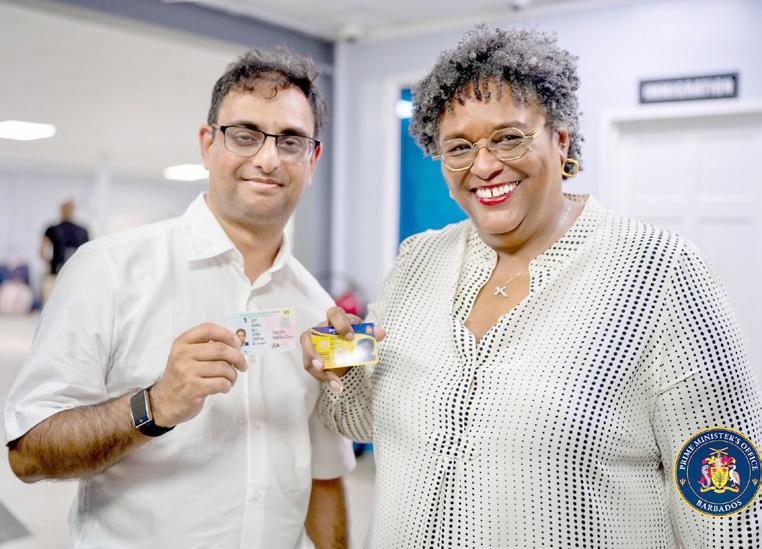
Barbadian Prime Minister Mia Mottley and Minister of Public Service, Government Efficiency and Implementation, Zulfikar Ally display their respective ID cards
integration that Caribbean people can feel in their daily lives. It will truly make Caribbean integration a lived reality.”
President of Guyana Dr Mohamed Irfaan Ali also welcomed the development, calling it a symbol of the close relationship between the two countries and their shared vision for a more connected Caribbean region.
“As Guyana and Barbados celebrate 60 years of Independence, this initiative symbolises not only the enduring friendship between our nations, but also our shared vision for a more connected, accessible, and united Caribbean community,” Ali said.
The two governments said additional details regarding eligibility requirements and implementation procedures will be released ahead of the July 1 start date.
(Credit: Barbados Today)
THE Guyana Police Force’s Traffic Department recorded 2,605 traffic-related cases between May 17 and May 23, 2026, with speeding offences once again accounting for the overwhelming majority of violations as law enforcement officials intensified road safety operations across the country.
According to figures released by the department, 1,377 speeding cases were recorded during the oneweek period, representing more than half of all offences detected. Police also noted a sharp rise in cases of driving under the influence (DUI), with 61 motorists charged for drunk driving offences.
In a brief statement accompanying the statistics, the department warned that “DUI detection increases” as some motorists continue to throw “caution to the wind,” prompting an expanded police response.
Other offences recorded during the period included 78 seatbelt violations, 91 cases involving failure to
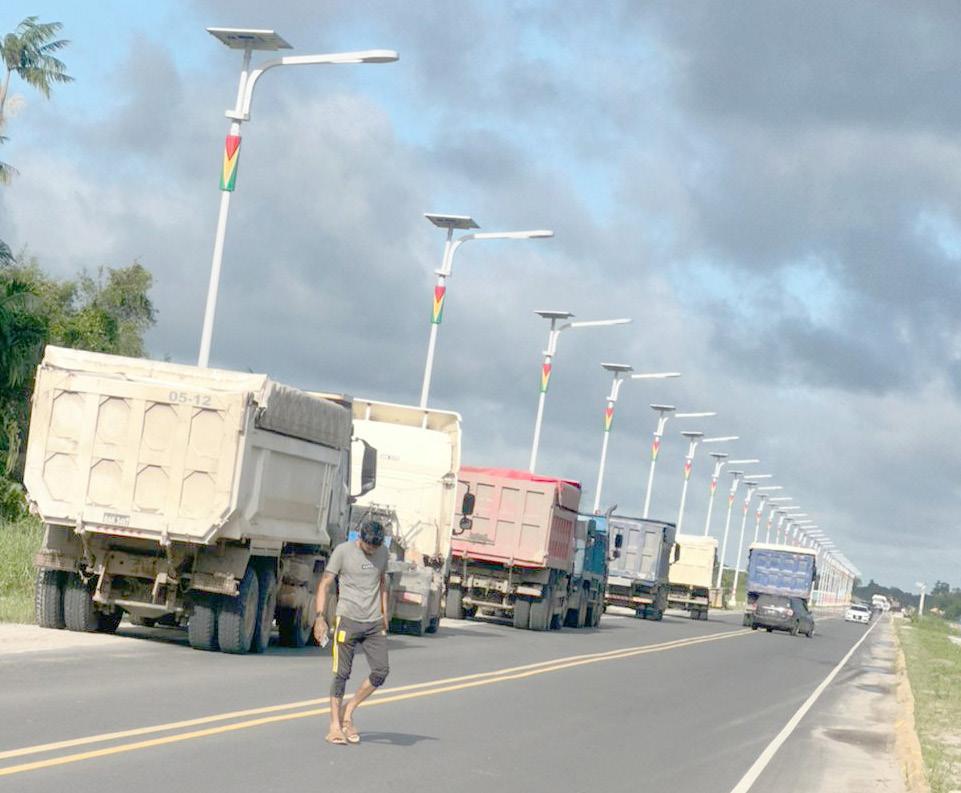
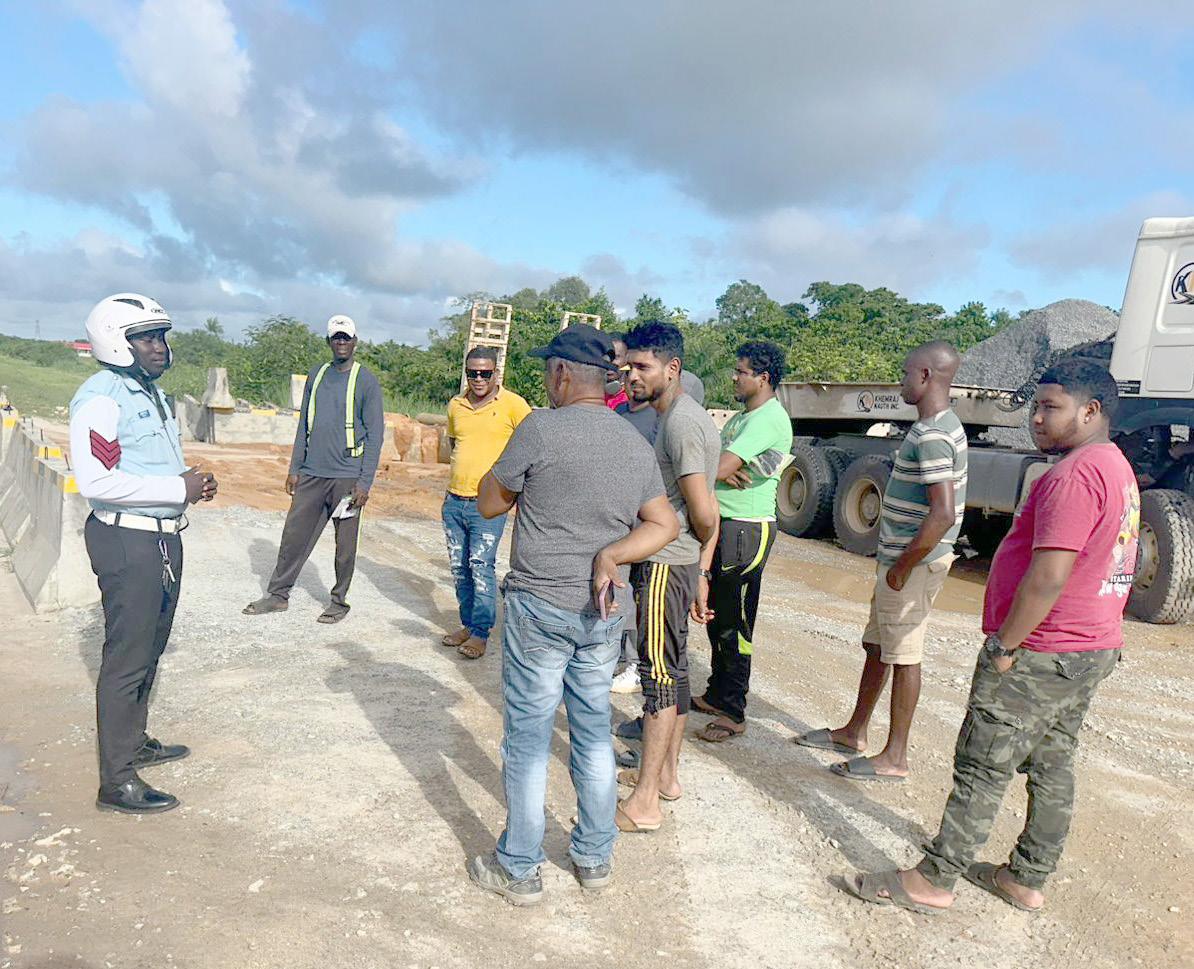
As part of its public awareness efforts, the Traffic Department also conducted a series of school lectures and community outreach activities between May 17 and May 23
wear safety helmets, and 29 cases where pillion riders were not wearing helmets.
Police also documented 30 offences involving tinted motor vehicles, 48 unlicensed drivers, and 48 breaches of prescribed fitness conditions for vehicles.
Additionally, officers recorded 76 cases of motorists leaving vehicles in dangerous positions, 42 unlighted mo-
tor vehicles with defective front lights, 36 vehicles with defective rear lights, and 22 breaches of traffic light signals.
The latest figures come amid ongoing concerns over road safety in Guyana, where authorities have repeatedly warned about reckless driving, speeding, and drunk driving contributing to serious accidents and fatalities on
the nation’s roadways.
In recent years, the Traffic Department has intensified enforcement campaigns and public education initiatives in an effort to reduce collisions and promote safer driving habits. The police have frequently stressed that speeding and impaired driving remain among the leading causes of fatal accidents nationwide.
As part of its public
awareness efforts, the Traffic Department also conducted a series of school lectures and community outreach activities between May 17 and May 23.
Road safety lectures were delivered at 29 schools across several administrative regions, including Belvedere Nursery in Region Six, Hosororo Secondary and Port Kaituma Secondary in Region
One, Cornelia Ida Primary in Region Three, High Achievers Institute of Learning in Region Seven, and Arapaima Primary and Tabatinga Nursery in Region Nine.
Police said the education campaign targeted nursery, primary, and secondary school learners in an effort to instill road safety awareness from an early age.
Additional outreach activities were conducted at locations including Diamond Tip Night Club, Eclipse Sports Bar, Parika Junction, the Vreed-en-Hoop Stelling area, Turkeyen and Alberttown Police Stations, Rosehall Car Park in Corentyne Berbice, and along the Linden Highway.
The department also utilised radio programming through NCN 102.5 FM as part of its nationwide awareness campaign.
Police said awareness exercises continued daily as authorities work toward improving road safety and encouraging greater compliance with traffic laws.
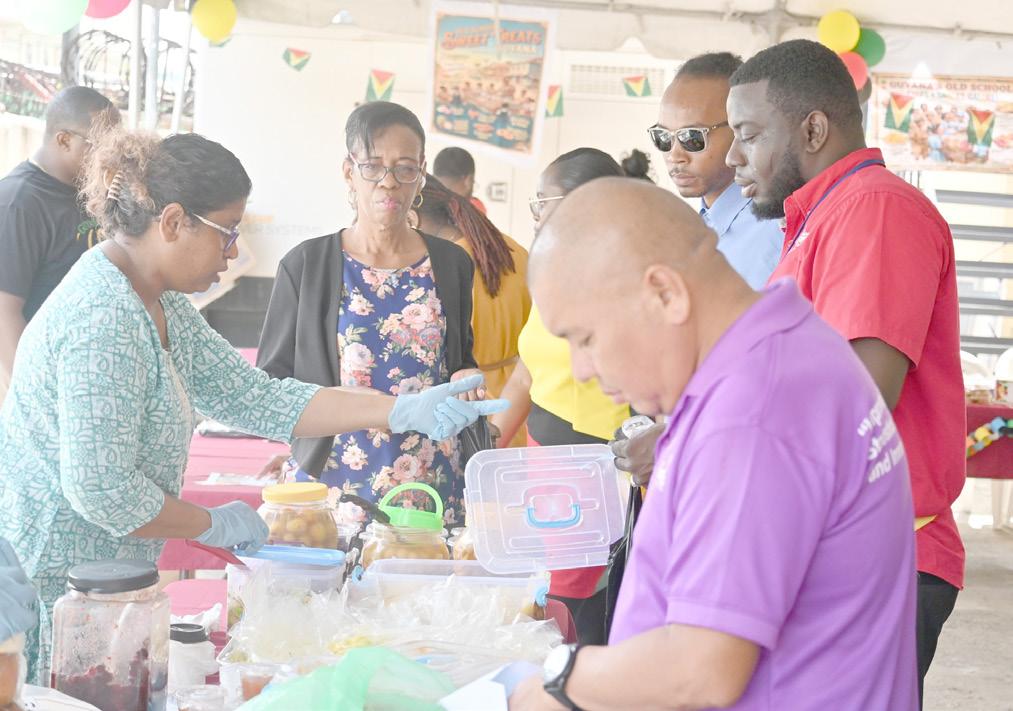
THE Bureau of Statistics, on Wednesday,transformed its Main and Hope Streets compound into a nostalgic showcase of Guyanese culture and cuisine as staff gathered for a “Taste of Old Guyana” Market Day in celebration of Guyana’s upcoming 60th Independence Anniversary and the observance of Eid ul Adha.
The cultural event recreated the atmosphere of traditional Guyanese marketplaces, allowing employees to relive childhood memories through a wide selection of classic local snacks, beverages, and sweet treats that once defined everyday life across the country.
Adding to the nostalgic experience, organisers introduced a chit system modelled
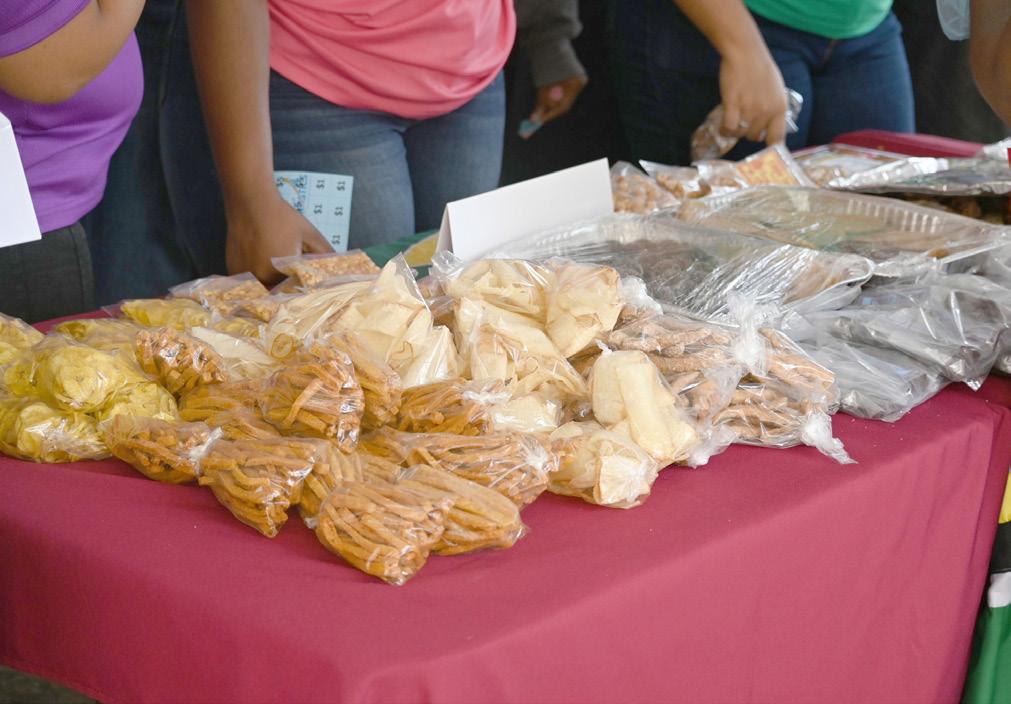
after old cash denominations of $1, $5, $10, and $20, reflecting how purchases were once made decades ago. Staff were treated to a va-
riety of traditional Guyanese delicacies, including cassava pone, bara, guava cheese, coconut biscuits, rubber band sweetie, pickles, syrups, and
“bruck teeth,” among numerous other local favourites. Snow cones and homemade lemonade proved particularly popular, with many partici -
pants reminiscing about their childhood experiences associated with the beverages.
In observance of Eid ul Adha, sweet meats such as
mithai, vermicelli, and sweet rice were also shared among staff, reflecting Guyana’s multicultural traditions and religious diversity.
According to organisers, the activity was designed not only to commemorate Guyana’s Diamond Jubilee celebrations marking 60 years of Independence since 1966, but also to honour the country’s rich cultural heritage and social evolution over the decades.
The Bureau said the initiative aimed to strengthen team spirit and foster greater cultural appreciation among employees while reinforcing the institution’s commitment to preserving and celebrating Guyana’s national identity and traditions.
A NEW wave of development is reshaping Region Ten, with the government advancing projects aimed at improving connectivity and expanding economic opportunities across the region.
Speaking at the 60th Independence Anniversary Flag Raising Ceremony in
Linden on Sunday evening, Minister of Public Works, Bishop Juan Edghill, said the transformation reflects the PPP/C administration’s long-term vision for national development.
Minister of Public Works, Bishop Juan Edghill, speaking at the 60th Independence Anniversary Flag Raising
Ceremony on Sunday evening stated:
“You had your glory days of bauxite and the major role it played in contributing to our own national development and sustainability. But you are experiencing a new wave of development. We can still hold on to bauxite as a major item, or we could
understand that the world has changed and we have to change with the world,” the minister told the gathering.
The minister outlined several major infrastructural projects which he said are positioning Region Ten at the centre of Guyana’s economic expansion and its integration with South America.
He noted that the first phase of the Linden to Mabura Hill road project, a vital link connecting Guyana and Brazil, is nearing completion and is expected to be finished by the end of August.
Minister Edghill disclosed that discussions are actively progressing for the next phase of the project from
Mabura Hill to Kurupukari. The government is also advancing plans for the construction of bridges and road networks linking Kurupukari to Annai and Annai to Lethem, to improve trade and transportation between Guyana and neigh-
WITH dozens of new health facilities being opened and more hospitals under construction, Health Minister Dr. Frank Anthony says the Ministry of Health is aggressively expanding training programmes for nurses, doctors and allied health workers to ensure the country has enough personnel to operate the growing health system.
Speaking on Starting Point, Minister Anthony said
staffing has become a major focus as government continues to roll out new hospitals, health centres and health posts across Guyana. He noted that while infrastructure expansion is visible, the human resource push behind it often goes unnoticed.
“Because of this expansion in terms of the 30 new facilities, the health centres, the health posts, and of course the six new hospitals, it requires a lot of people to
run the system,” Minister Anthony said.
To meet growing demand, the ministry has significantly expanded nurse training, moving beyond Guyana’s traditional three nursing schools in Linden, Georgetown and New Amsterdam, which were only able to train about 200 nurses annually. Through partnerships with WHO/PAHO and a WHO collaborating centre at the University of São Pau-
lo in Brazil, Guyana is being assisted in regards to training nurses online.
Additionally, nurses are being trained using a portal on the Coursera platform to rapidly increase capacity.
“Over the last three years, we have been training nurses using that portal. This year in July, we would graduate about 800 nurses and once they are successful, get their certification, all 800 would be employed by the Ministry
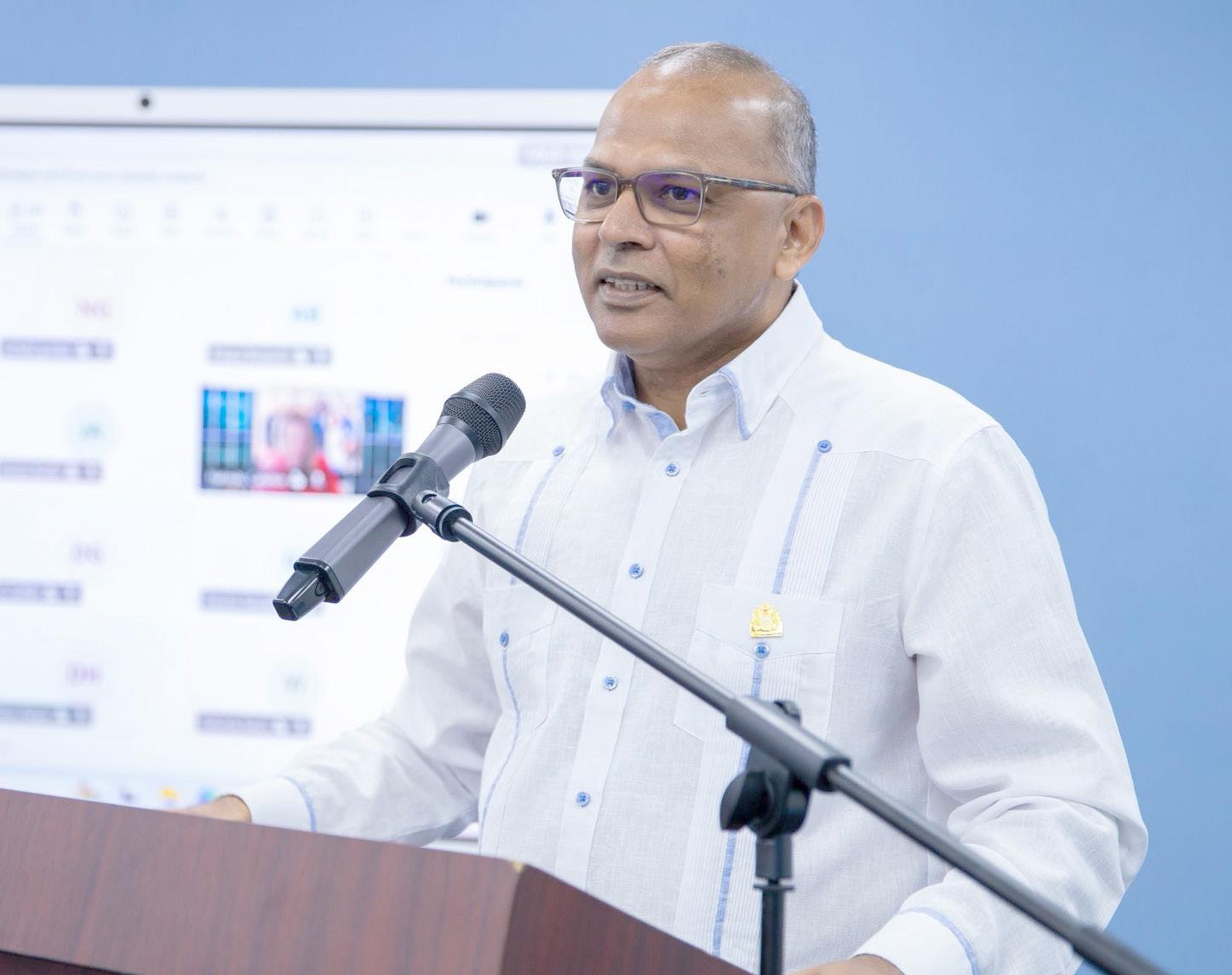
of Health,” Minister Anthony said.
To support practical learning, the ministry also established simulation centres in all 10 administrative regions, allowing nurses to complete hands-on training closer to home.
“A simulation centre would have mannequins and all these things, so as the nurses complete modules of theoretical training, we bring them into the simulation centres and we are able to teach them the practical components. That has been working very well and has helped us to improve how we train people,” the Minister explained.
Beyond nursing, the ministry is expanding training across multiple health disciplines, including registered nurses, midwives, nursing assistants, pharmacy assistants and other technical areas through approximately 20 separate programmes.
“ About a week ago, we had the CARPHA Conference and many of the Caribbean countries, they have similar problems like us, like migration of nurses and shortages and so forth, when they saw the model that we are using, they are asking us now to be part of the system because they recognised this is the way in which they can address some of their problems,” the Minister said.
Training capacity has increased by about 100 percent over the last two to three years, while the ministry has employed close to 5,000 persons in the health sector.
Doctor training is also being scaled up to meet future staffing needs. The University of Guyana’s medical intake has been expanded, while government is moving to roll out pre-medical and pre-clinical training in all 10 regions so students can begin foundational studies closer to their communities before advancing to clinical training.
The newly operational hospitals are also being equipped with classroom spaces to support on-site learning and clinical training.
“While I spoke about the nurses, we are also doing a lot of work with our doctors. The undergrad programme at the University of Guyana has been expanded from about 60 persons to 120 persons,” Anthony said.
The Ministry of Health has partnered with several overseas bodies to further boost specialised training. These include MacMasters Canada, Northwell hospital chain in New York and Apollo in India.
“Currently, we have a cardiac surgeon in Apollo so there are a lot of options we are using to skill the people in the system and when they come back, they help us upgrade the kinds of care we are giving to our patients so that is how we are expanding and changing the system qualitatively,” Minister Anthony revealed.
Meanwhile Minister Anthony noted that about two weeks ago, the Ministry of Health and the European Union signed an agreement from which Guyana will benefit from a 2.1 million euros grant with Agency France for training purposes.
“People from Europe are going to come to Guyana to train our medical professionals and our medical professionals will go to Europe Universities to improve their skills. That’s one area but we also have doctors from other countries to work, we are happy to host them and if we have a need, we will be recruiting those people as well,” the Health Minister said.
The long-term strategy is to build enough trained healthcare workers to effectively man Guyana’s rapidly expanding healthcare infrastructure and improve access to care nationwide.
EXXONMOBIL Guyana Limited (EMGL), on Saturday, hosted a capacity-building session for the top 20 national finalists in the fourth annual SHOUT4Change competition, as part of efforts to strengthen environmental awareness and leadership among Guyanese youth.
The immersive session formed a key component of the competition’s developmental programme and focused on expanding participants’ understanding of environmental sustainability, conservation practices, and the role of industry in supporting Guyana’s low-carbon development agenda.
ExxonMobil Guyana Limited partnered with Recover Guyana and the Ministry of Education to support the national environmental speech competition, known as SHOUT4Change.
During the session, ExxonMobil Guyana’s representatives provided the finalists with an operational update on the company’s activities, including presentations on environmental management systems and sustainability initiatives linked to the country’s rapidly expanding energy sector.
Participants also received a presentation from the Iwokrama International Centre for Rainforest Conservation and Development on the Guyana Conservation Initiative (GCI), which aligns with Guyana’s Low Carbon Development Strategy 2030.
The initiative, funded through a multi-year grant from the ExxonMobil Foundation and implemented by Iwokrama alongside Environmental Management Consultants Inc. (EMC), supports public awareness campaigns on marine conservation, ecosystem restoration, livelihood development, and community-based environmental projects in coastal and hinterland communities.
As part of the experiential learning component, finalists later toured the Mangrove Information
Centre under the guidance of EMC and the National Agricultural Research and Extension Institute. The exercise exposed students to the role mangroves play in coastal protection, biodiversity preservation, and climate resilience.
The SHOUT4Change competition is designed to encourage environmental advocacy and public speaking among young people while promoting greater awareness of sustainability challenges and solutions in Guyana.
The competition unfolds in four stages. During the second phase, the top 20 finalists are required to deliver 90-second prepared speeches focused on STEM-based environmental solutions. The third round will narrow the field to 10 contestants competing in an impromptu segment aimed at testing critical thinking and subject knowledge, while the final round will see the top four participants responding to a comprehensive environmental question to determine the 2026 national youth environmental speaker.
Organisers said the winning school will receive a $1 million grant to support an environmental advancement project, along with one year of free fibre internet service from One Communications. Individual prizes for the top four students include laptops, internet service, and education vouchers valued at up to $100,000.
In recognition of mentorship efforts, the teacher of the winning student will also receive a trip to Kaieteur Falls.
Recover Guyana said the SHOUT initiative forms part of its broader environmental education programme, which also includes ENGAGE, a nationwide green entrepreneurship initiative supported by Scotiabank Guyana, and Project FLOW, a sustainability programme targeting more than 100 secondary, technical, and special needs schools across the country.
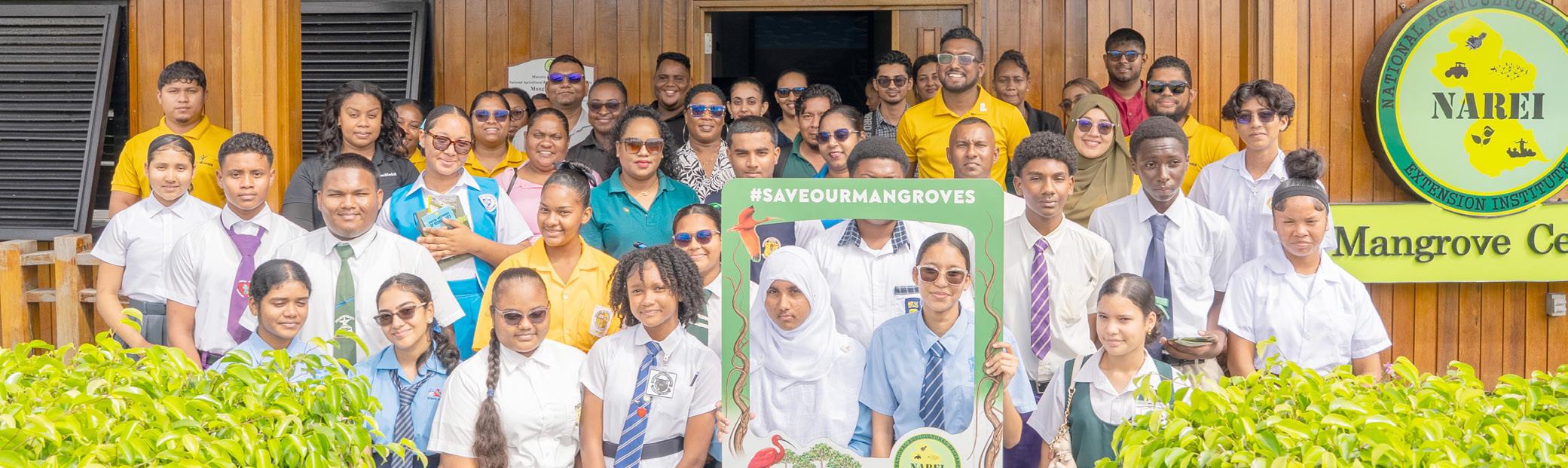
SCORES of Guyanese in the Peel Region of Ontario, Canada, braved continuous heavy rains last Saturday to participate in a spectacular 60th Guyana Independence Anniversary Flag Raising Ceremony, Cultural Show and Fashion Extravaganza, held at the Brampton City Hall, under the auspices of Mayor Patrick Brown, in collaboration with the Consulate General
of the Cooperative Republic of Guyana in Toronto.
The highly anticipated event, although held mostly indoors, was the second such huge collaboration with the Town of Brampton which is home to some 14,000 Guyanese, many of whom are reinvigorated by the modern and transformative Guyana that the present Government is working to build.
The ceremony opened
with prayers by religious leaders of the Christian, Hindu and Muslim faiths, following the hoisting of the Golden Arrowhead, Guyana’s national flag, outside, by City staff alone, because of the rain.
Guyana’s Honorary Consul, Mani Singh, brought greetings on behalf of His Excellency, President Dr Mohamed Irfaan Ali, and the Government and people
of Guyana.
The Guyanese representative recalled the long and gruelling fight for Guyana’s Independence by the country’s forefathers, but particularly noted the late President Dr Cheddi Jagan’s influence and inspiration across the English-speaking Caribbean, resulting in many regional nations attaining their independence, breaking free of the shackles of British


colonial rule.
Honorary Consul Singh lauded Mayor Brown for hosting the event, which drew about 400 Guyanese and friends of Guyana, City Councillors, and the business and religious communities, in the Rotunda of City Hall.
Honorary Consul Singh noted that the lowering of the Colonial British Union Jack and the hoisting of the seal of Guyana’s independence, the Golden Arrowhead, ushered in a new era where the Nation became solely in charge of determining its own political and economic future.
He reflected on the painful history of the African slave trade and forced labour, which built European empires, followed by the inhumane slave-like conditions of Indian Indentured Servants, as the former slave masters chose to call them for legal reasons.
Mayor Brown, in his remarks, noted the great contribution of the 14,000 Guyanese living in Brampton, adding that many of them hold very senior positions at the Town of Brampton.
The Mayor recalled the “difficult period” in 2020 after the General and Regional Elections in Guyana when the current People’s Pro -
gressive Party/Civic (PPP/C) was kept from assuming office for several months, even though it had clearly won the elections.
According to Mayor Brown, the Guyanese residents of Brampton lobbied City leaders which led to the City Council passing a resolution supporting the PPP/C as the winner of the elections and demanding that democracy should prevail.
Several groups of dancers of all ages wowed the crowd with tantalizing performances to various Caribbean genres and mixes, including soca, chutney, reggae and other music forms.
During the fashion display, models strutted in beautifully designed wear, including ethnic wear, depicting the creativity of Guyanese diaspora designers.
Guests in attendance were treated to a range of nostalgic Guyanese snacks such as patties, pholourie, bara and pine tarts, supplied by diaspora entrepreneurs in the community.
Saturday’s activities were among many organised across Canada by various Guyanese groups to mark the country’s Diamond Jubilee Independence Anniversary.
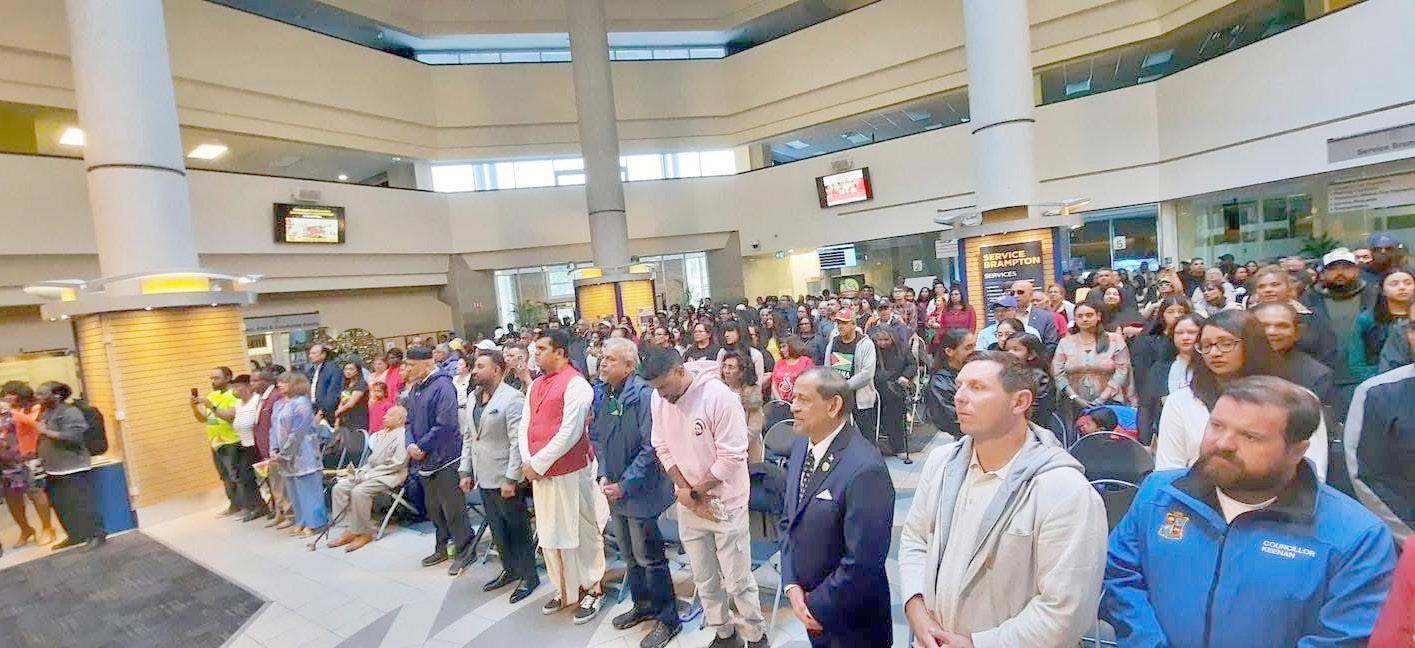
HUNDREDS of allottees in the De Endragt Phase Two Housing Development on the East Coast of Demerara are expected to gain access to and identify their houselots within days as infrastructural works near completion in several sections of the scheme, according to Housing Minister Collin Croal.
Minister Croal, accompanied by engineers, engineering technicians, clerks of works, and contractors, conducted a site inspection on Monday to assess progress and engage contractors responsible for delayed works within the development.
During the visit, the minister announced that persons assigned temporary
with surveying activities in that section of the housing scheme.
However, the minister acknowledged continued delays affecting allottees assigned temporary lot numbers 164 to 408, stating that the contractor responsible has already been formally warned over the slow pace of works.
“We’ve expressed our total displeasure on the rate at which the work is ongoing. In fact, we do not see the evidence of the level of work that is required to be able to bring on par or even to catch up,” Croal said during the inspection.
He revealed that the Central Housing and Planning Authority has already begun imposing liquidated
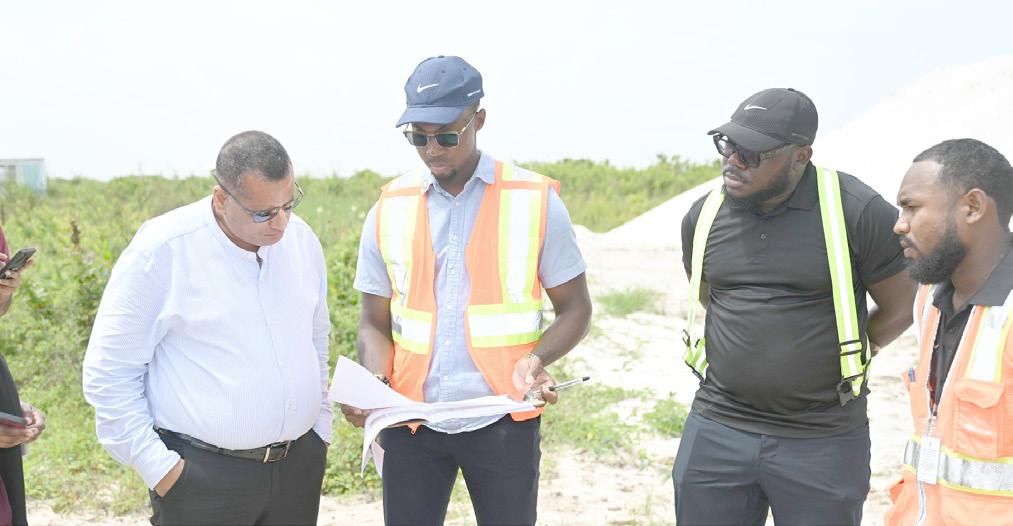
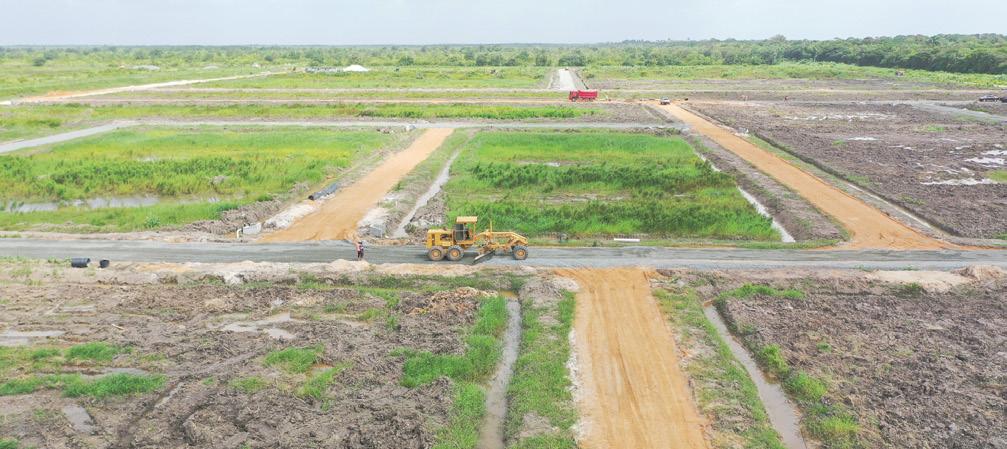
Housing Minister Collin Croal accompanied by engineers, engineering technicians, clerks of works, and contractors, conducted a site inspection on Monday to assess progress and engage contractors responsible for delayed works within the development
lot numbers 409 to 604 will be able to access and identify their lands during the coming week, as surveyors are currently installing paals to demarcate the house lots.
He further disclosed that infrastructural works for allottees with temporary lot numbers 605 to 733 are expected to be completed by the end of May, allowing those beneficiaries to identify their lands by the second week of June.
Croal noted that one contractor previously behind schedule had significantly improved progress over the past week, enabling the ministry to proceed
damages on two contractors who failed to meet contractual deadlines and is considering additional measures to ensure the timely completion of outstanding infrastructural works.
Despite the setbacks, the minister said the government remains committed to completing all Phase Two infrastructural works by the end of June.
Croal also appealed to affected allottees for patience, noting that the ministry remains aware of public concerns and is actively monitoring contractors to accelerate delivery of the development.
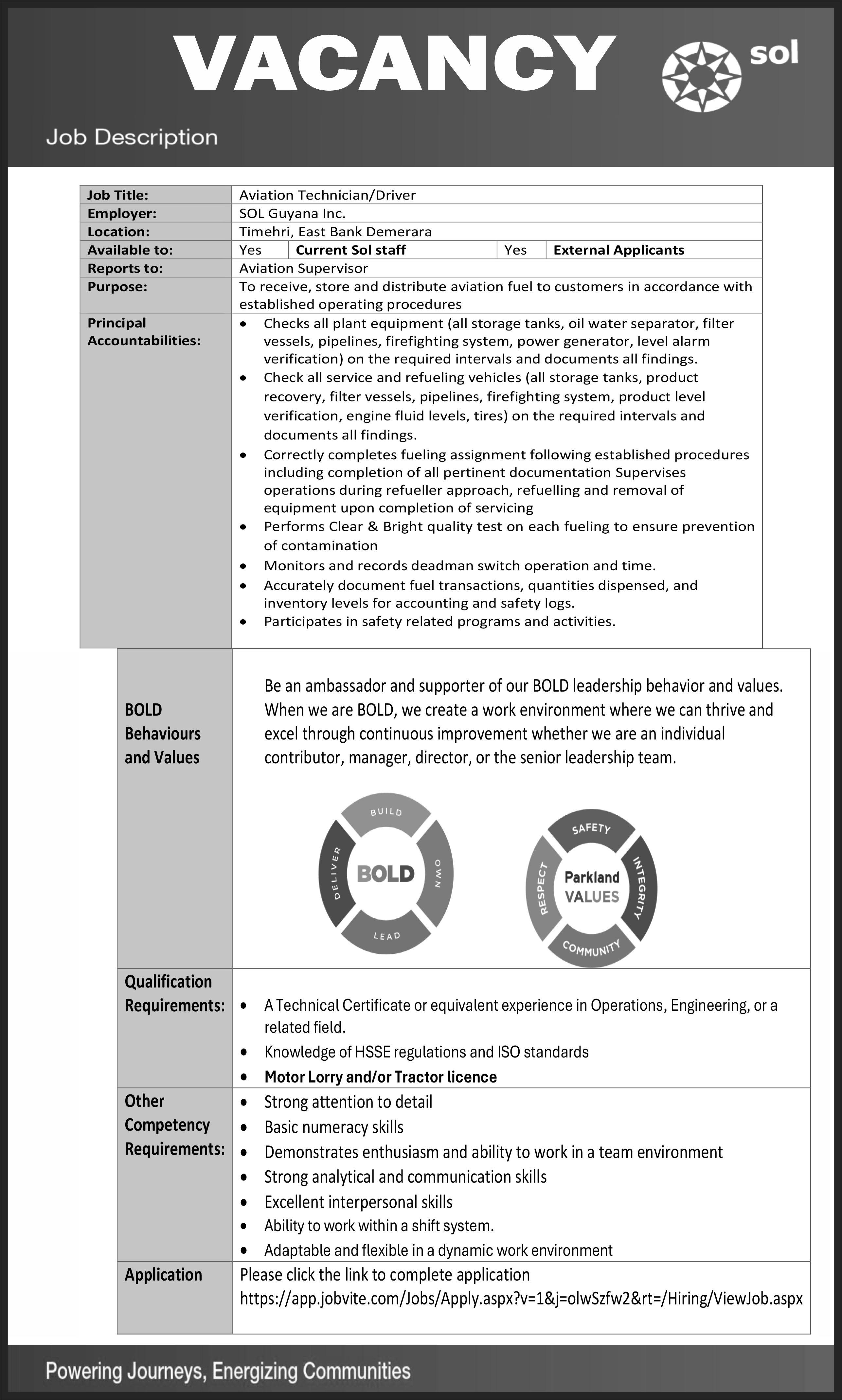
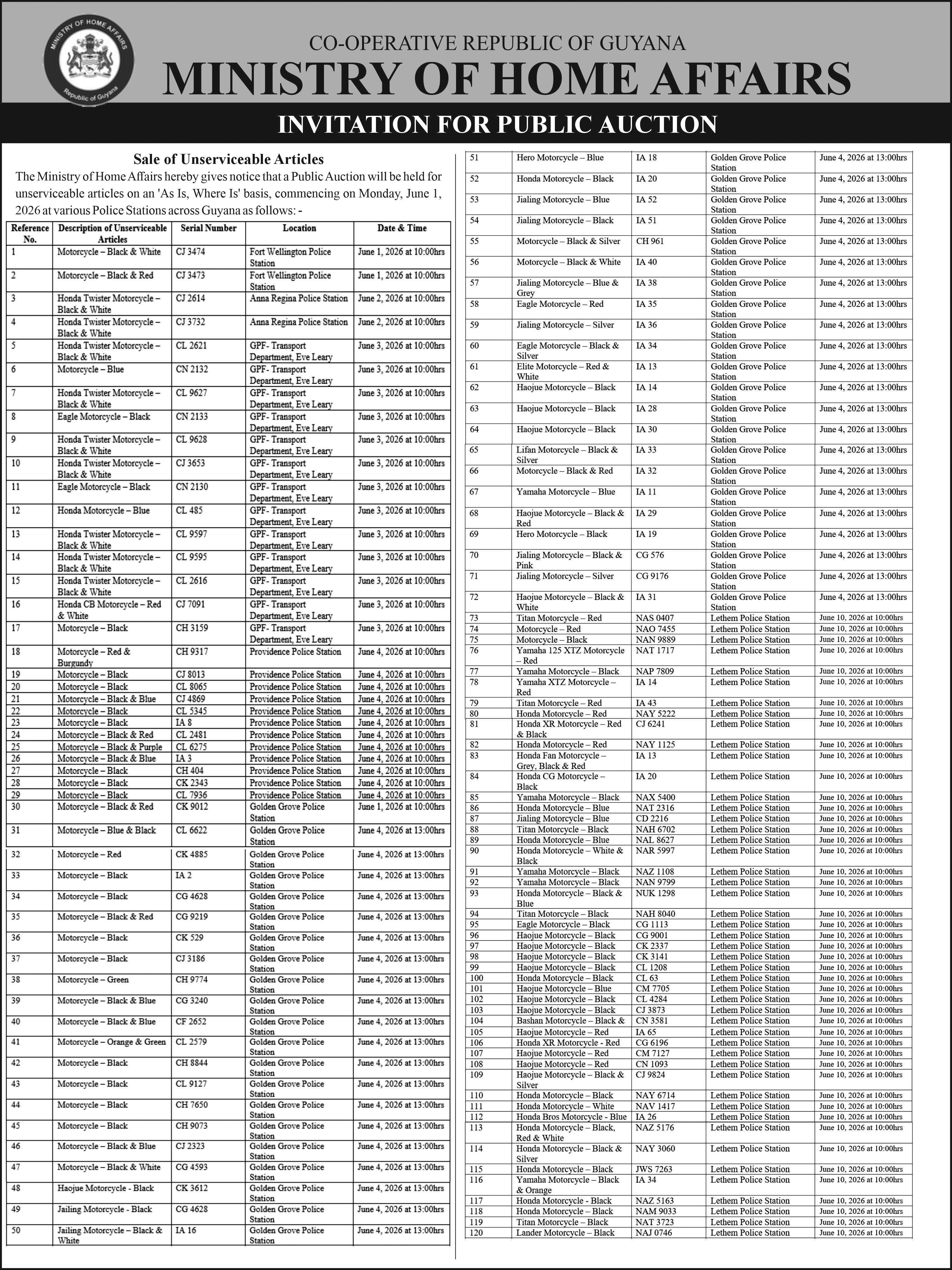




MINISTER of Health, Dr Frank Anthony, says over the last 10 years there has been a significant decline in maternal deaths and that is because of the new interventions that were put into place.
“There are a couple of reasons why a woman might die during childbirth; one would be postpartum hemorrhage, meaning bleeding after delivery and if that’s not properly managed you can have persons dying. We recognise that this is an issue and we have trained healthcare workers across the public health system to respond appropriately to this,” Minister Anthony said.
In the last three to four years Guyana has not had any case of postpartum hemorrhage. The Health Minister attributed this largely to the kinds of training that is being given to healthcare workers, thereby eliminating one of the major causes of maternal deaths. He however, said training remains continuous so as to ensure that healthcare professionals abide by all necessary protocols.
In remote and hinterland regions the Ministry of Health has implemented another initiative to help mothers deliver their babies safely.
“Another intervention we have put into place, is to create waiting homes. A waiting home is a building that is being put in the compound of a hospital and the people who live far away, they can come to the hospital, stay in the waiting home and when they go into labour, they move from the home into the delivery ward and so they can have a safe delivery,” Minister Anthony said.
This measure was taken by the Health Ministry as a means to avoid and eliminate complications as prior to the construction of the waiting homes, many mothers delivered their babies on route to the hospital which is highly unsafe.
So far six waiting homes have been constructed across the country but the Health Ministry’s aim is to establish waiting homes in every interior hospital because it will make a big difference in ensuring safe deliveries as evident in Region One, recording no maternal deaths last year.
According to Minister Anthony, in the event that death does occur, the entire chart for that patient is seized within 24 hours and handed over to the Chief Medical Officer (CMO). “We do that because we don’t want anybody to go and interfere, add anything or write anything or do anything to that chart because it is a record and we don’t want anybody to alter that record. When that file goes to the CMO, he sets up an internal team in that institution, that would review the case and then you have an external team that would also go in and do a review. If there is any negligence on anybody’s behalf, that person is taken in front of the Medical Council and the Medical Council will decide what action to take,” the Health Minister said. He reiterated that the same rule applies to nurses in a case where death is caused by negligence of a nurse. The nurse would be taken to the nursing council and the council would decide the next course of action. In extreme instances, if the licence of that person gets pulled, then that person is prevented from practising in Guyana and this applies for both nurses and doctors.
Minister Anthony revealed that the system is being designed to ensure that there is fairness across the board. “We also have a Maternal Mortality Committee, so whenever a death occurs, this committee would also investigate the matter apart from the investigation we do internal to the ministry, at the institutional level, at the ministry level, there is an external committee and very often that committee is headed by somebody who is not from the public sector because we do not want people to feel that we are biased and we cover up things. That committee could come in with an impartial view and be able to make that assessment,” Minister Anthony said.
Apart from this committee, cases that are termed ‘Near Misses’, which means that the person didn’t die because of the actions that were taken, Minister Anthony said that these cases are reviewed and used as teaching moments for doctors and nurses so that they never be repeated.
“There is a very elaborate process that we have. We want to prevent these things from happening and that is why this is important,” the Minister noted.
By Indrawattie Natram
THE Anna Regina Car Park was transformed into a sea of national pride on Monday morning as residents gathered to commemorate Guyana’s 60th Independence Anniversary with a ceremonial Flag Raising exercise.
The programme blended patriotism with culture, featuring calypso performances, patriotic songs, dances, and spoken word presentations reflecting on Guyana’s history, struggles, and achievements since attaining Independence in 1966.
Delivering the feature address, Madanlall Ramraj said he was highly impressed with the performances and noted that Guyana is advancing rapidly under the dynamic leadership of President Irfaan Ali.
Minister Ramraj said the Government remains focused on ensuring that the country’s resources are wisely allocated for the benefit of all Guyanese. He noted that the world is now witnessing a nation destined for greatness and transformation.
He said Guyana today stands resilient and progressive, adding that the decisions being made during this period of national transformation will shape the lives of future generations.
According to the Minister, under the leadership of President Ali and Vice President Bharrat Jagdeo, Guyana is experiencing unprecedented growth that cannot be ignored.
He explained that the transformation is not confined to Georgetown alone, as the Government has been bringing services and development directly to the people across the country.
He pointed to recent visits by the Vice President to Region Two, where issues affecting residents were addressed directly.
Minister Ramraj said the Government remains people-centred and continues to place citizens first. He highlighted that thousands of Guyanese, particularly
citizens and that Guyana is becoming a beacon of opportunity, with new businesses opening and expanding across the country. He added that Guyana is also positioning itself to feed the Caribbean through its expanding agricultural programmes.
Also addressing the gathering was Regional Chairman
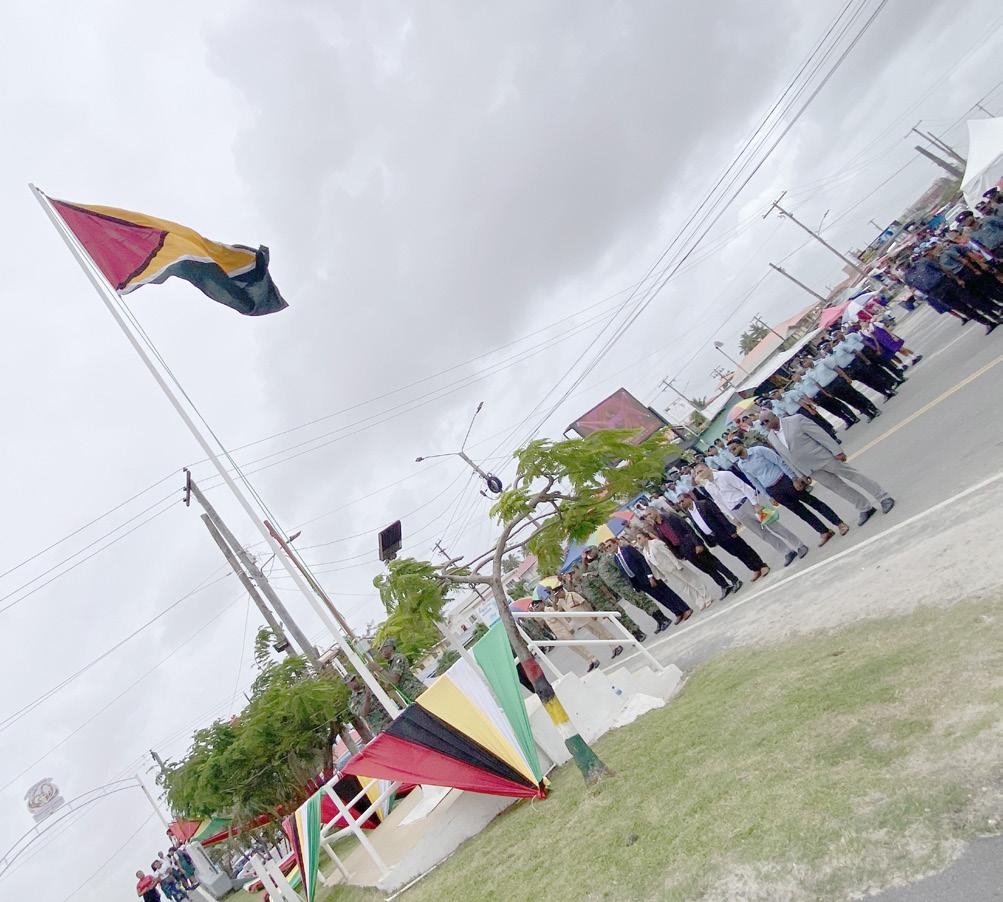
in hinterland and Indigenous communities, are now benefitting from improved connectivity and modernised public services.
He also noted that the Government continues to provide free scholarships to qualified persons, ensuring that young people from Regions One, Seven, and Ten can access the same opportunities as those on the coastland.
“Today a young person from Region One, Seven or Ten can experience the same opportunities because of accessibility,” Minister Ramraj said.
The Minister further stated that home ownership is becoming a reality for many
Devin Mohan, who said it was both a privilege and honour to celebrate the 60th Anniversary of the Independence of the Cooperative Republic of Guyana.
He described the milestone as a reminder of the courage, sacrifices, and determination of those who fought tirelessly to secure the nation’s freedom and sovereignty.
“As our Golden Arrowhead rises proudly above us, let it remind us that patriotism is not only about celebrating our nation on Independence Day, but about serving our communities, uplifting one another, and working together to build a stronger and more united
Guyana for generations to come,” Mohan said.
He urged citizens to continue embracing unity, togetherness, and national pride, noting that Guyana stands as a shining example of strength through diversity.
“Our many cultures, religions, traditions, and backgrounds are woven together into one beautiful national identity. When we stand together as one people and one nation, there is no challenge too great and no dream beyond our reach,” he stated.
Mohan also praised the leadership of President Ali and the PPP/C Government, stating that Guyana is experiencing unprecedented progress and transformation. He noted that in Region Two, development is no longer a promise but a reality, citing major road upgrades, improved drainage and irrigation systems, expanded healthcare services, modern schools, housing developments, sports facilities, and increased opportunities for farmers, fisherfolk, entrepreneurs, and young people.
Regional Vice Chairman Humace Oodit delivered the welcoming remarks and called for continued unity and togetherness in advancing Region Two.
The ceremony culminated with the hoisting of the Golden Arrowhead. Minister Ramraj took the salute from members of the Joint Services before a parade brought the observances to a dignified and patriotic close.
Among those present were Prime Minister’s Representative Arnold Adams, Regional Executive Officer Deolall Rooplall, Deputy Regional Executive Officer Omesh Sasenaryan, and Regional Commander Khemraj.
bouring South American countries.
Minister Edghill said the broader vision includes utilising Guyana’s planned deep-water harbour at Palmyra in Berbice to move goods and services more efficiently and at lower costs across the region.
Another major development project highlighted was the new Wismar–Mackenzie bridge in Linden. He said the
bridge is more than 95 per cent complete and is expected to be opened by the end of June.
“We are getting ready in just a matter of weeks, by the end of June, to open for every Lindener and every Guyanese who passes through Linden, a bridge that we could be able to get across the Demerara River,” he said.
Moreover, the minister
pointed to other major infrastructural works aimed at strengthening Guyana’s regional integration agenda as the country marks 60 years of Independence.
He announced that the process for appointing supervisory consultants under the International Federation of Consulting Engineers (FIDIC) framework for the proposed bridge across the Berbice River has been com-
From page 15
pleted.
Guyana also remains engaged with neighbouring Suriname on plans for the bridge across the Corentyne River, despite recent changes in Suriname’s administration.
These projects form part of a wider national strategy to position Guyana as a major transportation and trade hub within South America. (DPI)


JALEN Brunson and the New York Knicks made sure to end this one quickly.
Now, they’re headed to the franchise’s first NBA Finals in decades with some extra days off.
Brunson and the Knicks cruised to a blowout 13093 win over the Cleveland Cavaliers in Game 4 of the Eastern Conference finals on Monday night at Rocket Arena. That completed the 4-0 series sweep and sent them into the NBA Finals for the first time since 1999. Brunson was named the Eastern Conference finals MVP via a unanimous vote, too.
Now, the Knicks will await the winner of the Western Conference finals.
The San Antonio Spurs and Oklahoma City Thunder are tied up 2-2 entering Tuesday night’s Game 5. The NBA Finals will start on June 3, which gives the Knicks more than a week to prepare.
The Knicks took a 12-point lead after the first quarter, and looked extremely comfortable while doing so. They shot 56% from the field in the first 12 minutes with six 3-pointers, and easily beat the Cavaliers in transition repeatedly for easy buckets at the rim, too.
By halftime, the game was just about over. The Knicks

used a long 20-0 burst into the second quarter to break the game wide open, and opened the second period on a 23-6 run to snag a 25-point lead. Brunson had 10 points at halftime, and even received “MVP!” chants from Knicks fans that packed into Rocket Arena before they carried a 19-point advantage into the locker room.
The Cavaliers comeback hopes just never came together. The Knicks pushed their lead to 30 briefly in the third quarter and cruised the rest of the way to pick up the 37-point win.
bowling attack that struggled for answers. Late cameos from Matthew Cooper and Christopher Mitchelle ensured the San Fernando-based outfit crossed the psychological 200-run threshold.
Faced with a daunting asking rate, Endeavour’s reply began with brief optimism. Opener Kyle Balraj struck a brisk 30-ball 46, punctuated by six boundaries and two sixes, while Mikeal Sinanan and Rahul Basu chipped in with 23 apiece. However, Club Sando’s bowling unit tightened the screws immediately after the powerplay.
Adrian Cooper was the chief destroyer, returning excellent figures of 4 for
29, while Jase Asson (3 for 15) and Calvin Loubon (2 for 25) sliced through the middle and lower order. Endeavour’s chase lost all momentum past the halfway mark, culminating in a rapid collapse to 143 all out in 17.5 overs.
For Club Sando, the silverware offered sweet redemption after narrowly missing out on promotion to Premier Division One by just two points in the twoday league format. It also completed a remarkable family treble for the Cooper brothers—Silus, Adrian, and Matthew—who joined their siblings Cephas and Akeil in celebrating local domestic titles this season. Despite the heavy de -
ARGENTINA star Lionel Messi suffered an injury scare before the World Cup, requesting to be substituted during Inter Miami's Major League Soccer game on Sunday.
Donovan Mitchell led Cleveland with 31 points in the loss, which ended the Cavaliers’ deepest postseason run since the LeBron James era. Evan Mobley added 15 points and seven rebounds, and James Harden had 12 points after going 0-of-6 from behind the arc.
Brunson had 15 points and five assists, and didn’t play a second in the fourth quarter. Karl-Anthony Towns had 19 points and 14 rebounds to lead the Knicks, and OG Anunoby finished with 17 points. (Yahoo Sports)
(From page 27)
feat, Endeavour captain Andy Gobin found solace in his team’s historic run, marking the club’s first final appearance at this level in over two decades. Club president Narine Cassie echoed those sentiments, reflecting on a highly consistent season that included a fourth-place league finish and a semi-final appearance in the 50-over tournament.
Club Sando had previously signalled their intent with a ruthless 68run semi-final dismantling of Woodland SC, driven by a blistering 86 from Silus Cooper and a 50 from Sampson, while Endeavour had earned their final berth with a 29-run win over Caldrac.
Miami coach Guillermo Hoyos later suggested the 38-year-old forward's replacement against the Philadelphia Union was precautionary because of pitch conditions in a wet Miami.
The 2022 World Cup winner came off in the 73rd minute of the game after clutching the back of his left
leg, but appeared to be walking normally as he headed straight down the tunnel.
"As far as I know, we don't have a [medical] report on that yet, but he really was fatigued," Hoyos said after the game when asked about Messi's condition.
"He was tired; the pitch was heavy and when in doubt, the standard approach is always to ensure you don't take any risks."
Messi has not formally confirmed he plans to play for the defending champions in the World Cup, which be-
gins on 11 June, but is widely expected to return for what will be a record-equalling sixth appearance at the finals which are being co-hosted by the United States, Canada and Mexico.
Argentina's squad is due to be named next week, with their opening game against Algeria on 16 June. Since moving to Miami in 2023, the eight-time Ballon d'Or winner has carefully managed his workload but has still spent spells on the sideline with hamstring issues.
deny them the possibility of staying in Mexico," Sheinbaum said.
"The United States does not want the Iranian team to stay overnight, but they are going to play three matches there.
"So they asked us: 'Can they stay overnight in Mexico?' And we said: 'Yes, no problem. We have no problem."
Iran were originally given Tucson, Arizona as their World Cup base with all three of their matches scheduled to take place in the US.
However, the ongoing war in the Middle East and related security concerns has led to uncertainty around their participation.
The World Cup is being co-hosted by the US, Canada and Mexico, with Iran scheduled to play New Zealand on 15 June and Belgium on 21 June - both in Los Angeles - and Egypt in Seattle on 26 June.
Iran are currently preparing for the tournment in Antalya, southern Turkey.
The BBC has contacted the White House and Fifa for comment.
Iran's sports minister Ah-
mad Donyamali, also confirmed that world football's governing body has stressed that the Iran squad will be given visas to play in the US this summer
"The Fifa president promised us that all our players would receive visas. There is no reason why our players should not receive visas," he said.
The Iranian FA (FFIRI) had presented Fifa with a list of 10 conditions for their participation at the World Cup, including allowing players, coaches and officials who have completed military service with the Islamic Revolutionary Guard Corps (IRGC) to receive visas.
(From page 25)
US Secretary of State Marco Rubio has said that Iran players will be welcome at the tournament but individuals with links to the IRGC could face entry restrictions.
Taj was one of a number of FFIRI officials turned away at the Canadian border ahead of April's Fifa annual congress in Vancouver with Canada's immigration minister telling parliament that his visa was cancelled because of links to the IRGC.
Some members of the squad went to the US embassy in Ankara on Thursday to submit visa applications for the tournament.


LAS VEGAS, United States, (CMC) – Barbadian female sprinter Tristan Evelyn walked away with US$250, 000 after winning the women’s 100m at the controversial Enhanced Games on Sunday.
Running as a non-enhanced athlete, the 28-yearold Olympian crossed the finish line in 11.25 seconds to comfortably win gold in the six-woman field.
Shania Collins of the USA was second in 11.43 seconds to win US$125,
000, with her compatriot Taylor Anderson claiming US$75, 000 after finishing third in 11.48 second.
The race also featured three other athletes from the Caribbean, with Denae McFarlane of Jamaica placing fourth in 11.61 seconds to take home US$50, 000, while Guyana’s Jasmine Abrams (11.72) and Jamaica’s Shockoria Wallace (13.30) finished fifth and sixth and earned US$30, 000 and US$20, 000 respectively.
An emotional Evelyn said she was elated to have won the event and the massive payday.
“I can’t even put it into words, I’m just so grateful,” she said fighting back tears.
“This is everything. This is my childhood dream coming through. I believed in my ability… For a lot of years I’ve doubted myself but this time I wanted to be confident in who I am and in the work that I put in and I did that tonight.”
MUMBAI, India, (CMC)
– Batting coach for the Mumbai Indians, Kieron Pollard has admitted that the team’s performance in the 2026 Indian Premier League (IPL) fell well short of expectations.
Mumbai Indians placed ninth in the 10-team tournament, mustering just eight points from their 14 matches with only four wins.
Speaking after their 30run defeat to the Rajasthan Royals in their final match on Sunday, Pollard conceded that the team failed to deliver.
“If this had happened, if we had done this, if we had done that, if we had played this one, if we had batted, it’s a bit of that,” Pollard said at the press conference after the game.
“Overall, it has been disappointing for all of us as Mumbai Indians. I’m sure the fans and everyone would have felt the same and there’s no hiding from that. We weren’t good the entire tournament. We weren’t able to sort of string together wins and use the momentum

when we got it.”
The former West Indies all-rounder said the team would perform a postmortem at a later date to determine what went wrong.
“Right now, is not the time and place to talk about that [postmortem]. All these things will be sort of emotional decisions and thinking of every aspect of what’s needed.
“Everyone needs that time and space to go, sit down, recollect, have a fair idea and assessment as to where it went wrong for us. That’s where better decision-making is going to
come about. If you sit here right now and say you need to do this, you need to do that, I think that will be irresponsible from a management perspective,” Pollard said.
“Guys are going to sit back and actually think about what’s needed. It has been a while since we won the championship and that’s something that we have accepted as a team. And I said, another disappointing campaign adding to what would have transpired before. So deep thinking is going to go into it.”

KENISHA Phillips was the star over the weekend, winning the 200 and 400 on Saturday in the Guyana Overseas-Based Sports Association Annual Independence Meet.
Other top winners were Jevon Roberts, Shamar Horatio and Attoya Harvey at the event held at the National Track and Field Centre at Leonora.
Phillips stormed to an easy win in the women’s 200-metre dash in 24.10 seconds in front of Tonya Rawlins and Savannah Adams.
Phillips then dominated the field in the women’s 400 metres with a time of 56.72 Seconds. Krystal Morris and Delicia Wilkie took second and third place respectively.
Rawlins got her revenge in the 100 metres to win in 11.55 seconds, Savannah Adams second and Tiffa-
ny Springer third.
While the men’s 200 metres saw Shamar Horatio pipping to the finish line in 20.26 seconds, Easton was in second place and Revon Williams in third position.
Horatio was not good enough to win the 100-metre finals, as Onesi Dunn ran 10.13 with Horatio finishing in 2nd place in 10.15 seconds and Akeem Steward third.
While middle-distance Supremo Ebo McNeil comfortably won the boys’ 1500 metres in 4 minutes 30.16 seconds, with Brave Jadel Liverpool running second and Bryson McBean third. McNeill then won the 800 metres in 1 minute 58.76 seconds, with Liverpool and McBean finishing second and third. The middle distance category saw the Guyana De-
finalise their ultimate 15-man talent pools closer to their respective zonal start dates.
Registration forms are currently available through the tournament’s official social media channels or via direct WhatsApp contact at +592 635-2235.
The action-packed tournament is set to bowl off with the Berbice Zone on August 8–9, featuring 16 teams battling across four premier venues: the Port Mourant Community Centre Ground, No. 69 Ground, Welfare Ground (Canje), and the Albion Sports Complex, which is slated to host the zonal finals on Sunday, August 9.
Following the opening leg in Berbice, the tournament moves to East Bank/ West Demerara on August 15-16, followed by the Essequibo leg on August 22-23.
In a strategic move to maximise fan engagement and support local cricket

fence Force’s Attoya Harvey running a blistering 2:28.09 seconds to win the
(From page 27)
festivities, the competition will pause during the Caribbean Premier League (CPL) window.
Action will resume postCPL with the highly competitive Georgetown/East Coast Demerara leg, spanning September 26-27 and October 3-4. This all leads toward the historic national grand finale on October 11, 2026, which will be hosted for the first time at the Anna Regina National Stadium in Region Two.
Financial incentives for the 2026 season have reached an all-time high, introducing guaranteed cash prizes for every single team that reaches the quarter-final stage of their respective zone.
Rewards begin at $25,000 for losing zonal quarter-finalists and scale up significantly, culminating in a $500,000 purse pocketed by the zonal winners before they advance to the National
Finals.
The stakes at the national level are even higher, as teams will compete for a massive $2,000,000 grand prize, while the runner-up takes home $1,000,000.
In addition to the substantial cash prizes, the four national finalists will earn the prestigious right to represent Guyana at the upcoming Global T10 Tapeball Blast this October.
Individual brilliance will also be handsomely rewarded throughout the tournament.
The eventual tournament MVP is set to walk away with $150,000 and a brandnew motorbike.
Specialised awards for the leading run-scorer and top wicket-taker include $100,000 and a new television each, ensuring that personal milestones are celebrated alongside team success.

Malika Marquez. She followed up later to win the women’s 1500 metres with Jelisa Wright with a time of 5 minutes 05.09 seconds.
The boy’s 800 metres was won by Joshua Lam, who won it in 1 minute 56.95 seconds ahead of Jevon Roberts and Samuel Booker, who completed the top 3. Roberts claimed the men’s 1500 metres win ahead of Odida Parkinson and Kosi Thomas.
for schools was won by Christianburg Wismar Secondary
School ahead of Mackenzie High and Tutorial High. Christianburg also won the mixed 4x100 race.
The 4x400 for clubs was won by the Guyana Defence Force, with Running Brave Athletics second and Team Nice third.
women’s 800 metres finals, beating out Jelisa Wright and
The country’s recent CARFITA medalist Olivia Solomon was the clear winner in the girls’ 15-17 800 metres, winning in 2 minutes 14.56 seconds, outlasting Adanya Glen and Ayesha Austin. The men’s 400 dash was won by Revon Williams, who beat out Tishawn Easton and Quincy Marks. The 4x400 metre relay
GDF also won the 4x100 relay in 43.39 seconds, beating out Police Progressive Youth Club and Running Brave.
The girls’ 1500 metres saw Adanya Glen edging Karen Lake and Joanna Anthon, winning it in 5 minutes 17.58 seconds.
The women’s long jump winner was Krystal Morris, with Yohance Bourne taking the men’s long jump title.
Top athlete Leslain Baird claimed the men’s javelin throw with a throw of 72.85 metres.
LONDON, England, (CMC) – Bolton Wanderers are back in the championship. And at the heart of their long-awaited promotion triumph was the pride and joy of Barbados, attacking midfielder Thierry Gale.
The 24-year-old put in a workmanlike shift for 72 minutes in Sunday’s League One play-off final, as Wanderers cruised past Stockport County 4-1 to secure a return to the second tier for the first time since 2019.
While the scoreline suggests a rout, Gale’s influence in the final third was a constant thorn in Stockport’s side.
The Barbados international registered two shots on the day, one of which forced a sharp save from County goalkeeper Corey Addai.
His movement and industry helped stretch a tiring Stockport defence before he was withdrawn with 18 minutes remaining to a standing ovation from the Bolton end.
The final itself was a rollercoaster. Bolton struck inside five minutes when Addai’s error allowed Ruben Rodrigues to slot home.

Stockport thought they had levelled immediately, but a VAR check ruled out Adama Sidibeh’s effort for a foul on George Johnston.
Sidibeh did get his goal just before the half-hour mark, flicking in a header to make it 1-1.
But Bolton took control after the break. Kyle Woot-
ton turned into his own net to restore the lead, and Sam Dalby’s spectacular scissor kick made it 3-1. Rodrigues added a fourth from the penalty spot in stoppage time after Stockport’s Josh Dacres-Cogley was sent off for a bizarre hair-pull on Ibrahim Cissoko.
FORMER Amateur Boxer, Athletes Coach and founder member the Guyana Committee of Services, 68-year-old Leslie Black on Sunday at the Police Sports Club, received the Guyana 60th Independence Lifetime Achievement Award from the ‘Guyana, American Heritage Foundation’ for his contribution to Guyana through Sports.
“I am deeply honored and grateful to receive the Guyana 60th Independence Lifetime Achievement Award. I extend sincere thanks to Lady Ira, the Guyana American Heritage Foundation, Burgette William, and Ex-Athletes and Friends Inc. for this prestigious recognition” proudly stated Black, a recipient of the Golden Arrow of Achievement (A.A.) National Award.
Black was born in Guyana’s largest County, Essequibo, but grew up in West Ruimveldt in Georgetown.
He disclosed that he truly appreciated the acknowledgment of his years of dedication, service, and commitment to supporting others through athletics and community development.
“This award is very special to me, and I remain proud to have represented, and to continue representing, Guyana with love and pride.
Over the past 35 years, I have served in the athletics field as a coach and manager to outstanding athletes such as Cleveland Forde, Alika Morgan, Javina Straker, Reonna Cornette, Kelvin Johnson, and Delcey Dick, all of whom have represented Guyana with excellence on the regional and international stage” informed Black, who along with his
wife Avril, provided accommodation at their home for several Athletes in the past.
Black served as an executive member of the Guyana Committee of Services, an organization founded by the late Joseph Ramkumar of Payless Variety Store.
“The organisation played an important role in assisting many athletes and sports personalities over the years, including supporting the surgery of Guyana’s world-rated boxer, Clive Atwell, an initiative organised by Lady Ira of the USA. The organisation has also sponsored CARIFTA athletes and many other sports personalities throughout the years” explained Black.

“I strongly believe that Guyana has lost some of its dominance in long-distance athletics mainly because of the lack of road competition and consistent sponsorship opportunities for athletes.
23-ball 71 from Guyanese powerhouse Quentin Sampson propelled Club Sando to a commanding 70-run victory over Endeavour Sports Club at the Queen's Park Oval, sealing the Trinidad and Tobago Cricket Board (TTCB) Premiership II T20 Festival title in emphatic style.
Sampson’s final-hop fireworks capped an astonishing individual tour -
nament. The West Indies hard-hitter plundered 200 runs across just four matches, facing a mere 82 deliveries and clearing the boundary an incredible 22 times.
He found an equally impactful Guyanese compatriot in Joshua Persaud, whose tournament tally of 162 runs at the top of the order—headlined by crucial knocks of 97 and 54—was matched by sharp glovework that yielded 12 dis -
missals behind the stumps. Opting to bat first, Club Sando laid the foundations of their triumph by posting a formidable 213 for 7.
While skipper Silus Cooper (37 off 23) and Keron Rampersad (38 off 27) provided early impetus, it was Sampson who broke the game wide open. His Man-of-the-Match effort included eight sixes and three fours, utterly dismantling an Endeavour
(Turn to page 24)
More sponsors are needed, and the relevant author-
ities and stakeholders within the sports sector should come forward to support and sponsor more road events.
It is difficult to continuously rely on the same individuals and organisations for assistance” continued Black.
Black stressed that now is the time to further improve the athletic scene in Guyana, especially as our country continues to make progress in track events at the CARIFTA level.
“For many years, I have advocated for Guyana to follow the example of several Caribbean nations by inviting experienced coaches from Kenya to work alongside and share knowledge with our local coaches.
I firmly believe that this initiative could greatly help in rebuilding and strengthening long-distance athletics in Guyana” Black concluded.
Tournament organisers, FL Sport, have reported an unprecedented surge in interest, with team slots across various zones filling up rapidly as regional squads rush to secure their participation
ANTICIPATION for the fourth season of the One Guyana T10 Tapeball Blast has reached an all-time high since registration officially opened.
Tournament organisers, FL Sport, have reported an unprecedented surge in interest, with team slots across various zones filling up rapidly as regional squads rush to secure their participation.
Tournament Director John Ramsingh expressed immense confidence in the trajectory of this year's tournament, noting the overwhelming response from the cricket community.
“We are well underway for achieving the total num-
ber of teams we want this year – 80 – and we are confident that by the respective match days, we will have those teams,” Ramsingh stated to the media.
With the stakes higher than ever, organisers are urging teams to act quickly rather than delaying their entry while finalising their rosters.
Ramsingh emphasised the urgency of the first-come, first-served system, recognising that the fierce nature of the competition often causes captains to deliberate over their lineups.
The Berbice, East Bank/ West Demerara and Essequibo zones will have a max-
imum of 16 teams each, and East Coast Demerara/ Georgetown will have 32 teams.
“It is a highly competitive tournament, and we understand that teams may want to lock in players before registering, but we are reminding teams that the registration is first-come, firstserved, and many teams have so far paid their registration fee and indicated squads will be submitted later as per tournament guidelines,” Ramsingh explained.
To accommodate this, captains can immediately secure their team’s spot with a G$35,000 entry fee and
(Turn to page 26)

Kusal Mendis will captain Sri Lanka in the ODI and T20I formats
COLOMBO. Sri Lanka, (CMC) – Experienced wicketkeeper-batter Kusal Mendis and Dhananjaya de Silva have been appointed Sri Lankan captains for the upcoming all-format tour of the West Indies that commences next month.
Mendis has been appointed captain for both the ODI and T20I squads, while de Silva will lead the Test side.
All-rounder Kamindu Mendis will serve as vice-captain in all formats.
Kusal Mendis takes over the ODI captaincy from Charith Asalanka, who had earlier been elbowed out of the T20I job ahead of the
T20 World Cup, and has now been replaced as ODI captain as well.
Asalanka is named in the 16-man ODI squad, though he has lost his spot in the T20I outfit.
In T20Is, it is Dasun Shanaka who Kusal Mendis takes over the leadership from. Shanaka led the side between December and February as a stop-gap captain for the World Cup, after Asalanka’s ousting. He was unable to have significant impact in the role but retains his place in the T20I squad. Sri Lanka will be boosted by the return of Wanindu Hasaranga, who is set to re-
turn to action in the ODI and T20I formats.
Hasaranga has recovered from a hamstring which he sustained during the T20 World Cup.
Unavailable, however, is Matheesha Pathirana, who injured a hamstring while playing a solitary match for Kolkata Knight Riders in mid-May.
Between Dushmantha Chameera, Dilshan Madushanka, and Eshan Malinga – who appear in both whiteball squads – Sri Lanka have three quicks who can exceed 140 kph.
The newcomers are largely batters. The 27-year-
NATHAN DeNobrega capped off a stunning run of form on Sunday to claim the coveted Men’s Open Singles title as the 60th Independence Tennis Open drew to a dramatic close at the National Park Hard Courts.
In the men's marquee final, DeNobrega put on a masterclass against Gerald Scotland, asserting his dominance from the baseline to seal the top honour and crown a stellar tournament campaign.
The baseline brilliance wasn’t reserved solely for the men’s draw. In the Ladies Open, the formidable Afruica Gentle once again proved she is the queen of the Guyanese courts.
Gentle produced a clinical display to dismantle Tisel Pat-
terson’s challenge, adding yet another prestigious piece of silverware to her ever-growing trophy cabinet.
There was also a familiar story of resilience in the senior ranks, where veteran Phillip Squires rolled back the years.
Squires turned in a polished, vintage performance to outmanoeuvre Benjettan Osborne and secure the Men’s 35 Singles title.
Away from the seasoned campaigners, the tournament offered a fascinating glimpse into the future of Guyanese tennis:
The Novice Brackets: Harry Wu claimed the Novice Men’s crown with a gritty victory over Shamar Henry, while Jahdiel Harry triumphed against Akila Peters to take
home the Novice Women’s title.
The Juniors: In the Under-12 categories, Israbella Grannum rose to the occasion to defeat Breyanna Younge for the Girls' title, while Zion Hickerson outlasted Hayden Chan in a grueling battle to snatch the Boys' trophy.
old opening batter Lasith Croospulle gets into the T20I squad on the back of some good recent performances, while on the Test side of things uncapped batter Pasindu Sooriyabandara gets his first major tour as well, having impressed in the most-recent domestic season.
Also, in the squad is uncapped 29-year-old bowling allrounder Isitha Wijesundara.
ODI Squad: Kusal Mendis (captain), Pathum Nissanka, Kamil Mishara, Pavan Rathnayake, Janith Liyanage, Charith Asalanka, Kamindu Mendis, Milan Rathnayake, Wanindu Hasaranga,
Dunith Wellalage, Maheesh Theekshana, Dushmantha Chameera, Dilshan Madushanka, Eshan Malinga, Asitha Fernando, Pramod Madushan.
T20I Squad: Kusal Mendis (captain), Pathum Nissanka, Kamil Mishara, Lasith Croospulle, Pavan Rathnayake, Kamindu Mendis, Dasun Shanaka, Milan Rathnayake, Dunith Wellalage, Wanindu Hasaranga, Maheesh Theekshana, Dushmantha Chameera, Dilshan Madushanka, Eshan Malinga, Binura Fernando, Nuwan Thushara.
Test Squad: Dhananjaya de Silva (captain), Pathum
Nissanka, Lahiru Udara, Nishan Madushka, Dinesh Chandimal, Pasindu Sooriyabandara, Kamindu Mendis, Sonal Dinusha, Kusal Mendis, Milan Rathnayake, Prabath Jayasuriya, Ramesh Mendis, Asitha Fernando, Vishwa Fernando, Lahiru Kumara, Isitha Wijesundara, Kasun Rajitha.
Fixtures:
1st ODI – June 3
2nd ODI – June 6 3rd ODI – June 8
The tournament, which was fully funded by the Government of Guyana as part of the landmark Diamond Independence celebrations, drew high praise from officials at Sunday's closing ceremony.
Speaking on the court, the Minister of Culture, Youth and Sport, Charles Ramson
Jr., lauded the rapid evolution of the domestic game and the vital partnership with the Guyana Tennis Association (GTA).
"I have seen some really exciting stuff today," Ramson said. "The skill level has improved over this period of time
and it will only continue to get better."
Director of Sport, Steve Ninvalle, echoed those sentiments, reinforcing the government’s commitment to providing the high-quality facilities necessary to sustain this new wave of talent.
With GTA President Cristy Campbell offering her formal thanks to the National Sports Commission and the government for their unwavering support and inclusion, tennis in Guyana appears to have found its perfect serve.