


$178M



––– President Ali announces; welcomes
By Naomi Parris
LONG lines at Automated Teller Machines (ATMs) could soon be eliminated, as Guyana prepares to introduce a digital payment system, easing reliance on cash transactions and the need to carry large sums of money.
This was announced by President Dr. Irfaan Ali during his address at the opening ceremony for Demerara Bank’s new Beterverwagting, East Coast Demerara branch on Monday.
The Head of State emphasised how Guyana is quickly adapting to enhance its financial ecosystem.
“In the next six months, I’ve advised the Governor of the Central Bank that we must be in a position that a
national payment platform must be fully operational, and we must have access to digital wallets at a national level and international scale,” the President said.
While Dr. Ali underscored the importance of upgrades to the banking sector’s physical infrastructure, he noted that the very nature of banking is being transformed.
“As we celebrate this physical expansion of banking, you must also recognise that banking itself is changing. It was a time when banking meant standing in long lines. People would go into a branch, deposit money, withdraw cash, or pay bills. The bank was a place you had to visit. The model is changing,” he said.
The President added:
“The future of banking is digital. The future of
banking is online banking. The future of banking is cashless transactions. We’re moving towards a time when fewer people will need to come into a branch for routine transactions, deposits, transfers and bill payments, these will increasingly, be done electronically.”
He further emphasised that modernising Guyana’s financial architecture is critical to its broader economic ambitions.
“We cannot fully integrate into the global marketplace if we do not modernise our financial systems. That is why the government is committed to building a financial ecosystem that will gradually move us towards the reliance on technology and electronic means of setting accounts,” Dr. Ali said.
To this end, the govern-


ment is actively working to build a financial ecosystem that supports greater reliance on technology and electronic methods of settling transactions.
Rather than creating entirely new digital accounts for every citizen, President Ali said the administration has opted for a more practical and cost-effective approach by leveraging existing bank accounts.
These accounts are already being used to distribute old-age pensions, National Insurance Scheme (NIS) benefits, public sector salaries, utility payments and, more recently, cash grants.
“We are using bank accounts to deliver old age pensions, NIS benefits, salaries of government workers, payment of utility bills and now the cash grant. This approach is cheaper; it is more orderly and is more convenient for citizens,” the Head of State said.
He noted that this also strengthens financial inclusion.
The President said: “When people receive payments through the banking system, they become part of that system.
They are more likely to save, to transact and to access all the financial
services.”
Meanwhile, Dowlat Parbhu, Demerara Bank’s Chief Executive Officer (CEO) noted that the new facility, which replaces its previous location at Le Ressouvenir is outfitted with the most modern technologies to support efficient, safe and digital banking services.
The new facility spans 23,000 square feet and features a spacious banking hall, safety deposit box services, and specialised sections for credit services and new accounts.
The branch is equipped with three intelligent ATMs, one drive-through, and two walk-up units, capable of cash withdrawals and deposits.
“We look to continue to build on the strong foundation, guided by our sheer vision, driven by excellence and commitment to making a meaningful impact across the communities we serve,” he said.
He noted too that the bank contributed approximately 50 per cent of all lending growth in the banking system last year, making it a market leader and a key driver of economic expansion.
Further, the bank’s lending growth is strategically deployed across productive sectors, including housing, agriculture, manufacturing, services, oil and gas, telecommunication, and hospitality.
Further in the coming months, Parbhu announced that the bank will be launching an enhanced digital platform aligned with the government’s plans to make the financial system more efficient.
“We are also planning this year to roll out a series of next generation digital solutions that we believe will fundamentally change the status quo of banking. These are not incremental upgrades. They are transformational shifts of how banking is delivered and experienced. Because our vision is very simple,” President Ali said.
He added: “You should not need to visit a branch to have relationship to the bank. In other words, the Demerara Bank will be coming to you.”
In 2025, the bank reported a net profit of $8.41 billion, a 50.5 per cent increase, and a return on assets of 3.8 per cent, outperforming local and regional averages.
By Feona Morrison
PRESIDENT Dr Irfaan Ali, on Monday, underscored the central role of law in national development, declaring that “a society without laws cannot endure,” as he delivered feature remarks at the launch of the Revised Laws of Guyana (2012–December 31, 2022) and the Law Reports of Guyana 2008–2021.
The event, held at the Arthur Chung Conference Centre, highlighted efforts to modernise and consolidate the country’s legal system.
“We are to practice something that is alive,” the President stated, emphasising that the law must be understood within its broader context.
“The laws of Guyana are part of a much larger infrastructure—it is part of the international frame.”
He stressed that legal systems must evolve continuously, noting that “the revision of laws will be a normative process in our life moving forward.”
The Head of State also pointed out that laws enable “intellectual reasoning in our decision making” and ensure “soundness in the legal precedence.”
Dr Ali traced the historical evolution of legal systems, from “subjective retribution to fixed penalties” to modern principles such as the rule of law, describing it as “an important concept for us in this region and for the global community.”
He added that laws must remain “applicable and adaptable and practical in the world in which we live.”
Addressing contemporary challenges, President Ali identified technology and digitisation as a key issue, stating that legal systems must move beyond static

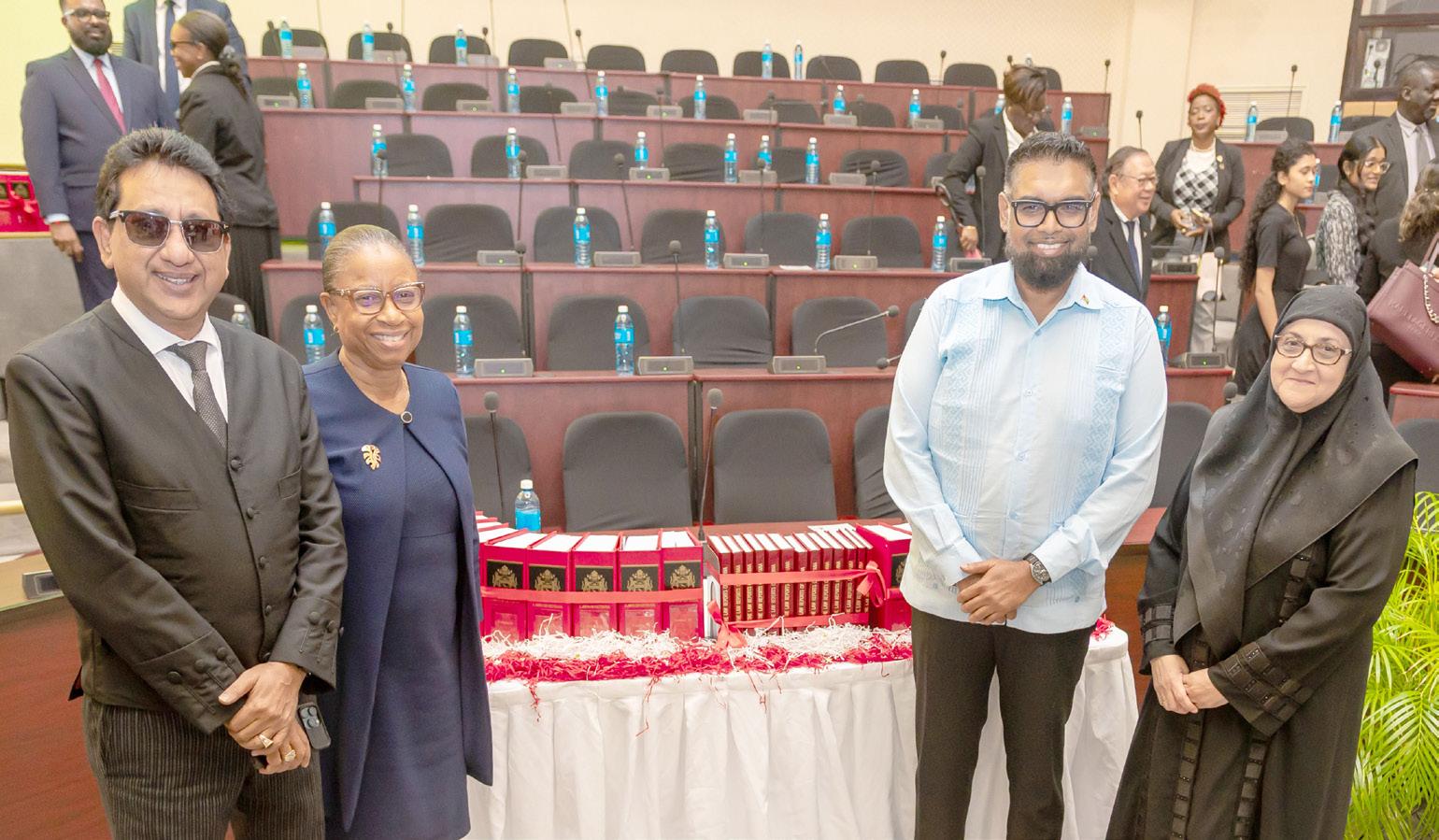
The newly launched Revised Laws of Guyana (2012–December 31, 2022) and the newly published Law Reports of Guyana, documenting landmark court decisions from 2008 to 2021 (Delano Williams photo)
platforms.
“The websites now must be interactive… with a deep AI (Artificial Intelligence) backbone,” he said, noting that such systems are “no longer a luxury, but part of a revolutionised system.”
He also pointed to issues such as political polarisation, globalisation, declining public trust, and access to justice, stressing that the legal system must respond effectively.
“Our judiciary… we are all making the investments that will allow us to meet these challenges successfully,” he asserted.
In a strong defence of the rule of law, the President warned against abuse of systems and unchecked authority.
“A society without laws cannot endure. Without rules to restrain power, authority becomes unchecked,” he said, adding: “Without law, there is no order. Without order, there is only chaos.”
The Head of State further
stressed that laws must be clear, accessible, and consistently applied. “A hidden law is no law, an outdated law is an unreliable law, an inconsistently applied law is an unjust law,” he declared.
Turning to the significance of the revised legal volumes, President Ali explained that consolidating legislation reduces confusion and strengthens justice.
“When laws are consolidated, confusion is reduced. When confusion is reduced, disputes are minimised. When disputes are minimised, justice is strengthened,” he said.
He also highlighted the importance of law reports in preserving judicial reasoning.
“Law Reports capture the thinking of our judges. A judgment not recorded is a lesson lost, a lesson lost is justice weakened,” he stated.
The President emphasised that improved access to law is fundamental to justice.
“Access to justice begins
with the access to the law itself… when citizens cannot find the law, they cannot follow it,” he said, adding that “justice must not be locked in libraries and chambers. It must be available at our fingertips.”
Looking ahead, he called for continuous updates to the legal system, noting that “in a fast-changing society, the law must keep a pace with change.”
He linked this to Guyana’s economic transformation, stressing that investors rely on “clarity… predictability… and the rule of law.”
“Confidence in the economy begins with confidence in the law,” President Ali said, describing the launch as “more than the unveiling of volumes,” but a step toward strengthening the foundation of justice.
Attorney General and Minister of Legal Affairs
Anil Nandlall, SC, said the landmark project is aimed at revising, consolidating,
and reporting the laws of Guyana, underscoring its vital role in advancing the country’s economic growth and democratic governance.
Speaking at the event, Nandlall highlighted the pivotal timing of the initiative, noting that it, “Comes at a pivotal time when our country is experiencing exponential growth and transformation.”
He cited the International Monetary Fund’s 2025 assessment that Guyana’s economy is projected to grow at an average of 14 per cent per year over the next five years, fuelled by oil production and strong non-oil Gross Domestic Product (GDP) growth.
The Attorney General emphasised the importance of a robust statutory framework, stating, “A robust and modern legislative framework is required to govern the particular undertaking… by these very laws politicians and administrators are held accountable to the citizenry, and the citizens’ rights and freedoms are guaranteed and protected by Article 65 of our supreme law, the Constitution.”
The project encompasses two key components: the revision and consolidation of the laws of Guyana, and the publication of law reports from 2008 to 2021.
Nandlall said that the revision process involved consolidating legislative provisions, removing repealed sections, reorganising principal acts, updating language, and incorporating subsidiary legislation.
Approximately 325 pieces of subsidiary legislation were revised as part of the exercise.
The printing of the revised laws—known as the “red volumes”—was funded by the Government of Guyana at a cost of $178,640,000,
producing 200 sets of 19 volumes.
Law reporting, the second component, involves recording significant judicial decisions from Guyana’s High Court, Court of Appeal, and the Caribbean Court of Justice. Nandlall stressed its importance for legal consistency, citing the doctrine of precedent.
“The principle promotes consistency and predictability in the law.”
The project cost $92,085,000 and included printing 750 sets of 14 volumes of the Guyana Law Reports.
He further acknowledged key contributors, particularly Professor Velma Newton, praising her “energy, diligence and perseverance” in ensuring the success of both projects.
The Attorney General concluded by highlighting the ongoing nature of law revision and reporting:
“Law revision and consolidation and law reporting will remain a priority of our government. The goal is for the Attorney General’s Chambers to be fully equipped with the legal and technical capacity so that continuous law revision and law reporting can be realised,” he said.
The launch represents a significant milestone in modernising Guyana’s legal system, ensuring access to justice, supporting economic confidence, and maintaining the rule of law.
The launch was attended by government ministers, heads of the disciplined forces, Acting Chancellor of the Judiciary Roxane George-Wiltshire, SC, judges, magistrates, retired judges, diplomats, members of the Bar, and state attorneys.
–– President Ali says
WHILE affirming strong ties with the United States of America (USA) and expansion of security and capacity-building partnerships, President Dr Irfaan Ali has affirmed that discussions have not focused on the establishment of a US military base here.
The President made these remarks on the sidelines of the launch of the Revised Laws of Guyana, while engaging the media, on Monday.
“We are not discussing those matters, but as I said, our partnership is strong, and our partnership includes
training, technology, transfer of knowledge, integration of assets,” he said, noting that this is common among nations seeking to bolster its security capabilities. While highlighting the broad security partnership Guyana and the US shares, the Head of State said: “Our military and security partnership has a long list with
the US.”
The engagement held with the US was on building out a system to address and monitor the use of the country’s Exclusive Economic Zone (EEZ), the President said, noting that these types of infrastructure can be costly.
He added that Guyana also has partnerships with
other nations to build its capacity, including with Brazil and Colombia, noting “So we’ll continue those partnerships that enhance our capability and capacity and that builds our ability to respond effectively to business.”
Last year December, senior officials from the United States Department of War reinforced Washington’s
commitment to deepening security co-operation with Georgetown and supporting stability across the Caribbean and South America. Discussions centred on strengthening bilateral defence co-operation, safeguarding Guyana’s territorial integrity, and See page 5


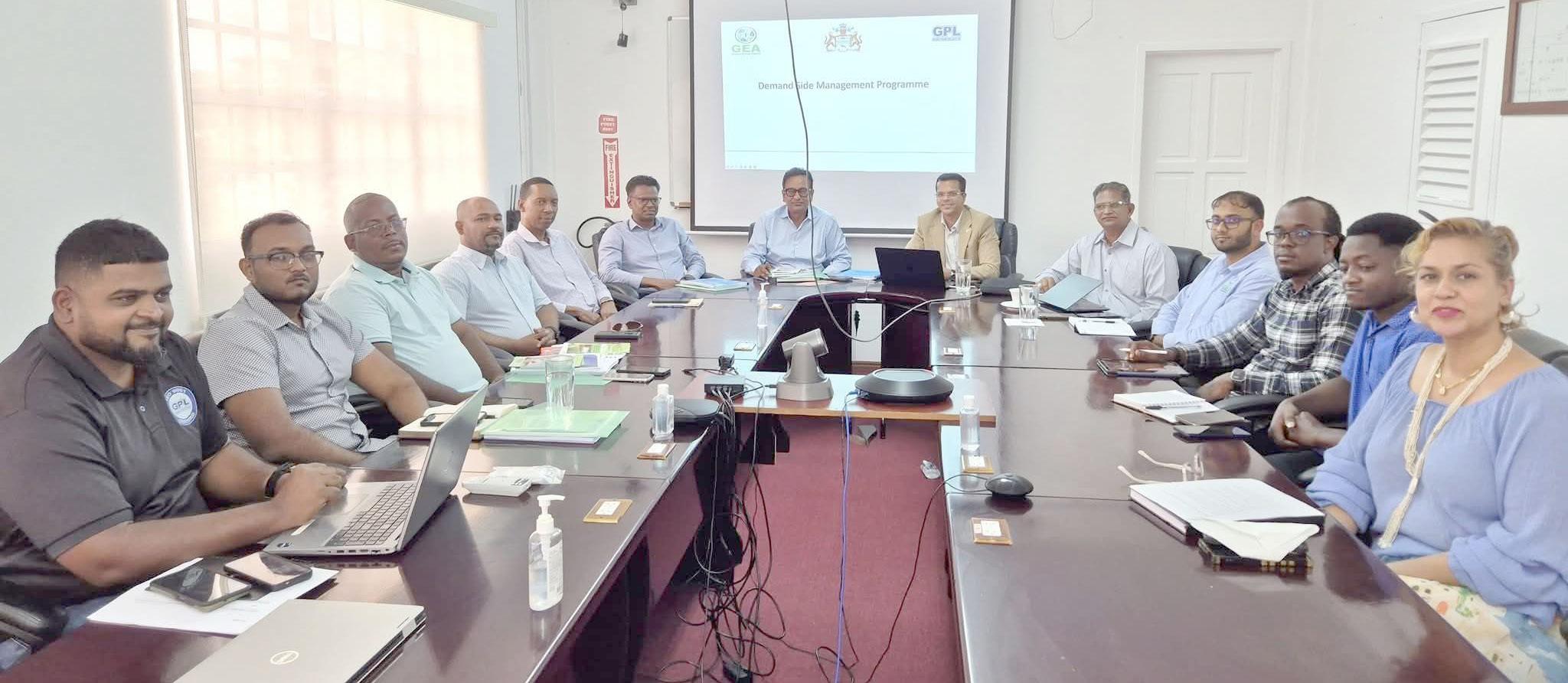
THE Guyana Energy Agency (GEA) and Guyana Power and Light (GPL) Incorporated met last Thursday at GPL’s Headquarters for the inaugural Demand Side Management (DSM) Programme meeting.
Demand Side Management, according to a press release from GPL, is a strategic solution for managing consumer electricity demand by promoting energy efficiency and conservation, so consumers can adjust the level and pattern of their electricity use, rather than relying on the expansion of power generation capacity.
It aims to improve electricity usage, reduce overall consumption across Guyana, prevent grid overload, enhance system stability, and lower emissions from the power sector.
Technical personnel from both agencies concurred that there is significant potential for demand side management to improve energy efficiency and encourage more responsible energy consumption.
A primary focus is enhancing energy efficiency through the adoption of energy-efficient equipment, including optimising existing devices and appliances to reduce electricity use without compromising consumer satisfaction.
This includes promoting efficient inverter air conditioners and refrigerators, upgrading outdated appliances that consume excessive electricity, and encouraging the purchase of Energy Star rated devices. These measures will help to lower overall electricity consumption and reduce energy costs for consumers.
Additionally, to support maximum-demand customers, the programme will facilitate energy audits and assessments in collaboration with relevant governing bodies, particularly across business sectors. These audits will identify opportunities to enhance energy use, reduce costs, and reinvest energy savings into operations.
Implementing energy audits and power factor correction initiatives enhances efficiency for high-demand customers, while strengthening overall grid performance.
Small-, medium-, and large-scale consumers and businesses will be educated and advised on these measures, with the utility company playing a key role in supporting, guiding, and enforcing corrective actions to ensure maximum-demand customers maintain an acceptable power factor.
Another integral action area of the DSM programme is the promotion of renewable energy sources. The programme will bring awareness to consumers building homes that are energy-efficient by using quality insulation, air-
tight construction methods, efficient windows and appliances, and renewable energy options like solar where feasible.
Through public awareness initiatives, consumers will be encouraged to adopt grid-tied solar photovoltaic (PV) systems for their households and businesses, especially first-time homeowners applying for electricity, to help meet growing energy needs and drive long-term behavioural change.
Grid-tied systems integrate a building’s solar PV system directly into GPL’s network. These systems operate by capturing solar energy through photovoltaic arrays, which are then converted by an inverter to power the building’s electrical load.
Any excess energy is sent to the utility grid. The Net-Billing Programme allows customers with gridtied solar PV systems to earn credits for any excess electricity that is fed from their PV system back into the utility grid.

It provides an additional financial incentive for renewable energy adoption, while helping consumers manage electricity costs and contribute to living sustainably.
A customer with a gridtied installation is referred to as a ‘Prosumer’. The grid-tied and net-billing arrangement is formalised between GPL and the prosumer through the signing of a Standard Offer Contract (SOC), which outlines the relevant terms and conditions. Under this arrangement, GPL will compensate the prosumer for any excess energy exported to the utility grid.
“This is a programme that brings GEA and GPL together and provides a structured approach to developing a sustained and comprehensive demand side management programme,” said Dr Sharma.
According to Nandlall, the initiative is a timely collaborative effort that will help to foster behavioural change among consumers, and most importantly, drive the transition to renewable energy.
Under Guyana’s Low Carbon Development Strategy (LCDS) 2030, the Demand Side Management (DSM) Programme supports building a sustainable, low-carbon energy pathway by promoting energy efficiency and conservation solutions to improve the stability and performance of the national power grid.
By implementing these measures, the programme provides the utility company with an advantageous position in managing electricity supply and demand.
–– Minister Teixeira emphasises, highlights gov’t has closed gaps, created opportunities for all –– cautions against social media being used as a destructive tool
GUYANA’S democratic framework and constitutional protections have enabled the nation to steadily evolve into a more inclusive, unified and equitable society, Minister of Parliamentary Affairs and Governance, Gail Teixeira emphasised on Monday.
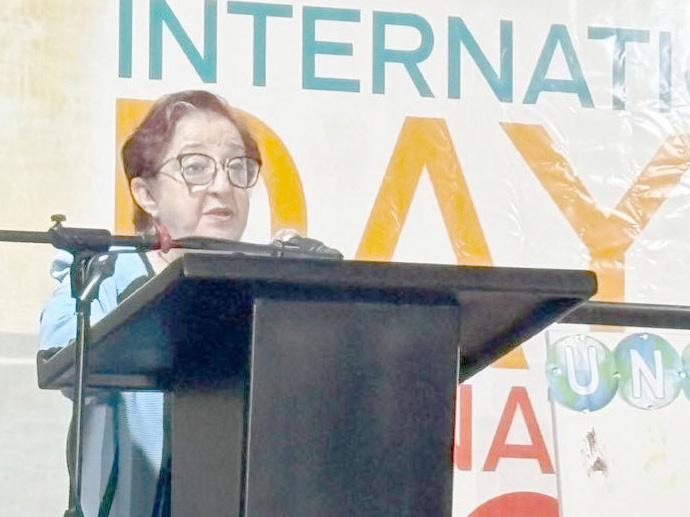
During her remarks at the Ethnic Relations Commission’s (ERC) observance of the International Day for the Elimination of Racial Discrimination along with the current commission’s third anniversary at the Umana Yana, Minister Teixeira highlighted Guyana’s progress, stating, “We’ve travelled a long way as a country.”
Emphasising that citizens must give credence to how far Guyana has advanced, she noted that even with the deep ethnic, religious and linguistic diversity, and times of intense political tension, Guyana has never descended into war.
As Minister Teixeira explained, Guyana’s greatest achievement is not just economic growth or infrastructure expansion, but also its ability to avoid the conflict that has destabilised many similarly diverse nations.
The minister then reflected on the decades of
global upheaval and the profound violation of human rights through atrocities such as fascism, which led to the creation of the United Nations (UN), which she said is now “under threat.”
Guyana’s constitution, as the minister pointed out, is one that is distinct and expansive, and that came about because of civil strife.
She said: “We’d come out to the 97 elections, and if there was violence, and we could have gone a different way, like we could have gone a different way in 2020 post elections, but we, as a people and by the political leadership of the time, we went back to the Constitution, amended it, and brought in very strong articles.”
Teixeira emphasised that human rights are the bedrock of democracy, underscoring that Guyana’s development, in that context, must be understood under a broader historical backdrop. Additionally, she highlighted the gradual cultural shift in Guyanese society, where younger generations are rejecting the rigid ethnic and religious divisions.
Giving her observation on the 2025 General and Regional Elections, the minister said: “I observed,
and I may be wrong, that the language that began at the beginning on the social media was very racial, halfway down the line in the campaign, you started to see that dissipate. And I think that I know my own belief as a politician is that race no longer plays as divisive a role as it played for decades.”
Still, the minister cautioned against social media, although a productive tool, being destructively used to infringe upon human rights.
“Today, the society is much more open, but there still are prejudices,” she said.
Drawing on lessons from renowned human rights activist, Nelson Mandela, the minister reminded the audience that hate is learned and can be unlearned.
Pointing to the global trends, the minister underscored the need for vigilance.
Central to Guyana’s progress as a society, is the fact that the constitution explicitly prohibits discrimination, whether it be on the basis of gender, race, religion, nationality and disability.
Constitutional reforms have also led to the ability for citizens to seek redress
From page 3
expanding joint efforts to confront transnational threats.
According to a US Embassy statement, the visit formed part of the United States’ broader efforts to bolster regional partnerships at a time of increasing geopolitical tension and heightened security challenges in the hemisphere.
Earlier this year, President Ali and US Secretary of State Marco Rubio, reaffirmed their nations’ deepening security partnership as both leaders committed to enhancing co-operation to counter transnational crime, protect regional stability and safeguard Guyana’s sovereignty.
According to a statement issued by the US Department of State and attributed to Principal Deputy Spokesperson Tommy Pigott, Secretary Rubio spoke with President Ali to discuss strengthening bilateral security co-operation, commending the Guyanese Head of State for his leadership as a regional security partner and for Guyana’s expanding role in promoting stability across the Western Hemisphere. Both leaders committed to maintaining close engagement on the issues discussed, as well as other areas of mutual interest, signalling continued momentum in Guyana–US relations anchored in security co-operation, democratic
directly through the courts and the creation of key human rights bodies such as the ERC.
“These are innovative creations of the Guyanese people and the Guyanese politicians. We didn’t follow the examples of other countries and when you look at the Guyana constitution, and many innovations that are not necessarily in other people’s constitutions, and in some of them that we brought in, a number of governments might not like them, because they hold the Government in Guyana accountable in a way that some other countries are not,” Minister Teixeira said.
REJECTS DIVISION
Minister Teixeira posited that modern discrimination emerges not just from prejudice but also from unequal access to opportunities.
In that regard, the minister highlighted how the People’s Progressive Party/ Civic (PPP/C) government is closing the gap with initiatives.
These include tens of thousands of house lots distributed at subsidised rates, free education for all and equitable access to scholarships, the distribution of the ‘Because We Care’ cash grant to thousands of learners, training opportunities, the creation of thousands of jobs, and subsidies that remove pockets of poverty.
Adding to that, she disclosed that universal secondary education is projected to be achieved by 2026/2027.
The minister also pointed to the expansion of internet, electricity and water
access in hinterland communities.
“We have come a long way, and that those things reduce feelings of discrimination, reduce ethnic insecurities, because you can see in housing schemes, when you go to them, that they reflect Guyana, they reflect the diversity of Guyana,” she added.
The minister urged citizens not to take for granted the unique social fabric that Guyana has built, where religious and cultural traditions are respected and communities remain.
governance, and regional stability.
The United States and Guyana have steadily expanded defence co-operation in recent years through joint training exercises, intelligence collaboration, and maritime security operations.
Washington has positioned Georgetown as a key strategic partner in ensuring stability in the Caribbean Basin and countering illicit networks that operate across borders.
Guyana’s rapidly growing economy and its rising geopolitical importance, driven by the global attention on its oil sector and its role in hemispheric security, have further strengthened bilateral ties.


GUYANA stands at a defining crossroad. With unprecedented economic expansion driven by oil production and broader structural transformation, the country is being rapidly reshaped.
But amid the optimism reflected in projections from the International Monetary Fund, which anticipates sustained double-digit growth in the years ahead, one truth must remain firmly in focus: Economic progress without a strong legal foundation is ultimately unsustainable.
The recent launch of the revised Laws of Guyana 2022 and the Guyana Law Reports (2008–2021) is, therefore, far more than a ceremonial milestone.
It is a critical investment in the Rule of Law, institutional integrity, and public confidence, pillars without which no modern state can endure, much less thrive.
At its core, law is not merely a collection of statutes; it is the machinery through which governance is exercised and accountability enforced.
As legal scholar V. C. R. A. C. Crabbe aptly observed, legislation transforms policy into enforceable rules that shape economic, social,
and political life. In a democracy, those same laws serve as a check on power, ensuring that leaders remain answerable to the people.
Yet, laws, however well-crafted, are only as effective as they are accessible.
A legal system that is fragmented, outdated, or difficult to navigate undermines justice itself. Citizens cannot assert rights they do not understand, nor can businesses operate with confidence in an environment where legal certainty is elusive.
The United Nations has long underscored that access to justice is a fundamental component of the Rule of Law; without it, rights exist only on paper.
This is where the significance of the law revision exercise becomes clear.
By consolidating, updating, and modernising legislation, the State has taken a necessary step towards making the law intelligible and usable.
Removing repealed provisions, harmonising language, and integrating amendments are not mere technical exercises; they are acts that bring clarity and coherence to the legal system.
Equally important is the reviv-
al and continuation of law reporting. In common law jurisdictions such as Guyana, judicial decisions are not secondary, they are a primary source of law.
The doctrine of precedent, or stare decisis, ensures consistency and predictability by requiring courts to follow established rulings. Without reliable and accessible law reports, this system falters, leaving judges, attorneys, and scholars without the tools needed to interpret and apply the law effectively.
The publication of the Guyana Law Reports (2008–2021) addresses a long-standing gap. For decades, the sporadic nature of law reporting hindered the development of jurisprudence and limited the accessibility of legal reasoning.
By systematically compiling decisions from the High Court, Court of Appeal, and the Caribbean Court of Justice, this initiative strengthens the intellectual and practical foundations of the legal system.
History reminds us that this challenge is not new. From the scattered and unpublished laws of the early 19th Century to incomplete revision efforts in the colo-
nial era, Guyana has long grappled with the task of organising its legal framework.
Even in more recent times, long gaps between revisions and reports created inefficiencies and inconsistencies. That these issues persisted for generations underscores the magnitude of the achievement represented by the current project.
It must also be acknowledged that such undertakings are neither simple nor inexpensive.
Significant public investment, international collaboration, and sustained institutional effort were required to bring these volumes to fruition.
But the cost of inaction would have been far greater. A weak or inaccessible legal system discourages investment, stifles innovation, and erodes public trust.
As Guyana positions itself as a major economic player, the importance of legal certainty cannot be overstated. Investors, whether local or foreign, seek environments where rules are clear, stable, and fairly enforced.
and updated reports are not merely legal tools; they are instruments of national development.
The challenge now is to sustain this momentum. Law revision and reporting must not be episodic exercises undertaken decades apart, but continuous processes embedded within the State’s institutional framework.
Training legal professionals, strengthening the capacity of the Attorney-General’s Chambers, and embracing digital accessibility will be key to ensuring that the law remains a living, evolving instrument.
Ultimately, the success of Guyana’s transformation will depend not only on the wealth it generates, but on the strength of the systems that govern it.
The Rule of Law is not an abstract ideal, it is the bedrock upon which economic prosperity, social cohesion, and democratic governance are built.
Citizens, too, demand a system where justice is not delayed, denied, or obscured by complexity.
In this regard, the revised laws
In launching these revised laws and reports, Guyana has reaffirmed a simple but profound principle: That justice, to be meaningful, must be accessible, and that progress, to be lasting, must be anchored in law.
THE Office of the President has issued a public notice aimed at ensuring that National Awardees are accorded appropriate honours upon their passing.
In a statement on Monday, the Protocol Division noted that although it is tasked with coordinating official courtesies for awardees, it is not always informed when an awardee dies, which affects arrangements.
“The Protocol Division of the Office of the President wishes to inform the public, particularly the families and relatives of National
Awardees, that while the Division is responsible for coordinating appropriate honours and official courtesies for awardees both during their lifetime and upon their passing, it has not always been advised of the death of an awardee,” the notice stated.
It was against this backdrop that it added that this gap “affects the implementation of appropriate arrangements to ensure that due honours are accorded at the funeral.”

To this end, the Office called on citizens to play a more active role in notifying authorities.

“To ensure that every National Awardee is suitably honoured, the
Protocol Division of the Office of the President respectfully requests that family members, relatives, representatives, friends or members of the public promptly notify the Division upon the passing of any National Awardee,” the statement said.
The division further outlined the process for notification, noting that persons should make contact as soon as possible and provide key details.
“Notification may be made by contacting the Protocol Division of the Office of the President at
the earliest opportunity, providing the name of the deceased awardee and relevant funeral details so that the necessary arrangements can be made,” the notice stated.
The division, in its statement, further underscored the importance of recognising the contributions of awardees.
“The Office deeply values the service and contribution of all National Awardees to our nation and remains committed to ensuring that they are accorded the respect and dignity they so richly deserve, in life and in death.”
PAPER committal proceedings in the case surrounding the deadly explosion at the Mobil Service Station at the corner of Regent and King Streets, Georgetown, were expected to commence on Monday, March 23, 2026, but took a significant turn after one of the accused indicated his intention to admit full responsibility for the incident.
The matter, being heard before Acting Chief Magistrate Faith McGusty at the Georgetown Magistrates’ Court, involves Venezuelan nationals Daniel Alexander Ramirez Poedemo, 33; Johnny Boodram, 27; and Alexander Bettencourt, 44, along with 33-year-old Guyanese Krystal LaCruz, all of whom are charged with terrorism.
During Monday’s proceedings, Poedemo, who is alleged to be the mastermind, spoke through a translator, indicating his willingness to accept full responsibility for
the explosion.
According to the translator, he said that whatever decision is taken rests with the court, while maintaining that the other accused were not involved in the incident and should be released.
He added that he wanted to bring the matter to a swift conclusion so that “the innocent persons can be out”.
The translator further related that Poedemo stated he was prepared to admit to everything, explaining that he was given the materials by a Guyanese/Venezuelan individual, and placed them where instructed.
He maintained that the others had no involvement, insisting that he alone was responsible for the entire incident.
Following the disclosure, Prosecutor Mandel Moore informed the court that he had advised Poedemo’s attorney that a formal proposal must
be submitted to the Director of Public Prosecutions (DPP), Shalimar Ali-Hack, SC, for consideration.
Attorney Shellon Boyce, who represents Poedemo, indicated that she would require two weeks to prepare the proposal. As a result, the matter was adjourned to April 20 for report.
The explosion, which occurred on October 26, 2025, claimed the life of sixyear-old Soraya Bourne and left several of her relatives injured, including Jenica Hooper, 27; Yvonne Jonas, 71; Seddia McIntosh; and 11-year-old Reshard Lord.
Several vehicles and nearby buildings were also damaged in what authorities have described as one of the country’s most serious national security incidents in recent years.
The case had been poised to begin paper committal proceedings on Monday, fol-

lowing an earlier delay after two of the accused secured legal representation. Attorney Boyce had previously entered an appearance for Poedemo and requested time to review the disclosure materials and consult with her client, while attorney Melvin Duke, representing Bettencourt, also sought time to examine the evidence and obtain instructions. Both requests were granted.
The development follows the recent completion of disclosure by Moore, who presented a comprehensive bundle of evidence the State intends to rely on, including witness statements, forensic analyses, electronic and telecommunications data, and other documentary material. Samples collected from the scene were also sent to India for advanced forensic testing.
Paper committal proceedings mark a critical stage in indictable matters, during which a magistrate determines whether the evidence is admissible and sufficient to establish a prima facie case to commit the accused to stand trial in the High Court.
Authorities have described the explosion as a coordinated terrorist act, alleging that Poedemo entered Guyana around 08:00 hrs on the day of the attack carrying an explosive device in two bulky black plastic bags, as seen on surveillance footage.
Minutes after entering the gas station compound, the device detonated.
Poedemo faces a separate charge of terrorism contrary to Section 3(1)(a) of the Criminal Law (Offences) Act, which alleges that he detonated an explosive de-
vice with intent to threaten Guyana’s security and sovereignty, or to strike terror among the public, resulting in the child’s death.
Meanwhile, the remaining accused—Venezuelan national Jennifer Rodriguez, 33, and Guyanese nationals Wayne Correia, 44, and Ramesh Pramdeo, 51—are jointly charged with aiding and abetting Poedemo. Their matter is ongoing at the Leonora Magistrate’s Court.
All seven accused remain on remand as proceedings continue.
Minister of Home Affairs Oneidge Walrond has stated that the government intends to seek the death penalty under Guyana’s anti-terrorism legislation, which provides for death sentence where terrorist acts result in loss of life.
IN the March 19, 2026 edition of the Kaieteur News (KN) on page two, there appeared a whole page colour advertisement with 128 signatures of which five were organisations, and the rest were individuals. I am not good at counting so it could be slightly above 128.
The placement was the work of The Usual Suspects (TUS), all of which are from the Mulatto/Creole class (MCC). Before we proceed, this has been the first time TUS has taken out an advertisement in KN. Both the personalities in TUS and the MCC are not too fond of KN. Their choice of paper was the MCC-owned Stabroek News (SN). Both TUS and MCC have a low opinion of KN. I wrote for KN so I know how these folks regard KN.
I took out the names of seven Indian persons because
they are close to both TUS and the MCC. That left us with 14 Indian signatures constituting a mere 12.5 percent of folks who signed the advertisement. That is not a good sign of the politics of TUS and MCC. The question needs to be asked is that in a placement in the newspaper praising the work of the SN, only 14 Indian persons were contacted out of 128?
Anyway, the content of the placement is very disturbing because it seeks to deliberately deceive the people of this country. It is times like these that you need to write so this young nation can be mentally free of deceptions and fictions that are designed to fool them.
Here are the deceptive words in that advertisement: “Stabroek News carried our news and views…ranging from solidarity with Palestine
and outrage against genocide in Gaza.”
This is a blatant fiction. This is a gargantuan deception. This is an enormous act of deceit.
Of those 128 signatures, none ever published even one word denouncing genocide in Gaza and lamenting the Israeli terror against the people of Palestine. My job is to read the newspapers. I have read every newspaper every day since Israel began killing the Palestinian people. I repeat: none of those 128 signatures ever published even one line about Gaza even after two and a half years of genocide.
I can identify the person among those signatures that made public statements in denunciation of Israeli terror in Gaza. One is Vanda Radzik who spoke at the seawall esplanade symposium. Charlene Wilkinson shared out

flyers at that event. And I saw Sherlina Nageer sharing out pamphlets at the Ramadan Village last year. There was a picket exercise outside CARICOM and Ms. Radzik was there.
There was one huge march which started from the Umana Yana. Bonita Harris and others mentioned above were in the March. The SN only reported on that march and no other Palestinian event in this country. The SN took a policy of not reporting on Palestinian activities during the Israeli bombing.
Here is a list of events SN ignored since the bombing began two and a half years ago. There were two public marches that took place from the Square of the Revolution with speeches after the marches.
They were sponsored by Guyana Committee for Palestine headed by Halim Khan, former head of Region Three Chamber of Commerce. At one of the events, Kaieteur
News (KN) publisher, Glen Lall was there. KN reported on the events.
There were two public symposia at Square of the Revolution. Former President Donald Ramotar spoke and Palestine’s Ambassador to Guyana. A picket in solidarity with Palestine was held outside the Conference Centre during the visit there of Tony Blair. Palestine’s Ambassador to UN held a talk at the Marriott Hotel on the genocide.
The Mayor of Georgetown offered a comment during question time.
For three months, a lone figure named Shamal Zamaluddin held a one-man picket in support of Palestine at the junction of Dowding Street and Vlissengen Road. The News Room media house featured his bravery.
I repeat- the SN did not carry any of these events.
Months after the bombing started, through the initiative of a Western diplomat, SN interviewed Israel’s ambas-
sador to the UN in which the most basic requirements of an interview were abandoned and SN made the Ambassador look good.
SN never ran a front-page story on the genocide, contrary to Kaieteur News that did 10. Dhanraj Bhagwandin, former journalist in support of SN, could only point to one foreign news item that SN carried on Gaza.
The Stabroek News was not interested in Gaza because the Stabroek News from day one of its birth was a vehicle for Western/ imperialist narratives and shamelessly so. Those who can write that SN gave space to the suffering Palestinian people are unfit to be among us.
DISCLAIMER: The views and opinions expressed in this column are solely those of the author and do not necessarily reflect the official policy or position of the Guyana National Newspapers Limited.
GUYANA is bracing for several days of intense and unstable weather, with authorities warning of widespread rainfall and potential flooding across multiple regions.
According to a Special Information Bulletin issued on Monday by the National Weather Watch Centre, “unstable weather conditions are expected to produce widespread rainfall with flooding potential for the next six days (March 23 to 28, 2026)”.
The Hydrometeorological Service said the developing weather pattern could not only trigger new flooding, but also worsen existing conditions, particularly in low-lying and poorly drained communities.
Meteorological analysis indicates that the current system is being driven by “strong low-level convergence, supported by moisture transport from the trade winds,” alongside upper-level atmospheric dynamics that are intensifying instability.
“These combined factors are contributing to increased cloudiness, frequent showers, periods of moderate to heavy rainfall, and isolated to scattered thunderstorms,”

Pumps were operational to drain the land of excess water after heavy rainfall on Monday
the bulletin explained.
Forecast models show no immediate relief, with the unsettled conditions expected to persist throughout the week.
Residents can expect periods of heavy rainfall, particularly during the morning into early afternoon, along with thunderstorms and reduced visibility during intense showers.
Authorities are also cautioning against hazardous conditions on roadways due to water accumulation.
The bulletin highlighted several likely impacts, including “localised flooding, especially in flood-prone and low-lying areas,” as well as
disruptions to outdoor activities and risks associated with lightning and gusty winds.
The National Weather Watch Centre said it will continue to monitor the situation closely and provide updates as conditions evolve. Following intense rainfall, the city’s pump stations are fully activated and remain operational.
Authorities report that the drainage network is functioning as designed, with water levels already receding in several affected communities. Residents are advised to exercise caution in low-lying areas as runoff continues.
PRESIDENT Dr Irfaan Ali has announced plans for the development of commercial plazas to accommodate small businesses currently operating along public roadways, as part of a broader push to create a more structured and sustainable environment for commerce.
During his remarks at the opening of Demerara Bank Limited’s new location at Beterverwagting, on Monday, the Head of State underscored the need for a more orderly approach to development.
“Let me be clear, we have to build a more orderly system of growth and development. We can’t have hundreds of shops on the main public road,” the President said, adding: “And what are we going to do? We’re going to identify critical areas along the East Coast, East Bank and all of Guyana, where we’re going to build out little open plazas, with food court with proper facilities for the small businesses that are on the public road.”
He said that the government is working closely with Neighbourhood Democratic Councils (NDCs) to identify suitable locations along the East Coast and East Bank corridors, as well as in other parts of the country, for the establishment of these facilities.
“We want to build an environment that is safe, secure, beautiful, clean and humanistic for these businesses, and we’re going to be building them all across the East Coast, all across the East Bank in every single NDC,” he said.
According to President Ali, the initiative will see the creation of small, welldesigned commercial hubs featuring food courts and essential amenities to support vendors.
These plazas are intended to provide a safer, cleaner and more organised setting for both business owners and customers, while enhancing the overall aesthetic and functionality of key economic zones.
He emphasised that the move is not about dis-
working closely with NDCs to identify sites across ECD, EBD corridors
placing small operators, but rather about creating long-term opportunities for growth in a more conducive environment.
The government, the Head of State said, will also examine how the Guyana Development Bank and commercial banking partners can assist in financing and establishing these sites, particularly in areas with tourism potential.
He also dismissed criticisms that the initiative is aimed at removing vendors for political gain, asserting instead that the government’s focus is on long-term development.
The goal, Dr Ali said, is to foster communities that are safe, secure, aesthetically pleasing, and supportive of small enterprise growth.
The Head of State said: “So, it is not about removing these facilities… that is short term political win for the opportunistic souls that exist in our society.”
“We’re in the process of identifying sites that we’re going to put these facilities. So, you and your children


The Ministry of Public Works recently announced protocols for vendors plying their trade on road shoulders along Sheriff Street
can go off the public road in these beautiful plazas and buy ice cream for your children. Your grandparents can go and sit down and listen to some good, soft music,” he added.
The Ministry of Public Works recently announced new protocols for vendors plying their trade on the road shoulders along Sheriff Street. Efforts are also underway to regulate the use of government reserve and other public spaces for vending.

-
men Nazar Mohamed and Azruddin Mohamed have moved to the Caribbean Court of Justice (CCJ), filing an urgent application seeking special leave to appeal and a stay of ongoing extradition proceedings.
Court documents seen by this publication on Monday show that the application, filed under CCJ Application No. GY/A/CV2026/001, asks the regional court to overturn the March 17 decision of the Guyana Court of Appeal, which dismissed their challenge to the Authority to Proceed (ATP) in the United States extradition case.
In the filing, the Mohameds are requesting several orders, including that special leave be granted to appeal the
decision of the Court of Appeal, that the appellate ruling be reversed or set aside, and critically, that the extradition proceedings before the Magistrates’ Court be stayed pending the determination of the CCJ matter.
The father and son duo are also seeking an expedited hearing, asking the court to treat the special leave application as the substantive appeal, should the court deem it appropriate.
The CCJ has already moved to advance the matter, issuing a Notice of Case Management Conference (CMC) scheduled for Wednesday, March 25, 2026, at 10:00 hrs via video conference.
According to the notice, attorneys involved in the
matter are expected to be prepared to assist the court in setting directions for how the case will proceed. In their application, the Mohameds argue that the Court of Appeal erred in law when it found that the Minister of Home Affairs was exercising an administrative function, rather than a quasi-judicial one, in issuing the ATP that triggered the extradition proceedings.
This issue formed the core of their earlier legal challenge, where they contended that the minister’s decision was tainted by bias and should be quashed. However, both the High Court and the Court of Appeal (COA) rejected that argument, with the appellate court ruling that there was “absolutely no merit” in the claims and affirming that the minister acted within the scope of her statutory authority.

for such delegation.
While delivering the COA’s reasoning, Justice George underscored that the minister’s role in issuing an ATP under the Fugitive Offenders Act is administrative and executive, not judicial, thereby nullifying claims of bias raised by the appellants.
“On the facts of this case, bias does not arise,” she stated.
The court found no evidence that the statutory procedures governing the issuance of the ATP were breached, nor that the minister failed to consider the legally required factors before granting approval for the extradition process to proceed.
Justice George affirmed that “there is no evidence” that the provisions of the Fugitive Offenders Act regarding the issue of the ATP were not followed. The court also dismissed arguments that legal advice provided by Attorney General Anil Nandlall could constitute bias, stressing that such counsel falls squarely within his constitutional role as the government’s principal legal adviser.
“It cannot be that advice in terms of applicable case law… can be biased,” George said, adding that there was no evidence to support such a claim. Further, the court rejected the contention that Minister Walrond should have delegated her authority to issue the ATP, clarifying that the relevant legislation does not provide
The Mohameds had argued that the ATP was tainted by political bias, citing Azruddin Mohamed’s political involvement and candidacy in the September 2025 General and Regional Elections.
However, both the High Court and now the Court of Appeal found no legal basis for that argument. In its final determination, the appellate court concluded that the appellants failed to establish any bias or impropriety that would invalidate the minister’s decision.
“The court is of the view that the Chief Justice was correct in dismissing the application,” George said.
The court had also declined to grant a stay of the ongoing extradition proceedings, noting that any such application would be more appropriately made to the CCJ.
Meanwhile, extradition proceedings continue before Principal Magistrate Latchman at the Georgetown Magistrates’ Court on Tuesday, March 24. The extradition case stems from a United States federal indictment returned in October last year in Miami, charging Nazar Mohamed, 72, and Azruddin Mohamed, 38, with participating in a multi-year scheme to evade millions of dollars in taxes and royalties owed to the Government of Guyana through fraudulent gold export practices and related money laundering activities.
According to court documents, the pair allegedly used their company, Mohamed’s
Enterprise, a gold wholesaler and exporter in Guyana, to conceal the true quantity and value of gold exported to overseas buyers in Miami and Dubai.
Prosecutors allege that between 2017 and 2024, the men avoided paying millions of dollars in taxes and royalties by reusing official government seals obtained from a single declared shipment of gold on multiple subsequent shipments.
The indictment further alleges that empty boxes bearing Guyanese government seals were shipped from Dubai through Miami to Guyana, and that bribes were paid to customs and other officials to facilitate the scheme.
Authorities estimate that the alleged activities resulted in a loss of approximately US$50 million in revenue to the Government of Guyana. Nazar Mohamed faces charges of conspiracy to commit money laundering, conspiracy to commit mail and wire fraud, and mail fraud.
Azruddin Mohamed is charged with conspiracy to commit money laundering and wire fraud, and is also accused of evading more than US$1 million in Guyanese taxes related to the shipment of a Lamborghini from Miami to Guyana.
The indictment also seeks forfeiture of approximately US$5.3 million in gold bars seized at Miami International Airport in June 2024.
Both men were sanctioned by the United States Office of Foreign Assets Control (OFAC) in June 2024.
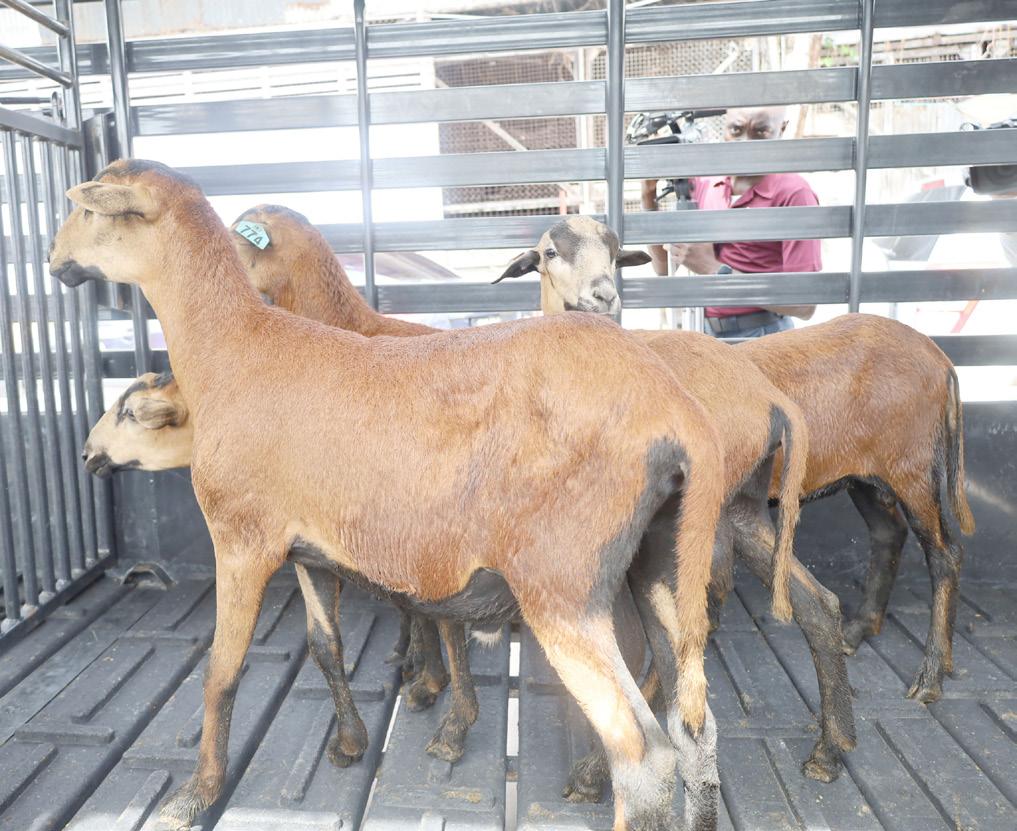
THE Government of Guyana, through the Guyana Livestock Development Authority (GLDA), is making remarkable progress in developing a regional brand of mutton through its Black Belly Sheep programme.
During a meeting with a delegation from Barbados, headed by Barbados’ Minister of Agriculture and Food and Nutritional Security, Dr Shantal Munro-Knight, Agriculture Minister Zulfikar Mustapha disclosed that since the project was launched in Region Five in March 2022 by President Dr Mohamed Irfaan Ali, significant progress has been made, with the national herd exceeding 3,000.
“I know one of the main areas we have to discuss is the progress of the Black Belly Sheep programme. In August 2022, we received the first tranche of sheep, totalling 131. We later received three other sets. The second tranche totalled 342, the third, 234, and the fourth, 293. To date, we’ve increased the stock to over 3,000,” Minister Mustapha said.
He also noted that the cross-breeding component of the initiative has commenced as the government advances its efforts to develop a regional brand aimed at reducing the importation of mutton from New Zealand. Recently, the first offspring—nicknamed “Ruth”—was born at
GLDA’s Headquarters, Mon Repos.
This, he added, is in keeping with CARICOM’s “25 by 2025 + 5” Initiative, which seeks to reduce the regional food import bill by 25% by the end of 2030.
As part of the initiative, the GLDA is also implementing an ongoing programme through which 60 farmers from Region Five have each benefitted from five-acre production plots. These plots will function as controlled small-ruminant production units dedicated to the rearing and finishing of sheep under the Barbados Blackbelly Sheep Project.
To date, 54 farmers have been allocated their respective plots and are expected to commence production by the second quarter of 2026.
Minister Mustapha noted that this structured approach is expected to generate several strategic outcomes.
“First, it will contribute to the development of a standardised sheep production model that can be replicated across other regions. Second, the concentration of finishing operations will enhance supply chain efficiency, thus facilitating coordinated slaughter, processing, and distribution systems.
“Third, by producing consistent, high-quality lamb and mutton, the initiative will strengthen the reliability of domestic supply while positioning Guyana to capitalise
on emerging regional and extra-regional export opportunities,” he said.
The minister said that one core objective of the project is to increase local mutton production to over 7,000 tonnes by the end of year five and to reduce the regional importation bill by 25%.
In 2022, Dr Ali launched the major Black Belly Sheep Project in Region Five, with the aim of making the region the Livestock Capital of Guyana while improving the social and economic well-being of its residents.

The Barbados Blackbelly Sheep Project in Guyana represents a strategic initiative aimed at strengthening the livestock sector, enhancing regional food security, and expanding economic opportunities for farmers.
The project, launched by the Government of Guyana in collaboration with the Government of Barbados, forms part of a broader regional effort to reduce reliance on imported meat products and to develop a sustainable sheep production industry within the Caribbean.

By Shaniya Harding
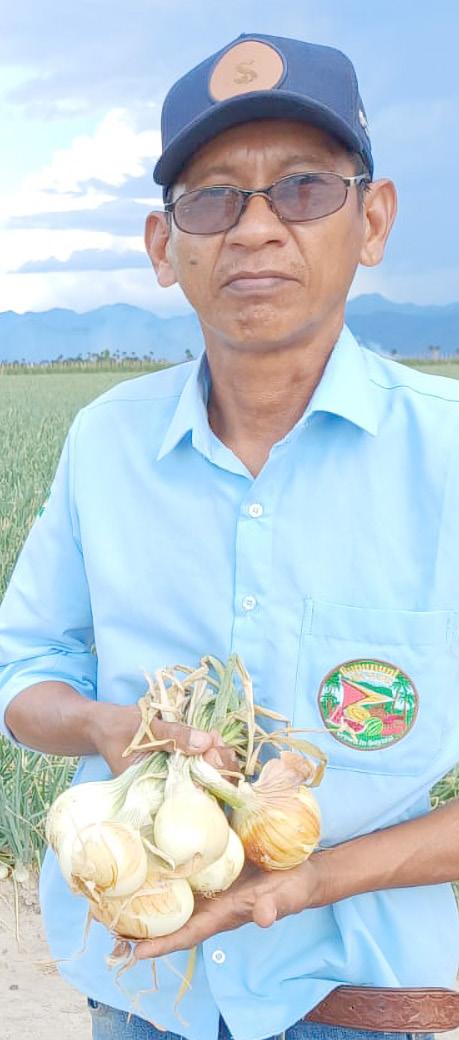
GUYANA’S agriculture sector continues to grow through collaboration and innovation. Among the most recent examples is the Ministry of Agriculture’s partnership with Region Nine farmer Christopher Moses.
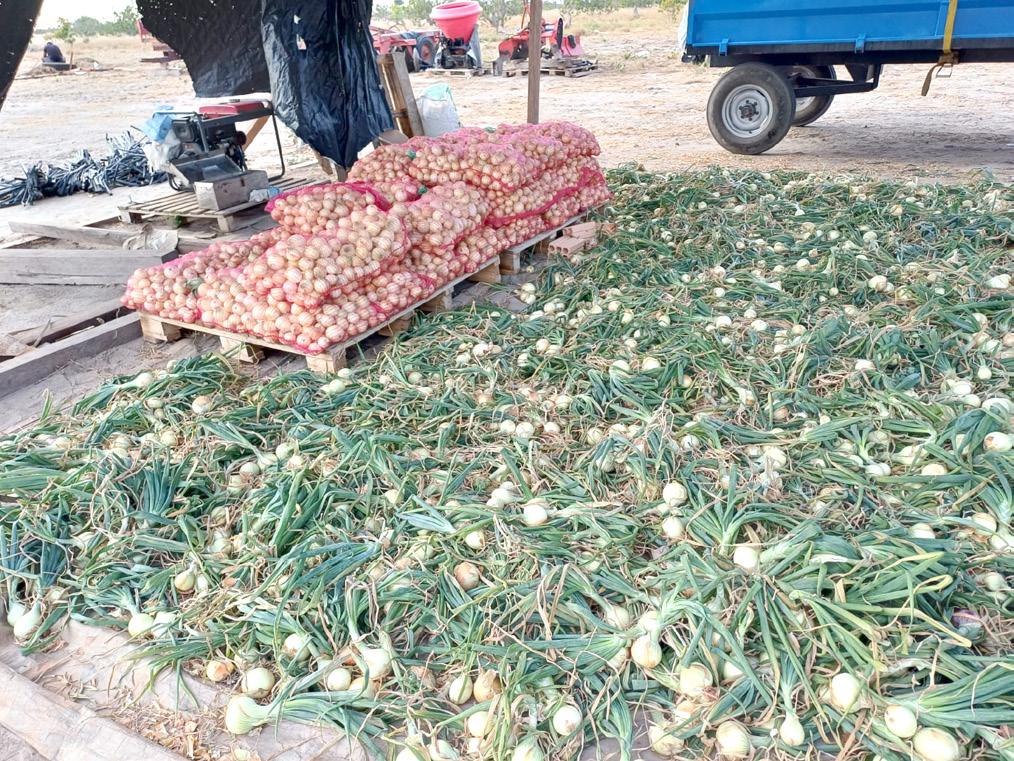
Through a partnership in late 2025, Moses, with support from the ministry, cultivated five acres of onions on his farm in Manari. Recently, he and his team pre-harvested the first batch of onions from the $9.5 million project.
Highlighting the success of the project, Moses shared
that the crops are tremendously promising, with him having very high and positive hopes ahead of harvesting in the second week of April. Then crop was planted in December last year.
With the project expected to produce 70 tonnes per hectare, Moses has already continued his partnership with the ministry to cultivate an additional 40 acres as the project moves to a new phase.
Speaking to the Guyana Chronicle from his farm in Region Nine, Moses shared that his large-scale farm in the Rupununi has been operating for a few years and
began with watermelon cultivation.
Last year, however, a meeting with fellow farmers, stakeholders, and the Minister of Agriculture, Zulfikar Mustapha, saw the minister highlighting the possibility of onion cultivation in the region.
Seeing an opportunity to diversify his farm, Moses indicated his interest to the ministry and drafted a proposal that was accepted.
“Last year, the minister had a meeting with stakeholders and said that the Ministry of Agriculture wanted to do onion production,” he said adding, “I indicated that we
could do it, and that is where it all started. We prepared the project, developed the costing, and submitted it. The Ministry agreed to partner with us, contributing to the cost of inputs and seeds, while we provided the land, equipment, and expertise.”
Following this, Moses and his team collaborated with the National Agricultural Research and Extension Institute (NAREI) and worked alongside agronomists from Brazil to make the cultivation a reality.
Sharing insight into the process, Moses said that while he and his team focused on management of the farm, hands-on cultivation, and crop health, support from the ministry, NAREI, and third-party agronomist from Brazil, Agmon Da Costa, created space for technology sharing by adopting techniques used by NAREI and across the border in Brazil.
“We had a lot of support from NAREI and from a third-party agronomist from Brazil. We paid to have a third-party agronomist from Brazil, so it was more like a technology transfer,” he said.
Further, he noted, “They have already been doing this just across the border in the state of Roraima, because we have similar soil, weather, and conditions. There was a learning process, but it was not very challenging because of that support.”
Now moving closer to its harvesting stage, Moses says
the pre-harvest has shown great results, with the quality of the crops being very good. The success of the crop, he added, is largely due to support and use of a proven model from Brazil. “The crop has been very successful so far. On a scale of one to ten, I would rate it a nine. The success is largely because we applied a proven model from Brazil rather than starting from scratch.”
Another reason for the crop’s high quality has been the soil and regional climate, he said adding, “The Rupununi is unique in Guyana because it has a long dry season, about eight months, and a shorter rainy season of about four months. We do not have heavy rainfall during the Christmas period, which makes it ideal for agriculture. The low humidity reduces issues like fungal infestations, but it does mean that irrigation is necessary. Overall, the conditions here are very suitable for crop production once irrigation is in place.”
While initially one of the primary challenges Moses and his team faced was accessibility and transportation, that is now being addressed. Citing the recently completed 100 kilometres of the Linden-Mabura Hill Road project, Moses said this has made getting the crops to Georgetown and other retailers much easier.
“One of the challenges in the Rupununi is transportation and being far from Georgetown. But that will soon be resolved with the road that is being built. The recently asphalted section of the road, about 100 kilometres has been really helpful. It is just one-third or a quarter of the way to Georgetown, but it has really helped,” he said. This comes as Moses and the ministry plan to move to the next stage of onion cultivation.
Moving forward with 40 acres of land would require greater technical support, specifically through mechanised harvesting equipment.
Moses explained that currently harvesting is being done manually on the five-acre plot. The far larger 40-acre plot, however, would require harvesting equipment to adequately and efficiently harvest the crop.
While he has made efforts in this area on his own, he shared that moving forward, he will collaborate with the Ministry of Agriculture. “Harvesting will be done manually for now because it is just five acres. When we move forward with the next project, it will be 40 acres in collaboration with the Ministry of Agriculture,” he said.
He noted, “When we go ahead with that, we will have to mechanise in terms of harvesting. Right now, the planting is mechanised but moving forward, we have to get the equipment to deal with a larger plantation.”
Currently, Moses is looking at the distribution of the crops following harvest in early April.
He explained that he has already partnered with the Guyana Marketing Corporation to aid in getting the estimated 70 tonnes of onions to Georgetown. “We will be working in collaboration with the Guyana Marketing Corporation to distribute the onions in Georgetown, Lethem, and we will also be supplying the local market in the Rupununi.”
The successful project and the plan for an additional 40 acres highlight not only Guyana’s agricultural potential, but also the positive impact of strong leadership, collaboration, and innovation.
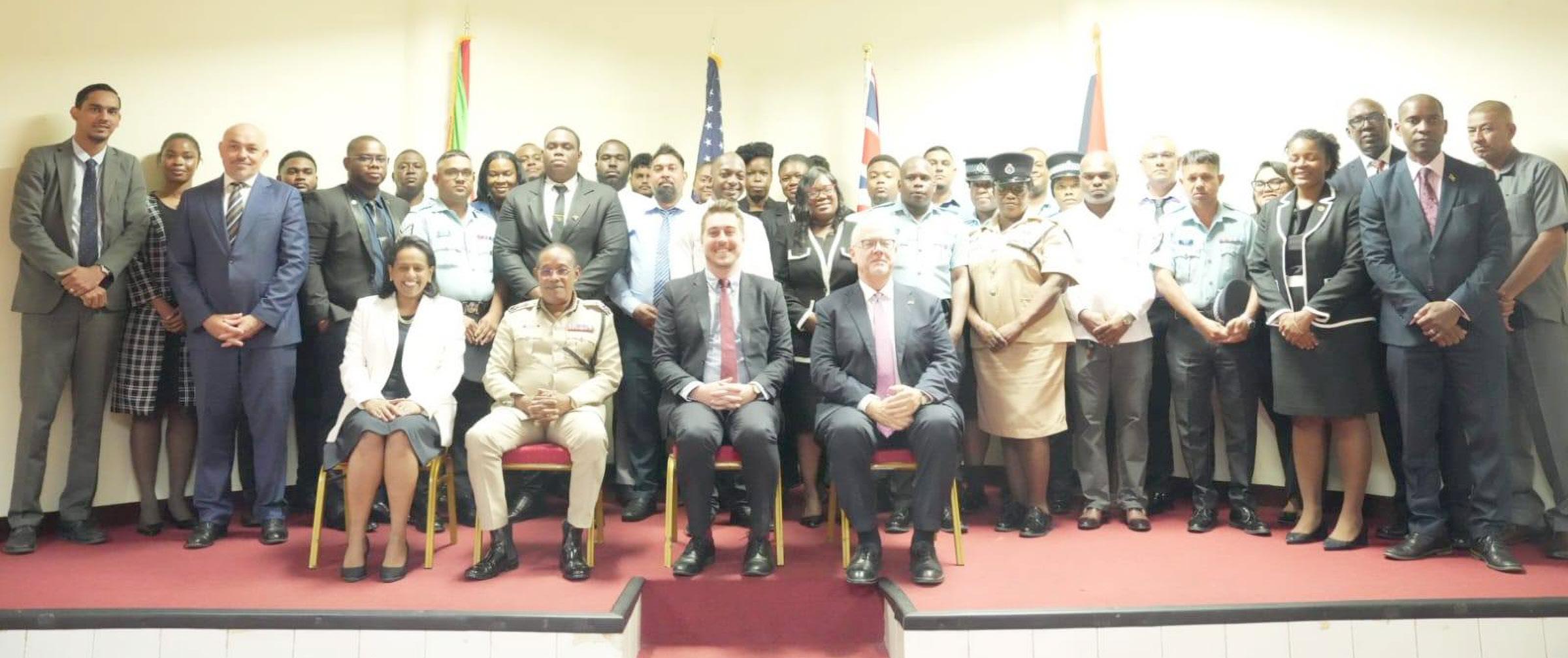
THE US Embassy Georgetown, in collaboration with the British High Commission, on Monday, opened a three-day anti-corruption workshop under the jointly funded U.S.-UK Criminal Justice Reform Project.
According to a press release from the US Embassy, the programme brings together 25 investigators and prosecutors from Guyana’s leading investigative agencies and the Office of the Director of Public Prosecutions to strengthen skills for investigating, prosecuting, and preventing corruption.
During the March 23 – 25 workshop, participants will focus on financial investigations, case-building, and international best practices for managing complex corruption cases.
As the first Guyana-based initiative under the multiyear project, which also supports criminal justice partners across Barbados and the Eastern Caribbean, the workshop advances the project’s broader objectives to modernise laws and practices, expand technical expertise, and reinforce effective interagency collaboration.
At the opening ceremony, US Embassy Deputy Chief of Mission, John Crippen, highlighted the persistent threat corruption poses to good
WITH support from the Greater Guyana Initiative, the Centre for Local Business Development will be hosting its fifth AccelerateHer business entrepreneurship programme, which offers an exciting opportunity for Guyanese women to access business acceleration workshops, and professional mentoring to grow their businesses.
The event targets women business owners, operators, and managers, and builds the leadership and business skills of women entrepreneurs in Guyana to help them grow companies across a wide variety of industries and sectors, according to the centre.
While it is supported by the GGI, the Ministry of Human Services and Social Security and the Women’s Chamber of Commerce and Industry Guyana (WCCIG) partner with this edition of the AccelerateHer programme. The programme is designed to enable the growth of small businesses with tailored workshops, access to one-on-one business advisory services, mentoring, pitch development, and fostering strong and supportive peer-learning environments for women. The centre says that with the predicted successful mentorship and peer-learning models, AccelerateHer matches a world

of professional mentors with participants based on their business background and focus. Moreover, the programme is aimed at motivating women entrepreneurs, who recognise the value of interactive and collaborative approaches to expand their business acumen and entrepreneurial skills.
The centre noted that women entrepreneurs seeking to expand their company, access new markets or to increase efficiencies and innovation, should consider applying to the programme.
The fifth AccelerateHer is expected to run from April to July 2026 and will be executed in two phases.
Phase one, which is scheduled for April 9 to 10, 2026, will include a weekend bootcamp with 30 participants, group sessions and
take-home activities, business model canvas, and value proposition development.
Phase two slated to be held from April to July will include selected participants from the bootcamp. They will participate in a ten-week programme, which will include mentorship, tailored coaching and workshops, weekly peer learning, and SWOT analysis of their business. And finally, graduation in July, which is also ‘demo’ day, which includes the graduation, awarding of certificates and interactions with the business community, potential buyers, and partners.
The application deadline for AccelerateHer 2026 is April 3, 2026. To learn more and apply, visit: https://centreguyana.com/ trainings/entrepreneurship/ accelerateher-2026/
governance and encouraged participants to apply the skills and interagency relationships developed during the workshop to address complex cases collaboratively.
Liam McShane, Chargé d’Affaires at the British High Commission in Georgetown, welcomed the agencies’ enthusiastic participation, which, he said, reflects strong
commitment to the “continued improvement and success” of Guyana’s criminal justice system. He added that, “this commitment to justice and public service is essential to the strengthening of Guyana’s institutions, as well as to the confidence and trust that citizens place in them.”
The United States and United Kingdom both underscored that corruption fuels transnational organised crime, hinders development, and weakens public trust.
Both nations said they look forward to strengthening co-operation with Guyana to improve accountability, criminal deterrence, and shared security.
The US Department of State’s Bureau of International Narcotics and Law Enforcement Affairs provided the US funding under the Caribbean Basin Security Initiative, a US security co-operation programme with Guyana and 12 other Caribbean countries to degrade and dismantle transnational criminal organisations, curb illicit narcotics, and deepen regional security co-operation.
Commissioner of the Guyana Police Force, Clifton Hicken, encouraged the participating officials to uphold accountability across the justice sector, uphold high character in their work, and apply the lessons of the training workshop.

--as cameras act as ‘witness, guide’ by turning apparent ‘minor activities’ into ‘big leads’
THE Guyana Police Force Command Centre has emerged as the “Digital Brain” of the Force, with a shift to a high-tech, intelligence-led era of policing.
The transformation did not happen overnight. The story of the Command Centre dates back to its beginnings as the National Emergency Response Operations Centre, once managed through the NDMA and operated by the Guyana Defence Force. What
began as a modest emergency hub has now evolved into a national powerhouse for real-time policing. Step inside on any given day or night, and you will find no pause, no lull.
A team of 911 call takers, dispatchers, IVS operators, supervisors, and duty officers rotate in twelve-hour shifts, ensuring that Guyana is never without eyes, ears, and support.
The phones ring constant-
ly. Some calls are urgent, some frantic, some hopeful. In 2025, almost 890,000 calls passed through these lines. More than 5,600 became active cases of crime, fire, medical emergencies, traffic incidents, and other public-safety concerns.
Even when the prank calls came by the hundreds of thousands, the discipline of the ranks never wavered. Behind every ring is a possibility of life, and so every call matters.
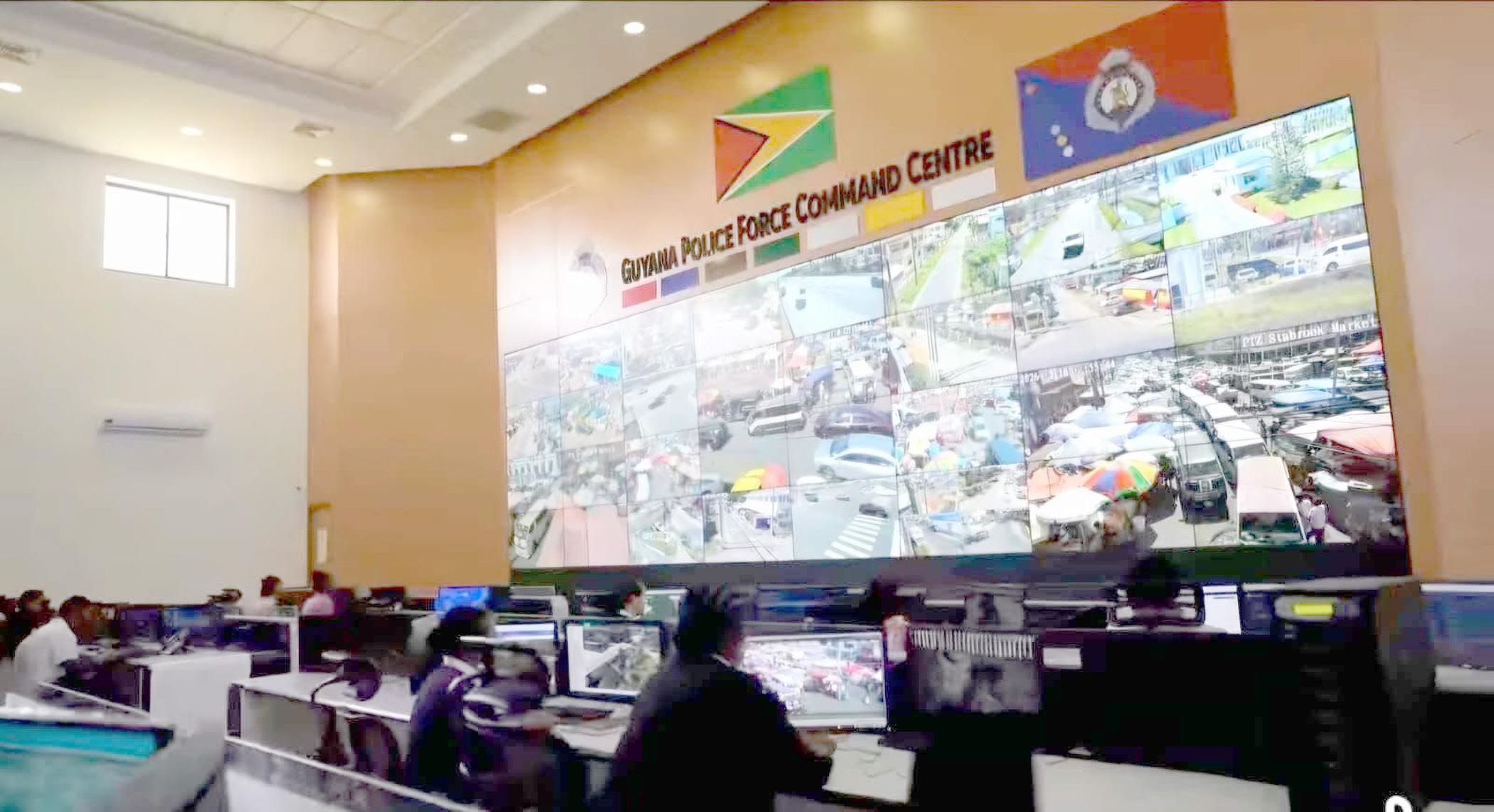
But the Command Centre’s strength is not limited to the lines it answers, it is also found in the vast network of cameras stretching across the country.
Born out of the Safe City programme and now expanding into Safe Country, this network covers strategic points in Regions Three, Four, Five, and Six, with Regions Two and 10 currently being outfitted under new phases.
Hundreds of camera sites have been installed, each location fitted with PTZ cameras, facial recognition units, license plate readers, and traditional bullet cameras. Every camera, every angle, tells a story.
Inside the Centre, operators watch these stories unfold in real time. A suspicious figure pacing at a street corner. A sudden gathering that seems to grow too quickly. A vehicle that doesn’t belong in the place it’s spotted.
A fight breaking out near a shop. A motorcyclist weaving recklessly through traffic. Moments like these are detected in seconds, and divisional patrols move out with clear intelligence guiding them. The cameras do not just record, they prevent, they protect, they interrupt. Many breakthroughs in
recent policing operations in have unfolded because of what the Command Centre observed. In several instances, intelligence gathered through the camera network has assisted investigators in tracing the movements of vehicles and persons of interest, enabling ranks to respond swiftly and effectively.
What may appear to be minor activity captured on camera can often provide critical leads, prompting further investigation and operational response. The cameras acted as both witness and guide.
And the Centre’s capabilities only continue to grow. Today, more than 11 million facial snapshots and over 30 million license-plate images sit securely in the system’s databases.
When investigators need to track a suspect, confirm a vehicle’s presence, validate a timeline, or extract footage for court, the Command Centre becomes the anchor of the case. The number of investigations strengthened by video evidence over the past year is in the hundreds, and rising.
Yet, perhaps the most impressive part of this operation is not the technology itself, but the people who
use it. Every camera feed is interpreted by trained eyes, every alert is assessed by a professional who must decide, often in a split second, what action is required.
The Command Centre collaborates daily with the Traffic Department, General Duty ranks, and specialised units, ensuring a flow of intelligence that strengthens every corner of the Force. Whether it is identifying speeding offenders, monitoring crowds at major events, or supporting anti-crime patrols, the Command Centre stands as the silent partner to every operation.
As the Safe Country initiative continues its phased expansion, the Command Centre grows with it, extending its reach deeper into the regions and offering more communities the protection of intelligent, modern policing. It represents the future the Strategic Plan envisioned, a Guyana where public safety is not reactive but proactive.
And so, the Command Centre is not just a room filled with screens. This multi-layered infrastructure, and public assistance improve the Force’s ability to detect incidents, track movement, and monitor crime patterns nationwide.
(Guyana Police Force)

—Attorney-at-Law Pieters emphasises
GUYANESE-Canadian attorney-at-law Selwyn Pieters, has emphasised that US-indicted businessmen Azruddin Mohamed and Nazar Mohamed’s cases are moving at “breakneck speed” in higher courts, but the substantive matter continues to “crawl” in the magistrates’ court.
“The Mohameds’ case is moving at breakneck speed. A case filed in January has made its way from the Magistrate’s Court to judicial review in the High Court, then to the Guyana Court of Appeal, and now to the Caribbean Court of Justice (CCJ) by the end of March. Justice on target,” he said in a post on his Facebook page.
Pieters, however, cautioned that while the extradition challenge has advanced quickly, the substantive proceeding before Principal Magistrate Judy Latchman at the Georgetown Magistrates’ Court is progressing at a much slower pace.
In emphasising his point, he said: “A caution though. The challenge to the extradition process has moved with breakneck speed to the CCJ. The substantive case is crawling at a snail’s pace through the Magistrate’s Court with only one witness evidence being taken since the January 6, 2026, commencement of the proceedings.”
The prosecution in the extradition proceedings recently raised concerns over the length of the cross-examination of its first witness.
Prosecutor Glenn Hanoman, speaking with reporters outside the courtroom, pointed out that the first witness, Permanent Secretary of the Ministry of Foreign Affairs and International Cooperation, Sharon Roopchand-Edwards, has been under cross-examination for more than two months.
According to Hanoman, the prolonged questioning reflects what he described as a deliberate slowing of the judicial process.
“We’re inching towards the end of cross-examination of the first witness. That witness was first called on the 6th of January, so she’s been under cross-examination now for about almost two and a half months — a masterclass in delay,” he said.
The Mohameds were sanctioned in 2024 by the United States Department of the Treasury’s Office of Foreign Assets Control (OFAC) over allegations tied to an illegal gold export and money laundering scheme involving under-de-
clared shipments, which is at the centre of the U.S. extradition request.
They are facing serious allegations in a federal criminal case filed in the United States District Court for the Southern District of Florida.
The indictment alleges that the Mohameds conspired to commit wire fraud, mail fraud, and money laundering.
Their extradition proceedings formally commenced before Magistrate Latchman on January 6, 2026, following their arrest on October 31, 2025, after an Authority to Proceed (ATP) was issued by the Minister of Home Affairs, Oneidge Walrond.
The High Court proceedings were initiated in late December 2025 and challenged the constitutionality of the 2009 amendments to the Fugitive Offenders (Amendment) Act, as well as alleging bias on the part of the Minister in issuing the Authority to Proceed.
A final ruling was delivered on February 4, 2026, by Chief Justice (ag) Navindra Singh.
An appeal against Justice Singh’s ruling was subsequently filed to the Court of Appeal in early February 2026, with a final unanimous decision delivered on March 17, 2026, by a panel of three judges, including Acting Chancellor of the Judiciary Roxane George-Wiltshire, SC.
While delivering the COA’s reasoning, Justice George underscored that Minister of Home Affairs, Oneidge Walrond’s role in issuing an ATP under the Fugitive Offenders Act is administrative and executive, not judicial, thereby nullifying claims of bias raised by the appellants.
“On the facts of this case, bias does not arise,” she stated.
The court found no evidence that the statutory procedures governing the issuance of the ATP were breached, nor that the minister failed to consider the legally required factors before granting approval for the extradition process to proceed.
Justice George affirmed that “there is no evidence” that the provisions of the Fugitive Offenders Act regarding the issue of the ATP were not followed.
The court also dismissed arguments that legal advice provided by Attorney General Anil Nandlall could constitute bias, stressing that such counsel falls squarely within his constitutional role as the government’s princi-
pal legal adviser.
“It cannot be that advice in terms of applicable case law… can be biased,” George said, adding that there was no evidence to support such a claim.
Further, the court rejected the contention that Minister Walrond should have delegated her authority to issue the ATP, clarifying that the relevant legislation

Guyanese-Canadian attorney-at-law Selwyn Pieters
does not provide for such delegation.
The Mohameds had argued that the ATP was tainted by political bias, citing Azruddin Mohamed’s political involvement and candidacy in the September 2025 General and Regional Elections.
However, both the High Court and now the Court of Appeal found no legal basis for that argument.
In its final determination,
the appellate court concluded that the appellants failed to establish any bias or impropriety that would invalidate the minister’s decision.
“The court is of the view that the Chief Justice was correct in dismissing the application,” George said.
The Court of Appeal ruling has since been appealed to the CCJ, which has already set a case management conference for Wednesday.


THE Guyana Police Force Traffic Department has recorded more than 4,000 traffic violations within a single week, with speeding continuing to dominate the list of offences, underscoring persistent concerns about road safety across the country.
According to the department’s latest report, a total of 4,189 cases were documented between March 15 and March 21, 2026. Of these, speeding accounted for a staggering 1,549 offences— by far the most prevalent violation—highlighting ongoing challenges in curbing dangerous driving behaviour on Guyana’s roadways.
Other major infractions included 156 cases of seatbelt violations and 59 instances of driving under the
such as the East Bank and East Coast Demerara corridors, where traffic volume has increased significantly in recent years due to ongoing infrastructure expansion and economic activity linked to Guyana’s rapid development. In addition to enforcement, the Traffic Department said it continues to prioritise public education as part of its road safety strategy. During the same period, ranks conducted a wide-ranging series of lectures and outreach activities targeting drivers, commuters, and business establishments.
These engagements were held at dozens of locations nationwide, including police stations, public roads, construction sites, and popular social venues, reflecting an effort to reach road users in
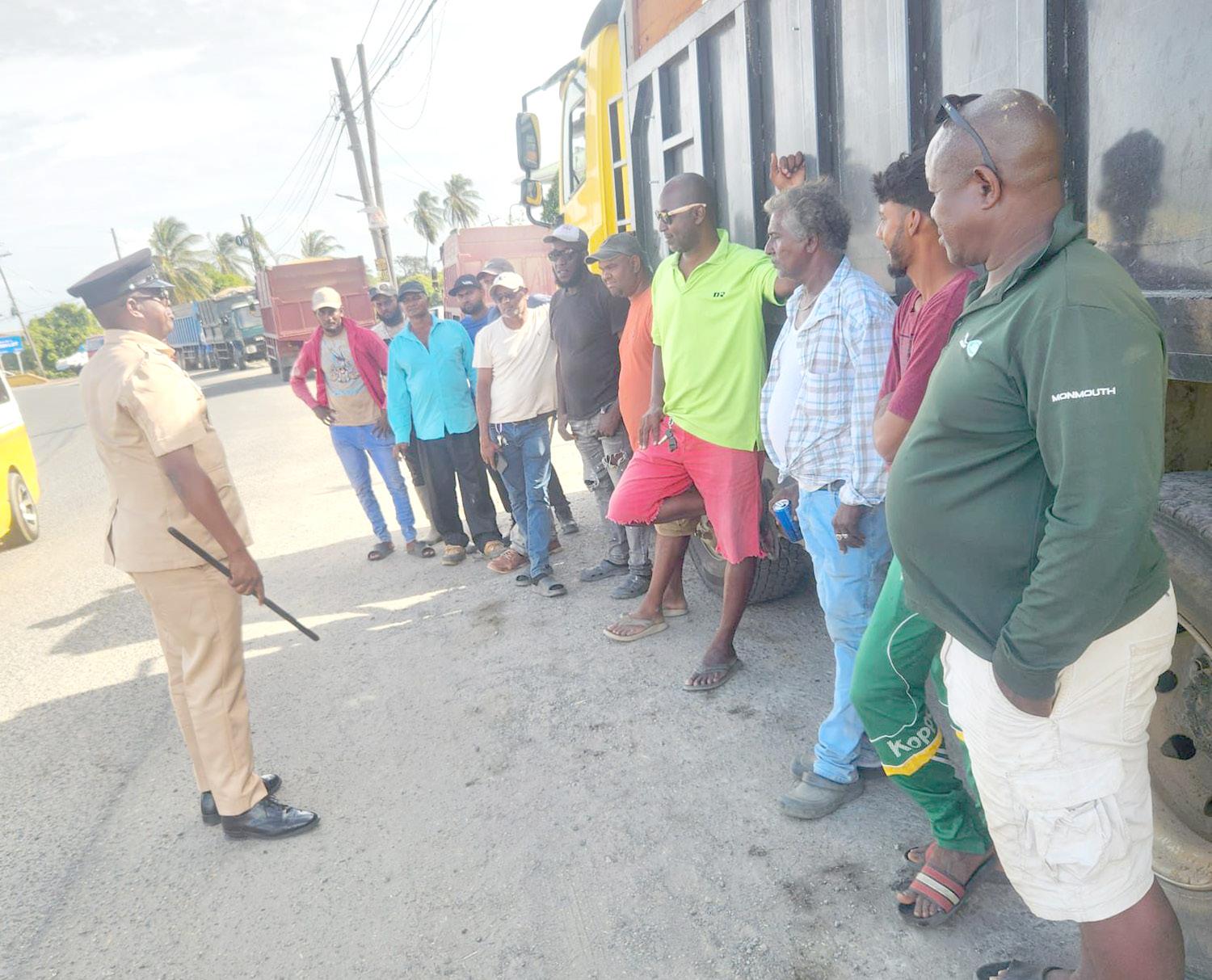
influence (DUI), both of which remain key contributors to road fatalities and serious accidents. The data also showed 132 cases of failure to wear safety helmets and 99 cases involving pillion riders without helmets, pointing to continued non-compliance among motorcyclists.
Additional offences recorded during the period included 137 cases of leaving a motor vehicle in a dangerous position, 84 unlighted vehicles (front), 75 unlighted vehicles (rear), and 64 breaches of prescribed fitness conditions. Authorities also cited 41 unlicensed drivers and 15 cases of breaches of traffic light signals. Lesser, but still notable violations, included faulty packing (23) and improperly tinted vehicles (3).
The figures come amid intensified enforcement efforts by traffic ranks, particularly along major roadways
both formal and informal settings. Outreach activities extended to areas along the East Bank and East Coast Demerara, Linden Highway communities, as well as hinterland regions such as Mahdia, Lethem, and North Rupununi.
Special emphasis was also placed on youth education, with traffic officers delivering road safety lectures at several schools across Regions Two, Four, Five, and Eight. These sessions aimed to instill responsible road use habits from an early age, authorities said.
The Traffic Department has repeatedly warned that speeding and impaired driving remain among the leading causes of fatal accidents in Guyana, and has urged motorists to adhere to traffic laws as enforcement and education campaigns continue.
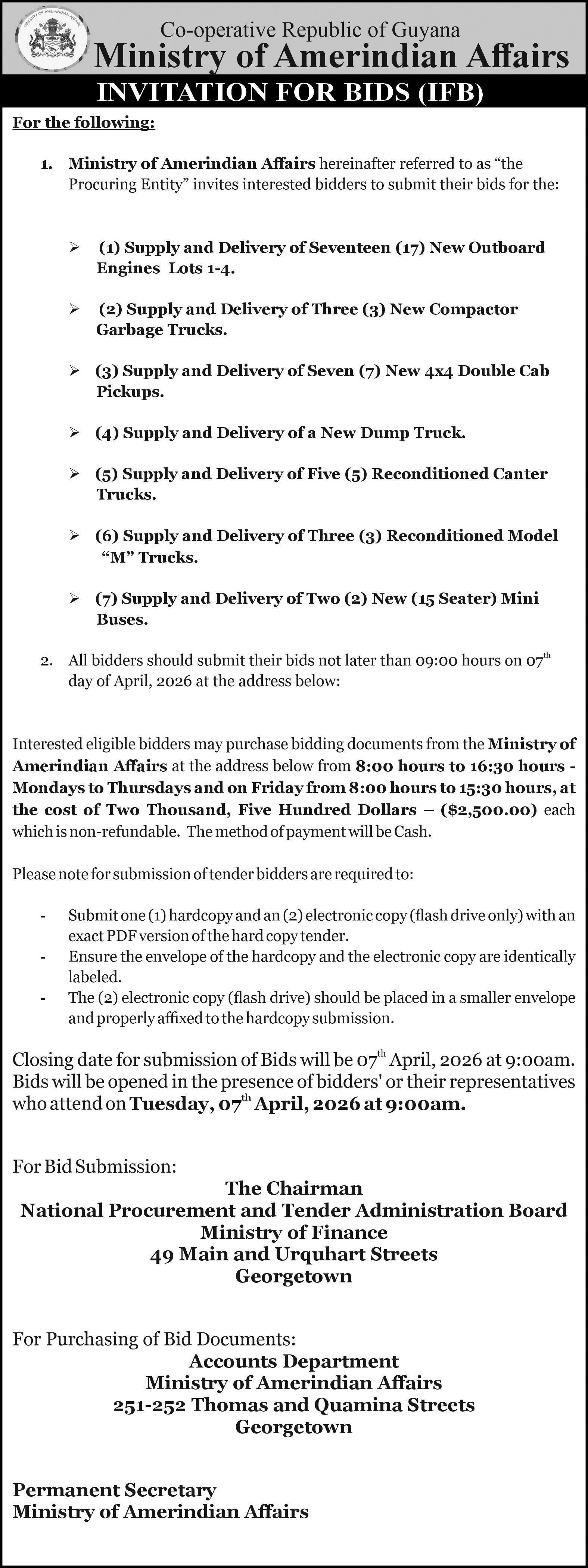
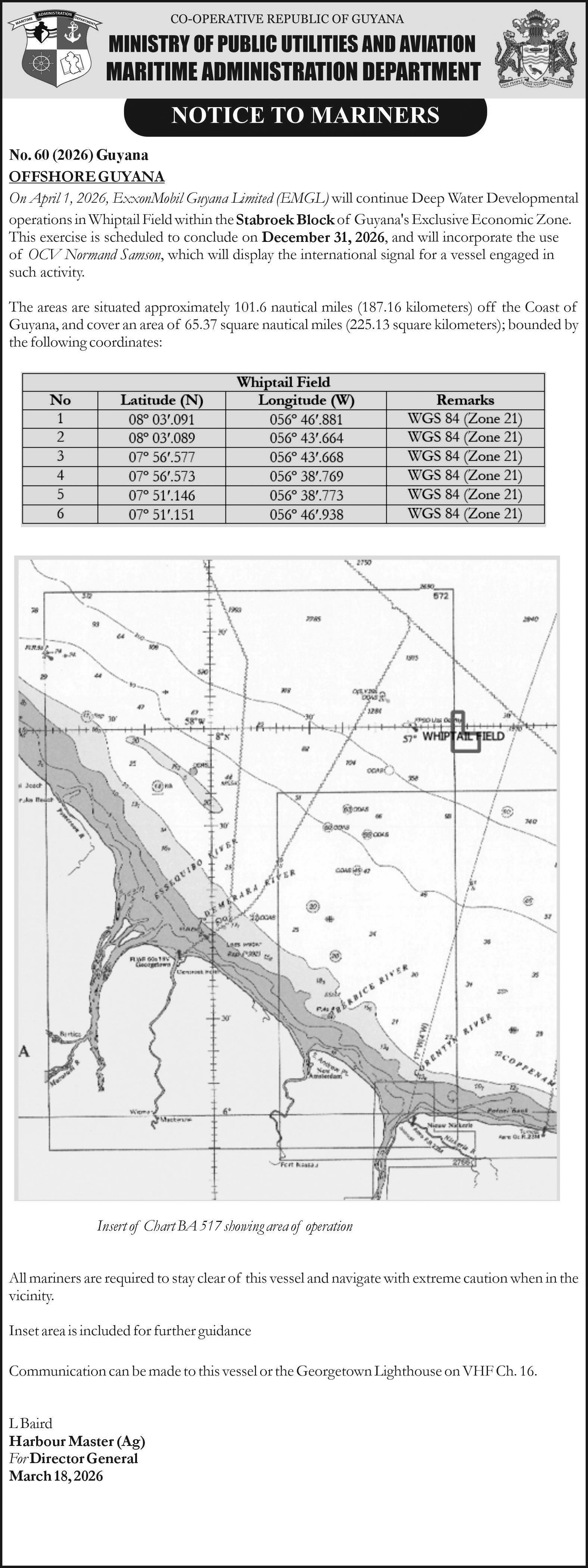


RWANDA'S Fanny Utagushimaninde says it was like "a dream" after becoming the youngest woman to make a Twenty20 international century at the age of 15 years and 223 days.
Opening batter Utagushimaninde made an unbeaten 111 from 65 balls on her T20 debut in a 122-run victory over Ghana at a tournament in Lagos, Nigeria.
She had reached three figures off 59 balls in the 18th over with a clip through mid-wicket off Ghana seamer Elizabeth Annor.
The teenager eclipsed the previous record held by Uganda's Prosscovia Alako, who was 16 years and 233 days old when she scored a
hundred against Mali in June 2019.
Utagushimaninde, who came through a schools programme in Rwanda supported by the Marylebone Cricket Club Foundation, told BBC Sport it was slightly surreal when she reached the milestone.
"It was a special moment for me and my cricket journey. A dream to achieve it on my debut at 15," she said.
"This shows my hard work, confidence and passion for the game. I'm grateful for the support from my coaches, team-mates and everyone around me.
"I will keep pushing myself to improve and achieve more in the future."
Utagushimaninde's score
was also the highest by a woman on T20 debut, beating the 96 made by Australia's Karen Rolton against England in 2005.
Rwanda coach Leonard Nhamburo added: "This record-breaking performance is a testament of the hard work and dedication she did put in.
"It's something that Fanny earned through years of sacrifice and unwavering commitment to the game and a true testimony of how development cricket is coming through in Rwanda."
France's Gustav Mckeon, at the age of 18 years and 280 days, is the youngest man to score a T20 international century for his 61ball 109 against Switzerland in July 2022. (BBC Sport)
mer Wales and Wimbledon football manager Bobby and has also previously served as the chief executive of Bristol City Football Club.
"My old man was a football manager," he said. "Sacking was part of the job and it wasn't necessarily the right thing. Moving people on can sometimes be the easy thing to do. That's not the route that we're going to take."

Covering a wide range of topics related to the Ashes tour and the fallout, Gould and Key said: there has been no "bust up" between McCullum and Stokes England does not want McCullum to "completely change", but to "evolve" behaviour of some players was "unprofessional" and there will be "new expectations" there is
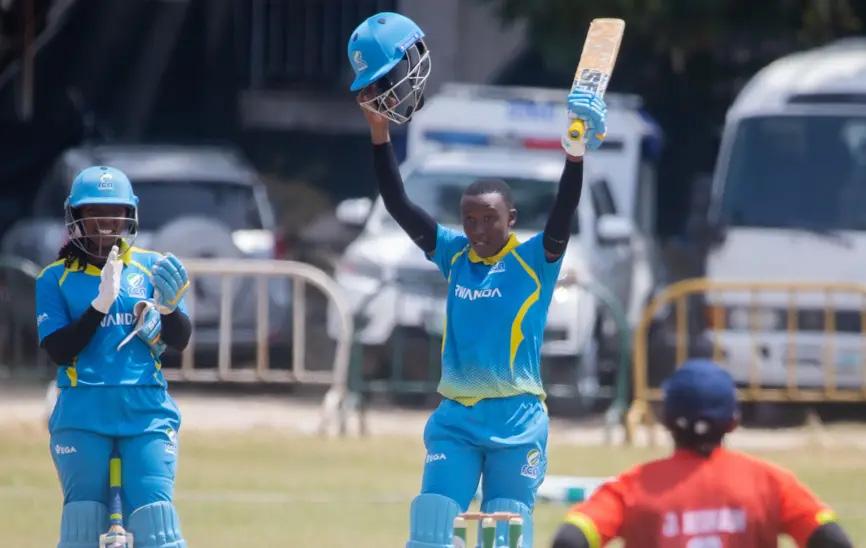
(From page 23)
not an "easy fix" to cricket's relationship with alcohol only 30-40% of this review is "new" and England must stop "relearning old lessons"
A review or report seems to habitually follow an Ashes defeat in Australia. On this occasion, the ECB has resisted changing personnel, possibly against the desire of some sections of England supporters.
Some measures have already been implemented. England used a specialist fielding coach during the white-ball tour of Sri Lanka and T20 World Cup, though Key confirmed additions to the backroom staff would continue on an ad hoc basis.
There was also a midnight curfew imposed on
players, while England is recruiting a new national selector and a new member of the board with an intention to boost cricketing expertise.
Beyond those changes, little new information was revealed by Key and Gould –perhaps an admission that the mistakes of the Ashes tour could have been prevented before the tour began.
McCullum and Stokes united as the leaders of the England Test team in 2022. Though both have continued to back each other in public, there was a clear divergence in their messaging in Australia.
Stokes referred to "weak men" in the dressing room, and asked for his players to "show some dog". As his
(Tuesday, March 24, 2026) COMPLIMENTS
Answers to yesterday’s quiz:
(1) AUST vs ENG, Melbourne, 1970-71
(2) Bill Lawry-AUST & Ray Illingworth-ENG
Today’s Quiz:
(1) Where and when was the first ever T20 International match played?
(2) Who were the assigned captains?
Answers in tomorrow’s issue
ability to score runs ground to a halt, the captain later suggested opponents have found ways to combat England's attacking style. In contrast, McCullum thought England too easily came away from their methods in Australia.
"At no stage was there any bust up or anything like that," Key told BBC Sport.
"There's this view that it's either blocking or slog -
ging - Ben's for blocking, Brendon's for slogging. That is not the case.
"We still want players to go out there and be aggressive, we still want players who can score runs against the best bowlers in the world. They've just got to be relentless in how they do it. Fundamentally there's alignment in the way we are going." (BBC Sport)
(From back page)
lion ($10.43 million) out of pocket due to ticket refunds and other costs, local media reported.
Roach spoke to media after CA unveiled Australia's home summer schedule, which includes a first-ever four-test series against neighbouring New Zealand starting in Perth on December 9, followed by tests in Adelaide, Melbourne and Sydney.
years, 20 years, who knows, but that does not guarantee development and continuity.”
Lawrence maintained that long-term planning should always trump qualifying for a particular tournament.
“We can continuously keep going and bringing in a coach closer to a tournament to try and achieve a shortterm goal and then when it doesn’t happen people are saying that the T&T team isn’t good. But for me that is not the correct way to do it.
(From back page)
“If you want to do it correctly, then use the resources you have on the island, improve and grow the development, and it might be integrated with some foreign coaches, because obviously foreign coaches bring a different skillset,” Lawrence said. However, he pointed out that several foreign coaches hired by the TTFA to deliver in big tournaments had also failed to deliver.

TWO years ago, they were the ultimate wild cards. This week, they arrive with a target on their backs.
After a stunning debut in 2024 that saw the Guyana Over-45 Men march all the way to a silver medal— falling just short in a 5-4 heartbreaker to hosts England—the South American nation is doubling down. Guyana has officially landed in Nottingham for the 2026 World Masters Hockey Indoor World Cup.
While the 2024 run caught the hockey world off guard, Guyana is expanding its footprint for the 2026 campaign, fielding four powerhouse rosters across the following divisions: Men’s Over-40, Over-50, and Over55 and Women’s Over-40.
Guyana Hockey Board
(GHB) President, Philip Fernandes, isn't tempering expectations, specifically pointing to the Over-40 Men as the bracket-buster of the tournament.
"The strongest contender would be the Over-40 Men's team," Fernandes told the media. "We have guys who have kept themselves fit and are very skilful. Last time, our pace gave us the edge. We have that same speed in our Over-40 group."
Fernandes is well aware that the element of surprise has evaporated. "The last time we were unknown... we caught them off guard," he noted. "This time, they will be looking for Guyana."
Perhaps the most anticipated addition is the Women’s Over-40 squad.
Comprising a veteran core
that has been the backbone of Guyanese hockey since the mid-2000s, the ladies are finally stepping onto the world stage to prove that their "competitive brand" of hockey travels well.
Preparation for this year’s quest was a massive upgrade from 2024. Improved access to upgraded training facilities allowed the teams to simulate the high-octane indoor environment they’ll face at the University of Nottingham.
The journey was fuelled by a massive community and corporate push. Heavy hitters like CEVONS Waste Management, Guinness, A&D Elevators (USA), and Rock Hard Cement have stepped up to ensure the Golden Arrowhead is represented.
BONES Hyland scored 23 points and Jaden McDaniels finished with 19 to lead the Minnesota Timberwolves to a 102-92 win over the host Boston Celtics on Sunday night.
Rudy Gobert added nine points and 14 rebounds for the Timberwolves, who won in Boston for the first time since 2005. Minnesota also received 17 points, eight rebounds and six assists from Ayo Dosunmu.
Minnesota outscored Boston 26-15 in the final quarter, even though Celtics scored the game's final six points.
Jaylen Brown led Boston with 29 points and seven rebounds. Jayson Tatum added 16 points and 11 rebounds for the Celtics, who shot 35.8% from the field (34 of 95). The loss ended Boston's four-game winning streak.
Nuggets 128, Trail Blazers 112
Nikola Jokic had 22 points, 14 rebounds and 14 assists, Jamal Murray also scored 22 points and host

Bones
Denver never trailed in a win over Portland.
Peyton Watson returned from a 19-game absence to score 14 points off the bench.
Cameron Johnson scored 19 points, Christian Braun had 15, Bruce Brown contributed 13 and Aaron Gordon had 12 as the Nuggets beat the Blazers for the 11th straight time on their home court.
Deni Avdija led Portland with 23 points and 14 assists, while Donovan Clingan hit a career-high four 3-pointers on his way to 18 points. Toumani Camara and Robert
Williams III scored 16 each, while Scoot Henderson finished with 13 points.
Suns 120, Raptors 98
Devin Booker scored 25 points and Jalen Green added 20 as Phoenix snapped season-worst five-game losing streak with a victory over visiting Toronto.
Collin Gillespie had 16 points for the Suns, who led wire-to-wire and avenged a 122-115 road loss to the Raptors on March 13. Jordan Goodwin scored 14 points, Ryan Dunn added 12 and Rasheer Fleming chipped in 11.
Scottie Barnes led the Raptors with 17 points. RJ Barrett and Ja'Kobe Walter added 13 apiece, Immanuel Quickley had 11 and Gradey Dick scored 10. Forward Brandon Ingram was held to six points on 3-of-10 shooting after averaging 25.8 points over his last five games. Toronto trailed by as many as 31 and lost its second straight following a three-game winning streak. (Reuters)
ENGLAND all-rounder Sam Curran has been ruled out of the Indian Premier League with an unspecified injury.
The 27-year-old was due to represent Rajasthan Royals for the first time but has been ruled out before the season opener on Saturday.
Curran has played 64 IPL matches, scoring 997 runs and taking 59 wickets.
He has been replaced by Sri Lanka T20 captain Dasun Shanaka, who has previously played for Gujarat Titans in the 2023 campaign.
"We are disappointed to lose a player of Sam's calibre so close to the start of the season," said Rajasthan

Royals Director of Cricket and Head Coach, Kumar Sangakkara.
"Sam brings immense value with both bat and ball.
However, we are pleased to have found an ideal replacement in Dasun Shanaka, a finisher with the bat and a quality all-rounder who helps maintain the balance of our side."
The Royals' first game is against Chennai Super Kings on 30 March. (BBC Sport)
KINGSTON, Jamaica, (CMC) – JAMAICA’S
Reggae Boyz will be without the services of winger Demarai Gray and midfielder Kevon Lambert for their upcoming FIFA World Cup playoffs.
Both players were named in head coach Rudolph Speid’s 27-member squad to face New Caledonia on

March 26 in Guadalajara, Mexico. A victory will see them advance to take on DR Congo on March 31 for a spot in the 2026 World Cup.
However, the 29-yearold Gray, who has seven goals in 29 appearances for Jamaica, suffered an injury during Birmingham City’s 1-0 loss to Derby County on Saturday in the English
Championship.
It will be the third time in as many months that Gray will miss international duty through injury, having also withdrawn during the September and October windows for the final round of CONCACAF World Cup qualifying.
Tivoli Gardens forward Nickalia Fuller, who has
five goals in the Jamaica Premier League this season, has been named as Gray’s replacement.
Meanwhile, Lambert has also been ruled out through injury, but his replacement has yet to be named.
The team is expected to depart for Guadalajara today ahead of Thursday’s clash with New Caledonia.
FOR the first time, Royal Challengers Bengaluru (RCB) begin an IPL season as defending champions. They had come close in 2009, 2011 and 2016, but fell short at the final step each time. Through all those heartbreaks, one constant remained - Virat Kohli - who had been part of every rise and fall, waiting for this moment to arrive.
When it finally happened, it felt less like a celebration and more like a release of everything that had come before it.
"It was a very special night for all of us at RCB. I have been here since day one and so has Ramesh Mane [Team Masseur and Caretaker]. We are probably the
oldest members of the RCB group," Kohli said ahead of the 2026 IPL season, revisiting the winning moments of 2025.
RCB went into the final against Punjab Kings with belief, but without getting carried away. Kohli said the team was confident, while also aware of the quality of the opposition and the demands of a final.
"When we reached the finals, I felt a sense of calm confidence. But you also understand it's not going to be a cakewalk. It's a Final and there is another team who has played really well to get there. Obviously, they have also beaten a lot of good sides so they are also very confident of what they want to do."
THE initial matches of the Pakistan Super League (PSL) will be played behind closed doors in Lahore and Karachi, the country's cricket board (PCB) chairman, Mohsin Naqvi, said on Sunday, a fuel shortage caused by the conflict in the Middle East.
The franchise-based Twenty20 league, set to kick off on Thursday, also cancelled its opening ceremony in Lahore as it scaled back from six venues to two.
"Fans will be able to receive refunds for tickets and we apologise to them for the inconvenience... we pray that the situation in the region returns to normal soon," Naqvi, who is also Pakistan's interior minister, told a press conference.
Naqvi said the decision was taken after a meeting with the league's franchises.
"The Prime Minister (Shehbaz Sharif) requested
The past disappointments could have weighed them down, but Kohli felt it had the opposite effect. Those near misses helped the team stay steady in the big moments.
"Given the history of the near misses and the almost moments of the past where we reached the finals and we could not win, I think that gave us extra motivation to hold our nerve. Because the league has become so much more competitive, we must have played really good cricket to get to the finals. It's not a fluke; it's not by chance. We have beaten some really good teams, and we are an amazing team which has earned the right to be here on this day."
As the match moved towards its conclusion, Kohli
said the occasion became deeply personal. The result brought with it a rush of memories from his long journey with the franchise.
"All in all, it was an amazing night for all of us. It was quite surreal for me honestly, quite unbelievable when it was all unfolding in the end. So many things flashed in front of your eyes. The whole journey for 18 years. All the ups and downs, all the good moments, bad moments. It's like the accumulation of all of that is unfolding in front of you and that is going to happen in the next ten minutes. It's a very difficult thing to explain. It's a thing to experience. And that experience I will never ever forget."
Even when the result was almost certain, the nerves did
not completely settle. Kohli admitted that the final over, especially the wait for the last few balls, felt like the hardest part of the night.
"Especially the last over where you know the game is sealed. Hoping that Josh [Hazlewood] doesn't bowl a no ball which he never
does. There was quite confidence but still as I said, you are hoping for the perfect result. So, knowing that the game is beyond them and then to wait for those last three balls was probably the toughest part of the night," recalled Kohli. (Cricbuzz)
EIGHT-YEAR-OLD
Bryson Medford, a right-handed batsman, is the youngest cricketer to benefit from “Project Cricket for young and promising cricketers in Guyana, the joint initiative between Anil Beharry, a former long serving BCB executive and Kishan Das of the USA.
all of Pakistan to restrict their movements because of the fuel crisis. We closed schools and instituted from home and increased the number of Eid holidays. We don't know how long this war will last," Naqvi said.
"But we can't ask people to restrict their movements and then have 30,000 people in stadiums every day. We decided that as long as this crisis is ongoing, we will not have crowds at matches."
Naqvi said the league would streamline its operations to minimise team movement.
"We don’t know how long the current situation will persist, but hosting the PSL is essential. It's an international brand, and foreign players are involved... if we had postponed the PSL, there would be no window later to hold it," he added. (Reuters)
Bryson’s uncle, Sean Cameron, reached out, indicating that his nephew is madly in love with cricket and is in need of a junior bat.
The Meten-Meer-Zorg Primary School student was the recipient of one cricket bat. Young Medford was advised to balance his cricket with his academic life.
Over the years, many Guyanese cricketers benefitted from this project, some of whom went on to represent West Indies at different levels.
Total cricket related items received/purchased so far: $786,146 in cash, 13 coloured cricket uniforms, one set of stumps, two trophies, 36 pairs of cricket shoes, 40 pairs of batting pads, 49 cricket bats, 48 pairs of batting gloves, 29 thigh pads, three pairs of wicket-keeping pads, six arm guards, two chest pads,
two boxes, 15 gear bags, 13 bat rubbers, seven helmets, one fiber glass bat, one pair of floppy hat, 16 boxes and four of white cricket balls, 13 boxes of red cricket balls, one bat cone, one batting inners and 28 footballs.
To date, 106 players from all three counties of Guyana have benefitted directly from cash, 10 gear bags, two trophies, four arm guards, 43 bats, four boxes, six helmets, 38 pairs of cricket shoes, 22 pairs of batting pads, 25 thigh pads, one bat grip, 42 pairs of batting gloves, one pair of wicket-keeping pads and four pairs of wicket-keeping gloves.
Cricket related items, used or new, are distributed free of cost to young and promising cricketers in Guyana. Skills, discipline and education are important characteristics of the recipients. Talent spotting is being done across the country and club leaders also assist to identify same. Progressive and well managed cricket clubs with a youth programme will also benefit.
Anyone interested in contributing can contact Anil Beharry on 623 6875 or Kishan Das on 1 718 664 0896.

By Frederick Halley
THE year 2022 was a memorable year for Regal teams at the 16th edition of the South Florida Softball Cricket League (SFSCL) with the three-day tournament belonging almost exclusively to the two Guyanese outfits as both the Masters Over-40 and Legends Over-50 teams emerged victorious in their respective categories in emphatic fashions.
The Over-40s brushed aside Corriverton Masters by 67 runs while the Legends crushed Toronto Blizzards by 79 runs in one-sided affairs
To crown an excellent final day, players from both teams copped all the individual awards with Chien Gittens and Ramesh Deonarine easily winning the Most
Valuable Player (MVP) prizes in the Over-40 and Over50 categories respectively.
Gittens also took the MVP of the final prize and another trophy for scoring the most runs in the Over-40 division.
Apart from copping the MVP prize, Deonarine took home trophies for scoring the most runs and for claiming the most wickets in the Over50 category.
Not to be outdone, the late hard-hitting left-hander Eric Thomas won the MVP of the final award for his masterful innings of 62.
Fast forward to 2024, which saw a significant development, with the defending champions Regal Legends joining forces with New York Hustlers to form Regal NY Hustlers and Regal Masters opting not to participate.
Despite reaching the fi -
nal, it wasn’t the result the Over-50 combination was aiming for, suffering defeat at the hands of nemesis New York Softball Cricket League (NYSCL) in a low scoring final.
Despite not emerging winners, one player stood out, copping the MVP award for the second consecutive Florida Cup, for his sparkling batting performances but has since gone into exile because of ill health.
Essequibian lefthander, Ramesh Narine, a long-standing player for Regal Legends, blasted 109 off 51 balls versus Marine Legends, spanking seven fours and seven sixes in the process, 85 off 37 balls (four fours and four sixes) versus Shaw Realty an undefeated 75 off 32 (four fours and eight sixes) in the semi-final

against Orlando Legends after earlier hitting 69 versus the same team prior to the semis.
That “partnership” be -
tween the Guyana/New York combination has since been severed and with Regal Legends “going alone,” they are aiming to enter winners’ row
in this year’s tournament which bowls off on Friday. Veteran all-rounder, David Harper, has since taken over the reigns of Regal Legends, replacing pugnacious opener Uniss Yusuf, based on adopted rotation policy and will be leading the Campbellville-based star-studded team on his first overseas sojourn following a few matches on the local circuit.
The 15-man squad comprises: David Harper (captain), Mohendra Arjune, Eon Abel, Jagdish Persaud, Nandram Samlall, Stanley Mohabir, Richard Driffield, Troy Gobin, Mahendra “Bobby” Parasnauth, Parsram Persaud, Uniss Yusuf, Roy Persaud, Rudolph Baker, Surujdeo Ramdeen and Khemchand Dindyal.
Sachin Pitamber seized a pivotal opportunity to place himself at the top of the heap, on Sunday, after round 8 concluded in the Guyana Chess Federation National Men’s Championship at the David Rose School compound.
Pitamber, with one round to go, is on 6.5 points after a few rare blunders from defending champion Candidate Master Taffin Khan who was displaced from the top in the last few rounds.
The leader Pitamber, after a decent start in the first 4 rounds, picked up the pace, beating Ronuel Greenidge in round 5 with black pieces.
He went on to secure a huge upset in round 6 against
FIDE master Anthony Drayton, followed by a win over Leslie Campbell in round 7 and a draw against Rolex Alexander in round 8. Kyle Couchman, Anthony Drayton and defending champion Khan are tied on 6 points for places 2-4. Couchman beat the likes of Alexander, Jaden Taylor, Khan and Keron Sandiford to secure second place in the race for the 2026 title.
While in the national women’s championship after draws in her first two clashes, Candidate Master Aditi Joshi has been unbeatable to maintain her place at the top of the table.
In the last 4 rounds over the weekend she defeated Ciel Clements, drew with
SACKING head coach
Brendon McCullum after England's Ashes debacle would have been the "easy thing to do", according to England and Wales Cricket Board chief executive, Richard Gould. McCullum, director of

Jessica Callender, beat WCM Sasha Sharif and rising star Kataleya Sam. She has 7 points in her 8
outings to top the standings for the women’s title, which include 2 draws and 6 wins.
cricket Rob Key and Test captain Ben Stokes are to remain in their posts despite the 4-1 Test defeat in Australia, a tour blighted by poor planning, substandard performances and off-field issues.
Gould was speaking alongside Key at Lord's on
Monday, discussing the findings of a review of the tour.
"I've seen the driving ambition and determination that we're lucky enough to have within our leadership group to take the lessons from the Ashes and move forward," said Gould.
"These are all individuals that have got other things that they can do in their lives. They are all committed to doing the best for England and to learning the lessons that are evident."
Gould is the son of for-
to page 20)
WCM Sharif is in second place with 6 points after four outright wins and 4 draws. In third place is another
former national champion, Jessica Callender, on 5.5 points after 3 draws and 4 wins.



SHAKEEL Babb proved he is a cut above the rest, claiming the overall title at the 'Battle of the Rising Stars 2' Novice Bodybuilding Championship on Sunday night.
The Razor Athletics standout flexed his way to the top prize at the Ramada
Princess Hotel, East Bank Demerara, outlasting a field of Guyana’s most promising newcomers. In front of a crowd of over 400 spectators, Babb's conditioning and symmetry earned him the nod from the judges as the night's premier athlete.
Babb’s journey to the
overall crown began earlier in the evening when he secured the Under-143 lbs category. However, the final "posedown" was a heavyweight clash of disciplined winners.
To secure the ultimate title, Babb had to overcome stiff competition from his
MELBOURNE,( Reuters)
– AUSTRALIA’S cricket board will resist calls to exert greater control over the nation's test wickets despite a pair of two-day matches during the Ashes that cost the local game millions of dollars.
The first Ashes test against England at Perth Stadium and the fourth at the Melbourne Cricket Ground (MCG) were decided in two days, prompting widespread criticism of the pitches' preparation.
While the Perth wicket was rated highly by the International Cricket Council's match referee, the MCG pitch was given an "unsatisfactory" rating for being too much in favour of the bowlers after 36 wickets fell.
Test wickets are prepared independently by ground staff at the venues but after day one of the Melbourne test, Cricket Australia (CA) CEO, Todd Greenberg, said

it would be "hard not to get more involved" in them, saying two-day matches were bad for business.
On Monday, however, CA's head of operations, Peter Roach, said the governing body would keep its distance, saying Australia's vast size and different conditions made it impractical to centralise pitch preparation.
"It's inconceivable that we could ever control much more than we do now," Roach told reporters on Monday.
"In England, you could put in a central curator to go or New Zealand, or South Africa, because the wickets and the clays and the climates are so similar.
"In Australia, because they're so different, you could put the best curator in Australia to a different venue and all of a sudden they're an also-ran for a while.
"Because they wouldn't know the characteristics and the climate and how those pitches respond to that."
Test matches last up to five days, with most finishing within four. But two-day tests are very much a rarity.
The lost days of cricket in Perth and Melbourne were a huge financial blow for Australian cricket, leaving CA nearly A$15 mil -
(Turn to page 20)
own gym-mate and local rivals.
Despite the size disadvantage against the heavier classes, Babb’s razor-sharp definition told the story.
Speaking to the media following his victory, the newly crowned champion was quick to praise his men-
tor, three-time Mr Guyana Darious Ramsammy, for guiding him through a gruelling maiden prep.
Summary of Results
- Overall Title: Shakeel Babb; Men’s Physique: Enimen Eitokpah; Over 176 lbs: Jonathan Nedderman; Under 176 lbs: Enimen Ei-
tokpah; Under 165 lbs: Vijai Rahim; Under 143 lbs: Shakeel Babb
The event, organised by the Guyana Amateur Bodybuilding and Fitness Federation (GABBFF), served as a vital platform for the next generation of Guyanese muscle.
Lawrence: Yorke should have been given more time
PORT OF SPAIN, Trinidad, (CMC) – FORMER
Trinidad and Tobago football coach and national player, Dennis ‘Tallest’ Lawrence is in disagreement with the Trinidad and Tobago Football Association’s (TTFA) decision not to renew the contract of former head coach Dwight Yorke.
Lawrence, who became an instant football legend in 2005 when he scored the winning goal for T&T against Bahrain to send them to their first and only FIFA World Cup one year later, contended that Yorke had not been given enough time at the helm.
Speaking during an interview on Isports on i95.5 FM recently, the 51-yearold assistant head coach of Championship side West Bromwich Albion, said continuity was importance to any coach’s success.

tions broke down.
“In my opinion, coaches need time, especially in a job like the T&T job. I did not follow the whole process of what Dwight did etcetera, I’m speaking about all coaches on a whole and that would include Dwight.
Yorke was appointed T&T head coach in November 2024 and given a mandate by the TTFA to qualify for the 2026 FIFA World Cup.
However, he failed to do so and the two parties eventually parted ways last month after salary negotia-
“What I do know is that if you’re bringing in a coach that doesn’t have the wealth of experience like Dwight… and you’ve just used a campaign to give him experience, what is the harm in taking that experience that he’s just gained and extending it and hopefully then thinking that for the next campaign he would be in a better position,” Lawrence said.
“We’ve never tried things like that. We’ve always brought in a hit man to qualify for a campaign…and if you continue to keep doing it that way you may hit one again in the next 10 years, 15
(Turn to page 20)