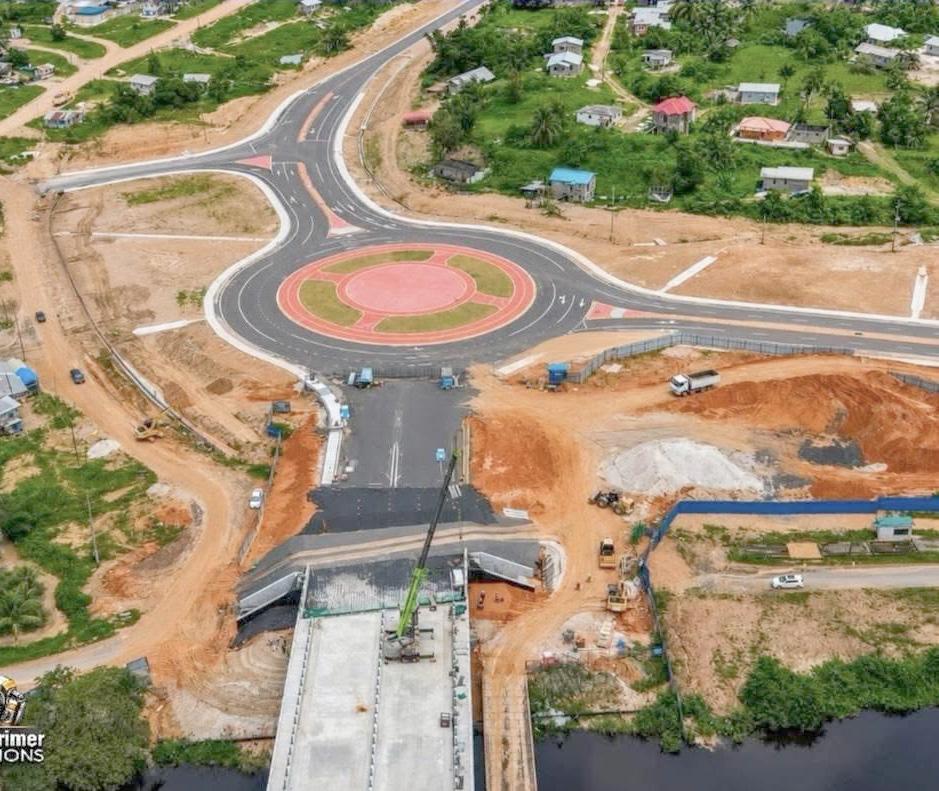
As part of the modern design to eliminate the old bottlenecks, the new four-lane toll-free Wismar-Mackenzie Bridge in Linden, Region 10, has two roundabouts anchoring both the eastern and western approaches (Photo: Ministry of Public Works/Facebook)
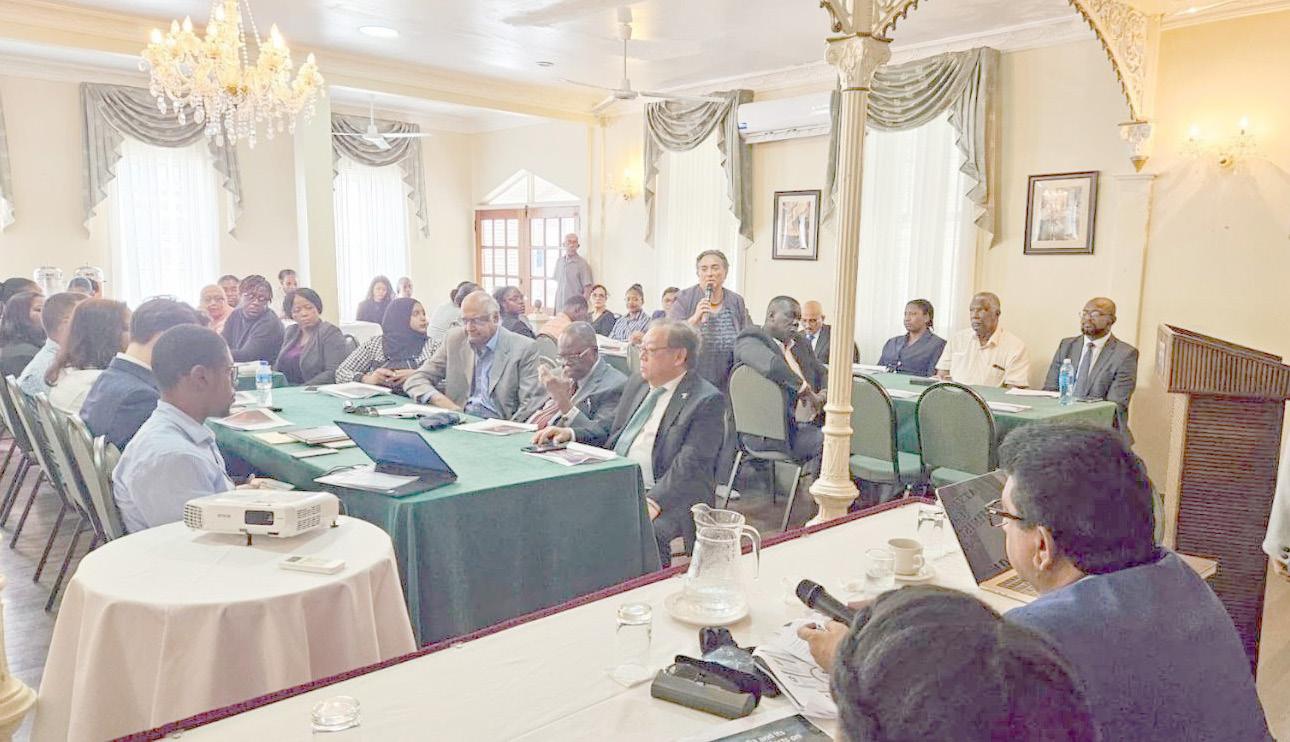
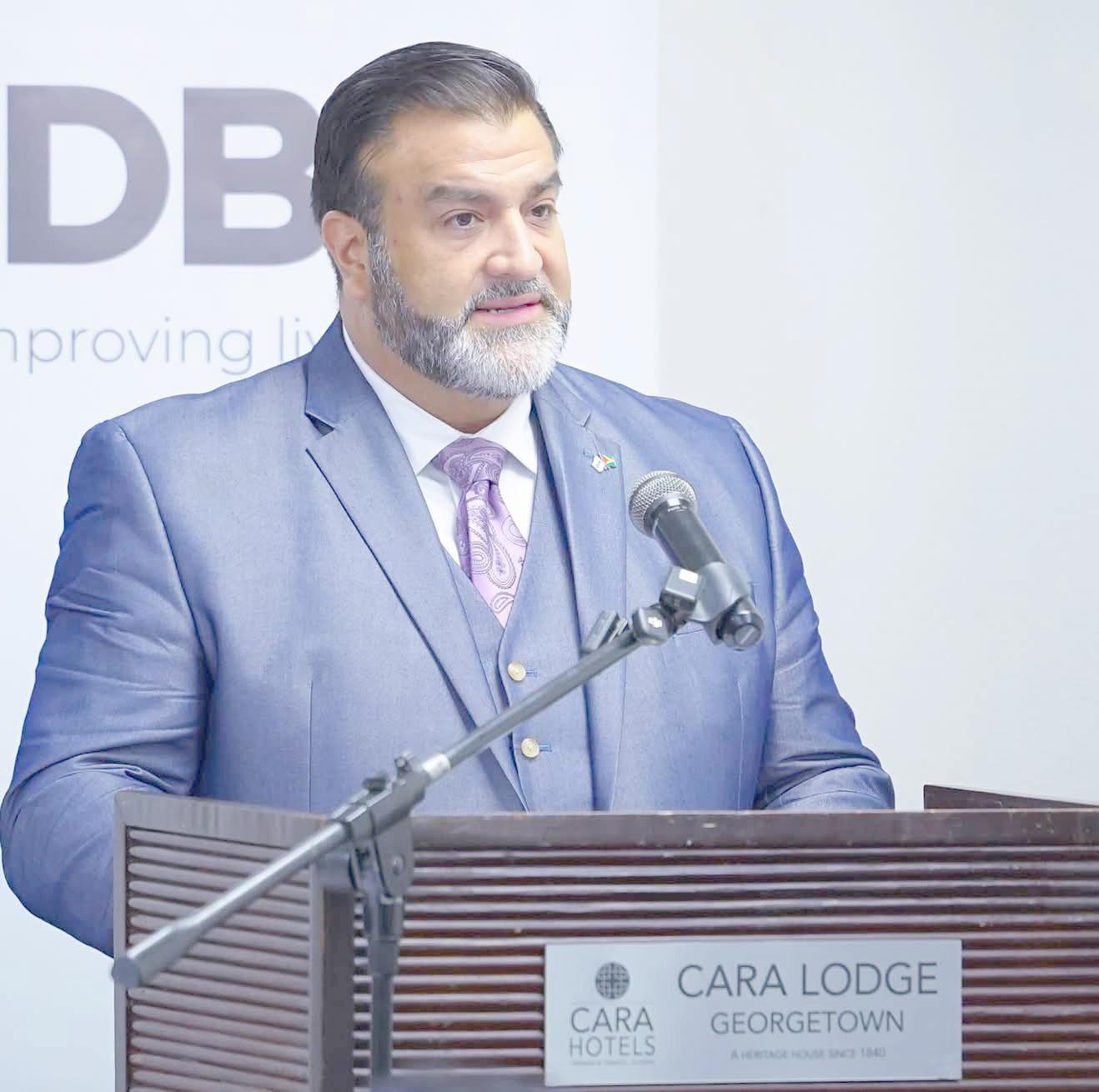
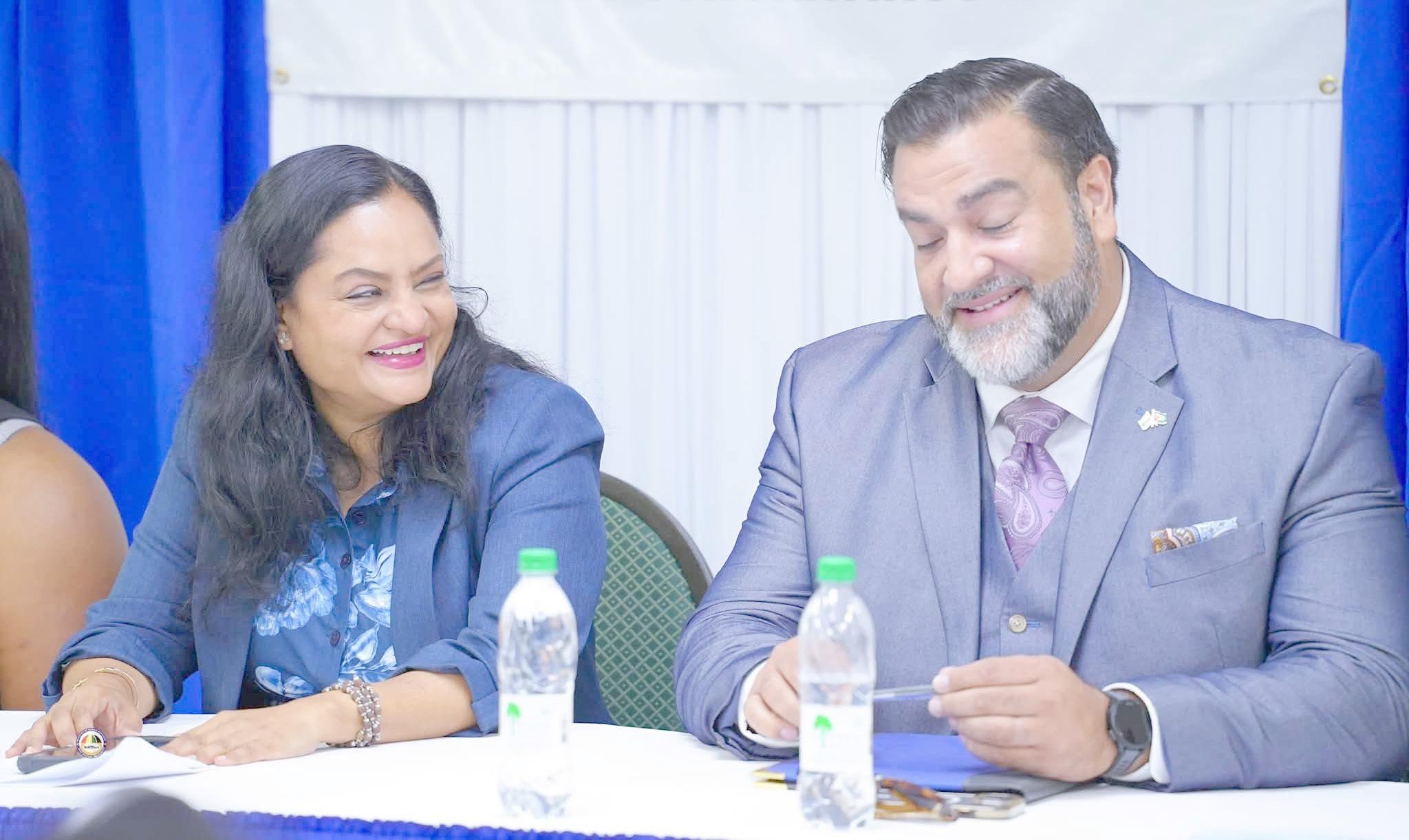
The Attorney General’s Chambers & Ministry of Legal Affairs, on behalf of the Government of Guyana, held a consultative engagement at Cara Lodge, Quamina St, Georgetown, with the legal fraternity on the issue of “social media and its consequential effects on children”. The gathering included representatives of key legal institutions of Guyana, including, the Judiciary, the Director of Public Prosecutions, the Law Revision Commission, lawyers from the public sector, as well as the practicing Bar. Former Chancellor Carl Singh OR, Prof. Kenneth Benjamin from the Law Department of the University of Guyana, Justice (Ret’d) Winston Patterson, Ombudsman and Justice (Ret’d) Lisa Shoman, General Counsel of CARICOM were also in attendance. Deputy Solicitor General, Shoshanna Lall chaired the proceedings, Deputy Chief Parliamentary Counsel, Joann Bond delivered a PowerPoint presentation, and Attorney General Anil Nandlall delivered remarks (Photo: Mohabir Anil Nandlall SC MP/Facebook)
Guyana is open to partners, but ready to compete –– President Ali says
PRESIDENT Dr Irfaan Ali has warned that while Guyana is open to regional and international partners, it will not hesitate to compete and “break the locks open” in markets that continue to restrict Guyanese products.
The president said this while speaking at CAM Motors’ unveiling of its Foton and Jetour lines of vehicles on Saturday.
President Ali said that Guyana is moving to build a sophisticated manufacturing and assembly base beyond the oil and gas sector.
“I say to my friends across in Trinidad, Jamaica, all across the Caribbean, the DR [Dominican Republic], we want you to invest with our local private sector in the agro-processing industry, the manufacturing industry.” the Head of State said adding:
“We’re going to build it, the best agro-processing industry you will ever dream of. We’re going to build it right here in
Guyana, and it’s going to be built in the next four years.”
Framing Guyana’s posture as one of partnership, but with firm expectations of fairness, President Ali signalled that his government is prepared to confront protectionist barriers in the region.
“If there are economies in the region that will continue to lock our products out, we’re going to break those locks open, because we believe in reciprocity.
He stressed that the first invitation is to partner, particularly in agro - processing and manufacturing, but cautioned that Guyana would compete aggressively if necessary.
“If you’re not going to be part of it, we’ll compete with you, and we’ll beat you out of the market. I can assure you that the first invitation is to partner,” he said adding:
“We know that we have contributed significantly to this region, and we cannot only be a country that is celebrated because of our potential, we have to be a country that is celebrated because we have converted potential into opportunity and opportunity into success.”
He also pointed to the emerging opportunities from Cuba and Haiti opening up, and deeper integration with northern Brazil and the Dominican Republic, describing the potential market expansion as “immense” if supported by a conducive policy environment on taxation, energy costs, technology
and government incentives
PRIVATE SECTOR BACKED ‘ONTO EVERY INCH OF SUCCESS’
President Ali used the CAM Motors partnership to underscore his government’s commitment to “the explosion of private capital” and to nurturing young entrepreneurial leadership.
“Our private sector knows that they have a government that is backing them right on to every inch of success”, he said challenging local investors to demonstrate their readiness to seize larger opportunities, including in tourism.
He disclosed that he has already challenged the private sector partners behind the venture to position Guyana as an assembly hub for emerging automotive brands, insisting the country must not negotiate “from a position of being a selling destination” but as a location with the innovative capacity and capability to do far more than act as a “warehouse” or “showroom”.
“Our ambition must be to develop an ecosystem around every single business initiative that we pursue… tonight (Saturday) is not about launching the sale of a new brand, tonight is about the building of an ecosystem, an ecosystem that will support creativity, support innovation, and support service delivery.”
Earlier this year, the government moved to op-
erationalise a raft of fiscal incentives and tax-relief measures after Senior Minister in the Office of the President with responsibility for Finance, Dr Ashni Singh, successfully piloted the Fiscal Enactments (Amendment) Bill 2026 through the National Assembly, following the conclusion of consideration of estimates of expenditure of the 2026 National Budget.
Among the most consequential provisions was the removal of corporate taxes on agriculture and agro-processing businesses, a move the government had said will promote productive activity and diversification. The measure is expected to increase retained earnings and drive reinvestment to boost output and productivity in the agriculture value chain.
The Bill also expanded the export-allowance framework to include value-added timber products, a step aimed at enhancing the competitiveness of exporters by reducing their effective tax burden and allowing them to price goods more competitively on international markets.
Further support for domestic manufacturing also came on stream with the removal of VAT on locally made furniture, including doors, moulding, and beds, as well as on locally produced jewellery.
These measures are intended to lower construction costs, strengthen the forestry and jewellery subsectors, and support local manufacturers.
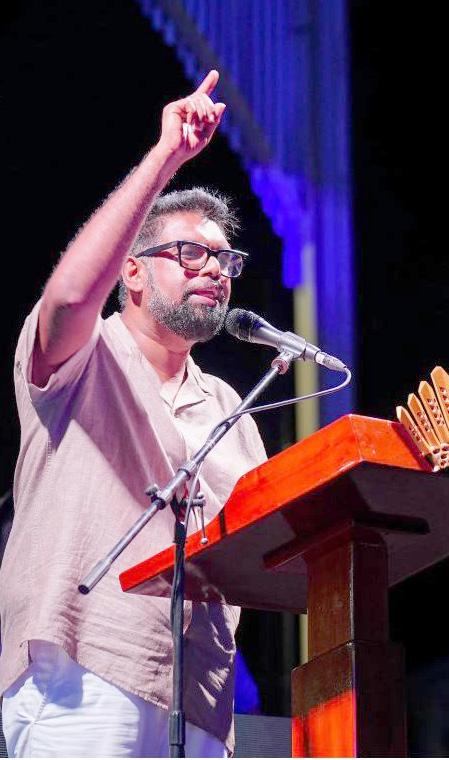
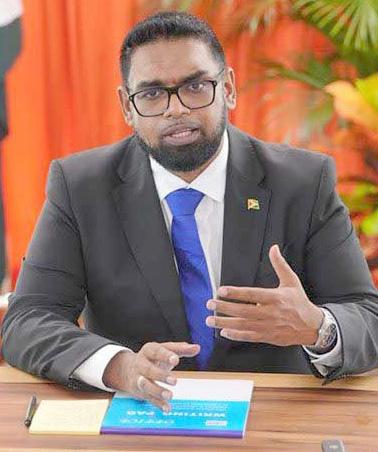
President Dr Irfaan Ali (OP photo)
‘SMEs are dream factories’
–– President Ali urges banks to take services into housing schemes, quarries, workplaces
PRESIDENT Dr Irfaan Ali has challenged commercial banks to move beyond traditional branch‑based operations, urging them to take services directly into new housing schemes, quarries and workplaces as part of a wider push to deepen financial inclusion and support small and medium‑sized enterprises (SMEs).
Framing SMEs as central to Guyana’s transformation, President Ali said small businesses are not just commercial entities but engines of social mobility.
“SMEs are not simply businesses, they are dream factories, they are opportunity creators, they are employment generators, they’re also the bridge between poverty and prosperity for thousands of families,” he said at the commissioning of Citizen Bank’s new Region Seven branch.
He argued that banks must now adapt their models to reach customers where they live and work, particularly in emerging housing developments and key productive sectors.
“Outside of this building, I would like to see Citizen Bank in the housing schemes… where the lands are allocated… help them in the field to apply for their loans and let us help them in the field to have their business plans done,” he said, calling for coordinated outreach.
Ali pointed to successful “banking in the field” models in countries such as India and Bangladesh, noting that some of the world’s most successful SME ecosystems were built on direct engagement with underserved communities.
“Banking in the field is
something that is old, but highly successful… reaching the unreached, finding innovative mechanisms to reach the unreached,” he said.
The President also outlined a vision for frictionless digital onboarding, suggesting that basic accounts should be opened as quickly and easily as a routine purchase.
He linked this to the government’s efforts to expand access to financial services, including the creation of tens of thousands of new accounts, and said banks should ensure their technology and procedures support this drive.
Ali further urged Citizen Bank to embed itself in local economic networks, singling out equipment distributors and quarry operations as examples where financial inclusion remains incomplete.
“Get to the equipment distributor. Get to the quarry that you have here. Ensure all the staff in the quarry have a bank account with you. It is enabling the environment around you to benefit from your position,” he said.
The President maintained that such outreach would strengthen both communities and the banking sector, as more workers gain access to savings, credit and other financial products, while banks build broader and more stable customer bases.
“What is the purpose of having a strong bank ing system if communities remain under‑banked? What is the purpose of fi nancial stability if financial opportunity is not broadly shared?” he asked, insist ing that this is the moment when commercial banks should embrace inclusion.
Gov’t advancing digital transformation to improve public services
MINISTER for the Public Service, Government Effi ciency, and Implemen tation, Zulfikar Ally, has said that the Government of Guyana is continuing efforts to transform the delivery of public services through digital systems, institutional reforms, and through investments in public servants.
In a video message marking United Nations Public Service Day, Ally said the government’s modernisation agenda is aligned with President Dr Mohamed Irfaan Ali’s vision for a Digital Guyana and aims to create institutions that are more efficient, responsive, and accessible to citizens.
“This year’s theme, transforming public institutions, advancing innovation, participation and inclusion, is a timely reflection of the transformation Guyana’s public service is currently undergoing across the public sector,” the minister said.
According to Ally, public service extends beyond
employment and represents a commitment to national development and serving citizens across every region and community in Guyana.
He noted that while many public servants work behind the scenes, their contributions support the functioning of the country and help to maintain essential services.
“Public servants are the bridge between government and our people,” Ally stated.
He indicated that their efforts ensure children receive education, patients access healthcare services, businesses obtain services, and vulnerable citizens receive necessary support.
The minister said the administration recognises that strong institutions and capable public servants are essential components of development and have guided recent investments in public-sector modernisation.
Among the initiatives highlighted was the government’s focus on upskill-
ing public servants through scholarship opportunities and online learning programmes.
Against this backdrop, he noted that the GOAL scholarships have been made readily accessible to public servants, while collaborations with online learning platform Coursera are allowing workers to pursue professional development at their own pace.
He encouraged public servants to take advantage of the opportunities being offered.
The minister also pointed to ongoing efforts aimed at improving working conditions, modernising administrative systems and creating pathways for greater efficiency and accountability.
Central to those efforts, he said, is digital transformation.
“Technology is reshaping how governments around the world operate, and Guyana is embracing this change,” Ally stated.
He went on to add that
digital systems are helping to reduce paperwork, improve record management, increase transparency, and make government services more accessible.
As part of this process, Ally spoke of the introduction of GovConnect, a digital appointment system intended to allow citizens to schedule visits to government offices in advance. This initiative is expected to reduce lengthy waiting times and improve convenience for citizens seeking services.
However, he emphasised that digital transformation goes beyond introducing technology and involves changing the overall culture of service delivery.
He said the aim is to ensure citizens spend less time navigating bureaucracy, while public servants are equipped with the tools needed to perform their duties more effectively.
The minister further stressed that innovation should not be limited to technological solutions.
–– Minister Ally highlights reforms on UN Public Service Day
“Innovation also means finding new solutions to long-standing challenges. It means encouraging creativity, embracing continuous improvement, and fostering a culture where public servants feel empowered to identify opportunities for better service delivery,” he said.
The minister went on to speak on the importance of inclusion, noting that public services must remain accessible to citizens regardless of location, age, disability, ethnicity, or socioeconomic background.
Efforts to modernise institutions must ensure that no one is left behind and that digital transformation is accompanied by measures that improve digital literacy and connectivity.
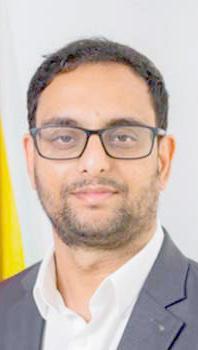
Minister for the Public Service, Government Efficiency, and Implementation, Zulfikar Ally
Further to this, he indicated that the government is advancing a broad programme of institutional reforms that includes modernisation of Public Service rules, strengthening human-resource management systems, improving records management, and streamlining administrative processes.
“These reforms are aimed at creating a Pub lic Service that is more agile, responsive and equipped to meet the evolving needs of our citizens and our rapidly developing economy,” Ally stated.
President Dr. Irfaan Ali
Historic MoU signed between UG, ACCA
By Faith Greene
THE University of Guyana (UG) and the Association of Chartered Certified Accountants (ACCA) on Thursday signed a Memorandum of Understanding (MoU) to advance the university’s accountancy programme.
A historic event, the MoU signing was held in partnership with the ACCA and the Institute of Chartered Accountants of Guyana at the University of Guyana’s Education Lecture Theatre, at Turkeyen Campus.
This historic collaboration is one that was built on a shared commitment to developing globally competitive accounting and finance professionals in Guyana. Over the past seven years, the School of Entrepreneurship and Business Innovation (SEBI), and the Department of Accounting and Finance conducted a review of the work to be done, to strengthen the Bachelor of Accountancy programme,
which will allow it to be in line with international professional standards.
A major milestone under the University of Guyana’s belt, this accreditation from the ACCA means that UG is granted exemption for four papers from the ACCA programme, placing the tertiary institution among the ranks of accredited universities across the Caribbean.
The next step together is to enhance the syllabus further, for students to benefit from additional exemptions as they progress in their studies.
It was announced that they will develop a Dual Award programme, that will be the first of its kind in the Caribbean region, at the Bachelor’s (BSc) level. This programme is set to allow students to graduate with both their UG degree and the ACC Advanced Diploma in Accounting and Business through an integrated pathway that is expected to be a game changer for employability, as well as
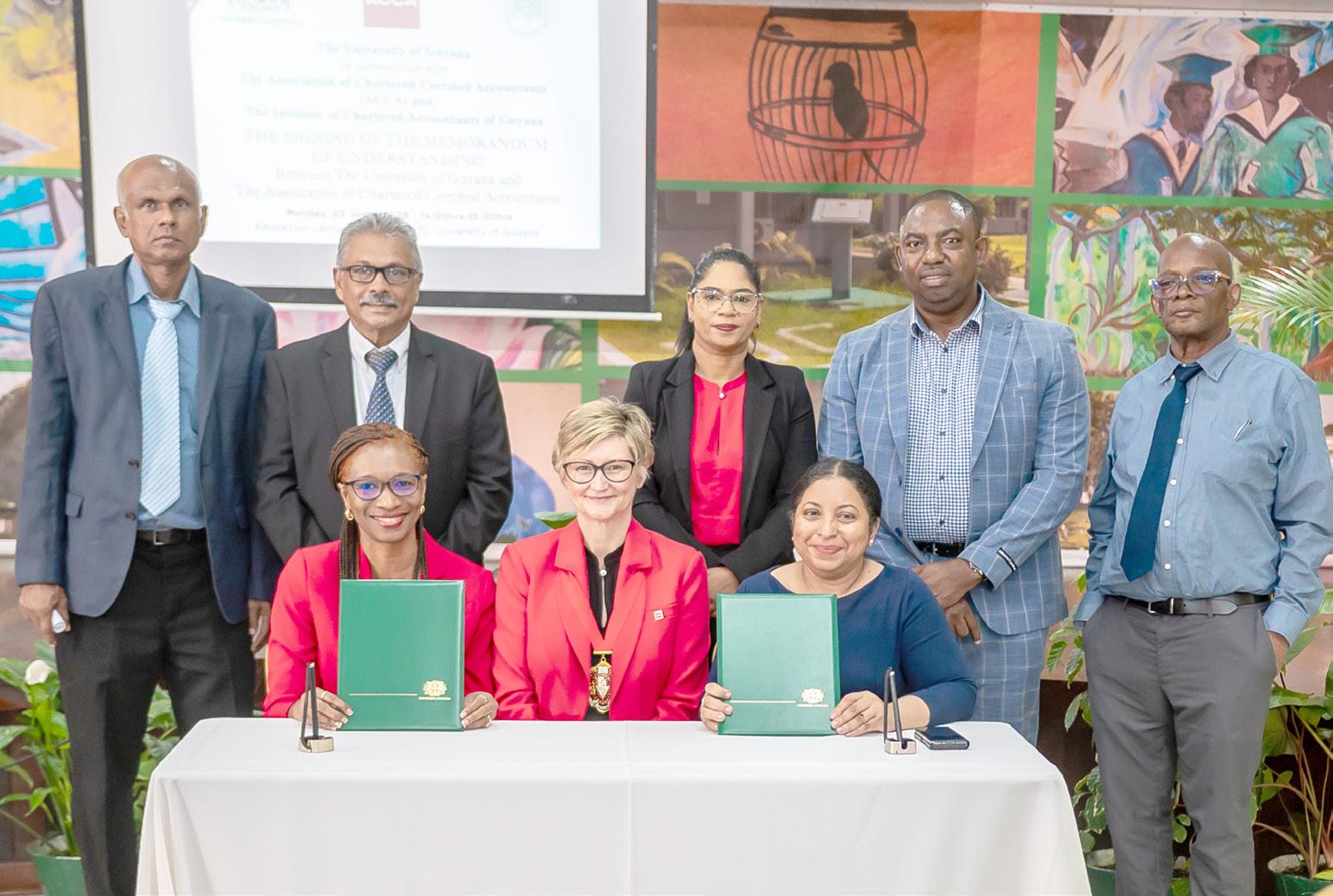
Officials from the ICAG, Minister of Education Sonia Parag,Dr. Alfred Aaron, Prof. Emanuel Cummings, Head of ACCA Caribbean Paula Marcekke-Irish, ACCA President Melanie Proffitt and UG’s VC Prof. Paloma Mohamed-Martin, during the MOU signing at UG (Delano Williams Photo)
professional readiness.
More than this, it provides UG students with a more efficient pathway to obtaining one of the world’s most respected professional qualifications.
The signing marked the beginning of an exciting new chapter for not just the University of Guyana, but also its students. Now the work begins, and this means that beyond strengthening their existing relationship, this new advancement provides a framework for deeper collaboration in
curriculum development, professional engagement, and capacity building for the university and its students.
Speaking at the significant occasion, Minister of Education Sonia Parag related that for a long time, President Dr. Irfaan Ali had been speaking about such a programme for the accounting field, and what can be done to enhance the qualifications of those who are in this field so that they can better contribute to both the public and private sector.
ference in performance at various companies.
With this in mind, she said any country that is transforming, the qualifications of persons in that country need to match that transformation.
“I fully take the point that this isn’t just for the benefit of those who are going into the programme, but how it will definitely help us to manage our country in a way where we will be an example for the rest of the world,” Minister Parag said.
The minister said that the University of Guyana is our national university, and it therefore must remain relevant.
“It has to remain relevant. Accountancy is not one of those programmes that can be irrelevant. If anything, it has to be relevant, not only for today, but 10 years from now, 20 years from now, and a lot of our young people who are studying this programme are exiting the country to do their undergraduate in accountancy,” Minister Parag stated, adding:
“Almost everybody that I speak to every now and again, they are going to some university in the UK or USA to do accountancy, and then move on to their master’s in finance, and then they come back, or maybe come back here, or not,” she said.
She posited that with the advancement of this programme, Guyana will be able to produce students who will remain relevant in the future.
Meanwhile, at the level of the government, the Minister said they have been able to work with the University of Guyana to accomplish several things that lead to student advancement.
The minister recalled many times where persons would underscore the difference in studying ACCA and the Degree in Accountancy, as well as the dif -
Meanwhile, ACCA’s President, Melanie Proffitt on the sidelines of the event shared similar sentiments, noting that because Guyana is evolving, attracting investment opportunities and our economy is growing, there is a need for good, professionally trained accountants that are ethically motivated and who are going to provide assurance, as well as help the economy to grow.
These persons can also help organisations that have confidence in the country. Capacity building, which is something the ACCA provides globally, has a really significant role to play in Guyana in helping to build out ethically trained and technically competent accountants for the future.
“You heard the ViceChancellor talking. It’s incredibly inspiring to think about how the University of Guyana can work in partnership with ACCA to produce the accountants that the country needs to provide that foundation for growth and sustainability, making sure that the resources are used in the right way,” Ms. Proffitt said.
She shared that Guyana is poised, at a great point, to grow and prosper, but “I think University of Guyana and ACCA can really help to foster that growth and make sure that everything is done with the purpose for good. ACCA’s purpose is to protect the public interest and be a force for good, and I think that’s exactly what this partnership will do and help create good opportunities for the next generation of accountants,” she said.
CHIEF of Operations for the Inter-American Development Bank (IDB) – Guyana, Ivan-Alonzo Gaviria, has commended Human Services and Social Security Minister Dr Vindhya Persaud for her exemplary leadership in the implementation of the Support to Safety Nets for Vulnerable Populations Affected by Coronavirus in Guyana project
He described the country as a stand-out performer among the IDB’s 26 member states. Reflecting on the programme’s achievements between 2020 and 2024, Gaviria said Guyana distinguished itself through effective execution, innovation and a steadfast commitment to serving vulnerable citizens, noting that the initiative not only provided critical support during the COVID-19 pandemic, but also delivered long-term benefits that strengthened the country’s social-assistance systems and capacity to protect livelihoods.
Speaking at a recent event focused on highlighting the key interventions implemented under Component One of the Support for Safety Nets for Vulnerable Populations Affected by COVID-19 programme, Gaviria lauded the leadership of Minister Persaud, noting that the accomplishments of the programme would not have
been possible without her leadership.
“I think it merits saying that nothing is accomplished without excellent leadership. And to that end, I do want to recognise the Honourable Minister. As you could tell by her remarks, she understands every aspect of the project. And not only this one, every undertaking that she has. She knows the persons who are affected. She knows the plan, and she’s constantly innovating.”
Moreover, he added that strong leadership and partnership have been vital to the work of the IDB.
“Without that kind of leadership and that partnership, it’s very, very dif-
ficult for the Inter-American Development Bank to be successful in obtaining these objectives. So, again, minister, thank you so much for your support,” he further noted.
Designed to cushion the impact of the COVID-19 pandemic on vulnerable populations, a total of 58,534 old-age pensioners and more than 47,000 households had benefitted from key interventions implemented under Component One of the programme. The programme, which was financed by the IDB, was launched in December 2020 and was implemented by the Ministry of Human Services and Social Security.
Gaviria further noted that through a strong partnership between the Co-operative Republic of Guyana and the Inter-American Development Bank, the project helped to strengthen the country’s capacity to support vulnerable populations, protect livelihoods and enhance the delivery of social assistance to those most in need.
He also stated that among the 26 member countries that implemented the project, Guyana stood out as one of the nations that created a positive, long-term impact on its people.
“This project was not like any other one we had prepared in response to COVID-19 across our 26 member countries. Thanks to the vision of the ministry and the minister and
all collaborators, it included elements that created long-term impact,” the IDB official noted.
Gaviria emphasised that while the IDB carried out a number of reviews and assessments, the true success of the operation could not be measured in quantifiable data alone, but rather in the people it served — and this, he added, is where Guyana made its real impact. “You are going to hear a lot about percentages, et cetera. But percentages and reports and financial execution aren’t people. The only thing that matters is people. And whether or not they have been served duly, truly, equitably by the operation and by the services that we have fi-
nanced. And in this particular case, I believe they have.”
In addition to the oneoff cash transfers provided to pensioners, the initiative reached 16,183 public-assistance beneficiaries and delivered cash grants to 4,971 children living with disabilities.
The electricity credit-transfer programme benefitted 47,059 households across the country. The initiative also established the Survivor Advocate Programme, aimed at supporting victims and survivors of gender-based violence by helping them navigate the criminal justice system and access essential services, benefitting a total of 30 survivors.
IDB Chief of Operations Ivan-Alonzo Gaviria speaking at a recent event highlighting the outcomes of the COVID-19 Safety Nets Programme in Guyana (Ministry of Human Services and Social Security photos)
Human Services and Social Security Minister Dr Vindhya Persaud and IDB Chief of Operations Ivan-Alonzo Gaviria at a recent engagement on the implementation of the COVID-19 Safety Nets
Beyond the Barrel
PRESIDENT, Dr Irfaan Ali announced that more than four international delegations will be visiting Guyana, not for oil and gas, but for tourism, food production, manufacturing, and creating wealth, and this is a significant turning point in our history.
During his speech at the ceremony where he commissioned two new Jags Aviation planes, the President clearly articulated this idea: “The world is beginning to discover a Guyana that is totally unrecognisable.”
In essence, this recognition, which represents a departure from our previous narrow focus on offshore reserves, is well earned. As such, it represents the result of the President’s vision, planning, and consistent delivery.
As the President correctly noted, this development did not occur by chance. Rather, it was carefully planned and achieved. In terms of tangible evidence of success, we see that GO-In-
vest assisted in facilitating GY $157 Billion in investments in non-oil sectors during 2025 alone; these investments represent more than $1 trillion worth of signed agreements since 2020 across a range of sectors including agriculture, manufacturing, tourism, and logistics -- all representing commitments for greater than 32,000 jobs. The growth rate of the non-oil sector was an incredible 14.3% during last year. With the Caribbean region currently purchasing approximately $US6-$8 Billion in food each year, the government’s goal of Guyana becoming a ‘breadbasket’ for the region is based upon both logical reasoning and visionary leadership.
The President described aviation as “a lifeline, not a luxury,” ; this captures perfectly the innovative thinking that has characterised this administration.
A country of large forests, powerful rivers, and widely dispersed communities requires infrastructure that links farmers to their customers and remote
areas to the national economy -- and the government is doing this. Terminal Two at the Cheddi Jagan International Airport, designed as an experience through which visitors can learn about Guyana’s natural heritage and biodiversity, coupled with the movement of the Rose Hall and Lethem Airports from aspirations to accomplishments illustrate a government that takes action on its commitments.
This moment is particularly exciting because the government has matched its ambitions with the appropriate enablers: zero-tax agriculture and agro-processing, a new Development Bank for small businesses, and unprecedented levels of investment in roadways, port facilities and the Wales gas-to-energy project that will reduce electricity prices by half and allow competitive industries to exist. These elements represent the purposeful construction blocks of a sustainable and broad-based economy.
It was when speaking about discipline that the President made his most poignant comments: “There is no substitute for hard work... regardless of how much money is coming in.” This same approach to hard work demonstrated by leaders at the top is precisely what gives investors confidence when arriving at our doorstep. We meet this new wave of interest not as beggars, but as a sovereign nation that negotiates from a position of strength, while ensuring that local content, environmental responsibility and retaining value within our country for our citizens. Our forests, our land, and our people’s talent have been present prior to the oil era. Under this government’s stewardship they are being prepared to continue beyond it.
The President referred to this moment as being “on the brink” of an “unbelievable future,” one that is being developed intentionally and with confidence for every citizen.
There is probably no one who can claim he is truly ‘grounded’ with Rodney
Dear Editor,
WE grew up in colonial times believing that truth and fact were one and the same. Then later we were told to believe that they were different; that fact was actually proven and established truth. Today we are told to accept truth without proof, or to believe the many unverifiable, unproven and unprovable truths which are as numerous as the countless stars above or the myriad mindless minds below.
I am talking about the various truths surrounding the life and works of Walter Rodney who was assassinated this month, 46 years ago. Since his assassination, many truths have been peddled, some diluted, some whitewashed, some completely turned over, mostly by Rodney’s former associates who behave as if they have a monopoly on the truth surrounding Rodney’s life and death; ironically however, most of them have made a complete 180-degree turn from the teachings and ide-
als of Rodney, while some, disgustingly, are openly in bed with his assassins.
To understand who they are, I would like to present my “truth”, and if you can verify it, you can use it as a measuring rod to examine who are really following his teaching, his convictions, his ideals, and who were sitting at his supper, but ended up betraying him.
Walter, the son of a staunch member of the Marxist-oriented PPP, was born in 1942. From a young age, he was exposed to and actively became immersed into working class politics. He attended Queens College, and, having graduated first in his class, won a scholarship to the University of the West Indies where in three years, he graduated with a First-Class Honors BA in History.
It was a time when the Cold War was at its height, reaching its peak in October 1962 during the Cuban Missile Crisis, and the pro-Marxist, Castro-friendly PPP government of British Guiana of which Walter Rodney’s father was a staunch supporter, was receiving
its fiercest opposition from the imperialist Kennedy-Macmillan/Churchill coalition. It was a time when Marxism was the fashionable ideology of the emerging third world intellectual. It was a time when African Nationalism, Pan Africanism, Black Power and the Organization of African Unity (OAU) were surging with popularity among Black intellectuals. This was when Walter Rodney emerged on the scene.
Rodney, having earned a first-class degree in History at Mona, went on to the prestigious London University, School of Oriental and African Studies where, at 24, he earned his PhD with honors in African History. After serving a teaching stint at the University of Dar es Salaam in Tanzania, he returned to his Mona alma mater in 1968 as a Lecturer in African History.
While in Tanzania, Rodney had totally immersed himself in all political, social and economic issues relating to the development of Africa, and he believed and strongly
advocated that the whole of Africa should pursue a pro-Marxist approach to national development.
In Africa, Rodney publicly advocated for the violent overthrow of African governments run by “petty bourgeois.” Eventually, his friend Julius Nyerere, President of Tanzania began to strongly disagree with him, and published a fierce counter argument that anyone preaching violence would face his wrath. Nyerere later went on to ban the University Students African Revolutionary Front (USARF) – a radical Marxist group Rodney helped to establish.
Rodney’s “radicalism” made many African leaders uncomfortable, and as they began to increasingly institute directives to counter his activities, he returned to his alma mater as a Lecturer, in 1968, bringing to Jamaica with him, his fierce revolutionary fervor. It must be noted that the young, brilliant
OP-ED What Latin American and Caribbean Politics can learn from Messi
By Jorge Werthein
LATIN America is facing a challenging moment. Alongside economic, social, and security concerns, the region is experiencing a growing crisis of trust.
Citizens in many countries feel increasingly distant from their leaders and less convinced that politics can provide lasting solutions to the problems affecting their lives.
Against this backdrop, it is worth looking at a phenomenon that appears far removed from politics: the admiration Lionel Messi inspires around the world.
Not because he is a football player. Not because he has won historic titles. And certainly not because athletes should be viewed as potential political leaders.
The reason is different.
Messi embodies a style of leadership that seems increasingly rare in public life across Latin America.
Millions of people from different ideologies, religions, generations, and nationalities admire and respect him. In a region marked by polarisation, that consensus is remarkable.
The first lesson is humility.
At a time when many leaders equate visibility with leadership, Messi chose a different path.
Even after achieving virtually everything an athlete can achieve, he never needed to de-
clare himself the best. His authority was built on performance rather than self-promotion.
The second lesson is perseverance.
His career has been marked by setbacks, criticism, and disappointment. Yet he persisted. He continued working when many doubted his ability to reach the highest goals.
The Copa América and the FIFA World Cup became the reward for that determination.
Another fundamental lesson is teamwork.
Messi never won alone. Coaches, teammates, doctors, trainers, and specialists contributed to every achievement.
His greatness has always rested on his ability to elevate the talents around him and place them at the service of a common objective.
Politics often forgets this simple truth.
No president transforms a country alone.
Sustainable progress depends on strong institutions, competent teams, and the ability to build consensus.
There is also consistency.
For more than two decades under constant public scrutiny, Messi has remained remarkably faithful to his values and behaviour.
That consistency generates trust.
And trust is one of the scarcest resources in contemporary democracies.
Another essential characteristic is discipline.
His success is not simply the product of talent. It is the result of preparation, dedication, sacrifice, and relentless effort.
The same applies to nations.
Countries do not advance through inspiring speeches alone.
They advance through planning, continuity, and effective execution.
Messi also represents something particularly needed in Latin America: the ability to unite.
In increasingly fragmented societies, he remains one of the few figures capable of generating broad admiration across different sectors.
A democratic leader does not need to please everyone, but must govern for everyone.
Perhaps the most important lesson lies in his ability to surround himself with talented people.
Great leaders understand that no one can know everything. Their strength lies in recognising talent, bringing it together, and creating the conditions for it to flourish.
Finally, Messi leads by example.
His authority was never built through grand speeches but through consistency between words and actions.
Perhaps that is precisely what Latin America needs most.
Our societies are tired of promises. What they seek are results.
Perhaps the region does not need more leaders who talk about themselves. Perhaps it needs more leaders capable of doing what Messi has done throughout his career: putting talent at the service of a collective project.
There is probably no one who can claim ...
and charismatic Walter Rodney attracted young students in Jamaica by the thousands just like he had done in Africa. Eventually, he incurred the wrath of the Hugh Shearer’s government which declared him persona non gratia and barred him from entering the island on returning from Canada where he had gone to address a Black African Writers’ conference.
The Jamaican government accused him of inciting a Castro-type revolution and advocating violence in the country, resurrecting a 1962 spite against him for being in possession of “subversive literature” - Che Guevara’s famous text, Guerrilla Warfare, which the Jamaican Authorities seized from him when he was a student at UWI and returning to Jamaica after a Cuban visit.
The 1968 expulsion of Rodney from Jamaica triggered off the “Rodney Riots”, a major wave of protests and civil unrest predominantly by university students and the masses of poor people in Jamaica.
Rodney alternatively returned to his position in Tanzania for roughly five years during which time he became a Pro-
fessor, produced his magnum opus, How Europe Underdeveloped Africa, published in 1972, and contributed heavily to the intellectual debates surrounding Tanzanian socialism and the whole of the African Liberation struggles more than any known African ever at the time.
He believed that praxis must stand together, if not above pure theory and he therefore incorporated and integrated Che Guevarra’s guerrilla tactics into his Pan African activism. In his lectures and books like The Groundings with my Brothers, Rodney often cited Guevara’s ethos.
He championed Che’s belief that a true revolutionary intellectual must pair theory with immediate, decisive action against imperialism. In brief, Walter was Che. Since he was 18, he was fascinated with Cuba, Castro and Che Guevarra, visiting the island twice after the Cuban revolution, in 1960 and 1962. In Cuba, he bought and studied Che’s book on Guerilla Warfare which, on returning to Jamaica, was confiscated by Authorities.
Feeling a sense of accomplishment in Africa, he returned to his native country,
Guyana in 1974, having been promised by the University of Guyana a professorship and the Chair of the History Department. However, upon his arrival in the country, the then Prime Minister, Forbes Burnham rescinded the job offer.
Rodney spent the next five years doing what a sincere politician loves most – “grounding with my brothers” at the grass-root level with all races of Guyanese people in the ghettos, villages and even the riverain and forested areas.
He organised and co-founded the Working People’s Alliance (WPA), a political party, which soon became a powerful force that rivalle d both major ethnic parties, the People’s Progressive Party (PPP) and the People’s National Congress (PNC). But the many African leaders or Hugh Shearer of Jamaica, only wanted him out of their countries; Guyana Prime Minister, Forbes Burnham wanted him dead.
Burnham took two years to prepare and train an army sergeant named Gregory Smith to make a bomb in a walkie-talkie set, join the WPA and to
From page 6
cultivate the friendship and earn the trust of Rodney. Burnham succeeded.
Professor Walter Rodney died cruelly and violently at the age of 38, in June 1979, behind the wall of a prison, just like his erstwhile idol, killed at thirty-nine in October 1967 in the obscure Bolivian jungle.
But like all war wagers fail to realise, you may kill an opponent, hound and scatter their disciples all over the world, but you do not kill an idea; because that person becomes a martyr; that idea becomes an ideal, and his few disciples multiply into a multitude.
Sadly, however, at least six of his close disciples in Jamaica were killed, and hundreds were hounded and forced to emigrate. In Guyana, the casualties were even worse.
Today, there is probably no one who can claim he is truly “grounded” with Rodney, and that is why, while the man’s ideals would never die, the WPA is in comatose.
Yours truly, Gokarran Sukhdeo
Jorge Werthein, PhD in Education (Stanford University), Senior adviser IICA Director General
Book review: Ramharack’s magnum opus
I HAVE been married to Janet Mohamed for a few months over 47 years. In that vast period, she has made reference many times to the first victim of the Wismar massacre – her mother’s cousin, Richard Khan. Khan’s father and my wife’s grandmother were brother and sister making Richard my mother-in-law’s first cousin.
So many times, in our marriage, my wife would tell me about the death of Richard and the lives of his three other brothers. It is through my wife I came to know that one of the brothers, Akbar, did not mentally survive what happened to his parents and siblings. Unfortunately, Dr Ramharack did not capture the mental state of Akbar.
My wife can now read the story of the children of her mother’s first cousin in Wismar in 1964. That story is captured in a gargantuan book of 800 pages titled: “The Wismar Massacre: The Ethnic Cleansing of Indians in Guyana” by Baytoram Ramharack.
This is so large a book that to review it objectively you have to make sure you do
not skip parts of it. But I couldn’t help doing just that if I was to do a book review shortly after the launching of the work last Saturday.
I got a donation of the book from Dr Ramharack last Wednesday when he was the guest on The Freddie Kissoon Show, and I began reading it right away. I bypassed several parts which I consider not germane to the review. Three characteristics stand out about this book. One is the scholarship. It is extensively researched. Secondly, it is a valued addition to Guyana’s historiography.
The third dimension of this work is that it tells a story that remained untold for more than 50 years. What happened in Wismar to the Indian population there is the most painful tragedy in Guyana’s history. It is beyond incredible that such a tragedy did not find its way in a book length manuscript long before 2026. For this, Ramharack has left a legacy in Guyana’s academia.
This is not an easy book to analyse because of the confluence throughout the pages of academic writing meeting popular writing,
but Ramharack negotiated this difficult pathway with notable competence. A reviewer will find different silhouettes in the book to emphasise but one dimension of the work pierced my psyche. It is the police’s and Governor’s tardiness in dealing with the violence.
The author is unambiguous in stating that hundreds of properties could have been saved and the massive physical injuries and several incidents of rape could have been prevented had the police and British soldiers shown acceptable levels of alacrity (my words).
For example, the attacks on Indians started on May 22 (1964) and continued for another two days with the most violent and tragic day being May 24.
The British soldiers arrived in Wismar late in the day (6PM to be precise) on May 25. By then what could be considered a form of ethnic cleansing was already underway. Reading this section of the book, it is clear that the police and the Governor’s office acted too slowly.
Ramharack on page 300 shaped his words that could make you feel that Governor Luyt deliberately acted slowly because of a personal view he had of Premier Cheddi Jagan. Ramharack informed us that the Premier had objected to the appointment of Luyt and from there on, Luyt saw the PPP government in antagonistic terms.
One of the things that pop up in your mind as you read about the delay by the security
forces is if they had acted earlier would there have been an event in Guyana’s history referred to as the Wismar Massacre?
The answer stares you in the face as you read that section. Hundreds of buildings and dozens of physical brutalities could have been prevented. There are times in history you wonder what history would have been like if there were intervening forces that could have altered history.
I find page 287 very moving. On the top of the page is a female refugee clinging with tender care to a tiny baby on her lap with the name Leela. Next to her is another child oblivious to the disastrous future that awaits her childhood.
Next to that photograph is evidence of the mammoth research effort of Ramharack. He produced an adult photograph of baby Leela and she is no doubt a beautiful Guyanese woman.
The Wismar Massacre is a book worth reading because it is about a vast tragedy in Guyanese history that has no parallel in the CARICOM region. I guess it will become one of the most important books ever published on the history of this fantastic yet inexplicable land.
DISCLAIMER: The views and opinions expressed in this column are solely those of the author and do not necessarily reflect the official policy or position of the Guyana National Newspapers Limited.
Regional pharmaceutical bonds to strengthen medicine supply
GUYANESE are expected to benefit from faster access to medicines and medical supplies as the Ministry of Health strengthens its capacity to decentralise pharmaceutical distribution with the establishment of new regional bonds.
Minister of Health, Dr Frank Anthony, said the storage bonds in Lethem, Mabaruma, and Linden, along with those in Regions Two, Five and Six, are nearing completion.
The facilities are expected to improve inventory management, ensure a more reliable supply of pharmaceuticals and allow all health institutions to respond effectively to emergencies and increase patient demand.
“In the coming months, these bonds will be fully
operational, and we can start utilising these facilities for storage and to supply health centres and hospitals within the regions,” the minister told the Department of Public Information (DPI) last Friday.
For residents living in riverine, rural and hinterland communities, the project is expected to lead to fewer medicine shortages and more timely access to essential drugs and medical supplies.
This also eliminates many of the logistical challenges that arise from regional health centres and hospitals waiting on resupplies from Georgetown.
The initiative marks a bold step in modernising Guyana’s healthcare supply chain, ensuring quality health care is not limited to infrastructure and medical personnel but also by a reliable system capable of delivering lifesaving medicines across the country.
Yarrowkabra residents benefit from Chinese medical outreach
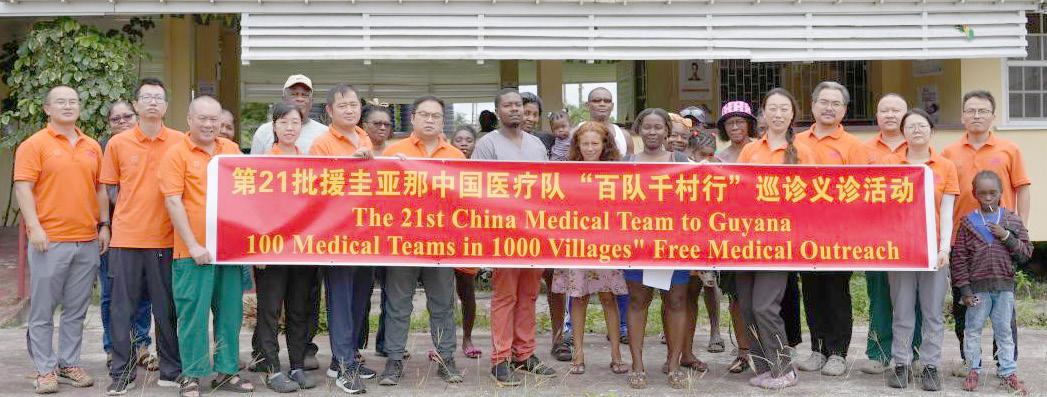
EARLIER this month, the 21st Chinese Medical Team held a successful specialty medical outreach in Yarrowkabra, Soesdyke/Linden Highway, where scores of locals benefitted from free medical care.
The medical team described the event as a resounding demonstration of bilateral co-operation and humanitarian service.
The comprehensive medical outreach held at the Yarrowkabra Health Post provided critical healthcare services to residents.
The outreach was held with the aim of alleviating the healthcare accessibility challenges faced by the residents of Yarrowkabra and surrounding areas along the Soesdyke-Linden Highway.
Due to geographical constraints and limited local medical resources, many vulnerable residents find it difficult to seek timely specialist consultations.
The 21st Chinese Medical Team was headed by Captain and general surgeon, Dr Li Huansong. The multi-disciplinary team deployed a robust contingent of specialists spanning general surgery, plastic surgery internal medicine, orthopedics, gynaecology, traditional Chinese medicine (TCM), public health and ophthalmology.
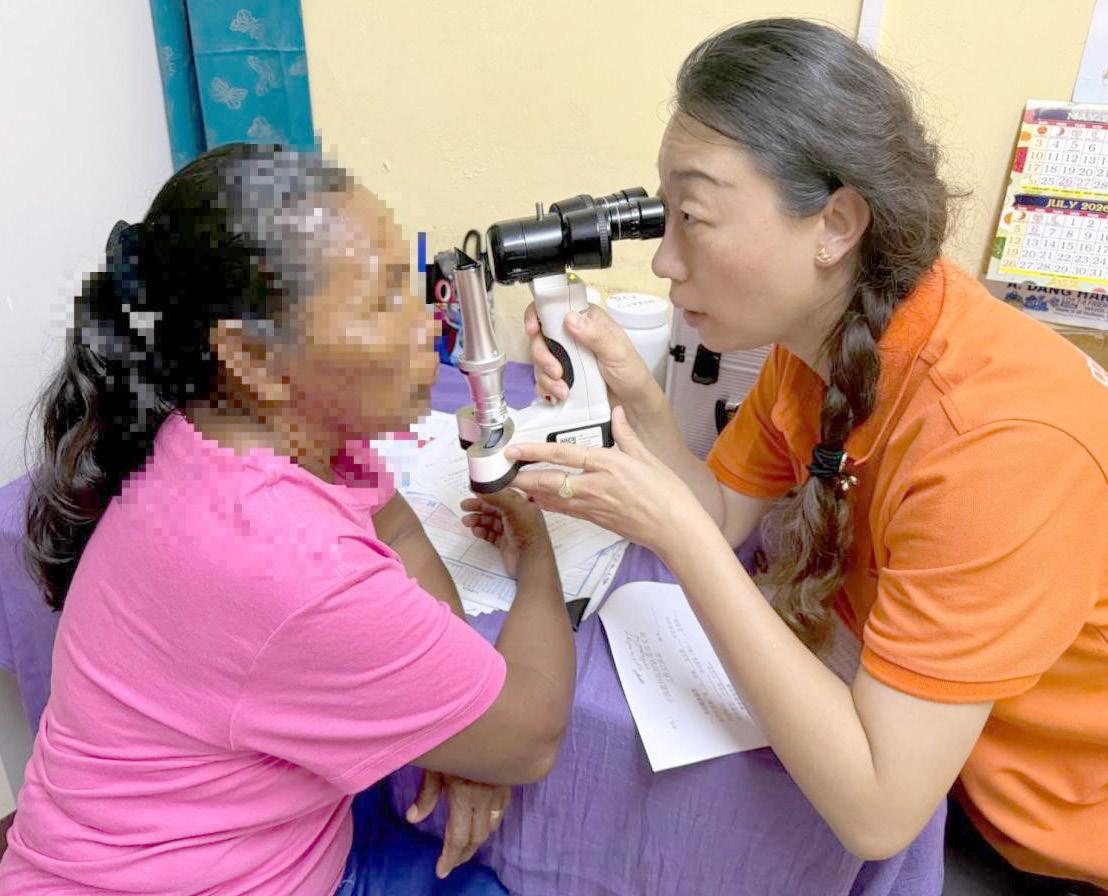
Among the various services offered, the eye care station received significant attention from the community. Dr Liu Nannan, the team’s ophthalmologist, provided basic eye examinations and vision
consultations for a wide range of residents, including children and elderly individuals.
In addition to the ophthalmic consultations, the medical team offered free blood pressure and blood glucose monitoring to screen for prevalent chronic health conditions.
However, a dedicated health education lecture was also delivered, focusing on chronic disease management and routine daily preventative health-
care measures.
Reflecting on the success of the exercise, community representative Matthew Baker expressed profound gratitude to the medical professionals.
“Many people in this community find it difficult to travel far for specialist care. Having an eye doctor and other medical specialists come right to our community health post is a great benefit to our people,” Baker remarked.
The 21st Chinese Med-
ical Team reiterated their commitment to deepening the long-standing bond between Guyana and the People’s Republic of China.
Through continued regular community outreaches across the various administrative regions, the team aims to bring high-quality clinical expertise directly to the grassroots, further fostering the close friendship and health co-operation between the two nations.
The members of the 21st Chinese Medical Team, who recently participated in the comprehensive medical outreach at the Yarrowkabra Health Post
Dr Liu Nannan, the 21st Chinese Medical Team’s ophthalmologist, provides basic eye examinations to residents of Yarrowkabra, Soesdyke/Linden Highway
Chinese Ambassador pledges support for exchanges in education, culture, youth engagement
THE Chinese Ambassador to Guyana, Yang Yang, recently pledged the Chinese Embassy’s readiness to continue co-operating with the University of Guyana, and to supporting more exchanges in education, culture and youth engagement.
Spanning more than 50-years, Guyana and the People’s Republic of China have maintained a friendly diplomatic relationship that continues to grow stronger.
Speaking about the future of this valuable relationship at recent engagements at the University of Guyana, Turkeyen Campus, the Chinese Ambassador said that young people are the future of the friendship the two nations share.
“Young people are the future of our countries, and they are also the future of China-Guyana friendship,” she said.
The ambassador had alluded that many of the students from the Uni -
versity of Guyana have been to China, and expressed hope that the experiences of study, visit and exchange have left each of them with their own special memories of China.
“We look [forward] for more UG students to learn more about China. We are also willing to provide more opportunities for you to study, visit and take part in exchanges in China so that you can see the real China for yourself and share
your stories with Chinese friends,” she announced. Guyana and China’s friendship started in November 1971, when both nations signed an agreement on the mutual establishment of commercial offices, with China setting up its own in Guyana in March 1972. Diplomatic relations were established in June that same year, and Guyana established its embassy in China in October the following year.
Drivers remanded over fatal Providence crash
THE drivers of a motor lorry and a minibus involved in the fatal accident on Providence Public Road, East Bank Demerara, which claimed the life of a 36-year-old Essequibo Coast resident, have been remanded to prison on charges of causing death by dangerous driving.
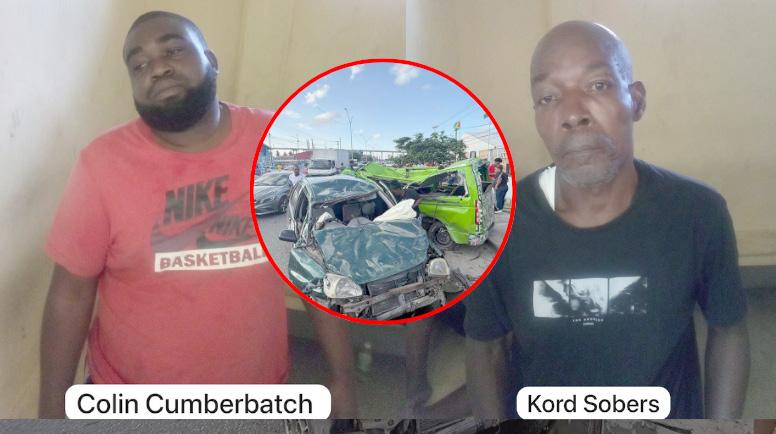
Kord Sobers, 55, of La Parfaite Harmonie, West Bank Demerara, the driver of motor lorry GAF 1093, and Colin Cumberbatch, 31, of Kitty, Georgetown, the driver of minibus BAH 9443, appeared before Magistrate Judy Latchman at the Diamond/Golden Grove Magistrate’s Court on Monday.
The men were charged with Causing Death by Dangerous Driving, contrary to Section 35(1) of the Motor Vehicles and Road Traffic Act.
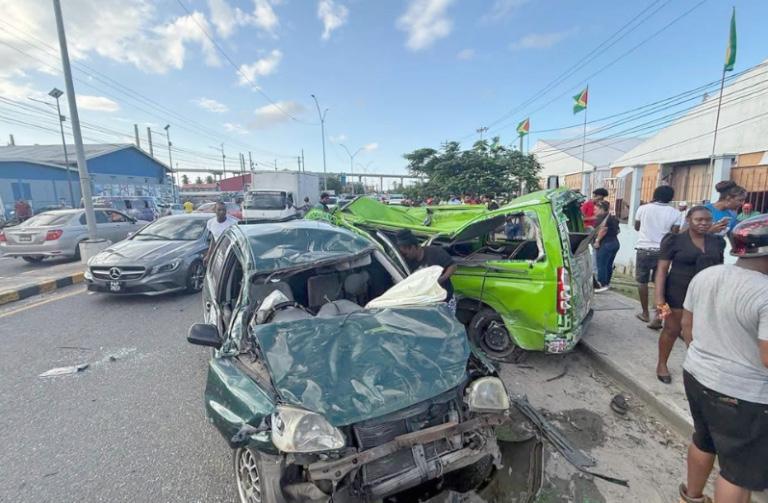
The charge stems from the fatal accident which occurred on June 20 along Providence Public Road and resulted in the death of Ruddy Raymond, 36, of Jonestown, Lima, Essequibo Coast.
The indictable charges were read to the defendants, who were not required to plead.
Both men were remanded to prison and the matters were adjourned to July 10 for report.
According to a police release, the minibus was proceeding north along the eastern driving lane of
the western carriageway, while the motor lorry was travelling north along the western driving lane of the same carriageway.
Investigators allege that the motor lorry made a sharp right turn and entered the path of the minibus, causing the minibus to collide with the right side of the truck.
The impact reportedly caused the minibus to strike the median, cross into the eastern carriageway, topple onto its right side and collide with a motor car travelling south.
As a result of the collision, the driver of the motor car and his 23-yearold female occupant sustained minor injuries. The minibus driver and seven
passengers also received injuries.
Emergency Medical Technicians responded to the scene, where Raymond was examined and pronounced dead.
His body was later tak-
en to Memorial Gardens Funeral Home, where it awaits a post-mortem examination.
The minibus driver and six surviving passengers were taken to the Diamond Regional Hospital for treatment.
Police said two breathalyser tests conducted on the driver of the motor lorry returned readings of 0.003 per cent and 0.004 per cent.
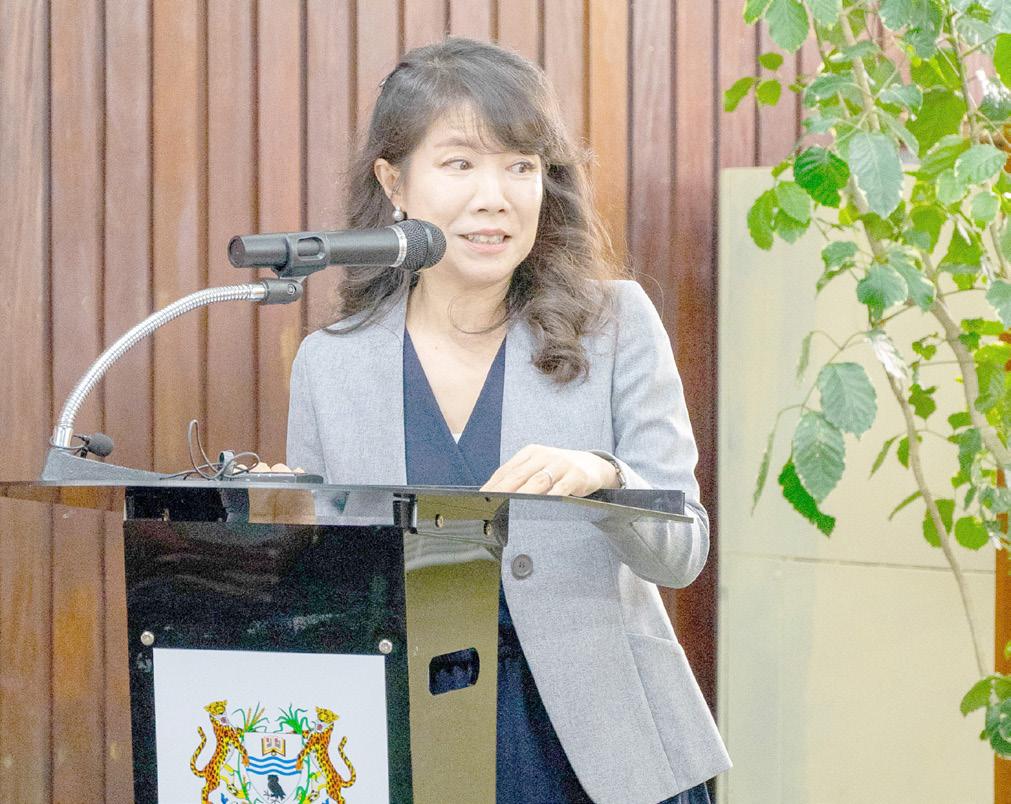
Chinese Ambassador to Guyana, Yang Yang (Elton John photo)
‘Human rights remain a driver of development’
–– Ambassador Rodrigues-Birkett assures stakeholders, acknowledges constraints of the current financial climate on human rights
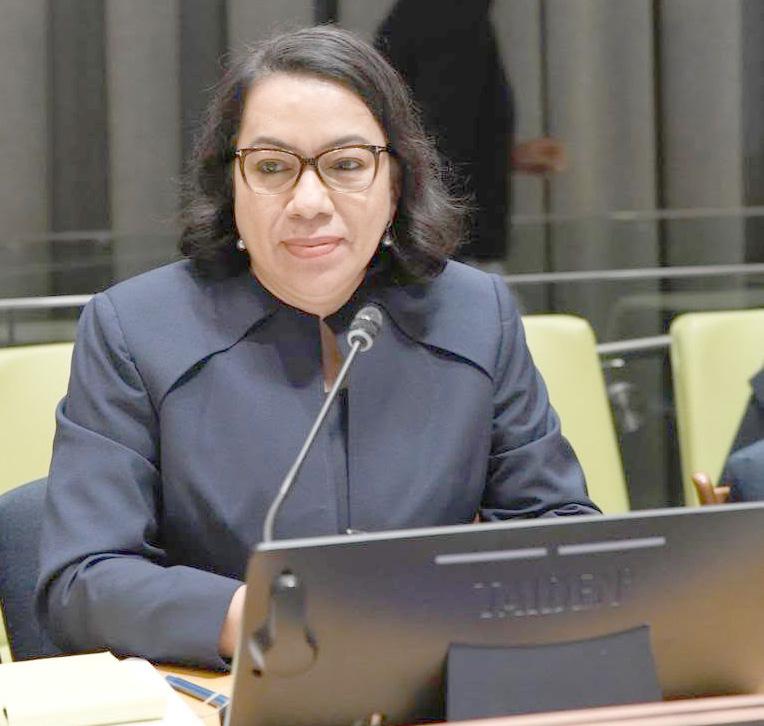
GUYANA’S nominee for United Nations Secretary-General, Ambassador Carolyn Rodrigues-Birkett, has underscored the importance of human rights funding, stating that efforts to advance development, peace and security are inherently investments in human rights.
During a recent interactive session with member states, delegates and civil society members, in a bid for the top post, Rodrigues-Birkett was asked by the European Union delegation whether she would elevate human rights if chosen to lead the organisation.
“I believe that in the current financial crisis we have to look for ways and means of how we can increase this, but I also see the investment in development and the investment in peace and security as also investment in human rights,” she said, responding to the EU’s concern that only around one per cent of UN system resources are dedicated to human rights mandates.
She added: “When conflicts arise, many times human rights is one of the things that suffer immediately.”
The Guyanese diplomat anchored her reply in national experience, citing education and indigenous rights reforms as evidence that human rights can deliver measurable development outcomes.
“When I became Minister of Amerindian Affairs in 2001, there was one indigenous doctor in the whole of Guyana, and the investment that we made in education over the next 15 years, saw a really big jump in terms of the numbers, not only of medical doctors, but engineers and other professionals,” she recalled adding:
“This was one of the human rights that we invested in…the right to education, and so that to me is one of the concrete examples where we saw an investment in human rights resulting in sustainable development.”
Ambassador Rodrigues-Birkett went on to
highlight Guyana’s 2006 Amerindian Act as a second pillar of that record. The legislation, she noted, was the first in more than six decades to cement the rights of Indigenous Peoples in Guyana.
“It was the first in our country for over 60 years, and we gave the rights in that law to Indigenous People, to their land, to their
she stressed.
On the central political question from Brussels regarding how she would boost the UN’s underweight human rights budget, Ambassador Rodrigues-Birkett signalled intent but acknowledged the constraints of the current financial climate and the Secretary-General’s dependence on member states.
She asserted that she would work with member states to seek an increase beyond the one per cent currently allocated, positioning human rights financing within a broader effort to strengthen delivery across the UN’s mandate.
own governance mechanisms, their own systems,” she said.
She argued that the impact has been tangible and long term.
“From then, 2006 to today, we have seen how the investment in that law, in the rights of Indigenous Peoples has improved their conditions overall in my country; very measurable,”
“How do we improve the budget for human rights in this organisation? Of course, I will certainly have to work with member states to do this,” she said.
Rodrigues-Birkett sought to show that expanding budgets for rights is not only a normative priority but also a practical route to long-term social and economic transformation.
The dialogue formed
part of a transparent and inclusive selection process mandated by General Assembly Resolution 79/327, under which each candidate presents their vision and answers questions from Member States and civil society.
Drawing on her five years at the United Nations and Guyana’s recent term on the Security Council, Rodrigues-Birkett said she had heard a “growing sense of frustration that the UN is not delivering as it should,” citing proliferating conflicts, the slow pace in meeting the Sustainable Development Goals (SDGs) and a worsening liquidity crisis. Yet she insisted that the world would be “difficult to imagine” without the UN’s conflict prevention and standard-setting work.
“If there were no United Nations, how would we even begin to address many of the global issues confronting us? I’ve said all of this because I believe in the United Nations. It is indispensable. It is incomparable, and it is a force for global good,” she added.
Guyana’s Permanent Representative to the United Nations, Ambassador Carolyn Rodrigues-Birkett
Elections fraud trial adjourned as defence calls for former GECOM IT head to testify in person
THE ongoing elections fraud trial was adjourned on Monday after the defence objected to key testimony being delivered virtually, insisting that former Guyana Elections Commission (GECOM) Information Technology Manager, Aneal Giddings, appear in court to testify in person.
When the matter was called before Acting Chief Magistrate Faith McGusty,
Giddings, who served as GECOM’s IT Head during the 2020 General and Regional Elections period, had been scheduled to testify for the prosecution. However, he was expected to give evidence virtually as he was reportedly out of the jurisdiction.
Counsel for the defence, Nigel Hughes, raised objections to the arrangement, noting that Giddings’ evidence forms a critical aspect of the case
and that his appearance in person was necessary.
Hughes told the court that, given the witness’ significance, he should be physically present to provide testimony and also be available for cross-examination in person.
Following deliberations on the issue, efforts were made to call other witnesses to take Giddings’ place. However, as no alternative witnesses were immediately avail -
able, the proceedings were adjourned until Wednesday, when additional witnesses are expected to be
called.
The trial centres on allegations of fraud in relation to the tabulation and declaration of results from the 2020 General and Regional Elections, a process that triggered months of political uncertainty before a final declaration was eventually made five months after polling day.
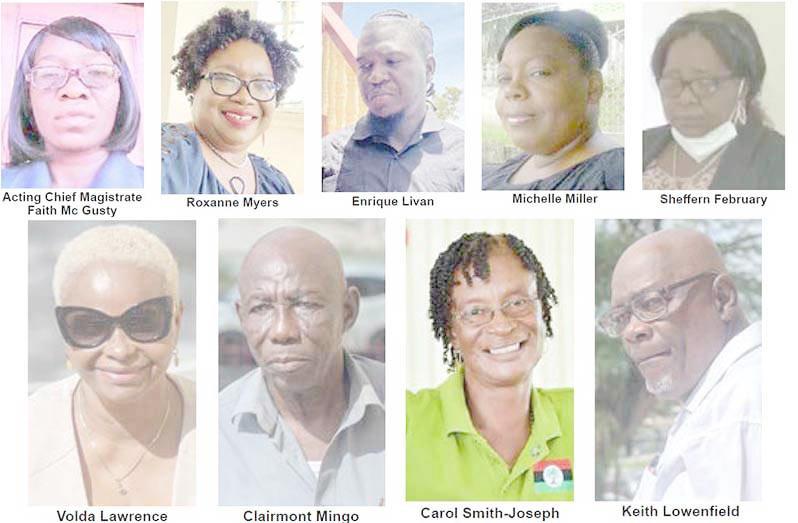
Among those on trial are former Chief Election Officer Keith Lowenfield, former Deputy Chief Election Officer Roxanne Myers, former Region Four Returning Officer Clairmont Mingo, former Health Minister Volda Lawrence and People’s National Congress Reform (PNCR) member Carol Smith-Joseph.
Also facing charges are former GECOM employees Michelle Miller, Sheffern February, Enrique Livan and Denise Babb-Cummings.
The nine defendants collectively face 19 charges, including conspiracy to defraud and misconduct in public office. They have all pleaded not guilty and are currently on bail.
The prosecution, led by King’s Counsel Darshan Ramdhani, alleges that the accused participated in efforts to inflate votes in favour of the then A Partnership for National Unity + Alliance For Change (APNU+AFC) coalition, while reducing votes cast for the People’s Progressive Party/Civic (PPP/C).
Following a national recount supervised by the Caribbean Community (CARICOM) and months of legal challenges, the PPP/C was ultimately declared the winner of the elections with 233,336 votes compared to APNU+AFC’s 217,920 votes. President, Dr. Irfaan Ali was sworn into office on August 2, 2020.
The Presidential Commission of Inquiry into the elections later concluded that there had been collusion among senior GECOM officials aimed at diverting votes to APNU+AFC rather than safeguarding the integrity of the electoral process.
Former GECOM IT manager Aneal Giddings
Six-year-old dies after jumping into canal to save friends
By Bebi Shafeah Oosman
TRAGEDY struck an East Bank Berbice family on Sunday after their sixyear-old son lost his life while swimming with other children at Sixth Bridge, Glasgow, East Bank Berbice.
Dead is Kayden Busey, a Grade One pupil of the All Saints Primary School in New Amsterdam.
Based on information gathered, he allegedly drowned at the Sixth Bridge located in Glasgow, East Bank Berbice where he and some other children were swimming at the time.
Kayden’s mother, Gaynor Paul, explained that she did a detox and was sleeping when her neighbour called on her to inform her that “somebody missing.”
She said she immediately realised that her children were not at home and rushed to the area.
“That is when I jump on my bike and I go straight to
DEAD: Kayden Busey, a six-year-old Grade One pupil of the All Saints Primary School in New Amsterdam
the dam and I see me two lil one and I ask them where your brother and me son say he deh in the water. I go to the water and same time two people jump in,” she said. According to Paul, the men searching for the child told her the area where he had reportedly gone under
was deep.
“When them searching them na find he, so I think like he gone home back, so I ride go home, but then we still couldn’t find he,” she recalled.
Still hoping that her son had somehow left the area, the mother continued searching until other children pointed out the location where Kayden had disappeared beneath the water.
“A boy go and plunge and as soon as he plunge he pull up my son and they try do CPR and nothing,” she said.
According to information provided to the family, the children had allegedly been playing a prank by pretending to drown.
Believing the children were in danger, Kayden reportedly jumped into the water to help them.
Reflecting on the tragedy, the grieving mother said she had often warned her children about going to the area unsupervised.
“I does always tell them
about the back there. If I didn’t drink my detox, they would a never left the yard,” she said.
Paul described her son as a loving and caring child who was always willing to help others.
“He is a loving one, he like talk, he don’t play, you can’t tell he stupidness,” she said.
Engineer proposes automated koker system to improve Georgetown’s drainage
–– says new system would reduce reliance on manual operations
By Shaniya Harding
A LOCALLY developed proposal to automate Georgetown’s sluice/ kokers, could significantly improve the city’s ability to manage flooding by eliminating delays associated with manual operations, according to engineer Patrice Jacobs.
Presenting the concept to the Mayor and City Council, Jacobs argued that Georgetown’s gravity-based drainage network is increasingly struggling to cope with rapid urban development, rising sea levels and more intense rainfall events.
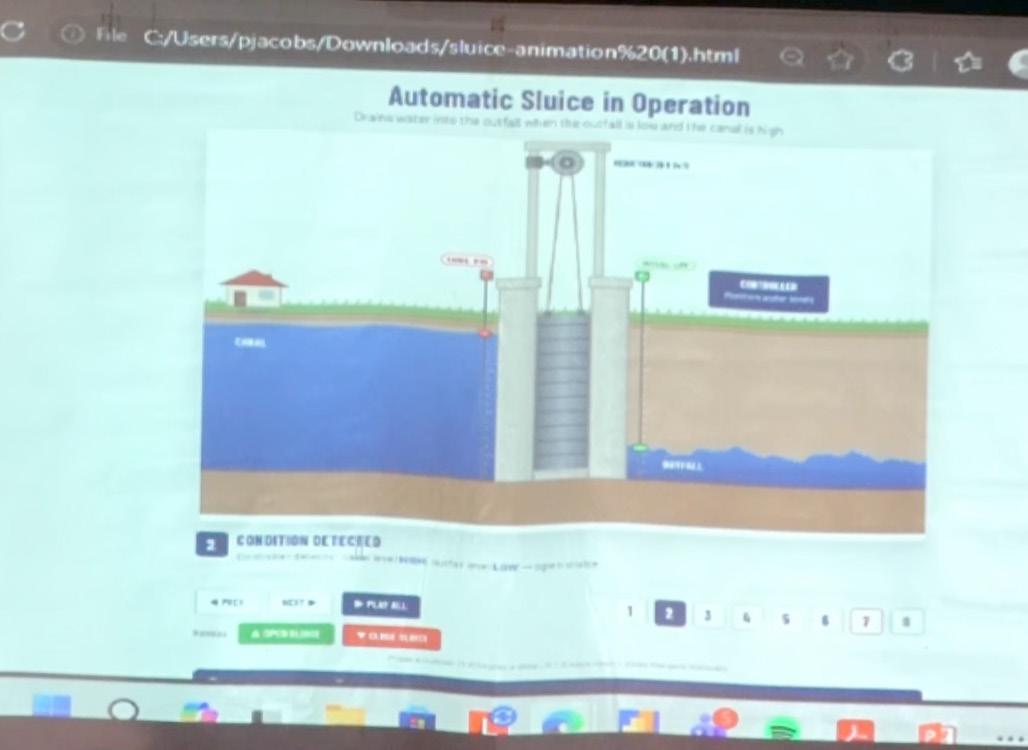
He said the automated system would use sensors and controllers to monitor water levels in canals and outfalls, opening and closing sluice doors automatically to maximise drainage opportunities while preventing seawater from flowing inland. The proposal, he added, offers a practical, locally driven solution to enhance the efficiency of the city’s existing drainage infrastructure and reduce the risk of flooding during extreme weather conditions.
While making his pro -
posal to the council, Jacobs noted that his system aims to alleviate the drainage and flooding issues facing Georgetown. The current drainage system, he explained, relies on gravity, with the exception of a few pumps installed in recent years.
While functional, Jacobs argued that the city’s drainage infrastructure must evolve in keeping with its broader development. “The gravity system as we know it has done its best while it lasted, but as we all know, as we continue to evolve as a city, we find that the drainage system is woefully inadequate. The drainage system as we know it works on tide. The challenge is that we continue to be a country or a city that is below the coastal line. We have two tides per day, and that is when you are especially required to achieve all the drainage that you set out to achieve.”
Jacobs also cited the fact that the current system is manually operated and called on the city to consider new opportunities for improvement through an automated system that would function regardless of whether an
attendant is present.
Speaking on the impact of the 2005 flood, he noted that research shows Georgetown took the brunt of the economic fallout, with more than half of the total loss attributed to the capital.
Jacobs emphasised that the flood highlighted the vulnerabilities of the gravity drainage system, compounded by persistent challenges such as the country’s low-lying terrain and growing concerns over global warming and rising sea levels.
“The issue we continue to face is the question of rising sea levels. We all know that global warming has contributed to rising sea levels. Our fortunes will not change unless we do something different in terms of how we manage to stop a flood. And as such, this situation will not change, so the gravity system will be under extreme pressure if we continue to use the same system as the sea level continues to rise,” he said.
Speaking on how the current system works, Jacobs explained that Georgetown’s drainage network depends heavily on tides and manual intervention. Kokers are opened by attendants when
water levels in the city’s canals are higher than those in the outfalls, allowing water to drain during low tide. As the tide rises and reaches the same level as the canal, the attendant must close the koker to prevent seawater from flowing back into the city.
According to Jacobs, delayed openings or closures represent a primary downside of the current system, resulting in missed drainage opportunities and reduced efficiency.
He further argued that Georgetown’s drainage infrastructure is struggling to keep pace with increasingly intense rainfall, noting that the city’s system can drain only about 5.5 millimetres of rainfall per hour, compared with recent events that have exceeded 17, 21 and even 24 millimetres per hour.
Jacobs’ proposal centres on an automated koker management system designed to reduce reliance on manual operation and improve drainage efficiency. The system would use sensors installed on both the canal and outfall sides of each sluice to continuously monitor water levels, while a controller would
analyse conditions and make real-time decisions. When water levels in the canal are higher than those in the outfall, the system would automatically open the koker to allow drainage.
He said: “The solution that I am offering is really an automatic solution. It is going to open automatically. It does not require a manual interface. And it is going to close automatically with space seals. It is going to run 24 hours. And it is always on standby to respond to extreme conditions… it is going to respond at the appropriate time to allow for drainage. So, you would not lose 15 minutes because an attendant was asleep, or he was cooking, or it was raining and he could not get out.”
As tides rise and water levels equalise, the system would automatically close the koker door to prevent seawater from re-entering the city.
Walking the Mayor and City Council through a live simulation, Jacobs explained, “Currently you have high water in the canal and the tide is low, so we can allow the system to begin draining. The next thing that is going to happen, and this
will happen in sequence, it is not going to be manual, the door is going to open automatically because the sensors detected that the water was high in the canal and low in the outfall.”
He further added, “The water will then start to recede. If you look at the sensors, the colours change. You see it is red here, which is dangerously high, and low on the outfall side, so it tells you it is good to open the door. It is going to drop, and the canal sensor turns to green as it gets lower. It will reach a point where the canal and the tide will have the same level, and at that point the koker will close. There is no manual required.”
Jacobs told the council that the technology could be implemented using local expertise, noting that while some equipment would have to be imported, the design and operational knowledge already exist in Guyana.
The Mayor and City Council are expected to review the proposal as part of ongoing efforts to strengthen Georgetown’s drainage infrastructure and improve the city’s resilience to flooding and climate-related challenges.
Engineer Patrice Jacobs presented his automated koker proposal to the Mayor and City Council of Georgetown earlier this week
Students urged to resist peer pressure, embrace individuality
Minister of Education Sonia Parag
MINISTER of Education Sonia Parag has urged students to resist peer pressure and embrace their individuality, stressing that confidence and self-identity are key to making positive choices.
Parag spoke to the students during a recent Sexual and Reproductive Health symposium at Bartica, Region Seven, during which she called on young people to understand that they have the power to say no to behaviours and activities that may negatively affect their lives.
Addressing students directly, she questioned whether they often feel pressured to imitate friends or social groups. She used examples such as vaping and engaging in activities simply because others make them appear “cool.”
“You do not need to be “cool” by giving in to peer pressure,” the minister told the gathering while emphasising the importance of making independent decisions rather than following trends.
their well-being simply to gain approval from others.
She went on to highlight that many young people fear exclusion from social groups if they choose not to participate in certain activities, explaining that such behaviour can amount to bullying.
She noted that children between the ages of nine and 16 are often particularly vulnerable, as they are navigating significant emotional and physical changes during that stage of their lives.
As part of her advice, the education minister encouraged students to speak openly with their parents and seek guidance when facing challenges or uncertainties.
“How many of you understand that you have the power to say no? … And that’s okay,” she said.
According to the minister, learning to make independent choices marks the beginning of developing confidence and a strong sense of self.
Against this backdrop, she highlighted the importance of recognising and appreciating personal uniqueness, noting that people were not meant to be identical.
“If we were meant to look the same and be the same, we would have been the same and looked the same, but we’re not. We’re all different, and we’re all unique,” Parag said.
She stressed that students should never feel pressured to become like someone else in order to gain acceptance or popularity.
“No one needs to be like someone else to fit in. No one needs to be like someone else to be cool,” she added, warning that individuals should not harm themselves or compromise
Parag said many young people are often influenced by what those around them are doing and may feel compelled to fit in, but she reminded students that saying no is not a weakness.
Local welder has eyes set on metal furniture manufacturing
AARON Arokium has turned a childhood fascination with metal into a fruitful business and a life story of grit, faith, and steady progress.
From Rose Hall, Corentyne, Berbice, he rose from humble beginnings to build a name in welding and fabrication. Today, his journey is proof that discipline and purpose can change one’s life.
He grew up in the country, spending his days playing football, swimming in the trenches and fishing. By age nine, he was already drawn to metal work.
“Ever since I was a kid, I felt the nudging in me for
welding and fabrication,” he said, recalling how he would draw on the ground, beat and shape metal at home and show his mother what he had made. She encouraged him to keep going.
He later studied metallurgy at the Winifred Gaskin Memorial Secondary School in Berbice.
At age 17, Arokium left Guyana and began working in industrial welding. One of his early jobs was at HESS Oil Terminal in St. Lucia, an oil and storage facility where he worked as a welder and fabricator. He later continued with Buckeye after it took over the operation.
His resume also includes work with Tampa Tank Inc in Florida, CB&I and Exxon Mobil, giving him vast experience in the trade and the oil sector.
Even as a young man, he set clear goals. He wanted to become a “wizard” with metal by 18 and own his own business by 30. Those aims kept him focused as he moved through different jobs and learned from mentors overseas.
He told this publication that the discipline he built early helped him stay on course and grow into the business owner he is today.
However, the road was
not easy. Arokium said he came from a large family where even basic needs were hard to meet. He believed hard work was the only way out of poverty, and he pushed himself to master his craft.
He gave credit to his mother who instilled values and confidence to keep him grounded. He also faced a stroke, a vehicular accident, and a separation from his partner. Still, he held onto faith and a positive outlook.
“In life I learned …in every adversity there is a lesson and a blessing,” he said.
In Guyana, he now runs AArokium Welding and Fabrication. He wants the
Aaron Arokium
company to grow beyond repairs, welding jobs, and commercial fabrication into the manufacturing of modern metal furniture for local and overseas markets.
He also hopes to offer warehouse fabrication solutions and storage units for businesses needing practical industrial support.
Arokium sees opportunity as Guyana’s engineering infrastructure expands and the oil and gas sector creates new demand for skilled workers. He wants to use his knowledge and experience to guide young people who are entering the trade.
For him, the next stage is not just business growth on projects within the oil and gas sector but helping others find a career path and create employment for fabricators and metal workers as Guyana continues to develop.
His advice is simple: “Stay ready.”
According to him, “preparation” brings “manifestation,” meaning hard work must come before success.
Now 38, Arokium said the hunger of his boyhood has been satisfied, and his childhood dreams are now real.
Madramootoo grateful for Women’s CPL opportunity
By Sean Devers
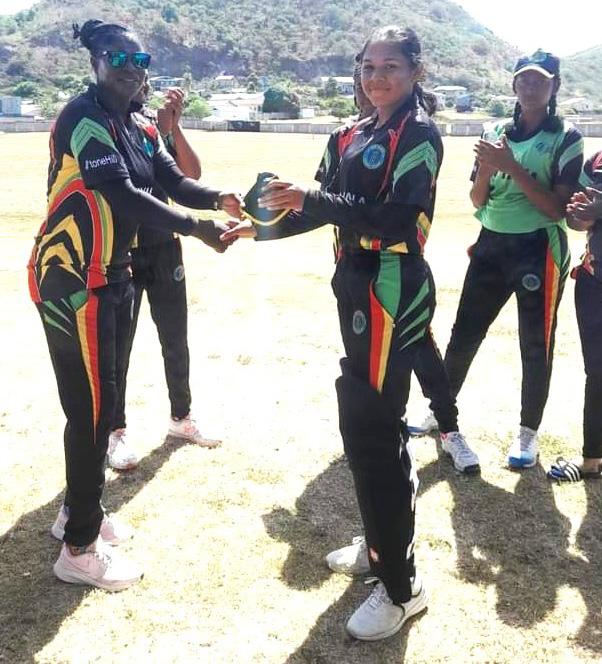
DEMERARA and national fast bowling all-rounder Tilleya Madramottoo has been selected for the Guyana Amazon Warriors in the four-team Women’s Caribbean Premiere League (CPL) scheduled for Barbados from September 5-17.
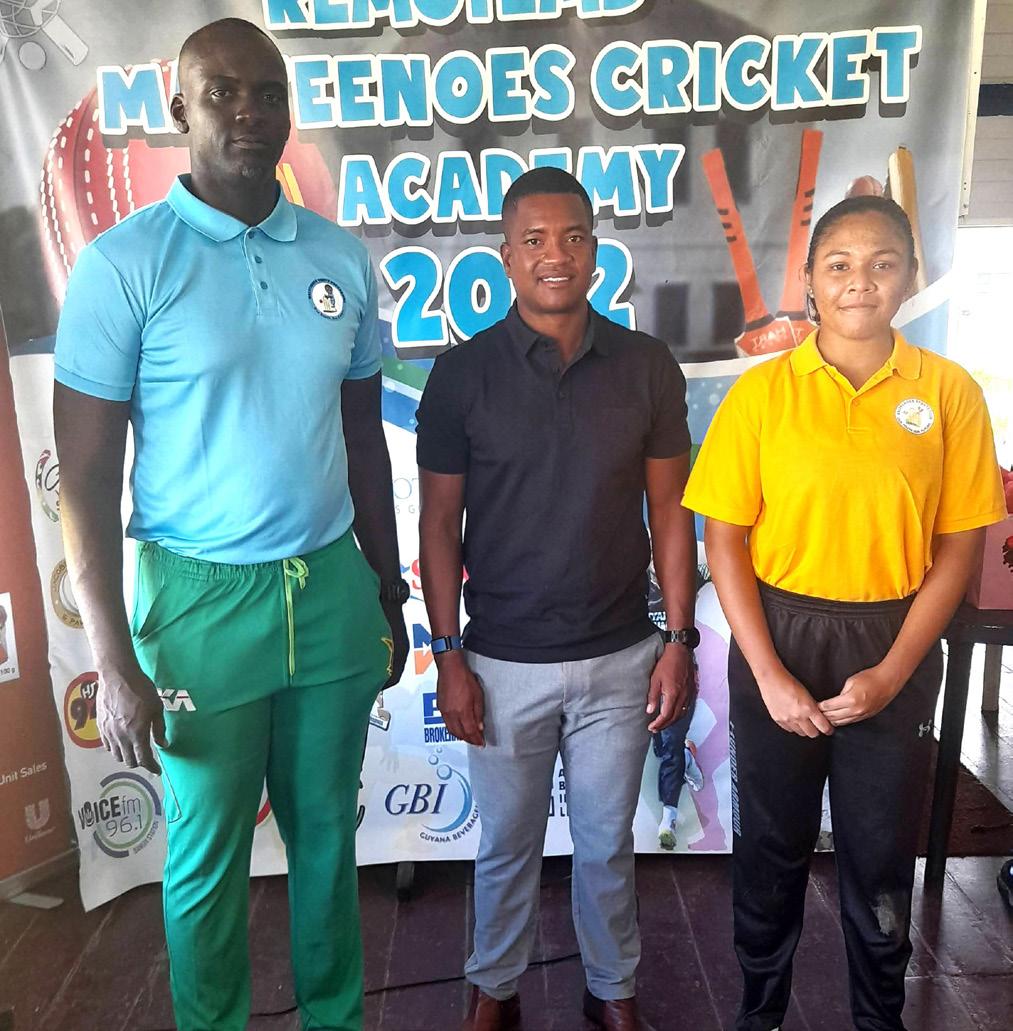
Tilleya becomes the second female player from the Malteenoes Sports Club joining left-arm spinner Kaysia Schultz to be picked for this tournament. Minister Steven Jacobs is the only player from the Thomas Road club to play in the men’s CPL.
Tilleya remembered the day when she received the news of her selection to participate in CPL.
“On that day, I was actually preparing for an exam and not thinking about cricket. When I received the news, I was shocked and could hardly believe it at first. Once it sank in, I felt very happy, excited, and extremely grateful for the opportunity,” posited Tilleya.
The WCPL selectee feels that women’s cricket in Guyana has been growing, and she would like to see that development continue through more opportunities, competitive matches, and support systems for female players. Creating a stronger pathway for young girls will help them develop and see cricket as a sport they can pursue seriously.
“My advice would be to stay disciplined and committed to both academics and cricket. Balancing both is not easy, but it is possible
ENGLISH RACING TIPS
NEWBURY
12:17 hrs Wateera
12:50 hrs Chilli
13:25 hrs Bayside View
14:00 hrs Starlite Sami
14:35 hrs Twirler
15:05 hrs Baileys Khelstar
15:35 hrs Redbud Sixteen
FFOS LAS
09:30 hrs Lohoobb
10:00 hrs Harry's Halo
10:30 hrs English Time
11:00 hrs Buckland Belle
11:35 hrs Pureis King
12:10 hrs Solanna
NEWTON ABBOT
12:35 hrs Saint Polo
13:10 hrs Sudbury Hill
with focus, sacrifice, and determination.
I would also encourage young girls to believe in themselves, work consistently on their skills, and not be discouraged by challenges along the way,” said the third year University of Guyana student who is pursuing a bachelor’s degree in biology.
Tilleya Madramottoo was born to Noel and Indira Madramootoo and is the middle child between two brothers; first born Valon and Noel Junior. The closely knitted family resides in the East Coast Demerara Village of Industry.
“Growing up, I was fortunate to be surrounded by a very close-knit and supportive family. My mother has always been one of my biggest supporters, attending my games and training sessions and being someone I could always count on.
My father has also played an important role by sharing his knowledge, giving me advice, and helping me improve my game. My brothers have continued to support me through training, encouragement, and being part of my journey.
My family has been my foundation, instilling values of hard work, discipline, and dedication, while also helping nurture my love and passion for cricket from a young age,” informed Tilleya, who attended Mae’s private school from the nursery to secondary levels.
“Mae’s played an important role in my development both academically and personally. Sports was a part of my school life at Mae’s.
AMERICAN RACING TIPS FINGER LAKES Race 1 Sorority Prank Race 2 Ari's Magic Race 3 Mercilesanihilator Race 4 Carch A Tiger Race 5 Coach Bahe Race 6 Tap It Easy Race 7 Rockinmoney Race 8 Nightmissio
There was table tennis and windball cricket.
I mainly participated in windball cricket, which was my first exposure to the sport in a school setting. Cricket was the only sport I played growing up.
My interest in the game developed through my father and older brother, who were both major influences in my early years. Being exposed to cricket from such a young age naturally built my love and passion for the sport” explained the talented bowling all-rounder.
The lass who turns 21 next month, has played for Demerara Women in the under-17, under-19 and senior inter-county tournaments. She has also represented Guyana at both the under-19 and senior national levels.
“I joined Malteenoes in 2022 after attending the Cricket Academy with my younger brother. I really
enjoyed the environment, and my parents liked the structure, coaching, and development opportunities offered by the club.
As a result, they enrolled both my brother and I as members. It has been a very positive environment for my cricket development”
At age 11, I first played in an environment that consisted mainly of boys at a cricket camp at the Ogle Cricket Club. I was nervous at first, but over time I became more confident and comfortable. Being a part of Malteenoes helped me adapt to that competitive environment, mostly as I trained alongside the boys there.
I eventually grew to enjoy it, as it challenged me and helped improve my game. I have also had opportunities to play alongside men during club cricket, which has further contributed to my development and
CRICKET QUIZ CORNER
(Tuesday June 23, 2026)
CUMMINGS ELECTRICAL COMPANY LTD-83 Garnett Street, Georgetown (Tel:225-6158)
Answers to yesterday’s quiz: (a) Maratuwa, 1993
(b) Richie Richardson & Arjuna
Today’s Quiz:
(1) How many Test centuries have been compiled by WI batsmen against SL to date?
(2) How many Test hundreds have been made by SL batsmen against the WI to date?
Answers in tomorrow’s issue
understanding of cricket.
Around the age of 12, I played my first competitive match in the under-17 girl’s tournament, representing the East Coast team. It was an important early experience that introduced me to a higher level of competitive cricket.” continued Tilleya.
She also shared two unforgettable moments so far in her cricketing career.
“The first was scoring my maiden fifty at Everest during the senior inter-county tournament. I started the innings nervously, but after my first boundary, I began to settle and build my innings. Reaching my fifty felt unreal, and although I was eventually dismissed, I left the field very proud. That moment became even more special as it was followed by my selection to the national team.
The second was during an under-19 tournament in Berbice, where I scored another fifty against Essequibo and contributed to a win against Berbice on the same day. That performance made me one of the leading run-scorers of the tournament. I was playing with a twisted ankle, but remained determined to perform. Having my family there made the moment even more meaningful,” Tilleya said.
“My batting developed over time as I gained more confidence and experience.
I enjoy bowling more as it is my main role, but I also enjoy batting because it challenges me in a different way
and allows me to contribute more to the team” stated Tilleya.
“Cricket became more serious for me after playing senior inter-county cricket. That level helped me understand the pathway to national selection and higher levels of cricket, which motivated me to take the sport more seriously and commit fully to improving,” added the talented young lady.
She is grateful to coach Yadram, Ms. Heema, and coach Jitlall, who helped build her foundation during her early development at the Ogle Cricket Club.
“I have benefited from the support of Coach Quasen Nedd and Coach Royal Melville and the members of Malteenoes Sports Club, who have assisted me through training, guidance, and their knowledge of the game.
Other coaches outside the club, such as Coaches Linden Fraser and Basil Butcher Jr, Coach Clive Grimmond and Coach Rawle Merell, who have each contributed to my development in different ways.
I am truly grateful for all the support I have received throughout my journey so far. Every opportunity I have had is a result of hard work, guidance, and encouragement from those around me. I look forward to continuing to grow as a cricketer and representing my country with pride,” the young lady concluded.
Coach Quasen Nedd (left) Guyana’s most successful first-class captain Leon Johnson and Tilleya Madramottoo at the 2022 Malteenoes Cricket Academy Tilleya receives her National Cap on her debut
John captures the elite Guyana Cycling Federation’s National C/ship
THE inform Briton John is the new National Cycling Road Race Champion after one of his best showings on the local scene last weekend where he eclipsed his rivals.
The race, running over 167.3 kilometers, was done over a looped course on the Linden-Soesdyke Highway; riders travelled to Netsurf Park, made a U-turn, and returned to the start.
John, who had represented Guyana with distinction overseas, returned home to pull off a heist for his local club, We Stand United.
Second and third places
went to Kaieteur Attack Racing Cycling Club’s Andre Greene and Alex Mendes in that order.
Ajani Cutting again showed his growing pedigree with a win in the U-23 category, beating out the likes of Sidwell Sandy and Aaron Newton.
KFC Evolution's Denise Jeffery went on to capture the women's category, with Tandiea Noel taking the junior women's title.
The Masters over 35 was won by multidisciplinary athletes. Kristan Jeffery of KFC Evolution, who got the better of Seagun Hubbard
and Devendra Sahadeo respectively.
KFC Evolution Alex Newton was good enough to take the junior title, with Alexander Leung and Kevin Stephen finishing in that order for the other podium spots.
The Masters over 50 was won by We Stand United’s Nigel London, with Flying Stars' Ray Harlequin second and Carlton Wheelers' Shurland Sue-Hang third.
The National Championships began on June 14 with the individual time trials at the inner circuit of the National Park.
Emphasis placed on batting at training camp, says Sammy
CMC – Head coach Daren Sammy has revealed that batting for long periods of time was one of the main talking points of the West Indies’ training camp ahead of the start of their two-match Test series against Sri Lanka.
The home side will take on Sri Lanka in the opener at the Sir Vivian Richards Stadium beginning on Thursday.
Speaking in an interview ahead of that match, Sammy said much will be expected of their batters in the series, with the Windies searching for their first Test victory in over two years.
He explained that the 10-day camp which ended on Monday, paid particular emphasis toss improving their batting in the game’s longest format.
“For us, over the first six matches in this World Test Championship we have focused on batting for long periods and not losing so many wickets in a session and the
ability to not let the bowling get into our bowling lineup when someone is bowling a good spell.
“Those are areas that we focused on; so, a lot of concentration, a lot of attention to detail, especially when you’re in the nets batting, putting a price on your wicket and to bat long because it’s not a sprint, more like a marathon and your true character will be tested in all formats of the game,” Sammy said. He admitted that even though they were playing at
home, adapting to the conditions expected in Antigua had also been a big talking point.
“We trained specifically to looking at the conditions that we may face, what we expect here in Antigua and what we have to do in order to match Sri Lanka’s skill set and get the better of them.
“We’ve looked at the surface and we have a fair idea of how it’s going to play, so all of our preparations have been tailored towards that,” Sammy said.
RHTYSC
Rohan Benn named Father of the Year, hundreds receive food hampers
THE cricket teams of the Rose Hall Town Youth and Sports Club (RHTYSC), MS on Saturday last honoured thirty-two-year-old Rohan Benn as the RHTYSC Father of the Year 2026 under their Walter Nero's Father’s Day Memorial Programme.
The teams, Poonai's Pharmacy Under-11 and -13, Farfan and Mendes Under-15, Bakewell Under-17 and Second Division, Pepsi Under-19 and Intermediate, Metro Females, NAMILCO Under-23 and First Division hosted the programme in honour of the late Walter Nero, who was a close friend of the club.
Rohan Benn was nominated by a senior executive of the club, and the cricket teams, after careful review of the nomination, agreed. Benn, who was born in Essequibo moved to Berbice five years ago and is the single parent of three children - two boys and a girl.
He takes care of his children with special emphasis been placed on their education.
The cricketers noted that the devoted father was the perfect example of a father and therefore decided to honour him. Mr. Benn received a trophy, medal of excellence, framed certificate
of excellence, a food hamper and three special gifts.
Club Secretary, Hilbert Foster congratulated Benn on his selection and stated that the RHTYSC was honoured to recognise his commitment as a parent.
Foster noted that the club has been honouring outstanding parents since its formation in 1990. The cricket teams of the club, Foster declared, hosts hundreds of self-development programmes as part of their contribution to society. These programmes are organised under a wide range of sub-headings, including sports, awards, charity, education, anti-drug and anti-suicide initiatives, community development, youth development, religious activities, and publications.
Tony Nero, eldest son of the late Walter Nero congratulated Benn on his award and urged him to uphold his high standard of being a dedicated parent to the kids. He also praised the RHTYSC and the cricket teams for the remarkable job they were doing in serving the ancient county of Berbice.
National under-16 player Jayden Ganpat stated that he and his colleagues were honoured to present the Father of the Year Award to Rohan Benn and urged his
three children to always strive for excellence in their daily lives.
Among the players of the RHTYSC are Kevin Sinclair, Kelvon Anderson, Clinton Pestano, Junior Sinclair, Slyus Tyndall, Jonathan Rampersaud, Sheneta Grimmond, Shabika Gajnabi, Ramzan Koobir, Daniella Manns, Shemaine Campbelle, Matthew Pottaya, Trisha Hardat and Leon Reddi.
An emotional Benn expressed gratitude to the club and the cricket teams for the award and committed himself to upholding his standard as a parent.
Meanwhile, the cricket teams under the Walter Nero Memorial Programme distributed hundreds of food hampers to fathers on Saturday. The cricketers accompanied by Cricket Manager Robby Kissoondial visited the homes of the fathers to hand over the food hampers which consisted of sixteen different food items including flour, butter, sugar, chowmein, sweet soap and other essential items. The programme was co-sponsored by the children of Walter Nero and the club would like to express thanks to Karen, Sandra, Theresa, Jackie and Nancy Nero.
Walter Nero Father's Day Memorial Programme…
Tony Nero presents the Walter Nero Father of the Year Award to Rohan Benn while his children and club officials look on
Daren Sammy
National Senior, Junior and Youth Athletics Championships set for June 26-28
MORE than 360 athletes have registered for the Guyana National Senior, Junior, and Youth Track and Field Championships as the country’s elite competitors prepare for the premier domestic event of the year.
The Athletics Association of Guyana (AAG) is bracing for an unprecedented surge in numbers after opting to merge its three distinct age tiers into a single threeday mega-event, scheduled for June 26-28 at the National Track and Field Facility.
Organisers said the structural shift aims to boost participation and foster a more vibrant competitive atmosphere.
AAG official Tyrone
Smith indicated the decision followed feedback from local clubs, who noted that previous fragmented timelines often left many senior athletes unavailable.
Fourteen clubs have already registered rosters, with organisers expecting additional local teams and overseas-based athletes to confirm entries before registration closes.
While participation is not mandatory for athletes to retain their national status, the stakes remain high. The meet serves as a final opportunity for local competitors to hit the strict qualification marks required for major international events later this year.
The championships will receive a boost in star
power with the confirmed participation of high-profile overseas-based talent.
National 400-metre record holder Malachi Austin is set to compete on home soil, alongside collegiate middle-distance standout Alliyah Moore and a competitive contingent of foreign and local athletes.
Financial incentives are also on the line, with cash prizes of $40,000, $30,000, and $20,000 earmarked for the top three finishers in the senior categories.
The official opening ceremony will take place on Saturday and will be attended by Steven Jacobs, the Minister within the Ministry of Culture, Youth and Sport.
ICC T20 Women's World Cup… ‘We are nowhere near semi-finals’ – West Indies head coach
HEAD Coach of the West Indies women’s team, Shane Dietz, says that the regional ladies are not there yet, even as analysts have dubbed them favourites to win the title this year.
The maroon women have had a dream start to their campaign with an opening win against defending champions New Zealand, before beating Scotland and Sri Lanka.
However, Coach Deitz, who has been coaching the team for about two years, says that they must remain focused; they have not qualified for the next round just yet.
‘New Zealand if they win their games and if we lose two games; still a long way to go. We are nowhere near the semifinals yet; we are playing okay cricket, but we need to improve.
Anyone can beat you on any day. We still have to at least win other games, and hopefully on Wednesday we put a good performance in at Lord's and beat England, and then we will think we are in the semifinals’
Deitz says while they lost to Sri Lanka at home, they have put in the work and got the results in the world cup despite not putting in their best performance.
‘They (West Indies) fielded reasonably well but probably should have batted a bit better, so there is a bit of work to do there, but obviously we had games in the Caribbean, but we have been working hard in our build-up to come to this World Cup. We are pretty happy with how things went; putting them straight under pressure; they fought back pretty well with one
partnership in the middle’
A strong performance with the ball led the West Indies women to a five-wicket win over Sri Lanka the ICC Women's T20 World Cup on Sunday.
The Caribbean side earlier in the match bundled out the Sri Lankans for 98 runs, with team captain Hayley Matthews grabbing three wickets for 15 runs.
Needing 99 for victory, the Windies ladies achieved the target with 23 balls to spare, with top scores of 27 and 17 from Stafanie Taylor and Matthews.
The West Indies play co-host England at 13 hours 30 local time, then they meet Ireland on Saturday in their last group game.
The top four teams go straight to the semifinals set for June 30, with the finals set for the 5th of July.
Camptown FC secures Elite League Season 8 qualification
CAMPTOWN FC has secured automatic promotion to the 2026/2027 Elite League Season 8 after being crowned champions of the Elite League Qualification Playoff on Sunday last.
The Georgetown club earned promotion through impressive back-to-back victories over Timehri United FC and Potaro Strikers FC.
The first-time participants began their playoff campaign in impressive fashion, securing a convincing 3-0 victory over Potaro Strikers FC at the National Training Centre.
tive Regional Association leagues and earned the opportunity to compete in the Elite League Qualification Playoff. It is encouraging to see the continued growth, interest, and excitement that the Elite League is generating across our Regional Associations, reflecting the ongoing development of club football throughout Guyana.
I also extend sincere congratulations to Camptown FC on their outstanding performance throughout the playoff competition. On be-
Ozeal Small led the charge with a brace in the 41st and 60th minutes, while Jomaal Sedock added a third goal deep into stoppage time (90+1') to put Camptown firmly on course for qualification.
With the title and automatic Elite League promotion on the line, Camptown followed up with another disciplined performance, defeating Timehri United FC 2-0.
Shane Jones opened the scoring in the 10th minute before Ozeal Small once again found the back of the net in the 73rd minute to seal the victory and confirm Camptown FC as champions of the Elite League Qualification Playoff.
GFF President, Wayne Forde, commended the participating clubs for their efforts throughout their respective Regional Association competitions and praised Camptown FC on earning promotion to the nation's premier club competition.
"I would like to congratulate all the clubs that participated in their respec-
Allen also acknowledged the challenge posed by the playoff format but praised his team's execution.
"It was a tough twogame campaign, but we stuck to our plan, remained disciplined, and ultimately came out victorious," he added.
The Elite League Quali-
fication Playoff featured seven clubs representing seven Guyana Football Federation Member Associations in a knockout-format competition designed to determine one direct qualifier for the 2026/2027 Elite League season.
By claiming the playoff title, Camptown FC secured
automatic qualification to the Elite League 2026/2027 Season 8. The runner-up, Timehri United FC will now face Fruta Conquerors, a club from the 2025/2026 Elite League Season 7, in a promotion playoff to determine the final spot in the upcoming Elite League campaign.
Camptown’s triumph marks a significant achievement for the Georgetown Football Association representative, who demonstrated consistency, attacking quality, and defensive resilience throughout the playoff competition to earn their place among Guyana’s elite clubs.
half of the Guyana Football Federation, I am pleased to welcome them to Elite League Season 8 and wish the club every success as they prepare for the upcoming campaign." Ford said.
Camptown FC Head Coach, Calvin Allen, credited the club's success to the unwavering commitment of both players and administrators, while expressing appreciation to the Guyana Football Federation for staging the qualification playoff.
Reflecting on the club's journey, Allen noted that many doubted Camptown's ability to assemble a competitive squad capable of reaching the Elite League.
"When everyone told us it would be impossible to put together a team last Easter to compete in the Georgetown competition and eventually qualify for the Elite League Playoff, we chose not to listen. Instead, we remained focused and continued to push forward. Through hard work, good fortune, and the quality of our players, we were able to achieve our goal and qualify for the Elite League."
Camptown FC will join the Elite League for the first time
Windies’ Head Coach, Shane Deitz
Briton John at the top of the podium—2nd place Andre Greene (left) and 3rd place
Alex Mendes (right)
Officials and some athletes at the launch of the event on Monday