




The Bharrat Jagdeo Demerara River Bridge now boasts a new feature of vibrant, coloured lights that could be seen from miles away (Delano Williams photo)

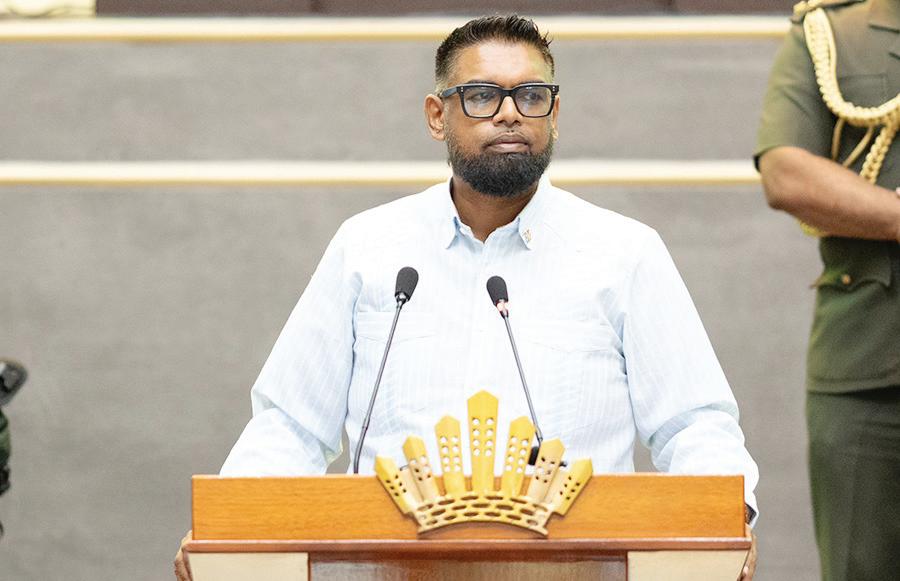
PRESIDENT Dr Irfaan Ali has reiterated that his administration is maximising the economic tools at its disposal to cushion the impact of rising fuel costs and is now calling on the local private sector to demonstrate social responsibility by moderating profit margins.
Delivering the feature address at the Georgetown Chamber of Commerce and Industry (GCCI) Annual General Meeting held last week, President Ali said the government has already “maximised its adjustment tool” by maintaining a zero per cent excise tax on fuel, even as global energy prices and freight costs have increased.
He stressed that the government had also preserved concessions that were in place during the COVID-19 pandemic.
“We have maximised our adjustment tools because we have zero per cent excise tax on fuel. So, we have already maximised that adjustment. We've already maximised the adjustment on freight costs. During the pre-COVID period, we have never removed that benefit, so you maximise the tools available, the macro-economic tools, and here is where social responsibility from businesses comes in.
When the State has maximised its tools, the private sector must support” he said.
The President disclosed
that the state-owned GuyOil is currently operating at a deficit in order to stabilise domestic fuel prices. He signalled that while the government is willing to bear some of the strain, the company must at least be allowed to operate at break-even to
ensure sustainability.
Against this backdrop, Dr Ali issued a pointed appeal to private fuel retailers, some of whom he said were enjoying profit margins of 30–35 per cent at the pump on refined fuel.
“This is the time for you
to make some adjustments in the interest of the consumers. These are difficult conversations, not easy conversations, but they're necessary conversations, and this is what true partnership between the government and the private sector looks like and must feel like… it is true partnership through which the people see the benefit every time there's an interaction between the government and the private sector,” he said.
For Guyana, President Ali noted that these external shocks underline the urgency of building self-reliance, regional co-operation and a more secure energy platform.
“We cannot continue to look beyond our hemisphere for solutions when we have so much resources within the Western Hemisphere, if we are to really secure a sustainable future for ourselves,” Dr Ali said.
The President related that current realities highlight now more than ever how crucial it is for Guyana to strengthen its energy infrastructure.
He warned that the country could not rely on just these fiscal fixes. Instead, he argued, Guyana must press ahead with structural projects designed to permanently reduce exposure to volatile fuel imports, particularly the gas-to-energy
TURN TO PAGE 4
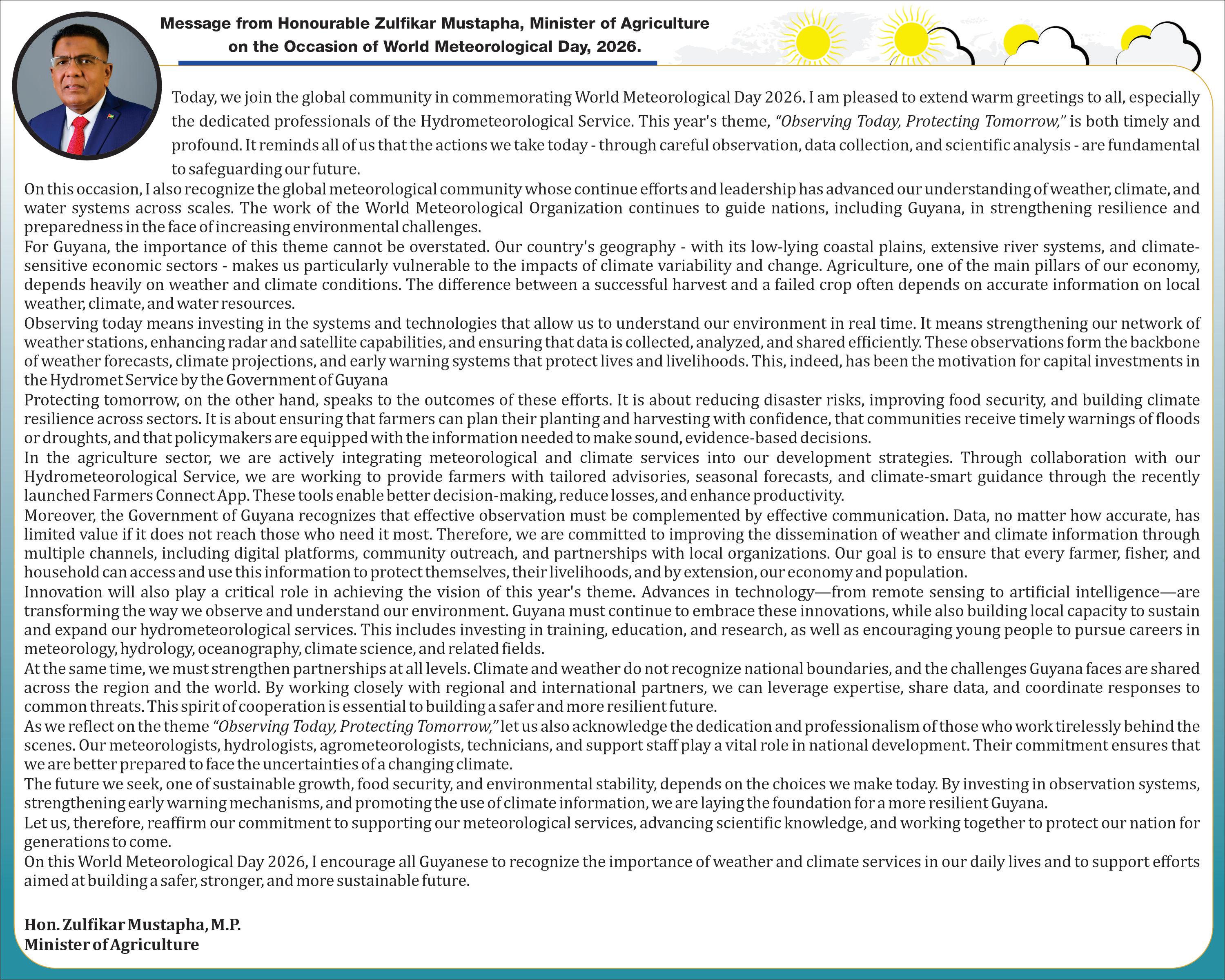
GUYANA is moving to define a clear investment pathway for a suite of transformational initiatives that will underpin long-term economic growth and competitiveness, President, Dr Irfaan Ali has said.
In his address at the Georgetown Chamber of Commerce and Industry (GCCI) Annual General Meeting last week, the Head of State disclosed that the government will shortly hold high-level talks with the Export–Import Bank of the United States (US Exim Bank) to map out financing and technical support for key energy infrastructure projects.
“Very soon, we will be having high-level meetings
ergy (GtE) plant is expected to start this year.
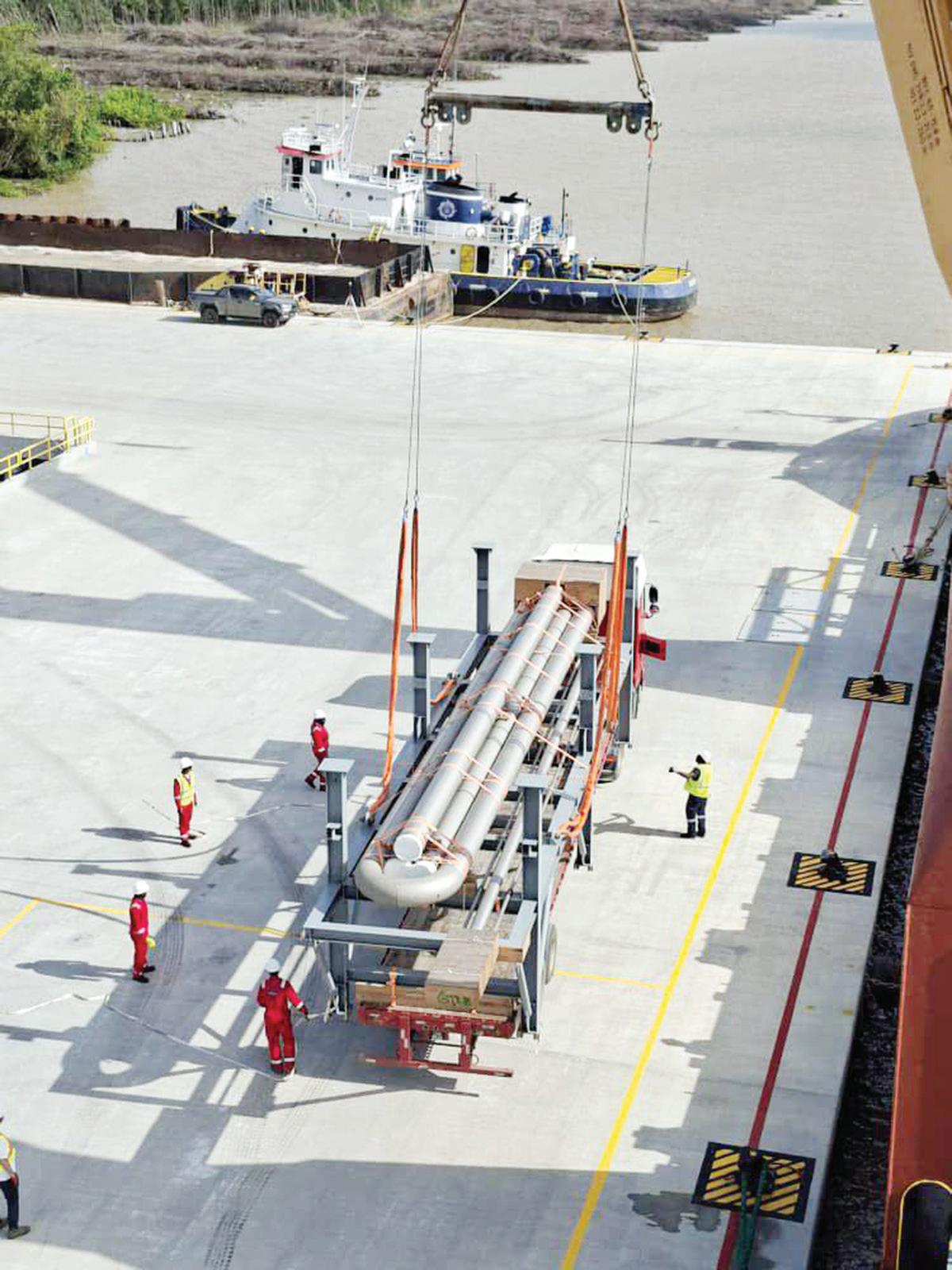
Earlier this month, the first pipe rack for the GtE project arrived in Guyana, marking another key milestone in the ongoing development of the landmark energy initiative at Wales.
The Guyana Chronicle had previously reported that five firms have already been pre-qualified under a second Request for Proposals (RFPs) for another 300 megawatts (MW) plant, with bids expected by the end of March.
It is expected that part of the first phase of the Wales project will be operational by the end of this year, which will see 228 MW of power being delivered.
ate new opportunities for citizens.
With over two-thirds of the work already done and strong collaboration among the government, ExxonMobil Guyana and contractors, the project has been moving steadily towards completion
Already, the government has talked of plans for a second gas plant to meet the country’s growing energy demand.
According to Dr Ali, these projects are central to the government’s strategy to boost productivity across the economy, especially in sectors such as agriculture and manufacturing, while also ensuring that energy and input costs are kept in check.
medium to long term.
The President also underscored the strategic im-
with the US Exim Bank to define the path in terms of investment in the key infrastructure for [a] second gas project and building out the rest of Wales,” he said.
Construction of the second phase of the gas-to-en-
The GtE, a vital piece of Guyana’s development, is progressing well and is closer to fruition. It represents Guyana’s determination to use its natural resources to lower costs, expand industries and cre-
He stressed that the investment programme is not merely about large-scale construction, but also about creating a more competitive and resilient economic base capable of sustaining high levels of growth over the
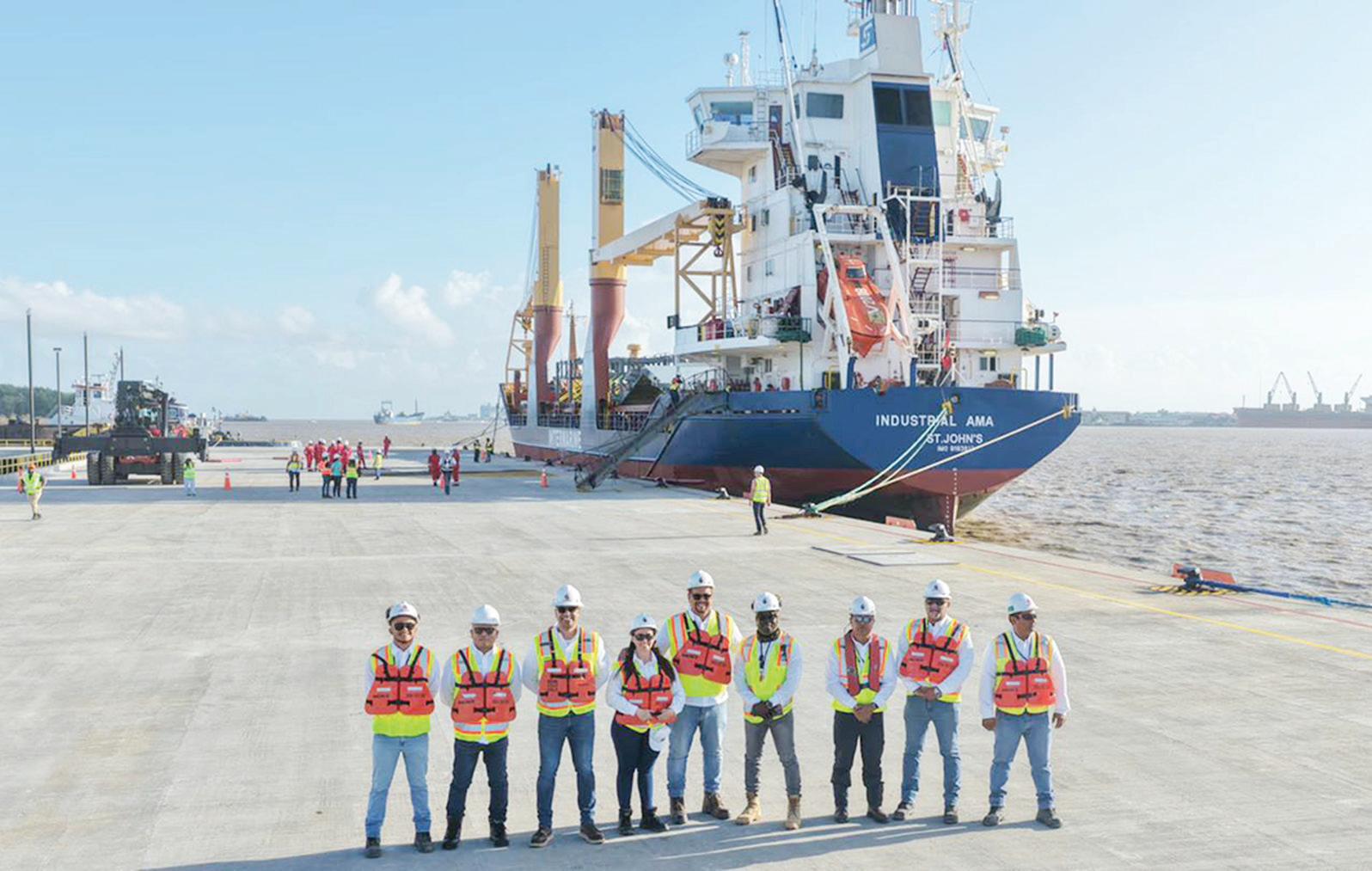
portance of completing a deep-water port, describing it as indispensable to Guyana’s ambitions as a rapidly expanding oil-producing and export-oriented economy.
He warned that without
significantly increased port capacity, Guyana’s ability to handle larger vessels and
infrastructure to support larger shipments and more complex logistics.
The deep-water port, he argued, is essential not only for current trade flows but for future industrial and commercial growth, including the export of value-added products and the servicing of regional and international markets.
Dr Ali also warned that the world was entering a “frightening” period of disruption driven by attacks on critical infrastructure and chokepoints in international shipping routes.
According to President Ali, “over the last couple of days, 17 per cent of energy capacity has been affected, dismantled and can be considered lost.”
greater volumes of trade would remain constrained.
“If we can't have greater and bigger capacity coming in, then we will always be shooting in the dark,” Dr Ali cautioned, pointing to the need for modern port
He pointed, too, to a 25 per cent jump in fertiliser prices and rising fuel and freight costs, warning of cascading consequences for food security and global manufacturing.
OIL prices look set to rise further on Monday, having closed before the at their highest in nearly four years, after U.S. and Iranian threats to target energy facilities, analysts said on Sunday.
U.S. President Donald Trump on Saturday threatened to “obliterate” Iran’s power plants if Tehran did not fully reopen the Strait of Hormuz within 48 hours, a significant escalation barely a day after he talked about “winding down” the war, now in its fourth week.
Iran warned on Sunday it would attack U.S.-linked infrastructure, including energy and desalination facilities in the Gulf, if Trump carried out his threat.
On Friday, Brent futures for May settled up
3.26% at $112.19 a barrel, the highest since July 2022.
“President Trump’s threat has now placed a 48-hour ticking time bomb of elevated uncertainty over markets,” said IG market analyst Tony Sycamore. If the ultimatum is not walked back, oil prices will spike on Monday, he said.
“It clearly means more escalation which means higher oil prices. Some are incorrectly thinking, however, that Iran may cave,” said Amrita Sen, founder of Energy Aspects. “Trump is trying to show he can out-escalate and that way ends in scorched earth for Gulf infrastructure.”

Iran has ports and refineries in Saudi Arabia, Kuwait, Bahrain, the UAE and Qatar in retaliation for attacks on its infrastructure. The closure of Hormuz has resulted in a loss of a full four days of global supply – or some 440 million barrels – during

inhabitable within weeks and force mass evacuations and cascading power failures, according to the Atlantic Council.
Brent gained about 8.8% last week, while the front-month WTI settled down around 0.4% compared with last Friday’s close. WTI’s discount to Brent hit its widest in 11 years on Wednesday.
Restoring supplies from the Middle East Gulf could take up to six months, International Energy Agency chief Fatih Birol told the Financial Times on Friday.
the 22 days of the war so far.
Tehran has so far refrained from attacking large desalination plants in Saudi and the UAE, which are responsible for the water supply for millions of people.
Large-scale damage to those facilities could make some cities in the Gulf un-
The Trump administration is considering plans to occupy or blockade Iran’s Kharg Island to pressure Iran to reopen the Strait of H ormuz, Axios reported on Friday. (Reuters)
initiative.
President Ali told stakeholders that the country must move ahead with key
plans for an oil refinery, a second gas plant and deep-water port.
“If we can have greater, bigger capacity coming

in, then we will always be shooting in the dark,” he lamented, adding: “Now I believe we should return to the conversation of a refinery for national security.”
Turning his attention to domestic policy, President Ali underscored the scale of the government’s current interventions to cushion households and businesses from spiralling energy costs.
“We are fortunate to the extent that soon our energy will come from our own gas, natural gas. We’ll have cooking gas, refined gas that
we will have control over the prices and supply and, of course, the safety of the transport and logistic link,” he said.
“Later this year, when the gas and energy project comes on stream, we’ll begin to see the tangible benefit of that vision,” President Ali added.
These developments, he said, will contribute to greater overall stability in the energy market and reduce the country’s exposure to external shocks.

By Bebi Shafeah Oosman
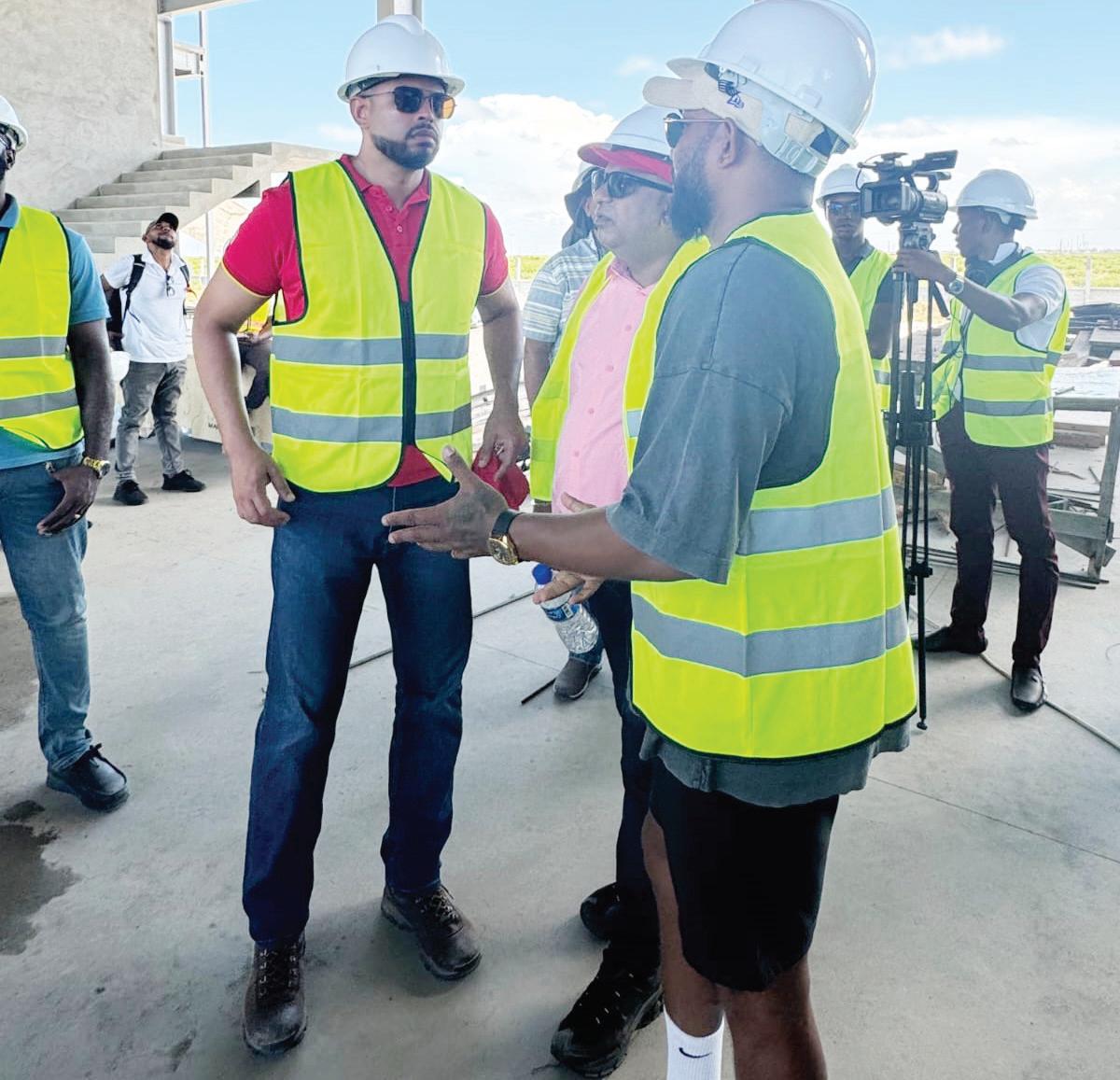
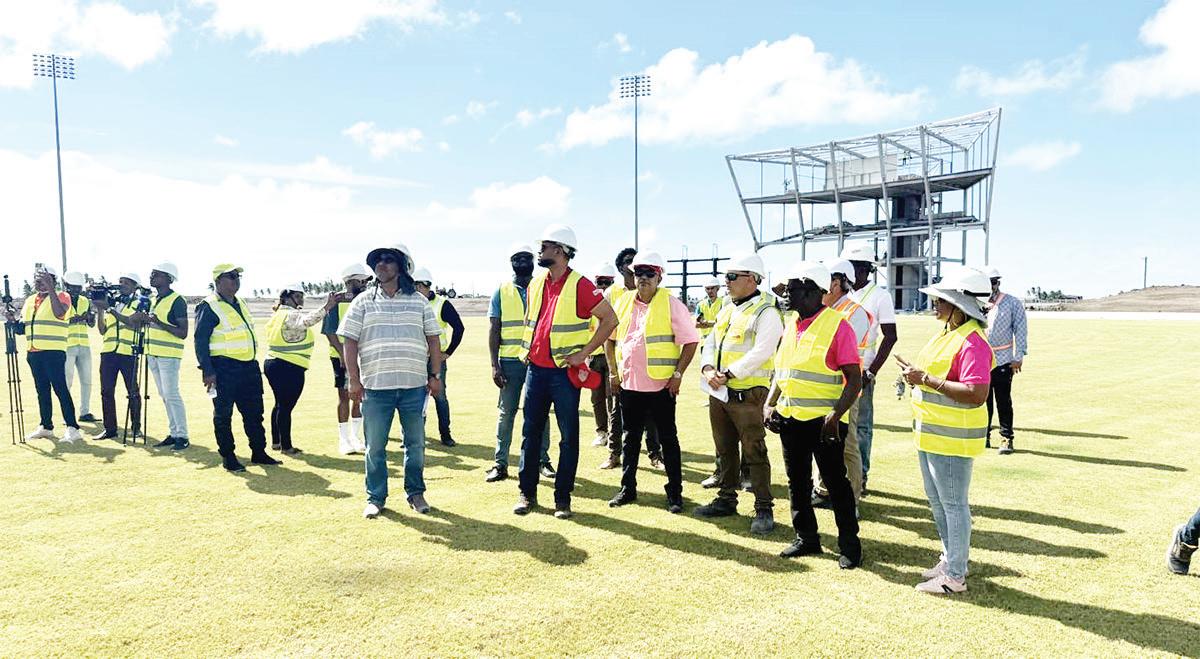
MINISTER of Culture, Youth and Sport, Charles Ramson Jr., on Sunday visited the construction site of the new Berbice Stadium at Palmyra, where he emphasised that the facility must be completed by the end of May.
During the site inspection, Ramson made it clear to contractors and engineers that the deadline remains firm and warned that liquidated damages will apply if the project extends beyond the agreed completion date.
He urged those responsible for the various components of the project to intensify their efforts and instructed contractors to “put in the hours now,” stressing that with an unpredictable rainy season approaching, the window to complete several external works is narrowing.
According to Ramson, being present on the ground is critical to ensuring decisions are made quickly so that work can continue without delays.
“It is important to be on the ground to make decisions with resolutions to advance the contracts and ensure that the timelines are met,” he explained.
The minister also noted that some aspects of the project have faced logistical challenges, due to the international sourcing of materials. Several
key components installed at the facility were imported from multiple countries, many of which have experienced shipping disruptions.
“Prior to this, a lot of the components you see installed here came from many countries, and many of those countries had shipping issues,” Ramson said.
larger national vision, Ramson said the facility represents the invisible hands of investment that are transforming communities across the country.
He added that the Berbice Stadium will serve as a multi-purpose facility, capable of hosting sporting and community and culture events, and forms part
He said that although major structural elements are already in place, certain finishing materials only recently arrived.
“Even though the stand is assembled and the roof is being installed, the sealant only arrived yesterday. And even though the seats had arrived, the sealant is very important,” he noted.
Describing the development as part of a
of a wider effort to expand sports infrastructure in the region.
“This is transformational investment happening here,” the minister said.
Once completed, the stadium is expected to significantly boost sporting opportunities and events in Berbice while providing a modern venue for athletes and residents alike.


ASSISTANT Commissioner of Police
Mahendra Singh, Guyana's Traffic Chief, has called for partnership in public transportation. He emphasised that the Guyana Police Force does not seek praise for its proactive efforts with the United Minibus Union (UMU).
In a frank interview at Traffic Headquarters in Georgetown, Singh discussed ongoing police-led dialogues along key routes such
as Brickdam in Region 4A and Parika in Region Three. These discussions focus on serious issues such as fare disputes, passenger mistreatment, overloading, substance abuse by drivers and conductors, and general lawlessness.
His humble approach underscores that collaboration is crucial for "sanity" on the roads, not a quest for recognition, as daily offences require collective action beyond
just enforcement.
This approach deserves recognition amid Guyana's ongoing road-safety crisis. Between 2020 and 2024, 642 lives were lost in 574 crashes, including 24 children, leading to a death rate of 15 per 100,000 people.
Minibuses, essential for daily commutes, often become hazards owing to reckless behaviours, Singh correctly identified.
These issues contribute to preventable tragedies that need
more than just tickets; they require real changes in behaviour.
The Traffic Department's humility stands in stark contrast to operators who break rules; yet Singh maintains that the challenge, though significant, can be tackled through teamwork.
He notes previous successes, such as declining minibus fatalities and collaborative efforts with drivers. Singh's firm stance against bribery adds to his credibility.
He urges motorists to reject "gifts" to traffic officers and to accept accountability. Guyana aims to reduce annual fatalities to below 50 by 2030 through nationwide initiatives.
These include improving infrastructure and implementing the Safe System approach, which features pedestrian crossings and traffic-calming measures.
However, the police alone cannot achieve this; UMU must take responsibility by ensur-
ing discipline in fares, capacity, and sobriety to protect both passengers and pedestrians.
Ultimately, Singh's vision casts the police as facilitators in a joint effort, rather than as heroes. If operators listen, Guyana's roads can be transformed from chaotic routes to safe pathways, saving lives and supporting the growing economy. The responsibility now lies with all stakeholders: collaborate or face the consequences.

THIS output here began three columns ago, the origin of which is a large letter in the Stabroek News (SN) of March 14, 2026 by Nigel Westmaas, one of the more pronounced defenders of the political interests of the Mulatto/Creole class and one of the longest serving members of the Working People’s Alliance (WPA).
Westmaas had a mouthful to say about me, including personal accusations and remarks about my past and present political outlook. Westmaas knew he printed an ocean of criticism of me, so he writes that he expects an eight-part series as a reply. I don’t know if I will do eight or less or more but here is part four and I know there will be a part five.
Westmaas accuses me of being personal in my analysis of my subjects. But this is the very Westmaas in a letter to SN that describes
me as an attack dog for the PPP. For the record, unlike Westmaas, I do not belong to any political party. I have absolutely no relationship with the PPP as the ruling party and with the Government of Guyana, even at the thinnest of levels. I am not a paid columnist with the Chronicle. I don’t know, have never seen or talked with a number of Cabinet ministers.
Westmaas in his SN March 14, 2026 missive wrote the following: “His reversal (Kissoon) invites the question of whether there may have always been some prior affinity with the very party (PPP) he once condemned so vehemently.”
I was elated, mentally rampant and emotionally ecstatic when Westmaas insinuated about a secret relationship with the PPP during my days as critic of, and activist against, the PPP.
This particular Westmaas accusation allows me to address the vast young minds who currently fill the population of Guyana. Secondly, they allow me to contribute to my country’s historiography (unlike Westmaas, who left 30 years ago, I have not left and will never leave my country).
Westmaas never fails to broadcast that he has two heroes. The first is Martin Carter who Westmaas thinks is the profoundest thinker Guyana produced, and Dr. Rupert Roopnaraine, who, in fact, was a far deeper thinker than Carter.
So, my question to Westmaas is, does he think his two heroes had secret relationships with other entities just as he thinks I had? Martin Carter is suspected of being an MI6 informant of the UK government while he was inside the PPP leadership in the 1950s. Released British documents from


that period revealed that Carter may have been the person MI6 codenamed, “Lascar.”
After being expelled from the PPP for being a Stalinist and ultra-communist in 1955 and picketing the Queen’s sister who was on a visit to British Guiana, Carter turned up in 1957 as a high-level employee of the cultural arm of the Colonial Office in British Guiana named the British Council.
From there, he became the chief spokesperson for the British plantocracy - the Booker Empire. From there, he became the Information Minister for the pro-West Burnham Government then went back to the Booker Empire.
When Carter’s usefulness to British intelligence and the British Government was over in the 1980s, his atonement for his sins took a sordid turn. He became a dipsomaniac. The last
time I ever saw Carter, at UG where I taught, he was drunk in his office. The last time I ever saw Carter in my life, he was walking on a Regent Street pavement in Bourda drunk out of his wits.
Ravi Dev remarked that during the hippie days in the late sixties, the CIA may have recruited Roopnaraine when he was at Cornell University. There has always been a rumour that someone high up in the WPA was an informer because many secret things the organisation was doing got exposed with tragic consequences. I was working with the Grenadian Government when the American invasion occurred in October 1983. None of us could get out of Grenada but Roopnaraine flew out on a special chartered flight.
Dr. Josh Ramsammy who worked closely with Roopnaraine as founding members of the WPA told me that
Roopnaraine had a secret relationship with the PNC. It turned out by accounts of Ravi Dev and later behaviour by Roopnaraine himself that he was always close to the PNC, and he singlehandedly birthed A Partnership for National Unity (APNU). I am begging Westmaas to explain the behavioural patterns of his two heroes.
For the record, while I was actively against the PPP government, I had not even an infinitesimal connection with the PPP. If I did and my ugly secrets made me a recipient of perks, I am still to receive them. If offered them at this late stage of my life, I may take them. Should I?
DISCLAIMER:
The views and opinions expressed in this column are solely those of the author and do not necessarily reflect the official policy or position of the Guyana National Newspapers Limited.
My personal interactions with Dr. Jagan were limited to being a part of several audiences where he spoke.
I also had several fleeting handshakes after or during public engagements. I have one particular memory of an
encounter with Dr. Jagan, sometime in the mid-90s, could be 96, I’m not sure. I was a young student at UG, together with 2 other friends, we were heading to Avenue of the Republic and Regent Street to take a bus to the campus. We had to walk past
Freedom House. While in that vicinity, we saw Dr. Jagan who appeared to be casually ‘liming’ on the sidewalk outside Freedom House. He was in the company of about three or four other persons; he was wearing what Guyanese refer to as ‘ordinary
clothes’.
Then someone drove up and had difficulty parking, Dr. Jagan stepped out to indicate to the oncoming traffic to stop to allow enough room for that person to do his parking manoeuvres.
He was the President of Guyana, and we did not observe any major swarming security detail. Dr. Jagan appeared as an ordinary citizen just engaging other ordinary citizens, no fanfare.
One of my friends had a negative visceral reaction to Dr. Jagan’s deportment. She pouted and carried on about how much she thought he had no class.
“How a man could be president and just deh like duh pon the street?”
She thought he should appear regal, formal and stately. I vehemently disagreed and argued that, that sort of humility and down-to-earth deportment is lovely and refreshing.
I argued that when it’s time to be regal Dr. Jagan was quite capable of functioning in that arena as may be fitting and appropriate. I surmised that our different points of view were informed largely by our upbringing. My friend was brought up in Cummingsburg Georgetown, I am from rural Berbice and our socialisation took on and created a different outlook on these matters.
Another incident that is burned into my memory was a comment attributed to President Jagan that “Africans were at the bottom of the social ladder”.
Some people had revolting reactions to the comment. The opposition milked it, repackaged it and peddled it in ways that
were immensely effective in Afro-Guyanese communities.
Though his statements were mischaracterised by his detractors, it was a source of major hurt for a large segment of Afro-Guyanese. Back then, the PNC and other opposition elements had a political megaphone which Afro-Guyanese paid attention to, they were far more suspectable to race baiting than they are today.
Desmond Hoyte was leader of the opposition, he was seen as a statesman, a man of substance whose politics was informed by hard issues, he was not seen as a racebased activist.
The nation was not browbeaten and bombarded everyday with wolf crying accusations about race. So, when the accusations against Dr. Jagan came from Hoyte’s office, it took a foothold in Afro communities, it came over as credible.
Despite the fact that he was taken out of context, Dr. Jagan didn’t seek to explain it away, he simply apologised. I believe the Afro-Guyanese community connected with his humility and sincerity.
I learned from Boyo Ramsaroop, Khemraj Ramjattan, Moses Nagamootoo and Former President Ramotar that that incident tore Dr. Jagan. He was very sorrowful that the Afro population was made to believe, so widely, that he intended harm to their social interest. I recall that during a recess break in the Jagdeo-Kissoon libel trial, I was in the company of Dr. Roger Luncheon (who testified in court that day) and several other persons having a free
and open discussion on ethnic politics in Guyana.
Dr. Luncheon was asked about that bottom of the ladder comment. He gave an identical answer to that of Ramsaroop et al.
Dr. Luncheon was also asked how can he be complicit in allowing the government to have nearly all Indo-Guyanese heads of agencies and heads of diplomatic missions. The addendum to that question was whether he thought that Dr. Jagan would have allowed that to happen.
Dr. Luncheon gave a nuanced response. A response which I believe explains a lot about the evolution of party politics in Guyana. Dr. Luncheon said the shape of leadership in the PPP could be explained by the way the political struggles evolved and our historical living arrangements which placed us in ethnic enclaves.
He argued that the majority of those who struggled with Dr. Jagan were East Indians and the few Africans who struggled with him had an unshakable place in his government, but that list was exhaustive. He further opined that, outside of Georgetown, we were all raised, schooled, churched and politically persuaded in ethnic enclaves.
When the PPP took government, it was not selecting leaders based on ethnic hue, it was looking for loyal and trustworthy soldiers, especially those who were part of the struggle. The PPP was churning out second and third generation Indo-Guyanese with a history of loyalty to the party than the party was able to procure a lin-
PROGRESS under the European Union (EU) funded 11th EDF Regional Technical Cooperation Facility with the Caribbean Forum (CARIFORUM) of the African, Caribbean and Pacific States was assessed when the Programme Management Committee met recently.
The 11th EDF Support to Wider Caribbean Cooperation: Regional Technical Cooperation Facility (TCF) brought together officials of CARIFORUM, the CARICOM Secretariat and The Dominican Republic, in its capacity as Chair of CARIFORUM, on Wednesday, March 11.
The committee noted activities aimed at ensuring a structured platform for political and technical wider Carib -
bean dialogue, activities to support negotiations for Associate membership to CARICOM, support being provided by the facility to advance implementation of the CARIFORUM-EU EPA, internships and attachments programmes and technical assistance to operationalise the Caribbean-EU Protocol.
Members of the Committee commended the CARIFORUM internship and attachment programmes and welcomed the proposal for language-training programmes for young professionals, describing them as vital pillars for cultivating a skilled and adaptable CARIFORUM talent pool.
Launched in February, 2023, the Regional Technical Cooperation Facility is implemented

by the CARIFORUM Directorate located at the CARICOM Secretariat. Valued at €500,000 and fully financed by the European Union, the TCF supports co-operation efforts across the Wider Caribbean. Implementation ends on 24 December, 2026. (CARIFORUM Directorate)
FROM PAGE 8
eage of Afro-Guyanese or their ability to recruit a new school.
So, when a leadership void is created, the ranking leaders at the time instinctively and organically reached out to those already in their field of view. Those in their field of view were most likely to come from the enclave where their greatest camaraderie existed.
Dr. Luncheon also said that he thought Dr. Jagan would have been more thoughtful, selective and deliberate and would’ve relied less on the instinctive organic extraction process, as such, there could not have been that degree of ethnic dominance in the leadership structure. He believed that many of the leaders at the time, did not go through the political and cultural milling process that Dr. Jagan did.
So, he was not surprised nor thought anything untoward about shape of the government. He felt that the socio-political status quo was a developing process and it should be given an opportunity to evolve; and with evolutionary exposure the ethnic leadership structure will become more balanced.
Finally, I recall when Dr. Jagan died, Mrs. Jagan reported that his last words to the family were, “everything will be all right.” Everywhere you go during that time; on the radio, in minibuses, from home entertainment speakers, even in deep Afro enclaves, the Bob Marley tune, Three Little Birds, rang out.
The part that said, “don’t worry about a thing ‘cause every little thing gonna be alright” became a national theme
chorus. Then on the day of his cremation, as his funeral cortège moved from Freedom House through the streets of Georgetown, on to the East Coast Public Road all the way to Port Mourant, Corentyne, hundreds of thousands of Guyanese of every ethnicity lined the roadway to pay their last respects.
Dr. Jagan was loved throughout Guyana, and where love does not describe citizen’s emotions, respect was certainly an overwhelming sentiment towards him. Dr. Jagan’s legacy will be forever woven into the fabric of our society.
DISCLAIMER: The views and opinions expressed in this column are solely those of the author and do not necessarily reflect the official policy or position of the Guyana National Newspapers Limited.
Patients suffering from debilitating orthopaedic conditions are getting a new lease on life as the Georgetown Public Hospital Corporation (GPHC), in collaboration with the Health and Education Relief Organisation (HERO), undertakes a week of intensive surgeries in Georgetown.
Between March 16 and 22, a joint team of local and visiting specialists are performing 38 adult and Paediatric procedures, targeting conditions that severely affect mobility and quality of life.

exposure to advanced surgical techniques, strengthening Guyana’s capacity to deliver specialised orthopaedic care.
HERO, a U.S.-based non-profit founded by Guyanese physicians in the diaspora and it is driven by a shared commitment to giving back to their homeland. The organisation have been conducting biannual missions since 2007, facilitating hundreds of life-changing surgeries across the country.
The visiting HERO team, led by Dr Wayne
For many patients, these surgeries represent not only relief from pain, but also the opportunity to regain independence and return to daily activities.
Bazil, began consultations shortly after arriving on Friday March 13, 2026, working alongside GPHC’s orthopedic unit

to identify and prepare patients.
The surgeries include anterior cruciate ligament (ACL) reconstructions, clubfoot repairs, meniscal and labral procedures, many using minimally invasive techniques made possible through GPHC’s recent acquisition of arthroscopic technology.
GPHC says the intervention not only delivers critical care but also reduces the need for costly overseas treatment, while improving recovery times and long-term outcomes for patients.
The mission also supports skills transfer, with local medical staff receiving hands-on training and
The team is comprised of Dr Wayne Bazil, President of HERO, along with Dr Rory Lewis, Dr Ronald Chase, Dr Claude Scott, Dr Brody Dawkins, and Dr Shanay Fischer,
The collaboration underscores ongoing efforts to expand access to specialised healthcare and improve patient outcomes nationwide.
(DPI)
By Indrawattie Natram
A SINGLE mother from Coffee Grove in Region Two celebrated Eid-ul-Fitr in a truly special way after receiving a brand-new home under the Men on Mission (MoM) initiative.
Prior to receiving this house, she lived in a dilapidated wooden building for years. The story of her plight was shared with Minister within the Ministry of Public Works, Madanlall Ramraj, who acted on the request for betterment.
For years, the single mother, Farah Mohamed, struggled to provide a safe and comfortable living environment for her two children. Today, that hardship has been re-
placed with joy, relief, and renewed hope as she steps into a new chapter of her life.
The keys to her new home were officially handed over on Saturday in the presence of Minister Ramraj; Regional Chairman Devin Mohan, and Vice Chairman, Humace Oodit, who all shared in the heartfelt moment. She was handed over the keys on an auspicious day for her religion.
Built on the same property where her previous structure once stood, the house now offers improved safety, comfort, and dignity for Mohamed and her family.
This initiative was made possible through the support of contractor Takash Persaud and marks the seventh
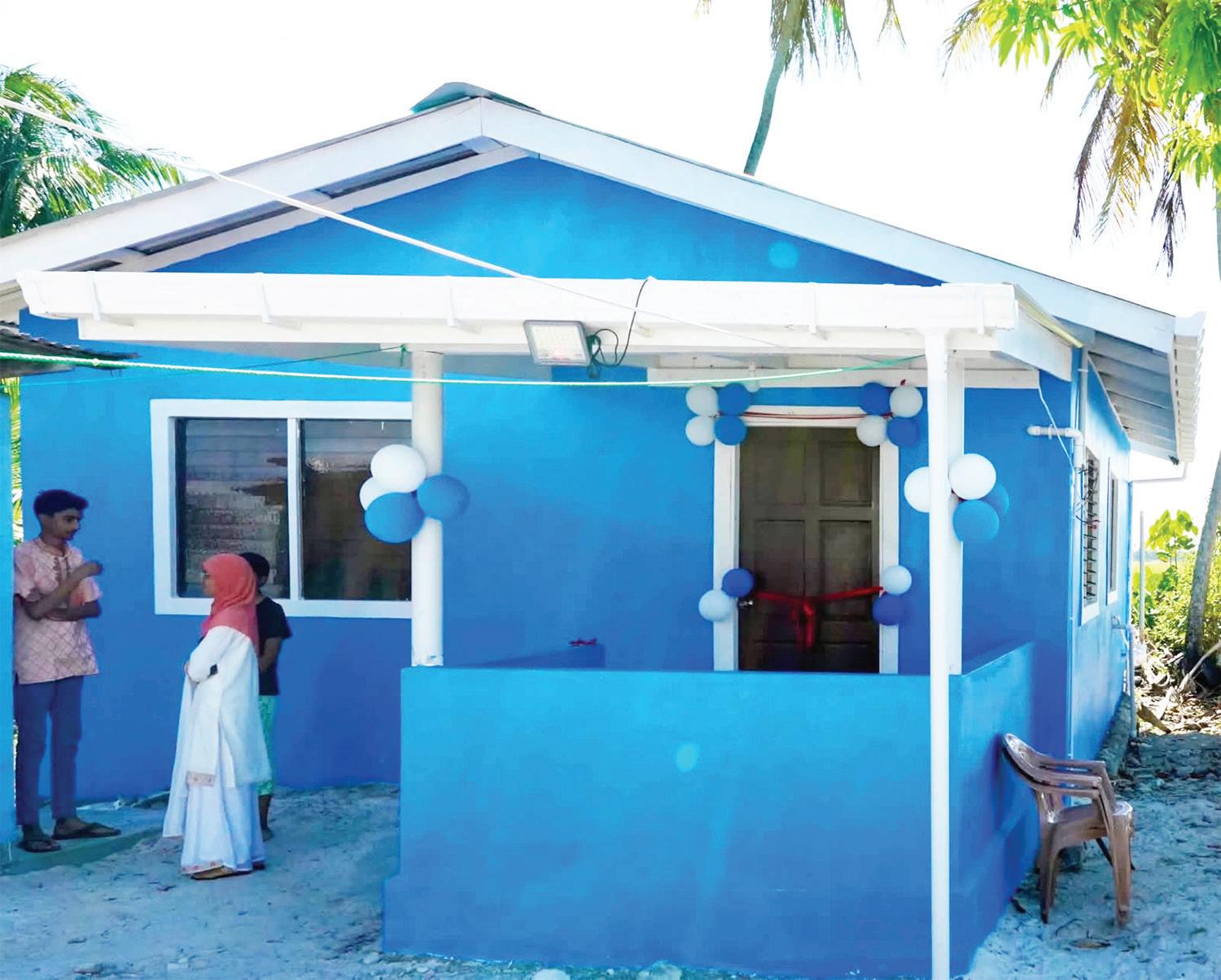
home completed under the MoM programme in the region.
The region, through the Men on Mission Initiative, has been

collaborating with the business community to
ensure that the houses are built for those in need.
Persaud said he was happy to do such since it’s one of his corporate social responsibilities. He said he was happy that the mother will now live in a more comfortable house.
Overcome with happiness, Mohamed expressed sincere gratitude to the Men on Mission initiative and Minister Ramraj, describing the gift of a new home on Eid Day as a life-changing blessing. She said she no longer has to worry about heavy rainfall and leaking roofs.

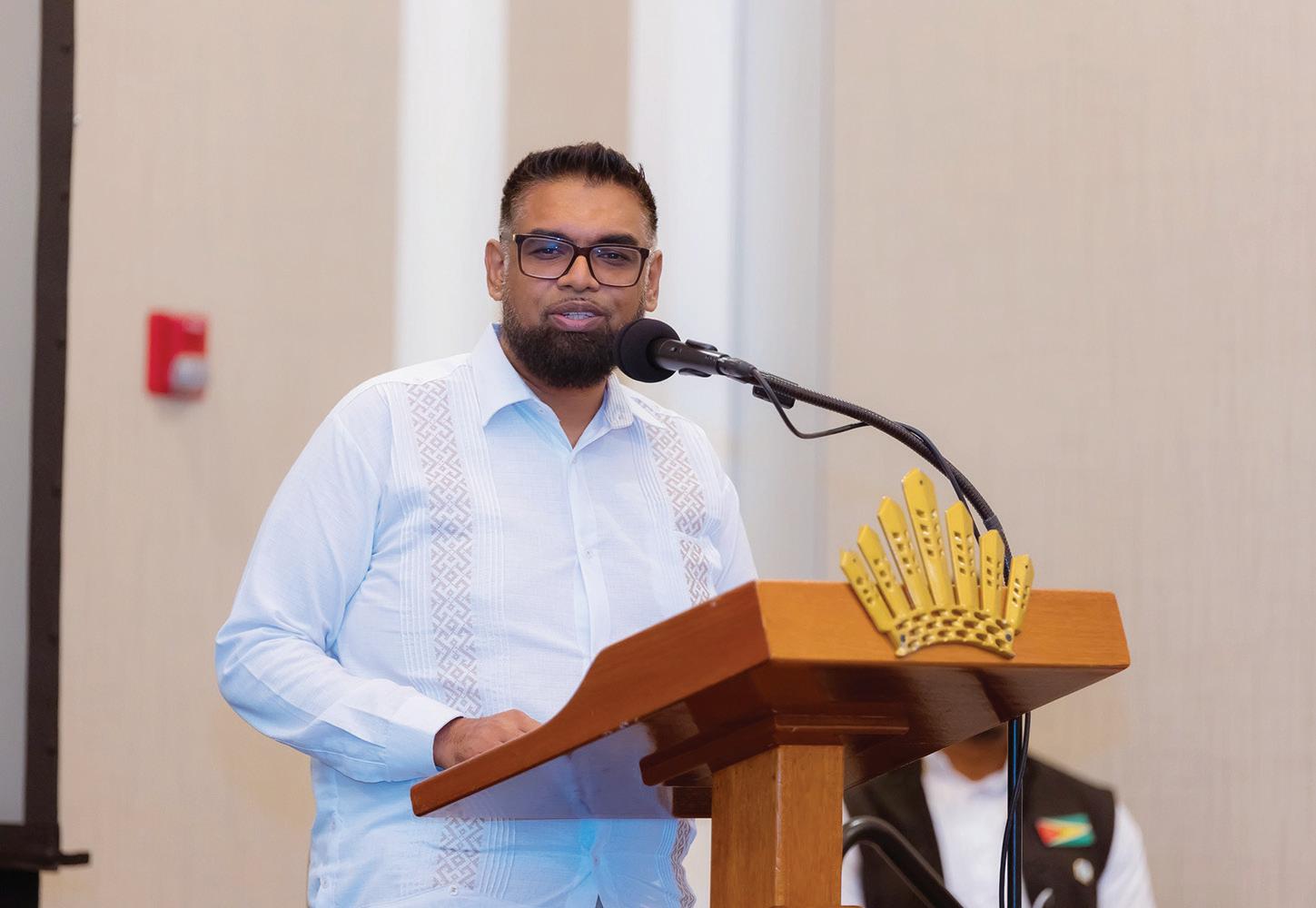
PRESIDENT Dr. Irfaan Ali has announced that Guyana will soon begin large-scale production of cocoa and coffee.
Speaking at the annual general meeting of the Georgetown Chamber of Commerce and Industry (GCCI) last week, President Ali said that within the next few weeks, large-scale cultivation of cacoa and coffee will commence, alongside
broader investments in agricultural and food systems.
He outlined a series of initiatives aimed at transforming the sector, including expanded aquaculture, manual cul-

tivation projects, and the completion of a national food terminal and hub. These developments, he noted, are part of a wider strategy to position Guyana as a key player in regional and global food production.
“Within the next few weeks, we will have large-scale cocoa cultivation, cocao as we call it, we will have largescale coffee cultivation, manual cultivation, expansion of aquaculture, the completion of the food terminal, a food hub,” the President said.
He highlighted growing interest from major private-sector players, who are increasingly investing in food production and agro-processing.
The Head of State stressed that such investments are critical as the world continues to grapple with high food and transportation costs.
“More and more and more, we're seeing the large private-sector organisations in Guyana moving towards investment in food, investment in agro- processing,” he said, adding: “This is
what is important for the future of our country, as we see today, the cost of food, cost of transportation, to move that food in a region and a world that is still recovering from COVID, still reeling from the impact of the Russian-Ukrainian war, now having to navigate these challenges, we are equally committed to providing relief to consumers, because a strong consumer base is the foundation of a strong partner.”
Earlier this month, President Ali had met with RIZEK Cacao, a renowned Dominican Republic (DR) processing and export company of cocoa and its products, which has expressed interest in expanding its operations to Guyana.
“The world is watching. The world is investing in Guyana. The world is recognising what we already know that this is, this is a country on the rise, and as we rise, we must rise together, because growth that excludes is growth that fractures, but growth that includes is growth
that endures,” President Ali said.
First established in 1905, Rizek Cacao is said to be an expert in processing and exporting cocoa and its products, adhering to international norms and standards to satisfy the needs and expectations of consumers.
Back in 2025, Guyana and the DR had inked an agreement to establish approximately 200 acres each of coffee and cocoa in Region One (BarimaWaini), as part of the country’s broader efforts to boost economic diversification, enhance rural livelihoods, and expand regional trade.
That agreement had underscored the importance of sustainable agriculture and technical co-operation and will support the development, cultivation, processing and marketing of both crops. It will also pave the way for joint research and development programmes, as well as value-added production and trade facilitation in the cocoa and coffee sectors.
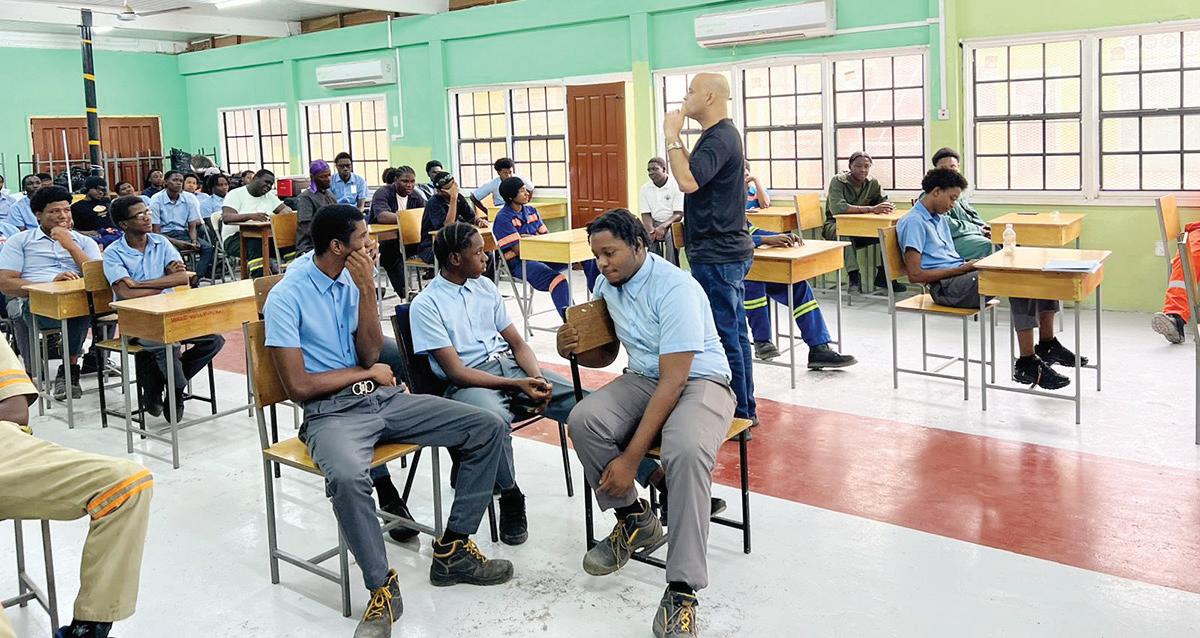
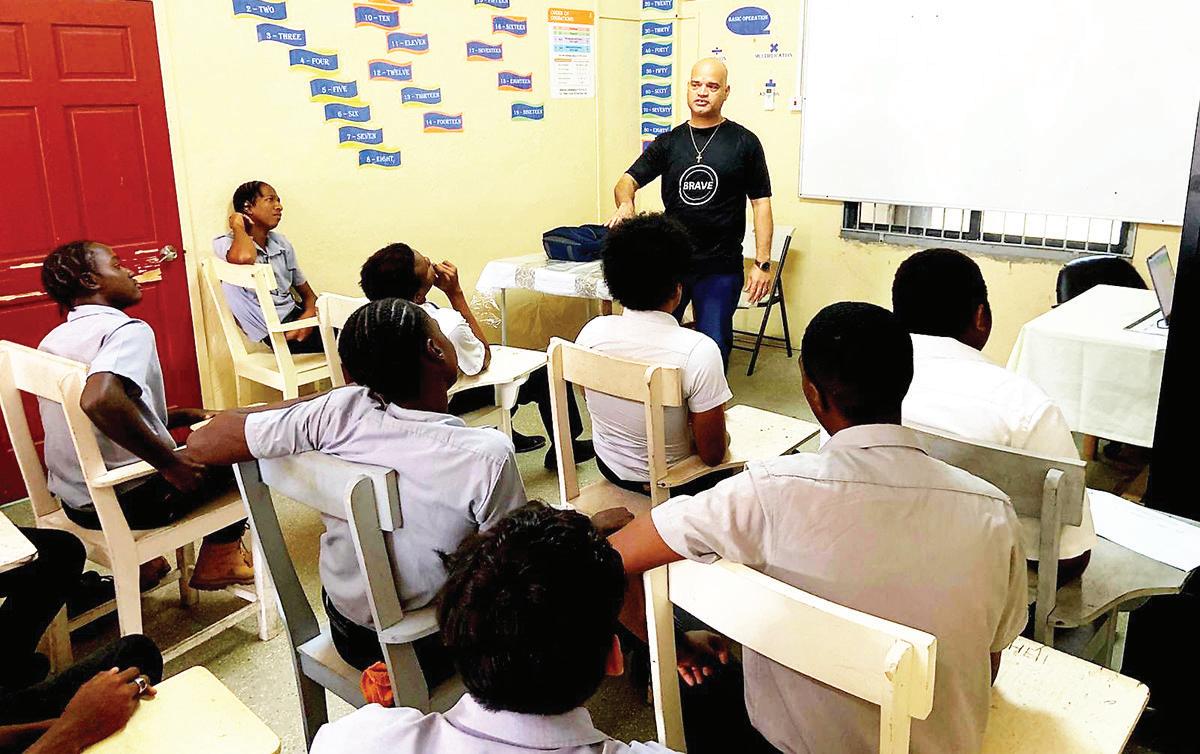
Last week, teams from the Gender Affairs Bureau (GAB) and the Sexual Offences and Domestic Violence Policy Unit (SO&DVPU) of the ministry brought the initiative directly to young men at GITC and LTI
THE Ministry of Human Services and Social Security is advancing with purpose as it continues the rollout of its BRAVE Centre initiative across key communities and hotspots throughout Guyana.
Last week, teams from the Gender Affairs Bureau (GAB) and the Sexual Offences and Domestic Violence Policy Unit (SO&DVPU) of the ministry brought the initiative directly to young men at the Guyana Industrial Training Centre (GITC) and the Linden Technical Institute (LTI).
The ministry noted that with a strong focus on male students, trained
male facilitators led impactful and candid discussions on the range of support services offered through the BRAVE initiative.
These include access to safe, judgment-free spaces where men can openly express themselves, receive free counselling, and be guided toward embracing positive masculinity.
Importantly, the initiative also encourages personal accountability, equipping men with the tools to make healthier decisions and contribute meaningfully to their families and communities.
At its core, the BRAVE
Centre initiative is about shifting narratives and strengthening support. It reinforces that men are not alone, not overlooked, and not defined by stereotypes.
Instead, they are being actively engaged, supported, and empowered to understand and manage their emotions, navigate challenges constructively, and emerge as positive forces within society, the ministry said.
It was highlighted that this is the ministry’s commitment, ensuring that meaningful, compassionate, and transformative support is accessible to the men of Guyana, fos-

tering stronger individuals, stronger families, and ultimately, stronger communities.
The first BRAVE Centre was launched in
July 2025, at the West Central Mall in Leonora, West Coast Demerara. It was called a pioneering step towards helping men to redefine what it means to be men and is a facility dedicated to supporting men and boys in becoming better versions of themselves.

DIRECTOR of Vreeden-Hoop Shorebase Inc (VEHSI), Nicholas Deygoo-Boyer, has underscored the importance of technical training in equipping Guyanese to meet the growing labour demands of the oil and gas sector.
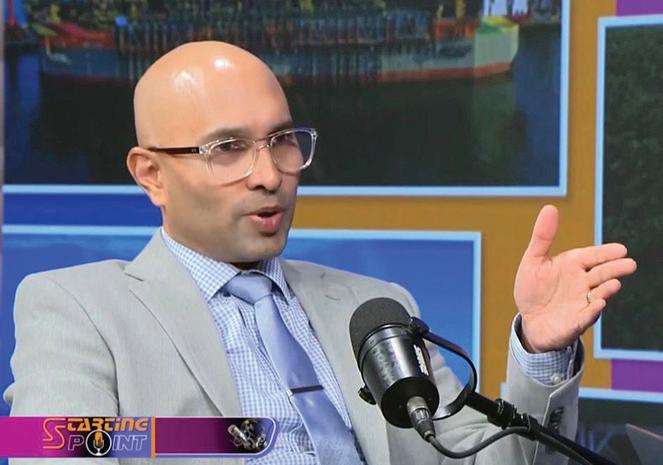
During his appearance on the Starting Point Podcast, he pointed to the Guyana Technical Training College as a critical step forward in this regard.
He said that the demand for skilled workers in technical and STEM fields has never been
higher, noting that young people should consider careers in those areas.
Boyer said, “There’s never been a larger demand for persons in tech-
nical or STEM fields than there is.”
He related that the rapid expansion of the oil and gas industry, alongside ongoing infrastructural
development, has created intense competition for skilled labour across multiple sectors.
“The oil and gas industry, civil infrastructure and construction, and you know everything else that is in between – mining, are all tugging at the same workforce,” Boyer noted, as he even highlighted the strain on existing training institutions.
According to him, the new technical training college represents a significant advancement in addressing this gap, describing it as a “big leap” to really create a facility which aids in creating the workforce for the gas industry of the future.
Boyer pointed out that the scale of operations
offshore requires a substantial and continuously rotating workforce.
“If each FPSO… the population on board is around 200 plus persons… that means… you have to have 400 people to staff a vessel,” he said.
Against this backdrop, he emphasised that building a strong local workforce is essential to ensuring Guyana fully benefits from its oil and gas resources.
“Their manner of hitting local content is by creating a large Guyanese workforce,” he said, noting that ownership alone will not be the primary driver.
Beyond industry needs, Boyer also highlighted the broader social
impact of technical training, linking it to improved livelihoods and economic mobility.
“When you look at the salaries that these guys and gals… are taking home quite a bit that will transform their lives,” he said, adding: “It allows them to have a quality of life, to buy a home, to raise a family.”
He added that the expanding economy is already creating opportunities for graduates.
“When that workforce is trained, they’re not coming out hoping for a job,” Boyer said, stressing that the initiative is “positively affecting the country” by helping to build a stronger middle-class.
violence
was not something people spoke about openly in Kyrgyzstan in the 1990s following the collapse of the Soviet Union, but after a long road of dedicated efforts, there are now laws addressing family abuse, crisis centres and hotlines while human rights defenders tackle such new challenges as sexual slavery.
Bübyusara Ryskulova has been on the frontlines for more than three decades. Honorary President of the crisis centre Sezim (which means “feeling”), she has worked towards helping women and children who survived violence.
While Kyrgyzstan has made significant progress in strengthening protections against domestic and family violence, challenges remain, she told UN News during the recent Commission on the Status of Women session (CSW70) at UN Headquarters in New York, where representatives from more than 100 countries discuss access to justice and the protection of women’s rights.
“My work has been connected to the very topic discussed at this session for more than 30 years,” said Ms. Ryskulova, who was the only civil society representative in a “very strong delegation” that included the deputy prime minister, ombudsperson, deputy prosecutor general, Supreme Court and various ministries.
“For me, it’s a chance to see how other countries work,” she said, adding: “At home, you hear a lot of criticism, but still, comparison puts things into perspective.”
‘I KNEW HOW DEEP OUR PROBLEMS WERE’
Ms. Ryskulova said she “came into this by accident”, explaining that her decision to dedicate herself to this work was inspired by a previous visit to the United States in 1998, when an exchange programme brought her to seven states to learn about ways to address domestic violence.
“I saw for the first time how a support system actually functions,” Ms. Ryskulova said. “Back home, no one even talked about these issues out loud. When they started teaching us what a public organisation is, what an NGO [non-governmental organisation] is, I was learning like a schoolgirl. Everything was new and
very interesting. But, even then, I knew how deep our problems were.”
‘ROLLBACK’ OF WOMEN’S RIGHTS
One of the first crisis centres in the region, Sezim was founded in 1998, at a time when the very idea of helping survivors of violence was new to the country.
Even today, speaking openly about domestic violence can still be difficult, Ms. Ryskulova said.
“In the early 1990s, there’s been a noticeable rise in religiousness, and sometimes people interpret many issues through the lens of religion,” she said.
“For example, in the village where I’m from, there is one school and two mosques. So, talking about violence can still be hard, and in some areas of women’s rights, there has been a certain rollback.”
TOUGH START
The early days were incredibly tough, especially when the first hotline was launched, she said.
“When we opened the hotline, we just sat there waiting. Will anyone call? And for a long time, no one did,” she recalled.
“When the first call finally came, they said, ‘take it’. I had almost no experience. My hands were shaking, but that’s how we started.”
PROGRESS IS UNDENIABLE
Progress is undeniable. The professional landscape is slowly changing. While the country had almost no practicing psychologists in the early 1990s, now many universities train them.
After a civil society campaign and a major petition drive, in 2003, Kyrgyzstan became one of the first post Soviet countries to adopt a law on family violence, with
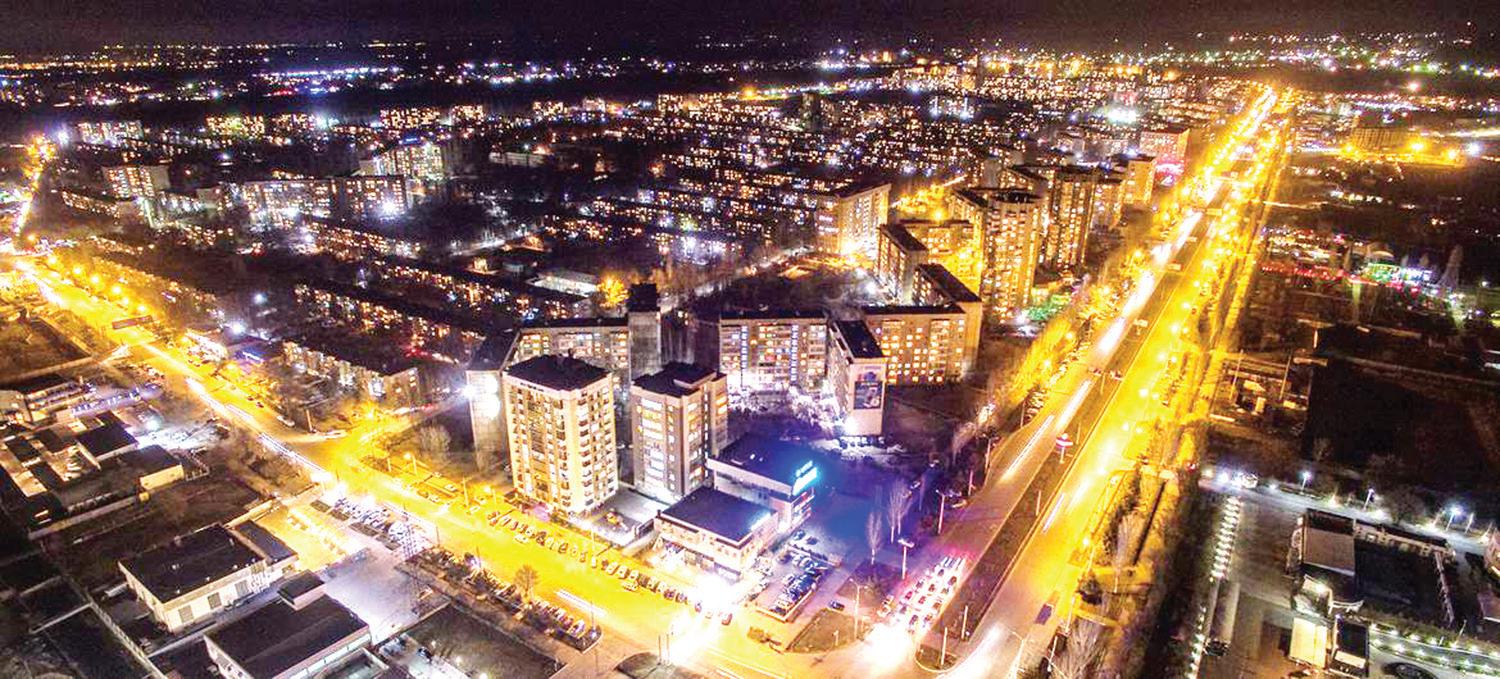
Bishkek, the capital of Kyrgyzstan
legislative updates adopted in 2017.
“At the legislative level, we really can’t complain,” Ms. Ryskulova said.
“But, the law is one thing, and its implementation is another. That’s why now we work more on the ground, protecting specific people. We have a shelter, and our specialists have been working for more than 30 years. I received a second degree myself, as a practical psychologist and today I often represent survivors’ interests in court. Our law allows that, through a power of attorney, even if you’re not a lawyer.”
Sometimes, she says, these cases become high profile and help push the system forward.
“In recent years, our organisation has handled around 40 court cases, and almost 90 per cent of the decisions were in favour of the survivors. These were very difficult cases [including] murders, rapes. We work on them, and then we raise public awareness. If a woman doesn’t want publicity, we protect her anonymity completely.”
International cooperation, including with UN agencies, played a major role in the development of crisis centres in Kyrgyzstan, with the International Organization for Migration (IOM) being one of their earliest partners.
“That’s where I first heard the term ‘sexual slavery’,” she said.
“Then we opened a hotline specifically for that issue. I remember one of the first girls was underage and pregnant. I met her at the
airport myself. She said she didn’t want to live, that she would end her life if the baby was born. We had to take turns sitting by her hospital bed so she wouldn’t harm herself.”
Today, Sezim continues to work with UN agen-
cies such as the UN refugee agency, UNHCR, and UN Women.
“For us, this is very important [for] sharing expertise, training specialists [and] joint projects,” Ms. Ryskulova said. “Platforms like the Commission on the Status of Women provide the opportunity to see what is happening in the world and understand what we still need to learn,”
Despite decades of work and visible progress, she is certain about this: helping survivors still requires daily effort.
“Seminars and trainings matter and prevention matters,” she said, “but if even one person who has suffered remains without protection, then we still haven’t done everything we must.” (UN News)
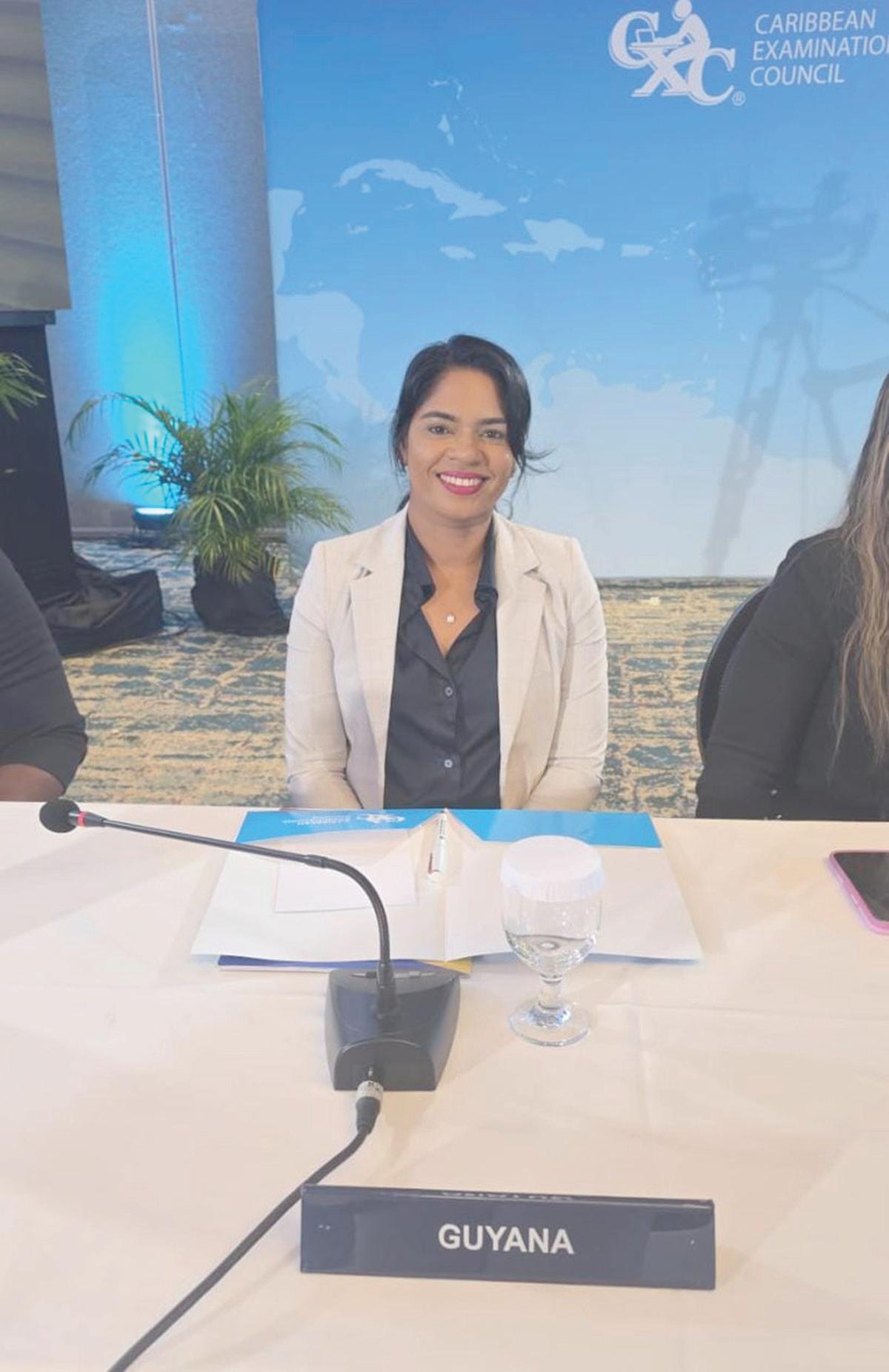
MINISTER of Education, Sonia Parag, has noted that Guyana’s flagship Digital School is now serving more than 27,000 students across the Caribbean as the platform is continuing to expand its reach and offerings.
Parag made this known while delivering the keynote address
at the closing ceremony of the Caribbean Examinations Council (CXC) Ministerial Forum, during which she said the initiative, fully funded by the Government of Guyana, is being made available free of cost to participating CARICOM countries.
“The Digital School was not only established for Guyanese, it
was also established for the wider CARICOM region,” Parag said.
To this end, she noted that several territories, including Barbados, Grenada, Belize and St Kitts and Nevis, are already benefitting from the platform.
She said that the Digital School delivers live interactive classes aligned with the CXC

framework, supported by digital tools that allow for personalised learning and continuous engagement, which positions it as a critical tool in modernising education delivery across the region.
According to the minister, the platform currently provides content for Grades 10 and 11, with expansion in the works.
“In three weeks, we will be able to have the content for Grades Seven to Nine, and in the months to come, we will have the entire primary [level] on the Guyana Digital School,” she said.
Parag emphasised that the initiative was born out of the challenges experienced during the COVID-19 pandemic, when countries were forced to rapidly transition to online learning.
Against this backdrop, she stated that rather than treating digital learning as a temporary solution, Guyana moved to make it a permanent feature of its education system.
“Instead of always having to find a shortterm fix or a temporary fix, why not make this permanent? Because the entire world is moving… the entire world is digitising,” she stated.
Additionally, she indicated that the platform also serves as a safeguard against dis-
ruptions to education, particularly in the face of natural disasters and other emergencies common to the Caribbean.
“For all of our territories in the Caribbean that suffer in one way or the other from some disaster… we have to have something in place that gives that reassurance, that allows the process to continue,” she said.
With this, she underscored that the digital school is designed not only to complement classroom teaching, but also to expand access to quality educational resources, particularly for students in remote and underserved communities.
“If you really want your students to improve and you want them to have every resource possible to make them successful, then I’ll encourage you to sign on to the Guyana Digital School,” she urged regional counterparts.
With more than 27,000 students already enrolled, the minister said the initiative reflects Guyana’s commitment to supporting regional education development through practical, accessible solutions, while strengthening collaboration among Caribbean nations.

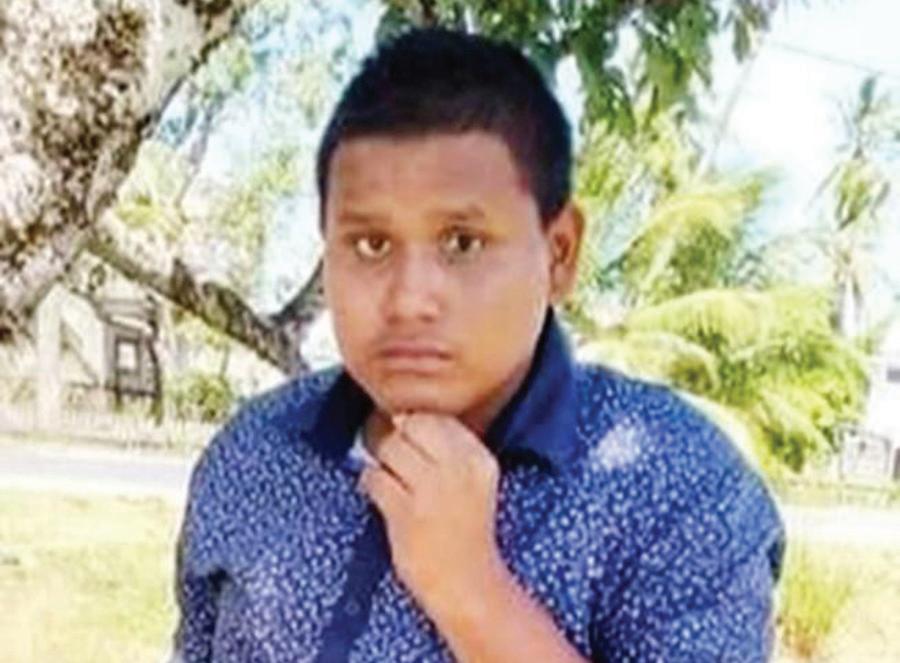
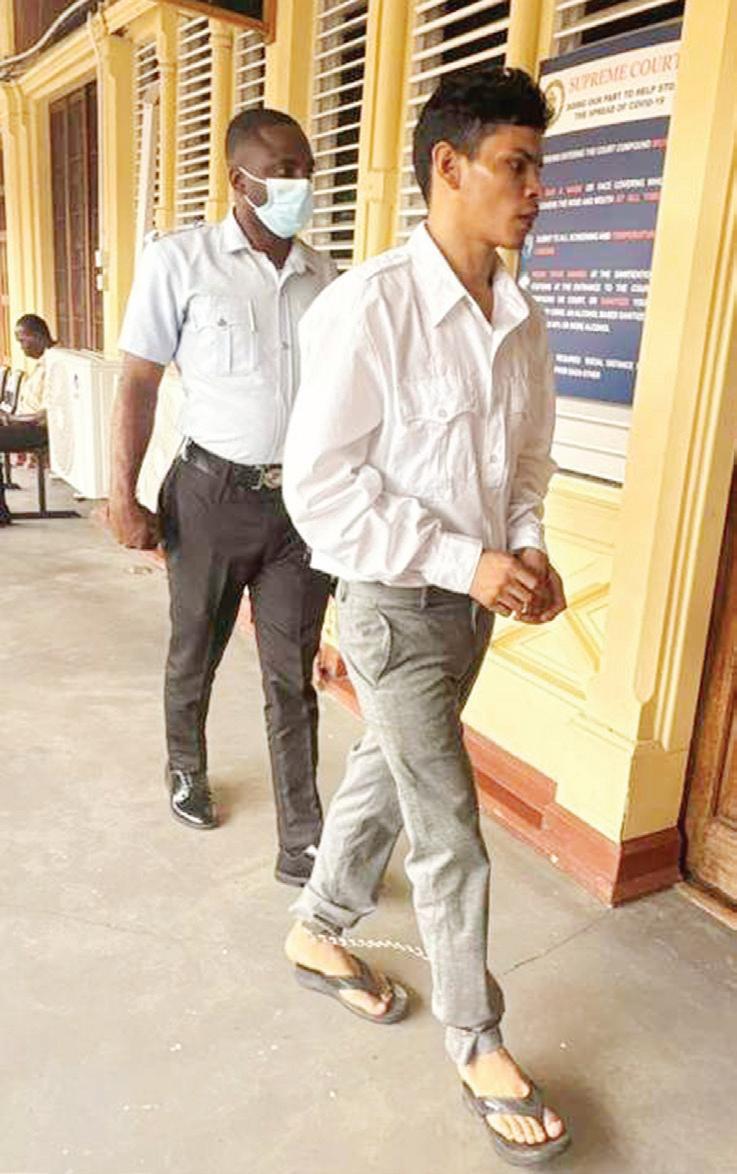
THE trial of two men accused of the 2022 murder of 18-yearold Jude Christino is proceeding after the High Court in Demerara declined to accept their guilty pleas.
OJ Samuel Smith, known as “Red Boy,” and Wayne DaSilva, 22, called “Monkey Man,” are jointly charged in connection with the fatal stabbing at Kumaka Waterfront, Mabaruma, Region One (Barima-Waini).
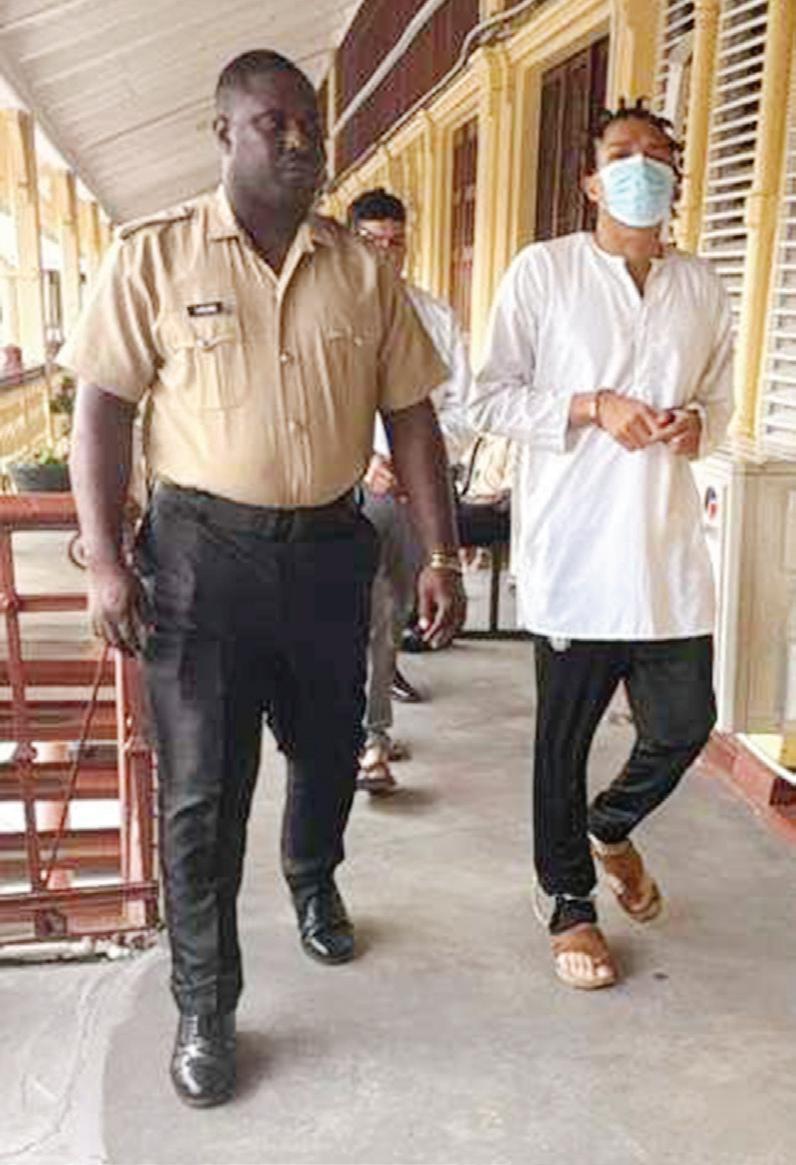
Counsel Geneva Wills. Police said Christino was seen arguing with two men before the confrontation escalated. As the teenager attempted to flee, both men pursued him and began assaulting him.
According to an eyewitness, one of the men then produced a knife and stabbed Christino in the neck,
causing him to stumble and collapse.
Both assailants reportedly fled the scene, leaving him lying motionless.
Police were later summoned, and Christino was rushed to the Mabaruma Regional Hospital, where he was pronounced dead on arrival.
Both accused were
charged and remanded following their initial court appearance. After conducting a preliminary inquiry, the magistrate found that there was sufficient evidence to establish a prima facie case against the men and ordered that they be committed to stand trial in the High Court.
When the matter was called before Acting Chief Justice Navindra Singh, DaSilva indicated that he wished to plead guilty. However, as the court probed his decision, his responses became inconsistent and unclear. He appeared uneasy, offering shifting ac -

counts of what transpired, at one point suggesting involvement, while at another denying that he inflicted the fatal injuries. His inability to give a clear and unequivocal plea led the court to reject it. Smith also addressed the court, providing an account that suggested he might have acted under instruction and fear. His
version raised potential legal defences, including duress, which the court could not ignore.
In light of these circumstances, the court determined that the guilty pleas could not be properly accepted. Both men will now face trial.
The prosecution is being led by State Counsel Christopher Belfield and State




By Michel Outridge
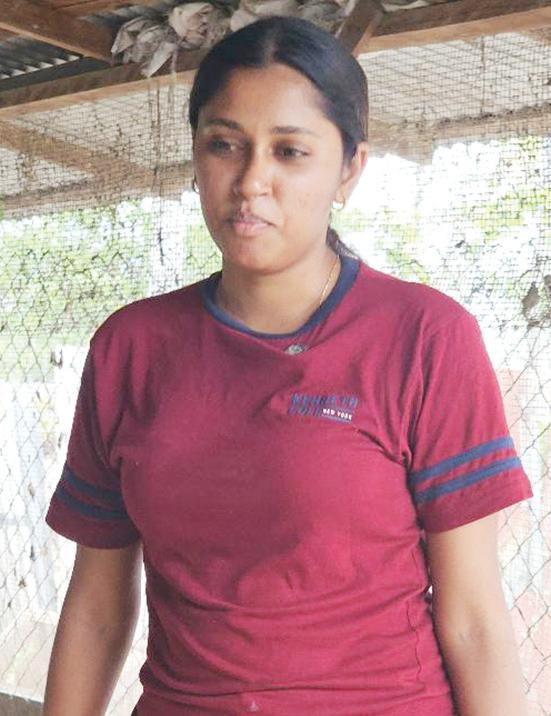
BEFORE the sun rises over the Corentyne, Raveena Ramkishun is already in motion, preparing meals, organising her household, and ensuring her family is ready for the day ahead.
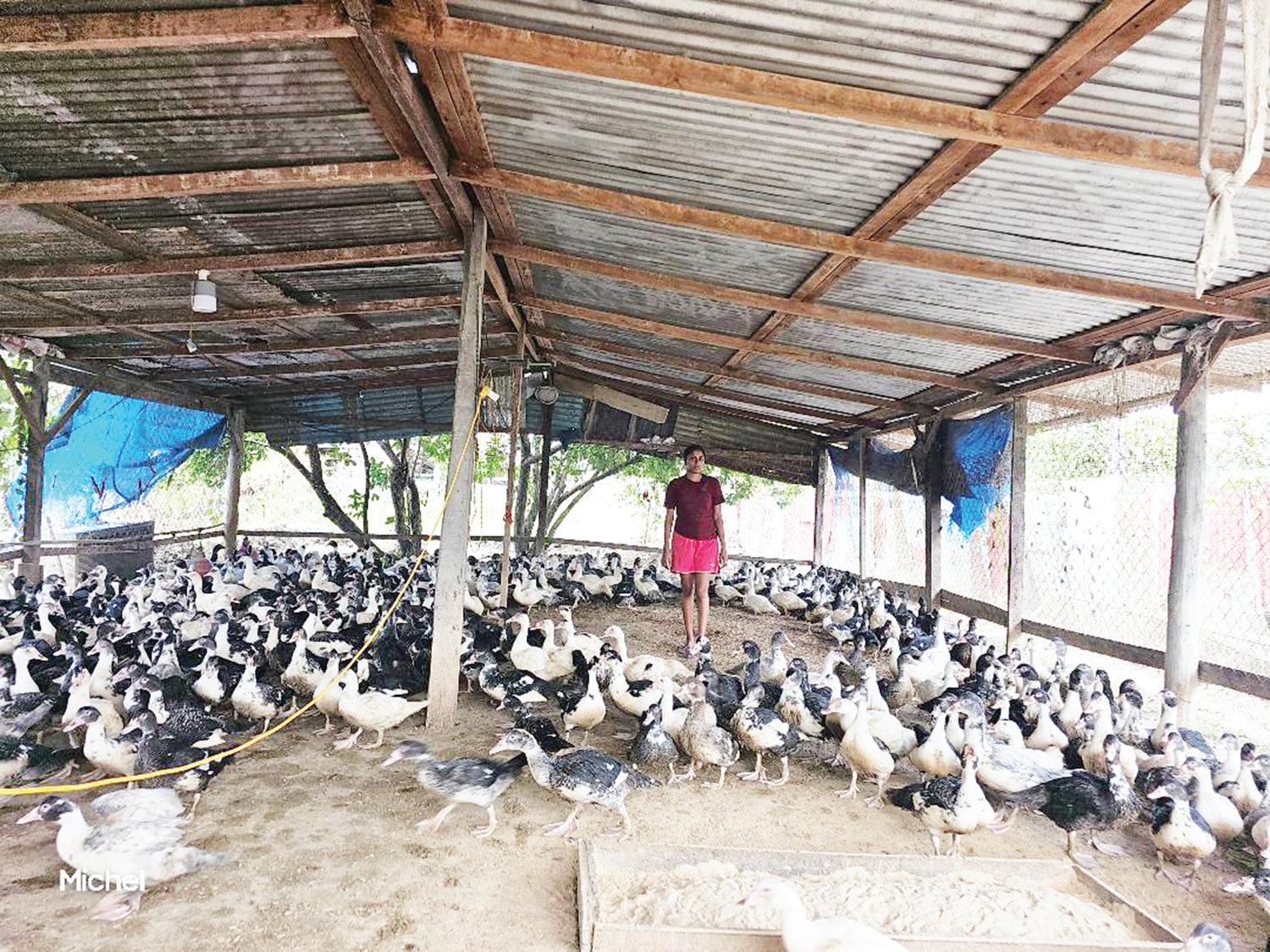
A devoted wife and mother of three, she skillfully juggles early morning chores before stepping into her backyard, where another responsibility awaits: her growing duck farming enterprise.
It is within this daily rhythm of care, discipline, and determination that her remarkable journey unfolds, embodying the essence of a people-first Guyana.
Her story reflects how the PPP/C government led by President Dr. Irfaan Ali is creating real opportunities for ordinary citizens, empowering women like Ramkishun to pursue education, build sustainable livelihoods, and contribute meaningfully to their families and communities.
Born and raised in Topoo Village, Ramkishun’s early life followed a familiar path. After completing her secondary education, she married and embraced the responsibilities of being a full-time housewife and mother.
Yet, like many women across Guyana, her aspirations extended beyond the domestic sphere. Today, she stands as a symbol of transformation: an emerging entrepreneur, a university student, and a role model for her three daughters.
At the heart of her transformation is the Government of Guyana’s GOAL (Guyana Online Academy of Learning) scholarship programme, which has opened doors to higher education for thousands of citizens.
Currently pursuing a Bachelor’s Degree in Economics, Ramkishun balances academic pursuits with the demands of motherhood and business management.
Her story underscores the administration’s commitment to ensuring that education is accessible, flexible, and empowering, particularly for women.
Parallel to her academic journey is her thriving duck-rearing enterprise, an agricultural venture that has become a critical source of household income.
What began four years ago with a modest purchase of 300 French Muscovy duck-
lings from a neighbouring large-scale breeder, Devika, has since evolved into a structured small business operation.
Today, Ramkishun manages approximately 1,500 ducks housed in two large pens behind her home in Guava Bush Village. Reflecting on her progress, she shared, “From then to now, I would say I have learned a lot due to GLDA’s support in offering training in duck rearing to me as a woman farmer and I am very pleased with the initiative, so far, to enhance my capabilities.”
Her success is not incidental but grounded in discipline and sound management practices. She emphasised that record keeping is essential to the sustainability and growth of her enterprise, allowing her to monitor production, track expenses, and make informed decisions.
Her entrepreneurial journey has been significantly strengthened by the technical and institutional support provided by the Guyana Livestock Development Authority (GLDA).
Through its Region Six extension services, officers regularly visit her farm, offering guidance on husbandry practices, feeding, disease prevention, and overall flock management.
Ramkishun expressed gratitude for this support, noting, “I am very thankful for the support given to me from GLDA through their visiting Extension Officers along with Dr. Susan Farley; they would check for growth and diseases and lend relevant assistance.”
This support is part of a broader national framework through which GLDA promotes livestock development.
The authority’s centralised hatchery services,
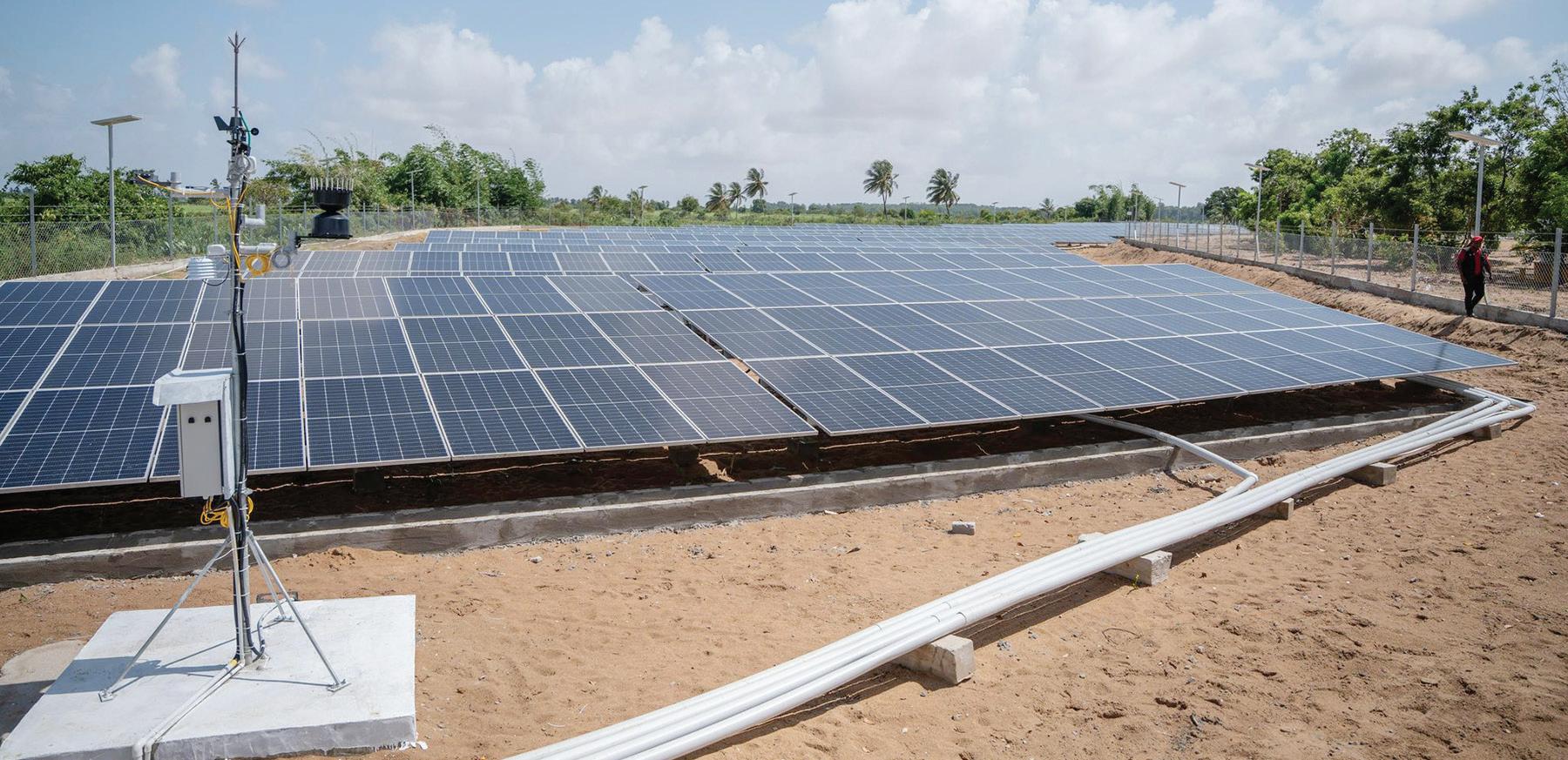
IN Mahdia, Region Eight (Potaro-Siparuni), the 37,000 Solar Home Energy Systems Project and the 0.65 MW grid-forming Mahdia solar PV farm are significantly expanding access to affordable, reliable renewable electricity for residents.
According to the Ministry of Public Service, Government Efficiency and Implementation, some 226 off-grid households in the community have benefitted from solar home energy systems, with an additional 10 systems requested for new households to meet growing demand.
The solar PV farm is supplying renewable electricity to the satellite village and key public facilities, including the village office, sewing centre, and the multipurpose building.
In December 2024, Prime Minister, Brigadier (Ret’d) Mark Phillips, had commissioned the megawatt grid-forming solar PV farm, a project that was funded by the Inter-American Development Bank (IDB) under the Energy Matrix Diversification and Strengthening of the Department of Energy (EMISDE) programme.
With a population of just over 1,500, Toshao of Campbelltown in Mahdia, Earl Gildharie, said they have a total of 430 households (and counting), and have benefitted from both the solar home systems and the solar PV farms.
Gildharie also said that, from the main solar grid in Mahdia, persons have seen a 30 percent reduction in electricity costs that enables residents to reduce energy expenses and reinvest their savings
“For some of us, we usually pay like $20,000
on average, so with that 30 percent will come in as a good savings, and we can find other uses for that revenue,” the Toshao said.
Region Eight is not the only region in Guyana where this sentiment is shared. In Region One (Barima-Waini), Toshao of Karaburi, Earl Rodrigues, said that persons hailing the solar PV farm as very beneficial, mainly to primary school buildings, and the nursery school, as well as the teachers’ quarters. Additionally, the National School Feeding programme facilities in that area also benefit from the solar farm.
At Rockstone Primary School in Region Ten, a teacher at the school, Ms. Joylyn Gibbons, said that before they had the 6.33 kWp rooftop solar PV system, which was installed by the Guyana Energy Agency, under the government of Guyana, there was limited resources in terms of electricity availability at the school to provide better lighting for both students and teachers.
She said this installation in 2023 has significantly helped students and teachers to be more comfortable, and boosts teaching abilities.
In December last year, Prime Minister Philips had noted that the short to medium term plan of the government, is to build out 100 megawatts of solar power, complementing other medium and longterm projects, including the Gas to Energy initiative and the Amaila Falls project.
The government, overall, intends to deliver more than 500 megawatts of new generation capacity, with renewable energy forming a central pillar of this transition.


‘Let
- Minister Persaud
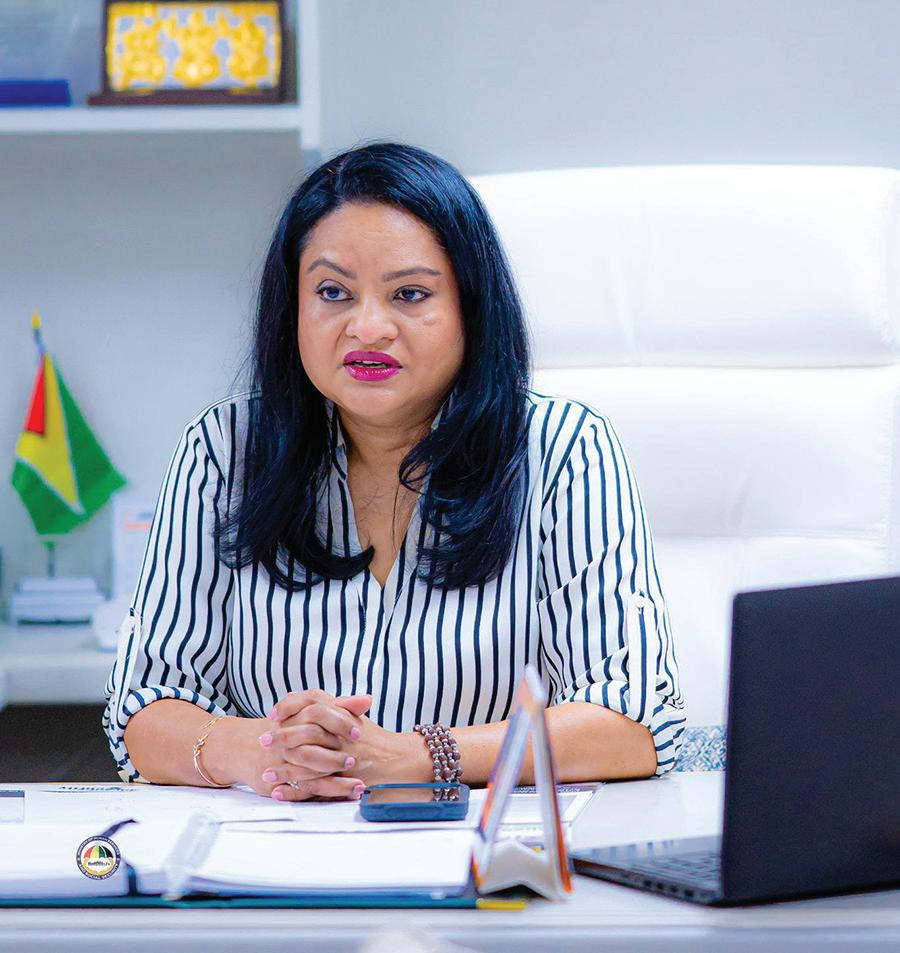
MINISTER of Human Services and Social Security, Dr Vindhya Persaud, has emphasised the need for persons to continue giving hope and love to those living with Down Syndrome.
In her message on the occasion of World Down Syndrome Day, Dr Persaud said: “Today, I pay tribute to the many caregivers out there who are giving real support, care and love, to the many children and young people and the people who are living with Down Syndrome.”
On the topic of inclusion, the minister said true inclusion is not just making space at the table, but also ensuring that each unique voice at the table is heard.
“It is recognising that there is much more to be done, but it is also providing hope to all those who live with Down Syndrome,” Dr Persaud said, adding: “Let us ensure that we give hope, we give love and we combat loneliness.”
She remarked that it is also about recognising the many developments that have happened in the world, noting that it is not only about a diagnosis, but recognising milestones that have been achieved by consistent, patient work.
World Down Syndrome Day was observed on March 21, 2026, under the theme, “Together Against Loneliness.” World Down Syndrome Day is observed annually on March 21. This special day was
created to celebrate the lives of persons with Down Syndrome, and to ensure they have the same freedoms and opportunities as every other person.
According to the United Nations, Down Syndrome occurs when a person has an extra partial (or whole) copy of chromosome 21. There is no known cause for Down Syndrome, but it has always been a part of the condition. Down Syndrome exists across the globe, and commonly results in variable effects on learning styles, as well as physical characteristics and health.
This year’s theme, the UN said, is focused on raising awareness of how loneliness disproportionately affects people with Down Syndrome, and other intellectual disabilities, and their families.
This campaign called for real inclusion in schools, workplaces, and communities, and emphasised that being present does not equate to being included or truly connected. It asserts that everyone has a role to play in the creation of welcoming spaces, as well as meaningful relationships to help people feel they belong.
The theme also framed loneliness as a human rights issue, and urged for collective action to turn the UN Convention on the Rights of Persons with Disabilities into concrete change that ends isolation, and promotes full participation in society.
PAGE 18
breeding stock programmes, and technical training initiatives have been instrumental in expanding duck production across the country and continues to provide viable income opportunities for small and medium-scale farmers like Ramkishun.
Within this enabling environment, Ramkishun has been able to contribute meaningfully to her household alongside her husband, a member of the law enforcement community.
Despite the demanding nature of his profession, he remains supportive of her educational and entrepreneurial pursuits, reflecting a partnership grounded in shared responsibility and mutual growth.
As she explained, her venture “is contributing to my home financially,” reinforcing
educate a nation.”
This philosophy underpins both her academic pursuits and her entrepreneurial drive, as she continues to build a future not only for herself but also for her children and community.
Her life embodies a powerful intersection of tradition and modernity. She continues to prioritise family while simultaneously pursuing higher education and managing a business enterprise.
In doing so, she challenges outdated notions of gender roles and demonstrates that women can excel across multiple domains when given the right opportunities and support.
As Guyana observes initiatives such as the Year of the Female Farmer, stories like Ramkishun’s serve as compelling evidence of
her role as an active partner in sustaining her family.
For Ramkishun, however, success is not measured solely in financial terms. As a mother of three daughters, she is deeply committed to instilling values of education, independence, and resilience.
PROVIDER AND GUIDE
She sees herself as both a provider and a guide, determined to ensure that her children understand the importance of self-reliance and lifelong learning.
Importantly, she is also using her voice to inspire other women across Guyana. She believes that the country’s rapidly evolving oil and gas economy has created unprecedented opportunities and is urging women to take advantage of them.
As she expressed, women must “use your strength to grow,” noting that for her, agriculture was a natural choice because “there will always be a demand for food and the environment here in Guyana is enabling.”
She further emphasised the transformative power of education, stating that “if you educate a woman, you
what is possible when policy meets purpose.
Through strategic investments in education, agriculture, and rural development, the government is not only enhancing economic productivity but also empowering individuals, particularly women to transform their lives.
Reflecting on her journey, Ramkishun expressed deep gratitude for the opportunities afforded to her. The GOAL scholarship has enabled her to pursue academic advancement, while her duck-rearing enterprise provides financial independence and stability. Together, these pillars have reshaped her future.
Her message to other women, especially young and single mothers, is clear: opportunities exist, and with determination, support, and access to the right resources, it is possible to build a better life.
She encourages women to explore entrepreneurship, utilise available government services, and take steps to formalise and grow their businesses.








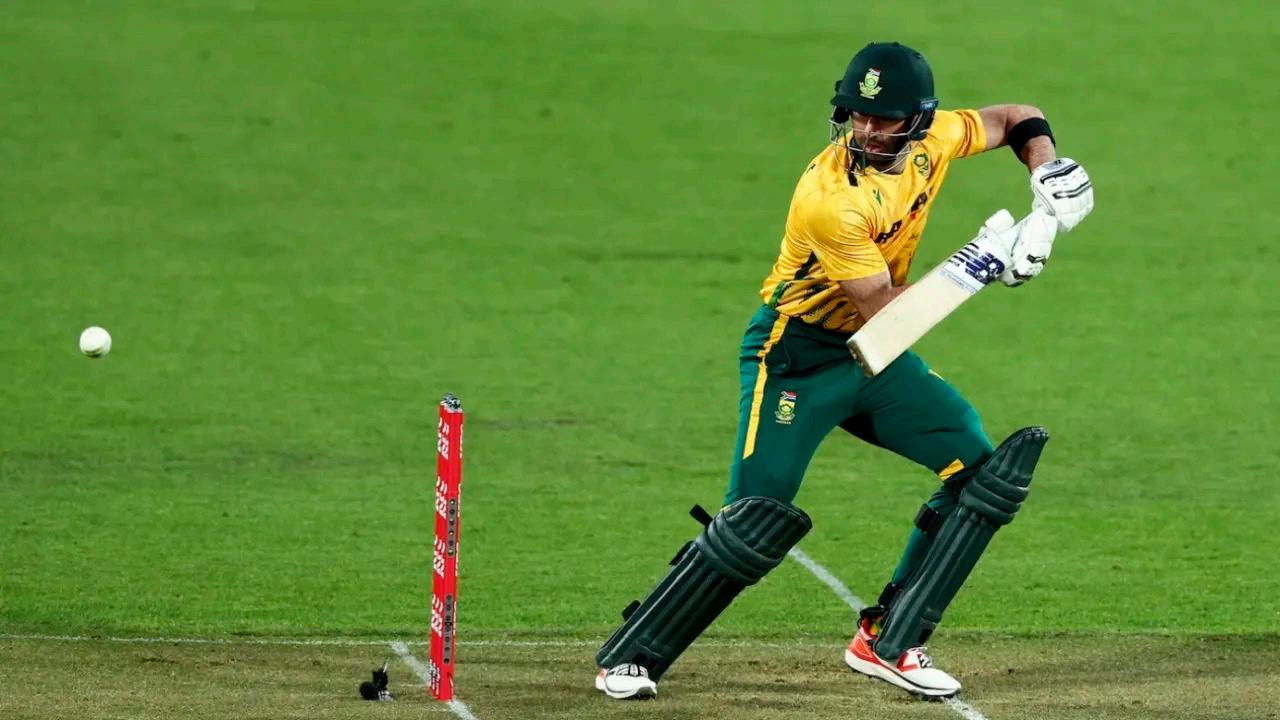
(ESPNCRICINFO) - South Africa levelled the scoreline in the five-match T20I series against New Zealand and ensured that Wednesday's final game will be a decider. They successfully defended what seemed a below-par score of 164 for 5 thanks largely to their spinners. Debutant offspinner Prenelan Subrayen and veteran left-arm spinner Keshav Maharaj took four wickets between them and conceded 35 runs in their seven overs to take New Zealand from 76 for 3 in the ninth over to 112 for 7 in the 14th. New Zealand were bowled out inside 19 overs.
The hosts were significantly weakened from the team that took a 2-1 lead earlier in the week. Regular captain Mitchell Santner, opening batter Devon Conway
and seamer Lockie Ferguson are being rested while standin captain Tom Latham was unavailable for this match after being hit on the thumb in game three. Latham will undergo scans to determine if he can play in the last fixture.
Despite their opposition's personnel changing, South Africa will be pleased with a better performance than the previous two matches. Five of the top six got starts and one, Connor Esterhuizen, went on to a significant score of 57. He shared a second-wicket stand of 81 with Tony de Zorzi, which is South Africa's highest of the series so far.
In defence, Gerald Coetzee set the tone with a fiery spell of fast bowling and finished with 3 for 31, while the spinners did the mid-innings damage. New
Zealand's top-scorer was Tim Robinson, who made 32, but they had no partnerships worth more than the opening stand of 28.

Batting heroes have been few and far between for South Africa in a series where they have been without their entire first-choice line-up, but in Esterhuizen, they have found one for the future. After top-scoring with 45* on debut in game one, he was moved from opening to No. 4 and then to No. 3,

but made the most of it with his first international fifty on Sunday.
After Wiaan Mulder was dismissed for a second-ball duck, Esterhuizen was all but opening anyway but was on one off six balls when he got his first opportunity to go big.
Kyle Jamieson bowled one full on his pads and he clipped it through midwicket for his first boundary. Then Jamieson went short and Esterhuizen pulled for six, and he was on his way. He sent Ben Sears over mid-off and then long-off for four and six respectively, and plundered a hat-trick of boundaries off New Zealand's stand-in captain Jimmy Nee-

sham. His fifty came off 33 balls in the tenth over and he got 34 runs in 12 balls between mid-off and midwicket.
South Africa were decently set-up on 81 for 1 when Esterhuizen pulled Sears over square leg, debutant Katene Clarke ran in from the rope and dived forward full length to take a spectacular low catch.
SEARS KEEPS SOUTH AFRICA BELOW 165
After removing their biggest threat, Esterhuizen, Ben Sears bowled two more important overs to keep South Africa to a modest total. He bowled the 16th over, with South Africa 121 for 4 and Jason Smith new to the crease. Sears went on-pace and a variety of lengths and Smith could neither nudge it through the off side nor pull the shorter one away. Only one run came off the bat in that over. Then Sears was brought on for the final over, with South Africa 162 for 5 and eyeing something over 170. He delivered a mixture of slower balls and yorkers which neither Rubin Hermann nor George Linde could get away and again, conceded just one run off the bat. His final two overs cost him two runs and he finished with figures of 1 for 22 in four overs.
(BBC) - Newcastle winger Harvey Barnes is set to be called up to Thomas Tuchel's England squad to replace the injured Eberechi Eze.
Eze was not in Arsenal's squad for Sunday's 2-0 Carabao Cup final defeat by Manchester City because of a lower leg injury.
Barnes has been called up once before, in October 2020, when he won his only England cap in a friendly against Wales.
Scotland have tried to convince Barnes to switch his international allegiances and play for Steve Clarke's team at this summer's World Cup, with the 28-year-old eligible
through his grandparents.
But Barnes turned down Scotland's advances and is now expected to be part of Tuchel's squad for friendlies against Uruguay and Japan in which a number of fringe players will be given the chance to stake a claim for a regular place.
The Three Lions face Uruguay on 27 March and
(BBC) - LeBron James set the record for the most regular-season games played in NBA history as he helped the Los Angeles Lakers to a dramatic buzzer-beating 105-104 victory against the Orlando Magic in his 1,612th outing.
James, 41, moved one clear of Robert Parish's 1997 record of 1,611 appearances, in a game the Lakers won when Luke Kennard scored a three-pointer with 0.6 seconds left.
"It just kind of happened. It was not on the list of things that I wanted to accomplish," said four-time NBA champion James.
"I wanted to be the best player in this league at some point. I wanted to be one of the greatest, if not the greatest, to ever play this game. I wanted to be an NBA champion.
"I wanted to possibly
win rookie of the year, make All-Star appearances, win a gold medal, win some MVPs - those were some of my goals.
"But some of the stuff that's just been happening over the course of the last few years has been super-duper cool."
James - who is the first player to take part in 23 consecutive NBA seasons and is also the NBA's record points scorer - contributed 12 points, six rebounds, four assists and three steals as the Lakers beat Orlando for a ninth straight win.
The Lakers are third in the Western Conference, while Magic are eighth in the Eastern Conference.
"Availability, I've always wanted to be available to my team-mates," added James.
"It's a mental toll, trying to play a lot and being out there. I just give a lot of
March 23, 2026)
and where was the first ever ODI game contested?
(2) Who were the designated captains? Answers in tomorrow’s issue
praise to the man above and [it's about] just loving the game and appreciating the game."
James was not the only player to achieve a milestone as Kevin Durant passed NBA legend Michael Jordan to go fifth in the all-time scoring list in regular-season games.
Durant moved to 32,294 - two ahead of Jordan - courtesy of a 27-point display for the Houston Rockets, who are fourth in the Western Conference, in their last gasp 123-122 win against the Miami Heat, who are ninth in the Eastern Conference.
"It means a lot," said Durant, who passed Jordan with a three-pointer in the fourth quarter.
"I'm grateful to be here and for this incredible journey it's been. I'm looking forward to continuing."
Elsewhere, Shai Gilgeous-Alexander scored 40 points for the Oklahoma City Thunder as four players were ejected in his side's fiery 132-111 win against the Washington Wizards.
The Thunder's Ajay Mitchell, Jaylin Williams and Cason Wallace were ejected, along with Washington's Justin Champagnie, following a mass brawl near the end of the second quarter.
Reigning NBA champions Thunder remain top of the Western Conference, while the Wizards are one place off the bottom in 14th place.
Japan on 31 March, with both games at Wembley Stadium.
Barnes has scored 14 goals in all competitions for Newcastle this season.
Meanwhile, Bayer Leverkusen say defender Jarell Quansah has been ruled out of England's friendlies with a thigh injury.


(BBC) - World number one Carlos Alcaraz was knocked out of the Miami Open in the third round after a surprise 6-3 5-7 6-4 defeat by Sebastian Korda.
Top seed Alcaraz, 22, produced a sloppy first set which gave the American the early initiative but Korda looked to have blown his chance in the second set.
Korda served for the match at 5-4 but was broken to love by the Spaniard who went on to win the next two games to force a third set.
Alcaraz upped the ante but Korda held his nerve and seized a break for 4-3 in the third when his opponent stroked a forehand wide.
Korda, ranked 36th in the world, confidently held his next two service games to close out the match - sealing the win on his second match point as Alcaraz overhit a return.
"It feels great," said Korda, who wrapped up the win in two hours and 19 minutes as he beat a top-ranked player for the first time in his career.
"I took the scenic route, that's for sure - a little more stress than I would want but happy with how I played.
"I kept believing. I got myself in some nasty situations, but I kept going and played really well in the end."
Korda, 25, is the lowest-ranked man to defeat Alcaraz since world number 55 David Goffin of Belgium upset the Spaniard in the second round in Miami last year
Alcaraz began the year by winning his seventh Grand Slam title with a triumph at the Australian Open and did not suffer his first loss of the season until he fell to Daniil Medvedev in the semi-finals of Indian Wells.
Korda, who reached the quarter-finals of the Miami Open in 2021 and 2025 but has never gone further, will face 14th seed Karen Khachanov or qualifier Martin Landaluce in the fourth round.
CMC – West Indies Women’s captain Hayley Matthews struck a fighting half century, but it was not enough to prevent her side from going down to Australia Women by 17 runs to give the visitors a series-clinching victory here on Saturday.
Matthews, who admitted she was in a batting rut prior to the match, bounced back to score 56 off 41 balls, but the home side could muster only 147 for four in their 20 overs in response to Australia’s total of 164 for five at the Arnos Vale Ground.
The result gave the Aussies an unassailable 2-0 lead in the three-match series, their fourth straight T20I series win over the Windies Women. The final match is set to be played at the same venue on Monday.
After winning the toss and choosing to bat for the second straight match, the Aussies were given a good start by openers Georgia Voll and Beth Mooney, who put on 54 runs in six overs. Voll was the main aggressor, bludgeoning 39 of those runs off just 23 balls with six fours and one six,
before holing out to mid on off the bowling of Karishma Ramharack.
Mooney, Player-of-theMatch in the opener, struggled throughout her knock of 17 off 20 balls until she walked past a delivery from leg spinner Afy Fletcher and was bowled to give her a 100th T20I wicket, and leave the score 71 for two.
Ellyse Perry, who topscored with 42 off 28 balls and Phoebe Litchfield, who made 35 off 29 balls, then added 58 runs for the third wicket to put Australia in firm control of the contest at
129 for two.
At that stage, they would have been eyeing a total in the region of 180, but once Matthews had the latter caught at deep midwicket, the visitors lost their momentum in the latter stages of the innings, with the final three overs yielding only 20 runs and two wickets.
The West Indies didn’t get the best of starts in their run chase, with Qiana Joseph being run out for 11 with just 13 runs on the board.
Matthews and veteran Stafanie Taylor then shared a 77-run stand for the second
wicket that threatened to take the match away from the Aussies.
Matthews started slowly, scoring one run from her first 11 deliveries, but opened up to bring up her eighth T20I half century off 38 balls by tickling pacer Tahlia McGrath to fine leg for four.
But just as she looked to accelerate, Matthews slapped spinner Playerof-the-Match Alana King straight into the hands of captain Sophie Molineux at mid off to leave the Windies 90 for two in the 13th over.
From there on, the Windies struggled to score runs, with King also accounting for the wicket of Taylor for a pedestrian 22 off 27 balls, while Georgia Wareham dismissed Shemaine Campbelle for six to see the home side slump to 113 for four in the 18th over.
Deandra Dottin tried her best with an unbeaten 39 off 28 balls, but it was never going to be enough, with the Windies needing 41 runs from the last two overs. King finished with figures of 2-25 from her four overs.
Tons from Lall and Dick and all-round showing from Barker highlight latest round
By Sean Devers
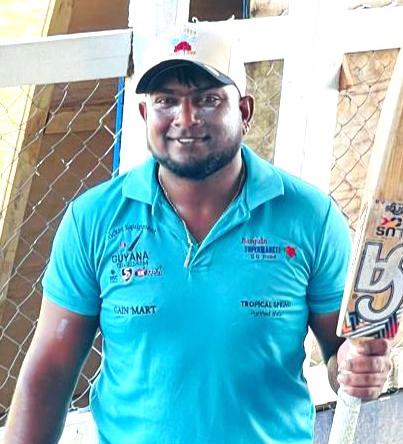
Six matches were played yesterday in the latest round of the Georgetown Cricket Association’s (GCA) Sherwin Williams T20 2nd Division Tournament with a magnificent 127 from Andy Lall being the highlight of the round. In the morning game at the Police Sports Club ground, Bel Air Rubis defeated Police Academy by 56 runs.
Bel Air were led by Lall’s century which lasted 63 balls and included eleven fours and 10 sixes.
Lall received support from Irfan Ali (47) and Rajendra Singh (30).
The Police Academy were restricted to 180-6 when their 20 overs expired in sweltering heat.
Skipper, Troy Benn (45), Siemion Gaffor (44) and Kelvin Leith (21) got starts as Aravinda Gainda took 3-20. In the afternoon game, Police defeated the University of Guyana (UG) by 163 runs.
The home team scored 258-4 in 20 overs with Dwayne Dick scoring a pug-

nacious 136 from just 58 balls with 17 fours and eight sixes. He got support from Andrew Lygth Jnr who blasted seven fours and three sixes in his 54.
Yeshua Hutson continued his consistency with 3–33 as UG were limited to 95–7 off 20 overs; he then returned with the bat to strike seven boundaries in an unbeaten 51 before running out of partners.
There were two wickets each for Jeffery Blair and
Kapildeo Charandeen.
In the morning game at Malteenoes Sports Club (MSC), the Guyana Defence Force (GDF) beat Sophia by six wickets.
Sophia were bowled out for 93 in 17 overs, with Joshua Grant the lone fighter, scoring 40.
Nigel Deodat (3-19), Leon Andrews (3-25) and Colvis Sam (2-18) were the main wicket takers for the GDF who marched to 98-4 with Joshua Ferrell hitting
seven fours and three sixes in his 61.
Garth Allen took 2-17.
At MSC in the afternoon game, the host hammered Diplomats by 104 runs.
Half-centuries from Marcus Watkins, who made 88 with nine fours and five sixes from 51 balls and Nichosie Barker whose 75 lasted 47 balls and included six fours and four sixes powered MSC to 217-5 off 20 overs.
Elvis Patoir took 2-45 for Diplomats who were
Dwayne Dick scored a pugnacious
dismissed for 113 in the final over.
Daniel Scott and Vickash Mirchand made 28 each, while Barker returned with the ball to take 6–6, supported by Shaquille Williams who claimed 2–19.
At the Transport Sports Club (TSC), the home team defeated Guyana National Industrial Corporation (GNIC) by 52 runs.
TSC reached 170-8 with Jadon Campbell leading the way with 40.
John Persaud (24), Mick-
el Johnson (19), Reyad Latif (18), Jeremiah Hohenkirk (18), Nehemiah Hohenkirk (18) and veteran Shawn Massiah (16) all passed 15 runs. Kevin Lindo took 3-25 while there were two wickets each from Jamain Grosvenor and Lystuel George.
GNIC could only manage 118-9 in their 20 overs despite 29 from David Dick and 24 from Devon Layne. Renaldo Greenville took 3-31 while Reyad Latif took 2-8.
At the Demerara Cricket Club (DCC), Georgetown Cricket Club defeated the home side by four wickets.
DCC were limited to 1318 in 20 overs with Alphius Bookie top scoring with 45. Only Jaden Dowlin (23), Ricardo Percival (19) and Nkosi Beaten (10) got into double figures.
Yeudistir Persaud took 3-31 and Krsna Singh took 2-19 for the Bourda boys who reached 133-6 with nine balls to spare. Nicholas Shiopersaud (31), Rivaldo Phillips (30) Kennard Moonsammy (25) contributed to the win while Kaylon Callender took 2-20 in a losing cause.
By Sean Devers
ON the back of a regal 96 from Tyrell King, GT X1 beat Everest by five wickets in their backyard on Saturday.
Ravindra Singh sent Ajay Kissoon’s stumps for a walk before he had scored at 0-1 as GTX1 made an inauspicious start on a spin-friendly track.
King faced 98 balls in his majestic 96, decorated with seven fours and eight sixes. He joined Narine and featured in an entertaining 120run, third-wicket partnership. The stand was eventually broken when Jumal Hill removed Narine.
Samuel Ally bowled Khan, who executed several imperious shots, and his demise left GT X1 on 166-4.
Aaron Narine, whose 47 lasted 67 balls and included five boundaries, was joined by Ricardo Etwaroo (2), who was run out at 14-2.
When Ali trapped Roshaun Lowkashwar lbw in the same over for a duck without adding to the score in the 35th over, victory was 16 runs away.
Ally finished with 2-25 for Everest, who had earlier made 182-9 in 40 overs.
Anek Haimnarine (33), Vinesh Kalpoo (33), Joshua Sharma (22), and Savir Narine (21) all got starts.
Nathan Puran and Aaron Perlins took two wickets.
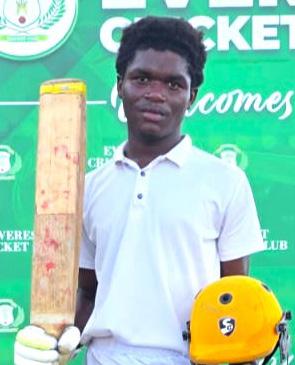
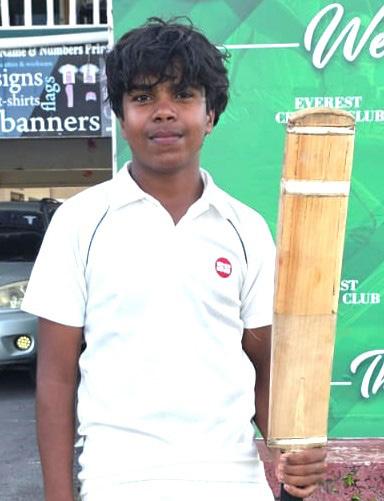
WHEN day-three action of the East Bank Inter-Village Football tournament organised by Sports Extra unfolded at the Eccles EE Ground on Saturday evening, Upper Soesdyke needled Circuitville whilst Swan upstaged Herstelling, 4-1.
Swan’s win over Herstelling who won their opening match Against Lower Soesdyke has left Group B interestingly poised as a win for Lower Soesdyke in their final game against Sawn would mean that goal difference will decide which two villages advance to the quarterfinals.
A fit looking Swan unit were led to their win by Abraham Webb, who netted a first-half double that effectively knocked the wind out of the sails of Herstelling. Webb was on target in the 12th and 33rd minutes. The opening goal was scored by Timothy Adrian in the eighth minute.
Herstelling found it difficult to contain the Soesdyke-Linden Highway based village and did not help themselves when Orlando Dickie was red carded in only the
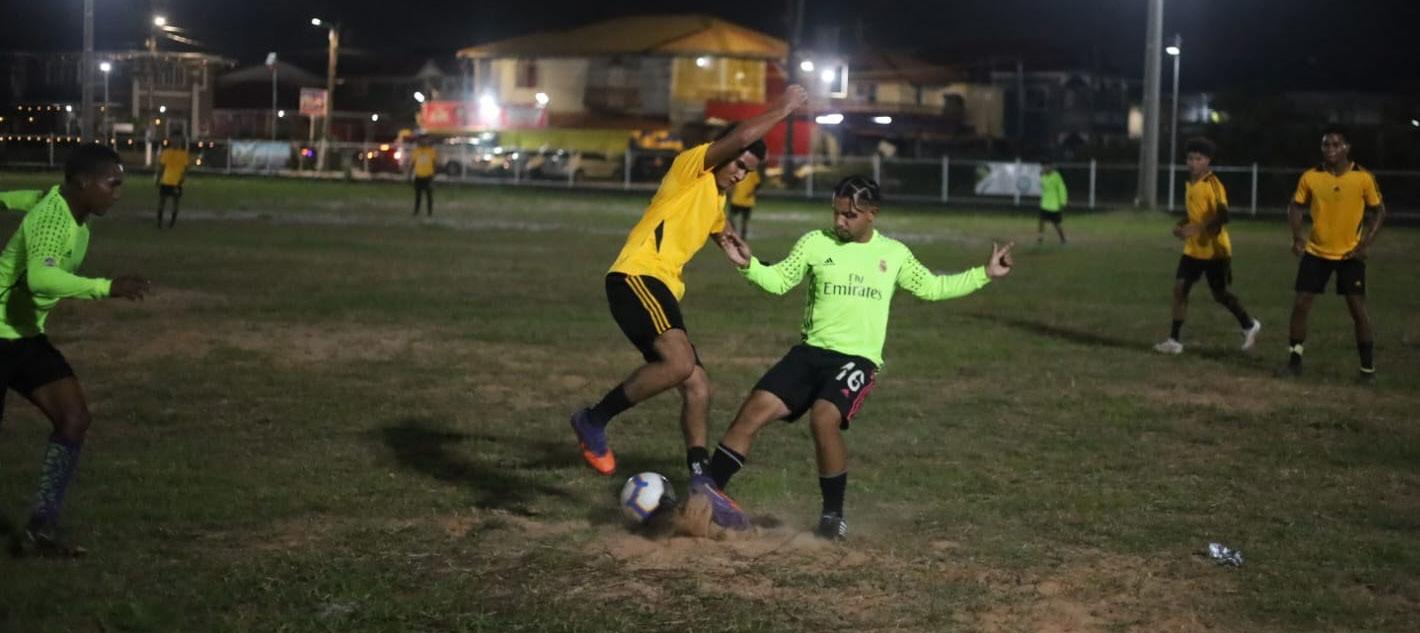
12th minute, which placed then under pressure.
Swan further increased their lead in the 46th minute when Devon Lonke found the back of the net and despite Herstelling pulling one back in the 50th minute through a Malcolm Hendricks goal, the task of stopping Swan was beyond them.
Circuitville, coming off a heavy 2-7 loss to Grove in their opening Group C match on the first weekend of action, looked very purposeful in their clash against Upper Soesdyke, matching them play for play for almost the entire game.
When it seemed as if the game was headed for a draw, Circuitville’s goalkeeper misjudged a shot taken by Tyrone Khan in the 66th minute. It was the goal that made the difference between the two villages, earning the win for Upper Soesdyke whilst it also signalled the end of Circuitville’s campaign as they have lost both their matches.
Upper Soesdyke and Grove will battle in the final group match to decide which of the two villages will end as group winner; both have booked their spots in the quarter finals, the first two villages to do so.
Action will continue Sunday night with another double header, Kaneville, fresh off their upset win over Timehri, will take on Friendship in their first game of the tournament from 18:00hrs, with the feature showdown between Mocha also in their opening game of the tournament against Agricola who must win to remain in the tournament. Agricola lost their opening game to Kuru Kururu.
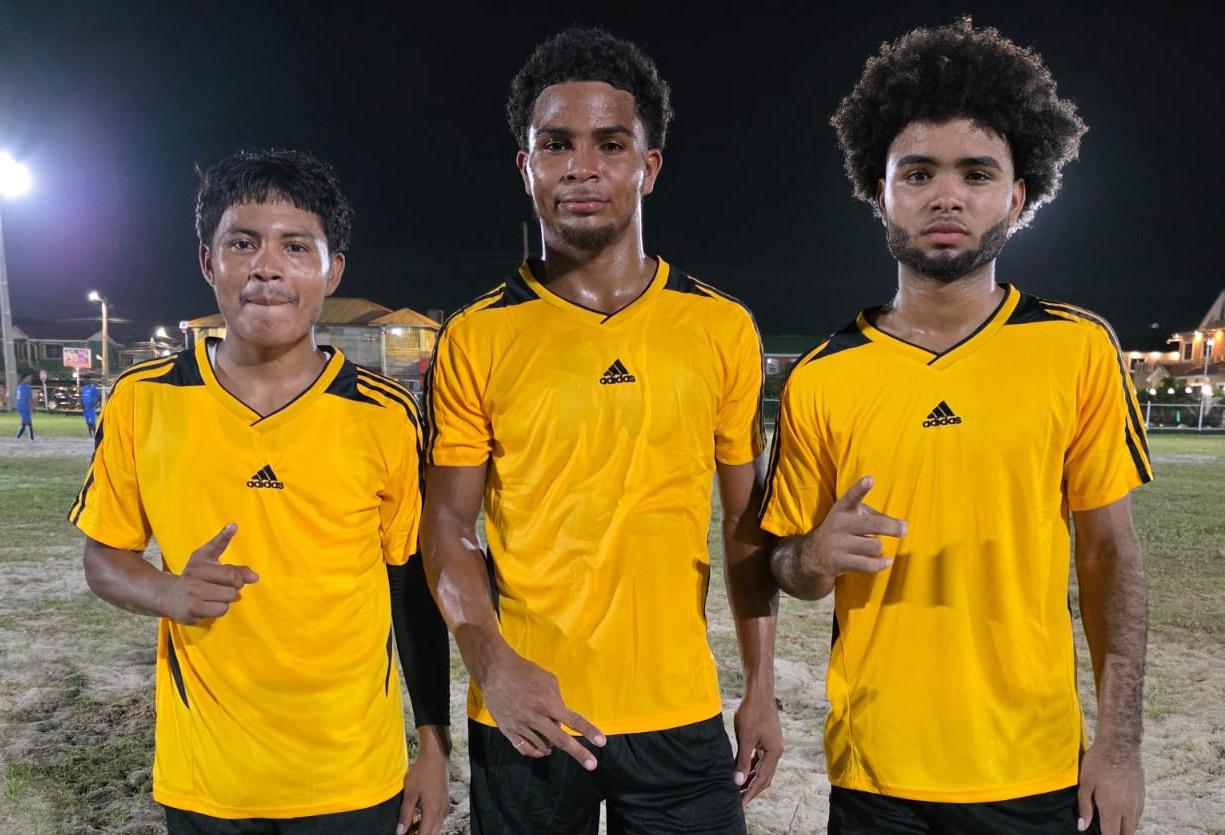

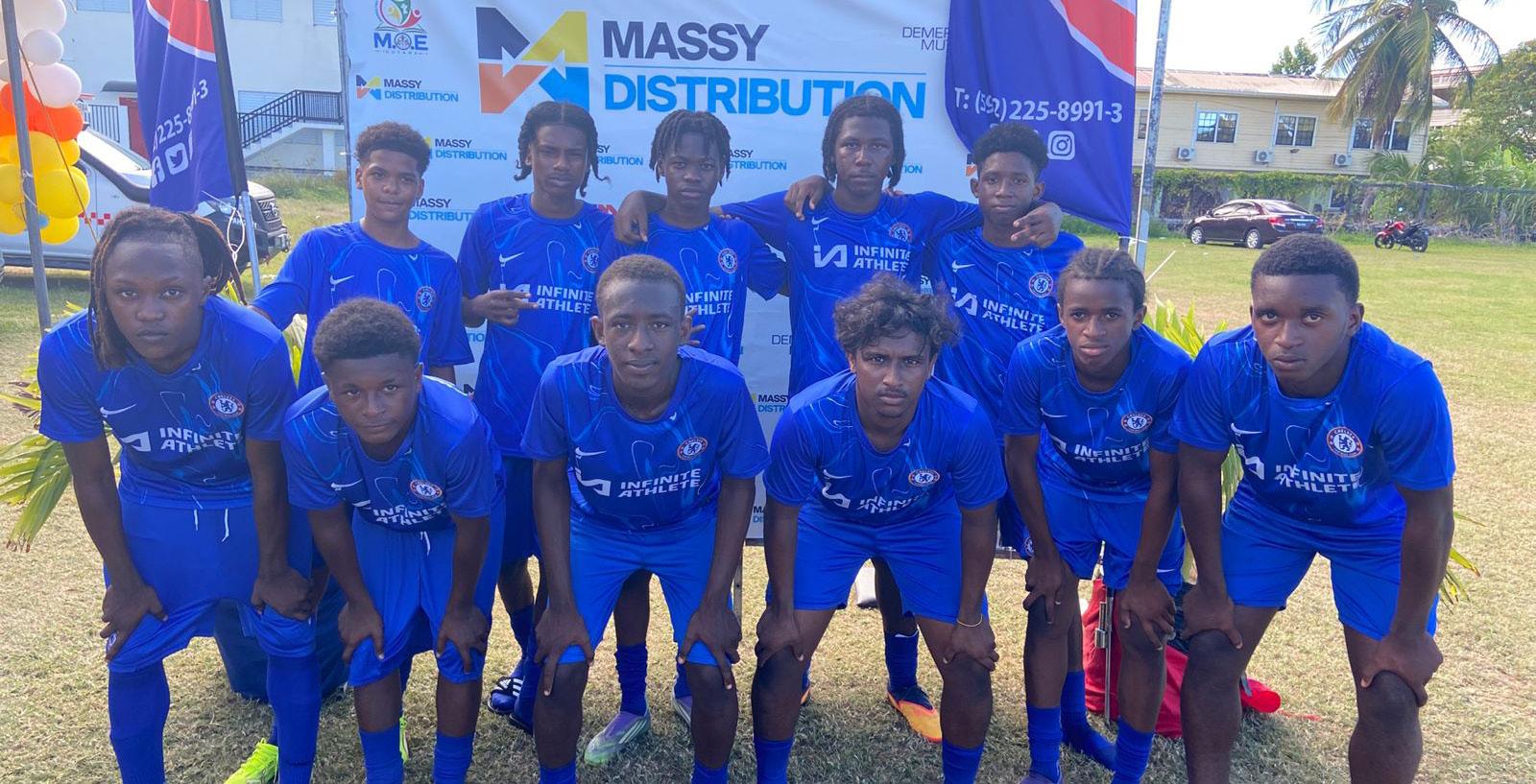
Chase Academy gave the clearest signal of their intent with a 22-nil thrashing of the Bishops’ High School on Sunday at the Queen’s College Ground.
They had goals from 12 different players, with triples from Germaine Garrett and Nyron Barrow.
Dimani Hard, Mark Glasgow, Fabio Kowlessar, Jaden Tasher and Jaden Christian also registered doubles.
The other scorers were Darius Chester, Malcolm Hendricks, Aaron Vasconcellos and Kemron Pellew.
Belladrum Secondary School also emerged as one of the bigger winners on Sunday over New Campbellville Secondary.
Deadrian Mckenzie registered a triple to steer them to the win, with Kahien Hercules and Roland Daniels scoring the other two goals in a 5-nil victory.
Anna Regina Secondary School had three different scorers as they
defeated President’s College 3–2, with goals from Darius Pearson, Nickeem Braithwaite and Jerry Stephen.
West Demerara Secondary School also edged Brickdam Secondary School 3-2.
West Demerara Secondary’s Jaquan Smith led with a brace while Malachi Charles scored the other goal.
Annandale Secondary School was also in the winner's row with a 2-nil stoppage of Mackenzie High
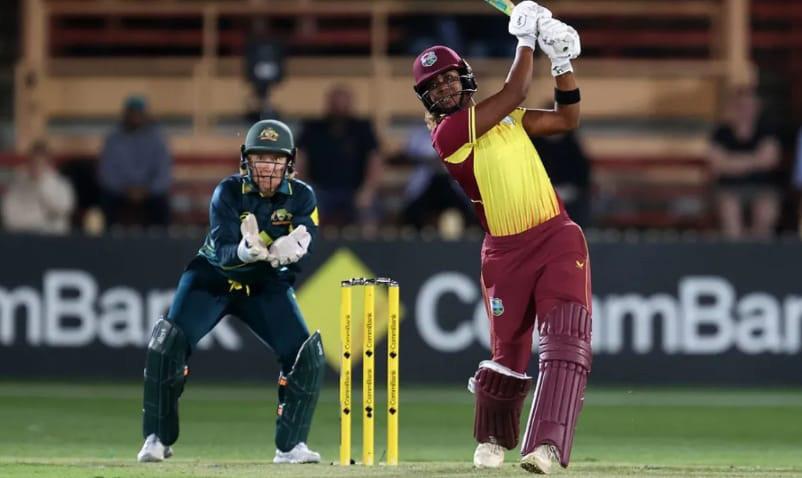
School.
Annandale got goals off the boots of Zephan Henry and Malachi Jervis.
Three Mile Secondary School narrowly defeated Carmel Secondary 2-1, with Durrell Washington and Joshua James scoring in the win.
Meanwhile, other round one winners on Saturday included West Ruimveldt Secondary School, which defeated Yarrowkabra Secondary School 3-nil, with Donovan
Welcome scoring a brace and Lydon scoring the other goal.
Westminster Secondary School drew with St Joseph High School, while Charlestown Secondary School and St John’s College also played to a nil-nil stalemate, nilnil; meanwhile, Dolphin Secondary School started their campaign with a 4-2 loss to Ann’s Grove Secondary School.
Ann’s Grove Secondary had a pair of goals each from Kennard Halley and Isaiah Williamson.