‘Clean water is not a luxury. It is life’ – President Ali commissions new Bartica water plant
-- says facility built ahead of surge in housing, hospital, airport and tourism demand in Region Seven --first surface-water treatment plant to serve over 6,000 residents
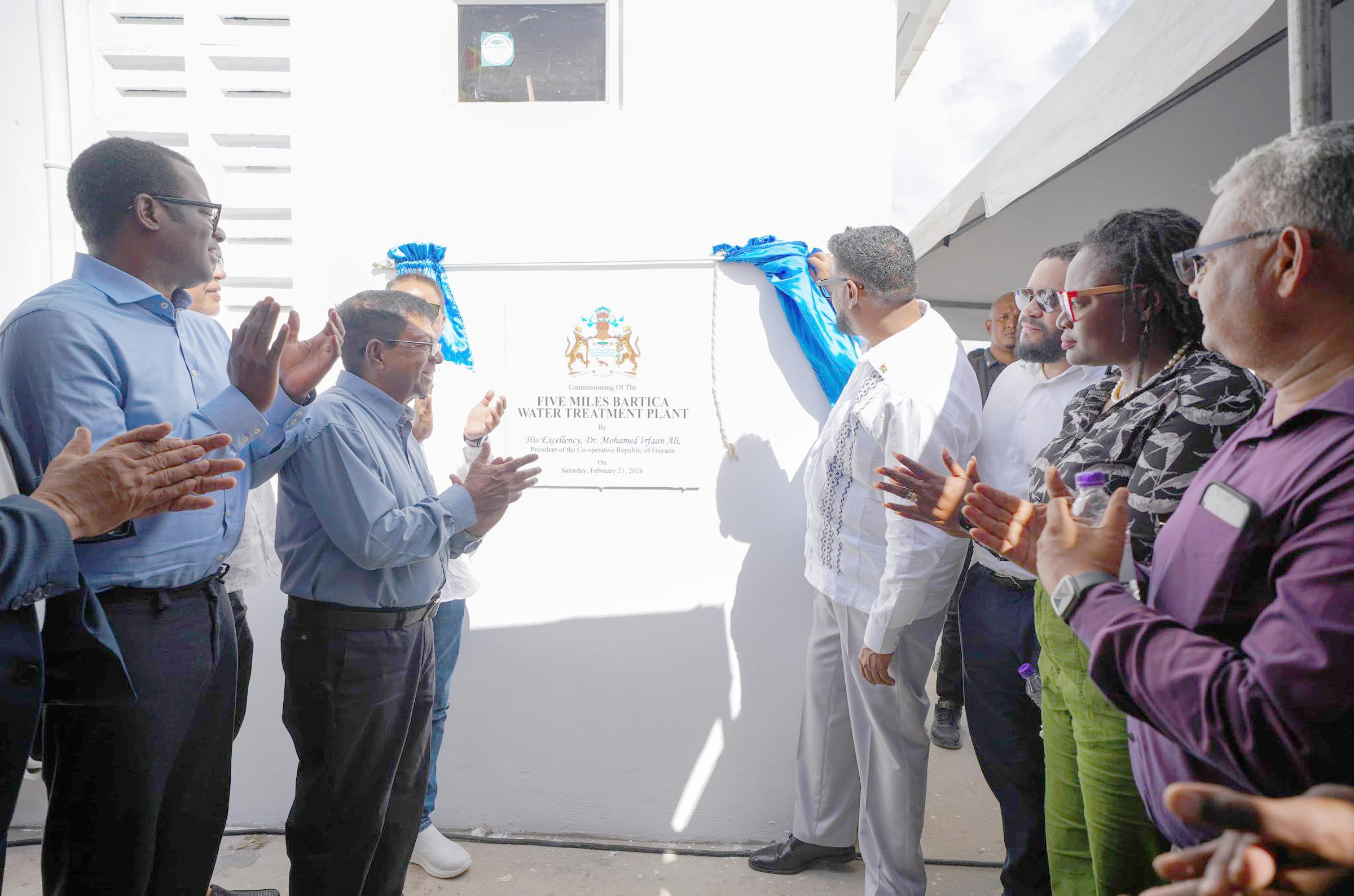
President, Dr Irfaan Ali on Saturday commissioned the state-of-the-art Five Miles Bartica Water Treatment Plant in Region Seven (Cuyuni–Mazaruni), a combined investment of $607 million, signalling an “aggressive forward-planning approach” to meet the surging demand expected from rapid housing, tourism, aviation and health-sector expansion in the township and surrounding communities.
President Ali calls for 100% locally produced bottled water within 12 months
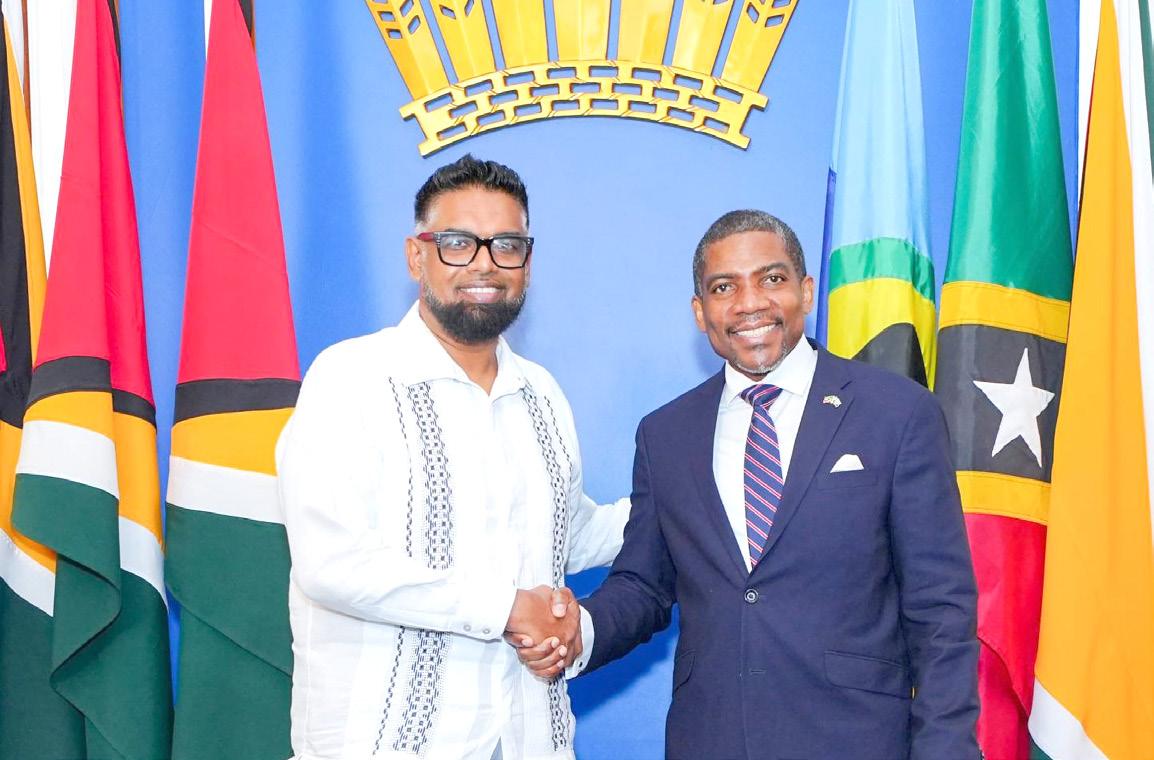
President, Dr Irfaan Ali met with the Prime Minister of St Kitts and Nevis and current Chair of CARICOM, Dr Terrance Drew, at State House on Saturday. During the meeting, President Ali and Prime Minister Drew discussed a number of issues relating to CARICOM and the advancement of Guyana–St Kitts and Nevis relations. Prime Minister Drew called the meeting “fruitful” and said that the CARICOM Heads will continue to push the idea of “regional integration and togetherness.” The 50th Meeting of the Conference of Heads of Government is scheduled for next week in St Kitts and Nevis. (Source Office of the President)
President Ali calls for 100% locally produced bottled water within 12 months
PRESIDENT, Dr Irfaan Ali has set a national target for Guyana to achieve full local production of bottled water within the next 12 months, arguing that the country’s vast freshwater wealth must be harnessed to eliminate unnecessary imports and unlock new economic opportunities.
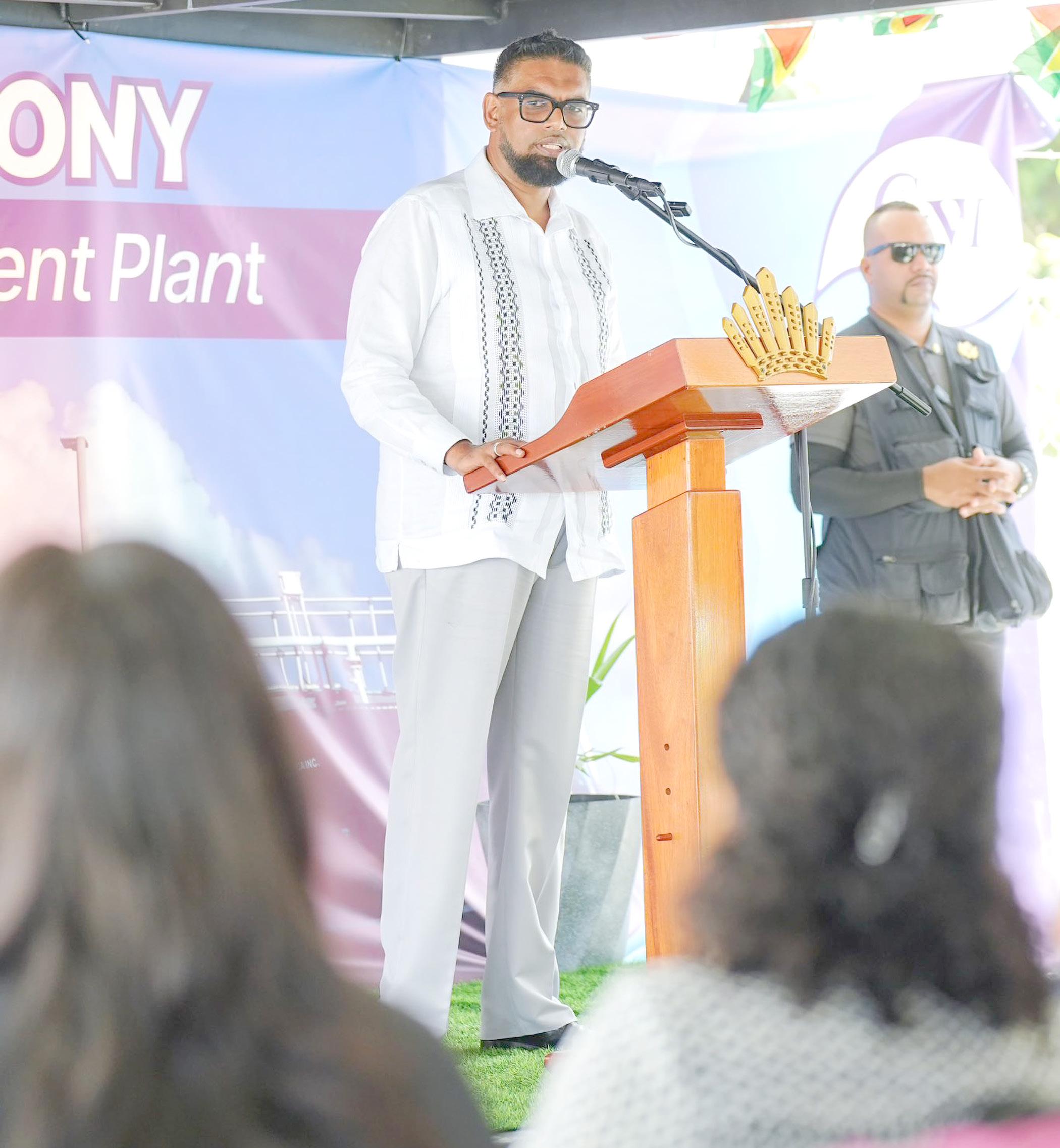
The Head of State made the declaration on Saturday while commissioning the new Five Miles Bartica Water Treatment Plant in Region Seven (Cuyuni–Mazaruni), where he broadened the conversation on water beyond service delivery to include its strategic economic value and industrial potential.
rich in freshwater resources to remain dependent on imported bottled water.
In his assessment of Guyana’s current consumption patterns, President Ali said it was incongruous for a nation
“It can’t be such a resource-rich country in fresh water and importing bottled water. This ministry must therefore set its side on a target of ensuring that all our water consumed locally is produced locally in the next 12 months,” he stated.
The pronouncement ef-
fectively places bottled-water production squarely on the policy agenda of the newly established Ministry of Public Utilities and Aviation under Minister Deodat Indar, which the President described as central to advancing national efficiency, competitiveness and economic diversification.
However, President Ali’s call reflects a broader shift in the administration’s approach to water, repositioning the resource not merely as a public good, but also as a commercial asset capable of supporting domestic manufacturing, reducing foreign exchange outflows and generating employment.
To achieve this target, the President underscored the need for structured collaboration with the private sector, cautioning against fragmented investments and instead, advocating for a coordinated, scale-driven production model that can drive down costs and ensure market competitiveness.
“Whether we have to collaborate and we must collaborate with the private sector to ensure that they build up their capacity and capability, every entity don’t need to have a water-bottling facility.
We can have one entity that produces all of the plastic bottles, a standard size across the country, so that we have economies of scale,” he explained.
Such a model, he suggested, would allow Guyana to standardise inputs, streamline production and create efficiencies across the entire value chain, from bottling and packaging to distribution and retail.
The President noted that preliminary production assessments indicate that locally bottled water can be supplied to the domestic market at highly competitive prices, once economies of scale and efficient production systems are in place.
“When you look at our operational costs and the cost of production, you can have
this at least at $100 on the market, or less easily. What we have to do is work with the private sector to see how we can actualise this so that a country that is known as the land of many waters can have the cheapest water available to its people,” he said.
Beyond the immediate goal of import substitution, President Ali framed the initiative as part of a larger policy effort to optimise the economic value of Guyana’s freshwater reserves through integrated planning and modern resource management systems.
“We now have to work with the integrated water resource management system principles to develop an optimisation plan of our water asset in Guyana, our total water asset and how that asset can be deployed to optimise value,” he stated.
This approach, grounded in Integrated Water Resource Management (IWRM) principles, is expected to guide how freshwater is allocated and commercialised across domestic, agricultural and industrial uses as the country’s economy continues to diversify.
The President also signalled that as new sectors expand, including agro-processing and manufacturing, the country will need to move towards a more sophisticated classification of water usage, ensuring that supplies are efficiently directed based on sectoral demand.
“We will have to move to a situation where we define water based on set use agriculture, industrial, residential. These are important concepts,” he noted.
The proposal also aligns with the government’s wider emphasis on building integrated production ecosystems that allow multiple industries to benefit from shared infrastructure and standardised inputs, a strategy increasingly being applied across energy, agriculture and manufacturing sectors.
‘Clean water is not a luxury. It is life’ – President Ali commissions new Bartica water plant
-- says facility built ahead of surge in housing, hospital, airport and tourism demand in Region Seven --first surface-water treatment plant to serve over 6,000 residents
PRESIDENT, Dr Irfaan Ali on Saturday commissioned the state-of-the-art Five Miles Bartica Water Treatment Plant in Region Seven (Cuyuni–Mazaruni), a combined investment of $607 million, signalling an “aggressive forward-planning approach” to meet the surging demand expected from rapid housing, tourism, aviation and health-sector expansion in the township and surrounding communities.
The facility, the first surface-water treatment plant of its kind in Guyana, is expected to serve more than 6,000 residents across the Four to Seven Miles area of Bartica, with a production capacity of two million litres of treated water per day.
The Five Miles plant was constructed by Toshiba Water Solutions Inc at a cost
of $468 million. Supporting infrastructure, including the water-catchment system, pumping station and transmission pipeline, was completed at a cost of $68 million. A reinforced concrete access road to the catchment and pumping station will also be built at a cost of $71 million to strengthen operational access.
The plant forms part of the government’s broader Coastal Water Treatment Infrastructure Programme (CWTIP), which has already transformed water-service delivery across several regions.
Delivering the feature address at the commissioning ceremony, President Ali explained that the investment was not merely about meeting present demand, but is also about positioning the region to absorb immi-
nent large-scale development within a short timeframe.
“As we celebrate here, my mind is already contemplating the challenges not three years from now, but one and a half year from now, because in one and a half year from now, we’ll have thousands of new homes in a new housing scheme. We will have a new state-of-the-art hospital, we will have a municipal-type airport, we’ll have new hotels and a marina, all of which would require abundant water supply as a part of the efficiency programme,” the President stated.
He highlighted that such rapid growth requires constant forward planning and flexible infrastructure capable of quick expansion.
“That is why you cannot sit and wait. We have to plan continuously, ahead of time, and that is why, too, these plants are built in modular forms. All the new plants are built in a modular way, that is, we can add capacity very easily without dismantling
the existing infrastructure,” President Ali explained.
The Five Miles facility also marks a milestone for the Guyana Water Incorporated (GWI), as it introduces modern surface-water treatment technology that will enhance quality, reliability and continuity of supply for residents and businesses in the expanding Bartica township.
The investment also reflects the first-phase achievements of the Coastal Water Treatment Infrastructure Programme, under which seven large water-treatment plants and 15 smaller facilities were constructed, 12 existing plants upgraded, and approximately 200 kilometres of transmission mains installed across Regions Two, Three, Four, Five, Six and Seven.
These interventions have collectively improved water quality, service continuity and system efficiency nationwide.
President Ali commended the leadership and technical teams within GWI for their decades-long commitment to expanding and modernising Guyana’s water infrastructure, noting that sustained planning has been necessary to match the country’s unprecedented development trajectory.
“Dream time planning, another joyous occasion when we commissioned this, was the treatment plan in every aspect of development. We try as far as possible to ensure at least the medium-term demand is satisfied with that investment. Unfortunately, the pace and speed at which the country is growing sometimes does not
Meanwhile, the second phase of the programme is already underway, with seven additional treatment plants being constructed at Maria’s Delight in Region Two, Wakenaam and Leguan in Region Three, Hope in Region Four, Bath in Region Five, Adventure in Region Six and Five Miles Bartica in Region Seven.
Unveiling of the plaque for the Five Miles Water Treatment Plant
‘Hold your heads high, be proud to be Guyanese’ — Bharrat tells youths
— Minister urges patriotism, unity and confidence in growing opportunities at home
MINISTER of Natural Resources Vickram Bharrat has called on young Guyanese to embrace a stronger sense of patriotism, reflecting on the country’s transformation from an era marked by migration and limited prospects to one defined by expanding opportunities and renewed hope.
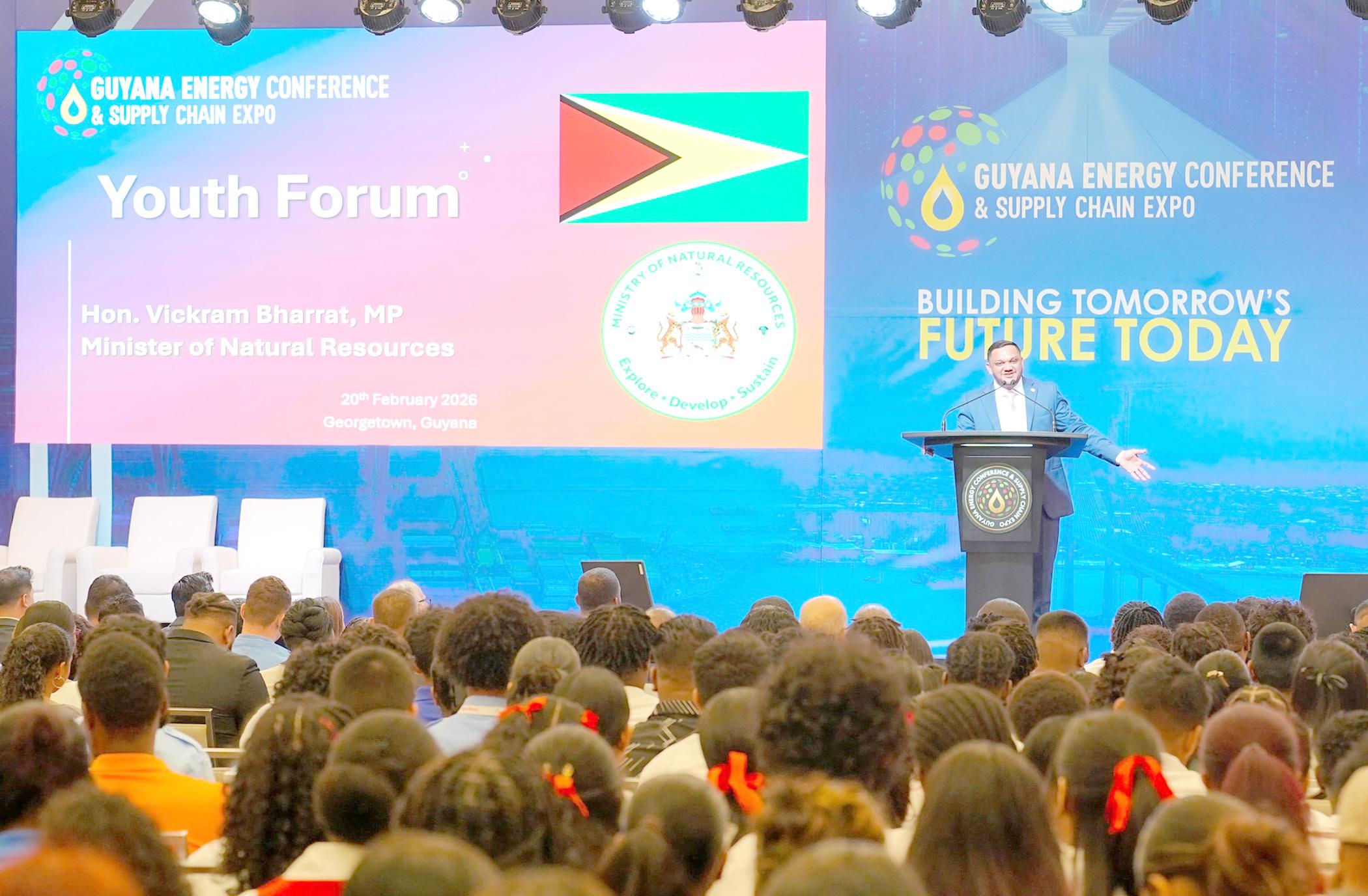
He made the appeal during the youth forum at the Guyana Energy Conference and Supply Chain Expo, where he addressed a packed audience of secondary and university students and young professionals, urging them to demonstrate national pride not only abroad, but within Guyana itself.
“As young Guyanese today, we have so much to be proud of, today we can hold our heads high, and we can lift our chest, and we can say, ‘I am Guyanese,’” the minister told young leaders.
Bharrat recalled a time
when Guyanese travelling overseas often faced stigma, sometimes concealing their nationality due to perceptions that they were migrating in search of employment.
Contrasting that period with the present, he pointed to the growing demand for housing and local opportunities as evidence of a dramatic national shift.
“You see the opportunities that exist today… instead of people lining up for a visa, they’re lining [up for] house lots. That is change and that is one of the greatest achievements of the Peoples’ Progressive Party/ Civic, bringing back hope to Guyanese,” he said. According to the minister, the current environment allows young people to pursue ambitions within their homeland rather than seek prospects elsewhere.
“Today, we can dream again. Today, you as young people… you are not look-
ing for an exit. You are not looking to leave this country in search of better opportunity[sic], because you know there are good opportunities in your country,” he added.
Bharrat also called for more visible demonstrations of patriotism, arguing that
pride in country must be consistently reflected in everyday conduct at home.
“You have so many reasons to be proud to be a Guyanese today and we need to show that patriotism… not only outside of Guyana,” he said, urging a cultural shift
in attitudes and behaviours, including greater respect for the environment and public spaces, especially to stop littering.
He further highlighted the importance of unity under President, Dr Irfaan Ali’s “One Guyana” vision, encouraging young citizens to lead by example in fostering inclusion and shared prosperity.
Minister Bharrat’s renewed call for a sense of patriotism comes at a crucial time, especially as Guyana observes 56 years of republicanism tomorrow.
Through challenges and triumphs alike, Guyana continues to be shaped into a prosperous, multi-ethnic, and competitive nation—a nation where every citizen has an equal opportunity to thrive and contribute.
Further, Guyana’s development story is increasingly being defined not only by economic expansion, but also by deliberate investment in people — particularly its young citizens.
Since returning to office following the September 1 2025 polls, President Ali has announced the government’s plans to continue implementing comprehensive measures to support households and cushion the global trend of increased cost of living.
The government has invested heavily in the social welfare of Guyanese, while also building out the country’s infrastructural landscape to enable long-term growth and sustained development.
Among the plethora of measures rolled out from 2020 to 2025 are the re-introduction and increase of the education grant to the children; the increase in old-age pension; increase in public assistance; targeted cash transfers, and the grant for persons living with disabilities; health vouchers and programmes; and the removal and reduction of taxes, along with other targeted tax-deduction measures.
In addition to this, the government has abolished tuition fees at the University of Guyana and several technical vocational institutions, making tertiary education free of cost.
Meanwhile, a number of nursery, primary and secondary schools were rehabilitated and newly commissioned in an effort to promote equitable access to education levels.
The government also moved to open several new regional hospitals, thereby enhancing the delivery of healthcare across the country.
Minister of Natural Resources Vickram Bharrat at the youth forum (Guyana Energy Forum)
Karpowership unveils AutoCAD lab at GTI to boost technical training
—Initiative to enhance digital-design skills, support youth development and job readiness
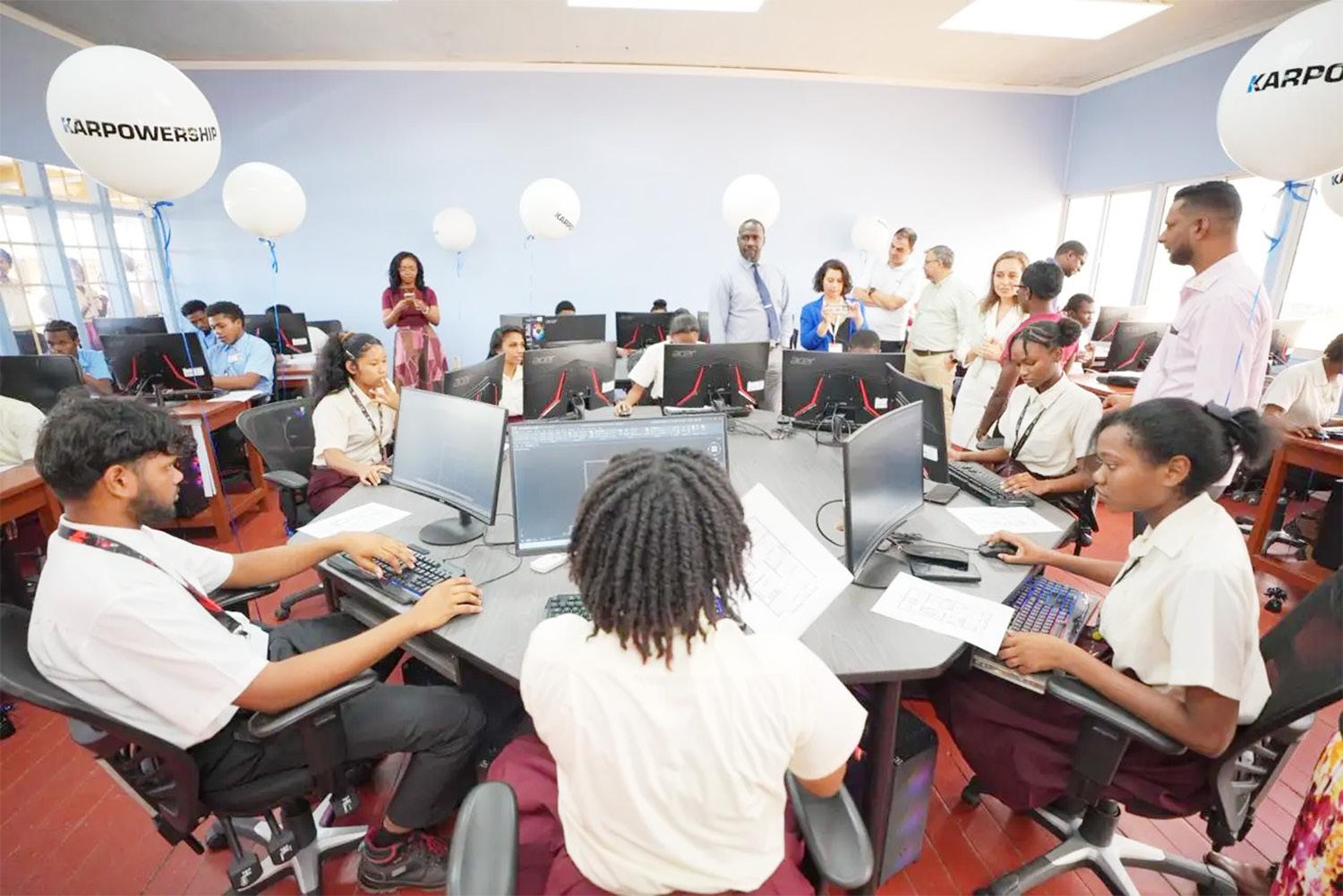
TÜRKIYE-BASED energy company Karpowership has launched a state-of-theart AutoCAD Technology Lab at the Government Technical Institute (GTI), reinforcing its commitment to strengthening technical education and skills development in Guyana.
The announcement was made on the third day of the Guyana Energy Conference and Supply Chain Expo, where the company also pledged continued support for Guyana’s expanding energy sector and broader development agenda.
Addressing delegates, Beyza Özdemir, Americas Regional Director of Commercial Operations for Kar-
is not just about generation, it is not just about oil and gas discoveries, it is about ensuring hospitals and schools are functioning, businesses are evolving and expanding, and new industries are growing.
Today, this philosophy is exactly what connects us to Guyana and Guyana's prosperity for the future,” Özdemir said.
The newly established AutoCAD Technology Lab, created in honour of company founder Rauf Osman Karadeniz, features high-performance desktop computers designed to support AutoCAD-based instruction at GTI. The facility enhances existing instructional capacity and expands students’
(CSR) strategy, which focuses globally on education, nutrition and women’s empowerment.
“Our contribution and our commitment go beyond energy generation. We are investing heavily in CSR projects around the world,” she said, noting that Karpowership will continue to collaborate with local institutions, including GTI and the Guyana Industrial Training Centre (GITC), to expand training opportunities.
The company, which operates floating power plants and provides energy solutions globally, is also an allied provider for Guyana’s two chartered powerships from UCC Holdings. Öz -
powership, said the initiative reflects the company’s long-term commitment to capacity-building, youth empowerment and job creation in Guyana.
She noted that while the company’s operational partnerships in the energy sector are significant, the shared vision for sustainable growth and collaboration provides even greater opportunities for future engagement.
“At Karpowership, we strongly believe that energy
access to industry-standard digital design tools widely used in engineering, construction and other technical fields. According to information released following the launch, the lab is expected to benefit approximately 1,000 first- and second-year fulltime engineering students annually across multiple programmes at the institute.
Özdemir explained that the initiative forms part of the company’s wider corporate social responsibility
demir said the company views its presence in Guyana as part of a broader effort to support the country’s ambitious infrastructural and energy-expansion programmes.
She pointed to Guyana’s rapid economic growth and major projects such as gas-to-energy, solar power developments and data centre investments as evidence of the country’s dynamic transformation.
“Our footprint
shows that the
is
growing very fast and undertaking major projects… We are proud to be one of the contributors to these economic developments as a bridging solution,” she added.
The AutoCAD lab initiative is expected to play
a critical role in equipping young Guyanese with practical, technology-driven skills, thereby strengthening the technical workforce needed to support Guyana’s ongoing industrialisation and energy-driven economic expansion.
in Guyana
country
The AutoCAD Technology Lab is expected to support approximately first- and second-year full-time engineering students yearly across multiple programmes at the Guyana Technical Institute
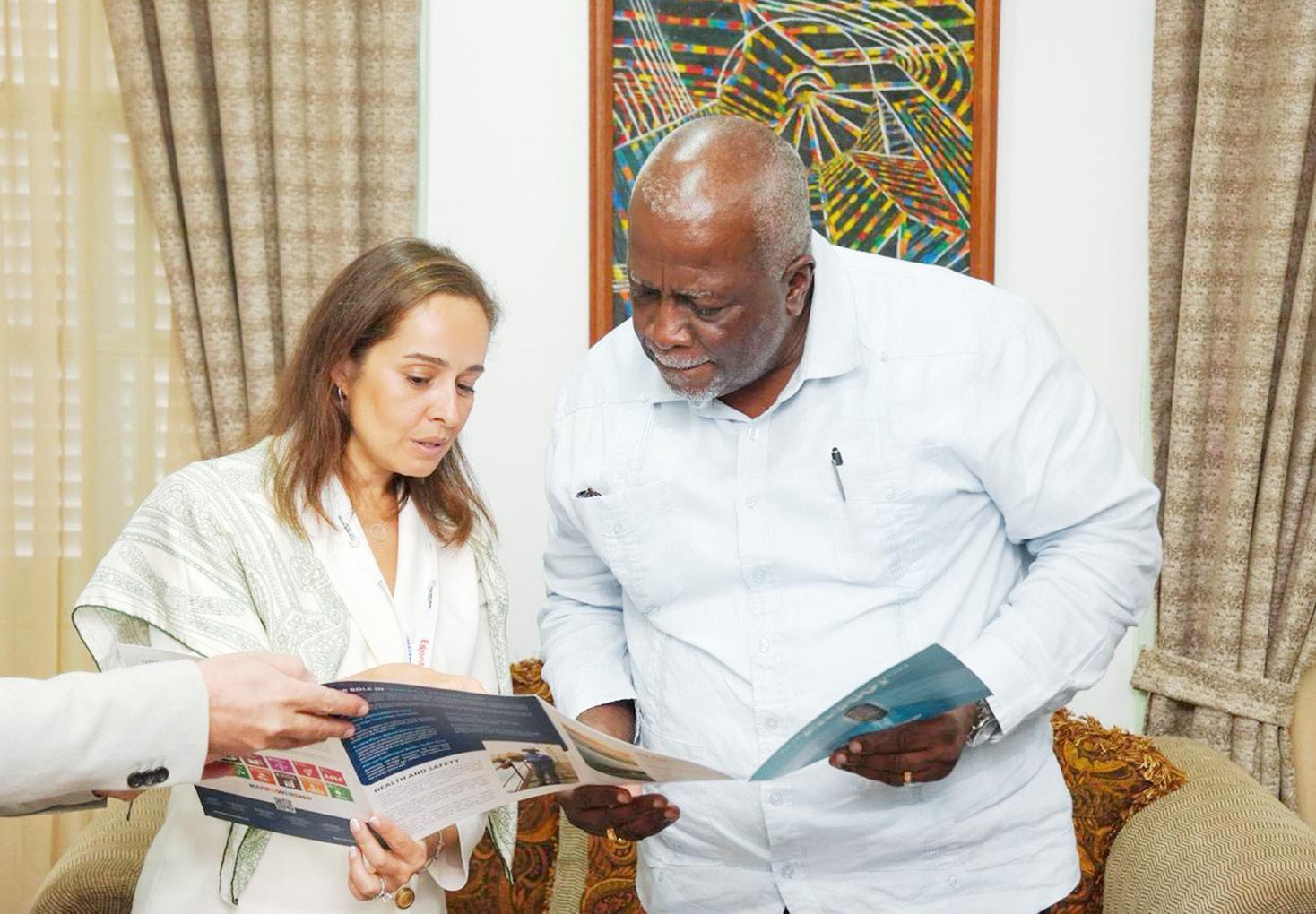
Beyza Özdemir, Americas Regional Director of Commercial Operations for Karpowership beside Prime Minister Brigadier (Ret’d) Mark Phillips during a recent engagement (Office of the Prime Minister photo)
Water as Asset
GUYANA’S description as the “land of many waters” is steadily evolving from a geographic identity into a strategic economic doctrine. What is now taking shape is a deliberate policy-repositioning: water is no longer being treated solely as a social utility, but as a national asset capable of driving energy security, industrial expansion and export competitiveness.
The scale of investment since 2020 makes that shift unmistakable. More than G$65 billion has been channelled into the water sector, lifting treated water access to over 98 per cent nationwide, with 153 new wells drilled and coastal coverage approaching universal levels by the end of 2025. These figures are not just indicators of improved service delivery; they represent the
foundational infrastructure required to monetise freshwater resources in a structured and sustainable manner.
This emerging framework rests on a clear premise; which is abundant freshwater is a comparative advantage in a world increasingly constrained by water scarcity.
As global production systems face rising costs linked to limited water availability, Guyana is uniquely positioned to leverage its reserves not only for domestic reliability, but for regional economic engagement. The proposition to develop treatment plants and distribution networks targeting markets in North America, Brazil and the Dominican Republic reflects a deliberate ambition to transition from raw resource possession to ownership of value-added regional
infrastructure. The energy dimension further deepens this outlook. Studies estimate that Guyana holds over 7,000 megawatts of untapped hydroelectric potential across its rivers and waterfalls. Central to this outlook is the advancement of major hydropower initiatives, particularly the Amaila Falls Hydropower Project, which remains a cornerstone of the country’s longterm energy diversification plan.
Properly harnessed, this capacity could reduce dependence on imported fossil fuels, lower electricity costs and reinforce long-term energy security. Equally important is the recognition that water infrastructure itself is energy-intensive; improving efficiency in treatment and distribution systems will be critical to containing operational
costs while maintaining affordability for consumers.
Budget 2026 reinforces this integrated approach, with G$21.6 billion allocated to the sector to enhance security, affordability and digital management of water services. The establishment of a National Water Council to coordinate policy across health, agriculture and climate resilience sectors signals an institutional understanding that water policy cannot operate in isolation. Instead, it must intersect with broader economic and environmental planning.
The economic implications are considerable. Differentiating between agricultural, industrial and residential water use allows for more efficient allocation, cost structuring and long-term investment
planning. Industrial water, for instance, can support manufacturing, mining and agro-processing without necessarily requiring potable-level treatment, thereby optimising both output and expenditure. Such classification moves the sector closer to a modern resource-management model aligned with global best practice.
Guyana therefore stands at a tactical inflection point and water, in this context, is no longer merely a service delivered to households; it is a core development input, capable of powering industries, supporting energy transformation and opening new avenues for regional trade. Properly managed, it can become one of the defining pillars of Guyana’s next phase of national growth.
President Ali on the world stage
Dear Editor,
AFTER five years in office, His Excellency Dr Mohamed Irfaan Ali should be congratulated for turning a new and dynamic page for Guyana and its citizens. The political, economic and social transformation in Guyana is due largely to his buoyancy, hope, faith and confidence in the people, and their unwavering support for his policies and the “one Guyana” initiative.
The President pledged that in his second term, his administration will advance the economy, increase productivity and the Gross Domestic Product (GDP) with the intent to provide tangible financial relief to every household in the country.
Despite the fact that his election to office was marred by five months of intentional delay by the APNU coalition government, however, after the votes were finally tabulated on August 2, 2020, history was made in Guyana, a page has been turned, and a new era began with the swearing in of Dr. Mohamed Irfaan Ali as the first Muslim President. Dr. Ali knew that being from a minority group, the task ahead was
not going to be easy, but with adequate training, resilience, and poise, he was ready to make the sacrifice to solve the nation’s woes, unite and uplift the people, grow the economy, and move the country forward.
An eternal optimist, President, Dr. Ali is a trustworthy and disciplined leader, a genuine and faithful son of the soil, a patriot, and a true champion of the people.
His Excellency, who is a strong believer in good governance, fairness, equality and transparency, has achieved more in his first term in office than many others have failed to achieve in a much longer period.
He also believes that the people of Guyana deserve leaders who will serve their interests and not their own.
His quiet resolve and his relentless effort to improve the lives of all Guyanese, especially those at the bottom of the economic ladder, and to make sure that no one is left behind and that all are treated fairly and equally sets him apart.
He has inspired, influenced, and empowered others toward a shared vision, prioritising collective success over personal gain. Defined
by his good character, integrity, charisma and action and not by position or power, the Head of State has fostered a cultivating and supportive environment in Guyana built on the people’s trust and togetherness.
Over the past five years, President, Dr Irfaan Ali has done an excellent job as both a leader of small states, a serious voice in global development debates and a rising world leader, proudly representing Guyana at high-level forums across the region and around the world. On several occasions, he participated in high-level discussions at the United Nations General Assembly, Climate Change Summits and at Trade Forums with various countries around the world, including the United States, Canada and the European powers.
The leader of the fastest-growing economy in the world, Guyana’s President, Dr. Irfaan Ali, has emerged as a significant and the leading regional voice for the Caribbean, particularly during his tenure as Chairman of CARICOM, when he advocated for food security, unity and regional integration.
Under his leadership, Guyana
has emerged as the world’s fastest-growing economy, driven by its vast oil discoveries, while also pushing aggressive policies on food security, climate change, energy transition, and global cooperation. His leadership role has elevated his profile in the Caribbean and Latin America and has earned him praise and prestigious awards for his visionary and decisive leadership.
Dr. Ali has received numerous commendations from many world leaders who recognise his enormous impact on Guyana’s rapid and vibrant transformation. In October 2025, His Excellency was recognized by Time Magazine--one of the world’s most esteemed and respected magazines, as being one among 100 rising and most influential leaders in the world.
A few days ago, the Government of the State of Roraima in Brazil has conferred its highest accolade, the Order of Merit Fort Sao Joaquim, upon His Excellency President Dr Irfaan Ali for his strong and brilliant leadership in strengthening economic ties between Guyana and the northern Brazilian state.
The commendations have boost-
ed his popularity at home and reinforced his image as a leader who not only has the highest respect locally but also abroad.
It strengthens his vision to build a modern Guyana that would be recognised globally and validates his work and position among a new generation of an elite group of world leaders and visionaries who could influence events and issues in future years.
Globally, the recognition adds to President Ali’s appeal as a dynamic statesman from the Global South who has championed the cause of developing nations in climate finance and biodiversity protection and has navigated complex geopolitics in the Caribbean and Latin America. His advocacy on issues of climate change, equity and unity resonates beyond Guyana and the Caribbean, which could seriously translate into greater diplomatic, trade, and investment opportunities for Guyana and make it a better place to live.
The convoluted, corrugated, contaminated logic of three men
THERE is a political/legal/ constitutional controversy raging at the moment. The three PNC appointed GECOM commissioners will not resign--with Vincent Alexander leading the charge-- even though there is a new opposition leader and a new opposition majority that want to replace these three commissioners.
If you go through the letter pages in the print and online publications, Vincent Alexander’s name can often be seen. He is one of the biggest critics of the Government of Guyana. But let’s examine the nature of this man and tell me if he would be a democratic office-holder if given huge governmental power. Alexander says that he is not a PNC GECOM commissioner. He is a constitutional GECOM commissioner who does not represent any political party.
When you digest the corrugated, convoluted and contaminated logic of Alexander, then Guyana should be happy
that Alexander is not entrusted with the power to rule Guyana. What is Alexander saying? First, he is not a party representative at GECOM. Secondly, his appointment is for life. Thirdly, he will not resign even though there were general and regional elections and Guyana has a new opposition leader. Fourthly, he rejects the position that the new opposition leader from a different political party can appoint three GECOM commissioners because the previous opposition leader’s appointments are for life.
Where is the insanity in this thinking? First, if Alexander does not represent the PNC in GECOM, why did he not say that before during his 18 years at GECOM? He never said that before because the PNC would not have tolerated such behaviour because the constitution authorises the PPP and PNC to select three commissioners respectively to represent their interests in GECOM, with a
chairperson who is to act as a buffer between the commissioners of the two political parties.
Can Alexander tell the nation then how do policies and positions of the PPP and PNC arise within GECOM and who present them at the table? Who in GECOM adumbrates the positions of the PNC and PPP when their positions are opposed to each other? The perfect example occurred in 2019. The ruling APNU+AFC wanted houseto-house registration before the national and regional elections. The PPP opposed that demand.
Which position did Alexander take? He voted for house-to-house registration and rejected the PPP’s stance. But since Alexander does not sit in GECOM as a party representative, how did he arrive at his vote to have house-tohouse registration? Since he is a constitutional commissioner and not a party man, did he seek advice from the opposition PPP, civil society
groups, UG academics, trade unions and the media on how he should vote? Who in the society or which organisation determines what GECOM commissioners say and how they vote? Alexander, in the ongoing raging controversy over his continued membership of GECOM, has an obligation to answer these questions.
The second insanity in Alexander’s stance is his relationship with the opposition leader and the major opposition party in parliament. Alexander and the other two commissioners appointed by the PNC refused to meet with Opposition Leader Azruddin Mohamed. Who then conveys to GECOM, when there are official meetings, what the major opposition party and the opposition leader want GECOM to do?
Obviously, it cannot be the three PPP commissioners. Why would they represent WIN in GECOM? And since the three PNC commission-
Road safety, speeding and alcohol
EARLY one morning, while living in Golden Grove, East Bank, Demerara, I walked out to the main road to catch a minibus to Georgetown. I stood on the western side of the road, where there still remained materials being used in the ongoing road-widening project.
The road was in relative darkness as dawn was still minutes away and traffic was sparse, except for huge trucks moving up and down. While I glanced around me, my gaze was directed mostly to the south as I looked for a minibus heading my way. Suddenly, I became aware of the roar of powerful engines coming from the north and felt that something was wrong.
As I glanced quickly in that direction, I was horrified to see one truck in the process of overtaking another and bearing down on the spot where I was standing. I jumped back just in time
as the trucks swept past me, feeling the nearness of the overtaking truck, which seemed to have missed me by mere inches. The trucks roared past, still speeding and probably totally unaware of the fact that one of them would certainly have struck me if I had not moved out of the way.
On another occasion, as I was walking at the side of the road, facing the oncoming traffic but unable to use the sidewalk, which was under construction, a truck swerved to avoid a hole and once more I had to jump out of the way to avoid being hit. I have since witnessed 'close calls' between trucks and other pedestrians as well as other vehicles and recalled a report which indicated that trucks were becoming increasingly involved in road accidents.
In addition, speeding is the primary reason for road fatalities in this country, standing at 70 per cent and so far
this year 97 individuals have lost their lives, according to the National Road Safety Council (NRSC)
The recently launched road-safety strategy is not only welcome but imperative, given these alarming statistics. Aligned with the UN goals, the aim is to reduce traffic fatalities by 50 per cent by 2030. Measures include increased funding for the NRSC, intensified police operations and public awareness programmes such as 'Do The Right Thing'." Doing the “Right Thing” must, however, apply to all road users and those responsible for vehicles traversing our roadways. Truck owners, in particular, must come under closer scrutiny for the condition and documentation of their vehicles and the drivers they employ, many of whom are inexperienced and often seem too young to even qualify for the licence necessary to drive vehicles of this size.
ers want nothing to do with WIN, then where does that leave the constitution? Is Alexander telling the Guyanese people that, contrary to what the constitution says, there cannot be any input into the working of GECOM from the current Opposition Leader because he and his two colleagues will not meet with the Opposition Leader?
The third insanity is tantamount to comicality. There are three commissioners at GECOM at the moment who never supported over the decades the positions of the PPP representatives and always voted against their proposals. These three commissioners are also not in favour of the continued role of the GECOM chairperson, Justice Claudette Singh. But will the new opposition leader have an input into these directions by Alexander and company?
Since the general and regional elections of 2025, Mr Alexander has often called for the removal of Justice
Singh, including a letter in the newspapers as recent as last week, but Opposition Leader Mohamed, has never voiced any opinion on resignation or continuation. So Alexander, then and the two PNC commissioners speak for themselves only in GECOM. They certainly do not speak for the opposition leader, who has no say whatsoever. If I have to choose between WIN and the PNC, I will close my eyes and pick the PNC. But the voters of Guyana chose the current opposition leader and the constitution speaks loudly. Mr Alexander and his two acolytes should be removed from GECOM immediately.
DISCLAIMER: The views and opinions expressed in this column are solely those of the author and do not necessarily reflect the official policy or position of the Guyana National Newspapers Limited.
The rush to pick up and deliver loads also leads to speeding and other blatant traffic violations, such as the tendency of trucks to block the outer lane of dual carriageway roads, causing other drivers to have to 'undertake' them. Complaints are often made that the trucks, because of their size, disregard pedestrians and other road users. “Ya can't argue with them”, commented the driver of a minibus in which I was travelling, when a truck 'cut in' in front of him, causing him to abruptly apply brakes to avoid a collision.
Along with speeding, another major area of concern is drunken driving. Despite repeated warnings and exhortations, many still persist in driving under the influence of alcohol. They choose to ignore the fact that alcohol dulls the senses, slowing reaction time and reducing coordination. It also impairs
sight and hearing, even when the blood-alcohol content is low.
While speeding and drunken driving are key issues targeted under the new road-safety strategy, they are dependent on police vigilance and legislative enforcement to be successfully reduced.
I therefore call on those officers responsible for road-traffic control to 'do the right thing' and ensure that violators are apprehended and prosecuted to the full
extent of the law.
An AI Overview put it this way, “Road Safety is a critical life-saving concern, often summarised by the philosophy that safety is a shared, consistent responsibility.”
DISCLAIMER: The views and opinions expressed in this column are solely those of the author and do not necessarily reflect the official policy or position of the Guyana National Newspapers Limited.
Ramadan Village and the Making of a National Table
THE word commensality literally means “eating at the same table,” or more broadly, “eating with others,” and it is a practice embedded in most, if not all, major-faith traditions.
For Guyanese Muslims, commensality comes alive for the entire Islamic lunar month of Ramadan, which began last Thursday. It is a tradition, in Guyana and in countries where Muslims
are either the majority or minority, for believers to voluntarily trade domestic commensality for a communal experience, often bringing along a dish prepared at home to share in the collective breaking of the fast.
After an entire day abstaining from food and drink, it is perhaps natural that the nights of Ramadan unfold in the warmth of prayer and a shared meal. Yet what
sets Guyana’s Ramadan Village apart, an initiative, it bears repeating, conceived by President Irfaan Ali, is that it moves the centre of gravity from the domestic to the communal, and now, to an institutional setting, nowhere more appropriate than the grounds of the Muslim Youth Organisation on Woolford Avenue in Thomas Lands. In doing so, it elevates the sacred act of breaking the
fast, or iftar, from the intimacy of our neighbourhood masjids to a national platform, expanding the circle of fellowship and reaffirming our shared obligations as citizens bound by faith, community, and country.
More specifically, it is also an occasion to reflect on the production of the food we consume. More specifically, who are the farmers, small and big, that produce our food? What effort do they expend to ensure that the food nourishes our bodies instead of making us sick and unhealthy? How does it get from their farms to our markets and kitchens?
The majority of Guyanese, I am sure, are grateful to live in a country that produces all the food types we require as human beings to survive. On my way to the Parika market, it is hard to miss a large billboard celebrating this astonishing accomplishment.
Under President Ali's tenure and the stewardship of Guyana’s Minister of Agriculture, Zulfikar Mustapha, researchers from the University of Göttingen in Germany and the University of Edinburgh in the UK revealed that out of 186 countries, only Guyana has scored 100 per cent, giving it the distinction of being food self-sufficient.
And yet that’s hardly the full story of the food revolution quietly unfolding in Guyana.
When President Ali walked through the Christmas farmers’ market, or I see him moving through the stalls at the Ramadan Village, marvelling at a juicy mango, a papaya or a pineapple on display, I hear echoes
of the central thesis in his 2024 book, Achieving Global Food Security: The Caribbean Experience and Beyond. Dr Ali is not only consumed with growing more, but his vision is also to share the food Guyana produces with our neighbours in the wider Caribbean and with the world.
In a sound narration of the Prophet of Islam, he is reported to have said: “Indeed, the most beloved food in the eyes of God is that upon which the hands are many.” That is not just a pious sentiment; it is akin to a social and political challenge. President Ali understands that if Guyana is to share its food in that spirit, if we are to move toward a truly national commensality, then the country must build food systems that are efficient enough to feed more people, inclusive enough to reach the margins of society, and environmentally resilient enough to endure climate change.
And that’s exactly what staff at the Ministry of Agriculture, under the stewardship of the Hon. Zulfikar Mustapha, have been busy doing. Guyana is now using GIS and data-driven decision-making to drive up crop yields.
The government invested roughly US$165,000 in advanced crop-management drones, software and training for Guyana Rice Development Board staff, then made these same highend services available to small farmers free of cost.
In doing so, President Ali and Minister Mustapha are pairing field-level tools with system-level reform, launching a na -
tional Agricultural Information System that pulls daily reports from extension officers, feeds real-time dashboards and gives policymakers a live, data-rich picture of the sector to plan production, manage risk and attract new investment.
The message is simple: science, precision farming, biotech labs, nano-fertilisers and digital platforms are designed to make Guyana both an oil producer and a regional agricultural powerhouse. I believe the Ramadan Village is a living metaphor for a kind of commensality that is a moral ideal and not just a warm, fuzzy feeling one gets from the scent of freshly cooked dhal.
National commensality will only become real when the Ramadan Village ethic of shared plates and crowded tables is reflected in how we value our food, how the state supports production and farmers, feeds schoolchildren and cushions the vulnerable.
Each time we pass a plate to a stranger at the Ramadan Village, we are indeed observing a spiritual act, but we are also performing a civic duty. If President Ali’s food-security project succeeds, it will not be measured only in yields and export figures, but in how many hands, at home and across the Caribbean, find their way to the same national plate.
DISCLAIMER: The views and opinions expressed in this column are solely those of the author and do not necessarily reflect the official policy or position of the Guyana National Newspapers Limited.
Guyana Moving Forward
TOMORROW, Guyana will celebrate its attainment of national sovereignty and self-governance, having become a Republic in 1970. Guyana had earlier gained independence on May 23, 1966 and was ecstatic to try out its new system of governance.
In the 1970s, Guyana was transformed into a socialist “co-operative republic” led by then Prime Minister Forbes Burnham. It was then marked by aggressive nationalisation of foreign-owned industries (bauxite, sugar), autocratic rule and towards the end of the decade, significant economic decline, severe shortages and political repression.
There was the hosting of the Nonaligned Foreign Ministers Conference in 1972 and the controversial elections of 1973/1978. History recalled the Jonestown massacre that killed hundreds of Americans in 1979.
The 1970s were, for many, a transition from the optimism of independence to a period of “misery” and increasing state control. Burnham and the People’s National Congress’s grip on power, control, wealth, business, commerce and security led to it being one of the poorest countries in the Western Hemisphere in the early 1980s.
When Burnham died and Desmond Hotye continued, though toning down his policies and measures, Guyana was virtually becoming a bankrupt pariah state.
Guyana was on its death bed. The long walk, struggles, fights and compromises to emancipation, independence, and republicanism did not save Guyana from this sad reality.
All of those events, stories of personal challenges, rigged elections, political struggles and socio-economic battles from the period 1950s to 1966 and right through the 1970s to 1980s had made Guyana into a weak nation that was on life support as it manoeuvred its way through high waters and hell in the 1990s under the leadership from the People’s Progressive Party’s Cheddi Jagan, Samuel Hinds, Janet Jagan, and Bharrat Jagdeo.
Under their leadership, Guyana was like a malnourished child finally seeing a doctor to nurse him back to satisfactory health. Dr Jagan led the way with prudent policies which were propoor, pro-working class, and pro-people. He led Guyana to make the economy work for poor people and citizens by building the social, welfare and economic foundation from the ashes left by Burnham and Hoyte’s PNC.
Many will not openly praise Dr Jagan for saving Guyana and ending the decades of tyranny, but they all know it.
Dr Jagdeo came to power at the turning point in our history and continued the bold financial and social reforms. He understood the gravity of the task of nation-building as he understood the then-opposition of the PNC, which was always fanning the flames of racism, division, political violence and unrest. Dr Jagdeo was starting work on building the structure of a modern, free and democratic Guyana, on one hand, while on the other hand, he was cognisant that he had political enemies, particularly the PNC, styled as the PNC-1 Guyana, PNC-Reform, APNU, and the APNU+AFC, waiting to stab him in the back.
He pushed through because Guyana was going to be in a position to win by the time he stopped being the President.
Fast-track past the stable yet turbulent years of Donald Ramotar, whose administration was fighting for its life and to safeguard everything that the PPP had been fighting for thus far.
Despite all the PPP/C administration’s efforts, the APNU+AFC would win the elections. The PPP/C would let them reign, but with checks and balances. For five years, the party opposed when they had to and agreed when they had to.
The PPP/C informed the public of the many scandals of the APNU+AFC administration, which were costing the populace immensely, in terms of wealth, resources, and human resources.
In the midst of a storm, their own parliamentarian, Charandass Persaud, sealed
their fate with a no-confidence motion. The theft and highway banditry intensified, then held on to power for five long months.
The country was going backwards. And, it would soon have flattened after Guyana was showing recessionary indicators.
It’s good to know and be reminded of our history. Every time we forget how far we have come as a nation and a republic, I will always tell the same story. If we, as Guyanese, forget our history, we are bound to relive it.
I fear that was what we did by giving the PNC a chance at government from 2015 to 2020.
On Monday, Guyana will reach another milestone in the nation’s history when it celebrates its 56th year as a republic with much pomp and ceremony. This Republic Day celebration will mark over five and a half decades of national sovereignty and self-governance. It will mark the sixth year since we elected Mohamed Irfaan Ali as our president, marking the start of his second term.
When President Ali came to power, Guyana was still in the midst of the COVID-19 Pandemic and an ongoing health crisis. He still faced economic crises, both domestic, caused by the greed, selfishness, and arrogance of the APNU+AFC government, and international, caused by climbing global food and oil prices, climate change, and many wars.
Ali got to work and started in a bold, fresh and admirable way, solving the crises. He kept Guyanese safe during the pandemic. Our economy was shielded by Ali’s domestic economics while rolling out one of the most aggressive public housing, infrastructure and construction campaigns in the history of this country. He continued the fiscal and financial transformation, working with the private sector, banking institutions, industry bodies and civil society to make homes, property, and businesses more affordable.
President Ali also started the most aggressive campaigns to push Guyana to attain the goal of food security, emphasising agriculture as a
necessity through which other things become accessible.
All facets of life were touched during the early Ali years. Dr Ali’s administration transformed the face of the oil and gas sector in this country through a bold and realistic legislative facelift, which places focus on Guyanese and Guyanese jobs.
Read the words I will write. This current PPP/C government is the hardest working government this country and the wider region have ever seen.
Now, Guyana is progressing smoothly along the development trajectory. Change is upon us and finally, there is something to celebrate.
President Ali and the government, through Budget 2026, will again address
the cost of living and doing business and will further strengthen the monitoring of infrastructural projects that bring value and empowerment to our people.
Dr Ali will ensure the citizens of Mahaica, Eversham, St Cuthbert’s Mission, Anna Regina, Sophia, Letter Kenny, Providence, Diamond, Grove, and many more communities, including Linden, access the benefits, good governance and policy making outlined in Budget 2026.
The president has already delivered on some of his commitments made earlier this year to take Guyana closer to being a modern digital economy, starting by revolutionising the Public Service and Public Sector.
Looking back on how
far we have come since the 1970s to date, Guyana is brighter, more modern and sophisticated. Real growth and change are engulfing the country, and it will transform our country’s face and image. Guyana is in safe hands. Guyana is in the steady hands of those who know and understand the mood of the people.
At last, let the celebrations begin, knowing the future is in Dr Ali’s hands, moving forward.
DISCLAIMER: The views and opinions expressed in this column are solely those of the author and do not necessarily reflect the official policy or position of the Guyana National Newspapers Limited.
The next phase: What it will take to develop Guyana’s gas
GUYANA’S oil success story is well underway. Four offshore projects are already producing. Liza 1, Liza 2, Payara and Yellowtail are driving output to historic levels, with capacity currently exceeding 900,000 barrels per day.
Three more developments
are on the way, for startups in 2026, 2027 and 2029, with a proposed eight undergoing regulatory reviews. Production continues to grow, export revenues continue to rise, and the country’s position as a major new oil producer is firmly established. The next chapter is gas.
While oil has transformed Guyana’s fiscal outlook, natural gas is set to shape its economic structure. The government’s Gas-to-Energy (GtE) project marks the first tangible step. Phase 1 will transport 50 million cubic feet per day of gas to shore from the Liza field. That sup-
ply will fuel a 300-megawatt power plant, and a natural gas liquids (NGL) facility. Phase 2 will add another 90 million cubic feet per day through the same pipeline system, from the Hammerhead project, supporting a second 300-megawatt plant and an additional NGL facility.
Beyond associated gas from those oil fields is the proposed eighth project, Longtail, which is expected to produce approximately one billion cubic feet of gas per day, and 250,000 barrels per day of condensate.
If sanctioned, Longtail would mark Guyana’s first non-associated gas development, expanding the resource base available for domestic use and potential regional markets.
ExxonMobil Guyana has signalled its willingness to move quickly. The company’s upstream leadership has made clear that it stands ready to supply gas as soon as demand frameworks are in place.
As two key executives put it, the pace of development is not set by the upstream operator alone but by the readiness of the full system, including regulatory approvals, environmental assessments, land and marine use decisions, downstream infrastructure, and, critically, market demand.
ExxonMobil Upstream
President Dan Ammann and ExxonMobil Guyana President Alistair Routledge outlined the oil major’s readiness during the just-concluded Guyana Energy Conference and Supply Chain Expo.
Gas development is fundamentally different from oil. Oil is a globally traded commodity whose value is realised primarily through exports. Gas, by contrast, is infrastructure-intensive and market-specific. It requires dedicated facilities to receive the supply. It succeeds when upstream, midstream, and downstream components advance in sequence.
This reality places significant responsibility on the government. Investors will require clarity on permitting, environmental approvals, and fiscal terms. Exxon’s early-stage “Wales Gas Vision” envisions supplying gas for petrochemical and power projects onshore. P etrochemicals, fertilizers, data centers and manufacturing facilities will have to materialize in line with the government’s legal and regulatory framework. In this regard, the government has announced plans to take natural gas legislation to parliament this year.
The benefits to Guyana will be many. The government has committed to reduc-
ing power prices by 50 per cent for consumers through the Gas-to-Energy project. Replacing heavy fuel oil with natural gas would lower generation costs and improve reliability.
Gas-fired power generation emits fewer pollutants than heavy fuel oil, positioning Guyana to expand its electricity supply while moderating its carbon intensity.
Domestic gas displaces imported fuel, reducing exposure to global price volatility and supply disruptions.
Lower and more reliable power costs can unlock investments previously considered unviable, strengthening manufacturing, services, and value-added industries.
As electricity becomes cheaper and more stable, businesses gain the confidence to expand. New industries create employment.
In the words of Amman, oil generates revenue, and gas can build an economy. The opportunity now is to ensure the regulatory system is ready, and for industrial policy, as well as infrastructure, to move in concert.
DISCLAIMER: The views and opinions expressed in this column are solely those of the author and do not necessarily reflect the official policy or position of the Guyana National Newspapers Limited.
Patient dies after incident at N/A Psychiatric Hospital
POLICE are investigating the circumstances surrounding the death of 52-year-old Ravindra Yudeshwar Bishram, formerly of Cumberland, East Canje Berbice, following an incident at the New Amsterdam Psychiatric Hospital on Thursday evening.
According to a police release, hospital staff on duty heard gasping sounds around 19:50 hrs on February 19, 2026, and discovered Bishram lying in a pool of blood inside the ward.
Another patient, a 38-year-old man of Bath
Ravindra Yudeshwar Bishram
Settlement, West Coast Berbice, was present in the ward at the time.
Bishram was immediately escorted to the New Amsterdam Public Hospital, where he was admitted, but later succumbed to his injuries at about 06:53 hrs on Friday, February 20, 2026, while receiving medical treatment.
His body is currently at Persaud’s Funeral Home awaiting a post-mortem examination.
The 38-year-old patient has since been placed in an isolation room as investigations continue.
Police say the probe remains ongoing.
‘Clean water is not a luxury...
allow us, based on existing financial constraints and circumstances, to meet that rapid change,” he said.
Reflecting on past limitations, the Head of State pointed out that infrastructural constraints historically forced difficult engineering compromises, but evolving economic conditions now allow for more robust longterm solutions.
“There was a time when you had to make a difficult decision of putting the pipeline in the middle of the road to ensure that both sides of the road get water. That was not because we did not have great engineers.
That was because we did not have the resources that would allow us to put the lines on both sides of the road,” he noted.
The President further stressed that the new plant forms part of a wider national strategy to modernise utility services and strengthen competitiveness as Guyana positions itself for accelerated economic diversification.
“The most important marker of national efficiency and national competitiveness is the efficiency at which our public utilities deliver service. How fast someone can get the electricity connection, how fast someone can get a water connection and how reliable is the resi-
dential supply,” he said.
President Ali pointed out that ensuring reliable and affordable water is central to unlocking broader socio-economic growth, particularly in emerging urban centres such as Bartica, which is rapidly evolving into a regional hub.
According to President Ali, Region Seven has seen billions of dollars in investments across multiple sectors, including housing, health, infrastructure and renewable energy, all of which will drive increased demand for water and other utilities.
“Clean water is not a luxury. It is life. It is health in every glass. It is dignity in every household. It is security for every child. When a community no longer worries about the safety of its supply, it will focus on growth, education, opportunity,” the President said.
He further highlighted that the government’s approach goes beyond achieving universal access, focusing instead on optimising the economic value of Guyana’s abundant freshwater resources.
“The sector is not about 100 per cent access to treated water. The sector is how do we harness the potential of our fresh water. That is a strategic objective,” President Ali explained.
The Bartica plant also complements wider infrastructural developments in the region, including the construction of a new level-five hospital, ongoing housing expansion, renewable energy installations and the extension of transport and aviation facilities that will collectively reshape the economic landscape of the township.
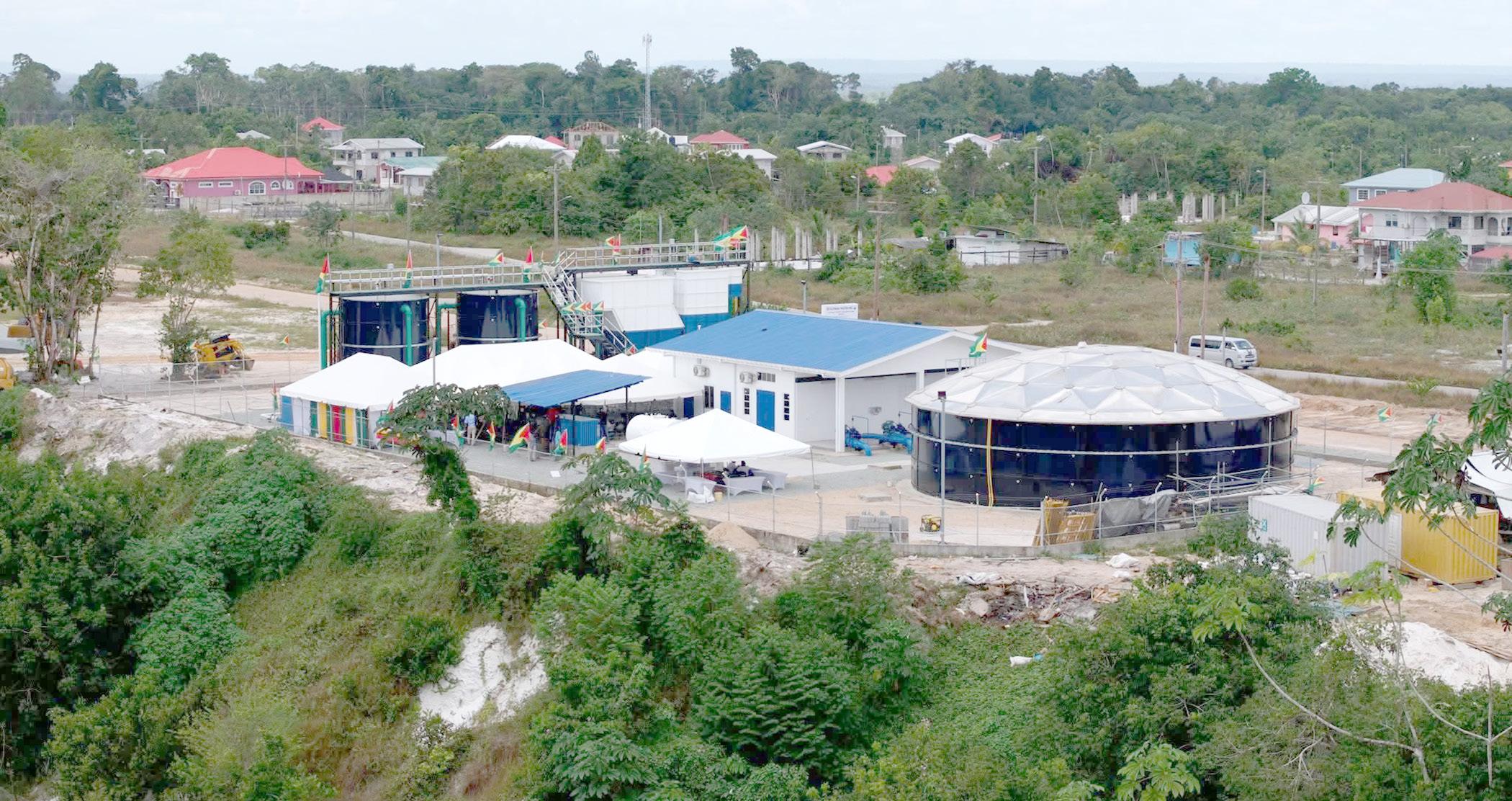
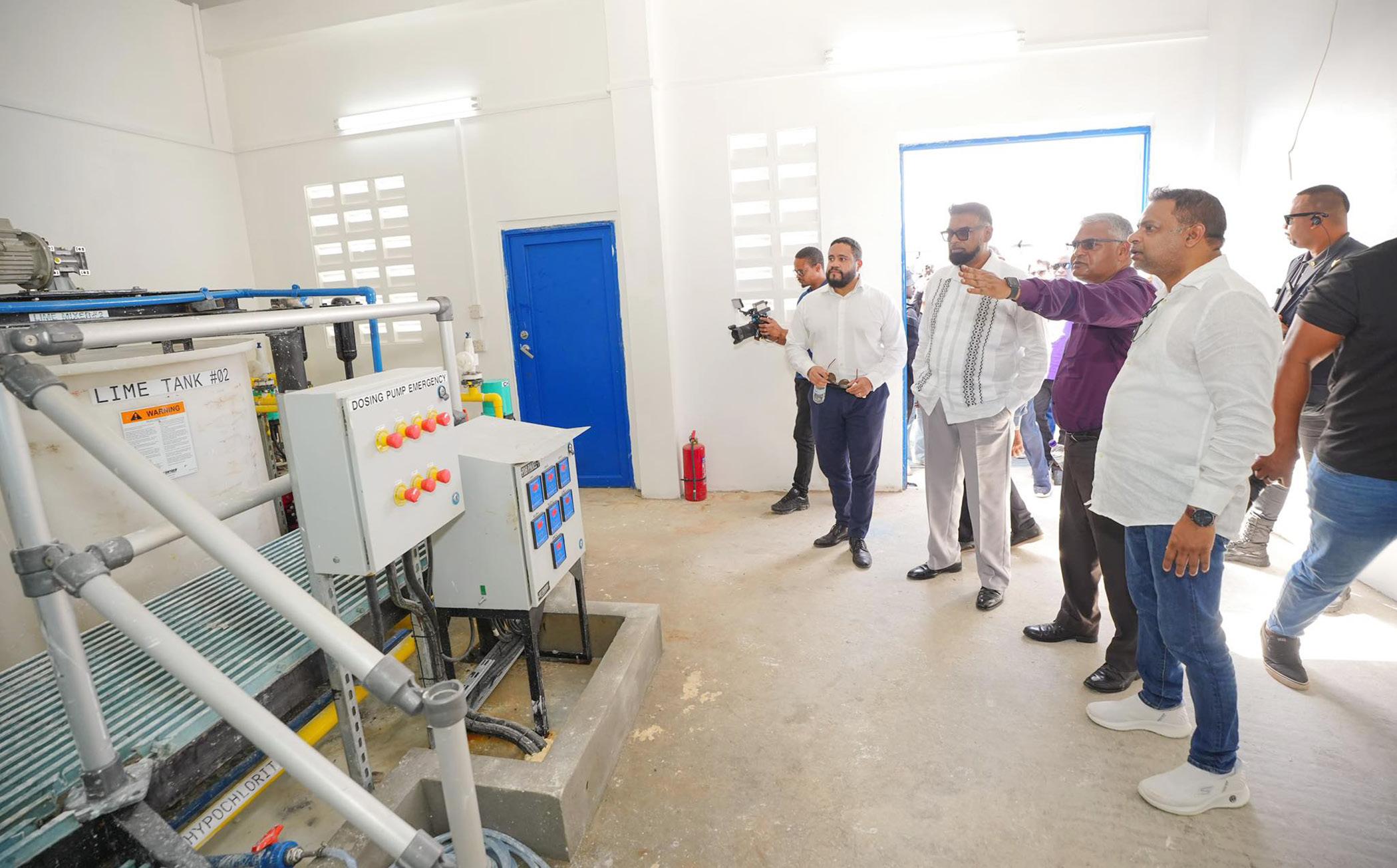
President Ali along with other officials inspect the $468 million state-of-the-art Five Miles Bartica Water Treatment Plant
US$20M DDL dairy farm set to begin milk production by mid-2026
GUYANA’S first modern, large-scale dairy farm at Moblissa is on track to begin fresh milk production by mid-2026, a development Prime Minister Brigadier (Ret’d) Mark Phillips says will significantly advance national food security, skills development and agro-industrial growth.
The Prime Minister on Friday toured the Demerara Dairies Incorporated (DDI) facility along the Soesdyke–Linden Highway, where he received a comprehensive briefing on the US$20 million, 200-acre technologically advanced project now in its final stages of construction.
Commending the scale and strategic value of the initiative, Prime Minister Phillips said the facility will serve not only as a production
hub, but also as a national learning and training centre for the dairy industry.
“In addition to producing milk and other dairy products, this facility will serve as a destination for dairy industry practitioners, and as a learning centre for educational institutions, ranging from the University of Guyana to schools across Region 10 and the wider country. Here, students will observe modern dairy farming practices introduced from other regions,” he said.
Phillips also highlighted the innovative transformation of the Moblissa savannah into high-quality pasture suitable for advanced dairy operations, noting that the project will generate employment, enhance technical capacity, and broaden economic par-
ticipation in Region 10 and beyond.
As the development enters its final phase, approximately 100 Guyanese workers, many from Linden, are expected to be employed, with additional support operations linked to Demerara Distillers Limited’s (DDL) production facility at Diamond.
Prime Minister Phillips emphasised that the project demonstrates the tangible benefits of strong public-private-community partnerships in advancing Guyana’s productive sectors.
“This project will benefit Moblissa, Region 10, and Guyana as a whole by advancing food security, providing training and education, and creating employment opportunities,” he stat-
ed, adding, “The knowledge transfer from international experts collaborating with young Guyanese technicians, veterinarians, and engineers will create mutually beneficial outcomes.”
He further praised the leadership of DDL and its project partners for maintaining high standards in design, worker welfare facilities, and overall site management, describing the initiative as a model of the modernisation taking place across Guyana’s agricultural and agri-industrial landscape.
Executive Chairman of Demerara Distillers Limited, Komal R. Samaroo and other company representatives were also present during the tour.
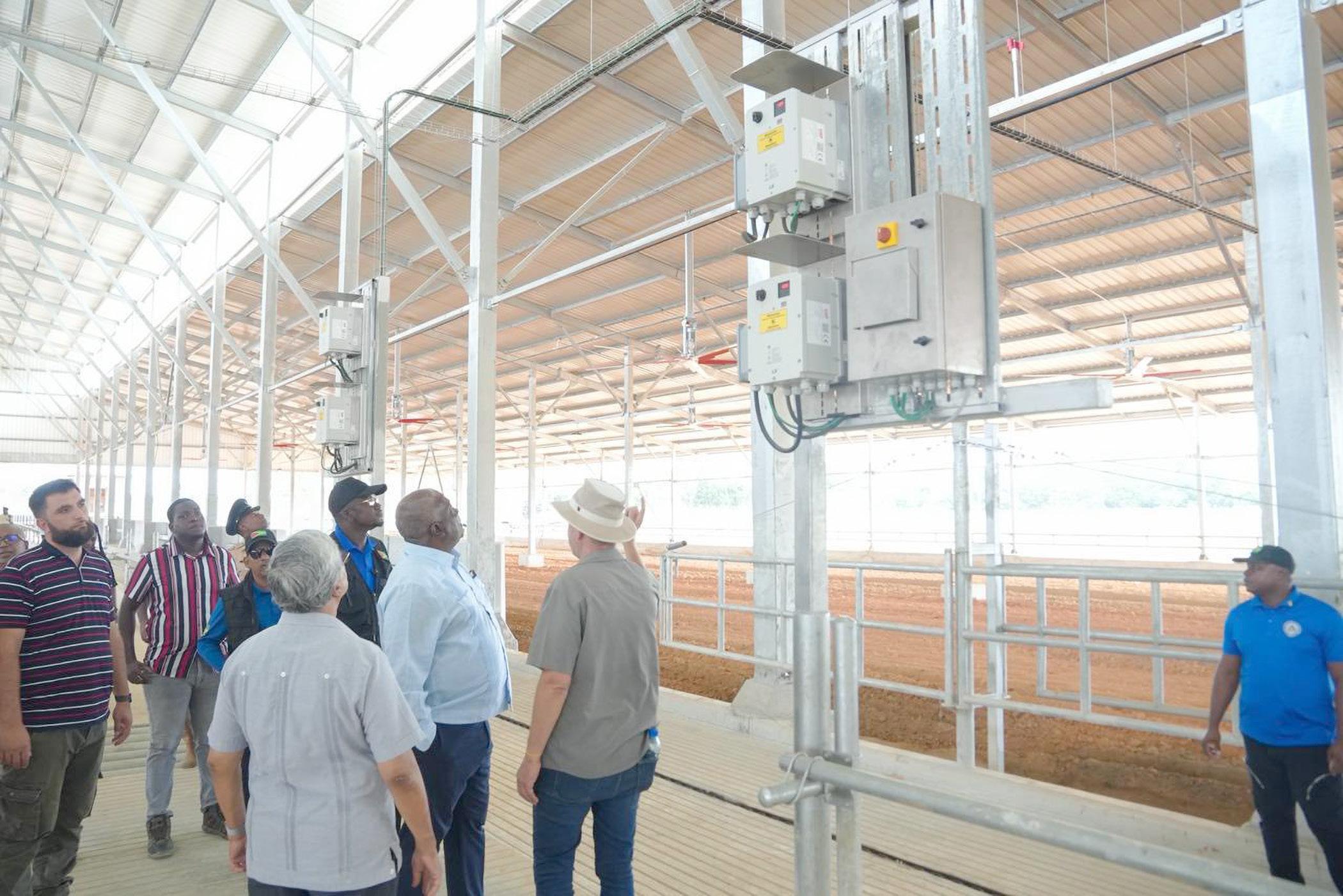
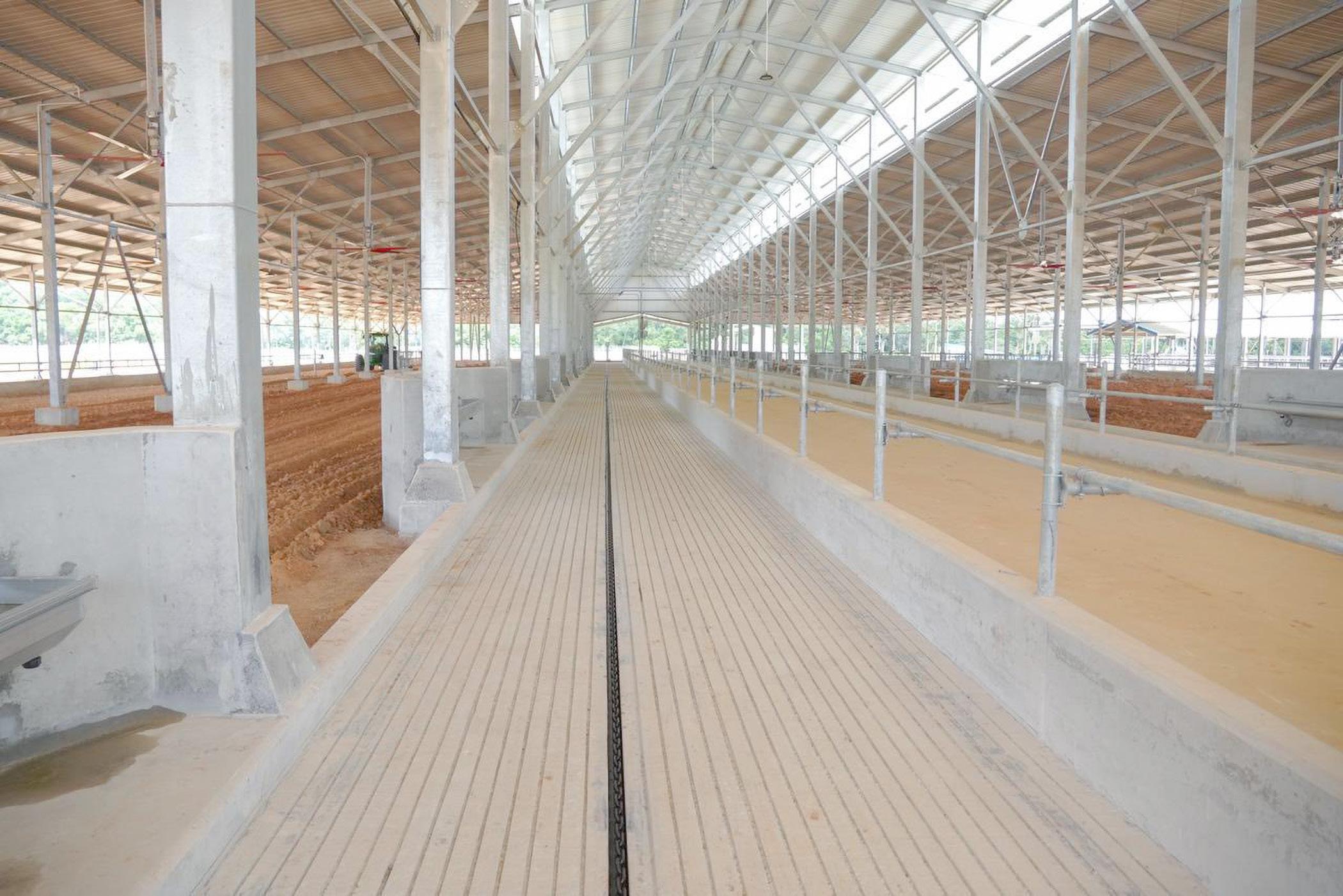
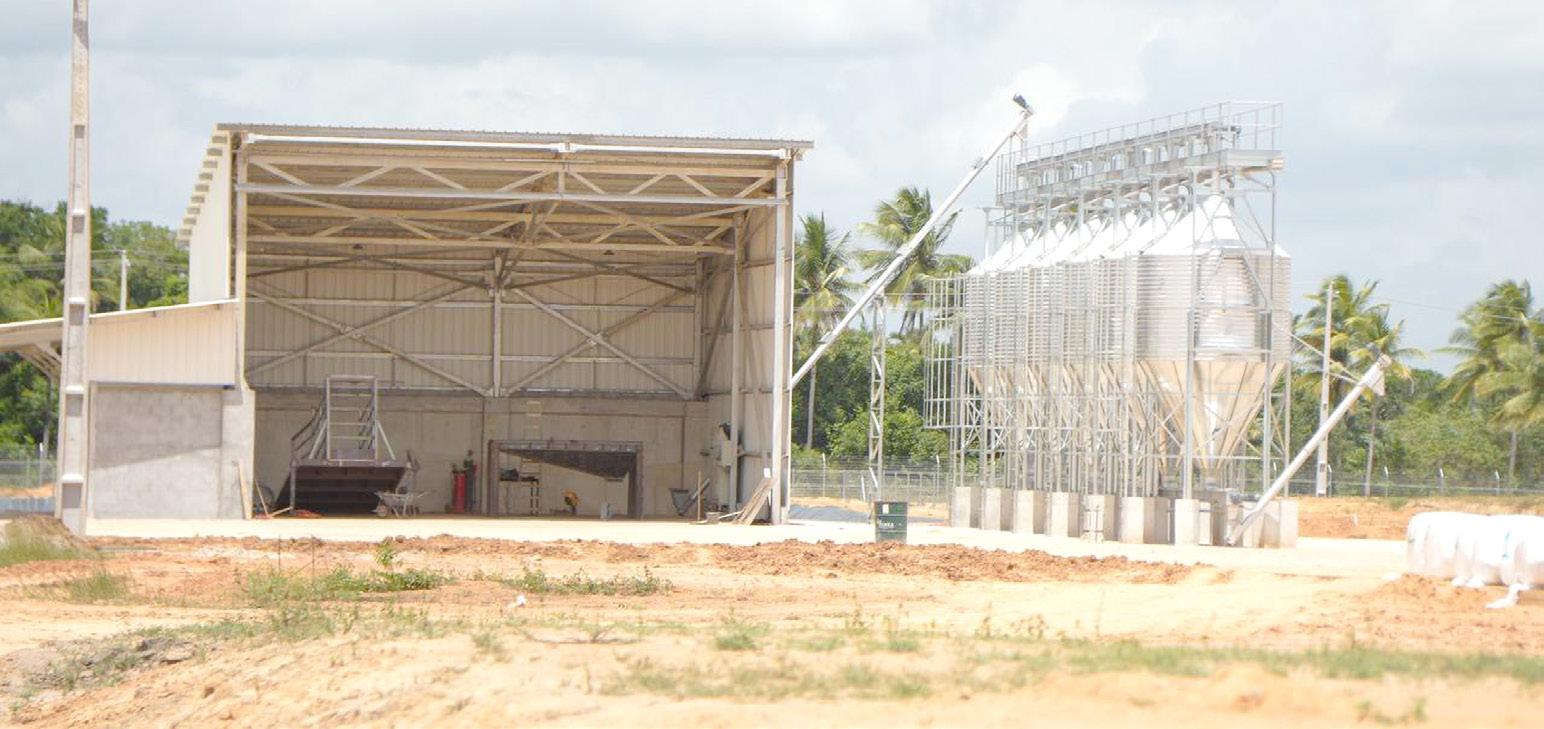
Interior view of the technologically advanced 200-acre dairy complex, which is expected to commence fresh milk production by mid-2026 and support large-scale modern dairy operations
Prime Minister Brigadier (Ret’d) Mark Phillips and officials receive a technical briefing during a tour of the Demerara Dairies Incorporated (DDI) modern dairy facility under construction at Moblissa along the Soesdyke–Linden Highway
First scleral buckle surgeries performed in Guyana’s public sector
THE Georgetown Public Hospital Corporation (GPHC) has recorded another breakthrough in specialised ophthalmic care, following a week-long surgical partnership that strengthened the country’s capacity to treat complex retinal conditions.
The initiative, held from February 9 to 13, 2026, brought together local and international retina specialists to manage challenging cases and introduce advanced surgical techniques at the institution, further positioning GPHC as a hub for high-level, sight-saving interventions.
The collaboration was spearheaded by Guyana’s only practising retina surgeon, Dr. Arlene BobbSemple, alongside visiting United States retina specialist, Dr. Krishi Peddada, who participated under the World
Eye Mission. The partnership focused on identifying and surgically treating complex retinal diseases while providing hands-on mentorship and skills transfer for the local surgical team.
During the mission, 11 complex retinal surgeries were successfully completed.
Notably, two scleral buckle procedures were performed at GPHC for the first time, marking a milestone in the hospital’s expanding surgical repertoire.
The procedure is used in repairing retinal detachments, either as a primary method or in combination with vitrectomy in more complicated or recurrent cases.
According to GPHC, “the milestone represents a significant expansion of the hospital’s retinal surgical capabilities,” underscoring the institution’s steady pro-
gression towards delivering advanced ophthalmic care locally.
Dr. Bobb-Semple has been central to this transformation. Since joining GPHC in 2018, she has led the development of the hospital’s retina services and, following the acquisition of vitrectomy equipment, has been performing complex retinal surgeries in-country since 2021.
Her additional year of subspecialty training in vitreoretinal surgery has been pivotal in ensuring that highly specialised, sight-saving care is accessible to Guyanese patients.
Currently, the absence of a local ophthalmology subspecialty programme means that specialists must undergo several years of overseas training before returning to serve locally, making such partnerships critical to building national capacity.
GPHC noted that visiting specialist missions provide vital opportunities for the exchange of advanced techniques, while simultaneously reducing the need for overseas referrals and improving
timely access to critical eye care services.
“The ultimate aim of these initiatives is to strengthen GPHC’s and, by extension, Guyana’s capacity to manage complex retinal diseases,” the release stated, adding that with continued development, advanced procedures such as scleral buckle surgery could become routine options for eligible patients.
Hospital officials highlighted that the collaboration reflects a broader strategic
push to modernise specialised medical services and enhance patient outcomes through targeted partnerships and strong local leadership. With sustained investment in training, technology, and international cooperation, GPHC is positioning itself to deliver increasingly sophisticated ophthalmic interventions, ensuring that patients can access world-class, sight-saving treatment without leaving Guyana.
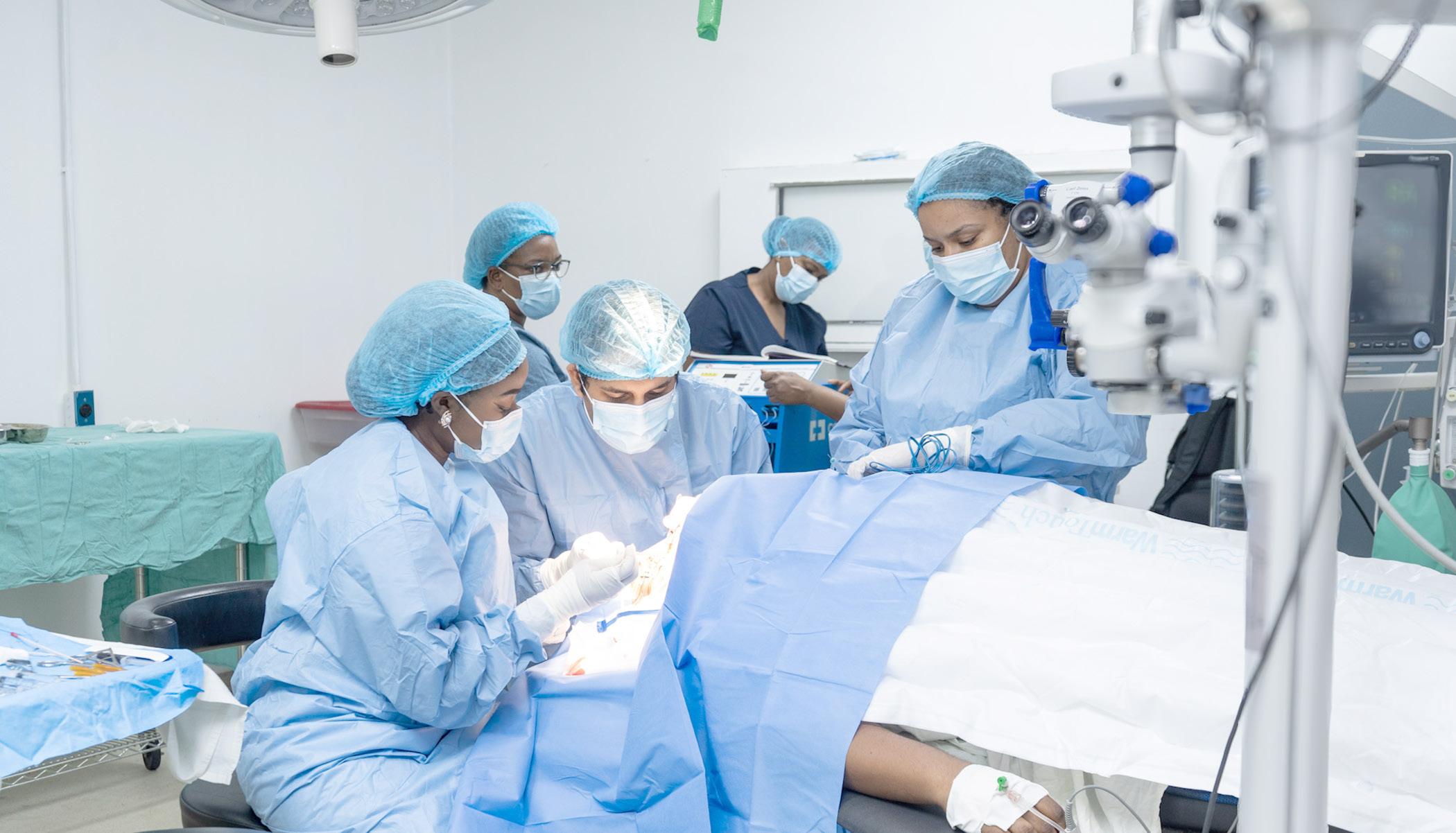
GPHC surgical team, led by Retina specialist Dr. Arlene Bobb-Semple and visiting U.S. specialist Dr. Krishi Peddada, performing a complex retinal procedure during the week-long World Eye Mission collaboration at the Georgetown Public Hospital Corporation
Three held after CANU seizes nearly 11 kg cocaine at Parika
THREE men were arrested on Friday after officers of the Customs Anti-Narcotic Unit (CANU) seized almost 11 kilograms of suspected cocaine during an intelligence-led operation at Mora Village, Parika, East Bank Essequibo.
According to CANU, ranks acting on information intercepted three males in the vicinity of Mora Village, one of whom was carrying a haversack. A search of the bag revealed three brick-like parcels of what was suspected to be cocaine.
The men, Jared Kellawan, Jahdiel Kellawan, and David Newsum, were arrested and escorted to the residence of Jared Kellawan, where officers conducted further searches.
During that exercise, an additional seven brick-like parcels suspected to be cocaine were discovered.
The suspects were subsequently taken to CANU Headquarters, along with the suspected narcotics, which weighed a total of 10.966 kilograms.
— Energy panel underscores prudent fiscal management, NRF as pillars of sustainable growth
STRONG governance, fiscal discipline and institutional transparency are emerging as decisive factors shaping investor confidence in oil-producing nations, with Guyana’s policy framework being highlighted as a model for sustainable resource management.
This position was advanced during a high-level panel at the Guyana Energy Conference and Supply Chain Expo last week, where international energy and finance experts examined the risks and opportunities associated with managing petroleum wealth.
Director of Sustainable Finance Global Sovereign Solutions at Citi, Jorge Ordonez, emphasised that the mere presence of the oil
resource does not guarantee long-term prosperity. Instead, he argued, the critical determinant is how effectively governments manage revenues through transparent, rules-based and forward-looking fiscal systems.
He noted that Guyana’s approach, anchored in strong governance and disciplined fiscal oversight, positions the country to convert oil wealth into sustainable national development rather than short-term consumption.
Central to this framework is the Natural Resource Fund (NRF), established under the NRF Act of 2021 to manage oil revenues in a transparent and accountable manner for the benefit of present and future generations.
The legislation introduced significant governance enhancements, including the creation of an independent Board of Directors responsible for reviewing policies and monitoring the fund’s performance, thereby separating operational oversight from the Minister of Finance.
The Act also requires parliamentary approval for withdrawals and provides simplified, rules-based calculations to ensure that spending aligns with longterm developmental objectives. Operational management of the fund rests with the Bank of Guyana.
Complementing this fiscal architecture are other key legislative measures, including the Local Content Act 2021, which prioritis -
es Guyanese nationals and companies in the procurement of goods and services within the petroleum sector to build domestic capacity and deepen participation in the value chain.
Another major piece of legislation is the Petroleum Activities Act 2023, which modernised Guyana's oil and gas legal framework, replac-
ing the 1986 Act.
Further, international and domestic investors have taken notice of the economic expansion and prudent fiscal management by the current People’s Progressive Party/ Civic (PPP/C) government as Guyana continues to attract global confidence and investment continues to expand.
The International Monetary Fund, in its 2025 Article IV Consultation Report, commended Guyana’s careful and rules-based management of the NRF, describing it as a critical pillar of the country’s long-term economic strategy.
Ordonez, during the panel discussion, said having access to a resource such as oil, which is a global commodity, has significant value as a “growth engine” globally.
“However, having said that whether it remains a risk or an opportunity depends on how that oil wealth is managed right and when governments have strong fiscal and governance frameworks like guarantee, discipline and transparent management of oil [wealth],” he said, adding that it is an opportunity for governments to use oil revenue to fast track development today while building a diversified, receiving economy for the future.
Ordonez further noted that sovereign wealth funds and national funds are very effective tools to help achieve sustainable development.
Robust investment, risk-management policies and checks and balances that foster accountability and transparency at the fiscal level are essential, he said, noting that governments have to have a very clear view on oil production and
the expected oil revenues, spending discipline and consensus around the spending priorities.
Finally, Ordonez said there needs to be an institutional commitment and consensus at the highest level, so an economy that is inclusive, diversified, and delivers opportunities and prosperity with transparency and accountability can be created.
Additionally, Deputy Assistant Secretary for International Cooperation at the US Department of Energy, Aleshia Duncan, joined the panel discussion and underscored Washington’s interest in expanding international collaboration and mobilising investment to support sustainable energy growth.
Notably, Director of Projects within the Caribbean Development Bank (CDB), O’Reilly Lewis, said the institution believes that “pursuing regional interconnection is economically rational and technically beneficial and financially bankable, so that would be our focus for the next few years.
Meanwhile, Director of EY Energy Markets Group, Josh Loftus, highlighted the importance of “bankability” in attracting sustained offshore investment, noting that Guyana’s trajectory is positive, given its ability to combine technology, scale and operational expertise with a stable governance environment.
Collectively, panellists agreed that Guyana’s transparent governance architecture, prudent fiscal management and strengthened institutional frameworks are anchoring its oil success and positioning the country to leverage petroleum revenues to drive inclusive, diversified and sustainable economic growth.
US-based pensioner dies after bee attack at Success; young woman hospitalised
A 77-year-old woman who was visiting Guyana from the United States has died after she and others were attacked by a swarm of bees at Success, East Coast Demerara, on Friday morning.
Dead is Mohadai Sankar, a pensioner of Success, whom police said was staying at her local address at the time of the incident. The attack occurred around
07:00hrs on February 20, 2026, in Regional Division 4 ‘C’.
According to a police release, Sankar, a 25-yearold woman and two other persons were attacked by a swarm of bees believed to have come from the roof of a neighbouring house. The victims reportedly sustained multiple suspected bee stings. They were assisted and
Labourer killed in alleged hoe attack during dispute with brother
POLICE in Regional Division Two are investigating a suspected murder following the death of a 57-year-old labourer during a domestic dispute at Capoey Mission, Essequibo Coast, on Friday afternoon.
Dead is Leslie Edwards, called “Bumpy”, of the said address. The incident reportedly occurred around 14:10 hrs on February 20, 2026.
According to a police release, Edwards and his 59-year-old brother, with whom he resided, were at home when an argument allegedly erupted between them.
During the altercation, the suspect reportedly armed himself with a garden hoe and dealt Edwards
taken to medical facilities. Sankar was transported to the Enmore Regional Hospital, where she succumbed around 18:45hrs while receiving treatment. The 25-year-old woman was taken to the Georgetown Public Hospital Corporation, where she remains hospitalised in stable condition.
Sankar’s body was es -
corted to Jerrick’s Funeral Home and is awaiting a post-mortem examination.
The police visited the scene, and personnel from the National Agricultural Research and Extension Institute were summoned to the area to bring the situation under control.
Investigations are ongoing.
several blows about his body.
Police ranks, who responded to the scene, found the victim lying motionless in the yard. He was escorted to the Suddie Public Hospital, where he was pronounced dead on arrival by a doctor on duty.
The body was subsequently taken to the Suddie Public Hospital Mortuary, where it is now awaiting a post-mortem examination.
The 59-year-old brother has been taken into police custody, and was escorted to the Lima Regional Hospital, where he is receiving medical attention. He remains under police guard assisting with the investigation.
Investigations are ongoing.
Mohadai Sankar covered by bees
Leslie Edwards, called “Bumpy”
Two remanded over cannabis bust at Success Village operation
TWO men have been remanded to prison after appearing before the Sparendaam Magistrate’s Court on narcotics trafficking charges following a CANU operation at Success Village, East Coast Demerara.
On Friday, Isiah Charles and Sheldon Chase appeared before Magistrate Nurse, where they were charged with possession of narcotics for the purpose of trafficking, to wit, 2.614 kilograms of cannabis. Both defendants pleaded not guilty.
Bail was refused, and the matter was
adjourned to April 2, 2026.
The charges stem from an operation conducted on Thursday, February 19, 2026, when officers of the Customs Anti-Narcotic Unit (CANU), acting on information received, intercepted a motor vehicle with the duo inside while in the vicinity of Success Village.
A subsequent search of the vehicle revealed several brick-like parcels containing a quantity of cannabis, which was later confirmed to weigh 2.614 kilograms.
One miner hospitalised, another in custody after Mahdia wounding incident
AN altercation between two miners at 111 Miles, Mahdia, Potaro-Siparuni, has left one man hospitalised with a fractured skull and the other in police custody.
The injured men are a 27-year-old miner of North Sophia, Georgetown, and a 33-yearold miner of ‘B’ Field, Sophia, Georgetown. The incident reportedly occurred around 00:30 hrs on Saturday, February 21, 2026.
Preliminary investigations indicate that both men were allegedly consuming alcoholic beverages near a supermarket when an argument erupted and escalated into a physical confrontation.
During the altercation, both sustained
injuries inflicted with objects that are yet to be identified.
They were initially treated at the Mahdia District Hospital before being escorted to the Georgetown Public Hospital Corporation for further medical attention. The 27-year-old miner, who suffered a fractured jaw, was later discharged on the same day and subsequently arrested. He remains in police custody.
The 33-year-old miner, who sustained a fractured skull, remains hospitalised under police guard.
CCTV cameras in the area were observed and will be reviewed as part of the ongoing investigation.
E-Transactions, Data Protection Laws coming -AG Nandlall announces
AS Guyana accelerates its transition from paper-based systems to secure digital platforms, Attorney-General and Minister of Legal Affairs Anil Nandlall, SC, has announced that there will soon be legislation in place for electronic transactions and the strengthening of data protection.
He made the disclosure during last Thursday’s session of the Guyana Energy Conference and Supply Chain Expo, explaining that sweeping legislative reforms are being crafted to align
with the country’s unprecedented economic and technological transformation.
“Of course, we are digitising the entire government structure, and we have two main legislative pillars upon which those activities are going to be conducted,” Nandlall said.
He explained that the proposed electronic transactions law will provide full legal recognition for digital transactions, ensuring their validity even when conducted without traditional paper documentation, while noting
that certain limited exceptions will apply.
Complementing this will be comprehensive
data - protection legislation designed to establish a robust framework for the collection, storage and management of data across multiple sectors as Guyana deepens its digitalisation drive.
“You heard the President speak elaborately on many, many platforms on the digitisation and digitalisation of Guyana, and we are laying the foundation for that to be done,”
the Attorney-General told stakeholders.
NATIONAL DIGITISATION
The legislative push forms part of a broader national strategy to modernise public administration, enhance efficiency and position Guyana as a competitive player in an increasingly digital global economy.
President, Dr Irfaan Ali has repeated -
ly stressed the urgency of accelerating national digitisation, warning that countries that delay risk being excluded from future economic opportunities shaped by rapid technological change.
“We must digitise and digitise quickly,” the President said in recent remarks, noting that the fourth industrial revolution is reshaping major sectors of the global economy at an unprecedented pace.
Referencing the impact of earlier technological revolutions, he noted, “In the 20th century, the computer revolution reshaped the modern economy, but it also deepened global inequality because many countries entered late and unprepared. Guyana cannot afford to repeat that mistake, not now, not when the fourth wave is moving even fast-
TURN TO PAGE 23
One Communications unveils
US$25M
investment to support digital transformation
TELECOMMUNICA -
TIONS provider, One Communications, will invest US$25M this year to expand connectivity and strengthen digital infrastructure across Guyana, positioning itself to support the country’s accelerating technological and economic transformation.
The announcement was made by Chief Executive Officer (CEO) Abraham Smith, on Thursday, during the Guyana Energy Conference and Supply Chain Expo, where he outlined the company’s strategy to align network expansion with national development priorities.
Smith said Guyana’s rapid transformation has already moved beyond preparation into active growth, noting that rising demand for connectivity must be met with forward-looking infrastructural investments.
“Guyana is not preparing for growth; we are clearly operating inside of it,” he stated, adding that as major projects such as the gas-to-energy development advance, telecommunications infrastructure must expand in tandem to sup-
port industrial and social development.
He explained that One Communications has already extended connectivity into Wales and surrounding communities, strengthening transmission routes and reinforcing links to key industrial facilities in the area to match the scale of ongoing energy projects.
“Mobile LTE coverage is active there with additional sites planned to support growing traffic and industrial demand, including realignments towards the gas-to-energy location,”
Smith said, highlighting that connectivity is now core national infrastructure that underpins supply chains, risk management and economic scaling.
The CEO noted that over the past 15 years, the company has invested more than US$250 million in network development, including approximately US$100 million in fibre expansion alone in recent years.
The planned US$25 million investment for 2026 will further expand domestic fibre networks and enhance mobile cover-
age nationwide.
According to Smith, the company has reconfigured network topology, strengthened redundancy and collaborated with national partners such as the Guyana Power and Light (GPL) to ensure telecommunications systems evolve alongside the country’s broader infrastructure rollout.
He added that investment is being deliberately decentralised beyond Georgetown, with nearly 80 per cent of the company’s fibre footprint already located outside the capital. The fibre network currently serves more than 180,000 homes and businesses, with further expansion planned along emerging economic corridors.
As the pioneer of Mobile Money Guyana (MMG), One Communications also intends to introduce additional digital services and extend reach into more regions as the country deepens its digital economy.
Smith pointed to Guyana’s evolving legislative framework, including proposed laws on electronic transactions, open data and
data protection, as foundational to enabling innovation and the development of new digital platforms.
He also expressed optimism about the establishment of a data centre in Berbice, noting that the company has already begun installing supporting infrastructure in the region.
Echoing national policy direction, Smith emphasised that connectivity is no longer optional but is also essential to inclusive development.
“The promise we are making is clear: to invest ahead of demand, to build systems that hold up under pressure, to ensure inclu-
sion beyond the coast, and to strengthen the digital backbone that allows the country to move forward with confidence,” he said.
He stressed that for a rapidly developing nation such as Guyana, digital expansion must be driven not only by
infrastructural investments, but also by strong partnerships, innovation and collaboration with government, industry and communities to ensure that connectivity supports both economic growth and social advancement, nationwide.
Abraham Smith, Chief Executive Officer of One Communications
Free day and night childcare centres to open soon along East Bank corridor
SINGLE and working parents along the East Bank Demerara corridor will soon benefit from expanded childcare support, as the Ministry of Human Services and Social Security moves to complete two new Day and Night Care and Early Childhood Development Centres at Dia -
mond/Grove and Mocha.
The facilities, which will cater for approximately 100 children including infants, are expected to become fully operational within the coming weeks, with registration already open and staff recruitment under way, according to Minister of Human Services and Social Security
Dr Vindhya Persaud.
The initiative follows the successful commissioning of the ministry’s first such centre at Anna Catherina in Region Three and represents the expansion of the programme into Region Four to meet growing demand for accessible childcare services.
Speaking after a recent
site visit, Minister Persaud said the Diamond/ Grove centre is in its final stages of preparation, with most construction works completed. The modern facility is designed to accommodate children from newborns to 12 years old, providing round-the-clock care to support working parents facing childcare challenges.
“Here at the Early Childhood Development Day and Night Care Centre we are open for registration. We also have vacancies for jobs so you can come. It is not hard to find, it is in the Diamond/Grove area. We are open, we are ready and we are waiting,” the minister stated.
She explained that the centres will offer entirely free services to eligible families, particularly tar-
Minister of Human Services and Social Security, Vindhya Persaud, during a walkthrough and site visit of Region Four Day, Night Care and Early Childhood Development Centres (Ministry of Human Services and Social Security photos)
finished, furniture being assembled and final yard works and tidying expected to be completed within two to three weeks. In parallel, staff recruitment and training are already progressing.
Both facilities are progressing smoothly, with completion slated to be soon and registration already open
geting working parents, single mothers and teenage mothers earning $150,000 or less per month. “Come on and get registered or register your children, because remember it is free to you as working parents… You could be a teenage mother and you can have your child placed here,” Persaud added.
Providing an update on the Mocha facility, the minister said construction is nearing completion, with painting almost
Persaud noted that the Region Three centre at Anna Catherina is already operational and nearly filled, with only a few spaces remaining, highlighting strong demand for the service.
“Region Three is up and running and we have a few more spots left, but Region Four, we have fully opened registration for even this centre from now for children who would like to be placed here,” she said.
The Day and Night Care and Early Childhood Development Centres form part of the government’s broader social support framework, aimed at easing the burden on working families, promoting early childhood development and enabling greater workforce participation, particularly among women. By providing free, accessible and safe childcare, the initiative is expected to strengthen household stability, empower parents to pursue employment and education, and enhance the overall well-being and development of children across participating communities.
E-Transactions, Data Protection...
FROM PAGE 20
er and the stakes are even higher.”
President Ali said the government’s push to digitise public sector services, expand online government platforms, improve data systems and support digital banking solutions is part of a deliberate strategy to transition Guyana into a modern, competitive economy.
Citizens are already interacting with the state through more online portals, he said, and financial institutions are expanding mobile banking, electronic payments and digital-wallet systems to increase efficiency and access.
Defending the scale of the government’s investment, he said the direction of the world leaves no room for hesitation.
The president described a world rapidly reorganising itself around digital capability. Dr Ali said Guyana must be ready to participate in this transformation, not observe it from the sidelines.
“Guyana cannot stand on the sidelines and watch this transformation pass us by. We cannot be spectators in a game where the rules are being rewritten daily,” he said.
Instead, the country must pivot fully into a new era of knowledge and innovation.
“We must move from a resource-based economy to a knowledge-based economy, from dependence on extraction to dependence on invention, industrialisation and innovation, from low-skilled labour to high-skilled digital talent.”
Guyana’s digitisation drive is a sweeping national effort to modernise the country by
transforming public services, expanding digital education, integrating advanced technologies into healthcare, agriculture, manufacturing and transport, and strengthening secure data systems across government.
It also accelerates the use of digital banking and electronic payment platforms as the nation shifts from traditional, paper-based and resource-dependent systems to a fast, efficient and innovation-driven digital ecosystem capable of competing in the rapidly evolving global technological landscape.
Last November, the government launched GovConnect, a digital appointment system integrated into Ministry of the Public Service, Government Efficiency and Implementation, allowing citizens to book appointments with government agencies via smartphone applications available on both the Apple App Store and Google Play Store.
The country has also begun implementing an electronic identification (E-ID) system, with President Ali being the first recipient of the biometric card last August. The cards are expected to enhance border control, facilitate daily transactions such as opening bank accounts, and play a central role in the broader digital transformation agenda.
Additionally, the government is establishing service centres in every region to allow citizens to conduct official business and resolve queries closer to home, reducing the need to travel to Georgetown for government services and further supporting the transition to a modern, decentralised digital state.
ENGLISH RACING TIPS
FONTWELL
10:20 hrs Cracker Jacque
10:50 hrs Potters Charm
11:20 hrs Bollin Thou
11:50 hrs Atlantic Power
12:20 hrs The Boss Bear
12:50 hrs Red Acres Max
HEREFORD
10:10 hrs Queen Maeve
10:40 hrs Madame La Pappillion
11:10 hrs Flowing Cadenza
11:40 hrs Glancing Jack 12:10 hrs On The Go
12:40 hrs Imperial Bede
13:10 hrs Jackmart
SOUTH AFRICA RACING TIPS
KENILWORTH
08:35 hrs Kebonalesedi
09:00 hrs Major Master
09:35 hrs Sohot Sowhat
10:10 hrs Gold Giboski
10:50 hrs Wander Dune
11:25 hrs Azzurri
IRISH RACING TIPS NAAS
10:00 hrs Lynches Knock
10:30 hrs Immediate Effect
11:00 hrs Peaceinthevalley
11:30 hrs Melbourne Shamrock
12:00 hrs It”s Good To Talk
12:30 hrs Captain Guiness
13:00 hrs The Busy Fool
Preparation key to Windies’ success so far, says Chase
• From Page 32
Chase said confidence in the dressing room was extremely high ahead of that crucial clash.
“I think the team is full of confidence having won all four group stage games and the vibe in the camp is very lovely. The guys have been working hard…every guy knows what he needs and I think that is the hallmark of the team; everyone knows their role and everyone knows what they need to
do and we’ve been doing it,” Chase pointed out.
The veteran all-rounder said he had been impressed with both batting and bowling units so far.
He said he had seen major improvements since the start of the World Cup.
“I think the batting in the middle overs, that has really pleased me so far, because usually we tend to face too many dot balls in the middle against the spin. But I think we’ve been really rotating the strike well in the middle
Sunday, February 22nd, 2026
CUMMINGS ELECTRICAL COMPANY LTD83 Garnett Street, Georgetown (Tel: 225-6158)
Answers to yesterday’s quiz:
(1) IND & PAK (2) Sri Lanka & ZIM
Today’s Quiz:
(1) Which Group C teams are into the Super Eight round of the current T20 World Cup? (2) Which Group D teams have qualified?
Answers in tomorrow’s issue.
Maharaj to lead South Africa...
• From Page 29
Conrad said the tour offers an opportunity for fringe players to step into the international environment with several World Cup regulars set to return home after the global event.
“With this series taking place directly after the T20 World Cup, the majority of that squad will return home, which creates a great opportunity for this group of players to step into the international environment and show what they’re about at this level,” Conrad noted.
“Keshav has experience
captaining the Proteas and has led two teams to the SA20 finals. His leadership and calm presence make him the ideal person to lead this group on this tour.
“The batting unit is particularly exciting for this tour. Tony brings experience to the top order, while Connor, Dian and Jordan have all demonstrated the ability to play positive, attacking cricket for their domestic teams. Touring New Zealand will challenge their skills in different conditions, and playing in our first bilateral double-header series alongside the Proteas Women adds
to the excitement.”
The five-match series will begin at the Bay Oval in Mount Maunganui with subsequent games scheduled in Hamilton, Auckland, Wellington (Sky Stadium) and Christchurch.
South Africa T20 squad:Keshav Maharaj (c), Ottneil Baartman, Eathan Bosch, Gerald Coetzee, Tony de Zorzi, Connor Esterhuizen, Dian Forrester, Jordan Hermann, Rubin Hermann, George Linde, Nqobani Mokoena, Andile Simelane, Lutho Sipamla, Prenelan Subrayen, and Jason Smith. (Cricbuzz)
New CPL franchise owners...
• From Page 31
“Once that happens, that should then sort of give them the confidence to boost involvement within
the CPL ecosystem, as well, because it could just as well be part-owner driven, part-Government driven.
So we feel the best step forward is to take the initiative
overs along with picking up the odd boundary and then we’ve been finishing lovely,” Chase said.
“I would also like to commend the guys on the bowling. I think to get 38 wickets out of the 40 possible wickets, I think that’s a good job from the team. We’ve been keeping it tight throughout the innings.
“Sometimes I just think that we need to tighten up on the Powerplay, and I think once we tighten up on that we’ll be great.”
ourselves, to start making strategic aligned decisions that feed into the system that give that confidence and from there build more of a synergy to grow even better.”
Shreyanka shines as India take lead in multi-format series
INDIA secured a comfortable 17-run win in the third T20I at the Adelaide Oval to add two more points to their tally in the multi-format series.
An impressive 121-run stand between Smriti Mandhana (82) and Jemimah Rodrigues (59) helped India post a sizable 176/6 before early breakthroughs with the ball strengthened their position. Australia fought back through Ashleigh Gardner’s 57 but were unable to recover from the initial damage.
After India opted to bat first, Darcie Brown began with a wayward over, conceding five wides and a boundary to get the visitors underway.
]Australia tightened up through disciplined overs from Gardner and Kim Garth, during which Shafali Verma was dismissed. However, the acceleration began with Rodrigues joining Mandhana at the crease.
After peeling off a boundary each in the third and the fourth overs, they struck three fours in the sixth over to take India to 54/1 and end the PowerPlay on a high. The partnership flourished through regular boundaries and smart rotation of strike.
Mandhana reached her fifty with a six over mid-wicket in the 12th over and she continued to attack by striking two more fours and sixes before falling to Annabel Sutherland in the 17th over.
Rodrigues, who had been dropped in the 15th over, brought up her fifty in the 18th over while Richa Ghosh’s seven-ball, 18-run cameo propelled India at the death. Sutherland contained the damage in the final over where India managed to score just three runs while losing three wickets.
In reply, an indisciplined 18-run opening over from Renuka Singh Thakur saw Aus-
tralia get off to a rollicking start. They were, however, derailed early after losing three wickets in three overs.
It began with Shreyanka Patil, who replaced Kranti Gaud in India’s XI, dismissing Georgia Voll in the second over. Renuka then had Beth Mooney holing out to deep backward square leg in the following over.
A landmark 350th international match went awry for Elleyse Perry as she was bowled by Shreyanka in the fourth over, leaving Australia on 32/3.
Phoebe Litchfield and Gardner promised to rebuild with their 31-run stand but it ended with Litchfield holing out to long-off attempting a switch-hit in the ninth over.
India squandered an opportunity to truly press home the advantage after Amanjot Kaur dropped Gardner off her own bowling. Even as Georgia Wareham fell in the 13th over, Gardner threatened to turn the game and brought up fifty with a boundary in the 16th over.
A light drizzle also appeared to aid Australia, helping the ball skid on to the bat better while also quickening a rather sluggish and sandy outfield.
It took a brilliant diving catch from Rodrigues at deep mid-wicket later in the same over to see Gardner’s return. Australia lost their way thereafter, with Grace Harris stepping on her own stumps in the following over before Sophie Molineux was trapped LBW four balls later.
Shreyanka added a third wicket to her tally after trapping Sutherland in front while Australia tottered to 159/9 in their 20 overs.
The multi-format series now moves to the ODI leg, starting with the clash at The Gabba on February 24. (Cricbuzz)
NBA
Reunited Lakers trio leads late surge past Clippers
LUKA Doncic scored 38 points with 11 assists and Austin Reaves added 29 points as the Los Angeles Lakers used a full complement of stars to earn a 125-122 victory over the visiting Los Angeles Clippers on Friday.
LeBron James added 13 points with 11 assists as the Lakers’ star trio played together for just the 11th time this season and fourth time since mid-December. Doncic returned after missing four games before the All-Star break with a hamstring injury.
The Lakers improved to 5-2 since Feb. 3 while winning in their return from the All-Star break. Kawhi Leonard scored 31 points and Bennedict Mathurin added 26 for the Clippers. They both departed in the closing minutes as Leonard left with ankle soreness with 5:10 remaining and Mathurin fouled out with 1:49 left.
The Clippers led 109-107 with 6:11 remaining after a 3-pointer from Leonard before the Lakers went up 112-109 with 5:11 left on a 3-pointer from Doncic. That was part of a 7-0 run which gave the Lakers a 114-109 lead with 4:34 remaining.
Doncic helped the Lakers seal the victory with five points over the final 1:30. Nicolas Batum missed a potential game-tying 3-point attempt for the Clippers with four seconds remaining after a steal.
The Clippers shot 54.9% from the floor as they rallied from a 15-point deficit in the third quarter before falling short. The Lakers shot 51.8% overall and 54.8% from
3-point range in the victory.
After a hot-shooting first half for both teams, the Lakers took a 72-65 lead into the break by going 66.7% from the floor as Doncic scored 22 points. Doncic leads the NBA with at least 20 points in a half 28 times this season.
Leonard scored 21 points as the Clippers shot 56.8% from the floor in the first half.
In addition to losing Leonard and Mathurin late in the game, Clippers starting forward John Collins did not return after he was under cut by the Lakers’
Ratcliffe avoids FA charge over immigration comments
MANCHESTER United co-owner Sir Jim Ratcliffe will not be charged by the Football Association over a controversial interview in which he claimed the United Kingdom had been “colonised by immigrants.”
The governing body has issued him with a reminder of his responsibilities as a participant in English football when taking part in media interviews. However, the FA will not be taking any
further action. It had been examining whether the comments had brought the game into disrepute.
The comments were widely condemned, including by Prime Minister Sir Keir Starmer and all United’s leading supporter groups.
Ratcliffe did offer a qualified apology, while United released their own statement highlighting the inclusivity initiatives they are part of. Football anti-discrimination charity
Kick It Out said it was “disappointed” Ratcliffe had “not been given a stronger sanction” by the FA.
“When speaking in any capacity, he is still a representative and co-owner of Manchester United, which has a global following. Unprompted, he brought the club into a TV interview where he was inaccurate with the facts and divisive with his language,” it said. (BBC Sport)
Shreyanka Patil took 3 for 22 in the win.
Sir Jim Ratcliffe heads football operations at Manchester United.
Luka Doncic scored 38 points with 11 assists.
Trott hints at England post after Afghan exit
JONHATAN Trott enjoyed a victory in his last game in charge of Afghanistan on Thursday and while he does not know what the future holds he said he would jump at the chance to coach England if the opportunity arose.
Afghanistan’s 82-run win over Canada concluded their Twenty20 World Cup campaign, where they managed only two wins and failed to advance to the Super Eight stage from Group D.
“I don’t know what the future holds. Maybe I have a couple of days off and see how it goes,” said the 44-year-old, who took over as Afghanistan coach in July 2022.
Trott represented England in 127 matches from 2009 to 2015 and was part of the side that won three consecutive Ashes series,
English Premier League
including the 2010-11 victory in Australia.
“I’m very proud of the way I played my cricket and always like to see the England side do well,” the former batsman added.
“I’d love to one day hopefully have the opportunity to coach a team that you hold so dear to your heart.
“There are a lot of people that I’m sure would love to do that job.
“We’ll have to see. I just want to enjoy my coaching and I’ve certainly enjoyed the last couple of years here.”
Trott’s initial contract with Afghanistan ran for 18 months before extensions through 2024 and 2025.
During his tenure they reached their first T20 World Cup semi-final in 2024 and fell just short of the semis at the 50-overs World Cup in 2023. (Reuters)
Red cards and poor home form – Chelsea ‘set fire to points’
CHELSEA head coach Liam Rosenior has inherited many of the problems that afflicted Enzo Maresca’s side before him.
After Burnley’s 93rd-minute equaliser in their 1-1 draw, Chelsea became the Premier League leaders for dropping points at home - 17 this season.
They also now have a league-high six red cards this term, following Wesley Fofana’s dismissal in the 72nd minute.
That red card ultimately led to Chelsea’s subsequent collapse after Joao Pedro opened the scoring, with Rosenior lamenting that his side have “set fire to four points” after drawing 2-2 at home to Leeds in their previous league match.
“There’s an inquest after every game whether we win or lose,” Rosenior added.
However, this is the first result to prompt such an angry reaction from the manager, who was appointed after Maresca left the club on New Year’s Day following a falling-out with the hierarchy.
Rosenior continued: “I’m learning about the players. I’m learning about the people you can lean on when things aren’t going your way and you need to see a game out. That’s something we need to address very quickly.”
There was further frustration over goalscorer Zian Flemming being given a free header in the centre of Chelsea’s box, with Burnley substitute Jacob Bruun Larsen missing a similar chance minutes later.
“A marking assignment was missed,” Rosenior said. “I’m not here to throw players under the bus - I will always protect my players, and I’ll deal with it during the week.
“But there was a player assigned that duty who marked the wrong man.” (BBC Sport)
Jonhatan Trot enjoyed a victory in his last game.
Liam Rosenior, left, said Chelsea had “set fire to four points” after another costly red card and late setback against Burnley.
Morkel brothers reignite backyard battle
WHAT’S been billed as the biggest match of the 2026 T20 World Cup so far is also a contest between two members of the same family, as Morne Morkel and Albie Morkel come up against each other from the dug-out.
Once team-mates, briefly at the international level and for a longer period domestically, they are now on opposite sides as India’s bowling coach and South Africa’s T20 specialist consultant, respectively and the battle from the backyard could be reignited. There, there was usually only one winner.
“With Morne being the youngest, Albie and myself always batted first in any backyard game,” Malan Morkel, the oldest of the three brothers, who had a brief under-19 career and now works as a coach at one of South Africa’s most prestigious schools, Paarl Gimnasium, told ESPNcricinfo. “So Morne had to bowl thousands of balls at us and when it was his time to bat, we would often say, ‘let’s go for a swim’ depriving him of time in the middle.
The result was that Morne had plenty of practice against left-handed batters, as both Malan and Albie are left-handers, but “never really developed batsmanship because we seldom let him bat.”
No wonder when the opportunity came up to open the batting for South Africa in a Test match in 2009 (when Graeme Smith had his
hand broken by Mitchell Johnson), Morne grabbed it with both gloves and earned the nickname Haydos as a result.
Earlier that year, Albie played what turned out to be his only Test for South Africa, also against Australia, but there was no resentment on his part that Morne had surged ahead of him. “They were always supportive of each other and enjoyed each other’s success,” Malan said.
Maharaj to lead South Africa in NZ
KESHAV Maharaj will lead a 15-member South Africa squad for the five-match T20I series against New Zealand, scheduled to be played from March 15 to 25. The squad announced by Cricket South Africa on Friday (February 20) has as many as five uncapped players and none of the IPL-bound players.
Among the fresh faces are batters Connor Esterhuizen, Dian Forrester and Jordan Hermann, who have earned call-ups on the back of consistent returns in domestic T20 competitions. Allrounder Eathan Bosch also finds a place in the squad. Teenage fast bowler Nqobani Mokoena has been included after a breakthrough season in the SA20. The 19-year-old finished with 13 wickets - fourth-highest - from 10 games at an economy of 9.62 for the Paarl Royals.
“Nqobani showed during SA20 that he is an exciting young quick with the ability to make an impact and this series will give him the perfect opportunity to expose him to the international setup,” said head coach Shukri Conrad.
Maharaj is one of three players from South Africa’s ICC Men’s T20 World Cup 2026 squad named for the tour, alongside fellow left-arm spinner George Linde and Jason Smith. Meanwhile, fast bowler Gerald Coetzee returns to the T20I setup for the first time since featuring against Namibia in October 2025, while batter Tony de Zorzi is back after recovering from a right hamstring injury.
The series will be played as dou -
ble-headers, with the South Africa Women playing in the afternoon followed by the men’s fixture in the evening across all five matches, marking the first time the senior national sides will feature together in a bilateral double-header format.
• Continues on Page 26
Albie went on to become a “T20 specialist,” as Malan puts it and developed a cult following at CSK, for whom he played 92 matches between 2008 and 2013. He is a lifer at the franchise and now works in its coaching set-ups around the world, including at JSK in South Africa. Morne went on to have a stellar international career and is one of only six South African bowlers to get more than 300 wickets in Tests and was part of the
team that lifted the Test mace in 2012. The two have been team-mates against India on three occasions at the T20 World Cup - 2007, 2009 and 2010.
Between them, they lived their late father Albert’s dream. “Their love for cricket stems from the exposure we got through our dad being a semi-professional cricket player, school teacher and cricket coach. He played competitive cricket until the age of 45,” Malan said. “We spent countless hours next to the field where he was either playing himself or coaching a team. It was part of our DNA.”
As similar as their interests were as children, their personalities are vastly different. “Albie was quiet, reserved and a deep thinker but ultra competitive,” Malan said. “Morne was the funny one. We have many home videos where he is always pulling funny faces or performing a crazy dance.”
Strange, then, that the one to crack a joke about their relationship now was Albie. “No, we don’t talk to each other,” Albie said in Delhi, holding a poker face that eventually curled into a wry smile. “My mother is more worried about who to support: India or South Africa.” Has mom Morkel made up her mind? “Mom is nervous for them both. She wants her boys to do well,” Malan said. “I don’t think she will wear either a green or blue cap on Sunday.” (ESPN Cricinfo)
OMAN’S Twenty20 World Cup campaign may not have gone their way after a nine-wicket defeat by Australia left them winless in the tournament but skipper Jatinder Singh struck a philosophical tone, emphasising pride and gratitude for the experience.
Oman finished dead last in Group B with no wins in four matches, one of only three teams along with minnows Namibia and Canada who failed to register a victory at the tournament in India and Sri Lanka.
“It’s a proud moment for all of us that we got a chance to play the World Cup,” Jatinder said after Friday’s match in Pallekele.
“The result and the journey of the World Cup did not go our way, but I think everybody is grateful... We got a chance to represent Oman and we played for the country.”
The skipper acknowledged Oman’s short-
comings in preparation that hampered his team’s chances.
“Preparations were not really up to the mark we required because we lacked the full members’ support,” he added.
“We wanted to play competitive cricket, but whereas we ended up playing domestic (cricket) and the domestic level is not that up to the mark.”
Oman have now failed to win a game in the last two World Cups but Jatinder expressed confidence that the experience would serve as a foundation for future campaigns.
“Now everybody has experienced this, now we know what are the ingredients required to come to this stage,” he said.
“I’m sure that we have taken a lot of learnings from this tournament... I’m sure that the boys have taken a lot of positives from this and from the opposition as well.” (Reuters)
Albie and Morne Morkel have been team-mates briefly at the international level • (AFP)
Keshav Maharaj is no stranger to captaining South Africa.
Oman’s T20 World Cup skipper Jatinder Singh.
ICC T20 World Cup
Three games to save a job? No excuses if England fail again
THE noise is one of the first things that hits you on arrival in India.
The chatter. The beeping of horns. A thrilling assault on the senses.
England have also battled to dampen the noise around their group throughout this T20 World Cup campaign.
Should Brendon McCullum stay on as coach? Is Harry Brook the right man to be captain?
Even after reaching the relative tranquillity of central Sri Lanka, Brook fielded questions about the ongoing situation regarding Pakistan players’ involvement in The Hundred.
Brook’s pre-prepared answers – he gave it in two separate interviews to different questions – did not say much, but he did at least show support for those involved. On another day, Brook’s admission that England had “probably underestimated a couple of the sides” when scraping through the group stage would have taken the headlines.
It was honest, but not a great look for a team battling a perception of being loose with their preparation.
“We obviously didn’t know all the players and we had minimal stats on some of them,” Brook said.
“That’s something that we can definitely improve on in the future, especially in tournaments further down the line - getting your homework done a little bit earlier.”
England’s performance in the group stage was undoubtedly unconvincing.
They were taken to the final ball by Nepal and lost to West Indies in Mum-
English Premier League
bai, before edging to wins over Italy and Scotland in Kolkata.
Batters got in and got out - Tom Banton’s 63 not out the only real match-defining score. Even the ever-reliable Adil Rashid has gone for nine runs per over or more in three of the four games.
It means England have shown little to suggest they can threaten late into the tournament to this point.
Without improvement this will likely be a fourth underwhelming major tournament in a row since they won the T20 World Cup in 2022.
But Brook’s comments also reflect some of the difficulties faced by the major nations at this World Cup – a tournament in which no team has built an entirely compelling case to suggest they will be champions.
Players from the lower-ranked teams expressed their keenness to
perform, not just to cause an upset but also to prove they are deserving of the greater opportunities they so desperately seek.
The Test-playing sides, in contrast, had everything to lose. Just ask Mitchell Marsh when he gets off his flight to back to Australia on Saturday.
And for all their struggles to finish matches with ease, England were also ahead in all three games against their lower-ranked opponents.
Nepal’s chase looked to have stalled, Scotland were 127-8 and Italy 1-2 in the first over of their chase.
Most former England captains would not admit it, and maybe Brook has shown he would, but it would only be human to relax in those situations.
Most of all, however, England are hoping familiarity brings an upturn in fortunes. They returned to Sri Lanka on Tuesday, first spending two nights in Colombo before taking the winding drive to Pallekele.
Colombo was where Brook stood in front of his team-mates in late January and apologised for his late-night antics in Wellington and the subsequent fallout – an attempt to draw a line under the Ashes defeat.
Pallekele was where England won all three T20s against the very same team they now face.
England said they were badly prepared for the Ashes and now admit to being underprepared for this group stage. For the next task they could hardly have had better preparation. (BBC Sport)
ST GEORGE’S, Grenada, (CMC) – Despite falling agonisingly short of leading West Indies Women to victory over Sri Lanka Women in their opening Women’s One Day International on Friday, Jannillea Glasgow said is still proud of her performance with the bat.
Glasgow scored a maiden WODI half- century, but could not stop Sri Lanka from recording a slim 10-run victory to take a 1-0 lead in their three-match series.
The 22-year-old all-rounder, playing in her 10th WODI, hit an even 50 off 67 balls to lead a lower order fightback after the Windies Women had slipped to 80 for five, sharing an 89-run partnership for the sixth wicket with Stafanie Taylor.
Speaking after the match, Glasgow admitted her knock would have been more memorable if it had resulted in a win for her side.
“First I want to thank the Lord for everything that he has done today. It was a great innings even though I gave them chances earlier, but still I came back and capitalised.
“What I did well was to almost bring my team home. That didn’t happen, but still,” Glasgow said.
She said she was encouraged by the more experienced Taylor throughout her innings.
“I felt very comfortable. She told me to play my natural game and just to wait because she knows I can hit the boundaries.
“She told me that she knew I could do it and to stick with here, capitalise when I can and everything went well,” Glasgow said.
Man City beat Newcastle to increase pressure on Arsenal
Manchester City moved to within two points of Premier League leaders Arsenal with a tense victory against Newcastle United at Etihad Stadium.
The Gunners opened the door to City by squandering a two-goal lead against doomed Wolverhampton Wanderers in midweek - but Newcastle made Pep Guardiola’s side fight all the way for a vital three points.
Nico O’Reilly’s two first-half goals, either side of Lewis Hall’s equaliser, set the platform for City’s victory, putting pressure on Arsenal before Sunday’s north London derby at Tottenham Hotspur (16:30 GMT).
Newcastle, however, made light of their 5,000-mile round trip to Azerbaijan to face Qarabag in a Champions League play-off, giving City plenty of anxiety in the second half before the win was secured. City, knowing victory would push
them on to Arsenal’s shoulder, made a predictably fast start and went ahead in the 14th minute, O’Reilly’s shot carrying too much power for Newcastle goalkeeper Nick Pope, who should have done better having got a hand to the effort.
Newcastle were posing threats of their own and were quickly level, Hall’s shot deflecting past Gianluigi Donnarumma off Rayan Ait-Nouri after City failed to clear a corner.
City were briefly set back, but went ahead again after 27 minutes when Antoine Semenyo showed more desire than Nick Woltemade to play in Erling Haaland, who provided a perfect cross for O’Reilly to head home at the far post.
Nerves were frayed inside the Etihad in the closing stages, and it needed a huge save by Donnarumma from Harvey Barnes in the dying seconds before City could finally celebrate. (BBC Sport)
England appointed Brendon McCullum, left, as their white-ball coach in 2024.
Nico O’Reilly, second from right, heads in Manchester City’s second goal. • (Getty Images)
MODEC Tertiary football tournament moves into quarter-final stage
...Petra Organisation outfits teams
ON Saturday at the Ministry of Education ground, the Petra Organisation outfitted the eight quarter-final teams of the inaugural MODEC Tertiary football competition being played around the country.
Co-director of the Petra Organisation Troy Mendonca, speaking to the competing schools, said that they were very elated with the organsation of the teams in the first two rounds.
“Our experience for the past two weeks was very unique, we weren’t at all the matches, we were able to view some of them and it is very interesting with a lot of teams, one of our concerns was how they were going to put themselves together in this the inaugural tournament but they all put together teams and give a good account of themselves.
“We want to thank each and every team for the efforts they made, from the initial stage, we might have hiccups because it is the first time we are doing this but so far even if we have any issues with the support of you guys and the coordinators everything was sorted out.”
Title sponsors MODEC Country Manager Rafael Fumis commended the player for the competition thus far and says by supporting the tournament they hope to inspire the next generation to excel in every area of your life.
“Today (Saturday) we celebrate all the
New Zealand-Pakistan match abandoned because of rain
teams participating in this tournament, your dedication team work and sportsmanship have made this event a true success, either you advance further or not, your efforts and commitment are what make this competition meaningful and MODEC we believe that sport and education are both essential for growth and development of young people, sport teaches discipline, resilience and the value of working together while education open doors to opportunity to progress.”
The quarter-finals are set to be staged on Saturday, February 28 and Sunday March 1.
The first two clashes on Saturday will see New Amsterdam Technical Institute taking on Government Technical Institute and Upper Corentyne Technical Training Centre coming up against Port Mourant Technical Institute, with the first game staring at 16.00 hrs at the Scotts Ground.
The following day, March 1, will see University of Guyana playing Essequibo Technical Institute, and Linden Technical Institute locking horns with Mackenzie Technical Institute at Queen’s College Ground, with the first game kicking off at 13:00hrs.
The winners will advance to the semi-finals to be staged on March 5, with the final set for March 8 at a venue to be announced.
THE opening match of the T20 World Cup’s Super Eight stage between New Zealand and Pakistan in Colombo has been abandoned without a ball bowled because of rain.
Spectators arriving at the R Premadasa Stadium found the field under cover after precipitation in the afternoon, but conditions improved enough for a toss to be staged on time, with Pakistan winning and choosing to bat. However the rain set in prior to the start of play and umpires called off the game just over two hours after its scheduled start time, with both sides taking a point for a no result.
Rain blighted fixtures held in the Sri Lankan capital during October’s Women’s World Cup, held during the island’s monsoon season, with seven of 11 matches held there
affected by the weather.
This is only the second abandoned match of this tournament, after Ireland’s game with Zimbabwe in Pallekele was called off on Tuesday. Both New Zealand and Pakistan finished second in the group stage, winning three fixtures and losing against their pool winners, South Africa and India respectively.
The tournament resumes on Sunday with England playing Sri Lanka in Pallekele (09:30 GMT) before India face South Africa in Ahmedabad (13:30 GMT).
Pakistan will hope for better weather when they face England on Tuesday, while New Zealand will resume their campaign on Wednesday against Sri Lanka in Colombo (both matches 13:30 GMT). (BBC Sport)
New CPL franchise owners promise to boost local economy
KINGSTON, Jamaica, (CMC)– Kingsmen Sports Enterprise, the organisation behind the reestablishment of a Jamaican franchise in the Caribbean Premier League (CPL), has given the assurance that the country’s economy will benefit from its presence.
The Fawad Sarwar-owned Kingsmen Sports Enterprise, based in the US, will be the new owners of the Jamaican franchise for the region’s premier T20 tournament after a successful bidding and negotiation process.
The Jamaican franchise returns in August from a two-year absence following the departure of previous owner Kris Persaud, who sold the franchise back to CPL and moved on to the Antigua and Barbuda Falcons.
Representative, Faisal Mirza says Kingsmen, who also recently acquired the Hyderabad franchise in the Pakistan Super League, viewed Jamaica as the obvious next destina-
tion for its growing portfolio.
In an interview with the Jamaica Observer, Mirza said the organisation would not be banking on the Jamaica’s government support to run the franchise, but would be utilising their own resources.
“The government in Jamaica has been very cooperative in being forthright, and desires to bring cricket back to Jamaica through the CPL [but] I think most importantly, that we ourselves as Kingsmen are really driven to make this a success.
“We don’t want to rely on outside influence. Being able to partner on things is ideal, but typically we try to drive from within and that helps create that sort of paradigm that we’re looking to create that creates a symbiotic relationship with the government who see meaningful activity happening,” Mirza said. • Continues on Page 26
MODEC Country Manager Rafael Fumis handing over a Jersey to one the competing school teams’ captain.
Both of the abandoned matches in the 2026 T20 World Cup have been held in Sri Lanka.
A CPL franchise is set to return to Jamaica this season.
Berbice beat Demerara to capture
U-16 Inter-County 50 overs tournament
By Sean Devers
Defending Champions Berbice remained unbeaten when they defeated Demerara by the 37 runs on the Duckworth/ Lewis/Stern system yesterday in the final of the Guyana Cricket Board (GCB) U-16 Inter-County 50 overs tournament as Inter- County returned to GCC ground , Bourda for the first since 2024.
Berbice defeated Demerara in final preliminary round and showed why they are the best prepared of the team as spinners.
Man-of-the-Match Ravindra Persand (3-20) and Jaden Ganpat (2-11) shared five wickets between them in a bowler’s dominated match.
Skipper and fast bowler Leon Reddy took the wicket Ashton C0ollins to finish with the most wickets (11) as the home team were bowled out for 112 in 47 overs.
National left-handed U-15 and U-17 opener Lomar Seecharran top scored 35 with three boundaries to finish with most runs (248).
Seecharran, who scored 151 against the
GFF mandates child safeguarding in landmark rights deal
THE Guyana Football Federation (GFF) has signed a Memorandum of Understanding (MOU) with the Rights of the Child Commission (RCC) to implement mandatory child safeguarding protocols across all levels of the sport in the South American nation.
The agreement, supported by the Restorative Justice Centre (RJC), shifts the Federation from a voluntary compliance model to a strictly enforced regulatory framework. The move aligns Guyana’s football infrastructure with the “FIFA Guardians” global standard, a toolkit developed by world football’s governing body to combat abuse in youth academies.
Under the new regulations, safeguarding training and formal compliance declarations will be compulsory for all coaches, referees, and administrators
within the GFF ecosystem.
“This partnership reinforces our commitment to global standards,” GFF Second Vice-President Rawlston Adams said on Wednesday. “It is about creating a culture where safety is the bedrock of development,” he said.
RCC Chief Executive Andre Gonsalves said the proactive stance sets a “national benchmark” for sports organisations in the country. Guyana, which is looking to modernise its sporting output under FIFA’s guidance, currently oversees thousands of youth players in various regional academies.
The GFF will now begin rolling out targeted training programmes for regional associations, aiming to provide a verifiable safety net for participants in its grassroots and elite development pathways.
GCB Select X1, shared in a 45 run first wicket stand with Mickel Jonhson 13 before Johnson was removed by Man-of-the-Match off-spinner Persaud.
Collins who made 23 from 20 balls three fours, fell to the impressive Reddy at 111-9 after Arfaz Khan (10) was other batter to reach double figures before he was run out.
Nathon Bishop (1) and Prosper Jacobus (5) both failed to get going yesterday in bright sunshine as Ganpat and Persaud befuddled the Demerara batters.
When Berbice began their reply Luke Amsterdam (16) was lbw to left-arm wrist spinner Collins at 28-1 in the 11 th over before Akash
MUMBAI, India, (CMC) – Roston Chase strongly believes that thorough planning is one of the major reasons behind the West Indies’ success at the ongoing ICC Men’s T20 World Cup.
The Windies are one of four unbeaten teams remaining in the tournament, having brushed aside Scotland, pre-tournament favourites England, Nepal and Italy to finish top of Group C at the end of the preliminary rounds. However, they now face a tougher test in Group 1 of the Super Eights, where they have been grouped with the similarly unbeaten India, South Africa and Zimbabwe.
Speaking after an optional training session at the Wankhede Stadium on Saturday, Chase explained that the regional team was planning both on and off the court.
Ramdewar (19) and Trevor Reynolds (24) with a six and a four, took Berbice to 62-2 before Ramdewar was trapped lbw to Collins. Seecharran, bowling off-spin, had Reynolds lbw with one that seemed to be missing leg stump and Berbice were 66-3.
Reddy, the most valuable of the tournament failed to go on from 16 but Altaf Ali (19 not out) and Shaid Gajnabi 3 were at the crease with four runs to win when the players were forced off the Bourda sward after 30 overs.
Play never resumed although the sun returned in all its glory to give Berbice victory in the truncated match.
He promised there would be continued focus ahead of their opening match against Zimbabwe on Monday.
“That’s something else that I think we’ve been doing well; we haven’t been taking any team lightly in the World Cup.
“At the end of the day it’s World Cup cricket and every team is going to come out there with that passion and that energy to win and take the World Cup home,” Chase, who was one of 11 players who took part in the training session said
“So, I think the preparation in terms of practicing and also the analytical side in terms of planning and being strategic in the boardroom, I think that’s what has paid off for us. Each team is a threat to us and we want to take them down.”
• Continues on Page 26
West Indies all-rounder Roston Chase.
Berbice beat Demerara yesterday at Bourda to take the GCB U-16 Inter-County 50-overs title. (Sean Devers Photos)
Left-arm wrist spinner Ashton Collins had a good day for Demerara taking 3-38 and scoring 23.
MOM Ravindra Persaud (right) and Jadon Ganpat shared 5 wickets between them to bowl Berbice to Championship honours.