


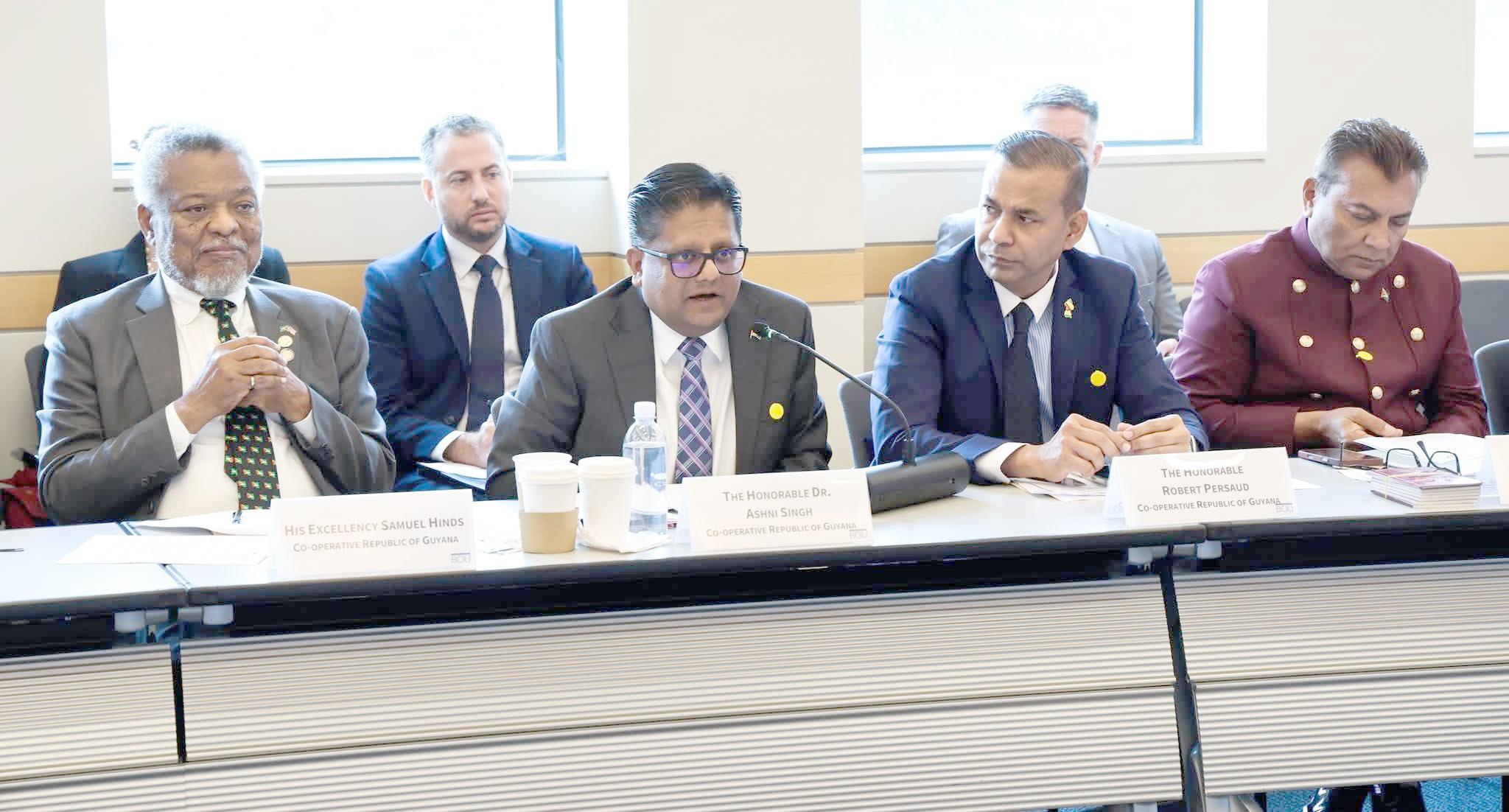
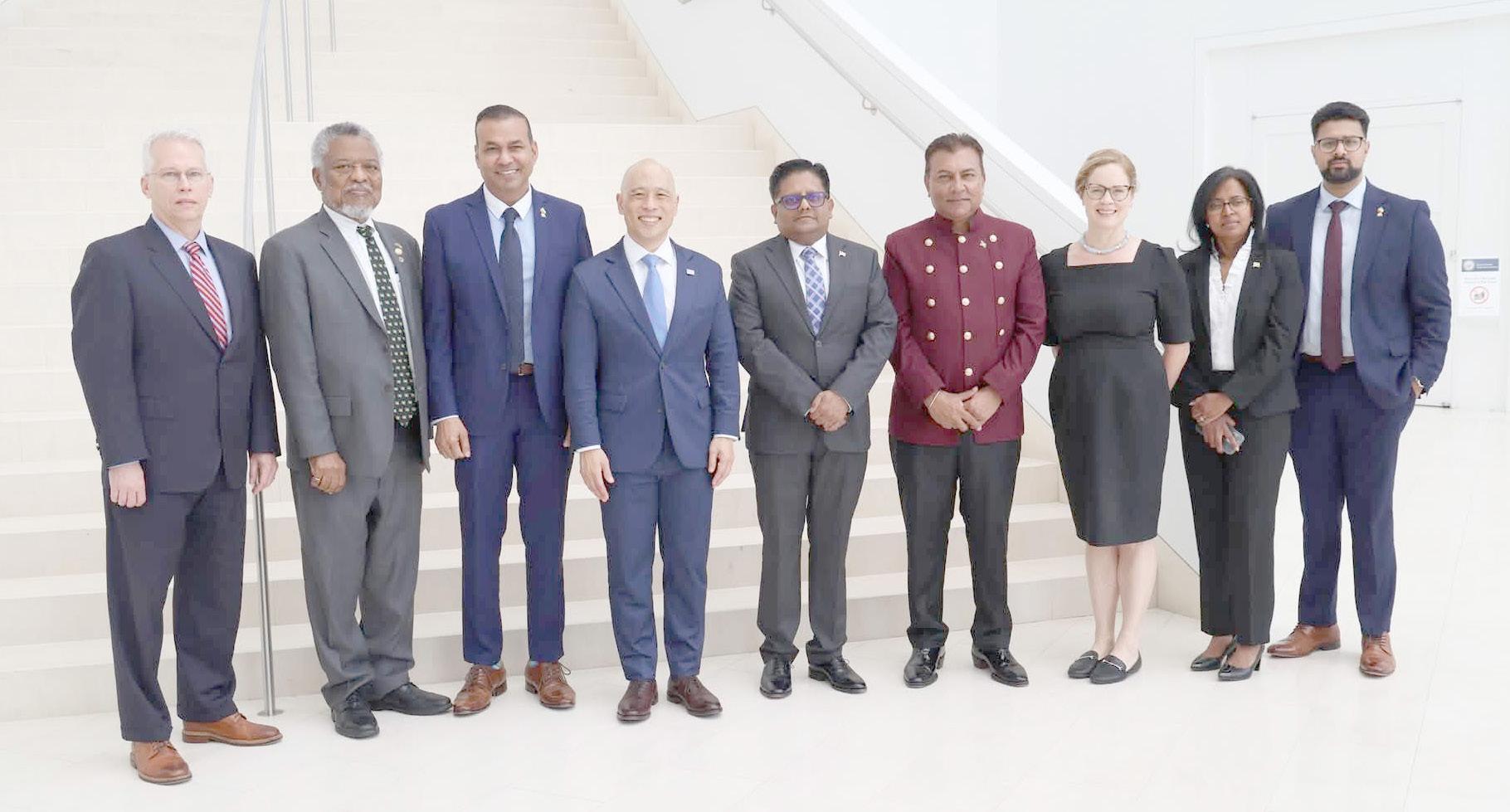
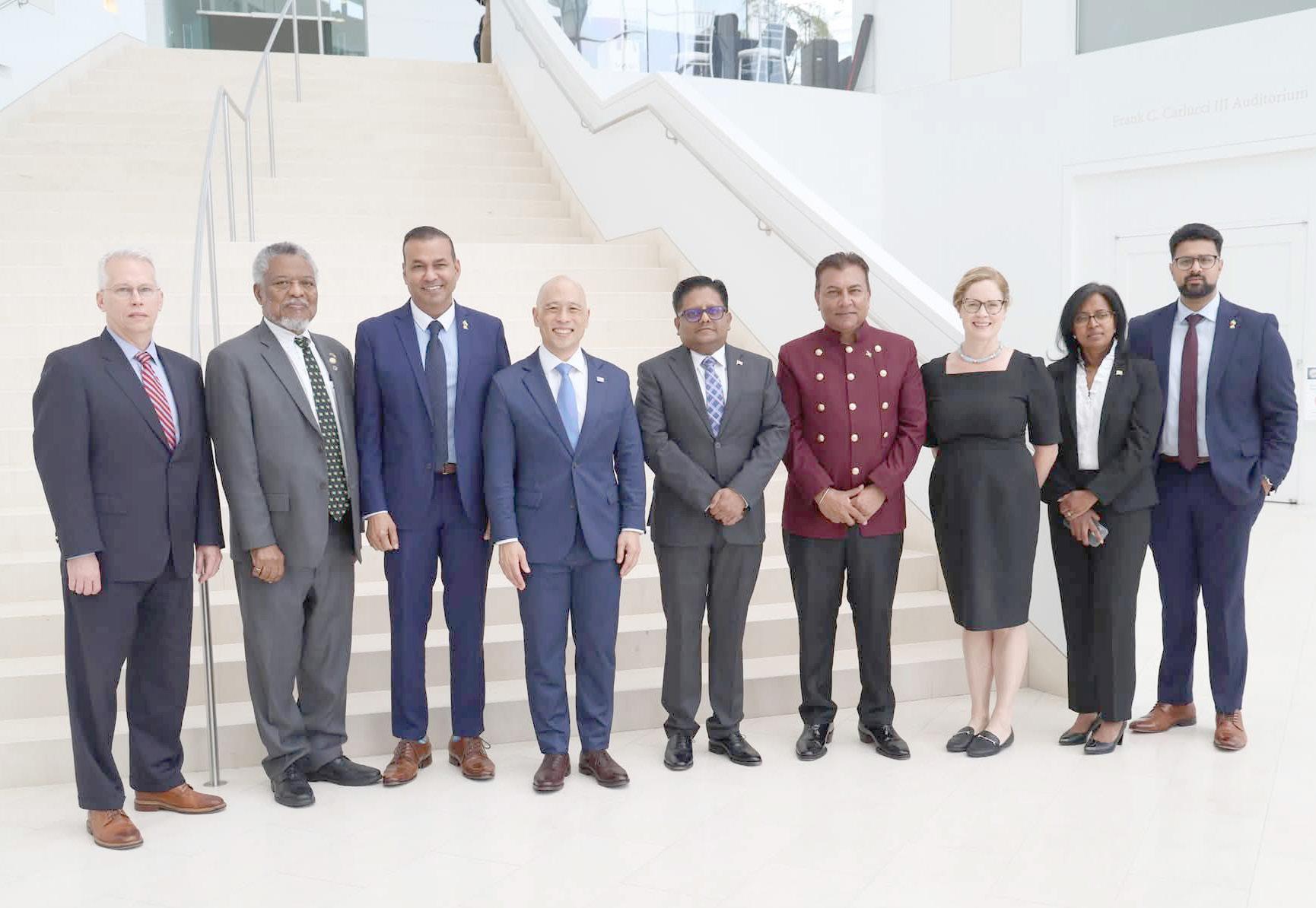
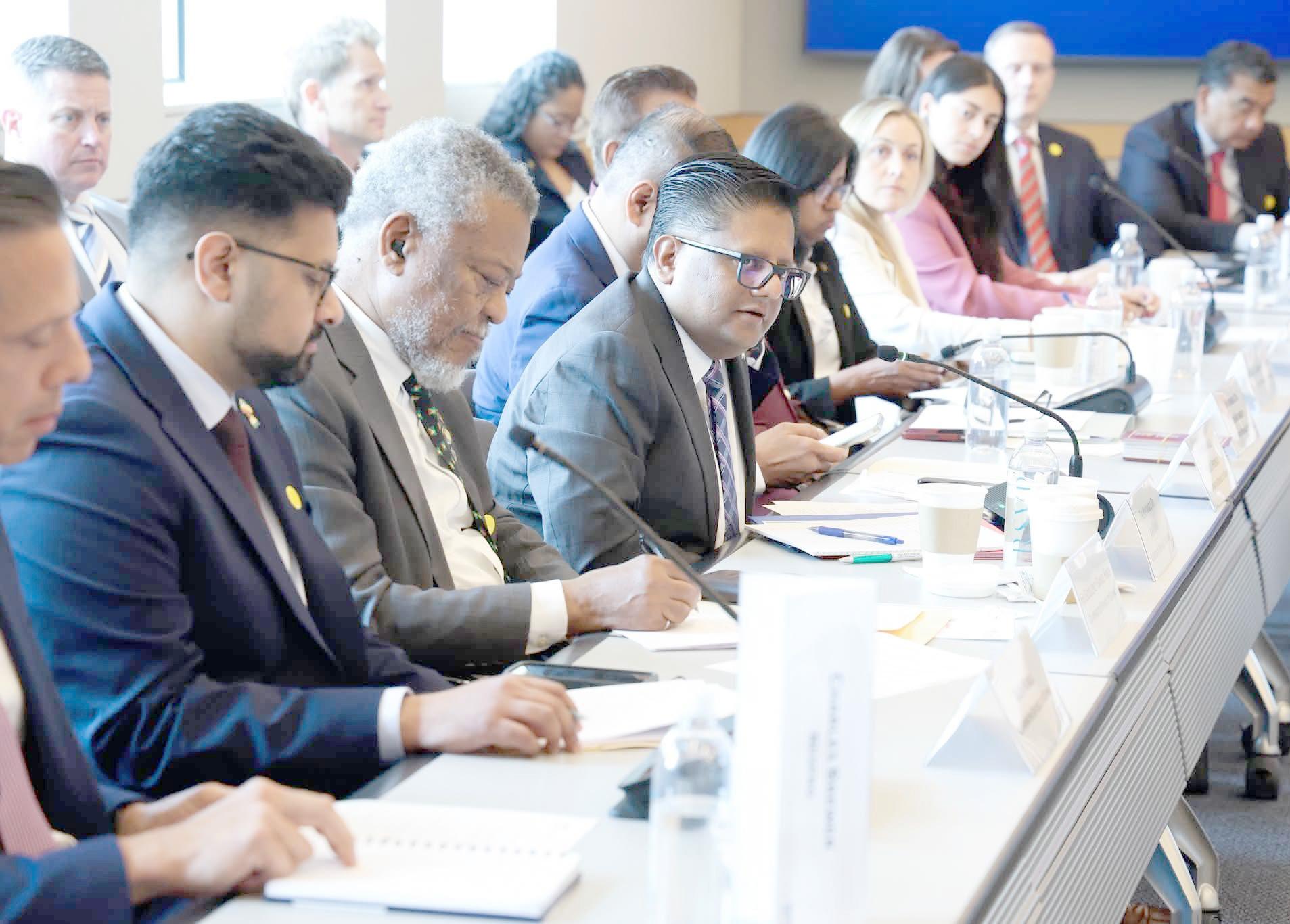
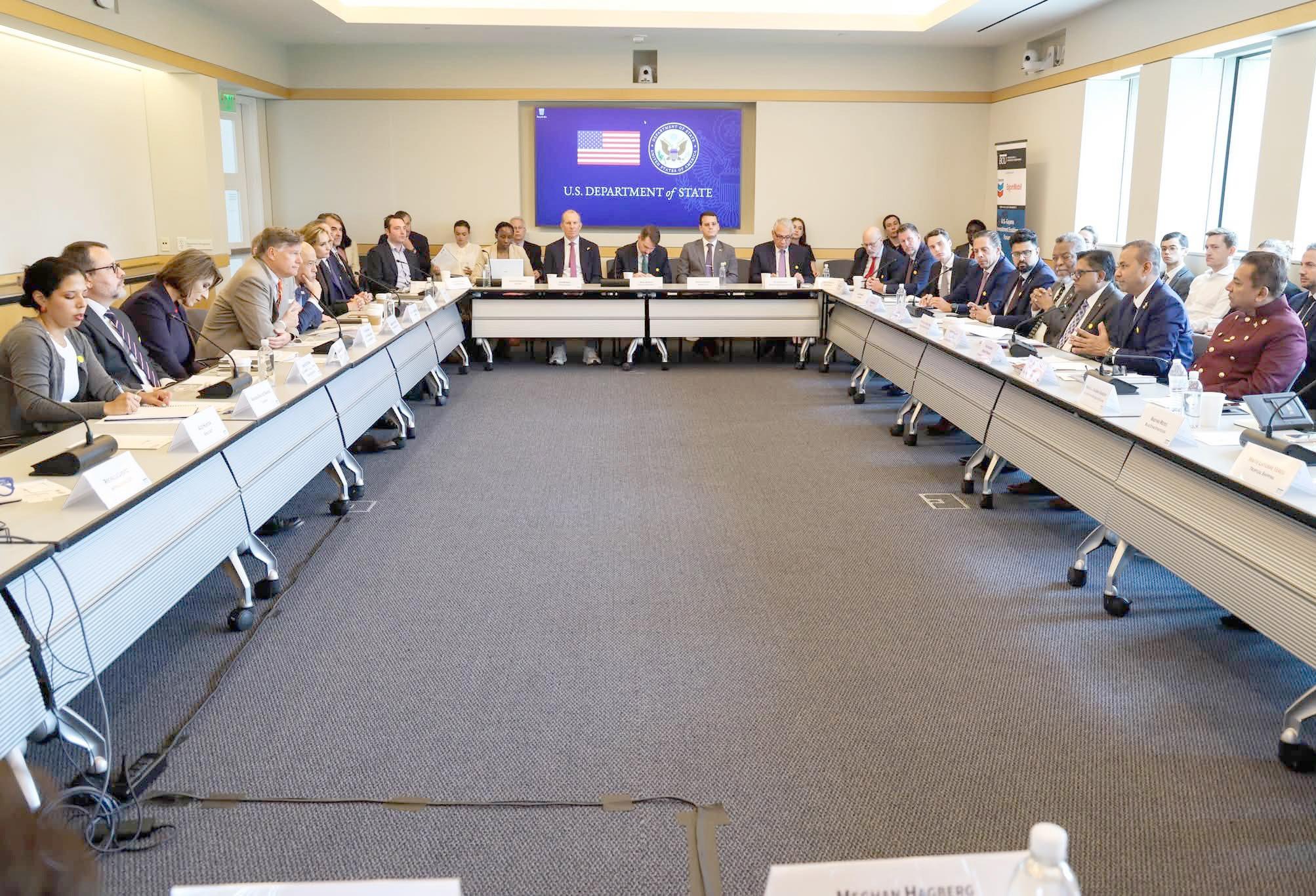
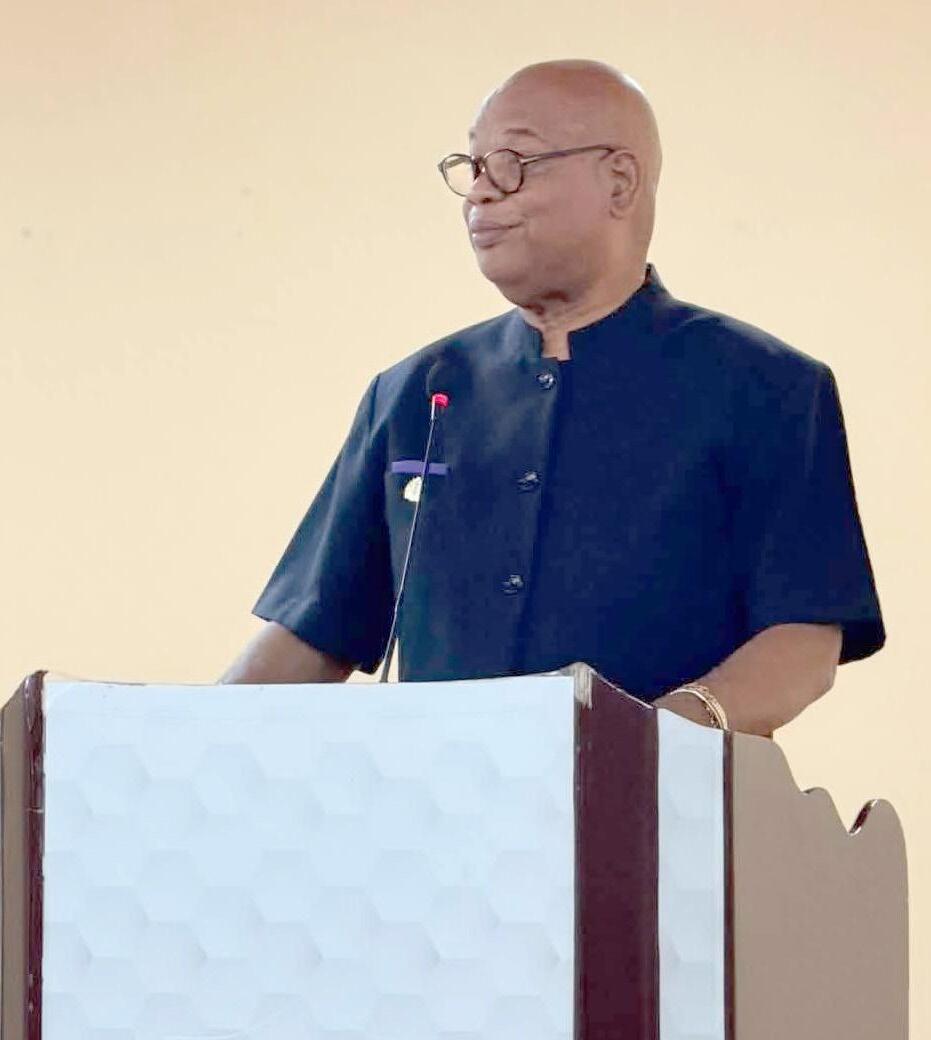
Senior Minister in the Office of the President with responsibility for Finance Dr. Ashni Singh addressing the US-Guyana Investment Enabling Forum at the US Institute of Peace in Washington, DC. He was joined by Guyana’s delegation comprising Foreign Secretary Robert Persaud, Ambassador to the United States Samuel Hinds, Chief Investment Officer of Go-Invest Dr. Peter Ramsaroop, Counsellor in the Caribbean Executive Director’s Office at the Inter-American Development Bank Navita Anganu-Ramroop, and Adviser to the Embassy of Guyana in Washington, DC, Wazim Mowla
Region Eight leaders highlight transformative impact of development projects ahead of NTC Conference ‘False, misleading and unsupported by credible evidence’ — Mustapha rejects Mohamed’s claims —AgricultureMinistersayshisson’sminingpropertieswerelawfullyacquiredandchallenges AzruddinMohamedtosubmitanyevidenceofwrongdoingtotherelevantauthorities
10 Victim co-operation biggest hurdle in sexual offence cases —DPP says increased reporting is encouraging, but victims withdrawing
— More than half recorded in the last two years, Dr. Singh tells Washington investment forum Zoo temporarily closed as transformation project gets underway



TRADE between Guyana and the United States has exceeded US$25 billion over the past decade, with more than half of that total being recorded within the last two years, Senior Minister in the Office of the President with responsibility for Finance Dr. Ashni Singh has disclosed.
The Finance Minister revealed the figures while addressing the recent U.S.-Guyana Investment Enabling Forum in Washington, DC, where he also reaffirmed the Government of Guyana’s commitment to deepening investment, trade and commercial ties with the United States.
In a Facebook post following the forum, Dr. Singh said Guyana views its relationship with the United States as a special one, built on shared values and shared interests.
He noted that the United States remains Guyana’s largest source of foreign direct investment (FDI) and its leading trading partner, underscoring the growing economic partnership between the
two countries.
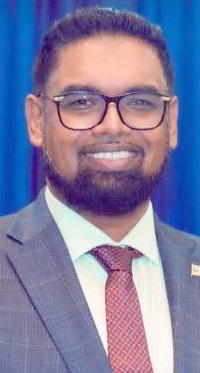
Looking ahead, Dr. Singh said President Dr. Irfaan Ali’s administration remains committed to strengthening that relationship by encouraging greater investment and expanding commercial cooperation.
“We would like more U.S. companies to invest in Guyana, and to do business in Guyana and with Guyana and Guyanese companies,” he said.
Dr. Singh represented Guyana at the U.S.-Guyana Investment Enabling Forum, hosted by the Business Council for International Understanding (BCIU) in partnership with the U.S. Department of State at the U.S. Institute of Peace.
During his opening remarks, he conveyed appreciation on behalf of President Ali and the Government of Guyana to U.S. Deputy Secretary of State Christopher Landau and his team for facilitating the forum and for their continued engagement and support. He also commended the BCIU for organising the event.
Guyana’s delegation
included Foreign Secretary at the Ministry of Foreign Affairs and International Cooperation
Robert Persaud; Guyana’s Ambassador to the United States, Samuel Hinds; Chief Investment Officer of the Guyana Office for Investment (Go-Invest) Dr. Peter Ramsaroop; Counsellor in the Caribbean Executive Director’s Office at the Inter-American Development Bank
Navita Anganu-Ramroop; and Adviser to the Embassy of Guyana in Washington, DC, Wazim Mowla.
The forum brought together government officials, investors and business leaders to explore opportunities to further strengthen investment and economic cooperation between Guyana and the United States.
Recently, United States Ambassador to Guyana Nicole Theriot had disclosed that a growing number of major American companies are turning their attention to Guyana, deepening economic ties that will stretch well beyond the oil-and-gas sector.
Speaking in an interview on the ‘Sources’ programme about US–Guyana trade relations, Ambassador Theriot said more and more US firms are ‘waking up to the opportunities’ in Guyana and are actively seeking Guyanese partners.
She stressed that Washington’s focus is on partnership, with the opening of a United States Department of Commerce
office inside the US Embassy, Guyana, in September 2023, acting as a “matchmaker” between American investors and local businesses here.
While she did not have an exact figure at hand, Theriot said the number of partnerships has grown exponentially since the office was established.
“One of the things that I think is very important to mention is that it’s not
just happening in the oiland-gas sector, it’s happening in agriculture, it’s happening in security, it’s happening in IT. US companies have really woken up to Guyana,” she said. According to Theriot, this diversification aligns with the Guyana Government’s own priority of broadening the economy to secure long-term, sustainable growth.
—AgricultureMinistersayshisson’sminingpropertieswerelawfullyacquiredandchallenges AzruddinMohamedtosubmitanyevidenceofwrongdoingtotherelevantauthorities
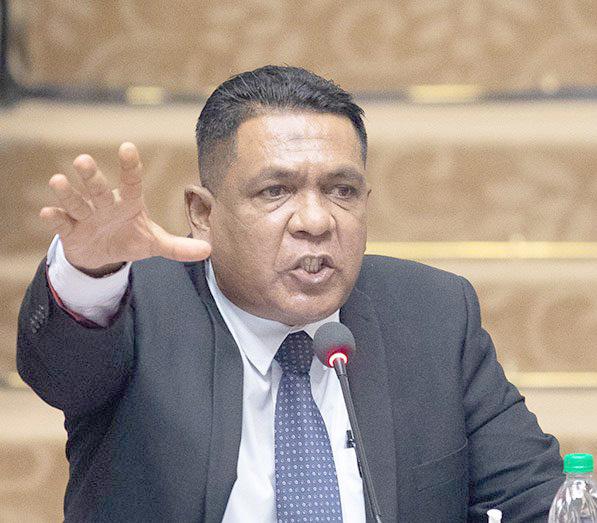
MINISTER of Agriculture, Zulfikar Mustapha, has dismissed allegations made by fugitive offender Azruddin Mohamed regarding his son’s business dealings, describing the claims as “false, misleading and unsupported by credible evidence.”
In a statement on Saturday, Mustapha said Mohamed has continued to make “wild and unsubstantiated allegations” while serious allegations concerning his own conduct remain under public scrutiny.
The minister said he
had addressed the matter publicly last week, but instead of responding to the issues he raised or providing evidence to support the claims, Mohamed had repeated the same allegations through social media and other public platforms.
According to Mustapha, the attacks on his son began after the latter chose to pursue his own independent business path.
“Since then, he has been subjected to repeated public allegations and attempts to damage both his reputation and his

business. Despite these attacks, he has remained focused on conducting his affairs lawfully, professionally and independently,” the minister stated.
Mustapha maintained that his son’s business affairs are entirely separate from his own and that, like
every Guyanese citizen, he has the right to engage in lawful business activities without harassment, intimidation or politically motivated attacks.
Addressing allegations surrounding mining operations, the minister said all of his son’s mining

properties were acquired through the lawful procedures established by the relevant authorities and are operated within the legal framework governing the sector.
He noted that every Guyanese has the right to apply for mining properties once they comply with the law, pay the required fees and make the necessary investments, adding that his children have been involved in medium-scale mining for several years in accordance with the country’s laws and regulations.
Mustapha also contended that it is a matter of public record that Mohamed and members of his family collectively hold mining rights over properties exceeding the combined holdings of all of his children, yet allegations continue to focus solely on his family.
He further rejected claims that mining properties linked to his children are being leased to foreign companies, describing the allegation as false.
“Significantly, despite making such a serious accusation, he has failed to identify a single foreign company or produce any evidence to support that claim,” Mustapha said.
The minister urged Mohamed, if he believes any law has been broken, to submit whatever evi -
dence he claims to possess to the relevant authorities for investigation rather than making repeated allegations through social media or political platforms.
“Public accusations do not constitute proof, nor should they be used to convict individuals in the court of public opinion,” he said.
Reaffirming his commitment to transparency, accountability and the rule of law, Mustapha said he has confidence in Guyana’s institutions and will not be distracted from his responsibilities by attacks against him or his family.
“The Guyanese people deserve better than a relentless stream of allegations intended to inflame public opinion and distract from the issues that truly matter. They deserve facts, not speculation; evidence, not rhetoric; and responsible public discourse grounded in truth and due process,” Mustapha said.
He also called on the public to reject misinformation, insist on facts and allow the relevant authorities to carry out their duties independently.
“The truth is established through evidence, due process and the rule of law, not through repeated public accusations,” the minister stated.

VILLAGE leaders from several Indigenous communities in Region Eight have credited government investments and projects funded through the Low-Carbon Development Strategy (LCDS) with significantly improving infrastructure, livelihoods and economic opportunities in their villages.
Speaking ahead of the National Toshaos Conference, the leaders outlined a range of completed and ongoing initiatives, while identifying additional priorities they hope will receive government support.
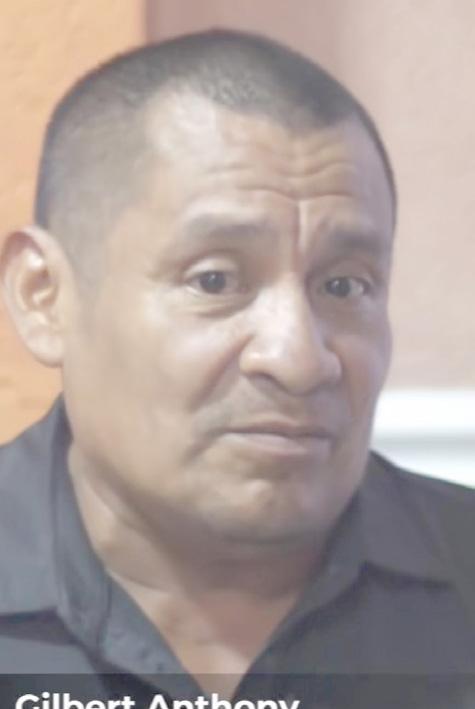
Toshao of Muruwa Village, Gilbert Anthony, said the once-underdeveloped community has seen notable improvements in recent years.
According to Anthony, Muruwa now has two schools, a health post, teachers’ quarters, a village office, a sewing centre and a garage, facilities that were previously unavailable.
He also highlighted the provision of an outboard engine through a government-supported fishing project, which has enabled residents to catch and sell fish, creating an income-generating opportunity for the community.
Meanwhile, Toshao of Kopinang, Allister Atkinson, said his village has benefited from several major projects, including a village kitchen, ICT hub, guesthouse and sewing centre.
He noted that the village kitchen, which is currently under construction, will serve both residents and visitors, while the guesthouse is expected to support the community’s growing tourism sector.
Tourism, he explained, is one of Kopinang’s key development priorities, with plans to officially launch tourism activities in the village next year.
Through LCDS funding, the village has also constructed a craft centre to showcase traditional Indigenous crafts and locally-made souvenirs for visitors.
Chairperson of the Maikwak Community Development Council, Eugenia Cypriano, said her community has experienced substantial development through government support and LCDS financing.
Among the projects completed are a new school kitchen, an expanded playfield, an ICT hub, a guesthouse, a fuel depot, and two pavilions.
Cypriano, who is also pursuing studies at the Cyril


Potter College of Education, said the ICT hub has become an important resource for students and residents by improving access to training and educational opportunities.
She added that while progress has been significant, improving roads and expanding the community’s water supply remain priorities. She is also seeking assistance to provide water storage tanks for households that are still without access to standpipes.
Cypriano noted that the new fuel depot will eliminate the need for residents and travellers to journey to neighbouring villages to purchase fuel, making transportation more convenient while creating new economic opportunities.
Toshao of Karisparu, Candace Evans, also praised the pace of development in her community, citing government-funded projects including a fuel depot, a completed shop, a sewing centre, a nearly completed benab, improvements to the village airstrip and the completion of the Cypress Bridge.
Looking ahead, Evans said she is hopeful for continued collaboration with the government to further advance development in the village.
Meanwhile, Toshao of Kamana, Derek Williams, said LCDS carbon credit funds have been invested in projects that directly benefit residents.
He explained that the village purchased all-terrain vehicles (ATVs) to improve transportation across the Pakaraima Mountains, making travel easier for villagers.
The community also established a mini-market using carbon credit funds. Williams said the business serves not only Kamana residents but also customers from neighbouring villages, creating both economic ac-
tivity and improved access to essential goods.
The testimonies from the Region Eight leaders come as the Government continues to significantly expand investments in Amerindian and hinterland communities.
Through the 2026 National Budget, G$7.5 billion has been allocated to support the development of Indigenous communities, complemented by substantial funding under the Amerindian Development Fund.
These investments are aimed at improving infrastructure, healthcare, land titling, education and economic opportunities, while supporting more than 800 community-led projects financed through Guyana’s carbon credit agreements under the LCDS.
Most recently, 11 Amerindian villages received capital grants from the Ministry of Amerindian Affairs to implement projects designed to improve livelihoods, strengthen community infrastructure and promote sustainable development.
The beneficiary villages are Quarrie, Wowetta, Aishalton, Yurong Paru, Katoonarib, Tiger Pond, Sand Creek, Surama, Yakarinta, Kanashen, and Annai.
Government investments have also resulted in the installation of more than 37,000 solar home systems across remote and off-grid communities, including a G$300 million 24-hour solar grid in Batavia Village.
Additionally, more than G$14.5 billion has been transferred directly to Amerindian villages to finance community-led initiatives such as eco-tourism, agro-processing and other sustainable economic ventures.
Indigenous entrepreneurs are also able to access zero-interest loans of up to G$3 million to expand their businesses.
To further strengthen village capacity, communities

continue to receive assets including all-terrain vehicles (ATVs), transportation vehicles and other equipment to support economic and administrative activities.
On the issue of land rights, the administration has demarcated 15 villages and issued 17 certificates of title since taking office, securing land ownership for more than 16,000 Amerindians. A further G$400 million has been allocated this year to continue the Amerindian Land Titling Programme.
Healthcare access is also
being expanded through the rollout of telemedicine services, alongside the construction of new regional hospitals in Regions One, Seven, Eight and Nine, bringing specialised healthcare closer to hinterland residents.
The National Toshaos Council (NTC) Conference will be held from July 20 –24, 2026 at the Arthur Chung Conference Centre under the theme: Empowering Leadership while Building Sustainable Village Economies through Inclusive Partnership”.
This important gathering will bring together Toshaos and Indigenous leaders from communities across Guyana to engage in meaningful discussions on issues affecting Indigenous peoples and communities.
The conference will also provide an opportunity for direct dialogue with government ministers, agencies and President Irfaan Ali on matters that are critical to Indigenous development, governance, and wellbeing.


FOR much of Guyana’s history, national development was largely viewed through a coastal lens.
The country’s economic life, public investment, and opportunities were concentrated along the narrow strip where most Guyanese lived, while many hinterland communities continued to grapple with inadequate infrastructure, limited public services, and few avenues for economic advancement. Development in those areas was often measured by what they lacked rather than by what they possessed.
That narrative is gradually changing, and the voices from these hinterland villages emerging ahead of this year’s National Toshaos Conference provide perhaps the clearest indication yet of that shift.
What stands out is not simply the number of projects being implemented, but the way village leaders now speak about development. The conversation is increasingly centred on enterprise rather than dependency.
Toshaos are discussing tourism ventures, craft centres, village kitchens, ICT hubs, fuel depots, fishing projects, and mini-markets. They are speaking about creating livelihoods, expanding local economies, and providing opportunities for young people to remain in their communities instead of feeling compelled to leave in search of work elsewhere.
This is an important distinction, because sustainable development has never been about constructing buildings or delivering grants in isolation. It is about creating the conditions under which communities can determine their own future. The Low-Carbon Development Strategy has helped to reinforce that principle by allowing villages to identify and finance projects that reflect their own priorities. More than G$14.5 billion has now been transferred directly to Amerindian villages, supporting over 800 community-led initiatives across the country. Whether those funds are invested in eco-tourism, agricul-
ture, transportation or small businesses is no longer being decided exclusively in Georgetown, but by the people who understand their communities best.
The broader investment programme tells a similar story. This year’s National Budget allocated G$7.5 billion specifically for Amerindian development, while the government has continued to expand investments in renewable energy, healthcare, education, and transportation. More than 37,000 solar home systems have already been installed across hinterland and riverine communities, and village solar grids are now powering schools, health centres and public buildings in areas that, only a few years ago, relied on generators, or had no reliable electricity at all. Infrastructure, however, should never be viewed as an end in itself. A solar system is valuable not because of the panels that have been installed, but because it allows children to study after sunset, enables health workers to deliver better care, and gives small businesses longer operating hours. In the same
way, an upgraded airstrip is not simply a strip of concrete. It provides faster medical evacuations, creates opportunities for tourism, allows farmers easier access to markets, and strengthens connections between remote communities and the rest of the country. Development acquires meaning only when it improves the everyday lives of the people it is intended to serve.
None of this suggests that the work is complete. Many Indigenous communities continue to identify roads, water supply, Internet connectivity, and employment as pressing concerns.
Those priorities remain legitimate, and the National Toshaos Conference continues to provide one of the country’s most important forums for ensuring that these issues receive direct attention from policymakers. Development, after all, is not a destination, but a continuous process that must respond to changing needs and aspirations.
GUYANA’S growth, including development connected to the oil and gas industry, is creating new possibilities across many sectors.
For young people preparing to leave school, however, the availability of opportunities is only one part of the equation. They must also be prepared to enter the workplace, meet its expectations, and make the most of those opportunities.
A certificate can help open the door to employment, but job readiness helps a young person walk through that door with confidence. Employers value academic qualifications, but they also look for people who can communicate clearly, work well with others, solve problems, manage their time, and conduct themselves professionally.
In practice, job readiness is often demonstrated through everyday actions: arriving on time, listening carefully, asking questions when something is unclear, accepting feedback, completing tasks responsibly, and treating colleagues with respect. These habits may appear simple, but they can shape how a young employee performs, grows and responds to challenges.
This is why structured job-readiness programmes can make a meaningful difference.
This month, 240 young people from Regions 3, 4, 6, 7, and 10 completed the classroom phase of the Employment Attack 102 (EA102) Job Readiness Summer Camp. The programme was implemented by Specialists in Sustained Youth Development and Research Inc. (SSYDR), with support from ExxonMobil Guyana.
Over four weeks, participants completed SSYDR’s Work Ready Curriculum, which covered personal development, communication, leadership and teamwork, workplace conduct, financial fitness, safety and health, and employer and employee rights and responsibilities. They also explored entrepreneurship and developed practical workplace skills through hands-on activities.
For graduate Sameer Wong of Westminster Secondary School, the experience went beyond preparing for employment.
“I expected to gain knowledge about preparing for the world of work,” he said. “I’ve gained so much more. This experience has helped me build confidence, strengthen my communication skills, learn the importance of teamwork, and understand the values of responsibility, professionalism and perseverance.”
Participants also applied their learning through the new EA102 Community Initiative. Working in teams, they planned and implemented projects that responded to the needs of their communities, from supporting vulnerable groups to improving shared spaces. In the process, they practised leadership, budgeting, planning, and project management while recognising that their skills can also be used in service to others.
Crystal Kanhai of Bartica Secondary School said the programme reshaped her understanding of teamwork.
“It taught me that it is not a weakness to depend on others, but rather a strength,” she shared. “I learned that success does not come from working alone, but working with the right people.”
The learning will continue beyond the classroom. Graduates will now enter a twomonth coaching phase, during which they will refine their career goals and receive guidance as they transition into employment, further education, training or entrepreneurship.
Since its launch in 2018, Employment Attack 102 has reached more than 1,750 young people across Guyana through its collaboration with ExxonMobil Guyana.
Behind that figure are individual stories of growth: young people with a clearer sense of direction, greater confidence in their abilities, a stronger understanding of what the workplace requires, insight into small business development, and former students paying it forward by returning to SSDYR to coach new cohorts of youth.
As Guyana’s oil and gas industry contributes to wider economic activity, preparing young people to participate meaningfully in the country’s development is just as important as creating new opportunities.
Investments in job readiness help ensure that young Guyanese are not simply waiting for change but are equipped to navigate it.
Job readiness and employability skills are, therefore, about more than producing a future workforces. It is about nurturing and developing adaptable young people who can lead, collaborate, build businesses and contribute meaningfully to their families, communities and country.
DISCLAIMER: The views and opinions expressed in this column are solely those of the author and do not necessarily reflect the official policy or position of the Guyana National Newspapers Limited.
I WILL be a student of philosophy until I die.
I like the subject. I think it is the best form of knowledge a human can ever delve into. It is a formidable journey in comprehension that makes you feel it cannot be understood. But once you persist, you come to know more about life, nature and humans that no other source of knowledge can give you.
I have liked philosophy since I worked at 17 years at the Michael Forde Bookstore at the bottom of Freedom House, the head office of the PPP. Based on my studies of philosophy, I cannot reconcile myself with the rule of Forbes Burnham. I believe, as a critic of power, it will remain impossible for me to have any holistic appreciation of the power output of Burnham. Then one has to add the personal angle. I would not have disliked Burnham as intensely as I do if Burnham had not victimised my wife because of me. He should have left my wife out of the equation.
Having said all of that,
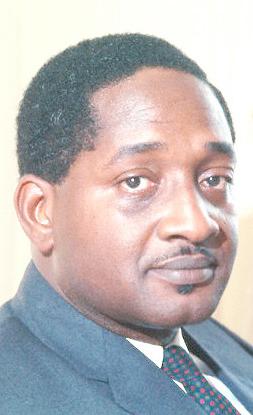
there are nuances in the personality of Burnham that I had an appreciation for and always will.
These motifs, I do not think, subtract from Burnham’s power intoxication. These dimensions are naming things after gigantic humans that will remain permanent, Muslim and Hindu holidays and Burnham’s contribution to the African liberation struggle, Maurice Bishop’s Grenadian Government and the government of the Sandinistas in Nicaragua.
For the purpose of this commentary here, I will concentrate only on the naming achievements of Burnham. Three stand out: Quamina Street, Mandela Avenue and Clive Lloyd Drive. I have not included Lance Gibb Street because I have not done the research to know if that was a Burnham thing.
Burnham must be given thanks for these accomplishments because they have an anti-colonial touch and a culturally redemptive value. There are similar lines to be pursued in this country. I grew up never recognising that the
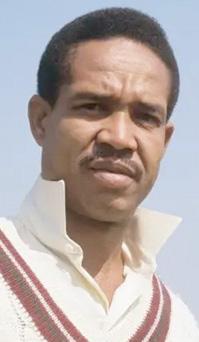
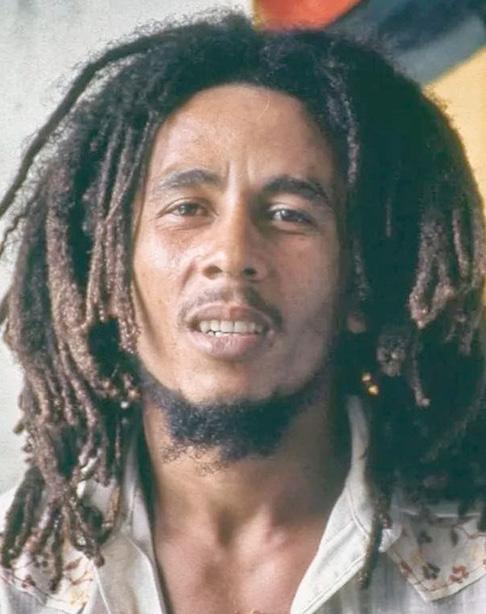
CARICOM family is a group of distinct countries. I belong to the Caribbean. I am a Caribbean man, and I would not have it any other way. The Caribbean is one of the most philosophically blessed pieces of global earth. Gary Sobers and Bob Marley belong to the Caribbean, not Jamaica and Barbados exclusively.
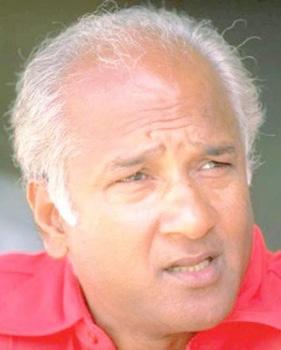
This present generation in Guyana would not know how to contextualise Gary Sobers in the creation of One Caribbean. You have to live in the era of Sobers’ achievements to understand what he is to the Caribbean. It is the same with Bob Marley. In the history of global music, Marley is for me the most pronounced composer of philosophical lyrics. He was from One Caribbean. Marley is gone, Sobers is gone, but Rohan Kanhai is still alive. He is 90 years of age. It falls on the shoulders of President Ali to give the present generation and the one to come the understanding of what the Caribbean has given the world. I never liked VS. Naipaul for obvious

reasons –my philosophical training would instruct me to see Naipaul as a copy-cat Anglo-Saxon whose self-hate made him disparage the Caribbean.
But Naipaul was extremely limited in running down the Caribbean as a non-achieving place. If Naipaul was more politically conscious, he would have seen that Western domination hardly achieved anything for mankind. I would like to see President Ali make some symbolic gesture to One Caribbean and name something in Guyana after Sobers, Marley and Kanhai.
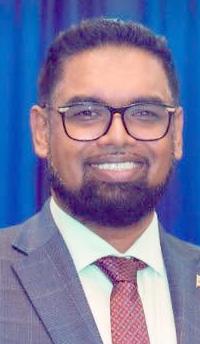
I am mature enough to judge the psychological angles of another human that I interact with. I see in Irfaan Ali, a sincere
commitment to expand the horizon of the lives of Guyanese people. I think those who dislike Ali do so because of their political agenda. This is not just logical but absolutely logical. They are Ali’s competitors. They want to win power. But knowing the inner substance of Ali, is something Ali’s detractors should attempt to. They will see a different leader.
If there is any Caribbean leader who has the potential to pursue that symbolism of One Caribbean, it is the current president of Guyana, Mohamed Irfaan Ali. I don’t know if Dr. Ali will be at Sobers’ funeral, but I will appeal to him to make Sobers a part of the Guyana landscape just as he should with Marley.
When Sobers died on
Friday, believe me, immediately I thought of Rohan Kanhai. Both men played together in dozens of test matches where they proved Naipaul was wrong. Kanhai and Sobers gave glory to the Caribbean and the Caribbean should reciprocate. In Guyana, I would ask President Ali to start the reciprocation process. Let there be parts of Guyana that will forever bear the names of Gary Sobers, Bob Marley and Rohan Kanhai.
DISCLAIMER: The views and opinions expressed in this column are solely those of the author and do not necessarily reflect the official policy or position of the Guyana National Newspapers Limited.

IT is time to turn the page on the strange obsession with President Irfaan Ali’s socalled “megafarm” on the Soesdyke-Linden Highway.
There are more than 60,000 reasons to do so. That’s how many Guyanese received titles to their houselots, generous cement and steel vouchers and favourable mortgage rates over the last five years. Be assured, they don’t give two hoots about a farm.
Three days ago, President Ali laid out as clear a roadmap as there is of where the national housing backlog is and his administration’s plan to clear most of it by the end of his second term. Earlier this month, the president delivered a significant speech to mark the 25th anniversary of the Guyana Lands and Surveys Commission (GLSC). The opposition media, not surprisingly, ignored it because it revealed something remarkable about this president.
The story of land access in former European colonies is an unresolved moral and economic question at the heart of post-colonial nationhood. When Dutch settlers arrived on the Guiana coast in the 1600s, they carved up the coastal plain into plantation tracts, some exceeding 100 hectares, backed by enslaved African labour and a drainage infrastructure that still underpins the country today.
Upon Emancipation in 1838, freed men and women abandoned those plantations. Some pooled their meagre resources to purchase failed estates, establishing the earliest “freedom villages,” the first collective land acquisitions by formerly enslaved people in the Western Hemisphere. Most lacked the capital to sustain the villages and were forced to revert to subsistence farming.
The takeaway is that the structural denial of land as a vehicle for wealth was, from the very inception, the mechanism by which colonial inequality was reproduced after slavery
officially ended. This story was never unique to Guyana.
Across the Caribbean, the same crushing plantation logic played out. In Jamaica, emancipated workers were systematically excluded from crown lands after 1838; the 1888 Land Settlement Act maintained its European bias, and it was not until the Moyne Commission of 1938-39, convened after labour riots across the region, that meaningful land reform was even contemplated. In Trinidad, the British simply overlaid one plantation hierarchy onto another, with land concentrated in European hands well into the twentieth century.
In Zimbabwe, Mugabe inherited a system so skewed that, as late as 1980, Black Zimbabweans were effectively locked out of productive land by the Lancaster House settlement. When he eventually moved, brutally and without institutional capacity, the result was economic collapse. The lesson is not that land reform was wrong; it is that reform without institutional architecture, legal frameworks, and post-transfer support is a recipe for disaster. I hope by now you’re beginning to get a clear picture of President Ali’s vision. South Africa offers an equally sobering parallel. Since 1994, the ANC has consistently failed to meet its redistribution targets. The “willing-seller, willing-buyer” model, embraced under World Bank advice, handed market power back to landowners who inflated prices, and the newly resettled could not access bank loans because they held no formal title. Without title, there was no collateral; without collateral, no capital to invest. Not surprisingly, the promise of land reform failed.
Singapore drew a sharply different lesson.
Facing a post-colonial housing crisis in 1960, the Housing Development Board was granted sweeping powers under the Land Acquisition Act. The Act allowed the state to acquire land

below market value in the public interest. Armed with institutional capacity to build, the state proceeded to survey and train engineers to deliver at scale. Within ten years, it had built 54,000 flats.
Today, more than 80 per cent of Singapore’s population lives in state-built housing, and home ownership, the single greatest driver of household wealth creation, exceeds 90%. What Singapore understood, and what too many post-colonial governments failed to grasp, is that the institutional machinery must precede the ambition.
This is precisely what President Ali has committed himself and his administration to doing. The full digitisation of the GLSC within four years matters and should be applauded. His vision of an entity that he described as “system-based, people-centred, and service-driven” is not merely a modernisation slogan; it is an acknowledgement that Guyana cannot repeat the failures of Zimbabwe or South Africa.
In those countries, ambition outran administration. President Ali is well aware that hundreds of citizens in some communities
have already endured decades of uncertainty living on un-titled lots while the state and claimants argue over who really owns the ground beneath their feet.
To put the scale in perspective: clearing Guyana’s 75,000 housing backlog alone requires the development of 20,000 acres of new land, an area nearly half the size of Antigua, and it falls to GLSC to survey, title, and deliver every one of those acres with speed and precision.
That President Ali, who cut his teeth walking back dams with surveyors as Minister of Housing, now stands as the architect of the most ambitious land distribution programme in this nation’s post-independence history, is no accident. President Ali stands at the critical juncture where the convergence of institutional memory, political will, and oil is fuelling a moment that Guyana may not see again in our generation.
DISCLAIMER: The views and opinions expressed in this column are solely those of the author and do not necessarily reflect the official policy or position of the Guyana National Newspapers Limited.
ATTORNEY General and Minister of Legal Affairs, Anil Nandlall, SC, has called for greater judicial involvement in the Caribbean’s fight against financial crime, arguing that judges and magistrates must adopt a specialised approach when interpreting and applying asset recovery legislation.
Speaking on Wednesday at the opening ceremony of the 2026 Annual General Meeting of the Asset Recovery Inter-Agency Network for the Caribbean (ARIN-CARIB) at the Georgetown Marriott Hotel, Nandlall said the judiciary is a critical stakeholder in the fight against organised crime. He stressed that judicial officers play an
essential role in depriving criminals of the proceeds of their illegal activities.
Appealing to the ARIN-CARIB to include greater judicial participation in its work, Nandlall said, “I appeal to that body to incorporate in that body’s engagement the judiciary. The judiciary is an important part in this equation.”
According to him, the legal framework governing anti-money laundering and asset recovery differs significantly from ordinary criminal legislation and therefore requires a different judicial approach. He described the legislation as sui generis, explaining that it demands specialised methods of interpretation
rather than the traditional principles applied in conventional criminal cases.
“We are dealing with legislation that I’ve described elsewhere as sui generis They require different canons of interpretation. They differ from the ordinary criminal statutes,” he said.
While acknowledging that the laws contain far-reaching powers, Nandlall said that is necessary given the sophisticated nature of modern organised crime and illicit financial activity.
“They are draconian, but that is the nature of the legislative framework,” he stated.
The Attorney General argued that judicial officers must recognise the unique
purpose of asset recovery legislation when presiding over such matters.
He emphasised, “They cannot use ordinary canons that apply to the ordinary criminal law in interpreting and applying this statutory framework. It’s different.”
Nandlall warned that the region’s efforts to combat money laundering, organised crime and other forms of illicit finance would be significantly hampered without the active participation and understanding of the judiciary.
“And if we don’t get the judiciary on board, then our task becomes tremendously more difficult,” he cautioned.
Nandlall noted that today’s criminal organisations
operate across multiple jurisdictions, moving illicit proceeds through complex financial networks and exploiting differences in national legal systems to evade prosecution.
He said this evolving threat underscores the need not only for stronger co-operation among law enforcement agencies but also for a judiciary equipped to effectively interpret and enforce modern asset recovery legislation.
He maintained that strengthening judicial understanding of these laws is essential to ensuring that criminals are stripped of the financial gains derived from their unlawful activities and that confiscation becomes an effective tool in the adminis-
tration of justice. Guyana has, over the past several years, significantly strengthened its anti-money laundering and countering the financing of terrorism framework through legislative reforms, institutional capacity building and closer cooperation among local and international law enforcement agencies.
The government has also expanded the use of mutual legal assistance, enhanced co-operation through Interpol and the Egmont Group, and increased the use of ARIN-CARIB mechanisms to support cross-border financial investigations and asset recovery.
EVERY year, the National Toshaos Conference (NTC) reminds Guyanese of an important truth: our Indigenous communities are not an afterthought in national development
They are central to it. The gathering is more than a conference -- it is the largest democratic forum of Indigenous leaders in Guyana, where Toshaos speak directly to the government about the needs, aspirations and future of their villages.
This year’s National Toshaos Conference 2026 once again demonstrates a political reality that has become increasingly difficult for the opposition to deny: no government in Guyana’s modern history has invested more in the livelihoods, education, health, infrastructure, land rights and economic empowerment of Amerindian communities than the People’s Progressive Party/Civic (PPP/C).
The evidence is overwhelming.
For decades, Indigenous communities had complained of neglect, poor roads, limited health care, weak educational opportunities and inadequate government attention.
Today, while challenges remain, there is measurable progress backed by billions of dollars in investment and hundreds of completed projects across Regions One, Seven, Eight and Nine.
Unlike political parties that only remember Amerindian communities during election campaigns, the PPP has made Indigenous development a permanent national priority.
The National Toshaos Council has become a genuine platform for consultation rather than a ceremonial event. Government ministers, permanent secretaries and technical officials remain available to answer questions, resolve problems and incorporate village priorities into national planning. This is participatory democracy in action.
Perhaps the clearest example of the government’s commitment lies in economic investment.
Over recent years, more than $60 billion has been invested in Amerindian, hinterland and riverain communities, including over $50 billion in capital expenditure alone. These investments have improved health care, education, transportation, water access, electricity, internet connectivity and housing.
These are not promises written in a manifesto, they are projects visible in villages across Guyana.
One of the most transformational achievements has been the Low Carbon Development Strategy (LCDS).
For generations, Indigenous communities protected Guyana’s forests without receiving meaningful financial recognition. The PPP government changed that.
Fifteen per cent of Guyana’s carbon-credit revenues have been transferred directly to Indigenous villages. More than $4.7 billion was distributed to over 240 villages, while the community share later increased to 26.5 per cent, preserving transfers exceeding US$23 million and supporting more than 800 community projects.
This represents something unprecedented. Rather than outsiders benefitting from Guyana’s forests, the people who have protected those forests for centuries are now receiving direct financial returns to invest in agriculture, tourism, community enterprises and village infrastructure.
Land rights have also advanced significantly.
Almost 8,700 Amerindians have benefitted from legal land titles under the current administration, while additional villages have received certificates of title and completed demarcation exercises.
Land ownership is not simply about geography. It is about dignity, security and preserving Indigenous heritage for future generations.
Education has equally become one of the strongest pillars of government policy.
Nearly 5,000 GOAL scholarships have been awarded to students from hinterland communities, representing about 16 per cent of all scholarships issued. Seventy-nine new hinterland schools have been built, dozens more renovated and additional secondary schools are under construction.
Teacher training has expanded dramatically. The proportion of fully trained teachers across Regions One, Seven, Eight and Nine has risen from less than 43 per cent in 2020 to 83 per cent by the end of 2024.
Millions of textbooks have reached students.
Hundreds of schools now enjoy highspeed internet. Libraries continue to be expanded.
These are investments in opportunity. Health care tells an equally compelling story. Thirty-two hinterland health facilities have been upgraded. Six hundred additional health workers now serve remote communities. Medicine availability has improved substantially. Telemedicine now connects dozens of villages with specialists. More than 1,500 medical evacuation flights have saved lives.
In Region Nine, surgeries once available only in Georgetown are increasingly performed locally. In Region One, malaria cases have fallen dramatically, while surgery capacity continues to be expanded. Regions Seven and Eight have similarly recorded improvements in outreach services, medicine availability and specialist care.
Infrastructural development has transformed everyday life. Thousands of kilometres of hinterland roads have been maintained and upgraded.
Billions have been invested in road construction. Water coverage has increased significantly through new wells and water systems.
Thirty thousand solar home systems have been distributed, bringing electricity to families previously living without reliable power.
Government Wi-Fi now reaches 140 hinterland communities. For many Indigenous children, internet access is no longer a luxury but a reality.
Agriculture has likewise received sus -

tained investment. More than $4.5 billion has supported food-security initiatives involving cassava, rice, corn, peanuts, pineapples, honey, coffee, cocoa, spices, fish farming and agro-processing.
Nearly 200 tractors and agricultural implements have been distributed, while approximately 10,000 farmers have benefitted from expanded support programmes.
This is genuine rural economic development. Social protection has not been ignored.
Community Service Officers have been restored and expanded.
Thousands of Indigenous pensioners and vulnerable residents continue receiving government assistance.
The Because We Care cash grant has been restored and increased, easing financial pressure on families preparing children for school.
Young people continue benefitting from employment opportunities, tourism initiatives and skills training.
Culture has also received unprecedented recognition. Indigenous fashion, eco-tourism, heritage preservation and cultural identity are increasingly viewed not as historical relics, but as important contributors to Guyana’s national development.
This represents a fundamental shift in national thinking.
The contrast with previous administrations is impossible to ignore.
During the APNU+AFC administration, the coalition proudly pointed to having three Amerindian ministers and an Amerindian Vice President.
Representation, however, is meaningful only when it delivers measurable results.
Indigenous communities judge governments not by photographs or political appointments but by roads built, schools opened, medicines delivered, land titles granted, jobs created and opportunities expanded.
Those measurable outcomes simply did not occur on the scale witnessed since 2020.
The existence of Amerindian ministers did not automatically translate into transformational development across hinterland communities.
Likewise, newer political movements such as WIN frequently present themselves as defenders of Indigenous peoples. Yet slogans and social media campaigns cannot
substitute for sustained investment.
Too often, Amerindian communities become convenient political backdrops during election seasons, only to fade from public attention afterwards.
The people of the hinterland deserve more than symbolic visits and political speeches.
They deserve long-term partnerships. That is precisely what the National Toshaos Conference continues to represent.
It reflects a government willing to sit with Indigenous leaders, answer difficult questions, receive criticism where necessary and commit resources to solving problems.
No one suggests that every challenge has disappeared.
There are still villages requiring better roads, expanded health services, stronger telecommunications and additional economic opportunities.
Development is an ongoing journey. But no honest observer can deny the direction of travel.
Billions invested. Thousands of jobs supported. Thousands of scholarships awarded. Improved schools. Improved hospitals. Expanded internet. Land titles secured. Carbon revenues shared. Communities empowered.
The story of Indigenous development in Guyana is no longer defined by neglect.
It is increasingly defined by partnership.
As Guyana continues its remarkable transformation, one lesson from the National Toshaos Conference remains unmistakably clear: when Indigenous communities are treated as partners in nation-building rather than spectators to development, the entire country moves forward together.
That, more than any political slogan, explains why so many Amerindian leaders continue to view the PPP/C government as the administration that has done the most to place their livelihoods, communities and future at the centre of Guyana’s national development.
Putting People First means when they win, Guyana wins. When our Indigenous people are placed first, as they should always be, Guyana wins!
DISCLAIMER: The views and opinions expressed in this column are solely those of the author and do not necessarily reflect the official policy or position of the Guyana National Newspapers Limited.
By Vanessa Cort
NO sooner had I written about the capacity of sport to bring us together than trouble began to ‘rear its head’ at the current World Cup tournament.
Allegations of unfair decisions by referees, allegedly pressured by the powers-that- be, culminated with the President of the International Football Federation (FIFA), Gianni Infantino, facing investigation.
It all came to a head in the Round of 16 game between Argentina and Egypt, where the Argentinians made a remarkable comeback from two goals down to win the match 3-2. Those three goals came in 13 minutes and many challenged their validity.
After the initial celebration over this incredible victory by the world champions, social media was flooded by a flurry of outraged comments.
Viewers around the world questioned decisions made during the match, the efficacy of the Video Assistant Referee (VAR) technology and the role of Infantino in all of this.
A disallowed Egyptian goal and disputed yellow cards issued to its players marred the game and gave rise to complaints that the Argentinians were being specially favoured.
Egyptian supporters also accused the Argentinian fans of becoming violent and abusive, throwing beer bottles at them and shouting racial slurs.
They were not alone as the Cape Verde fans made similar complaints. The team from the small African island nation gave the world champs a ‘run for their money’, pulling back two goals before eventually conceding the winning goal in the second half of extra time.
Argentina was in trouble again in their quarter-finals match against Norway, when the Norwegian team scored in the sec-
ond half, tying the match at 1-1.
They were then forced to play with one man short, after striker, Breel Embolo, received a second yellow card for a foul, leading to an automatic red card and had to leave the field.
The referee’s decision came into dispute as he had previously issued a yellow card to an Argentinian player for the foul, but reversed this after a controversial VAR review.
The fact that the call was made just minutes after the Norwegians had levelled the score reignited claims that the tournament favoured the Argentinians, who still had difficulty overcoming their rivals, eventually scoring the winning goal in extra time.
FIFA has now been openly accused of bias by many and Infantino is facing heavy backlash for an earlier decision to lift a one-match ban against US striker Folarin Balogun.
According to Time magazine, dozens of members of the European Parliament have called for an investigation into the FIFA President’s role in lifting the ban. They have written to the European Union Football Association (EUFA)asking them to “lend their voices” in support of a probe into whether Infantino succumbed to US pressure.
The lawmakers referred to the FIFA Statutes and Code of Ethics, clearly requiring political neutrality, particularly after the US president, Donald Trump, claimed responsibility for the reversed decision, saying, “I was the one who got them to do it”.
Further compounding his woes, the FIFA President received a letter from 50 members of the European body voicing support for an ethics complaint. Non-profit organisation, Fair Square, registered concerns over Infantino’s unilateral decision to award Trump the inaugural FIFA Peace Prize last December.

Martyn Ziegler of The London Times also reported that several countries, which had backed Infantino’s re-election, are now considering withdrawing their support following the lifting of the ban, considered to be crossing “a red line”
If anything, the raging controversies and the allegations against Argentinian fans during this World Cup, have shown just how much politics and racism can divide us in a world of sport intended to create greater unity.
And as the finals take place today between Spain, the reigning European champions and Argentina, the world champions, I do hope the match will see fairness and camaraderie return to the sport, regardless of the result.
As Frank Deford, legendary American sportswriter and commentator, once said, “ I think, at its best, sport does bring us together”.
DISCLAIMER: The views and opinions expressed in this column are solely those of the author and do not necessarily reflect the official policy or position of the Guyana National Newspapers Limited.
THE Guyana Zoological Park has been temporarily closed to the public as preparatory works begin for a major transformation project that will modernise the facility and improve conditions for animals.
The Protected Areas Commission (PAC), in a statement issued on Saturday, said the temporary closure is necessary to facilitate initial works ahead of the planned upgrades.
According to the Commission, the zoo, which has long been a cherished attraction for generations of Guyanese, is entering the first phase of a redevelopment programme aimed at improving the facility while ensuring higher standards of animal care.
“The zoo holds a special place for many Guyanese, and these preparatory works are an important step in improving conditions for the animals in our care and preparing the site for future improvements,” the PAC said.
It assured the public that animal welfare will remain the highest priority throughout the closure, with every effort being made to ensure the continued care and wellbeing of all animals housed at the facility.
The PAC also thanked the public for its patience and understanding, adding that updates will be provided as the project progresses.
The temporary closure comes as the government moves ahead with its long-promised transformation of the Guyana Zoological Park and Botanical Gardens into what President Dr Irfaan Ali has described as a world-class attraction and “the pride of South America.”
In April, President Ali said the project would significantly modernise the facility while enhancing its role as both an educational and recreational destination.
The redevelopment will include the rehabilitation
of the Botanical Gardens and water systems, construction of modern zoo infrastructure to improve animal welfare and facility management, upgraded visitor amenities, improved accessibility and dedicated educational spaces focused on biodiversity and environmental awareness.
The project will also feature new pathways, bridges, landscaping, enhanced security and operational systems, while integrating the zoo and gardens into a broader network of green, cultural, commercial and waterfront corridors as part of Georgetown’s wider urban renewal plans.
President Ali had said the scale and complexity of the project would deliver a modern facility that represents strong value for money while supporting sustainable tourism and biodiversity conservation under Guyana’s Low Carbon Development Strategy (LCDS) 2030.
Public consultations on the redevelopment began in October 2024, when
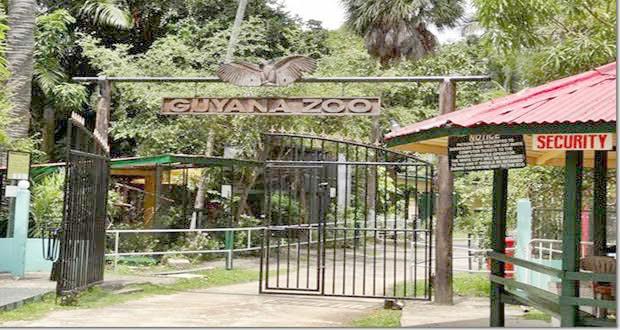
The Guyana Zoological Park has been temporarily closed to the public as preparatory works begin for a major transformation project that will modernise the facility and improve conditions for animals
Vice-President Dr Bharrat Jagdeo engaged children, university students and other stakeholders to gather ideas for the redesign.
During those consultations, Jagdeo said the project aims to create a modern educational and recreational space that reflects Guyana’s rich natural heritage while expanding green spaces and providing a safe, family-friendly environment.
Plans unveiled during the consultations included interactive exhibits, indigenous-inspired designs, ecosystem replicas, a hop-on-hop-off electric transport system, and the preservation of rare and endangered plant species. The redesigned Botanical Gardens are also expected to feature specialised sections for medicinal plants, native fruit trees and ornamental flora, with
upgraded pathways to support guided tours.
Funding for the initiative was bolstered last year when the National Assembly approved a $2.8 billion budget for the National Parks Commission under the Office of the President, paving the way for the long-awaited transformation of one of Georgetown’s most recognisable landmarks.
PRESIDENT Dr Irfaan Ali has ordered the commencement of the process to appoint new members to three key constitutional commissions, whose threeyear terms recently expired, Attorney General and Minister of Legal Affairs Anil Nandlall, SC, has announced.
At the same time, Nandlall rejected claims that the Government controls the country’s constitutional commissions and the judiciary, insisting that the bodies operate independently under the Constitution of Guyana. He also accused some commentators of spreading misinformation about the country’s constitutional framework.
During a recent edition of his weekly programme Issues in the News, Nandlall said the terms of the Judicial Service Commission (JSC), Public Service Commission (PSC) and Police Service Commission (PolSC) expired on July 13. As a result, President Dr Irfaan Ali directed that the constitutional process begins for the appointment of new commissions.
The PSC is responsible for appointments, promotions and disciplinary matters involving public servants, while the PolSC oversees similar matters for police officers from the rank of inspector and above, excluding the Commissioner of Police.
Meanwhile, the JSC is responsible for the appointment and discipline of judges, magistrates and Commissioners of Title, except for the Chancellor of the Judiciary and the Chief Justice, whose appointments are governed by separate constitutional provisions.
He explained that while some existing members could ultimately be selected again, the Constitution requires the establishment of entirely new commissions every three years.
Nandlall explained: “The
life of a commission lasts for three years as provided for by the Constitution. When those three years finish, or when that time expires, a new commission is appointed.”
According to the Attorney General, the appointment process is governed by the Constitution and involves the participation of the President, the Leader of the Opposition, the National Assembly and representative organisations, depending on the commission concerned.
He said these constitutional arrangements ensure that appointments, promotions and disciplinary matters involving public servants, senior police officers, judges and magistrates remain insulated from political interference.
During the programme, Nandlall said the Public Service Commission, Police Service Commission and Judicial Service Commission are independent constitutional bodies with clearly defined responsibilities and that the Executive has no authority to direct how they carry out their functions.
He argued that many members of the public mistakenly blame the Government for decisions that are constitutionally vested in those commissions.
Against this backdrop, Nandlall dismissed claims
that the Government exercises control over every arm of the State.
“When they say that we don’t have a democracy in this country and the government controls everything, it’s absolute untruth and crass ignorance,” he declared.
The Attorney General also sought to explain how each commission is constituted.
Using the Police Service Commission as an example, he said several members are nominated through the National Assembly following consultations with organisations representing police officers, while the chairman is appointed by the President after meaningful consultation with the Leader of the Opposition.
Nandlall clarified that the constitutional requirement for “meaningful consultation” does not amount to obtaining the Opposition Leader’s agreement but rather requires genuine engagement before appointments are made where the Constitution so provides.
He also outlined the composition of the Judicial Service Commission. According to him, the Chancellor of the Judiciary, the Chief Justice and the Chairman of the Public Service Commission serve as ex officio members. The remaining members are appointed through constitutional mechanisms involving the President and the National Assembly after consultation with representatives of the legal profession.
Nandlall maintained that Guyana’s constitutional arrangements provide stronger safeguards for institutional independence than many other jurisdictions within the Commonwealth.
“I’ve said repeatedly that our Constitution is more democratic and more advanced than most constitutions in the Commonwealth, including the Common -
wealth Caribbean,” he said.
He challenged critics to compare Guyana’s constitutional provisions with those of other Caribbean countries, arguing that Parliament and other independent stakeholders play a significant role in the appointment of members to the commissions.
The Attorney General said he devoted a significant portion of his programme to explaining the constitutional framework because of what he described as persistent misinformation surrounding the country’s legal and political systems.
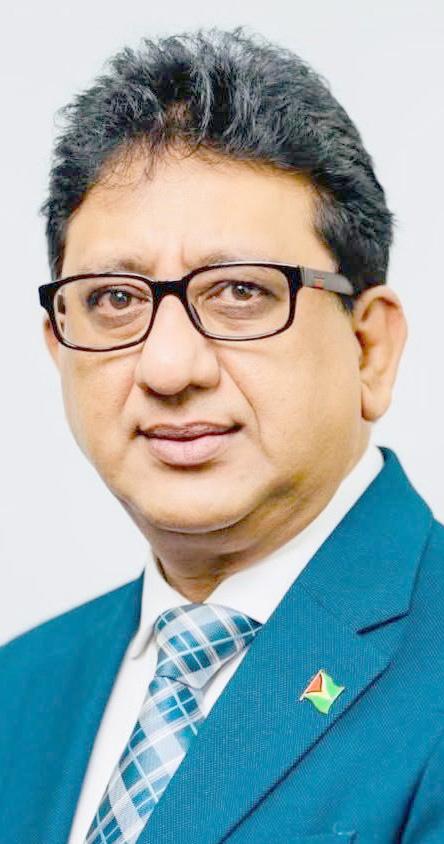
“I see the level of misinformation and erroneous information being peddled in the public domain about our legal system, about our constitutional structure, about our political system,” he said.
Without identifying anyone by name, Nandlall criticised some academics and commentators, contending that despite their professional credentials, they continue to make inaccurate statements about Guyana’s Constitution, the separation of powers and the operation of constitutional commissions.
He warned that such misinformation could mislead the public and erode confidence in democratic institutions, stressing that public discourse should instead be guided by an accurate understanding of the Constitution and the distinct roles assigned to the Executive and independent constitutional bodies.

THE lack of victim co-operation remains the biggest challenge facing the Office of the Director of Public Prosecutions (DPP) in prosecuting sexual offence matters, even as the agency continues its
nation-wide outreach and sensitisation efforts aimed at increasing awareness, encouraging reporting and helping communities better understand these crimes.
This is according to DPP
Communications Officer Liz Rahaman, who said earlier this week that while reports of sexual offences have been increasing across the country, largely as a result of greater awareness, gaining the co-op-

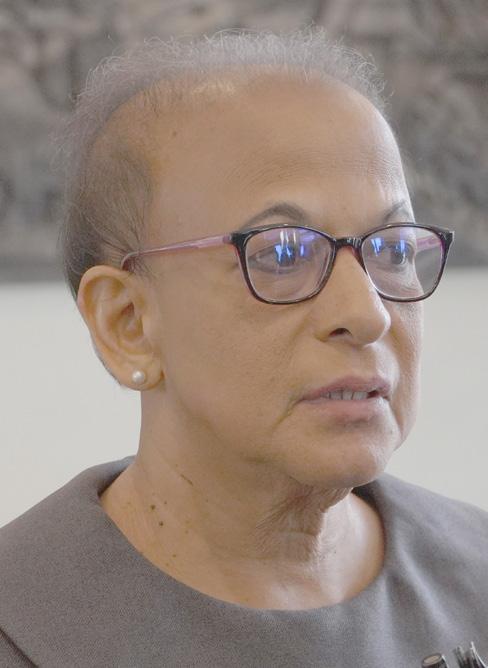
eration of victims remains the critical hurdle to successfully bringing cases before the courts.
Speaking to the media on the sidelines of a recent event, Rahaman explained that because sexual offences are typically committed in private and without witnesses, a victim’s willingness to give evidence is often the deciding factor in whether a matter can proceed to prosecution.
“The DPP faces challenges, a lot of challenges, in prosecuting sexual offences, particularly in getting victims themselves to come forward and give evidence,” she said.
She added, “When sexual

offences are committed, they are committed in private, they are committed in the dark, they are committed outside of extraneous witnesses. So, if that victim does not wish to proceed with the matter, it places the DPP in a very difficult position, and that is the main challenge which the DPP faces.”
Rahaman also addressed questions about a recent report on the number of teenage pregnancies referred to the Childcare and Protection Agency (CPA), and why a comparable number of sexual offence cases have not reached the courts.
She said this, too, comes down to victims’ reluctance to make police reports. However, Rahaman noted that the chambers’ outreach programmes are aimed at closing that gap by educating communities on the importance of reporting abuse and co-operating with investigators.
“During our outreaches, we have spoken to them about the importance of coming forward and reporting it,” she said.
The DPP’s public-education programme has been running since 2013 with officers travelling across Guyana’s 10 administrative regions to engage communities on sexual offences, domestic violence and child protection.
Rahaman said the programme has placed particular focus on hinterland communities, where access to information and legal resources can often be more limited.
“The DPP’s Chambers, from 2013 to now, has been continuously conducting outreaches across the 10 administrative regions of Guyana,” she said.
She highlighted that the chambers has conducted engagements across several hinterland areas, including communities in Regions One and Nine.
“We have focused on the hinterland communities—Region One, Baramita, Sub-Region Moruca, Mabaruma and Region Nine—because Region Nine has vast territories and we have to ensure we cover them all,” she said.
Rahaman further noted that representatives from the DPP recently participated in the South Rupununi Women’s Conference in Aishalton as part of the chambers’ continued efforts to engage Indigenous communities on sexual offences and domestic violence.
She explained that the outreach programme is designed not only to inform residents about the law, but also to help individuals recognise abusive behaviour and understand when an offence has been
committed.
“The aim and objective is educating our people, our Indigenous communities, on sexual offences and domestic violence,” Rahaman said.
She continued: “The only way we can ensure that they become more aware is if we continue our public-education programme. It is aimed at sensitising them to what the elements of sexual offences are.”
She noted that the programme’s focus has expanded beyond girls, as boys are increasingly affected as well.
“Sexual offences are not only being committed against our girl children anymore; they are also being committed against our boy children across the world,” she said.
Rahaman stressed that abuse can occur in the very environments where children are expected to be safest, including within homes, schools and churches, often at the hands of trusted individuals.
“Whether that crime is being committed within their own homes, by their mother, father, family members or people close to them, people who are in positions of trust, our schoolchildren, they go to school, our church leaders, whomever we place our children in the care of, our children must know, our parents must know what can happen,” she said.
Despite the challenges surrounding victim co-operation, Rahaman said the DPP has seen encouraging results from its outreach efforts, with more sexual offence matters being reported to the Guyana Police Force and subsequently referred to the chambers.
Highlighting this trend, she added: “Over the recent years, we have had numerous police files sent to the DPP’s office involving sexual offences that are being reported more and more to the Guyana Police Force across all the regions.”
Rahaman credited the increase in reporting to growing awareness within communities about the importance of seeking help, calling it a direct result of the chambers’ continued efforts.
“We can safely say it is as a result of our public education programme that we continue to sensitise our people. They have become more aware of the importance of going to the Guyana Police Force and reporting these crimes,” she said.
For Rahaman and the DPP’s Chambers, the increase in reports shows that more Guyanese are learning to recognise abuse and are more willing to report it, even as turning that awareness into convictions remains a challenge.
THE People’s Progressive Party (PPP) has honoured the memories of Michael Forde and the Ballot Box Martyrs during separate commemorative ceremonies held this week, paying tribute to individuals the party says made the ultimate sacrifice in defence of democracy and the party’s ideals.
On Friday, party mem-
The party said Forde’s actions saved the lives of several PPP leaders who were inside the building at the time.
Tributes were delivered by Minister of Local Government and Regional Development Sonia Parag, PPP General Secretary Bharrat Jagdeo’s representative Neil Kumar, President of the Guyana Agricultural and General
people who stood up for what they believed in,” the party said in a statement posted on its Facebook page.
In recognition of his sacrifice, the Progressive Bookshop was renamed in his honour.
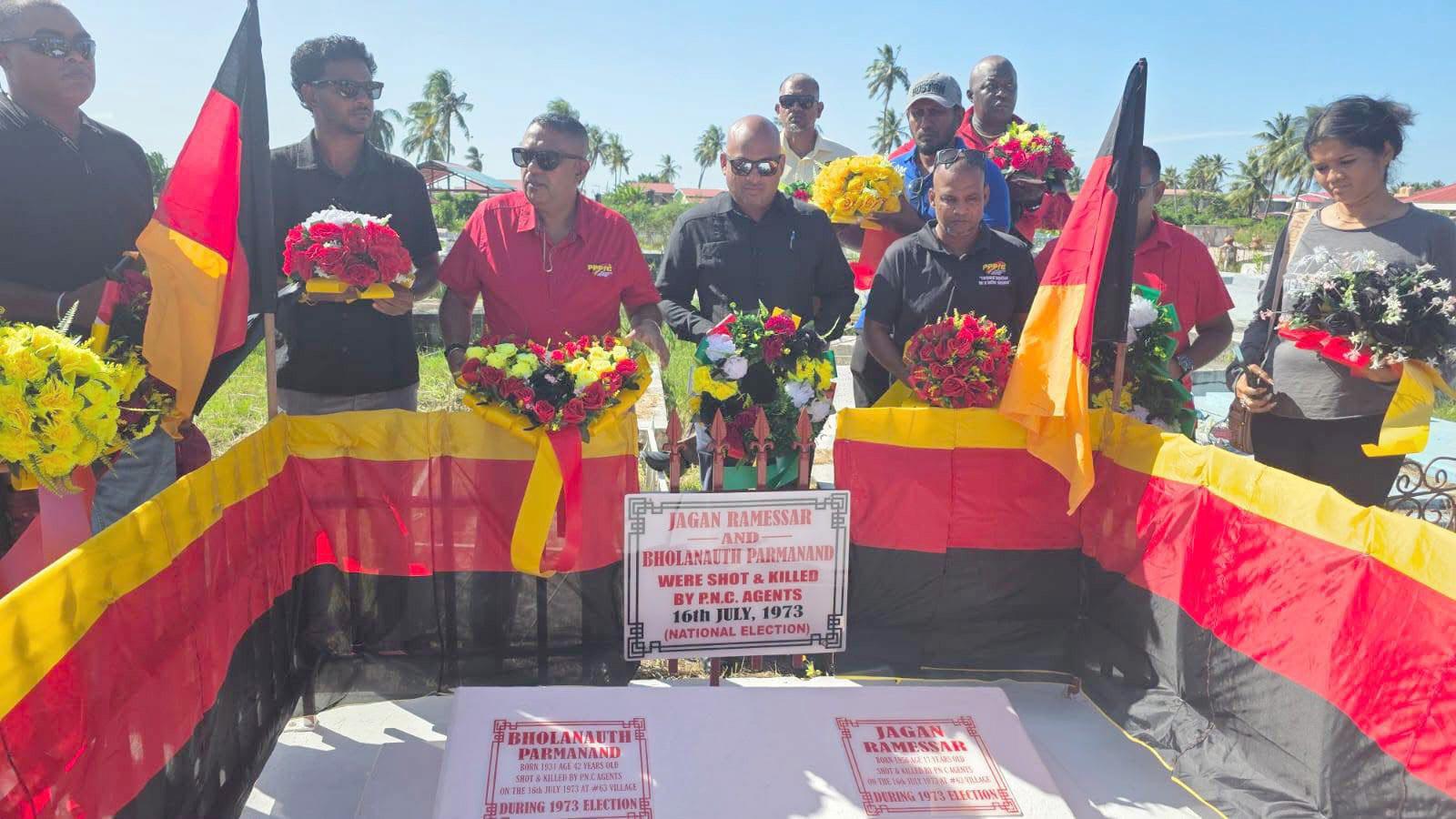
A day earlier, on Thursday, the PPP held a remembrance service at the burial site of the Ballot Box Martyrs in Number
bers, officials and supporters gathered for a wreath-laying ceremony to mark the 62nd anniversary of the death of Michael Forde, who died on July 17, 1964.
According to the PPP, Forde lost his life while attempting to remove a bomb allegedly planted by a People’s National Congress (PNC) agent at the Freedom House bookstore on Robb Street.
Workers’ Union (GAWU) Seepaul Narine, and other party officials.
The PPP noted that Forde was only 22 years old when he made the decision to intervene.
“Michael was not just a worker at the bookshop; he was also an active member of the Progressive Youth Organisation (PYO). His actions on that day reflect the commitment and courage of many young
66 Village, Corentyne, to mark the 53rd anniversary of the deaths of Jagan Ramessar and Bholanauth Parmanand.
The party recalled that on Election Day, July 16, 1973, Ramessar and Parmanand were among a crowd gathered outside a polling station at Number 63 Village, Corentyne, protesting the removal of ballot boxes from the polling
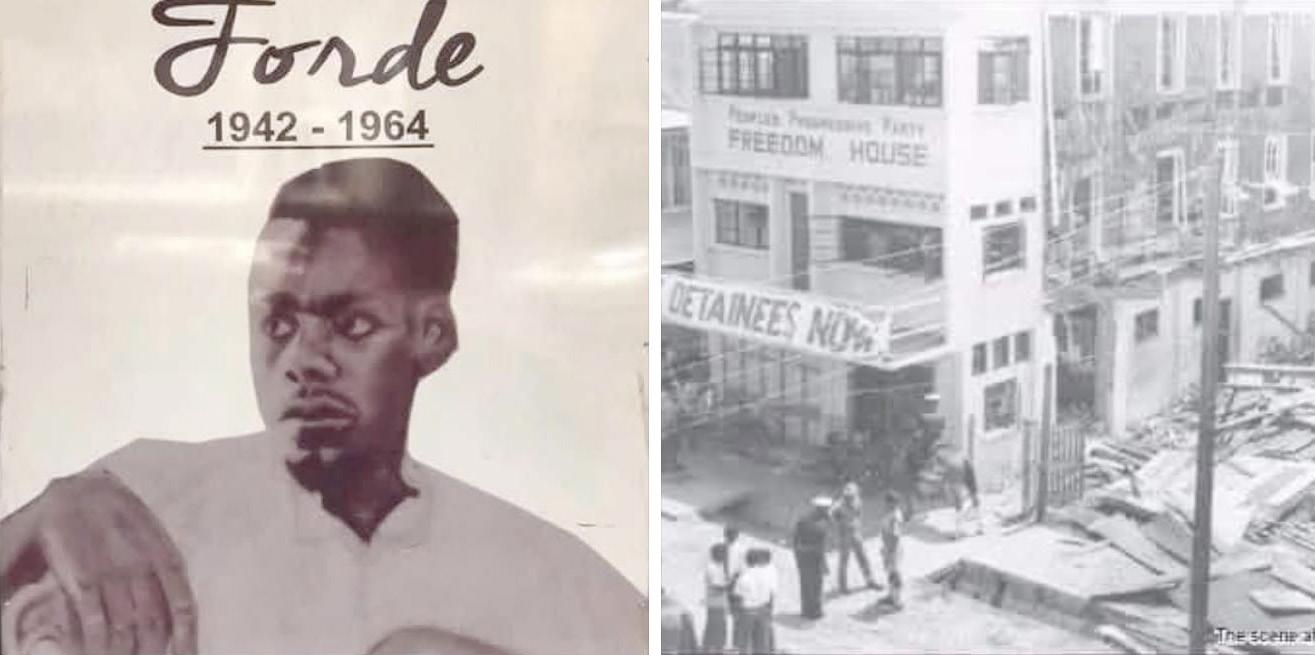
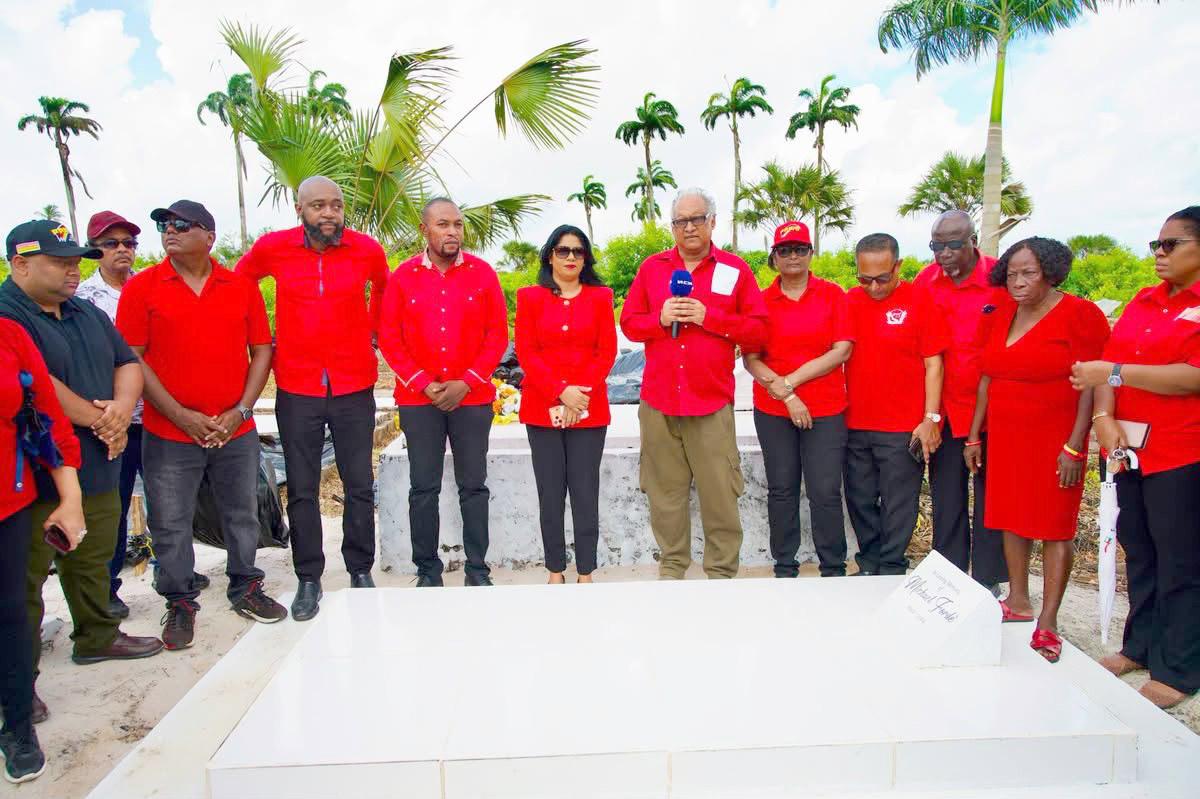
On Friday, party members, officials and supporters gathered for a wreath-laying ceremony to mark the 62nd anniversary of the death of Michael Forde, who died on July 17, 1964
place at the close of voting.
According to the PPP, the protesters demanded that ballots be counted at the place of poll before being transported elsewhere. During the protest, Ramessar and Parmanand were shot and killed by members of the Guyana Defence Force.
A 47-year-old vendor is in police custody after ranks allegedly recovered 30 grams of suspected cannabis during an intelligence-led operation at Castello Housing Scheme, Georgetown.
Police said the operation was conducted at about 15:45 hrs on Friday, July 17.
According to a police release, ranks observed the suspect throwing a bulky black plastic bag over a fence as they ap-
proached the property.
The bag was retrieved and searched in the suspect’s presence, during which a quantity of leaves, seeds and stems suspected to be cannabis was found.
The suspect and the suspected narcotics were
taken to the East La Penitence Police Station, where the substance was weighed in his presence and amounted to 30 grams before being lodged.
The suspect remains in police custody as investigations continue.
The annual observances, the Party said, serve as a reminder of those who lost their lives during pivotal moments in Guyana’s political history, and reaffirm its commitment to preserving their legacy.
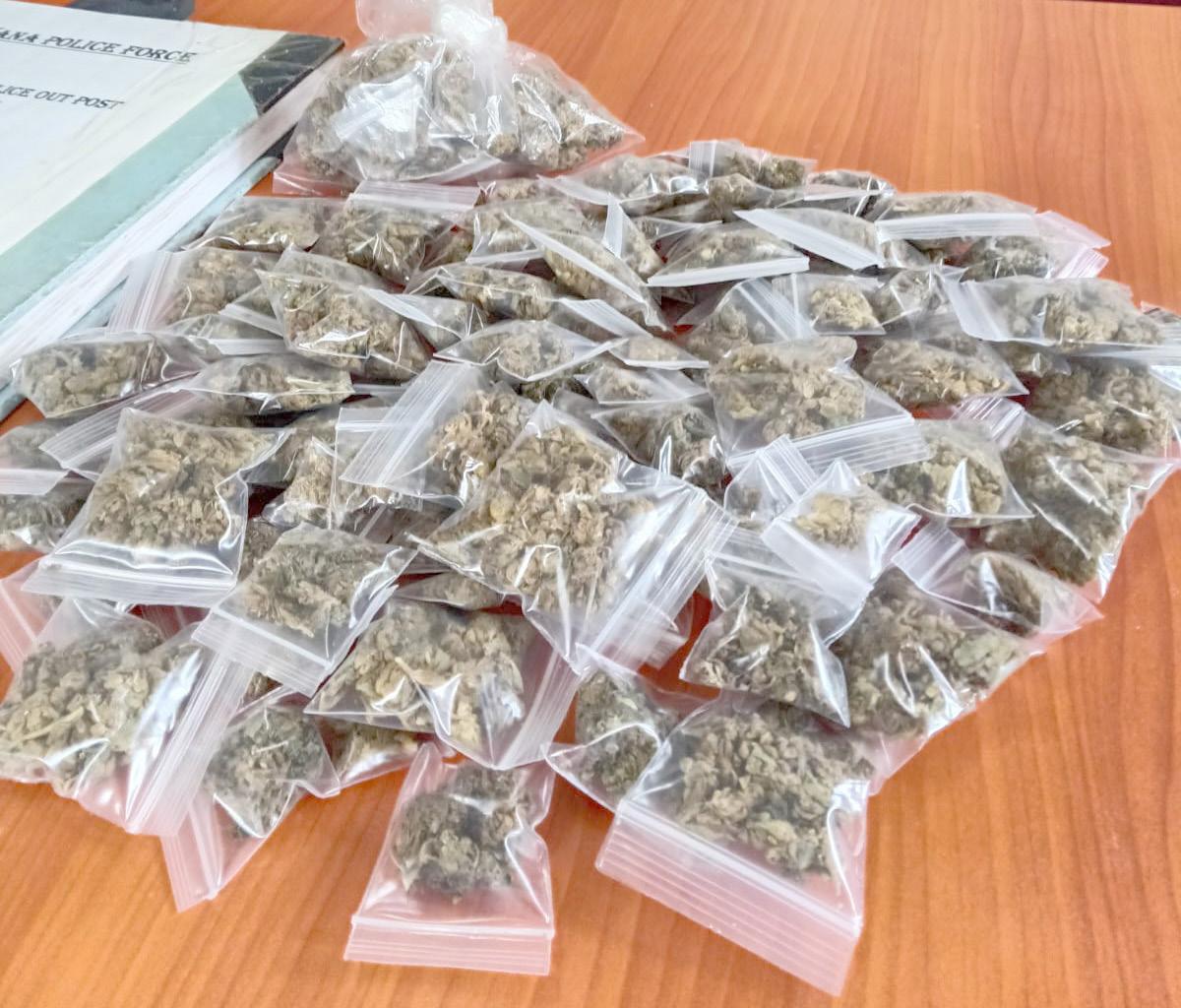
Police recovered 30 grams of suspected cannabis during an intelligence-led operation at Castello Housing Scheme, Georgetown
THE Ministry of Human Services and Social Security (MHSS) has begun providing trauma-focused counselling for the 33 children who were safely evacuated following a fire at the privately owned Hope Children’s Home at Enmore, East Coast Demerara.
Minister of Human Services and Social Security, Dr Vindhya Persaud, on Friday said the children were relocated to state-care facilities following the incident and that the ministry has already started engaging them and their caregivers to provide the necessary support following the traumatic experience.
The minister said the first
session of trauma-focused counselling has started as part of the ministry’s response, noting that incidents such as fires can have lasting emotional effects on children.
“There was a bible class happening and all the children were evacuated. At present, we have housed them in our state care. I have already engaged the children and also the caregivers and we are working with them to make sure that they are comfortable, they’re safe,” she further added, “We are starting the first session of trauma-focused counselling because it was a fire and every fire brings with it trauma.”
The fire occurred on Fri-
day at the children’s home, where all 33 children, comprising 15 girls and 18 boys, were safely evacuated.
At the time of the incident, the children were attending Vacation Bible School in the church building located on the compound when the blaze reportedly started in the boys’ dormitory.
Following the evacuation, the children were moved to a safe area before arrangements were made for them to be relocated to state-care facilities, where they continue to receive care and protection.
Dr Persaud said while all children were accounted for,
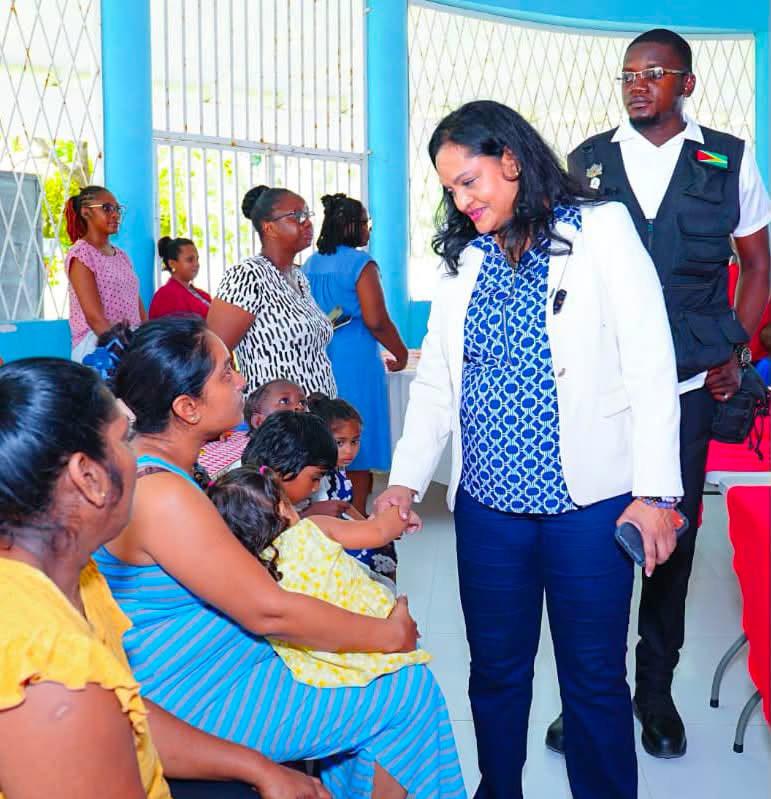

Minister of Human Services and Social Security, Dr Vindhya Persaud, interacts with the victims during her visit to scene following the fire at the Hope Children’s Home on Friday (Ministry of Human Service and Social Security photo)
two children were admitted to the Enmore Regional Hospital for observation due to concerns arising from the incident.
“However, there were two children who were admitted to the Enmore Hospital for observation. One child is very traumatised by the whole incident and it is out of abundant caution and possible risk of smoke inhalation that that child is there,” she explained, adding, “The second child, as he was leaving the facility, he fell and he may have some injury to his shoulder,” she said.
The minister said both children are being monitored by medical personnel, with further evaluations being conducted to determine their condition.
Dr Persaud also confirmed that a staff member from the children’s home was admitted to the hospital for minor injuries sustained during the incident.
The response to the fire involved several agencies, including the Guyana Fire Service, the Childcare and Protection Agency (CPA), and other officials from the Ministry of Human Services and Social Security. Dr Persaud said the government’s priority remains ensuring that every child affected by the incident receives the necessary care, protection and support while the situation continues to be monitored.
“We are just making sure that everybody is safe as they are and that we are here with everyone,” she said.
“We are waiting on the doctors to have a thorough medical evaluation and to also check him for smoke inhalation. So, both children are being monitored at the Enmore Hospital, but so far all the children are safe and accounted for,” she said.

business owners, religious leaders and other stakeholders, on Friday, engaged officials from the Ministry of Public Works on the proposed four-lane highway for the Mahaicony corridor, with discussions on the project’s design, environmental impacts, drainage, and property concerns.
projected lifespan of 20 years and will be divided into three construction lots. Initial works will focus on Lots One and Two, which will involve the rehabilitation of the existing roadway.
The upgraded highway will feature widened carriageways separated by a median, street lighting,
residents will continue to be kept informed throughout the process.
While welcoming the proposed development, stakeholders raised several concerns, including the possible acquisition of private lands, the impact on drainage infrastructure, and the preservation of historic railway bridges
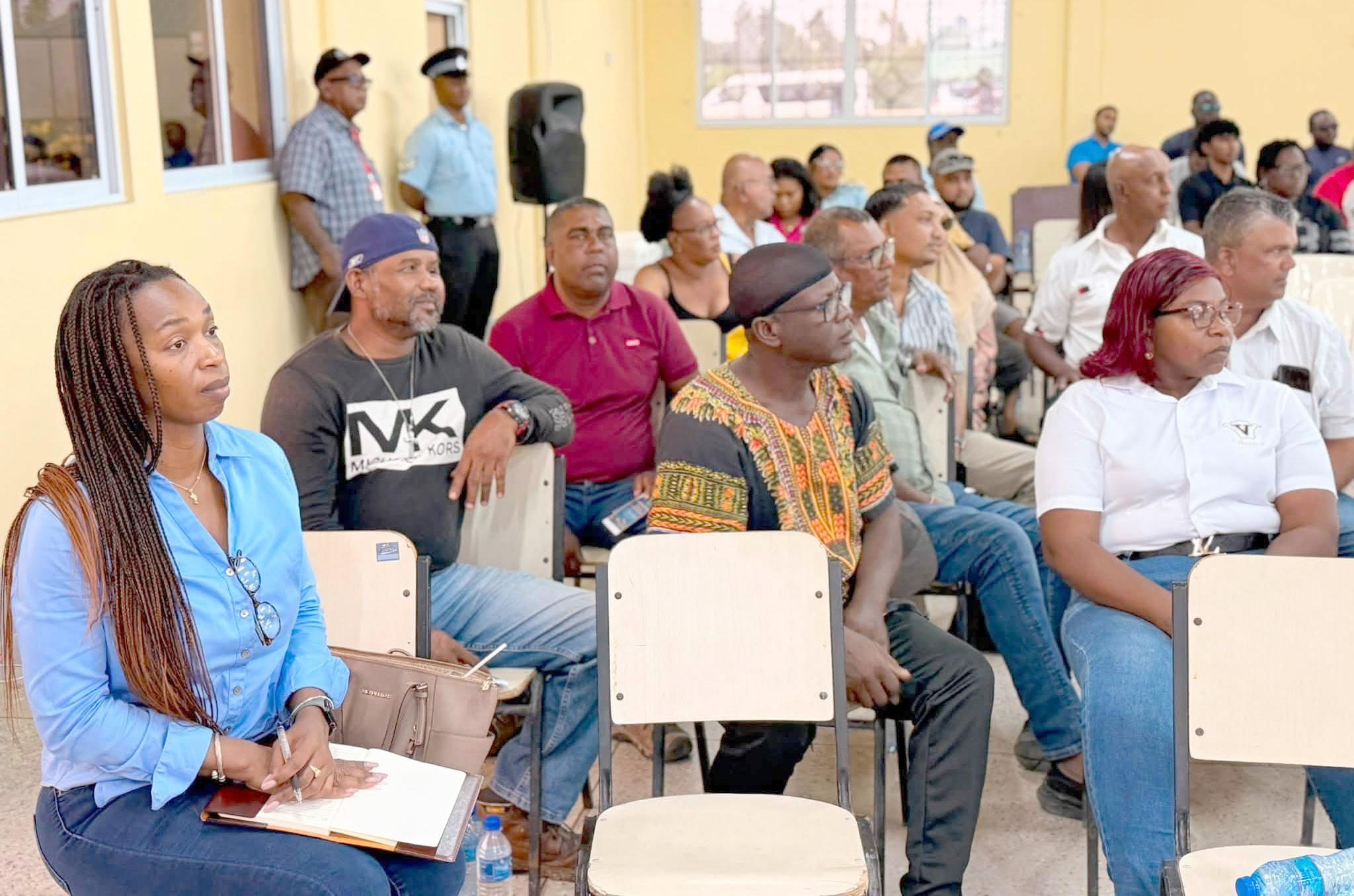
The stakeholder consultation, held at the Mahaicony Technical and Vocational Training Centre, was led by Minister of Public Works, Bishop Juan Edghill and formed part of the government’s ongoing engagement process ahead of the commencement of works.
During the meeting, officials outlined the scope of the project, its proposed design, environmental and social considerations, and the mechanisms that will be in place for addressing grievances throughout implementation.
According to the ministry, the new highway is being designed with a
raised pedestrian crossings, rumble strips, improved junctions, pedestrian crossing signs and designated crossings for livestock.
Minister Edghill told stakeholders that the current round of consultations is intended to familiarise residents with the government’s plans before a contractor is selected.
He explained that once a contractor has been engaged, additional consultations will be held to present detailed traffic management plans and construction schedules.
“The operational aspects will arise once that engagement occurs,” the ministry said, noting that
regarded as monuments and artefacts.
Responding to those concerns, the project’s consultant said options would be explored to preserve the railway structures, stressing that the bridges would not simply be discarded.
On the issue of drainage, Minister Edghill assured residents that any interventions would be subject to approval by the hydrologic engineer at the National Drainage and Irrigation Authority (NDIA).
He noted that similar concerns have arisen during major infrastructural projects elsewhere in the country and have been

successfully resolved.
“So, while there must be some inconvenience, it is for the long-term good and it will definitely help with the development of your region,” Edghill told the gathering.
Addressing concerns about private property, the minister assured residents that no one would be unfairly treated if land acquisition became necessary.
“If for any reason, in order to get this road completed, we have to use anyone’s private property, you will not be disadvantaged. The Constitution provides that you are given fair market compensation,” he said.
The proposed highway forms part of the government’s wider transport infrastructural programme aimed at expanding and modernising the national road network.
According to the ministry, the project is expected to improve connectivity, reduce travel times, strengthen
economic corridors and support long-term development across Region Five and surrounding communities.




GEORGETOWN, Guyana, (CMC)
– The Caribbean Community (CARICOM) has described former West Indies cricketer Sir Garfield Sobers as a brilliant and humble man.
In a statement issued by CARICOM following Sir Garry’s passing at the age of 89 on Friday in his homeland of Barbados, the regional body said he was a giant both on and off the field.
“A son of the Caribbean, Sir Garfield embodied the excellence and resilience that define our community. His brilliance on the field, and his humility and graciousness beyond it, transcended the boundaries of cricket and earned him global recognition and admiration,” the statement read.
“In acknowledgment of his remarkable talent and impact he was deserv-
“The Caribbean Community (CARICOM) joins the Government and people of Barbados and the global cricket fraternity in mourning the passing of cricket legend, Sir Garfield Sobers.
edly conferred with CARICOM’s highest honour, the Order of the Caribbean Community (OCC) in 1998.
“His legacy lives on in the generations he has inspired to pursue excellence and represent the Caribbean with distinction.
“CARICOM extends deepest condolences to the Government and people of Barbados, his loved ones, cricket aficionados across the Region and the world, and all who mourn his passing,” it further added.
BASSETERRE, St. Kitts, (CMC)
In a stunning and abrupt reversal, St. Kitts and Nevis has officially withdrawn its bid to host the 2027 CARIFTA Games, dashing the hopes of a nation that had eagerly awaited the return of the region’s premier junior athletics championships.
After months of public speculation and initial governmental interest, the decision to step aside was confirmed on Wednesday by Minister of Sports Samal Duggins.
Following high-level discussions with the St. Kitts-Nevis Athletics Association and the St. Kitts and Nevis Olympic Committee, the administra-
tion concluded that next year is simply “not the most ideal time” for the Federation to take on the prestigious event.
“We believe that, along with the different institutions, particularly the Olympic Committee, that next year would not be the most ideal time for us to host it,” Duggins stated. He added that the Federation has requested a deferment of its interest to a later, undisclosed date, offering little solace to a local sporting community now grappling with profound disappointment.
The withdrawal marks a dramatic end to what was already a turbulent bidding process. During the 2026 CARIFTA Games in Grenada, St. Kitts and Nevis and Trinidad and Tobago
emerged as the sole candidates after no formal bids were submitted ahead of the NACAC Congress.
Both nations were subsequently asked to provide robust government or sponsor guarantees, a requirement stiffened by NACAC President Mike Sands to prevent athletics associations from facing major financial shortfalls.
Those requirements carried particular weight for St. Kitts and Nevis, which previously hosted the Games in 2008 and 2015.
The 2015 staging was notoriously followed by financial difficulties, prompting NACAC to demand far stricter safeguards from potential hosts this time around.
MIAMI GARDENS, Fla.
-- Bukayo Saka’s hat trick helped England survive a dramatic second-half comeback to beat France 6-4 in Saturday’s chaotic third-place playoff and secure their best finish at a World Cup since 1966.
England were up 4-0 at the break in Miami as a shambolic France side was dismantled through goals from Declan Rice and Ezri Konsa and two Saka strikes.
Both teams made seven changes following their semifinal defeats, but in his final match in charge
after 14 years at the helm, France’s Didier Deschamps introduced four substitutes at halftime including Ousmane Dembélé and Bradley Barcola in an attempt to trigger a response. It began just three minutes after the restart. Michael Olise found Kylian Mbappé in space and his first-time left-foot finish beat Dean Henderson Six minutes later, Mbappé turned provider, sending Barcola clear to finish inside Henderson’s near post before Mbappé finished another France move to score his 10th goal
of the tournament and move him back ahead of Lionel Messi as the men’s all-time World Cup goalscorer on 22 goals.
Olise -- whose seven assists in a single World Cup campaign is another record -- missed a glorious chance to equalize, somehow sidefooting wide from 12 yards out, before England finally steadied themselves.
Djed Spence burst into the box on the overlap and was brought down by Malo Gusto. Saka converted the 87th-minute penalty to become only the fourth men’s player to score a World Cup
hat trick for England.
There was still time for France to respond again as Dembélé cut in on his left foot to finish but substitute Jude Bellingham had the final say, driving into the box before finishing from close range to secure a memorable win.
Bellingham’s late strike made him the first Englishman to score seven goals in a single World Cup campaign.
The 10 goals were the most scored in a World Cup match since Hungary beat El Salvador 10-1 in 1982.
“THERE are moments in the story of a people when the life of one individual becomes woven into the hopes, dreams, and identity of generations.
“Today, the Caribbean mourns the passing of such an individual, The Right Excellent Sir Garfield Sobers NH, AO, OCC, a son of Barbados whose extraordinary journey became part of the story of our region and whose brilliance carried the name of the West Indies with distinction across the world.
“In the story of cricket, there are great players. There are champions. Then, there are those rare individuals who redefine the very meaning of greatness. Sir Garfield Sobers was the greatest cricketer the world has ever seen. His mastery of batting, bowling and fielding was unparalleled, but his true significance reached far beyond the boundary ropes.
“He emerged from the Caribbean at a time when our region was finding its voice and asserting its place on the world stage. Through his excellence, he gave millions across our islands and in the diaspora, a renewed belief in what was possible. He showed that greatness was not confined by the size of our nations, the geography of our islands or the circumstances of our beginnings.
“Sir Garfield Sobers became more than a sporting icon. He became a symbol of Caribbean excellence, resilience, and possibility. His achievements brought pride to Barbados, inspiration to the West Indies and admiration from every corner of the cricketing world.
“As a young cricketer, I was fortunate to benefit from Sir Garfield Sobers’ contribution through the Sir Garfield Sobers International Under-19 Cricket Tournament. I remain grateful not only for that opportunity, but for the encouragement, wisdom and support he personally shared with me over the years. His kindness and influence will forever remain a treasured part of my journey.
“Sir Garfield Sobers has completed his final innings, but his legacy will forever endure in the hearts of our region, and the story of the cricketing world.
“On behalf of Cricket West Indies, I offer our heartfelt condolences to his family, the Government and people of Barbados and all those across the world who mourn his passing.” (CWI)
(Sunday, July 19, 2026)
(1) Which WI bowler had the best figures in the first ODI of the current WI/NZ series? (2) Which NZ batsman had the best score in the same game? Answers in tomorrow’s issue
ANDY Flower has confirmed that he is not in contention for the England Men’s Test head coach position. Brendon McCullum was recently relieved from the role weeks after Ben Stokes announced his international retirement.
Speaking at the media day as London Spirit Men’s head coach, Flower was asked if he had ruled himself out. “I have, yes,” he said. Flower said it would “not

ENGLISH
RACING TIPS
NEWTON ABBOT
09:30 hrs High Aura
10:15 hrs Diamond White
10:40 hrs Watchoutitscookie
11:15 hrs Makinbecon
1150 hrs Jager Time
12:22 hrs No More No REDCAR
08:53 hrs Hey Up Ronnie
09:23 hrs Derry Garran
09:58 hrs Stitching Wheel
10:33 hrs Amidst The Chaos
11:08 hrs Be Patient
11:43 hrs Baldosa
12:17 hrs Offspin
STRATFORD
08:45 hrs Adelak
09:15 hrs Duel Au Soleil
09:48 hrs Stellarmasterpiece
10:23 hrs Charging Thunder
10:58 hrs Centara
11:33 hrs Artiste D’ainay
12:08 hrs Lucy The Wire
SOUTH AFRICA
RACING TIPS
SCOTTSVILLE
08:15 hrs De Vlugge
08:50 hrs Lylac In Winter
09:25 hrs Wiccan Warrior
10:00 hrs Flamethrower
10:35 hrs Fleur De Ling
IRISH RACING TIPS
CURRAGH
08:40 hrs Abletai
09:10 hrs Star Performar
09:40 hrs Ibelieveicanfly
10:15 hrs Mallavelly
11:25 hrs Al Riffa
12:00 hrs Lars Soldier
12:30 hrs Abbotsford
be possible” for him to serve as the head coach of reigning IPL champions Royal Challengers Bengaluru as well as the England Men’s cricket team.
“For me, personally, I don’t think I could have both, especially with the IPL being held in the first couple of months of the English summer,” he said.
“If I was [sic] England Test coach, I would like to be here, watching and interacting with the people I need to watch and interact with. For me that wasn’t a possibility.”
Flower admitted he’s been in touch with the ECB (England & Wales Cricket Board) but is “very happy” with the work he’s doing at the moment.
“I have spoken to the ECB, I am aware of the head coach vacancy of the England national team. I have spoken with Rob [Key, managing director of England Men’s cricket] at the ECB on that topic.
“The bottom line for me is I’m very happy in
the work that I’m doing at the moment. I work for a couple of really good organisations, with really good teams around me and I’m really comfortable with what I’m doing at the moment,” he said.
Flower previously served as England Men’s assistant coach in 2007 and later as head coach between 2009 and 2014.
“I’ve worked with England before and I had an amazing time. I had the privilege to be England head coach and represent England a number of years ago and I remember those years really fondly.
“It would be a privilege for me or anyone else to be the Test coach. For me at this time, I’m really comfortable with what I’m doing and I’m going to stick with doing that.”
England next play a Test match on August 19 against Pakistan at Headingley, giving the board just about a month to pick McCullum’s successor. (Cricbuzz)
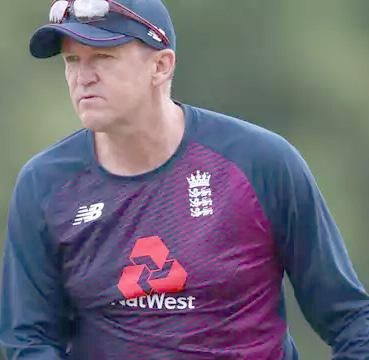

SEVERAL international captains and players have criticised the ICC’s revamped Men’s ODI World Cup format, with Netherlands’ captain Scott Edwards calling it “incredibly disappointing” and arguing that the game should be creating “more opportunities on the global stage, not less”. Scotland’s skipper Richie Berrington urged administrators to “meaningfully” consult players on major decisions.
The reactions came through the World Cricketers’ Association (WCA) after the ICC approved a revamped 2027 ODI World Cup format, introducing a Super Series featuring the three lowest-ranked qualified teams, with only one progressing to the 12-team main stage before the tournament moves into a Super 7 phase.
Edwards said the revised pathway altered the reward for years of planning and investment by Associate nations. “Qualifying for an ODI World Cup is a huge achievement for any country, so when the reality of that opportunity changes after years of planning, it’s incredibly disappointing.
“ The ICC talks a lot about growing the game globally, but decisions like this make it harder for associate nations to play against the best teams in the world. Those opportunities are what helps countries improve and inspires the next generation of players. If we’re serious about making cricket a global sport, we should be creating more opportunities on the global stage, not less.”
Namibia captain Gerhard Erasmus said an ODI World Cup was “our long form” for many Associate players and that qualification should provide “a real opportunity to compete on the biggest stage”.
“For players in many countries, an ODI World Cup isn’t just another tournament, it’s our long form and something careers are built around and generations of players aspire to. We all accept that you have to
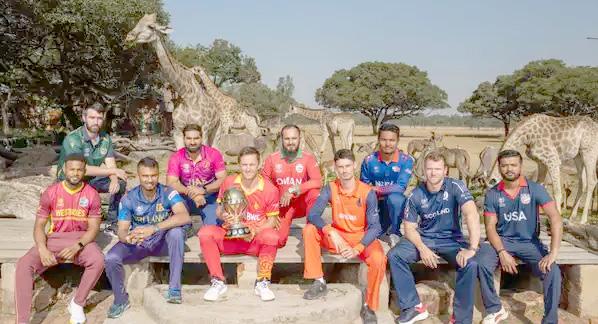
earn the right to be there, but we also want qualification to provide a real opportunity to compete on the biggest stage. This follows a long history of limited opportunity at associate level.”
Ireland captain Paul Stirling said Associate nations had “consistently proven to add value and interest at global events” and pointed to football’s World Cup as an example of how smaller teams can enrich major tournaments. “The smaller and associate countries have consistently proven to add value and interest at global events. The football World Cup we’ve just witnessed is testament to that in other sports and it would be great to see cricket take a similar
approach to maximise opportunities for the game.”
Berrington, meanwhile, said players should be “meaningfully consulted” on decisions that have a significant impact on the game and on their careers. “Players don’t expect to make every decision, but we should be meaningfully consulted on decisions that have significant impacts on the game and on players’ careers. Better decisions are made when different perspectives are brought to the table, and we’re urging the game to start doing that properly.”
USA’s Harmeet Singh said World Cup opportunities meant a great deal not only for players but also for “growing the game in emerging countries”, adding: “Coun-
tries, and players invest years preparing for opportunities like an ODI World Cup. Those opportunities mean a lot, not just for the players involved but for growing the game in emerging countries and for the fans who invest in the game. That’s why decisions like these matter well beyond one tournament.”
New Zealand batter Daryl Mitchell also backed “consistent and fair opportunities” for teams around the world, saying: “We are fully supportive of players and countries around the world being provided with consistent and fair opportunities to reach and compete on the game’s biggest platforms.” (Cricbuzz)
LONDON, England, (CMC) – Julien Alfred beat Olympic 200m champion Gabby Thomas for the second time in a week on her way to setting a new meet record at the London Diamond League here on Friday.
The reigning Saint Lucian Olympic 100m champ blazed across the finish line in 21.66 seconds, relegating the American to second in 21.81 seconds, while Shaunae Miller-Uibo of the Bahamas claimed the third spot in 22.24.
Alfred’s time broke her own meet record
of 21.71 seconds, which she set at the event last year.
“I am happy I won one [a race] again. I am healthy, so I couldn’t be happier. Right now, I am in a good place mentally and physically,” Alfred said after the race.
“I’m not going to lie, I didn’t want to run today, but my coach was like, ‘It is our last race for a while, we can go home and get to Saint Lucia, too’.
I am here, I did it and I won, so I am very happy with how it went today.”

“I WAS indeed happy when I read a few months ago of plans as announced by the Minister of Sport Charles Ramson (Jnr) that the Government of Guyana has plans for an upgraded cricket facility at Anna Regina, and I imagine then that it will be a facility where the Guyana and West Indies Boards can use it as a first-class ground.
“When I saw the pictures and videos of the recent opening, and after listening to an interview done by [former] WI batting star Shivnarine Chanderpaul, it was clear that Essequibo, the county of my birth now possess an international standard facility with all the facilities for players, officials, spectators and the media.
“It was not possible for me to be at Anna Regina for the historical opening due to some commitments in the Eastern Caribbean, but [I] look forward to being at the venue when matches are played in the 40-over World Cup that Guyana is hosting in the middle of October.
“It would be very remiss of me if I did not pay tribute to Benny Sankar and his late father for establishing our first-class cricket venue at Hampton Court, which played a great role in establishing cricket on the Essequibo Coast and [I] was part of the commentary panel that covered the Guyana vs. Barbados match at the said venue. I do hope that we will be able to see cricket matches played at the Hampton Court ground again.“In attempting to produce this article I had to throw my mind back to a timewhen I was 12 years of age and my late father, John Perreira, would
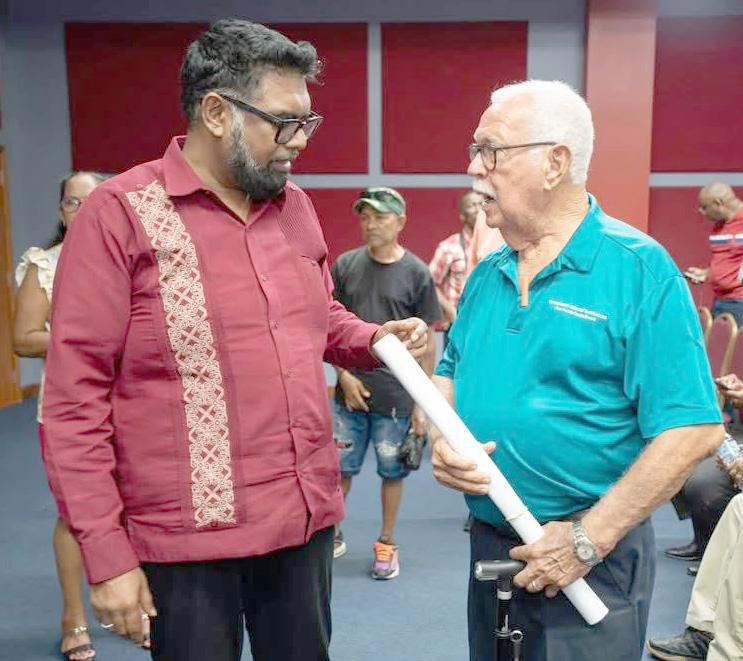
take the family from our Grant, at Now and Ever, to the nearest ground where cricket was played at Martindale, which was part of the
TADEJ Pogacar has extended his overall lead in the Tour de France after another dominant victory on a mountainous stage 14 course, lined by thousands of fans.
The UAE Team Emirates-XRG rider crossed the line 38 seconds ahead of team-mate Isaac del Toro of Mexico, with France’s teenage sensation Paul Seixas of Decathlon CMA-CGM third on the same time on the 155.km stage from Mulhouse.
Pogacar’s main rival for the yellow jersey, Denmark’s Jonas Vingegaard of Visma-Lease a Bike, finished fourth, 44 seconds down.
The leaders - which also included impressive breakaway riders Tobias Halland Johannessen of Uno X Mobilty and Ecuador’s Richard Carapaz of EF Education-Easypost - carved their way through fervent fans who lined the narrow tarmac roads up Le Markstein in the Voges mountains near the German and Swiss borders.
While Vingegaard has come into this three-week race in his best form since his debilitating crash in 2024, it was a chastening day for the man who has twice won the Tour over Pogacar, in 2022 and 2023.
For a while it looked as if Vingegaard would be able to hold on to the wheel of Pogacar after the Slovenian launched his attack with about eight kilometres to gothe 29-year-old Vingegaard having set the pace himself just a few kilometres before.
But Pogacar’s super-high cadence and sustained power was, yet again, far superior to every other rider.
Vingegaard now trails Pogacar by four minutes 30 seconds overall after this and Pogacar’s three other stage wins in this three-week Grand Tour.
Pogacar, 27, is aiming to become the joint-most successful rider in the Tour’s history with five wins, alongside Jacques Anquetil, Eddy Merckx, Bernard Hinault and Miguel Indurain.
“Thanks to all the fans who came to the side of the road,” said Pogacar afterwards. “It was really something unforgettable to see all the crowds on the top of the mountain - I’ve never seen something like this [before].
“All the cyclists and riders... we have massive respect for each otherit’s great to put on this show and nice to see this kind of racing. There is so much crowd that it gives you [an] additional boost.”
Belgium’s Remco Evenepoel of Red Bull-Bora-Hansgrohe keeps hold of third in the general classification, five minutes and four seconds down.
Denmark’s Mads Pedersen of LidlTrek remains in the green points jersey, while the King of the Mountains jersey belongs to Pogacar.
The white young riders classification has now been taken by Seixas, by three seconds over Spain’s Juan Ayuso of Lidl-Trek
This was to ensure an education facility in that area of the river as against having to go all the way to Charity.
“Cricket was played at that time in many areas along the river starting with Charity itself to include Jacklow, Petersgill, Canegater, Santa Rosa at
Moruca and Siriki. Many years later, the ground at Hampton Court became a reality to be followed by a ground built by the Alfonso Brothers at Tennis Farm.
“In the late 1950s there was a visit of the Saint Stanislaus College Cricket team which was one of the highlights of cricket in the Pomeroon. The talented and well-coached team that was encamped at the Martindale School sleeping in hammocks while the residents of the area ensured that they were well fed.
The game at Martindale drew a large group up and down-river, which was followed by a dance at the school with the aid of a gas lamp with music provided by a group with stringed and percussion instruments and songs of the river.
“The following April on my late father’s birthday, I arranged for my father’s schooner, the Joan Patsy, to bring a cricket group of friends and a match was played at Jacklow in front of a large number of spectators from the Charity area and to my father’s delight, my group of friends won by two runs.
“As someone getting involved in the world of cricket, I was able to present the newly built Martindale Primary School with a bag of cricket equipment as a ‘giveback’ to that educational institution.”
PAKISTAN all-rounder
Mohammad Nawaz was handed a three-month ban for breaching the ICC’s Anti-Doping Code after testing positive for a prohibited substance during the men’s T20 World Cup earlier this year, although the sanction has effectively been served following a reduced period of ineligibility.
The ICC said Nawaz tested positive for Carboxy-THC, classified as a Substance of Abuse under its Anti-Doping Code, following Pakistan’s 2026 T20 World Cup fixture against the Netherlands in Colombo on February 7. The 32-year-old admitted the violation and established that the substance had been consumed out of competition and was unrelated to enhancing sporting performance. His period of ineligibility,
backdated to May 1 when he voluntarily accepted a provisional suspension, was reduced from three months to one month after he committed to completing an ICC-approved substance of abuse treatment programme.
Having already spent two and a half months under provisional suspension, Nawaz’s suspension has now been lifted. Subject to successfully completing the treatment programme, he will not be required to serve any further period of ineligibility.
Under the ICC Anti-Doping Code, Nawaz’s individual records from Pakistan’s match against Netherlands on February 7, along with those from any subsequent matches until the commencement of his provisional suspension on May 1, have been disqualified. (Cricbuzz)
claimed their third T20 Blast title after beating Hampshire Hawks in an enthralling Edgbaston final.
After being asked to bat first the Steelbacks survived a monumental collapse, losing their final eight wickets for 31 to post 169, opener Ricardo Vasconcelos providing the backbone with 88.
But they mounted a fine comeback of their own with the ball to prevent Hampshire becoming the first team to win four T20 Blast titles in a nerve-shredding climax which went to the final over.
(Scores: Northamptonshire Steelbacks 169 (19.5 overs): Vasconcelos 88; Baker 5-21
Hampshire Hawks 155 (19.2 overs): Weatherley 75; Sales 3-25)
The Hawks needed 31 to win from the final 20 balls with five wickets in hand but that became 15 to win from the final six balls with just two wickets remaining.
Joe Weatherley was on strike on 75having hit an unbeaten 88 in their semi-final earlier in the day - however he skied Ben Sanderson to Northants skipper David Willey inside the rope at long-on and then Sanderson bowled Sonny Baker from the next ball to secure victory by 14 runs.
The England paceman had earlier become the first bowler to claim five wickets on Finals Day with 5-21 in the first innings.
After producing a fine display with both bat and ball to see-off Notts Outlaws in the last four, James Vince opted to bowl first after winning the toss for the final, despite knowing the Steelbacks had beaten Somerset batting first in the opening semi-final.
Baker claimed the early scalp of dangerman and former Hawk Chris Lynn, the Australian veteran clipping a short delivery to Chris Wood at short fine leg, but the Steelbacks rallied with Vasconcelos and Nathan McSweeney (30) adding a swashbuckling 60 in six overs.
Another 69 followed between Vasconce-

Northants added to their T20 Blast titles from 2013 and 2016.
los and Lewis McManus from the next 7.2 overs with Northants 138-2 with 4.5 overs remaining before McManus holed-out off Scott Currie for 22.
It sparked an almighty collapse as left-handed opener Vasconcelos departed for a career-best 88 from 59 balls, featuring 11 fours and two sixes, falling to a slower-ball from Baker, the first of six wickets to fall in 12 deliveries.
Three of them came in Baker’s final over, leaving him with career-best figures of 5-21 - just three days after his 5-24 in the quarter-final - to become the first player to register a Finals Day five-fer.
James Fuller ended with figures of 7-62 across eight overs on the day as the Steelbacks were dismissed in the final over.
The Steelbacks made the perfect start to the reply as Toby Albert edged the first ball from Willey to the keeper but Vince and Weatherley - who had combined for a stand
of 126 in the semi-final - steadied the ship with 40 before Vince skied one off James Sales to Vasconcelos to depart for 17.
Weatherley remained to surpass Luke Wright’s 2018 record of 125 for the most runs on a single Finals Day but lost Ben Mayes (9) before dangerman Tristan Stubbs (2) was bowled by a peach from leg-spinner Calvin Harrison five balls later and, despite Hilton Cartwright hitting 11 from four balls, he was yorked by Sales to leave the Hawks up against it with eight overs remaining.
Sales registered figures of 3-25 to make it 4-41 across eight overs on the day and 25 wickets in the competition.
Weatherley posted his second half-century of the day and had Liam Dawson in support but 74 were required from the final seven overs and 58 from the final five.
On the ground where he scored a career-best 68 for England against India on Tuesday, Dawson helped himself to 17 off Willey’s final over to move to 26 and leave
the Hawks needing 41 from the final 24 balls. Dawson spun to paddle a six over fine leg off Luke Procter to reach 35 from 18 balls but was calamitously run out at the non striker’s end two balls later after setting off for a leg-bye single which Weatherley turned down.
Fuller came in with 32 needed from 20 balls but Weatherley took charge to become the tournament’s leading run-scorer and leave his side needing 22 from the final two overs.
It was down to 17 two balls later before Procter cleaned up Fuller’s off-stump as he tried to cart the ball over mid-wicket and Currie followed two balls later as he botched an attempted ramp.
Weatherley then holed-out after a 53-ball stay which yielded nine fours and two sixes and Baker followed him straight after to start the Steelbacks celebrations.
(BBC Sport)
“CRICKET West Indies joins the people of Barbados, the wider Caribbean, and the global cricket community in mourning the passing of The Right Excellent Sir Garfield Sobers, a towering figure whose influence on our game and our region can never be overstated.
“Sir Garfield was more than the greatest all-round cricketer the world has ever seen. He was the embodiment of West Indies cricket at its finest, bold, brilliant, innovative and unapologetically excellent. His extraordinary achievements transformed the way the game was played and inspired generations of cricketers to dream beyond what had once seemed
possible.
“For those of us entrusted with leading Cricket West Indies today, Sir Garfield’s life serves as both an inspiration and a responsibility. He established a standard of excellence that continues to define the aspirations of every player who wears the maroon. His legacy reminds us of the immense potential of Caribbean cricket when talent, purpose, and pride come together.
“On a personal level, he inspired all of us from early childhood to fall in love with this wonderful institution called West Indies cricket. As children we imitated his unique walk, with our collar turned upwards, even
if we couldn’t imitate his incredible skill. He remained gracious, approachable, and deeply committed to the continued growth of West Indies cricket. He generously shared his wisdom, encouraged young players, and remained a passionate advocate for the game throughout his life.
“His passing is an immeasurable loss, but his legacy is eternal. Every generation of West Indies cricketers, administrators and supporters will continue to draw inspiration from the remarkable example he set, not only through his records and accolades, but through the dignity, humility and pride with which he represented the Caribbean.
“On behalf of everyone at Cricket West Indies, I extend our deepest condolences to Sir Garfield’s family and loved ones, to the Government and people of Barbados, and to cricket fans around the world. We mourn with you, even as we celebrate a life that forever changed our sport and elevated the name of the West Indies on the world stage.
“Sir Garfield Sobers will forever remain one of the greatest ambassadors our region has ever produced. His legacy will endure wherever cricket is played, and his spirit will live on every time a young West Indian dreams of wearing the maroon with distinction.
“May he rest in eternal peace.” (CWI)
…’Nobody can come close to him’
NEW DELHI: Sir Garfield Sobers was much more than a legendary all-rounder — he was the cricketer who revolutionised the game and changed how future generations approached it, former India captain Kapil Dev said while paying tribute to the West Indies great following his death at the age of 89.
Speaking to PTI on Saturday, Kapil described Sobers as one of the finest cricketers ever to grace the sport, saying his influence stretched far beyond statistics and records.
“I think anybody who knows about cricket should know about Gary Sobers. One of the finest cricketers ever born on this earth,” Kapil said. “The way he played cricket inspired people like us. It’s a sad day. He’s no more, but he’s given us so much — so much cricket and his talent and ability which we follow throughout our lives.”Sobers, widely regarded as the greatest all-rounder in
cricket history, passed away at his home in Barbados on Friday, just 10 days before his 90th birthday.
‘We had all-rounders, but not on his scale’
Kapil, himself one of cricket’s greatest all-rounders, believes no player has ever matched Sobers’ extraordinary versatility.” I think, well, we had all-rounders, but not on his scale. I don’t think anybody can come close to him, the way he played batting, bowling, fast bowling, spin bowling, fielding. Everything — he had the ability and the knack for entertaining. At the end of the day, many cricketers will emerge, but very few will be true entertainers,” Kapil said. According to Kapil, Sobers’ greatest gift was not just his immense talent but the joy with which he played the game. “I think it’s the talent, the way he used to enjoy himself and the way he used to play. During that era, no
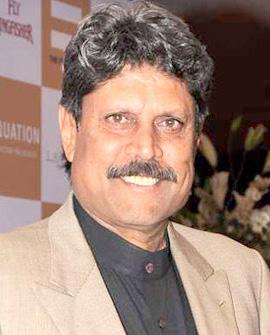
Kapil Dev believes no player has ever matched
extraordinary versatility
doubt the West Indies team was one of the best, but he set records and shifted people’s mindset of how to play and enjoy,” he added.
The man who changed cricket’s thinking Kapil recalled how Sobers challenged the conventional coaching philosophy of his time and inspired young cricketers to think differently. “The biggest thing I remember is that he changed the method of MCC cricket coaching, what we used to call playing in ‘V’,” he said. “I think the first thing I came to know is not playing V, how you can get runs. That was the biggest statement stuck in my mind when I was growing up.”
Kapil also remembered Sobers as a warm personality away from the cricket field. “He was a brilliant cricketer. We lost him, but one can learn from the way he played cricket. Hats off to him, as he just enjoyed his life. In the evening, he used to sit and talk and we were just good listeners. He talked more about other things in life rather than cricket,” he added. (Times of India)
ST JOHN’S, Antigua, (CMC) – Barbados defended their CWI Rising Stars Men’s Under-19 50-over Championship title in emphatic fashion by defeating the Leeward Islands in the fourth and penultimate round here on Saturday.
It was their fourth win in as many matches and with the Leeward Islands’ loss to Guyana, Barbados cannot be overtaken in Monday’s final round of matches.
In the day’s other result, Jamaica emerged victorious by trouncing the Windward Islands.
At Pigotts Sports Ground: Barbados will be crowned champions once again following their comprehensive six-wicket victory over Trinidad and Tobago.
The win moved their record to 4-0 with just one round of matches to go, with their nearest challengers holding 2-2 records.
The result always seemed likely once T&T were routed for just 141 in 37.1 overs, thanks mainly to a five-wicket haul by Rajeev Parsooram.
Barbados had a slight wobble early on, losing both their openers cheaply, but recovered to comfortably reach 142 for four in 31.1 overs.
T&T seemed on track to post a competitive total when openers Christian Lall and Levi Ghanny were at the crease during a 92-run stand.
But once Parsooram got the breakthrough by having Lall caught for 54 off 63 balls, T&T lost their way.
Raphael Lovell had Ghanny stumped for 25, while Tariq Richards, Christiano Ramanan and Renaldo Fournillier all fell cheaply to leave T&T stuttering at 110 for five after 26
overs.
Captain Brendan Boodoo scored 22, but no other batters got into double digits and their innings folded meekly.
Parsooram finished with figures of 5-35, while Justin Parris took 2-9 and Lovell 2-21.
Barbados found themselves in a spot of bother when Fournillier accounted for the wickets of Gadson Bowens and Damarko Wiggins to leave them 11 for two in the sixth over.
But knocks of 37 from Jordan Graham and 23 from Kemar Dixon, along with an unbeaten 40 by Seth Smith and Parris’ contribution of 27 not out, helped Barbados ease to victory with almost 20 overs to spare.
Smith and Parris shared an unbroken partnership of 54 for the fifth wicket that rescued them from a ticklish position of 88 for four.
At Liberta Sports Club: The Leeward Islands were the only side that stood a chance of unseating the defending champions, but their title hopes went up in flames when they were surprisingly trounced by 121 runs by the previously winless Guyana.
After choosing to bat first, Guyana was led by half centuries from captain Parmeshwar Ram and Adrian Hetmyer, before being bowled out for 272 in 47.1 overs.
The Leeward Islands were then doomed by a middle order collapse that saw them crumble from 70 for two to 151 all out in 37.4 overs.
It was a solid all-around performance from a Guyana outfit that had failed to win any of their three previous matches.
They owed their total to a 104-run partnership between Ram and Hetmyer that steadied
the innings following the early dismissals of opener Khush Seegobin and Justin Dowlin.
When Ram was needlessly run out for 79 off 82 balls, with 10 fours and three sixes, Guyana were still well placed at 143 for three after 26 overs.
At that stage they would have been hoping to post a bigger total, but Matthew Miller’s four wicket haul and the unfortunate run out of Hetmyer for 76 off 90 balls, which included seven fours and one six, stunted their momentum.
Emmanuel Lewis scored a vital 42 batting at number seven, which contributed to the final total.
Miller ended with 4-45, while Kerique Mentore took 2-51.
After losing Tanez Francis and Lyhte Browne early, Kunal Tilokani and J’Quan Athanaze consolidated during a 41-run partnership for the third wicket.
However, when Gilbert Griffith bowled Tilokani for 37, the Leeward Islands lost four wickets for 28 runs to slide to 98 for six.
Lawshorn Bergan, who scored 31, led a brief lower order fightback, but they lost their last three wickets for four runs to seal their defeat.
Griffith took 3-29 and Ram 2-32.
At Bethesda Sports Ground: Jamaica kept the Windward Islands winless by handing them a 114-run whipping.
Buoyed by an unbeaten century from opener Tyson Gordon Jr and half centuries by captain Odane Binns and Demarco Scott, Jamaica coasted to 252 for three in their 50 overs.
The Windward Islands’ batters then failed
to fire, with Perico Henry’s four-wicket haul helping to bowl them out for a meagre 139 runs in 25.3 overs.
Henry claimed the wickets of Earshino Fontaine, Zach Thomas and Tyler Venner in quick succession to reduce the Windwards to 51 for six.
The Windward Islands only managed to get over the 100-run mark thanks to a fighting knock of 47 from Cody Fontinelle, with the outcome of the match long decided.
Henry claimed 4-28 and Joel Williams 2-25.
Earlier, Gordon Jr and Binns shared a partnership of 103 runs for the first wicket, which helped to set the tempo for the remainder of the innings.
Binns was eventually dismissed for 55 off 97 balls, with the wickets of Demario Hall and Pajay Nelson falling in quick order to make the score 141 for three.
But Gordon Jr, who finished unbeaten on 102 off 132 balls with 11 fours and two sixes, and Scott, who scored 52 not out off 45 balls, shared an unbroken partnership of 111 runs to take Jamaica to a winning target.
At Liberta Sports Club: Guyana defeated Leeward Islands by 121 runs.
GUYANA 272 in 47.1 overs (Parmeshwar Ram 79, Adrian Hetmyer 76, Emmanuel Lewis 42, Dhanesh Persaud 10; Matthew Miller 4-45, Kerique Mentore 2-51).
LEEWARD ISLANDS 151 in 37.4 overs (Kunal Tilokani 37, Lawshorn Bergan 31 not out, J’Quan Athanaze 22, Jathan Edward 17, Rondre Daniel 11; Dhanesh Persaud 4-31, Gilbert Griffith 3-29, Parmeshwar Ram 2-32).
WHEN Spain and Argentina meet in today’s World Cup final, the thought of lifting the famous trophy will be the only thing on the players’ minds.
However, the result at New York New Jersey Stadium could prove significant beyond crowning the world champions - it could effectively decide who wins the 2026 Ballon d’Or.
The era of Lionel Messi and Cristiano Ronaldo domination may be long gone, but in recent years there has still always been a clear favourite to scoop the prize.
In 2026, it is different.
There are plenty of contenders, although history tells us it is difficult to take top spot without also winning the Champions League or a major international tournament in the same year.
Could the World Cup final decide who will earn the award - perhaps swinging it the way of Lamine Yamal or Messi - or will the winner be someone else?
Biggest prizes usually precede Ballon d’Or
Harry Kane, Erling Haaland and Kylian Mbappe all put up extraordinary goals-coring numbers in 2025-26, but that is only one part of the story.
More often than not, a nominee needs to win a major continental or international trophy.
Only four of the past 19 Ballon d’Or wins have gone to a player who did not triumph in the Uefa Champions League, World Cup, European Championship or Copa America in the same year.
Messi accounts for three of those
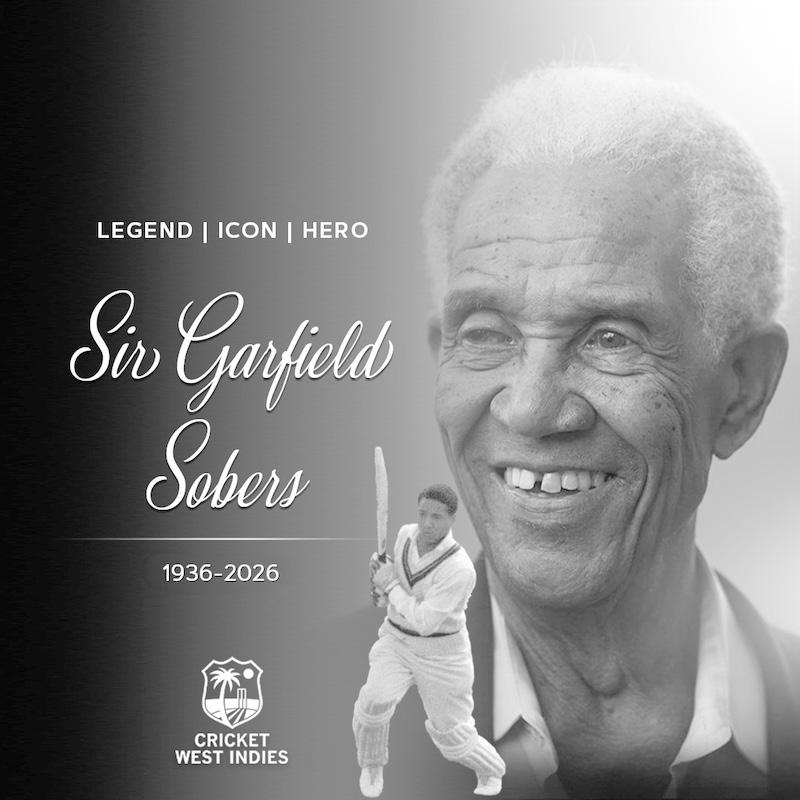

Yamal is hoping to claim the Ballon d’Or for the first time, while Lionel Messi is looking to win his ninth

(2010, 2012, 2019) and Ronaldo the other (2013).
Rightly or wrongly, that means the odds are stacked against Kane, Haaland, Mbappe, Michael Olise, Declan Rice and Jude Bellingham.
Ousmane Dembele took the 2025 prize after winning the Champions League with Paris St-Germain. A successful defence
this year means Dembele and team-mate Khvicha Kvaratskhelia are in the conversation.
That takes us to the World Cup final, where two candidates go head to head.
Messi, at 39, is looking win a record-extending ninth Ballon d’Or, while 19-year-old Lamine Yamal is hoping to better his second-place finish in 2025
S ee story on page 18 S ee story on page 18