

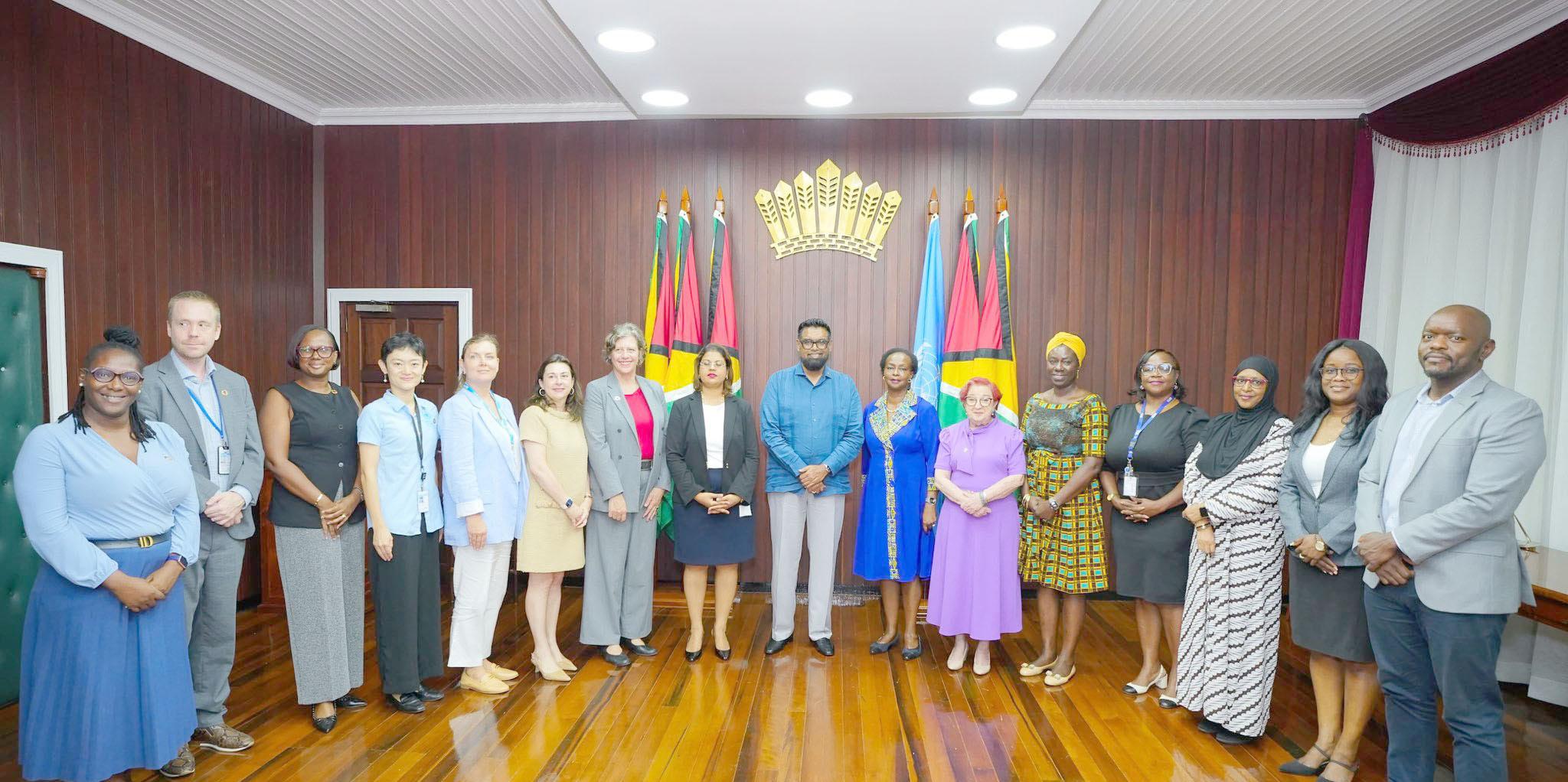
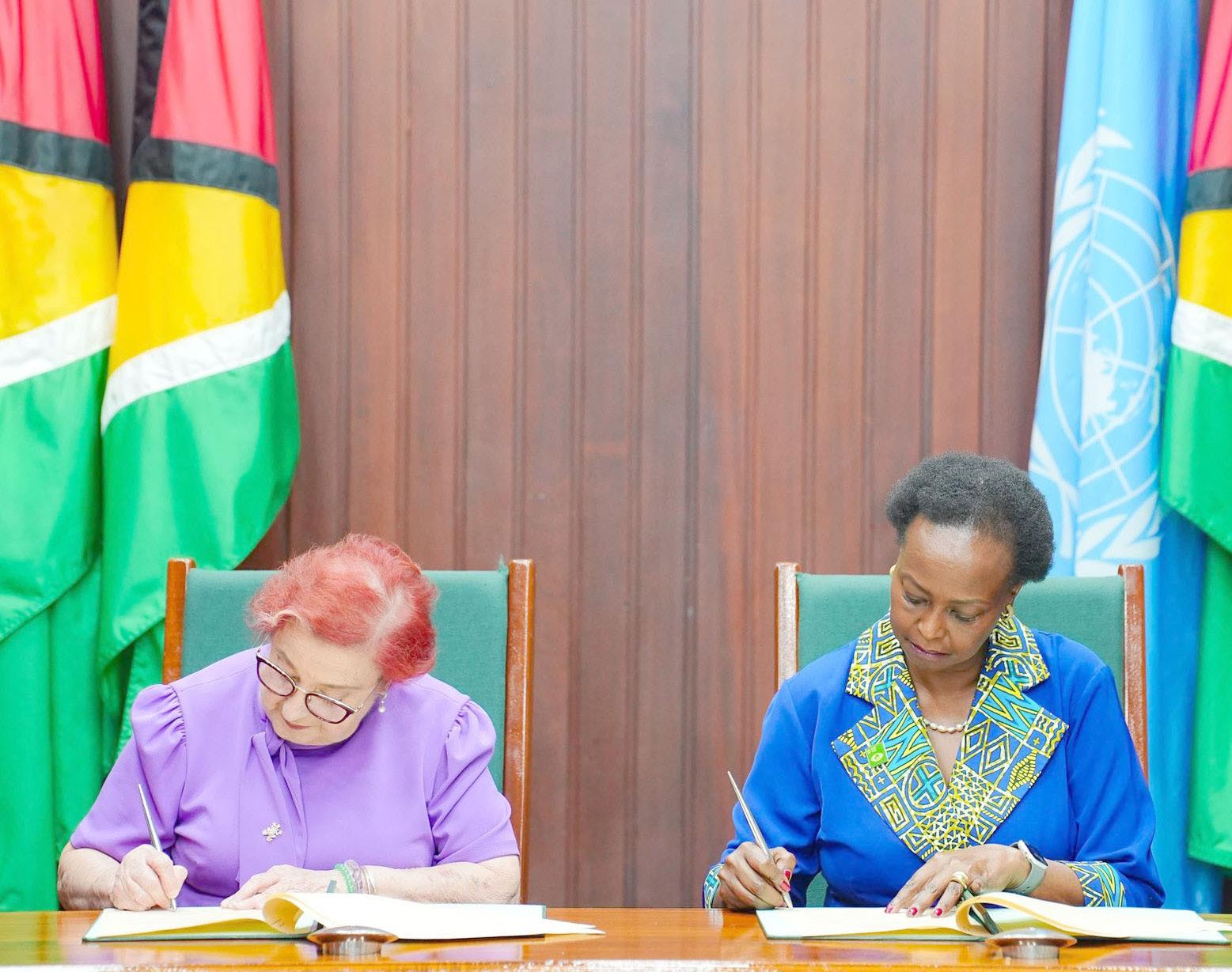



THE Government of Guyana and the United Nations in Guyana signed a Declaration of Intent (DOI) to formalise the United Nations’ participation in the Global Biodiversity Alliance, marking an important step in strengthening cooperation on biodiversity conservation, sustainable development, climate resilience and global knowledge exchange.
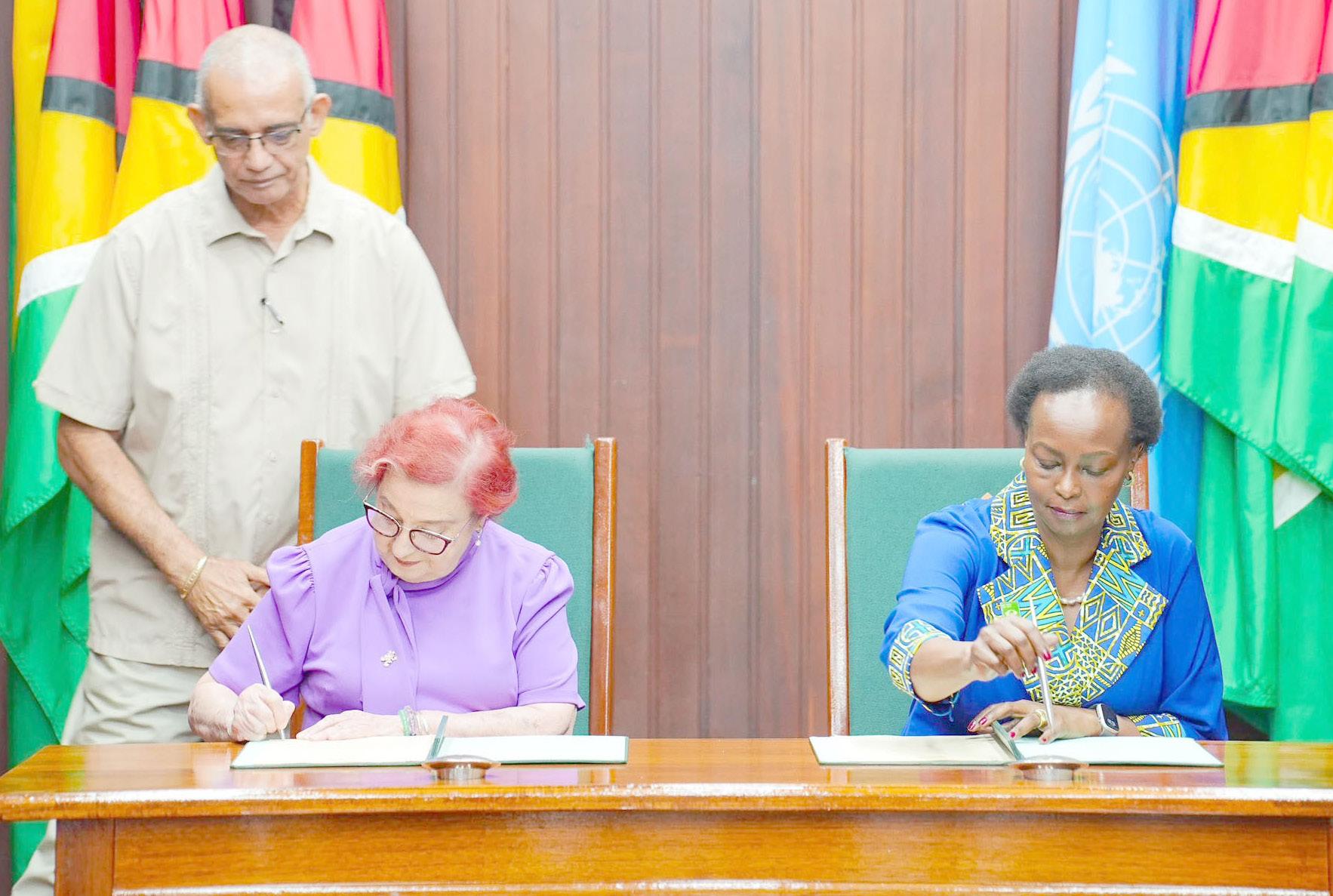
Honourable Gail Teixeira, Minister of Parliamentary Affairs and Governance of the Cooperative Republic of Guyana, and Jean Kamau, UN Resident Coordinator, signed the DOI on 18th May, 2026.
The signing ceremony hosted by H.E. Dr. Mohamed Irfaan Ali, President of the Co-operative Republic of Guyana, took place at the Office of the President. It was attended by senior government officials from the Ministry of Natural Resources, Ministry of Foreign Affairs and International Cooperation and Ministry of Parliamentary Affairs and Governance, as well as representatives of UN Agen-
cies, Funds and Programmes in Guyana.
His Excellency President Dr. Mohamed Irfaan Ali, has conveyed that the partnership reflects Guyana’s long-standing commitment to responsible stewardship of its forests, biodiversity and natural resources. He expressed that the signing by the United Nations on to the Global Biodiversity Alliance, led by Guyana, is a powerful affirmation that biodiversity protection and the sustainable management of natural resources must remain central to global development. He underscored that Guyana’s leadership in climate and biodiversity, has shown that innovative partnerships can support environmental stewardship, and Guyana remains committed to sharing experiences and lessons with the international community.
“The United Nations is pleased to join this important initiative, which closely aligns with the world’s shared objectives of sustainable development goals (SDGs) while championing South-South cooperation.” said Jean Kamau, UN Res-
ident Coordinator.
Through the Declaration of Intent, the Government of Guyana and the United Nations reaffirmed their shared commitments to integrating biodiversity considerations into national development planning and sustainable investment frameworks, in line with Guyana’s vision of pursuing development that is inclusive, low-carbon, and climate-resilient. The Declaration further underscores the importance of inclusive participation and the meaningful engagement of Indigenous Peoples and local communities, whose knowledge, stewardship and lived experience are essential to biodiversity conservation.
The Partnership is expected to contribute to stronger coordination, data-sharing and information exchange on biodiversity action within the United Nations Multi-Country Sustainable Development Cooperation Frameworks and the Kunming-Montreal Global Biodiversity Framework, while supporting Guyana’s ongoing leadership in climate and biodiversity diplomacy.
GPF to introduce paperless reporting system within six months as digital reform accelerates
THE Guyana Police Force (GPF) is moving to implement a fully paperless reporting system within the next six months as part of a broader modernization drive aimed at transforming the organisation into a more technology-driven and internationally aligned security institution.
The announcement was made by Commissioner of Police Clifton Hicken during the most recent Police Round-Up programme, where he outlined an accelerated push toward digitisation, capacity building, and institutional reform under the Force’s strategic development agenda.
The planned shift to digital reporting forms a key pillar of the GPF’s wider technology strategy, which will be further embedded in its upcoming 2027–2031 strategic plan. According to Hicken, the blueprint will include a dedicated focus on technology, innovation, and adaptability as central components of modern policing.
“Technology is what is ruling the world… it is now central to modern policing in the Guyana Police Force,” Hicken said, adding that the Force is working to ensure that “within the first six months, we will be taking reports by computer… and we are in the process of digitising the entire force.”
A major component of the transformation includes the decentralisation of the Force’s Zara computer centres, which are being expanded across multiple divisions to improve access to computer literacy training for ranks
nationwide. The initiative is intended to strengthen evidence-based policing and improve operational efficiency through wider technological access.
Alongside digitisation efforts, the Force is also intensifying capacity-building programmes, with structured training for ranks at all levels and a growing emphasis on academic advancement.
Hicken revealed that one officer has already attained a doctorate, while five others are currently pursuing doctoral studies. In addition, approximately 52 officers hold master’s degrees, 58 possess undergraduate degrees, and a further 112 are enrolled in diploma programmes.
“Academia is very important for any striving organisation,” he noted, underscoring the Force’s push to elevate professional standards through education.
Further insights into the training reforms were provided by Head of the Guyana Police Force Academy, Senior Superintendent Sonia Herbert, who explained that the institution now runs a range of internal courses throughout the year in addition to standard recruitment training.
She said the updated curriculum for ranks from constable to inspector now replaces traditional promotional examinations and incorporates subjects such as computer studies, emotional intelligence, conflict management, conflict resolution, and foreign languages. According to Herbert, the expanded training aims to improve professionalism and enhance interactions with the public.
Foreign language instruction has also been strengthened in response to increased regional integration and the growing presence of foreign nationals linked to Guyana’s expanding oil and gas sector. Spanish and French are currently offered, while Portuguese training is supported through a Memorandum of Understanding with the Brazilian Embassy.
“We have a number of police ranks… very much literate in Portuguese, Spanish, and pretty soon French,” Herbert said, noting that officers are also being trained to provide translation support in court proceedings.
She further disclosed that the Police Academy has secured both local and international accreditation and is preparing to renew its status while also expanding its academic offerings. Among the planned additions is a tourism policing programme, which authorities say is increasingly necessary as Guyana experiences rapid development and a rise in international visitors and events.
“With the influx of foreign nationals… and all these national events taking place, it is good for the ranks to have the knowledge about tourism policing,” Herbert explained.
The Guyana Police Force says the combined reforms in digitisation, training, and international collaboration are aimed at building a more modern, efficient, and professional policing institution capable of meeting evolving national security demands while aligning with global best practices.
PRESIDENT Dr. Irfaan Ali has hailed the formal participation of the United Nations in the Global Biodiversity Alliance as a “powerful endorsement” and a critical step in elevating biodiversity protection on the international agenda.
Speaking at the official declaration ceremony held at Office of the President on Monday, President Ali framed the event as “very special, not only for Guyana, but for all of the stakeholders who value the environment [and] value biodiversity.”
He underscored the UN’s longstanding role in Guyana’s development and expressed hope for deepened collaboration with the right data sets and right priorities.
“Biodiversity is collapsing at a rate unprecedented in human history, with up to 1 million species now at risk of extinction. The rapid loss of the world’s biodiversity is a direct threat to food security, water systems, public health, and the global economy. It is, in other words, an
existential threat to humanity,” President Ali said.
The President said the UN’s participation was both
“a natural fit and a powerful endorsement” of the alliance’s work, noting that biodiversity protection is now central to the UN system’s global agenda, from the Convention on Biological Diversity to the Sustainable Development Goals.
“It is natural because biodiversity protection has become central to the global agenda of the United Nations system, and it’s powerful because the presence of the world’s foremost multilateral institution elevates the credibility, reach, and impact of this initiative. The United Nations has long stood at the forefront of global efforts to protect the environment and promote sustainable development,” the President said.
He further highlighted the UN’s role in placing biodiversity “at the centre of global policy making” and in recognising that it is inseparable from economic development, poverty reduc-

President Dr. Irfaan Ali with UN Resident Coordinator, Jean Kamau at the official declaration ceremony held at Office of the President on Monday
tion, climate resilience, food production, public health and social stability.
President Ali stressed that biodiversity must be integrated into sectors such as agriculture, infrastructure, energy, tourism, urban planning and national economic policy, aligning this approach with the core philosophy of the Global Biodiversity Alliance.
President Ali issued a broad invitation to international organisations, development partners, multilateral institutions and sovereign states to join the alliance, arguing that the biodiversity crisis is “too large, too complex, and too interconnected for any single country or institution to address alone.
He called for collective action at a scale never seen before, involving governments, civil society, indigenous peoples, the private sector and the scientific community.
Meanwhile, UN Resident Coordinator Jean Kamau said the alliance aligns closely with international sustain-
able development priorities and reinforces South-South co-operation.
The UN is now the 97th member to join the global biodiversity alliance.
“Today’s ceremony reflects more than a commitment on paper; it demonstrates our shared vision for safeguarding the natural heritage of our planet for present and future generations. Biodiversity is not only a cornerstone of environmental sustainability, but also a fundamental pillar of economic resilience, food security, cultural identity, and human well-being,” Kamau said.
Guyana’s leadership in biodiversity conservation is bolstered by collaborations with major global institutions and organisations including Yale Center for Biodiversity and Global Change, Conservation International, the World Bank, the Government of Brazil and other states, alongside Indigenous communities and private sector partners in green finance.
THE government has introduced a stricter framework for the management and execution of public contracts as part of efforts to improve accountability and ensure timely delivery of services to citizens.
Senior Minister within the Office of the President with Responsibility for Finance Dr Ashni Singh said the measures follow directives issued by President Dr Mohamed Irfaan Ali during a recent meeting with per-
manent secretaries, regional executive officers and other accounting officers.
Speaking after a follow-up engagement with permanent secretaries on the president’s instruction, Minister Singh said the government’s objective is to ensure that contractors fully honour the terms and timelines outlined in their agreements with the state
He explained that discussions focused heavily on tighter contract man -
agement and stronger oversight of the execution of government contracts for goods and services.
“The Cabinet’s expectation is that all contracts for the provision of goods and services to the government will be implemented to the letter of the contract,” Minister Singh stated He said this means contractors must deliver the agreed quantity and quality of goods and services within the timelines specified in
their contracts.
The minister noted that permanent secretaries were instructed to strictly enforce contractual timelines and ensure liquidated damages are imposed on contractors who fail to meet agreed-upon deadlines
Liquidated damages are standard financial penalties included in government contracts to hold contractors accountable for delays
Minister Singh further warned that where con -
tractors continue to fail to deliver even after the liquidated damages period has commenced, steps must be taken to terminate those contracts.
The finance minister also reinforced the requirement for performance bonds to remain in place throughout the life of the contracts.
According to the minister, permanent secretaries will be held responsible in instances where performance bonds are absent,
allowed to lapse, or expire before contractual obligations are fulfilled
Additionally, the government announced tighter controls on contract variations and contingencies
Minister Singh said contingencies that previously allowed flexibility in contractual pricing will no longer be permitted, and any proposed variation to agreed contract prices must return to the original approving authority. (DPI)
THE 2020 Electoral fraud trial resumed on Monday at the Georgetown Magistrate’s Court before Acting Chief Magistrate Faith McGusty.
When the matter was called on Monday, key witness, Bebi Anieshaw Mohamed, who during 2020 was a tabulation officer for the People’s Progressive Party/ Civic (PPP/C) took the stand for further cross-examination.
Mohamed was cross-examined by attorneys for the defendants, Dexter Todd, Darren Wade and Eusi Anderson. Subsequently, she was re-examined and officially concluded her testimony
before the court.
The trial is expected to continue on Wednesday, with other witnesses expected to take the stand.
At the beginning of this month, it was noted by the prosecution that more than 10 witnesses were still to be called to present evidence.
At that time, Special Prosecutor, attorney-at-law Latchmie Rahamat, while speaking with members of the media, explained that while the State remains prepared to proceed efficiently, the fluid nature of trial proceedings makes it difficult to determine when the matter will conclude.

Those on trial include former Chief Elections Officer (CEO) Keith Lowenfield; former Deputy CEO Roxanne Myers; former Region Four Returning Officer Clairmont Mingo; former Health Minister Volda Lawrence; and People’s National Congress Reform (PNCR) member Carol Smith-Joseph.
Also facing charges are former GECOM staffers Michelle Miller, Sheffern February, Enrique Livan, and Denise Babb-Cummings.
The defendants collectively face 19 charges, including conspiracy to defraud and misconduct in public office. Each has entered a plea of not guilty and was released on significant cash bail.
The prosecution, led by King’s Counsel Darshan Ramdhani, has argued that the defendants each played a “critical role” in attempts to inflate votes in favour of the then-incumbent - A Partnership for National Unity and Alliance for Change (APNU+AFC) coalition while reducing votes for the Peo-
–– trial to continue on Wednesday

ple Progressive Party/Civic (PPP/C).
Initial results announced by Lowenfield had declared an APNU+AFC victory, with 171,825 votes against the PPP/C’s 166,343. However, after five months of litigation and a Caribbean Community

(CARICOM)-supervised recount, the PPP/C was declared the winner with 233,336 votes to APNU+AFC’s 217,920, paving the way for Dr Irfaan Ali’s swearing-in as president on August 2, 2020.
The fallout from the election controversy led to the termination of Lowenfield, Myers, and Mingo’s contracts at GECOM in August
2021. The Presidential Commission of Inquiry (CoI) into the events of the 2020 General and Regional Elections have found that there were collusion and collaboration between senior GECOM officials to divert votes to the APNU +AFC instead of safeguarding and preserving the integrity of the electoral system.


President Ali says
THE Environmental Protection Agency (EPA), in collaboration with the National Data Management Authority (NDMA), has begun placing sound monitoring devices along the seawalls, with a wider national rollout to follow.
This initiative comes after numerous complaints from residents about disruptions to family life.
“The sound alarm is not meant to stop the music and celebration on the seawalls,” he said. “They are now test-
Speaking at the Guyana Bank for Trade and Industry’s (GBTI) 190th anniversary dinner on Saturday night, President Dr Mohamed Irfaan Ali announced that the devices are being used to measure noise levels in areas where entertainment businesses operate.
ing to see the levels that are acceptable, that will allow the entertainment whilst not disturbing the peace of families and communities.”
Once the testing phase is complete, a standard acceptable noise level will be published, the president revealed.
Entertainment operators will then be expected to voluntarily remain within that threshold, with President Ali indicating that there would be no immediate legal con-
sequences for those who do not comply.
He described the initiative as part of a broader national effort to improve the quality of life, saying the government wants citizens to enjoy both public entertainment spaces and the quiet of their own homes.
“Quality time is not only what we spend in entertainment areas, but how families can enjoy their own private space,” he said.
(DPI)
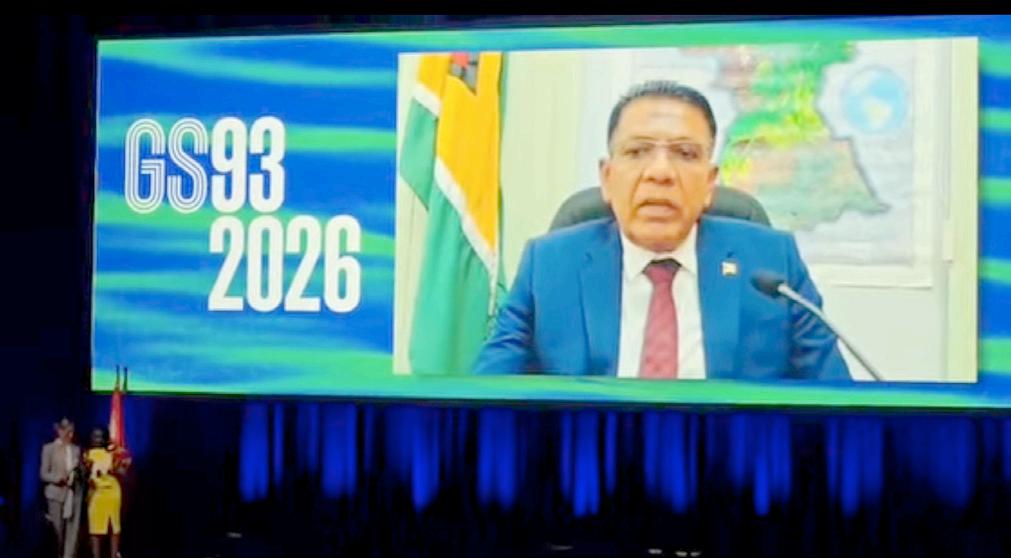
GUYANA is positioning itself as a regional reference point for modern, evidence-based animal health governance, driven by major investments in diagnostics, digital surveillance and strengthened legislation, Agriculture Minister, Zulfikar Mustapha, told the 93rd General Session of the World Organisation for Animal Health in Paris, France.
Addressing the session virtually on Monday, Mustapha, while delivering remarks on behalf of the Government of Guyana and the wider Caribbean Community (CARICOM), framed animal health as a strategic investment in economic resilience, pandemic preparedness and regional food security.
“The theme of this year’s session, ‘investing in animal health to secure everyone’s future’ captures the essence of what our nations must do, treat animal health as a strategic investment for stability, prosperity and sustainability,” he said.
Guyana, he noted, has invested heavily in animal health, with a particular focus on boosting diagnostic capacity and laboratory resilience.
The government has expanded its diagnostic capacity with new Polymerase Chain Reaction (PCR) systems and strengthened national laboratory networks to better detect and manage diseases of economic importance.
These investments are aimed at supporting early detection, rapid response and improved regional surveillance.
Minister Mustapha linked these upgrades directly to pandemic prevention, stressing that robust veterinary systems are now seen as frontline defences.
“We are working to enhance animal health policies, accelerate our pandemic preparedness, while also strengthening laboratory framework to mitigate and, whenever possible, reduce the spread of disease,” he explained.
A central plank of Guyana’s push is the digital transformation of its surveillance architecture. The country’s animal health surveillance system now integrates digital data management, enabling more timely, accurate and transparent oversight.
“Our surveillance system now integrates digital data management, positioning
Beyond its domestic reforms, Guyana is positioning itself as a regional leader on animal health and food security.
The country currently leads the CARICOM ministerial task force on food production and food security, which is driving the region’s agenda to reduce its dependence on extra-regional food imports.
self-reliance.
“As a region, we are working to establish a CARICOM animal health corridor, harmonising standards and building trust to expand regional trade in livestock and livestock products,” he said.
“Regional self-reliance, animal health security and production resilience are not a matter of aspiration, but of national and regional survival,” he added.
Guyana as a regional reference point for modern, evidence-based animal health governance,” he said.
This digital shift is intended to support real-time monitoring, quicker reporting of outbreaks and more data-driven decision-making, aligning national systems with evolving global standards for animal health.
Additionally, Guyana has also moved to overhaul its legal framework to underpin these technical reforms with amendments to the Animal Health Act, aimed at
strengthening enforcement and modernising compliance mechanisms.
“This reform ensures that our veterinary services operate with efficiency, transparency and accountability, key pillars of world standards,” he added.
By tightening its legislative and institutional framework, Guyana is seeking to improve biosecurity, facilitate trade in livestock and livestock products, and build confidence among regional and international partners.

Within this framework, animal health is treated as a core enabler of production growth in priority sectors such as meat and poultry, as well as a foundation for safe intra-regional trade.
Mustapha pointed to wider regional efforts to harmonise standards and strengthen veterinary capacity as part of a move towards regional
Guyana is also calling for sustainable financing for animal health systems, including support for vaccines, preventative measures, and further digital upgrades in surveillance and diagnostics.
The Minister also urged greater investment in youth and innovation to secure the next generation of animal health professionals.


THE latest escalation of conflict in the Middle East has once again exposed one of the greatest vulnerabilities of the modern global economy: the world remains dangerously dependent on fossil fuels, chemical fertilisers and critical shipping routes concentrated in one of the most politically unstable regions on earth.
As tensions rise around the Strait of Hormuz, the narrow maritime corridor through which a significant share of the world’s oil, natural gas and fertiliser supplies passes, governments, industries and consumers alike are being reminded that geopolitical instability in a single region can send shockwaves across the global economy within days.
Already, international agencies and economic observers are warning of rising energy prices, increasing fertiliser costs, inflationary pressure, and growing risks to global food security. For developing nations in particular, such disruptions can quickly evolve into broader social and economic instability.
But amid the uncertainty, the crisis has also sharpened global attention on an issue that for years was often framed mainly as an environmental concern: the transition to a bio-economy.
That transition is no longer simply about climate change or sustainability, it is increasingly becoming a matter of economic resilience and geopolitical security.
At its core, the bio-economy seeks to reduce dependence on fossil-based systems
by using renewable biological resources, scientific innovation and bio-technology to produce food, energy, materials and industrial products.
Bio-fuels can reduce reliance on imported oil. Bio-inputs can lower dependence on costly chemical fertilisers. Bio-materials can replace petrochemical-based products. Together, these alternatives create economies that are more diversified, locally grounded and less vulnerable to international supply shocks.
The current crisis demonstrates precisely why that matters.
For decades, much of the world’s development model has been built around centralised fossil-fuel systems and fragile global supply chains.
When conflict erupts in energy-producing regions, the consequences spread far beyond oil markets. Transportation costs rise. Agricultural production becomes more expensive. Food prices increase. Inflation deepens. Poorer countries suffer most.
The bio-economy offers a pathway to reduce those vulnerabilities.
Importantly, this is not merely theoretical. Across the Americas and other regions, countries are already building competitive industries around bio-ethanol, bio-diesel, bio-technology, precision agriculture, bio-materials and the productive reuse of agricultural waste.
Nations such as Brazil, Argentina, Colombia, Costa Rica and Uruguay have
already demonstrated that bio-economic development can generate exports, create rural employment, strengthen energy security and stimulate innovation simultaneously.
The Americas possess enormous strategic advantages in this emerging global landscape.
The region holds some of the world’s greatest reserves of biodiversity, freshwater, bio-mass and agricultural potential.
Latin America and the Caribbean are also leaders in tropical agriculture and bio-energy production, assets that are likely to become even more valuable as countries seek alternatives to fossil dependence.
Institutions such as the Inter-American Institute for Cooperation on Agriculture have spent years working to position the bio-economy as a pillar of rural development and economic modernisation.
Through partnerships with governments, academic institutions and international organisations, efforts have expanded beyond theory into practical initiatives involving innovation, entrepreneurship, technical training and public-policy development.
The growing emphasis on bio-inputs and sustainable agricultural systems is especially important. Reducing dependence on imported chemical fertilisers would provide countries with greater protection against international market disruptions, while improving long-term agricultural sustainability.
At the same time, the bio-economy has the potential to revitalise rural regions that
have often lagged behind urban centres in investment and employment opportunities. New industries built around renewable biological resources can create jobs, stimulate local manufacturing and encourage scientific research and technological advancement.
Still, realising this opportunity will require deliberate investment and political commitment. Infrastructure, financing, research capacity, regulatory modernisation and support for innovation ecosystems will all be essential if countries are to compete effectively in the emerging bio-based global economy.
The bio-economy is not a complete replacement for traditional production systems, nor will the transition occur overnight. Fossil fuels will remain part of the global energy mix for years to come. But the current geopolitical instability makes one fact increasingly difficult to ignore: economies that are heavily dependent on imported fossil resources and vulnerable global supply chains face mounting strategic risks.
In a world shaped by conflict, disrupted logistics and energy uncertainty, the ability to produce food, energy and industrial materials from renewable local resources is becoming more than an environmental advantage. It is becoming a strategic necessity.
The countries that recognise this reality early, and invest accordingly, will be better positioned not only to weather future crises, but also to shape the next phase of global economic development.
I LIVE directly opposite Movie Towne. When you are in the parking lot of MovieTowne, and you look straight up into the sky, you see my house.
There is a street that houses the temporary head office of EXXON and that street leads you to MovieTowne.
The street was just a narrow piece of bush and mud when MovieTowne was being built. I used to walk my dog through that area of bush and darkness to where MovieTowne was being built.
One night, I entered the compound, and a man with a gun longer than the Essequibo River said: Sir, you cannot come in here.” I replied, “I just live across the road, look that is my house; I’m just walking my dog.”
He felt it was alright and from that night, I walked my dog there, and my dog literally witnessed the construction of MovieTowne. After MovieTowne was finished, the company constructed a road where the bushes and mud were. The street leads from the Railway Embankment to the old Atlantic highway. It is that street people take to go to Massy Supermarket. The temporary head office of EXXON is at the southern tip of the street, and either EXXON or the Ministry of Public Works turned the pathway into a fully modern street.
It has no name. Mid-last year, a lady set up a vending booth right at the southern tip of the nameless street directly opposite Exxon. I was fortunate that morning to see the Ministry of Public Works officials asking her to move. I was on my verandah having a late breakfast.
That lady is gone. She hasn’t returned, and if she does, the ministry will evict her again, and she will be charged. But no one has charged Banks DIH and Hand-in-Hand from doing exactly what the vanished vendor did – illegally occupy the parapet. This has been a long introduction to yesterday’s (Monday) column by Leonard Craig titled, “Freddie Kissoon and Banks DIH: An Obsession?”
The exchange with Craig began two weeks ago when he noted that he cannot agree with me that Banks DIH only should be focused on by the authorities to remove encumbrances on the parapets. It should be a national policy including all offenders, including the vendors. I replied to Craig and conceded that his point is valid. But I added a vital, priceless footnote.
I asked Craig if the policy includes all offenders; then a sad situation is going to happen. The untouchables will not be touched. The people who will lose out are the poor vendors. And I am right by citing two gargantuan examples. The vendor opposite my house on the street with no name has been removed and is gone forever.
But Banks DIH and Hand-in-Hand, which did exactly what the vendor did opposite my home, have remained untouched, although the then Traffic Chief visited Thirst Park and Eve Leary and instructed Hand-in-Hand to remove the cones from the parapet. Those instructions were issued years ago.
I quote from Craig’s column yesterday: “I however have revolting sentiments towards a concept Freddie seems to be advo-

cating. We should be wary of, and probably not attempt uniform application of the law because we perceive that there are untouchables in society who will get away with flouting the law. If we are to go by that theory, then “let the poor vendors do their thing because the privileged will resist” and the application of the law will be skewed against the poor. An endless cycle of inaction. We cannot fail to implement even-handed public-policy measures because we believe or anticipate that some wealthy violators will resist, it’s too Animal-Farmish.”
But this is my point and Craig has buttressed my ideological anxiety the way he has written it. That is what will happen. That has happened and that is happening. There is a uniform application, but all of Guyana knows what happens to that uniform. It becomes
a tattered garment because powerful and untouchable men and women and powerful companies will not wear the uniform. What happens then is that the lady on the street with no name vanishes because of a policy that is supposed to be uniform but is ignored and trampled upon by the corporation kings, the bourgeois monarchs, and the middle class with their ubiquitous status. So what is Craig saying? He is saying there must be a uniform policy for all. No offender should be spared. What am I saying? I contend in that uniform policy, the poor and powerless will become poorer and more powerless.
DISCLAIMER: The views and opinions expressed in this column are solely those of the author and do not necessarily reflect the official policy or position of the Guyana National Newspapers Limited.
By Muhammad Ibrahim and Eduardo Trigo
THE conflict in the Middle East has once again highlighted a structural weakness in the global economy: the enormous dependence on fossil fuels, fertilisers, and critical maritime routes concentrated in a politically unstable region.
The Strait of Hormuz— through which a substantial portion of the world’s oil, gas, and fertilisers passes— has once again become a point of global vulnerability.
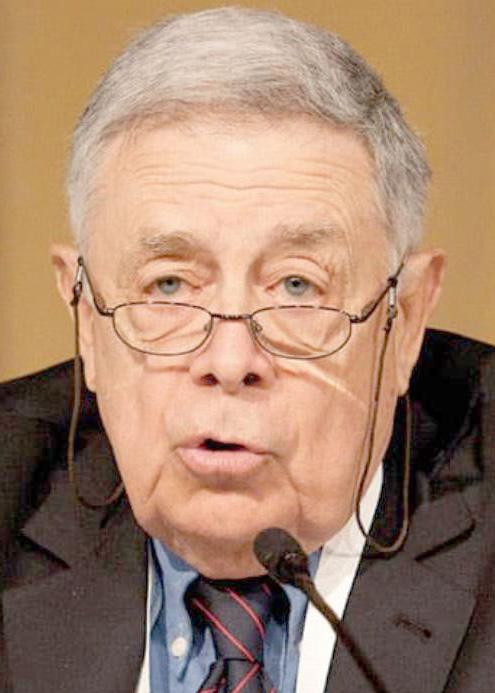
Special Adviser to the Director General of IICA, Dr. Eduardo Trigo
The consequences are already being felt.
International organisations are warning of rising energy prices, higher fertiliser costs, inflationary pressure, increased risks to global food security, and, in many cases, social stability.
In this context, the bioeconomy has ceased to be merely an environmental or technological agenda and has become a strategic issue of economic and geopolitical security. The bioeconomy proposes progressively replacing fossil resources with biomass, biotechnology, bioenergy, biomaterials, and industrial processes based on biological knowledge.
In other words: producing more food, energy, and materials using renewable resources and scientific knowledge.
At the same time, it is increasingly recognised as a catalyst for rural renewal, through the investments it attracts and the new jobs it generates.
The conflict in the Middle East may have triggered the process by which environmental and strategic ambitions converge with economic viability. The current crisis shows why this transition is important. Bioeconomic systems offer more resilient alternatives in key areas: biofuels to reduce energy dependence, bio-inputs to decrease the use of chemical fertilisers, and new biobased materials to replace petrochemical derivatives.
Proposals from various international organisations and forums, including the OECD and the G20, and what is already happening in
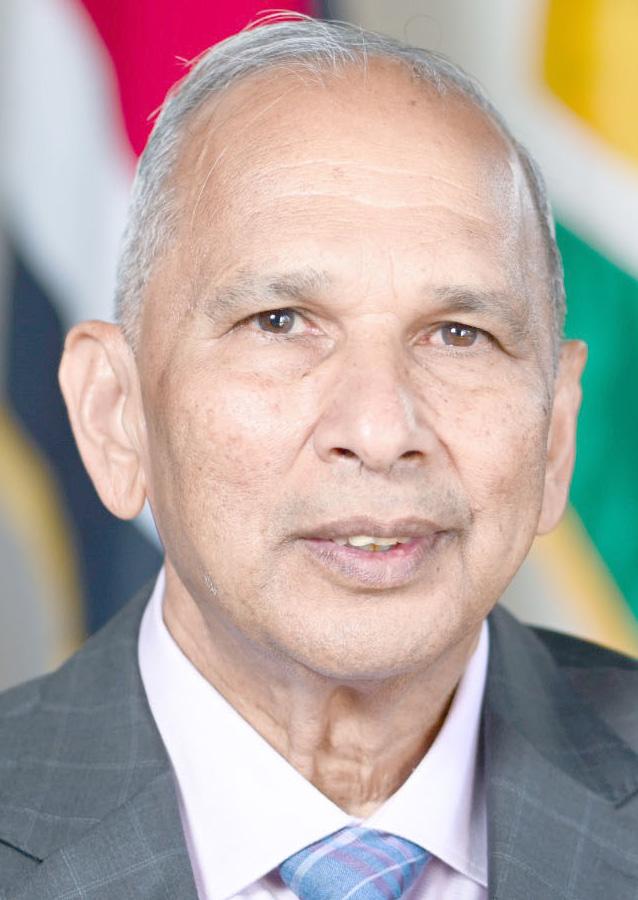
Director General of the Inter-American Institute for Cooperation on Agriculture (IICA), Dr Muhammed Ibrahim
the United States, Canada, the European Union, and some Asian countries fully confirm this potential.
In this scenario, the Americas region stands out with exceptional comparative advantages, as it concentrates some of the world’s largest reserves of biodiversity, water, biomass, and photosynthetic capacity. Furthermore, it is a leader in both temperate and tropical agriculture, agricultural biotechnology, and bioenergy production.
Countries such as Brazil, Argentina, Colombia, Costa Rica, and Uruguay have already demonstrated that it is possible to develop competitive bioeconomic value chains based on bioethanol, biodiesel, biomaterials, precision agriculture, plant genetics, and the comprehensive use of agro-industrial waste. And more than 10 countries in the region already have, or are in the process of developing, dedicated strategies for the development of their bioeconomies, an effort in which the Inter-American Institute for Cooperation on Agriculture (IICA) is actively participating.
More than a decade ago, when the concept was still in its infancy in the region, IICA began working alongside European and Latin American organisations to develop conceptual frameworks, assessments, and strategies to promote a knowledge-based bioeconomy. Over time, that agenda evolved into concrete programmes for innovation, institutional strengthening, and business development, which include the strategic positioning of the bioeconomy, the strengthening of technical capacities, and support for the design of public policies and regulatory frameworks.
In parallel with support for national initiatives, work is also underway to create a bio-entrepreneurship platform aimed at incubating and accelerating bio-based companies throughout the region, and to develop the Latin American Bioeconomy Network as a mechanism to facilitate interaction among the public, private, and academic sectors.
The promotion of initiatives on bio-inputs and sustainable agriculture aimed at reducing dependence on chemical inputs and increasing productive resilience, and the creation of regional spaces for political dialogue to position the bioeconomy as a strategy for rural development, job creation, territorial value addition, and climate mitigation, are also part of the institutional responsibilities undertaken.
The current international crisis may accelerate transformations that were already underway, and while Europe and Asia seek to reduce energy vulnerabilities and ensure the supply of food and strategic inputs, Latin America and the Caribbean could not only become one of the major global suppliers of biomass, food, biofuels, bio-inputs, and biotechnological solutions, but also find a powerful source to boost the develop-
ment of their economies and revitalise their rural areas.
The bioeconomy does not automatically replace traditional production models. However, it offers a platform for building more diversified and resilient economies that are less dependent on fossil fuels and more knowledge-based. But to seize this opportunity, progress is needed in investment, infrastructure, scientific innovation, adequate financing, and mod-
ern regulatory frameworks.
In a world marked by geopolitical conflicts, logistical disruptions, and growing energy uncertainty, the ability to produce food, fibers, energy, and materials from renewable resources is no longer merely an environmental advantage: it becomes a strategic asset.
And the Americas is uniquely positioned to occupy a central place in this new global economy.

WHO is Ganesh Mahipaul bluffing with this watered-down explanation that he gave to the media at Friday’s People National Congress’ press conference when he was asked a question pertaining to recent defections from the party?
Is Mahipaul in his right senses or still suffering from the aftermath of the 2025 electoral defeat, which relegated the PNC/APNU into benchwarmers in the back seat of the opposition?
Is he ‘mad’ or blinded by ego? Did he answer the
question like that because he knows that without Aubrey Norton, he does not have a future in politics with the PNC/APNU? Or he was giving the public a class in political strategy and denial? Whatever his reasons might be for giving his dumb and one-sided view of political history, it did not serve to quell the public’s concern about the desperate state of the PNC/APNU opposition, which is now undoubtedly continuing to suffer defeat after defeat and is reeling from the heavy weight of political
defections, crossovers, and internal rifts.
So, Mahipaul said at the press conference that the defections were not hampering the party’s work and they were busy “doing several things.”
He added that these were not “tried and tested” members and that the PNC is currently in a recruitment mode. According to him, the party was “doing well.” He even said that “maybe the issue is with them, not us” after downplaying the significance of the defections at this time


in the PNC/APNU’s history. Let me say this. Mahipaul should not have answered the question even though it was directed and intended for him. He should have declined the question because the question needed a political and proper response from the leader, Norton, or the party general secretary.
It was too important. No junior politician, who is begging for the public’s and PNC’s approval, like Mahipaul should ever feel comfortable taking on that responsibility unless one’s intention is to open a can of worms and suspicion.
The fact that Mahipaul said these defections were not hampering the party’s work is telling and concerning to party members and the public alike. It appears defensive and disparaging, if not disrespectful. How dare he say that they are not “tried and tested”?
The departure of Rickly Ramsaroop, Shurwayne Holder and Dinesh Jaiprashad has had an impact on the PNC’s leadership, members and people who they knew, however small. It caused the public to see the illusion of PNC/APNU unity falling apart. Mahipaul would be a fool to not admit this or seek to express his party’s concern over their decision to be aligned with the PPP after their many public utterances, even if he saw it coming.
A political party must always appear to be empathic and grateful to its former members even if their departure was not in the right manner or quietly. It should never live in denial that introspection should not be done, or else they risk others following suit if they too have the same problems.
Therefore Mahipaul should never have asked whether the problem was with them. He does not know of the trials, conversations, and experiences that regional councillors Ravoldo Birbal, Sheik Yaseen, Prince Holder and Gangadai Lloyd faced
with racism, discrimination, and outright bullying in the PNC/APNU.
He cannot speak to the experiences and fallout that pushed Holder, Ramsaroop, and Jaiprashad over the limit. He cannot know the hearts of these men or comment on what caused their choices.
He, of all people, cannot say what led any former APNU or PNC parliamentarian or regional official because none of them trust him.
He talks too much. Amanza Walton, James Bond, Holder, Tabita Sarabo-Halley, Natasha Singh-Lewis and Dawn Hastings-Williams know not to trust the rat-like politician.
They have no confidence in him and believe he is a political rat just eating away at Norton’s cheese. Mahipaul is loyal to no politician, only to himself.
If he were a true PNC/ APNU history student, he would call a spade a spade. He would know that one or two things can be true at the same time with respect to PNC/APNU politics.
One is the party is in bad shape following its worst and historic defeat. And the party is not finding its footing yet because there are still rifts, factions, infighting, squabbles, and duels.
Mahipaul should accept that things are not right with his party and stop trying to hide behind the veil of unity. Every defection is making it clear as day to the public. And PR, for that matter, was never his forte.
The underlying factor is Norton. Mahipaul knows the truth and still tries to ramrod other reasons down the public’s throat. He knows where the problem lies and does not want to admit it. It lies with Norton. He is killing the PNC and has his feet firmly on its neck with no indication of release.
The PNC leadership and membership did not want Norton after the first term. He, allegedly, rigged the congress and installed those that would support his brand of

politics. Now, Norton forced himself onto the PNC/APNU movement as the presidential candidate and lost the elections. Instead of crawling into his hole, Norton emerged with a new scheme to retain power and control.
Mahipaul must accept this notion. He must accept this is why the PNC is losing so “bigly”. He must accept the principle that his comrade leader’s time is up and that one must know when to go. He is part of the problem and not the solution.
If one was Mahipaul, one would jump into the gutter and suck air through a straw because one would be embarrassed to say out loud the PNC is winning the political fight when the whole world could see it is too ashamed to close its eyes.
Let me be pellucid. The exodus of members will continue and grow for as long as Norton and spineless politicians like Mahipaul continue to take up space and air in Congress Place.
They are soft and not upto-date with the realities that politics is changing, dynamic and very surprising. They should do the honourable thing and resign, paving the way for bright, new, and innovative persons, which, incidentally, PNC still has, to take over the struggle.
The truth is, the denial bubble is busting. The top brass are ignoring glaring, on-the-ground reality checks, creating a massive disconnect with voters.
The once-great PNC/ APNU party is falling apart at the seams. The factional infighting has transitioned from whispers to open warfare, weakening their position faster than projected. The power vacuum is creating chaotic, contradictory messaging that leaves supporters confused.
It is unfortunate that this internal meltdown continues, where key figures flee, voting blocs fracture, and the façade of unity collapses. PNC/ APNU is a party in paradox, as its public defiance masks a desperate behind-the-scenes struggle for survival.
DISCLAIMER: The views and opinions expressed in this column are solely those of the author and do not necessarily reflect the official policy or position of the Guyana National Newspapers Limited.
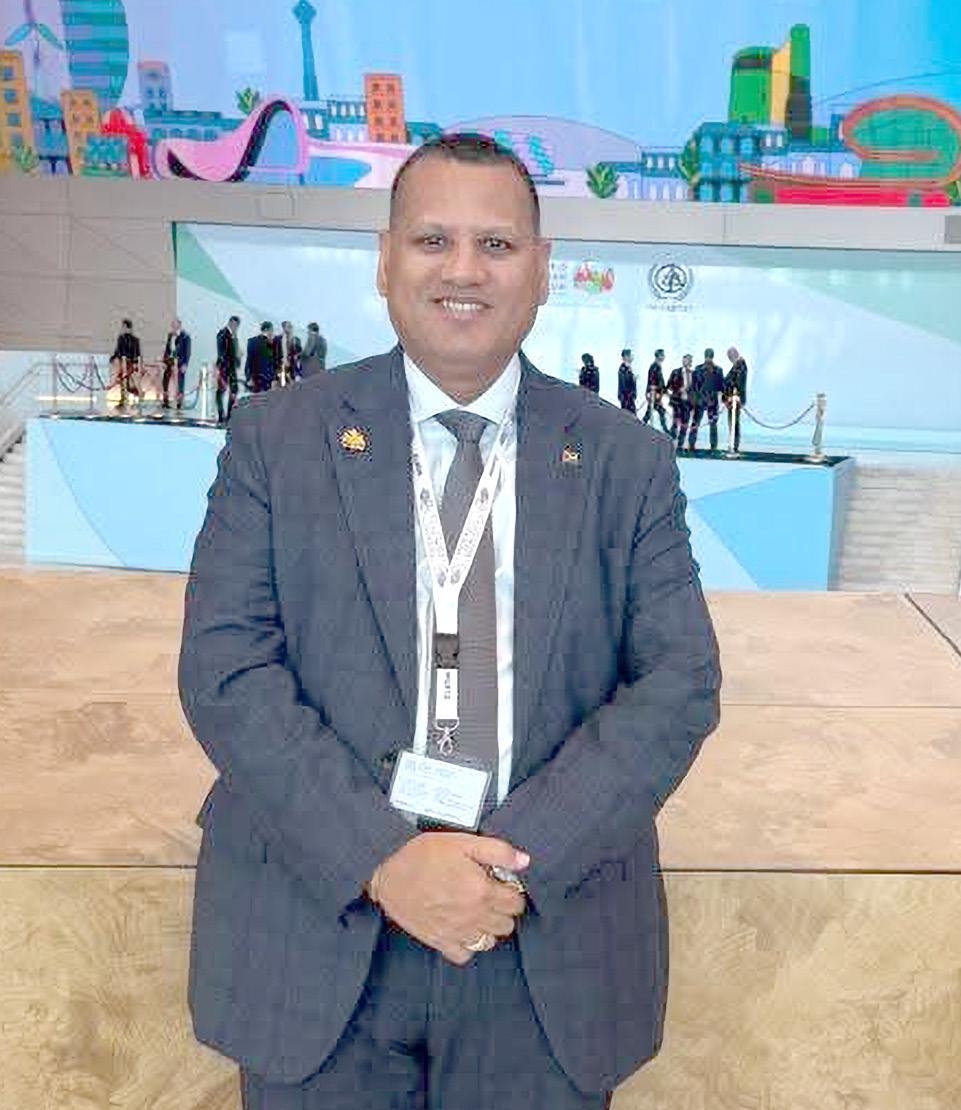
MINISTER of Housing, Collin Croal, is representing the country at the Thirteenth Session of the World Urban Forum (WUF13), where global leaders are convened in Baku, Azerbaijan to discuss the future of sustainable cities and urban development.
The high-level United Nations forum, which runs from May 17 to 22, 2026, is being held under the theme “Housing the World: Safe and Resilient Cities and Communities” and has attracted participation from government ministers, heads of international organisations, academics, and policy experts from more than 180 countries.
Croal attended the official opening ceremony of the forum, which was addressed by President of Azerbaijan Ilham Aliyev, alongside senior officials from UN-Habitat, including Executive Director Anacláudia Rossbach, as well as other international dignitaries.
Guyana’s participation at WUF13, officials said, underscores the government’s ongoing commitment to advancing sustainable housing development, strengthening climate-resilient communities, and expanding international cooperation in urban planning and infrastructure development. The engagement also provides an opportunity for Guyana to share its experiences while learning from global best practices in housing and urban policy.
The World Urban Forum, convened biennially by UN-Habitat, serves as the United Nations’ premier platform for dialogue on sustainable urbanisation and the future of cities. Discussions at the event focus on the challenges posed by rapid urban growth, including housing demand, infrastructure de-
velopment, climate resilience, and the shaping of effective public policy responses.
This year’s forum also features an Urban Expo, where countries, cities, private sector actors, and development organisations are showcasing innovative solutions aimed at promoting inclusive, resilient, and sustainable urban development.
Guyana’s presence at the forum comes at a time when the country continues to expand large-scale housing and infrastructure programmes as part of its national development agenda, with officials seeking to align local initiatives with global standards and emerging urban trends.
PREPARATIONS are well advanced for the sixth edition of the International Building Expo, with organisers reporting near-full occupancy of exhibition space and growing international participation ahead of the four-day event scheduled for June 25–28, 2026.
Hosted by the Ministry of Housing and Water under the theme “Guyana at 60: Building Strong Foundations for the Sustainable Future,” the expo has already allocated approximately 96 per cent of available booths, signalling strong demand from both local and overseas exhibitors.
Housing and Water Minister Collin Croal, in a telephone interview on Monday, said the response so far has exceeded expectations, with only a limited number of exhibition spaces still available.
He noted that the strong uptake reflects growing international confidence in Guyana’s construction and housing sector.
MINISTER of Tourism, Industry and Commerce, Susan Rodrigues, has said that the tourism sector is becoming an increasingly important component of Guyana’s economic transformation, with the government placing greater emphasis on strategic investment, infrastructure and long-term industry development.
The minister made this known during a recent event, during which she stated that tourism is being positioned as a sector capable of generating opportunities across communities and supporting broader national growth.
According to the minister, tourism is no longer viewed simply through the lens of attractions and leisure, but as an industry connected to livelihoods, entrepreneurship and economic diversification.
“The vision was strategic,” Rodrigues said.
She added, “It recognised that tourism is not only about landscapes and attractions. Tourism is about people, culture, experiences and identity.”
The tourism minister noted that the sector has continued to expand steadily, supported by deliberate policy decisions and investments aimed at improving the country’s competitiveness as a destination.
Against this backdrop, she pointed to rising visitor arrivals as evidence of growing international confidence in Guyana’s tourism product and overall development trajectory.
Guyana, she said, recorded more than 453,000 visitor arrivals in 2025, representing the highest number in the country’s history and a 22 per cent increase over the previous year. She added that growth continued into 2026, with March recording almost 40,000

“We are very pleased with where we are at this stage,” Croal said, adding that a significant number of participating companies are coming from outside Guyana. According to the Ministry, exhibitors from around 11 countries have expressed interest in taking part in this year’s event. These include regional partners such as Barbados and Trinidad and To-
bago, as well as international participants from Canada, the United States, China, Costa Rica, Japan, and Italy, among others. Several local agencies and private-sector entities are also confirmed.
The expo, which has grown into the largest of its kind in the Caribbean, is designed to bring together contractors, suppliers, TURN TO PAGE 13

arrivals.
Rodrigues said the sector’s expansion is also linked to improvements in infrastructure and service standards, including advancements within the aviation and hospitality industries.
“These developments are not incidental,” the minister stated.
“They are the result of deliberate investments, strategic planning and strong leadership aimed at positioning Guyana as a premier destination.”
She also said that tourism development must create opportunities for people and communities across the country, including entrepreneurs, artisans, performers and small-business operators.
The government’s approach to tourism, she said, is intended to ensure that economic benefits extend beyond Georgetown and major commercial centres.
“Tourism must create opportunities for livelihoods and preservation of identity,” she said.
THOUSANDS of customers across sections of Demerara and Berbice were left without electricity on Monday after an excavator reportedly damaged critical transmission infrastructure operated by the Guyana Power and Light Inc. (GPL).
According to GPL, the disruption occurred at approximately 10:17 hours when the L1 Transmission Line connecting the Garden of Eden and Grove substations experienced a system disturbance, causing both substations to go offline.
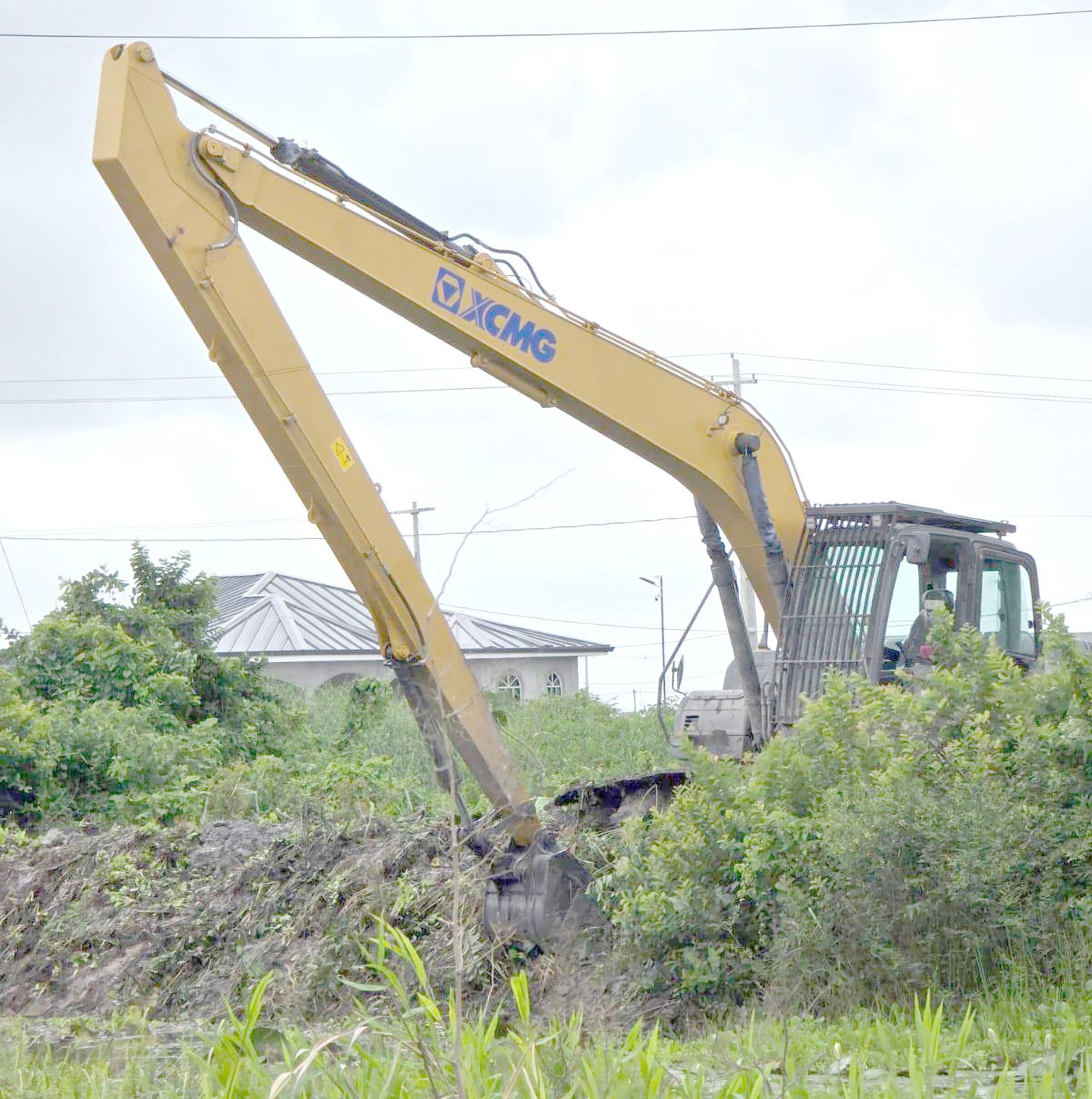
Following an inspection of the transmission line, GPL’s technical teams determined that an excavator operating at Grove, East Bank Demerara, had come into contact with the transmission line, damaging key infrastructure and triggering the disruption.
GPL identified the excavator as belonging to S. Joseph Transportation & Ma-
The company said the outage created an estimated 37-megawatt deficit on the national grid, resulting in widespread power interruptions across several communities in Demerara and Berbice.
chinery Rentals and said it was being operated by Garfield Hinds at the time of the incident.
The utility company said restoration efforts began immediately after the disturbance, with power being restored incrementally as crews worked to stabilise the system. Full service was restored to all affected customers by approximately 11:37 hours.
GPL has since launched a formal investigation into the incident and indicated that the contractor responsible would be pursued for compensation to cover the cost
of repairs and damage to the transmission infrastructure.
In a statement, the company reminded contractors and members of the public that excavation, construction and heavy-duty operations near transmission and distribution infrastructure must be coordinated with GPL to avoid accidents and disruptions to the electricity network. The utility warned that unauthorised activities near power infrastructure can result in significant service interruptions, damage to critical assets and serious safety risks.
Guyana has experienced increased pressure on its electricity infrastructure in recent years amid rapid economic growth, expanding housing developments and large-scale construction activity.
GPL has repeatedly cautioned contractors and equipment operators to exercise greater care when working near transmission lines and utility assets.
The company apologised to customers for the inconvenience caused and thanked the public for its patience during the restoration process.
- nearly 50 years later MEDEX programme continues to anchor Guyana’s frontline healthcare
GUYANA’S Medical Extension Officer (MEDEX) Programme, established nearly five decades ago to bridge gaps in healthcare access, is being credited as one of the country’s most impactful healthcare initiatives, with trained officers continuing to deliver frontline medical services in communities across all ten administrative regions.
Established in 1977, the programme was created to expand access to healthcare at a time when medical services were limited, particularly in hinterland and riverine areas.
Since then, it has trained 319 Medical Extension Officers, many of whom continue to serve on the frontline of the country’s primary healthcare system.
Speaking to healthcare workers in Region One, the country’s Chief MEDEX, Carleen Howard-Mohabir, emphasised the responsibility of healthcare workers to deliver service beyond the walls of health facilities.
“If someone is coming to us, you know that they do not have an alternative; as you know, we are public servants and we should all keep that as our main interest; we should ensure that we give that care and public service to all residents in Region
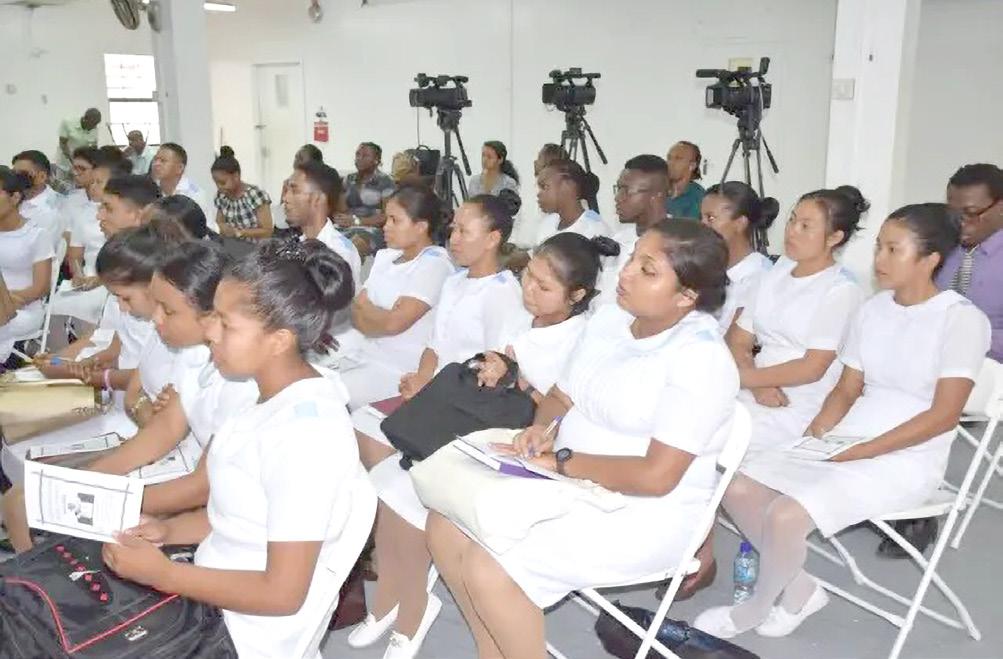
One,” the Chief MEDEX said.
Currently, there are 109 MEDEX officers deployed across Guyana, providing essential services at health posts, health centres, and district hospitals.
They are responsible for diagnosing and managing common illnesses, delivering maternal and child health services, stabilising emergency cases, and managing chronic diseases such as hypertension and diabetes.
“As the Education Minister has said, no child left behind, also no patient should be left behind. You would have heard HE, the President advocating, mentioned and elaborating that we need world class healthcare, so if the patient cannot come to us, we should take service to the patient,” MEDEX How-
ard-
Mohabir added. The programme continues to expand, with approximately 100 new students recently enrolled from across the ten administrative regions, marking the largest cohort to date.
During a recent telephone interview, the Chief MEDEX reflected on the programme’s impact and her own journey within it, stating that she is proud to be part of the programme as it has helped to shape her character and the person she has become today.
As the MEDEX Programme approaches 49 years of service in 2026, it continues to play a vital role in strengthening Guyana’s healthcare system and ensuring that quality care reaches even the most remote populations.
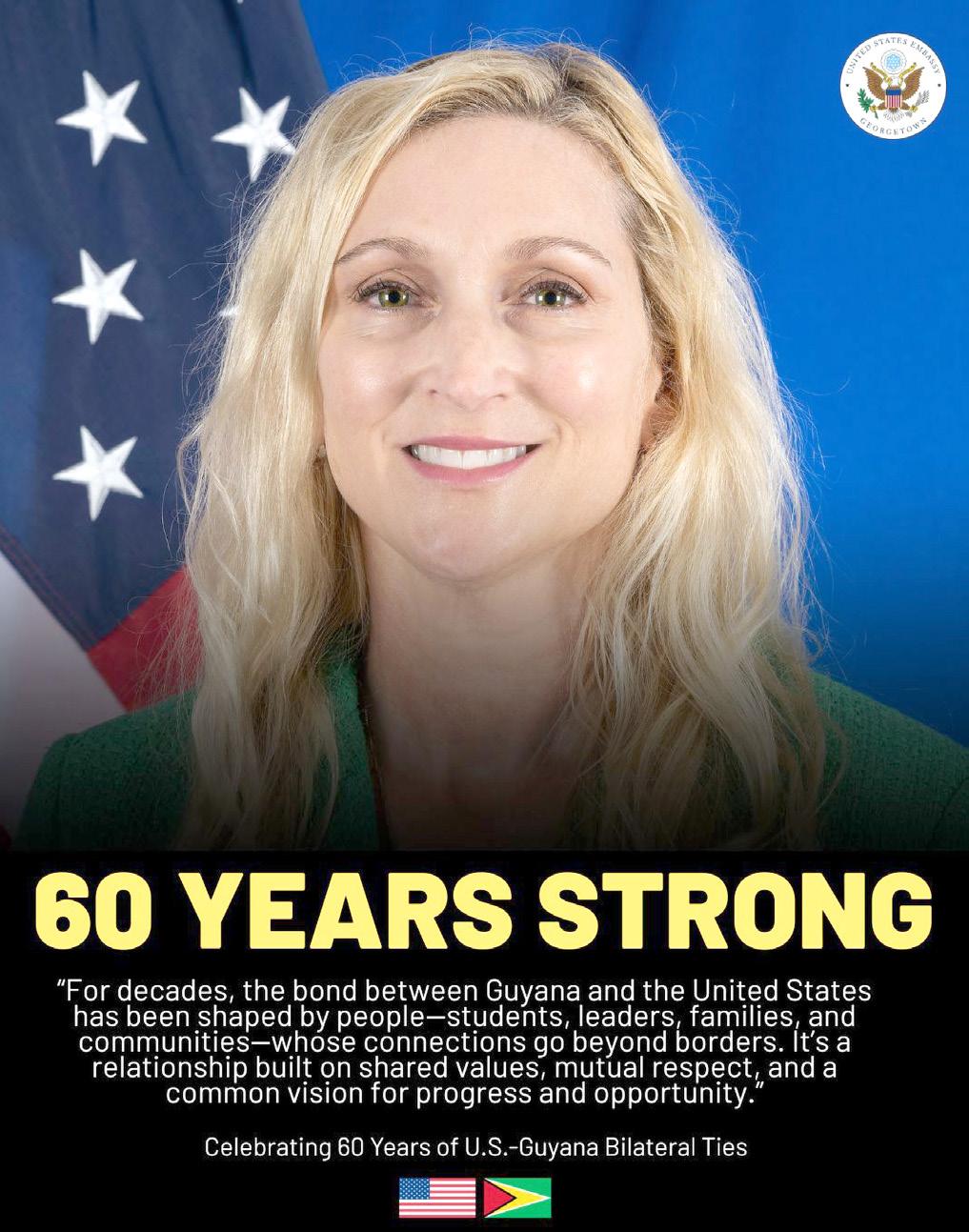
THE United States Embassy in Guyana has launched a new digital campaign titled “60 Years Strong” to commemorate the longstanding relationship between Guyana and the United States as the two nations mark major national milestones this year.
The initiative was announced by U.S. Ambassador Nicole Theriot, who noted that 2026 is significant for both countries, with the United States observing 250 years of independence while Guyana celebrates its 60th
anniversary as an independent nation. In a statement released by the embassy, Ambassador Theriot said the digital series would highlight the enduring partnership between the two countries, which she described as being rooted in shared values, mutual respect and a common vision for development and progress.
According to the ambassador, the campaign will feature stories centred on democratic principles, bilateral co-operation and the contributions of Guyanese alumni who participated in
U.S. exchange programmes and have gone on to make impacts within their communities and professional fields.
The embassy said the series will also focus on areas of co-operation aimed at strengthening regional development and collaboration between the two countries.
Guyana and the United States have maintained diplomatic relations since Guyana gained independence in 1966. Over the decades, the partnership has expanded across sectors including security, trade, health, education, ener-
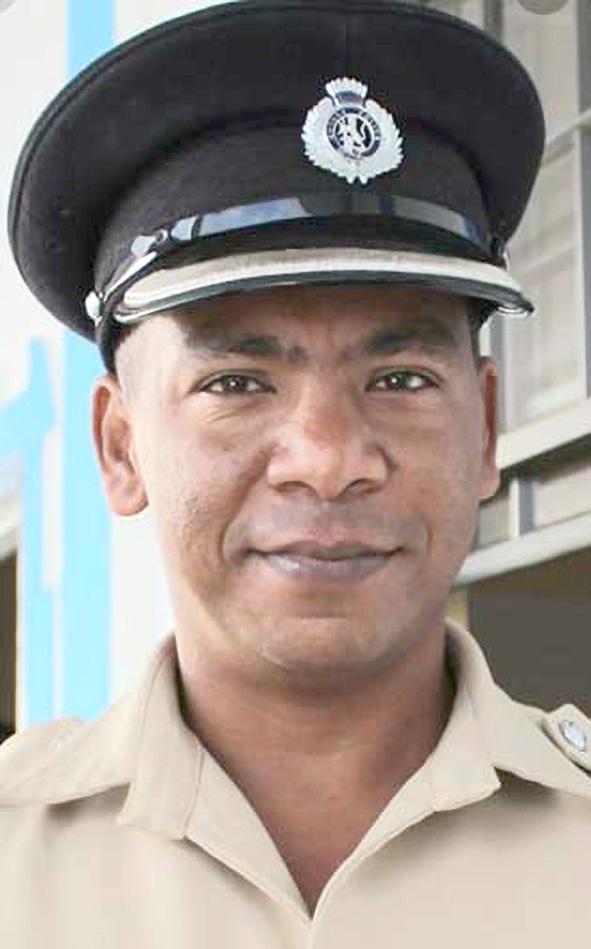
A GEORGETOWN magistrate, on Monday, declined a renewed request for the release of former Assistant Police Commissioner Calvin Brutus’ passport, indicating that the issue had already been argued before the court and should instead be addressed by the High Court.
The ruling was made by Magistrate Faith McGusty during proceedings at the Georgetown Magistrates’ Court after defence attorneys Glen Hanoman and Asif Zafar Ali returned to court seeking the temporary release of the travel document on behalf of former senior police officer Calvin Brutus.
During the hearing, the attorneys argued that Brutus required the passport for travel and as an additional form of identification linked to his current business activities, which they said involve the sale of truck parts. The court heard that the
passport had been lodged as part of the conditions attached to the criminal matter before the magistrate. Magistrate McGusty appeared unwilling to revisit the issue, remarking, “I think we played this song already. I do not wish to be a part of this band again.”
She subsequently indicated that the High Court should determine the matter.
Hanoman and Zafar Ali maintained that their client was not attempting to evade the judicial process and said the application was being made for legitimate business and identification purposes.
The matter was adjourned until May 25. Brutus, a former senior member of the Guyana Police Force, has been before the courts in relation to a number of criminal charges. (NCN)
THE government is ramping up efforts to modernise Guyana’s agriculture sector and attract more young people through a tunnel-ventilated poultry farming initiative, a programme aimed at increasing poultry production and reducing CARICOM’s food import bill.
While Guyana is already self-sufficient in poultry meat production, Minister of Agriculture, Zulfikar Mustapha, explained that food demand has increased significantly because of the rapid expansion of the oil and gas and hospitality sectors.
Tunnel-ventilated poultry farming is a mechanical climate-control system where a constant, high-speed stream of fresh air is drawn through a poultry house.
Air enters at one end, flows longitudinally over the birds, and is exhausted by heavy-duty fans at the opposite end, creating a ‘windchill’ effect to prevent heat stress. Each of the pens that will come on stream has the capacity to produce approximately 40,000 birds every six weeks, with mortality rates estimated at between one and two per cent. Persons interested will form groups of approximately 40 members, with each project estimated to cost around $160 million.
The participating groups would access approximately $40 million in financing through the banking sector, while the government would provide additional support. The projects are expected to generate annual profits
gy and governance. In recent years, relations between the two countries have deepened amid Guyana’s rapidly growing oil-and-gas sector and increased economic and strategic co-operation in the Caribbean region.
The United States has also supported a number of initiatives in Guyana through development partnerships, educational exchanges and security collaboration.
The embassy is encouraging public participation in the campaign through the social media hashtags #Freedom250 and #USGuyana60.
of at least $61 million after expenses. Minister Mustapha stated that persons already employed do not have to leave their jobs to be a part of the initiative. “We will work with the groups, train them and help them through the process. Most of the systems will be automated,” he noted during a recent engagement with farmers in Region Two.
“Marketing is easy. Sometimes in one day, all your birds could sell out,” the agriculture minister stated.
According to the minister, there is still a perception among many young people that agriculture is only for senior people or persons without an education, and the government is working to change that mindset.
(DPI)

1. Chinese and American societies and the international community have been following U.S. President Donald J. Trump’s visit to China with intense interest. How do you assess the summit meeting between President Xi Jinping and his counterpart?
Wang Yi: During the visit, President Xi Jinping and President Donald J. Trump had long discussions on major issues concerning China-U.S. relations and world peace and development in a way that was open, thorough, constructive, and strategic. They actively sought the right way for two major countries to get along with each other, and reached a number of common understandings in this respect. As noted by many in the media, it was a historic meeting.
First, China and the United States have both entered a crucial stage in our development. This year marks the start of China’s 15th FiveYear Plan for Economic and Social Development, and we are advancing Chinese modernization on all fronts through high-quality development. This year is also the 250th anniversary of American independence.
In this special year, the two presidents met in Beijing for an extensive discussion on national governance, bilateral relations, and international and regional hot spots. This sent an important message to the world: Achieving the great rejuvenation of the Chinese nation and making America great again can go hand in hand, and the two countries can help each other succeed and advance the well-being of the whole world.
Second, China-U.S. relations have reached a new starting point. This is the first face-to-face engagement between President Xi and President Trump since their Busan meeting last October, and also the first visit to China by a U.S. president in nine years. It is a continuation and strengthening of the good momentum in the interactions between the two presidents. As transformation not seen in a century accelerates across the globe, the world has once
again reached a crossroads.
President Xi raised some important questions: Can China and the United States overcome the Thucydides Trap and create a new paradigm of major-country relations? Can we meet global challenges together and provide greater stability for the world?
Can we build a bright future together for our bilateral relations in the interest of the well-being of the two peoples and the future of humanity?
These questions are vital to history, to the world, and to the people.
They are the questions of our times that Chinese and American leaders need to answer together. When the two presidents set the course for the giant ship of China-U.S. relations, they will have a significant and far-reaching impact on the evolving international landscape and the development of human society.
Third, the two presidents’ in-depth discussions have produced fruitful outcomes. The visit included not only official talks and a welcoming banquet, but also private exchanges and a cultural visit. Throughout the nearly nine hours the two presidents spent with each other, they showed mutual respect, a commitment to peace, and a shared interest in pursuing cooperation.
The most important political understanding they reached was the agreement to build “a constructive China-U.S. relationship of strategic stability.” They also agreed for the two sides to pursue more exchanges on foreign policy, military-to-military relations, economy and trade, public health, agriculture, tourism, people-to-people ties, and law enforcement. This will provide a powerful boost to China-U.S. interactions.
2. What is meant by “a constructive relationship of strategic stability,” the new vision for China-U.S. relations?
Wang Yi: President Xi and President Trump agreed on a new vision of building a constructive China-U.S. relationship of strategic stability, providing strategic guidance for bilateral relations over the
next three years and beyond. The new vision they articulated has been well received by the people of both countries and the broader international community. This is how China understands it:
It should be positive stability where cooperation is the mainstay and the relationship gets more resilient through exchange and cooperation. As the world’s top two economies, China and the United States share deep ties. Neither can cut the other out, or prosper without the other. We both gain from cooperation and lose from confrontation. While a confrontational relationship will be disastrous for both countries and the world, China-U.S. cooperation will get many great things done to the benefit of both and all.
and conflicts and wars are not acceptable. Peaceful coexistence is the biggest common denominator of China and the United States. Conflict and confrontation between us will produce consequences no one can bear. The bottom line is that both sides must abide by the three China-U.S joint communiqués, respect each other’s social systems and development paths, respect each other’s core interests and major concerns, and respect each other’s right to development.
In short, building a constructive China-U.S. relationship of strategic stability is not a slogan. It should be a goal both sides uphold and entail concerted actions. Now that our presidents have set the direction, we should add more substance to this
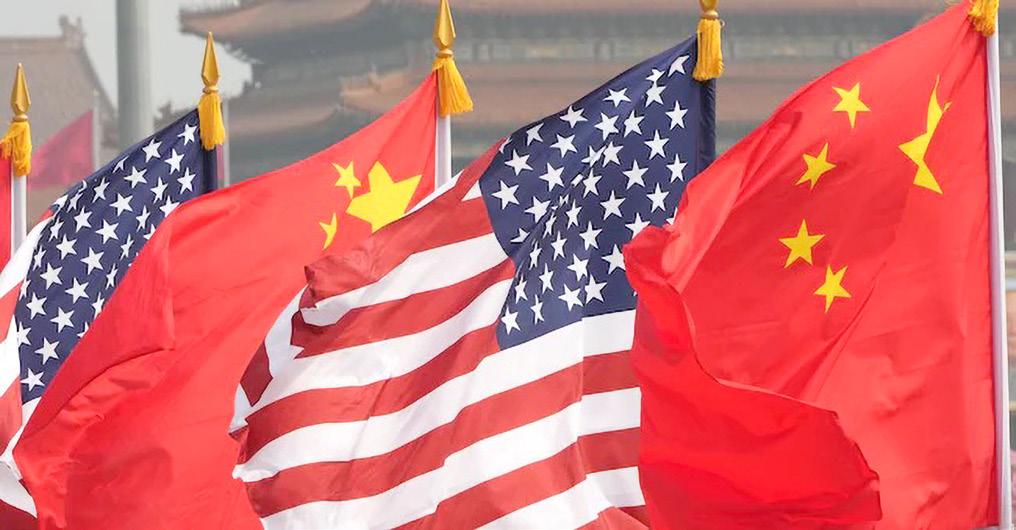
It should be healthy stability where competition is kept within proper limits and is not turned into a zero-sum game. Major-country competition is nothing new, but China-U.S. relations should not be defined by competition. When competition does happen, it must be a healthy one where we learn from each other, pursue excellence together, and compete fairly in compliance with rules. The purpose of competition should be to outdo oneself, so that both sides become better. It should be constant stability where differences are manageable and the relationship should not be like a roller coaster. Both sides should maintain policy continuity and stability. It is very important for both sides to honor our words and move in the same direction. A positive outlook of China-U.S. cooperation will provide more certainty for both countries’ development and for the international situation.
It should be lasting stability where peace is expectable
new vision and translate it into concrete policies and measures, so as to write a new chapter in China-U.S. relations.
3. During this summit, what has been agreed in terms of interactions at the leadership and other levels?
Wang Yi: The China-U.S relationship is the most important and complex bilateral relationship in the world. It is anchored by presidential engagement. Since President Trump took office last year, the two presidents have had two meetings and five phone calls, and wrote each other many letters. Their engagement provided strategic direction for the improvement and development of China-U.S. relations and kept the relationship on an even keel despite a few ups and downs.
During this visit, the two presidents agreed to keep in close touch through meetings, calls, and letters. At the invitation of President Trump, President Xi will
pay a state visit to the United States this fall. In the meantime, the two sides should work together to make thorough preparations for these presidential interactions, foster the right atmosphere, and secure more outcomes of cooperation.
With the authorization of the two presidents, the political and diplomatic channel has stayed active. The two countries’ foreign policy officials and diplomats have properly handled differences, solved practical problems and increased mutual understanding, contributing to stronger bilateral ties. As instructed by the two presidents, the two economic and trade teams have held multiple consultations, which stabilized the economic and trade ties and market expectations. These two channels will continue to work to lengthen the list for cooperation and shorten the list of irritants.
To effectively implement what the presidents have agreed to, the various departments on both sides must work in concert. The Beijing summit will reenergize exchanges between the two sides’ legislative bodies, subnational entities and business, academic and media communities. The two sides have also agreed to support each other in hosting this year’s APEC Economic Leaders’ Meeting and G20 Summit. All levels in both countries must hit the ground running to follow through on what our presidents have agreed to and secure more tangible outcomes.
4. In what ways will the summit boost people-to-people exchanges?
Wang Yi: President Xi has pointed out that the hope of China-U.S. relationship lies in the people, its foundation is in grassroots connections, its future depends on the youth, and its vitality comes from subnational exchanges. During this summit, both presidents spoke about the importance of promoting people-to-people exchanges. President Xi specially cited the “Ping-Pong diplomacy” which took place 55 years ago. It opened up the China-US. relations that had remained frozen for over two
decades, and marked a milestone in contemporary international relations. President Trump also reviewed historical interactions between the two nations, noting that Sino-U.S. friendship goes all the way back to America’s founding and the American and Chinese people have shared a deep sense of appreciation and respect that ran in both directions.
As the relationship entered a new phase, President Xi announced an important initiative to invite 50,000 young Americans to China on exchange and study programs over a period of five years. It was warmly received and actively joined by both societies. President Xi welcomes more young Americans to visit and study in China. President Trump has also said multiple times that he welcomes Chinese students to the United States. This kind of two-way exchange will broaden the horizon of the young people in both countries, and shape a better future of China-U.S. relations. During the visit, the two presidents toured the Temple of Heaven together. The tour provided insights into the Chinese appreciation of harmony among all beings and respect for the law of nature. This special program attested to the need for the two great countries to deepen mutual understanding and foster people-to-people friendship.
In the past year and more, legislative, subnational, and business delegations have visited each other more frequently. Many U.S. business leaders accompanied President Trump to China on this trip, and he even invited them to the official talks.
President Xi spoke to every one of them, encouraged them to strengthen cooperation with China, and stressed that China will open its door still wider. Premier Li Qiang also met with the U.S. business leaders. They all said that they have a deep commitment to the Chinese market, and want to grow their business here and strengthen cooperation with Chinese partners. It is clear that China remains a hot destination for American businesses and investors.
REGIONAL conglomerate
ANSA McAL Group has reaffirmed its long-term investment commitment to Guyana, positioning itself as a strategic partner in the country’s economic and social transformation amid ongoing rapid growth.
commercial expansion and is centred on long-term partnership and national development.
The company made the announcement during its “Growing with Guyana” Networking Cocktail and Business Showcase held in Georgetown on Friday, which brought together President Mohamed Irfaan Ali, senior government officials, business leaders and private sector stakeholders.
Speaking at the event, Group Chief Executive Officer, Anthony Sabga III, said the company’s involvement in Guyana extends beyond
“Growing with Guyana is not about expansion for expansion’s sake. It is about partnership, shared progress, and long-term commitment to the people and communities of Guyana,” Sabga stated.
The event formed part of ANSA McAL’s broader strategy to align its operations and investments with Guyana’s Vision 2040 development agenda.
Among the major announcements was the launch of a national call for social investment proposals through the ANSA McAL Foundation.
Head of Sustainability and Social Investment, Melanie Richards, said registered

civil society organisations across Guyana will be invited to submit programmes focused on education, including STEM, technical and vocational training, entrepreneurship and youth development.
According to the company, GYD $20 million, equivalent to approximately US$100,000, will be invested across two selected organisations. The initiative will also include a one-day
A NEW cohort of Regional Executive Officers (REOs) has officially assumed duty across most of Guyana’s administrative regions, marking a significant step in the government’s ongoing effort to strengthen regional governance and improve public service delivery nationwide.
The appointments span Regions One through Eight and Region Ten, with officials now tasked with overseeing the daily administration of Regional Democratic Councils (RDCs), coordinating government programmes, and ensuring the implementation of national development policies at the regional level.
The newly appointed officers are: Steven CheefoonRegion One, Deolall Rooplall - Region Two, Surendra Khayyam - Region Three, Juan Edghill Jr.- Region Four, Mary Samaroo - Region Five, Ronald Harsaywack - Region Six, Josh Kanhai - Region Seven, Marti DeSouza - Region Eight, and Gregory Harris - Region Ten.
The government also confirmed that Karl Singh continues to serve in his post in Region Nine. REOs play a central role in bridging national policy and local implementation, with responsibility for man-

aging regional administrative systems, supervising technical staff, and working alongside local democratic organs and community stakeholders. Their mandate includes improving accountability, strengthening coordination, and enhancing the efficiency
of essential public services.
Their assumption to office comes as the government continues to roll out major investments in infrastructure, healthcare, education, agriculture, public works, and community development across all regions. Officials are expected to play a key coordinating role in ensuring these initiatives are effectively implemented and reach communities in a timely manner.
President Mohamed Irfaan Ali has expressed confidence in the leadership capacity of the new REOs, emphasising the importance of professionalism, transparency, and responsiveness in regional administration.
The newly appointed officers have been extended congratulations as they begin their tenure serving communities across the country, with expectations high that their leadership will strengthen regional governance and accelerate development outcomes nationwide.
capacity-building workshop aimed at strengthening the operational capabilities of non-governmental organisations.
The company also highlighted its social and cultural initiatives undertaken in Guyana during 2025, including sponsorship support for the Parkside Steel Orchestra and the “Pan on the Wall” cultural showcase, road safety partnerships along the Essequibo Coast, and support for the Empower Guyana: Center for Equity and Innovation.
During the event, Group Head of Legal and Corporate, Secretary Frances Bain-Cumberbatch, underscored the significance of the Anthony N. Sabga Awards, which recognise Caribbean professionals for excellence and innovation.
She noted that since its establishment in 2005, the awards programme has recognised 71 Caribbean professionals and invested approximately TT$34 million in support of their work. Guyana has produced 16 laureates to date, and Georgetown is expected to host the 2026 awards ceremony next month.
Guests at the showcase also viewed presentations and exhibits from several ANSA McAL subsidiaries operating in Guyana, including ANSA McAL Distribution Inc., ANSA Motors Guyana, ANSA Building Solutions Guyana, Guyana Breweries Inc. and ANSA McAL Real Estate. The event comes as Guyana continues to attract increased regional and international investment amid rapid economic expansion driven largely by growth in the oil-and-gas sector, infrastructure development and expanding consumer markets.
Headquartered in Port of Spain, ANSA McAL operates across more than 11 territories and spans sectors including manufacturing, automotive, financial services, distribution and beverages. The company has maintained a presence in Guyana for more than three decades.
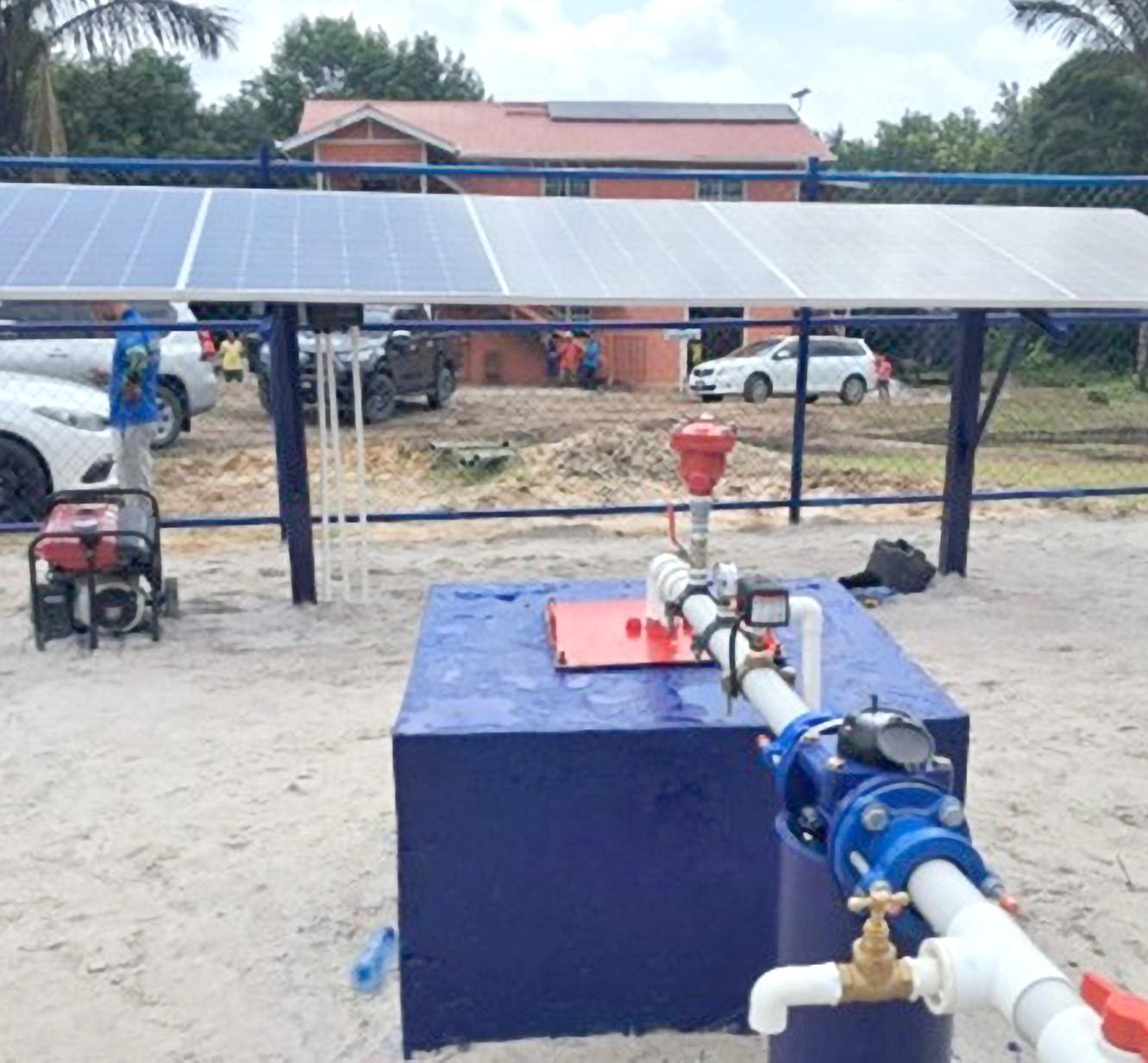
RESIDENTS of Adventure along the Soesdyke-Linden Highway are now experiencing a major improvement in their quality of life following the commissioning of a new well installed by Guyana Water Incorporated (GWI).
The undertaking marks the first time the community has had direct and reliable access to treated water.
During an interview with the Department of Public Information (DPI) on Monday, Community Chairman, Alonzo Cornelius, described the project as a major transformation for residents who previously faced severe challenges accessing water, especially during the dry season.
He added that what once cost families thousands of dollars in water supply arrangements is now a burden of the past, as water is finally reaching homes directly.
The Adventure community, which officially became a recognised community in 2020, has grown from about 13 households to more than 25 households with an estimated 60 to 70 residents.
“The government has been very responsive, and GWI came in, did the studies, looked at the population and distance, and identified the most suitable site for the project,” Cornelius said. He emphasised that the project is part of a wider transformation taking place in the community, which also includes a multi-purpose building, a village shop, transportation support for schoolchildren via a community bus, and ongoing road and electricity development initiatives. He noted that before the well’s installation, residents depended on a small creek connected to the Moblissa Creek system for drinking water and household use, a practice that was both time-consuming and unreliable.
With the new well now in operation, Chairman Cornelius is urging residents to take ownership of the facility and protect it for long-term sustainability.
According to Cornelius, the GWI’s intervention came after the community prioritised water as one of its key development needs under its Community Development Council (CDC) framework. Technical assessments were later carried out to determine the most suitable location and system design for the well.
(DPI)
financial institutions, policymakers, and investors in a single space to showcase developments in housing, infrastructure, and construction technology.
Minister Croal also clarified arrangements for the Ministry’s participation at the event, noting that its
main exhibition booth will be positioned at the front of the venue as in previous years. He added that the Ministry will also feature elements of its “Dream Realised” initiative at the rear section of the exhibition space. However, he said the Ministry will not be pro -
cessing new housing applications on site during the event, directing prospective applicants instead to regional offices and standard service channels.
The “Dream Realised” component is expected to include another large-scale distribution of land titles,
continuing a feature that has become a central attraction of the expo in recent years.
Croal said the Ministry remains optimistic about the 2026 staging, noting that visitors can expect a strong focus on innovation, construction technology, and sector education aimed at im-
proving public understanding of housing and infrastructure development.
First launched in 2010 under the then Minister of Housing and Water, Mohamed Irfaan Ali, the International Building Expo was initially conceived as a platform to connect contrac-
FROM PAGE 9
tors, suppliers, banks, and investors.
Over time, it has expanded significantly in scope and scale and is now regarded as a key regional event for the construction and housing industry, linking Guyana to regional and international markets.
A TWO-DAY cybersecurity training programme aimed at strengthening Guyana’s national security infrastructure has concluded, with members of the Guyana Defence Force (GDF) and the National Intelligence and Security Agency (NISA) receiving advanced instruction in cyber threat prevention and digital security systems.
The programme was organised by Data Technology Guyana in collaboration with global cybersecurity firm Fortinet and focused on preparing security personnel to respond to the growing complexity of cyber threats targeting critical infrastruc-
ture and sensitive information systems.
According to organisers, participants were exposed to industry-standard cybersecurity frameworks, modern security tools and best practices through hands-on training sessions designed to improve national cyber defence capabilities.
General Manager of Data Technology Guyana, Rennie Leow, said the initiative represented an important step in strengthening the country’s cyber resilience.
“By empowering our national security forces with the right knowledge and tools, we are laying a strong foun-
dation for a more secure digital future for Guyana,” Leow said.
The training also highlighted ongoing collaboration between the private sector and international technology partners to expand cybersecurity capacity in Guyana as the country continues its digital transformation efforts.
Fortinet Regional Account Manager for Guyana and Suriname, Bhagwat Persaud, participated in the programme alongside senior representatives from the security sector, including Deputy Director of the National Defence Institute and ICT Policy Advisor to the GDF, Dr. Seon Levius, and Officer

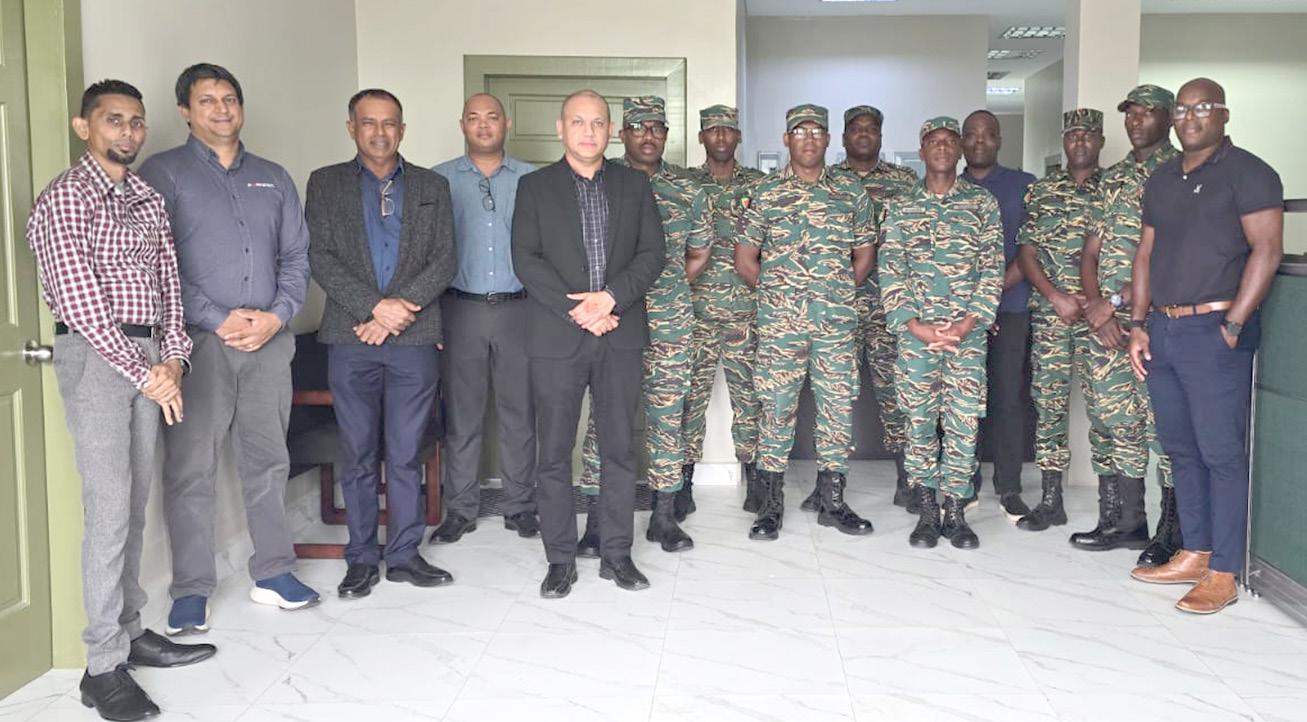
Commanding of the GDF Information Technology Department, Major Samuel Jason Klien and representatives from National Intelligence
and Security Agency.
Data Technology Guyana said it intends to continue supporting the development of secure and sus-
tainable information and communications technology systems as Guyana advances its digital infrastructure and online services.
3,168 traffic offences
MORE than 3,000 traffic-related offences were recorded across Guyana between May 10 and May 16, 2026, with speeding continuing to account for the vast majority of violations, according to the latest enforcement statistics released by the police.
Police recorded a total of 3,168 traffic cases during the one-week period, including 1,308 speeding offences, 123 cases involving failure to wear safety helmets, and 104 seatbelt violations.
Authorities also reported 64 cases involving unlicensed drivers, 55 breaches of prescribed fitness conditions for vehicles, and 54 offences related to illegally tinted motor vehicles.
In addition, police documented 36 cases of driving under the influence (DUI) and another 36 offences involving pillion riders without safety helmets. Other violations included leaving motor vehicles in dangerous positions (92), breaches of traffic light signals (27), faulty parking (7), and unlighted motor vehicles, with 49 vehicles found without front lights and 42 without rear lights. The figures were released alongside details of an extensive public education campaign carried out during the same period as part of ongoing road safety and traffic awareness efforts.
Traffic ranks conducted lectures and outreach exercises at taxi bases, police stations, public roads, bars, villages, and community venues across the country.
Among the locations targeted were Sheriff Street, Charity
Schools included Tobago Primary in Region One, Karasabai Secondary in Re-
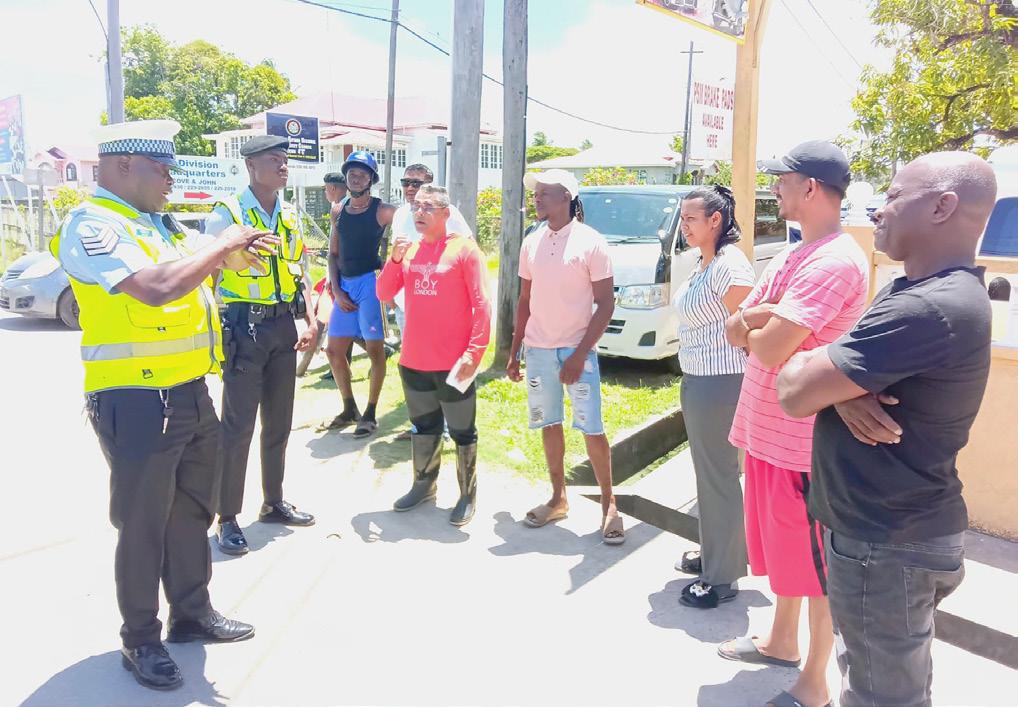
Public education campaigns were also carried out during the same period as part of ongoing road safety and traffic awareness efforts
Public Road, Vreed-en-Hoop, Mahdia, Mabaruma, Sea Wall Road, and the township of New Amsterdam.
Outreach activities were also held at several entertainment establishments, including Pearly Bar, Fresh Cash Bar, Rewind Sports Bar, Eclipse Bar, Diamond Tip Sports Bar, and Mets Sports Bar, where officers engaged patrons on responsible road use and the dangers of impaired driving.
Police further expanded their education programme to schools between May 11 and May 15, conducting road safety lectures at institutions in Regions One, Two, Four and Nine.
gion Nine, Gangram Primary in Region Six, and several schools in Region Two, including Somerset and Berks Nursery, Huis’t Dieren Primary, Onderneeming Nursery, Sparta Primary and Suddie Primary. Timehri Primary in Region Four B also participated in the initiative. The traffic enforcement and education exercises form part of ongoing efforts by the police to reduce road fatalities and improve compliance with traffic laws nationwide.
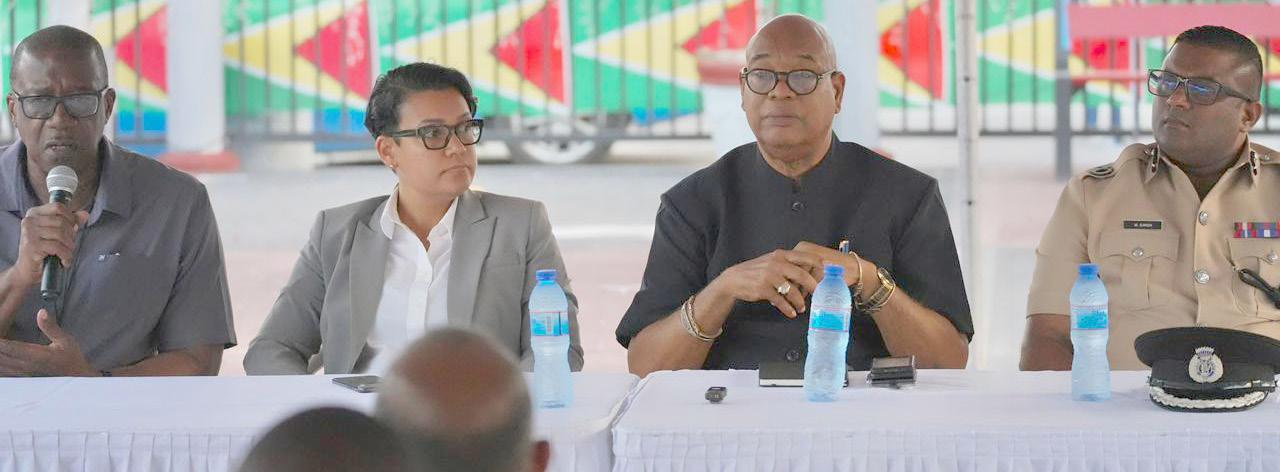
Officials at the Stabroek Square public meeting on public transportation fares, featuring (from left) Captain Stephen Thomas, Director General of MARAD, Susan Rodrigues, Minister of Tourism, Industry and Commerce, Bishop Juan Edghill, Minister of Public Works, and Traffic Chief and Assistant Commissioner Mahendra Singh, as they addressed concerns over transport fares (Sachin Persaud photos)
THE Government on Monday issued a stern warning to public transport operators against imposing unauthorised fare increases, as officials moved to strengthen enforcement amid mounting complaints of excessive charges by minibus, taxi, and boat operators across the country.
At a public meeting held at Stabroek Square, senior government ministers and enforcement agencies stressed that no fare hikes have been approved, and warned that operators found breaching licensing conditions could face suspension or revocation of their permits.
Minister of Public Works Juan Edghill described the situation as “untenable,” citing a growing number of reports from passengers allegedly being overcharged for transportation services.
“The case is clear: as of now, there is no increase in fares,” Edghill declared during the meeting. “No Guyanese citizen, no tourist, no child, no worker or anyone is forced to pay.”
The minister referenced complaints received by his ministry, including a report of a passenger allegedly being charged $2,000 for a taxi trip from Giftland to Cummings Lodge in Georgetown.
Edghill stressed that transport providers are obligated to comply with approved fare structures and cannot refuse service or remove passengers who decline to pay inflated prices. He urged commuters to formally report operators who
violate regulations, assuring that authorities would take action.
“No operator who is licensed by the various regulatory authorities can order a passenger out, boat, bus or car, if they refuse to pay,” he said.
At the same time, the minister indicated that the government remains willing to engage operators to address challenges affecting the sector while ensuring consumer protection measures remain in place.
Minister of Tourism, Industry and Commerce, Susan Rodrigues, also reiterated that public transportation services fall under the jurisdiction of the Public Utilities Commission and encouraged passengers to file complaints where overcharging occurs.
Rodrigues highlighted several government interventions aimed at supporting transport operators, including fuel subsidies, expanded road infrastructure, the relaxation of restrictions on imported used vehicles older than eight years, and changes to policies governing used tyres.
“We cannot have and we cannot condone the arbitrary imposition of increased fares,” she said, while also calling for continued dialogue between operators and the government to address industry concerns.
Assistant Commissioner and Traffic Chief of the Guyana Police Force, Mahendra Singh, confirmed that police investigations into the complaints are ongoing and that enforcement measures have already intensified.
According to Singh, the force has circulated information outlining approved fare structures and encouraged members of the public to submit formal complaints and statements to facilitate prosecution and regulatory action.
He disclosed that at least three road service licences are currently being considered for revocation due to alleged breaches of licensing conditions.
“The revocation is justified because the clauses of the same licence have been breached,” Singh stated. “The law will be respected.”
On the maritime side, Director General of the Maritime Administration Department, Captain Stephen Thomas, warned that boat operators engaging in price gouging could also face suspension.
Thomas noted that government measures, including the removal of boating licence fees and inspection costs, were implemented to help reduce operational expenses for operators.
“Operators who charge and price gouge, we will be suspending their licence, and they won’t be able to work,” he said, adding that other qualified applicants are prepared to enter the sector if current operators fail to comply with regulations.
Authorities say the increased enforcement effort is intended to protect commuters and ensure public transportation services remain accessible and affordable amid ongoing concerns over rising living costs.
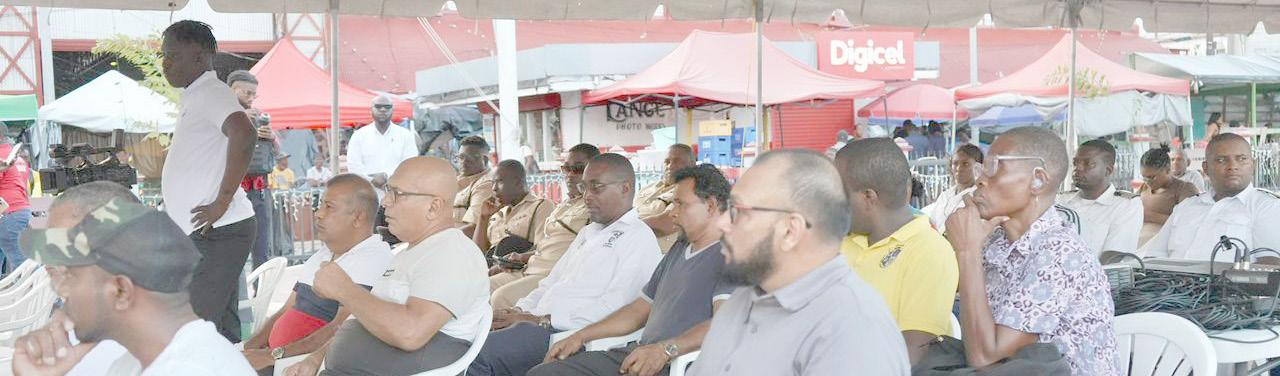
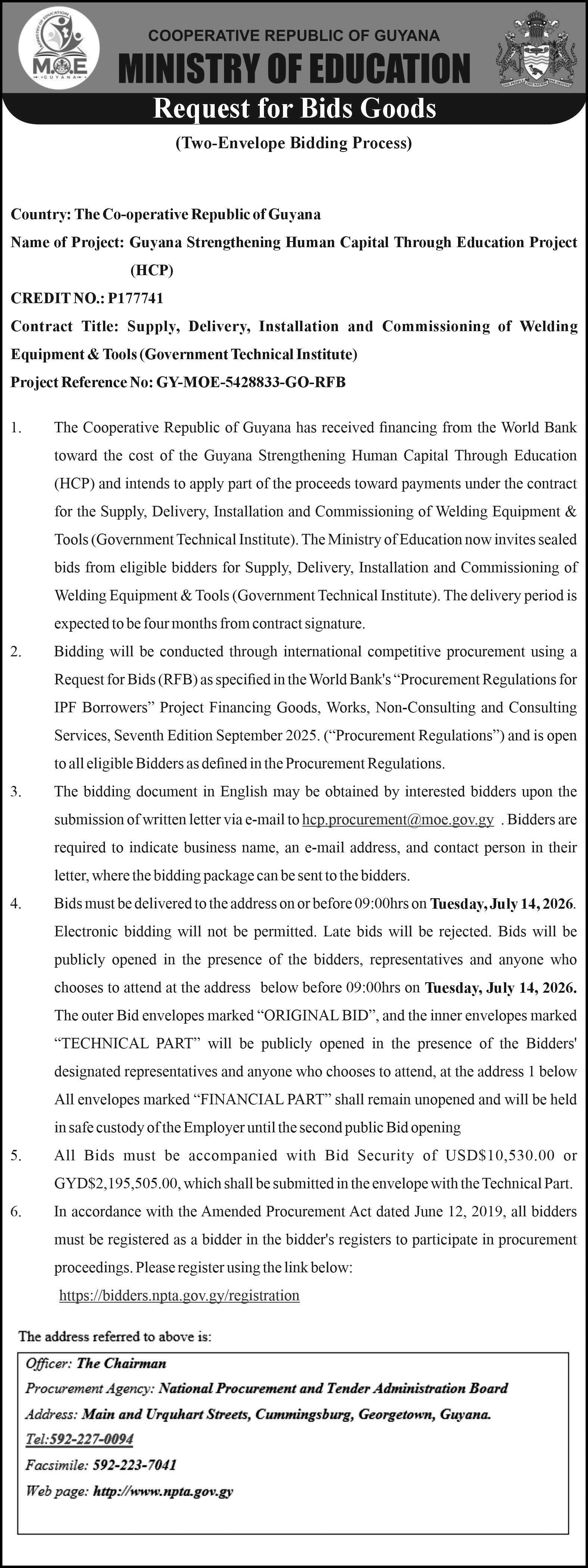
Five are receiving training in climate-smart agricultural techniques under a government-supported initiative aimed at strengthening food production, expanding employment opportunities and building more resilient farming communities.
The programme, being implemented through the WIIN Climate Smart Agriculture initiative, is a collaboration between the Ministry of Human Services and Social Security and the National Agricultural Research and Extension Institute (NAREI).
According to the ministry, participants are undergoing both practical and theoretical training in a range of modern agricultural practices, including hydroponics, grafting, budding and shade house management.
As part of the programme, trainees also visited the Fort Wellington Model Farm and NAREI facilities, where they observed climate-smart agriculture systems and technologies being implemented in real-world settings. Officials say the initiative is intended to equip residents with skills that can support self-employ-
ment, entrepreneurship and long-term food security while promoting sustainable farming practices. Climate-smart agriculture has become an increasing priority in Guyana as the country seeks to modernise its agricultural sector and improve resilience to climate change, flooding and changing weather patterns. The approach focuses on improving productivity while reducing environmental impact and strengthening farmers’ ability to adapt to climate-related challenges. Hydroponics and shade house cultivation, in particular, have
gained attention as methods capable of increasing crop yields while using less land and water. Such techniques are also seen as important tools for improving yearround agricultural production. The WIIN programme forms part of broader efforts by the government to support vulnerable groups and create economic opportunities through skills training and community-based initiatives.
Agriculture remains one of Guyana’s traditional economic pillars despite rapid expansion in the country’s oil-and-gas sector.
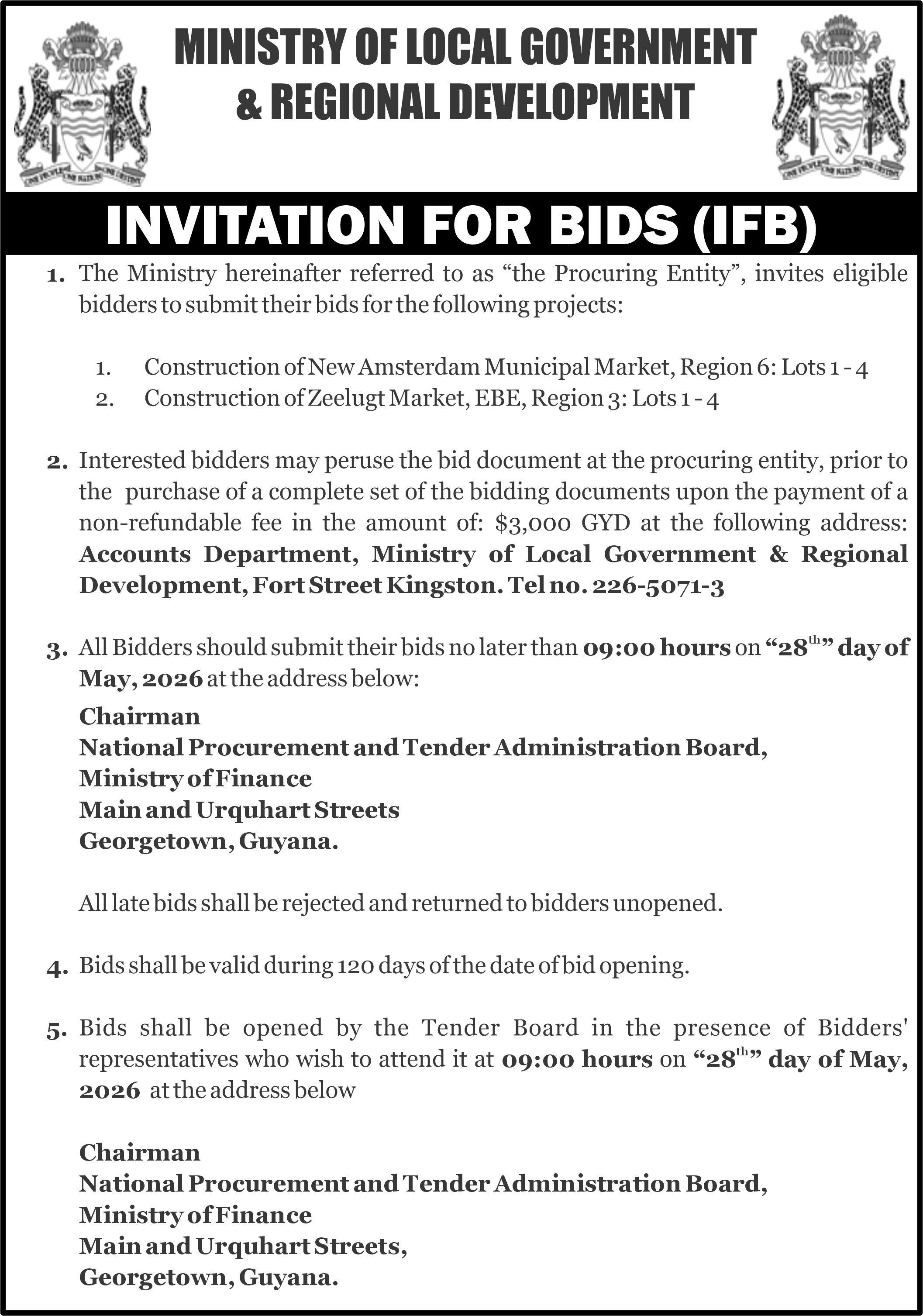
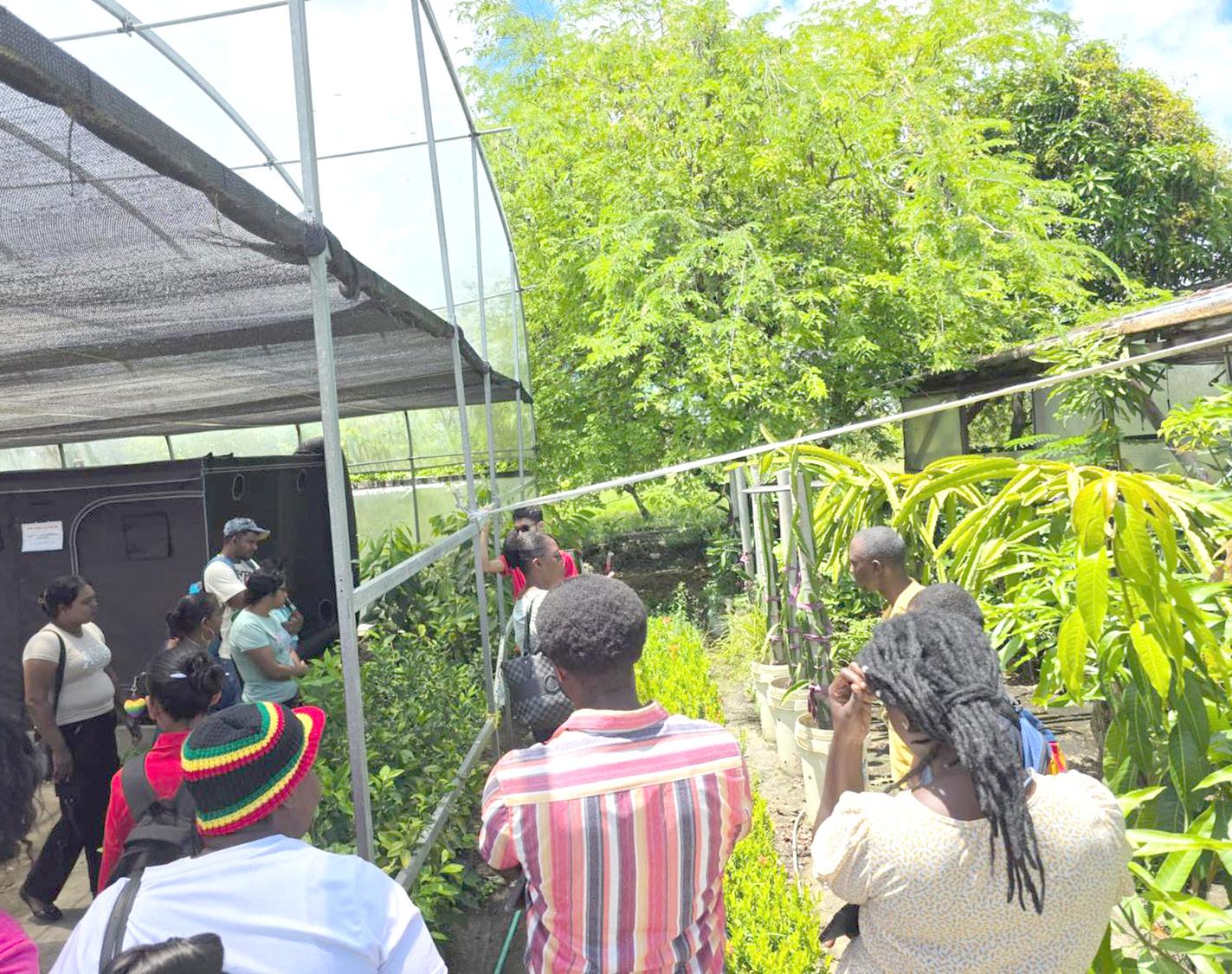
and processing have been identified as areas with economic and environmental potential, particularly for hinterland and rural communities.
The Euroclima programme, funded by the European Union, supports climate mitigation and adaptation projects across Latin America and the Caribbean.
In Guyana, several initiatives under the programme have focused on sustainable forestry management, community development and strengthening green econom-
ic opportunities.
Officials have said that community-based training programmes are intended not only to build technical capacity but also to encourage entrepreneurship and value-added production using locally available resources.
The bamboo furniture course is among a series of capacity-building activities being rolled out under the project as Guyana advances policies tied to sustainable natural resource management and low-carbon development.
POLICE are investigating the circumstances surrounding the escape of remanded prisoner Adrian Damder from the Lusignan Prison, East Coast Demerara, which occurred sometime between 08:00hrs and 16:00hrs on Sunday May 17, 2026.
Damder, of Graham Street, Better Hope, East Coast Demerara, was remanded to the Lusignan Prison on January 14, 2026, in relation to two counts of Threatening Language. Police ranks have since been dispatched to the prison as investigations continue.

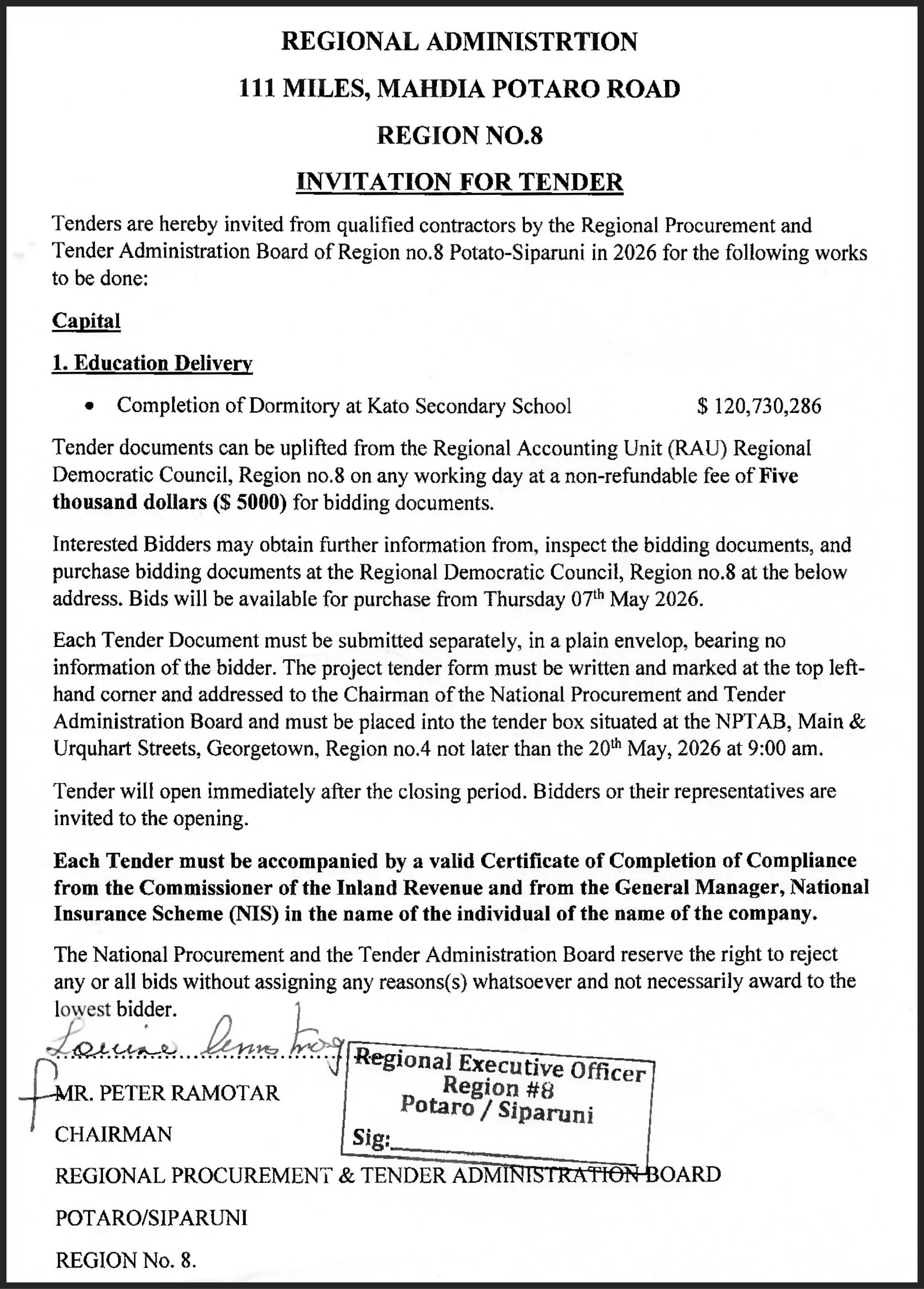




to Guyana’s success at the Caribbean Area Squash Association (CASA) Championships 2025. Her discipline, dedication, and strong work ethic continue to position her for success both regionally and internationally.
(From page 22)
Hand-in-Hand Insurance recognises the importance of investing in youth development and creating opportunities for young people to excel. The company is honoured to play a role in supporting Emily’s journey and wishes her continued success in her future competitions and sporting endeavours.
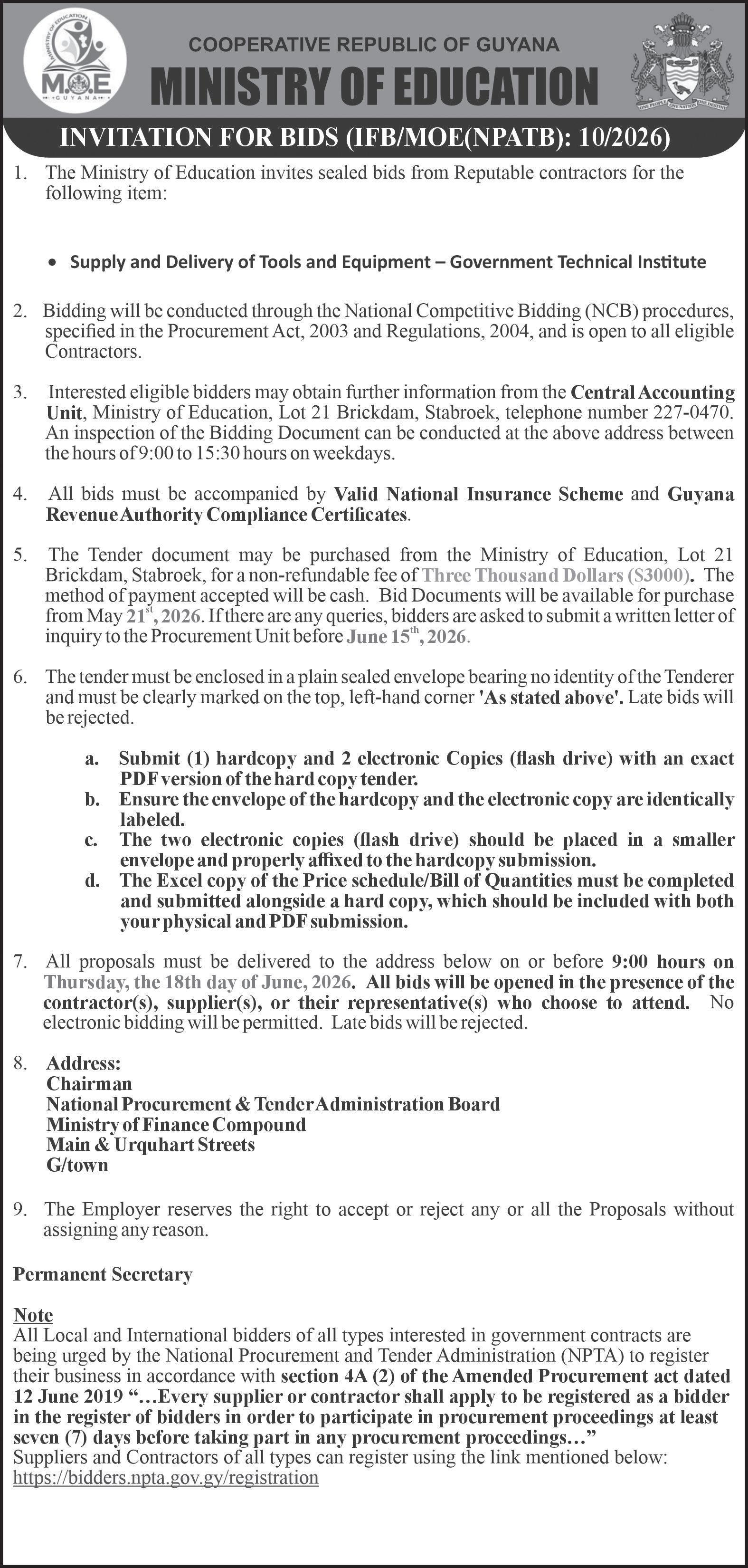
9, 11-1, 11-6
Junior Boy's Singles Elite [1] Ethan Bulkan def. [4] Joshua Verwey 10-12, 1210, 11-9, 11-7
Junior Girl's Singles Elite [2] Kaylee Lowe def. [1] Emily Fung A Fat 9-11, 11-9, 11-8, 6-11, 11-7
Women's Singles- Elite [3] Mary Fung-A-Fat def. [4] Kirsten Gomes 11-1, 11-5, 11-6
Men's Singles- Elite [3] Ashante Smith def. [4] Nicholas Verwey 2-11, 119, 11-3, 11-3
Women's Singles- Elite
Jonathan van Lange and Keemo Paul, that resuscitated the innings and gave them hope of gaining a first innings lead.
But four runs short of a well-deserved half century, the teenaged van Lange was undone by a delivery from Seales that he could only edge behind to the keeper.
With any Harpy Eagles recovery resting on the back of Paul, he reached his sev-
enth first-class half century, but almost immediately after was bowled by pacer Joshua James for 51 from 100 balls, to put the Red Force in control at 197 for seven.
However, the defending champions were saved by some useful contributions from the tailenders, with Gudakesh Motie scoring 33, Shamar Joseph contributing an unbeaten 16 and
(From page 23)
[1] Nicolette Fernandes def. [2] Ashley Khalil (Demerara-Mahaica) 11-8, 11-2, 11-8
Men's Singles- Elite [2] Alex Arjoon (Demerara-Mahaica) def. [1] Jason-Ray Khalil 11-6, 7-11, 11-6, 8-11, 11-7
(From page 21)
Veerasammy Permaul making 10 to get them within touching distance of the Red Force’s total.
Seales ensured there would be no last wicket heroics by the Harpy Eagles by dismissing Motie to give his side the smallest of advantages.
He ended with figures of 4-55, Hinds claimed 3-46 and Anderson Phillip 2-90.

HAVING served in the capacity of Secretary and more recently Second Vice-president, Guyana-born Shiv Persaud has been elevated to the presidency of Cricket Ontario.
Persaud, who also serves as President of the Scarborough Cricket Association (SCA) and the Ontario Softball Cricket League (OSCL), replaces long-standing cricket official Mohammed Shaikh.
In an invited comment, Persaud, who relishes challenges, pointed out that his aim is to bring stability and programmes that will be sustainable over the long term and be beneficial for all.
According to Persaud, the various area boards/ associations could look forward to “raising the awareness of Cricket Ontario and the pathways that exist, attract more sponsors and im-
prove the standards at every level, including coaching and officiating.”
Persaud pointed out opportunities to work together to promote and grow cricket in their areas, whereby creating a platform for league to provincial to national support at the grassroots level.
Questioned on the recent setbacks facing the beleaguered Cricket Canada, Persaud felt that the body is doing its best at its level.
“Our focus will be putting the best effort forward to bring trust and transparency in Ontario, reassuring all of our players, officials, sponsors and stakeholders.
“Completing our cricket calendar for the summer for our youths, women, girls and seniors in preparation for national tournaments are our key priorities. We will be working diligently as a board and with our committees.”
Since taking over the role as President of the SCA, the body has come a long way with over 120 teams competing in 50, 40, 30 and 20 overs cricket. As its President, Persaud has also brought about noticeable changes in SCA, such as introducing multiple formats of the game, emphasising the importance of youth, grassroots development and rejuvenating the youth programme which includes U19
girls currently on the national U19W squad.
Apart from Persaud, the others elected at the recent Special Meeting were: First Vice-president – Farhan Khan, Second-Vice-president –Gurpreet Hothi, Secretary – Manish Tomer and Treasurer – Safiullah Jalali. The Directors at Large are Ranjit Chaudhri, Zakir Patel, Giridhar Bannaravuri and Adeel Ahmed.
(ESPNCRICINFO) - Sunrisers Hyderabad (SRH) have qualified for the IPL 2026 playoffs, taking Gujarat Titans with them. Chennai Super Kings (CSK), meanwhile, are on the brink of elimination. MS Dhoni made it to the ground for the first time this season, but his calf injury continued to keep him on the sidelines. His team fought all the way through, trying to defend a total of 180, but a fifty from Ishan Kishan and utter brilliance from Heinrich Klaasen won out in the end.
GAIKWAD IN FOCUS AGAIN
Ruturaj Gaikwad was

9 off 11 at the end of the powerplay. He became the second batter this season to come through the first six overs with no boundaries after Lucknow Super Giants' Arshin Kulkarni in the game against Royal Challengers Bengaluru on May 7. It doesn't appear as if Gaikwad is out of form. He is CSK's second-highest run-getter. Just that he seems to be in denial about the way runs are scored in the powerplay in this IPL. With the field up, other openers are thinking boundaries all the time. He wants to get set and then go. It's old school and that method, on Monday, gave him 15 in 21 balls - the lowest contribution by an
14:20 hrs Katie's Melody
14:50 hrs Bold Step
15:20 hrs Wee Alki
15:50 hrs Fairly Fulling IRISH RACING TIPS CORK
hrs Sports Day
hrs Capichera 11:20 hrs Ziata
11:55 hrs Masterclass
09:30 hrs Lady Phoebe 10:00 hrs Ticker Tape
10:30 hrs Real Trou -
11:00 hrs Gold Digger 11:35 hrs Oasis Cover 12:05 hrs Hen Party 12:35 hrs King's
11:40 hrs Alaskan Bear
12:12 hrs Bad Boy Rizz
12:42 hrs Jordan Breeze
13:12 hrs Star Glory
13:42 hrs Al Haarith
14:12 hrs Gleneagle Bay
14:42 hrs Carmel's Phoenix
15:12 hrs She's Ideal SOUTH AFRICA RACING TIPS KENILWORTH
08:15 hrs Nicci's Law
08:50 hrs King's Quest
09:25 hrs Backinthefastlane
10:05 hrs Flying South
10:40 hrs Black Cheetah
11:15 hrs Galactus
opener at the time of his team's 100.
On a pitch designed to neutralise bowlers of his pace, Pat Cummins picked up 3 for 28 in four overs. He nailed his match-up with Sanju Samson (one wicket for 23 runs in 20 balls in the IPL) and repeatedly went into the pitch with slower balls to add Kartik Sharma and Gaikwad into his back pocket. Led by the SRH captain's example, Sakib Hussain took pace off for 18 of his 24 deliveries and finished with 2 for 34. These balls were sticking in the pitch and not coming onto the bat. It made setting up to play shots difficult.
Dewald Brevis walking out to bat is a spectacle all on its own, when he takes a knee just before entering the field. It's clearly got something to do with his faith, but out here, it's seen as a hero entry. As the main man marking him-
self out as the main man. Except coming into this game, he had a strike rate of 122.22. It was the sixth-lowest of all batters this season to have faced at least 50 balls.
SRH allowed only two boundaries in the five overs from nine to 13. CSK needed something from their star boy and finally he delivered. Hitting Nitish Reddy for a four and a six in the 14th over set him on his way to make 44 off 27. Confident in his cross-bat shots, he set himself up for the slow short ball and kept cutting and pulling them into the boundary.
At 17.5 overs, when Brevis was dismissed by Eshan Malinga, he, Samson and Kartik had scored 103 off 59, with 10 fours and seven sixes. Gaikwad, Urvil Patel and Shivam Dube had scored 54 off 52 with three fours and three sixes.
CSK AND SRH PUSH EACH OTHER
A third of CSK's first seven overs were dot balls. Forty of SRH's first 53 runs

came in boundaries. The start of the chase was all about two teams pushing each other waiting for one of them to break.
Spencer Johnson and Mukesh Choudhary pushed the speed gun up to 140 kph and above, the polar opposite of what SRH's quicks did, but they kept Travis Head and Abhishek Sharma in check and eventually got one of them out.
CMC- A slender first innings lead of 15 runs is all that separates defending champions Guyana Harpy Eagles and the Trinidad and Tobago Red Force halfway into their intriguing contest in the final of the West Indies Championship here on Monday.
The Red Force’s slight advantage at the Sir Vivian Richards Stadium was set up by a last wicket partnership of 98 between Jayden Seales and Anderson Phillip that saw them eventually being dismissed for 260 in 73.5
overs.
Resuming the day on 240 for nine, the pair added 20 more valuable runs before Keemo Paul brought the innings to a close by dismissing Phillip for 26, leaving last man Seales unbeaten on a career-best 70 not out off 100 balls, inclusive of seven fours and two sixes.
Seales then returned to also do damage with the ball, claiming four wickets as the Harpy Eagles were bowled out for 245 in 69.4 overs to leave the match in the balance heading into
Tuesday’s penultimate day. Similar to the Red Force, the Harpy Eagles were bailed out by their lower order after losing half of their wickets with less than 100 runs on the board.
In-form opener Matthew Nandu failed to trouble the scores, edging a delivery from Seales behind to be caught behind by the keeper, with the West Indies fast bowler also accounting for the wicket of his partner Tagenarine Chanderpaul for 33, to leave the score 37 for two.
Jayden Seales’ four-wicket haul helped to give the Trinidad and Tobago Red Force a slim 15-run first innings lead.
Kevlon Anderson made just nine before Terrance Hinds had him adjudged lbw, and when Hinds dismissed both skipper Tevin Imlach and Kemol Savory for 17, the Harpy Eagles were in dire straits at 93 for five.
Their blushes were saved by an 82-run stand for the sixth wicket between
(Turn to page 20)
‒ Fans urged to take advantage of pre-sale ticket special
TICKETS for the highly anticipated Guyana Grand Prix have gone on sale online ahead of the July 11 and 12 event at the South Dakota Circuit.
Following last week’s launch at the behest of President, Dr Mohamed Irfaan Ali, online ticket presales have begun via the guyanago.org website.
A spokesman for the local organising arm, the Guyana Motor Racing and Sports Club (GMR&SC), contended that the event, which has redefined local motorsport, is being treated as more than a regular racing event.
“The Guyana Grand Prix is more than just a day of racing. We have an entire weekend of events planned. In the coming days, we will release more information as we confirm it, but as it relates to ticket sales, we wanted to get that out of the way early.
“It’s a two-fold approach, the releasing of presale tickets this early. Firstly, we know a lot of people in the diaspora are planning their vacations around that July period, and we wanted to take advantage of that and ensure that we give people options if they want to
come back home and witness high-quality racing.
“And we also know there are people interested in getting their tickets early and setting them aside, and we opted to give them an incentive for being among the first; that is, a discounted price on tickets.”
The spokesman noted that the current $39USD per ticket for the Sunday grandstand is a limited-time offer, with prices expected to rise as the event nears.
“A lot of people have been asking about the VIP ticket packages, and those will go on presale next week. We are just trying to iron out a few small details regarding that before we release, but fans and enthusiasts can rest assured there are provisions being made.”
The Guyana Grand Prix, which is the third round of the GT3 De Las Americas series that travels through Latin America, will make its inaugural Caribbean and South American stop on July 11-12.
The two-day event will feature a mix of local and international races at the newly redeveloped South Dakota Circuit, the home of motorsport.
HAND-IN-HAND Insurance is proud to support the continued development of Guyana’s young sporting talent through its recent sponsorship of promising junior squash player Emily Fung-A-Fat. As part of this commitment, the company contributed half of Emily’s
coaching fees to assist with her ongoing training and development in the sport. A cheque was officially handed over during a simple presentation.
Emily has distinguished herself as one of Guyana’s most promising junior athletes, recently contributing
(Turn to page 20)

GUYANA’S 60th Independence Diamond Jubilee Sports programme kicked off in the past week with four disciplines and three of those disciplines saw the finals being contested over the weekend at separate venues.
Softball Cricket held under the auspices of the Georgetown Softball Cricket League Inc., culminated at the Police Sports Club Ground, Eve Leary, with 4R Lioness claiming the female title after defeating Supreme Stars of Linden by 16 runs.
The over-40 title was won by Regal which trounced Parika by 74 runs while emerging as the over50 champions was Parika Legends by a whopping 99 runs over Regal.
In the 15-over female final, 4R Lioness took first strike and posted 159-5 led by Player of the Final, Guyana and West Indies player, Sherry-Ann Fraser who smashed 88 (5x4, 9x6). Fraser’s fellow Windies teammate Shabika Gajnabi who smashed a hundred in their semi-final against #64, supported with 26 (3x4) along



with Abigail Scott, 18 (3x4).
In reply, Supreme Stars made a valiant effort but fell short of the winning total as they ended on 143-7 when the overs ran out. Joyann Richards was the top scorer with 39, Merissa Rodney contributed 19.
OVER-40 FINAL
Regal took to the crease first and rattled up 257-3 from their 20 overs led by Player of the Final, Keith Fraser who fell short of what would have been a well-deserved ton by a single run. He blasted seven sixes and nine boundaries after facing
42 balls.
Great support came from Patrick Rooplall with a 58-ball 95, clearing the boundary ropes 10 times along with 3-fours. Assif Ali made 49 (3x4, 5x6) from 22 balls. Parika in reply were dismissed for 183 off 18.4 overs.
Their top scorer was Ravi Beharry with 44 (3x4, 4x6), Thakur Samlall 33, Yaseer Mohanie 26, Latchman Rohit 20 and Eshwar Singh 19.
OVER-50 FINAL
Parika Legends were piloted to the title on account of a classy century from the bat of Unis Yusuf who blast-
ed 124 off 64 balls spiced up with nine fours and 11 maximums as his team racked up a challenging 210-9 from their 20 overs; Usil Armstrong made 21. Regal’s Suresh Ramdeen was the leading bowler with 4-25 and Roy Persaud taking 3-54. They could not come close to the winning total as they were limited to 111-9 from their allocation of 20 overs. Ramdeen returned with the bat to lead with 36 (3x4, 2x6), Lloyd Rooplall 16, Micael Ifill 13 and Suresh Mangal 12 were the next best scorers as they fell short by 99 runs.
Armstrong capped a good
all-round performance for Parika Legends snaring 4-18 with support from Kabish Persaud and Jagmohan Singh who took two wickets each for the winners.
A total of 12 teams were involved in the three categories of the competition including teams from Essequibo, Berbice and Demerara, matches were also played in Essequibo and East Coast. The tournament’s sponsor was the Ministry of Culture, Youth and Sport in observance of Guyana’s 60th Independence Diamond Jubilee celebrations.
Squash and Badminton also wrapped up their tournaments on Sunday after four days each of pulsating rivalry at the National Racquet Centre and the National Gymnasium.
Tennis was served off on Sunday at the National Park Courts and will conclude on May 24th. athletics, basketball, dominoes, hockey, table tennis, volleyball, cycling and golf would also be contested during this month, part and parcel of Guyana’s Diamond Independence
Sports Programme.
GUYANA'S Rosana Fung narrowly missed out on a podium finish on Sunday evening in the professional segment of the Roger Boyce Bodybuilding World Cup held in Bridgetown, Barbados.
Competing in the women's wellness category, the professional athlete finished in fourth place, which earned her 750 US dollars.
Meanwhile, in the semi-professional category on Saturday, Guyana captured 13 medals, including seven gold medals.
Roley Chandler, Romelton Siland, Lindon ‘Muscle’ Burnett and Javier Cespedes were the gold-medal winners.
Chandler captured gold in the men’s physique cat -
egories to earn a pro card.
Siland won two golds and a silver in Men’s Fitness, Men's Physique and Master’s Physique.
Reigning Mr Guyana, Colin ‘Mr Clean’ Chesney snapped up two silver medals in the heavyweight and masters bodybuilding groups.
Lindon ‘Muscle’ Burnett won gold in his weight class and silver in the masters.
Javier Cespedes took gold in the youth bodybuilding division.
Weslyn Gonsalves and Suraj Jahaman also claimed bronze and silver medals.
The team was coached by Videsh Sookram and was accompanied by GBBFF president Roger Callender.

By Sean Devers
THE Guyana Squash Association’s (GSA) 60th Independence Anniversary Squash Tournament concluded yesterday at the National Racquet Centre on Woolford Avenue, with Alex Arjoon and Nicolette Fernandes winning the men’s and women’s singles titles respectively.
Arjoon beat Jason Ray Khalil -11-6, 7-11, 11-6, 8-11, 11-7 in the men’s singles final, while his sister, Ashley Khalil, lost to Fernandes, 11-8, 11-2, 11-8 in the women’s final.
Like the game on Saturday night, Jason Ray Khalil’s fitness was tested in a five-game match highlighted by lengthy rallies.
Arjoon, showed great use of the court and executed several backhand drives as he controlled the game to 11-6.
Jason Ray responded with a good array of shots to take game two 11-7 before Arjoon won the third game 11-6.
But Jason Ray dug deep to take the match into the fifth game. Both played good squash with long rallies and well-timed drop shots. Jason



Ray won 11-8. Both players were looking tired but Arjoon emerged victorious in the deciding game 11-7.
Director of Sports Steve Ninvalle presented the awards and cash prizes to the winners.
The senior winners received $100,000 while the beaten finalists collected $50,000.
The Guyana Squash Association (GSA) thanked the Ministry of Culture, Youth & Sport for sponsoring the tournament and the media for their support by providing coverage.
According to the GSA, this four-day tournament was hosted to celebrate Guyana’s 60th Independence Anniversary as a part of a mandate by the Sports Ministry to the various sporting associations in Guyana.
The next GSA event is the Senior Nationals slated for June 1-7.
Results:
Junior Boy's Singles Elite
[3] Justin Ten Pow def. [2] Egan Bulkan 11-4, 7-11, 11-5, 11-8
Junior Girl's Singles Elite [5] Malia Maikoo def. [6] Paige Mendonca 9-11,