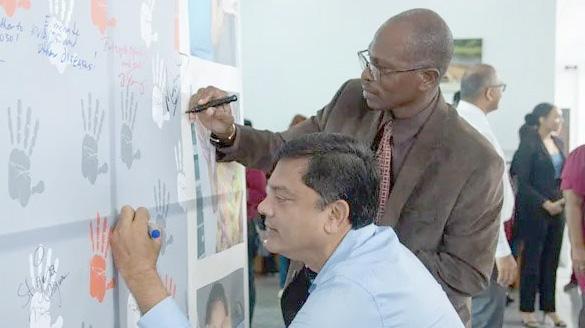
President Ali calls for shift from quick profits to long-term enterprise building
says upcoming development bank aiming to rewire entrepreneurial thinking, back success
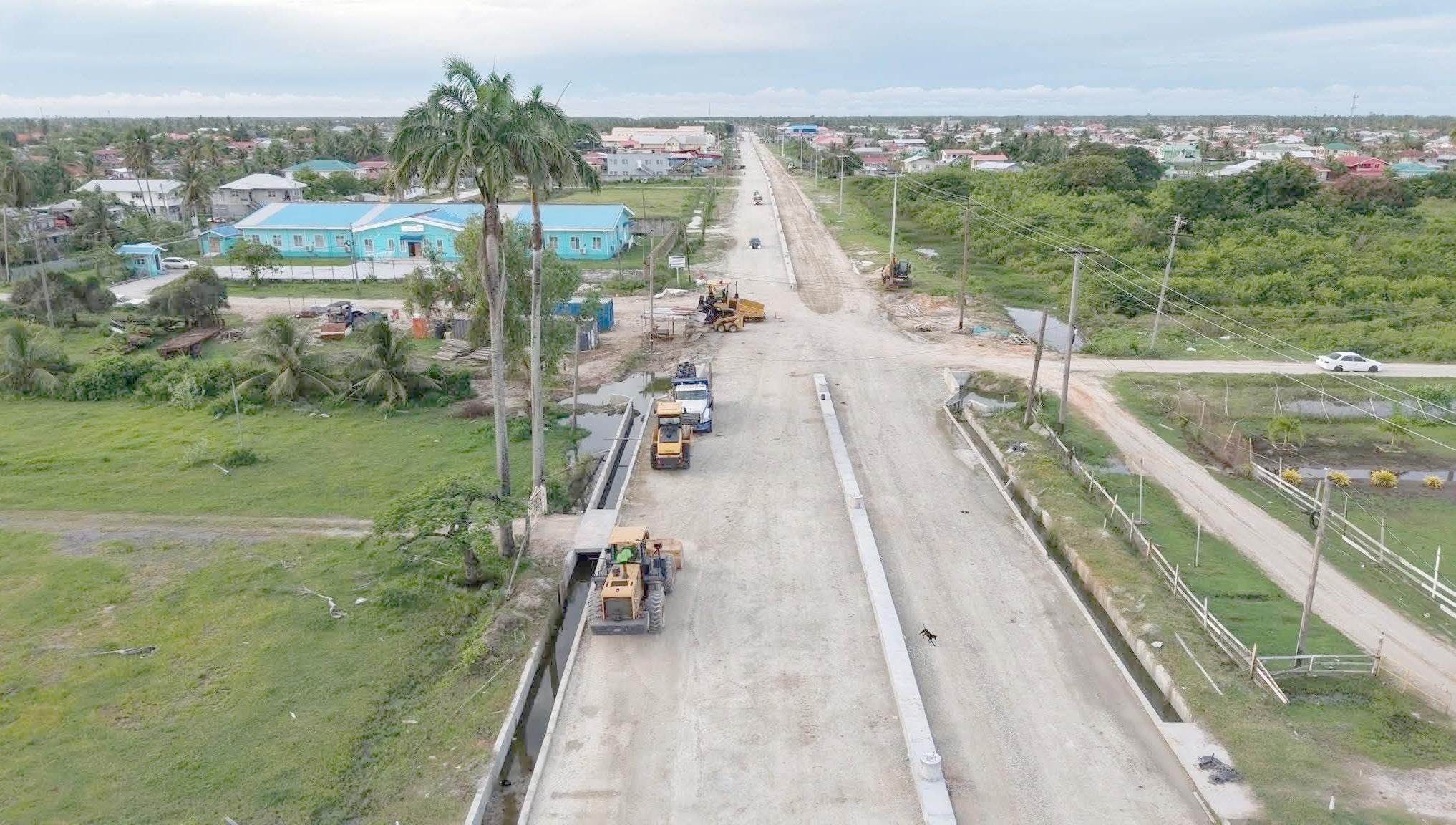
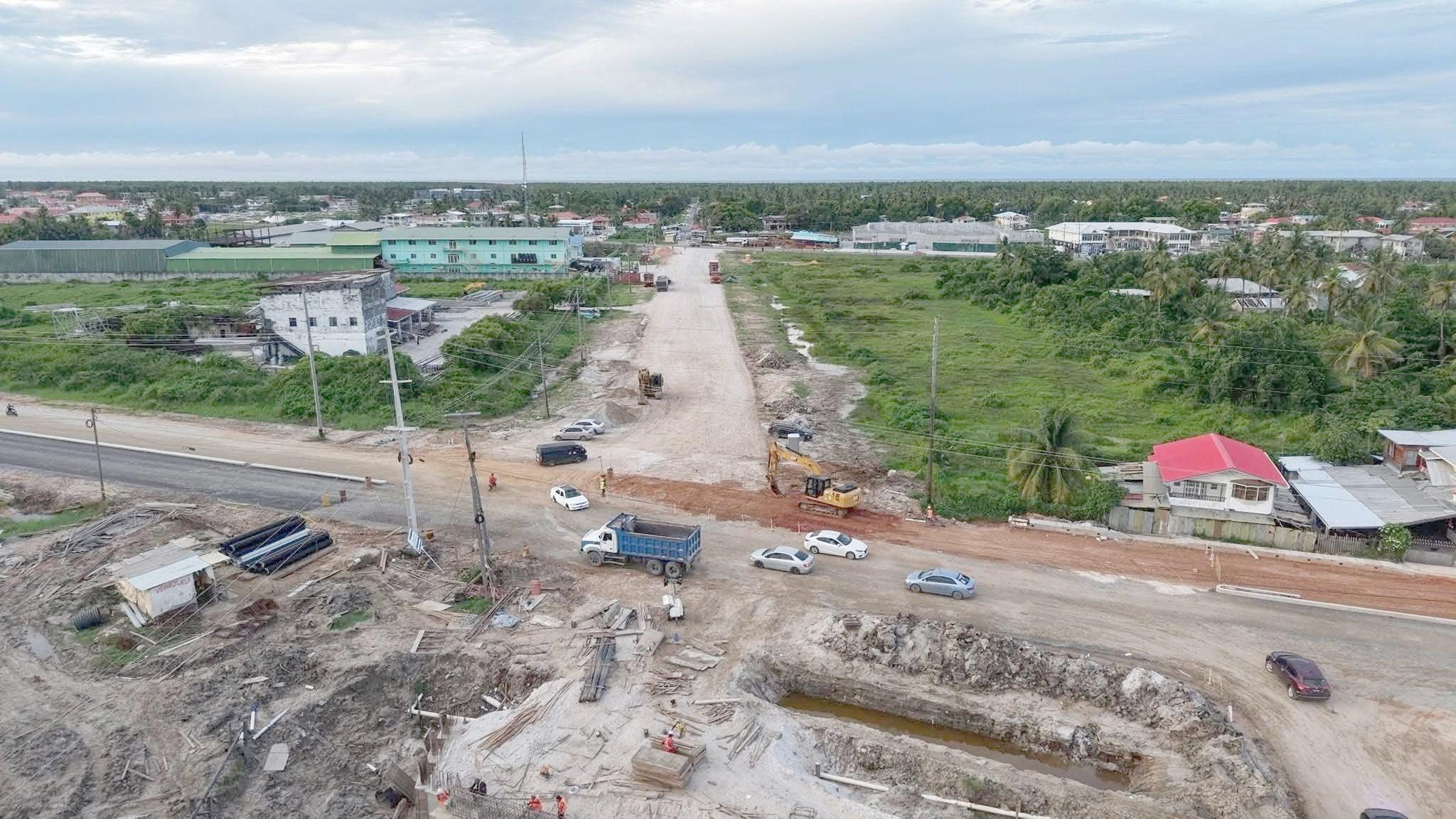
Construction of the Railway Embankment four-lane roadway at Enmore is progressing steadily, marking another major step in the transformation of transportation infrastructure along the East Coast Demerara corridor. The new arterial road will extend from Enmore to the Unity Roundabout, providing residents and commuters with an alternative route and reducing dependence on the East Coast Public Road. The project represents a significant upgrade from what was once a mud dam that was largely impassable for many vehicles, particularly in the Haslington area. Upon completion, the roadway will enhance connectivity, improve traffic flow, and create safer and more efficient travel for thousands of residents (DPI photos)
Structured national action needed to protect children from social media risks
Minister McCoy says, assures intent is not to restrict access to technology
Education Minister announces
‘ripe’ with opportunities across all sectors
Finance Minister says economic transformation creating openings for businesses of every size
as Guyana looks to leverage expertise from Brazil,
Structured national action needed to protect children from social media risks
––– Minister McCoy says, assures intent is not to restrict access to technology
GOVERNMENT is working on developing a comprehensive mechanism to protect children from the harmful consequences of social media, while maintaining access to digital education, creativity, and online economic opportunities.
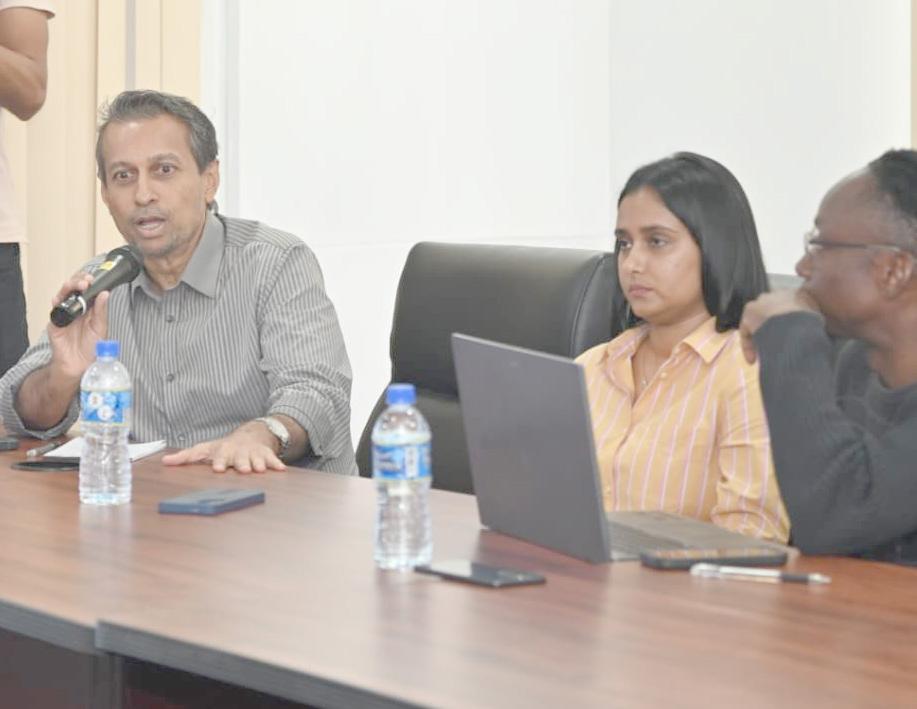
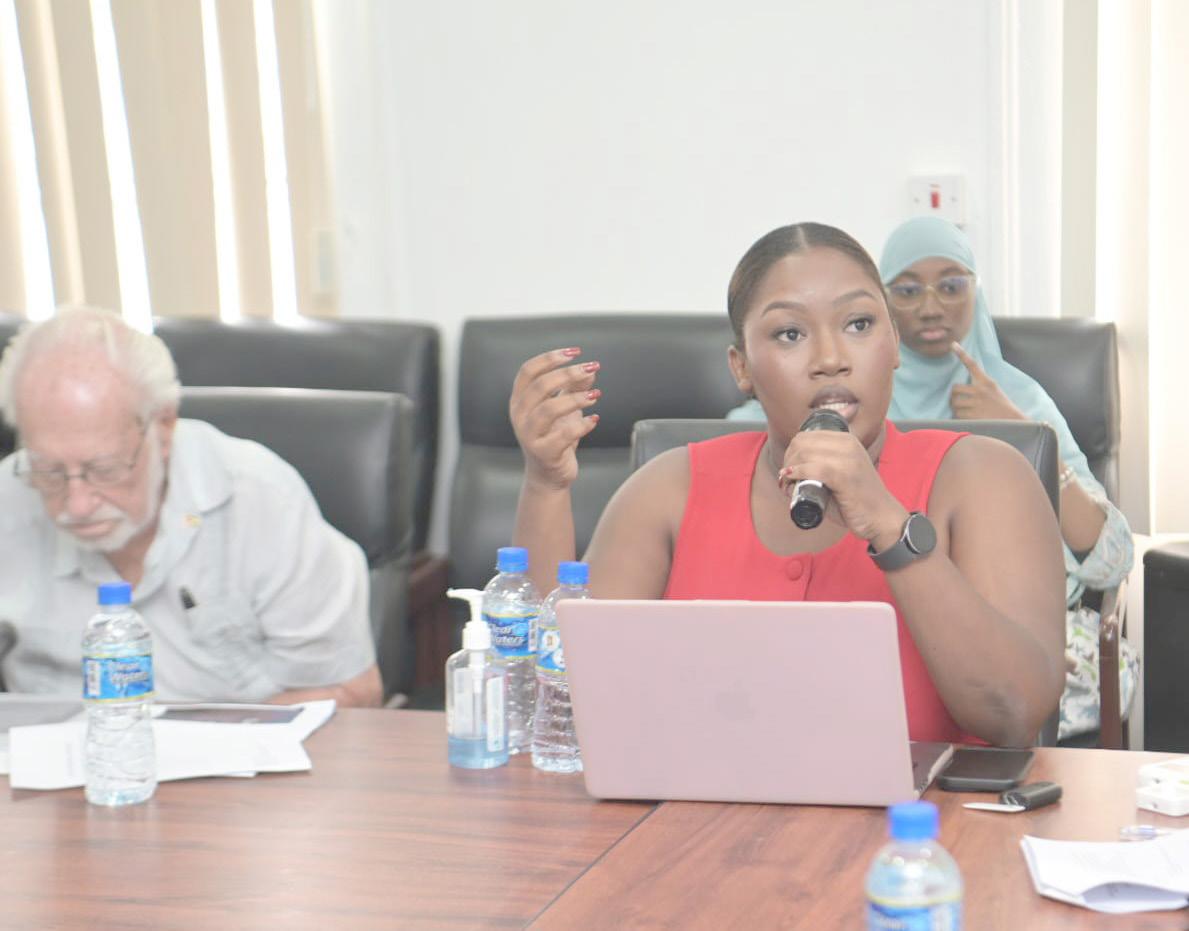
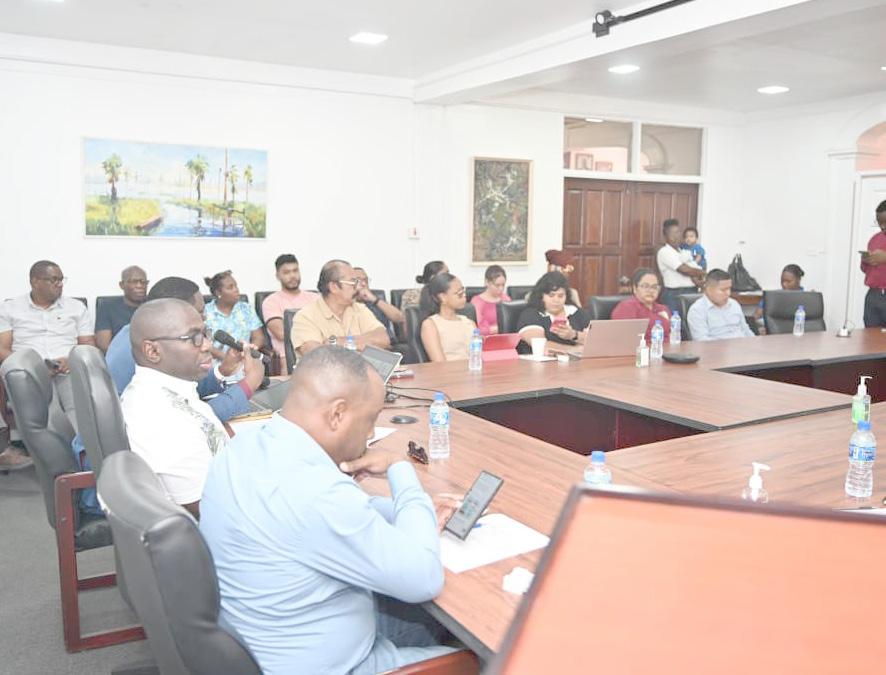
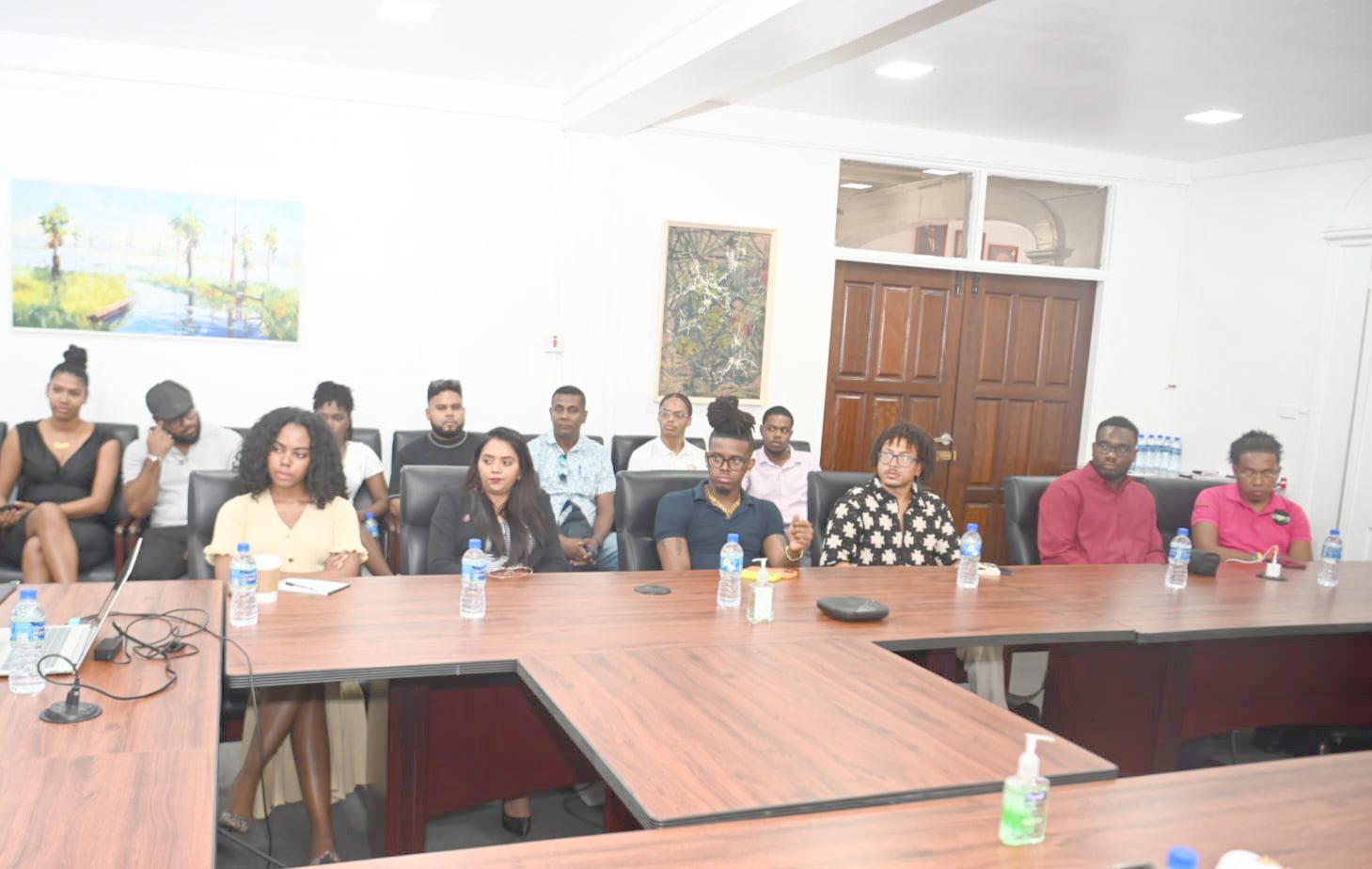
Minister within the Office of the Prime Minister with responsibility for Public Affairs Kwame McCoy made this known during an engagement with local influencers,
media practitioners, and public relations experts on Saturday.
McCoy said the administration recognises that social media and digital technologies now occupy a “major part” of children’s lives and must be addressed through structured national action.
He pointed out that while digital platforms have opened up avenues for learning, information, creativity, innovation, and economic participation,
they also expose children to a wide range of risks.
The minister explained that the session formed part of a wider programme of engagements with different stakeholder groups. Consultations have already been held with sections of civil society and non-governmental organisations.
Other ministers, he said, will conduct similar exercises within their sectors to ensure a broad national conversation.
He indicated that submissions from all stakeholder meetings will be collated into a national pool of ideas and feedback for consideration by the government, with the consolidated report to be forwarded to the Ministry of Parliamentary Affairs and Governance.
Participants were also invited to submit additional written recommen-
dations for inclusion in that pool.
The minister stressed that the initiative is not an attempt to restrict access to technology, but to strengthen protections at both the household and national levels in keeping with the State’s obligations to children.
“This is not an attempt to ban technology or to ban anything. This is an attempt to improve a system at the household level, at the national level that allows for the guaranteed protection of our children in keeping with the constitutional obligation and the rights of children, by virtue of us being able to create and establish laws and authorities,” he said.
The proposed mechanism, he added, would likely involve the creation of laws that reflect higher standards of child pro -
tection online, while preserving digital inclusion, education, and responsible expression.
“Guyana’s approach and our government’s approach is about first and foremost protecting our children by all means, by all cost, while preserving the opportunity for digital inclusion, creativity, and responsible expression and innovation,” he said.
The minister underscored that the government has been heavily promoting digital education over the last five years, citing initiatives such as the digital school and the Guyana Online Academy of Leaning (GOAL).
Technology, he said, has been used for communication, culture, access to information and economic participation, but the same technologies expose children to serious dangers,
including cyberbullying, harassment, exploitation, grooming, harmful content, addictive platform design, misinformation, and mental health challenges.
The consultations are therefore intended to help the administration “keep pace” with the evolving online environment and to identify practical measures that can be implemented in homes, schools, and communities.
He urged participants to share their experiences and suggestions freely.
“The information sector has a special role, which you fall into as influencers, because you help shape what children see, hear, believe, and they think on a daily basis as you practice your trade and you share content across platforms,” he said.
‘This is not a quick turnover’
–– President Ali calls for shift from quick profits to long-term enterprise building
–– says upcoming development bank aiming to rewire entrepreneurial thinking, back success
By Naomi Parris
THE government’s proposed Guyana Development Bank is being pitched not merely as a source of finance but as a programme to transform how Guyanese think about business.
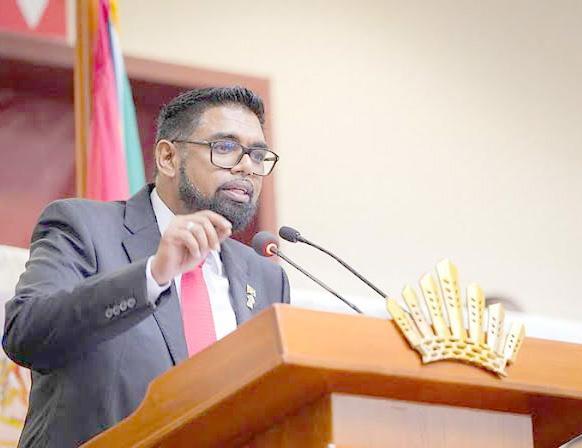
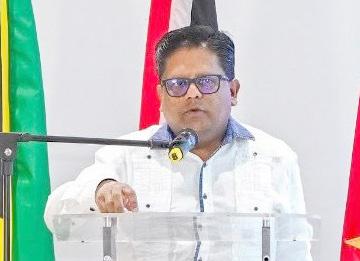
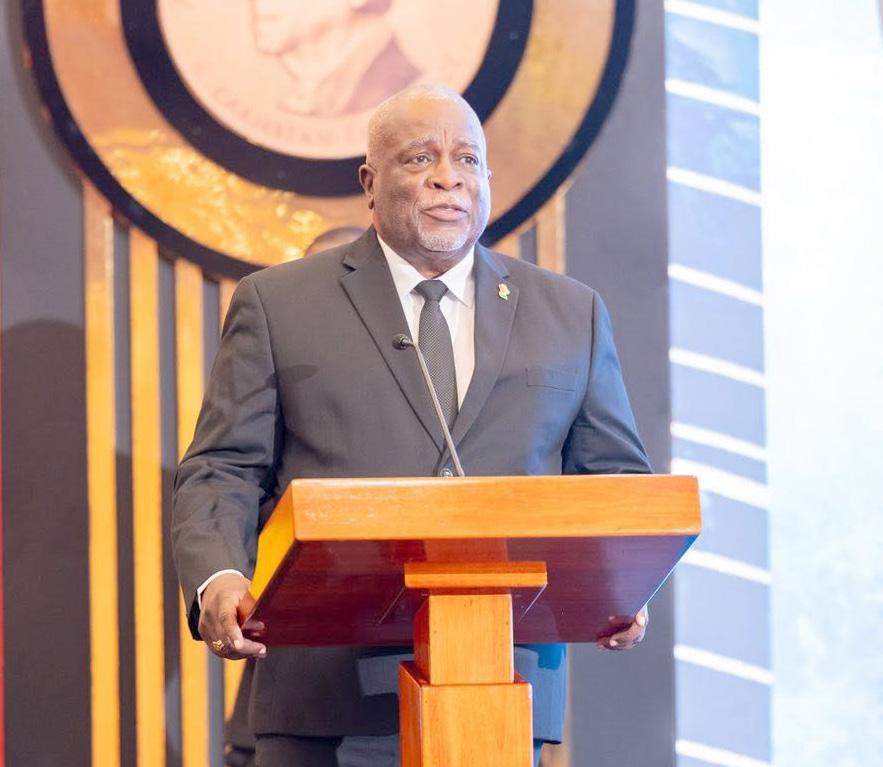
“The Guyana Development Bank is about creating strategies at the individual and small business level that allows Guyanese to win, prosper, and succeed,” President Dr. Irfaan Ali said during a recent broadcast outlining the bank’s structure.
The bank will provide small and medium-sized businesses and aspiring entrepreneurs with access to micro-credit loans of up to $3 million at a zero per cent interest rate.
The model aims to help entrepreneurs from application through growth, eventually transitioning to commercial finance.
“You have to create a positive mindset, and this is something I want every Guyanese to have as we embark on this journey together. The first phase of the development bank would create opportunities for thousands of Guyanese. We want every single person that will embark on a journey of success, a journey of fulfillment with the Guyana Development Bank to have a positive mindset,” he said, adding:
“This is a business opportunity; this is a loan that is interest-free and collateral-free, but it’s not a grant. It is meant to allow you to build a business to build prosperity, to build an enterprise, to build off of your creativity, to build off of your ideas, to support your ideas, to support your entrepreneurial spirit. It is not making a quick spin, or a quick
turnover or quick transaction.”
He pointed to support pillars such as financial literacy, business development coaching, marketing advice, and integration with other government extension services, all established to ensure success in entrepreneurship.
Additionally, mentors will be drawn from already established enterprises, religious and community leadership, who will be deployed alongside facilitators to sharpen ideas and foster the patient, disciplined approach that is necessary for durability and resilience.
He insisted that beneficiaries must commit time and effort. He stressed that persons must dedicate themselves to day-to-day management.
“It is well thought out, that is why it has support mechanism and also a mechanism built in in the organisational structure to allow you to grow to incentivise the growth and development of your business,” he stressed.
Patience and hard work are presented as pillars alongside financial support, with the government promising continuous follow - up and pathways to scale up rather than one‑off disbursements.
“You can’t believe you’ve arrived because you’re now developing a business and believe you can delegate the responsibilities of running that business. You have to, at inception, dedicate your time, your energy, your patience. Your value system has to reflect a positive mindset for success,” he said, adding:
“I want you to be prepared; I want you to understand that when we placed this in the Man -
ifesto, we knew that for the success of this bank we have to also change mindset.”
The bank will operate through a bottom-up, field‑driven structure anchored by a board and chief executive officer at the top, and regional credit officers on the ground who work directly with applicants to shape ideas, process interest-free, collateral-free loans and monitor projects.
These officers are supported by regional facilitators who organise clusters of similar businesses, deliver financial literacy and basic management training, and link borrowers to wider government support.
Legislation for the bank’s operationalisation was tabled in the National Assembly recently.
While much attention has focused on the bank’s role in providing financing and SMEs, the legislation also outlines extensive governance, transparency and enforcement mechanisms designed to safe -
The bill places significant responsibility on the institution’s board of directors, which will oversee the affairs and business of the bank. Among its responsibilities, the board will be required to approve strategic and
business plans, establish credit, risk and governance policies, monitor management performance and safeguard the independence of credit decisions. The legislation also stipulates that the bank must operate with due regard for financial sustainability and risk management.
To strengthen public confidence in the institution, the bill establishes strict eligibility requirements for board members.
Under the proposed legislation, an undischarged bankrupt, a person of unsound mind, or anyone convicted of an indictable offence or an offence involving fraud, dishonesty or moral turpitude would be disqualified from serving as a director.
The legislation also outlines several circumstances under which a director may be removed from office.
President Dr. Irfaan Ali guard public resources and ensure prudent management.
Data integration underway for Guyana’s Agricultural Situation Room
commissioning expected by month-end, Minister Mustapha says
GUYANA’S Agricultural Situation Room is on track to be commissioned by the end of June, with data integration now underway following the completion of the facility’s technical infrastructure, Agriculture Minister Zulfikar Mustapha has announced.
“We are now putting in the data and will have the commissioning by the end of this month,” Minister Mustapha said during a meeting last week with Inter-American Institute for Cooperation on Agriculture (IICA) Director Dr.
Muhammad Ibrahim.
The situation room is designed to serve as a central repository for realtime agricultural data, supporting evidence-based decision-making, project monitoring and policy development. The initiative is being developed with support from the InterAmerican Institute for Cooperation on Agriculture (IICA).
The digital infrastructure is intended to support a range of priorities, from crop and livestock planning to monitoring progress on major projects.
The situation room will improve coordination, and provide the analytics needed for timely policy and operational decisions.
with President Dr. Irfaan Ali’s call for the sector to embrace modern technology, data-driven decisionmaking and digital infrastructure as central pillars of Guyana’s agricultural transformation.
President Ali has repeatedly emphasised that technology, ranging from smart-monitoring systems to predictive analytics, must be integrated into every layer of the country’s food-production systems improving efficiency, enhancing resilience, and driving competitiveness.
lishing a situation room was first touted by President Ali back in 2023. Dr. Ali, while addressing the 2023 regional Agriculture Investment Forum and Expo held in Guyana, had said that in order for the Caribbean region to attain its regional food-security goals, innovation and digitisation will need to be pivotal factors.
Dr. Ali, during that forum, had proposed multiple initiatives to incorporate data and technology into its local food-production industry.
“We have everything set up, so now they are now putting [together] data that will achieve our objective with the situation room,” Mustapha said.
The situation room initiative aligns directly
Minister Mustapha noted that the collaboration with IICA continues to play a vital role in supporting Guyana’s transition to a smarter, technologydriven agricultural sector, and that the situation room will significantly elevate the country’s ability to safeguard production and support farmers nationwide.
The initiative of estab-
“We have recognised that technology gives us the opportunity to connect the farmers directly with extension officers instantaneously. And part of the innovative investment that we will make here is to create a proactive information sharing and response platform,” the President had said.
Agriculture Minister Zulfikar Mustapha
Minister Persaud takes government services directly to Region Two communities
RESIDENTS across several communities in Region
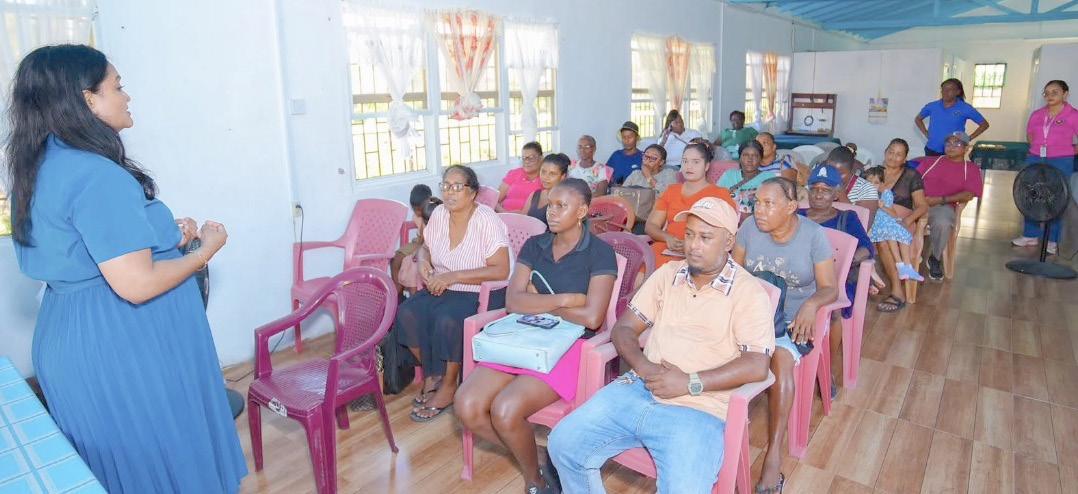
Two welcomed Minister of Human Services and Social Security Dr. Vindhya Persaud as she concluded a two-day outreach aimed at bringing government services closer to the people and addressing pressing social concerns.
The outreach saw Minister Persaud and her team visiting Capoey Mission, Onderneeming, Queenstown, and Good Hope where scores of residents gathered to engage directly with ministry officials on issues affecting their families and communities.
At Capoey Mission, Minister Persaud highlighted a number of government programmes designed to support vulnerable individuals and families. She spoke extensively on child protection, domestic violence, abuse prevention, and the range of social services available to citizens in need.
The minister encouraged residents to make full use of the support systems estab-
lished by the government, and stressed the importance of protecting children and strengthening family structures.
Accompanying the minister were Permanent Secretary Dr. Erica Forte, Director of the Childcare and Protection Agency Levine Gouveia, and other senior officials.
The team listened to concerns raised by residents,
particularly those relating to the welfare and safety of children, while offering guidance and immediate interventions where necessary.
A major focus of the outreach was community engagement and problem-solving. At the Little Red Village Community Centre in Onderneeming, discussions centred on parenting challenges and childcare issues affecting
families.
In response to concerns raised, Minister Persaud announced that Childcare and Protection Agency officers would be redeployed to the community to undertake targeted interventions and provide additional support to children and families requiring assistance.
The outreach also included a meeting with residents and persons living
with disabilities in Queenstown, where issues relating to accessibility, welfare support, and social assistance were discussed. Many residents welcomed the opportunity to speak directly with the minister and ministry officials about their concerns.
The final meeting was held at Good Hope Primary School, where residents raised matters relating to old-age pensions, public as-
sistance, childcare services, and other social support programmes. Ministry officials provided information on available services and outlined steps being taken to address concerns brought forward.
Minister Persaud assured residents that the issues highlighted throughout the outreach would not be ignored and would be addressed through the ministry’s ongoing programmes and interventions.
She noted that direct engagement with communities remains an important part of the ministry’s work, allowing officials to better understand the challenges facing citizens and respond with practical solutions.
The two-day outreach formed part of the Ministry of Human Services and Social Security’s continued commitment to ensuring that support services reach every community and that residents have direct access to the assistance they need to improve their quality of life.
Dr. Vindhya Persaud addressing Queenstown residents during the outreach
Curbing the Lawless Minibus Culture
ASSISTANT Commissioner of Police
Mahendra Singh, Guyana’s Traffic Chief, has called for partnership in public transportation. He emphasised that the Guyana Police Force does not seek praise for its proactive efforts with the United Minibus Union (UMU).
In a frank interview at Traffic Headquarters in Georgetown recently, Singh discussed ongoing police-led dialogues along key routes like Brickdam in Region 4A and Parika in Region Three.
These discussions focus on serious issues such as fare disputes, passenger mistreatment, overloading, substance abuse by drivers and conductors, and general lawlessness.
His humble approach underscores that collaboration is crucial for “sanity” on the roads, not a quest for recognition, as daily offenses require collective action beyond just enforcement.
This approach deserves recognition amid Guyana’s ongoing road safety crisis.
Between 2020 and 2024, 642 lives were lost in 574 crashes, including 24 children, leading to a death rate of 15 per 100,000 people.
Minibuses, essential for daily commutes, often become hazards owing to reckless behaviours by their operators, Singh correctly identifies.
These issues contribute to preventable tragedies that need more than just tickets;
they require real changes in behaviour.
The Traffic Department’s humility stands in stark contrast to operators who break rules, yet Singh maintains that the challenge, though significant, can be tackled through teamwork.
He noted previous successes, such as declining minibus fatalities and collaborative efforts with drivers. Singh’s firm stance against bribery adds to his credibility.
He urged motorists to reject “gifts” to traffic officers and to accept accountability. Guyana aims to reduce annual fatalities to below 50 by 2030 through nationwide initiatives.
These include improving infrastructure
and implementing the Safe System approach, which features pedestrian crossings and traffic calming measures.
However, the police alone cannot achieve this; UMU must take responsibility by ensuring discipline in fares, capacity, and sobriety to protect both passengers and pedestrians.
Ultimately, Singh’s vision casts the police as facilitators in a joint effort, rather than as heroes. If operators listen, Guyana’s roads can transform from chaotic routes to safe pathways, saving lives and supporting the growing economy.
The responsibility now lies with all stakeholders: collaborate or face the consequences.
I stand strongly against misinformation from the Opposition Leader
Dear editor,
PLEASE permit me to share my views on some of the issues that are pushed, peddled, misinformed, misguided, and misleading that are coming from the opposition parties, and in particular the main opposition WIN party and its leader.
Since the WIN party became the main opposition, I have stayed silent and away from making comments or highlighting anything about them because I was observing what they really are and if they are going to be an effective opposition like the once now defunct AFC party.
First of all, we all know that the leader of the main opposition is a person of interest knowing that he is sanctioned by the U.S. and has many cases before the courts, including extradition proceedings.
The support for that party and its leaders,
for me, stems from the Lamborghini story, where young people and a host of opposition supporters felt he should have those luxury vehicles without paying his rightful share of taxes.
Anyway, I don’t want to deal a lot with that because his party formation is indeed on that story, and his running for high office is because he has lost one of the biggest investments in the oil and gas sector, which he was part of.
But my reflection on this main opposition over the past year tells me that this party started just as the AFC did, but the AFC was guided by principles, which they no longer have after betraying the people of this country for personal political power and self-gain.
Yes, the now main opposition leader and his cabals are running all over like the Road Runner. As soon as someone calls, he is there, even if their latrine falls because of the rain
or heavy wind.
Mr. Mohamed is playing a serious game with this nation by being a grasshopper in all the communities, as if he is truly representing the people and wants the best for them. No, he wants the best for himself at this moment because of the pending extradition awaiting him.
I saw him going into Berbice and targeting mainly the agricultural sector and trying all sorts of things to ensure he gains the support of the people by highlighting issues which are welcome, but by putting in his own piece to feel good about it.
Those who know me know that I say it as it is, and yes, some of the issues he highlighted needed to be highlighted because the persons employed to ensure that they listen to the people and help in resolving issues are acting as lords, and that is why the people cannot have the service that the government wants them to. Many of those employees,
when sending their reports to their superiors, polish it up like if nothing is wrong on the ground. When the matter meets the ministers, only then do you know that they are barefaced liars.
Yes, and maybe the Opposition Leader doesn’t know that every country in the world has problems, and Guyana is no exception. Maybe he is closing his eyes to that or is being fooled.
I am not writing to defend anyone or any ministry or the government, but I am saying it as it is because Azruddin Mohamed feels Guyanese are easy to fool, or they are fools.
Let me say this to you, Mr. Mohammed, and maybe you were told of me, but I am me, and I say it as it is to anyone, and I stand for the people, not myself. You are wasting your time trying to get the crumbs
Preaching a political sermon in an age long gone
TWO APNU parliamentarians, Terrence Campbell from the PNC and David Hinds from the WPA have called for social mobilisation to put pressure on the PPP to be democratic.
When one thinks about who these two men are, you are inclined to dismiss their advocacy as comical.
But a serious intellectual assessment is useful because such an analysis has pedagogical properties that lead to the education of a nation. So, let’s pause the type of personalities that have issued the call and look at exactly what the call is about.
To generate social mobilisation to exert pressure on the government involves many essential factors of which one stands out and that is leadership. Throughout history, mass agitation only becomes successful when it has organisational direction. Dialectically, an uprising can take place without any concentrated presence of leadership.
But the spontaneous outbreak can only endure if it has leadership to guide it and to give it stimulus. This is where the concept of the role of the individual in history comes in. The Russian genius, Lenin, covered this ground extensively in his writings. A spontaneous confrontation between workers and state never endures without the guiding hand of a group of leaders or an individual whose charisma, credibility and rhetoric are penetrating.
In Guyana, where is that leadership? In Guyana, what is visible to any citizen is opposition leadership that has no credibility, appeal, and political finesse. Let’s start with Hinds. If there is any leader who went on to
the battlefield and when he looked over his shoulders, his soldiers were gone, it is David Hinds.
Henry Jeffrey has taken up the advocacy of Campbell and Hinds. After endorsing the position of Campbell and Hinds, Henry noted that the two large parties control over 80 per cent of the voting population. Jeffrey, Campbell, and Hinds argue that with such ethnic division, the PPP discriminates against the other half of the population.
Here is where Campbell, Jeffrey and Hinds must never be allowed to go unanswered. Let us examine how 80 per cent of the population voted in the general election last year. The combined votes of the PPP and WIN in 2025 were 351, 564 out of a total number of 438, 467 ballots. This means that the PPP with an Indian presidential candidate and WIN with an Indian presidential leader pulled in 80 per cent of the votes. The party that has been generally associated with African Guyanese, the PNC, secured 78, 000 votes for a point of 18 per cent.
The voting structure of the 2025 elections has never been discussed by Hinds, Campbell, and Jeffrey since September 2025. All three men have daily Facebook posts but there is never any discussion of the elections results. They cannot discuss the results because it wipes away their argument of ethnically deterministic voting.
How is this point tied up with the leadership question that has been raised at the beginning of this article? The 2025 elections results prove that people like Hinds and others have been rejected by the Guyanese population. Who then is going to lead the
social mobilisation that the three men want? Let’s return to Hinds’ soldiers deserting him.
From September 2020 when the PPP won the elections, there has been a daily outpouring of race sermons by Hinds. He became a candidate in the 2025 elections. And his party secured 18 per cent of the votes with the GECOM data base revealing that WIN, headed by a Muslim Indian man, gained the votes from areas that traditionally voted for the PNC before there was ANPU, and since APNU came on the scene.
Can it be argued that Hinds then was rejected by the very people he has been appealing to since 2020? That is my contention so he will not be accepted in any spontaneous outbreak.
That brings us to Terrence Campbell. Just weeks before the 2025 polls, Campbell went on to the APNU slate. But his presence did not stem from the exodus of voters from both
the PNC and APNU. So, it begs the question as to whether he has leadership qualities. If the answer is yes, then, how do you explain his failure to prevent the crossing over of more than 100, 000 traditional PNC votes to WIN?
Each time Jeffrey and Hinds open their mouth or put pen to paper it is about race. Here are the words of Jeffrey: “What Guyana has are large scale ethnic expressions of dissatisfaction that have now been largely suppressed by the PPP.”
This bell has been rung out. This song has been sung out. This drum has lost its beat. There is a new Guyana that has left that bell, song, and drum behind.
DISCLAIMER: The views and opinions expressed in this column are solely those of the author and do not necessarily reflect the official policy or position of the Guyana National Newspapers Limited.
I stand strongly against misinformation ...
from the issues.
I was an AFC strongman; the PPP and PNC know it, and yes, as the strongman, I was targeted by both the PNC and PPP, and that’s not a secret. As a strong politician, I was controversial, as many put it. I was targeted to bring me down. Even my relatives were used to target me. Ask PPP members Jaffarally and Harry Gill what they were doing. Despite these efforts, I never gave up.
A few times, I tried to make contact with you to put you in your place, but no avenue was available. In fact, I sent you messages on Facebook and tried calling but got no response. So, I don’t have to hide that. I am me.
I say the above to ensure you know who I am when you have someone to write your letter to respond to me, which I believe you are going to.
Now, take this and smoke it in your pipe because the PPP will remain in power for a long time because of their developmental agenda for the people and the country.
I am not saying this because of anything or gain, I am saying this because I saw and experienced what took place between 2015 - 2020 under the then APNU+AFC government.
Leading up to the 2015 elections, the AFC was heated in political matters and promised the people, especially farmers, sugar workers, and the working class, a better life. After they got into power, they kicked the hell-out-ahskelter of the people.
The PNC and AFC lied so badly to the people of this country by promising them a good life.
Almost all the ministries were non-func-
tional. The only ministry that could make our nation survive was doing nothing to ensure our people got adequate food on the table. The agriculture sector was almost dead and buried.
I want to tell you since you are shouting out loud as if you know or any of your MPs know about agriculture. In 2020 when the PPP was declared the winner, from that very minute, I was looking to see who they are going to put to head this important agriculture ministry and when they publicly declare the minister, I was overwhelmed because I knew he is for the people and knew of agriculture.
Also, I want you to know and ask that minister about how much I criticised him. I don’t have to praise him today.
From Day One, that very minister went on the ground, and you know where he went? He went to Region Five, the largest agricultural region in this country. I was surprised when some AFC members informed me that the new agriculture minister was on the ground in Region Five. Knowing me, I followed him through the region to hear what he had in mind to ensure the sector does not fail.
Former Minister Holder visited this region maybe twice in his five-year term, and the visits were comic shows because it was about pressuring the rice farmers by raising the land rental and D&I charges.
From that very day that Minister Mustapha visited, I kept following his works to know if he was the same as Holder. But, no, he made a commitment to help the farmers, and the next day, those promises were fulfilled.
The AFC supporters and farmers in the region also gained in those outreaches that
day, and yet they spread lies about not being involved and having anything. This is the only way PNC is going to gain support, and now you’re doing the same to your people.
From 2020 to present, we have seen a robust agricultural sector in all regions. We have seen improved agricultural productivity and infrastructures that are benefiting the farmers every day, no matter which political party they are supporting.
Mr. Mohamed, you have been running around telling farmers that the ministry doesn’t care about them, but you failed to tell them that it’s the opposition that has failed the sector over the years.
Ask those very people what they ever got from the PNC government between 2015 and 2020. Ask those very landowners if they ever had their lands cleared by the then government. Ask the rice farmers if they have ever had their irrigation system looked into. Ask the cash crop farmers if they have ever had any assistance. Ask the fisherfolk what they ever got to better their industry. Ask the cattle farmers what they got to better their sector.
I can go on, but it’s a waste of time to speak to an amateur opposition leader who only knows about evading taxes, under-the-table business, etc.
Today, you want to lecture us on agriculture and question the agriculture minister on this sector and his spending to better the sector.
I would urge you to study Guyana’s agriculture sector and how it was during those days. Let me remind you that former President Burnham was encouraging citizens to
plant what they eat, but in 2015-2020, those very people were trying to kill the nation through starvation by not supporting agricultural development.
You failed to understand and realise that this sector is important to our economy after the oil and gas sector, which you have your eyes on.
I don’t want to say more on this, but I want you to know that the agriculture sector is going to always have problems because we are seeing and experiencing climate change, which you know nothing about.
Brothers and sisters, don’t be fooled again by any Third Force because we have seen and experienced first-hand who they really are.
If you are for the people and know what can better the sector that you seem to be so passionate about, then here is an open invitation to join me for a television programme in Berbice. Let’s talk about agriculture. I’m also willing to provide transportation and meals.
I am calling on you as the Opposition Leader to stop running around like a Road Runner and start acting in a responsible manner by sharing genuine information.
The agriculture sector is on the rise, and under this government and minister, no matter what you do or say, it won’t stop progress.
I can recall Vice-President Bharrat Jagdeo saying that Guyana has some really stupid people. He is correct.
The main opposition parties have a lot (no offence).
The current administrative format will not help the deadly traffic culture
A CULTURE of law and order is the basic element upon which civilisation rests; its denomination is existential. No country, society or community has
ever been successful without it. Our ability to maintain strong institutions is
the bedrock of good governance, economic development, and wealth creation; it is an indispensable part of human existence.
I have been writing columns, letters, and editorials on this subject for well over two decades. In fact, portions of this article are copied from a piece I wrote in 2018 and still remains relevant today. I believe that society survives and thrives not based on the amount of riches it accumulates, but on how well it is able to function with rules-based order. Of what use would all your riches be if it existed in the O.K Corral?
Today I focus on our traffic culture. Recently, the traffic chief reported that up to the end of March 2026, fatal and serious accidents have increased by over 18 per cent. It would be an interesting tale if we kept stats on the damage caused to public property due to vehicular accidents. Over recent years, we have gotten more roads that are wider and smoother along with a greater number of safety features and better lighting. We have also gotten a round of modern law reforms and application of high technology, yet fatal and serious accidents are soaring. The issue in play is our road culture.
As a normal way of life, we install unapproved vehicular headlights; use decorative and unapproved numberplates; install all kinds of psychedelic blinking taillights; blast our horns with impunity in front of schools, courthouses, and places of worship. We routinely apply unsafe levels of illegal tints to front windshields. We routinely neglect to stop at pedestrian crossings. Motorcyclists wear unapproved helmets or none at all. We ride bicycles without the legally prescribed bell or night lights. Minibuses habitually ply unapproved routes, charge unprescribed fares, blare loud and obscene music, speed, and overload in an environment where touting and harassment of
passengers is routine. We allow our domestic and farm animals to wander in the heart of town. We fester a preponderance of unlicensed taxis and taxi drivers; all of whom operate in an unregulated environment and charge any fare they deem fit.
All of this goes on unabated in full view of law enforcement and policymakers. It is so pervasive that even law enforcement officers are seen engaging in these very practices, with freedom and ease. It is a well-known pervasive traffic culture that officers extort bribes from motorists: “Decide yuh mind; is either leff or rite! Leff something before ah rite dis ticket!”
It’s not uncommon to see uniformed police officer riding in extremely overloaded minibus, where the conductor has to stand with his buttocks hanging out the window to make room for the 23rd passenger in a 15-seater minibus.
These things are done with such brazenness and impunity, to the point where it has taken foothold and become an imbedded part of the traffic culture. This pervasive culture of lawlessness has been eating away at our value system and contributing to a general breakdown of law and order while taking the lives of innocent citizens. I believe that our collective value system has been compromised to the extent that it threatens public safety and negatively impacts governance and will ultimately stagnate or retard development. It is time for condign knee jerking and comprehensive response.
Our response over the years has been like applying a plaster to a hemorrhaging wound. There is an occasional flare-up campaign with fancy code names. The very day the campaign ends, it’s back to life as usual.
Guyana cries out for the denouncement of these rounds of piecemeal campaigns.
I did not support the M&CC parking metre fiasco at the fundamental level for reasons quite different from
By L eonard craig
most of the objections raised by a deluge of organic public outcry. The objections raised included allegations of corruption, circumventing legal procedures, lack of transparency and the creation of a financial burden for citizens and visitors to the capital city.
Full disclosure, I was not opposed to the idea of the parking metre itself. However, I remember feeling a sense of maddening revulsion to the proposed price structure. $500 an hour was madness. Parking should cost slack change, not solid lunch money as it then was. I concede that the popular objections were all solid and valid, but my foremost opposition was from a public policy standpoint. In its proposed form, it added another layer of isolated piecemeal policy prescription that ignored the larger traffic reform imperatives, instead of being a cog in a larger comprehensive national traffic management plan. I am not a fan of piecemeal policy reformation, in any sector.
A comprehensive, sustained road transportation policy is needed to target cultural reorientation; every citizen must join hands with policymakers. It is now ‘forever’ since I’ve begun advocating for the establishment of a Department of Motor Vehicle and Traffic Management to cater for comprehensive transportation management.
The current fragmented administrative structure was designed more than 70 years ago when there were five vehicles on our roads; it has served its purpose. It is no longer efficient or suited for our extant challenges. It will not arrest the pervasiveness of the death culture on our roadways.
DISCLAIMER: The views and opinions expressed in this column are solely those of the author and do not necessarily reflect the official policy or position of the Guyana National Newspapers Limited.
Guyana ‘ripe’ with opportunities across all sectors
–– Finance Minister says economic transformation creating openings for businesses of every size
GUYANA’S rapid economic transformation is creating opportunities across virtually every sector of the economy, with businesses ranging from small enterprises to major international investors positioned to benefit from the country’s unprecedented growth.
This is according to Senior Minister within the Office of the President with responsibility for Finance Dr. Ashni Singh, who was at the
time addressing a recent trade and investment mission here.
Dr. Singh said the country is experiencing an extraordinary period of expansion fuelled by growth in the oiland-gas sector, large-scale infrastructure projects, and increasing private sector investment.
The minister noted that while oil production continues to drive economic growth, opportunities are emerging across a wide range
of industries, including agriculture, agro-processing, manufacturing, tourism, construction, education, and training.
“It almost doesn’t matter which sector you’re doing business in; the opportunities are many,” he said.
He pointed to ongoing investments in transportation networks, energy infrastructure, housing, healthcare, and industrial development as creating demand for goods
LCDS 2030 expands Guyana’s
low-carbon
vision beyond forests
–– strategy broadens focus to include blue economy, climate adaptation
GUYANA’S Low Carbon Development Strategy (LCDS) 2030 represents a significant evolution of the country’s development framework, expanding beyond its original focus on forest conservation to encompass new sectors and a more integrated approach to sustainable development.
This was according to Director of Climate and REDD+ at the Ministry of Natural Resources, Pradeepa Bholanath, who, during a recent appearance on the ‘Starting Point Podcast,’ outlined how the updated strategy builds on the foundation laid by the original LCDS launched in 2009.
According to Bholanath, the first phase of the LCDS focused heavily on establishing the fundamentals of forest climate services and building the institutional capacity needed to support climate action initiatives.
“We had always looked at the 2009 LCDS as a starting point of what will be a continuous cycle of low-carbon development,” she explained.
She noted that between 2010 and 2020, Guyana was able to strengthen institutions and test practical climate initiatives, generating valuable lessons that informed the development of LCDS 2030.
The updated strategy, introduced in 2021, broadens the country’s low-carbon development agenda by incorporating a range of new and emerging sectors.
Among the most nota -
Director of Climate and REDD+ at the Ministry of Natural Resources, Pradeepa Bholanath
ble additions is a dedicated focus on the blue economy and ocean economy, which Bholanath said positions Guyana’s oil and gas sector within the country’s low-carbon development framework.
“For the first time, we have a blue economy and ocean economy section within the LCDS that positions how the oil and gas sector really sits central to the focus of low-carbon development in Guyana and not counter to our low-carbon development priorities and imperatives,” she said.
The strategy also places greater emphasis on social inclusion, expanding opportunities for women, youth, Indigenous Peoples, and local communities to participate in and benefit from low-carbon development initiatives.
Additionally, climate adaptation has emerged as a key pillar of the updated framework, reflecting the growing need for countries to prepare for and respond to the impacts of climate change.
Against this backdrop, she described LCDS 2030 as a more comprehensive implementation framework that seeks to integrate all sectors of society while accommodating new development opportunities.
“These sectors were built out in a way to create, to my mind, a more integrated implementation framework for low-carbon development, one that includes not just all spheres of society, but new and emerging sectors as well,” she stated.
The climate official said the strategy remains a work in progress and suggested that future iterations could further expand Guyana’s low-carbon agenda as new opportunities emerge.
“If we think what will be LCDS phase three, I could already think of ways in which we could expand in the current phase,” Bholanath said, adding that there have already been “so many areas of achievement” under the strategy.
She expressed optimism about the years ahead as Guyana continues implementation of LCDS 2030 and pursues its sustainable development objectives through to the end of the decade.
and services throughout the economy.
According to Dr. Singh, opportunities exist along the entire investment spectrum, from large-scale projects requiring hundreds of millions of US dollars in financing to small and medium-sized enterprises seeking to serve expanding local markets.
“Opportunities are growing along the entire spectrum,” he said. “They exist at the mega end, the large-scale investment opportunities, all the way down to the smallest of enterprises.”
The finance minister stressed that Guyana’s growing population, rising disposable incomes, and increasing levels of foreign direct investment are helping
to create a vibrant business environment.
“There is a lot of business to be done,” he said, noting that economic activity is being driven by both public and private sector investments.
He highlighted tourism as one area with significant growth potential, pointing to ongoing investments in internationally branded hotels and efforts to address longstanding constraints that previously limited the sector’s expansion.
He also identified education and skills training as emerging opportunities, particularly as demand grows for internationally recognised certifications and specialised
training linked to the oil and gas industry and other sectors.
“There are opportunities even in the training and certification space,” the minister said, noting that strategic partnerships have already enabled local businesses to establish training facilities that previously did not exist in Guyana.
Against this backdrop, he stated that the government’s policy objective remains the development of a globally competitive economy that extends beyond oil and gas, ensuring sustainable growth across multiple sectors.
Senior Minister within the Office of the President with responsibility for Finance Dr. Ashni Singh
NGSA results set for release on July 10
–– Education Minister announces
MINISTER of Education, Sonia Parag, on Sunday, announced that parents and pupils awaiting the outcome of this year’s National Grade Six Assessment (NGSA) can expect the results to be released on July 10.
In a video message posted on the ministry’s social media pages, Parag said the Ministry of Education had recently received confirmation of the release date and wanted to provide clarity to parents and pupils, who have been anxiously awaiting the results.
“I don’t want to keep parents in suspense,” Parag said, adding, “We have recently
received the date for the release of the NGSA results, and that will be on the 10th of July. So, parents, you can mark that in your calendar. Children, you can also mark that in your calendar.”
The minister noted that she had seen numerous enquiries from parents throughout the past week and had even met pupils eager to know when the results would become available.
According to Parag, the results will be released by the Government of Guyana through the Ministry of Education and will provide placement details for those who are scheduled to enter
secondary schools in the new academic year.
Addressing the thousands of candidates who wrote the examination in May, the minister encouraged them to view the assessment as a stepping stone in their educational journey.
“I want you to know that this is one stepping stone; you’re moving to another level,” she said, while acknowledging the anxiety and anticipation many are experiencing as they await their results.
Parag urged pupils to remain positive regardless of their performance, noting that the examination represents
of Education, Sonia Parag
Management
to
only one stage of a much broader academic and career path.
In April, it was indicated that some 15,938 pupils across Guyana were set to sit the two-day examination in May.
Ahead of the examination, the minister had encouraged candidates to approach the assessment with confidence, reminding them that years of preparation had equipped them for success.
She had also urged pupils not to be overwhelmed by the significance of the examination, encouraging them to remain focus carefully read
strengthen
instructions and review their work before submission.
Meanwhile, Parag also extended best wishes to learners preparing to write their end-of-term examinations this week.
She noted that the assessments mark the conclusion of the current school year and will determine their progression to the next grade level in September.
“I wish you all the best, and I hope that you have been giving the kind of attention that needs to be given to your subjects, so that you would be successful,” the minister said.
upgrades, intercropping
Guyana’s
sugar industry ––– as Guyana looks to leverage expertise from Brazil,
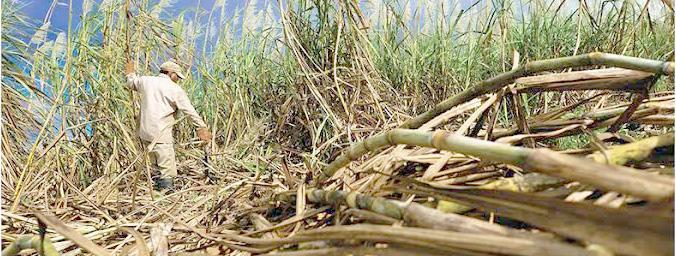
GUYANA is exploring a range of management reforms, technical upgrades and intercropping initiatives aimed at revitalising the sugar industry, as the government seeks to draw on Brazil’s expertise to improve productivity, diversify revenue streams and strengthen the longterm sustainability of the sector.
This is according to President Dr Irfaan Ali, who last week met with
as prospective technical supporters in the effort.
“One of the areas that we need to fix now is sugar. We’re working with India, and we’ve asked IICA for some support on how we can really get this right,”
President Ali said during the meeting, signalling the government’s intent to bring in expertise to address longstanding structural issues.
“We have the fixed management issues, technology issues, the moderni-
goal of replicating aspects of Brazil’s success through strategic partnerships and technology transfer.
Last month President Ali had signalled imminent management changes and a technical overhaul at underperforming Guyana Sugar Corporation (GuySuCo) estates.
He had made it clear that the focus will be on estates that have consistently failed to deliver, with particular attention on top-level
the Director General of the Inter-American Institute for Cooperation on Agriculture (IICA), Dr Muhammad Ibrahim and the Vice-Minister of Agriculture and Livestock of Brazil, Cleber Soares, during a recent state visit.
Guyana has already set out a multi - pronged modernisation agenda that includes management reforms, technological upgrades at sugar mills, field mechanisation and the exploration of intercropping to diversify incomes and add value across sugar estates.
India and other international partners such as IICA and the Brazilian Agricultural Research Corporation (EMBRAPA) were named
sation of the mills. We have the mechanisation of the fields is ongoing. We have to look at intercropping to see what value can be created. So, we’re working on those things,” he added.
Speaking more broadly about Guyana’s agricultural trajectory and the role of international partnerships, President Ali compared the country’s ambitions to Brazil’s transformation into a global food exporter.
“Brazil imported more than 80 per cent of [their] food. Today, [they are] a net exporter to more than 190 countries. I think that we have been able to fast-track that over the last five years,” he said, underscoring the government’s
leadership.
“You’ll definitely see action on some of these estates that have not performed. They must be, especially at the senior management level and the head office at these places, the estates there need to be some rationalisation,” he had said. It was previously reported that the corporation closed 2025 with production of approximately 59,200 tonnes of sugar, falling short of even its already reduced final-crop target of 60,000 tonnes.
That figure is also significantly below the revised 2025 target of 70,000 tonnes, and far off the original target of 80,000 tonnes.
Minister
FAO calls for stronger prevention, global action
– as transboundary animal diseases spread across regions
COUNTRIES around the world are facing a growing threat from transboundary animal diseases (TADs), including New World Screwworm, African Swine Fever, Avian Influenza, Foot-andMouth Disease, and Peste des Petits Ruminants, as well as other emerging zoonotic threats such as Andes hantavirus, Ebola, and Nipah.
As diseases and pests move more rapidly across borders, countries are fac -
“The impacts of these outbreaks extend far beyond animal health. They disrupt agricultural production, trade, and tourism, threaten livelihoods, increase food security risks, and in some cases pose direct risks to human health,” said Dr Tiensin Thanawat, FAO Assistant Director-General, Director of the Animal Production and Health Division, and Chief Veterinarian.
The economic impacts of transboundary animal dis-
demonstrate how quickly animal health threats can cross borders and create significant risks for food production, trade, and livelihoods.
Strong prevention and preparedness remain the most effective and least costly tools for reducing the impact of animal disease outbreaks. When outbreaks exceed national capacity, FAO acts as the Provider of Last Resort, rapidly deploying expertise, coordinating the response, and mobilising resources to
ing increasing pressure to strengthen prevention, preparedness, and response systems.
The stakes are high. Livestock sectors support more than one billion livelihoods and contribute trillions of dollars in economic value each year. Protecting animal health is therefore critical not only for farmers and livestock keepers, but also for food security, trade, economic stability, and rural prosperity.
The factors driving disease spread are becoming increasingly complex. Increased movement of animals, people and products, changing production systems, environmental pressures and uneven veterinary and surveillance capacity are creating new opportunities for diseases and pests to spread across regions. Addressing these threats requires stronger surveillance, earlier detection, greater information sharing and closer international co-operation.
eases are substantial. Avian influenza has resulted in the loss of more than 633 million poultry and threatens a $48 billion market, while footand-mouth disease causes $11.3 billion in annual losses and African swine fever has reduced pig herds by over 40 percent in some parts of Asia. These impacts underscore the importance of stronger surveillance, faster detection and coordinated international action.
Recent developments highlight the urgency of the challenge. New World Screwworm has now reemerged in the United States of America after decades of successful containment, following its northward spread through Central America and Mexico. At the same time, the emergence and international spread of the SAT1 serotype of Foot-and-Mouth disease beyond its historical range in Africa has raised concern across parts of Asia, the Middle East, and other regions. These developments
As part of this effort, FAO is working with Members to develop the Global Partnership Programme for Transboundary Animal Diseases (GPP-TAD), a longterm, country-owned platform focused on prevention, early warning, preparedness, anticipatory action, and rapid response. The objective is to help countries detect and contain outbreaks earlier,
reduce disruptions to food production and trade, and minimise the need for costly emergency interventions.
The programme is being developed as a collaborative, multi-partner initiative—including with organisations such as the World Organisation for Animal Health (WOAH)—with a focus on strengthening national capacities, supporting sustainable
financing approaches, and better linking country-level investments with regional and global support.
Building on decades of experience, the initiative aims to strengthen existing international efforts and help countries move from reactive responses toward more durable systems for prevention and preparedness. (FAO)
sustain action when national systems are overwhelmed or other actors cannot operate.
“Experience consistently shows us that prevention and preparedness are more effective—and less costly—than responding after an outbreak has taken hold,” said Beth Bechdol, FAO Deputy Director-General. “Investing in animal health systems is one of the most effective ways to protect livelihoods, support trade, strengthen food security and improve resilience across agrifood systems.”
Building on more than 80 years of experience and programmes such as the Emergency Prevention System for Animal Health (EMPRES), the Emergency Centre for Transboundary Animal Diseases (ECTAD) and the Emergency Management Centre for Animal Health (EMC-AH), FAO is working with Members and partners to strengthen global capacity for prevention, preparedness and response to transboundary animal diseases.
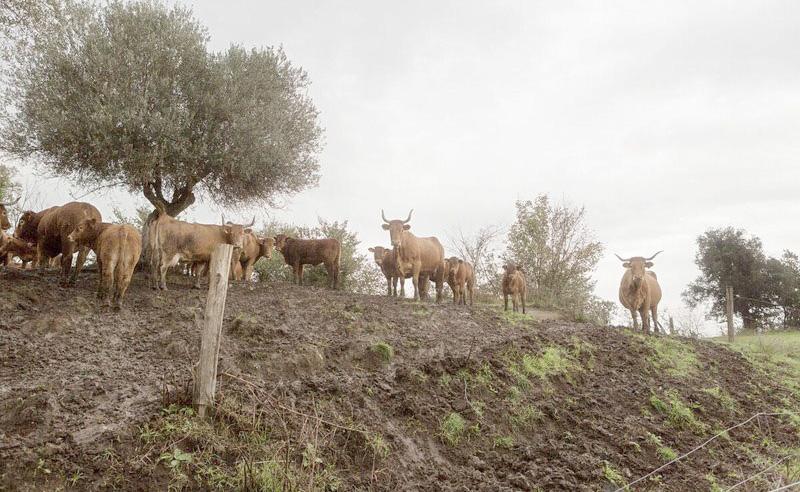
Cattle in Italy
Online passport application system to be launched today
GUYANA’S immigration services are set to enter a new digital era with the launch of the country’s online passport application and appointment system on June 15, 2026.
The initiative, spearheaded by the Immigration Support Services Department, is expected to significantly reduce waiting times, improve efficiency, and provide citizens with greater convenience when applying for passports.
Senior Superintendent and Deputy Chief Immigration Officer, Stephen Telford, described the platform as a major milestone in the department’s modernisation agenda.
“On Monday, June 15, 2026, Guyana will be
launching its online passport application system. What this allows you to do is, from the comfort of your home, make an application for your passport,” Telford announced. Through the new system, applicants will be able to initiate passport applications online and select the passport office where they wish to complete the processing stage.
The platform will also introduce an appointment-based service, allowing citizens to select a convenient date and time for their visit.
The launch builds on a series of reforms that have transformed immigration services in Guyana.
Passport processing
times have been reduced to three working days, while expedited applications can be completed within 24 hours and, in exceptional circumstances, even sooner.
The department has also expanded passport services across the country through decentralised offices and mobile enrollment units, ensuring citizens in remote and vulnerable communities have greater access to travel documents.
In addition to online passport applications, immigration services have embraced digital travel processing through the introduction of the electronic embarkation and disembarkation form and automated e-gates at ports of entry.
Telford said the e-form allows travellers to complete immigration requirements up to 30 days before travel, while e-gates have reduced processing times for eligible passengers to as little as 15 seconds.
The online passport ap-
plication system represents another step in government’s broader digital transformation agenda, leveraging technology to improve public service delivery, enhance accessibility, and create a more efficient experience for citizens seeking immigration services.
This initiative demonstrates the government’s continued commitment to building a modern, citizen-centred immigration system capable of meeting the demands of a rapidly developing nation. (DPI)
Deputy Immigration Officer, Senior Superintendent Stephen Telford
PM lauds Caribbean excellence at Anthony N. Sabga Caribbean Awards ceremony
–– says region’s heroes must be recognised, supported, and celebrated
PRIME Minister, Brigadier (Ret’d) Mark Phillips underscored the importance of recognising and celebrating the mastery emanating from the Caribbean, as Guyana once again hosted the Anthony N. Sabga Caribbean Awards for Excellence.
Delivering the keynote address at the ceremony held Saturday night at the Guyana Marriott Hotel Georgetown, the Prime Minister lauded the depth of the occasion and the strength, resilience, and collective potential of Caribbean people.
The ceremony, he added, stands as one of the region’s most distinguished celebrations of achievement and serves as an important reminder that “the Caribbean is not defined by limitation, but by greatness.”
Reflecting on the question posed by beloved Guyanese musician, the late Dave Martins – “Where are your heroes, Caribbean?” – he an-
swered: “The answer tonight is simple. They are right here. They are in this room. They are in our universities, our laboratories, our boardrooms, our clinics, our studios, our families, our farms, and our communities. They are walking among us, often quietly, often without fanfare, but always with impact.”
Prime Minister Phillips added that Caribbean excellence is not rare, but recurring, and pointed to the region’s history of survival, resilience, and endurance as part of the foundation for its success.
He said Caribbean people have emerged from some of the most difficult chapters in human history, including slavery, colonial domination, indentured servitude, plantation economies, natural disasters, and post-independence struggles.
“We are, therefore, not accidental survivors. We are the descendants of resistance. We are the heirs of resilience.
We are the embodiment of endurance. We are a people forged in struggle, but not defined by it.”
The Prime Minister also reminded that education must remain a major factor in shaping the destiny of the Caribbean.
Learning, he explained, remains a path to liberation and a bridge to a better life. He further acknowledged the role of the wider community – including elders, religious leaders, neighbours, and relatives – in guiding and shaping future generations.
Prime Minister Phillips added that the Caribbean’s size should not be viewed as a limitation, but as a defining strength that has fostered adaptability, resourcefulness, and innovation across the region.
“Because we are small, we are adaptable. Because we are small, we are resourceful. Because we are small, we learn to innovate where others rely on scale.”
He also identified entrepreneurship as one of the region’s strongest assets, noting that Caribbean people have long demonstrated the ability to create, build, and provide for themselves through small businesses, farming, market vending, and other forms of enterprise.
The Anthony N. Sabga Caribbean Awards, the Prime Minister added, matter deeply because they do more than honour individuals. He said the awards tell a regional story of the excellence that exists in the Caribbean.
“It reminds us that we are not a people who have been left behind. We are a people who are contributing, building, and leading.”
Prime Minister Phillips urged the region to go beyond celebration by continuing to support, invest in, and believe in its heroes and heroines, while noting that greatness often develops over time and may not always be immediately seen.
“We must understand that within the DNA of our Caribbean region lies a blueprint for excellence. It is encoded in our history. It is expressed in our culture. It is visible in our achievements. And it is waiting to be fully unleashed in future generations.”
During his congratulatory message to the distinguished awardees, Prime Minister Phillips stated that the ceremony serves as a reminder that Caribbean greatness is not a distant aspiration, but a present reality. (OPM)
Guyana advances plans for HIVISION 2031 to end AIDS as a public health threat
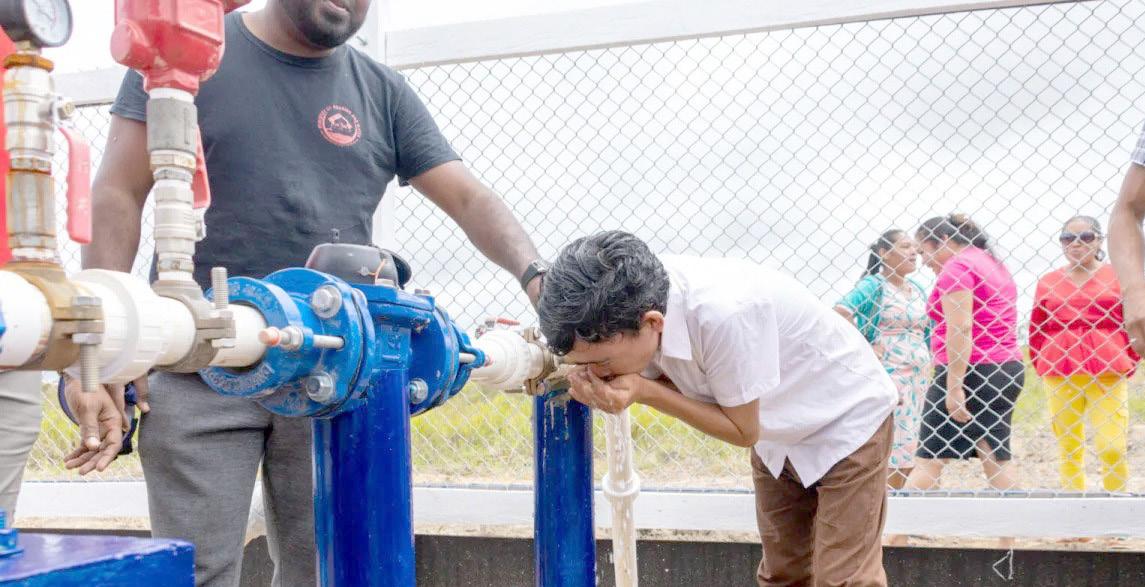
RESIDENTS of Malali in Region Ten are set to benefit from improved access to safe and reliable drinking water as Guyana Water Incorporated (GWI) moves forward with plans to drill a new potable water well in the community.
The project, which has been allocated a budget of $18.5 million, forms part of ongoing efforts to expand water infrastructure and improve the quality of life for
residents across the country. When completed, the new well is expected to strengthen water supply services in Malali, providing households with greater access to treated water and supporting the community’s continued growth and development.
Access to safe drinking water is a priority for the government to improve public health and deliver essential services nationwide.
To facilitate the project,
GWI has invited bids from contractors for the drilling of the potable water well. Interested bidders have until June 26, 2026, to submit their proposals.
The initiative underscores the government’s continued focus on enhancing water security and ensuring that communities like Malali have access to the resources needed for healthier and more sustainable livelihoods. (DPI)
THE Ministry of Health, through the National AIDS Programme Secretariat (NAPS), has taken another significant step towards strengthening Guyana’s HIV response by inviting proposals to review the current National HIV Strategic Plan and develop a new roadmap to guide the country’s efforts through 2031.
The consultancy will assess the implementation of HIVISION 2025, Guyana’s National HIV Strategic Plan for 2021-2025, and support the creation of HIVISION 2031, which will chart the country’s HIV response from 2026 to 2031.
The initiative forms part of Guyana’s commitment to ending AIDS as a public health threat by 2031, in keeping with international targets outlined by UNAIDS and the country’s broader health and development agenda.
Under the consultancy, experts will review the achievements, challenges and
gaps of HIVISION 2025, update Guyana’s national HIV epidemiological profile, and engage stakeholders through consultations, key informant interviews and site visits across the country
The successful consultant or consultancy firm will also be responsible for drafting and finalising HIVISION 2031, ensuring that the new strategy reflects current realities and emerging priorities in HIV prevention, treatment, care and support services.
The Ministry of Health is seeking applicants with expertise in public health, ep-
idemiology, health policy and HIV programme planning. Consultants are also expected to have experience working with key and vulnerable populations and familiarity with the UNAIDS Global AIDS Strategy.
The consultancy will be conducted over 60 days, with proposals due by June 26.
The development of HIVISION 2031 is expected to strengthen Guyana’s national response to HIV and support continued progress toward achieving an AIDSfree future. (DPI)
Prime Minister, Brigadier (Ret’d) Mark Phillips delivers remarks at Anthony N. Sabga Caribbean Awards for Excellence ceremony held on Saturday
ENGLISH RACING TIPS
WETHERBY
08:30hrs Starlight Mirage
09:00hrs Crossbar
09:32hrs Hey Havana
10:07hrs Roaring Ralph
10:40hrs Bayraat
11:15hrs Crafty Spirit 11:50hrs Bradbury
CHEPSTOW
08:50hrs Pride Of Nepal
09:20hrs Man Is King
09:55hrs Tall Trees
10:30hrs Sonic Si 11:03hrs Sioux Warrior
11:33hrs Punchbowl Flyer
12:05hrs Redhot Whisper
12:35hrs Praise Indeed
WINDSOR 13:00hrs Blake's Lass
13:30hrs Zabeell Small
14:00hrs Uncle Don 14:30hrs Sea Her Excel 15:00hrs Our Guy
15:30hrs Big Bear Hug
16:00hrs Ziggy's Avenger
IRISH RACING TIPS
11:40hrs Le Coq Hardi
12:12hrs Warriors Wood
12:42hrs Venusienne
13:12hrs Brohatna
13:42hrs Joe's Turn
14:12hrs Annie's Belle
14:42hrs Jacovec Cavern 15:12hrs O'Callaghan Can
RACING TIPS
CARICOM horse-racing shifted to Bush Lot United
THE horse-racing organisers in Guyana finalised the decision to move the CARICOM Cup from Port Mourant Turf Club to Bush Lot United Turf Club, West Coast Berbice on Sunday, July 5.
This decision came after numerous cancellation at Port Mourant Turf Club as a result of the weather.
“To ensure that the CARICOM CUP 2026 proceeds as scheduled and to avoid any possibility of cancellation or postponement due to recent weather conditions, the venue has been changed,” the organisers noted.
This proactive decision was made in the best interest of horsemen, patrons, sponsors, and all stakeholders to ensure a safe track and an
uninterrupted day of exciting horse-racing action.
Despite the change, all other event details remain unchanged.
A total of 11 races are on the card and more than G$15 million in cash and prizes will be up for the taking.
The CARICOM Gold Cup feature will be open to all three-year-olds and over horses going at a distance of 1900 metres. A total purse of four million dollars will be up for grabs and the top horse will receive two million.
Other races on the programme include the CARICOM Sprint stakes open to all four-year-olds and over, CARICOM Derby open to three-year-olds Guyana bred, and the ‘E’ Class and Lower. There is also the Rising
Star stakes open to threeyear-old imported horses, the three-year-olds and over WI Bred winners, ‘H’ Class and Lower WI Bred non-winners in Guyana, three-year-olds and over I/J/K Class, ‘L’ Class winners, K&L Maidens and the future star stakes two-year-old Guyana-bred juveniles.
All races will be run under the Guyana rules of racing and entries will open from June 22 and close on June 26.
Full Entries, declaration of horse, jockey & equipment are to be made in person at the Racing Office c/o Director of Racing Operations, Mr John Rupert, Racing Office, Lot #15, Strand, New Amsterdam (J’s Supermarket).
Powell enters record books but West Indies lose
CMC- ROVMAN Powell entered the record books on Saturday night, becoming the all-time leading run scorer for the West Indies in T20 international cricket.
Yet the milestone arrived in the bittersweet shadow of a defeat, as Sri Lanka levelled the three-match series 1-1, setting up a thrilling decider at the iconic venue last night.
Powell, who now has 2,314 runs in the format, overtook his compatriot Nicholas Pooran, 2,275, with a typically powerful knock after top-scoring with 43 for the regional side.
But his heroics weren’t enough to stop Sri Lanka from claiming a commanding victory by 37 runs in the second T20.
Reflecting on his record after the match, Powell allowed himself a moment of pride amidst the disappoint-
ment.
“It feels good. It’s a boy’s dream to play for the West Indies,” Powell said. “I never knew I would play for the West Indies for the last ten years or so. So it’s definitely something that I’ve dreamt about. To be able to score the most runs for the West Indies at this point is a very good feeling.”
However, his tone quickly shifted to business as he dissected a lacklustre performance in the field and with the bat.
“Not the result that we wanted,” Powell admitted.
“We realised we didn’t have a good day out with the ball. It’s not a 190-run wicket. If they had gotten 170, 165, it could have been a West Indies win.”
He was equally critical of his batting unit, which spluttered under pressure.
“As a batting group, we did not bat properly. We lose
wickets in clusters. So there are a few things that we can work on for the final.”
Powell insisted there is room for improvement in all three departments ahead of today’s series finale.
With the series now a winner-takes-all contest at Sabina Park, Powell made an impassioned plea to Jamaican fans, who turned out in healthy numbers for the second match.
“I really believe that Jamaicans love cricket, so it’s nice to see them coming out and rallying around us. Tomorrow (today) is another opportunity for them to do that,” he said.
He then offered a warning to Sri Lanka, leaning on the West Indies’ proud history in knockout matches.
“It’s a final. West Indies usually do well when it comes to the final, so hopefully tomorrow we’ll put on a show for them.”
Dakota 100 Round Two and...
(From page 22)
The Beharry Group U-19 schools T20 cricket…
Fredericks grabs 7-14 for Abram Zuil to highlight
By Sean Devers
THE inaugural Beharry Group U-19 Schools T20 Cricket Tournament bowled off on Saturday, with action in the Essequibo Coast and West Demerara zones.
The tournament, organised in collaboration with the Ministry of Education (MOE) and the Petra Organisation, was set to continue yesterday.
However, according to the Tournament Coordinator and former Guyana U-17 player, Azizi Christiani, inclement weather resulted in yesterday’s matches being postponed to next Saturday.
Last Saturday’s standout performance came at the ‘new’ Hampton Court Ground, where an incisive four-over spell from Guyana U-13 and U-15 fast-bowling all-rounder Ravid Fredericks spearheaded Abram Zuil Secondary School’s emphatic 10-wicket victory over Cotton Field Secondary.
In mostly sunny conditions and before a fair-sized gathering, which included several parents of the students, Fredericks charged in under cotton wool-like clouds and ripped through Cotton Field’s batting lineup to finish with remarkable
opening day
figures of 7-14.
Eshwar Tilak had 1-0, while a couple of run-outs aided in the demolition of Cotton Field Secondary for a paltry 19 off seven overs, as only Ezekiel Christopher showed fight with eight runs from 17 balls.
When Abram Zuil's Secondary began their reply, not even a passing drizzle could put a damper on the pugnacious start.
Marcanthony Obermuller smashed Sudesh Jacobs for a couple of scorching boundaries in the opening over that cost 15 to finish unbeaten on nine from just three balls.
Fredricks, the son of Norman Fredericks, who played in the 2011 Regional 50over tournament for Guyana, played the supporting role with an undefeated six as his school chased down the target in just 1.2 overs to end on 20-0
Fredericks was adjudged the Man-of-the-Match to the delight of his schoolmates.
In the other matches on a low-scoring opening day, Aurora Secondary beat Johanna Cecelia Secondary by six wickets.
Avinash Singh (17) and Avinash Seurattan (16) offered the only resistance as Johanna Cecelia were dismissed for 66 in 13.4 overs.
Samael Payne (3-13), Arif Singh (3-12), and Angel Person (2-19) bowled for Aurora, who reached 70-4. Guyana U-15 player Jathniel Nurse was not out on 15, and man-of-the-match Singh was on seven.
Charity Secondary School defeated Anna Regina Secondary by three wickets. Anna Regina were bowled out for 89 with Darius Pearson (24) and Jonathan Barry (18) leading the way with the bat.
Javon Ramdunhar (317), Brandon Perriera (2-10) and Jeral Gildharie (2-14), bowled well for Charity Secondary School, who reached 90-7.
Donald Peters (24), Gildharie (17) and Perriera (14*) saw their team to victory despite the efforts of Pearson (2-28) and Tyrese Stephney (2-2-28).
At Uitvlugt Ground, home team West Demerara Secondary School defeated Patentia Secondary School by two wickets.
Batting first, Patentia were dismissed for 75 with Jeremiah Garnett taking 4-21 for West Demerara despite 12 from Abdool Ahamad. West Demerara reached 76-8 with Ahamad making 18 as Jadon Birch captured 4-18 in a losing cause.
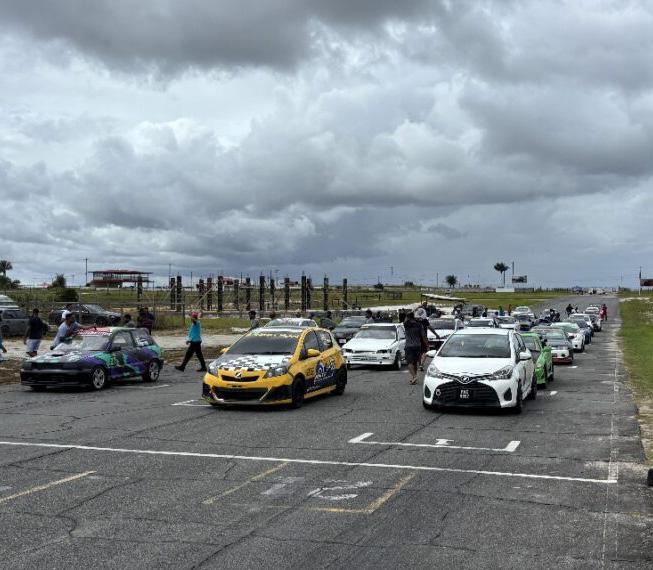
face with which to get familiar with and while the layout might be the same, there are a lot of quirks for drivers to watch out for.”
“We have completely flatted the front straightway so no longer is there that dip that we have become familiar with as well as several other changes that racers are going to have to get used to.”
The official noted that
with this in mind the club has organised the endurance and is also looking at unofficial practice sessions leading up to the July 1213 GT3 Challenge De Las Americas.
Ashley Khalil takes Silver in PanAm Masters in Colombia
ASHLEY Khalil lost to Chile's Anita Pinto in the finals of the PanAm Masters Squash Championships in Medellín, Colombia.
Khalil, who captured her fifth local title a few weeks ago by beating Mary Fung-a-Fat in the Guyana Squash Association (GSA) Enet Senior National Squash Championships, went down to the number 1 seed.
In a riveting final against Pinto, the Guyanese put up a great fight but lost 3-1 to settle for another international silverware.
On the road to yesterday’s final, the 33-year-old, new Women's Continental Champion got the better of American Nathalie Champlain 3-0.
Ashley then defeated Chile's Natalia Diaz in the second round in a similar fashion before dismissing Grace Birmingham of the USA 3-0 to qualify for the semi-final, where she beat Colombia's Karina Salti
in straight games. (Sean Devers)
YBG Regional Basketball Conference … Tutorial Academy, BHS blast into Region 6 finals
TUTORIAL Academy
and Berbice High School emerged as the top teams in the Youth Basketball Guyana Region 6 regional conference semifinals on Friday at the Vryman’s Erven Basketball Hard Court.
In the girl’s category, JC Chandisingh went down to Vryman’s Erven 16-14; they were led by Shequeen Collins with 8 points.
In the second semifinals, Tutorial Academy defeated Skeldon Line Path 18 – 02. Tutorial Academy's player of the game was Jelicia Myers, who dropped 12 points while Jada Alexander also chipped in with 8 points.
The boys' semifinals saw Berbice High School edging JC Chandisingh Secondary 28 – 23.
Avion Kesney was superb for the winners with 18 points while on the losing side, Donaldo Henry led with 14 points.
Skeldon Line Path also narrowly got past Berbice Educational Institute 23-20 in the other semis
Skeldon Line's top scorer was Joel Sukram with 14 points while Daniel Duke had 8 points and 4 steals. Region 6 regional finals are now set for June 25.
The boys' finals will feature Berbice High School against Skeldon Line Path while the girls’ will see JC
GBBFF president says Guyana will host Pro show in 2027
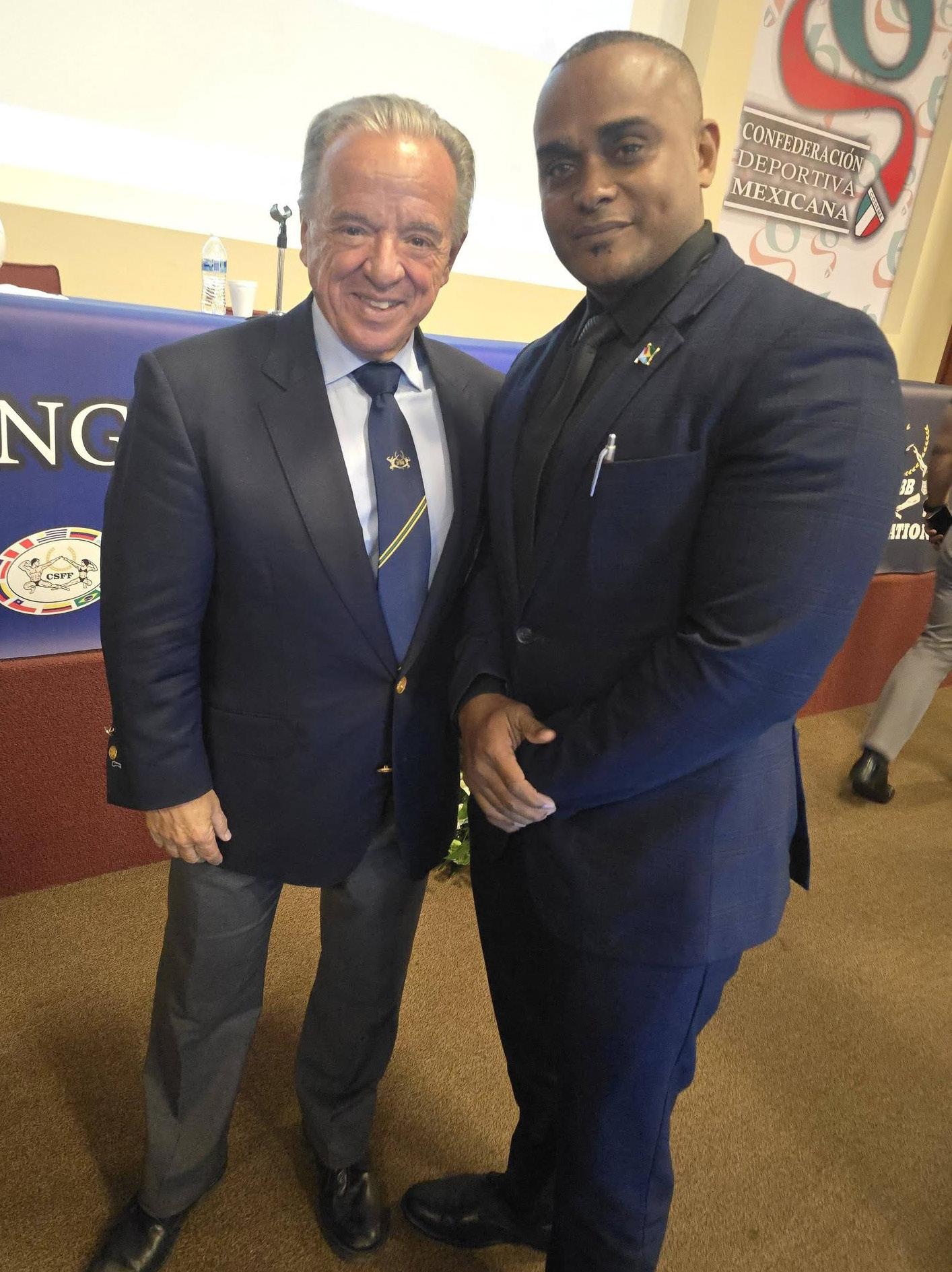
PRESIDENT of the Guyana Bodybuilding and Fitness Federation Roger Callender says Guyana will have a professional bodybuilding show next year.
Callender, a two-term president, held discussions on the sidelines of a meeting of the International Bodybuilding Federation Pan American Congress in Mexico.
The Guyanese met with IFBB President Dr. Rafael Santonja, securing the rights to host a professional bodybuilding show in Guyana next year for the first time.
"The main topic was to have a pro show in Guyana, and he agreed, and he supports this venture 100 percent, and he promises to work closely with me in putting together this show, so the IFBB will be fully supportive."
This, according to the GBBFF President, is expected to boost tourism and create a platform for Guyanese professional bodybuilders and others, including neighboring South American and Caribbean nations.
"It is not only a win for Guyana, but it is a win for the bodybuilders who are already pro athletes, and they have a chance to represent or activate their pro cards right here in Guyana."
Callender says that Dr. Santonja has pledged his full support, working closely with Mr. Callender to ensure the success of this prestigious competition.
He says that such shows can’t be run by the federation, as the GBBFF can’t sign a contract as such; he
President of the Guyana Bodybuilding and Fitness Federation Roger Callender & IFBB President Dr. Rafael Santonja
is currently working out the details to organize the show himself, with the name and other details to be announced at a later date.
Meanwhile, Guyana’s premier bodybuilding show, Stage of Champions, run by founder Videsh Sookram last year, was officially elevated to a Pro-Card qualifying event, a first for Guyana.
This certification allows top competitors in bodybuilding, men's physique, and bikini categories to win
Elite Pro Cards, which could be activated at any pro show around the world.
Callender says that Stage of Champion has not sought pro-show status, and it is up to them, as it is a private show, which he has no control over.
The IFBB pro show will create a local stage for professional athletes the likes of Rossana Fung, Hannah Rampersaud, Roley Chandler, and Sylvon Bruce Whatley, among others.
Dakota 100 Round Two and Track Day set for June 28
WITH track enhancement work on the South Dakota Circuit set to wrap up shortly, the Guyana Motor Racing and Sports Club (GMR&SC) is planning the second round of its endurance championship for June 28.
Chandisingh Secondary playing Tutorial Academy. The Regionals are sponsored by Edward B. Beharry Ltd., G-Boats Inc., National Sports Commission, Ministry of Education, and Banks DIH Ltd.
The ‘christener’ for the new venue, which gets underway from 12:00 hrs., is expected to attract some of the country’s leading drivers and riders as competitors continue their campaigns in the 2026 circuit racing season.
Fans can look forward to an action-packed programme featuring a mix of circuit
racing, motorcycle competition and track day activities, providing entertainment for both seasoned motorsport enthusiasts and newcomers to the sport.
Round Two of the Dakota 100 Championship comes on the heels of a competitive opening round and is expected to play a crucial role in shaping the championship standings. Drivers and riders will be seeking valuable points while also testing the limits of their machines on the demanding South Dakota Circuit.
The event has received support from sponsors, including Castrol, GUYOIL, E- Networks and One Guyana, whose continued backing has helped strengthen local motorsport development.
Meanwhile, according to an official, track work is expected to be completed within the coming days hence the date of the endurance.
The official stated, “We will have a brand-new sur -
(Turn to page 21)
The accompanying Track Day segment will offer participants the opportunity to experience the circuit in a controlled environment, allowing drivers to improve their skills, test vehicle performance and enjoy the thrill of motorsport firsthand.
Ashley Khalil took ‘Silver’ yesterday when she lost in the PanAm Masters Squash Championships in Colombia
Berbice High School's Avion Kesney
St. Therese Primary cop Berbice Zone title in Future Warriors Tapeball
ST. Therese Primary held their nerve under pressure to clinch the 2026 Berbice Zone title of the ExxonMobil Guyana -powered Future Warriors Tapeball tournament, sealing a 13run victory over a resilient Tain Primary unit.
The result extended Tain Primary's sequence of near-misses in the primary schools competition, forcing them to settle for the runner-up spot for a second consecutive year, having previously finished third in the inaugural edition.
Batting first, St. Therese posted a formidable 81 for 6 from their allocation of eight overs. Christiano Ramdeo anchored the top order with a composed 20, while Ghani George provided late impetus with a vital 19.
Despite disciplined spells from Romel Ramdeo (2-11) and Adriel Chichester (213), the target demanded an asking rate of over 10 runs per over.
Given Tain Primary's tournament reputation as the only other side to breach the 80-run barrier, the chase was expected to be a close affair. However, the St. Therese bowling unit executed their plans clinically.
Even though Chichester threatened to break formatting with a brief 16 and
Nicholas Bristol contributed an identical 16, Tain were restricted to 68 for 2 as Melroy Grant (1-10) and George (1-14) squeezed the run flow in the middle overs.
Despite the final defeat, Chichester's tournament aggregate of 62 runs earned him the Most Runs Award.
The individual honours for the zone, however, were dominated by Rose Hall Estate Primary’s Mario Ramsammy. The young bowler
claimed the Most Wickets and tournament Most Valuable Player (MVP) awards on the back of an exceptional return of 11 wickets in four matches, coupled with an economy rate of 5.88 and 25 dot balls.
Earlier in the day, Massiah Primary secured a comprehensive 46-run victory over Rose Hall Estate Primary in the third-place playoff. Massiah raked up 79 for 6, built on Khushan Parman-
and’s 17 and an unbeaten 15 from Rishma Ramjass, despite Ramsammy’s excellent 3 for 16. In reply, Rose Hall Estate crumbled to 33 for 5 against disciplined bowling.
The semi-final stage highlighted the explosive nature of this year's tapeball tournament as in Semi-Final 1, Tain Primary blasted their way to 86 for 2 against Massiah Primary, powered by a scorching 11-ball 34 from Chichester (1x4, 5x6s) and
an unbeaten 29 from Romel Ramdeo.
Massiah fought back through Ramjass, who struck a fluent 16-ball 27 (1x4, 3x6s), but Ramdeo’s 3 for 11 ensured Massiah were halted at 66 for 6.
In Semi-Final 2, St. Therese Primary made short work of a 56-run target against Rose Hall Estate as Keiron DeJonge smashed a brutal unbeaten 27 off just 10 deliveries, littered with three
sixes and a four, to guide his side home at 59 for 1 in just 4.5 overs after Rose Hall had been restricted to 55 for 4.
Beyond the silverware, the tournament highlighted an institutional focus on modern cricket metrics. The top four schools each received comprehensive equipment bags, agility kits, and electronic scoring tablets.
The integration of tablets is designed to introduce young players to the digital mechanics of online match scoring, bridging the gap between recreational play and data analysis. All 16 participating schools also left with baseline fitness equipment.
With this victory, the New Amsterdam-based St. Therese Primary joins Demerara champions West Ruimveldt in the national postseason lineup.
The spotlight now shifts to the Essequibo Zone, scheduled for June 20-21 at the Anna Regina National Stadium.
The regional champions will progress to the Champion of Champions tournament later this year, in August or September.
The ultimate winner of that national phase will earn a novelty fixture against the Guyana Amazon Warriors.
Diamond Jubilee Hockey Cup - GCC teams reign on Day Three
THE Georgetown Cricket Club’s (GCC) hockey teams headlined the third day of action in the Diamond Jubilee Hockey Cup with a series of impressive victories at the National Stadium, Providence.
In the men’s first division, GCC came up against Saints and won it comfortably 4-1.
Aldo Melendez, Fredrico Cush, Dwayne Scott, and Lucas Sergeant scored in succession to put a stranglehold on the clash before a consolation goal from the Saints' Shakeem Fausette in the dying moments of the game as it ended 4-1.
Meanwhile, the GCC elite played the women’s category, beating Saints 7-nil.
Princessa Wilkie, got them off the mark before a
double from Abosaide Cadogan gave them an unassailable lead of 3-nil.
A pair of goals from Amariah Sahadeo followed, before Rebecca Ferreira and Gabriella Xavier added field goals to complete the dominant 7-nil victory.
Hikers Women also came out on top in their Ladies’ First Division fixture against Old Fort Inferno, winning 2-0.
Kenisha Wills and Ariel Adams were at the helm of the victory with two field goals.
Pepsi Hikers had to settle for a draw when they locked horns with Old Fort in top form, 3-3.
Robert France stood out for Pepsi Hikers with a brace, while Old Fort’s
St. Therese Primary held their nerve under pressure to clinch the 2026 Berbice Zone title of the ExxonMobil Guyana -powered Future Warriors Tapeball tournament
Yonnick Norton also netted twice, but neither side could be separated as the match ended level. Old Fort's Shaquon Favorite and Hikers' Shane Samuels were the other goal scorers in the draw.
Hikers striker Shane Samuels makes a penalty corner attempt