Guyana Chronicle E-Paper 15-02-2026

Page 1


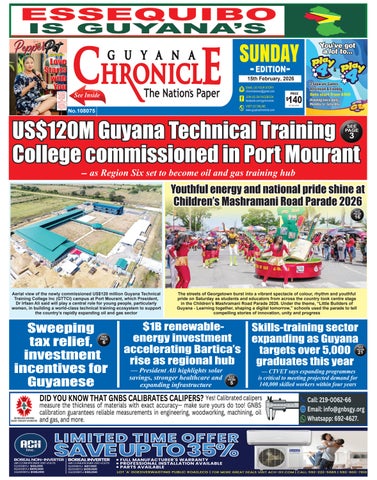
US$120M Guyana Technical Training College commissioned in Port Mourant

PRESIDENT, Dr Irfaan Ali on Saturday commissioned the US$120 million Guyana Technical Training College Inc (GTTCI) at Port Mourant, underscoring the central role of young people, particularly women, in building a world-class technical training ecosystem to support the country’s rapidly expanding oil and gas sector.

Delivering the feature address, the President said the decision to construct the facility was shaped by strategic engagements in 2020 between the Government of Guyana and its development partners, including ExxonMobil.

He explained that, rather than opting for short-term distribution of oil revenues, the administration chose to

channel more than US$120 million into long-term national capacity building, focusing on infrastructure and human capital that will deliver sustained benefits for future generations.

The state-of-the-art institute, outfitted with advanced simulation technology, now joins a limited group of similar facilities globally. President Ali said the selection of Port Mourant was deliberate,

--as Region Six set to become oil and gas training hub

given its historic reputation for producing highly skilled technical workers through the former Port Mourant Technical Institute.

During the ceremony, the President invited current GTTCI students, already enrolled in programmes at the institution, to stand, describing them as the true

inspiration behind the country’s strategic investment in technical education.

He observed that, a decade ago, significantly fewer young women viewed technical training as a viable pathway, but their growing participation today reflects a transformative shift in Guyana’s development trajectory.

“This is what inspires the future,” the President said, expressing confidence that the next generation will be instrumental in driving longterm national prosperity.

He noted that the commissioning of the college firmly positions Region Six as Guyana’s national oil and gas technical-training capital and a future regional hub for specialised workforce development in the petroleum sector.

The President disclosed that the programme moved from concept to operationalisation in under four years, well ahead of the initial six to seven-year projection.

He emphasised that the facility forms part of a wider development strategy for Region Six, which also encompasses a new nursing school, expanded engineering programmes through the University of Guyana, plans for a comprehensive medical-training presence, a new Level Five teaching hospital in New Amsterdam and major investments in sporting infrastructure.

Further expansion is planned in agricultural training, industrial capacity, and projects linked to the gas-to-energy initiative and the development of a deep-water port, all of which TURN TO PAGE 13

Advanced simulation training in progress at the GTTCI, as instructors guide students through real-time technical performance analysis aligned with global oil and gas industry standards.
President, Dr Irfaan Ali delivers the feature address at the official commissioning, highlighting investment in human capital and technical education.
Students of GTTCI in attendance at the commissioning ceremony

Finance Minister slams APNU’s Campbell for ignoring vast reports on current reality

--Rebukes lead APNU MP for masking APNU+AFC IDB data as Guyana’s performance

SENIOR Minister in the Office of the President with Responsibility for Finance, Dr Ashni Singh, last Friday, blazed lead APNU Parliamentarian Terrence Campbell for repeatedly citing what he described as outdated poverty statistics that do not reflect Guyana’s current socio-economic reality.

Speaking during the third sitting of the 13th Parliament, Dr Singh highlighted that during the days of scrutiny in the Committee of Supply and heated debates, Campbell repeatedly referenced the poverty statistics drawn from an Inter-American Development Bank (IDB) working paper that analysed survey data from 2016 to 2018, as well as 2021, the height of the COVID-19 pandemic.

Campbell had referenced the IDB report in the National Assembly while arguing that ordinary Guyanese were not being centred in this year’s

fiscal plan.

It is in this regard that the Minister scolded Campbell for resurrecting the APNU+AFC era report and accused him of misrepresenting the poverty statistics and thereby painting a misleading picture of the People’s Progressive Party/Civic (PPP/C) government’s performance.

Dr. Singh called out the lead APNU Parliamentarian for ignoring the volumes of current government data on programme performance across all sectors, which he said document the significant progress in social and economic development.

Dr Singh stressed that the government has been transparent in providing updated data across sectors, including in the national Budget documents, which he said outline both progress made and areas still requiring attention.

“It was convenient for Mr. Campbell. It was convenient for him to ignore the

existence of all of the other data that we have produced, not only in Volume Two, but all of the other data and all of the other reports that we’ve been producing and putting out there constantly, every single sector,” Dr Singh told the House.

“Every single sector in this government has been producing reports on a regular basis on their performance that documents what is being achieved, where gaps remain and what still remains to be done,” he added.

Although the IDB report clearly identifies the timeframe of the data used, the opposition repeatedly failed to disclose this context while presenting the figures as reflective of present-day conditions.

On page 41 of the report, under the appendix titled Surveys Analysed by Country, it states clearly that the data for Guyana comes from the Labour Force Survey for the years 2016 to 2018 and 2021.

The 2016–2018 period fell squarely under the APNU+AFC administration, while 2021 coincided with the economic disruptions caused by the COVID-19 pandemic, when the incumbent PPP/C administration returned to power in 2020.

The IDB publication, titled Ten Findings about Poverty in Latin America and the Caribbean (Working Paper IDB-WP-01644), was released in November 2024.

The minister criticised Campbell for branding the IDB report as the only source of data, firmly stating, “Nothing could be further from the truth and I could present here a vast compilation of documents and reports that have been produced by my colleagues, the ministries under their respective charge,

gle Guyanese citizen being able to achieve personal and household prosperity.

The government, Dr. Singh defended, has emphasised its comprehensive vision for economic growth, including infrastructure and social sector investments, aiming for world-class services.

The Minister noted that despite the veiled efforts by the opposition, the Guyanese people can see through this and are well aware that both sides of the opposition have no interest in their well-being.

containing valuable data and extensive data on what we have achieved.”

Describing Campbell’s arguments as “fallacious” in relation to the poverty rate, the Minister noted that the lead APNU’s claims were even previously debunked, yet he refused to even acknowledge that the data was sourced from when APNU+AFC was in office.

The Minister also denounced Campbell’s disagreement with the removal of property tax on individuals, noting that “just a few minutes later, he extolled his own personal wealth.”

The Minister told the House that the Guyana, that the PPP/C government aims to build, will see every sin-

“The inescapable fact of the matter is that the only political party that presented a comprehensive vision for improving the lives of the Guyanese people is the People’s Progressive Party,” Minister Singh said.

“Budget 2026 will see us continuing to invest in the things that matter for the long-term viability and competitiveness of our economy, including infrastructure that is so critical to catalyse strong long-term economic growth, transport infrastructure, energy infrastructure, etc,” Dr. Singh said.

Dr. Singh reaffirmed that the PPP/C government remains committed to improving living standards and addressing poverty through expanded employment, education, health care and social-support programmes outlined in Budget 2026.

Senior Minister in the Office of the President with responsibility for Finance, Dr Ashni Singh

$1B renewable energy investment accelerating Bartica’s rise as regional hub —President

WITH close to $1 billion invested in renewable energy across Region Seven (Cuyuni-Mazaruni) over the past few years, President Dr Irfaan Ali has said Bartica is undergoing a deliberate transformation into a dynamic regional hub where development is both “visible and felt.”

Speaking during a recent broadcast of ‘Tea on the Terrace,’ the Head of State underscored that the changes unfolding in Bartica are the result of targeted, people-centred policies designed to strengthen healthcare, education delivery, connectivity and infrastructure within the region.

“The shift matters because when a regional capital is stronger, the entire region benefits,” President Ali stated, noting that renewable energy investments have significantly reduced fuel costs, lowered operating expenses and improved the reliability of electricity supply.

He pointed to the 1.5-megawatt solar farm now operating in Bartica, which has already generated substantial savings, as well as the installation of 345 solar home systems that are directly supporting families across hinterland communities.

Turning to healthcare, the President said the expansion of services has led to a reduction in medical

evacuations from the region, with improved local capacity allowing more patients to be treated closer to home.

In 2025 alone, the Bartica Regional Hospital treated more than 15,000 patients

Ali highlights solar savings, stronger healthcare and expanding infrastructure

These are direct benefits, translated benefits from the investment we’re making from our budgets, and that’s just 2025 alone,” the President said.

Across the education sec-

“This means better learning outcomes, access to online certification and training, more students qualifying for high-income jobs, studying from home, studying on the GOAL scholarship pro-

and performed nearly 3,000 surgeries, while the Kamarang District Hospital served over 3,300 patients. The Kamarang facility also conducted some 28,000 laboratory tests that were previously unavailable within the district.

“These are outcomes that protect communities and reduce long-term public health expenditure and implications.

tor, schools within the region have been upgraded and key institutions connected to high-speed internet. According to President Ali, internet bandwidth in Bartica has increased from 10 megabits per second to 200 megabits per second, significantly improving access to digital learning, certification programmes and remote study opportunities.

PROGRESS

During the programme, a Bartica resident identified as Miss Lam shared first-hand accounts of the town’s progress, particularly in healthcare, education and infrastructure.

She referenced the new hospital currently under construction at Five Miles, Bartica, as a critical addition that will further strengthen medical services within the region.

On education, she observed that increasing numbers of young people are taking advantage of opportunities under the Guyana Online Academy of Learning (GOAL) programme.

She also welcomed the construction of a new municipal airport in Bartica, noting that improved air connectivity would address longstanding transportation challenges faced by residents of Region Seven.

Last November, President Ali described the sod- turning for the new BK airport terminal in Bartica as a transformative milestone for the region and a key step towards strengthening national connectivity, tourism and economic diversification.

gramme,” he noted.

The President also highlighted that between 2020 and 2025, some $2.5 billion was transferred directly to households in Bartica through various government support initiatives, injecting additional disposable income into the local economy and supporting community development.

Since its launch in 2021, GOAL has awarded more than 39,000 scholarships across certificate, diploma, bachelor’s, postgraduate, master’s and PhD programmes, almost doubling the government’s original target of 20,000 scholarships by 2025. The initiative also provides access to more than 100 short, skills-based programmes through partnerships with local and international institutions, many of which require no formal qualifications for entry.

“It’s very beneficial to them, because they’re studying and doing everything from the comfort of their home and they could provide for families,” the resident said.

Reflecting on broader infrastructure upgrades, the resident noted that improved road access over the past five years has eased travel to schools and interior communities, facilitating greater mobility and economic activity.

Collectively, the investments in renewable energy, healthcare, education, digital connectivity and transport are positioning Bartica not only as a stronger regional capital but as an emerging growth centre capable of driving inclusive development across the wider Cuyuni-Mazaruni region.

President Dr Irfaan Ali addresses the gathering during last year’s commissioning ceremony of the $553 million Bartica Stelling

Fiscal Reforms that Put People First

THE successful passage of the Fiscal Enactments (Amendment) Bill 2026 through the National Assembly is set to go down as another major moment in the government’s economic strategy, one that is clearly aimed at delivering tangible, countrywide benefits while strengthening the productive sectors that will sustain longterm growth. This is not simply a technical amendment to a series of tax laws. It is a deliberate restructuring of the fiscal framework to place more disposable income in the hands of citizens, lower the cost of living, and stimulate invest -

ment across key sectors. By amending the Income Tax, Corporation Tax, VAT, Property Tax and Customs Acts, the administration has effectively aligned its legal framework with the promises outlined in Budget 2026.

The direction is unmistakable: relief for households, incentives for production and a more enabling environment for businesses.

Several measures stand out for their immediate impact. The increase in the income tax threshold from $130,000 to $140,000 per month will remove thousands of workers from the tax net while injecting billions of dollars back into the pock-

ets of citizens. Similarly, the removal of net property tax on individuals represents a meaningful step towards easing financial pressures on homeowners.

Equally important are the interventions targeting productive activity. Eliminating corporate taxes on agriculture and agro-processing sends a strong signal that food security and value-added production remain central to the country’s diversification agenda. Expanding export allowances to include timber value-added products, and removing VAT on locally manufactured furniture and jewellery, further strengthens the competitiveness of local

industries while encouraging manufacturing and craftsmanship.

The reforms also reflect a practical understanding of everyday costs faced by Guyanese. Measures to remove VAT on smaller vehicles and hybrid vehicles, reduce taxes on pick-ups, eliminate duties on all-terrain vehicles, and scrap taxes on outboard engines up to 150 horsepower will directly ease transportation costs, particularly for hinterland and riverain communities where mobility is essential for livelihoods.

Support for childcare and elderly services introduces another critical dimension. By removing corporate taxes

for companies in these sectors and allocating co-investment funds, the government is signalling that social-care infrastructure is now a national development priority, not an afterthought.

What is emerging is a fiscal policy anchored in both growth and inclusion. Encouraging local production, expanding tourism-related activity and improving safety through duty-free access to security equipment, all point to a comprehensive strategy that links economic expansion with household-level relief.

The broad endorsement from private-sector bodies, labour rep-

resentatives and tourism stakeholders suggests that these reforms are being viewed not as isolated concessions, but as part of a coherent economic roadmap. At its core, the Fiscal Enactments (Amendment) Bill 2026 reinforces a central governing philosophy: economic policy must ultimately translate into better living standards for citizens. By targeting disposable income, reducing costs, and unlocking investment across sectors, the government has moved to ensure that growth is not abstract, but is felt in homes, businesses and communities across Guyana.

Sweeping tax relief, investment incentives for Guyanese

GOVERNMENT has moved to operationalise a raft of fiscal incentives and tax-relief measures after Senior Minister in the Office of the President with responsibility for Finance, Dr Ashni Singh, successfully piloted the Fiscal Enactments (Amendment) Bill 2026 through the National Assembly, following the conclusion of consideration of estimates of expenditure on Friday.

The Bill gives legislative effect to key policy interventions announced in Budget 2026, setting the stage for increased disposable income, reduced living costs and expanded incentives for productive sectors. The Ministry of Finance stated that the amendments are intended to

“increase disposable income; reduce the cost of living; promote local production; stimulate investment in priority sectors and provide targeted tax and duty relief to individuals and businesses.”

The legislation amends the Income Tax Act, Corporation Tax Act, Value-Added Tax (VAT) Act, Property Tax Act and the Customs Act. Once assented to by President Dr. Irfaan Ali, amend-

ment’s fiscal-policy agenda for 2026 by “enhancing economic activity, supporting households, encouraging local production and reducing the overall cost of living.”

Among the most consequential provisions is the removal of corporate taxes on agriculture and agro-processing businesses, a move the government said will promote productive activity and diversification. The measure is expected to increase retained earnings and drive reinvestment to boost output and productivity in the agriculture value chain.

According to the Finance Ministry, the measures collectively advance govern -

ments to the Income Tax and Corporation Tax Acts will take effect from January 1, 2026, while VAT and Customs changes will come into operation on February 16, 2026. Amendments to the Property Tax Act will apply from the year of income commencing January 1, 2025.

The Bill also expands the export-allowance framework to include value-added timber products, a step aimed at enhancing the competitive-

Senior Minister in the Office of the President with Responsibility for Finance, Dr Ashni Singh

Stabroek News,

Part 1: The 1986 return of the MCC

CLASS analysis, whether in a rich, industrialised society or a small island state with a mere 300,000 persons, is a fundamental requirement in studying the sociology, politics and economics of a country.

To grasp how and why the Stabroek News (SN) started and why it died, class analysis is a sine qua non. To analyse the journey of SN will take several columns because it is a complex story. Before we proceed, a brief note on the statement issued by the De Caires family on the reason for the closure. I will return to the statement as an entire column.

Their reflection on the beginning and evolutionary life of SN is fictional, deceitful and downright misleading. The couple did not produce the incontrovertible facts that are embedded in the ontology of SN. To understand why SN was born and the purpose it intended

to serve in the Guyanese society, it would be useful to read the book, “The birth of the Stabroek News.”

On page 131, it noted that co-founder, David DeCaires, asserted that he birthed SN to nurture an “open economy based on free enterprise.”

No one starts a newspaper with the intention of nurturing a free enterprise system or any system at all.

One starts a newspaper to enhance the value of journalism and to inform society about the contents of that society.

In that very book, there are descriptions of how the Mulatto/Creole class (MCC) was impressed upon to finance the newspaper. A vital sum came from the American government and from the beginning of SN right up to this day, the paper repaid its gratitude by remaining an unapologetic pro-Western, pro-imperialist newspaper.

Comprehending the

depth of the ideological beliefs of the SN is a very disturbing undertaking. Just juxtapose the coverage of Israeli violence in Gaza with the Kaieteur News’. When you do the comparison, you cannot help but detest SN. I know, as someone who is emotionally grieving over the genocide in Gaza, I am glad SN has died.

After President Desmond Hoyte began the introduction of abertura and perestroika through de-Burnhamisation, David DeCaires and Miles Fitzpatrick saw an opportunity to resuscitate the special and monarchical presence of the light-coloured petty bourgeoisie.

Both men were the crème de la crème of the MCC in British Guiana. In those days, DeCaires and Fitzpatrick were royal items. This was the motive behind the formation of SN. Both founders yearned for the days when they and their

fellow MCC aristocrats would be given space again to roam Guyana with an elitist aura. Both men made sure that they were treated with monarchical recognition and SN gave them that special touch.

De Caires and Fitzpatrick used the SN to laud it over Guyana. I never knew about Portuguese elitism only from what my father and visitors to our house told me when I was a little boy. But I saw it in full force at SN. DeCaires and Fitzpatrick were condescending to anyone who was not from the MCC.

A hard-to-take person at SN was Mrs. DeCaires. As a columnist, she told me never to attempt to speak to Mr. DeCaires. No staff member could walk up to the third level and try to speak to Mr. DeCaires; only the Portuguese and Caucasian employees had that privilege, including British woman, Anna Benjamin.

Mrs. DeCaires was harsh and insulting to one of the leading politicians of the day, parliamentarian Moses Nagamootoo.

Security was not at his desk, so Nagamootoo walked up. Mrs. DeCaires waded into Nagamootoo in front of people and scolded him for going upstairs without permission and asked him to leave. My heart went out to Nagamootoo and from that day, I detested Doreen DeCaires, a feeling that has not been diluted over the years.

Two moments caused a revelation at SN that its owners were intent on bringing back Portuguese elitism. One was for a Sunday edition. Mr. DeCaires allowed his daughter and her friend, the daughter of the OMAI gold company, to simply run the newspaper for that day. The two women knew absolutely nothing about journalism.

The other moment was when DeCaires plucked an

18-year-old Portuguese altar boy from the Catholic Church and made him the news editor. It sent shock waves throughout SN’s journalistic staff. This “youth maan” maybe didn’t know how to spell journalism much less to write it.

But DeCaires and Fitzpatrick got away with it because they owned the only real newspaper and everyone bowed to them. Guyana had returned to the days of conspicuous class elitism. DeCaires held his birthday each year at a majestic resort on the Essequibo River and only his MCC friends were invited, not even one senior staff from SN. In 1986, the MCC was reborn.

DISCLAIMER: The views and opinions expressed in this column are solely those of the author and do not necessarily reflect the official policy or position of the Guyana National Newspapers Limited.

Sweeping tax relief, investment...

FROM PAGE 6

ness of exporters by reducing their effective tax burden and allowing them to price goods more competitively on international markets.

Further support for domestic manufacturing will come through the removal of VAT on locally made furniture, including doors, moulding and beds, as well as on locally produced jewellery. These measures are intended to lower construction costs, strengthen the forestry and jewellery subsectors and support local manufacturers.

In a move aligned with the government’s public-safety agenda, duty and VAT will be removed on security equipment such as cameras and alarm systems to assist households and businesses in enhancing security.

Vehicle ownership and transportation costs are also being addressed. The government will introduce flat taxes on double-cab pick-ups, with $2 million applicable to vehicles under 2,000 cc and $3 million for those between 2,000 cc and 2,500 cc, irre-

spective of age. Additionally, VAT will be removed from new vehicles below 1,500 cc and on hybrid vehicles below 2,000 cc, supporting both affordability and the country’s low-carbon development pathway.

For hinterland and riverain communities, all import duties and taxes on All Terrain Vehicles (ATVs) will be eliminated, while taxes and duties on outboard engines up to 150 horsepower will also be removed to reduce transportation costs in remote areas.

Targeted social support measures are embedded in the legislation. Corporate taxes will be removed for companies providing childcare and elderly services, complemented by $1.5 billion in co-investment support for child and elderly-care facilities, contingent on agreed service rates.

The Bill also removes the net property tax on individuals, which the government estimates will increase disposable income by more than $1.4 billion, and raise the monthly income tax threshold

from $130,000 to $140,000. This adjustment is expected to remove 5,000 persons from the tax net and inject over $2 billion in additional disposable income into the workforce.

In tandem with the fiscal measures, the government is also advancing tourism-support initiatives. The removal of the 14-day residency requirement for destination weddings, piloted in the National Assembly by Minister of Home Affairs Oneidge Walrond, is expected to expand tourism-related economic activities and benefit the hospitality industry.

The private sector has broadly endorsed the mea-

sures. The Private Sector Commission stated that “from a business and productive activity standpoint, the measures announced will significantly enhance the operating landscape for the private sector,” highlighting incentives such as the removal of corporate tax on agriculture and agro-processing and the revision of export allowances.

The Georgetown Chamber of Commerce and Industry anticipates “a transformational effect on the playing field for Micro, Small, and Medium-sized Enterprises in particular,” while the Guyana Manufacturing and Services

Association welcomed the removal of VAT on locally manufactured furniture and jewellery and the inclusion of value-added timber products in the export allowance framework.

Labour representatives have also expressed support.

The Federation of Independent Trade Unions of Guyana lauded the “strong emphasis placed on direct cash transfers and income-support measures that will tangibly improve the daily lives of workers, pensioners, and vulnerable households,” pointing to the $100,000

cash grant for all Guyanese aged 18 and above as immediate relief.

Tourism stakeholders similarly endorsed the package, noting that the removal of duties and taxes on ATVs and outboard engines will reduce operating costs for river-transport providers, tour operators and eco-lodges.

As underscored by President Ali in December 2025, the government’s fiscal strategy is anchored on a people-centred approach, emphasising that “people come first, always.”

Weathering the storm and Stabroek News’

closure

The Stabroek News will close on March 15

THE Editor-in-Chief (EiC), Anand Persaud, stated that the newspaper would honour all of its financial commitments to staff, including their severance and pension payments. Persaud said that the newspaper came to an end “because of a change in market conditions.”

He noted that “newspapers all around the world are facing this crisis.” Persaud gave an example of the closure of Newsday in Trinidad last month.

“We considered all of the options, but at the end of the day, there was nothing that really stood out as providing long-term security. A lot of

digital revenues are what you call ephemeral. It’s here today and gone tomorrow. And you can’t really be sure that it’s going to be there. So, we had to make a tough decision,” he said.

And before the public gets the wrong idea, Persaud made it clear that the People’s Progressive Party/Civic (PPP/C) government, owing millions to the newspaper, did not contribute significantly to the closure.

“Now, it wasn’t necessarily a factor in the newspaper making the decision to close. That is, even if DPI had paid us on time, we still would be non-distressed because of the change in the markets”, the

EiC said.

The Stabroek News shareholders stated they played a valuable role between 1986 and now, signalling that that role needs to be played by others in the media because accountability to the public is very important.

The shareholders said that it was “a newspaper that was fearless” and “a non-advocacy newspaper.” This means it took no sides and was balanced. This means that it was not biased and always spoke the truth, giving the public the task of deciding whether to believe or not. Its stories or reportage of events were not coloured.

According to Persaud,

“What we want to do is to leave with dignity. We want to leave on our feet rather than leave on our knees, beholden to anybody and to have to sort of like to be in that.”

Let’s discuss.

I want to be pellucid. The Stabroek News’ announcement on Friday morning that it would close down its operations in Guyana by March 15, 2026, is deeply regrettable, unfortunate and disappointing, but it was neither shocking nor surprising. I will get to the latter part of that argument in this piece.

The decision to cease its operations and undergo a voluntary liquidation of the 40-year-old news giant was sound and a step in the right direction.

What is even more honourable is that Stabroek News has chosen to ease the burden staff will endure when they are out of operations and find themselves unemployed come March.

Firstly, Stabroek News, in the 1980s and early 1990s, was a pillar of journalistic integrity and a fortress of ethics. It was one of Guyana’s powerful fourth estates, which many in the public loved and loathed at the same time. It was among the news entities which were considered giants within the local and regional news landscape.

It offered a fresh, objective and true take on news, often delivering the news with an unapologetic flair. It dominated the news cycle with its bold colour, opinion pieces, editorials and its focus on truth-finding.

There was an obsession with the blunt truth that made the S/N into one of the very few balanced, non-biased and frank newspapers within the Caribbean.

Secondly, when its founder and long-time EiC, David de Caries, died in 2008, this version of the S/N would follow soon after.

Different styles and formulas have been adopted to date, but none have got it right.

In 2011, the newspaper started its period of decline. After all, its tone was rapidly changing and political dynamics started to play a more noticeable role in the newspaper’s coverage of

events and activities that would shape the face of Guyana moving forward.

The present EiC would not admit it, but he knows it’s true. Any objective reader of the SN would get the sense, one time or another, that the SN was not being truthful and, in fact, had some of the stories very wrong. They would not even try to conceal this by correcting it. It was pandering to its master’s wishes and doing everything to survive, even if it meant sacrificing its journalistic integrity at the altar of political expediency.

In other words, it joined the trend of news organisations compromising objective reporting, accuracy and ethical standards to serve political interests, advance a specific agenda, or cater to a polarised audience.

This phenomenon is a major factor in the decline of public trust in the SN, as it is seen to prioritise political narratives over, or to the exclusion of, impartial fact-finding.

Added to the decline were the market factors that govern the media and news business in Guyana and farther afield.

Thirdly, one must question how SN could not adapt to the changing and dynamic news landscape of journalism, news and business over all the decades of SN’s existence. What were the shareholders, directors and managers doing? Sleeping?

I do not accept or believe Persaud’s statements, which made it sound like the current management of the SN did everything, but nothing seemed viable in the end to bring back financial stability to the company. Was downsizing not a viable option? Was cutting the fat, as every other media, facing the very same fate, not an option?

How could the independent SN not pull through while the government-run newspaper is still keeping abreast with technology, digitalising, making economies of scale and weathering the storm?

How could the De Caires’ newspaper not diversify its content to reach more readers?

Why did they not do more to save SN from de-

cline? Were they not more concerned about learning from the lessons learnt by Kaieteur News, Guyana Times, Catholic Standard, and other publications of old?

Something is awfully wrong. The ‘maths ain’t mathsing’ for me. Something is wrong with the buttermilk. I think that there is more than Persaud and the shareholders are telling us. I have confidence that the truth will surface and come to the light. But when?

So, I am not surprised or baffled at the news, because of the path that I saw the newspaper was going down; it was just a matter of time before it ran out of gas. The newspaper had finally become a rag for the opposition parties, APNU, PNC and more recently, WIN, to use as they wish. Mostly anti-government sentiments and editorials expose the entity’s political slant against the government of the day.

The newspaper was not leaving on its feet as Persaud would like the public to believe, but as a sickly, battered and worn caricature of its original self. I blame Persaud and all the management for not only neglecting, but also squeezing the lifeblood out of SN. I SAID IT.

Fourth, the abrupt closure of long-standing independent institutions and a “perfect storm” of political and economic forces are hallmarks of the existential crisis currently plaguing the Caribbean newspaper sector.

As local and worldwide advertisers shift their resources to global social media platforms, traditional revenue streams have failed. Additionally, physical printing has become unsustainable due to sharp rises in newsprint, maintenance, and manufacturing costs.

Particularly vulnerable to market shocks are independent newspapers that lack the support of a major media conglomerate, and a dramatic shift in consumer behaviour towards free social media content has resulted in circulation drops of up to 40% when cover prices are raised to offset expenses.

Though I doubt it played a role in the closing, I cannot TURN TO PAGE 11

The Spirit of Ramadan in the House of One Guyana

LATER today, the annual Ramadan Village will return to the grounds of the Muslim Youth Organisation (MYO) in Thomas Lands, three days ahead of the lunar Islamic month during which Muslims will abstain from food and drink, idle talk and worldly distractions from dawn to sunset. Difficult as that may sound in a warm, sometimes very hot, tropical country, Ramadan comes wrapped up in a familiar spirit of community and spirituality.

The keynote address this evening will be delivered by Ieasha Prime, an accomplished female Muslim scholar of Islam and a familiar friend of Guyana. In her case, the familiarity isn’t due to her popularity on social media platforms. As it turns out, this is her third visit to Guyana, and it took more than two days to get here.

That she would make the long trip again, to join us in welcoming the sacred month of Ramadan, speaks to the depth of her affection and regard that she holds for the

people of this country, and for good reasons. We have a bold and confident president in Dr Mohamed Irfaan Ali, who has, to put it bluntly, captured the imagination of many Muslims who reside in the West and are consumed by the plight of the global Muslim Ummah (community).

To appreciate what that means, one would have to situate our president in that same global Muslim conversation, which has been overshadowed by a genocide in Gaza that has claimed the lives of thousands of Palestinians.

I refuse to state the death count because there should be no numerical yardstick to measure the scale of Israel’s killing fields of Gaza and the West Bank. Now in its third year, the Israeli military machine continues to wreak havoc on Palestinians who have been reduced to skeletons eking out scraps of food from the rubble of Gaza.

Although the 2025 edition of the Muslim500, a list of the most influential Mus-

lims, names President Ali, I am surprised that he wasn’t among the top 50. President Ali is not an imam nor is he a religious scholar, and Guyana is not a Muslim country, but what he has accomplished in five years is nothing short of remarkable. It would be a huge mistake to carve him out only as a Muslim leader, and equally, it would be a terrible mistake to ignore the fact that he is a sitting president who happens to be a practising Muslim.

He is the kind of political leader that young Muslim activists in Europe and North America thirst for, but one who is also a conscientious Muslim who is not compromised, shackled or dead.

At this moment, I am thinking of the ageing Palestinian leader Marwan Barghouti, who has been imprisoned for 23 years and is so formidable that Israel dares not swap him in any prisoner exchange deal. There is also the principled Imran Khan, former captain of Pakistan’s cricket team, another leader with an ethical spine, who

has been wrongfully imprisoned in a Lahore jail cell with 100 books, two dumbbells, a prayer mat and a TV that does not work. No wonder he has gone blind in his right eye.

That’s the context, I believe, in which we need to situate our Ramadan Village. Our guest, Ieasha Prime, was in New Zealand last month when I messaged her to extend an invitation to visit Guyana on behalf of the organisers of the Ramadan Village.

I imagine that she was visiting the Muslim community in Christchurch. Readers might recall that a White supremacist terrorist opened fire at two mosques in that city on March 15, 2019, killing 51 Muslim worshippers and injuring nearly 100 others. The timing of the Friday congregational prayers made it a deliberate and calculated attack designed to kill and maim as many Muslims as possible.

To mark the horrific and

senseless violence inflicted on Muslims, the United Nations declared March 15 as the International Day to Combat Islamophobia.

Yet, just last week, a deplorable incident outside Sydney Town Hall in New South Wales, Australia, reminded me how fortunate Muslims are to call Guyana home.

After a peaceful protest against the visiting President of Israel, a group of Muslims stepped aside from traffic and pedestrians to perform their sunset Maghrib prayer. As they prayed, police reportedly received an order to clear the area and, for reasons unclear, decided it included the worshippers.

Nearly a million Muslims live in Australia, and one would expect most Australians, especially trained officers, to recognise the simple posture and rhythm of Muslim prayer, which makes what happened next all the more absurd.

Riot police descended on

worshippers in prostration, pepper-spraying, pushing, and dragging them away. Several were injured, one man suffered “massive” bruising and possible kidney damage, and women reported knee injuries from being thrown to the ground.

In Guyana, President Irfaan’s Ramadan Village stands as living proof of a shared sense of community that unites us regardless of creed or ethnicity. It is a space where Muslim and non-Muslim Guyanese can come together not as “us” and “them,” but as one people, where President Ali’s “One Guyana” vision shines as bright as the lanterns on the lawns of the MYO tonight and throughout the month of Ramadan.

DISCLAIMER: The views and opinions expressed in this column are solely those of the author and do not necessarily reflect the official policy or position of the Guyana National Newspapers Limited.

Women in STEM: Powering Guyana’s Future

GUYANA is buzzing with opportunity. As the country grows in energy, technology, environmental management and infrastructure, strong foundations in Science, Technology, Engineering and Mathematics (STEM) are essential.

Women are increasingly part of the teams designing systems, developing solutions, and leading innovation across these fields. Their presence is not symbolic; it is shaping how progress happens. Research shows that diverse technical teams consistently outperform homogenous ones in problem-solving and innovation, making women’s participation crucial for national development and industry

growth.

Building the next generation of STEM leaders requires both vision and confidence. Karen Abrams, co-founder of STEMGuyana, consistently urges starting now. “Let’s not wait. Let’s build, innovate, and create the future we deserve, starting today.” Including women in STEM is not just about fairness; it ensures that Guyana harnesses the full talent and creativity of its population. When women are given the opportunity, they lead projects, solve complex problems, and inspire others to follow. These opportunities are already creating real impact. Diana Gittens, Product Manager at Mobile Money Guyana and STEMGuyana

board member, combined technology with community service by creating a breast cancer awareness chatbot.

The platform provides citizens with reliable health information and helps people access medical services quickly. Similarly, Joylyn Conway, lecturer and STEM advocate, dedicates her work to empowering girls in STEM. “I live to educate and empower girls in STEM and those who aspire to be. I truly believe all girls deserve a chance to know they can imagine, inspire, and invent.” Their efforts show how women in STEM can solve practical problems while inspiring the next generation.

STEM pathways in Guyana continue to expand, pro-

viding both education and real-world application. From robotics clubs and coding workshops to digital initiatives like the HerVenture mobile learning app, young people and women entrepreneurs gain critical skills that allow them to thrive.

HerVenture provides business education, financial literacy, and digital marketing guidance, reaching thousands across the country. In engineering and energy sectors, women contribute to infrastructure development, while in environmental science, they conduct research and lead conservation projects that protect Guyana’s forests, rivers, and biodiversity. Across these areas, women are applying technical

Moving house

IT is said to be one of the five most traumatic experiences in a person’s life. Yet many families and individuals across the globe have had the experience at least once and some have had to do so many times.

Often, moving house is preceded by trauma, particularly in those instances where the move is forced, unexpected or hurried.

And looking for a new home comes with its own stress in terms of appropriate location, size and, most important of all, affordability.

Last week I helped one of my daughters move house and while I, myself, have had to move a few times, helping her brought home to me (the perfect term in this situation) the full extent of the anxiety and worry moving can cause.

She was eventually able to find an apartment, after months of searching, but this was smaller than the house she was currently

occupying, bringing with it the challenge of downsizing. Items would have to be put in storage, given away or simply dumped for want of space.

Before getting this apartment in Lamaha Springs, she was scheduled to move to an even smaller one in Georgetown because her tenancy on the current house was coming to a close

But just days before the planned move, my daughter was informed that the apartment had been rented to a close friend of the owners. This meant that she then had to ask for an extension to her tenancy, while now looking feverishly for other accommodation.

Preparing to move brought with it the realisation that she had accumulated many more things since her last move.

The task of sorting, packing and discarding seemed momentous.

However, it all began

very methodically, with labelled barrels indicating what they contained - clothing, curtains, towels, bed linen and some miscellaneous items.

Boxes too were packed and labelled, eventually given to garbage bags, loaded with additional items

As the deadline for the move fast-approached, the organised packing became a matter of just getting things out of the way and into bags.

The move took four days, from Saturday to Tuesday, although it was originally intended to be completed in just one or maybe two days.

I arrived last Monday, in time to help pack the last of the bags, though additional bags and some heavier items still had to be loaded and fetched the following day.

The moving was done by a canter and a car, with much ‘back and forth’ and ‘up and down’ according to my daughter’s partner, who by this time was at his ‘wit’s

end.’

His plaintive words made me think of those people who, according to the BBC, consider moving house as “the next most stressful thing after a family member dying”.

But this proves to be more of a feeling than an actual fact borne out by statistics.

However, there can be no doubting the fatigue, irritability, sometimes accompanied by difficulty sleeping, loss of appetite and the feeling of being overwhelmed that moving can cause.

Experts also refer to the Relocation Stress Syndrome (RSS), “A clinical term for the physical and emotional distress caused by moving”, often describing this as similar to PTSD.

On a lighter note, as another of my daughters arrived to help with the moving in, we were able to laugh about the ‘back and forth’ and ‘up and down’, adding

knowledge in ways that benefit both society and industry, including Guyana’s growing oil and gas sector.

Early exposure is proving particularly powerful. ExxonMobil’s “Girls in Gear” engineering workshop welcomed over 200 young participants, giving them hands-on experiences such as building rockets and bridges. These activities spark curiosity, build confidence, and show girls that STEM is a space where they can innovate and lead. Support from industry through scholarships, internships, and partnerships further ensures that women develop the skills needed for high-demand roles in energy, technology, and environmental science.

Supporting women in STEM today is an investment in Guyana’s future. From classrooms in Georgetown to innovation hubs across the regions, women are leading, innovating, and inspiring the next generation. Their contributions are shaping careers and strengthening the nation, driving innovation, solving complex challenges, and demonstrating that when women are at the forefront of STEM, the whole country benefits.

DISCLAIMER: The views and opinions expressed in this column are solely those of the author and do not necessarily reflect the official policy or position of the Guyana National Newspapers Limited.

our own phrases like ‘in and out’ and ‘front to back’ as we fetched in assorted items and sought to get the new apartment in shape.

There are still barrels, boxes and bags to be unpacked, furniture to be rearranged, mats and carpets to be placed and curtains to be hung.

And though this too can come with fatigue and fretting, moving in is in no way as traumatic as moving house.

And to my daughter and

anyone else who has recently moved into a new home, I send this quote from an unknown author: “May your home know joy. Every room hold laughter. Every window open to great possibilities.”

DISCLAIMER: The views and opinions expressed in this column are solely those of the author and do not necessarily reflect the official policy or position of the Guyana National Newspapers Limited.

Weathering the storm and Stabroek...

deny the rise of artificial intelligence and international digital platforms that exploit local material without paying for it, further undermining the sustainability of Caribbean newsrooms like SN.

Finally, I think SN missed a golden opportunity to weather the storm, ensuring its survival and endurance. I think that if the newspaper went back to De Caires’ way of storytelling, truth-based news coupled with the consistent use of technology, SN would overcome the difficult period, crisis, or challenging situation with minimal damage.

It was still possible to have resilience and strength in navigating financial or professional hardships, much like a ship safely navigating rough weather. Here, it is important to note that the PPP/C and its policies did not lead to the decline and closure of the so-called independent press, SN, in Guyana. The PPP/C could have done things differently, but its actions still did not cause the SN’s demise.

The SN was its own biggest enemy. The decisions and inaction caused its decline and unprofitability.

Its ‘civil society’ and ‘third force’ elements did nothing to save the SN, even though it rallied its causes harder than ever. Its managers are to be blamed. Its failure to keep abreast with the demands of a changing Guyana and the news landscape caused its decline. It self-imploded. Frankly speaking!

DISCLAIMER: The views and opinions expressed in this column are solely those of the author and do not necessarily reflect the official policy or position of the Guyana National Newspapers Limited.

PAGE 3

US$120M Guyana Technical Training...

State-of-the-art laboratory and process-training equipment at the GTTCI, designed to deliver hands-on, industry-standard technical education for Guyana’s expanding energy sector

are expected to accelerate economic diversification and regional growth.

President Ali said the training institute is a critical pillar in Guyana’s strategy to convert oil wealth into human capital; strengthen local-content participation; diversify the economy and create stable, high-income technical careers for young Guyanese. He stressed that the development model being pursued advances agriculture, energy, manufacturing and knowledge-based industries simultaneously.

He pointed out that prior to 2020, Guyana possessed significant petroleum resources but lacked a structured national framework to train its own technical workforce. The establishment of the institute, he said, now

guarantees the development of certified local technicians, expanded industrial capability, and greater economic sovereignty.

The objective, he added, is not merely resource extraction but the deliberate construction of enduring national capacity.

The President stressed that the development unfolding in Berbice, including infrastructure, housing, education and industrial expansion, positions the region for unprecedented growth and opportunity in the years ahead.

Meanwhile, Director of the GTTCI, Professor Clement Sankat, told the gathering that the transformation reflects the vision of President Ali and the Government of Guyana, “but not only a vi-

sion, his tremendous capacity for action and shaping the new Guyana for opportunities for our people.”

According to Sankat, the technical training college forms part of the “new Guyana,” adding that “our President’s vision is to train Guyanese students at GTTC using global standards and best practices.”

In 2024, Guyana’s first state-of-the-art oil and gas training facility — The FacTor (Facility Simulator) — was commissioned at Port Mourant, Berbice, Region Six. The US$13 million (GY$2.6B) project represented the first phase of the wider Guyana Technical Training College Inc.

Sankat disclosed that three batches of students have already been trained. The

programme for those students was conducted in Canada, with practical training completed at the FacTor, after which the graduates were employed on various ships. However, with the commissioning of the training college, students will no longer have to travel overseas as the entire programme will now be delivered in Port Mourant with the necessary accreditation. “The need to send our students to Canada for such training has come to an end.”

He noted that the college is among the few, globally, offering such specialised training, positioning Guyana to attract overseas students and earn regional and international recognition.

President of ExxonMobil Guyana, Alistair Routledge, in his remarks, stated that President Ali holds a fundamental belief in maximising the opportunities from oil and gas resources.

He said discussions commenced on ensuring Guyanese benefit in every aspect,

with the government making it clear that Guyana intends to raise its standards to be among the best in the world, and that the institute’s standards must match that ambition.

Routledge also underscored the importance of Professor Sankat’s role in advancing the project and maintaining high standards throughout construction, while reiterating the government’s focus on developing a globally competitive, skilled workforce.

Aerial view of the newly commissioned US$120 million GTTCI campus at Port Mourant, positioned as a national hub for oil and gas technical workforce development

800 nurses to graduate under hybrid programme by mid-year

CLOSE to 800 nurses are expected to graduate by June this year, almost four times the country’s traditional annual output, as a result of the hybrid nursing programme developed in partnership with international agencies, Health Minister Dr Frank Anthony has disclosed.

Dr Anthony made the announcement during the final day of consideration of the estimates and expenditure for Budget 2026, telling the Committee of Supply that the expanded output represents a major milestone in strengthening Guyana’s healthcare workforce.

“We’ll have by June of this year, the first batch of close to 800 registered nurses that will be graduating,” the minister said.

He explained that the innovative model has been working “really well” and the influx of new graduates will provide a significant boost to service delivery across the public health system.

“So, we expect that this year alone, we have for different categories of training that we’re doing, not only nursing, but different categories of training, close to 5,000 people who would be coming off different programmes, and we’ll have to bring them into the system,” Dr Anthony added.

Previously, the country’s nursing-training capacity was limited to the Linden, Georgetown and New Amsterdam nursing schools, which together could accommodate only about 200 trainees annually. To ad -

dress the growing demand for healthcare professionals, the government developed the hybrid nursing programme in collaboration with the World Health Organization (WHO).

Under this arrangement, US$1 million was channelled through the Pan American Health Organization (PAHO) to the University of São Paulo, whose nursing faculty worked alongside Guyanese educators to design a comprehensive three-year curriculum. Dr Anthony noted that 30 local tutors were trained in Brazil’s teaching methodologies before returning to implement the programme locally.

“So, we have designed an entire curriculum—three years of this nursing programme, and we then decide to partner with Coursera. So,

this content is on the Coursera platform,” he said.

The theoretical component of the programme is delivered online through Coursera, while practical training is conducted at simulation centres established across the country, enabling a blended learning approach that expands access without compromising clinical competence.

The minister further revealed that the programme has begun attracting interest from regional counterparts, with several Caribbean countries seeking to participate.

“Very soon, we’ll be signing some agreements where we will allow some of the other Caribbean countries to join this online nursing school that we have,” he disclosed.

Dr Anthony also indicated that with several new hospitals now commissioned nationwide, plans are advancing to have those facilities formally designated as teaching hospitals. This move

—Health Minister says innovative model drawing regional interest

will integrate clinical training directly into service-delivery settings and expand opportunities for hands-on learning.

To support this expansion, two new training facilities are nearing completion: one at the Suddie Hospital compound and another at the old New Amsterdam Hospital compound.

“We have two new nursing schools or training schools, for that matter, that we’ll be completing. One is at the Suddie Hospital compound, and one is in the old New Amsterdam Hospital compound,” he stated.

While these facilities will strengthen nursing education, the minister emphasised that their mandate will be broader, accommodating multiple programmes offered through the Health Sciences Division, which currently runs about 20 courses. The strategy is to decentralise training opportunities, so that more students can access programmes within their regions instead of relocating to Georgetown.

In addition, the ministry is working with the University of Guyana to extend the reach of its medical school into the regions, allowing students to complete much of their academic and clinical training closer to home, with periodic attendance at the main campus as required.

Dr Anthony said this approach is intended to ensure that “we’ll get more people in the regions properly trained,” while simultaneously building a more equitable and resilient health workforce.

He further noted that new hospitals commissioned this year are being outfitted with additional classroom spaces to support training activities. This will complement the traditional teaching capacity centred at the Georgetown Public Hospital.

“Very soon, we will authorise that the six new hospitals would all become teaching hospitals, so we’ll make the relevant legal amendment so that that can happen,” the minister said.

Young Guyanese earns doctorate at University of Aberdeen

—With research focusing on strengthening Guyana’s offshore oil and gas safety laws

GUYANESE scholar Taymara Jagmohan has officially added a doctorate to her list of accomplishments after being conferred with a PhD from the University of Aberdeen; a challenging but rewarding culmination of years of research, resilience and determination.

Her doctoral thesis, titled “Offshore Oil and Gas Health and Safety and Environmental Regulation in Guyana: Lessons from the UK and the US Safety Regimes,” examines how Guyana can

a single model to replicate in Guyana, Jagmohan’s findings pointed to the need for balance. She concluded that Guyana may benefit from a hybrid regulatory system, combining performance-based and prescriptive approaches, to improve oversight, strengthen enforcement and guide future legal reform.

While she describes that conclusion as only a summary of a much broader body of work, she hopes the research will contribute meaningfully to discussions on offshore

Guyanese Taymara Jagmohan has officially added ‘Doctor’ to her list of accomplishments after being conferred with a PhD from the University of Aberdeen

strengthen its legal framework as oil and gas production continues to expand.

The research comes at a critical time for Guyana, with major offshore discoveries accelerating production. Jagmohan noted that legislation has not always moved at the same pace. This inspired her to undertake a comparative study of two experienced oil-producing jurisdictions, the United Kingdom and the United States, to examine how their regulatory systems evolved, particularly after facing safety and environmental challenges within the industry.

Rather than identifying

the completion of her PhD.

Reflecting on her years in Scotland, Jagmohan spoke fondly of her time at the University of Aberdeen, describing the experience as transformative, both

TURN TO PAGE 20

safety, environmental protection and long-term governance in the oil and gas sector.

Though her academic focus ultimately settled in law, Jagmohan’s early interests were wide-ranging. As a teenager, she immersed herself in reading, often completing more than 100 books per year, to understand diverse perspectives.

She also explored science before committing to legal studies, an interest that later informed the technical depth of her doctoral research. Her academic journey includes an undergraduate degree and two Master’s degrees prior to

Jagmohan expressed gratitude to her parents, brother, extended family, examiners, friends and faith community for their support during the demanding doctoral years

Youthful energy and national Children’s Mashramani

THE streets of Georgetown burst into a vibrant spectacle of colour, rhythm and youthful pride on Saturday as learners and educa-

tors from across the country took centre stage in the Children’s Mashramani Road Parade 2026.

From dazzling costumes inspired by Guyana’s rich cultural heritage to energetic dance routines pulsing with soca and steelpan rhythms, the young participants transformed the road march

into a living canvas of national pride. Their performances were more than entertainment; they were a bold expression of identity, creativity and the

promise of a generation growing up in a rapidly modernising Guyana.

Under the theme, “Little Builders of Guyana - Learning together, shaping a digital tomorrow,” schools used the parade to tell compelling stories of innovation, unity and progress. Costumes fused traditional ele-

national pride shine at

Mashramani Road Parade 2026

ments with futuristic designs, symbolising a country that honours its roots while embracing a technology-driven future.

Teachers, joined by Minister of Education, Sonia Parag, marched alongside their learners, guiding, encouraging and celebrating each step, reinforcing the powerful role ed-

ucation plays in nation-building.

The parade route pulsed with youthful energy as cheers erupted from parents, onlookers and proud

alumni who lined the streets. Each group brought its own flair, whether through dramatic choreography, interactive displays or vibrant portrayals of

Guyana’s landscapes, industries and cultural diversity.

These photographs from our Photographer, Sachin Persaud and the Ministry of Education capture the unforgettable faces, bold expressions and joyous moments that defined the parade.

Housing Ministry surpasses target in Region Six outreach

- Almost 500 Agreements of Sale signed as CH&PA fast-tracks titles and advances $30B housing drive in Berbice

FOLLOWING the passage of Budget 2026, the Ministry of Housing has intensified its regional outreach in Region Six (East Berbice-Corentyne), delivering services and advancing home ownership processing for hundreds of residents over the weekend.

Led by Minister of Housing, Collin Croal and Minister within the

Ministry Vanessa Benn and supported by a full team from the Central Housing and Planning Authority (CH&PA), the two-day outreach and documentation exercise was held at the Classic International Hotel. The initiative formed part of the ministry’s drive to accelerate service delivery and improve efficiency across the housing sector.

The exercise, which

began on Friday and continued into Saturday, exceeded its target of 450 signings, with nearly 500 persons signing their Agreements of Sale to advance the processing of their Certificates of Title. In addition to document signings, the outreach facilitated direct engagement with residents, allowing officials to address concerns, provide updates, and resolve a

range of housing-related matters.

Housing development in Region Six has seen major investment in recent years, with approximately $30 billion injected into the region, benefitting some 28,000 Guyanese. Chief Executive Officer of CH&PA, Dr Martin Pertab, disclosed that between 2020 and 2025, more than 4,000 house lots

were allocated and over 440 titles were distributed across the region.

The numbers continue to rise. On Friday alone, 396 persons signed Agreements of Sale for Number 75 Village, Phase Two, with additional signings on Saturday morning pushing the total well beyond the ministry’s initial target.

Minister Croal noted that the early momentum

reflected the demand for faster processing and the ministry’s renewed focus on delivery.

The outreach, which also saw financial institutions present on the ground, represents the next phase of the ministry’s housing drive in the region. Looking ahead, CH&PA plans to invest approximately $159 billion nationally this year to advance its housing programme, with continued development in areas such as the rear of Number 77 Village, Springlands and Hogstye.

Minister Croal assured residents that those signing during the outreach would see swift progress in completing the home ownership process. “I want to commit that in three months, we will be coming back to issue your certificate of titles for both within the 75, Phase 2, and the 76, Blocks 3 and 4. That is my commitment to you,” he stated.

By the end of 2026, the ministry anticipates constructing more than 8,000 houses and allocating over 15,000 house lots as part of its wider housing targets.

Minister of Housing Collin Croal and Minister within the Ministry of Housing, Vanessa Benn (Ministry of Housing photos)
The ministry surpassed its initial target in Region Six, with almost 500 persons signing Agreements of Sale
Moving forward the ministry aims to develop systems, decrease waiting time in land acquisition, and improve communication by strengthening systems at both the ministerial and registry levels

Agriculture boost for Region 10 in 2026 Budget

AGRICULTURAL

development in Region 10 is set to receive a major boost under the 2026 National Budget, beginning with the refurbishment of the Regional Agriculture Office and several other key initiatives.

Minister of Local Government and Regional Development, Priya Manickchand, outlined the planned investments while re -

poultry pens at Linden Foundation Secondary, New Silver City Secondary, and Wismar Christianburg Secondary. The $3 million initiative aims to provide students with hands-on agricultural experience as part of their School-Based Assessments (SBAs), benefitting more than 500 students.

Additionally, the Regional Agriculture Office at Christians -

ble-drawer desks, and a biometric time clock — all aimed at improving staff productivity and efficiency.

Minister Manickchand emphasised that the government’s development agenda seeks to diversify the economy rather than rely solely on the oil and gas sector.

She noted that Guyana remains unique in its ability to produce sufficient food across

sponding to agriculture-related questions from opposition member Sharma Solomon.

Among the projects to be undertaken this year are two farm-tomarket access road upgrades. One will be executed at West Watooka at a cost of $13 million, opening up 25 acres of farmland for cultivation and benefitting over 250 farmers and residents.

A similar road upgrade will be done at Lower Kara Kara, Block 42, for $13 million, providing access to 15 acres of farmland for about 50 farmers.

Minister Manickchand also announced the construction of

burg will be refurbished at a cost of $8.9 million, enhancing services for over 18,000 farmers and improving working conditions for more than 30 staff members.

To strengthen field operations, a double-cab 4×4 pickup valued at approximately $8 million will be procured to support monitoring and evaluation activities across the Intermediate Savannahs and Linden. The office will also be modernised with new equipment, including a smart board, desktop computers, office chairs, CCTV cameras, heavy-duty projectors, dou -

every major food group, a success she attributed to deliberate and sustained agricultural policies that have made farming more attractive to citizens.

“We have seen a major shift in public perception toward farming,” she said. “Farmers from Region Ten, including many women, are producing impressive quantities of high-quality crops for the market. This progress has earned Guyana recognition internationally and reinforces the government’s focus on agriculture as a national priority.” [DPI]

Housing Ministry...

However, Croal acknowledged that achieving these goals requires internal reform. Speaking candidly about existing challenges, he noted that persons seeking titles have historically faced waiting periods of up to six months. The ministry now aims to reduce that timeline to three months by strengthening systems at both the ministerial and registry levels.

“I want to say now, because we are also putting our checks and balances in-house at the ministry, that once you sign, there should be no glitch after that. And the processing of the title must be done within three months. Some of the glitches are not only at the registry level, but also in-house. So, some heads will have to roll in due time, because this is something that we have taken dearly. We are committed as a government to ensure that as quickly as possible, you have home ownership,” the Minister said.

Home ownership, the minister stressed, goes beyond receiving land documents. He underscored the importance of developing sustainable

communities alongside individual ownership.

“Home ownership ends when you have ownership as well as your communities developed. That is why we are also enhancing your community to ensure that you have the necessary facilities, including recreational facilities, a green space and so that you can have an area to take your family,” he said.

“These are some of the restructurings we are doing in-house, because while we are stepping up with the amount of delivery that we have to do, it is still not good enough. And I publicly recognise this.”

Improving communication and access to information is also high on the ministry’s agenda. Regional offices are expected to develop better communication with head offices to play a stronger role in providing updates to applicants on the status of their housing applications and title processing, as the ministry works to deliver faster and more efficient service in Region Six and beyond.

Guyanese earns doctorate at University of...

intellectually and personally. Outside of her studies, she found balance in activities such as yoga, swimming, painting, reading and weight training.

She acknowledged that the path was not without challenges. However, she credits perseverance and strong support systems for carrying her through. Her supervisor, she said, consistently encouraged her with the reminder that “anything worthwhile is worth fighting for.”

She described his guidance as both sensitive and steadfast throughout the research process. Jagmohan also expressed gratitude to her parents, brother, extended family, examiners, friends and faith community for their support during the demand-

FROM PAGE 15

ing doctoral years. Now, with her PhD formally conferred, she is looking ahead, though she remains reserved about what comes next. For Taymara, the achievement is not simply about academic recognition, but about contributing knowledge that could shape policy conversations in Guyana at a pivotal moment in its development.

As she moves forward, she does so with the same competitive spirit and discipline that guided her through years of research and writing, determined, she says, to keep moving forward. Her message to fellow Guyanese is one of persistence, that progress requires courage, and meaningful reform demands careful study.

Skills-training sector expanding as Guyana targets over 5,000 graduates this year

—CTVET says expanding programmes critical to meeting projected demand for 140,000 skilled workers within four years

GUYANA’S workforce continues to grow and evolve across sectors and the area of skills training is no different, says Director of the Council for Technical and Vocational Education and Training (CTVET), Patrick Chinedu Onwuzirike.

Speaking to the Guyana Chronicle in a recent interview, Onwuzirike shared that there has been steady growth within the skills-training sector, with some 5,000 Guyanese estimated to graduate this year, compared to the council’s usual 2,000 graduates annually.

This, he noted, highlights not just the interest of Guyanese but also the development of the workforce, with more people trained and available to fill existing gaps. Moving ahead, Onwuzirike added that the council, through the Ministry of Education, will continue to grow and expand to facilitate the increasing number of Guyanese seeking to become skilled and be part of a growing workforce.

Citing the council’s development to better meet demand, Onwuzirike explained that in recent years it has developed a modularised, competency-based programme to ensure that Guyanese citizens and persons across the region can study and receive a regionally accredited and recognised certificate, now known as the Caribbean Vocational Qualification (CVQ).

He added that this initiative has assisted and strengthened the CARICOM Single Market and Economy (CSME) projects.

To this end, the council has worked to ensure its standards remain high.

“Quality assurance is not just a walk in the park. We have to make sure we have all our Ts crossed, all our Is dotted, and throughout that time have been maintaining that quality assurance. It is not an easy process, but we have been maintaining it and I am proud that we are doing some marvellous work in this area,” he said.

This commitment to standards is one of the reasons the council continues to see increasing numbers of applicants and graduates. Currently, the council issues some 2,000 CVQ certificates annually. That number is

slated to more than double, with Onwuzirike estimating that approximately 5,000 certificates could be issued this year.

This expansion comes as the Ministry of Education broadens the offering of CVQ certificates, including at the secondary-school level.

“Currently, the Council for Activities is issuing annually about 2,000 CVQ certificates. We have started it in secondary schools, in conjunction with the CXC, we issue certificates to students leaving the secondary-school system. The ministry now has a policy that speaks to the fact that every secondary school leaver must have a CVQ certificate, or a CXE certificate, in this case, the CVQ. In combination with the Ministry of Education and what we do with the post-secondary institutions, we are estimating that this year, we might be issuing about 5,000 certificates,” he said.

However, that number could double again in the coming years.

According to Onwuzirike, surveys from the International Labour Organisation (ILO), along with other studies, have projected that in the next few years, Guyana will need an estimated 140,000 skilled persons to meet workforce demands.

“Very soon, we might go from 5,000 to 10,000, imagining how many students leave secondary school every year. That is something that I believe is a magnitude of work that can change Guyana as we know it,” he said.

“Recent surveys and data have shown that there are gaps in our labour market in terms of skills that are needed. We have surveys from

done through the World Bank Project, and it’s pointed out to us that by the next three to four years, we have to find about 140,000 persons skilled to work in most areas in Guyana.”

This shift, Onwuzirike

said, is vital to Guyana’s development. For this reason, several steps have been taken to ensure that acquiring a certificate remains accessible. The council has worked to make vocational training less

TURN TO PAGE 23

[the] ILO, we have surveys that the Ministry of Education and the Government of Guyana would have [sic]
Director of the Council for Technical and Vocational Education and Training (CTVET), Mr Patrick Chinedu Onwuzirike

Cotton Field Government Services Centre nearing completion

—New Region Two hub to deliver passports, registrar and digital services closer to residents

MINISTER within the Ministry of Public Works, Madanlall Ramraj, on Saturday visited the newly constructed Government Services Centre at Cotton Field, Region Two, as the facility is moved closer to completion.

The centre forms part of the government’s broader effort to modernise and decentralise public services, ensuring residents along the

Essequibo Coast can access critical services without the need to travel to Georgetown.

During the tour, Minister Ramraj assessed the progress of the final phase of works, which includes the installation of workstations, counters, air-conditioning units, security systems, signage, and ICT infrastructure.

Designated waiting areas are being outfitted to provide comfort and order for members of the public, while individual departments are being

equipped with the necessary technology and furnishings to guarantee smooth and efficient daily operations.

Once officially opened, the centre will house the Guyana Passport Office, Guyana Digital School, and the General Registrar’s Office.

Residents will be able to complete passport applications and related immigration services, receive support for digital learning programmes and process vital documents such as birth, marriage, and death certificates—all in one convenient location.

The establishment of the centre is expected to significantly reduce waiting times, cut travel expenses for residents, and improve overall service delivery throughout Region Two.

For many families, particularly those from riverine and hinterland communities, access to centralised services on the coast will represent a major improvement in convenience and efficiency.

Similar centres have already been commissioned in Regions Three and Five, bringing together agencies such as the Environmental Protection Agency, the Bureau of Statistics, the Guyana National Bureau of Standards and providing facilities for police clearance processing. These centres have enhanced inter-agency coordination

and streamlined public interactions with government departments.

During the outreach at Cotton Field, the minister and his team interacted with residents who were eager to learn about the services that would soon be available.

Several individuals also expressed strong interest in employment opportunities within the departments that will operate from the facility, underscoring the centre’s potential to create new job prospects for persons within the region.

Accompanying the Minister were Regional Chairman, Devin Mohan; Regional Vice Chairman, Humace Oodit; Deputy REO, Omesh Sasenarayan; Director of Government Efficiency, Nigel Dharalall; Director of the Guyana Digital School, Tamashwar Bujdoo; Operations Manager of the Digital Identity Card Registry, Saarah Gajraj and Deputy Chief Immigration Officer, Senior Superintendent Stephen Telford, along with representatives from the respective agencies.

The Cotton Field Government Services Centre is poised to become a key administrative hub for Region Two, reinforcing the government’s commitment to equitable development and accessible public services for all citizens.

Residents who attended the meeting
Minister Madanlall Ramraj during the visit

Trio released on $500,000 bail each over cannabis trafficking in Bartica

TWO construction workers and a businesswoman from Bartica were, on FridaY, released on $500,000 bail each, after pleading not guilty to a drug trafficking charge following the discovery of cannabis during a police operation earlier this week.

Eric David, 23, and Keegon Cummings, 25, both construction workers of Three Miles, Bartica, along with Whitney Fraser, 35, a businesswoman of Four Miles Housing Scheme, Bartica, appeared via Zoom before Magistrate Ravindra Mohabir at the Bartica Magistrate’s Court.

The charge, contrary to the Narcotic Drugs and Psychotropic Substances (Control) Act, Chapter 10:10, was read to them.

It is alleged that, on Wednesday, February 11,

2026, at Four Miles Housing Scheme, Bartica, Essequibo River, the trio had in their possession 288 grams of cannabis for the purpose of trafficking.

The matter has been adjourned to March 27, 2026, for continuation.

According to a police report, the charges stem from an intelligence-led operation conducted on the day in question, around 18:00 hrs at a residence in Four Miles Housing Scheme.

Police said that upon arrival at the premises, ranks observed a bag being thrown over the back fence. They immediately proceeded to the backyard, where three individuals were present, and retrieved the bag.

Upon examination, the bag reportedly contained a transparent plastic bag with several small ziplock par-

FROM PAGE 21

Skills-training sector expanding as Guyana targets...

intimidating by embedding academic concepts into practical applications.

Additionally, programmes are now modularised, allowing students to earn statements or micro-credentials for completed units, even if they are unable to finish the full certificate immediately.

“Those that did not get the full, or did not complete the full unit, we will give them statements and say what they have done, and they can use that to go and get some work,” he said, noting that these credentials are recognised throughout the Caribbean region.

The importance of skills training to Guyana’s future cannot be overstated, according to Onwuzirike, who believes it will be transfor-

mative for the nation’s development trajectory. He pointed to international examples where strategic investment in vocational training has significantly boosted economies.

The director also highlighted that skills training is universally valuable, attracting interest even from professionals in traditional fields such as law and accounting, who recognise the practical benefits of vocational competencies.

As the programme continues to expand through on-line learning options and flexible scheduling, CTVET is positioning itself to meet the growing demands of Guyana’s development, while ensuring that opportunities remain accessible to all citizens.

cels holding leaves, seeds and stems suspected to be cannabis. The substance was weighed in the presence of the suspects and amounted to 288 grams before being lodged.

The trio, who were all occupants of the home, were arrested and escorted to the Bartica Police Station.

House clears $18.8B contingency advances used to sustain momentum on priority works last year

The government has secured parliamentary approval for $18.8 billion in advances from the Contingency Fund, with the resources having already been deployed in the latter part of 2025 to fast-track developmental works and key social initiatives across Guyana. Senior Minister in the Office of the President with Responsibility for Finance, Dr Ashni Singh, received the National Assembly’s approval for Financial Paper Number 2 of 2025, which covers expenditures directed towards infrastructural expansion, social-support programmes and regional interventions countrywide.

The approval signals the administration’s continued push to translate its development agenda into immediate onthe-ground delivery, particularly following the renewed mandate secured at the September 1, 2025 General and Regional Elections.

In outlining the broader policy direction, President, Dr

Irfaan Ali had emphasised that the government’s vision for the next five years is rooted in execution and tangible results. According to a release from the Ministry of Finance, the President underscored that “vision without action is only words,” noting that the administration was moving “with urgency and resolve, turning plans into projects, promises into performance and hope into reality—delivering tangible results to the Guyanese people now, for the next five years, and beyond.”

It is within this framework that the $18.8 billion in contingency financing was utilised to sustain momentum on priority works across multiple sectors, ensuring that critical projects were not delayed pending the new fiscal cycle.

A substantial $10.5 billion was allocated under the Ministry of Public Works to support an expanded infrastructural programme. These works included highway improvements along the East Coast of De-

Senior Minister in the Office of the President with Responsibility for Finance, Dr Ashni Singh

$18.8B contingencies...

merara; miscellaneous road and drainage upgrades; hinterland road development; sea and river defence interventions, as well as works on stellings and government buildings.

The scale of the allocation underscores government’s continued focus on strengthening transport connectivity, climate resilience and public infrastructure as pillars of economic expansion and regional integration.

On the social front, the Financial Paper provided $5.4 billion under the Ministry of Human Services and Social Security for Old Age Pensions, alongside $1.4 billion to bolster Public Assistance payments, reinforcing the administration’s emphasis on safeguarding vulnerable groups while growth accelerates.

In the education sector, $1.4 billion was allocated to facilitate an expanded work programme, specifically to support dietary provisions within primary education, a measure aimed at enhancing student welfare and learning outcomes.

The housing and water sector also benefitted, with $640 million channelled under the Ministry of Housing to advance hinterland water-supply initiatives, expand water services and improve water-management systems in underserved communities.

Additionally, $548.8 million was directed to support expanded work programmes across Regions One, Two, Five, Seven, Eight and

Nine, primarily in the areas of health and education, while also covering operational activities such as national and regional events, local travel and subsistence, and sanitation and extermination services.

The distribution of the funds reflects a deliberate effort to ensure balanced development across both coastal and hinterland regions, aligning with government’s stated objective of inclusive growth and equitable service delivery.

The approval of the Financial Paper comes as the administration presses ahead with its wider transformational agenda, anchored by the recently passed $1.558 trillion Budget 2026 — a 12.7 per cent increase over the previous year and fully financed without new taxes.

Dr Singh, in his budget presentation, framed the fiscal programme within the context of Guyana’s approaching 60th independence anniversary, noting that the country now stands “globally respected, politically mature and economically strong.”

The contingency-financing approval, therefore, represents not merely retrospective authorisation of spending, but a continuation of the government’s strategy to maintain project continuity, accelerate implementation timelines and ensure that developmental gains are sustained across all regions as Guyana advances into a new phase of rapid transformation.

ENGLISH RACING TIPS

MUSSELBURG

09:50 hrs Fantasy World

10:20 hrs Siorai

10:50 hrs Magic Gloves

11:20 hrs Didntgotwenty

11:50 hrs Crystello

12:20 hrs Special Rate

12:50 hrs National Question

NEWCASTLE

10:12 hrs The Craftmasters

10:42 hrs Duchess

11:12 hrs Havachoc

11:42 hrs Bossy Parker

12:12 hrs Novak

12:42 hrs Silky Lass

13:12 hrs Em Jay Kay

SOUTH AFRICA

RACING TIPS

SCOTTSVILLE

08:35 hrs Thought Control

09:10 hrs Jazz Festival

09:45 hrs Tomris

10:20 hrs Magma Magic

10: 55 hrs Chicarito

IRISH RACING

PUNCHESTOWN

09:30 hrs Pure Steel

10:00 hrs Kiss Will

10:30 hrs The Lovely Man

11:00 hrs Lazare De Star

11:32 hrs Dani Donadoni

12:02 hrs Nettuno Italia

12:32 hrs Begorra Man

13:02 hrs Jump Allen

Karnataka gov’t clears Chinnaswamy to host IPL 2026 matches

THE Karnataka government has granted permission to the M Chinnaswamy Stadium to host matches in the upcoming IPL 2026 season, after months of uncertainty.

“In the interest of the sport and its fans, the Cabinet today has taken an important decision to permit the conduct of IPL matches at Chinnaswamy Stadium, while keeping public safety paramount,” Karnataka's Deputy Chief Minister DK Shivakumar announced on X on Thursday (February 12).

“The recommendations of the Justice John Michael D'Cunha Report will be implemented, with strict adher-

ence to norms on ticketing, crowd regulation, and stadium access. With responsibility and accountability, we move forward.”

In the wake of the stampede that ensued during Royal Challengers Bengaluru's victory parade a day after their maiden IPL title triumph in June 2025, the M Chinnaswamy Stadium was deemed unsafe. The ground has since not hosted a competitive game of cricket, with high-profile matches such as the ICC Women's ODI World Cup moved out of the venue at the eleventh hour.

With prolonged question marks over its readiness to host IPL 2026 matches, RCB were

Sunday, February 15th, 2026

CUMMINGS ELECTRICAL COMPANY LTD83 Garnett Street, Georgetown (Tel: 225-6158)

Answers to yesterday’s quiz: (1) WI won by 30 runs (2) Sherfane Rutherford (WI)

Today’s Quiz:

(1) What has been the result of the Italy/Nepal Group game in the current T20 World Cup? (2) Who was voted Man of the Match?

Answers in tomorrow’s issue.

CPL matches, franchise set to return to Jamaica after seven

• From Page 32

“We have worked out some details in regard to how Jamaica will benefit outside of the T20 games; and we will be able to promote brand Jamaica, destination Jamaica, because it’s a combination of two ministries partnering with the CPL and the new franchise holders.”

years

Meanwhile, Minister of Tourism, Edmund Bartlett said the island was set to reap major benefits from the CPL’s return.

“The Government of Jamaica is delighted to welcome the CPL family back to our shores in 2026 as we celebrate the exciting fusion of cricket, culture, and community. The return of CPL

to Kingston represents more than just world-class sporting action — it signals a renewed wave of energy for our urban tourism strategy.

“We are committed to showcasing fresh experiences, vibrant city offerings, and even more compelling reasons for visitors to choose Jamaica as their destination,” Bartlett said.

on the lookout for an alternative venue. They were also believed to have written to the Mumbai Indians to use the DY Patil Stadium in Navi Mumbai as an alternative venue. At Chinnaswamy, the franchise proposed the installation of AI-enabled surveillance cameras to ensure smoother crowd management in the future. With the state government giving the green light, the call will now be RCB's on whether they will choose to play their home games at the M Chinnaswamy Stadium or not.

As per the norm, the defending champion holds the right to host the subsequent IPL final. (Cricbuzz)

ICE to anchor security for 2026 World Cup amid controversy

IN a statement that underscores both logistical ambition and simmering controversy, U.S. Immigration and Customs Enforcement (ICE) will play a pivotal security role in the 2026 FIFA World Cup.

This announcement, detailed by Acting ICE Director, Todd Lyons, during a House Homeland Security Committee hearing, integrates ICE's Homeland Security Investigations (HSI) into the operations of what is set to be the largest World Cup in history, spanning 104 matches across North America.

Lyons explained that HSI will be a “key part of the overall security apparatus” for the tournament, which kicks off June 11 and concludes on July 19.

The competition will take place in 16 cities across the United States, Mexico, and Canada, making it a massive logistical undertaking requiring co-operation across multiple jurisdictions. While discussing the agency's plans with committee members, Lyons emphasised that no enforcement pauses are expected near event venues, affirming ICE's commitment to “securing that operation” and ensuring safety for both participants and attendees.

The involvement of ICE, particularly the agency's HSI division, has sparked heated debate. Democratic Representative Nellie Pou of New Jersey, a state hosting the World Cup final at MetLife Stadium, expressed concerns regarding the potential for enforcement actions to intimidate fans. “The threat of detention could deter fans and damage the entire experience,” Pou argued, underscoring the delicate balance between security and hospitality.

Likewise, Atlanta Mayor, Andre Dickens, whose city is slated to host eight matches, voiced his hopes for a subdued ICE presence, reflecting broader concerns among host cities about the impact of aggressive enforcement actions on the tournament atmosphere. It's a sentiment supported by precedents from last summer's FIFA Club World Cup, when no enforcement actions occurred despite significant ICE presence.

ICE’s involvement in the World Cup, through its HSI arm, is focused on counter-terrorism intelligence, visa security,

human trafficking investigations, financial crimes, and cross-border threats. At events of this scale, HSI’s mandate also includes intelligence sharing, fraud investigations, smuggling networks, and assessing potential risks to venues and teams. Deportations and detention operations remain under a distinct ICE division, suggesting a separation of duties aimed at minimising unwanted attention on these controversial practices during the World Cup.

This integration of ICE into World Cup security operations highlights the complex interplay between ensuring safety and fostering an inclusive, welcoming environment for millions of fans. As the most-watched sporting event globally, the World Cup presents unique challenges and opportunities for host nations—balancing the need for rigorous security with the festive spirit that makes it a truly international celebration.

As preparations advance, stakeholders remain focused on optimising both safety protocols and fan experience. With millions expected to attend, the collaboration between federal, state, and international agencies under the Department of Homeland Security's broader directive remains pivotal.

In conclusion, as the 2026 FIFA World Cup approaches, the effectiveness of ICE and its strategies will not only influence the event’s immediate security outcomes but also shape the narrative of America’s capacity to host global events safely and inclusively. The world will be watching, both for the football and for a model of security that respects liberty and humanity. (Daily Sabah)

League One Mansfield Town shock Burnley

LEAGUE One side Mansfield Town came from behind to beat Premier League strugglers Burnley and reach the fifth round of the FA Cup for the first time since 1975.

Josh Laurent gave the Clarets the lead midway through the first half but goals from Rhys Oates and Louis Reed completed a brilliant second-half turnaround to help the Stags progress.

Veteran Burnley forward, Ashley Barnes, had a glorious opportunity to open the scoring early on, when he slid in to connect with Quilindschy Hartman’s cross but somehow diverted wide from just a few yards out.

The Premier League side deservedly went in front after 20 minutes through Laurent who showed brilliant composure inside the area, feinting to shoot and putting Mansfield goalkeeper Liam Roberts on the ground before slotting into an empty net.

Jacob Bruun Larsen, who is still yet to score for Burnley since his summer move from Stuttgart, was inches away from breaking his duck when he burst through on goal and dinked over the onrushing Roberts, only

to be denied by an excellent goalline clearance from Kyle Knoyle.

Mansfield thought they had found a leveller before the break when Oates broke the offside trap before finishing brilliantly past Max Weiss, but he was penalised for a foul on Hjalmar Ekdal in the build-up.

The visitors came out of the traps fast in the second half and really should have been level when Oates found himself in a one-onone after a slip from Ekdal but with just Weiss to beat he put it well over the bar.

But Oates got a second chance to tie things up and this time took his opportunity, climbing above his man to head home brilliantly from a Knoyle cross.

Burnley took control of the game again soon after but it was the League One side that turned the game on its head when captain Reed curled in a delightful free-kick from 25 yards with just 10 minutes remaining.

Zian Flemming could have salvaged the game for Scott Parker’s side when he blazed over from six-yards out in stoppage time but the Stags held on to complete a memorable upset. (BBC Sport)

Chris Paul announces retirement after 21 seasons

TWELVE-TIME All-Star guard, Chris Paul, on Friday, announced his retirement from the NBA after 21 seasons.

Paul, who previously said he’s retiring at the end of the season, publicly made his decision to hang up his sneakers over Instagram.

“This is it! After over 21 years I’m stepping away from basketball,” Paul, 40, wrote on social media.

The Toronto Raptors waived Paul earlier on Friday.

That move was expected after Toronto acquired Paul from the Los Angeles Clippers

as part of a three-team deal with the Brooklyn Nets at last week’s trade deadline. The trade for Paul, in the eyes of the Raptors, was done for financial reasons.

Signed to a one-year, $3.6 million contract last offseason, Paul rejoined a Clippers franchise with which he spent six seasons from 2011-17. This season, he averaged 2.9 points, 3.3 assists and 1.8 rebounds in 16 games off the bench. He has not played in a game since Dec. 1.

Paul ranks second in NBA history in assists with 12,552 and second in steals with

2,728, trailing only Basketball Hall of Famer John Stockton in both categories.

“After 21 remarkable seasons, Chris Paul retires as one of the greatest point guards in NBA history and a true steward of our sport,” NBA commissioner Adam Silver said in a statement.

Paul has career averages of 16.8 points, 9.2 assists, 4.4 rebounds and 2.0 steals in 1,370 games (1,314 starts). He has not won an NBA title, getting to the Finals only once when his Suns lost to the Milwaukee Bucks in 2021. (Reuters)

Louis Reed celebrates putting Mansfield ahead with a sublime free-kick • Reuters
Acting ICE Director, Todd Lyons, during a House Homeland Security Committee hearing.
Chris Paul ends storied NBA run.

T20 World Cup

Jansen, Markram star in statement win for Proteas

AFTER huffing and puffing their way past two Super Overs to earn a win against Afghanistan, South Africa provided a demonstration of why they were so close to winning this T20 World Cup the last time around by swatting aside New Zealand in front of a 55,000-strong crowd at the Narendra Modi Stadium in Ahmedabad.

before an outside edge flew away for another boundary. Mitchell Santner switched bowlers around and Jacob Duffy was plundered for two sixes and a four as 50 came up in the third over of the chase. By the time Quinton de Kock was dismissed for a 14-ball 20, South Africa had 62 on the board. By the time the PowerPlay ended, South Africa had scored 83 and needed

at this venue. In reality, New Zealand’s score was some way short of pushing their opposition close.

Finn Allen (31 off 17) blazed away at the start, slamming three fours and a six off Lungi Ngidi and then another four and a six off Marco Jansen. The left-armer though created the biggest dents inside the PowerPlay. First he cramped Tim Seifert with a short ball and drew a top edge. Then he struck two more times in the final over of the PowerPlay to dismiss Rachin Ravindra and Allen, and what seemed a positive start for New Zealand quickly fizzled

New Zealand continued to teeter even post the PowerPlay with Glenn Phillips lasting just three deliveries before Keshav Maharaj cleaned him up, leaving New Zealand at 64 for 4. Mark Chapman (48 off 26) and Daryl Mitchell (32 off 24) rebuilt with an excellent 74-run stand off just 44 deliveries as New Zealand refused to hunker down and play their way to a respectable score. Chapman was the aggressor-in-chief, finding the fence six times and clearing it twice, while Mitchell provided the anchor.

With a score of 200 looming, Markram turned to Jansen for the 14th over, a move that bore dividends as the pacer’s well-disguised slower ball accounted for Chapman.

It led to another cluster of wickets as New Zealand proceeded to also lose Mitchell in a period where they lost 3

It needed a small and late cameo from James Neesham (23* off 15) to push the total to 175, one that barely tested South Africa. (Cricbuzz)

Banton blitz lifts England past Scotland

KOLKATA, (Reuters) – ENGLAND beat Scotland by five wickets in the Twenty20 World Cup on Saturday to move up to second in Group C behind the West Indies, thanks to Tom Banton’s unbeaten half-century at Eden Gardens.

Chasing 153 for victory, Banton’s 63 off 41 deliveries guided England over the line after Scotland made early inroads into their top order.

“It’s T20 cricket, it’s a high-risk game and you’ve got to keep backing yourself,” said Banton, who picked up the player of the match award after falling early against Nepal and the West Indies.

England won the toss and elected to field, with pacer Jofra Archer picking

up two wickets in his second over to dismiss George Munsey and Brandon McMullen while Michael Jones fell in the powerplay for a quickfire 33.

Richie Berrington and Tom Bruce (24) steadied the ship with a 71-run stand, a measured counter-offensive that targeted the spinners and increased the run rate to nine per over.

Both fell in quick succession, however, with Berrington out one run short of what would have been a hard-earned fifty when he was trapped lbw by Adil Rashid (3-36).

From a relatively comfortable 113-3, Scotland stumbled into disarray as the duo’s wickets triggered another collapse but Oliver Davidson offered a final flicker of resistance with an unbeaten 20

Islamabad United parts ways with Joseph ahead of upcoming season

ISLAMABAD, Pakistan, (CMC) – PAKISTAN Super League (PSL) outfit Islamabad

United has ended the contract of West Indies fast bowler Shamar Joseph for the upcoming season.

According to a report by ESPNcricinfo, both parties agreed by mutual consent to part ways.

Islamabad United bought Joseph for his base price, PKR 11 million, (US$39,371) at the PSL auction last Friday, with no other party bidding for him.

According to reports neither the player nor the franchise intends to make a public statement on the matter, and the decision is set to be approved by the PSL’s technical committee. Joseph has been replaced by Zimbabwean seamer Blessing Muzarabani, who has played in the PSL in the past, and was part of the team that won the title in 2021.

Once confirmed, Muzarabani will join the only other Zimbabwean at the PSL, Sikandar Raza, who hit the winning runs in the final for Lahore Qalandars last year.

United, who have won three PSL titles, a joint record, also brought in Mohammad Hasnain, Salman Irshad, Mohammad Wasim Jnr, Mir Hamza and Richard Gleeson as specialist quicks.

The PSL begins on March 26, and will feature two new teams, Sialkot Stallionz and Hyderabad Houston Kingsmen. There will be a third fresh team with Multan Sultans bought by a new owner, who changed the franchise location to Rawalpindi. The final will take place on May 3.

Ireland thrash Oman

In Saturday’s first game, Ireland beat Oman by 96 runs after stand-in captain Lorcan Tucker blasted an unbeaten 94 off 51 balls to set up a total of 235-5, with support from Gareth Delany (56) and late fireworks from George Dockrell (35 off 9).

Oman’s chase never got going despite a half-century from Aamir Kaleem and 46 from Hammad Mirza, as eight batters failed to reach double figures.

Josh Little led Ireland’s attack with 3-16 while Matthew Humphreys and Barry McCarthy took two wickets each, leaving Oman winless after three matches.

that took Scotland to 152 all out.

England’s chase got off to a poor start when the explosive Phil Salt fell to the third ball of the innings and fellow opener Jos Buttler was dismissed in the second over.

Banton and Jacob Bethell (32) shared a 66-run stand but Scotland struck twice again when Bethell and captain Harry Brook (four) attempted to play the sweep shot and were caught.

That brought Sam Curran to the crease and he eased the pressure with a knock of 28 before he fell skying a Brad Wheal delivery to wicketkeeper Matthew Cross.

But Will Jacks (16 not out) finished the chase in the penultimate over with the game’s biggest six and a four.

Tom Banton finished unbeaten on 63 off 41 balls.
Aiden Markram scored a blistering unbeaten 86.
Shamar Joseph

Mexico edges T&T to qualify for FIFA U-17 World Cup

PORT OF SPAIN, Trinidad, (CMC )– MEXICO secured qualification to the FIFA Under-17 World Cup with a tense 2-1 victory over Trinidad and Tobago here on Thursday.

The win ensured Mexico ended unbeaten in Group A with four victories in their four matches and booked a ninth consecutive appearance for the North American nation at the marquee event.

With the contest seemed headed for a goalless stalemate, Mexico won the match in the game’s final minutes Jesús Orduño put the visitors in the lead in the 82nd minute

with a simple finish after receiving a pinpoint pass from Adán Sánchez and they doubled their lead four minutes later when Sánchez rose to head home a cross.

T&T pulled one back in the fifth minute of added time through Adasa Richardson who converted from the penalty spot.

With the result T&T slipped to third in the group behind Barbados, who trounced Saint Martin 6-0.

Jacob Gollop scored a brace for Barbados, while goals from Reuben Garnes-Alleyne, Amari Small and Jamarco Johnson, along with an own goal, carried to them

a lopsided victory.

Barbados took the lead in the 11th minute through an own goal from Saint Martin, but added two more in a span of nine minutes to go into the half leading 3-0, courtesy of a penalty by Gollop in the 17th minute, and a long-range banger from Garnes-Alleyne in the 26th.

Gollop further extended the lead for Barbados in the 70th minute, before second-half substitutes Small and Johnson completed the rout in the 84th and 87th minutes respectively.

..What other records could he break? Kane reaches 500 goals

HARRY KANE has made history by becoming the first Englishman to reach 500 professional goals in official games.

The Bayern Munich striker hit the milestone with a brace against Werder Bremen on Saturday.

Kane was already the highest-scoring Englishman, having surpassed Jimmy Greaves’ total of 474 in December.

It has been another remarkable goal-scoring season for Kane, who has 26 goals in just 22 Bundesliga games. And it is only February.

BBC Sport takes a look at how Kane has scored his goals and what other records he could break.

Kane’s goals and who he has scored for

Kane’s first goal in professional football came 15 years ago when he scored as a 17-year-old playing for Leyton Orient against Sheffield Wednesday.

That was one of five goals

Kane is also the highest-scoring man for England with 78 goals for the Three Lions.

Almost half of his goals have come in the Premier League (213). After that he has scored 89 in the Bundesliga while he has also been prolific in the Champions League.

He was already by far and away the highest-scoring Englishman in European football elite club competition as he currently sits on 48 goals, 18 more than Wayne Rooney, who sits second on that list.

Kane has also scored in every competition he has played in. How does his record compare to other English greats? Greaves’ record as the highest-scoring Englishman stood for six decades until Kane overtook his tally two months ago.

Kane left the Premier League as the second-highest scorer in the competition, with Alan Shearer holding the record with 260 goals.

According to the International

ARKANSAS, United States, (CMC )– JULIEN Alfred continued her impressive buildup to next month’s World Indoor Championships with another impressive performance, this time at the Tyson Invitational here on Friday.

The reigning women’s 100 metre Olympic champion sprinted to a world-leading time of 6.99 seconds in the 60 metres to cop gold in a strong field at the Randal Tyson Track Center in Fayetteville.

It broke the previous meet record of 7.02 seconds, which was set by Tiana Madison of the USA in 2012.

The USA’s Jacious Spears finished second in 7.03 seconds while Brianna Lyston took home bronze in 7.07 seconds.

Earlier in the preliminary rounds, the 24-year-old Alfred ran 7.01 to win Heat 2, which was also a meet record at the time.

It means that Alfred, the 2024 World Indoor champion, now has

She

Julien Alfred (left) edges Jacious Spears to win the women’s 60 metres at the Tyson Invitational.
Harry Kane of FC Bayern Munich celebrates scoring
Mexico Under-17s celebrate after qualifying for the FIFA Under-17 World Cup.

JFF ecstatic over Under-17’s World Cup qualification

KINGSTON, Jamaica, (CMC) – PRESIDENT of the Jamaican Football Federation (JFF), Michael Ricketts, is overjoyed by the national Under-17 team’s historic achievement of qualifying for the Under-17 World Cup in Qatar.

The unbeaten Jamaican starlets ended their CONCACAF Under-17 Qualifiers in style with an impressive 3-1 win over pre-tournament favourites Canada in Costa Rica on Wednesday, to finish top of Group G. It’s the third time in Jamaica’s history that they’ve qualified for the Under-17 World Cup, with their last appearance coming in 2011.

In an interview with the Jamaica Observer, Ricketts said the team’s performance was a reflection of the JFF’s investment at the youth level

“We have invested heavily in our youth programmes over the last few years. Our TDS

the

boys won that competition under [Andrew] Peart again. So, it’s [been] a work in progress, and the invest-

GFF announces $314M investment plan for 2026

THE Guyana Football Federation (GFF) has unveiled a major $314M strategic framework for 2026, aimed at overhauling the domestic game while keeping pace with a packed international schedule.

President Wayne Forde and the GFF Council confirmed the “financially prudent” plan to balance grassroots growth with the rising costs of competing on the world stage.

Central to the changes is a revamped domestic calendar. From 2026, Elite League clubs will move to a year-round competitive model, featuring four major tournaments: Elite League Cup, Federation Cup, Elite League Season Eight and Super 16 Cup

The GFF says the expansion is designed to give players more “meaningful match minutes,” ensuring the national team pool is sharp for international windows.

The Federation will pump $70m into these domestic competitions, with a combined prize pool of $18m.

However, the domestic spending is dwarfed by the cost of international am-

bitions. The GFF expects to spend over $226m on CONCACAF competitions alone, covering men’s, women’s, and youth national teams.

“This approach responds to CONCACAF’S increasingly intensive competition calendar,” the GFF said in a statement.

“We are prioritising the long-term development and competitiveness of the domestic game.”

The investment comes with a caveat for the country’s top clubs. The GFF warned that access to elite competition remains tied to strict CONCACAF Club Licensing standards.

Clubs that fail to improve their administration and professional management risk being barred from both regional tournaments and the domestic Elite League.

This is a significant financial commitment for a Federation trying to bridge the gap between local talent and international results.

The $226m earmarked for international travel and tournament costs highlights the high price of Guyana’s seat at the CONCACAF table.

ment is paying off and we are just absolutely delighted,” Ricketts said.

“I must use this opportunity to congratulate my technical staff, who have worked so hard, tirelessly, to keep things on track and to ensure that we stay focused. I’m just proud of the boys. They have really, really worked hard. I watched the game, I was so nervous sometimes, but they kept their nerve and the result is that we have qualified.”

After missing out on qualification in 2025, the JFF named veteran Wendel Downswell as head coach to add further experience to the technical staff, which featured Vassell Reynolds, Altimont Butler, and Carlton Simmonds.

Rickets was full of praise for Downswell, who led the Under-17 side to the 2011 World Cup, and was also at the helm when the Under-20s qualified for the 2001 edition.

“He would have brought years of experience. He knows how to qualify Under-17 teams, so he was a great addition to a staff that had worked so very well from day one.

“Congratulations are indeed in order, and we are just supremely happy and confident going forward,” Ricketts said.

CPL franchise returns to Jamaica after seven years

KINGSTON, Jamaica, (CMC) – MINISTER of Sport, Olivia Grange, has announced that Caribbean Premier League (CPL) matches will return to Jamaica for the first time in seven years.

In a statement on Friday, Grange revealed that Cabinet had given approval for the country to host matches in the CPL 2026 season starting in August, as well as the establishment of a new Jamaica franchise.

Jamaica last hosted a CPL match in 2019 when the Jamaica Tallawahs played their final

home game at Sabina Park.

The Cabinet’s approval comes after the Ministry of Culture, Gender, Entertainment and Sport, and the Ministry of Tourism concluded arrangements with the CPL.

“I’m very elated that the games will be around independence time, so we’ll have an extended celebratory period, and I’m looking forward to the diaspora coming to Jamaica to enjoy the Independence celebrations, the grand gala and CPL,” Grange said.

• Continues on Page 28

[Talent Development Scheme] programme, our Under-14 boys would have won the CFU Boys Challenge Cup, then last year again at
CONCACAF level the
Jamaica’s Jamone Lyle (centre) dribbles away from Canada’s Eloi Breton (right) and Ulrich Zamble during their CONCACAF Under-17 Qualifiers
GFF President, Wayne Forde
The CPL is set to return to Jamaica after a seven-year absence

Turn static files into dynamic content formats.

Create a flipbook
Guyana Chronicle E-Paper 15-02-2026 by Guyana Chronicle - Issuu