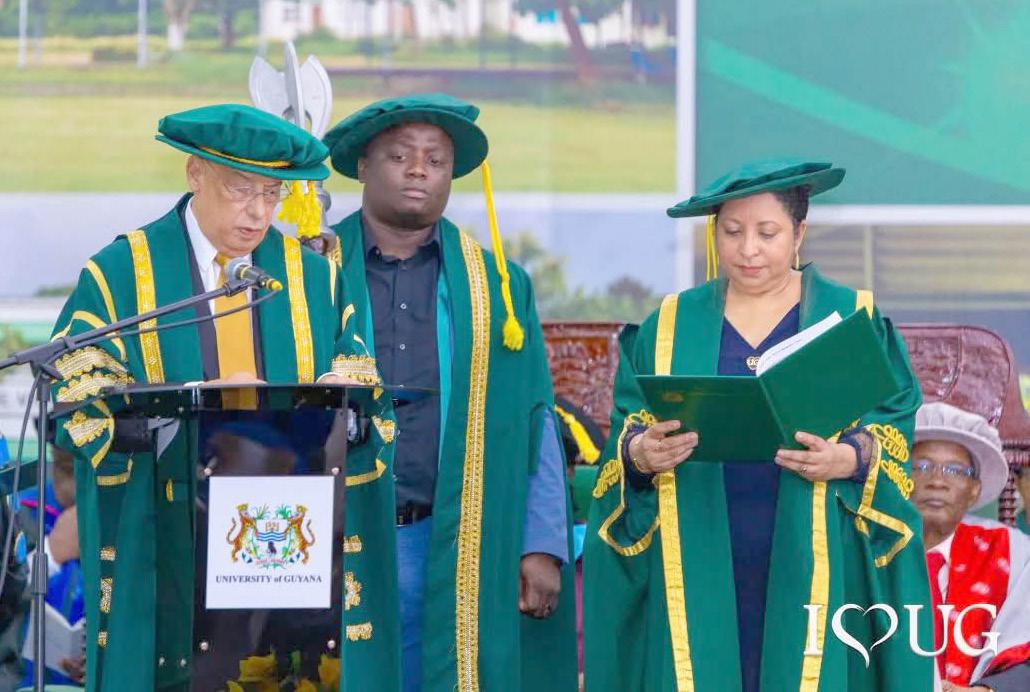
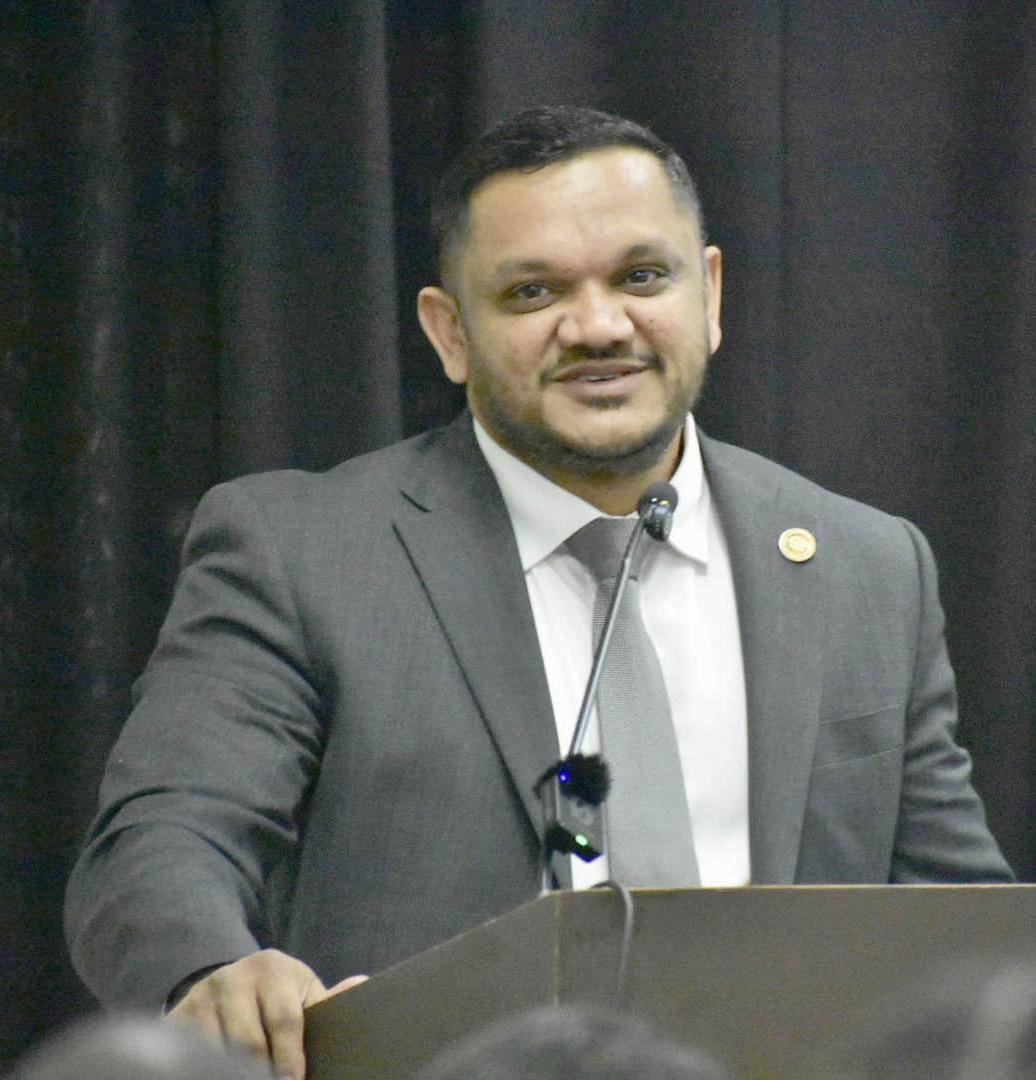
President Dr. Irfaan Ali on Friday said that the installation of the 11th Chancellor of the University of Guyana (UG), Sir Ronald Sanders, will position the institution to become more deeply embedded in global affairs (Office of the President photo)
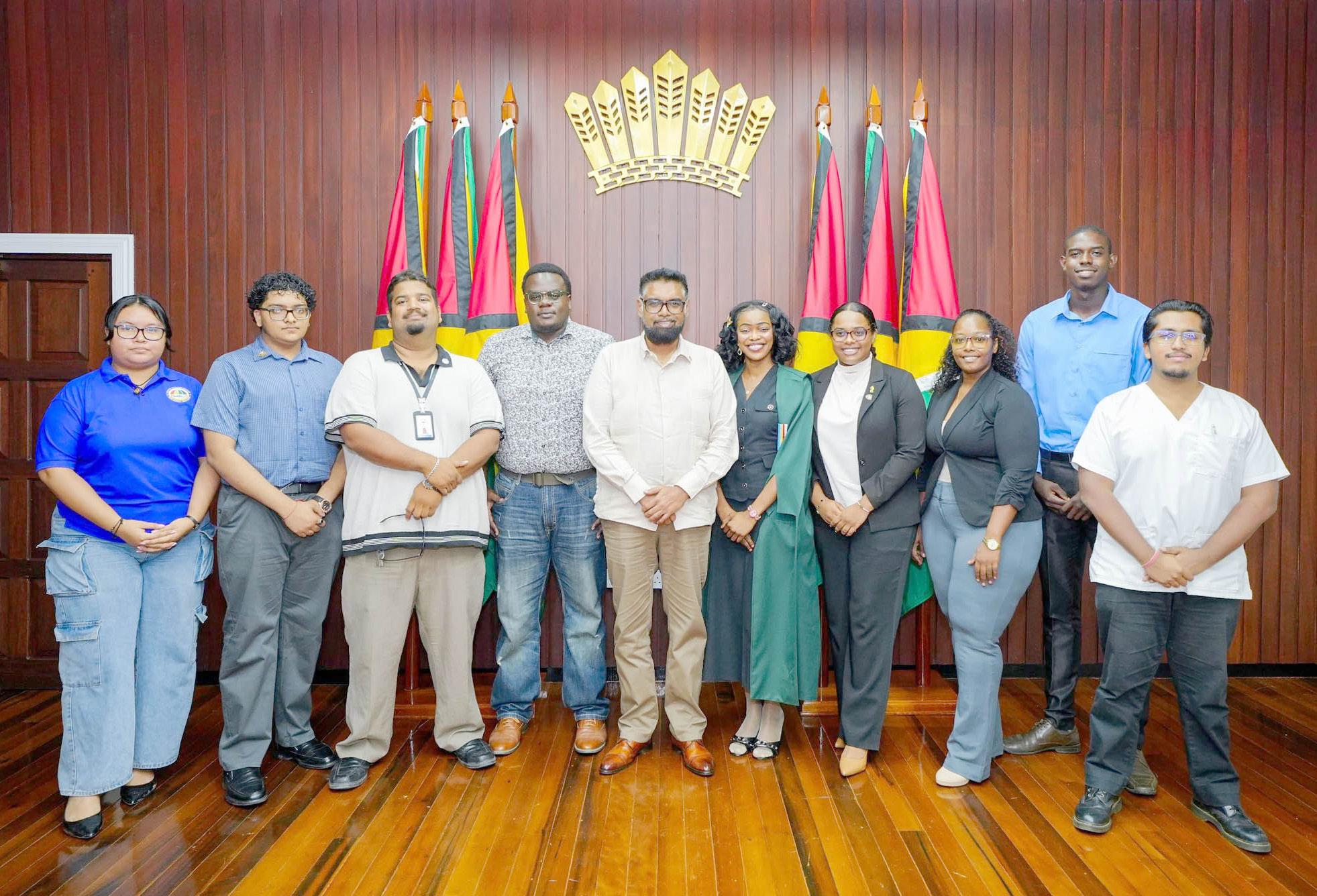
President Dr. Irfaan Ali on Friday met with a delegation from the University of Guyana Students’ Society (UGSS) led by its President, Tirishatha Semple. Semple, who was recently re-elected to serve a second term, was accompanied by several outgoing and incoming executives (Office of the President photo)
Sir Ronald ‘well suited’ to guide UG at pivotal moment in Guyana’s development
–– President Ali says, as renowned diplomat takes up post as UG’s 11th Chancellor
SIR Ronald Sanders has officially assumed the post of 11th Chancellor of the University of Guyana (UG), with President Dr. Irfaan Ali hailing him as a “distinguished son of the soil” and a leader well suited to guide the institution at a pivotal moment in the country’s development.
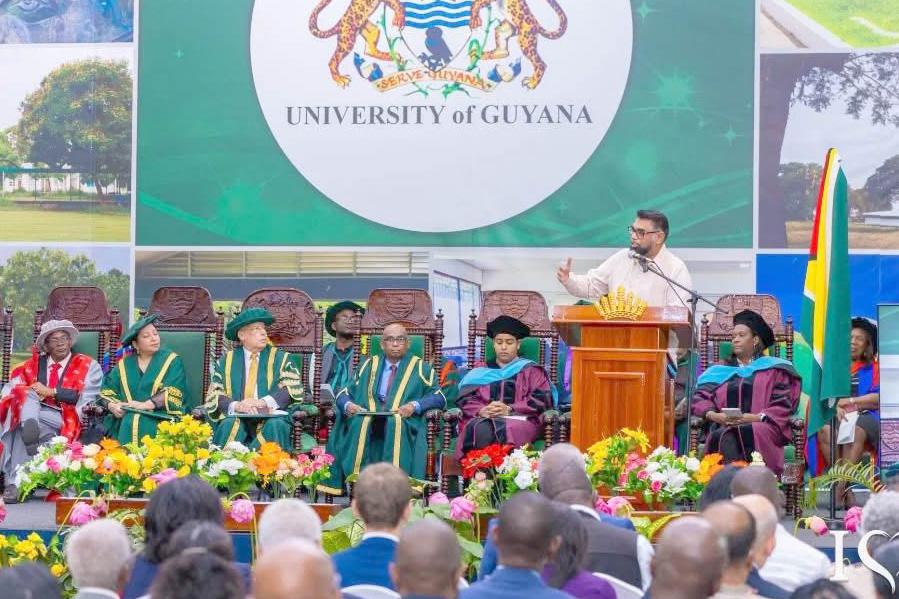
During his address at the inauguration ceremony on
Friday morning, President Ali set out a broad vision for the University of Guyana, reminding his audience that education is firmly tied to national priorities and economic transformation.
“One of the things that would not change in this world, is a need for knowledge… It is only through ideas that new discoveries are made. It is only through
good research and ideas that new products are developed. And it is only through new products we can expand our prosperity and ensure that our prosperity is built on a diversified platform,” he said. For Guyana, Dr. Ali said, this means ensuring that national development leads to regional prosperity
See page 4
Sir Ronald Sanders has officially taken up his post as UG’s 11th Chancellor on Friday, following an inauguration ceremony
President Dr. Irfaan Ali during his address (Photo credit: UG)
House clears $1.558 trillion Budget 2026
––to continue expansion of social safety nets, construction of transformational infrastructure, acceleration of human capital development
FULLY financed, with no new taxes and a sharp focus on development and fiscal responsibility, the 2026 $1.558 trillion budget secured parliamentary approval in the wee hours of the morning on Saturday.
After days of scrutiny in the Committee of Supply and heated debates, the fiscal package, which is 12.7 per cent larger than the 2025 budget, was passed during the third sitting of the 13 th Parliament.
Senior Minister in the Office of the President with Responsibility for Finance, Dr Ashni Singh said Guyana’s economy will continue to grow by extraordinary rates.
“Budget 2026 will see us continuing to invest in the things that matter for the long-term viability and competitiveness of our economy, including infrastructure that is so critical to catalyse strong long-term economic growth, transport infrastructure, energy infrastructure, etc,” Dr. Singh said.
The government, he defended, has emphasised its comprehensive vision for economic growth, including infrastructure and social sector investments, aiming for world-class services.
“…And Budget 2026 will see us investing in the social sector at a rate that will ensure that the quality of social services delivered to the Guyanese people achieves a standard that will equate to world class. We have spoken of world-class healthcare, world-class education. We have spo-
ken of the deployment of technology-based solutions so Guyanese citizens will live, finally, Sir, in a truly modern society, and in a truly modern Guyana,” he told the House.
The Finance Minister
tives intended to attract investment into strategically selected locations.
This will complement anticipated reductions in electricity costs that are expected to significantly improve the competitive-
the expansion of export allowances to include value-added forestry products, and the removal of VAT on locally made furniture and jewellery.
freight charges used to calculate import taxes.
Meanwhile, an additional $9 billion has been set aside in 2026 for further cost-of-living support.
Assistance for children
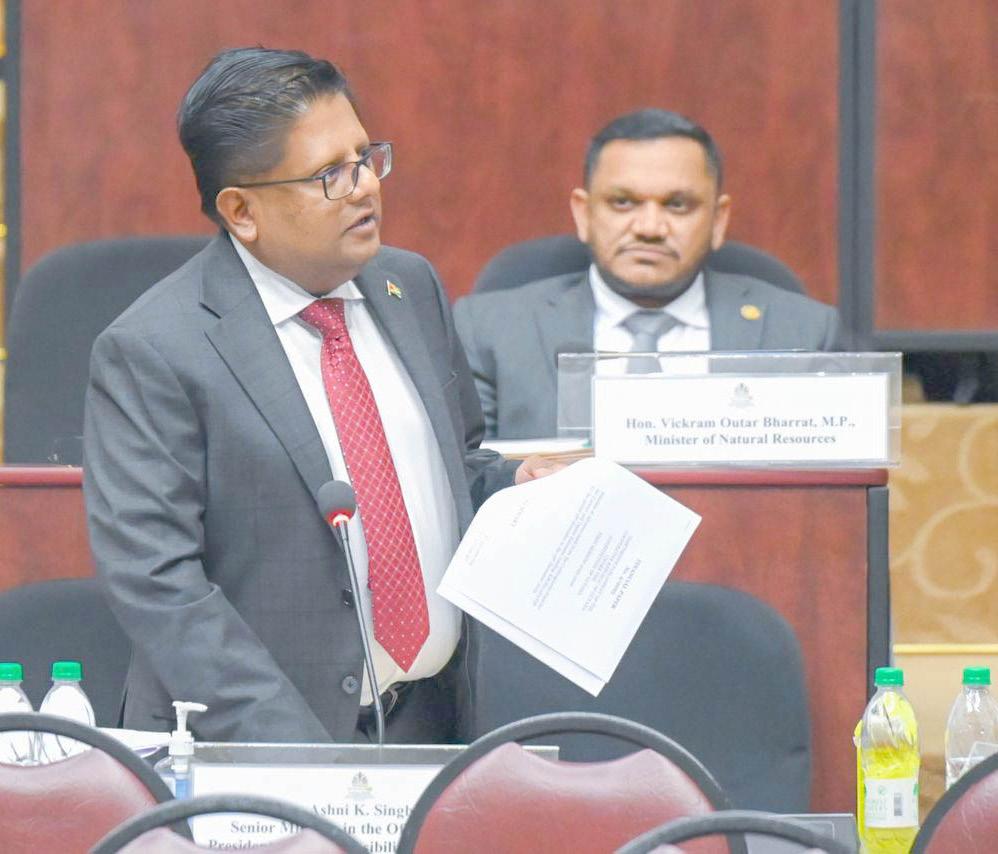
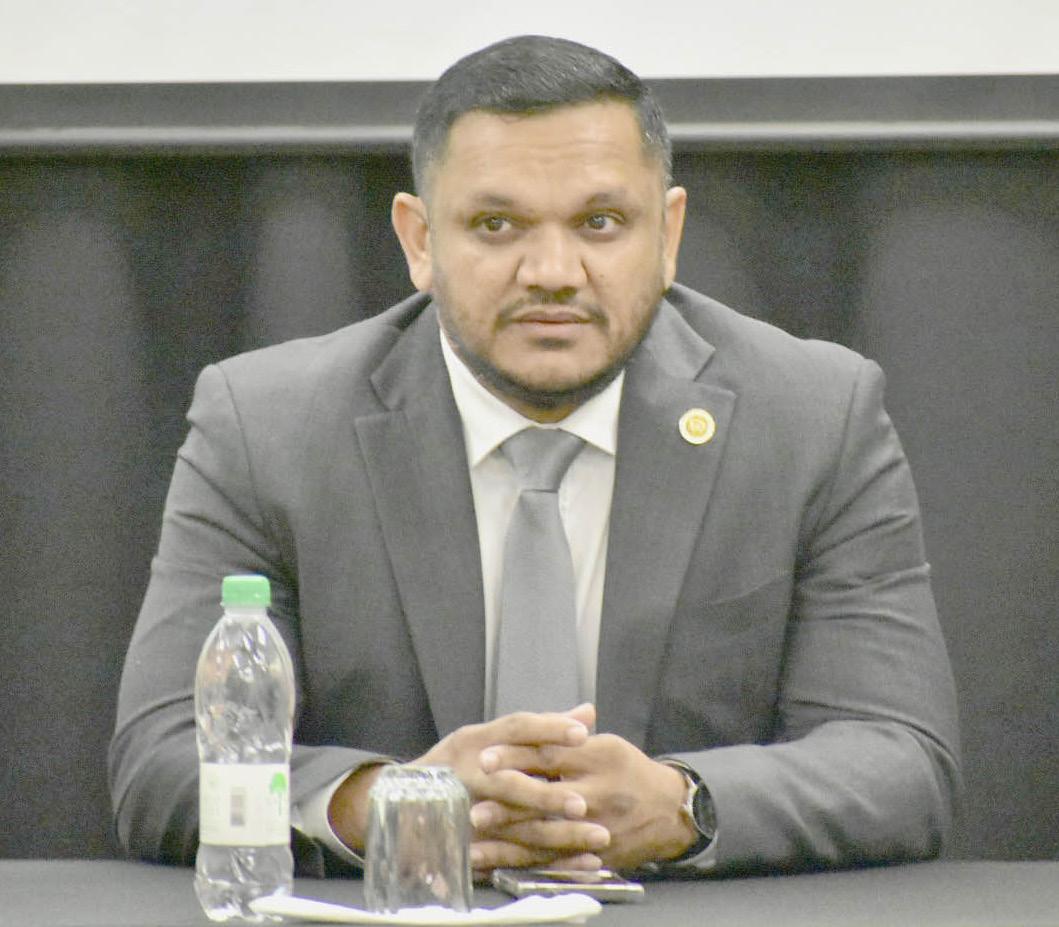
Senior Minister in the Office of the President with Responsibility for Finance Dr.
also highlighted the parliamentary opposition’s failure to endorse key budget measures in this year’s budget, underscoring a perceived lack of concern for the people of Guyana.
Under the theme, “Putting People First”, key plans of this year’s fiscal package include plans for Special Development Zones with fiscal incen-
ness of manufacturing operations when the flagship Gas-to-Energy (GtE) project comes on stream.
In addition to this, the 2026 budget makes provisions for the removal of corporate taxes on agriculture and agro-processing, which is expected to free-up resources for reinvestment.
The fiscal package also creates space for
COST OF LIVING AND MORE DISPOSABLE INCOME
To ease cost-of-living pressures, the government will maintain the zero per cent excise tax on fuel, a measure in place since 2022, which has helped shield households from global trends. Budget 2026 will also extend relief on
and the elderly will also be expanded, with the Because We Care grant increasing to $60,000 per child, the introduction of a $20,000 annual transportation grant for schoolchildren, which, with the $5,000 uniform voucher will see each child receiving $85,000.
This will reflect an estimated $12.4 billion being transferred to par-
ents under the education grant programme.
Support will also continue to cover examination fees for Caribbean Secondary Education Certificate (CSEC) and Caribbean Advanced Proficiency Examination (CAPE) benefitting some 14,000 students.
The elderly will see an increase in old-age pension to $46,000 per month, and benefit from an annual transportation grant of $20,000 providing an additional injection of $1.9 billion in support.
Measures to raise disposable income include higher stipends for community-based workers, the return of the $100,000 national cash grant for adults aged 18 and above, the removal of net property tax on individuals, and an increase in the income-tax threshold to $140,000 per month.
While the controversial We Invest in Nationhood (WIN) Opposition Leader, United States-indicted businessman Azruddin Mohamed was notably absent, the Opposition’s Chief Whip, Tabitha Sarbo-Halley contended that while she believes this year’s fiscal measures were marginal, acknowledged that the government had made “some movement”, and an “attempt to deal with some of the issues that the country and the people face”.
A key feature of the budget is an adjustment to the income-tax threshold, which the Opposition Chief Whip conceded would “give a few more dollars in the pockets of persons”.
Ashni Singh
Sir Ronald ‘well suited’ to guide UG ...
and greater regional integration, with the University of Guyana playing a deliberate and leading role in research and thought leadership at both national and regional levels.
He stressed, too, the importance of aligning education with national development priorities, pointing to the government’s policy shift to offer free university education.
Sir Ronald is a former Visiting Fellow at the University of Oxford, and holds a Master’s Degree in International Relations from the University of Sussex. He has received an Honorary Doctor of
Letters from the University of the West Indies and an Honorary Doctor of Laws from the University of Guyana.
His academic career includes service as Senior Research Fellow at the Institute of Commonwealth Studies, University of London, and Senior Fellow at Massey College, University of Toronto. He also served as Rapporteur of a special committee appointed by the Vice-Chancellor of the University of London on the future of the Commonwealth Institute, and as an elected member of the Executive Board of UNESCO.
On the diplomatic front, Sir Ronald is currently Antigua and Barbuda’s Ambassador to the United States and the Organisation of American States, and has served an unprecedented three terms as President of the OAS Permanent Council. His work on multilateral diplomacy, small-state advocacy, and global policy engagement has earned him wide international respect.
“He is more than eminently qualified to hold this position, his long and distinguished career in diplomacy, scholarship and public service makes him more than
ably qualified for the post. University of Guyana is extremely fortunate to welcome to him as its 11th Chancellor,” President Ali said.
GREATER REGIONAL INTEGRATION
Looking at the future, President Ali outlined a higher calling for the academic institution pointing to opportunities for greater regional integration.
UG, he added, is positioning itself to become a world-class tertiary centre of education, serving as a catalyst to lead the nation into a secure future.
“We have said that our national development and prosperity must lead to regional prosperity and greater regional integration.
Any successful academic institution or university in today’s world must be strong in research. Must be able to deliver research papers that stand, that can stand scrutiny, must be able to contribute to literature and research.
And University of Guyana must occupy a deliberate space here, nationally and in our region to begin with,” President Ali said.
He noted that the university must now align itself with the realities of
industries to ensure that graduates can maximise both their academic knowledge and practical skills, taking full advantage of emerging opportunities.
“The traditional form of academic qualification, degrees, diplomas, masters and PhDs are very important, but we must align those qualifications with professional designations, because that is a direction that the world is heading into.
How we ensure that our education system here at the university is integrated in those professional institutions,” he said.
PAHO, CARPHA sign landmark 2026-2030 agreement to strengthen regional collaboration
THE Pan American Health Organization (PAHO) and the Caribbean Public Health Agency (CARPHA) formalised their continued partnership with the signing of the 2026–2030 Framework Agreement, reinforcing a shared com-
mitment to advancing public health priorities across the Caribbean.
The agreement, according to a press release from CARPHA, provides an operational framework to support a unified regional vision for health, strengthening coordina -
tion and collaboration at a time when Caribbean countries face growing and complex health challenges, and where resources are limited but public health needs remain significant.
Covering the period 2026–2030, the agreement positions both agencies to work more strategically to deliver results under the PAHO–CARICOM Joint Subregional Cooperation Strategy, supporting Member States in strengthening health systems, improving preparedness, and advancing population health outcomes.
The agreement marks the continuation of a long-standing and trusted partnership between PAHO and CARPHA: grounded in shared responsibility, mutual accountability, and a common goal of improving health and well-being for the people of the Region.
Delivering welcome remarks at the virtual signing ceremony, Dr. Jarbas Barbosa, Director of the Pan American Health Organization said: “This Agreement enables PAHO and CARPHA to jointly develop regional strategies and plans of action, implement health programmes aligned with our Strategic Plans and Programme Budgets, and provide technical cooperation that is responsive to
Dr. Horace Cox, CARPHA Director watches on as Dr. Lisa Indar, Executive Director signs the Framework Agreement
country needs. It also establishes a clear framework for subsidiary agreements, ensuring transparency, accountability, and results-based implementation”.
Dr. Lisa Indar, Executive Director, CARPHA pointed out, “Caribbean countries rightly expect that the limited resources available for technical cooperation are used efficiently, effectively, and strategically to achieve the greatest possible impact for
our Caribbean citizens”. Dr Indar added, “This can only be achieved through stronger collaboration, streamlined implementation, reduced duplication and a lighter operational burden on our Member States”.
PAHO has supported CARPHA in multiple priority areas including the Caribbean Regulatory System; laboratory strengthening; climate resilience and environmental health; non-communicable dis -
eases, risk communication and community engagement; and emergency preparedness and response, including foodborne disease preparedness.
CARPHA and PAHO said they both look forward to deepening collaborations over the next five years and translating this framework agreement into measurable improvements in health outcomes for the people of the Caribbean
Accountability and Modernisation
GUYANA’S education system stands at an important turning point. With unprecedented public investment flowing into schools, infrastructure, connectivity and teacher development, the question confronting policymakers is no longer whether resources are being provided, but whether those investments are translating into measurable improvements in learning outcomes.
The Ministry of Education’s decision to introduce biometric attendance systems in schools must therefore be viewed within this broader national context, one defined by accountability, digital transformation and rising expectations.
Education Minister Sonia Parag has been careful to frame the initiative not as punishment for teachers, but as a mechanism to strengthen accountability and ensure that students consistently receive the instruction they are entitled to.
That distinction matters. Any reform perceived as punitive risks resistance from educators whose co-operation is essential to success.
However, accountability mechanisms are not inherently adversarial; they are a normal feature of modern public administration, particularly in sectors receiving substantial taxpayer funding.
Recent developments help explain the policy direction. During unannounced
school visits earlier in the academic year, the minister reported instances of significant teacher absenteeism, with classrooms left without supervision at critical points in the term.
Such occurrences undermine not only student performance, but also public confidence in the education system.
The biometric system, now being piloted ahead of a nationwide rollout, is intended to provide real-time attendance data and eliminate uncertainty surrounding teacher presence.
In truth, the move aligns with a wider digital shift already underway across Guyana’s public sector. Government initiatives such as electronic identification programmes and expanded online public services demonstrate a clear policy trajectory towards data-driven governance and improved service delivery.
Schools, as foundational public institutions, cannot remain outside that transformation.
Critically, biometric attendance does not replace professional trust; it supplements it with reliable information.
International research shows that biometric attendance technologies improve accuracy, reduce administrative time, and minimise fraudulent recording practices, allowing educators to focus more on teaching rather than paperwork.
When implemented responsibly, such systems can strengthen institutional efficiency without diminishing professional autonomy.
Still, legitimate concerns deserve attention. Opposition voices have questioned whether schools should divert limited grants towards purchasing biometric equipment rather than instructional materials.
Nevertheless, that debate is healthy and necessary. Modernisation must never come at the expense of textbooks, learning aids or student welfare.
The ministry’s indication that financial support may be provided to schools unable to afford the systems is therefore a crucial safeguard and should be transparently managed.
Equally important is the minister’s clarification that biometric clock-in systems will not redefine teachers’ professional responsibilities, but teaching has never been confined strictly to classroom hours; lesson preparation, grading and pastoral duties extend well beyond the school day.
Yet the broader principle remains difficult to dispute: improved outcomes require measurable standards; as such, Guyana cannot aspire to higher matriculation rates, stronger literacy levels and globally competitive graduates while
tolerating lost teaching time.
Accountability is not an accusation; it is thus a prerequisite for progress.
The expansion of internet connectivity, fibre upgrades and satellite links, particularly for hinterland schools, further signals that the government’s strategy goes beyond attendance monitoring.
Digital infrastructure, safety protocols, anti-bullying policies and new security tools collectively point to an education system being reshaped for the demands of a modern economy.
Ultimately, the success of biometric attendance will not be judged by scanners or software, but by results.
If classrooms become more consistent, students receive uninterrupted instruction, and performance indicators improve, the reform will justify itself.
If, however, implementation becomes heavy handed or disconnected from classroom realities, it risks eroding morale without delivering gains.
Guyana’s education transformation requires partnership, not confrontation. Technology can provide the tools, but trust between policymakers and teachers are essential in strengthening the system.
The challenge now is to ensure that accountability and respect advance together, because the real beneficiaries must remain the nation’s children.
Accountability is not persecution
Dear Editor,
EVER so often, a familiar drama plays out in the public arena: A fugitive offender, finally tracked down after months or years of evasion, suddenly declares themselves a victim of “political persecution”. It is a predictable script—and a deeply cynical one. The hypocrisy is hard to overlook. For as long as the law is optional, these individuals ignore subpoenas, skip court dates, and cross borders to avoid accountability.
Yet, the moment law enforcement catches up, they rush to embrace the very legal system
they previously dismissed, insisting on the protections of due process while casting doubt on its legitimacy. If they trusted the system enough to cry foul now, why did they not trust it enough to stand before it earlier? Claiming political persecution is not a legal argument—it is a public relations strategy.
It reframes a concrete criminal case into a sweeping ideological drama, hoping to drown out the uncomfortable specifics: the evidence, the witnesses, the paper trail. Even more telling is the timing. Rarely do these complaints arise at the start of an investigation.
They appear only after arrest, when theatrics replace defence.
This tactic does real harm. It cheapens the language of political oppression; language that belongs to journalists, dissidents, and activists who genuinely risk their lives for their beliefs.
When fugitives co-opt that vocabulary to avoid answering for fraud, corruption, or other misconduct, they trivialise the struggles of people who have no choice but to confront authoritarian abuse.
A democratic society should remain vigilant against true political prosecutions. But
we should be equally vigilant against attempts to weaponise that fear. Accountability is not persecution.
A warrant is not a witch hunt. And those who run from the law should not be applauded when they reappear as self-styled martyrs. When the facts are clear and the process is fair, we shouldn’t let anyone—no matter how loudly they shout—blur the difference between justice and victimhood.
Sincerely, Mike Bhikam
A war of words, wisdom and wisecracks in the National Assembly
Dear Editor,
THE Guyana National 2026 Budget has taken an unprecedented presentation when members of parliament either defined, refined or undermined budget deliberation.
The Guyanese public has always been privileged to the English language and the Creoles language being proclaimed or persecuted in parliament.
But recently, a 360-degree turn heralded a traverse on linguistic fluency with the flavour and fluency of Awadhi, Hindi and Sanskrit, when, the Honourable Pt. Vikash Ramkissoon, a PPP/C Minister within the Ministry of Agriculture, was responding to the Honourable Pt. Vishnu Panday, a WIN Member of Parliament.
In the rum shop, the conversation usually res-
onates around the trinity of politics, sports and religion. It is not a cultural travesty but a troubled custom which glues the company with commotion and emotion. The effect can either affect relationships, or, afford the first half bottle to “gaff” and the second half bottle to “laugh.”
Some things do not go hand in hand. It is unadvisable to mix alcohol with petrol. Do not drink and drive. Some things are inseparable. Sugar and spice are sweet-natured binders. Some say to keep politics out of the church, mosque and mandir. Others want to protect the sanctity of religion from being pulverised around the walls of parliament.
Many political heads are affirmed because of their religious affiliation and vice-versa. Many battles were fought over be-
liefs. A walk down history lane will reveal and reflect on the horrific laments by the wounds of, for example, “the Battle of Badr624 AD, the Christian Crusades-1095/1291, the Kurukshetra War-10th Century BCE, the Partition of British India-1947, the Gaza War-2023, etc.
One of the Hindu religious texts, the Bhagavad Gita, coalesces spirituality with action by shaping politics not as power-pursuance but as “Dharma” (righteous duty) and “Karma Yoga” (detached service). It urges leaders to perform duties without attachment to results while focusing on ethical responsibilities over personal gains.
An elder Pt. Panday’s adventure into a religious parlance and his insular divergence from a protective parliamentary pavement,
proved catastrophic and was sternly rebutted and dislodged by an assailing counter-attack from the youthful but alert Pt. Ramkissoon.
The Honorable MP Panday committed the unforgivable toxic mistake of alleging that the Honorable MP Ramkissoon did not profess a certain requisite knowledge, thus attempting to place Pt. Ramkissoon in a cumbersome and embarrassing position.
Like a disturbed cobra, an infective and invigorated response was inevitable. The Honorable MP Ramkissoon sternly rebuked the insular provocation and ventured into the tapestry of linguistic finesse to expertly and eloquently expound on his ancestral language, thereby removing any doubts of illusive imagination and to
correct Pt. Panday’s convoluted contortions and acid accusations.
Guyanese are accustomed to the expressions, “hard ears and head hard.”
It was a light moment for the House to applaud and approve the appropriate answer from the young PPP/C stalwart, finally making his impressive presence felt with distinction in a significant way, after an unnecessary period of pending parliamentary objection from the now reduced and battered Opposition APNU.
Mahatma Gandhi’s preference as a reference to the Gita, justified non-violent resistance and read war as an allegory for the internal struggle between good and evil.
In the National Assembly, there is a constant war of words, wisdom and wise-cracks, widening the gap of good and bad, light and darkness, and righteousness and unrighteousness.
Hopefully, there is a moral lesson for all Members of Parliament to learn from this episode of unwarranted innuendos.
Yours respectfully, Jai Lall
Representing Region Three is no easy task, not with the excellent standard and high bar set by the distinguished President Dr. Irfan Ali, himself a son of the soil from Region Three. Pt. Vikash Ramkissoon has excelled himself both as a politician and a pandit. He is undoubtedly a voice to reckon with for the government as a Minister, and a strong fighter for his Dharma as a pandit and a community worker.
Valentine’s Day: Love Should Heal, Not Hurt
Dear Editor,
EACH year on February 14, Valentine’s Day arrives adorned with red roses, candlelit dinners, carefully chosen gifts, and public declarations of affection. Social media platforms are filled with curated expressions of romance, restaurants reach full capacity, and jewellery boxes are opened in celebration. For many, it is a joyful occasion.
Yet, beyond the flowers and photographs lies a more important question: What is love, truly?
While the calendar designates a single day to honour love, authentic love cannot be confined to a date. It is neither seasonal nor performative. It is not measured by the price of a gift or the
grandeur of a gesture. Love is not a spectacle reserved for public display; it is a daily practice.
Real love is revealed in quiet, consistent moments. It appears in early-morning encouragement and late-night reassurance. It is reflected in patience during disagreement, and in kindness when tensions rise.
It remains steady amid uncertainty, and resilient in the face of challenge. Love, in its healthiest form is dependable and sustaining. Equally important is the recognition of what love is not. Love is not abuse. It is not manipulation. It is not control disguised as protection or humiliation masked as humour. Love does not thrive on fear, nor does it leave physical or emotional
scars. It is not silence born of intimidation, nor violence excused as passion.
For too long society has romanticised suffering, repeating phrases such as “love hurts” until pain has been normalised within relationships. This narrative must be challenged. Healthy love does not erode confidence, isolate individuals from support systems, or diminish self-worth. Authentic love fosters security. It strengthens rather than silences.
A healthy relationship is not defined by power or dominance, but by partnership. It consists of two individuals choosing to walk side by side, each whole and valued. It allows space for honest communication, personal growth, and mutual respect. Love should be a refuge,
not a battlefield—a space where individuals feel safe to breathe, speak, and evolve. Valentine’s Day can also serve as a moment of reflection. Are we loving in ways that uplift? Are we communicating with empathy and respect? Are we cultivating relationships in which both people are free to grow?
Love is not possession; it is connection. It is not control; it is collaboration. It does not require self-erasure but encourages shared progress and collective strength.
Perhaps most fundamentally, love begins within. Self-respect and self-awareness form the foundation for all meaningful relationships. Embracing self-worth enables individuals to establish boundaries, to walk away from harm, and to choose
peace over chaos. One’s value does not diminish simply because it is unrecognised by another.
This Valentine’s Day, let the celebration extend beyond romance. Let it become a reminder that love should elevate, not diminish. It should inspire growth, not instill fear. It should empower individuals to become stronger, not smaller.
To those in healthy relationships, continue to nurture them with intention and care.
To those facing hardship in silence, know that safety and respect are not luxuries—they are rights. And to those still waiting for love, begin with yourself. The right relationship will never require you to shrink in order to belong.
Valentine’s Day is not
about perfection; it is about purpose. It is about choosing kindness over cruelty, patience over pride, and healing over harm.
Celebrate love today. More importantly, practise it tomorrow—and the day after that. Demonstrate it in daily actions, in thoughtful words, and in the way you treat yourself and others.
Because love is not proven in a single day of celebration. It is demonstrated in consistent commitment.
Love should heal. Love should empower. Love should help us rise, not just on February 14, but every day of the year.
Warm regards, Suresh Sugrim HMG Inc.
Guyanese East Indians on Valentine’s Day
TODAY is Valentine’s Day. As a colonial subject in a country controlled by an English-speaking, Christian empire, the United Kingdom of Great Britain, we could not escape being imbued with the cultural motifs of the UK. So yes, I did give my girlfriend Valentine gifts and after I married her, I continued to do so.
But at the same time, I recognised the cultural values of the civilisation I came from, Hindu culture and the civilisation my wife was born into – Islam. Today, lovers will celebrate Valentine, which the British handed down to us but which originated from the Roman Empire. In fact, Valentine and Christmas are perhaps the oldest traditions celebrated in Guyana that came from the Roman Empire.
Whenever we celebrate a cultural tradition that colonial empires brought to Guyana, we must reflect on the phenomenal bravery of the indentured East Indians that offered Guyana, a cultural alternative to Anglo-Saxon civilisation. The indentured East Indians and their subsequent generations maintained their Hindu and Islamic cultures.
They brought to Guyanese society, the other worlds that existed outside of the European existence. They maintained their religion and culture. While we could not resist the literature, movies and songs of the British Empire, Guyana also showcased the cultures of other parts of the world through the East Indians here.
It was almost a losing cause trying to have an alternative culture in Guyana, in the 20th century. European culture was ubiquitous, first through colonial domination then through the social hegemony of the Portuguese class. Nowhere was this domination more graphic than in music, religion and literature. The economy was controlled by the Portuguese mercantile class,
but the East Indians had their thriving economy in agriculture, particularly rice.
It was in the area of culture that the Indians of Guyana became a historical phenomenon for preserving their rich Indian traditions. Everything was stacked against them culturally. They were taught by Christian teachers in schools, the textbooks were written to glorify European civilisation; the newspapers carried stories of British society, the radio stations played only English-language songs.
In two areas, this cultural hegemony became tragic. Schools taught French instead of Spanish.
The University of Guyana emphasised the arts, humanities and social sciences. Forty years after independence, there was not even one course taught at UG on sea defence.
Years after its founding, UG initiated a Faculty of Agriculture.
Amidst this tsunamic onslaught by the European empire in Guyana, the sugar workers fought valiantly to preserve the rich heritage of Hindu and Muslim civilisations. The sugar workers in meticulous ways practis ed their culture and religion on the estates, and it followed Indians who left the estates and found employment outside the sugar economy.
A historian though versed in Guyanese historiography and competent in Guyanese Indian history, will find it psychologically impossible to imagine how persevering the sugar workers were in maintaining their non-European culture.
They resisted the Christian indoctrination at schools and still gave their children Indian names. They resisted the saturation of Anglo-Saxon music and played their Eastern music throughout their lives. They also had their Indian movies.
They did not cave in to Christian culture and married in Christian rites.
Every month, there was a Hindu or Muslim wedding on the estate. When their children returned from studies abroad, they retained their non-European cultures and married in Hindu and Muslim rites and gave their children Muslim and Hindu names.
Go back to the middle of the 20 th century and look at the famous Indians who excelled in medicine and law from studies abroad, their children were given Indian names. When in Guyana we participate in Christian celebrations like Valentine, Christmas, Easter, we must remember alongside these holidays are events devoted to Hindu and Muslim culture that are part of the national mosaic of Guyana.
India features largely in the psyche of Hindus in this country. They may not want to live and work in India for practical, economic reasons, but after their own country and the UK that colonised us and the US that displaced the UK after 1945, India lives in the consciousness of both Muslim and Hindu Guyanese. One of the most desired things in the psychology of a Guyanese Muslim is to make the Haj.
Islam and Hinduism are strong biological organisms in the life of Guyana, and the reason for that is that the indentured workers and their children refused to be proselytised into other religions. Think of one of the rarest talents in movies anywhere in the world at any time in history – it is Amitabh Bachchan.
All Guyanese know him as one of history’s greatest film actors -- and that is because the Hindus and Muslims of Guyana refused to abandon the culture they came to Guyana with.
DISCLAIMER: The views and opinions expressed in this column are solely those of the author and do not necessarily reflect the official policy or position of the Guyana National Newspapers Limited.
Welfare of Guyanese students in Cuba ‘top priority’
GUYANA’S Minister of Public Service, Government Efficiency and Implementation, Zulfikar Ally has assured Guyanese that students in Cuba are receiving aid and support amid ongoing economic and social unease there.
Responding to questions during the Committee of Supply on Friday from Opposition MP Amanza Walton-Desir, Minister Ally said the well-being of all Guyanese students overseas
remains a priority for the government.
He told the House that he had personally contacted Guyana’s Ambassador to Cuba earlier in the week while Parliament was in session.
According to the minister, the country’s ambassador, Halim Majeed has been meeting with students across various regions in Cuba, providing them with essential supplies, and has made himself available as an emergency point of con-
tact through the High Commission.
“He has been meeting with them. I have asked him to go out even further in the regions in Cuba, and he has done so. He has been giving them supplies, and he has offered that if any one of them has any emergency or any needs for them to contact him at the High Commission,” Ally told the House.
Ally further disclosed that his ministry, including the Permanent Secre-
–– Public Service Minister says
tary and technical team, is scheduled to hold a virtual meeting with some of the students at 13:00 hrs on Monday, to further assess their welfare, hear their concerns directly, and determine any additional support required.
The minister stressed that the government is in constant contact with the students and will continue to monitor the situation closely, coordinating with diplomatic officials on the ground to ensure that Guyanese nationals in Cuba receive ongoing assistance and protection.
Minister of Public Service, Government Efficiency and Implementation Zulfikar Ally
Expanded support, investment to modernise Joint Services in 2026
–– Minister Walrond says
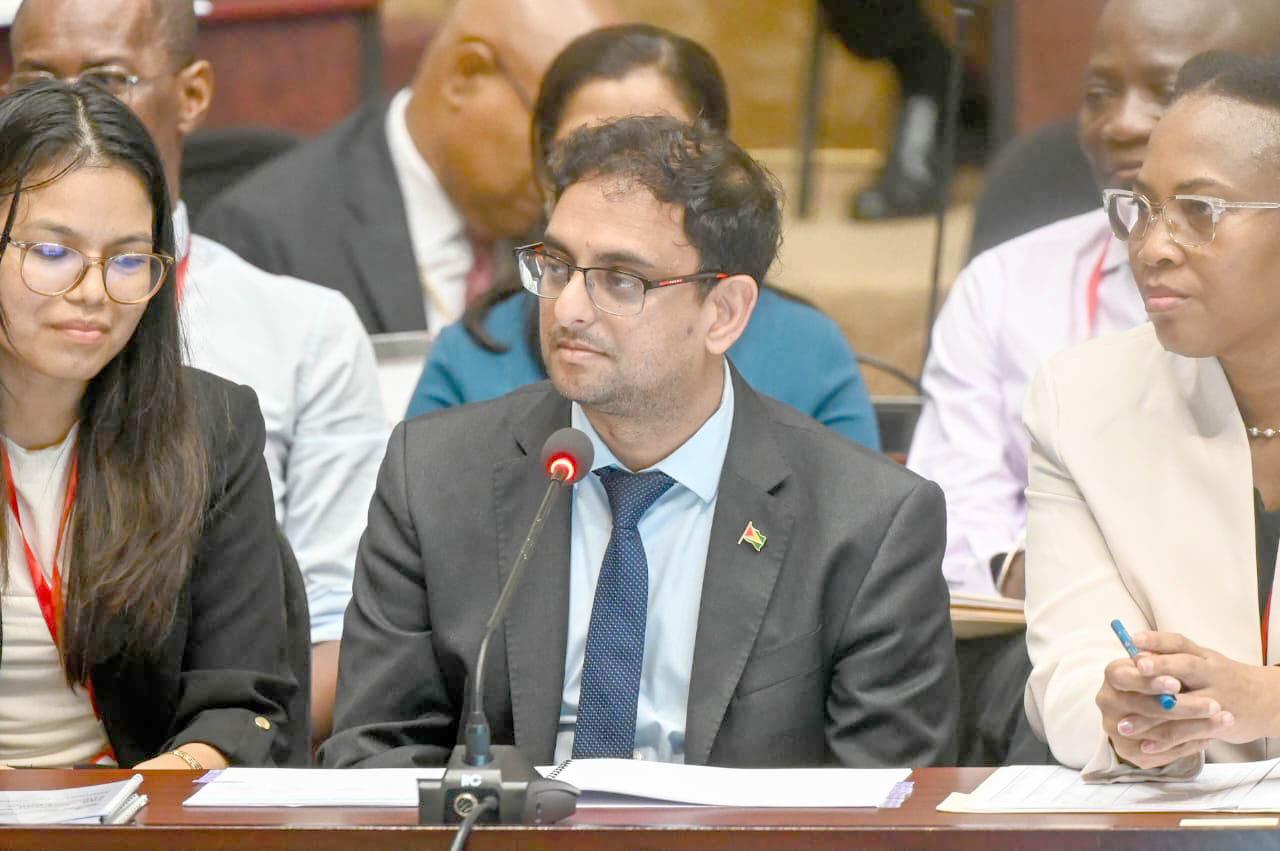
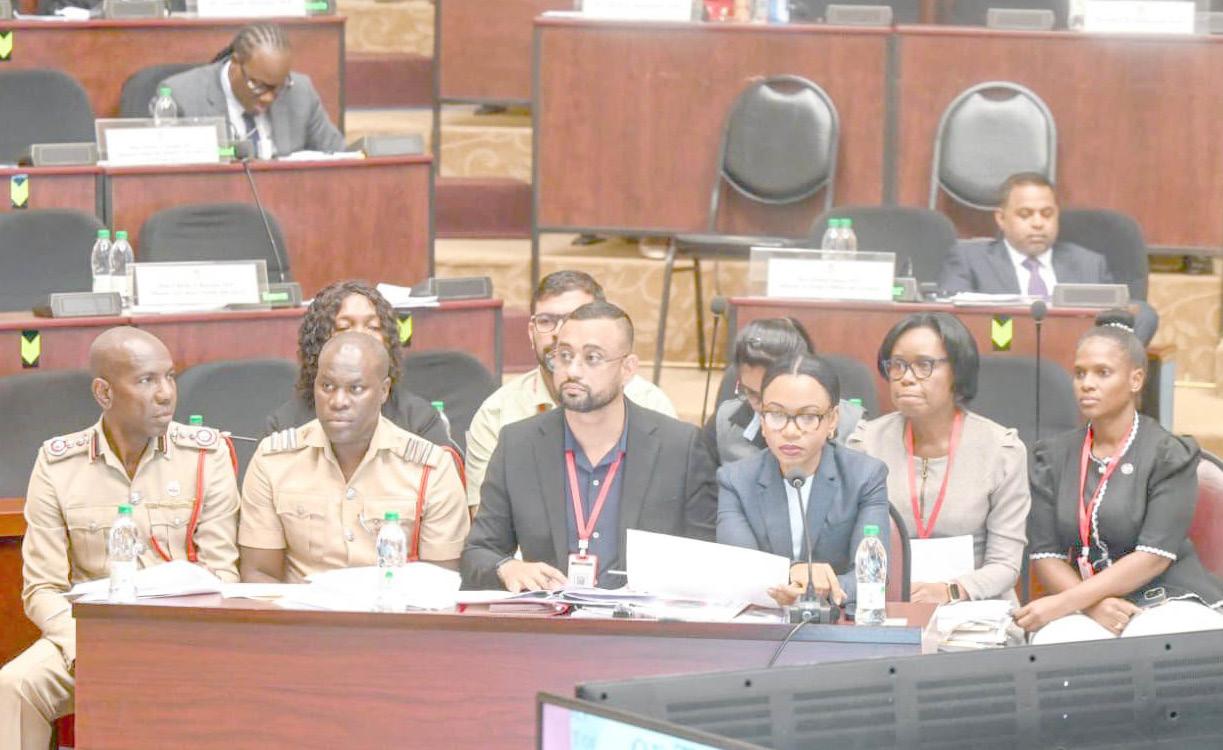
DESCRIBING it as the largest capital injection in history for the Guyana Police Force (GPF) alongside the expanded support for the Guyana Fire Service (GFS), Minister of Home Affairs Oneidge Walrond on Friday expressed the government’s commitment to modernising law enforcement and emergency responses.
Minister Walrond, while responding to questions in the parliamentary Committee of Supply, noted that Budget 2026 allows for an expansive national-security strategy with major infrastructural upgrades, expanded surveillance, strengthened forensic capacity and tougher traffic enforcement.
An allocation of $52.109 billion was approved for the Ministry of Home Affairs under Budget 2026, strengthening security-sector delivery and reinforcing public safety across Guyana.
Sweeping trafficenforcement measures were highlighted by the minister who emphasised the importance of road safety.
As such, among headline measures are the introduction of governors on vehicles, especially heavy-duty ones, a move aimed at reducing speeding which the minister said “have [sic] contributed to this gorge of deaths on the road.”
Additionally, she pointed to the expansion of the closed-circuit television (CCTV) network, stating: “With the cameras and more e-tickets being issued, we’ve already issued
almost 35,000 speeding tickets, and other kinds of trafficking violations, and enforcement of those tickets are going to ramp up over 2026.”
Additionally, the minister said this forms part of the broader strategic plan for the GPF, to reduce crime through intelligence-led policing and increased police presence.
She said: “This has helped as well to reduce the incidence of crime generally over the past five years… we’re speaking of the increased enforcement, the patrols, and so, it’s the whole of the programme that we are funding and that the budget speaks to what is going to help with this reduction.”
Forensic capacity is also being strengthened as Minister Walrond noted that there are two handwriting experts being trained, and the Guyana Forensic Laboratory, that is under the Ministry of Home Affairs, has specialists there being trained as well.
She further noted that the government has undertaken widespread infrastructural upgrades nationwide, rehabilitating and constructing new living quarters for ranks.
“This is the largest capital investment ever made in the Guyana Police Force,” she said.
The earmarked funds for the GFS, which the minister described as “unprecedented investment,” will allow for new or upgraded infrastructure, equipment and training.
Ranks in all 10 administrative regions have
been assigned to conduct daily hazardous-building inspections, as part of efforts to reach the increased performance target,
Additionally, a number of fire stations and officers’ living quarters are set to be constructed or rehabilitated.
In 2026, $250 million has been allocated for the purchasing and installation of the fire hydrants nationwide, the minister said.
Additionally, the minister stated that two airport fire-fighting vehicles are earmarked for Timehri and water tenders will be distributed to Regions Two, Four, Five and Six.
Water bowsers are set to be given to Regions Three and Five, while a 15-seater minibus for Regions Three and Four, and according to Minister Walrond, 40 Neighbourhood Democratic Councils (NDCs) will be allocated pickups.
These will bolster emergency-response capacity.
Ministers rally support for Albouystown family after house collapses
MINISTER within the Ministry of Culture, Youth and Sport Steven Jacobs on Friday evening visited an Albouystown family whose Hill Street home collapsed, leaving them displaced and two relatives injured.
He was accompanied by Minister of Labour and Manpower Planning Keoma Griffith and Government MP Mishika Griffith-Whyte, and met with members of the extended household
now grappling with loss and uncertainty.
According to details shared on Jacobs’ official Facebook page, the family’s house crumbled suddenly, forcing the occupants to flee as the structure gave way.
Two persons sustained injuries during the incident, while the remaining relatives managed to run to safety just in time. The visit focused on offering moral support and assessing the immediate needs of the af-
fected family, who are now in urgent need of shelter and basic supplies.
Jacobs pledged that the authorities stand in “full support” of the family during what he described as a deeply difficult period.
He further committed that officials will continue to work to ensure that the family receives the emergency assistance required in the short term, while longer-term interventions are explored.
ISDC
THE International Skills Development Corporation (ISDC), a United Kingdom intermediary agency, will refund approximately US$1.5 million to the Government of Guyana following concerns surrounding a scholarship arrangement under the GOAL (Guyana Online Academy of Learning) programme, the Committee of Supply heard on Friday during consideration of the 2026 budgetary estimates.
Responding to questions posed by A Partnership for National Unity (APNU) opposition member of parliament, Terrence Campbell, Minister of the Public Service, Government Efficiency and Implementation, Zulfikar Ally, told the House that the agency has already begun refunding the country and by next week the money will be fully paid.
“I have been in constant engagement with the Permanent Secretary and the head of GOAL, with the persons of those institutions. We have been working with them very closely, and by
next week, we should have all of the money refunded back into the account,” he said.
Pressed by Campbell on the anticipated amount to be recovered, the minister informed the House that the refund would total US$1.5
not, in fact, registered with that institution.
million, noting that part of the sum had already been received, with the balance to follow.
Back in 2025, it had emerged that students enrolled in a programme said to be associated with Staffordshire University were
Meanwhile, addressing a concern that some GOAL students had completed three years of study but remained uncertain about the status of their degrees through the Indira Gandhi University, the minister noted that the government had been in discussions with the Indian High Commissioner, seeking that office’s intervention to resolve the issues affecting the students’ academic status and certification.
Minister within the Ministry of Culture, Youth and Sport, Steven Jacobs and Minister of Labour and Manpower Planning Keoma Griffth, and Government MP Mishika Griffith-Whyte on Friday evening visited an Albouystown family whose Hill Street home collapsed, leaving them displaced and two relatives injured
‘Report them!’
–– Health Minister tells patients who are being turned away from public health facilities
HEALTH Minister Dr. Frank Anthony has urged citizens who are diverted by public healthcare workers to report them, affirming that facilities are well equipped and operational.
The minister emphasised in response to Opposition Chief Whip Tabitha Sarabo-Halley, who said she received complaints that citizens seeking care at health facilities have been told to visit private facilities instead.
The concern about ultrasound availability at the Georgetown Public Hospital Corporation (GPHC) was first raised, and the minister clarified that the facility has several ultrasound machines, which are operational.
Although he said that delays experienced by patients are often due to high demand, the minister issued a strong warning against public healthcare workers who are directing patients to private clinics.
“Now, what I want to say to the general public, if you come to any one of the hospitals anywhere, and
somebody says to you, ‘You can’t get it done here, but come to my private clinic,’ report them. Report them, so that we can have the information and we can deal with them,” he said.
Dr. Anthony urged persons to lodge their concerns at the Help Desk at the hospital or use the ministry’s hotline to report issues.
The General Health Hotline (Complaints & Feedback) is 227-4357.
“We have also put up at all of our health facilities a poster with a number. If you go there and the place is supposed to open at 8 a.m. and the place is closed, call the number so that we’ll know and we’ll be able to take action,” Dr. Anthony said.
The minister firmly stated that the government has invested heavily in public healthcare infrastructure at GPHC, and raised the standards very high.
Additionally, Dr. Anthony responded to the concerns raised regarding doctors who are employed fulltime in the public system but also engage in private
practice during working hours.
Noting that it is a valid concern, he stated that the implementation of an electronic health record system at GPHC will strengthen accountability.
The system will track which doctor saw a patient, how much time was spent, and when the patient was discharged.
“So, if they are not in the system; if they come in and spend an hour and disappear, then all of that, you would be able to track that, and I think that would bring some level of accountability. So, that’s one major thing that we are putting in place, and I hope that will help us to manage this problem better,” he said.
The minister also highlighted the efforts to improve patient experience by introducing patient advocates at the six regional hospitals.
These trained personnel will assist patients navigating the system, particularly those who may feel overlooked while waiting for care.
Relocation process advances for Cummings Park informal settlement families
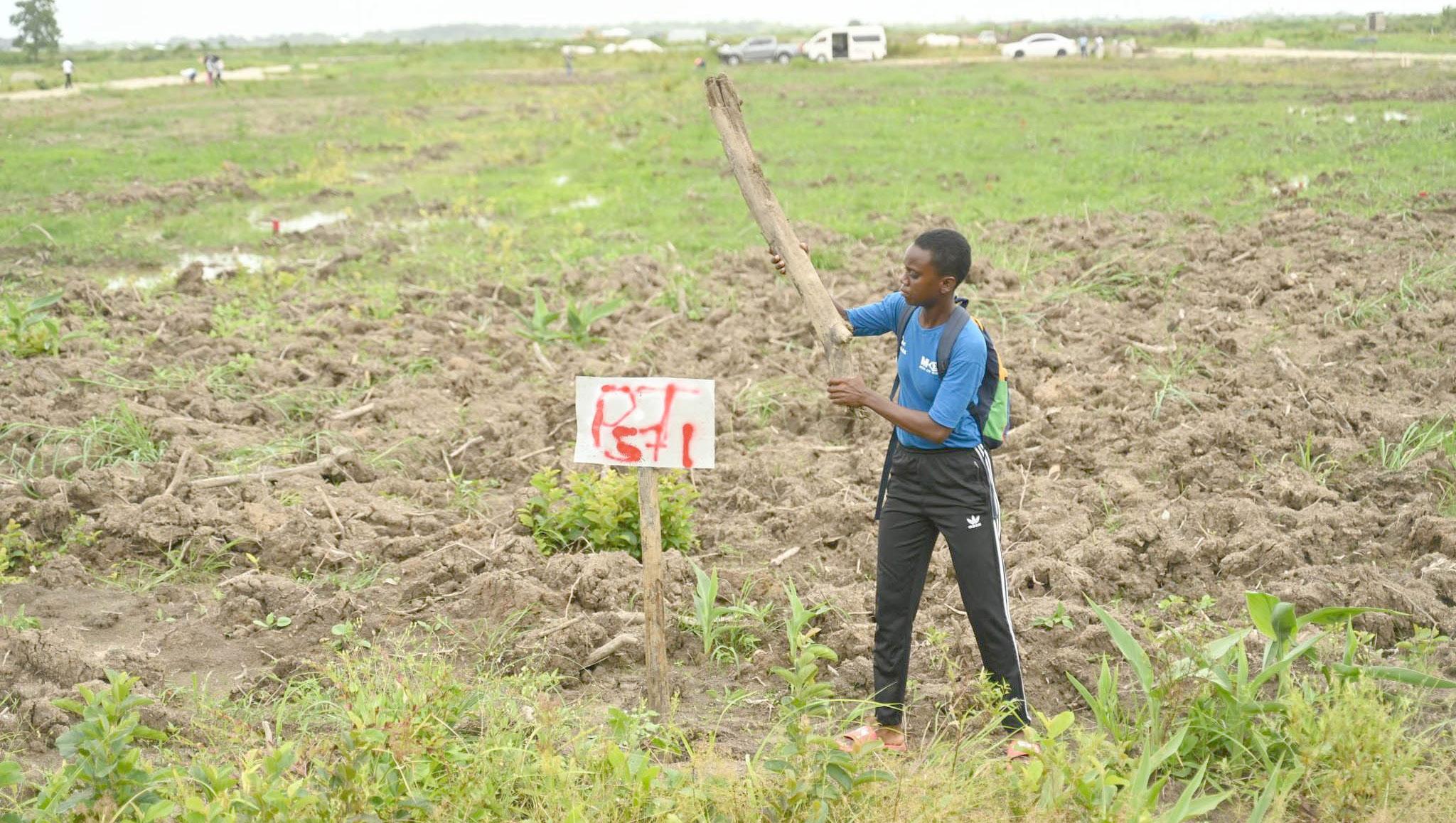
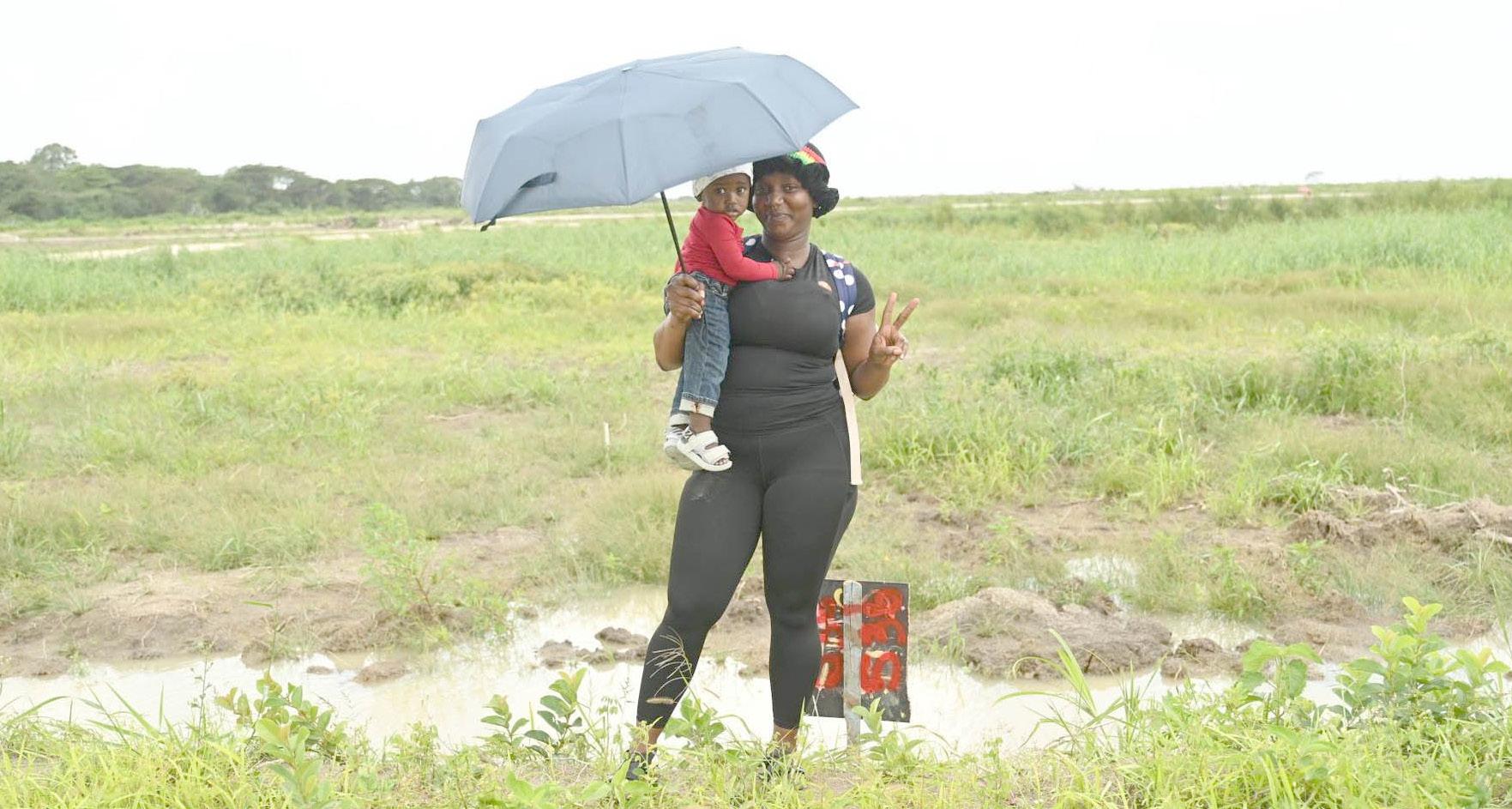
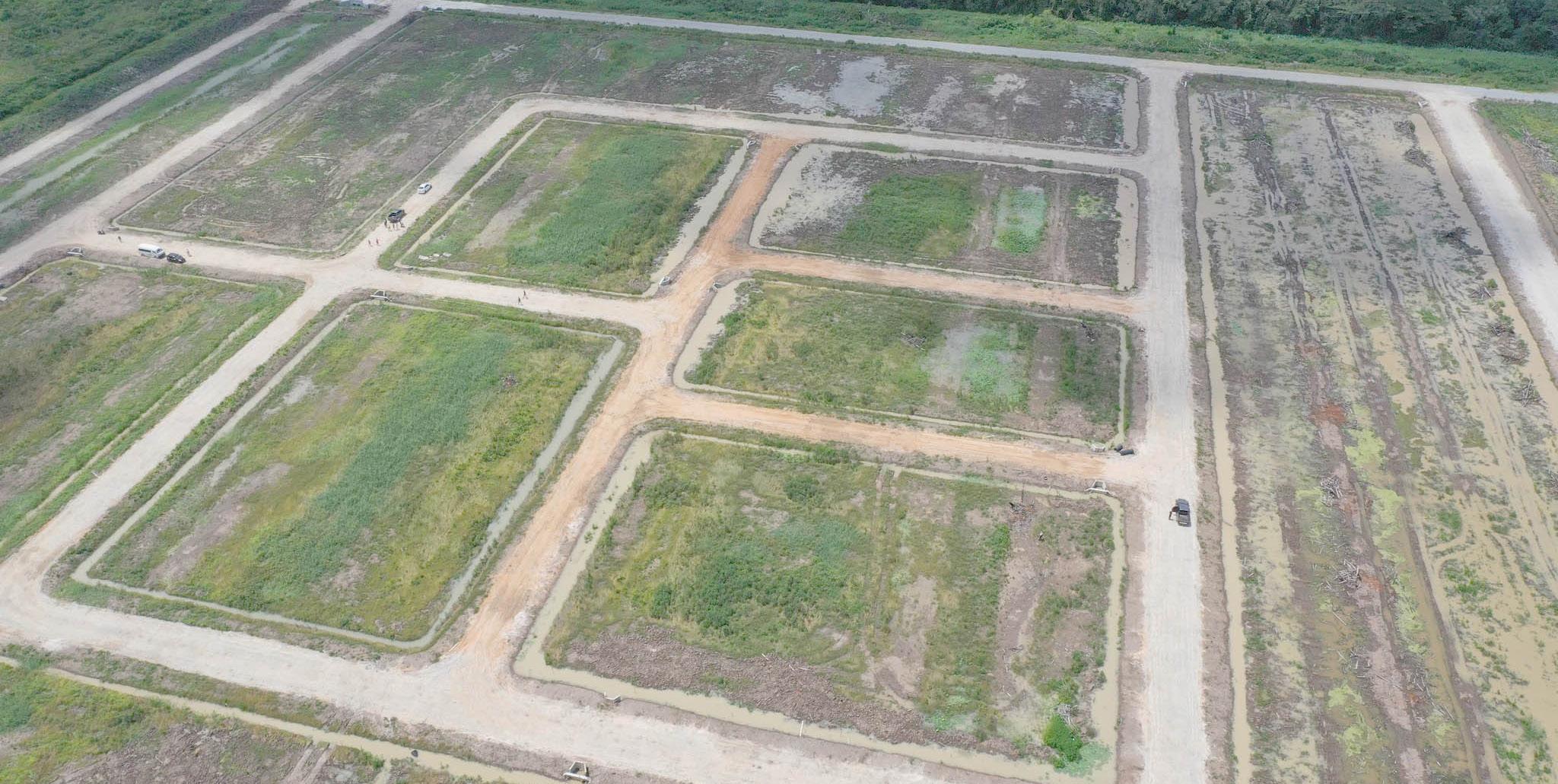
FAMILIES from the Cummings Park informal settlement, located behind Ogle Airport and Sophia, were Friday invited to participate in a lot identification exercise as part of the ongoing relocation process.
The exercise was led by surveyors and staff from the Community Development Department. During the engagement, a few residents initially raised concerns about the distance to the relocation site. Officials used the opportunity to explain the strategic location of the area and its long-term benefits.
Residents were informed
that the lands are bordered by the four-lane highway from Craig and the Aubrey Barker Road extension, positioning the area between two major transportation corridors. This location significantly enhances accessibility and is expected to add both immediate and longterm value to the identified properties.
To date, 25 individuals have already seen their respective lands. The agency has indicated that efforts are ongoing to ensure the remaining 35 allottees view their lots before the end of this month.
The relocation initiative
follows a joint site visit conducted on Monday, November 3, 2025, by officers of the Community Development Department and the Enforcement Department at the Cummings Park Informal Settlement. The visit aimed to assess the progress made in the relocation exercise and identify households.
The agency has reaffirmed its commitment to continued engagement with residents throughout the process to ensure clarity, address concerns, and facilitate smooth coordination as relocation efforts progress.
Families from the Cummings Park informal settlement, located behind Ogle Airport and Sophia, were Friday invited to participate in a lot identification exercise as part of the ongoing relocation process
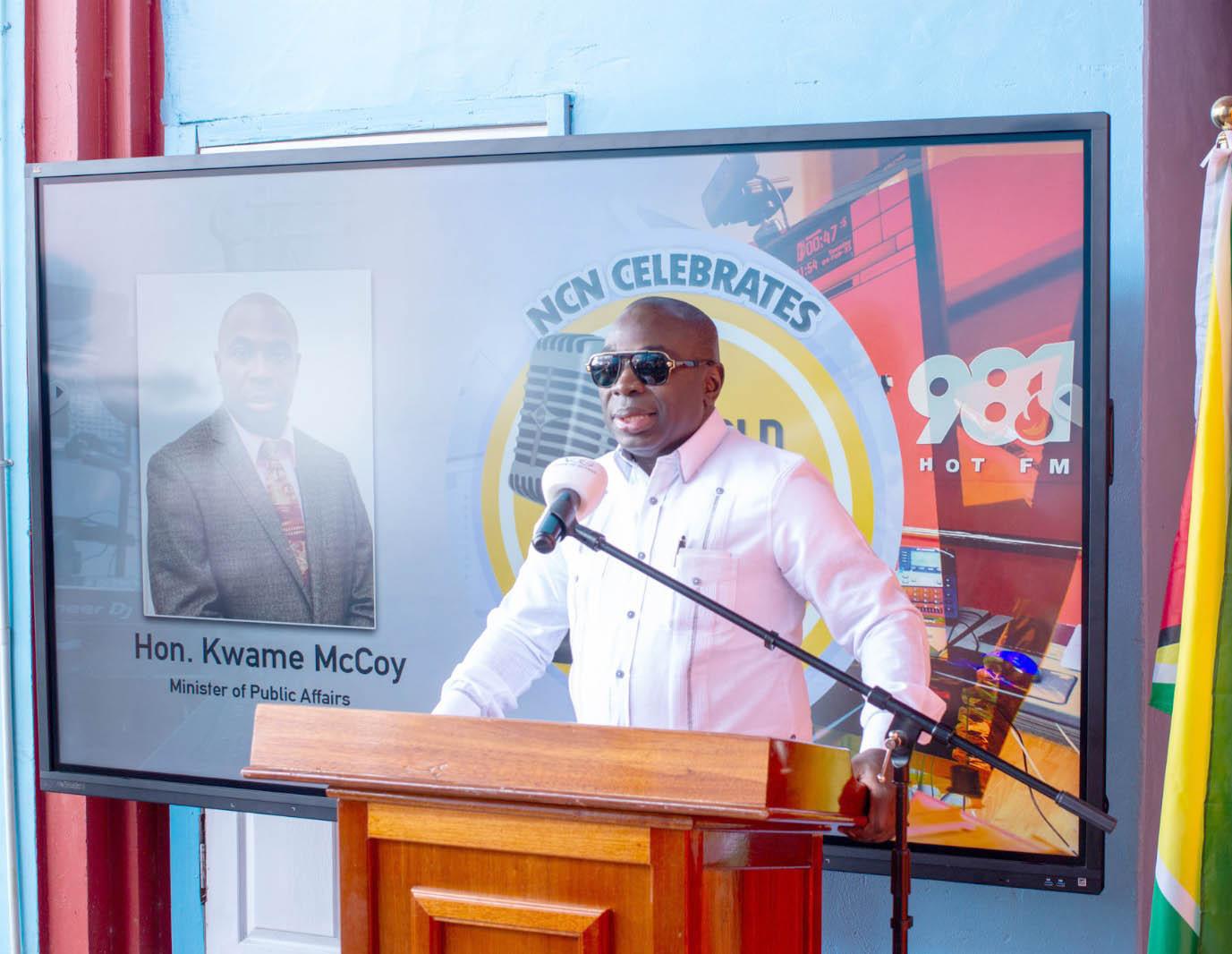
Radio in good hands
–– Min. McCoy
–– as NCN celebrates World Radio Day 2026
Minister within the Office of the Prime Minister Kwame McCoy on Friday affirmed that “radio is in good hands” as the National Communications Network (NCN) joined the global observance of World Radio Day 2026 under the theme “Radio and AI”
MINISTER within the Office of the Prime Minister, Kwame McCoy on Friday affirmed that “radio is in good hands”, as the National Communications Network (NCN) joined the global observance of World Radio Day 2026 under the theme “Radio and AI”.
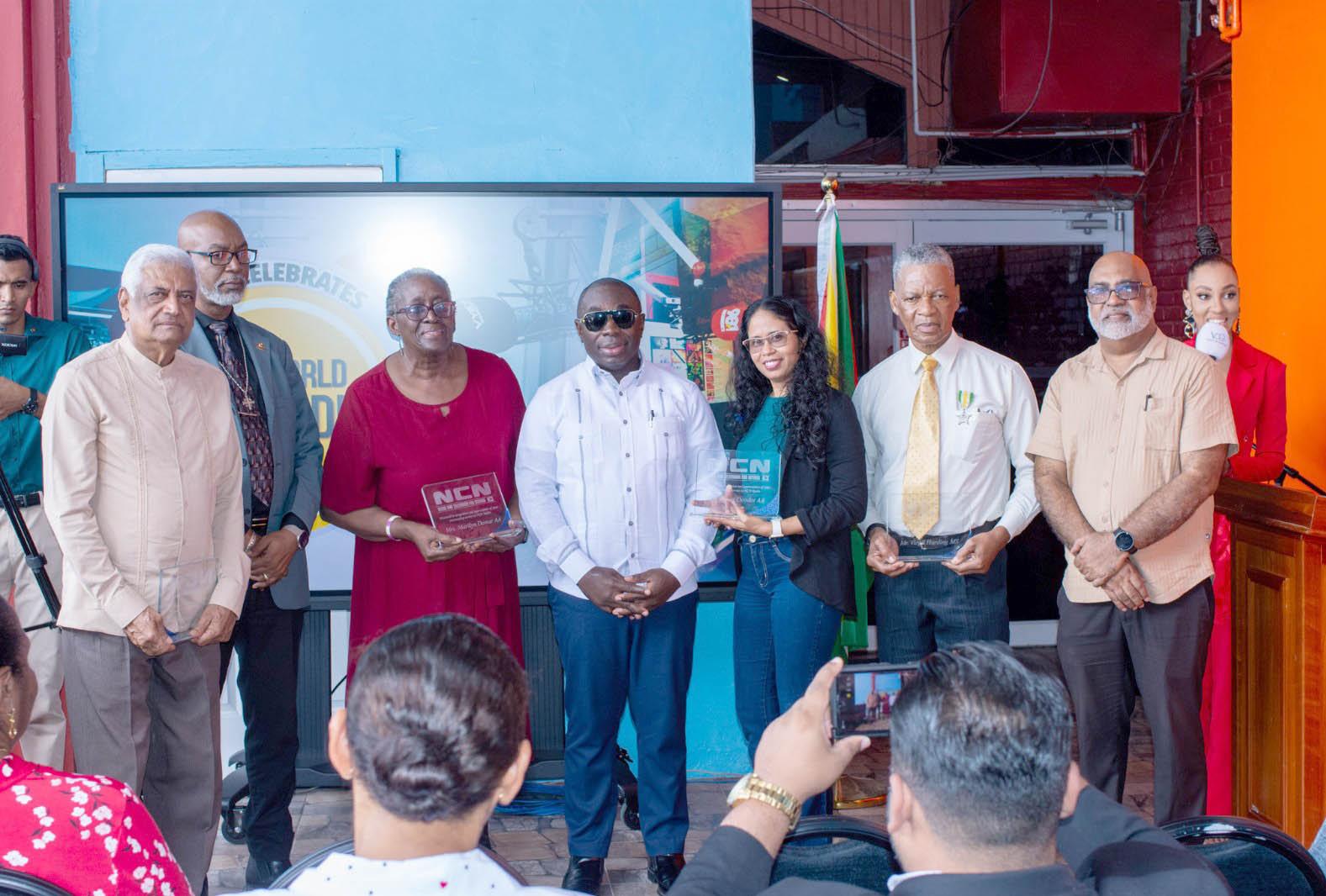
for more than five decades; Marilyn Dewar, AA, a distinguished music teacher and cancer survivor known for her long-running show “Concert Favourites” on the Voice of Guyana; and Virgil Harding, MS, who has served listeners in the North Rupununi for 26 years through Radio Paiwomak 97.1 Bina FM. Dr. Rovin Deodat, AA, was also honoured (award collected on his behalf by Michella Abraham-Ali) for his signature programmes “From Word to Word”, a 35-year-long literary series, and “Have You Ever Wondered?”
“NCN is ensuring that people right across this country have the means of communicating or are connecting with us for the means of gaining knowledge, information, and entertainment,” he stated, lauding the institution’s continued evolution in an era shaped by technology and innovation.
In celebrating the en-
Addressing a gathering at NCN’s headquarters, Minister McCoy commended the network for upholding high standards in broadcast journalism, and ensuring that citizens remain informed across every region of the country.
during power and influence of radio, NCN also used the occasion to honour the voices that have shaped its airwaves over the years. Several veteran broadcasters were recognised for their decades of dedication, excellence, and service to the industry and the nation. Among the honourees were Dr. Steve Surujbally, AA, whose beloved radio programme “Your Vet and Your Pet” has educated and entertained audiences
Food production giant, Del Monte, eyes massive pineapple investment in Guyana
NEGOTIATIONS are ongoing to secure a large-scale pineapple venture with global food giant, Del Monte, which could see thousands of acres under pineapple cultivation.
Chief Investment Officer of the Government of Guyana and Head of Guyana Office for Investment (Go-Invest) Dr. Peter Ramsaroop revealed this during a press conference on Friday.
Dr. Ramsaroop noted that this could positively impact Guyana’s vision to dominate value-added markets.
He said: “Del Monte
wants to come in and plant 1000s of acres of pineapples, and if you can get that planted, and you can get our pineapple in a can. Now, why would I import that pineapple? [It would be] cheaper coming from Guyana, going into the region, and so is futuristic thinking like that that is going to make a difference with the problems or any [trade] barriers.”
Dr. Ramsaroop also pointed out how Guyana is aggressively moving to eliminate trade barriers within the Caribbean Community (CARICOM) and promote regional integration.
Out of 186 countries, only Guyana produces enough food to self-sufficiently feed all its citizens without foreign imports, according to new research.
The study, published in
Nature Food, investigated how well each country could feed their populations in seven food groups: Fruits, vegetables, dairy, fish, meat, plant-based protein and starchy sta -
ples.
Worldwide, the study found that 65 per cent of countries were overproducing meat and dairy, compared to their own populations’ dietary needs.
It also found that Guyana, located in South America, is the only country that could boast total self-sufficiency, while China and Vietnam are close behind, being able to produce enough food in six out of seven food groups.
Just one in seven of the tested countries was judged self-sufficient in five or more categories.
Recently, President Dr. Irfaan Ali said Guyana is positioning itself to become the Caribbean’s leading food production and distribution hub, as the country leverages its raw agricultural output, expanding agro-processing capacity and major infrastructure investments to reach global agro-industrial scale.
Speaking on the country’s long-term development strategy, President Ali had noted that the wider CARICOM region is increasingly looking to Guyana to play a central role in ensuring food security.
He highlighted, too,
recent investments aimed at strengthening the entire food ecosystem, from production to processing, storage and distribution.
Guyana is scaling up the production of priority commodities and promoting diversification into new crops, livestock, and aquaculture; targeting new markets across the Caribbean and internationally to strengthen food trade and supply chains; investing in agricultural infrastructure, such as the construction of farm-to-market roads, modern storage facilities, upgraded ports, and improved transport links; and modernising agriculture with technology, including through digital extension services, precision farming, and climate-smart practices.
Additionally, there are major efforts to transform the livestock industry and expand aquaculture and sustainable fisheries; drive value addition and trade logistics, thereby retaining more value within the national economy; and promote inclusion and empowerment by ensuring that women and young people are central to agricultural transformation.
Mohameds appeal failed High Court bid to halt extradition proceedings
UNITED States-indicted businessman Azruddin Mohamed and his father, Nazar Mohamed, have moved to the Court of Appeal seeking an urgent stay of ongoing extradition proceedings, arguing that their pending substantive appeal should be determined before any further committal steps are taken.
According to the Notice of Motion filed in the appellate jurisdiction of the Supreme Court of Judicature, the applicants are requesting “a stay of the proceedings for the extradition… until the determination of the substative appeal filed herein”.
The application names the Minister of Home Affairs, the Attorney-General, and Magistrate Judy Latchman as respondents. It also asks the Court of Appeal to hear the substantive appeal urgently, and, if deemed appropriate, treat the hearing of the motion as the hearing of the appeal itself.
On February 4, Chief Justice (ag) Navindra Singh, at the High Court, dismissed the legal challenge brought by the applicants, who accused the Minister of Home Affairs and the Government of Guyana of bias in the extradition proceedings.
The Court found no substance in the claim that political rivalry had tainted the decision to issue an authority to proceed under the Fugitive Offenders Act.
The Mohameds had mounted a two-pronged legal challenge in the High Court, alleging bias and invalidity of the authority to proceed.
In the matter, the father-and-son duo asked the court to determine that the Minister of Home Affairs, the President, the Attorney General, the Vice-President, the President and the government as a whole were biased against Azruddin Mohamed because of his role as a political competitor in the September 2025 elections.
On that basis, they argued that the authority to proceed with the extradition process was tainted and unlawful, including the arrest warrant and the ongoing extradition proceedings before Principal Magistrate Latchman in the Georgetown Magistrates’ Court, which they contended should be quashed.
In the substantive matter, the Mohameds are challenging the constitutionality of parts of the Fugitive Offenders Act, particularly amendments made in 2009.
That case remains before the court, with a ruling expected around February 16.
During the hearing of the bias case, lawyers for the State, including Attor-
ney-General Anil Nandlall, SC, and Senior Counsel Douglas Mendes argued that bias does not arise in relation to the Minister of Home Affairs, because the minister is performing an executive function, not a judicial or quasi-judicial function, when issuing an authority to proceed.
Nandlall had reminded the court that the younger Mohamed entered politics after the extradition process had already begun, and after sanctions had already been imposed.
Accepting political bias
According to court documents, Nazar, 72, and Azruddin, 38, were owners of Mohamed’s Enterprise, a gold wholesaler and exporter in Guyana that sold gold to buyers in Miami and Dubai.
Guyanese authorities impose approximately a seven percent tax and duty on exported gold. From about 2017 through at least 2024, the pair allegedly enriched themselves and defrauded the Government of Guyana by concealing the true quantity and value of gold exported by their company.
as a defence, he argued, would allow anyone facing extradition to simply enter politics and then claim to be targeted for political reasons. The State also relied on case law from across the Caribbean, the Commonwealth and England.
According to the Attorney General, the court accepted these arguments. In its final decision, the Chief Justice dismissed the Mohameds’ claim that the Minister of Home Affairs and the government were biased, finding that the minister acted as an executive officer carrying out a duty assigned by Parliament under the Fugitive Offenders Act.
The court also awarded $500,000 in costs to each respondent—the Attorney General, the Minister of Home Affairs and Principal Magistrate Latchman.
Extradition proceedings in the magistrates’ court are set to continue on February 16. In that case also, the Mohameds’ had made several attempts to stall same.
SANCTIONS AND INDICTMENT
In October last year, a federal grand jury in Miami returned an indictment charging the father and son with participating in a multi-year scheme to evade millions of dollars in taxes and royalties owed to the Government of Guyana through fraudulent gold export practices and related money laundering activities.
The indictment alleges that Mohamed’s Enterprise paid taxes and royalties on one shipment of gold to obtain official government seals, then reused those same seals on subsequent shipments to avoid paying additional taxes and royalties. Prosecutors further allege that empty boxes bearing Guyanese government seals were shipped from Dubai through Miami to Guyana, and that bribes were paid to customs and other officials to facilitate the scheme.
In total, the pair allegedly exported at least 10,000 kilogrammes of gold through Miami, resulting in an estimated loss of approximately US$50 million to the Government of Guyana.
Nazar is charged with conspiracy to commit money laundering, conspiracy to commit mail and wire fraud, and mail fraud.
Azruddin is charged with conspiracy to commit money laundering and wire fraud.
The indictment also alleges that Azruddin Mohamed engaged in a separate scheme to evade more than US$1 million in Guyanese taxes in connection with the shipment of a Lamborghini from Miami to Guyana.
The indictment seeks forfeiture of approximately US$5.3 million in gold bars seized at Miami International Airport on June 11, 2024. Both men were sanctioned by the Office of Foreign Assets Control in June 2024.
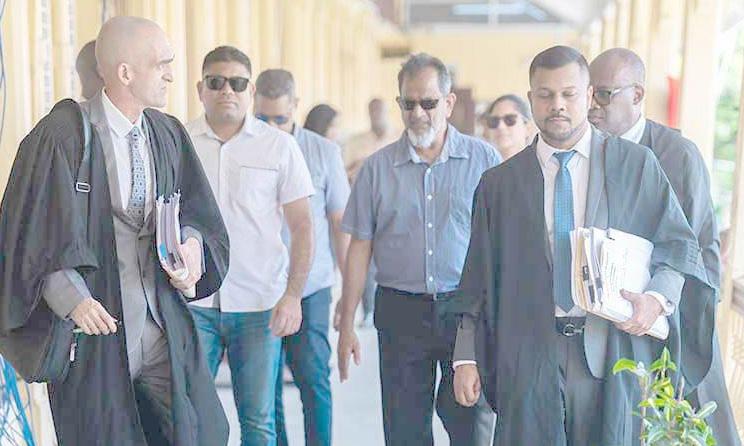
Nazar and Azruddin Mohamed accompanied by their legal team
85% of women-owned businesses to participate in AgroFest 2026
APPROXIMATELY 85 per cent of local womenled enterprises will be a part of over 50 businesses participating in AgroFest 2026.
This is according to the Guyana Office for Investment (Go-Invest), which
is coordinating the fifth consecutive group for participation at AgroFest.
Guyana’s participation in the annual agricultural exhibition in Barbados has remained a cornerstone in strengthening the country’s position as a regional powerhouse.
AgroFest 2026 is being held from February 27-March 01, 2026, at the Queen’s Park in Bridgetown, Barbados. Leading Guyana’s delegation at AgroFest 2026 is Dr. Peter Ramsaroop, Chief Invest-
ment Officer of the Government of Guyana and Head of Go-Invest.
Dr. Ramsaroop, during a press conference at Go-Invest on Friday, highlighted how Guyana’s continuous participation in AgroFest complements President Dr. Irfaan Ali’s 2030 development agenda to place further emphasis on export, food security, economic diversification, and deeper regional trade integration across the Caribbean Community (CARICOM).
“AgroFest was one of those avenues that we latched on to very early on, after the President announced food security as one of his main pillars and the biggest benefit that I see of this whole event is that we’re able to take, I think this time, almost 58 companies; young companies that have a product, have an art, have a painting, have furniture to show to the wider world. And the results over the last five years have been significant,” he said.
Guyana’s participation at AgroFest has produced measurable commercial outcomes, including several businesses being able to transition from exhibitors to active suppliers within Barbadian supermarkets, hospitality chains, and distribution networks.
“The objective of the event is to expand our product line within the Caribbean,” Dr. Ramsaroop affirmed.
He further said that over the last couple of years that the private sector stepped up every time there is a major event, noting that it has invested back in Guyana.
“The confidence level in our country is significant,” Dr. Ramsaroop said.
Guyana’s presence at AgroFest 2026 will include
over 50 participating businesses, two 40-foot containers of Guyanese products, a coordinated national pavilion, structured B2B meetings with distributors, retailers, and hotel buyers, and engagement through the AgroFest Biz-Link platform to secure contracts and repeat orders.
AgroFest 2026 directly advances the government’s economic priorities by expanding non-oil exports, strengthening small and medium enterprises (SMEs) competitiveness, scaling value-added agriculture and manufacturing, reducing trade barriers within CARICOM and reinforcing Guyana’s role in regional food security.
The initiative is being executed in collaboration with the Ministry of Agriculture, Guyana Marketing Corporation, Guyana Manufacturing and Services Association, and privatesector partners including Banks DIH, Blue Water Shipping, Fullworks, and Duane Trading.
Corporate Guyana is encouraged to deepen its support for export-led growth initiatives that position local producers within regional value chains.
Companies such as Demerara Distillers Limited, Precision Global, Duane Trading, and DuraVilla Homes, along with several small manufacturers in the agro-processing and handicraft industries have successfully established commercial relationships in Barbados.
Guyanese products are now supplied to vendors at Pelican Village and to hotels across the island, demonstrating sustained market penetration facilitated through Go-Invest’s export development initiatives.
Guyana is set to participate in AgroFest for the fifth consecutive year
Demerara Bank increases housing-loan ceiling to $40M
––– maintains rates as low as five percent
See full statement from Demerara Bank Limited:
“DEMERARA Bank Limited has announced an expansion of its Residential Housing Loan framework, increasing the lending ceiling from $30,000,000 to $40,000,000 while maintaining a competitive interest rate of five percent per annum, effective 9 February, 2026.
Under the revised structure, residential housing loans of up to $40,000,000 will attract an interest rate of five percent per annum, making Demerara Bank the only commercial bank in Guyana currently offering this level of residential financing at this rate. The bank believes that access to affordable financing should not become more restrictive simply because housing costs have evolved.
In recent years, the cost of residential construction has increased steadily, driven by rising material prices, labour costs, and contractor fees. These realities have made it increasingly difficult
for many prospective homeowners to complete or comfortably finance their homes within traditional lending limits. Demerara Bank’s revised loan ceiling is designed to better align financing options with today’s construction environment and the practical needs of borrowers.
The adjustment reflects the bank’s continued commitment to empowering Guyanese citizens and supporting one of life’s most meaningful milestones of owning a home. The bank promotes that Homeownership remains a significant achievement for individuals and families, symbolising stability, independence, and long-term security. The enhanced lending framework ensures that customers are able to borrow slightly more where necessary without being penalised by higher interest rates. This approach supports households seeking to build, complete, or purchase homes that meet modern standards of comfortable living.
Demerara Bank has long maintained that economic growth must translate into meaningful opportunities for citizens. By adjusting its residential housing loan limits, the bank continues to play an active role in supporting national development, strengthening communities and helping families achieve their aspirations.
Local Gov’t Ministry condemns APNU’s misrepresentation of Minister Manickchand’s remarks
THE Ministry of Local Government and Regional Development has voiced strong concern over what it describes as the “misleading” manner in which A Partnership for National Unity (APNU) has circulated subject Minister Priya Manickchand’s recent remarks.
According to the ministry, APNU shared a selectively edited version of the minister’s response, which excludes key portions of her full statement.
In a press release issued on Friday, the ministry contended that by cutting and presenting only selected segments of the video, APNU created a false narrative that distorts both the context and intent of Minister Manickchand’s comments.
The ministry said such selective editing amounts to a misrepresentation, and has the potential to mislead the public on important issues of national education policy.
Calling for transparency and fairness in public discourse, the ministry urged members of the public to review the full, unedited video before forming opinions.
“Transparency and fairness are essential to informed and constructive discourse,” the ministry emphasised, noting that incomplete presentations serve only to undermine meaningful engagement.
“Demerara Bank Limited remains deeply committed to supporting every Guyanese at every stage of life.
True to its name and purpose, the bank continues to stand with its customers as they build their futures.”
GTTCI formally opens today
WHILE the Guyana Technical Training College Inc. (GTTCI) in Port Mourant, Region Six will be formally opened today, for the past few months, it has been elevating the local technical training capacity and supporting Guyana’s growing oil and gas industry by developing a highly skilled, Guyanese workforce.
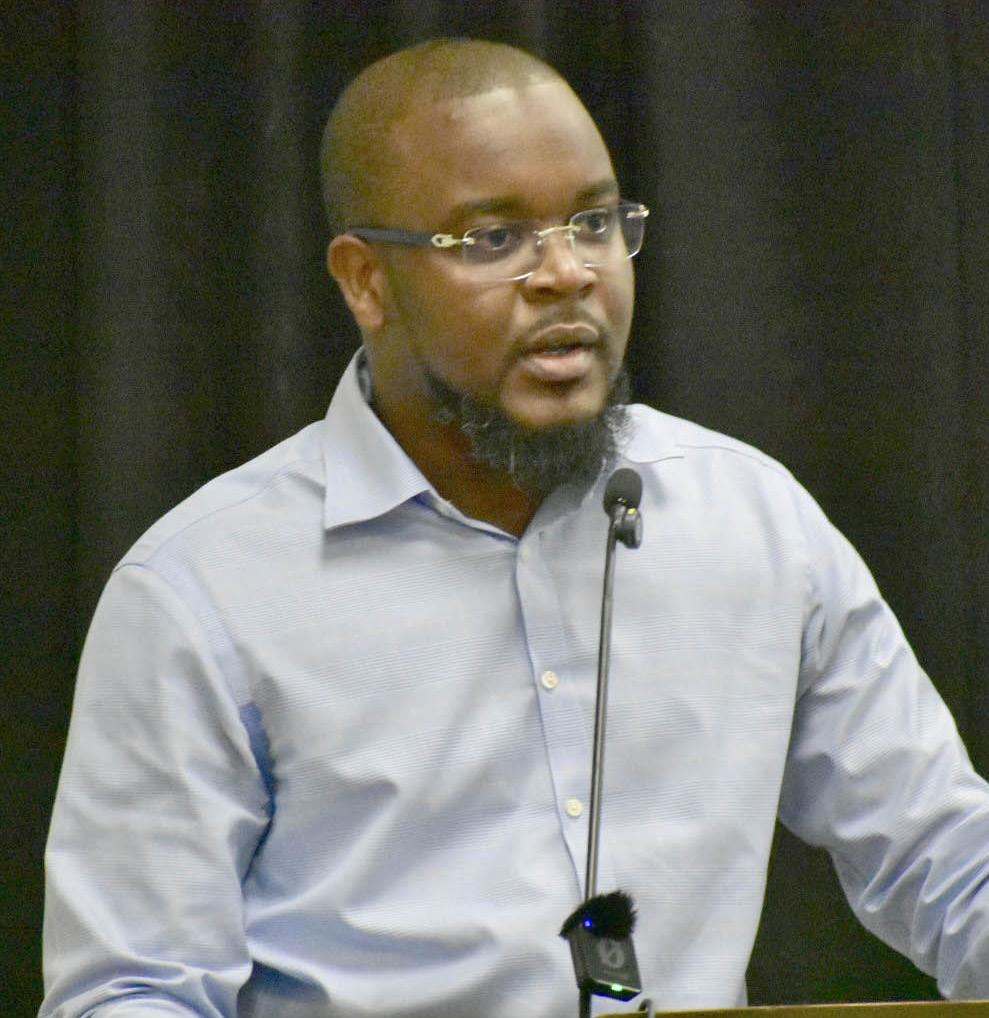
Minister of Natural Resources Vickram Bharrat during the launch of the Local Content Online Reg-
istration Portal on Friday, said that the GTTCI aims to certify locals who have the skills and experience needed in the oil and gas sector.
He remarked that in addition to creating job opportunities for young Guyanese, the Government of Guyana has been establishing entities to ensure that young people are trained and certified.
According to the minister, the government recognised that there were man
skilled locals who were not certified. Because of this, they could not be employed.
Minister Vickram said that this is what the GTTCI intends to address.
“We have so many people with skill sets, but they don’t have the certificate and you know that in the oil and gas industry, they will not employ you without a requisite certification, and you can’t blame them because it is a very sensitive industry, especially when it comes to
health and safety,” the minister added.
Underscoring the government’s involvement in ensuring that Guyanese are trained and are given opportunities, the minister stated that Guyanese need better paying jobs, and are capable of working in technical fields.
According to the minister, already an estimated 35 Guyanese have graduated from the GTTCI, and these persons have already gained
employment offshore.
“Many of them are on the Unity FPSO. There’s a batch there, about 20 right now, and they’re going to graduate in about six months as well in collaboration with SBM. So, once they’ve trained, then they go offshore and they start to work,” Minister Bharrat said, adding:
“There’s employment that’s provided for them. As a matter of fact, most of those trainees are already employed, mostly
by SBM. So, they’re being paid at the same time while they’re training, and then deployed after that,” he said.
Highlighting Guyana’s development, the minister said that today, Guyanese are not leaving to find betterment elsewhere. Instead, they are either staying in Guyana or returning because of the transformation taking place.
This rapid transformation, he said, happened because of good leadership, good management, and good governance.
Natural Resources Ministry launches Local Content Online Portal
By Faith Greene
THE Ministry of Natural Resources’ Local Content Secretariat has launched its Local Content Online Portal, which aims to reduce the overall application processing time through centralised digital workflow.
The portal will facilitate online application submission, improve internal review and approval efficiency, and ensure there is real-time visibility of the application status and timelines.
Whether persons are firsttime applicants, checking the status of an existing application, or transitioning from the previous system, the new online portal provides a single, secure point of access, free of cost.
Through the Local Con-
Minister of Natural Resources Vickram Bharrat
tent Register, the Local Content Secretariat ensures that locals and local companies are prioritised in the procurement of goods and services
for the enhancement of the value chain of the petroleum sector.
Announced in December 2025, the launch of the Local
Content Online Registration Portal is part of the government’s mandate to strengthen local content implementation, and, to ensure that persons have access to the local content registration.
Delivering his keynote address, Minister Vickram Bharrat said that when the government assumed office in August 2020, their commitment to Guyanese was that they will ensure Guyanese benefit directly from the oil and gas sector.
He posited that Guyana’s government is using the revenue from the oil and gas sector to ensure a modern healthcare system is built, along with world-class education, free tertiary education, solid infrastructure, cash grants, and the expansion of traditional productive sectors.
–– promises faster application processing time
“We have been using the revenue from the oil and gas sector to do that, so that Guyanese are benefiting from the oil and gas sector indirectly. With regards to direct benefits, it is coming through the local content legislation, where we have almost 7,000 Guyanese working in the oil and gas sector.”
Guyana’s Local Content Act was enacted in 2021. One of the main components of the Act’s operationalisation is the certification of companies and Guyanese nationals to be added to the Local Content Register.
This exercise, in the first instance, commenced by encouraging persons to visit the Local Content Secretariat, where they were required to bring their relevant documents, and were interviewed,
meeting with various members of the registration team at the Secretariat.
This, however, reduced productivity and efficiencies at the Secretariat. The Secretariat took a different approach, allowing applicants to submit their documents through email, which improved these efficiencies. Because of the large volume, a lag in the system resulted in the slow processing of applications.
Under the guidance of Minister Bharrat, the Secretariat was tasked with finding a way to take the process online.
Following this, the Secretariat engaged a developer, who was tasked with looking at the current system,
Minister of Natural Resources Vickram Bharrat (Sachin Persaud photo)
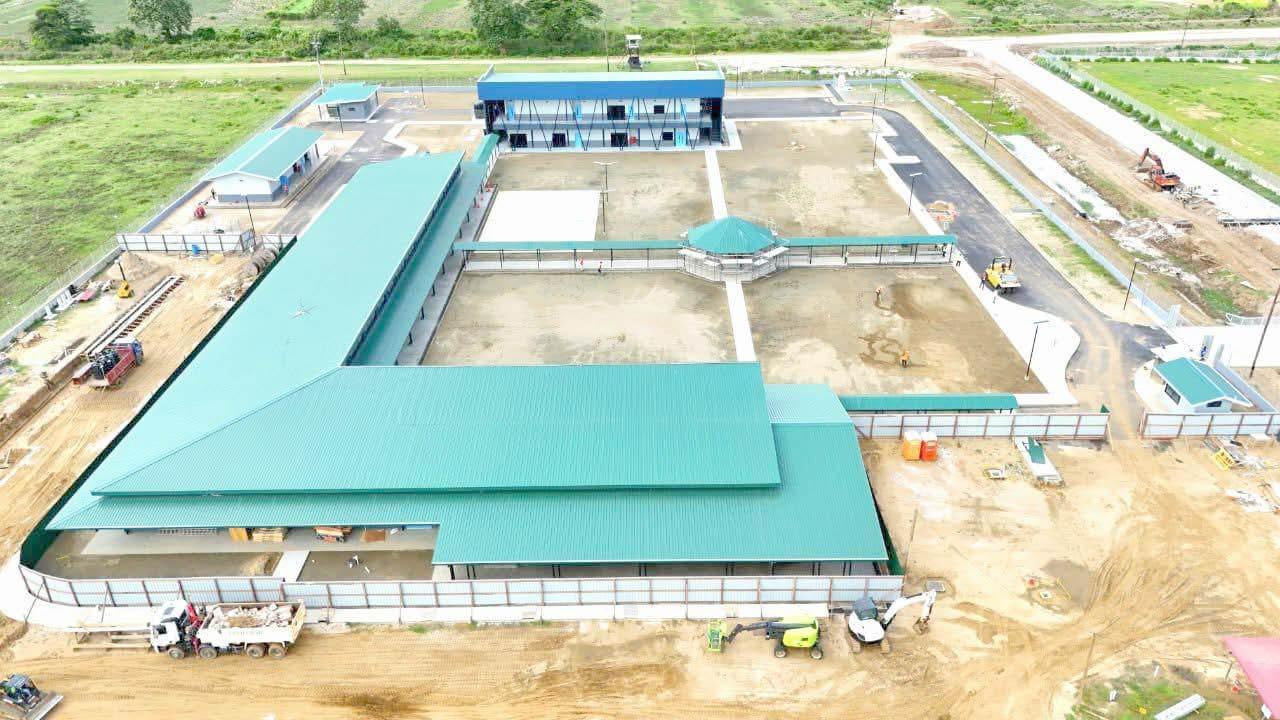
The Guyana Technical Training College Inc. (Photo: Office of the President/Facebook)
Allottees in Region Six advance homeownership as housing agency processes ownership documents
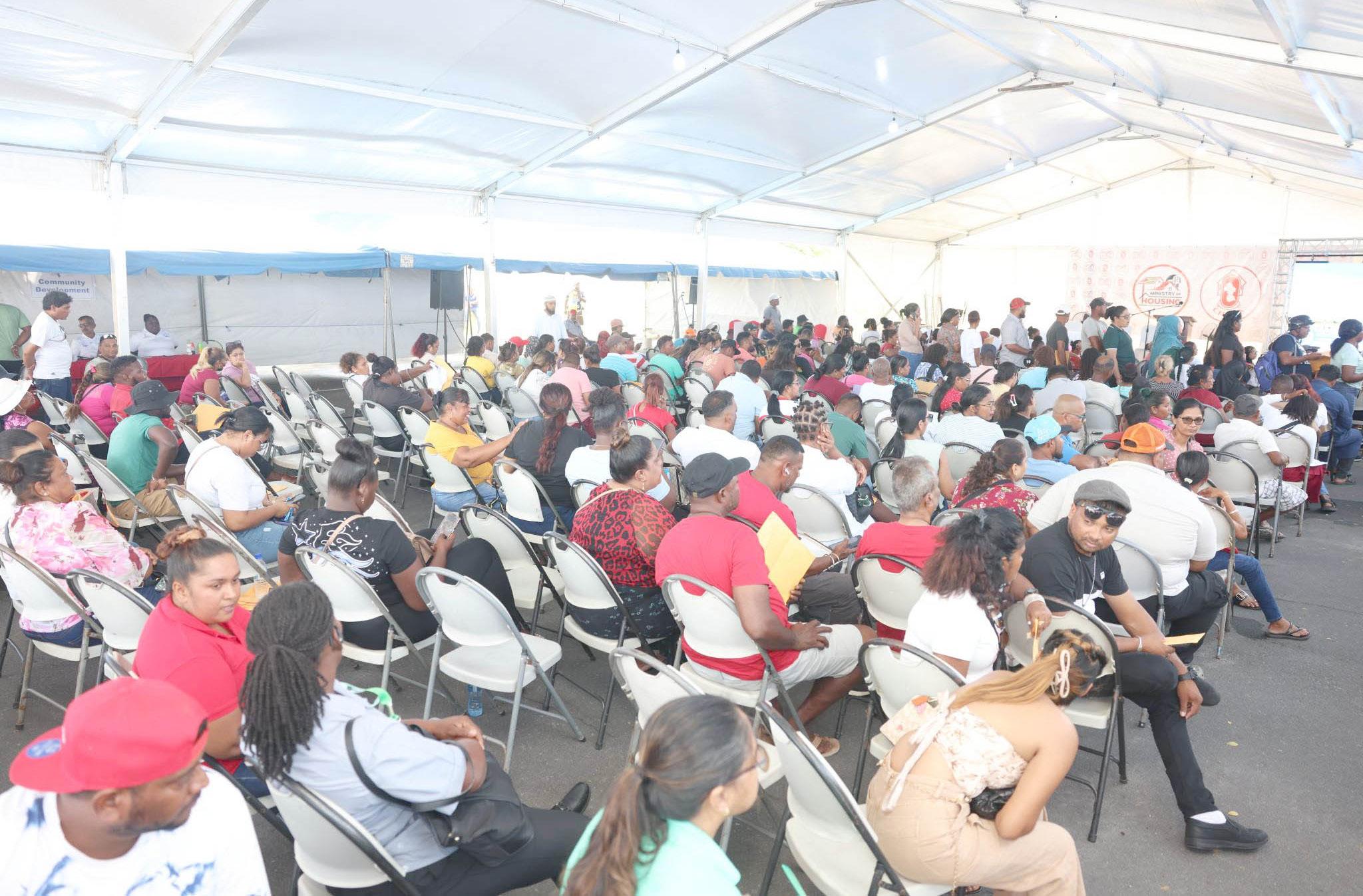
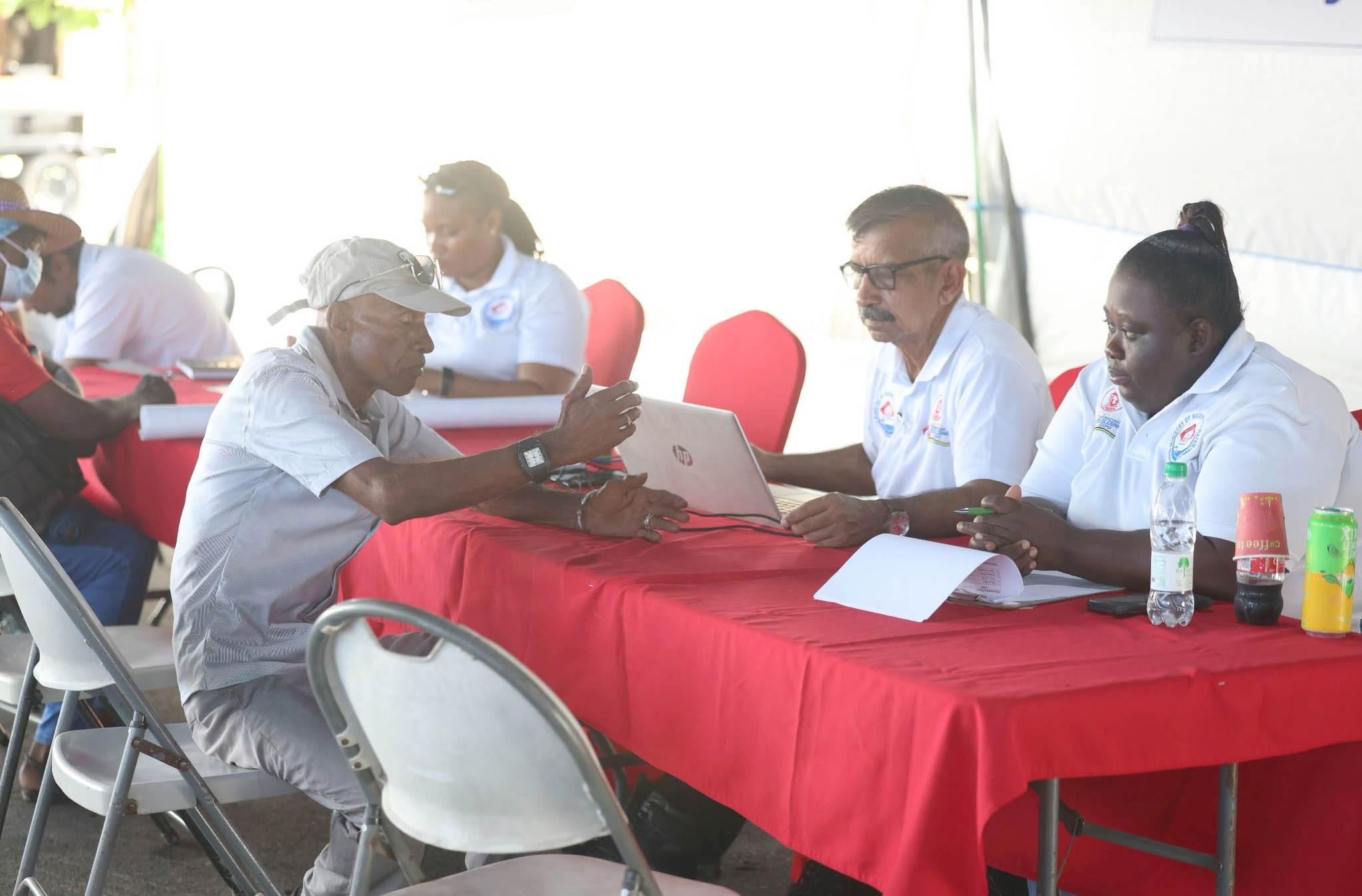
SCORES of prospective homeowners from Number 75 and Number 76 villages in Region Six turned out on Friday to complete key steps towards land ownership, as the Central Housing and Planning Authority (CH&PA) hosted a documentation exercise aimed at advancing homeownership opportunities.
The activity, held at the Classic International Hotel, facilitated the signing of Agreements of Sale and the processing of Certificates of Title for allottees within
the Number 75 (Block Two) and Number 76 (Blocks Three and Four) Housing Developments.
Leading the exercise were CH&PA Chief Executive Officer Dr Martin Pertab and Operations Manager Gaitree Ramawad, who oversaw the processing of beneficiaries as they moved closer to securing legal ownership of their house lots.
Many allottees expressed optimism as they completed the required documentation.
Glynis Hiles, one of the beneficiaries, said receiv -
ing her Agreement of Sale represents an opportunity to move toward independence and begin constructing her own home after previously living with relatives.
Another allottee, Jason Pilgrim, described the process as an important milestone, noting that securing ownership documents allows him to move ahead with plans to build.
Dr Pertab explained that the agency has set a target of approximately 450 allottees to complete the process during the exercise.
While Agreements of Sale were issued at the venue, beneficiaries also began the registration process required to obtain their Certificates of Title.
According to the CH&PA head, the initiative forms part of the government’s broader housing drive to ensure more Guyanese families benefit from the stability and security associated with homeownership.
“It’s encouraging to see the excitement on their faces, knowing they are one step closer to owning their
own homes,” Dr Pertab said.
He added that possession of ownership documents enables beneficiaries to approach financial institutions to secure mortgages and begin construction.
To further assist participants, representatives from lending institutions, insurance companies and the national utility, Guyana Water Incorporated, were present to provide guidance on financing, insurance coverage and utility connections.
Dr Pertab also wel -
comed a recent announcement by Demerara Bank Limited to increase its housing-loan ceiling from $30 million to $40 million while maintaining a five per cent interest rate, noting that improved access to financing will help make homeownership more attainable for many citizens.
The housing authority said similar exercises will continue as part of ongoing efforts to regularise allocations and accelerate housing development across the country.
Stabroek News to cease print publication from March 15 as company enters voluntary liquidation
INDEPENDENT newspaper Stabroek News will cease its print publication from March 15, 2026, as shifting market conditions and the accelerating dominance of digital platforms force a major restructuring of its parent company, Guyana Publications Inc. (GPI).
In a statement, the Chairman of Stabroek, Brendan de Caires, indicated that the company will shortly begin the process of voluntary liquidation, bringing an end to nearly four decades of print circulation for the independent newspaper.
The closure comes against a backdrop of global upheaval in traditional media business models, with declining circulation and shrinking advertising revenues continuing to erode the viability of
print operations.
Minister within the Office of the Prime Minister, Kwame McCoy, reacting in a Facebook post, said, “It is regrettable to know of the intended closure of Stabroek News by mid-March 2026. It is truly an indication of how porous is the global media landscape and a stark reminder to those in the media business that they must constantly take into consideration evolving their strategy to deal with competitive market forces and changing media dynamics, including the eruption of social media.”
In his address to employees on Friday, de Caires confirmed that while the company will enter voluntary liquidation, all employee benefits will be honoured.
He explained that news-
papers such as Stabroek News, which began publishing in November 1986, have faced mounting pressure from global digital platforms such as Facebook, YouTube, Instagram and TikTok.
“Falling circulation and dwindling revenues impose a choice between corporate mergers, rapid digitisation, or managed decline. For the last five years, the Board of
Directors of our company has weighed its options, including going digital against the near certainty of print media’s failure. In the end, we have made the decision to choose liquidation while we remain solvent and the company can pay its debts rather than risk a forced closure in the next few years”, he stated.
Editor-in-Chief Anand Persaud also pointed to mar-
ket realities as a key factor influencing the closure. In an interview with Prime News, he said the changing media environment has reshaped how audiences consume news and how revenue is generated.
“Newspapers all around the world are facing this crisis. You would know yourself that just last month, News Day in Trinidad folded as a result of the collapse of advertising and subscription revenues and the general difficulty in the market. You know, the market is now dominated by social media and digitalisation. There are so many free openings for people to gather news,” he explained.
Persaud noted that over the past five years, the newspaper had confronted its chal-
lenges directly, exploring several options, including partial digitisation. However, he acknowledged that these efforts did not deliver the long-term financial security required to sustain operations.
“So, we had to make a tough decision and in the light and in the mode of our being an independent newspaper, what you want to do is to leave with dignity. We want to be on our feet rather than live on our knees, beholden to anybody,” he said.
The cessation of print publication will mark the end of a 39-year run for Stabroek News, a publication that has played a prominent role in Guyana’s media landscape since its establishment in 1986.
Many allottees expressed optimism as they completed the required documentation
Natural Resources Ministry launches...
the available tools, and then finding ways to ensure that they improve efficiencies, maintain the integrity of the process, and boost confidence in terms of ensuring that users’ or applicants’ information was secure and private.
This resulted in the creation of the portal which is set to be a game changer. It is hoped that this new platform will help to streamline the application process and bring greater clarity and efficiency to all involved.
In keeping with their commitment to providing an efficient service, a new timeline was developed for the processing of applications. This will be as follows:
Three working days for renewals, new applications can be approved within five days for soletraders, while for companies that are 100 per cent Guyanese owned, new applications will be processed in 15 working-days and renewals can be completed in ten days. Applications for other companies will be processed within 21 days and renewals within 15 days.
Director of the LCS, Attorney Micheal Munroe remarked that the Secretariat is proud to be at this juncture, adding that this move symbolizes a “tectonic shift” in the way the Secretariat operates.
He noted that the portal
has been tested and retested extensively, and he encouraged applicants to contact them if new issues arise.
To access the Local
Content Online Portal, persons can visit: https://lcregister petroleum gov gy / to learn more and register for a Local Content Certificate.
Director of the Local Content Secretariat Attorney Micheal Munroe (Sachin Persaud photos)
Preview of the Local Content Online Portal
Jumbo Offshore completes mooring pre-installation for ExxonMobil’s Errea Wittu FPSO
JUMBO Offshore has completed mooring pre-installation activities for the FPSO Errea Wittu for ExxonMobil Guyana Ltd at Uaru Field, Stabroek Block, Offshore Guyana, on behalf of Modec.
According to a press release, the scope of work included the installation of suction anchors and the pre-lay of mooring lines in preparation for FPSO hook-up.
Jumbo Offshore performed installation engineering, procurement, mobilisation and marshalling activities to support offshore installation. The offshore campaign was executed using Jumbo Offshore’s J-class installation vessel, Fairplayer. All operations were conducted in ac-
Jumbo Offshore-Mooring line completion Errea Wittu-2026
cordance with project requirements and applicable safety standards.
Freek Muurling, Project Manager at Jumbo Offshore said, “I am very proud of the hard work and commitment shown by all Jumbo personnel and subcontractors during the preparation, mobilisation, and execution of this deepwater pre-lay mooring project. The team demonstrated full focus on engineering, procurement, documentation, and meticulous planning in sometimes challenging circumstances. The yard and offshore teams’ resilience and teamwork led to a safe and successful completion of the mooring line installation campaign.
“I would also like to highlight the transparent and constructive communication between Jumbo, Modec, and Exxon, which created a strong working relationship and contributed greatly to moving the project forward safely and efficiently.”
The Uaru field is located 200 kilometres offshore Guyana at a depth of 1,750 metres. It is estimated to hold more than 800 million barrels of oil.
The Errea Wittu FPSO will produce 250,000 barrels of oil per day and will have a gas-treatment capacity of 540 million cubic feet per day.
It will have a water-injection capacity of 350,000bpd, a produced water capacity of 300,000bpd and a storage capacity of two million barrels of crude oil.
Anna Regina set to open next month
...Mackenzie National Stadium on stream for April
ESSEQUIBO will have its long-awaited stadium next month according to Minister of Culture, Youth and Sport Charles Ramson Jr.
The minister made the announcement on Thursday during the consideration of budgetary estimates.
‘Next month in the month of March, Anna Regina get ready we are about to open the national stadium for Anna Regina too and it is a fantastic facility that is being developed there and for the people of Anna Regina there they will be very excited, so we are going to be opening
all five stadiums this year. We have already done one, we have four more to go and there is likelihood of opening at least two more indoor facilities this year.”
The minister also added that Linden will soon have a second stadium, with the opening of the one at Mackenzie.
“In relation to the Mackenzie stadium, that will also be a national stadium, we expect the facility to be ready just around maybe April or so, we only have one major project that’s outstanding that is moving to by about April we should be in fairly decent
stage to be ready to open,” the minister said.
He also outlined that they also have several indoor facilities set to open this year.
The completed stadiums will host cricket and other international sporting events, helping to diversify Guyana’s sporting landscape.
Minister Ramson, while addressing questions from opposition Member of Parliament Sharma Solomon, said that Bayroc will be treated similarly to the Providence National Stadium in terms of the government providing support personnel for its upkeep around the clock.
“The operation of the Bayroc National Stadium, there is already approved an entire organigram, appointed of personnel etc who will be there full time. So next two weeks or so expect to see a lot of movement in relation to that as there is at the Guyana national Stadium Providence, so you will have a full employment operation there to maintain and run the Bayroc National Stadium.”
Saturday, February 14th, 2026
Aryansh Sharma, Sohaib Khan power UAE to thrilling win over Canada
(ESPNCRICINFO) - Aryansh Sharma and Sohaib Khan fired United Arab Emirates to a hard-fought five-wicket win against Canada in Delhi. It was UAE’s second win in the competition, after they beat Namibia in the 2022 edition of the T20 World Cup.
Aryansh and Sohaib did justice to Junaid Siddique’s five-wicket haul which restricted Canada to 150 for 7.
UAE were themselves down in the dumps at 66 for 4, before this pair added 84 of the 85 runs required at that stage. With eight needed from the last over, Aryansh struck a six off the
first ball and then took a single. Sohaib top edged Jaskarandeep Singh to fall with UAE needing one off three balls before Muhammad Arfan scored the winning run.
UAE, however, were nowhere near a win when left-arm spinner Saad Bin Zafar took 3 for 14 to put Canada in a strong position by the 13th over of the chase.
Zafar puts pressure on UAE
Kaleem Sana had the UAE captain Muhammad Waseem caught at midwicket for four in the third over.
Zafar then removed the other dangerman, Alishan Sharafu, in the seventh over to give Canada the early advantage.
Sharafu couldn’t clear Nicholas Kirton at covers and fell for five.
Zafar was stingy and kept his subtle change of pace going, removing Mayank Kumar for four in the 11th over. Kumar’s intention to belt him down the ground only found Sana at long-on. In his next over, Zafar had Harshit Kaushik caught at deep midwicket.
Sohaib brings UAE back into contest
UAE had their backs to the wall as they needed 56 runs in the last four overs. Sohaib hit Dilon Heyliger for two sixes and a four.
He first smoked him over midwicket for a maximum, followed by a lofted shot over mid-off for four, and a six straight into the sight-screen.
After the 17-run over, Sohaib got stuck into Jaskarandeep with a four and a six off the first two balls of the 18th over.
He then cracked two more fours to start Sana’s penultimate over, before the left-arm quick’s beamer hurt wicketkeeper Shreyas Movva.
Another top edged boundary and a straight hit for two got Sohaib to his half-century off just 28 balls, leaving UAE eight to win from the last over.
Siddique bosses powerplay, death overs
The 33-year-old Siddique began UAE’s push when he had Dilpreet Bajwa caught at mid-off in the second over for 11.
Yuvraj Samra mistimed a pull to mid-on in Siddique’s next over.
When Muhammad Jawadullah had Nicholas Kirton caught behind in the sixth over, UAE gained a stronghold in the game.
Siddique returned with three more wickets in his late spell. He started off with Harsh Thaker’s wicket after he had reached his half-century. Siddique used the slower delivery to outfox a set Thaker. He removed Movva and Zafar in the last over, completing his maiden five-wicket haul in T20Is.
Thaker’s lone hand
Thaker survived an lbw appeal against Jawadullah in the first ball he faced. He waited for a few more deliveries before depositing Haider Ali for a four and a six in the next over.
Thaker then thwacked Muhammad Arfan for his second six, as he and Navneet Dhaliwal added 58 runs for the fourth wicket. Dhaliwal, who made a half-century against South Africa in Canada’s previous game, struck four boundaries in his 34 off 28 balls.
His run-out was unfortunate when Dhaliwal’s bat got stuck just outside the crease. Thaker later fell on exactly 50 off 41 balls, with two fours and three sixes, though Thaker held together the UAE innings till the 18th over.
T20 World Cup
Sohaib Khan changed the tempo of the chase • AFP/Getty Images
T20 World Cup
Muzarabani, Evans and Bennett slay Australia
(ESPNCRICINFO) - Zimbabwe remained undefeated against Australia in T20 World Cups after a career-best bowling display from Blessing Muzarabani, key strikes from Brad Evans, and a gutsy 64 not out from Brian Bennett helped orchestrate a stunning 23-run win in Colombo and throw Group B into chaos.
Muzarabani took 4 for 17 from four overs, ripping out the top order alongside Evans in the powerplay - Evans took 3 for 23 - as Australia never really looked close to chasing Zimbabwe’s impressive 169 for 2 down that had been set up by even contributions from the top four on a slow pitch.
Matt Renshaw’s 65 off 44 gave Australia hope but on top of the polished display with bat and ball, Zimbabwe also fielded superbly to restrict Australia and threaten their T20 World Cup Super Eight hopes.
Australia’s decision to bowl first on a fresh pitch in the day-time will be scrutinised. There were moments when Bennett’s 56-ball innings looked like it might have been slower than required, but powerful contributions from Tadiwanashe Marumani, Ryan Burl and Sikandar Raza ensured it was more than enough as Australia managed to take just two wickets in 20 overs.
The win was even more impressive after Zimbabwe lost the hero of their last T20 World Cup victory against Australia in Brendan Taylor for the tournament because of a hamstring injury.
Zimbabwe are now on the verge of qualifying for the Super Eight stage, while Aus-
tralia must defeat both Sri Lanka and Oman in Pallekele to ensure safe passage through to the next phase.
Marumani hit the accelerator up front, thumping 35 off 21 to offset a slow start by Bennett.
Australia’s decision to bowl looked a good one in the first two overs as Ben Dwarshuis and Marcus Stoinis extracted swing and bounce from the tacky fresh pitch in the early morning conditions. Zimbabwe did not strike a boundary in the opening two overs. But Marumani cut loose thereafter. He thrashed two short balls from Dwarshuis to the rope and then unfurled two outstanding reverse sweeps and a conventional sweep off Maxwell. He eventually fell to Stoinis, who bowled a superb spell but the innings was critical in the context of the game.
Zimbabwe were 79 for 1 at the halfway stage and there was discussion in the dressing room of 190 being on the cards. But Sikandar Raza recalled the experience of the 2025 tour to Sri Lanka and called for steady heads. A message was sent out to Bennett and Burl to play with control.
They neutralised Adam Zampa, who had done so much damage against Ireland. Bennett cut him neatly behind point to find the rope after biffing Dwarshuis down the ground.
Burl switch-hit Matt Kuhnemann over point but otherwise they kept the ball on the ground and played smartly. Bennett raised his tenth T20I half-century, and his first in a World Cup, off 43 balls.
Blessing Muzarabani struck the first blow, off his first delivery
• AFP/Getty Images
Basketball team confirmed for Glasgow 2026 Commonwealth Games
PRESIDENT Godfrey Munroe and the Executive Committee of the Guyana Olympic Association (GOA) proudly welcome the official confirmation of Guyana’s Men’s 3x3 Basketball team for the Glasgow 2026 Commonwealth Games, marking a significant milestone in the continued growth and international positioning of Guyanese basketball.
This will be the second appearance of 3x3 Basketball at the Commonwealth Games, following its successful debut at Birmingham 2022, and represents another important step in Guyana’s integration into the global multi-sport ecosystem.
The GOA confirms that Guyana’s qualification follows the formal submission and endorsement of the 3x3 men’s discipline by its Executive Committee, with the de-
cision grounded in the sport’s strong international competitive trajectory, its strategic relevance within the Olympic and Commonwealth sport frameworks, and Guyana’s recent performances and structured development pathway.
President Munroe notes that this achievement is a testament to the dedication, planning, and hard work of the Executive Committee of the Guyana Amateur Basketball Federation (GABF), as well as the commitment of the athletes, coaches, and administrators who continue to elevate the sport nationally.
The Executive Committee of the Guyana Olympic Association extends its formal congratulations to the Guyana Amateur Basketball Federation and all stakeholders involved, and looks forward to supporting the team as preparations advance towards Glasgow 2026.
Second CARIFTA trials on today at new Bayroc National Stadium
THE quest to secure honours continues this Saturday as the Athletics Association of Guyana (AAG) hosts the second round of trials for the 2026 CARIFTA Games from 11:00hrs.
Action shifts to the newly commissioned Bayroc National Stadium, where the nation’s premier U17 and U20 talent will look to secure their spots for the 53rd edition of the region’s most prestigious junior championship.
The 2026 CARIFTA Games will be staged at the Kirani James Stadium in St. George’s, Grenada, from April 4-6.
With the selection window narrowing, the AAG is looking to finalise a squad capable of maintaining Guyana’s rising status in Caribbean athletics.
“We are in full preparation mode,” said AAG President Amanda Hermanstine. “Our developmental cycle for this team began in October, prioritising both mental fortitude and technical execution. I am confident
that this 2026 cohort will uphold our proud tradition of excellence on the regional stage.”
Several of Guyana’s rising stars have already met the stringent qualification standards.
The women’s team features a potent duo in Tianna Springer (400m) and Athaleyha Hinckson (100m/200m), both of whom have already demonstrated podium potential.
Malachi Austin and middle-distance standout Javon Roberts currently spearhead the men’s contingent.
Today’s meet will be a defining moment for several athletes currently on the “Watch List.” In the men’s 100m, Ezekiel Millington (10.62) and Skylar Charles (10.61) are within striking distance of the 10.55 qualifying benchmark.
The horizontal jumps also promise high drama, with long jumpers Duel Europe (7.05m) and Walton Alleyne (7.03m) needing to bridge a marginal gap to hit the 7.10m standard.
Glasgow 2026 has confirmed the nations set to compete in the 3x3 Basketball competition, one of the most dynamic and fast-growing disciplines in the international basketball landscape.
The Games, the largest sporting event in the UK in 2026, will feature approximately 3,000 athletes from 74 nations and territories, competing across 10 sports and six Para sports at four iconic venues throughout the city.
The 3x3 Basketball competition will be staged at the SEC Centre from 24–29 July 2026. Known for its fast-paced, half-court format, 3x3 Basketball is played by two teams of three players using a single hoop and a 12-second shot clock, ensuring constant action and
intensity. Games last 10 minutes or end once a team reaches 21 points, delivering a high-energy, spectator-friendly experience that emphasises speed, skill, and athleticism.
Following its strong reception at Birmingham 2022, the 3x3 programme has expanded from eight to 12 teams per gender for Glasgow 2026, underlining the discipline’s rapid global growth and rising appeal.
Guyana’s inclusion among the qualified nations reflects the country’s steady progress in basketball development and its continued presence on the international sporting stage as part of the Commonwealth and Olympic movements.
Mr Rawle Toney, Secretary General of the Guyana Basketball Federation and a FIBA 3x3 Commission Member, extended personal thanks to the Guyana Olympic As-
sociation for their crucial support and congratulated every member of the basketball family.
According to Mr Toney: “Our men’s 3x3 team’s selection for the Glasgow 2026 Commonwealth Games is a historic achievement. It elevates Guyana on a major international stage and is a powerful endorsement of our development programmes.
“This opportunity, earned through years of hard work from our athletes and dedicated planning, allows us to showcase Guyanese excellence, inspire future players, and fuel the growth of basketball at home. It also highlights the exciting role of 3x3 within global sport.
“We are incredibly proud to prepare for this competition and are committed to representing our nation with unity and determination at the SEC Centre.”
CWI unveils powerful 15-member squad for Sri Lanka tour
CMC – Cricket West Indies (CWI) has unveiled a powerful 15-player West Indies Women’s squad to host Sri Lanka in a three-match One Day International series, set to bowl off at the National Cricket Stadium in Grenada from February 20.
According to CWI, the series is far more than just a bilateral contest; it is a pivotal step in the Windies Women’s quest to climb the ICC Women’s Championship rankings.
With future ODI assignments against cricketing heavyweights Australia, as well as series against Ireland, Zimbabwe, and Pakistan later in the year, building momentum on home soil is paramount.
The team receives a massive boost with the return of captain Hayley Matthews, who has fully recovered from the shoulder injury that had sidelined her since last June.
Matthews will be supported by a new-look leadership group, with Chinelle Henry appointed vice-captain. Henry takes over the role from veteran wicketkeeper Shemaine Campbelle. The move signals a deliberate shift in the team’s leadership structure, looking towards a new era.
In another significant boost, explosive all-rounder Deandra Dottin is welcomed back into the fold. Dottin had been sidelined by injury for much of 2025, forcing her to miss crucial assignments, including the ICC Women’s World Cup Qualifiers and subsequent tours.
Cricket West Indies Director
n The full West Indies Women’s ODI Squad: Hayley Matthews (captain), Chinelle Henry (vice-captain), Aaliyah Alleyne, Shemaine Campbelle, Jahzara Claxton, Deandra Dottin, Afy Fletcher, Jannillea Glasgow, Realeanna Grimmond, Shawnisha Hector, Qiana Joseph, Ashmini Munisar, Karishma Ramharack, Shunelle Sawh, Stafanie Taylor.
n Team Management Unit:
Head Coach: Shane Deitz, Team Manager: Sheena Gooding, Assistant Coaches: Ryan Austin, Damien Wright, Shane Dowrich, Physiotherapist: Ashley Stephens, Strength & Conditioning Coach: Hector Martinez Charles, Performance Coach: Dr Nadine Sammy, Media & Content Officer: Nicholas Maitland.
n Series Schedule
(All matches at National Cricket Stadium, St George’s, Grenada): 1st ODI – Friday, February 20 – 9:30 AM
2nd ODI – Sunday, February 22 – 9:30 AM
3rd ODI – Wednesday, February 25 – 9:30 AM
*The three-match T20I series will follow from February 28.*
of Cricket Miles Bascombe emphasised the deeper significance of the home series, framing it as an investment in the sport’s growth across the region.
“This home series is a cornerstone event, not just for team preparation but for the continued elevation of women’s cricket across the Caribbean,” Bascombe stated.
“Every match played here is an investment in our future. It is about providing a visible, high-performance pathway that shows every young woman in the region what is possible. Playing in front of our home fans in Grenada adds a profound layer of significance, so we want our team to feel the pride of the Maroon legacy and feed off that energy to inspire the next generation.”
Head Coach Shane Deitz is relishing the competitive challenge that Sri Lanka presents. The visitors currently hold a significant advan-
tage in the ICC rankings, sitting sixth compared to the West Indies’ ninth position. Deitz made it clear his squad is hungry to settle an old score.
“We’re excited to have this series against Sri Lanka, who are a really good team. They beat us in the ODI series in Sri Lanka back in 2024, so we owe them one, and now we get them on our home turf,” said Deitz.
“It’ll be tough-fought against a team ranked higher than us, but the girls are excited about competing, putting on a good show and playing some great cricket for all our fans here in the Caribbean.”
The squad’s preparation has been thorough, featuring two high-performance camps in Antigua last year and a specialised training camp for 15 players in the player pool at the Super Kings Academy in Chennai, India.
About 3x3 Basketball at Glasgow 2026:
Wilson returns unopposed as GAPLF President
...Women feature prominently in new-look executive
THE Guyana Amateur Powerlifting Federation (GAPLF) successfully hosted its Annual General Meeting (AGM) on Thursday, February 12, 2026, at the Racket Centre, Woolford Avenue, Georgetown.
When the meeting was called to order, over 30 registered members were in attendance. Franklin Wilson, who did not seek re-lection less than a year ago, was returned unopposed to the presidency reaffirming the confidence of the membership in his leadership.
Wilson’s executive team for the new term includes Gordon Spencer as Vice President; Roger Rogers as General Secretary both retaining their positions as did Bjorn Williams, committee member.
Kiana Benjamin is back as Treasurer, along with Public Relations Officer/Organising Secretary, Denroy Livan. Completing the executive are the two new committee members, Lisa Oudit and Nedisha Tinnis.
This executive body will guide the federation’s activities and strategic direction for the coming year.
In brief remarks following the election, President Wilson expressed sincere gratitude to outgoing President Paul Meusa for his stewardship and contributions during his tenure. Wilson acknowledged that the sport’s image had suffered major setbacks and pledged to make its restoration his immediate priority.
“Our athletes must come first,” he emphasised, outlining his commitment to ensuring
that the federation’s decisions and programmes are centred on athlete development and welfare. Performing duties as the Returning Officer was Mrs Safrana Cameron-Baird. Looking ahead, Wilson shared his vision for expanding powerlifting throughout the length and breadth of Guyana. His plan includes taking the sport to communities and schools, thereby encouraging greater youth involvement and building a strong foundation for future talent.
He also underscored the importance of engaging corporate Guyana to get on board, noting that partnerships and sponsorships will be vital to sustaining growth and providing opportunities for athletes.
He commended the Government of Guy-
ana, and by extension the Ministry of Culture, Youth and Sport and the National Sports Commission for their continued support and for recognising the need to invest in a building and high performance centre which will further bolster development of the sport, noting that it’s a much-needed pillar which will add to the federation’s quest for hosting regional and international competitions.
With renewed leadership and a clear mandate, the GAPLF is poised to strengthen its foundation, broaden participation, and elevate the profile of powerlifting nationwide. The federation remains committed to fostering discipline, resilience, and excellence among athletes, while ensuring the sport continues to thrive across Guyana.
Technical institute dismiss GSA
MAHAICONY’S Technical Institute had an emphatic start to their MODEC Tertiary Football Competition on Wednesday at the No.5 ground in Berbice when they locked horns with the Guyana School of Agriculture, winning 10-3.
Tyrel Delph was the first to hit the back of the net for Mahaicony Technical in the second minute of play.
Omar Williams then produced a spell-binding period of play with a hat-trick as he mesmerised GSA’s defenders to take over the contest with goals in the 17th, 20th and 21st minutes.Dexter Spencer and Shondel Antoine in a desperate attempt to mount a comeback worked their way through the Mahaicony Technical Institute’s defence to score in the 24th and 30th minutes respectively, making it 4-2.
However, Niron Thom joined the party with his goal in the 40th to restore their advantage 5-2. A double from Winton Hartman then guided MTI as they reached 7-2 at the half time break.
Dexton MacPhie then made it 7-3 with GSA’s third goal after the resumption.
MTI’s Thom was not done, returning to register a double in the 60th as they extended their lead to 8-3 before Delph added to his opening goal with two more in the 80th and 82nd minutes to cap off a sensational win 10-3.
Leonora Technical and Vocational Training Centre will next meet the Essequibo Technical Institute later today (Saturday) at the National Track and Field Centre.
The matches continue throughout the week around the different regions where
schools are located with teams playing on a home-and-away, round robin basis.
The top seven and the next best team will advance to the quarter final. The competition is fielding technical institutes and university teams and was created to capture school segments between junior and senior players.
The top teams after the finals will be awarded 300,000, 200,000,100,000 and 50,000 for places one-four, with proceeds going towards a school project of the school’s choice.
The 14 competing schools are the University of Guyana Turkeyen campus, Tain campus, Cyril Potter College of Education, Government Technical Institute, Linden Technical Institute, Port Mourant Technical Institute, New Amsterdam Technical Institute, Mahaicony Technical Institute, Essequibo Technical Institute, upper Corentyne Technical training center, Texila American University, Guyana School of agriculture, Leonora Technical and Vocational Training Centre and the Guyana Industrial Training Centre.
The tournament will conclude on March 8 at the Ministry of Education Ground.
Mahaicony Technical Institute’s goal scorers (right to left) Tyrel Delph (3) Omar Williams (3) Winton Hartman (2) Niron Thom (2).
GAPLF President Franklin Wilson is (fourth, right) is flanked by from right, Denroy Livan, Lisa Oudit, Gordon Spencer, Nedisha Tinnis, Roger Rogers, Kiana Benjamin and Bjorn Williams.
Athletes will hope to secure spots in the national team.
Minister Charles Ramson Jr and Director of Sports Steve Ninvalle.