


–– upgraded facility to feature 237 stalls as part of wider transformation with roads, drainage, community centre and recreational projects planned


Degree holders surge 56.7% as fewer young people remain outside education, employment
— small miners laud President after talks ––miners to get greater access to capital through Development Bank — data shows gov’t investing heavily in youth
First shipment of 300 pregnant heifers arrives from
—




–– upgraded facility to feature 237 stalls as part of wider transformation with roads, drainage, community centre and recreational projects planned
THE government on Saturday officially commenced the long-awaited upgrade of the East Ruimveldt Market with the turning of the sod for a $528.37 million redevelopment project that will modernise the facility, create additional vending opportunities and improve amenities for both vendors and shoppers.
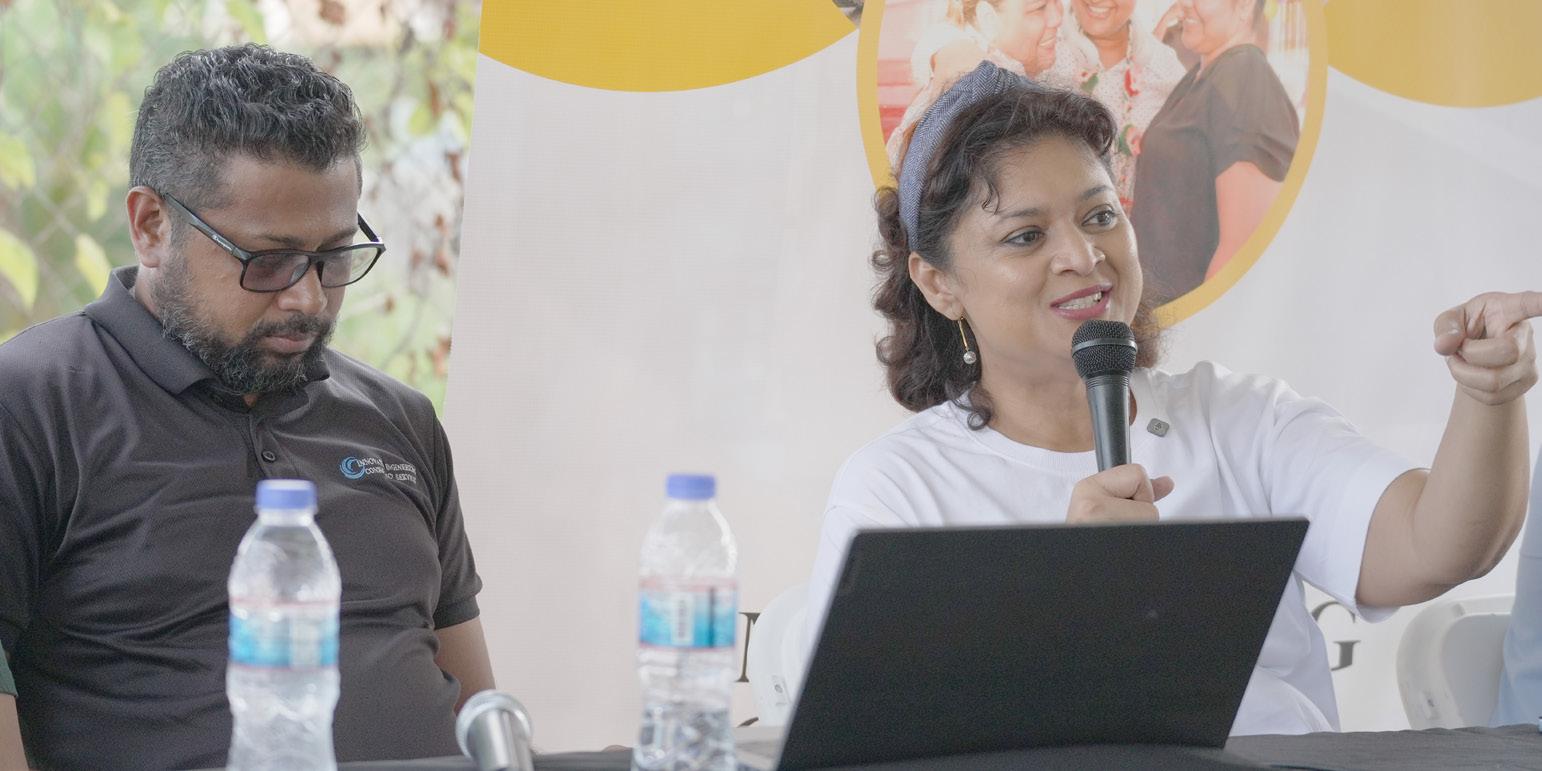
Minister of Local Government and Regional Development Priya Manickchand led the sod-turning ceremony, describing the
comes after a visit she made to the market in February, when she realised the facility had significant potential but was greatly deteriorated.
This assessment, she explained, had the government expand its focus beyond the market itself to include the wider East Ruimveldt community, with the aim of creating an environment that better supports vendors as well as residents and families.
“It was not only coming here because there was a
building has been demolished and will be rebuilt.
The new facility will be accompanied by a football field, basketball court, walking track, improved lighting, widened roads where necessary, additional seating areas and a new bridge serving the market.
Minister Manickchand noted that the development strategy for East Ruimveldt will be used as a model for community development across the country, stating, “It is creating a community for you that we’d like to see

public tender because we have a law, the National Procurement and Tender Administration law, that tells us how we must procure for these markets,” she added, “This market will be built in five lots. You will have five contractors here simultaneously.”
The minister also highlighted the need to better utilise the existing market. While the facility currently contains 213 stalls, only 55 are actively operating, with many others being used for storage or remaining closed.
The reconstruction will add more than 20 additional stalls, while reorganising the layout to create more opportunities for vendors and improving the overall shopping experience.
the stalls are used as a bond or a storage. Forty-seven stalls are closed, and 10 were repossessed. And this is the information we got from your market clerk and the committee in the market.”
Beyond expanded vending space, the upgraded market will include facilities intended to make it a community destination, rather than simply a place to shop. Plans include a dedicated food block, salon and tailoring spaces, a youth tailoring training centre, gathering spaces for activities, and parking for more than 50 vehicles.
band playing,” she continued, “We want to engage and have a space for the community here. There is a salon, tailor shop, a little space for children, a little space for gathering.”
Minister Manickchand said the East Ruimveldt Market is the first of five markets where sod-turning ceremonies will be held over the next two weeks as part of a nationwide programme to rehabilitate public markets.
project as a direct response to concerns raised by vendors during a visit to the market earlier this year.
The project, which is expected to be completed in four months, will modernise the market while complementing a series of works already being undertaken by the Ministry of Public Works, including the desilting of drains, road improvements, the construction of a new bridge, and the rebuilding of the community centre and recreational facilities.
Speaking to market vendors and community members at the event, Manickchand said the project
market here. It is because we are looking at East Ruimveldt as an entire community. What would make it that community that allows us to use this as one of the communities in this country that will join all communities in this country to bring up happy, healthy, wholesome children and adults,” she said.
Since that visit, several projects have either started or entered the planning stage. Minister Manickchand said the Ministry of Public Works has already awarded contracts to clean and desilt every drain and alleyway in East Ruimveldt, while the community
replicated across this country because we believe that you deserve no less.”
The minister further noted that the market design was completed after several rounds of revisions over the past months before being taken through the National Procurement and Tender Administration process.
To reduce construction time, the project was divided into five separate lots, allowing contractors to work simultaneously rather than waiting for one section to be completed before moving to another.
Speaking on the implementation process, she noted, “We had to go to
As Minister Manickchand explained, “ A lot of
Speaking to the vision of the new market, the minister said, “Maybe a mother went into shop, the father could be here with his children, there could be a little
She said the government’s long-term objective is to modernise all markets across Guyana while improving the communities they serve.
As she put it, “You will see this kind of infrastructure going up across the country in markets all over Guyana.”

GUYANA’S sustained investment in education, scholarships and skills training is translating into measurable gains for the country’s young people, with data showing a sharp increase in university graduates alongside a significant decline in the number of youths who are neither studying nor working.
Statistics released by the Bureau of Statistics (BoS) to mark World Population Day 2026 indicate that the number of youths attaining a bachelor’s degree or equivalent qualification increased by 56.7 per cent between the third quarter of 2021 and the fourth quarter of 2024.
At the same time, the proportion of young people classified as not in education, employment or training (NEET) declined from 35.7 per cent in the third quarter of 2021 to 25 per cent by the fourth quarter of 2024.
The figures suggest that more young Guyanese are remaining in school, pursuing higher education or entering the labour market as government investments in human
capital continue to expand.
The data forms part of Guyana’s observance of World Population Day under the theme “Realising the hopes and aspirations of young people – today and for the future.”
GOVERNMENT’S HUMAN CAPITAL AGENDA
In his World Population Day message, Senior Minister in the Office of the President with responsibility for Finance, Dr Ashni Singh, said Guyana’s development strategy is centred on investing in people from infancy through adulthood.
“As Guyana progresses through the ongoing unprecedented transformation, our Government remains steadfast in our commitment to nurturing, enhancing and realising the potential of every Guyanese citizen,” Dr Singh said.
“Our people-centred policy framework is geared towards supporting all Guyanese from infancy through adulthood. By empowering our youths from nursery to

university and into the workforce, we are building the foundations of a sustainable and prosperous ‘One Guyana’,” he added.
According to the minister, those investments begin before birth through expanded maternal and paediatric healthcare, continue throughout the education system and extend into tertiary education, vocational training, entrepreneurship and home ownership.
Central to that strategy is the Government’s policy of providing free education from nursery to university.
Dr Singh said that over the past five years more than 100 new schools have been constructed across Guyana while existing schools have undergone extensive rehabilitation.
He noted that access to learning has also expanded through the Guyana Learning Channel, EdYouFM and the Digital School, helping to make educational resources available to students regardless of where they live.
Financial support for students has likewise increased substantially.
This year, families are receiving $85,000 per child through the combined Because We Care grant and the school uniform and supplies grant, representing a single-year investment of approximately $17 billion in
schoolchildren.
The Government has also maintained the full subsidisation of CSEC and CAPE examination fees for up to eight subjects while expanding the National School Feeding Programme, which now provides daily meals to more than 110,500 nursery and primary school learners.
Together, these interventions are intended to reduce financial barriers that might otherwise prevent children from completing their education.
The data also reflects growing interest in higher education.
According to Dr Singh, applications to the University of Guyana climbed from approximately 17,800 for the 2024/2025 academic year to around 26,000 for the 2025/2026 academic year.
Meanwhile, the Guyana Online Academy of Learning (GOAL) has now awarded more than 54,000 scholarships, allowing Guyanese to pursue certificate, diploma, bachelor’s, master’s and postgraduate programmes through international institutions.
The minister said the Government remains committed to expanding scholarship opportunities and

investing in the country’s academic and professional development.
Beyond traditional academics, Government has increased investment in technical and vocational education to prepare young people for careers in Guyana’s rapidly changing economy.
Dr Singh said more than 2,000 youths have completed specialised training through the Youth Entrepreneurship and Apprenticeship Programme (YEAP).
Another 14,000 young people have benefitted from the Youth Entrepreneurial and Skills Training (YEST) programme administered through the Board of Industrial Training.
Additionally, approximately 2,500 youths have participated in robotics, coding and digital technology training through the Presidential Award for Youth, Entrepreneurship and Robotics (PAYR) initiative.
These programmes are designed to equip young Guyanese with practical skills for careers in construction, engineering, manufacturing, technology and the country’s expanding oil and gas sector.
The Government is also seeking to cultivate a new generation of entrepreneurs.
According to Dr Singh, the Small Business Bureau’s Youth Entrepreneurship Programme has already trained more than 500 secondary school students in entrepreneurship and corporate fundamentals.
Participants can also access grants of up to $400,000 to support viable business ideas.
Looking ahead, he said the soon-to-be-established Guyana Development Bank will further strengthen the entrepreneurial ecosystem by providing accessible and affordable financing to young innovators and small businesses.
Chief Statistician Errol La Cruz said the latest figures demonstrate the value of using labour market data to guide national development.
He noted that the increase in tertiary qualifications and the decline in the number of young people outside education and employment point to positive changes in the country’s human capital profile.
“Those gains demonstrate the importance of using labour-market information to align education, technical and vocational training with the changing needs of the economy,” La Cruz said.
“Reliable data can help ensure that young Guyanese acquire the skills and competencies required to participate meaningfully in both established and emerging areas of economic activity.”
He said official statistics also help policymakers anticipate future demands and identify emerging trends in education, employment and social development.
Dr Singh emphasised that sustained investment in young people remains one of the Government’s foremost priorities, noting that demographic data continues to guide policy decisions across sectors.
“The successful execution of these expansive, cross-sectoral interventions relies entirely on the availability of timely, high-fidelity and reliable demographic data,” he said.
“By systematically investing in our youth and strengthening our statistical architecture, we are securing an inclusive, equitable and sustainable future. Let us continue to work in unison to build a stronger, more resilient and prosperous Guyana for generations to come.”

—says transparent management, expanding production driving
GUYANA is set to become the world’s highest oil producer per capita when crude production surpasses one million barrels per day with the arrival of its fifth floating production, storage and offloading (FPSO) vessel, Minister of Natural Resources Vickram Bharrat has said.
Speaking on the Starting Point podcast on Saturday, Bharrat said the country’s transformation from an oil discovery to a major producer has been unmatched anywhere in the world.
He said, “When I say unprecedented growth, this has never been achieved anywhere in the world. Whether it’s ultra-deep water, whether it’s shallow water, whether it’s onshore exploration production, it has never happened. What took place in Guyana has never happened anywhere in the world.”
The minister noted that Guyana moved from its first oil discovery in May 2015 to first production in December 2019—a timeline he said no
other country has matched.
He explained, “When we [the People’s Progressive Party/Civic] took over government in 2020, I can recall our daily production was 80,000 barrels per day with one FPSO. Today, we are producing more than 900,000 barrels per day with four FPSOs, and one is set to arrive in Guyana shortly, taking us to five FPSOs.”
Bharrat noted that two additional FPSO vessels, the Jaguar and the Essequibo 1899, are currently under construction in Singapore.
He added that once the Errea Wittu FPSO comes on stream later this year or early next year, Guyana’s daily production will exceed one million barrels per day.
“With Errea Wittu coming on stream later this year, early next year, our production would surpass the million barrels, which will make Guyana the highest oil producer in the world per capita. And that’s why I say unprecedented. This has never happened anywhere in
the world.”
According to the minister, the country’s petroleum sector continues to expand, with exploration activities ongoing in the Stabroek Block while new exploration agreements are also being signed for other offshore acreage.
He said, “And while this has been ongoing, exploration continues in the Stabroek Block as well as other blocks. We are signing other agreements with companies, with countries, to continue exploration as well.”
The Stabroek Block, located about 190 kilometres offshore Guyana, spans approximately 26,800 square kilometres and is operated by United States-based ExxonMobil Guyana, which holds a 45 per cent interest, alongside partners United States-based Hess Guyana (30 per cent) and China’s CNOOC Petroleum Guyana (25 per cent).
Since the first discovery in 2015, the block has yielded more than 11 billion

barrels of oil equivalent. It is currently producing about 900,000 barrels of oil per day through four FPSO vessels—Liza Destiny, Liza Unity, Prosperity and ONE GUYANA. Production is expected to exceed one million barrels of oil per day as additional FPSOs come onstream.
Moreover, Minister Bharrat said the Government’s greatest challenge is no longer managing the petroleum sector itself but managing the expectations of Guyanese as the economy continues to expand.
“Yet, the difficulty in the sector is not managing the sector because we’ve been doing quite fine over the last five to six years. The difficulty is managing expectations.”
He maintained that Guyana’s oil sector is among the best-managed of the world’s newest petroleum producers.
“So much so that Guyana’s oil and gas sector is rated as one of the best-managed oil and gas sectors in the world among new oil-producing countries. We have managed the sector well through good, bold, decisive decision-making and leadership.”
Bharrat explained that
Guyana deliberately studied both the successes and failures of other oil-producing nations before developing its own petroleum governance framework.
“I would say that we had a chance to look at mistakes made by other oil-producing countries, look at best practices by other oil-producing countries, and then craft a model that is best suited for us. And I think that has really been beneficial to Guyana,” he noted.
He also defended the Government’s record on transparency, noting that Guyana publicly reports petroleum production, revenues, licences and environmental permits.
Minister Bharrat explained, “In many countries, citizens don’t know what is their daily production. Production licences and environmental permits are not online to be perused. Revenue flowing in from the oil and gas sector is not gazetted and reported in the National Assembly on a quarterly basis, as we do in Guyana. It speaks to transparency and accountability.”
The minister acknowledged criticism from the political opposition but said such scrutiny is common in
every oil-producing nation.
“We don’t expect the politicians of this country to praise the president or the vice president or myself or any other minister. But we expect a fair opposition that will give credit when things are done properly and criticise when things are not done properly.”
Bharrat said the Government remains focused on ensuring that the benefits of the petroleum industry continue to reach ordinary Guyanese through employment, infrastructure development and wider economic growth.
He noted, “When we have 7,000 Guyanese trained and employed in the oil and gas sector, that is 7,000 families putting their hands up and saying, ‘I have benefitted from the oil and gas sector. My husband, my mother, my daughter, my brother, my uncle—they are working in the oil and gas sector.’”
Bharrat said the expansion of Guyana’s real estate, manufacturing, construction, and other sectors is being driven largely by the rapid growth of the oil and gas industry, with the resulting economic gains increasingly benefitting ordinary Guyanese.


GUYANA’S transformation is often measured in billions of dollars, record oil production, massive infrastructure projects, and unprecedented economic growth.
By the end of 2026, the country is expected to produce more than one million barrels of oil per day, while the International Monetary Fund continues to rank Guyana among the fastest-growing economies in the world.
Those are remarkable achievements, but a quieter statistic may prove to be even more important: Guyana is now home to more than one million people, and the majority of them are young.
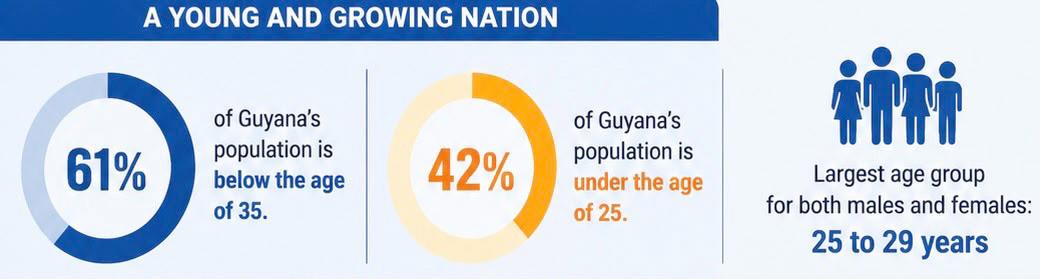
The latest data from the Bureau of Statistics paints the picture of a nation with enormous potential. Sixty-one per cent of the population is under the age of 35, while 42 per cent is younger than 25.
This is a demographic advantage that many developed countries no longer possess. Across Europe, North America and parts of Asia, governments are grappling with ageing populations, shrinking workforces, and declining birth rates. Guyana, by contrast, has something many countries wish they had: A youthful population capable of driving growth for decades to come.
But demographics alone do not guaran-
tee prosperity.
A young population becomes an asset only when it is educated, healthy, skilled, and given opportunities to succeed. Otherwise, what economists describe as a demographic dividend can quickly become a demographic burden.
There are reasons for optimism.
Over the past five years, Guyana has made some of the largest investments in education and youth development in its post-Independence history. New secondary schools are being built across the country. Tuition at the University of Guyana continues to be subsidised, opening the doors of higher education to thousands of students.
Through the GOAL scholarship programme, thousands more Guyanese have been able to pursue tertiary education locally and internationally in disciplines ranging from engineering and medicine to logistics, information technology and business management.
At the same time, investments in Internet connectivity, digital learning and technical and vocational education are helping prepare young people for an economy that is becoming increasingly knowledge-driven.
The labour market is also changing.
Recent labour force data show that youth
MINISTER within the Office of the Prime Minister, Kwame McCoy, participated in the United Nations Global Dialogue on Artificial Intelligence (AI) Governance, held from July 6-7, 2026, while attending the World Summit on the Information Society (WSIS) 2026 Forum.
According to a post on the minister’s Facebook page, the dialogue focused on promoting responsible,
human-centred AI frameworks that protect human rights while advancing sustainable development goals.
The minister said Guyana’s participation reflects the country’s commitment to adopting international standards on AI ethics, transparency and accountability as part of its national digital strategy.
Through engagements with global leaders and policymakers, Guyana
also reinforced its commitment to contributing to the development of international rules governing emerging AI technologies.
The discussions are expected to help inform Guyana’s approach to harnessing artificial intelligence to strengthen governance and drive national development, while ensuring citizens benefit from a fair, secure and inclusive digital future.
unemployment has declined significantly over the past three years as opportunities continue to expand across construction, healthcare, hospitality, agriculture, services, logistics, and the energy sector. More young Guyanese are entering university, learning skilled trades, and launching businesses than ever before.
These are encouraging trends.
But progress should never breed complacency.
Young Guyanese are entering adulthood with expectations unlike any generation before them. They are more connected to the world, more technologically aware, and more ambitious.
They are not simply looking for employment. They want careers. They want innovation. They want financial security. They want the opportunity to own homes, start businesses, raise families, and build fulfilling lives.
Meeting those expectations will require sustained planning.
The country’s development agenda cannot depend solely on oil and gas. While petroleum has transformed Guyana’s economic fortunes, no responsible nation builds its future on a single industry. The government has repeatedly stated that oil revenues are
intended to finance a diversified economy rather than become the economy itself.
That diversification is already taking shape through investments in agriculture, tourism, manufacturing, healthcare, technology, logistics and the Orange Economy. These sectors must continue to grow because they will provide opportunities for generations long after the last barrel of oil has been produced.
Housing, healthcare, education and transportation must also keep pace with population growth. A nation of more than one million people requires more schools, more hospitals, better public transport, reliable utilities and modern communities. Economic growth means little if citizens cannot access quality public services or afford a decent standard of living.
Perhaps the greatest challenge is retaining talent.
For decades, Guyana watched many of its brightest minds leave in search of opportunities abroad.
Today, that trend is beginning to reverse. More Guyanese are returning home, while many young people are choosing to build their futures here, because they see possibilities that did not exist a decade ago.
— marks start of government’s 1,000-head national herd-expansion programme
THE first shipment of 300 pregnant heifers has arrived in Guyana under the government’s national herd-expansion programme, a major initiative aimed at increasing the country’s cattle population and boosting beef and dairy production.
In a statement on Saturday, the Ministry of Agriculture said the animals were imported from Brazil as part of a programme to procure 1,000 pregnant heifers to strengthen the national breeding herd and improve livestock genetics.
The ministry said the cat-
tle successfully completed all veterinary health inspections, testing and quarantine requirements before export and meet Guyana’s animal health import standards.
“The first consignment is currently being transported to the Ministry of Agriculture’s Breeding and Research Centre at Ebini, Berbice River, where the animals will become part of the national breeding programme designed to improve the country’s genetic stock and expand cattle production,” the ministry stated.
The contract was awarded to Brazilian company Coop-
era following a competitive tender process that attracted four bids—one local and three international. The National Procurement and Tender Administration Board approved the award at a cost of G$245,000 per pregnant heifer.
The ministry said the investment will expand local breeding capacity, reduce reliance on imported breeding stock and support Guyana’s food-security agenda.
The remaining 700 heifers are expected to arrive in scheduled shipments until the full complement of 1,000 animals has been delivered.
An op-ed in support of the Guyana SME Development Bank by Chairman, New Hayven Merchant Bank, Floyd N. Haynes
FOR decades, the most familiar story in Guyanese small business has not been one of failure, but of frustration.
A seamstress in Sophia with three steady clients and a waiting list cannot expand because she has no land title to pledge. A young agro-processor in Region Two has the recipes, the labels, and the buyers — but no bank willing to lend GYD 2 million without a cousin’s house as security. A wheelchair-using software developer in Linden builds apps from her bedroom because the cost of a small office is locked behind an interest rate she cannot service.
These are real examples. They are the everyday architecture of exclusion in our financial system, and this is precisely what President Ali’s vision of a Development Bank is designed to dismantle. The new bank will be capitalised at US$200 million, and its core offering will be loans of up to GYD $3 million at zero interest with reduced collateral requirements.
This initiative deserves the full support of the Guyanese public — not as a handout, but as one of the most strategically timed economic interventions of the post-oil era.
The timing could not be better Guyana is in the middle of the fastest economic transformation in the Western Hemisphere. Our GDP grew by more than 43 percent in 2024 and continues to expand at double-digit rates. Roads are being built, ports are being expanded, hotels are rising, and demand for goods and services — from catering to construction supplies to creative content — is multiplying faster than local suppliers can meet it.
The danger in a boom of this size is not that there is too little opportunity. It is that the opportunity flows almost entirely to those already capitalised: large firms, foreign contractors, and established importers. Without deliberate intervention, the small Guyanese entrepreneur becomes a spectator in his/her own country’s prosperity. The SME Development Bank is that deliberate intervention.
What the bank actually changes
Three features make this institution different from anything we have tried before.
First, zero interest. Commercial bank lending rates for small businesses in Guyana have historically sat between 10 and 14 percent. On a GYD $3 million loan, that is roughly GYD $300,000 to $420,000 a year in interest alone — often more than a micro-enterprise’s annual profit. Removing interest does not just lower cost; it changes which businesses are mathematically viable and sustainable.
Second, reduced collateral. The collateral requirement is the single greatest barrier to credit for women, young people, and persons with disabilities — groups statistically less likely to hold titled property in their own names. By relaxing this requirement, the bank effectively unlocks the productive capacity of demographics that the formal financial sector has too often excluded.
Third, targeted inclusion. The explicit emphasis on youth, women, and persons with disabilities is not a symbolic gesture. These three groups together represent the
majority of Guyana’s working-age population, and they are over-represented in the informal economy, where productivity gains are hardest to capture. This strategy moves them out of the informal economy and into the formal economy. Bringing them into the formal credit system is how an economy converts demographic potential into measurable growth.
The wider economic case
There is a temptation, in a country with our oil revenues, to assume that direct cash transfers or large infrastructure projects are sufficient, however on closer observation, the evidence suggests that while these initiatives are necessary they are far from sufficient. Oil revenue is finite, volatile, and concentrated. A diversified small business sector is the only durable insurance policy against the day when oil production slows down.
Every GYD $3 million loan that capitalises an agro-processor in Berbice, a tour operator in Region Nine, or a tailoring shop in Linden does three things simultaneously: it creates jobs that do not depend on the oil sector, it adds to the existing tax base, and it keeps money circulating in Guyanese communities rather than leaking offshore through imports. A US$200 million capitalisation, lent and recycled prudently, can finance tens of thousands of such loans over the life of the institution.
The priority sectors the government has identified — agriculture and agro-processing, tourism and hospitality, services, and creative industries — are also the sectors where Guyana has genuine comparative advantage and where small firms, not multinationals, are the natural unit of production.
The legitimate concerns, and how to address them
No serious supporter of this bank should pretend the risks are zero. Zero-interest lending, if poorly administered, can create dependency, encourage poor lending decisions, or the institution can simply lose money. Reduced collateral, if combined with weak underwriting, can produce default rates that erodes the capital base. In addition, the combination of zero interest and reduced collateral can lead to perverse incentives or what is referred to as the “cobra effect” This is where a well-intentioned reward structure
inadvertently motivates people to act against the system’s actual goals.
The answer is not to abandon the idea. It is to build the bank correctly from day one. That means a governance structure with a clear framework that defines authority, responsibilities, and decision-making processes. It must ensure organisational activities align with objectives while managing risks. It must incorporate the following core pillars:
Transparency: Open, clear, and accurate communication with stakeholders.
Accountability: Answerability at all leadership and operational levels.
Responsibility: Ethical decision-making aligned with the organisation’s goals.
Fairness: Equitable treatment of all stakeholders without bias or conflicts of interest.
The bank should also have - independent and professional credit assessment, transparent published criteria, strict separation between political officeholders and lending decisions, mandatory business training for first-time borrowers, and public quarterly reporting on disbursement, repayment, and sector outcomes. Done well, the Development Bank could be one of the most impactful institutions in the country.
A bank for the Guyana we are becoming
For too long, the question facing the small Guyanese entrepreneur has been: how do I prove I deserve credit? The right question, for a country at this moment in its history, is the reverse: how does the financial system prove it deserves the entrepreneur?
The SME Development Bank is the first serious answer this country has given to that question. It is not a perfect institution, and it will not single-handedly solve poverty or inequality. But it does something rare in public policy — it directs real money, at meaningful scale, at the precise people whose exclusion has held back our economy the longest.
If we get this right, a decade from now we will look back on the establishment of this bank: as the moment Guyana decided that prosperity would be built from the bottom up, not handed down from the top.
It deserves our support. More importantly, it deserves our vigilance — so that it lives up to its promise.

ONE of the most accepted perspectives about humans has a long tradition in human society.
It is called the role of the individual in history. In Western countries, and in non-Western countries where European colonialism dominated, philosophy is said to have begun with Socrates.
Long before as an individual, Socrates changed the course of Athenian society, there were Eastern countries that addressed the role of the individual in history. Today, all countries accept that there could come into being one person who can bring about phenomenal changes or singlehandedly can destroy a nation.
The modern philosophical treatise on how the individual can shape the dialectic while the dialectic can shape him/her is the post-war, French philosopher, Jean Paul Sartre. Sartre’s profound philosophy text, “Critique of Dialectical of Reason”, is the best guide as to how the individual can emerge in circumstances and singlehandedly change the direction of those circumstances. Hazel Barnes, in 1964, translated Sartre’s book and renamed it “The Problem of Method”, but still, this is a very difficult book to read. One of the persons I met who mastered that book was Rupert Roopnaraine.
There can be no doubt that throughout history, the individual comes alone and in the interaction with the dialectic either sets history backwards or moves history forward, but there is little room for doubt among scholars and historians about the power of the individual to rise above the ordinary and change a country for better or worse.
The historical record is replete with
By Vanessa Cort
examples. No doubt Guyanese students are familiar with Julius Caesar. In the modern world, there is the legacy of Vladimir Lenin in Russia, Mikhail Gorbachev in Russia, Hitler in Germany and Henry Kissinger in the US. Nelson Mandela in South Africa, Fidel Castro in Cuba. When we come to the present day, there is Modi in India and Trump in the US. It doesn’t matter if you like them or not, they shaped the dialectics of their country one way or the other.
The integration process in the Caribbean cries out for the personality that Jean Paul Sartre wrote about. CARICOM is more than 50 years old and there isn’t anything stellar, encouraging or optimistic about CARICOM. It simply limps along and it showcases, as it limps along, the deep chagrin about integration that lives within the soul of every Caribbean citizen.
Patrick Manning, the then Prime Minister of Trinidad, looked set to bring to the Caribbean the role of the individual in history. He announced what became known as the Manning Initiative, whereby Trinidad and Barbados would enjoy a meaningful integration. But Manning, though willing, did not possess the leadership qualities to make him transform the Caribbean.
He succumbed to political banality and became intoxicated with the wealth of Trinidad and used it profligately like spending 300 million American dollars to host the Summit of the Americas, money that could have been spent on regional integration. CARICOM is waiting for the individual that Sartre wrote about. CARICOM is waiting for the emergence of the human that rises above the ordinary and changed the course of history.

Only two leaders in CARICOM today possess the willingness to shape the dialectic – Mia Mottley and Irfaan Ali. I think Mottley hasn’t got the latitude to do it. Barbados’s economy does not allow Mottley do it. I believe she wants to. She is eager to make CARICOM a nation of one, but the space in Barbados is not there.
The only other person that is likely to bring out the phenomenal role of the individual in history is Irfaan Ali of Guyana. Guyana is an oil-rich economy. Resources could be used to harness integration. President Ali only has four more years in the seat of power. If he is going to be known for decades to come as the man who made CARICOM come alive, as the man who brought integration into the homes of each Caribbean citizen, he has to start now.
There are some directions that he must walk in. One is the complete abolition of visas for any CARICOM citizen to be in
Guyana. CARICOM citizens in Guyana should not have to visit an immigration officer every 90 days. Secondly, Guyana must allow the free movement into Guyana of CARICOM citizens.
Thirdly, on a yearly basis, he should allow the presence of a small number of CARICOM public officials to work in Guyana. They will receive their home salary but will be given a meaningful allowance and housing facilities while living in Guyana. It doesn’t have to be on a reciprocal basis. Fourthly, twice a year, President Ali should have a tete- a-tete with two CARICOM heads inside Guyana as a confidence-building measure towards deeper integration. Go for it, Mr. President! History beckons!
DISCLAIMER: The views and opinions expressed in this column are solely those of the author and do not necessarily reflect the official policy or position of the Guyana National Newspapers Limited.
AS in the rest of the world, there is growing concern in Guyana over the way in which synthetic drugs seem to be replacing traditional illicit narcotics.
Compounding this issue is the fact that some of these drugs are designed to mimic the effects of natural substances like cannabis or cocaine, while being produced in underground laboratories.
The drugs are constantly altered to avoid detection by law enforcement and these changes also mean that their exact composition and their ingredients are often unknown.
The Global Coalition to Address Synthetic Drug Threats (GCASDT), launched three years ago, has stated that, “Illicitly manufactured synthetic drugs such as fentanyl, tramadol, methamphetamine, Captagon, MDMA, and ketamine threaten the health, security and well-being of people around the world”.
The coalition is committed to several strategies for combating the flow of these drugs, including the all-important sharing of information on new threats as they emerge, rather than trying to stop them when they have already reached communities.
Given the fast- spreading nature of ‘synthetics’, countries like ours would benefit greatly from information on new drugs, whose production is outpacing the ability of the law to recognise and ban them.
We also need to heed the call for the global community to combine its efforts to “prevent the production and trafficking of illicit synthetic drugs, identify emerging drug trends and use patterns and respond to their public health impacts”.
While some of the drugs on the GCASDT list may still be unfamiliar here, methamphetamine/MDMA, popularly known as Molly and Ecstasy are here and their use is on the rise. They are generally favoured by our young people and,
known as ‘party drugs’, they tend to be used in social settings when our youth get together to enjoy themselves. Many are oblivious of the devastating physical and psychological effects of these substances, considering them harmless.
But the rapid emergence of psychoactive substances such as these has led to an international drug crisis.
Traffickers are expanding shipment routes; manufacturers are getting more creative with finding new ingredients and criminals are constantly looking for weak spots in the system.
According to UN News, “More people are using drugs than ever before...exposing vulnerable communities to greater health risks”.
And Monica Juma, Executive Director of the UN Office on Drugs and Crime (UNODC), said in a report last month, “We have seen an unprecedented spike in new types of drugs on the market, and worryingly some are more potent or dangerous than before”.
The Organisation also reiterated that harm associated with drug use is shaped by poverty, homelessness, poor mental health and unequal access to health in addition to the effects of the drugs themselves.
Women, in particular, are said to,”...remain significantly less likely than men to receive treatment despite progressing more rapidly to drug dependence”. And globally, only one in 23 women with drug use disorders receives treatment as compared to one in 9 men.
Here, the issue of rehabilitation and its effectiveness arise, with the National Institute on Drug Abuse (NIDA) in the US assuring that addiction is treatable, helping addicts to manage the condition.
Treatment at rehabilitation facilities has been shown to help people stop using drugs and resume productive lives. It is therefore an essential part of any programme directed at countering the harmful effects of substance abuse.
Three years ago, Minister of Health, Dr Frank Anthony,

announced plans to expand substance abuse services. He acknowledged,
“We don’t have adequate ‘rehab’ facilities...we don’t have enough specialists”.
One year later, he stated the government’s intention to pay more attention to substance abuse in its National Mental Health Action Plan and National Suicide Prevention Plan, targeting the years 2024 to 2030.
Dr Anthony further said that the Ministry was offering help to those struggling with substance abuse at about ten clinics around the country, while supporting the two major non-governmental organisations - The Phoenix Recovery Project and the Salvation Army Men’s Rehab Centre - which provide rehab services.
The Health Minister nonetheless signalled hopes of finding other partners to tackle substance abuse.
And given the widening drug problem, with the influx of synthetic substances, there certainly is a need for more agencies - both governmental and non-governmental - to become involved in providing facilities for those battling substance abuse.
DISCLAIMER: The views and opinions expressed in this column are solely those of the author and do not necessarily reflect the official policy or position of the Guyana National Newspapers Limited.
I AM not in the least surprised that Azruddin Mohamed, kitted out with a teleprompter, tape measure and a pocket calculator, would attempt to conjure up a scandal over a farm belonging to President Irfaan Ali. For all his theatrics, the only skill Azruddin has convincingly displayed is a basic grasp of arithmetic.
In his so-called expose released a week ago, Azruddin is tall on accusations and short on evidence. He alleges corruption but has offered the citizens of Guyana zero evidence. Like Naipaul’s Mr Biswas gazing at other people’s houses, the apparent size of the president’s farm is enough to provoke Azruddin’s indignation. For a man who profited from decades of a gold-smuggling network inherited from his father, the Soesdyke farm at Long Creek, falsely measured by the clearance acreage, dares to scream corruption at the highest level of government.
If the president truly intended to siphon off a share of the country’s oil wealth for himself, Arya, and his sons, investing it in a farm along the Soesdyke highway would make him remarkably foolish. Where, precisely, is the profit in that? Nor is there any evidence to suggest that little Zayd’s fondness for rescuing animals means his future is in agriculture.
Farming is back-breaking work. It requires attention from dawn to dusk with little profit to show at the end of the harvest. Haven’t you noticed that the government has had to provide financial relief to rice farmers, sugar estates, and fisherfolks to the tune of billions of dollars a year?
If Azruddin were to tell me that the president’s farm sits on an aquifer the size of the Ogallala, he might get my attention. President Ali must know that Brazilian banks are foreclosing on a record-breaking number of farms, according to a recent Reuters report.
Thousands of US farmers are walking away from their land, largely due to climate change, supply chain challenges and profitability.
Consider this: In every major speech over the last three years, President Ali has consistently emphasised food security. He reinforced that commitment in his 2025 book, Achieving Global Food Security: The Caribbean Experience and Beyond.
Kaieteur News, hardly a sympathetic voice, acknowledged that the book “offers new and credible insights on the Caribbean food security crisis.” Even the defunct Stabroek News published Dr Bertrand Ramcharan’s review, who said the book “deserves wide attention” and that it should inform CARICOM-wide discussion.
From where I sit, the farm fits squarely within the president’s vision and is proof of his passion for agriculture. It offers the country tangible evidence that, unlike so many political leaders, President Ali is willing to shoulder the risk that comes with a modern farm and lead from the front rather than simply instruct others to do so.
If we are to embrace Azruddin’s aggressive inquiry, where every asset, acre and head of cattle is to be itemised and interrogated, then consistency demands a wider lens.
On November 30, 2012, masked gunmen dressed as police officers raided the fishing boat “Summer Bliss” at the Willemstad port in Curaçao. The hijackers pistol-whipped its 51-year-old Guyanese captain and made off with 70 unmarked gold bars weighing 216 kg (476 lbs), valued at approximately US$13M.
The Curaçao authorities eventually arrested the bandits and retrieved the gold. The incident received widespread national and international media coverage and was dubbed the “Heist of Curaçao.”

So let us ask Azruddin and Nazar “Shell” Mohamed, plainly:
Were the 70 gold bars aboard the Summer Bliss the property of the Mohameds? No evasion, yes or no.
Guyanese authorities estimated that approximately GY$1 million in taxes was avoided when this single shipment of unmarked gold bars bypassed official channels.
Citing an American dossier, the Curaçao Chronicle reported at the time that the shipment reflected 15 years of illicit gold cargo movement, often about the same or higher volume, that occurred weekly between Guyana and Curaçao.
It is entirely appropriate in any democracy to ask a sitting president to account for his assets. It is equally necessary that those making the loudest accusations account for their own financial histories, especially where they intersect with incidents of international concern.
That history is no longer confined to regional reporting or archival suspicion. United States authorities have now moved beyond in-
ference to indictment, naming Nazar “Shell” and Azruddin Mohamed in connection with gold smuggling, sanctions evasion, and the movement of illicit proceeds through international financial systems.
The significance of legal action cannot situate what was once treated locally as rumour within a formal evidentiary framework tested by one of the most aggressive financial enforcement regimes in the world.
In that context, the questions surrounding Curaçao, unmarked gold, and long-running trade routes are not speculative diversions; they are part of a continuum now under active international scrutiny.
And no amount of chicanery by Azruddin and his sister will induce U.S. law enforcement to trade a live investigation into a gold smuggling operation for a manufactured scandal about a farm.
DISCLAIMER: The views and opinions expressed in this column are solely those of the author and do not necessarily reflect the official policy or position of the Guyana National Newspapers Limited.
Understanding the supply chain: The first step to finding opportunity in Guyana’s Energy Industry
WHEN most people think about Guyana’s oil and gas industry, they picture supply vessels, drilling operations and large vessels in the ocean. And while these are essential parts of the industry, they are only one piece of a much bigger picture. Behind every offshore operation is a vast network of people and businesses providing the goods and services needed to keep the industry running safely and efficiently. Together, this network is known as the supply chain. In simple terms, the supply chain is the system of people, businesses, products and services that support an industry from start to finish. In the energy sector, it includes far more than engineering and drilling. Every offshore project also depends on logistics, transportation, warehousing, catering, health and safety services, equipment maintenance, environmental support, information technology, accounting, legal services, communications and many other professional services. Understanding this is important because opportunities in the energy sector are often much broader than people realise. A company does not necessarily have to provide
specialised oilfield services to contribute to the industry. Many local businesses already possess valuable skills and expertise that can support offshore operations—they simply need to understand where they fit within the wider supply chain.
As Guyana’s energy sector continues to grow, so too will the range of goods and services required to support it. Exploration, construction, production and maintenance each create different business needs, meaning opportunities will continue to evolve as the industry matures. Businesses that understand these changing requirements will be better positioned to identify where they can add value.
However, understanding where your business fits is only the beginning. Companies seeking to participate must also be prepared to meet the industry’s expectations. The energy sector places a strong emphasis on safety, quality, reliability and efficiency. Depending on the service being offered, this may involve strengthening business systems, investing in workforce training, improving health and safety practices, obtaining relevant certifications or developing the capacity to deliver
consistently.
Preparation should begin well before an opportunity becomes available. Waiting until a procurement notice is published may leave businesses without the time needed to meet industry requirements. Instead, companies can use the period before opportunities arise to strengthen their operations, build their capabilities and better understand how procurement processes work.
Fortunately, Guyanese businesses do not have to navigate this journey alone. The Centre for Local Business Development (CLBD) offers supplier-readiness programmes, business advisory services and oil and gas training designed to help local companies better understand industry requirements and improve their competitiveness. These programmes can help businesses identify gaps, strengthen their operations and prepare for future opportunities.
Businesses should also take advantage of supplier engagement opportunities hosted throughout the year. Vendor forums, procurement workshops and supplier outreach sessions organised by companies such as ExxonMobil Guyana, SBM Offshore Guyana, MODEC and other industry stakeholders
provide valuable insights into procurement processes, upcoming business needs and supplier expectations. These engagements allow businesses to ask questions, better understand industry standards, the range of procurement opportunities available and position themselves for future participation.
Guyana’s energy industry is creating opportunities across a wide range of sectors, but success begins with understanding how the industry works. The supply chain demonstrates that oil and gas is supported not only by offshore operations, but also by hundreds of businesses working onshore every day. By taking the time to understand where they fit, strengthening their capabilities and making use of the training and supplier development resources available, Guyanese businesses can be better prepared to compete and contribute as the country’s energy sector continues to evolve.
DISCLAIMER: The views and opinions expressed in this column are solely those of the author and do not necessarily reflect the official policy or position of the Guyana National Newspapers Limited.
POLITICS is at its best when it is a contest of ideas. It is at its worst when it descends into manufactured controversy designed to distract the public from the real issues that affect their daily lives.
The recent criticism directed at President, Dr Mohamed Irfaan Ali over his private farm falls squarely into the latter category.
To hear the opposition tell the story, one would believe that Guyanese have uncovered some hidden secret. The truth is far less sensational.
President Ali’s interest in agriculture is neither new nor surprising. Throughout his public life, he has consistently promoted agriculture as a pillar of Guyana’s economic diversification, food security, and regional leadership. His engagement with farmers, agricultural projects, and rural communities has been visible for years.
A private farm owned by a President who has repeatedly championed agriculture should not be treated as evidence of wrongdoing simply because political opponents decide it is convenient to make it so.
The People’s Progressive Party/Civic has long placed agriculture at the centre of national development.
Since returning to office in 2020, the government has allocated billions of dollars towards drainage and irrigation, farm-to-market roads, support for rice, livestock, aquaculture, corn and soya production, and incentives for farmers across Guyana. Those investments are reflected in successive national budgets and in projects across the country’s agricultural regions.
These are not campaign slogans. They are public policies backed by public expenditure.
The real question, therefore, is why a farm has suddenly become the centrepiece of opposition politics.
Instead of debating agricultural productivity, food security, export opportunities, or improving farmers’ incomes, the opposition has chosen to pursue insinuation over substance. It is easier to manufacture headlines than to produce credible policy alternatives.
The President has repeatedly subjected himself and his administration to public scrutiny through parliamentary oversight, budget debates, procurement processes, and constitutional institutions.
Transparency should remain a continuing obligation of every public office holder, and where legitimate questions arise, they should be answered with facts rather than political theatre.
That same standard should apply to everyone seeking public office.
Azruddin Mohamed has become a prominent political figure while also being associated with significant legal and regulatory matters that have received international attention.
The United States government-imposed sanctions on Mr. Mohamed, his father, and businesses linked to the family in 2024. Those sanctions and related legal proceedings are matters of public record. Mohamed has denied wrongdoing, and various legal proceedings remain ongoing. Those matters should be resolved through the appropriate legal processes, not through trial by politics.
Likewise, public discussion surrounding statements made by members of the Mohamed family towards the President deserves careful scrutiny, where those statements are documented and reported. Political disagreements should never descend into intimidation, personal attacks, or rhetoric that undermines democratic discourse.
Guyana benefits when disagreements are settled through debate, elections, and the rule of law, not through escalation.
What is troubling is the eagerness of sections of the opposition to seize upon every allegation, rumour, or social media controversy involving the government, while remaining comparatively silent on difficult questions concerning their own allies. Accountability cannot be selective. If transparency is demanded of the government, then transparency should also be expected of those who seek to replace it.
The country’s development agenda is extensive. Guyana continues to invest in roads, bridges, hospitals, schools, housing, energy,

agriculture, and economic diversification. Citizens are entitled to debate whether these programmes are effective, whether they deliver value for money, and how they can be improved. Those are meaningful political discussions.
Turning a President’s farm into a national scandal without credible evidence of misconduct is not.
The Guyanese people are capable of distinguishing between legitimate scrutiny and manufactured controversy. They understand that politics often becomes louder as elections approach. They also understand the difference between evidence and speculation.
The opposition has every right to question the government. That is an essential feature of democracy. But those questions should be grounded in verifiable facts, not assumptions designed to create suspicion.
Similarly, the government should continue to embrace transparency, respond to legitimate public concerns, and demonstrate that its policies are producing tangible benefits for ordinary Guyanese. Confidence in public institutions grows when accountability is consistent, regardless of political affiliation.
As this debate continues, there are several questions that deserve thoughtful answers from Mohamed and the opposition:
1. Given the ongoing public attention sur-
rounding international sanctions and legal proceedings involving you, how do you intend to reassure Guyanese that you meet the standards of transparency and accountability expected of national leaders?
2. What specific policies would you implement to strengthen Guyana’s agricultural sector beyond criticising the government’s approach?
3. If you argue that transparency should apply to everyone in public life, what additional disclosures or accountability measures would you support for all political leaders, including yourself?
Guyana deserves a political culture focused on competing visions for development rather than perpetual controversy. Agriculture remains too important to become another casualty of partisan politics.
The country’s farmers need investment, infrastructure, technology, markets, and leadership, not distractions.
The measure of leadership should ultimately be found not in political spectacle but in results. On that score, Guyanese will judge every political leader, government and opposition alike by the evidence before them.
DISCLAIMER: The views and opinions expressed in this column are solely those of the author and do not necessarily reflect the official policy or position of the Guyana National Newspapers Limited.
— small miners laud President after talks –– miners to get greater access to capital
SMALL-SCALE miners are expected to benefit from expanded access to financing and greater participation in Guyana’s proposed Development Bank, following discussions between President, Dr. Irfaan Ali and a delegation from the Small Miners Association Guyana Inc. (SMAGI).
The delegation, led by SMAGI President David Daniels, met with the Head of State on Friday to discuss issues affecting the mining sector, with a particular focus on financing, land access and continued support for small and medium-scale operators.
Speaking after the meeting, SMAGI director, Adonika Spellen described the
engagement as productive, saying the President addressed several of the association’s concerns.
“We had a very positive meeting with the President, and he addressed several of our concerns,” Spellen said.
She noted that one of the association’s key priorities was ensuring that small miners have a voice and stake in the proposed Development Bank.
“We wanted to ensure that miners would have a say or stake in the Development Bank and he [President Ali] has assured us that he’s going to prioritise small miners as it relates to getting access to the grant, so that we could form consortiums to support more livelihoods in the industry,”
she explained.
Joseph Daniels, a member of the association and a life-long participant in the mining sector, said the organisation remains committed to helping miners achieve long-term success.
Originally from Bartica, Daniels said mining has been part of his family’s livelihood for generations.
“Our organisation focuses on helping miners to achieve their dreams, whether that’s gaining access to mining lands, clarifying policies or supporting lawful mining practices. These are the initiatives that drive our organisation and help miners meet their goals,” he said.
Another member of the association credited the
government with creating greater opportunities for small miners, particularly through improved access to mining lands.
He said support from the Ministry of Natural Resources and the current administration has enabled more miners to own claims and share opportunities with others entering the industry.
Miner Derrick Kissoon, who has spent 15 years in the sector, also welcomed the outcome of the discussions.
“I see the outlook as better. We received a lot of positive feedback. The President is on board with small miners, and I think the future looks good,” Kissoon said.
Meanwhile, SMAGI President David Daniels
said the association’s objective is to ensure small and medium-scale miners continue progressing and building sustainable livelihoods.
“We want the small and medium-scale miners to keep transitioning upwards so that they continue creating generational wealth for their families, while developing their communities at the same time,” he said.
Daniels noted that President Ali has consistently demonstrated a willingness to engage with the association and respond to issues affecting miners.
“Every time we continue to meet President Ali, we continue to see more incentives for the mining industry,” he said.
Among the measures highlighted were duty-free concessions on mining machinery, all-terrain vehicles (ATVs), fuel and parts,
which he said have helped reduce operating costs for miners.
Daniels also emphasised the association’s desire to ensure the benefits of the sector are more widely shared.
“We want the industry to be one that is not exclusive to some but is for all miners. Over the years, we saw the industry was somewhat exclusive, but with our constant engagement with President Ali, we have seen it opening up so that more benefits trickle down to every single miner,” he said.
The meeting formed part of the government’s ongoing engagement with stakeholders in Guyana’s mining sector as it seeks to strengthen the industry’s contribution to economic growth, while expanding opportunities for small and medium-scale operators.
JUST weeks after committing to address residents’ concerns about deteriorating roads, Minister of Housing, Collin Croal, on Saturday, returned to the New LBI Housing Development on the East Coast of Demerara to inspect the progress of a major road rehabilitation programme now underway.
The follow-up visit comes after the minister met with residents on June 16, during which concerns were raised over the poor condition of roads throughout the
developing housing scheme.
At the time, he assured residents that urgent intervention would be undertaken to improve access within the community.
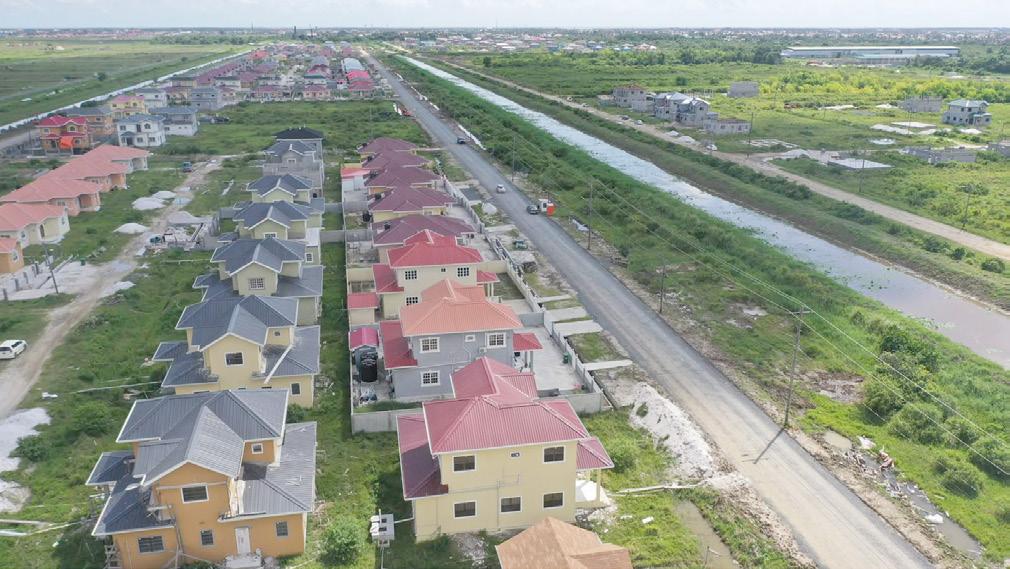
Speaking during Saturday’s inspection, Minister Croal said the government is already delivering on that commitment, with approximately $1 billion in infrastructural works currently in progress across the western section of the development.
“We are here at LBI as a follow-up to a commitment we made to residents who
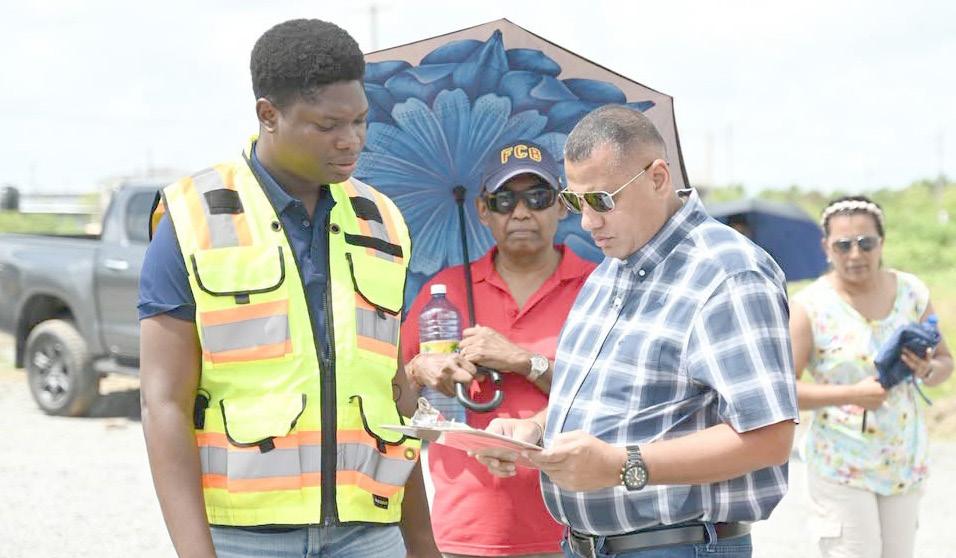
had complained about the condition of the roads,” Croal said.
He explained that the New LBI Housing Development is one of the government’s major housing projects and is expected to extend all the way to Aubrey Barker Road.
“This is one of our major housing developments that will extend all the way to Aubrey Barker Road. On the western portion alone, we committed $1 billion in infrastructure works, and those works have already com -
menced,” the minister said.
Croal disclosed that 23 contractors are currently engaged in executing the road works, while contracts for the construction of the internal cross streets are in the final stages of being awarded.
“The cross streets will be constructed in concrete, and works are expected to commence within the next two weeks,” he added.
The minister also underscored the importance of protecting the substantial public investment, noting that the movement of heavily loaded
trucks has already posed a challenge to road infrastructure in the area.
“Now that we are constructing these roads, another issue has emerged— the reckless use of the roads by heavy-duty trucks.
Once the roads are completed, we will implement measures and restrictions to safeguard the integrity of the infrastructure. We will work with the relevant authorities to ensure these investments are protected for the benefit of all residents,” Croal said.
According to the Central Housing and Planning Authority (CH&PA), residents welcomed the minister’s return to the community and expressed appreciation that work had commenced shortly after the issues were raised.
Many residents noted that the ongoing improvements have already made a noticeable difference to accessibility within the scheme and said they are looking forward to the completion of the infrastructure project.
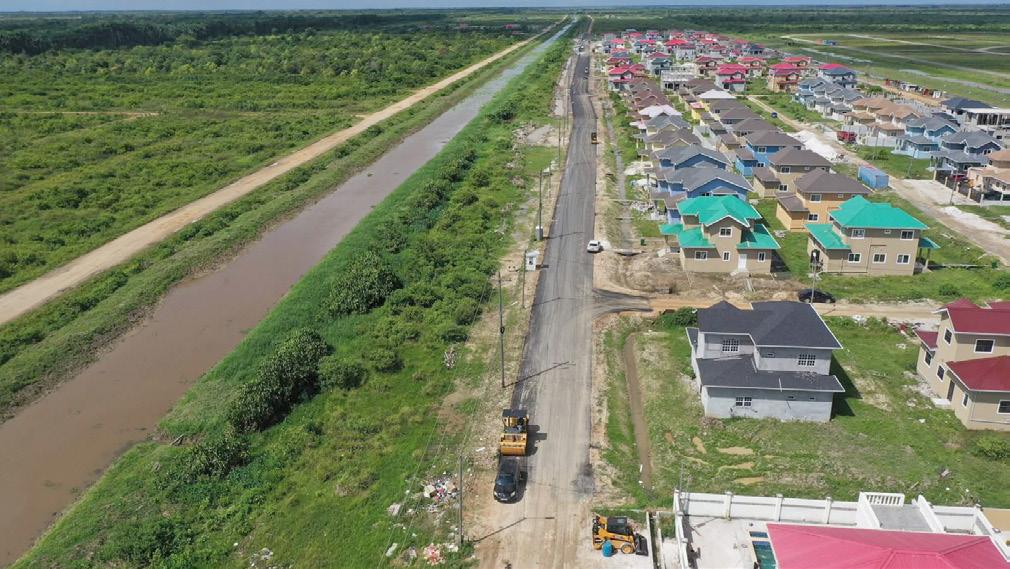
GUYANA’S estimated population has surpassed the one-million mark for the first time, reflecting the country’s continued demographic growth and underscoring the need for sustained investment in housing, healthcare, education and employment opportunities.
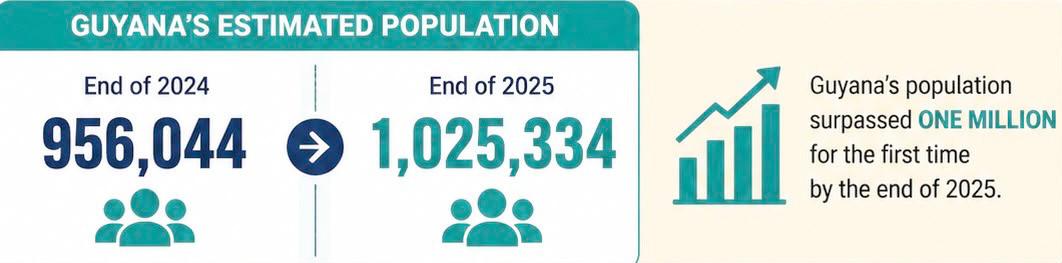
According to the Bureau of Statistics, Guyana’s estimated population reached 1,025,334 by the end of 2025, up from 956,044 at the end of 2024. The figures were released on Friday as part of the country’s observance of World Population Day 2026.
In his World Population Day message, Chief Statistician Errol La Cruz said the latest estimates highlight Guyana’s evolving demographic landscape and reinforce the importance of reliable population data in guiding national
development.
“Official statistics provide an objective foundation for measuring progress and improving the well-being of our young people, whose aspirations will shape the future of Guyana,” La Cruz said.
The Bureau noted thAt Guyana has experienced steady population growth over the past decade. The 2022 Population and Housing Census recorded a 17.63 per cent increase over the 2012 Census, with a population of 878,674.
The latest estimates also point to the country’s youthful population. At the end of 2025, 61 per cent of Guyana’s population was below the age of 35, while 42 per cent was under the age of 25. The largest age group for both males and females was those between 25 and 29 years.
According to the Bureau, this demographic profile pres-
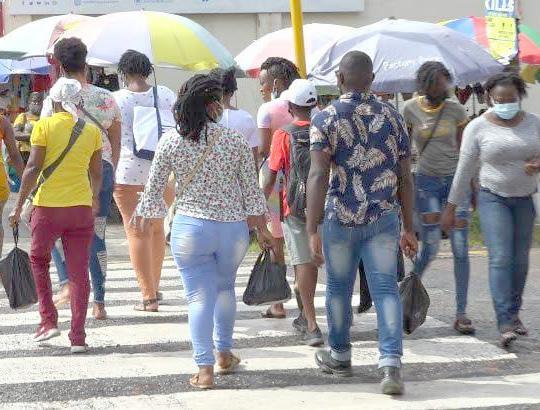
According to the Bureau of Statistics, Guyana’s estimated population reached 1,025,334 by the end of 2025, up from 956,044 at the end of 2024
ents significant opportunities to expand the workforce, strengthen innovation and accelerate economic and social development. However, it also increases demand for essential
services, including housing, healthcare, education, transportation and employment.
The Chief Statistician said recent labour force data reflects encouraging progress,
with overall unemployment declining from 14.5 per cent in the third quarter of 2021 to 6.8 per cent in the fourth quarter of 2024. Youth unemployment also fell sharply during the same period, dropping from 31.9 per cent to 12.1 per cent.
La Cruz emphasised that timely, reliable and accurate official statistics remain critical to evidence-based policymaking, enabling the government to anticipate future needs, identify emerging trends and ensure resources are directed where they are needed most.
“As we commemorate World Population Day, I encourage all stakeholders to continue supporting the production and use of quality data, recognising that every statistic contributes to a deeper understanding of our population and a stronger foundation for Guyana’s sustainable develop-
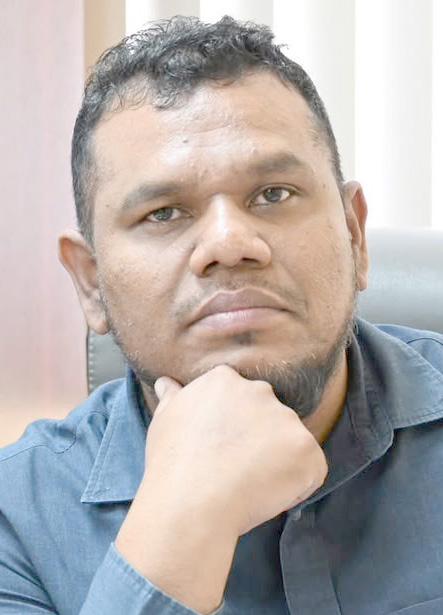
ment,” he said.
World Population Day is observed annually on July 11 to raise awareness of global population issues. This year’s theme is “Realising the hopes and aspirations of young people – today and for the future.”

By Indrawattie Natram
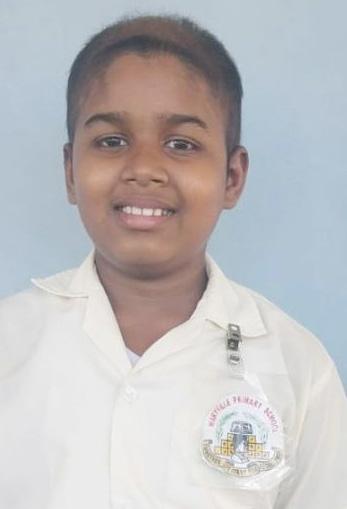
FOR eleven-year-old Kaydon Josiah Mal, the 2026 National Grade Six Assessment (NGSA) was much more than an examination. It became a powerful testament to courage, resilience and an unbreakable bond between a father and son.
For months leading up to the examinations, Kaydon made countless sacrifices in pursuit of his dreams.
He gave up his free time, rarely watched television, stayed away from his phone and spent very little time playing with friends. His days were filled with school and extra lessons. Leaving home early each morning, he would often return at around 17:30 hours, only to eat dinner and head out again for classes.
But nothing could have prepared him for the heartbreak that awaited him on the eve of his exams.
On April 28, 2026, just hours before he was due to sit the most important examinations of his young life, Kaydon lost his father Floyd Mal due to a car collision. The devastating news came early the next morning as he woke at 05:00 hours to begin his final revision.
In one of the most difficult moments of their lives, two of Kaydon’s mentors, Sir Martin Samaroo and Sir Justie Ramdass, stepped forward to support the grieving family.

Josiah Mal and his later father Floyd Mal
Arriving at their home at dawn, they gently broke the heartbreaking news to the young pupil and offered prayers and words of encouragement.
Despite the overwhelming grief, they urged Kaydon to find the strength to sit his examinations.
His mother Sherika Mal recalls the emotional days that followed.
“Honestly, my son and I were both nervous, but before the results came out, I assured him that no matter what the outcome was, I was already extremely proud of him simply for showing up and writing those exams.”
When the results portal finally opened, she entered her son’s information with trembling hands. Seconds felt like hours as the page loaded.
“When I saw his marks and the school he was awarded, I broke down in tears—tears of both joy and sadness. This is more than exam results. It is proof of his courage and determination. He is a strong and brave child, and I could not be prouder of him.”
Kaydon’s hard work earned him a place at Anna Regina Multilateral School, the very institution his father had attended years earlier.
His father often reminded him that one day he, too, would walk the halls of Anna Regina Multilateral, affectionately encouraging his beloved son—whom he lovingly called “Lovebird”—to make the family proud.
Although his father is no longer here to celebrate this milestone, Kaydon’s mother believes his spirit lives on through his son’s achievement.
“This accomplishment is dedicated to his father because he was determined to write those exams to make him proud. It hurts that he is not here with us today, but I know he is looking down on his Lovebird.”
Now preparing for the next chapter of his life at Anna Regina Multilateral School, Kaydon has already set his sights on an even bigger dream: becoming a doctor. His teachers, especially Sir Martin Samaroo, have long encouraged him, often saying with confidence, “Dr. Mal in the making.”
For Kaydon Josiah Mal, the road to success has been marked by sacrifice and unimaginable loss. Yet, through courage, determination, and the love of those around him, he has proven that even in life’s darkest moments, hope can still shine brightly.

By Indrawattie Natram
JUST months after undergoing brain surgery and enduring extensive cancer treatment, young Revaldo Komal Singh of La Bagatelle, Leguan, Essequibo Islands, has achieved a
remarkable milestone that is inspiring many across Guyana.
When the results of the 2026 National Grade Six Assessment (NGSA) were announced on Friday, one message stood out among the countless congratulatory
notes. It came from Revaldo’s mother, Lalita Singh, bearing news that filled hearts with joy. Against tremendous odds, the young man sat the examination and earned 380.15 marks, successfully passing all of his subjects
with an overall pass rate of 78 per cent.
For many students, preparing for the NGSA is challenging enough. For Revaldo, however, the journey to the examination room was unlike any other.
His health struggles be-


gan in 2024, forcing him to miss an entire year of school after doctors advised that it was unsafe for him to attend classes. During that time, he underwent brain surgery, attended countless hospital appointments, completed 30 sessions of radiation therapy, and endured four cycles of chemotherapy.
Although he has made tremendous progress, Revaldo has not yet fully recovered and still has a small fraction of soft tissue remaining in his brain from the tumour.
The second of four children born to Lalita and Ricardo Singh, Revaldo never allowed his illness to extinguish his determination to learn.
After months of treatment, he returned to school last September. While he did not attend extra lessons, his teachers worked closely with him, and his mother spent countless hours helping him revise at home.
Speaking about her son’s accomplishment, an emotional Lalita said she could not hold back her tears when she saw his results.
“I am so proud of my child’s achievement despite all his challenges,” she said.
Reflecting on the difficult road her family has travelled, Lalita added, “I cried because, a year ago, I didn’t know if my baby would live to sit his exam.”
Despite the physical
and emotional toll of his treatment, Revaldo never gave up. His determination to continue his education remained unwavering throughout his battle.
Those who have followed his story over the past two years have witnessed his transformation from a young patient fighting for his life into a resilient learner celebrating academic success.
Revaldo’s achievement is a testament to his courage, perseverance, and the incredible strength he displayed throughout one of the most difficult periods of his life.
As family, friends, teachers, and supporters celebrate this remarkable accomplishment, his story serves as a powerful reminder that setbacks do not have to define one’s future and that some of life’s greatest victories emerge from life’s toughest battles.

By Feona Morrison
GUYANA’S continued economic transformation will depend not only on increased production but also on the development of a strong regional logistics network capable of moving goods efficiently across the Caribbean and beyond.
This is according to the Chairman of the Guyana Shipping Association (GSA) and Chief Executive Officer (CEO) of GAICO Construction and General Services, Komal Singh.
Speaking during an interview on the Guyana Dialogue on infrastructure and development, Singh argued that roads, ports, bridges and other major infrastructure projects are closely linked to the country’s long-term economic success and competitiveness.
“Guyana’s economic development can only be sustained if we build a strong regional logistics network that allows us to efficiently move our goods across the Caribbean and beyond,” Singh said. He noted that strengthening logistics is especially important as Caribbean countries continue to advance regional food
security initiatives. He stated: “The regional food security that has been pushed among member states currently—it is important for that to move through in order to make sure that we have continuity on a strong supply chain, given all the challenges that we’re seeing around the world.”
Singh pointed to the anticipated completion of the gas-to-energy project, stating it is expected to boost Guyana’s manufacturing capacity.
Singh said that with the gas-to-energy project expected to be completed by the end of this year or next year, Guyana’s manufacturing sector is expected to grow to meet and exceed domestic demand while supporting the region’s food security efforts. However, he warned that without a proper logistics network to move goods across the region in a timely, efficient and economical manner, the country could face a bottleneck where it produces more goods than it can competitively deliver to nearby markets. He said discussions over the past year among Caribbean leaders have reflected the growing recognition of
the need to improve regional transportation and logistics.
“So, over the last year, I would say, we have heard President Dr Irfaan Ali working closely with other regional heads of state to develop a strong network to move our goods around the region.”
Singh also referenced plans for an international airport in Lethem, which he said would improve the movement of products from southern Guyana directly into Caribbean markets.
“We’ve also heard President Ali allude to development of an international airport in Lethem, allowing us to move product from that part of the region straight to the Caribbean region.”
At the same time, he pointed to the ongoing investment in port infrastructure across Guyana as another important component of the country’s logistics strategy.
“You’ve also seen locally the amount of money that is being spent on developing ports across this country, not in just one single area.”
According to Singh, these investments are intended to decentralise trade by allowing goods to be shipped from locations closer to their des-
tination markets rather than routing everything through Georgetown.
“The importance of all of that infrastructure development is to set our network in such a way that we don’t need to move goods or produce from Parika all the way into Georgetown to have it shipped back into Trinidad when Parika is closest to Trinidad and to some part of the other region.”
He stressed that failing to establish these transportation networks now could undermine the country’s future economic potential.
“The importance of these developments is critical to the sustainable growth of our economy. If we don’t do that now and we don’t build out and spend money on that infrastructure, we can run into a situation where we’re producing excess capacity of goods, but we cannot get it to the markets at a competitive price,” he said.
Singh urged citizens to appreciate the broader role infrastructure plays in creating economic opportunities.
“So, I would say to everybody, you need to understand the importance of infrastructure and how that is related to economic opportunities and economic growth
of a country.”
Beyond facilitating trade, Singh said infrastructural projects also significantly improve the movement of people and increase productivity by reducing travel times.
He noted that several new highways have substantially shortened journeys that once took hours.
Singh added, “Most of the highways that have been constructed across our country currently, when you look at the amount of time that we used to traverse to get from point A to point B, some of those times moved from, like, two or three hours to an hour, or less than an hour in some cases.”
The reduction in travel time, he said, translates into measurable economic benefits.
“When you take demand power lost, if someone has to sit in a line for a day, spending two to three hours, and you put a value to that loss, it’s very significant, and persons now can utilise that time to do more valuable things for themselves and their families.”
Singh also highlighted the impact that major infrastructural projects have on surrounding communities,
particularly through rising property values.
He commended the Government’s approach to planning infrastructural projects, describing them as strategically designed to support multiple areas of development.
The Chairman stated, “This infrastructure development that has been taking place is very strategic. We must commend the government when you really look at some of these infrastructures, if not all the major infrastructure that has been built out. The government is very strategic in how they develop this area.”
“It caters for the environment, it caters for the people, it caters for an industrial commercial development.”
Singh said the economic impact can be seen in land values along new transportation corridors.
“Property value automatically goes up, and the equity value of the community automatically goes up. There is a real benefit also, even to persons who are not doing anything.
By just the development alone, it creates a value increase to property within those areas.”
By Feona Morrison
GHANA-based Cybele Energy Limited has until the end of July to pay its outstanding US$17 million signing bonus for Guyana’s S7 shallow-water petroleum block or risk losing its Petroleum Sharing Agreement (PSA), Minister of Natural Resources, Vickram Bharrat has warned.
Speaking on the Starting Point podcast on Saturday, Bharrat said the Government is prepared to suspend or cancel the agreement if the company fails to meet its contractual obligations by the deadline.
He revealed that Government lawyers are already engaging Cybele’s legal representatives in an effort to ensure compliance with the terms of the agreement.
“What we would have done is to get our legal folks, the legal firm representing us, to engage them and their legal team. So, right now, our legal team is basically in contact with them to ensure that they are in compliance with the agreement. Otherwise,
we will have no other choice than to suspend or to cancel that agreement.”
Cybele, the first African company to be awarded an offshore petroleum block in Guyana, secured the S7 shallow-water block during last year’s competitive licensing round. Under the agreement, the company is required to pay a US$17 million signing bonus.
Bharrat said the company had informed the Government that payment was delayed because of difficulties involving one of its investors.
“They would have indicated to us that they’re having a few issues with their investor, but they’ve also indicated recently that they are signing a new agreement. I believe that, maybe as we speak, that agreement is being signed with another investor, and that they will be in a position to pay the signing bonus.”
According to the minister, the company requested an additional two to three weeks to complete the transaction. However, he stressed that the extension is not open-ended.
“…the ending of July will be the absolute cutoff date.”
Bharrat said the Government agreed to grant additional time because Cybele Energy has already demonstrated a commitment to establishing operations in Guyana.
He noted that the company has opened a local office, employed several Guyanese—including a young Guyanese woman as its country manager—and paid more than US$2 million in licence fees and other statutory charges.
“They’ve already paid over US$2 million in licence fees and other fees that are required of all oil companies that sign agreements with us.”
The minister said those investments, coupled with the Government’s desire to maintain investor confidence, influenced the decision to show some flexibility.
“Government, in a sense, [is] being a bit lenient because of these factors and because we want to show investors’ confidence too in government and in Guyana.”
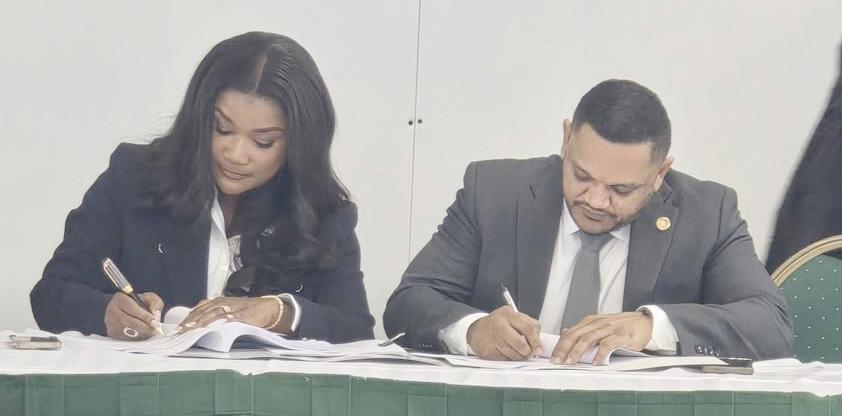
“And because of that, some amount of leniency, I must say, would have been given to them.”
Bharrat nevertheless emphasised that the Government expects all petroleum companies to honour the commitments contained in their agreements and made it clear that the matter will not be allowed to remain unresolved beyond the endof-July deadline.
A consortium led by TotalEnergies, and comprising QatarEnergy and Petronas, has already paid its US$15 million signing bonus for the S4 shallow-water block.
According to the minister, the consortium has
commenced seismic surveys using specialised vessels that collect geological data beneath the seabed to determine whether hydrocarbons are present.
Bharrat explained that once the seismic data is analysed and favourable indications of hydrocarbons are identified, the company can determine where to drill exploration wells before eventually seeking approval for appraisal drilling and, potentially, production.
He said the availability of a specialised seismic vessel in Guyanese waters is particularly significant because only a limited number of such vessels operate globally.
Once TotalEnergies completes its work, the vessel is expected to undertake the Government’s multiclient 3D seismic survey programme covering other offshore blocks that may be offered in future licensing rounds.
“We are pretty confident that once this data is analysed and they show good signs of hydrocarbon, then they will move to the exploration programme, where they’ll start the exploration wells.”
Bharrat said the petroleum agreement governing the blocks provides significantly greater benefit for Guyana than previous agreements. He noted that it includes a 10 per cent royalty, a 10 per cent corporate tax and a reduced cost recovery ceiling, while maintaining a 50-50 profit-sharing arrangement between the Government and contractors.
He said these terms represent a marked improvement over those contained in the widely criticised Stabroek Block PSA, which was signed by the former A Partnership for National Unity and Alliance For Change (APNU+AFC) coalition government.
FOR Claudius Baird, becoming an attorney is not the destination—it is the first step towards a much bigger dream.
The young legal scholar is preparing to travel to The Bahamas later this year to attend the Eugene Dupuch Law School, where he will complete the professional training required to practise law. However, financial constraints threaten to delay that journey, prompting him to seek public support to help fund his studies.
Baird, who was born in Linden, Region Ten, spent part of his childhood in St Lucia before returning to Guyana on his own to pursue a law degree. His ultimate ambition is to one day serve as a judge at the Caribbean Court of Justice (CCJ), the region’s highest court.
“I want to be a judge,
so I’m just passing through the lawyer field for now,” he said.
Outside of academics, Baird describes himself as a devoted Christian who enjoys hiking, swimming, watching movies, acting and debating.
His passion for law, he recalled, was evident from an early age, particularly through his love of debate.
He laughed as he recounted advice from his mother, who once told him: “Claudius, not everything is a debate. Some things you just need to hear and say okay and let it go.”
She later recognised that his argumentative nature would eventually guide him towards a career where questioning and reasoning are essential.
Throughout secondary school, teachers also encour-

Legal scholar Claudius Baird is seeking public support to help fund his legal training at the Eugene Dupuch Law School in The Bahamas
aged his strengths. An English teacher challenged him to write argumentative essays to develop his ability to present logical, well-supported
arguments, while studies at the University of Guyana further refined those skills.
Returning to Guyana to pursue his legal education meant leaving his parents behind in St Lucia and making several personal and financial sacrifices.
“You really couldn’t buy everything you’d want to buy because school fees had to be paid,” he said.
Despite the challenges, Baird said he never lost sight of his goal.
He admitted that the transition into university was not always easy, particularly during his second semester when he questioned whether he could continue.
“I could remember thinking, ‘Am I able to continue this?” he recalled.
His parents encouraged him to persevere, reminding him that worthwhile goals
require hard work and determination.
“They were like, ‘At the end of the day, you chose it and nothing in life is going to come easy just because you like it. There are certain things that you have to work very hard to achieve.’”
Encouraged by their advice, Baird pressed on and successfully completed his legal studies.
Although he hopes to become a judge, he has developed a keen interest in criminal and company law.
“I love the business aspect and how companies draft different contracts to secure themselves and, by extension, secure others who are coming into business with them,” he said.
His desire to serve on the bench stems from a belief that meaningful change comes through justice.
He believes many of the challenges facing his hometown of Linden and Guyana as a whole require people who are prepared to serve with fairness and integrity.
For now, his immediate focus is reaching The Bahamas to complete the final stage of his legal training.
Baird is appealing to members of the public for assistance through his GoFundMe campaign, “Support Claudius’ Final Step to Becoming a Lawyer,” or through Mobile Money Guyana (MMG) at 684-0845.
Expressing gratitude to those who have already supported him, he said every contribution, whether financial or by sharing his story, brings him closer to achieving his dream.
“I do appreciate their support and it’s not going to be wasted,” Baird said.
– US developer advances major Ogle and Diamond communities as demand for modern housing grows
TWO major United Statesbacked housing developments valued at more than US$500 million have entered the vertical construction phase, marking another milestone in Guyana’s rapidly expanding real estate sector as the country’s economic transformation continues to attract international investment.
According to a press release issued by developer Coastal Rim Properties Inc. (CRP), construction is progressing steadily on the TAJ Dream Ogle and TAJ Diamond developments, which together will deliver more than 1,200 residential units near Georgetown.
The company said the projects represent the largest private residential investments undertaken in Guyana to date.
CRP, a US-based developer with more than five decades of experience and a portfolio of over 6,000 residential units, is undertaking the developments in partnership with NBA Hall of Famer, Hakeem Olajuwon. The projects are being led by principals Nicola and
Giovanni Mola.
At the flagship TAJ Dream Ogle development, which will comprise more than 1,000 condominium units, approximately 70 per cent of the road corridor infrastructure has been completed, while surveying and elevation works are about 85 per cent finished.
The company said drainage trenches along the northern and southern boundaries have been fully backfilled, and installation of a storm-water drainage system using large-diameter HDPE pipes is now underway.
Supporting infrastructure has also advanced, with the two-storey site office and conference facility nearing completion and the steel framework for the storage and logistics building already erected. Meanwhile, construction at the TAJ Diamond development is also progressing. The 218-home community has entered its vertical construction stage, with steel columns and beams installed on the first 15 houses.
Foundation and slab works are ongoing across the site, while underground
plumbing and masonry work have commenced on several units.
According to CRP, both developments are being constructed using US-manufactured, climate-treated structural steel designed to withstand Guyana’s coastal environment. The company added that daily safety briefings and engineering inspections are being conducted at both construction sites.
TAJ Dream Ogle is strategically located along the Ogle corridor, within minutes of the Eugene F. Correia International Airport, ExxonMobil Guyana’s headquarters, MovieTowne and Giftland Mall.
Upon completion, the mixed-use development will include residential condominiums, a walkable retail town square and a branded five-star hotel with a hospitality training institute. The developer expects the first residential buildings and initial retail phase to be completed by the spring of 2027.
Commenting on the progress, principal Nicola Mola said construction continues to gather momentum.
“Every week on site tells
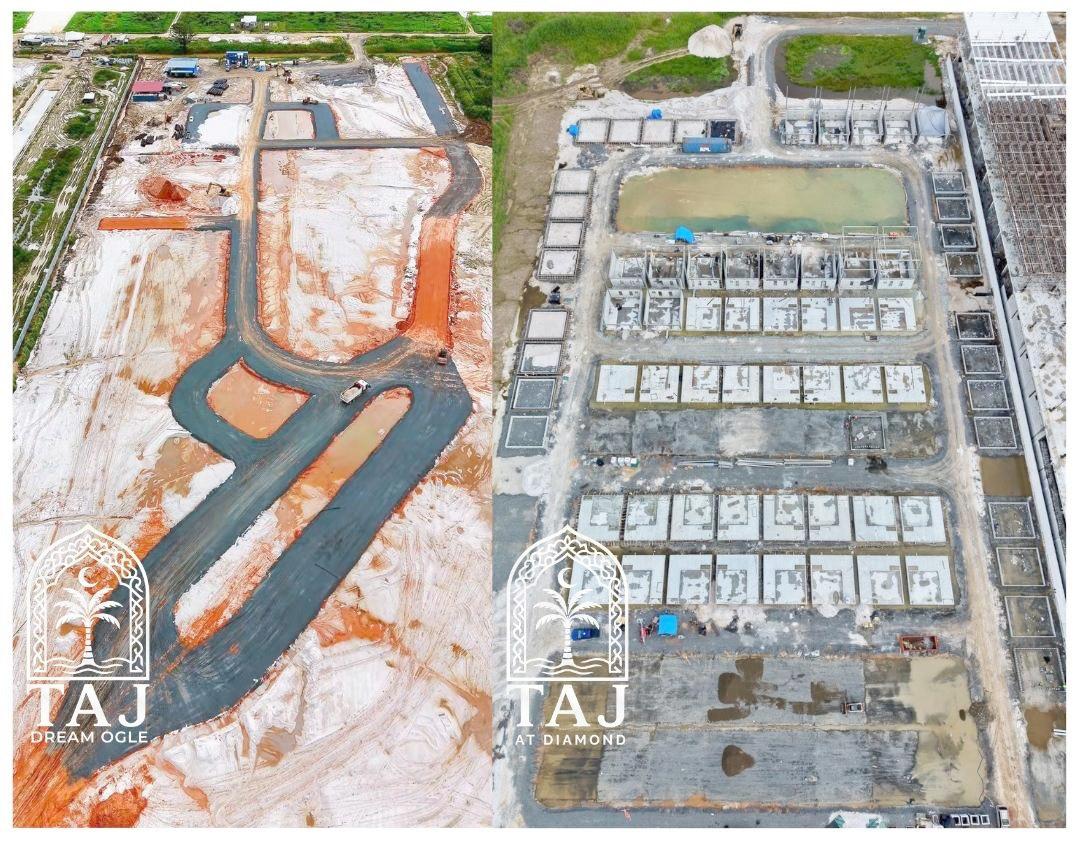
Coastal Rim Properties Inc. (CRP) construction is progressing steadily on the TAJ Dream Ogle and TAJ Diamond developments, which together will deliver more than 1,200 residential units near Georgetown
the same story. Momentum. What began as a vision for a new standard of living in Guyana is now rising out of the ground. We built these communities to international standards because Guyanese families, and the diaspora who have invested their belief in this country, deserve
nothing less,” Mola said.
Guyana’s booming economy, driven by offshore oil production since 2019, has fuelled unprecedented growth in the country’s construction, hospitality and real estate sectors, with both local and international developers investing heavily
to meet increasing demand for housing and commercial infrastructure.
CRP, which primarily operates across the western United States and Hawaii, said the Guyana developments mark the company’s first ground-up residential communities in the country.




SOUTH AFRICA
RACING TIPS
GREYVILLE
08:25 hrs Last Magarita
09:00 hrs The Gliding Fish
09:35 hrs Blazing Fury
10:10 hrs Billy Cool
10:45 hrs Winter Blessing
ENGLISH RACING TIPS
PERTH
09:06 hrs Holy Joe
09:41 hrs Conquer The Breeze
10:16 hrs Atlantic City
10:51 hrs Bleu D’ Enfer
11:26 hrs Lowlands
12:05 hrs Lucky In Taipan
STRATFORD
08:50 hrs Tiny Riot
09:25 hrs Son If Tyran
10:00 hrs Laffer Curve
10:35 hrs Gambino
11:10 hrs Person Of Interest
11:45 hrs Edelak
12:20 hrs Miss Kassiopi
IRISH RACING TIPS
DUNDALK
09:00 hrs The Highway Rat
09:35 hrs Iff In Doubt
10:10 hrs Outlaw Man
10:45 hrs Bella Colombia
11:20 hrs Celtic Druid
11:55 hrs Reynir
12:30 hrs Duvessa

ST JOHN’S, Antigua, (CMC) – Defending champions Barbados, Trinidad and Tobago and the Leeward Islands began this year’s Rising Stars Men’s Under-19 50-over Championship with victories here on Saturday.
While Barbados and the Leeward Islands romped to comfortable wins over the Windward Islands and Jamaica respectively, T&T were made to fight before getting over Guyana.
At Liberta Sports Club: Trinidad and Tobago overcame a woeful batting performance to register an impressive 24-run victory over Guyana.
After being sent in, T&T could only muster 167 in 40.3 overs, thanks mainly to a fighting half century by Christian Lall.
Daron Dhanraj, Amrit Pittiman and Daniel Holder then grabbed three wickets apiece to bowl out Guyana for 143 in 34.3 overs.
T&T actually got off to a decent start with the bat, with Christiano Ramanan scoring 33 and Tariq Richards 31, to propel their side to 73 for two in the 17th over.
However, Romario Ramdehol and Dhanesh Persaud shared four wickets between them to spark a middle order collapse that saw T&T crumble to 94 for six.
They were saved by a 62-run partnership between Lall and Renaldo Fournillier, who scored 19, which carried them to 156 for six.
When Joshua Budram struck to remove Fournillier and Lall was dismissed for 53 off 70 balls, T&T suffered another slide that saw them lose their last four wickets for 11 runs in the space of four overs.
Budram wrapped up the tail to finish with 4-9, Ramdehol took 2-21, Micah Amsterdam 2-35 and Persaud 2-44.
Guyana lost openers Khush Seegobin and Parmeshwar Ram in the space of three balls to slip to 10 for two, before Shamar Apple and Yannick Newton put on 46 runs for the third wicket.
But Guyana’s innings unraveled once New-
ton was bowled by Holder for 23, with Apple being dismissed for 28 shortly afterwards, while Adrian Hetmyer made just seven, to see them slump to 72 for five in the 14th over.
Ramdehol tried his best to revive the innings in his unbeaten knock of 41 off 82 balls, but he got little other support.
Dhanraj was the pick of T&T’s bowlers with 3-20, Pittiman claimed 3-44 and Holder 3-46.
At Coolidge Cricket Ground: Half centuries from opener Tanez Francis and captain Matthew Miller carried Leeward Islands to a comprehensive 120-run win over Jamaica.
Francis topscored with 82 off 98 balls, inclusive of 11 boundaries, while Miller hit 72 off 78 balls, with four fours and three sixes, to propel their side to a formidable 275 for seven in their 50 overs after electing to bat first.
Jamaica never mounted a serious challenge to the total in their run chase and were eventually dismissed for 155 in 35.5 overs.
The Leeward Islands were given a solid start, with Francis and Amoree Jones posting a 68-run opening stand.
When Alixandre Elliot struck to claim the wicket of Jones for 20, the Leeward Islands wobbled briefly to find themselves 80 for three.
Francis and his skipper came to their side’s rescue during a 106-run partnership that put them in the ascendancy at 186 for three in the 38th over.
Jamaica fought back by dismissing both batters in quick succession to reduce their opponents to 209 for five, but Lawshorn Bergan and Rondre Daniel both scored 28 runs to anchor the innings and get the Leeward Islands to their eventual total.
Geovanni Grey mopped up the tail to claim 4-44, while Elliot took 3-40.
Jamaica never recovered from a horrible start that saw them lose their top four batsmen with only 58 runs on the board.
CRICKET QUIZ CORNER (Sunday July 12, 2026)
CUMMINGS ELECTRICAL COMPANY LTD-83 Garnett Street, Georgetown (Tel:225-6158)
Answers to yesterday’s quiz:
(1) Shai Hope & Justin Greaves (2) 5 centuries
Today’s Quiz:
(1) How many Test hundreds Justin Greaves has now scored?
(2) Which 3 WI bowlers conceded the exact number of runs in SL first innings of the recent second Test? Answers in tomorrow’s issue
Ryan Lyttleton, who scored an unbeaten 59 off 69 balls and Demarco Scott, who made 15, tried to revive the innings in a 44-run partnership for the fifth wicket.
However, once Scott was run out, Jamaica lost five wickets for 27 runs to collapse to 129 for nine to effectively end the contest.
For Jamaica, Jathan Edward took 3-37, Miller returned to snare 2-12, and Kunal Tilokani finished with 2-33.
At Bethesda Sports Ground: Barbados produced a record-breaking batting performance on their way to thrashing the Windward Islands by 119 runs.
Jordan Graham, Kemar Dixon and Gadson Bowens all scored half centuries, while R’Jai Gittens smashed 49 off just 16 balls, to see the defending cham-
pions post a mammoth 392 for nine in their 50 overs, the highest-ever total in the tournament’s history.
The Windward Islands did make a contest of their chase, but lost wickets at key intervals to eventually finish on 273 for seven in 50 overs.
Barbados actually got off to a wretched start, losing opener Damarko Wiggins in the second over of the match with just three runs on the board.
What followed thereafter, however, was a sensational showing by the remaining batters.
Bowens and Graham shared a 135-run partnership for the second wicket in only 12 overs, that saw Barbados motor to 138 for one at the start of the 14th over.
Pacer Kevin Joseph broke the stand by bowling Bowens for 62 off 40 balls, comprising eight fours and three sixes, and he also trapped Graham lbw after he had scored 76 from just 43 balls and struck 11 boundaries and three sixes, to leave Barbados 151 for three at the end of the 16th over.
Kelani Clarke and Kemari Dixon then added 78 runs for the fourth wicket to maintain the momentum before Clarke was dismissed for 37.
The Windwards looked to have brought themselves back in the match when the dismissal of Justin Parris left Barbados 239 for five after 34 overs.
But Dixon, who made 67 off 73 balls, along with some remarkable power hitting by the lower order left their opponents stunned.
Gittens smashed five fours and four sixes in his stunning knock at number nine and Raphael Lovell scored an unbeaten 31 off 29 balls, to help Barbados pummel 153 runs from the remaining 16 overs, including 85 off the last five.
Their total surpassed the previous highest total of 374 for six, which ironically was scored by Windward Islands against Barbados in the 2014-2015 season.
Aiden Burton ended with 3-36, while Kevin Joseph took 2-51 for the Windwards.
Captain and opener Theo Edwards then slammed 92 off 77 balls, with 15 fours and three sixes, and together with Burton, kept the Windward Islands in the hunt at 161 for two in the 27th over.
Any hope of pulling off an unlikely victory was erased when left-arm pacer Raphael Lovell trapped Burton lbw for 47 to end their 139-run partnership.
His dismissal saw Edward, Johnathan Daniel and Zach Thomas all losing their wickets without the addition of a run, leaving them in tatters at 162 for six.
Tyler Venner stroked an unbeaten 71 off 62 balls to ensure the Windward Islands were not bowled out with the outcome already decided.
For Barbados, Rajeev Parsooram took 3-46 and Jahidi Hinds 2-63.
AFGHANISTAN’S women’s refugee team are set to have their funding extended.
Last year, the cricket boards in England, Australia and India, plus the International Cricket Council (ICC), announced a combined programme to support the players who were exiled after the Taliban returned to power in 2021.
Sources have told BBC Sport the task force responsible for the matter met during the governing body’s annual conference in Edinburgh and recommended that the project continue.
Outgoing ICC deputy chair Imran Khwaja will now formally present that recommendation at the board meeting on Saturday.
Officials from the England and Wales Cricket Board (ECB), Cricket Australia (CA) and the Board of Control for Cricket in India (BCCI) have all backed the proposal and it would be a major surprise if the ICC board do not sign it off.
The three boards are also keen for the ICC to play a more substantial role in the project moving forward with a share of the funding and resources.
Since settling in Australia, where they now live and train, Afghanistan’s women players have repeatedly called on the ICC to recognise them once again as an international team and commit to long-term funding.
They are currently on a tour of the UK


and last month called on the ICC to give them a “clear answer” on what their future looks like.
An exact timeframe for how long the funding will exist will be discussed at the board meeting, but it is understood there could be a commitment up until 2032.
What is currently less clear is what the roadmap looks like for their prospects of playing official internationals.
BBC Sport understands a formal paper prepared by Clare Connor, chair of the ICC Women’s Cricket Committee, will also be submitted to the ICC board for consideration.
That paper includes a proposal that the governing body permit the team to play official international cricket.
However, the issue is an extremely complex and sensitive one for the ICC to navigate, so a clear decision might not be quite so straightforward.
The ICC understandably has a duty of care to officials of the Afghanistan Cricket Board who are accountable to the Taliban.
Equally, there are also some concerns of what the long-term implications could mean
for men’s cricket in Afghanistan.
Nevertheless, the fact that the issue of official matches has been brought to the table at board level is seen as a significant moment and would provide a basis for further conversations.
Afghanistan’s women met with ICC president Jay Shah and fellow ICC officials at Lord’s before the Women’s T20 World Cup final on 5 July and a number of key speeches were said to be well received by influential figures present.
The ICC has also been quietly strengthening the structure around the project.
Last month the ICC’s executive committee agreed to add a dedicated female representative to the task force -- which had been largely made up of men -- for consultation on key decisions.
Additionally, they agreed that Pitch Our Future, an Australian campaign that raises funds and support for the displaced Afghan women’s cricket team, will be consulted during future task force meetings to ensure the voices of the players were adequately represented.
FORMER England captain Heather Knight has announced her retirement from international cricket.
Knight, 35, joins batter Tammy Beaumont in stepping down from England duty at the end of the ongoing Test match against India at Lord’s.
The batter finishes with 320 international appearances, which is an England women’s record, and led her country to a famous World Cup win at Lord’s in 2017, having replaced the legendary Charlotte Edwards as captain in the previous year.
Having made her debut in 2010, Knight led England in 199 matches, a nine-year tenure which came to an end

Heather Knight scored her most recent century against India at the 2025 World Cup.
after the heavy Ashes defeat in 2025.
“I’m extremely grateful and privileged to have gone on the journey that I have
been on as an England cricketer,” said Knight.
“It’s hard to walk away because the dressing room and the people in the dressing room have been a constant in my life for 16 years, and the memories and the experiences and the people have helped shape me become who I am today, but I’m really content with this decision and I’m really excited for what’s next.
“Growing up as a little girl from Devon and playing with the boys, I never thought I’d get to experience this. It feels right to leave the game with this historic Test at Lord’s. It’s been an amazing 16 years, and I feel so lucky.”(BBC Sport).
CZECH youngster Linda Noskova recovered from missing five championship points to beat her friend Karolina Muchova and win an extraordinary and dramatic Wimbledon final.
Noskova looked on course for a routine victory when she led 6-2 5-2 - but crumbled with the finishing line in sight as 10th seed Muchova won five games in a row to force a decider.
However, the 21-year-old showed remarkable resilience to reset and finally clinch a 6-2 5-7 6-3 victory.
“It feels incredible. Physically and mentally it has been tough - it is never easy to get the last point,” said Noskova.
Speaking to Muchova, she added: “You made it so tough for me. I’m glad I played my first major final with you and I think we made history today.”
Noskova paid tribute to her family in her on-court speech afterwards - including her mother, Ivana, who died on the eve of Wimbledon two years ago.
“I want to thank my dad for coming here, for my family flying here - I know you don’t like flying so I appreciate it,” she said as she teared up.
“There is one more person I’d like to

thank. I’d like to thank my mum. I wouldn’t be here without her.”
Noskova then blew a kiss to sky as the Centre Court crowd gave her a standing ovation.
Noskova’s second-set collapse was excruciating to watch for the 15,000-strong crowd on Centre Court, but the way in which she mentally reset in the decider was
ENGLAND stand one win from their first men’s World Cup final since 1966 as Jude Bellingham’s brilliant two-goal display inspired them to come from behind to beat Norway after extra time in Miami.
Thomas Tuchel’s side rode their luck in a quarter-final played in fierce heat and humidity, but Bellingham was once again the talisman to send England into the last four, where they will play either Argentina or Switzerland - which will be shown live on the BBC.
In a tight, tense encounter, Norway went ahead after 36 minutes when Andreas Schjelderup’s dipping effort deceived England goalkeeper Jordan Pickford to fly in.
England needed an instant response, with Bellingham inevitably providing it in firsthalf stoppage time when he took Anthony Gordon’s pass perfectly in his stride to beat Norway keeper Orjan Nyland.
Tuchel was forced into half-time changes, replacing the influential Declan Rice, who has been struggling with illness and injury, as well as Noni Madueke, sending on Eberechi Eze and Bukayo Saka.
Norway threatened after the break, seeing a goal by Torbjorn Heggem ruled out for Erling Haaland’s needless shove on Elliot Anderson, while David Moller Wolfe headed against the bar.
Haaland was subdued and eventually substituted at the break in extra time, with Bellingham having already stepped up again three minutes into the added period, pouncing after Nyland could only push out a shot from substitute Morgan Rogers.
England now go into their third World Cup semi-final since they lifted the Jules Rimet trophy 60 years ago, hoping they can change their fortunes after losses to West Germany in 1990 and Croatia in 2018.

England’s Jude Bellingham celebrates scoring his team’s second goal.(AFP)
England were unable to repeat the heroics of their magnificent last-16 victory against Mexico in Azteca Stadium, perhaps understandably looking jaded after their exertions there, followed by these stifling conditions in Miami.
Where there is Bellingham, however, there is hope - and once again the Real Madrid star provided the moments that define and decide big games.
Bellingham’s reaction after showing superb technique to equalise three minutes into first-half stoppage time was remarkable, simply turning and running back to the centre circle in businesslike fashion before whipping up England’s fans.
England suffered in the sweltering second-half conditions as both teams tired, but it was Bellingham again who made the decisive contribution, reacting first to Nyland’s slip to settle a game of fine margins.
It takes Bellingham’s tally to six goals at the World Cup as he continues on what almost looks like a personal mission to bring glory to England
admirable.
Serving for the title again an hour after her first attempt, Noskova hit an ace to set up a sixth championship point and converted it with a service winner.
Noskova immediately fell to the court as her relief poured out, with 29-year-old Muchova walking around the net to congratulate her Paris 2024 Olympics doubles partner.
“It’s really tough to find any words, but I’ll start with Linda - my ex-friend,” joked Muchova.
“The way you handled it and the way you played was unbelievable. You deserve it.”
Noskova hid under her towel towards the end of the second set and did the same again in the moments after securing a testing victory.
The ninth seed is the third Czech champion in the past four years at the All England Club, after victories for compatriots Marketa Vondrousova and Barbora Krejcikova in 2023 and 2024 respectively.
Fittingly, Noskova’s crowning glory watched by Czech-born Martina Navratilova - a nine-time singles champion - and one of her idols Petra Kvitova, who won in 2011 and 2014.
As well as lifting the iconic Venus Rosewater Dish, Noskova will receive £3.6m in prize money and move up to a new career-high ranking of seventh in the world.
One of the latest of a long line of Czech talents, Noskova had been tipped as a future star who could challenge for Grand Slam titles.
She was a highly-rated junior who became the youngest player inside the top 100 in 2022 and a run to the Australian Open quarter-finals in 2024 underlined her ability.
Making consistent runs at the majors had been rare, but reaching the fourth round at Wimbledon last year made her feel “comfy” on the grass when she returned this year.
Noskova set herself up for a deep run in SW19 by winning the Berlin title last month but, in her speech during the Centre Court trophy presentation, acknowledged how difficult the tournament has been both physically and emotionally.
On court, Noskova had to fight back from match point down in her third-round encounter against Romania’s Sorana Cirstea. She is only the third player - after Venus Williams in 2005 and Serena Williams in 2009 - to win the Wimbledon women’s singles title from such a position.
Buttler smashed a majestic 131 to lead England to the top of the world rankings with a dominant 56-run win over India in the fifth T20 at Southampton.
Buttler produced a vintage innings of touch and power following a relatively barren run, recording his highest score in a glittering T20 career.
Fifth T20 international, Southampton
England 257-3 (20 overs): Buttler 131 (64), Brook 95* (45); Dube 2-22
India 201-8 (20 overs): Kishan 56 (35), Varma 53 (25); Curran 3-36
England won by 56 runs, won five-match series 4-0
He shared in an England T20 record stand of 233 - and world record for the second wicket in T20 internationals - with captain Harry Brook, who clattered a remarkable 95 not out off 45 deliveries
Jos Buttler and Harry Brook added a record 233 runs for the second wicket • ( AFP/Getty Images)
in the hosts’ 257-3.
England’s third-highest T20 international total and highest against India proved too much for the tourists, who made 201-8 as the world champions fell to a 4-0 series defeat.
Ishan Kishan and Tilak Varma both hit half-centuries but Shreyas Iyer’s beleaguered side, who were shocking in the field, never looked likely to snatch a consolation win and have now lost their number
one ranking to their opponents.
This is the first time India have gone winless in a fivematch T20 series and extends their own unwanted record of six straight defeats in completed 20-over matches, after shock losses to Ireland at the start of a tour to forget.
The two sides will now face each other in a fivematch one-day international series, starting at Edgbaston on Tuesday (11:00 BST).
ENGLAND face an uphill battle to avoid defeat in the one-off Test at Lord’s as India took control on day two.
Resuming on 21-1 in reply to India’s first-innings 285, England were skittled for 170 to give the tourists a lead of 115.
On another hot day and in improved batting conditions, India finished 154-1 - an ominous lead of 269 - as England’s bowlers toiled and lacked wicket-taking threat on a flat surface.
Smriti Mandhana reached another classy half-century and remains unbeaten on 69 after adding 88 for the first wicket with Shafali Verma, who fell to Sophie Ecclestone for 33. Earlier, Kranti Gaud made history as the first woman to earn her place on the Lord’s Test honours board with a fine spell of 5-37 as England struggled against her disciplined accuracy.
Having removed Tammy Beaumont the previous evening, Gaud continued to work through the top order. Maia Bouchier was caught behind for 23 and Alice Capsey was bowled with a nip-backer for nine before she claimed the key wicket of captain Nat Sciver-Brunt lbw for 44.
Sciver-Brunt and Amy Jones provided England’s only real resistance with a fifth-wicket stand of 84, but Jones’ departure for 52 sparked a dismal collapse of the last six wickets for just 39 runs.
Despite a tough day, the biggest positive for England was the world record attendance for a single day at a women’s Test match - the crowd figure of 15,243 beating the previous

Kranti
best of 11,918 at Melbourne for the Women’s Ashes in 2025.
With two more days of good weather expected, India have the chance to keep a tired England toiling and bat them out of the game on day three.
Gaud exposes England’s batting
While there was some turn for England’s spinners on the first day, the pitch appeared
easier for batting after a day basked in the London heat which makes Sciver-Brunt’s decision to bowl first more questionable.
Yet England could not capitalise as the exceptionally talented Gaud, at just 22 years old, and the rest of India’s attack executed a simple gameplan of endlessly bowling a good line and length and the hosts were exposed.
Whether it was a combination of general fatigue post-T20 World Cup or that they are simply not used to batting for such long periods of time remains unclear, but arguably only Capsey could say she got a genuinely good ball that nipped between bat and pad.
Bouchier wafted unnecessarily outside the off stump, Heather Knight played around a straight one from Sayali Satghare for six and Jones suffered a lapse in concentration to prod spinner Sneh Rana to short leg.
When Sciver-Brunt was struck on the front pad, England’s long tail had far too much to do, and there were heart-warming scenes when Lauren Bell was brilliantly dismissed by Shafali’s rebound catch at slip for Gaud’s fifth wicket.
A beaming Gaud raised the ball to an applauding Lord’s pavilion as she led India off the field, having put her side in a commanding position for victory.
Bowlers facing a brutal day three England’s bowlers did little wrong with the ball, as they plugged away for an hour before tea and throughout a difficult lengthy evening session.
It was a daunting task for them with minimal rest after the first innings, and having to
contend with a big deficit that allowed India’s top order to play with freedom and confidence knowing that they could still trust the surface. Bell was particularly metronomic as she conceded just 16 from her 11 wicketless overs, while Issy Wong steamed in with her usual energy and passion.
Mandhana was open about her frustration after falling for 83 on day one and failing to kick on to a century, and she looked in the mood to settle in with the potential and fluency to bat for another day.
She took on Ecclestone effectively down the ground, with England’s spinners unable to extract as much turn from the surface to put doubt in the batters’ minds.
Alongside Shafali, the left and right-handed combination troubled England’s bowlers. The pair are a force to be reckoned with in the format as they became the first partnership in the women’s game to bring up 900 Test match runs as a pair, averaging 75.08 together in 13 innings.
Ecclestone gave England the opening by removing Shafali, caught by sub fielder Emma Lamb, but Mandhana found valuable support from Yastika Bhatia who will resume alongside the opener on 39 on the third day.
England will hope for more assistance from the surface when play resumes, especially for a bowling attack unused to putting in such long shifts.
(Scores) India 285 (Mandhana 83; Ecclestone 3-68) & 154-1 (Mandhana 69*; Ecclestone 1-46)
England 170 (Jones 52; Gaud 5-37)
SOUTH Africa and Mamelodi Sundowns midfielder, Jayden Adams, has died at the age of 25, just weeks after featuring for his country at the World Cup.
Adams featured in all three of South Africa’s group games at the tournament, where they reached the knockout stages before losing to co-host Canada in the round of 32.
“It is with profound shock and a heavy heart that I have learnt of the passing of Jayden Adams,” South Africa’s Minister of Sport, Arts and Culture, Gayton McKenzie, said in a statement.
“South African football has lost one of its brightest young talents, and our nation mourns alongside his family, his team-mates and the millions of supporters who watched him grow from a promising academy prospect into a full Bafana Bafana international.”
restraint and compassion, and to refrain from speculation, while his family and Mamelodi Sundowns are given the space and privacy they need at this incredibly difficult time.
“Any official information will be communicated by the appropriate parties in due course.”
Adams started in the 1-1 draw against the Czech Republic in Group A despite learning that his grandmother had passed away only hours before kick-off.
The South African Football Players Union said it was “devastated by the untimely passing” of Adams who made his debut for his country in 2022.
young life that still had so much to offer.”
Adams started his career at Stellenbosch FC, before moving to Mamelodi Sundowns in January 2025, where he won league and African Champions League titles.
He was part of the South Africa squad that reached the 2023 Africa Cup of Nations semi-finals before being called up to Hugo Broos’ squad for the World Cup, where the team made history in reaching the knockout stages of the competition for the first time.
“It’s so incredibly sad to hear that South Africa midfielder Jayden Adams has passed away just weeks after featuring in his nation’s historic FIFA World Cup campaign,” FIFA president, Gianni Infantino, said.
McKenzie added: “The cause of Jayden’s passing has not yet been confirmed, and I wish to appeal to members of the media and the public to exercise
Police in South Africa said they had opened an investigation after the body of a 25-year-old man was found at a house in Schotschekloof, a suburb in central Cape Town, on Saturday morning.
“Jayden had only recently represented South Africa at the 2026 World Cup, carrying the hopes of the nation with pride, courage and distinction.
“His passing is an immeasurable loss to his family, team-mates, clubs, the football fraternity and the country at large.
“South African football has lost a gifted player, a proud servant of the game and a
“My thoughts and condolences, as well as those of everyone at FIFA and the global football community, are with his family, friends and team-mates. The Bafana Bafana and Mamelodi Sundowns star will be sorely missed. May he rest in peace. (BBC Sport)
MONACO, CMC – Julien Alfred produced a historic performance in the 200 metres to grab gold in the Monaco Diamond League here on Friday.
Competing at the Stade Louis II, the 25-year-old Saint Lucia Olympic sprint champion left challengers Adaejah Hodge and Gabrielle Thomas in her wake on her way to clocking 21.51 seconds, setting a new meet record and national record in the process.
Alfred and Thomas, the 200m gold medallist, were
locked together heading into the final straight before she pulled clear over the closing metres, taking a full two-tenths off her previous best of 21.71.
Her time was also the fastest in the world this year and third fastest of alltime, behind only Florence Griffith-Joyner’s world record of 21.34 seconds and Shericka Jackson’s 21.41.
Hodge, who arrived in Monaco as the world leader after running 21.68 at last month’s NCAA Championships in Eugene, finished strongly to edge
past Thomas for second in 21.76, while Thomas, placed third in 21.84.
“I have been preparing for this for such a long time, to finally see it pay off, I am just happy. I didn’t realise how fast it was till I crossed the line. I looked at the clock and saw my time and that’s why I was screaming like at the Olympics,” Alfred said after the race.
“There are no limits right now. Today, I was actually hoping to see 21.6, I got 21.5, so I am happy nonetheless.”
KINGSTON, Jamaica, (CMC) – Trinidad and Tobago sprint legend Ato Boldon has described the death of former Jamaican athletic coach Stephen Francis as one of the most significant losses the global track and field community has experienced in decades. Francis, who died on July 4 at the age of 62, was the co-founder and head coach of the MVP Track Club in 1999. He transformed Jamaica into a sprinting powerhouse, guiding stars such as Shelly-Ann Fraser-Pryce, Asafa Powell, and Shericka Jackson to multiple Olympic and World Championship medals.
In a recent interview, Boldon, a four-time Olympic medalist, said Francis’ impact extended far beyond Jamaica’s shores. He maintained that Francis’ influence reshaped the global athletics landscape.
“I think no matter where your passport or your allegiance, you realise that Stephen Francis was a great. He wasn’t a great Jamaican. He was a great, period,” Boldon said.
“…I think this is one of the biggest losses we’ve had in this sport since I’ve been alive. A lot of the other great coaches are still around—Bob Kersee and others, so this is monumental.”
For decades, many of Jamaica’s greatest sprinters—including Merlene Ottey, Don Quarrie, Ray Stewart, Michael Green, and later Asafa Powell developed through the American collegiate system before representing Jamaica

internationally.
However, Boldon said Francis challenged that long-established model.
“He and the people who were integral in starting MVP said, ‘Wait a minute, why are we sending our athletes to the NCAA to get run into the ground for four or five years, and then they come back and give Jamaica what’s left?
Let’s change the thinking.’
“It changed the thinking globally. Athletes still have the option to go through the NCAA system, which is a great system, but they also have other options.
They can stay at home, develop locally, and still become world-class athletes,” Boldon said




By Sean Devers
IN the first ODI between these two sides in three decades, the West Indies beat New Zealand by seven wickets in the first day/ night game to go 1-up in the five-match series, which concludes with the last two scheduled for Barbados
New Zealand, who last played the West Indies in Guyana in an ODI in April 1996 when they lost by 10 wickets at Bourda, made 267 all out in 49.5 overs. The hosts reached 268-3 in 48.5 overs batting under lights.
The visitors’ total was helped by a 73-ball, 65, which was aided by seven fours and a six from Daryl Mitchell, while Will Young scored 49 from 63 balls with five boundaries.
Young and Henry Nicholls (27) added 80 for the first wicket before Michael Bracewell (29) and Mitchell shared in a 65-run partnership.
Alzarri Joseph wrapped up the lower order to end with 4-34 from 8.5 overs and got support from 19-year-old left-arm wrist spinner Vitel Lawes, who captured 3-52 from 10 overs on his international debut.
West Indies, led by 95 from Keacy Carty and an unbeaten 87 from Captain Shai Hope, reached 268-3 with seven balls to spare.
West Indies, who left out Matthew Ford, Kemo Paul, and the injured Roston Chase
and Justin Greaves, elected to field in sunny conditions on a lush green outfield.
After the 10-over power-play, the Black Caps were 45 without loss, with Young on 22, and Nicholls on 15. The 50-run stand was posted in the 11th over.
But with the score on 80 in the 16th over, Lawes made the breakthrough by dismissing Nicholls, who reached the ropes once in his 43-ball 27,
With Young one away from his 12th ODI 50, he played against the spin of left-arm spinner Gudakesh Motie, got a leading edge and lobbed a return catch to the Berbician as New Zealand slipped to 98-2 in the 20th over to the delight of the small but raucous, partisan crowd, which included several students.
Lawes, with a smile as broad as the Essequibo River, produced one that left the left-handed Mark Chapman and was easily stumped by skipper Shai Hope as the Jamaican teenager was having an auspicious start to his international career. The visitors were 125-3 in the 25th over after 100 was posted in the 20th
Chapman’s 27 was decorated with two sixes and a four. His demise made way for Tom Latham to join forces with Mitchell, who deposited Sherfane Rutherford for six.
Khary Pierre trapped Latham lbw for 25 at 169-4 in 33.4 overs
Mitchell drilled Shamar Joseph down the ground as he unleashed his trademark drive, while Bracewell stroked the pacer between cover and mid-off for four.
Mitchell swept Motie for a boundary to post his 12th 50 as he and Bracewell forged a useful partnership.
Mitchell flicked Shamar Joseph between square leg and fine leg for two to bring up the 200 in the 38th over.
Lawes, who seems to be one for the future if handled properly, induced Bracewell to hit a reverse sweep to backward point to collect his third wicket and break the 65-run stand.
Mitchell pulled a ‘pumped up’ Alzarri Joseph to deep square at 243-6 before he removed Nathan Smith (5) as the Antiguan took two wickets in the space of eight runs.
Alzarri had skipper Mitchell Santner (21) caught at mid-off off the third ball of the final over before bowling Matthew Fisher (1) with the fifth ball to end the innings.
When the West Indies began their reply, they lost John Campbell for 11 at 28-1 in the fifth over
Ackeem Auguste stroked Fisher gloriously past cover for four, and the crowd, which had decreased for the West Indies reply under lights, were dancing to music and waving the flags of various Caribbean nations as they struggled to create an electric atmosphere.
The 50 partnership came up in the 18th over despite Santner and Jayden Lennox bowling miserly spells.
Auguste broke the shackles with a lovely drive for four off Lennox, who had the last laugh when Auguste edged to the ‘keeper’ after making 38 with four boundaries on 92-2.
Hope joined Keacy Carty and featured in a match-winning third-wicket stand, with Carty getting to his sixth 50 from 67 balls
Hope soon reached his 32th ODI 50 to go along with his 19 tons as the partnership flourished.
When 45 away from victory from 38 balls and Carty five away from his fifth hundred in this format, he was removed by Bracewell at 223-3 to end the 131-run stand. His 95 lasted 112 balls and included 12 boundaries, which included a couple of sixes.
Sherfane Rutherford (22 with a six and a four) and Hope saw their team home with Hope clobbering Bracewell for six as the 46th over produced 13 runs.
West Indies needed 13 from 12 balls; the fans were on their feet and blowing horns.
Hope hit Fisher for six and took a single off the third ball while Rutherford effortlessly deposited the ball onto sightscreen of the fifth as the hosts won.
The next match is scheduled for tomorrow from 2:30pm.