as Guyana enhances diagnoses, therapies in primary healthcare
Mount Sinai, Gov’t working to expand screening for chronic conditions, illnesses
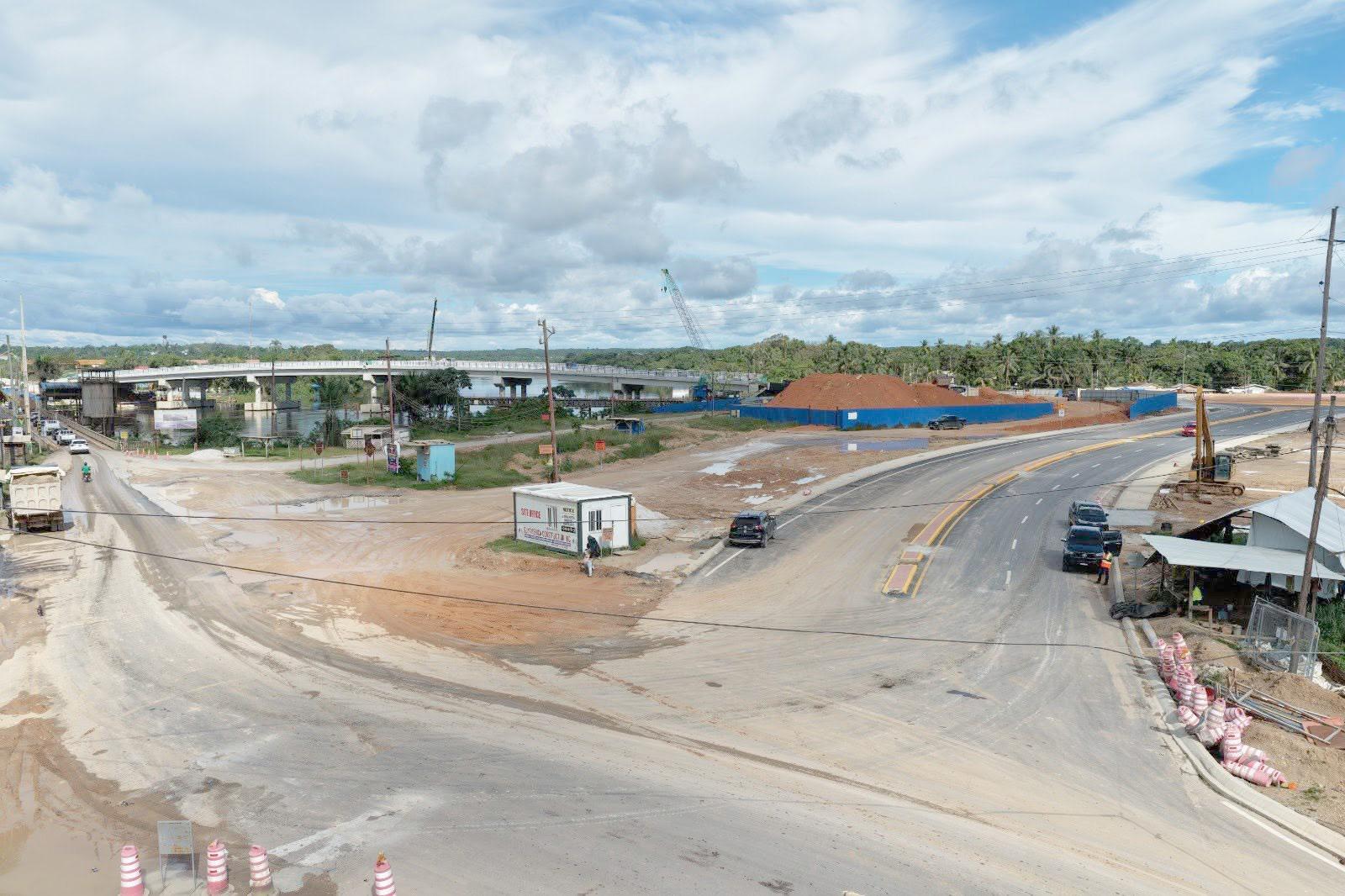
The western approach road to the new Mackenzie-Wismar Bridge is taking shape as construction work continues to advance on the project. The new bridge, which is visible in the background will be of immense benefit to the people of Linden and surrounding areas in Region Ten, as well as tourists, businesspeople and others heading to Lethem in Region Nine (Photos: Vice President Bharrat Jagdeo/Facebook)
Early morning works see upgrades to Camp Street parapets, drains
Ali
Creatives urged to turn talent into enterprises through development bank
Early morning works see upgrades to Camp Street parapets, drains
––
President Ali calls on vendors, citizens to work with government to keep city clean
By Naomi Parris
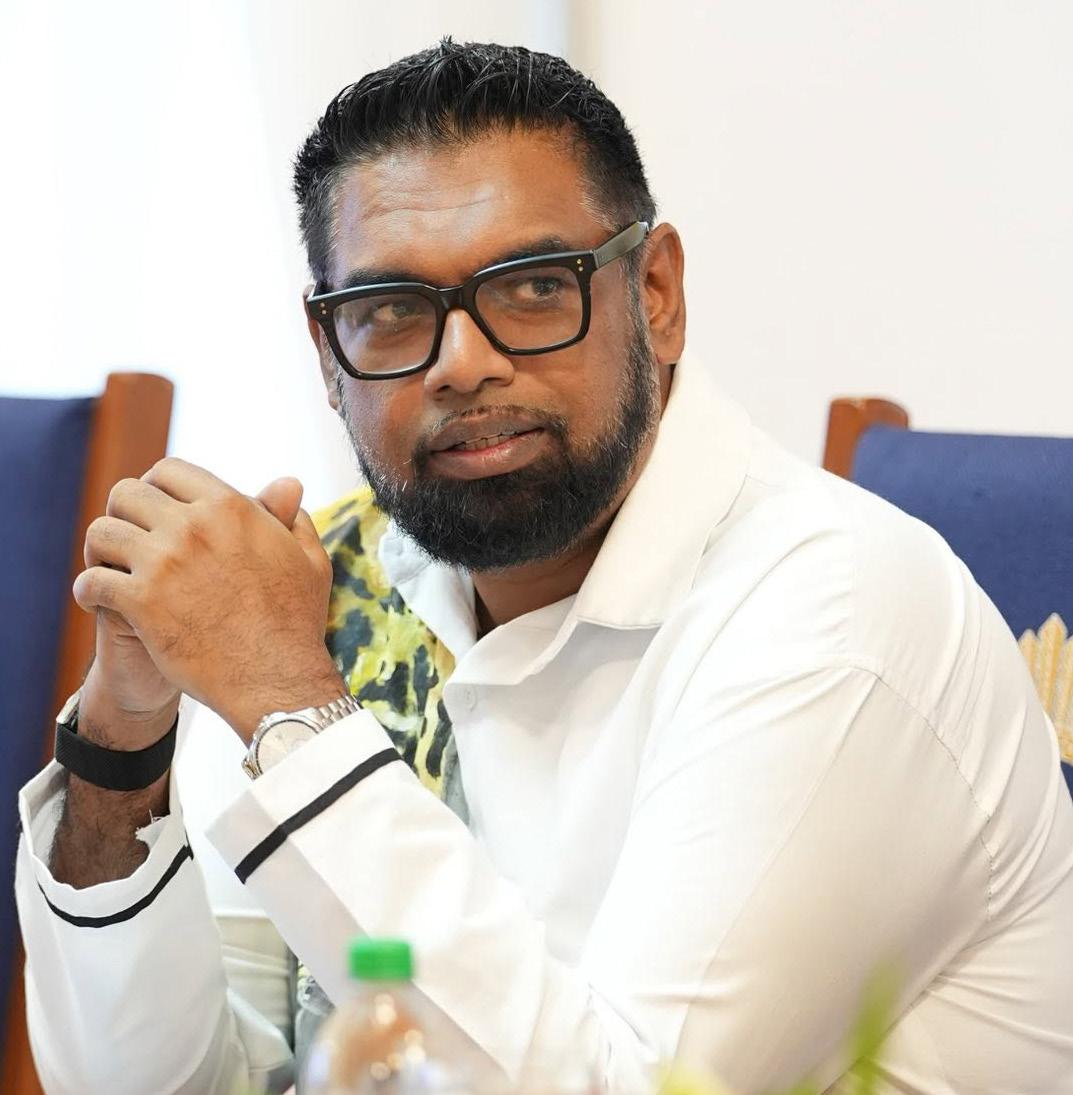
PRESIDENT Dr Irfaan
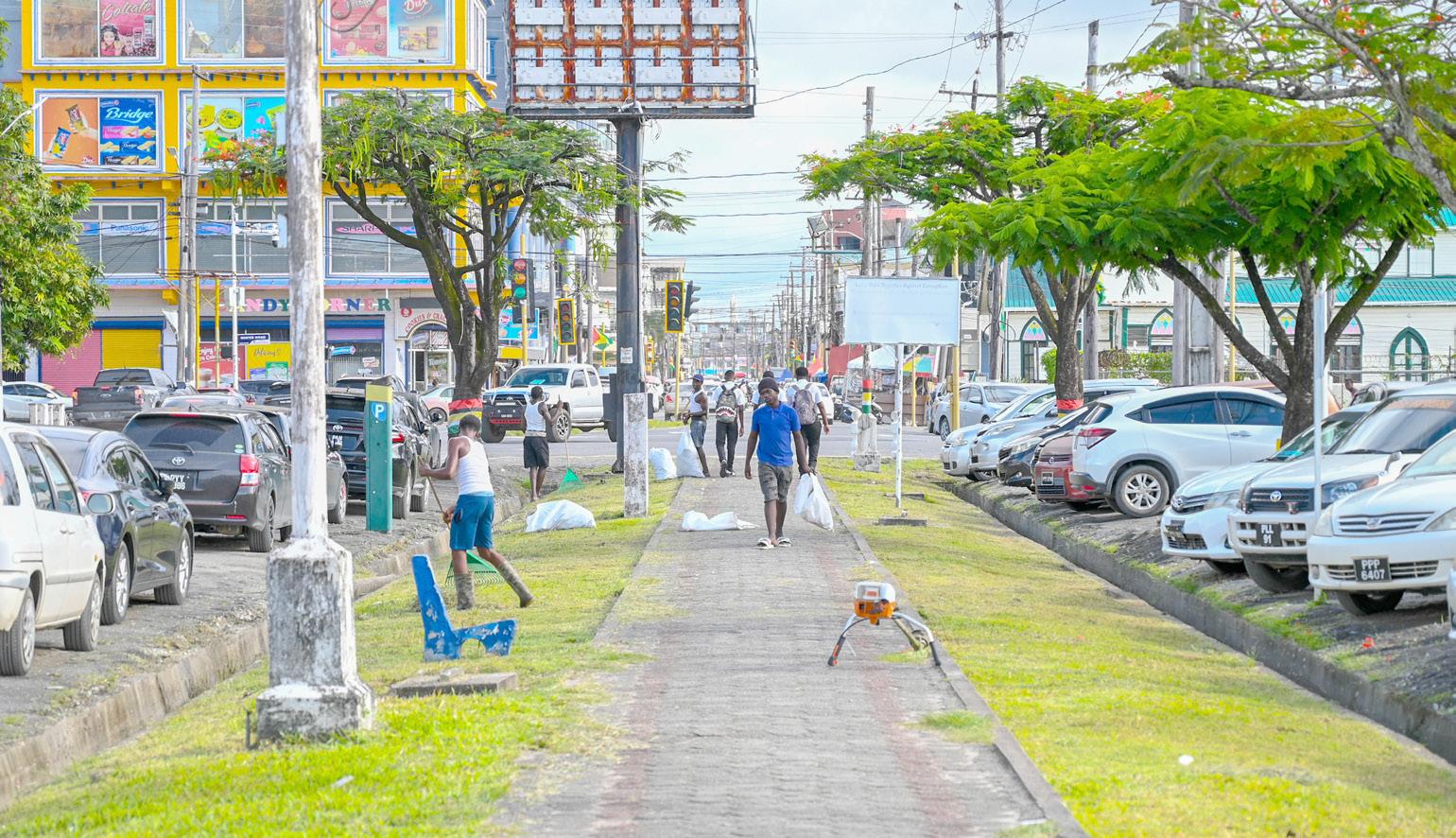
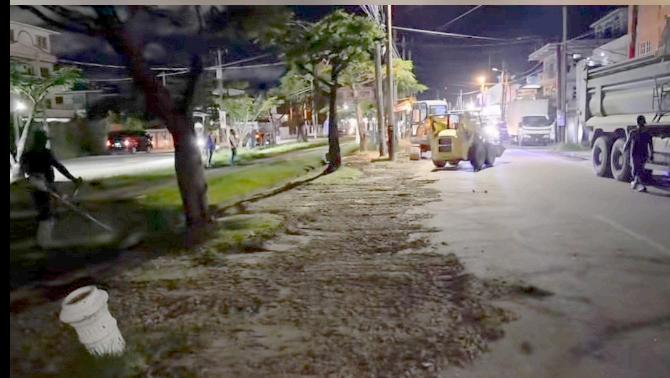
Ali in the wee hours of Thursday morning led a hands‑on inspection of on going works along Camp Street, where teams were clearing clogged drains and enhancing parapets as part of a wider city enhance ment plan.
On site as the works progressed, President Ali pointed to indiscriminate dumping and poor waste management around commercial facilities as a central factor behind the clogged drains and deteriorating environment.
He stressed that mean -
ingful change would require co-operation from private vendors and other city users, not only state intervention.
‘One of the serious problems we have here, this is one of the major challenges, and this is what we would have to work on with the vendors to come up with a solution,” he said at the location, gesturing to debris and refuse left along the parapet.
The President noted that rubbish left overnight was not only unsightly but directly impeded proper drainage and has contributed to persistent flooding and damage to the road surface.
President Ali was blunt
in his assessment of the state of the capital’s drainage network, linking the present problems to prolonged inaction at the municipal level.
He pointed out that the central government had been forced to intervene heavily over the last five years to restore key sections of the city, where blocked drains, broken parapets and failing road surfaces had become the norm.
“These are some of the challenges that we work towards improving.
improving the parapets, improving the general envi ronment in and around the
See page 4
While works requiring heavy machinery were completed during the wee hours of the morning, additional efforts to maintain the parapets and drainage systems along Camp and other city streets continued well into the day (Elton John photo)
Medical screenings to be expanded for adolescents, youths
–– as Guyana enhances diagnoses, therapies in primary healthcare
–– Mount Sinai, Gov’t working to expand screening for chronic conditions, illnesses
WITH more than 86,000 children already receiving comprehensive screening, Guyana is now moving to expand its nationwide health programme now targeting the country’s adolescent population.
The programme, first launched in June 2023, is in partnership with Mount Sinai and initially targeted some 27,000 nursery school children.
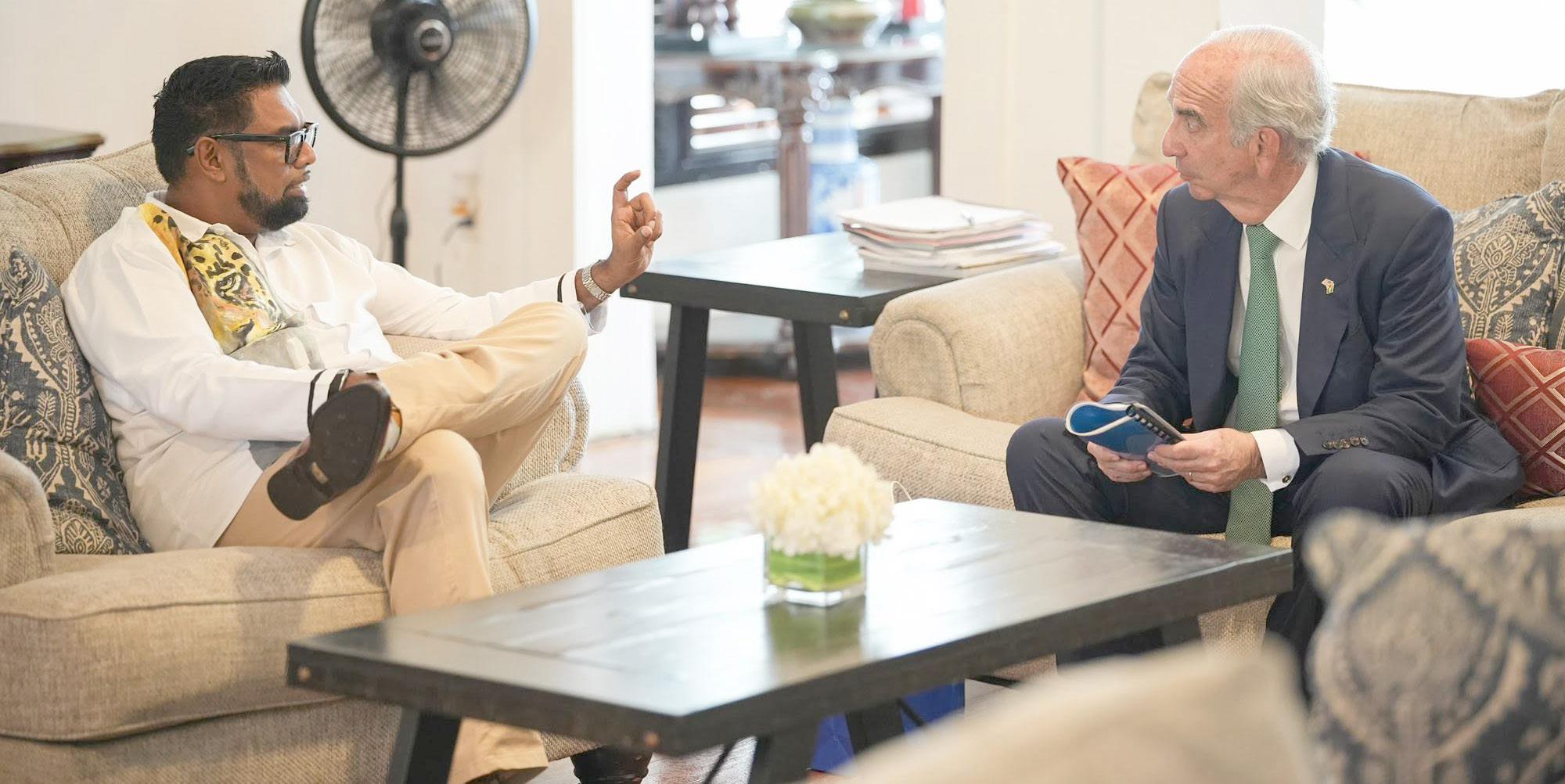
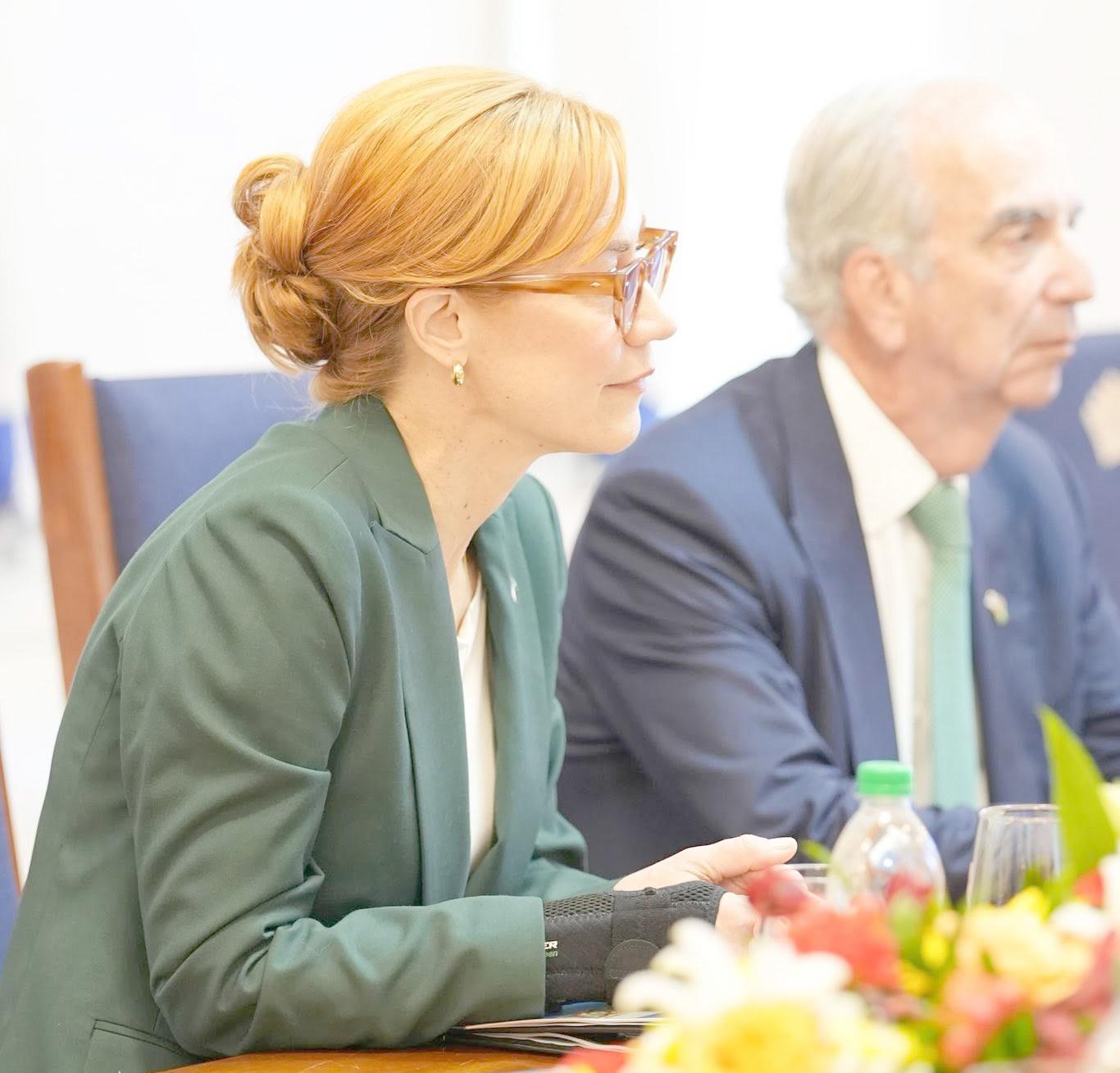
Executive Director of Mount Sinai, Rachel Vreeman, following a meeting with President Dr Irfaan Ali at State House on Thursday disclosed that young children had received comprehensive health examinations.
These included dental
care, vision, hearing, development, and physical evaluations.
“Guyana’s ability to move forward this national child health screening programme is unparalleled around the world. I have not seen a single country that has been able to move forward with this kind of early childhood initiative with the speed and coverage that Guyana has,” she said adding:
“This is going to transform what primary care looks like for the children of Guyana, what it looks like for the health of the next generation, and to have data and to have the ability to respond to health issues and children and adolescents at this level is incredible.”
She noted that Mount Sinai is now working closely with the government to not only expand the programme beyond its initial target but also offer expertise, allowing the country to boost its paediatric care.
“We’re working to help to equip Guyana’s paediatricians to be the next champions and to lead the adolescent health into the future.”
A key focus in the renewed support will be addressing mental health, substance abuse, and early screening for autism.
“We’re working to expand services for adolescents and youth, we’re helping to grow the diagnoses and the
therapies that are available for kids with challenges like autism,” she said.
The programme had sought to tackle the diverse challenges present in classrooms while simultaneously mitigating potential learning setbacks. The government wants to foster an understanding among young individuals about the importance of maintaining an active lifestyle and consuming a nutritious diet.
Meanwhile, Health Minister Dr. Frank Anthony noted that screening programmes will now be expanded to cover early diagnosis and managing chronic illness targeting or repository conditions, kidney conditions,
and cancer.
“We are happy to work along with Mount Sinai. This partnership has been building a number of great results for us already,” he said.
“Already, we are seeing, because of these interventions that more people are complying with the treatment that has been given, and people are staying long for these treatments, and so therefore we are seeing less complications from [the] population.”
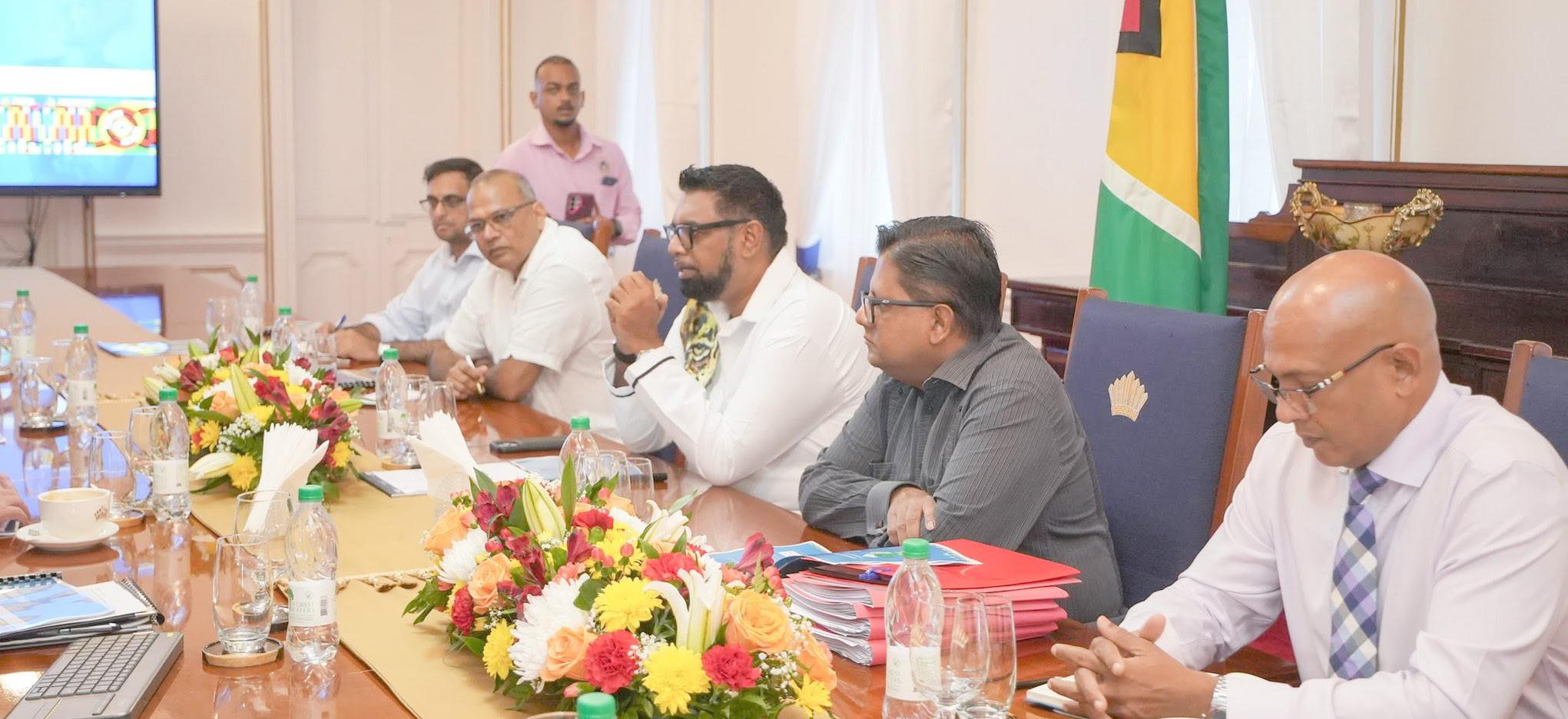
Further, during Thursday’s meeting, President Ali was briefed on the progress of several other key initiatives being implemented.
These included the upgrading of digital health services and expanded car-
diovascular and cancer treatments.
President Ali and the Steering Committee also assessed the implementation of future projects as Guyana transitions into a modern healthcare economy.
Senior Minister within the Office of the President with responsibility for Finance, Dr Ashni Singh; Minister of Health, Dr Frank Anthony; Minister of Public Service, Government Efficiency and Implementation, Zulfikar Ally; and Hess Corporation’s Chief Executive Officer, John Hess, along with executives from Mount Sinai Guyana, were also in attendance.
Early morning works see upgrades ...
city. [There have been] years of neglect by the city council. All of the investment here around the city in the last five years is by the central government,” he emphasised.
The works along Camp Street form part of a broader city enhancement and drainage improve ment programme. The President and technical teams focused on a section where a damaged under ground drain and worn road surface had com bined to create a persistent hazard.
He explained that crews would be working through the early hours to stabilise the area before the morning rush.
“We’ll try to see how much of this we can get
President Dr Irfaan Ali, on Wednesday night, led a hands‑on inspection of ongoing works along Camp Street, where teams were clearing clogged drains and enhancing parapets
done by five, six in the morning before the traffic starts to come back heav ily into the city,” he said, noting that the intervention included sand, crusher‑run and resurfacing to improve the parapet and carriage way.
Works began in the wee hours of Thursday morning
However, he cautioned that a more permanent solution would require fixing the underground infrastructure:
“This section here we will need to do some work in the underground drain age that goes across the road, so that we can fix this situation here,” Presi dent Ali stated.
While highlighting the scale of central govern ment’s investment, Pres ident Ali underscored that sustainable improve ment in Georgetown’s environment depends on behavioural change and stronger municipal man agement.
The Head of State an nounced back in Septem ber 2025, the launch of ‘Rescue Georgetown,’ a city revival plan for sus
tainable urban develop ment.
He had told reporters that initiative was devel oped with the support of the Kings Foundation, aimed at restoring George town’s status as a source of national pride.
He explained that the wider vision for George town set out in the low carbon development strat egy (LCDs) will see 15 flagship demonstration projects being advanced.
These will include the highlighting of the city’s
architectural history, con structing a walking trail along the city, which will lead to the historic trans port building and train sta tion, transforming it into a museum and training cen tre, as well as immediate works on the Stabroek wa terfront and improvements to markets and shopping areas.
Since then, there have been upgrades to recreational spaces across the city, creating cleaner and more family-friendly environments.
Bethany reaps economic benefits from first Tambaqui harvest
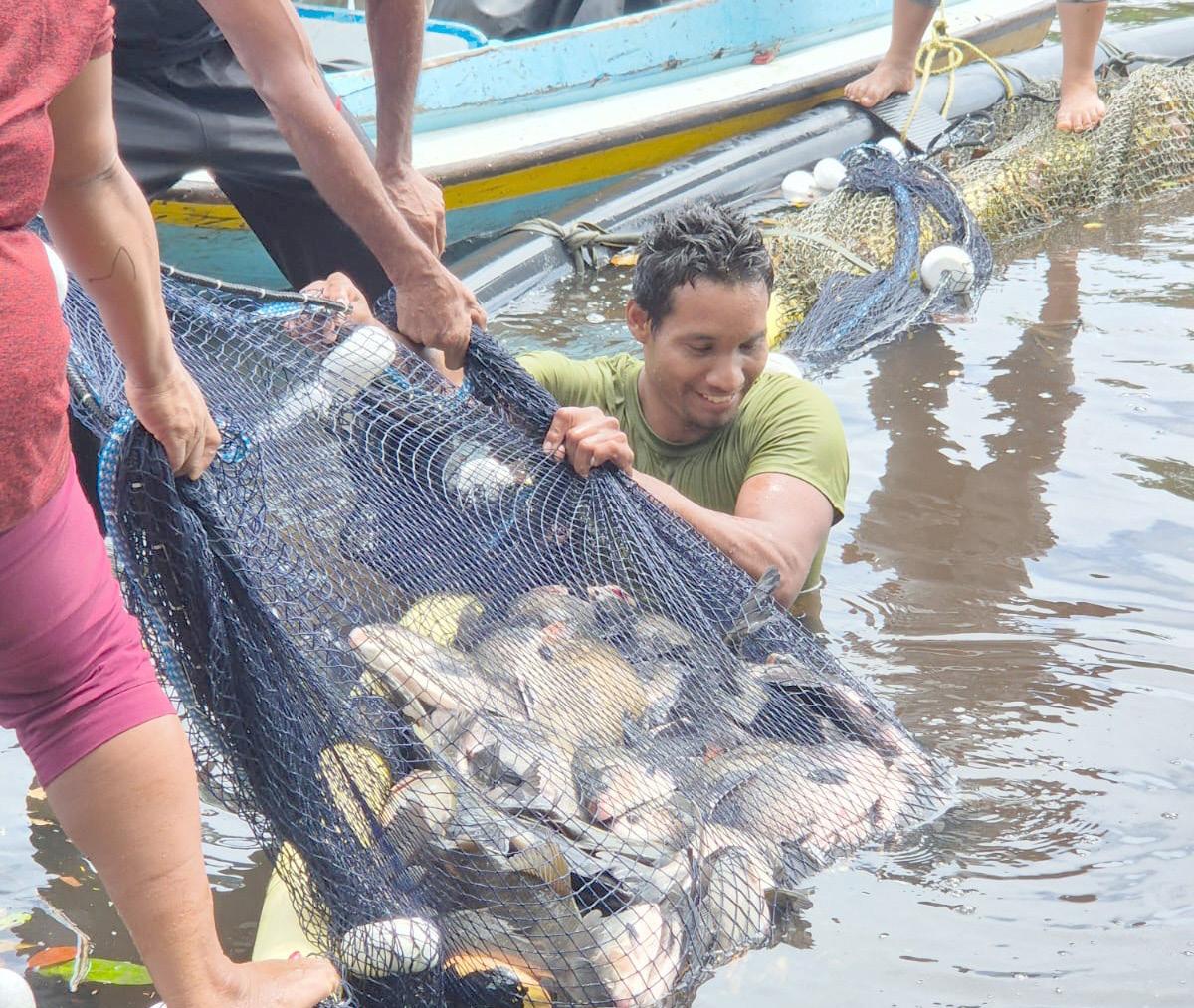
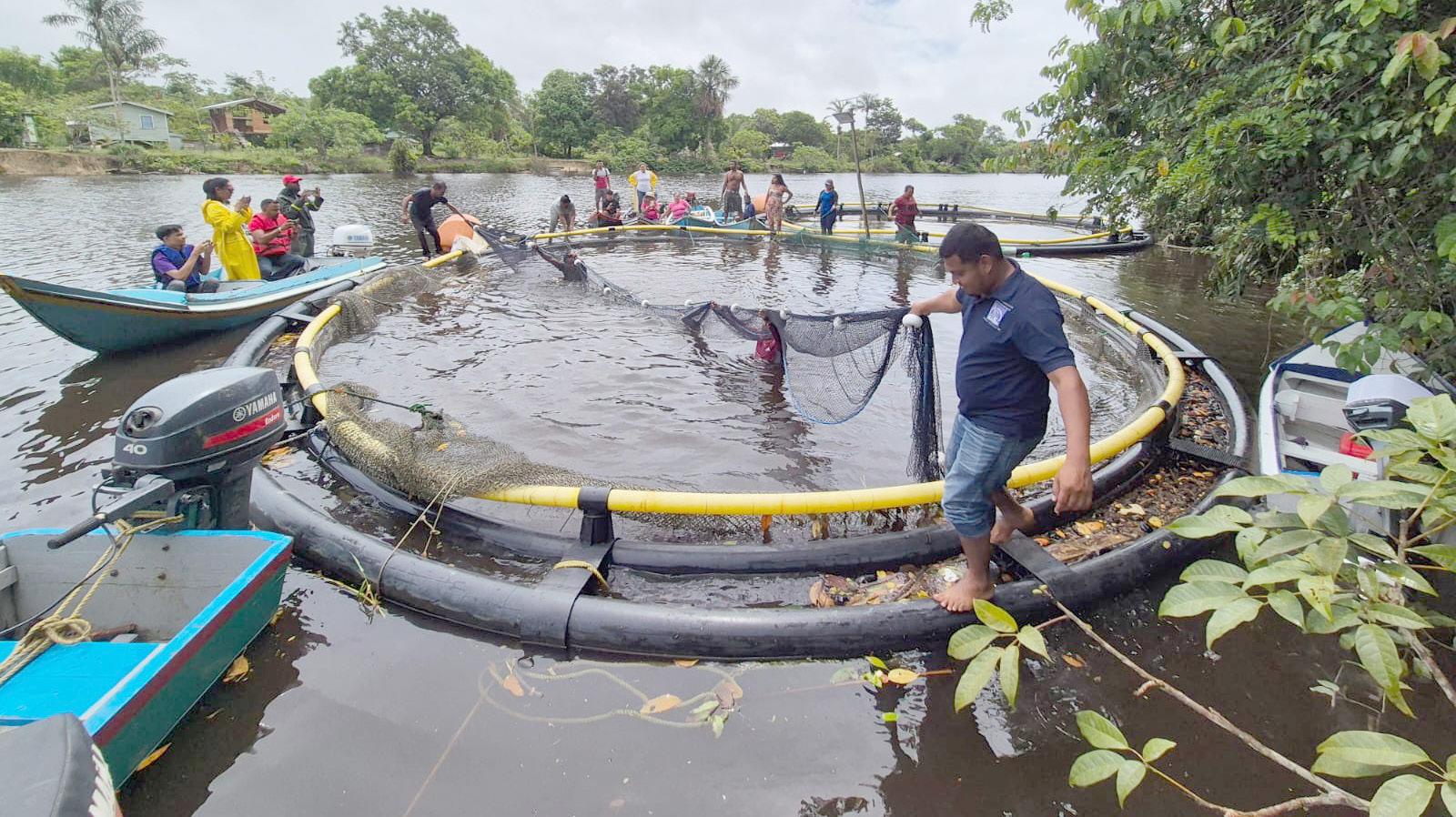
BETHANY Village has recorded a significant economic milestone with the successful harvesting of its first batch of Tambaqui fish, demonstrating the potential of aquaculture to create income and strengthen livelihoods within the community.
The project, which commenced in August 2025, was established through the Government of Guyana’s aquaculture programme. Fingerlings were supplied from Anna Regina, while fish feed and technical support were provided by the government through the Ministry of Agriculture to ensure the success of the initiative.
According to Toshao and Director General of the Ministry of Agriculture, Sonia Latchman, the first harvest took place on Wednesday, June 10, 2026, yielding 18
The harvesting of the Tambaqui fish
Tambaqui with a combined weight of 134.5 pounds. The largest fish weighed 10 pounds and the smallest 5.5 pounds, with an average weight of 7.5 pounds.
Apart from providing fresh food, the project has generated direct economic returns for the village. All the fish harvested were sold within Bethany, ensuring that money remained within the local economy, while giving residents access to a fresh and affordable source of protein.
The initiative also created opportunities for skills development and employment. Village Councillor Tajernarine Geer worked closely with Fisheries Department officers to provide training for residents in fish farming and cage manage-
ment. Community Infrastructure Improvement Project (CIIP) workers assisted with maintaining the cage, while Naomi Lukhai played a key role in overseeing the daily care and feeding of the Tambaqui fishes.
Toshao Latchman said the project is proof that targeted government investment can create sustainable economic opportunities in rural and hinterland communities. She expressed gratitude to the Government of Guyana, the Ministry of Agriculture, and the Fisheries Department for
supporting the initiative and ensuring residents benefitted from training, resources, and technical assistance. With another harvest expected within two weeks, the village is anticipating additional income from the project. Further boosting economic prospects, Minister of Agriculture, Zulfikar Mustapha, has pledged support for another aquaculture initiative involving additional fish that can thrive in muddy water conditions, creating opportunities for expanded production and
increased earnings for residents.
Toshao Latchman said the first harvest was a trial and she is glad that the fish survived the muddy water in Bethany.
The success of Bethany’s first Tambaqui harvest demonstrates how aquaculture can serve as a viable economic enterprise, generating income, creating employment opportunities, and contributing to long-term food security and sustainable community development.
Bethany’s Toshao, Sonia Latchman, holds one of the fishes from the Tambaqui harvest
Justice Moving Faster
THE reduction of criminal assizes matters from approximately 300 cases to just over 100 is not merely an administrative achievement, it is evidence of a justice sector undergoing one of the most significant transformations in modern Guyana.
For years, Guyanese complained about delays in the courts. Victims waited endlessly for closure. Witnesses grew frustrated. Accused persons remained on remand for prolonged periods. The phrase “justice delayed is justice denied” became synonymous with public concerns about the legal system.
Today, however, the numbers tell a different story.
The reduction in the criminal backlog is the product of years of legislative reform, technological investment, institutional strengthening and unprecedented collaboration among justice sector agencies.
Importantly, this progress did not happen overnight.
Since 2020, the PPP/C administration has embarked on a comprehensive modernisation of the justice sector as part of a broader effort to reform public institutions and improve service delivery. More than 100 pieces of legislation have been enacted during this period, many aimed at strength-
ening governance, modernising procedures and increasing efficiency across the public sector.
The justice system has been one of the major beneficiaries.
The implementation of the Plea Bargaining Act and the Paper Committal Act has significantly reduced delays in criminal proceedings. Matters that once took years to progress are now moving through the courts more efficiently. New criminal procedure rules and the introduction of sentencing guidelines are expected to further improve consistency and predictability within the legal system.
At the same time, Guyana’s courts are being transformed through technology.
The High Court and Court of Appeal have transitioned to cloud-based e-filing and e-litigation systems, reducing dependence on paper-based processes and improving access to justice. Magistrates’ courts are also being digitised as part of a wider modernisation programme.
Virtual hearings are becoming an increasingly important feature of the system. Facilities are being established at prisons, including Camp Street, Lusignan, New Amsterdam and Mazaruni, as well as selected police stations, allowing remand
hearings and other proceedings to be conducted virtually. This not only improves efficiency but reduces transportation costs and security risks.
Technology is also revolutionising criminal investigations.
Today’s investigators have access to surveillance footage, digital evidence, forensic tools and sophisticated software capable of tracking movements and strengthening evidence collection.
The support provided through partnerships with the European Union, the United Nations Development Programme and other international agencies has accelerated these efforts. Millions of dollars have been invested in specialised software, digital infrastructure, forensic tools, equipment and training.
The Guyana Police Force has benefitted from fingerprint technology, scanners, laptops, specialised investigative tools and enhanced interoperability with other justice sector institutions. Joint training programmes involving prosecutors and investigators are also helping to establish common standards for evidence gathering and case preparation.
Yet perhaps the most important aspect of the reforms is the shift in philosophy.
The justice sector is increasingly moving beyond a purely punitive model toward one that incorporates rehabilitation and restorative justice.
The Restorative Justice Act has expanded opportunities for community-based interventions and alternative sentencing in appropriate cases. Meanwhile, investments in prison modernisation are helping to reduce recidivism by focusing on rehabilitation, skills training and reintegration.
This approach recognises that public safety is strengthened not only by punishing wrongdoing but by reducing the likelihood of reoffending.
Of course, challenges remain. Modernising a justice system is a continuous process rather than a single achievement. Backlogs must continue to be managed. Technology must continue to evolve. Public confidence must be maintained. Nevertheless, the progress being reported should not be underestimated.
A reduction represents more than efficiency, it shows a justice system that is becoming faster, smarter and more responsive to the needs of citizens. For decades, Guyanese demanded reform and today, those reforms are beginning to deliver measurable results.
Former APNU+AFC MP cleared of drug trafficking charge
FORMER APNU+AFC
parliamentarian Devin
Sears has been cleared of a narcotics trafficking charge after a Linden magistrate upheld a no-case submission made by his attorneys, ruling that the prosecution’s evidence amounted to suspicion rather than proof.
The charge against Sears was dismissed on Thursday by Magistrate Rushell Liverpool in the Linden Magistrates’ Court following legal arguments advanced by attorneys-at-Law Nigel Hughes and Kiswana Jefford.
According to Jefford, the prosecution’s case relied heavily on the assertion that a strong scent of cannabis was emanating from bags found inside a minibus being driven by Sears at the time of his arrest.
However, during cross-examination, one of
the police witnesses acknowledged that his ability to identify the smell of cannabis was based on specialised training received as a law enforcement officer.
The witness further accepted that Sears had received no such training and therefore could not be presumed to have identified the contents of the bags based solely on smell.
Additionally, police witnesses admitted that the contents of the bags were not visible and could only be determined after the bags were opened.
“The evidence therefore suggested that the contents were not visible and the evidence led by the prosecution relied on suspicion rather than proof of knowledge,” Jefford stated.
The attorney also noted that Sears’ co-accused had
accepted full responsibility for the narcotics, leaving the prosecution without evidence that Sears knowingly participated in the alleged trafficking operation.
“Suspicion, however strong, cannot find a conviction,” Jefford said.
The dismissal brings an end to criminal proceedings against Sears arising from a major drug bust conducted by police in Linden last October.
Sears, 39, had initially been charged with possession of narcotics for the purpose of trafficking and was remanded to prison after appearing before Magistrate Liverpool.
His co-accused, 69-yearold farmer Albert Sandy of Tacama Waterfront, Upper Berbice River, pleaded guilty to the charge and was sentenced to four years’ imprisonment.
At the time, Sandy accepted full responsibility for the 310.71 kilogrammes of cannabis discovered in the vehicle and admitted that the drugs belonged to him.
Despite that admission, Sears was initially remanded to prison before later securing $400,000 bail from the High Court.
The charges stemmed from an operation conducted on October 20, 2025, near the old Bamia Police Checkpoint in Linden.
Police ranks on mobile patrol stopped a dark blue Toyota Hiace minibus bearing registration number BAJ 4486, which was registered to the Region 10 Tourism Committee Inc.
According to police, Sears was driving the vehicle when officers became suspicious after observing what they described as nervous
behaviour.
Investigators alleged that Sears appeared to be sweating heavily and informed officers that he was transporting “tourism plants.”
A search of the minibus uncovered 22 bulky black plastic bags and four large brown canvas bags containing leaves, seeds and stems suspected to be cannabis.
The narcotics were later weighed and amounted to 310.71 kilogrammes.
Both men were arrested and cautioned. Police subsequently reported that Sandy admitted ownership of the cannabis and told investigators that he had paid Sears to transport him to Parika.
Following the incident, Sears resigned from the Region 10 Tourism Committee, where he had been actively involved in tourism-related initiatives.
Devin Sears
Two men in conversation: Comical or sad politics?
WHEN you want to see how dishevelled the thinking of people is who criticize the Government of Guyana then constantly monitor their output
The nonsense is simply incredible. So Kidackie Amsterdam of APNU and Aubrey Norton were in conversation.
Amsterdam asked Norton if the law allows the PNC to retain the seats in the Regional Democratic Councils that were occupied by PNC councillors that two weeks ago defected to the PPP. Norton told Amsterdam that the law does not allow for the PNC to recall them.
As a reaction, Amsterdam retorted that although the law doesn’t allow for their removal, is the PNC going to do nothing about the state of affairs? You are not going to believe what the next topic between the two men was. Amsterdam asked Norton what the PNC’s attitude is to the three APNU GECOM Commissioners. Norton said they cannot be removed by anyone. They are appointed for life.
Now, Amsterdam and Norton have opened themselves to ridicule. If the law allows for permanency, then just as Amsterdam thinks that even withstanding that fact, the PNC should do something about the RDC councillors, why should the Opposition WIN party do nothing about the APNU GECOM councillors?
I am certainly not a fan of WIN and of the two parties, PNC and WIN. My preference is for the PNC, but the danger of ignoring moral laws and legal rules for the sake of convenience inevitably causes destruction. The Guyanese people voted in September 2025. The PPP won. We as a nation should respect the nation’s choice; accept that the PPP has a constitutional right to administer Guyana. The nation changed the party it wanted to be in opposition. It chose WIN over the PNC. I prefer the PNC over WIN. I wished that it was the PNC in opposition than WIN, but that was not the choice of the electorate and the voters’ ballots have to be respected, or else democracy goes out the window.
Let me repeat for perhaps a million times what I wrote in my columns and said on the Freddie Kissoon Show. In 2020, I voted for the Lenox Shuman party, the Liberal and Justice Party. When, on the next day after voting closed, I saw the attempts to rig the election, I became emotional and my emotions overpoured in every daily column of mine until Irfaan Ali was sworn in as president. The day you deny the people their right to vote, the
day you disrespect how they voted, that is the day your country is going down the road to perdition. We have been there before. I wasn’t going to accept Guyana’s return to hell in March 2020 without a fight.
There is a new majority parliamentary opposition and whether we like it or not, that opposition party has to be represented in GECOM. That is the law. Unfortunately, Messrs. Alexander, Trotman and Corbin cannot speak in GECOM on behalf of WIN.
To allow that is to recognise the descent into constitutional, legal and moral caricature.
Norton does not understand context when he talked about permanent commissioners. The permanence is contextual. It rests on the outcome of national elections. If there was no opposition after the September 2020 poll, just as there were twice in Barbados, who then were APNU commissioners representing in GECOM?
There is one great circus that awaits Guyana. If the APNU commissioners continue to sit in GECOM, then they sit there to adumbrate the presentations of the opposition as contained in the policies, preferences and predilections of WIN because WIN is the majority opposition. The caricature will be gigantic because WIN does not want the APNU commissioners to represent WIN in GECOM and the APNU commissioners and the leader of the PNC do not want to talk to the leadership of WIN.
The result of this circus makes Guyana a laughingstock in the region. There is a moral and legal way out. A new election produced a new opposition party.
That party, because on numbers, should have two commissioners and by the same criterion, the PNC, having 12 seats, is entitled to one commissioner.
The nation should not accept WIN having all three commissioners. Why should a party with 16 seats have all three and the party with 12 gets nothing? That cannot be right and fair.
The arid, mediocre, ugly reasoning that the GECOM commissioners are there for life is deliberately misleading. We do not have to bring in foreign “experts” to ascertain when permanent is permanent. Permanence is dissolved when the electorate decides that. And the electorate dissolved permanence in September 2025.
DISCLAIMER: The views and opinions expressed in this column are solely those of the author and do not necessarily reflect the official policy or position of the Guyana National Newspapers Limited.
DNA reports, forensic evidence, statements tendered –– as Mobil Service Station bombing paper committal continues
By Feona Morrison
THE Georgetown Magistrates’ Court, on Thursday, continued its extensive review of evidence against four persons accused in connection with the deadly October 2025 bombing at the Mobil Service Station in Georgetown, with prosecutors tendering dozens of additional statements and key
forensic reports as part of the ongoing paper committal proceedings.
The proceedings, being conducted before Acting Chief Magistrate Faith McGusty, are aimed at determining whether sufficient evidence exists to commit the accused to stand trial in the High Court on terrorism-related charges arising
from the explosion that claimed the life of six-yearold Soraya Bourne.
During Thursday’s hearing, the court received dozens of statements and further statements from detectives attached to the Guyana Police Force’s Major Crimes Investigation Unit, which spearheaded the months-long investigation into the incident.
Also tendered was evidence from an official of the
National Forensic Science University in India, one of the experts involved in the examination of forensic material collected during the probe.
Among the documentary evidence admitted were the post-mortem report prepared in relation to Bourne’s death, a site inspection report com -
piled by investigators, the publication of the wanted bulletin issued during the manhunt for suspects, a Deoxyribonucleic acid (DNA) analysis report from the Center of Excellence in DNA Forensics (India), and vehicle registration documents linked to the investigation.
Also admitted into evidence were medical certificates relating to the victims who survived the attack,
along with immigration records for the four accused.
The proceedings are expected to resume on June 29 at 09:30 hrs. as the court continues its review of the voluminous evidence gathered by investigators.
The paper committal process commenced on June 8, with more than 100 statements formally ten -
dered on the opening day alone. Those statements included accounts from eyewitnesses, police officers, investigators and other individuals connected to the investigation.
The evidence submitted during the opening phase of the proceedings also included a statement from Venezuelan national, Jhonny Boodram, one of the accused persons.
Boodram is jointly charged with fellow Venezuelan national, Alexander Bettencourt, Guyanese-Venezuelan Krystal LaCruz, and Venezuelan national Daniel Alexander Ramirez Poedemo, who prosecutors allege orchestrated the attack.
The charges stem from the October 26, 2025, explosion at the Mobil Service Station located at the corner of Regent and King Streets in Georgetown.
The blast killed sixyear-old Soraya Bourne and injured four of her relatives, who were in the vicinity when the explosion occurred. The incident also caused significant damage to nearby buildings and several vehicles and triggered widespread concern across the country.
Investigators have described the explosion as one of the most significant national security incidents in Guyana’s recent history.
According to the prosecution, Poedemo faces a charge of terrorism contrary to Section 3(1)(a) of the Criminal Law (Offences) Act.
The allegation is that he placed and detonated an explosive device with the intent to threaten Guyana’s security and sovereignty or
to strike terror among members of the public, resulting in the death of the child.
Boodram, Bettencourt and LaCruz are accused of aiding and abetting Poedemo in the commission of the alleged terrorist act.
The Guyana Police Force’s investigation relied on a combination of surveillance footage, forensic evidence, intelligence gathering and witness tes-
timony. Investigators also sought international assistance, sending forensic samples to India for advanced scientific testing.
The inclusion of DNA analysis reports and evidence from an Indian forensic expert is expected to form an important part of the prosecution’s case as the court assesses whether sufficient evidence exists to place the accused before a jury.
All four defendants remain on remand.
The commencement of the paper committal proceedings follows months of legal developments in the matter, including repeated claims by Poedemo that he alone was responsible for the explosion.
The broader investigation initially resulted in charges being laid against several other individuals.
Among them were Guyanese nationals Ramesh Pramdeo and Wayne Correia, who were charged alongside Venezuelan national, Jennifer Rodriguez, in separate proceedings before Magistrate Alisha George.
In April this year, Pramdeo and Correia were discharged after the magistrate upheld a no-case submission made by their attorney.
The court ruled that the evidence presented by the prosecution was insufficient to support the terrorism-related charges against the two men.
Rodriguez, however, was committed to stand trial in the High Court after the magistrate found that a prima facie case had been established against her. She remains on remand and is expected to face trial at the next practicable sitting
of the Demerara Criminal Assizes.
The proceedings before Acting Chief Magistrate McGusty now focus on what investigators have described as the central case involving the four accused.
Under Guyana’s criminal justice system, a paper committal is a pre-trial procedure used in serious criminal matters in which a magistrate examines written statements, expert reports and documentary evidence without hearing live testimony.
At the conclusion of the process, the magistrate must determine whether the evidence discloses a sufficient case to commit the accused to stand trial before a judge and jury in the High Court.
Senior Police Legal Adviser, Mandel Moore, is appearing on behalf of the State.
The case continues to attract significant public attention, particularly in light of the Government’s stated intention to pursue the death penalty under anti-terrorism legislation, which provides for capital punishment in circumstances where terrorist acts result in the loss of life.
From film to art: President Ali urges creatives to turn talent into enterprises through development bank
PRESIDENT Dr Irfaan Ali has appealed to Guyana’s creative community, from visual artists to filmmakers and storytellers, to seize the opportunities that will be unlocked through the new Guyana Development Bank, which will offer interest‑free, collateral‑free financing backed by mentorship and technical support.
eaking about the bank’s proposed model on Wednesday during a broadcast, President Ali stressed that the ini tiative is not limited to traditional sectors such as agriculture, but is deliberately designed to invest in talent, cre ativity, and cultural in dustries.
“One of the import ant aspects of this de velopment bank, is that it gives us the oppor tunity now to invest in the talent, the creativity, the ideas of every Guy anese. You may have an artist with a creative idea. You may have someone with a good storyline for a short film. How do we invest in that?”
He underscored that the bank’s interest‑free, collateral‑free loans are intended to help build sustainable enterpris es, not provide one‑off handouts or quick cash.
“Let me say to you that this is a business opportunity. This is a loan that is interest free and collateral free, but it’s not a grant. It is meant to allow you to build a business, to build prosperity, to build an enterprise to build off of your creativity, to support your ideas, to support your entrepre neurial spirit.”
The Head of State explained that the bank’s structure with regional credit officers, facilita tors and mentors will prioritise hand‑hold ing, financial literacy and business develop
ment support so that creatives can move from raw ideas to viable, in come‑earning projects.
He explained that this bottom‑up model is de signed to help small ventures grow into larg er enterprises, includ ing in non‑traditional sectors such as the arts and film.
“The bank allows us to invest in talent, invest in ideas, and allows us, of course, in securing a path towards economic transformation through investment, through the broadening of access to credit,” he added.
President Ali urged creatives to approach the bank with a pos itive mindset and a willingness to put in the work required to turn their concepts into sustainable business es. He made it clear that success under the scheme will depend on discipline, patience and sacrifice rather than a “quick spin.”
“I must say to all those who will be pur suing their initiatives under the Guyana De velopment Bank that this requires hard work. Yes, it will require you to put in the time, work hard… I want you to be prepared, I want you to understand that when we place this in the manifesto, we knew that for the success of this band, we have to also change mindset.”
Framing the Guyana Development Bank as a core manifesto promise, the President said the ultimate goal is to create long‑term income‑earn ing opportunities for thousands of Guyanese families.
He encouraged art ists, writers, filmmakers, and other creatives to prepare their proposals and be ready to plug into the ecosystem of fi nancing, mentorship and government support that will come on stream.
The bank will oper
ate through a bottom‑up, field‑driven structure anchored by a board and chief executive officer at the top, and regional credit officers on the ground who will work directly with applicants to shape ideas, process interest‑free, collater
al‑free loans and moni tor projects. These officers are supported by regional facilitators who will or ganise clusters of sim ilar businesses, deliver financial literacy and basic management train ing, and link borrowers
to wider government support.
He explained that as businesses grow, sector spe cialists and technical offi cers will step in to right‑size investments, provide tech nical advice and prepare projects for expansion with commercial banks, ensur
ing a continuous pipeline of support from start‑up through to larger‑scale oper ations, even after the initial loan is repaid. Legalisation for the financial institution’s operationalisation was tabled in the National Assembly last Friday.
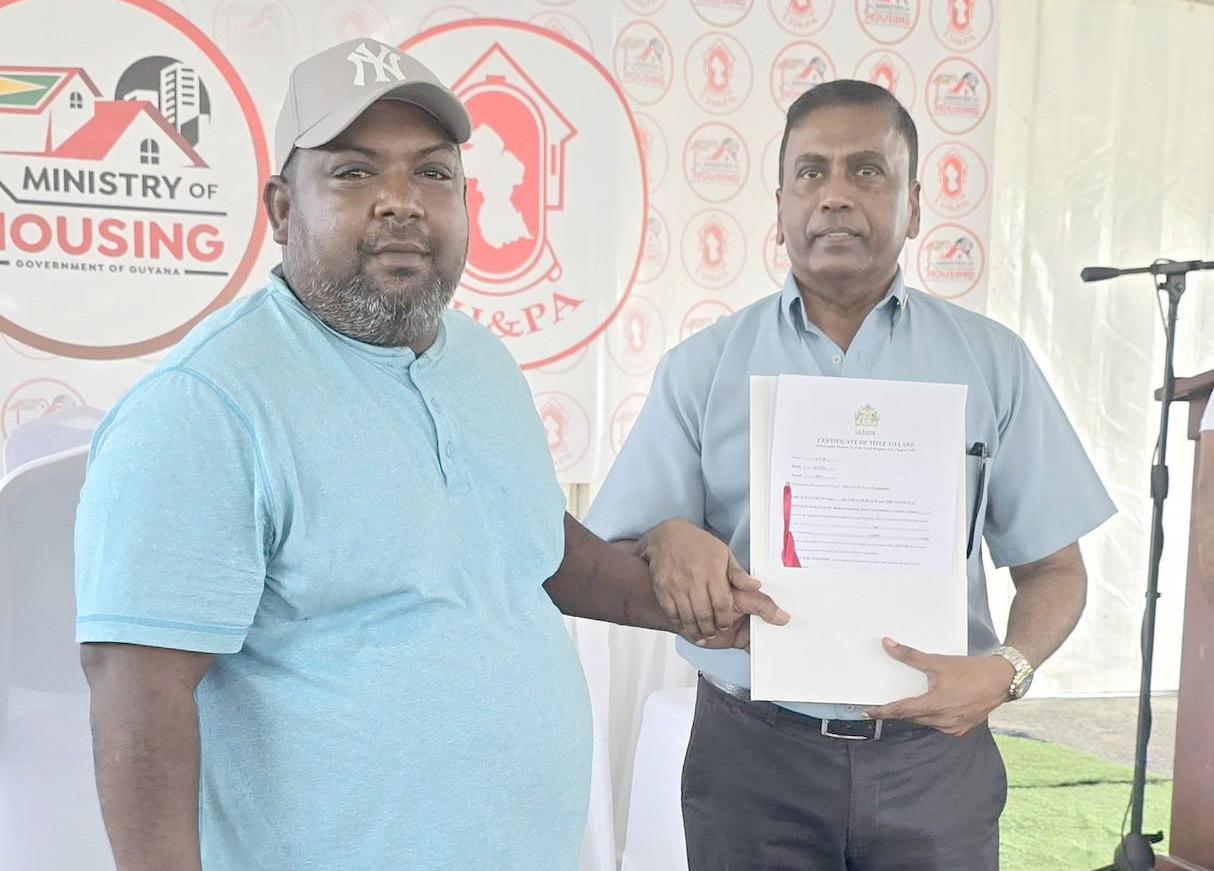
EARLIER this month, the Ministry of Housing wrapped up the first Dream Realised Housing Drive for 2026 at Rosignol, Region Five (Mahaica-Berbice), bringing hundreds of families closer to owning their own house.
Over 900 house lots were allocated within the Tract ‘A’ Hope and Tract ‘A’ Waterloo Housing Developments, while more than 250 Certificates of Title were distributed, providing beneficiaries with greater security and peace of mind, according to
the ministry.
Each lot allocated, and each title issued represents new beginnings, future homes, and opportunities for families to build lasting legacies.
Through the housing drive, Sharon Jaggot, a mother from Region Five, has moved closer to home ownership, thanks to the Cement and Steel Initiative that was introduced by the government in 2023.
Jaggot, in a video posted on Facebook by the Ministry’s Central Housing and Planning Authority said, “I will be using this voucher to assist me with building my home- to start it.”
The young mother said this initiative is a great one, as it caters to young people who are just starting out on their own. “This is like an aid to get the basic stuff, like the cement,” Jaggot said.
Hansraj Persaud is another resident who benefitted from the housing drive. Persaud was able to uplift his transport, a milestone he said would allow him to not only build a house but own it.
The Ministry of Housing is accelerating Guyana’s housing development, designed to implement national housing and settlement policies through an efficient, well planned, coordinated and structured framework.
The ministry was allocated $159.1 billion to housing development for 2026, in this year’s National Budget, with the aim of accomplishing the continued development of new and existing housing areas, allocating 15,000 more house lots across all income categories, particularly in areas such as Moleson Creek, Providence, Vryheid’s Lust, Leonora and Charity, facilitating the construction of a further 8,000 homes in key areas, and issuing over 7,000 titles and transports, which will allow property owners access to collateral for mortgage loans and provide security of tenure.
Hansraj Persaud
Sharon Jaggot
Lima Regional Hospital records first urology surgery
Story
and photos
by Indrawattie Natram
HEALTH services in Region Two continue to improve with Lima Regional Hospital achieving a major milestone by successfully performing its first urology surgery, the first such procedure ever conducted in the region.
The achievement was highlighted in a health report presented by RDC Councillor Melrose Henry during the Region Two Regional Democratic Council statutory meeting held on Wednesday in the RDC Boardroom, Anna Regina.
According to the report from Medical Superintendent, Dr Sheneer Reid, the hospital recorded significant activity during the month of May, demonstrating the growing demand for healthcare services and the capacity of the institution to meet patients’ needs closer to home.
Statistics showed that the hospital recorded 370 admissions and 359 discharges. The Outpatient Department attended to 3,534 patients, while the Accident and Emergency Department treated
1,139 patients. Additionally, 555 patients visited various clinics, including 208 patients at the Eye Clinic and 60 at the Audiology Clinic.
Diagnostic Services recorded high numbers with 1,928 laboratory patients and 32,263 laboratory tests conducted during the month.
The hospital also performed 963 x-ray examinations, 72 CT scans, 460 ultrasounds, and 44 echocardiograms.
Pharmacy Services filled 2,643 prescriptions, while Surgical Services completed 72 operations during the reporting period.
Henry highlighted ongoing efforts to monitor and combat vector-borne diseases. A total of 310 dengue tests were recorded while 127 malaria tests were conducted, with 16 positive cases recorded. Six malaria patients were admitted and have since been treated and discharged.
Councillor Henry noted that residents are being encouraged to take preventative measures against mosquito-borne illnesses by eliminating stagnant water around homes, using mosquito nets, and seeking medical
attention promptly when symptoms develop.
Another significant development was the commencement of a dedicated Urology Clinic at Lima Regional Hospital, enhancing access to specialised care for patients suffering from urinary tract infections and related conditions.
According to Regional Health Officer Dr Ranjeev Singh, successful completion of the region’s first urology surgery marks a major advancement in healthcare delivery and reduces the need for residents to travel outside Region Two for certain specialised procedures.
Dr Singh continues to encourage residents to make use of available medical services, attend regular health screenings, and practise healthy lifestyles as the region works towards improving overall healthcare outcomes.
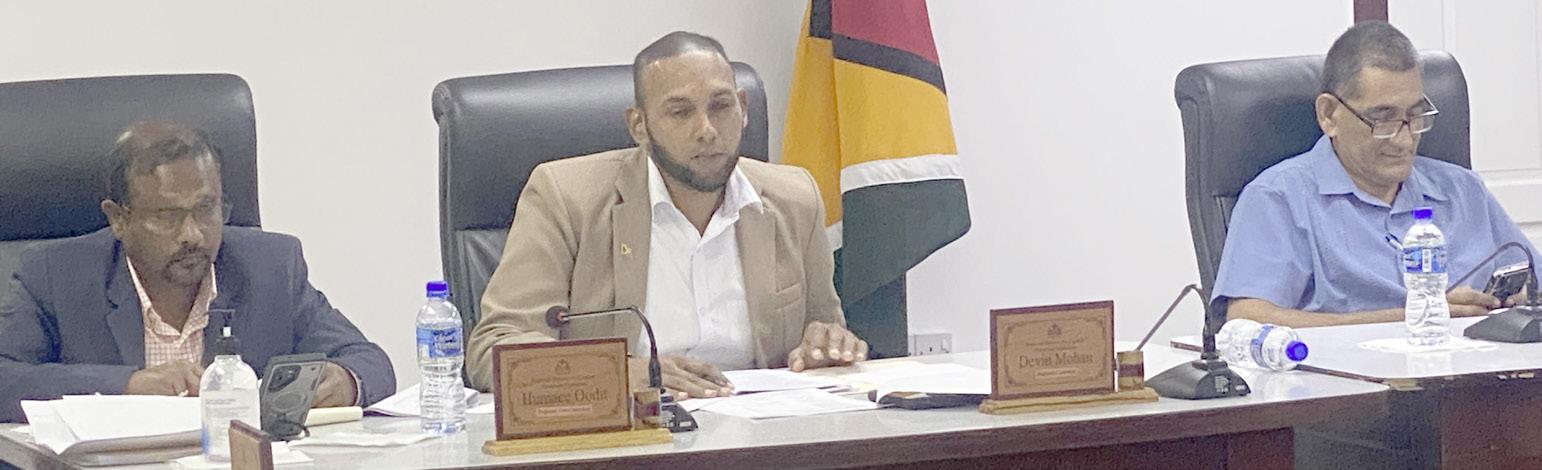
Regional Chairman, Devin Mohan, commended the health professionals of the Regional Health Services for the work they do.
He said that surgeries that people had to seek outside Region Two are now available.
Wanted suspect dies in failed supermarket robbery
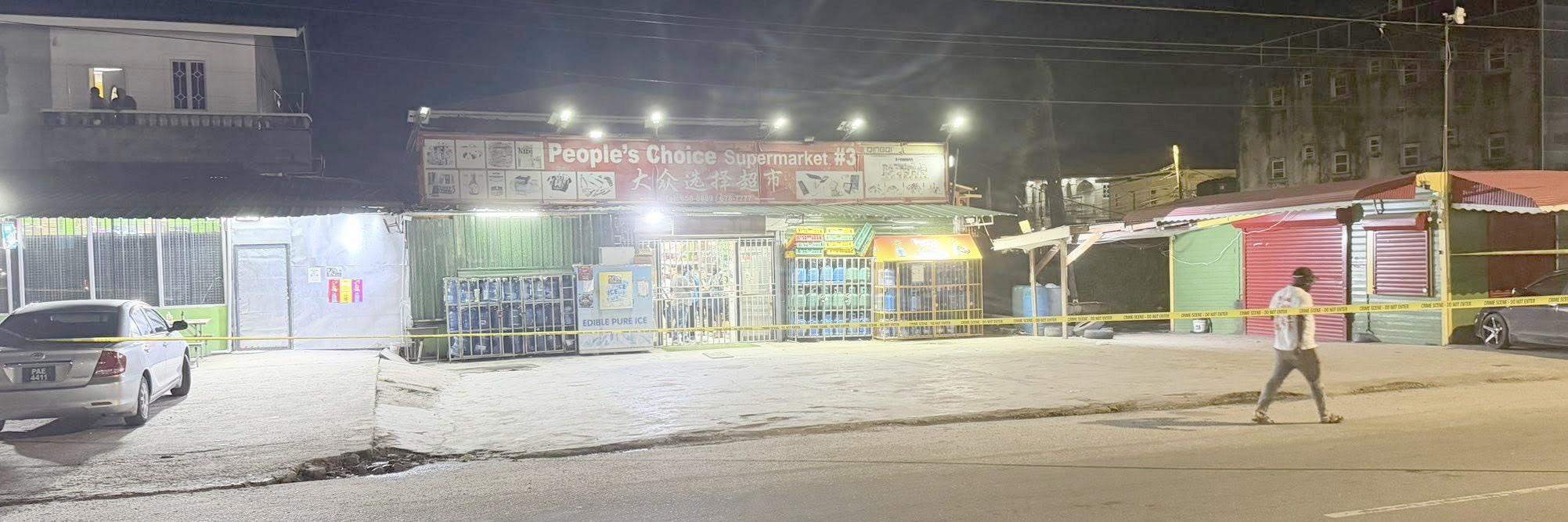
A 24-year-old man who was wanted by police in connection with a firearm-related offence was fatally shot during an alleged attempted armed robbery at People’s Choice Supermarket on Mandela Avenue, Georgetown, on Wednesday night.
Police have identified the deceased as Nia Emmanuel, an unemployed resident of Norton Street, Lodge.
According to investigators, the incident occurred at about 20:40 hrs and is being treated as an alleged attempt to commit a felony, namely robbery under arms.
Police said a .38 revolver recovered at the scene contained three live rounds and one spent shell. The weapon has been lodged along with three 9mm spent shells recovered from the scene pend-
ing forensic examination. Emmanuel’s body was taken to Memorial Gardens Funeral Home, where it awaits a post-mortem examination.
Further investigations revealed that the deceased was wanted by police in connection with an alleged discharg-
ing of a loaded firearm with intent matter that occurred on November 3, 2025.
Police said efforts are continuing to locate the other suspects who were allegedly involved in the attempted robbery.
Investigations are ongoing.
Regional Chairman, Devin Mohan (centre), at the RDC meeting held on Wednesday
The scene where the 24-year-old was fatally shot during an alleged attempted armed robbery at People’s Choice Supermarket on Mandela Avenue, Georgetown, on Wednesday night
The firearm recovered at the scene
New bill seeks court-approved sale of seized assets losing value
—Authorities could sell seized vehicles, vessels, machinery, virtual assets and other property as heirlooms, items of sentimental value protected from forced sale
A NEW bill introduced in the National Assembly last Friday seeks to establish a legal framework for the sale of seized property that is rapidly losing value while recovery and forfeiture proceedings remain ongoing.
The Depreciating Property Sale Order Bill 2026 proposes a mechanism through which competent authorities can apply to the High Court for permission to sell certain categories of property that have depreciated significantly, are subject to unpredictable changes in value, or have become costly to maintain.
According to the bill, it is intended to provide for “the sale of depreciating property and for connected matters.”
Under the proposed legislation, a number of agencies would be empowered to initiate applications for sale orders. These include the Attorney General’s Chambers, the Director of Public Prosecutions (DPP), the Special Organised Crime Unit (SOCU), the Financial Intelligence Unit (FIU), the Commissioner of Police, the Guyana Revenue Authority (GRA) and “any other authority empowered by law to seize or restrain property”.
The bill defines depreciating property as qualifying property “that is declining in value since the date of seizure or after a restraint order was granted against the property” or property
“that is subject to unpredictable changes in price, valuation or deterioration”.
A broad range of assets would fall within the scope of the legislation. These include jewellery and precious metals, vehicles, vessels, aircraft, virtual assets and virtual currencies, furniture, manufacturing machinery, digital devices, commercial property, securities such as stocks and shares, and other property that has lost value or become expensive to manage.
Notably, the bill specifically addresses virtual assets, defining them as “any digital representation of value that can be digitally traded, transferred, or used for payment or investment purposes”, including crypto-
currencies, stable-coins and non-fungible tokens (NFTs).
The proposed law would permit an application for a sale order where the property is in the possession of a competent authority and “the average value of the qualifying property has depreciated, or the cost of retaining and managing the qualifying property is disproportionate to the property’s value”.
The legislation also allows applications where the legitimate owner provides written consent for the sale of the property.
However, several safeguards have been included before a court can authorise a sale.
The bill states that the Court shall not grant a sale
order unless notice is given to the person from whom the property was seized, as well as any person or entity with an interest in the property. Additionally, a notice of seizure must be published in a newspaper with wide circulation in Guyana for at least two consecutive weeks.
The legislation further requires that the property be valued by a nominated expert before any sale order is granted.
Importantly, the bill provides that the Court may only issue a sale order if it is satisfied that certain conditions have been met. These include situations where a criminal investigation has commenced and there are reasonable grounds to believe an alleged offender benefitted from criminal conduct, where proceedings for an offence have already been instituted, or where the property is believed to be an instrumentality of an offence or tainted property.
At the same time, the proposed legislation contains protections for property owners.
The court would be prohibited from granting a sale order if the person from whom the property was seized can establish that the property is “unique”, “of great sentimental value”, or “an heirloom”.
The bill also gives the court discretion to refuse a sale order where it determines that such an order would be disproportionate or unjust to an interested person.
In those circumstances, the court could instead return the property subject to preservation conditions, appoint a receiver to manage it, release the property upon payment of its equivalent value, or make another order considered appropriate, including allowing for the social reuse of the property.
Where a sale order is granted, the court would require the competent authority to arrange for the sale “immediately but no later than three months after the issuance of the sale order”.
Several sale methods are contemplated under the legislation, including online sales, private treaty arrangements, public auctions, public tenders and sealed-bid sales.
The bill defines an online sale as one in which members of the public may browse, bid and pay for property online. Public auctions, meanwhile, would require at least seven days’ notice and public access to the sale process.
Another key feature of the legislation concerns the
handling of proceeds generated from sales.
The bill provides that proceeds from the sale, after the deduction of approved reasonable costs, are to be deposited into an interest-bearing account and held on trust for the person in respect of whom the seizure or restraint order was made, or that person’s representatives.
The legislation also protects the interests of innocent co-owners by requiring that any excepted joint owner’s share be paid to that individual or their designee.
To promote accountability, the bill establishes limits on costs associated with the sale process. It provides that the total value of reasonable costs “shall not exceed ten per cent of the gross sale price of the qualifying property” and stipulates that any remaining costs must be borne by the State. The proposed law forms part of a wider framework dealing with restrained, seized and recoverable property, including assets linked to criminal conduct, money laundering, terrorist financing and other serious offences. If passed, the legislation would create a dedicated legal process allowing authorities to preserve the value of assets that might otherwise deteriorate or become expensive to maintain while related court proceedings continue.
The bill has now been laid before the National Assembly and is expected to undergo further parliamentary consideration before any final decision is made on its enactment.
Attorney General and Minister of Legal Affairs, Anil Nandlall, SC, explained that the proposed legislation seeks to preserve the value of vehicles, boats, gold and other assets seized during criminal investigations while related court matters remain before the judiciary.
He explained that such property is often stored for years in unsuitable conditions, resulting in significant deterioration, leaving the State with little value when assets are forfeited and exposing it to costly lawsuits when property must be returned to acquitted persons.
The proposed legislation, he noted, was developed through the Regional Security System (RSS) and the Caribbean Financial Action Task Force (CFATF), is designed to protect property owners while addressing a longstanding problem affecting law enforcement agencies and the justice system.
‘Parliament is never closed’ – Speaker
–– says over 400 questions submitted since November 2025
SPEAKER of the National Assembly, Manzoor Nadir, has rejected claims that Guyana’s Parliament has been shut down, revealing that more than 400 parliamentary questions have been submitted and processed since the commencement of the 13th Parliament in November 2025.
During a recent interview on the National Communications Network (NCN), Nadir contended that criticism surrounding the absence of frequent sittings of the National Assembly ignores the extensive legislative and administrative work that continues behind the scenes throughout the year. “Parliament is never closed otherwise,” Nadir stated. “We don’t even say close. We go into recess.”
He further explained that Parliament only enters its annual recess between August 10 and October 10.
The Speaker’s comments come amid growing public debate over the nearly four-month gap between sittings of the National Assembly.
The June 5 sitting was the first since mid-February 2026. According to Nadir, some Members of Parliament and commentators are misleading the public by conflating Parliament with sittings of the National Assembly.
“It suits many persons, including some Members of Parliament, to mislead people,” he stated.
“The confusion comes when they say Parliament is closed, as against, we did not have a sitting of Parliament for a particular period of time.”
Nadir explained that Parliament comprises both the President and the National Assembly and functions as the country’s law-making authority, while the National Assembly serves as the chamber where legislation is debated and approved before receiving presidential assent.
He stressed that parliamentary business continues regardless of whether
legislators are meeting in the chamber.
To support his position, the Speaker disclosed that the Parliament Office has received and processed more than 400 parliamentary questions from government and opposition members since Parliament was convened on November 3, 2025.
“We have received over 400 questions from Members of Parliament,” he revealed.
Nadir explained that every question submitted undergoes a rigorous review process before it can be placed on the Order Paper.
The Clerk of the National Assembly, Sherlock Isaacs, first examines each submission against the requirements set out in the Standing Orders.
The Speaker added, “The clerk will read those questions against the rules.”
He went on to explain that “The questions cannot anticipate something that is coming. A question cannot be based on news reports. A question has to be factual. A question can’t seek the opinion of a minister. A question cannot impute on the integrity of the House or the minister.”
Questions that fail to satisfy parliamentary requirements are returned to Members of Parliament for correction.
According to the Speaker, more than 150 questions were rejected at the initial stage because they breached one or more provisions of the Standing Orders.
Questions that pass the clerk’s review are then forwarded to the Speaker for further examination. Nadir revealed that 267 questions reached his office for consideration.
The process often involves additional fact-checking and research to verify information contained in the submissions before approval is granted.
Of those reviewed, more than 150 qualified to be placed on the Order Paper and were forwarded to ministers for responses.
He explained that ministers are generally afforded 21 days to prepare responses after questions are approved.
The Speaker also pointed to the volume of business handled at the most recent sitting of the National Assembly, during which 30 parliamentary questions were answered, including 20 written responses and 10 oral replies.
Beyond parliamentary questions, Nadir noted that the Parliament Office continues to receive motions, petitions, bills and reports from constitutional commissions, government agencies and the Auditor General. These documents are reviewed and prepared for future sittings while Members of Parliament continue engaging with constituents and raising issues on their behalf.
“So, while we may not have had a sitting since the budget debate, the work of Parliament—the lawmaking function of Parliament—never ceased,” he stated.
Nadir maintained that parliamentary democracy extends far beyond debates in the chamber and includes the continuous scrutiny of reports, processing of legislation and examination of questions submitted by elected representatives.
“There is a lot of hue and cry being made about sittings of the National Assembly, but they cloak it in the form of our democracy being in desperate peril because we don’t have sittings of Parliament,” he said.
According to the Speaker, the ongoing processing of hundreds of parliamentary questions and legislative documents demonstrates that Guyana’s parliamentary system remains active even during periods when the National Assembly is not formally sitting.
Nadir noted that Guyana’s parliamentary system is rooted in the Westminster model of governance in the United Kingdom, which devel -
Speaker of the National Assembly, Manzoor Nadir oped over centuries into a representative democracy built around parliamentary rule. His remarks come against the backdrop of ongoing public debate over the frequency of National Assembly sittings and concerns expressed by opposition figures regarding the pace of legislative activity.
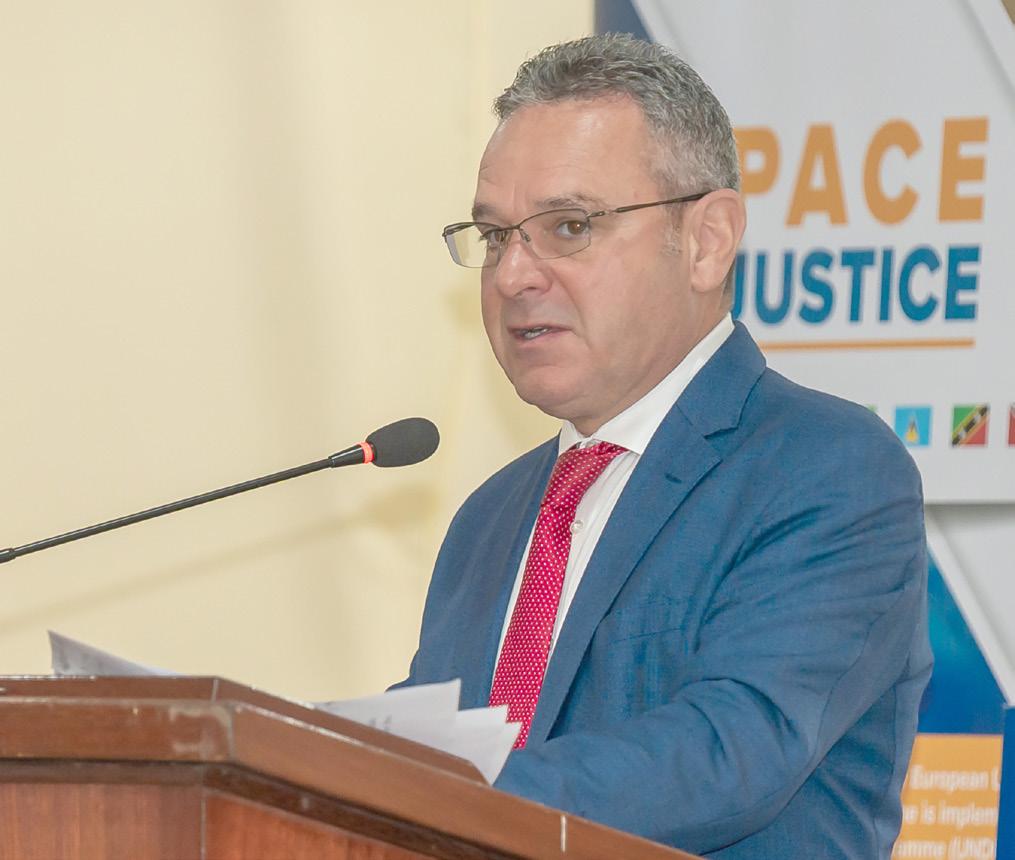
Prosecutors, investigators undergo training under Regional PACE Justice programme
–– as efforts to improve Guyana’s criminal justice system continue
By Shaniya Harding
THE Government of Guyana has poured significant resources into courts, judges, and legislation, but without proper training, it all amounts to nothing.
This was the message delivered by Deputy Solicitor General, Shoshanna Lall, on behalf of Attorney General, Mohabir Anil Nandlall, at the opening
The hosting of the event was a partnership between the United Nations Development Programme and the European Union, and it aimed to reduce criminal backlogs across eight Caribbean countries.
The workshop is the latest activity under the PACE Justice Project, which spans Antigua and Barbuda, Barbados, Belize, Dominica, Guyana, St. Kitts and Nevis,
incarceration rates that are already among the highest globally. The project seeks to address this through three broad outputs, deploying technology and infrastructure, building capacity across justice institutions, and strengthening national and regional processes and procedures.
Lall, while delivering the feature address on behalf of AG Nandlall, high-
expertise. “We can speak about the many courts the government has built over the last couple of years, including in very rural areas, the appointment of new magistrates and judges, new legislation and rules.
But all of that accounts for nothing if we do not equip our justice actors with the right training,” she stressed.
of a two-day joint training workshop for prosecutors and investigators on Thursday morning.
Lall was joined by Crime Chief and Deputy Commissioner of Police, Wendell Blanhum; Chargé d’Affaires of the European Union Delegation to Guyana, Spiros Polycandriotis-Van Duynhoven; Director of Public Prosecutions, Shalimar Ali-Hack; UNDP Guyana Officer-in-Charge, Dhiraj Singh, among others, at the activity hosted under the PACE Justice Project.
St. Lucia, and Trinidad and Tobago. The project was born out of a 2020 UNDP Judicial Needs Assessment of nine Caribbean countries, which found that efficient access to justice across the region was being undermined by delays at key stages of the criminal justice process. Those delays which were largely caused by constraints on human and technological resources, created massive bottlenecks in the justice sector, contributing to high numbers of prisoners on remand and
lighted the government’s considerable investment in the justice sector in recent years, noting, “The Government of Guyana has invested huge amounts of resources in augmenting infrastructure and human resources within the judicial system. All of this is aimed at alleviating the backlog and creating greater access to justice and efficiency in the justice landscape.”
Moreover, Lall noted that these investments must be backed by equipping prosecutors with the right
naturally complement and embrace the five pillars of the Guyana Police Force’s Strategic Management Plan.”
He added, “They promote modern policing and necessitate that investigators utilise available technologies in crime fighting.
As part of our joint reform initiative, the Guyana Police Force continues to incorporate technologies into
earlier ones in Barbados, Saint Lucia, and Saint Vincent.
“To date, these sessions have yielded valuable insights which, along with key lessons from study visits to France and Spain in May 2026, attended by officers from the Guyana Police Force, among others, will be consolidated during a final workshop in Barbados on 18 and 19 June,” he said.
our daily operations across areas such as intelligence, investigation, and prosecution.”
He also addressed what he described as a mischaracterisation of the justice system, noting that while investigators work hard to build strong cases, the blame for delays is often due to external factors.
The Crime Chief explained, “Commentators frequently point to inordinate delays within the justice system. However, the reality is that many delays are attributed to external factors, such as witnesses being reluctant to attend court.”
MODERN POLICING
Also addressing the participants of the workshop was the Crime Chief who spoke to the importance of modern policing and the need for investigators to work in keeping with the changing demands of the justice system.
Speaking on the goal of this and similar workshops, Blanhum said, “Ultimately, the goal is to assist Guyana in improving our criminal justice processes and procedures. These objectives
Further, he said, “Unfortunately, public perception does not always account for these nuances and instead criticises the justice system as a whole. That is why a multifaceted approach is absolutely essential to ensure the criminal justice system remains efficient and effective.”
Meanwhile, Polycandriotis-Van Duynhoven outlined where Thursday’s workshop sits within the broader PACE Justice programme, noting that it was the fourth in a series of training sessions following
He further noted that the overall objective is to develop standardised operational procedures for the Caribbean region, promote more effective and consistent law enforcement practices, and provide participants with practical skills that can be directly applied in daily work. He further noted that what sets this training apart is its strong operational focus, ensuring that participants gain practical, actionable skills that can be immediately applied. Since the project document was signed in 2023, UNDP Guyana has procured approximately US$304,000 in hardware for the Guyana Police Force, the Office of the Director of Public Prosecutions, the Guyana Prison Service, the National Forensic Laboratory, and the Guyana Fire Service, and has spent more than US$130,000 on additional court recording software. Training has already been delivered in restorative justice, criminal mediation, case management, and criminal trials, and officers have travelled to Barbados and Europe for
in
and
specialised training
forensics, digitisation,
AI.
Deputy Solicitor General Shoshanna Lall delivers remarks on behalf of Attorney General and Minister of Legal Affairs, Mohabir Anil Nandlall, at the opening of the joint police-prosecutor training programme under the PACE Justice Project on Thursday (Delano Williams photo)
Crime Chief and Deputy Commissioner of Police, Wendell Blanhum, addresses participants during the opening ceremony of the PACE Justice Project training workshop at the Police Officers’ Mess, Eve Leary
Chargé d’Affaires of the European Union Delegation to Guyana, Spiros Polycandriotis-Van Duynhoven, delivers remarks during the opening of the regional justice sector training programme
Participants and officials gathered at the Police Officers’ Mess, Eve Leary, for the opening of the PACE Justice Project’s joint training programme for prosecutors and investigators
Guyana expands robotic surgery with series of regional firsts
—GPHC completes historic multi-speciality surgery week,
pioneering
robotic procedures across four medical disciplines
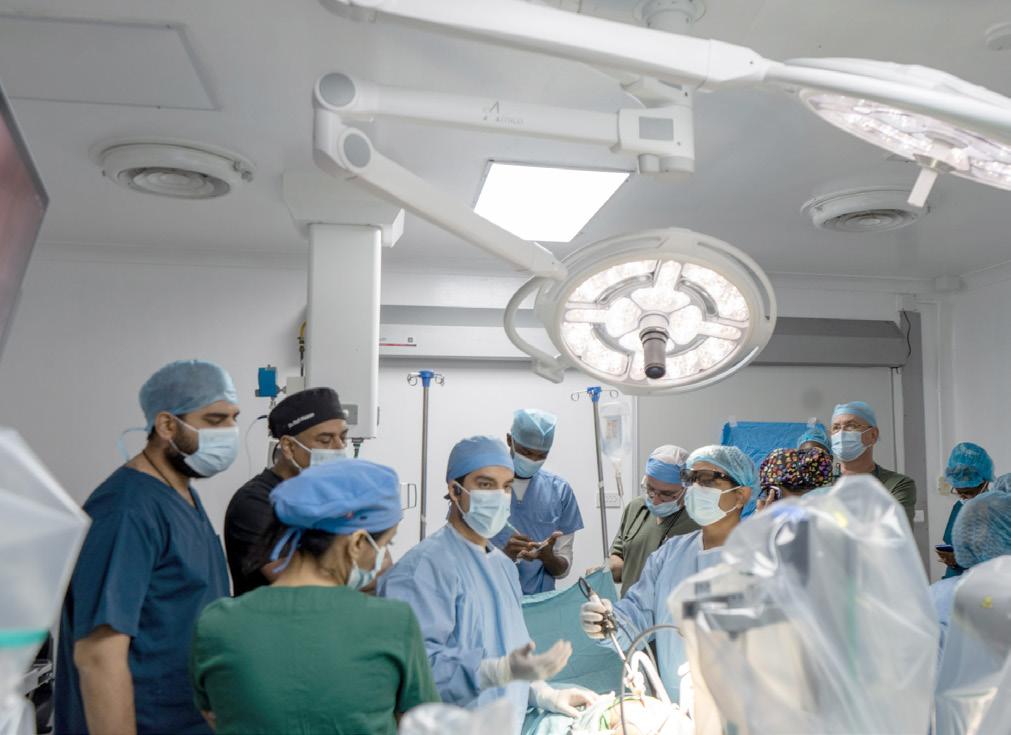
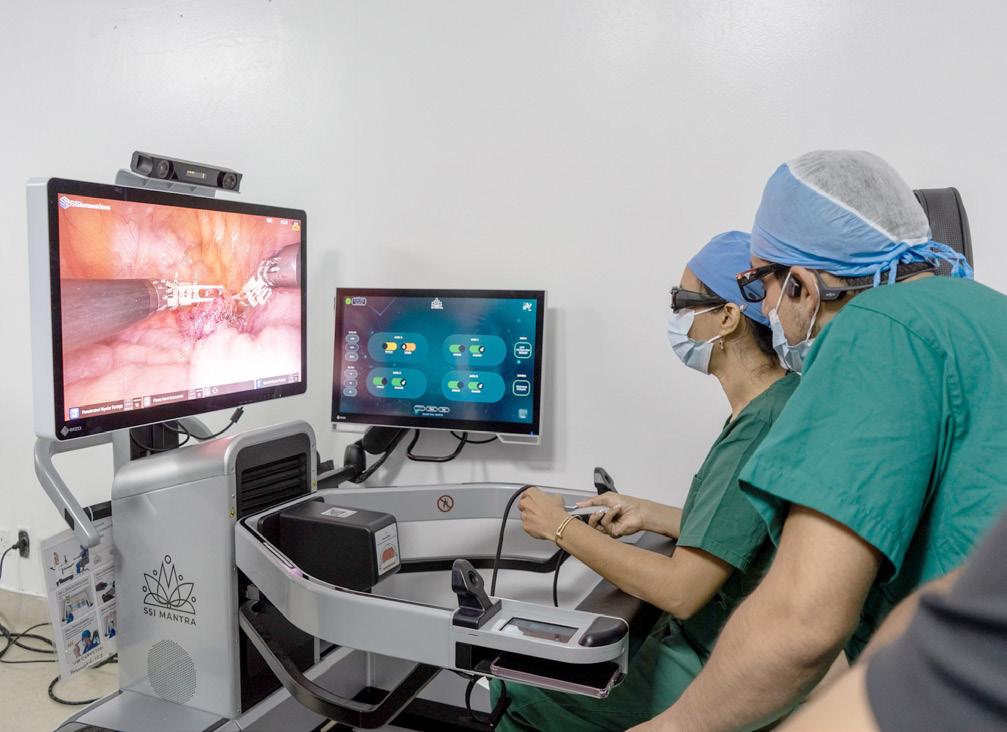
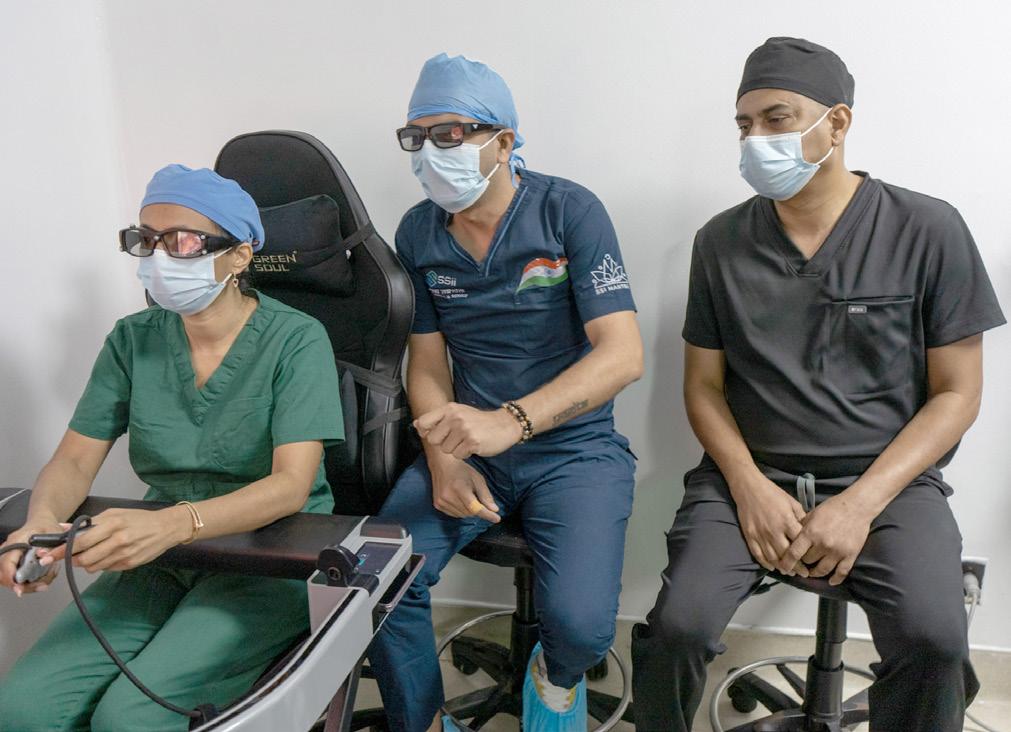
The successful completion of a series of first-of-its-kind robotic surgeries has positioned Guyana as the pioneer of a multi-speciality robotic surgery programme in the English-speaking Caribbean, less than two weeks after the technology was officially introduced at the Georgetown Public Hospital Corporation (GPHC)
THE successful completion of a series of first-of-itskind robotic surgeries has positioned Guyana as the pioneer of a multi-speciality robotic surgery programme in the English-speaking Caribbean, less than two weeks after the technology was officially introduced at the Georgetown Public Hospital Corporation (GPHC).
According to GPHC, a landmark week of robotic surgical procedures conducted between June 1 and June 5, 2026, built on the country’s historic launch of robotic surgery on May 26, which featured the world’s longest robotic telesurgery spanning more than 20,000 kilometres using the SSI Mantra 3 Robotic Surgical System.
The hospital noted that each procedure completed during the week represented a historic first for Guyana and the English-speaking Caribbean, “further positioning Guyana as a regional leader in surgical innovation and ad-
GPHC credited the success of the initiative to a multidisciplinary team, including anaesthesiologists, operating theatre personnel, biomedical engineers and international specialists
vanced healthcare delivery.”
The Urology Department introduced robotic urology on June 1 under the guidance of Consultant Urologist, Dr Rajendra Sukhraj. Two successful procedures, a renal cyst decortication and a varicocelectomy, were
performed, marking what GPHC described as a critical breakthrough in minimally invasive urology.
The following day, the Department of Obstetrics and Gynaecology successfully carried out Guyana’s first robotic gynaecological pro-
cedures. Dr Padmini Singh performed a bilateral salpingectomy, while Dr Radha Sookraj conducted an ovarian cystectomy, expanding minimally invasive surgical options for women’s health.
On June 3, robotic surgery was introduced in bar-
iatrics, with Dr Bibi Hussain performing Guyana’s first robotic Single Anastomosis Gastric Bypass (SAGB).
The momentum continued on June 4 when additional robotic gynaecological procedures were completed and Dr Jagnanand Ramnarine performed a robotic cholecystectomy, further strengthening the hospital’s general surgery capabilities.
The final day of the programme saw Dr Hemraj Ramcharran conduct a robotic cholecystectomy, while Dr Ramnarine completed an inguinal hernia repair procedure. According to GPHC, both surgeries significantly expanded the scope of the institution’s robotic surgery programme.
The hospital credited the success of the initiative to a multidisciplinary team, including anaesthesiologists, operating theatre personnel, biomedical engineers and international specialists.
Special recognition was given to operating theatre assistants Devonna Bowman
and Naomi Roopnarain, who received specialised training in India, and biomedical staff Dervin Bennett and Imran Alli, who assisted with the deployment of the robotic system.
All procedures conducted during the week were supervised by visiting Ecuadorian surgeon Dr Pedro Luis Maldonado, while technical support was provided by representatives of SSI, the manufacturers of the robotic platform.
“In less than two weeks since its official launch, GPHC has managed to incorporate robotic surgery in the departments of Urology, Gynaecology, Bariatric Surgery, and General Surgery,” the hospital said, adding that these achievements have made Guyana “the pioneer of a multi-speciality robotic surgery programme among the countries of the English-speaking Caribbean based on the SSI Mantra 3 Robotic Surgical System.”
Guyana’s strong legislative protection for PWDs highlighted at UN conference
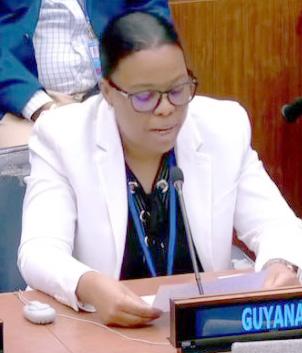
SPECIAL Projects Officer at the Ministry of Parliamentary Affairs and Governance, Alicia Jerome-Reece, delivered a powerful statement, underscoring Guyana’s unwavering efforts in strengthening inclusivity and creating a world free from exploitation, violence and abuse for Persons with Disabilities (PWDs).
Delivering her speech at the 19th Conference of State Parties to the Convention on the Rights of Persons with Disabilities at the United
Nations Headquarters in New York, under the theme ‘Creating a World Free from Exploitation, Violence and Abuse for All Persons with Disabilities,’ Jerome-Reece underscored that Guyana’s constitution prohibits discrimination on the basis of disability.
Guyana, she said, has made advances in legislative, institutional and support measures, to prevent and respond to exploitation, violence, and abuse against persons with disabilities. According to Je -
rome-Reece, “Our Combatting of Trafficking in Persons Act strengthens protections for persons with disabilities by recognising disability within the context of vulnerability. It imposes stringent penalties for offenders and provides victim assistance and training that is responsive to the specific needs of victims, including persons with disabilities.”
Furthermore, she mentioned that Guyana’s Family Violence Act strengthens legal safeguards, including for
PWDs. The act ensures that abuse occurring within care or support management is addressed and that persons with disabilities are afforded appropriate protection.
These protections are complemented by responsive services, including shelters, psychosocial support and case management referrals.
“A hotline service facilitates reporting of all forms of violence and abuse and connects survivors to essential support services. Access to justice is also ad -
vanced through legal aid support, court accessibility measures, online participation, e-litigation, and a family court and a mental health court,” the Special Projects Officer said. Jerome-Reece further said that Guyana will continue its efforts to strengthen these mechanisms and public awareness while at the same time, fostering close collaboration with persons with disabilities, their representative organisation, and partners to advance protection.
CARICOM trade ministers meet in Georgetown for 62nd COTED
THE Sixty-Second Regular Meeting of the Council for Trade and Economic Development (COTED) opened on Thursday, June 11 at the CARICOM Secretariat in Georgetown, Guyana.
The meeting is being chaired by the Hon. Dr Vince Henderson, Minister of Foreign Affairs, Interna-
tional Business, Trade and Energy of the Commonwealth of Dominica.
CARICOM Secretary-General, Dr Carla Barnett, in opening remarks to
the Ministers and delegates pointed to multiple ongoing global crises that continue to reshape economies and trade.
She said that disruptions
in energy markets and supply chains have unsettled financial markets, increased prices, and created uncertainty for global economic growth.
Referencing data from the United Nations Conference on Trade and Development (UNCTAD), Dr Barnett noted projections of a decline in global merchandise trade, alongside continued high costs for fuel, food and fertiliser.
These conditions, she added, are expected to increase inflation and affect food security, heightening the vulnerability of CARICOM economies to external shocks.
Underscoring the importance of the meeting against this backdrop, she stated, “Our resilience is being tested, and safeguarding our trade and economic development agenda requires strategic, coordinated and focused efforts.
In this regard, the COTED deliberations and decisions continue to be consequential for every member of the Community, particularly businesspersons, consumers, the self-employed, and our young people.”
Among the matters on the agenda for trade ministers is an assessment of the CARICOM Single Market and Economy (CSME), which the Secretary-General described as “the Region’s core platform for economic development and resilience.”
She added that the assessment COTED is undertaking confirms the need for more effective implementation of the Revised Treaty of Chaguaramas to “ensure a stronger and more durable CSME.”
In this context, she highlighted Article 164 of the Treaty, which allows for temporary tariff protection and market access support to help develop regional industries, particularly in Lesser Developed Countries.
She also commended the CARICOM Development Fund for ongoing support to firms benefitting from these measures.
Trade ministers are also expected to consider emerging areas such as digital trade, with work advancing on a regional digital trade policy as part of efforts to respond to a more technology-driven global economy.
COTED will also review developments in the multilateral trading system, which the Secretary-General said has faced ongoing challenges.
The Sixty-Second Regular Meeting of the Council for Trade and Economic Development continues through June 12. [CARICOM RELEASE]
GPHC surgery consultant urges Guyanese to prioritise colon health
By Faith Greene
DR Allan Tinnie,
a General Surgery Consultant at the Georgetown Public Hospital Corporation (GPHC), recently emphasised the importance of “answering your body’s call” in talks about maintaining good colon health.
Dr Tinnie explained that the colon is the last part of the digestive tract, and measures about five feet in length, connecting the small intestine to the anus and the rectum. The colon is also the average height of a guinea pig.
“The colon has some specific functions, one of which is to keep you hydrated. It absorbs most of the water that you ingest from the foods, as well as electrolytes and minerals. It is a storage organ in general because it allows for the waste material to pass all the way to the end,” the doctor said.
According to Dr Tinnie, there are a number of things that can go wrong with the colon, including physical changes. Some of the dangers can be functional, such as constipation, for example.
“Patients may also present with conditions like polyps growth within the colon, for which we generally tend to look for when we do screening procedures. You develop some pouches. I call them pressure pouches, and those pouches can cause problems with bleeding, they can perforate, or they can cause infections. They’re called diverticulosis. In addition to that, cancer is a very big problem with the colon, and it has a lot to do sometimes with your genetic predisposition and or your dietary habits,” Dr Tinnie explained.
He revealed that being constipated for a long time exposes the colon to a number of toxins that remain longer and affect the lining of the colon. This, he said, is why it is very important that persons pay attention to their diet.
He encouraged the use
of lots of fiber, as it reduces the transit time in the bowel and reduces that exposure level.
Fibers also help the colon itself, particularly the cells in the colon, to remain healthy because they make short-chain fatty acid for themselves and remain healthy to protect us as well.
When it comes to colon cancer, Dr Tinnie said there are a number of symptoms, but emphasised that these symptoms have to be persistent, worsening, or recurrent to be of real significance.
“The number of things that you have to look for would be tilting of your stool, changes of constipation, diarrhea, intermittently or recurrent. If you have weight loss that is unexplained with some of these symptoms, also the presence of blood in your stool, if you see any slime or mucus, and of course also if there’s any evidence of discomfort in the abdomen, bloating, swelling, or pain, those things you should want to have. Those can be signs that there’s something wrong with the bowel,” he advised.
Alongside this, Dr. Tinnie shared that some of the things that can be done to help in the prevention of some of these diseases or sicknesses include water consumption, exercising and keeping your body weight within the range of your height.
“You want to avoid things like alcohol, smoking. You want to limit red meat in your diet, as well as you want to exercise maybe at least 30 minutes a day. Those things help to maintain good heart rate,” Dr Tinnie stressed.
Dr Tinnie stated that another common issue noticed with patients when they visit the clinic is, “when you ask them about the nature of the type of stool that they have, most of them (say), ‘me, I don’t really look at my stool’. I think that’s a habit that we can change. Looking at the
stool is important. You can pick up changes early. You can see things like slime in the stool.
Those things will be unusual, and you’ll want to come and have that checked,” he added.
Dr Allan Tinnie, General Surgery Consultant at the GPHC
Cannabis found during Mahdia police operation
POLICE in Regional Division Eight are investigating the discovery of a quantity of suspected cannabis during an operation conducted at School Street, Mahdia, Region Eight.
According to a police release, ranks carried out searches in the area between 03:00 hrs and 03:40 hrs on Wednesday, June 10, 2026, when a large bulky black plastic bag containing leaves, seeds and stems suspected to be cannabis
was found among a garbage heap. Further searches of the bag revealed two separate transparent plastic bags containing additional quantities of the suspected narcotic.
The suspected canna -
bis was taken to the Mahdia Police Station, where it was weighed and amounted to 120 grams before being lodged.
No arrests have been made as investigations are ongoing.
The suspected cannabis was taken to the Mahdia Police Station, where it was weighed and amounted to 120 grams before being lodged
St Ignatius labourer remanded for cocaine trafficking
A 25-year-old labourer from St. Ignatius Village, Central Rupununi, has been remanded to prison after being charged with possession of cocaine for the purpose of trafficking.
Junior Thomas appeared before Magistrate Omadatt Chandan at the Lethem Magistrate’s Court on Thursday, June 11, 2026.
Thomas was charged with Possession of Narcot-
ics for the Purpose of Trafficking, contrary to Section 5(1)(a)(i) of the Narcotic Drugs and Psychotropic Substances (Control) Act.
Police said he was arrested on Wednesday, June 10, after he was allegedly found in possession of three grams of cocaine.
The charge was read to Thomas, who pleaded not guilty. He was remanded to prison and the matter was adjourned until August 12, 2026.
REMANDED: Junior Thomas
St. Theresa Primary pupils served fresh, quality meals
-MoE says
THE Ministry of Education, on Thursday, has assured parents and the public that all meals served at St. Theresa Primary School in Region Six are of a quality standard and are checked by the headteacher and teachers before being distributed to the pupils.
The ministry was at the time responding to a video, which suggested that its National School Feeding Programme served spoiled, moldy cheese sandwiches to the pupils earlier in the day.
In setting the facts straight the ministry in a statement said:
“�������� �� : The cheese sandwiches were ������������ ���� ������ ������������ ���������� ��������������, �������� ��, �������� At the time of delivery, the meals were verified by the headteacher of the school to be fresh and of proper quality and standard.
“�������� ��: Every meal served is videoed, photographed and inspected thoroughly by teachers of every school, who then have to
sign a letter of satisfaction confirming that the meals meet the requisite high standards fit for our children.
“�������� �� : Since September 2025, Hon. Sonia Parag, Minister of Education, made it mandatory for caterers to provide video and photo evidence of meals being prepared for each day, including last Tuesday (as evidenced in the video and screenshot below).
“�������� ��: All reported cases are investigated thoroughly and caterers found to be in breach of the health and safety guidelines are immediately removed from the programme.
“�������� �� : Investigations into many reported cases have found that meals would often be forgotten in book bags for days.”
The ministry pointed out that while there is a “clear attempt to tarnish this very impactful programme for cheap political gains,” it will continue to investigate every single complaint, regardless of the source.
Noting that the overall wellbeing of our children remains paramount in
The Ministry of Education encourages parents, teachers and the public to report any concerns they may have with the National School Feeding Programme by scanning the QR code
everything that is done, the ministry encouraged parents, teachers and members of the public to remain vigilant and to report any concerns they may have with the programme.
Caterers must provide video and photographic evidence of meals being prepared for each day (MoE photo)
ENGLISH RACING TIPS
SANDOWN
08:08hrs Mysterious Times
08:38hrs Silver Wrath
09:13hrs Marching Mac
09:48hrs King’s Welcome
10:23hrs Dangerman
10:58hrs Edwin Hubble
11:35hrs Eupjonia
12:08hrs King Of Berkshire
GOODWOOD
12:32hrs Rollthedicebaby
13:04hrs Hove Ranger
13:39hrs Mr Freedom
14:14hrs Double
Naughty
14:49hrs Wedonttelllies
15:24hrs Desperate Dan
YORK
08:50hrs Jannas Journey
09:25hrs Everatease
10:00hrs Dandana
10:35hrs Big Negotiator
11:10hrs Antipodes
11:45hrs Schrodinger’s
12:18hrs Dovey Moon
IRISH RACING TIPS
GOWRAN PARK
11:15hrs Folsom Blues
11:50hrs Pocket Jacks
12:23hrs Rion Rubette
12:58hrs Chirpsdown
13:33hrs Son Of Beauty
14:08hrs Bofa Beach
14:43hrs
Trustyourinstinct
15:18hrs Faro Island
AMERICAN RACING TIPS
BELMONT AT THE BIG A
Race 1 Felonious Race 2 Kiamba
Race 3 Silvology
Race 4 K Gun
Race 5 Key Actress
Race 6 Just Peachy
Race 7 Dot’s Dollar
Three sent off as Mexico beat South Africa in World Cup opener
(BBC) - Three players were sent off as World Cup co-hosts Mexico defeated South Africa in a dramatic opening match at a packed Azteca Stadium.
South Africa finished with nine men, while Mexico were reduced to 10 in the closing moments.
Brazilian referee Wilton Sampaio produced the flurry of red cards, dismissing South Africa’s Yaya Sithole for denying a goalscoring opportunity and Themba Zwane for a slap, then sending off Mexico’s Cesar Montes for a late foul.
Only four red cards were shown in the entire Qatar 2022 World Cup, while three had never been shown in a tournament-opening game before.
Long before any hint of that turn of events, Mexico delighted their fans with the first goal of the finals after only nine minutes.
South Africa midfielder Sithole was tackled by Erik Lira and the ball dropped to Julian Quinones whose powerful strike went through the legs of goalkeeper Ronwen Williams.
Quinones almost made it 2-0 just before half-time, but his 12-yard first-time shot bounced off the foot of the right post.
The hosts’ task became much easier when Sithole was sent off five minutes into the second half, bringing down Brian Gutierrez when he was going through on goal.
Striker Raul Jimenez, 35, sealed the victory with his first goal at a World Cup, heading
Mexico’s best runs at the World Cup came in the 1970 and 1986 tournaments they hosted, when they reached the quarter-finals on both occasions
in powerfully from Roberto Alvarado’s cross for Mexico’s second, a moment that appeared to bring tears from the veteran.
South Africa were playing in the finals for the first time since they hosted the 2010 competition, but they ended with nine men as
substitute Zwane was ordered off for slapping the face of Alvarado.
Seventeen-year-old Mexico midfielder, Gilberto Mora, the youngest player in this tournament, became the second youngest to appear in a World Cup, behind only Brazil
great Pele, who played in the 1958 competition when he was also 17.
Mexico had a red card of their own late on, when Montes fouled Khuliso Mudau, but the hosts maintained their two-goal advantage.
Taskin, Mustafizur set up famous series win for Bangladesh
(ESPNCRICINFO) - Bangladesh secured their first ODI series victory against Australia after they won the second ODI by five wickets in Dhaka, chasing down a rain-adjusted target of 192 having earlier removed the visitors’ first three wickets before they had scored a run.
Australia reached 187 for 8 in 42 overs when rain came but had done well to reach that far becoming just the fourth team in ODI history to be 0 for 3.
Taskin Ahmed and Mustafizur Rahman did the early damage and finished with three wickets each. Australia hung on through fifties from Marnus Labuschagne and Xavier Bartlett who rescued them with a 103-run seventh-wicket stand.
Buoyed by his maiden half-century, Bartlett bowled an inspired first over when play resumed. A big appeal off the first ball was followed by Tanzid Hasan giving a simple return catch. Bartlett then dropped Najmul Hossain Shanto off the fifth ball, although it was a tough chance, before the umpire raised the finger to an lbw appeal on the last ball but Shanto’s review saved him with the ball missing leg stump.
The recalled Soumya Sarkar got Bangladesh going with a lofted cover drive in the third over. He repeated the dose against Nathan Ellis in the next over then Shanto took consecutive boundaries off Bartlett in the fifth over.
Three more boundaries followed in as many overs, including Soumya hoisting Ellis over square leg for a six. Shanto survived a half chance on 21 when Labuschagne dropped a tough opportunity at short midwicket. Soumya then went after Adam Zampa, climbing into a high six over long-on.
It was the part-timer Matt Renshaw who got Australia the much-needed breakthrough in the 16th over. Soumya’s reverse paddle was poorly executed, and he gave Bartlett a simple catch at slip. Shanto followed soon after, caught behind off Riley Meredith, who
was returning to the ODI side after five years. Cameron Green made a further blow when he removed Litton Das with a snorter that took the glove after a brisk 21. Mosaddek Hossain, Bangladesh’s batting hero from the first game, played his shots from the start before giving Cooper Connolly a simple catch at long-off.
At 144 for 5, with a only the bowlers to come, the game was not quite closed out. However, captain Mehidy Hasan Miraz withstood a blow to the side of the head to help Towhid Hridoy in the remaining part of the chase. The game ended up finishing in a rush as Hridoy hooked Meredith for a six followed by a pulled boundary then Mehidy sealed victory with another hook that cleared the boundary.
The opening exchanges of the match were remarkable. Taskin set off one of the most extraordinary starts seen in Bangladesh when he clean bowled Matthew Short for the second consecutive innings, this time the batter leaving the ball from a good length. It meant Short had fallen for a duck three innings in a row, starting from the third ODI against Pakistan in Lahore. Connolly followed in the next over when he fell first ball to Mustafizur. The delivery was going slightly away from the left-handed Connolly who provided the thin edge. Renshaw fell in a similar way at the end of the same over, and Australia hadn’t opened their scoring.
Towhid Hridoy and Mehidy Hasan Miraz took Bangladesh home • AFP/Getty Images
S&K Imports GY backs One Guyana T10 Tapeball Blast
MOMENTUM behind the One Guyana T10 Tapeball Blast shows no signs of slowing down, as S&K Imports GY has officially signed on as a corporate partner for the upcoming tournament.
Located at Lot 6, Saila Park, Crane Public Road, Vreed-en-Hoop, West Coast Demerara, this marks the first time the prominent business has aligned itself with the tournament.
The partnership reinforces the tournament’s skyrocketing commercial value and its deep-rooted cultural impact, setting the stage for an explosive 2026 season scheduled to bowl off on August 8.
“As a business, we are deep lovers of cricket, and we see this as the perfect avenue to drive community development,” a spokesperson for S&K Imports GY stated.
“Tapeball cricket is the heartbeat of grassroots sports in Guyana, and we want to see our local talent thrive on a massive platform. Supporting this tournament is about investing in our youth and our communities.”
Tournament organiser John Ramsingh welcomed the new backing, emphasising that corporate synergy is pivotal to elevating the overall tournament experience this year. With the tournament rapidly approach-
ing, organisers are issuing an urgent call to teams across the nation to lock in their spots immediately rather than delaying their entry while attempting to perfect their rosters.
Ramsingh emphasised that registration operates on a strict first-come, first-served basis, acknowledging that the fierce, highstakes nature of the competition often leads captains to overthink and deliberate over their lineups for too long.
To guarantee entry, teams must pay the G$35,000 entry fee now. This allows captains the necessary flexibility to finalize their ultimate 15-man talent pools closer to their respective zonal start dates. Entry caps are being strictly enforced to effectively manage the intensive schedule. The Berbice, East Bank/West Demerara, and Essequibo zones are rigidly capped at 16 teams each. Meanwhile, the East Coast Demerara/ Georgetown zone will accommodate up to 32 teams.
Registration forms are currently available on the tournament’s official social media channels, or interested teams can register via WhatsApp at +592 635-2235.
The high-octane action begins with the Berbice Zone on August 8–9. Sixteen teams will battle across four premier venues, including the Port Mourant Community Centre
Ground, No. 69 Ground, and the Welfare Ground in Canje. The regional action will culminate with the zonal finals on Sunday, August 9, at the Albion Sports Complex.
From there, the tournament caravan moves swiftly to the East Bank/West Demerara leg on August 15–16, followed quickly by the Essequibo Zone on August 22–23.
In a strategic move designed to maximise fan engagement and support local cricket festivities, the competition will pause during the Caribbean Premier League (CPL) window. This thoughtful scheduling allows fans to fully immerse themselves in the professional franchise season without distraction.
Action resumes post-CPL with the highly anticipated Georgetown/East Coast Demerara leg, spanning September 26–27 and October 3–4. This gruelling regional phase leads directly to the historic national grand finale on October 11, 2026.
For the first time in the tournament’s history, the ultimate prize will be contested at the Anna Regina National Stadium in Region Two, bringing elite tapeball action directly to the passionate and cricket-starved fans of the Essequibo Coast.
High Stakes and Life-Changing Rewards
The stakes for the 2026 season have reached an all-time high, courtesy of a re-
vamped financial structure that introduces guaranteed cash prizes for every single team that reaches the quarter-final stage of their respective zone.
Rewards begin at $25,000 for losing zonal quarter-finalists and scale up significantly, culminating in a hefty $500,000 purse pocketed by the zonal winners before they even advance to the national finals.
At the national level, the rewards become life-changing for grassroots cricketers. Teams will compete for a massive $2,000,000 grand prize, while the national runner-up will take home $1,000,000. Beyond the financial windfall, the four national finalists will also earn the prestigious right to represent Guyana at the upcoming International T10 Tapeball Tournament later this October.
Individual brilliance will be celebrated just as handsomely alongside team success. The tournament’s eventual Most Valuable Player (MVP) will walk away with $150,000 and a brand-new motorbike.
Furthermore, specialised awards for the leading run-scorer and the top wicket-taker will see both players receive $100,000 and a new television each, ensuring that historic personal milestones are met with premier rewards.
Tributes pour in for former basketball administrator McDonald
CONDOLENCES continue to pour in for former sports journalist and basketball administrator Al McDonald who passed away recently.
Leading the overseas list was General Secretary of the Guyana Basketball Federation (GBF) Patrick Haynes who posited yesterday, “It is with deep sorrow that the Guyana Basketball Federation learns of the passing of Mr. Alred Naisan Chapman –known to all as Al McDonald. On behalf of our entire basketball community, I extend heartfelt condolences to his son, Junior Sean, and to all his family members.”
Guyanese basketball official Patrick Haynes, who is President of CONCENCABA (Confederation of Central America and Caribbean Basketball) and First Vice-President of FIBA Americas added, “Al was more than a journalist; he was a true pioneer of organised basketball in Linden and by extension, Guyana. His vision and dedication led directly to the founding of the Linden Amateur Basketball Associ-
ation (LABA) in 1976, where he served as its first president. That foundation has supported generations of players and administrators.”
Haynes continued “We are grateful that his ashes will be returned to Guyana, where his impact remains forever embedded in our basketball history.”
In a previous interview on his development as a sports journalist with this newspaper, Al Mac paid tribute to former President of the Guyana Amateur Basketball Federation and longstanding sports broadcasting icon Joseph ‘Reds’ Perreira, saying, “It was ‘Reds’ Perreira who actually introduced me, (Al McDonald) to the deep exigences of the sport called basketball, when I returned to Guyana after covering the Central American and Caribbean Basketball Tournament in the Dominican Republic. Previous to the ‘tete a tete’ with him all I knew about the game was the final results of matches, but ‘Reds’ showed me that there was more to the sport
than just scoring points and achieving the final results between two teams.”
Miami-based former president of the GABF John ‘Fishy’ Yates, and Manager of the men’s basketball team to the 1975 Santo Domingo staged CAC Games, said “My recollection of Al Mc was he was dedicated to what he did and very detailed. He was one who could give you a true history of the sport of basketball in Guyana.”
Former FBA Referee Cecil Chin, who attended the 1975 CAC Games with Al McDonald as the reporter, offered on Al’s death saying, “Sad greetings to the family of Alred McDonald upon hearing of his passing. Al Mac, as he was well known to his colleagues, was an outstanding ‘periodista’ and administrator in the sport fraternity and choosing basketball as his priority…On returning to Guyana he became much more involved in the discipline, heading to Linden with every intention of assisting in the development of the game in Linden. His efforts along with the support
of the Linden fraternity caused Linden to become a sub-association.”
New York-based former national player Royston Telford (Snr) remembers Al McDonald saying “Al-Mac has contributed immensely towards the recognition of athletic talent in Linden, Region 10 and other rural communities. He was very inspirational in guiding the Yellow Birds basketball team throughout our journey, from junior to senior level, where we produced quality players such as Oswald Douglas, Steven Carryl, Steve Neils (Snr), the Padmore brothers Ewart and Wayne, Lennox Stephens, Neil (GG) Caynes, John Joseph, Trevor Benjamin, Carl Liverpool, Lloyd Ross, Raymond Braithwaite and the Thorne brothers. Lots of talent and memorable years of prime-time basketball in Linden.”
Al McDonald began his journalism career in 1975 with the Guyana Chronicle and also covered sports for Sports Special and, briefly, for New Nation.
Mexico City opens FIFA world Cup 2026 with spectacular opening ceremony
(FIFA) - The eyes of the world were on Mexico today as the FIFA World Cup 2026™ began with an opening ceremony that offered a celebration full of sound, colour and meaning.
As the host of the opening match, Mexico held the first in a trio of opening ceremonies that will continue across Canada and the United States. Produced in creative partnership with Balich Wonder Studio, it reimagined the FIFA World Cup™ trophy through the lens of Mexico’s culture – a thread that will run through each of the three ceremonies. In Mexico, this concept was brought to life through the intricate and celebratory art of papel picado, a powerful symbol of tradition, craftsmanship, and joy.
The ceremony featured music, dance and artistry, with contributions from some of the most exciting voices in global music. The star names who brought to life the sound of
the Official FIFA World Cup 2026™ Album included Shakira, Burna Boy, Alejandro Fernández, Belinda, Danny Ocean, J Balvin, Lila Downs, Los Ángeles Azules, Maná and Tyla.
LABUBU, the beloved characters from global entertainment IP brand POP MART, also made a surprise appearance at the FIFA World Cup opening ceremony as special guests.
For both the spectators inside the Mexico City Stadium and the global television audience, the mix of indigenous talent and modern folkloric performers proved a powerful way to kick off this World Cup finals tournament.
The ceremony also featured a parade of flags of the competing nations and concluded with an explosion of fireworks as the long wait for the FIFA World Cup 2026 finally came to an end.
LABUBU, the beloved characters from global entertainment IP brand POP MART, also made a surprise appearance at the FIFA World Cup opening ceremony as special guests
Bandara, Perera heroics earn Sri Lanka Emerging Players draw
(CMC) - Anjala Bandara scored his second century of the match to ensure Sri Lanka Emerging Players shared the spoils with West Indies Academy in the opening four-day Test here on Thursday.
Bandara followed up his first innings knock of 163 with an unbeaten 189, while Pulindu Perera scored a crucial 87 as the home side compiled 401 for eight in their second innings before both sides agreed to a draw at the Mahinda Ra -
japaksha International Cricket Stadium.
Sri Lanka resumed the fourth and final day precariously placed on 173 for five – an overall lead of just 148 – and needing a herculean effort from their lower order to avoid defeat.
They got just that from Bandara and Perera, with the pair continuing from where they left off the previous day after coming together with their side in dire straits at 91 for five.
In all, the pair shared a game-chang-
ing partnership of 162 runs, that carried Sri Lanka to relative safety at 253 for five.
And when pacer Jediah Blades finally broke through by dismissing Perera after he had faced 107 balls and struck 10 boundaries, Tharinda Nirmal helped to further frustrate the Academy bowlers by adding 92 runs for the seventh wicket to erase any hopes the visitors would have had of pushing for victory. By the time he was run out after
scoring 40 from 96 balls, Sri Lanka had extended their total to 345 for seven, an overall lead of 320 runs.
The match petered into a predictable draw thereafter, with Bandara carrying his bat throughout the innings. His unbeaten knock spanned just over nine hours and saw him face 326 balls and hit 13 fours.
Johann Layne was the Academy’s best bowler with 3-61, while Blades took 2-43.
Shakira stars again
A vision in gold
Mexico City opens FIFA world Cup 2026
FL Sport’s John Ramsingh (right) and a representative