MONDAY 12th January, 2026
PRICE $100 VAT INCLUSIVE
No. 108041
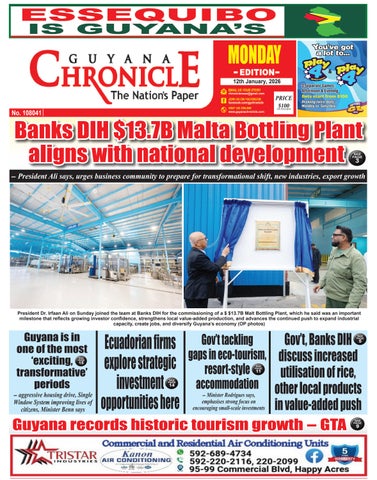
Banks DIH $13.7B Malta Bottling Plant aligns with national development
SEE PAGE
3
- President Ali says, urges business community to prepare for transformational shift, new industries, export growth
President Dr. Irfaan Ali on Sunday joined the team at Banks DIH for the commissioning of a $ $13.7B Malt Bottling Plant, which he said was an important milestone that reflects growing investor confidence, strengthens local value-added production, and advances the continued push to expand industrial capacity, create jobs, and diversify Guyana’s economy (OP photos)
Guyana is in one of the most ‘exciting, transformative’ periods SEE PAGE
15
- aggressive housing drive, Single Window System improving lives of citizens, Minister Benn says
Ecuadorian firms explore strategic investment opportunities here SEE PAGE
14
Gov’t tackling Gov’t, Banks DIH gaps in eco-tourism, discuss increased resort-style utilisation of rice, accommodation other local products
SEE PAGE
5
SEE PAGE
11
- Minister Rodrigues says, emphasises strong focus on encouraging small-scale investments
in value-added push Guyana records historic tourism growth - GTA
SEE PAGE
9
2
GUYANA CHRONICLE, Monday, January 12, 2026
Education Ministry takes GOAL, Guyana Digital School to Leguan
Minister of Education Sonia Parag and a team of officials, recently briefed residents of Leguan Island on the vast educational opportunities available under the Guyana Online Academy of Learning (GOAL) and the Guyana Digital School programmes. Expert advice, guidance, and hands-on assistance with the registration process were accessible to the residents (MoE photos)
GUYANA CHRONICLE, Monday, January 12, 2026
Banks DIH $13.7B Malta Bottling Plant aligns with national development
3
- President Ali says, urges business community to prepare for transformational shift, new industries, export growth
President Dr. Irfaan Ali delivering the feature address By Trina Williams EMPHASISING that the turning point of Guyana’s industrial sector will be transformational rather than “marginal”, President Dr. Irfaan Ali has signalled to local producers that the months ahead are critical as lower electricity costs and targeted support will result in the emergence of new industries and export growth. Addressing stakeholders and members of the business community, President Ali, on Sunday at the opening of Banks DIH Ltd $13.7 billion Malta Bottling Plant, said that this legacy company has managed to ensure that its decades of investment strategies align with national development. The commissioning of this plant is a symbol of national pride, as the diversified industrial powerhouse continues to contribute to Guyana’s economic and
cultural heritage, Dr. Ali said. He further emphasised that it is important that government policy and private sector investment form a partnership to ensure sustainability and growth. “It's important also for us to recognise that Banks DIH would not have made this investment if they did not have the confidence in the governance mechanism, the confidence in the government, and the confidence in a policy making framework that we are applying today,” he went on to say. The future of manufacturing in Guyana will not be built from “scratch”, President Ali said, noting that it will and must be built on the foundation laid by established enterprises such as Banks DIH. It is in this regard, he emphasised, that the perfect opportunity has presented itself for Guyana to penetrate
President Dr. Irfaan Ali and other officials during a tour of Bank DIH’s New Malta Bottling plant, which was officially commissioned on Sunday regional and international markets. For decades, Guyana’s industrial sector has faced constraints owing to the high energy costs which has discouraged largescale investment. That constraint, President Ali said, is about to be lifted. Reminding his audience that the first Gas-to-Energy (GtE) plant is set to come onstream by the end of this year, President Ali said it is “not a marginal change; it is a game-changer in industrial development.” He noted that low energy costs will reshape the economies of manufacturers and manufacturing in Guyana, make global production more viable and make space for new industries and the expansion of existing ones. This means, there will be a fundamental
A glimpse of the large-scale operation that will take place inside the new plant (OP photos)
reshaping of manufacturing in Guyana. “The period between now and later this year is therefore critical,” President Ali said before urging the local business community to prepare, plan, and position themselves for this “new era,” as the nation is serious about becoming an industrial global contender. A legacy company such as Banks DIH, the President said shows that Guyanese brands can achieve the international recognition. He used the opportunity to encourage the smaller local brands to expand and invest. Dr. Ali made it clear that as Guyana accelerates, the local private sector will not stand alone in the transition. He pointed to the forthcoming budget, which will include measures to support businesses, so they are better positioned. “The manufacturing and industrial sectors will receive targeted support… What I will say is this: the direction is clear. The opportunity is real. The time is now. I believe that legacy companies like Banks DIH and others, can and must play a decisive role in shaping Guyana’s manufacturing future,” the Head of State affirmed. The President also proposed opportunities for Guyana to attract regional and international brands that currently bottle or
manufacture products elsewhere in the Caribbean. NATIONAL DEVELOPMENT The President stated that legacy companies can lead the way in modernising manufacturing by investing in new technologies, automation and energy efficient production system and as energy costs fall and infrastructure improves, these firms can rapidly scale up output deepen local value added and reduce reliance on imports. “Legacy companies can also act as anchors within Guyana's manufacturing ecosystem. By partnering with smaller local suppliers, contracting local service providers and mentoring emerging firms, they can help build integrated value chain across the economy, the procurement, power and market access can put smaller businesses into formal manufacturing networks, spreading industrial capability beyond a few large farms, and creating broader base employment and entrepreneurship,” he said. It is in this regard that the President noted that the government is discussing with large companies how they can contribute to the Guyana Development Bank to create opportunities to support small businesses, including “mom-and-pop”
and roadside operations. This year, Micro, Small and Medium-Sized Enterprises (MSMEs) will be able to access loans of up to $3 million at zero interest and without collateral through the new development bank. The President said that developing strong Guyanese brands is essential to building a competitive economy. “Brands do more than sell products, they carry a country's identity, reputation and standard in the local and international markets. When Guyanese brands succeed, value is returned [and] retained at home, jobs are created, and local enterprises move up the global value chain from raw production to finish, recognised products. Most importantly, Guyanese brands tell the world that Guyana is not just a place of resources, but a place of creativity, craftsmanship and capability,” he said. Meanwhile, Chairman and Managing Director of Banks DIH Clifford Reis, in his remarks noted that the new plant is not just a physical structure, but it symbolises a long-term commitment. He noted that with this most recent investment, the company’s capacity for storage, brewing and bottling has expanded enormously.
4
GUYANA CHRONICLE, Monday, January 12, 2026
Tourism and Hospitality Institute on track for mid-2026 completion – work has begun to develop the curriculum
EXPECTED to play a significant role in strengthening Guyana’s tourism workforce, the Tourism and Hospitality Institute is on schedule to be completed by mid-2026. During an appearance on the “Starting Point” podcast that aired on Sunday, Minister of Tourism, Industry and Commerce Susan Rodrigues emphasised the importance of the institution, noting that work has already begun to develop the curriculum. “This project is being managed under the Ministry of Education, and they are working with the Guyana Tourism Authority to create a curriculum for the institute. The idea is to
Ministry of Tourism, Industry and Commerce Susan Rodrigues, along with contractors at the construction site during its earlier phase
train Guyanese to international standards,” Minister Rodrigues stated. When completed,
the institute will play a vital role in strengthening Guyana’s tourism workforce by equipping Guyanese with practical and globally competitive skills in various areas of hospitality, including tour-
ism services for tour operators, mixologists, food handlers, and basic customer service. The facility will help address existing skill gaps countrywide, improve service delivery in hotels, restaurants, tour operations and other related services. The overall goal is to enhance visitors’ experience. Minister Rodrigues
explained that although providing theoretical training at the institute will be impactful for professional development, it is also important that students learn practical skills on the job. “Because the real-life experiences that you will get to improve the way you deliver your services can only happen in the field,
it can’t happen in the classroom only,” she noted. This investment in human capital represents the government’s commitment to support private sector growth, expand employment opportunities and position Guyana to meet the increasing demand of a rapidly growing tourism sector. (DPI)
5
GUYANA CHRONICLE, Monday, January 12, 2026
Gov’t, Bank DIH discuss increased utilisation of rice, other local products in value-added push PRESIDENT, Dr Irfaan Ali on Sunday disclosed that he has engaged Banks DIH on the integration of more locally produced rice and other products in its value-added production. He made this disclosure while giving the feature address at the commissioning of the Banks DIH large-scale Malta Bottling Plant, where he highlighted how the household name has become a diversified powerhouse. “I've already had discussions with Mr Reis and his team on how they can utilise more of our rice production in their value chain and the products that they produce, and they've assured me that they are working on a plan that will not only utilise more rice, but a lot of the products that we are targeting. So, Banks DIH and others can and must play a decisive role in shaping Guyana’s manufacturing future. These firms carry with them decades of experience, established brands, trusted relationships and critically, financial depth,” President Ali said. Guyana’s rice sector, the second most vital agricultural industry, has experienced remarkable growth in the last five years. The growth of the sector is due to careful planning and solid investments made by the People’s Progressive Party/ Civic (PPP/C)-led government. This momentum will continue with the government identifying agriculture as one of the key pillars of a diversified economy. Since 2020, the government has rolled out a series of strategic interventions designed to shield rice farmers from escalating input costs, volatile prices, and logis-
President, Dr Irfaan Ali and Chairman and Managing Director of Banks DIH Clifford Reis share a light moment at Sunday’s commissioning of a large-scale Malta Bottling Plant (OP photo)
tical challenges. These measures, supported by billions of dollars in public investment, have been critical in maintaining productivity and protecting farmers’ incomes. One of the most significant forms of assistance came through fertiliser support. As global prices surged, the government distributed urea fertiliser valued at $3.1 billion, from a total allocation of $3.8 billion, easing the financial burden on farmers and allowing uninterrupted cultivation. Moreover, the PPP/C government has launched a $2.1 billion assistance programme to support rice farmers, providing a $300 per bag subsidy for paddy as part of ongoing efforts to strengthen Guyana’s agricultural sector. This initiative is a key commitment from President Ali to ease farmers’ financial burdens and ensure the long-term sustainability of the rice industry. The initiative fulfils a commitment made by the President, ensuring that rice farmers receive $300 per bag of paddy as support to offset production costs and stabilise
incomes. As part of this exercise, approximately $480.5 million was distributed to 1,618 rice farmers in Region Five (Mahaica–Berbice). This intervention forms part of a wider national programme, representing a total government investment of approximately $2.1 billion, aimed at sustaining rice production, enhancing food security, and reinforcing the resilience of one of Guyana’s most important agricultural sectors. Recently, at Anna Regina last Friday, 570 fisherfolk in Region Two received a one-off G$150,000 grant. President Ali had announced the initiative, which also includes the removal of taxes on essential fishing materials such as fuel and seines. This year, over 6,996 fisherfolk nationwide will benefit from the programme. LEADER IN FOOD PRODUCTION President Ali recently stated that Guyana is positioning itself to become the Caribbean’s leading food-production and distribution hub, as the country leverages its raw agricultural output, expanding agro-processing capacity
and major infrastructural investments to reach global agro-industrial scale. He explained that this ambition is closely tied to strategic partnerships, including with Brazil’s Roraima state, which has significant agricultural
capacity at a global scale. He highlighted too recent investments aimed at strengthening the entire food ecosystem, from production to processing, storage and distribution. Among them is the abattoir at Onverwagt, which is capable of processing between 60 and 100 animals per day, supported by the ongoing development of cold-storage facilities. “We now have the food ecosystem being developed to support large-scale processing, production, storage, and distribution. So, we are also building out the infrastructure. We’re talking about the airport at Lethem so we can export directly to the Caribbean. We are looking at creating an agro-industrial hub in Lethem to bring raw produce, add value, and handle all packaging for the Caribbean and North
American markets, “he explained. According to President Ali, these initiatives are part of a broader, integrated plan to modernise agriculture and scale up exports. In addition, agro-industrial hubs are also planned for Berbice and Essequibo, while new port facilities at Parika and Charity will enable direct shipping of agricultural goods to the region. The President said these developments demonstrate how investments in infrastructure, new agricultural lands, technology and market integration are being pursued simultaneously. Looking ahead, President Ali expressed confidence that agriculture, alongside tourism, will drive unprecedented growth over the next five years.
6
GUYANA CHRONICLE, Monday, January 12, 2026
The Sugar Industry’s Reckoning
PRESIDENT, Dr Irfaan Ali's strong warning to GuySuCo’s management is a crucial shift in Guyana's strategy for reviving its sugar industry. With the corporation finishing 2025 at 59,200 tonnes, below its lowered goal of 60,000 tonnes, the government's patience has understandably worn thin. The message is clear: continued public investment must show tangible results, and underperformance will no longer be
accepted. The figures reveal a troubling pattern of ongoing mismanagement veiled as progress. When a corporation starts the year aiming for 80,000 tonnes, lowers its goal to 70,000, then further lowers it to 60,000, only to miss that target, there is more at play than just operational issues. Weather problems and labour shortages are real challenges, but they do not completely excuse management’s lack of
accountability. Since 2020, the government has invested over $40 billion in revitalising the industry, directing billions each year to mechanisation, infrastructure upgrades, and field enhancements. Yet, these investments have produced lower returns than expected. However, the government's accountability framework needs to look beyond the estates themselves. The President's plan to
seek international technical support and engage more with private cane farmers shows an understanding that real change, not just administrative pressure, is needed. These efforts deserve careful optimism. The mechanisation improvements seen in 2025, which include a 29 per cent rise in cane yields and the highest level of mechanisation in GuySuCo's history, suggest there is potential for real recovery.
The challenge now is to convert these technical gains into steady, measurable production increases without further target changes. As Guyanese look to 2026, they deserve more than stern warnings. They need a realistic, credible path to recovery that openly acknowledges past failures, sets clear success metrics, and holds everyone accountable for poor performance, from estate managers to senior gov-
ernment officials. The sugar industry is essential for regional livelihoods and national GDP, but investment without results, and promises without accountability, will only worsen the crisis. President Ali’s warning shows that this chapter of exCuses must end. What remains to be seen is whether the government is ready to take responsibility for creating the right conditions for estates to succeed.
Principle, power, and prudence: Guyana must read the world as it is Dear Editor, INTRODUCTION: THE recent public discourse surrounding the United States’ actions in Venezuela has once again illuminated a perennial dilemma in international relations: The persistent tension between principled reasoning and strategic reality. Several prominent commentators, including former President Mr. Donald Ramotar, former Opposition Leader Mr. Aubrey Norton, and columnist Ms. Abena Rockcliffe, have each engaged this moment through the lenses of international law, sovereignty, and the inherent vulnerability of small states in a world structured by great-power dominance. These interventions are neither frivolous nor ill-intentioned. They draw upon moral philosophy, historical experience, and a legitimate apprehension that the selective enforcement of international norms ultimately weakens the
very protections upon which smaller states depend. Yet, foreign policy, particularly for states confronting immediate and existential strategic threats, cannot be sustained on moral abstraction alone. It must be grounded in a sober, unsentimental appraisal of power, deterrence, alliances, and survival as they actually function within the international system. On former President Mr. Donald Ramotar: Principle and the Limits of Ideal Conditions: Former President Ramotar has characterised the United States’ actions in Venezuela as a return to what he has described as “gunboat diplomacy”, and as a troubling erosion of respect for international law. He has warned that when powerful states act with apparent impunity, smaller states may ultimately find themselves exposed, once the normative restraints they rely upon have been sufficiently weakened.
This position is intellectually coherent and, in ideal circumstances, normatively sound. International law does matter, particularly to small states. Yet history demonstrates that international law has rarely functioned as an effective shield in moments of acute strategic confrontation. From Iraq and Libya to Syria and Panama, sustained diplomatic objections by major powers such as Russia, China, India, and Brazil did not prevent action once a dominant power resolved to proceed. The limiting factor, therefore, was not moral insufficiency, but the reality of structural power asymmetry embedded within the international order. For Guyana, presently confronted by explicit territorial claims, military posturing, and coercive rhetoric from Venezuela, the operative question is not whether international law ought to be universally applied, a proposition few
would dispute, but whether public rhetorical opposition to its principal security guarantor would enhance or instead compromise national survival. In Guyana’s specific circumstances, principle detached from deterrent power does not fortify sovereignty; it places it at risk. On former Opposition Leader, Mr. Aubrey Norton: Sound Counsel Under Non-Ideal Conditions: Mr. Aubrey Norton has urged caution and restraint, emphasizing the importance of diplomacy and measured positioning in an increasingly volatile geopolitical environment. Such counsel is prudent and reflects a sober appreciation of the dangers inherent in impulsive or emotionally driven statecraft. However, caution must not be conflated with strategic neutrality where neutrality itself carries risk. Guyana’s defense archi-
tecture, diplomatic leverage, and deterrent credibility are inextricably linked to its alignment with the United States and its partners. Venezuela’s conduct, ranging from referendum theatrics to overt military signaling and explicit territorial assertions has already demonstrated a willingness to test Guyana’s sovereignty. In asymmetrical confrontations of this nature, ambiguity weakens deterrence. Prudence, therefore, does not lie in symbolic equidistance, but in strategic clarity, particularly where existential interests are implicated and the costs of misjudgment are severe. On Ms. Abena Rockcliffe: Moral Warning and Contextual Reality: Ms. Abena Rockcliffe has invoked the well-known postwar reflection attributed to Martin Niemöller, commonly paraphrased as “First they came…”, as a warning against silence in the face of perceived injustice. Niemöller’s reflec-
tion, written in the aftermath of the collapse of Nazi Germany, cautioned against societal passivity as successive groups were targeted until no one remained to speak. The moral force of that warning is undeniable. Yet its original context was one of internal repression under a totalitarian regime, where silence facilitated the consolidation of tyranny. Guyana’s predicament is categorically different. This is not a case of internal persecution sustained by domestic acquiescence, but a geopolitical confrontation shaped by overwhelming power asymmetry and immediate territorial risk. It is instructive to note that even Venezuelan officials themselves, the direct subjects of American action have sought to moderate rhetoric, pursue diplomatic off-ramps, and avoid uncontrolled escalation. If the state most immediately affected recognises the
7
GUYANA CHRONICLE, Monday, January 12, 2026
Romain Khan and AlissaTrotz in the
diasporic senselessness YOU don’t have to go to a journalism school to know what a newspaper editor should do. Apart from erasing libellous, racist, and personalised vulgar abuse, an editor’s job in to ensure that the finished product, whether a reporter’s piece or a columnist submission, contains credibility. Perhaps here is a perfect example. If a columnist is doing a piece on a poor batsman whose average was terribly low, you cannot in the same commentary write that in many ways he was ahead of some of the great batsmen. If you do not state why he was ahead of some of the great cricketers, then the commentary becomes unsustainable because you are blatantly contradicting yourself. The role of the editor is to protect the credibility of the newspaper by taking out that line because it did not make sense; and if you retain it then people will question the competence of the editor.
So, last year, the editor of the Stabroek News column, “In The Diaspora” (ITD), Alissa Trotz published a piece by a Guyanese named Romain Khan. Khan was introduced to readers as an Essequiban who settled in Alberta, Canada. Ms Trotz’s words are that, Khan “made Alberta his home.” Here is what Khan wrote about Guyana in his piece for ITD (Dec., 29, 25): “… in a country where public spaces have yielded to the modern-capitalist imperative of expanding highways and widened streets that promote the tyranny of the automobile and corporate profiteering … malaise of asphalt, concrete and the environmental and social cleaving of communities. “ Is there anything here that makes Khan appear very silly in your eyes? Yes, there is. Khan left a tropical, non-polluted country rich in carbon credits and settled not in Barbados, Grenada, Seychelles, Maldives Islands,
or Bermuda, but in the oil capital of Canada where sprawling highways, streets so sprawling that none come close even in an infinitesimal way of resembling even the widest highway in Guyana. There is no building in Guyana that has eight levels. There are hundreds of structures in Alberta whose levels are more than 80. For every car you find in Guyana, Alberta has 10,000. For every vehicle with 5000 cc you find in Guyana, Alberta has 25,000. Imagine the pollution there. For every mega-supermarket that displaced green spaces in Guyana, Alberta has 100. For every ounce of corporate profiteering you find in Guyana, you get 1,000 pounds in Alberta. It is simply impossible to compare Guyana with Alberta for destruction of green spaces. Yet Khan has done that, making himself a fool. Do you want to see the difference between Alberta and Guyana in terms of
an ugly landscape? Just touch your smart phone and bring up Alberta. When you do, then it is an inescapable thought of the reader of seeing you as a fool in referring to Guyana as a place where expanding highways encroach on the green spaces and Guyana is suffering from the tyranny of the automobile and there is corporate profiteering. And guess what? You live in Alberta. So, what should Alissa Trotz as editor of Khan have done? To spare Khan from looking foolish, she simply should have taken out that section that I quoted above. Trotz lives in Canada. She has travelled throughout Canada, and so she knows the physical horizon of Alberta. She cannot be so incompetent not to know that in small, developing Guyana, there cannot be a comparison between the highway systems and automobile numbers in
Alberta and Guyana. Khan was going off in the deep end when he went in that direction and Trotz as his editor should have known better, but does she? To compare the encroachment of green spaces by large highways and the number of automobiles in Guyana and Canada is simply beyond one’s imagination. F i n a l l y, K h a n a l s o touched on something that really lacerates my psyche. And truly I find it overbearing and as I get older, I am finding it a mental burden that I don’t need in my old age. It has been all over the newspapers in Guyana the past 15 years. It is about people telling us how to fight imperialism, how to stop climate damage, how to shape good governance and they have lived all their lives in countries that are imperialist, have damaged the climate beyond recognition and
are far less democratic than Guyana and her CARICOM partners. Khan found it useful to quote the brilliant Caribbean poet, Edward Kamau Braithwaite regarding the imperialist penetration of the psychology of the colonial subject. But one of the victims of such saturation is Romain Khan himself. If Braithwaite was alive, he would have asked Khan why he left beautiful Essequibo for Alberta. Now realistically, Khan may have left for economic betterment. Fine! One can understand that. But shut your mouth and do not write nonsense. DISCLAIMER: The views and opinions expressed in this column are solely those of the author and do not necessarily reflect the official policy or position of the Guyana National Newspapers Limited.
Principle, power, and prudence: Guyana must read the... limits of confrontation, it is reasonable to question the strategic wisdom of Guyana assuming rhetorical positions that invite exposure without delivering protection. On Other Principled Voices: Rhetoric, Support, and the Limits of Commitment: Across the Global South, it is common for states to articulate principled objections to unilateral American action and to present themselves, rhetorically at least, as counterweights to United States power. Russia, China, India, Brazil, and others routinely invoke the language of sovereignty, non-intervention, and international legality in multilateral forums, often with considerable moral force. It would be neither accurate nor fair to suggest that such states offer no assistance to partners under pressure. Military hardware, diplomatic cover, economic engagement, and, in select cases, direct intervention has all been provided where such involvement aligns with their own strategic interests. Yet experience consis-
tently demonstrates that this support is neither unconditional nor open-ended. When confrontation with American power approaches the threshold of direct and escalating conflict, assistance becomes carefully calibrated, commitments narrow, and rhetoric increasingly outpaces action. The appearance of defiance remains; the willingness to incur decisive costs on behalf of another state does not. This pattern is not evidence of bad faith; it is a reflection of how power is managed in the contemporary international system. It underscores a sobering reality: expressions of solidarity, however forceful in tone, rarely mature into guarantees of survival when the strategic stakes rise beyond manageable limits. Conclusion: Survival, Deterrence, and Strategic Obligation: Guyana is not choosing between morality and immorality. It is choosing between symbolic expression and national survival.
Its territorial defense, economic stability, and geopolitical insulation are inseparable from a strategic relationship with the United States, a relationship that has already functioned as a tangible deterrent against Venezuelan adventurism. This relationship has not been theoretical; it has been operational, timely, and consequential. In this context, Guyana’s posture is not merely a matter of gratitude, but of obligation grounded in survival, deterrence, and strategic continuity. Ideal principles have value, but they cannot substitute for protection when a serious adversary is at the gate. The international system is governed not by aspiration, but by power, interest, and consequence. Small states endure not through moral exhibitionism, but through disciplined alignment and strategic realism. Guyana must read the world as it is, not as it wishes it to be. Respectfully, Prof., Dr. Stanley Anthony Vivion Paul
8
GUYANA CHRONICLE, Monday, January 12, 2026
NCN’s CEO among seven Guyanese honoured for helping to preserve Indian culture THE Pravasi Bharatiya Divas and World Hindu Day were celebrated on Friday evening at the Swami Cultural Centre with vibrant cultural performances, inspiring speeches, and community spirit. The event featured traditional songs, poetry recitals, and dances that showcased the richness of Indian traditions, while scholars and leaders emphasis0ed the importance of preserving Hindi as a living language. The High Commission of India featured the felicitation of seven noteworthy Guyanese and their contributions to preserving the Indian culture through their crafts. They are Mr. Neaz Mohamed Subhan- NCN's CEO; Mr. Hemraj Kissoon-
Indian High Commissioner to Guyana, Dr. Amit Telang and the seven awardees
Chairman of the Indian Commemoration Trust; Mr. Sasenarine Sankar,
President of the Indian Commemoration Trust; Ms. Rajkumarie Singh-
Principal of Hindu College; Mr. Suresh Singh- Pandit of Better Hope Mandir; Ms. Roshini Khushi BoodhooPopular Indian classical & contemporary
dancer; and Dr. Kumar Sukhraj- Vice-President of the Guyana Central Arya Samaj. Pravasi Bharatiya Divas is observed annually on January
9 by the Republic of India, to mark the contribution of the overseas Indian community towards the development of India.
Neaz Mohamed Subhan, NCN’s CEO collects his award from Indian High Commissioner to Guyana, Dr. Amit Telang (NCN Guyana photos)
9
GUYANA CHRONICLE, Monday, January 12, 2026
Guyana records historic tourism growth – highest visitor arrivals recorded
GUYANA’S tourism sector recorded its strongest performance to date in 2025, closing the year with 453,489 visitor arrivals, representing a 22 per cent increase over 2024 and the highest annual total in the country’s history. The results reinforce Guyana’s position as one of the fastest-growing tourism destinations in the Caribbean. Here’s a breakdown of the recorded figures. NOVEMBER 2025 Visitor arrivals reached 34,706, representing an 8% increase compared to November 2024. This growth is particularly noteworthy as November is traditionally considered a shoulder period for tourism. Performance during the month was supported by increased diaspora travel for family reunions and cultural activities, improved airlift capacity and the adoption of digital booking systems that enhanced travel efficiency. The United States and Caribbean markets remained dominant, while arrivals from Canada and Europe continued to show steady
growth. DECEMBER 2025 December recorded 47,337 visitor arrivals, a 21 per cent increase over December 2024 and the highest number of visitor arrivals ever recorded in Guyana for the month of December. This performance was driven by seasonal holiday travel, festive events, expanded regional connectivity, and targeted marketing in both diasporic and leisure markets. While the United States and Caribbean continued to lead source markets, notable growth from Europe and Latin America signalled Guyana’s expanding international appeal. RECORD-BREAKING ANNUAL PERFORMANCE Guyana closed 2025 with a record number of arrivals across all major source markets. The market-share distribution for the year was led by the United States (40 per cent) and the Caribbean (33 per cent), followed by Canada (seven per cent), Latin America (seven per cent), Europe (six per cent), and other markets (seven
per cent). Key contributors to this performance included expanded airline connectivity and competitive fares, strong post-pandemic diaspora demand, successful sports and cultural tourism events and continued improvements in digital- data monitoring systems. Effective collaboration between public-and private-sector stakeholders also played a critical role in strengthening tourism infrastructure and promotion. REGIONAL VALIDATION FROM THE CARIBBEAN TOURISM ORGANIZATION As a member of the Caribbean Tourism Organization (CTO), Guyana’s 2025 tourism performance was reflected in the organisation’s December 2025 regional tourism report, which benchmarked growth across Caribbean destinations. Between January and October 2025, Guyana recorded a 23.8 per cent increase in international arrivals, representing the highest growth rate among reporting Caribbean destinations during that peri-
od. Sister countries such as Dominica (+16.2 per cent), Trinidad & Tobago (+13.0 per cent), and the Cayman Islands (+2.1 per cent) trailed Guyana’s performance. When measured against pre-pandemic levels, Guyana achieved a 45.2 per cent increase in arrivals compared to 2019, placing it among the strongest tourism recoveries within the Caribbean. This placed Guyana ahead of Jamaica (+6.1 per cent), Dominica (+19.1 per cent), and St. Vincent & the Grenadines (+37.4 per cent), underscoring resilience and rapid recovery. The CTO report also reflected consistent double-digit growth across multiple months in 2025, indicating steady momentum rather than isolated increases: January (+22.8 per cent), February (+16.8 per cent), April (+40.5 per cent), August (+43.9 per cent), September (+36.9 per cent), October (+28.9 per cent). Further, the CTO explicitly identified Guyana as a leader in growth and recovery, positioning the country as a rising star in Caribbean
tourism. While destinations such as Cuba (-19.9 per cent) and Jamaica (-2.0 per cent) struggled, Guyana’s performance stood out as a model of resilience and strategic success. OUTLOOK FOR 2026 Guyana’s record-breaking tourism growth in 2025 positions the destination for continued expansion in 2026. Building on gains in market diversification and connectivity, the country is expected to strengthen its global eco-tourism brand further and reinforce its role as a regional benchmark for
sustainable tourism growth. Based on current trends, visitor arrivals are projected to reach 550,000 by the end of 2026. Continued investment in airlift, infrastructure, marketing, and digital systems will remain central to maintaining competitiveness and longterm resilience. For additional information/clarifications, please contact Romel Richmond, Manager of Statistics and Research, at 219-0094-6 or email romel@guyanatourism.com. (GTA)
‘Nations’ co-founder Brian O’ Toole passes away
DIRECTOR and Co-founder of School of the Nations and Nations University, Dr Brian O’Toole, died on Saturday following a period of illness. The 71‑year‑old was a patient in a city hospital at the time of his death, his wife Pam O’Toole confirmed. She told this publication that he was admitted twice to the Intensive Care Unit (ICU) in recent weeks, adding that medical professionals tried their best. Noting his decades-long contribution to Guyana’s education landscape, she said her husband also worked with children with disabilities, something he was very passionate about. Mrs O’ Toole told the Guyana Chronicle that he first came to Guyana in 1977 as part of the Baha’i Faith and fell in love with the country. Here he remained, becoming a well-respected
Brian O’Toole member of the Faith. He (AA) recipient, will be relater contributed to the es- membered for his kindness, tablishment of School of the strong work ethic, service to Nations, which was subse- humanity, sense of humour, quently expanded to include and unwavering commitNations University. ment to his students, reliThe couple has been liv- gion, family and Guyana. ing together in Guyana for The enduring legacy some 48 years and they have of his service, mentorship, two sons Liam and Cairon and compassion was reand five grandchildren. flected in the many condoMr O’ Toole, an Ar- lences and tributes posted rowhead of Achievement on social media.
10
GUYANA CHRONICLE, Monday, January 12, 2026
‘Guyana has what it takes to compete and win’ - Agriculture Minister
- says 15 new processing facilities, expanded market access, major financing support positioning Guyana as a regional food-production hub
AGRO-PROCESSING infrastructure is expanding beyond Guyana’s coast with the establishment of 15 new agro-processing and packaging facilities across multiple regions, according to Minister of Agriculture Zulfikar Mustapha, who has signalled the government’s aim to boost value-added production and open up opportunities for farmers to access regional and international markets. The minister made these remarks during a recent video address in which he highlighted government’s economic diversification strategy. “Today, across the country, we are seeing processors who are creative, determined and committed to transforming our local produce into high-quality products, whether it is pepper sauce, cassava flour, fruit mixes,
coconut product, or any of the new lines emerging across our region, our agro-processors are proving that Guyana has what it takes to compete and to win.” To support this momentum, he said there has been the construction or retrofitting of 15 agro-processing and packaging facilities in various regions, including Regions One, Two, Six, Seven, Nine and 10, among others. With that said, the minister pointed out that it is evident that the developments are not only occurring in the urban areas alone, but across the country. These facilities are now being used to produce and package cassava bread, pepper sauce, green seasoning, coconut oil, jams, coconut flakes, and many other value-added products that reflect the richness of Guyana’s ag-
Agriculture Minister Zulfikar Mustapha and other officials touring the agro-processing facility that was commissioned at Linden in 2023 riculture, Minister Mustapha stated. “Our strategic focus now is to build a vibrant value-added industry and expand market access. This includes completing the food hub supporting food, pulp, juice and coconut-based industries, and promoting certification so that our products can enter regional and international market,” he added.
The agriculture minister then shifted his attention to the government’s target to strengthen the domestic market through expanded Guyana shop outlets. “Now, let me be clear, going forward, Guyana will be positioned as a major food-producing hub in the region,” he said. The plan revolves around building the next
generation of Guyanese food brands that stand proudly in supermarket shelves across the Caribbean and beyond, the minister said, while emphasising that the People’s Progressive Party/Civic (PPP/C) government’s ambition is “bold and achievable.” The minister also noted that the government TURN TO PAGE 11
GUYANA CHRONICLE, Monday, January 12, 2026
Gov’t tackling gaps in eco-tourism, resort-style accommodation
11
- Minister Rodrigues says, emphasises strong focus on encouraging small-scale investments
By Shamar Meusa GOVERNMENT is intensifying efforts to position Guyana as an emerging tourism destination, with a strong focus on expanding accommodation options, encouraging local investment and widening access to incentives across the sector, according to Minister of Tourism, Industry and Commerce Susan Rodrigues. Speaking on Sunday’s episode of the Starting Point podcast, Rodrigues said a range of tax incentives already exists within the tourism, hospitality and services sectors, but noted that while progress has been made in hotel construction, gaps remain in eco-tourism and resort-style accommodation. She explained that recent policy actions were shaped by the need to address those gaps. “One of the things that we are lacking in the sector is the expansion in accommodation, and that is what prompted us to publish the call for proposals for the eco-lodges,” she said.
Over the past five years, Guyana has added six internationally branded hotels, contributing an additional 600 rooms to the country’s accommodation stock. Minister Rodrigues said brands such as AC Marriott, Aiden by Best Western have already been opened, while a Sheraton, Hyatt, among other brands, are under construction. In addition, she noted that 15 hotels are currently being built, and together they are expected to add a further 2,000 rooms once completed. While traditional hotel accommodation is largely on track, the minister said attention has shifted to eco-lodges and resort-type facilities, which are critical to Guyana’s tourism product. She observed that visitors increasingly seek varied experiences and accommodation options, particularly those linked to nature and community-based tourism. Minister Rodrigues also stressed that government incentives are not limited to large-scale investors. She said Guyanese are being encouraged to participate
Minister of Tourism, Industry and Commerce, Susan Rodrigues directly in the sector, even on a small scale. “Even if it’s adding two or three bedrooms and marketing it as an Airbnb, that is something
that we are incentivising,” she explained. According to the minister, concessions and tax incentives are available to
small and medium investors who expand or upgrade accommodation, including those adding as few as three to five rooms. She said this approach reflects a broader policy objective of ensuring that ordinary citizens and small businesses can benefit from the growth of tourism. She highlighted ongoing expansion by existing operators, noting that Baganara Island Resort is commissioning additional accommodation this month. Minister Rodrigues said such developments are welcome, as the government continues to drive visitor arrivals and interest in Guyana. Looking at the broader vision, the minister said, “Our strategy is to open up Guyana as a new frontier,” adding that tourism is seen as a key pillar in diversifying the national economy. She emphasised that the benefits of tourism are expected to flow mainly to small businesses, including transport providers, food vendors and homeowners offering accommodation.
She also pointed to opportunities for indigenous communities, which stand to gain from increased visitor numbers by providing services and sustaining livelihoods through tourism-related activities. Beyond incentives, the minister said government agencies are actively working to help operators understand and access available concessions. She explained that this includes guidance on how to structure proposals to qualify for benefits, as well as continuous engagement through the Guyana Tourism Authority (GTA). Minister Rodrigues said the GTA plays a central role in marketing private-sector tourism products locally and internationally, offering what she described as “free marketing” for operators. She also highlighted the authority’s investment in training, noting that 8,500 people have been trained in tourism and hospitality over the past five years, with training ongoing.
significant agricultural capacity on a global scale. “The entire CARICOM region is now looking at Guyana as the production and distribution hub for food, and this is closely integrated with Roraima because whilst we are building out the mega farms, it’s important that we have a partnership with a state like Roraima. That is huge in agriculture, and their productive capacity is at a global scale,” he said adding, “We are now leveraging that advantage to add value and create new wealth through agri-processing opportunities.” He highlighted too recent investments aimed at strengthening the entire food ecosystem, from production to processing, storage and distribution. Among them is the abattoir at Onverwagt, which is capable of processing between 60 and 100 animals per day, supported by the ongoing de-
velopment of cold-storage facilities. “We now have the food ecosystem being developed to support large-scale processing, production, storage, and distribution. So, we are also building out the infrastructure. We’re talking about the airport at Lethem, so we can export directly to the Caribbean. We are looking at creating an agro-industrial hub in Lethem to bring raw produce, add value, and handle all packaging for the Caribbean and North American markets, “he explained. According to President Ali, these initiatives are part of a broader, integrated plan to modernise agriculture and scale up exports. Looking ahead, President Ali expressed confidence that agriculture, alongside tourism, will drive unprecedented growth over the next five years.
‘Guyana has what it takes to compete... FROM PAGE 10
has invested in a cassava-processing facility at Parika, which will support more than 200 farmers by purchasing fresh cassava and producing over three tonnes of cassava flour per day. This facility will become operational in early 2026 and will help promote a healthier and locally produced alternative to imported flour. Over the past month, he said there has been engagements with ANSA McAL and Massy Stores to create new opportunities for Guyanese products to reach supermarket shelves across multiple Caribbean destinations. “These partnerships open doors, but it is now up to our agro-processors to seize these opportunities and scale up production,” he stated. With the government committed to converting Guyana into a leader in value-added food pro-
duction and producers requiring access to capital, Minister Mustapha said this is where the Guyana Development Bank stands as a critical pillar of this transformation. Micro, Small and Medium Enterprises (MSMEs) will be able to access up to $3 million in zero-collateral loans through this bank, which is expected to become fully operational before the end of the first quarter of 2026 and will receive an initial injection of US$200 million from the government. “This is the missing link in the value-added, chain-affordable financing that empowers our people to produce, innovate more and earn more,” the minister stated. Additionally, to accelerate this transformation, the government has extended to agriculture and agro-processing, the same fiscal space traditionally
reserved for health and education, Minister Mustapha said. He first pointed to the removal of corporate tax within agriculture, along with the implementation of unprecedented incentives that cover a number of elements from primary production to manufacturing, packaging and distribution, and fertiliser. Beyond tax relief, the government went a step further by directly supporting producers with the provision of free fertilisers, planting materials, and shade houses. “We are building a system that gives every processor a fair chance to compete globally as part of our broader diversification agenda,” he minister said, adding, “We are building infrastructure, the partnership and the market pathway; now together, we must build the product, the scale and the global present that will define Guyana as a leader
in value-added food production.” GUYANA BECOMING A REGIONAL LEADER Last week, President, Dr Irfaan Ali had said that Guyana is positioning itself to become the Caribbean’s leading food production and distribution hub, as the country leverages its raw agricultural output, expanding agro-processing capacity and major infrastructural investments to reach global agro-industrial scale. Speaking on the country’s long-term development strategy, President Ali noted that the wider Caribbean Community (CARICOM) region is increasingly looking to Guyana to play a central role in ensuring food security. He explained that this ambition is closely tied to strategic partnerships, including with Brazil’s Roraima state, which has
12
GUYANA CHRONICLE, Monday, January 12, 2026
GUYANA CHRONICLE, Monday, January 12, 2026
13
14
GUYANA CHRONICLE, Monday, January 12, 2026
Ecuadorian firms explore strategic investment opportunities here
COMPANIES from Ecuador are exploring a range of strategic investment opportunities in Guyana, signalling growing regional interest in the country’s infrastructure-led development agenda. The engagement is being led by the Chief Investment Officer for Guyana and Agency Head of the Guyana Office for Investment (GO-Invest), Dr Peter Ramsaroop, the entity posted on social media. Dr. Ramsaroop, during the engagement, met with representatives of Ecuadorian firms CIPORT and SGV
– Soluciones Globales de Vivienda, along with local partner Excel Guyana Inc. The discussions focused on investment opportunities aligned with Guyana’s national development priorities. During the meeting, Dr. Ramsaroop outlined the Government of Guyana’s development trajectory and highlighted the central role of infrastructure, energy, housing and industrial expansion in supporting sustained and inclusive economic growth. The post noted that he also provided an overview
of Guyana’s broader transformation agenda, pointing to major public and private sector investments currently underway, as well as those planned over the next five years. These initiatives include the development of deep-water port infrastructure, the expansion of regional and industrial ports, large-scale bridge and road construction projects, airport and runway upgrades, and energy generation projects linked to the gas-to-shore initiative. Plans for the establishment of industrial zones to support manufacturing and agro-pro-
Ecuadorian firms are exploring investment opportunities in Guyana cessing were also outlined as part of the country’s longterm development strategy. Dr. Ramsaroop noted that these projects form part of the vision articulated by President Dr Mohamed Irfaan Ali to leverage Guyana’s energy resources as a catalyst for economic modernisation, industrialisation and long-term resilience. He emphasised that this approach is intended to position Guyana as a competitive hub for logistics, manufacturing, agro-processing and regional trade. Particular attention was given to opportunities for structured public-private partnerships and innovative financing models, alongside the importance of local content development and capacity building. The discussions also examined Guyana’s comparative advantages, including declining energy costs, preferential market access through CARICOM, expanding regional demand, and a policy framework designed to support investment in housing, infrastructure and value-added production. Further, Dr. Ramsaroop underscored the Government’s openness to integrated investment proposals that combine financing, construction and long-term operation, while delivering measurable national benefits. He noted that such approaches align with the country’s objective of ensuring that large-scale investments contribute meaningfully to national development and economic diversification. The Chief Investment Officer said, “Guided by
His Excellency President Dr. Mohamed Irfaan Ali’s Vision 2030 and beyond, Guyana is advancing infrastructure-led growth to drive economic modernisation, unlock private investment, and deliver lasting benefits for the Guyanese people.” GO-Invest said the engagement reflects its continued role in facilitating strategic dialogue and partnerships that align international expertise with Guyana’s development objectives, as the country advances an ambitious and coordinated programme of infrastructure-led growth. It was further noted that, CIPORT, which brings more than four decades of experience in ports, bridges and heavy civil infrastructure across Latin America, was represented by its President, Irene Miranda; Chief Executive Officer, Jaime Macias; and Advisor, Andres Romo-Leroux. SGV – Soluciones Globales de Vivienda, a joint initiative between Ecuador’s Grupo Corporativo Visión and Austria’s Global Housing Solutions, was represented by Chief Executive Officer Carlos Luna, who shared insights on innovative housing solutions and industrialised construction systems. Excel Guyana Inc. participated as the local partner supporting engagement between international firms and Guyana’s investment ecosystem. The company was represented by its Chief Executive Officer and Co-Chair, Kris Sammy, and Co-Chair, José Rafael Gomez.
15
GUYANA CHRONICLE, Monday, January 12, 2026
Guyana is in one of the most ‘exciting, transformative’ periods - aggressive housing drive, Single Window System improving lives of citizens, Minister Benn says
By Trina Williams GUYANA is undergoing one of the most exciting and transformative periods in its history since attaining its independence, as unprecedented opportunities have emerged to raise living standards and build a modern and inclusive nation, Minister within the Ministry of Housing Vanessa Benn has stated. The minister spoke extensively on the national developments taking place, and how citizens’ personal and collective aspirations have the greatest opportunity to be realised, during a recent video address on the ministry’s Facebook page. She told the nation: “Our individual and joint efforts and commitment are required to convert our dreams and
Minister within the Ministry of Housing, Vanessa Benn
aspirations into reality and achievement.” Minister Benn then turned her attention to President, Dr Irfaan Ali’s previous outline of a five-year development blueprint, which sets the pace for the government’s policy agenda for continued economic and social transformation in the coming years.
The minister first highlighted the government’s aggressive push to empower citizens financially and economically through a national financial inclusion strategy. For Guyanese entrepreneurs, access to financing has long been one of the most substantial obstacles in the path of executing bril-
liant ideas, as often, many lack the requisite collateral or commercial banks demand interest rates that stifle growth before it begins. Women, youth, and micro- and small-business owners in particular face these challenges and hence, President Ali’s plan to construct a national development bank that offers zero-interest loans, will expand opportunities for citizens, Minister Benn explained. Mentorship and training will also be
provided to beneficiaries to enhance their entrepreneurial capabilities towards successful businesses, she said, noting that hinterland and remote communities will be served through agent- banking networks, thereby ensuring national coverage and enabling greater access to these services. President Ali announced that the development bank will be capitalised with a minimum of US$200 million and is expected
to become operational before the end of the first quarter of this year. He noted that the bank will operate in close integration with commercial banks, with the goal of unlocking greater access to capital. A special incentive regime will be introduced to encourage commercial banks to expand lending to Micro-, Small- and Medium-Sized Enterprises (MSMEs), mirroring the incentives offered TURN TO PAGE 16
Guyana is in one of the...
16
FROM PAGE 15
to banks in the housing sector. In return, commercial banks will be required to lower interest rates to below four per cent and reduce collateral requirements for SME borrowers. MSMEs will be able to access up to $3 million in zero-collateral loans through the
GUYANA CHRONICLE, Monday, January 12, 2026
Guyana Development Bank, and with a further $7 million which will be made available through co-financing with commercial banks at preferential rates. The minister then pointed to other aspects of the government’s inclusive financial strategy, which includes educating citizens regarding basic financial and investment concepts,
banking and financial services. “The strategy has enabled working people to open bank accounts without hassle and unlock greater opportunities for income generation through job creation, increased wages, pensions and public assistance, targeted cash transfers and tax reductions for a wide range of goods
and services,” the minister said. IMPROVING LIVES Minister Benn noted that under the leadership of President Ali, there continues to be consistent works towards fostering greater access to world-class healthcare and education, water and sanitation services, modern infrastructure and transportation services along with efficient public services. Placing further emphasis on her sector, Minister Benn said: “The Government of Guyana's housing sector programme remains committed to the provision of affordable housing, clean water, proper drainage and a clean, healthy environment for all. Indeed, the national development strategy and the Low Carbon Development Strategy (LCDS2030) both national policy documents ascribed to these basic rights. “These are also in alignment with the United Nations Sustainable Development Goal SDG 11, for sustainable cities and communities, with the aim to make urban areas inclusive, safe, resil-
ient and sustainable by 2030 through affordable housing, safe transport and reduced environmental impact, all of which Guyana has officially assented to under the UN's 2030 Agenda for Sustainable Development.” As the government continues to pursue affordable homeownership for all Guyanese, Minister Benn said that the ministry is addressing the backlog of pending housing applicants. Even as the government works assiduously to address this, the construction of new homes remains a key priority, with the People’s Progressive Party/Civic (PPP/C) a d m i n i s t r a t i o n t a rgeting a minimum of 40,000 houses over five years, averaging 8,000 annually. Minister Benn also pointed to several projects taking place such as the Yarrowkabra Homestead project, which specifically targets vulnerable, single mothers and women-led households and is designed to assist these families in enhancing their socio-economic status from poverty to at least the middle-income category. SINGLE WINDOW SYSTEM Minister Benn spoke about the Single Window System, a centralised online platform that makes the lives of citizens easier as it allows for the submission, review, approval, and monitoring of planning and development applications through a single access point. The system is designed to cut bureaucracy, reduce processing delays, and foster transparency across government agencies and local authorities.
She said: “Through our ministry, the CH&PA has been collaborating with the National Data Management Authority (NDMA) to frequently review and update the online platform, addressing any kinks in the system and adapting to any and all new emerged and emerging requirements and issues. “We have provided multiple capacity-building sessions to boost the capability and efficiency of party agencies, while representatives of village councils, their chairpersons, overseers and superintendents of works have been trained. Surveys and reassessments were conducted towards identifying any glitches in the portal and technicians deployed across the regions to resolve them.” In 2024, the government, through the Central Housing and Planning Authority (CH&PA), launched the Electronic Planning and Development Single Window system. Its main purpose was to replace the old method of approving building permits. This meant that applications previously involved handling large paper plans that required approvals from multiple agencies, including the Central Board of Health, Ministry of Public Works, Environmental Protection Agency, and the Guyana Fire Service. To eliminate this, the system was launched as a ‘one-stop shop’ for all land and development applications by integrating all agencies on a single platform. But, in President Ali’s own words, certain actors are reluctant to adapt to the new system.
17
GUYANA CHRONICLE, Monday, January 12, 2026
Biobank, pharmaceutical, vaccine manufacturing part of Life Sciences Park plan
THE possible establishment of a biobank alongside pharmaceutical and vaccine-manufacturing facilities is being advanced through plans to develop a Life Sciences Park in Guyana, Minister of Health Dr Frank Anthony has said. The minister made this known in a video message during which he said, “We also intend to develop a Life Sciences Park, and this programme came about with the President meeting with Prime Minister Mottley and two of them having a meeting with the President of the EU.” According to Dr Anthony, those discussions resulted in a special programme through which the European Union will support both Barbados and Guyana in developing Life Sciences Parks. He revealed that Guyana is close to formalising a partnership with a leading Life Sciences Park in Belgium, which will play a key role in shaping the local initiative. “We are on the verge of signing an agreement with one of the top Life Sciences Parks
in Belgium and once that is signed, the park in Belgium is going to work with us here in Guyana to develop our life science park here in Guyana,” Dr Anthony said. In addition to this, he stated that a major aspect of the initiative will be the development of a biobank, aimed at advancing research into diseases affecting the local population, including cancer. “We also want to ensure that we develop bio banking that is from different tissues. We’ll be able to bank them, where researchers then would be able to use the tissue to do more research on understanding different types of cancers and how they interact in different mediums,” Dr Anthony said. He explained that the biobank would strengthen research capacity and expand scientific knowledge relevant to Guyana’s health challenges. “So, we would be working on establishing a bio bank capable of doing these types of research and extending our knowledge in some forms of these cancers that have been affecting
our local population,” he said. Beyond research and discovery, the Life Sciences Park is also expected to support manufacturing, particularly in the pharmaceutical and vaccine sectors, through partnerships with international companies. “We are also going to be working with various partners and companies to establish manufacturing in Guyana,” Dr Anthony said. He disclosed that discussions are already underway with several partners interested in setting up pharmaceutical manufacturing plants in the country. “ We w a n t t o d o more manufacturing of pharmaceuticals. And already, we've been talking to a number of partners that over the next couple of years, will be coming to Guyana to establish manufacturing plan for pharmaceuticals,” he stated. In addition, talks are ongoing to establish local vaccine-manufacturing facilities. “We have also been talking to a number of partners to set up plants here to do the manufacturing of vaccines,” Dr Anthony said.
According to the health minister, the combined initiatives would generate employment opportunities, while positioning Guyana as a centre for medical research and innovation. “So once completed, what we'll be doing is creating more jobs. What we’ll also be doing is creating an academic centre where we can conduct research in
Minister of Health Dr Frank Anthony
medicine and to do new discoveries that would enhance the types of medicines that people would be using in the future,” he said. Further, he stated that over the next
few years, citizens will see the government moving in this direction, facilitating collaborations with various global partners and academic institutions.
18
GUYANA CHRONICLE, Monday, January 12, 2026
GUYANA CHRONICLE, Monday, January 12, 2026
19
20
GUYANA CHRONICLE, Monday, January 12, 2026
Shanaka, Mendis star in 12-over run-fest... (From page 23)
innings, but he had produced a gem. The stage had been set for him by a top order that had already prospered, however. By he time Shanaka arrived, Sri Lanka were already 100 for 5 after 8.5 overs.
HASARANGA DECKS FOUR Although the ball was
difficult to grip, this Dambulla surface still took decent turn. And Hasaranga can be devastating on such tracks, particularly when the opposition has no choice but to target him. Although often Hasaranga gets plenty of bowled and lbw dismissals with his googly, all four of his victims on Sunday were caught attempting big shots.
ENGLISH RACING TIPS HEREFORD 09:00 hrs Illogical Logic 09:30 hrs Race To Base 10:00 hrs Vol Royale 10:30 hrs Noahsgreatrainbow 11:00 hrs Bollin Thou 11:30 hrs Jamaicaine 12:00 hrs Cool Customer LINGFIELD 08:40 hrs Diomed Spirit 09:10 hrs Nunc Est Bibendum 09:40 hrs Comprador 10:10 hrs Midnight Call 10:40 hrs Chloe's Courage 11:10 hrs Royal Jet 11:40 hrs Repertoire WOLVERHAMPTON 13:00 hrs Moon Over The Sea 13:30 hrs Espona Bay 14:00 hrs All Moonshine
His speed through the air and degree of turn created most of those dismissals. AGHA SETS THE CHASE ALIGHT Of the 12 he faced, the only ball Agha didn't score off was the one he got out to. Agha hit three sixes, five fours, one three, and two twos in his innings. He took a par-
14:30 hrs Bella Bisbee 15:00 hrs Pimentel 15:30 hrs R P Mcmurphy 16:00 hrs Eagles Whistle IRISH RACING TIPS PUNCHESTOWN 08:48 hrs Madness D'elle 09:18 hrs Zuzekel 09:48 hrs Bambino 10:18 hrs Sean MC 10:58 hrs Kimi De Mai 11:18 hrs Empire Walk 11:48 hrs Fastnet Crystal AMERICAN RACING TIPS MAHONING I VALLEY Race 1 Soupersilverdollar Eace 2 Henry Mac Race 3 Mobil Dream Star Race 4 Twirling Light Race 5 Devoutly Race 6 Wild Domain Race 7 Tonight Race 8 Fracture AMERICAN RACING TIPS MA
CRICKET QUIZ CORNER (Monday, January 12, 2026) COMPLIMENTS OF CUMMINGS ELECTRICAL COMPANY LTD 83 Garnett Street, Campbellville, Georgetown (Tel: 225-6158) Answers to yesterday’s quiz: (1) Travis Head-170 (Adelaide) (2) Joe Root-160 (Sydney) Today’s Quiz: (1) What were the best bowling figures in an innings by an AUST in the recent Ashes series? (2) Which ENG bowler had the best innings figures? Answers in tomorrow’s issue
ticular liking to the bowling of Maheesh Theekshana, who went for 22 runs in the third over. His most spectacular shot was an over-the-shoulder scoop against Matheesha Pathirana in the fourth over, which sailed over the boundary. But then Pathirana wised up, bowled fuller, and Agha sent a catch to short fine leg to end his innings.
21
GUYANA CHRONICLE, Monday, January 12, 2026
India scrape home after Kohli, Gill hit half-centuries WITH scores of 74*, 135, 102 and 65* in his last four ODIs, Virat Kohli seemed to be telling the world he was no longer willing to be dismissed unless he had reached three figures. This sequence seemed to be stretching into the new year, with Kohli batting on 93 and taking full control of a chase of 301. Then, a familiar nemesis appeared. Kyle Jamieson has caused Kohli and India numerous headaches in Test cricket, and now he burst this first ODI wide open in the space of seven balls with the wickets of Kohli, Ravindra Jadeja and Shreyas Iyer. Having been cruising to victory minutes earlier, India suddenly needed 59 off 53 balls with five wickets in hand and two new batters at the crease. And with Washington Sundar held back, nursing a side strain, one of them was the lower-order batter Harshit Rana. A match dominated by India moved now to an exciting finish, and both Rana - who made a 23-ball 29 - and the hobbling Washington played their part in it, before KL Rahul put the finishing touches, hitting debutant Kristian Clarke for 4, 4, 6 to seal
KL Rahul guided India home (Jan 11, 2026 BCCI)
victory with six balls to spare. The first men's international game at the Kotambi Stadium got the finish fans may have craved, but its tension had seemed inconceivable when Kohli was in the middle, putting on stands of 118 with Shubman Gill and 77 with Iyer. Kohli's innings was one of both vintage and new-age rhythms. He was all intent at
the start, stepping out to the seamers, prepared to go over the top, hitting six fours in his first 20 balls. Thereafter, he knew he was in charge, and dictated the tempo like a deep-lying midfield playmaker. There was, for instance, the shot he played to go from 75 to 79. Having hit just one boundary in 55 balls (and not being any worse off for it), he manufactured one off Clarke
with his expert manipulation of the middle-overs field restrictions, with only four fielders allowed outside the 30-yard circle. He took stance outside leg stump, telling the bowler anything on the line of the stumps would go over the off side, with no one on the boundary at deep cover or mid-off. Clarke followed Kohli with a ball at his hip, and he wristed it expertly to the unguarded backward-
square-leg boundary. Within sight of a century, however, Kohli fell, charging Jamieson and failing to find the elevation needed to clear mid-off. Jamieson then took out Jadeja and a set Iyer, who had batted authoritatively until then upon his return from injury, taking a heavy toll of legspinner Adithya Ashok. Both were soft dismissals, though both came off crossseam deliveries that misbehaved just enough off this black-soil Vadodara surface to punish shots lacking neither defensive nor attacking conviction. Then Rana, surviving a dropped chance from Daryl Mitchell on the midwicket boundary, dominated a sixth-wicket stand of 37 with Rahul before falling with 22 needed off 22. With Washington only able to walk between wickets, India still managed a single nearly every ball, before Rahul applied that emphatic finish with nine needed off nine balls. That India were in full control for much of their chase indicated two things: one, the lack of experience in New Zealand's injury-ravaged attack, and two: the inadequacy of their total. Their innings began
promisingly, with Devon Conway and Henry Nicholls putting on 117 for the first wicket, but as well as they batted, India's bowlers never let the scoring rate run away. Then Rana dismissed both openers, diddling out Nicholls with a wide slower yorker before bowling Conway off the inside edge with an inducker. Thereafter, New Zealand's innings was full of promising innings and promising partnerships that ended just when they were beginning to look threatening. India's seamers did the bulk of the wicket-taking, while Kuldeep Yadav took out the dangerous Glenn Phillips with a cleverly looped-up wrong'un. Amid all that, Mitchell ensured New Zealand wouldn't fall short of a competitive total with an innings of industry - he only took 51 balls to get to his half-century despite only hitting four boundaries in that time - and well-timed spurts of aggression, including a sequence of 4, 6, 4 off Prasidh Krishna in the 48th over - the highlight a scooped four over short fine - before falling lbw next ball.
Barcelona edge Real Madrid to take Spanish Super Cup (BBC) - Barcelona edged past Real Madrid in a five-goal thriller to win back-to-back Spanish Super Cup finals in Jeddah, Saudi Arabia. It marked a 16th triumph in the tournament for Hansi Flick's side, with Barcelona also beating Los Blancos in last year's final. Brazilian forward Raphinha's floated shot in the 73rd minute proved to be the winner after a frantic ending to the first half. Three quick-fire goals in first-half stoppage time put the two on level terms at the break after Raphinha had opened the scoring, drilling into the bottom corner in the 36th minute. Vinicius Jr equalised two minutes into three of added time, nutmegging Jules Kounde on a brilliant run before sliding into the far corner to score his first Real goal in 17 games, since
4 October, 2025. Robert Lewandowski then clipped in off the post to restore Barca's lead in the 49th minute. But Gonzalo Garcia hooked in three minutes later after a scramble in the box that saw Dean Huijsen's header hit the bar, as Barca boss Flick protested the the half-time whistle should already have been blown. Frenkie de Jong was shown a straight red card in stoppage time after lunging in on Kylian Mbappe, who came on as a substitute having recovered from a knee injury. Late chances at both ends made for a nervy finale with Marcus Rashford shooting wide when clear, while Alvaro Carreras and then Raul Asencio both shot straight at goalkeeper Joan Garcia. But Barca held on to secure a second consecutive
Raphinha has scored seven goals in his last five games for Barcelona
title for the first time since 2011. Barcelona have now won 10 games in a row, last suffering defeat in November when they lost to Chelsea in the Champions League. They have not lost to
Spanish opposition since 26 October when Real beat them in the El Clasico at the Bernabeu. Victory provides a first piece of silverware in what could turn into a fruitful season for Flick's men, who
sit four points clear of Real at the top of La Liga. This was the fourth Clasico Super Cup in a row, while all three of Barca's final wins under Flick have come against Real - two Super Cups and the Copa
del Rey. German boss Flick himself has now won all eight finals he has been involved in, including five with Bayern Munich. For Los Blancos it has been a patchy season with four wins in their last six La Liga matches. Inconsistency in the league and in Europe has not met the lofty expectations of the club and fanbase with questions raised over Xabi Alonso's future in Madrid. That pressure on the Spaniard seems to have slowly alleviated with five consecutive wins in all competitions, but this result could lead to those questions resurfacing. The four-team Spanish Super Cup has been hosted in Saudi Arabia since 2020 and the Spanish Football Federation have extended the deal to continue to play it in the country until 2029.
22
GUYANA CHRONICLE, Monday, January 12, 2026
23
GUYANA CHRONICLE, Monday, January 12, 2026
Guyana Cup 2026…
22M for open one-mile race; five feature races carded THE Jumbo Jet Thoroughbred Racing Committee (JJTRC) has officially released details of five of the most featured races on the card for the 18th running of the Guyana Cup, scheduled for August 23, 2026, confirming yet another significant purse increase across the marquee events. The announcement underscores the continued upward trajectory of horse racing in Guyana, as the Guyana Cup steadily gains international recognition across the Caribbean, South America and beyond. The organisers have reiterated that the long-term vision is to increase purses annually, with the ultimate goal of aligning the Guyana Cup with major North American racing events, while already matching regional standards.
“This is a deliberate and strategic investment in the future of the sport,” an official close to the planning process noted. “Every year the bar is raised, not just financially, but professionally.” Five feature races and purse breakdown Guyana Cup (Open– One Mile) - Total Purse: G$22,000,000 - First Prize: G$12,000,000 - Estimated Entrance Fee: G$1,320,000. When combined with nomination incentives where some horses may earn 100% entrance fee waivers, a qualifying horse that goes on to win the Guyana Cup could effectively realise winnings in excess of G$13,000,000, making it one of the most rewarding races in the region. Guyana Cup Sprint Total Purse: G$7,500,000 - First Prize: G$4,000,000
- Estimated Entrance Fee: G$440,000 The Sprint continues to attract top-class speed horses and international attention, serving as a vital showcase of raw pace and tactical brilliance. Imported Derby - Total Purse: G$7,500,000 First Prize: G$4,000,000 - Estimated Entrance Fee: G$440,000 This race remains a cornerstone for imported talent, providing elite competition and a benchmark for local horses to measure themselves against proven international bloodlines. Locally Bred Derby Total Purse: G$5,625,000 - First Prize: G$3,000,000 - Estimated Entrance Fee: G$330,000 The locally bred division continues to grow in stature, reflecting steady improvements in breeding quality,
training standards, and race management. Imported Two-Year-Old Fillies Race - Total Purse: G$3,750,000 - First Prize: G$2,000,000 - Estimated Entrance Fee: G$220,000 One of the most notable changes from last year is the transition from an open imported Two-Year-Old race to a fillies-only event. Organisers believe this strategic move will play a critical role in strengthening Guyana’s breeding future. BUILDING THE FUTURE THROUGH FILLIES AND BREEDING By attracting top-class, well-bred imported fillies, the organisers envision these horses eventually becoming broodmares, laying the foundation for stronger local bloodlines. This initiative comple-
ments Guyana’s already impressive line up of stallions along the coast, while addressing a long-standing gap, the need for quality broodmare stock. “Our ultimate goal is that the biggest purses like the Guyana Cup and the Sprint are won by locally bred horses,” an organiser explained. “But to get there, we must first raise competition levels, improve breeding depth, and give our horses the ability to travel and compete in West Indian-bred races in Barbados and Jamaica.” The ripple effects of this vision extend far beyond the racetrack. A stronger breeding industry would create hundreds of direct jobs in breeding farms, stables, transport, and veterinary services. Supporting thousands
of indirect jobs across agriculture, logistics, tourism, and hospitality will position Guyana as a regional hub for Thoroughbred development. Industry leaders believe that sustained investment, paired with structured nomination systems and international standards, will unlock long-term economic benefits for the country. With record purses, refined race structures, and a clear development roadmap, the 18th Guyana Cup signals more than just another race day, it represents a maturing industry with global aspirations. And as organisers boldly hinted, the future may hold even bigger transformations, perhaps one day seeing the prestigious Guyana Cup contested as an open fillies feature, further redefining Caribbean racing history.
Ninvalle pays tribute to Shanaka, Mendis star in 12-over run-fest to square late Boxing Coach Cort series for Sri Lanka PRESIDENT of the Guyana Boxing Association (GBA) Steve Ninvalle has paid glowing tribute to the late Gregory Cort, describing him as the driving force behind the growth and success of boxing in Berbice, and a passionate servant of the sport in Guyana. Cort, who died on Friday after a period of ailment, was 63 years old. He was the long-serving head coach of the Rose Hall Jammers Boxing Gym, and one of the most influential grassroots boxing figures the country has produced. In expressing condolences, Ninvalle said Cort’s passing represents a major loss to the boxing fraternity, particularly in Berbice, where his impact was both deep and lasting. “Gregory Cort was more than just a coach; he was the heartbeat of boxing in Berbice,” Ninvalle stated. “His passion for the sport, his commitment to young athletes, and his belief in what boxing could do for
lives and communities were unmatched. He has left a void that will be extremely hard to fill, and he will be deeply missed,” Ninvalle said. Under Cort’s guidance, boxing in Berbice reached new heights. He was instrumental in identifying, nurturing, and developing talent, producing several of Guyana’s top boxers, many of whom went on to compete regionally, and establish themselves among the best in the Caribbean. Ninvalle noted that Cort’s contribution went beyond medals and titles, emphasising his role in discipline-building, mentorship, and the long-term development of the sport. “His legacy will live on through the fighters he developed, and the standard he set,” Ninvalle added. Gregory Cort’s name, Ninvalle highlighted, will forever be etched in the history of Guyanese boxing as a coach who gave selflessly to the sport he loved.
(ESPNCRICINFO) - Dasun Shanaka clobbered 34 off 9 balls, Kusal Mendis, Kamil Mishara, Dhananjaya de Silva, Charith Asalanka and Janith Liyanage all chimed in with quick runs, and Sri Lanka raced to 160 for 6 in 12 overs, but Pakistan still made them sweat. The match had been shortened to 12-overs-a-side after rain forced a delay of two hours and 20 minutes. A wet outfield also made bowling significantly more difficult, with both spinners and seamers struggling to grip the ball. But in any conditions, this was a run-fest, Sri Lanka traveling at 13.3 an over across their innings, while Pakistan's run rate was 12.25. In the end, Sri Lanka's bowlers made frequent-enough incisions to slow the opposition. Wanindu Hasaranga was chief among the destroyers, taking 4 for 35 in his three overs. Salman Agha played the most daring innings in the chase, thumping 45 off 12
Kusal Mendis
balls. Had he survived for two further overs, Pakistan might have had the momentum to get over the line. In the end, they fell 14 short. SHANAKA GOES BIG Sri Lanka's captain was under a little pressure to im-
pose himself after recently reclaiming the leadership. To this match he brought his best big-hitting self, and transformed a good total into a daunting one. Shanaka came in with only 19 balls left in the innings, then smoked his second and third
balls for six. Then, in the final over bowled by Mohammad Wasim, Shanaka thumped three sixes off the first three balls, depositing two of those over the deep cover boundary. He holed out off the third-to-last ball of the (Turn to page 20)
24
GUYANA CHRONICLE, Monday, January 12, 2026