Saturday 10th October, 2026 PRICE
$100 VAT INCLUSIVE
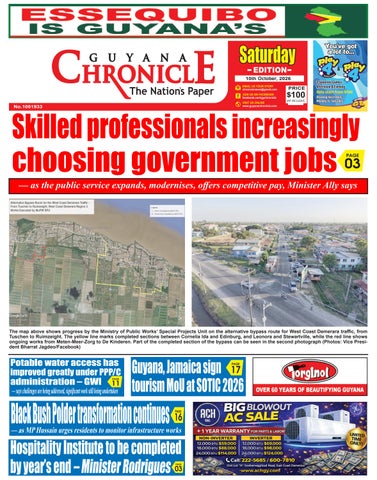
Skilled professionals increasingly choosing government jobs 03 No.1081933
PAGE
–– as the public service expands, modernises, offers competitive pay, Minister Ally says
The map above shows progress by the Ministry of Public Works’ Special Projects Unit on the alternative bypass route for West Coast Demerara traffic, from Tuschen to Ruimzeight. The yellow line marks completed sections between Cornelia Ida and Edinburg, and Leonora and Stewartville, while the red line shows ongoing works from Meten-Meer-Zorg to De Kinderen. Part of the completed section of the bypass can be seen in the second photograph (Photos: Vice President Bharrat Jagdeo/Facebook)
Potable water access has improved greatly under PPP/C administration – GWI 11 PAGE
–– says challenges are being addressed, significant work still being undertaken
Guyana, Jamaica sign 17 tourism MoU at SOTIC 2026
Black Bush Polder transformation continues
PAGE
PAGE
16
–– as MP Hussain urges residents to monitor infrastructure works
Hospitality Institute to be completed by year’s end – Minister Rodrigues 03 PAGE
2
MV Barima CoI seeks records on entire maritime fleet
THE Commission of Inquiry (CoI) into the July 2026 MV Barima tragedy has requested extensive records on vessels operated by the Maritime Administration Department (MARAD) and the Transport and Harbours Department (T&HD), as investigators
GUYANA CHRONICLE Saturday, October 10, 2026
broaden their examination beyond the ill-fated vessel. Commissioner Dr. Andrzej Jasionowski disclosed on Wednesday that the CoI is reviewing preliminary documents received from several institutions, with some of the requested records beginning to arrive.
He said the documents cover entire fleets of vessels operating in Guyana, rather than being limited to the 87-year-old MV Barima, which was involved in the July tragedy that claimed dozens of lives. “Among those documents are the documents
we have requested at the start of our commission,” Jasionowski said, explaining that request letters had been sent to T&HD, MARAD and other institutions. He noted that the Commission had already received some of the material and had begun examining
Dr Andrzej Jasionowski, a Polish naval architect and marine engineer it as part of its preliminary work. Jasionowski added that a further comprehensive request was sent last week for documents relating to the wider fleet of vessels operating in Guyana. The expanded requests are expected to assist the Commission in examining the operational background of the country’s vessels, including matters extending beyond the circumstances surrounding the MV Barima disaster. He said, “So, we will be looking at not just Barima, but the whole background of operation of the entire fleet.” The Commission’s examination of records from the two agencies and other institutions forms part of its efforts to establish the circumstances surrounding the tragedy and assess the broader operational context in which the vessel was operating. The document review will allow the commissioners to consider information concerning the wider fleet as their inquiry progresses, alongside evidence specifically related to the MV Barima The Commission has since begun gathering evidence and examining information relevant to the incident. It is scheduled to
formally commence taking evidence on Wednesday, October 14, 2026, at the Arthur Chung Conference Centre (ACCC). Jasionowski is a Polish naval architect and marine engineer with more than three decades of experience in maritime accident investigations. He holds a PhD in Ship and Marine Technology from the University of Strathclyde in Scotland and a Master of Engineering degree in Naval Architecture and Ocean Engineering from the Technical University of Gdańsk in Poland. His expertise includes vessel stability, ship design, and the investigation of maritime casualties. The MV Barima tragedy involved the passenger and cargo vessel, which departed the T&HD Kingston Goods Wharf in Georgetown at about 15:15hrs on July 18, bound for Port Kaituma. The vessel later encountered difficulties while sailing off the Essequibo Coast, near the mouth of the Pomeroon River, before capsizing. An estimated 179 passengers and crew were aboard at the time. The disaster claimed 73 lives, while 76 people survived and approximately 30 others remain unaccounted for, according to authorities.
Skilled professionals increasingly choosing government jobs
3
GUYANA CHRONICLE Saturday, October 10, 2026
–– as the public service expands, modernises, offers competitive pay, Minister Ally says
AN increasing number of professionals are leaving the private sector to join the public service, according to Minister of Public Service, Government Efficiency and Implementation, Zulfikar Ally, who said the trend is helping government build a more skilled workforce. Ally made the disclosure while appearing recently on the Energy Perspectives podcast, where he was asked how government intends to attract and retain highly skilled professionals as Guyana’s rapidly expanding economy creates increasingly competitive opportunities in the private sector. However, Ally rejected the suggestion that government is necessarily struggling to compete with private employers. He pointed to what he described as an “increasingly alarming number” of people leaving the private sector to work in government. He said the trend is encouraging as government seeks to transform the public service into a modern and highly skilled institution capable of keeping pace with Guyana’s economic development. Ally said, “I’m very happy about that because we want to build a very skilled public service.” The minister said the government wants the public service to become an institu-
tion that is admired not only in Guyana but across the Caribbean. According to him, government is seeking workers who are hardworking, dedicated and committed to serving citizens. He said some people are choosing public-sector employment because they believe government provides them with a greater opportunity to serve the population. “I’ve met many staff like that whose passion is not about salary… but they want to serve the public,” he said. He also maintained that government compensation is competitive with the private sector, depending on the level and type of position. “Within the public service, what we pay are very competitive and comparable to the private sector depending on what levels and what position you look at as well,” he said. His comments come as government seeks to overhaul the public service to match the demands created by Guyana’s rapid economic growth. Ally said the volume of work handled by public servants has increased significantly, with some departments now dealing with responsibilities that are several times greater than they were a decade ago. He pointed to the Ministry of Foreign Affairs and International Co-operation as
one example. He noted that protocol officers, who previously dealt with a relatively small number of international visitors, are now required to accommodate presidents, former heads of state, ambassadors, diplomats, foreign ministers and executives of major international companies on a much more frequent basis. Minister Ally stated, “It means, for those staff, they have to be at the airport every single day. So, instead of being there two, three times
THE Hospitality and Tourism Training Institute (HTTI), currently under construction at Port Mourant, Berbice, is approximately 80 per cent complete and is expected to be fully completed by the end of 2026. Providing a progress report of the project, Minister of Tourism Industry and Commerce, Susan Rodrigues held a meeting with the Minister of Education Sonia Parag, alongside representatives of Niagara College, Canada, who are assisting with the development of the Institute’s hospitality and tourism cur-
ricula. The tourism ministry is overseeing the project and has indicated that the work is moving apace steadily and should be completed by the end of this year. While also informing on the curriculum development process, the Ministry of Education in collaboration with Niagara College, has noted that it aims to ensure that the programmes offered at the Institute meet the current and emerging needs of Guyana’s tourism and hospitality sector and align with regional and international industry standards. During the discussions,
the Ministry of Tourism, Industry and Commerce provided information on the sector’s priorities, including occupational demand, service standards, skills gaps and the competencies required of graduates entering the workforce. These efforts form part of preparations to equip the Institute to deliver training that responds to the demands of Guyana’s growing tourism and hospitality industry. Minister Rodrigues was accompanied by Permanent Secretary Roger Rogers, Director of the Guyana Tourism Authority Kamrul
Minister of Public Service, Government Efficiency and Implementation, Zulfikar Ally a month, like they were accustomed to, protocol now is they have to be there every single day, tending to our special guests and invitees that are coming to Guyana.” The transformation of the economy, he said, means government can no longer rely on the same systems, staffing levels and skill sets that were adequate in the past. The ministry has therefore placed greater emphasis on digitisation, training and modernising the public service.
Ally said the government is also investing in professional development, including providing public servants with access to online training through Coursera. According to him, public servants can use the platform to improve existing skills or develop new competencies across a wide range of fields. The government is also relying on education and scholarship programmes to develop the specialised skills needed to support Guyana’s growing economy. Ally said thousands of Guyanese are pursuing studies through government-funded scholarships, including programmes in fields such as biochemistry and oil and gas. He said the objective is to ensure that Guyana develops the human resources required to regulate, negotiate, and oversee increasingly sophisticated industries. At the same time, Ally stressed that the transformation of the public service cannot be separated from changes taking place in the private sector. He praised local businesses for becoming more sophisticated and said many companies are now placing greater emphasis on diverse boards and specialised professionals, including lawyers, accountants, and engineers. He cited the Guyana Energy Conference as an ex-
ample of the private sector’s growing capacity, describing the event as being organised at an international standard. The minister said he believes the public and private sectors can benefit from a broader change in the culture of service delivery. He said, “The more you can deliver service and a good quality service and a customer-friendly service, the more your business would do well.” He added that the government does not view the public and private sectors as being in competition with each other, but rather as entities that can work together to improve services and contribute to national development. For the public service, Ally said, the ultimate goal is to move away from what he described as an “archaic public service” toward a modern, customer-friendly institution. He said government investments in technology, training and administrative reform are intended to ensure that public servants can work more efficiently while providing citizens with better services. For Ally, the movement of skilled workers from the private sector into government is therefore part of a broader transformation aimed at building a public service capable of meeting the demands of a rapidly changing Guyana.
Hospitality Institute to be completed by year end – Minister Rodrigues Baksh and Director of Tourism Sunalie Raghubar. Minister Parag was joined by Permanent Secretary Shannielle Hoosein-Outar, Chief Education Officer Sadam Hussein and Chief Planning Officer Mishka White-Griffith. Niagara College was represented by Curriculum Development Expert Joyce Bott and Hospitality Expert Eric Mauke. Once completed and operational, the HTTI will support the development of a skilled workforce to meet the growing demands of Guyana’s tourism and hospitality sector. (DPI)
Hospitality Tourism Training Institute under construction
4
GUYANA CHRONICLE Saturday, October 10, 2026
Amid heartache of Nepal flooding disaster, fear remains
SIX weeks after Nepal’s deadly flooding disaster, communities are still struggling to rebuild their lives, but they will need sustained help as global warming increases the risk of another Himalayan catastrophe, the UN Children’s Fund (UNICEF) said on Friday. At least 1,400 people were killed, including 84 children, and nearly 5,300 people are still missing, after a mountain of glacial ice and rock collapsed into the Bhotekoshi, Upper Trishuli and Narayani-Gandak
rivers in late August, unleashing a massive torrent that washed away bridges and homes.
LASTING TRAUMA I n a n u p d a t e f ro m Kathmandu, UNICEF spokesperson James Elder highlighted the traumatic experience of 16-year-old Sahara, who he met this week at a technical training supported by the agency. “Her mum was swept away by the floods and killed. Through tears, Sahara told me, ‘It’s not nice to live
without a mum.’” Today, areas of impacted towns and villages “look like war zones,” Mr. Elder stressed, while access to some communities in Rasuwa remains difficult. “They continue to receive airlifted relief supplies in the most isolated areas,” said Caroline Holt, Director for Disasters, Climate and Crises at the International Federation of Red Cross and Red Crescent Societies (IFRC). “In the hardest-hit locations, families face disrupted markets, higher transport costs and shortages of essential goods as roads and communications are gradually restored.” SECURITY CALL The IFRC official
stressed the urgent need to support those impacted by the disaster. “People need more than assistance to survive, they need confidence in their future, they need to know where they live, how they will earn an income and when their children can return to school,” she said. Among those requiring urgent assistance are Shushila and her husband, Jivan, after floodwater more than two metres high surged through their home, destroying their tailor’s shop and tea store. “They escaped with the clothes they were wearing, and nothing else,” Mr. Elder said. “Shushila told me, ‘Maybe it would have been better if we weren’t able to escape.’ That is the stress and trauma brought on by
inaction elsewhere in the world,” Mr. Elder noted, adding that UNICEF has supported Shushila and Jivan’s family with cash assistance. “With so many needs, how did they prioritise their spending? On their children; books, stationery and clothes.”
COP31 CALL International support for vulnerable countries, including Nepal, that are on the front line of climate change is critical, as the Himalayas warm “about twice as fast as the global average,” Mr. Elder said. Noting that Nepal produces only 0.1 per cent of global greenhouse emissions, the UNICEF spokesperson welcomed declarations of support from States parties
to the UN Framework Convention on Climate Change (UNFCCC) “to avert, minimize and address loss and damage. But for countries like Nepal, those commitments have to quickly translate into support that reaches affected families on the ground,” he said, ahead of this year’s UNFCCC summit (COP31) in Antalya, Turkïye, from 9-20 November. “Unless the world acts to reduce climate risks, we will keep returning to the same valleys after the next flood and after the next landslide, and yet again find children paying the highest price. This is true in Nepal, across Asia, across the Pacific and around the world,” said Mr. Elder. (UN)
Cage fish farming reaches 43 hinterland communities
5
GUYANA CHRONICLE Saturday, October 10, 2026
CAGE fish farming, once doubted as unworkable in Guyana, is now in 43 communities. Most of them are in the hinterland, and residents are earning more and eating more fresh protein. Minister of Agriculture Zulfikar Mustapha gave an update on the project during an interview with the Department of Public Information (DPI) on Thursday. He said it has grown well beyond its pilot sites at Mainstay, Mashabo and Lake Capoey in Region Two. “I can remember vividly two, three years ago when the president mentioned about cage fishing, people were laughing, saying that, that kind of activity cannot be done in this part of the world… But we have proved them wrong,”
Minister Mustapha said. Cages are now in place at Rockstone, Shulinab, Nappi, Orealla, Siparuta and St Cuthbert’s Mission, among other communities. The minister said the programme is helping villages “tremendously in supplementing their income and at the same time providing necessary proteins for the community.” The programme has grown steadily this year. Minister Mustapha told the DPI earlier this year, that close to 53 cages were operating across the country, most of them in Indigenous and hinterland communities. He said then that one cage can make about $8 million in a production cycle. A village with three or four cages could add between $24 million and $25 million to its local economy.
Under the programme, the government gives communities cages, fingerlings and feed, along with technical support and training from the Fisheries Department. “I don’t want the communities, these indigenous communities to be dependent anymore, that you must go and give them things. I want this community to be a producer of commodities,” he said. He noted that hinterland villages now run 13 agro-processing facilities, which package their own products and sell in commercial quantities on the coast. Peanut butter made at St Ignatius in Region Nine is now on supermarket shelves in Georgetown. T h e g o v e r n m e n t ’s support also extends to finding buyers. The New
Tambaqui being harvested at Rockstone, Region 10, the under government’s Marine Cage Farming Project Guyana Marketing Corporation (New GMC) links producers with buyers, so communities are not left on their own once they start producing. “ We a r e n o t j u s t
MOM hands over new house to elderly couple
Elderly Great Diamond, East Bank Demerara residents Mr. Nazir and Mrs. Persaud have received a new house through President Dr. Irfaan Ali’s Men on a Mission (MOM) initiative. The home was handed over by Minister of Labour and Manpower Planning Keoma Griffith and MOM members. The initiative continues to support vulnerable persons, including the elderly, single parents, people living with disabilities, and families affected by disasters (Photos: Vice-President Bharrat Jagdeo/Facebook)
doing these things and leave the people by themselves. We are working with them from production right on to marketing,” the minister said.
Minister Mustapha said he is impressed by how organised the communities are and how eager residents are to get into commercial activities. (DPI)
6
GUYANA CHRONICLE Saturday, October 10, 2026
Sustainable Tourism, Shared Prosperity
THE Caribbean tourism industry stands at a defining crossroad. Climate change, technological advances, shifting travel preferences and global economic uncertainties are reshaping the international tourism landscape. The Region needs to move beyond traditional models of attracting visitors and embrace a more collaborative, sustainable and inclusive approach to development. Guyana’s growing tourism ambitions, underpinned by its exceptional natural and cultural assets, provide an important example of how this transition can be pursued. What came out of the 2026 State of the Tourism Industry Conference (SOTIC) is clear: The long-term competitiveness of the Caribbean will depend not only on the quality of its individual destinations, but also on its ability to work together, improve connectivity, attract responsible investment and ensure that tourism delivers tangible benefits to its people. During the ministerial panel discussion, Guyana’s Minister of Tourism, Industry and Commerce Susan Rodrigues made the case for regional partnership, arguing that the Caribbean tourism product is more about what brings the Region together than what separates its countries. That is a principle that is worthy of being one of the main pillars of the Caribbean’s tourism strategy. Every destination has its own attractions, traditions and experiences. While other Caribbean destinations are known for their beaches, marine environments, historic towns, food and cultural festivals, Guyana has vast rainforests, stunning rivers, savannas, waterfalls, wildlife and vibrant cultural communities. Countries can instead join forces and combine these strengths to produce a richer and more varied regional product, rather than competing on their own. Multi-destination packages, joint marketing campaigns, improved air and sea links and closer working relationships between tourism operators could encourage visitors to visit more than one Caribbean country on the same trip. Such arrangements would make the Region more attractive, offer opportunities
to businesses and help to distribute tourism spending among a number of destinations. But collaboration should be more than just promotional campaigns. Governments, airlines, accommodation providers, tour operators and regional institutions must work together to address the practical barriers which make travel between Caribbean destinations expensive or inconvenient. To translate its shared identity into concrete economic gains, the Region needs better connectivity, coordinated visitor experiences and appropriate travel arrangements. Guyana’s involvement in the discussion is particularly noteworthy as the country is seeking to boost its tourism industry as part of a broader push to diversify its economy. Oil and gas have changed the economic prospects of this country but sustainable national development requires investment in other productive sectors that can generate employment, support entrepreneurship and create opportunities across the country. Minister Rodrigues was correct when she emphasised that Guyana cannot afford to put all of its economic eggs in one basket. Diversification of the economy into tourism, agriculture and other industries can help with economic resilience, widening the sources of national income and reducing the vulnerability to external shocks, including geopolitical instability and swings in international markets. Tourism can also develop important relationships with agriculture, transportation, construction, manufacturing, entertainment and small business. Hotels and restaurants need agricultural produce, tour operators need transport services, visitors buy local crafts and experience cultural events, and communities can build enterprises around their natural and historical assets. Such linkages allow tourism expenditure to diffuse more broadly across the domestic economy. But success should not be measured simply in terms of more visitors or more hotels. Tourism should create decent jobs, encourage local ownership, stimulate small and medium sized enterprises, and provide
hinterland and rural communities with meaningful opportunities to participate in economic development. This is where the growing emphasis on sustainable tourism in Guyana becomes especially relevant. The country’s receipt of the Green Destinations Country Baseline Assessment Award is a welcome milestone in efforts to bolster the environmental and management standards underpinning the country’s tourism industry. The recognition came after an assessment by the Good Travel Institute on behalf of Green Destinations International and during the presentation the alignment of Guyana with the Green Destination Standard was highlighted. The award should be viewed not as a destination but as a platform to build on the work already underway. Guyana’s tourism assets include its biodiversity, forests, rivers, wildlife, savannas and living cultures. So, protecting them is both an environmental duty and an economic necessity. As the sector grows, careful planning will be needed to ensure that tourism infrastructure does not threaten the very resources that visitors come to experience. Destination planning needs to incorporate responsible waste management, protection of sensitive ecosystems, energy and water efficiency, climate-resilient infrastructure and respect for local cultures. Sustainability has also to be good business sense. Dr. D’Arcy Dornan, from the Good Travel Institute, said responsible practices could reduce operating costs, improve efficiency, reduce business risks and increase competitiveness. Credible sustainability standards can also help businesses show their performance to visitors, investors and financial institutions who are increasingly considering environmental and social responsibilities when making their choices. These benefits are particularly relevant for Guyana with new investment opportunities opening up. With a well-managed tourism industry we can attract visitors who want genuine nature-based experiences,
and encourage businesses to adopt practices that maintain the long-term value of the destination. Just as important is the question of who benefits from that growth. Indigenous and hinterland communities need to have real opportunities to influence tourism activities on their lands, traditions and cultural heritage. They should be given appropriate training, access to finance, local enterprise development and fair opportunities to earn income from tourism so that they can participate. We need to respect cultural knowledge and community traditions, not to package them as attractions for commercial consumption. The link between infrastructure and social development also becomes clear here. “A road is not simply a means of getting from point A to point B,” said Minister Rodrigues. “It can improve access to health care, education, markets and other vital services, helping to close the gap between coastal and hinterland communities. That is a major development principle. Thoughtful project planning and focus on environmental and community issues can ensure that infrastructure investment enhances tourism and quality of life for residents. Tourism development should be in tandem with national development and should not override the needs of the people who live in the destination that is being promoted. The Caribbean must also prepare to cope with the growing impacts of climate change. Tourism infrastructure and the natural environments on which many destinations depend are threatened by coastal erosion, stronger storms, flooding, rising temperatures and pressure on freshwater resources. So, we need to embed climate resilience into investment decisions, building codes, coastal management and emergency preparedness. Further, Guyana’s Green Destinations assessment is a good start for this approach, but the real test will be in making measurable improvements over time. Ongoing collaboration between government agencies, the private sector, local communities and international partners is needed to turn recognition into lasting outcomes.
Global trade reaches record $35 trillion despite conflicts
WORLD trade reached a record $35 trillion in 2025 – but developing countries were held back from greater participation in the global economy because of new technological and policy barriers, the UN trade and development agency UNCTAD said on Friday. “Only a fraction of investment by companies is now driven by traditional concerns such as low labour
costs,” said senior UNCTAD official, Anastasia Nesvetailova. “Instead, value is moving into strategic sectors, semiconductors, artificial intelligence, clean energy, advanced computing, where the barriers to entry are high and rising.” ACCESS ISSUES The agency identified increasing export controls,
investment screening, and supply-chain pre-conditions as the reasons why strategic sectors were harder for developing countries to access. Turning to this year, UNCTAD said that higher trade values continue to be driven by price hikes linked to the global energy shock caused by the US-Iran war. The global trade map is also shifting, with trade be-
tween China and the United States falling by more than 20 per cent since 2024. Meanwhile, East Asian countries have expanded their trade links with both China and North America.
Ms. Nesvetailova explained. “The fastest expanding economies include China, India, Indonesia, Kyrgyzstan, Mongolia, Tajikistan, Uzbekistan, and Vietnam.”
ASIA: GROWTH ENGINE “Even as the (global) economy slows, Asia will contribute 60 per cent of global growth this year,”
GLOBAL SOUTH SLIPS BEHIND Apart from a handful of Asian economies, most of the Global South is falling further behind, UNCTAD
maintained. And as their growth slows, financial risks are mounting and development finance is under strain, the agency said. In support of trade in developing countries, UNCTAD called for support for domestic industries over the long term, training, research and foreign investment tied to local suppliers. (UN)
Khemraj Ramjattan: Class struggle in the AFC
7
GUYANA CHRONICLE Saturday, October 10, 2026
LAST week, I concluded a three-part series on the evolution of the relationship between the Mulatto/ Creole Class (MCC) and the political parties they founded. The series concluded with the creation of the Alliance For Change (AFC) by the MCC. The congenital weakness in reflecting on complex political issues in a newspaper column is space constraint. The Khemraj Ramjattan presence in the AFC is a very formidable topic to pursue. You cannot do justice to it in a mere newspaper article. A c a v e a t i s i n o rder. MCC personalities throughout Guyanese history have not been politically bright people. They may be good in their respective professions but they do not excel in political thinking. It is the academics, political observers and trade unionists who interact with MCC personalities that bring political strategies into play. When Raphael Trotman embraced David Granger’s theory that political changes can come if the political landscape can have the presence of a middle class third party like in the 1950s, he honestly believed that it was a brilliant move so he acted on it. Trotman and his AFC acolytes formed the AFC for the AFC to be a MCC outfit. They paid no attention as to how a narrow class-based party can bring about a PPP defeat. Because Ramjattan and Trotman developed a closeness out of their separate trials and tribulations inside their respective parties – PPP and PNC – Trotman invited Ramjattan to join the AFC. This did not go down well with the MCC in the AFC including Sheila Holder. Ramjattan did not fit the pattern. He was darkskinned, Hindu and did not have much MCC paraphernalia about him. The first sight of strain between the Ramjattan and the MCC was seen in 2011 when Ramjattan decided that the AFC’s presidential candidacy should rotate and it should go to him. Trotman and the MCC were livid. MCC personalities thought that Ramjattan should know his place. But Ramjattan was in a different world from that
of the MCC. He came out of a mass-based party – the PPP - that grounded among the working class, peasantry and the Indian petite bourgeoisie. All Ramjattan wanted to do in the AFC was to align the AFC with the kind of political world he evolved from. So, he reached out to the peasantry and the Berbice working class and he sought money from rich Hindu and Muslim Indians. He succeeded in all his political endeavours. The MCC in 2011 was still in no mood to have him as their presidential candidate. But there was a huge rebellion among the African rank and file and working-class Indians in the AFC. Ramjattan’s success in clinching the 2011 presidential spot was as an outcome of class struggle. The working class in the AFC, both Africans and Indians, wanted Ramjattan. The Indian petite bourgeoisie in the AFC carried a vicious fight to the MCC manifested in a poisonous confrontation between Trotman and diaspora financier, Dr Somar. The AFC became a different party after Ramjattan became the 2011 candidate. It lost its MCC visage and became more like a massbased party. The AFC was inundated with Indians that Ramjattan recruited. The AFC had 10 regional branches and all of them were fitted out with people who were not from the MCC. By this time, Ramjattan had persuaded Moses Nagamootoo to join him in the AFC It was from this period that a creeping dislike for Ramjattan by the MCC emerged. It reached its climax with the results of the 2011 general elections. Even though the election resulted in a PPP minority government, MCC personalities argued that in the 2011 national elections, the AFC spent 80 million dollars more than in the 2006 general elections and just won one seat more. They argued that if Trotman was at the helm more middle-class people would have come out to vote. But the GECOM database contradicted that perception. Nagamootoo had made the difference. What the MCC was grumbling about was loss of identity. The AFC was looking more like a
multi-racial, mass-based party with two Indians at the helm – Nagamootoo and Ramjattan. The MCC would have none of it. The selection of MPS from the AFC caused a huge split between Trotman and Ramjattan. The MCC revolted against a Ramjattan choice of a darkskinned, Indian woman – Gomattie Singh. Even though she was a lawyer, she was seen contemptuously by the MCC as not fit to be an AFC parliamentarian. Raphael Trotman appointed an MCC personality – his friend, Chantelle Smith. David Granger made
an astute move. Sensing that the MCC was losing out in the AFC, he rejected Nagamootoo as Speaker of the House in preference for Trotman. Class strug-
gle was intensifying in the AFC. Part two is coming up. DISCLAIMER: The views and opinions expressed in this column are
solely those of the author and do not necessarily reflect the official policy or position of the Guyana National Newspapers Limited.
Panama earthquake: Tsunami warnings issued after magnitude 7.7 quake
8
GUYANA CHRONICLE Saturday, October 10, 2026
–– Colombia, Ecuador, Nicaragua, Guatemala, Chile put on high alert
A MAGNITUDE 7.7 earthquake has hit southern Panama, triggering tsunami warnings across Central and South America. The US National Weather Service issued tsunami warnings for Panama, Colombia, Ecuador, Nicaragua and Guatemala on Friday following the quake. Chile’s naval Hydrographic and Oceanographic Service also issued a tsunami warning. The US Geological Survey said the earthquake was centred about 10km (6 miles) southwest of the remote community of Pitaloza Arriba along the Pacific Ocean coast.
Residents of Panama City reported feeling tremors, with buildings shaking and people evacuating into the streets. “We felt it very strongly. It knocked things over in the kitchen, but we’re okay, though we’re very scared,” 60-year-old Rosendo Dominguez, who is from Herrera province, where the earthquake struck, told The Associated Press news agency by phone. “Everyone is outside, scared,” Dominguez added. Videos shared by newspaper La Prensa showed the tower of a historic building had collapsed along with several balconies of a residential building in Penon-
ome, a city about halfway between the epicenter and Panama City. Panama’s ministry of education ordered schools closed, while President Jose Raul Mulino called for calm “What happened should not be used to cause alarm or disorder,” he wrote on X. There have been several destructive earthquakes in the region this year. In June, twin quakes hit northern Venezuela, causing widespread devastation and killing at least 6,500 people. In August, a magnitude 7.4 earthquake hit Colombia, killing at least 289 people. (Al Jazeera)
A magnitude 7.7. earthquake has hit Panama
9
GUYANA CHRONICLE Saturday, October 10, 2026
FAO calls for urgent investment to protect food production –– as crises deepen across the Near East and North Africa
–– more than 45 million people face severe hunger across Gaza, Lebanon, Sudan, Syria, Yemen AS onflict, displacement, and climate pressures continue to drive high levels of acute food insecurity across the Near East and North Africa, the Food and Agriculture Organization of the United Nations (FAO) is calling for urgent funding for emergency agricultural assistance to help families continue producing food and earning an income. Conflict and economic shocks are undermining the region’s food productive capacity, while funding shortfalls are limiting assistance to protect food production and livelihoods. FA O D e p u t y D i r e c tor-General Beth Bechdol, Assistant Director-General and Regional Representative for the Near East and North Africa AbdulHakim Elwaer, and Director of the FAO Office of Emergencies and Resilience Rein Paulsen met governments, donors and partners to highlight agriculture’s critical role in preventing food insecurity from worsening, protecting livelihoods and supporting recovery. Across these countries, more than 45 million people face crisis-level hunger or worse, as conflict and economic shocks are derailing food production destroying agricultural infrastructure and disrupting markets. “Repeated shocks are stripping families of their ability to produce food and earn an income—just as humanitarian resources are becoming increasingly constrained,” said Bechdol. “We must act before those losses become irreversible. Investing early in seeds, livestock, water, and other agricultural support can protect livelihoods, prevent hunger from deepening and reduce humanitarian needs over time.” FUNDING GAPS DEEPEN HUNGER In Gaza and the West
Bank, more than 1.2 million people faced Crisis or worse levels of acute food insecurity between April and June 2026, and conditions are projected to worsen during the second half of the year. FAO is seeking $140.9 million in 2027 for time-critical agricultural assistance and recovery. In Lebanon, 1.24 million people are projected to face Crisis or worse levels of acute food insecurity between April and August 2026. FAO requires $38 million to reach 35 000 conflict-affected farmers and rural households. In Sudan, 19.5 million people are facing high levels of acute food insecurity. Yet only 23 percent of the $193 million required under the 2026–2028 Emergency Response Plan has been funded. In Syria, around 7.2 million people were facing acute food insecurity in late 2025. FAO requires $171.5 million in 2027 to assist 5.2 million people, combining immediate livelihood protection with recovery and resilience measures. In Yemen, 18.3 million people faced Crisis or worse levels of acute food insecurity in the latest analysis. FAO has secured less than 1 percent of the $87.9 million required under its 2027 Emergency and Resilience Plan. AGRICULTURE PROTECS FOOD AND LIVELIHOODS IN EMERGENCIES Protecting produc tive capacity can provide food and income and help households withstand future shocks, reducing dependence on humanitarian assistance. Emergency agricultural assistance – including seeds, livestock feed, veterinary services, cash and vouchers, irrigation support and other inputs – can See page 10
FAO Deputy Director-General Beth Bechdol (third left), Assistant Director-General and Regional Reprsentative for the Near East and North Africa, AbdulHakim Elwaer (fourth from left) Director of Emergencies Rein Paulsen (left), FAO Representative in Lebanon Veronica Quattrola (second from left) stand next to the solar array during a field visit in Lebanon to meet a group of farmers who are using an innovative shared solar-powered irrigation pump to irrigate their greenhouses
FAO calls for urgent investment . .
10
GUYANA CHRONICLE Saturday, October 10, 2026
From page 9
help families continue producing food during crises. For example, in Gaza, FAO assistance has enabled farmers to resume production and helped livestock-keeping households preserve sources of food and income. In Sudan, FAO has reached almost five million people in 2026 with seeds, livestock vaccination, animal feed, agricultural input vouchers and other support. “Agriculture must be at the heart of emergency response. The earlier we act, the more lives and livelihoods we can protect,” said Elwaer.
“When a farmer receives seed before the planting season, or a livestock keeper receives feed and veterinary support before animals are lost, we are protecting food today and the means to produce it tomorrow. But this only works if resources arrive in time.” LEBANON: CONFLICT TAKES A TOLL ON AGRICULURE The delegation’s visit to Lebanon highlighted how conflict and displacement affect agriculture and rural communities, including the
experiences of farmers directly affected by hostilities. More than one million people were displaced following the March 2026 escalation, mainly from rural areas. In southern Lebanon, between 55 and 65 per cent of the population in Bent Jbeil, Marjaayoun, El Nabatieh and Sour districts, is projected to face Crisis or worse levels of acute food insecurity. More than 22 per cent of the country’s agricultural land has reportedly been damaged, while approximately 50 per cent of agricultural land in South and
Nabatieh is inaccessible. In Nabatieh, the FAO team assessed conflict-related damage to farmland, agricultural infrastructure, and services, and discussed recovery priorities with farmers, cooperatives, and Ministry of Agriculture staff. “In southern Lebanon, we saw what conflict means for agriculture – damaged farmland, irrigation systems and productive infrastructure, and farmers who have lost the means to produce and earn an income,” said Bechdol. “Restoring agriculture cannot wait until after the emergency. Protecting pro-
duction and livelihoods is part of the response now, and it will also be essential to Lebanon’s recovery.” Beyond the immediate response, FAO is also supporting Lebanon to translate its new 10-year National Agriculture Strategy and Investment Plan into investment and action, with a focus on restoring production, improving efficiency of water use, and strengthening the overall competitiveness of the agricultural sector. FUNDING AGRICULTURE BEFORE
LOSSES DEEPEN The delegation engaged with governments, donors, and partners to mobilise resources that can address immediate humanitarian needs while protecting the productive systems needed for recovery. FAO is calling on donors and partners to maintain and increase support for emergency agricultural assistance across the region, ensuring that vulnerable farming, herding, and fishing communities receive timely support before losses become irreversible. (FAO)
GUYANA CHRONICLE Saturday, October 10, 2026
11
Potable water access has improved greatly under PPP/C administration – GWI –– says challenges are being addressed, significant work still being undertaken
THE following is the full text of the Guyana Water Incorporated’s response to public commentary on its mandate and matters concerning its delivery of potable water: “GUYANA Water Incorporated (GWI) wishes to respond to recent public commentary by Gordon Moseley concerning the state of Guyana’s potable water sector and initiatives being undertaken to improve access to affordable drinking water. While GWI recognises the importance of public scrutiny and constructive discussion on matters affecting citizens, it is equally important that such discussions are informed by the substantial investments, infrastructural developments and ongoing programmes that have been transforming the country’s water sector over the past several years. Any assessment of Guyana’s water sector that overlooks these developments that have been undertaken by the PPP/C administration risks presenting an incomplete picture of the progress being made, the challenges being addressed and the significant work still underway to ensure that every Guyanese has access to safe, reliable and affordable potable water. Over the last five years, significant progress was achieved in Guyana’s potable water sector across all regions through targeted investments in water infrastructure, system rehabilitation, network expansion, and service improvements. These interventions have enhanced access to safe and reliable potable water, improved service quality, and strengthened the resilience of water supply systems to meet increasing demand owing to the aggressive housing programme being implemented by central government. Regional achievements included the expansion of water supply systems to previously underserved communities, upgrades to water treatment and distribution infrastructure, rehabilitation of aging networks, and improvements in water production and storage facilities. Hinterland and remote communities particularly benefitted from projects aimed
the introduction and expansion of Government-supported bottle refilling stations and the possible implications for private water vendors. The establishment of these facilities is a public-service initiative designed to make purified drinking water more affordable and accessible to citizens. At a time when households are managing competing financial demands, access to drinking water at a substantially reduced cost can provide meaningful relief, particularly for low-income families and residents who purchase drinking water regularly. With five-gallon refills offered at just G$100 at refill stations, the initiative provides residents with an affordable alternative for obtaining purified drinking water. These facilities compleThe $2.2 billion New Cummings Lodge Water Treatment Plant — the largest of its kind in Guyana, which ment the wider national prowas commissioned by President Dr Irfaan Ali in October 2025 gramme to improve access at increasing coverage and Complementing this work, developments is particularly face-water treatment facilities to potable water and demonreliability, while urban and more than 200 kilometres of evident in the Hinterland, at Diamond which will serve strate the Government’s comcoastal regions saw improve- transmission and distribution where expanding access pres- 36,000 residents from Craig mitment to ensuring that the ments in treatment capacity pipelines have been installed ents unique geographical, to Little Diamond and anoth- benefits of investment in the and distribution efficiency. to improve connectivity, ex- logistical, and operational er at Hope on the East Coast water sector are felt directly Under the leadership of tend services to developing challenges. Through sus- Demerara corridor serving by ordinary citizens. The Government’s inithe Irfaan Ali-led govern- communities and strengthen tained investment in wells, 35,000 residents from Cane tiative is being implemented ment, GWI has been imple- the delivery of water to areas water supply systems and Grove to Cove and John, menting an extensive pro- that have historically been distribution infrastructure, together with five additional through GWI in the interest gramme of investment and underserved. potable water access in the plants at Maria’s Delight, of the wider public. It is infrastructural development GWI’s work has also fo- Hinterland has increased Leguan, Wakenaam, Bath consistent with the utility’s guided by its strategic plan- cused on ensuring that access from approximately 46 per and Adventure. In addition mandate to deliver safe, adning framework and nation- to water is accompanied by cent to 95 per cent as of 2026. to these larger facilities, GWI equate, and affordable water al development priorities. improvements in the quality This represents a signifi- has completed the installa- services throughout Guyana. These investments are not of water supplied. Over the cant improvement in service tion of 16 small water treat- The expansion of these facilisolated interventions but past five years, treated-wa- coverage for communities ment plants in several rural ities will provide additional part of a coordinated, long- ter coverage has increased that have historically faced communities and is working opportunities for residents to term approach to expand- significantly, moving from barriers to accessing reliable towards rolling out a further access purified drinking waing water access, improving approximately 52 per cent water supplies. six. These smaller systems ter while complementing the water quality, strengthening to around 80 per cent. This GWI acknowledges that, are particularly important broader work to improve waservice reliability, and ensur- progress reflects the Gov- despite the progress achieved, in extending treated-water ter infrastructure nationwide. GWI remains committed to ing that the country’s water ernment’s commitment to challenges remain in some access to communities where infrastructure can accom- moving beyond the provi- communities. In certain loca- large-scale infrastructure may serving the people of Guyana modate population growth, sion of water alone towards tions served by groundwater not be the most immediate or and recognises that public confidence must be supported by new housing developments, expanding access to treated wells, customers have raised practical solution. and the needs of previously water for more households concerns about elevated iron GWI emphasises that the both measurable progress and underserved communities. across Guyana. content. These concerns are progress being recorded is a willingness to acknowledge Over the last five years, Through the Coastal Wa- not being dismissed. They the result of sustained pub- areas requiring improvement. the Government’s investment ter Treatment Infrastructure form part of the continuing lic investment and the con- The agency will continue to in the potable water sector Programme (CWTIP), eight work required to modernise tinued implementation of communicate its achievements, has delivered measurable re- new water treatment plants the country’s water systems a structured programme of respond to legitimate customer sults. Approximately 98.6 per have been constructed across and improve the quality and development. The agency’s concerns and pursue the incent of Guyana’s population coastal and hinterland areas, consistency of service deliv- strategic plans provide the vestments needed to strengthen now has access to potable strengthening the country’s ered to customers. GWI is framework for identifying the country’s water supply water. This achievement re- capacity to produce treated therefore continuing to invest priorities, directing resourc- systems. As Guyana continues flects sustained investment water and improving ser- in treatment capacity and es and monitoring progress to develop, the demand in new wells, water supply vice delivery. In addition, supporting infrastructure to towards national water-secfor reliable and affordable systems and transmission GWI has undertaken the close the remaining gaps and tor objectives. The scale of and distribution infrastructure rehabilitation and upgrading advance towards universal the current investment pro- water services will increase. across the Coastland and of more than 13 existing treated-water coverage. gramme demonstrates that the GWI is therefore commitHinterland regions. More water treatment plants across This work will be further Government’s commitment ted to working with the than 200 wells have been the country. These interven- strengthened through the extends beyond short-term Government, communities, drilled during this period, tions are intended to improve second phase of the Coast- interventions and is focused and other stakeholders to strengthening production ca- operational performance, al Water Treatment Infra- on building a stronger, more ensure that the country’s pacity and extending access strengthen treatment capaci- structure Programme. Phase resilient water sector for pres- water infrastructure keeps pace with national developto communities that previ- ty, and address longstanding Two includes plans for seven ent and future generations. ously experienced limited infrastructure limitations. new water treatment plants, GWI also wishes to ad- ment and that no communior inadequate water supply. The importance of these comprising two major sur- dress concerns raised about ty is left behind.”
12
Guyana reaffirms commitment to human rights, democracy G U YA N A h a s re a f firmed its commitment to protecting human rights, strengthening democratic institutions, and upholding the rule of law at the 153rd Assembly of the Inter-Parliamentary Union (IPU) in Arusha, Tanzania. Minister within the Office of the Prime Minister, Kwame Mc Coy, delivered this statement on behalf of Guyana to the IPU’s Standing Committee on Human Rights and Democracy during the October 5-9 assembly. Mc Coy highlighted Guyana’s participation in the 2025 Universal Periodic Review, during which the country supported 146 of the 206 recommendations received. He said Guyana was continuing to strengthen constitutional institutions and oversight mechanisms, including the Elections Commission, judiciary, Audit Office,
GUYANA CHRONICLE Saturday, October 10, 2026
Minister within the Office of the Prime Minister, Kwame Mc Coy is a member of the Bureau of the Inter-Parliamentary Union’s (IPU) Standing Committee on Human Rights and Democracy, representing the Latin America and Caribbean Group. He recently delivered a statement on behalf of Guyana at the 153rd Assembly of the IPU held in Arusha, Tanzania Ombudsman and Rights Commissions, to promote accountability and protect citizens’ rights.
“Democracy, in our understanding, must be meaningful in the daily lives of citizens. It must
enable people to participate, express themselves freely, organise, vote, seek justice and hold pub-
lic institutions accountable,” the minister said. He also emphasised the importance of Parlia-
ment’s role in scrutinising the Executive, protecting fundamental rights and ensuring inclusive participation in democratic processes. Addressing Guyana’s development agenda, Mc Coy said access to education, healthcare, housing, employment, social protection, and economic opportunities remained essential to human dignity. “Ultimately, our objective is clear: to build a Guyana in which democracy is stronger, human rights are respected, institutions are accountable, and every citizen can participate meaningfully in shaping the development and future of our country,” he said. Mc Coy is a member of the 18-person Bureau of the IPU’s Standing Committee on Human Rights and Democracy, representing the Latin America and Caribbean Group.
GUYANA CHRONICLE Saturday, October 10, 2026
Kwakwani man pleads guilty to stabbing friend 10 times
EARLON Towler, also known as Orlando Towler, has pleaded guilty to attempting to murder his friend, Lancelot Captain, who sustained 10 stab wounds during an attack in Kwakwani, Region 10 (Upper Demerara-Berbice), on November 2, 2024. Towler entered the guilty
was rushed to the Kwakwani District Hospital, where he received initial treatment before being transferred to the Linden Hospital Complex later that day. On November 5, 2024, he was transferred to the Georgetown Public Hospital Corporation, where he received further treatment and underwent
Earlon Towler plea before Acting Chief Justice Navindra Singh at the High Court in Demerara. According to agreed facts presented in the matter, the incident occurred on November 2, 2024, when Towler and Captain, who were friends, were at a ball field in Kwakwani. Towler, who was consuming alcohol at the time, approached Captain, took away his drink, slapped him and left. Captain subsequently went to Towler’s residence, where he complained to the convict’s mother about the incident and asked her to tell Towler to stay away from him. However, after leaving the residence and walking home, Captain was approached from behind by Towler, who inflicted two stab wounds to his back with a knife. A scuffle then ensued as Captain attempted to retrieve the weapon from Towler. During the struggle, he sustained eight additional stab wounds to his body. Captain collapsed and
surgery. A medical report detailed the extent of his injuries, which included five stab wounds to his back, one to his right shoulder, one to his left shoulder, one to his left forearm, one to the left side of his chest and a penetrating wound to the right side of his chest. The injuries were deemed life-threatening. To w l e r w a s a r r e s t e d on November 2, 2024, and placed in custody as investigations into the incident continued. He was indicted for attempted murder, contrary to Section 103(c) of the Criminal Law (Offences) Act, Chapter 8:01. Wounding with intent, contrary to Section 57(a) of the same Act, was listed as the alternative charge. The agreed facts were signed on October 7, 2026, by Towler, his attorney Clyde Forde, and State Counsel Christopher Belfield and State Counsel Praneta Seeraj, who represented the prosecution. Towler is expected to be sentenced on November 16, 2026.
13
14
GUYANA CHRONICLE saturday, october 10, 2026
Gafsons Industries secures certification for three locally manufactured products
GAFSONS Industries Limited has strengthened its commitment to quality manufacturing, with three locally produced products now certified under the Guyana National Bureau of Standards (GNBS) Product Certification Programme and authorised to carry the National Standards Mark. The company’s latest achievement is the certification of its 1,700-litre rotationally moulded polyethylene water storage tank, making it the first Guyanese company to secure certification for this type of product, according to the GNBS. The certification was granted last month under the GYS 588:2023 Standard, and comes as the GNBS prepares to observe National Quality Week from October 11 to 17, and World Standards Day on October 14. Gafsons’ other certi-
fied products include its four-inch concrete hollow blocks, certified in June 2019 under the GYS 215:2024 Standard, and polyvinyl chloride (PVC) pipes manufactured by its sister company, Plastic Products Limited. The pipes have been certified since 2000 and currently conform to the GYS 107:2021 and GYS 99:2021 Standards. Deputy Factory Manager Jitendra Mishrah said the company’s adoption of standards has helped strengthen product quality, improve manufacturing processes and build customer confidence in locally produced goods. He explained that Gafsons Industries, which began operations in 1953 and was incorporated in 1971, had expanded its manufacturing capacity over the decades under the leadership of Executive
GNBS Head of Certification Services (ag) Keon Rankin, handing over the certificate to Deputy Factory Manager at Gafsons Industries Jitendra Mishrah Chairman Sattaur Gafoor. wrap, wallboard, silica Its locally manufactured board and construction products include PVC pipes buckets. The company is and fittings, polyethylene also pursuing new manuwater storage tanks, shrink facturing projects involving ultraviolet boards and Stone Plastic Composite products. Mishrah said the company’s growth was driven by a vision to manufacture more goods locally rather than depend exclusively on imports, while creating employment opportunities for Guyanese. He also highlighted the role of the GNBS in protecting consumers and supporting manufacturers through the application of national standards. “You can’t have a counterfeit product coming to Guyana, and customers suf-
fer for that,” Mishrah said, explaining that standards help ensure compatibility between products such as pipes and fittings. He added that the GNBS establishes benchmarks manufacturers must follow to maintain consistent quality and give consumers greater confidence in the products they purchase. “The Bureau creates a yardstick for the manufacturer to follow. That makes us very stringent in following the standard. Once we follow the standard, that makes the product more qualitative to the customer, and they become very comfortable utilising the product,” he said. The certification process has prompted improvements in Gafsons’ production and product-identification systems, particularly for its newly certified water storage tank. Mishrah said the company standardised manufacturing parameters, including the tank’s weight and quality, to meet the applicable requirements. It also updated product labelling to provide customers with information on installation and other relevant manufacturing details. Similar traceability measures apply to the company’s certified PVC pipes, which carry printed information identifying the applicable GNBS certification, manufacturing date and time, and pipe size. The markings help customers identify products and
provide a means of tracing manufacturing details. Mishrah said maintaining certification requires continuous attention to quality, with manufacturers expected to sustain compliance and improve their processes over time. “There is a constant effort being made to maintain the standard quality for the customer to get the benefit — we always try to improve,” he said. Gafsons Industries is also working towards securing certification for additional sizes of its polyethylene water storage tanks and other categories and sizes of PVC pipes. The process may require adjustments to product designs and manufacturing parameters before the products are submitted for assessment. Mishrah said the company would recommend the GNBS Product Certification Programme to other local manufacturers, noting that wider adoption of standards could contribute to greater consistency in the marketplace and help protect consumers. The GNBS is encouraging businesses interested in product certification to contact its Certification Services Department for guidance on the relevant standards and application process. Manufacturers can contact the Bureau on 219-0064-66 or visit www. gnbsgy.org for further information.
(from left to right) Deputy Factory Manager, Jitendra Mishrah, Quality Control Officer, Raymond Makau and Supervisor – Plastic Products Production, Rabindranauth Narine
More children access specialised heart treatment
15
GUYANA CHRONICLE Saturday, October 10, 2026
–– 13 children discharged after cardiac procedures at GPHC
THIRTEEN children with congenital heart defects have been successfully treated and discharged from the Georgetown Public Hospital Corporation (GPHC), following a fiveday paediatric cardiac collaboration involving more than 50 local medical professionals and 18 specialists from Apollo Hospitals in India. The initiative, held from September 28 to October 2, 2026, resulted in 16 cardiac procedures, including 10 complex open-heart surgeries, three device closures and three diagnostic catheterisations, as efforts continue to reduce the number of children awaiting specialised heart treatment in Guyana. Spearheaded by President, Dr Mohamed Irfaan Ali, the collaboration brought together local and international medical teams to provide treatment for children with heart conditions present from birth.
Some patients required more than one procedure during the intervention, which marked GPHC’s third paediatric cardiac surgical programme for 2026 and Apollo Hospitals’ first surgical heart collaboration in the western hemisphere. The visiting team was led by cardiac surgeon Dr Kumar Gaurav, while GPHC’s Head of Paediatrics, Dr Tarik Davidson, coordinated the local medical team. The specialists worked together to perform surgeries, conduct procedures in the hospital’s Cardiac Catheterisation Laboratory and monitor the children throughout their recovery. Device closures involve inserting a small device to seal certain openings in the heart, while diagnostic catheterisation allows doctors to examine the heart and its blood vessels using a thin, flexible tube. Beyond the immedi-
ate treatment provided, the collaboration also created opportunities for knowledge-sharing and practical training, helping to strengthen GPHC’s capacity to deliver specialised paediatric cardiac care. Additional treatment planned overseas As part of the continuing effort to address the backlog, six other children have been identified for surgery in India, because their conditions are particularly complex and may require advanced post-operative life support that is not currently available in Guyana. The Government of Guyana has committed to covering the expenses associated with treatment for the six children and their families. GPHC is also preparing for another paediatric cardiac mission in December, in collaboration with Gift of Life International, during which approximately 10 open-heart surgeries are ex-
Spearheaded by President, Dr Mohamed Irfaan Ali, the collaboration brought together local and international medical teams to provide treatment for children with heart conditions present from birth
pected to be performed. Meanwhile, Operation Echo is helping to address the backlog of children awaiting echocardiograms, ultrasound examinations used to assess the structure and function of the heart. A team from Northwell Health is conducting the examinations at the GPHC, while another team from Calgary, Canada, is expected
to arrive later this month. Children found to require surgical intervention will be added to the waiting list for further treatment. At least three additional paediatric cardiac programmes are also scheduled for 2027. The continuing initiatives are intended to expand access to specialised treatment, reduce waiting times and strengthen local
medical expertise, allowing more children with heart conditions to receive care in Guyana. For families affected by congenital heart disease, the programmes offer renewed opportunities for treatment and recovery, while helping to build the country’s capacity to manage increasingly complex paediatric cardiac cases.
Black Bush Polder transformation continues
16
GUYANA CHRONICLE saturday, october 10, 2026
–– as MP Hussain urges residents to monitor infrastructure works
By Bebi Shafeah Oosman THE transformation of Black Bush Polder, Region Six, continues to gain momentum as more roads that were once muddy and difficult to traverse are being upgraded to asphaltic concrete surfaces, bringing improved accessibility and greater convenience to residents. Member of Parliament Zamal Hussain, during an engagement with residents on Wednesday, highlighted the ongoing infrastructural improvements, noting that the latest phase of road construction will also see the completion of several connecting roads. Recently, 115 lots were
Member of Parliament Zamal Hussain, on Wednesday, provided Black Bush Polder residents with an update on ongoing road upgrades in the area awarded to contractors for works to be carried out across the Black Bush Pol-
der area as government continues to improve road infrastructure.
On Wednesday, Hussain explained, “And that includes the connection of
some of the roads them because in the previous phase we had some roads built and now we are building the connection.” He noted that the continuation of these works is important to ensure that communities benefit from a more integrated road network, rather than having upgraded roads that remain disconnected from other essential access routes. For years, residents of Black Bush Polder have had to contend with deteriorating mud dams and challenging road conditions, particularly during the rainy season. The ongoing transformation is expected to continue to significantly improve mobility for families, farmers, schoolchildren, business operators and other road users. As one of the country’s important agricultural communities, Black Bush Polder depends heavily on reliable infrastructure to facilitate the movement of agricultural produce, machinery and other essential goods. Improved roads are therefore expected to contribute not only to the comfort of residents but also to greater efficiency in farming and commercial activities. Meanwhile, Hussain encouraged residents to remain vigilant as construction commences and progresses and to play an active role in ensuring that the projects are executed to the required standards. He emphasised that residents have an important responsibility in monitoring developments within their communities and should maintain open communication with the engineers and contractors involved in the works. According to the parliamentarian, co-operation between residents and technical personnel is essential to ensuring that the completed infrastructure is durable, meets the needs of the community and delivers value for public investment. He urged residents to raise concerns constructively and to work alongside the engineers whenever issues
arise, rather than waiting until projects are completed to highlight possible shortcomings. Hussain also reminded residents that while infrastructural development brings significant long-term benefits, the construction process may result in temporary inconvenience. He explained that road construction often involves excavation, the movement of heavy machinery and temporary disruptions to access, all of which are necessary components of the development process. Residents were therefore encouraged to exercise patience and understanding as contractors continue their work, recognising that the temporary discomfort is intended to produce lasting improvements. The MP underscored the importance of balancing the urgency of completing projects with the need to maintain proper construction standards, noting that the ultimate objective is to deliver quality infrastructure that will serve communities for years to come. The ongoing road upgrades also represent a significant shift in the infrastructural landscape of Black Bush Polder, where communities that previously relied on mud dams are gradually benefiting from modern road surfaces. Beyond improving transportation, the developments are expected to enhance access to schools, healthcare facilities, businesses and agricultural lands. The continued transformation of Black Bush Polder reflects the push to modernise rural infrastructure across Region Six, with improved connectivity remaining central to enhancing the quality of life and supporting economic opportunities in agricultural communities. Meanwhile, Hussain also noted that the region is in the “closing stages” in terms of completing all the roads in Region Six. “We are in the closing lap of the project…,” he underscored.
GUYANA CHRONICLE Saturday, October 10, 2026
17
Guyana, Jamaica sign tourism MoU at SOTIC 2026
THE Governments of Guyana and Jamaica have signed a Memorandum of Understanding (MoU) to strengthen bilateral co-operation in tourism and hospitality, deepen longstanding relations between the two countries, and create new opportunities for collaboration and investment. The agreement was signed by Guyana’s Minister of Tourism, Industry and Commerce, Susan Rodrigues, and Jamaica’s Minister of Tourism, Edmund Bartlett, during the State of the Tourism Industry Conference (SOTIC) 2026 at the Atlantic Suites by Hyatt. According to the tourism ministry, the signing took place in the presence of Permanent Secretary of Jamaica’s Ministry of Tourism, Jennifer Griffith; Director of the Guyana Tourism Authority, Kamrul Baksh and Secretary-General and CEO of the Caribbean Tourism Organization (CTO), Ms. Dona Regis-Prosper. The MoU establishes a framework for both countries to share knowledge and expertise, strengthen engagement between tourism stakeholders and encourage travel between the two destinations. It also creates opportunities for collaboration in tourism investment, air connectivity, education and training, sustainable tourism development, and tourism resilience. Minister Rodrigues welcomed the agreement, noting that it provides an opportunity for both countries to strengthen tourism ties, share expertise and explore new avenues for collaboration. “This partnership allows us to learn from each other’s experiences,
build stronger connections between our tourism stakeholders and create opportunities that benefit our people and the wider Caribbean,” Minister Rodrigues said. Meanwhile, Minister Bartlett stated that the partnership with Guyana, an emerging destination, will add great value to Caribbean tourism integration and the strategies for multi-destination tourism. He emphasised the importance of moving beyond visitor arrival numbers to ensure that tourism delivers greater value to local economies and contributes meaningfully to the prosperity of Caribbean people. “Guyana is adding much more to the Caribbean tourism experience, with its forests, hidden valleys, and rich natural heritage. We want to build the capacity of our people to respond to the demands of prosperity and ensure that we retain greater value from tourism for our people,” Minister Bartlett said. The agreement comes as Guyana continues to expand its tourism sector, strengthen international partnerships and position ‘Destination Guyana’ as a competitive, sustainable tourism destination. Closer collaboration with Jamaica will create opportunities to exchange experiences, develop partnerships, and advance a more resilient and inclusive regional tourism industry. The signing during SOTIC 2026 reinforces the importance of regional co-operation in advancing shared tourism priorities and ensuring that the sector creates lasting opportunities for Caribbean businesses, workers, and communities.
Guyana’s Minister of Tourism, Industry and Commerce, Susan Rodrigues and Jamaica’s Minister of Tourism, Edmund Bartlett, signed the MOU in the presence of Permanent Secretary of Jamaica’s Ministry of Tourism, Jennifer Griffith; Director of the Guyana Tourism Authority, Kamrul Baksh and Secretary-General and CEO of the Caribbean Tourism Organization (CTO), Ms. Dona Regis-Prosper (MINTIC photo)
18
GUYANA CHRONICLE saturday, october 10, 2026
Guyana’s Himanshi Kumar shines at 22nd CTO Regional Tourism Youth Congress 2026 –– highlights her tourism vision
THE 22nd Caribbean Tourism Organization (CTO) Regional Tourism Youth Congress 2026 was held on Thursday, bringing together the future leaders of the Caribbean tourism industry at the annual State of the Tour-
ism Industry Conference (SOTIC). The youth congress, which has been a CTO initiative since 1999, was held under the theme “Caribbean Tourism Through the Eyes of Tomorrow”. It was designed to build
tourism awareness, enthusiasm, and engagement among Caribbean youths. Additionally, it placed the spotlight on 18 young tourism representatives from across the Caribbean, each giving a glimpse of what tourism leadership
Guyana’s ‘Junior Tourism Minister,’ Ms. Himanshi Kumar (centre) (Photo: Minister of Tourism, Industry and Commerce, Susan Rodrigues/Facebook) could look like tomorrow. The countries that were represented are Guyana, Anguilla, Antigua and Barbuda, The Bahamas, Barbados, Belize, Bermuda, British Virgin Islands, Cayman Islands, Grenada, Jamaica, Nevis, St. Lucia, Sint Eustatius, St. Kitts, St. Vincent and the Grenadines, Tobago, and Turks and Caicos Islands. One of the first topics discussed was multigenerational travel product development. Multigenerational travel is defined as a continuing trend in today’s day and age of travel. This type of travel involves families traveling with at least three generations, including grandparents, parents, and children. It is driven by the need to uphold traditions and deepen connections, but also socioeconomic factors including higher disposable income among older adults, and a growing preference for family—focused leisure activities. Sharing her thoughts on this, Guyana’s ‘Junior Minister of Tourism’ Himanshi Kumar said that for our nation, multi-generational tourism can mean something much greater than families traveling together. K u m a r s a i d , “ We should not simply sell families a vacation. We should give them an opportunity to pass Guyana on from one generation to the next. And as Junior Minister of Tourism for Guyana, my vision is simple: Guyana, A Journey
for Generations. Firstly, generations of Guyana, Heritage Journeys. We can create tourism experiences where families do not simply visit destinations, they experience Guyana through the eyes of each generation. A grandparent shares the Guyana they remember; a parent connects it to the Guyana of today, and a child discovers the Guyana that will belong to them tomorrow.” She emphasised that innovation is not simply where families go, but it speaks about what they do together. Grandparents, she explained, can participate in bird watching, while parents can take part in culinary and craft experiences, and their children participate in wildlife fishing. These journeys, Kumar remarked, can connect Georgetown’s heritage, our Indigenous communities, rivers, hinterlands, our diverse cultures, cuisines, and our traditions. “Secondly, we must look beyond our borders. Return to Guyana. [Develop] a multi-generational diaspora programme to turn Guyana’s diaspora into a bridge between generations. Guyana has something many destinations envy, a global family. Diaspora visitors accounted for approximately 65 per cent of total arrivals in the period of January to September 2026. Millions of people of Guyanese heritage live beyond our borders, and many younger generations only know Guyana through the stories told
by their elders. Let us now give those stories a destination,” she said. According to Kumar, Guyana can develop ancestral and cultural journeys that bring diaspora families back to their roots, reconnecting them with their ancestral communities, which leads them to discover their heritage, and to experience where their family stories began. Finally, the young tourism leader stated that generations of Guyanese are seen traveling to Panama and Colombia instead of to Kaieteur Falls. In her remarks, she underscored one important fact, that many Guyanese have never even seen past their community. As a future Minister of Tourism, Kimar said she will introduce subsidised domestic tourism packages, making attractions more affordable and accessible for the locals who call Guyana home. “A child from the coast should be able to experience the wildlife of the Rupununi. A family in Georgetown should be able to visit the Kaieteur Falls, and their grandparents should be able to witness it along with them with accessible transportation, rest areas, and suitable facilities incorporated,” Kumar added. She affirmed that multi-generational tourism should not only bring families to Guyana, but it should also allow Guyanese families to witness the Guyana that is for every generation.
GUYANA CHRONICLE Saturday, October 10, 2026
Minister Persaud highlights government’s efforts to involve citizens in nation’s progress
HIGHLIGHTING the need for building stronger communities, creating equal opportunities, and ensuring that no one is left behind, Minister of Human Services and Social Security, Dr Vindhya Persaud, represented Guyana at the 153rd Assembly of the Inter-Parliamentary Union (IPU) in Arusha, Tanzania. Delivering Guyana’s presentation during the General Debate, held under the theme “Enhancing good governance and empowering communities through inclusivity, trust and opportunities for all,” Minister Persaud joined parliamentarians from around the globe to share national experiences, exchange ideas and explore collective solutions to common challenges. Representing Guyana on the Bureau of Women Parliamentarians, Minister Persaud also participated in discussions focused on strengthening women’s leadership, representation, and participation in decision-making. Expressing her thanks to the President and people of Tanzania, the minister stressed that governance positively impacts people’s daily lives, creates opportunities, inspires trust and protects rights and access to justice through accountable and transparent systems that are governed by data-driven policies and comprehensive legislation. Dr Persaud said, “In Guyana, we bring government closer to people, as every day, people connect with their president and cabinet from our coastal villages to indigenous and riverine communities. Government also receives citizens’ feedback on digital platforms to resolve their daily frustrations, making all processes more accountable.” She related that this climate of inclusivity and accessibility supports meaningful participation at all levels of national conversation and decision-making, involving young people, women, people with disabilities, the private sector and civil society, including faith-based and non-governmental organisations. Additionally, she mentioned the annual National Toshao Council, which brings together leaders of 253 Indigenous villages for
Minister of Human Services and Social Security, Dr Vindhya Persaud (MHSSS photo) close discussions with the President and cabinet on their governmental priorities including allocation of 15 per cent of revenue from Guyana’s carbon credit sales towards their economies, which are self-governed. She related that the Government of Guyana’s purpose is clear: Every citizen must share in Guyana’s progress. Dr Persaud disclosed that Guyana’s government has achieved remarkable people-centred development, mentioning housing for 53,000 families, free university education, technical vocational training and scholarship for thousands, free tele-medicine and robotic surgery in healthcare; expanded socioeconomic support for senior citizens, vulnerable populations, and people with disabilities. Connectivity and innovation in digital technology. New infrastructure and roadways, improving access to services and markets. The minister said Parliament’s accountability framework facilitates direct engagement with the people of Guyana through countrywide consultations. In addition to Guyana’s parliamentary committee system, national consultations across Guyana contribute to several critical pieces of legislation. “Our Ministry of Parliamentary Affairs and Governance has strengthened transparency in anti-corruption efforts by coordinating government accountability work, supporting oversight institutions, and monitoring the country’s international anti-corruption commitments,” Dr Persaud said adding, “Guyana’s parliamentary commitment includes the Committees of Public Accounts, four parliamentary sectoral committees
that scrutinise government policies and administration, and there are stakeholders and members of the public who can come to these committees to bring evidence and statements.” She noted that Guyana commends the IPU and recommends that it strengthens co-operation with regards to inclusive finance, and an accessible digital governance, allowing both countries to share effective approaches, while protecting privacy and public accountability.
19
20
GUYANA CHRONICLE saturday, october 10, 2026
171
21
GUYANA CHRONICLE Saturday, October 10, 2026
‘We go above and beyond for every single patient that is diagnosed with cancer’ -GPHC Oncology Department says
THE Oncology Department at the Georgetown Public Hospital Corporation (GPHC) provides compassionate, high-quality care and hope to persons from across Guyana who have been diagnosed with cancer. From early diagnosis and personalised treatment plans to palliative care and emotional support, the Oncology Department’s multidisciplinary team stands strong besides patients through each step of their journey with cancer. Identified as a treatment centre for cancer patients, the Oncology department sees around 20 or 25 patients in the Chemotherapy Room, and at least 15 new
patients every week. To join, a person must have a confirmed diagnosis of cancer. This is done through a biopsy. Patients are typically referred to the GPHC from either the Outpatient Department or from another hospital, after which they are given an appointment. The doctor then decides what treatment a patient should be given, whether it be radiotherapy or immunotherapy, and patients are monitored until they are completely healed. In addition to treatment, the department offers medical imaging, pathology, new case consultations, follow-up consultations, nutrition advice, a phar-
macy for medication, and oncology lab services. The department marked Breast Cancer Awareness Month earlier in October with a Pinning Ceremony, which brought together patients, cancer survivors, healthcare workers, and supporters to recognise the importance of early detection, treatment, support, and hope. The GPHC, as the national referral hospital, plays an integral role in Guyana’s cancer response through the oncology clinic. Along with Guyanese the clinic serves persons from across the Caribbean who come to Guyana seeking treatment.
GPHC at the start of October held a Pinning Ceremony in observance of Breast Cancer Awareness Month (Photo: GPHC/Facebook)
GGDMA wraps up $6M back-to-school drive
22
GUYANA CHRONICLE saturday, october 10, 2026
–– concludes with distribution of more than 300 school packages in Region Ten
THE Guyana Gold and Diamond Miners Association (GGDMA) has concluded its nationwide backto-school initiative after distributing more than 300 backpacks filled with school supplies to children in six Linden communities, as part of a programme valued at more than $6 million. The final phase of the month-long exercise was conducted recently with distributions reaching children in Coomacka Mines, Siberian Mines, Chinese Road, Speightland, West Watooka and Block 22 in Region Ten. The initiative, funded through contributions from more than 20 miners, also reached children in Region Four, Bartica and other mining communities across the country, providing students
The final phase of the month-long exercise was conducted recently with distributions reaching children in Coomacka Mines, Siberian Mines, Chinese Road, Speightland, West Watooka and Block 22 in Region Ten
with essential materials for the new academic year while helping to ease the financial burden on parents. GGDMA Managing Director, Avalon Jagnandan, said the association was pleased to support families in mining communities and thanked the donors who contributed to the programme. “We are excited to give back to the mining community and the mining town of Linden. Over the past month, we have been actively engaging several mining areas and districts, giving back to the kids in those areas and giving back to the mining communities,” Jagnandan said. He described the Linden outreach as the conclusion of the current phase of the project, acknowledging the See page 23
GGDMA wraps up $6M back-to-school . .
23
GUYANA CHRONICLE Saturday, October 10, 2026
From page 22
miners and other contributors whose support enabled the association to distribute the school packages. The donations comprised backpacks and school supplies for primary and secondary school learners, with the association emphasising the importance of helping children access the resources needed for their education. Residents and com-
munity representatives welcomed the initiative, noting its practical benefits for families preparing for the school year. Community representative Sunita Jacobs thanked the association for taking the programme directly to residents and providing tangible support to the community. “We want to say a big thank you for coming to our community and for bringing this initiative
here, not only just to visit, but to bring something back into our community,” Jacobs said. Schoolteacher and resident, Rufina Allicock, said the donation would help ensure that children were better equipped for learning. “Being a school teacher, I know what it means for learners to be equipped with the necessary materials to prepare them for schooling,” she
said, adding that the initiative had brought joy to the children while helping parents manage the cost of purchasing school supplies. In Chinese Road, resident Lorina Swaven also expressed appreciation for the community’s inclusion in the programme, saying the children were happy to receive the packages. The Linden distribution followed earlier ex-
ercises in Region Four and Bartica. In Bartica, more than 500 primary and secondary school learners received backpacks and supplies, while meals were also provided for children attending the activity. The association said the programme formed part of its corporate social responsibility efforts, aimed at supporting the communities that have sustained Guyana’s min-
ing industry and helping young people access educational opportunities. With the current initiative completed, the GGDMA thanked the miners, community leaders, parents, teachers and volunteers who helped deliver the packages across the country. It also reaffirmed its commitment to supporting education and community development in mining areas.
24
GUYANA CHRONICLE saturday, october 10, 2026
GUYANA CHRONICLE Saturday, October 10, 2026
25
26
GUYANA CHRONICLE saturday, october 10, 2026
GUYANA CHRONICLE Saturday, October 10, 2026
27
28
GUYANA CHRONICLE saturday, october 10, 2026
GUYANA CHRONICLE Saturday, October 10, 2026
29
30
GUYANA CHRONICLE Saturday, October 10, 2026
GUYANA CHRONICLE Saturday, October 10, 2026
31
32
GUYANA CHRONICLE Saturday, October 10, 2026
GUYANA CHRONICLE Saturday, October 10, 2026
33
34
GUYANA CHRONICLE Saturday, October 10, 2026
GUYANA CHRONICLE Saturday, October 10, 2026
35
36
GUYANA CHRONICLE, Saturday, October 10, 2026
CRICKET QUIZ CORNER (Saturday October 10, 2026) CUMMINGS ELECTRICAL COMPANY LTD 83 Garnett Street, Georgetown (Tel:225-6158)
Answers to yesterday’s quiz: (1) WI won by 5 wickets (2) Shai Hope (WI) Today’s Quiz: (1) Who faced the first ball in the first T20 game in the current WI/IND series? (2) Who delivered it? Answers in tomorrow’s issue
ENGLISH RACING TIPS NEWMARKET 08:15 hrs The Lost King 08:50 hrs Drumbeat 09:25 hrs Rock Montreal 10:00 hrs Darkness Falls 10:40 hrs Beylerbeyi 11:15 hrs Desert Romance 11:50 hrs Mobadir YORK 08:30 hrs Divine Whisper 09:05 hrs Water To Wine 09:40 hrs Weffaag 10:17 hrs Al Shabab Storm 10:57 hrs Iron Stone Lad 11:32 hrs Divine Knight 12:07 hrs Be The Standard CHEPSTOW 08:35 hrs Confused 09:10 hrs Tenter Le Tout 09:45 hrs Stick To The Board 10:32 hrs Flash Bardot 11:02 hrs Masked Man 11:35 hrs Got A Dream 12:10 hrs Northern Singer IRISH RACING TIPS FAIRYHOUSE 08:58 hrs Glen Kiln 09:33 hrs Antrim Coast 10:10 hrs Smallcraftwarning 10:50 hrs Ash Hobbs 11:25 hrs Annie’s Angel 12:00 hrs Granlahan 12:35 hrs Gaelic Seer SOUTH AFRICA RACING TIPS TURFFONTEIN 08:25 hrs Trombolines 09:00 hrs Grand Empire 09:35 hrs Never Never Land 10:15 hrs Culturati 10:50 hrs Guetilla Warfare AMERICAN RACING TIPS BELMONT PARK Race 1 Hullabaloo Race 2 Ice Choclat Race 3 Summer Memories Race 4 Sara’s Shaman Race 5 Miracle Michael Race 6 Baby Yoda Race 7 Irish Goodbye Race 8 Two Out Hero
37
GUYANA CHRONICLE, Saturday, October 10, 2026
Hope, Rutherford pull off record chase as West Indies level series
CMC– WEST INDIES produced the highest successful run chase in their men’s T20I history, and the second-highest in the format, as Shai Hope’s unbeaten 102 off 45 balls and Sherfane Rutherford’s 84 off 37 powered them past India’s 249-5 with six wickets in hand, levelling the five-match series 1-1 here Friday. India’s massive total, built on Sanju Samson’s 82 and a ferocious finish from Shreyas Iyer and Tilak Varma, proved too little on a dewy surface highway in Ranchi. The 501 runs scored on the night made it the second-highest aggregate in men’s T20Is, but the gap between the sides came down to some typical Caribbean big hitting. West Indies struck 20 sixes to India’s 13, with nine of them coming off Hope’s bat. The dew, as Hope had predicted at the toss, did the rest, and India’s spinners bore the brunt: Axar Patel conceded 63 in 3.3 overs, while
Kuldeep Yadav went for 53 in four. After Hope won the toss and sent India in, the evening initially seemed headed in one direction, with West Indies undoing their own efforts through poor fielding. Samson, under pressure after a lean run, was scratchy early, edging his first boundary past the keeper before being dropped by Kamil Pooran at cover when he was just on six. He punished the free hit from Akeal Hosein over long-on almost immediately. Two overs later, he took Hosein for two sixes and two fours in a 22-run over. A second drop, at mid-off on 42, was followed by a 21-ball fifty, the joint-fastest by an Indian against West Indies. With Ishan Kishan cracking 43 off 22 on his home ground, the pair added 97 in 43 balls, and India reached halfway at 127-1. Roston Chase, who finished with 3 for 24, removed Abhishek
Sharma, bowled Kishan with one that stayed low, and had Shivam Dube dragging on. India managed only 42-3 between overs 11 and 15, a period that saw Samson upper-cut a Shamar Springer slower ball straight to a squarer-than-usual third man for 82. Iyer, fresh from his maiden T20I hundred, and Tilak took 80 off the last five overs. West Indies helped them along with wides, full tosses and a slow over-rate that left only four fielders on the rope for the final over. Tilak hit Springer’s first three balls of the 20th over for sixes and finished unbeaten on 44 off 18, while Iyer made 40 off 18. India could not have asked for a better start to the defence. In the first over, Mayank Yadav had Pooran top-edging a pull and then got Shimron Hetmyer first ball with a 144kph delivery that jagged back onto middle stump. But from then on, the tide
turned. Hope took Axar for two sixes and a four in the fourth over, and Rovman Powell raced to 24 off 13 before Mayank sent his off-stump cartwheeling. Rutherford walked in and hit three of his first four balls to the fence, and by the end of the Powerplay West Indies were 72-3, at par with the scoring rate. What followed was the partnership that won the match. Hope, who had followed backto-back ODI hundreds with a fifty in the first T20I, reached another in 24 balls. Rutherford, dropped on 39 by Mayank at short fine leg, cleared the large boundaries with ease. India tried to hide the ball wide of off, and for a while it worked, but Axar’s 12th over went for 23 and Naman Dhir’s next over went for 18. Rutherford’s fifty came in 24 balls, his third successive fifty-plus score in T20Is.
The pair added 120 off 54, and by the time Kuldeep found Rutherford’s edge in the 15th over, the target had shrunk to 72 off 35. That should have been India’s opening. Instead, Romario Shepherd, who had limped off while bowling in the first innings, walked out and shut the game down. Kuldeep’s 17th over went for 24, Hope clearing long-off twice before Shepherd went down on one knee to hit another over mid-wicket. Arshdeep Singh’s 18th then went for 17, effectively shutting the door. With 10 needed off 12, Hope finished it off in three balls from Axar, slog-sweeping a six to reach 96 and then lofting another over long-off to bring up his magnificent hundred and the win. West Indies finished on 250-4, leaving India to rue a total that had looked imposing until Hope and Rutherford turned Ranchi into a theatre of a record-breaking chase.
(ESPNCRICINFO) - SAHIBZADA Farhan celebrated his ascension to the captaincy in grand style, smashing a 53-ball 89 that blazed his side to a comprehensive win in the first T20I against Sri Lanka. After Sri Lanka won the toss in Rawalpindi and somewhat curiously opted to set a target, the 182 they put up was made to look inadequate by a bellicose Pakistan’s showing up top that put up 70 in the powerplay and scarcely slowed down after. Maaz Sadaqat, who needed just 28 balls to bring up his half-century, put up a 92-run stand with Farhan after Fakhar Zaman’s cameo up top,
flaying a lacklustre bowling attack. Pakistan’s efforts with the ball were altogether more impressive, if sullied by bursts of untidiness that saw a whopping 29 extras conceded. But they reined Sri Lanka in from time to time, stifling their momentum and keeping the score within chasing range. Mohammad Imran’s 2-21 on debut was the pick of the bowling efforts, and while Lahiru Udara kept Sri Lanka afloat almost single-handedly with 91 off 55, the support he needed from the other end never quite came.
When Sri Lanka batted after winning the toss, it took Kamil Mishara nine deliveries to get off the mark. By the end of the fourth over, Sri Lanka was scoring at a run-a-ball, and had lost two wickets. Pakistan, by contrast, took just 2.2 overs to match that score; by the end of the sixth, they had powered through at dazzling speed thanks to Farhan and Zaman’s onslaught. Sri Lanka took far too long to begin taking advantage of the powerplay. They struggled to find their timing, the powerplay littered with multiple plays and misses, and extravagant, low-percentage shots that bore no fruit. While they did launch
a bit of a recovery in the final two overs, the slow start would end up proving costly as Sri Lanka left runs on the table.
his feet in T20I cricket in Rawalpindi today. Opening the bowling alongside Naseem Shah, he was the more effective bowler, utilising sideways movement that more than made up for a lack of pace. He conceded just the one run in his opening over and 19 in three powerplay overs. As Sri Lanka found their feet at the halfway stage of the innings, Farhan turned back to him and Imran did not disappoint his captain. He struck with his first delivery upon return and allowed just two in the over, halting Sri Lanka’s momentum once more and capping a stellar debut.
Farhan, Sadaqat help Pakistan ace 183 chase to go 1-0 up
A tale of two Powerplays
Imran’s bright start To say Mohammad Imran wasn’t the most exciting debutant from Pakistan this game would be stating the obvious. That title belonged to Razaullah - the fast-bowling, six-hitting, sharpjawed Edgbaston slayer Razaullah - who appears to have parlayed his stunning Test debut into white-ball call-ups. Imran, who also made his Test debut in that game and ended up being a footnote, instead found
38
GUYANA CHRONICLE, Saturday, October 10, 2026
High stakes in Essequibo as Regal Super Centre hands over additional T10 individual awards
RETAIL giant Regal Super Centre has officially presented the remaining individual awards for the Lotto/Let’sBet One Guyana T10 Tapeball Blast ahead of Sunday’s national finale at the Anna Regina National Stadium. On Thursday, Regal Super Centre handed over three television sets to the tournament’s top performers and a lucky spectator, following the earlier presentation of a brand-new motorbike reserved for the Most Valuable Player. It marks the fourth consecutive edition in which Regal Super
Centre has sponsored a suite of individual awards. Alongside the motorbike, the tournament MVP will walk away with $150,000 in cash. The leading run-scorer and top wicket-taker will each earn $100,000 plus a television set, while the Player of the Final will receive $75,000. The tournament will also award $50,000 bonuses to the players with the Super Strike Rate and Best Economy Rate (minimum 12 balls). Speaking at the handing-over ceremony, Regal Super Centre representative Rehanna Gobin high-
lighted the company’s commitment to grassroots development. “We have loved this tournament and supported it since year one,” Gobin said. “To see how the One Guyana T10 Tapeball Blast has expanded across the country is incredible, and Regal Super Centre is always happy to stand behind an event that brings communities together and showcases local talent.” One Guyana T10 Tapeball Blast representative Romario Samaroo praised the ongoing corporate backing, noting the impact on player
motivation. “Regal Super Centre has been a cornerstone partner of this tournament from day one,” Samaroo said. “Their commitment to rewarding individual excellence adds immense value to the competition, giving players extra motivation to perform at their absolute best. We are deeply grateful for their continued partnership.” Four undefeated sides—GrillMaster Sip N Play All-Stars, Mahdia (Movements Family), Lusignan Bulls DTP II, and Kemol Savory’s SVC/AJM CC—will clash in Es-
sequibo on Sunday for national supremacy and the $2m top prize. The runners-up will pocket $1m, and both losing semi-finalists will receive $500,000. Action bowls off at 14:30hrs local time as GrillMaster face Mahdia in the opening semi-final, before SVC/AJM CC take on Lusignan Bulls DTP II at 16:30hrs. A six-over women’s exhibition match between Tapakuma (Elite Warriors) and Capoey United follows at 18:30, ahead of the grand final under lights at 19:30.
Guyana to Host World Archery GCC cowboys, ‘Saints’ Level 2 Coaching Course after ‘S’ and Old Fort bomb Caribbean Championships GHB Junior Indoor Hockey Championship, day two…
squad produce wins
THE GCC Cowboys dismissed the U21 Hikers side on Thursday evening in one of the most competitive clashes thus far in the Guyana Hockey Board’s (GHB) Junior Indoor Hockey Championship. The tournament is being played at the Cliff Anderson Sports Hall. It ended 6-2 in GCC Cowboys’ favour; Vladimir Woodroffe starring with a hat-trick, while Lucas Sergeant also delivered a double. Kristian Viapree accounted for the other goal. GCC Cowboys lost their opener on Wednesday against Old Fort Vipers in a 5-4 nail biter. Ezekiel Moses again led ‘Saints’ ‘S’ team as they edged Old Fort Vipers 3-1. Moses scored field goals in the 12th and 23rd minutes, with his scoring partner Jabari Lovell converting a penalty corner for the other
goal. Yonnick Norton scored an Old Fort consolation goal. In a one-sided contest Saints Sigma thrashed St Joseph Warriors 4-nil, with a pair of field goals from Oswald Fraser and Christiano Romescido. Hikers Hatchets, and Old Fort Predators also ended their match-up in a stalemate, 1-1. In the girls’ U21 category, goals from Makaylah Poole and Carenza Copeland led Saints Past GCC Spartans 2-1. The Old Fort bomb squad also took a win in the Girls U17, beating hikers 3-nil after a brace from Keitanna Percival and another goal from Tinashe Henry. The girl U17 class witnessed GCC Her-ricanes defeating Hikers Junior Cadets 2-1 with strikes from Hannah Percival and Mariel Yenkana. Multi-Star and St Joseph Blue Blood played to a draw.
GUYANA will host a World Archery Level 2 Coaching Course from October 26–30, following the 2026 Caribbean Archery Championships and the 8th Caribbean Developmental Championships scheduled for October 22–25 at the Guyana National Stadium, Providence. The Board of Directors of Archery Guyana Inc. announced that the coaching programme will be held at Olympic House, Liliendaal, East Coast Demerara, in collaboration with World Archery Americas and with support from Olympic Solidarity. The back-to-back events are expected to strengthen both competitive archery and coach development in Guyana, providing local athletes with international competition experience while improving the technical capacity of coaches responsible for developing future talent.
World Archery’s Level 2 coaching programme focuses on intermediate coaching skills, including advanced technique, equipment study and tuning, biomechanics and psychology. Leading the course will be World Archery-certified Coach Trainer, Ludys Tejada, assisted by Guyana’s Level 2 coach, Ryan McKinnon. Participants will undertake structured training aimed at improving their coaching knowledge and practical skills while strengthening the development pathway for archers in Guyana. Archery Guyana President, Vidushi Persaud-McKinnon, welcomed the initiative, highlighting the opportunity to build on the momentum of hosting an international championship. “It is particularly meaningful that immediately after Guyana hosts an international archery
championship, we will welcome a continental-level coaching development programme. We are not simply bringing an event to Guyana, we are using the opportunity to build capacity that will remain long after the medals have been awarded,” she said. Archery Guyana also expressed appreciation to Guyana Olympic Association President, Godfrey Munroe and the association’s Executive Committee for supporting the initiative. The federation further acknowledged World Archery Americas and Olympic Solidarity for their continued commitment to sports development through education and capacity building. Olympic Solidarity supports development initiatives through National Olympic Committees, including programmes designed to strengthen coaching expertise and improve sporting standards.
39
GUYANA CHRONICLE, Saturday, October 10, 2026
Courts Optical boys U11 pee wee football competition…
Round of 16 set for this weekend
QUARTER-final places are on the line today as the Petra Organisation kicks off the Round of 16 phase of the Courts Optical Pee Wee competition. The U11 schools football tournament will continue at the Ministry of Education ground. After the completion of the three rounds of action in the group stages, the top 16 top grassroots teams are looking to book a spot in the
quarter finals on October 17. The Round of 16 action opens with Redeemer Primary matching skills with Potaro Primary at noon on Field 1, with Ffield 2 set to host St. John versus Georgetown International Academy. Pakuri Primary next lined up against former champions Tucville Primary at 13 hours, with defending champions Leonora Primary taking the field against St. Theresa. Another former champi-
on and top challenger, West Ruimveldt, will next take on Plaisance Primary. One of the tournament’s most storied sides, St. Pius, will look to go all the way when they meet Marian Academy. The final set of clashes features Santa Rosa playing St. Gabriel Primary and Georgetown International Academy’s second ,eam meeting with Waramuri.
THE Guyana Badminton Association (GBA) served off its National Junior and Senior Badminton Tournament on Thursday at the National Gymnasium, Mandela Avenue, with players from across the country competing in several age categories. The tournament features men and women’s singles, along with junior singles, doubles and mixed-doubles events, showcasing established players and emerging talent. In the boys’ under-17 singles, top seed Ruel Rambiriche defeated Ethan Mangra 21-7, 21-6, while third/fourth
seed Eon Williams beat Carl Fungafatt 21-8, 21-3. Second seed Hasani Robinson also advanced with a 21-19, 21-17 victory over Egan Bulkan. Mikkel Wong recorded a convincing 21-5, 21-5 win over Amari Abel in the round of 32, before defeating Liam Singh 21-7, 21-5 in the round of 16. Steen Antonio Gomes recovered from dropping the first game to defeat Casey Beckles 16-21, 21-14, 21-19. In the boys’ under-19 singles, top seed Rambiriche defeated Eon Williams 21-12, 21-12, while second seed Christopher Jordan beat Chike Nurse 21-6, 21-8. Third/fourth seeds Darean
Thomas and Ronit Gulchand also advanced, defeating Kunal Alert 21-10, 21-8 and Halen Jiang 21-8, 21-8, respectively. Nathan Henry produced one of the round’s closest results, overcoming Chioke Nurse 18-21, 21-19, 21-15 in the under-19 round of 32. He followed that performance with a 21-8, 21-9 win over Christopher Andrews. The girls’ under-17 singles saw Tei Haynes defeat Jada Pike 21-9, 21-12, while Anya Manickchand beat Neeharika Shetty 21-8, 21-12. Sarah Ramnarine also progressed after defeating Leanna Carmichael 21-9, 21-17.
Leonora Primary top players: Johnathan Melvin, Neron Persaud, and Elyon Hyman
National Junior, Senior Badminton Tournament serves off in Georgetown
In the girls’ under-19 quarterfinals, Gabriella Henry defeated Andreanna King 21-8, 21-15, while Anya Manickchand secured a 215, 21-11 win over Anika De Freitas. Second seed Harshini Muralidharan advanced by walkover against Alleyia Grant. The girls’ under-15 quarterfinals produced wins for Cathalina Wong, Gabriella Persaud, Zariah Ivan and Galianna Frank. Wong defeated top seed Vaishnavi Natarajan 21-4, 21-16, while Ivan beat Mika Morgan 21-16, 2117. Frank overcame second seed Sakina Klass 21-15, 23-21, and Persaud advanced
by walkover against Skyler Gurchuran. In the boys’ under-15 singles, Vaibhav Natarajan defeated Danveer Hira 21-5, 21-1, while Nathan Mohanlall advanced by walkover against Viren Meghan. The junior doubles and mixed doubles events also got underway. In the under-17 mixed doubles, Emmanuel Lozano and Brianna Morgan defeated Jonathan Lynch and Eyota Adams 21-6, 21-12, while Vaibhav Natarajan and Galianna Frank beat Liam Singh and Anya Manickchand 2112, 21-19. Egan Bulkan and Ethan
Bulkan won their boys’ under-17 doubles match 21-10, 21-6 against Steen Antonio Gomes and Jason Imran Hussain. In the boys’ under-19 doubles quarterfinals, top seeds Kunal Alert and Darean Thomas defeated Miguelanjel Jose Vasquez Silva and Shane Satrohan 21-8, 21-10. Christopher Jordan and Ruel Rambiriche also advanced after beating Chike Nurse and Chioke Nurse 21-11, 21-5. The tournament continues over the coming days, with competitors seeking national honours across the various junior and senior categories.
Hope, Rutherford pull GCC cowboys, ‘Saints’ off record chase as ‘S’ and Old Fort bomb West Indies level series
40
GUYANA CHRONICLE, Saturday, October 10, 2026
GHB Junior Indoor Hockey Championship, day two…
SEE PAGE
38
SEE PAGE
37
squad produce wins
Shai Hope went for his shots despite West Indies losing two wickets early (Getty Images)
Sherfane Rutherford kept hammering (AFP/Getty Images)
St Joseph Blue Bloods in blue versus ‘Saints,’ in orange
High stakes in Essequibo as Regal Super Centre hands over additional T10 individual awards SEE PAGE
38
Romario Samaroo (left) of One Guyana T10 Tapeball Blast and Rehanna Gobin of Regal Super Centre
Printed and Published by Guyana National Newspapers Limited, Lama Avenue, Bel Air Park, Georgetown. Telephone 226-3243-9 (General); Editorial: 227-5204, 227-5216. Fax:227-5208
| SATURDAY, OCTOBER 10, 2026