




GUYANA is preparing to usher in a new phase of development, as President Dr. Irfaan Ali recently emphasised plans to utilise the nation’s energy resources to expand non-oil industries and areas, ranging from bauxite, manufacturing to information and communications technology (ICT) infrastructure.
The President made those remarks in a video posted on his Facebook page, where he spoke about discussions to deepen co-operation with the United States (US), following a meeting with U.S Secretary of Energy, Chris Wright.
President Ali, in the video, said: “Guyana has tremendous opportunities ahead of us in which we could utilise energy to add value in our natural resources, whether it’s bauxite, building out our capacity capability for fertiliser to support the rest of the region, data centres and other investments in manufacturing, industrial development, LNG plant and be that first mover in terms of the infrastructure that will be able to accommodate gas from other partners within the region.”
Last week, the first pipe rack for the Gas-to-Energy (GtE) Project arrived in Guyana, marking another key milestone in the ongoing development of the landmark energy initiative at Wales, West Bank De-
merara.
It was the President who made the announcement in a post on his official Facebook page, noting that the arrival of the structure represents continued progress in the construction of the integrated energy facility.
According to the President, the pipe rack will support the network of pipelines that will transport natural gas from the offshore pipeline system to the Natural Gas Liquids (NGL) plant and the power generation facility currently under construction at Wales.
The infrastructure forms a critical component of the broader project, which aims to utilise natural gas produced offshore to generate electricity and produce natural gas liquids.
Five firms have already been pre-qualified under a second Request for Proposals (RFPs) for another 300 megawatts (MW) plant, with bids expected by the end of March.
Part of the first phase of the Wales project will be operational by the end of this year, which will see 228 MW of power being delivered. By mid-2027, the entire project should be completed.
With plans for natural gas-fired plants totalling up to 600 megawatts under phased development and the commissioning of the first 300-megawatt plant anticipated this year,
the strategy is to reduce emissions from the power sector, while lowering electricity costs for consumers and improving reliability across industries and communities.
The GtE, a vital piece of Guyana’s development, is progressing well and is closer to fruition. It represents Guyana’s determination to use its natural resources to lower costs, expand industries and create new opportunities for citizens.
With over two-thirds of the work already done and strong collaboration among the government, ExxonMobil Guyana and contractors, the project is moving steadily towards completion.
The benefits of the GtE project extend beyond power, as it also has the opportunity to produce local fertiliser, which could
reduce reliance on imports and save foreign currency.
The 1,400-acre Wales Development Zone is being developed around the core infrastructure of the GtE plant, positioning it as the centrepiece of Guyana’s emerging industrial landscape.
The President has repeatedly emphasised that the GtE project is not just about a pipeline and power generation, but about building the foundation for a diversified, production-driven economy.
Further, plans are advancing for a large-scale data centre at Wales, aimed at positioning Guyana as a regional technology hub. The initiative will address issues such as data sovereignty and computing capacity, while driving innovation and artificial intelligence development.
Notably, President Ali
has constantly underscored that the development agenda includes using energy from Guyana’s rapidly expanding oil and gas sector to power non-oil industries.
Bauxite, one of Guyana’s long-standing mineral exports, as one of the industries that will be built out is crucial as the sector was crippled under the previous government, with operations in the Berbice River area previously being inactive for nearly six years.
Guyana’s bauxite sector is poised for a significant revival, following the previous announcement by the government of restarting operations in the Berbice River area.
Just recently, it was also announced that Guyana’s second gas pipeline will land at the mouth of the Berbice River in Region Six, a move set to trigger a new wave of industrial activity.
The project is expected to support bauxite processing, agro-processing and fertiliser production, creating significant employment opportunities for the surrounding communities.
Economic diversification is a key element of sustainable development, in which a country transitions to a more diverse production and trade structure and this is to decrease vulnerability to external shocks which can undermine prospects
for longer-term economic growth.
Diversification helps to manage volatility and provide a more stable path for equitable growth and development, and this strategy has been rolled out by the People’s Progressive Party/Civic (PPP/C) under President Ali’s leadership.
Successful economic diversification strategies require a comprehensive set of policy measures focused on improving productivity across various sectors. Under President Ali, his government has unveiled a development agenda, which features emphasis on infrastructure, innovation, enhancing human capital, and creating a favourable business environment to stimulate private sector growth.
In 2025, Guyana’s non-oil economy grew by 14.3 per cent, marking a notable improvement from the 13.1 per cent recorded in 2024. Notably, in 2025, the economy recorded double-digit growth for the sixth consecutive year.
Further, Guyana continues to attract global confidence and investment as the country’s economy expands under the PPP/C Government’s pro-investment policies.
Since returning to office in 2020, the PPP/C has prioritised fostering an enabling environment for both large and small businesses, promoting job creation, economic diversification, and sustained non-oil sector growth.

THE waters off the glittering coastlines of Britain’s Caribbean territories have long been a mystery.
But now scientists on the first expedition beyond the islands’ shallows have discovered an underwater mountain range, a massive “blue hole,” coral reefs apparently untouched by climate change and never-before-seen sea creatures.
Operating 24 hours a day for the last six weeks, researchers subjected cameras and other equipment to extreme water pressure, recording as deep as 6,000m (19,700ft).
To navigate the Cayman Islands, Anguilla and Turks and Caicos, they were forced to rely on decades-old maps with serious errors and whole areas missing.
The UK Centre for Environment, Fisheries and Aquaculture Science (CEFAS) has shared their footage and discoveries exclusively with BBC News.
The UK government shares responsibility for protecting the islands’ nature and up to 90% of Britain’s unique species are found around these and other British Overseas Territories.
Now scientists say the race is on to protect this “relatively pristine” environment from the threats of climate change and pollution.
“This is the first step into environments people have never seen, and in some cases didn’t know existed,” says Dr James Bell, leading the expedition on the British research ship RRS James Cook with scientists from the three islands.
“Just yesterday we found a kind of type of swimming sea cucumber, and we still don’t know what it is,” he added, calling the diversity he’s seen “really, really astonishing”.
The Cayman Islands, Anguilla and Turks and Caicos are home to 146 species that live only in those territories, and this research expedition should add even more to the list.
The team documented nearly 14,000 individual specimens and 290 different types of marine creatures, although more scientific work is needed to confirm their
findings.
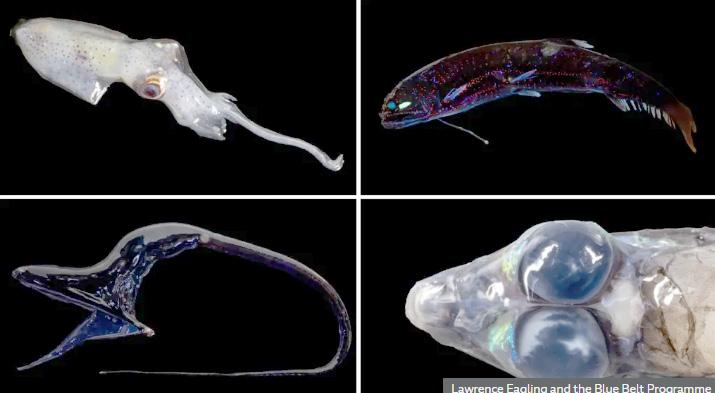
They found a pelican eel with a glowing pink tail that flashes red to lure in food, a barrel-eyed fish with tubular eyes pointing upwards to see the silhouettes of its prey, and a dragonfish with a glowing rod under its chin.
Talking to BBC News as the ship navigated an uncharted underwater mountain called Pickle Bank, Bell said: “We’re not sure how close to it we are. It’s quite difficult to map it without running the risk of running aground.”
The team eventually worked out that the mountain, which is north of Little Cayman island, rises from 2,500m (8,200ft) deep to about 20m (65ft) below the sea surface.
Footage reveals a bright blue, yellow and orange mountain side teeming with life -- golden towers of coral growing next to coral that look like large brains.
The team filmed fish darting between gorgonian whip coral, and jelly-like orange sea sponges near black coral.
They have found one of the healthiest, most diverse reefs in the region, free from the ravages of the stoney coral disease plaguing the Caribbean. It is likely that this reef is protected, for now, by its depths and the mountain’s steep slopes.
Deep-water, or mesophotic, reefs are also usually too deep to be affected by warming ocean temperatures - caused largely by climate change - which have damaged 80% of the world’s corals since 2023.
Using deep-sea cameras and echo-sounders lowered from the ship’s side, the researchers have mapped almost 25,000 sq km (9,700 sq miles) of sea-floor and captured 20,000 photos, including of glowing lantern fish and alien-like cephalopods.
“We know the surface of Mars or the Moon better than we know the surface of our own planet. You send a satellite around them and map them in a few weeks,” Bell says.
“We can’t do that for our ocean. We have to map it bit by bit using acoustic instruments on ships,” he explains. In Turks and Caicos, the
team discovered something missing from existing sea charts - an extremely steep 3,200m (10,500ft) high mountain ridge stretching 70km (45 miles) along the sea bed, west of a place called Gentry Bank. They were also astonished to discover a massive, vertical sinkhole called a blue hole, 75km south of a bank called Grand Turk, that formed when a cave
collapsed inwards.
“Imagine taking an ice cream scoop out of the seafloor. That’s what we saw - a crater about 300m (980ft) wide to 550m (1,800ft) below sea level,” says Bell.
They believe its steep walls could form the deepest blue hole in the Caribbean, rivalling Belize’s famous Great Blue Hole.
Usually nothing lives inside a blue hole, but cameras

dropped inside the new discovery show small sponges, a species of urchin called large spatangoid, and diverse fish species.
And 25km (15 miles) north of Anguilla, the researchers followed rumours spread by local fishers who had pulled up pieces of coral while working. The team confirmed there was a 4km (2.5 mile) reef with mosaics of coral growing in sponge “gardens”.
They also found black coral that could be thousands of years old, making them some of the oldest ever recorded.
“It tells us that these environments are really pristine and healthy,” says Bell.
Scientists are interested in these areas of deep water and steep mountains because they can funnel nutrient-rich water up to the surface, providing feeding grounds for animals or as fishing spots.
On board the ship, CEFAS worked alongside a group of environmental experts from the Cayman Is-
lands, Anguilla and Turks and Caicos who will use the findings to improve biodiversity management plans and find new fishing opportunities for island communities.
“Our islands were literally born from the sea. But when it comes to our offshore environments, we really haven’t had a chance before to discover what’s out there,” Kelly Forsythe from the Cayman Islands Department of Environment told BBC News. The island governments joined the research as part of a project called Blue Belt Programme.
The work should provide information to help the UK fulfil its legally-binding UN commitments to protect 30% of the world’s oceans by 2030 in designated Marine Protected Areas.
“Anyone can draw a box on a map and say, ‘That’s a marine protected area’,” explains Bell.
“But unless you know what’s in it, you don’t know if that’s useful at all.” (BBC)

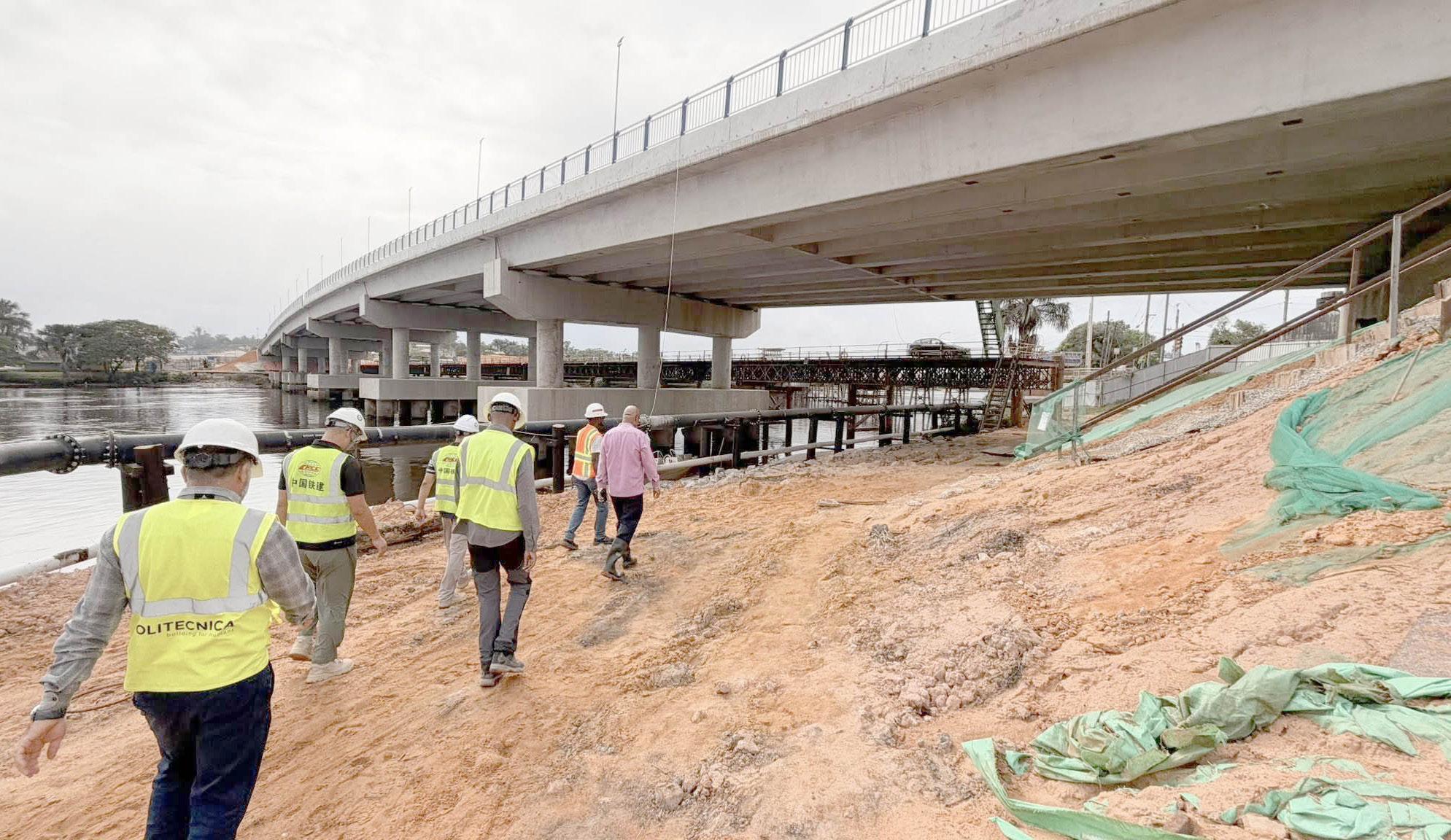
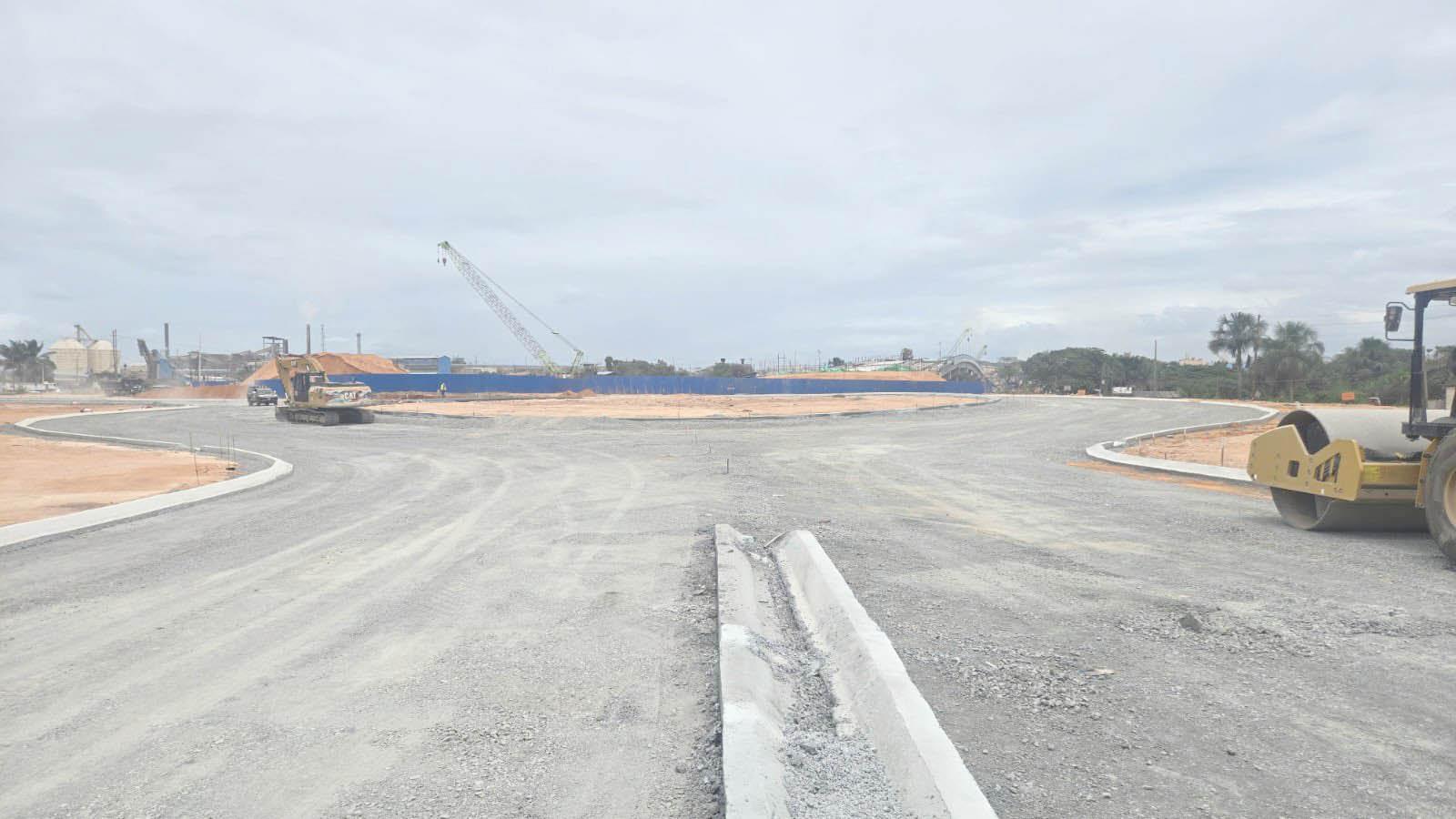
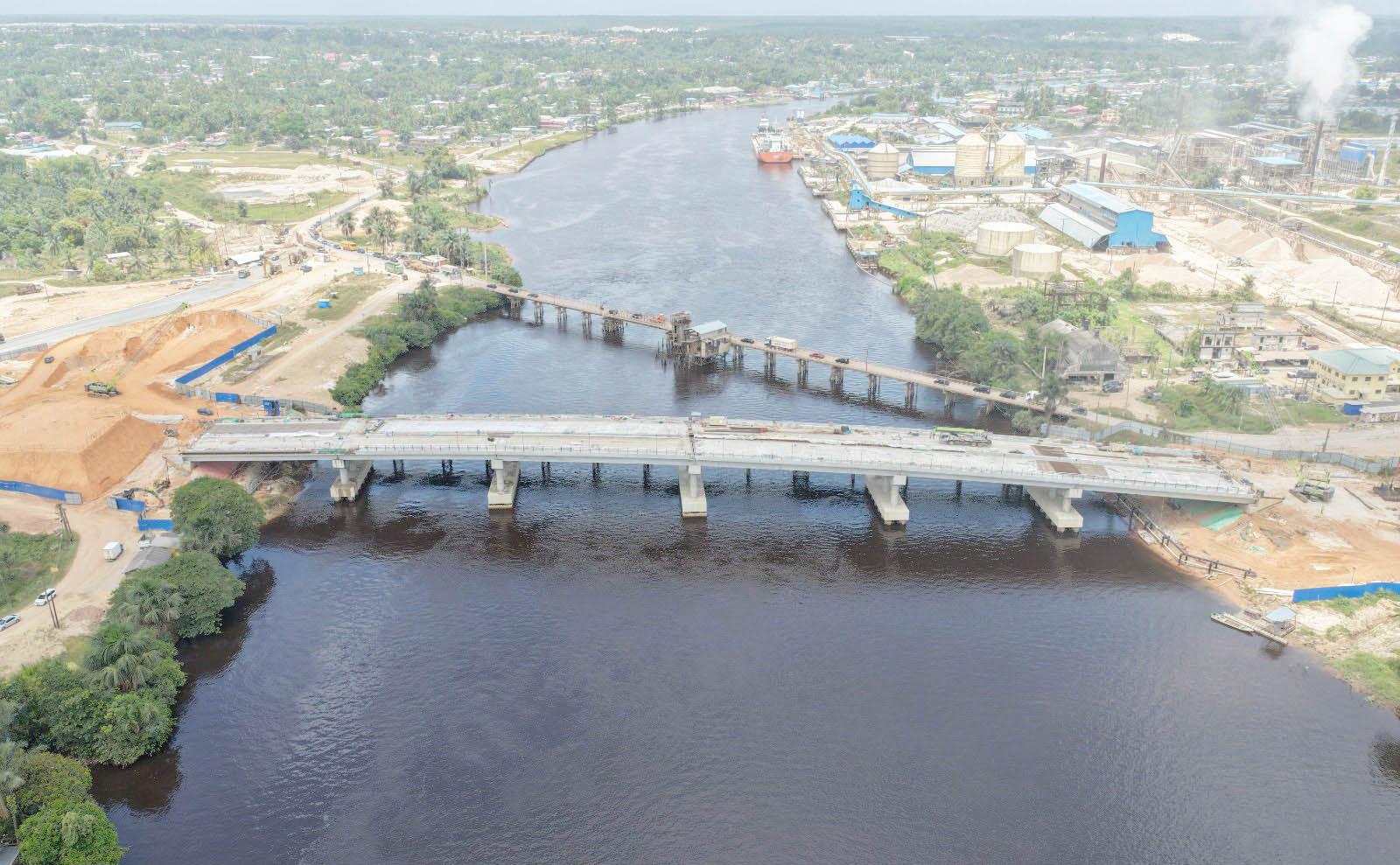
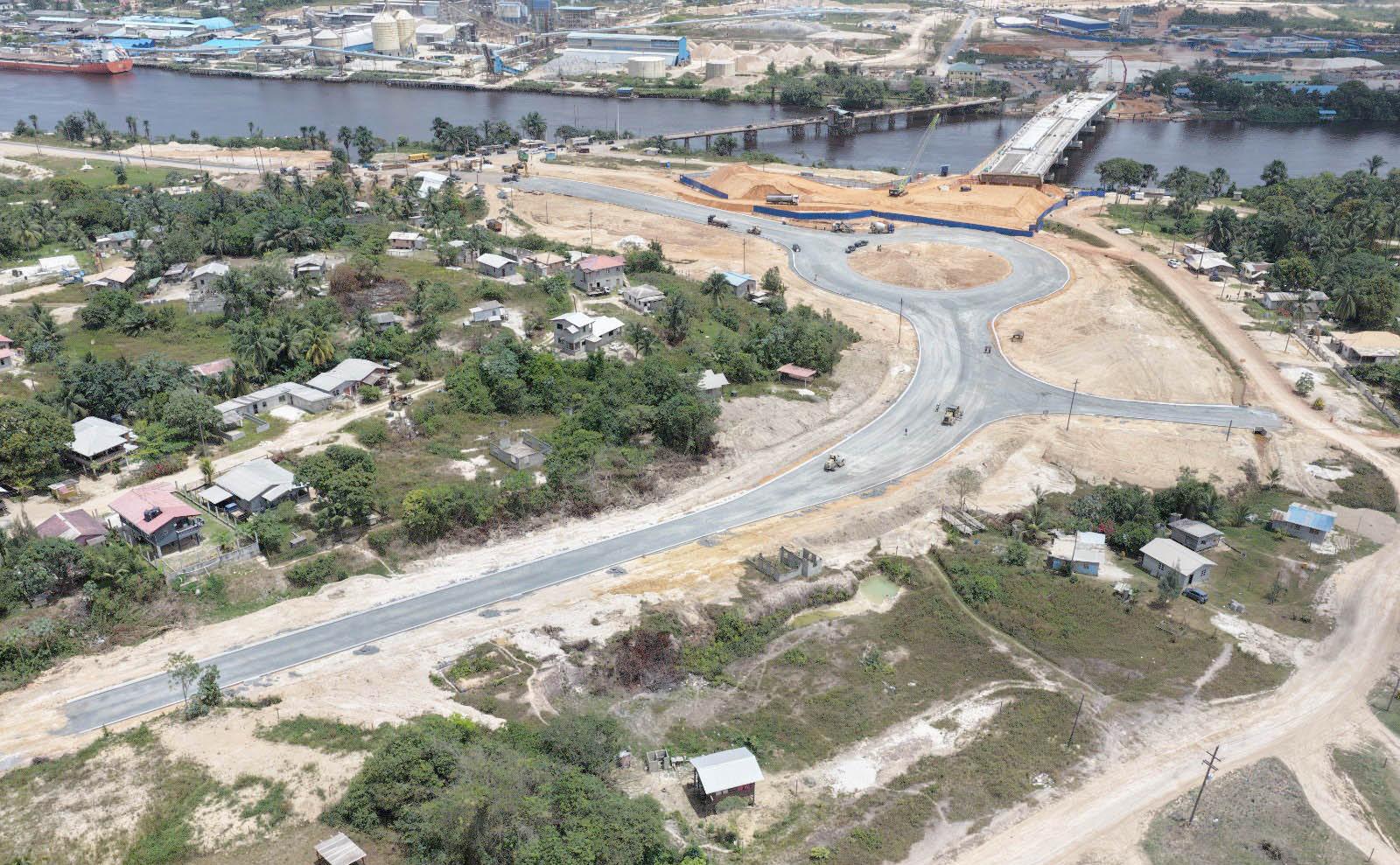
Physical works on the new US$35 million Wismar-Mackenzie Bridge at Linden, Region 10, have reached 97 per cent completion, bringing the long-anticipated crossing closer to commissioning
PHYSICAL works on the new US$35 million Wismar-Mackenzie Bridge at Linden, Region 10, have reached 97 per cent completion, bringing the long-anticipated crossing closer to commissioning.
The update was provided to Minister of Public Works, Bishop Juan Edghill, after a targeted assessment visit to the project site last Friday.
During the visit, the minister convened a multi-stakeholder meeting with technical staff from the Ministry of Public Works, contractors China Railway Construction (Caribbean) Company Ltd and GuyCo Construction Inc., along with the project’s consultancy firm, Politecnica.
Minister Edghill and representatives from the various entities also conducted an on-site walkthrough of the
233-metre-long concrete bridge where works are nearing completion. According to the ministry, concrete placement for the structure is now at 97 per cent.
The team also inspected the secondary road connections leading to and from the bridge.
A project debrief revealed that works on the western end of the project, on the Wismar side, are advancing steadily.
Construction of the West Watooka Connector and Dacoura Haul Roads is currently 33 per cent complete.
Subgrade preparation, subbase, crusher-run base and curbing for these roads have already been fully completed.
Foundation works for the roundabout on that end are also finished, while curbing for the roundabout is at 50
A 29-year-old labourer was found dead with multiple chop wounds at his Tuschen, East Bank Essequibo home on Monday morning, prompting a police murder investigation.
Dead is Herbert Hartman of Tuschen New Scheme.
According to a police release, Hartman and a 23-year-old construction worker of Tuschen Housing Scheme, who is now in police custody, were known to each other.
Police enquiries disclosed that the two men were earlier at a worksite in the area where they were allegedly imbibing alcohol when an argument erupted. During the confrontation, the suspect reportedly threatened the deceased before leaving the location.
It is alleged that the suspect later went to Hartman’s residence armed with a cutlass, where another altercation occurred.
At about 06:00 hrs on Monday, March 9, 2026, Hartman was discovered lying motionless in a pool of blood at his home with several chop wounds about his body. The body was escorted to the DeKinderen Regional Hospital, where it was examined and pronounced dead by a doctor on duty. It was later taken to the Ezekiel Funeral Home, where it awaits a post-mortem examination.
Police subsequently contacted the suspect, who was arrested and remains in custody, assisting with investigations. Investigations are ongoing.
per cent completion. Works along the Burnham Drive approach are also progressing, with subsurface works at 38 per cent and curbing at 39 per cent, while culvert installation continues.
On the eastern side of the project, works are 27 per cent complete. These include foundation and retaining structures designed to support the main approach to the bridge.
During the visit, officials were informed that 3,750 prefabricated vertical drains have already been installed and geotextile material laid as part of the ground-preparation process. Contractors are currently placing white sand and crushed stone as part of the subsurface works to stabilise the area.
Additionally, a new culvert has been installed at the Washer Pond Road approach
at Noitgedacht. Construction of the retaining wall for the main embankment is also progressing, with excavation and geotextile installation already completed and backfilling underway to prepare for final surfacing.
According to the Ministry of Public Works, the project remains on schedule to become fully operational by June 2026, once the connector roads are completed.
When finished, the new toll-free crossing will feature two barrier-separated pedestrian walkways, modern lighting infrastructure and roundabouts on both the eastern and western approaches.
The ministry noted that the project forms part of the government’s broader infrastructural expansion programme aimed at improving connectivity and mobility
across Region 10 and the wider country.
“The Ministry of Public Works remains committed to delivering high-quality infrastructure that meets the growing demands of Region 10 and the wider country,” the release stated, while thanking residents of Linden and commuters for their continued patience and co-operation during execution of the works.
The large-scale infrastructural project will feature four lanes as compared to the previous two-lane bridge that had existed. This small but deliberate change will cut travel time in half and reduce traffic congestion.
It will also generate substantial annual savings for commuters and businesses, as this bridge, too, will be toll free. It reflects a decision by the President Ali-led
government aimed at making travel more affordable between regions.
The new 220-metre-long precast concrete bridge is also being built to accommodate a wider range of vehicle sizes and weights, as well as higher speeds and uninterrupted passage for vessels, facilitating safer and easier passage to commuters.
Upon completion, the bridge will feature a prestressed, post-tensioned concrete box girder design, comprising four vehicular lanes and two barrier-separated pedestrian walkways.
The modern bridge is expected to mirror the design of the new Bharrat Jagdeo Demerara River Bridge. It is set to become an iconic landmark of the region, providing a sense of pride and identity to the residents.


A GROWING narrative suggests that Guyana’s social-safety net is a recent creation, born out of oil wealth and sustained by petroleum revenues.
This view is convenient, but inaccurate. Long before the first barrel of oil was lifted, successive PPP/C administrations had already embedded social transfers at the heart of national development, using limited resources to lift households, expand opportunity and build long-term wealth.
Well before the discovery of oil, Guyanese families were benefitting from a mix of cash and in-kind transfers aimed at easing household burdens and improving life chances.
Programmes such as the BecauseWe-Care-Cash Grant, the One Laptop per Family initiative, the school-feeding programme and the provision of free textbooks were not oil-era inventions.
They were deliberate policy choices, introduced when resources were scarce, to ensure children stayed in school, families could meet basic needs
and opportunities were not determined by income.
Since 2021, these initiatives have expanded in both scale and value. But this expansion represents continuity, not rupture.
Oil revenues have strengthened the state’s capacity to do more, but the philosophy underpinning these programmes, people-centred development, was firmly established decades earlier.
Nowhere is this clearer than in housing. The national housing programme, launched in the 1990s when Guyana was emerging from debt and economic decline, stands as one of the most powerful anti-poverty tools in the country’s history. It did more than provide shelter; it interrupted the intergenerational transmission of poverty.
Low-income beneficiaries receive house lots at a fraction of their market value, paying as little as 25 per cent, with the remaining value effectively transferred by the state.
That support is compounded by infrastructural investments, roads, drainage, water, electricity, that immediately

raise property values.
Reduced interest rates on low-income mortgages, made possible through tax concessions, further ease the burden on working families.
Mortgage Interest Relief then adds another layer of support, translating over time into savings equivalent to multiple mortgage instalments.
When these interventions are monetised, the value transferred to households runs into millions of dollars, but the true impact is not captured by numbers alone.
Home ownership remains one of the most powerful forms of asset accumulation. A home anchors families, enables the acquisition of other assets, and provides long-term security, often extending to future generations through inheritance.
The result has been tangible upward mobility.
Many households that once fell squarely within the low-income bracket have transitioned into the middle class, not through handouts, but through structured, strategic support that allowed them to build and retain assets.
Education-focused transfers reinforce this trajectory. Free tertiary education, scholarships, government payments for CXC subjects, and post-secondary training programmes deliver benefits that last a lifetime.
These are not annual giveaways; they are investments that create self-reliant households capable of contributing meaningfully to national development.
Seen in this light, today’s budgetary measures are not radical departures, but extensions of a long-standing development path.
They deserve to be judged not only by their immediate cost, but by their lasting impact on household wealth, social mobility, and resilience.
As Guyana looks beyond 2030, the challenge is not whether to sustain such interventions, but how to deepen them in ways that continue to reduce intergenerational poverty and build a more equitable society.
On that front, the record shows that long before oil, the foundation had been already laid.
POLICE are investigating the suspected drowning of a two-yearold child whose body was discovered in the Pomeroon River at Kabakaburi Mission, Upper Pomeroon River, on Saturday afternoon.
Dead is Samirah Evans, 2, of Kabakaburi Mission.
According to a police report, the child was at home with her mother about 12:30 hrs when she was later discovered missing. Relatives and residents of the community immediately launched a search in the area.
Police said that about

17:30 hrs the child’s body was discovered floating in the Pomeroon River in the vicinity of Warapana, approximately one mile from the Kabakaburi Mission landing.
The body was retrieved and escorted to
the Oscar Joseph Public Hospital, where it was examined and pronounced dead by a doctor on duty. It is currently awaiting a post-mortem examination.
Investigations are ongoing.
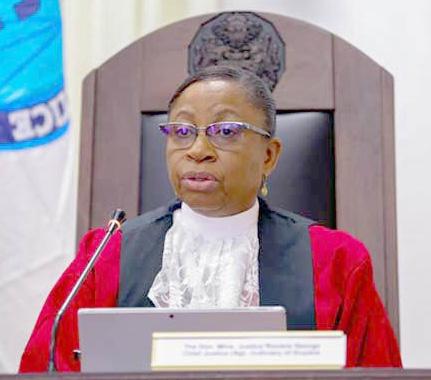
AS she spotlighted the critical role women play in the efficient functioning of the justice system, Acting Chancellor of the Judiciary of Guyana Justice Roxane George emphasised the importance of creating spaces where they can lead, decide, and shape the future of justice.
This perspective was part of her special message for International Women’s Day, which was celebrated on Sunday. The video message was posted on UNDP-Guyana’s Facebook page Justice George started her legal career as a State Counsel at the Chambers of the Director of Public Prosecutions in 1990 and ended her time at that Chambers as the Acting Director of Public Prosecutions, before becoming a High Court Judge in 2005.
In 2017, she was appointed as Acting Chief Justice and in August 2025, was appointed as the Acting Chancellor of the Judiciary.
Justice George pointed out that women make up about 50 per cent of the population of the world, noting that it is critical that women are represented in the judiciary of their respective countries.
In Guyana, she said 60 per cent of judicial officers are women. Justice George-Wiltshire stated, “Women judicial officers have made an immense contribution to the administration of justice, of course, in Guyana regionally and internationally. We bring to the table, to the fore, a very gendered perspective, a more gendered perspective, one that has allowed for greater focus on gender-based violence, on family matters, which we know disproportionately affect women or involve women or concern women,” the Acting Chancellor said. She stated that women’s representation in the judiciary ensures that there is representation of women’s
concerns, and such representation also sends a strong message that access to justice is for everyone, regardless of their gender.
The Acting Chancellor in her remarks pointed out the partnership between the Judiciary of Guyana and the PACE Justice Project, stating
that it has been very beneficial and positive. From this fruitful collaboration, there has been capacity-building, specifically as it relates to restorative justice and addressing cases where children have come into conflict with the law.
“The digitisation of our
court systems for the benefit of the public, and the emerging use of AI in legal research and writing, these have all also been dealt with in depth,” she said.
Another important aspect, according to her, has been case management.
She highlighted in her message that there have been a number of training sessions on case management so that judicial officers can better manage the caseloads that come before them in the courts.
In this regard, Justice George announced that there will be further trainings in relation to the conduct of criminal trials and the hearing of criminal appeals.
Additionally, they will engage in a “deep dive” into sentencing guidelines or criminal procedure rules, which will revolutionise how Guyana’s criminal justice system will operate in the courts. In tandem with human resource capacity-building, Justice George-Wiltshire said we must have adequate
infrastructure, to support the work of judicial officers. It is in this regard that the PACE project has provided the Judiciary with recording equipment that will be placed in eight additional courts.
“And of course, there will be further rollout of the provision of internet service, especially in our interior courts. All of this with a view to ensure that the publics that we serve have access to justice,” the Chancellor (ag) disclosed.
In closing, she said: “I would like to say to women and girls, you have the power within you to always do your best, to aim for excellence in all that you do. I urge women and girls to be bold, to be assertive, importantly for me, to command respect.
And I also strongly urge and encourage them to advocate for gender equality and a life that is free from fear, violence, and discrimination.”
IN recognition of International Women’s Day and International Women’s Month (IWM), Outliers Zone Caribbean is inviting women across the nation to pause and ask themselves one powerful and often overlooked question: What type of legacy am I building?
In a press release, the company said that for many women, life is a constant daily investment of their M.E.A.T. (Money, Energy, Attention and Time). However, only a few pause long enough to consider where their daily investments are leading.
According to Athalyah Yisrael, Co-Founder of Outliers Zone Caribbean, the concept of legacy is often misunderstood.
“Legacy is not only what we leave after we are gone,” she said adding, “Legacy is the footprint we are creating for our generations to live by and follow. Whether those footprints lead toward wealth, wellness, and expansion, or toward hardship, scarcity, and poverty, is being shaped by the decisions we make today.”
To spark national reflection during International Women’s Month, Outliers Zone Caribbean is offering
a limited number of women access to its Signature Legacy Assessment, a short, reflective tool designed to help women evaluate whether their current life trajectory is aligned with the legacy they truly desire.
The two-to-three-minute Legacy Assessment, developed from the organisation’s Corporate Operational Financial Readiness framework manual “7 F’s To a Financially Fulfilling Legacy”, which was written by Mrs. Yisrael, evaluates seven critical areas of life that influence a financially fulfilling legacy. These areas are faith, fitness, family, finance, fun+fulfillment, future, and friends. Participants will receive a legacy score that reveals whether they are currently living by intentional design, moderate focus or default.
“Most women are doing their best,” Yisrael noted stating, “But the truth is many of us are building our lives by default rather than by intentional design. Awareness is the first step toward transformation.”
In recognition of International Women’s Month, 25 women will be invited to complete the assessment. The assessment can be ac -

Co-Founder of Outliers Zone Caribbean Inc. and author, Athalyah Yisrael, signing copies for the Book ‘7 F’s To A Financially Fulfilling Legacy’ (Outliers Zone Caribbean photo)
cessed via the Outliers Zone Caribbean’s Facebook page or by WhatsApp request at 592-617-0173.
The invitation remains open until March 15. For
women who wish to move beyond awareness and begin intentionally designing their legacy, Outliers Zone Caribbean is offering two intentional pathways for deeper
engagement and legacy implementation.
The first is the Legacy Design Immersion, a premium one-day guided experience where women and their husbands or significant partners work alongside the Outliers Zone Caribbean team to translate their vision into a five-year Financially Fulfilling Legacy Roadmap for their family. This immersive strategic planning experience represents an investment of $75,000, designed for couples who are ready to intentionally structure the values, systems, and financial direction that will guide their family’s future.
The second pathway is the Legacy Reset Experience; a self-paced option designed for women who prefer to begin building their legacy systems independently. This experience includes the “7 F’s To A Financially Fulfilling Legacy” manual and implementation playbook, along with access to a live Virtual Legacy Reset Session on March 15, where participants will be guided through key principles for maximising the use of the systems outlined in the self-paced manuals.
This pathway represents an investment of $25,000 and is ideal for women who are
ready to take practical steps toward intentional legacy design at their own pace.
“For eight years, we have been leading the conversation encouraging individuals and families to think more intentionally about legacy,” Yisrael said. “Not simply in terms of inheritance, but in terms of values, morals, systems, financial independence in 5-10 years thinking, and intentional life design.”
She added that the invitation this month is simple yet profound. “Pause. Reflect. Ask myself whether the way I am investing my M.E.A.T (money, energy, attention, and time), today is leading toward the legacy I truly desire.”
“Because ultimately, a financially fulfilling legacy is not accidental. It must be designed intentionally. Contact ozcship@gmail.com or 617-0173 for any additional information, the release said.
Just last month, Outliers unveiled its new digitised Operational Financial Readiness Framework for Guyana’s disciplined services.
This marked a strategic step in strengthening financial security and operational resilience within Guyana’s uniformed forces.
I WAS at the day of appreciation for Rupert Roopnaraine.
I read all the emotionally slanted and misplaced panegyrics of the Stabroek News (SN). I read the ignorant opinions of Janet Bulkan on the SN. I read the barefacedly biased sociological distortions of the Mulatto/ Creole academics like Alissa Trotz, Nigel Westmaas, Percy Hintzen, and others.
I could go on but my point is each time I see this repugnant caricature of people, places and events by those mentioned above, I think of my very first UG History class with Sister Mary Noel Menezes.
She taught a course named the Philosophy of History. Sitting next to me was the current Registrar of UG, Dr. Nigel Gravesande, Dr. Kimani Nehusi who at the time was named Francis Drakes and the former Chancellor of the Judiciary, Justice Carl Singh. Sister’s perspectives on history have made a lasting impression on all of us who were her students.
I graduated with a history degree from UG and from that moment my life was changed forever. I will never stop contributing to the education of Guyanese on what their history is. I can only speak for myself so I will say that each time I see attempts to miseducate the next generation of Guyanese, I will write. I owe it to me and the country I
come from.
I read the outpouring about how good SN was and I say I will not allow the journalistic degeneracy of SN to go unwritten. I sat next to the former founder of the UK branch of the WPA, Leyland Decambra at Roopnaraine’s funeral. After the event, we went to German’s to eat and he said to me that he knows Roopnaraine well and based on what he heard at that day of appreciation: “Frederick, you must write.”
And so here I am writing to stop people from fooling Guyanese. Part five on Roopnaraine is forthcoming. I know 40, 50 years from now, just as people will read the glowing accounts of Martin Carter and Roopnaraine and others from their adoring fans, they will read my columns.
Do you know the past week, Ravi Dev submitted two letters on Rupert Roopnaraine to the SN and they were not published? This man is one of the foremost intellectuals in Guyana. In that week, GHK Lall and others have had more than four letters published. The problem seems to be the subject – Roopnaraine. Yet there are people who do not see anything wrong with this vulgarisation of SN.
I have done five items on SN in a series that began since its announced closure, and I know at an absolute level that those five

pieces will fall into the historian’s hand. I know Dev’s analysis of the shortcomings of Roopnaraine will fall into the historian’s hand. I know the several columns I have done on Martin Carter will fall into the historian’s hand. That is how inescapable history is.
The Martin Carter enigma shows how easy it is to distort history if there is no counter-narrative.
The Mulatto/Creole class (MCC) continues to eulogise Martin Carter and rightfully so for the brilliance of his poetry. A huge chunk of history is deliberately left out when the politics of Carter is omitted. The MCC has Carter as their favourite Guyanese. Nigel Westmaas wrote that he was Guyana’s deepest thinker.
But now and until all of them die (including Roopnaraine), they will not discuss even in a single line how a self-proclaimed Stalinist and staunch anti-colonial activist like Carter could spend most of his adult life working for the British colonial office in Guyana then at a senior level, the Booker empire where he was spokesman for the plantocracy.
None of the MCC academics want to touch that subject. None of them that love Carter will ever want to offer Guyana’s
historiography an explanation as to why this ultra-communist that was far more Marxist than Cheddi Jagan ended up serving imperialist interest in British Guiana.
The MCC academics like Nigel Westmaas, who is smitten by Carter, is so contemptuous of opinions outside his own MCC circles that he will not even attempt an explanation as to why his hero was an imperialist servant.
Here is Westmaas writing in the MCC newspaper, SN, last Sunday. I ask all my readers to reflect on what Westmaas wrote and see how extremely and absolutely necessary it is for people to write in order to stop the distortion of history.
Westmaas notes that the Guyana Chronicle attempts to shape historical interpretation (sic) to suit its political imperatives and narratives but not the SN.
Which newspaper in the world, past and present have not done that? Has this man ever read an SN editorial since 2020?
DISCLAIMER: The views and opinions expressed in this column are solely those of the author and do not necessarily reflect the official policy or position of the Guyana National Newspapers Limited.
Gov’t remains committed to building an education system for girls to thrive
– Minister Parag ground, her geography, or her circumstances, is given a fair and equal chance to succeed; And action means we do more than speak,” the minister said.
IN observation of International Women’s Day, Minister of Education, Sonia Parag, on Sunday, reaffirmed a simple yet powerful truth: women’s rights are human rights
During her address, which was posted on the ministry’s official Facebook page, she emphasised that in education, rights mean access.
This includes access to safe classrooms, quality teaching, technology, and opportunity.
“Justice means ensuring that every girl, regardless of her back-
She reaffirmed that when we educate a girl, we empower a family, and when we empower a woman, we strengthen a nation.
Minister Parag said that in Guyana, the Government remains committed to building an education system where every girl can learn, lead, and thrive without limitation and without fear.
“Today, and every day, we stand for rights, justice, action for all
women and girls. Happy International Women’s Day to all of our women across the country and across the world,” she said.
The Ministry of Education has said that women continue to shape homes, classrooms, communities and nations with courage, compassion and unwavering determination, adding that the leadership of women inspires change, their voices drive progress, and their contributions leave a lasting impact on every generation.
A 58-year-old taxi driver of Wismar, Linden, is in police custody after more than 13 kilograms of suspected cannabis were discovered in his motor car during a stop-and-search exercise along the Linden Highway.
The discovery was made around 15:40hrs on Sunday, March 8, 2026, in the vicinity of Bamia.
Police said ranks stopped a Toyota Premio motor car driven by the taxi driver, who was the sole occupant. A search of the driver revealed no illegal items.
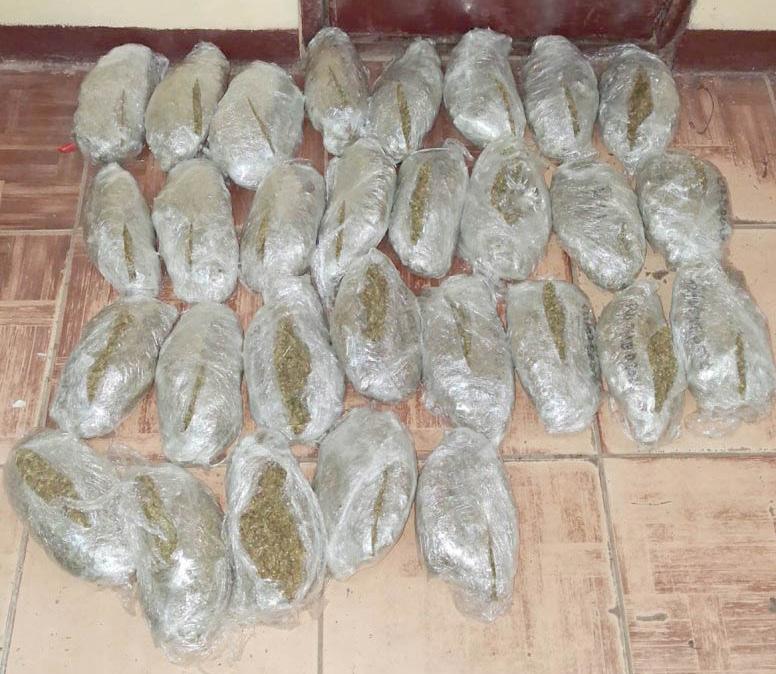
However, during a search of the vehicle, ranks discovered four yellow five-gallon jars in the trunk containing twenty-nine parcels wrapped in transparent plastic with leaves, seeds and stems suspected to be cannabis.
The suspect was arrested and escorted to the Mackenzie Police Station along with the suspected narcotics, which were weighed in his presence and amounted to 13.154 kilograms before being lodged.
The taxi driver remains in police custody pending charges as investigations continue.



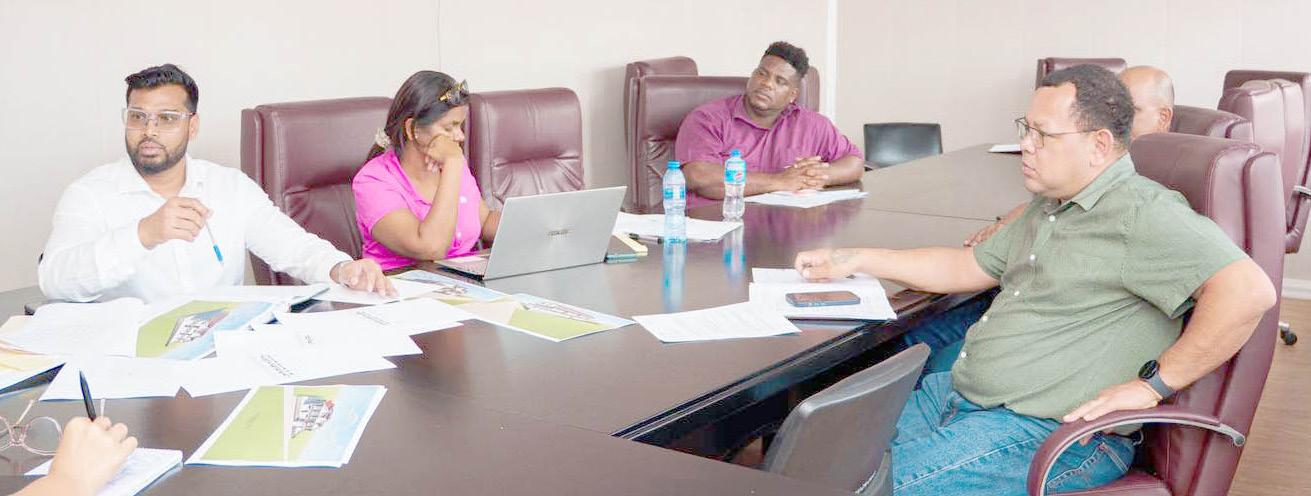
MINISTER of Local Government and Regional Development, Priya Manickchand, on Monday convened a key meeting to outline ambitious plans for upgrading several markets across Guyana.
The discussions were focused on reimaging the Buxton, Plaisance, Zeelugt, and Tuschen markets through comprehensive re-development efforts, envisioning facilities that better serve vendors and shoppers with
improved layouts, sanitation, and amenities.
Attention also turned to enhancing the existing New Amsterdam and Skeldon markets, aiming to elevate their functionality and appeal in line with growing regional demands.
In a forward-looking move, the meeting explored the potential development of a new market area at the Soesdyke Junction, alongside the innovative idea of establishing a rest stop along the
nearby highway to support travellers and stimulate economic activities.
These proposals reflect the ministry’s commitment to strategic infrastructural investments that align with Guyana’s evolving transportation and trade networks.
While specifics are still under review, Minister Manickchand emphasised ongoing consultations with all relevant stakeholders to refine these visions into actionable plans.
THE University of Guyana (UG) has begun its search for a new Vice-Chancellor and Principal.
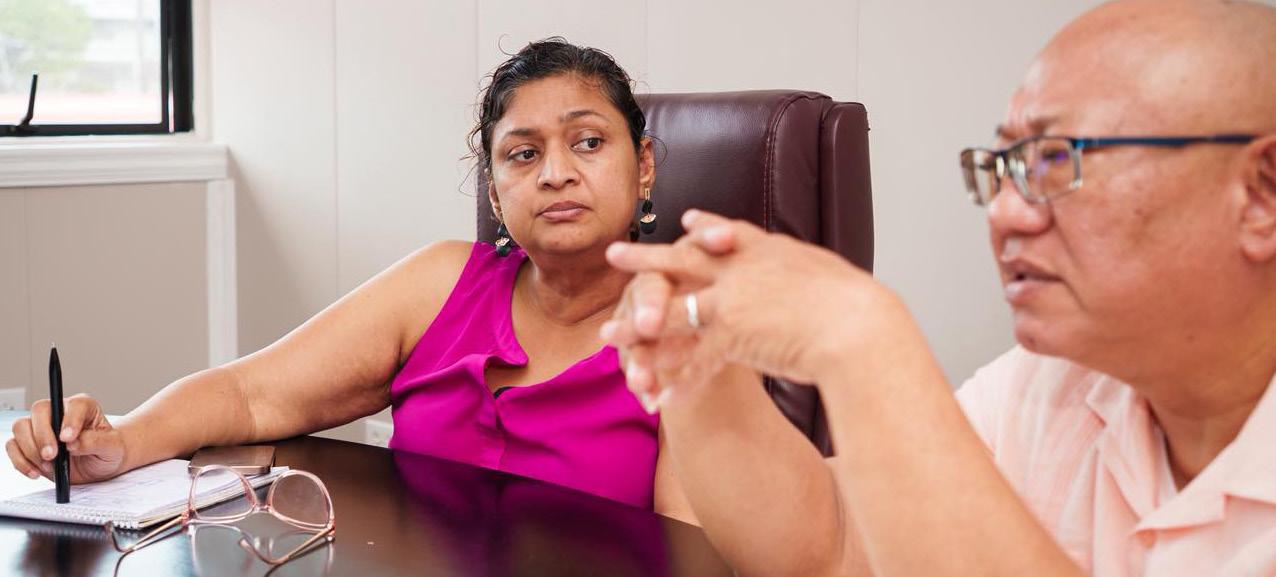
Chancellor of the University, Sir Ronald Sanders, in a statement on Monday, said that on February 16, 2026, the University Council decided to establish a Search Committee to identify and recommend a new ViceChancellor and Principal of the UoG, in light of the fact that the current Vice-Chancellor’s contractual term, after seven years in office, is due to come to an end.
“The Council took this decision in order to ensure that the process for selecting new leadership for the University proceeds in an orderly, transparent and merit-based manner, consistent with the governing framework of the institution and the Council’s responsibility to secure the best possible leadership for the University,” the statement read.
Upon that decision, the Chancellor stated that the search committee agreed to the establishment of the process, together with the public advertisement of the post.
Sir Ronald stated that the selection of a Vice-Chancellor is an important moment
for the University and the country, overall.
“Guyana is now undergoing one of the most dynamic periods of economic growth and structural transformation in its modern history. Expansion in energy production, infrastructure modernisation, economic diversification, and wider international engagement are reshaping national priorities and workforce demands.
“In these new circumstances, the University of Guyana, as the nation’s premier public university, must play an even more central role in producing highly qualified graduates, expanding postgraduate education, strengthening research, and contributing independent expertise, innovation and practical knowledge to national and regional development,” he said.
It is in this regard that Sanders said that the university is seeking a ViceChancellor of “intellectual distinction, strategic courage and proven executive capacity, a person capable of positioning the University as a centre of research excellence, professional training and regional influence in a rapidly evolving economy.”
The person sought should possess a distinguished academic record, normally at the rank of full professor or equivalent, together with significant senior executive leadership experience within a university or comparable institution, the statement read, further noting that the Council is looking for a leader with a strong record of involvement at senior level in institutional growth, research expansion and performance improvement; sound experience in financial management and institutional administration; and the capacity to lead organisational transformation and complex change.
Someone committed to academic freedom, shared governance, institutional accountability and high standards of integrity, are the traits that the council is seeking in the successful candidate.
The public advertisement, which was issued on Monday, sets out the terms of appointment, the application requirements, and the timetable for submissions. The closing date for applications is April 17, 2026, according to the public advertisement.
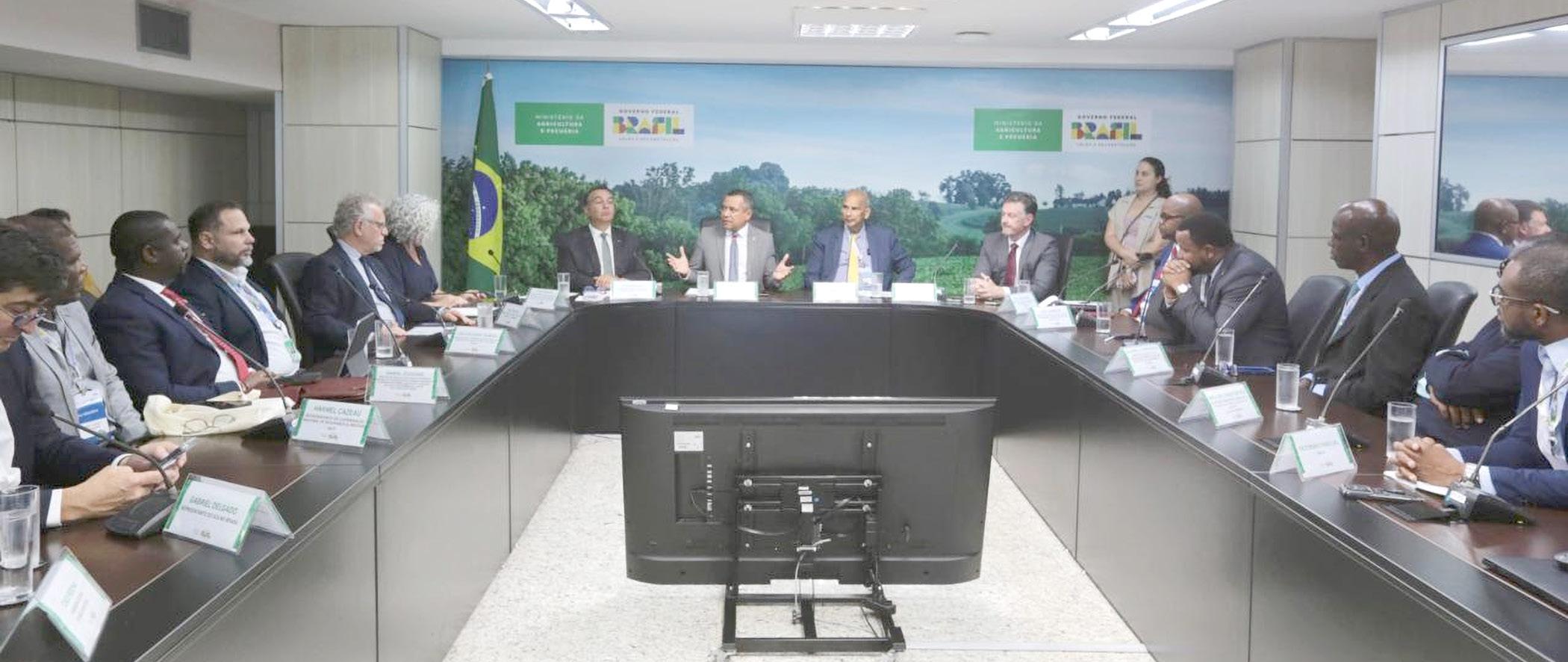
IN Brasilia, the Deputy Executive Secretary (Deputy Minister) of Brazil’s Ministry of Agriculture and Livestock (MAPA), Cleber Soares, hosted a meeting with the Director General of the Inter-American Institute for Cooperation on Agriculture (IICA), Muhammad Ibrahim, and ministers and other senior agricultural officials from Caribbean countries.
The meeting took place parallel with the 39th Session of the FAO Regional Conference for Latin America and the Caribbean, and was used to explore opportunities for co-operation, identify synergies and present strategic initiatives.
In his opening remarks to the meeting, Cleber Soares underlined the importance of Brazil’s closer ties to the Region through IICA, and emphasised the role of the Brazilian Agricultural Research Corporation (EMBRAPA) in the technological development of Brazil’s agriculture.
Soares also presented information about the ministry’s five secretariats and each one’s current initiatives. In response, the visiting ministers highlighted their countries’ needs and the opportunities for broadening and strengthening Brazil’s relationship with them.
The Director General of IICA, Muhammad Ibrahim, welcomed everyone and stressed the importance of the countries that make up the Caribbean Community (CARICOM).
He also informed the ministers of the progress being made in drafting IICA’s new Medium-term Plan (MTP), the institutional roadmap of the specialised agency, which incorporates the areas in which the countries need and have requested co-operation.
“Strengthening links with Brazil will have a very positive impact and can help boost agriculture in each nation, contributing to global food security. These countries face climate challenges and other problems, and, working together, they can overcome these difficulties more easily,” Ibrahim observed.
During the meeting, Secretary Soares announced the creation of the Centre for Innovation and Sustainable Agriculture in the Americas in Guyana, designed to meet the needs mentioned by the ministers and improve relations with the entire Caribbean.
The decision to create the centre was taken by the Min-
istry of Agriculture, Livestock and Fisheries of Brazil (MAPA); the Ministry of Foreign Affairs of Brazil (MRE); the Brazilian Cooperation Agency (ABC); the Brazilian Agricultural Research Company (EMBRAPA) and IICA.
“Our aim in the coming days is to move forward in establishing a framework, so that in a short time the Foreign Ministry, working with IICA, the ABC and EMBRAPA, is able to kick off the process of creating the centre. Brazil will share its technology, technical expertise and experience with our Caribbean brothers and sisters,” Soares remarked.
Brazil’s Deputy Minister also underscored the fact that his country has the potential to support these other nations that need co-operation. As a leader in tropical agriculture, Brazil possesses the technology, innovation and skilled producers needed to help strengthen crop and livestock farming.
During the meeting, representatives from the MAPA explained the role of each secretariat within the ministry and their importance to the work carried out in Brazil in support of crop and livestock farming.
Marcelo Fiadeiro, Secretary of Rural Development (SDR), highlighted the ministry’s sustainability policies. The Undersecretary for Agricultural Policy, Wilson Vaz, then explained its rural credit policies, support for marketing and rural insurance.
The Director of Planning and Strategy for the Unified Agricultural Health System, Judi Nóbrega, spoke about the role of the Agricultural Defense Secretariat, which is in charge of controls and inspections, and is also responsible for ensuring the sanitary credibility that certifications of Brazilian products enjoy in international markets.
Finally, the Undersecretary for Trade and International Relations (SCRI), Augusto Billi, explained his department’s responsibilities, which include opening markets, trade relations and agricultural exports.
Billi also pointed out that the first shipment of Brazilian beef would be arriving in Saint Vincent and the Grenadines this week to fill local supermarket shelves—a concrete result of the strengthening of bilateral trade relations.
Vegetables are also being harvested from seeds donated
by Brazil during last year’s mission.
The ministers discussed strategies designed to make agriculture more attractive to the new generations, highlighting the potential of technologies such as drones and precision agriculture for modernising the sector and reducing the migration of young people from rural areas to the city. They also emphasised the need to increase agricultural training and higher education programmes.
During the discussions, the participants referred to the practical challenges faced by farmers, such as climate impacts, the vulnerability of islands and post-harvest handling problems that affect the quality and shelf life of products.
Another key point was the importance of ensuring reliable, stable markets to stimulate agricultural production.
Participants also discussed the security problems that exist in rural areas, particularly praedial larceny, considered a major challenge in some Caribbean countries.
The possible responses mentioned included the adoption of surveillance technologies and the creation of police units specialising in agricultural security.
Several countries shared specific experiences and challenges. The representatives from Saint Kitts and Nevis reported on the damage caused by animals invading crops, while the representatives from Haiti emphasised the severity of their country’s food insecurity, with more than half the population struggling to access food.
They all stressed their TURN TO PAGE 15
CHIEF of Operations at the Inter-American Development Bank (IDB)- Guyana Ivan-Alonzo Gaviria, on Sunday engaged several women attending the second annual HerVenture Summit, on building sustainable and strong businesses.
Speaking as an ally of women empowerment, Gaviria said access to finance has been a common barrier, preventing some women-owned businesses from scaling and growing their business, or getting to the next level.
In his remarks, the IDB-Guyana Chief of Operations said that women in Guyana are already bankable, emphasising that women entrepreneurs are not merely standing on the sidelines of our nation’s transformation, but are helping to shape it. He told women at the Summit that when we speak about bankability, we shouldn’t think of
it as something that needs to be proven, but as something that is already being demonstrated through women’s performance, leadership, and measurable economic impact that spans across Guyana’s rapidly growing economy and across multiple sectors.
Gaviria said this is why the IDB Group continues to invest in strengthening the ecosystem around women entrepreneurs.
“This is a massive opportunity for everybody. For instance, through targeted initiatives like our IDB Lab Project, ‘Guyana’s Women Entrepreneurs Realizing the Potential,’ we’re helping equip women-led businesses with the financial and technical support that is required to demonstrate strong growth,” he expressed.
Gaviria told the women that what matters now, is that they continue to take full advantage of

every opportunity that is emerging, from supply chains to digital services, agriculture, technology, construction, tourism, the creative
industries, and the expanding network of support programmes.
This includes the Road to Leadership Programme executed
by HerVenture and programmes through the Ministry of Human Services and Social Security’s Women’s Innovation and Investment Network (WIIN), which goes beyond just teaching skills.
These initiatives create networks of belief, where women can uplift, mentor and support each other. More than 100 women would have graduated from programmes like the Road to Leadership Programme at the Summit.
In expressing words of encouragement to the women, he said: “You belong in all these places, not because it looks good, but because it’s good economics, it’s good business. It’s because you were prepared, you were ready and you add immense value to these places. Because your voice, and your presence Is required. You need to be in these places.”
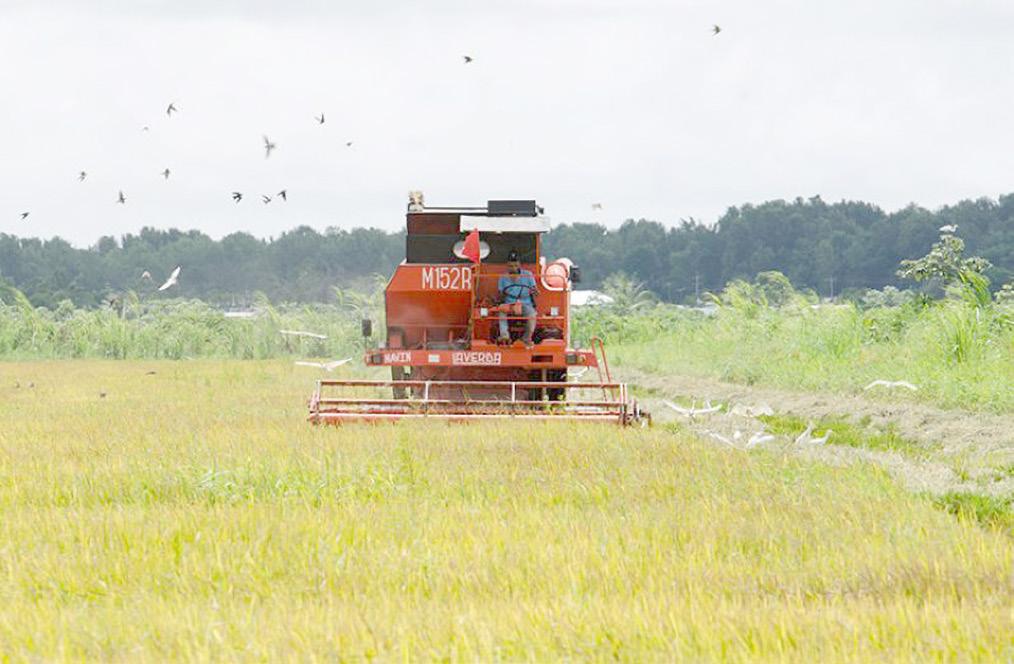
WITH farmers confronting more frequent dry spells and other erratic weather patterns, the Government of Guyana has been promoting more climate-smart techniques across several agriculture sectors, with a particular focus on rice farming.
Addressing the recently concluded he 39th Session of the United Nations Food and Agriculture Organisation (FAO)’s Regional Conference for Latin America and the Caribbean (LARC 39) held in Brazil, Agriculture Minister, Zulfikar Mustapha said rice production remains a key element of the country’s food ecosystem.
To this end, he noted that the government is cognisant
that the industry will need to be made more resilient to climate change.
“We are promoting improved rice varieties that are more tolerant to drought, flood and pests. We are also establishing climate-smart rice production models at our rice resort station to demonstrate techniques that reduce risk and improve efficiency under changing weather conditions,” he said. The minister noted that rice is currently cultivated by around 6,000 farmers across more than 232,000 acres annually.
He stressed that climate pressures, especially more frequent dry spells, are creating new challenges for the industry, but also driving innovation and reform.
Beyond production in the field, the minister drew attention to the often-overlooked problem of post-harvest loss in the rice value chain.
He said the government is investing in projects such as drying floors and improved milling capacity to reduce losses after harvest.
By upgrading these facilities, the ministry aims to ensure that a higher proportion of the rice harvested by farmers actually reaches the market in good condition.
Mustapha said, “Another important area is reducing post-harvest loss, which is often overlooked when discussing climate resilience. We are also investing in driving a number of projects to improve this, things like dry-
ing floor, improving milling capacity, and these are all applicable to the rice sector.”
A key pillar of the minister’s strategy is the promotion of improved rice varieties with greater tolerance to drought, floods, and pests.
Through the Guyana Rice Development Board (GRDB), the government is rolling out these varieties to farmers across major rice-growing regions.
According to Mustapha, these new lines of rice are designed to maintain yields even when rainfall is erratic or when crops are exposed to extremes of water stress and pest pressure. This, he said, is central to protecting farmer incomes and national food security in an era of climate
uncertainty. To complement the improved seed varieties, the ministry is also investing in climate - smart rice production models. These are being established at the rice research station as demonstration sites, showcasing practical techniques that help farmers manage risk and use resources more efficiently.
The models are intended to highlight best practices in water management, soil health, and input use, giving farmers concrete examples of how to adjust their operations.
along the Corentyne, Region Six, who were recently impacted by heavy rainfall, are set to benefit from compensation through the government’s crop insurance programme.
The insurance project, launched in July last, through collaboration among the Ministry of Agriculture, UPL Costa Rica, Philip Morris International and the Guyana Rice Development Board (GRDB), aims to protect farmers from losses caused by extreme weather events such as floods and droughts.
THE CARICOM Private Sector Organisation (CPSO) has welcomed the African Export-Import Bank’s (Afreximbank) decision to increase its investment commitment to the Caribbean from US$3 billion to US$5 billion, describing the move as a major step towards expanding trade, investment, and economic co-operation between the Caribbean Community and the African Union (AU).
According to a press release from the CPSO, the announcement was made during the engagement between President of Afreximbank, Dr George Elombi and CARICOM Heads of Government during the 50th Regular Meeting of the Conference held in Saint Kitts and Nevis
on February 24, 2026.
During that meeting, Dr Elombi outlined Afreximbank’s strategic vision for deepening economic engagement with the Region and supporting initiatives aimed at expanding trade and investment flows. “This expanded commitment by Afreximbank represents a major milestone in strengthening economic co-operation between the African Union and the Region,” said Dr Patrick Antoine, Chief Executive Officer and Technical Director of the CPSO.
He added: “For the private sector in CARICOM, it offers the potential for realising expanded trade opportunities, deepening investment partnerships, and strengthening the productive capacities of private sector
and infrastructure projects between CARICOM and the AU.” Among the priority initiatives highlighted was the development of the Afreximbank Caribbean Trade Centre in Bridgetown, Barbados, which will also serve as the bank’s regional office along with conference facilities and a five-star hotel. Construction of the facility is expected to begin this year.
Afreximbank has also indicated its willingness to support the establishment of a Caribbean Export-Import Bank, which is an institution envisioned to strengthen the Region’s capacity to finance trade and investment, while contributing to a more robust regional financial architecture. In addition, the bank has been working with regional central banks to
develop a CARICOM Payment and Settlement System (CAPSS), which could facilitate cross-border transactions through a regional clearing system and reduce reliance on hard currencies.
Recognising the importance of physical connectivity in supporting trade expansion, Afreximbank further signalled its readiness to assist with financing initiatives aimed at strengthening air and maritime links between the Caribbean and the African continent, which remain critical to unlocking the full potential of AU-CARICOM trade and investment.
The CPSO, Afreximbank, and the Africa Business Council had previously signed a Memorandum of Understanding (MoU) for the establishment of the African

Caribbean Business Council (ACBC), a formal platform designed to facilitate structured private sector co-operation between the two regions.
Through the ACBC, the parties aim to advance trade and investment forums; business-to business matchmaking; investment facilitation; financial-sector co-operation and capacity-building initiatives aimed at strengthening small and medium-sized enterprises, women and youth entrepreneurs.
The framework also provides a mechanism to deepen institutional co-operation and explore longer-term opportunities for expanded AU-CARICOM trade and investment co-operation.
“The CPSO looks forward to deepening its collaboration with Afreximbank and the Africa Business Council, working alongside regional governments, financial institutions and private sector stakeholders to advance the implementation of these initiatives, including through the Africa Caribbean Business Council,” Dr Antoine said.
He added: “Our organisation remains committed to ensuring that the opportunities emerging from the strengthened AU-CARICOM partnership translate into concrete outcomes for regional businesses, expanded trade flows and sustainable economic growth across the Region.”
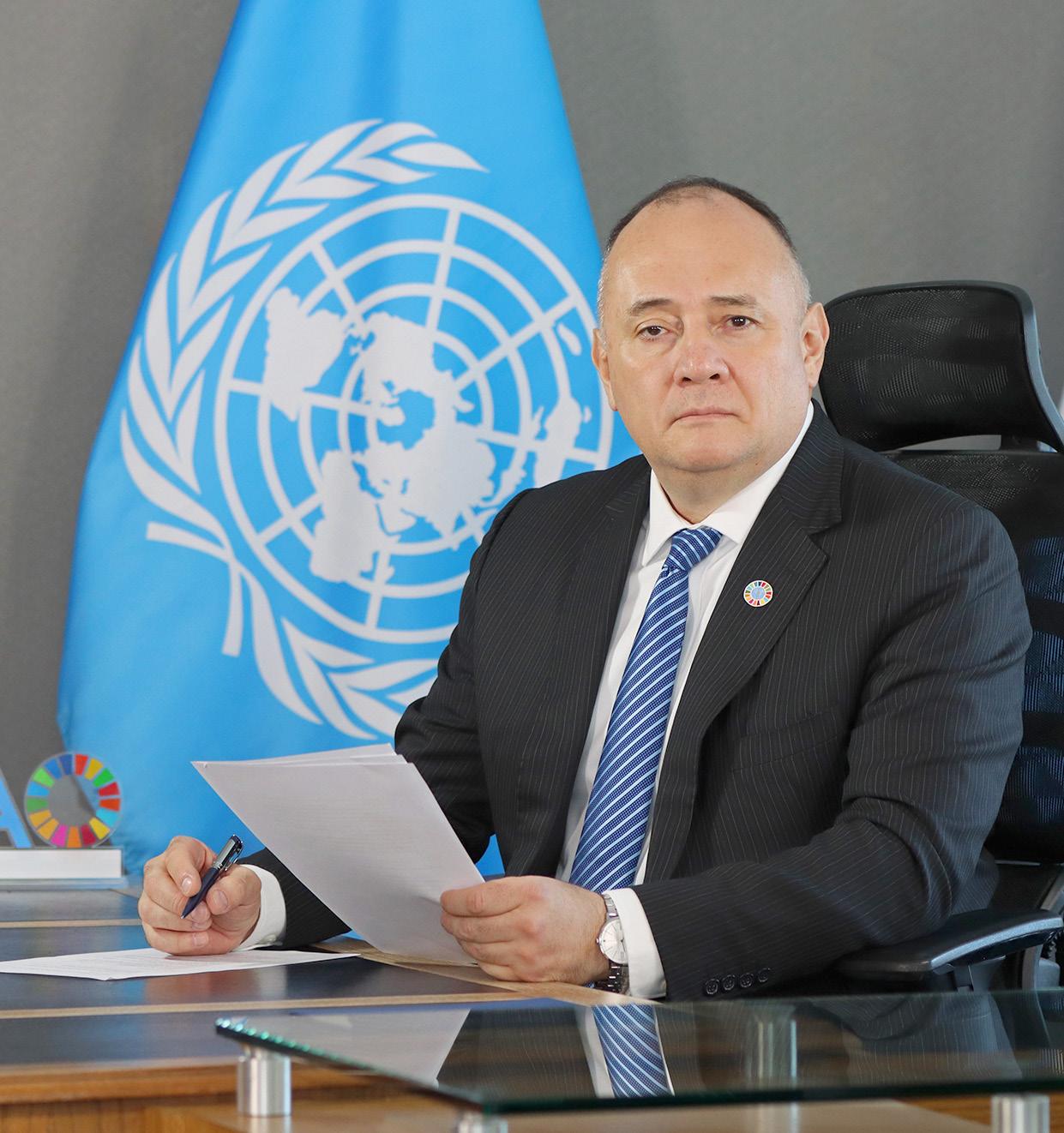
By Rene Orellana Halkyer, Assistant Director-General and FAO Regional Representative for Latin America and the Caribbean
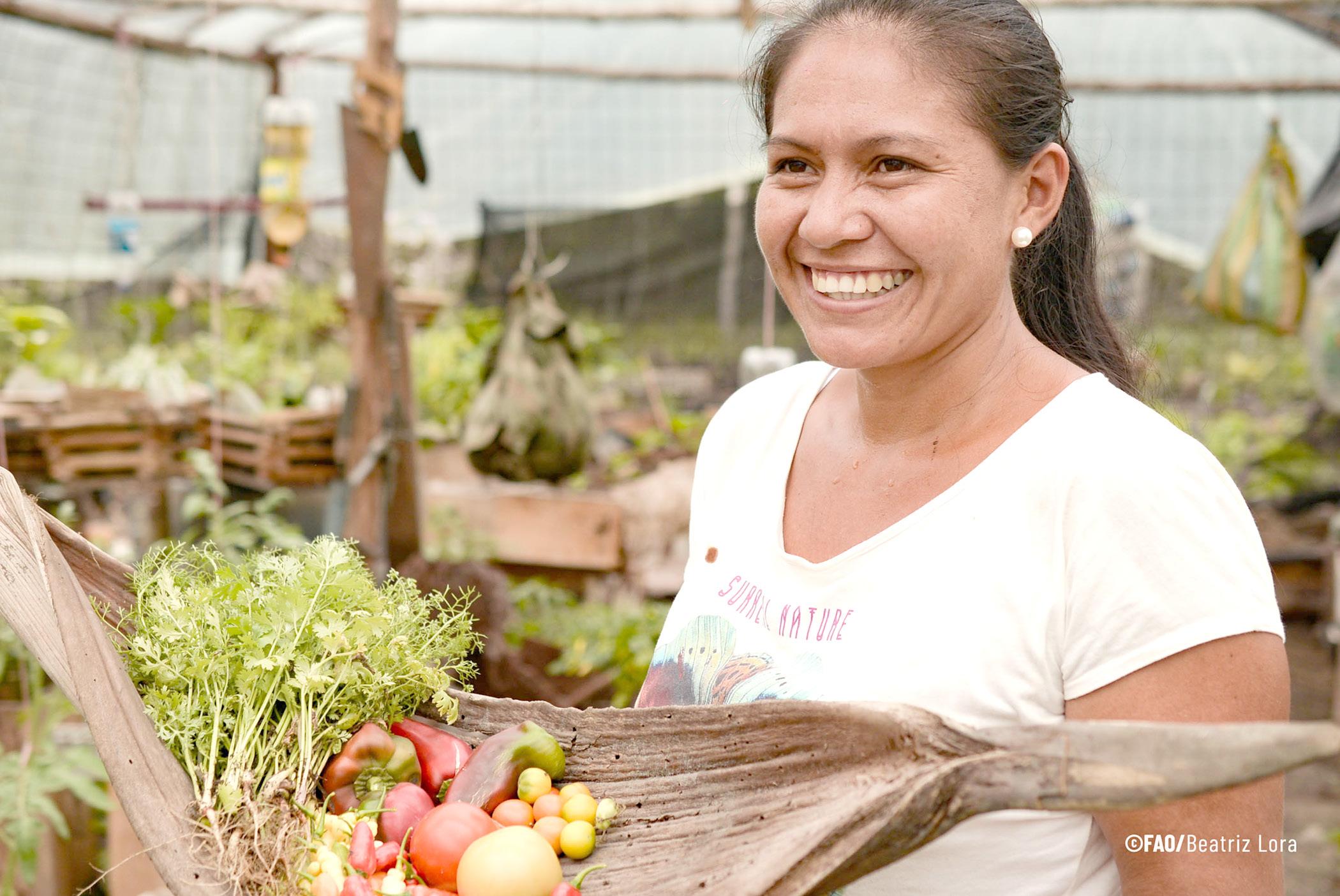
THE designation of 2026 as the International Year of the Woman Farmer by the United Nations General Assembly comes at a decisive moment for Latin America and the Caribbean.
The region stands at a turning point to reconfigure its financial ecosystems, in a context marked by increasing climate risks and the need to promote more equitable economic growth.
This transformation process will only be complete if women are placed at the centre of national development strategies and plans. Ensuring their financial inclusion and strengthening their economic empowerment is an indispensable condition for advancing toward more resilient, sustainable and inclusive agrifood systems.
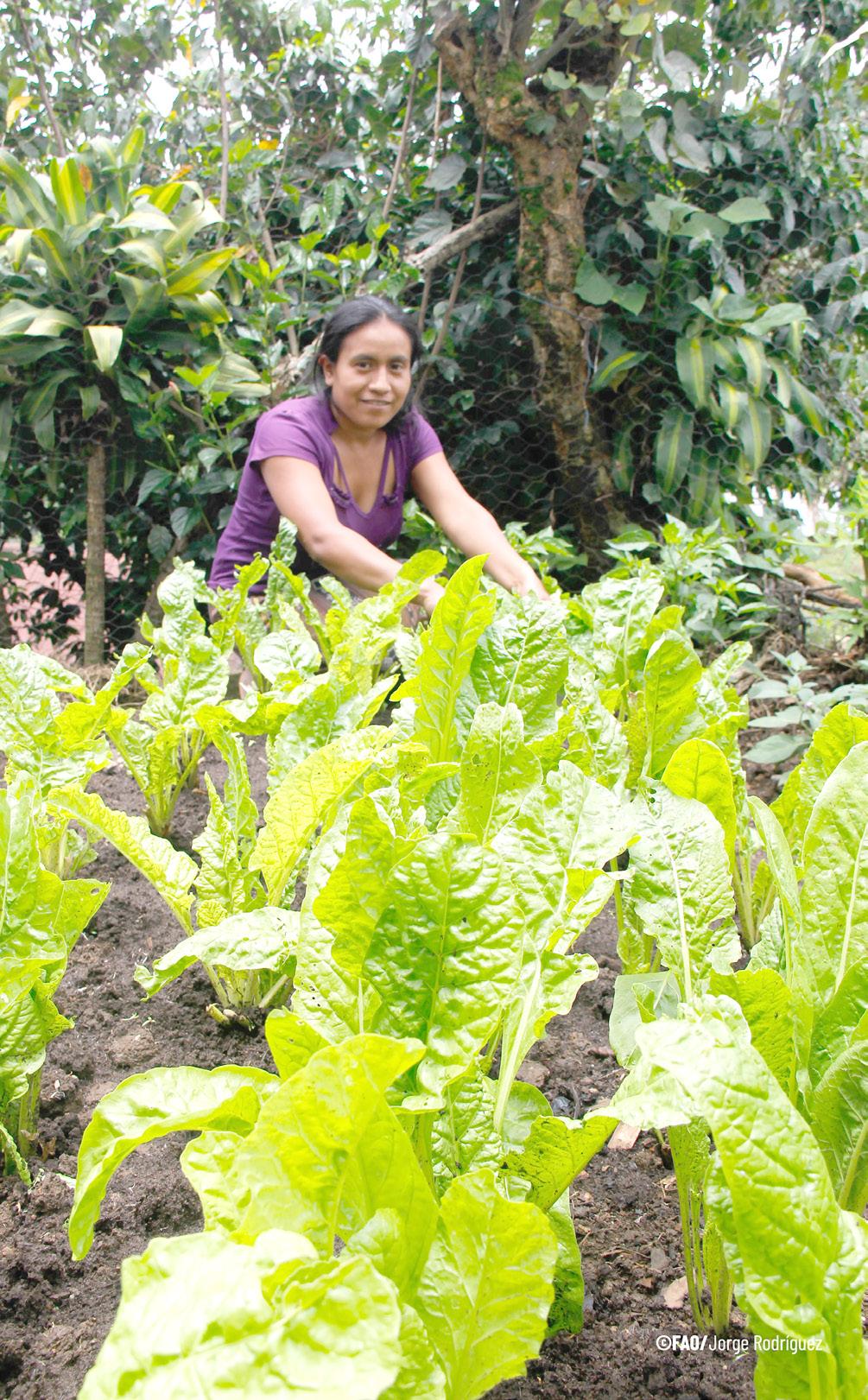
Women represent 36 percent of the workforce in the region’s agri-food systems. However, they continue to participate under deeply unequal conditions. They face limited access to credit, training processes, financial ser-
vices and formal markets, as well as a persistent structural burden of unpaid domestic and care work.
These conditions limit their economic autonomy, reduce their productivity, and restrict their integration into higher value-added segments of productive value chains.
Advancing gender equality within agri-food systems could generate substantial economic and social impacts, including a significant increase in global Gross Domestic Product and improvements in food security for
millions of people. However, a gender perspective continues to occupy a secondary place in development financing flows, and only a limited share of international co-operation incorporates it as a priority objective.
In this context, the 39th FAO Regional Conference for Latin America and the Caribbean represented a starting point to renew commitments for countries to strengthen their political will toward the full participation of rural women and translate it into concrete public policy agree-
market access, and digital literacy and connectivity.
It is also essential to strengthen the role of rural women’s organisations in all their diversity, through the legal recognition of savings and credit cooperatives and community savings groups as financial intermediaries.
At the same time, financial inclusion must be linked to social protection systems, positioning the State as a key actor in providing public guarantees, insurance and mechanisms that facilitate rural women’s access to fi-
ments, financing and innovation. This entails promoting financial architectures capable of effectively responding to rural realities, articulating instruments such as credit, banking access, insurance and other financial mechanisms with key services, including capacity strengthening, technical assistance,
nancial services.
Within this framework, investment in comprehensive care systems constitutes a critical factor in this process. Recognising unpaid care work and expanding women’s economic participation strengthens household incomes and stimulates local economies. Regional
evidence shows that such investments generate social and economic returns, contribute to job creation, and strengthen the resilience of rural communities.
To support these efforts, the FAO-led Regional Platform for the Empowerment of Rural Women has been consolidated as a relevant tool for assisting countries. The platform brings together evidence, good practices, training and co-operation spaces aimed at strengthening the design and implementation of public policies that channel more effective and innovative investments in favour of rural women.
The International Year of the Woman Farmer 2026 calls on governments, the private sector, development
banks, international co-operation and civil society to accelerate action by mobilising investments with a gender-transformative approach and promoting innovation as a driver of agrifood system sustainability. At FAO, we will continue supporting the transformation of these systems through solid evidence, strategic partnerships and technical assistance to countries, firmly convinced that a hunger-free, more sustainable and inclusive region will only be possible if we strengthen the empowerment of those who sustain food production, rural economies and the resilience of territories across Latin America and the Caribbean. (FAO)
interest in strengthening regional co-operation to address challenges related to food security. The meeting also reinforced the importance of co-operation between countries and international organisations, underlining IICA’s role in promoting agricultural development initiatives across the region. Overall, Brazil’s experience was presented as a benchmark for tropical countries. Lastly, it was emphasised that strengthening
agriculture in the Region depends on a combination of technological innovation, market access, security in rural areas and international co-operation, especially in developing solutions tailored to the conditions of tropical agriculture.
The participants from the Caribbean included the Minister of Agriculture, Food Security and New Growth Industries of Belize, Rodwell Ferguson; the Minister of Agriculture, Fisheries and
Blue and Green Economy of Dominica, Roland Royer; the Minister of Agriculture of the Dominican Republic, Francisco Espaillat Bencosme; the Permanent Secretary for Agriculture and Fisheries at the Ministry in Antigua and Barbuda, Walter Christopher; the Minister of Agriculture, Forestry and Rural Transformation of Saint Vincent and the Grenadines, Israel Bruce; and the Representative of the Office for National Coordination
FROM PAGE 11
of Food Security (CNSA) of Haiti , Harmel Cazeau. Also involved in the meeting were the IICA Representative in Brazil, Gabriel Delgado; the IICA Representative in Argentina, Fernando Camargo; the IICA Projects Director, Fernando Schwanke; the IICA advisor for the MERCOSUR region, Caio Rocha; and the MAPA’s Federal Agricultural Inspector, Luiz Eduardo Rangel. (IICA)
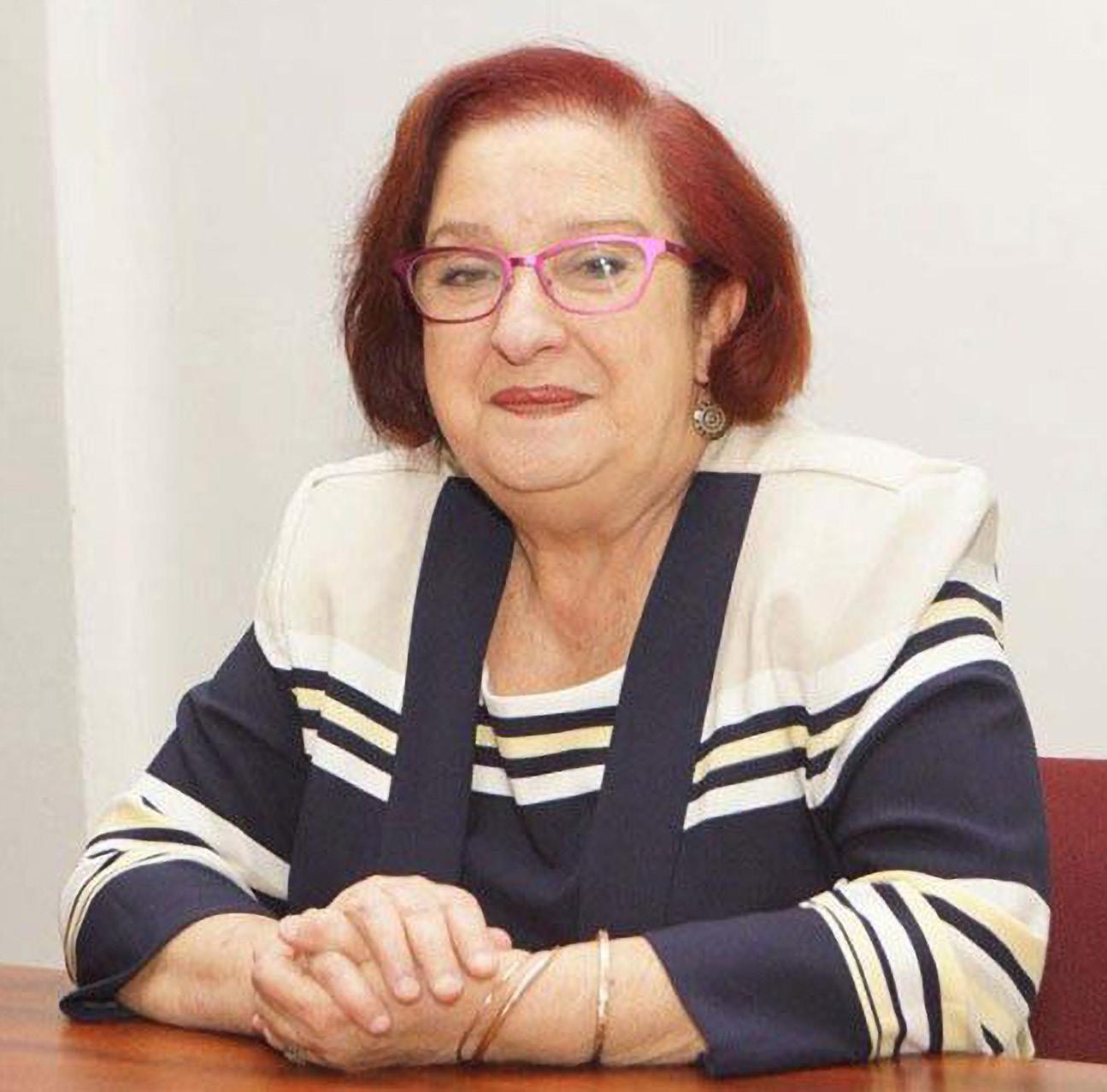
AS Guyana joins the rest of the world in observing International Women’s Day 2026 recently, the country is marking the occasion with a historic moment: veteran politician Gail Teixeira currently serving as Acting President.
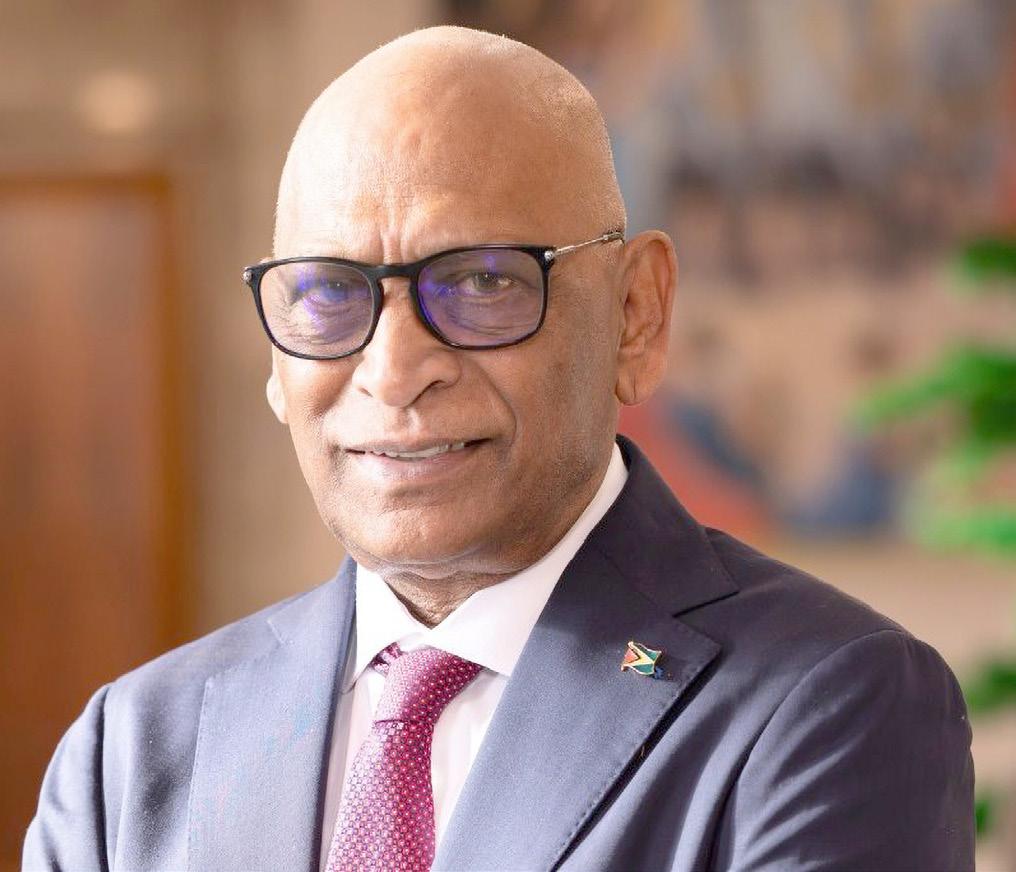
President Dr Mohamed Irfaan Ali during the time represented Guyana at the historic “Shield of the Americas” Summit hosted by United States President Donald Trump in Doral City, Florida. This was highlighted by Guyana’s Ambassador to the United Nations in Geneva, Dr. Leslie Ramsammy, who said the development reflects both the progress of women in leadership and Guyana’s broader commitment to gender equality.
In a message issued by the Permanent Mission of Guyana to the United Nations in Geneva, Ramsammy noted that Teixeira’s appointment is symbolic of the crucial role women have played in the country’s struggle for democracy and development.
Teixeira has served as a government minister and parliamentarian for more than 34 years and has been involved in the fight for freedom and democracy for over five decades. According to Ramsammy, she is among
the pioneers of Guyana’s democratic movement and has earned a distinguished place in the country’s history.
“Honourable Gail Teixeira exemplifies the pivotal role women have played in the fight for independence, freedom and democracy,” Ramsammy said, adding that her service continues with “vigour and dignity.”
Guyana’s progress in advancing women’s rights is also reflected in international rankings. In the Global Gender Gap Report by the World Economic Forum, Guyana ranked 31st globally in 2025 for gender equality and first in the category of women’s health and survival.
Women also hold a significant share of leadership positions in the country.
About 39.4 per cent of parliamentary seats are held by women, placing Guyana among the countries with the highest female representation in national legislatures.
Additionally, 35 per cent of Cabinet members are women, while 70 per cent of judges in the judiciary are women, one of the highest proportions in the Western Hemisphere.
Guyana has also been recognised for its efforts to im-
prove women’s health, particularly in the fight against cervical cancer.
Under the global strategy adopted by the World Health Organization, countries aim to eliminate cervical cancer by achieving the 90-70-90 targets by 2030. These targets call for 90 per cent of girls to receive the HPV vaccine before age 15, 70 per cent of women to be screened by ages 35 and 45, and 90 per cent of women diagnosed with the disease to receive treatment.
Ramsammy said Guyana
has significantly increased investments in this effort and has set 2050 as its target for eliminating cervical cancer, while already making notable progress toward the global targets.
Beyond health, women are also benefitting from government initiatives designed to expand economic opportunities.
According to the Mis -

sion, 85 per cent of housing subsidies issued under the national programme have gone to women, while women account for more than 60 per cent of house lot allocations, the highest level in Latin America. Women are also surpassing men in university-level graduation rates, reflecting growing access to higher education.
Economic empowerment is also being strengthened through initiatives such as the Women’s Innovation and Investment Network, which has trained more than 90,000 women in areas including information technology, entrepreneurship and technical skills.
Additionally, Guyana is preparing to launch a Micro, Small and Medium-Sized Enterprise (MSME) Bank, which will provide support for small businesses and expand access to interest-free loans for women entrepreneurs.
Despite the progress, Ramsammy acknowledged that significant challenges remain in achieving full gender equality.
Among the most pressing issues are gender-based violence and disparities in labour force participation. Statistics show that one in two women report experiencing intimate partner violence,
while female participation in the workforce stands at about 38 per cent compared with 65 per cent for men.
To address these challenges, the government enacted the Family Violence Act 2024, which strengthens legal protections for victims.
Additional support services include the 914 emergency hotline, the I-Report mobile application, and the establishment of Hope and Justice Centres to assist victims of abuse. The government has also introduced 24-hour daycare programmes to help mothers pursue employment and career opportunities.
Ramsammy said continued collaboration among government agencies, the Women and Gender Equality Commission, Parliament, the private sector and civil society will be essential to close the remaining gaps.
“Guyana can be proud of its continued efforts to achieve gender equality,” he said, noting that the country is celebrating real achievements while continuing the work to create a more equal society for women and girls.
He added that International Women’s Day provides an opportunity not only to recognise progress but also to reaffirm Guyana’s commitment to advancing the rights and opportunities of women both nationally and globally.

--research findings can be used to inform national coastal management strategies, serve as a model for evaluating mangrove restoration efforts, university says
UNIVERSITY of Guyana Senior Lecturer, Dr Mark Ram, has recently completed his PhD in marine ecology after undertaking a rigorous four-year academic journey pursuing a landmark research project which focused on understanding and improving mangrove restoration and coastal ecosystem recovery.
sional responsibilities. The balancing act tested him, yet it also strengthened his resolve.
“Despite the challenges, the process was incredibly fulfilling, especially knowing that the research contributes to improving our understanding of mangrove restoration and coastal ecosystem recovery,” he said.

Dr Ram, who is attached to the Department of Biology in the Faculty of Natural Sciences, began his doctoral studies in 2021 at James Cook University in Australia. Reflecting on the experience, he shared that the road to achieving his doctorate required resilience, discipline and faith in the value of the work he was undertaking.
“The journey toward earning my doctorate was challenging, but it was also rewarding. Conducting longterm ecological research required extensive fieldwork in coastal mangrove ecosystems, careful data collection and rigorous analysis. Balancing research with teaching and other professional responsibilities also required strong commitment and time management,” Dr Ram said.
As a lecturer at the University of Guyana, Dr Ram was not only pursuing advanced research overseas but also continuing his profes-
the research capacity of the University and enhancing the quality of teaching by integrating locally relevant
scientific research into the classroom. It also helps to position the University as a contributor to global discussions
on ecosystem restoration and climate resilience,” the young scholar added. Dr Ram noted that his research findings can
inform national coastal management strategies and serve as a model for evaluating TURN TO PAGE 19
Dr Ram’s decision to pursue a PhD was driven by his passion for Guyana’s coastal ecosystems and a desire to give back through science.
“My inspiration to pursue a PhD came from an interest in coastal ecosystems and a desire to contribute meaningful scientific knowledge to conservation efforts in Guyana,” he shared.
“Mangroves play a critical role in protecting coastlines, supporting fisheries and maintaining biodiversity, yet there has been limited long-term scientific evaluation of restoration efforts in the country. Achieving this milestone is very meaningful to me both personally and professionally,” Dr Ram addeD. Dr Ram believes this achievement will also strengthen the University of Guyana’s academic standing and enrich the learning experience of his students.
“This accomplishment contributes to strengthening
- more than 3,500 traffic offences recorded last week
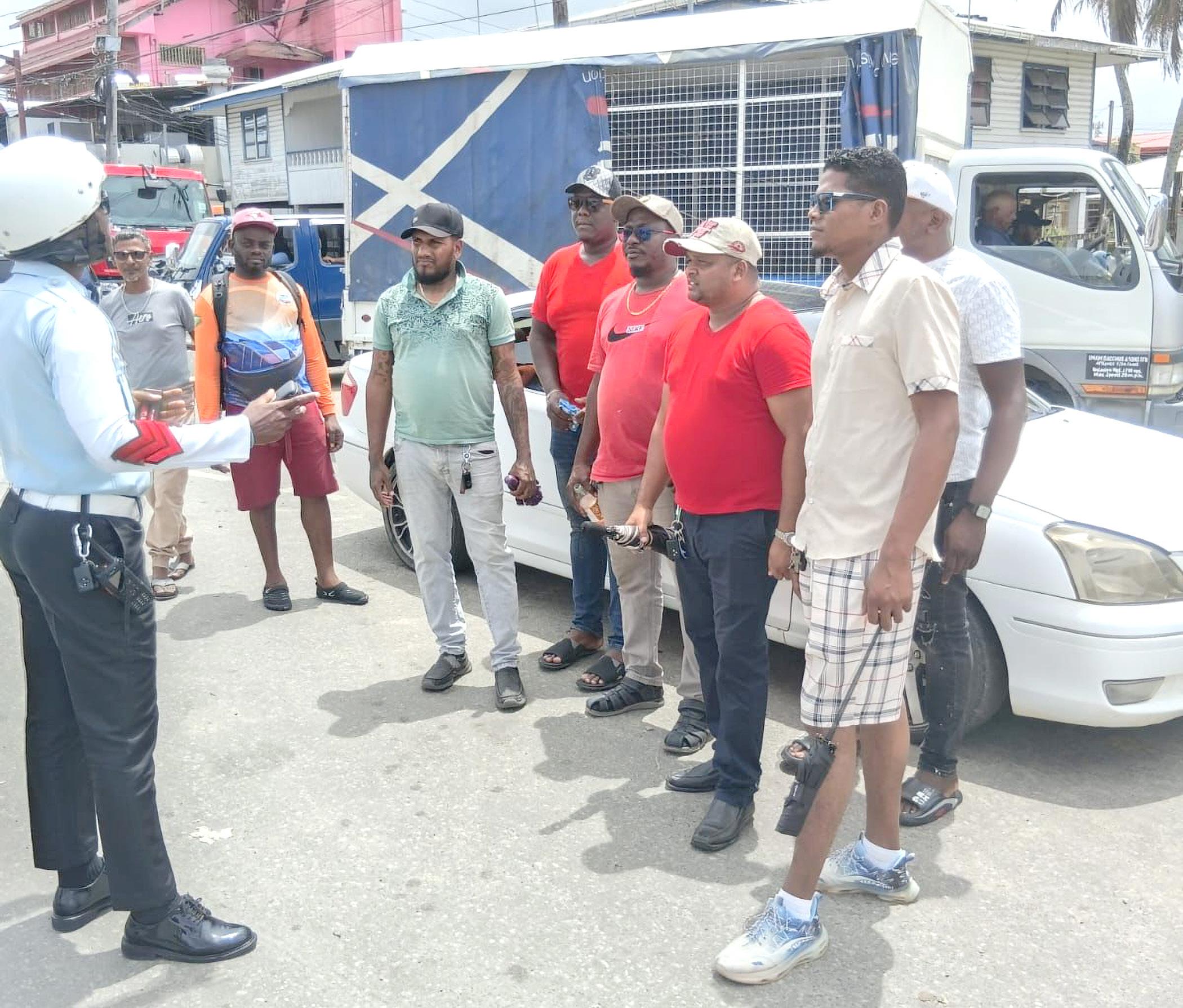
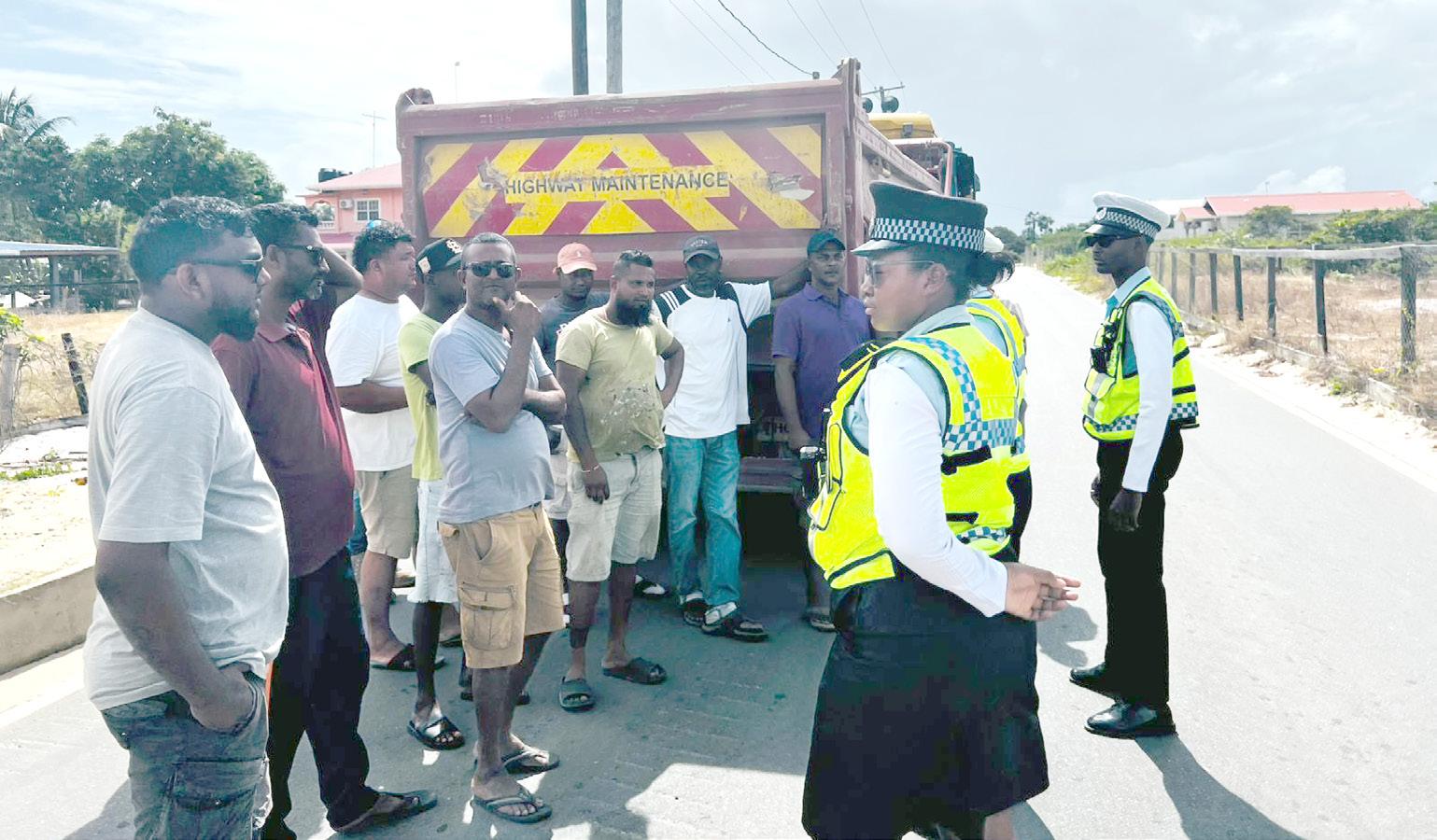
THE Guyana Police Force Traffic Department recorded 3,523 traffic-related offences across the country between March 1 and March 7, 2026, with speeding accounting for the overwhelming majority of violations.
According to statistics released by the department, 1,334 drivers were cited for speeding, making it the most frequently recorded offence during the reporting period.
Police also reported 91 cases of failure to wear safety helmets and 37 cases involving pillion riders without helmets, highlighting continued concerns about motorcycle safety on the nation’s roadways.
Other violations recorded during the week included 68 seatbelt offences, 29 cases of driving under the influence of alcohol, and 35 instances of unlicensed drivers operating motor vehicles.
The Traffic Department also documented 74 cases of motorists leaving vehicles in dangerous positions, 31
breaches of prescribed fitness conditions, and 16 cases of drivers breaching traffic light signals.
Additional offences included 28 vehicles operating without front lights, 15 without rear lights, two cases involving excessively tinted vehicles, and one instance of faulty packing of goods.
Alongside enforcement efforts, the Traffic Department continued its public education campaign aimed at improving road safety awareness.
During the same period, traffic ranks conducted a series of lectures and community outreach programmes targeting drivers, bar patrons, business employees and community members across several regions.
Outreach sessions were held in locations including Beterverwagting Public Road, Golden Grove Public Road, La Grange on the West Bank of Demerara, Supenaam Village, Princeville in Region Eight, Mahdia, Bartica, Mabaruma, and the
Eccles community, among other areas.
The department also engaged private organisations and groups such as Vulcan Group Incorporated, Optimum Safety Solutions, and the Blind Association of Guyana, where officers delivered safety lectures focusing on responsible driving and pedestrian awareness.
Traffic officers also conducted educational sessions at several schools as part of their road safety outreach to young people.
Schools visited during the week included Matthew’s Ridge Primary, Belladrum Primary, Arawanza Primary, Fisher Nursery, Princeville Primary, Campbelltown Nursery, and Mahdia Secondary.
The Guyana Police Force said these initiatives are part of its ongoing strategy to strengthen public awareness and encourage safer behaviour on the roadways while reducing traffic accidents and violations across the country.
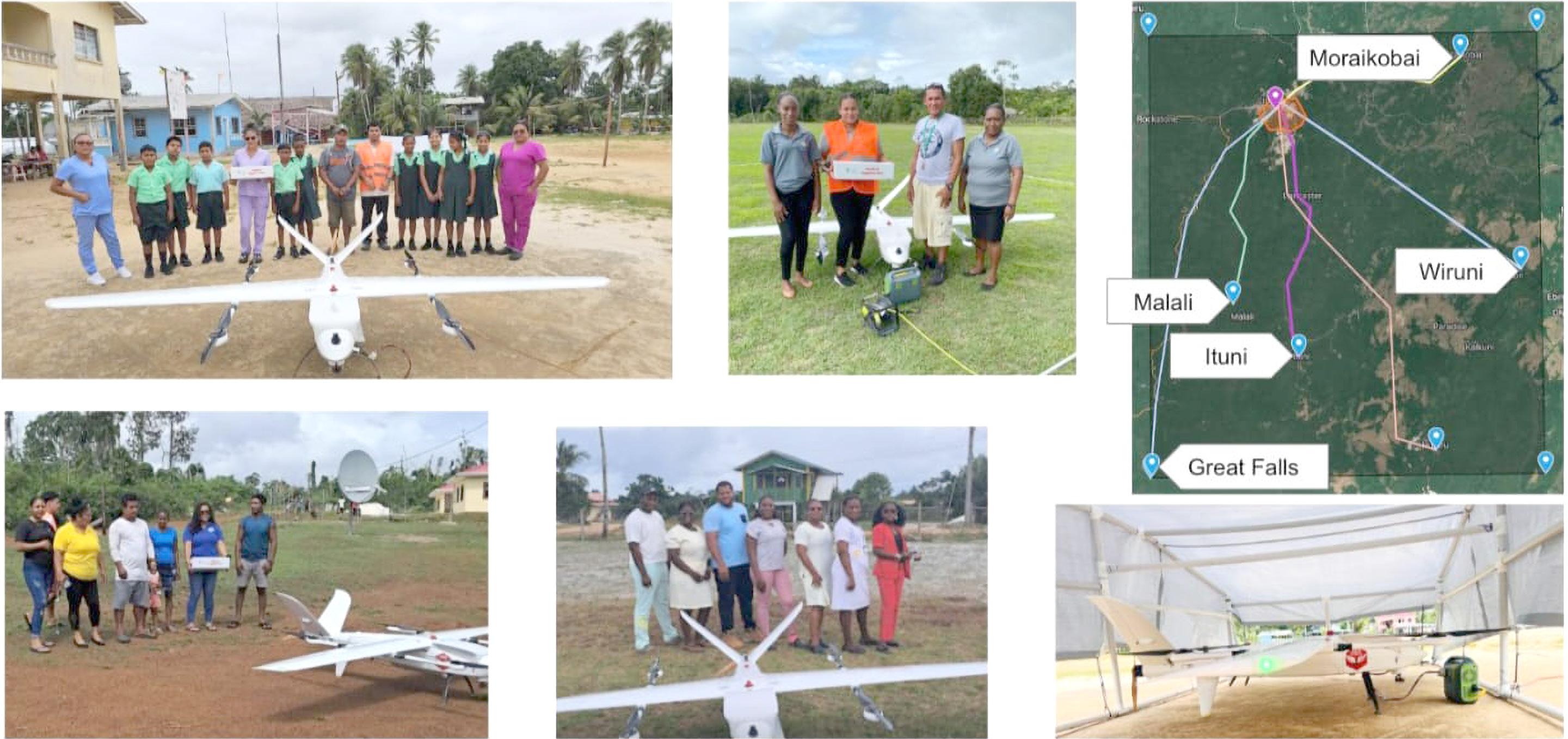
DIRECTOR General of the Ministry of Health, Dr. Vishwa Mahadeo, has confirmed that drone technology is already being used to transport medicines to remote communities, as part of the Government’s push to strengthen healthcare access across Guyana.
Providing an update during the Region 10 2025 Review and Leadership Meeting, Dr. Mahadeo told regional health leaders that pilot operations have already demonstrated the effectiveness of the system in delivering medical supplies to hard-to-reach locations.
“Only the other day, drone technology was piloted and medicines were dropped off to places like Malali and Ituni, in the river and on the trail. I think the vision of the President and the Minister of Health to have the latest technology available to our people was demonstrated when those drones dropped off medicines at Malali and other places,” Dr. Mahadeo said.
According to the Director General, the initial pilot deliveries reached several communities including Moraikobai in Region Five
A 39-year-old housewife who reportedly endured years of domestic abuse has died following an alleged attack at Long Creek, Soesdyke-Linden Highway, on Sunday morning.
Dead is Caslene Toney of the said community.
Police said the incident occurred around 06:00hrs on March 8, 2026, and involved a 65-year-old welder with whom Toney shared a common-law relationship.
Preliminary investigations indicate that the couple had a disagreement during which the suspect allegedly armed himself with a sharp object and inflicted injuries on the woman.
Toney was initially taken to the Linden Hospital Complex, where she received medical attention before being transferred to the Georgetown Public Hospital Corporation. She later succumbed to her injuries.
The weapon believed to have been used in the incident was retrieved and lodged as evidence.
The suspect, who reportedly sustained several suspected self-inflicted injuries, is currently hospitalised under police guard.
According to relatives and other persons familiar with the couple, the relationship was riddled with domestic abuse. They claimed the couple shared six chil-
dren who were exposed to the repeated conflicts between the pair.
Relatives also indicated that the matter had previously been reported to authorities, but Toney had withdrawn the complaint and opted not to pursue the case further.
They further alleged that the suspect was known to be extremely possessive.
Investigations are ongoing.

mangrove restoration efforts both regionally and internationally.
For his students, this means access to cutting-edge, locally grounded research that connects theory with real-world environmental challenges.
Dr Ram was quick to acknowledge that the milestone was made possible through significant support. His research was funded by the Government of Guyana, the World-Wide Fund for Edu-
cation for Nature Fellowship, and the Marine Conservation Action Fund of the New England Aquarium.
He also credited the academic guidance of his supervisors and the institutional support of the University of Guyana, along with logistical assistance from the Mangrove Department of the National Agricultural Research and Extension Institute.
“I received tremendous support throughout my doctoral journey, from funding
agencies to academic mentors, friends and colleagues at the University, it was truly a collective effort,” he shared.
Dr Ram’s research focused on evaluating the ecological outcomes of mangrove restoration in Guyana. Since 2010, the country has invested in restoring mangrove forests to protect coastlines, strengthen fisheries and enhance community livelihoods. However, long-term scientific monitoring of these efforts has been limited.


Through extensive fieldwork along Guyana’s coastline, Dr Ram compared restored mangrove sites with natural mangrove ecosystems. He examined vegetative cover, macrobenthic assemblages, fish communities and sediment characteristics to determine whether restored areas were recovering ecological functions similar to natural systems.
The research provides
critical scientific evidence to guide future restoration initiatives and strengthen Guyana’s climate resilience and coastal protection strategies.
The University of Guyana congratulates Dr Mark Ram on the successful completion of his PhD and commends his dedication to advancing research, teaching and environmental stewardship for the benefit of Guyana and beyond.
The University of Guyana, through its students, faculty and research institutes, has consistently produced path-breaking research which continues to add to the existing body of knowledge in various areas of academic research. To learn more about UG’s research, please visit: https:// researchandinnovation.uog. edu.gy/. (University of Guyana)
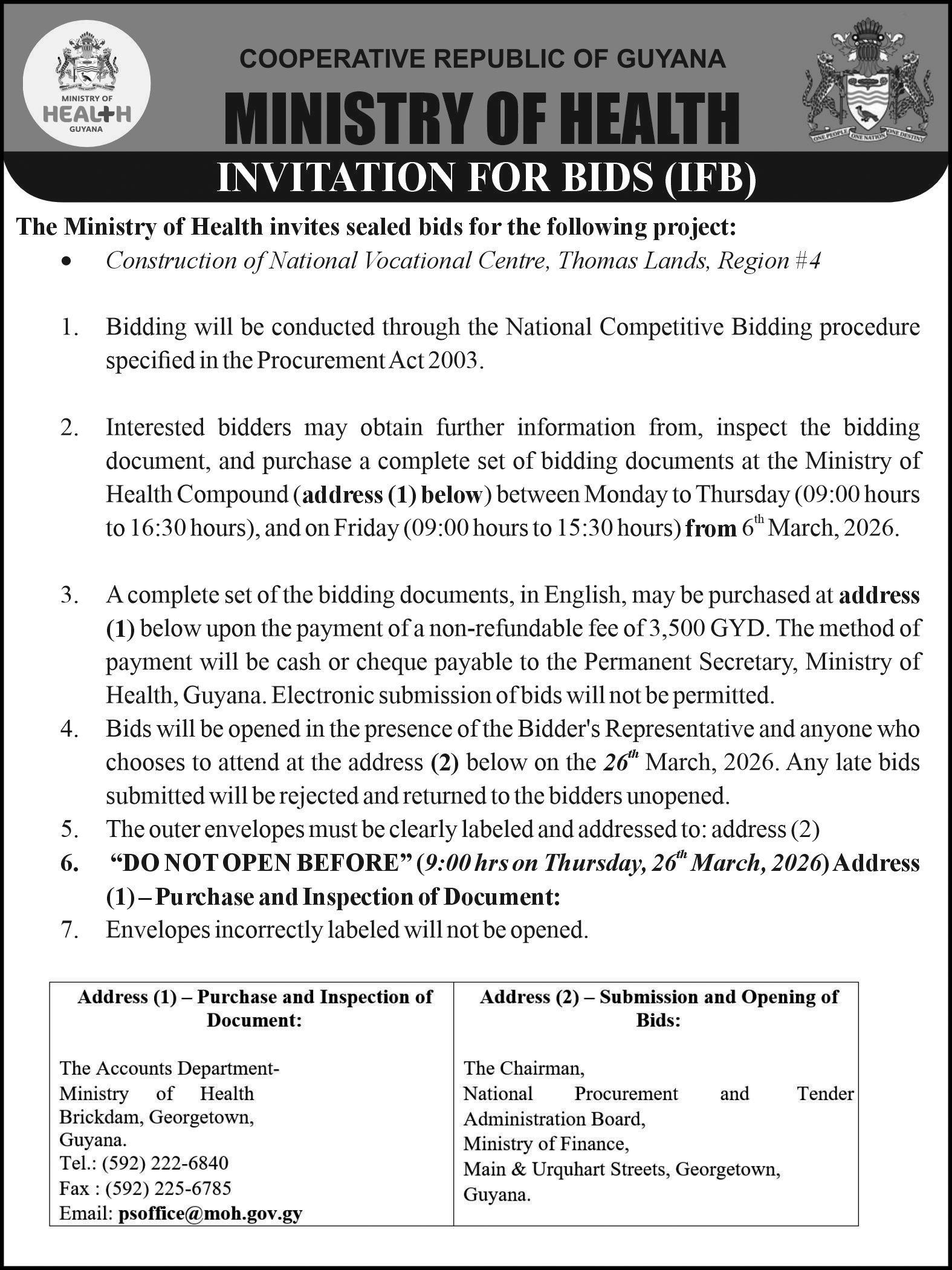


terrain won’t be an issue, whether it be blood and blood products, whether it be emergency injections or medicines, it will be delivered because that technology is being invested in. It has been tried, it was successful, more training has to be done but it is available,” Dr. Mahadeo added. The drone initiative forms part of a wider effort by the Ministry of
Health to modernise healthcare logistics and expand access to critical services in hinterland and riverain communities, all part of HE President Irfaan Ali’s vision to provide world class health to all citizens in Guyana.
Through partnerships with international technology providers, specialised drone systems capable of transporting medical cargo
over long distances are being introduced to support the delivery of medicines and other essential supplies. With successful pilot tests already completed, the Ministry is expected to continue expanding the programme while training personnel to fully integrate the technology into Guyana’s healthcare delivery system.


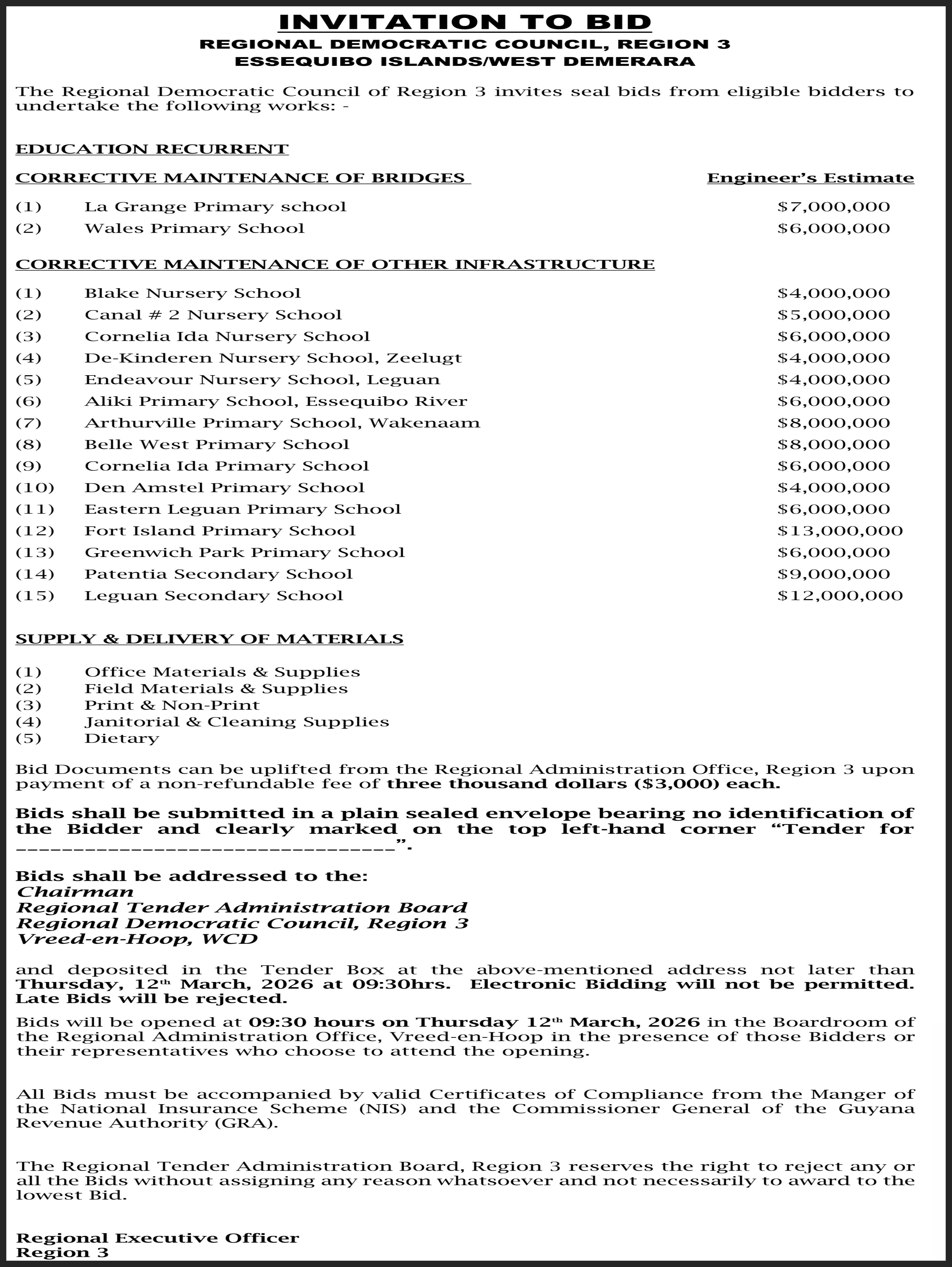
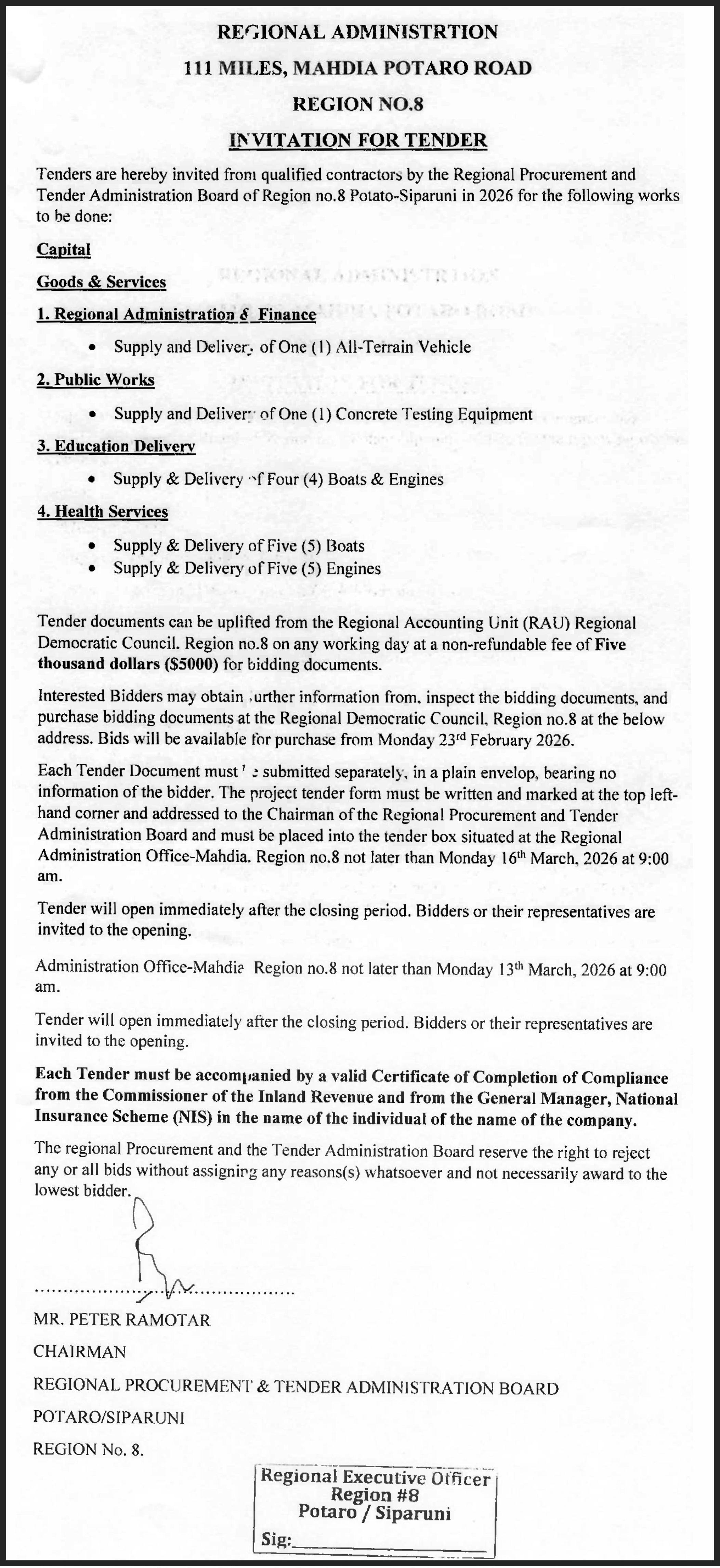






FOUR Spurs scored 20 or more points, led by Victor Wembanyama's 29, as host San Antonio rolled to a 145-120 win over the up and down Houston Rockets on Sunday in a Lone Star State dustup.
The Spurs scored their most points in a game this season and have captured four straight outings and 15 of their past 16 contests as they continue to chase Oklahoma City for the top spot in the Western Conference.
San Antonio took charge of Sunday's game with a rousing second quarter that produced a 12-point lead
at halftime. The Spurs increased that margin to 27 points when Stephon Castle canned a 3-pointer with 5:45 to play in the third quarter on the way to carrying a 110-94 advantage into the final period.
Houston got to within a dozen points early in the fourth quarter but no closer as the Spurs reasserted themselves and drew away, leading by as many as 30 in the final minutes.
Castle added 23 points for San Antonio while De'Aaron Fox finished with 20 points and 10 assists, Keldon Johnson also scored 20 points, Dylan Harper had
19 and Julian Champagnie tallied 11. The Spurs shot 58% from the floor and made 21 of 40 3-point attempts and have taken the first three games of a sixgame homestand.
Kevin Durant and Amen Thompson led Houston with 23 points each. Reed Sheppard Jabari Smith Jr. scored 17 apiece while Alperen Sengun had 16 points. The Rockets have alternated wins and losses over their past six games and fell 7.5 games behind San Antonio in the West standings.
Durant closed the first quarter with a floater and two free throws that gave

the Rockets a 33-32 lead after 12 minutes of play. San Antonio quickly jumped to the front and pushed its lead to 11 points two times, the latest on a
the journey till today, it has been very special and collectively as a team what we've achieved is in front of you."
Of the nine matches, India won eight, although the campaign was not initially smooth. India struggled to overcome USA in the first match and then lost a Super 8 game to South Africa. Suryakumar said the cam -

paign gathered momentum after the match against Zimbabwe.
"When we played in Chennai against Zimbabwe, I felt that we have started playing a different brand of cricket. I understood a little bit how to play going forward. And when I played the (virtual) quarterfinal against West Indies at the Eden Gardens, I felt that there was a different level

of confidence in this team."
The India skipper said his memorable catch in the 2024 final changed his life and that he set his sights on the home World Cup after being appointed captain.
"That catch changed my life completely. Because that was a moment of the tournament. And then after that, when I started leading this amazing team, it was a very special feeling because
turnaround jumper by Castle with 7:46 to play in the second period. The Rockets trimmed their deficit to 5549 on a hook shot by Sengun two and a half minutes
(From back page)
I knew that we were going to play the World Cup in India after two years.
"And no team has ever won in India. And when you play T20 World Cup or any tournament in India, there is a different vibe, a different excitement. So I started telling everyone when we started playing bilaterally that you should be excited that when you play in India in the T20 World Cup, people will have expectations from you, they will talk to you, you will
enjoy it more.
"So with that excitement we started that journey. And the way we played in the T20 World Cup, the way we wanted to play and the way we won this trophy, that is part of that excitement. So it has been a very beautiful journey. And hopefully, this continues."
India has been playing a more attacking brand of cricket and the skipper said that style will continue.
"Everything was changed post 2024. We played a
over Leslie Campbell, Rashad Hussain, FIDE Master Anthony Drayton, Ronuel Greenidge, Sachin Pitamber, Jaden Taylor and Zhang, His only loss came against Kyle Couchman.
Anthony Drayton made
a comeback after his earlier loss to Sandiford to finish second in the qualifier with Kyle Coachman third.
The other qualifiers who will line up against Candidate Master and three times defending champion Taffin
March 10, 2026)
later before San Antonio answered, using a setback 3-pointer by Wembanyama to take a 69-57 advantage to the break.
Harper led all scorers with 17 points before halftime while Wembanyama added 15. Durant's 11 points paced Houston in the first half, with Thompson and Sheppard contributing 10 points apiece. San Antonio all but put away the game in first 2:15 of the third quarter, bursting out of halftime with a 9-2 run capped by Champagnie's banked jumper that stoked the lead to 78-59. (Reuters)
different brand of cricket in 2024 and from there we understood how this team needs to work forward, play forward.
"And it's been a wonderful journey since. We won the ICC Champions Trophy in 2025, played a completely different brand of cricket, and now in 2026, we wanted to do something special in front of the home crowd right here. We want to continue doing that 27 - 28 - 29 and never stop." (Cricbuzz)
(From page 29)
Khan include Sachin Pitamber, Prince Dunn, Javier Daveand, Kim Chong, Leslie Campbell and Aquilani Swaminadha
Meanwhile, Kataleya Sam is the top contender after winning the Diamond Fire-sponsored Chess Championship Qualifiers.
She ended also with 7 points after wins over Emma john, Anaya Lall, Jessica Callender, Ciel Clements, Parnita Kishun and Italy TonChung with draws against Sasha Shariff and Treskole Archibald.
She will lead a cohort who will face off against reigning champion, Aditi Joshi, for the national title. The other qualifiers are Archibald, Shariff, Clements, Sana Sreebalakumar, Parnite Kishun, Saura Ruplall, Sarah Ramkarran and Amaya Sharma.
SANJU Samson felt his "dreams had shattered" after a poor T20I series against New Zealand just prior to the 2026 T20 World Cup, but conversations over the past two months with Sachin Tendulkar reassured him that a turnaround wasn't far away.
"To be honest, there has been a lot of guidance and suggestions from senior players," Samson said after winning the Player-of-the-Tournament award in India's successful T20 World Cup defence.
"A lot of former players have reached out to me and tried to help me out. From the last couple of months - I hope I can share it here - I've
…Sanju Samson was the Player of the Tournament for scoring 321 runs in five matches at a strike rate of 199.37
been in constant touch with Sachin sir. When I was sitting outside in Australia [during the T20Is in October]… I wasn't playing a game, I thought about what mindset is required.
"I reached out to sir and had huge [long] conversations with him. Even yesterday [Saturday], he called me up to check how I am feeling. Getting guidance from someone like him - that clarity, game preparation, awareness and game sense - I'm grateful for everyone who supported me."
Samson revealed he was "broke" and "completely out of my mind" after the New Zealand series at home, having managed just 46 runs in five innings. He soon lost
his place in the XI to Ishan Kishan, and didn't get his next opportunity until the Super Eight.
He responded with scores of 97*, 89 and 89 in three must-win games to end the tournament with 321 runs, the third-highest in the competition despite playing only five games. He scored those runs at a strike rate of 199.37.
"Right after the New Zealand series, I was broke. I was completely out of my mind. I felt like my dreams had shattered. I thought, 'okay what else can I do?' But God had different plans," Samson said. "I suddenly came back into the crucial games [starting with the virtual quarter-final against West Indies], and did what I could for the country.

GUYANA’S sharp shooter
Akil Hughes and Nikkolai Smith steer the nation to a comfortable 2-0 sweep of their friendly series against the touring Grenada National basketball team at the Cliff Anderson Sports Hall on Sunday.
In the final encounter, Guyana led 16-10 after the first quarter and 30-23 at
the half.
Grenada stepped on the gas in the third period outscoring Guyana 16-9 to tie the clash 39-39.
Local Akil Hughes stepped up dropping 16 points with Nikkolai Smith contributing 13 points as they held off Grenada in the final period 23-20 to finish with a 3 points victory 62-
59.
Grenada’s Kristoff Redhead was their top scorer with 16 points while Twain Mitchell had 14 points in the loss.
Meanwhile, on Saturday Guyana won the second game of the series 67-54 The first clash which was set to be held on Friday last was cancelled.
KERON Sandiford will lead a strong list of contenders for the National Open Chess Championship after taking his final win over the weekend against Alexander Zhang in his national open qualifier. Sandiford finished strong with 7 points after winning in the 8-round competition. He secured outright wins


I'm very proud and happy that I was courageous enough to dream about it and things have turned up nicely for me, so I'm really grateful."
Samson was part of the
2024 T20 World Cup-winning squad under Rohit Sharma too, but didn't play in a single game in the USA and the Caribbean then. He revealed his turnaround be-
gan then, and the "dream" to deliver what he did in Ahmedabad was born there.
"To be very honest, this entire process started onetwo years before, when I was with the 2024 World Cup-winning team in West Indies," he said. "I couldn't get a game, but I kept on dreaming, kept on visualising, kept on working. This is exactly what I wanted to do then. I thought I needed to put in so much work that this is exactly what I wanted to achieve. By God's grace today things have turned around."
"I'm just going through it. It feels a bit surreal. This itself is very big for me, I need to enjoy it right now."
(ESPN criciino)
Ultimate aim is to improve our standard in ODIs: Phil Simmons
BANGLADESH head coach, Phil Simmons, said that they are not losing their sleep over direct qualification for the forthcoming ICC Men's ODI Cricket World Cup 2027 as they prepare for the upcoming three-match ODI series against Pakistan, scheduled from March 11 in Dhaka.
Bangladesh, who have lost four of their last five ODI series, will be eyeing a fresh start in the upcoming series against Pakistan, which will mark their return to ODI format after a gap of four months.
To qualify automatically for the 14-team tournament, a team must be in the top eight in the ICC ODI rankings by the cut-off date of March 31, 2027.
According to the current ODI rankings, Bangladesh sits in 10th place with 74 rating points, just behind West Indies, who have 77 points.
With Zimbabwe already assured of a place as co-hosts, Bangladesh is effectively in 11th position in the race for direct qualification and must climb to at least ninth place before the March 31, 2027 cut-off to avoid the qualifiers.
"The ultimate aim is to improve our standard in ODI cricket rather than getting too caught up in qualification mathematics," Simmons told reporters ahead of their series opener at the Sher-e-Bangla National Cricket Stadium on
we are playing," he added.
Simmons said that his team is slowly getting past the disappointment of not participating in the recently concluded T20 World Cup in India and Sri Lanka, with the withdrawal stemming from security reasons.
Bangladesh prepared for the Pakistan series for the last two weeks by playing the oneday version of the Bangladesh Cricket League (BCL) which, according to Simmons, helped the players move on from the T20 World Cup disappointment.
Monday.
"The team may not currently have the same level of experience that was present when Bangladesh once reached the top of the ODI rankings, but our focus is on ensuring that the present group plays to the best of its ability," he said.
"The work we are doing now is aimed at helping the team climb up the rankings table. Our ambition is not only to remain within the top eight to secure automatic qualification, but also to keep moving upward by consistently playing better cricket," he said
"While the long-term objective is to reach a stronger position in the rankings before the qualification cut-off date, the immediate priority is to improve the quality of cricket
Simmons added that he will be putting "a lot of emphasis" on how the batters perform during the middle phase of the ODI innings.
Ahead of the series, the team has concentrated on strengthening its middle-order batting, an area in which Bangladesh has struggled for some time. To bolster the middle phase, Bangladesh has recalled Litton Das and Afif Hossain. With Litton set to don a middle-order role, Simmons reasoned out the idea behind playing him outside the opener's spot.
All three matches of the ODI series will be played at the Sher-e-Bangla National Stadium. While the opener is set for Wednesday (March 11), the second and third matches will take place on March 13 and 15 respectively. (Cricbuzz)
ALYSSA Healy captained Australia to a 10-wicket victory against India in her final match before retirement at the one-off day-night Test in Perth.
The 35-year-old was lofted onto the shoulders of her team-mates after openers Phoebe Litchfield and Georgia Voll reached a fourth-innings target of 25 inside five overs at the Waca.
(Scores: India 198 (Rodrigues 52; Sutherland 4-46) & 149 (Rawal 63; Hamilton 3-32)
Australia 329 (Sutherland 129, Perry 76; Satghare 4-50) & 28-0 (Voll 16*, Litchfield 11*)
Australia won by 10 wickets and claimed multi-format series 12-4
India resumed on 105-6 and were bowled out within the first hour of the third day in Perth, with spinners Ash Gardner and Alana King taking the last wickets to dismiss the tourists for 149.
Gardner ended a 50-run partnership between Pratika Rawal and Sneh Rana,

bowling the latter for 30, while Healy caught Kashvee Gautam off King for a fourball duck.
Sayali Satghare was caught by Georgia Voll, before opener Rawal, who top-scored with 63, was the last wicket to fall, caught by Annabel Sutherland off Gardner.
Healy, who has usually been Australia's wicketkeeper though Beth Mooney took the gloves in this Test, finishes her 299-match international career with 7,333 runs and 276 dismissals to her name in all formats of the game.
She led Australia to a
historic 16-0 whitewash in the Ashes in 2025, won the World Cup twice - making the highest individual score of 170 in a World Cup final against England in 2022and the T20 World Cup on six occasions.
This crushing win ensured Australia won the multi-format series 12-4.
Defeat in the one-off Test, coming after a 2-1 T20 series victory and a 3-0 loss in the ODIs, ends a nine-match winning run in red-ball cricket for India, with their last defeat against the same opponents in Adelaide in February 2006.
By Sean Devers
ELDORADO beat the Guyana Defence Force (GDF) at Everest in semi-final two on Sunday to join Trasport Sports Club (TSC) in the final of the Georgetown Cricket Association (GCA) and Friends second division two-day cricket tournament.
In another low-scoring encounter, GDF was bowled for 99 on Saturday as none of the batters demonstrated the temperament required for two-innings cricket.
Joshua Ferrell (26), Micheal Deonarine (18) and Skipper Leon Andrews (12) were the only batters to reach double figures. Mohamed Nassir (3-9), Owen Andrews (3-30), Stephon Wilson (217) and Ntini Permaul (2-46) did the damage with the ball for Eldorado who replied with 144 to take a 45-runs lead.
Deonarine Dindyal (35), Sunil Ramlall (29), Kapta Seepersaud (28) and Owen Andrews (23) all wasted starts which thwarted plans to build a lead of over 100 runs.
Leon Andrews captured 3-36 while Delshawn McDonald took 2- 28 for the soldiers who feared worse in
GDF Captain, Leon Andrews, captured seven wickets in the match and top-scored with 23 in the second innings in a losing cause
their second innings and were blown away for 92.
Leon Andrews top-scored with a T20 style 23 from 16 balls decorated with three fours and six before Permaul bowled him in the fourth over to leave GDF on 26-1 and they never recovered.
West Indies Masters player Randy Lindore (10) joined Christopher Deonarine (15) and together they carried their team to 50, before Wilson bowled Deonarine.
Deonarine’s demise trig-
gered a dramatic collapse as eight fell for 29 runs to leave the Army on 79-9.
It took a run-a-ball 18 with two boundaries from Gevon Shultz to take GDF into the nineties but Nassir soon removed last man John Grant (2) leaving Eldorado the seemingly simple task of getting 45 to win.
Williams took 4-25 for Eldorado, who suffered an inauspicious start to their victory chase Dindyal (7), Ramlall (3) and Permaul (0) were dismissed in the first three overs, leaving Eldorado precariously placed on 12-3.
Kevin Williams (11) and Tuen Hicks took the score to 32 before Leon Andrew got rid of Williams and Owen Andrews for a duck three runs later as he struck twice in the 11th over.
However, it was too little too late as Hinks, who remained undefeated on 24 from 48 balls with a six and a four, saw Eldorado to victory.
The first semi-final between TSC and Police had ended in a draw but TSC advanced by virtue of getting first innings points. No date has been set for the final.
IRAQ’S World Cup playoff decider later this month should be postponed amid the escalating US-Israeli war with Iran, says the team's head coach, Graham Arnold.
The Iraqis are set to face either Bolivia or Suriname in the Mexican city of Monterrey on March 31, with the winner of the inter-continental play-off booking their place in the 2026 World Cup to be held in the United States, Mexico and Canada from June 11.
But Iraq is concerned they might not be able to get their players and staff over to Mexico for the match because of the travel disruption in the Middle East, triggered by the con -
flict in neighbouring Iran.
Iraqi airspace has been closed since February 28 when the first US-Israeli strikes began and Iran responded by firing missiles and drones at Israel, Gulf states and other nearby countries.
Arnold, who became Iraq’s manager in May 2025, said putting together a team solely with players based outside Iraq would hinder the country's chances of qualifying for their first World Cup since 1986.
"It wouldn't be our best team and we need our best team for the country's biggest game in 40 years," the Australian said.

"The Iraqi people are so passionate about the game that it is insane. The fact that they haven't qualified for 40 years is probably the main reason I took this job.
tal play-off semi-final on March 26, with the winners taking on Iraq for the right to join 47 other nations at the World Cup.
"If Fifa was to delay the game it gives us time to prepare properly," Arnold said.
"Let Bolivia play Suriname this month and then a week before the World Cup, we play the winner in the US. The winner of that game stays on and the loser goes home.
Iraq defeated the United Arab Emirates 3-2 on aggregate in the fifth round
"But at this stage with the airport being shut down we are working hard to try and find another alternative."
of the World Cup qualifiers in Asia last November to book their place in the inter-continental play-off. Bolivia face Suriname in their inter-continen -
"Our federation's president, Adnan Dirjal, is working round the clock trying to plan and prepare to make everyone in Iraq's dream come true so we need this decision made quickly."
(BBC Sport)
By Frederick Halley
GUYANA-BORN umpire,
Daniel Singh, who now resides in Canada, is the latest candidate who will soon be participating in the revived and much vaunted West Indies Cricket Umpires Association (WICUA) Exchange Programme.
Singh’s participation was approved by the Executive Committee of the Canada Cricket Umpires Association (CCUA) and he will be officiating in matches in his home country during the period March 26 to April 8.
A fully qualified WICUA umpire as of 2011, while living in the British Virgin Islands, Singh has also completed the Level Three Cricket Canada examinations, since migrating to North America in 2021.
Since then, he has been an
active member of the CCUA, as well as the Toronto Cricket Umpires and Scorers Association (TSCUA).
President of the CCUA, Azad Khan, who is also Secretary of the WICUA, made the announcement about Singh’s participation at the recently held awards ceremony hosted by the CCUA.
Speaking at the ceremony, Khan extended unreserved congratulations to Singh and wished him well during the upcoming assignment in Guyana.
“I was happy to be one of the first persons who interacted with Singh since he came to Canada and welcomed him to the membership of the CCUA,” Khan pointed out.
“I am confident that he will bring great respect to our association as he represents us in Guyana while officiating in matches there.”
One of the objectives
of the CCUA is to develop, build upon and maintain close collaborative working relationships with cricket governing bodies and other umpire and scorer associations, both within Canada and overseas.
“So, as an Executive Committee, we are pleased that Singh has accepted the challenge and opportunity to help fulfill this mission, as he will be our first representative to participate in the WICUA Exchange Programme,” added the CCUA President.
Khan also expressed appreciation to President of the Guyana Cricket Board (GCB), Bissoondyal Singh, and President of the Guyana Cricket Umpires Council (GCUC), Dawchan Nagasar, for their assistance with supporting the participation of Singh in the schedule for upcoming matches in Guyana.
President of the WICUA,
Vivian Johnson, who also attended the CCUA awards ceremony, congratulated Singh and thanked him for his willingness to be part of the programme. He explained that the WICUA does not have the funds required to cover the full cost of the programme, adding that a significant portion of the expenses is borne by each umpire.
“So this is a significant individual sacrifice and we thank all the umpires who have represented their respective countries as part of the programme thus far,” said Johnson.
Prior to migrating, Singh also worked as a journalist at the Guyana National Newspapers Limited (GNNL), publishers of the Guyana Chronicle.
Another CCUA member, Sush Mahalanobis, will also be participating in the programme at a date to be
By Sean Devers
THE Guyana Badminton Association (GBA) successfully hosted its first tournament of 2026 with an Air Badminton Tournament sponsored by the National Sports Commission (NSC) and El Dorado Trading on Friday last at the Motorcross ground, Mainstay.
Six schools participated in the tournament, and a random draw of fifteen teams was conducted, with each team selecting its own creative and fun name.
After an exciting day of competition, Abram Zuil Secondary School (Lil Threats) emerged as the champions.
2nd Place: Anna Regina Secondary School – Bomb Squad: Mark Daniels, Tyrese Stephney, and Ashley Williams
3rd Place (Semi-finalists): Anna Regina Secondary School –Block List: Samarious Forde, Brian Bissasar, and Omika Williams
The matches were played in a triples format consisting of two males and one female per team. The games were played best in three to eleven points system.

The GBA expressed its appreciation to the teachers and athletes for their enthusiastic participation. The tournament was made possible following the introduction of Badminton on the Essequibo Coast through the Shuttle Time Programme, where twenty teachers were trained during a workshop held last year with the collaborative efforts of the National
Sports Commission (NSC) and the Ministry of Education (Guyana) under the Five Priority Programme.
The GBA reaffirmed its commitment to continuing the promotion and development of badminton across Region 2 and the Essequibo Coast.
The association also expressed profound gratitude to its sponsors, the NSC and
announced, also likely in Guyana.
This Exchange Programme was conceptualised by the WICUA to afford the opportunity for its umpires to visit and officiate in matches in other countries, while also sharing in and experiencing the diverse cultures throughout its member territories.
El Dorado Trading, for their support.
NSC’s Sports Coordinator, Wazeeda Bacchus, received special thanks for her assistance in ensuring the tournament’s success.
Joash Innis, Eon Jairam, and Deeroya Morris represented Abram Zuil Secondary School known as Lil Threats
The schools involved were, Aurora Secondary School – Aurora Avengers, Aurora Secondary School – Shuttle Warriors, Aurora Secondary School – Aurora All Stars, Abram Zuil Secondary School – Original Stush, Abram Zuil Secondary School – Abram Zuil Warriors, Cotton Field Secondary School –The Shottas, Cotton Field Secondary School Jaguars, Charity Secondary School
– Charity Shuttle Masters, Charity Secondary School –Charity Shuttle Stars, Charity Secondary School – Charity Defenders, Charity Secondary School – Net Ninjas, 8th of May Secondary School – Bad Blue, Anna Regina Secondary School – Bomb Squad, Anna Regina Secondary School – Block List

DUBAI, United Arab Emirates, (CMC) – All-rounder
Jason Holder is the lone West Indian named in the International Cricket Council’s (ICC) Team of the Tournament for the 2026 Men’s T20 Cricket World Cup.
The 34-year-old Barbadian was awarded for his stellar performance in the tournament, which climaxed on Sunday with India winning their second consecutive title via a dominant 96-run victory over New Zealand in the final
In seven matches, Holder grabbed 10 wickets at an economy rate of 8.87 with a best bowling performance of 4-27 against Nepal in the preliminary round. He also scored 141 runs in seven matches at an aver-
age of 35.25. Holder also played a pivotal role in one of the standout performances of the World Cup, scoring 49 off 31 balls during a record eighth-wicket partnership of 89 with Romario Shepherd against South Africa, the highest in Men’s T20 World Cup history.
South African captain, Aidan Markram, was named captain of the side that includes four Indians.
TEAM OF THE TOURNAMENT: Aidan Markram (captain), Sanju Samson, Sahibzada Farhan, Ishan Kishan, Hardik Pandya, Will Jacks, Jason Holder, Jasprit Bumrah, Lungi Ngidi, Adil Rashid, Blessing Muzarabani. 12th man – Shadley Van Schalkwyk.


The CPL will be
KINGSTON, Jamaica (CMC) -Jamaica’s Sports Minister, Olivia Grange, has revealed that Kingsmen Sports Enterprise is set to invest over US$3 million to establish new franchises in the Caribbean Premier League (CPL) and Women’s Caribbean Premier League (WCPL) competitions.
The United States-based Kingsmen, owned by Pakistan-born businessman, Fawad Sarwar, has committed annual investments of US$2.75 million to operate a professional men’s team as well as US$500,000 to establish and operate a professional women’s CPL team.
Grange made the announcements during a re -
cent meeting of Parliament’s Standing Finance Committee that examined the 2026-27 Estimates of Expenditure ahead of the Budget debate which gets under way on Tuesday
Additionally, the minister said the CPL had decided to waive fees for Jamaica’s home games at Sabina Park this year, with the country
HAVING lifted the ICC Men's T20 World Cup, Suryakumar Yadav has already set his sights on the Olympic Games and the next edition of the tournament. Immediately after the victory on Sunday night, the India skipper declared that an Olympic gold medal is now the team's next target.
"The next goal is the Olympics. Olympic gold and also the T20 World Cup that year. Don't forget," Suryakumar said at a crowded post-match media conference in Ahmedabad, putting to rest speculation over his future plans.
Rohit Sharma had announced his retirement immediately after India's 2024 World Cup triumph in Barbados. In a similar situation, there had been considerable anticipation around Suryakumar Yadav's future plans. With this latest announcement, there is now clarity on how India will shape its preparations over the next two years.
The Olympic Games

will be held in Los Angeles in August 2028, while the next edition of the T20 World Cup will be played later that year in Australia and New Zealand. Suryakumar also reflected on the journey over the last month and said the feeling of winning the World Cup has not yet sunk in.
"It'll take a little bit of time to sink in. We have just come out of a game. It was a good game. Playing at home. When we wake
up tomorrow and go back home, I don't know where we are going, but it will be a special feeling. Whatever happened in the last two years post 2024 T20 World Cup has been unbelievable and I don't know how to express it. It has been a wonderful journey.
"Obviously it has been a wonderful journey the last one month though it didn't start the way we wanted it to start. But then it's part of the sport. Throughout
(Turn to page 28)
still rebounding from the devastation of Hurricane Melissa.
“With the return of the Jamaica-based franchise, four matches are scheduled to be played at the iconic Sabina Park, marking the return of CPL matches to Jamaica for the first time since 2019.
“CPL will waive the fee this year, which is normally
a part of the host agreement, in consideration of Hurricane Melissa and its impact on the country. Therefore, Jamaica’s input will be primarily value in kind,” Grange said.
The minister said Kingsman Sports Enterprise had also committed to focusing on grassroots cricket programmes for the youth.
Grange said details will be worked out jointly and will involve collaboration with the Jamaican government and corporate stakeholders to deliver measurable benefits. She also disclosed that the Kingsman had promised to invest in sporting infrastructure to position Jamaica as a hub for elite T20 cricket and to ensure global exposure.

The meeting of the ICC, scheduled for March 25-27 in Doha, Qatar, has been postponed
THE meeting of the International Cricket Council (ICC), scheduled for March 25-27 in Doha, Qatar, has been postponed in view of the ongoing war in the region. The meeting is expected to be reconvened sometime in April, although a new date has not yet been announced.
The postponement was inevitable because of the ongoing conflict in the Middle East, and a formal communication was sent to members on Saturday, the day before the T20 World Cup final in Ahmedabad. The ICC, it is learnt, is looking for another venue in the continent.
The meeting was to bring together ICC Board Directors, Chief Executives, Committee Members and
senior leadership "as part of the organisation's ongoing governance calendar, providing an important opportunity to deliberate over key matters pertaining to the present and future of the global game."
The decision to stage the meetings in Doha, the ICC had said in a release on February 22, was because of the ICC's growing engagement with cricket in Qatar and the country's wider sporting ecosystem. "The ICC's support of and collaboration with the Qatar Cricket Association and Olympic Committee, Cricket in Qatar has fuelled remarkable progress for the sport in recent years," the ICC had said.
Meanwhile, a host of ICC officials are expected to be in Ahmedabad, the
home city of Jay
the
Zealand playing the final, it is learnt that New Zealand Cricket (NZC) chairman Roger Twose will be at the Narendra Modi Stadium on Sunday night. Zimbabwe Cricket (ZC) chairman Tavengwa Mukuhlani and Cricket South Africa (CSA) chairman Dr Mohammed Moosajee are also expected to be present, along with several other board representatives. However, there is no immediate information of Bangladesh Cricket Board (BCB) president, Aminul Islam, attending the meeting. He is believed to be in Melbourne. Pakistan Cricket Board's (PCB) chairman, Moshsin Naqvi, will not attend. (Cricbuzz)