


–– AG Nandlall tells ICJ; says Venezuela’s actions against Essequibo are ‘redolent of colonialism’
–– affirms the 1899 Arbitral Award remains the ‘full, perfect and final settlement’ of boundary between the two nations
–– King’s Counsel Sands says Bolivarian Republic’s case built on ‘fiction, magical realism’
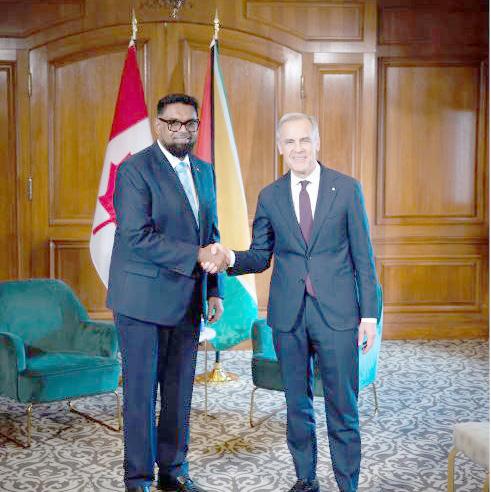
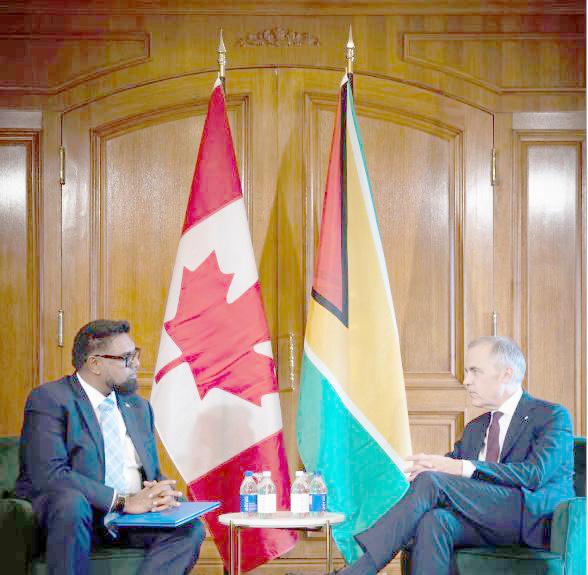


PRESIDENT, Dr Irfaan Ali on Friday held discussions with Canadian Prime Minister Mark Carney, on expanding co-operation between the two countries in various areas.
The two met during President Ali’s visit to Canada where the Guyanese Head of State highlighted the two nations’ very intense and diversified relationship that extends beyond diplomacy.
During the discussions, it was noted that areas touched included investment, innovation, climate leadership, and regional relations.
The President noted that both countries have taken leadership roles on climate issues, tropical forests, and biodiversity, while also sharing common positions on sovereignty and territorial integrity.
“Canada, at one time,
was our largest trading partner,” President Ali added.
He went on to note that part of the discussions focused on how Canada could play a “deeper and greater role” in Guyana’s economic transformation through diversification, innovation, and advancement.
Against this backdrop, he also highlighted the strong people-to-people, cultural and histori-
cal ties between the two countries, while pointing to food security as another shared area of leadership.
Guyana, he noted, is keen on strengthening engagements with Canada as they reshape their foreign-policy agenda.
“CARICOM, Guyana, we want to not be behind the curve, but right in your line of sight,” President Ali told the Prime Minister.
Meanwhile, Prime Minister Carney welcomed President Ali to Canada and underscored the long-standing ties between the two nations.
He stated that this year marks the 60th anniversary of Guyana’s independence and 60 years of diplomatic relations between the two countries.
“We have lots of ties,” Prime Minister Carney said.
He also referred to the business links between the two countries and acknowledged their shared interests in peace, stability, and territorial integrity within the CARICOM region.
He said, “We have business ties.” We have common interests for peace, stability, territorial integrity in the CARICOM region and all of the countries there.”

–– says Venezuela’s actions against Essequibo are ‘redolent of colonialism’
–– insists the 1899 Arbitral Award remains the ‘full, perfect and final settlement’ of boundary between the two nations
By Feona Morrison
ATTORNEY General and Minister of Legal Affairs
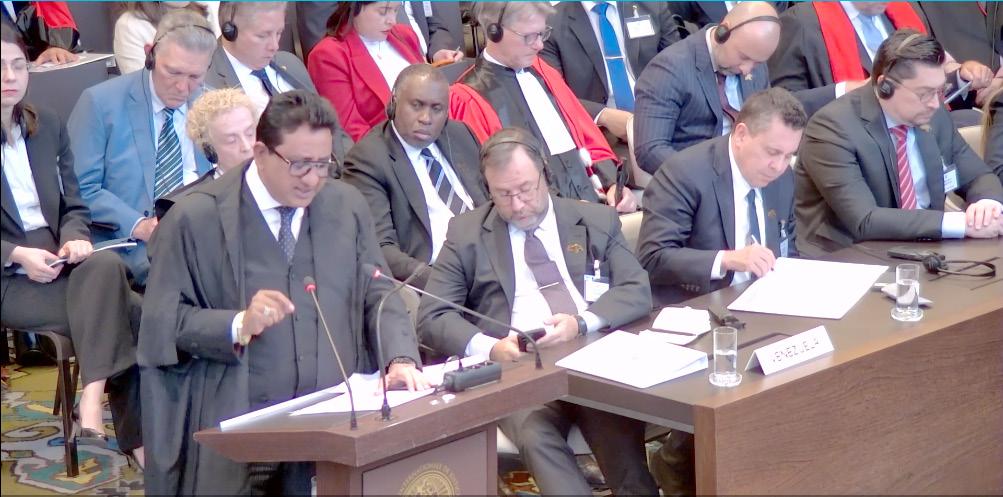
Anil Nandlall, SC, on Friday delivered an emotional and forceful closing rebuttal before the International Court of Justice (ICJ), warning that Guyana’s future as a sovereign nation depends on a clear and definitive judgment affirming the validity of the 1899 Arbitral Award issued in Paris, France.
Addressing the judges at the close of Guyana’s rebuttal in the historic Essequibo border controversy case, Nandlall described the proceedings as one of immense national importance, stressing that Venezuela’s claim to more than 70 per cent of Guyana’s territory has overshadowed the country’s existence since independence.
Nandlall told the court, “For more than 60 years, Venezuela has laid claim to more than 70 per cent of Guyana’s sovereign territory.
“Generations of Guyanese, mine being one of them, have grown up under the long and threatening shadow caused by Venezuela’s claim to nearly three-quarters of our country.”
The Attorney General said the territorial controversy has deeply affected Guyana’s development, security and national well-being for decades.
“Venezuela’s claim has blighted, bedevilled, and burdened Guyana for the entirety of its life as a sovereign state,” he said.
Nandlall warned that the consequences of losing the Essequibo region would be catastrophic for Guyana.
“The loss of the territory claimed by Venezuela would eviscerate Guyana. Indeed, the country as we know it would cease to exist,” he declared.
According to him, the
case before the ICJ is, therefore, not merely a legal dispute but an existential issue for the Guyanese people.
“Guyana’s Foreign Minister [Hugh Todd] was not exaggerating when he described this case as having an existential quality for Guyana,” he told the judges.
“For Guyana and its people, the stakes could scarcely be higher.”
Despite the enormous stakes involved, the Attorney General stressed that Guyana chose to place its trust in international law and the international judicial system when it approached the World Court in 2018.
Guyana is asking the ICJ to confirm the validity of the 1899 Arbitral Award, which legally established the land boundary between then British Guiana and Venezuela. The award emerged from an international arbitration process established under the 1897 Treaty of Washington after Venezuela and Great Britain had agreed to submit the boundary controversy to arbitration.
Nandlall told the court Guyana’s faith in international law remains unwavering.
He said, “As Attorney
General of Guyana, I can personally attest to Guyana’s profound commitment to the rule of international law.
“It is a commitment which runs deep in Guyana’s institutions and national culture. It is both an article of faith and a source of national pride.”
He added that Guyana views international law as essential to maintaining peace and stability among nations.
“It is founded on a firm conviction that international law is the bedrock of the international order and the indispensable foundation for peaceful relations between all states,” Nandlall stated.
“From Guyana’s perspective, there is no higher value or greater imperative than respect for international law.”
The Attorney General said Guyana approached the court in 2018 with confidence in three specific areas: the validity of the 1899 Arbitral Award, the United Nations Secretary-General’s decision to refer the matter to the ICJ and the court’s ability to fairly and
impartially determine the controversy.
“First, Guyana had unwavering confidence in the correctness of its decision regarding the validity of the 1899 award and the boundary which it determined.
“Second, Guyana was equally confident in the wisdom of the decision of the Secretary-General of the United Nations that the court should be entrusted with resolving this intractable controversy.
“Third, Guyana had complete confidence in the independence and impartiality of the court, and its ability to deliver a just outcome based on the fair-minded and even-handed application of international law,” Nandlall said.
He underscored that the proceedings over the last eight years have vindicated Guyana’s confidence in the court.
“Since Guyana filed its application eight years ago, these proceedings have vindicated and reinforced Guyana’s confidence in each of those things,” he told the judges.
He praised the ICJ for conducting the case with
fairness and diligence.
“At every stage, the court has conducted the proceedings with conspicuous care, attentiveness and fairness,” he said.
Nandlall said: “The court has carefully considered and confirmed its jurisdiction to entertain Guyana’s application and it has carefully considered and confirmed the admissibility of that application.”
The Attorney General said Guyana remains confident that the court will now move on to determine the merits of the case concerning the validity of the 1899 Arbitral Award and the land boundary established by it.
At the same time, he accused Venezuela of consistently attempting to prevent the court from ruling on the substantive issues.
“Since the start of these proceedings, Venezuela has strained every sinew to avoid the court delivering a judgment on the merits of Guyana’s application,” Nandlall asserted.
“These strenuous efforts have even continued throughout this hearing on the merits.”
According to him, Vene-
zuela has repeatedly attempted to argue that the 1966 Geneva Agreement prevents the court from ruling on the validity of the 1899 Arbitral Award.
However, Nandlall said Guyana’s legal team demonstrated that those arguments are unsupported by the agreement itself, its historical context, and Venezuela’s own previous positions before the court.
“Guyana’s counsel have demonstrated the lack of merit in those arguments, which find no support in the text or the history of the Geneva Agreement and which are contradicted by Venezuela’s previous statements to the court,” he said.
“It is not hard to see why Venezuela is so reluctant for the court to determine the merits of Guyana’s application.”
Nandlall argued that Venezuela understands that a ruling on the merits would effectively end its territorial claim to almost 160,000 square kilometres of Guyana’s territory.
“Venezuela knows that it has no good answer to Guyana’s case and it knows that a judgment on the merits should bring to an end Venezuela’s claims to almost 160,000 square kilometres of Guyana’s territory,” he submitted.
The Attorney General also strongly defended the validity of the 1897 Treaty of Washington and the 1899 Award itself.
“In its written and oral pleadings, Guyana has convincingly demonstrated that Venezuela’s attempt to impugn the validity of the 1897 Treaty of Washington has no merit whatsoever,” he said, adding: “Venezuela was neither deceived nor coerced into signing the
treaty.”
“On the contrary, the treaty achieved what for years Venezuela had desired and demanded, the submission of its boundary dispute with Great Britain to international arbitration,” he said.
Nandlall further rejected Venezuela’s attacks on the arbitral tribunal itself.
“The arbitral tribunal faithfully fulfilled the mandate conferred by the 1897 Treaty,” Nandlall stated.
“Neither the terms of the award nor the way it was reached involved any excess of power or impropriety by the eminent members of the tribunal,” the Attorney General said.
Nandlall related that Guyana’s case also demonstrated that Vene-
zuela knew about all the matters it now claims invalidated the award at the very time the award was issued in 1899.
Yet, according to him, Venezuela respected and affirmed the award for decades afterward.
He said, “Yet, for more than 60 years after 1899, Venezuela respected, asserted and affirmed the validity of the award.
“As Guyana has shown at this hearing, Venezuela has no credible answer to any of this. In short, the award was and remains valid and binding on the parties,” Nandlall emphasised.
The Attorney General noted that the 1897 Treaty itself described the award as “the full, perfect and final settlement of the

boundary between Venezuela and Guyana.”
Nandlall also addressed what he described as Venezuela’s ironic attempt to invoke decolonisation principles in support of its case.
“…Venezuela’s attempt to invoke the law of decolonisation to support its case is legally unfounded,” he said, adding: “But it is also ironic, because Venezuela’s sudden repudiation of the 1899 award in the 1960s, just as the process of Guyana’s decolonisation was underway, impeded and delayed Guyana’s progress towards independence by several years.”
He accused Venezuela of behaving in a manner that mirrors the very colonial conduct it criticises.
“In the years since Guyana attained independence in 1966, Venezuela has acted in a way that has striking echoes of the imperial colonialists whom it rightly denounces,” Nandlall declared.
The Attorney General outlined what he described
as repeated violations of Guyana’s sovereignty over the Essequibo region.
“As Guyana has explained, both in its written and oral pleadings, since 1966, Venezuela has repeatedly denied and violated Guyana’s sovereignty over its Essequibo region,” he said.
He pointed specifically to Venezuela’s occupation of Ankoko Island and repeated military incursions into Guyanese territory.
“Venezuela has invaded and illegally occupied Guyana’s territory on Ankoko Islands for six decades. It has conducted numerous other military incursions into Guyana’s land and maritime territory, incursions which are intended to menace and intimidate Guyana and its people.”
Nandlall also criticised Venezuela’s recent actions during the pendency of the ICJ proceedings, accusing Ca -

racas of openly defying provisional measures orders issued by the court.
“During the pendency of these proceedings, and in contumacious defiance of this court’s provisional measures orders, Venezuela has enacted legislation which purports to incorporate our Essequibo region as a new Venezuelan state,” he noted.
Nandlall further said that Venezuela has sought to place the region under the jurisdiction of its legislative, executive and judicial organs, and has even depicted the territory as part of Venezuela on official maps.
According to Nandlall, Venezuela has also attempted to rewrite the region’s history.
“Venezuela has also sought to rename the territory as Guyana Esequiba,” he said.
“It has even falsely claimed at this hearing that the Essequibo River was named after a Spanish explorer.”
Nandlall corrected the assertion, explaining that the river’s name originates from the indigenous word “dishikibo,” meaning fireside.
“The name of the Essequibo River is in fact derived from an indigenous word, dishikibo, meaning fireside, which was later adopted by the Dutch and the British,” he explained.
Nandlall described Venezuela’s conduct as deeply troubling.
“Venezuela’s attempts to annex its smaller neighbour’s territory, its attempts to erase and rewrite the history of Guyana’s Essequibo region, and its innumerable bellicose threats to Guyana’s sovereignty and territorial
integrity are all redolent of colonialism,” Nandlall declared.
As he concluded his presentation, the Attorney General stressed that the wording of the court’s eventual judgment would be critically important.
“The judgment that you deliver in this case will be of exceptional importance to Guyana,” he told the judges.
“It is not simply the outcome of the judgment that will be important. The terms of the judgment will be equally crucial.”
Nandlall urged the court to issue a ruling that leaves no uncertainty regarding the validity of the 1899 Arbitral Award and the boundary it established.
“If the court accepts Guyana’s arguments, as we are confident that it will, then it is essential that the court’s judgment directly, explicitly and unambiguously affirms the validity of the 1899 award in its integrity and the boundary which it established,” he said.
He cautioned that any lack of clarity could be used by Venezuela to prolong the controversy.
“Any ambiguity in the court’s judgment will inevitably be seized upon by Venezuela as a basis for continuing to lay claim to vast swathes of Guyana’s sovereign territory,” the Attorney General cautioned, noting: “The clarity and specificity of your judgment are vital to the effective resolution of this longstanding dispute.”
A final ruling from the ICJ is expected later this year, according to Guyana’s Ministry of Foreign Affairs and International Co-operation.

KING’S Counsel Philippe Sands on Friday delivered a blistering rebuttal before the International Court of Justice (ICJ), accusing Venezuela of weaponising anti-colonial arguments and attempting to reopen a border controversy that had been settled for more than six decades.
Presenting Guyana’s rebuttal in the historic Essequibo border case on Friday, Sands argued that Venezuela’s attack on the 1899 Arbitral Award was rooted not in law, but in political opportunism tied to Guyana’s impending independence in the 1960s.
At the centre of Venezuela’s argument is the so-called Mallet-Prevost Memorandum, a document Venezuela says exposed alleged impropriety in the arbitration process that established the boundary between then British Guiana and Venezuela.
The Mallet-Prevost Memorandum is a document written by Severo Mallet-Prevost, the official secretary to the United States-Venezuelan delegation during the 1899 Paris Arbitral Award proceedings, and published posthumously in 1949.
The memorandum later became central to Venezuela’s complaint before the United Nations (UN) in 1962, which ultimately led to the signing of the 1966 Geneva Agreement between Venezuela and the United Kingdom.
But Sands dismissed the argument in scathing terms.
“The argument is ‘tosh’; it’s a fiction, and it suffers from fatal problems,” he told the court.
He argued that Venezuela’s legal team had falsely portrayed the memorandum as a shocking revelation that suddenly explained why Venezuela repudiated the award in 1962 after accepting it for more than 60 years.
“For these counsel, the Mallet-Prevost Memorandum has a clear purpose,” Sands said, adding: “It offers a rationale, the rationale to explain why Venezuela accepted the award for 63 years, never challenged its validity and then suddenly and abruptly changes its position in 1962.”
According to Sands, however, the facts complete-
ly undermine that narrative.
“Venezuela already had all the information it now says was newly available in 1949,” he argued, noting that discussions about compromise and political considerations surrounding the award were publicly reported in newspapers within days of the tribunal’s ruling in October 1899.
Sands cited contemporaneous reporting from both The New York Times and The Times of London, which openly discussed the arbitral compromise and the pressures faced by the arbitrators.
“These two newspaper articles were published within two days of the award,” he stressed, noting: “It was public; it was available. It was plainly known to Venezuela.”
Despite this knowledge, Venezuela not only refrained from objecting to the award, but signed the 1905 Boundary Agreement implementing it and respected the boundary for decades afterward.
“Did this information cause Venezuela to object to the award? It did not,” Sands said, noting: “For the next 57 years, it faithfully gave effect to that treaty and the award it implemented. Not a squeak of opposition.”
He rejected Venezuela’s claims that the arbitration process involved blackmail or extortion by Russian jurist Friedrich Martens, who chaired the tribunal.
Sands argued, “Is there evidence here of extortion or blackmail? No, there is not.
“There is none, not a shred of evidence.”
Instead, Sands described Martens’ efforts to secure consensus among arbitrators as a normal feature of arbitral deliberations.
“The striving for consensus is an act of decency and wisdom,” he said, adding: “That Mr. Martens achieved it is to his credit, not to his detriment.”
Sands argued that Venezuela’s true objective was not legal correction, but rather reopening the territorial question at the moment Guyana’s independence became imminent.
“What are we actually addressing in this court -
room?” he asked the judges, noting: “British Guiana’s desire for independence offered a wonderful opportunity to reopen, for the first time after 63 years, the path to resolve a lingering unhappiness about the substantive outcome of the award and the 1905 treaty.”
According to Sands, the Mallet-Prevost Memorandum was ultimately “instrumentalised” and “weaponised” by Venezuela to justify reopening a controversy that had long been settled.
“The only thing that was new in that document, magical realism, was the claim of an Anglo-Russian deal prompting the outcome,” he said, adding that Venezuela itself no longer appeared to rely on that “outlandish claim”.
Sands also forcefully rejected Venezuela’s attempt to frame the case as part of a broader anti-colonial struggle.
Responding directly to arguments advanced by Venezuelan counsel Professor Makane Moïse Mbenge, Sands said comparisons to the Chagos Islands advisory opinion were entirely misplaced.
“Chagos offers no assistance whatsoever to Venezuela. It is totally different,” he declared.
Sands said that unlike Mauritius in the Chagos matter, Guyana inherited internationally recognised boundaries at independence based on a binding arbitral award and treaty that Venezuela itself had accepted for decades.
Sands reminded the court that Venezuela had voted in favour of United Nations Resolution 1514 of 1960 — the landmark decolonisation resolution affirming territorial integrity — without raising any reservation regarding British Guiana’s boundaries.
“At the moment it voted for Resolution 1514, it still accepted its boundaries as they had existed for more than 60 years,” he said.
According to him, Venezuela only changed its position when Guyana’s independence “suddenly hoved into view.”
In one of the most significant passages of his presentation, Sands warned the ICJ that accepting Venezuela’s
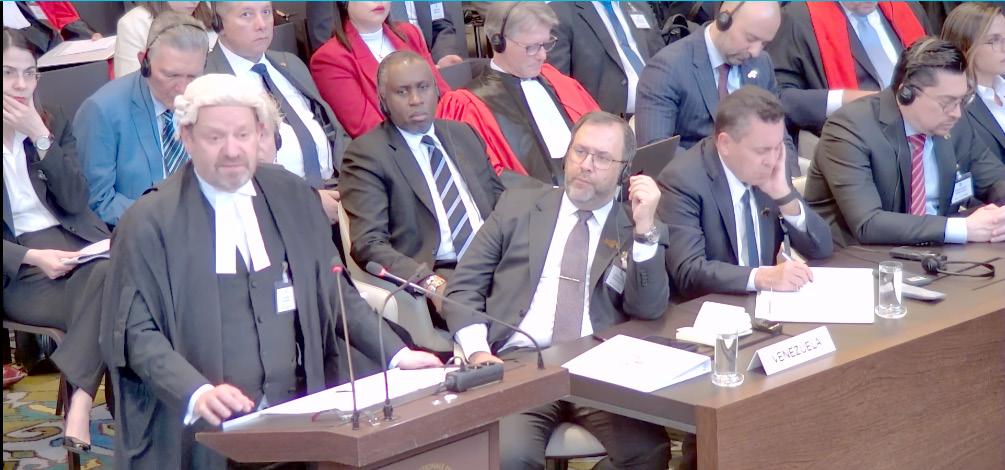
King’s Counsel Philippe Sands presenting Guyana’s rebuttal arguments before the International Court of Justice during hearings in the case concerning the Arbitral Award of 3 October 1899 (Guyana v. Venezuela)
arguments would destabilise international borders globally and undermine long-established legal settlements.
He told the judges, “If this court is to accede to Professor Mbenge’s invitation and find invalid the 1899 Arbitral Award and presumably also the 1905 Treaty, you would rekindle the embers of dead empires.
“You would plunge Guyana into a new form of domination and oppression in
relations with its much larger neighbour.”
Sands further warned that overturning a century-old arbitral award would create dangerous global consequences.
“You would send a signal to the world that the passage of six decades is no bar to setting aside an Arbitral Award or a Boundary Treaty,” he argued.
“You would rekindle an age of instability and uncer-
tainty.”
The King’s Counsel said such a precedent would threaten borders across Africa, Latin America, and other post-colonial states whose boundaries emerged from colonial-era agreements and settlements.
“That is what Venezuela is asking you to do,” Sands declared, noting: “That is what we feel sure you must resist.”


THE Guyana Government’s announcement to sign a US$27.36 million contract for a battery-energy storage system with PowerChina International Group Limited, through the Guyana Power and Light Inc., is more than just another infrastructural announcement.
This is one of the clearest signs yet that the country is starting to tackle one of its most intractable development problems -- an unreliable electricity supply.
For years, instability in the price of electricity has been a burden on households, small businesses and industry.
Commerce has been disrupted, equipment damaged, productivity sapped and normal living has come with daily frustration due to power outages.
The former pattern of an overburdened and fragile power grid is no longer viable in a country experiencing rapid economic expansion, driven largely by oil revenues.
The new Battery Energy Storage System (BESS) of two 30 MWh/15 MW lithium-ion installations at the New Sophia and Goedverwagting substations in Region Four is expected to provide 30-MW support to the Demerara-Berbice Interconnected System.
It also aims to increase grid stability
and reliability, where consumers have been calling for real progress for some time. This matters.
For too long the public discussion about electricity has been almost entirely about generation, how many megawatts can be produced, what new plants are being built, or what fuel source will be next.
But modern electricity systems are just as reliant on flexibility, storage, control and resilience.
A battery-storage facility does not only add power, it also helps to manage sudden fluctuations, absorbs excess energy, stabilises voltage and frequency and restores service more quickly after failures.
That’s why the project’s black-start capability is worth mentioning in particular.
In short, it gives the system greater capability to restart blocks of the grid after a major outage without total dependence on external supply.
For consumers who have suffered long blackouts, this is not a technical aside, it is a real operational improvement.
This investment also has broader implications for Guyana’s longer-term energy transition.
Guyana has pledged to increase renewable energy and reduce its reliance on im-
ported fossil fuels under the Low Carbon Development Strategy 2030.
But renewable-energy integration cannot be efficient without modern grid systems. Solar and wind resources are inherently variable.
Battery storage is therefore crucial if renewable generation is to become more than just an aspiration.
The integration of the new battery systems with the Guyana National Control Centre through SCADA, energy management and automatic generation control systems is a step in the right direction.
It suggests that the country is not just buying equipment, but beginning to modernise the intelligence of the grid itself.
But infrastructural contracts should not be judged on the basis of ceremonial signings or ambitious timetables.
The eight-month target for completion is encouraging, but Guyanese consumers will assess success by seeing concrete results, such as fewer blackouts, shorter outages, faster restoration times and greater consistency in daily service. That will be the true test.
There is one other important point.
The contract also includes the training of GPL engineers, maintenance services
and parts. This may look routine, but it is important. Guyana’s infrastructural future cannot eternally be dependent on foreign contractors.
Physical investment must be complemented by growth in local technical capacity. New projects should not only be about increasing imported dependence, but also about building national competence.
Guyana’s economy is growing and electricity demand will continue to rise sharply.
New housing schemes, industrial expansion, commercial activity and digital services all need a better energy backbone
This new investment will not solve all the problems in the power sector, but consumers are still worried about aging distribution networks, transmission vulnerabilities and service inefficiencies. But it’s a practical and a necessary step towards a more modern electrical system.
For years Guyanese have been promised better power. Now it’s time for delivery.
This battery-storage project will not only strengthen the grid. It will foster public confidence that Guyana’s energy future can at last begin to align with its economic ambitions.
THE New York City Council will be honouring a few Guyanese with proclamations, while other New York Elected officials will present certificates to the remaining nationals in recognition of the country’s 60th Independence Anniversary, themed: ‘A Diamond Jubilee Celebration’ – in City Hall Chambers on Wednesday, May 27, at 17:00hrs.
The 60 distinguished Guyanese patriots of homeland Guyana and abroad have shaped New York City and State governance, the arts, education, health, community development, and the global footprint.
Their work resonates from Brooklyn, Queens, Staten Island, Manhattan, and the Bronx to Georgetown, from the diaspora to Guyana’s shores, forging a durable diamond of resilience, creativity, and service.
The 60th Independence Anniversary (Diamond Jubilee) honorees are musician Adrian Dutchin; District Leader Albert Baldeo; Legislator Alicia Hyndman; journalist Alim Hassim; Olympian Aliyah Abrams; Ambassador Michael E. Brotherson; Aminta Kilawan-Narine, Esq., Angels Caribbean Band; and Avé Maria Brewster Haynes, who is President of the Guyana Cultural Association.
Others are social service leader Berlinda Persaud; cultural ambassador Bharati Sukul Kemraj; 80th Lieutenant Governor Brian Benjamin; actress Carol Catherine Hilaria (CCH) Pounder; captain Haslyn Peters; healthcare Executive Claire Patterson-Monah; singer, director Courtney Noel; entrepreneur Dave Narine; entrepreneur Doris Rodney; educator Dr. Dhanpaul Narine; academic

leader Dr. Ivelaw Griffith; radio host Dr. Linda Felix; community advocate Dr. Mohamed Hack; cultural enabler Dr. Monica Sanchez; cultural ambassador Dr. Rose October; educator Dr. Terrence Blackman; educator Dr. Vibert Cambridge; scientist Dr. Vincent Adams; neighbourhood leader Edgar Henry, and educator Faiuze Ali.
Others to receive awards are journalist Fitzgerald (JR) Giddings; educator Harold Miller; educator Ingrid Joseph; consular specialist Isaiah Chappelle; legislator Jabari Brisport; poet, pastor James C. Richmond; community advocate Joan Alexander Bakiriddin; community organizer Jonnel C. Doris, journalist
Joy Reid; community organizer Khari Edwards; cultural advocate Lady Ira Lewis; Melnia Cordis, Esq.; community organizer Mohamed Q Amin; community organizer Patricia Jordan-Langford; district leader Richard David; civic leader Rickford Burke; fashion designer Roger Gary, legislator Roxanne J. Persaud; entrepreneur Rozanna Beaumont; business leader Rupnarine Harricharan; and Clergy Shayk Sarfraz Bacchus. District manager Sherif Fraser; sportsman Sir Clive Lloyd; arts administrator Sonia Daly; journalist Tangerine Clarke; entrepreneur Tony Singh; entrepreneur Viburt Bernard; musician Wrickford Dalgetty; educator Zamal Sankar; dancer Zaman Mohamed Amin; and Musician Singer Dr. Terry Gajraj make up the list of honorees.
Under the Government of Guyana’s overall theme:
“The Homecoming, encouraging Guyanese to return, reconnect, and celebrate 60 years of Independence,” the nation that gained its independence from British rule on May 26, 1966, will be showcased at the momentous City Council event.
In addition to music, dance, and a diverse Guyanese cuisine, nationals will be entertained by a cultural presentation to showcase the multicultural heritage of the six races of people. Pannist Rudy Bishop, and singer Terry Gajraj, among others, are scheduled to perform.
Poet James Richmond, organizer of the commemoration, and CBS TV Award-winning reporter, anchor, Jennifer Bisram, will serve as emcees. (Caribbean Life)
By Senior Advisor to the Director General of IICA, Jorge Werthein–PhD in Education, Stanford University
AGRICULTURE is not absent from the media.
It is sidelined. And hidden within that apparent nuance lies one of the great paradoxes of our societies: a sector essential to daily life nevertheless occupies a marginal place in public discourse. In the mainstream media of Latin America and the Caribbean, agriculture appears, but rarely takes centre stage. It is found in specific spaces, in technical sections or in formats aimed at audiences already familiar with the sector. It is not generally part of the main flow of information that shapes the perspective
of the average citizen.
This form of representation is not innocent. By being confined to specialised niches, agriculture also becomes associated with a limited audience: producers, companies, and actors directly linked to the activity. For the vast urban majority, however, the topic remains distant, almost alien.
This gives rise to a profound disconnect. Urban citizens do not perceive agriculture as a central component of the economy, despite its weight in exports and employment. Nor do they recognise it as a social pillar that sustains territories and communities, or as a strategic factor for stability, peace, and food security.
This logic of confinement is not exclusive to traditional media. It is re-
produced, with equal intensity, on radio, television, and especially on social media, today one of the main channels for information and opinion-forming.
Despite its massive reach, agriculture fails to establish itself there as a topic of general interest either. Its presence remains fragmented, sporadic, often linked to crises, but rarely associated with its structural value.
The problem is no small matter. Societies that do not understand the centrality of their agriculture will find it difficult to sustain consistent public policies or devise long-term development strategies. Media invisibility translates, sooner or later, into political weakness.
In a world marked by recurring crises—food, energy, geopolitical—food production emerges as a decisive factor

for stability. It is not just about the economy. It is also about sovereignty, social cohesion, and peace.
However, this evidence has yet to find its counterpart on the public agenda.
Reversing this situation does not mean multiplying specialised spaces, but rather breaking out of this confinement. Integrating agriculture into the core of the social debate. Naming it, explaining it, showing it in all its complexity: as a system that links production, territory, innovation, employment, and well-being.
As long as agriculture remains on the margins of the media narrative and the digital ecosystem, it will also remain on the margins of collective priorities. And that is a cost the region should no longer be willing to pay.
RETIRED Guyanese scholar in the US, Daniel Gibran, has just published in the letter pages of Kaieteur News an analysis titled, “Explaining America’s forever wars.”
It is absolutely shameful that a Guyanese living abroad had to write such an informative piece when the University of Guyana has an International Relations Department.
There is absolutely nothing from the academics in that department from which Guyanese can learn about international affairs as they probably did on reading what Professor Gibran wrote. Gibran’s stuff should have come from our International Relations folks at UG. But these people, for decades now, have not offered even a small letter in the newspapers or social media about what goes on in the world.
I find Dr. Gibran’s take on US foreign policy very interesting, but I have to disagree fundamentally with his thesis that the 9/11 bombing has a deep psychological hold on US leaders, and explains why since 9/11, the US has got engaged in forever wars.
I quote Dr. Gibran on the connection between 9/11 and the war mentality afterwards: “The post 9/11 era will likely be studied as a moment when external strategy deeply altered internal America.”
Dr. Gibran went on to ask the question and I quote him again: “…whether the US after 9/11 entered not just a military campaign against terrorism but into a permanent psychological, political institutional state of war.”
Dr. Gibran goes on to link 9/11 with the United States’ position on war.
My contestation is that 9/11 has no connection to US predilection for foreign interventions including foreign wars. I go so far to say that there is absolutely no connection. The US goes to war and has been going to war for over a century now because that is what empires do. The United States is an empire and empires see wars as a normal process.
If there wasn’t 9/11, there would have been no difference in how the US sees wars and why it goes to war. In other words, 9/11 came and went but US as an empire continues to do what empires do – fight wars.
There is a complex factor at work that differentiates the US empire with the other two powerful international war machines that history has produced – the Roman Empire and Pax-Brittanica.
This complex factor lies in the national psyche of the US which differentiates the US from Rome and Great Britain. In fact, Gibran touched on the role of the American psyche in going to war but missed the point badly.
He asks the question if something is wrong with the American psyche. This is where he was about to get it right but answered his own question wrongly.
He noted that there is nothing wrong with the American psyche which is similar to three other empires – Rome, Britain and the USSR. There is no scope in a newspaper article to elaborate on why the American psyche has nothing in common with the national psyches in Rome, Britain and the USSR. I am not inclined to lump the USSR in the same category as Rome, Pax-Britannica and Pax-Americana. So, from hereon I will not

make any reference to the USSR.
The Roman Empire and the British Empire evolved differently from Pax-Americana. Both previous empires were founded on philosophical principles that guided the behaviour of global hegemony.
Rome inherited the philosophical tradition of ancient Greece and many of the Roman senators and Roman emperors were huge admirers of philosophy. In fact, one Roman emperor, Marcus Aurelius, wrote a profound philosophy text - “Meditations.”
The Age of Enlightenment had a huge influence on the role of the UK as it became an empire. Sadly, there is no philosophical foundation in the American empire.
One has to understand how the US evolved, how it became powerful, and how it sees power to comprehend why it embraces forever wars. There is a concept called “the American psyche” and it plays a problematic role in the civilisation of the United States.
It is this psyche one has to understand
when studying forever wars of the United States. What is taking place in the US at the moment, not just in the US Government and US legislature but in the general American society is the American psyche on display. A dysfunctional psyche not reproduced in any other nation throughout history.
America’s external interventions are for the sake of power and that makes it exceptionally violent unlike Rome and Britain.
The British Empire was a commercial venture. If overseas colonies did not contribute to the economic expansion of the UK, then the UK had little interest in keeping them. The UK expanded overseas in search of markets. The US expands overseas for the sake of power. Unfortunately, space has run out.
DISCLAIMER: The views and opinions expressed in this column are solely those of the author and do not necessarily reflect the official policy or position of the Guyana National Newspapers Limited.
PRESIDENT, Dr Irfaan Ali, on Friday said foreign direct investment in Guyana has surged to approximately 35 per cent of the country’s Gross Domestic Product (GDP), describing it as a powerful indicator of growing global confidence in the country’s economy and governance.
Speaking at the Guyana-Canada Business Forum, the President said the scale of investments flowing into Guyana reflects confidence not only in the economy, but also in the country’s political stability and development trajectory.
“That tells you about global confidence, investors’ confidence, confidence in the political system, confidence in the government, confidence in the economy and confidence that in the risks they are taking to invest, they believe that they can be successful.”
The Head of State said Guyana has moved beyond the stage of having to introduce itself to international investors, noting that the country is now recognised globally for its economic transformation and strategic opportunities.
He highlighted Guyana’s leadership in climate policy, biodiversity, agriculture and
“Foreign direct investment has surged to levels estimated at approximately 35 per cent of GDP. That is no ordinary number,” President Ali stated.

renewable-energy advocacy long before the emergence of the oil and gas sector.
According to President Ali, Guyana is now positioning itself for the
next phase of development through diversification into sectors such as healthcare, education, tourism, agro-processing, manufacturing, artificial intelligence
and data centres.
“We are building out the most modern healthcare system in the world, the most modern education system in the world, not only for Guyanese, but as an economic component of the diversification of our economy,” he said.
The President noted that Guyana is aggressively embracing AI and digitisation, integrating technology into healthcare, immigration, public services and national planning systems.
“We have embraced AI as a development partner of the future,” he stated.
President Ali urged Canada to get more involved in Guyana’s development, noting that while Canada used to be Guyana’s biggest trading partner, Canadian companies haven’t acted
fast enough to take advantage of new opportunities.
He identified hydroelectricity, smart grids, pharmaceutical manufacturing, agriculture, tourism and manufacturing among the sectors offering major opportunities for Canadian investment.
The President further stressed that Guyana’s development model is aimed at creating prosperity for all Guyanese through policies that encourage private-sector expansion and entrepreneurship.
“The government’s only role is to create the environment through systems and policies.
The role of business, making money, development and growth is the role of the private sector,” he said. (DPI)
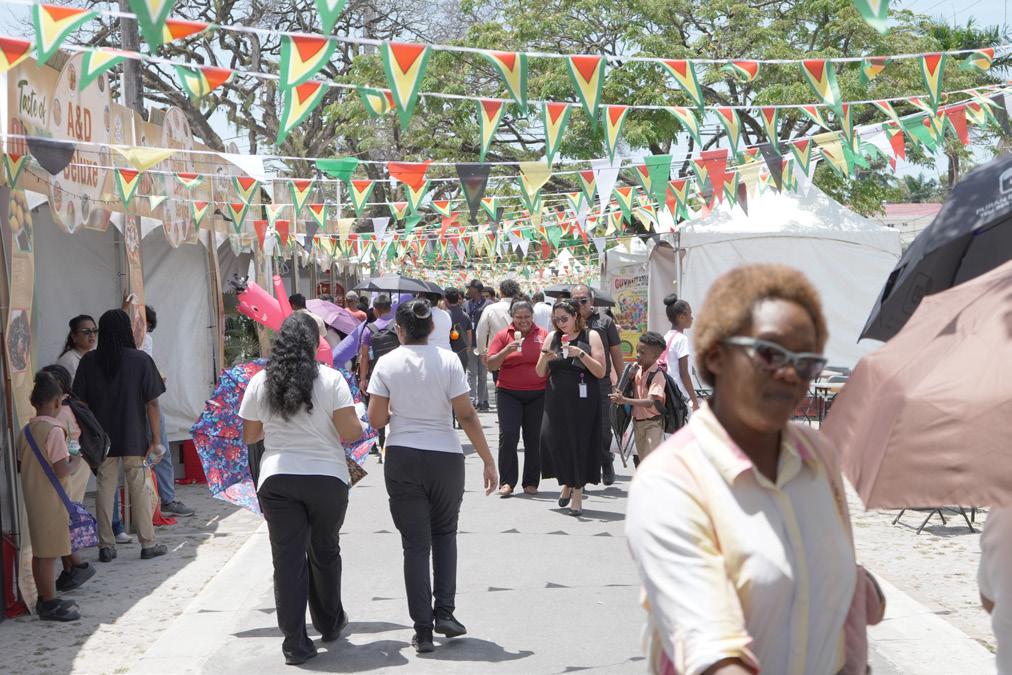
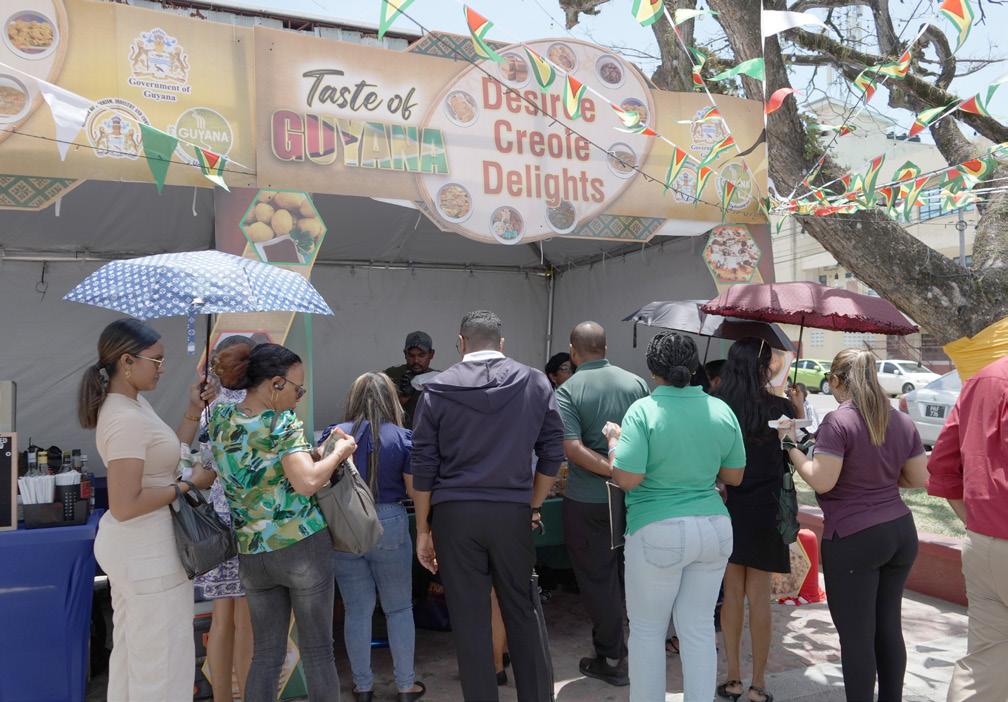
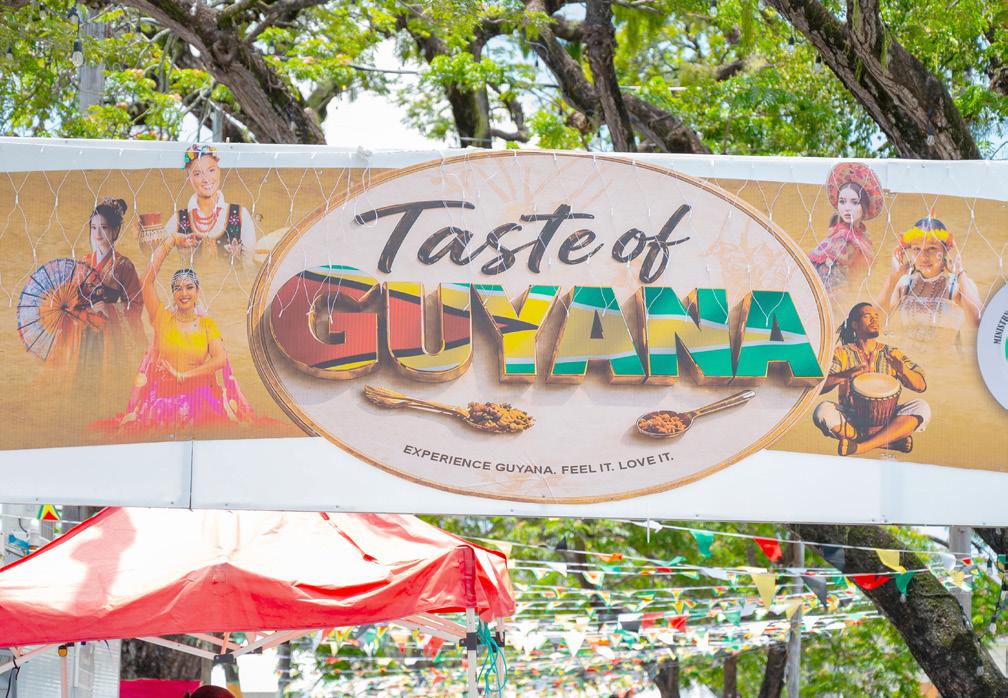
THE Ministry of Tourism, Industry and Commerce (MINTIC), in partnership with the Guyana Tourism Authority (GTA), hosted a “Taste of Guyana” Exposition on Main Street between Quamina and Middle Streets.
As Guyana ushers in its 60th Independence Anniversary, the ministry created an event that focused on Guyana’s authentic gastronomy offerings.
Director of the GTA Kamrul Baksh, in his remarks about the event, said that food is part of the fabric of the Guyanese society, which is multi-ethnic.
“So, we’ve put that on, and the many visitors and the
many locals, we want them to enjoy some of the finest, authentic Guyanese cuisine,” he said.
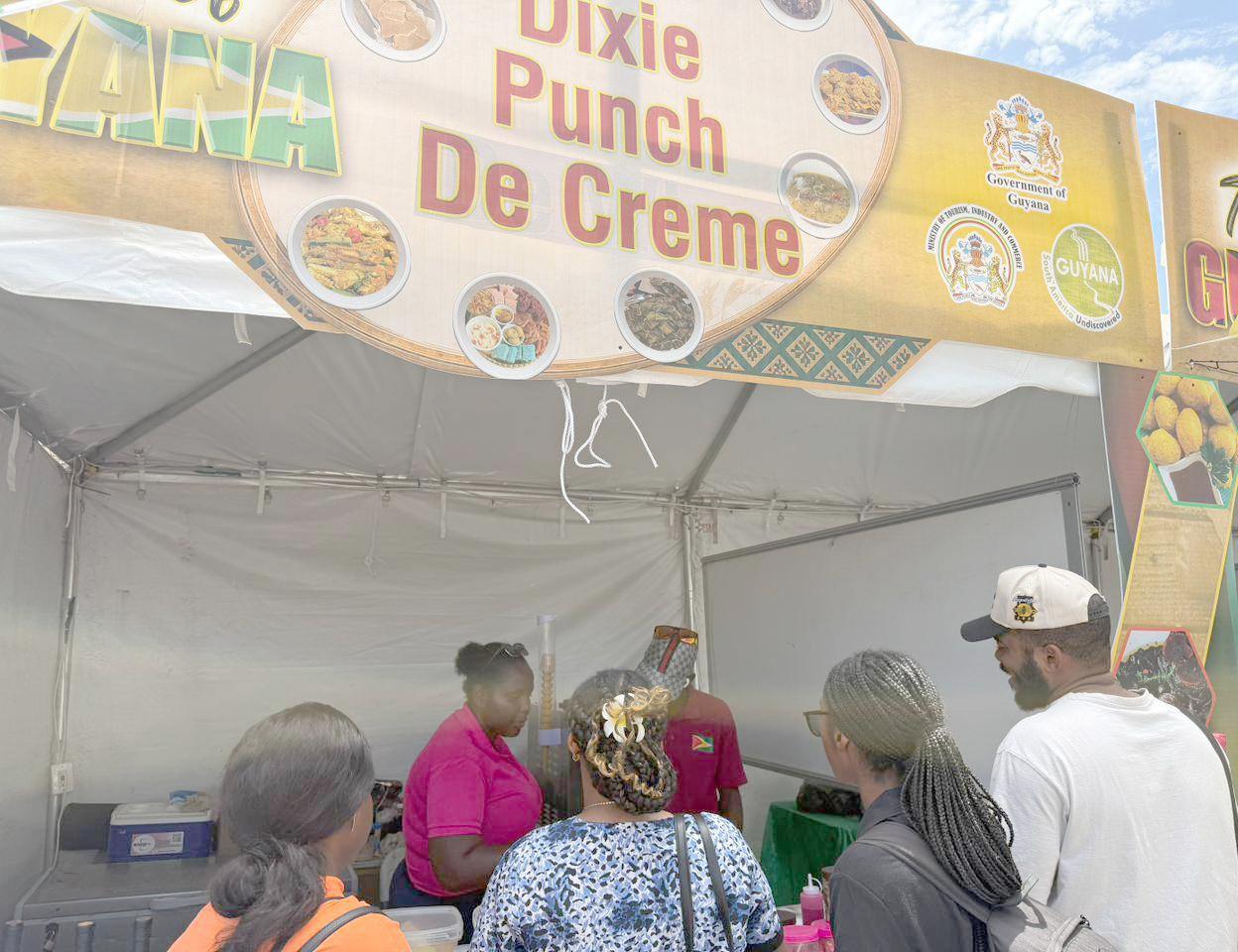
Among the names present were Dixie’s Punch De Crème, a 100 per cent Guyanese- owned company that has produced a number of Guyanese-inspired crème liquers, including the Capadulla, Coffee and Original Punch De Crème flavours.
Two months ago, Dixie’s ventured into a new market: Locally-made ice cream with real products grown in Guyana.
Speaking with the Daily Chronicle on Friday, the owner of the Punch De Crème brand Dixie Jordan said that they launched this
new addition some two months ago, gaining overwhelming support from old and new customers.
“I am very, very impressed that people would like to enjoy actual local ice cream because I love local ice cream. Not saying that what we have is not good, but I feel like local ice cream brings something different and that is what I wanted to bring and offer to the Guyanese public,” Jordan said.
The flavours offered by Dixie’s include the popular cherry cheesecake, guava temptation, pineapple cheesecake, cookies and cream, vanilla and chocolate.
Outside of ‘expos’ and the Guyana Marketing Cor-
poration’s Guyana Shop, Dixie’s Punch De Crème can be found in Buxton on the East Coast of Demerara. Persons can contact Dixie’s on (592) 659-8142 to get some of their products.
In two weeks, the Government of Guyana will be hosting another event called “Street Food on the Terrace”, an initiative of President Dr. Irfaan Ali.
The GTA Director revealed that several private hotels are set to participate, including the Georgetown Marriott Hotel, Soma Hotel, Aden by Best Western, and the AC Marriott Hotel.
These Hotels will be showcasing Guyanese cuisine with a twist of creativity and
innovation, all in celebration of Guyana’s independence.
“So, persons can go to those venues and have authentic Guyanese cuisines
with a twist of creativity in a fine dining establishment. So that was the aim there for that event,” he reiterated.
EMPHASISING Guyana’s tourism sector’s tremendous growth, Minister of Tourism, Industry and Commerce, Susan Rodrigues, has said that ‘Destination Guyana’ continues to prove its resilience.
Speaking during a virtual panel discussion on The Guyana Dialogue, Minister Rodrigues reflected on Guyana’s time during the COVID-19 pandemic when travel came to a standstill, and where many economies globally unravelled because of the travel cease and decline in tourism industries.
Those economies, she pointed out, were heavily dependent on tourism and travel to engineer growth. Guyana’s economy has since bounced back, showing our resilience in this area.
The minister in her remarks said that Guyana’s transformation has been so rapid that we have surpassed the experience gained by many of our Caribbean neighbours.
Earlier this week, the minister announced the figure for visitor arrivals in March 2026, which showed an increase of 13.4 per cent (39,484 visitors) compared to the corresponding period in 2025.
According to the minister, people come to Guyana because it is an authentic destination.
She noted that while we try to increase our visitor arrival numbers and try to grow the tourism industry, the President has been cautious in saying that we must develop tourism and be mindful of our environment at the same time.
She remarked that Guyana’s tourism efforts were birthed from conservation efforts. This means Guyana will remain an authentic destination, where we preserve our rainforests, protected areas and care for our heritage sites, natural waterfalls and preserve Indigenous culture.
She explained that with tourism, there is a need to ensure the destination’s visibility and that there are investments in infrastructure.
The Cheddi Jagan International Airport is one example of this, where a new arrivals terminal is being built. This will ensure that when passengers and visitors come to Guyana, and as they traverse the airport, they will be able to see a part of Guyana right there. The new terminal is being built in a way that celebrates our nature and conservation efforts.
The CJIA was also recently recognised as the premier aviation hub of the Caribbean, ranking number one for overall passenger experience and satisfaction.
The minister underscored that the government made the investment in Guyana, to ensure that when visitors arrive the first impression is a good and a lasting one.
The Minister mentioned that they will continue to work with the airport authorities, as well as immigration to ensure that we can process passengers as seamlessly as possible, providing them with a good experience, and welcome them into Guyana so that they can have a taste of our country.
“People do believe in Destination Guyana. I don’t think we’re an emerging destination anymore. I think we are firmly established in the international community and the global stage as a destination that offers authentic experiences, and in the coming days and weeks, the calendar of events that we have unfolding, people will really get to experience Guyana’s culture and heritage and that is something that we promote as Guyana’s authentic experience,” the minister said.
She mentioned that since 2020, the government, through the Ministry of Tourism, launched about 65 new tourism products. That work continues to evolve as the Ministry works with Indigenous Communities to expand community owned and led tourism products. This alone makes Guyana different from other tourism destinations in any part of the world.
“We have been working with communities all across Guyana. And it’s not just the locations, but our tour operators have really been active in creating new experiences. So, in many cases, it’s not only about seeing different parts of the country, but about experiencing the destination itself,” she said.


AT the opening of a National Seminar on Energy Efficiency held at the Arthur Chung Conference Centre, Liliendaal on Friday, Prime Minister Brigadier (ret’d) Mark Phillips highlighted the government’s focus on reduced energy usage and steps being taken to shield Guyanese from the unstable global energy markets.
The event, hosted by the Guyana Energy Agency (GEA) with support from the World Bank, formed part of Guyana’s continued efforts to advance energy efficiency as a cornerstone of the country’s Low-Carbon Development Strategy (LCDS), energy transition, and fiscal sustainability agenda.
Energy efficiency (EE) is globally recognised as a cost-effective and reliable means of reducing energy costs, improving system reliability, strengthening energy security, and supporting climate resilience. Further, it is an integral pillar of Guy-
ana’s LCDS, and a critical enabler for not only reducing electricity costs and public expenditure, but also improving system reliability as electricity demand grows, easing energy imports and
enhancing climate resilience and fiscal sustainability.
The World Bank recently elevated energy efficiency as a core corporate priority through its Energy Efficiency Scale-up Approach Paper which emphasises stronger policies, market creation, innovative financing, and utility-led demand side solutions.

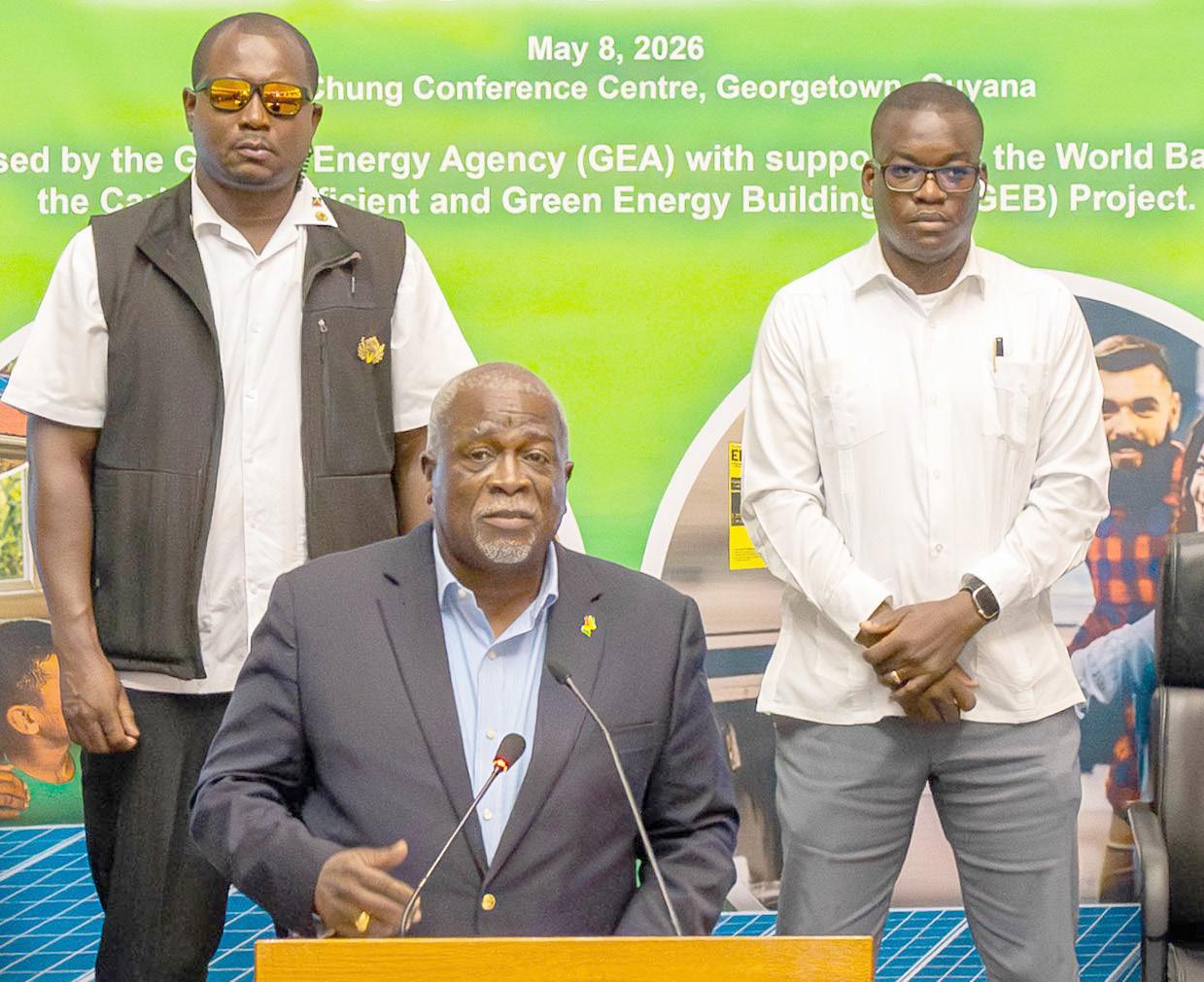
Under the Caribbean Efficient and Green Energy Buildings (CEGEB) Project, the World Bank is lending its support to Guyana to scale-up EE investments in public buildings and facilities, strengthen regulatory frameworks and build local capacity.
The seminar aimed to share global World Bank experiences and lessons from successful EE programmes, present the World Bank’s EE Scale-Up Strategy and its relevance for Guyana, create awareness of the importance of EE in public buildings and facilities, discuss market and financing mechanisms to unlock EE investments, and identify practical next steps for scaling EE market transformation under CEGEB and beyond. The seminar targeted key government of Guyana agencies including GEA, the Ministry of Finance, GPL, GNBS, and the Ministry of Housing, to name a few.
Delivering the keynote address, Prime Minister Phillips posited that the CEGEB Project, supported by the World Bank, is the vehicle through which we are seizing opportunities in the public sector.
“In our public buildings, that is the schools, hospitals, offices, police stations, these are facilities operated by the government, so we must lead by example, retrofitting our public buildings, encouraging energy efficient standards,
new construction, establishing building energy codes, setting minimum energy performance standards for lighting, air conditioning, refrigeration and future appliances are grounded, and programmes that the Guyana Energy Agency and our partners are advancing, and it has our government’s full and unambiguous support,” the Prime Minister said.
He noted that the current period of heightened geopolitical uncertainty being experienced around the world, along with ongoing international conflicts, tensions in major oil producing regions, disruptions to global shipping routes and instability in energy markets have driven fuel prices significantly higher.
However, Guyana has experienced an average of 74.8 per cent increase in fuel import costs since the start of 2026 alone. Gasoline acquisition costs rose by 62.4 per cent, diesel by 7.3 per cent, and jet fuel by an extraordinary 102.6 per cent the PM revealed.
These numbers, according to Prime Minister Phillips, translates directly to a higher cost for utilities, businesses and for each household in Guyana.
“Our government has taken steps to shield our citizens. The excise tax on fuel has been held at zero per cent since March 2022, and we continue to monitor markets and engage with local oil companies on mitigation measures. We are expanding fuel storage capacity and
investing in infrastructure to reduce the risk of supply disruptions, but these are defensive measures. The strategic answer that addresses the root of our vulnerability is to reduce our dependence on imported energy through the twin pillars of renewable energy supply and energy efficiency,” he said. Additionally, he said that Guyana must embrace energy efficiency, which is described as the cheapest, cleanest, and most immediately available energy resource in any country around the globe, with the same ambition and urgency we bring to our supply side investments.
The PM acknowledged the government’s strides in this regard with the addition of more than 186 megawatts of new generating capacity. Government has also constructed solar farms, completed a few hydro power plants, installed over 46 solar mini grids and distributed 37, 230 Solar Home Energy Systems. This adds more than 37 megawatts of renewable energy. The government is also advancing the 165 megawatts Amelia Falls Hydropower Project.
Sharing similar remarks, Senior Minister with Responsibility for Finance Dr. Ashni Singh said that when we speak on energy security, it is not merely about ensuring we have adequate energy but also ensuring that we use what we have as efficiently as possible.
By Indrawattie Natram
HISTORY was created in Region Two (Essequibo Islands-West Demerara) on Friday with the commissioning of an AutoCAD Laboratory at Abram Zuil Secondary School.
This marked a major step forward in technical and vocational education and training (TVET) delivery in Guyana, according to Minister of Education Sonia Parag during her address at the commissioning of the ‘lab’.
She described the initiative as “a gateway to opportunities”, aligning it with the theme of the launch: “Towards Enhancing and Fostering Quality, Relevance and Equitable TVET Delivery”.
Minister Parag noted that Guyana is moving steadily
towards achieving universal secondary education through the construction of more schools and expanded access to learning opportunities across the country.
She highlighted that TVET in Region Two has been rapidly evolving, and the commissioning of the AutoCAD laboratory, which is a first for the region, accelerates the growth of this area.
According to the minister, the state-of-the-art facility will play a vital role in shaping Guyana’s future workforce by equipping students with modern technological skills and preparing them to become globally competitive.
She said students will now have opportunities to explore concepts in 3D design and computer-aided
drafting, as technology continues to integrate societies and industries worldwide.
The minister further revealed that four additional AutoCAD laboratories are expected to be commissioned as the Ministry of Education continues to modernise technical education across Guyana.
Deputy Chief Education Officer (TVET) Dr. Ritesh Tularam described the laboratory as a significant investment in the future of students at Abram Zuil Secondary and neighbouring schools.
Dr. Tularam related that the ministry has transitioned from traditional drawing boards and set squares to modern AutoCAD systems, noting that technical education delivery has advanced significantly in recent years.

THE Financial Intelligence Unit (FIU) has issued a public warning following reports of an individual falsely claiming to be an employee of the agency and attempting to solicit personal and business information from members of the public.
The unit, in a notice, expressed concern over these incidents, noting that such actions are unauthorised and fall outside the scope of its lawful operations.
In a statement, the FIU made it clear that no employee or representative has been granted authority to approach individuals or businesses to request information in the manner described.
The agency emphasised
that its functions are strictly governed by law and do not permit informal or unsolicited collection of sensitive data from the public.
The FIU was established under Section 9(1) of the Anti-Money Laundering and Countering the Financing of Terrorism Act of 2009, as amended.
Under its mandate, the unit is authorised to request, receive, analyse, and assess suspicious transaction reports and other relevant information. However, such information is only obtained through formal channels, including submissions from reporting entities or competent authorities in a prescribed format. According to the FIU, legitimate requests for in -
He said the modern laboratory will provide students with practical skillsets and competencies in computer-aided design and engineering, ensuring they are better prepared for future careers in technical fields.
Regional Chairman Devin Mohan said the commissioning reflects the tremendous transformation taking place within the education sector, and emphasised that the initiative promotes innovation and creativity among students.
Regional Education Officer Shondelle Hercules stated that the commissioning represents more than the opening of a laboratory, describing it as an investment in innovation, workforce development, and technological advancement.
She noted that AutoCAD is widely utilised within engineering and technical fields, and will help prepare students for meaningful ca-
reer opportunities.
Hercules added that the initiative promotes equity by ensuring that technological resources become accessible to students across secondary schools in the region.
She related that the laboratory will strengthen digital competencies, support career pathways in surveying and information technology, and contribute to Guyana’s broader educational transformation and skilled workforce development.
Headteacher of Abram Zuil Secondary School Jerome Rajpersaud said the new facility was created to provide students with hands-on experiences in modern technology and technical education.
Rajpersaud expressed confidence that the laboratory will inspire excellence within the technical field, while enabling students to confidently navigate an increasingly technological world.
He thanked teachers and staff members for their dedication in ensuring the successful completion of the project and extended gratitude to the TVET Unit, the Ministry of Education, and the Government of Guyana for making the historic achievement possible.
The laboratory has been outfitted with 15 Nitro V15 computers equipped with 16GB RAM and 512GB hard drives, a 72-inch smart board, and a 24-inch plotter.
Special recognition was also given to Head of the Industrial Technology Department Rishi Narine, along with technical teachers and students who constructed the furniture for the laboratory, and worked extensively to ensure the facility was fully functional.
Also attending the ceremony was Dr. Kofi Dalrymple, Dean of the Faculty of Engineering and Technology at the University of Guyana.
formation are made in writing on official letterhead or transmitted through its secure information exchange platform, known as caseKonnect, which is used by designated reporting entities and authorised agencies. The unit stressed that any deviation from these procedures should be treated as suspicious.
The FIU urged the public and the business community to remain vigilant and to refrain from sharing any information with individuals who claim to represent the agency without proper verification. In cases where such requests are made, the public was strongly advised to report the matter to the Guyana Police Force for investigation.
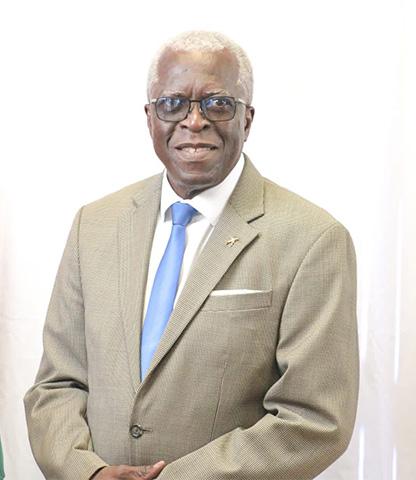
THE Aviation Operators Association of Guyana (AOAG) has congratulated Lt. Col. (ret’d) Egbert Field, Director General of the Guyana Civil Aviation Authority, on his election as Chairman of the Caribbean Aviation Safety and Security Oversight System (CASSOS).
This appointment, the association said in a press release, is a fitting recognition of Lt. Col. (ret’d) Field’s decades of distinguished service to aviation, his deep technical expertise, and his unwavering commitment to the advancement of civil
aviation within Guyana and the wider Caribbean Community.
“Under his stewardship, the Guyana Civil Aviation Authority has continued to strengthen regulatory oversight, modernise operational standards, and promote a culture of safety, professionalism, and sustainable growth within the aviation sector.
His leadership has earned the respect of operators, regulators, and aviation professionals throughout the region,” the association said.
Lt. Col. (ret’d) Field’s election to lead CASSOS comes at

an important time for regional aviation, as CARICOM states continue to pursue greater co-operation, harmonisation of standards, and enhanced connectivity across the Caribbean.
“We are confident that his steady leadership, experience, and collaborative approach will serve the organisation and the region exceptionally well,” the association said.
As he assumes this important regional responsibility, the association pledged its full support and looks forward to working closely with him and CASSOS in advancing the shared goals of safety, operational excellence, capacity building, and the continued growth of Caribbean aviation.
“We wish Lt. Col. (ret’d) Field every success in his tenure and are confident that his leadership will leave a lasting and positive impact on regional aviation,” the association said.
The aviation body also recognised Lt. Col. (ret’d) Field’s longstanding commitment to engaging industry stakeholders and fostering constructive partnerships in support of aviation development.

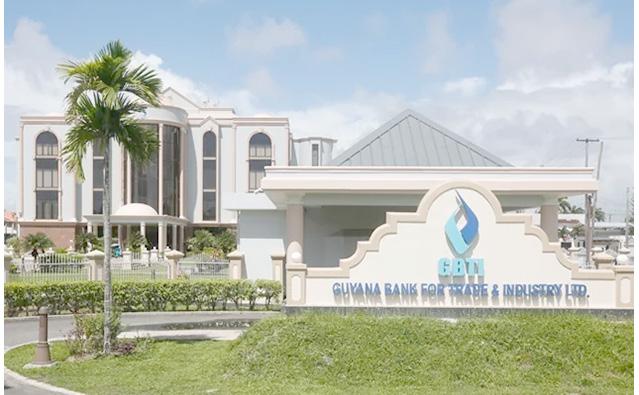
THE Guyana Bank for Trade and Industry (GBTI) has announced a sweeping overhaul of its mortgage portfolio, unveiling a new rate structure with interest as low as three per cent, in a move aimed at making homeownership more attainable for Guyanese families.
According to a press release from the bank, effective May 1, 2026, the revised rates are designed to support a wide cross-section of borrowers, from low-income and young professionals seeking their first home to customers building or refinancing higher-value properties.
According to the bank, the rates are tiered by loan size, starting at 3.5 per cent for mortgages up to $4 million, with incremental increases across higher brackets and negotiable terms above $60 million, while customers who deepen their relationship with the institution through the
GBTI Advantage rewards programme can qualify for a further reduction of up to 0.5 percentage points, bringing the effective rate down to as low as three per cent for smaller loans.
The bank noted that loans up to $30 million in project cost may also fall under its Low-Income Housing Loan category, aligning its offerings with the government’s expanded low-income mortgage ceiling and thereby broadening access to cheaper finance for first-time homeowners.
GBTI has said that the combination of lower interest rates and rewards for customers who centralise their salary deposits, card services, insurance and investments with the bank translates into tangible monthly savings.
In the press statement, Senior Manager of Marketing, Pernell Cummings, said the bank wants every Guyanese family to feel that owning a home is more achiev-
able than ever, emphasising that the new rates and the GBTI Advantage programme are about “real savings, real value and a banking relationship that grows with you.”
Chief Executive Officer, Shawn Gurcharran, framed the move within GBTI’s broader philosophy of building lifelong partnerships, noting that the institution aims to stand with customers from their first savings account to their first home and beyond.
He reiterated that the bank’s tagline, “Seeing Guyana Through Your Eyes,” is more than a marketing line and instead serves as a guiding principle for how it designs products in a rapidly changing economy.
The announcement comes at a time when Guyana’s housing sector is undergoing rapid expansion, buoyed by the country’s oil-fuelled economic growth and an aggressive public policy push to deliver serviced lots and turnkey homes to thousands
THE Ministry of Natural Resources announced Friday that it has reached the end of its tether and begun taking action against errant miners bent on polluting the Walabaka Creek and its environs despite being warned repeatedly against doing so.
The crackdown reportedly began on Monday, May 4, when a Guyana Geology and Mines Commission (GGMC)-led enforcement team, supported by members of the Guyana Police Force, was deployed to the Walabaka area to take the necessary action, and has resulted in “more than 15 pieces of mining equipment, including engines, excavators and pumps” being seized.
According to a release from the ministry, “the Walabaka Basin has been a source of concern since late 2024 due to persistently high levels of turbidity, commonly referred to as muddy water, resulting from mining activity within the area.”
It said that “over the past several months, the Mines Technical and Environmental Departments of the Guyana Geology and Mines Com -
mission (GGMC) have been working with operators to improve the containment of tailings and prevent the release of sediment-laden water into nearby waterways.
But despite their best efforts, “some errant miners have continued to directly discharge tailings and release turbid water from holding ponds into the Walabaka Creek”, which has had “a direct impact on Pump Creek, where the Guyana Water Incorporated (GWI) pumps water for treatment and distribution to residents of Port Kaituma.”
On the intervention of Minister of Natural Resources Vickram Bharrat and Minister of Housing Collin Croal on April 26, “the errant miners were given two weeks to bring their operations into compliance and were clearly advised that failure to take corrective action would result in consequences.”
Things would come to a head when hundreds of residents of Port Kaituma were affected by GWI’s inability to supply water due to the high levels of turbidity caused by the continued action of the irresponsible miners.
According to the release, “the Ministry of Natural Resources wishes to make it clear that while mining remains an important pillar of Guyana’s economy, it must be conducted responsibly and in full compliance with the law. Operators are required to take all necessary steps to prevent environmental damage, protect water sources and safeguard the health and well-being of communities.
In closing, the ministry said that it will, “through the GGMC continue to monitor the Walabaka drainage basin and other mining areas across the country to ensure compliance with environmental and mining regulations. Operators who continue to act in disregard of the law will be held accountable.”
It also sought to “assure the residents of Port Kaituma and surrounding communities that their concerns are being treated with urgency,” and that “the Government of Guyana remains committed to ensuring that mining development does not come at the expense of public health, clean water access, or environmental protection”.
–– with offers starting form three percent
of citizens.
In Budget 2026, the government allocated some $159.1 billion to the housing sector, with targets to distribute 15,000 new house lots, construct 8,000 homes across income brackets and deliver thousands of titles.
It was also reported that the steady escalation of the low-income mortgage ceiling over the past six years, noting that the threshold, which stood at $8 million in 2020, was first increased to $20 million and has now moved to $30 million as the admin-
istration seeks to keep pace with rising construction costs and ensure that lower- and middle-income earners can still qualify for favourable borrowing terms.
That policy shift has been reinforced by direct presidential interventions in the mortgage market: President Irfaan Ali previously pressed the New Building Society to raise its mortgage limit to $30 million with a cap of five per cent on interest, and had repeatedly argued that targeted measures, including interest rate reductions,
have already contributed to a marked increase in the volume of housing loans disbursed.
Against this backdrop, the mortgage market has become increasingly competitive, with commercial banks repositioning themselves to capture new borrowers.
Earlier this year, Republic Bank (Guyana) announced that it was removing the cap on its residential mortgage ceiling and offering loans up to $60 million at five per cent interest, reinforcing a trend of downward pressure on rates and upward movement on loan limits as institutions chase a rapidly expanding pool of prospective homeowners.
GBTI’s new structure goes a step further by setting a floor below 3.5 per cent and by tying additional rate cuts to the depth of a customer’s relationship with the bank, signalling a strategy that blends price competition with customer retention.

THE Canadian-funded Justice Education Society (JES) Guyana Programme will officially conclude on September 30, bringing to a close four years of collaboration with the Office of the Director of Public Prosecutions (DPP) aimed at educating hinterland communities about domestic and sexual violence.
The impending conclusion of the programme was highlighted during a recent
lage leadership, noting that the training of Toshaos and senior village councillors remains critical to long-term change.
She stressed that education remains central to building stronger communities and fostering generational transformation.
During the engagement, the DPP reflected on the message she consistently shared during outreach visits: that young Amerindians
nities places it in a strong position to offer guidance in matters relating to Guyana’s Amerindian populations, particularly in areas linked to technology, connectivity and community development.
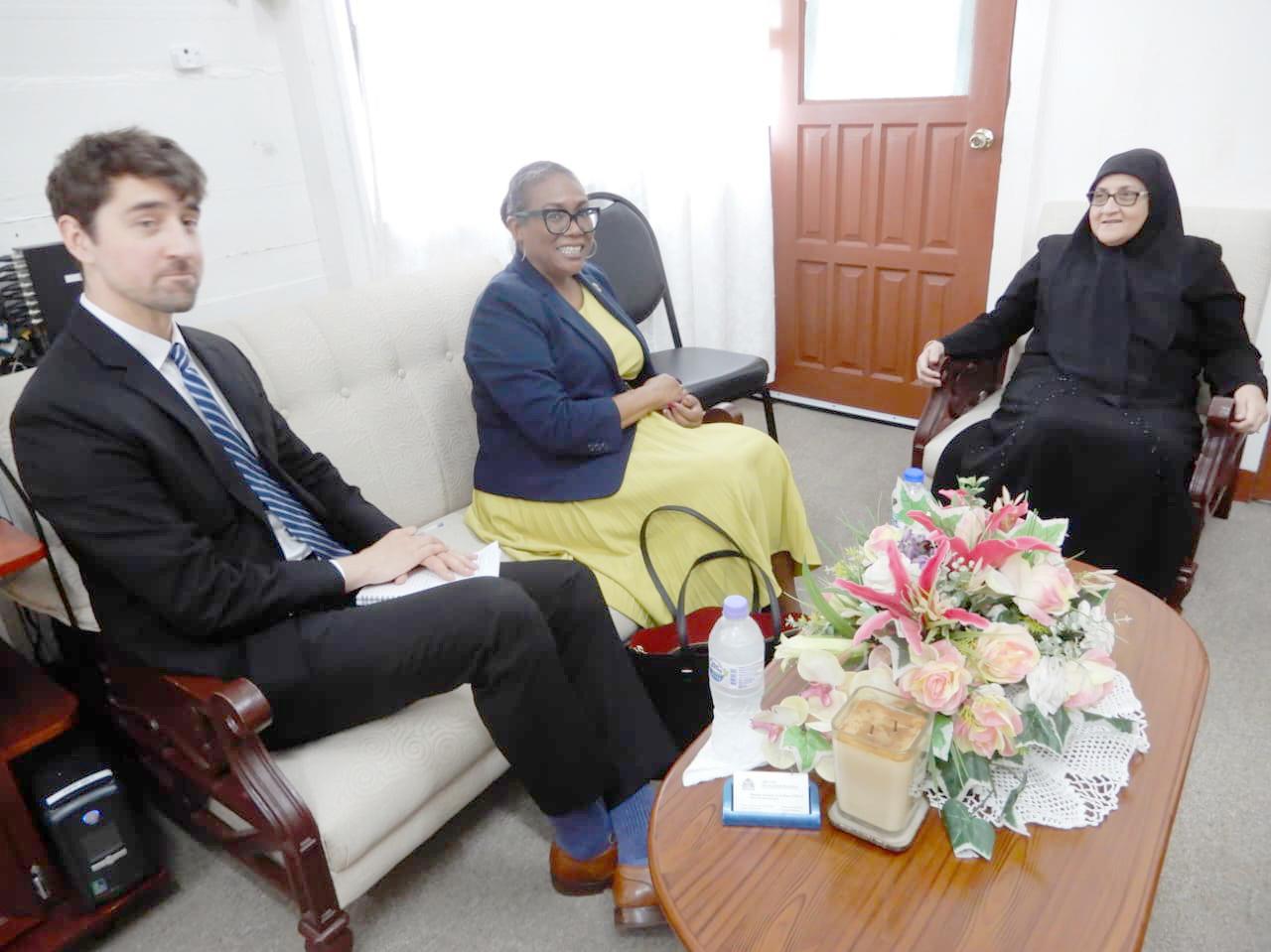
farewell courtesy call on Director of Public Prosecutions, Shalimar Ali-Hack, by Lisa Thompson, Country Director of the Justice Education Society, who was accompanied by International Programme Director, Gavin Martyn. During the meeting, Thompson thanked the DPP’s Chambers for its support through a series of joint outreach and community engagements, particularly in hinterland Regions One and Nine.
According to the DPP, the programme made significant strides in sensitising Amerindian communities, especially women and girls—on issues surrounding domestic and sexual violence.
Ali-Hack said the initiative also demonstrated the importance of targeting vil-
should take their education seriously, from primary through tertiary level, and then return to their communities equipped to contribute to local development.
Ali-Hack also noted that many Amerindian communities are now benefitting from electricity, internet access and ICT hubs, opening new opportunities but also exposing residents to social challenges.
She pointed to the growing presence of loud music, intoxicants and illicit drugs in some communities, warning that these issues must also be taken into account during public education and outreach efforts.
Thanking the Canadian-funded initiative for its contribution, the DPP said Canada’s own experience with Indigenous commu -
Over the past four years, the DPP’s Chambers and JES conducted outreach programmes in several hinterland communities, including Moruca and Baramita in Region One, as well as the Deep South Rupununi villages of Potarinau, Shulinab, Meriwau and Quiko in Region Nine.
Beyond community outreach, the programme also partnered with the DPP’s Chambers to provide cultural sensitisation training for members of the Guyana Police Force, police prosecutors and legal staff attached to the DPP’s Office in those regions.
The conclusion of the JES Guyana Programme marks the end of a notable chapter in justice education and community engagement in the hinterland, where efforts to improve awareness of violence, rights and access to justice have increasingly been viewed as essential to strengthening vulnerable communities.
THE regional health sector is set to receive a welcome injection of support with the signing of a new co-operation agreement between the Caribbean Community (CARICOM) and the Government of Spain.
The agreement, according to a press release from CARICOM, formalised Spain’s €400,000 contribution to “Strengthening Regional Leadership, Governance and Coordinated Action in Health to Address New and Existing Health Challenges in the Caribbean Community (CARICOM),” which is being implemented by the CARICOM Secretariat and the Caribbean Public Health Agency (CARPHA).
It was signed on Wednesday, May 6, 2026, by the CARICOM Secretary-General, Dr Carla Barnett, and the Ambassador of Spain to CARICOM, María Cristina Pérez Gutiérrez, during
the Tenth Meeting of the Joint Technical Committee (JTC) of the CARICOM–Spain Joint Fund for Scientific and Technical Cooperation.
In her opening remarks, Co-Chair of the Meeting, Assistant Secretary-General, Foreign and Community Relations Directorate, Elizabeth Solomon, underscored the value of the CARICOM-Spain partnership, noting “the CARICOM-Spain Joint Fund continues to play an important role in advancing regional priorities through co-operation that has evolved into a results-oriented programme of support that is both practical and responsive delivering tangible benefits to the people of the Caribbean Community.”
Pérez Gutiérrez, who also chaired the session, reaffirmed Spain’s commitment to CARICOM, noting, “Spain values its partnership with CARICOM and remains com-
mitted to supporting initiatives that strengthen resilience, sustainability and regional co-operation.”
The Committee considered two new regional project proposals with a combined value of US$700,000.
The first proposal targets “Greening Caribbean Ports Programme (GCPP): Advancing Sustainable Maritime Infrastructure in Caribbean Small Island Developing States,” and is expected to be implemented by the Caribbean Centre for Renewable Energy and Energy Efficiency (CCREEE) and the Port Management Association of the Caribbean (PMAC).
The second proposal, titled “Strengthening the Caribbean Emergency Response Capabilities through the Next Level Regional Response Mechanism (RRM),” is expected to be implemented by the Caribbean Disaster Emergency Management Agency (CDEMA).

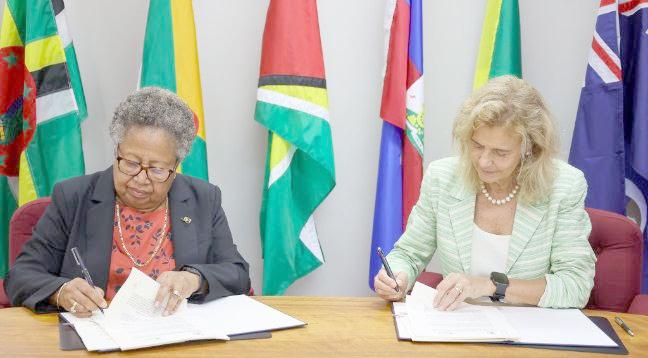
Both sides reaffirmed the CARICOM–Spain Joint Fund as a key in-
strument for supporting priority regional initiatives and strengthening technical co-operation between CARICOM and Spain.

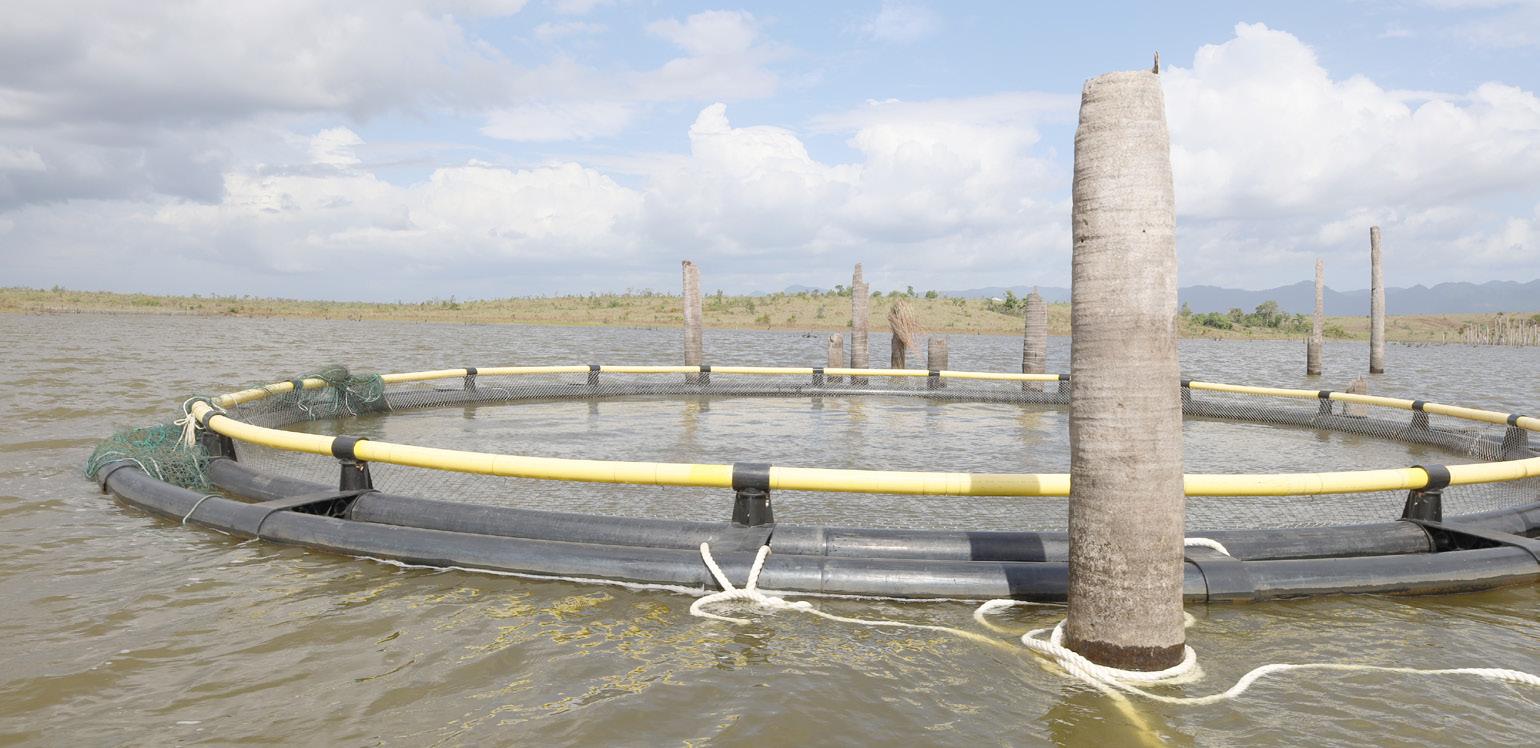
THE Ministry of Agriculture, through the Fisheries Department, has commenced cage aquaculture activities in Nappi Village, Region Nine, as part of the government’s ongoing efforts to expand aquaculture production and create sustainable income opportunities in hinterland communities.
Last October, five fish cages were assembled and subsequently installed in the Nappi Reservoir to facilitate the rearing of Tambaqui.
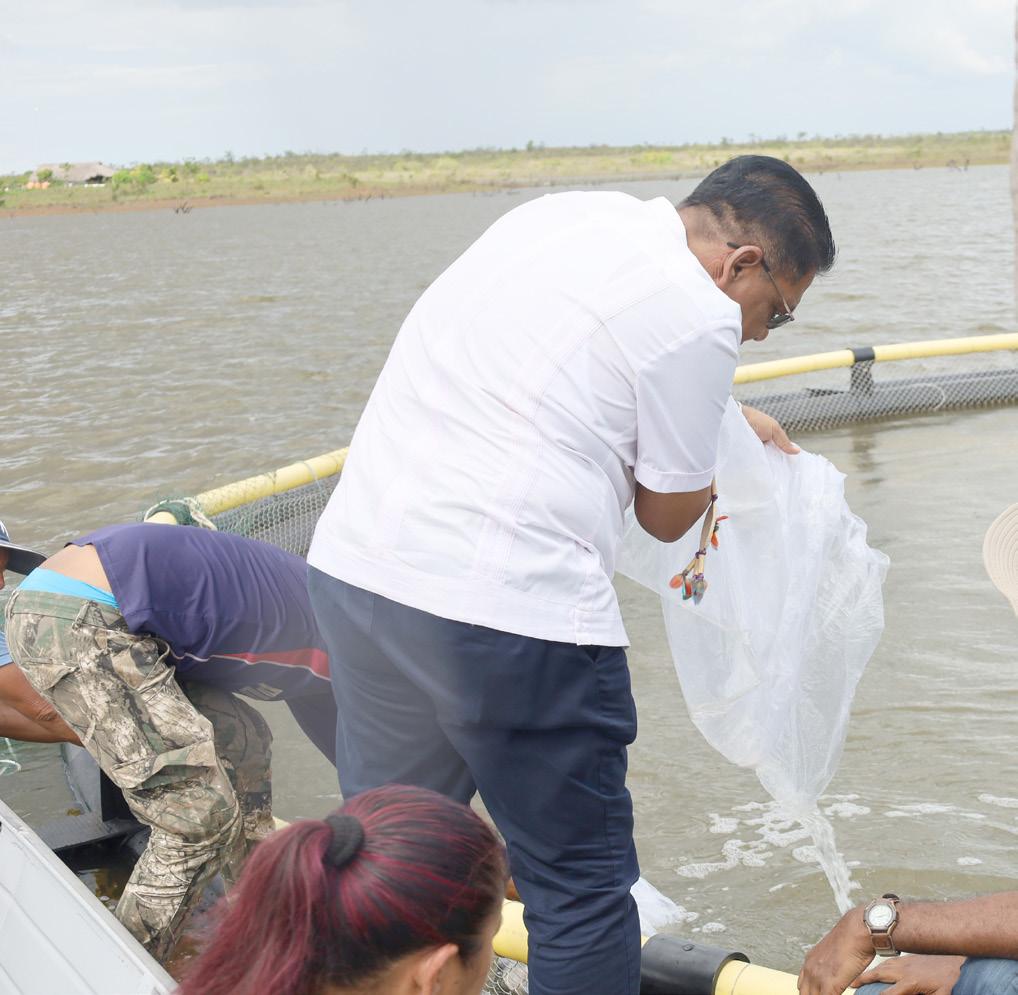
On Thursday, while in the region conducting a series of meetings with villagers, Agriculture Minister, Zulfikar Mustapha, visited the reservoir
and participated in stocking several of the cages with fingerlings.
While engaging residents, Minister Mustapha said the cage aquaculture initiative has emerged as one of the most transformative projects introduced in the agriculture sector since its inception.
He noted that when the idea was first pro -

posed by President Dr Mohamed Irfaan Ali, it faced significant criticism.
“When President Ali first spoke about the cage aquaculture initiative, many people had negative things to say. Today, we are seeing that this is one of the most transformative projects introduced by the Government of Guyana in the agriculture sector. This is because we have a President with a futuristic vision.
“The project is now enabling hinterland villages and communities to become more economically stable. While we will continue to provide assistance through our relief programmes, our government aims to make communities more self-sustainable while increasing their earning potential and economic standing,” he underscored.
Under the project, the government provides cages, fingerlings, and feed
to riverine and hinterland communities, along with technical support and training for villagers and beneficiaries.
Minister Mustapha also disclosed that, to ensure the long-term sustainability of the initiative, an aquaculture station is currently being established in Lethem.
He said that the facility will provide Tambaqui and Matrinxa fingerlings, along with additional support, to communities involved in cage aquaculture as well as approximately 12 communities currently engaged in pond aquaculture.
The facility, he added, will be equipped with tanks, water and aeration systems, pumps, and a backup power supply, and is expected to benefit more than 5,000 residents across the region.
With construction currently underway, the aquaculture station is expected to become fully operational before the end of July this year.
MINDFUL Guyana Inc. has signed a Memorandum of Understanding (MOU) with the Mayor and Town Council of New Amsterdam, creating a new partnership aimed at strengthening environmental stewardship, mental wellness and community development across Region Six.
The agreement, signed recently in New Amsterdam,
The MOU also provides for capacity-building workshops targeting community leaders and volunteers.
King said the New Amsterdam partnership forms part of a broader national initiative being advanced by Mindful Guyana Inc., which seeks to promote environmental responsibility alongside mental wellness.
He noted that the organisation has now formally es-

establishes a framework for collaboration between the organisation and the municipality, with both sides committing to initiatives designed to improve public spaces while promoting emotional resilience and healthier lifestyles among residents.
Chairman of Mindful Guyana Inc., Royston King, said the partnership will focus on the design and implementation of programmes that support cleaner, greener communities while encouraging mindfulness and mental well-being.
Under the agreement, the two sides will collaborate on environmental awareness campaigns, community clean-up activities, the development of green spaces and urban beautification projects, public education programmes on mindfulness, mental health and sustainable living, and youth initiatives that combine environmental responsibility with personal well-being.
ing community resilience, addressing stigma around mental health, and encouraging healthier lifestyles,” King said.
He added that the organisation also seeks to draw attention to the effects of pollution, poor sanitation and the lack of green recreational spaces on both
mental and physical health outcomes.
Representatives of both Mindful Guyana Inc. and the Mayor and Town Council expressed optimism that the agreement will provide a practical pathway for addressing environmental concerns while improving the emotional and social
well-being of residents.
“Mindful Guyana Inc. looks forward to working closely with the Town Council and the residents of New Amsterdam to build a more mindful, sustainable and resilient community,” King said.
The partnership comes at a time when local au-
thorities and civil society organisations are placing greater emphasis on holistic community development, with increasing recognition that cleaner environments, stronger social support systems and greater awareness of mental health are critical to improving quality of life.
tablished a regional chapter in Berbice, which will serve as a coordinating hub for activities in Region Six and help maintain sustained engagement with local stakeholders.
According to King, Mindful Guyana Inc. was established in response to growing national concerns over mental health challenges, including suicide, substance abuse and the wider social and environmental pressures affecting citizens’ well-being.
He said the organisation was founded on the principle that mental health is closely linked to environmental conditions, arguing that neglected surroundings can contribute to stress, anxiety and other psychological challenges while also worsening non-communicable diseases such as hypertension and diabetes.
“Through its work, Mindful Guyana Inc. focuses on promoting mindfulness practices, strengthen -

THE Government of Guyana, through Guyana Power and Light Inc. (GPL), has signed a landmark contract with PowerChina International Group Limited for the engineering, procurement and construction of a 60 MWh / 30 MW Battery Energy Storage System (BESS), along with associated substation expansions and systems integration, at a contract sum of US$27,366,171.06.
The contract signing was led by Kesh Nandlall, Head of GPL’s Executive Management Committee, along with Divisional Director Ryan Ross and other personnel from GPL and PowerChina International Group Limited.

Under the project, two 30 MWh / 15 MW lithium-ion battery systems will be installed at the New Sophia and Goedverwagting substations in Region Four. The project will add 30 MW of power to GPL’s grid and significantly improve the stability and reliability of the Demerara-Berbice Interconnected System (DBIS).
The systems will be integrated with the Guyana National Control Centre (GNCC) through modern SCADA, Energy Management and Automatic Generation Control systems. The project also includes spare parts, maintenance services and training for GPL engineers and is expected to be completed within eight months.

The contract signing was led by Kesh Nandlall, Head of GPL’s Executive Management Committee, along with a representative of PowerChina International Group Limited
Speaking during the signing, Mr. Nandlall noted that the project represents a major step in strengthening Guyana’s electricity infrastructure. He explained that the Battery Energy Storage System will help reduce the frequency and duration of outages, improve power restoration through its black start capability and support the integration of renewable energy sources in keeping with Guyana’s
LCDS 2030 goals. GPL remains committed to investing in modern infrastructure aimed at improving the reliability, efficiency and sustainability of electricity supply across Guyana.

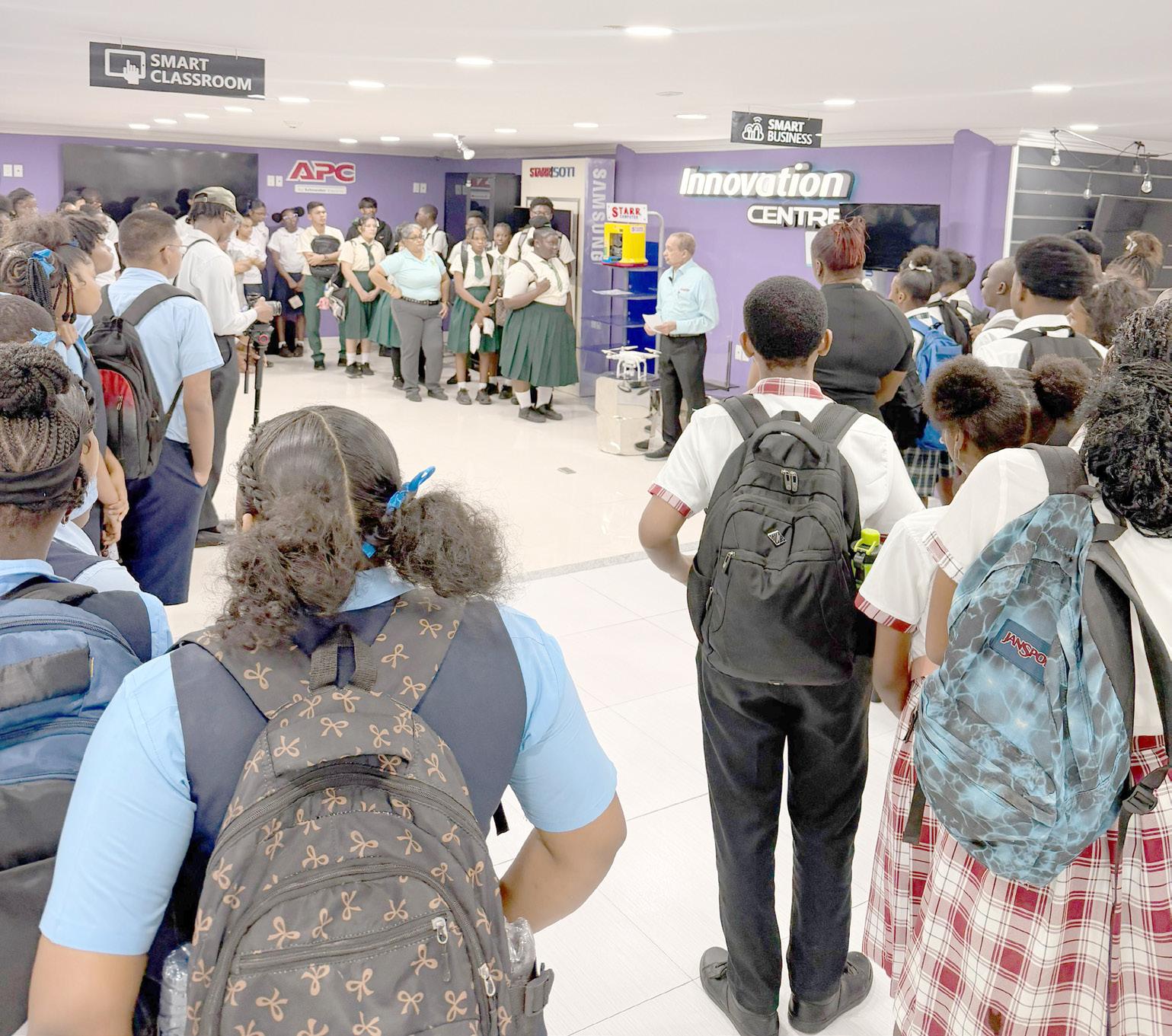
President of STARR Computer and businessman Mike Mohan speaks to students about the importance of hydroponics and technology-driven agriculture as vital tools for Guyana’s future
PRESIDENT of STARR Computer and businessman Mike Mohan has underscored the importance of hydroponics and technology-driven agriculture as vital tools for Guyana’s future, telling secondary school students that innovation and entrepreneurship will play a central role in building the country’s next generation of leaders.
Mohan made the remarks during a recent engagement with students at the STARR Computer showroom on Brickdam, Georgetown, where he addressed young people on the growing opportunities emerging from the intersection of agriculture, technology and business.
Speaking in support of the state-of-the-art Agriculture and Innovation Entrepreneurship Programme (AIEP) hydroponic farm at Fort Wellington, West Coast Berbice, Mohan described the initiative as a powerful symbol of Guyana’s advancing agricultural transformation.
The AIEP hydroponic project, officially launched during the 2023 Agri-Investment Forum and Expo, was designed to promote high-tech, sustainable agriculture while encouraging greater youth participation in agribusiness.
With Guyana placing increasing emphasis on food security, diversification and innovation, hydroponics has emerged as one of the most promising methods of producing crops efficiently while using less land and water than conventional farming.
The Fort Wellington facility is expected to serve not only as a production site but also as a training hub for emerging agri-entrepreneurs.
The hydroponic farm is also expected to become a regional model for modern agriculture across the
“This project demonstrates what’s possible when we combine technology, investment and young talent to create a resilient agricultural sector,” Mohan said, while praising the hydroponic initiative as a practical example of how modern farming can drive national development.
Caribbean, contributing to national and regional food security efforts while exposing young Guyanese to new career paths in agribusiness.
Mohan’s engagement with students forms part of a broader effort to connect young people with emerging industries and entrepreneurial opportunities.
Students from five secondary schools are scheduled to participate: New Carmel Secondary, West Ruimveldt Secondary, Houston Secondary, Richard Ishmael Secondary and Christ Church Secondary.
The almost 80 students, aged 15 to 16 and drawn from Grade 10, represent a key stage in their academic development, the year immediately before their final secondary school year.
By exposing students to innovation in agriculture at this stage, Mohan said, the aim is to broaden their understanding of the industries shaping Guyana’s future and inspire them to see entrepreneurship not as a distant ambition, but as a real and attainable pathway.








REPUBLIC Bank Financial Holdings Limited (RBL), in partnership with Cricket West Indies (CWI), the Guyana Cricket Board (GCB) and the Government of Guyana, officially launched the fourth edition of the Republic Bank ‘Five for Fun Cricket’ programme on Thursday, April 30, 2026.
Held at the picturesque Everest Cricket Club in Georgetown, the well-attended launch set the tone for what promises to be the programme’s biggest and most inclusive season yet.
A lively ‘Five for Fun’ skills demonstration by students of Winfer Gardens Primary, Stella Maris Primary and Redeemer Primary, was one of the main attractions of the launch which was also attended by distinguished attendees including former West Indies captain Ramnaresh Sarwan, as well as current West Indies women’s players Mandy Mangru and Cherry-Ann Fraser.
After reaching 75 schools across Essequibo, Demerara and Berbice in its first three years, the initiative has expanded significantly in 2026, with over 100 primary schools now set to participate.
Notably, schools from Administrative Regions One and Nine will be included for the first time in a pilot phase, as announced by National Coordinator and former West Indies fast bowler, Reon King.
“The Republic Bank ‘Five for Fun’ Programme is designed for boys and girls between the ages of seven and 11. The fast-paced format introduces young players to structured cricket coaching while emphasising the fundamentals of the game in an engaging and accessible way.
"The programme will progress across four phases: schools training period, zonal playoffs in June, county playoffs in September and national festival finals slated for October,” King explained.
More than just cricket, the programme promotes team work, confidence, discipline and resilience through a series of fun, high-energy matches
played under simplified rules. It also plays a vital role in fostering early athletic development and life skills among participants.
President of the Guyana Cricket Board, Bissoondyal Singh, underscored the programme’s broader impact, saying: “Together, we are working to strengthen, and in some cases, reintroduce cricket at the primary-school level where passion is first ignited, dreams begin and character is shaped. We recognise that the investment in this programme goes far beyond the boundary ropes.
“It is not simply about competition, it is about inclusion, opportunity and development. It ensures that both boys and girls are given equal access to learn, play and grow within the game. More importantly, it allows them to cultivate a love for cricket, while developing essential life skills that will serve them well beyond the field.”
Singh, who is also a Director of Cricket West Indies further stated that, “At its core, the Republic Bank “Five for Fun” Cricket Programme is about holistic development. It creates a space where children can explore, express themselves, and build critical qualities such as leadership, patience, teamwork, resilience, confidence, discipline, and responsibility.
“These are not just sporting attributes, they are life attributes. Cricket, as we know, is far more than a game. It is a powerful vehicle for positive behavioural change. This programme provides structure, purpose and guidance and offers a meaningful alternative to negative influences such as antisocial behaviour, unhealthy lifestyles, and excessive screen time, replacing them with team work, discipline and aspiration.”
Director of Sport Steve Ninvalle, representing the Ministry of Culture, Youth and Sport, highlighted the programme’s national alignment.
“The Republic Bank Five for Fun Programme aligns seamlessly with President Irfaan Ali’s ‘One
Guyana’ initiative. The Ministry of Youth, Sport and Culture is proud to support the programme’s expansion into pilot zones in Regions One and Nine, providing both boys and girls at the primary-school level with the opportunity to participate in a structured and inclusive cricket development pathway."
Chief Education Officer of the Ministry of Education, Saddam Hussain, also reaffirmed the ministry’s commitment.
"The Ministry of Education, through its Allied Arts Unit, is proud to continue its support of the Republic Bank ‘Five for Fun’ programme and is delighted by its expansion to include over 100 schools. The ministry recognises the programme’s vital role in contributing to the holistic development of our students, providing them with the opportunity to benefit from all that sport has to offer."
Speaking on behalf of the sponsors, Human Resources Manager of Republic Bank Guyana Limited, Jannis London, emphasised the organisation’s continued investment in youth development through sport.
“Today marks another chapter in the Republic Bank ‘Five for Fun’ Youth Cricket Programme, one that continues to grow, evolve and create real opportunities for young people across Guyana."
"This programme, which is part of our Power to Make a Difference social investment initiative, is not only about cricket , but about keeping our children engaged, active and focused. It’s about exposing them to values like [sic] team work, discipline, confidence and even the possibility of pursuing cricket at a professional level.”
Guyana’s launch marks the first of five territories for the 2026 season. St. Kitts and Nevis will follow on May 7, with Trinidad and Tobago and St. Lucia launching on May 13 and May 20 respectively. Barbados, the newest territory, will host its inaugural launch on May 28.

(ESPNCRICINFO) - Kolkata Knight Riders picked up their fourth win on the trot, their spin bowlers (120-76-3) capturing Delhi Capitals in a vice-like grip and never letting go. Finn Allen made sure that wouldn’t repeat in the second innings. He pulverised DC’s spinners (9-0-102-1) to score his first IPL century even though he only had 143 to chase.
Nissanka fifty
Pathum Nissanka scored a good half-century. He made 50 of DC’s first 85 runs at a strike rate of 172. The other end could only contribute 33 at a strike rate of 103. It was symbolic of how hard it was for a new batter to settle in and how much pressure comes on the set batter on a pitch like this. Even though he was going at a good clip, and had hit the previous ball for four, he still left his crease looking for more and was stumped off Anukul Roy. The left-arm spinner took another wicket, four balls later.
Roy starts the spin choke DC were 74 for 2 after eight overs. But only four of those overs were from spin bowlers and three of them were inside the powerplay. Given the comfort of five fielders on the boundary, and a pitch that was slow and turning, Roy, Sunil Narine and Varun Chakravarthy started to dictate proceedings.
At one point, DC scored just 11 runs in 30 balls. This was between overs 12 to 16. No IPL team in nearly two decades has ever been this sluggish in this period of play.
Roy set this choke up, stumping Nissanka out with a slower and wider delivery and bowling Tristan Stubbs out with the exact opposite of that. That was solid range for a bowler with no mystery about him.
runs, with only three boundaries, are the fewest by any batter this season having faced at least 50 balls) and the conditions not helping run-scoring, all Narine and Varun had to do was what they do so well. Amp up the mystery. Aim at the stumps. Narine finished with 4-0-17-1. Varun, badly limping when he bowled his final over which cost 16 runs, finished with 4-0-28-0.
Ashutosh Sharma broke a boundary drought that last 38 balls in the 17th over. He reverse swept Vaibhav Arora, coming around the wicket, for six in the 19th over. His cameo - 39 off 28 balls - carried KKR to 142 for 8.
Allen’s landmarks
For the first time in his IPL career, Allen played through the powerplay. This was his eighth innings. He might have felt bad for running out his captain Ajinkya Rahane when his straight drive flicked Mitchell Starc’s outstretched finger and deflected onto the stumps but he quickly got over it. DC played a part in that a well with Kuldeep Yadav and Vipraj Nigam bowling balls right in the slot. Allen is superb down the ground and needed no second invitation.
From 20 off 17, he launched 10 sixes, the last of them when KKR needed two to win and he needed six to bring up 100.
Allen had a strike rate of 235 against spin (73 off 31). The next best, from both teams, was Rahane with 167, benefiting from playing just three balls and scoring five runs.
Kuldeep’s struggle continues
In a match where his former team’s spinners held so much sway (economy rate 6.33), Kuldeep suffered, going at 13.66 an over even though he was spared the trouble of bowling in the powerplay.
Axar bowled three with the field up and still finished with figures of 4-0-27-1.

AS part of Guyana’s 60th Independence Diamond Jubilee Sports Tournaments, which saw its launching recently at the Cliff Anderson Sports Hall by Minister of Culture, Youth and Sport, Charles Ramson Jnr. and Minister within the Ministry, Steven Jacobs, the Georgetown Softball Cricket League (GSCL) Inc, will be staging a T20 three-category tournament, featuring the Legends Over-50, Masters Over-40 and Women.
The Over-50s comprise Regal Legends, Essequibo Legends, Pari-
ka Legends and Jai Hind Legends of Berbice and according to GSCL President, Ian John, the aim is to make the tournament a countrywide affair.
The four teams featuring in the Over-40 category are Caribbean Cricket Club Number 2 and Hibernia Strikers of Essequibo, Regal Masters and Lusignan Sports Club of Demerara.
The tournament is set to bowl off tomorrow at the Reliance ground in Essequibo with Caribbean Cricket Club Number 2 clashing with Hibernia Strikers from 14:00 hrs at
the Reliance ground.
The action switches to Demerara on Friday, May 15 with Regal Masters and Lusignan Sports Club battling at the Lusignan ground in the Masters category from 14:00 hrs.
On Saturday, May 16, it’s the turn of the Over-50s with Regal Legends taking on Essequibo Legends and Parika Legends confronting Berbice’s Jai Hind, the former on pitch one and the latter on pitch two at the Police Sports Club, ground, Eve Leary from 10:00 hrs.
The four women teams will join the action on Sunday morning, prior to the staging of all three finals later in the day at the Police Sports Club ground. 4R Lioness and Number 64 Knight Riders clash on pitch one while Linden’s Supreme Stars come to grips with Uprising on pitch two. The two winners will meet in the final.
The winners in the Over-50 category will take home $250,000 and the winners’ trophy while the runners-up are guaranteed $100,000 and a trophy.
The Over-40 winners will re-

(BBC) - Arsenal manager Mikel Arteta has told his players and fans to “stay present and live the moment” as the club prepare for a huge month in which they could secure a Premier League and Champions League double.
The Gunners are five points clear of second-placed Manchester City, who have a game in hand, at the top of the table and need three wins from their remaining three fixtures to claim a first league title in 22 years.
On Tuesday, they also reached their first Champions League final for 20 years with a 2-1 aggregate win over Atletico Madrid, and will face Paris St-Germain in Budapest on 30 May.
“We are closer and closer and everything that we do now is going to matter to win it or not,” said Arteta on Friday.
“Stay present, live the moment, prepare and show the same level of energy, hunger and desire that we have showed all season or more.”
Arsenal take on relegation-threat-
ened West Ham at London Stadium in the league on Sunday, Burnley at home on 18 May and Crystal Palace at Selhurst Park on the final day of the season, 24 May.
While the mood at the training ground is understandably high after their semi-final triumph this week, Arteta said his side’s “energy and detail” is solely focused on picking up three points against the Hammers, who are 18th, one point and one place from safety behind Tottenham.
He also acknowledged the reactiongood and bad - to the club’s celebrations following the Atletico game.
Former Manchester United forward Wayne Rooney said the scenes at Emirates Stadium were “a little bit too much”, but ex-Arsenal striker Ian Wright insisted the “fun police” should not stop players and supporters from enjoying the achievement.
Manchester City, who defeated the Gunners in the Carabao Cup final in March, face Brentford at Etihad Stadium
on Saturday, followed by Palace, Bournemouth and Aston Villa, with the FA Cup final against Chelsea in the middle of those fixtures.
City fought their way back into contention for a potential seventh league trophy under Pep Guardiola with an 11-game unbeaten run, claiming a 2-1 victory over the Gunners along the way.
But a 3-3 draw with Everton at Hill Dickinson Stadium on Monday meant they uncharacteristically stumbled in the title race.
City were leading 1-0 when they conceded three goals within 13 minutes in the second half. Jeremy Doku’s stunning strike - his second of the game - rescued a much-needed point for Guardiola side.
With three of their remaining four games at home, Guardiola knows the atmosphere at the Etihad will be important.
“I love to play at home, what can I say?” said the Spaniard. “Winning our games is all that we can do.”
ceive $200,000 and a trophy and the runners-up $50,000 while the winners of the women’s category will walk away with $100,000 and the runners-up $50,000.
All three ‘players of the match’ in each category will collect $5,000 and a trophy.
According to the Ministry of Culture, Youth and Sport, all finals for all the tournaments will be live streamed on the Ministry’s platforms, “reinforcing its commitment to advancing sport and ensuring it remains central to Guyana’s national development.”

SOUTH AFRICA RACING TIPS
GREYVILLE
08:20


PRESIDENT’S College and Plaisance Secondary were the top schools’ basketball outfits on Thursday when Youth Basketball Guyana hosted its East Coast Regional Conference.
President’s College then edged their East Coast counterparts, Golden Grove Secondary, 29-20.
Terron Mohabir continued to show his pedigree with an outstanding 14 points and three rebounds, with Romarion Wolfe supporting well with six points.
Plaisance Secondary beat Hope Secondary 29-8. Plaisance battled from tip-off with Christopher Ram leading the charge with 11 points.
However, the player of the match went to Trevor James for his all-round good showing as he grabbed eight points and seven rebounds. In the other clash, Good Hope beat Annandale Secondary by three points.
Director of Youth Basketball
Guyana Chris Bowman says they have begun hosting regional competitions at Linden, New Amsterdam and Corentyne, Berbice, Georgetown and East Coast as they move closer to the National Schools Basketball Festival.
“It really has been going quite well; the decision to really focus this year on the developmental

aspect of the region was the right decision. What we are seeing so far is so many new players, too many to count, teams and players.”
Bowman said the change in format has seen increased competition, which has forced them to expand regionally to include more teams.
“On the East Coast for the past few years, we have had President’s College competing in the Georgetown regionals because there wasn’t much competition on the East Coast for President’s College, but this year we have some really good games we have seen so far.”
He says they are also hosting a mini camp and training session in

ON Thursday, Beacon FC and Riddim Squad snatch semi-final wins in the Georgetown Football Association knockout football tournament.
Beacon, going up against Eastveldt Football Club, captured a 6-1 victory at the Plaisance community centre ground.
Antwone Vincent scored in the 15th minute to get Beacon FC off the mark before Stayon Murray recorded a double in the 20th and 22nd minutes to make it 3-nil.
Tamiel Hutson then stepped up to register a double of his own in the 25th and 29th minutes, putting them up 5-nil at the break.
Simon Emanuel then eroded some of the good work of his team with an own goal which gave Eastveldt a glimmer of hope.
However, in the dying minutes, Tefon Daly restored the cushion to ensure a 6-1 victory
and a place in the finals.
In the other clash of the evening, Riddim Squad clinched a 3-nil win over Vengy.
Dorville Stewart scored the early goal before Kelvin Gordon and Steffon Daniels scored on the brink of halftime to extend the advantage to 3-nil.
The second half saw no further changes to the score as Riddim Squad walked away with a comfortable win.
The final will be played on Saturday at the Plaisance Community Centre ground.
The teams are playing for a million in prizes, with half a million for the first-place prize, $300,000 for second place, $200,000 for third and $100,000 for fourth place along with trophies and medals.
The competition is sponsored by Nalico/Nafico Insurance.
the region as they look to set up a format for the competition at the Abram Zuil Secondary School.
The regionals continue on Sunday with the Georgetown leg at the sports hall with four matches set for the day.
Chase’s Academy will meet the Bishop’s High B; School of the Nations play the Bishop’s High A; St Stanislaus College play Tutorial High; and Marian Academy will clash with Queen’s College.
The regionals are sponsored by Edward B Beharry Ltd, G-Boats Inc., National Sports Commission, Ministry of Education and Banks DIH Ltd.
County Championship after suffering a hamstring injury.
The 37-year-old Barbadian, who was representing Durham, sustained the injury on the opening day of their match against Middlesex last Friday.
Roach had originally signed with Durham for the first half of the Championship season, bringing his five-year association with Surrey to an end.
Durham has opted to replace
Olivier had been expected to join Durham for the second half of the season, but the club brought forward his arrival following Roach’s injury.
Roach now finds himself in a race against time to be fit for the West Indies’ two Test series against Sri Lanka late next month.
The two teams will play two Test matches in Antigua, with the first match slated to bowl off on June 25, and the second match scheduled for July 3.