—President Ali set to deliver feature address as country takes centre stage
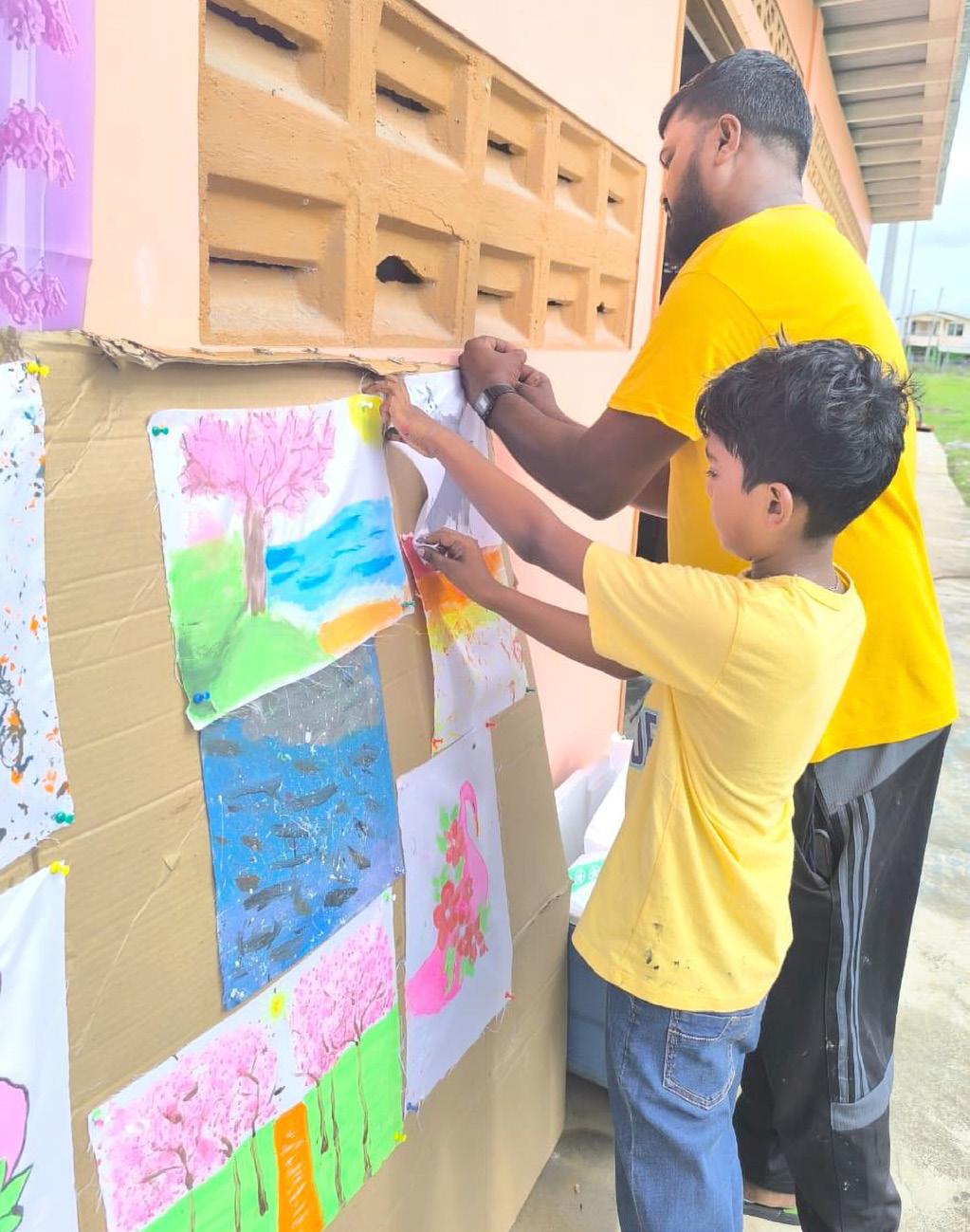
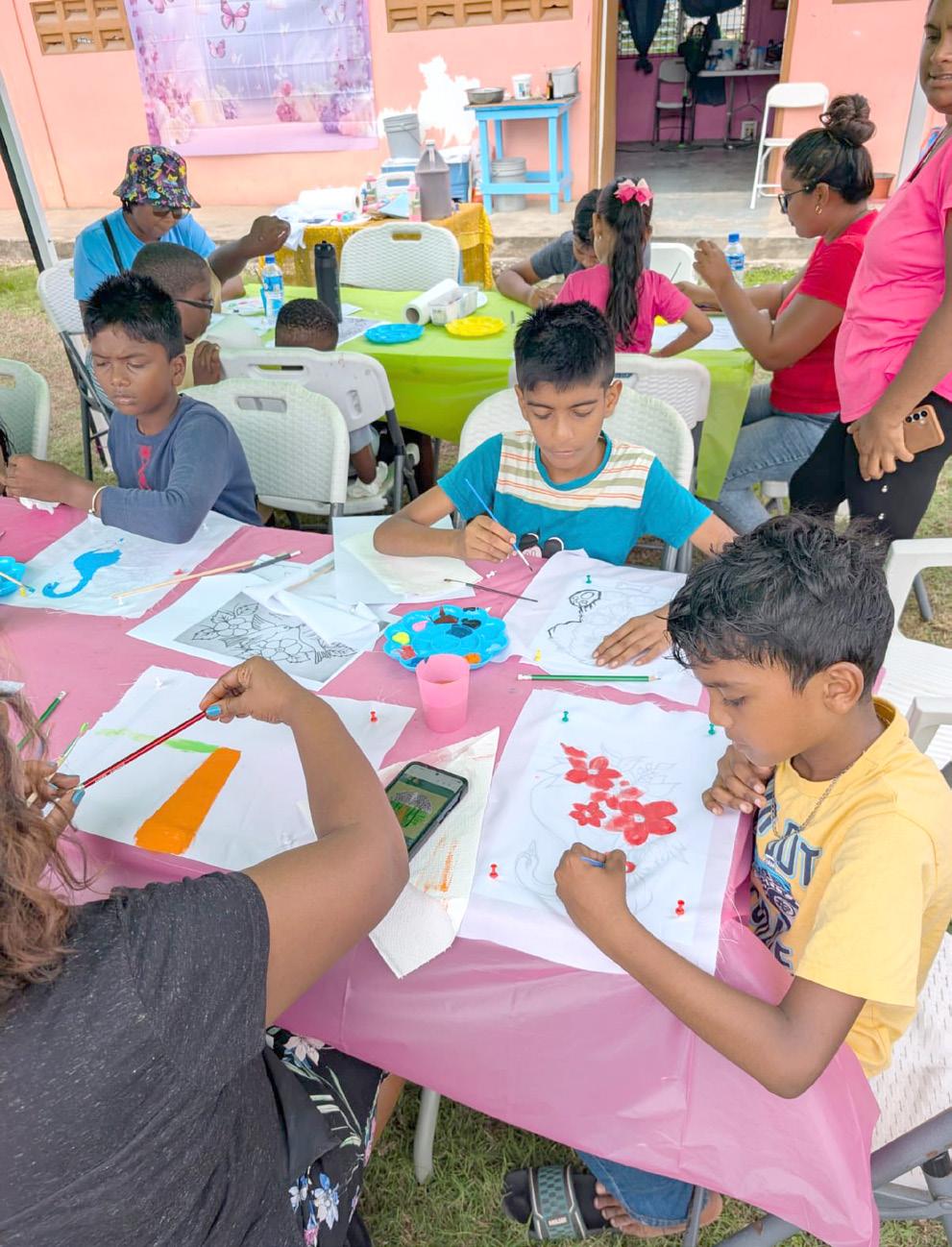
The Ministry of Human Services and Social Security kicked off Family Month 2026 with a ‘Paint Day’ hosted by the Family Enhancement Services Section at the Strathavon Community Centre Ground. Parents and children filled their canvases with colour, amid laughter and love as they were guided by the team of facilitators. This family month is celebrated under the theme “Repair, Rebuild, Strengthen” [ MHS&SS photos]
Port Kaituma Hospital gets new maternal waiting home among other facilities
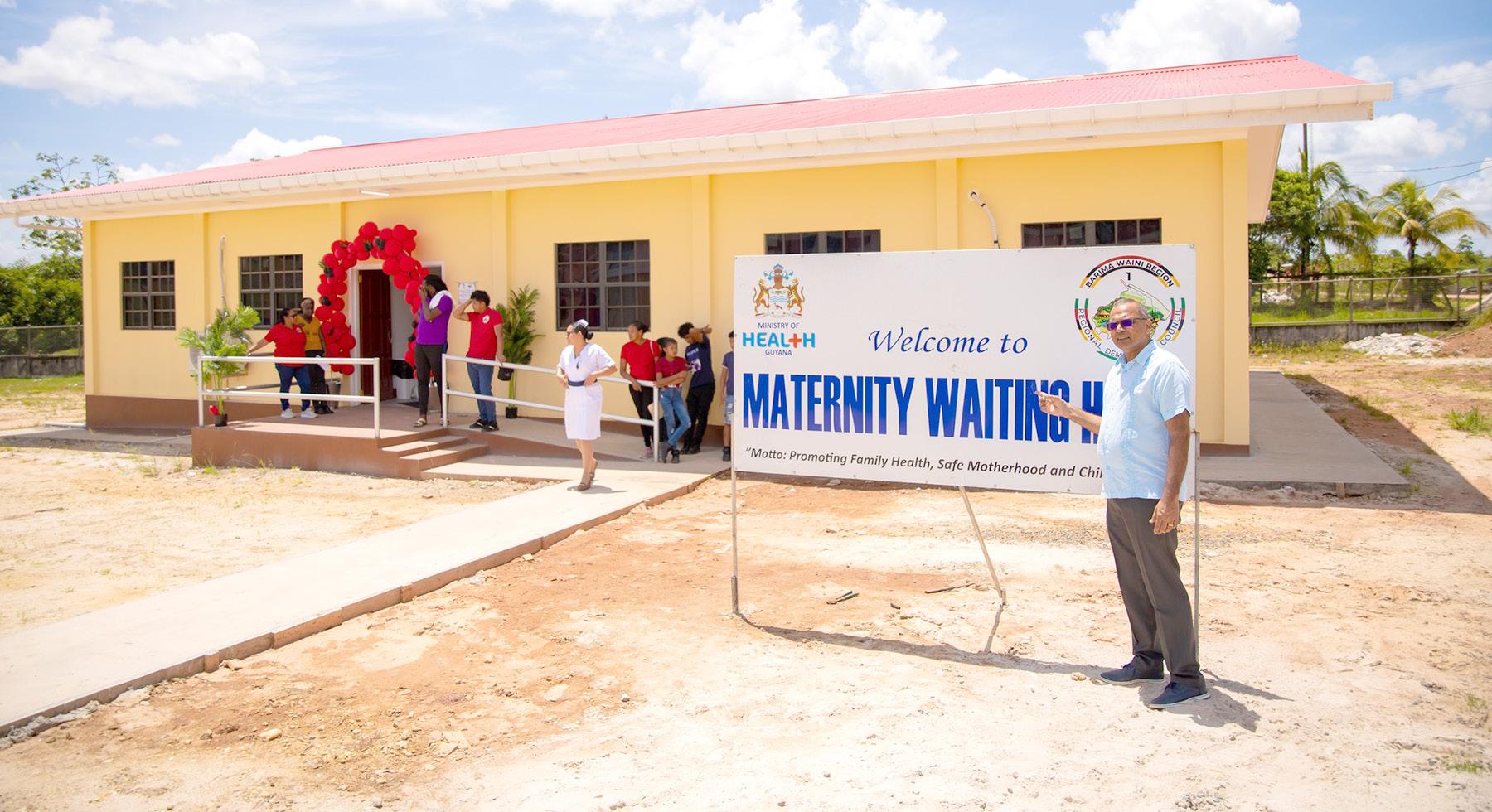
Minister of Health Dr. Frank Anthony commissioned a suite of major infrastructural upgrades at the Port Kaituma Hospital, marking a historic leap in healthcare accessibility for residents in Region One (Barima-Waini). [ MOH photo]
Gov’t reaffirms commitment to press freedom as Guyana marks World Press Freedom Day — McCoy underscores progress, acknowledges past constraints, calls for balanced global assessments
‘Produce
enough or pay more’
– VP Jagdeo warns low production driving up food costs
Over 51,000 e-tickets signal turning point in Guyana’s road-safety enforcement --coupled with shockwaves through global oil and shipping markets
OTC spotlight reflects Guyana’s rising global influence — Dr Singh says
—President Ali set to deliver feature address as country takes centre stage
GUYANA is set to command significant international attention at this year’s Offshore Technology Conference (OTC), with President, Dr Irfaan Ali leading a large national delegation and delivering the feature address at the event’s opening.
This was revealed by Senior Minister in the Office of the President with responsibility for Finance, Dr Ashni Singh, during a preview of the Starting Point podcast, where he underscored the importance of the moment for Guyana’s global standing.
“Not only will President Ali be leading a large delegation to OTC, but he will be delivering the feature address at the opening of OTC,” Singh stated.
According to the finance minister, this prominent role signals Guyana’s growing influence on the international stage, particularly in discussions surrounding energy and development.
“That itself tells you Guyana’s place, and of course President Ali’s place in the global arena and in the global conversations around subject matters that are relevant to
us,” he said.
The Offshore Technology Conference, widely regarded as one of the world’s leading energy forums, brings together key players in the oil and gas sector, including governments, investors, and industry leaders.
Singh noted that Guyana’s participation at this level reflects a major shift in how the country is perceived globally.
“Because Guyana will be taking centre stage at OTC this year under President Ali’s leadership,” he added.
Reflecting on previous engagements, Singh highlighted how far the country has come in a relatively short period.
He explained that in earlier years, Guyana’s presence at the conference was far less prominent, making this year’s development particularly noteworthy.
“In the early years we attended, this year President Ali is listed as the feature speaker at the opening and that tells the journey,” he said.
The minister emphasised that this recognition is not accidental, but the result of
consistent effort and credible engagement.
“And here again, that journey alone is not, these are not accidental occurrences. People listen to hear what you have to say. They examine whether they believe you have something to say of value and it is on that basis they engage with you,” Singh explained.
He added that Guyana’s elevation within the OTC
framework reflects both its growing importance in the global oil and gas industry and the respect it commands among international stakeholders.
“And the fact that Guyana has been elevated to the prominence that we have in OTC 2026 speaks volumes about Guyana’s place in the oil and gas industry worldwide, in the offshore technology sub-sector which
is what OTC focuses on, and the extremely high regard with which Guyana is held globally,” he said.
Singh also highlighted the recognition afforded to President Ali personally.
“And the extremely high regard with which President, Dr Irfan Ali is held globally, I think OTC provides an excellent example, illustration of that,” he added.
According to organisers, President Ali will officially declare the conference open on May 4, marking the start of one of the world’s largest gatherings focused on offshore energy technology. The event will be held at NRG Park in Houston, Texas, from May 4 to 7.
President Ali will be accompanied by a Guyanese delegation, including Minister of Natural Resources, Vickram Bharrat, as the country continues to strengthen its engagement with the international energy community.
Chairman of the OTC Board of Directors, Dan McConnell, described the President’s participation as a significant honour, noting that Guyana has rapidly es-
tablished itself as a major offshore oil producer and an influential voice in the global-energy landscape.
Guyana’s emergence as a key player in offshore energy has attracted billions in investments, accelerated the development of critical infrastructure and deepened partnerships with international oil companies and technology providers.
Participation at OTC 2026 is expected to further highlight these advancements and reinforce the country’s role in shaping the future of energy.
Executive Director of OTC, Amanda Rushing, said President Ali’s address is expected to set the tone for the four-day conference, which will feature technical sessions, exhibitions, and high-level discussions.
The conference is expected to attract tens of thousands of energy professionals from more than 100 countries, providing a global platform for governments, industry leaders, engineers, and innovators to exchange ideas and explore solutions for offshore-resource development.
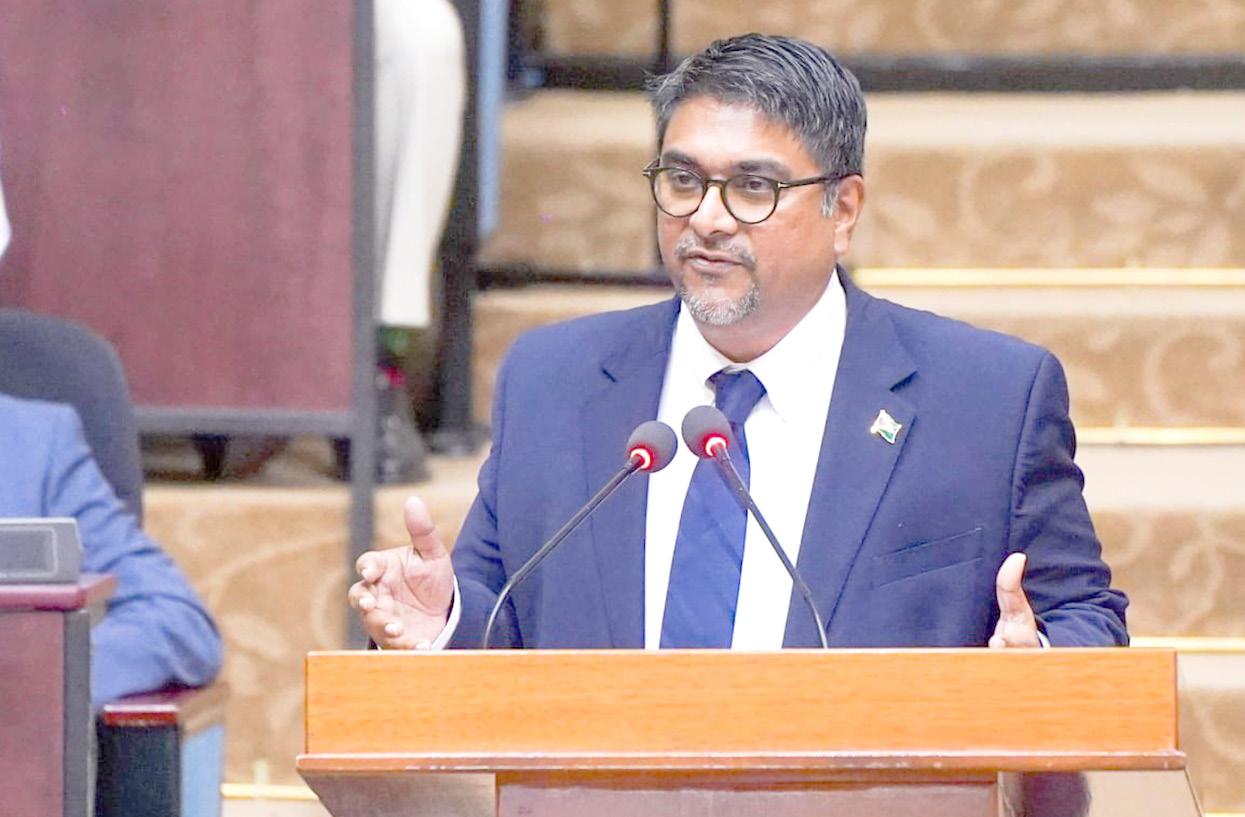
Senior Minister in the Office of the President with responsibility for Finance, Dr Ashni Singh (Starting Point photo)
U.S. companies ‘in it for the long term’ in Guyana — ambassador says
UNITED States companies operating in Guyana are committed to long-term partnerships and local capacity building, rather than short-term gains, according to U.S. Ambassador Nicole Theriot
Speaking recently on the Energy Perspectives podcast, Theriot said the U.S. business model in Guyana is centred on collaboration with local firms and developing the country’s workforce.
“We don’t come in, bring our own workers, finish the project, collect our money and leave. That’s just not how U.S. companies or the U.S. government operates,” she said.
Instead, she explained, American firms are focused on building sustainable partnerships.
“We are in this for the long term. We are here to be your partner moving forward. We don’t just come and then leave,” she added.
Theriot emphasised that
success in Guyana requires strong local collaboration.
“You have to work very closely, hand in hand, with Guyanese companies and also Guyanese employees,” she said.
She noted that while expatriate workers may be used initially, the long-term goal is to transfer skills to Guyanese.
“Our model is: in the short term, if it’s necessary, we’ll bring in expatriates to work. But simultaneously, we are training and building the capacity of Guyanese workers so that we can leave and they can take over. It’s a matter of upskilling,” she explained. The Ambassador described this approach as essential for ensuring Guyana’s long-term independence and sustainability.
“It will make you, in the end, completely independent and self-sustainable,” she said.
Beyond oil and gas, Theriot highlighted growing U.S. interest in sectors such as
infrastructure, agriculture, healthcare, and information technology.
“U.S. companies are absolutely interested in Guyana in a number of different sectors,” she said. She pointed to major developments, in-
cluding interest in a deepwater port, partnerships in agriculture, and investments in healthcare systems.
“There was a huge presence of U.S. health care here—Mount Sinai Health Systems and Northwell Health. And they’re also bringing in other U.S. companies to modernise and expand Guyana’s health network. So, there’s so much going on in different areas.”
Theriot also revealed that Guyana’s first data centre could be developed by a U.S. company. However, she urged improvements in procurement systems to further boost investor confidence.
“I think Guyana could do itself a huge favour, not just for U.S. companies but for all international companies, if they looked at modernising the tender process. I think that’s something that could really add a lot of value and
be a win for all of us,” she said.
Theriot added: “Things like online submission of digital documents, or having oversight contracts for every single major public works contract—those things would give U.S. and international companies peace of mind. So, that when they’re dealing with Guyana, they know exactly what the requirements are, what they need to do, and how it’s going to work.”
The Ambassador encouraged potential investors to visit Guyana in person to fully appreciate the opportunities available.
“You have to come here. You can’t do a webinar or have a phone call. You have to see it for yourself,” she advised.
She also stressed the importance of patience and understanding the country’s stage of development. “Be
beyond oil
open to connections with Guyanese partners and be patient,” she said.
Theriot expressed optimism about Guyana’s future, describing its rapid transformation as remarkable. “I have to say the transformation in this country is astounding… it’s almost unbelievable how quickly things are moving,” she said.
“And it’s just such a testament to the commitment of the private sector here, the government, and the Guyanese people wanting to make that transformation. So, it’s really beautiful.
I’m really happy to see it.” She added that Guyana’s development trajectory is inclusive and forward-looking. “You’re seeing all of these benefits for all Guyanese… it can’t be just one segment of the population that benefits,” she said.
Fort Island residents eagerly prepare for 60th flag-raising ceremony
FORT Island is set to host Guyana’s 60th Independence flag-raising ceremony, with residents already mobilising to welcome President Dr. Irfaan Ali and an
estimated 5,000 visitors later this month.
The Department of Public Information (DPI) recently spoke with Zalifa Debedin, known as “Pretty”, as she
and members of the community prepare for the landmark event. “I’m very happy, and I’m proud. And I would say that we, the Island people, Fort Island, we are blessed for the President to choose this part to come this year to do the event. We hope that the President, when he’s finished, he would interact with persons the whole night. It’s not like two hours and cut off. We would have activities for the whole night. And then we have refreshments, and it would have refreshments on sale also,” she revealed.
Debedin said hosting such a significant national event will not only build on the island’s rich history, but also bring greater attention to the community.
Fort Island, formerly known as Flag Island, is located approximately 16 kilometres from the mouth of the Essequibo River. It once served as the capital of the colonies of Essequibo and Demerara during the 17th and 18th Centuries.
The island earned its original name from a large flag that was flown to guide ships during Dutch occupation, and is home to the historic Fort Zeelandia. Today, Fort Island has a population of approxi-
mately 106 residents across 38 households. According to Debedin, the community remains closely connected, with residents sharing strong ties.
She emphasised the importance of preserving the island’s history and promoting it to future generations, so they can appreciate the significance of its heritage and historic structures.
Preparations for the flag-raising ceremony are already underway. Debedin said residents have begun clearing the event site, including the Fort, walkways, and surrounding areas, with the entire community contributing to the effort.
Debedin said that all persons residing in the community are onboard with this, lending a helping hand to ensure their home is welcoming. She added that the goal is not only to prepare for the event, but to ensure that improvements made now can be maintained long after the celebrations.
In addition to a clean and welcoming environment, visitors can expect a variety of local offerings, including coconut water, lime-and-ginger drinks, fried fish, and other traditional Fort Island fare.
U.S. Ambassador Nicole Theriot
President Ali hailed as most worker-friendly leader in Guyana’s history
CHAIRMAN of the Federation of Independent Trade Unions of Guyana (FITUG) Carvil Duncan has praised President Dr. Mohamed Irfaan Ali’s leadership, recognising him as the most ‘worker-friendly’ head of state the country has ever seen.
Duncan made the declaration while addressing this year’s Labour Day celebrations, hosted on the lawns of State House on Friday, pledging to throw the full electoral weight of the organised labour movement behind him.
“This is the first time in the history of this country that we had a budget for Labour Day,” he said, crediting President Ali for making it possible.
The FITUG chairman, who said he has worked alongside every president Guyana has had, drew a clear distinction between President Ali and his predecessor.
“He’s worker- orientated. He’s trade union- friendly,” he said, adding, “Every one
of the presidents in this country I have worked with, and they all have their own style, but President Ali has a different style.”
He described President Ali as uniquely approachable, noting that the head of state regularly convenes direct discussions with the Federation to hear workers’ concerns and exchange ideas, including on pathways for trade unionists to transition into entrepreneurship.
The chairman also underscored FITUG’s political influence, reminding those present that organised labour’s membership exceeds that of any political party in the country. He
said the Federation, which represents the largest bloc of organised workers in Guyana, would throw its support behind President Ali without hesitation. “In his first term, he was extremely good; in this second term, he has been better,” the chairman said. His remarks also touched on the broader significance of the moment, with Guyana approaching its 60th year of independence and the trade union movement itself tracing its roots back to the formation of the first union in 1919 and its registration in 1921. [DPI]
Datadin urges courts to prioritise justice over technicalities
ATTORNEY-AT-LAW and People’s Progressive Party/ Civic (PPP/C) Member of Parliament Sanjeev Datadin is calling for a shift in judicial approach, urging courts to impose financial penalties for procedural missteps rather than dismissing cases outright, while insisting that matters must ultimately be decided on their merits.
Datadin, speaking at a recent trialogue on procedural rigidity within the legal system, contended that an overemphasis on strict technical compliance is undermining the pursuit of substantive justice.
He referenced regional case law, including decisions of Guyana’s apex court, the Caribbean Court of Justice (CCJ), noting that these rulings emphasise the need to determine matters on their substantive merits rather than on procedural missteps.
Referencing a case he had argued before the CCJ, Datadin recalled that the court “sent back a case to the Court of Appeal saying a case was to be judged on its merit and not on a technical fault,” reinforcing what he described as a critical principle in modern justice systems.
He expressed concern that judges are increasingly prioritising procedural rules, noting that “far too much
weight” is being placed on them instead of examining the substance of disputes.
“I have a very firm view on this. Judges are placing far too much weight on procedural rules rather than merits,” Datadin said.
he should not be shut out,” he stated.
Datadin emphasised that the overarching purpose of civil procedure rules is to ensure fairness and justice, not to create barriers to hearing cases.
Using practical courtroom scenarios, he explained that litigants who miss deadlines or fail to comply strictly with procedural requirements should not automatically be denied a hearing. Instead, he suggested that courts should penalise such breaches through costs.
“If you don’t file your defence in time, default judgment is given. But if the man comes to court and he’s late and he says, ‘look, this is my defence,’ you can make an award for costs for the wasting of judicial time, but
“The overriding objective is that the courts must be fair, do justice, and apportion time proportionate to the seriousness of matters,” he explained, adding that strict application of rules often undermines this goal.
He further noted that higher courts, including the Privy Council, have already signalled the importance of balancing procedural compliance with substantive justice.
“The explanation as to why he is late is one part, but for you to do justice, you have to look at the merits of
—Calls for costs instead of dismissals; says litigants must be heard on merits
the claim,” Datadin said.
The attorney warned that an overreliance on procedure could have wider societal consequences, suggesting that litigants who feel denied justice may lose faith in the legal system.
“Procedural matters… are going to put people with cutlasses on the road because they will be angry that they haven’t got justice,” he cautioned.
He stressed that the courts serve as a civilised mechanism for dispute resolution, but that function is undermined when individuals are denied the opportunity to be heard.
“Civilised societies settle disputes with a judge, but if the judge is not going to give you a chance to hear your case because you are late, then how do you feel satisfied?” he questioned.
Datadin also raised concerns about the practical realities facing attorneys, noting that tight timelines and heavy caseloads make strict compliance difficult.
“The bulk of judicial time now is wasted by applications for extension of time because the timelines are so short. Lawyers are doing several cases. It’s almost impossible,” he said.
While acknowledging that courts may be concerned about delays, he argued that
mechanisms already exist to address repeated non-compliance, such as escalating sanctions and “unless orders,” which can ultimately lead to dismissal if parties continue to default.
“The fact that he is late— punish him with costs… then if you’re repeatedly delinquent, the court makes an ‘unless order,’” he explained.
Ultimately, Datadin maintained that justice must re -
main visible, accessible, and grounded in fairness rather than technical formality.
“There is a disproportionate weight being placed on procedure rather than substance, so it’s more form than it is substance,” he said, adding that justice should not be confined to “side streets” but must remain “on the highways, clear for everyone to see and understand.”
The Chairman of the Federation of Independent Trade Unions of Guyana (FITUG) Carvil Duncan has praised President Dr Mohamed Irfaan Ali’s leadership, recognising him the most ‘worker-friendly’ head of state of state the country has ever seen.
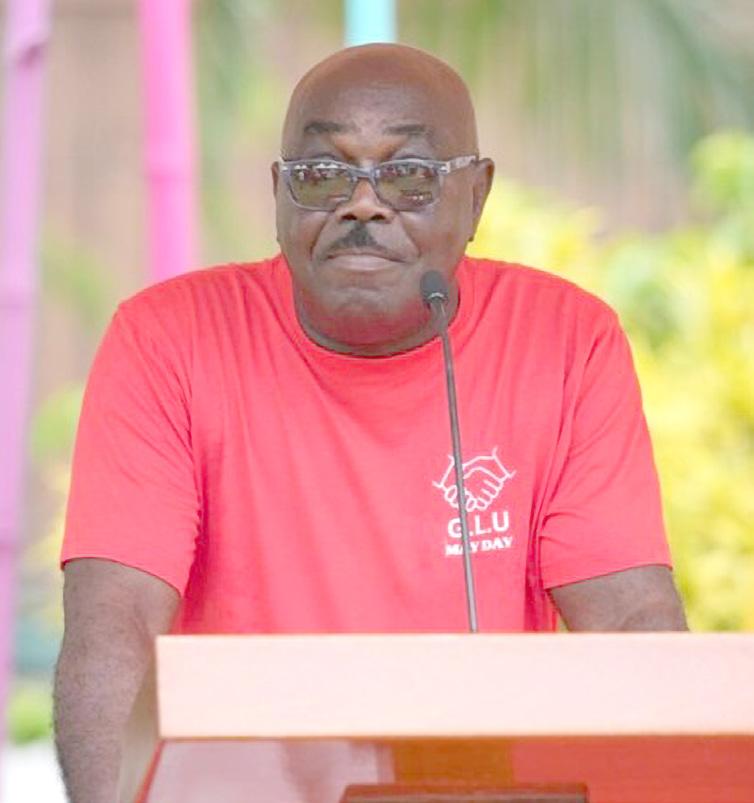
Chairman of the Federation of Independent Trade Unions of Guyana (FITUG) Carvil Duncan
Attorney-at-law and PPP/C Member of Parliament Sanjeev Datadin
Full Confidence
IT took over a hundred years for Guyana to get what it has long been owed. Oral hearings on the merits of Guyana v. Venezuela, one of the most important legal contests in our nation’s history, begin at the International Court of Justice (ICJ) at the Peace Palace in The Hague on Monday, May 4, 2026.
There is much more at stake than a simple court case; there is also the question of what constitutes the very essence of Guyana’s sovereignty, and whether we have the ability to defend ourselves in a legal arena. We go into that courtroom proud and prepared. Our approach to The Hague is based upon confidence rather than arrogance. It comes from hard work. Our Ministry of For-
eign Affairs has clearly stated that we are approaching these public hearings with “full confidence in the strength of our case”, which is backed by a wealth of documentation, and an abundance of supporting legal precedents regarding the binding nature of arbitral awards, the inviolability of treaties, the sanctity of the Rule of Law and the preservation of territorial borders.
These are not empty statements; they represent the legal foundation for 127 years of international precedent for establishing this border since the 1899 Arbitral Award resolved this issue once and forever.
Venezuela accepted this border for approximately sixty-six years before declaring it “null
and void” in 1962 – a revisionist view of history driven by neither legal nor logical rationale, but by political expediency and, more recently, by the promise of vast oil reserves located offshore Guyana.
Venezuela has made two unsuccessful attempts to impede this case via jurisdictional objections – first in 2019 and then again in 2022 – both times being rejected by the court when it issued its decisions on December 18, 2020 and April 6, 2023. Each time Venezuela sought to delay or obfuscate this case, it has been thwarted. Venezuela has exhausted all avenues of legal recourse; Guyana is ready.
Attorney-General Mohabir Anil Nandlall, along with an impressive team of international
lawyers, will personally appear before the court. He has stated that the hearing will take place from May 4 through to at least May 8, possibly extending through the next week.
This is real serious business being done by serious people fighting for a serious cause. Minister Hugh Todd was correct when he said that he was proud of his team’s performance throughout the years leading up to this point, and remains confident that the decision will be in favour of Guyana.
In fact, Budget 2026 has designated funds specifically to support Guyana’s legal and diplomatic efforts in relation to its ICJ case – another indication of how committed this administration is
to protecting each and every inch of Guyana’s territory.
Perhaps, as significant as anything else is that the ICJ had previously ordered Venezuela not to do anything that could interfere with Guyana’s management and/ or control of Essequibo during the pendency of this case, when requested to do so by Guyana.
Essentially, this represents a protective barrier for Guyana, combined with the moral clarity surrounding Guyana’s position, makes any future acts of Venezuelan aggression – either verbal or territorial –subject to contempt of court charges against Venezuela if those actions violate a prior order entered by the highest court in the world.
Price controls do not reduce cost of living--they distort supply
Dear Editor,
THE Leader of the Opposition’s call for price controls is not a serious costof-living strategy; it is a policy instrument that, by design, suppresses supply response and shifts scarcity into queues, rationing, or informal markets.
In small, open economies—where a material share of the consumption basket is imported and passthrough is driven by freight, FX, and external price cycles—administratively capping prices does not eliminate cost; it redistributes it and usually amplifies it through shortages and risk premia.
The mistake is to treat inflation as a purely domestic markup problem that
can be solved with a ministerial directive. Guyana has faced the same global conditions affecting prices everywhere—shipping volatility, imported food and fuel inflation, and supply-chain disruptions—yet the government’s response has not been rhetorical; it has been fiscal and structural.
Critically, the Opposition’s argument is offered without any accounting of the scale of the existing cost-of-living interventions already embedded in the fiscal framework.
The Fiscal Shield: Quantifiable Cost-of-Living Intervention
Let us examine the empirical anchor the Opposition omits. Across zero-rated and reduced taxes on fuel, price freezes and subsidies
in key utilities, and agricultural input support, the state is absorbing a significant portion of the consumer price shock—estimated at over G$500 billion annually through direct and indirect measures.
Measured against NonOil GDP of approximately G$1.6 trillion in 2025, this implies an intervention on the order of ~31% of the domestic economy. The mechanism matters: when the state compresses fuel-and-utility inputs and stabilizes critical supply lines, it lowers delivered costs across transport, farming, processing, and retail—reducing second-round inflation and protecting real incomes without collapsing supply incentives.
Price controls, by con-
trast, attempt to force an outcome at the shelf while leaving cost drivers unchanged, which is why they reliably translate into shortages rather than affordability.
From Administered Prices to Equilibrium Prices: Seven Drivers of Lower Structural Costs
The real solution is not to cap prices ex post; it is to lower unit costs ex ante by expanding productive capacity, improving logistics reliability, and removing large household expenditure burdens through targeted social policy.
Put differently: equilibrium prices are achieved when supply expands and productivity rises faster than demand—especially in a fast-growing economy facing capacity absorption
constraints. In this regard, the relevant framework is structural, not administrative, and it rests on seven linked pillars:
1. Energy (cost base of the economy): With a G$119.4 billion allocation in the 2026 Budget, the Gas-to-Energy project targets a material reduction in electricity tariffs (often cited at ~50%). Lower power costs compress the cost curve for cold storage, agro-processing, manufacturing, and services—improving firm margins, enabling reinvestment, and reducing the pass-through embedded in final consumer prices.
2. Infrastructure and logistics (market access and delivered cost): The G$196.1 billion (Budget
2026) investment in roads, bridges, and ports is not cosmetic capex; it is a competitiveness lever. Weak logistics reliability increases inventory buffers, raises working-capital costs, elevates spoilage, and widens retail markups. Improved connectivity reduces the delivered cost of food and essential goods while expanding the feasible market for domestic producers.
3. Climate-resilient agriculture (supply stability): The G$113.2 billion (Budget 2026) allocation to Agriculture—particularly drainage and irrigation upgrades—targets the core source of food-price volatility: output instability. When rainfall and flooding shocks reduce harvests, unit costs
TURN TO PAGE 7
Libel, technicality and character damage
ATTORNEY-AT-LAW and Member of Parliament, Sanjeev Datadin, gave an absorbing presentation on the Freddie Kissoon Show last Wednesday on two shortcomings in Guyana’s jurisprudence. It would be advisable if all members of the lower and higher bench of the judiciary, all lawyers and law students and Guyanese in general, digest what Mr. Datadin had to say.
The Caribbean Court of Justice (CCJ) has ruled in relation to a case from Guyana that courts in Guyana cannot make decisions based on a technicality, but on the merits of the case. On March 17, the CCJ rebuked the three tiers of the justice system in Guyana – the High Court, the Full Court and the Court of Appeal – for dismissing a case on the basis of procedural irregularities rather than on the real essence of the matter, that is, the actual merits of the case. In this specific instance the matter was Harry Panday versus Malcolm Panday in a family dispute over a sum of 733,000 American dollars.
Based on that judgement it means lower courts in Guy-
ana have to fall in line and allow trials to proceed even if there were technical faults involved. Mr. Datadin opined that litigation in front of the courts should not be dismissed because one party has made a procedural error.
Mr. Datadin explained that failure to offer a response within a specified time frame results in judgement against a defendant. He said this is wrong because the defendant may have a very justified reason for late filing. Datadin suggests failure to meet a deadline should result in a fine but not a default judgement.
tors, businesspeople, army officers, Ministers of Government, police officers are busy people. Why should they lose a case because they didn’t file a response in time? This is a blatant denial of justice. Imagine in a dispute involving immense acres of land, one party loses all of those assets because of a
suffered default judgement involving dozens of millions. Two libel cases stand out –Vice-President Jagdeo versus then PNC parliamentarian, Annette Ferguson and Vincent Alexander versus Vishnu Persaud. Both had judgement against them because of technical glitch.
I agree with Mr. Datadin.
technicality. What happens if based on the merit of the case the land actually belonged to the defendant?
To my mind, the point here is commonsense. Doc-
How can the court award dozens of millions of dollars because the defendant didn’t file a writ in time in a libel case? How can that be right? People in Guyana across the political spectrum have
Failure to meet a deadline should result in a fine. The defendant should be given a chance and if on the second time, it happens again then a larger fine should be imposed. If on the third occasion, the defendant defaults again then one can understand judgement against him/her. Certainly not on the
first failure.
The second point in the weakness of Guyana’s jurisprudence as pointed out by Mr. Datadin is the area of libel laws. The reason for the existence of libel is for the courts to compensate for the suffering and damage you have endured because of a false statement published about you. The plaintiff must and the emphasis is on MUST, provide the court with evidence of damage.
The case of ex-marine, Zachery Young versus CNN, is very instructive and the courts in Guyana should take its cue from that case. CNN claimed that Mr. Young ran a business of extracting money from people he facilitated in leaving Afghanistan. Young sued and won because he was able to prove to the court how he was damaged. He proved to the courts that security contracts he had were terminated after the CNN report because he was portrayed as a rapacious person.
In the case of Catherine Hughes versus Vice President Jagdeo over the word, “lowlife”, the judge said that she has to weigh the evidence of damage to character. In other
words, the plaintiff, Hughes, has to show evidence of how she suffered. What has gone on in the courts of Guyana in libel writs is unprecedented injustice. How can the plaintiff sue for damage of character without showing evidence of that damage? Someone published that John Brown is a homosexual. Brown’s wife sought a divorce after publication. Brown can show that after publication his wife sued for divorce thus providing the court with evidence of damage.
The raison d’être for libel is damage, loss and suffering. When it is publicly said that you are an incompetent bank manager and you sue and you are not demoted and is still the bank’s manager, then, how have you been damaged? There must be evidence of damage. If a judge doesn’t ask for that evidence, then his/her competence is in question.
DISCLAIMER: The views and opinions expressed in this column are solely those of the author and do not necessarily reflect the official policy or position of the Guyana National Newspapers Limited.
Price controls do not reduce...
rise and imports fill the gap at higher landed prices. More resilient systems increase production reliability, reduce fiscal leakage to emergency imports, and stabilize food prices through time.
4. Food security land expansion (scale of domestic supply): As a matter of policy, the Government is moving to unlock an additional 100,000 acres of agricultural land to advance the food security agenda. This is not a marginal adjustment: with roughly 1.04 million acres of total agricultural land and only about 32% currently in cultivation, opening up 100,000 acres adds approximately ~10 percentage points—taking cultivated land toward ~42%. The causation chain is direct: more cultivated acreage increases domes -
tic output potential, reduces import dependence and landed-cost exposure, and dampens food-price volatility by stabilising supply through time.
5. Human capital (productivity and future earnings): The shift toward free tertiary education and the expansion of the GOAL scholarship program reduces a binding household constraint—tuition financing— while improving the future income-earning potential of the labour force.
Over time, higher productivity supports real wage growth without importing inflation, and it improves the economy’s capacity to sustain social spending from a stronger non-oil tax base.
6. Health system modernization (household risk and labour participation): Expanding and modernizing
regional hospitals reduces catastrophic out-of-pocket expenditure and the implicit “health risk premium” households must self-insure against.
When health shocks are better pooled through public provision, disposable income volatility falls, labour participation improves, and the social safety net becomes more fiscally efficient than ad hoc cash responses.
7. Housing finance support (household balance sheets): Mortgage interest relief and concessional lending reduce the financing wedge between income and asset ownership, converting rent-like cash outflows into household equity accumulation.
This matters macroeconomically: stronger household balance sheets support domestic savings
mobilisation and improve the stability of the financial system—conditions that ultimately lower the risk premia embedded in prices and investment costs.
Conclusion: The Objective is Lower Unit Costs, Not Administered Shelf Prices
Cost-of-living relief is ultimately a question of unit costs and productive capacity. When energy, transport, and climate risk are reduced—and when large household expenditures (education, health, housing) are structurally compressed—real incomes rise in a durable way. That is why the relevant metrics are productivity, logistics reliability, and fiscal space, not the optics of a temporary price cap.
Given the constraints of a letter to the editor, the
foregoing is necessarily only scratching the surface.
The intent here is to give readers a basic appreciation and a timely reminder of the policy architecture being deployed—not only to dampen the cost of living in the narrow sense, but to lower the recurring cost structure of a higher standard of living through productivity, capacity, and targeted fiscal shielding.
Price controls attempt to override market-clearing signals while leaving the cost structure intact; the predictable result is supply contraction, informal pricing, and weaker domestic production—precisely the opposite of what a fast-growing, import-exposed economy requires.
Taken together, the existing fiscal shield (on the order of G$500 billion) and
FROM PAGE 6
the seven structural pillars outlined above represent a coherent framework: protect households now while expanding the supply base that delivers lower equilibrium prices over time. This is not a debate about ideology; it is about whether policy strengthens national competitiveness or manufactures scarcity.
Sincerely, Joel Bhagwandin
Delcy’s Disrespect
I HAVE had an opportunity to read at lengths the responses of the opposition here with respect to the Guyana/Venezuela border controversy and all the drama unfolding. I have also had the opportunity to listen to acting Venezuelan President Delcy Rodriguez’s response to President, Dr Mohamed Irfaan Ali’s recent complaint to CARICOM.
Firstly, I unequivocally support President Ali’s recent action with respect to protesting the wearing of a pin or brooch of a map which falsely depicts part of Guyana’s territory as part of Venezuela, while on an official trip within the CARICOM.
I believe that the president’s missive sent to CARICOM was decisively clear and worded strongly. It called on all the CARICOM countries to reinforce the treaty of Chaguaramas and principles of international law. It reminded member states that only recently CARICOM gave its full sup-
port and backing of Guyana in the border controversy at the International Court of Justice. It made it clear that CARICOM practises respect for territorial sovereignty, while reinforcing these countries undeniable right to have bilateral relations with whomever they please, even Venezuela.
The president’s letter spoke to consequences of the false symbolism while this case is receiving the attention of the ICJ. It mixed or minced no words and CARICOM responded almost immediately restating that Guyana’s has its full and unwavering support.
I think his actions were enough to expose the hidden agenda of Venezuela’s action in the region at this point and time.
Secondly, Rodriguez knew what she was doing and did it anyway. She knew that the ICJ would be listening to oral remarks from both sides tomorrow. She was subtle and smart, but then was found out. She is very
disrespectful and crazy to try and pull that shenanigan off in our region and backyard. I think her response was poor and weak. For the record, Guyana does not care how she dresses or what she wears, just do not seek to convey the false impression that Essequibo belongs to Venezuela. It does not historically and factually.
There is not one iota of evidence to prove that claim. She would be better served looking at the state of Venezuelan people and getting the socioeconomic welfare of the country back in order. I think as an ex-foreign minister of
her country, it was in bad taste and undiplomatic for her to behave so poorly. Rodriguez lied. There is no scandal involving President Ali. I do not care if Rodriguez read and knows from her so-called history books that Essequibo belongs to Venezuela, because that is not the case. She, like a very few people in Venezuela, have been misled from childhood because Essequibo has been and is part of Guyana’s territory. I would advise her to burn those fictional books and gain access to truthful, factual and unbiased information.
Thirdly, I am ashamed of the opposition in this country. They should be standing firmly behind the President on this matter and not criticising him publicly at this time.
They are seeking to score
cheap political points and muddy the waters. If I were the opposition, I would have blistered Venezuela and stand firmly with Guyana. I would have initiated a private call with the head of state or foreign affairs minister to state my concerns about the government’s handling of the controversy and sought clarity about various developments.
I would not issue a ‘ghetto’ press release, criticising the government over its “strategic vision.” Who does that? That is cutting the nose to spoil the face. The PNC, FMG and WIN need to behave much better with matters of this nature. Venezuela is looking for everything it could find to help its case and the opposition does not seem to understand this.
All the strategic plans are in place and well advanced.
Every single thing Guyana is doing is to ensure that Essequibo remains intact. I am truly disappointed by the PNC, particularly, for this childish missive to the press.
Finally, Delcy’s disrespect is not new. It comes on the heels of disrespect for the recent ruling of the ICJ in which it has jurisdiction to determine the validity of the 1899 Arbitral Award and the court unanimously ordered Venezuela to avoid altering the status quo in the disputed Essequibo region, where Guyana exercises control.
The ICJ even on May 1, 2025 reaffirmed its December 2023 order, specifically directing Venezuela to stop conducting elections or administrative acts in the territory. Yet, Maduro, Rodriguez and Venezuela continue to provoke Guyana. Delcy ‘gonna get it right’ and stop provoking this country. She is going to stop poking the bear. In the meantime, tomorrow the hearings on the merits of the case are set to begin.
DISCLAIMER: The views and opinions expressed in this column are solely those of the author and do not necessarily reflect the official policy or position of the Guyana National Newspapers Limited.
Sticking A Pin in the Side of the World Court
SIR Ronald Sanders’ reading of Delcy Rodríguez’s decision to wear, during official Caribbean engagements last week, a brooch depicting Venezuela with Guyana’s Essequibo region folded into its map, is a timely and compelling framing of the principles at stake and the message it sends to Guyana, the wider Caribbean, and the international community.
The former ambassador of Antigua and Barbuda to the United States and the Organisation of American States, and now the Chancellor of the University of Guyana, Sir Sanders, aptly titled his important and must-read contribution “A Pin, a Principle, and the Integrity of the Caribbean - Territorial claims are decided in court, not worn on a lapel.”
Starting tomorrow, the International Court of Justice (ICJ) will begin a week of public hearings on the merits of the Arbitral Award of October 3, 1899 (Guyana v. Venezuela), at the Peace Palace in The Hague, the
Court’s seat. I expect many Guyanese will use this moment to brush up on the compelling arguments behind the nationwide campaign, launched in 2023 by the People’s Progressive Party/ Civic (PPP/C), with thousands of bumper stickers and billboards proudly declaring: “Essequibo ah we own.”
A breach of principles is one thing, but far more troubling is the pattern of behaviour by Caracas. More than being an affront to the Caribbean Community and, more specifically, Guyana, Rodriquez’s metal badge demonstrates yet another instance where Venezuela has stuck a pin into the ICJ by openly threatening Guyana’s sovereignty. This is hardly symbolic.
On December 1, 2023, the ICJ ordered Venezuela, then still ruled by Nicolás Maduro, to refrain from any action that would alter the status quo in the Essequibo or aggravate the dispute, after Guyana asked the Court to stop a referendum aimed at annexing its territory. Ven-
ezuela ignored the ICJ and went ahead with the vote three days later and then declared that more than 95 per cent of voters had endorsed making Essequibo a Venezuelan state.
Between January and April 2024, Caracas moved to extend Venezuelan citizenship and identification cards to Guyanese citizens. Caracas established an “Integral Defence Zone of Guyana Esequiba” and threatened Guyana’s licences and concessions in the area.
The Hon. Hugh Todd described these steps as “blatant attempts to annex Guyana’s territory in open violation of the ICJ’s order and international law.”
Venezuela backed its threats with military action by beefing up military assets on our borders along the Cuyuni.
When President Mohamed Irfaan Ali was presented with satellite images pointing to more aircraft, missiles and fast attack craft positioned within striking distance of our territory,
Guyana’s military was placed on high alert.
Venezuela’s threats at sea have been just as clear.
In early 2025, the Government of Guyana condemned an incursion by an armed Venezuelan patrol vessel that approached and harassed Guyanese-flagged oil installations, falsely claiming they were operating in Venezuelan waters.
This followed earlier episodes in which Venezuelan naval units interfered with vessels conducting lawful petroleum operations under Guyanese licences. These were deliberate attempts to intimidate Guyana and to undermine investor confidence in our offshore sector, even while the ICJ process was pending.
Guyana returned to the ICJ in 2025 seeking additional provisional measures after Caracas announced plans to hold elections for a “governor” and legislative council in the so-called Guayana Esequiba state.
On May 1, 2025, the Court
Embracing pregnancy and the ‘baby bump’
THERE was a time when pregnant women were embarrassed by their swelling bellies, when they waited with impatience for their figures to return, when some said they felt ugly. Now, in more enlightened times, women are becoming less concerned about being out of shape and prouder of their rounded ‘middes’.
Calling it ‘bump proud’, women are painting, photographing and generally showing off their pregnancy and their changing shape. Superstar singer and fashion icon, Rihanna, wore cropped tops and clothing designed to reveal rather than hide the ‘baby bump’ and many more women have been following her lead.
Photographic studios are now offering photoshoots
with both parents. And male partners are encouraged to strike poses where they embrace the rounded stomach, showing their connection to both the mother and unborn child. The ‘shoot’ is seen as a way of documenting the journey to motherhood and is shared with friends and family. Many now post pictures on social media with hashtags such as #bumpproud and #momlife.
A growing number of pregnant women see the display of their bellies as a form of empowerment, contributing to body positivity and allowing them to feel ‘comfortable in their own skin’.
The feminist movement also encourages a woman’s pride in her growing belly, hailing it as a welcome shift from the belief that only curvaceous bodies are beautiful.
However, pregnancy is a time when a myriad other changes are taking place in a woman’s body, and not all women ‘sail’ happily through the experience. Hormonal changes can cause mood swings, depression, listlessness and a general feeling of discomfort that may remain until childbirth.
While some women may experience ‘morning sickness’ only in the early months, some may ‘throwup’ throughout the pregnancy. Some get cravings, are upset by certain odours, cannot eat foods they may have previously enjoyed and suffer from swollen feet. In extreme cases, some pregnant women experience acute loss of appetite, or their bodies reject food altogether and doctors have to try a variety of strategies to ensure they receive
enough nourishment.
And those are just some of the array of physical and psychological symptoms that pregnant women experience. It can often feel like a rollercoaster, with changes occurring in quick succession and without warning. I have even heard women claim that they wanted no interaction with their partner during pregnancy. One woman said to me, “When I’m pregnant, I don’t want nothing fuh do wid he”.
But, pregnancy also offers a unique opportunity for women to connect with their bodies, understanding that all of these changes are preparing them for what Crown Midwifery in the US calls,” ..the most important job your body will ever have: nurturing your little one”.
Retaining a positive
reaffirmed its earlier orders and went even further to explicitly direct Venezuela to refrain from conducting or preparing any elections in the territory under Guyana’s administration.
The Government of Guyana has since called on Venezuela to comply fully with these binding measures and to cease any action that violates our territorial integrity or threatens peace and security in the region. Yet, instead of retreating from this dangerous course, Venezuela has continued to promote, at home and abroad, the false narrative that Essequibo is already part of its sovereign territory.
CARICOM’s April 28, 2026 statement, warning that Community platforms must not be used to promote claims to be adjudicated by the ICJ, was an important step. It signalled that the region will not allow its institutions to be converted into a stage for annexationist propaganda against one of its own. President Ali’s letter
to the CARICOM Chair, objecting to the appearance of the brooch at a community-related event, was fully justified.
But we must be clear: the brooch controversy is not about fashion or even symbolism in isolation; It is about the visual expression of a project that has already produced illegal referenda, annexationist laws, military deployments and armed incursions, all in defiance of two sets of ICJ provisional measures.
If the Caribbean is to “stand on the side of law,” as Sir Ronald rightly urges, States must refuse to normalise aggressive actions that seek to change facts on the ground while the ICJ is deliberating.
DISCLAIMER: The views and opinions expressed in this column are solely those of the author and do not necessarily reflect the official policy or position of the Guyana National Newspapers Limited.
mindset is therefore of the utmost importance, as experts say that this can also affect the foetus in a good way. Some women talk or sing to their unborn child while others play music, all in an attempt to create a positive bond.
Embracing the pregnancy in this way and being proud of their growing bellies also helps women combat the pressure to ‘snap back’ to their pre-pregnancy shape. They are now breaking the taboo which urges concealment of the ‘baby bump’
and viewing it as a symbol of power, representing a profound connection to their unborn child.
As actress Tori Spelling said, “I’m super proud of my bump. Why should I be embarrassed and cover up something that’s the greatest gift a woman can experience.”
DISCLAIMER: The views and opinions expressed in this column are solely those of the author and do not necessarily reflect the official policy or position of the Guyana National Newspapers Limited.
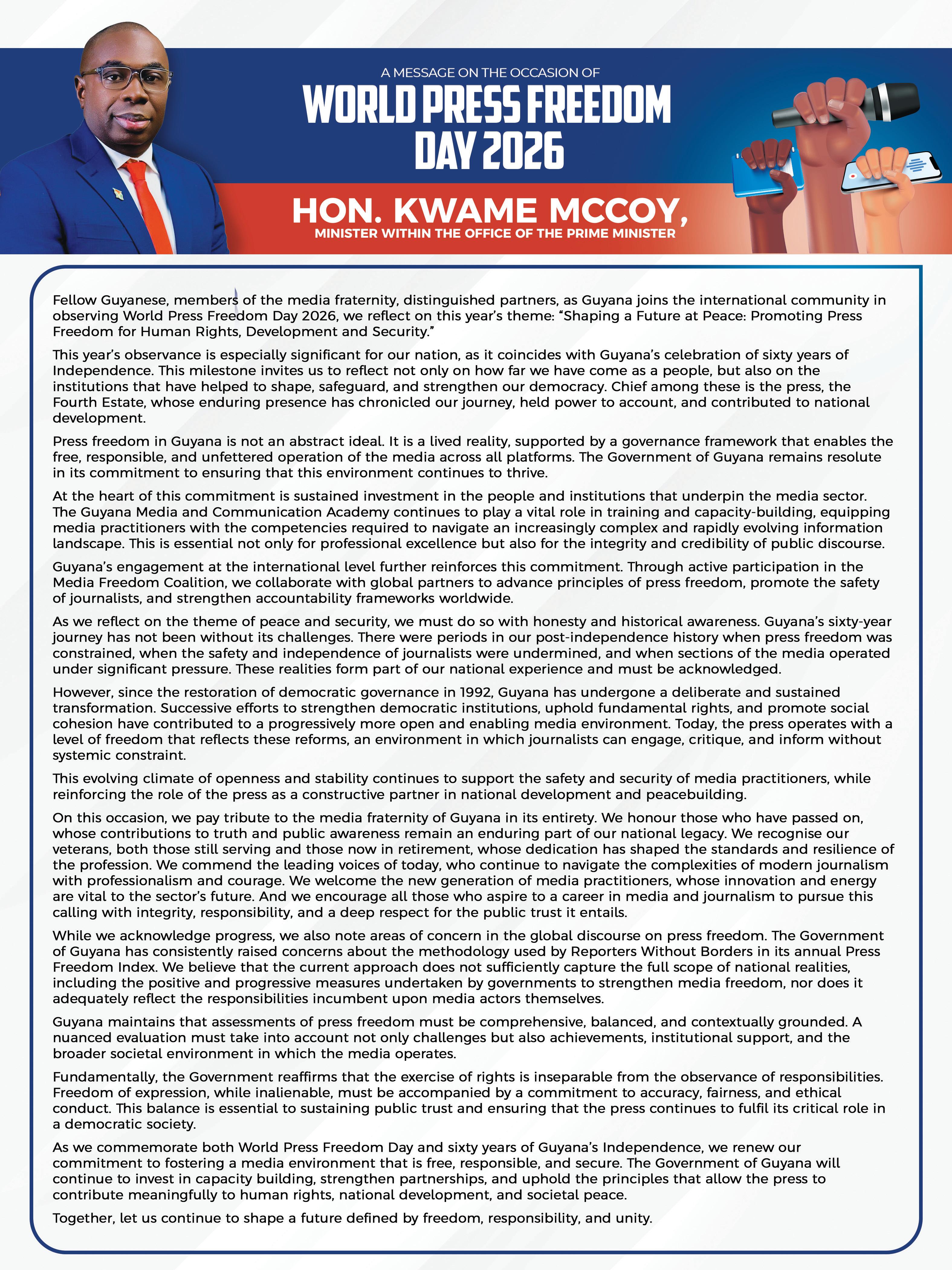
Gov’t reaffirms commitment to press freedom as Guyana marks World Press Freedom Day
—
McCoy underscores progress, acknowledges past constraints, calls for balanced global assessments
AS Guyana joined the international community in observing World Press Freedom Day 2026, Minister within the Office of the Prime Minister Kwame McCoy reaffirmed the government’s commitment to maintaining a free, responsible and enabling media environment, while urging a more balanced global approach to assessing press freedom.
In a statement, McCoy said this year’s observance, held under the theme “Shaping a Future at Peace: Promoting Press Freedom for Human Rights, Development and Security”, carries added national significance as it coincides with Guyana’s 60th Independence Anniversary.
He noted that the milestone provides an opportunity not only to reflect on the country’s development trajectory, but also on the role of the media in strengthening democracy.
“Press freedom in Guyana is not an abstract ideal. It is a lived reality, supported by a governance framework that enables the free, responsible, and unfettered operation of the media across all platforms,” McCoy stated.
The minister highlighted ongoing investments in the media sector, pointing to the work of the Guyana Media and Communication Academy in building capacity among journalists to navigate an increasingly complex information landscape.
He further emphasised Guyana’s engagement at the international level, including its participation in the Media Freedom Coalition as part of broader efforts to promote press freedom and the safety of journalists globally.
At the same time, McCoy acknowledged that Guyana’s post-independence history has included
periods where press freedom was constrained, noting that such realities must form part of an honest national reflection.
“There were periods in our post-independence history when press freedom was constrained, when the safety and independence of journalists were undermined… These realities form part of our national experience and must be acknowledged,” he said.
However, he underscored that since the restoration of democratic governance following the 1992 Guyana general elections, the country has seen a sustained transformation towards a more open and enabling media environment.
According to McCoy, today’s media landscape reflects those reforms, allowing journalists to “engage, critique and inform without systemic constraint.”
Turning to global discourse, the
minister also raised concerns about the methodology used by Reporters Without Borders in its annual Press Freedom Index, arguing that it does not adequately capture national realities or the progress made by countries like Guyana.
“Guyana maintains that assessments of press freedom must be comprehensive, balanced and contextually grounded,” McCoy said, adding that such evaluations should reflect both challenges and achievements.
He stressed that while freedom of expression is fundamental, it must be exercised with responsibility, including adherence to accuracy, fairness and ethical standards.
The minister used the occasion to pay tribute to Guyana’s media fraternity, honouring past and present practitioners for their role in informing the public, holding power to account and contributing
to national development.
As Guyana marks both World Press Freedom Day and its diamond jubilee of Independence, McCoy said the government remains committed to strengthening partnerships and investing in the sector to ensure the continued growth of a free and responsible press.
“As we commemorate both World Press Freedom Day and sixty years of Guyana’s Independence, we renew our commitment to fostering a media environment that is free, responsible, and secure,” he added.
Guyana Takes the Global Stage at the 2026 Offshore Technology Conference
All eyes will turn to Houston this week as the Offshore Technology Conference (OTC) 2026 gets underway. Among the industry’s most established players, Guyana will take centre stage as the featured nation, a distinction that reflects just how far the country has come since oil production commenced in 2019.
This year’s conference will open with a historic first: Dr Irfaan Ali, President of Guyana, will deliver the keynote address, the first time a sitting President has done so in the conference’s history. That moment signals a shift not only in the stature of the event, but in Guyana’s place
within it. Once considered a frontier prospect, the country is now firmly positioned as a recognised and influential voice in the global energy conversation.
For Guyana, OTC is far more than a networking platform. It is a window into where the industry is heading.
As local businesses and professionals engage with international partners, they are exposed to advanced technologies defining modern offshore energy, including robotics, autonomous underwater systems, and new approaches to subsea engineering and digital monitoring. This is the level of innovation Guyana is now
operating alongside. The value of that exposure goes beyond observation; it turns exposure into capability, allowing global standards to shape local development.
Moments like this also bring into focus what is required to sustain that progress.
As the technologies on display at OTC become more advanced, the need for a workforce that can keep pace, and eventually lead, becomes more urgent. Participation alone is no longer enough. The focus must be on building the skills and systems that allow Guyana to grow with the sector, not behind it.
As investment in the oil
and gas sector expands, there has also been a growing emphasis on training, knowledge transfer, and long-term capacity building.
Companies operating in Guyana are increasingly supporting initiatives aimed at strengthening the local talent pipeline, recognising that the sector’s success depends not only on resources but on people.
As Guyana continues to expand its role in the global energy sector, the systems that prepare people for opportunity must keep pace. Growth only becomes sustainable when people are equipped to support it. Ensuring that the next generation is ready for a more
technical and specialised economy is now a national priority.
Just as important is how that opportunity is shared. By extending STEM access into hinterland and remote communities, the initiative supports a more inclusive approach to development. It opens space for young people across the country to see themselves in the future of the economy, including the high-tech industries being showcased at OTC.
For many, this is the difference between seeing opportunity from a distance and being able to step into it.
As Guyana takes its place at the centre of conversations at OTC 2026, the signifi -
cance of this moment extends far beyond the conference halls. It reflects a country that is not only expanding its presence but also recognising the responsibility that comes with it.
The story is no longer only about resources. It is about readiness. And ultimately, it is about whether Guyana can translate its position on the global stage into lasting, tangible opportunities for its people.
DISCLAIMER: The views and opinions expressed in this column are solely those of the author and do not necessarily reflect the official policy or position of the Guyana National Newspapers Limited.
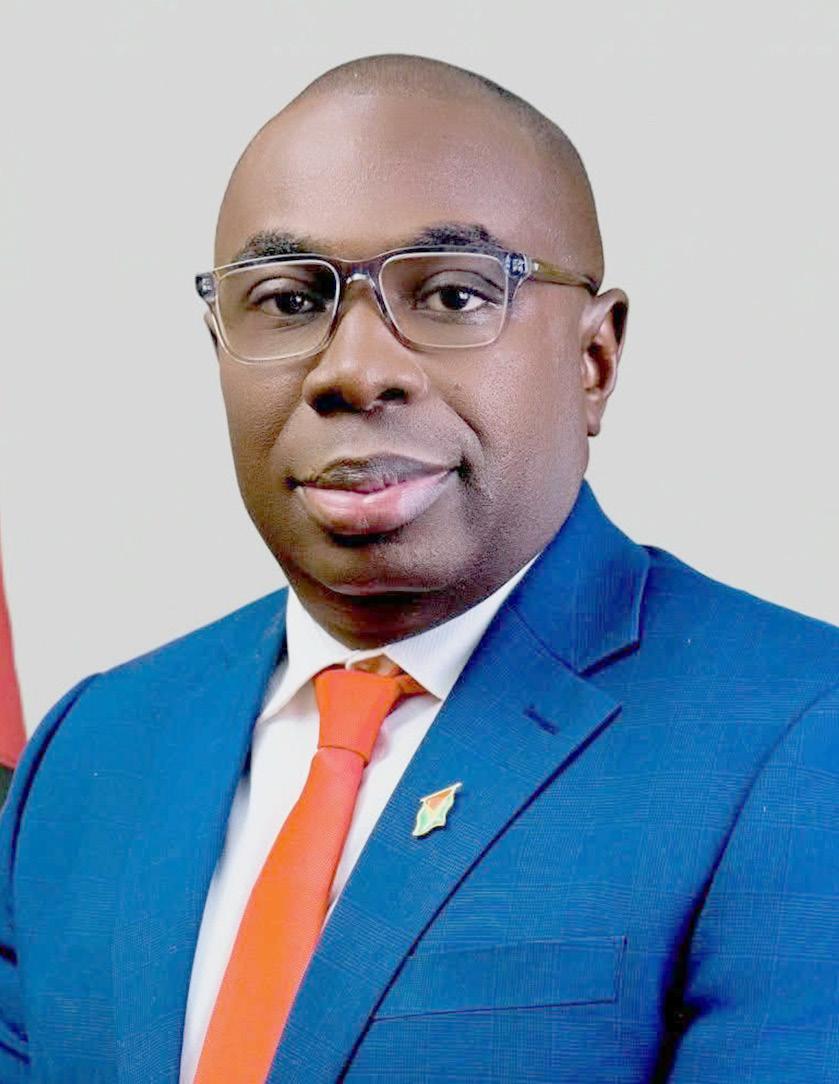
Minister within the Office of the Prime Minister Kwame McCoy
‘Produce enough or pay more’ –
VP Jagdeo warns low production driving up food costs
– coupled with shockwaves through global oil and shipping markets
VICE PRESIDENT, Dr Bharrat Jagdeo says Guyana needs to produce more to deal with the rising market prices and minimise the effects of the external world conflicts.
Responding to a question from a farmer during a consultation convened by President, Dr Mohamed Irfaan Ali on Thursday at the Arthur Chung Conference Centre, VP Jagdeo explained that Guyana is not producing enough of what its people are now eating, and that this gap is driving up food costs.
VP Jagdeo also acknowledged that local production shortfalls are unfolding against a volatile global backdrop, heightening the urgency of strengthening domestic food security.
The recent conflict between the United States and Iran, which sent shockwaves through the global oil and shipping industries, has added new pressure to an already strained global supply chain.
With oil prices rising and shipping disruptions causing economies to convulse, the cost of imported goods, including food, is expected to climb further in the weeks and months ahead.
For a country that still relies heavily on imports for certain food items, Guyana is not insulated from that reality.
“More people are eating meat now. They’re wealthier, they eat more chicken, they eat more meat and the prices are going up,” the VP said. “We’re not producing enough beef.
We’re not producing enough mutton in the country based on what people are
eating….so prices keep going up,” he said
The VP pointed to chicken as an example of the local angle of the problem.
Vendors buy a piece from producers at $125 and sell it fried for $6.75 USD.
Mutton tells an even sharper story. While a pound costs around $4.99 USD in the United States, it fetches $11 USD here, because the country does not produce enough, and suppliers know it.
The VP used cassava cultivation as another cautionary example, and one that is closer to home.
When the government offered farmers $40 a pound and committed to setting up a processing mill, prices jumped to $125 a pound within weeks, making the entire project unviable before it could start.
Against this backdrop, the VP said the country must
either produce more or accept strategic imports. He said leaving prices to climb unchecked places the burden squarely on ordinary Guyanese.
“Guess who gets criticised all the time for cost-ofliving increases? The government,” he said.
On rice, traditionally a reliable staple, the VP acknowledged that rising labour costs could one day threaten that stability, making diversification and stronger yields a necessity rather than a choice.
He stressed that with global uncertainty showing no signs of easing, smallscale, low-productivity operations are no longer sustainable, and that livestock and agriculture must be treated as proper industries if Guyana is to keep prices manageable.
For a country that still relies heavily on imports for certain food items, Guyana is not insulated from that reality
“If they go into it as an industry, I’m sure we can compete with any part of the world,” he reasoned stating, “But if you do it
at a low productivity level, then the country suffers. Ordinary people suffer.” [DPI]
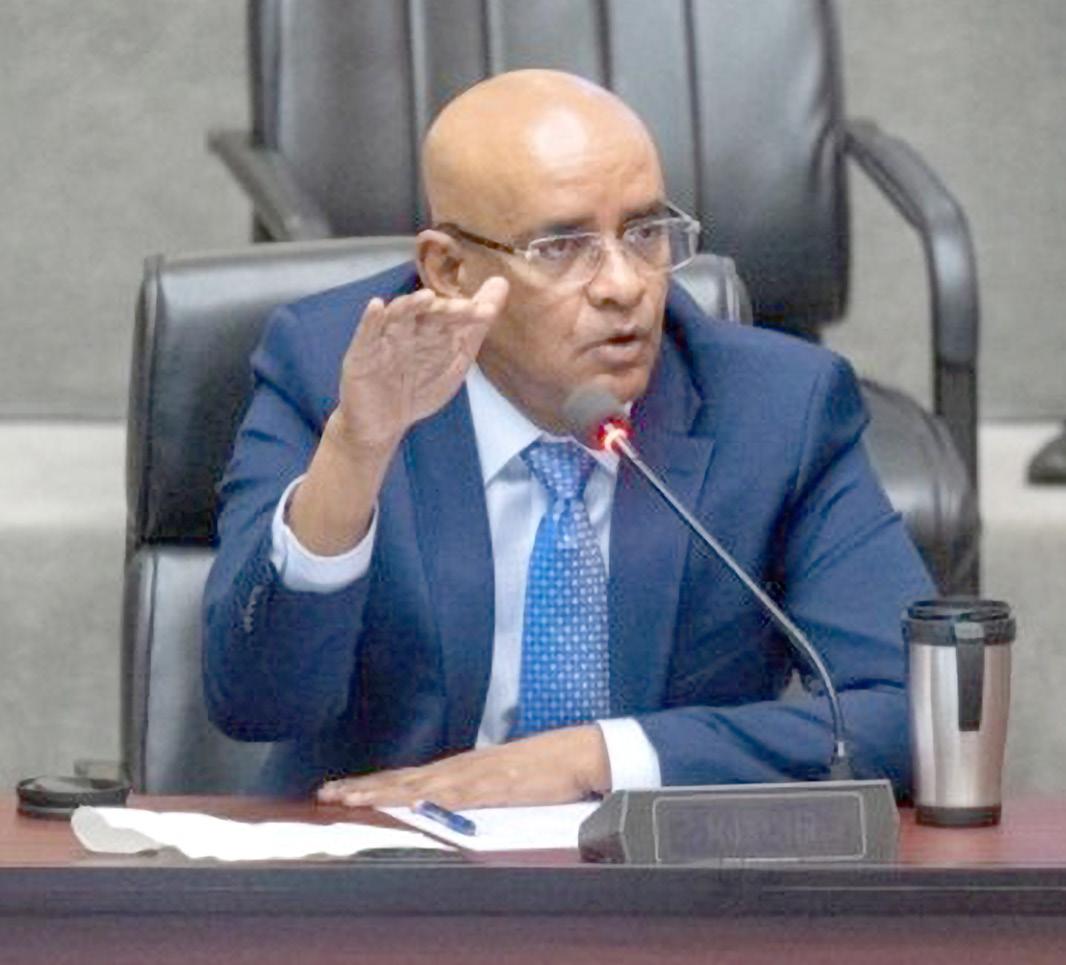
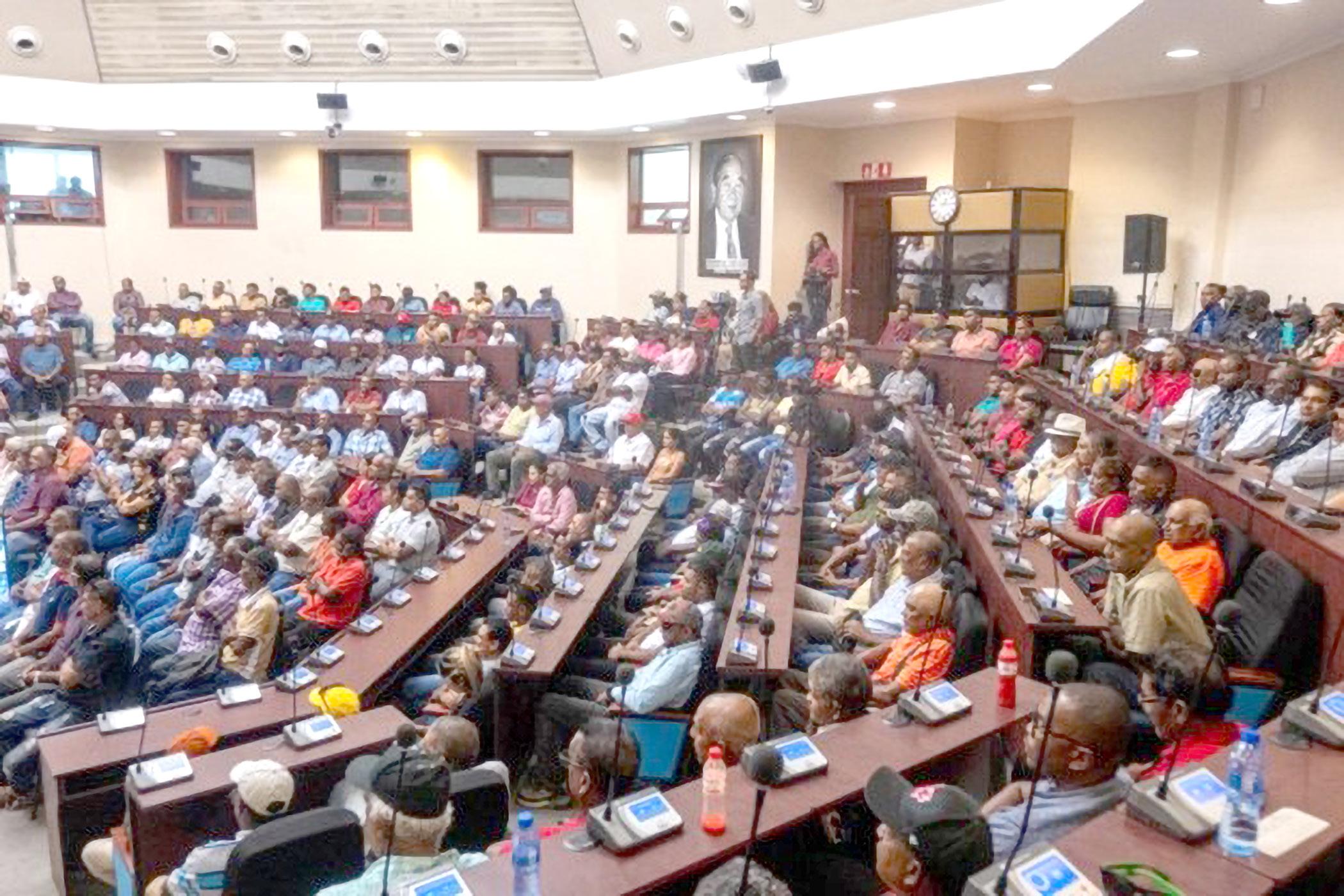
Vice President, Dr Bharrat Jagdeo addressing hundreds of rice farmers at a meeting convened by President, Dr Mohamed Irfaan Ali
Farmers in attendance
Over 51,000 e-tickets signal turning point in Guyana’s road-safety enforcement
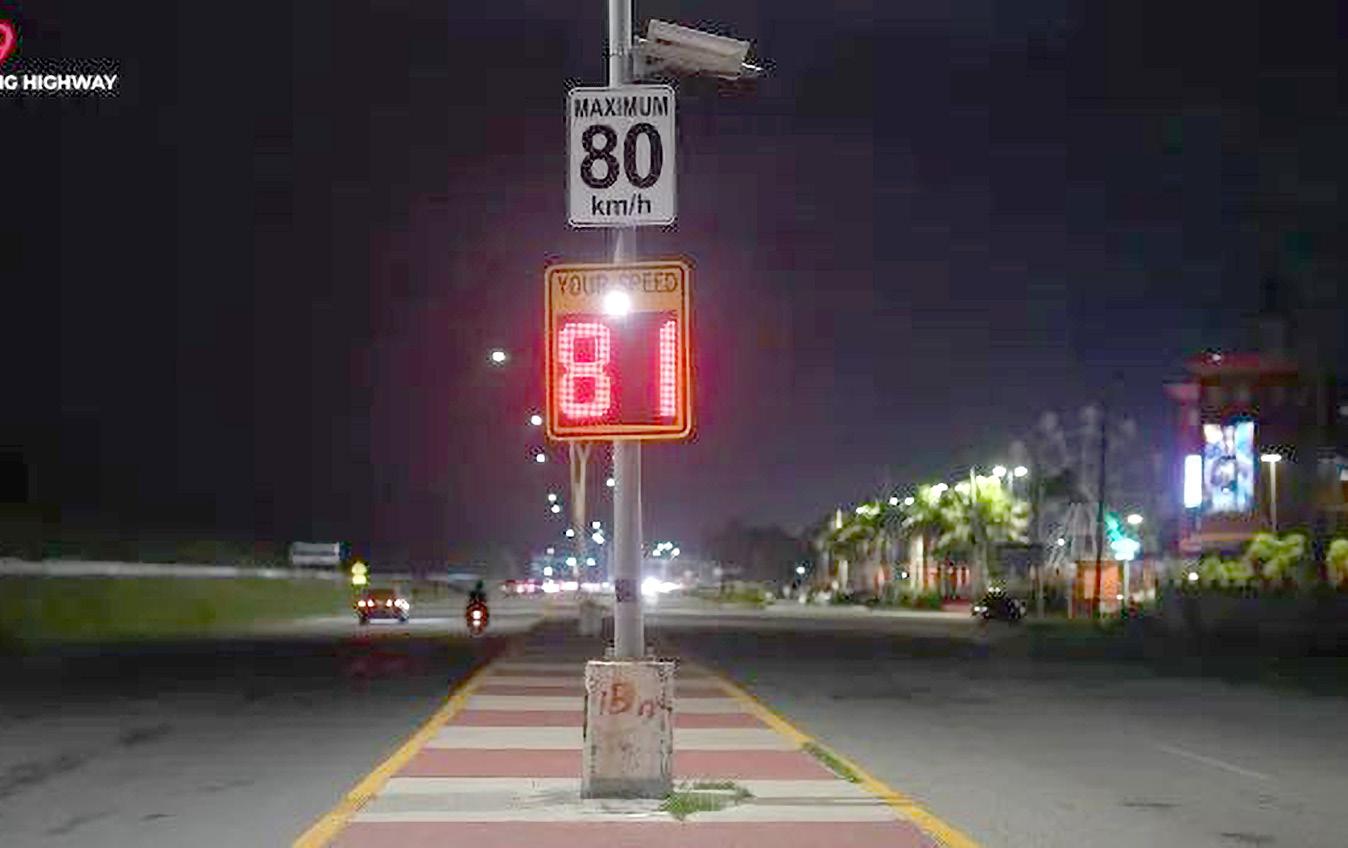
GUYANA’S drive to improve road safety has recorded a significant milestone, with more than 51,000 e-tickets issued since the rollout of the Safe Road Intelligence System (SRIS), a technologically driven initiative aimed at strengthening traffic enforcement and reducing road fatalities.
This was disclosed by Traffic Chief Mahendra Singh during an interview with the Department of Public Information (DPI) on Thursday, where he outlined the impact of the system which became operational on April 1, 2025.
Singh explained that the initiative represents a major shift from previous approaches to road safety.
He noted that it is powered by technology which removes human interference and strengthens accountabil-
ity in enforcement.
He said the system was designed with safeguards to prevent bias and compromise, while ensuring that violations are detected and addressed efficiently.
“This safe road initiative is technologically driven. It is one which has at its core safeguards built in to prevent any biases, any interference, or any form of compromise.”
The traffic chief reported that more than $205 million has already been collected from payments, with over 52 per cent of the 51,000 plus tickets issued being settled by offenders.
He said the system is currently active along major corridors including the Heroes Highway, the Mandela to Eccles Interlink, the East Coast Public Road and parts of Region Three, where noticeable reductions in serious
and fatal accidents have been recorded.
While minor collisions still occur, Singh noted that the reduction in severe crashes is a positive indication of improved road-safety outcomes in monitored areas.
However, he cautioned that reckless driving behaviour continues to be a challenge, with many motorists still engaging in speeding and unsafe use of roadways.
He also highlighted that drivers are willing to take the risk to get by every space of roadway that is available, they wish to use, whether dangerously or carelessly or negligently.
The Safe Road Intelligence System (SRIS) is not only an enforcement tool but also a deterrent mechanism aimed at changing driver behaviour over time.
He added that as the system continues to expand nationwide, it is expected to further strengthen compliance and support broader
efforts to reduce traffic fatalities.
The traffic chief emphasised that road safety is being pursued through a combined approach of enforcement, public awareness and technologically driven monitoring, all aimed at creating safer and more responsible road use across Guyana. [DPI]
THE National Gallery of Art (NGA), Castellani House, has issued a call for artists to participate in its upcoming Visual Arts Exhibition, scheduled for May 14, 2026, in celebration of Guyana’s 60th Independence Anniversary.
According to the gallery’s curator, Ohene Koama, the exhibition, titled “The Independent Artist,” does not have a specific theme and allows artists to submit work in areas such as painting, sculpture, drawing, ceramics, and photography.
The rules of the competition are straightforward: a maximum of three pieces per artist; all artworks must be professionally finished and ready for display; each piece must include the title, date, and medium; and artists must submit a short ‘bio’ along with a brief artist statement via email to ngaguy1993@ gmail.com.
Additionally, the title, date, medium, and price for each submitted piece must also be included in the email.
The deadline for submissions is May 6, 2026, at 17:00 hrs, with artworks to be delivered to Castellani House. No submissions will be accepted after this deadline. Koama noted that several artists have already submitted pieces for
—‘The Independent Artist’ showcase set for May 14 at Castellani House
the exhibition, and the timeline allows for works to be installed ahead of the official opening. The exhibition aims to showcase local talent and provide artists with a platform to reach a wider audience.
Following the opening on May 14, the exhibition will continue into June, giving art enthusiasts the opportunity to visit Castellani House and view the works on display.
Traffic Chief Mahendra Singh
More than 51,000 e-tickets have been issued since the rollout of the Safe Road Intelligence System (SRIS) back in April last year
Passion, dedication drive growth of Nadia’s Craft Shop
are at the heart of Nadia Lockhart’s journey as a creative entrepreneur, driving the continuous expansion of Nadia’s Craft Shop, an online-based business established in November 2018.
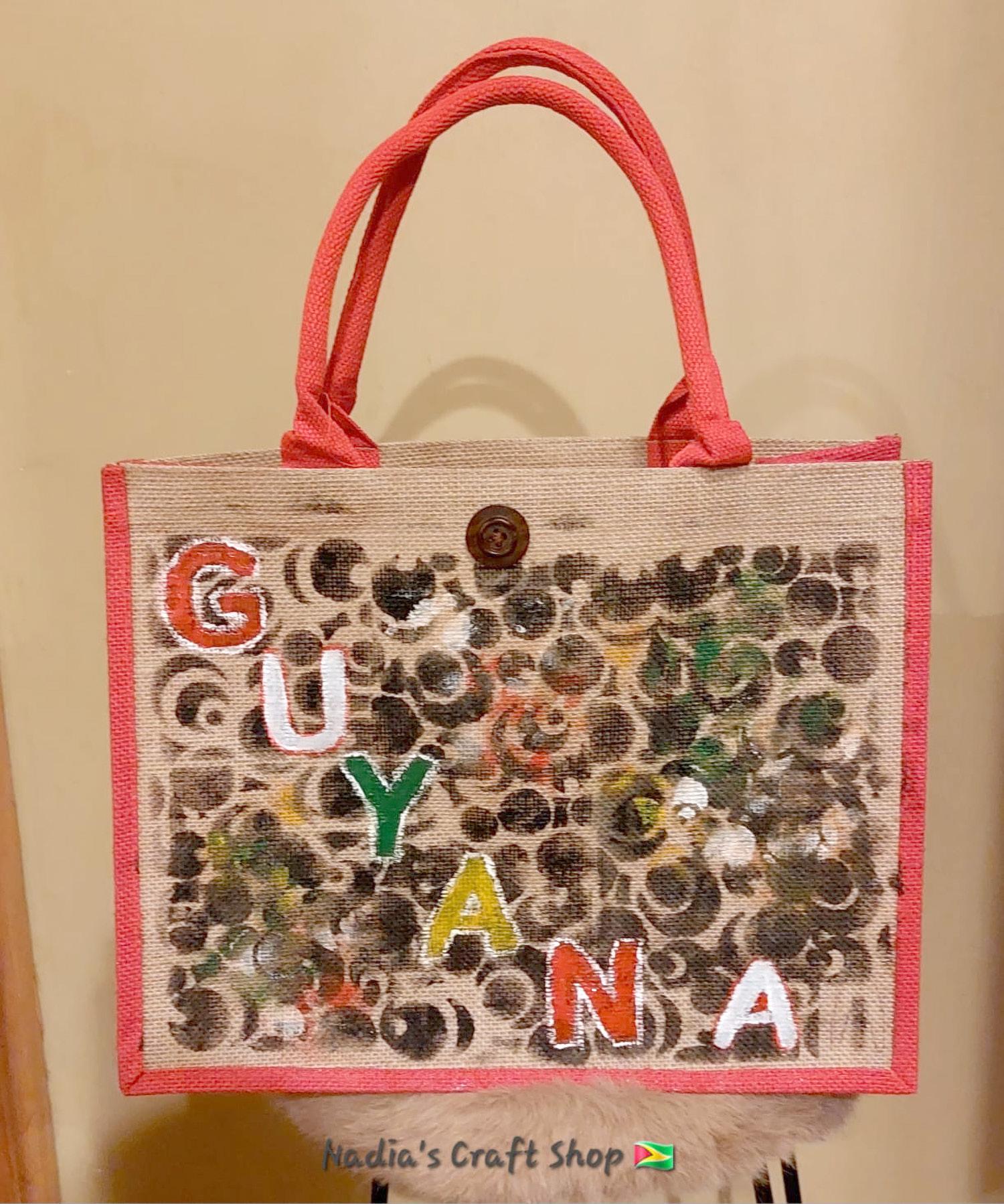
What began with the creation of candle holders has since evolved into a diverse range of handcrafted items, including handmade florals, decorative bottles, resin coasters, hand-painted Guyana-themed bags, clothing, and door wreaths, particu -
larly popular during the last holiday season.
In addition, she also makes corsages, fascinators, which are elegantly decorated headbands, perfect for tea parties or other special occasions.
Asked about where her materials are sourced, Nadia expressed that the bottles, for example, are recycled wine bottles and rum bottles which are cleaned and used in her crafts, while the wreaths are made with either styrofoam or wood.
“Well, at the moment,
since I’ve added hand-painted Guyana bags, and I’ve added clothing, so the moment the clothing and the bags, they’re off the hook; I’ve been getting a lot of sales with those, because I even have placemats that I used to make bags with. So, the bags and the clothing,” she shared.
A full-time entrepreneur, Nadia said she now has more time to dedicate to her craft, allowing her to consistently develop new and innovative products.
“There are times when I put my mind to do something, I go straight through. I work, I don’t stop. I would work for eight to 10 hours in a day, and then start again the next day. Most times, I don’t wait for an event. If I have an idea and feel I need to work on it right away, I do,” she explained.
She added that her business continues to grow through word-of-mouth and social media, with customers frequently sharing her work and attracting new clients.
“But that’s basically how my business is going right now, until I have a physical location where I can fully open to the public and persons can walk in, see items, and make purchases,” she said.
The woman stated that each piece she creates comes from the heart and is created with love, crafted with care and intention.
Nadia regularly participates in local exhibitions,
and Social Security.
She is also scheduled to showcase her products at an exhibition event at the Georgetown Club on May 9, 2026, under the Black Magenta theme in observance of Mother’s Day. Persons can find Na -
dia’s Craft Shop on Facebook and Instagram under the same name, with most transactions conducted via Facebook. Interested customers can also make enquiries and place commissions through social media or by calling 615-3671.
including Uncapped and the We Lift Expo hosted by the Ministry of Human Services
Items sold at Nadia’s Craft Shop
Port Kaituma Hospital gets new maternal waiting home among other facilities
HEALTHCARE delivery in Guyana’s hinterland is being transformed significantly under the People’s Progressive Party Civic (PPP/C) Administration as thousands of residents within the Matarkai sub-district will benefit from several new facilities at the Port Kaituma District Hospital, Region One.
The facilities, which include a modern operating theatre, upgraded maternal and child health unit, digital X-ray services and a maternal waiting home, were officially commissioned by Minister of Health Dr. Frank Anthony on Friday.
“This is not just about investing in buildings and equipment. We want to make sure these services are functioning and that people can benefit from them,” Dr. Anthony said as he outlined the government’s push to deliver world-class healthcare across every region.
The minister said the new operating theatre will allow emergency surgeries to be done in Port Kaituma, thereby reducing the need for patients to be transferred to the main referral hospital in Georgetown for urgent care. He disclosed that within two weeks, specialist teams are expected to begin clearing the backlog of surgeries in the district as part of Guyana’s 60th Independence Anniversary.
Dr. Anthony also highlighted the
rollout of advanced diagnostic technology through an Artificial Intelligence-powered Picture Archiving and Communication System (AI PACS), which will support doctors in reading digital X-rays.
He explained that the software can assess images in seconds, identify abnormalities such as pneumonia or tumours, and improve the accuracy of diagnoses by up to 99 per cent.
The Port Kaituma Hospital system will be linked with other hospitals nationwide, allowing specialists at the Georgetown Public Hospital and overseas experts to provide second opinions when needed.
The maternal waiting home will help expectant mothers from far-flung communities arrive safely before labour begins, reducing dangerous deliveries during travel, and helping Region One maintain zero maternal deaths.
The minister stressed that the government wants zero maternal mortality, not only in Region One, but across Guyana.
Beyond infrastructure, Dr. Anthony said the government is expanding healthcare human resources through scholarships, free University of Guyana programmes, regional pre-medical training, and decentralised medical education to train more doctors, medexes and health workers from hinterland
communities. He urged residents to identify young people for training opportunities, saying stronger local staffing is key to sustainable healthcare delivery.
He also pointed to major gains in disease control, including reductions in malaria cases, and ongoing plans to eliminate filaria, Chagas Disease, leprosy and tuberculosis.
Additionally, he encouraged residents to use government-funded health vouchers, laboratory screening programmes, eye-care support, and HPV vaccination initiatives aimed at preventing cervical cancer.
Director of Regional Health Services Dr. Cerdel McWatt said Region One is emerging as a model for healthcare development, noting that the commissioning represents another milestone in the government’s strategy to strengthen primary and secondary care in remote communities.
He said the expanded maternal and child health unit, improved diagnostics and new waiting home will improve outcomes for mothers and children while reducing preventable complications.
The director further praised the region’s leadership for aggressively pursuing development projects and ensuring they are completed.
According to Dr. McWatt, Region One has distinguished itself through innovation, with telemedicine, outreach expansion and improved service delivery already benefiting thousands of residents.
Meanwhile, Regional Health Officer Dr. Steven Cheefoon said the transformation of Region One’s health sector since 2020 has been unprecedented, with more than 300 residents already trained in nursing, allied health and technical fields, and over 200 others currently in training.
He said the region is deliberately building a local workforce so residents can be treated by professionals from their own communities.
Dr. Cheefoon noted that ambulance access has expanded from just one vehicle in the entire region to six ambulances, with two more expected this year.
He added that telemedicine now connects remote villages such as Sebai, Kwebanna and other hinterland communities to doctors and specialists, while new health posts continue to be built in previously underserved areas.
The Regional Health Officer also reported dramatic progress in malaria control, with cases dropping from more than 16,000 in 2020 to just 824 last year after nationwide distribution of treated bed nets and
improved surveillance.
He said Region One is now positioned to lead the hinterland in quality healthcare delivery.
Friday’s commissioning at Port Kaituma forms part of the government’s wider investment drive to modernise healthcare infrastructure, strengthen staffing, digitise services and ensure residents in every part of Guyana receive timely, professional and high-quality medical care. [DPI]
Minister of Health Dr. Frank Anthony standing in front of the Port Kaituma Hospital’s new maternal waiting home
Minister of Health Dr. Frank Anthony and (to the minister’s right) Director of Regional Health Services Dr. Cerdel McWatt inspect the new Operating Theatre
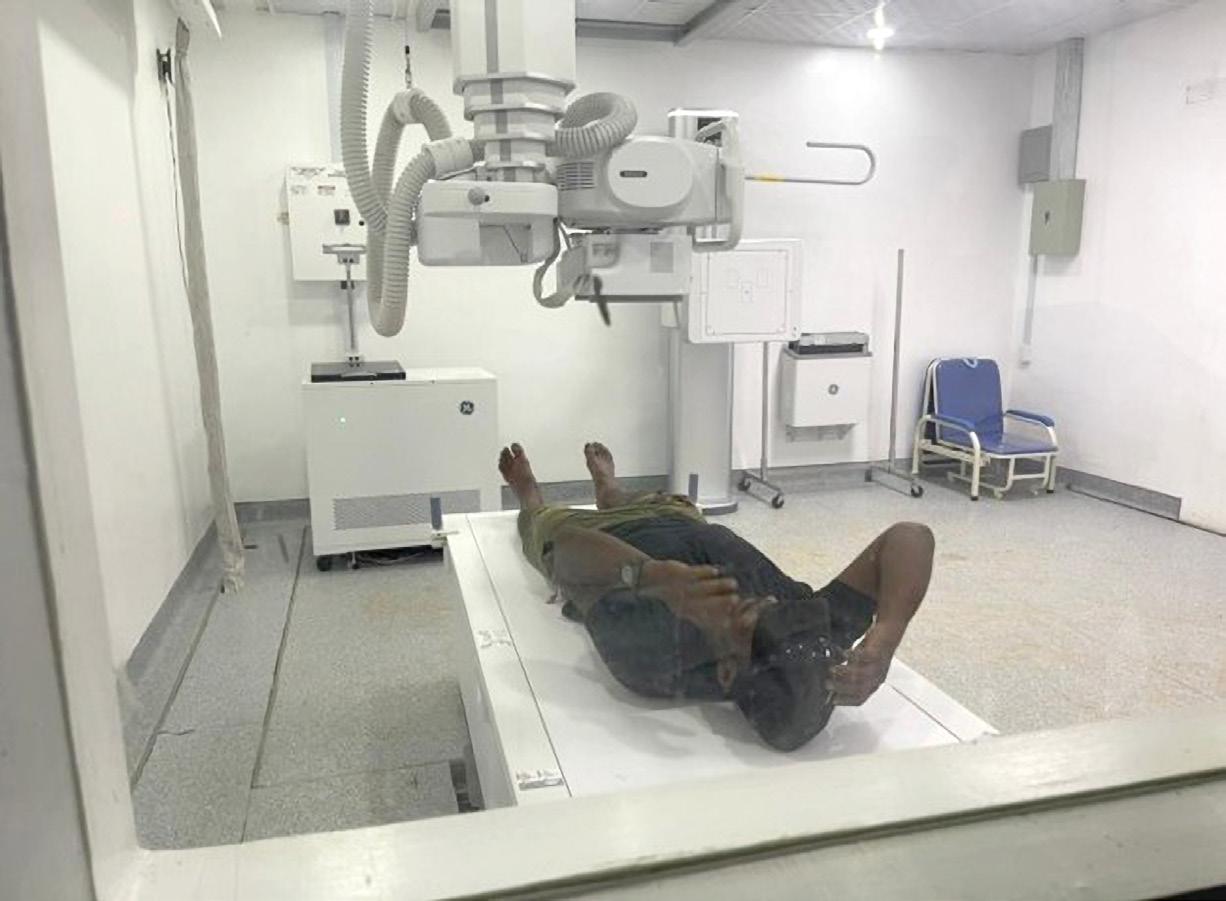
An examination being done on the new digital X-ray machine at the Port Kaituma District Hospital
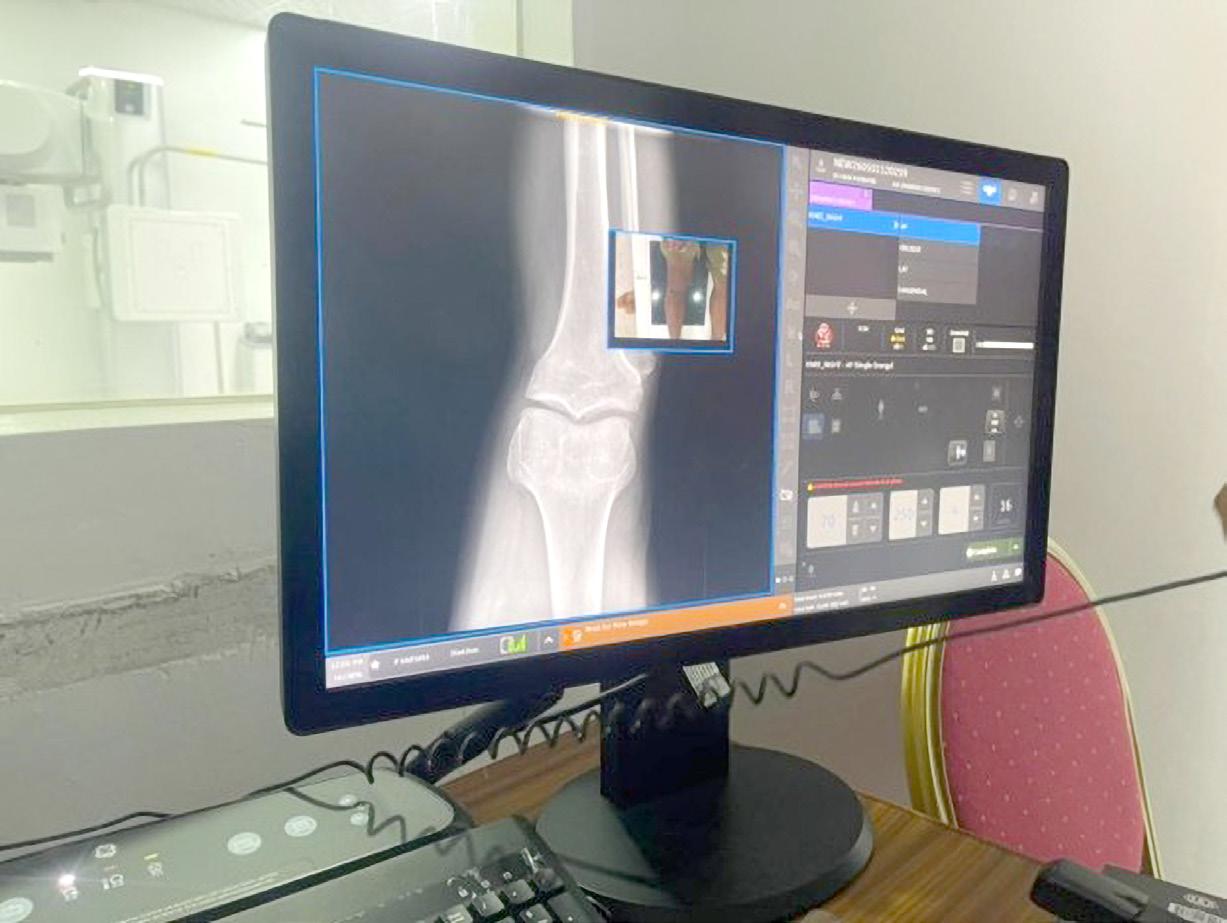
The digital X-ray machine is outfitted with camera and the machine delivers quick results
Decomposed body found at Capoey Lake
POLICE are investigating the discovery of a decomposed body found at Capoey Lake, Essequibo Coast, on Friday evening.
The body, believed to be that of an adult male of mixed ancestry, remains unidentified. Police said the discovery was made around 18:10 hrs on May 1, 2026, after ranks responded to a report and went to the location, where the body was found lying face up and motionless on the lake bank. Preliminary investigations revealed that the body was partially submerged in water and clad only in black underwear. Investigators also observed a tattoo bearing the word “ANIMAL,” along with the image of a jaguar, on the upper left arm of the deceased.
The body was removed from the scene and taken to the Suddie Public Hospital, where it was examined and
certified dead by a doctor on duty. It has since been transferred to the Suddie Public Hospital Mortuary, where it awaits identification and a post-mortem examination. Investigations are ongoing.
Robbery suspects shot at shopkeeper, nabbed after crash at Mahaica
TWO men accused of robbing a shop at Unity, Mahaica, were apprehended after a dramatic chase that ended in a collision on Saturday afternoon.
Police said the incident occurred around 12:05 hrs and involved a 32-year-old shopkeeper. “Preliminary investigations revealed that the victim was in her shop when two suspects approached and demanded money. The men then reportedly began searching through drawers and other areas of the shop for cash
The victim reportedly ran from the shop, during which the suspects discharged a round in her direction. She subsequently fainted and was taken to hospital by public-spirited citizens,” a police release said.
The suspects then attempted to escape but were pursued by residents and police ranks. During the chase, they reportedly collided with a motor car and were subsequently ap-
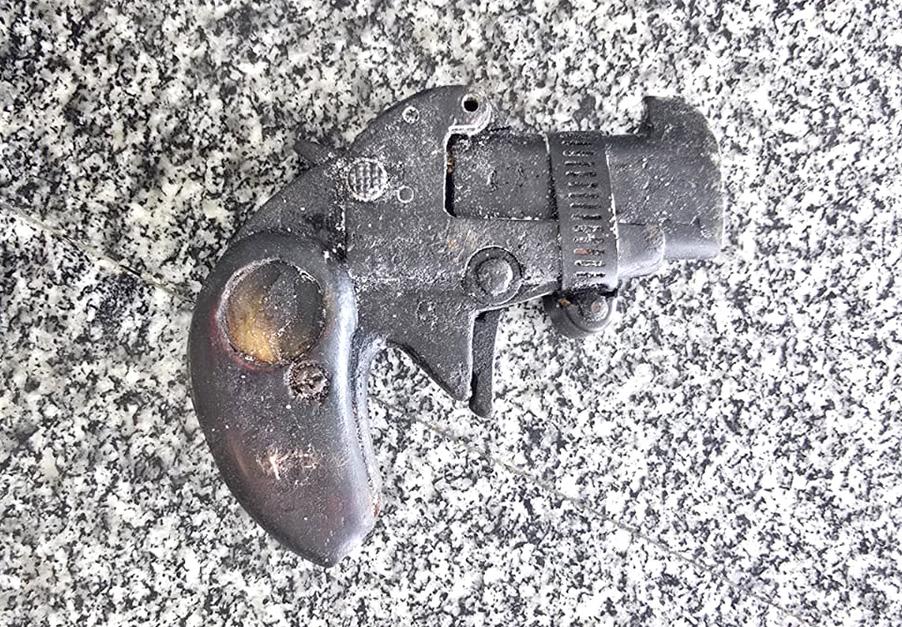
The firearm recovered by the police
prehended. Police recovered a firearm and the motorcycle used by the suspects.
The two men, a 21-year-old of Sophia and a 20-year-old of Cummings Lodge, are currently receiving medical treatment at the Enmore Regional Hospital for multiple injuries. Investigations are ongoing.
Airguns, handcuffs
and police vest
found dumped at Garden of Eden
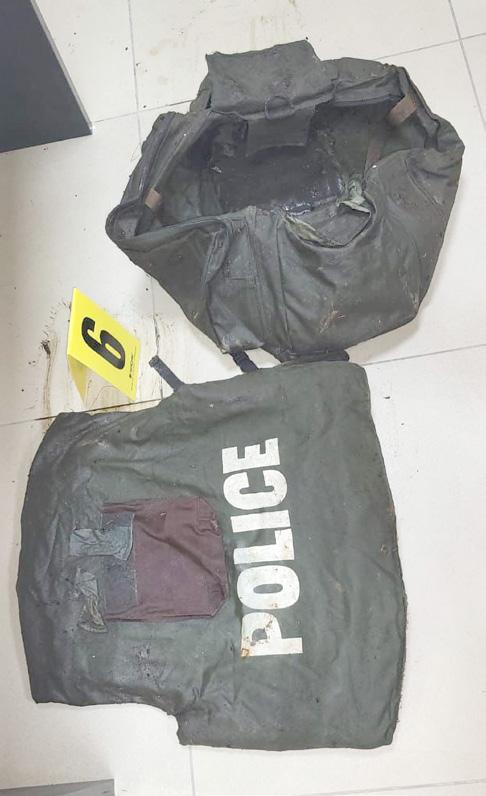
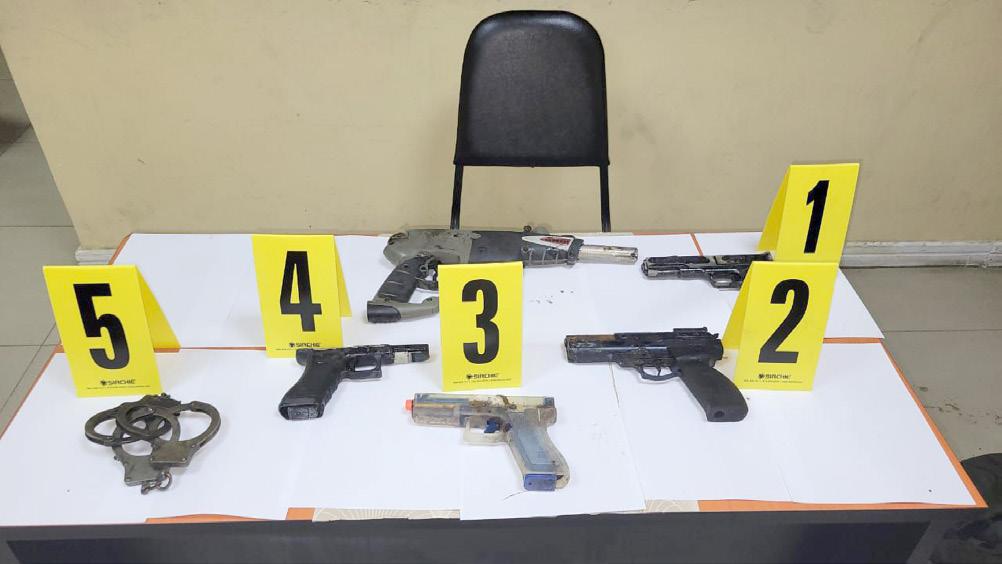
POLICE have recovered a quantity of suspected air guns, airsoft pistols, handcuffs and a police vest during an operation at Garden of Eden, East Bank Demerara.
The discovery was made between 22:00 hrs and 22:20 hrs on Friday, May 1, 2026, after ranks acted on information received and conducted a search at a garbage heap along the southern parapet near a trench.
and
and a Brass Eagle Samurai paintball marker gun with tank.
During the exercise, officers found a green duffle bag containing several items, including a Vintage Marksman Repeater .177 calibre BB gun, a BSA 240 Magnum .22 air pistol, a G3 Nightingale airsoft pistol with magazine
Police also recovered the lower frame of an airsoft pistol with magazine, two pairs of handcuffs and a bulletproof vest. The items were taken to the Grove Police Station and lodged pending investigations. No arrests have been made as the investigations are ongoing.
The police bulletproof vest in question
The quantity of suspected air guns, airsoft pistols
handcuffs recovered by the police
ENGLISH RACING TIPS
NEWMARKET
08:45 hrs Esna
09:20 hrs Cathedral
09:55 hrs Many Men
10:35 hrs Precise
11:10 hrs Call Me Tomorrow
11:45 hrs Napa
12:20 hes Sahara King
HAMILTON
09:05 hrs Wesport
09:40 hrs Elysian Flame
10:15 hrs Haayimn
10:53 hrs Izzari
11:25 hrs Liverpool Star
12:00 hrs Mount Ruapehu
12:35 hrs Alpine Sierra
SALISBURY
08:30 hrs Moonhall Lass
09:00 hrs Ziggy Starshine
09:35 hrs Dapper Valley
10:10 hrs Binmalk
10:48 hrs Royal Poetry
11:20 hrs Ranga Tang
11:55 hrs Take The Boat
SOUTH AFRICA
RACING TIPS
KENILWORTH
08:00 hrs Beneath The Clouds
08:35 hrs Give Me Everthing
09:10 hrs Shezaripper
09:45 hrs Vica’s Liberte
10:20 hrs Follow Your Heart
10:55 hrs Lhasa
IRISH RACING TIPS
CORK
08:20 hrs Edward Thatch
08:55 hrs Cool Azul
09:30 hrs Collecting Coin
10:05 hrs Quiet Mutiny 10:43 hrs Lifting Sails
11:15 hrs Kalir
11:50 hrs Yousaynothingatall 12:27 hrs Atomic City
Gaikwad, Kartik, bowlers push
MI to the brink of elimination
(ESPNCRICINFO) - Chennai Super Kings (CSK) outplayed Mumbai Indians (MI) for the second time this season, leaving Hardik Pandya's men on the brink of elimination.
After misreading pitch No. 6 against Gujarat Titans (GT) last weekend, CSK used pitch No .5 to their advantage on Saturday, limiting MI to 159 for 7. Their attack kept banging the ball away on good lengths and hard lengths on a two-paced track to shut down MI's batting line-up. Ruturaj Gaikwad and Kartik Sharma made light work of the middling target with unbeaten half-centuries. They climbed up to sixth on the points table, with their fourth win in nine games.
After opting to bat first, MI crashed seven sixes in the powerplay - five of those came from Ryan Rickelton - but some of that big-hitting was offset by the 19 dots they played out during this phase.
Mukesh Choudhary had missed CSK's previous game against GT, after they had brought Sarfaraz Khan in as Impact Sub as early as the fourth over. Here, he conceded 25 runs in three powerplay overs.
Prashant Veer, the rookie left-arm spinner, had a rough initiation into the IPL with the ball. Rickelton smacked him for three sixes in his first over in the league. Gaikwad tossed him the ball in the fifth over because Akeal
Hosein, who had bagged a four-wicket haul against MI at the Wankhede in the reverse fixture, was out of the team at Chepauk for this one. So, Veer bowled despite the presence of the left-handed Rickelton at the crease. It released the pressure that Choudhary and Anshul Kamboj had built up.
Six of the first ten overs were bowled by uncapped CSK bowlers. While Veer came back well after the powerplay, it was debutant seamer Ramakrishna Ghosh who was more impressive. He claimed the big scalp of Suryakumar Yadav when he banged a hard-length delivery, and had the batter slicing a catch to Dewald Brevis at sweeper cover for 21 off 12 balls.
Before the start of IPL 2025, Gaikwad had name-checked Ghosh as a player to watch out, but it took a while for him to get a game. He showed glimpses of what he’s capable of on Saturday, returning 1 for 24 in his three overs. Left-arm wristspinner Noor Ahmad gave him excellent support, taking out two left-handers in Rickelton and Tilak Varma.
Suryakumar has struggled through the season, and his numbers against pace have been especially wretched: seven dismissals in nine innings, an average of 10.71 and a strike rate of 133.92. Tilak was dropped by Shivam Dube when he was on 1, but added only 4 to his tally before he mis-hit
Noor to Gaikwad at cover.
Naman Dhir top-scored for MI with 57 off 37 balls, but could not find a higher tempo that would hurt CSK. He started quickly - he moved to 19 off nine balls - but slowed down drastically against spin. Along the way, he was also reprieved by Dube, on 19.
Captain Hardik Pandya laboured to 18 off 23 balls before Kamboj had him holing out in the final over of the innings. After hitting seven sixes in the first six overs, MI could manage only three in the next 14.
CSK had a shaky start, losing Sanju Samson to Jasprit Bumrah in the second over. At the start of that over, Bumrah got one to angle in at Samson and then veer away late to kiss the outside edge, but Jacks dropped a sitter at slip. At the end of that over, Bumrah found Samson's outside edge once again, with Rickelton holding onto the catch this time.
After Samson and Urvil Patel departed, Gaikwad controlled the chase along with Kartik. He picked away Trent Boult for two fours and a six in the third over and went on to bring up back-toback half-centuries.
At the other end, Kartik targetted the mystery spin of AM Ghazanfar, taking him for 23 off 13 balls. He closed out the game with an eye-catching reverse-scoop off Boult, and sent 34,940 fans at Chepauk into frenzy.
Quarterfinals set for Sunday and Tuesday...
• From Page 27
Sunday’s opening clash brings together Kuru Kururu which toped group A with two wins in as many matches putting all on the line when they take on group C runner-up, Upper Soesdyke. Kuru Kururu will be led by veteran Marvin ‘Munro’ Joseph and Kevin Scott, both scoring a double each so far.
Leroy Evans who has scored their other goal will also add support to their victory quest. Upper Soesdyke will start as the underdog and will have to come big to topple their opponent. They will have to improve in the attacking third as they have only scored a single goal to the opponents’ five.
Sunday’s feature clash is a potential humdinger with Swan, one of the fittest teams taking on a seasoned challenger, Agricola. The tournament’s second leading goal scorer,
Today’s Quiz: (1) How many centuries were struck in IPL 2022? (2) What was the highest team total made in IPL 2022? Answers in tomorrow’s issue.
Abraham Webb with a hat-trick of goals will have to maintain his accuracy if they are to continue their positive run.
He’ll have support from Timothy Adrian and Anderson Webber amongst other players. Agricola had to draw on all their experience after losing their first match to topple Mocha in their final group game which allowed them to squeeze into the quarterfinals. They’ll depend on Kelvin Gordon, Shamar Sampson, Demanie Cort and Jamal Fiffe to lead their bid for a win.
On Tuesday, Grove, the most clinical village on show so far, scoring nine goals while conceding two, will take on neighbouring village, Kaneville, a young but confident team in the main event. The tournament’s leading marksman, Domini Garnett (4 goals) will once again lead Grove as they eye a place in the semis. Kevin Padmore, Rayfield Hilliman, Akeem Jarvis and Jamal Cordis will all lend support. Kaneville will look to Deno Cupidore, Tyequan Robinson and Herman Gill to lead an upset.
Opening play at 7pm will see Herstelling and Timehri locking horns with another potential epic expected. Timehri stormed back from the brink after losing their first game to top group D, whilst Herstelling won their first match but went down in their second.
Nyron Barrow, who netted both goals Timehri scored in the tournament so far will seek to repeat his heroics but will have to contend with the likes of Malcolm Hendricks, Johenni Mendoza and Jonathan Conyers. Two exciting days of play awaits with the rewards being four spots in the business end of the tournament.
The tournament has been made possible through the kind sponsorship of the Ministry of Culture, Youth & Sport, Office of the Prime Minister, Ministry of Housing, Bounty Farm Ltd., Fitness Express, Republic Bank, Star Rentals, and The Trophy Stall.
Dharry will defend his title if the price is right
By Sean Devers
WITH a record of 31 wins, 6 losses, and a draw from 38 fights, holder of the IBO Super Bantamweight world title, 40-yearold Elton Dharry wants to fight two more times before he retires to focus on being a boxing promoter.
Two Saturdays ago at the Pegasus Suites in Georgetown, , Dharry became the first Male pugilist to win a World Title on local soil when he beat 22-year-old Salim Kassim of Tanzania by a unanimous verdict in a gruelling 12-round battle to capture the title.
Speaking on last Tuesday Night’s ‘Sean Devers Sports Watch,’ Dharry, who entered the ring at 122 pounds, said he felt relief to finally win a world title on his second attempt in a career that began 22 years ago when the USA-based Guyanese beat Mark Fernandes at the Cliff Anderson Sports Hall on his professional debut.
“I feel a bit of relief… I was constantly worrying… when I would be a world champion, it was on my mind every day. If I were to retire today, I would have accomplished what I have set out to do. So, I am excited and happy with that. I have always wanted to have 40 professional fights at the end of my career. I have 38 fights; I am looking forward to fighting two more times,” informed Dharry, who grew up on the Essequibo Island of Leguan before migrating to the US at the age of 13.
Speaking about Saturday night’s fight.
“I saw him [Kassim] fight. He is the WBO African Champion, and I have seen clips of him. This guy beat up some undefeated fighters, so I knew I had my hands full.
“I went into that fight knowing that I had a tough fight on my hands. I was a bit nervous… not because he was 22, but because he can fight; he is the African champion, and when you win a belt and keep fighting, you become more confident. The more you fight, the better you get,” explained Dharry.
“I was fighting once a year for six years, while he might have had 13 fights, but he fought in December and February, and he was sharp, so I knew I had something hard coming,” noted Dharry, who is ranked number seven in the flyweight division by WBA as of March.
“When he caught me and knocked me down in the second round, I knew like s..t, I got to do something or else it would be a terrible night for me.
“Well, I won’t say his running around disrupted my plans…If I wanted to, I could have caught him, but I was advised to be smart, don’t overcommit... don’t get too aggressive.
“I could have gotten to him, but the guys thought I was winning even though we were not doing too much in some of the rounds.
“They wanted me to fight smart and not get caught again, and be knocked out. But no, it [Kassim’s moving out of range] did not
affect me since he was not that fast.
“I did not expect him to move around the way he did. I thought he would have been more aggressive and tried to put me away because that’s the way he fought in the videos I saw.”
Dharry said that he has been through a lot, but does not entertain negative thoughts.
“I have been knocked out only once in my life, and it was not in the boxing ring, it was not in a fight. It was in a cricket match.
“I was the wicket-keeper, the batsman played a pull shot and swung around, and the bat hit me in my head. I was knocked out cold. I was out for hours. I spent a week in the hospital.
“So cricket is more dangerous! I can say that …right?
“A lot of people pass away while driving, walking, or being robbed going to the store… so now some are saying I should stop fighting because I am the world champion, since it is dangerous. That is nonsense. I think positive,” reasoned the pugilist, who fights out of the Gleason Boxing Gym in Brooklyn.
“I have a great fan base in New York and at Gleason’s Gym. They are already making a banner for me. I am so honoured and proud.
“Even in Guyana, people have given me great support. I felt the support this time around from everyone. There were no negative comments from anyone here, and they all supported me. That means a lot when you step into the ring. It motivates me,” stated Dharry, who travelled to Leguan to shoot a documentary on Gleason Gym.
“It was a wonderful feeling to go back to where I grew up. I will take a two-week rest and spend time with my family,” continued Dharry, whose nephew plays U-15 cricket for Essequibo.
Dharry informed that he has already had calls asking him to defend his title.
“If it’s financially feasible for me, I will consider it, but my focus is to do more promoting and box in two more bouts.
“I am talking to partners to hold a card in the Summer at the Cliff Anderson Sports Hall and get more eyes on the sport,” disclosed Dharry.
Dharry revealed that his toughest fight was at the Providence Stadium in 2022, when he beat Panamanian Orlando Penalba for the WBC International Super Flyweight title.
Dharry was floored thrice in the final round but survived to win by unanimous decision.
“I was medically unfit to be in the ring. I had acid reflux, and I could not eat any food. I was on medication throughout that period, was dehydrated. I fought a man who put me through hell in that fight.
Former National Lightweight Champion
Mike Benjamin, veteran Sports Commentator ‘Reds’ Perreira, and boxing historian Oswald Pierce were also guests on the programme.
Referee Eon Jardine gives Kassim an eight-count as Dharry (foreground) watches, but the African Champion would go the full distance (Sean Devers)
One Guyana T10 Tapeball to start August 8
THE Caribbean tapeball landscape is set for its most lucrative chapter yet as FL Sport officially unveiled a significantly bolstered prize structure and the comprehensive schedule for the fourth season of the One Guyana T10 Tapeball Blast.
This premier cricket extravaganza is scheduled to bowl off on the weekend of August 8-9 and will culminate in a historic national grand finale on October 11 at the new
Anna Regina National Stadium.
The competition begins in Berbice with a 16-team cap for its opening leg, then moves to the East Bank/West Demerara zone on August 15-16 and the Essequibo zone on August 22-23.
The tournament will briefly pause to prepare for the Caribbean Premier League (CPL) in Guyana.
Action resumes following the conclusion
of the CPL, with a revamped format for the Georgetown/East Coast Demerara Zone.
Moving away from the traditional compact two-day schedule for the capital region, organisers have extended this leg to four playing dates, with the Round-of-32 and Round-of-16 slated for September 26-27, followed by the quarterfinals and zone finals on October 3-4.
Tournament Director John Ramsingh expressed high expectations for the upcoming season, noting that the event continues to grow in both popularity and prestige.
Ramsingh emphasised the commitment to bringing the game to the people, highlighting that registration is open to any team for any zone. While match venues are being finalised with an eye toward utilising the country’s premier facilities, the organisers confirmed that admission for all fans will remain free of charge throughout the tournament.
The financial stakes for Season IV have reached unprecedented levels for the format. FL Sport has introduced a tiered payout structure designed to professionalise the tournament and reward teams for deep runs.
Each zone winner will now pocket $500,000 and advance to the National Finals to compete for a $2 million top prize.
Under this revamped structure, the national champion will walk away with $2.5 million, while the national runner-up will
earn $1.5 million.
Beyond domestic glory, the stakes are heightened by the announcement that zone winners will earn an automatic qualifying spot in the upcoming Global T10 Tapeball tournament.
In a bid to remain player-centred, rewards have been expanded even for those who fall short of the podium.
Losing finalists at the zone level will receive $200,000; semi-finalists will earn $50,000; and, for the first time in the tournament’s history, losing quarter-finalists will receive $25,000. Individual brilliance will also be handsomely compensated.
The tournament MVP will receive $150,000 and a motorbike, while the leading run-scorer and wicket-taker will each earn $100,000 plus a television.
Additional cash incentives are set for the Player-of-the-Final, the best economy rate, and the highest strike rate, alongside various non-monetary prizes for statistical leaders.
Registration for the 80-team straight knockout tournament is scheduled to go live on Friday, May 8, with an entry fee of $35,000 per team.
Organisers remind prospective participants that spots are filled on a first-come, first-served basis, with payment serving as the only confirmation of a team’s place in the most anticipated tapeball event of the year.
YBG Schools’ Basketball Conference Series…
Hururu, Mackenzie High, Skeldon Line Path & JC Chandissingh record wins
HURURU Secondary, Mackenzie High, Skeldon Line Path & JC Chandisingh Secondary Schools were among the winners on Friday when Youth Basketball Schools’ regional Basketball Conferences continued on Friday in Berbice and Linden.
After completing the Georgetown leg, the action moved to Linden, where Hururu Secondary girls opened the day’s clashes with an 8-0 win over Mackenzie High.
Kayann Grimmond recorded 6 points in the win.
While in the boys’ category, Hururu Secondary overwhelmed Harmony Secondary 49-0 points as Breyon Shultz starred with 16 points and 10 rebounds.
Peter Roger also played well to finish with 12 points and 7 rebounds.
Also emerging victorious was Mackenzie High who took an upset win over Kwakwani Secondary 22-16.
Shaquan Massiah led Mackenzie High offensively 12 points and 3 steals.
Over in the ancient county of Berbice, JC Chandissingh and Skeldon Line Path were the top sides.
The Girls category kicked off with a one-sided contest as JC Chandissingh Secondary stormed their contest with Skeldon Line Path, beating the latter 20-0.
It was an all-round good showing for the winner, with Jada Minty and Renecia Rose leading the point’s column.
The boys’ group saw Skeldon Line Path flipping the script with a 45-5 points win over Lower Corentyne Secondary.
Daniel Duke did the damage for Skeldon Line Path as he recorded 10 points. They had several other contributors, with Chris Promes (10) and Kellon Lyte (9) also having a share in the points.
The last game of the day saw JC Chandisingh Secondary defeating Manchester Secondary 36-17. Mark Mendonca guided JC Chandisingh with his 15 points with Denaldo Henry is showing his worth with 10 points.
The Regionals are sponsored by Edward B. Beharry Ltd, G-Boats Inc., National Sports Commission, Ministry of Education and Banks DIH Ltd.
Kayann Grimmond, Hururu Secondary top scorer.
Classic Ball Blasters
whip Guyana Defence Force
BLUEBERRY Hill / Alleys/ Valleys / Christianburg combined found a way to emerge winners of the inaugural Kashif and Shanghai 2026 Linden Town Week Inter Ward football championship.
They needed penalties to shake loose a 4-3 win over arch rivals Half Mile/ One Mile /Scheme in front of a capacity crowd at the spanking Bayrock National stadium in Wisrock, Linden, Friday night.
In a tense final, which was witnessed by Minister of Culture, Youth and sport Charles Ramson Jr. among others, Half Mile One Mile/ Scheme were able to nudge ahead from a brilliant 39th minute effort by Clinton Charles, much to the applause of their cheering fans.
This followed neat exchanges which could have gone either way, but Half Mile/ One Mile/ Scheme held the lead 1-0 lead at the break.
In the second period of play despite mounting a number of raids with near misses, Blueberry Hill /Alleys/ Valleys/ Christiaburg would find the equalizer through a counter play.
This evolved when Colwyn Drakes hit the ball past the Half Mile/ One Mile/ Scheme goalkeeper in the 84th minute, to level and send the crowd into a frenzy.
The overflowing football fans were by then into the match since no quarters were being given, but the scores were knotted 1-1 when regulation time ended and the penalty kick were ordered.
It was then that Blueberry Hill/ /Alleys/ Valleys /Christianburg would eke out a win, as both teams were tied 3-3 with one kick remaining.
Half Mile/ One Mile/ Scheme muffed the fifth shot and Blueberry Hill/ Alleys/ Valleys/ Christianburg snatched the win, netting their kick which was worth $1M, the winners’ trophy and bragging rights for the next year.
The Ministry of Culture, Youth and Sport donated the first prize of $1M to the champions Blueberry Hill/ Alleys/ Valleys/ Christianburg, as their player Kendolph Lewis was adjudged the tournament’s Most Valuable Player and got a trophy and $100,000, compliments of Bernard’s Variety Store.
For being runners-up Half Mile/ One
Mile/ Scheme for placing second walked away with $400,000 and a trophy, with Amelia’s Ward/ Kara Kara/ Bamia collecting $200,000 after defeating West Watooka/ Canvas City for third place as the fourth-place finisher received $150,000.
Marcus Tudor after scoring five goals for Half Mile/ One Mile/ Scheme was the Highest Goal Scorer and he received $56,000 from Town Clerk Lennox Gasper with Blueberry Hill’s Delon Adams being declared as the Best Goal Keeper and was handed a pair of gloves by Ian Deviera, and $50,000 from Bella’s Lumber Yard.
Amelia’s Ward / Kara Kara / Bamia Jamal Bentick collected the Best Goal celebration which was given by United States-based Lindener ‘Grandpa’ Harvey.
16 years old Travon Guillaume who played for Amelia’s Ward/ Kara Kara/ Bamia was the Youngest Player and was handed $20,000 along with a trophy donated by Unique Essentials.
For scoring the most goals for Blueberry Hill, Shane Luckie received a voucher from United States-based Rawle Johnson.
For scoring the opening goal of the tournament Clinton Charles was awarded $100,000 compliments of Bella’s Lumber Yard as Blueberry Hill/ Alleys/ Valleys/ Christianburg.
Ball Blasters shocked top team, the Guyana Defence Force on Thursday when the Demerara Volleyball Association intensified action in their league at the National Gymnasium.
Classic Ball Blasters were relentless in attack and sharp in defence to capture a straight-sets victory.
They won the contest 25-14, 26-24 and 25-16.
Classic Ball Blasters were led by Dua Grant with 11 points and 1 block, and Micah Chichester with 7 points and 3 ace serves.
Top scorers for GDF were Alex Fung-
Fook with 7 points, and Stephon Norah with 6 points.
Meanwhile, in the other league fixture on Wednesday, Premier Eagles Volleyball Club soared to victory over rival Vanguard VC in similar fashion.
The Eagles demonstrated precision and teamwork to power through all three sets for a flawless win.
Ian Baggot was again at the helm of the win delivered as he produced 10 points and 1 ace to pivot Eagles to victory.
Eagles closed out the contest 25-18, 25-9 and 25-13.
Vanguard top scorer was Victor Rogers with 3 points.
Most Valuable Player Kendolph Lewis at right collects his trophy from Yannick Charles.
Champions K&S /UDFA 2026 Inter Ward football Blueberry Hill/Alleys/Valleys/ Christianburg celebrations after final.
CLASSIC
Demerara Volleyball Association League…
Premier Eagles Volleyball Club.
Classic Ball Blasters.
GCA’s Sherwin Williams T20 second division cricket round-up
By Sean Devers
Everest, Transport, Ace Warriors, and GDF were in the winner’s row in the morning games of the GCA’s Sherwin Williams’ T20 second division cricket, which resumed yesterday, after being halted due to the inclement weather.
At MSC, Everest beat GNIC by 34 runs as Navindra Persaud hit three fours and six sixes in his 72. He got support from Troy Gonsalves, who made an unbeaten 45 to help the Camp road team to 153-5 off their 20 overs.
Jermaine Grosvenor (2-15) and Lemuel Ross (2-23) were the main wicket takers for GNIC, who were restricted to 118-8 when their 20 overs expired.
Stephon Campbell top-scored with 36 as Gonsalves had 3-16. Nityanand Mathura and Javid Rasheed had two wickets each.
At TSC, the home team beat GYO Mystic Marvels by seven wickets.
Veteran medium pacer Shawn Massiah (5-15) and Reyaz Latif (4-14) shared nine wickets between them to dismiss GMM for 120 in 19.2 overs. Trevayne Mohabir (45) and Martimah Headley (31) offered token resistance.
Jerimiah Honenkirk reached the boundary thrice and cleared it four times in 57. Emmanuel Lewis scored 20 for Transport in a successful run-chase.
At QC, Ace Warriors beat Sophia by five wickets after making 67-5 from 8.2 overs, replying to the 66 all out in 14.1 overs made by Sophia. Skipper Tyrick Walters hit a six and four in 18 in a dismal batting performance from Sophia as Nkosi Whytes had 3-13 and Junior Phillip took 2-10.
Joshua Grant captured 4-14 as Ace Warriors struggled to victory, with only Rawle Enmore (15) reaching double figures.
In the last morning game, GDF defeated DCC by two wickets in Queenstown.
Led by 32 from Alphius Bookie and 15 from Mickel Sharma[r1.1], DCC were bowled out 86 in 13.3 overs as Nigel Deodat (4-17) and Colvis Sam (4-25) conspired to orches-
trate DCC’s demise.
The Army reached 89-8 in 17.4 overs with Rasheed Gaffur making 25. Qumar Torrington, Wavell Allen and Veteran off-spinner Dennis Squires took two wickets each for the home team in a losing cause in their backyard.
In the afternoon game at MSC, Eldorado were dismissed off the last ball of the 20th over for 136.
Wicket-Keeper Quasim Yusuf hit seven fours and three sixes in a top score of 64, but only Owen Andrews reached 15.
Former Test player and National Leon Johnson took 4-28 for GCC, who replied with 139-2 in 15.3 overs.
Joshua Wade led the charge with a brutal
106 with six fours and 10 sixes as GCC won by eight wickets
At QC, UG made 135-6 with Devendran Ramkishun making 42. He got support from Bijan Embleton (22) and Nazeem Khan (20).
Raydon Enmore had 2-22 for Ace Warriors, who made 136-8 with Rawle Enmore (38) and Whytes (25).
Newral Nicolas had 3-18 in a losing effort as Ace Warriors won by two wickets.
At DCC, GDF marched to 242-3 with Gaffur clobbering nine fours and 10 sixes in his 112 while Shamar Angel contributed 90.
Agricola were restricted to 98-9 when their 20 overs were completed, despite 33 from Neil Hutton.
Gevon Shultz and Nigel Deodat took three wickets each for GDF, who won by 144 runs. At TSC, Transports galloped to 278-1 with Hohenkirk hitting nine fours and three sixes in 117 and shared in an unbroken 198 runs second wicket stand with U-19 World Cup Batter Shamar Apple, who scored 107 with eight fours and 10 sixes.
Reyad Latif (29) had put together 80 with Hohenkirk for the first wicket.
Diplomats were limited to 137-8, to be beaten by 141 runs as only Tyrell Peters (47) and Germain Douglas (34) offered fight. John Persaud and Reyad Latif had two wickets each. The tournament continues today at various venues.
LEOPOLD Street had a phenomenal outing on Friday evening at the National Cultural Centre Tarmac hoisting the Georgetown trophy in the Guinness Greatest of the Street football competition finals.
Leopold Street battled a storied Bent Street side, and it lived up to the hype as Leopold pulled out all the stops to walk away the a million-dollar richer after 4-1 drubbing of their rivals.
Second place, Bent Street, took home $400,000. In the 3rd place contest Island AllStars got the better of New Bay Ballers – 2-nil. While Guinness Plate cup category, National All-Stars went down to Festival City 1-0, and Gold is Money beat Sparta Boss 4-0. In the Plate Cup Final Gold is Money, and Festival City's contest ended 1-1 in regulation time, forcing kicks from the spot, Festival City won 5-4 on sudden death kicks.
Leopold St. collecting trophy and prize from Guinness brand manager Geoff Clement in the presence of the Colours boutique rep.
Rasheed Gaffur scored a century yesterday.
Shawn Massiah (5-15) (right) and Reyaz Latif (4-14) shared nine wickets for Transport.
Joshua Wade celebrates his ton for GCC yesterday (Sean Devers photo)
MCYS/East Bank Inter Village Football…
Quarterfinals set for Sunday and Tuesday; semifinal spots at stake
FOLLOWING six days of epic round-robin action, it’s now down to the knockout stage of the inaugural MCYS/ East Bank Inter Village Football Tournament organised by Sports Extra.
Earning the right to advance by virtue of placing as the top two villages from the four groups were, Kuru Kururu and Agricola (group A), Swan and Herstelling (group B), Grove and Upper Soesdyke (Group C), and Timehri and Kaneville
(group D).
The Eccles EE Ground will once again host the matches on Sunday May 3rd and Tuesday May 5th which are expected to be ding dong battles, and will also test the fitness and resilience
of players who will now be contesting 90-minute matches.
All the teams which have advanced have earned their spots with Kuru Kururu, Grove and Swan the only teams that have kept a clean record to date, Swan
drawing one match.
These are the villages to watch as they look very solid units, nonetheless, the other villages are also in with a chance of booking one of the four semifinal spots on the line. • Continues on Page 22
GMR&SC head holds talks with FIA on Caribbean, Latin American racing
PRESIDENT of the Guyana Motor Racing and Sports Club (GMR&SC) Mohamed Shairaz Roshandin used his attendance at the Miami Grand Prix this weekend to advance discussions on motorsport development in the region.
During the event, Roshandin met with Fédération Internationale de l'Automobile (FIA) President Mohammed Ben Sulayem, where they explored opportunities for growth across the Caribbean and Latin America.
According to Roshandin, the meeting was productive and forward-looking.
“I took the opportunity on the sidelines of the Miami Grand Prix to meet with President Ben Sulayem. We had very fruitful discussions on the advancement of the sport in the
region, where it needs to go, and I can say the future of Caribbean and Latin American racing is bright,” he said.
The engagement follows GMR&SC’s recent agreement to host the upcoming GT3 Americas Challenge, a move expected to signal a transformative period for local motorsport.
The introduction of the GT3 series is seen as a major step forward, supported by unprecedented levels of infrastructural development.
Work is ongoing to upgrade the South Dakota Circuit to meet GT3 standards, a development that is also expected to boost the overall direction and growth of motorsport in Guyana.
The GT3 Americas Challenge is scheduled for July 11–12, 2026.
GMR&SC President Mohamed Shiraz Roshandin (left) shakes hands with Fédération Internationale de l’Automobile (FIA) President Mohammed Ben Sulayem.
Berbice will host the opening zone of the tournament this year.
Ruturaj Gaikwad was much quicker at the start. • May 02, 2026 • Associated Press