2nd JUNE, 2019
No.105656
President confident of re-election …on mission to eradicate homelessness across country 03 PAGE
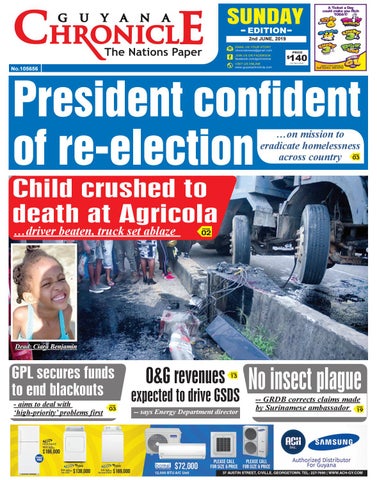
Child crushed to death at Agricola …driver beaten, truck set ablaze
PAGE
02
Dead: Ciara Benjamin
GPL secures funds to end blackouts - aims to deal with ‘high-priority’ problems first
PAGE
03
O&G revenues
PAGE
13
expected to drive GSDS -- says Energy Department director
No insect plague
-- GRDB corrects claims made by Surinamese ambassador 19 PAGE
2
Child crushed to death in Agricola accident
ON Saturday afternoon, 7-year-old Ciara Benjamin was crushed to death by a truck, bearing registration GWW962, whose driver was allegedly speeding along the roadway when he lost control of the vehicle. According to eyewitnesses on the scene, the driver of a speeding sand truck on Saturday afternoon lost control of the vehicle on the East Bank Demerara highway, at Agricola, as he was heading to the city. The child was reportedly standing at the highway’s median at approximately 16:00hrs with her aunt, Simone Barry, waiting to cross the road. The truck collided with Ciara and pinned her to the median. The young girl’s aunt, Barry, lost consciousness after being hit by the truck that caused her niece’s tragic death. However, she soon regained consciousness and was struck with the severity
of the situation. “I was crossing the road, I was holding my niece hand tight,” a distraught Barry recounted to reporters at the scene. “I was holding her hand to cross the road to go home and I get pitched, and I get blackout and I don’t know what happened.” Just after recounting the ordeal to reporters, Barry fainted and was taken away. The driver of the truck was accosted by residents who rushed to the scene. Police officers arrived later and took him away; he was sent to the hospital. The horrific accident also led to a back-up of traffic along the highway lasting well into the evening. Long lines of vehicles were seen along the East Bank of Demerara as far as the Providence Stadium, and along Mandela Avenue. This was because the truck was lodged on the median and had to be TURN TO PAGE
3
►
SUNDAY CHRONICLE, June 2, 2019
- residents retaliate by beating driver, setting truck on fire
The truck being lifted off of the median where 7-year-old Ciara Benjamin was pinned down
Police officers at the scene trying to mitigate the traffic woes that ensued, as persons attempted to remove the truck from the median
The driver of the truck
The truck was later set alight by persons at the scene [Delano Williams photos]
SUNDAY CHRONICLE, June 2, 2019
President confident of re-election
3
…on mission to eradicate homelessness across country
PRESIDENT David Granger has once again expressed confidence in winning the next general elections, telling residents on the East Bank of Demerara, on Friday, that he is on a mission to eradicate homelessness and that this will be done before he leaves office. “I would like to leave office where there is not a single homeless Guyanese. Every single Guyanese will have a roof over their head,” President Granger said before quipping: “cause I ain’t leffing for just now.” The President, who will be seeking a second term when elections are held, back in April expressed similar sentiments when he addressed members of his party—the People’s National Congress/ Reform at their General Council Meeting. Back then, he said the A Partnership for National Unity + Alliance For Change (APNU+AFC) coalition will win the next General and Regional Elections. According to him, the coalition government’s track record will act in its favour. “We are strong, the PNC is strong and the Coalition (APNU+AFC) will ◄ From page 02
Child crushed ... removed before the young girl’s body could be retrieved. As persons attempted to remove the truck, a mammoth crowd also gathered around the scene. Many of the persons present were expressing the anger towards the negligence of the driver and called for justice. Taking matters into their own hands, persons poured gasoline onto the truck and set it afire. This occurred at around 18:30hrs and caused a further build-up of traffic. At 19:30hrs, a fire engine was seen still trying to make its way through the traffic to douse the inflamed truck.
win the elections!” he said. The Head of State said that his vision for Guyana post-2020 is for it to be a country where there are better education, fuller employment, greater equality, greater empowerment – through local governance, better infrastructure and public utilities, better health care delivery and infrastructure and public services delivered to all regions. Over the past four years, Local Government Elections (LGE) was held twice under the coalition government while four new capital towns were declared following major infrastructural developments in those areas. The increase in salaries, wages and pensions, the drilling of wells in the Upper Takatu-Upper Essequibo Region, the supply of potable water to communities previously deprived, and the construction of a new East Bank Berbice road are among the accomplishments of the APNU+AFC Government under the leadership of President Granger. President Granger has already received the support of the Executives of the APNU for his return as president.
President David Granger
General-Secretary of the A Partnership for National Unity (APNU) Joseph Harmon; executive member of the Guyana Action Party (GAP) Sydney Allicock and National Front Alliance (NFA) executive member, Keith Scott, have all expressed deep pride in endorsing the President. “This is a man who has proven over the past three and a half years to be one with great vision, capability and has a right-thinking mind. We in the A Part-
nership for National Unity (APNU) are confident of his candidature as we have seen the appreciation of the Guyanese electorate for the work he has done over the years,” the coalition leaders and ministers said in a joint statement. Mr Granger, who is also the leader of the People’s National Congress/Reform (PNC/R), was re-elected unopposed at the party’s congress in 2018. He will likely come up against four other contenders
for the presidency, including three newcomers from the Liberal and Justice Party; A New and United Guyana and the Federal United Party. His strongest test, however, will come from the main opposition People’s Progressive Party/Civic. However, the three ministers expressed confidence in their choice of representative. “His sober thinking, his advocacy for peace and development, his desire to see Guyana progress, have all aided to enhance his beliefs of good governance,” they said. They added: “Guyanese, we need a good captain who can steer the ship Guyana without malfeasances and corruption, so that all of us can be beneficiaries of good governance and a developed country. Let us support the APNU+AFC coalition.” Most recently, the son of Dr. Cheddi Jagan, Guyana’s former President and founder of the People’s Progressive Party (PPP), Dr Joey Jagan (Jr) publicly endorsed President Granger and the Coalition administration. Dr. Jagan predicted that the incumbent government
will win the next elections. “I like Mr. Granger, and I think Mr. Granger should finish his term, and he’ll win the next election. I like Mr. Granger, that underlines everything, to tell you the truth. I have no excuses to make for anyone,” he said. He expressed the belief that this administration has allowed for more sound foreign investment and development across sectors. The Caribbean Court of Justice (CCJ) is preparing to hand down its decision on the No-Confidence Motion, which was invalidated at the Court of Appeal here. The motion was brought against the Coalition Government in the National Assembly last December. The CCJ’s decision can either result in elections being held this year or when it is constitutionally due in 2020. Since the No-Confidence Motion was brought by the Opposition Leader and former President, Bharrat Jagdeo, President Granger has been expressing confidence in the electorate returning him to office for a second term.
GPL secures funds to end blackouts - Aims to deal with ‘high-priority’ problems first CHIEF Executive Officer of the Guyana Power and Light Inc.(GPL), Albert Gordon, has shared that the company has secured some funds necessary to upgrade the power distribution network, in an attempt to end ‘blackouts’ in Guyana. Gordon was at the time responding to a question posed by local activist, Nicole Cole, on the frequency of and solutions for power outages in Guyana, at the University of Guyana’s Turkeyen and Tain Talks 18, which was organised to discuss the local energy sector. Gordon conceded that over the past five weeks, there have been a total of five power shutdowns, but affirmed, "There is a plan to end blackouts." According to Gordon, the power supply system is one which has many flaws. There is an inadequate generating
capacity, coupled with a transmission and distribution system that is poorly configured. In 2017, this system experienced 25 total shutdowns. In 2018 that figure had been reduced to 12, even though the company had to contend with the very same system and its inherent flaws. Between September of 2018 to now, the system experienced about six shutdowns; five of these occurred over the past five weeks. The “heart of the problem” for these recent shutdowns, according to Gordon, has been identified as the sole transmission line between the Kingston and Sophia substations and the Vreed-en-Hoop substation. The CEO noted that it will require approximately US $150M to “just get the basics done” in fixing the system, but also disclosed that GPL has been able to secure US
Chief Executive Officer of the Guyana Power and Light Inc.(GPL), Albert Gordon [Samuel Maughn photo]
$26M to work on the Kingston to Sophia transmission line. “There is one transmission line that connects the Kingston substation to the rest of the Demerara Berbice Interconnected System,” Gordon explained. “Plans are in place to do rehabilitation work on that line, because every time
that line goes down, the system will go down.” This is a result of the configuration of the system. The local system is one which has “radial transmission”, which means that there is one power source that supplies the system and a power failure issue would result in the interruption of the system. With this radial system, Gordon explained that there is a hub a Sophia and the substations connected in the other areas. And so what happens is that if one part of the system is affected, it is likely that the other parts will be affected as well. Seeking to improve this, he noted that there are plans to build some “hoops” in the system which would allow for some redundancy, so that when one part fails, the entire system does not have to shut down. In so doing, he indicated that GPL is mulling the
possibility of constructing new substations at Wales and Eccles. Additionally, he noted that through funds secured from the Inter-American Development Bank (IDB), plans are in train to build a “backup line” for the Kingston to Sophia transmission line and another US$20M loan from the Islamic Development Bank to “reconfigure” some of the existing substations. Even though funds have been secured, he explained that a process of procurement must be followed, and this will take time. Nevertheless, he assured that the processes are moving along as planned. “There are some other things to fix in the transmission network but those are the high priority things to help to bring some redundancy in the network so that the entire system doesn't fail,” he said.
4
SUNDAY CHRONICLE June 2, 2019
Virginia Beach killings: City names 12 victims of mass shooting (BBC) The 12 people killed when a gunman fired on his colleagues at a municipal building in the US city of Virginia Beach have been named. City manager Dave Hansen said the victims - 11 local authority workers and one contractor - “leave a void we will never be able to fill”. The gunman shot indiscriminately before dying in a gun battle with police. He has been identified as DeWayne Craddock and described by police as a disgruntled city employee. Authorities said they would only refer to him by name once, in order to focus attention on the victims. What is known about the victims? The municipal workers killed were Laquita Brown; Tara Gallagher; Mary Louise Gayle; Alexander Gusev; Katherine Nixon; Richard Nettleton; Christopher Kelly Rapp; Ryan Keith Cox; Joshua Hardy; Michelle
Langer and Robert Williams. Robert Williams had worked for the authority for 41 years, the news conference was told, while Christopher Rapp had been there for only 11 months. The contractor was identified as Herbert Snelling. “Today we all grieve,” Mr Hansen said. At least three people are known to have been wounded, including a police officer whose life was saved by his bulletproof vest. Martin O’Grady, director of trauma at Virginia Beach General Hospital, told reporters all three are in a stable condition and still receiving treatment, he added.What about the gunman? Police said Craddock, 40, had been employed as an engineer with the city’s public utilities department for 15 years. According to AP news agency he had served in the military and was described by neighbours as
Clockwise from top left: Richard Nettleton; Ryan Keith Cox; Christopher Kelly Rapp; Katherine Nixon; Tara Welch Gallagher; Laquita Brown; Mary Louise Gayle; Alexander Gusev; Herbert “Bert” Snelling; Joshua Hardy; Michelle “Missy” Langer and Robert “Bobby” Williams quiet and “rarely smiling”.Some US media had reported that the gunman had recently been fired, or was about to be fired. But Mr Hansen said he was an employee at the time and had a security pass to enter the building. Virginia Beach Police Chief James Cervera declined to comment on a motive for the shooting. Police previously said the
gunman had used a .45-calibre semi-automatic pistol equipped with a sound suppressor and high-capacity magazines. Mr Cervera said other weapons were recovered at the scene and at the gunman’s home, but did not give details. Law enforcement officials quoted by AP said the gunman had recently bought several firearms, all legally.
Sunday, June2, 2019 - 04:00 hrs & 14:30 hrs
At the scene In the pouring Saturday morning rain, witnesses and well-wishers came together for what has become a customary vigil to remember those killed. Jayme Rivera, who works in the same complex and had gone home for the day, said her heart sank when she heard news of the shooting. “It doesn’t even seem real,” she said. “It’s a tragedy, a senseless act of evil.” What is striking is the reluctance among those here to talk about tighter gun controls, an issue which will continue to divide this country even after 2019’s largest mass shooting has been forgotten.“We too often look to our leaders for answers on this and the answers are what you see here,” says Eric whose friend saw his co-workers killed. “It’s got to be community.” How did the shooting unfold? The attack began shortly
Saturday, June 1, 2019
05 12 13 20 26 28 24
J
04, 13, 15, 23, 24
0, 5, 6
3, 4, 0
2, 4, 6, 9, 11,
after 16:00 (20:00 GMT), at Virginia Beach Municipal Center. The area was put into lockdown by police and employees were evacuated. One of the victims was shot outside in a car and the rest were found over three floors of the government building. Four officers entered the building, located the gunman and engaged him, police said. The attacker was then shot dead. Mr Cervera said it had been a “a long-term, large gunfight”. “Once they identified him... he immediately opened fire. We immediately returned the fire and again I want everyone to know that this was a long-term, running gun battle with this individual,” he said. Mr Hansen said the building would be closed for some time and some city services would be temporarily relocated. On Saturday, President Donald Trump tweeted his condolences. He later ordered flags across the US to be flown at half-mast on all public buildings until 4 June. According to US tracking website Gun Violence Archive, the incident is the 150th mass shooting in the US so far in 2019 - and the deadliest. The site defines a mass shooting as a gun attack in which at least four people are either killed or wounded. It is the worst such shooting in the US since November 2018, when 12 people were killed at a bar and grill near Los Angeles, California.
5
SUNDAY CHRONICLE June 2, 2019
Mexico ‘won’t be provoked by US’ over migrant row
(BBC) Mexico’s pres ident has insisted his government will not be provoked, after President Donald Trump announced escalating tariffs on all goods unless Mexico curbed illegal migration. Andrés Manuel López Obrador described Mr Trump’s slogan “America First” as a fallacy and said universal justice was more important than borders. Stock markets saw sharp losses following Mr Trump’s announcement. Mr Trump declared a national emergency at the US-Mexico border in February. He said it was necessary in order to tackle what he claimed was a crisis with thousands of undocumented migrants crossing the US southern frontier. Mr Trump’s latest statement came a day after US border authorities in El Paso, Texas, detained a group of more than 1,000 migrants - the largest single group agents had ever encountered. White House spokeswoman Sarah Sanders said on Friday that Mexico could have done more to stop the group - and others - as they travelled through the country. “They could have easily broken up this group, arrested them or sent them back home, and they didn’t do anything,” she told reporters. “We’re asking Mexico to enforce their own laws to help stop the people coming in from Central America.” In tweets later on Friday, President Trump said the tariffs were also to encourage Mexico to “take back” the country from drugs cartels. What did Mr
López Obrador say? The president said he had ordered his foreign minister to travel to Washington on Friday. “I want to insist that we are not going to fall into any provocations, that we are going to act prudently with respect to the authorities of the United States [and] with respect to President Donald Trump,” he said. In a letter to his US counterpart, Mr López Obrador said Mexico was complying with its responsibility to avoid “as far as possible and without violating human rights, the passage [of migrants] through our country”. “President Trump: Social problems are not resolved with tariffs or coercive measures,” he added. “With all due respect, although you have the sovereign right to express this, the slogan ‘United States [America] First’ is a fallacy because, until the end of time, and even over and above national frontiers, universal justice and fraternity will prevail.” Foreign Minister Marcelo Ebrard confirmed on Twitter that he would lead a delegation to Washington, adding: “The treatment of Mexico is unfair and does not make economic sense to anyone.” He later tweeted that a summit to resolve the dispute would be held in Washington on Wednesday, with US Secretary of State Mike Pompeo heading the US side. “We will be firm and defend the dignity of Mexico,” he said. How has US business reacted? The US Chamber of Commerce, which represents
three million businesses in the US, condemned Mr Trump’s plan. Chief policy officer Neil Bradley said the tariffs would “be paid by American families and businesses without doing a thing to solve the very real problems at the border”. The Business Roundtable, a US body made of chief executives of major US corporations, said it would be “a grave error” and urged Mr Trump to reconsider. It warned that the move jeopardised the new US-Mexico-Canada trade deal to replace the North American Free Trade Agreement (Nafta). President Trump’s top trade adviser Robert Lighthizer had opposed the plan, the Wall Street Journal reported, also warning that the new trade deal could be affected. One source quoted by the paper said: “Lighthizer is not happy.” What did Mr Trump say? The US president has long accused Mexico of not doing enough to stem the flow of people. Migrants, most of whom say they are fleeing violence in Central American countries, travel through Mexico on their way to the US, where they hope to claim asylum. In a White House statement, Mr Trump said the tariffs would rise by five percentage points each month until 1 October, when the rate would reach 25%. The tariffs would stay
at that level “unless and until Mexico substantially stops the illegal inflow of aliens coming through its territory”, he said. “For years, Mexico has not treated us fairly - but we are now asserting our rights as a sovereign nation,” the statement said. The president also took aim at his Democratic opponents, accusing them of a “total dereliction of duty” over border security. The Democratic-controlled House of Representatives is taking legal action to halt the Trump administration’s efforts to build a border wall, saying it would be a waste of funds and would not stop illegal immigration. W h a t w i l l the tariffs affect? Mexico was the second largest supplier of goods to the US last year, with imports totalling $352bn (£275bn), according to Goldman Sachs. It is known for agricultural products like avocados and tequila, but the country is also a major manufacturing hub and home to many US companies. The country produces hundreds of thousands of cars every month, and is also home to technology and aerospace companies. It is one of the G20 economies. US firms Ford, General Motors, John Deere, IBM and Coca-Cola all operate in Mexico, as well as thousands of other multinationals. On Friday, the three main
US financial markets opened almost 1.5% down, with General Motors falling 5%. The president’s statement comes amid a trade war with China.
After complaining for years about the US trade deficit with China, Mr Trump imposed tariffs on hundreds of billions of dollars worth of goods coming from the country.
6
SUNDAY CHRONICLE, June 2, 2019
Crime and politics RECENT incidents of crime, particularly armed robberies, have attracted commentaries from political, business and other social groups. The Guyana Police Force (GPF) has advised that it has the situation under control and in recent weeks, ranks have confronted and killed six bandits on the Corentyne and Georgetown in separate operations. It is also instructive that Director-General of the Ministry of the Presidency, Joseph Harmon, assured last Friday that from government’s perspective, it has every confidence in the Guyana Police Force to keep crime under control and to deal with serious criminals when they emerge. He said that the commissioner of police and his officers are providing greater leadership to the police force, noting that there is a better cadre of senior officers, there is a better cadre of intelligence officers, who are now ensuring that police operations are intelligence-led and intelligence-driven. Harmon also commented on a recent travel advisory issued by the US, noting that “From the level of the Cabinet, I would wish to give the assurance to all our citizens,
including all those persons who are abroad and are making decisions to travel to Guyana, that Guyana is a safe place, it’s a safe place to live, it’s a safe place to work, it’s a safe place to invest, and that is the word I would wish to give to all the persons who might be thinking twice as a result of the advisory.” He said countries issue such advisories so that their citizens can be aware of a situation that exists in a country at any particular point in time. When a robbery occurs, people who are affected -- directly or indirectly -- feel scared and threatened. And where, in instances of such nature, people live in the moment and worry about the possibility of it happening to them, that fear will cause them to question the credibility of the police statistics. Another aspect of our society that ought not to be overlooked is that crime is used as a wedge issue. This serves as political mileage -- to ‘prove’ the failure of the other political group, and stoke racial tension on stereotypical assertion of which group is villain and which is victim. Reacting to robberies through polarised lenses does not aid in its elimination. Instead, it leads to creating and fomenting lopsided
views that could miss the source(s) of the anti-social behaviour and treat with same in a surgical manner. These are the realities that confront the police force and the policy makers; and seeking to address robbery, these must become factors of consideration in planning and decision-making. Every citizen has a responsibility to self and the environment to help in preventing robbery. This requires taking the necessary precaution not to be targeted, being aware of one’s surroundings, and reporting any suspicious activity. It does not hold true that keeping large sums of money on one’s person or in the home is the safest or wisest decision. Held notions that it is unwise to put money in the bank because it’s yours or the bank will steal it must be reviewed through practical, life-saving lenses. It must be recognised that placing one’s money in the bank can ward off potential danger to one’s life. The bank cannot legally steal your money, and there is proof of transactions in one’s bank account and periodical review through bank statements. If money is legitimately acquired, there ought to be no problem in having it deposited in
a bank account, including complying with the needed paperwork to prove identity and the source of legitimacy, should these be called for in order to protect the integrity of the banking institution. It helps in fighting robbery and other crimes when both the account holder and banking institution confirm to the required expectation. Where banks and government are concerned, it is to the benefit of the bank, the security of the people, and work of the police force to examine and move with haste to convert cash into other representative money outside of hard cash. Bank cards (credit and debit) and cheque books have proven to reduce the risk of being robbed of one’s hardearned money. Outside of these being safe and reducing the need to have to carry or store large sums of money, they are among the most trusted ways to conduct monetary transactions around the world. Putting this infrastructure in place can be costly, no doubt. At the same time, we need to ask ourselves if we can continue not to do so, when, in addition to the world moving ahead and leaving us behind, robbery is taking a toll on the society and the people.
Where an image is presented to the world that Guyana is not a safe destination, it could divert needed foreign exchange. Admittedly, robbery/crime has its genesis in the society, and where man’s first institution is the family, it is expected that socialisation takes into consideration instilling values that “thou shall not steal or covet thy neighbour’s goods.” Similarly, it cannot be lost sight of that, outside of the family, there are other influences, sometimes overpowering, that fuel and propel crime. The sources of these must not be ignored in acknowledging and putting measures in place to curb crime. Through intelligence-gathering, the police should have data on the causes of crime; and though the degree of the respective causes is not known, the lure of instant gratification, poor family structures, peer pressure, glamourisation of crime, the influential and well-connected not being held to account for their criminal conduct, unemployment and poverty are factors influencing criminal activities. Tackling crime ought not to ignore these factors.
Telecoms union accuses GTT of violating collective labour agreement Dear Editor, The Guyana Postal & Telecommunication Workers’ Union (GPTWU) which represents non-management workers within the Guyana Telephone and Telegraph Company (GTT+) continues to be very perturbed with the actions of the management of the company in relation to the continuous violations of the extant Collective Labour Agreement (CLA) between the parties. GTT+, over time, has hired approximately 72 Customer Service Representatives, within its call centre, each, on a nine months’ contract. This is the largest concentration of contract employees within the company.
The call centre division falls within the Union’s Bargaining Unit. The CLA clearly states in Article # 36:1, “Contract work shall be held to a minimum and the company agrees there shall be no contract work allocated to outside contractors which would result in interference with the employment or promotion of permanent employees.” This practice by GTT+ is clearly designed to trample on the rights of the workers. These workers are continuously employed on a contractual basis without any effort on the part of management for confirmation. They are not represented by the union since they are contract employees. The union has been engaging the Department
of Labour in an effort to have the contracted workers brought on permanently at the establishment, but to date, the Department of Labour has failed to deal with the issue in a decisive manner. As a result, the company is emboldened and continues with this violation. Management continues to show gross disrespect to the ministry by not providing documentation requested by the department, in addition to not showing up for conciliation meetings, called by the said department. The contract employees, whose contract are in total breach of the Law are forced to accept the following:> Monthly salary, which is way below what is being paid to permanent employees who are performing duties
at the same level across the company. > They are not on the company’s pension or group life scheme, even though many of them are working with GTT+ for a number of years. > They are dismissed without due process being allowed. Those are just some of the infractions that are meted out to these workers without any intervention by the Department of Labour, even though they are aware of all the issues. The status of these workers needs to be regularised. There can be no other position on this issue. The Department of Labour must be effective in its mandate by addressing
this issue. Just recently the world saw how the matter involving Rusal and GB&GWU was handled. The Department of Labour MUST not appear to be selective and or naive when dealing with the multinationals. The Department of Labour is aware of all the illegalities and infractions being perpetuated by GTT+ but continues to turn a blind eye to the plight of the workers. This violation among others shall be made public and the company must be made to respect the law. This union will continue to expose the continued arrogance being displayed by GTT+. This issue of the large influx of contract workers
was raised with the Ministry of Labour, now the Department of Labour, over the years. The membership is calling on the Minister within the Ministry of Social Protection, with responsibility for Labour, Honourable Mr. Keith Scott, to address the issues with the authority vested in him, soonest. Workers’ of this country must not be taken advantage of. Regards, Harold Shepherd President GPTWU
7
SUNDAY CHRONICLE, June 2, 2019
OP-ED
The PPP and Equatorial Guinea
By James McAllister EQUATORIAL Guinea has a lot of lessons for Guyana and the people of Guyana cannot afford to ignore them. Oil was discovered in Equatorial Guinea in 1996 and by 2005, oil production was around 320,000 barrels per day. The Gross Domestic Product (GDP) increased from US$440M in 1997 to US$23B in 2012. The per capita GDP was impacted significantly because of a relatively small population of 1.2 million people. GDP per capita increased from just US$2,200 in 2000 to US$8,201 in 2006 and US$23,789 in 2012. However, by 2017, GDP fell to US$12.5B and per capita was down to US$12,737, and is projected to fall to US$7,500 by 2024. What happened? A lot. It is true that the price of oil fell from US$112 per barrel in 2012 to $48 in 2017, but this is not the only reason. The primary reason is corruption, and this is what Guyana must guard against. The governing elite in Equatorial Guinea has made corruption into an art form. What is frightening is that there are a number of similarities between what is happening in Equatorial Guinea and what happened in Guyana under the PPP. The Berbice Bridge; the Skeldon Sugar Factory; “Pradoville,”; New GPC sole-sourcing; keeping the Lotto money out of the Consolidated Fund; the law books theft and the oil blocks giveaway are all tactics lifted directly out of the Equation Guinea playbook. How? Let us look at it. Each year, the regime in Equatorial Guinea spent approximately 80 percent of its budget, approximately US$4B, on infrastructural projects. The majority of these projects were not needed and are white elephants today. They were built because they present the best opportunity for the elite to siphon off money. For example, the country has five airports, but only two hospitals; each ministry has three buildings, but schools have no running water; an island with a population of 5,000 has a US$120M seaport, but no school. THE BERBICE BRIDGE SCAM The PPP was accused of discrimination against New Amsterdam because of the location of the Berbice Bridge. It was alleged that the location was because the
PPP was looking after supporters on the Corentyne. Not true, it was just a scam at the expense of the people of Berbice. At least three reputable international companies had submitted proposals to build fixed, high-level bridges at locations different from the current location where the bridge is. The PPP rejected all of the proposals and insisted that it wanted an Acrow panel floating bridge. The interesting thing about an Acrow panel bridge is that it is a proprietary item. That is to say, it is a special product available from very limited sources. In such cases, manufacturers give incentives, sometimes as much as 10%, to officials who chose their products for major projects. In the case of the Berbice Bridge, US$2.5M would have been the incentive. The location and type of bridge was never about supporters. There were two and a half million reasons why the decision was made. Now the people of Berbice are saddled with a bridge they cannot afford to use and must depend on government subsidy. Yes, there was a need for a bridge across the Berbice River. However, like in Equatorial Guinea, the PPP designed the project to satisfy corrupt desires instead of the needs of the people. SKELDON SUGAR\ FACTORY Many local experts were puzzled by the PPP’s determination to build the Skeldon Sugar Factory. GUYSUCO had admitted that the cost of production at the factory would have been significantly above the world market price for sugar, but yet the PPP persisted. Some argue that this determination was the PPP's effort to take care of its supporters. However, if this was all about supporters they would have acted on the information that the sugar lands at Wales and Uitvlugt were depleted. They were advised to diversify and commence training of sugar workers at Wales and Uitvlugt to ensure that they are marketable outside the sugar industry. They did nothing. Instead, they rushed to build the US$200M Skeldon Factory. As in Equatorial Guinea, the factory is now a white elephant. As in Equatorial Guinea, the project was overpriced by US$60M. The Skeldon Sugar Factory was never about sugar workers; it was always just a prestige project conceptualised to siphon off money into the
James McAllister
pockets of the PPP elite. “PRADOVILLE” AND THE LAW BOOKS THEFT. “Pradoville” and the law books theft are related. “Pradoville” is a case where the PPP decided to allocate national assets to its executives. They sat in cabinet and formally decided to engage in a corrupt act. The PPP is contending that the law books -- national assets -- were not stolen because the President gave it to the former AG. The courts might be tempted to go along with this argument because of the limited monetary value of the items in question, but this would set a dangerous precedent. If our courts rule that the President had the power and authority to give away the law books -- national assets -- then he had the power and authority to give away house lots in “Pradoville.” This would mean that Jagdeo and Ramotar could have given away the Kaieteur National Park. In Equatorial Guinea the President arranged for the oil company to place the oil proceeds in his personal bank account. The PPP’s defence of “Pradoville” and Law Books scandals is an argument in support of the actions of the president in Equatorial Guinea. The Lotto funds issue is an example of the PPP's willingness to become creative with the handling and flow of government money. OIL BLOCKS GIVEAWAY The report of the allocation of oil blocks by the PPP to their friends is apparently beyond Equatorial Guinea levels. Knowing that Exxon found oil, the PPP moved swiftly to give away national assets worth tens of billions of U.S. dollars. No doubt, like with the Skeldon Factory and the Berbice Bridge,
there is going to be financial benefits for PPP officials. Guyanese must look at Equatorial Guinea and make informed decisions. It is true that a high per capita GDP is a prerequisite for the Good Life, but poverty and squalor could still exist if we allow a kleptocracy to be in charge of our resources. For instance, in Equatorial Guinea, despite the high per capita GDP, pricey is widespread, and children suffer stunted growth because of malnutrition. The government spends only 2 percent and 3 percent of the budget on health and education respectively, but 80 percent on infrastructure. There is no investment to diversify the economy, and the collapse in oil prices had a devastating impact. The PPP has demonstrated tendencies similar to the regime in Equatorial Guinea. Fortunately, unlike in Equatorial Guinea, the people of Guyana have it in their power to determine if the PPP, in its current form, is allowed to be in charge of our national resources. When we head to the ballot box in 2020 we must know our vote will determine if there is going to be a Good Life, or if we will replicate Equatorial Guinea, where the people are in abject poverty but the elites are rich. Research has shown that wealth generated from the hydrocarbon industries tend to entrench authoritarianism previously existing,
rather than usher in greater liberties. Under the PPP we saw the murders of Ronald Waddell and Courtney Crum- Ewing, the incarceration of Mark Benschop and the throwing of faeces on Frederick Kissoon, all
because they were vocal against the PPP government. This is the kind of attitude that will become entrenched if the PPP, in its current form, is allowed to form the next government.
8
VISION 2040 WHEN the specialist examined my eyes last year, she pronounced with satisfaction that I had “20-20 vision”. I was seeing small objects and letters, even in the distance. I was elated, therefore when, during Cabinet sitting last Tuesday, the multi-agency, expert group headed by United Nations Environment Programme Director for Latin America and the Caribbean, Leo Hileman, handed President David Granger their policy recommendations for Guyana’s Green State Development Strategy (GSDS), sub-titled “Vision 2040”. The GSDS strategy was received from this vision projects far into the future, and shows “an inclusive and prosperous Guyana that provides a good quality of life for all its citizens based on sound education and social protection, low-carbon resilient development, new economic opportunities, justice, and political empowerment”. MAN WITH PLAN With the policy document in his hands, President Granger appeared to be the proverbial “man with the plan” for what he calmly and reassuringly described as our “Green State”. According to the experts, the Strategy resulted from wide consultation with stakeholders from which, initial-
ly, a Framework Paper was produced after those “green conversations”. They explained that with huge revenues from oil and gas, the Strategy will guide public investment on a “hard infrastructure” programme to expand production in the agriculture, forestry and energy sectors, and modernize land, sea and air transport and telecommunications. Injecting “high ambition” into agriculture, the vision sees land expansion by 100%, and gross domestic product at a high of $720 billion by 2040. Agriculture is projected to provide as many as 116,000 jobs in this period. These are projections that could be realized, given financing of the strategy in this sector. SHARED VISION I left for New York yesterday morning and it was not possible to read and digest the expansive learning from the 215-page ‘Vision’ paper, which is now available for reviews and open to criticisms. What I find strange, however, is a comment in a section of the media that the Guyana Opposition party does not share the “vision” in the Strategy Paper, or finds it deficient. For me, this has to be a shared vision since it deals with the goals of the entire nation. The Opposition cannot stay on the sideline and
torpedo it just to spite the Coalition Government. It cannot want a re-play of the shameless rejection of the National Development Plan on ideological grounds that it included recommendations for the privatization of the sugar industry. I was among those who, in keeping with “party line”, voted in parliament against the Plan for the long-term development of our country. APPEASING POLITICAL BASE The PPP then was determined to appease its political base; but in the end, it presided over the destruction of the sugar industry, and eventually, its own demise as government. It had put forward a half-baked plan of modernisation of the Skeldon sugar factory. Without Skeldon, its leader had said, the sugar industry is dead. And his prophesy was fulfilled. In politics, we must all learn from our mistakes, so the better approach now should be for the opposition to come on board as a partner in national development and to make an early pitch for possible inclusion on the “Vision 2040 Council” that would manage and execute this strategy. The know-itall as well as the negative and condemnatory opposition-as-usual approaches are not helpful to even op-
position supporters who suffered from the economic decline. The new strategy paper examined past performance, or lack thereof, which resulted during 2013 in some 463,000 Guyanese residing abroad. It cited World Bank reports that since 1992 the average annual emigration has been 10,000 persons – a net brain-drain. That was due mainly to a jobless rate of 12 per cent. It is time, therefore, to turn that hopeless past into a vision for the future. GREEN ECONOMY INVESTMENTS Volume 1 of Vision 2040 looks at green economy investment in agriculture, forestry, energy and road transport infrastructure. It looks at opening new lands as it sees agriculture as a principal backbone of the green economy. It is our surest hope of escaping from the potential in a petroleum-dominated economy, from the so-called “Dutch Disease”. In 2012, agriculture
SUNDAY CHRONICLE, June 2, 2019
contributed 21% to the GDP, and employed 33% of the workforce. But agricultural activities occupy only 8.5% of the national land space, which invites the recommendation to expand cultivation lands, in areas away from the coast, and to beef-up inland fish farming and agro-processing. Guyana is richly endowed with fresh water and sunshine to sustain an unprecedented agricultural and aquacultural revolution. The experts revealed that fishing has been on the decline from 60,000 tons of fish in 2003 to only 40,000 tons in recent years. It recommends recourse to deep-water fishing, and inland fish farming. GLOBAL SHIFTS In other sections of the strategy, critical appraisals have been given of the sugar and rice industries, and what should be done to make them viable. It also examines the potentials of the fruits and vegetables industry, to satisfy the “global shift in consumer preferences towards healthier products”. It points
to Guyana’s role in organic agro-processing exports, citing our 4Ps (peppers, plantains, pineapples and pumpkin) and 4Cs (coconut, citrus, cassava and carrots). I trust that the release of the Green State Development Strategy (Vision 2040) would occasion widespread interest in the new Guyana, from now and 20 years ahead. The discussion paper should stir debates on the recommendations for complementary avenues for our country’s development, whilst we acknowledge that within the next five years, oil will account for one-half of our gross domestic product. I will continue to critically examine these policy recommendations, to identify with the many other areas for which a vision is needed for our forward movement. I invite you to do so also.
From the brink of death to life again –– diabetic patient tells her story SHANTI Persaud thought her diabetes was under control. Months later, she was on the brink of death from kidney failure. Deep in the throes of renal failure, barely able to eat, move or talk, and on the verge of total exhaustion, Shanti had no idea that her struggle for life would become an incredible survival story. How she beat the odds, survived and eventually moved on to live a normal life is a story of incredible luck, a determined and highly-skilled doctor and his team, and a pioneering medical procedure at one of the nation’s leading hospitals that can save the lives of countless productive Guyanese.
Looking back on the illness that almost cost her her life, Shanti could hardly remember a time when she had not suffered from a combination of high blood pressure and diabetes. As such, her routine included monthly visits to her community health clinic for medical check-ups. She did not worry too much as she always took her medications and was able to live a relatively normal life and do many of the things she loved, such as exercising, taking care of her family and even indulging in an occasional fast-food treat. When she visited the clinic monthly to keep track of her conditions, her checkups often included a kidney function test. But one day,
her quietude was shaken. She got her kidney function test results and found out that her kidneys were not working at maximum capacity. The results indicated that the problem was marginal, but it explained the recent feelings of fatigue that she had noticed. Still, she and her family, though concerned, were not alarmed as they did not fully understand the danger or consequences. But the deterioration [of her health] was rapid and Shanti’s condition deteriorated from marginal loss of kidney function to chronic renal failure. Shanti was not at all prepared. With chronic renal failure, her tiredness and weak-
Shanti Persaud
Dr Kishore Persaud
ness grew worse. It was as though all the strength, all the vitality had been sucked from her body. Bathing herself had become impossible without assistance from her daughter. Shanti could not have stood up for the time it took for her to prepare a meal. Climbing stairs had become difficult as she lost her breath quickly.
“I was always tired. Everything was difficult. It was tiring to even put my clothes on. My daughter used to help me. I was really swollen; my feet, my hands, my face, my entire body. I was just swollen. I was worried. Not really scared because I didn’t know too much about it. But I was worried and confused,” Shanti said. Her kidneys were almost gone. That was the reason for her fatigue, pain and bad
WORRIED AND CONFUSED
feelings; and to make matters worse, Shanti was going blind. Shanti started dialysis treatments in which she was hooked up to a machine that rid her body mechanically of impurities as well as excess fluids and salt. This invasive procedure became an essential part of Shanti and her family’s routine because, without it, she would simply die. Everything in her life seemed to revolve around this artificial system of filtering impurities from her blood, which is called hemodialysis. Three times a week, her family had to take her to the hospital for the sessions. For four consecutive hours, a machine would pump her blood through a filter outside the body TURN TO PAGE 9 ►
SUNDAY CHRONICLE, June 2, 2019
Gov’t continues outreach in North West District …Arawau Village gets $800,000 presidential grant
MEMBER of Parliament, Mervyn Williams, and team on Friday last continued the administration’s initiative of ‘Bringing government to the people’ during a visit to the village of Arawau, located about two hours’ drive from the Kumaka waterfront, Mabaruma, North West District. Residents of Arawau Village eagerly awaited the arrival of the MP who, upon arrival, listened to their concerns and offered appropriate responses to their issues. The meeting was held in a local church building. Williams, who is also adviser to Vice-President and Minister of Indigenous Peoples’ Affairs, Sydney Allicock, assured residents of his government’s support and urged them to form Co-op Societies to better develop their community. After listening and responding to concerns of the members of the community, Williams presented to the residents a cheque of $800,000 under the Presidential Grant scheme. The funds will be used for the clearing and drainage of land for agricultural purposes. The villagers were most surprised and happy to be the recipients of the gift. Meanwhile, following the
MP Mervyn Williams hands over the cheque to CDC Chairman Mr. Lennox Peters
meeting, Williams told the Guyana Chronicle that it is clear that the residents have some issues which the government will address immediately. He said central government is deeply concerned about services not reaching to the residents and projects that ought to have been completed are lagging. He said the Regional Executive Officer has committed that before the end of June, medical outreaches will be conducted in the village with special focus on pregnant mothers. Williams observed that residents have not had a medical visit to the area for some time now. Williams said he also up-
dated residents about the prevailing political situation, correcting what he said were some of the misinformation being propagated by the opposition. “People were under the impression that the government was illegal and so I had to set the record straight that the Court of Appeal has nullified the no-confidence motion and that we are awaiting the final court decision from the Caribbean Court of Justice.” Williams said too that he assured the residents of the high-level commitment given to the nation by President David Granger that his government will respect the ruling of the CCJ. He said too that in the
ensuing period, government has sought the advice of the Guyana Elections Commission regarding the conduct of elections and has also recently provided the financial resources for it to undertake house-to-house registration and also adequate funding for it to run off any possible elections. “So we have matched our words with actions and everything now hinges on the CCJ,” Williams related. He said the outreach in Region One is a continuation of what has been happening across the country. “Government continues to do its work taking services to the people regardless of where they are…” In another community –
Sacred Heart, Williams said residents had some concerns mainly in the education sector. He said residents were promised a boat and engine, but these have not been delivered. Williams however said that in recent days, the regional tender board approved the purchase of boats and engines and he is hopeful that the community would get what was promised to it. The sum of $3.4B was approved for Region One’s (Barima-Waini) Regional Administration in this year’s budget. Under the Education capital programme for 2019, the sum of $151.2M was approved for rehabilitative work to the Port Kaituma Primary and Secondary schools and extension of White-Water Nursery School. The sum also caters for the construction of sanitary blocks at Waramuri, Port Kaituma and St John’s Primary schools, and the construction and enclosure of living quarters at Unity Square and Manawarin. Some $21.9M was also budgeted for school furniture and equipment, including equipment for ‘smart’ classrooms, desks, benches, cupboards, tables, chairs, racks, fire extinguishers, musical and sports equipment at several schools in the region. $15.7M was also allocated for transportation. The money caters for boats and outboard engines at
From the brink of death ...
and pump it back into her body. A bleak future of interminable dialysis treatments stretched before her. It was expensive too, costing nearly $50,000 a week. Additionally, every two months she had to be admitted to the hospital for blood transfusions and to treat complications caused by undergoing dialysis. There were terrible side effects. The treatment left her feeling lightheaded and weak. After receiving it, she would be taken from the hospital in a wheelchair, lifted into the car and later, up the stairs to her home. This continued for about eight agonising months. It is a period Shanti tries to forget. As her dialysis ordeal continued, there was a ray of hope. It came from Dr Kishore Persaud, a transplant surgeon at the St Joseph Mercy Hospital who urged Shanti to consider undergoing a kidney transplant. He was experienced in this area, having performed several such surgeries with a high success rate. The surgery would require a willing donor whose physiological makeup would be compatible with Shanti’s. Shanti’s brother was a perfect match. Such transplants are gen-
erally done at the Georgetown Public Hospital Corporation (GPHC), but Shanti was more comfortable doing hers at Mercy Hospital. Little did she know that it would have been a first for the privately-operated institution. The Mercy Hospital rose to the occasion and a series of prudent actions followed to facilitate a successful surgery.
LITTLE NERVOUS It was a quiet Saturday in October 2017 when Shanti and her brother arrived at the Mercy Hospital for the surgeries. She was a little nervous, but Shanti trusted her doctor. The Mercy Hospital team had left no stone unturned. According to Dr Kishore, “We would have reviewed the protocol and discussed it with the administration at the Mercy Hospital… spoken to all the specialists and… made a clear plan of how to proceed in this aspect because it was the first-ever transplant we would have been doing at this hospital. “After setting all the parameters in place, we then proceeded to do her transplant. We partnered with the … university in Miami which gave us a backup to our laboratory service in terms of
proceeding with [conducting] all the tests that are not available in Guyana,” Dr Kishore explained. Shanti and her brother spent over eight hours on the operating tables beneath the skilled hands and watchful eyes of Dr Kishore and a team of medical experts who worked intently on the transplant. After the operation, Shanti recalled waking up on a bed in one of the hospital’s rooms. Relieved, she looked over and saw her brother awake on the other bed. The surgery had been a success and her new kidney had begun to function while she was still on the operating table. Dr Kishore left nothing to chance. He stayed with Shanti throughout the night after the operation to ensure that the kidney was fully functioning, and afterwards, he and other doctors made frequent follow-up checks. Shanti marveled at Dr Kishore, remarking, “I was amazed by his commitment and dedication. He stood there until the kidney was fully functioning before leaving the room.” Shanti experienced none of the pain she had expected in the recovery phase and, after one week of ‘top-notch’
after-surgery care by the hospital’s staff, she was able to walk, on her own out, of the hospital. Her brother had left the hospital four days after the surgery. “Currently, she is doing exceptionally well…since she was discharged she was never admitted again,” Dr Kishore said recently.
VISION REGAINED To top it all off, Shanti has regained most of her vision. Dr Kishore explained that a benefit of this surgery is a reversal of some of the retinopathy caused by diabetes. “She has enjoyed nearly all the benefits of renal transplants…no admissions since; no dialysis since; she never had to get blood a transfusion; she is on minimal medication; she can see… her blood sugar is well controlled… she is living a normal life, a better quality of life, except under some intensive monitoring.” Dr Kishore said many people with renal failure would like a kidney transplant, but it’s not easy to get a compatible donor. “Not everyone has a generous friend or relative that wants to donate a kidney. And then the public [is not aware] that a person can live
a perfect life with just one kidney,” he said. The surgeon remarked that some persons are, in fact, surviving on just one kidney and are not even aware of it because they have not experienced any symptoms indicating that a kidney has stopped working. Underscoring that donating a kidney is safe, Dr Kishore explained that the screening process for donors is thorough, following rigid guidelines. “When we take a kidney from someone, we ensure that person is capable of living a normal healthy life for the rest of their life on one kidney. We would never take a kidney from someone if we know we would cause harm to that person. That is our main objective when we screen a patient thoroughly…” Shanti’s brother, for instance, is enjoying an active life after the successful operation. This includes working hard, going to gym and active social interactions. Until he heals fully, his only inhibition is lifting heavy weights. One of the ways of increasing the availability of kidneys for persons in need is for Cadaveric Legislation to be passed in Guyana, allowing for organs to be taken
9
Moruca, Barama, Pawaikuru, and St Nicholas, Waramuri and Santa Cruz Primary and Santa Rosa Secondary Schools among others. In the area of Health, $101.1M was allocated for the completion of a x-ray room at Pakera District Hospital and staff quarters at Mabaruma; construction of a maternity waiting home at Santa Rosa, health training complex at Mabaruma, health post at Parakese, and incinerator at Kwebana; enclosure of living quarters and upgrading of central duct system at the Mabaruma Regional Hospital and the provision for hot water baths. An ambulance will also be purchased for the Kumaka District Hospital at a cost of $14M. For public infrastructure, $45M was allocated for the construction of bridges at Thomas Hill, Mora and Rincon roads and Kamwatta; $50M for the construction of roads at Burma and Hosororo Hill and $9M for culverts at Wauna Scheme. Twelve million will also be expended for electricity distribution network at Waramuri. Meanwhile, under agriculture, the sum of $20M was earmarked for the establishment of a food processing facility at Mabaruma. FROM PAGE 8
from patients who are brain dead and implanted into those in need. Since Shanti’s surgery, there has been one other kidney transplant at the St Joseph Mercy Hospital by Dr Kishore and his team. Altogether, 20 kidney transplants have been done in Guyana by Dr Kishore and his team at the Georgetown Public Hospital Corporation with Dr Kishore as the lead surgeon. He is a strong advocate of kidney transplants in cases of renal failure, declaring the procedure life transforming for both the patients and their families. “With transplants, you become independent, you go back to work, you contribute to society, you live a more productive life,” Dr. Kishore said. He pointed out that Guyana benefits immensely from the lives saved by kidney transplants because productive, professional Guyanese recover, go back to work and contribute to nation building. Back from the brink of death and doing her bit for Guyana, Shanti Persaud agrees fully.
10
SUNDAY CHRONICLE, June 2, 2019
THE MOTHER OF ALL ELECTIONS IN 1953, the first mass-based elections were here in British Guiana. It was a monumental moment. Prior to this development, colonial democratic centralism was the order of the day. The masses were excluded from voting, based on property qualifications and a myriad of electoral barriers that ensured the status quo was preserved. Accordingly, the 1953 elections will be forever etched in our annals as the event that resulted in the suspension of the constitution by the British and the removal of the PPP from office, after just 133 days in office. Since this event, Guyana has experienced 11 elections to date: in 1957, 1961, 1964, 1968, 1973,
1980, 1985, 1992, 2006, 2011 and 2015. The 1953 and 1964 elections were compelling, the 1992 and 2015 electoral process was cataclysmic. However, 2019/2020 teems with special symbolism that makes it worthy of being referred to as the mother of all elections. Firstly, since Guyana’s independence, every single government has been subject to the ignominious fiscal reality of being dependent on foreign governments to provide handouts for national development. We have taken our proverbial ‘begging bowl’ to every world capital within reach. The discovery of black gold presents a scenario where the Cooperative Republic of Guyana is now in possession of a
natural resource that will see us on a path to economic independence. US$300M of loan free money with no conditions attached. So, on the budgetary and fiscal front, this development makes the 2019/2020 elections arguably the most consequential elections in the nation’s history. Secondly, the realpolitik of the situation is quite straight forward. The political party that controls the state apparatus during first oil has the opportunity to embark on unprecedented national development projects that will transform this nation economically, socially and politically. The political parties who are afforded this chance could win the hearts and minds of the people
and purchase enough political capital to have power for possibly the next three electoral cycles. This would mean that those who lose out could be locked out of power for the next 25 years. It is for this reason we are witnessing and will continue to witness the mad rush to capture the minds of the people. For some, it is the biggest fight of their long political careers. Hence, it is not far-fetched at all to submit this will be the mother of all elections. Thirdly, the soul and consciousness of this nation will be tested. A clear and simple choice faces the Guyanese people at the next elections. Do you wish to revert to pre-2015 lawlessness
w i t h arguably the most vicious cabal in the Caribbean’s modern history armed to the teeth with revenues from oil or continue the journey to a law-and-order society where the people can feel the benefits of being an oil-rich nation? It has to be noted, oil means nothing for the people if the revenues are controlled by people who are intent on ensuring themselves and their families are the only ones aggrandized. For this, the masses have got to be supremely aware of the unparalleled importance of these elections.
Understanding Energy
FID for Liza Phase 2 EARLY in May, ExxonMobil and its partners announced that they made their final investment decision (FID) for Liza Phase 2 in the Stabroek Block. The consortium confirmed that they had received final government and regulatory approval, allowing the project to move forward, following weeks of discussion with the EPA to ensure that the companies have appropriate insurance in place for the work. FID was the last major step before Phase 2 work begins, which will represent a massive expansion of the offshore oil sector when Phase 2 becomes operational in mid-2022. According to an ExxonMobil release, Phase 2 is expected to cost $6 billion and will contribute up to 220,000 barrels of oil per day to Guyana’s
overall production, substantially more than the 120,000 barrels per day from Phase 1. Projections for total production from Guyana at peak levels are around 750,000 barrels per day, with Phase 2 contributing a significant portion of overall potential production. Over its lifetime, Liza Phase 2 is expected to produce 600 million barrels. To do so, the consortium intends to develop six drill centres, as well as approximately 30 wells, including 15 production, nine water injection and six gas injection wells. As this column has addressed previously, in the oil and gas industry, FID relies on three different elements: front-end engineering and design (FEED), economic prospects and
regulatory approvals. During FEED, operators map out and try to solve any possible engineering and operational challenges. Operators then evaluate economic prospects by securing buyers, shipping agreements, land-use approvals, financing, permits, engineering, procurement and construction contracts. These components, along with rigorous economic analysis, help companies determine whether the investment will produce targeted profits. Finally, and most importantly, companies must receive formal approval from local governments and regulators. Because of this extensive process, reaching FID represents a significant sign of confidence by a company or consortium. It is essentially the point at which an
operator has determined that everything is in place for the project, that the project makes fiscal sense, and that the execution phase should begin. The beginning of the execution of Phase 2 creates new opportunities for Guyana. First and foremost, the projected 220,000 barrels per day will add to the revenues Guyana will gain from the Stabroek project PSA, which gives the government 50% of profit oil production plus a 2% royalty. These revenues will make up the primary flow of direct benefits from the offshore work to Guyana’s economy. But an additional phase of development also means that the scale of operations is increasing. As noted above, the consortium will
be executing a range of new activities such as developing well centres and drilling. These operations will require more offshore personnel and more onshore support, many of whom will be hired locally. This process of local content development is already underway. ExxonMobil has announced that the company’s Guyanese direct and indirect workforce more than doubled in 2018, to more than 1,000 workers. Local businesses are also positioning themselves to provide more services to the industry. It is critical that businesses continue to compete for and win new opportunities to help drive economic development in Guyana. Early entry and participation in the new oil and
gas industry is important for Guyanese individuals and companies. Production activities will continue far into the future. Gaining a foothold as a qualified and capable service provider will help cement profitable, long-term economic relationships. The Stabroek consortium has also indicated that FID on a third phase of the drilling, on the Payara prospect, is targeted for later in 2019. That phase could produce 180,000–220,000 barrels per day. Guyana can expect the build-up for operations to continue to pick up speed. Capturing the associated opportunities will be an important objective and a primary focus across Guyana, for civil society, private sector and the government to increase prosperity in Guyana.
11
SUNDAY CHRONICLE, June 2, 2019
UG Think Tank hopes to steer country towards a sustainable economy THE University of Guyana (UG) has launched an Energy Think Tank initiative to help Guyana figure out how it can balance both the development of hydrocarbons and a green, sustainable energy economy. The Think Tank initiative was launched on Friday at the university’s Turkeyen Campus through the help of key interdisciplinary technical and policy framing agents from the academic and non-academic community. Explaining the drive behind the launching, Deputy Vice-Chancellor for Philanthropy, Alumni and Civic Engagement (PACE), Dr. Paloma Mohamed stated that other countries in the world have not been able to maintain the balance but Guyana wants to be the one with a difference. “No country in the world has ever been able to achieve what Guyana is setting out to do, which is to find a way to use fossil fuels and to explore a vast offshore theatre and still maintain the stance and a future of sustainability, greenness and renewable energy,” she said. The teams which facilitated the Think Tank were the university’s Internal task force on energy; a group of key organisations and international partners. These included Trent University, CbMEX, Arizona State University, the faculty of Engineering and Technology, the Faculty of Natural Sciences, the Faculty of Social Sciences, the Guyana Energy Agency (GEA); the Department of Energy; the Department of Environment and the Guyana Oil Company. From May 29 to June 3, the group of energy academics will help to fashion Guyana’s energy agenda for the future. Some of their main goals are to clarify, propose and support a research agenda on energy for UG and to discuss and formulate a medium to long term national agenda. Presenting the keynote address at the launching was Senior Professor of Physics, Astronomy and Chemistry at Trent University, Professor Suresh Narine. He put into
context the importance of the Think Tank in Guyana, by repeating a quote he once stumbled upon while in Rome which stated: ‘Action without strategy is a nightmare and strategy without action is simply a day dream’. Narine then acknowledged energy as crucial to Guyana’s development but, with oil on the horizon, he stated the country must now seek to address questions related to sustainability, proper management, Regional security and economics. “It isn’t petroleum that results in that high quality of life, it’s access to energy,” Narine stated. “It is good that we’re creating strategies [like the Green State Development Strategy]. It’s even better that the University of Guyana is seeking to bring together minds in order to inform those kinds of strategies.” He encouraged the participants to engage in dialogue on how Guyana can use its revenues from petroleum to generate sustainable growth. He reminded that every country in the world has access to sunlight and wind, therefore, access to alternative energy. However, Narine pointed out that the greatest challenge to alternative energy is storage and, therefore, encouraged the academic minds to also look at effective means of storing high-density energy. On Friday, remarks also came from Arizona State University Professor, Gary Dirks, who noted the transition from fossil fuels as complicated but necessary. Meanwhile, Programme Manager of the Energy Unit at the CARICOM Secretariat, Devon Gardner, congratulated the University and team for the useful and timely initiative. He reminded that the energy sector, responsible for the development of hydrocarbons, must also be the one to deliver the solutions to climate change. Following the launching, the various groups participated in a closed, all-day symposium tackling the pressing questions highlighted.
Founding members of the Think Tank initiative (Delano Williams photo)
12
SUNDAY CHRONICLE, June 2, 2019
Commonwealth supports sustainable economic growth in Guyana THE UK Hydrographic Office (UKHO) has begun a three-week capacity-building programme in Guyana to support safe maritime trade and the development of a sustainable blue economy. Those in attendance during the training included representatives from the Maritime Administration Department (MARAD) and the Guyana Lands and Surveys Commission. According to the programme, almost all activity in our oceans, from shipping to monitoring delicate marine environments, depend on accurate seabed mapping data that illustrate the shape and movement of natural underwater features.
Participants during the training session
So, for coastal communities like Guyana, the collection of this data is vital to supporting sustainable eco-
nomic growth and protecting their communities from the effects of climate change. As part of the UK Gov-
ernment’s Commonwealth Marine Economies (CME) Programme, the UKHO will be presenting equipment and training to help Guyana collect this data through seabed mapping surveys of its coastal waters. This data will then be
used to develop new nautical charts, which will be key to supporting sustainable maritime trade in the area. Further, information collected through these surveys will be used to support disaster planning and resilience, coastal infrastructure development and protection of natural resources. Claudette Rogers, Director General of MARAD, said multi-beam sonar equipment and training from the Commonwealth Marine Economies Programme “will help us to develop valuable skills which will be of benefit to Guyana for many years to come.” She said that the information gathered from subsequent surveys will provide valuable support in the development of Guyana’s blue economy, allowing the country to manage the development of maritime trade and the sustainable use of natural
resources. “As well as being used to allow vessels safe access to our ports and harbours, the data will be utilised in other disciplines such as fisheries and coastal zone management, environmental planning, and maritime security, and will also assist in the development of policies that protect our marine environment,” she said. Greg Quinn, British High Commissioner to Guyana, said: “Oceans and rivers are the lifeblood of society. It is important to use them safely and efficiently to protect both people and the environment. Through the provision of training and the ability to collect data, we are partnering with Guyana to meet its international maritime obligations and advance its socio-economic development agenda.”
Fuel shortage in hinterland -- Director-General being monitored Harmon Government is monitoring the fuel shortage affecting several Hinterland areas, including the North West District, which sources the commodity from neighbouring Venezuela. DIRECTOR General of the Ministry of the Presidency, Joseph Harmon, told media operatives at a post-Cabinet briefing on Friday that the situation arose from the rationing of fuel which is allowed to cross the border into Guyana. He said while there is no problem with diesel, the Guyana Energy Agency (GEA) is in touch with the situation. He said there are concerns, especially by miners, about a tax which is placed on the fuel from Venezuela and they are asking for the removal of same. “That is a consideration which the Guyana Energy Agency and the Guyana Revenue Authority will have to consider,” he said. He said it is government’s concern that the residents in affected areas “do not suffer any hardship” as a result of what is happening in Venezuela. An option would be taking the fuel from the capital
city and this move is among several which the GEA will have to consider, Harmon said. The price of gasoline in Region One (Barima-Waini) increased as a result of a shortage of the commodity there due to the ongoing socio-economic crisis in Venezuela. The GEA said earlier last week that although it has not received a formal notification of a fuel shortage in Region One, it is aware that there is a shortage. “Reports received have suggested that there is a shortage of gasoline in Venezuela, from where most of the fuel in Region One originates. This has naturally led to a reduction in gasoline imported into the region; the supply of diesel has been unaffected,” GEA Chief Executive Officer, Dr Mahender Sharma, told this newspaper last week. In the Barima-Waini district, residents and business operators depend heavily on fuel imported from Venezuela. The imported fuel is checked at the port of Morawhanna; the authorities usually add a tax to the fuel when it arrives there before
it is distributed by tradesmen to other parts of the region. However, due to the ongoing economic crisis in Venezuela, the authorities there have reportedly clamped down on the trade of fuel across the border, a move which is directly impacting the economy of Region One with locals being forced to pay higher taxi and minibus fares, which have risen by 100 per cent. Regional Chairman Brentnol Ashley, in an interview with the Guyana Chronicle on Tuesday, said the Barima-Waini district has been experiencing a shortage of gasoline for the past five weeks; however, the situation has worsened recently. To cushion the impact, the regional chairman has recommended that government consider relaxing the $5,000 GRA tax on every barrel that is coming in until such time that we could have a smooth flow of fuel in the region, and that through GUYOIL, if they have a tanker to come to the region and sell to business persons, so that the prices could drop.
13
SUNDAY CHRONICLE, June 2, 2019
O&G revenues expected to drive GSDS –– says Energy Department director GSDS,” he said. However, if the country decides to pursue cheap and reliable energy, including for value-added in other sectors, Dr Bynoe explained that Guyana must know where the growth sectors are and be able to target and put resources there.
By Vishani Ragobeer DEPARTMENT of Energy Director, Dr Mark Bynoe, has said Guyana must ready itself for the expanding oil and gas industry and the development expected from the ‘Green State Development Strategy’ (GSDS). The director made these remarks at the University of Guyana (UG) Turkeyen and Tain Talks 18 on Thursday, which focused on energy for Guyana, renewable energy, oil, gas and Guyana’s ‘green’ future. “Energy is not an end in itself,” Dr. Bynoe explained, adding: “It is what it can be used for; how it can transform the lives and the livelihoods of all Guyanese.” Guyana’s recent hydrocarbon [oil and gas] discoveries have the potential to place it on a development pathway, according to Dr Bynoe. This pathway has already been articulated in the GSDS. The GSDS is premised
Department of Energy Director, Dr Mark Bynoe, addressing the gathering at the University of Guyana (UG) Turkeyen and Tain Talks 18
on sustainable utilisation of the country’s natural resource wealth to support economic resilience and building the human capital. The question often asked, according to the director, is whether the ‘green state ethos’ counters the pursuance of a hydrocarbon economy. “The answer for me is a resounding, not necessarily,” he said. As articulated by President David Granger, the
GSDS aims to promote sustained economic prosperity, environmental security and the social well-being of Guyanese. “It is not just about energy, it is a development paradigm,” Dr Bynoe explained. “While there continues to be substantial discussions around the utilisation of the oil revenues, the hydrocarbon resources revenues are expected to be the catalyst for growth and funding of the
Police praised for handling of Lodge incident THE Public Security Ministry has commended the works of the Guyana Police Force in the aftermath of the killing of three bandits during an armed confrontation in Lodge, Georgetown on Thursday night. Junior Nurse, 25, of Hill Street, Albouystown was killed in a police shootout along with Shawn Browne Jnr. and Leslie Griffith. The shootout stemmed from a robbery when bandits invaded the home of a family but were held up in the house as a police patrol was summoned and responded promptly on the scene. Police recovered three guns and many spent shells from the crime scene. According to the Public Security Ministry, the responsiveness of the Police Force certainly resulted in the prevention of harm to an innocent family. “Unfortunately, but with every justification, it resulted in the demise of three individuals whose intentions were to rob and probably kill,” the ministry stated. The ministry said it is
Dead: Shawn Browne Jr.
Dead: Junior Nurse
very thankful for the community support which was received Thursday evening; firstly, for giving of relevant and necessary information to the policemen involved in the actions taken; and, secondly, for rallying around the Police Force’s efforts in rescuing that family. “Community support is extremely necessary to fight crime in Guyana. This support realised success in Black Bush Polder recently as it did on this instance. The battle is not yet won. But the collaborative efforts of the public, Police Force
and the ministry will continue unabated until it is,” the ministry stated. Thursday night’s killing comes two weeks after police in Berbice eliminated three other bandits who were tormenting residents there. It also comes on the heels of the Private Sector Commission (PSC) saying that its members are deeply concerned that insufficient progress is being made with regards to the fight against crime.
DEMAND “We are already seeing an increase in demand for energy,” he said, adding: “With increasing temperatures, there will also be a need for more cooling effects, driving the demand for more energy again.” There is also a need for energy efficiency and investments in renewable energy, he reminded.
This expansion of the energy sector is one which augurs well for a well-implemented GSDS, according to Dr Bynoe, who stressed that it will be important for Guyana to ensure that its development in the hydrocarbon sector is complimentary with that strategic intent. “Revenues from offshore will allow choices to be made with regards to onshore development, to ensure compliance with the GSDS,” he said. He continued: “The critical aspect here is whatever Guyana does with its revenues, and as we pursue a ‘Green State’ ethos, let it be strategic and let us be able to pursue what is termed a ‘no-regrets’ measure.” This ‘no-regrets’ measure, he noted, involves being wary of the dreaded resource curse, known commonly as
the Dutch Disease. This curse or disease occurs when there is an increase in the economic development of a specific sector and a decline in other sectors. Cognisant of this, Dr Bynoe stressed that focus cannot just be on oil and on renewable gas, but other growth sectors as well. As the country hopes to move to more renewable energy sources, he contended that the transition would encompass some caveats. “A rapid large-scale energy transition creates extra demands for energy sources and these demands will compete with other economic activity,” he said. For him, this is something Guyana really needs to safeguard against given its relatively small but capable and competent workforce.
14
SUNDAY CHRONICLE, June 2, 2019
President Granger extends condolences on passing of Andaiye -WPA pays tribute to activist, late member President David Granger has extended condolences to the friends, relatives and other acquaintances of the late Andaiye, A.A.-- women’s activist and former executive member of the Working People’s Alliance (WPA). Andaiye , nee Sandra Williams, died on Friday at the age of 77, after a prolonged battle with cancer. She was a founding member of Red Thread Guyana in 1986 and was also an executive member of the Caribbean Association for Feminist Research and Action (CAFRA). According to a release from the Ministry of the Presidency, Andaiye was also a founder of the Guyana Cancer Society and the Cancer Survivors Action Group. She worked with the Women and Development Unit of the University of the West Indies (WAND) from 1987 to 1992, and from 1987 to 1996 with the Caribbean Community (CARICOM). In 1997, she was awarded the Golden Arrow of Achievement (AA). In a statement, the WPA said that although Andaiye had not been active in the party in recent years, she remained an important source of wisdom and advice to the leadership. “Her passing is a blow to the movement for change and transformation in Guyana and beyond— until the very end she remained a committed soldier of the cause of social justice, women and children rights, working class liberation and ethnic and racial equality,” the party said. It said the body and Guyana has lost one of the “brightest lights that emerged from our Guyanese and Caribbean belly,” and the WPA noted that it is eternally grateful that she walked, marched, struggled and grounded with it, as the body fashioned one of the most remarkable chapters in our country’s history. “We give thanks for her life and contributions,” the party noted. The WPA said Andaiye started her public life as a schoolteacher and foreign service worker. She is remembered as part of a group of young radical educators who attempted to infuse a new national and revolutionary praxis into the then education system. Although she left the profession, she never stopped being a teacher. The party said that her contributions to public education during her years as a WPA activist-leader and later on in Red Thread are testimony to the role of education in Andaiye’s political praxis. “Sister Andaiye will also be remembered as a Black Power activist who saw the
The late women’s rights activist, Andaiye
movement towards Black pride and dignity as a necessary step in our independence journey,” the party said. She changed her name from Sandra Williams to Andaiye and wore her hair in the Afro-style of the day—these two symbols remained part of her identity for the rest of her life,” the party said. She returned to Guyana in 1977 at the urging of her school friends, Walter Rodney and Rupert Roopnarine, both of whom had become associated with the newly formed WPA. She joined the party and played pivotal roles in its development as one of the most formidable radical parties in the Caribbean. She was a leader, thinker and worker of the highest order and helped to make the WPA and Guyana an oasis of radical and revolutionary thought and action. Andaiye served the party in various capacities, but it was as a writer and editor of the party’s publications and as its International Secretary that she made her most definitive contributions. Her penchant for detail, her sense of history and her analytical mind made her an intellectual giant in a party and movement blessed with rare leadership talent. “But she was also a foot soldier who walked the streets, roads and alleys across Guyana to spread the politics of change and transformation,” the WPA noted. As WPA mourns her passing, the party calls on Guyana and the Caribbean to emulate the example of the Andaiyes of the region.” She died like most revolutionaries in our country and region— forgotten and marginalized by the political elites whose power came from the struggles and sacrifices of these very forgotten souls,” the party said. According to the WPA, the party is comforted by the fact that “Sister Andaiye died knowing that she selflessly gave her life to the service of country, region and humanity. In her name and by her example, we forge on. We salute you Sister Andaiye,” the party stated.
15
SUNDAY CHRONICLE, June 2, 2019
Works progressing on $1B water treatment plant at Diamond - to benefit 30,000 persons WORKS to a water treatment plant at Diamond on the East Bank of Demerara, which will benefit some 30,000 persons, are 75 per cent completed. According to the Department of Public Information (DPI), Minister of Communities, Ronald Bulkan, and a team from the Inter-American Development Bank (IDB) along with Guyana Water Inc. (GWI) officials, visited the Diamond Water Treatment Plant on Friday. The plant will have a capacity to serve 30,000 residents and will have positive impacts on the non-revenue water, the issue of metering, and most importantly energy efficiency, the DPI said. Minister Bulkan praised the IDB-funded project as “the largest investment in the water sector.” The minister also placed major emphasis on the need for potable water and re-emphasised the coalition government’s commitment to that provision. “It is well accepted that apart from a roof over our heads, the provision of pure water is one of the basic requirements and necessities for dignified living. So, in this regard, this administration is resolutely committed to providing this vital ingredient... for human life and existence,” Minister Bulkan reiterated. Meanwhile, one of IDB’s Executive Directors, Selwin Hart, lauded the IDB projects that the Government of Guyana has executed. “We have seen really great IDB projects [like] the Hinterland Housing Project, where water harvesting is an essential component of that project,” the IDB Executive Director said. According to Executive Director Hart, the purpose of the IDB team’s visit was to listen, learn and understand the context of Guyana’s development, and to gain insight into the challenges and opportunities in Guyana. In the original design of the plant, it was intended for water to be taken from both surface and ground. Managing Director, Dr Richard Van West-Charles, explained that there was a deviation from this design since water is primarily sourced from the ground. The GWI director also noted that this decision will lead to massive savings. “As a result, it is contributing to a savings of approximately $25M per annum
due to a reduction in the need to import chemicals for the treatment process,” the managing director said. This will also contribute to approximately $1.2M in energy savings per month. The GWI head also touched on plans to enhance
fruition. “It gonna benefit [me] because I tell you the truth, the water does come really dirty and it don’t filter to good purity, you know? Yea, it gonna benefit man,” local taxi driver at Diamond Car
A section of the Diamond Water Treatment Plant (DPI photo)
Park, Parsram Ramchan, told the DPI. Another resident of Diamond, Vanessa Arjoon, a vendor, expressed “we gonna be at a better standard of the
Minister of Communities, Ronald Bulkan, and a team from the IDB inspecting the Diamond Water Treatment Plant (DPI photo)
services in the hinterland region. “The Ministry of Communities and GWI are seeking to move aggressively to look at the issue of access in the hinterland communities... and the impact of climate change affecting those communities”, the managing director declared. In this regard, the managing director acknowledged that more needs to be done in relation to servicing many areas throughout Guyana. Dr Van West-Charles said, “we are working feverishly to look at other supports in the area of water supply [and] water safety for our different populations across the coast and in the hinterland”. The Diamond Water Treatment Plant is part of three similar plants that is made possible through the partnership and collaboration between the Government of Guyana, IDB, and the European Union. The plants are located in Region Six, Region Three and at Diamond. Their construction/installation has a total cost of $6.6B. The water treatment plants allow the coalition government to work towards the United Nations Sustainable Development Goal (SDG) number six which aims to “ensure availability and sustainable management of water and sanitation for all.” Meanwhile, residents of the area have spoken positively about the project’s
water and that is good because right now I buy bottle water. So, if the standard improved better than what it is now, I won’t have to buy water.”
Construction works for all three water treatment plants are scheduled to conclude in December of this year.
16
SUNDAY CHRONICLE, June 2, 2019
SUNDAY CHRONICLE, June 2, 2019
17
18
SUNDAY CHRONICLE, June 2, 2019
Beware of falsified, substandard drugs -- these are coming from companies that sell generic drugs, says Dr Sugrim By Navendra Seoraj MANY people have either died or fallen ill, not because of a medical condition, but in some instances because of substandard and falsified drugs which continue to find their way into the global and local markets. Falsified and substandard medications are from those companies that sell generic drugs, which are not made to the intended quality or concentrations, said Head of the Georgetown Public Hospital Corporation (GPHC)’s Ophthalmology Department, Dr Shailendra Sugrim. “This would cause con-
fusion in the consumers’ minds on generics in general. There are quite a few reliable companies who make generic drugs to good quality using certain mechanisms to cut their cost of production. Whenever substandard or falsified medications appear on the market, then the consumer will usually think twice before purchasing a generic,” said Sugrim in an invited comment. Although such drugs have been found on the local market, Sugrim said he has not encountered many substandard and falsified drugs in eye care. When they get into the market, those medical prod-
ucts cause harm to patients and fail to treat the diseases for which they were intend-
Director of the GA-FDD, Marlon Cole
ed.
According to Sugrim, those drugs affect healthcare delivery in many ways. It has a non-therapeutic effect, which means that the patient does not receive the therapeutic or curative effect that they were intended to have. After not receiving the desired result, patients may lose confidence in the medical profession and the pharmaceutical industry. “Substandard drugs can also have untoward side-effects, since we're not sure of the standard under which they were manufactured,” Sugrim lamented. Falsified and substandard drugs also worsen the condition of persons, because they do not get the correct therapeutic effect of the correct medication. With all the damning effects, it is necessary to take precautions when purchasing drugs. Sugrim said his department would usually receive either brand or generic medications. From his experience, most of the generics they use for eye medications work fairly well, but there are added benefits of brand-name drugs. The branded drugs have reliable scientific research and rigid-testing mechanisms behind the use of the drug. Branded drugs are usually not within the budget of the common man, so generics are quite a good, affordable alternative for patients. According to the World Health Organisation (WHO), both generic and innovator medicines can be falsified, ranging from very expensive products for cancer to very inexpensive products for treatment of pain. They can be found in illegal street markets, via unregulated websites through to pharmacies, clinics and hospitals. WHO statistics show that an estimated one in 10 medical products in low- and middle-income countries are substandard or falsified. In 2013, the WHO launched the Global Surveillance and Monitoring System to encourage countries to report incidents of substandard and falsified medical products in a structured and
systematic format, to help develop a more accurate and validated assessment of the problem. As of November 2017, WHO had issued 20 global medical product alerts and numerous regional warnings, and has provided technical support in over 100 cases. “We know for sure that there are substandard or unregistered pharmaceuticals in our market, we have had cause to go to court for some defaulters,” said Director of the Government Analyst, Food and Drug Department (GA-FDD), Marlon Cole. ASSESSMENT
Cole believes falsified and substandard drugs are a burden to the healthcare delivery system, so healthcare agencies have to be more vigilant and detect those things. The best known way to deal with those medications is to develop systems to detect them. He said they have to first check to see if the product is registered and work from there. According to Cole, there is a global surveillance monitoring system which gives users information in real time. “We can enter and send information if we discover a substandard item in Guyana…We can load it and the
Head of GPHC’s Ophthalmology Department, Dr. Shailendra Sugrim
In order to ascertain the exact impact of falsified and substandard drugs in Guyana, the GA-FDD has embarked on an exercise to do an assessment of the medical industry. Cole said the department is working with the Regional Medicine Surveillance Department in Jamaica to do the assessment. GA-FDD has since sent two batches of samples to the surveillance department for testing. The department is also using its local capacity through the Drug Chemistry Lab to do some analyses. “We are responding because there has been a plethora of complaints about people saying the drug is not doing what it should,” Cole lamented. He recalled that he had personal experiences where friends of his went to an institution to be treated and it was too late, because they did not realise the medication was not working.
entire globe will know the specific name of the medication, who is the trader and which factory it came from,” said the GA-FDD director. The system was launched in 2013 and by 2017, it had received 2000 reports of substandard drugs globally. Reporting was not limited to any specific drug, but was predominant among lifestyle medication such as things for weight loss. Guyana has also signed on to the Caribbean Drug Registration Systems. This system determines which drugs are sold in Canada, the United States of America, Australia and the United Kingdom (UK). “If the drug is permitted to be sold there, the drug must be issued with a certificate of authorisation to be sold in those countries,” Cole explained. The system, he said, TURN TO PAGE 19 ►
No insect plague
19
SUNDAY CHRONICLE, June 2, 2019
-- GRDB corrects claims made by Surinamese ambassador THE Guyana Rice Development Board (GRDB) has rejected statements from Suriname’s De Ware Tijd Dwtonline which quoted Suriname’s Ambassador to Guyana, Ebu Jones, as saying that an insect plague has broken out in the local rice sector. GRDB, in a press statement, noted that some farmers’ fields in Region Six (East Berbice-Corentyne) were affected by paddy bugs during the first crop of 2019. “Those paddy bug incidences were dealt with by farmers. Paddy bugs are pests that affect paddy production globally,” said the GRDB. GRDB General Manager, Nizam Hassan, said Ambassador Jones probably took information from the media which might not have been wholly correct. “Saying something like there is an insect plague in the rice sector could affect our market, so we wanted to clear the air on this matter,” said Hassan in an invited comment on Saturday. In April, the Council
GRDB General Manager, Nizam Hassan
of the Central Corentyne Chamber said it is expected that approximately 20 per cent of the entire crop of 58,200 acres in Region Six would be ravaged by paddy bugs. Hassan, however, debunked those claims, noting that the situation is not so bad and that the board of the GRDB has been working assiduously with farmers to find a way to manage the situation. “In order to manage the infestation, farmers need to
Beware of falsified, ... was not adhered to in the past, but they have been enforcing it; so now even if a drug is manufactured in India, Pakistan or China it must show authorisation from one of the aforementioned
countries. “To combat this you need good governance…you need the technical capacity…our response in some cases is to go to court, refuse entry, seize or confiscate falsified and
follow the guidelines provided by the GRDB,” he said. In order to further clear the air, GRDB said 98 per cent of the first crop has been harvested at the end of May 2019, producing 519,470 tonnes of paddy at an average yield of six tonnes per hectare, compared to 508,195 tonnes for the first crop of 2018. The figure is a clear indication that despite the challenges in the industry, the sector continues to perform well. Meanwhile, Dwtonline also quoted Ambassador Jones as saying that paddy is smuggled from Guyana to Suriname. The board, in response, said it is unaware of any smuggling of paddy to Suriname. In fact, rice has been and is being exported to Suriname legally. “We checked with officers and with our staff and we did not get any information that paddy is being smuggled to Suriname… I don’t know why the ambasFROM PAGE 18
substandard drugs,” said Cole. In order to maintain their effort, he said the GAFDD needs the support of the Pharmacy Council of Guyana and the Poison Board.
sador would say that,” said Hassan. GRDB presented figures which showed that for the period 2014-2018, some 3,535 tonnes of rice and rice by-products were exported to Suriname.
In 2018, 233 tonnes were exported, and as at May 2019, 98 tonnes of parboiled rice was exported. Overall exports for the first quarter of 2019 were 103,024 tonnes, compared to 49,629 tonnes for the corre-
sponding period last year. “The board noted that despite challenges, the rice industry has been resilient and is dealing with the challenges as they present themselves,” said GRDB.
20
SUNDAY CHRONICLE, June 2, 2019
GNYC supports free education -- says education key to reducing social ills, fostering development
By Vishani Ragobeer REPRESENTATIVE of the Guyana National Youth Council (GNYC), Dr Shonette Waterman, said the youth representative body is in full support of free
education from the nursery to tertiary levels. Speaking recently at a forum that sought to solicit views of young people on how to tackle youth unemployment, Waterman contended that some of the basic
causes of unemployment include the lack of proper education. “At the grassroot level, there are some persons who cannot complete secondary school because they have been struggling since prima-
GNYC representative, Dr Shonette Waterman
ry school, and they may not have attained the grades necessary to get to a secondary school,” she said. For this reason, she shared that the GNYC strongly believes that improved access to education will reduce unemployment and foster development of young people. “Key on our list [of solutions to unemployment] is education, because we would have identified the lack of education as being one of the causes for unemployment,” Waterman said, adding: “Therefore, the GNYC stands for the principle that we should have free education from nursery to university in Guyana.” Article 27 of the Constitution of Guyana already states: “Every citizen has the right to a free education from nursery to university, as well as at non-formal places where opportunities are provided for education
and training.” This, however, is not always the case, as tertiary education is not free. Recently, an informal group of young people have banded together into what is called the “Free University of Guyana Movement”, to advocate for tertiary education, particularly at UG, to become free again. Just this week, Prime Minister Moses Nagamootoo indicated that he strongly supports the idea of no tuition at the university, which will be effected if the coalition government is elected to a second term in office. Waterman also noted that a common problem faced by persons who aspire to attain higher levels of education, is that they could have large sums of money to repay, after taking loans to fund their educational pursuits. “Persons struggle to find the amount to repay the government, so we are standing on the principle of free
education from nursery to tertiary,” she added. To this end, Prime Minister Nagamootoo noted that currently, university students benefit from loans from a revolving fund that is repayable in 15 years after the students find jobs. In time, however, this fund should be converted into a grant in order for the new generation to benefit from oil and gas revenues. Aside from UG, Waterman also noted that there must be focus on other areas of tertiary education such as Technical, Vocational Education and Training (TVET) The GNYC representative also noted that while the Department of Youth has many TVET options available to provide educational opportunities for young people, there is an apparent lack of “visibility” of these programmes. “How many young people can you reach on the road and ask them if they know about the services being offered? Do you know how you can get into it?” she asked, and pointed out that “the majority will say that they do not know what is going on, and as such, we have a problem with the visibility of the programmes.” As such, she stressed that young people must be made aware of what opportunities are available for them.
21
SUNDAY CHRONICLE, June 2, 2019
Miner killed at Kuribrong backdam A 27-year-old miner succumbed to chop wounds he sustained during an altercation at Kuribrong Backdam in the Potaro-Siparuni region last evening. Dead is Mark Jacobus, who hails from the Aranaputa Valley, North Rupununi. While details are sketchy, the man's relatives reported that he was stabbed and chopped about his body, including to his head and neck, by his assailant/s on Friday night. Jacobus was taken to a health post at 14 Miles, Issano, where he succumbed to his injuries. Police from the town of Bartica have since journeyed to the area to investigate the incident. Jacobus leaves to mourn his wife and three children and other relatives and friends.
Mark Jacobus
22
SUNDAY CHRONICLE June 2, 2019
SUNDAY CHRONICLE June 2, 2019
23
24
SUNDAY CHRONICLE June 2, 2019
SUNDAY CHRONICLE June 2, 2019
25
26
SUNDAY CHRONICLE, June 2, 2019 FROM BACK PAGE
Dharry beats... - the fight, however, went the distance. One of the judges gave the New York-based Guyanese a five-round victory with a score of 97-92, while the other two thought the fight was closer with scores of 95-94 each. Although he exploded in the fight, Dharry had trained with an injured right hand for over a month prior to the clash. The 33-year-old, who fights under Havoc Boxing Promotions, has now won 21 consecutive bouts since 2010. Last week he also climbed from top 10 in the World Boxing Association (WBA) super flyweight division to eighth position - his highest rank to date. Dharry has not been in action since March 2018, when he registered a unanimous decision over American Oscar Mojica in New York. Since then he has had several boxers agreeing in principle to fight before backing out for one reason or another.
South Africa Racing Tips Turffontein 08:30 hrs Wild Thoughts 09:05 hrs Dickens 09:40 hrs Kings Archer 10:15 hrs Odd Rob 10:50 hrs Twelve Oaks Irish Racing Tips Kilbeggan 09:00 hrs Union Gap 09:35 hrs Dolly Dancer 10:10 hrs Featherinyourcap 10:45 hrs Duke’s Girl 11:20 hrs Robin De Carlow 11:55 hrs Allee Bleue 12:30 hrs Think Positive English Racing Tips Nottingham 09:10 hrs Tom Tulliver 09:45 hrs Dal Horrisgle 10:20 HRS Htilominlo 10:55 hrs Sun Maiden 11:30 hrs Burford Brown 12:05 hrs Fairy Stories 12:40 hrs Oi The Cluubb Oi’s Fakenham 10:00 hrs Felix Mendelssohn 10:35 hrs Emerald Rocket 11:10 hrs Vendredi Trois 11:45 hrs CottonVALE
27
SUNDAY CHRONICLE June 2, 2019
Raptors braced for big response from Warriors in NBA Finals tonight By Frank Pingue TORONTO, Canada (Reuters) - The Toronto Raptors scored an impressive win over the two-time defending champion Golden State Warriors in the NBA Finals opener and are now preparing for what could be a mighty response. Golden State’s bid for a fourth title in five years did not get off to the start they had hoped and while Toronto may feel good about their chances in the bestof-seven series they know they have plenty to improve on to clinch a maiden championship. “We know that after a win the team that gets beat gets really determined. They try to fix things. They mostly play a lot harder and more physical and all those kind of things,”
Cameroon forward Pascal Siakam #43 of the Toronto Raptors attempts a lay-up against the Golden State Warriors in the first half during Game #1 of the 2019 NBA Finals at Scotiabank Arena last Thursday in Toronto. (CNN photo) Raptors head coach Nick Nurse told reporters on Friday. “And for us, we just had a lengthy, lengthy film session. There was plenty out there
that we need to do better if we want to win another game in this series. “So we have to fix those things and get ready to play a game. And treat it as a game, one
Salah, Origi goals hand Liverpool Champions League triumph By Richard Martin MADRID, Spain (Reuters) - An early Mohamed Salah penalty and a late strike by Divock Origi gave Liverpool a 2-0 win over Tottenham Hotspur in yesterday’s allEnglish Champions League final as their coach Juergen Klopp finally got his hands on Europe’s biggest prize. Egypt striker Salah, who had painful memories of last year’s final defeat by Real Madrid after suffering a shoulder injury, got his side off to a flying start in Madrid by lashing home from the penalty spot after a handball from Moussa Sissoko. Tottenham, playing in their first European Cup final, kept their heads and came to life when semi-final hattrick hero Lucas Moura came on but, with Harry Kane lacking sharpness after injury, another miraculous European comeback proved
beyond them. Liverpool, who missed out on the Premier League title to Manchester City by one point, did not produce their usual whirlwind attacking game but sealed a sixth European Cup triumph with an arrowed finish from substitute Origi in the 87th minute. “Everyone is happy now,” said a delighted Salah. “I am glad to play the second final in a row and play 90 minutes finally. Everyone did his best today, no great individual performances, all the team was unbelievable.” Right-back Trent AlexanderArnold added: “It is hard to put into words. The season we have had, we deserved it more than any other team.” The win was sweet redemption for Salah and especially German coach Klopp, who had lost on his last six appearances in major finals, including Champions League showpieces with Borussia Dortmund in
2013 and Liverpool last year. His opposite number Mauricio Pochettino took a bold but ultimately misguided gamble in fielding Kane, who had only returned to full training a week ago after almost two months out with a serious ankle injury and struggled to influence play. Kane was far from the only player who lacked sharpness in a game of few moments of real quality - a possible effect of both sides not playing any competitive games for three weeks. Spurs put Liverpool under real pressure in the latter stages as Dele Alli headed over and Son Heung-min and Moura forced impressive saves from Brazilian goalkeeper Alisson Becker. Origi, one of Liverpool’s heroes in their stunning semifinal second-leg turnaround against Barcelona, then killed the game with a ruthless finish into the bottom corner.
Liverpool’s Mohamed Salah celebrates with the trophy and teammates after winning the Champions League Final vs Tottenham Hotspur at Wanda Metropolitano, Madrid, Spain, yesterday. (REUTERS/Carl Recine)
game.” Nurse, whose team on Thursday won the first NBA Finals game ever held outside of the United States, said the Raptors will now have to deal with the challenges of getting back to business after experiencing the highest of highs in the series opener. According to the first-year coach, the task for the Raptors starts with transition and doing all they can to make sure the Warriors are forced to play against a five-man defence, which he feels can guard effectively when done right. “A little bit more ball pressure, a little bit more when there’s a mistake somebody covering up that mistake as quick as possible, and then somebody covering up for that guy who just covered up for it,” said
Nurse. “But again, it starts with your defence that has to get set up, and Warriors team play really fast.” One player the Raptors will not have to worry about for at least one more game is twice NBA Finals Most Valuable Player Kevin Durant, who has been ruled out of today’s contest with a calf injury, but the Warriors have plenty of other weapons that can take over a game. The Raptors, however, have their share of weapons too, including Cameroonian forward Pascal Siakam, who rose to the occasion with a breakout game on Thursday in which he scored a careerplayoff-high 32 points. The timely emergence of Siakam, whose point total was
the highest in an NBA Finals game by an NBA G League alumni, gives the Raptors one more weapon should the Warriors manage to keep both Kawhi Leonard and Kyle Lowry in check. “He’s has a God-given ability of having a big engine with lots of energy that enables him to play with a certain speed, athleticism, and enables him to work very hard every single day,” said Nurse. “That motor he’s been given, he’s using to the best of his ability. He soaks up things. He takes it to the court. He works, works, works. He takes care of himself. He’s really got a burning desire to be a very, very good player in this league.”
28
SUNDAY CHRONICLE June 2, 2019
Anthony Van Dyck gives O’Brien record-equalling Epsom Derby win ANTHONY Van Dyck has won the Epsom Derby, giving acclaimed trainer Aidan O’Brien a recordequalling seventh winner in the prestigious race. Jockey Seamie Heffernan rode the 13-2 chance to victory on his 12th attempt, with Madhmoon in second and Japan in third. O’Brien, 49, trained seven of the 13 runners in the mile-and-a-half race. “It’s incredible; I’m so privileged to be part of the team,” the trainer told ITV Racing. Broome finished fourth to give O’Brien three of the top four. There will be dancing in the streets of Lingfield
Anthony Van Dyck earned his place in the Epsom Derby by winning the Lingfield Derby Trial in May.
CAC 2018 winner Daniels expected for Senior National Bodybuilding Championship … Ross set for World Championships THE Guyana Amateur Bodybuilding and Fitness Federation (GABBFF) is expecting Damian Daniels, the 2018 Central American and Caribbean champion, to be guest poser for this year’s Senior Bodybuilding Championships. The Grenadian heavyweight is an IFBB Pro. President of the local federation, Keavon Bess, made the announcement yesterday. Bess also announced August 12 as the date for the championships and the National Cultural Centre as
Bodybuilders from 15 gyms across the country are expected to compete in the event. (Facebook)
its venue. ONE OF THE BIGGEST According to Bess, this year’s senior event will be one of the biggest with bodybuilders and fitness
enthusiasts from 15 gyms across Guyana expected to compete. Tickets for the event are $2 000 per person and organisers are looking for a
prompt 19:00hrs start. Bess said that proceeds from the event would go towards sending a team to the Central American and Caribbean Championships, which is scheduled for Puerto Rico from September 12 to 16. ROSS SET FOR WORLD Meanwhile it was also announced that Guyana’s Bodybuilding legend Hugh Ross would represent Guyana at the National Amateur Bodybuilders Association (NABBA) World Bodybuilding Championships, fixed for June 8 in Belfast, Ireland.
GHI/Charlestown Secondary All-Girls football festival underway this weekend SEVERAL secondary schools both private and public are currently engaged in fierce competition in the Guyana Hemp Industries(GHI)/Charlestown Secondary School’s inaugural All-Girls U-18 Football Festival. It commenced
yesterday and will continue today at the Ministry of Education ground on Carifesta Avenue with kick-off time set at 10:00hrs both days. Some of the schools to be in action are Charlestown Secondary, Annandale Secondary, Marian Academy, Queen’s
College, St Mary’s High, Cummings Lodge Secondary and School of the Nations. The festival is being hosted under the theme: “The Recreation football offers is an opportunity for young players to build friendships, develop communities, harmonise ed-
ucation and sports, and build passion for the game through friendly competition”. Trophies, medals and other prizes made possible by the CEO of Bedesse Import Inc. and Chairman of the GHI are up for grabs.
- well, you know what I mean - after the two Classic trial-races staged on that track, with its topological similarities to Epsom, produced both the Oaks and the Derby winner. In a scrambling finish during which, in particular, the plucky runnerup Madhmoon and Sir Dragonet, the favourite, both looked as though they would win, Anthony Van Dyck came out on top. Jockey Seamie Heffernan said he was always confident of success, but there were times that the colt looked up against it. However, ultimately his stamina lasted out best
to increase O’Brien’s stranglehold on the sport. “There are so many people involved that I would like to thank,” O’Brien said. “These races are so competitive and so tough. I’m so privileged, delightful and grateful to the team.” “I knew he would be with me when I needed him,” jockey Heffer nan said, after his mount won it at the line, having been pushed close deep into the f inal furlong. “It was a big ask of him, but he’s danced every dance. I’m happy.” “He can train all right!” Heffernan said of O’Brien. (BBC Sport)
Fisherman Masters receive support for NYSCL Cup
Zameer Hassan accepts the cheque from Andrea Bridgelall.
WITH the New York Softball Cricket League (NYSCL) Independence Cup set to commence on June 28, local softball team, Fisherman Masters, have received a major boost towards their preparation for the threeday tournament. Last Wednesday, Mike’s Pharmacy threw in their support and presented a cheque to Marketing Manager of Fisherman Masters, Zameer Hassan, at a simple ceremony held at their Bel Air location. Hassan expressed gratitude to the company for their assistance, adding it’s their first overseas outing and they will be looking to make Guy-
ana proud. Andrea Bridgelall of Mike’s Pharmacy said they are happy to be associated with the team’s participation in a tournament of such magnitude, stating that they have a passion for the sport and wished the team well. She said that over the years Guyana has been represented well at this competition and she hoped that this trend will continue. Meanwhile, Fisherman Masters have also expressed gratitude to Satrohan Sookdeo Boat Construction & Fishing Business, W&J Enterprises and Leonard Ice Factory for their input.
29
SUNDAY CHRONICLE, June 2, 2019
Warner returns from ban to star in Aussies opening World Cup win BRISTOL, England (Reuters) - David Warner and Steve Smith returned to international cricket yesterday to see Australia through to a comfortable seven-wicket win over Afghanistan in their World Cup opener at Bristol’s County Ground. Warner top-scored with an unbeaten 89 while Smith made 18 as Australia easily chased down a modest target after Afghanistan, who won the toss and elected to bat, were bowled out for 207. The pair were back for their first official one-day international after year-long bans following a ball-tampering scandal in South Africa. Australia, whose captain Aaron Finch contributed 66 runs off 49 balls, reached 209 for three in the 35th over, ensuring a winning start to the defence of their World Cup crown. Warner played a circum-
spect innings in stark contrast to the record-breaking 178 he scored against the Afghans in a dominant 275-run victory at the last World Cup in Perth four years ago. Instead it was Finch who led the way for Australia this time, playing the aggressor while Warner was an uncharacteristically subdued support act. But after Finch was caught as Australia lost their first wicket for 96, Warner took the lead, first with Usman Khawaja (15) and then Smith, who walked out to the wicket to a cacophony of jeers. Smith was caught with just three more runs needed to win. Warner was also jeered when he reached his 50 but both looked nonplussed by the reaction to their return. “It’s good to be back. It was a great win and good start for us. I had nerves
getting back into the camp and getting back into the full intensity of training but I was a bit more relaxed when Finchy started going,” Warner said. Earlier, Pat Cummins and Adam Zampa took three wickets each, as Australia bowled out their inexperienced opponents in 38.2 overs. Paceman Cummins finished with figures of 3-40 and leg-spinner Zampa 3-60 as the holders kept the brakes on despite occasional flashes of flair from the Afghans. Afghanistan lost both of their openers in the first two overs but rallied with a half-century from Najibullah Zadran and an aggressive cameo from Rashid Khan to creep past 200. Rahmat Shah earlier steadied the innings with a 43-run knock after coming in at No. 3, but it was Na-
David Warner celebrates reaching his half-century
jibullah and captain Gulbadin Naib who gave their team hope of a competitive total with a swashbuckling 83-run sixth-wicket partnership off 75 balls. Najibullah scored 51 off 49 balls while Gulbadin hit 31 off 33. Rashid Khan provided a late flurry of runs, his 27 runs off 11 balls ending when Zampa trapped him leg-before-wicket. Australia wicketkeeper Alex Carey completed five dismissals in the innings – one short of Australia’s World Cup record, set by Adam Gilchrist in 2003.
Scoreboard AFGHANISTAN innings Mohammad Shahzad b Starc 0 Hazratullah Zazai c Carey b Cummins 0 Rahmat Shah c Smith b Zampa 43 Hashmatullah Shahidi stp. Carey b Zampa 18 Mohammad Nabi run-out 7 Gulbadin Naib (c) c Carey b Stoinis 31 Najibullah Zadran c Carey b Stoinis 51 Rashid Khan lbw b Zampa 27 Dawlat Zadran c Carey b Cummins 4 Mujeeb Ur Rahman b Cummins 13 Hamid Hassan not out 1 Extras: (lb-3, nb-1, w-8) 12 Total: (all out, 38.2 overs) 207 Fall of wickets: 1-0, 2-5, 3-56, 4-75, 5-77, 6-160, 7-162, 8-166, 9-205. Bowling: M. Starc 7-1-31-1, P. Cummins 8.2-0-40-3, N. Coulter-Nile 8-1-36-0, M. Stoinis 7-1-37-2, A. Zampa 8-0-60-3. AUSTRALIA innings ( target: 208 runs from 50 overs) A. Finch (c) c Mujeeb Ur Rahman b Gulbadin Naib 66 D. Warner not out 89 U. Khawaja lbw b Rashid Khan 15 S. Smith c Hazratullah Zazai b Mujeeb Ur Rahman 18 G. Maxwell not out 4 Extras: (lb-1, nb-2, w-14) 17 Total: (three wickets; 34.5 overs) 209 Fall of wickets: 1-96, 2-156, 3-205. Bowling: Mujeeb Ur Rahman 4.5-0-45-1, Hamid Hassan 6-2-15-0, Dawlat Zadran 5-0-32-0, Gulbadin Naib 5-0-32-1, Mohammad Nabi 6-0-32-0, Rashid Khan 8-0-52-1.
Former Arsenal and Sevilla player Henry, Ferguson shine as Black Reyes dies in car accident Caps storm to 10-wicket win
MADRID, Spain (Reuters) - Former Sevilla and Arsenal winger Jose Antonio Reyes has died in a traffic accident, aged 35, several of his former clubs said yesterday. “We couldn’t be announcing any worse news. Our beloved former youth player Jose Antonio Reyes has died in a traffic accident. Rest in peace,” said a statement on Sevilla’s official Twitter account. Reyes was under contract at Spanish second tier side Extremadura. Seven second-tier games, due to be played today, including Extremadura’s match against Cadiz, were postponed until Tuesday. Reyes’ last match was a 1-0 win at Alcorcon on May 18. “With a shrunken soul and a broken heart Extremadura reports the death of our player Jose Antonio Reyes in a traffic accident. We ask everyone to pray for his soul,” said a club statement. The left winger also played for Arsenal, Real Madrid and Atletico Madrid among other sides and made 21 appearances for the Spain national team. Spanish media said the
Former Sevilla and Arsenal winger Jose Antonio Reyes
accident occurred at 11:40hrs (0940 GMT) yesterday morning on the road connecting his home city of Utrera and Seville. Sevilla’s statement said his cousin Jonathan Reyes also died in the accident. Reyes made his professional debut with Sevilla at the age of 16, moving to Arsenal in January 2004 for £17M and was part of the famous ‘Invincibles’ who won the Premier League that season without losing a game. “Jose, who was part of the Invincibles team, was a hugely popular figure at our club and will always hold a special place in our hearts. Our thoughts are with all his family, friends and team-mates,” said Arsenal on Twitter.
He joined Real Madrid on loan in the 2006/07 season, winning the La Liga title and later joined neighbours Atletico before returning to boyhood club Sevilla in 2012, going on to lift three consecutive Europa League titles between 2014 and 2016. He later played for Espanyol then Chinese club Xinjiang Tianshan Leopard before returning to Spain to join Extremadura in January. Spain captain Sergio Ramos, a former team mate of Reyes at Sevilla said on social media “I’m broken, destroyed, I have no words. All my love to his family. We’ll always remember him. Rest in peace, brother.” Reyes’ death comes 12 years after Sevilla left back Antonio Puerta died from a heart attack during a match. The club’s sporting director Monchi added: “It’s impossible to believe this news, it’s impossible to take in, how cruel. Rest in peace Jose Antonio Reyes ... what a left wing you and Antonio are going to form up there in heaven.” Governing body UEFA and the Spanish soccer federation also issued their condolences.
CARDIFF, Wales (Reuters) - New Zealand crushed Sri Lanka without losing a single wicket in Cardiff yesterday to begin their World Cup campaign in style after seamers Matt Henry and Lockie Ferguson had skittled their opponents out for 136. Kiwi opener Martin Guptill then smashed an unbeaten 51-ball 73, while Colin Munro made 58 not out to help the New Zealanders reach their target in less than 17 overs. Earlier, Kiwis skipper Kane Williamson won the toss and chose to bowl on a pitch so green it was indistinguishable from the outfield, and he was rewarded when Henry trapped Lankan opener Lahiru Thirimanne leg-before in the first over. Canterbury seamer Henry, who conceded 107 runs in a warm-up match against West Indies earlier this week, continued his resurgence to remove Kusal Perera and Kusal Mendis in the ninth over to leave the Sri Lankan middle order exposed at 46-3. “Good to go out there on a green surface,” Henry, who credited his stint with English county Kent last season for his man-of-the-match performance, said after the match. “You don’t get too many one-day wickets like that. On a
surface like that we were trying the full length and get them forward, with them trying to hit us off our length.” Henry took 3-29 off seven overs, while Ferguson bagged three middle-order wickets as Sri Lanka finished with the lowest ODI total at Sophia Gardens - below their own record there of 138, also set against the Kiwis, in the 2013 Champions Trophy. Sri Lankan captain Dimuth Karunaratne led a mini-recovery for his side, carrying his bat with an unbeaten 52 to take the total past 100. All-rounder Thisara Perera (27) received no support from the lower order, as they were skittled out with 20.4 overs to spare. Karunaratne has urged his team to reassess their approach for the rest of their campaign after the majority of the batsmen perished in search of early boundaries. “136 is never going to be enough in these conditions,” the Sri Lankan captain said. “It was a good toss to win ... it was seaming and swinging in the morning, so they had the advantage. “We need to think about our game and approach. We’re trying to play our shots early. We need to give ourselves a
Scoreboard SRI LANKA innings H. Thirimanne lbw b Henry 4 F. Karunaratne (c) not out 52 M. Perera c de Grandhomme b Henry 29 B. Mendis c Guptill b Henry 0 D. de Silva lbw b Ferguson 4 A. Mathews c Latham b de Grandhomme 0 B. Mendis c Neesham b Ferguson 1 N. Perera c Boult b Santner I. Udana c Henry b Neesham 0 R. Lakmal c Santner b Boult 7 S. Malinga b Ferguson Extras: (b-1, nb-2, w-8) 11 Total: (all ou,; 29.2 overs) 136 Fall of wickets: 1-4, 2-46, 3-46, 4-53, 5-59, 6-60, 7-112, 8-114, 9-130. Bowling: M. Henry 7-0-29-3, T. Boult 9-0-44-1, L. Ferguson 6.2-022-3, C. de Grandhomme 2-0-14-1, J. Neesham 3-0-21-1, M. Santner 2-0-5-1. NEW ZEALAND innings (target: 137 runs from 50 overs) M. Guptill not out 73 C. Munro not out 58 Extras: (lb-3, nb-1, w-2) 6 Total: (16.1 overs) 137-0 Bowling: S. Malinga 5-0-46-0, R. Lakmal 4-0-28-0, I. Udana 3-0-24-0, N. Perera 3-0-25-0, B. Mendis 1.1-011-0
chance to get set and then score runs.” The result cemented 2015 runners-up New Zealand’s status as the dark horses in the tournament and also highlighted why Sri Lanka, who have recorded just one ODI win in 2019, may struggle to qualify for the semi-finals. New Zealand’s next game is against Bangladesh at The Oval on Wednesday, while Sri Lanka stay in Cardiff to play Afghanistan on Tuesday.
30
SUNDAY CHRONICLE June 2, 2019
Defending male champions disciplined, out of Rupununi FA Champions League THE defending male champions of the Rupununi Football Association (RFA) Champions League, Tabatinga Football Club, have been replaced due to an infraction. According to information from the RFA, the champion club, who were one of the favourites for the title this season, have been replaced by the Titans United - a team they knocked out in the quarterfinals. “After careful investigation, it was found that Tabatinga FC had breached the constitution and regulations of the RFA. As a result, Tabatinga FC have been penalised and will not participate in the remainder of the RFA Champions League and two RFA-sanctioned tournaments. Consequently, there will be a combing exercise by the Director of Competitions from the (Guyana Football Federation) GFF.”
Although the association did not disclose the reason for the sanction, they did state that their clubs need to follow protocol. “The RFA would like to encourage all members to follow the regulations of the RFA, the GFF, CONCACAF and FIFA, as failure to do so will result in sanctions.” Tabatinga FC had eased past Titans United by a score of 6-1 in the opening leg of their quarterfinals clash at the Saints Sports Ground in St Ignatius Village, while in the return leg in Aishalton, Titans FC had rallied back to edge the defending champs 4-3. Tabatinga had advanced to the semis with a 9-5 aggregate score. NEW CHAMPS The tournament will have two new champions, since in the female division, defending champions, the Gladiators FC, went down twice to
city of Mexico in 1976 and nominated Victor Jaramillo (MEX) as president until an official election was scheduled to take place at the first Pan Championships
clash. The semi-finals of the competition were scheduled for this weekend. Today, Titans United will tackle the Paiwomak Warriors from 16:00hrs at the Annai sports ground. Prior to that, the Strikers FC will play the Paiwomak Warriors from 14:00hrs at the Massara Sports Ground in a female clash. Guyana Rush Saints teams were expected to battle against Kanuku Harpies (males) and Flash FC (females) yesterday (June 1) at Parishara Sports Ground
and
Saints
Sports
Tabatinga FC had battled their way to the final four before they received their ban.
Ground respectively.
By Julien Pretot
Guyana Badminton Association president Gokarn Ramdhani
Am
the quarterfinals home-and-away
Serena, Osaka exits open Paris boulevard for Halep
Ramdhani appointed Deputy Chairperson for Communication & Marketing of BPAC THE president of Guyana Badminton Association (GBA), Gokarn Ramdhani, has been appointed Deputy Chairperson for Communication and Marketing for the Badminton Pan American Confederation (BPAC) for the next four-year term (2019-2023). The decision was made on May 22 at the BPAC Annual General Meeting which was held in Nanning, China, in the framework of the Sudirman Cup and Badminton World Federation (BWF) AGM 2019. Meanwhile, in a statement to the press, Ramdhani noted; “I am very pleased to get this position to help with the development of international badminton and Guyana. I am also happy to know that my work and contribution to badminton is being recognised by the highest international bodies.” The Pan American Badminton Confederation (BPAC) is the governing body of badminton in the Americas and is recognised as such by the World Badminton Federation. It was founded in 1976 and is currently comprised of 37 member associations. BPAC was founded in the
rivals the Paiwomak Warriors in
the
following year. Badminton was included in Olympic Games programme in Barcelona 1992 and ParaBadminton, in Tokyo, 2020.
PARIS, France (Reuters) - Simona Halep’s path to a second successive French Open title cleared up in spectacular fashion yesterday after 23-time Grand Slam champion Serena Williams and world number one Naomi Osaka exited Roland Garros in the third round. Williams failed to recover from a woeful start against fellow American Sofia Kenin as the 20-year-old motored into the last 16 with a 6-2, 7-5 win, putting the former world number one’s quest for a record-equalling 24th singles major on hold. Williams, who suffered her earliest Grand Slam exit since Wimbledon 2014, was given a standing ovation as she walked off Court Philippe Chatrier while sections of the crowd jeered her conqueror. The 37-year-old Williams, seeded 10th, paid the price for
her lack of match practice as she was playing in only her fifth tournament of the year, and her fightback in the middle of the second set was short-lived. Osaka, just like Williams, was a possible semi-final opponent for third seed Halep, who is looking to become the first woman to retain the Suzanne Lenglen Cup since Justine Henin won a third consecutive title in 2007. But the Japanese top seed, who had already been forced to go the distance in her first two rounds, was clueless in a 6-4, 6-2 defeat to Czech Katerina Siniakova. The loss snapped Osaka’s 16-match winning streak in Grand Slams after she won the 2018 U.S. Open and this year’s Australian Open. With Osaka gone, five of the top six seeds are now out of the women’s singles draw, leaving Halep as the sole survivor. The Romanian showed her best side in a 6-2, 6-1 dismissal of Ukrainian 27th seed Lesia
Serena Williams of the U.S. reacts during her third round match against Sofia Kenin of the U.S. at Roland Garros, Paris, France. (REUTERS/ Gonzalo Fuentes) Tsurenko. In the men’s draw, world number one Novak Djokovic strolled into the fourth round with a 6-3, 6-3, 6-2 victory against Italian qualifier Salvatore Caruso. Leading the charge of the young generation, Alexander Zverev continued to flirt with
danger, the German fifth seed advancing with a 6-4, 6-2, 4-6, 1-6, 6-2 victory over Serbian Dusan Lajovic - his second five-setter of the tournament. The 22-year-old, who has now won all five-set matches he has played at Roland Garros, next faces Monte Carlo Masters winner Fabio Fognini after the Italian ninth seed dismissed Spain’s Roberto Bautista Agut 7-6(5), 6-4,, 4-6, 6-1. Greek Stefanos Tsitsipas and Austrian Dominic Thiem both progressed with four-set victories. Last year’s runner-up Thiem will take on Gael Monfils, one of two Frenchmen left in the draw. Tsitsipas will be up against a resurgent Stan Wawrinka after the 2015 champion downed Bulgarian Grigor Dimitrov in three tiebreaks.
Botofago face Panthers tonight in GFF/KFC Under-20 final WEATHER permitting, the final of the Upper Demerara Football Association (UDFA)organised Guyana Football Federation (GFF) KFC Independence Under-20 football championship for teams in Linden will be played this evening from
21:00hrs at the Mackenzie Sports Club ground. In matches which had to be played at the Wisburg Secondary School ground due to the unavailability of the MSC venue, following the semifinals, the results showed that Amelia’s Ward Panthers
earned the right to play in the final when they ended the hopes of Haynes and Lewis Winners’ Connection from the penalty spot 5-2 after the two teams were locked in a 2-2 stalemate at the end of regulation play. Panthers will face Botofago, who eliminated Milerock by
a 2-0 scoreline, in the second semifinal match. The first match tonight at 19:00hrs is one featuring Linden East and West teams, as they battle it out for bragging rights.
(Joe
Chapman)
31
SUNDAY CHRONICLE June 2, 2019
Windies can upset the ‘big boys’, says Lloyd NOTTINGHAM, England (CMC) – If the West Indies can emulate their performance against Pakistan throughout the World Cup, legendary former captain Clive Lloyd expects them to beat some of the higher-ranked teams. In their opening match on Friday, Oshane Thomas and Andre Russell bowled with pace and accuracy to rout Pakistan for 105, their second lowest score in World Cup history. Chris Gayle then smashed a 33ball fifty as the Windies eased to a seven-wicket victory with 218 balls to spare. Lloyd lauded the regional team for their performance, especially in light of the fact that Pakistan
had proved troublesome in the past. “I think Pakistan have previously given us problems so it was a very admirable performance and I can only wish Jason Holder and the rest of the boys well for the rest of the tournament. I’m sure they will upset a few of the big boys if they play like that,” said Lloyd, the last West Indies captain to win the coveted World Cup. “This game has provef that we have some firepower and that means we can match anybody in this competition. We have to try and test out our batting now, that’s the real test going forward. We have to see how
Clive Lloyd was impressed by the West Indies’ performance against Pakistan.
Sarwan, Wallace named in Windies Selection System Task Force ST JOHN’S, Antigua (CMC) – A six-member Task Force has already commenced the process of reviewing the team selection policy of all West Indies teams. The recently appointed Selection System Task Force is chaired by Cricket West Indies (CWI) vice-president Dr Kishore Shallow and also includes CWI Director Enoch Lewis as deputy chairman; Director of Cricket Jimmy Adams; former West Indies captain Ramnaresh Sarwan; former West Indies opener Philo Wallace and Miles
Bascombe, also a former West Indies player. Dr Shallow said there was an urgent need for the selection process to be reviewed, in light of the many changes to the game of cricket over the past 10 years. “Other international bodies have advanced their selection process to be in alignment with the modernisation of the game. Cricket has changed tremendously over the last decade, with the introduction of the T20 format, which has increased the
Ramnaresh Sarwan current selection system of all West Indies teams and construct recommendations of a selection system that is best suited to West Indies cricket.
Its findings will be prepared in a final report to be presented to CWI’s Board of Directors, who will include recommendations on selection systems by September 2019.
importance of batting strike rate for results. “There is also an increase of regional and international fixtures, a reality that should be considered in the advanced environment of the game, and which requires a selection system that has comprehensive coverage,” Dr Shallow said. Within the next three months, the Task Force will, among other things, conduct a rigorous analysis into the
Philo Wallace
Sarwan, Wallace and Bascombe have all expressed their delight in being appointed to the Tas–k Force.
they do when they have to bat first and try and post a good total. “I want to see how we get on if we have to defend a total, but it’s shaping up really well at the moment and they couldn’t have asked for a better start to the tournament. Admittedly, Pakistan were not at their best but I think that was more to with the West Indies pressure as that was a good tactic,” he added. However, Lloyd said he expected a much sterner test when the Windies take on Australia in their next game on Thursday. He said it was now left to be seen if the regional side could
perform under pressure. “We just need to see what happens when the pressure is on the West Indies, but the game against Australia should do that as that will be a good test of where we are at. “Australia have got some firepower and some very good batsmen, so that should be an excellent game. That will give you an idea if West Indies can qualify or not,” Lloyd pointed out. “It’s going to be a good test and I also want to see the game against England. That too is going to be quite the contest. England have some real firepower and variety too.”
‘We achieved our goal,’ says Windies vice-captain Hayley Matthews DUBLIN, Ireland (CMC) – Fresh from scoring her maiden Twenty20 International century, West Indies Women vice-captain Hayley Matthews said she was extremely satisfied with both her performance and the team’s, during their tour of Ireland. Matthews scored an unbeaten 107 to help the Windies women post their second highestever T20 score of 188 for one against Ireland on Wednesday. They then restricted Ireland to 116 for three of their 20 overs to clinch a 3-0 victory in the series. Matthews said she was happy the Windies Women were able to achieve their goal of winning all three matches. “Coming out here we knew we had a job at hand and that was to win the series 3-0. We played some really good cricket and if you look at the scores you see that every game we improved our scores, and I guess for me too. So I was pretty happy with that and I guess the team was too,” she said. Matthews said she was also delighted at her individual achievement. She said despite being nervous when she reached the 90s, she always backed herself to score a hundred. “I kind of thought to myself
Hayley Matthews celebrates after scoring her maiden T20 International century. that I was hitting the ball clean from nought right up until 90 so don’t change anything and if they come in my area still back myself to play the same shots I’ve been playing all innings long. I think I was able to do it with a four. I backed my skill and tried not to be too nervous I guess,” Matthews said. Having struck seven boundaries and nine sixes in her knock, the opening batsman said the pitch was very good for batting. “I think the pitch was very good and there was some even bounce in the pitch which is what you always want, as well. It was coming on a lot better to the bat than last game so it was good to see that the pitch got better as the two days went on,” she said.The vice-
captain said the preparation for the upcoming tour of England was critical. Matthews said the series served as the perfect practice as they expect to face similar conditions in England. “This result was huge. We knew it was basically going to be preparation for going to England and I think the girls are going to take a lot of confidence from this series. “We’ve learnt a lot here, coming down and playing in these conditions, playing in the cold weather which will be very similar to England and hopefully we can carry all of these things into that series and learn from it,” Matthews said.
Salah, Origi goals hand Liverpool Champions League triumph SEE STORY ON PAGE 27 ►
Liverpool’s Mohamed Salah celebrates with the trophy and teammates after winning the Champions League Final vs Tottenham Hotspur at Wanda Metropolitano, Madrid, Spain, yesterday. (REUTERS/Carl Recine)
Dharry beats
Panama’s champ to win two belts … now ranked eighth in the world
GUYANA’S Elton Dharry defeated Panama’s champion and former title challenger, Gilberto Cacique Mendoza, by unanimous decision on Friday night at the Vasco Núñez de Balboa Convention Centre in Hotel El Panama, in Panama City. With the win in the super flyweight clash, the Guyanese-born boxer is now the holder of the Central American Boxing Federation (Fedecentro) World Boxing Association (WBA) and Central American Boxing Federation (Fecarbox) World Boxing Council (WBC) belts. The 10-round clash was no easy task for the bantamweight boxer. Cacique was a tough opponent, but Dharry’s training and drive for a world championship fight drove him to victory. In the bout, a clash of heads resulted in the visiting boxer suffering a black eye, but a combination of shots in the seventh round helped Dharry knock down the fan favourite TURN TO PAGE 26 ►
Windies can upset the ‘big boys’, says Lloyd
PAGE
31 The champion Elton Dharry gives an interview after his fight
Printed and Published by Guyana National Newspapers Limi ted, Lama Avenue, Bel Air Park, Georgetown. Telephone 2 2 6- 3243-9 (General); Editorial: 2 2 7- 5204, 2 2 7- 5216. Fax:2 2 7- 5208
SUNDAY, JUNE 2, 2019