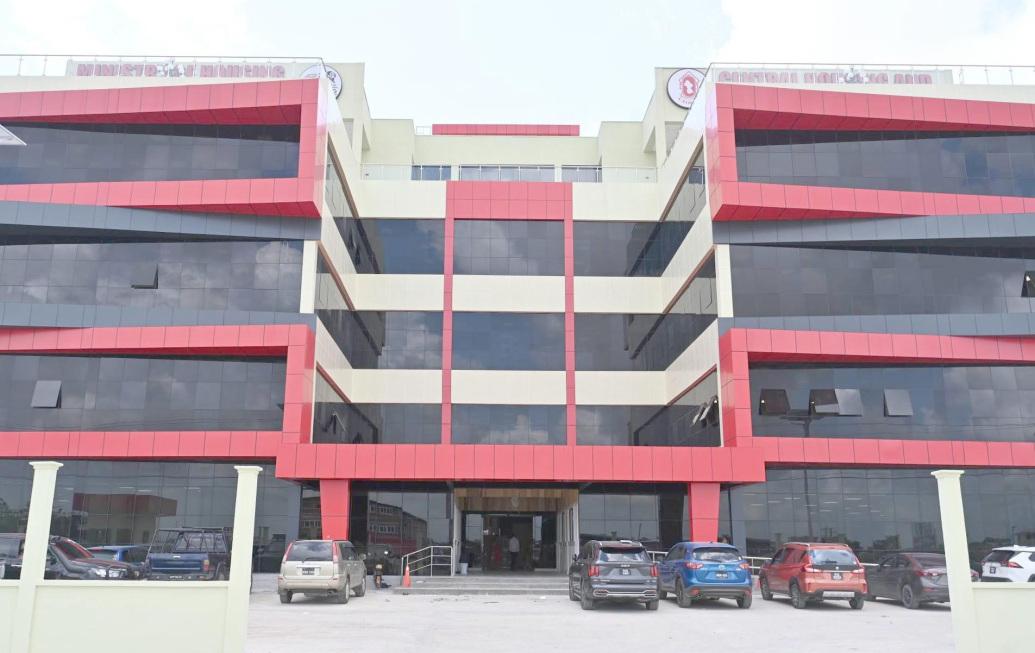
Minister of Housing, Collin Croal and Minister within the Ministry of Housing, Vanessa Benn, toured the Ministry of Housing’s new headquarters at Plantation Houston, East Bank Demerara, on Friday, reviewing final works before occupancy. CH&PA CEO Dr. Martin Pertab and other senior officials joined the walkthrough. The 150 x 105-foot building sits on a two-acre lot and will house over 400 staff members, thereby boosting the ministry’s service delivery (Ministry of Housing)
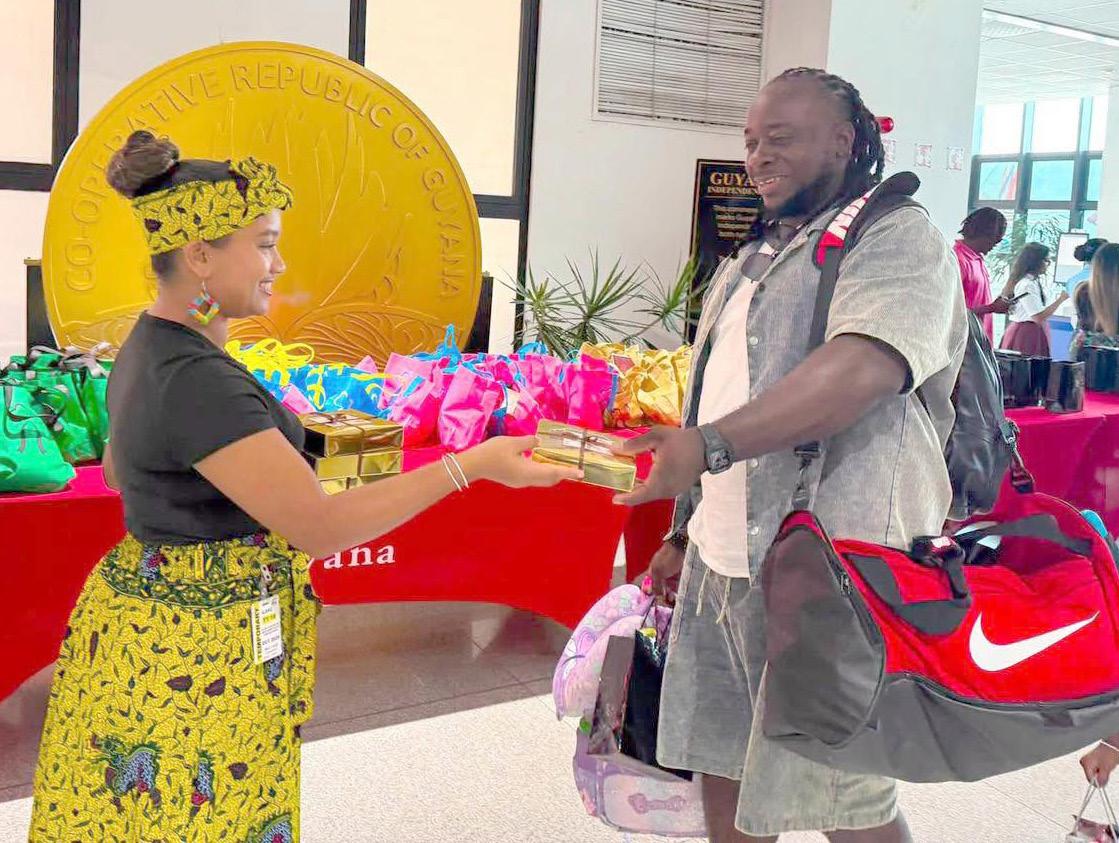
Ahead of Emancipation Day, the Guyana Tourism Authority on Friday welcomed arriving passengers at the Cheddi Jagan International Airport with a taste of Guyana’s rich African heritage through traditional delicacies (CJIA photo)
MV Barima CoI begins work as search, recovery efforts continue
THE Commission of Inquiry into the MV Barima tragedy has officially begun its work as search and recovery operations continue with no new verified developments to report at this time.
This is according to an update from the Office of the Prime Minister on Friday.
The statement noted that the coordinated operation
continues, and any new information related to the search and recovery efforts will be communicated through the established official channels as it becomes available.
Meanwhile, the chairman and members of the commission were formally sworn in on Thursday by Chief Magistrate Judy Latchman, at State House in Georgetown.
The commission will now independently carry out its mandate to examine the circumstances surrounding the incident before presenting its findings, observations and recommendations upon the completion of its investigation.
The Office of the Prime Minister also advised that further media briefings will
be held when significant and verified operational developments occur.
The government reaffirmed its commitment to supporting affected families, maintaining the integrity of the ongoing search and recovery operations, and ensuring the public continues to receive accurate and verified information.
President Ali establishes expert team to audit maritime safety, compliance
–– to
IN a decisive step to fortify the safety of Guyana’s waterways, President, Dr Mohamed Irfaan Ali, has announced the formation of a Safety and Compliance Audit Team tasked with conducting a comprehensive review of the safety and compliance standards governing marine vessels operating across the country in the aftermath of the MV Barima tragedy.
The initiative forms part of the government’s continuing programme of action to strengthen maritime safety and prevent future tragedies, and reflects the administration’s commitment to ensuring that every vessel plying Guyana’s rivers and coastline meets the highest practicable standards of safety and accountability, the President said.
President Ali has assem-
strengthen standards nationwide
The President recently appointed an independent, five-member international Commission of Inquiry, chaired by Justice Godfrey Phillip Smith of Belize, to determine the causes of the MV Barima disaster and recommend systemic reforms.
bled a team whose collective experience spans decades of hands-on maritime administration, defence and vessel inspection.
The Audit Team comprises: Dr Ivor English, former Director-General of the Maritime Administration Department (MARAD); Colonel Julius Skeete of the Guyana Defence Force and Captain Joseph Lewis, Marine Officer and Surveyor of Ships.
wealth of technical expertise, practical experience and knowledge in marine administration, maritime operations, and the inspection and surveying of ships.
Together, the three men bring what the President’s statement describes as a
The team has been charged with examining compliance with applicable maritime safety require -
ments and making recommendations to strengthen oversight, improve enforcement, and ensure that vessels, operators and regulatory systems across Guyana meet the highest standards of safety and accountability.
This step builds on a broader wave of initiatives
That panel, which includes maritime, engineering and legal experts from Jamaica, Trinidad and Tobago and Poland, has been tasked with scrutinising everything from vessel loading and passenger boarding procedures to search-andrescue coordination.
The government also launched the HEART Initiative, a national body coordinating long-term support for survivors and affected families.
IMF praises Guyana’s fiscal discipline, governance reforms
THE International Monetary Fund has once again given Guyana high marks for the way it is managing its rapidly growing oil wealth, commending the government for “sustained prudent fiscal policies” and a borrowing strategy that keeps the country’s risk of debt distress at its lowest possible rating.
In its Article IV Mission concluding statement, IMF staff painted a picture of a country that continues to punch well above its weight on fiscal responsibility even as spending needs multiply.
While the fiscal deficit is expected to widen somewhat in 2026, driven largely by social transfers and electricity subsidies aimed at cushioning citizens from rising costs, the Fund projects an improvement in 2027, thanks to the built-in one-year lag in
the Natural Resource Fund (NRF) withdrawal rule that automatically moderates spending.
Perhaps the most striking endorsement in the report is the Fund’s recognition that Guyana’s careful stewardship has produced “rapid accumulation of substantial NRF balances and one of the lowest debt-to-GDP ratios in the hemisphere.”
The IMF noted that Guyana’s budget documents already provide detailed medium-term projections, performance indicators, and macroeconomic assumptions, reflecting a strong foundation, the Fund said, for building out even more sophisticated fiscal guideposts as the economy continues its transformation.
One idea under discussion is anchoring policy to the non-oil primary balance,
which would help balance the needs of Guyanese today against those of future generations, while accounting for the higher cost of delivering public services in a low-population-density country.
The report also highlighted real momentum on institutional modernisation. The
authorities are rolling out digital solutions across key public services, including efforts to make government information systems talk to each other more efficiently.
Financial account audits are proceeding on schedule, internal audit capacity is being strengthened, and a
new centralised digital procurement platform is helping safeguard the quality of public spending as expenditure expands rapidly.
The Fund also acknowledged the government’s work to resolve outstanding costoil audits, including through arbitration.
On anti-corruption and anti-money laundering, the IMF was similarly encouraged. Guyana is pursuing what the Fund called a “comprehensive approach” to AML/CFT, including concrete steps to close gaps flagged in its 2024 Mutual Evaluation Report by the Caribbean Financial Action Task Force, alongside new AML legislation and a broader modernisation of the legal framework.
The Fund singled out progress in the gold mining sector, where a planned risk
assessment of extractive industries is expected to help identify remaining vulnerabilities.
Some beneficial ownership information is already publicly available; this is a transparency measure many resource-rich nations struggle to implement, and the IMF encouraged further work on public access and enforcement.
Continued reinforcement of the Integrity Commission, including stronger compliance with asset declaration rules, rounds out a governance agenda that the Fund views as moving in the right direction.
As the Fund put it, staff will continue engaging with the authorities on how best to calibrate medium- and long-term fiscal guideposts to Guyana’s development needs.
the Ali administration has rolled out after the tragic MV Barima incident.
Former Director-General of the Maritime Administration Department, Dr Ivor English
GDFs Colonel Julius Skeete
UN report: Global hunger levels ease for third consecutive year as regional disparities persist
The 2026 edition of The State of Food Security and Nutrition in the World (SOFI) also examines the cost of healthy diets
ROME – Global hunger declined for a third consecutive year in 2025, demonstrating that progress is possible. However, the improvements remain fragile, unevenly distributed and insufficient to achieve the Sustainable Development Goals by 2030, according to The State of Food Security and Nutrition in the World
2026 (SOFI 2026) report, released on Tuesday by five United Nations specialized agencies.
The report estimates that 7.8 percent of the global population faced hunger in 2025, down from 8.1 percent in 2024 and 8.6 percent in 2022, confirming a sustained, albeit slow, improvement. This means that around 645 million people were affected by hunger in 2025, representing a reduction of nearly 14 million compared to 2024 and 43 million compared to 2022.
Despite global progress, recovery remains uneven across regions. Asia, together with Latin America and the Caribbean, has recorded steady improvements in recent years. In contrast, Africa is now home to approximately 309 million hungry people, compared with 292 million in Asia. Although Africa’s previously rising trend is beginning to stabilize, with the share of its population facing hunger decreasing from 20.3 percent in 2024 to 20.0 percent in 2025, the continent now has the highest number of hungry people in absolute terms amid a rapidly growing population.
Broader measures of food access tell a similar story. In 2025, an estimated 25.8 percent of the global population (around 2.1 billion people) experienced moderate or severe food insecurity, meaning they were at times forced to compromise on the quality or quantity of the food they ate. This is down from 27.1 percent in 2024 and 28.7 percent in 2020 – equivalent to nearly 86 million fewer people than in 2024 and 135 million fewer than in 2020, though still above pre-pandemic levels.
Regional disparities remain stark. More than half of Africa’s population (56.6 percent) faced moderate or severe food insecurity in 2025, compared to 20.3 percent in Asia, 22.9 percent in Latin America and the Caribbean, and 8.7 percent in Northern America and Europe. Food insecurity
also continues to be more prevalent in rural areas than in peri-urban and urban areas, while women remain disproportionately affected, although the gender gap narrowed slightly in 2025.
HUNGER
PROJECTIONS IN THE CONTEXT OF THE MIDDLE EAST CONFLICT
The annual report also offers updated hunger projections for the next five years in light of the conflict in the Middle East.
Depending on the length of the impact of the crisis on food inflation – which is driven by higher energy and fertilizer prices – approximately 510 to 520 million people may still be facing hunger in 2030 (compared to the lower projection of 503 million in the pre-conflict scenario), with the global number of undernourished people expected to decrease by 20 percent. However, other potential disruptors, including the effects of weather extremes such as El Niño in 2026 and 2027, are not considered in these projections and could further compound these effects.
The report’s joint authors - the Food and Agriculture Organization of the United Nations (FAO), the International Fund for Agricultural Development (IFAD), the United Nations Children’s Fund (UNICEF), the UN World Food Programme (WFP), and the World Health Organization (WHO) – warn that the
2026 Middle East conflict, along with weather extremes and the reductions in official development assistance and humanitarian funding, are threatening to undermine the progress made to end global hunger.
SLOW PROGRESS ON GLOBAL NUTRITION TARGETS
The report highlights that global progress on maternal and child nutrition also remains insufficient to meet international commitments, including the 2030 nutrition targets.
Indicators such as child stunting, wasting, overweight, low birthweight and exclusive breastfeeding show only marginal improvements and progress is too slow to meet the targets. At the same time, anaemia among women aged 15 to 49 years is worsening, while the prevalence of adult obesity shows a steady increase – from 12.1 percent in 2012 to 16.2 percent in 2024 – contrary to the target of halting its rise by 2025. Only 30.8 percent of children aged 6 to 23 months worldwide consume a minimally diverse diet and 150 million children under five years of age are still stunted. Progress again varies significantly across regions. The prevalence of child stunting is declining in Africa and is on track to meet the 2030 target in Asia, while exclusive breastfeeding rates are improving across all regions where data is available. However,
nearly all regions are experiencing widening gaps in addressing anaemia among women, and child overweight is increasing rapidly in Oceania.
THE COST OF A HEALTHY DIET
This year’s SOFI report takes a closer look at the cost of a healthy diet - the average minimum expenditure required to obtain locally available foods that meet energy and most nutrient requirements. According to FAO and WHO, a healthy diet is one that is adequate, balanced, diverse, and moderate.
The report underscores that costs remain a major constraint to achieving SDG 2 (Zero Hunger), although lowering such costs alone will not be sufficient to improve dietary quality and nutrition outcomes.
In 2025, the average global cost of a healthy diet rose to 4.28 purchasing power parity (PPP) dollars per person per day, up from 3.44 PPP dollars in 2021 and 2.94 PPP dollars in 2017, with the highest levels recorded in Latin America and the Caribbean (4.91 PPP dollars). At the same time, the number of people unable to afford a healthy diet has declined - from 2.97 billion (37.4 percent of the global population) in 2021 to 2.69 billion (32.7 percent) in 2025.
However, this trend masks significant regional disparities. In Africa, affordability worsened markedly, with 66.6 percent of the population unable to afford a healthy diet in 2025 - more than double the levels observed in Asia and in Latin America and the Caribbean.
Healthy diet costs vary widely across regions due to structural differences in agrifood systems. Animal source foods, fruits and vegetables account for the largest share of costs, while starchy staples contribute relatively little. Animal source foods are the largest contributor to the cost of a healthy diet in Africa, whereas vegetables represent the largest share in Latin America and the Caribbean.
THIRTY young people from Sophia have completed an intensive leadership development programme at the Sophia Community Centre.
The programme is designed to equip them with the skills, confidence and values needed to become the next generation of leaders.
The week long initiative, organised by SANKOFA, brought together participants between the ages of eight and eighteen for practical training in leadership, public
speaking, financial literacy, character education, digital etiquette and other essential life skills.
Delivering the feature address at the closing ceremony on Friday, Minister of Labour and Manpower Planning Keoma Griffith urged the participants to embrace every opportunity for growth, reminding them that leadership begins with service.
“I want all of you here today not to take this experience for granted because volunteering helps you to help others. But while it
helps you to help others, it unlocks something within you. And that’s a passion for people,” the minister noted.
Reflecting on Guyana’s rapid transformation, the minister urged the participants to prepare themselves for the opportunities emerging in the country by making education their highest priority.
He said, “There is no better way to prepare yourself than pursuing your education and all of the things that are available to you.”
He noted that with free education now available at every level, young people have unprecedented opportunities to build successful careers and assume leadership roles in every sector.
He stressed that Guyana’s future depends on a generation that is educated, disciplined and committed to national service.
Speaking at the ceremony, Founder and President of SANKOFA Lourdeth Ferguson said the initiative was inspired by a commitment to nurture confident young citizens
while preserving the values of heritage and community.
“We must reclaim the wisdom of our past and use it to build a bright and strong future.
Sankofa calls us to honor heritage, restore that which was lost, and empower the next generation with knowledge, values, and purpose.”
Ferguson explained that the pilot programme was launched to create lasting social impact through youth development.
She added that the par-
ticipants demonstrated enthusiasm, discipline and a genuine desire to learn throughout the week.
She also outlined plans to expand the initiative to communities across Guyana while introducing a mentorship component that will continue supporting participants beyond the classroom.
The programme was delivered by a team of volunteer facilitators and supported by donors who ensured each participant received meals throughout the week.
Participants of the SANKOFA leadership initiative
Freedom Remembered, Unity Renewed
EVERY August 1, Guyana pauses to mark a turning point no monument can fully capture: the day our ancestors’ long struggle for freedom became law.
Emancipation Day is not a relic of the past, it is a living inheritance, and this year, as every year, it demands more of us than a day off and a splash of African print.
It demands memory. Not the sanitised kind that fits neatly into a parade, but the full, difficult truth of what enslaved Africans endured on these coastlands: the Middle Passage, the plantations, the deliberate stripping of names, languages, and families.
When we gather at the 1763 Mon-
ument or in the villages founded by freed men and women who pooled their earnings to buy land no one wanted to sell them, we are not performing history.
We are honouring the fact that freedom here was never given, it was fought for, often at unbearable cost.
But memory alone is not enough. Emancipation Day must also be a mirror held up to the present. Are we, as a nation, living up to the unity our ancestors imagined when they built the first free villages together, pooling resources across old plantation lines because survival demanded co-operation over division?
Too often, in the day-to-day noise of Guyanese life, we let politics and old
suspicions pull us apart rather than pull us together. The Village Movement was itself an act of radical unity, as Africans embraced collective ownership, collective labour, collective destiny. That spirit is worth resurrecting, loudly and often, not just in August.
Resilience is the other half of this inheritance. It shows up in Afro-Guyanese communities that have weathered economic hardship, migration, and neglect, and still produce culture, enterprise, and leadership that shape this country far beyond their numbers. That resilience deserves more than applause, it deserves investment.
It is encouraging to see growing attention paid to the historic villages, to
Afro-Guyanese cultural institutions, and to economic empowerment programmes aimed at communities that spent generations catching up from a starting line they never chose.
Emancipation Day should leave us uncomfortable as much as it leaves us proud.
Proud of the courage of 1838. Uncomfortable with how far unity and equity still have to travel in this diverse nation we call Guyana.
If we honour our ancestors only in commemoration and not in continued commitment to each other, to fairness, to remembering whose shoulders we stand on, we have missed the point of the freedom they died fighting for.
A backward mentality in a developing country
Dear Editor,
IT can be incredibly frustrating to watch public discussions get derailed by rumours, double standards, and conspiracy theories instead of sticking to proven facts and logic.
This type of mindset is not unique to Guyana, but cultural, political, and historical factors certainly shape how it plays out in the country.
Guyanese are mostly of the view that, as a country, whatever we endure it is inherently unique and does not occur elsewhere in the world. Conversely, they also tend to compare what Guyana should be like by using examples of other places in the world, yet fail to realise that those places are only where they are because their people work together.
At times, it is ludicrous to see the double standards Guyanese often display of wanting better but failing to work together to achieve such. For example, we have a littering problem. Guyanese blame the government for
it, and then opt to compare how other places are. Yet WE THE PEOPLE still litter, still throw our garbage outside the moving vehicle or boat, or right where we stand or walk.
Most Guyanese do not understand what development and growth is, because to them, development is defined as free money in their bank accounts at the government’s expense, where everything else is irrelevant.
With all the development and construction happening, they see it as a government stealing through corrupt contracts even though they themselves cannot verify the information they “gaff” about on the street corners.
It is a sad thing, especially when you have a population that is less academically inclined to see the truth behind the twisted narratives they are being fed.
Decades of race-based politics and fierce rivalry between major parties create an “us versus them” mentality. Guyanese are quicker to believe in a conspiracy that hurts the opposing side
than a fact that helps them.
A long history of political tension, lack of transparency, and institutional corruption make the public naturally skeptical of official narratives, i.e. when people do not trust the government or institutions, conspiracy theories easily fill the gap.
Guyanese culture heavily values oral storytelling and informal communication. Rumours and sensational stories (often shared via social media) spread much faster than dry, factual news reports.
Platforms like Facebook and WhatsApp allow unverified claims to go viral instantly.
Users often lock themselves into echo chambers where confirmation bias leads them to accept narrative over logic.
Guyanese frequently excuse bad behaviour or logical gaps when it comes from their own political party, ethnic group, or social circle, while fiercely condemning the exact same behaviour
from the opposing side.
“How can we change this?” is the question we all should consider because it could create a precedent whereby for generations to come where the population gives relevance to conspiracies over facts, inevitably, we will be a developing country with a backward mentality.
Institutions and leaders must provide open, verifiable data to earn public trust and leave less room for speculation.
Citizens should pause to verify information from multiple reliable sources before passing it on to help break the chain of rumours.
Teaching people how to identify biased sources, fake news, and logical fallacies is crucial for long-term change. Evaluating situations based on fairness, evidence, and national progress—rather than political or ethnic alignment—helps eliminate double standards.
OP-ED Guyana is not following the resource curse — we
By Dr Peter Ramsaroop, Chief Investment Officer and Chief Executive Officer of GO-Invest
A FAMILIAR question is often asked of resource-rich nations: can they avoid the so-called “resource curse”? It is a valid concern, but it overlooks the deliberate strategy already underway in Guyana.
The resource curse is not caused by oil itself. It stems from weak institutions, poor governance, economic complacency, and the failure to convert resource wealth into longterm investments in people and productive sectors. History shows that countries falter when they consume rather than invest.
Guyana has chosen a different path. Oil is not our destination; it is our catalyst.
Under the leadership of President, Dr Mohamed Irfaan Ali, our approach has been consistent: deploy petroleum revenues to build an economy capable of thriving long after the last barrel is produced.
We are currently investing at an unprecedented scale in roads, bridges, ports, hospitals, schools, housing, energy, digital systems, education, healthcare, and national security. These are not short-term expenditures but long-term investments designed to strengthen competitiveness, productivity, and resilience for generations.
Dr Peter Ramsaroop
Guyana has always been a diversified economy. Agriculture, forestry, mining, manufacturing, and services have long formed the backbone of our development. Today, we are strengthening and modernising these traditional sectors through technology, infrastructure, and value-added production. At the same time, we are ex-
are writing a different
panding into new and emerging industries. Agriculture is expanding, manufacturing is growing, tourism is accelerating, business process outsourcing continues to generate employment, and sectors such as logistics, energy services, construction, financial services, technology, and value-added manufacturing are emerging as new growth pillars.
Our objective is not to become an oil-dependent economy, but to build on our existing strengths and position Guyana as one of the world’s most dynamic emerging economies.
Institution building is equally central to this strategy.
Guyana has established a Natural Resource Fund with parliamentary oversight and transparent reporting. Local Content legislation ensures that Guyanese businesses and workers directly benefit from the petroleum sector.
Environmental stewardship remains a national priority alongside the protection of one of the world’s largest standing tropical forests, demonstrating that economic development and climate leadership can advance together. These are precisely the institutional safeguards that help nations avoid the resource curse.
Equally important is our people-centred development model.
Free university education, expanded
story
technical and vocational training, healthcare investments, support for entrepreneurs, housing programmes, and community infrastructure all represent sustained investments in human capital. Lasting prosperity is built not only on natural resources, but on educated, skilled, and empowered citizens.
We do not deny the challenges. Inflationary pressures, rapid urbanisation, labour constraints, governance demands, and the need for continuous institutional strengthening require disciplined management. Responsible leadership means confronting these challenges directly—not ignoring them.
To suggest that Guyana is destined to repeat the failures of others, however, ignores both our strategy and the progress already being made.
History provides examples of countries that squandered resource wealth. It also provides examples of nations that transformed it into lasting prosperity. Guyana is determined to be among the latter.
Our ambition is not to become another petrostate.
Our ambition is to build a globally competitive, knowledge-driven economy powered by innovation, investment, productivity, and opportunity—using today’s oil revenues to secure tomorrow’s prosperity.
The road to Emancipation
Dear Editor,
IT was this month, the month of August, 192 years ago that the enslaved people from Africa were promised their freedom. However, before I tell you about the African Emancipation in more detail, I would like to start with how the Dutch came to British Guiana.
We must remember that Walter Raleigh heard some drunken English sailors in a bar in England talking about gold and the golden king in South America. On hearing this, he equipped three ships with ration, supplies and volunteers and set sail to South America in 1595.
On his way to South America, he learnt that most of South America was owned by the Dutch, The French, The Spanish and the Portugese.
However, he found what looked like an abandoned land on the north coast of South America. He sailed through and turned left into another river where he saw about 40 ‘Red Indian’ families living in tents, which he later learnt were Benabs. They welcomed him, since he was flying the English flag.
Those ‘Red Indians’, who we now
know as Amerindians (were our First Peoples).
The ‘Red Indians’ (Amerindians) greeted him and asked what brought him here. Said Walter Raleigh, “I’m looking for wealth (gold).” To which the ‘Red Indian’ Chief replied, “Yes, we have hills of gold around here. And we even have a golden King, who lives in a Golden Palace over the hill.” Unfortunately, this was all lies.
Walter Raleigh never saw any gold, and neither the King nor the Golden Palace.
But he went back to England and told the people of England he found hills of gold and saw the King and the Golden Palace, after which he was knighted by the Queen as Sir Walter Raleigh.
On learning this, the French, the Spanish, the Dutch, the Irish, and some Germans all came searching for wealth, and they, too, found nothing.
But it was the Dutch who found something of value. They found fertile land to plant sugarcane. They initially started by enslaving the Amerindians as labourers to plant sugarcane, but they refused and fled into the jungle. They then tried some
Europeans as paid contractual slaves, but that, too, did not work. The sun and the work were very tedious.
By 1636, the Dutch began to look elsewhere for labourers. They wanted a large amount of reliable strong and disciplined men to work. The Dutch heard of the Slave Trade from West Africa, run by African Chiefs. They made contact and realised that many African labourers were available.
Not so long after, slaves began to arrive on Plantation Kyk-Over-Al and Pomeroon. Over the years, the African people; man, woman, and child, endured much suffering. There were several slave rebellions and non-cooperation, as brothers were being taken from their brothers, men being taken away from their wives, brothers and sisters being cruely taken away from each other, women and children crying for each other. There was no mercy.
There were some notable Europeans who fought in the English Parliament for the slave labour to be abolished. There were people like Sir Thomas Buxton and Reverend John Smith. Sir Thomas Buxton, a white European, got the village of Buxton named after him, and Reverend
John Smith mysteriously died in prison.
The entire 18th Century was marked by more arrival of slaves and more slave rebellions. Slavery must be the greatest sin committed by Man; even greater than murder, even though that’s my belief. Forcing men and women to wear and eat what the masters want them to is a life of misery.
There were many calls that massa day must done. It eventually came in 1838, even though they were promised in 1834.
The planters used their financial power to change slavery to apprenticeship and indentured labour, however, the actions and attitude of the Europeans remained the same. On Monday, August 1, 1838, the curtains finally came down on slavery and apprenticeship.
The Africans of old initially celebrated that day as plain August Monday, or Freedom Day. Today, the preferred name is Emancipation Day.
The foregoing information was taken from the National Archives and Vere T. Daly’s The Making of Guyana.
Yours
truly, Frank De Abreu
The first Emancipation Day since the 2025 general elections
THIS is the first Emancipation Day since the September 2025 general elections.
Those elections have unleashed a phenomenal transformation in the political temperament of African Guyanese. The 2025 election results have shown how deep three changes Guyana have seen over the years.
One is that demographic movements in the Guyanese population have given birth to an ocean of young people. The African population in 2025, like the Indian population, is not tied any longer to the apron strings of their parents. This young population is now living inside a zeitgeist that has no resemblance to the 1970s and 1980s. They are not susceptible to race-baiting. What happened in 2025 among Africans was that the issue was more important than the race of the candidate.
The second change is that African Guyanese no longer see the PNC as the embodiment of their instincts. Two factors could be responsible for this. One is the mountainous failure of the PNC to effect far reaching changes in the Guyanese society for the five years it was in power from 2015-2020. The other factor is the pessimism that has crept into the minds of African Guyanese about the future of the PNC.
Finally, the third changing thing in Guyana is the rejection of a school of African leaders (PNC, WPA, AFC, ACDA, UG lecturers, journalists and a number of professional individuals) that
the young African population realised how barefaced these leaders were in fooling them. The 2025 election results demonstrated the extent to which African Guyanese were disgusted with their leaders.
The current set of young Guyanese we have cannot be so easily fooled and by some weird psychic contortion, these African leaders that seek to deceive them feel that they can spin the most fabled, idiotic stories and African Guyanese will believe them. There is no parallel in modern post-Independence Guyana that matches this theatre of clowns and carnival of vulgarity.
Just two examples should suffice. African spokesperson, Henry Jeffrey, noted that in the 2020 election, the PPP rigged the voting in nine of the ten Regions in Guyana in which the percentage started from 30 percent to seventy percent. Aubrey Norton told his interviewer that the PPP rigged the 2025 election.
Now, which moron will believe Norton since the PPP rigged it and gave WIN a whopping 16 seats. Which African Guyanese believes Jeffrey and Norton? What they believe is that both men just wanted to fool them. In this context then, Emancipation Day 2026 has seen the liberation of the African race in Guyana.
The emancipation of the African Guyanese from failed leaders which began in 2025 will see some unsavory moments as the years unfold. The entire
gamut of failed African leaders has not recovered from the devastating trauma of 2025. What we see in them is false attempt to appear normal. But they cannot. The electoral massacre was too psychically piercing. It is going to take a long time to recover.
In order to stave off the increasing disappearing of their existence, these failed leaders will hold on to anything they can get to keep them alive. My contestation is that tragedy big or small, disaster big or small, national controversies big or small, these events will be used by these disappearing leaders to make a pitch for resuscitation. Take Nigel Hughes. He was silent since the September 2025 election. Now we see Nigel making statements about the murder accused in the MV Barima tragedy.
I had no doubt in my mind that the ferry tragedy was a golden moment for them. The opposition had absolutely no intention of entering parliament, bowing their heads in prayer and talking to the nation about the tragedy. The plan was hatched days before. Move in, create confusion and get maximum publicity. Last Monday’s pyrotechnics in Parliament had nothing to do with the victims
of who perished in the ferry incident.
Last Wednesday’s display in Parliament was about staying alive. Maybe someone in the gallery should have taken his mobile stereo and while they were parading, play the Bee Gees’ mega-hit, “Staying Alive” from the movie Jesus Christ, Superstar. Guyana in 2025 witnessed the emancipation of the African mind. No one in the young African population takes David Hinds seriously. No one in the young African population thinks Aubrey Norton is a competent political leader. No one in the young African population thinks David Granger was an effective president. And so, the story goes; the age of Forbes Burnham, Hamilton Green, Desmond Hoyte, David Granger, the WPA, ACDA, mo fyaah/slo fyaah, cussing down other people because of their races are all gone. It is anyone’s guess which next event these disappearing African leaders will milk in order to stay alive.
DISCLAIMER: The views and opinions expressed in this column are solely those of the author and do not necessarily reflect the official policy or position of the Guyana National Newspapers Limited.
Guyana Development Bank inspires confidence among entrepreneurs
ENTREPRENEURS
and small business owners have welcomed the establishment of the Guyana Development Bank, describing the new institution as a significant opportunity for expanding access to financing and support for small and medium-sized enterprises (SMEs).
The Guyana Development Bank Act 2026 was recently passed in the National Assembly and subsequently assented to by President Dr Mohamed Irfaan Ali on Thursday, officially bringing the legislation into force and establishing the country’s newest financial institution.
For young entrepreneurs, Daniel Prince, owner and founder of Danny’s Business Solutions, the establishment of the bank represents a new pathway to access capital and grow their businesses
Prince said the initiative will provide critical support to young business owners seeking to expand their operations.
Danny’s Business Solutions focuses on stationery retail and printing services, and Prince believes access to financing will allow entrepreneurs to promote their business-
es, reach wider customer bases and further develop their enterprises.
“I think that this is a great initiative since it will allow young business owners to access finances to promote their business and better forward it to reach better customer bases for them,” Prince said.
He added that once businesses establish a strong foundation, entrepreneurs can use additional financing opportunities to further expand.
Macy Barclay, another small business owner, said the initiative will assist persons who may not have the collateral traditionally required by financial institutions.
“I think this is very good because some people can’t really afford to give back interest or afford to give back collateral,” Barclay stated.
She noted that the support provided through the institution can help more Guyanese pursue entrepreneurship and contribute to economic growth.
Aspiring entrepreneur Shemaul Agard, who plans to establish a business selling air-conditioning tools and equipment, described the bank as a valuable opportunity for persons seeking to enter the busi-
ness sector.
The business I’m going into is providing or selling AC tools, and my thoughts on this bank is it’s a very lovely opportunity for most Guyanese because we have no collateral,” Agard said.
Owner of GT Shines, Tyrone Baine, said the financing support provided through the Guyana Development Bank could help him acquire tools and equipment needed to expand his business.
Baine, who previously received a grant from
the Ministry of Tourism, Industry and Commerce, said access to additional financing could allow his business to move from a small operation to a larger enterprise.
“The grant is going to be very helpful. A loan from the Guyana Development Bank could give me room to start. I could get my tools, I could get my equipment. It could be a good opportunity for me. I could scale my business from small, starting with the four hundred thousand and then I could maybe
work my way up to the ten million,” Baine explained.
The establishment of the Guyana Development Bank forms part of the government’s efforts to strengthen entrepreneurship, expand access to financing and provide greater support for SMEs as contributors to economic
growth and job creation.
The bank is expected to provide loans of up to $3 million to SMEs, with the financing offered without interest and without the requirement for collateral, while also providing mentorship and technical support to entrepreneurs. (DPI)
Daniel Prince Macy Barclay Shemaul Agard
Tyrone Baine
Construction safety campaign targets stronger workplace culture
THE Ministry of Labour and Manpower Planning on Thursday continued its nationwide “Putting Safety First in the Construction Sector” campaign with a construction safety seminar for employers, contractors, supervisors and workers in Region Four.
Held at the Police Officers’ Mess Annexe in Georgetown, the seminar forms part of the ministry’s ongoing effort to strengthen occupational safety standards and promote a culture of workplace safety across Guyana.
Minister of Labour and Manpower Planning, Keoma Griffith, told the gathering that the initiative
was developed to address the country’s approach to workplace safety through education and awareness.
The campaign is being rolled out region-by-region to educate stakeholders on the importance of prioritising safety before moving into enforcement through workplace inspections.
“You may ask yourselves, why are we doing this now? It has led me to understand that there are some issues in Guyana that we have to confront frontally, and one of them is our culture of safety and how we approach safety.
Safety is everybody’s business,” the minister stated.
“Not only do we intend
Minister of Labour and Manpower Planning, Keoma Griffith
to bring awareness, but we want to analyse what the safety culture is in every region so that we can make direct interventions,” Minister Griffith added.
He urged participants to become ambassadors for workplace safety by encouraging workers and fellow contractors to comply with occupational safety standards.
He also reminded those gathered of the importance of remaining free from alcohol and drugs while on the job, noting that the issue is addressed in the safety manual distributed during the seminar.
Following the education campaign, the ministry will begin inspections
at construction sites to assess compliance with occupational safety and health regulations.
Similar safety campaigns will be expanded to other high-risk sectors, including mining and agriculture, as the ministry works to build a national culture where safety is a shared responsibility.
“We are hoping that by the end of this entire exercise, we have a new culture of Guyanese who are serious about their safety and serious about the people who work for them. Together, we can all benefit from a country where safety is everyone’s priority,” he said. (DPI)
Guyana’s diplomats urge unity, reparatory justice during Emancipation observance
GUYANA’S Permanent Representative to the United Nations, Ambassador Carolyn Rodrigues-Birkett, has called on Guyanese at home and abroad to honour the legacy of Emancipation by continuing the fight for reparatory justice, strengthening national unity and building a country where all citizens can thrive.
Her appeal came as the nation continues to mourn the victims of the recent MV Barima tragedy.
Delivering the keynote address at Guyana’s Emancipation Day observance at Medgar Evers College in Brooklyn on Thursday evening, Ambassador Rodrigues-Birkett said this year’s commemoration comes at an especially painful moment, following what she described as the country’s worst maritime disaster in recent history.
Before reflecting on the significance of the 188th anniversary of Emancipation, she acknowledged the lives lost in the sinking of the MV Barima and extended condolences to grieving families.
“I crave your indulgence before going further into my remarks to acknowledge that we are meeting at a time when our country has experienced the worst maritime disaster in recent history,” she said.
Rodrigues-Birkett noted that President, Dr Irfaan Ali has already announced the establishment of a Commission of Inquiry into the disaster and gave the assurance that every necessary form of assistance would be provided to survivors and the families of those who died.
“I extend my condolences to the relatives and loved ones of those who perished, recognising that words cannot heal the deep sorrow they are enduring and will continue to endure.”
Against that backdrop of national mourning, the ambassador urged Guyanese not to lose sight of the significance of Emancipation, describing it as one of the defining moments in the country’s history and a reminder of the extraordinary sacrifices made by African ancestors.
She said, “As I extend Emancipation greetings to everyone, I especially greet our African-Guyanese sisters and brothers. Your mere presence here today demonstrates the strength and determination of your ancestors. They live through you.”
She reminded the audience that the emancipation
won by African ancestors ultimately ensured that no other ethnic group in Guyana would ever experience slavery.
Rodrigues-Birkett said commemorations provide an opportunity to confront the horrors of slavery and remember those who endured unimaginable suffering during the transatlantic slave trade.
She noted that many Africans died before even completing the journey across the Atlantic, while those who survived were stripped of their languages, cultures and identities before being forced into unpaid labour for more than two centuries.
“Our African-Guyanese brothers and sisters are the only Guyanese whose ancestors suffered a deliberate and forceful erasure of their way of life, language and culture, all while being made to work for free for over 200 years,” she said.
Because of both the scale and duration of those atrocities, she described slavery as “the greatest crime against humanity.”
Rodrigues-Birkett said those historical injustices make reparatory justice an unfinished global obligation.
UNFINISHED BUSINESS
“It is for this reason that the unfinished business of reparation must be addressed, as the effects of slavery run deep in our societies across the Caribbean,” she said.
She stressed that the Caribbean’s campaign for reparations is not motivated by financial gain.
“Reparations is [sic] not about asking for ‘free mon-
ey’; it is about justice, and this is what we seek,” she declared.
The ambassador welcomed recent apologies issued by some countries and institutions that benefitted from slavery, but argued that apologies alone cannot resolve centuries of injustice.
“We welcome this development, but apologising is just a first step,” she said.
Rodrigues-Birkett highlighted growing international support for reparatory justice, pointing to the landmark United Nations General Assembly resolution adopted earlier this year recognising the transatlantic slave trade and the enslavement of Africans as the gravest crime against humanity.
She recalled that the resolution, tabled by Ghana on behalf of the African Union, received the support of 123 countries, while only three voted against it and 52 abstained.
Guyana voted in favour of the measure and, she said, will continue advocating alongside Caribbean nations for reparatory justice and stronger international recognition of the rights of people of African descent.
She also reaffirmed Guyana’s support for the Second International Decade for People of African Descent, which began on January 1, 2025, and aims to advance equality, recognition and justice for people of African descent worldwide.
While acknowledging that the road to reparations will not be easy, Rodrigues-Birkett urged Guyanese to draw inspiration from the perseverance of their ancestors.
“We have no illusions about the challenges that may be encountered in the fight for reparation,” she said. “But we must not give up.”
She recalled that freedom was not won through a single act of resistance, but through generations of struggle.
Cuffy’s 1763 rebellion, though unsuccessful, laid an important foundation for Emancipation, while Damon, Quamina and countless others paid the ultimate price in pursuit of freedom.
“Let us pay tribute to them, and to Quamina, and the many others whose names we will never know,” she urged.
The ambassador said Guyana’s history of Indigenous genocide, slavery, indentureship and colonial rule demonstrates the resilience of its people.
She noted that although the country still faces challenges common to many developing nations, it is now in a stronger financial position to advance national development.
However, Rodrigues-Birkett cautioned that economic wealth alone cannot define a successful nation.
“There are countries that have developed without any natural resources, but through leadership and the hard work of the people,” she said.
“The beauty and richness of Guyana also lie in our people, the diversity of our colours and culture, our history, and so much more.”
HARNESS GUYANA’S DIVERSITY
She called on Guyanese everywhere to harness that diversity to build a stronger nation.
“Let us use our diversity and our collective resilience to do good, to unite, to build a better, stronger and greater Guyana, regardless of where we may live, at home or in the diaspora.”
Guyana’s Consul General in New York, Ambassador Michael Brotherson, also paid tribute to the victims of the MV Barima tragedy, stating that although the observance was taking place thousands of miles from home, the hearts of those gathered remained with fellow Guyanese.
He said the tragedy
served as a reminder of the compassion, resilience and unity that define the Guyanese people.
Brotherson reflected on the legacy of Emancipation, describing it as the restoration of humanity after centuries of oppression and highlighting the courage of African ancestors who resisted slavery through rebellion, cultural preservation and community-building.
He pointed to the Village Movement as one of the Caribbean’s greatest examples of collective self-determination, noting that formerly enslaved Africans pooled their resources to purchase villages such as Victoria, Buxton, Golden Grove and Belladrum, laying the foundation for economic
independence and self-governance.
The Consul General also linked that legacy to Guyana’s Diamond Jubilee celebrations this year, arguing that the nation’s road to independence began with Emancipation and the determination of those who fought for freedom.
He said the government remains committed to translating the spirit of Emancipation into practical opportunities through investments in community development, support for organisations representing people of African descent, entrepreneurship initiatives and continued advocacy for reparatory justice at the regional and international levels.
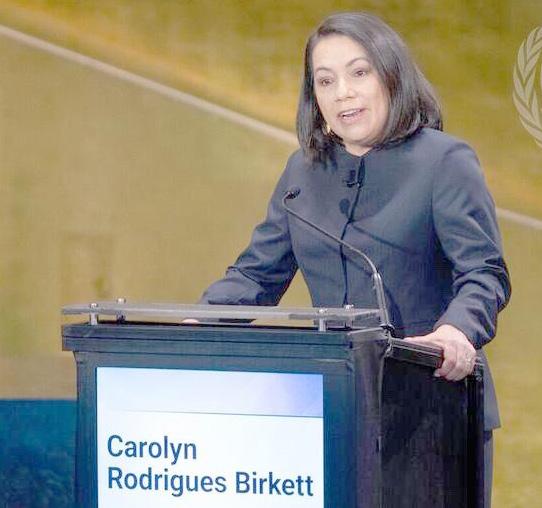
Ambassador Rodrigues-Birkett outlines vision ahead of UN Secretary-General election
GUYANA’S candidate for the position of United Nations Secretary-General, Ambassador Carolyn Rodrigues-Birkett, has outlined the priorities she would bring to the role if elected, including strengthening multilateralism, accelerating UN reform, and ensuring greater support for developing countries.
During an interview with UN Insider on Thursday, Ambassador Rodrigues-Birkett said the United Nations remains indispensable despite growing global challenges.
She stressed that the organisation must become
more efficient, effective and responsive to the needs of member states.
She also noted that her immediate priorities, if elected as secretary-general, would be assembling a strong leadership team, addressing the growing number of global conflicts, responding to mounting humanitarian needs, and improving access to development financing, particularly for developing countries.
Ambassador Rodrigues-Birkett also advocated for continuous UN reform, stronger diplomacy to resolve conflicts, and expanded South-South co-operation.
She added that electing the UN’s first female secretary-general would send a powerful message that barriers can be broken and inspire women and girls around the world.
The election for the next United Nations Secretary-General is expected to take place in 2027, when the General Assembly appoints the successful candidate upon the recommendation of the Security Council.
The successful candidate will succeed the current Secretary-General at the start of January 2027.
Ambassador Carolyn Rodrigues-Birkett (UN photo)
Ambassador Michael Brotherson
IPED offers free health checks during wellness initiative
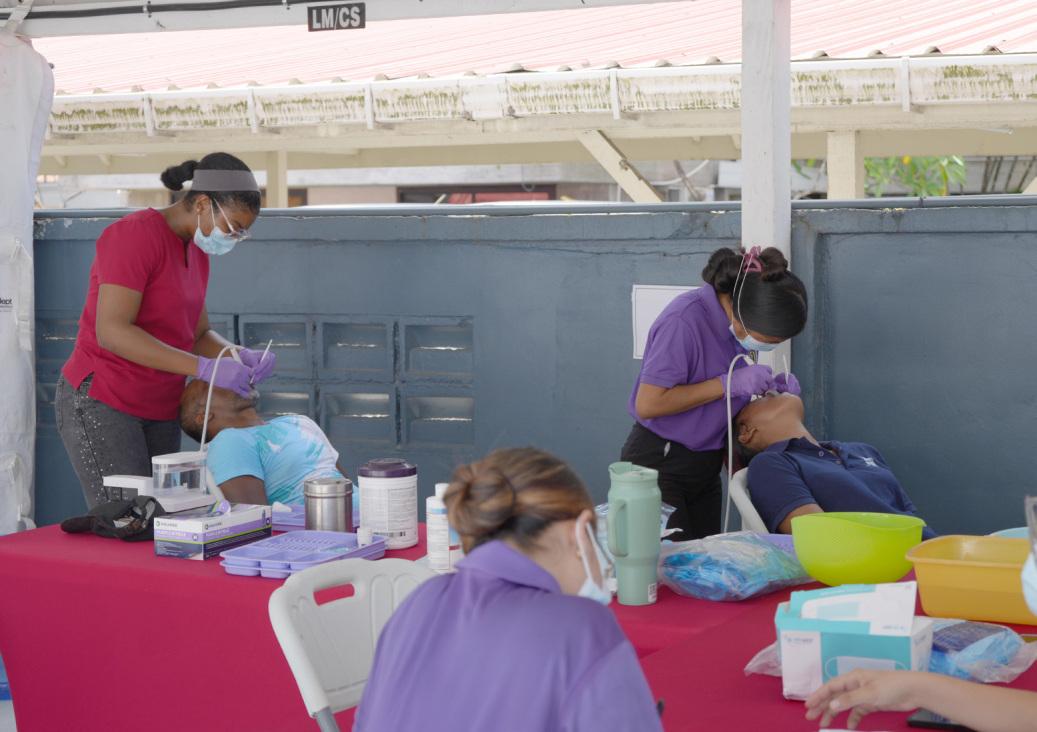
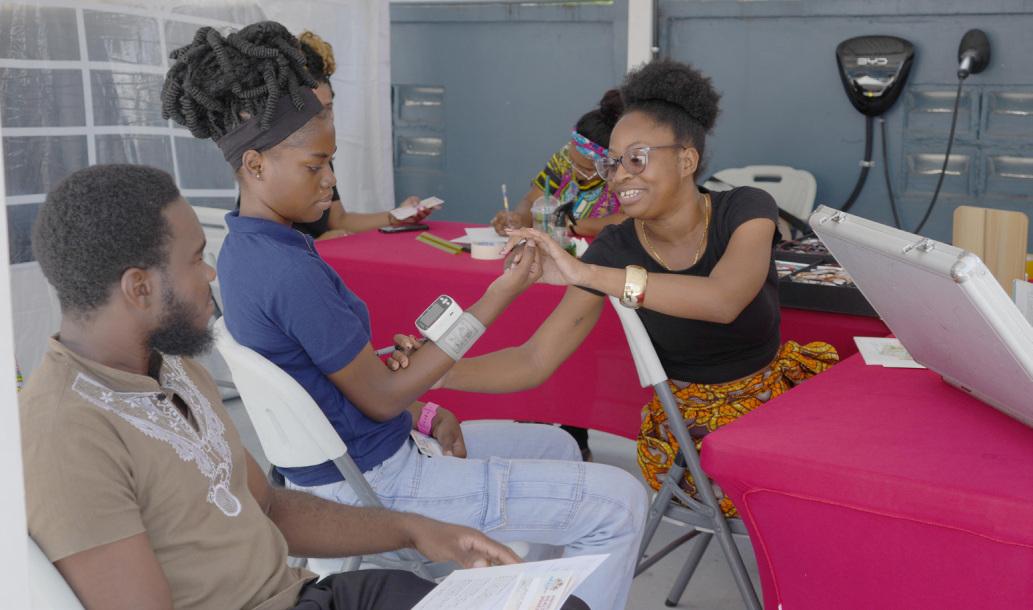
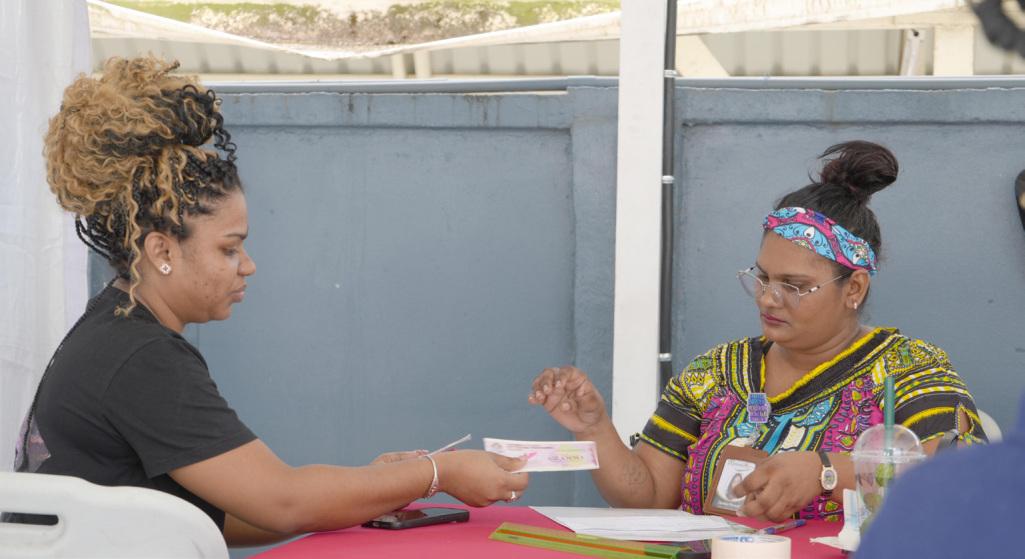
THE Institute of Private Enterprise Development (IPED) hosted its first-ever health fair on Friday, in partnership with the Ministry of Health, offering free health screenings to staff, clients and members of the public.
Held at IPED’s office at 253-254 South Road, Bourda, Georgetown, the fair provided free screenings and information on cholesterol, blood pressure, diabetes, eye health, dental care, HPV, and HIV, along with a blood-donation drive.
The initiative forms part of IPED’s ongoing efforts to promote health and wellness among its staff, clients and the wider community, as the organisation marks its 40th anniversary this year.
Beyond providing thousands of Guyanese with the tools, confidence and support to turn their ideas into viable businesses, IPED said it is now placing greater emphasis on health and wellness as part of its mission to ensure that no one is left behind and its clients are
empowered.
Health fair organiser and Officer in Charge of IPED’s Human Resource Department, Denisha Jones, said the event was designed to raise awareness about the importance of health.
“We’re trying to let persons know that health plays a big part in life, because we know some persons try not to exercise or try to be healthy,” she said.
Jones noted that although this was IPED’s first health fair, the organisation hopes to make it an
annual event, depending on the response.
“We’re hoping that it could be a once-a-year thing, since this is the first, so we’re testing the waters here,” she said.
Human Resource Officer at IPED, Denisha Jones
Gov’t continues to support persons affected by MV Barima tragedy
FAMILIES of survivors and victims of the July 18 MV Barima tragedy continue to laud the government’s efforts with assistance provided throughout the search, recovery and bereavement process.
Toshao of Whitewater Village and representative for the Mabaruma Sub-region at the National Toshaos Council, Andre Cox, said the government responded swiftly to the needs of affected families from Region One.
Cox recalled informing President, Dr Mohamed Irfaan Ali that he would not attend the National Toshaos Council Conference until his relatives and other residents affected by the tragedy had been rescued or recovered.
According to Cox, the president immediately assured him that transportation would be arranged for relatives wishing to travel to Charity, Region Two, to assist with the ongoing response.
Flights were subse -
quently organised to transport relatives from Mabaruma to Charity, while survivors were flown from the Essequibo Coast back to Mabaruma to reunite with their families.
He said the government also ensured families received accommodation, transportation, meals and other essential support while in Region Two.
“Everything was provided. We even had persons assisting with clothes, detergents and other necessities. I really appreciate
everything the government has been doing throughout this process,” Cox said.
Cox added that financial assistance was also made available to affected families, while psychologists and counsellors continue to provide emotional support to those impacted by the tragedy.
In Whitewater Village alone, where five families were directly affected, Cox said three psychologists have been providing daily counselling and monitoring.
He also commended President Ali for maintaining direct engagement with survivors and bereaved families, while praising the collective efforts of government ministries involved in the response.
Jane Cox of Whitewater Village, whose brother survived the tragedy and whose brother-in-law, Sylvester Peters, lost his life, also expressed gratitude for the support her family received.
“The government provided everything. They
supported us with the burial, funeral and every expense.
We didn’t have to spend our own money. The government gave us full support, 100 per cent,” she said.
The government has continued to provide financial, logistical and psychosocial support to families affected by the MV Barima tragedy, while search, recovery and family-assistance efforts remain ongoing.
(DPI)
Guyana’s economy remains among world’s fastest growing – IMF
GUYANA’S economy continues to rank among the fastest-growing in the world, underpinned by robust expansion in both the oil and non-oil sectors, according to the International Monetary Fund following its 2026 Article IV Consultation.
The assessment was
contained in a statement issued on Friday at the conclusion of the IMF’s 2026 Article IV Consultation, following discussions led by IMF Mission
Chief Lusine Lusinyan with senior government officials, the private sector, labour representatives and other stakeholders.
The IMF reported
that Guyana’s economy expanded by more than 19 percent in 2025, following average annual growth of nearly 40 percent during 2023 and 2024.
The IMF said, “Guyana’s economy continues to expand at a very rapid pace, supported by robust oil and non-oil activity.”
Oil production exceeded 900,000 barrels per day by the end of 2025, representing a 35 percent increase over the previous year, while the non oil economy recorded growth of approximately 14 percent, driven by construction, agriculture, mining and manufacturing.
The IMF also outline continued improvements in the labour market, noting that unemployment declined to 6.2 percent by the end of 2025, while inflation remained relatively contained despite rising global food and energy prices.
The fund praised the government’s economic management, pointing to stronger fiscal and external positions, continued investment in national development and the accumulation of savings in the Natural Resource Fund.
IMF explained that, “Prudent macroeconomic policies continue to support growth,” the IMF stated, adding that the government’s development agenda, anchored by the Low Carbon Development Strategy 2030, maintains “a welcome focus on economic diversification, resilience, and sustainability.”
According to the report, oil revenues more than offset lower non oil revenues in 2025, contributing to a narrower fiscal deficit while financing continued investments in infrastructure, education and healthcare.
The IMF also found that available economic indicators “do not point to clear signs of overheating,” while recommending continued monitoring of wage growth and competitiveness as the economy continues its rapid expansion.
Looking ahead, the fund described Guyana’s prospects as “highly favourable,” projecting that oil production will continue to rise while the non-oil economy is expected to grow by an average of about seven per cent annually over the next five years.
“The economic outlook remains highly favourable,” the IMF said, noting that new oil developments, sustained public investment and expanding infrastructure will continue to support long-term growth.
The report further commended the government’s commitment to fiscal responsibility, describing its borrowing strategy as prudent and reaffirming that Guyana remains at low risk of debt distress.
It also welcomed ongoing efforts to strengthen governance, improve transparency, modernise public financial management, reinforce anti-money laundering and anti-corruption frameworks, and enhance oversight of the extractive sector.
The IMF further recognised Guyana’s commitment to climate resilience and economic diversification through investments in renewable energy, climate-resilient infrastructure, agriculture and human capital, noting that these initiatives will help improve competitiveness, lower energy costs and sustain inclusive economic growth over the long term. (DPI)
GFS demonstrates readiness, addresses response-time concerns –– at live firefighting demonstration
By Faith Greene
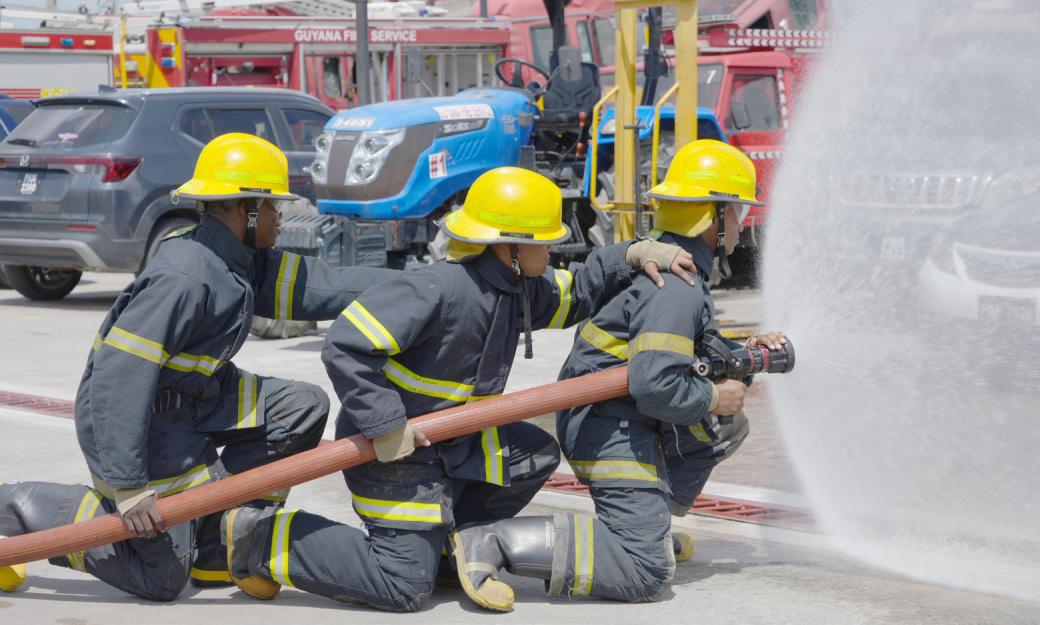
THE Guyana Fire Service (GFS) has displayed that it is fully capable of handling any type of emergency, following a live firefighting demonstration held on Friday to showcase firefighters’ operational response during active fire events and other fire-related emergencies.
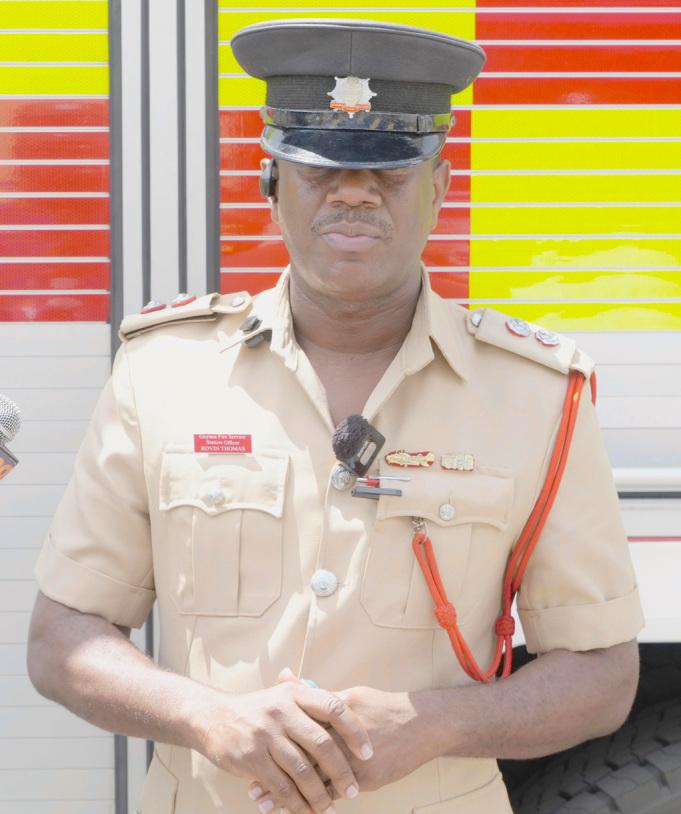
Station Officer with responsibility for Operations at GFS Headquarters on Mandela Avenue, Rovin Thomas, said the exercise tested the Fire Service’s response capability and helped dispel public misconceptions about firefighters’ readiness.
extinguishing material.
Thomas explained that the response process begins at the Control Room, the GFS’s nerve centre, where all emergency calls are received and relayed to firefighters on the ground.
“What actually happens once a call comes in [is] the information is collected, and the gong is sounded. This is an alert kind of system that we have in place. Once that gong is sounded, the team dons their kits, mounts their appliance, and responds to the scene,” he said.
Thomas identified road congestion as the Fire Service’s biggest daily challenge, particularly during
“More often than not, there are members of the public who are of the perception that firemen only come to work, lie in, sleep all day, and then turn up late to fires,” Thomas said, adding that the GFS can only respond once a call is made.
“We have an in-house policy here: when in doubt, turn up. So even though we might think it’s a hoax call, our appliances will always turn out,” he said, noting that firefighters undergo regular training exercises, not just for demonstration purposes.
In Georgetown, the GFS maintains a three-minute response time, measured from the receipt of a call to the arrival of the appliance at the scene and the expulsion of more than 50 per cent of its
fires involving oil, grease and vehicles.
Thomas said the GFS operates on a shift system, with approximately adequate personnel on duty at any given time, attached to three appliances: the fire truck (or water tender), the water bowser, and the hydraulic platform.
peak hours on the East Bank and in parts of Georgetown, noting that motorists do not always yield to fire appliances using sirens.
On the issue of water supply, Thomas said the GFS has benefitted from government intervention through the installation of more than 1,000 hydrants in and around Georgetown, in addition to access to water from canals.
Even in areas without hydrants or with clogged drains, he said, the GFS deploys bowsers carrying 14,000 litres of water.
Regular fire appliances carry 450 gallons of water, similar to a standard tank, while some bowsers carry up to 500 gallons. Appliances also carry a foam capacity of 250 gallons, used to fight
Firefighters display rapid response and readiness in live simulation exercise
Station Officer with responsibility for Operations at the GFS Headquarters on Mandela Avenue, Rovin Thomas (Sachin Persaud photos)
UG names transitional leadership team
–– as Professor Paloma Mohamed-Martin’s seven-year tenure comes to an end
THE University of Guyana has confirmed that the contractual term of Professor Paloma Mohamed-Martin as Vice-Chancellor came to an end on July 31, 2026, closing out seven years in which she served as the institution’s principal academic and administrative officer.
Speaking on behalf of the University Council, Chan -
cellor and Chair of Council, Sir Ronald Sanders, thanked Professor Mohamed-Martin for her years of leadership. He noted that the Council appreciated her stewardship of the university and wished her success in whatever she pursues next.
With Professor Mohamed-Martin’s departure, the University Council has moved to ensure there is no
disruption to the institution’s operations.
A Transitional Management Team has been set up to oversee the University’s day-to-day academic, administrative and financial affairs while the search for a permanent successor continues.
The team will be chaired by Professor Stafford Griffith, who holds a professorship at the University of Guyana and
is Professor Emeritus of the University of the West Indies.
Professor Griffith brings decades of experience in Caribbean higher education leadership, having previously served as Interim Pro Vice-Chancellor and Principal of the Five Islands Campus, Regional Director of the Office for Online Learning, Director of the School of Education, and Deputy Dean
of the Mona Campus at UWI.
He has also held senior posts with the Caribbean Examinations Council (CXC) and sat on numerous national and regional boards and commissions.
Joining him is Dr Diana Devika Gobin, the University of Guyana’s Deputy Vice-Chancellor for Finance and Administration. With more than 18 years in higher education, Dr Gobin has held a range of academic and administrative leadership roles, including Assistant Dean of the Faculty of Social Sciences, and has been closely involved in the university’s financial management, academic development and governance.
She holds a Doctor of Education in Leadership and Innovation, an International MBA in Innovation and Entrepreneurship, and a Bachelor of Social Science in Management.
The third seat on the Transitional Management Team will go to the incoming Chair of the Committee of Deans, who is expected to be elected next week. The team will operate under the oversight of the Chancellor and the University
Council until a new Vice-Chancellor is formally appointed.
The university’s search for its next Vice-Chancellor remains underway. A comprehensive international search process has produced a shortlist of four candidates, who are now proceeding through the final stages of consideration by the Council.
Sir Ronald Sanders emphasised the Council’s commitment to a smooth transition, noting: “The Council is committed to ensuring a smooth and orderly transition in the leadership of the University while maintaining continuity in its academic mission, governance and administration.
“I have every confidence that Professor Griffith, Dr Gobin and the incoming Chair of the Committee of Deans will provide the steady and experienced leadership necessary during this interim period. At the same time, the Council remains fully engaged in completing the search for the University’s next Vice-Chancellor through a rigorous and transparent process.”
Outgoing UG Vice Chancellor, Professor Paloma Mohamed-Martin
Chair of UG’s Transitional Management Team, Professor Stafford Griffith
Emancipation Day Messages
THE People’s Progressive Party extends warm greetings to all Guyanese, particularly our Afro-Guyanese brothers and sisters, as we commemorate the 188th Anniversary of the Abolition of Slavery.
This historic occasion reminds us of the immense sacrifices, resilience, and unwavering determination of the thousands of enslaved Africans who endured unimaginable suffering while never surrendering their hope for freedom, dignity, and justice.
Their courage and resistance laid an enduring foundation for the values of equality and human rights that continue to shape our nation.
We pay tribute to our ancestors whose struggles and sacrifices paved the way for future generations and honour the invaluable contributions of Afro-Guyanese to Guyana’s political, economic, social, cultural, educational, and sporting development.
Their achievements have enriched our national identity and remain an inte-
ON this Emancipation Day, the Alliance For Change (AFC) joins all Guyanese in honouring the courage, resilience, sacrifice and enduring legacy of our African ancestors, whose struggle against the brutal institution of slavery helped shape the foundation of our nation.
Emancipation is more than a historical milestone. It is a continuing call to uphold the principles of freedom, justice, equality and human dignity. The sacrifices made by those who came before us impose upon every generation the responsibility to build a society where opportunity is available to all, where every citizen is treated with respect, and where no community is left behind.
As we celebrate the rich cultural heritage, traditions and achievements of Afro-Guyanese, we also acknowledge the invaluable contributions they have made—and continue to make— alongside our brothers and sisters of other ethnicities, to Guyana’s development in public service, business, education, security, culture, sports, agriculture, security and every sphere of national life.
The AFC believes that the true spirit of Emancipation can only be realised when our country embraces unity over division, fairness over favouritism, and inclusion over
exclusion. Our diversity remains Guyana’s greatest strength, and it must never be used to divide us, but rather to inspire us to work together for a more prosperous and just nation.
Today, as Guyana stands at a defining moment in its history, and as we continue to mourn the lives of those who perished senselessly on the MV Barima, we recognise that as a people, we are blessed with immense opportunities but challenged by deep social and political divisions.
We renew our commitment to building a country where every citizen—regardless of race, ethnicity, religion, gender or political affiliation—has an equal stake in our nation’s future.
Let this Emancipation Day be a reminder that freedom carries responsibility: the responsibility to defend democracy, protect the rule of law, promote good governance, and ensure that the benefits of our nation’s wealth are shared equitably among all Guyanese.
The Alliance For Change extends warm Emancipation Day greetings to all Guyanese at home and in the diaspora. May this occasion renew our resolve to continue the unfinished work of creating a united, inclusive and truly free Guyana.
Happy Emancipation Day.
gral part of our country’s progress.
The observance of Emancipation Day is not only a celebration of freedom but also a reminder of our collective responsibility to reject division, discrimination, and hatred in all their forms.
Together, we must continue to build a society founded on mutual respect, equality, and shared prosperity. On this
188th Anniversary of the Abolition of Slavery, the People’s Progressive Party honours the legacy of our foreparents and calls on all Guyanese to draw inspiration from their courage as we work together to secure a brighter, more united, and prosperous future for generations to come.
Happy Emancipation Day!
Emancipation Day Messages
“YOU can change the laws of man, but you can’t change the laws of God.” — Queen Ifrica
As Queen Ifrica prepares to headline this year’s Emancipation Day celebrations at the National Park, these words remind us that justice, dignity, and freedom are principles greater than any human institution. They speak to the enduring struggle of humanity to uphold truth, equality, and respect for all.
On behalf of the Executive Council of the Guyana Public Service Union (GPSU) warmest Emancipation Greetings are extended to all our members, and indeed to all Guyanese, at home and in the Diaspora, on this historical 188th Anniversary of the formal abolition of Slavery.
As we join the people of Guyana, the Caribbean, and the African diaspora in commemorating Emancipation Day 2026, we honour our African ancestors who endured the horrors of the Middle Passage, survived the cruelty of slavery, and preserved their dignity, culture, and humanity in the face of unimaginable suffering.
However, while we are commemorating the horrors of the Middle Passage, —honouring the countless ancestors swallowed by the Atlantic Ocean in their forced journey toward freedom—we find ourselves anchoring a new, profound grief in those very same waters.
At this time Guyana weeps for the 103 souls lost to the horrific sinking of the MV Barima.
We pray for the families enduring this unimaginable nightmare, and we honour the memories of those who did not return to shore. May we channel our national
grief into an unyielding demand for justice, accountability, and the protection of every Guyanese life. We owe it to our ancestors, and we owe it to the 103 souls we mourn today, to ensure our waters never witness such negligence again.
May their souls rest in eternal peace.
The story of slavery is one of the darkest chapters in human history. Millions of Africans were violently torn from their homes, families, and communities, forced across the Atlantic Ocean under conditions of unimaginable cruelty, and subjected to a system that sought to deny their humanity.
The slave trade was built upon violence, exploitation, and the belief that one human being could own another. Yet, even in the deepest darkness of bondage, the enslaved African spirit remained unbroken. Through resistance, survival, cultural preservation, and an unyielding desire for freedom, they challenged a system designed to erase them. Yet they rose to lay the foundational stones of modern Guyana through the village movement, communal farming, cooperatives and early labour organisation.
The Abolition Act of 1834 was not a gift; it was a victory.
It was the hard-earned outcome of generations of
Emancipation Day Messages
From page 24
resistance, sacrifice, courage, and relentless struggle by enslaved Africans who refused to accept that bondage was their destiny.
Freedom was not placed into their hands through kindness; it was carved from the pain of their suffering, the strength of their resistance, and their unwavering belief that every human being deserved liberty.
The freedom we enjoy today—the rights we exercise, the voices we raise, and the opportunities we pursue— stand upon the shoulders of those who endured what no human being should have been forced to endure. Even the rights that remain unfinished, the rights that are overlooked, and the freedoms that still require protection are connected to the sacrifices of those who came before us.
Their struggle opened the doors through which we walk today.
Emancipation therefore is not merely a moment in history; it is a responsibility passed from one generation to the next. It calls upon us to protect the dignity of all people, challenge injustice, and continue the unfinished work of building a more equal society.
For public servants, this responsibility carries a special significance. The institutions of the State exist to protect the rights, freedoms, and dignity of the people. Public servants are therefore not merely employees of government; they are custodians of the Republic’s values and guardians of the freedoms secured through generations of struggle.
We must remain vigilant against any attempt to weaken the principles of fairness, justice, accountability, and equality. The freedoms won through sacrifice must never be taken for granted, surrendered through silence, or diminished through neglect.
This year’s theme reminds us of the importance of African culture in connecting generations and building a world where all children are loved and protected. Culture is more than a celebration; it is an identity, a strength, knowledge, and healing.
We must preserve our heritage while confronting systemic racism, discrimination, and the lingering effects of colonial injustice.
We now stand at the threshold of a new technological age. Artificial intelligence and innovation present opportunities to transform education, healthcare, public services, and economic advancement. But progress must be guided by fairness, inclusion, and humanity. Our people, especially our youth, must not only consume technology—they must be empowered to create, lead, and shape the future.
At the same time, we must confront the growing challenges affecting our young people, many of whom are being drawn toward crime, violence, substance abuse, and other anti-social lifestyles. We must respond not only with laws, but with love, mentorship, education, opportunity, and renewed investment in the potential of every child.
Guyana’s economic transformation has opened new possibilities, but true development must be measured by how it uplifts people. Prosperity must be reflected in decent work, fair wages, strong public services, quality education, and meaningful opportunities for all citizens. A nation’s greatness is not measured only by its wealth, but by the dignity it affords its people.
The GPSU remains committed to defending workers’ rights, strengthening public service, and advocating for a Guyana built on justice, equality, and inclusion.
As the drums of Emancipation echo across our land, let us remember the words of our National Anthem: “Both
bondsmen and free, laid their bones on your shore.”
These words are more than a verse; they are a memorial carved into the conscience of our nation. They remind us that Guyana was built upon the labour, sacrifice, and resilience of those whose lives shaped the foundation of this Republic. Their bones rest beneath this hallowed ground, but their spirit continues to live through every citizen who serves with honour and every worker who contributes to the advancement of our country.
The GPSU calls upon all public servants to continue serving efficiently with integrity, humility, and dedication. Let us put country before self, remembering that every act of honest service is another step in completing the
journey that began by our ancestors.
Let us use this Emancipation Season to strengthen our solidarity, reject divisiveness and recommit ourselves to building a nation anchored on the principles of fairness, equality and mutual respect. Together, as one formidable workforce, we will safeguard our rights and secure a prosperous future for generations.
Together, let us continue to labour upon the hallowed grounds of the Cooperative Republic of Guyana until we achieve the vision of that Great Land of Guyana—a nation where freedom is meaningful, justice is protected, dignity is respected, and hope belongs to all.
Happy Emancipation Day 2026.
Emancipation Day Messages
THE Ethnic Relations Commission (ERC) joins Guyanese across the nation and throughout the diaspora in observing the 188th Anniversary of the Emancipation of Africans from slavery, a defining milestone in our history that is both solemn in remembrance and inspiring in its enduring legacy.
For generations, Africans were forcibly taken from their homeland, subjected to brutal and inhumane conditions, and deprived of their fundamental human rights. Yet their spirit endured. In the years that followed freedom, the formerly enslaved pooled their resources to purchase the very plantations on which they had laboured, founding the Village Movement and establishing communities that stand to this day. Their
courage and endurance continue to inspire generations of Guyanese.
This day, August 1st, is not only a celebration of freedom, but a call to reflect on the sacrifices, strength and resilience of our African ancestors.
This year’s observance carries particular significance, as our nation marks sixty years of Independence. The freedom won in 1838 laid the foundation for the sovereignty we celebrate in 2026, and the contributions of Guyanese of African descent remain woven into every part of our national life.
As part of its constitutional responsibility to foster harmony and good relations among Guyana’s ethnic groups, the Commission regards Emancipation Day as an important
occasion for reflection, education and national unity.
It reminds us that building a stronger nation requires a continued commitment to mutual respect, inclusion and appreciation of our diverse cultural heritage.
The Commission encourages all citizens to take part in Emancipation activities across the country, and to embrace the occasion as a national opportunity for reflection, learning and togetherness.
It is in the sharing of each other’s history and heritage that tolerance is nurtured and the bonds of our nationhood are strengthened.
Fifa scraps controversial World Cup investment plan
(BBC) - FIFA president Gianni Infantino says he has scrapped the controversial
plan to sell off stakes in the governing body’s major competitions, following widespread opposition.
Infantino said it had become clear the project had “created divisions” that are “no longer in the interest” of its original objective.
The Swiss official added: “As a result, this proposal will not proceed.”
Infantino had offered all 211 member associations $40m (£30m) if they backed a proposal for private investment in its tournaments, including the men’s and women’s World Cups.
European football’s 55 member associations, Uefa, voted on Thursday to boycott World Cups if the plans went ahead.
Fifa’s chief operating officer Kevin Lamour said the governing body’s own administration had been “deceived” about the project.
Carlos Cordeiro - Infantino’s senior adviser on global strategy and governance - resigned over the matter, saying the proposal was “a bad deal for football” and would “mortgage football’s future”.
That came after two other major confederations spoke out against the plans.
Concacaf, which governs football in North, Central
America and the Caribbean - and hosted this summer’s World Cup - said its members “rejected” the proposal, with sources saying the vast majority of associations from the region are losing, or have lost, faith in Infantino.
The Asian Football Confederation (AFC) said it stood in “solidarity” with Uefa and Concacaf, while UK Prime Minister Andy Burnham said Infantino was “the wrong man” to lead Fifa.
Infantino, 56, is now under immense pressure as he seeks re-election for a fourth term as president at the Fifa Congress in March.
He said he now intends to “bring all interested parties back together” in the “spirit of shared interest” in football.
Infantino’s plans were unlikely to pass
Despite rejections from Uefa and Concacaf, Fifa initially vowed to continue with its proposals on Friday, saying “nobody is selling football”.
However, in announcing the plans had been scrapped, Infantino acknowledged he needed the backing of the majority of Fifa member associations - meaning 106 of its 211 members needed to vote in favour.
That became unlikely
when the AFC joined Uefa and Concacaf in opposing the plans.
Uefa has 55 votes, Concacaf has 35 and Asia has 46.
If all member associations had backed their governing bodies’ stance, that would have meant 136 nations voting against Infantino’s plan.
The governing bodies in Africa (CAF) and Oceania (OFC) had said they would discuss Fifa’s plan in August.
The governing body overseeing football in South America, Conmebol, said it had asked Fifa for “additional information and clarifications” regarding the “scope, structure, governance and possible effects” of the proposals.
What was Infantino’s plan?
Fifa and Infantino wanted to create a commercial subsidiary to run its main events, including its World Cups, with external investors able to buy stakes in it.
It said it would “invite third parties to make minority, non-controlling investments” in a new subsidiary - Fifa Forward Enterprise (FFE).
Infantino set a deadline of 19 September for football federations to accept his plans if they wanted to access
an initial $20m (£15m).
A 25-page document created by investment bank JP Morgan laid out how Fifa’s tournaments would expand to hit an estimated increased payout of 24m euros (£20.5m) per member association in the 2035-2039 cycle.
It mentioned “new business initiatives” and “attracting top talent with incentive-driven compensation”.
The World Cup is described in it as the “most widely viewed” sporting event but Fifa, by contrast, is said to be “under-monetised”.
There was no mention of the women’s game in the document.
Fifa said Thrive Eternal was expected to lead the proposed investor group for FFE.
Thrive is an American venture capital firm founded by Joshua Kushner - the brother of US President Donald Trump’s son-in-law Jared.
Trump - addressing the proposals for the first time on Friday - said he had not spoken to Infantino about the plans.
The two have developed a close relationship since Trump assumed office for a second time in 2025.
CRICKET QUIZ CORNER
(Saturday, August 01, 2026)
Gliondar
12:35 hrs San Aer
13:05 hrs Fratas
TURFFONTEIN
08:25 hrs African Pride
09:00 hrs Dark Silver
09:35 hrs Prince Of Kildare
10:10 hrs Sky Pilot
10:45 hrs Rising Eagle
AMERICAN RACING TIPS
SARATOGA
Race 1 Voyager
Race 2 Blessednotboth ered
Race 3 Gewurztraminer
Race 4 Subjugation
Race 5 Wyna
Race 6 Booked
Race 7 Sassmaster
CUMMINGS ELECTRICAL COMPANY LTD., 83 Garnett Street, Campbellville, Georgetown (Tel:2256158)
Answers to yesterday’s quiz:
(1) Colin Croft-8/29 (POS, 1977) (2) Imran Khan-8/80 (Bourda, 1988)
Today’s Quiz:
(1) Which WI has played the most Test matches against PAK to date?
(2) Which PAK player has contested most Test matches against the WI to date?
Answers in tomorrow’s issue
GFF announces squad for 2026 CFU U14
THE Guyana Football Federation (GFF) has officially announced its final 20-player squad for the 2026 Caribbean Football Union (CFU) Under-14 Boys Challenge Series, following months of preparation under the FIFA Talent Development Scheme (TDS).
The selected squad features a blend of talented young footballers from Guyana, the United States of America, and England, who will represent the Golden Arrowhead when the tournament kicks off this August in Punta Cana, the Dominican Republic.
Led by Head Coach Jamal Pedro, Guyana will compete in Tier II, Group C, opening its campaign against Montserrat on Sunday, August 16, before facing Anguilla on Monday, August 17, and The Bahamas on Wednesday, August 19.
The squad’s selection follows four months of intensive preparation through the FIFA Talent Development Scheme, a long-term initiative designed to identify, develop, and prepare the country’s most promising young footballers for regional and international competitions.
The programme forms part of FIFA’s global strategy to ensure that every talented player has access to a structured
development pathway. In Guyana, the TDS brings together the nation’s top boys and girls for year-round training under the supervision of the GFF’s National Coaches Pool.
The programme currently comprises a core group of approximately 24 players, supported by a wider training pool of around 30. While most participants are drawn from the coastal regions, the programme also provides regular opportunities for talented players from the hinterland and other parts of the country to be identified, integrated, and developed within the national pathway.
GFF President Wayne Forde commended the commitment shown by the players and coaching staff throughout the preparation period and expressed confidence in the team’s ability to represent Guyana with pride on the regional stage.
“I’m incredibly proud of the work being done by Technical Director Mr Bryan Joseph and his coaching staff. It is also encouraging to see the significant impact the FIFA Talent Development Scheme has had on the preparation of these young men. For many of them, this will be their first opportunity to represent Guyana, and we expect them to uphold the highest
standards of professionalism, discipline, and respect for the game.
“On behalf of the Guyana Football Federation Council, I wish them every success as they continue their preparations and go on to represent our country at the 2026 CFU Under-14 Boys Challenge Series,” Forde said.
The GFF extends its congratulations to every player selected to represent the nation and commends all those who participated in the Talent Development Scheme throughout the selection process. The federation also acknowledges Coach Jamal Pedro, who will make his inaugural appearance on national duty as a Head Coach. As one of the rapidly emerging coaches within our National Coaches Pool, Pedro has demonstrated tremendous commitment to youth development, and the federation wishes him every success as he leads the team on the regional stage.
We wish the team, coaching staff, and delegation every success at the 2026 CFU Under-14 Boys Challenge Series and looks forward to seeing the young Jaguars compete with determination, discipline, and pride as they represent Guyana on the regional stage.
FOLLOWING the success of last year’s inaugural challenge, the Republic Bank Caribbean Premier League (CPL) Step challenge is back for 2026 – bigger, bolder, and with prizes on the line.
This global initiative once again invites fans to take a virtual fitness journey across six CPL host nations, uniting supporters from across the Caribbean and beyond in a shared mission of health, fun, and social impact. The tournament is asking fans to “Put your best foot forward!”
Running for 50 days from 1 August to 19 September 2026, the challenge raises the bar with a collective goal of 200 million steps. Participants will once again walk the virtual route from Antigua, St Kitts & Nevis, Saint Lucia, Trinidad & Tobago, Jamaica, Guyana and finally Barbados, with each milestone destination unlocking exclusive digital content, trivia, team leaderboards, and celebratory media as fans step in the footsteps of their favourite CPL teams.
Over the course of last year’s challenge, fans collectively achieved 179 million steps logged. This is the equivalent of more than 80,000 miles walked – enough to circle the globe over three times. This year the plan is to beat that number.
The Guyana Amazon Warriors fans led the way, recording an incredible 53 million steps. While the team narrowly missed out on lifting the CPL trophy on the field, they emerged victorious in the fan step challenge.
“Last year showed us just how much our fans embraced this challenge, and this year we’re raising the target and raising the stakes.
Health and Wellness remains at the heart of what we do at CPL, and we can’t wait to see our fans step up – and be rewarded for it,” said Pete Russell, Republic Bank CPL CEO.
Noel misses podium in 100-metre butterfly final
GUYANA’S Raekwon Noel had a rare loss on Thursday in the Central American and Caribbean Games 100-metre butterfly final, as he finished off the podium.
The Guyanese went into the final as the fastest swimmer, but finished 5th in a disappointing 53.58 seconds.
Noel earlier on Thursday won his heat
with a time of 53.28 seconds to earn a place in the final of the boys’ 100-metre butterfly.
His closest rivals were Colombia’s David Arias, who qualified with a time of 53.41 seconds, and Andries Brooks, with a time of 53.47 seconds.
A Venezuelan swimmer took the gold and silver medals.
Manuel Diaz won it in 52.45 seconds, with Venezuela’s Jorge Otaiza in second place and Dylan Carter of Trinidad in third for the bronze.
He did not start his 100-metre backstroke.
Guyana returns to the pool today with Ariel Rodrigues and Shreefah Lewis in the 50-metre butterfly.
THIS evening, the Guyana Amazon Warriors will seek to defend their ExxonMobil Guyana Global Super League title against a worthy challenger.
The Warriors go straight to the final by virtue of their three wins on the trot; they will take on the winner of last evening’s Qualifier, which featured Desert Vipers and San Francisco Unicorns.
The Warriors opened their ExxonMobil Guyana Global Super League campaign with a comfortable three-wicket win over Unicorns.
They then secured an unconvincing victory against Vipers by two wickets, in which Romario Shepherd scored a majestic half-century.
The team’s third clash saw them secure a 53-run win over Lahore Qualanders, powered by a massive half-century from
Gurbaz and a four-wicket haul from Gudakesh Motie.
The home side’s only blemish at the Providence National Stadium was in their final group-stage contest against the Big Bash League’s Perth Scorchers, which they lost by 14 runs.
Skipper of the Guyana Amazon Warriors, Imran Tahir, speaking ahead of the final, says he hopes his team has learned from their experience in the tournament so far.
“This has been the story all GSL; the Providence condition is quite tough to bat on, but again, we are professional, so we should adapt after one or two games. For me, I think if you don’t learn from it, then you are not doing a good job for your team, so the message is clear: we see every game we play, overs 7-12 we struggle, and luckily, there are some strong characters in our
team [who] took us over the line in those two-three games where we were put under pressure’
He said that while the playing conditions are tough, they are the same for both teams, and they must play intelligently to overcome the opposition.
“It has been a great team effort, but I think this middle over is something we always talk about, and I hope we don’t make any mistakes going forward in the finals because that is the only game we have left. The conditions are for both teams; I have no problem with that. I think whoever plays smart, the game will go in their favour for me. Gurbaz has been a key player, and I want to see him take it a bit deeper in the finals.’
Tahir, who led the Warriors to their first GSL and Caribbean Premier League titles,
says this win is as important as any with the franchise
“It means everything, you come here to win, you don’t come to be second or third, because I don’t think anyone will remember you and that is my experience playing all over the world from a personal point of view. I didn’t take wickets, but I think that is how the season goes, when you play different leagues, sometimes you pick up [a] wicket on a bad ball and sometimes you bowling really well and not picking up wickets.”
He says that Gurbaz has played amazingly, has shown his skill, and will be crucial to the Warriors’ campaign in the final Warriors will now look to become back-to-back champions of the ExxonMobil Global Super League in their own backyard
Rahmanullah
Raekwon Noel
Albion to ‘come alive’ for Lotto/Let’s
Bet T10 Tapeball finals on August 9
THE passion and energy of Guyanese tapeball cricket will take centre stage as the ancient county of Berbice prepares to bowl off the fourth season of the Lotto/Let’sBet One Guyana T10 Tapeball Blast.
Organisers are predicting non-stop, rollicking action when the top 16 teams from Berbice battle for zonal supremacy from August 8–9, 2026, culminating in a massive finals night at the Albion Sports Complex on August 9 starting from 14:00h.
Opening day matches, from 10:00h, on Saturday, August 8, will be spread across four key locations in the county: the Albion Sports Complex, No. 69 Ground, Port Mourant Ground, and Welfare Ground in Canje.
Action then shifts exclusively to the Albion Sports Complex on Sunday, August 9, where the ultimate Berbice Zonal Champions will be crowned under the lights. Admission is completely free to the public for all matches across every venue.
Tournament Director John Ramsingh confirmed that registration officially closed on July 31 for the Berbice zone, and officials are currently working behind the scenes to verify player eligibility and finalise the publishing of squad ros-
Organisers are predicting non-stop, rollicking action when the top 16 teams from Berbice battle for zonal supremacy from August 8–9, 2026
ters and the random draw of fixtures.
“Registration officially closed on July 31 for the Berbice zone, and our team is currently hard at work behind the scenes reviewing and verifying squad players to ensure full compliance and a level playing field. There is an incredible buzz on the ground, and we are eager to get play underway and see our very first zonal champion crowned under the lights at Albion.
Preparations are well advanced, and everything is lining up for an explosive opening weekend.
Fans can expect thrilling action as teams go all-out for the G$500,000 zonal first prize, which gives them a chance to compete for an
even bigger G$2,000,000 national purse at Anna Regina on October 11.”
In a significant departure from traditional knockout formats where early exits yield no financial return, the 2026 edition guarantees cash rewards for sides making deep runs into the zonal stages.
Losing quarterfinalists in each zone will pocket G$25,000, while losing semi-finalists take home G$50,000.
The stakes rise sharply from there, as defeated zonal finalists earn G$200,000, and the regional champions bank a cool G$500,000 purse before even stepping into the national bracket.
The ultimate jackpot awaits in the national playoffs, where the crowned
champions will walk away with a massive G$2,000,000 first-prize purse.
The national runners-up will secure G$1,000,000, while both losing semi-finalists will be rewarded with G$500,000 each.
Following the Berbice curtain-raiser, the tournament caravan heads to East Bank/West Demerara on August 15–16, before moving to the Essequibo Zone on August 22–23.
The competition will then take a brief hiatus to accommodate the Republic Bank Caribbean Premier League (CPL), before resuming with the powerhouse Georgetown/East Coast Demerara leg across two weekends on September 26–27 and October 3–4.
In a landmark move for the tournament, the national grand finale on October 11, 2026, will head to the Anna Regina National Stadium in Region Two, bringing the ultimate showdown of Guyanese tapeball cricket directly to Essequibo for the very first time.
With remaining slots filling rapidly, organisers have issued an urgent directive to teams in the remaining three zones to finalise their squads and register via official social media channels or direct WhatsApp (+592 635-2235) ahead of their respective deadlines.
Unicorns to face Warriors in GSL final after thumping win over Vipers
THE San Francisco Unicorns are through to the 2026 ExxonMobil Guyana Global Super League (GSL) T20 final after beating Desert Vipers by eight wickets in a high-stakes Qualifier on Friday evening at the National Stadium, Providence.
Unicorns will now meet defending champions Guyana Amazon Warriors in the championship game on Saturday from 7pm in front of a capacity crowd.
Chasing a tricky 123 for victory, Unicorns reached the target with 23 balls to spare. The successful chase was brilliantly led by opener Tim Robinson with an impressive, unbeaten 68 off 54 balls.
Robinson and Oliver Peake shared a record-breaking, 97-run third-wicket stand after they lost Connor Esterhuizen for 17 and skipper Hassan Khan without scoring.
The in-form Robinson hit six fours and a six, while Peake provided steady support with 33* off 34, hitting five fours.
Left-arm spinner Khary Pierre, who made the initial breakthrough, finished with 2-22 from his four overs.
Earlier, Uncorns justified their decision to bowl first, restricting Vipers to 30-2 in the Powerplay and 61-4 by the 13th over.
Vriitya Aravind provided some late-order impetus scoring 29 not out, but it was left-arm spinner Fabian Allen who stole the spotlight with the ball, taking 3-20 in an impactful four-over spell.
He first accounted for opener Andries Gous (8), then added the scalps of Rilee Rossouw (11) and skipper Shadab Khan (14), strikes that dented the Vipers. Unicorns’ victory was sweet redemption for the nine-wicket defeat they suffered against the same opposition in the preliminary phase, and it sets up a grand finale with the home franchise and defending champions Warriors on a night when Providence will be rocking.
GCB president expresses condolences on former cricketer Sydney Jackson Matthews passing
PRESIDENT Bissoondyal Singh, the executives and staff of the Guyana Cricket Board extend profound condolences on the passing of former Guyana cricketer Sydney Jackson Matthews. Matthews represented Guyana with distinction during a first-class career that spanned 1970 to 1988. He was among the pioneering Guyanese cricketers selected for the inaugural West Indies Under-19 tour of the United Kingdom in 1970 and later represented the West Indies President’s XI against New Zealand in 1972.
A talented and highly versatile bowler, Matthews began his career as a fast bowler before successfully transitioning to leg-spin.
This remarkable adaptability reflected his skill, cricketing intelligence and deep understanding of the game. His career-best first-class bowling figures were six wickets for 76 runs.
Matthews played an important role during a distinguished period in Guyana’s cricket history and was associated with regional championship-winning teams in 1971,1977, and 1987. He competed alongside some of Guyana and the West Indies’ most celebrated cricketers and earned the respect of teammates and opponents through his discipline, commitment, and professionalism.
President Bissoondyal Singh said, “Sydney Matthews was a gifted and versatile cricketer who represented Guyana with pride and distinction. His successful transition from fast bowling to leg-spin demonstrated his exceptional ability and determination. His contribution to three regional championship-winning teams and his pioneering representation at the West Indies Under-19 level will forever remain part of Guyana’s rich cricketing history. His passing is a significant loss to the cricket fraternity of Guyana and the wider Caribbean.”
Matthews also contributed to domestic cricket through his representation of East
Bank, the Demerara Cricket Club and the Guyana Defence Force. His cricketing legacy continued through his son, Ron Matthews, who also represented Guyana and the West Indies at the Under-19 level.
On behalf of President Bissoondyal Singh, the executives, Staff and entire membership of the Guyana Cricket Board, sincere condolences are extended to his family, relatives, friends, former teammates and all members of the cricket fraternity who mourn his passing. May his soul rest in peace, and may his contribution to Guyana and West Indies cricket continue to inspire future generations.
S ee story on page 35
Unicorns to face Warriors in GSL final after thumping win over Vipers
ExxonMobil Guyana Global Super League… Tahir says Warriors ready for any challenger
S ee story on page 34
Inaugural Emancipation Secondary Schools’ Super 18 Tape Ball Festival set for today
THE Uprising Promotions Committee (UPC), formerly known as the G.O.A.P.C., is set to make history on Saturday, August 1, with the staging of the inaugural Emancipation Secondary Schools’ Super 18 Tape Ball Cricket Festival at the National Cultural Centre tarmac.
The one-day competition will bowl off at 08:30hrs (8:30 a.m.) and will feature an exciting 36-ball, eighta-side format designed to showcase the talent, energy and competitive spirit of Guyana’s secondary school cricketers, while celebrating the nation’s Emancipation observances.
Eighteen schools from across the country will
compete for the prestigious Emancipation Trophy, with medals and $100,000 in cash incentives to be shared by the top two finishing teams.
The participating schools are Queen’s College, Saint Stanislaus College, Tutorial High School, St. Joseph High School, North Georgetown Secondary School, Bishop’s High School, St. Rose’s High School, Charlestown Secondary School, West Demerara Secondary School, Patentia Secondary School, Diamond Secondary School, Annandale Secondary School, New Campbellville Secondary School, Tucville Secondary School, St. John’s College, Christ Church Secondary School, B.E.I. Secondary School and the Linden Foun-
This is the beautiful trophy for today’s Emancipation competition
dation Secondary School.
The tournament forms part of the committee’s commitment to promoting youth development through sport,
while commemorating Emancipation in a meaningful and engaging way. The shortened Super 18 format promises fast-paced, high-intensity cricket, placing a premium on aggressive batting, sharp fielding and tactical decision-making.
The Uprising Promotions Committee is inviting cricket enthusiasts, students, parents and members of the public to attend and support the young athletes as they compete in what is expected to become a signature annual Emancipation sporting event.
The opening matches are scheduled to begin promptly at 08:30hrs (8:30 a.m.) on Saturday at the National Cultural Centre tarmac.
Fabian Allen of the San Francisco Unicorns celebrates the wicket of Shadab Khan of Desert Vipers during the ExxonMobil GUYANA SUPER LEAGUE T20 semi-final match between Desert Vipers and San Francisco Unicorns at the Guyana National Stadium, Providence, Guyana. (Photo by Ashley Allen/GSL T20)