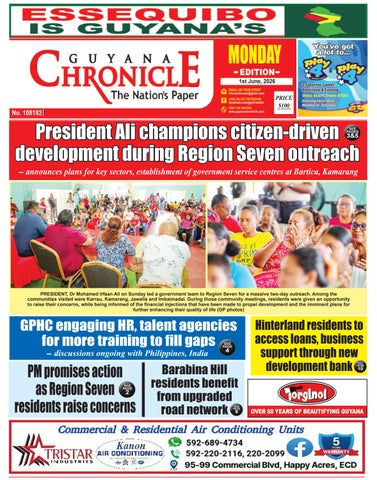
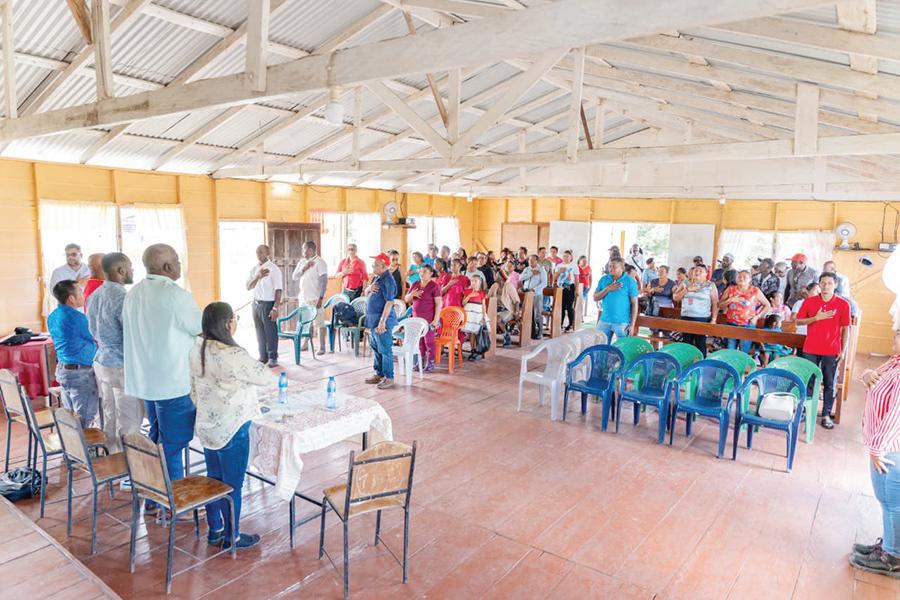
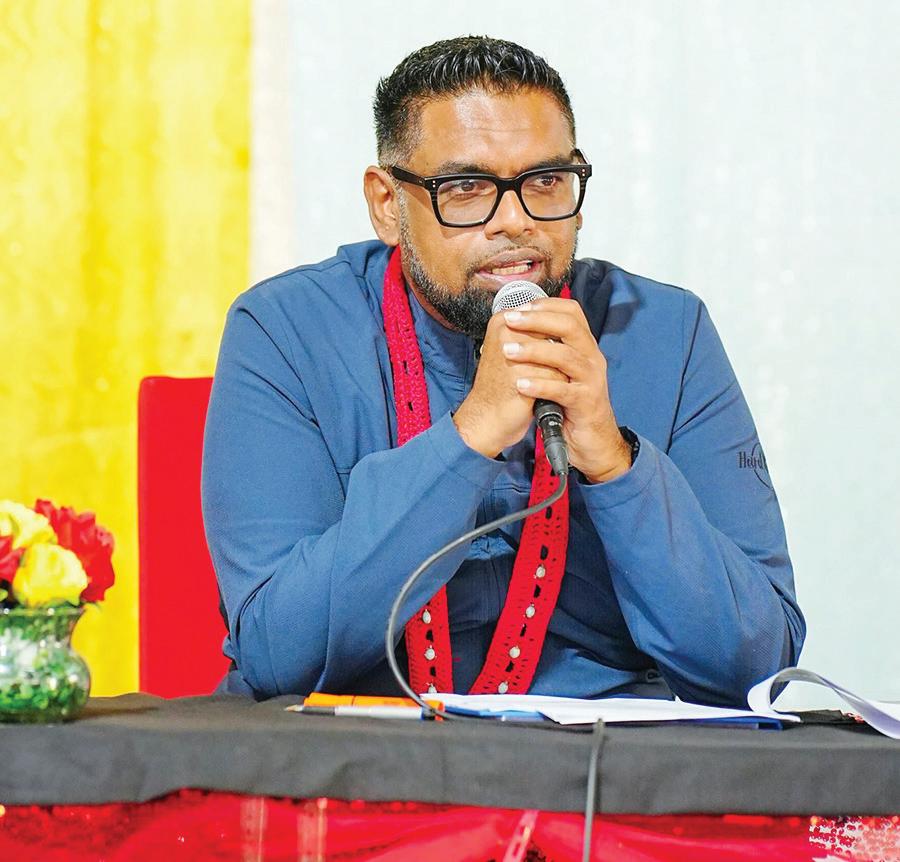
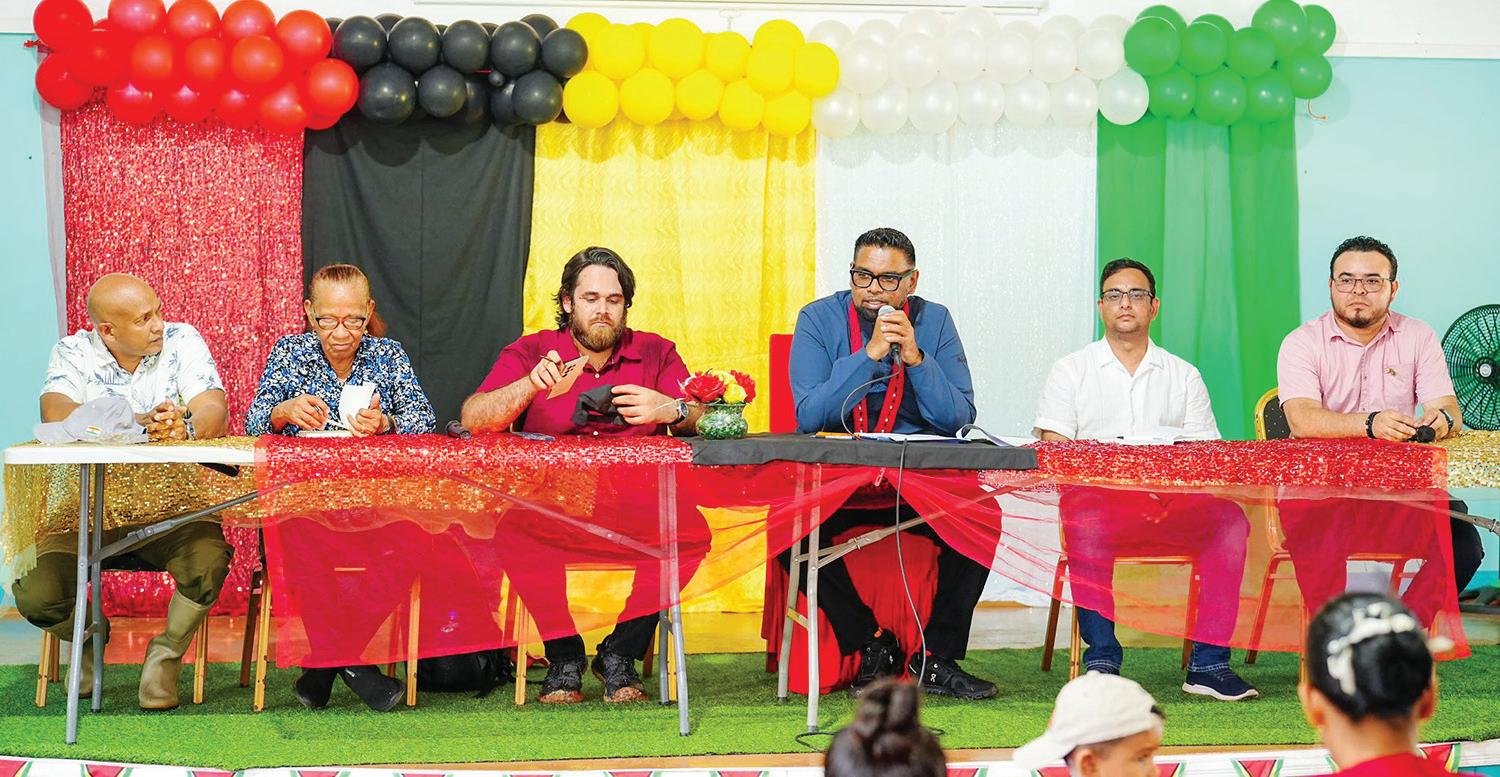
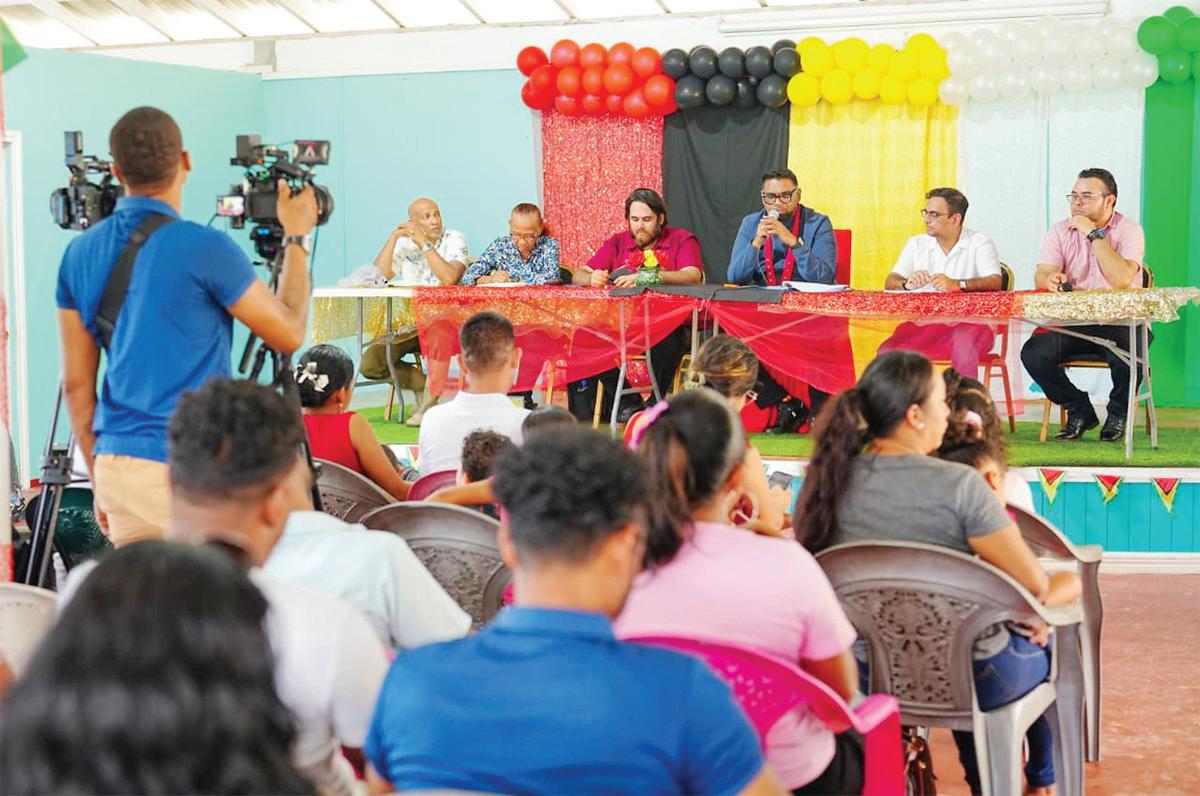
PRESIDENT, Dr Mohamed Irfaan Ali on Sunday led a government team to Region Seven for a massive two-day outreach. Among the communities visited were Karrau, Kamarang, Jawalla and Imbaimadai. During those community meetings, residents were given an opportunity to raise their concerns, while being informed of the financial injections that
PM promises action as Region Seven residents raise concerns during outreach
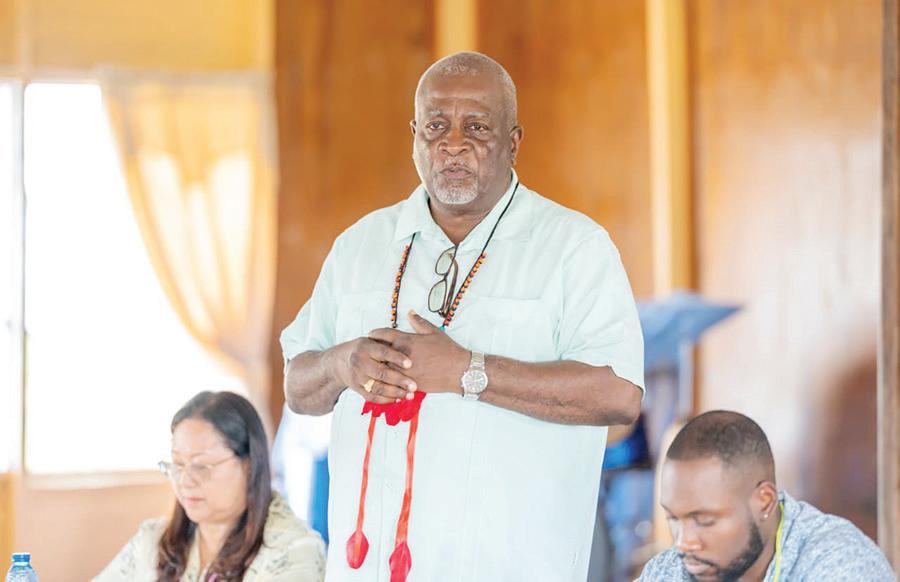
AS part of the government’s ongoing on-theground approach to community engagement, Prime Minister, Brigadier (Ret’d) Mark Phillips, on Sunday, met with residents and village representatives of Imbaimadai and surrounding communities in Region Seven to listen to their con-
cerns and discuss areas for further support.
Prime Minister Phillips was accompanied by Minister of Labour and Manpower Planning, Keoma Griffith, and Minister within the Ministry of Local Government and Regional Development, Pauline Sukhai.
During the engagement,
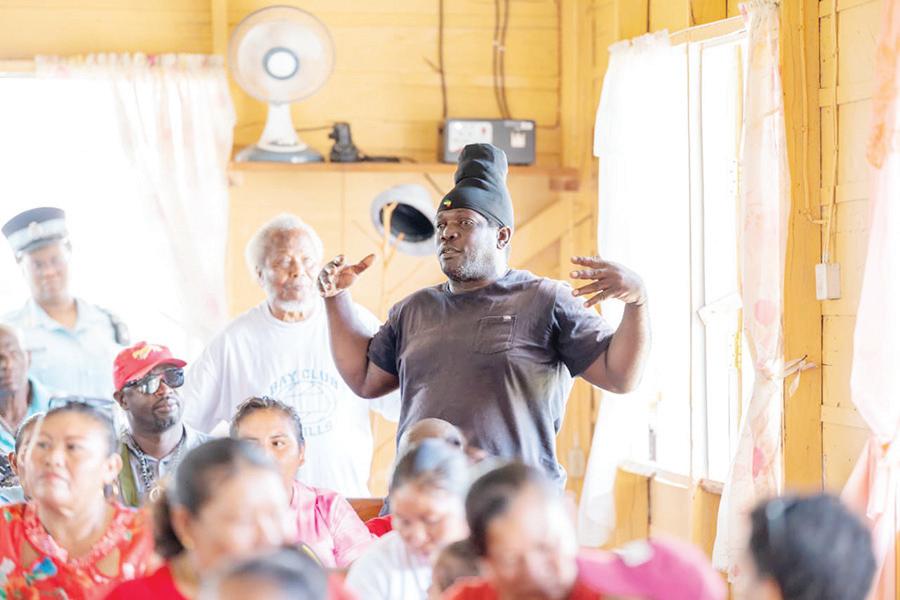
residents raised several matters related to community development and service delivery, including street lighting, old-age pension, land titling and demarcation, the rehabilitation of roads and bridges, health services, a proposed solar farm, the development of a community ground and centre, education,
mining and agriculture.
Prime Minister Phillips assured residents that the matters raised would be examined and advanced through the relevant ministries and agencies, in keeping with the government’s development and service-delivery framework.
In relation to recreational
facilities, the Prime Minister noted that the Ministry of Culture, Youth and Sport has been supporting the development of community grounds across the country. He assured residents that the request for support will be brought to the attention of the ministry.
Additionally, Prime Minister Phillips told residents involved in farming that their concerns would be referred to the Ministry of Agriculture for the relevant technical support and available assistance.
He also encouraged young people from Imbaimadai and surrounding communities to take advantage of scholarship opportunities offered through the Guyana Online Academy of Learning.
He noted that improved connectivity through the Low Earth Orbit satellite system under the WiFiGY programme continues to expand connectivity access therefore expanding access to education and other opportunities in hinterland and Amerindian communities.
He stressed that the government remains committed to using all resources to educate and empower citizens,
while ensuring that development reaches all communities.
Minister Griffith supported the Prime Minister’s call and highlighted opportunities available through the Ministry of Labour and Manpower Planning to deliver technical and vocational training in communities like Imbaimadai. He noted that such programmes can support entrepreneurship, skills development, and employment readiness.
Minister Sukhai, during her interaction with residents, spoke to the government’s work in relation to land titling and demarcation. She noted that continued engagement with communities such as Imbaimadai remains important to ensuring that these matters are addressed through the relevant processes and in the interest of residents.
The meeting formed part of President Irfaan Ali’s government outreach currently ongoing in Region Seven and the administration’s wider agenda to engage citizens directly, address community concerns, and craft inclusive policies that benefit all of Guyana. (OPM)
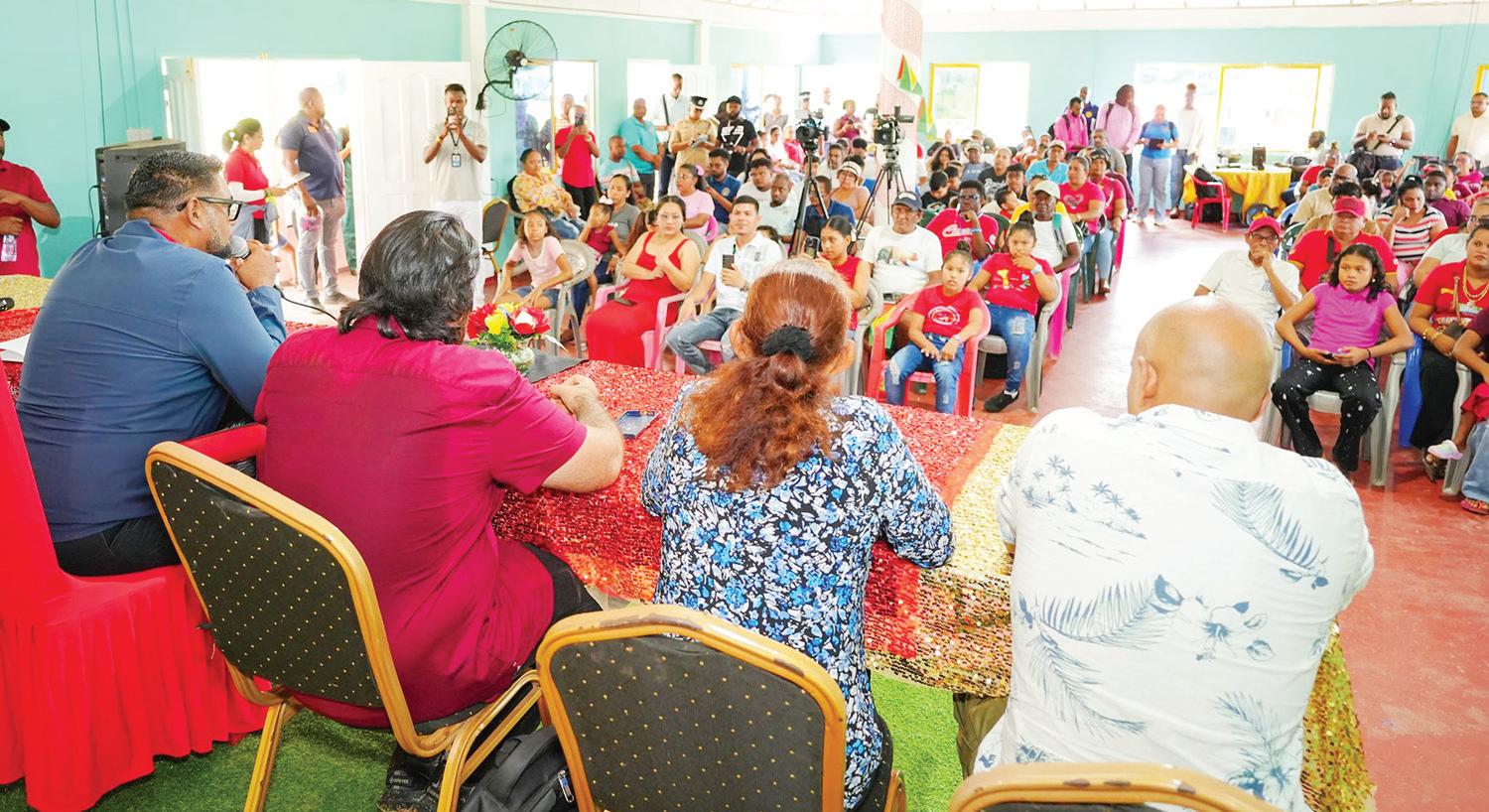
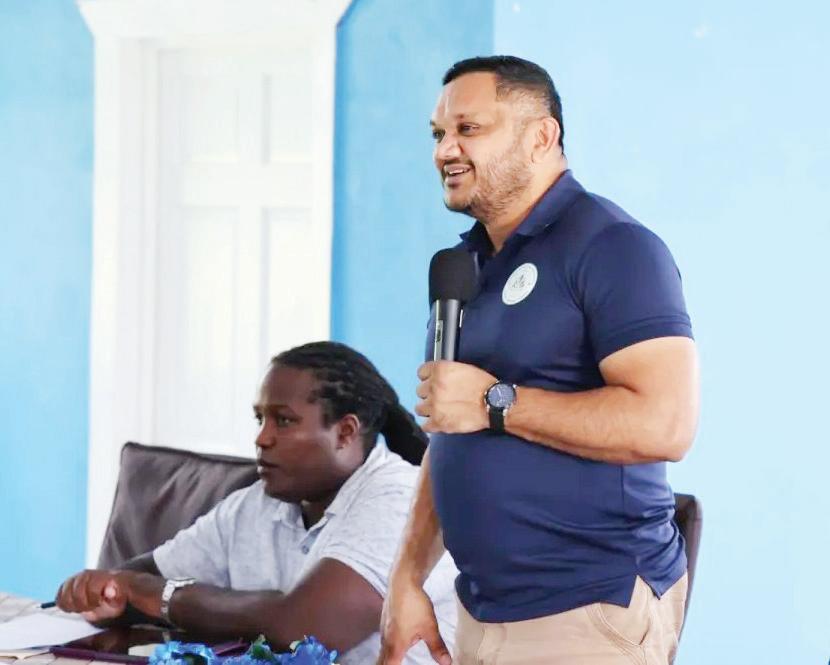
Prime Minister, Brigadier (Ret’d) Mark Phillips addresses Region Seven residents and village representatives. Also pictured are Minister of Labour and Manpower Planning, Keoma Griffith, and Minister within the Ministry of Local Government and Regional Development, Pauline Sukhai
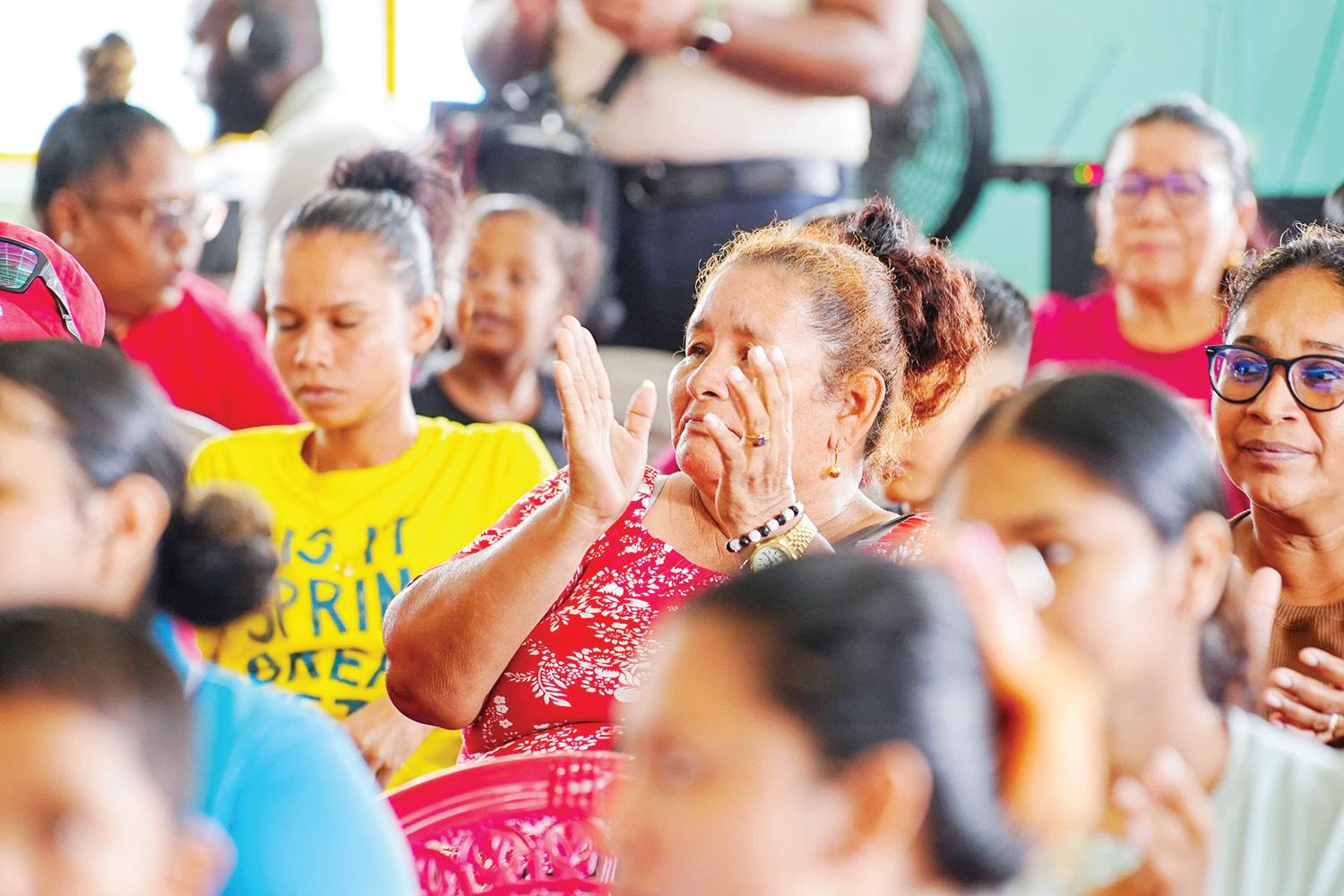
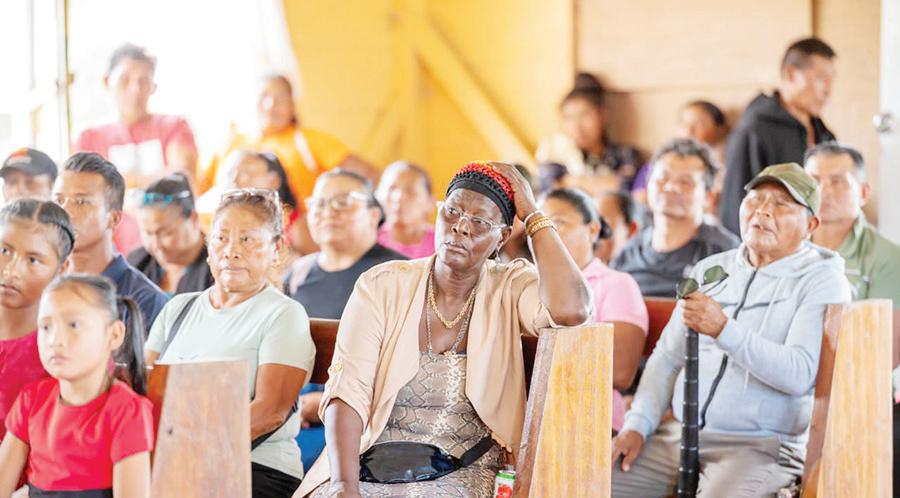
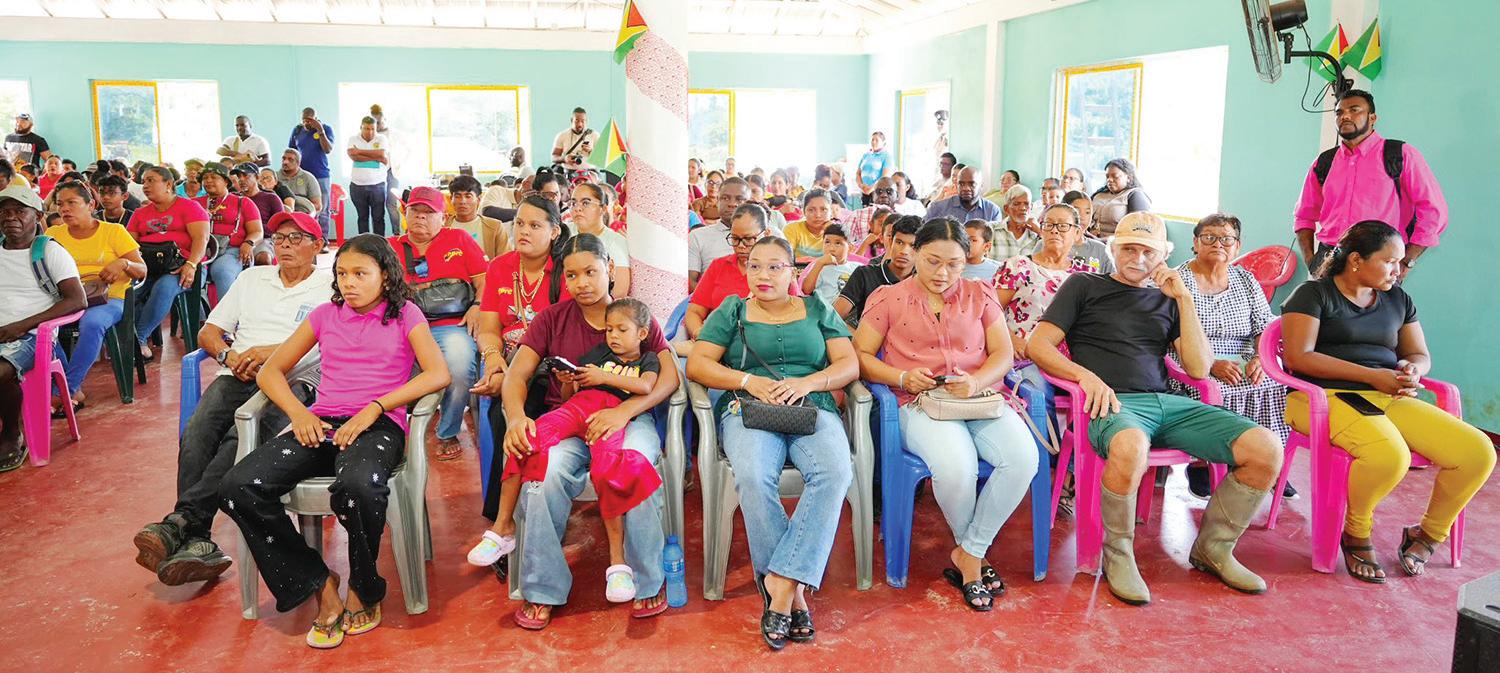
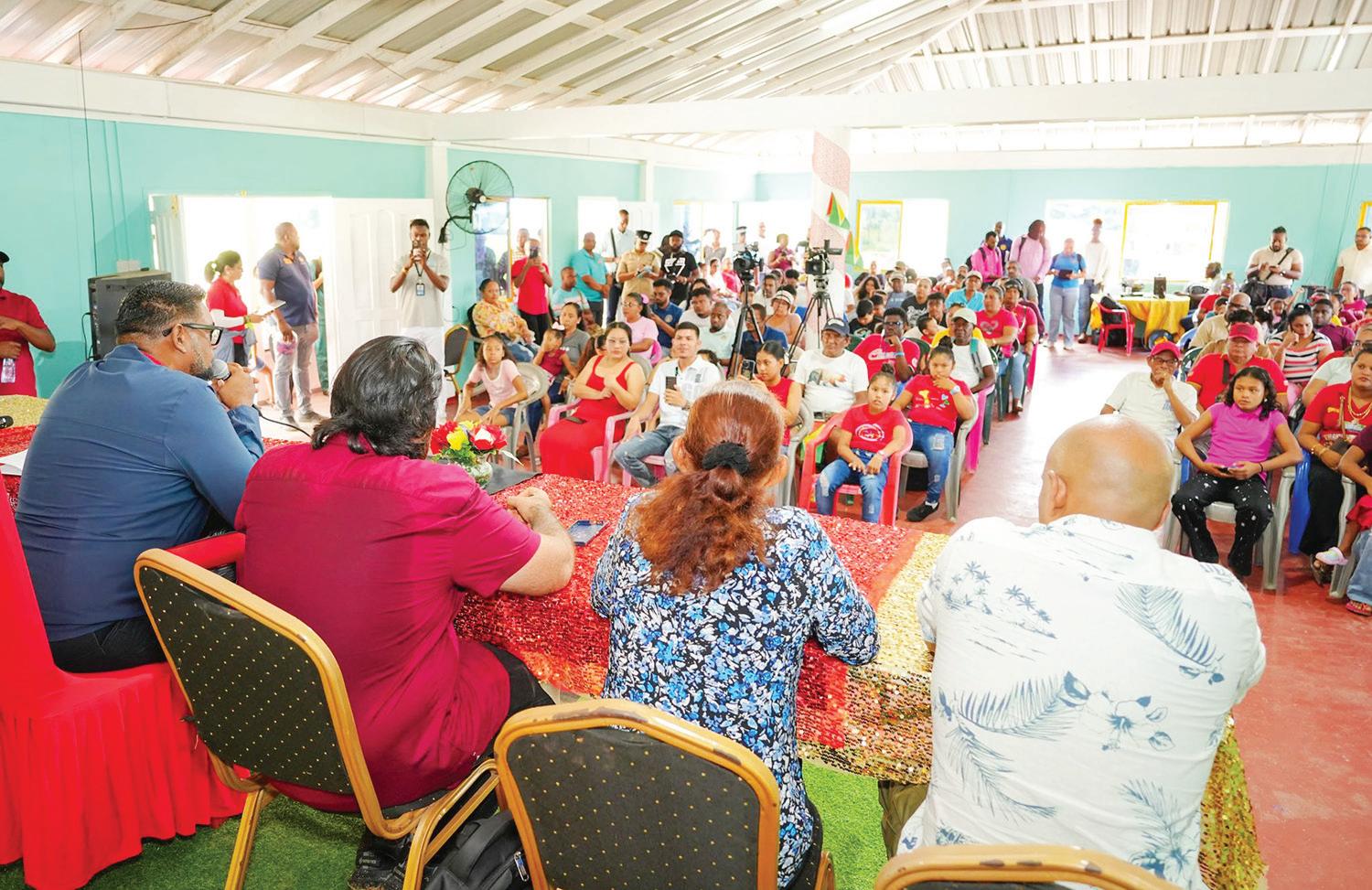
Scenes from the government outreach held at of Imbaimadai, Region Seven on Sunday (OPM photos)
‘We want the people to be involved in their own development’
- President Ali tells Karrau residents, highlights government’s plans for key sectors
By Naomi Parris
PRESIDENT Dr. Irfaan Ali has reaffirmed his government’s commitment to community-driven development, telling residents of Karrau Village, Region Seven that they will play a central role in shaping their own future as major investments continue across the hinterland.
Speaking during a Cabinet outreach, Dr. Ali said the exercise was designed to “connect directly with people” and gather ideas “from the ground” to inform decision-making at the community level.
“We want people to be involved in their own decision-making for the development of the community, and filling out that long-term prosperity plan at the community level all across our country,” he told villagers.
and the LCDS fund, with more than $80 million allocated under the latter alone. These have been supplemented by capital projects and direct investments from Central Government.
ENERGY, HEALTH AND EDUCATION UPGRADES
As the community grows and its ‘prosperity index’ improves, Dr.
erator for the village, especially in light of a new secondary school that, when fully occupied, is expected to accommodate more than 200 students.
In the health sector, a new dental chair has already been delivered to the local health centre, and is to be installed and made operational within one week.
end of this week, and that the dentist is there, full-time.”
The new secondary school is scheduled for completion by July, and Dr. Ali said it should be fully operational for all levels, with parents offered the option of enrolling their children there instead of sending them to Bartica.
He further commit -
Over the past few years, the President noted, hundreds of millions of dollars have been channelled into hinterland and riverain communities through various mechanisms, including the presidential grant
Ali said there is rising demand for higher levels of public services, particularly electricity. He announced that the Office of the Prime Minister will examine the feasibility of a mini off-grid system or gen-
“Unfortunately, we have some technical people who are not doing their job,” the President said, adding that a team had been left in the village “to ensure that the dental chair is fully operational by the
ted to rehabilitating the main bridge serving the school, in collaboration with the local council and villagers. ROADS, HOUSING, AND INFRASTRUCTURE
Residents identified
poor road conditions as one of the community’s main challenges.
In response, the President explained that Karrau Village requires about two kilometres of internal roads and a further eight to ten kilometres of road into the ‘back dam’.
Government will work with the village to procure key pieces of equipment including a grader, roller, and truck to allow the community to build out and maintain its own road network.
An excavator previously provided through the National Drainage and Irrigation Authority (NDIA) will continue to support farmers in the wider region.
The President also highlighted a home improvement project that has generated “especially excited” interest in the village.
The initiative will begin with an assessment of all vulnerable families, targeting the elderly, persons living with disabilities, single mothers, and large households, with the aim of upgrading homes in riverine and hinterland communities.
Water security and
erosion control were also placed on the agenda. Two village wells are experiencing difficulties, and a technical team has been deployed to fix that challenge as quickly as possible. In the lower Karrau area, where about 400 feet of land is affected by massive erosion, the President has ordered a technical assessment to determine the necessary remedial works.
COMMUNITY FACILITIES AND ACCOUNTABILITY
Responding to calls for improved recreational spaces, Dr Ali said efforts are underway to complete a play park facility in partnership with the British Council.
He underscored that the outreach was not limited to announcements and promises but also involved monitoring the performance of technical officers posted to the area.
“Not only are we going to be looking at the opportunities and what we have to do, but we’ll also be assessing the performance of technical people, and wherever there’s lapses in that performance, there will be consequential effect,” he warned.
President Dr. Irfaan Ali
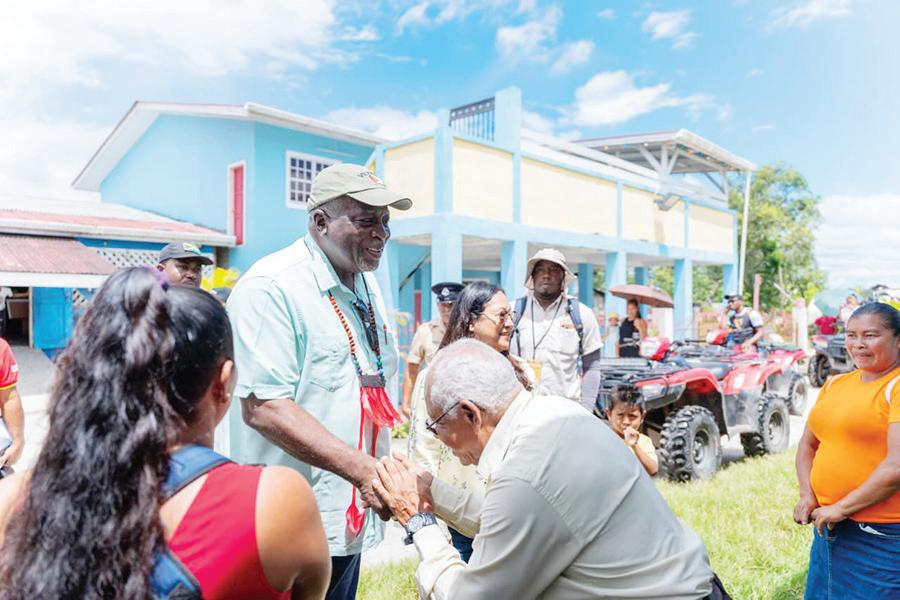
President Ali was accompanied by Cabinet members and regional officials during his meeting with residents
Scores of Karrau residents on Sunday attended a government outreach headed by President Dr. Irfaan Ali (OP photos)
GPHC engaging HR, talent agencies for more training to fill gaps
- discussions ongoing with Philippines, India
By Naomi Parris
THE Georgetown Public Hospital Corporation (GPHC) is intensifying efforts to address staffing shortages, particularly within its nursing service, through a combination of local training initiatives and international recruitment.
Chief Executive Officer Robbie Rambarran said the institution has been engaging human resource and talent recruitment agencies as part of ongoing efforts to strengthen its workforce.
Discussions are also under way with agencies in countries such as the Philippines and India to secure specialised personnel who
can help meet growing demands within the healthcare system.
“In terms for the doctors, there isn’t much of a challenge. There's a huge challenge in nursing staff. We have engaged human resource agencies, talent agency in recruiting staff, which we're in the process of having discussions,” he said during an appearance on the Starting Point Podcast over the weekend.
He noted that the GPHC has been working on both short-term and long-term solutions to address gaps.
As part of those efforts, the hospital has expanded training programmes for patient care assistants, who play a supporting role
in the delivery of nursing services. In addition, a large number of nursing assistants are currently undergoing training.
Rambarran said approximately 600 registered nurses are expected to graduate by the end of the year, providing a substantial boost to the country's health-care workforce.
“We have been training a lot of people in Guyana as patient care assistants, which complement nursing. There is nursing assistant…a lot of them [will] graduate at the end of this year, about 600 registered nurses will be graduated; so while we are training, we are looking to bring in some specialised staff who will help boost that workforce in the nursing service.”
While training continues locally, the GPHC is also seeking to recruit specialised staff from overseas to strengthen the nursing
service and ensure adequate staffing levels across departments.
The CEO acknowledged that there are also some shortages in pharmacy and medical-technology services, though these are less severe than those affecting nursing.
He explained that the opening of several new regional hospitals has contributed to staffing shifts, with healthcare workers opting to take up positions closer to their homes.
"People are going
there to work because they live closer, and that is understandable," Rambarran said, adding that reduced commuting costs and improved convenience have made those positions attractive to many employees.
Despite these challenges, Rambarran said the hospital remains focused on ensuring that critical services are maintained while recruitment and training efforts continue.
“There is a little bit of gap in pharmacy
and medical tech, but with the new hospitals that are opened, people are going there to work because they live closer and that is understandable. They live closer, it's less cost for them to come to Georgetown…now we have repositioned in those departments and looking for staff, but our major challenge is in the nursing service, and we are working with both training and recruitment,” he explained.
Gov’t service centres to be opened at Bartica, Kamarang
- President Ali announces
KEY government services that were once out of reach for citizens across Region Seven (CuyuniMazaruni) will soon be available with the imminent launch of the government’s service centre.
This was announced by President Dr. Irfaan Ali on Sunday during a Cabinet outreach where he told hundreds of residents at Karrau Village that the centre will be fully operational within four weeks.
“We are launching the Government Service Centre. In Region Seven, we will have one such Government Service Centre, where all GRA [Guyana Revenue Authority] services, Digital ID services, NIS [National Insurance Scheme] services, Immigration services, Licensing services will be done right here in Bartica in Region Seven. So, you don't have to go anywhere. You want your passport, you will go to Bartica. You want your Digital ID, you go there. You want a birth certificate, death certificate, you go right there,” the President said. He made a similar announcement during a subsequent meeting at Kamarang.
The government recently began the roll out of the service centres across the country, creating a one-stopshop access to multiple government agencies, decentralised services, improved efficiency and people-centred delivery.
Citing millions of
dollars in direct support and development spending, President Ali also shared that the government has shown its commitment to the people of Karrau through a series of targetted investments. These include increased old-age pensions, more than $13 million in Presidential Grants, a further $7.5 million from a supplementary budget allocation, and annual LCDS funding of $24 million over the past three years.
The President added that approximately $39 million has also been invested in capital works in the village, reflecting what he described as the government's willingness to invest in the community's long-term development.
He noted further that the government is laying the groundwork for a new phase of development in Region Seven through major infrastructure investments and improved connectivity.
He stressed that the region's importance extends beyond mining, describing it as a vital hub for forestry, and one with enormous potential for tourism growth. The ongoing development of transport and other infrastructure, he added, is intended to support economic expansion, and create new opportunities for communities across the region.
“I'm not here today for long speeches, but I'm here today for us to have a conversation on the next phase of devel-
opment for your village and for this region,” he said.
DEVELOPMENT INITIATIVES FOR KAMARANG
Addressing the residents of Kamarang, President Ali noted that in a bid to increase the region’s food security, his government, through the Ministry of Agriculture, will establish a 20,000-capacity tunnel-house poultry farm within the next three months.
The chickens, the President said, will be sold to the upper Mazaruni area at cost. He said that a segment of the Army’s Agricorp will be deployed to the community to ensure that the project is set up as quickly as possible.
Additionally, the government will also invest in increasing the community’s cold storage capacity, with an investment made in procuring three 20foot containerised solar blast freezers.
“That will reduce tremendously the cost of two key items: Eggs and chicken. This is an investment that will cost us maybe close to $300 million, but we're going to make this investment to enhance the food security of the upper Mazaruni area,” President Ali said.
Also high on the agenda is the development of a fuel depot in collaboration with the Guyana Geology and Mines Commission (GGMC). The President emphasised that this depot will not be for the mining community, but to supply fuel
for households.
“In addition to the fuel depot, we're going to see how we can establish a depot for cooking gas, because we can use some of our military assets to transport from Bartica to Kamarang,” he further said.
The President is leading a two-day Cabinet outreach across Region Seven.
President Dr. Irfaan Ali on Sunday told Region Seven residents that government service centres will be operationalised at Bartica and Kamarang in four weeks (President Dr. Irfaan Ali/Facebook)
Banking on Guyana’s bright future
THE announcement by global banking behemoth Citi to set up a representative office in Georgetown is much more than just a corporate expansion announcement.
It is yet another strong indication that Guyana is no longer considered a peripheral market, but an emerging economic force that international financial institutions can no longer afford to ignore.
For decades, Guyana had struggled to attract the attention of big international banks and investors.
Today, it is quite different. Oil production; unprecedented levels of infrastructural investments; expanding trade opportunities and growing private-sector activities have made the country one of the fastest-growing economies in the world.
Citi’s decision to expand its footprint in Guyana is a vote of confidence in the economic direction of the country and long-term prospects in this regard.
This is a much more important development than the opening of an office.
Citi and other international banks are crucial in providing trade finance, cross-border payments, capital raising, foreign investment and corporate banking services.
Their existence connects local firms to the world market and gives greater confidence to foreign investors coming into emerging economies.
In many ways, financial institutions are the plumbing underpinning economic growth, offering the networks and expertise that allow investments and com-
merce to thrive.
The decision was driven by the fast-growing sectors in Guyana, including infrastructure and export financing, said Citi top brass.
The bank, which has operations in over 180 countries and jurisdictions, believes that having a presence on the ground will enable it to better understand local conditions, while it serves international investors looking for opportunities in Guyana and Guyanese businesses looking to expand abroad.
What this development says about the changing financial landscape of Guyana is just as important.
The Bank of Guyana’s approval comes after reforms have modernised the financial regulatory framework of the country and enabled international financial insti-
tutions to set up local representative offices.
These reforms were intended to enhance Guyana’s integration into the global financial system, increase access to international financial services and improve competitiveness in the banking sector.
Moreover, Citi is not alone in this move by the big institutions. Other international financial institutions such as Crown Agents Bank and One Americas have also recently been approved, a sign of increasing international financial focus on Guyana.
Now, there are several international institutions that are emerging, so it’s not a temporary transformation, it’s sustainable
But enthusiasm must be tempered with realism.
A representative office
is not a full-service commercial bank. Citi will not be competing for retail deposits or offering everyday banking services to ordinary Guyanese customers. Instead, it will target corporate clients, government bodies and financial institutions and investors requiring sophisticated international financial solutions.
But the indirect benefits can be substantial. Better access to international capital markets, stronger correspondent-banking relationships and improved trade-finance capabilities can all contribute to a more efficient and globally connected economy.
The challenge now is to ensure that Guyana maximises the opportunities created by this growing international interest.
Simply achieving economic growth is not in itself
sustainable development. Policymakers must continue to strengthen institutions, improve transparency, invest in human capital and maintain a stable regulatory environment that encourages responsible investment.
Citi’s arrival should therefore not be seen as the end of the story of Guyana’s success, but yet another milestone along the journey. It demonstrates faith in the direction in which the country is going and an appreciation for the opportunities that lie ahead.
For a country that just a few years ago struggled to get the attention of the world of finance, the establishment of a Citi office in Georgetown sends a clear message: Guyana is emerging as a serious player in the international economy.
Dear Editor, DID you know that capybaras are still found around the Eugene F Correia Airport (EFCI) and the excursion incident on April 14 was not an isolated case of them on the runway? How much of their natural habitat was destroyed for “development” in recent years. As concrete structures replace green spaces along the Heroes Highway stretching through Buzzbee Dam and eventually towards the CJIA, forcing wildlife into urban areas and transit zones, we must critically evaluate our strategy for
greenfield projects. Was any mechanism put in place by the government for relocation, or cohabitation? I think not.
Editor, we understand that Guyana is “developing”, the population is growing and industries are expanding. It is the normal progression of a country with managed resources. But as the saying goes, you don’t get something for nothing. So, who pays? The fauna that once lived in those ecosystems. Sustainable resource management requires that we account for this ecological cost.
Out of sight, out of mind? Recently, an anteater was sighted in the newly opened Guyana-China Friendship park. At the same park, on one of my morning commutes, I spotted an eagle perched on the stump of a tree that it once called home. The capybaras are at the airport. Just driving on the Ogle highway at sundown one can see flocks of parrots heading west. Talk to the farmers, or anyone living in those areas before the development, what have they spotted?
Those anecdotal observations add weight to the need for more robust studies. The
government should commission wildlife biologists to conduct data-driven population and baseline studies before it is too late. The results can inform collaborative planning and balance development with survival requirements of native wildlife. Let’s not preach habitat destruction as a worldwide problem and we do nothing to curb our own contributions to it, however small it may appear.
Mass relocation, while challenging, remains far better than localised eradication. Whether this is the right answer or not would
depend on the outcome of the studies. Alternative progressive options should also be explored, such as mandating biophilic designs that allow human infrastructure to coexist with non-disruptive species. Additionally, broad public education on safe animal handling may be the single biggest positive solution by mitigating fear-driven conflicts.
Editor, at the very least, when government opens new areas for “development,” due diligence must be done. The evidence suggests otherwise. Developers should no longer
be allowed to clear plots indiscriminately without managing the wildlife that thrives there. At the very least, I strongly urge the Guyana Wildlife Conservation and Management Commission to immediately help with the capybaras at the EFCI airport before someone starts killing them. Implementing an organised wildlife management and mitigation strategy now is vital before human-wildlife conflicts lead to destruction of these animals.
Yours sincerely, Avinand Rampersaud
One of the things in Guyana that makes no sense
THERE were elections last week in two civil society organisations – the Bar Association of Guyana and the Private Sector Commission (PSC). Both organisations have term limits. For that reason, the Bar Association has changed presidents. In the case of the PSC, the incumbent was re-elected, but after his new term, he will be ineligible for re-election.
There are some things in life that run against the core of what human existence stands for, and, for me, permanent leadership is one of them. I have done four commentaries on term limits in my columnist career; this is my fourth. The absence of term limits makes no sense at all.
Permanent leadership defeats two purposes in life. One is to allow humans to gain experience so that they
know the environment they have to interact with at a deeper level when they grow older. The sharing of that experience makes other humans more knowledgeable of the world and human nature.
I have been associated with politics in Guyana since I was 17 being a polling agent in the 1968 general elections. Since that year, my experience in politics has made me a better human. All countries change their foreign diplomats after three or four years so they can gain experience in other countries.
The second negative impact of permanent leadership is its denial of the rise of talent. When you are the leader of an army, a government, a business company, the interfacing with the society and the world at large makes you more knowledgeable and you acquire skills and talent that allow you to go through life
with less discomfort.
When a person occupies the headship of an organisation for decades, there is no space for others to rise to the top so they can acquire skills that are waiting to be possessed. Immediately the example of the Guyana Olympics Association (GOA) comes to mind. One person, attorney Juman Yassen, stood at the apex for 30 years. Can you imagine in those 30 years, the countries that Mr. Yassin visited and would have learned about the global world of sports?
Here is a commonsensical argument. If the GOA had term limits, many other sport personalities would have had the opportunity to travel around the world and learn about sports throughout international society. Now if a person at 25 years is shut out from leading an organisation and the incumbent goes
on for 30 years, then at 55, that person may no longer be interested in the job because of pressure of family commitments and other interests in life. It was inherently wrong because that person was denied the experience of seeing the world because of the absence of term limits.
Here is what I wrote on March 11, 2022: “The Berbice cricket administrators recently rejected a motion to have its head serve only three consecutive terms of two years. Instead, they went for five consecutive terms. Obviously, this means that a CEO can be in power for ten straight years. Why in a young country like this does anyone want their administrator of cricket, football, hockey, tennis, racehorse etc to hold office for 10 years? Why not four or five? Why ten? Why not share the experience so after four years,
another young person gets a taste of what it is like to administer an important national association?”
When this happened in Berbice, I felt sorry for my country because I believed it had people who operated against the value of common sense. It still has. Patrick
Yarde is going on to 40 years as head of the Guyana Public Service Union. There are hundreds (yes, hundreds) of public servants who have reached mandatory retirement of 55 and were never given a chance to serve as the head of their union.
Lincoln Lewis is going beyond 35 years as General Secretary of the Guyana Trade Union Congress. He is the longest serving General Secretary of the GTUC after his predecessor, Joseph Pollydore, who served for 25 years.
Then there is Mr. Mike
Mc Cormack. The Guyana Human Rights Association (GHRA) started in 1979 with Mr. Mc Cormack as its President. This means Mr. Mc Cormack has been at the apex of the GHRA for 46 years. It has to be an absurdity for any organisation to accept a person as its president for 46 years. Think of the hundreds who have been in the GHRA and were not given the opportunity to lead it.
The Constitutional Reform Commission must legislate for term limits for all civil society organisations.
DISCLAIMER: The views and opinions expressed in this column are solely those of the author and do not necessarily reflect the official policy or position of the Guyana National Newspapers Limited.
Flag-raising mishap should not detract from commitment, sacrifices of military personnel
Dear Editor,
DURING the day, or in the dead of night, while most of the country bustle with activity, or remain fast asleep, Guyana’s military men and women, donned in combat uniforms, and equipped with heavy-laden military weapons, remain wide awake patrolling and protecting the territorial integrity of the country, and keeping Guyanese safe from incendiary external threats.
In the absence of a national military draft, these men and women voluntarily entered military service, and for such, become worthy of respect and admiration, particularly for their commitment and willingness to serve the country in the face of constant danger. Whether prompted to serve out of egoistic or altruistic reasons seem irrelevant, for these men and women
share in one collective allegiance, one collective consciousness that symbolises their commitment to be the defenders, the protective vanguards of the country’s national integrity and territorial legitimacy. Rarely seen patrolling the streets, the security functions of the men and women who serve in Guyana’s militia seldom appear visible to many, and therefore not fully cognisable by the very people who benefit from their protection. Regrettably, as if to embarrass the government, the malcontents seek every opportunity to underplay or discredit the important security functions and dedication of Guyana’s military personnel. Evidence of such reaction can be seen in recent social media posts that tried to mock the military for its missteps in raising the flag during Guyana’s 60th Independence
Day ceremony. Indeed, the incident does not stand testimony as a proud moment for the military or the government. But how often does such occur? Should one then allow the incident to foreshadow the ongoing security the militia provides for everyone in the country? To do so, only reflects one’s foolhardiness. Moreover, one does not need to be reminded of the constant threat posed by Venezuela’s presidents, past and present - Nicolas Maduro and Delcy Rodriguez, respectively. As widely publicised, these former, and present Venezuelan dictators, seldom detract from their frivolous claims to a huge swath of Guyana - the Essequibo region - which necessitates constant vigilance by Guyana’s military. Consequently, lobbing childish barbs at the military – as in the case of the flag-raising mishap
– is insulting to the core of the integrity of the Guyana Defence Force, and should not serve to diminish or underplay the exemplary efforts of Guyana’s brave men and women in uniforms, who assiduously toil in fending off Venezuela’s aggression.
By way of the forgoing, I am reminded of the sacrifices Guyana’s Defence Force soldiers make each and every day; sacrifices that not only linger in the minds of neighbours, friends and families, but, which deserve conspicuous memorialisation so that those who find infantile pleasures in minor military incidents can be reminded of the braves who lost their lives in the line of duty to the country. Most worthy of note are Lieutenant Colonel Michael Charles, Colonel Michael Sahoud, Lieutenant Colonel Sean Welcome, Staff Sergeant Jason
Khan, and retired Brigadier Gary Beaton, who lost their lives in the helicopter crash of December 8th, 2023. Not to be ignored are the two survivors Lieutenant Andio Michael Crawford and Corporal Dwayne Johnson, both of whom carry the scars and memories of that fatal incident.
The above-mentioned militia men left their homes and families daily to assume responsibilities relating to the defence and security of all Guyanese. Without assurances of returning home safely, these men, I am sure, understood that they could be endangering themselves in protection of the country, yet they chose to voluntarily enlist to serve in the military, which then begs the question: do you think those who hurl social media babbles at the military do so out of courage or cowardice? Before hastening to answer, please
give some consideration to the eloquently expressed statement by Dr. Martin Luther King when he said: “Cowardice asks the question, “Is it safe?” Expediency asks the question, “Is it politic?” And vanity comes along and asks the question, “Is it popular?” But conscience asks the question, “Is it right?” And there comes a time when one must take a position that it is neither safe, nor politic, nor popular, but he must do it because the conscience tells him it is right.”
Today, the men and women of Guyana’s military continue to serve, not because it is safe, or popular, but because their consciences tell them it is right. For this, they deserve our utmost respect and admiration.
Regards, Narayan Persaud, PhD Professor Emeritus
PM Mottley’s
‘Amphisbaenaist’ conundrum
GUYANA recently celebrated 60 years as an independent nation. Among the A-list guests was Barbados’ PM Mia Mottley, who was indubitably Georgetown’s most honoured guest for the multi-day celebration. Her celebratory visit was significant for many reasons: standing out was the bringing into reality of passport-free travel between the sister CARICOM states with PM Mottley and her entourage being the first travellers. This is laudable, though 20 something years late, but you know what they say, better late than never. This is a big move towards making the CSME a real thing. I hope that at the upcoming July summit, other territories will just make the bold move and sign on.
I am an unapologetic integrationist. I am impatient with the length of time and ‘talk-talk’ associated with CARICOM integration. When regional leaders make these flowery integra -
tion speeches, I get really angry because I know that most of these leaders treat their own integration agenda as fairytales. They might as well start a typical speech with, “Once upon a time in a land far far away.” In the region, leader after leader come and go, they sign documents and make treaties then disregard them for decades.
There is a CARICOM malaise affecting the cycle of leaders we continually choose. I believe the issue is deeply psychological and is tied to the exercise of power. CARICOM integration is thought of as a supranational force that erodes local political power. Regional leaders already preside over very small physical spaces together with very small populations and turning some of that over to the invisible hand of economic and demographic integration is a big ask. No sane person signs away aspects of his own power. I don’t know what other explanation to attach to this phenomenon. They talk the talk when out of
office. Once they taste local power it becomes intoxicating in ways they are unable to mentally extricate themselves. As such, they continually sign treaties, which they leave as a hot potato for the next leader to juggle.
How do you explain a CARIPASS treaty signed since 2007, and not a single CARICOM Travel Card has ever been issued anywhere in the region? Then we come almost 20 years later to jump and celebrate that Guyana and Barbados sidestepped their own multilateral treaty and CARICOM institution to forge bilateral co-operation. Because of its catalytic potential, I am with this initiative 100 per cent, but I am not at all enthused. Here is why. Because of the region’s history of archiving documents before the ink dries and the history of disregarding its own treaties and agreements, I do not think the agreement between Guyana and Barbados has gone far enough. To make passport-free travel possible, it took an executive deci-
sion via a bilateral agreement. What this means is that any President of Guyana or Prime Minister of Barbados can stop the programme by a simple verbal command to their immigration chiefs. This platform is too shaky. I would be a believer when Bridgetown and Georgetown coordinate and take identical legislation to parliament, divesting politicians of some of that executive power and letting the programme function as an institution.
CARICOM leaders are seeking to retain too much state individualism inside of a movement that requires stronger supranational regulatory mechanisms. That is why I expressed deep consternation in the verbal emanations of a top Caribbean academic, Dr Kai Ann Skeete, because I believe when everyone else fails, our academics should uphold principles, facts, figures, law and institutions and uphold their integrity to the corollary conclusion.
So, when I hear our academics pander to political talking points, I feel a deep sense of trepidation and disillusionment for the future of the integration movement.
Amphisbaena is an apt representation of the majority of CARICOM leaders over our storied history. This trait has been our biggest self-warning, self-imposed stumbling block. Prime Minister Mottley is being struck by a bout of ‘Amphisbaenaism” relating to Guyana.
Just a few weeks ago, Venezuela’s Delcy Rodrigues walked into Bar-
bados displaying a redrafted map of Venezuela that annexed two-thirds of Guyana in violation of international law. PM Mottley didn’t think she had a moral and legal obligation to slip in a word of affirmation of the only known borders.
CARICOM and its instruments, associations and institutions far supersede a regional trade agreement. It’s an integration movement. Because none of the partners to the agreement are stateless, the treaties and instruments bind each nation to defined physical spaces and defined nationalities of people. For the survival of the movement, any illegal annexation of any segment of physical space affects the entire founding agreement. So, PM Mottley cannot this week feel zero sense of obligation to affirm the physical space of Guyana and then the next week send her citizens to Guyana without a passport to inhabit the very space she has not displayed any conviction and courage of her conscience to affirm, not even in the slightest.
One head is for regionalism, and the other head is for nationalism. Sometimes they pull in the same direction, and without warning and without a modicum of yeomen kindred spirit, just pulls in opposite directions. Any depiction or gesture of annexation of any part of any member of CARICOM is an affront to the Treaty of Chaguaramas, an affront to the common market space, an affront to our regional institutions, including the
Caribbean Court of Justice and an affront to the common economy we are attempting to build. If this implication is not evident, the summit in July might as well take an agreement to suspend the treaty until all border matters in all territories are permanently and unconditionally settled.
There is one main thing Guyana can do to assist regional leaders to manage their amphisbaena traits. Guyana should immediately place on the agenda and take affirmation text to the next Heads of Government conference that require all signatories to the regional treaty to affirm the existing iteration of all national borders as recognised by the UN. This is a basic low-hanging fruit that does not need further explanation.
It’s simple, we are in a regional agreement. What is the inventory we are dedicating to the agreement? A one paragraph text, when adopted, will set the ground rules of engagement with the rest of the world. This format of affirmation does not seek to make individual states into enemies of Venezuela, but to pursue friendship in mutual respect for established spaces, peoples and institutions already affirmed in both states.
DISCLAIMER: The views and opinions expressed in this column are solely those of the author and do not necessarily reflect the official policy or position of the Guyana National Newspapers Limited.
Barabina Hill residents benefit from upgraded road network
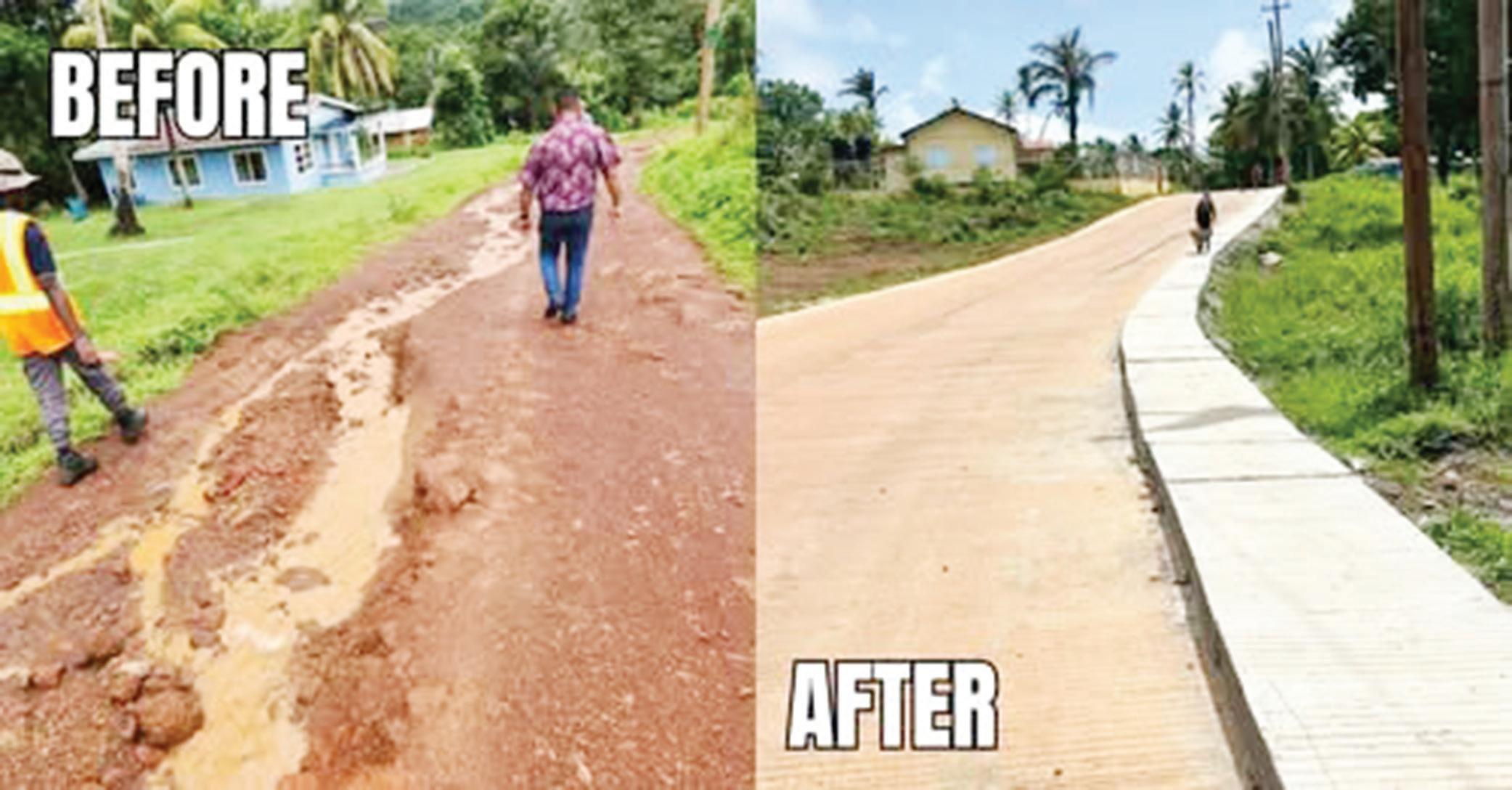
RESIDENTS of Barabina Hill in Region One are now enjoying easier travel and improved connectivity following the completion of a major road upgrade in the community.
Some 1.4 kilometres of road were transformed from laterite to concrete roadway. In the past, the laterite road posed great challenges for residents, particularly during heavy rainfall.
According to the Ministry of Public Works, the upgraded thoroughfare now provides smoother and more reliable transportation within the community, and an improved quality of life for residents.
It is also expected to support greater mobility access to essential services, and contribute to the continued development of the Barabina Hill Village.
The project, which was supervised by the ministry’s Special Projects Unit (SPU), was implemented using a community participation model.
This approach directly engaged residents, and utilised village labour to foster community ownership while boosting the local economy.
Moreover, the upgrade forms part of the PPP/C government’s wider effort to improve infrastructure, and strengthen connectivity
1.4
in communities across the country.
Speaking recently on the importance of infrastructure development, President Dr. Mohamed Irfaan Ali highlighted the transformative role of road projects in national development.
“The roads we are building connect not just communities but destinies,” the president said.
He also reaffirmed the government’s commitment to ensuring the country’s rapid economic transformation delivers long-term benefits to all Guyanese. (DPI)
Top aid official urges young people to ‘serve humanity, support the UN’
A VETERAN humanitarian has been reflecting on her work serving people worldwide as she prepares to leave the United Nations at the end of the month.
“It has been the privilege of a lifetime to serve humanity,” said Joyce Msuya, who spent the past four years as the Assistant Secretary-General and Deputy Emergency Relief Coordinator in the UN Office for the Coordination of Humanitarian Affairs (OCHA).
In an exclusive interview with UN News, she highlighted the critical role played by humanitarians in a “collapsing” world and the challenge of advocating before a divided Security Council for safe access to civilians in the Gaza Strip.
Ms. Msuya, who is from Tanzania, was also inspired by her interactions with young people over the years – even when they asked “uncomfortable” questions about the UN’s response in conflict situations.
She encouraged them to lend support to the world body and the principle of multilater-
Bero)
alism which are so under threat.
“What has kept me grounded is to always think about the internally displaced people, the persons we are trying to serve,” she said. “And that is a very noble cause – a gift of service to humanity that I hope especially the young generation will aspire to do.”
This interview has been edited for clarity and length
Joyce Msuya: Three things come to my mind as I’ve had a bit of time to reflect. One is the privilege I've had to serve humanity in this role. I joined OCHA six days before the Ukraine war started in February
2022 and even then, I thought gosh, the world was collapsing. So, just being in this role and seeing three major wars – Ukraine, Gaza, and then more recently, Iran – has been quite a humbling experience, but also very motivating to see the power and the contribution that the United Nations and the humanitarian community at large, including NGOs, can play.
The second is being in this role as someone from the Global South. I didn't know what that meant as a platform, and that has been incredibly, a gift of service for me personally, and I really hope that has opened
doors and will open doors for others.
Lastly, is just see -
ing the investments that funding partners are putting in, but also the suffering of people in all the countries where I've travelled. I used to take some things for granted and now I have a very deep appreciation of what suffering really means for people.
UN News: You have visited 30 countries, probably more. Is there a particular story or encounter that has remained in your mind?
Joyce Msuyua: I remember visiting an internally displaced camp
in the northern part of Yemen. I met a woman, a mother of four, who was in her thirties. She told me that she had never had a stable life. She’s been moving from one place to another because of the war. But what struck me was how kind and giving she was, despite the incredible pain that I could not imagine as a mother that she went through. In talking to her, I realised her own aspirations for her children were very similar to my
TURN TO PAGE 13
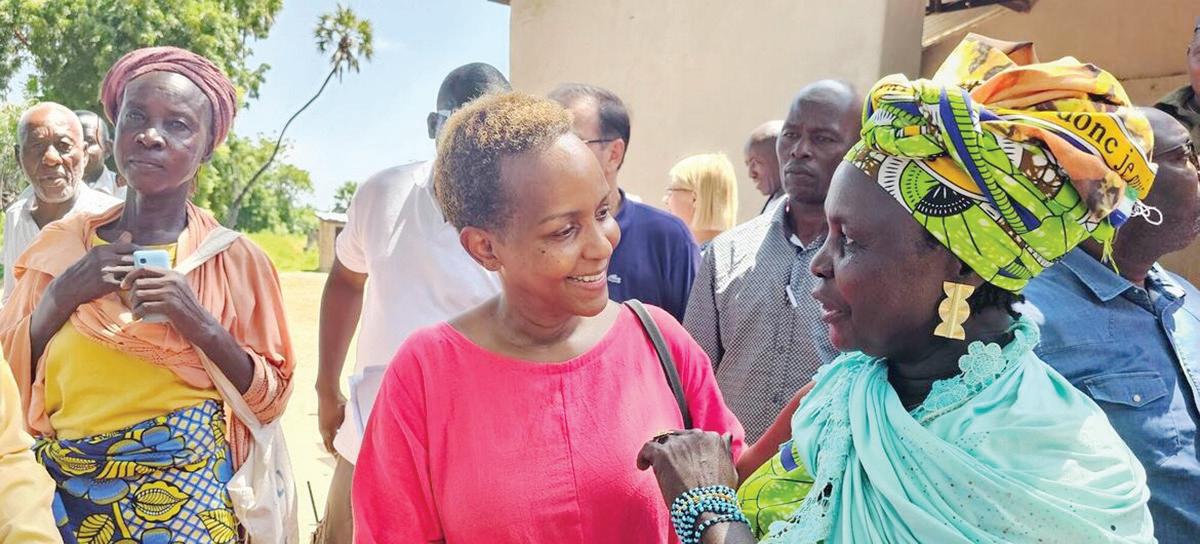
UN Assistant Secretary-General Joyce Msuya (centre) meets local authorities in Birao, Central African Republic, during her mission to the country in October 2025 (UNOCHA/Virginie
kilometres of road at Barabina Hill was recently transformed from laterite to concrete
Hinterland residents to access loans, business support through new development bank
RESIDENTS of hinterland and Amerindian communities will soon have direct access to soft loans and other business support through the Guyana Development Bank, President, Dr Mohamed Irfaan Ali announced on Sunday.
Addressing residents in Karrau Village, Region Seven, President Ali reaffirmed that the bank is designed to support community-driven
development, enabling residents to invest in small enterprises, form consortia and pursue larger projects collectively.
“The Guyana Development Bank will allow us to target you directly, so that you can benefit from soft loans that will allow you to invest in your small businesses, that will allow you to come together in a consortium…and do larger projects,” President Ali told Karrau residents.
Apart from financing, the bank will also deploy officials to provide
coaching, mentoring, and financial-management training, ensuring borrowers have the tools needed to build and sustain successful businesses.
President Ali said the initiative represents the government’s commitment to provide resources, equipping citizens with the knowledge and guidance to make the most of them.
The Guyana Development Bank is set to be
launched in the coming months as soon as legislation is approved in the National Assembly.
In the 2026 National Budget, some US$100 million was allocated to establish the facility and provide seed capital to banks, enabling them to lend to small and medium-scale enterprises (SMEs), including those that have struggled to secure financing through traditional channels. (DPI)
Residents of Karrau Village at the Karrau multipurpose building
‘You are not alone’: WHO chief vows to stand with DR Congo through Ebola outbreak
COMMUNITY trust will be decisive in bringing the rapidly evolving Ebola outbreak in eastern Democratic Republic of the Congo under control, WHO Director-General Tedros Adhanom Ghebreyesus said on Saturday, as health teams race to contain the emergency that has spread across multiple provinces and into neighbouring Uganda.
Speaking in Bunia, the capital of Ituri province and the epicentre of the outbreak, Tedros said local communities must remain at the centre of the response to the Bundibugyo strain of Ebola, for which no approved vaccine or treatment currently exists.
“We are not here to tell people what to do. We are here to listen,” he said at a press briefing. “Communities understand their own challenges and their own solutions. Our role is to support you in implementing those solutions, together.”
The outbreak continues to evolve rapidly.
As of 27 May, 906 suspected cases and 223 suspected deaths have been reported in DRC. Across both DRC and Uganda, 134 confirmed cases and 18 confirmed deaths have been recorded as of 29 May. In addition, an American national who had treated patients in DRC is currently receiving care in Germany.
BUILDING TRUST
Tedros used his visit to meet government officials, community leaders, humanitarian agencies and health partners, emphasizing that public confidence and community participation would be essential to ending transmission.
“Community ownership is what will bring this outbreak to an end,” he said.
He expressed hope to engage with women’s groups, religious leaders, business representatives and young people during his visit, describing trust-building as a process that “starts with listening.”
The UN health agency has increasingly focused on working through community networks, including local leaders, radio stations and social media influencers, to combat misinformation and encourage early detection and treatment.
TIMELY MEDICAL CARE VITAL
The outbreak is caused by the Bundibugyo virus, a relatively rare strain of Ebola first identified in Uganda in
While no approved vaccine or treatment currently exists, Tedros stressed that survival is possible with timely medical care.
“Ebola caused by the Bundibugyo virus can be survived with good medical care, and some people here in Ituri have already recovered,” he said. “Seeking care early makes a real difference.”
WHO and its partners are also pursuing clinical trials aimed at developing vaccines and treatments for the strain.
PROTECTING ESSENTIAL SERVICES
Meanwhile, response efforts continue to expand.
WHO has delivered more than 2,000 diagnostic test kits and helped strengthen screening capacities at key transport hubs. The agency is also improving water systems at Ebola treatment centres to support infection prevention and control.
There are also deep concerns that the outbreak risks disrupting broader healthcare services in affected areas.
The UN reproductive health agency, UNFPA, said health facilities were increasingly redirecting personnel, supplies and infrastructure toward Ebola response activities, reducing access to services such as emergency caesarean sections, neonatal care, contraception and postnatal support.
To help maintain those services, UNFPA is deploying midwives, reproductive health kits and medical equipment while supporting a regional response plan involving DRC, Uganda and South Sudan.
‘WE ARE HERE, WITH YOU’
Tedros said the response must extend beyond the immediate outbreak, stressing that WHO
“While we fight this outbreak alongside you, we are committed to ensuring that other essential health services and humanitarian assistance continue to be provided to
communities across Ituri and beyond,” he said.
He also expressed confidence that the outbreak can be contained.
“DRC has faced Ebola before, sixteen times, and has ended every outbreak,” he said. “This is the seventeenth. That history gives me real confidence.”
Closing his remarks, Tedros sought to reassure affected communities.
“You are not alone in
this,” he said. “We are here, we are with you, and we will see this through together.” (UN)
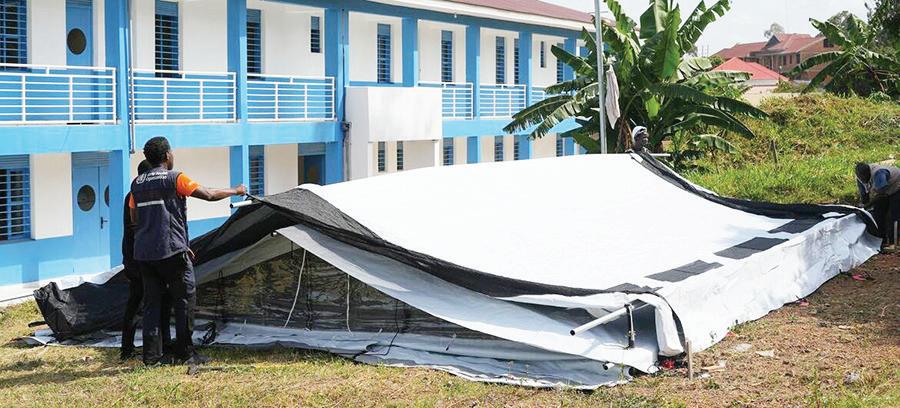
A WHO staff sets up a tent to expand capacity at a hospital in Ituri, DR Congo (WHO/Joël Lumbala)
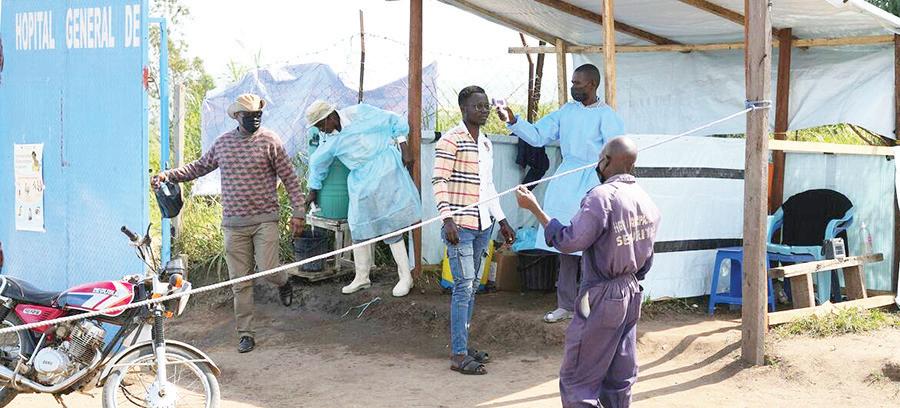
A health worker screens a man at the entrance of a hospital in Ituri, DR Congo (WHO/Joël Lumbala)
$8M to power youth and sports development in Jawalla
RESIDENTS of Jawalla in Region Seven will benefit from an $8 million investment in youth, culture and sports development following commitments made during a government outreach in the community on Sunday.
The Ministry of Culture, Youth and Sport pledged $7 million to support cultural and sporting activities, while the Ministry of Natural Resources will provide an additional $1 million to further boost
community development.
Toshao of Jawalla, Verron Henry-Williams, welcomed the support, describing the visit as a long-awaited opportunity for residents to engage directly with government officials.
Speaking with the Department of Public Information (DPI), she disclosed that the fund will help to create more opportunities for young people.
“Seven million was requested, and I understand that it will be handed
over. That is to offset expenses in cultural training schools,” Williams explained.
During the outreach, Minister of Natural Resources, Vickram Bharrat, reaffirmed the government’s commitment to partnering with indigenous communities to address development challenges and improve opportunities for residents.
The minister emphasised that meaningful progress requires collaboration among government
agencies, community leaders, parents and residents.
“We’ve got to work together on fixing issues,” Minister Bharrat said.
Additionally, the funding comes as a boost to the community with a rich sporting tradition.
Jawalla is widely known across the Upper Mazaruni for its active participation in the annual Upper Mazaruni District Games, one of the largest sporting and cultural events in the hinterland.
The games bring to -
gether athletes from villages such as Paruima, Waramadong, Kako and Kamarang to compete in football, cricket, volleyball, athletics, and archery.
Jawalla has frequently hosted and competed for top honours at the games, earning a reputation as one of the Upper Mazaruni’s leading sporting communities.
The combined $8 million commitment is expected to strengthen sports development, preserve
cultural traditions and support youth engagement in Jawalla.
Jawalla has frequently hosted and competed for top honours at the games, earning a reputation as one of the Upper Mazaruni’s leading sporting communities.
The combined $8 million commitment is expected to strengthen sports development, preserve cultural traditions and support youth engagement in Jawalla. (DPI)
Karrau resident commends government for transforming village infrastructure
KARRAU resident Vernie Bristol has praised the Government of Guyana and local leadership for what she has described as remarkable development in the community, highlighting the new educational, technological, and agricultural facilities that are serving those living in the remote Region Seven village.
Speaking at a recent community engagement, Bristol said she has watched Karrau grow over the years and felt “very proud” of the transformation that is taking place.
recently been producing food supplies for villagers.
“The food hub, the shade house that’s been producing over the months, lately, and the produce for villagers to be able to access from the shade house,” she noted.
In addition, Karrua has benefitted from the construction of a multipurpose building, which Bristol listed among the many things that have materialised in the village in recent years.
been experiencing steady development, with significant improvements in education and healthcare infrastructure over the past few years.
The resident reported that Karrau Village now has a nursery school, primary school, and a secondary school that is approximately 80 per cent complete, alongside a functioning health post serving residents and surrounding communities.
She credited the government and the village councillors for a series of key projects, including a new nursery school, and, notably, a secondary school that now allows students to complete their education within the community.
councillor,” Bristol said, adding:
“I’m very proud to see how my village has been developing over the years, all thanks to the Government of Guyana and Toshao, the
“We get a new nursery school… The most I’m very thankful for, we get the secondary school, which [means] our children can be able to go right here in the community… from nursery to primary to secondary.”
Bristol also highlighted the establishment of an ICT hub, describing it as “very helpful in the community”, as well as a food hub and a shade house, which have
Expressing her gratitude, she said she was “very grateful and thankful” for the range of initiatives that, in her view, have significantly improved life in Karrau.
Meanwhile, according to Amelia Sugrim, a nursing assistant at the village health post, the community had
“We also have the health post, which I work at, and we are trying our best with getting works done and getting to serve our people within the village. We know this would be impacting not only us but the population within Karrau,” she shared.
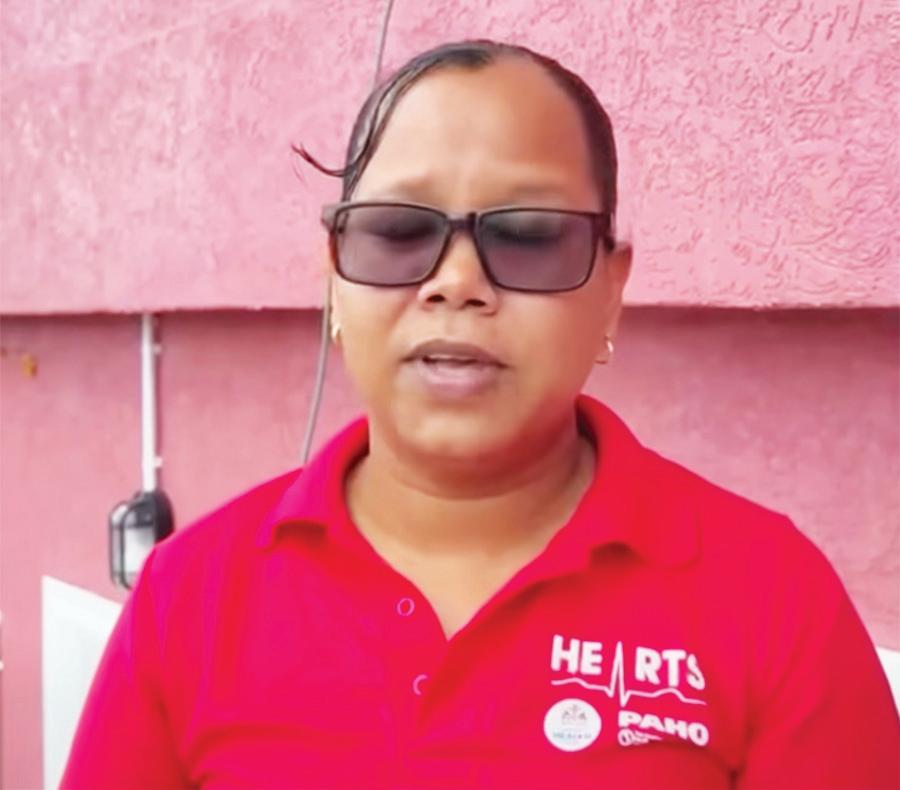
Vernie Bristol Amelia Sugrim
Minister of Natural Resources Vickram Bharrat
Toshao of Jawalla Verron Henry-Williams
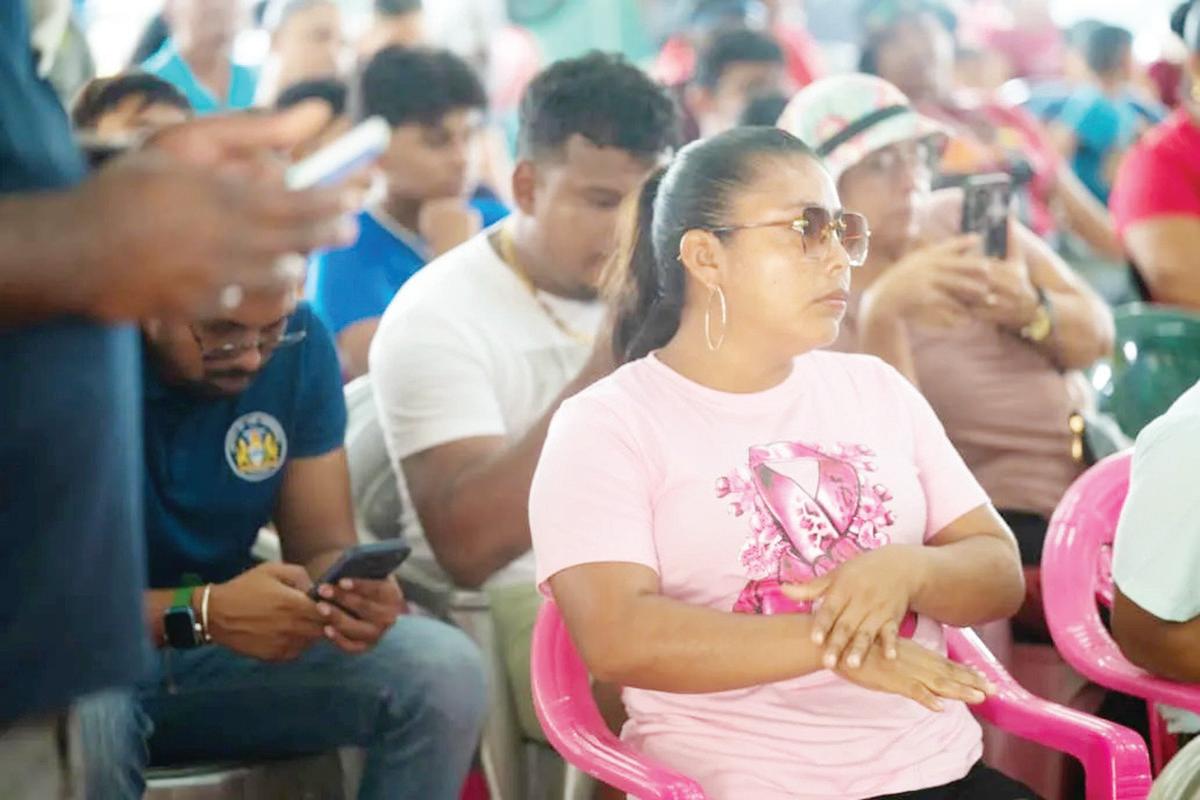
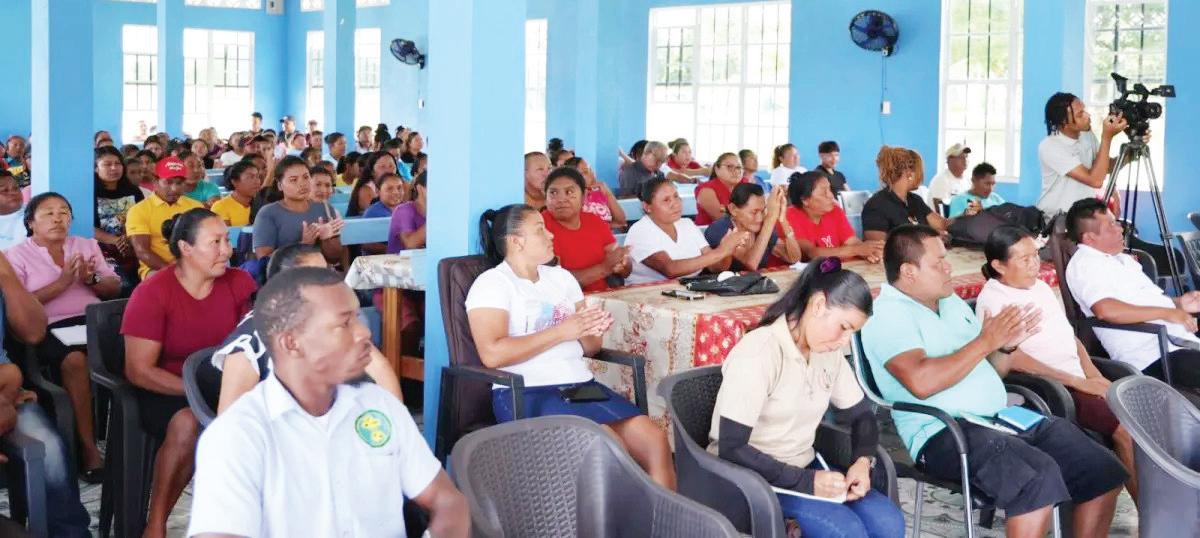
A section of the gathering at the meeting on Sunday
Victoria couple feared drowned at Unity beach
A YOUNG pregnant woman and her partner are feared drowned after they disappeared while swimming at Unity Beach, East Coast Demerara, on Sunday afternoon.
Missing are 20-yearold Loydicia Waldron, known as "Loyda", a sales assistant of Victoria Village, East Coast Demerara, and her partner, 31-year-old Special Constable Andri Francis, called "Bobby", of the same address.
According to a statement from the Guyana
Police Force, the couple encountered difficulties at about 14:00 hrs while swimming at Unity Beach.
Preliminary investigations revealed that Waldron reportedly began drifting out towards the Atlantic Ocean and called out for assistance. Francis, reportedly, went to her aid, but both were subsequently pulled under by the strong current and disappeared.
An alarm was raised and immediate searches were conducted at the beach and surrounding
areas. However, efforts to locate the couple proved unsuccessful.
The incident has left relatives and friends devastated. Waldron, who was expecting a child with Francis, had been looking forward to her baby shower, which was scheduled for July 25.
Search efforts continued up to press time, with police and other responders combing the area in the hope of finding the missing pair.
Police said investigations into the incident remain ongoing.
Top aid official urges young people to...
own aspirations for my own children – peace, education and stability. For me, that was the lesson that we as human beings have more in common than in difference. And I've always carried that and will always carry that message with me as I exit this particular role.
UN News: You have also briefed the United Nations Security Council more than 40 times, an average of almost once every month. Which briefing was the most difficult for you, and why?
Joyce Msuya: The Security Council is an absolute central body for the United Nations. When I joined OCHA, it was a Monday, and then the following day I was asked to brief the Security Council on Syria, my first briefing. I remember pinching myself sitting in that chamber thinking, ‘Wow, what a privilege, what an honour.’
I would say probably the most difficult part of my briefings to the Security Council were around
the humanitarian crisis in Gaza.
We were advocating for operational humanitarian space in the context where there was a global fracture of the big powers. And whenever I was in the chamber to advocate for humanitarian work and to report on the progress, I carried the perspectives of humanitarians who had lost their lives while trying to save others; OCHA staff who were still sacrificing a lot, especially national staff.
Some of them I knew through the interactions who had lost family members, children separated from their families, and yet they showed up every single day to serve others.
I think third is the lack of respect for international humanitarian law. Even though we advocated – and the Secretary-General, the Emergency Relief Coordinator and the whole sector were very clear, but really to see the impunity that came with that.
What gave me hope
was the whole multilateral [system] supporting humanitarian work, speaking up even when it was tough to do so.
UN News: Records also show that you held nearly 20 meetings with students in different countries. What is one message or insight from those students that have stayed with you and that you believe the international community should hear?
Joyce Msuya: I always strive to engage with students. I find their thinking, their curiosity and their questions very refreshing, very difficult, and very uncomfortable because they are not tainted by some of the organisational stuff that older people have.
I overprepared when I met with the students because I felt you just don’t know what question they have.
I remember being in Tokyo at a university and some of the students were saying ‘Why should we believe in the United Nations whilst you said ‘x’ in this war, and you stayed quiet on
another?’ For me, it was an opportunity to engage in a very open and candid way with the young generation.
Second for me was to unpack the journey of being an international civil servant. There were lots of questions, including from girls, about how did I get to where I am and how do I stay grounded, and some very personal questions, for example, on family.
So, using my platform to inspire the younger generation – to join in with multilateralism – to support the United Nations.
And the third is I’ve learned that because of technology, young people are more connected than we thought. Whether I'm speaking in Tokyo or in Mozambique or in Kenya, there’s some commonality, common threads, thanks to social media, to news, et cetera, which is good and bad: good because they get a lot of information from social media and the networks, but also bad as sometimes there is misinformation and
disinformation.
Our role is to help them filt UN News: Finally, what is your personal message to the world?
Joyce Msuya: I would say three personal messages, and one is also inspired by the Secretary-General.
The United Nations has an important role to play, so please support multilateralism – get engaged, be informed. This is your body as much as it is for us who are serving.
I always say - including to the critics – think about if the United Nations was not there, what would happen, whether it’s in Gaza, in the humanitarian sector, the Democratic Republic of the Congo, Sudan, Yemen, Syria, on and on. The power of multilateralism as our collective organization is key.
Second, let's not forget what service is, especially in the humanitarian sector. What has kept me grounded is to always think about the internally displaced people, the people we are trying
to serve. And that is a very noble cause – a gift of service to humanity that I hope especially the young generation will aspire to do.
And lastly, deepest thanks to every person, every government, every community, the whole sector, strangers whom I've met who have prayed for me, who have supported me. It has been the privilege of a lifetime to serve humanity. er what is reality, what is not, using data and evidence. (UN)
Missing are 20-year-old Loydicia Waldron, known as “Loyda”, a sales assistant of Victoria Village, East Coast Demerara, and her partner, 31-year-old Special Constable Andri Francis, called “Bobby”
The couple had planned a baby shower for July 25
‘Lean, logical and more coordinated’
- GPHC headed to full digitisation by mid-2027, CEO says
By Naomi Parris
WITH the information infrastructure already in place and work actively ongoing to map documents across 74 departments, the Georgetown Public Hospital Corporation (GPHC) is anticipating full digitisation of patient records by mid-2027.
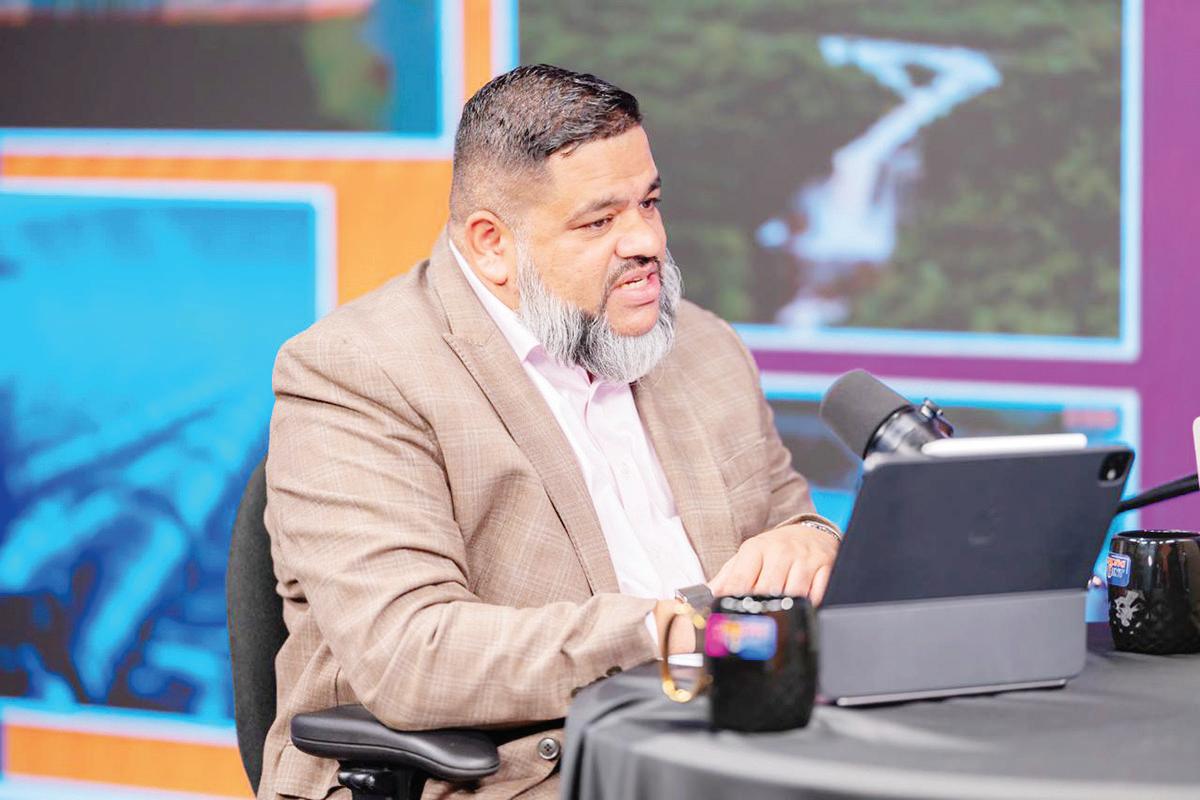
This is according to the hospital’s Chief Executive Officer (CEO), Robbie Rambarran, who made an appearance on the Starting Point Podcast over the weekend.
“It's not an easy task. It's Georgetown Hospital. It’s very complex. As you know, there are lots of departments, there are actually 74 different departments in the hospital.”
Rambarran noted that the task is no easy feat, but the aim is ultimately to address the redundancies that
often arise due to manual paper trails.
“First, we have to do a process; mapping documents…[and] state how we want the system to be. We don't want to design an electronic health record system with the same manual system that we have,” he said adding:
“There are many areas that we can improve. There are many redundancies that happen because of our paper trail and documentation, but it will make the system more lean, more logical, more coordinated.”
He noted that the software being used is generic and will have to be customised to fit the needs of the Georgetown facility.
“We have revised that, so we're looking at about two years, two and a half years. So, let's assume by mid next year we should be able to complete it,” Ram-
barran said, noting that the IT infrastructure has already been completed.
To ensure proper implementation, he noted that there is a whole framework of implementation, a governance committee, a steering committee, and an advisory committee at every different segment of the operation.
“What takes the time is actually designing that software that meets our needs, and [ensuring] it's lean, it's efficient, staff friendly, and patient friendly as well,” he added.
Once completed and fully operational, Guyanese across the country will be able to access their medical records and medical test results directly from their mobile devices.
The digitisation agenda is expected to significantly improve the quality of healthcare services by reducing waiting times, streamlining patient movement between departments, and ensuring more efficient access to medical information.
The long-term objective
is to establish an interconnected public healthcare system with seamless access to patient records nationwide. The Ministry of Health also plans to collaborate with private healthcare providers to facilitate smoother transfers between the public and private sectors.
FESTIVAL CITY
At the Festival City Polyclinic in Georgetown, the government has successfully implemented electronic medical records.
At the official launch
last year, the government also introduced the online patient booking system. Through the system, patients can book appointments and services remotely using a computer or mobile phone, significantly reducing waiting times at the facility.
Among the key benefits of the eHEALTH system are: faster and more coordinated patient care; reduced waiting times at health facilities and strengthened public trust in the secure handling of health data.
GPHC’s CEO, Robbie Rambarran
Fire destroys Water Street workshop
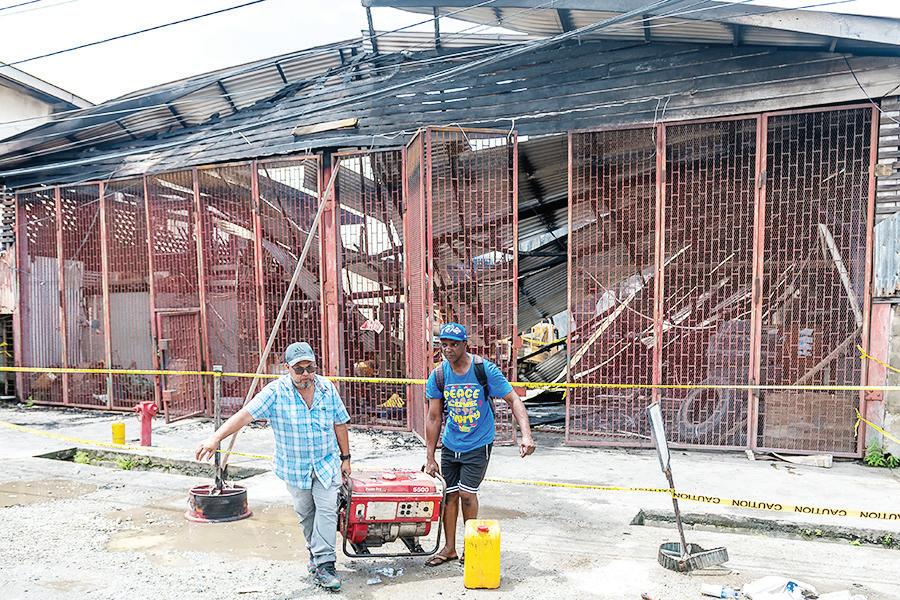
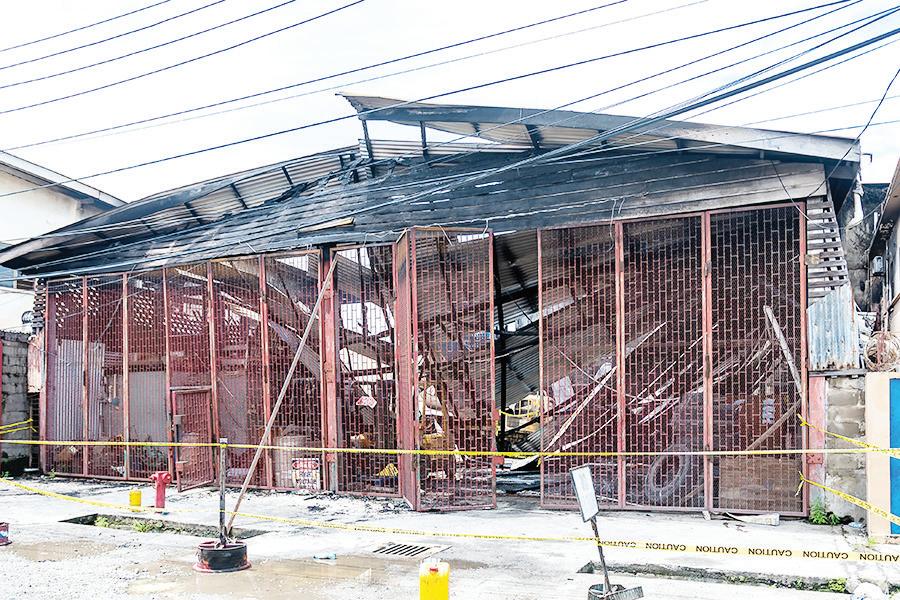
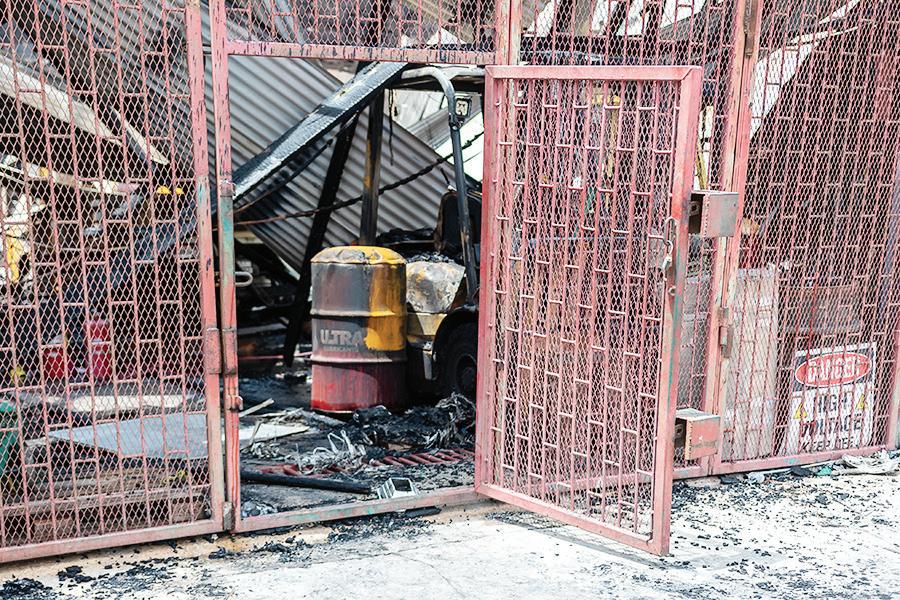
A FIRE of unknown origin on Sunday completely destroyed the lower flat of a building that housed a workshop operated by the Demerara Shipping Company and was owned by Demerara Distillers Limited (DDL).
The early-morning blaze occurred at Lot 6-12 Water and Schumaker Streets, Georgetown.
Eyewitness Shane Singh told the Guyana Chronicle that other truck drivers, who were parked near the building, alerted him to the fire around 04:00hrs.
Singh said he rushed to remove his vehicle after hearing loud explosions and almost immediately seeing flames, which quickly en -
gulfed the building.
This publication was told that several vehicles were parked in the compound and that several bottles of propane gas were also being stored there.
Singh stated that firefighters did all they could but were hampered by the explosions.
He disclosed that the
building was a two-storey edifice that housed a workshop for servicing/repairing vehicles owned by the company.
Singh related that he along with more than 40 truck drivers would normally be parked in the area, waiting for their load of stockfeed.
He said the firefighters worked quickly to contain the blaze which threatened nearby buildings, most of
which are aged. He commended them for their efforts.
Buildings which housed several small businesses and the now-defunct Herman Bholaisingh tailor shop are located nearby. One of the buildings sustained minor damage.
Chief Fire Officer Gregory Wickham could not be reached for a comment. A
spokesman for DDL said the fire reportedly started in the generator room of the workshop, but he could not give any other details. He stated that the incident is currently being investigated. Meanwhile, managers of the company that operated the workshop declined to comment when approached.
Venezuelan man injured in Parika shooting
THE police in Regional Division # 3 are investigating a shooting incident which occurred on Saturday, May 30, 2026, about 23:30hrs at Parika, East Bank Essequibo, during which a 20-year-old Venezuelan construction worker of Zeelugt, East Bank Essequibo, was injured.
According to the police, investigations revealed that a 62-year-old farmer of Parika, East Bank Essequibo, was at home when he
reportedly heard a sound coming from his front door.
“Further enquiries disclosed that the farmer, who is a licensed firearm holder, later observed the 20-yearold male under a shed on his property. During the incident, two rounds were discharged from the firearm, which resulted in the 20-year-old receiving injuries to his upper right abdominal area.
“The injured man was escorted to the De Kinderen
Regional Hospital where he was seen and examined by a doctor on duty and admitted a patient,” the police said.
The farmer later reported the matter to the police and the licensed firearm along with five live rounds and two spent shells were lodged pending an investigation.
Several persons were questioned and statements are being taken as part of the investigation, the police added.
Motor car collides
with police motorcycle at Hague
THE police are investigating a serious accident which occurred on Sunday, May 31, 2026, about 12:03hrs on the Hague Public Road, West Coast Demerara, involving a GPF motorcycle #CR 6252, driven by a police corporal attached to Regional Police Division # 3 Traffic Department and motor car #PPP 758, driven by a 39-year-old man of Parfaite Harmonie, West Bank Demerara.
According to a police statement, preliminary investigations revealed that
motor car #PPP 758 was stationary on the northern side of the roadway, facing east, when the driver reportedly made a U-turn across the road and collided with force motorcycle #CR 6252, which was proceeding east along the northern side of the Hague Public Road.
As a result of the collision, the motorcyclist was flung over the motor car and fell onto the road surface, where he sustained injuries about his body, the statement said.
The injured rank was picked up by public-spir-
ited persons in a conscious condition and taken to the Leonora Cottage Hospital, where he was seen and examined by a doctor on duty.
He was later transferred to the De Kinderen Regional Hospital for further medical attention.
A breathalyser test was conducted on the driver of motor car #PPP 758 and no trace of alcohol was detected, the police said, adding that the driver is presently in police custody assisting with an investigation.
Several pieces of equipment were removed from the workshop before it was completely destroyed
The aftermath of the fire
From horse racing to high-quality small ruminant breeding
By Michel Outridge
IN the quiet agricultural community of Number 46 Village, Corentyne, Berbice, a young farmer is steadily transforming his passion for livestock into a model of innovation, resilience, and agricultural entrepreneurship.
At only 25 years old, Prem Ramsaywack has emerged as one of Region Six’s promising small ruminant breeders, demonstrating how youth involvement, scientific livestock management, and institutional support can contribute meaningfully to Guyana’s rapidly expanding agriculture sector.
Ramsaywack’s journey into professional sheep breeding began during the COVID-19 pandemic in 2020, a period that disrupted many traditional economic activities across Guyana.
An avid horse racing enthusiast at the time, he had invested heavily in racehorses and the sport itself. However, with horse racing temporarily halted during the pandemic, he was compelled to seek alternative avenues for income generation and longterm investment.
Coming from a family deeply rooted in livestock farming, the transition into small ruminant production was both natural and strategic.
Raised around cattle, sheep, and goats, Ramsaywack was exposed from an early age to the discipline, sacrifice, and commitment required for successful farming.
His father, a cattle farmer who also reared small ruminants and dairy cows, played a significant role in shaping his appreciation for quality livestock production and animal husbandry.
Interestingly, Ramsaywack’s passion for agriculture was also nurtured academically. He was an outstanding Agriculture Science student at Berbice High School and demonstrated a keen interest in livestock production from an early age.
Although circumstances beyond his control prevented him from completing his formal studies and graduating, he never allowed that setback to define his future or limit his ambitions.
Instead, he channeled his energy into practical farming, continuously learning through
experience, observation, and technical training.
Today, he strongly believes that while traditional farming knowledge remains invaluable, the future of Guyana’s livestock industry depends on the successful fusion of traditional practices with scientific and technical innovation.
According to Ramsaywack, modern agriculture requires farmers to be adaptable, informed, and willing to embrace improved production systems.
Starting modestly with only two pregnant Dorper ewes, Ramsaywack gradually developed a breeding programme focused on genetic quality rather than quantity.
Today, he maintains a carefully managed core flock consisting of 25 breeding ewes and one high-quality breeding ram, supported by replacement stock that ensures continuity and genetic improvement within the herd.
His operation aligns closely with the Government of Guyana’s broader agricultural diversification agenda under the leadership of President Irfaan Ali and the PPP/C Administra-
tion, which has placed significant emphasis on strengthening national food security, increasing livestock production, and advancing the development of the small ruminant industry.
Through targeted investments, technical extension services, and farmer support programmes, the government has encouraged young entrepreneurs to enter agriculture and contribute to Guyana’s ambition of becoming a major regional food producer.
VALUABLE CONTRIBUTION
For Ramsaywack, sheep breeding is not merely a business venture, but a strategic contribution to the country’s food production capacity.
His primary focus is the breeding of high-quality crossbred animals using the Dorper sheep, a breed widely recognised for its adaptability, rapid growth, and meat production characteristics.
He explained that his ultimate ambition is to become one of the leading private small ruminant breeders in Region Six while contributing significantly to the growth and professionali-
sation of the industry in Berbice.
Prem’s passion for Dorper cross-bred sheep stems largely from a desire to support farmers and consumers alike by improving access to quality breeding stock and increasing the local supply of affordable mutton.
According to Ramsaywack, there remains substantial opportunity within Guyana’s livestock sector for young entrepreneurs willing to invest in efficient breeding systems and modern farm management practices.
“As a young entrepreneur, I see tremendous opportunity in supplying quality food for both the local and regional markets through breeding programmes that focus on productivity, genetics and sustainability,” he noted.
GLDA ASSISTANCE
A critical component of his success has been the adoption of improved feeding and pasture management systems.
Through this collaboration, he has been able to refine supplemental feeding strategies tailored specifically to the nutritional requirements of his flock.
As a young farmer, Ramsaywack openly acknowledged the critical role that institutions
Ramsaywack places strong emphasis on nutrition, maintaining a feeding regime that consists of approximately 60 per cent forage, complemented by carefully formulated supplemental rations incorporating locally available feed resources. These include rice bran and molasses-urea blocks, all of which contribute to reducing dependency on imported feed materials while improving overall production efficiency. Recognising the importance of scientific feeding practices, Ramsaywack works closely with nutrition specialists attached to the Guyana Livestock Development Authority (GLDA), particularly through the agency’s Nutrition Laboratory located at Mon Repos.
TURN TO PAGE 18
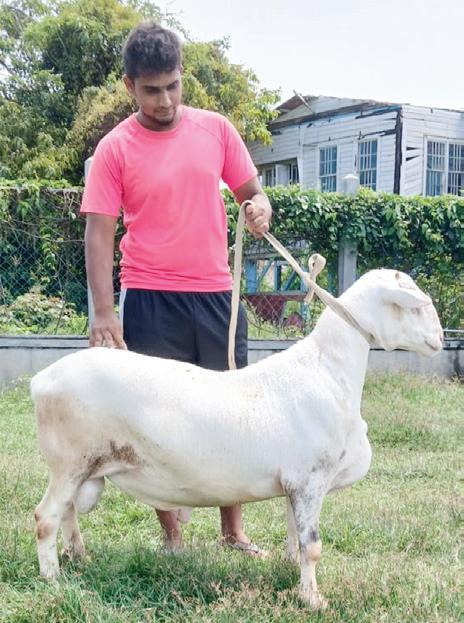
Prem Ramsaywack and his Dorper ram sheep
- Prem Ramsaywack highlights his innovative, resilient, entrepreneurial spirit
From horse racing to high-quality small ruminant...
such as the GLDA play in supporting the growth and sustainability of Guyana’s livestock industry.
He believes agencies like the GLDA are indispensable in helping young farmers gain access to technical expertise, scientific guidance, and practical support needed to modernise agriculture.
He explained that young farmers often possess passion and determination but require technical direction and institutional support to maximize their potential and avoid costly mistakes.
One of the most significant
challenges facing his expanding operation was the establishment of adequate pasture to sustain a growing number of animals.
Initially attempting to develop the pasture independently, Ramsaywack encountered several difficulties related to soil suitability and forage establishment.
Recognising the importance of proper pasture management to the long-term sustainability of his operation, he reached out directly to Dr. Dwight Walrond, Chief Executive Officer of the GLDA. According to Ramsaywack, support was rendered without delay.
Under the guidance of the
GLDA’s technical team headed by Mr. Norbert Felix, Livestock Officer responsible for pasture development, Ramsaywack was able to transform five house lots acquired during the third quarter of 2025 into productive grazing land.
The development programme incorporated forage species including Pangola grass, Tanner grass, Antelope grass, and African Star grass, all selected for their adaptability to Guyana’s climatic conditions and their high nutritional value for ruminants.
Ramsaywack expressed deep appreciation for the professional guidance and technical
support provided by the GLDA throughout the process.
He noted that the intervention not only resolved his pasture challenges but also exposed him to practical knowledge in forage establishment, soil preparation, and sustainable livestock management.
For him, pasture management has become one of the most critical aspects of his farming operation because of the central role forage plays within his feeding programme.
The establishment of quality pasture has significantly enhanced the farm’s productivity while reducing feeding costs and dependence on imported
feed materials.
“The support from GLDA has been exceptional. The process taught me a great deal about pasture management, nutrition, and proper livestock systems. The pasture we established is now helping to move the farm toward becoming more efficient, more productive, and less dependent on imported feeding materials,” he explained.
He further highlighted the valuable extension support he continues to receive from the Region Six extension team headed by Ms. Shellon David, noting that extension officers play a vital role in the continued development and monitoring of livestock farms within the region.
Like many progressive breeders, Ramsaywack also pays close attention to genetic management and inbreeding prevention.
Following each lambing season, lambs are immediately separated at the weaning stage, typically around three months of age to prevent uncontrolled breeding.
Young rams are then carefully evaluated and prepared for sale to farmers, including customers from as far as the Essequibo Coast in Region Two.
To maintain high genetic standards within the flock, breeding rams are only utilised for two mating seasons before replacement.
This management practice ensures continued improvement in carcass quality, growth performance, and overall herd productivity.
The farm currently experiences two lambing seasons annually, allowing for consistent production and steady supply to the market. Ramsaywack’s elevated housing system for the sheep also reflects his focus on efficient management and adaptation to Guyana’s tropical climate.
Elevated pens not only maximise the use of limited land space but also improve drainage, ventilation, and animal health.
His commitment to excellence has already earned him national recognition. During the Annual Small Ruminant Expo hosted by the GLDA at Rising Sun Turf Club, West Coast Berbice, Ramsaywack captured the prestigious Best Replacement Ram title, an achievement he described as one of the proudest moments in his farming career.
For him, the experience of participating at the Annual Small Ruminant Expo was excellent since it allowed him the opportunity to market his animals and network with other farmers and breeders.
He is looking forward to this year’s competition and is working ardently to secure the
title as champion breeder.
With evident pride, he reflected on the significance of the award and the motivation it has provided for continued improvement within his breeding programme.
Looking ahead, Ramsaywack is preparing to further diversify and expand his operation. He disclosed that he is eagerly looking forward to incorporating the Barbados Black Belly sheep into his breeding programme as part of efforts to improve adaptability and genetic diversity within his flock.
Additionally, as part of his long-term expansion strategy, he intends to venture aggressively into Boer goat farming, another area he believes holds strong commercial potential within Guyana’s evolving livestock industry.
Beyond his personal ambitions, Ramsaywack is also encouraging more young people to pursue careers in agriculture and agribusiness.
He believes Guyana’s rapidly expanding Oil and Gas economy will create sustained demand for food production and agricultural products, thereby opening significant economic opportunities for farmers and agro-processors.
He further noted that the policies implemented under the leadership of President Irfaan Ali and the PPP/C Government continue to create an enabling environment for youth entrepreneurship and agricultural development.
According to Ramsaywack, agriculture remains one of the most promising sectors for young Guyanese seeking longterm economic opportunities, particularly in livestock production where local and regional demand continues to expand steadily.
The story of Prem Ramsaywack represents more than the success of a single farmer; it reflects the growing transformation taking place within Guyana’s livestock sector.
Through strategic government support, access to technical expertise, and the dedication of young agricultural entrepreneurs, the country’s small ruminant industry is steadily positioning itself as an important contributor to food security, rural economic growth, and regional agricultural development.
For Ramsaywack, however, the journey is only beginning. Armed with determination, technical knowledge, and a passion for livestock breeding, he remains focused on building a sustainable enterprise capable of supplying high-quality breeding stock and supporting the continued advancement of Guyana’s agricultural sector for years to come.
RACING
CRICKET QUIZ CORNER
(Monday, June 01, 2026)
CUMMINGS ELECTRICAL COMPANY LTD., 83 Garnett Street, Campbellville, Georgetown (Tel:225-6158)
Answers to yesterday’s quiz: (1) LSG (2) RCB
Today’s Quiz: (1) How many games MI lost in IPL 2026? (2) How many did CSK lose?
Answers in tomorrow’s issue
Kohli, bowlers lead RCB to second straight IPL title
(ESPNCRICINFO) - It took them 18 years to win their first title, but Royal Challengers Bengaluru (RCB) took no time in becoming only the third team to successfully defend it. Their seam bowlers made superb use of a slightly sticky surface after Rajat Patidar won the toss, restricting Gujarat Titans (GT), who were in their third final in five years of their existence, to 155, the exact same score RCB managed in the league match against the seam team in the same ground on the same
pitch No. 6 bang in the middle of the square.
Josh Hazlewood, who has never lost a T20 or ODI final, set the tone with the wicket of Shubman Gill in his first over.
Bhuvneshwar Kumar momentarily reclaimed the purple cap with two wickets, and Rasikh Salam capped off his best IPL with three to take his tally for the year to 19. Last final's Player of the match, Krunal Pandya, who won his fifth IPL final out of five, also chipped in with the big wicket of Jos Buttler in his analysis of 4-023-1. He is now behind
only Rohit Sharma and Ambati Rayudu in number of titles, and is also the first player to successfully defend a title with two different teams.
Only three out of 26 scores under 190 in a full match had been defended successfully this IPL. With the ball still nibbling around, the best attack in the tournament would have thought they had a chance, but amid falling wickets, Virat Kohli chose this final to hit his fastest IPL fifty and his highest playoff score, leading a five-wicket win with two overs to spare.
Get the openers
Gill and B Sai Sudharsan came into the final as the only pair of batters from the same team to have scored 700 or more runs in the same IPL. However, they were up against bowlers that have troubled them in the past. A cagey start ensued, Gill survived the Bhuvneshwar over, but Hazlewood had him top-edging his signature short-arm pull.
GT promoted Nishant Sindhu to No. 3 to protect Buttler from Bhuvneshwar, but the wily bowler made sure Buttler had to come out as he took out Sud -
harsan in his second over. He first beat Sudharsan on the charge with a bouncer before continuing with another, this one taking the toe end on the ramp.
Vaibhav Sooryavanshi, in attendance in Ahmedabad, was now assured of the orange cap. This was only the fourth time this IPL that both the GT owners had been dismissed inside the powerplay, thre e of them against RCB.
Middle-overs choke
Seeing some grip from the pitch and conventional, subdued batters at the wicket, Krunal shelved all his fancy change-ups and
bowled only length. His first three overs yielded zero boundaries. Salam was equally miserly at the other end, just bowling good length and enjoying the slight variations from the surface. One of those had Sindhu caught at long-on.
When Krunal started his final over, they had gone 37 legal deliveries without a boundary. Krunal expected the frustrated Buttler to try something, saw him coming and fired in a wide yorker for a spectacular stumping by Jitesh Sharma.
West Indies name ODI squad to face Sri Lanka
- Motie, Alzarri return after extended absence
CRICKET West Indies (CWI) has announced its 15-member squad for the highly anticipated threematch One Day International (ODI) series against Sri Lanka, scheduled for June 3-8 at Sabina Park in Jamaica.
The series comes at the start of a crucial stage in the West Indies campaign for automatic qualification to the 2027 ICC Men’s ODI World Cup.
Led by captain Shai Hope, the “Men in Maroon” team will also be aiming to extend their unbeaten home ODI series streak to five consecutive victories, with the
last triumph coming against Pakistan in August of last year.
The squad sees the return of fast bowler Alzarri Joseph, who had been sidelined since July 2025 by a back injury, along with Gudakesh Motie who missed the away series against New Zealand back in November.
Following his impressive performances during the recent ICC Men’s T20 World Cup, Shimron Hetmyer has been reintegrated into the West Indies ODI setup as part of CWI’s strategic build-up towards the 50-Over World Cup in October and November next year. He will
join the squad ahead of the third and final encounter.
Head Coach Daren Sammy says the team’s strong recent form at home has boosted confidence ahead of the series against a formidable opponent.
“Sri Lanka are a disciplined and skilful ODI unit, especially in conditions that demand patience and smart cricket. For us, this series is about setting the standard, intensity in the field, clarity with the bat, and consistency with the ball. We want to play fearless but intelligent cricket and continue building the identity we believe
West Indies cricket should represent.”
Sammy added that, “In our desire to make home a fortress in ODI cricket, I want the team to win moments consistently rather than relying on individual brilliance which we have stressed for the last 18 months.”
The squad arrived in Jamaica on May 31 following the conclusion of the 10-day training camp at the Coolidge Cricket Ground in Antigua.
Fans can watch the exciting action all series long
on ESPN Caribbean or listen to live radio coverage on Windies YouTube channel. For updates on the full 2026 International Home Series visit www.windiescricket.
com and follow @windiescricket on all major social media platforms.
West Indies ODI Squad Against Sri Lanka: Shai Hope (Captain), Ackeem Auguste, John Campbell, Keacy Carty, Roston Chase, Matthew Forde, Justin Greaves, Shimron Hetmyer, Amir Jangoo, Alzarri Joseph, Shamar Joseph, Gudakesh Motie,
Sherfane Rutherford, Jayden Seales, Shamar Springer, Team Management Unit (TMU): Head Coach: Daren Sammy, Manager: Rawl Lewis, Assistant Coach (Batting): Floyd Reifer, Assistant Coach (Bowling): Ravi Rampaul, Assistant Coach (Fielding): Rayon Griffith, Physiotherapist: Dr Denis Byam, Strength & Conditioning Coach: Darc Browne, Massage Therapist: Harone Jackson, Performance Analyst: Avenesh Seetaram, Content & Media Officer: Jerome Foster
GBA’s Development Tournament at National Gymnasium
Andrew Lewis Gym is Best Gym, Daniels adjudged Best Coach
GBA’s Development Tournament at National Gymnasium
Andrew Lewis Gym is Best Gym, Daniels adjudged Best Coach
By Sean Devers
AT a sparsely populated National Gymnasium on a windy Saturday night, the Andrew Lewis Boxing Gym located in the heart of Albouystown was adjudged the best Gym of the one-night Guyana Boxing Association’s (GBA’s) Development Tournament at the National Gymnasium.
The New Amsterdam Boxing Academy (NABA) took the runners-up position while the GBA’s National Boxing Coach Lennox Daniels was adjudged the tournament’s Best Coach.
Also receiving Best Boxer awards were: (Abu Barker U13), (Josh Chester U15), (Lennox Lawrence U17), (Ken Harvey U19), (Ken Harvey U20)
The 13-year-old Chester, fighting out of the Champion Gym (ALBG), was clinical in his destruction of Harpy Eagles’ Travalta Harris.
The talented Chester demonstrated excellent technique as he floored Harris in the first round with lightning-fast combinations to the head and body, as the referee rushed in to stop the fight and save Harris from further punishment.
Chester, boxing in the U15 45-48Kgs category, looks like one for the future if handled properly and remains focused on his boxing and schoolwork.
The most entertaining bout of the night was the U19 bout in the 74-77Kgs division between Lekiem Amores from ALBG and Berbician Jofes Jackson, representing the NABA.
The pair went toe to toe in a high-intensity fight, in which lots of punches were thrown from all angles.
Jackson was caught with a wicked right to his head guard, but retaliated with some good shots of his own to bring the spattering of spectators to their feet.
When the dust had settled after three exciting rounds, there was not really much difference between the pugilists.
However, it was Jackman from the Gym in Guyana’s first town, who won by a split decision in a riveting contest that could have been adjudged a draw.
During the presentation, GBA’s Seon Bristol, on behalf of former boxer Wilfred
Skeete, presented boxing gear to the 18-year-old Ken Harvey for his Bronze Medal at the Youth South American Games in Panama.
Exh. Bout #1: Teddy Darlington (P & P) vs. Arjun Behari (RHJ) #2: Janya Ross (P & P) vs. Makaya Ross (P & P) (female) #3: Akela Massay (ALBG) vs. Kenisha Klass (P & P) (female)
Bout #11 U19 57 – 60Kgs: Nathan Christopher (RHJ) vs. Amol Moses (NABA)
Blue won by disqualification. Bout #12 U19 63 – 66Kgs: Hotham Vancooten (NABA) vs. Izzla Vanderstoop (ALBG) Blue won after a stoppage in Rd.#1.
Bout #13 U19 63 – 67Kgs: Curtis Mc Donald (NABA) vs. Ken Harvey (ALBG)
Blue won on points.
Bout #14 U19 74 – 77Kgs: Lekiem Amores (ALBG) vs. Jofes Jackson (NABA)
Blue won on points. Bout #15 U19 57 – 60Kgs: Akeeme Ross (P & P) vs. Keyon Medas (P & P) Red won on points.
Bout #16 U20 67 –70Kgs: Terron Wintz (NABA) vs. Patrick Harvey (FYF) Blue won on points.
Bout #17 U20 69 – 71Kgs: Simeon Hamer (ALBG) vs. Osais Prince (POL) Red won on points
TG Titans Cricket Team set for Tobago tour
(GEORGETOWN, Guyana
– May 28, 2026) – THE TG Titans Cricket Team is gearing for a bilateral series against several cricketing counterparts in the Twin Island Republic.
The cricket tour to Tobago from June 3–8, 2026, will see the team will contest three matches against top opposition. During the tour, the Titans will play two matches against Club Crusoe Cuzins, comprising one 40-over match and one T20 encounter, while also facing
Tobago Legends in an additional T20 fixture.
The tour forms part of the team’s ongoing efforts to provide players with regional exposure and strengthen cricketing ties within the Caribbean.
Club Crusoe Cuzins, reformed in 2010 after an extended hiatus and had a short period of inactivity for a few seasons but is back with new management and sponsorship. Former captain Jason Persaud, through his Cuzins franchise and newly acquired sponsorship support, is
leading the team’s return ahead of the upcoming 2027 season.
Persaud, during a conversation with Tourism Guyana representatives, explained that the club’s renewed direction is heavily focused on youth development and long-term sustainability.
“The team lacked the vision of youths for the future, and that is my main focus going forward,” Persaud stated.
He also expressed appreciation to Tourism Guyana and acknowledged the
friendships built with several Tobago-based players, which helped make the tour possible.
Team management has also extended sincere gratitude to the sponsors and partners whose support has made the trip a reality. The team acknowledged the contributions of Sonrize Engineering, BEEPATS, Igloo, Jaigobin Hotel, Papa John’s, Autopit Signs, Dave’s Guyanese Cuisine, and the Ministry of Culture, Youth and Sport for investing in sports
and youth development.
Meanwhile the TG Titans, established in 2024 as a tape ball playing team, elevated their status to the hardball arena last year through several exhibition games and round robin tournaments.
The highlight of their brief but fruitful foray into the hardball arena came with the winning of the Ogle Cricket Club One Day cricket extravaganza.
According to team officials, the tour presents an excellent opportunity for players
to gain valuable experience while showcasing their abilities against competitive regional teams.
“The support from our sponsors has been tremendous and has allowed the team to embark on this important tour. We are excited for the opportunity to compete in Tobago and proudly represent Guyana,” team representatives noted.
The team is scheduled to depart Guyana on June 3 and return on June 8, 2026.
Terron Wintz (right) defeated Patrick Harvey on Saturday night at the National Gymnasium (Sean Devers photos)
West Ruimveldt Primary reign supreme in Demerara Zone of Future Warriors Tapeball
WEST Ruimveldt Primary, a consistent face in the Future Warriors Tapeball for Primary Schools tournament, powered by ExxonMobil Guyana, overcame their final-round jitters from previous years to surge to the Demerara zone title on Sunday at the National Stadium, Providence.
Having previously stumbled in the final rounds in yesteryears, West Ruimvelt chose the grandest stage to deliver its most complete performance.
Blunting Chateau Margot's reputation as the tournament's preemi-
The foundational bricks of West Ruimveldt’s championship-winning total were laid by Bryan Hunter, who smashed a brisk 12-ball 23, punctuated by three boundaries and a solitary six.
Skipper Steven Orie provided the perfect foil with a crucial 18, ensuring the run rate never dipped despite Mahendra Chunilall’s probing spell of 2 for 10.
Chateau Margot’s pursuit never found its rhythm against a relentless West Ruimveldt attack.
Rohit Shama top-scored with just five as Vincent Farley (2 for 5) and the ubiquitous Orie (2 for 8)
Part of the action in the high-octane final between West Ruimveldt Primary and Chateau Margot Primary at the National Stadium, Providence on Sunday
nent 'chase masters,' West Ruimveldt posted 66 for 4—the highest total of the competition—before producing a clinical bowling display to choke the East Coast Demerara outfit to a paltry 40 for 7.
triggered a procession of wickets.
Orie capped off a sensational individual campaign as the tournament’s leading run-scorer with 49 runs, alongside a three-wicket haul that
rightfully earned him the Most Valuable Player award. Farley finished as the tournament's leading wicket-taker with five scalps.
Earlier in the day, West Ruimveldt signalled its
West Ruimveldt Primary are the 2026 Champions of the Demerara Zone in the Future Warriors Tapeball for Primary Schools, powered by ExxonMobil Guyana
intent in the first semi-final by dismantling Rama Krishna Primary.
A combined bowling effort from Farley (2 for 3), Hunter (2 for 7), and Zyron Austin (2 for 12) restricted Rama Krishna to 36 for 8, before Orie’s steady 10 steered them into the final.
Chateau Margot’s route to the final was far more dramatic. They pulled off yet another signature chase against former champions Stella Maris, hunting down a target of 52 with five wickets and seven balls to spare.
Ezekiel Thomas’ unbeaten 18 and Clevon Jacobs’ 16 had originally lifted Stella Maris to 51 for 2, but Wazim Khan’s ice-cool, five-ball 10*
sealed an emphatic win for Chateau Margot.
Stella Maris eventually found consolation in the third-place playoff, bossing a 51-run chase against Rama Krishna to win by seven wickets inside 5.3 overs.
Jeremiah Scott’s blistering 24 off 13 balls and Joshua Horatio’s cameo of 14 off 7 rendered Michail Nelson’s earlier 12 for Rama Krishna obsolete.
All four top schools received a bag of cricket equipment, an electronic tablet for scoring, and agility kits to support their continued interest in the sport, along with medals and trophies.
The highly competitive Demerara leg featured 16 schools, including Grove
Primary, Supply Primary, La Grange Primary, Meten-Meer-Zorg Primary, St. Pius Primary, Winfer Gardens Primary, Enterprise Primary, Comenius Primary, Redeemer Primary, Camille’s Primary, ISA Islamic and School of the Nations.
The grassroots caravan now shifts to the Berbice zone at the historic Albion Sports Complex on June 13-14, followed by the Essequibo zone at the Anna Regina National Stadium on June 20-21.
The three regional champions will then collide in a blockbuster 'Champion of Champions' tournament slated for August/September.