10th JUNE, 2018
Greater generating capacity No.105301
–– several solar, wind and hydro projects to be completed by 2020 03 PAGE
1.4 million pounds of 02 ganja destroyed PAGE
Businessman allegedly 10 rapes girl, 9 PAGE
More men abused by women 10 seeking protection PAGE
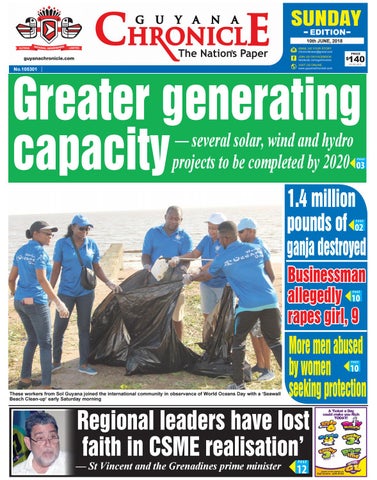
These workers from Sol Guyana joined the international community in observance of World Oceans Day with a ‘Seawall Beach Clean-up’ early Saturday morning
Regional leaders have lost faith in CSME realisation’
–– St Vincent and the Grenadines prime minister
PAGE
12
2
SUNDAY CHRONICLE June 10, 2018
Ten-Pow to serve 1.4 million pounds as a VP of 73rd UN of ganja destroyed –– alone in Berbice during past five General Assembly months, reports divisional commander
GUYANA has been elected by acclamation as a Vice-President of the upcoming 73rd United Nations (UN) General Assembly, a statement from the Ministry of Foreign Affairs said Friday. Also elected were Algeria, Burkina Faso, Cambodia, Cyprus, Democratic Republic of the Congo, Gambia, Iraq, Japan, Namibia, Panama, Qatar, San Marino, Spain, Sudan and Ukraine, along with five permanent members of the Security Council — China, France, Russian Federation, United Kingdom and the United States. Rudolph Michael TenPow, who currently serves as the Permanent Representative and Ambassador Extraordinary and Plenipotentiary of Guyana to the United Nations will take up the position. Ambassador Ten-Pow began his career in the Foreign Service of Guyana in 1980 as Desk Officer for Venezuela and later Head of the Frontiers Division.
By Jeune Bailey Van Keric
Permanent Representative and Ambassador Extraordinary and Plenipotentiary of Guyana to the United Nations, Ambassador Rudolph Michael Ten-Pow He joined the United Nations in 1986 as a Translator from French and Spanish and served for a number of years at the Economic Commission for Latin America and the Caribbean (ECLAC) in Santiago, Chile. Upon his return to Headquarters in 1991, he served successively as Reviser, Training Officer, Chief of
the English Translation Service and acting Director of the Documentation Division of the United Nations. During the period 20132015, he joined the World Bank in Washington, DC as Senior Programme Manager for Conference Services, returning to the United Nations in 2015 as acting Director of the Documentation Division and later as Special Adviser to the United Nations Coordinator for Multilingualism. Ambassador Ten-Pow has served as Guyana’s Permanent Representative to the United Nations since 2016.
POLICE in Berbice have destroyed in excess of one million pounds of ganja during exercises within the Canje and Berbice riverine areas in the past five months, Divisional Commander, Assistant Commissioner Lyndon Alves has reported. He said in the drug fight, his goal is to reduce the suppliers which in turn will reduce the demand for drugs. And, in so doing, the division will continue to target large-scale operations in the Canje and Berbice river communities as well as known drug houses. As a result of the raids, ranks found and destroyed 18 fields in which there were 1,321,430 plants measuring between four inches to six feet. The plants weighed 665,000 kilograms or 1,466.074lbs In addition, Alves said, two outboard motor engines were seized, along with seven firearms, including five shotguns and two pistols. The gangs, which operated within the riverine community, targeting specifically floating shops, have since been dismantled following an intelligence-led attack, which left two bandits dead on March 2. On that day, Indrajit ‘Danny’ Sham, 37, of Betsy Ground, and Amar ‘Punk’ Bissoon, 21, of Adelphi Village, both East Canje areas, were shot after police intercepted a boat in the Berbice River. Based on further information, ranks
proceeded to another location where they discovered several bounded sheep and other items within a camouflaged aluminum boat. But, as ranks exited their boat, they came under fire and in responding, two men were fatally wounded. Since the slaying of Sham and Bissoon and the subsequent arrest and the prosecution of three other persons, there have been no more reported cases of robbery attacks on floating shops, boasted the commander. During the period under review, Berbice River business couple, Frank and Cheryl Gladstone were robbed of their gold jewellery, cash and mobile phone, moments after being awakened from their sleep at the New Amsterdam Municipal wharf. It is customary for the couple to sleep in their wooden motorized vessel whenever they travel from their home at Kimbia, Berbice River to New Amsterdam where they would make purchases of dry goods and other items, which would then be resold to residents of riverine communities, as they traverse the waterway on their return trip home. Another reported robbery had been committed on Randy Gladstone, his wife Donna and their daughter Russell, of Maria Henriette, Berbice River. They had to plunge from their floating shop into the murky Berbice River after they were attacked by six gun-totting bandits. The family was robbed of items totally just under $1M.
Greater generating capacity
3
SUNDAY CHRONICLE June 10, 2018
–– several solar, wind and hydro projects to be completed by 2020
PUBLIC Infrastructure Minister David Patterson on Friday announced that several renewable energy projects involving solar, wind and hydro and amounting to some 30 megawatts will be completed by 2020. At the end of this year, some five megawatts of renewable energy would have been installed, representing just about five per cent, the minister said. “By the end of 2020, it will be about 30 megawatts -- we are well on our way to achieving our target of becoming 100 per cent renewable energy— we have made progress,” he told reporters. Speaking at a joint post-Cabinet press conference, Minister Patterson said these will be constructed in the three new towns--Bartica, Lethem and Mabaruma--as well as Mahdia and several interior locations. In Bartica, a 1.5-megawatt solar farm, with storage, will be constructed with funding provided by the Inter-American Development Bank (IDB) at a cost of US$3.87M. The project will commence sometime this year and will last for 18 months. Feasibility study is being completed. A micro hydro power project of one megawatt will be constructed at Itiribisi with funding under the Guyana REDD Plus Investment Fund (GRIF) at a total investment cost of US$5.22M. The time frame for implementation is two and a half years. Technical and economical assessments and other studies are ongoing at the site. For Lethem, he said a one-megawatt farm with storage will be constructed though a US$2.6 million IDB loan. This project, he
noted, should be completed in 18 months. The Public Infrastructure Minister said too that a 2.2 megawatts dual hydro-system, using the Moco Moco and Kumu Falls, will be constructed. The funding will be received through the United Arab Emirates and the GRIF. The project time is two and a half years. The total investment for Moco Moco is US$2.2M while US$6.42M will be invested for the Kumu Falls. A site visit to Moco Moco is scheduled for the near future and a geotechnical study, which is funded by the IDB, is presently ongoing. That report will be received in the third quarter of this year. In Mabaruma, the installation of a 0.4-megawatt solar farm with storage is ongoing with funding of US$1.3M provided through the national budget. This project, the minister said, is slated to be completed in August. For Mabaruma as well, there will be a micro-hydro power 0.2 megawatts and that is being funded by the National budget and GIZ Rita, a small project about US$200,000 and construction commences in the 3rd quarter of 2018 and should be completed next year. A US$1.8M Photovoltaic system will be constructed within 18 months in Mahdia. And government has given private developers up to the end of July to secure financing for the 2.2-megawatt Tumatumari hydro project. Minister Patterson said Government will enter a power purchase agreement with the company if they are successful. If not, the government will take over the project, which is anticipated to cost US$4.4M. The project is currently with a private
developer, Tumatumari Holding Inc. “It has been with them for quite a while. They said that they are about to do financial closure. We have given them up to the end of July, 2018, to reach financial closure with their investor,” he said, before adding that if the developer is unable to reach financial closure, government will take over the project, thereby making it one of its priority projects. Meanwhile, a utility-scale, four- megawatt PV system, outfitted with a substation and funded through a grant from the Chinese government, will begin later this year on the West Coast Berbice. A feasibility study is currently being conducted and a Memorandum of Understanding (MoU) has already been signed. Funding has also been secured to commence the hydro project in Kato, in Upper Takutu-Upper Essequibo (Region Nine) and the Hope Beach Wind Farm project remains on the cards. Patterson informed that funding has been secured for solar farm projects at Port Kaituma, 0.6 megawatt; Kwakwani, 1 megawatt; and Matthews Ridge, 0.4 megawatt. Kwakwani will cost US$2.6 million, Port Kaituma US$1.8 million and Matthews Ridge US$2 million. Further, Minister Patterson said, as a member of the International Solar Alliance (ISA), Guyana will benefit from a US$15M line of credit, from which government plans to power several Indigenous communities. The Ministries of Indigenous Peoples’ Affairs and Communities have been tasked with identifying these villages. These, he noted, will be utility scale installations
Minister of Public Infrastructure, David Patterson rather that roof top solar, to ensure entire villages are powered. It is anticipated that 4 megawatts of power will be achieved from that project. Some US$7.7M has been invested in renewable energy since 2017, Patterson said while noting that since taking office in 2015, the APNU+AFC coalition government emphasised the need for renewable energy here. The aforementioned projects were done in collaboration with the Guyana Energy Agency (GEA), the Hinterland Electricity Corporation, Guyana Power and Light (GPL), the Ministry of Natural Resources and the Office of Climate Change.
4
SUNDAY CHRONICLE, June 10, 2018
Trump torpedoes G7 effort to ease trade spat, threatens auto tariffs
U.S. President Donald Trump on Saturday threw the G7’s efforts to show a united front into disarray after he became angry with Canadian Prime Minister Justin Trudeau, and said he might double down on import tariffs by hitting the sensitive auto industry. Trump’s bombshell announcement that he was backing out of the Group of Seven communique, made after he left the summit in Canada early, torpedoed what appeared to be a fragile consensus on the trade dispute between Washington and its top allies. “PM Justin Trudeau of Canada acted so meek and mild during our @G7 meetings only to give a news conference after I left saying that, ‘US Tariffs were kind of insulting’ and he ‘will not be pushed around.’ Very dishonest and weak. Our Tariffs are in response to his of 270% on dairy!” the U.S. president tweeted. In his press conference, Trudeau had spoken of retaliatory measures that Canada would take next month in response to Trump’s decision to slap tariffs on steel and aluminum imports from Canada, Mexico and the European Union.
“Canadians, we’re polite, we’re reasonable but we also will not be pushed around,” Trudeau, the host of the two-day summit in La Malbaie, Quebec, told reporters. Reacting to Trump’s tweets, Trudeau’s office said: “We are focused on everything we accomplished here at the summit. The Prime Minister said nothing he hasn’t said before - both in public, and in private conversations with the President.” Trump’s salvo capped a dizzying two days of controversies that began with his suggestion Russia be readmitted to the G7, then what a French official described as a “rant” full of “recriminations” against U.S. trading partners, followed by Trump’s denial of any contention with leaders at the summit and his description of their relationship as a “10.” By ordering his representatives to back out of the communique, Trump appeared to be asserting his oft-stated aim of upsetting the status quo whether by pulling out of the global climate accord or the international nuclear deal with Iran or threats to scrap the North American Free Trade
Agreement. The communique, which appeared to have papered over the cracks that have surfaced in the G7, said the leaders of the United States, Canada, Britain, France, Italy, Germany and Japan agreed on the need for “free, fair, and mutually beneficial trade” and the importance of fighting protectionism. “We strive to reduce tariff barriers, non-tariff barriers and subsidies,” the statement said. Trump’s reversal, announced while he was en route to Singapore for a meeting with North Korean leader Kim Jong Un, sent his G7 partners scrambling. “We stick to the communique as agreed by all participants,” a European official said on condition of anonymity. Trump’s counterparts in the G7 had sought this week to try to find some semblance of consensus with Washington on trade and the other key issues that
have formed the basis of the 42-year-old grouping of industrialized nations. French President Emmanuel Macron had labeled the summit a success before Trump’s Twitter posts, saying there was relief within the G7 that an escalation of the trade dispute had been avoided. “The nature of the debate we had was rather appeasement and it stopped the escalation in terms of behavior,” Macron, who had exchanged terse Twitter messages with Trump in the run-up to the summit, told reporters. “It allowed a dialogue, where for weeks there were uncoordinated unilateral actions and non-cooperation.” Macron is aware of the latest twist on the communique and does not have a comment at this time, a French presidential official said. NERVOUS INVESTORS Trump says his tar-
iffs are meant to protect U.S. industry and workers from unfair international competition as part of his “America First” agenda. The prospect that he could be moving toward an even greater protectionist trade policy is likely to chill financial markets worried about tit-for-tit escalation that could lead to a fullblown global trade war. Trump has announced tariffs of up to $150 billion on Chinese goods over U.S. complaints of Beijing’s trade practices and its alleged theft of U.S. technology. China has vowed to retaliate in equal measure. Canada, Mexico and the EU also are moving ahead with their own levies on U.S. goods. But tariffs on U.S. imports of cars and auto parts would devastate the Canadian auto industry, which is highly integrated with the U.S. sector. They could also damage Japan and Germany.
The Trump administration announced two weeks ago that it would investigate whether auto imports hurt U.S. national security, the first step toward tariffs similar to the ones he imposed on steel and aluminum imports last week. Earlier on Saturday, Trump told reporters it would be “very easy” to make the case for tariffs on auto imports using the rationale that they threaten national security. “It’s economic. It’s the balance sheet. To have a great military, you need a great balance sheet,” he said. Such a move could make it nearly impossible to renegotiate the terms of the 1994 NAFTA pact between the United States, Canada and Mexico. On Saturday, Trump repeated his desire to have a sunset clause in an updated NAFTA deal, a demand Trudeau rejected again. (Reuters)
Sunday, June, 10 2018 –– 13:50
DATE: DATE: 26/11/2016 9/06/2018 26/11/2016 9/06/2018
23 10 11 2 12 14 12 18 19 13 22 26 02 N J 11
06 5
13 6
14 7
21 10
24 19
26/11/2016 9/06/2018
04 9
07 4
03 0
26/11/2016 9/06/2018
05 0
04 5
01 6
26/11/2016 9/06/2018 02 4 809 1510 161119132014 2118
5
SUNDAY CHRONICLE, June 10, 2018
Cuba ‘sonic attack
US tests two more Havana embassy staff The US is testing two staff members from its Cuban embassy in Havana amid concerns they may have been subjected to sonic attacks. A State Department spokesman said they were being tested for brain injuries. Last year, 24 Cuba embassy staff suffered a mysterious illness after reporting “auditory sensations”. Earlier this week the US removed diplomats from the southern Chinese city of Guangzhou, after they reported symptoms and strange sounds. The incidents have raised concerns that a government or agency may be targeting the US with a new type of sonic weapon. Cuba has denied targeting embassy staff, and the US has not blamed the country’s
The US says some two dozen staff previously based in Cuba have been affected by the suspected attacks (BBC photo)
Main suspect in customs officer’s shooting arrested THE police have confirmed that the main suspect in Thursday night’s shooting, which left two Guyana Revenue Authority (GRA) Law Enforcement and Investigation (LEID) officers nursing pellet wounds, was taken into custody Friday night. Two other suspects were held on Thursday night, while the mastermind has been identified as Andrew Motielal. Reports are that around 21:50hrs on Thursday, LEID officers were at a house at Bee Hive, East Coast Demerara speaking to the owner, when three vehicles--a Toyota Verossa and two minibuses, pulled up and its occupants began shooting at them. The GRA officers were left no alternative but to return fire, causing the assailants to speed away. The GRA said that acting on information received, around 21:00hrs, a team of officers coordinated an approach to intercept a motor vessel and motor vehicles suspected to be transporting uncustomed goods (a quantity of alcoholic beverages and foreign chicken) in Beehive, East Coast Demerara. During the exercise, the officers observed a white Toyota motorcar turning into
the street and stopping in front of the house that was
Arrested: Andrew Motielal
under surveillance. The occupants of the motor vehicle exited and proceeded to maliciously shoot
at the LEID officers with an undisclosed number and calibre of firearms. LEID officers were forced to take evasive action and defensively returned fire in the general direction of the perpetrators with their GRA-issued firearms. The perpetrators then retreated to their motor vehicle and sped away, which allowed LEID officers to regroup and exit the location safely. It was then they realised, GRA said, that two of the officers had been shot with what appeared to be shotgun pellets to their arms and leg.
The matter was immediately reported to the police. According to GRA, despite the constant threat to their lives, LEID officers of the GRA continue to fearlessly execute their duty in an effort to safeguard the country’s revenue and curb the scourge of smuggling. The Authority is enlisting the cooperation of the general public in providing information and assistance in apprehending persons involved in these illegal activities.
government for the suspected attacks. Those affected have suffered a range of symptoms including hearing loss, dizziness, fatigue, cognitive issues and sleep loss. The two latest staff members from the Cuba embassy could be “potentially new cases” but are yet to be “medically confirmed,” a US State Department official told the Associated Press news agency. They are said to have been taken to the University of Pennsylvania, where doctors are treating those with suspected injuries. Last month, the US State Department urged its staff in China to alert them to any abnormal hearing or vision issues after an employee reported mystery symptoms. (BBC News)
6
SUNDAY CHRONICLE, June 10, 2018
The Guyanese Diaspora THE scenes last week in New York where hundreds of Guyanese converged to reaffirm their commitment to country and its peoples as they celebrate this country’s 52nd Independence Anniversary was refreshing. They were out in their numbers waving their flags, singing and chanting as they move along to let the world know that they stand with their country. The organisers must be commended for putting on a very good show, though inclement weather had threatened proceedings. At an interfaith service preceding the parade, Ambassador Rudolph TenPow, permanent representative to the United Nations, invited nationals to recommit to building a new and stronger Guyana, independent and free, with people at the centre, “who will care for each other, and look out for each other as One People, One Nation, with one Destiny.” Ten-Pow recalled Guyana becoming an Independent nation on May 26, 1966, and reflected on how far we have come as a nation and what challenges lie on the road ahead of us. There is something deeply soulful when you see people who left their homeland but find the time to turn up in large numbers in the middle of the day to bat for their country. It is a powerful statement that can only augur well for our Guyanese nationalism, which is constantly being tested. They deserve our gratitude. Often we do not give enough credit to our diaspora for the role they have played and continue to play in our country’s socio-economic, cultural and political
fortunes. We know of the critical role of remittances to the economic survival of many families. We know of the boost to businesses and the economy at large when diasporans visit in large numbers. But we have not always as a country acknowledged their worth along with the intangibles that they contribute to our country. In a minority of instances, migrants to other lands marginalise or erase memories of their homeland. But the majority of migrants display a heightened patriotism to their countries of birth. Maybe it is the sense of isolation in a foreign land or the feeling of “otherisation” that drives that heightened sense of nostalgia which, over time, becomes a collective patriotism. One remembers the role of the Caribbean diaspora in England in the breakthrough of the West Indies cricket team in the 1950s and during the period of West Indian dominance of the game. They were always at the grounds in their numbers, transforming them into Caribbean spaces of freedom. There was also their role in channelling West Indian music to the European continent, taking reggae and calypso to far places. In similar vein, one of the most patriotic diasporas in North America has been the Caribbean diaspora. They display a cultural fidelity to the Region that is reflected in the many carnivals and other cultural festivals that have become part of the North American cultural landscape. In almost every major North America city there is a Caribbean
Carnival and a radio programme that spreads the culture to the Caribbean Diaspora and the wider society. The Guyana Folk Festival, for example, which is organised by the Guyana Cultural Organisation, is an annual meeting place for Guyanese. Politically, the Guyanese diaspora has been a critical source of fundraising and moral support for our political parties. The interest shown after the 2015 elections is a case in point. Supporters of the winning coalition actually organised a massive Victory Rally in New York that matched the one held locally. This development is of course aided by the internet, which affords instant access to local news and information. In fact, the diaspora in some instances receive such information in a more timely manner than those of us at home. We once had overseas voting that allowed our diaspora to formally participate in the political process from where they are. That initiative earned a bad name and may not be recoverable. But there must be some way to formally bring our diaspora into our mainstream again.
Kudos to M&CC Preserving our history THE Mayor and City Council ought to be congratulated for its effort to keep our city clean and safe. It has been quite some time since I have seen the city so clean. This is not to say that the council must not challenge itself to higher standards, but it should be clear to all, as it is to me, that the council is making some effort to restore Georgetown to its former glory and the operatives there should be praised and encouraged to keep up the good work. That notwithstanding, it is still very difficult to find a proper parking space in Georgetown on any given day of the week, but especially on Fridays and Saturdays. I have observed that some store owners are occupying the space in front of their stores with their cars and their vehicles and there is no space for customers who wish to shop there or elsewhere in the city. Some store owners are even selling cars on the roadways along Regent Street and in Barrack Street, Kingston. In front of commercial banks and other business
places are also congested with vehicles parked in not only a disorderly but also unsafe manner. In light of this situation, I am kindly asking the Mayor and City Council to bring out the parking meters as quickly as possible so that there can be order on our roads and safety for our children and elders. Many cities of the world have installed parking meters to deal with the problems that I mentioned in this letter. Now that we are thinking about producing oil and gas and expect more people to visit and live in the city, we need order and discipline in the way we drive and park our vehicles in public spaces and roads so that we all can be safe. I am asking the Mayor and City Council to please bring back parking meters so that we all can be safe. Aaron Smith
Dear Editor, Though most of my time is spent addressing some pending matters which was shelved for some years now, I can't say for sure the level of progress the Guyana Tourism Industry is making, but I will continue to say to all stakeholders that I am aware that it's no easy task in convincing foreigners to head to this direction and you just have to keep going and keep fighting harder in accomplishing your task. I still do make time to contribute my little bits and pieces from an independent stand point which is very challenging. I believe, locally we can improvise in many little ways with the consultation of experts on preservation of artefacts. Perhaps we can now consider a different approach and include schools environs as an option. Of course, the Ministry Of Education will need to play a major role in collaboration with all stakeholders. I thought perhaps artefacts that represent schools from decades ago, especially the 'British Guiana' era could now be dis-
played in glass showcases and in this way, we can assist in the preservation aspect of our history. I do possess a historical literature piece of the 'Bishop's High School Journal dated September 1958' which I am making available by way of photo image for education to everyone via your respective newspapers and it has some very interesting data along with a few photo images and advertisements. Two notable names published in it are as follows. Christobel Deane (Secretary of the Methodist Society at UCWI).Though I am wild guessing with this name, I believe she has transitioned and was the wife of the late Senior Council, Clarence Hughes and Shirley Field-Ridley (President of the Political Club and female student of the year 1957-58 at UCWI).This is a very popular name over the years. Quite a lot will agree. Regards, T. Pemberton
7
SUNDAY CHRONICLE, June 10, 2018
OP–ED
Could big oil break Guyana’s elite? By Vanessa Braithwaite WHY is there such a fuss about Exxon among many of Guyana’s elite? What are the roots of this animosity and suspicion? How may Exxon upset Guyana’s class structure? The elite is made up of the business class, civil society and their spokespersons, chronic letter writers and the columnists who represent the views and interests of the business class. This ‘Chattering Class’ dominates, without exception, the national debate. They choose what issues are important and decide what is right and wrong at the exclusion of the working-class voice. Their pet topics revolve around their own interests, not those concerned with the common man, save when they can be used to undermine the government, which is invariably characterised as a threat to their interests. Recent issues they care deeply about are parking meters (because they all drive) and VAT on private- school fees; not topics that your average Guyanese farmer cares for or knows little about. For example, compare the number of letters written about the murder of 18 Guyanese fishermen in Suriname to those penned on the burning topic of a sedition clause be-
fore Parliament. Who gives this elite and its spokespersons access to air these views? Naturally, the corporate-sponsored media, which, while masquerading as independent journalistic institutions, are simply servile megaphones transcribing the latest businessman’s complaint or a frivolous attack on the State. The so- called Fourth Estate never actually dares to question or allow discussions about the capitalist class structure, but on occasion highlights the exploitation of workers so as to give the impression of independence. But there is no doubt where their interests lie. The socio-economic dominance of the business elite was little interrupted by the transition to independence. As was the case in many post-colonial countries, the elite did not want to create more equitable societies to abolish the institutions of the British. They simply moved into the private clubs and sought to maintain the economic and social structures: The wealth concentrated in the hands of themselves, a marginal middle class and then the toiling masses beneath. That Queen’s College remains the premier school in Guyana is no accident.
Even the period of socialism under Burnham could not break their hold on the monetary and cultural high ground. And this dominance was maintained, and continues to this day primarily by threats of capital flight and a decades-long refusal to pay their fair share of the tax burden; even up to 2013, only one third, or 992 out of 2618 registered and active firms, filed tax returns. A 2015 report on illicit financial flows, of which under-invoicing and smuggling make up a large part, estimated them to be valued at 511% of total public spending on education, making Guyana 6th in the world rankings. GRAND LARCENISTS IN PINSTRIPE SUITS Successive governments have therefore been cashstrapped to develop the country, finding themselves indebted to international institutions and left as beggars, even relying on corporate charity, which only served to burnish that class image as forces for good in the society, even as the crony capitalists among them helped themselves to tax breaks and discounted national patrimony. Then in 2015, Exxon discovered oil. Boom! The reaction of the elite has been predictable: Trotting out tired
arguments of an impending neo-colonialism; that Guyana would become a sort of modern-day plantocracy with the government as overseer for ‘Big Oil’. The savaging of the contract and every aspect of Exxon’s activities has been relentless. What the reaction actually reveals is a deep sense of insecurity among the elite, which worries that the good life they have enjoyed at the expense of the workers will be disrupted. And equally important that they will lose status, influence and relevance. And they have every reason to be worried. In fact, this rebalancing has been underway since the May 2015 election of the coalition government, which many of the elite only pretended to embrace. Now they gripe about the growing power of the State, cloaking it in alarmist arguments of a creeping military dictatorship. Countless letters and editorials complain about ex-soldiers being installed in government positions as if they were former criminals. Meanwhile, the investigations into, and prosecutions of, former ministers and officials who spent two decades handing out State assets to themselves, their families and friends is not framed
as a legitimate redress, and accounting for blatant criminal self-dealing, but as a witch hunt. How dare former politicians be hauled before the court, and handcuffed, no less? The increasing efficiency of the GRA, under Commissioner Godfrey Statia, and its legitimate pursuit of tax evaders are seen as “hurting business” rather than ensuring the business class pays its fair share. Corporations are suddenly finding their frivolous court cases to avoid paying VAT and other taxes resolved in the GRA’s favour. It is literally payback time. FIRST OIL So now we come to ‘First Oil’, which is only months away, and the revenues it is expected to produce. By 2025, this could amount to a staggering $200B, able to build five Demerara Harbour Bridges, or 1000 secondary schools every year. With those kinds of funds, no longer will the government be in thrall to the business class; no longer will they have to beg for charity or listen to their self-serving agenda cloaked in sanctimonious concern for the nation. A rejuvenated government will be able to afford to bring in experts to help with development of what will be
transformative infrastructure projects, and pay decent wages to public servants, thereby encouraging the best and brightest to pursue careers in the Civil Service. Ideally far improved healthcare, education and security will all be within Guyana’s grasp within a decade. The common man will see the improvements, and this will result in the legitimacy and authority of the State to grow. And that will mean a fundamental rebalancing of the power dynamics within the society. Exxon, which will be here for decades to come, is in fact the ideal silent partner in the socio-economic drama that will unfold. They are an energy company that wants to get oil and gas out of the ground 130 miles out at sea. Unlike the planters of olden days, they have zero interests in regulating the class system. But the revenues their activity will unleash will produce an earthquake to the fragile nature of Guyana’s class system. That is why the elite is gnashing its teeth; they see the future and they fear they will no longer be on top.
Nowrang Persaud has a wide imagination Dear Editor, Mr Nowrang Persaud, in his letter which appeared in the May 30, 2018, Guyana Times, contended that for the sugar industry to return to its “halcyonic days” it must either be privatized or managed by an independent management contractor. Having read some of Mr Persaud’s letters in the press, over time, I gather that his stance is fuelled largely by his own experience. I recall him writing about being those selected in pursuit of
the ‘Guyanisation’ of the sugar industry. Indeed, I imagine for him and those selected, it was a terrific honour and certainly a privilege to be invited to join the then foreign owners in managing the industry. The atmosphere at such managerial level for Mr Persaud, who previously spoke of his humble beginnings, must have been an entirely exciting new experience. It is, therefore, not surprising to me that Mr Persaud and those of his ilk would advocate a return to those times. But while Mr Persaud speaks
about the “halcyonic” times of private ownership, for the masses it was a completely different world and time. History speaks about the attitude, contempt and disdain the then owners, and even some of the promoted Guyanese managers, had for the workers. Every advancement or gain secured was not given charitably or gratuitously as some make it seem, but, on the contrary, was birthed in the struggles of the workers. In a few days’ time, the Enmore Martyrs would be recalled
and is an incident which serves to remind us of where we have come from and what workers went through in order to secure decent lives. That struggle led to several improvements that emanated not from the plantocracy, but from the Venn Commission which had firsthand look at the squalid living conditions and the abhorrent working conditions of the time. Certainly, if things were as good as Mr Persaud says they were then, workers wouldn’t have called for and supported the nationalization of the industry.
The workers wouldn’t have had the need to struggle to be treated fairly. Workers, undoubtedly, wouldn’t have lost their lives as they sought justice for themselves and their families. Unlike Mr Persaud’s [view], for the workers, private ownership was far from “halcyonic”; in fact, they were downright abominable. Yours faithfully, Patricia Persaud
8
REASONS FOR RIBBONS
WHEN Minister Annette Natasha Ferguson cut the ribbons to officially open the Kitty Roundabout, I didn’t think there would be so much pride and fun in welcoming a brand-new, modern feature in our society. In spontaneous happiness, I took the scissors from her, cut out a silk bouquet from the ribbons, and handed it to her. Those glorious scissors were once used when we were a majority parliamentary opposition as a symbol of struggle to cut down the-then minority government’s excessive and unjustified spending of public moneys. These days, since we have become the majority government, the scissors are deployed in celebratory events over moneys properly spent for the public good. I saw the legendary Dave Martins (with or without The Tradewinds) striking a high note for the Roundabout, when he advised a handful of ‘Facebookers’ to stop bad-talking the project. I could imagine that that type of negative response to, or lack of appreciation at a higher level of our societies for, any and everything good or great could have led Martins to sing his famous song, “Where are our Heroes, Caribbean?” However, when outside or away from Guyana, some of the same Facebookers would be quick to take out their cameras, now phone-cum-cameras, for snapshots of a Roundabout – whether in Delhi, Paris, Trafalgar Square, or even in Port of Spain! They rightly would cherish the moment since, as the saying goes, a thing of beauty is a joy forever!
gratitude. I look forward to shortly join our grateful people in the next ribbon-cutting at Parika to commission the West Coast Demerara Highway, and the others to follow, such as the Mahdia, Mabaruma and East Bank Berbice roads, which are in advanced stages of completion. Next in line is the project to resurface the Canal No. 1 Polder Road. Completed and almost ready for ribbon-cutting ceremonies are lamps on the Mocha/Arcadia road and the Corentyne Highway; bridges at Liliendaal and Good Hope; the Hosororo tumeric factory and the Pakaraima Sun-Dried Tomato factory.
IMPRESSIVE LIST I suspect that the real angst and unhappiness of a few are, at core, political. They are not about the object but over the fact that the Coalition Government is doing something good, and is adding to an already impressive list of achievements. The Coalition could have cut ribbons for finding new markets for our rice and paddy after the former regime left our farmers high and dry when Venezuela imposed a trade embargo against us. The former regime put salt into the farmers’ wounds by bankrupting the Petro Caribe Fund, and raided moneys from such places as the Rice Board and the Guyana Marketing Corporation. Today, smiles are returning to the faces of rice farmers, who not only enjoy accessible markets but new varieties of paddy that already have yielded close to 40 bags per acre. The cheers I see today have taken me down memory lane when, as a child in my village, Indo-Guyanese farmers would trek on foot to the back dam to either plant or reap their rice crops. Women, clad in colourful traditional saris, fetched on their heads wooden trays with fruits and flowers, and home-made ‘persad’ (sweets), as they beat their drums and sing joyful songs of praise and
RESERVOIRS I had set aside a new pair of scissors for the handing-over ceremony of the Nappi Water Reservoir which was done the day before I left the country on a medical emergency. Minister Raphael Trotman had graciously invited me to cut the ribbon at this reservoir in the Upper Takutu/Upper Essequibo (Region 9) which has a capacity for 4.5 million cubic metres of clean water, to meet adequately the needs of farmers in times of drought. Just a few days ago someone reported that six inches of rain had fallen in Parishara, and there were fears of flooding. But Vice-President Sydney Allicock quickly retorted that that was a “good flood” as the excess water has been absorbed by the reservoir. I understand that a more ambitious water project in the Rupununi is awaiting further, free, prior and informed consent. This US$15M IDB-funded project, planned for location at Pirara, will become the base of the Hinterland Sustainable Agricultural Development Programme, that could see the complete transformation of the vast savannahs. I also missed the jubilant beating of drums and ribbon-cuttings for the launching of Radio Aishalton and Radio Orealla, as well as those for the 120 ICT Hubs that have
SOME $50M of $291M allocated for capital works in Region 10’s 2018 budget have been invested in infrastructural projects in riverine communities. This is a significant change to the system over the years which allowed attention to be placed on Linden; the capital of Region 10. Regional Executive Officer, Orrin Gordon, said that a considerable number of projects have been tendered and awarded in the riverine communities, and this is a part of the Regional Democratic Council’s (RDC) mission to see development in these areas as well, thus bringing the good life to all residents
These include repairs being done to both the health centre and the primary school. Resident of Hururu, Elymewell Barkoye, said that the projects in total approximately cost $3.8M and while in some cases a skilled person has to be hired, the is being done by residents. “Most of the people will be working in the community so the funds will stay in the community,” Barkoye said. He recommended that training be initiated for residents of these hinterland communities to learn vocational skills, such as masonry, carpentry and joinery, so that they will not only be labourers but will contribute to the skillset of
SUNDAY CHRONICLE June 10, 2018
been established across Guyana under the e-governance programme of the Ministry of Public Telecommunications. Soon, ribbon-cutting will become a new fad and our people will look forward to being present at the celebration of new projects whether it is a bridge in Canal No. 1 Polder, the construction of duplexes and single-family homes, and futuristic complexes such as the new Bertram Collins College of Public Service and the spanking new-look, brightgreen Ministry of the Presidency! It is not my intention here to catalogue every school, every health centre, every police station or other public buildings that have been repaired, renovated or built anew, such as, the most recent, the Arthur Chung Conference Centre. I wanted to show that good things are happening in Guyana, and that we can no longer adopt the suck-teeth approach that these are not important. Improvements in the quality of our life come from many projects which have to be owned-up by our people, and protected by them. REPORT VANDALS They have to report the vandals who break water mains, cut telephone wires or interfere with power poles. They have to suck their teeth at folks who drive heavy-duty machinery on bridges and farm roads, or use tractors with iron cages on their wheels on public roadways. They have to feel offended when sand trucks use active roadways to park and to sell their cargoes, or dump their cargoes on the parapets. If we learn to applaud the beautification of Guyana, we would take offence at miscreants who despoil our historic monuments, clog our canals and trenches with plastics and other garbage, or tamper with traffic signs and road lamps. We have to end the “don’t-care-a-damn” attitude! This is the time to re-motivate our people, promote respect for community and national development and re-awaken confidence in our country and our democratic system.
Region 10 riverine communities benefiting from the ‘Good Life’ of Region 10. “It’s the Council’s hard drive to see improvement and development in those locals, starting from De Veldt right down to Kwakwani,” Gordon stated. A number of these projects have been signed on to already, the REO revealed. What is more noteworthy is that these projects are being awarded to the very residents of the community with the intent that local content is provided for labour and the funds are circulated within the communities. The community of Hururu located in the Upper Berbice River benefited from three projects.
the work force. “It would be excellent for them to learn a skill because you still have to get someone with a skill to do the concrete project,” he said, adding that it is now the mission of the RDC to have residents do the job rather than employ outside contractors. REO Gordon had said in a previous interview that focus will be given to all communities, including the far-flung ones. “Those small projects like repair to health centres, schools and so on, we believe that you can do and they have decided that yes, they are going to have that done and we intend to work with them
and empower them so that they too can benefit and get a piece of the regional pie,” he articulated. As it relates to the entire 2018 works programme, the REO revealed that the administration is on target with spending and 80 projects have been executed while all of the projects have been tendered out. “Administratively, they are on course, 80 projects, you could not have asked for much more,” he said. The two major projects to be awarded are the construction of the Bamia Primary School at $313M and the Bamia Nursery School at $63M.
Region 10 REO Orrin Gordon
9
SUNDAY CHRONICLE, June 10, 2018
Understanding Energy: Part V...
What is cost recovery?
WITH this column, we try to make the global oil and energy industry more easily understandable. So, with that in mind, imagine you open a restaurant. You build it on land owned by a friend, so you agree to give that friend half of the profits you make. You’re lucky you’ve found a good spot and customers come; you are making cash. But before you take home profits, you must pay back the money you spent to build the restaurant and buy ovens, refrigerators, plates and glasses. You’re already paying employees and buying food, so even though you’re generating cash, this money isn’t yet “profit”, because you haven’t made as much money as you put into it. This is the concept of cost recovery. Before you
take home cash for yourself and your partners as profits, you need to make back what you spent. Until you’ve made back those costs, every dollar you take in is just revenue, not profit. In this scenario, you are ExxonMobil; your friend is Guyana. ExxonMobil spent around US$460M searching for oil off the coast for 16 years before they found anything. According to figures provided to the government by ExxonMobil subsidiary, Esso Exploration and Production Guyana Limited, US$230M was spent to drill the Liza Phase One well, which included follow-on wells and the costs of mobilising the drilling rig, helicopters, and supply vessels. Such costs are relatively standard for drilling initial, or “pioneer”, wells in deep-
water areas. Offshore drilling in deep water like Guyana’s is the most expensive type of fossil fuel exploration; nearby countries, like Brazil, see costs of US$200-300M to drill comparable wells in new offshore territories. During the exploration period, ExxonMobil also spent approximately $140M for comprehensive seismic surveys conducted over 20,000km of ocean floor. This was the largest single seismic campaign ever conducted by ExxonMobil, and the information generated allowed ExxonMobil to determine where drilling should occur. In addition, ExxonMobil spent $65M to pay geologists, geo-scientists and engineers to identify promising oil formations and to design the wells. They spent a further
Control is critical
I WANT to draw to a close this column’s discussion of marijuana and weed zones by trying to be honest about one of the key risks posed by legalisation. It is this risk which pushes my thinking toward zones rather than full legalisation, even though I am not against the decriminalisation of the possession of small amounts of the plant. A memory from Northern California, San Francisco, I think does a good job of portraying my unease about broad legalisation. A few work colleagues who had grown to be my friends once decided to plan a trip to San Francisco, and California-lover that I am, I was enthusiastic about tagging along.
While there, a local friend of ours showed us the city’s various and starkly different bar scenes, but we did eventually become bored. That’s when the member of the group that could legally obtain marijuana in the State did so, and began to smoke the herb. Before we could walk two blocks, we were approached by someone offering to sell us cocaine. That, readers, is the simple reason I can’t support full legalisation. We had passed that same drug dealer before, and he had said nothing to us; but the moment someone in our group was smoking weed, he perceived us as customers, and was willing to take the risk of even walking up to us to
$25M on overhead costs like block rental fees and training programmes. All of these costs were split by ExxonMobil’s two partners in the Stabroek field: Hess and CNOOC. In the contract Guyana signed with ExxonMobil, which is the standard contract it signs with all oil companies, the terms are plain: If no oil was found, then the costs of exploration would have fallen to the companies alone, and they would have gone home empty handed and a few hundred million dollars poorer. But since they found oil, they can now “recover” those costs. This cost recovery is not paid by the Government of Guyana, and it’s not tax avoidance. It just means that the companies that risked their money to explore for oil
get to make the money they already spent before they start giving the government most of the oil revenues. However, by the terms of the contract, those costs can’t be recovered all at once. The contract stipulates that cost recovery can never take up more than 75 per cent of total revenues. That means that even in the first few years of production, ExxonMobil will still pay the government around US$300M annually. By 2025, when those original costs have been mostly recovered, government revenues will increase to more than US$1B each year, since most of each barrel will be pure profit split between the government and ExxonMobil. Ultimately, according to Norwegian firm Rystad Energy, Guyana will receive
offer his wares. Marijuana, for one reason or another, is strongly linked with other much more dangerous drugs. On the one hand, this is said to be because, as a psychoactive drug, it opens users up to the appeal of similar mental stimulants, rendering them vulnerable to the advances of that cocaine dealer. This, in turn, acts as a signalling device to him that his business is either accepted or desired, and as a result makes him willing to attempt to engage in a sale. Many Guyanese, on a moment’s reflection, must surely be worried that widespread legalisation would act as a titanic signal that Guyana is open for business to those who peddle the harmful, powerfully addictive narcotics that are so dangerous to each of us individually, and our society as a whole. Even further, doesn’t Guyana have a long history of allegations that those more dangerous drugs have had a significant impact on our economy? If these drugs and the related money have been able to pass through Guyana on its way to destinations like the United States, then that means they are likely to become readily accessible locally. If demand also increases, due to marijuana use, then it is not difficult to see how this could escalate into a serious national drug problem. It is possible that marijuana use won’t have this effect in our society, but it is a risk many are wisely unwilling to take. This is why I like the idea of zoning. Rather than widespread change that is difficult to control and hard to reverse, weed zones
about 60 per cent of all profits from oil production. This contract with ExxonMobil ensured that the Government of Guyana risked nothing on exploration. As failed drilling efforts in the Falkland Islands and Cuba have shown, exploration is uncertain, and there is a real chance of spending hundreds of millions of dollars and finding little or nothing. Putting that risk on private companies, like ExxonMobil, is regarded by the IMF and others as the best solution. The chance of cost recovery in the event of success ensures that private companies will be willing to take on the risk themselves. In turn, the government doesn’t need to gamble public funds for expensive and potentially unsuccessful exploration.
(small areas in which it is legal to buy, sell, carry and consume marijuana) would act as a kind of test. The idea came from the special economic zones that have been established in China in an effort to attract investment. The economic incentives in these zones would likely have been difficult to enact nationally, and perhaps had unintended consequences, but zoning has helped the country benefit from them while controlling their side effects. Further, if we see that the activity in weed zones is leading to marked increases in the use of more dangerous narcotics, increases in crime and the presence of a significant, related underground economy, we can simply shut the zones and return to the situation as it was before. Legalisation, on the other hand, would have to incorporate at minimum a period in which those possessing the plant would have an opportunity to turn it in, as well as a widespread crackdown on dealers countrywide, rather than merely closing the enterprises in a specific, small location as in a zone. Finally, as the oil economy grows local wealth, let us not ignore the experience of wealthy countries like Singapore, which have extremely strict anti-narcotics laws. Without zoning, it is all too easy to see that our wealth could be sucked into spending on dangerous narcotics; something the Singaporeans are certainly worried about. Zones allow us to control the extent and effects of marijuana activity; and control is critical.
10
SUNDAY CHRONICLE, June 10, 2018
New study finds...
More men seeking protection orders By Lisa Hamilton A RECENT research conducted on domestic violence in Guyana shows that more men are seeking protection orders from other men and their ex-lovers. But the study also found that although more male victims are now speaking out, there are still misconceptions about the scourge, one of which is that women remain the highest number of victims.
20 per cent respectively of murder victims in Guyana, most of which were domestic violence cases. With this in mind, the project was intended to inspire a systematic approach to addressing domestic violence, and sought to answer why, in spite of laws to protect people from harm, there are few positive results. It also examined how cultural norms and practices intercept laws which lead, in some cases, to domestic
we had not done any work in. Some of them we knew that there were some real problems, and since we had the funding, it enabled us to do some work in the far-flung areas: Lethem and Bartica, where it’s very difficult because of the cost of getting there, and the cost of accommodation.” For additional information, data was gathered from legal aid files, dating from 1997 to present; police domestic violence records; and
en such as wives and ex-girlfriends. Speaking on what may have resulted in this recent rise, Project Researcher, Dr. Jewel Thomas said: “In some instances perhaps, they were being abused in the relationship for many years but never reported it because of stigma; or it could be that it is a new condition. But one can only know by studying the details of the case.” MEN ARE BEING ABUSED
Project Researcher, Dr. Jewel Thomas
married and common-law are more frequently making these requests. In 2017, 92 per cent of applicants reported some sort of emotional or psychological abuse, including name calling, cursing, and destruction of property for their request, while 44 per cent say they were threatened. However, when it comes to the issuing of orders, the findings show that cases where lawyers were involved tended to take a longer time to have orders issued due to the preparations of several affidavits and adjournment requests.
Members of the audience at UG on Friday (Delano Williams photos)
These and more revelations were brought to light by the NGO, Red Thread, which collaborated with the US State Department in funding the two-year research. The findings of the project, entitled ‘Engaging Communities for Improved Implementation of Domestic Violence Laws’, were revealed on Friday during a discussion at the University of Guyana (UG)’s Education Lecture Theatre. According to the study, from 2012 to 2017, women accounted for 14.3 per cent, 21.9 per cent, 23.5 per cent, 19.5 per cent, 7 per cent and
violence becoming ‘understandable’. The project engaged the residents of five communities, namely: Bartica, in the Cuyuni-Mazaruni; Plaisance/Better Hope on the East Coast; Lethem, in the Upper Takutu-Upper Essequibo; Anna Regina on the Essequibo Coast; and La Parfaite Harmonie on the West Bank Demerara. Giving the reason for choosing the foregoing communities, Red Thread Coordinator, Karen de Souza told the Guyana Chronicle: “Partly, some of them
data from the court registry. Some of the findings analysed data on protection orders which are granted by the court, and can protect persons from domestic violence, harassment, and stalking among other purposes. While the findings show that the majority of applicants for protection orders are women, there has been a recent rise in the number of application orders coming from men. Those from men were made against other men such as sons, brothers and nephews, as well as against wom-
But de Souza has her own take on the matter: “I attribute it to two things: One, that increasingly, men who are being abused are getting the support to come forward and seek protection from the law. I also attribute it to perpetrators who run to the police station with a report before the woman can get to the station to make a report.” When it comes to acquiring protective orders, the research indicates that they are granted relatively quickly, with 72 per cent receiving orders within a month of which husbands and wives, both
STILL RELUCTANCE Dr. Thomas laments that even in cases where there are opportunities for domestic violence victims to formally report on their abuse, the research proved that many are still reluctant to do so. “What you will have in domestic violence cases is that there will be reluctance to taking the matter into a formal arena. Persons are reluctant to make a statement to the police and then take the matter to the courts,” she said, further adding that this can be problematic for the police.
As such, she stated that the police force needs the necessary training to ensure they can deal with the situations of victims hesitating to report on domestic violence which can become frustrating at times. Thomas also says that many persons still believe that domestic violence is a private matter referring to it as “husband and wife story” when indeed it requires joint efforts to address. Other recommendations coming out of the research were for additional training of the police on the enforcement of the Domestic Violence Act (1996) and the handling of a breach of a protection order. The need for probation officers to be trained in counselling and for special counselling on to be provided for staff who constantly engage in cases of domestic violence was also highlighted. This research project began in 2016 and was implemented by the Red Thread which the US State Department regards as a “true grass root organization” which has advocated well for the rights of women and children in Guyana.
Businessman allegedly rapes girl, 9 POLICE in ‘B’ Division are investigating the rape of a nineyear-old that occurred Wednesday while the child was at the perpetrator’s home. Guyana Chronicle was in-
formed that the child would frequent the home of the man who lives alone but with the knowledge of her mother. According to reports, the child had since been removed
from her parents’ home and is currently in the care of a close relative. The alleged perpetrator is a well-known businessman who does rice farming. This publica-
tion was also informed earlier in the week that the brother of the victim confided in a teacher that the said man touched his sister inappropriately. The police were informed
and questioned the child. A medical was also performed which confirmed the girl was raped. The suspect was arrested and is currently assisting police with their investigations.
11
SUNDAY CHRONICLE, June 10, 2018
National Coordinating Coalition gets new Secretariat in Sophia
The National Co-ordinating Coalition (NCC) has been given a new lease on life with the official launch and occupancy of its new Secretariat at Cummings Park, “E” Field Sophia on Friday (June 8) . This Secretariat, according to its Executive Director, Ms. Simone Sills, is a model of civil society co-ordination that works collaboratively with Civil Society partners and has responsibility for the oversight, coordination, and monitoring of 38 projects. The National Co-ordinating Coalition (previously known as the National Co-ordinating Committee), has its genesis in the formation of a coordinating body formed by the United States Agency for International Development (USAID) in 1999. Through that means, USAID began supporting a core group of Guyanese NGOs involved in the work of HIV/AIDS Prevention, Care and Support activities, and had responsibility for oversight, coordination, and monitoring of project results. But with the global cut back on HIV spending and ultimately the decreasing of USAID financial support through PEPFAR in 2012, the sustainability of the programme was threatened, since Government was also unable to take responsibility for the funding of the programme. Cognizant of the critical contribution the NGOs make to the National HIV/ AIDS response, in June 2015,
continue to impact the lives of thousands of Guyanese, adding that they complement the national response to health, social issues, hence the need to sustain their services is evident. Chairing the programme was Ms. Caressa Henry, Technical Officer, National Coordinating Coalition.. Joining the NCC in celebration were Ms. Edris George of the U.S. Embassy; Ms. Goldie Scott of the Volunteer Youth Corp; Mr. Alex Foster, Chairman of the
The Cummings Park Community Centre which now houses the NCC Secretariat
environment for the National Coordinating Coalition. That programme was successfully implemented and comes to an end on June 15, 2018. Now registered as a non-profit and non-governmental organisation, the National Coordinating Coalition Inc. (NCC) is an autonomous umbrella body, managing the relationships and collaborative undertakings among its members. Its mission and vision are as follows: - M i s s i o n : T o strengthen and sustain the National Coordinating Coalition and NGOs responding to health and social issues in Guyana. - Vision: An independent, civil society advo-
of the entity: * Coordinate, in collaboration with governmental and other partners, the NGOs’ response to HIV/ AIDS/STIs, and other health and social issues in Guyana; * Mobilize resources to ensure the sustainability of the National Coordinating Coalition (NCC) and respond
5, 6, 7 and ten, and are among the longstanding NGOs in Guyana addressing community and social issues which affect at-risk youth and families. She said that through partnership with the Guyana Organisation of Indigenous Peoples (GOIP), the NCC extends its reach to regions 1,7, 8 and 9. These interven-
From left: Executive Director, Simone Sills; Alex Foster, Board Chairman; Margaret Lawrence, Board Member and Jaimeel Davis of FFP share a light moment.
A section of the gathering at the Launch of the NCC Secretariat
USAID initiated a three (3) year cooperative agreement with the Volunteer Youth Corps Inc. One of the project’s objectives, Ms. Sills said, is to create an enabling
Council, and sitting councillor of the Georgetown Municipality. Ms. Marks was instrumental in having permission granted for the use of the Community Centre to house the Coalition’s Secretariat and has been a key organizer in getting things done. Said Ms. Goldie Scott: “This is a dream started by USAID, birthed in 1999. We are here to congratulate all the NGOs who worked to make a difference in the country…” Ms. Marks expressed
cacy body that’s financially self-sufficient and sustainable with the capacity for administering multi-sectoral grants. The following three objectives drive the core focus
to national health and social issues; * Offer support, and advocate for policies and practices, for healthy communities and national development. Meanwhile, member of the Board of Directors, Ms. Margaret Lawrence outlined that in response to the need for broader interventions to address societal challenges, the NCC has adopted a community service approach that looks beyond HIV/AIDS. The NCC members are established in regions 2, 3, 4,
tions include the prevention of suicide among key populations, youth empowerment and skills building, education development, crime reduction, gender-based violence, equitable access to healthcare services, and prison reform interventions. Crediting the NGOs for the yeoman services delivered, Ms. Lawrence pointed out that the drive or passion of persons working with NGOs is a powerful resource and shows remarkable results. She said that with minimal resources, the NGOs
Organizer, Ms. Tarissa Henry addresses the gathering.
Board of Directors – NCC; Mr. Jaimeel Davis, Manager of ‘Gifts in Kind’ Food for the Poor; Ms. Andrea Marks, Chairperson of the Cummings Park Community Development Council (Sophia); and supportive entities which made generous donations in kind and which served to put the Coalition on good footing to jump start their activities at the new location. Among the ‘on the spot’ donors was ‘Food for the Poor’ which donated a quantity of furniture much needed for the literacy programme and pledged a further donation of computers and training kits to the Information Technology (IT) Class as well. “We are here to support the organization as much as we can, said FFP’s ‘Gifts in Kind’ Manager, Mr. Jaimeel Davis who also made other donations of cleaning agents in support of the aesthetics of the office. Other Private Sector partners have also made pledges of support to the Coalition. Meanwhile, there were kudos for Ms. Andrea Marks, Chairperson for the Sophia Community Development
confidence that henceforth, the stigma attached to Sophia will be removed and that only good things will come out of Sophia. Meanwhile, Chairman of the National Coordinating Coalition, Mr. Alex Foster who was also present, expressed gratitude to the many residents of Sophia who over the last few days have worked assiduously, rendering help in diverse ways to make the launch of the facility possible. “I am glad that we have made this choice to establish the NCC Office here in Sophia. The presence of the office will be able to transform this part of the capital city, which is long overdue, and this is due to the fact that the NCC has the ability to mobilize resources - especially members of the donor community, so we can put a spotlight on Sophia in positive ways. This means that Sophia will not only grow as a community, but the stigma and discrimination associated with it will be removed. Indeed, everyone has a story to tell,” Mr. Foster affirmed.
12
SUNDAY CHRONICLE June 10, 2018
‘Regional leaders have lost faith in CSME realisation’ … says SVG’s Dr Ralph Gonsalves; feels a more practical approach needed By Ariana Gordon
CARICOM members have to become more practical in their approach to the concepts of the Caricom Single Market and Economy (CSME), St Vincent and the Grenadines Prime Minister Dr Ralph Gonsalves said Friday. The occasion was a twoday shareholder consultation on the CSME at the Ramada Princess Hotel on the lower East Bank. Dr Gonsalves said that while on paper the plans may seem ideal, they are far from realistic, and regional leaders have begun to lose faith in the realisation of the CSME. The CSME is an integrated development strategy envisioned at the 10th Meeting of the Conference of Heads of Government of CARICOM back in July 1990 in Grand Anse, Grenada. It was designed to benefit the Region’s citizens by providing more and better opportunities to produce and sell goods and services and to attract investment. According to the Region’s longest serving Prime Minister, there is a lot yet to be done on the Single Market component of the CSME. He feels that much more can be done in the areas of integration, movement, functional cooperation with respect to health, education, human resources development and foreign policy, but does not believe it is easy to make a clear demarcation between the Single Market and Single Economy. As it relates to the issues facing the concept of a single economy, Dr Gonsalves does not believe that they would be ironed out “in the foreseeable future.” He explained that because of the nature of respective economies within CARICOM, and the uneven though combined state of underdevelopment, varying challenges will continue to exist, and it is because of this that he doesn’t believe that the region can move towards a single economy. UNEVENLY YOKED He said, too, that within CARICOM there are unevenly yoked units “and the region is not going to move
towards deeper integration if we remain so unequally yoked.” “Those who have a greater advantage in the integration movement need to appreciate that, and lessen the extent of the unequal yoking. These are practical matters of life, living, production and reproduction,” the Vincentian Prime Minister who has served four terms in office declared.
with respect to trade and single market, is Trinidad and Tobago. He pointed to challenges his country faces with respect to business and obtaining foreign currency in Trinidad, while stating that he is not adopting an anti-Trinidad and Tobago stance. “St Vincent and the Grenadines [buys] from Trinidad and Tobago EC$150M worth of goods. US$60M and
tion of Eastern Caribbean States (OECS), strengthen operationally Chapter 7 of the Revised Treaty of Chaguaramas to better protect the interest of disadvantaged countries and regions and sectors and consolidate and extend the operation of cooperation, security arrangement, foreign policy coordination and the trade single market activities. SUPER-NATIONAL
agreement,” he said while noting that the Caribbean Court of Justice is the only entity which enforces anything. He also called for an upgrade of the functions of the CARICOM Secretariat. Meanwhile, former Prime Minister of Jamaica, Bruce Golding like Dr Gonsalves admitted that the Region is further away from the CSME that was initially envisioned 30 years ago when the ‘Grand
Prime Minister of St Vincent and the Grenadines Dr Ralph Gonsalves (right) interacts with former Prime Minister of Jamaica, Bruce Golding (left) and Caricom Secretary-General Irwin LaRocque (center) Friday ahead of the opening of the two day stakeholders’ forum on CSME. (Adrian Narine) He pointed to the freedom of movement and the six-month definite stay for CARICOM nationals in each country in accordance with the Treaty of Chaguaramas while pointing to the Myrie case of 2013. “Let us be practical!” he demanded as he said the region’s domestic populations will not allow an influx of persons. “Let us be honest about that,” he said, pointing to Jamaica and Haiti as examples. Prime Minister Gonsalves made it clear the principal beneficiary of CARICOM,
we have sold to them up to two years ago up to EC$2M mainly in agricultural products. That number has fallen now; the aggregate value and volume have fallen significantly, because we cannot get foreign exchange for our agricultural produce. I raised this matter, [but] there is no solution,” he said. As a result of the difficulties faced by some countries within CARICOM, Dr Gonsalves has called for an amendment to the revised Treaty of Chaguaramas to accommodate the economic union of the Organisa-
INITIATIVES He has also called for the revamping of Caricom governance structures to accommodate, in a measured way, super-national initiatives in targeted areas of integration including trade and economic integration. “The Secretariat (CARICOM) can talk until it is blue in the face… unless you have a mechanism for super-national initiatives, something that came to the European Commission in respect of integration, it is going to be a gentleman’s
Anse Declaration’ was adopted. Golding accepted that much more thought has to be put into the CSME. “It seems to me that some member states are of the view that the CSME in its full implementation is likely to do them more harm than good it’s an issue that we have to confront,” he told stakeholders. He like Dr Gonsalves called for there to be a realistic approach to the matter as he urged that such approach must be isolated from finger-pointing and blame game. “The CARICOM Secretariat
must not be the scapegoat for CARICOM’s failure,” Golding stated emphatically. The former Jamaican leader said too that because of the changes within the economic environment since CSME was introduced, CARICOM more than ever needs the concept to work. “I believe that it could provide the countries of the region with a better chance to contend with the ferociousness of the global market,” he posited. Golding served as the Chairman of the Commission to Review Jamaica’s Relations within the CARICOM and CARIFORUM Frameworks. The report commonly called ‘the Golding Report’ has made several recommendations on the way forward in the integration process in the region. THE MANY CHALLENGES Similarly, CARICOM Secretary-General Ambassador Irwin LaRocque spoke candidly about the challenges facing the region with respect to the full implementation of the CSME. “We need to move the agenda along much faster. The time it takes to get things done is a cost to the private sector and it’s a cost in terms of the credibility to the community at large,” he said. LaRocque like Dr Gonsalves and Golding reiterated that “we have not done near enough on elements of the single economy.” He said the single economy is needed to buttress what is needed in the single market and as such the voice of all stakeholders must be heard. “We take too long to get things done,” he said noting that some initiatives were started since 2004 but are yet to achieve intended goals. “Why must it take so long for us to get vital things done?” he asked while declaring, “it is either we get it done or move on to other issues.” Other speakers included Dr Justin Ram, Director, Economics Department, Caribbean Development Bank; and Joseph Cox, Assistant Secretary-General, Trade and Economic Integration, CARICOM Secretariat.
13
SUNDAY CHRONICLE June 10, 2018
Legal Affairs Ministry appoints three senior officers
THE Attorney General’s Chambers and Ministry of Legal Affairs has appointed three senior officers to hold the posts of Deputy Solicitor General, Assistant Solicitor General and State Solicitor, Public Trustee/ Official Receiver. In a statement to the media Saturday, the ministry announced the appointment of Deborah Diane Kumar as Deputy Solicitor General; Beverley Natasha Maison Bishop-Cheddie as Assistant Solicitor General; and Jennifer Ayana McCalman as State Solicitor, Public Trustee/ Official Receiver. According to the ministry, the appointment of the three women represents a further meaningful step in its output of legal calibre. The ministry’s objective is “to ensure value is added and to select candidates who are capable of getting the job done, because employee performance is critical to overall success in the public affairs”, the statement said. Kumar, a Queen’s College graduate of 1995, was admitted to the local bar in October 2001 and three years later, she was admitted to the Trinidad Bar. According to the minister, the newly-appointed Deputy Solicitor General has a wealth of knowledge and experience within the practice for almost 18 years. “Ms. Deborah Kumar has been in private practice which she embraces, as it was the stepping stone for the blossom of her career. She has always had a passion for public service and now assume and dedicates her time at the Ministry of Legal Affairs,” the statement added. Kumar obtained her Bachelor of Laws Degree in 1999 from the University of Guyana, after which she pursued and obtained the Law Education Certif-
icate at the Hugh Wooding Law School in Trinidad, September 7, 2001. Similarly, Beverley Natasha Maison Bishop-Cheddie, another graduate of Queen’s College, has 11 years experience and knowledge in the legal profession. She pursued a first degree in Social Work where she shared best graduating student in 1999. Thereafter, she graduated with a degree in law at the University of Guyana in 2004. Bishop-Cheddie immediately thereafter enrolled into the Hugh Wooding Law School which she successfully completed in 2006. She was employed as a Judicial Research Assistant for the Trinidad & Tobago Judiciary from 2006-2010; she served at the magistracy, high court and appellate level. Upon return to Guyana, she engaged in private practice as Advocate Attorney and served as a temporary magistrate. She also worked as a probation officer for one year from 2000 to 2001 at the then Ministry of Labour, Human Services and Social Security. Like Kumar and Bishop-Cheddie, Jennifer Ayana McCalman graduated from the University of Guyana in 2003 and holds a Bachelor of Laws Degree with distinction. She is the recipient of the University of Guyana Pro-Chancellor’s Medal, graduating as the Best Law Student within the Faculty of Law in 2003. In 2005, she graduated with a Legal Education Certificate (LEC) with Honours from the Hugh Wooding Law School. McCalman was admitted to practice law here on October 20, 2005. She is also admitted to practice as a solicitor and barrister within the St. Christopher and Nevis Circuit of the Eastern Caribbean Supreme Court. McCalman’s work and
legal experience includes serving as State Counsel in the Advice & Litigation Department of the Attorney General’s Chambers within the Ministry of Legal Affairs, Guyana, where she worked after her admission to the Guyana Bar in 2005. She then went into private practice and has been providing service to individual clients, corporations and non-governmental organisations for the past 13 years. In January 2013, McCalman became a Christian Missionary in Johannesburg, South Africa. She served the United Congregational Church of Southern Africa (UCCSA), One Church in Five Countries –Botswana, Mozambique, Namibia, South Africa and Zimbabwe, as the Communications and Justice Advocacy Officer. She completed her missionary service in August 2014 and returned to Guyana with a global experience ready to serve her country. McCalman now serves as the State Solicitor, Public Trustee/ Official Receiver within the Attorney General’s Chambers and Ministry of Legal Affairs. The Attorney General’s Chambers and Ministry of Legal Affairs said McCalmon brings a wide array of skills, knowledge and experience to the public service. She has been diligently serving in the post of State Solicitor, Public Trustee/Official Receiver since September, 2017. “The ministry has appointed passion-driven individuals who will support the mission of the ministry to enhance the legal services provided to public agencies and the vision for an effective public service that works in the best interest of the government and the society at large,” the statement concluded.
State Solicitor, Public Trustee/ Official Receiver, Ayana McCalman
Deputy Solicitor-General Debra Kumar
Assistant Solicitor-General Beverley Natasha Maison Bishop-Cheddie
14
SUNDAY CHRONICLE June 10, 2018
Guyana to strengthen ties with Russia –– says President at Russia Day Reception
GUYANA and Russia continue to share common concerns relating to threats of terrorism and other transnational crimes, said President David Granger at Friday’s Russia Day reception. The head of state said the common abhorrence of the negative effects of such threats form a basis for continued cooperation within the global multilateral system. As such, the Guyanese leader said Guyana looks forward to strengthening its friendship with Russia through the pursuit of those common interests in the years ahead. “Guyana and Russia have enjoyed cordial relations and collaborated in the
fields of culture, education, economics, security and science. Guyana iterates its appreciation for Russian support for debt relief and disaster relief. We are pleased with the recent conclusion of a treaty to guide our basic relations and with the signature of agreements relating to visa waivers… The Patrice Lumumba University was established in the era of de-colonisation and numerous Guyanese have enjoyed scholarships there and, later, at the People’s Friendship University of Russia,” said President Granger. Guyana and Russia have enjoyed excellent formal and informal relations for over 50 years and the President noted Russia’s
immense contributions to the world’s rich heritage through the historic accomplishments of its people’s in the arts, economics, politics, science, sport, technology and other fields. He described the country as “an influential member of the international community.” The head of state also took the opportunity to wish Russia success in the hosting of the International Federation of Association Football (FIFA) World Cup 2018, which commences next week. “The streaming of the matches from Russia will be followed eagerly around the world and by Guyanese football fans,” he said. Meanwhile, newly-accredited Russian Ambas-
President David Granger (centre) and Minister of State Joseph Harmon (right) share a toast with Russian Ambassador to Guyana, Alexander Kurmaz, Friday at the Russia Day 2018 celebrations (MoTP) sador, Alexander Kurmaz, said that like Guyana, Russia too is home to different ethnicities and cultures and said that they too work towards a motto of ‘One People, One Nation, One Destiny’. “We are working very hard with the members of the Guyanese Government in order to establish a durable agenda for boosting the inter-ministerial and inter-governmental context to come back, first of all, to the practice of regular visits
between the two countries,” he said. Russia Day is the national holiday of the Russian Federation. It is celebrated annually and commemorates the adoption of the Declaration of State Sovereignty of the Russian Soviet Federative Socialist Republic (RSFSR) on June 12, 1990. The occasion also marks the adoption of the new Russian Constitution, a new national flag, national anthem and emblem and new
name for the country; the Russian Federation. Minister of State, Joseph Harmon, who is currently performing the functions of Foreign Affairs Minister, and former President Donald Ramotar were among those in attendance. Prime Minister of St. Vincent and the Grenadines, Dr. Ralph Gonsalves was a special guest at last night’s event. Guyana and St. Vincent and the Grenadines share the same Russian envoy.
President David Granger (second right) shares a light moment with Russian Ambassador to Guyana Alexander Kurmaz (second left), Prime Minister of St Vincent and the Grenadines Dr Ralph Gonsalves (right) and Minister of State, Joseph Harmon (left) at Friday’s Russia Day 2018 celebrations (MoTP)
SUNDAY CHRONICLE June 10, 2018
15
Raising the bar in the
16
SUNDAY CHRONICLE June 10, 2018
–– ASTM, CROSQ and ICC
By M Margaret Burke THE American Society for Testing and Materials (International) ASTM has been in Guyana for a few days, after having travelled to Jamaica and Trinidad to hold discussions on what is now called the Caribbean Road Show. Teaming with the Guyana National Bureau of Standards (GNBS), the CARICOM Regional Organisation for Standards and Quality (CROSQ), and the International Code Council (ICC), ASTM expressed confidence that, within their power, no stone will be left unturned in their effort to lift the bar and move the construction industry leaps and bounds towards acceptable standards. ASTM has been in existence for over 100 years (starting in 1898) and Mr. Travis Murdock, Manager of Technical Committees Operation for the last 19 years, informed the team and participants that his primary focus is on sustainable development, sustaining building requirement and also pre-
paring for and dealing with natural disasters that unfortunately do occur. He said that within the United States, there is a rule which has been maintained for a number of years now that requires federal government agencies to recognize the existence and incorporate the necessary standards that are out there in the world. The idea behind this, he stated, is that governments can implement regulations that have been proven and tested and can then work effectively in given situations. Mr. Murdock told his audience that the ASTM has over 12,000 standards by which they operate globally. He said that these were established by the organization in an effort to better the lives of millions of people on a daily basis. He explained that people need to have confidence in the products and or services they receive, thus ASTM strives to create a business environment that sees steady improvements, where all concerned are satisfied with what they receive. “Working across bor-
The GNBS staff, director and internationa ders, disciplines and industries, we harness the expertise of over 30,000 members to create consensus and improve performance in manufacturing
and materials, products and processes, systems and services; understanding commercial needs and consumer priorities, we touch every part of everyday life
helping our world work better,” ASTM posits. CONSTRUCTION INDUSTRY In terms of the building aspect of the industry, ASTM focusses on sustainable construction of a high quality for every building --large or small-- and the GNBS executive stated that they are quite ready to buy into the plan for the highest level of construction in Guyana. According to Ms. Bostwick, “The GNBS sees itself as one of the leading agencies in terms of standardisation and our aim is to ensure that there is improvement in the products and services available in Guyana,” adding that for this to effectively occur, GNBS would need the support of other departments within government agencies and elsewhere. She said that standards are basically used to provide confidence, to ensure that there is reliability and there is consistency. She said it ensures that there are reduced technical barriers to trade. Further, she stated that when there is an international standard, it shows that there is global acceptance and agreement from minimum requirements.
Globally, she points out, standards bodies are recognized for providing value for service to the local stakeholders and also making international standards accessible at the national level. She went on to say that over the years Guyana has been advancing in this area, having an MoU with ASTM, as well as a number of opportunities where the country can benefit in the areas of construction; the oil and gas sector; electronics; medical devices and a whole range of other services. “Therefore, I encourage us, for this team has made a special effort; they have actually visited us to engage us to show how they can help us; they are here to help us and we need to make use of the opportunities,” Ms. Bostwick implored. RAW MATERIALS She cited the building code documents that were available for many years now and asked, “How many of the major decision-makers or contractors have copies of them; and further, how many would sensitize other contractors and sub-contractors on these building codes.
e construction arena
17
SUNDAY CHRONICLE June 10, 2018
C teaming with the GNBS ment for things to happen. INTERNATIONAL CODE COUNCIL Mr. Mark Johnson, Executive Vice-President and Director of Business Development from the International Code Council, was another inspiring speaker at the forum. As ICC is another USbased organization, it works closely with the ASTM, while overseeing a number of other important technical and construction works and agencies.
al presenters How many have been checking on the quality of raw materials that our contractors are using for construction purposes; for doing government projects?” she enquired. Ms. Bostwick further asked: “When they say they are ordering steel, sand, stone, pipes, what do we use as a measuring stick to verify the specifications of those materials that are being used…depending on the height of the building, the size of the building, you have to start with a particular type of foundation. How do we know that the foundation that is being presented to us, based on the specification, meets the requirements?” She stated that her concerns are based on some of the past and current issues relating to the construction industry, where for example some buildings show minor and major signs of falling apart, in some cases soon after they have been completed and or occupied. STANDARISATION Mr. Fulgence St. Prix, who represented the CARICOM Regional Organisation for Standards and Quality (CROSQ), in a concise presentation said
that the audience was made up of regulators who set the agenda for the respective government agencies and so he focussed his remarks on standardization from a perspective of implementation. He said that he was very thankful that CARICOM was chosen to be part of the road show, knowing that he was coming at a time when there are major devastations from natural disasters last year. Therefore, he said that sustainable construction is something that is on everybody’s mind right now. “Having said that, we speak of access to standards and how we would like to use standards; we speak of a regulatory system for implementation of the standards, but to get to that point there is need for the input of everyone… standards development is driven by the stakeholders,” he assured. He added that the stakeholders are the ones who should indicate the kind of standards that they would like to see implemented in their various disciplines, since the responsibilities start with them. Mr. St. Prix emphasized that the standards are developed by the stakehold-
ers --the practioners --and therefore called upon all concerned to give the GNBS the necessary support when the call is made to join the technical committees. “The Bureau cannot work with you all; the staff just coordinates the standards and so you have a responsibility to participate in the standards development process. We have organisations like ASTM who have opened up the process to us, but are we making full use of that opportunity?” he asked. He said that what the road show team is trying to do is to coordinate the development of quality infrastructure; in other words, in supporting infrastructure that would [help] the implementation of standards and so the team needs to ensure that the stakeholders have the enabling environment so that laboratories can be set up and also accreditation can be acquired so that the testing of materials can be done. Mr. St. Prix went on to say the team would also like to see a certification, which certifies materials. But again, the bureau alone cannot do it, he stressed, saying that the policy makers can only provide the enabling environ-
He stated that the central focus of his organization is about making buildings safe, protecting people and property; and striving to protect the family and also the finances of people. It therefore develops building codes for residential and commercial buildings, including homes and schools – for both new and old buildings. He said that building codes are developed through an openness of process, transparency, building consensus among all stakeholders; hav-
ing strong technical committees with a good understanding of the subject matter that is being discussed; also codes that are current and contemporary, which are relevant for today’s technology and change. “I want to stress that building codes from ICC serve as a model. We realise that they need to be adapted, taking into account the different circumstances of countries and people… Also, too, it does not only See page 18
18
SUNDAY CHRONICLE June 10, 2018
AG, team consult on alternatives to incarceration
ATTORNEY-General Basil Williams and team met with consultant, Dr Dianne Williams, who is contracted under the Support for the Criminal Justice System Programme (SCJS) to discuss alternatives to incarceration. The issues emanated from the discussions were: the design and implementation of a restorative justice programme under the Ministry of Legal Affairs, to solve minor offences or disputes
through alternatives to trial; the design of proper rules of procedure; the proposal of appropriate standards of performance; a guide to the type of offences that should be the subject of restorative justice processes; the design and implementation of a training programme for restorative justice officers which includes court staff, lawyers, prosecutors, the media, Ministry of Legal Affairs officials, among others. Essentially, the consul-
tation further tackled the strengthening of the probation service, coupled with appropriate training; reviewed protocols and design risk assessment tools to ensure that released inmates are appropriately tracked; trained probation officers in the use of discretion to appropriately respond to each individual case; and provided the probation service with systems and equipment to generate and maintain adequate information concerning released
Raising the bar ... From page 17
serve as a model, but it has different bite and teeth in terms of adopting into law so as to be effective,” Mr. Johnson remarked. He urged participants to be the eyes and ears of
the consumer; to strive to protect them from manmade and natural disasters; to keep construction costs down by establishing uniformity in the construction industry, which allows manufacturers to do busi-
ness on a larger scale— nationally, regionally or internationally, stating that these are the codes by which the ICC work. Mr. Johnson said he recognizes the challenges with society such as this one, but
offenders. Restorative justice focuses on the needs of those affected by crime. This process allows persons to meet voluntarily with the others involved and gives them the chance to deal with the harm caused and helps them to heal.
In addition, discussions surrounded the importance of probation service as part of the criminal justice system. Probation service delivers community sentences which are tough, challenging offenders to change their offending lifestyles. The SCJS programme
seeks to strengthen the Probation and Social Service Department so it can perform adequate follow-up of treatments delivered in and after prison, in order to better tend to the rehabilitative needs of those who present a lesser risk of reoffending.
with determination to see codes and regulations put in place, it can be done. One of the ways to achieve this is by stakeholders working together and also being willing to educate people who are involved or need to get involved in areas of construction. Participants invited to the road show were
from many of the major building and construction industries in Guyana, government agency representatives such as the Ministry of Public Infrastructure, Civil Defense Commission (CDC), Central Housing and Planning Authority, Ministry of Communities – Engineering Services, Nation-
al Drainage and Irrigation Authorities (NDIA), Guyana Power and Light (GPL), Inland Revenue Authority (IRA), Ministry of Social Protection – Occupational Safety and Health, Guyana Forestry Commission, Guyana Energy Agency (GEA) , other local industries, academia and many others.
19
SUNDAY CHRONICLE June 10, 2018
Study finds ...
LGBTs are intimidated and not allowed easy access to redress.
LGBTs feel unsafe By Vishani Ragobeer
IT’S one thing to be subject to constant ridicule, violence and harassment by total strangers, but coming from your own family does take some getting used to. And that’s exactly what a recent study here has found, that members of the Lesbian, Gay, Bisexual and Transgender (LGBT) community are constantly subject to harassment, even violence on occasion, all because they are unable to readily access legal recourse. And this harassment and violence, the report says, is all because of their Sexual Orientation, Gender Identity and Expression, called SOGIE in LGBT parlance, and occurs frequently in public spaces where there is a lack of safety from verbal and physical aggression. But that’s not all, as researchers have found that the harassment and violence are not just confined to public spaces but occur even in the supposed safety of the home, at the workplace and Online. According to the study, “Pervasive levels of violence confront LGBT persons in
Guyana, and limit their ability to exist freely in public spaces; violence and harassment against LGBT people are endemic in Guyanese society, and jeopardise their security and ability to freely express their identity.” One transgender woman living in New Amsterdam named Grace recalled that back in 2013, a transgender man was tied up and burnt to death in his own house. Grace said, “I lost one of my best friends; he was a transgender, and he was burned to death in a house. They tied him up and then burned the house.” After the police failed to investigate the incident properly, Grace said, “I just said, ‘May your soul rest in peace’. I collected a black plastic bag with the remains, and we gave him a burial.” Still traumatised by what happened to this day, Grace asked of no one in particular “How bad is it going to get before good comes?” NOWHERE’S SAFE According to Executive Director of the Guyana Rainbow Foundation,
Colleen McEwan, in the report, “You can’t really afford to assume that you are safe all the time.” This fear of which McEwan speaks was echoed by all the LGBTs that were interviewed. As was observed in the report, “The State has a positive obligation, under international law, to protect and promote the rights to life, security, and free expression, yet discriminatory laws and anti-LGBT prejudice create an enabling environment where such crimes against LGBT persons are rampant.” The police force has been identified as one agency that has hindered the process of legal redress, since it was reported that law enforcement officers refuse to take or investigate reports proffered by LGBT individuals. And the persons who shared their futility with reporting violence also shared that they are unlikely to attempt reporting in the future. SASOD Human Rights Coordinator, Valini Leitch recalled an incident where
The LGBT report a transgender woman was doing sensitisation work at a local bar, when some men made a pass at her, but she laughed it off. But after leaving the bar, Leitch recalled, “One of them broke a bottle and slashed her from ear to mouth. Police officers were close by but they left her on the road to bleed, even though they knew about the situation.”
Others reported that police discrimination includes a lack of timely investigation and cases left unsolved. “The inability to report crime leads to a lack of access to the complete justice system, including courts and remedies,” the study shared. Through Guyana’s “discriminatory” laws that criminalise same-sex consensual sexual relationships and cross-dressing,
CALL TO ACTION The study, however, states, “The Guyana Police Force must act to abide by international standards of investigation, beginning with investigating whether the crime was motivated by prejudice, including homophobia or transphobia. “Perpetrators of even the most horrendous crimes against LGBT persons too often enjoy impunity.” Generally, the report outlined, “LGBT individuals in Guyana experience violence and discrimination across all sectors of their lives, with instances combining and intersecting to create an existence in which LGBT persons are trapped in a life cycle of violence and Discrimination. According to Adam, a gay man, “To be a gay person in Guyana and survive, you have to have a lot of tolerance; you have to be brave; and you have to be proud of yourself. “If you are not brave, if you are not proud of yourself, if you are not tolerant to the ignorance that is going to be approaching you, then you can’t survive here.”
20
SUNDAY CHRONICLE June 10, 2018
Ten Commandments of Oil – according to the Theatre Guild of Guyana
RE-MEMBERING the Brink : Oil and a Whole Lotta Gas moves to Linden this Sunday and Berbice, June 22. AFTER 5 successful shows at the newly refurbished home in Kingston, Georgetown, the Theatre Guild’s Workshop Ensemble will perform “Re-membering the Brink: Oil and a
Whole Lotta Gas’ in Linden and Berbice. The show will travel to Linden’s Lichas Hall, Sunday June 10 and then to Line Path Secondary School at Skeldon on Saturday June 22. Both shows will be performed at 5pm and are free to the public. Oil and a Whole Lotta Gas is comedic forum the-
atre piece which seeks to begin the process of popular engagement with the issues surrounding oil and gas in a non-political but very entertaining way. The show revolves around 8 sharp skits, two monologues, two quickies and several scintillating dances by a cast and crew of about 40.
Big audience hits have so far been “Tek Back We Cat-Fish” with a series of comic characters rifting off a script written by award-winning writer, Mosa Telford. ‘Wendell’ played by Clinton Duncan, comments coyly on several matters of importance to Guyana, including immigration, migration, foreign policy and economics and the aspiration of Guyanese to take their place of pride as leaders and as a global destination with a great future. Several other pieces gesture to the possible social problems Guyana may face soon, but the Theatre Guild now steeped in theatre for education and action techniques never stop at just describing
problems. All offer possibilities and solutions. Another huge hit of the show has been the work of Frederick Minity who plays “The Preacher” in the hilarious “ Ten Commandments of The Oil” written by Clinton Duncan with inputs from the ensemble. This piece cleverly deals with all of the lesson’s to be learned for management, fiscal, governance and economic policies to do with Guyana’s expected wealth. It makes the point however, that expectations must be managed and gives guidelines as to how. Three great favorites of the children’s shows have been the very comedic spoof off of Dora the Explorer – into “Mora de Explora” played by veteran prize-winning actress and director, Simone Dowding as “Mora” ,
Osafa Dos Santos “ as “Diego” and Gregory Eastman as “Boots”. While “Oil and Gas University” dealing with key terms in the industry plays off a script developed by Sherwin Adams, featuring Shivina DeMendonca, Jennifer Langevine and Tristana Roberts, veteran director and actor Godfrey Naughton’s quickie “Oily” written by Coleen Humprey, who plays a well-known Guyanese social media personality in “Boom Out from the Royal Wedding” are other favorites. The research and development of the production as well as the facilitation of free shows for school children have been underwritten by CGX Energy in support of the arts and public education about the industry.
21
SUNDAY CHRONICLE June 10, 2018
Bartica moves gracefully towards Green Hub status IN keeping with the sustainable development goals and Green State Development Strategy, Bartica continues to make significant strides towards becoming the ‘Green Hub’ of Guyana.
The municipality has been engaging a number of local and international partners to mobilise technical and financial support to develop and implement plans and projects in the area of resilience, sustainability and
local economic development. Among the many projects intended to impact the town’s green agenda is an environmental assessment to the tune of $12M which is being funded by the United Nations Environment Pro-
Bartica Mayor Gifford Marshall (right), Roger Rogers of the Ministry of Communities (centre) and Professor Sergio Peres (right) examine a waste-to-energy pilot project in Recife, Brazil gramme. According to a statement issued by the municipality, the study will provide information mainly about waste generation, which will facilitate local policy-making. It will also serve to strengthen the environmental component of the Municipal Development Plan, currently being prepared with support from the Ministry of Communities. Meanwhile, through the United Nations Environment
Programme, Bartica Mayor Gifford Marshall, along with Roger Rogers of the Ministry of Communities, visited Recife, Brazil to observe Recife’s local government and civil society organisations and the development of the city. During the visit which ran from June 4 to 8, 2018, Marshall and Rogers were also able to observe the steps taken by Recife in implementing a sustainable and integrated urban approach to ensure
green urbanisation patterns. The Bartica Town Council, according to the statement, has been very proactive in its mandate to become a Green Town and advance the sustainable development of the municipality. It is hoped that in the near future, through collaborative efforts, the municipality’s institutional, human resource and infrastructural capacity will be strengthened in keeping with its green agenda.
22
SUNDAY CHRONICLE June 10, 2018
Mabaruma Town Council anticipates regional flights from Caribbean destinations
THE aesthetics at the Broomes Airfield in the North West District town of Mabaruma has been upgraded and the town council is eagerly anticipating an upgrade which would enable connectivity for regional flights from destinations such as Trinidad and Tobago. This was disclosed on Friday afternoon when Mayor of Mabaruma, Henry Smith, addressed a gathering during the launch of a public awareness and stakeholder education project on the lawns of the Public Buildings. As he spoke of the developments in Mabaruma since it became a town following the 2016 Local Government Elections (LGE), Smith said that the car park at the
airfield has been upgraded through the execution of concrete works while the improved road network connecting the airstrip with the town has positively impacted the community. “Our neighbor, Trinidad, is just 17 minutes of flying time away from the booming town of Mabaruma,” Smith said as he made the council’s case for regional flights from Caribbean destinations. He said that the link can be the perfect boost for marketing the region’s economic potential such as in the agricultural sector. As regards the development of the town, he said that there is more room for effective consultation and collaboration between the Regional Democratic Council (RDC) and the town council. “May-
be some additional interactive educational sessions would help in the understanding of the specific roles as they should apply,”he said. He added that this can enhance the system of local democracy within the town. “For a growing town, we need the assistance of technical expertise to conduct relevant training sessions in an effort towards our realizing our goals of pursuing and attaining a green economy, “he said. Smith is convinced that over 75% of the town’s population is buying into the concept of a green economy. In 2016, after the town was established, there were challenges, Smith said and he noted that there were some success over time. Smith said that, at the
time, the system of governance was new to the region. “But the process of acceptance to this change gained momentum with the passage of time,” he asserted. He said that depite the
challenges at the level of the council, including absenteeism from statutory council meetings, the management team was able to ensure that projects were completed in the six constituencies.
Smith said this was a clear indication that levels of cohesion were achieved, especially in the approved processes for projects geared at the development of the town.
23
SUNDAY CHRONICLE June 10, 2018
NANA acquires barrel burner for safe narcotics disposal
THE National Anti-Narcotics Agency (NANA) has acquired a Helios barrel burner for the disposal of narcotics in safe and more environmentally friendly manner. According to a release from NANA, this piece of equipment will now enable the law enforcement agencies namely Customs Anti-Narcotic Unit (CANU) and the Narcotics Branch of the Guyana Police Force “to dispose of narcotics in a much safer and more environmentally friendly setting.� Ranks of these agencies are currently undergoing training in the use of the equipment. The release said it is anticipated that the disposal of narcotics will be done in the very near future using this new piece of equipment.
A portable barrel burner
24
SUNDAY CHRONICLE June 10, 2018
SUNDAY CHRONICLE June 10, 2018
25
26
SUNDAY CHRONICLE, June 10, 2018
English Racing Tips Goodwood 09:00 hrs Sir Titan 09:35 hrs Volpone Jelois 10:10 hrs North Korea 10:45 hrs Chivers 11:20 hrs Lucky Beggar 11:55 hrs Four White Socks 12:30 hrs Austin Powers Nottingham 09:20 hrs Honey Man 09:55 hrs Farhh Away 10:30 hrs Company Asset 11:05 hrs Justanotherbottle 11:40 hrs Spot Lite 12:15 hrs Navajo StarB South Africa Racing TIPS Turffontein 08:35 hrs Al Danza 09:10 hrs Arte 09:45 hrs Cascapedia 10:20 hrs Our Biscuit 10:55 hrs Come The Day
27
SUNDAY CHRONICLE, June 10, 2018
Four days to go …
World Cup favourites choosing defensiveminded midfielders over deep-lying playmakers THE most fascinating tactical development over the past few World Cups has been the increased popularity of the deep playmaker. Having almost become extinct around the turn of the century, it's notable that recent World Cup winners have generally depended upon a great creative influence from deep. Take the past six World Cup winners, and they can essentially be split in half -- the early three sides used defensive-minded water-carriers in front of the defence, screening and tackling rather than creating. Brazil's 1994 side, for example, used Dunga and Mauro Silva, two players reliable with possession rather than genuinely creative. Four years later, France also played two in their final victory over Brazil, with Didier Deschamps deployed alongside Emmanuel Petit to the left. Christian Karembeu, a peculiar hybrid of a wingback and a box-to-box midfielder, also shuttled up and down on the right of a very defensive three-man midfield. In 2002, meanwhile, it
who had replaced the more creative Juninho midway the tournament. Then, however, there was something of a revival. Italy's creative force in their 2006 triumph was Andrea Pirlo, who depended upon Rino Gattuso to get through the running, and who played a relaxed, reserved role and created from in front of his own defence. Spain's 2010 side used Xabi Alonso deep alongside Sergio Busquets, with Xavi Hernandez also dropping back to help out. More than anyone, Spain popularised deep-lying passers. In turn, that partly influenced the Germany side of four years later, who used Bastian Schweinsteiger, a technically gifted former winger, in a holding midfield role; their star midfielder was Toni Kroos, who played a little higher up, but in front of the opposition midfield rather than between the lines. So what of the 2018 crop? Well, for fans of deep-lying playmakers, things aren't looking entirely promising. In a post-Pirlo-and-Xavi world, and with Italy absent and therefore denying us the opportunity to watch Pirlo's
functional players ahead of their back four. Spain must be considered a slight exception. Their holding midfielder is Busquets, who clearly has the passing qualities to be considered a playmaker, and is absolutely wonderful at playing disguised reverse passes into attack, but plays
ter here, with Sami Khedira pushing forward to the right, and Kroos dictating the play. Mesut Ozil, meanwhile, will play as a conventional No.10. The other big sides, though, are playing battlers in those positions. Brazil's deepest midfielder will be Casemiro, who has showcased his passing skills at
France’s Ngolo Kante
Brazil’s Casemiro will play an integral role at the FIFA World Cup 2018 in Russia.
Spain’s Sergio Busquets
was back to a defensive Brazilian duo. Gilberto Silva played alongside Kleberson,
successor, Marco Verratti, it's clear that the majority of big sides are using more
a very safe, reserved role for Spain and leaves the creativity to more advanced players. In a 4-1-4-1 system, Spain's most dangerous creators are Andres Iniesta, David Silva and Isco, who will look to receive the ball between the lines, albeit while taking it in turns to drop deep. Thiago Alcantara plays deeper but might not force his way into the side. Koke is another option. Germany, meanwhile, still have Kroos. He's played all over the midfield throughout his career -- as a No.10, as a true holding player, and has now established himself as a centre-left midfielder in a trio or a duo. It'll be the lat-
Real Madrid more over the past season, but is largely still a holding player who keeps things simple and allows others to shine. For Brazil, he and Fernandinho will protect the defence first and foremost, with the side based around combination play from four more attack-minded players. The fourth favourites, France, are a similar case. N'Golo Kante will play in an all-action defensive midfield role, and while he's another whose passing has improved noticeably in recent months, he's hardly an Alonso or a Pirlo. Indeed, France's midfield is slightly lacking in creativity from deep, which
makes the absence of Adrien Rabiot slightly confusing. Argentina, meanwhile, have the option of the talented youngster Giovani Lo Celso, but Javier Mascherano seems more likely to shield the defence, perhaps with Lucas Biglia, another destroyer, for company. Belgium are an interesting case. Kevin De Bruyne will start in an even more withdrawn role than he's accustomed to at Manchester City, alongside Axel Witsel. But it seems likely that Roberto Martinez will push him forward against strong opposition, introducing an extra defensive midfielder. England, meanwhile, are taking an unusually technical side to Russia, but defensive midfielder is the area where they're lacking creative spirit. Eric Dier is a defender as much of a midfielder, and renowned for his tackling more than his distribution. Jordan Henderson is about energy and pressing. There might be some rare creativity in deep midfield positions from relative outsiders. Uruguay, usually based around combative players in front of the defence, look set to field Matias Vecino and Federico Valverde, with the latter particularly talented in possession.
Portugal's Joao Moutinho, on his day, can spread play excellently, while Ivan Rakitic will dictate play from deep for Croatia, with Luka Modric higher up. But look elsewhere and the likes of Mexico, Colombia and Switzerland are all fielding defensive-minded tacklers rather than creators in front of their defence, and this seems more likely to be a tournament about No.10s. Leo Messi, James Rodriguez, Younes Belhanda, Christian Eriksen, Christian Cuevas, Sergej Milinkovic-Savic, Shinji Kagawa and Piotr Zielinski all look set to be fielded as conventional No.10s with two holding midfielders affording them that freedom. Tha, in itself should produce some good moments -but consistently good football tends to come from teams fielding deep playmakers, who can find more time in possession and engineer methodical attacks. The 2018 World Cup might be remembered as the one where the sturdier, more defensive and less creative midfielders made something of a comeback.
28
SUNDAY CHRONICLE, June 10, 2018
From back page►
Curry inspires Golden State Warriors to NBA title Mendis fights ... THE Golden State Warriors won their third NBA title in four seasons with a comprehensive 4-0 series victory over the Cleveland Cavaliers. Coach Steve Kerr described the triumph as "the hardest so far" but his Warriors side routed the Cavs 108-85 to prevail in the fourth consecutive finals meeting between the teams. Stephen Curry scored 37 points for the Warriors, while LeBron James claimed 23 in what could be his final Cavs game. James is a free agent next month. The 33-year-old American, playing in his eighth consecutive finals, said he had "no idea at this point" about his future and would consider the decision with his family. ‘WE JUST KNOW HOW TO WIN' The win added to the Warriors' victories in 2015 and 2017 and was the first finals clean sweep since the Cavs were demolished by San Antonio Spurs in 2007. It was the second time the Warriors have secured the championship in Cleveland during Kerr's four-year tenure. "I remember sitting in this room three years ago and it seemed like a dream," Kerr said after the game. "This
feels like reality. I hope that doesn't sound arrogant. It's just the talent we have and
20 points, 12 rebounds and a post-season career-high of 10 assists.
Golden State Warriors celebrate winning the 2018 NBA Championships after sweeping the Cleveland Cavaliers
the experience we've gained." A James slam dunk had Cleveland 39-38 ahead halfway the second quarter, but Golden State responded to lead 61-52 at halftime and eased to victory from there. "We just know how to win," said Curry. "We keep waking up every day and trying to get better and we end up here. We can't get enough of this feeling. "Wherever that puts us in the conversation in the history of the NBA or being a dynasty ... we'll have plenty of time to discuss that later. We want to keep this thing going as long as we can." Curry top-scored but it was Kevin Durant who was named Finals MVP for the second year in a row, adding
It was the 28th consecutive play-off game in which he has scored at least 20 points. "They have five guys on the floor that can dribble, pass and shoot," said Cavs coach Tyronn Lue. "Even when you do defend them well, they've got guys like Steph and KD who can make unbelievable shots." 'BROKEN HAND WAS SELF-INFLICTED' LEBRON While Golden State are building one of the great basketball dynasties, Cleveland's future is clouded in uncertainty. James, widely regarded as the greatest player of his generation, is expected to
leave for a second time, having returned to the franchise in 2014 after departing for Miami four years earlier. The three-time champion revealed he had played the past three matches with a broken right hand, sustained after he scored his best play-off points haul of 51 in the opener. The Cavs' talisman reportedly suffered the injury after punching a blackboard in frustration after his side spurned an opportunity to win in the final seconds. "It was self-inflicted," he said. "I was very emotional for a lot of different reasons and I let that get the best of me." On the night, James topscored for his side and left to a standing ovation after playing 41 of the game's first 44 minutes, but it was his least productive performance of the series. "To be the best player in the world and to give everything you've got in your 15th season, play all 82 games and carry this team the way he did is a testament to his character," Lue said. "He's a bad boy and I love having him on our team. He fights and competes to the end. Sometimes you can give everything you've got and still come up short. "I hope he stays. But after a game like that I'm not in any position to talk about that." (BBC Sport)
Halep secures first Grand Slam title with victory over Stephens WORLD number one Simona Halep finally secured her first Grand Slam title with a gutsy comeback victory over American 10th seed Sloane Stephens in the French Open final. Halep, who had lost her three previous major finals, went a set and a break down at Roland Garros. But the 26-year-old Romanian battled back to take a see-saw second set against the US Open champion. She then raced away with the third to win 3-6, 6-4, 6-1. "I did everything I could. It is amazing what is happening now," Halep said. "I have been dreaming for this moment since I started playing tennis." Halep clinched victory with her first match point, Stephens unable to return a powerful first serve. The top seed dropped her racquet in celebration, covering her face with both hands before Stephens walked around the net to warmly
hug the champion. Given a standing ovation by the Court Philippe Chatrier crowd, a tearful Halep climbed into the stand behind the baseline to celebrate with her family and coaching team. Halep had lost in two previous French Open finals - to Maria Sharapova in 2014 and Jelena Ostapenko in 2017 and against Caroline Wozniacki in this year's Australian Open showpiece. The world number one said in the build-up to this match that she felt relaxed and would not be fazed by the pressure of winning her first Slam. And so it proved as she delivered in front of an expectant crowd. Halep was the favourite to finally land her first major title against an opponent who is better known for her success on hard courts rather than clay. But she was beaten by Stephens' brilliance, not her-
self, in the opening set. After that Halep took control, winning four games in a row early in the second as momentum turned. An early break in the third set, with Stephens appearing to tire, put the Romanian in command. Backed by plenty of noisy Romanian support, Halep broke again for 4-0 after an astonishing point in which she wore Stephens down with her relentless returning. She raced through a hold to love and, after taking Stephens to deuce, served out to win her first Grand Slam at the 33rd attempt. Stephens' run to her second Grand Slam final came as a surprise to many, given she had never previously made it past the fourth round at Roland Garros. The 25-year-old American had won all but one of her six Tour titles - including last year's US Open victory on a hard court. But her performances
here are further proof she is ready to challenge regularly for more honours. She will now rise to fourth in the world rankings after dropping to 957th just six weeks before her Flushing Meadows victory, following a foot injury which kept her out for almost a year. Stephens breezed through the French Open draw, dropping only one set, though she did not face anybody seeded higher until she met Halep. Many experts predicted a baseline battle in the final and that is how it turned out. In the opening set, Stephens' sharp movement across the baseline enabled her to return everything Halep threw at her, while forcing the Romanian into errors and hitting some wonderful winners herself. However, she could not replicate the same intensity in the second. (BBC Sport)
The right-hander has taken the attack to the Windies in a compact innings that has so far lasted 186 balls and just over 3-3/4 hours, and included nine fours and two sixes. Handed a life on 42 when he was dropped by wicketkeeper Shane Dowrich off leg-spinner Devendra Bishoo, Mendis carried on unfazed to add 102 for the second wicket – first with captain Dinesh Chandimal who retired ill on 15, and then with Angelo Mathews who made 31. Mendis put on a further 52 for the third with Roshen Silva who scored 14, before falling to Bishoo with the shadows lengthening. Kieran Powell had earlier missed out on a deserving hundred when he perished for 88 as West Indies, resuming the day on 131 for four, declared their second innings on 223 for seven, 13 minutes after lunch. The elegant left-hander, starting the day on 64, never found his rhythm of the previous evening, and, struggling to score freely, eventually clipped an ordinary ball from off-spinner Dilruwan Perera for substitute Jeffrey Vandersay to claim a low catch at mid-wicket, 45 minutes before lunch. He faced 127 deliveries in 2-3/4 hours at the crease and counted seven fours and two sixes. There was little urgency from him or wicketkeeper Shane Dowrich who departed on the half-hour mark, lbw to seamer Lahiru Kumara after adding two runs to his overnight 11. Thankfully, Holder then arrived to lift the scoring rate, striking four fours and a straight six in a 40-ball cameo, as he added a vital 42 for the sixth wicket with Powell. He departed lbw to leftarm spinner Rangana Herath, 15 minutes before lunch, leaving West Indies on 209 for seven at the interval. The hosts hung around for a further three overs following the resumption, enough time to get the lead to over 450, before declaring for the second time in the match – only the second time in 33 years the Windies had managed the feat. Kumara ended with three for 40 and Herath, two for 52. West Indies wasted little time in making inroads when speedster Shannon Gabriel claimed Kusal Perera cheap-
ly for 12 in the fourth over with the score on 21, the left-hander caught at first slip by Devon Smith looking to work a quick delivery into the on-side. Chandimal appeared untroubled in his 21 balls at the crease but complained of feeling unwell and left the field, with the score on 49. However, Mendis and Mathews ensured there was no further loss, taking Sri Lanka to tea on 65 for one, before pushing on in the final session with free scoring. Sri Lanka were beginning to enforce a Windies retreat when Mathews fell to a soft dismissal, feathering a leg-side catch to Dowrich off seamer Holder. Even then, Mendis remained difficult to dislodge, reaching his sixth Test half-century on the stroke of the final hour and also showing enough swagger to hook fast bowler Kemar Roach for his second six. Sri Lanka were inching their way to the close in a strong position when Silva got one from Bishoo that held up in the pitch, found himself in a tangle and looped a simple return catch.
Scoreboard WEST INDIES 1st innings 414-8 decl. SRI LANKA 1st innings 185 WEST INDIES 2nd innings (overnight 131 for four) K Brathwaite c wkp. Dickwella b Kumara 16 D. Smith b Lakmal 20 K. Powell c sub. (Vandersay) b Perera 88 S. Hope c Mendis b Kumara 1 R. Chase b Herath 12 S. Dowrich lbw b Kumara 13 J. Holder lbw b Herath 39 D. Bishoo not out 16 K. Roach not out 11 Extras: (b-4, lb-2, nb-1) 7 Total: (7 wkts decl., 72 overs) 223 Fall of wickets: 1-26, 2-55, 3-75, 4-119, 5-149, 6-191, 7-203. Bowling: Lakmal 12-2-32-1, Gamage 15-3-43-0, Herath 24-5-52-2, Kumara 9-0-40-3, Perera 12-1-50-1. SRI LANKA 2nd nnings (target: 453 runs) K. Mendis not out 94 K. Perera c Smith b Gabriel 12 D. Chandimal ret. hurt 15 A. Mathews c wkp. Dowrich b Holder 31 R. Silva c & b Bishoo 14 L. Gamage not out 0 Extras: (b-3, lb-3, nb-4) 10 Total: (3 wkts, 53.4 overs) 176 Fall of wickets: 1-21, 2-123, 3-175. Bowling: Roach 10-2-44-0, Gabriel 10.42-44-1, Holder 10-4-18-1, Cummins 8-122-0, Bishoo 10-1-32-1, Chase 5-0-10-0. Position: Sri Lanka require a further 277 runs with seven wickets intact.
29
SUNDAY CHRONICLE, June 10, 2018
Juicy Juice brand partners with EBFA for Under-13 League
SUREIA Manufacturing, under the popular Juicy Juice brand, has partnered with the East Bank Football Association (EBFA) to sponsor the association’s Under-13 League which will kick off shortly. On Friday, at the sponsor’s Eccles Industrial Site headquarters, CEO and founder Frank Sanichara, in the presence of Brand Manager Selwyn Bobb, EBFA president Franklin Wilson, secretary Wayne Francois and Executive committee member Devnon Winter expressed delight at being associated with the EBFA through sponsorship of the U-13 League. “We’re happy to be part of this process and to be a sponsor of this football competition especially for kids.” Having been approached by Wilson to get on board, Sanichara said that he had
no hesitation in getting on board noting that his company’s pleasure in giving back to kids. “One of the things is that it is important for, not only my company but also other companies to be involved in youth development. I must compliment the EBFA for the work that they have been doing. By doing this, we can always keep the kids busy and keep them away from the streets, from drugs and at the same time they’ll be able to live a much healthier life. Juicy Juice has also been a very popular brand and we are happy that the company has joined with us and the East Bank Football Association. It’s a 100% juice so there is no added sugar and there are many more benefits for kids to be using Juicy Juice.” The young businessman
also stated that it is important to promote healthy products for kids: “Diabetes has been an epidemic not only in Guyana but around the world and I would like to see kids using much healthier products.” Wilson extended thanks to Sureia and Juicy Juice for accepting the association’s offer to play a part in the development of the youths who will be ultimately aiming to don national colours in the future. “I know for a fact that they are going to love this tournament, as you would have noticed that the trophies are huge by U-13 standards. We want to encourage persons along the East Bank to support juicy juice because the more you support, the more the company would be able to give back, not only to East Bank football but also to football beyond the East Bank.”
NSC promotes table tennis in Region Two By Elroy Stephney TABLE Tennis coaching continues to be promoted in schools across the country by the National Sports Commission (NSC). Beginning on June 4, primary schools across the Essequibo Coast benefited from the expertise of National table tennis coach Linden Johnson who held daily sessions for the oneweek exercise, which ended on Friday. Johnson taught the basic skills of the sport while taking the opportunity at encouraging the prospective racquet-wielders to grasp every opportunity at developing their game. The first half of his training was held at the Agricultural Training Centre in Charity and involved participants from the Upper and Lower Pomeroon districts. His other half engaged schools in the South and was held at the Queenstown Community Centre ground. The more than 150 participants were ecstatic and eager to learn the dynamics of the game. The one-week course was done in collab-
National coach Linden Johnson demonstrates to students during one of his sessions.
oration with the NSC, Department of Sport and the Department of Education. Region 2 Sports Organisor Debra Daniels coordinated the activity and was extremely pleased with the outcome. She further expressed gratitude to coach Johnson, NSC and the participating students for their overwhelming support. Meanwhile, Daniels also disclosed that similar follow-up programmes will be conducted while competitions will be hosted to test skill and ability of the aspiring players. She added that the Esse-
quibo Coast/Pomeroon Table Tennis Association is now fully active and will facilitate the advancement of the sport in the Region as well as providing gear for future tournaments. Previous tournaments were already held for players aged 8 to 18 and according to Daniels, the sport is gaining tremendous momentum, hence this current programme will further boost the capability of more players who will compete in the future, given that they will be knowledgeable,” she concluded.
Juicy Juice representative Selwyn Bobb (2nd right) hands over the winning trophy to EBFA secretary Wayne Francois. Others in photo from right are Frank Sanichara, Devnon Winter and Franklin Wilson.
The top four teams would be rewarded with the top three receiving medals. The Most Valuable Player,
Highest Goals Scorer, Best Goalkeeper and Best Coach would also be rewarded. More details on the compet-
ing teams, rules, venue and fixtures would be released in the new week.
Head hits century as Aussies beat Middlesex in warm-up TWO warm-up games into the tour of England and Australia have produced two century-makers but failed to top 300 as new coach Justin Langer continues to look for some oneday mojo. Travis Head opened the innings against Middlesex at Lord’s yesterday and carved out 106 off 141 balls to follow Marcus Stoinis who was rested for the game following his triple-figure effort at Hove on Thursday which helped Australia reach 277. Vice-captain Aaron Finch also notched up his second straight half-century, making 54, but was also one of only two Australian batsmen to hit a six despite the offering of a very small side-on boundary at the home of cricket. Shaun Marsh, in for his first game of the tour, made 49, but Glenn Maxwell made only three, having scored just one against Sussex two days earlier, and Australia’s total of 6-283 left lots of room for improvement. The Aussies have won just two of the past 10 ODIs and face number-one-ranked England in a five-game series starting on Wednesday at The Oval, minus the highest two run-scorers of the past five years in banned duo Steve Smith and David Warner. D’Arcy Short has filled
Australia’s Travis Head celebrates bringing up his half-century against Middlesex at Lord’s yesterday.
the opening slot in the two games in England so far and his 18 at Lord’s, off just 12 balls, could have been much more if not for a brilliant catch at mid-wicket by Nick Sowter. But procrastination during the middle overs continues to be an issue for Langer’s men and the Australians were also bogged down by the three spinners Middlesex used. Part-time spinner Max Holden, who is only 20 and
playing just his second season of county cricket, went for just 29 runs in his 10-over spell bowled, and, bowling in tandem with left-armer Ravi Patel, conceded just 17 runs in six overs early in the Aussie innings. Australia left out spinner Nathan Lyon again, and the Test star is yet to play a warm-up match, with Ashton Agar picked ahead of him.
30
SUNDAY CHRONICLE, June 10, 2018
Harpy Eagles dominate schoolboys category of Mike Parris Schoolboys and Junior boxing –– FYF take charge of junior category By MichaelDaSilva THE Harpy Eagles boxing Gym of Albouystown, Georgetown dominated the schoolboys category of the Mike Parris Schoolboys and Junior Amateur Boxing tournament when the Guyana Boxing Association (GBA) staged its first leg of the series yesterday at the Andrew `Six Head’ Lewis Gym. The Harpy Eagles’ boxers registered three wins from five bouts in the Schoolboys category, while in the junior category, the Forgotten Youth Foundation (FYF) gym won two of their four fights at press time. In the schoolboys cate-
Part of yesterday’s action between Stephano McDonald (left) and Joel Anthony at the Andrew `Six Head’ Lewis gym during the GBA’s Mike Parris Schoolboys and Juniors’ championships (Photo by Delano Williams).
gory, Vergogenen Boxing Gym (VBG) and FYF) both won one fight each, while in the junior category, VBG had won one of four fights.
The day’s programme which started a bit late saw HE’s Kelan Lewis being given the win after his opponent, Ttazel was disqualified by the
officials for not having his hand wraps examined and approved after the three-round contest was over. In the second fighjt which was one in the 60-64 weight category, Colin Williams (HE) secured a split decision over FYF’s Moses Crawford after three bruising rounds. In the 70-74Kg category, Alex Adams (VBG) secured a 3-0 points’ win against Michael Mangal of FYF. In the 105-109 weight division, HE’s Joshua Hinds forced the referee to stop his contest against Maladshi Jones (FYF) in the first round and in the 95-99Kg weight class, FYF’s Stephon McDonald out-punched Joel Anthony in a bruising three round contest that brought the spectators to their feet at the crowed `Six Head’ Lewis
gym. In the junior category, there were three exciting fights that were concluded at press time,in the opener, Richard Howard who hails from a family of boxers, representing the FYF Gym, scored a split decision win against VBG’s Shequany Wright in a 100-104Kg contest; Leon Moore (FYF) whose father is Leon `Hurry Up’ Moore dominated the first and third rounds of his 105-110Kg contest against Deron Williams and was adjudged the winner by a 2-1 margin. In the 120-125Kg weight division, Christopher Romeo (VBG) won on points against Mark Crawford (FYF. The event is being staged by the GBA which is upping its concentration of its nurs-
ery in the next two months, leading up to the Third Caribbean Schoolboys and Juniors Championships slated to be held here in Guyana from August 17 to19. According to GBA’s president Steve Ninvalle, the other dates of the preparation programme will be on June 23, July 7 and 21 and August 4 and all of these programmes will be held at the Andrew `Six Head’Lewis Gym. Meanwhile,the GBA is expecting boxers from St.Lucia, Jamaica, Trinidad and Tobago, Barbados, Suriname and for the first time, French Guiana, Turks and Caicos Islands and the Cayman Islands for the Caribbean Championships.
NSC to assist should King be confirmed for 2019 Special Olympics in UAE
By Michelangelo Jacobus
HAVING recently been awarded the National Sports Commission’s (NSC) Persons with Disabilities (PWD) Sportswoman-of-the-Year 2017, 14-year-old athlete Faith King will receive the backing of the NSC, should she qualify for the 2019 Special Olympics to be hosted in Abu Dhabi, United Arab Emirates (UAE) from
March 14 to 21. Chronicle Sport was able to confirm NSC’s support from Director of Sport, Christopher Jones. Jones pointed out that once King is selected to participate at the Special Olympics in the UAE, the NSC will offer whatever assistance it can. However, he noted that the final decision rests with the NSC Board. Meanwhile, when contacted by this publication,
CRICKET QUIZ CORNER (Sunday June 10, 2018) COMPLIMENTS OF THE TROPHY STALL-Bourda Market & The City Mall (Tel: 225-9230) & CUMMINGS ELECTRICAL COMPANY LTD-83 Garnett Street, Campbellville, Georgetown (Tel: 225-6158) Answers to yesterday’s quiz: (1) Roshan Mahanama (Moratuwa, 1993) (2) Old Trafford, Manchester, 1975 (WC) Today’s Quiz: (1) Who is the only player to hit identical scores of over 100 in a Test match to date? (2) Who is the only player to contest both his nation’s first and one hundredth Test?
Faith King poses with her NSC PWD Sportswoman-of-theYear 2017 Award along with Director of Sport Christopher Jones.
National Director of Special Olympics Guyana (SOG) Wilton Spencer revealed that since October of last year, following the
Special Schools Athletics championships, King was placed on a shortlist with five other special athletes. It has not been confirmed
as yet whether or not King will be on the flight to the UAE next year. However, while the decision is pending, King remains in training. Her three events are the 4x100m, 400m and 200m races. King received her 2017 PWD Sports Award from Jones on Friday for her outstanding performance over the last year. The Special Olympics is the world’s largest sports organisation for children and adults with intellectual disabilities, providing yearround training and competitions to five million athletes
and Unified States Sports partners in 172 countries. The Games will feature seven days of competition in 24 sports. There will be court sports - badminton, basketball, beach volleyball, bocce, handball, table tennis, tennis and volleyball; races - athletics, cycling, kayaking, open water swimming, roller-skating, sailing, swimming and triathlon; judged competitions - equestrian, judo, artistic gymnasts and rhythmic gymnastics. Rounding out the list of sports are bowling, football, golf and powerlifting.
Missigher pips arch-rival Thomas to cop Aquatic Starz Shine 5K ‘Fun Run’ LONG-TIME rivals, Winston Missigher and Cleveland Thomas, put on a thriller of a contest in the Aquatic Starz Shine 5K ‘Fun Run’ yesterday, with Missigher coming out victorious after a sprint to the finish line. The victorious Missigher, back in action since May 26, stopped the timer at 15 minutes 16 seconds, pipping Thomas who came one second behind (15:17) while Marlon Nicholson settled for third with 15 minutes 32 seconds.
The race, which began and concluded at the Diamond tarmac, East Bank Demerara saw over 150 participants of all ages, from seven to 50. Missigher said the 5K was very tough since his last race was on May 26 and he was not fully prepared. His training was hindered due to abscesses that are under his arm. Meanwhile, national swimmer 12-year-old Aleka Persaud, known for her dominance in the pool, turned her attention to running and
Winston Missigher pips Cleveland Thomas to win.
subsequently won in the 1116 age category, clocking 22 minutes 12 seconds. Donna Lowe placed second with a time of 24 minutes 51 seconds while Aliyah Clarke came in third with 26 minutes 31 seconds. Kerry Scott, Chief Executive Officer of Aquatic Starz said that he was pleased with the turnout by the athletes and the support the event received. He deemed it a success. Scott said that the Shine 5K is the first of four events scheduled to happen this year.
31
SUNDAY CHRONICLE, June 10, 2018
Moe’s brilliance fails to inspire Guyana to win against Barbados By Rawle Toney in Barbados DESPITE a team-high 19 points and 15 rebounds from Anthony Moe, Guyana went down 76-93 to Barbados in game one of the three-game series at the Sir Garfield Sobers Gymnasium on Friday evening. Playing in front of a vociferous crowd at the Island’s premier indoor facility, Barbados, led by captain and point guard Jeremy Gill who finished the night with a game-high 22 points, were simply better than Guyana in every department, especially from the free-throw line, where they scored 30 of their 39 attempts, as compared to the Guyanese men’s 13 from 24. The game started with the Junior Hercules-coached Guyana team scoring the opening basket through forward Harlod Adams, but
Guyana before tip-off against Barbados at the Sir Garfield Sobers Gymnasium.
Barbados, behind Gill and Saeed Norville (12), ballooned the score 23-19 at the end of the quarter. In the second period, Moe had his way with the Barbados defence and, along with Adams, kept Guyana in the game after Barbados made a run to close the half with an
11-point lead (44 – 33). Moe had gotten into foul trouble, including picking up a technical from referee Jennifer Hackett for his continuous outburst, since he felt the whistles were one-sided in favour of the home team. Barbados kept their feet on the pedal with Charles
Vanderpool scoring most of his 14 points in the third quarter and along with Keefe Birkett (10) saw the home side close with a 69-58 lead in the third-quarter. Stanton Rose, the 18-year-old captain, had a timid first half but returned with a productive second
Withstanding a `sting’ operation - Kaysan Ninvalle IF there was a euphemism for the combination of tenacity, pride, strength and discipline then that would be Kaysan Jamil Ninvalle. The young table tennis prodigy has been at the helm of Guyana’s cadet and pre-cadet tennis for more than five years and is known to be a fierce and vociferous fighter on the table. Exactly one week ago the local table tennis fraternity was given another exhibition of his grit and determination at the Pre Cadet and Cadet National Championship. Then, Ninvalle won the Under-15 title and placed second in the Under-13 category.. Even though battling flulike symptoms which kept him away from school and practice for three consecutive days leading up to the tournament, the burly 13-year-old pleaded with his parents for a chance to participate. “I was vomiting and really couldn’t eat much. I didn’t go to school and was just at home resting,” Ninvalle said in an exclusive interview. “I know how much participating in the tournament meant so even though I was ill I just had to compete.”
Kaysan Ninvalle
At the National Championships the 2016 Junior Sportsman-of-the-Year was cruising to victory against an improving Jonathan Van Lange in the final of the Under-13 competition when one of the queerest things to happen in local table tennis occurred. Sponsored by Colours Boutique, Ninvalle was ahead 8-3 in the final game of five when he was stung in the face by a bee. This forced a stoppage of the match and with a swelling face and in obvious pain, the Chase Academy second form student chose to continue but lost the match 9-11 thereby
losing the Under-13 title. Ironically, Ninvalle had earlier in the day defeated Van Lange in the semi-final of the Under-15 competition and one week before was romping with the bigger ‘boys’ while securing a semi-final place in the Men’s Under-21. Following the Under-13 final, Ninvalle explained that he suffered several bouts of cramps which left him and his team, headed by National coach Linden Johnson, ambivalent about his participation in the Under-15 final, scheduled to be played two hours later.With his face gaining size with each passing hour the young star convinced his team that he had enough fuel to go the distance with Niron Bissu, who in recent times had stamped his authority as the division’s kingpin. Digging deep, the ‘baby face assassin’ took the first two games. However, Bissu came back strong and restored parity as the National Gymnasium erupted in applause as the two entertained with sublime loops and smashes. In the fifth game which decided the winner, the 2016 Caribbean Under-11
gold medallist defeated Bissu 11-4 in a masterly display of attack and defence. “I play with a lot of passion so it’s difficult for me not to be emotional when I win or lose,” the newly crowned Under-15 king revealed. National coach Linden Johnson who has been in charge of Ninvalle since he (Ninvalle) entered tennis eight years ago, agreed. “Kaysan is a fighter. During the last tournament he wasn’t in the best of health but he never used that as an excuse. “As it turned out he gave an excellent performance. Kaysan is one of the most talented players in the country, very strong, very disciplined and very consistent, which provides motivation and encouragement for any coach.” According to Johnson, plans are already in place for Ninvalle to be one of a few to commence preparation for the 2022 Youth Olympics. “I think that once he continues in this vein and keeps focus then the sky is the limit. In a nutshell his future in table tennis looks very promising.”
half, scoring all of his six points, five steals and five assists. His inclusive play on the floor sparked a good run for Guyana, bringing the team within four points . Rose, Moe, Adams, Orlan Glasgow (7) and Shaine Webster (13), Travis Burnett (9) tried to bring Guyana back into the game, but things took a turn when Guyana lost their primary scorer (Moe) as he was fouled out. Adams and Burnett were also fouled out, but at the time, the game was already out of reach. Hercules and his troops were back in ac-
tion last evening and will close their three-game series tonight. Both Guyana and Barbados are using the series as preparation for the June 24-30 Caribbean Basketball Confederation (CBC) Championships. At the CBC tournament in Suriname, the Guyana Men are in Group A, with hosts and rivals Suriname, St Lucia, Grenada and St Vincent and the Grenadines while Group B comprises Barbados, Bermuda, Antigua & Barbuda, Haiti and Montserrat.
Justify claims Triple Crown with win at Belmont Stakes (REUTERS) - Justify won the Belmont Stakes in New York on Saturday to claim U.S. thoroughbred racing’s Triple Crown, becoming just the second horse to achieve the feat since 1978 and the 13th overall. The favored threeyear-old chestnut colt was barely pushed as he completed the 1-1/2 mile (12-furlong) course in a wire-to-wire win in overcast but dry conditions at Belmont Park in Elmont, New York. The victory marks the second Triple Crown win for Hall of Fame train-
er Bob Baffert, who also won the Kentucky Derby, Preakness Stakes and Belmont Stakes with American Pharoah in 2015. The large and muscular Justify, owned by China Horse Club, Head of Plains Partners, Starlight Racing & WinStar Farm, was ridden to victory by veteran jockey Mike Smith. At 52, Smith is the oldest jockey to ever win the Triple Crown. Saturday’s race, the 150th running of the Belmont Stakes, marked the fifth time Baffert came to Belmont with a shot at the Triple Crown.
From back page►
Big wins for Buxton ... Ann’s Grove were also Sean Cato in the 36th. winners on the opening day, beating Charlestown 3-2 thanks to Treshawn Cudsoe (28th, 33rd, 36th) while Sheldon Bowen (3rd) and Mickel Prince (38th) were on the scorecard as well. Both Annandale and Vergenoegen won via walkovers from Bishops’ and Carmel respectively, with Brickdam winning 4-2 against New Campbellville, thanks to Akeem Henry (12th, 22nd) and Shoran James (27th, 35th). New Campbellville had Lexus Fortune (8th) and Antonio McArthur (36th). Tucville drew Queenstown 1-1 with Garfield Cegar scoring for the former and Tyrese Hard responding in the 40th. Chase Academy also drew with St John’s after Shem Foris’ 5th-minute goal was cancelled out by
North Ruimveldt (Multi) won via walkover from School of the Nations while Simeon Darlington (26th), Dexter Hector (28th), Tyrese Joseph (36th) and an own goal in the 39th helped St George’s crush East Ruimveldt 4-1. Ome Harris scored for the losers. South Ruimveldt, on the other hand, defeated Kingston 3-1, thanks to R. David (9), Nashawn Monderson (20) and Anthone Bernard (39). Joash James (5) put Kingston ahead before the surge saw them lose by two goals. Matches continue next Saturday at the Ministry of Education ground on CARIFESTA Avenue. The tournament is also sponsored by the Ministry of Public Health and Demerara Distillers Limited (DDL) under its Pepsi brand.
32
SUNDAY CHRONICLE, June 10, 2018
Big wins for Buxton, St George’s
ExxonMobil’s Nicholas Yearwood kicks off the inaugural Boys and Girls U-14 football tournament.
… ExxonMobil U-14 football off to resounding start By Stephan Sookram
Quality Clearance! This defender clears his line the old-fashioned way with a hefty right foot during the opening day of the ExxonMobil U-14 football tournament (Adrian Narine photos)
THE ExxonMobil U-14 Boys’ and Girls’ football tournament commenced yesterday at the Ministry of Education ground on CARIFESTA Avenue, with big wins for Buxton Youth Developers and St George’s High. The tournament was officially opened yesterday morning with a march past ceremony and kick-off by ExxonMobil’s Nicholas Yearwood. In the first game of the day, Tyrese Dennis (1st, 8th, 20th and 30th minute) helped
Buxton blank Tutorial 10-0. There were goals for Makhaya Jarvis (11th and 23rd), Samuel Garnett (12th), Rodwell Weekes (37th) and 2 own goals (36th, 39th). Game two saw Marian Academy win 1-0 over Uitvlugt, thanks to Daniel Lowe (5th) while game three saw Dolphin edge Friendship 4-3. Dolphin had Dwayne James (15th), Nicholas Tappin (19th, 31st) and Ian Ward (27th) while Prince Ford (13th, 36th) Shane Harper (25th). Turn to page 31►
Justify claims Triple Crown Mendis fights with win at Belmont Stakes but Windies PAGE
31
Justify with jockey Mike Smith aboard wins the 150th running of the Belmont Stakes, the third leg of the Triple Crown of Thoroughbred Racing at Belmont Park in Elmont, New York, U.S., (REUTERS/Lucas Jackson)
chip away
PORT OF SPAIN, Trinidad (CMC) – West Indies struck a crucial blow in the penultimate over of the fourth day when they prised out Roshen Silva cheaply, further enhancing their chances of winning the opening Test against Sri Lanka here yesterday. Needing to produce a record run chase after being set a mammoth target of 453, Sri Lanka ended on 176 for three, requiring a further 277 runs on today’s final day in order to win the intriguing contest at Queen’s Park Oval. Though Windies remained the odds-on favourites, Sri Lanka were left with a glimmer of hope, courtesy of an unbeaten 94 from stylish opener Kusal Mendis. Turn to page 28►
Printed and Published by Guyana National Newspapers Limi ted, Lama Avenue, Bel Air Park, Georgetown. Telephone 2 2 6- 3243-9 (General); Editorial: 2 2 7- 5204, 2 2 7- 5216. Fax:2 2 7- 5208
Kusal Mendis went past 50 and remained unbeaten on 94 at stumps. (Cricbuzz photo) SUNDAY, JUNE 10, 2018