THE
Daily Egyptian SERVING THE SOUTHERN ILLINOIS UNIVERSITY COMMUNITY SINCE 1916.
DAILYEGYPTIAN.COM
WEDNESDAY, SEPTEMBER 23, 2026
VOL. 110, ISSUE 7
SIU professor dies following shooting NOAH PETSCHKE Sports Editor
Provided by SIU Communications
A professor in the SIU Department of Forestry died on Saturday following a shooting at a home between Murphysboro and Carbondale, according to a news release from the Jackson County Sheriff’s Office. The release states that the sheriff’s office responded to a
New advisers’ union begins negotiations with SIU BRAYDEN GUY News Editor
InsiDE
Over the summer, advisers of SIU not only scheduled students for classes, but also formed the Southern Illinois Administrative Professional Association union, and plan to negotiate on Sept. 28 with the university for equitable salary, advancement and compensation for additional work. The negotiation meeting is a re-schedule of the original canceled meeting of Sept. 18, which now exceeds the 60-day deadline for bargaining to begin. Negotiations In a Sept. 17 email, director of the Employee Labor and Relations department Kelly Byrd wrote that she received the demand to bargain on July 20 from union representative and IEA UniServ director Rachel Tollett. The next day, Byrd responded that she received the demand and would start assembling a negotiation team. A meeting to start the bargaining process was scheduled for Sept. 18, but was cancelled because of scheduling conflicts. Byrd wrote in her email that nothing fell through and that they needed to make sure it worked for both teams’ calendars. The newly scheduled meeting for Sept. 28 now exceeds the 60-day deadline for bargaining to begin under the Illinois Educational Labor Relations Act. The new date is also further into the academic year, when advisers will become busy with appointments and work to help students with their current semester and get them ready and registered for the coming semester. The Daily Egyptian sent an email and left a voicemail for Tollett, but did not receive a response. Byrd said the process begins with a notice of demand from the union representative or the university. Then the union and Byrd will assemble a team of people for negotiations. Byrd then sends a letter to Chancellor Austin Lane with
whom she wants on the team for his approval. Then the two teams will schedule meetings to start the bargaining process Byrd could not say who the university’s negotiation team would consist of, but said the team would have directors, provosts, and administrators. If the parties don’t reach an agreement or contract within 45 days the act invokes a federal mediator to move the process along. The DE reached out to SIU Chief of Staff, David Shirley, in a Sept. 16 email with questions regarding bargaining and negotiations. Shirley wrote in response that due to the nature of negotiations and following best practice, it would be inappropriate to respond to the questions. Despite the adjusted salaries from the Compensation 2030 CBIZ study that went into effect in 2025, advisers in the SAPA union are planning to negotiate a new contract with the university. SAPA is represented by the Illinois Education Association, which also works with the Civil Service Union and Faculty Association. Salary Union president and academic adviser of the College of Health and Human Sciences, Matthew Sronkoski, said advisers would be negotiating for equitable salary, advancement and compensation for additional caseload — the amount of students an adviser is working with. Sronkoski did not want to discuss any specific numbers before negotiations began. At a current AP grade level of 7, advisers make a minimum of $20 an hour for a 37.5-hour workweek, or an annual salary of $39,163 to SIU’s salary range. This minimum salary was established in October of last year when it was increased from $15 an hour, or an annual salary of around $29,250. The maximum pay was also increased from ADVISER | 3
home off Lake Road at about 5 p.m. following reports of an active shooting. Kofi Akamani, 48, was transported to the Memorial Hospital of Carbondale, where he was pronounced dead due to injuries sustained during the shooting, according to the release. Betty Akamani, 35, was arrested and faces various charges, the release states.
go out to his family, friends, colleagues, and students during this difficult time.” An email to students in the College of Agricultural, Life and Physical Sciences, said that Counseling and Psychological Services will be available for students in the Agriculture Building, Room 107, from 10 a.m. to 4 p.m., in addition to their regular locations.
“Our concern rests with his family, friends, colleagues, and students,” Dean Kristina Boone wrote in the email. “At a later date, we plan to celebrate his life with a memorial.” The DE will continue to follow this story. Sports Editor Noah Petschke can be reached at npetschke@dailyegyptian.com
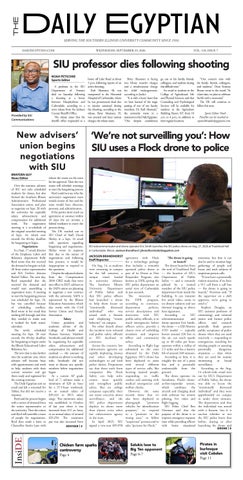
‘We’re not surveilling you’: How SIU uses a Flock drone to police
SIU telecommunicator and drone operator Eric Smith launches the SIU police drone on Aug. 27, 2026 at Trueblood Hall in Carbondale, Illinois. Jackson Brandhorst | jbrandhorst@dailyegyptian.com
JACKSON BRANDHORST agreement with Flock Staff Reporter for a technology package On Aug. 14, as students that includes a remotely were returning to campus operated police drone as for the fall semester, a part of its Drone as First unique email landed Responder Program, also in university inboxes: known as DFR, giving the The Southern Illinois SIU police department an University Department aerial view of Carbondale of Public Safety said in just seconds. that SIU police officers The intention of had launched a drone the DFR program, to help them locate an according to contracts, “emotionally distressed department policies, individual” who was service descriptions and armed with a firearm interviews with SIU and displaying “erratic public safety officials, is to behavior” on campus. reach emergencies before No other details about officers arrive, provide a the incident were released clearer view of unfolding and public safety officials incidents and improve at SIU declined to officer and community comment. safety. Across the country, law According to flight logs enforcement agencies are submitted to the state rapidly deploying drones obtained by the Daily and other developing Egyptian, SIU’s drone has technologies to aid with been deployed to assist police duties. Proponents with several different say that these tools from types of service calls, like companies like Flock locating injured people, Safety can help solve responding to traffic crimes more quickly crashes and assisting with and strengthen public medical emergencies and safety. But on college welfare checks. campuses especially, their However, the same use raises concerns about records show that it’s surveillance, and the also been deployed to SIU police department photograph “protestor deploys its drone more vehicles for identification than almost every other purposes,” to respond law enforcement agency to a “protester in the in the state. wrong area,” to follow In April 2025, SIU “suspicious” persons and to signed a two-year $99,950 take “pictures for Flock.”
Chicken farm sparks controversy Page 4
Betty Akamani is facing two felony murder charges and a misdemeanor charge for child endangerment, according to Judici. “It is with a heavy heart that we have learned of the tragic passing of one of our faculty members, Dr. Kofi Akamani,” the university wrote in a statement to the Daily Egyptian. “Our deepest condolences
‘The drone is going to launch’ The drone launches from the roof of Trueblood Hall — the location of SIU’s Department of Public Safety — and is remotely piloted by a trained member of the SIU police department from inside the building. It can transmit live aerial video, zoom in on distant subjects and use thermal imaging to detect heat signatures. According to SIU telecommunicator and drone operator Eric Smith, the drone — a DJI Matrice 4TD model — typically hovers around 220 feet in the air, can reach speeds up to 40 miles per hour, operates within a radius of 2.5 miles and has a battery life of around 240 minutes. According to him, it is roughly the size of a pizza box and is practically undetectable from the ground. The drone operates via Aerodome, Flock’s droneas-first-responder system, which combines the aircraft and charging dock with software for remote piloting, live video and flight logging. SIU Police Chief Ben Newman said that the purpose of the drone is to improve emergency response time while providing officers with better situational
Salukis lose to Big Ten opponent Page 6-7
awareness, but that it can also be used to monitor large gatherings of people and locate and track subjects of suspicious-person calls. “If you have a potentially violent situation, if we have a 911 call from a call box — the drone is going to launch,” Newman said. “If the supervisor on a shift approves, we’re going to send it.” Stephen Douglas, an SIU assistant professor of criminology and criminal justice and former police officer, said research generally finds greater public acceptance of police drones when they are used reactively — responding to emergencies, searching for missing people or assessing potentially dangerous situations — than when they are used for routine monitoring or broad surveillance. According to the Aug. 14 school-wide email sent out by SIU’s Department of Public Safety, the drone was able to locate the “emotionally distressed individual” and they were apprehended on campus in under three minutes. The department said that the individual was armed with a firearm, but it is unclear whether or not the SIU police knew that before, during or after launching the drone and DRONE | 9
Pirates in burlesque visit Cobden Page 11
Page 2 | Contact Us
Wednesday, September 23, 2026
Contact Us
Email: editor@dailyegyptian.com Editor-in-Chief: Carly Gist
Deputy Editor: Orion Wolf
cgist@dailyegyptian.com
owolf@dailyegyptian.com
News Editor: Brayden Guy
Sports Editor: Noah Petschke
bguy@dailyegyptian.com
npetschke@dailyegyptian.com
Design Chief: Yasmin Martinez-Powell
Photo Editor: Peyton Cook
ymartinezpowell@dailyegyptian.com
pcook@dailyegyptian.com
Faculty Adviser: Alee Quick
Business Manager: Amy Dion businessmanager@dailyegyptian.com
aquick@dailyegyptian.com
Follow Our SOcials
For Daily News visit our website
www.dailyegyptian.com
About Us
Published by the students of Southern Illinois University Carbondale on a weekly basis in print, and every day on dailyegyptian.com. Fall and spring semester editions run every Wednesday. Free copies are distributed in the Carbondale, Carterville and Springfield communities.
Mission Statement
The Daily Egyptian, the student-run news organization of Southern Illinois University Carbondale, is committed to being a trusted source of news, information, commentary and public discourse, while helping readers understand the issues affecting their lives.
Publishing Information
The Daily Egyptian is published by the students of Southern Illinois University Carbondale and functions as a laboratory for the School of Journalism in exchange for the room and utilities in the Communications Building. The Daily Egyptian is a non-profit organization that survives primarily off of its advertising revenue. Offices are in the Communications Building, room 1259, at Southern Illinois University Carbondale, Carbondale, Ill., 62901.
Copyright Information
@2026 The Daily Egyptian. All rights reserved. All content is property of the Daily Egyptian and may not be reproduced or transmitted without consent. The Daily Egyptian is a member of the Illinois College Press Association, Associated Collegiate Press, College Media Advisers Inc. and the College Business and Advertising Managers Inc.
Submissions
Letters and guest columns must be submitted with author’s contact information, preferably via email. Phone numbers are required to verify authorship, but will not be published. Students must include their year and major. Faculty must include rank and department. Others include hometown. Submissions should be sent to editor@dailyegyptian.com
Who is Gus Bode?
Gus Bode was first introduced into print April 13, 1956 when the Daily Egyptian was just the Egyptian. Gus is the DE mascot, but he is also more. Gus is meant to be a voice for us, an outlet for us students when we can’t say what we want to say.
Confluence Books Search online Come in and browse • Fiction
~ all kinds • History ~ Biography • Art ~ Music ~ And More!
confluencebooks618.com Hours: Wednesday - Sunday 12PM - 6PM
705 W. Main St., Carbondale
Shantel Franklin returns to SIU, ‘the place that changed my life’ The SIU alum is the Democratic nominee for Illinois’ 8th House District TAY ACREE Staff Reporter
The Sept. 16 reception had barely begun when Shantel Franklin started being pulled in different directions. Between conversations and photographs at the Tedrick Welcome Center, former mentors, students and other attendees repeatedly approached to welcome her back to Southern Illinois University Carbondale. Ten years after graduating from SIU, Franklin returned to the campus where she said she discovered her path toward public service — this time as the Democratic nominee for Illinois’ 8th House District. “It means so much,” Franklin said. “It’s getting the opportunity to come back to a place that changed my life.” The event was co-sponsored by the Paul Simon Public Policy Institute, Women in Public Policy and Civic Engagement and the SIU Alumni Association. Melanie Harriss, president of Women in Public Policy and Civic Engagement, said the organization welcomes students from every major and helps members strengthen their resumes, volunteer and prepare for careers in public policy and other fields. Linda Baker, interim director of the Paul Simon Public Policy Institute, welcomed Franklin back to campus and described the institute’s connection to the event. “We are always excited when we have an opportunity to work with our former students,” Baker said. Baker said the Women in Public Policy and Civic Engagement was created after SIU students attended the 2025 Women’s Civic Day at the Illinois Capitol. The annual Paul Simon Public Policy Institute event brings women students to Springfield to hear from legislators and public-sector leaders while learning about leadership and public service. After attending the event, students returned to campus determined to create an organization that would prepare them to discuss policy with legislators and become more involved in public affairs. After the reception, attendees gathered to hear Franklin discuss the SIU experiences that shaped her path into public service, her campaign for the Illinois House and the lessons she wanted current students to carry forward.Franklin arrived at SIU in 2012 after experiencing homelessness as a child and attending eight different schools. She told attendees that arriving in Carbondale gave her an opportunity to redefine herself. “I decided that I would not let my circumstances or anybody else define who I wanted to be in this life,” Franklin said. While studying political science, Franklin became involved across campus. She worked at what was then called the Black Resource Center, joined the Zeta Chi Chapter of Delta Sigma Theta Sorority, served as chief of staff for Undergraduate Student Government and was crowned SIU’s 2014 homecoming queen. Franklin said her work in student government gave her an early opportunity to represent others. “It taught me how to work
Shantel Franklin poses for a portrait inside SIU’s Tedrick Welcome Center Sept. 16, 2026 in Carbondale, Illinois. Soph Levinson | @hpos.artz well with others,” Franklin said. “It also taught me how to represent people, in a sense, because that was my first real shot at representing folks.” During her senior year, Franklin became the 2016 Alexander Lane intern through the Paul Simon Public Policy Institute. The internship was established in 2011 to honor Alexander Lane, SIU’s first African American male graduate. Lane later became a school principal, physician and Illinois state legislator. The paid internship gives SIU students the opportunity to go to Springfield to gain firsthand experience in public policy, public service and state government. Franklin worked with the Illinois Senate Democratic council under Senate President John Cullerton. That experience, she said, gave her firsthand exposure to the legislative process and inspired her to remain in public service. Sheila Simon, a former Illinois lieutenant governor and daughter of the late U.S. Sen. Paul Simon, attended Franklin’s event, and gave remarks. Simon thanked Franklin for returning to SIU and said her visit had inspired more than the students in attendance. “You inspire not just the students, but those of us who have a few extra years,” Simon said. “I appreciate your energy, and I look forward to an amazing career in politics. Keep us posted on how we can help you.” After graduating from SIU, Franklin spent seven years working for the Illinois Attorney General’s Office. When the 8th District seat became open, she said she had developed the courage, experience and passion to run. She is the first woman and youngest Democratic nominee for state representative in the district. She is running unopposed and is expected to take office in January 2027. She said reaching that point required her to overcome doubts from others and the pressure that comes with entering politics as a young Black woman. “There’s not a lot of people that look like me,” Franklin said. “Then, with being young, most times young people fight in politics to be taken seriously.” Franklin said she refused to let doubt or impostor syndrome prevent her from pursuing the position. “I’m ready, I’m willing and I look forward to doing a great job on behalf of the people,” she said. During a question-andanswer session, Franklin urged attendees to become involved in their communities and pay attention to the decisions made by their elected officials. Franklin said political decisions affect people whether
they choose to participate or not. She encouraged students to contact elected officials, become involved locally and advocate for changes in their communities. “I hear people say, ‘I don’t do politics,’” Franklin said. “Well, politics will do you.” Franklin also discussed the work required to win her four-way Democratic primary. She received 6,406 votes, or 46.2% of the vote, defeating runner up Latonya Mitts by 2,845 votes. Jill Bush and John Harrell also competed in the primary. Franklin said she left her position with the attorney general’s office to focus on the campaign and knocked on more than 25,000 doors. Franklin said housing will be one of her top priorities when she enters office. She said rising costs and access to health care are among the most urgent issues facing Illinois residents. Her district includes urban and suburban communities, but she said residents throughout the district share concerns about taxes and everyday expenses. “I grew up dealing with homelessness, and so I think it’s time for the state of Illinois to take the lead on housing policy,” Franklin said. Franklin is also a real estate professional and landlord. She said those experiences have allowed her to see housing issues from multiple perspectives. She plans to pursue policies that make homeownership more attainable while also protecting property owners’ rights. Although she does not have an opponent in the general election, Franklin said that does not remove her responsibility to voters. “Running unopposed does not mean that the accountability is lost,” Franklin said. She said she continues to knock on doors, call residents, attend events and use social media to hear from voters. In her closing remarks, Baker thanked Franklin, the student organizers and those who helped hold the event. She said programs such as Franklin’s visit continue Paul Simon’s legacy of supporting and preparing the next generation of public servants. Franklin encouraged students to become involved on campus, build relationships and pursue opportunities outside the limits of their majors. She also reminded them to support others as they advance in their own careers. “No matter how far you go, remember to reach back,” Franklin said. Staff Reporter Tay Acree can be reached at tacree@dailyegyptian.com
Wednesday, September 23, 2026
ADVISER CONTINUED FROM 1
$22.71 to $30. For some advisers, however, ends can still be difficult to meet, especially as the cost of living increases. “If everything goes right month to month, then I can pay my bills, barely,” academic adviser in the College of Arts and Media Karen Wolf said. Wolf said she has a daughter who is incredibly responsible, but other advisers with two or three kids would not be able to live with
just an adviser’s wage. “There are other advisers here who have two or three kids, and it would not be a livable wage. I know a lot of advisers who work here full-time, and they have side jobs or side hustles,” Wolf said. “I had side hustles for years,” Sronkoski said. “Bartender, Uber driver, worked at the Co-op … There are advisers right now who are working more than one job.” Even with the minimum salaries raised, that doesn’t mean that
AJ Sullivan | Sullinks.art
News | Page 3
everyone who was already working as an adviser saw a pay raise. “Well, the starting salary was raised, but the people who are already working, they are not raising everybody else’s salaries as a result of that,” Sronkoski said. “So there have been situations where people who are new are making almost as much money as the people who have been here for years. That’s problematic. And it’s systemic, and it’s not unique to here.” This is referred to as wage compression, when employees’ pay is similar despite differences in years of experience, skill, or background. The CBIZ study recommended SIU to adopt compressionbased pay adjustments, but the adjustments implemented by the university did not affect every employee. “There was one time they did it before, but it was targeted. Only certain people got wage compression relief, it wasn’t everybody,” Wolf said. Sronkoski said that there were adjustments to advisers’ salaries for compression from the CBIZ study, but it was not enough and did not keep pace with the raising mid-points and maximum rates. “They think they did a thing, but they didn’t do
a thing,” He said Besides the outliers of the University of Illinois (UIC Hospitals and Clinics) and the University of Illinois Chicago, all of the universities listed on the State Universities Civil Service System have minimums for Program/ Student Advisers under $25 per hour. The adviser position used to require a master’s degree at SIU, because advisers deal with students who go through the graduate program. But now the position only requires a bachelor’s degree. “What they can do is get away with justifying, if you are hiring someone with a bachelor’s degree, they can justify paying them less,” Wolf said. An equitable salary would mean a fair amount in terms of the adviser’s workload and years of experience, advisers say. Caseload Sronkoski works with 350 students and is one of 12 advisers at the College of Health and Human Sciences, which serves over 4,000 undergraduates and graduate students, according to the college’s website. He said that caseload was manageable for him. “Well I have also been doing it for 27 years,”
Sronkoski said. “It makes a difference in being here longer in how you navigate everything. It takes a long time to become a decent adviser.” Wolf advises students in art and design, music, musical theater and is soon to be an adviser for theater students as well. She said her caseload would range around 300 with her new students. “Right now I think my caseload without the theater students is about 250, “ she said. “That’s a good range. With the theater students it will probably be around 300, which is a little high.” The National Academic Advisement Association does not have an endorsed adviser load because caseloads will vary on the type of institution and the purpose of advising. Some advisement might be solely focused on registering students, while others might also help students with other parts of the system like housing or health services. The higher the caseload, the less personally tailored an adviser can be to each student. Caseload, however, is not always accurate to the amount of work of an adviser. Wolf said that there are often ghost students who are not counted and also take effort to advise.
“But then we have what we call ghost students who are not yet registered or they are thinking about coming to college or they are going to come here next year. So they are not registered, they aren’t counted, but a lot of times we do a lot of work for those students.” Wolf recounted one student who had returned to complete her degree from when she attended SIU in the 1960s. “I worked with her for like several months before she registered for classes,” Wolf said. Advancement Advisers are also pushing for more positions to work toward within their field. With only one chief adviser position in every department, advisers only have one position to work toward in advisement. “There is not a lot of opportunity for advancement for advisers. Basically, you are either an adviser or a chief adviser,” Sronkoski said. “There is only a handful of chiefs, and there are a ton of advisers. It’s not like a pathway in the classic sense.” The DE will update this story as negotiations and bargaining continue to develop. News Editor Brayden Guy can be reached at bguy@dailyegyptian.com
SIU Communications Building project delayed by bidding process MARIAH FLETCHER Staff Reporter
An $80 million dollar renovation is underway at Southern Illinois University’s Communications Building. The university plans to update the building that was constructed in 1964, however the bid continues to be delayed. Questions remain about the project’s timeline and how construction will affect the students and programs that use the building. The Communications Building houses programs such as the School of Communication Studies and the College of Arts and Media, which includes the schools of Theater and Dance, Journalism and Advertising, Media Arts, Architecture, Art and Design and Music, as well as WSIU, Carbondale’s NPR affiliate. The bid for construction has previously been delayed, which caused SIU Theater and Dance students to locate outside of McLeod Theater, the largest stage in the communications building. McLeod Theater’s doors still remain closed, even if construction does not begin until next semester, the theater has been unavailable for students to work in since December 2025. Originally, the bids were expected to happen in November of 2025 and the contractor was expected to mobilize the following February or March. As of September 2026, a bid for construction has yet to be awarded. Mark Owens, the director at SIU of Facilities and Energy Management, wrote in an email to the Daily Egyptian that he has been in contact with the Capitol Development Board over the bid for the building. “The Capital Development Board made the decision to
extend the bid opening date. The extension was based partly on other competing bid opportunities in the market and also provided contractors additional time to review and respond to several complex items addressed through the addendum process,” Owens wrote. An email sent to students by the dean of the College of Arts and Media, Hong Cheng, updated students about the process. He wrote that the bid was rescheduled from Sept. 15 to Oct. 6 of this year. The selected contractor will be mobilizing in January 2027, he wrote. Owens wrote that the start date in January of next year remains “an optimistic possibility.” He also wrote that the starting date will depend on the bidding results and contractor mobilization. The dean’s email also included the expense of the construction, which is $80 million. Cheng wrote that an additional $10 million to $11 million in packages are anticipated after the bid is awarded. For the total project area, Cheng wrote that it will be approximately 211,200 square feet, which includes not only the existing area of the building, but the new additions to be added. He also included that the project will take about 2 ½ years to complete. When Owens was asked about factors that could affect the optimistic start date in January 2027, he wrote, “The primary factors are completion of the competitive bidding and bid-review process, confirmation that the bids align with the available construction budget, CDB’s award and contract procedures, and the selected contractor’s
McLeod Theater’s colorful seats remain empty as renovations are expected April 3, 2026 at McLeod Theater in Carbondale, Illinois. Riley Sembler | @riley_sembler mobilization schedule.” According to Owens, these are standard steps for a project the size of the Communications Building. The CDB expects Phase 1 to include work for the new additions of the building, along with renovations to the theater and lobby. After a contractor is selected, according to Owens, they will complete a construction schedule for the entire building. The Communications Building is home to many classes, schools, clubs and student organizations — including the DE newsroom. Several students have had concerns about relocation. “The university will accommodate operational needs as they arise and coordinate with the affected departments through the dean’s office. Some temporary relocations have
already occurred, including portions of WSIU radio and television operations and certain School of Theater and Dance functions,” Owens wrote. Last semester, several student theater productions were moved to various auditoriums and theaters around the school and community. Owens wrote that coordination will continue throughout the time of constructions to maintain the operations inside the Communications Building. He also mentioned that several temporary relocations for many classes, student organizations, and clubs will be necessary. Owens wrote, “The full list of affected spaces and the duration of individual relocations cannot be finalized until a contractor is selected and the construction schedule is established.” The project will not completely renovate the existing
Communications Building. Instead, it will renovate specific areas of the building while adding new construction. They are also planning to update infrastructure that serves the building along with other parts of campus. Illinois Gov. JB Pritzker announced in January 2020 that state funding would support construction of a new Communications Building, but pandemic-related delays and rising construction costs ultimately forced the project to be scaled back to a renovation. One of those infrastructure upgrades is the modernization of a “chiller plant,” according to Owens, or the system that helps cool multiple campus buildings. The project will also add fire sprinklers to new construction areas and some existing areas included in the project. Owens wrote that there is no demolition
expected to happen to the Communications Building. The project is expected to be finished by summer of 2029, according to Owens. After the contractor is selected, there will be a more clear idea of the start and finish dates. “This is a multi-year project involving new construction, substantial renovations, major infrastructure improvements, temporary relocations and extensive coordination among CDB, the design team, the contractor and numerous university programs,” Owens wrote. “The Dean of the College of Arts and Media regularly communicates relevant updates with the College’s stakeholders.” Staff Reporter Mariah Fletcher can be reached at mariahfletcher@dailyegyptian.com and on Instagram
@mariahonrecord
Page 4 | News
Wednesday, September 23, 2026
Industrial chicken farm set to house 30,000 hens stirs controversy, builder pushes back MACK BIESK Staff Reporter
On a blazing hot midSeptember afternoon, Jesse Yoder, 35, stood in front of his tractor stopped outside a Carbondale chicken farm and noted the lack of a foul odor in the air. The farm, operated by Everett Kauffman, attracted criticism from neighbors and 6,000 petition signatures amidst its development a decade ago. The Illinois Department of Agriculture recently approved Yoder’s proposal to build his own similar, slightly larger facility just south of Murphysboro. It’s a plan that has neighbors worried about disruptive noises and odors, though Yoder argues his neighbors’ assumptions are inaccurate. Several hundred locals petitioned against the farmstead, and flooded the Jackson County Board with verbal and written complaints. Critics branded the farm a Concentrated Animal Feeding Operation — a type of highly industrial, compact farm more in line with a factory. Yoder says that designation isn’t entirely accurate. While, by sheer volume of chickens, Yoder’s farm would match that criteria, because it will be a dry litter operation (liquidbased systems won’t be dispersing manure produced by the chickens) it fails to check the boxes needed for a CAFO designation by the state — claims backed up by IDOA paperwork. Yoder mentioned that legally he’d be allowed to update his operation at any time, even if it meant meeting that CAFO designation. Though Yoder will manage the farm on his own, his contractor, Happy Egg, controls distribution of the egg and meat products. If the company changes its goals for the farm, Yoder may need to change his agricultural practices. Yoder has simultaneously rejected claims of disruptions to daily life. “I don’t know why some of them have come up with a misconception,” Yoder said. “They won’t even know when there’s chickens there and when there’s not
Exterior of a 25,000 capacity chicken farm Sept. 17, 2026 Carbondale, Illinois. Daylin Williams | @photosbydaylin chickens there.” Yoder encouraged those worried about the farmstead to speak with him directly, saying he’d happily show them around. Upon approval from the IDOA, Yoder sent written notice to 19 property owners in his property’s vicinity. “The facility has a maximum design capacity of 150 animal units or 30,000 laying hens,” IDOA spokesperson Lori Harlan specified in an email to the Daily Egyptian. The proposal includes building a single poultry layer barn measuring 408 feet by 40 feet and one litter storage structure measuring 40 feet by 50 feet, Harlan said. Illinois’ Livestock Management Facilities Act mandates that non-farm residences not be located within a quarter mile of such developments, though nine households are within a half mile of Yoder’s — which he says is just one short of triggering setback regulations of a half mile, as the LMFA would then consider the area “populated.” However, Yoder’s neighbors who are against the farm demand a say in what happens in their neighborhood. “Some folks have lived here all their lives,” Mark Stoffel, Yoder’s neighbor, said in an email to the DE. “(Others) bought property, to live a serene, peaceful life at the edge of the Shawnee
National Forest.” For Sarah Dorau, another neighbor of Yoder, the construction signals more than a few trucks coming in. Dorau and two neighbors attended a Sept. 10 Jackson County board meeting. After members ran through the meeting’s agenda, Dorau stood up to speak. “This isn’t just about livestock facilities, this is also about data centers,” Dorau said. “This is also about solar farms. This is about people getting pushed out of their homes, feeling forced to sell.” Dorau also asked the board to open their minds to zoning the county, an idea which drew visible pushback. Those living near the Carbondale farm, as far as Yoder knows, haven’t had issues since its 2018 opening. Yoder said differences between that operation and his would be minor. “The only thing is, those sidewalls (here) are 8 feet tall,” he said. “Mine are going to be 10. … And mine’s going to be red.” The changes in traffic will be barely noticeable — one semi-truck every three weeks for feed, another for egg pickup by contractors every other week and a couple more whenever chickens are transported for human consumption. As voiced by neighbors of the Carbondale farm during its construction, however,
that operation’s close proximity to Cedar Lake sounds environmental alarm bells. Critics have pointed out that Yoder’s farm could threaten the nearby Sugar Creek and the rest of the Shawnee National Forest. Recent slashing of federal environmental protections makes Little Egypt susceptible to industry overreach. For instance, 11,000 acres of the Shawnee were just threatened by a Trump administration proposal to end the 2001 Roadless Area Conservation Rule, leaving once-untouched swaths of land vulnerable to logging. In animal agriculture’s case, the Environmental Protection Agency both loosened air pollution regulations last year and proposed a massive rollback of 1972’s Clean Water Act protections. Congress passed the CWA to curb the pollutants — namely, nitrogen and phosphorus — Yoder’s farm may emit, particularly in runoff. When farmers spread fertilizers like nitrates and phosphates on their fields, rain and soil leaching bring them into the water system. These compounds from runoff cause eutrophication — the end of water ecosystems — according to the National Oceanic and Atmospheric Administration. Too many
nutrients in waterways cause an explosion of species, like algae, triggering a depletion of the ecosystem’s oxygen. Yoder told the DE that his farm’s litter and fertilizer will contain nitrates, and a 2016 Daily Egyptian article found that the Carbondale operation also uses phosphorus in its manure. The story described that the crops used by Kauffmann are sprayed with purchased phosphorus and nitrogen fertilizers before being fed to the farm’s chickens, whose manure is then spread back on the fields. Both the sprayed fertilizer and manure contain similar levels of runoff compounds. Research from the University of Georgia shows that similar operations also emit ammonia into the air, an issue Dorau mentioned at the Sept. 10 Jackson County board meeting. Though ammonia is an air pollutant, the EPA recognizes that it’s harmful to water ecosystems when deposited into surface waters. Yoder assured his plans have these issues in mind — the blueprints were created by an engineer working with the IDOA and the Illinois Environmental Protection Agency designing things within regulations, he said. Water-stop reinforced concrete walls, Yoder said, make it unlikely that nitrate will leach out of the feed and coop structures themselves. However, Yoder’s land is currently used for crop harvest, meaning runoff nutrients are a The National Library of Medicine found that although CAFO fertilizer on row crops makes up only around 5% of watersheds’ nitrogen inputs, they account for the highest amount of nitrate in streams by far. If Yoder’s farm ever changed to a CAFO designation, this risk and several others would rise. As the international environmental non-profit Sierra Club describes in their article, “The Environmental Injustice of CAFOs,” factory farms also contaminate water sources with hormones, cleaning agents and antibiotic-resistant bacteria. The possibility of local health problems also exists.
SIU Day of Giving is Wednesday, September 23! If you’d like to support the DE directly, scan the code.
Nitrates, for instance, have been found to cause reproductive cancers and blue baby syndrome, a disease occurring when the blood supply lacks oxygen, according to publications from the National Library of Medicine and the University of Missouri. Yoder may not be building the mega-farm some envision, but the larger conversation of big corporations moving in remains. Opponents to Yoder’s development, part of a corporate contract, feel it sets a precedent of landgrabbing by larger businesses. Many people at the Jackson County board meeting expressed interest in adding provisions about animal agriculture to the Legislative and Public Safety Committee’s ordinance regulating data centers, set for review in October. Board Chairman CJ Calandro and Vice Chairman Tamiko Mueller didn’t reply to emails from the DE. Board member Kevin Lister declined to comment via email. The Jackson County board made clear that authority over development lies with the IDOA and Illinois EPA. Unless Yoder’s farm would contain 1,000 animal units — 200,000 chickens — the Livestock Management Facilities Act mostly ties the county’s hands. Though construction hasn’t yet started, Yoder told the DE that his farm will be completed sometime near July, and he thinks operation will begin next September. Going forward, the community and county board will navigate the discussion around Yoder’s farmstead. The county’s aforementioned data center ordinance this October could change all parties’ circumstances if provisions about livestock farming are included. Dorau said at the September Jackson County board meeting, “What I’m asking is for us to have a discussion on how we help everyone.” Staff Reporter Mack Biesk can be reached at mbiesk@dailyegyptian.com and on Instagram @mackbiesk34.
Wednesday, September 23, 2026
Advertisement | Page 5
FRID6A-Y9 PM
0..0022..2266 0 F FRIDAY RIDAY 1110.02.26 6 6-- 9 P PM M
ffree, f reeee,, aaall r lll aaages, l geess,, fffood g ooodd tttrucks, o ruucckkss,, vvvendors, r ennddoorrss,, bbbyob e yoobb y
Kyle Tuttle Band (Progressive bluegrass w/ banjo at full throttle)
Chris Housman (Modern country where “y’all means all)
ROBBIE STOKES STAGE // NEW ERA PLAZA DOWNTOWN CARBONDALE IL
Page 6
Wednesday, September 23, 2026
SPORTS Salukis stumble against Big Ten school, lose 48 -10 to Illinois NOAH PETSCHKE Sports Editor Following a home victory over the Southeast Missouri State Redhawks, SIU football hit the road to face a Big Ten opponent, the Fighting Illini of the University of Illinois Urbana-Champaign, on Sept. 19. The Salukis received the kickoff, which resulted in a touchback to begin the Saturday afternoon contest. The Dawgs could not get on the board. The Fighting Illini cashed in a rushing touchdown on their first drive, leading 7-0. SIU answered with a gritty drive as quarterback DJ Williams scrambled for a fourth-down conversion and hit wide receiver Allen Middleton for an 8-yard touchdown a few plays later. Illinois quickly responded with a 77-yard touchdown, its longest rush since 2021. END Q1: SIU 7, UIUC 14 The Fighting Illini began the second quarter with a 45-yard bomb into the end zone, upping their lead to 21-7. An SIU turnover on downs gave Illinois the ball at midfield. The Fighting Illini scored their fourth touchdown of the half, leading by 21 with about 10 minutes left in the quarter. After getting within 10 yards of the end zone, the
Clayton Lakatos (36) looks towards the ground Sept. 19, 2026 at Gies Memorial Stadium in Champaign, Illinois. Peyton Cook | @cookmeavisual Dawgs settled for three points after a field goal from kicker Weston Schofield. Illinois nailed a field goal to conclude the first half, putting the home team up 31-10 going into halftime.
Sebastian Vargas notched an interception, his second in as many games. “What’s nice comes twice,” Vargas said. “I just wanted to get the team going; get the momentum on our side.” HALFTIME: SIU 10, The scoring barrage cooled UIUC 31 off for the third quarter as On Illinois’ first drive of the neither team pushed across second half, SIU cornerback points for all 15 minutes.
END Q3: SIU 10, UIUC 31 After a third-quarter scoring drought, the Fighting Illini kicked a field goal and brought their lead to 24 points. Just as the Dawgs got into scoring position, the Illinois defense intercepted a pass and took it back 88 yards for a touchdown. The Fighting Illini went up 41-10.
Illinois tacked on another touchdown in the fourth quarter for a solid 38-point lead. The clock wound down, and the Salukis exited the Big Ten matchup with a loss. “We needed some explosive plays to really hang in there and make this happen,” Head Coach Nick Hill said. “It didn’t happen today.”
FINAL: SIU 10, UIUC 48 With this loss, the Dawgs fall to 2-2 ahead of Missouri Valley Football Conference play. Illinois improves to 2-1. The Salukis will head to Murray State University to take on the Racers on Sept. 26. Sports Editor Noah Petschke can be reached at
SIU wide receiver Kyle Thomas (6) spins to avoid a University of Illinois defender during a game against the University of Illinois Sept. 19, 2026, at Gies Memorial Stadium in Champaign–Urbana, Illinois. Riley Sembler | @riley_sembler Edward Robinson (4) sticks his hand out while running towards the end zone Sept. 19, 2026 at Gies Memorial Stadium in Champaign, Illinois. Peyton Cook | @cookmeavisual
Allen Middleton (5) shouts after scoring a touchdown Sept. 19, 2026 at Gies Memorial Stadium in Champaign, Illinois. Peyton Cook | @cookmeavisual
Marching Salukis member Mason Van Horn looks down at the game Sept. 19, 2026 at Gies Memorial Stadium in Champaign, Illinois. Peyton Cook | @cookmeavisual
Wednesday, September 23, 2026
Sports | Page 7
SIU football’s Coleon Smith makes a big impact on and off the field NOAH PETSCHKE Sports Editor Coleon “CJ” Smith is a fifth-year senior offensive tackle for SIU football, but his story goes far beyond Saluki Stadium. Along with playing Division I football, Smith is a co-founder of a charitable organization to support veterans and a community volunteer. Smith earned a bachelor’s degree in human services from SIU in May 2025 and is currently working toward a master’s degree. At age 15, Smith’s father died after he suffered from kidney failure and, in 2025, Smith’s aunt, Michelle Grace, died of cancer. Michelle was a U.S. Air Force veteran who worked at the Pentagon during the 9/11 attacks. Smith and his mother, Akoswa Cook-Coward, founded Michelle’s Legacy Housing & Hope Organization Inc., which seeks out housing, caretakers and other assistance for veterans. The startup received a $2,000 grant from the
Offensive tackle, Coleon Smith (73) kneels and puts his hand on his helment in the end zone of Saluki Stadium Sept. 17, 2026 in Carbondale, Illinois. Peyton Cook | @cookmeavisual Gwinnett County Public Library in Georgia. “They served our country. There’s no need for them to be homeless,” Cook-Coward said. “That’s going to be her legacy.” “She was a proud veteran,” Cook-Coward said. “She lived it.” Along with co-founding
the organization, Smith and his brother own Mighty-NBattle Sports Academy LLC, a company where student athletes can get mentorship in and out of the classroom. “CJ came home to Michigan, helped facilitate a camp and gave shirts to the little guys,” Cook-Coward said. “He speaks to them,
whether it’s on Zoom or in person, creates meal plans, moves and plays for them. He does it for them.” Along with helping the youth develop into good students and athletes, Smith takes pride in making an impact on his community. “I’m also just working on my own endeavours with junk
removal around Carbondale and back home,” Smith said. Smith is from Inkster, Michigan, and moved to Romulus, Michigan, as a teenager. He attended Eastern Michigan University before heading down to SIU, and Smith said he’s been happy at his new university. “SIU had a very homey feel for me,” Smith said. “My coach at Eastern Michigan told me a lot about the program when I first talked to Nick Hill. He told me that (Hill) was a great person and that Carbondale is a great place.” Head Coach Nick Hill and Smith have been a part of SIU football together since 2022. “(CJ) has been here for a while now, so as far as his resilience and his intent to get better, he’s a great teammate,” Hill said. Hill praised Smith’s perseverance and grit through tough times. “In life, there’s always going to be an avenue to quit and make an excuse,” Hill said. “Coleon is going to be ready to take on the world as
a young adult. He’s going to be successful in whatever he does.” Smith has been an integral part of the SIU football team since he arrived four years ago. “He loves the game; he keeps coming back,” Hill said. “He’s great to be around. He’s great to have in the locker room.” Smith said he remains motivated to keep going despite the hardships during his football career. “The inner child in me keeps me motivated,” Smith said. “The feeling of being a kid, playing on the football team, and telling my teachers, ‘I want to go to the NFL,’ is what keeps me motivated. “Always have hope. Don’t give up your hope,” Smith said. “A lot of us go through different trials and tribulations throughout our lives, but you have to keep pushing and hope for the best.” Sports Editor Noah Petschke can be reached at npetschke@dailyegyptian. com
Saluki soccer shatters records, rewrites history AARON CARNAHAN Sports Reporter Southern Illinois soccer sits at 7-2 after the first nine matches on the schedule. The Salukis are a perfect 4-0 at Lew Hartzog Stadium this season and are currently riding a six-match win streak, after a victory at Evansville to kick-off Missouri Valley Conference play. In his first season,SIU head coach Graeme Orr’s team won one match. Two years ago, the Salukis finished with six wins; last year they finished with 10. This season, the team already has seven wins with nine matches left in the regular season. “We have three nonnegotiables here: outrun, outfight, outplay; so those are our characteristics,” Orr said. This is Orr’s fourth season at Southern Illinois; the team’s record has improved in each. “We are building our resilience; we are building our character. I am extremely proud of what we’ve done and what we have accomplished,” Orr said about the team’s growth this season. The Salukis have faced challenges and adversity this season.About five weeks ago, Southeast Missouri State defeated SIU 1-0 in the season’s opening match, a team the Salukis had beaten in the spring season. Orr pointed to this match as a teachable moment for the team. “This was a valuable lesson for us…. If you don’t compete every time, you can’t get hot,” Orr said. The Salukis responded, beating Western Illinois 5-0 the following match, and breaking the program’s singlegame goal record.
Forward Penny Warner said she feels the momentum the Salukis build through scoring goals. “A lot of us, when we see one goal and we see the success, it’s like, OK, this works. Do it again, and again, and again,” Warner said. After the victory, SIU took on another challenge when they headed to Alabama to play a Southeastern Conference opponent in the Auburn Tigers. Even though the Salukis lost the game, they came back even stronger by winning their next six matches. The Dawgs won their next five matches to close out nonconference play. In that five-game stretch, the Salukis weren’t scored on. SIU’s goalie, Reagan Miller, has been a shutout specialist this season, being named the MVC’s goalkeeper of the week on Sept. 15. Miller is 6-2 in her starts this season, allowing just four goals, making 23 saves and putting up four shutouts. Until Saturday, Sept.19, Miller hadn’t allowed a goal since Aug. 20. That’s a 30-day stretch without allowing a goal. No team has scored on her in all four matches at Lew Hartzog Stadium this season. “Shutouts are great. A good look for my defensive line… I love getting shutouts,” Miller said. Miller now holds the program record for career shutouts with nine, but she isn’t satisfied. “I am hoping to beat the inseason one, which is six,” she said. “Last season I got five.” Miller’s name is all over the
Saluki soccer record book. In addition to her career shutouts record, she leads in career wins and is tied for fourth in career saves. On top of Miller and the Saluki defense setting records and shutting down opponents, the Saluki offense has broken its fair share of records this season. On Aug. 16, the Salukis broke the single-game goal record when they scored five against Western Illinois. “When we score, we realize what the coaches are telling us in practice and what we do, it works and we can score,” Warner said. The Saluki offense was far from setting program records. Just two weeks later on Aug. 30, Warner had an electric performance against Alabama A&M. Not only did the Saluki offense get a statement 8-0 victory, breaking the single-game goal record they had just set, Warner was on the attack every time she touched the ball. “I just realized how much success I got being in the right position, not being offsides, small things like that,” Warner said. “I was like, ‘I can get more. If I score one, I can score more.’” Warner had a hat trick in the game during another offensive explosion from the Salukis. After that outstanding performance, Warner was named the MVC’s player of the week. Accolades are nothing new for Warner; she won a Junior College National Championship in 2024. Playing at SIU means a lot to Warner; both of her parents are alumni. Her father, Larry Warner, played football for the Salukis and is currently the
Goalkeeper Reagan Miller (left) and forward Penny Warner right) pose for a portrait Sept. 16, 2026 at the Women’s Soccer Locker Room in Carbondale, Illinois. Brylee Williams | bwilliams@dailyegyptian.com
running backs coach. “It does mean a lot being back here, especially because a lot of the people in the community knew me when I was little,” Warner said. “So me being an adult and playing here, and breaking records, and doing really good things similar to my dad, I feel like it’s so full circle for me.” Orr has built a team full of special players like Miller and Warner. There is a legacy that comes with playing for Saluki soccer. All 108 players that have ever suited up for a soccer game at Southern Illinois have their names engraved on a legacy board. “Every player that has played for us has been special,” Orr said. The culture of Saluki soccer is notable, and the team has been clicking on all cylinders. The team
has already set program records for most consecutive wins with five, and most consecutive home wins with four. “I just want to keep accomplishing more and creating more history,” Orr said. The coaching staff has inspired players to give it their best. “As a team and for myself, the coaching staff here puts a lot of hours in overtime, and a lot of us want to do our best for them,” Miller said. However, with as much success as the Salukis have had this season, Orr and the rest of the team realize the job is far from finished. “Obviously they’re happy they are getting the exposure they deserve, but they
would much rather have the accolades at the end of the season rather than halfway through,” Orr said. The rest of the team is on the same page as their head coach. The players feel that they’re all capable of coming through in the clutch in any given match. “We’re not relying on just one person. Our team has shown it could be anyone’s game no matter what,” Warner said. Miller agreed with the sentiment. “We do a really good job at focusing on ourselves and letting our players decide what happens,” Miller said. Sports Reporter Aaron Carnahan can be reached at acarnahan@dailyegyptian.com
SIU football optimistic ahead of MVFC opener Noah Petschke Sports Editor
After a 38-point loss at the University of Illinois UrbanaChampaign, the Salukis will head east to face the Murray State Racers on Sept. 26. The Saturday evening game will be SIU’s first Missouri Valley Football Conference
matchup of the season. Over the next nine weeks, the Dawgs will play every MVFC team. Of those games, SIU will face five teams that are ranked 11th or better in the FCS Stats Perform Top 25 as of Sept. 21. Head Coach Nick Hill is optimistic ahead of the rest of the season.
“I’m excited for us to have the focus of continuing to get better and having a great week of practice,” Hill said. “Just knowing the gauntlet that we have in front of us, it’s got to be just focus one game at a time.” Despite a tough loss to a Big Ten school, Hill’s confidence in the team hasn’t dwindled.
“I’ve shared this each week; it’s been a good group as far as their mentality and their response,” Hill said. “ It’s a team that is going to give you everything they’ve got.” The Saluki defense struggled to stop the Fighting Illini, allowing them to score on their first four drives of the game. Hill
believes there’s a silver lining in the loss to Illinois. “I told the defense, ‘This is probably good for us right now; what are we going to be made of?’” Hill said. “You find out a lot about individuals and guys that get an opportunity that you don’t really find out through those 25 practices in preseason”
The Salukis enter MVFC games at 2-2 after a tough nonconference schedule. “We found out a lot about our team,” Hill said. “I’m excited to get going into conference play.” Sports Editor Noah Petschke can be reached at npetschke@dailyegyptian.com
Page 8 | News
Wednesday, September 23, 2026 BOARD OF TRUSTEES MEETING
Athletic finances, cybersecurity risks among top concerns for SIU system ORION WOLF Deputy Editor The SIU Board of Trustees saw a presentation of the biggest risks to the SIU system at their Sept. 17 meeting. The survey, which was conducted by several high-ranking members of SIUE and SIUC, found that the current financial status of athletics, the outdated systems that introduce cybersecurity risks and the ratio of resources to the speed of technological advances were among the most concerning. Evonne Thompson, executive director of audit and chief audit executive for the SIU system, presented the survey’s findings to the board at the SIU School of Dental Medicine in Alton, Illinois. The FY2027 annual risk assessment survey was created by Thompson to “identify and prioritize risks most likely to impact the University’s mission, finances, operations, and compliance positions.” Thompson introduced a new way of understanding the risks, through a heat map of low to moderate to high risk concerns. Red signified high risk, yellow represented moderate risk and green was low risk. It was also featured on an X and Y scale of probability and impact. Board Treasurer and Vice President for Financial and Administrative Affairs Justin Oates also announced that the SIU system had entered
into an “enterprise resource planning study” with Northern Illinois University, Eastern Illinois University and Illinois State University. He said they are currently evaluating the system’s readiness to move forward with the plan. This partnership will allow the SIU system to work more efficiently through finances and risk management through shared software. Oatws said it’s an “extremely important process” as the “current systems are close to the end of their useful life.” “This project is also anticipated to bring the system under one chart of accounts, which will be helpful in determining our data and reporting is consistent across the system and should allow us to roll out the data in a more timely manner,” Oates said. “It will allow us to utilize that data to make better decisions as we move forward.” He stated that while the deficits were improving for both schools, there was still a large issue in regards to the financial model of athletics in which the school pays for the cost of away games with hotels, food, and transportation – especially in Carbondale, but as part of a national conversation about the increasing cost of those necessities. Oates then expressed concerns for the current status
Provided by Evonne Thompson
of the school’s self-insurance, which allows an institution to fall back on funds saved without having to take out third-party insurance. The system currently has $15 million in self-insurance. The FY2027 budget was passed by the board without much deliberation. In a meeting on Sept. 16, SIU Carbondale Chancellor Austin Lane discussed that a 2% tuition increase over the last year has given SIU around a million dollars for the 2027 fiscal year. The salary increases totaled over $3.5 million, Lane said. The faculty received a 2% raise – around $1.5 million with an expected salary increase of 3% next year.
Lane announced that all but one of the union contracts for the over 21 represented unions on campus were signed and $775,000 were set aside for a 2% raise for non-represented staff. There was $1.2 million for faculty compression raises, which makes the school able to ensure faculty are all getting paid similarly. At the meeting on Sept. 17, the discussed salary increase for Carbondale was 1%, and an additional 1% if they met enrollment goals, which was granted approval by the Board alongside the budget. The board approved several resolutions, including a budget approval for the
second floor renovation of the School of Medicine as well as real estate acquisitions for the School of Medicine in Springfield. Another item that was approved was the renewal of a contract between the Federal Bureau of Investigation and the Board of Trustees. At the meeting, Vice Chancellor for Administration and Finance Susan Simmers described it as, “a lease agreement between Southern Illinois University and the Federal Bureau of Investigation for communications equipment that consist of a VHF radio repeater and antenna on the roof of Neely Hall at SIUC.” Lane also presented
the semester’s enrollment numbers. According to Lane’s presentation at the meeting, enrollment with first-year undergraduate students was 1,779, and the overall student population numbered at 12,066. Lane also discussed his plan for the next Saluki Takeover Tour, in which, over the next nine months, he will visit many places to promote the university, including Los Angeles, Atlanta, and Chicago. The meeting concluded after over two hours of discussion. Deputy Editor Orion Wolf can be reached at owolf@dailyegyptian.com and on Instagram @orionwolf_
• LOCAL, ORGANIC, FAIR TRADE • WELLNESS • BULK • GROCERY • DELI • FRESH PRODUCE • CRAFT BEER & WINE •
Neighborhood Co-op Grocery Open daily 8am - 9pm
In the Murdale Shopping Center • 1815 W. Main Street, Carbondale IL • (618) 529-3533 • www.neighborhood.coop
JAX Mass Transit stops at the Co-op! Use the Pyramid Route (stop 14) or Big Muddy Route (stop 3) at Murdale Shopping Center.
DISCOVER LOCAL! • Organic • Fair Trade • Gluten-free • Vegan • Breakfast • Lunch • Dinner + Daily Deli Specials • Snacks and Grab-n-Go • Pizza • Functional Foods • Bulk • Bakery • Wellness • Produce • Grocery • Deli
FUNDRAISER EMPTY BOWLS OCTOBER 17
SIU + ceramics
Art for your table. Food for your community.
• 11:30AM-1PM
EXTRA EVERY SUNDAY! TOTAL PURCHASE WITH COLLEGE ID
5% OFF
Wednesday, August 26, 2026
from page 1 | Page 9
DRONE
CONTINUED FROM 1
the subsequent apprehension. 411 flights in four months Illinois law requires law enforcement agencies that own drones to report their usage annually to the Illinois Criminal Justice Information Authority, or ICJIA. The reports must include the number of drones owned, how often they were used under each of the law’s authorized purposes and details about individual flights. Those details include the date, time, reason and location of each use, whether video was recorded and whether the video was designated for retention for training. The ICJIA is then required to publicly publish that data per Illinois’ 2013 Freedom from Drone Surveillance Act, which was later amended in 2023 by legislation known as the Drones as First Responders Act. Through these acts, Illinois law generally prohibits police from using drones to gather information, including photographs and video, unless a specific exception applies. In 2025, the ICJIA contacted 1,058 agencies across the state via the National Public Safety Information Bureau and the Illinois Law Enforcement Alarm System. It emailed 2,395 contacts representing 1,058 agencies, received 586 responses — 55.4% — and sent seven follow-up emails before the deadline. It also contacted nonrespondents and agencies with incomplete submissions by phone and email. Per Illinois law, the responsibility to report drone usage falls on agencies that own a drone whether or not they were contacted by the ICJIA. Agencies that do not own a drone are not required to submit a report. The ICJIA’s survey instructions did call for agencies without a drone to report that they had none. The ICJIA acknowledged that some submissions lacked required information and that interpreting the written descriptions had limitations. Most reporting agencies did not report to the ICJIA as part of a DFR program
SIU Police Chief Ben Newman watches as SIU telecommunicator and drone operator Eric Smith flies the drone on Aug. 27, 2026 at Trueblood Hall in Carbondale, Illinois. Jackson Brandhost | @jbrandhorst@dailyegyptian.com
enforcement agencies that responded to the ICJIA report, 281 reported owning drones. Among those 281 agencies, SIU’s total drone deployments ranked seventh, despite its submitted log covering only about four months. When the comparison is limited to Aug. 25 through Dec. 30, SIU ranked second, behind only the Chicago Police Department, which recorded 891 flights during that period. SIU ranked first in total drone deployments among the four university police departments that reported drone ownership in Illinois. The others are the University of Illinois, University of Illinois Chicago and Lewis University. The flight logs are an agency-submitted account of the flights. They do not include the underlying dispatch recordings, complete incident reports or supervisor approvals needed to reconstruct every deployment decision. ‘We’re not surveilling you’ SIU’s own DFR policy, effective Aug. 20, 2025, prohibits random surveillance, harassment and targeting people solely
justification is fundamentally different from recording people who are not suspected of wrongdoing just because they might in the future. Douglas similarly said he would “absolutely describe a drone as a surveillance technology,” adding that the term itself is “not meant as a criticism.” The more important questions, he said, are how the drone is used, what information it collects, how long that information is kept and who can access it. SIU’s flight log notes document a wide range of uses, including locating, tracking and following various people and vehicles, responding to traffic crashes and photographing license plates for protester identification Among SIU’s flight log entries are multiple flights involving protesters, including two entries that detail attempts to photograph protestor vehicles. At about 12:08 p.m. on Sept. 25, 2025, a flight note reads: “DFR to Faner fountain for Protester in the wrong area.” The entry says the person later moved to Morris Library. On Oct. 14 — the day of a second memorial for Charlie Kirk that sparked protests at
“Of course what they are doing is surveillance.” - Jay Stanley
Senior policy analyst with the ACLU’s Speech, Privacy and Technology Project
such as SIU’s. The DE can only verify that at least seven DFR programs are currently operating across the state and that at least six more are on the way, including one at the University of Illinois. SIU’s flight log published in the ICJIA report contains flight identifiers, launch and landing times, location, report numbers, written flight notes and columns indicating recording and retention. Some notes include an operator’s name, initials or identifying number while others contain only a short description. According to SIU’s flight logs, they first deployed their drone on Aug. 25, 2025. The SIU police department launched the drone 411 times between then and Dec. 30, 2025. Of the 586 law
because of characteristics including race, religion, economic status or disability. It also directs operators to consider civil rights and privacy when deciding whether to deploy. “I think it’s important for our community to know we’re not surveilling them using a drone,” Newman said. “That is not the reason for that product.” Jay Stanley, a senior policy analyst with the ACLU’s Speech, Privacy and Technology Project, said calling a police drone a surveillance technology does not itself mean its use is improper. “Of course what they are doing is surveillance,” Stanley said. “Now, there can be legitimate surveillance.” Stanley said surveillance directed at a particular person based on a lawful
the SIU Student Center — a 5:42 p.m. flight note reads “Observing Student Center for CK event.” A second entry for a flight beginning at about 6:30 p.m. says photographs were taken of license plates in a parking lot for protester identification “if needed.” A later flight began at about 8:08 p.m. in which the note said that the drone was used to “take photographs of protestor vehicles for identification purposes.” According to the note, the camera wouldn’t hold still nor take a clear photograph of the license plates. Those entries do not identify a particular offense, imminent threat or warrant supporting the effort to identify protesters. They also do not explain whether the photographs were later used
to identify anyone, searched against other records or shared. Stanley said drones can serve legitimate purposes, including searches for missing people, but that DFR programs raise a different concern when their use expands from specific calls for service to monitoring political activity. “You find out that they’re sending them up over protests, not because they have any reason to believe that there will be any trouble at a protest, not because they have any intelligence that there’s going to be violence or disruption, but because they just want to watch the protest,” Stanley said. The notes alone do not establish which legal exception the SIU police relied on or what additional information officers had. Stanley said police observation of demonstrations warrants particular scrutiny because protests involve constitutionally protected assembly and expression. Other entries describe following people and collecting information during calls that ended without any observed criminal activity. On Nov. 8, an operator used the drone to check an area near the “north overpass” after an open 911 line originating from a campus call box. The note says the drone located a man and tracked him through West Campus near the Student Center. “No criminal activity observed,” the entry concludes. On Dec. 21, the drone obtained the license plate of a white van that was near an SIU van. Officers later determined that the man associated with the vehicle was there to replace a windshield. That entry also states that no criminal activity was observed. An Oct. 14 morning flight followed a “suspiciousperson” report near SIU’s Evaluation and Developmental Center. According to the note, the person was lost and looking for an address on Lewis Lane. The drone returned home when no crime was apparent. A call ending without evidence of a crime does not, by itself, establish that the initial deployment lacked a lawful purpose. The law includes medical assistance and other uses that do not depend on finding criminal activity. The logs also show how the drone was used to locate people for officers. On Nov. 18, an operator used thermal imaging following a report of a suspicious man near Anthony Hall. The note says the operator located him northwest of Davies Hall and followed him to South Washington Street and Grand Avenue, where officers could stop and speak with him. Other descriptions are brief, like a Sept. 18, 2025 entry that refers to a person on a bicycle taking pictures of instructors near Altgeld Hall. A Nov. 6 entry describes searching unsuccessfully for a person asking for money. Two separate flights detail attempts to locate homeless people. Lindsay Weinberg, professor and author of “Smart University: Student Surveillance in the Digital Age,” said surveillance on college campuses can shape not only what university officials can observe, but
how student activities are understood and governed. “We should be asking what mechanisms are in place to question and hold to account those doing the observing,” Weinberg said. She said campus monitoring can frame demonstrations and other collective activity as potential threats while leaving comparatively little scrutiny on those doing the observing. Weinberg said one concern surrounding surveillance technology is “function creep,” in which a tool introduced for one purpose gradually expands into others. SIU’s stated purpose for the DFR program centers on emergency response and public safety, while its flight logs also document testing, event coverage, parking monitoring, protest-related flights and other uses. Stanley said his broader concern with DFR programs is how easily a system designed for specific calls can expand into routine, suspicionless observation. He said the low practical barrier to launching a drone makes clear rules governing when it can be deployed especially important. “We’re not surveilling you,” Newman said. “Illinois is pretty prescriptive in laws that prohibit that kind of activity. We don’t use it for facial recognition and other things that the community might worry about.” Legal scope Illinois law allows police to use drones to document crime and vehicle crash scenes and respond to disasters or public-health emergencies. For 911-dispatched calls, the drone’s sole purpose must be locating victims, addressing their immediate health or safety needs or coordinating emergency responders. Police may obtain a search warrant based on probable cause or deploy a drone without one when they reasonably suspect immediate action is needed to prevent imminent harm to life, stop a suspect’s imminent escape or prevent the destruction of evidence. They may also search for missing people, conduct search-and-rescue operations or assist someone who cannot otherwise be safely reached, provided they are not also conducting a criminal investigation. The law also permits publicrelations demonstrations without collecting or recording information, and limited safety monitoring at qualifying public events with notice posted at least 24 hours beforehand. Political protests, demonstrations and other First Amendment-protected assemblies do not qualify under that event exception. A flight involving a protest would therefore need another applicable exception for drone deployment under the law. The act prohibits weapons on police drones and onboard facial-recognition software during flights. Applying facial-recognition software to drone-collected information afterward is generally prohibited, with limited exceptions for terrorism and imminent threats. Information gathered during most authorized operations must generally be destroyed within 30 days, or within 24 hours for qualifying public events. A supervisor may retain particular information when there is reasonable suspicion it contains evidence of a
crime or when it is relevant to an ongoing investigation or pending criminal trial. Information without personally identifying details may also be kept exclusively for training, and flight-path data, metadata and drone telemetry may be retained. Newman said video attached to a case is subject to the laws governing case records and evidence. The SIU drone flight logs do not document when individual videos were deleted, whether copies were exported or who accessed them. Forty-five SIU flight records have no written flight notes. Every record uses the same location label — the SIUC campus — even when the accompanying notes name another location. The flight log spreadsheet also has no separate field identifying the statutory exception or approving supervisor for each flight. Medical emergencies, traffic stops and more Recurring descriptions in SIU’s flight log notes include welfare checks, fire and building alarms, traffic stops, suspicious-person calls and assistance to Carbondale police. Operators also describe providing “overwatch,” meaning an aerial view of activity below, and coordinating officers’ responses. Nine entries mention a welfare check, 12 mention a traffic stop and 16 mention a suspicious person, people or vehicles. Some flights also served more than one purpose. The records document things like football-game and tailgate coverage, monitoring the area of a Veterans Day vigil, parking coverage for a Board of Trustees event and a Nov. 24 flight to a lake to look for glasses. Labels such as event coverage or overwatch do not identify which exception in state law supported a particular flight. Testing and training appear throughout the records, as well as a smaller number of community presentations. A DE search found 187 entries containing references to a test or training, but some of those entries also describe responding to calls, so the number does not represent 187 flights devoted exclusively to practice. ICJIA’s reporting instructions ask specifically whether video was retained for training. All 411 of SIU’s recorded flights are marked “Yes” under “Video Recorded” and “No” under “Designated for Retention.” SIU’s flight logs do not explain whether footage was preserved separately as evidence. ‘Pictures for Flock’ Flock’s involvement also appears in SIU’s flight log notes. Several entries detail Flock personnel operating the drone for testing, support and photographs. A Sept. 24 entry identifies “Elias from Flock Safety” conducting a test flight. An Oct. 16 entry details Elias Slater conducting a test flight to examine connectivity and possible higher antenna placements. A Nov. 12 entry identifies a range test associated with “C Avery Flock Safety.” SIU’s agreement with Flock includes training and ongoing support from the company. The flight entries establish that company personnel participated in testing, but do not explain the approval and supervision arrangements for each flight. A separate Sept. 19, 2025 DRONE | 10
Page 10 | News
Wednesday, September 23, 2026
SIU students and staff face changes to dependent health insurance coverage MARIAH FLETCHER Staff Reporter During the beginning of Southern Illinois University’s fall semester, dependents were cut from the school’s insurance plan for graduate assistants, graduate instructors and undergraduate students. United Health Insurance has been providing healthcare for SIU for over a decade. SIU has around 2,390 in-person graduate students and 7,396 undergraduate students. In the Graduate Assistants United contract, it states that the University has “sole discretion” to change the terms of health coverage and if any change occurs that reduces coverage, the union can demand to bargain the reduction in coverage. The local GAU is organizing a petition to help the affected dependents and are looking for ways to assist them. The GAU is also investigating an email allegedly sent to them in mid June from UnitedHealthcare, staff members at the GAU claim they never received a direct email from the healthcare company, while UnitedHealthcare claims otherwise. Adam Turl, a graduate instructor at SIU in English Composition, found out that they were losing coverage for their partner. At the beginning of the fall semester, Turl went to add their dependent, Tish Turl, to their policy. This is when they discovered that on Aug. 15, the university was no longer allowing graduate assistants, graduate instructors, or undergraduates to insure a dependent on their policy. Before the change took place, dependents were insured for qualifying students, graduate assistants and instructors. Previously, the policy allowed spouses, partners, and children under
DRONE
CONTINUED FROM 9
entry contains just three words: “Pictures for Flock.” It does not identify what was photographed, why the pictures were requested or whether they were delivered to the company. An Aug. 30, 2025 football-game flight also records an unintentional transfer of control: “HP unaware CK was flying and took over unknowingly.” The note does not expand those initials or identify either person as a Flock employee. SIU’s contract with Flock states that the company retains ownership of the hardware. Technical difficulties Technical problems recur in the flight notes, sometimes during responses to calls. During a Sept. 24 welfare check, an operator described the drone as “almost impossible to fly.” The next day, a flight responding to a report
26 as qualifying dependents. For at least the three previous academic years, dependents have been allowed onto a student policy. Adam Turl said that they did not receive any prior notifications about the change. When they went to question this at the Student Health Center, faculty initially told them to go to another building, then eventually broke the news that dependents were no longer insured by the university’s health insurance. “It feels like a slap in the face,” Adam Turl said. “If they’re willing to do this to graduate instructors, undergrads, what’s stopping them from doing it to nontenure faculty? I mean, if you’re willing to hurt the spouses and loved ones of this group of faculty and students, why wouldn’t they be willing to do it to other people?” After finding out that Tish was no longer insured, they found a press release online that was posted Aug. 15. Adam Turl spoke with the GAU, which is part of the Illinois Education Association. The IEA told Turl that even though this change was made in August, SIU allegedly knew a change would happen in March of 2026. Freedom of Information Act emails reveal that there were plans to potentially change the coverage in mid February of 2026. An email sent on Feb. 19, from Donald Howard to Christina Carney stated that there was a “potential change” to the policy. Howard also stated in the email that there may be funds to help “assist those students that may not qualify for any Medicaid or any existing subsidies …” A representative of the GAU said that emails were sent out to graduate assistants, graduate instructors, and students. However, not everyone
received an email from the university. Only people who previously insured a dependent on their policy received an email. If a GA, GI, or student planned to add a dependent for the upcoming semester, they would not have received the news. When Adam was looking to insure Tish Turl, the university gave them a paper with options like Medicaid and other market options, which Tish described as a “whole other slap in the face.” SIU Student Health Services partnered with Shawnee Health to assist students in transitioning their dependents to alternative coverage. However, remote students would have to travel to Carbondale to seek Shawnee Health’s help because they do not have remote visits, according to a flyer from Shawnee Health acquired in a FOIA request by the DE. Tish completed their degree at SIU with an MFA. They described feeling betrayed by the University that they fell in love with. “How much work did I do for the University? How much work does (Adam) do for this university? Other GAs do for this university… The work the GAs do holds this university up. Just to do that is so disgusting.” Tish Turl said. Tish mentioned that they did plan to make a few appointments for basic health checkups, which they can no longer schedule due to the lack of insurance on dependents. The cost of health insurance is rising in Illinois, and for the rest of the country. As of November 2025, about 30 million Americans are on the Affordable Care Act, according to John Hopkins Bloomberg School of Public Health. The ACA, commonly known as Obamacare, was a healthcare law passed to make health insurance more
affordable and accessible for Americans. Rising healthcare costs are driving up health insurance premiums across the country, making coverage increasingly difficult for many Americans to afford. The expiration of enhanced ACA subsidies at the end of 2025 has also made coverage more expensive, according to an article published by the Harvard T.H. Chan School of Public Health. “I love teaching. I’m not sure we would have made all the exact same decisions we did make if we would have known we wouldn’t be able to use the insurance,” Adam Turl said. When they were informed that dependents would no longer be insured, the GAs and GIs had already signed contracts that tied them to the university for the semester. Tish said, “A school that claims to care about retaining and being a vibrant, diverse campus, a single mom would not be able to be an undergraduate here because she would have to insure her kids somehow. How would she do it?” “I think it’s time for public institutions that are, in theory, owned by the people and state of Illinois to not give in to extortion by companies like UnitedHealthcare.” Adam Turl said. The GAU said that the University was given the decision to cut dependents from policies or deductibles would go up for most of the people on SIU’s health insurance plan. In a written speech delivered to SIU’s Board of Trustees, the GAU commented on the policy cut in April 2026. “Many graduate assistants are under serious financial pressure, and for some it has become a crisis. Inflation and recent changes to Marketplace health insurance tax credits have made this even harder, especially for international
graduate students. Many depended on Marketplace coverage because of the high cost of SIU health insurance, but students earning below $15,650 lost access to those tax credits, and many international students could not qualify for Medicaid. As a result, many were left with SIU insurance as their only option. For a graduate assistant, health insurance and mandatory student fees can cost about $5,000 a year, leaving less than $10,000 from a low stipend to cover rent, food, transportation, medical costs, and other basic needs. At that point, affordability becomes a matter of dignity and survival,” a leader of the GAU wrote. Jyotsna Kapur, a professor at SIU of cinema and media studies, learned about the change from Turl’s story. She said she felt “horrified.” “We’re just exposing our community and graduate students who make such strong contributions to this university,” Kapur said. “We call ourselves an R1, that’s totally on the backs of graduate students.” SIU became an R1 university in Feb. 2025. The title of R1 is given to schools that spend over $50 million on research and produce 70 research doctorates in a year, according to the Carnegie Classification of Institutions of Higher Education. “If costs have to be paid, and maybe this is an oldfashioned view, the top administrator should pay the price first. I don’t see that form of service leadership,” Kapur said. The GAU had reached out to the chancellor’s office last semester regarding the cut of dependents and have still not received a response, according to the GAU. Kapur said she had many students express that they felt relief to be single after the news circulated around campus.
“We always tell undergraduates to go live life for at least two years before coming back to grad school…Now we are saying stop living your life. We’re really shrinking the time to allow young people to explore after graduation,” Kapur said. “We are really shrinking what a graduate student can be. We’re reducing access to graduate education. We are reducing it to single men and healthy people who can afford the risk.” Kapur also expressed concerns about SIU’s international students. She said how some of the international students are confused about the change in coverage because there was never a clear answer to them regarding dependents on their policy. The GAU said that the university is working to find new plans for dependents on the market. Donald Trump’s One Big Beautiful Bill Act will affect insurance in the future for international students across the country starting in 2027. Changes under OBBBA will limit what international students will receive financial aid through the ACA. The change could make insurance less affordable for students and people on temporary visas, especially those bringing their families to the U.S. According to the GAU, many international students currently on marketplace insurance will have to change to SIU’s policy because of the OBBBA. This change will cut many international students’ dependents off from insurance, especially if their dependent is also a visa holder. The GAU has 257 recorded international students who are currently under marketplace insurance plans.
of a man with a gun at a gas station encountered extremely choppy controls and a poor signal near South Illinois Avenue and Pleasant Hill Road. The note says the suspect was gone when the drone responded — it does not establish whether the technical problems affected that outcome. During an Oct. 10 traffic stop, an operator
or had no operating issues. Eighty-five of the flight log entries describe technical or performance problems. The records end in December 2025 and do not establish whether those problems continued afterward, but Newman told the DE in September 2026 that the lag has since gotten much less frequent and that the
scene, and it has proven defines aggregated data successful for us on more as information stripped than one occasion.” of identifying details so that individuals cannot Data collection be identified directly As for the information or indirectly. Flock’s collected during the permission to use and flights, SIU and Flock’s distribute it continues contract data provisions after the contract ends. extend beyond the video Those provisions mean recorded during a flight. the contract’s 30-day While the agreement footage-retention period says that SIU owns its does not describe the agency data and that lifespan of every type of Flock shall not sell it, it information generated through the program. SIU can save or transmit footage before its deletion, while Flock’s rights to use aggregated data continue beyond that period. The contract establishes permissions for handling the information, but SIU’s flight logs do not show whether Flock used data from particular flights to also gives the company train algorithms, develop permission to collect, products or produce analyze and anonymize analyses, nor do they that information to create identify who accessed aggregated data. recordings or whether Flock can use that copies were saved aggregated information elsewhere. to train machine-learning Multiple efforts to algorithms, improve its reach representatives at products and develop other Flock were unsuccessful, offerings. The agreement however they do provide a
media kit for the press — a collection of stock photos along with fact sheets — as well as a “frequently asked questions” page on their website. SIU publishes a public Aerodome flight dashboard, where users can view mapped drone flight paths and filter records by date. The dashboard displays statistics including calls responded to, people located and calls handled without sending a patrol officer. Newman said the dashboard is intended to make the department’s drone activity accessible to the public while protecting information tied to investigations. The records reviewed by the DE include five purchase orders issued to Flock between November 2022 and September 2025 totaling $135,150 in authorized purchases for drone services, five Falcon license plate readers, four Community Partnership video cameras and related software and support.
“Oftentimes, that drone is the first eye on a crime scene, and it has proven successful for us on more than one occasion.” - Ben Newman SIU Police Chief
reported lag, loss of the camera view and an inability to activate the return-home function or enter an address. The drone returned on its own when its battery became low, according to the entry. Other entries report that the drone flew well
DFR program has been a success for SIU. “Flock and Aerodome have been instrumental to our emergency response and crisis response to incidents that are happening on campus,” Newman said. “Oftentimes, that drone is the first eye on a crime
Staff Reporter Mariah Fletcher can be reached at mfletcher@dailyegyptian.com
and on Instagram
@mariahonrecord
Staff Reporter Jackson Brandhorst can be reached at jbrandhorst@
Wednesday, September 23, 2026
Entertainment and Culture | Page 11
Come for the wine, stay for the booty Feather Hills Vineyard host Pirate Fest Burlesque MARIAH FLETCHER Staff Reporter
“Maritime madness” swept over Feather Hills Vineyard and Winery in Cobden, Illinois this Saturday, Sept. 19, as The Fine and Bawdy Wenches described their performance when they came to town for Pirate Fest Burlesque. The Fine and Bawdy Wenches is a group of performers from around the midwest that specialize in fantasy, especially maritime performance, or performance relating to navigation or commerce on the sea. According to the Wenches, they plan the event around International Talk Like a Pirate Day, which falls on the exact date of the performance this year. International Talk Like a Pirate Day is a holiday celebrating pirates in media depictions. According to Rosetta Stone Blog, it has become increasingly more popular in offices and in schools in recent years. The Fine and Bawdy Wenches and other performers entertained the crowd with burlesque, cabaret, vaudeville and drag, while audience members joined in, dressed as everything from pirates to sea creatures to mythical beings. Head Wench Ruby Hues said that burlesque reclaims the “concept of play back into adulthood.” All of the costumes the performers wore, or took off, were hand-made or self-sourced. Their performances were also original. Edith Puthie, a member of the Wenches who dressed as a mermaid, said on stage, “We love
our art and we hate AI stealing it.” There was a crowd of around 100 people enjoying the show, exploring vendor’s shops or drinking inside the winery. Since the Wenches move throughout the venue and interact with audience members, they gave the crowd hand signals to indicate whether they wanted to participate. The performers warned the evening would be raunchy. “It’s 100% inclusive of sex positivity,” Puthie said of their shows. “We always talk about how consent is sexy. Being a sexy little weirdo isn’t something people should be ashamed of. You will see here all different shapes and types of bodies, and people’s confidence is sexy.” The SOIL Sisters, a non-profit in southern Illinois aimed at bringing cultural awareness to rural communities, also attended the show. Benedetta Cuna-Lingee, a performer with the group, was dressed in a pirate-nun-clown cross over costume. They wore a black pirate hat with a face full of clown-like makeup, with a bright red corset. They said that they were most excited to watch and be a part of the show. “This is for the little weirdos that honestly need community, need some love,” Cuna-Lingee said. The Wenches’ brand of rowdiness is about more than simply putting on a raunchy show. For them, it is also about creating a space where people can embrace the parts of themselves they might
Performers entertain a crowd gathered around the outdoor stage during Pirate Fest on Saturday, Sept. 19, 2026, at Feather Hills Vineyard in Cobden, Illinois. Attendees dressed in pirate and fantasy costumes gathered on the patio to watch live stage shows and music throughout the afternoon. Nazarene Lace | nlace@dailyegyptian.com otherwise be told to hide in the small area of southern Illinois. Audience member Jeanette Garcia said that this event ties together things she loves, which is dressing up, celebrating local performers, and going to the wineries. “One of my favorite things about this event is that they are very LGBTQ friendly. I do not personally identify as such, but I have always had friends who are part of that community so I am a big ally for it,” Garcia said. She said that because of this inclusivity and support, she will always try to attend The Fine and Bawdy Wenches’ shows. The Fine and Bawdy Wenches have several performances coming up based on fairy-tales, myths, and “silliness you don’t get to do as an adult anymore,” Hues said. A volunteer for the event who called themselves Fancy the Fool, said it’s important to connect with your inner child as an adult. “Always look inside yourself, and if you are not friends with your childhood, your inner child, become closer,” Fancy the Fool said. All upcoming performances for the Wenches are listed on their website, including the “Halloween Whore-or Show” in Herrin, Illinois Sister Benedetta Cuna-Lingee holds a black folding fan while wearing pirate attire where audience members can and theatrical makeup during Pirate Fest on Saturday, Sept. 19, 2026, at Feather “prepare to be a little bit scared Hills Vineyard in Cobden, Illinois. Nazarene Lace | nlace@dailyegyptian.com and a little bit turned on.” The Wenches also have open auditions for several of their events, so anyone can join the raunchy fun of their performances.
Kitty Calienté of the Fine And Bawdy Wenches dances on stage at Pirate Fest Sept. 19, 2026 in Cobden, Illinois. Nazarene Lace | nlace@dailyegyptian.com
Puzzle Answers
Staff Reporter Mariah Fletcher can be reached at mfletcher@dailyegyptian.com
and on Instagram @mariahonrecord
Page 12 | Puzzles
Wednesday, September 23, 2026
Weekly PUZZLE PAGE
"Chefs" by Myles Mellor 1
Across
1. Hotel amenities 5. Slant 9. Inexpensive wine choice 14. This might be red 15. Result of overexercise 16. Loathe 17. Hand cream ingredient 18. Short Facebook video 19. Literature Nobelist Hermann 20. Beef Wellington is one of his famous dishes, 2 words 23. Going up sharply 24. Way 25. Peony pollinator 28. On Soc. Sec., maybe, abbr. 31. Bottled water brand 33. Civil War side, abbr. 36. Country 39. Kind of carpet 40. Ossobuco alla Milanese was one of her favorite dishes, 2 words 44. Subject of some treaties 45. Black, in the insect world 46. Court fig., abbr. 47. Pacific Northwest airport nickname, 2 words 50. Sassy one 52. Cygnet's mother 53. Lodge letters 56. Speech outline 60. Smoked salmon pizza is one of his famous dishes 63. Arctic 66. Nasty 67. Earthen water pot 68. ''Barracuda'' band 69. Ross and Java 70. Tire problem 71. Eye washes 72. Shore soarer 73. Big bash
2
3
4
5
6
7
8
9
10
14
15
16
17
18
19
20
21
33
35
40
29
30
36
31 37
44
53
49
50 54
64
51
55
56 61
65
57
67
68
69
70
71
72
73
1. Some deer 2. Stove light 3. Really like 4. Farmer, at times 5. Shade of red 6. Cake finisher 7. Tons, 2 words 8. Alabama civil rights city 9. "That's funny!"- 3 words 10. Follow 11. Hesitant sounds 12. Shipwreck signal 13. Poetic preposition 21. Met offering 22. Basic version, abbr. 25. State of Brazil 26. Make law 27. Black billiard ball 29. Place to unwind 30. Ring result 32. Nine-digit ID, abbr. 33. Catch
58
59
62
66
Down
*To play Sudoku, fill a 9x9 grid with digits 1 through 9 so that each row, each column, and each 3x3 subgrid contains each number exactly once. 46
60 63
27
43
45
52
26
39 42
48
25 32
38
41
47
13
Answers on page 11
24
34
12
22
23 28
11
34. Yes or no follower 35. Madison Avenue worker 37. "___ was saying"- 2 words 38. Former Fords 41. Suffix for a believer 42. Electronically charged atom 43. Blowing away 48. Cancels 49. Pfc. superior, abbr. 51. Depart abruptly, 2 words 54. Handy, 2 words 55. Type of moth 57. Bridal veil material 58. Conspicuous success 59. Make a figure eight 60. Distort 61. Mathematician Turing 62. Wall Street Journal subj., abbr. 63. University conferral, abbr. 64. " ___ the ramparts ..." 65. Taoism founder, ___-tzu
Weekly Event Calendar Your guide to upcoming local events over the next 7 days!
September
23
24
25
26
27
28
WED
THURS
FRI
SAT
SUN
MON
29
TUE