
Fire call sends McBrides to the same scene

Steve McBride and Connor McBride pose for a portrait with Carbondale’s Station’s fire engine Feb. 20, 2026 at Fire Station 2 in Carbondale, Illinois. Daylin Williams | @photosbydaylin
ANNALISE SCHMIDT
aschmidt@dailyegyptian.com
Earlier this month, Carbondale firefighter Connor McBride responded to an apartment fire alongside her father, Steve McBride, chief of the Murphysboro Fire Department, marking the first time the two had worked the same scene together. Connor always knew what the fire service meant to her father, and after completing the academy and beginning her own career, she started building her own path in the profession he spent decades in. Their careers came together for the first time on that call.
For Connor, the moment marked both a professional milestone and a personal one.
“Being able to work a fire scene together was a very proud moment for me to see what my dad does, and definitely a core memory that I will hold on to,” she said.
Connor was hired by the Carbondale Fire Department in June 2025, and began the fire academy in August before graduating Oct. 31. The 12-week academy introduced recruits to fire behavior and progressively more advanced skills.
“We basically will go in and they’ll start with just fire behavior. So we’ll basically get to sit down and
kind of witness how the fire progresses over certain rooms and the contents that’s inside, and then they progressively will teach us minor skills up to the major ones, of fighting the fire itself,” Connor said. She said the experience pushed her in ways she did not expect.
“It’s been a great experience. It’s definitely challenged me in areas that I never thought I’d be challenged before,” she said. “It’s probably one of the hardest things I’ve ever gone through, but I learned so much through it, about myself, about my teammates here, my
MCBRIDES | 6
Jay Crippen appointed Carbondale fire chief
TAY ACREE tacree@dailyegyptian.com
After 24 years with the Carbondale Fire Department, Jay Crippen has stepped into its top leadership role.
City Manager Stan Reno appointed Crippen as fire chief effective Feb. 1, 2026. Crippen brings 27 years of fire service experience to the position, including more than two decades serving with Carbondale.
A lifelong resident and Southern Illinois University Carbondale graduate, Crippen worked his way through nearly every division of the department, from firefighter to shift captain, training officer, emergency management coordinator, arson investigator and assistant fire chief.
Those years moving through the ranks still shape how he leads, he said.
“I aim to be clear and direct with expectations while gathering as much information as possible
before making decisions,” Crippen said. He added that he believes in standing behind his firefighters.
In his first year, Crippen said he plans to develop a long-term strategic plan while expanding fire prevention efforts.
“Carbondale has always been good at fire prevention,” Crippen said, “ response readiness remains a priority.”
Funding remains one of the department’s biggest
CHIEF | 6
After nine months of negotiating working conditions such as salary compression, sick leave days and low wages, the Association of Civil Service employees — SIU’s civil service union — reached an agreement for a new contract. Terry Richardson, president of the ACsE, said that all but one member voted yes.
Civil service is a job classification at SIU that refers to nonacademic employees, such as accountants, office administrators and clerks. At the September 2025 SIU Board of Trustees meeting, members of the ACsE reported during public comments that they experienced low morale, heavy workloads and unfair pay. According to a January 2024 chart from SIU’s Human Resources webpage, civil service workers were making between about $25,000 and $59,000.
Richardson said the ACsE union represents around 200 civil service employees at SIU. He said the biggest difference between union and nonunion workers is that union workers are bound by their contract.
“For example, all of our wages, everything of ours is defined by the contract we have. They don’t have a contract of any kind,” Richardson said of nonunion employees. “When people see the chancellor announce a 2% raise for campus, what he means essentially is nonrepresented individuals. Their raises

Contact Us
Email: editor@dailyegyptian.com
Editor-in-Chief: Carly Gist cgist@dailyegyptian.com
News Editor: Jackson Brandhorst jbrandhorst@dailyegyptian.com
Design Chief: David Starr-Fleming dstarrfleming@dailyegyptian.com
Photo Editor: Emily Brinkman ebrinkman@dailyegyptian.com
Ad Chief: Samantha Barnhill sbarnhill@dailyegyptian.com
Senior Editor: Lylee Gibbs lgibbs@dailyegyptian.com
Digital Editor: Peyton Cook pcook@dailyegyptian.com
Faculty Managing Editor: Alee Quick aquick@dailyegyptian.com
Business Manager: Amy Dion businessmanager@dailyegyptian.com

About
Us
Published by the students of Southern Illinois University Carbondale on a weekly basis in print, and every day on dailyegyptian.com. Fall and spring semester editions run every Wednesday. Free copies are distributed in the Carbondale, Carterville, and Springfield communities.
Mission Statement
The Daily Egyptian, the student-run news organization of Southern Illinois University Carbondale, is committed to being a trusted source of news, information, commentary and public discourse, while helping readers understand the issues affecting their lives.
Publishing Information
The Daily Egyptian is published by the students of Southern Illinois University Carbondale and functions as a laboratory for the School of Journalism in exchange for the room and utilities in the Communications Building. The Daily Egyptian is a non-profit organization that survives primarily off of its advertising revenue. Offices are in the Communications Building, room 1259, at Southern Illinois University Carbondale, Carbondale, Ill., 62901.
Copyright Information
@2026 The Daily Egyptian. All rights reserved. All content is property of the Daily Egyptian and may not be reproduced or transmitted without consent. The Daily Egyptian is a member of the Illinois College Press Association, Associated Collegiate Press, College Media Advisers Inc. and the College Business and Advertising Managers Inc.
are essentially based on that kind of thing, like the chancellor and the board approving it. Whereas unions, ours is in the contract.”
Richardson said the last ACsE contract, which was ratified in 2022, provided an average salary increase of 16%, while this contract provides an average raise of 7%.
“Part of that is because everything was so far behind,” Richardson said. “The first time, we were getting people above minimum wage with that one, and this time it’s just been kind of building on that.”
The contract is ratified, but hasn’t been signed. The signing process usually takes around a month, according to Kelly Byrd, director of Labor and Employee Relations.
The ACsE negotiated with Labor and Employee Relations, a division of Human Resources that represents the university for most bargaining units. Byrd said the bargaining process begins with the union and university putting together separate teams. The university’s team typically consists of directors or supervisors of people over the specific union, she said.
“When we meet for that first meeting, we do our introductions and then generally the union will start by giving proposals to the university side,” Byrd said. “It could be that they start with noneconomic proposals first and then do economic proposals afterwards. Or if there aren’t going to be a lot of changes to the contract, they might be all together.”
Once the union gives their proposals, the university responds. Byrd said the university can generally respond immediately to noneconomic proposals, but might need to consult with specific offices, like the chancellor’s, before responding to economic proposals.
“We just keep going, meeting
by meeting, until we come to a settlement,” she said.
Richardson said the ACsE discussed proposals for 14 different articles, including a shared leave program, in which employees could donate their sick and vacation time to one another. He said the compromise was extended sick leave, which gives employees 20 sick days per fiscal year, although it must be approved by HR and documented by a doctor’s office.
“The primary benefit, the way I see it, is for new employees, this gives them a lot of time to use if they have doctor’s appointments or something coming up,” Richardson said. “It’s important to me and to all of us on the executive committee, because we’re not just trying to fight for the current employees, we need to make sure that we’re making it enticing for people to come here and to build the staff — I mean, not just our union staff, all staff.”
Extended sick leave will begin in Fiscal Year ‘27 for all civil service areas, Richardson said.
The ACsE also looked to address salary compression, or minimal variation between employee salaries, regardless of differences in experience or skills.
In April 2024, the university launched Compensation 2030, a study that compares all employee salaries at SIU to those of other employees and outlines a career path from entry level to top management. Richardson said the organization decided to wait for the results before negotiating their wages. While the study was helpful in some aspects, he said it looked at compression from a large scale rather than within SIU.
“A lot of what’s happened is the entry level wage went up, but the compression there for long-term employees wasn’t addressed properly,” Richardson said. “When we did the last contract, we knew Part 1 was to just increase the minimums
CORRECTIONS
to get people up, starting towards where they should be. We always expected and kind of planned the second contract to be about compression and trying to alleviate that in some way…We didn’t get everything we wanted but any stretch, but I think we largely addressed pretty much all of that.”
Compensation 2030 can be renewed by the university for up to up to three consecutive years, the Daily Egyptian previously reported.
Byrd said that the timeline for the ACsE’s negotiation was not typical nor unusual.
“Because ACsE is such a big group with so many different classifications, there were a lot of proposals and we did a lot of work with this contract,” she said. “Both sides put a lot of time and effort in and really respectfully discussed things, so there was work to be done, to where (with) other groups it might take one to two months or one to two meetings. They might just come in with two or three proposals, or really all they need to update is wages, so we’re just talking about wages.”
For the ACsE, their work is not over.
“One of my big beliefs is that staff are really the backbone of the university,” Richardson said. “Granted, I’m a little biased, but I mean, I’ve seen with my own eyes how students create relationships with staff in their office. And that’s important, and that helps with retention too…So, to me, even though we’re just doing this for our people in the union, what I would like long term is a lot of the stuff that we have in the contract is spread out to everybody. I want all civil service employees to be equitable, not just in comparison with each other, but elsewhere and regionally.”
Editor-in-Chief Carly Gist can be reached at cgist@dailyegyptian.com.
In the Feb. 18 edition of the Daily Egyptian, the story titled “First time college students now get priority registration at SIU” incorrectly identified Wendell Williams as SIU’s associate chancellor of enrollment management. Williams in the vice chancellor for enrollment management. The story has been updated online to correct this error.

Submissions
Letters and guest columns must be submitted with author’s contact information, preferably via email. Phone numbers are required to verify authorship, but will not be published. Students must include their year and major. Faculty must include rank and department. Others include hometown. Submissions should be sent to editor@dailyegyptian.com
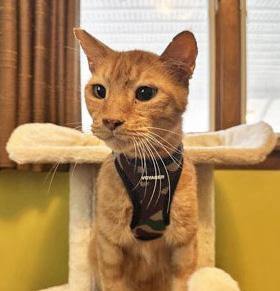
part of whatever you’re doing. He absolutely loves attention—he’ll lean in for pets, purr like crazy, and happily soak up affection. He’s very sweet, but he also has a bit of a spicy side: if you stop petting him before he’s ready, he might give a little swat to let you know he’s not done yet. It’s part of his charm! He also enjoys his harness and might take a walk with you! He is more dog-like than cat-like!
Ideal Home:
Red would thrive as an only cat, where he can be the center of your world. He may be able to live with another cat, but proper, slow introductions are essential. His perfect adopter will appreciate a cat with a big heart and a big personality.
If you’re looking for a sweet, attention-seeking companion with a remarkable personality, Red is your guy.



TAY ACREE
Four Republicans, four visions Inside Illinois’ GOP race for governor
tacree@dailyegyptian.com
Four Republicans are competing for their party’s nomination for Illinois governor, each pitching a different plan for where the state should go next as the primary approaches.
The winner of the Republican primary will face Democratic Gov. J.B. Pritzker in the November general election. The GOP field includes former state Sen. Darren Bailey, DuPage County Sheriff James Mendrick, policy analyst Ted Dabrowski and businessman Rick Heidner.
All four candidates criticized the direction of Illinois under current leadership, pointing to taxes, public safety and government spending as central concerns.
Illinois’ current state budget stands at roughly $56 billion, according to Gov. J.B. Pritzker’s recent budget proposal.
A figure several candidates cited as evidence of what they view as what they view as unchecked growth in spending.
Darren Bailey, a GOP nominee in 2002, is also a third-generation farmer from Xenia, a small town in Illinois. He previously served in the Illinois House and Senate andspent 17 years on the North Clay Board of Education, including 12 as president. He and his wife, Cindy, operate a family farm near Louisville.
Bailey said affordability is the issue he hears about most from voters.
“For one affordability , we have got to lower taxes, property taxes, we also need to lower power bills,” Bailey said, adding that he believes rising costs are pushing residents out of Illinois.
He said his first-year priorities would include lowering the cost of living, strengthening public safety and addressing literacy in schools.
“A lot of children aren’t able to read at the grade level they should, and we really need to fix this,” he said.
He did not outline specific policy
changes but said improving literacy would be a central education priority.
Bailey also called for more transparency in state government, proposing what he described as a public “waste tracker” an idea he has referred to as “Illinois DOGE,” a reference to efforts at the federal level to reduce government spending. So taxpayers can see how state dollars are being spent.
He described his leadership style as “bottom up” shaped by his time on the local school board.
“When I saw a problem in the schools. I ran for the school board and was there helping for 15 years,” he said.
Bailey said that approach means focusing on local concerns first and building policy decisions around what he hears directly from residents.
While Bailey emphasized affordability and education, other candidates framed the state’s challenges through different lenses.
James Medrick, a DuPage County resident for more than 30 years, was elected sheriff in 2018 after a career in law enforcement. A graduate of Downers Grove South High School, he has focused his tenure on public safety initiatives and rehabilitation programs with the county jail system.
Mendrick oversees what he said is an $80 million budget and more than 800 employees. He said that executive experience sets him apart from the other candidates.
Mendrick centered his campaign on public safety and tighter government oversight.
“We are in dire straits right now,” Mendrick said, pointing to the SAFE-T Act, Illinois’ sanctuary state policies and what he called wasteful spending.
The SAFE-T Act, signed into law in 2021, eliminated cash bail in Illinois and expanded police accountability measures. Supporters say it promotes fairness in the justice system, while critics argue it limits judges’ discretion
in detaining certain defendants.
Illinois’ sanctuary policies limit the extent to which state and local law enforcement cooperate with federal immigration authorities, particularly in civil immigration enforcement.
He said his first moves in office would include eliminating sanctuary state policies, revising the SAFE-T Act to allow category-based detention and launching a forensic audit of the state budget.
“Day 1 elimination of the sanctuary state,” he said.
“Buisness and government are different,” Mendrick said, arguing that running a public agency requires working within rules and constraints that differ from private industry.
He also highlighted rehabilitation and education programs in the DuPage County jail system, saying similar efforts could be expanded statewide.
Policy analyst Ted Dabrowski, who was born in Chicago and now lives in Wilmette, has centered his campaign on long-term fiscal reform and economic competition.
Dabrowski earned a bachelor’s degree from the Georgia Institute of Technology in 1986 and a second bachelor’s degree from Wharton School of the University of Pennsylvania in 1989. He later received a graduate degree from the University of Chicago in 2009.
Before entering Illinois policy debates, Dabrowski spent more than 15 years in international banking, including management roles with Citibank in Mexico and Poland. He later served as president of Wirepoints, an Illinois- based policy research organization, and worked at Illinois Policy Institute from 2011 to 2017 as a spokesman and vice president of policy.
Dabrowski has also pointed to his parents’ immigration to Chicago, his father from Poland and his mother from Ecuador, as shaping his views on economic opportunity and public policy.
“Illinois should be one of the top
five of the fifty states in this country for opportunity, for economic growth, for wage growth,” Dabrowski said.
He tied public safety and affordability to broader economic policy, calling for repeal of the SAFE-T Act and an end to sanctuary state policies. He also proposed lowering property and gas taxes while prioritizing job growth.
A major component of his platform is pension reform. Dabrowski has proposed transitioning new government employees to 401(k)-style retirement plans to limit future liabilities.
Unlike some of the other candidates, Dabrowski has not held elected office. He said his background in business and policy analysis gives him a different perspective on Illinois’ structural challenges.
“I’m the one who can take the real world application of business competition as well as the policy world and put that together,” he said.
Rick Heidner, a lifelong Illinois resident who grew up in Chicago’s western suburbs, raised by a single mother, has built his campaign around his background in business. He has not previously held elected office.
Heidner began working at a young age and later founded and led several Illinois-based companies, including J.J Peppers Food Stores, which grew to 24 locations. He has also operated businesses in gaming, fuel distribution, energy and commercial real estate, including Gold Rush Gaming, Ricky Rocket’s Fuel Centers and Prairie State Energy.
According to his campaign, Heidner’s real estate company manages more than 280 properties across multiple states. He has said his experience overseeing large operations and employing hundreds of workers gives him a practical approach to state government.
Like Dabrowski, Rick Heidner pointed to his business background. He said his experience includes executive leadership roles overseeing hundreds of employees.
Heidner, a longtime businessman, said public safety and economic growth are the most pressing issues.
“I keep seeing people getting hurt in this state and I want to help them,” Heidner said, adding that he would repeal the SAFE-T Act and end sanctuary state policies.
He said his first priority would be freezing tax increases while conducting a department by department review of the state’s spending.
“I want absolutely no tax increases until we go through every single department and figure out where all this money is going,” he said. Heidner argued Illinois should focus on attracting businesses and expanding its tax base rather than raising fees.
“I’m a businessman and I know how to generate business,” he said.
He also proposed a state income tax exemption for first-time homebuyers on the portion of income saved for a down payment.
“I want us to be the next Florida,” he said. Florida has experienced significant population growth in recent years and does not levy a state income tax. U.S. Census Bureau estimates show the state added hundreds of thousands of residents between 2020 and 2023. Some Republican candidates have pointed to those trends as evidence of what they described as a more competitive tax and regulatory environment. Bailey emphasized cost of living and education. Mendrick centered his campaign on public safety and government oversight. Dabrowski focused on fiscal restructuring and pension reform. Heidner framed Illinois as a business in need of expansion and spending control.
The primary election is scheduled for March 17, 2026, with the general election set for Nov. 3, 2026.
Staff Reporter Tay Acree can be reached at tacree@dailyegyptian.com.
Supreme Court ruling sends Bost’s mail-in ballot case back to lower courts
The U.S. Supreme Court ruled on Jan. 14 that Mike Bost, the Republican Congressman from Murphysboro, had clear standing to challenge Illinois state election laws in regard to mail-in voting.
The current law states that as long as the ballots are sent and labeled before Election Day, the ballot will still be counted up to two weeks after the election date.
Bost referred to this as “unconstitutional” in his statement on the Supreme Court’s ruling.
“This is a critically important step forward in the fight for election integrity and fair elections. I look forward to continuing to pursue this case as we navigate the next stages of the legal process,” Bost said.
According to court documents,
Bost said that ballots being allowed to be counted for a full fourteen days after Election Day would cost his campaign money and time if he had to hire poll watchers to monitor ballots for another two weeks. He also claimed that if “illegal ballots” were introduced into these mail-in ballot batches, his margin of victory would be smaller and his public image would suffer.
The suit was originally filed in 2022 by Bost, and two Republican presidential elector nominees, Laura Pollastrini and Susan Sweeney. It was rejected by the lower courts from the state of Illinois.
William Freivogel, a journalist who covered the Supreme Court as the assistant bureau chief in Washington D.C. for the St. Louis Post Dispatch, discussed potential effects this ruling could have, such as more election lawsuits and more election results
being challenged.
“That [the election law] is good as far as giving people who have trouble getting to the polls a chance to make sure that a ballot they have postmarked by the Election Day is counted, but it does leave the election results uncertain for a period of time,” Freivogel said.
This could inconvenience a candidate and mail-in ballots could turn an election. However, the constitutionality of such a law remains unclear.
As for what will happen with mail-in ballots, Freivogel said, “You can’t really tell from this Supreme Court decision how they will rule on whether or not the election law is valid.”
The 7th U.S. Circuit Court of Appeals, the lower court that represents Illinois as well as Indiana and Wisconsin, ruled that political
candidates did not automatically have a reason to sue because they were political candidates or because they utilized campaign resources to hire poll watchers to monitor ballots that arrived after Election Day.
“To be able to file a lawsuit in federal court, you have to have something that’s called ‘standing.’ It requires showing that you have a particular interest in how the law is interpreted,” Freivogel said.
The lower court did not find that Bost had such standing. Bost was granted a writ of certiorari, a request that the case be reviewed again by a higher court — the Supreme Court — who then heard his case.
The Supreme Court did not rule on whether or not the election law was valid, only that political candidates had standing to challenge election law before elections occur.
In the documents expressing
the opinion of the court after the Supreme Court made their decision, Chief Justice John Roberts wrote, “Premising standing on a candidate’s risk of election loss or failure to achieve a certain vote threshold could channel many election disputes to shortly before election day — or worse, after.”
As the Supreme Court decision forces the suit back to the 7th U.S. Circuit Court of Appeals, it is unclear what the widening impact of Bost’s suit will be.
“The eventual decision on Illinois law and how to count mail-in ballots will be important,” Freivogel said.
The Daily Egyptian has contacted Bost and is awaiting further comment.
Congressman Mike Bost visits old Murphysboro shoe factory after environmental cleanup
ORION WOLF owolf@dailyegyptian.com
U.S. Congressman and Murphysboro native Mike Bost toured the site of a former shoe factory on Wednesday, Feb. 18.
The Brown Shoe Factory, located at 430 S. 19th St., had become an environmental concern for the surrounding neighborhood after decades of deterioration, and has since been cleaned of all hazardous materials, according to the U.S. Environmental Protection Agency.
Adam Vrabec, the on-scene coordinator from the EPA, said that there were approximately 3,000 tons of asbestos and 55 gallon drums of hazardous materials removed from the site over a two-month period.
The building is still standing, its windows discolored and broken.
Whole floors have seemingly collapsed, leaving behind doors, windows and piles of bricks. A few still-standing walls have ivy growing over them and graffiti of every kind sprayed over the facade.
Before the cleanup, the waste piled up to the third story of the building, where the ceilings and floors had caved in. It contained asbestos, unknown liquids and machinery suspected to contain mercury, according to the EPA.
These materials were mixed in with the remnants of the fallen building, but
that wasn’t the challenge, Vrabec said; the challenge for the workers lay with the community and ensuring that none of the work on the site impacted the residents nearby.
Murphysboro Mayor Will Stephens explained the history of the factory. He said the Brown Shoe Factory operated from the 1920s to the 1970s as a manufacturer that supplied leather shoes across the country.
When the company moved operations to a new factory, the Murphysboro building was sold. It became neglected and began to deteriorate under its absentee owners, Stephens said.
“This is the culmination of 10 years of work and conversations,” Stephens said.
Stephens said he used to get annual emails about what would be done to the property. The cleanup is a big win for Murphysboro, he said.
“When people see a community working with agencies and making things happen, it helps the reputation of the community,” Stephens said.
When the Department of Justice was required by the city to approve the project due to the EPA’s presence, it was Mike Bost, Stephens said, who ensured that the issue wasn’t forgotten amid other issues that required the DOJ’s attention.
“I used to play here – I used to live two blocks down,” Bost said.
Bost watched the factory slowly go from being a working environment to being abandoned. As he looked around at the homes close by, he said, “It’s home.”
Vrabec said the asbestos was
loaded into tractor trailers and sent to a facility, and the other hazardous materials were sent to another facility to dispose of it.
Anne Vogel, the EPA Regional Administrator, said the project represents a “redevelopment to what the community actually needs.”
Vogel said that most contractors would not be willing to buy the property before the removal of the hazardous materials, but now they will.
News Reporter Orion Wolf can be reached at owolf@dailyegyptian.com or orionwolf6 on Instagram
Illinois joins WHO network as Trump cuts $600M CDC funding to 4 states
TREVOR JOHN tjohn@dailyegyptian.com
On Jan. 22, the United States initiated withdrawal from the World Health Organization. Since then, several Democratic-led states, including Illinois, have expanded their globalhealth partnerships. These actions have created friction with federal policy, straining the relationship between the states and the federal government and contributing to a broader legal standoff about CDC funding cuts.
President Donald Trump’s executive order to withdraw the U.S. from the WHO was based on several reasons centered on accountability, fairness, and national interest.
Health and Human Services
Secretary Robert F. Kennedy Jr. and Secretary of State Marco Rubio said in a joint statement that the decision was meant to right injustices and end the “bureaucratic inertia” and “international politics” that have damaged the WHO.
One of the critique points is the disproportionate share of the administration’s financial burden borne by U.S. taxpayers compared to other major powers, notably China. Conversely, WHO and UN spokespeople have pointed out that the U.S. still had an outstanding financial obligation of about $260 million at the time of exit — a debt the Trump administration has explicitly said it does not intend to pay.
On Feb. 3, 2026, Illinois Gov. JB Pritzker issued a formal press release
to Illinois residents and the broader public health community about Illinois joining WHO’s Global Outbreak Alert and Response Network, or GOARN. Illinois is the second U.S. state to join GOARN, following California.
GOARN is a WHO-coordinated partnership responsible for handling international public health emergencies — stopping the spread of diseases across borders by providing real-time outbreak intelligence, sharing expert laboratory data and rapidly deploying multidisciplinary teams of specialists to assist affected countries.
Pritzker’s announcement emphasized the effort to “put science, preparedness and people first,” signaling that the Illinois Department of Public Health would remain directly connected to international experts and real-time outbreak intelligence.
California Gov. Gavin Newsom’s primary reason for joining GOARN was to counter what he termed a “reckless decision” by the Trump administration to withdraw the U.S. from the WHO, according to Reuters.
“California will not bear witness to the chaos this decision will bring,” Newsom said. “We will continue to foster partnerships across the globe and remain at the forefront of public health preparedness.”
Since Feb. 3, New York state and New York City have also joined the network.
While joining GOARN may seem violate the Compact Clause of the Constitution, legal scholars suggest
that the state is operating in a distinct legal gray area.
“Under international law, a treaty is defined as an agreement between two states, and states in the sense of nation-states,” said Cindy Buys, a Professor at SIU’s School of Law. “That’s not what the WHO is.”
Buys explained that by framing the agreement as a technical partnership rather than a binding pact, Illinois avoids constitutional violations.
“It isn’t a treaty that the state of Illinois would be entering into with a foreign government, but instead, they’re just agreeing to attend meetings and share information,” she said.
John Shaw, Director of the Paul Simon Public Policy Institute, provides a different perspective.
“I do not see this as an attempt to establish an independent Illinois foreign policy, but rather as an effort by the governor to try to protect the public health of the people of Illinois,” Shaw said.
“It is also clearly a message by the governor that he will attempt to resist those administration policies that he believes are potentially hurtful to his state.”
The states that have joined GOARN enjoy several benefits — no membership fees, early-warning alerts through direct and real-time access to global intelligence on emerging disease threats, expert collaboration with international experts, and the ability to request technical and personnel assistance from the network during a
local health emergency.
Illinois faces the danger of conflicting guidance from the WHO and the CDC in case of a disease outbreak.
While Illinois and California have passed laws allowing them to follow independent medical organizations, the legal reality is murky.
“We have a supremacy clause in the Constitution, which says that federal law is supreme over state law,” Buys said.
According to Buys, “states also have their own police powers under our federalist system,” creating a complex legal landscape where “some decisions are made at a state level and some that are made at a federal level.”
“Gov. Pritzker has clashed with the Trump administration on many issues and neither the governor nor the Trump White House is likely to back down,” Shaw said.
As Trump moves to cut $600 million in CDC grants intended for HIV prevention, COVID-19 health equity initiatives, and programs for marginalized communities, Manish Shah, a federal judge in Chicago, on Feb. 12, issued a 14-day temporary restraining order for the cuts.
The move was intended to shift federal policy away from efforts that “do not reflect agency priorities”, according to the Trump administration, and targets four Democratic-led states — Illinois, California, Colorado and Minnesota.
According to Illinois officials, including Attorney General Kwame
Raoul, if the cuts go into effect, Illinois would stand to lose over $100 million in critical CDC funding, with over $30 million associated with HIV, hepatitis, STI, and TB prevention.
Regarding the $600 million in rescinded grants, the legal battle centers on whether the White House can withhold money Congress already approved — a concept known as impoundment.
“The courts have said that the President does not have the power to impound the funds the way that he has done,” Buys said. “We don’t have a final resolution on that issue from the courts yet.”
Southern Illinois relies on Federally Qualified Health Centers, unlike Chicago, and the cuts could lead to the closure of rural clinics.
While Illinois has secured immediate access to global health data through the WHO, it must now contend with the loss of the federal funds needed to act on that intelligence.
It is a political standoff that Shaw warns will have consequences far beyond the Governor’s mansion.
“I do not see southern Illinois as a political orphan … I expect the bulk of the administration’s funding and policy retaliations will be targeted at the state’s urban communities,” Shaw said. “There is likely to be collateral damage that will impact the entire state.”
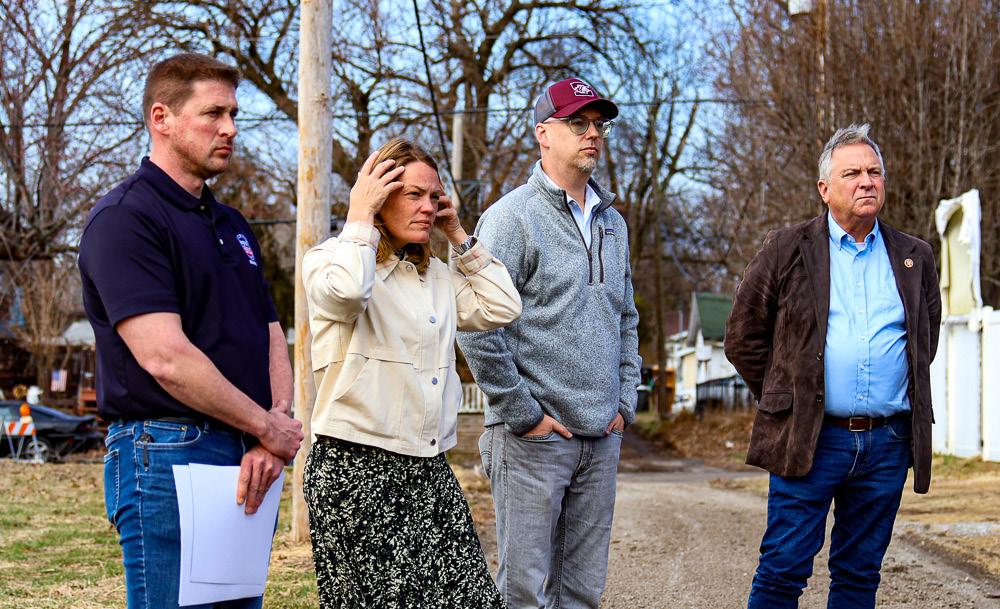
EPA coordinator Adam Vrabec, EPA admin Anne Vogel, Mayor Will Stephens, and Congressman Mike Bost stand answering questions about the former Brown Shoe Factory Feb. 18, 2026 in Murphysboro, Illinois.
Daylin Williams | @photosbydaylin
District 118’s State Representative candidates hone in on the primary election
As the March 17 Illinois primary election approaches, three prospective Republican state representatives for District 118 are bringing a different background, skillset and insight to the table. While they all agree on topics like taxes, energy costs and building community, each candidate said they believe they’re the best for the job.
District 118 covers territory in Pulaski, Alexander, Union and portions of Jackson and Williamson county. Paul Jacobs is the current representative, but he recently announced his candidacy for the 59th Senate District, leaving the seat open.
Harold Visser, a contractor from Chicago; Dayton Loyd, a U.S Army and National Guard Veteran from Makanda; and Scott Doody, a retired radio talk show host from Anna are looking to secure the Republican ballot. Chip Markel, a retired correctional officer from Carbondale, is the only Democratic candidate on the ticket.
Harold Visser
Visser formerly ran for Carbondale Mayor in 2023, but lost to Carbondale’s current mayor, Carolin Harvey. He also ran for Jackson County Board two years ago, but lost that race as well. Visser said he doesn’t consider those losses, but learning experiences that make him more qualified for state representative. His campaign initiatives feature deregulating the state’s administrative codes, lowering taxes and advocating against abortion.
Originally from a suburb of Chicago, Visser moved to Carbondale to attend
SIU and graduated in 2013. He holds a degree in business management with a specialization in entrepreneurship. For the past 20 years, he’s managed rental properties alongside contracting for the past 20 years at his business Kingdom Builder Contractor.
Visser said one thing he would like to do is freeze property taxes for 10 years to encourage new businesses to enter the area. As a business owner, he said he’s seen the many Illinois regulations that he said makes it increasingly difficult to operate on a daily basis.
“If you’re a businessman, every code and regulation means more money, more compliance,” Visser said. “So if you make it easier for those people, they’re going to come here. (If) they make it harder, they’re going to leave.”
Like his Republican running mates, Visser shares a desire for lowering District 118’s taxes. Visser noted the difference between prominent Illinois cities that border cities outside the state.
“If you look at Metropolis and Paducah and at East St. Louis and St. Louis, it’s government regulations and taxes. That’s the problem. It’s not the location and reducing those burdens in the 118 and statewide will bring companies back. It has to be reasonable and has to be sustainable,” Visser said.
Dayton Loyd
Loyd said he jumped into the race because he’s tired of the broken record in Springfield.
“You hear the same thing over and over and over, same problems over and over and over,” Loyd said. “Everybody comes up with these great solutions, but they’re not executed, so I’m not sure what’s going on with them.”
Puzzle Answers (puzzles on 12)


Loyd said his running mates are all good people, but that his military experience is what sets him apart. He spent 40 years in the military, serving in Berlin when the Berlin Wall fell in 1989 and as Director of Army Intelligence for Afghanistan. He earned an undergraduate degree at SIU and two respective masters degrees from the National Defense University and National Intelligence University.
“I’m the only one that’s got any real, documented, leadership experience,” Loyd said. “Everybody has their own superpower. Mine is I tend to be the fixer. I kind of fix problems for people.
I’d like to take that into the State Rep. position. I’ve been in and out of both state and federal governments so I know how it works. I know all the nonsense and the red tape you have to jump through.”
Loyd said he wants Carbondale and the state to utilize leftover COVID funds. He noted that economic loss from the pandemic caused many businesses to close.
“They have millions of dollars left over from the federal COVID fund still in the coffers they’re not even using,” Loyd said. “I think they need to redirect some of that; need to help with COVID-related problems instead of trying to direct it to retirement funds and things like that.”
While Loyd is not a politician, he said his global leadership is important to this position.
“So the things that kind of draw people to politics, those are not the things that are drawing me to politics. I’m drawn to it because I see serious problems that need to be fixed and I want to be the guy that can fix it,” Loyd said.
Scott Doody
Doody said his advantage over his competitors is the fact that he’s built connections as a lifelong resident of Union County. The Chicago Tribune’s editorial board recently endorsed Doody, writing that he “stands out as someone who could navigate Springfield.”
Doody hosted a local radio talk show for 12 years called the “Working Man Show” where he commonly discussed politics. Doody also served at Anna Kroger’s risk management and now works on old cars and trucks. His goals are to give back to his community by rebuilding infrastructure and promoting tourism.
“I know the territory, I know the geography, I know the people. I identify with them,” Doody said. “When you’re in the super minority like the Republican Party is, then you’ve got to play three-dimensional chess all the time.”
When the state representative candidacy opened up, Doody said locals were calling him asking him to run for office. He originally turned them down until the mayor of Murphysboro, Will Stephens, who managed Doody’s radio talk show, called him and suggested he think it over. Doody was hesitant to enter the race because he said he’s not a politician. After he thought it over, and Stephens agreed to be his campaign manager, Doody said he was up to the task.
Doody said he’s been working six days a week since he decided to run for office in August, only stopping for a few days to take a break during the Jan. 24 snow storm. He said being a Republican in a Democratic super majority frees up his time to work on local issues.
Doody said he knows many families who cannot afford to cool their entire house at night during the warm months.
“Electricity and property taxes are just insane, and it could be fixed, but now that’s the majority party’s decision on how they want to do that,” Doody said. “It’s my job to point out things that maybe we could do in a better way and see how that works out.”
Doody said artificial intelligence data centers are a driving force when it comes to spiking electricity bills and the race to ramp up on green energy, like the 3,000-acre solar farm in Pulaski County currently under construction.
“I hope to have adult conversations with the other side of the aisle,” Doody said. “Folks know this won’t work, when I’m talking to the Democratic Party, they know this isn’t doable. We’ve got to have relief on these electricity bills. Electricity is going to be complicated, but I understand what the problems are and I believe the Democrats understand it as well.”
Although Doody declined to explain the details, he did say he has a viable plan to eliminate property taxes for seniors.
“When people talk about running for state senate and state representative they’re going to Springfield to work on property tax relief,” Doody said. “That’s not where that problem is solved. Property taxes are worked out at the local level, and we’re going to have to start working as hard as we can with each other. School boards and taxing government agencies are going to sit down, put a plan together.”
Doody said he’s talked to people in Pulaski and Alexander counties about the vacant Tamms Correctional Center, a supermax prison that closed in 2013 due to high operation costs. The closure resulted in an estimated loss of 300 jobs. Doody would like to see it repurposed along with Tamms Work Camp, or the minimum security section of Tamms. It sits adjacent to the supermax allowing inmates to work in vocations like forestry management or maintenance, often paid. Doody said it could benefit the people of Alexander County by providing jobs.
“The Supermax has been stripped,” Doody said. “I don’t know if folks know that, but they have went inside and gutted that. I’m talking to people that worked there, people that live there, and here’s what they’re telling me. It’s my job to listen. I work for the people. Tear the supermax down. If that is done, we may be able to do something with the minimum security or the work camp, for lack of a better word.”
Doody said that the U.S. Forest Service could be interested in purchasing the land that the prison resides on because it’s located where the Ohio and Mississippi rivers connect with an abundance of nature. However, the prison would first have to be torn down, which he said he learned by talking to Alexander County officials,
and they don’t have the funds to do so.
Chip Markel
Markel is the sole Democratic candidate. Originally from Carbondale, he served in the Navy for four years directly after high school. He worked at Menard Correctional Center in Chester, Illinois. After seeing violence nearly every day there, he said he was motivated to be a part of the effort for a maximum security prison in Illinois. After lobbying for its construction in 1998, he transferred to Tamms and worked there until he retired in 2012. In 2022, Markel ran for the 12th U.S. Congressional District but lost to incumbent Mike Bost. Despite this, he said he felt a calling to represent District 118. He said he would like to reopen the work camp portion of the prison to provide additional jobs to the area. Markel said the district has been inadequately represented and his goal is to fight for the individual citizen.
“People can’t afford to live,” Markel said. “You know, how can you have to choose between paying your power bill or putting food on the table? You know it’s ridiculous that people have to go through that, right? That’s my driving force … we can do better. People in this area deserve that and I want to provide that.”
Markel noted his desire to advocate for getting a port put into Cairo’s riverside. He said five years ago, the governor announced $40 million of funding to develop the Cairo Port, but nothing has been done.
“You have two major rivers. We have a major rail, we have access to interstates. So that was good that the governor announced that, but that’s been five years ago, and we haven’t done anything yet. You know why not? To me, that’s the responsibility of your state representative to stay on top of that, to find out what’s going on, to keep pushing.
Like I did with the pursuit of the supermax prison,” Markel said. He said upcoming Medicaid cuts could be devastating to the region. Markel said it will be important to have a seat at the table to advocate for those affected. By January of 2027, many Medicaid recipients will have to meet the requirement of 80 hours of work per month. A study from the Center on Budget and Policy Priorities, a research institute that focuses on federal and state legislation, estimates that at least 72% of recipients nationwide may be at risk of losing coverage due to the work requirements.
Markel said hospitals and nursing homes in the area could be at risk due to the upcoming cuts.
“That’s not even including the assisted living facilities, or community health services who are already feeling the effects of that,” Markel said.
Markel would like to advocate for downstate Illinois to receive the funding necessary to alleviate the stress of future Medicaid cuts.
“You send a Republican to Springfield, unfortunately, that’s the way it’s going to be. They’re going to be outside the room. They’re not going to be at the table,” Markel said.
Staff Reporter Kristin Borchers can be reached at kborchers@dailyegyptian.com
crew. It was very eye opening.”
Her path into the profession was influenced early by her father.
“The reason I wanted to become a firefighter definitely stemmed from growing up with a father in the fire service, and the idea of how much I know my dad loves serving his community,” she said. “It’s definitely one of my greatest joys working in this department, because it doesn’t feel like a job, since I love what I do every single day.”
Connor said she grew up around the station, surrounded by firefighters she considered family.
“Growing up, I would come here and it’s like a second house I grew up with. The guys that my dad worked with were all like extra uncles or brothers, so I always loved coming to see my dad here, getting to spend time with him, because I know they’re taking care of my dad,” she said.
Steve spent 21 years with the Carbondale Fire Department and more than 30 years working for the city overall, retiring as assistant chief before becoming chief of the Murphysboro Fire Department.
“I was just about maxed out in my pension in Carbondale, and so I saw an opportunity to go back to Murphysboro, my hometown, and so I took over there,” he said. “I was retired for 12 hours. Sunday night I was done, and Monday morning I was over in Murphy.”
Before entering the fire service, he worked as a police officer in both Murphysboro and Carbondale. After assisting with a rescue at a Carbondale fire, he said the fire chief at the time encouraged him to apply for a new fire investigation program, believing his law enforcement experience and actions at the scene made him a strong fit. He was hired in 1997 after 11 years in law enforcement and completed the fire academy while still working as a police officer.
“This job isn’t just a job, it’s a calling,” Steve said.
He said the work has always centered on service and teamwork.
“I tell everybody to be lifelong learners and perfect their craft. It’s
CHIEF
CONTINUED FROM 1
challenges, Crippen said.
really a team sport. We take care of each other, and every call that we go on is an opportunity to make a difference,” he said. “They don’t call us when they’re having a good day, right? It’s when they’re having a bad day.”
Connor said she was part of the first crew on scene of the Feb. 7 apartment fire.
“My role was part of the suppression team, so we were first on scene,” she said. “When we arrived, we could obviously see the fire…we pull a line, stretch it out, and as soon as it stretched, we charge it and start pulling around the fire.”
As the fire grew, Murphysboro firefighters were called in through mutual aid, a common practice where neighboring departments assist each other on major incidents.
“Murphysboro and Carbondale work together hand in hand on these structure fires,” Steve said. “Just two nights ago, we had one in Murphysboro, and we called Carbondale to come over.”
Murphysboro responded as a rapid intervention team, a crew assigned to assist firefighters if they become trapped or injured.
“We got the call that Carbondale needed help, we responded with a RIT team,” Steve said. “By the time we got here, they had the fire under control, so then they sent us down to the basement and to do what we call overhaul, looking for hidden fire hot spots, and Connor was on the floor above, doing the same thing.”
Both knew there was a strong chance they would see each other on scene.
“I know when she’s on duty, and she knows I’m pretty much always on, so on the way over, I figured she was going to be there because, both sides of town usually go to something like that,” Steve said.
Connor said she realized the same when she heard the call.
“I definitely heard the mutual aid call as soon as we went on scene,” she said. “So I knew what was happening.”
Although she had seen her father work fires before while employed in emergency medical services, this was different.
“When I used to work the ambulance, I was staged, just in

Steve McBride and Connor McBride pose for a portrait with Carbondale’s station’s fire engine Feb. 20, 2026 at Fire Station 2 in Carbondale, Illinois. Daylin Williams | @photosbydaylin
case they needed medical, and I saw them arrive and got to witness them all work but this was before I got into the fire service, so it was pretty cool,” she said. “We haven’t gotten to work together yet … but this was the first time we’ve actually got to work an actual fire scene together.”
For Steve, watching his daughter work alongside him brought a different kind of pride.
“To see her do the things that I’ve done for so long on such a high level in that short a period of time since the academy is really something,” he said.
He said her success came as no surprise.
“I knew that she’d be good at this. She was on the ambulance service for a while, and she’s an adrenaline junkie like me, so I knew she would be good at this.”
Connor said her own journey was shaped not only by her father, but by programs like Badd Axe Ladies, which introduces young women to firefighting.
The program is a hands-on
firefighting experience created in 2022 to give women ages 16 to 25 a chance to explore what a career in the fire service is like.
The program includes a skills weekend where participants train in full firefighting gear, giving them hands-on instruction and team-building experience.
“So I was in it for their third year of having the program, and that was probably the final moment of realizing I can actually physically do this,” she said. “It really gives you that taste, and then it’s addictive. You never want to stop doing it, and you have a lot of fun doing it too.”
Since completing the program herself, Connor has returned as a mentor and instructor, helping guide other young women interested in the profession, and says she hopes to inspire others.
“I hope they’re able to see that they can do anything that they set their mind to, that there’s nothing that they can’t overcome, and that you can count on other people to be there and cover
your back when you need them,” she said.
Steve said he hopes more people consider careers in firefighting.
“Ladies should not shy away from the fire service,” he said.
“Everybody has a place. There’s probably things that I can do that she can’t. But I know for sure there’s things that she can do that I can’t. Everybody’s got the thing that they can do that somebody else can do.”
After decades in the profession, Steve said the fire service remains one of the most rewarding careers he could imagine.
“It’s a fantastic career. I wish I would have made the change from law enforcement sooner or even just gone straight into the fire service,” he said. “Do something you love and you’ll never work a day in your life.”
Staff Reporter Annalise Schmidt can be reached at aschmidt@dailyegyptian.com
Assistant Fire Chief Dylan Fairfield said Crippen’s leadership style reflects the time he has spent working alongside firefighters.
“Anything he asks you to do is
“Unlike other city operations, fire departments do not generate revenue,” he said. “City budget support is essential for staffing, training, and equipment.”
something he is willing to do himself,” Fairfield said. “He leads by example.”
Fire Captain Courtney Looft said Crippen prioritizes communication and remains calm in high-pressure situations.
“He listens,” Looft said. “He wants input before making decisions.”
With many firefighters out on calls or in training, Crippen introduced two of his team by name and encouraged them to speak about the department. The familiarity in the room reflected years of working side by side.
“He’s been here. He knows the department,” Fairfield said. “That matters.”
Staff Reporter Tay Acree can be reached at tacree@dailyegyptian.com


Jacobs, Vercellino to vie for Fowler’s senate seat in primary election
JACKSON BRANDHORST jbrandhorst@dailyegyptian.com
An Independent, a Democrat and two Republican candidates are set to square off in the race to serve Illinois’ 59th District to replace outgoing Illinois Sen. Dale Fowler, who announced this summer that he will not be seeking reelection.
Either Illinois State Rep. for district 118 Paul Jacobs or Franklin County Treasurer Stephen Vercellino will serve as the Republican nominee in November — depending on the results of the March 17 primary election.
Director of the Carbondale Chamber of Commerce, member of the Southern Illinois Workforce Development Board and owner of New Kahala William Lo will run as an Independent candidate come November — so long as he receives enough campaign signatures.
U.S. Army Lieutenant Colonel, member of the Jackson County Growth Alliance and member of the Jackson County Board Tamiko “T.C.” Mueller is running as the lone Democrat and will be the first Democrat to challenge this seat since Steve Webb in 2018.
Early voting for the primaries began on Feb. 5, and polls close at 7 p.m. on March 17.
‘Big shoes to fill’
In July of 2025, Fowler announced that he would not be running for his seat in the 59th District — citing a pledge that he made when he was elected back in 2016 in which he promised to only serve for 10 years.
Illinois State Senate terms are staggered to last two or four years, specifically structured as one two-year term and two four-year terms every decade. Because districts are redrawn after the census, the current term structure for the 59th District follows this 2-4-4 cycle.
The Illinois Senate has 59 members elected from districts across the state while the Illinois House of Representatives has 118 members; together they form the Illinois General Assembly, which writes and passes laws on issues such as education, state taxes, transportation and public safety, sending approved bills to Governor J.B. Pritzker for signature.
At the federal level, Illinois elects two senators to the United States Senate and sends 17 members to the United States House of Representatives, each representing a congressional district who represent the entire state. Those federal lawmakers serve in Washington, D.C., crafting and voting on nationwide policies including defense, federal spending and immigration, while state legislators focus specifically on laws that govern Illinois.
Longtime southern Illinois political figure Brandi Bradley, who has worked alongside Fowler in the Illinois General Assembly in Springfield, said the two developed a strong working relationship over the years.
“Sen. Fowler just wanted to deliver for the district,” Bradley said. “His No. 1 priority was economic development. That’s why he was so successful — working across the aisle just to deliver for southern Illinois.”
For 10 years, Fowler worked on projects like expanding economic development initiatives across southern Illinois, advancing the long-discussed Cairo Port project, supporting infrastructure improvements for rural water and sewer systems and backing workforce training partnerships tied to regional growth efforts.
Many of these projects are a long way away from coming to fruition, and Bradley says that whoever steps up to fill Fowler’s shoes must be prepared to continue the efforts in completing these initiatives.
“He always said 10 years,” Bradley said. “It can burn you out. You’re traveling to Springfield, you’re trying to get things done. I think leaving and letting somebody come in with fresh energy can be a good thing.”
Fowler’s announcement came as somewhat of a shock to Jacobs, who had just announced that he would be rerunning for his seat in Illinois’ 118th District.
“It had only been maybe a week,” Jacobs said of the timing between the two announcements. “We had just announced it — but Dale had given the promise of 10 years, and he was at his 10 years. He kept going back and forth on whether or not he needed to honor that, and he finally decided, you know what? I’m honoring that. We had no clue.”
Fowler had spoken to both Jacobs and Illinois District 117 Rep. Patrick Windhorst a few months before announcing his retirement, hinting at the idea that he would like one of them to be his successor if he were to decide to call it quits.
According to him, Windhorst didn’t want the Senate seat, and so Fowler’s shoes were his to fill.
Jacobs announced his campaign for the Senate seat just days later, and has since been publicly endorsed by Fowler, Windhorst and Republican Sen. for the 58th District Terri Bryant. Windhorst will seek reelection in the Illinois House for District 117, while Bryant will continue to serve as the Senator for Illinois District 58 for two more years.
For Jacobs, not much changes from switching his campaign from the House to the Senate — just the boundaries that determine which constituents he serves.
“We go from 190,000 people to 220,000 people,” Jacobs said. “We’re in a perfect position to do that. There’s not much difference. It’s just bigger. Much bigger. That’s the biggest attraction — there are more people we can serve and be conscious of their needs. We have a lot of needs in southern Illinois. We’re not exactly rich folks down here. There are a few rich folks, but we’re down to earth — impoverished, middle class and
lower middle class — and those folks a lot of times need a lot of help. So it’s an honor. It falls in your lap and you either go yes or no. And I said, ‘absolutely.’”
Jacobs, who has now served as a state representative in the Illinois House for over six years, acknowledged the weight of potentially succeeding a legislator widely respected across party lines.
“It was difficult because he’s very well-respected in many circles,” Jacobs said. “I felt very honored that Dale even talked about having one of us do it.”
‘We’ve got to think of everything’
A central theme of Jacobs’ campaign is continuing what he describes as Fowler’s economic development legacy — particularly the long-discussed Cairo Port project. He argues the port would not only benefit Cairo — one of Illinois’ most economically distressed communities — but the entire region.
“80% of the United States can be within eight hours of that Cairo port,” he said. “We have road, rail, highways — everything right there.”
He described the port as strategically positioned along major rail lines and river systems, capable of shipping coal, agricultural commodities and containerized freight via barge at lower cost than truck or rail alone. He also noted Cairo’s advantage as an icefree port for much of the year.
Beyond Cairo, Jacobs tied economic development to energy policy, arguing that attracting manufacturers to southern Illinois depends on stabilizing electricity costs.
“We have to get businesses in,” he said. “We can’t continue to live on government money. We have to get businesses and jobs that can perform here.”
He criticized the state’s energy transition policies, arguing they have contributed to higher utility costs and uncertainty for industry. Jacobs has voiced support for maintaining coal generation while also exploring alternatives like small modular nuclear reactors.
“We’ve got to think of everything,” he said. “We can’t just get rid of this and get rid of that.”
In Carbondale, Jacobs described a different but related challenge: reversing years of enrollment decline at Southern Illinois University.
“Carbondale is special,” he said. “But to go from 25,000 students to 10,000 is a tremendous hit.”
Jacobs credited SIU Carbondale Chancellor Austin Lane with aggressive recruitment efforts and said he personally urged Lane to focus on keeping local students in the region.
“51% of our high school graduates who go on to college go out of state and never come home,” Jacobs said. “We need to keep those kids here.”
Jacobs currently serves on the House appropriations committee for higher education and said he would
seek a similar assignment in the Senate to maintain influence over university funding decisions.
“They have to go through our committee to do anything,” he said. “We have a good product in our universities — we just need the students.”
He described recruitment of local high school students — even in athletics — as part of strengthening community investment in SIU.
“You get a kid out of Carbondale or Murphysboro,” Jacobs said, “you’re going to have people excited about Saluki football or basketball.”
Economic revitalization, he argues, extends beyond Cairo and Carbondale to smaller communities like Thebes, Mounds and other towns struggling with aging infrastructure and shrinking tax bases.
“Thebes doesn’t have a whole lot of taxpayers,” Jacobs said, referencing federally mandated sewer upgrades.
“There’s no way they’re going to be able to get hundreds of thousands of dollars to fix that.”
In Cairo, he pointed to costly temporary sewage pumping measures while larger infrastructure projects await funding.
Until those communities see relief, Jacobs said his priority remains what he calls “my people down here.”
‘Tackling government red tape’
Vercellino, like Jacobs, also decided to run for the Senate seat after learning that Fowler would not be seeking reelection, according to reporting from The Southern Illinoisan.
Despite multiple efforts to schedule an interview with Vercellino in late January, he did not reach back out to the Daily Egyptian to set up a time to do so before our print deadline.
Vercellino is an SIU graduate who worked at Aisin in Marion as a cost accountant from 2014 to 2018 before he began his tenure as Franklin County Treasurer, a role in which he still currently serves, despite having faced public scrutiny amid a 2023 investigation and external audit that he said was full of hearsay and false statements.
A Forensic Analysis Report commissioned by The Franklin County Board was conducted by independent Certified Public Accountant Troy V. Luh in 2023 that aimed to determine weaknesses in internal controls, identify red flags, assess the treasurer’s ability to perform required duties and to provide recommendations to the County Board.
The analysis found significant weaknesses in financial controls and reporting practices within the Franklin County Treasurer’s Office, citing what it described as “material weaknesses” in internal controls over a two-year period. The review identified inadequate segregation of duties, untimely bank reconciliations and delays in providing reliable financial information to the County Board and external auditors. The report concluded that these deficiencies
increase the risk of fraud or material misstatement — though it did not determine that fraud had occurred.
The analysis also flagged concerns over electronic check signatures, checks written out of sequence or without clear descriptions, delayed deposits and financial reporting delays that contributed to the late release of the county’s annual audit. It further found organizational and recordkeeping deficiencies and concluded that the treasurer lacked sufficient governmental accounting expertise to effectively manage the office.
“It is my opinion that the Treasurer’s Office lacks sufficient personnel to perform the duties of the office,” Luh wrote in the report. “It is also my opinion that the current Treasurer lacks the skills and abilities to successfully perform the job duties required in this position.”
The report recommended stronger oversight, improved internal controls, independent review procedures and timely reconciliations, warning that continued weaknesses could affect the county’s financial stability, credit standing and borrowing costs if left unaddressed.
In response to the report, Vercellino condemned the findings in a 2023 statement to WSIL, stating that much of what was included was wrong or misinterpreted. No charges, no resignation nor any form of ramification ever came of the investigation.
“I can’t really tell you what Steve has to offer,” Jacobs said of his primary opponent. “I do know he’s had some problems as treasurer. That’s about all I can say.”
According to Vercellino’s Facebook, he’s been campaigning hard across the 59th District, visiting with constituents in multiple counties at GOP events, town halls and meetings. Posts show Vercellino being depicted as a football player with the message “tackle government red tape.”
Vercellino told The Southern that he wanted to stay in southern Illinois to combat what he called a “brain drain.”
“I wanted to stay here and grow where I was planted and make this place a better place to live,” he said.
According to The Southern reporting, Vercellino, like Jacobs, highlighted water infrastructure, as well as energy prices and shortages, as major issues that area communities are facing. He also added that tourism is something that the region should continue to build on to attract visitors and new residents.
His website does not disclose any campaign promises nor ideological platforms.
Visit www.dailyegyptian.com later this week to read an extended version of this story with more details about Mueller, Lo and the two Republican candidates.
News Editor Jackson Brandhorst can be reached at jbrandhorst@dailyegyptian. com or on instagram @jacksondothtml
Salukis sweep Iowa trip as regular season enters the final stretch
ELI HOOVER ehoover@dailyegyptian.com
The Saluki men’s basketball squad made the daunting trip to Iowa to take on the Drake Bulldogs and the Northern Iowa Panthers. They ended the trip with their first sweep of the two games since the 20172018 season.
SIU 66, Drake 61
The Salukis traveled to Des Moines, Iowa on Wednesday, Feb. 18 to take on Drake. The Dawgs got revenge for their Jan 14 home loss and got their first win in Des Moines in six years in a 66-61 decision.
Despite shooting well from distance themselves, 3-pointers continued to hinder the Salukis. Bulldog guards Jalen Quinn and Eli Shetlar combined for four threes in the early going to give Drake an 18-13 lead with 9:58 left in the first half.
An 8-0 run for the Salukis, powered by guards Damien Mayo Jr. and Drew Steffe, brought the Bulldog lead down to 31-26. Both defenses buckled down, and the score stayed the same going into the last media timeout of the first half.
A Quel’Ron House 3-pointer
brought the score to 31-29, but that’s as close as the Salukis would get in the first half. The Bulldogs used a quick burst to take a 36-31 halftime lead.
SIU cut down the lead a tad during the first four minutes of the second half. Four different Salukis scored to cut their deficit to 42-40 with 15:37 left in the game.
Mayo continued to pour in points from all three levels, helping the Salukis on a 10-0 run. SIU’s offensive prowess and Drake going on a four minute scoring drought gave the Salukis a 50-44 lead with 11:26 left in regulation.
The Salukis continued to fend off the Bulldogs as time wound down. Despite Mayo missing much of the next segment due to foul trouble, SIU held on to a 53-49 lead with 7:43 left in the contest.
With 2:57 left and a 61-57 lead, Mayo committed his fifth foul of the ballgame, meaning the Salukis would have to play without him the rest of the way. That came into play in a huge way with 31 seconds left when guard Caden Hawkins coughed the ball up in the backcourt. That meant the Bulldogs had a shot at tying the game. A
House steal crushed Drake’s dreams, and two made free throws later the Salukis clinched a 66-61 road win.
While 3-point shooting has been an issue for the Salukis all year, it was their saving grace against Drake, shooting 39% from distance but only 32.5% from inside the arc.
Despite fouling out, Mayo led the Salukis with 22 points, tying his season-high he set on Dec. 3 at High Point.
SIU 59, UNI 57
The Panthers had the ball down 2 with 16 seconds and the length of the floor to go. UNI Guard Ben Schweiger’s last-second layup was blocked by Saluki forward Rolyns Aligbe, before falling harmlessly to the floor, clinching a 59-57 win for the Dawgs. The victory was SIU’s first win in the McLeod Center in seven years
The Salukis traveled to Cedar Falls, on Saturday, Feb. 21 to take on Northern Iowa, and left with their second win in a row. The win brought SIU to 8-10 in MVC play.
SIU started out hot on the offensive end while stifling the Panthers on defense. Guard Drew Steffe was lethal from long range,
and his two 3-pointers gave the Salukis an 18-10 advantage with 11:35 remaining in the first half.
UNI made a quick 5-0 charge, but a 3-pointer from forward Max Pikaar stopped the Panthers cold. House converting an and-1 moments later stretched the Saluki advantage to 24-17 with 7:06 left until halftime.
The Salukis finally cooled down as the first half wound down. A two minute scoring drought and back-to-back baskets for the Panthers cut the lead to 30-26 with less than 90 seconds left in the first half.
UNI briefly tied the ballgame back up for the first time since early in the contest, but a Steffe 3-pointer from the deep corner went in at the buzzer, giving SIU a 33-30 advantage at halftime. Steffe’s basket was a great representative of the Salukis’ shooting half, shooting 54% from the floor and 50% from behind the arc.
Coming out of the locker room, the Panthers took multiple small leads but yet another Steffe 3-pointer put the Salukis on
top 42-39 five minutes into the second half.
There might as well have been a lid on the UNI basket through the middle portions of the half, with the Panthers going scoreless for over five minutes. Even a change in defensive strategy couldn’t stop the Salukis on offense, and they held a 53-43 lead with 7:19 remaining in regulation.
The Panthers stifling defense brought them back in the ballgame, forcing four turnovers in the last four minutes. A layup from guard Trey Campbell brought UNI within two points with 36 seconds to go. A traveling violation on Saluki guard Damien Mayo Jr. gave UNI the ball back with 16 seconds left on the clock. Schweiger’s layup attempt to tie it was no good, and the Salukis finished off a 59-57 road victory.
The now 14-15 Salukis travel back to Carbondale for senior night on Wednesday Feb. 25 at 7 p.m. against the Indiana State Sycamores.
Sports Reporter Eli Hoover can be found at ehoover@dailyegyptian.com or on Instagram @hoovermakesart
Salukis scuffle, squander games against UNI and Indiana State
NOAH PETSCHKE npetschke@dailyegyptian.com
Looking to stack wins late in the season, the Salukis hosted the Panthers of the University of Northern Iowa on Thursday, Feb. 19 before hitting the road to challenge the Sycamores of Indiana State University on Saturday, Feb. 21. The Dawgs, who have seen some recent success, could not find the winning formula and lost 48-77 to UNI and 73-81 to Indiana State.
UNI 77, SIU 48
Looking to jump back into the win column, the Salukis hosted the Panthers on Feb. 19. The two teams, sitting in the middle of the Missouri Valley Conference standings, proved to be a rough matchup for SIU, surrendering a 29-point loss and dropping the contest 48-77.
The pace of play was slow to begin, with both teams missing their first shots and struggling to put together an effective offensive scheme. The Panthers got on the board first, countered by a jumper from forward Indya Green.
The Salukis went on a near four-minute scoring drought, but their defense shone, holding the Panthers to a one-point margin. Five different Salukis contributed to the scoring effort, but the Panthers led 15-14 after a quarter of play.
SIU took the lead early in the second quarter with a three-pointer from guard
Karris Allen. The consistent scoring persisted throughout half of the quarter, and it appeared to be an even matchup, but the Panthers took charge. Shots were falling left and right, and stopping the conference opponents was no easy feat.
UNI started to build and bolster its lead, and the Panthers entered halftime with a 39-31 lead.
Coming out of the half, the Dawgs needed an answer for the opponent’s playstyle, but the shooting struggles carried over. The Panthers were shooting with efficiency, and the lead was getting closer to being out of reach of the Salukis.
“We were in a hurry and got away from the game plan of where and how to attack them,” head coach Kelly Bond-White said Guard Jeniah Thompson was dropping in buckets, but the Salukis only shot 27% from the field in the quarter. The Dawgs needed a miracle as they faced a 57-41 deficit entering the final quarter.
Numerous scoring runs by the Panthers and minutes without points by the Salukis were not a recipe for success. The lead was skyrocketing, and the hopes of taking a victory were plummeting. The Salukis put up a mere seven points in the quarter, ending in a 48-77 loss at home. SIU 73, INDST 81
Trying to shake off the previous loss, the Salukis traveled to Terre Haute on
Feb. 21 to face the Sycamores of Indiana State University. While the game was more balanced, the Salukis dropped their third consecutive contest with a score of 73-81.
The Salukis won the tipoff and jumped out to a 7-0 start on buckets from Green and guard Kayla Cooper. While the SIU offense was cohesive, the Sycamores came back quickly and knotted the game at 12-12. Indiana State kept scoring, and the Sycamores finished the first quarter with a 21-18 lead.
The second quarter began similarly to the first, with a Green jumper. The pace was intense, and both teams played gritty defense and shot efficiently. With the first half coming to a close, Green and guard Alayna Kraus knocked down consecutive shots, bringing the score to a tight 35-36.
Coming out of the half, guard Jeniah Thompson got on the board, and the Salukis went back on top after a steal and a transition bucket by guard Tkiyah Nelson.
The offense was coming back together for the Sycamores, and the SIU lead was ephemeral. The Salukis started fouling and giving the Sycamores trips to the free-throw line. The Dawgs cleaned up the defense, and the game was neckand-neck. Going into the final quarter of play, the score was knotted at 56-56.
The Sycamores hit the ground

SIU guard Kayla Cooper (14) challenges the defense of two UNI players, Jenna Twedt (20) and Ryley Goebel (5) Feb. 19, 2026 at SIU’s Banterra Center in Carbondale, Illinois. Olivia Luesing | oluesing@dailyegyptian.com
running in the fourth quarter, going on a 7-point run and putting the Salukis into a difficult position. Indiana State was slowly putting the game out of reach, but Kraus came in and strung together five quick points.
The late efforts were not enough, and the Salukis dropped the game 73-81.
With these losses, the Salukis are now 9-16 overall and 6-10 in conference games. The Dawgs travel to Illinois State University on Thursday, Feb. 26, to play the Redbirds.
Sports Reporter Noah Petschke can be reached at npetschke@dailyegyptian.com
SIU WOMEN’S BASKETBALL RECAP
Saluki Baseball strikes out, goes 0-3 in weekend road series
NOAH PETSCHKE npetschke@dailyegyptian.com
The Salukis continued their on-theroad start to the baseball season, heading to North Carolina to play two games against Queens University of Charlotte and one against Appalachian State. The Salukis came close in all three games, but fell short in each of them.
FEB. 20: QUEENS 2, SIU 0,
After nearly a week off, the Dawgs were back in action against the Royals of Queens University of Charlotte. The game was a pitcher’s duel, but the Royals pushed across two runs to edge out SIU.
Joey Ruller started for the Royals and faced early trouble after hitting RF Kye Watson, followed by a stolen base. However, the Salukis failed to score the runner. RHP Andrew Evans took the bump for the Salukis and went to work immediately. The skilled pitcher mowed down the first three Royals’ hitters, two by strikeouts.
The strong pitching persisted, not
allowing a hit until the seventh inning, when 3B Cecil Lofton singled to right centerfield.
After a single in the eighth inning, Evans was pulled and the Royals played small ball to get into scoring position. The strategy paid off when a double was smacked to left field, plating the only two runs of the game.
The Salukis only put up one hit and dropped the first game 0-2.
FEB. 21: QUEENS 9, SIU 8
The Salukis faced off against the Royals for the second consecutive day as they looked to bring the bats back to life. While it looked like the Salukis were in business, the Royals rallied to snag a walk-off victory, defeating SIU 9-8.
After a pitcher’s duel in the prior game, LHP Troy Shepard took the mound for the Salukis. The southpaw faced early trouble, giving up a first-inning homer, and SIU was down 2-0.
Shortstop Tim Simay got the Dawgs on the board with an RBI sacrifice fly in
the fourth inning. LF Kristian Sprawling followed with a 2-run homer, giving the Salukis a 3-2 lead.
The Royals came into the fifth inning facing a deficit and exited with a 4-3 lead due to a hit barrage featuring an RBI single and double. The following inning, they tacked on another run with a solo homer to right center.
Jacob McKenzie came in to pinch hit and substitute in at the catcher position, and hit a home run to bring the Dawgs within a run.
The SIU offense exploded in the eighth inning as they batted around the lineup and put up four runs. The Salukis crossed the plate in many ways, such as a sacrifice fly, walk, single and passed ball.
The power bats out of Queens University came out twice more as the Royals mashed back-to-back longballs, making it a one-run game heading into the ninth inning.
The Royals loaded the bases with no outs in the bottom of the ninth and hit two
sacrifice flies to tie and walk off the game.
The Salukis’ bats came to play, but could not hold onto the lead, dropping the second game of the weekend 8-9.
FEB. 22: APPST 9, SIU 8
The Salukis faced the Mountaineers of Appalachian State University on Feb. 22, hoping to tally a victory ahead of their first home game of the season.
The Salukis displayed excellent plate discipline in the first inning and capitalized on the pitcher’s struggle to find the zone. The Dawgs drove in two runs via RBI walks taken by T. Simay and McKenzie.
RHP Ryan Halamicek started for SIU and got through the first two innings with no damage, but ran into some trouble in the third when he gave up an RBI double down the line.
The Royals tied the game and took a 5-2 lead in the fifth inning with two RBI singles, a groundout, and an error.
The SIU pitching had some trouble
SOFTBALL WEEKEND SERIES RECAP
with locating pitches effectively. The bottom of the sixth started with a base on balls for the Mountaineers, which was the sixth walk surrendered by the Salukis up to that point.
The Dawgs gained some ground back in the seventh inning with an RBI double from Sprawling and a 3-run homer off the bat of Lofton.
Watson added another run to the Salukis’ late-game push with an RBI single in the eighth inning.
A ninth-inning RBI from 2B Gabe Petrucelli tied the game, but the Mountaineers came up and scored the game-winning run on a single.
With these losses, the SIU now sits at 1-5. The Salukis will be back in action at home on Wednesday, Feb. 25, against the Miami (OH) Redhawks.
Sports Reporter Noah Petschke can be reached at npetschke@dailyegyptian.com
Saluki Softball goes 1-4 in weekend series
Saluki Softball goes 1-4 in Birmingham
AARON CARNAHAN acarnahan@dailyegyptian.com
The SIU Softball team is back in the states to play in the Green and Gold Classic in Birmingham, Alabama. The Salukis played five games in a Feb. 20 - Feb. 22 weekend series. The Classic contained some stiff competition, including two SEC opponents, with No. 1 ranked Tennessee and No. 25 ranked Ole Miss. SIU had a tough weekend, finishing with a record of 1-4, bringing the Dawgs record on the year to 8-7.
FEB. 20: SIU 8, MERCER 3
The Salukis kicked off the weekend on Friday, Feb. 20 against the 8-2 Mercer Bears. The Bears struck first with a homer in the first inning which gave them a 2-run lead following the end of the first inning. Both the Salukis and the Bears tallied one run each in the second inning. SIU switched pitchers entering the third inning, and Junior Emily Delgado was brought into the game. Delgado would go on to hold the Mercer bats to no runs and only one hit. Delgado tallied 8 strikeouts after five innings of work.
The Saluki offense scored four runs in the fourth inning, and Maleah Blomenkamp singled in a run to cut the Mercer lead to one. An error from a Mercer outfielder allowed three runs
to score on a fly ball hit by Sage Grann, giving the Dawgs a 5 to 3 lead over the Mercer Bears. The Saluki offense put three more runs up in the sixth, thanks to a two-run single off the bat of junior Mikeala Coburn. Hailey Wilkerson walked with the bases loaded to score Grann, and the score was 8-3, SIU out in front and they would later take the victory.
FEB 20: MSU 5, SIU 4
The Salukis faced an old Missouri Valley Conference foe in the Missouri State Bears. Missouri State University (MSU) is now a member of Conference USA and is riding a six-game winning streak into the matchup with SIU. After a scoreless first inning, Missouri State scored a run on an RBI single. MSU then scored three more runs on a triple with the bases loaded and knocked in one more run off a fielder’s choice to finish the top of the second inning with Missouri State commanding a 5-0 lead.
Freshman pitcher Hailey Lucas entered the game amidst the traffic on the base paths for MSU. Lucas was able to stop the bleeding for SIU and held the Missouri State Bears scoreless in innings three through seven. The Dawgs offense scratched across a run, on a Wilkerson groundout that scored Lee. The score
remained 4-1 until the bottom of the seventh inning, when Sydney Potter crushed a three-run home run that made it a one-run game. The Dawgs couldn’t quite muster enough of a comeback and lost with a final score of 5-4.
FEB. 21: OLE MISS 1, SIU 0
SIU returned to action the next day, and after a weather delay, Bauer’s Field was playable. The No. 25 team in the nation, the Ole Miss Rebels, were the opponents in the first of two games for the Salukis on Saturday, Feb. 21. The game was a pitcher’s duel from the jump. There were only six hits in the entire contest, three by each team. Lucas was the pitcher for the Dawgs. The game needed nine innings to declare a winner. Lucas threw over 100 pitches for the second day in a row and struck out five, opposing Rebel hitters only batting .111 against Lucas.
The Saluki offense couldn’t seem to get runners into scoring position. A promising top of the fourth had the bases loaded with Dawgs and nobody out. However, a pop-up and a groundball that was turned for a double play held the Salukis scoreless. Both offenses remained quiet until the first Ole Miss batter of the bottom of the ninth hit a walk-off home run to end this marathon of a game.
“You could tell it was going to come
down to one run,” SIU head coach Jen Sewell said.
FEB. 21: UAB 7, SIU 3
SIU played the second road game of the 2026 season, taking on the University of Alabama-Birmingham. The Salukis jumped out to an early lead, scoring three runs in the top of the first inning. Potter hit her 10th long ball of the year, scoring Blomenkamp and tallying her 23rd and 24th RBIs of the season. Lee’s hit brought in Grann, and a 3-0 Saluki lead was on the board after one half inning.
The UAB Blazers responded in the bottom half of the first with an RBI single that left the score 3-1 in favor of SIU after one inning. The Blazers scored again in the bottom of the third with an RBI double. UAB took control of the game in the bottom of the fifth. A solo shot tied the game at three runs apiece.
SIU had some fielding woes, committing three errors in the game, with a throwing error allowing a fourth run to score. UAB broke the game open with a three-run sixth inning to follow the two-run fifth inning. Now down by four runs, the Dawgs fell to UAB and lost their third straight game.
FEB 22: TEN 9, SIU 0
Less than 24 hours later, the Salukis took the field to take on the No. 1 team
in the nation, the Tennessee Volunteers. Tennessee is undefeated and riding a 13game winning streak into the matchup with Southern. The woes in the field continued for the Salukis, with five errors committed in the game and no hits. SIU was playing from behind for the entirety of this game. A two-run first inning, a two-run second inning, and a five-run fourth inning left the Salukis losing by a final score of 9-0 after being run ruled in the fifth.
Southern Illinois finished the Green and Gold Classic 1-4 with an 8-7 record on the season.
The Salukis are back in action next Friday, Feb. 27, through Sunday, March 1. The Dawgs will play five more games in three days at the Lipscomb Purple and Gold Classic in Nashville, Tennessee. SIU will play two games against a Big Ten opponent Purdue, as well as two games versus Western Carolina out of the SoCon conference, and one game against the hosts, Lipscomb, out of the ASun Conference. These are the last five games before Missouri Valley Conference play begins.
Sports Reporter Aaron Carnahan can be reached at acarnahan@thedailyegyptian.com

SIU hosts its first Afro-Latina mock quinceañera
For Amilia Estrada, the mock quinceañera was more than a celebration. It was an opportunity to celebrate coming-of-age after missing her own party during the COVID-19 pandemic.
The 11th Annual Mock Quinceañera hosted by the Latino Cultural Association was held on Saturday, Feb. 21. The event is designed for women who missed their quinceañera in their teens. SIU celebrated its first Afro-Latina quinceañera this year for Estrada, a Daily Egyptian staff reporter and River Region News Director.
“Being the first Afro-Latina quinceañera was truly an honor. It’s not just about the dress or performance, but it really made the moment mean something. I felt proud, but also aware that I was stepping into a space that hadn’t always been available,” Estrada said.
The event was a complete reiteration of a traditional quinceañera with food, dancing and symbolic traditions being similar.
“The quinceañera itself, as a whole, was absolutely amazing. Everything from starting practices and getting to know the court to when I shared the dance floor with my dad for the father-daughter dance,” Estrada said.
“It was a little overwhelming, but really empowering. I got to celebrate culture, identity and a kind of coming-of-age milestone all at once. Although I am not 15, being 22, this was still a kind of transition moment into womanhood for me. I’m really happy I got to share it with my friends and family,” Estrada said. After introductions, the court of honor and quinceañera took to the dance floor for multiple choreographed dances. In the end, everyone joined together to dance into the night, and meet one last time for the afterparty at Hangar 9.
Staff Photographer Daylin Williams can be reached at dwilliams@dailyegyptian.com

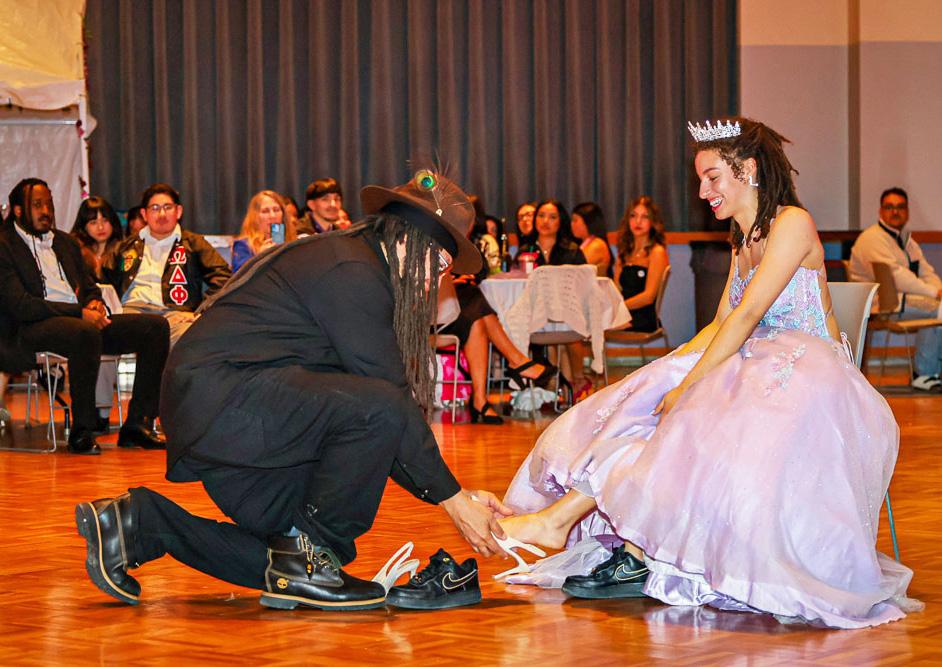


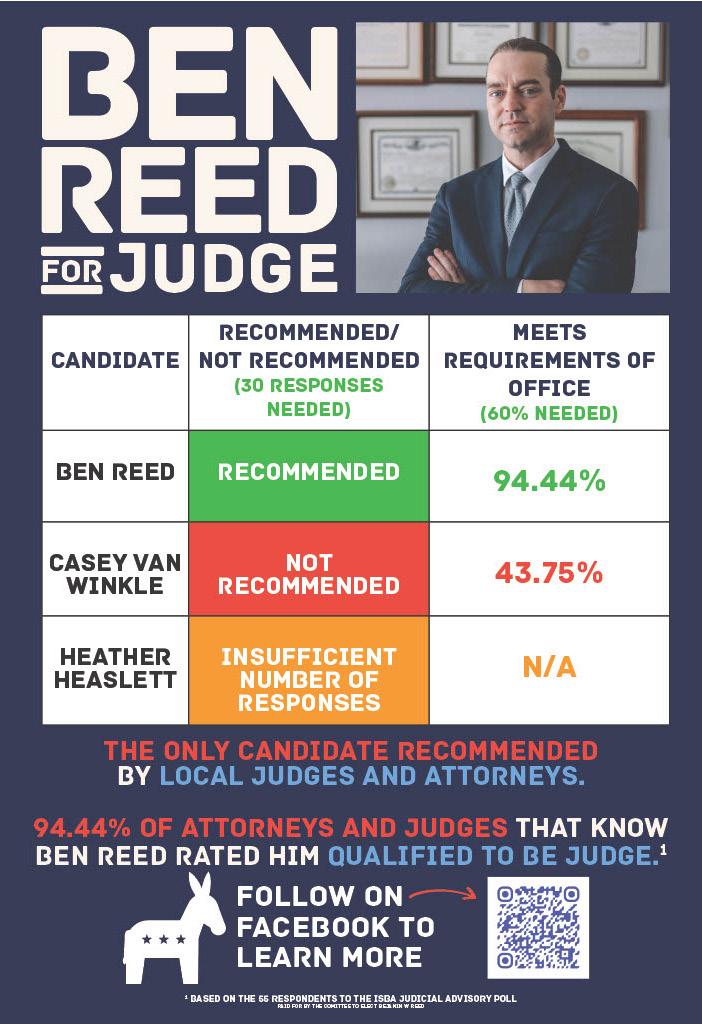
Amilia Estrada twirls her gown at the 11th Annual Quinceañera Feb. 21, 2026 in SIU’s Student Center ballrooms in Carbondale, Illinois. Daylin Williams | @photosbydaylin
Kobe Franco Alcántara Aquino, Carlos Zermeno and Xavier Valencia enjoy catered food Feb. 21, 2026 in SIU’s Student Center ballrooms in Carbondale, Illinois. Daylin Williams | @photosbydaylin
Jaleel Edmond replaces his daughter’s sneakers with heels symbolizing the change into adulthood. Daylin Williams | @photosbydaylin
Members of the Quinceañera party show off their new nails to eachother that they plan to wear for the party Feb. 18, 2026 at the Student Center Delta Room in Carbondale, Illinois. Peyton Cook | @cookmeavisual
ACROSS
1- Job for a
dermatologist
5- Gulf off Somalia
9- Wilander of tennis fame
13- Cheers
14- Lost fish in film
15- Railroad flare
16- Peruvian city
17- Sacred bird in ancient Egypt
18- Coastal opening
19- Kid’s story, 2 words
21- Writer of 37 across
22- Boat equipment
23- Merry-go-round figure, to a child
24- Black bird
28- Type of trapshoot
32- Sugary drinks
33- Cutting part

54- Character in 37 across
55- What 37 across followed, 2 words
61- De ___, in effect
62- Decorate anew
63- Between
34- Power measurement
37- Kids’ story
42- Charlie Chaplin’s brother
43- Well-ventilated
44- Mysterious letter
45- Countrified
47- Whopper topper
48- Butch Cassidy, e.g.
52- Order of corn
64- Take off headgear
65- Prayer ending
66- Michelle Wie’s org.
67- Deposits
68- Hunger for
69- Words to an “old chap”- 2 words
DOWN
1- Scary creature in a children’s story
2- Et ___ Latin for and others
3- Do-__ ___ fa, scale sequence, 2 words
4- Alexander, for one
5- “West Side Story” role
6- Prohibits temporarily
7- Painter Nolde
8- Face feature
9- Canadian storywriter
Alice
10- Moving
11- Stipulations
12- Unsavory
15- Boxer
20- Hither and __
24- Cheers
25- “An apple ___...”- 2 words
26- Peddle
27- Double bend
29- Safari country
30- Roush of baseball
fame
31- Chocolate in oval shape
34- Needle holder
35- Gambling city
36- Canyon in Utah
38- Close range, in ____
39- Watson portrayer in “Elementary”
40- Flightboard abbr.
41- Prefix with east and west
46- Netherlands city
47- Unrefined rock
48- More than bad
49- Tropical vine
50- Needing to scratch
51- Be temporarily, 2 words
53- Make reparations
55- Tortilla’s cousin
56- Chrysler engine
57- Neighbor of Java
58- Mischievous children
59- Baltic capital
60- Decisive time in WWII, 2 words
Weekly Event Calendar
Your guide to upcoming local events over the next 7 days!

*To play Sudoku, fill a 9x9 grid with digits 1 through 9 so that each row, each column, and each 3x3 subgrid contains each number exactly once.

Feb - Mar 2
27 25 26 WED THURS FRI 1 SUN 28 SAT MON 3 TUE

Sudoku #1