Confusion prevails around distance education money
Daniel Bethers
Hundreds of thousands of SIU dollars earmarked for everything from scholarships to equipment to student travel is suddenly at the center of a mystery, with department directors and faculty wondering where it is or whether it even exists.

The money is from Distance Education (DE) funds promised to SIU’s departments in exchange for the work required to put classes online.

“The School of Journalism and Advertising jumped at the opportunity to offer an online degree and as a result, the DE (distance education) funds have been a critical stream of revenue for us and the college,” said Jan Thompson, the director of the School of Journalism and Advertising. “For instance, I need to replace 25 computers in the newsroom and 40 computers in two classrooms. I was going to use DE money…but, I can’t plan for that because it is not clear if there will be DE money. We have heard there may be no money.”
Thompson said she remembers the distance education program was started by former Chancellor Rita Cheng.
“[It started] as an incentive for departments and schools to start to offer online courses-the department/ school would get a cut of the revenue,” Thompson said. “I think it has been around 40-50%.”
Chancellor Austin Lane told the Faculty Senate the distance education promise came at a time when the university was in deficit spending mode because of extreme cutbacks in funding from the state legislature. Before questioning Lane, the senate said it had received inquiries from three different colleges about the matter.
“During economic hard times,

this was extremely important, because of financial difficulties we had,” philosophy professor Kenneth Stikkers said. “There wasn’t any money for doing a lot of things like faculty travel. There was no money at all for faculty to travel, let alone student travel. And so the DE (distance education) money was extremely important. Eventually, things got so bad that the administration was not distributing that money for a while, it was such hard straits. And people complained, they said, ‘Well, you know, there’s no incentive to offer these courses [online] if there’s not some kind of benefit.”
The “hard straits” the university was going through were nothing short of 37.8 million dollars in state appropriations that SIU was forced to go without, thanks to the state budget impasse of 2015, which continued to disrupt funding to statefunded universities and government agencies across Illinois until late in 2017.
Before the 2015 budget impasse, in 2002, SIU had hit an all-time high in state appropriations, receiving $130.6 million dollars in funding directly from the state of Illinois. In early 2015, before Bruce Rauner’s state budget would have taken effect if all went smoothly in the state legislature, SIU received a more average appropriation sum of $101.6 million, sufficient to continue operations as normal. In the financial year (FY) 2016, SIU received a scant $29.27 million dollars when SIU administration was anticipating more than three times that amount.
Set on his “Turnaround Agenda,” then newly-elected Governor Brunce Rauner had begun to veto all attempts at passing a new state budget, which would span the
second half of 2015 and the first half of 2016. This included most state funding offered to universities, with only half measures for purposes of damage control making it through to SIU’s coffers.
The resulting $29.28 million would be the only money SIU saw from the state for the rest of 2016. In early 2017, the university received approximately $54 million in state appropriations, which it was forced to immediately apply to its expenses from 2016. Although SIU would receive an additional $47.54 million dollars in 2017, great damage was already done.


In 2017, the university was forced to run itself using only that last sum of $47.54 million, in addition to its other incomes. According to Interim Associate Provost Marc Morris, as a result of this hardship in 2017, as well as the previous year’s greatly reduced budget, that the university began to dig deep for the funds to continue running.
Morris said the university ran its accounts at a deficit, spending more funds than it had in order to stay functional after the unexpected drop in state aid. When addressing the Faculty Senate on the issue of distance education, Lane called it money that SIU had taken from its “reserves.” In doing this, the university incurred no interest rates, or fees of any kind, according to Morris.
However, the university’s thenadministration understood it was vital that SIU’s accounts were balanced again for the sake of long term sustainability. For this purpose, it drafted the Financial Sustainability Plan. The plan made large reductions to the university’s budget in a variety of areas, to be distributed across future academic years.

spend regardless of time passed.
“So Hahn, Professor Hahn, he teaches a lot of online courses,” said Stikkers. “So he generates a lot of money and he had made an arrangement because he conducts the study tour to Egypt. He conducts several [study tours] each year, and he had made a kind of a deal - not quite sure who would sign off on this, probably the dean - that some of these monies would be directed to fund the students and help enable them to go out on these studies, and so he had
want to do this.”
Stikkers first heard of the issue when Professor Jonathan Bean, director of the School of History and Philosophy, passed down a notification telling the rest of the school that the distance education funds would no longer be available and that travel expenses for professors wouldn’t be covered to the same extent as before. For this story, Bean told the Daily Egyptian that he had no comment on the situation.
p. 4 TEDxSIU p. 10 When to stop shopping p. 8 Arch Madness p. 12 From Curaçao to Carbondale
Egyptian SERVING THE SOUTHERN ILLINOIS
1916. DAILYEGYPTIAN.COM WEDNESDAY, March 8, 2023 VOL. 106, ISSUE 25 1, 2, & 3 BEDROOMS AVAILABLE Grab a roommate for $300-$350 per person! 805 E. Park Street (618)549-0335 | (618)549-0895
THE Daily
UNIVERSITY COMMUNITY SINCE
EDUCATION
13
DBethers@Dailyegyptian com Please see
|
Contact Us

Email: editor@dailyegyptian.com
Faculty Managing Editor: Annie Hammock ahammock@dailyegyptian.com
Editor-in-Chief: Sophie Whitten swhitten@dailyegyptian.com
Design Chief: Peyton Cook pcook@dailyegyptian.com
Sports Photo Editor: Lylee Gibbs lgibbs@dailyegyptian.com
Multimedia Editor: Kylen Lunn klunn@dailyegyptian.com
Sports Editor: Joey Bernard jbernard@dailyegyptian.com
Assistant Sports Editor: Cole Daily cdaily@dailyegyptian.com
News Editor: Jamilah Lewis jlewis@dailyegyptian.com
Ad Chief: Hannah Combs hcombs@dailyegyptian.com
Social Media Editor: Logan Brown lbrown@dailyegyptian.com
News Photo Editor: Dominique MartinezPowell dmartinez-powell@ dailyegyptian.com
Fighting climate hopelessness
Isaac LudIngton ILudIngton@daILyegyptIan com
Few issues present a greater impact to the future of collegeaged people than climate change. However, learning about the problem and its impacts can often create feelings of hopelessness. To keep these feelings from overwhelming people and preventing action, it’s essential that the issue be presented along with ways to prevent despair by offering ways to take action.

In 1988, NASA scientist James Hansen testified to Congress that global warming had arrived and identified the cause as the greenhouse effect. The greenhouse effect is the process by which gasses such as carbon dioxide and methane are emitted faster than they are removed from the atmosphere, leading to heat that would normally radiate back into space being trapped. Scientists have identified human activity as the cause of the current increase in the greenhouse effect, particularly due to the use of fossil fuels.
About Us
The Daily Egyptian is published by the students of Southern Illinois University Carbondale on a weekly basis. Fall and spring semester editions run every Wednesday. Free copies are distributed in the Carbondale, Carterville, and Springfield communities. The Daily Egyptian can be found at www.dailyegyptian.com or on the Daily Egyptian app!
Mission Statement
The Daily Egyptian, the student-run news organization of Southern Illinois University Carbondale, is committed to being a trusted source of news, information, commentary and public discourse, while helping readers understand the issues affecting their lives.

Publishing Information
The Daily Egyptian is published by the students of Southern Illinois University Carbondale and functions as a laboratory for the School of Journalism in exchange for the room and utilities in the Communications Building. The Daily Egyptian is a non-profit organization that survives primarily off of its advertising revenue. Offices are in the Communications Building, room 1259, at Southern Illinois University Carbondale, Carbondale, Ill., 62901.
Copyright Information
@2021 The Daily Egyptian. All rights reserved. All content is property of the Daily Egyptian and may not be reproduced or transmitted without consent. The Daily Egyptian is a member of the Illinois College Press Association, Associated Collegiate Press, College Media Advisers Inc. and the College Business and Advertising Managers Inc.
Submissions
Letters and guest columns must be submitted with author’s contact information, preferably via email. Phone numbers are required to verify authorship, but will not be published. Students must include their year and major. Faculty must include rank and department. Others include hometown. Submissions should be sent to editor@dailyegyptian.com
Due to this, the average global temperature of the Earth has increased around 0.14 degrees Fahrenheit each decade since 1880. This process is increasing in speed, with an average increase of 0.32 degrees Fahrenheit from pre-industrial levels each decade since 1981. As the World Meteorological Organization noted in January, this has led to data showing that the last 8 years, 2015-2022 specifically, have been the warmest years on record globally.
While these increases may sound small, minute changes in the Earth’s temperature can have dramatic impacts. These changes affect a variety of Earth’s natural processes, as well as biological processes which we and other species depend on for survival.
“When you think about it, climate change is impacting just about everything and everyone on the planet,” said Dr. Leslie Duram, a professor of geography and environmental resources and the director of the Environmental Studies minor program at SIU. Duram cited present impacts we are seeing and expect to see worsen, including sea level rise, longer and more intense forest fire seasons, an increase in the intensity of hurricanes, changes in precipitation and drought patterns, and longer periods of temperature extremes. Beyond these natural processes, she also cited heat-related impacts on human health, the expansion of species like ticks which can spread disease, and the extinction of entire species.
Unfortunately, some of these changes will now be unavoidable.
Under the Paris Climate Agreement, almost every country agreed that the global temperature increase should be limited to 3.6 degrees Fahrenheit (2°C), with hopes that it could be kept below 2.7 degrees Fahrenheit (1.5°C). However, “most of the science now is saying we won’t be able to meet 2.7°F, so we’re dealing with 3.6°F already,” noted Duram, “and if we continue to emit greenhouse gasses at the level where we are now, we still will rise beyond the 3.6°F.”
While it may be difficult to comprehend the full level of consequences which will result from climate change, understanding the magnitude of its impacts is essential for ensuring that we are working to address it and doing so in a just way.
Typically, speaking on the catastrophic nature of the problem has led to political action and greater public advocacy for addressing the crisis.
“I think right now we’re seeing a shift in public opinion that says we need to address it, but that’s because of the accelerating crises,” said Dr. Dustin Greenwalt, a SIU assistant professor of practice with a specialization in Environmental Communications. Greenwalt references how catastrophic rhetoric has inspired political action through groups such as Extinction Rebellion and Rising Tide North America.
“One of the really famous
moments was [when] the people of Tuvalu came to the United Nations,” Dr. Greenwalt noted. “Tuvalu is an island in the South Pacific that is at sea level, and Tuvalu barely exists anymore, people are already climate refugees. And those sorts of moments bubbled up into a broader kind of recognition.”
Despite the importance of not hiding the reality of the crisis, some individuals faced with the magnitude of climate change’s potentially devastating impacts can develop feelings of hopelessness or depression. This may arise from dread of personal impacts, a sense that the issue is out of their hands, or a sense the political factors may keep them from being able to help solve the issue.
“If you just talk about problems, then people just feel hopeless, and they feel almost unable to address the problem,” Duram said. “So, it’s very important that in addition to teaching about the problems, we teach solutions.”
She noted that speaking about clean energy, new technology for addressing climate challenges, actions that individuals can take, and how to educate others all serve to help individuals get beyond these feelings of hopelessness by demonstrating that progress is possible and being made.
Page 2 | News Wednesday, March 8, 2023
Please see CLIMATE | 3
Yarauseth Zavala | yzavala@dailyegyptian.com
Carbondale Public Library hosts Japanese maple informative meeting
mo
The Evergreen Garden Club held an informative program on pruning Japanese maple trees March 4 at the Carbondale Public Library’s Japanese Garden. Not only were club members attending this meeting, but library staff and local residents of Carbondale joined in for the fun.
David Robson, an educator from the University of Illinois Extension, demonstrated various techniques and tips on how to keep Japanese maple trees shaped and healthy.


Robson began this demonstration by showing off the various Japanese maples that grow within the small garden outside of Carbondale’s public library. Most of the plants were in their off season meaning no blooms or leaves would be found on the branches of the trees and shrubs. The Japanese maples were no exception and each branch was left barren aside from a few branches towards the top beginning to grow
new leaves as the spring season began to roll around.
Tree pruning is the practice of selectively removing branches,

stems, and foliage from a tree. It is an important part of tree maintenance and is essential for the health and safety of the tree.
Pruning can help to improve the overall structure and appearance of the tree, as well as reducing hazards posed by low-hanging branches and dead wood. Pruning can also be used to improve the overall health of the tree, as it can help to reduce pests and diseases, as well as promote new healthy growth.
Proper pruning techniques
are important to ensure the best results, and it is important to know the right time of year to prune each type of tree. This process was enacted on three different occasions by Robson.
As he began to prune the Japanese maples, he informed the crowd of some tips and tricks to make note of when pruning any trees, whether indoors or outdoors.
“Start out by pruning the trees in the late winter or early spring months before new growth begins
and remove any dead, diseased, or damaged branches first,” Robson said. “Follow up by using sharp tools to prevent bark tears and make sure to prune away any branches that are rubbing against each other, but be careful not to remove too much… around 25% or so should be the stopping point.”
This process is what many should take into consideration when pruning trees to keep them healthy and as Robson demonstrated, slowly but surely cutting away dead and damaged branches to make room for new growth. He passed around a few branches, one dead and one healthy to show the difference between the two so others are able to make the same distinction if the need may arise.
The dead branch had little to no color and was more brittle to the touch whereas the healthy branch was more flexible and had a more varying color palette.
He continued with his demonstration by illustrating that clean cuts are best when pruning so as to avoid leaving stubs and ruining the growth pattern. Another factor one might consider when tree trimming is pruning in an even shape and looking for weak spots to completely utilize the practice of pruning.
“Consider the future growth of the tree when pruning and plan cuts accordingly,” Robson said. The demonstration finished with Robson pruning the third and final tree that contained a larger sap amount than normal, so he used this as an educational talking point.
“My philosophy has always been sap is washing itself out rather than leaking from our mistakes,” Robson finished, informing others of the importance of sap maintaining these trees’ health and to keep sap content in mind for future reference.
Staff reporter and photographer Mo Collar can be reached at mcollar@dailyegyptian.com or on Instagram at @m0.alexander.
Duram also stressed the importance of voting in addressing climate change, in addition to individual action.
On a big picture level, she points out, we need policies and systemwide changes which require politicians who will take action. Beyond this, she stressed the importance of identifying ways to make climate change more individualized and finding a way to incorporate climate change adaptation or awareness
into things they deal with in their daily lives, such as in planning infrastructure and in medical care.
However, further feelings of hopelessness can arrive when voting either fails to produce results in a timely manner, or not at all. While still essential in gaining institutional support, voting alone may not meaningfully address peoples’ desire to see action.
“I think that people feel like, generally, there is a crisis of political representation in our society,” Greenwalt added.
“I think that [climate change] is a part of the broader set of crises, economic, political, and ecological, that they’re facing and don’t feel like the government is going to take meaningful action, and they haven’t been offered alternatives.”
As viable alternatives, Greenwalt highlighted the importance of building movements and organizations which advocate and protest for action, along with building more resiliency in their local communities and taking steps
to stop further expansion of fossil fuel production and infrastructure. As examples, he pointed to climate justice causes such as addressing the disparity between emissions (greatest in the global north) and impacts (greatest in the global south), and more localized movements such as the current push to protect Atlanta Forest in Georgia, which is currently being targeted for development. Overall, the best way to overcome the feeling that climate change presents a hopeless challenge is to get
involved in addressing it. This may be voting for candidates who will act on climate change, helping to inform and educate others, engaging in protest and advocacy, or finding local groups who are working to ensure their own communities are able to adapt and support each other. The worst option is to let this hopelessness cause inaction, which only serves to reinforce those feelings.
Staff reporter Isaac Ludington can be reached at iludington@dailyegyptian.com
News | Page 3 Wednesday, March 8, 2023
coLLar | @m0.aLexander
Several members of the Evergreen Garden Club assist David Robson with pruning an adult Japanese maple tree March 4, 2023 at the Carbondale Public Library in Carbondale, Ill. Mo Collar | @m0.alexander
David Robson admires his work of an adult Japanese maple tree March 4, 2023 at the Carbondale Public Library in Carbondale, Ill. Mo Collar | @m0.alexander
Climate continued from 2
Attendee holds a branch from a pruned Japanese maple tree March 4, 2023 at the Carbondale Public Library in Carbondale, Ill. Mo Collar | @m0.alexander
TEDxSIUC returns to Carbondale

 Trevor reaman | Treaman@dailyegypTian com
Eight speakers assembled on Saturday, March 4 in the Student Center for the revival of TEDxSIUC. Speakers Michael ‘Bret’ Hood, Haydeé Acebo, Scott Hamilton-Brehm, Brian Croft, Desmon Walker, Sarah Michalak, Nic Skovgaard, and Blaze Currie all had interesting talks about important knowledge and lifelessons to share with attendees. The topics of the talks ranged from “Take a Break and Get Outside… Doctor’s Orders” to “Why Brands Need Black Culture”. All who attended got a well rounded understanding of the topics that were discussed.
TEDxSIUC had something for everyone to take home with them that day. All of the speakers felt a personal connection with the talks and emphasized the importance of their knowledge as well as the knowledge of others.
“...I teach leadership, one of the things we talk about: if you can change just one life, you change the world. And TEDx is one way that we can all change the world and make it a better place,” says Michael ‘Bret’ Hood, one of the speakers.
Hood opened the talks with his presentation “Being Ethical is Harder Than You Think” where he gave personal experience from his 25 years as an FBI agent that, while most of us think we are incapable of performing unethical behavior, it is a trap that people unfortunately fall into more times that you think.
Along with Hood’s talk, there was plenty of opportunity for attendees to have some introspection, from Haydeé Acebo’s presentation “What Open Water Taught Me,” where she talks

about a change in mentality from goal-orientation to just going out and doing it, to Blaze Currie’s “We Can Facilitate Learning that is Transformational” that focuses on the change in perspective that can bring us all together.
“Transformational learning: …it’s based on a learning theory by Jack Mezirow… it’s basically about when a person experiences a disorienting dilemma, something
student who talked about her experience as a flight student here at the university and how she had to make a change in major due to disqualifiers that kept her out of the cockpit. In her talk, “70% of Us Will Never Make It to the Cockpit,” she talks about this, highlighting the side of aviation that nobody talks about and how she found her calling despite this barrier.
really holistically try… and then you have brands who just are completely scared to mess up as well…” Walker said.
He feels that thought should be put into who is in the room on these decisions and have a more conscious effort in both the creative and business side of marketing and branding.
Another visionary, Nic Skovgaard talked about “The
they’re consuming very casually, and I think that there are so many powerful stories that are out there to be shared that giving more people access to share them more easily can create some really amazing opportunities,” Skovgaard said.
On the flip side, Brian Croft advocated for disconnecting and getting out more. “Take a Break and Get Outside… Doctor’s Orders” is about the effect the outdoors has on us and how we have a yearn for the outside world.
“Outdoor experiences have a way of calming us… it’s in some ways even an opportunity to disconnect, just that ability to get away from the stressors we have… that’s why our wallpapers have such pretty views…” emphasized Croft.
that really challenges their existing beliefs, and the process that we can help them go through by asking really good questions, having conversations with them, giving them time to learn and grow. When you do those things, it becomes transformational. It changes the way people see the
Speaking on another industry, Desmon Walker spoke on “Why Brands Need Black Culture” focusing on the reliance of Black culture in branding, but the lack of credit that is given to it.
“So I think brands have a few different ways that they can and have gone on this topic. You have brands who still don’t get it. Who are not willing to get it. You have brands who try, but will not
Future is Vertical: Why Vertical Video Will Flip Your Screen Forever.” Touching upon the media world, he believes that content creation is going to move to vertical, going away from the traditional horizontal screens of television in favor of the vertical smartphone screen.
“The majority of the content that people are consuming, they’re consuming vertically, they’re consuming in short format, and
To further go along with the importance of the outdoors, Scott Hamilton-Brehm is a professor here at SIU who has studied in the realm of microbiology and now focuses on fighting climate change. He explains a process called Oxidative Hydrothermal Dissolution, a fairly new and promising process that uses heat and water to dissolve carbonbased biomasses. It relies on plants to help fight carbon emissions. Hamilton-Brehm wants this process to become more known and believes that this is a solution that can be implemented right now, it just needs the traction to be picked up.
If there is anything to be taken from TEDxSIUC this year, it is that everyone has something to give.
“I am on the TED stage today because of my heroes who were on the TED stage before me,” Skovgaard said.
Staff reporter Trevor Reaman can be reached at treaman@
Brain Croft takes the TEDxSIUC stage to speak about “Take a Break and Get Outside... Doctor’s Orders” March 4, 2023 in Carbondale, Ill. Trevor Reaman | treaman@dailyegyptian.com
Page 4 | News Wednesday, March 8, 2023
Haedeé Acebo gives her presentation “What the Open Water Taught Me” at TEDxSIUC in the Student Center ballrooms March 4, 2023 in Carbondale, Ill. Trevor Reaman | treaman@ dailyegyptian.com



 Michael “Bret” Hood speaks at the TEDxSIUC event March 4, 2023 in Carbondale, Ill. Trevor Reaman | treaman@dailyegyptian.com
Scott Hamilton-Brehm presents “Indirect Air Capture: Recruiting Nature to Fight Climate Change” March 4, 2023 at the Student Center in Carbondale, Ill. Trevor Reaman | treaman@dailyegyptian.com
Someone photographs Nic Skovgaard speaking at the TEDxSIUC event March 4, 2023 in Carbondale, Ill. Trevor Reaman | treaman@dailyegyptian.com
Michael “Bret” Hood speaks at the TEDxSIUC event March 4, 2023 in Carbondale, Ill. Trevor Reaman | treaman@dailyegyptian.com
Scott Hamilton-Brehm presents “Indirect Air Capture: Recruiting Nature to Fight Climate Change” March 4, 2023 at the Student Center in Carbondale, Ill. Trevor Reaman | treaman@dailyegyptian.com
Someone photographs Nic Skovgaard speaking at the TEDxSIUC event March 4, 2023 in Carbondale, Ill. Trevor Reaman | treaman@dailyegyptian.com
News | Page 5 Wednesday, March 8, 2023
TEDxSIUC guest speakers (from left to right) Michael “Bret” Hood, Sarah Michalak, Blaze Currie, Nic Skovgaard, Desmon Walker, Scott Hamilton-Brehm, and Brian Croft smile for a picture March 4, 2023 in Carbondale, Ill. Trevor Reaman | treaman@dailyegyptian.com
Column: East Palestine, OH derailment leads to trouble for Southern Illinois
38 cars of a Norfolk Southern freight train carrying toxic and hazardous materials derailed in East Palestine, Ohio, on Feb. 3. Not only was there an unsafe amount of chemicals for transportation, but the train had suffered at least one mechanical failure before the derailment, according to WFMJ news.
Several of these chemicals are of massive health risks to the general public, such as vinyl chloride, butyl acrylate, ethylene glycol and benzene residue. Each of these substances has the potential to cause massive health risks such as radiation poisoning, respiratory problems and even cancer in severe cases. These chemicals were released into the soil and water supply immediately after the derailment occurred which significantly affected the East Palestine area with many causes for concern; most notably is a mass spread of livestock and aquatic life deaths as well as chemically polluted water according to the National Transportation Safety Board.
City officials began to incite a controlled release and burn a few days later in hopes of preventing further explosions but did not take into account that when vinyl chloride is burned, it can release massive amounts of toxic chemicals into the air, which clings to the moisture. This means that the next time any form of precipitation occurs within this area, it will become acidic and genuine acid rain will become an issue of the present.
Now you might be wondering, what does this mean for Southern Illinois? The Ohio River was contaminated with these abundant amounts of chemicals and has been continuously flowing downstream towards the Mississippi River. The Ohio River not only runs through Southern Illinois, but
meets with the Mississippi which directly flows through the main waterways not even 30 minutes from Carbondale.
The Mississippi River is one of the main sources for any form of water supply within the Midwest and the South, and with it, the very likely threat of contaminated drinking

for concern, the most potentially catastrophic disaster has yet to come to pass, and that is its long term effect. We can draw conclusions from a previous incident many of the general public are aware of, the Chernobyl meltdown. Hundreds of thousands of different organisms were affected by this disaster, and the life
and more people have begun to get sick from unknown means throughout the Midwest and is even seen here at SIU with a massive coldlike bug spreading to the students and staff that isn’t quite what the common cold entails, specifically due to the focus on secondary respiratory and skin problems.
The main causes for concern with this potentially new virus from the train derailment and chemical fallout is the influx of headaches, fatigue and coughing fits brought on by this according to a recently published survey from the Ohio Department of Health.
water might come to pass.
Air quality has already begun to worsen for most of the Midwest with an increased amount of individuals suffering from various health problems regarding respiratory illnesses such as bronchitis as well as generalized irritation of the eyes, nose, throat and skin, according to Ohio Department of Health Director Bruce Vanderhoff.
Another severe issue the worsening air quality brings is the amount of livestock located in the Midwest that have already been exposed to potential chemical air. Over 5,000 land animals, most of which were livestock, have died around the area around Palestine and more have fallen ill with signs of radiation poisoning. This means that not only is our water supply in danger, but so is the food supply that contains various meats, the Ohio Environmental Protection Agency concludes.
Despite all these issues bringing much cause
growing and thriving there today is still being affected by it. Animals have developed mutations and plants have begun to grow abnormally, and both of these organism groups still have severe health problems 37 years later.
Radioactive air led to a mass evacuation once the residents were informed of the severity of the disaster, but it was too late for many that passed from various chemical poisonings.
Southern Illinois’ water supply has already begun to experience the effects of this as more fish have been reported to be found dead and floating towards the shores of the Mississippi as well as several other smaller bodies of water that are connected to this main river.
I went out to the Illinois and Missouri border and found a few fish floating along the banks slightly imploded and strange residue slightly akin to oil coating the shore. More
Not only has the East Palestine derailment created mass worry amongst most of the surrounding neighbors, but other train derailments containing hazardous materials are beginning to occur more frequently throughout the country bringing similar causes for concern in regards to chemically polluted air and water, according to Independent News.
Power plants and chemical warehouses have also been seen catching fire that have the potential to mix with the Ohio disaster and creating something much worse we aren’t quite aware of yet due to this high amount of explosions and fires containing hazardous chemicals all across the continental United States.
Southern Illinois and the rest of this country could be facing major problems in the near future if this pattern continues and air, water and soil quality continues to go down from chemical pollution. Our people, our animals and our very Earth are at stake after the East Palestine derailment and the following chemical release spreading across the country.
Page 6 | News Wednesday, March 8, 2023
Staff reporter and photographer Mo Collar can be reached at mcollar@dailyegyptian.com or on Instagram at @m0.alexander.
Mo Collar MCollar@dailyegyptian
CoM
Lane Frost | lfrost@dailyegyptian.com
“Our people, our animals, and our very Earth are at stake after the East Palestine derailment.”
- Mo Alexander Staff reporter
Daily Dawgs: Rufus on patrol
Hi guys! It’s me, Rufus! Spring has almost sprung! This is my favorite time of the year because all the birds and woodland creatures start to emerge, which means lots of good smells to sniff in the yard! Sniffing is a very important thing for us dogs. My mom says that’s how dogs see the world – through their noses. I know, I know, it sounds crazy because we have eyes, too, but Mom says that dogs’ eyes don’t see the same as human eyes. My mom is pretty special and teaches me a lot of cool stuff almost every day! Me and Mom contacted a local veterinarian to ask about how different dogs’ eyes and noses are from humans’. I was sitting there listening the whole time, but I don’t remember everything she said - but Mom took notes, so I’ll just let her tell you.
Dr. Brandy Doggett has owned and operated Striegel Animal Hospital in Carbondale for the past nine years and was kind enough to take some time out of her busy day to provide some interesting information on how dogs experience the world through sight and scent. We all know that dogs have a better sense of smell than humans, but just how much better? A quick online search will tell you that dogs have over 100 million olfactory receptors, and humans have around six million, but that isn’t the whole story.
“It’s definitely breed-specific,” Dr. Doggett said. “If you take a Chihuahua or something like that, they’re going to have less olfactory sensors than a bloodhound, for example.”
Referencing a trusted source, a neurologist out of the University of Tennessee, she said, “… German
Shepherds have about 220 million [olfactory] cells and Dachshunds about 125 million cells.”
Additionally, she indicated that the area of a dog’s brain dedicated to processing the scent information is roughly four times larger compared to the same area of the human brain. A dog’s sense of smell may dwarf that of humans’, but their eyes are not extraordinary. Doggett indicated that,
again, a dog’s visual acuity varies among breeds.
“We have sight hounds … our Salukis and Greyhounds, they’re the ones who hunt by sight, they don’t hunt by scent,” she said.
Speaking more generally of a dog’s visual acuity, Doggett said, “Their vision is kind of like some colorblind human vision. They don’t see reds, they see more yellows and blues, and they don’t really see greens. So if you have a red ball on the green grass, they’re not going to see it.”
She said that dogs do have the ability to see different shades, however, so if, for instance, the contrast between the red ball and the green grass is great enough, a dog may notice the contrast in shades. Dog’s eyes have a higher rod to cone ratio in the cornea than humans, which allows them to see better in low light, but makes them near-sighted and less able to distinguish finer details. To put it more simply, dogs have roughly 20/75 vision in comparison to what is considered perfect vision, 20/20, in humans.
----------------

Ok, back to me! Anyway, I wanted to tell you all about the woodland creatures! Let me set the scene. We were outside on a nighttime security patrol, which also doubles as potty time for me. There we were, casually walking around the yard, Mom looking at the stars and me doing what I do best – sniffing. When all of a sudden, almost from out of nowhere, I caught the scent of what I think Mom calls a rabbit! A rabbit! In my yard! Perimeter breach!!

I put my nose to the ground and started following the scent, with Mom at the other end of the leash trying to keep up – I was in hot pursuit! I sniffed it out from one side of the yard, across the rock driveway, to the other side of the yard, sniffing as fast as I could the whole way. It wasn’t hard to keep the scent, like Mom said, it’s what dogs do best! I sniffed and sniffed until I reached the boundary near the woods that Mom doesn’t let me go past. She says there’s lots of snakes in that part of the yard, and she’s worried about me. She’s a good mom! But I got off topic.
When I stopped at the boundary, I started sniffing the air; I even stood up on my back legs for a second and sniffed, trying to figure out where the rabbit went. Occasionally, I pulled against the leash, but only a little and only because I was just so excited to be on a fresh scent trail! Usually, the scent trails I find are old, so I know there’s nothing in the yard still. But this one was different. That’s when I saw it! The rabbit I had been smelling! It wasn’t very far away; Mom says only a few feet, and a few feet is only a few Rufuses. Mom says from the base of
my neck to the base of my tail is one foot, but I’m getting off topic again.
The rabbit! I had never seen one in real life before! I didn’t know what to do! I was so shocked to see it that all I could do was stand there and look at it. Mom stood with me, so still and so quiet – we didn’t want to scare it away. We stood there for a long time, until Mom gave the leash a slight tug and said, “Ok Ruf, let’s move along. It’s giving me creepy stalker vibes to just stand here and watch the rabbit like this.” She can be such a wet blanket sometimes.
Dr. Doggett had some insight on this particular situation as well, and said, “It’s kind of like a standstill. Rufus is waiting for the rabbit to move. The rabbit isn’t going to move because he knows if he moves the predator is going to see him; they’re invisible until they move. … But as soon as it moves, it catches his eye and he’s going to fixate on it, and do the little stare, just waiting for it to move. And then the game is on.”
Dr. Doggett was right! The game was on, and I didn’t want to move! I made my body as heavy as I could and sat down. That made Mom laugh, and I love to hear her laugh because it means she’s happy! Except not this time, because I didn’t want the rabbit to run away, I wanted to keep watching it! I turned my head and looked at her, hoping she would take the hint to pipe down, but that just made her laugh again. Then she said it reminded her of something some Looney Tunes guy named Elmer used to say about rabbits, and that you have to be vewy, vewy quiet. I wish she would have remembered that sooner! Then she took a picture – with the flash on! She’s not very good at this now that I think about it. Maybe Dr. Doggett should be my adventure buddy from now on – she seems to know what’s what.
Mom got her picture, but the rabbit had run off to do whatever it is that rabbits do while I was trying to get mom to hush and wasn’t looking. After we started walking again, the excitement of what just happened caught up with me and I had to do some zoomies. Humans have zoomies, too, but it’s only one zoom and it’s on the computer. Doesn’t seem like it’s as much fun as my kind of zoomies, but humans are funny like that and I don’t like to judge.
I’m out of time right now, but next week I’m going to tell you about all my tricks to being the best good boy ever!
Love, Rufus
Entertainment and Culture Page 7 Wednesday, March 8, 2023
eriCa loos eloos@dailyegyptian CoM
Day Starr-Flemming | @daydreamingddrawings
'23 madness



Page 8 Wednesday, March 8, 2023
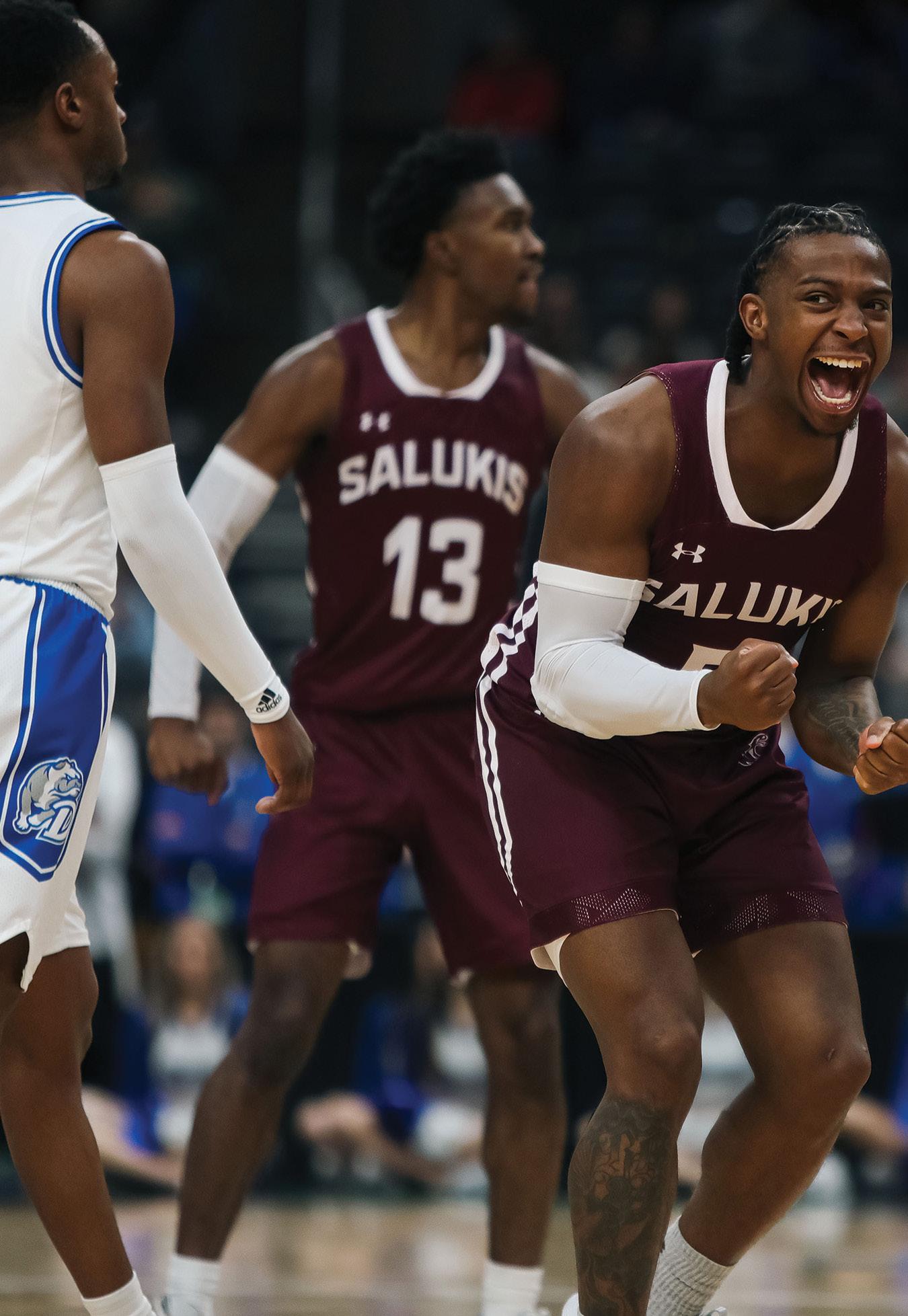
Lance Jones (5) yells in celebration as the Salukis catch up with the Drake Bulldogs in the second half at the Arch Madness Semifinal March 4, 2023 at the Enterprise Center in Saint Louis, MO. Lylee Gibbs | @ lyleegibbsphotography
Lane
| lfrost@dailyegyptian.com
Marcus Domask (10) jumps back to shoot against Donovan Clay (5) of Missouri State in The Missouri Valley tournament March 3, 2023 at the Enterprise Center in St. Louis, MO. Lylee Gibbs | @lyleegibbsphotography
Frost
Marcus Domask (1) gets up to dunk the ball against the opposing Drake Bulldogs at the Arch Madness Semifinal March 4, 2023 at the Enterprise Center in Saint Louis, MO. Lylee Gibbs @lyleegibbsphotography
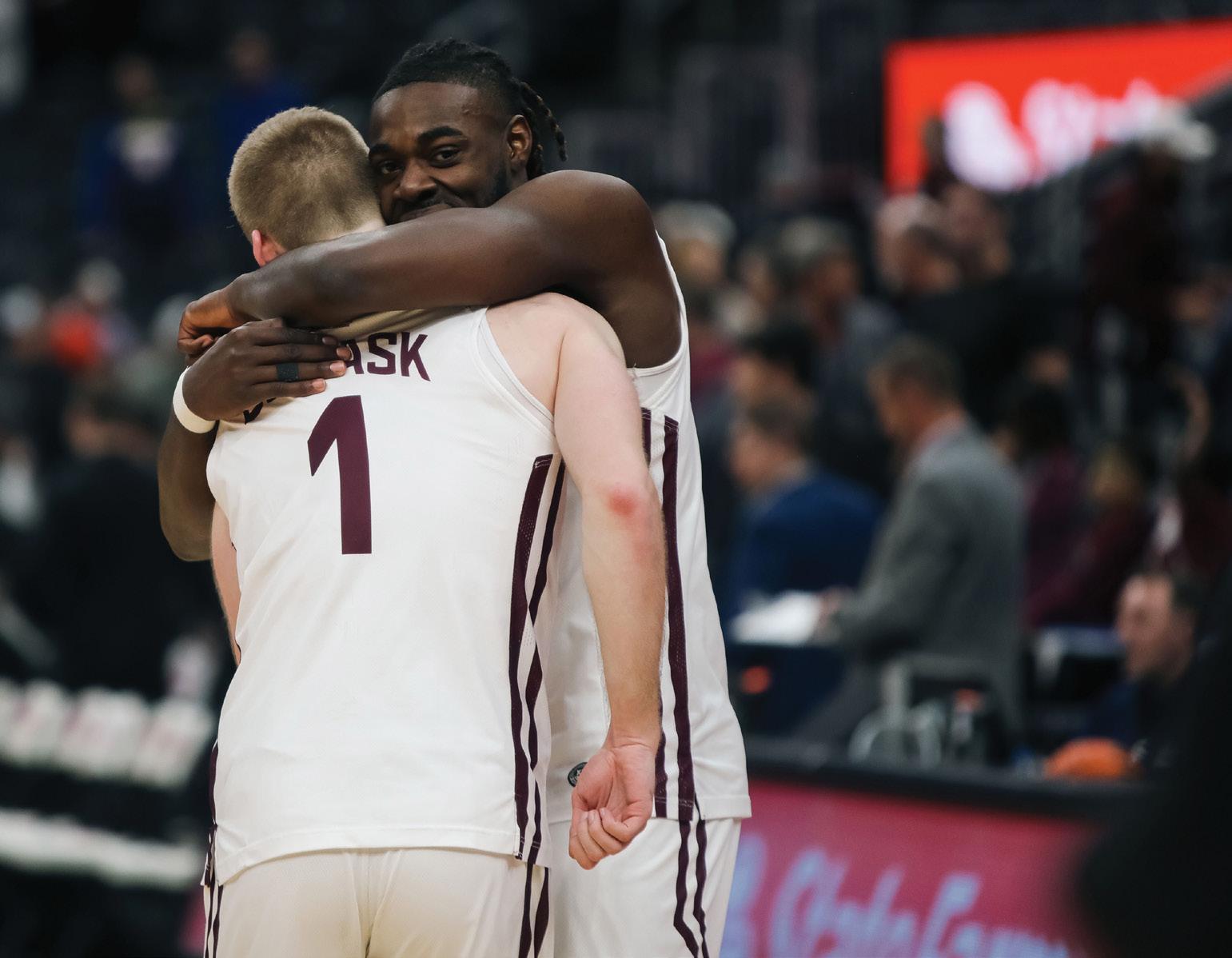
Marcus Domask (1) and J.D Muila (11) share a hug after the Salukis force Missouri State out of the bracket and advance to the Semifinals of the Arch Madness Tournament March 3, 2023 at the Enterprise Center in Saint Louis, MO. Lylee Gibbs | @lyleegibbsphotography
Arch madness



Page 9 Wednesday, March 8, 2023
Xavier Johnson (10) shoots from the three against the Bears of Missouri State in The Valley tournament March 3, 2023 at the Enterprise Center in St. Louis, MO. Lylee Gibbs | @lyleegibbsphotography
Xavier Johnson (10) waves towards the stands full of Saluki fans when the Salukis take on the Bears of Missouri State in The Valley tournament March 3, 2023 at the Enterprise Center in St. Louis, MO. Lylee Gibbs | @lyleegibbsphotography
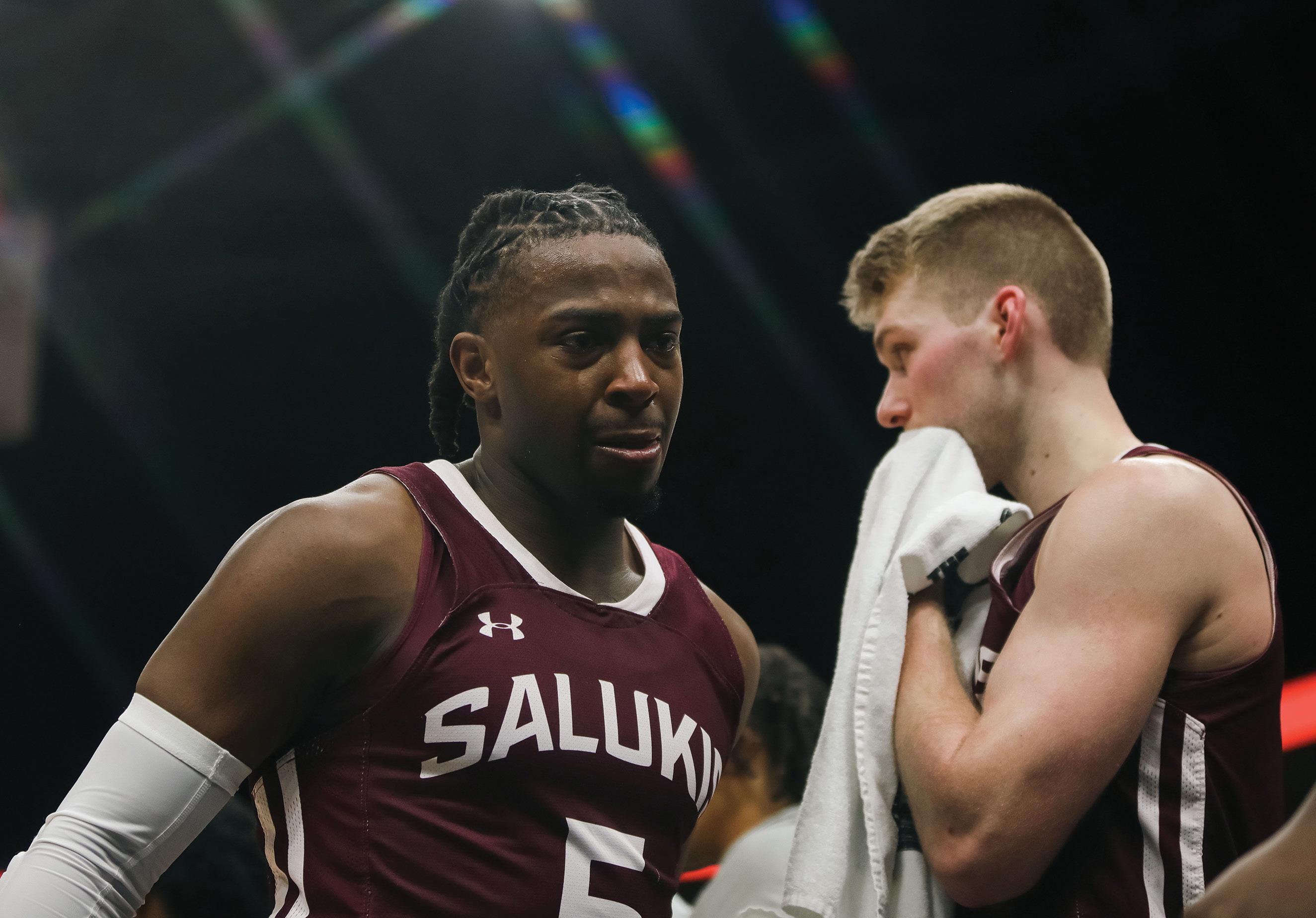
Emotions run high as seniors Lance Jones (5) and Marcus Domask (1) exit the court for their last appearance in the Arch Madness tournament as the Salukis fall to the Bulldogs of Drake March 4, 2023 at the Enterprise Center in Saint Louis, MO. Lylee Gibbs | @lyleegibbsphotography
When to stop shopping?
There is always that all time stupid question: If a tree falls alone in the woods, does it make a noise? I don’t know, but if the pole holding all of your clothes in the closet snaps, I promise it does. The first time that the thought of having too many clothes hit me, I was in middle school putting away the mounds of laundry that had accumulated at the corner of my bed. My mother threatened to spank me if I didn’t do it, but I knew something that she didn’t, it would not all fit.
Using my entire body weight, I laid against the clothing that was already hung, attempting to fit more in the small cracker jack box I called my closet. After filling every millimeter of pole space available, I finally had all of my clothing away. Not a costume or school uniform in sight, I felt extremely proud of myself. You know that thing you do when you clean, light a candle, leave the room and shut the door, and then return in as if you are on an HGTV show seeing your old hoarder home turn into a paradise, I remember doing that.
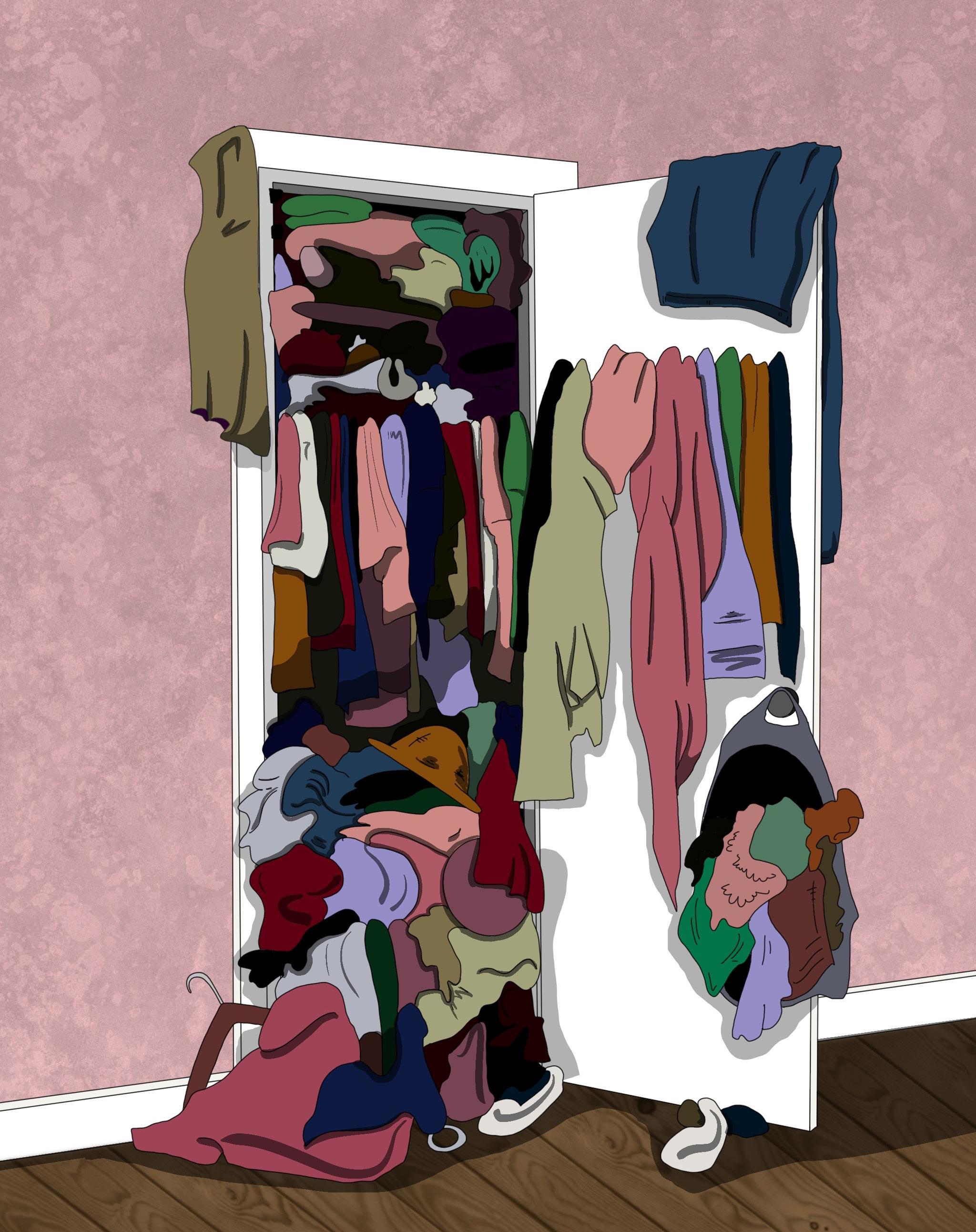
Later on that night, I recall laying in my bed hearing noises periodically coming from behind my closet door. The sounds sounded like a wooden ship moaning and groaning in the sea. With great hesitation each time, I kept getting up and checking, peeking my head in to see what was making the mystery noise. It seemed like it only happened every few minutes, but I could hear it, every time getting a little more high pitched.
Suddenly, after a good while with no noise, without any warning *SNAP* rang from my closet. I leapt from my bed in fear of some sort of vermin, but mustered up the gusto to turn the knob. Flinging back the door to face my nightmare, I was jaw agape as I started at the once bowing wooden pole that held my clothing, which had now snapped leaving me with a Joan Crawford-esque mess all over the floor. I recall stepping back in awe, and saying to myself “You have too much clothes.”
Hello everyone. My name is Aaron, and I am a recovering shopaholic. This might seem like a laughable affair, but I assure you that my pocketbook would not agree. Though I am half joking, and I can pinch a penny when needing to, sometimes when all the ingredients for an all out over-indulgent occasion line up right, my time to shine at what I do best ensues.
Everyone should have known as a child that I was going to have this problem, one of my favorite movies was the 2009 film “Confessions of a Shopaholic.” I was obsessed, and would act as if I was Isla Fisher, carrying around old birthday bags as if I had been out shopping at luxury stores, and carrying around an old orange snap top wallet that I had stolen from my big sister. Wearing my imaginary couture and holding my bags of loot, I would pull out my wallet and hand my credit card to the store clerk that obviously wasn’t there.
The credit card I would very politely present was actually an early 2000s McDonalds’ gift card that had no money on it, and I had multiple of them. In the movie, the main character goes into crippling debt from shopping for clothes too much. At one point in the movie, she takes her credit card and submerged it into water and freezes it, to prevent herself from overspending anymore. Little me froze my own play cards multiple times in the freezer, and would take them outside and smash the block of ice, as if I was in desperate need for some new piece of clothing.
How did I go from playing and having to teach myself to stop shopping, to actually discussing this for real with a therapist as an adult?
At first, I was able to laugh it off and say in a silly voice “Whoops! Guess I’m a shopaholic,” and play it off as if it was nothing more than a bit, but now I get this big feeling of nervousness rushing over me as I start to reach into my purse to retrieve my money. Of course, as soon as I get home to where the rest of my things are, I get giddy and forget the whole feeling of guilt and shame that was once pulsing through me, I feel the shoppers high.
Shopping addictions start because the brain becomes addicted to the feeling of shopping, and fashion fanatics are usually the ones that fall victim to it the worst. It’s all fun and games until you’re at the Dillard’s asking for eight different pairs of shoes in the size 11,
and all she does is look at you. You can feel it in her eyes, that look of “Here’s another one, another junkie,” and it’s even worse when she brings them all back and none of them look right, and she just smiles and nods, very obviously frustrated at her wasted time.
I have tried everything. Leaving my credit card at home doesn’t help, I have the number memorized, and you better not give me any cash, because in any true money-struggler fashion I will act as if it is free money, and all to no avail. I even gave up useless shopping for Lent this year, and as of right now I am still holding true to that sacrifice.
Overspending and overconsumption are very common amongst young adults, and that is because of the state
of the world we grew up in. If I can buy 30 shirts from Shein or Fashion Nova for the price of one well made garment, why would I bother wasting the money on just one thing, when I can have so many more crappy ones. This problem isn’t like the old school packrats and hoarders like it used to be, just people collecting trash up the walls, it’s all usable stuff, and wearable clothes, it’s just the excess that people have now.
The real question is, if it isn’t bursting from the closets of embarrassed overconsumers like me, is the alternative just a landfill?
Staff columnist Aaron Elliott can be reached at aelliott@dailyegyptian.com
Page 10 | Entertainment and Culture Wednesday, March 8, 2023
AAron Elliott AElliott@dAilyEgyptiAn com
Brooke Nicholas | bnicholas@dailyegyptian.com
“The Last of Us” is a first among videogame adaptations
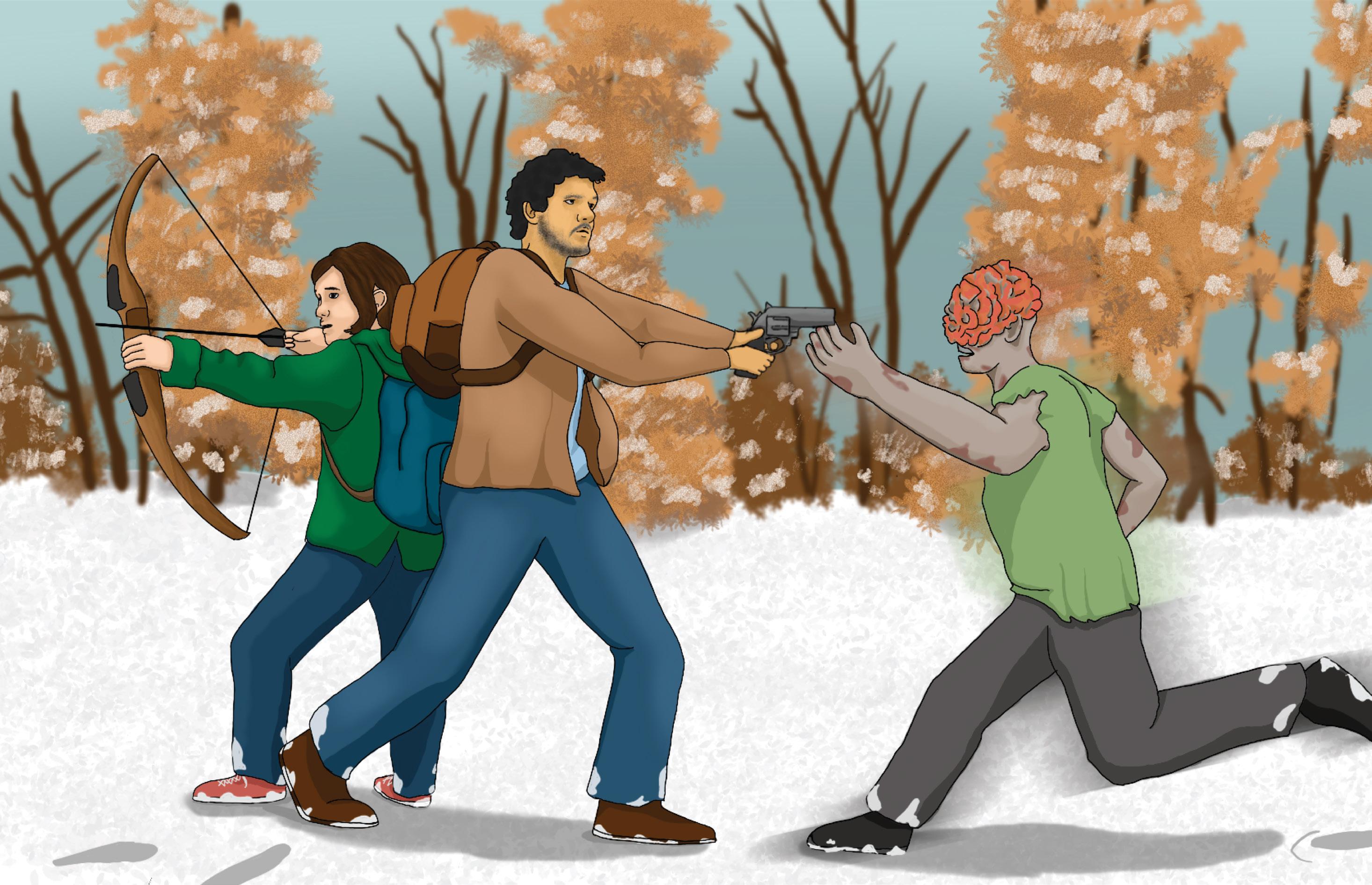
I don’t know about you but originally when hearing about “The Last of Us,” I thought it was going to be another bad video game-to-movie adaptation but, like many others, I took notice when it started to gain a lot of positive attention. My interest was officially piqued.
Going into the series as someone who has never played the game, I thought it was going to be a zombie-filled, action-heavy show. That is not the case. Sure there are moments when you get to see some impressive kills, but most of the show is focused on the relationships of the characters as they embark on a journey across the country in an infection-filled landscape.
The show had incredible character development following two people as they bond, and you watch a fatherdaughter-esque relationship emerge.
While the main storyline is focused on Joel and Ellie, there are multiple episodes with slight deviations that follow the storyline of others until Joel and Ellie get to them.
One of these deviations being Bill and Frank, but the story we are given in the
we deviate and when should we come back, if it’s kind of the same or worse, we stay where the game is; if it’s better, we deviate.”
Not only is the show itself somewhat different than I imagined, but the infected are as well when postapocalyptic zombies are the first thing you think of. These creatures are unlike any zombie you’ve ever heard of and that is obvious from the very first episode.
“We weren’t allowed to say the Z word on set. It was like a banned word, they were the ‘Infected.’ We weren’t a zombie show,” cinematographer Eben Bolter said.
show is quite different from the game. It paid off seeing as this decision was well received by most players of the game.
It also became a fan favorite episode to many new to the storyline as well.
In the after-episode interviews, creator Neil Druckman said, “My philosophy on the show has always been when should
The show knows when to stick to the original plot and dialogue and when to diverge. The way they aren’t scared to switch things up from the game I think is the main reason this show is getting so much attention.
It stands out to new viewers as well as keeping people who played the game involved. Some even enjoy the show more
because of the character development that happens throughout the show that isn’t as heavily portrayed in the game.
Johnny Martinez, a fan of the original game said “I like that the show has been able to accurately translate the characters for TV. Not only are they still able to maintain their layered dynamic that was present in the game, but I feel like the show fleshes them out even more in a way that makes me prefer the show over the game.”
“We see more vulnerability with the characters, and I feel that that helps in creating a stronger emotional attachment for the characters when compared to the game,” he said.
One of the biggest things I think makes this show so popular is that the creators keep in mind that it is based on the original game, but they don’t treat it like it has to be word for word. They do what’s best for character development and for the show rather than focusing on staying true to the original inspiration.
Staff columnist Bre Gallagher can be reached at bgallagher@dailyegyptian.com

Entertainment and Culture | Page 11 Wednesday, March 8, 2023
BrE gAllAghEr @BgAllAgEr@dAilyEgyptiAn com Devon Moon | dmoon@dailyegytian.com
“We weren’t allowed to say the Z word on set. It was like a banned word, they were the ‘Infected.’ We weren’t a zombie show.”
- Eben Bolter Cinematographer on “The Last of Us”
From Curaçao to Carbondale: The story of Kaeber Rog
Howard woodard hwoodard@dailyegyptian.com
Being one of many hopeful young kids in Curaçao, Salukis infielder Kaeber Rog just wanted to play baseball.
“The baseball environment in Curaçao is very big…there you play baseball games for fun,” Rog said.
He later compared baseball’s significance in the small Caribbean island to the global recognition soccer receives. Once he was introduced to the sport, it was normal to play it as frequently as possible in order to play at the highest level.
“My dad used to play baseball…he taught me baseball,” Rog said. “I used to go to the baseball field very close to my house. I used to go there and practice. And that’s how it was, playing baseball and having a lot of fun.”
His father also influenced him to become a switch-hitter. A natural right-hander, Rog’s coaches initially didn’t allow him to hit from the opposite side of the dish. They emphasized winning the few games the team played over Rog venturing out to explore a new aspect to his game.
“My dad told me at a young age how cool switch-hitting is,” Rog said. “I don’t know if my dad really knows how much that helped me to this day.”
Using the batting cage in his backyard every day, Rog and other kids his age began to take baseball seriously. They practiced and worked to improve and compete as young as 11 or 12 years old for their Little League teams. From there, they would aim to play at the Little League World Series in Williamsport. Rog’s team lost to the squad that represented Curaçao in the tournament.
Unlike most young people in today’s age, who may think it’s boring and slow, Rog is a huge fan of baseball.
“I have some friends that will tell you that they don’t like watching baseball. But I think it’s super cool,” Rog said. “I enjoy it…you see the pitchers…every little thing…how people go about their business.”
A true student of the game.
Some of his favorite players to watch are Curaçaoan, including MLB infielders Ozzie Albies and Didi Gregorius. He also likes Xander Bogaerts, who is from the neighboring island of Aruba. And he appreciates the playstyle of others who don’t necessarily share his background.
“Whoever I look at and see that is cool, I like them. Ronald Acuña, I see him hit and I’m like ‘oh my gosh, this guy is so freaking good.’ Francisco Lindor, switch-hitting shortstop…Mookie Betts…there are so many good baseball players,” Rog said.
At 15 years old, Rog got a new goal to shoot for: practicing to earn an international signing bonus. Baseball’s international amateur free agent market was created for players wanting to play in the MLB who weren’t born in the U.S. or Canada. It is a route that some of MLB’s premier players have taken including Juan Soto, Fernando Tatis Jr. and Wander Franco. But it is a risky avenue to take as there are no guarantees for your future.
“My mom didn’t really like that route for me,” Rog said. “She thought that not letting your kid not even finish middle school is not a smart move.”
Instead, Rog’s mother opted to send him to the United States when he was 16 to play high school baseball. There was an immediate adjustment period for Rog as he wasn’t
accustomed to the association between school and sport.
“In Curacao, baseball isn’t connected with school,” Rog said. “You go to school; they give you a bunch of homework. They don’t even know what you do with your life after school.”
This translates to no high school teams and essentially two different worlds between the baseball field and the educational environment. Much different than what the United States is accustomed to.
Another new world Rog had to encounter was living without any family or people he knew in a new country. He was fortunate to have a good experience in his first year in the U.S., living with a host family and two other Curaçao natives who play sports.
“One swam and the other one played basketball. But it was a lot of fun…like a vacation without your parents,” Rog said.
With his roommates, Rog played basketball, baseball and rode bikes after school. It was a freedom that he enjoyed but still used accordingly. Attending Trinity Christian Academy in Jacksonville, Florida, the weather and improved organization allowed Rog to play baseball year-round. He played a lot more, even if the motivation or talent wasn’t the same as his native country.
“You play like 25 games a year in high school in Curaçao…here in the United States, even though you might not play the same talent, at least you’re playing,” Rog said. “You got a lot more development in the United States baseball for sure.”
Baseball is hosting its fifth World Baseball Classic this March, where many of these players will be showcased and compete for their country. Although he doesn’t remember much from that early on in his life, Rog will be rooting for the nation where he was born:
“Netherlands all the way,” Rog said.
He lived in the Netherlands for the first four years of his life but moved to Curaçao where the rest of his family resided. Sometimes he
recalls some moments of his childhood, like when he sees pictures of him learning to ride a bike. But still holding that piece of his life, Rog played for Team Netherlands this past fall at the U-23 Baseball World Cup in Taiwan.
“It was an unbelievable experience. The pitching was completely different…very intense baseball,” Rog said.
Rog committed to Florida International University during his junior year of high school. Two years later, he found himself disappointed in his experience, simply not having fun. He wasn’t having success at the plate, was treated poorly by teammates, and acknowledged he wasn’t a good player at the time.
“It was very hard for me there because our team sucked, we were in last place. It was the COVID year and D1 coaches weren’t coming out,” Rog said. “Baseball is a very humiliating sport…with ups and downs. I learned a lot to try to stay the same, same attitude every day, be consistent.”
But he was conflicted as he didn’t want to leave Division I baseball. The emergence of COVID-19 made the decision for him, when Rog took his talents to junior college and had a chance to prove himself at Eastern Florida State.
Later on in 2021, he received the opportunity to play in the MLB Draft League, where top draft eligible players competed in a showcase during the summer. Rog made the most of this chance, leading the Draft League in batting average for a while, which led to multiple D1 schools vying for his services. Carbondale was the choice based on the winning Rog saw from afar.
“The main thing that drew me to SIU is seeing the 40-win season…I want to know how it feels to win. That’s the main reason why I came to SIU,” Rog said.
He excelled immediately, slashing .362/.429/.618 with 14 homers and 56
RBI in his first season. He drew more walks (33) than strikeouts (30) and also stole seven bases. This accumulated awards like 2022 Missouri Valley Conference Player of the Year and Newcomer of the Year. Rog’s production so far at SIU has been immense but his belief in himself is unmatched.
“I want to be the best Saluki baseball player ever,” Rog said.

But after establishing himself as a premier player, Rog wants to succeed as a team. Now in his senior season, he plans for the Salukis to win as much as possible.
“I want to go to regionals…hopefully Super Regionals but we can’t look too far ahead,” Rog said. “I want to accomplish that over my personal goals…the team goals matter more.”
It exemplifies an attitude that can carry Rog to the next level, which he plans to get to. With dreams to play in the big leagues, he is working hard to accomplish that aspiration but understanding he can’t completely control it. However, Rog has a plan that still involves the game he loves if he doesn’t make it to the majors.
“I want to be a baseball head coach, it’s a fun job…teaching players how to hit. I think one of the coolest things is if you’re a dad and a head coach, and you have your son allowed to practice…and grow up in that environment. I think that’s so cool.”
Rog’s mindset on not just baseball, but life, is cool. He has overcome countless obstacles from living in a foreign country to transferring to multiple different colleges in order to fulfill his dream of playing professional baseball. The Saluki baseball team is fortunate to have Rog as their star-studded shortstop, and hopefully we will witness Rog eventually live ou t his ultimate dream.
Page 12 | Sports Wednesday, March 8, 2023
Sports reporter Howard Woodard can be reached at hwoodard@dailyegyptian.com.
Kaeber Rog (31) scores a run against the St. Louis Billikens
February 28th, 2023 at Itchy Jones Stadium in Carbondale, Ill. Ethan Grimm @ethan_grimm
Education

continued from 1
“I think the frustration is not knowing how to plan as this issue only recently was presented to the chairs and directors,” Thompson said. “So, we are kind of in a state of paralysis and of course this causes anxiety at many different levels.”
What has confused SIU staff and students in recent weeks is the seemingly sudden lack of distance education funds from past years that many schools at SIU still considered to be spendable.
Some of the faculty members at the senate meeting Lane addressed couldn’t contain their criticism, calling SIU’s communication in this instance unacceptable.
“We all understand that we were in a budget issue and that there’s money to be repaid,” said Bethany Rader, vice president of the Faculty Senate and associate professor of microbiology. “The problem was miscommunication, because we’re told we have a certain amount of money - DE funds or indirect funds that go into a pot for our department - and then we as a faculty get to make decisions about this money. And then we thought we had a certain amount and then, all of the sudden we’re told ‘no, you have no money.’[....] and then when we approached our school director, and through him our dean, again it just seemed like people were being told completely different things.”
Lane said that he understood the issues that faculty were having, and explained that the deans and directors likely didn’t have the most accurate information. Lane said he was confused himself when he was first hired and the CFO explained the DE funds to him. He made the same mistake as the university’s staff, once believing that the DE funds were still available for him to spend, he said.
“If you have something that you have commitments on right now, I would suggest that you bring that forward if that’s something that you’re unable to pay for,” Lane said. “Because as Marc is working on now with Bob and with our CFO - they’re working on that plan between now and the end of the fiscal year. I would offer that - because we’ve got commitments already that are being covered - if you’ve got something that you were really counting on just make sure it hits the list that Mark and that group are putting together as priorities so they can take a hard look at it.”
Other faculty at the meeting also expressed that they had been confused by the university’s recent actions, with some stating that they had thought the school was on the verge of canceling DE funds completely. The faculty’s main concern was that they were only informed of the lack of DE funds in the middle of the fiscal year, rather than at the beginning of the year when they were budgeting.
Faculty members at the senate meeting said the miscommunication is a problem
because it affects decisions they make on a daily basis.
According to Lane, allowing the schools to continue to spend money that only exists on paper, as if it still exists at all, will only dig the university deeper into debt. By all appearances, this year SIU administration has decided to put its foot down on the issue, preventing schools from spending the distance education money.
“Every year we’ve got a carry forward amount that essentially was just an amount on paper. That was not real revenue to the institution at all,” Lane told the senate. “I think that’s the myth that was out there - that there were some carry over dollars that actually existed for people to use. Instead, it was carried over on paper and we operated for years, back to 2015, from what we call budget-deficit spending. We set our budgets based on deficits, because we knew every year we were gonna have to plug the hole from the sustainability plan.”
According to Lane, the university would go $14 million dollars deeper into debt this year if schools were permitted to use distance education funds as they were earlier in the financial year.
Stikkers said this left Hahn and other professors, who may have planned to use distance education funds, in the awkward position of having promised students large amounts of money in scholarships, only to have the funding taken out from underneath them. Hahn was not responsive to requests for comment.
Past students of Hahn, who traveled with him, say the experience was as memorable as it was expensive, citing the scholarship he offered as the key reason they were able to go on the trip.
“A big selling point of going on trips this summer was that there was a $1,000 scholarship available to the first 10 people in each group,” said Stefanie Doty, an undergraduate student who accompanied Hahn’s Greek travel group last summer thanks to one of his scholarships. “I planned on going to Egypt with that scholarship.”
Though Doty can’t say that the scholarships were the only factor in her canceling her membership in the Egypt travel group this summer, she did cancel for financial reasons, on which the scholarship had a large impact.
“This scholarship was really important for why it went last time. I mean, it’s a really big deal. Takes a really big chunk of money off,” Doty said. “I was signed up and registered to go and then I heard the bad news. And it was kind of up in the air. I didn’t really know what happened. It seemed like it was - it seems a little odd.”
The Daily Egyptian reached out to SIU’s accounting department, as well as the university’s budget office, but both were unresponsive. In SIU’s study abroad portal the Egypt travel group is estimated to cost $3,490.00 before tuition, round trip airfare, passport costs and other optional additions to
the trip. With the addition of the portal’s estimate of these other expenses for the average student, the total price was $7,873.75.
Despite the incredible expense, Doty says that her trip to Greece at a comparable cost was worth it.
“I think traveling abroad helps students stand out from the pack,” Doty said. “And I can honestly say if I had not gone, I would be on a different trajectory right now. It just opened my eyes to so much more around me and what really matters and helps me understand so much more. A lot of people view that trip, especially to Greece, they’re like, ‘Oh, I want to travel to Greece.’ This is not the Greece you see on social media. This is the history of the world. You cannot experience that from a book. You just can’t.”
However, for students heading to Egypt this summer, the situation may not be as hopeless as Doty feared.
“We will honor the commitments we made to all of our faculty this semester,” said Dean Joddy Murray of the College of Liberal Arts. “However, like other units in the university, we are currently reviewing our process for how to best allocate revenue generated by distance education and will employ the most suitable fund for travel grants. The provost’s office is considering our funding requests at this time.”
Despite disruptions to the distance education funds, Morris has indicated that Hahn’s trip is a priority for the College of Liberal Arts, confirming that the school is likely to find the funds somewhere, even if at present there is some disruption.
After her interview with the Daily Egyptian, Doty succeeded in finding a merit scholarship for her trip to Egypt and once again plans to go, but it seems possible that the situation of other students might prohibit going without as many scholarships as were once available.
SIU’s continued low enrollment problem, as well as state appropriations that only reached $101 million again this financial year, tell a story of lasting damage based on the troubled politics of the state, which were only settled when the state legislature overturned one of Rauner’s vetoes.
“If we’re thinking about doing a 2% across the board increase, if we’re thinking about funding those 21 represented unions with increases inside of the increase - that money has to come from somewhere,” Lane said. “So you have to be very careful to not let too much of the money go out of the door when the university may need it to cover additional increases to faculty and staff, because that’s exactly what the money would go towards. Unless we get an amazing state appropriation from the governor where he gives us more - and that probably won’t happen - but that’s something we keep our fingers crossed on.”
News | Page 13 Wednesday, March 8, 2023
Staff Reporter Daniel Bethers can be reached at dbethers@ dailyegyptian.com
Saluki men’s basketball defeats Missouri State, falls to Drake in Arch Madness
Southern Illinois men’s basketball made a run into the semifinals of the Missouri Valley Conference tournament at the Enterprise Center in St. Louis this past weekend. The Salukis won their first game against Missouri State 54-51 on Friday before losing to Drake 65-62 on Saturday.
It marks the farthest the Salukis have gone into Arch Madness since 2018, and the first semifinals run under head coach Bryan Mullins.
The Salukis were led by Marcus Domask with 17 points and four assists, as well as Xavier Johnson, who shot 5-for-7 and swiped three steals against Missouri State Friday.
Another notable performance came at the hands of Troy D’Amico, who scored 10 points that included a three-pointer off a Johnson steal to give the Salukis a two-possession lead heading into the final media timeout.
“It’s March, so it’s obviously win or go home,” D’Amico said. “That was just a big moment. Got me fired up, got the team fired up.”
However, Southern would commit three straight turnovers in the closing minutes, allowing Missouri State to pull within one, 5251. Domask’s two free throws late put the game just out of reach, and kept the Dawgs in St. Louis for one more day.
While the game came down to the wire, it didn’t seem like it would at first. Missouri State led by as much as 13 with seven minutes left in the first half, but was held scoreless for the final 6:29 to allow the Salukis a chance to cut the lead to just five by halftime.
“We just came together that one timeout and said ‘We’ve got to go on a run right now,’” Domask said. “We didn’t want to be down 10 at the half. We went on that run, and then the talk in the locker room at halftime was, they played their best, we didn’t play that good, and now it’s our turn.”
That defensive effort to end the first half was replicated later when the Salukis held Missouri State scoreless for a seven-minute stretch capped off by D’Amico’s three-pointer with 2:20 left in the game. By then, the lead had permanently shifted in SIU’s favor.
“We were able to keep them in front, and have good physicality,” Mullins said.
Despite committing three turnovers in the closing minutes, the Salukis still dominated in the turnover battle with a 17-10 margin in their favor. It helped balance out a rebounding margin that went 34-29 in favor of Missouri State, including four extra offensive rebounds for the Bears.
“They’re a great offensive rebounding team, so we knew that was going to be a challenge for us,” Mullins said. “But we couldn’t lose the turnover battle and lose the offensive rebounding battle and give them 10-15 more shots than we got.”
Southern had less than 24 hours to prepare for its next opponent, the second-seeded Drake Bulldogs. Drake eliminated the Salukis from the 2022 Arch Madness tournament, and history repeated itself in the 2023 edition as the Bulldogs came away with a 65-52 win.
“I thought we played well in spurts, we just didn’t put together 40 minutes of good enough basketball to win at this level,” Mullins said. “But just in terms of our team’s fight, our resiliency throughout this whole year, I couldn’t have asked to be a coach for a better team that represents this program, this university the way they do.”
Lance Jones led the team in scoring on Saturday with 18 points. He opened the night with two threepointers to spark a 9-0 run for the Salukis to begin the game, and featured heavily in a 13-2 Saluki run to start the second half.
“I think we all came out with the right focus,” Jones said. “To try to win the first possession, or try to come out with a great mindset.”
However, Drake managed to counter both SIU runs with bursts of their own. Notably, a 26-4 run in the first half gave the Bulldogs a lead they would never relinquish.
A major battle during the game came between Drake’s 6’10 forward Darnell Brodie and SIU’s 6’8 Clarence Rupert. Brodie would finish with 10 points and 17 rebounds, while Rupert had nine points and four rebounds.
A major focus of the Drake offense involved screens from Brodie, which would help free up Drake’s guards or cause Rupert to switch and free up Brodie for a good look at the basket.
“Those guys do a great job of finding Brodie,” Mullins said. “Brodie’s a big target. He does a great job setting screens, rolling, and he gets a lot of his baskets off of drop downs and pocket passes from the guards.”
This became even more effective after Rupert picked up two fouls in the first three minutes of the game. The Salukis had a point differential of +12 when Rupert was on the floor, but he was limited to just 21 minutes.
“Knowing I was in foul trouble early, I feel like it kinda impacted a lot,” Rupert said. “But knowing that JD Muila, he came into the game and defended Brodie. He’s been picking me up all year long. I try to pick him up as much as possible. We just couldn’t get over the hump.”
Drake emphasized the three-point game in the first half, hitting six shots in 10 attempts. But as the deep ball dried up in the second half, the Bulldogs transitioned to focusing more on the midrange, which garnered success from Roman Penn, Garrett Sturtz and MVC Player of the Year Tucker DeVries.
“We were trying to take away threes and prevent layups, try to make them take some tough contested twos,” Mullins said. “In that first half, they got too many threes. In the second half, they probably got too many layups.”
The Enterprise Center saw an influx of Saluki fans packing the southwest end of the stands. Between the Dawg Pound, the pep band, and fans in the audience, Southern felt the love of the community that it had felt all year long at the Banterra Center.
“Our fans, they’ve been at every single game, every home game sold out, supporting us,” Rupert said.
“Wins, losses, downs, ups; it really doesn’t matter. They come with us everywhere we go. Especially the Dawg Pound. Our fansbase is just amazing. That’s
all I can say: amazing.”
It is possible that SIU will be selected to one of several postseason tournaments, but its shot at an NCAA Tournament bid is gone after being eliminated from Arch Madness. Mullins stated that the near future is undetermined, but the loss to

Drake ends the meaningful stretch of SIU’s season. Assistant Sports editor Cole Daily can be reached at cdaily@dailyegyptian.com Sports reporter Brandyn Wilcoxen can be reached at bwilcoxen@dailyegyptian.com or on Twitter at @BrandynWilcoxen.
oil
bill
KEEP YOUR HEALTH AT THE TOP OF THE LIST.
There is no day like the present to start to take better care of your and your family’s health. The SIU Center for Family Medicine in Carbondale is accepting new patients.
Stay ahead of the race and make your health a priority this year. Schedule your annual appointment with your primary care provider by calling 618.536.6621 or visit siumed.org.

Page 14 | Sports Wednesday, March 8, 2023
Cole Daily anD BranDyn WilCoxen CDaily@Dailyegyptian Com BWilCoxen@Dailyegyptian Com
change pay electric
dinner
Family Medicine covers a broad spectrum of care for all ages, all genders and every kind of disease. We do this with a wide offering of treatments and specialty clinics for all patients. Call 618.536.6621 to schedule your first appointment. practice at 6 buy milk call doctor
prep
Devon Moon | woah_devon
A Daily Egyptian retrospective: the 2007 Sweet Sixteen
Peyton Cook @_peytoncook_
Jamaal Tatum. Randal Falker. Tony Young. Matt Shaw. Bryan Mullins. Chris Lowery.
If you’re a longtime Daily Egyptian reader, many of these names are a blast from the past. It’s been 16 years since these names were all together here at SIU.
These men and several others were preparing for a run into the NCAA Tournament. The Dawgs made a run all the way into the Sweet 16 and almost knocked off Kansas, who was a number one seed and heavily favored in the game.
That season was the last time SIU made the NCAA tournament, and it was the end of one of the most successful runs in school history.
Some of the sports writers at the Daily Egyptian who covered this legendary team include Scott Mieszala, Sean McGahan, Alejandro Gonzalez, Max Bittle, and Joe Lacdan. These writers produced several pieces that provided deep analysis of the program as it raced towards the tournament, and this article will be citing many of the stories they wrote at that time.
To set the scene: the Salukis spent the last six weeks of the regular season in the AP poll, ranked as high as number 11 in the AP Poll and number 11 in the coaches poll. Their 29-7 [15-3 MVC] record was good enough to win their ninth regular season title, and they went undefeated at home, continuing an amazing streak of losing only one home game over the previous five seasons.
The team was also highly decorated; Falker, Young, and Mullins were all MVC AllDefense First Team members, with Falker even winning MVC Defensive MVP. Tatum was named the MVC Player of the Year, and coach Chris Lowery was the MVC Coach of the Year. All of these efforts would ultimately earn the Dawgs a four seed in the NCAA Tournament.
After the team lost to archrival Creighton in the MVC tournament 67-61, Mieszala wrote a piece titled, “Next stop: The Big Dance.” Mieszala was previewing the NCAA tournament, and was able to shine light on the experience that the Salukis had, among other key aspects.
Mieszala wrote: “The Salukis are hoping experience can lead to more success in the 2007 NCAA Tournament.” Coach Chris Lowery said at the time, “‘I think the experience of having seniors will hopefully be more beneficial than it was last year.’”

Mieszala goes into detail about the Salukis being favored with a quote from Tatum, who said, “‘Being the underdogs or being the favorites, you still got to go out and play… you got to go out and compete and forget about everything except what have to do to win the game.’”
Tatum went on to say in the Mieszala piece, “We got to forget about what we’ve done up until this point. It’s a new season right now, we’re 0-0, we got to come out and win some games, just win a lot of games in a row.”
After their selection show at The Copper Dragon, SIU learned it would be facing 13-seeded Holy Cross at the Nationwide Arena in Columbus, Ohio. The Dawgs would win this game 61-51, and because of the timing of spring break, there weren’t any Daily Egyptian articles written in the wake of this game.
The win against Holy Cross would earn them the chance to play 5-seeded Virginia Tech, who they would soundly beat 63-48.
There was lots of Daily Egyptian coverage after this game; the front page story of the March 19 issue proclaimed “Sweet Salukis: SIU defeats Va. Tech, advances to Sweet 16 for first time in 5 years.”
McGahan detailed the defensive effort put forth by SIU, writing, “The team known nationally for its stingy defense provided more of the same Sunday on the way to its first Sweet 16 berth since 2002.”
Sophomore guard and future SIU basketball coach Bryan Mullins wanted to make sure the offense got its respect, saying, “‘I think that since everyone knows us for our defense and we play so hard defense that people don’t realize that we can score and we have been getting a lot better this year on offense. You can do so much on defense, but your offense has got to take over too.’”
Accompanying “Sweet Salukis” on the front page was a story by Brandon Wiesenberger. He wrote about the 500-plus Salukis fans who greeted the team at the Williamson County Regional Airport.
Wiesenberger wrote, “As Coach Chris Lowery exited the Delta carrier with his young daughter nestled in his left arm, the scores of fans outside and inside the airport erupted in adulation.”
Wiesenberger was able to capture Tatum in a great mood:
“‘It couldn’t get any better,’ said senior guard Jamaal Tatum as he walked through the crowd of people who were snapping
photos by the second and reaching out to slap hands with the victors.”
The March 20 issue of The Daily Egyptian was peppered with basketball- related stories, starting with Gonzalez’s coverage of the pep rally titled “Rally ‘round the Dawgs” found on the front page.
Gonzalez wrote, “The dreaded shot blocker [Falker] also said he appreciated the devotion Saluki fans showed traveling to Columbus, Ohio for the first rounds and said he was thrilled with the support at the rally.”
“‘It’s enough reason that they’re willing to come all that way and spend all that money to come and support, so that’s a big thing,’” Falker said.
Gonzalez also quoted SIU president Glenn Poshard, saying, “‘It’s already brought tremendous pride, in the school, in the region, in the state. We’re the only ones still standing in the state of Illinois.’”
Mieszala highlighted all of the history the squad made that year, and spoke with Young, who said, “‘It feels good that all the stuff we did, as hard as we worked, you know what I’m saying, it all paid off. We’re still going, we’ve still got things we want to do, still got stuff we want to accomplish.’”
“‘It feels good to just to add something else on your legacy, doing so much more stuff and finally accomplishing something and going back to the Sweet 16.’”
Falker’s comments to Mieszala took a long-term view: “‘It’s great to set records, but it’s better when your records are broke, because that means your school is still successful.’”
Young also looked ahead, saying, “‘As far as us [Young and Tatum] being seniors, that’s our role to teach and to help these guys understand the things we understand. So we feel confident in what we’ve taught them and what they know.’”
On the day of the matchup with Kansas, Mieszala took part in a correspondence piece with “Kansan” writer Ryan Schneider, in which each writer explained how their home team could win while also pointing out flaws in the respective teams’ games.
Many fans know what happened later that day, March 22, 2007: a thrilling back-andforth game, a missed Tatum three pointer that could have potentially tied the game, and a turnover by Falker that led to Kansas free throws. Young took the last shot of the game, but it didn’t fall. SIU lost
us. We play every game like we want to win it. If we didn’t think we was on the level of any team in this tournament, then we shouldn’t have come to the court, we should stay home.’”
Young and Tatum, who had played their last game as Salukis, were interviewed by McGahan. Though solemn, both were able to look back at positive things from the program.
McGahan asked the question, “What will you tell your grandchildren about your career?”
Young answered, “‘This is a family. We have so many other great times off the court, being with each other, around each other. I think most of my stories are coming from something totally different than what everybody expects.’”
Tatum answered the same question: “‘We’ll tell them about some of the things that happened at practice,’ Tatum said, prompting a grin out of an otherwise solemn Coach Chris Lowery.”
McGahan went on to write, “Lowery did not seem surprised that the men he has spent so much time coaching were acting so nonchalant about the game. ‘The basketball side is so little, a part of what we do with them,’ he said. ‘We’re around them so much. They’re like my other kids.’”
a heartbreaker 61-58.
Mieszala’s front-page headline read “Almost.” Young was quoted saying, “‘We played a good game against a very good team. You feel upset that you lost a game, but I’m proud of everybody on my team, everybody that stepped onto the court and fought with us.’”
Falker, almost certainly feeling the sting of defeat, was quoted, “‘We don’t take moral victories. If we lose, they beat
Lowery went on to say, “‘We always try to make them understand that there’s more to life than basketball.
Everything - the basketball side, off the court, before practice - the realness of life is always talked about with them. I think that’s probably why they play so hard.’”
McGahan was able to point ahead to the next season with Lowery’s quote, “‘After we told our seniors goodbye… we started immediately with everybody else that’s left, and the next two guys, Matt (Shaw) and Randal (Falker). They’re our next two guys.’”
Sports | Page 15 Wednesday, March 8, 2023
Sports reporter Ryan Grieser can be reached at rgrieser@dailyegyptian.com
ryan grieser rgrieser@Dailyegyptian Com




Study Break | Page 16 Wednesday, March 8, 2023
Sophie Whitten
Sophie Whitten swhitten@dailyegyptian.com
Hello from the outside
HELLO BY: ADELE
