The Oracle investigates testing accommodation system trends and its impacts on students.
PAGES 10, 11
SPORTS
Female athletes encourage discussion about the affect of menstrual cycles on performance.
PAGE 20


Henry M. Gunn High School
The Oracle investigates testing accommodation system trends and its impacts on students.
PAGES 10, 11
Female athletes encourage discussion about the affect of menstrual cycles on performance.
PAGE 20
Henry M. Gunn High School
Roy Lao and Vanisha Vig
In-Depth Editor & News Editor
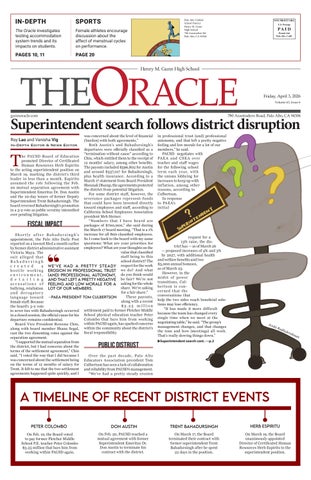
he PAUSD Board of Education promoted Director of Certificated Human Resources Herb Espiritu to the acting superintendent position on March 19, marking the district’s third leader in less than a month. Espiritu assumed the role following the Feb. 20 mutual separation agreement with Superintendent Emeritus Dr. Don Austin and the 22-day tenure of former Deputy Superintendent Trent Bahadursingh. The board reversed Bahadursingh’s promotion in a 3-2 vote as public scrutiny intensified over pending litigation.
Shortly after Bahadursingh’s appointment, the Palo Alto Daily Post reported on a lawsuit filed a month earlier by former district administrative assistant Victoria Maya. The suit alleged that Bahadursingh created a hostile working environment, detailing accusations of bullying, retaliation and derogatory language toward female staff. Because the board’s 3-2 vote to sever ties with Bahadursingh occurred in a closed session, the official cause for his departure remains confidential.
was concerned about the level of financial (burden) with both agreements.”
Both Austin’s and Bahadursingh’s departures were officially classified as a “termination without cause” according to Chiu, which entitled them to the receipt of 12 months’ salary, among other benefits. The payouts included $596,802 for Austin and around $337,017 for Bahadursingh, plus health insurance. According to a March 17 statement from Board President Shounak Dharap, the agreements protected the district from potential litigation.
For some district staff, however, the severance packages represent funds that could have been invested directly toward employees and staff, according to California School Employees Association president Meb Steiner.
We’ V e had a P retty steady erosion in Professional trust (and) Professional autonomy, and that left a Pretty negatiVe feeling and loW morale for a lot of our members.
“Numbers that I have heard are packages of $700,000,” she said during the March 17 board meeting. “That is a 1% increase for all 800 classified employees. So I come back to the board with my same questions: What are your priorities for employees? What are your thoughts on the value that classified staff bring to this school district? The respect for the work we do? And what do you think would be fair? We’re not asking for the whole share. We’re asking for a fair share.”
Paea President tom culbertson
Board Vice President Rowena Chiu, along with board member Shana Segal, cast the two dissenting votes against the separation agreement.
“I supported the mutual separation from the district, but I had concerns about the terms of the settlement agreement,” Chiu said. “I voted the way that I did because I was concerned about the settlement being on the terms of 12 months of salary for Trent. It felt to me that the two settlement agreements happened quite quickly, and I
These payouts, along with a recent $3.25 million settlement paid to former Fletcher Middle School physical education teacher Peter Colombo that bars him from working within PAUSD again, has sparked concerns within the community about the district’s fiscal responsibility.
Over the past decade, Palo Alto Educators Association president Tom Culbertson has seen a lack of collaboration and reliability from PAUSD’s management.
“We’ve had a pretty steady erosion


Superintendent
Peter colombo
On Feb. 10, the Board voted to pay former Fletcher Middle School P.E. teacher Peter Colombo $3.25 million that bars him from working within PAUSD again.
don austin
On Feb. 20, PAUSD reached a mutual agreement with former Superintendent Emeritus Dr. Don Austin to terminate his contract with the district.
trent bahadursingh
On March 17, the Board terminated their contract with former superintendent Trent Bahadursingh after he spent 22 days in the position.
herb esPiritu
On March 19, the Board unanimously appointed Director of Certificated Human Resources Herb Espiritu to the superintendent position.
Vin Bhat News Editor
PAUSD plans to introduce a range of courses for the 2026-27 school year. The additions aim to expand academic offerings while reinforcing the PAUSD Promise focus on “Innovation & Social Responsibility.” The new classes span Advanced Placement, honors and dual enrollment pathways, reflecting a broader district effort to connect student learning with college and career readiness.
Among the new courses being offered are Arts and Industry III, Arts and Industry III Honors, Introduction to Proofs Honors, Music and Industry and Music and Industry Honors. According to PAUSD Board records, AP Cybersecurity will be offered exclusively at Paly, while AP Business with Personal Finance will be offered exclusively at Gunn.
The district also approved Multivariable Calculus/Linear Algebra
Honors. However, the course will not be available at either high school campus in the upcoming year. Instead, existing concurrent enrollment courses with De Anza College will continue for students who meet the prerequisites, providing an afterschool virtual or in-person option at Paly next year and Gunn the year after.
Dual enrollment is a significant component of course expansion. For the 2026-27 school year, Gunn will introduce new dual enrollment courses, including Photography, Advanced Photography and Advanced Audio and Music Production. At Paly, students will have access to a dual enrollment Computer Science Capstone course.
AP Business with Personal Finance is a new course launching as part of the College Board’s AP Career Kickstart initiative. Business teacher Khoa Dao, who proposed the course for PAUSD, said the class represents an important step forward for career technical education within the district.
52 students are currently sIgned uP to take the aP BusIness wIth Personal fInance for the 2026-27 school year — the course requires PrinciPles of Business as a Prerequisite


“I think one of the goals that (the College Board has) is to bring a new level of legitimacy to CTE courses,” he said. Dao added that the class will provide students with both practical knowledge and academic benefits, including business-focused
college credit. To achieve those goals, the curriculum will build on existing business offerings at Gunn while introducing a more structured assessment model.
“(The class) is similar to the other business courses at Gunn in the sense that it continues the concepts that they’ve already learned,” he said. “The two business courses that we currently have at Gunn are project-based courses, and there are no exams. It’s not always clear if the students have a clear grasp individually of the concepts, but in AP Business, there will be tests in addition to projects.”
District leaders say dual enrollment continues to play a key role in broadening access to advanced coursework. PAUSD Career Pathways and Dual Enrollment Counselor Nicole Ho works closely with students, teachers and Foothill College to expand and manage these opportunities, supporting students in their academic and career goals.
Ho noted that dual enrollment has grown significantly in recent years, both in the number of courses offered and the range of subject areas available.
“Our dual enrollment program is constantly expanding,” she said. “We’ve increased the number of dual enrollment courses and added new

offerings this year, including within our Advanced Journalism and Media Studies programs like yearbook and magazine, as well as audio and music technology.”
Ho added that collaboration with Foothill College underpins this growth. District staff meet regularly with college partners to refine course offerings and ensure student accessibility to collegelevel courses, discussing potential improvements and program expansions monthly.
The dual enrollment program is also designed to help promote equity by removing financial and logistical barriers that might otherwise prevent students from accessing college-level coursework.
“For students who may not have the money to pay for college classes or concurrent enrollment, this is a huge opportunity,” Ho said. “There are no transportation or cost barriers, and it helps build momentum for students to explore certificates, internships and apprenticeships.”
of surveyed students think that Pausd should exPand its current career Pathway and dual enrollment course offerings with foothIll college
Source: Self-selected survey sent out to Gunn students by The Oracle from March 26 to March 31 with 70 responses.


Superintendent—p.1
As leadership shifts yet again, Chiu and Culbertson call for a “cultural reset” — leadership that listens and works closely with those who are working in the classroom. Chiu said her sole dissenting vote against Bahardursingh’s promotion on Feb. 23 emphasized a need for distance from previous leaders.
“(At the time), I wanted to signal a break in terms of the continuity of the management style of the previous superintendent, and I personally did
feel that Mr. Bahadursingh had clear professional ties with Dr. Austin,” she said.
While some may worry that important discussions surrounding student wellbeing may be taking a backseat due to the evolving superintendent search, Chiu said that strengthening mental health should still be a priority for PAUSD.
“The Superintendent search has absorbed a lot of energy and headlines, but ultimately, that’s a temporary thing,” she said. “We really need to act strongly, quickly (and) effectively, and continue to do so in a sustained way. I hope the board trustees can continue to work on both.”
Culbertson said he is still hopeful after the board’s decision to promote Espiritu, seeing it as an opportunity for stability and new beginnings.
“There’s over 800 educators and tons of other staff and it takes a long time to change the direction of an institution this big,” he said. “Mr. Espiritu is a really positive person and a very open communicator, and that is certainly a positive sign. The board making that selection is a really strong signal that something is changing for the better.”
The board unanimously appointed search firm McPherson & Jacobson to carry out superintendent search duties during
the March 31 board meeting. Espiritu will serve as interim superintendent if another candidate is not selected by the summer. The search for a new permanent superintendent for the 2026-27 school year is still ongoing.

780 Arastradero Rd.
Palo Alto, CA 94306
(650) 354-8238
www.gunnoracle.com
Editorial Board
Editor-in-Chief
Sylvie Nguyen
Ma naging Editors
Yu-Ming Liu
Ya-An Xue
News
Vin Bhat
Sarah Grupenhoff
Vanisha Vig
Forum
Kaylee Cheng
Claire Jittipun
Melody Song
Features
Gwen Domine
Lena Duggan
Eanam Maor
In-Depth
Roy Lao
Melody Na
Sports
Yael Gottesman
Olivia Lee
Lifestyle
Anne Dong
Ezra Rosenberg
Vaani Saxena
Social Media
Vaani Saxena
Photo Editor
Mars Ezakadan
Graphics Editor
Azuki Radhakrishnan
Staff
Business/Circulation
Eanam Maor
Graphics Artists
Vin Bhat
Kai Knutson
Sophie Kou
Michael Lu
Alexandra Liu
Sahana Mahadevan
Dani Massarweh
Nina Pankov
Photographers
Vin Bhat
Evelyn Chow
Maryam Maskatia
Chloe Wu
Reporters
Arjum Ahluwalia
Annabel Brown
Mayher Dulani
Athena Gao
Ellen Kim
Yuji Song
Fiona Wu
Noa Zeitlin
Cici Zhang
Michelle Zhou
Adviser
Kristy Blackburn

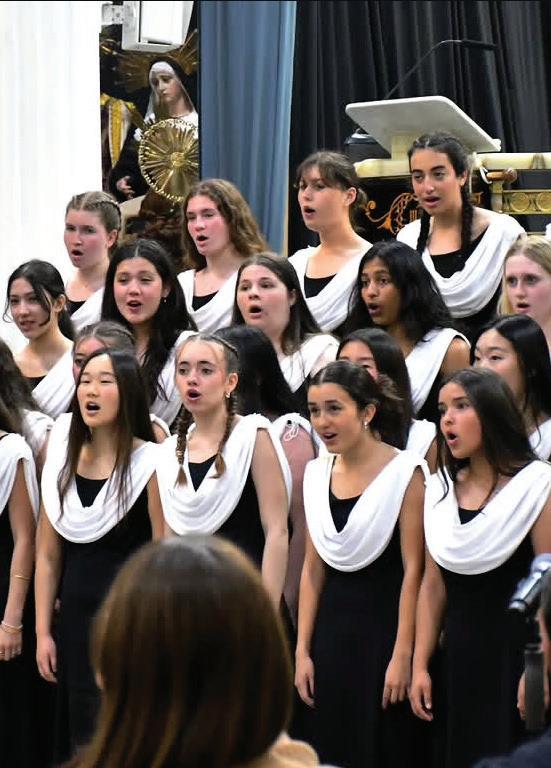
Gunn Choir traveled to Costa Rica to perform their hour-long repertoire at various churches from March 5 to 11.
According to choir director Angelina Fitzhugh, the trip was intended to spread musical spirit to a worldwide community by partnering and performing with local choirs.
“(A concert tour is) always about bringing the love of music and the music that we create (at Gunn) to this broader world,” she said. “So we partnered with local choirs. (The local choirs) sang at a concert, and then we sang. It was lovely to hear other ensembles perform.”
Fitzhugh said that the process, from the rehearsals at Gunn to the performances in Costa Rica, involved particular attention to the stylistic and technical aspects.
“Similar to other concert preparation, you have to learn (the music) after you know it, (and) then polish it,” she said. “(You need to) make sure all the dynamics are the same. Make sure that everyone’s tone is matching. Since we’re not singing in English most of the time, we need to make sure that everything that we’re doing is stylistically appropriate.”
For sophomore Sam Bergmann, this
trip offered an experience unlike typical European destinations that have an established church choral music audience.
“A lot of places in Central and South America have a lot of European influence, but Costa Rica is pretty distinctly culturally different (from) a lot of places I’ve ever been,” he said.
Junior Avni Lochan said the spirit of Costa Rica’s national motto, “Pura Vida” — a Spanish phrase that translates to “pure life” — was evident in the way locals often said the phrase in greeting.
“Everyone would say hi (and) bye to you by saying ‘Pura Vida,’” she said. “It means everything — it’s the spirit, it’s the happiness, it’s the joy.”
For Bergmann, a moment that captured the essence of “Pura Vida” came when the choir was sightseeing and gave an impromptu performance at the biggest church in the country.
“Our choir director says, ‘Oh, we’re gonna sing a couple songs,’” he said. “We didn’t have any of our fancy attire (or) our music, (but) the priest saw us walking through. Our tour guide saw him and was like, ‘Oh, hey, do you mind if we sing a couple of songs?’
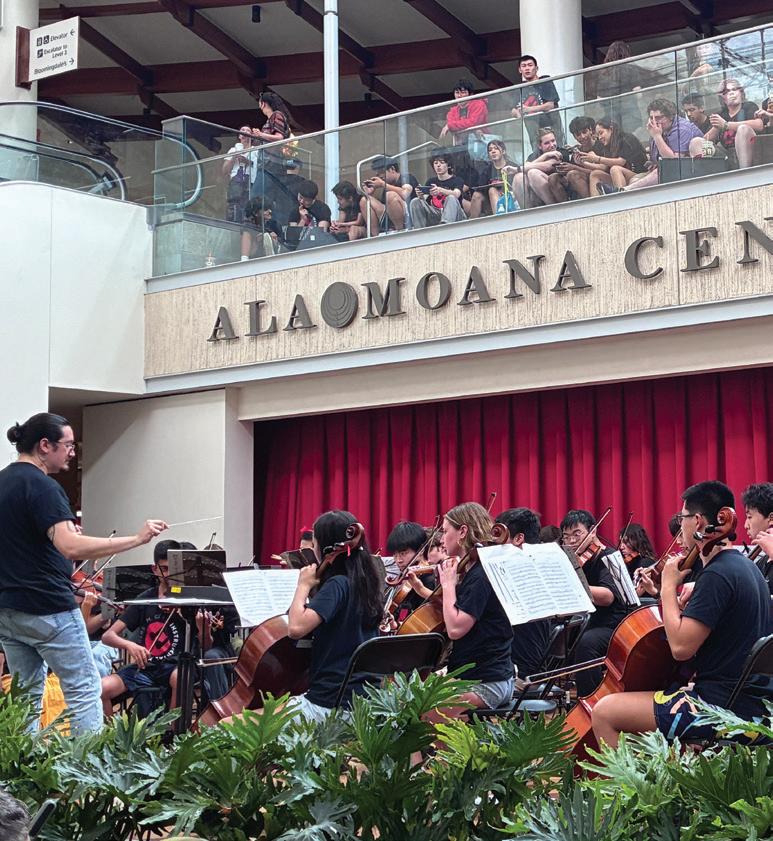
Gunn Instrumental Music traveled to Honolulu, Hawai’i to perform and compete at the Pacific Basin Music Festival from March 22 to 26, where students also debuted a world premiere orchestral piece.
This trip’s cohort included four groups: Wind Ensemble, Arastradero Orchestra, Spangenberg Orchestra and Combined Ensemble, which comprised of Symphonic Band and Freshman Concert Band.
The festival selected Wind Ensemble for a final command performance, a privilege earned by the group with the highest average score at the festival, according to band director Todd Summers.
“It was a huge honor, and that performance was a highlight for me,” he said.
Among the Spangenberg Orchestra’s repertoire was “At Sky’s End,” a premiere composition by Brett Abigaña. After inperson advice from Abigaña and months of workshopping at school, the students’ performance held particular importance for orchestra teacher Felipe Morales-Torres.
“It was the first time that anyone had ever heard it,” he said, “That was a really special moment.”

Dear readers,
This final issue from the 2025–26 staff starts to speak if you sit with it long enough. We hope our journalism — traversing local beats, national issues and human-interest narratives — calls on you to interrogate what you know and to see yourself somewhere in the margins. Inside these 20 folds is what it all adds up to: a newsroom reaching for growth in a craft that rewards
Summers added that the trip offered students opportunities beyond musical development like hanging out at the zoo and spending time together outside of rehearsals.
“The other side of (this trip), which I think is equally important, is the social aspect of everything,” he said. “Traveling together as a large group — band and orchestra kids together — (allows) the kids to interact on many different levels throughout the trip.”
Junior Ronan Seidel said the trip allowed him to engage with a wider group of peers.
“Jumping in the ocean and playing with everyone together (was the most fun part of the trip),” he said. “Getting to play with everyone and more than just my friends was very special.”
For sophomore Eabha Hartman, the social time helped her form deeper bonds with others.
“I think it really allowed me to get closer with (my classmates),” she said. “I’ve known them as my orchestra friends, but now I think of them more as my friend-friends.”
According to Morales-Torres, despite initial concerns about the Hawai’i weather in the days leading up to it, the trip turned
tenacity, demands ethics and inspires a palpable emotional DNA, restlessness. The kind that keeps us committed not only to campus media, but also to each other.
That’s what makes The Oracle the best kind of cult: the most brilliant high schoolers I know I’ll ever meet, with the impulse to do something fresh and innovative in archiving history as it unfolds. Unbeknownst to me, this class would take us from studying and
out well.
“The students really seemed to enjoy themselves,” he said. “We were worried about the weather, because it was flooding in Hawai’i before we went, but the sun opened up and it was a really beautiful time.”
teaching in journalism workshops in San Francisco to line dancing after national award wins at a conference in Tennessee. Along the way, platforms strengthened and tools formed: robust breaking news coverage, where even the quickest updates became scoops for long-forms; global news brief and student reflections series on Instagram (@gunnoracle) to reach underrepresented audiences; interactive multimedia displays on our website (gunnoracle.com); and source trainings that refined our judgment. Without a doubt, the next set of Oraclians is ready. And I had the utmost privilege of helping lead and work alongside their wicked-smart brains and
hearts of gold.
If the pieces of Volume 63 speak to you, I hope they say this much: We stayed restless.
Always, Sylvie Nguyen
The Oracle Editor-in-Chief 2025-26

I
really enjoyed the rapport
that
Clash
brought to both the students and teachers, and I think we all felt together as a community.


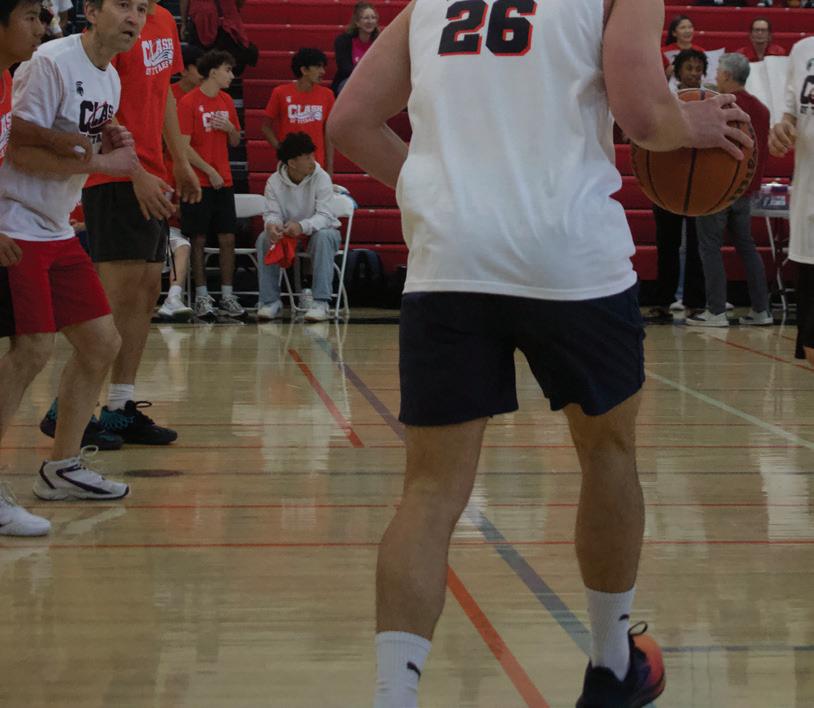

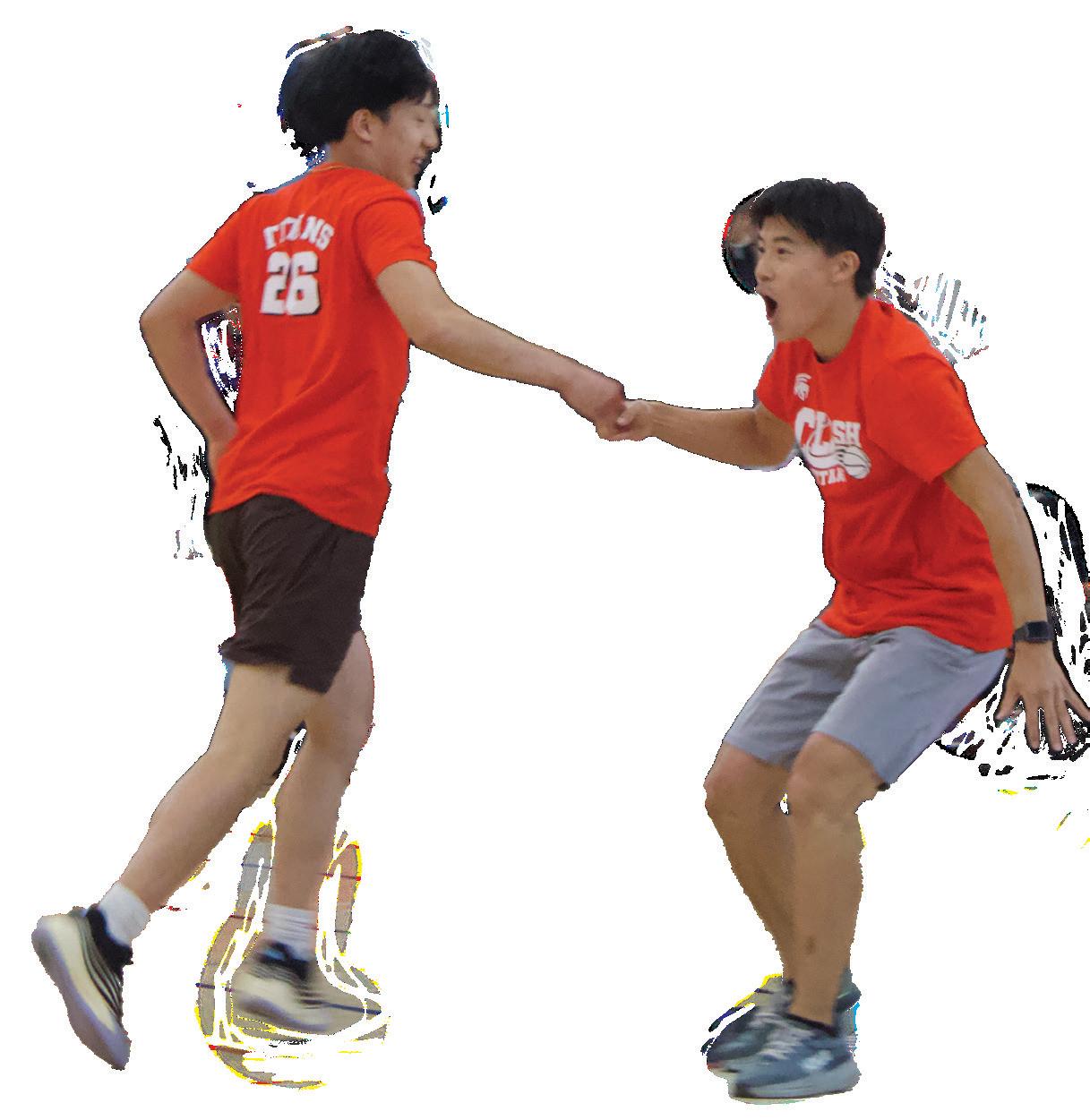

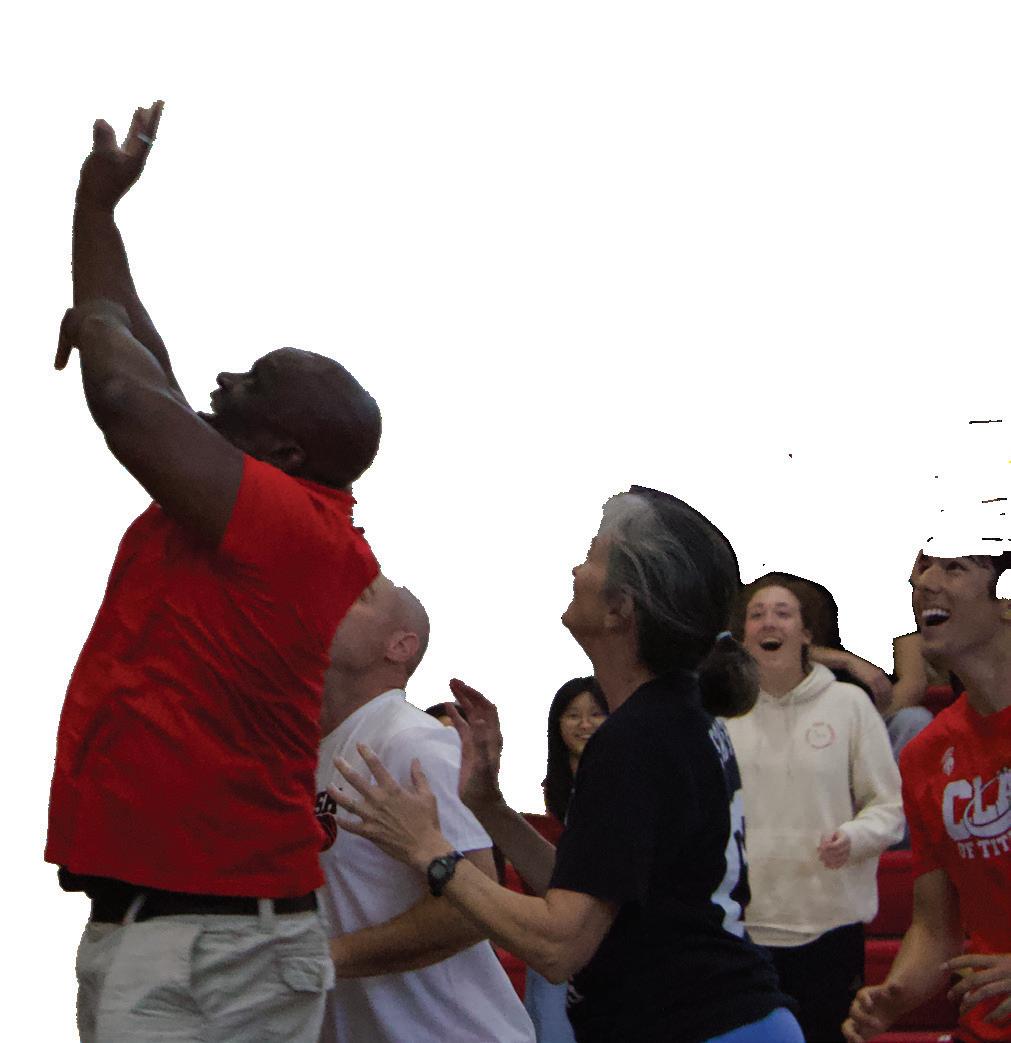
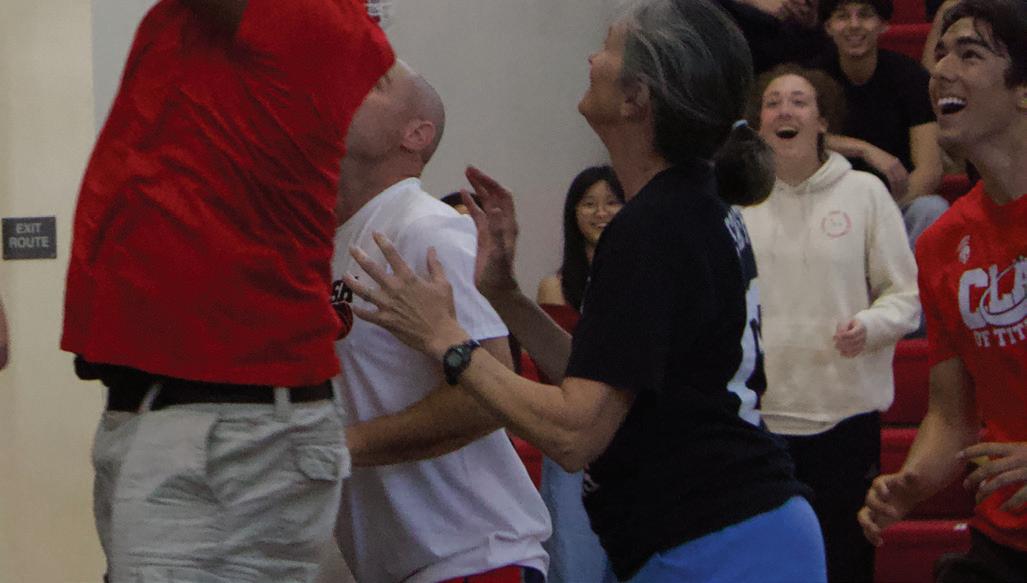


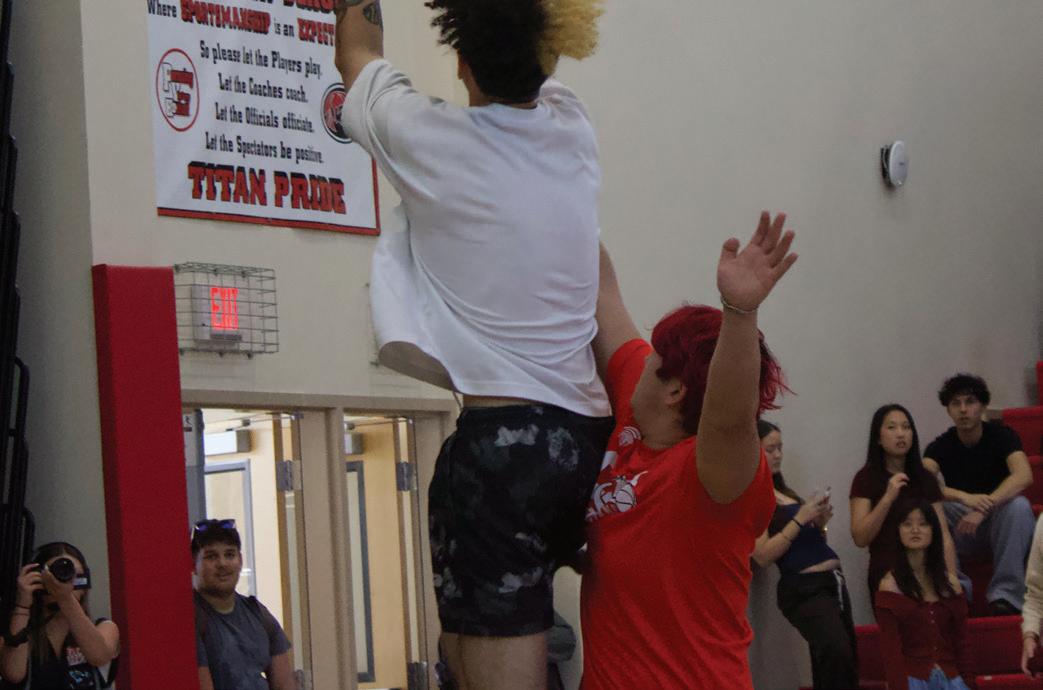
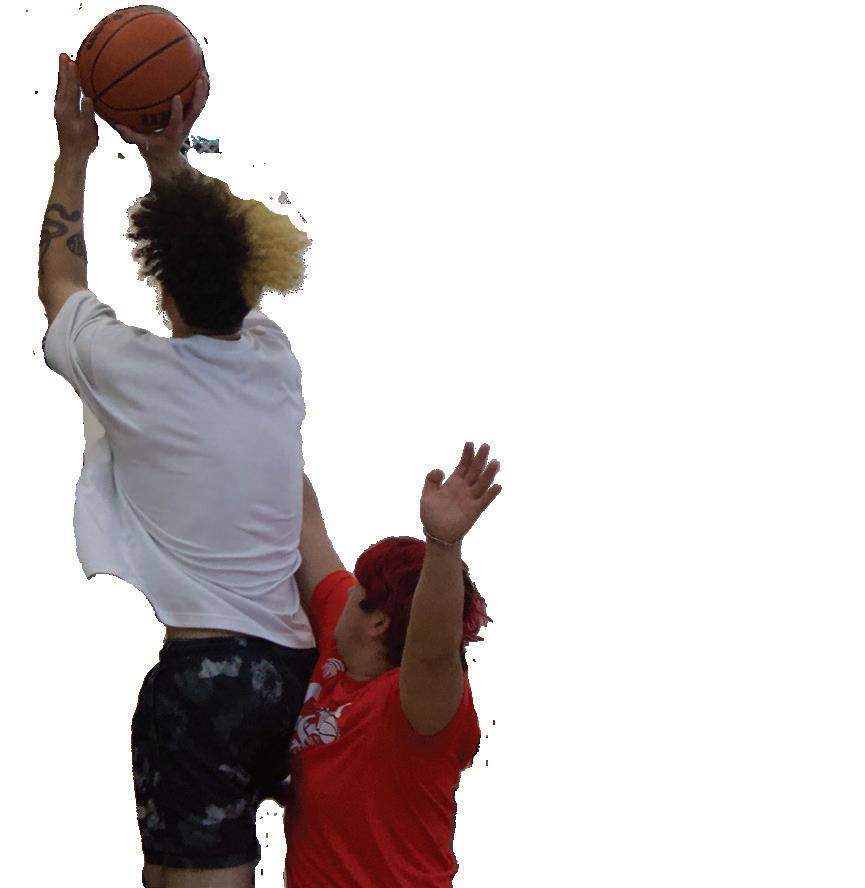
It was a hard fought game. We took it one possession at a time. It just wasn’t our day, but we’ll get them next time.
Eanam Maor Features Editor
Zones to be established at Palo Alto
of Establishment, according to Palo Alto Chief Transportation Official Ria Lo.
idea of Quiet Zones, as long as they can maintain the safety aspect.
Palo Alto residents may soon hear fewer train horns at three at-grade crossings as the city moves forward with plans to establish Quiet Zones, designed to limit routine train horn use and improve the community’s quality of life. The crossings — where pedestrians and vehicles cross the tracks at the same level — are located at intersections along Churchill Avenue, Meadow Drive and Charleston Road. Currently, locomotive horns must sound before entering public rail grade crossings, even when no immediate danger is present.
Federal regulations allow train horns to reach 110 decibels, while experts say repeated exposure to sounds above 70 dB can cause hearing damage over time. Residents have reported hearing the horns throughout nearly all hours of the day.
Establishing Quiet Zones has been under discussion for several years. Palo Alto City Council approved a study and conceptual plan for the Palo Alto Avenue crossing, also known as Alma Street, in partnership with Menlo Park in June 2023.
City officials have since coordinated safety measures, funding, construction and other logistics to meet federal standards, with the final step being a formal Notice
“Quiet zones are something where you’re balancing different sides of safety, because a noise impact can be damaging to people’s health, but we also want to make sure that people are not getting hit at the tracks,” Lo said.
City Rail Safety Committee member Patrick Burt also said that recent local student deaths by suicide commonly associated with the Caltrains, making the horn noise a trigger for some residents.
“I think if there is a way to implement Quiet Zones while still complying with safety measures and making
60.8%
Source: Self-selected survey sent out to Gunn students by The Oracle from March 26 to March 31 with 79 responses. of students do not believe that a quiet zone should be established at the Palo alto avenue and alma street crossing a noise imPact can be damaging to PeoPle’s health, but we also want to make sure that PeoPle are not getting hit at the tracks.
Palo alto chief transPortation official ria lo
“Right now at Paly with the community that’s been traumatized in recent months, the horn noise adds to those real significant impacts on students and staff and neighbors,” he said.
Senior Alex Efremova supports the
right now at Paly with the community that’s been traumatized in recent months, the horn noise adds to those real significant imPacts on students and staff and neighbors.
city rail safety committee member Patrick burt
sure that no cars or people are accidentally wandering onto the train track while the train is approaching, I would be supportive of the Quiet Zones,” he said.
Addressing such concerns of potential risks for pedestrians or vehicles unaware of incoming trains, Lo said the Quiet Zones do not eliminate homes entirely.
“The operator of the train always has the right to sound a horn if they believe that there’s an unsafe situation,” she said.
The Federal Rail Authority evaluates proposed Quiet Zones to ensure safety is not compromised and a city’s measures meet the requirements, according to Bert.
City officials conducted a post-
construction meeting on Feb. 26 at the Alma Street crossing, which will be a model for future Quiet Zones. Some issues raised by the FRA that were not in the original plan have delayed the final implementation, but most adjustments have been completed, according to Lo.
Plans for Churchill Avenue, Meadow Drive and Charleston Road crossings are in the design stage, while their Quiet Zone studies were conducted and presented in August 2024. These locations will employ quad gates due to space limitations, and the estimated cost for each Quiet Zones is about $1 million, which could be funded in part by a business tax passed three years ago for transportation, affordable housing and public safety, according to Bert. The city plans to use multiple communication channels, including Uplift Local and Transportation Connect, as well as community events to inform residents about the changes. A post-construction meeting is scheduled for April, which will allow the city to present the Notice of Establishment to the Rail Committee on May 12, according to Palo Alto Chief Transportation Official Ria Lo. The City Manager’s office hopes to present it to the City Council on June 15.
Roy Lao In-Depth Editor
Lively music merged with car horns along a stretch of El Camino Real during the “No Kings” Street Fest on Saturday, March 28, from 2 to 4 p.m. The demonstration was one of over 3,000 “No Kings” events planned across the United States opposing the Trump administration, according to a press release by organizing nonprofits Indivisible Palo Alto Plus and It’s Blue Turn.
The demonstration featured over 15 musical acts and 20 booths, with organizers estimating around 4,000 attendees. Some individuals dressed in costumes from “The Handmaid’s Tale,” and a flash mob of over 70 musicians and singers performed Beethoven’s “Ode to Joy” and an excerpt from his No. 9 Symphony.
For Vote 16 Palo Alto co-director senior Iris Blanchet, the demonstration served as a reminder of the
“It’s about mobilizing, but it’s also about understanding that you’re not alone,” she said. “Authoritarian governments win when they make you feel like you’re alone and there’s no real option for you and you just should give up.”
IPA+ member Ingrid, who preferred to keep her last name confidential, believes that the breadth of the protests send an important message to those in power.
“Civil resistance does bring down regimes,” she said. “That’s a historical fact. I look at all these people and I realize that when I wake up at 3 a.m. thinking I’m alone, I’m not. When our leaders look at these crowds, they’ll realize that they may be on the wrong side of history. I want them to feel the pressure. And this is a very effective way of telling them people are watching.”
Deborah Ju, parent of Gunn alumna, felt encouraged by the turnout but noted the need for greater youth participation among the demographic makeup of the protesters. Drawing on the anti-war movements of her youth, she said that involvement, especially by the
younger generation, is vital for meaningful change.
“I feel hopeful when I see so many people out, (but) I wish there were more young people out,” she said. “If the young people aren’t involved, then nothing is going to change. I’m worried about the future of our country. I’m worried about it for my kids and for my grandchildren. I love this country and we’re in a very dangerous spiral.”
Palo Alto Mayor Vicki Veenker, who also attended the protest, commended its peaceful nature and echoed the need for collective participation.
“We see and hear youth voices, and they’re really important,” she said. “We have given you a tough time to grow up in, but it’s on us to do our best to turn things around, and we need your help. Please pay attention. Please speak up. Please let us know how you feel.”
For Blanchet, the broader goal of this social activism extends beyond the protests themselves.
“All of this civic engagement, at the end of the day, is just about helping people,” she said. “You don’t even need to be protesting, if you can find other ways to help people. What’s important is that you find a way to always






Social media influencers, through Instagram “what I eat in the day” reels, have increased transparency about food choices, promoting a healthier diet and lifestyle by encouraging individuals to be proud of what they eat and be aware of the food they are consuming.
It is no secret that social media is incredibly influential on diets. But, the impact is positive. According to a 2025 survey conducted by the International Food Information Council, 60% of participants who came across social media content on food and nutrition said it encouraged healthier choices. When influencers share beneficial food habits they partake in, such as reducing processed foods in favor of natural snacks or desserts, it influences viewers to maintain a balance between carbs and other food groups, promoting overall health.
When transparent about their meals, influencers can motivate viewers to see a healthy lifestyle as more than just discipline and abstinence. The influencers promoting daily exercise and nutritious snacks like açai bowls or protein brownies encourage a healthier mindset and encourage viewers to be more aware of the food they are consuming. By making nutritional consumption a fun and trendy aesthetic to be a part of, individuals feel that they are in a healthy journey together.
Influencers can also share their past struggles with food, which can give a sense of understanding and community for

viewers going through similar experiences. This honesty encourages viewers to also be transparent about their food choices and promotes the idea that food is fuel, not something to avoid.
Additionally, according to a 2011 nutrition insight study conducted by Dr. Dan J. Graham, and Dr. Robert W. Jeffery, only 33% of participants self-reported that they almost always look at calorie content on Nutrition Facts labels. This low percentage affirms that social media is important because it is a source of knowledge about nutrition that reaches a broader audience.
As a result, diet transparency within social media has the potential to play a prominent role in promoting healthier lifestyles. It’s important to recognize personal limitations and that everyone has different needs to properly fuel their bodies. So when social media influencers fail to be transparent with their diets, it sets high and unrealistic standards by spreading the idea that certain food choices are right for everyone. When viewing conventionally attractive body types, and only catching glimpses of them consuming unhealthy food, younger audiences may mimic their diet even if it is unsustainable or unhealthy. If the same results are not achieved, they may question their worth, and wonder if something may be inherently wrong with their bodies and lifestyle, which can lead to them developing eating disorders. This is why social media food transparency is so important — it helps viewers more accurately understand how diet and eating habits affect health and physical appearance.
Transparency is the key to unlocking beneficial media that influences viewers to make healthy choices. Social media influencers posting about their healthy diets cultivates a sense of community within their platform, encourages honesty and promotes a healthier lifestyle.

Cici Zhang Reporter
Boasting thin, contorted bodies and platefuls of salad, fitness influencers garner hundreds of thousands of likes by promoting an unrealistic, unhealthy lifestyle to an audience of impressionable teenagers. Food transparency, popularized on social media, triggers body dysmorphia, insecurity and a plethora of eating disorders through the normalization of harmful habits and mindsets.
Food transparency has directly contributed to a social media-led culture of counting calories and excessive dieting. According to the National Alliance for Eating Disorders, social media platforms help create and uphold beauty standards, with the “thin ideal” constantly being praised and perpetuated online. The “blurring of lines between the personal and public spheres on social media platforms” exposes users to the many ways people defer to these standards, making them more impactful.
Interacting with these fitness influencers, users subscribe to an Instagram-prompted culture of food transparency, and in doing so, they contribute to the glamorization of a lifestyle that revolves around arbitrary standards and that heightens their own insecurity. Influencers craft largely unattainable beauty standards, promoting hazardous diets. Users then parrot them, derailing their own health. This insidious loop, fostered by social media platforms such as Instagram, Twitter and Facebook, is what sustains the debilitating toxicity of food transparency.
Additionally, the Cleveland Clinic, a prominent medical network, cites a
strong correlation between social media usage and disordered eating patterns, including binge-eating, purging, anorexia and orthorexia — a pathological fixation on clean or healthy eating.
Excessive or unregulated dieting can also weaken the immune system, increasing fatigue and possibly segueing into multiple health conditions. The risk of illness outweighs any benefits that food transparency might offer. Users’ health must be prioritized over an unreliable bandwagon effect.
Critics argue that food transparency inspires individuals to develop healthier lifestyles. According to the Healthy Eating Clinic, a team of dietitians based in Australia, though, 90% of influencers’ health advice was incorrect. A study they cited found that most nutrition advice online are actually “anecdotal opinions” masquerading as fact. Impressionable teenagers are manipulated into trusting inaccurate or damaging advice, and influencers profit from widespread misinformation. To mitigate potential eating disorders, teenagers should seek advice from medical professionals, such as dietitians and family physicians, instead of buying into the misinformation on social media.
Instead of being helpful, food transparency has triggered a myriad of eating disorders. Through social media platforms such as Instagram, Twitter and Facebook, fitness influencers have promoted the dangerous extremities of health — such as unregulated dieting — and sabotaged their users’ wellbeing. A significant portion of Internet audiences consists of impressionable teenagers; it is important to maintain honest, nonjudgmental online communities for all of us to thrive in.


“I think that’s full of crap because people in ancient times used to hunt animals and only used to eat meat. They didn’t have farming. We should eat meat because it’s the thing that we’ve been doing since ancient times.”
— Sean Jeswami, 9

“I think it’s very positive for the environment because with reduced (consumption) of meats, there will be less methane produced, which is a huge contributor to greenhouse gases. I think overall it has a positive impact.”
— Sam Bergman, 10

“I think vegetarianism is very healthy for the environment. It saves a lot of animals and I think that plant-based is definitely more effective for sustainability as well.”
— Siyona Navale, 9

“I’ve never eaten meat so I don’t struggle with it. I respect people who eat meat but I think the industry is just so corrupt. I wish I had the strength to go vegan, but I really like milk and eggs and cheese.”
— Mirabelle Upstill, 11

A substitute teacher in my ninth grade biology class once paused our documentary screening of Food Inc., to say that “Eating meat is not as bad as these people are making it seem.” I’ll be honest: As a vegetarian, I was disappointed. Reducing meat consumption isn’t some impossible, unrealistic demand. Moments like this affirm how conversations about the food choices we make can easily be dismissed. Instead of actively listening, we’re told that these documentaries are exaggerated and, as a result, youth are led astray, obscured from the environmental impact of meat consumption and the benefits of reducing it. In a way, being a vegetarian has often felt like being put on display in a museum’s “Mysteries of the World” exhibit: People don’t understand you. Questions like “What do you even eat?” and “How do you do that?” are guaranteed to induce eye rolls from me. And whenever I mention the benefits of veganism or vegetarianism, there’s always someone — usually a gym bro in the corner — asking me how I hit my protein goals. The assumption seems to be that I survive on plain, blanched vegetables. Newsflash: I don’t, and neither does most of the plant-based community. There’s also this idea that vegetarian food is automatically bland. I have no clue where this assumption comes from — vegetables can be seasoned too — but I can confirm that no meal from my household could be accused of flavorlessness. Meat might be a well-known source of protein, but it’s far from the only one. Lentils, tofu, beans and more get the job done. Vegetarians aren’t the unicorn of Americans, and we can’t be spotted like Bigfoot.

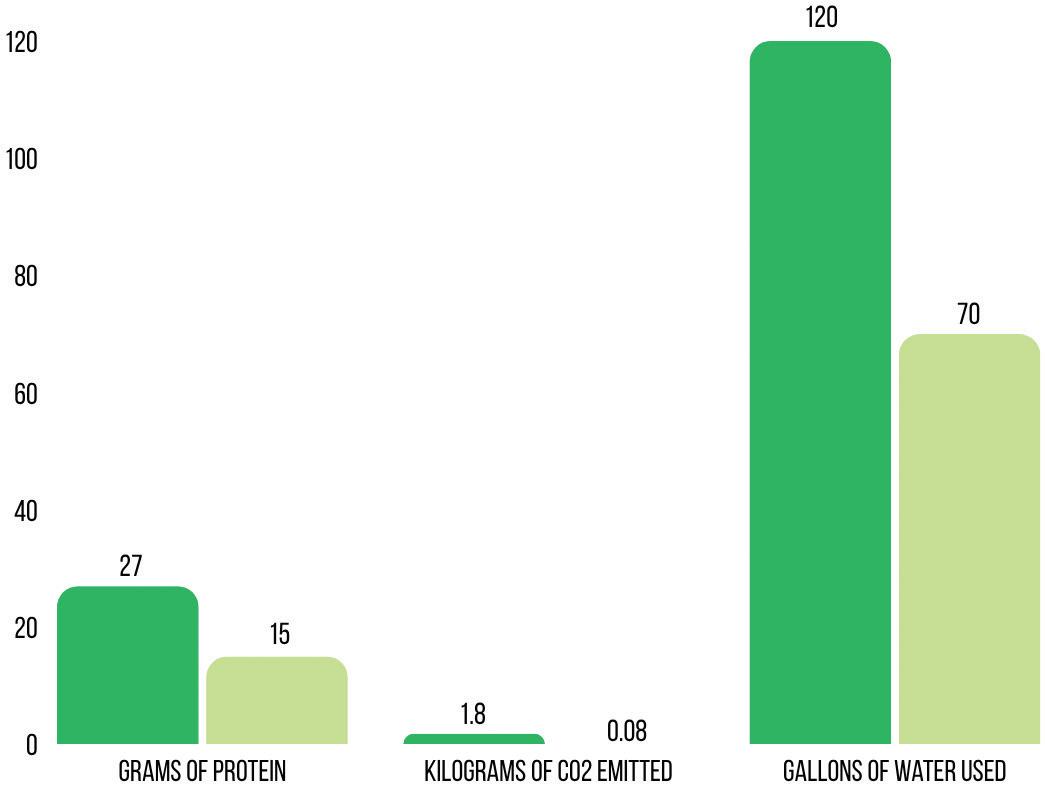
100g firm tofu

100g chicken KEY
Granted, the idea of never eating meat again can feel mystifying. But when vegetarianism is dismissed off the bat, the reasons for a meatless, or less-meat diet, are ignored. These reasons are not only personal, but also for the collective good. They’re largely tied to the environmental impact of food systems we all contribute to. Just buying meat increases your carbon footprint. We’ve all heard that cows release methane when they fart, but have you ever stopped to think why? When farmers prepare cows for slaughter to make your double-doubles from In-N-Out, it takes an incredible amount of water and processing that could be used to feed humans instead. If you remember the 10% rule from biology, only 10% of energy transfers from one level of a food chain to the next. Yet when you eat meat, you’re only getting 1% of the energy of what that animal ate, compared with 10% if you ate plants. If that’s not enough to convince you, any type of meat also requires thousands of liters of water per kilogram to be produced, according to Open Access Government. And vegetables? A mere 322 liters. On top of that, we all know that when cows digest all that food, they release methane. Once again, the National Library of Medicine has my back: Cattle methane emissions account for 18% of global greenhouse gas emissions. Let that sink in. Eating meat isn’t just unhealthy: It’s actively harmful to the planet. Would you rather eat meat for the rest of your life or watch the global temperature rise? Tough choice. With this in mind, consider why people follow plant-based diets and stop rejecting the ideals they center their life around. Following a plantbased diet can reduce the risk of heart disease and reduce high blood pressure, according to the National Institution of Health. These are significant, tangible health benefits that come from veganism and vegetarianism. Don’t come crying to me when your heart is suffering from all the bacon you ate. I tried to tell you. Cutting out meat isn’t hard. The mental and social barrier is what makes it difficult. Baby steps, people.

Knowledge has the power and potential to advance technology and medicine while simultaneously addressing global issues, yet it is often treated as a commodity rather than a shared resource. Research is meant to spread ideas and rapidly drive progress, yet it has become a restricted asset that limits who gets to learn and innovate. People should not have to pay for knowledge or information.
Without open and public access, knowledge becomes a barrier rather than a tool. According to the National Science Foundation, in 2022, up to 40% of basic research is funded by the federal government, yet the results are often placed behind high-cost fees. This creates a system where the people have to fund research with their taxes and pay again to access it. According to The Harvard Crimson, fees to read an individual article can often cost more than $40. With over half of academic research locked behind highcost paywalls, knowledge has become a privilege that many cannot afford.
Beyond research, restricted access to knowledge greatly contributes to educational inequality. Even throughout wealthier nations, millions of students lack access to textbooks, academic journals and reliable learning materials simply due to the cost barrier. According to UNESCO, over 250 million children worldwide still lack access to basic education. Restricting educational access only widens this gap, leaving students who are outside of privileged and elite institutions at a significant disadvantage.
Free knowledge also stimulates and plays a crucial role in innovation. With free information on the internet, individuals from diverse background and experiences can collaborate and contribute to new ideas and perspectives. However, studies have shown that freely accessible research is more widely used and has greater reach. For instance, the National Library of Medicine has shown that open-access articles receive 18% more citations on average compared to paid articles. This demonstrates that increasing accessibility also increases visibility and impact on the public. Organizations such as NASA have reinforced this idea by releasing decades of research, satellite data and software, therefore accelerating scientific discovery and an improved understanding of the Earth and space. By contrast, restricted access slows
progress by limiting who can build upon the perspectives and ideas behind the barrier of finances.
An issue that may arise when knowledge becomes free to the public is reduced incentives for creating highquality, rigorous work. If researchers and institutions no longer profit from their research, many argue that funding and publishing could decline, potentially lowering the quality of content produced. Academic journals’ annual subscriptions cost upward of thousands of dollars, and removing these revenue streams may disturb the sustainability of the work.
While from afar it may seem like the quality of research would deteriorate, this perspective overlooks how academic knowledge is actually produced. Most research
desire for discovery and real-world impact. Researchers are often not paid for their success in their papers, but instead funded by universities, grants or government institutions. For example, the U.S. National Science Foundation has provided over 9 billion dollars to support research and education. This means that the incentive to produce high-quality research is independent of earning a profit. With this, restricting access does not create more informational knowledge, but simply controls who can see it.
Another concern that arises with free knowledge for the public is that the information can be misused or misinterpreted. However, restricting access is not an effective solution and can worsen misinformation since it makes it more difficult for individuals to verify claims from free, credible sources. Studies show that it is rare for individuals to purchase academic research, and would rather rely on more easily available, but less reliable sources like social media. In a 2018 MIT study, false news reached people six times faster than the truth. If a paywall barrier is built upon this already existing problem, the likelihood of misinformation spreading is significantly higher because the most credible articles that could fight it are ignored.

To ensure that these issues are being addressed, institutions and the government must shift toward regulations and policies that prioritize accessibility over profit. Requiring that information is government-funded and credible, while also being publicly accessible, would ensure that society has equal resources and benefits from research. It is also important that publishers can expand reliable open-access platforms to reduce dependency on free options, as they exclude large portions of society. While implementing these challenges on a global or national scale presents challenges such as unwillingness or lack of cooperation, if people have to continue to pay for research, disparities will persist and knowledge will remain concentrated in only specific communities and groups of people.
The restriction of knowledge and information through the aspect of money does not just limit access to certain communities, but it also limits progress. When information is confined to only those who can afford it, discovery and innovation slow, inequality continues to worsen and opportunities are lost. Knowledge should be shared freely and used as a resource that is accessible to all, since it fosters a more inclusive environment for individuals from different backgrounds and experiences who can contribute to solving problems in the world.

Timothée Chalamet’s recent comments on ballet and opera in a CNN/Variety interview have become a viral media moment resulting in online controversy. Chalamet said he didn’t want to work in “ballet or opera or things where it’s like ‘Hey, keep this thing alive,’ even though it’s like, no one cares about this anymore.” Whether or not they are part of pop culture, the worth of older, traditional art forms lies not in money or attendance, but in their capacity for human connection and historical significance.
The themes of ballet and opera are timeless: love, grief, sacrifice, revenge, bravery and more. They give their forms longevity and suspend their audiences in the same experience and emotion as fellow audience members, the performers on stage and all the people who watched the show before them. According to a 2016 paper from the Guildhall School of Music and Drama, watching opera is both a highly emotional and “intensely social” experience. Audience members who watched alone also felt a strong
urge to talk about the performance with other people, and audience members who watched with others spoke more often in first-person plural (we) than first-person singular (I). So few modern art forms stimulate that level of connection with other people, and in the social isolation of the Internet Age, this characteristic makes the effort to keep ballet and opera alive worthwhile.
It is also precisely because live performance art is so capable of moving and invigorating its audience that it has been used to express popular ideologies of every time period. In France, Louis XIV played the role of the sun god in the 13-hour ballet “Ballet Royal de la Nuit,” which asserted his divine right to rule and upheld an absolute monarchy. After the French Revolution, ballet moved away from aristocratic, theological themes towards Romanticism, nationalism and populism. In modern times, old arts are still being used to convey social themes. In the 1932 ballet “The Green Table,” across six scenes, anti-war ideas are represented through dancers playing diplomats bickering around a green table. Ballet, operatic and theatrical works are artifacts representing cultural and historical shifts. What seems like a simple pirouette or love song carries the philosophies and ideologies of the eras they were created. They are worth preserving for the same reasons paintings are worth hanging in museums since art forms allow us to connect with varieties of cultures and people from the past.
Old art forms also support traditional artisans. Ballet
and opera rely on professions such as tutu builders, pointe shoe makers, wig makers and cobblers to make costumes. If they fade, the specialized knowledge of these related crafts will fade as well. Along with this, many of these traditional artisans directly influence more popular modern art. Tutu maker Anna Maria Genuise, for instance, has worked with both the Royal Ballet and on the 21st-century TV series Downton Abbey. Losing these artisans would be a loss of cultural heritage and foster reliance on destructive mass production instead. Skills that have been passed through generations would disappear, decreasing humanity’s collective knowledge in the process.
Opera singer Andrea Bocelli once said, “Opera and ballet are art forms that have crossed centuries and continue to speak to the human heart, because they answer a deep need for beauty, truth, and emotion. They are not arts of the past, but living languages that can still move us, make us reflect, and bring different generations together.” Timothée Chalamet is wrong. Old art forms have a history that doesn’t need Timothée Chalamet, standing on a giant orange Marty Supreme ping-pong ball, to bring people together.
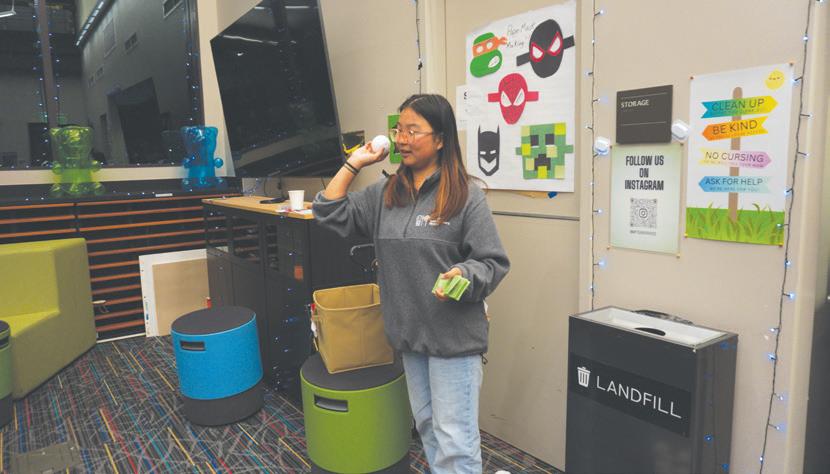
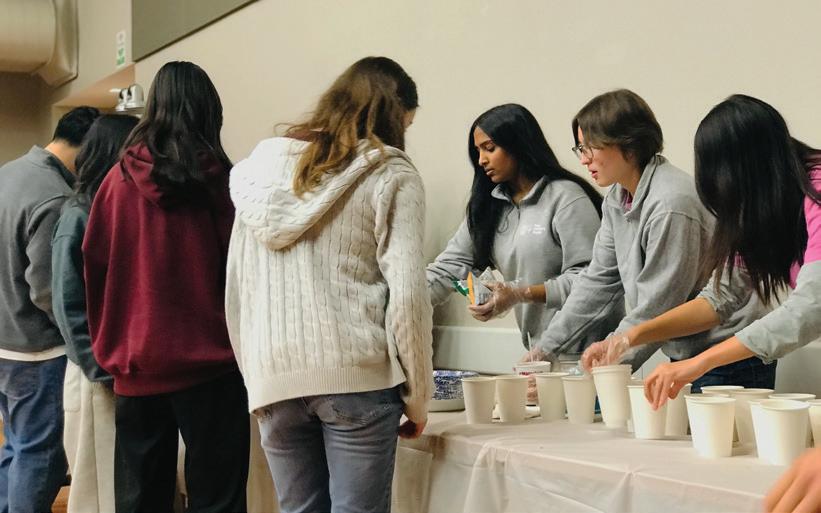
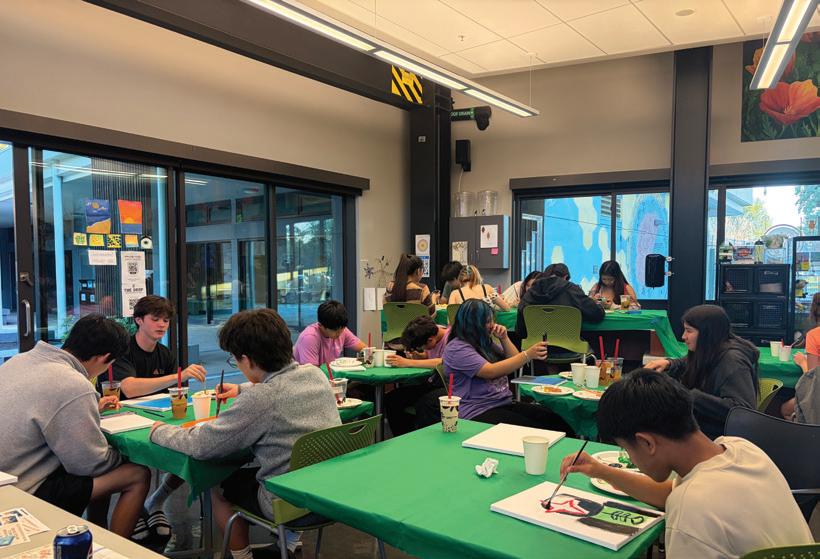
For many Palo Alto teens, finding a place to belong can be harder than it sounds. The Teen Advisory Board — better known as TAB — is working to change that one event at a time.
Made up of 15 to 20 dedicated high schoolers, TAB plans and leads free programs designed by teens for teens.
Co-president of TAB senior Palo Alto Middle College student Liam Wong describes the group’s mission.
“You have your school, you have your home, and then TAB provides that third environment where we try to get people to connect,” Wong said.
From a haunted escape room to a community boba and painting night, TAB’s events reflect the creativity its members bring to the table. The board has organized standout programs like Socks and Sockets, Boba and Brushes, and the annual Palopalooza, while also lending a hand to broader city initiatives like the Palo Alto citywide toy drive and the MLK Jr. Day of Celebration.
The events not only create valuable connections within the community, it also inspires fellow teens to engage with TAB. This was the case for sophomore TAB member Shristi Sinha.
“I was first inspired to join TAB after I attended one of their events last year, Palaplooza,” Sinha said. “I had a great time watching the student performers and doing tie-dye.”
Planning an event is no small undertaking. Wong describes the process that goes behind a large event, detailing the specific, popular recurring one: Boba and Brushes.
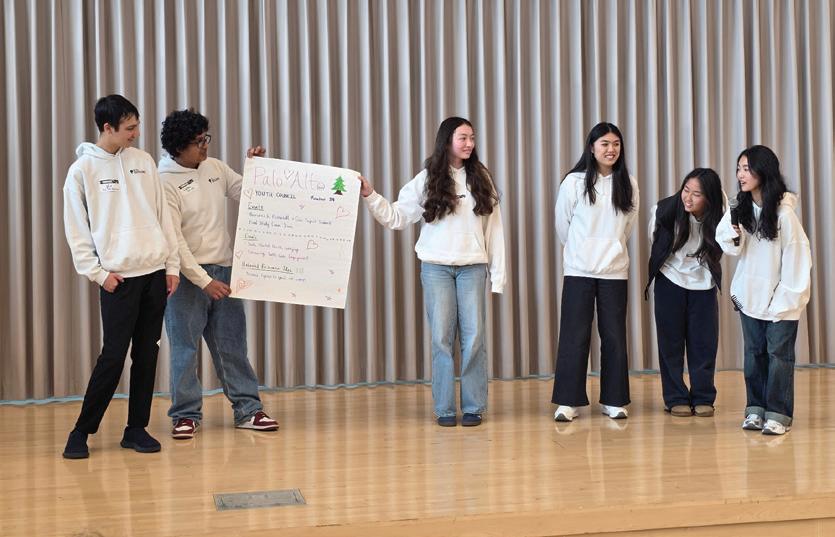
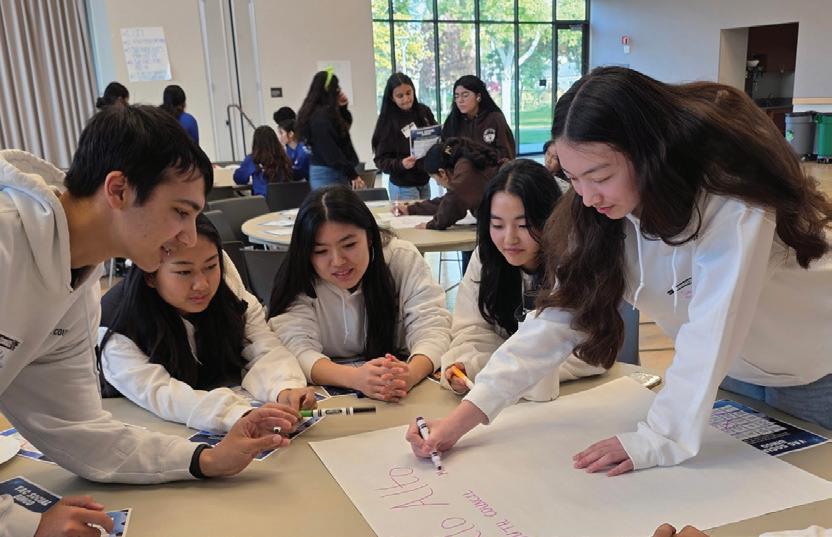
On Tuesdays, you can find high schoolers passionate about youth political involvement and civic engagement meeting at the Mitchell Park Library for their weekly Palo Alto Youth Council meeting. PAYC is a selective volunteer group that aims to foster connections between teens and the greater community through leadership panels, meet-and-greets with city officials and other public events.
The group of 29 students splits into committees with individual goals and planned events during their meetings. For example, PAYC member freshman Chloe Hong is currently working on the Earth Day committee that is collaborating with another youth group to create an Earth Day event that promotes environmental advocacy.
As she becomes more involved with PAYC and aligned with its mission, she reflects upon the reasons she joined the council at the start of the school year.
“(I wanted) an opportunity to get more involved with youth advocacy and be part of a group that connects the youth with all of Palo Alto,” Hong said. “I also liked that PAYC brings together students who care about similar issues and would want to create some change.”
youth mental health legislation, PAYC members like her are helping mobilize awareness about California Senate Bill 14, which excuses school absences for mental health concerns.
Shi is excited for an opportunity to apply for and rejoin PAYC next year, continuing to work alongside students interested in policymaking.
“This (committee’s lobbying project) is predicted to actually have to extend until next year, so I’d be really excited if I do get the chance to work on that same committee again and meet new people,” she said. “I know there’s a lot of freshmen and sophomores within PAYC, and it’ll be really cool to see 14-year-olds also interested in civic engagement.”
Not only do these student volunteers benefit the Palo Alto community, they are able to take away valuable life skills that will benefit them in their professional careers.
(I wAnTed) An opporTuniTy To geT more involved wiTh youTh AdvocAcy And Be pArT of A group ThAT connecTs The youTh wiTh All of pAlo AlTo
emily hong
“We start with ideation and come up with the events,” Wong said. “Then it’s execution. Planning what boba vendors, if we can get a discount, where we’re going to get painting supplies. Then we all arrive early to set up.”
However, in order for events to be fruitful, teens actually need to know about them and attend. Sinha describes how getting publicity for events can be tricky.
attend had been a helpful lesson for Sinha within TAB.
“The biggest lesson I have learned from TAB is to be on top of marketing in advance and to really advertise our events,” Sinha said. “It’s important that the teens knows what’s happening and where they can have a good time or relax with their friends after a long day of school and extracurriculars.”
TAB provides ThAT Third environmenT where we Try To geT people To connecT.
“A big challenge for us is gaining traction from the student body or community in Palo Alto,” Sinha said. “In the limited free time the students have, they don’t actually know many of the things happening in the Mitchell Park Community Center and ways that they can spend time with their friends after school.”
TAB addresses this issue using social media to advertise events on platforms teens use and see daily. Vice president Gunn senior Hannah Mei describes different methods TAB uses for outreach.
“All members are very active in making sure our social media posts get out to more people,” Mei said. “We mostly advertise through Instagram or by networking through our own social groups as well.”
Learning this skill of not only planning, but also advertising and marketing events so people actually
The effort pays off: Popular events draw up to 50 people, Wong says, and TAB’s winter study session during finals week brought in nearly 93.
“It gives people who maybe don’t go out often a chance to a completely free event, hang out with friends, drink bubble tea, eat food,” Wong said. “It helps provide an alternative space.”
Drawing on the specific event Boba and Brushes, Sinha details how participating in the events is rewarding and memorable for TAB members, especially after the effort they put in.
“I got to participate in a painting competition with a group of people,” She said. “It was a very fun and rewarding experience.”
Beyond the events themselves, TAB offers something just as valuable: community.
“TAB has taught me a lot about how I can make an impact within my community,” Mei said. “This is something I’ll take with me wherever I go.”
Junior Emily Shi echoes Hong’s sentiment. For her, PAYC is primarily a platform to push for change. As part of a committee dedicated to lobbying for
“A valuable lesson I’ve learned from PAYC is just how important communication is, especially when marketing for events,” Hong said. Marketing does not solely apply to PAYC events, however, it can be useful in broader terms too. “Marketing in general is a really important skill and also working with others in collaborating
—Written by Kaylee Cheng
sTeps To join TAB or pAyc:
- record An inTroducTory video And Acquire A leTTer of reccomendATion
- Apply online using The form AT
- ATTend An inTerview wiTh A commiTTee memBer miTchellpArkTeenservices.org

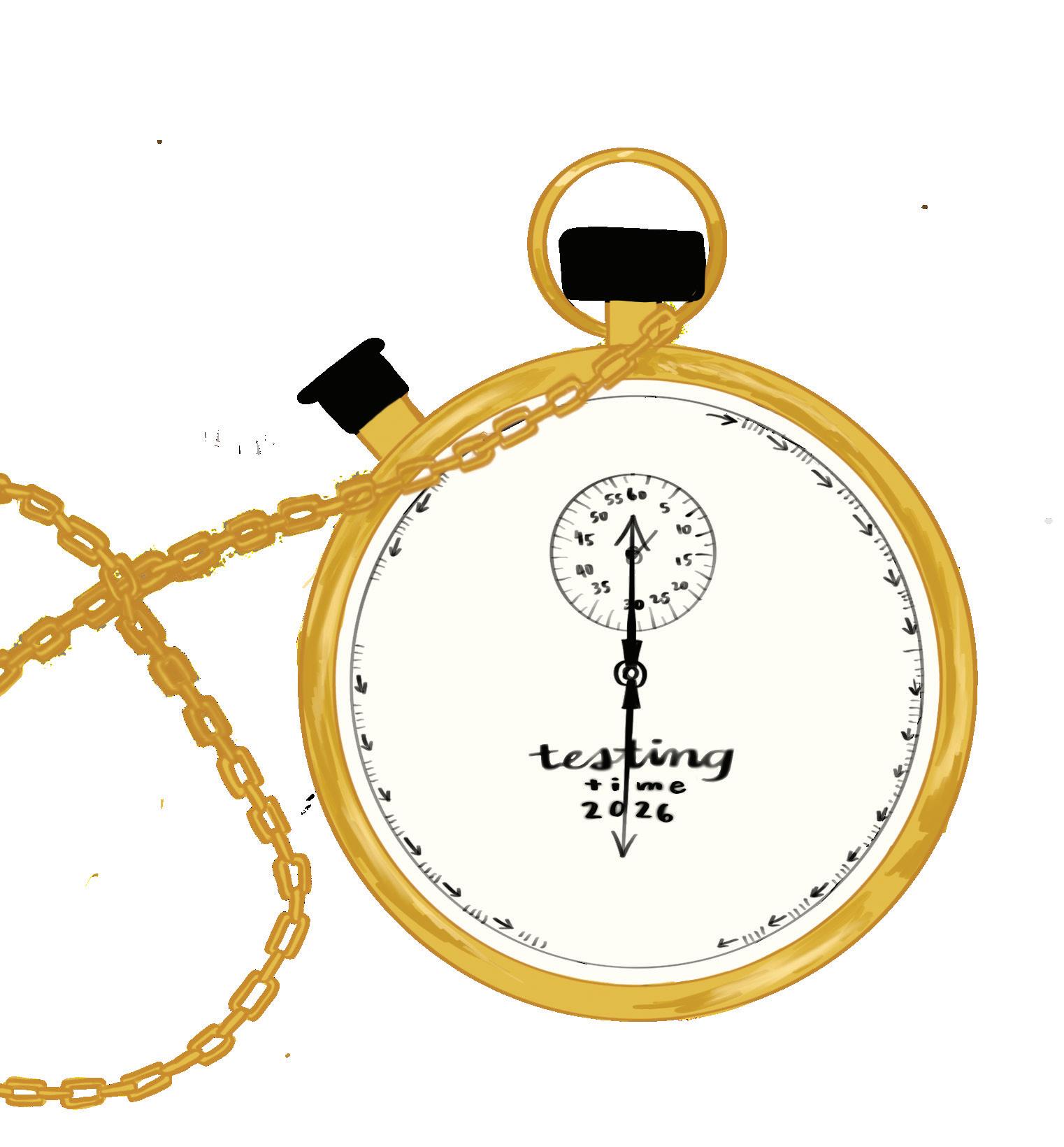
Yael Gottesman and Ezra Rosenberg Sports Editor and Lifestyle Editor
The rapid increase of students qualifying for testing accommodations at elite institutions has prompted a nationwide discussion on whether the function of testing accommodations provides a level playing field. To get a handle on the various perspectives relevant to this debate, understanding of the process for obtaining testing accommodations is required. Notable elite institutions experiencing this increase include Harvard, where 21% of undergraduates received disability accommodations last year, a rise of more than 15% over the past decade, Stanford, where 38% of undergraduates are registered as disabled, an increase from 24% in 2020-2021, and Amherst, where 34% of students are registered as disabled, an increase from 27% in 2021. At local institutions like University of California, Berkeley, the number of students who qualify for testing accommodations has quintupled over the last 15 years. News outlets such as Fox News have criticized this nationwide rise in secondary education, while publications like The New York Times have defended it as a necessary means to educational equity.
At Gunn, educators and school psychologists reported a similar, slow rise in the number of students receiving testing accommodations. This increase is concurrent with an overall decline of enrollments from 1,992 students in 2016-17 to 1,639 in 2025-26, according to data from the California Department of Education and Assistant Principal Harvey Newland.
Individualized Education Program, both of which may include testing accommodations. This step is then followed up by an annual reevaluation meeting.
Section 504 of the federal Rehabilitation Act requires schools receiving federal funding to provide services and protections to students with disabilities. These plans can include testing accommodations, but also extend to other areas such as assignments, behavior management, classroom environment and instruction and schedule modifications.
I can definitely see why it feels unfair and sometimes I feel that too, but people have their own reasons for (getting testing accommodations) and I think it’s important that we level (the opportunities) out by accommodating.
(504s) are not there Just to be helpful. they’re there because you require them in order to access your education or to be able to demonstrate your knowledge. they’re not something that we Just hand out to everybody.
school psychologist melissa clark
While there is broad agreement among students and educators on the goal of ensuring students have fair access to demonstrate their abilities through testing accommodations, the growing number has prompted discussion about how they are implemented and whether expectations around fairness and academic rigor are consistently understood. This tension creates a need for clearer communication about the role of accommodations and how they are meant to function in the classroom.
Open conversations about the fairness and equity intended for testing accommodations require a full understanding of the process behind obtaining them. The process of acquiring testing accommodations at Gunn is designed to be collaborative and data-driven, but also raises questions about consistency and access, particularly in how students enter and move through the system.
According to Assistant Principal Dr. Mycal Hixon, the process typically begins with a referral, which can come from teachers, parents or prior diagnoses of disabilities. From there, a Student Support Team — consisting of family members, teachers, counselors, school psychologists, occasionally an administrator and any outside relevant professionals like therapists — meets to evaluate the student’s performance and needs, ultimately helping determine the appropriate level of support. In the 60 days after the meeting, additional information is gathered to determine what challenges exist and how best to provide support, according to Hixon. The process ensures that as much feedback as possible is received.
These supports can range from temporary testing accommodations to formal plans such as a 504 plan or an
While the 504 plan provides general accommodations, the IEP acknowledges more severe disabilities that may require intensive support. While each student in need of testing accommodations has theirs uniquely tailored to, there is a general list that includes extended time, a note card for memory cue, tests in an alternate setting, alternate test methods, use of noise cancelling headphones, four-function calculator, test materials read to the student and oral responses. Extended time — the most common accommodation nationally in standardized testing, according to the U.S. Government Accountability Office — is typically offered in increments of 25%, 50% or 100% at Gunn.
While the multi-step process for obtaining testing accommodations is intended to ensure that testing accommodations are granted based on demonstrated need, it also means that access often begins with who initiates concern and how quickly it is addressed — factors that can vary from student to student, suggesting that access to accommodations may depend less on need and more on those who know how to navigate the system.
Some raise concerns about whether testing accommodations create an uneven playing field, especially in high-pressure academic environments where small differences in performance can have significant consequences. In competitive schools like Gunn, where grades, test scores and college admissions are all prevalent pressures, the idea that some get extra time or modified testing conditions can lead others to feel that
those students are being given an unfair advantage. This perception is further exacerbated by a limited understanding of what accommodations actually do. From an outside perspective, extended time or separate testing environments can appear to boost performance beyond what is “fair,” rather than leveling out the playing field. As a result, some believe that testing accommodations reduce the amount of pressure or effort required to succeed, creating resentment or skepticism about who truly needs them.
According to school psychologist Melissa Clark, there is a misconception that 504 plans are intended to give students an advantage, rather than provide necessary access.
“(504s) are not there just to be helpful,” she said. “They’re there because you require them in order to access your education or to be able to demonstrate your knowledge. They’re not something that we just hand out to everybody.”
Junior Carina Tseng, who has access to a separate testing environment as part of her accommodations, says these plans can be helpful while still acknowledging the broader debate surrounding them. Tseng’s perspective reflects a wider divide in how students understand testing accommodations, with some viewing them as necessary support and others questioning their impact on fairness.
“Obviously, you can’t guarantee fairness with the extra time,” she said. “I can definitely see why it feels unfair and sometimes I feel that too, but people have their own reasons for (getting testing accommodations) and I think it’s important that we level (the opportunities) out by accommodating.”
Nationally, the rise in testing accommodations has coincided with an increase in reported diagnoses such as ADHD and anxiety, as well as broader
41.5% of students do not believe that testing accommodations make the testing environment fair overall
Source: Self-selected survey sent to Gunn students by The Oracle from March 26 to 31 with 65 responses.
47.8% of students do that the only students granted accommodations those who need
Source: Self-selected survey sent to Oracle from March 26 to 31 with 69

awareness differences. The Centers for Disease Control and Prevention reported a 10% increase in high school students experiencing persistent feelings of sadness or hopelessness from 2013 to 2023. The nature of a parent’s worry for their kid’s performance in school and the actions they take as a result may support a rise in testing accommodation numbers as parents search for ways to improve their student’s wellbeing, mental health and, consequently, performance in school.
Lead Counselor David Leftwich sees a growing parent concern as one factor that may contribute to increased requests for support. The impact post-COVID 19-pandemic on education and general poor performance in school, he reasons, are examples of some things that might lead parents to want more support for their children.
“Whenever there’s something that raises parent’s anxiety levels about their children, they’re going to seek more support,” he said. “And so they’re watching closely. They’re concerned. They’re talking to the school. Is this a problem? Is that a problem? And so maybe more (support) gets put in place in those situations.”
willing to get a professional’s recommendations,” Leftwich said. “But if I told you that every evaluation that I got that I read from a private evaluator, I believed was done with complete earnestness on that evaluators part, and not there wasn’t a part of it that they said, ‘Well, I’m collecting $5,000 I kind of have to give these people what they want in this report’ and then when they bring us that report, it’s pretty hard to go the other direction against their recommendations.”
Another aspect of testing accommodations is that it reduces the toll it takes for students who need the extra support when completing their work. While accommodations can reduce the extra work needed to succeed, they aren’t necessarily required for every student to achieve the same results. They instead can lighten the load compared to students who must rely solely on their own resources.
I would love for all students to perform at their best ability, but I’m not so concerned with whether you’re getting a perfect score on any test, Just you having the sufficient amount of time to demonstrate what you know.
school psychologist michael galaviz
At the same time, access to outside resources can also play a role in the process. Evaluations conducted by private practices, which can cost thousands of dollars, may be submitted as part of the documentation used to determine a student’s eligibility for accommodations. These evaluations might offer insight into a student’s needs, but it’s at the cost of introducing new pressures in the system, particularly when schools may be asked to consider external recommendations. As a result, while schools rely on multiple data points to make decisions, the role of outside evaluations implies that access to testing accommodations can depend as much on a family’s resources as on a student’s actual needs.
Leftwich believes that the staff wants to conduct these private evaluations honestly and in the student’s best interest. At the same time, he acknowledged that the cost of these assessments can create pressures that make it difficult to question their recommendations.
“That’s very noble as a parent to learn more about your kid and to be
47.8% not
students who are accommodations are need them to Gunn students by The 69 responses.
Speaking to the broad goals of testing accommodations at Gunn, school psychologist Michael Galaviz shares how academic equity is key, and how supporting students to perfection is not.
“I would love for all students to perform at their best ability, but I’m not so concerned with whether you’re getting a perfect score on any test, just you having the sufficient amount of time to demonstrate what you know,” he said.
“Someone who deserves (testing) accommodations and doesn’t get them can study a ton and get a million tutors and find a way to have that same GPA (as someone who doesn’t need testing accommodations), but it’s just the toll it takes on that individual is a lot greater than someone normal to get the same result,” an anonymous student with testing accommodations said.



Sophomore Cordelia Hayes spends most weekends setting up temporary shelters for unhoused women across Palo Alto with the Heart and Home Collaborative, a seasonal shelter non-profit. As she engages and converses with the community, Hayes has begun strengthening her understanding of the tangible ways she can help address an issue that she says is both systemic and human.
“(There) are people who are chronically addicted to drugs,” she said. “These are people who have been sexually abused (or) have had family members die. There’s a reason that people are homeless, even though sometimes there’s not. They just got super unlucky, which is hard, because anybody could get unlucky.”
For Hayes, volunteering has reinforced an often-overlooked truth about those experiencing homelessness: They are just like everyone else.
“There is no category of homeless people,” she said. “When you actually get a chance to talk with people, you’re like, ‘These are just people.’ A lot of them are smarter than me or kinder than me, or better people than me.”
Conversations at home also shape Hayes’ perspective. Her father, a Human Services Manager for San Mateo County, raised her on the idea that it is okay to complain, as long as you do not quit.
“You have to be super, super resilient to work in
From volunteering at soup kitchens to organizing donation drives, Unhoused Action Club president junior Trinity Smith is no stranger to service. What began as a family tradition of volunteering at a soup kitchen every Thanksgiving has become a commitment to encouraging her peers to aid the local unhoused communities. After discussions with her cousin about a club dedicated to supporting the unhoused community club, and realizing Gunn didn’t have one, she decided to start her own, giving other students an opportunity to make a difference in their community.
“It’s just really hard for people, especially around here, to afford (basic) stuff, and if you can help out a little bit, you know, why not?” she said.
Each semester, the club creates essentials kits filled with toothbrushes, feminine products and deodorant. Along with this, the club sends at least five students to volunteer at a soup kitchen. Through these efforts, Smith focuses both on service and raising awareness about homelessness in her community.
“I think a lot of people don’t think (the unhoused crisis is) that much of an issue around here, but it really is,” she said. “When you go to (the food banks), there are lines outside, and if you go out during the night, you see people walking around or (sleeping) on benches.”
Even with careful planning, running the club doesn’t come without challenges. Projects require collaboration between multiple parties, which Smith facilitates.
“Organizing events (and) outreach definitely (require) communication, because some of these organizations have a lot of other responsibilities,” she said.
Nevertheless, Smith works diligently to overcome whatever obstacles come her way to ensure her club, and its mission, succeeds. Looking to the future, Smith hopes to expand the Unhoused Action Club to reach more students and impact more lives. She values the experiences she has gained from leading the club over the past year and hopes to share these enriching experiences with her peers .
that sector,” she said. “I think a lot of the work in that area requires compassion, and is really selfless.”
Through conversations with her father about his work with unhoused communities, Hayes learns to question systems and better understand how the homelessness issue fits into the larger California housing crisis.
“It is very important to (my dad) — and has become very important to me — that we think carefully and critically about the world around us and the way it pertains to other people,” she said.
After brushing her teeth in the mornings, Hayes’ father would ask thought-provoking questions.
“He was like, ‘Where’d you get the water from? Where’d you get the toothbrush and toothpaste from? How often do they need to be replaced? Was the water clean?’ There are so many things we take for granted that are not accessible, especially to homeless people, that we don’t even consider.”
Watching her father take on the difficult, sometimes futile-feeling task of fighting homelessness inspires Hayes to reflect on the person she wants to be.
“(He’s) made me aware of the deficiencies that exist in the world and made me want to be a better person,” she said.
—Written by Melody Song

“I just hope that we have more attendance and participation,” she said. “I hope that we can do more regular volunteering opportunities.”
—Written by Lena Duggan




At least once a month, junior Richard de la Garza volunteers with his church to help unhoused community members. For Our Lady of the Rosary, helping those in need hits close to home since many of those in the congregation are affected.
“Our church has many attendees that have sadly lost their homes, (so) the church tries to help us provide mental aid with available priests and fundraisers like bake sales to donate to the needy,” de la Garza wrote in a text message.
Although usually a monthly participant, in recent days, de la Garza has been to his church weekly to help out more often. He finds it vital to give back to his community and assist those who would benefit from a helping hand regardless of his own privilege.
“From a perspective of someone that doesn’t need donations from the church to live, it’s nice being able to help and receive joy from that blessing,” de la Garza wrote.
This call to action, however, does not stem solely from a dedication to his church community and the goodness of his heart. His service actions are also a result of lived familial experience contributing to his desire to help out.
“My mom went through being homeless at one point in her life along with other struggles and seeing how (tough) she is today is quite inspiring,” he wrote. “From what I know about the homeless community, it can really break or make you.”
There is often stigma that surrounds homelessness, especially the individuals themselves. To combat this, it is vital to challenge the often-inhumane treatment that unhoused people often experience. While de la Garza plays a large role in assisting underserved communities, he believes that changing the narrative does not always need to be huge gestures: a simple acknowledgment can be the key.
“It’s not hard to get involved, talking to someone on the street, just asking how their day was, can do wonders,” he wrote. “Seriously, it’s incredible how eloquent these people are.”
—Written by Gwen Domine
Established in 1923, the Scholastic Art and Writing Awards recognize the creative skills of teens from seventh to twelfth grade all over Canada and the U.S. Students have the opportunity to submit their art in twenty-nine art and writing categories, including ceramics, animations, critical essays and dramatic scripts. Heralded as the longest-running and most prestigious recognition program for creative teens, submissions begin at the regional levels, where participants can receive either Gold Keys, Silver Keys or Honorable Mentions. Teens who receive gold keys become eligible to be considered for Gold Medals, Silver Keys or scholarship awards.
—Written by Michelle Zhou
‘retreAt,’ Gold Key
Under the pressure of tests and constant studying, Knutson often wishes that she were still a little kid ensconced in her childhood blanket and holding her beloved stuffy. In this self portrait, Knutson hopes viewers will notice the avoidance conveyed by the direction her eyes are facing and the bunny detailing in pastel hues of blues and pinks.


‘supernovA,’ silver Key
Knutson portrays the societal pressure imposed on teenage girls and the insecurities many face when grappling with their self-image. Her hands illustrate the pressure she feels to conform to societal ideals. The stars show her attempts at hiding her insecurities in the name of “beauty.”
‘fAith And fAithlessness in the Inferno,’ Gold Key
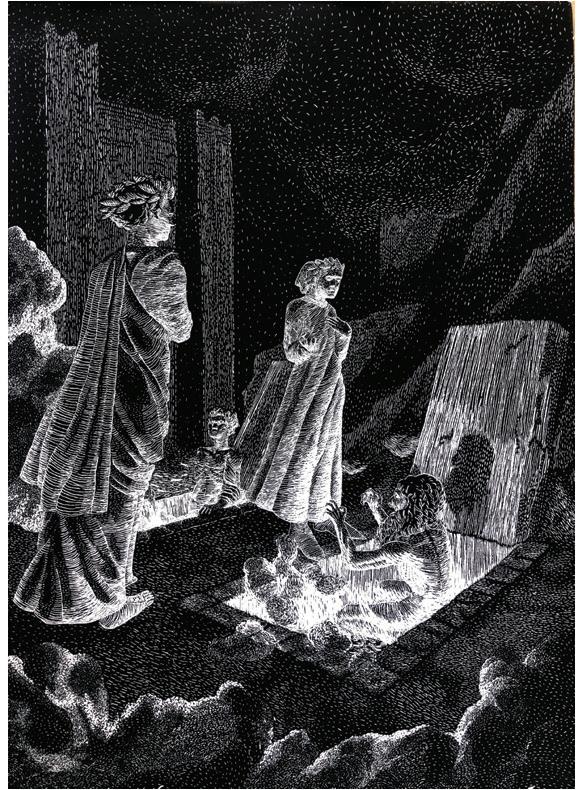
Inspired by the style of French artist Gustave Doré, Ahmed depicts a scene from Canto 10 of ‘Inferno,’ the first part of Dante Alighieri’s Italian narrative poem, ‘Divine Comedy.’ Dante (center) speaks to Cavalcante (bottom center) as Virgil (left) watches. Ahmed utilizes scratchboard to create high-contrast lighting that emphasizes the flame-filled sepulchers, in which Cavalcante and Farinata (center back) are bound to in the sixth circle of Hell.
The Oracle: How has your art changed over the years?
Ellie Chang: When I was a kid, I would just use art as a form of doodling to concentrate during class. I was always doodling horses and little people in the margins of my notes. But I think as I’ve tried to make my art more meaningful, I’ve gravitated a lot toward selfreflective kinds of pieces and also specific mediums that I like.
TO: Why are you passionate about art?
EC: I feel like it’s how I express myself. I feel like everybody needs some sort of outlet to express themselves. It doesn’t have to be creative, but for me, it’s always been that way. I feel like it’s very calming and
‘Ash And Mist,’ silver Key “Ash and Mist” depicts the Haleakalā volcano on Maui, Hawai’i. Chang was captivated by the variety of textures and colors. From the whorls of fog against the blue skies to the smooth sand on the jagged mountains, Chang hoped to capture the beauty of the volcano.


‘ChildliKe Wonder,’ silver Key
Originally created for her church gallery, Chang aimed to capture the freedom and joy of childhood in this watercolor piece. The child pours out their heart with no fear or hesitation, running across the beach as the sun rises and blissfully unaware of the chaos of life, represented by the seagulls surrounding them.
‘ConfliCted,’ honorAble Mention

‘Fragmented’ uses kintsugi, a Japanese art form that embraces imperfection, much like she had to learn to do herself.
grounding, especially as high school has gotten more intense. I feel like I’ve been doing art more and more because I need it to get away from all the pressures of academic life.
TO: What was the meaning behind “Childlike Wonder”?
EC: So I actually made that for my church’s gallery. They do a monthly gallery and the theme was rejoice in hope. I wanted to capture when you’re a little kid and you have a sense of joy and freeness. I feel like when you grow up you just can’t have that anymore because of the burdens of your different roles in life. I kind of wanted to capture the freeness of childlike joy, and I wanted to make a scene feel not as planned and more chaotic, so I added the birds in the back. Then I set it
Created with clay, glaze, fabric and cardboard, ‘Conflicted’ depicts Rodrigues’ struggle to grieve a friend’s passing. The main figure represents her and stands paralyzed among a sea of faces symbolizing her conflicting emotions and thoughts about how to heal.
‘frAGMented,’ honorAble Mention

at sunrise or sunset — I’m not quite sure —but the sun is on the horizon, and it’s a time of day that shows new beginnings and new ends.
TO: Do you like to use different styles to express different things?
EC: I just choose the one that would best express my ideas. I don’t know if painting is more towards another specific thing or drawing is more towards another. I think it’s just when I’m thinking about the meaning I want to capture in my art, I’ll think about which medium would best suit that. As for the pen piece, “Nostalgia,” I think I tried pen just because I wanted to make it really detailed. But for the watercolor piece, I wanted it to feel more free and less detailed and more abstract. So I chose watercolors for that. —Compiled by Noa Zeitlin. Edited for clarity.
Waves of chatter, ringing whistles and splashing water spill out of Gunn’s pool every day after school during the spring season.

So far, the swim team has had five meets. Competing in Division 1, the highest division of the Santa Clara Valley Athletic League, the boys team aims to reach the top five at Central Coast Section (CCS), while the girls team aims to reach the top three.
While the athletes’ goals remain focused on the finish line, the team never fails to support each other inside and outside of the pool. For boys swim head coach Dustin Fukada, the team’s aims are more than lowering lap times.
“It’s easy to say, ‘We’re gonna need somebody to be faster in a month than they were last month’: (that’s the) driving
As the last school day bell rings, student-athletes head down to the track in their running shoes and athletic gear. From sprints and hurdles to relays and high jumps, students of all grades and genders attend the after-school practices of Gunn’s most enrolled sport, track and field.
As part of the Santa Clara Valley Athletic League (SCVAL), track and field hosts and attends competitive meets with over 120 athletes. According to girls varsity runner and shot putter senior Hannah Baum, however, school-related trips have caused issues in attendance recently.
According to Baum, who has been on the team since her freshman year, the team is very inviting and presents easy opportunities to form strong friendships. Despite its large size, the track and field team still has a close bond. One of Baum’s

factor,” he said. “(But in terms of our culture), we want to keep growing with that (mindset of) being very positive and supporting each other.”
While swimming is a predominantly individual sport, team bonding is often spontaneously built into meets or practices. However, junior varsity girls swimmer freshman Sandhya Sashikanth hopes to have more team bonding events to connect with more people.
“Since it’s such an individual sport, I hope to get to know more people and we can all bond over this love for water sports,” she said. “(Swim is) a really positive environment — everyone’s rooting for you as well as themselves.”
highlights from the season is their pre-meet Pasta Feeds.
“There’s a good team spirit there and it’s fun to spend time with your teammates and eat good food together,” she said.
Changes in coaches this year have made the experience slightly different from past years.
“(We have been) figuring out coaching styles and (have been spending time) getting the coaches up to speed,” Baum said.
While track and field tends to be a more individual sport, Baum finds that relays are a way that the team can work together.
“It’s fun to do relays because it brings in more of that team aspect,” she said. “Also some of the relays, like the distance medley and the sprint medley, bring in people from different events, so you get to be on a team with people you wouldn’t usually be running with.”
Gunn varsity boys golf team has had a dominant spring season, with four consecutive wins in the Santa Clara Valley Athletic League play. After a narrow opening loss at Nueva — falling 188-187 — the Titans bounced back decisively, defeating Mountain View, Los Altos, Lynbrook, Los Gatos and Palo Alto High School.
The season’s standout moment came outside of league play, at a tournament that team captain senior Alexander Thu says rivaled the intensity of Central Coast Section.
“Our biggest highlight of the season so far has been the Monterey Classic at Laguna Seca Golf Course,” Thu said. “We took the win with a minus-six combined score and beat out strong CCS teams.”

Thu credits consistent practice and growing confidence for the team’s upward trajectory since the season opened.
“Our team’s gotten really strong since the start of the season,” Thu said. “We already started out really well, but we’ve been getting a lot of momentum and practice. We make good progress and have been able to shoot good scores.”
Off the course, the team’s chemistry has been just as important as their scorecards.
“This year I’ve tried to build a team culture that is also relaxed like a brotherhood,” Thu said. “When we need to focus, we really focus, and when we can have fun we have fun. We gotta be adaptable — and that’s been working out pretty well.”
As the last bell rings, the sports medicine room begins to fill as athletes from nine different spring sports bustle in and out to get treated for injuries, do rehab or get taped before practice. Alongside athletic trainer Gagan Cheema, a few student volunteers move around the room, helping her operate machines while joking with their “patients.”
In her freshman year, senior Makena Smith was in Sports Medicine when she heard that Cheema was taking volunteers to help her treat athletes.
“I play sports so I’ve seen how much hands-on stuff volunteers get to do, and all the different things they learned,” Smith said.
biology, emailed Cheema to ask if he could volunteer, and began in February after the wrestling season ended.
Cheema started taking volunteers when she was still teaching the Sports Medicine class because she wanted to follow the collegiate model of sports medicine training, where students also do field or clinical work. At games, volunteers help Cheema prepare and set up equipment. If an athlete is injured, they can observe the assessment and help with the treatment plan later on.
“I wanted to follow that model so students are able to apply their theoretical knowledge into practice,” she said. “Our students get a lot of hands-on experience.”
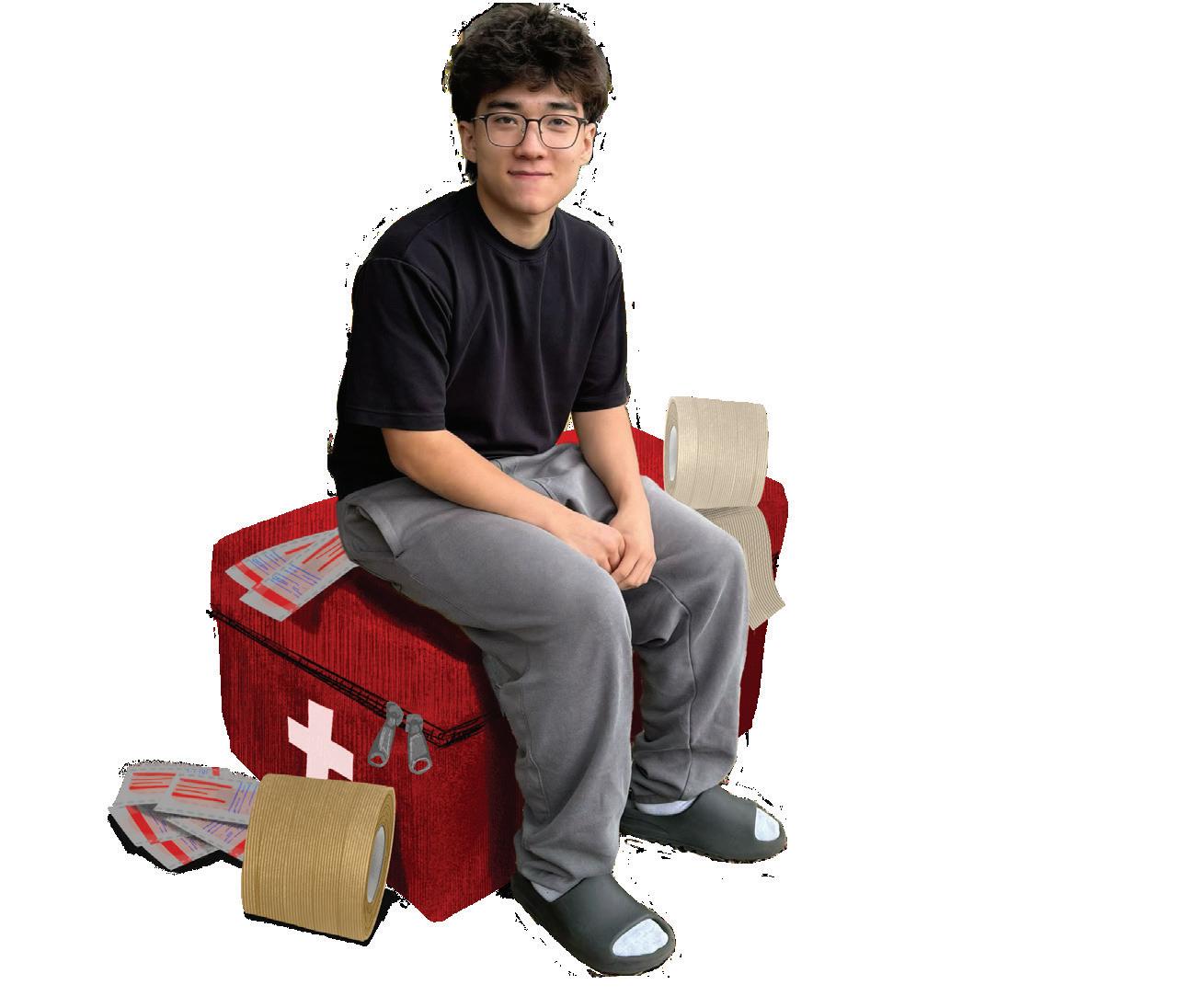
It is not a requirement for volunteers to have taken Sports Medicine. Cheema said the class provides a helpful theoretical base, but students will still learn all the necessary skills through many hours of volunteering. So far, McCloskey has learned how to operate Normatec compression machines and stims, two devices athletes use to aid muscle recovery. Smith learned to tape and wrap different body parts, both for injury prevention and recovery.
“There’s a lot of finger injuries (that) you can play with as long as you tape it,” Smith said. “It’s (mostly) stuff like that. And there are other things like ACL tears, broken wrists, a little bit of everything, but most of the time it’s just preventative or wrapping up a little injury.”
According to McCloskey, the time commitment depends on both the sports schedule and the student’s own timeline. Smith recalled leaving school at 2 p.m. for away games with the football team and getting home at
“But you choose to sign up,” Smith said. “Obviously, you don’t have to go. I just told G, ‘I’d like to do every
Cheema, McCloskey and Smith all agree that
volunteering strengthens students’ communication skills.
“I work with two other volunteers and we have to communicate with each other and Miss G,” McCloskey said. “I’ve (also) learned how to manage my environment a lot better because sometimes there’s busy days with a lot of people and we have to keep track of all the machines that we’re applying with timers and stuff like that.”
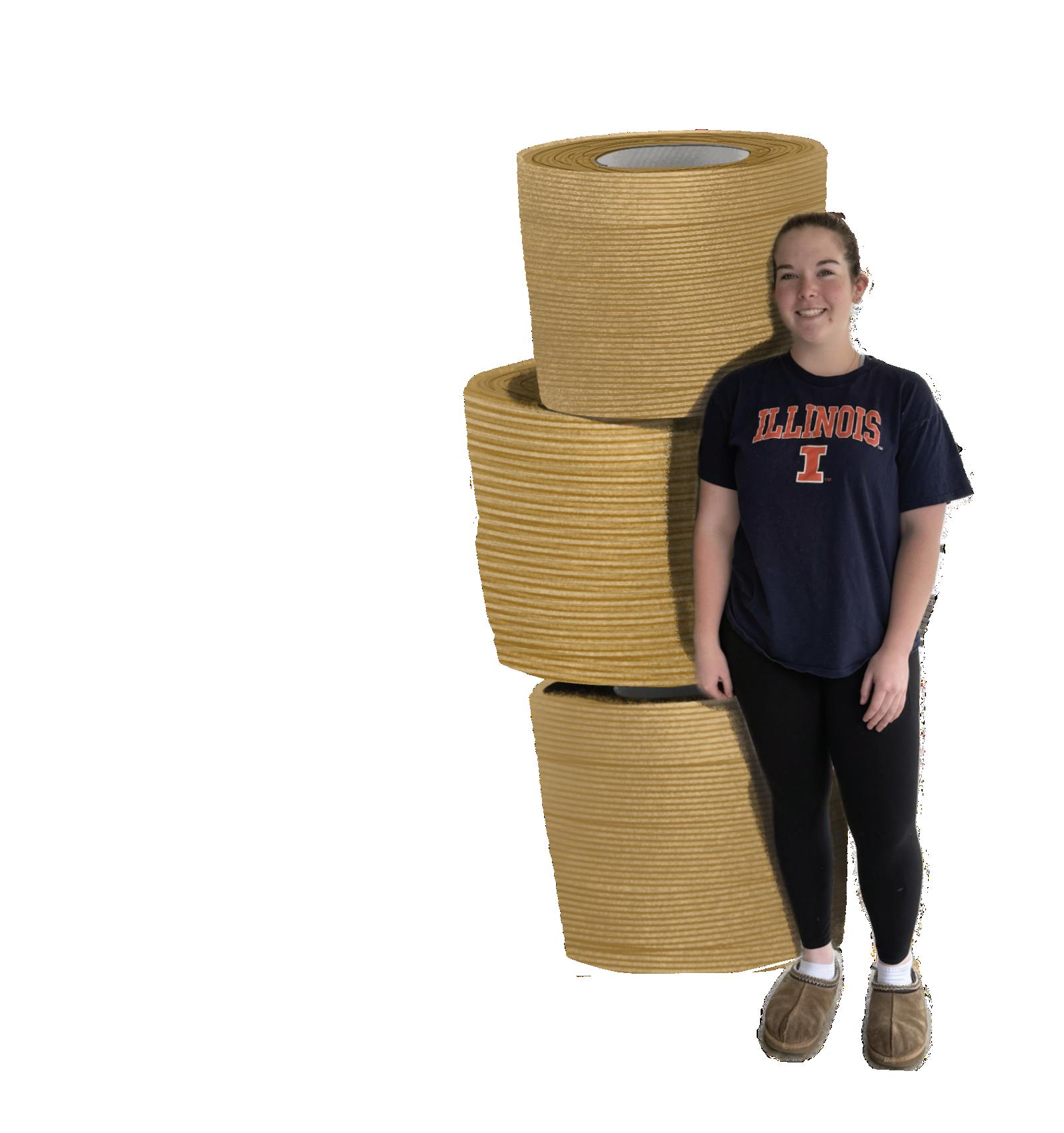
In sports, the focus often falls on the overall performance of athletes. But beyond physicality, performance often comes down to something far less visible: the body’s internal balance, where even small shifts can shape the outcome of a game.
At the center of this balance are electrolytes. According to MedlinePlus, electrolytes are minerals that carry an electric charge when dissolved in fluid. The charge of these molecules makes it so that, when the cell utilizes protein pumps or channels to facilitate active transport between oppositely charged ions, an unequal electrochemical gradient forms between the inside and outside of it. This encourages the passive flow of other ions across the cell membrane because the cell “wants” to reestablish electrical balance. This process is also known as secondary active transport.
Found throughout the body, electrolytes help regulate fluid levels, stabilize blood pressure and support proper muscle and nerve function by enabling electrical signaling through secondary active transport. Additionally, they help balance pH levels and transport nutrients throughout the body. A person’s kidney, liver and other organs act as filtration systems by controlling the body’s excretion and reabsorption of minerals and producing the hormones that regulate fluid balance.
something that can happen due to a lack of intake in fluids, kidney disease, vomiting, excessive sweating or overhydration — bodily systems become disrupted, leading to fatigue, muscle cramps, nausea, seizures and more.
These minerals become especially important for athletes during exercise, since as the body loses electrolytes through sweat, athletes are less able to perform at their full potential. Although eating certain foods such as bananas or figs can help replenish specific electrolytes, Sophomore Eleanor Lee finds that sports drinks like Gatorade or Powerade offer a faster and more convenient source by packing a concentrated mix of these minerals in one sip
“It gives me a lot of energy,” she said. “I’ll drink it when I’m backpacking because I’ll get really dehydrated or dizzy, and Gatorade helps because it has salt and minerals.”
However, widely advertised sports drinks often contain high levels of sugar, potentially causing tooth decay or diabetes. As a result, other brands — such as Pedialyte — that have less sugar and more electrolytes are more preferable options.
As a ballet dancer, Lee also uses liquid IV: an option recommended by her teachers that contains less than half the amount of sugar Gatorade does.

For the average student, the school day ends in the afternoon frenzy to be the first out of the parking lot or the bike cages. Last-minute homework assignments are shoved haphazardly into random backpack pockets, and teachers yell frantically as their students leave the classroom, reminding them that “the bell doesn’t dismiss” them. But not for an athlete. They’re skilled at multitasking, not only between school and sports, but also in handling their lacrosse stick, a day-old Gatorade and a fabricated prep check-in form claiming they have zero practice absences (they don’t) all in one hand.
for the next five weeks because sports games are 40-minute drive away. After a light day of conditioning, including a three-mile “jog” and 20 minutes of intense team-building group workouts, the athlete returns home smelling like a mixture of sweat and Biofreeze.
One may believe their day is over, but it’s far from it. The ominous pile of homework calls. Athletes rely on the blessed fridge stocked with energy drinks to brute-force their assignments after changing out of sticky practice clothing. Once the stack reduces and their eyes begin to flutter shut, the athlete sighs with relief for a brief moment, then realizes they’ll do it all again

As a loyal fan of all things Blue-1flavored, I was bubbling with anticipation to try the light blue flavor of Gatorade Cool Blue. The first sip flooded my mouth with refreshing sweetness. Soon after, a medicine-like taste — likely from the same chemicals responsible for the Blue-1 flavors I can’t get enough of — became prominent, starkly reminding me of the blue raspberry mouthwash I used to use as a little kid. The initial sweetness and the slightly nauseating aftertaste make the drink feel like using Instagram as a study break: It’ll make you feel bad by the end of it, but it is oh-sosweet at first. I would rate it a 5/10.
—Written by Noa Zeitlin

Gatorade is one of the sports drinks I can never seem to escape in tennis. A flavor that’s escaped me up ‘til now, though, has been Glacier Cherry, so I decided to give it a try.
For those of you who’ve enjoyed liquid Tylenol before, the colors may have uncanny similarities, albeit different viscosities. The smell is the same as the Fruit Punch flavor. So where does the “glacier” come in? The answer lies in the subtle and less intense cherry taste that lingers in my mouth and makes me want to take another sip.
The muted color of the liquid is a little undesirable and doesn’t really let you know what you’re getting into, but in the heat of a third-set tiebreak on the tennis court, I can count on Glacier Cherry to keep me refreshed. I would rate it a 7/10.
—Written by Ezra Rosenberg

—Written by Annabel Brown

At first glance Fierce Blue Cherry’s vibrant color is already mildly concerning. It’s adjacent to the color of a Smurf’s skin, and the smell of suffocating syrupy-ness upon opening the lid does it no favors. Blue Cherry is fierce upon the first sip, with its overwhelmingly intense flavor coating your mouth. After a quick adjustment, though, the taste softens into a blend of tart and sweet, with the sour edge saving the drink from being too thick. Still, like many artificially cherry-flavored things, it has an annoying — though subtle enough to forgive — aftertaste of cough medicine.
As a drink, Blue Cherry is all right. As a refresher, less so. I wouldn’t protest if handed one, but I won’t go seeking it out either. I rate it a 6/10.
—Written by
Fiona Wu
Always on the lookout for new niche activities to try, pottery was the perfect hobby for us to check out. The mix of functionality and creativity was appealing, and we’re always up for a good challenge. As complete beginners to the art, we landed on trying the easiest project: a plate. However, it still took an hour of rigorous shaping and molding, mistaking our sweat for bits of port clay, before we managed to (almost?) master the art of pottery and complete a dinner-sized, flower-shaped plate. This plate didn’t just appear out of nowhere. It took just as much grit to find a pottery place as it did to make


If you ever need to find a pottery class under 200 dollars, good luck: Hours of searching will lead you to the same place — lost, confused and out of options. Through numerous scheduling conflicts, we were finally able to uncover a secret studio in a fellow editor’s garage (special shoutout to potter KL Han for letting us into her space!).
Arriving at the studio at 10 p.m., we immediately got to work. KL Han started us off by mixing, squishing down
and folding the clay over, before repeating the process. Think of it like baking, only with a lot more arm muscle required. Then, she brought us to the clay roller to flatten out the lumpy clay into a usable sheet. We cranked the wheel until the clay moved between the roller and the flat bottom of the machine, making sure it didn’t get stuck on the roller. While walking back to the molding station, we wondered how a lump of clay could be turned into something beautiful.
We placed the flattened clay onto a ceramic plate template and began to mold it. Using our hands, we kneaded the clay from the top to the bottom to make sure it was distributed evenly, while simultaneously carefully sculpting the flower shape. After shaping the clay into a flower plate, it was now time to dry. We stood by the outlet blow drying our clay for what felt like hours, although it turned out to be only two short minutes. Now it was time to paint.

1. cut a slaB of clay
2. Roll out
3. mold into desiRed shape
4. paint with coloR of choice
5. fiRe in kiln, and voila! tips for a perfect plate
1. smooth Rough sides with sponge
2. apply multiple layeRs of paint
3. ensuRe even thickness
4. neveR apply paint to the Bottom
5. you can always RestaRt!
While we may not be masters of the brush, painting the plate felt like a breeze compared to the heavy armwork required for the pottery itself. After debating about what should go on the plate, we decided on the simplest and most on theme: The Oracle’s beloved mascot, Ollie. Although he would typically be painted with a vibrant red, sky blue was ultimately our weapon of choice (and the only color available). With hands shaking the entire time, but with each other’s support, we completed the piece and it was put in the kiln.
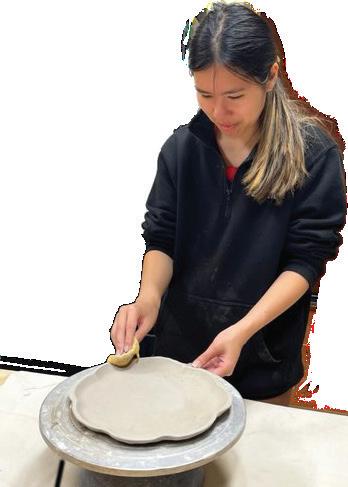
Like it or not, Generation Z is the future of the world. As the ones to live with the consequences of current climate-altering actions, this generation should be actively involved in making an impact on the physical and social environment. Choosing green is not easy, but Gen Z can reduce our ecological damage through simple acts such as biking, carpooling, recycling and more. Green Team treasurer junior Mina Van Roy believes that even though it’s not always convenient to be
However, choosing green can often feel like a luxury for those with time and resources. Student Climate Coalition and Youth Climate Advisory member senior Anika Agarwal notes that the financial burdens of sustainable practices make it difficult for Gen Z to participate.
“I do think that sustainability often comes with financial limitations (ex. Ethical clothing brands can be expensive),” Agarwal wrote in an email. “Also, social media trends and the desire for instant gratification drive
the impacts are concerning, you can find ways to avoid that technology when it’s not necessary. With AI, that might look like prioritizing meaningful uses over throwaway experiments and focusing on quality over quantity.”
Rather than seeking perfection when beginning a path of sustainability, one should recognize how small changes can amount to large impacts.
“It’s important for everyone to try to live sustainably,” Freitas said. “For teens, I think there are additional

ways to be sustainable
• Reduce, Reuse, Recycle
• Bike, take puBlic tRansit oR caRpool
• eat plant-Based meals
• save wateR and eneRgy
For years, Latinos Unidos member junior Keylee Dominguez saw Cesar Chavez as a symbol of justice — his name tied to lessons on activism, classrooms and stories of social change. Now, that image feels more complicated. As cities scrub the name “Cesar Chavez” from public surfaces following newly unearthed evidence that the labor leader had sexually abused women and children, communities grapple with how these allegations complicate his legacy as a keystone of social justice education and as a source of inspiration for young activists.
This new information has stirred clashing emotions among Gunn students as well, many of whom had looked up to Chavez as an inspirational idol. According to Dominguez, navigating these complicated sentiments is best done by separating Chavez as an individual from the impact of the cause he advocated for. Dominguez cautions that heavily associating movements with just one person unfairly discredits the thousands of other people who stood up for the same cause.
“It’s possible to acknowledge (Chavez’s) wrongdoing while still recognizing the importance of the labor movement that he (was involved) in,” she said. “We should know that this is does not excuse his behavior (while) also recognizing that the movements are bigger than just one person.”
The New York Times revealed in an investigation published on March 18 that Chavez had raped Dolores Huerta, an activist who had co-founded the United Farm Workers union. He had also sexually abused two young girls: Ana Murguía and Debra Rojas, both of whom were deeply connected to the UFW through their parents’ organizing work with Chavez. According to the investigation’s findings, these were not one-off incidents, but rather pieces of a consistent pattern of sexual abuse demonstrated by Chavez — one that has remained out of the limelight for many years.
statues of him once stood. He has long been venerated for his work in both politically empowering Latino voices and securing better pay, living conditions and health
identify with characters, but in order for these movements to be successful, they need a group of dedicated workers.”

She and many of the other victims had felt pressured into decades of silence by shame, fear and the weight of Chavez’s widely revered image. According to The New York Times, Huerta had refrained from speaking up about being raped until now, afraid that no one would believe her.
Substantiated by extensive evidence, these allegations have evoked conflicting emotions around Chavez’s legacy. In Fresno, San Fernando and many other cities across the nation, vacant spaces now occupy where
For social studies teacher Jeff Patrick, who has helped shape the new ninth-grade Ethnic Studies curriculum, the revelations of this investigation are a reminder to reiterate to students the importance of focusing on the impact of movements as a whole instead of placing one particular leader on a pedestal.
“(We need to) emphasize that these movements are never the product of just a single person,” he said. “It helps people understand the story (because) we like to
Educators must now decide whether or not to modify their social studies curricula and how to frame this new narrative. Patrick says that in light of these allegations, how Chavez’s story is taught will be a key point of consideration when revising the Ethnic Studies course plan this summer.
Retired Milpitas city council member Bob Nuñez, who also formerly served as superintendent of East Side Union High School District in San Jose, believes it is incumbent upon every school district to thoroughly discuss this dilemma, and to give weight to student input in the process.
“(Students are) the customers,” he said. “(They’re) the ones who are partaking in this educational plan, (and) should be involved in the creation of the curriculum (not just) on this issue, but on all issues. As a high school student, (you) need to be engaged because this will come up again.”
Nuñez cautions of how being overly concerned with just one individual’s impact detracts from the efforts of everyone else involved and from the cause itself.
“You lose sight of the issue, and you concentrate on a person,” he said. “But nobody has ever done anything all by themselves.”
Having met with and been deeply inspired by Chavez, Nuñez finds this news of the activist’s sexual misconduct especially startling and difficult to come to terms with. Chavez had influenced some of the major life choices that have led Nuñez to where he is today.
“A lot of what happened that day (when I spoke with him) shaped my career all the way until I retired,” he said. “Staying in education was a conversation with him. Helping Latino families that were farm workers was because of my conversation with him.”
— Written by Sarah Grupenhoff
Popularization of ‘looksmaxxing’ trends promotes toxic masculinity, hyperfixation on appearances
Once confined largely to stage performers and celebrities, beauty products like tinted moisturizer and eyeliner are beginning to find their place in men’s daily routines. What was once associated with performance or glamour has increasingly become a component of everyday maintenance, akin to shaving or skincare.
However, at the center of this shift is a paradox. Although more men are using makeup, many are doing so in ways that preserve traditional ideas of masculinity. This tension is largely due to the rise of social media influencers promoting appearance-based selfimprovement — often referred to as “looksmaxxing” — where participants partake in popularized strategies to appear more “physically desirable.”
Beginning in late 2025, advertisers began promoting products like “The Men Pen,” an eyebrow and beard pencil designed to touch up sparse areas. They emphasized that this product was “not makeup,” but a “looksmaxxing product,” using language that reflects a broader effort to distance cosmetic products from femininity.
Much of this shift is a result of a deliberate, unnecessary effort to cater to a hyper-masculine audience. Nearly identical products — eyebrow pencils — are given a different, male-centric name. This change in branding not only applies to “The Men Pen,” but also to “skin perfector” skin tints and “spot treatment” concealers. These linguistic shifts do not solely serve as marketing tactics — they create a psychological distance from femininity, allowing men to reap the benefits of the same products while holding a false perception of fundamental differences.
This race to appear more conventionally attractive spans far beyond makeup products: A popular social media looksmaxxing creator who goes by “Clavicular”
described in a Twitch livestream his experience taking a combination of Adderall and methamphetamine to suppress his appetite and alter his physique.
“I went on a three-day fast and stayed awake the entire time, and I lost five pounds,” he said in a livestream. “So, that was kind of the craziest thing I’ve done. It was pretty neurotoxic to be up that long.”
In an article published on Science Direct in 2000, men’s health professional Dr. Will Courtenay argues that men often engage in risky, health-diminishing behaviors due to a desire to adhere to socially constructed notions of masculinity. The recent looksmaxxing trend has become an extreme case of this phenomenon, influencing an alarming culture where harmful strategies to modify one’s appearance has become normalized.
Although this recent boom of male cosmetic usage initially points towards a movement away from traditional gender roles, they ultimately reveal how deep these norms are entrenched in society. Rather than dismantling the divide between masculinity and femininity, the rise of looksmaxxing ultimately reinforces it under a disguise of “male selfimprovement.”
— Written by Anne Dong



April is infamous for beginning with an iconic and silly day of pranks: April Fools’. The day of mirth and mischief originated in 1561 when the French calendar changed to begin in January rather than April 1. Originally meant to ‘fool’ those unaware of the change, the day is now synonymous with a pranking culture rooted in psychology.
Psychology teacher Ariane Tuomy explained how group expectations increase pranking, and how the culture incentivizes people to participate in the tradition, as it is the one day a year where pranking is especially normalized in society.
“(Pranking on April Fools’) is a combination of people feeling a certain obligation to participate in the tradition and a permission to prank others,” she said.
The reasoning behind why people prank others is not limited to one: The most prevalent reasons are lighthearted humor and breaking societal expectations.
“Our brains find it humorous when we have an expectation for something and then it’s something else which happens,” Tuomy said. “The humorous component of April Fool’s days is rooted in testing the social boundaries.”
Despite pranking holding a lighthearted connotation, when pranks are posted on social media, what starts as a fun, intimate moment meant to be a testament of friendship can become a practice of humiliation or misinformation. This practice pushes the boundaries of what is socially acceptable and leads to decreased trust within society.
Pranks primarily spread misinformation due to society’s tendency to accept information already aligning with their beliefs. On April Fools’, pranks can exploit those cognitive confirmation biases, leading to the spread of misinformation and to decreased trust of social media content.
Although many pranks are a testament of one’s friendship, for Psychology Club co-president sophomore Emilie Matthey, when pranks are done with the intention to hurt, it can decrease trust in relationships.
is taken too far, the person can end up feeling either betrayed, hurt or even traumatized.”
If a relationship is truly strong, it can be seen as more socially acceptable to prank a close friend. However, if the friendship is

“If it is a playful prank, then I think it can actually cause some validation and bonds (between) the pranker and the person being pranked,” she said. “But if the prank
resilient bond, where they trust you enough not to take it seriously or personally.”
Sometimes, even in close relationships, pranks can have unintended consequences. Everyone has different backgrounds, experiences and personal values, so things can be interpreted differently and have different effects on different people. Some topics can be more sensitive than others in a discussion, especially if those around have previous negative experiences around the topic. This is why it is so important to establish boundaries in relationships before pranking.
For junior Van Calvert, it comes back to the intention of which the prank was done.
“I don’t think it’s negative, unless people make it so,” he said. “As long as the prank is being done in good fun and spirit, I would consider pranking to be positive.
At the end of the day, April Fools is a celebration of the art of pranking and invites society to partake in jokes and entertainment with friends. Although pranks are considered a testament of one’s friendship, if they are not committed with positive intention, they can lead to victims of the prank feeling betrayed and experiencing a decrease of trust in friendships.
“It depends on whether somebody is being laughed at, or laughing with the other,” Tuomy said.
—Written by Mayher Dulani
to mess with you in a way where I know that our relationship is strong enough to withstand that, it is a testament of our friendship,” Matthey said. “By putting someone in a ‘vulnerable’ position, it’s a signal of a strong,
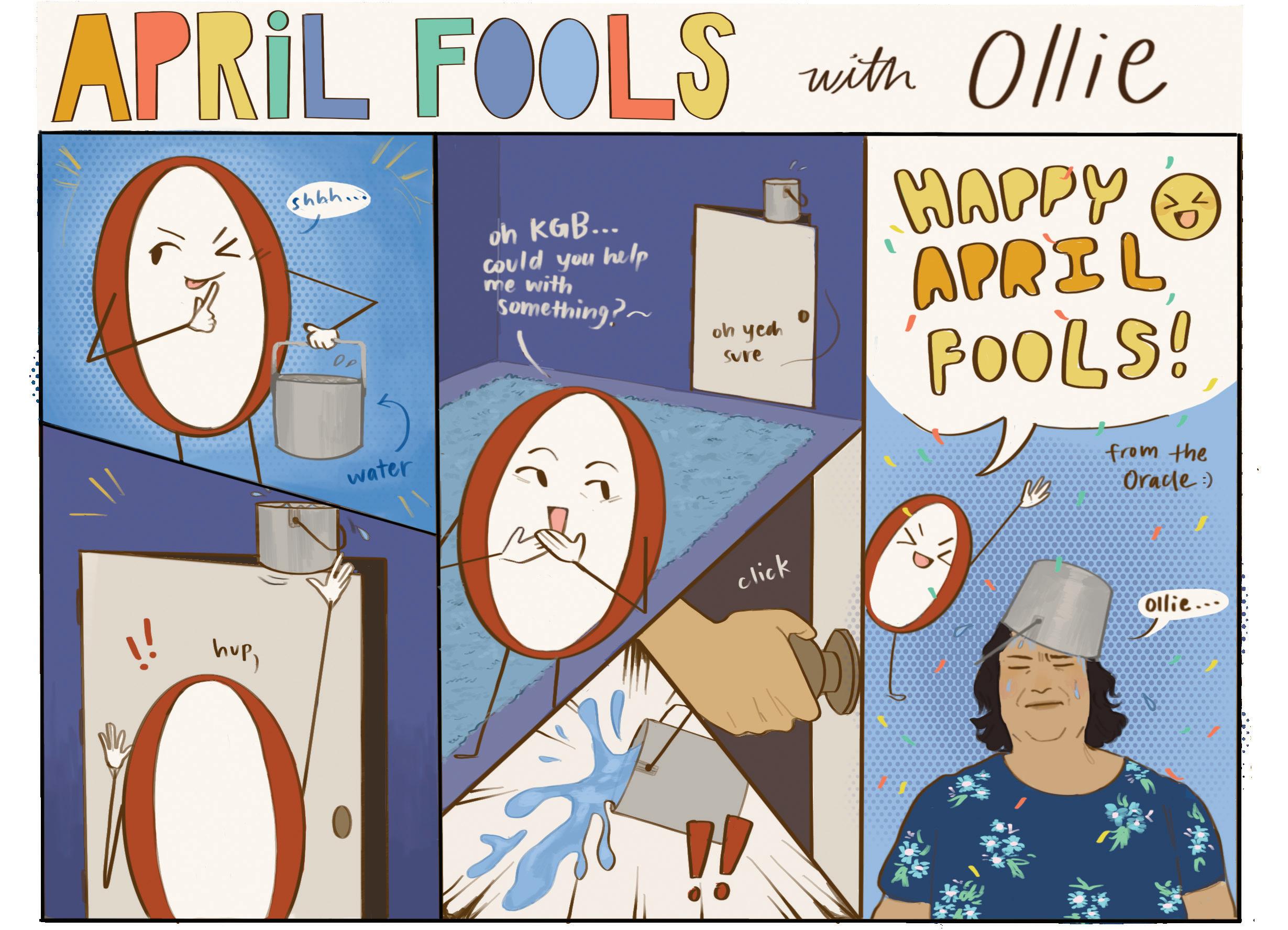
ACROSS





—Crossword by Arjum Ahluwalia
1. Card#1 in a card deck, plural
5. Singular preppy shirt with collar (2) 6. Soccer star Lionel 7. Floral leaf 8. Resorts with facials and robes


1. Taking a quick look (2)
__ Rica
Anna’s pair in Frozen, plural
Planting medium
5. Circuit measurement units
ACROSS DOWN —Crossword by Ellen Kim


1. Research class at Gunn (abbr.)
4. Best way to sign (2)
6. First five books of the Hebrew Bible
7. Motionless
8. Sturdy tree
ACROSS DOWN
1. Musical character, for one (2)
2. The first springtime month
3. Domain
4. Pronoun for “it”
5. Ice sport league (abbr.)
—Crossword by Annabel Brown
1. Pollen-induced annoyance
5. Taj __
7. “Freak Like Me” singer Howard 8. Bulletin board fasteners 9. “__ the limit!”
1. “__ __ my wit’s end!”
2. Triumphant cries
3. Baby bird
4. Handkerchief (abbr.)
6. Young lady

ACROSS DOWN —Crossword by Fiona Wu
1. Death’s counterpart
5. Central Honshu volcano
7. Opposable digit
9. Pole on a sailboat
1. Wood strip
2. “It Had To Be You” composer Jones
3. Flora and __
4. TV awards
6. Border on
ACROSS DOWN —Crossword by Michelle Zhou




8. Famous Japanese men’s figure skater

In modern sports, a focus on male physiology has blurred the harsh reality of the female athlete menstrual cycle, widening the gap of the understanding of the health aspect of periods in athletic performance. While studies show performance is tolerable during the cycle, there are continuous athlete testimonies revealing the negative impacts of menstruation on performance because of physical pain, fatigue, hormonal fluctuations and stress. For many female athletes, menstrual cycles are not just a widely misunderstood natural process, but a recurring obstacle that can limit their true capabilities and overall comfort..
Despite the ignorance faced universally by millions of female athletes, menstruation still remains as the most overlooked factor in performance, treated as an inconvenience rather than an uncontrollable, physical barrier masking true ability. Symptoms like cramps and changes like hormonal shifts can negatively impact speed, endurance and consistency, according to the National Institutes of Health. Yet instead of giving the support these women need, the struggles they carry are often minimized by coaches, teammates and the overall sports culture. Many female athletes have an additional competition to endure through a silent battle of pain and fatigue in a society where their experiences are constantly being ignored.
Freshman Mabel Johnson, volleyball player of four years, has experienced many teammates struggling to perform their best when on their cycle due to cramps.
not able to give it your best effort in practice.”
Mitchell explains how the gap between ability and performance can be a mental battle, draining her motivation and confidence.
“It can be really frustrating. Your performance is so below how you’ve been performing in the past weeks,” she said.
Moreover, she explains how period symptoms can fluctuate and be different for everyone which becomes a personal factor for many.
”“I think another thing is people tend to think that all period pains are consistent or equal across the board no matter the person,” Mitchell said. “But in reality, it can vary a lot and it can range from just feeling a bit off to ‘I’m completely incapacitated.’”
to be a good teammate, that you are expected to always be on your best game, not only competing against opponents but also against their body, a natural cycle
the lAck of open conversAtion Around menstruAtion leAds to huge silence, pushing femAles to go beyond heAlthy limits.
swimmer And volleybAll plAyer sophomore Zoe selker
Beyond the physical symptoms, the stigma of people dismissing period-related discomfort as normal and excusable plays a huge, undermining role in an athlete’s head. For swimmer and volleyball player sophomore Zoe Selker, the hardest part is the mistreatment for her pains and symptoms.
Acknowledging (periods) in sports settings would definitely help becAuse not everybody cAn plAy their best when on their period becAuse it’s A normAl thing.
volleybAll plAyer freshmAn mAbel Johnson
“I know a lot of girls, especially if they have conditions like endometriosis, can definitely have their performance affected if their cramps are bad,” Johnson said.
Johnson’s opinion reflects a common, widely reported challenge female athletes face during menstruation: physical discomfort with symptoms including cramps, headaches and muscle soreness.
A 2025 study in Frontiers in Sports and Active Living found that 87.8% of surveyed athletes reported negative performance impacts during their periods, with 83.7% experiencing issues like muscle fatigue and abdominal pain. Besides the pains from cramps, hormonal shifts during menstruation can also lead to low estrogen and progesterone levels, resulting in reduced energy, strength and imbalance, several critical factors that can greatly impair activity.
To competitive volleyball players where agility and running are abundant and crucial, a decrease in stamina and energy can be a drawback.
“Acknowledging (periods) in sports settings would definitely help because not everybody can play their best when on their period because it’s a normal thing,” Johnson said. “I don’t think people should get mad at athletes if they choose not to participate if they don’t feel well that day.”
While pain is one obstacle to tolerate, discus thrower junior Sophia ChakosMitchell shares her frustration on her performance deteriorating noticeably during menstruation.
“I think there’s some pretty big misconceptions surrounding periods and menstrual cycles as a whole,” Mitchell said. “Sometimes it’s not just your period. Sometimes it’s the week before as well where you’re not you’re not feeling good. Your energy levels are down and you’re
“One time it was so bad I couldn’t walk and when I got home, I was crying in my bed for 20 minutes straight,” Selker said. ‘I was in the pool, and my coach just told me to keep on swimming like I didn’t have any choice. I was actually in pain, and I was just told to continue practicing.”
Selker’s experience reflects a bigger issue at hand, where women are being overlooked for pain that they cannot control. The lack of open conversation around menstruation leads to a huge silence, pushing females to go beyond healthy limits. This normalized culture of dismissal deepens the barrier of vulnerability for females to discuss their periods especially in maledominated sports, resulting in risk of burnout without coaches understanding how they truly feel.
Selker explains the high expectations female athletes face regardless of the discomfort they feel from their menstrual cycle.
“In female sports you are expected
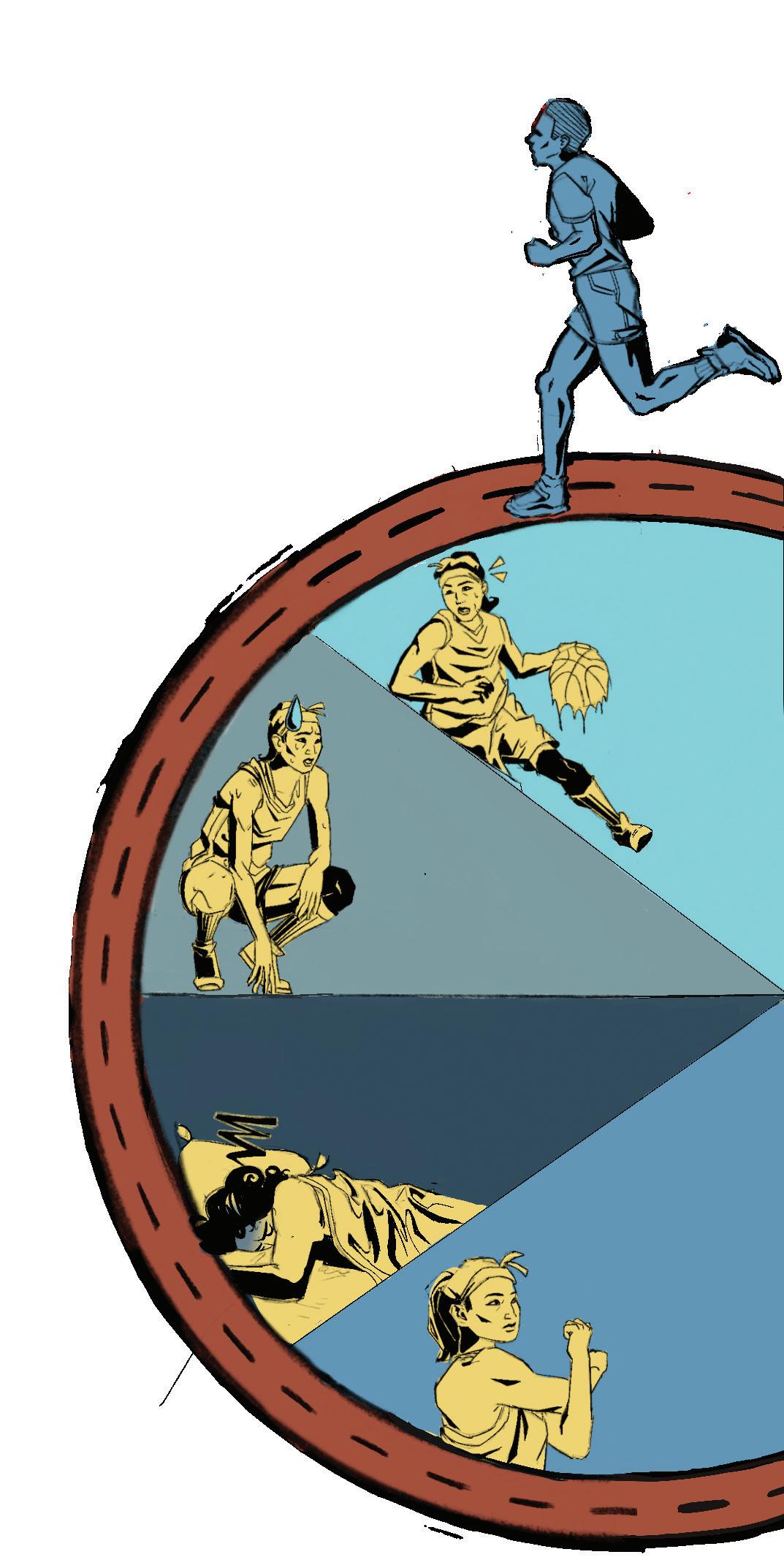
—Written by Yuji Song
7 to 14
dAys of peAk for Athletes due to low performAnce progesterone And estrogen levels
Source: National Library of Medicine
67% of femAle Athletes consider menstruAl cycle symptoms to hAve impAired their performAnce
Source: British Journal of Sports Medicine
62% of Athletes hAve missed full
Source: Science Direct trAining sessions due to their menstruAl cycle
1 to 3 performAnce
dAys on AverAge Are tAken post-period to return to peAk Athletic
Source: UMiami Health Sahana Mahadevan