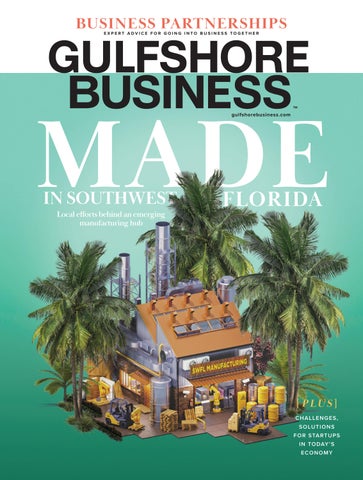
Local efforts behind an emerging manufacturing hub
![]()
Local efforts behind an emerging manufacturing hub
70 Business Spotlight
82
Horsepower
70
84
86
88
Heidi Rambo Centrella
Digital Editor Adam Regan
Associate Editor Kaitlin Regan
Senior Editors Tim Aten, David Dorsey, Nancy Semon
Assistant Editors Katiuska Carrillo, Samantha Roesler
Copy Editor Steve Gill
CONTRIBUTORS
John Guerra, Artis Henderson, Melanie Pagan, Justin Paprocki, James Raia, Sheldon Zoldan
ART
Creative Directors
Scott Glick, Jerry Pomales
Photo Editor Mary Rich
ADVERTISING Associate Publisher Chris Renstrom
MARKETING
Director of Marketing and Events Rachel Galante
Digital Media Marketing Manager Brittney Kleis
CIRCULATION
Director of Audience Development Kerri Nolan
PRODUCTION
Production Manager Martha Leavitt
ADMINISTRATION
Advertising Services Manager, Subscriptions & Distribution
Kathleen Hill
Office Address
26101 S. Tamiami Trail, Bonita Springs, FL 34134
Call or text 239.498.8500
gulfshorebusiness.com info@gulfshorebusiness.com
Subscriptions
Florida residents can subscribe for free online at gulfshorebusiness.com, out-of-state residents can subscribe for $12 a year, call or text 239.498.8500 for more information.
Change of address
Send old and new addresses and a mailing label, if possible, to Gulfshore Life, 26101 S. Tamiami Trail, Bonita Springs, FL 34134. Visit gulfshorebusiness.com/subscribe to login and update your address, call or text 239.498.8500 or email subscriptions@gulfshorebusiness.com.
Back issues
A limited number of back issues are available for $4.95 each plus tax and postage. Visit gulfshorebusiness.com/backissues.
Reprints
Visit gulfshorebusiness.com/reprints for plaques and reprints.
Contact Us
Please send all correspondence to:
Gulfshore Business 26101 S. Tamiami Trail, Bonita Springs, FL 34134 Call or text 239.498.8500
WEBSITE
gulfshorebusiness.com
As a resident of SWFL, if you were asked to think of a local industry, the odds are good your first thought would be of something related to tourism or hospitality, perhaps retail or health care … but you probably wouldn’t think of anything involving manufacturing. That sector only represents a smattering of the area’s economy: less than 5% of the workforce in Collier, Lee or Charlotte counties. But while no one’s likely to mistake our sunny, sandy stretch of paradise for the sprawling factories of the industrial northeast, the region is working to build momentum in manufacturing.
In “Building Growth in SWFL” on p. 28, Sheldon Zoldan takes inventory of several manufacturers that have put down roots in our vicinity. Skilled workers and available land for factories are both on the scarcer side in Southwest Florida, but from the watercraft of Nor-Tech Hi-Performance Boats to Arthrex’s lifesaving medical devices to the inflatable amusement park equipment
produced by Galaxy Multi Rides, more and more companies are finding fertile ground for growth. And a diverse, balanced economy with well-paying jobs is good for everyone.
Southwest Florida is well-supplied with business opportunities in general, spanning just about every possible industry, for the would-be solo entrepreneur or someone hoping to form or join a group. On the other hand, not all of those opportunities have a path to success, and partnering with someone else isn’t always the best plan. You might need to look twice at this statistic: In 2019, Forbes reported that 70%—almost three out of every
four—business partnerships fail. Power struggles, differing motivations, unequal levels of commitment or effort among partners, sometimes just plain bad luck … going into business with someone else is risky business.
While there’s no recipe for guaranteed success in business as a duo or group, there are several steps you can and definitely should take before signing yourself onto the team. In “Partnership and Its Perils” on p. 46, John Guerra sits down with three seasoned local pros—business lawyers Brian Zinn, Frank Aloia Jr. and Ray Placid— to discuss due diligence, proportionate distribution, levels of personal liability and much more, including the importance of getting significant details in writing. “Hoping for the best” is not by itself a good business model.
Whether your version of March comes in like a lion or goes out with a peacock’s tail (see Artis Henderson’s “Lions & Lambs” on p. 86), we wish you a good one.
HEIDI RAMBO CENTRELLA EDITOR IN CHIEF
This prestigious event will recognize three outstanding entrepreneurs who serve as role models for youth through their professional accomplishments and commitment to the community. All proceeds support local Junior Achievement programs that teach students the importance of work readiness, entrepreneurship and financial literacy.
Matthew KraghPresident MHK Architecture
Bill
Artis Henderson
Captains For Clean Water, Sanibel Captiva Conservation Foundation and Conservancy of Southwest Florida released the findings of a study executed by Green Economics, which quantifies the economic effects of harmful water-quality events, such as algal blooms, and degraded water quality on the Southwest Florida economy.
The results of the analysis show that during another event in Charlotte, Lee and Collier counties, similar to the harmful algal blooms experienced in 2005-06 and 2018, the study area would lose:
- More than $460 million in commercial and recreational fishing
- More than 43,000 jobs
- $5.2 billion in local economic output
- $17.8 billion in property values, with an associated $60 million in property tax revenue
- $8.1 billion in the value of outdoor recreation or quality of life
Join us as we honor local health care professionals and organizations in the April issue of Gulfshore Business. Nominated by their peers for exceptional courage, compassion, inspiration and innovation, “Health Care Heroes” showcases the doctors, nurses, first responders, administrators and more who stood out within their respective specialties in its annual recognition program.
Those driving electric vehicles on Sanibel and Captiva now have a place to charge their cars while staying on the islands. Planned since before Hurricane Ian struck in September 2022, a charging station with two plug-ins was recently installed at the Sanibel & Captiva Islands Chamber of Commerce.
National organization Chambers for Innovation & Clean Energy and Florida-based Optimus Energy Solutions provided and installed the charging station at no cost. Two parking spots are designated for EV charging, open 24 hours daily. Users can pay at the station by credit card or with the ChargePoint app. The charger is part of a program developed by CICE to help chambers and their members have access to EV chargers throughout Florida.
Naples was ranked the second happiest city for retirees, just behind Barnstable, Massachusetts, in a study of the 200 largest metropolitan statistical areas in the U.S. The study identified key elements that contribute to happiness—social networks, financials and health—and examined 13 pivotal rankings within them, such as community, cost of living and health care access. Naples has the highest life expectancy (86.1) of all 200 cities analyzed.
Southwest Florida development company London Bay bought Sandpiper Gulf Resort, a 63-unit condominium complex at 5550 Estero Blvd., for $25 million. The deal closed in December with three transactions, involving three different condominium associations.
London Bay also opened the 11-story, 58-unit Grandview at Bay Beach tower on the Estero Bay side of the beach in October, capping a $60 million construction project. The company also purchased 10 acres of land that had been the 144-room Outrigger Beach Resort, destroyed by Hurricane Ian, for $38.2 million.
With her accounting and data analytics degree, Lutgert grad Madison Diaz Granados innovates solutions at a top global auditing and accounting firm.
Ryan Benson was appointed chairman of the Florida Housing Finance Corporation board of directors. The co-owner of A. Vernon Allen Builder, a custom home builder in Naples and Sanibel, previously served as vice chairman and was originally appointed by Gov. Ron DeSantis to the board in 2019. Benson also serves as first vice president/president-elect for the Florida Home Builders Association. Florida Housing Finance
Gulfside Twelve, the first luxury residential community being built on Estero Island after Hurricane Ian, is working on the second phase of its development at 6240/6230 Estero Blvd. With its first residents set to move in this spring, construction on the entire project is scheduled to wrap up later this year. The entire project will encompass 12 units, starting at $4.1 million. Phase I consists of four units facing the Gulf of Mexico on Fort Myers Beach that already have been sold. The units are between 4,700 and 5,100 square feet and include four and five bedrooms and four-and-a-half bathrooms.
Whether you’re looking to expand your practice or buy new equipment, LMCU’s experienced, local lenders will work directly with you on your schedule. We’ll provide personalized solutions with competitive rates and flexible terms that meet your financing needs.
Call Sunil Muley at (239) 919-1361 or email Sunil.Muley@LMCU.org to see how we can help your practice grow.
LEEHotels
Motels
Bed and Breakfasts
Vacation Rentals (Condo)
Vacation Rentals (Dwelling)
Timeshare Project Groups
The rise of Airbnb is evident in Southwest Florida. More than 4,200 vacation rentals, including the likes of Airbnb and Vrbos, have been registered in Southwest Florida, according to an analysis by the Regional Economic Research Institute at Florida Gulf Coast University. This is more than four times the amount that existed in the 5-county region before the pandemic. Collier County drove a lot of that growth; the number of vacation houses increased nearly 10-fold in the county.
Growth in the vacation rental market may be showing signs of slowing in the state, as economists have pointed to oversaturation and increased regulation that could cap its growth. But, for now, it won’t be hard to book an Airbnb anytime soon.
Inspiration and Inkys Tie Dyes
By Justin PaprockiTony Incorvaia is a Deadhead. The Cleveland native grew up a fan of the Grateful Dead and, of course, wore more than a few of their signature tie-dye shirts. “I’ve been a hippie all my life,” he says.
He’s continued to live the lifestyle with his business Inkys Tie Dyes—he sells handmade tie-dye shirts, tapestries and other apparel featuring elaborate designs ranging from turtles to guitars to colorful mosaics. “The creativity aspect is what drives me,” he says.
Incorvaia moved to the Fort Myers area in 1995 and got into the restaurant industry, becoming a popular bartender at spots including the British Open Pub in Bonita Springs. He started playing around with tie-dyeing about seven years ago. He was admittedly not artistic by any means, but he found a creative spark in wrapping a T-shirt in rubber bands and soaking it with dyes to create unique designs. “I couldn’t
Tony Incorvaia, owner of Inkys Tie Dyes, sells handmade tie-dye shirts, tapestries and other apparel featuring elaborate designs.
Growing up a fan of the Grateful Dead, Tony Incorvaia has twice toured with the vendors who pop up in the parking lots and fields outside the band’s venues and regularly sells his wares at local farmers markets.
draw you a stick figure,” he says with a laugh. “But after a while, all my T-shirt designs started to come together.”
The Grateful Dead, even after the deaths of some of its original members, has lived on in various iterations and has continued to tour, bringing with it the hordes of fans who follow the band from city to city. Incorvaia has twice toured with the vendors who pop up in the parking lots and fields outside the venues to sell their wares. On his last tour, in 2019, he took his van to 23 stops across the country. “It really becomes like a family,” he says of the fellow vendors and Deadheads. “It was an amazing experience. I got to do something I wanted to do since I was a child.”
He’s built his following locally mostly through word-of-mouth and at farmers markets, such as Koreshan State Park market, which has now moved to Three Oaks Town Center. He said he finds a similar scene at the farmers markets as he did at the Dead concerts. Artisans are there to make a little money, but what’s really rewarding is the bond that forms connecting to others. “It’s not about the competition,” he says. “It’s about family and the community you build.”
Fil Adams-Mercer has enjoyed a string of business successes. A serial entrepreneur, he’s owned video stores, a parcel delivery service, a tech accessory business and— most recently—Naples-based Rivi Gin. “People think everything I touch turns to gold. But I’m no different than anybody else,” he says.
Adams-Mercer grew up in England. He came from a family of seven with modest resources: They didn’t have a car or indoor plumbing. He’s dyslexic, and he left school early. Yet, over the years, he’s built a series of businesses that have made him a multimillionaire. He attributes much of that success to luck. “If you don’t have luck on your side, you’ve got no chance,” he says. And though he sees himself as a lucky person, he acknowledges that he does have a real talent for spotting money-making opportunities. Entrepreneurism is simply part of his makeup. “I don’t think being an entrepreneur is something you want to be. You’re either it or you’re not,” he says.
Over the course of his journey, Adams-Mercer has learned some key lessons that he believes will help other entrepreneurs achieve his Midas touch.
Fil Adams-Mercer grew up in England with modest resources, but the serial entrepreneur has owned several businesses, most recently Naples-based Rivi Gin, and is now a multimillionaire.
Adams-Mercer skipped the usual route to success. He left school at 15 and eventually started working as a long-haul trucker. He made good money, which let him take chances on opening his first video shop—a few years later, he’d have four stores and sell the business to Ritz Video in the U.K., which, in turn, sold to Blockbuster. “If you go to university and take the normal route, you end up in the system,” he says. “You get married, you have kids. Then you can’t take chances. I’ve never had anything to lose by having a go at something.”
When Adams-Mercer brought on his first important administrator—a Stanford-trained C-suiter—he sat the man down and told him, “A lot of these people have been working for me for a long time. If you decide that you have to sack any of them, I want you to look them in the eye. See their kids, see their rent payments, see their overdrawn bank accounts. They’re real people, and we’re all trying to get through life the best way we can.”
Fil Adams-Mercer didn’t take the usual path to business success; he stopped school at 15 and became a longhaul trucker, which provided him with the financial resources to explore other endeavors.
There’s an exercise Adams-Mercer likes to do with the audience at his speaking seminars. He’ll lay a piece of duct tape on the ground and point to it. “You’ve got a great idea that you know could make a lot of money,” he says. “Now you just have to decide to step over the line and do it.”
The problem, he says, is that most people believe there’s a brick wall standing in their way. But the wall is usually of their own creation. “Just step over the line,” he says. “Make the decision to do it. That’s how you become an entrepreneur.”
Legacy legislation tangling modern supply chains
By Victor V. ClaarIn the early 1920s, U.S. politicians passed legislation you have likely never heard of. But whether you are a consumer, producer, motorist or retiree, the Jones Act makes your life less green, less convenient and more expensive.
The original Jones Act of 1920 made it illegal for a ship to transport goods from one U.S. port to another unless all the following requirements were satisfied:
- The vessel flies a U.S. flag;
- The vessel is U.S. built;
- The vessel is U.S. owned;
- The vessel is U.S. crewed.
Today, those restrictions have been softened so that being 75% owned and crewed by Americans is sufficient. But even so, it should be obvious that these restrictions are costly to Americans every-
where—in the short and long term. And Americans should work to repeal them.
But how did we get here?
Wesley Jones, a Republican senator from Washington state, made the argument that Americans grew too dependent on foreign shipping during World War I, and the country needed to become more self-reliant should another conflict arise.
But the legacy of the Jones Act is bad news for most Americans. Like many economic policies, the Jones Act creates unintended negative consequences for everyone.
Ever wondered why East Coast roadways are overloaded with tractor-trailer rigs?
Blame the Jones Act.
According to the Wall Street Journal, the world has more than 60,000 commercial ships in operation. Yet fewer than 100 are Jones Act compliant. This means that any shipping from one U.S. port to another—whether along the eastern seaboard or along our nation’s inland waterways—must be carried out exclusively by the remaining 90 or so ships that meet the act’s requirements.
Can a foreign oil tanker stop at multiple ports once it arrives at American shores? No. Instead, that oil must be unloaded at its first port of call, then moved onto either tanker trucks or U.S. ships, even to ship it up or down along either coast. A foreign ship cannot stop at two consecutive U.S. ports once it arrives because the Jones Act forbids it. Thus, the law raises shipping costs, worsens traffic and adds to greenhouse gas
The Jones Act, legislation passed in the early 1920s as a way to be less reliant on foreign shipping, makes life today less green, less convenient and more expensive.
emissions from all those tanker trucks. And the law applies to all foreign vessels—regardless of their cargo.
What about islands where lots of Americans depend on shipping for their survival, such as Puerto Rico or the Hawaiian islands? The Jones Act makes their lives harder, too. Because Hawaii is a U.S. port, Hawaii relies mainly on American vessels—those 90 or so vessels compliant with the Jones Act. But compliance is costly: According to 2020 estimates from the Grassroot Institute of Hawaii, the law costs a typical Hawaiian household nearly $2,000 annually.
Today, the legacy of the Jones Act—once framed as essential for national defense— is supply-chain bottlenecks and higher prices. One good way to know whether an economic policy is a hindrance or a help is to see what policymakers do when a real crisis arrives. Do they keep the policy in place, or do they suspend it because it’s really a burden we notice less when we’re not in an emergency?
We suspended the Jones Act for Hurricane Irma in 2017 and Hurricane Fiona in 2022. We also suspended it during the 2021 Colonial Pipeline emergency. It seems the law really does impair the flow of goods to where they’re needed most.
Good economic policy in a crisis is also good economic policy the rest of the time. It’s time to relax supply chains for all Americans and repeal the Jones Act.
Victor V. Claar is associate professor of economics in Florida Gulf Coast University’s Lutgert College of Business. He volunteers as a board member of the Freedom & Virtue Institute in Fort Myers, and serves the James Madison Institute as its adjunct director of the George Gibbs Center for Economic Prosperity.
LOCAL EFFORTS BEHIND THE
/ By Sheldon Zoldan
Southwest Florida will never be mistaken for the Rust Belt when it comes to manufacturing. The area and the state are far more likely to tout the beaches and sunshine, and the jobs that support the tourism and retirement industries.
Manufacturing is a small portion of the state’s economy, making up 4.5% of jobs; October employment numbers show 423,000 manufacturing jobs. Southwest Florida’s numbers are even lower than the state’s. Manufacturing makes up 2.5% of Lee County’s workforce, 3% of Collier County’s and 1.2% of Charlotte’s, according to October employment numbers.
The manufacturing done in Southwest Florida is a far cry from the large, sprawling, assembly-line factories of the industrial northeast. Most of the manufacturing companies here are small, often mom-andpop machine shops with a handful of employees.
Trond Schou and Nils Johnsen turned their love for speed and boats into a business.
They started Nor-Tech Hi-Performance Boats in Cape Coral in 1991 after building boats in their home country of Norway. Today, Nor-Tech employs about 200 workers in three factories in North Fort Myers and Cape Coral.
“We have grown with the town,” says Schou, who started his business in Cape Coral for the same reason so many others have started Southwest Florida businesses: A family member (his father) lived here.
Nor-Tech builds about 100 boats a year, Schou said, and revenues are growing about 10% to 15% annually. The company has a two-year backlog of orders.
Nor-Tech has the same problem other manufacturers have when it comes to finding labor. Schou recruits at technical schools as far away as Orlando.
“It’s very hard to find workers because they have a couple of different types of workers,” Schou says: “You have workers who retired from up North and
want to come to Florida and kind of hang out … and then the people who are younger and more entry-level, it’s tough for them to find affordable housing in the area.”
Nor-Tech pays between $15 and $30 an hour, depending on experience. The boats aren’t cheap. They cost from $500,000 to $2.5 million, he said.
Schou feels good about the company’s future. “I hope that we’re here to stay,” he says. “We’ve been through some shady times, and we made it through that. So, I think at the moment we are stronger than ever.”
Brian Tietz
But that is changing. Local governments are making more of an effort to attract manufacturing, which comes with better-paying jobs. The number of manufacturing jobs in Lee County has grown by 29% since 2018, double the growth rate of all jobs.
Manufacturing is needed because it’s one piece of the puzzle to create a diverse economy, said Ted Bill, president of Pelican Wire, based in Naples.
The reasons why the state and Southwest Florida have never been a haven for manufacturing are numerous: Geography, workforce, the lack of incentives and recruiting are cited.
“We get overrun by the South Carolinas, Georgias and Alabamas,” says Dave Gammon, executive director of the Charlotte County Economic Development Office. “They’ve always done it. They’ve recruited
better than Florida, so Florida as a manufacturing state has never really ranked high.”
Rob Harris, who leads the Southwest Regional Manufacturing Association, used to think the state’s anti-handout philosophy was the main reason why there wasn’t more local manufacturing. He pointed to Georgia, Alabama and South Carolina attracting foreign car makers. He has changed his opinion. The biggest
Florida has more than 20,000 manufacturing companies.Source: Southwest Regional Manufacturing Association
problem is a lack of a qualified workforce, he said.
Talk to many manufacturers and they agree. There’s a shortage of workers, especially skilled ones. It’s more difficult to find the right employee in Southwest Florida than it is in the Rust Belt, Pelican Wire’s Bill said.
Everyone who wants to work is working, said John Talmage, executive director of Lee County Economic Development. About 82% of the workforce between ages 25 and 55 in Lee County is working, which is above the national average, but the size of the workforce between ages 18-24 and 56 and older is below the national average.
“We have to find ways to get the younger 18- to 24-year-olds into the workforce and find ways to get 56-year-olds back into the workforce as managers or teachers,” Talmage says.
The negative perception of manufacturing also needs to change, Harris said. Many parents who moved south grew up in the Rust Belt and remember smokestacks lighting up the night sky. Harris called its atmosphere grease, grime and smokestacks.
But manufacturing overall has changed, said Keitha Daniels, economic development director for Hendry County. The buildings are air-conditioned, the work is clean, more technology is involved.
Many manufacturers in Southwest Florida have difficulty finding workers and agree there is a shortage of skilled workers, Nor-Tech included. Many recruit from technical colleges as far away as Orlando.
Build them and they will sell. That’s what tends to happen to medical device companies in Southwest Florida.
Lenkbar owner Erik Papenfuss sold his company to the French-based company Intech Medical in late 2023, and then bought back 20%. He remains CEO of the East Naples-based company.
Papenfuss and his father sold Hansa Medical, which made a heart stent holder in 2011. He used the proceeds to start Lenkbar.
Papenfuss was a child when his parents moved from Rochester, New York, to Marco Island to escape the cold winters. His father started his tool and die business that eventually morphed into Hansa Medical.
Lenkbar started to grow rapidly after Papenfuss’ noncompete agreement to do contract work with the buyer of Hansa expired in 2016.
Arthrex called not long after; now 50% of Lenkbar’s business comes from the medical instrument giant.
Lenkbar still would be
Erik Papenfuss Lenkbar CEO
in the medical business but not as big as it is if it wasn’t for Arthrex, Papenfuss says: “They’re really what started us.” He called Arthrex’s owner, Reinhold Schmieding, an inspiration.
The company’s revenue was about $26 million in 2023. It’s expected to reach $31 million this year, Papenfuss said.
Lenkbar, like most Southwest Florida manufacturers, scours the region for workers. Papenfuss
won’t hire workers from Arthrex unless they’ve been gone from the company for two years.
Programmers can make more than $100,000 a year, he said; hourly wages range from $18 to $33 an hour, depending on the job.
Headhunters find about 5% of the workers, and many engineers have been with him for decades.
“I look for passionate people,” Papenfuss says. “You can train good, smart, passionate people.”
The workforce is out there, said Lee Zaiser IV, CEO of Azimuth Technology, but you have to think differently to find them.
Many of his employees are from Southeast Asia and Japan, and 50% of them are women; an estimated 90% had never seen this type of machine before joining the company, so they need to be trained.
Finding enough space was more of an issue for Azimuth, Zaiser said.
Geography is a barrier in Southwest Florida. Land is scarcer for manufacturing and more expensive, said Chris Westley, dean of Florida Gulf Coast University’s business school.
“You have to have a really specialized good, [and] high demand for it, so the revenue will be sufficient to cover the cost of production,” he says.
Charlotte County never had facilities for manufacturing, Gammon said, so if a manufacturer wanted to build in Charlotte, they would have to be real estate developers first.
That is changing, especially around Punta Gorda airport, where developers are constructing buildings on spec. “So, now these manufacturing companies can come and not have to play the real estate game,” Gammon says. “All they have to do is lease the space they want and start doing their manufacturing.”
There would be even less manufacturing in Southwest Florida if it weren’t for the alluring palm trees, beaches and sunshine. The area
Larry and Theresa Bill weren’t sure their business would survive when they moved Pelican Wire to Naples in 1976. They were a mom-and-pop operation in the truest sense: Theresa took the orders and Larry manufactured the products.
Larry even started some side businesses because the Bills didn’t expect the business to survive.
They were wrong. The business didn’t just survive, it thrived. Pelican Wire is still going strong, making resistance and thermocouple wiring for companies such as Boeing and Caterpillar.
The company’s revenues are about $40 million annually, and growing between 5% and 10% annually, said company President Ted Bill, Larry and Theresa’s son.
The company created a holding company, the Wire Experts Group, to place Pelican Wire and its acquisitions under one umbrella. Pelican has about 65 employees in Naples and 150 in total.
Bill, 52, joined the company in 2008 after his
father died, leaving his job as an industrial engineer working for Disney in Orlando. The company became employee-owned at the same time.
“After my father passed away, we really struggled with what to do with the business and where it was going, because at the time I wasn’t planning to come back and run the company,” he says.
Being in Southwest Florida has its advantages; the sunshine is one of them. It also helps that Pelican is close to Florida’s ports to send its exports, mostly wiring for “green energy” companies.
The location also has its challenges; the big one is the workforce. “The employee pool is definitely more difficult to find,” Bill says. “You’ve got to find the right person, then you’ve got to train them and then you’ve got to try to keep them here—because it continues to get more expensive to live here.”
Pelican pays about $25 an hour for a machine operator.
What started as a mom-and-pop operation in 1976, Pelican Wire now has a total of 150 employees and an annual revenue of about $40 million, which has been growing between 5% and 10% each year.
80% of Florida’s manufacturers employ 20 or fewer workers; 94.2% of manufacturers in Southwest Florida employ fewer than 50 workers; 77.6% employ fewer than 10.
Source: Southwest Regional Manufacturing Association
Products used by consumers and industry are being manufactured in Charlotte County. Some of the companies were founded elsewhere, but for various reasons, their owners and corporate leaders chose the county for their centers of operations.
Inflatable indoor parks and rides, fencing around pools, heavy equipment and roof racks for vehicles are things you see every day, but may not realize were manufactured in and shipped from Charlotte County.
The Whincup family’s Galaxy Multi Rides got its start in the U.K., after Robin Whincup started a side business renting out a bounce house that he purchased in the 1980s. At that time, he and his wife Kate, a nurse, were running a contracting business, installing flooring for hotels, nursing homes and other large commercial projects.
“But we were always looking for a second income,” he says, explaining that the couple had five children to support. His son Mike later joined the family business and “we saw the potential as our inflatable business grew,” he says.
The family decided to concentrate on its inflatable enterprise and began to manufacture custom-made rides and inflatable games. Then large orders came in for indoor amusement parks. If you’ve ever taken a child or grandchild to a Sky Zone, Castle Fun Center or the Jumpin Fun Inflata Park in Sarasota, you have seen a Galaxy Multi Rides-made product.
The move to the U.S. began when, on a trip to an industry convention held in Dallas, Robin Whincup realized that most of his business was coming from the U.S. Having vacationed in Southwest Florida for a number of years because the family enjoyed the beach, outdoor spaces and American culture, the Whincups packed up and moved to Charlotte County in 2008. There, they found a warehouse in Port Charlotte that would accommodate their manufacturing enterprise on a large scale.
The demand for indoor inflatable amusement parks grew. “We manufactured and sold 75 of these parks over the last five years,” he says.
Although U.S. companies and individuals provide the firm’s biggest purchasers, the company’s products have been shipped to Australia, New Zealand, Hong Kong, the Falkland Islands, Guyana and Kazakhstan.
The company also makes inflatable mechanical bulls whose heads can be exchanged with other animal heads. This year an order came in for a number of mechanical reindeer. The good thing about inflatable mechanical bulls is that everything is soft, and if you’re thrown from the bull, you land on a soft, inflatable floor.
Baby Barrier manufactures pool fencing from its warehouse in Punta Gorda and ships the potentially lifesaving product nationwide.
“Most of our customers are from Florida and California,” says co-owner Michelle Walter. Her part-
ner, David Flury, said a number of customers also install pool fencing to protect their pets that can’t swim.
According to the CDC, more children ages 1-4 die from drowning than from any other cause of death, and it is the second leading cause, after motor vehicle accidents, for children ages 5-14.
Marden Industries and Supertrak, whose manufacturing firm is located near the Punta Gorda Airport, is a dealer for the Fat Truck brand, which manufactures an amphibious vehicle. Company President Tom King said Florida Fish and Wildlife Conservation Commission purchased a Fat Truck, and it crossed the Peace River during Hurricane Ian.
Marden Industries/Supertrak manufactures components to armor vehicles for the U.S. Army, whose humanitarian demining group searches for landmines and improvised explosive devices (IEDs) in war-torn countries.
The company also makes “mulchers,” heavy machinery that clears vacant lots, farmland and ranchland, and mows under power lines. It purchases Caterpillar equip- Baby Barrier; Galaxy Multi
ment and makes upgrades, including enhanced hydraulics for customized machinery, King said.
Recently, a new fiber-optic cable system was being installed in Punta Gorda, and “if you see a pickup with a compressor,” chances are you’re seeing a Marden Industries/Supertrak machine at work, he said.
Another company with a recognizable brand name manufactures customized roof racks for Range Rovers and other vehicles. Andrew Nix’s Voyager Offroad LLC specializes in the design and fabrication, which is completed at the company’s Port Charlotte warehouse.
Nix brought his company from Portland, Oregon, where he founded the company in 2001, to Port Charlotte in 2006. “We only use American alloys and we do not outsource any of our work to foreign entities,” he says.
The name “Voyager” is the company’s registered trademark. But there is a more glamorous side to what Voyager does: “We provide filming crews with the gear they need to film movies, commercials and music videos,” Nix says.
That movie equipment includes roof racks, side ladders and metal cages. He said a Voyager rack was used on the “fastest film car on earth,” holding the camera that filmed Netflix’s “Stranger Things” Season 4, Bad Boys for Life, Jumanji: The Next Level and dozens of series and movies. A Voyager rack and side ladder also was featured in the Marvel movie Ant-Man and the Wasp Voyager racks have been shipped as far as Australia, Japan and Europe, Nix said. But, more importantly, his vehicle racks “have saved lives in rollover accidents and are used taking thousands of families on road trips,” he says.
amount of commercial development happening in Charlotte County, and where future growth is headed.
He said several national companies have shown interest in an 800,000-square-foot spec building near the Punta Gorda airport. “Between last year and this year, we have more than 840,000 square feet now being built or finished,” Gammon says.
He also said that during the airport’s first 70 years, about that same amount of commercial space has been built, so the square footage has doubled in just the last two years.
Gammon said that within the next three years, some 1.5 million square feet of commercial space is expected to be filled. He credits Cheney Brothers, which in 2015 completed its 345,000-square-foot distribution center adjacent to the airport, with paving the way for other large firms to follow.
In November 2023, Economic Development Director Dave Gammon spoke to a group of Southwest Florida business professionals about the Baby Barrier manufactures pool fencing from its warehouse in Punta Gorda and ships product nationwide, with most of its customers being from Florida and California.
Nancy Semon
LeNor “Len” Zaiser III is the godfather of manufacturing in Southwest Florida. Azimuth Technology is the seventh manufacturing company he has started, this time with his son Len Zaiser IV.
Zaiser started manufacturing in Naples in 1975. The family discovered Naples the winter before, Zaiser IV said, after going as far south as they could in their motor home to get warm. “We fell in love with it,” he says.
The older Zaiser, now 86, moved his company, Engineering Research Inc., to Naples. The company made parts for the Sidewinder missiles on fighter jets. He then moved on to Defense Research Inc., Southern Research, Inovo, Structure Medical, CatapultMD and Azimuth.
“We were way before Arthrex,” Zaiser IV said
about making medical components.
Father and son started Azimuth in 2012, after selling Structure Medical; it sells precision gun parts to the Department of Defense, gun manufacturers and foreign governments, defense forces and law enforcement. Azimuth employs 240 people, Zaiser IV said. He didn’t want to reveal its annual revenues.
Zaiser IV said finding employees hasn’t been a problem if you are creative; Southwest Florida has enough hard workers. Azimuth looks for people it can train.
Only 3% of all parts on rockets launched in Florida are made in Florida.
Source: Southwest Regional Manufacturing Association
Bill Daubmann opened My Shower Door in 2003 in Naples. The company moved to Fort Myers in 2010 and into its new Alico Road building in 2019. The company employs about 185 and has grown to 10 showrooms in Florida.
boasts a who’s who of manufacturers that have started or moved their companies here because families had homes here or vacationed here.
Pelican Wire, Azimuth Technology, My Shower Door, Nor-Tech, Addman and Pravada Private Label are a few of the businesses owned by entrepreneurs departing more northerly climates.
Arthrex is the biggest and bestknown. Reinhold Schmieding moved his business from Germany to Naples in 1991 after vacationing in the area with relatives, and it has since grown into one of the biggest medical device makers in the world. Arthrex employs more than 6,000 people worldwide, 3,000 in Southwest Florida.
Medical device manufacturing has become one of the biggest industries in Southwest Florida. Tyber Medical, Merits Health Products, Structure Medical, Sutumed Surgical Sutures, Lenkbar and Emcyte call Southwest Florida home.
Arthrex’s investment in the area has created “labor agglomeration”— one business makes a large investment in the region, and it attracts talented and skilled people, FGCU’s Westley said.
“More and more people come here, and then there’s enough labor to justify further investment by other firms, and the next thing you know you have a little industry going,” he says.
Tyber Medical, based in Bethlehem, Pennsylvania, purchased Bonita Springs’ CatapultMD in 2021. The company makes orthopedic instruments and implants.
Every $1 in manufactured goods produces $3.60 in other sectors.
Source: Southwest Regional Manufacturing Association
B&I Contractors is different than most other manufacturers in Southwest Florida; it started as a construction company in 1960, installing heating, air conditioning, plumbing and electrical systems in large buildings. In the last 20 years or so, it has become its own manufacturer, making the plumbing and electrical systems it uses on jobs. It does not sell to other companies, said Gary Griffin, CEO since 1995.
Manufacturing your own systems has its advantages, he said: Instead of having workers put together the materials in the field, they can cut and weld using automated equipment and move them with overhead cranes.
“As good as many of our welders and tradespeople are who put systems together in the field, we don’t have as many as we need to get the job done,” Griffin says.
The company wouldn’t be able to do the amount of business it does if it didn’t make its systems, because it can’t find the workers it needs in the field. But doing the work
Gary Griffin B&I Contractors CEO
in-house has created a different problem: finding skilled workers who can do computer-aided design and drafting.
“It’s a little bit easier, but I wouldn’t say it’s a lot easier,” Griffin says. “But there are more people who certainly want to work in technology with computers.”
B&I, which also has offices in Tampa and Fort Lauderdale, has about 130 employees in its Fort Myers office. About 50 employees work in manufacturing. It’s an employee-owned company.
Some of the company’s projects include the FGCU Water School building, the Gulf Coast Hospital expansion and Great Wolf Lodge Resort in Naples.
Miami-Dade County’s loss is Hendry County’s gain. The rural county with fewer than 400 manufacturing jobs gained 50 when Custom Stainless moved there; owner Tony Carnero hopes to add another 30 employees.
Carnero, whose family started the business 44 years ago, needed to expand and couldn’t do it in cramped Miami. About 10 years ago, he and his family picked LaBelle as a place they wanted to retire. They fell in love with the small town, and when they started looking to expand the company, they looked to see if it was feasible in LaBelle. “Everyone was very receptive, very, very happy to bring in some manufacturing here,” he says. “It’s been a very pleasant experience.”
The move wasn’t as pleasant. Carnero sold his building in Miami and leased it back, expecting to be in it for a year until the factory could be built
in LaBelle. Three months later, COVID-19 shut down the world. A big portion of Custom Stainless’ business comes from restaurants and hotels, but the company survived thanks to being diversified enough by supplying medical laboratories.
One year turned into three. “We went $3 million over budget because of the devastation that COVID caused,” Carnero says. “But we survived it, thankfully, and now we’re here and we’re very happy.”
The bigger facility will allow the company to grow revenue, which now is between $6 million and $8 million, Carnero said. The goal is to increase it to $12 million and $15 million in two years.
Custom Stainless sells around the world. It has done projects from California to the Keys, and internationally in South Africa, Singapore and Japan.
Carnero has had little problem finding workers, and said he has a stack of resumes sitting on his desk.
“It’s a really good demographic for manufacturing,” he says. “The people are eager to work.”
Manufacturing accounts for nearly 5% of Florida’s gross state product.
Source: Southwest Regional Manufacturing AssociationCustom Stainless
Medical device manufacturing has become one of the biggest industries in the area. Arthrex, based in Naples, employs more than 6,000 people worldwide, 3,000 in Southwest Florida.
Having Arthrex as a neighbor is a good thing, said Toby Borcoman, Tyber’s chief people officer. Arthrex needs to turn to contract manufacturers, Tyber included, to provide some products.
The French company Intech purchased Lenkbar in September. The Naples-based company designs and makes surgical devices, and 50% of its business is with Arthrex, said CEO Erik Papenfuss. He calls Schmieding a mentor.
“We still would be in medical,” he says, “but we wouldn’t be as big as we are. Obviously, they helped us grow.”
Florida’s largest manufacturing segment is computer and electronic products.
Source: Southwest Regional Manufacturing Association
Manufacturing is only going to expand as the population grows. The Florida Chamber of Commerce’s goal is to make this one of the top five states for manufacturing jobs by 2030.
The jobs need to be more than basic manufacturing assembly jobs that pay $14 an hour, said the manufacturers association’s Harris. “We want high tech,” he says. “It has to go that way.”
The association held a panel discussion in November talking about automation, agreeing that manufacturers need to become more sophisticated and take advantage of advances in technology.
“If you’re not automated, at least in part, by 2030,” says Harris, “you’re going to be out of business.”
———Expert advice before going into business together
When it comes to forming business partnerships, contract and bankruptcy attorney Brian Zinn says to think of it like a marriage; and the corporate marriage needs a partnership operation agreement, similar to a prenup.
Sometimes there truly is strength in numbers and teaming up can be the key to success. But it’s common knowledge that entering into a professional partnership is one of the chanciest moves one can make in business. Differing motivations, unequal levels of effort and power tussles are among the top reasons these relationships fail.
Therefore, Forbes magazine reports, 70% of business partnerships fail. (“How to Keep your Business Partnership from Imploding,” March 13, 2019).
For those who are considering joining a business partnership, Gulfshore
obligations. In a limited partnership, personal liability is limited. Partners are only responsible for the amount invested in the limited partnership, but limited partners cannot contribute to business decisions. A limited liability company, or LLC, legally exists as a separate entity from its owners, so owners typically cannot be held personally responsible for the business debts and liabilities.
“A lot of people prefer forming an LLC,” says Aloia, who has helped clients buy and sell every type of business from day care operations, restaurant partner-
“I can tell you that the divorce rate of married people is 50%. The breakup of startup companies is 20% to 30% higher than that. It’s 70% to 80%.”
— Brian Zinn
Business asked for advice from three Southwest Florida business lawyers: contract and bankruptcy attorney Brian Zinn of Fort Myers; third-generation business lawyer Frank Aloia Jr. of Aloia Roland; and Ray Placid, a Naples-based contract attorney who now teaches commercial law and contract litigation at Florida Gulf Coast University.
The initial step is to determine how the partnership is organized and the pros and cons of that decision. Options include general, limited and limited liability partnerships. In a general partnership, the partners may be personally liable for the partnership’s debts and
ships and HVAC companies to electrical and plumbing contracting companies.
Speaking of firsts, here’s a primary piece of advice: Put everything in writing. “The best thing to do is think of it as a marriage; and just like a marriage, some people do a prenup,” Zinn says. “If you’re thinking about a corporate marriage, you always have a prenup. It’s known as a partnership operation agreement.”
Aloia, Zinn and Placid also suggest thorough due diligence before buying into a partnership. The Internet is full of free due diligence checklists—including from Dow Jones Risk & Compliance—for analyzing a potential partnership. The checklists, some of which contain hundreds of items, can include
reviewing the company’s articles of association, in effect the partnership’s constitution, studying its by-laws and amendments, as well as taking careful note of any pending and threatened litigation. Study the company’s financial reports and its list of physical assets.
“Before you join the partnership, ask the partners to provide you with all the information of what it costs to run the business, the partnership’s liabilities and the physical assets the company owns,” Aloia says. “New buyers should request documentation of
to review their finances and operations—ask to see the latest audit. One also can ask for copies of any recent IRS audits. To get a good idea of the health of the company, check the bank balance, said Placid, who has represented hundreds of clients in business transactions over the years. “If you buy into a company that never had an external review, look at the cash. The cash doesn’t lie. They can fake revenue but they can’t fake cash,” he says.
Further advice suggests that if you get pushback on examining the books and records, have a forensic
profit distributed among partners? What other exposure does the company have? If it is leasing space, for instance, how much is the lease and how long does it last? Does the company face any ongoing civil lawsuits or criminal charges, such as pollution or negligence cases?
The lawyers agree on avoiding another pitfall: The question of who is responsible for loans. Aloia cautioned would-be business partners on this point. It is not uncommon for those joining a partnership or buying a business to seek
“I can’t emphasize this enough: You have to be careful in partnerships regarding disproportionate distribution. Get a tax lawyer to guide you in your distribution.”
Ray Placid
what the partners are claiming.”
Zinn suggested thoroughly examining the business’ books and records. “If the person that has the business wants you to join them, at some point, he will have to let you see them. There’s usually a preliminary agreement where they provide a certain amount of time to do the due diligence.”
By the way, Zinn said, business owners on rare occasions will keep double records—one set is accurate, the other set of books are illegitimate, false, fictional. “I had a client who discovered a seller had three sets of books,” Placid says. That’s … pretty much always a red flag.
The best partnerships, on the other hand, hire outside auditors
accountant to help you. “They can suggest places where adverse information might be hidden, and whether the books and records are the actual books and records,” Zinn says.
Before you enter the partnership, find out whether you’ll be responsible for a portion of the debt the company already holds. And make sure the partnership agreement lays out each partner’s responsibility and compensation.
Other questions to ask: Who is responsible for licenses the company must maintain? Who orders materials and supplies? Who gets a salary? How much? How is the
financing from the owners, he said.
When the buyer pays $750,000 in cash and asks the partners to finance another $250,000 for a $1 million buy-in, for instance, Aloia suggested the seller take the time to teach the buyer the ins and outs of the business. “I tell the seller, be prepared to lose every dollar you finance if they don’t know how to run the business,” he says. “If the business crashes, you won’t get your finances back.”
Zinn similarly cautioned newcomers to a partnership that they may be used to obtain loans for the company. “Let’s say a business wants a loan and you’re joining the business,” he says. “As part of you joining the business, you may have
It is important to look at a business’ books and records before entering a business partnership. Ray Placid, a contract attorney, recalls a client who discovered a business with three sets of books—almost always a red flag.
There’s a popular neighborhood restaurant in Fort Myers where generations of families have stopped to eat and visit with owners Bonnie Grunberg and Tammie Shockey.
The Oasis Restaurant, serving breakfast and lunch, originally opened in 1989 on McGregor Boulevard. The 60seat restaurant closed when the shopping center in which it was located began renovations. The business partners built a new, 150-seat location at 2260 Dr. Martin Luther King Jr. Blvd., where it has operated since 2003.
Most independent business owners contacted by Gulfshore Business said they preferred not to have a business partner. They said experience has taught them that being a sole proprietor is the only way to go.
That is not the case for this engaging pair of business owners. The first restaurant began to fail shortly after Grunberg, Shockey and other business partners opened the location, Grunberg said. In fact, the pair bought out two other partners when the business showed signs of failing.
Grunberg and Shockey realized they had to work together to turn things around. They also knew in some ways they were unintentionally working against each other.
“We realized we better use boundaries, or we’d kill each other,” Grunberg says, laughing. “Rather than cross over those boundaries, we’d talk about our ideas—rather than introducing them without telling the other person.”
The two compromised and some-
thing clicked: Diners began to fill the Oasis dining room. Shockey, who enjoyed talking with customers, took on the kitchen responsibilities out of necessity. As she cooked and ordered supplies, Grunberg managed the front, serving customers and ringing up checks. Grunberg, however, could see that Shockey—who also has a talent for engaging the public—was unhappy in her singular role.
“When we opened the restaurant, Tammie ran the back of the house, and I ran the front of the house,” Grunberg says. “No one can flip eggs like Tammie, but I could see her frustration as the restaurant was growing.”
Shockey said she felt liberated when she found time to chat with customers, something that attracted return diners. “I liked the front of the house, but someone had to be in the back,” she says. “I missed talking to customers, and after a year and a half of being in the kitchen, I hired people to help cover the back. I could come out to the front from time to time.”
Grunberg and Shockey’s friendly rapport with customers makes Oasis a special place in Fort Myers. According to Grunberg, their original customers bring their grandchildren and even great-grandchildren to the restaurant these days.
“We were going to close our doors those 35 years ago,” Grunberg says. “Ultimately, we had that conversation where we divided our duties, respected each other’s boundaries and communicated. That got us through.”
After almost losing their business altogether, The Oasis Restaurant owners Bonnie Grunberg and Tammie Shockey realized if they divided duties, respected each other’s boundaries and communicated they would be successful.
to personally guarantee that loan as the new guy.” If you realize a few months later that the partnership wasn’t what it was cracked up to be and you want out, you could still be on the hook for that loan, he said.
One common exit strategy is to sell one’s interest in the partnership to a third party. Limited partners can sell either a part of their interest or its entirety to a new investor. “Can that partner sell that share to a member of the public, or do the other partners have the opportunity to buy them out first?” Zinn says. “An operating agreement would include the right of first refusal.”
Continuing partnerships know that people change their minds, their health fails or they want to try something else. “You want strong guarantees and remedies on the front end in case the partners did not tell you the truth,” he says. “If the person hands you a bad business, you will know within six months to a year. Skeletons come right out of the closet.”
Placid said those exiting the partnership concentrate on how much money they are going to collect on the way out, but don’t necessarily appreciate the hidden liabilities. “The exiting partner estimates the assets, agrees on a buyout price and collects, but years after he or she leaves the partnership, the IRS decides to audit the partnership—including the years the partner was involved with the company,” he says. “Three to six
“I tell the seller, be prepared to lose every dollar you finance if they don’t know how to run the business. If the business crashes, you won’t get your finances back.”
— Frank Aloia Jr.
years after leaving the partnership, one can be suddenly liable for an IRS bill of some size.”
He especially cautions partners to pay attention to the rules governing disproportionate distribution to avoid tax liabilities. The rules are complex and can have you reaching into your pocket to pay the IRS again.
“I can’t emphasize this enough: You have to be careful in partnerships regarding disproportionate distribution. Get a tax lawyer to guide you in your distribution,” Placid says.
Unforeseen lawsuits also can arise, he said. Imagine that during the time you were a partner in a multistore pizza delivery business, one of your delivery drivers critically injures another motorist in an accident: “Now you’re one of the 10 partners who owned the business at the time of the accident. It might take five or six years for the lawsuit to mature, but you were a partner at the time of the crash.”
So, if you want to spread the risk, share in the profits and enjoy a meaningful business venture, a partnership may be the way to go. But make sure the partnership agreement spells out as much as possible.
“Most people don’t run worstcase scenarios through their minds before joining a partnership,” Zinn says. “I can tell you that the divorce rate of married people is 50%. The breakup of startup companies is 20% to 30% higher than that. It’s 70% to 80%.”
In 1924, two University of Florida law graduates, Robert A. Henderson, Sr., and James A. Franklin, opened a modest law office above a Greek restaurant in downtown Fort Myers. Mr. Henderson’s leadership in the Fort Myers Chamber of Commerce and Rotary International paved the way for a century-long commitment to drive positive change and empower our community.
With over 50 attorneys in three offices strategically positioned in Fort Myers, Bonita Springs, and Naples, Henderson Franklin upholds its commitment to serve our clients’ needs in matters of business and tax planning, estate planning, family law, real estate, litigation, land use and environmental law, workers’ compensation, employment law and more.
Henderson Franklin celebrates 100 years with gratitude to Southwest Florida for your trust and our shared success.
Henderson, Franklin, Starnes & Holt, P.A. 1715 Monroe Street Fort Myers, FL 33901 henlaw.com 239.344.1100
Tristan Cavanaugh is an associate in Porter Wright’s Naples office. He focuses his practice on trust and estate disputes, guardianship proceedings and construction litigation. His trusts and estates experience includes litigating trustee-removal actions as well as disputes as to the duties and obligations of trustees. He also has experience in guardianship and incapacity proceedings. His construction litigation experience extends to construction-defect matters.
“I believe the heart of excellent legal service is a strong client partnership,” shares Tristan. “A deep understanding of my client’s desires, fears and needs is essential to delivering exceptionally tailored legal service.”
Tristan is a member of Order of the Barristers. He is a graduate of Case Western Reserve University School of Law and University of Akron.
tcavanaugh@porterwright.com
At Porter Wright, we believe in dynamic legal counsel. In this ever-changing world, we stay agile, work smart and reach further to deliver inspired outcomes.
Quarles & Brady LLP, founded in 1892, is a full-service Am Law 200 firm with approximately 550 attorneys offering an array of legal services to clients ranging from Fortune 100 companies to small entrepreneurial businesses to individuals. The firm has practices focused in bankruptcy, restructuring and creditor’s rights; business law; energy, infrastructure and environment; estate, trust and wealth preservation; health and life sciences; intellectual property; labor and employment; litigation and dispute resolution; product liability; public finance; and real estate and land use. Its 13 U.S. offices are in Chicago, Denver, Indianapolis, Madison, Milwaukee, Minneapolis, Naples, Phoenix, St. Louis, San Diego, Tampa, Tucson and Washington, D.C. Additional information can be found at quarles.com, as well as on Twitter, LinkedIn and Facebook.
With over 45 years of dedicated service in Southwest Florida, ABC Electric Service Inc. stands as a pillar of reliability. Built on Christian principles of integrity, honor, and trust, our company distinguishes itself by offering 24-hour emergency assistance, a rarity in the industry. From residential projects to large-scale commercial endeavors, ABC Electric provides a diverse array of services. It would be an honor for us to collaborate and work with you and your company. ABC Electric offers a comprehensive spectrum of services, catering to the diverse needs of all our customers. We take pride in tailoring our proposals to suit your specific projects and are committed to providing 24-hour service.
(239) 936-3355
info@abcelectricservice.com
abcelectricservice.com
commitment to integrity, innovation and craftmanship is
strength of our relationships.
on anything built the
B&I is an employee-owned HVAC, Plumbing and Electrical Contractor with HVAC Service for commercial and institutional buildings. 2023 revenues exceeded $192 Million delivered by our 850+ skilled team members working from offices in Fort Myers (HQ), Tampa, Sarasota, and Fort Lauderdale.
B & I increased revenues by 500% in the past ten years, and this growth would not have been possible if not for our investment in Automated Manufacturing and Building Information Modeling technologies. These technologies enhance project quality standards and worker productivity while allowing us to overcome skilled workforce shortages in the construction industry.
Southwest: (239) 332-4646 • Southeast: (954) 726-2744
West Central: (941) 727-3437 bandiflorida.com
Lee County, Florida hosts an advanced manufacturing sector that plays a pivotal role in the region’s economic landscape. Nestled along the Gulf Coast, Lee County has become a migration hub for manufacturing companies, which is contributing to the area’s job growth.
Advanced manufacturing in Lee County is characterized by its diversity in services, from aerospace to 3D printing and textiles. This industry and its growth has been successful with the help of local education partners like Florida Gulf Coast University, Florida SouthWestern State College and the Lee County School Board. We especially want to recognize the Southwest Regional Manufacturers Association of Florida for the assistance they provide to manufacturers in Lee County.
These collaborations are paving the way to Lee County’s success in advanced manufacturing. We salute our manufacturing sector and all the businesses and employees that are part of it.
Florida’s manufacturing employment count is now #10 in the country!1 SWFL has 1,245 Manufacturers employing nearly 15,000 people.2 The largest subsectors in SWFL are Architectural & Structural Metals and Medical Equipment & Supplies.1 State Mfg average wages are 17% higher than the all-industry average.1 Each manufacturing job produces another 6.75 indirect jobs.1
Rob Harris, SRMA Executive Director
The SRMA provides manufacturers with the tools they need to increase productivity & growth through peer-to-peer connections & knowledge sharing, matching needs with resource experts, building talent pipelines by connecting them with educators & students, & providing a collective & unified voice through advocacy.
To join or learn more, visit www.srma.net
Look no further – Priority Marketing not only provides unparalleled professional services, we are the solution to all your marketing, advertising, and public relations needs. We are here to be your strategic and creative force, ensuring exceptional results that leave a lasting impact.
Our Commitment
Our tagline – Will Work for Solutions – is more than words. It’s a promise to delve deep into your challenges and provide comprehensive solutions that propel your brand forward.
"We Are Your Solution" is not just a headline; it's an invitation to embark on a journey of extraordinary success.
We don't just work for you; we work with you. Together, we navigate the complexities of the market to develop strategies that guarantee success.
Our team of experts thrives on creativity. We infuse innovation into every campaign, ensuring your brand not only stands out, but shines brightly.
Your business is unique, and so are our solutions. We customize our services to align perfectly with your goals and vision.
It's not about the process; it's about the outcome. Priority Marketing is your partner in achieving tangible, measurable results.
We start with a foundation of collaboration with our client partners, coming alongside to understand their goals and how we can achieve strategic business objectives.
Whatever the market challenge, we take a consultative and integrated approach to marketing, advertising, communications, public relations, and digital. Research shows that integrated campaigns are 31% more effective at building brands, and our proven methods result in efficiency, quality, and a return on investment.
The Partnership is one of the oldest, independent, and womenowned agencies in the Southeast. Our name is our approach.
“The Partnership has driven business outcomes in our healthcare system and brings fresh thinking about what’s next for our brand.”
—Paul Hiltz, CEO, NCH
Since 2007, Wilson Creative Group has been at the forefront of crafting award-winning advertising, marketing and public relations campaigns. Our expertise drives success for Southwest Florida’s premier businesses through sound consultation, intelligent ideas and innovative design across a comprehensive range of marketing disciplines. Committed to strategic planning, thoughtfulness and meticulous attention to detail, we inspire clients to challenge the status quo. Our enduring mission is to foster growth, overcome obstacles and exceed goals for our clients—to create lasting brand impressions with their customers.
Trust us to elevate your marketing and propel it toward success you haven’t yet imagined.
Subscribe to our e-newsletter, Gaining the Upper Brand
239-597-9480
Are your messages breaking through?
Valerie’s House is a special place where children and families come to work through the loss of a loved one. We offer peer support groups, individual & family grief counseling, school groups, special activities, and mentorship for children, teens, and their grown-ups who are grieving the death of a loved one.
scan to learn more
Our vision is that no child will grieve alone.
Saturday, March 23, 2024
Centennial Park Downtown Fort Myers
Spencer Graham and Thor Parrish could be called the yin and yang of Southwest Florida golf. Graham, 51, is a heart attack and cancer survivor who’s a communicator and teacher extraordinaire. Parrish, 27, has a physique that fits the name of a Norse god. He’s the organized one who has the business acumen of a Wall Street banker.
They are two pieces of a puzzle that fit together perfectly. They are 50-50 partners in the Junior Golf Performance Academy at Quail Creek Country Club in Naples, the largest junior golf academy in Florida.
The academy has been a shot in the arm for Quail Creek to attract new, younger members and a magnet for local kids hoping to learn golf. It has grown so much an expansion is in the works, with the goal being to open another academy in Fort Myers this year.
Graham is a born teacher. “His super power is connecting, not only with the player but the family,” Parrish says.
Graham grew up playing competitive junior golf, learning from some of the best teachers. And teaching the game is what got him excited. “I found myself at 13, 14 years old always wanting to help my friends learn how to play golf,” he says. “I always was wanting to help them get better.”
He left college after one year to become an assistant pro, became a teaching pro at 21 and soon after started the Junior Golf Performance Academy in Delaware. He moved the school to Orlando where he could teach outside 365 days a year, and then to Tiburón in Naples.
He moved from Tiburón to Quail Creek around 2015. The move was a win-win. “This place gave me a chance,” he says. He gave it a younger demographic, parents of the children who attended his golf school.
Graham brought 47 of his students and their families from Tiburón to Quail Creek. He said when he started at Quail Creek only about 6% of his
students were members’ children. Now it’s about 50%, and one reason is because younger families are joining the club for golf.
“We get interest from their clients,” says Kristin Downey, director of membership for Quail Creek. “We definitely both reap the benefits.”
The club’s website touts that its average age, now 60, keeps declining. The
average age of family members with children is 47, according to the website.
The academy has brought Quail Creek 52 members and $2 million in additional revenue in the past three years, Parrish said.
“We’ve totally shifted their culture in the sense that we’ve had families who bought homes, who bought golf memberships, who have food and beverage there every single week,” he says.
The club and the academy signed a 10-year contract extension last year, Graham said.
Parrish started with the academy as an intern from Florida Gulf Coast University’s golf management program. He was special from the start, Graham said. “He was so mature for his age, so organized, very professional—and that’s not what I’m used to, because in today’s world it is really hard to find good, hardworking, strong people like that,” he says.
Parrish wears the description well. He spends mornings at Thunder Performance, the gym he and his wife own
Junior Golf Performance Academy’s after-school program has grown to approximately 160 students. Partners Spencer Graham and Thor Parrish are looking to open a second academy, likely in Lee County.
on Alico Road in south Lee County. He spends afternoons at the academy.
Parrish is a scratch golfer left-handed, but to become a better instructor he learned to play right-handed.
Two years ago, Graham offered to make Parrish a 50-50 partner.
“He was the perfect person to have by my side in terms of keeping things organized,” says Graham, who is the chief executive officer, with Parrish the chief operating officer. “He knows exactly what his strength is, and I know exactly what my strength is: talking to people, interacting with families and building really good golfers.”
From a business standpoint the academy was a mess, Parrish said. “He’s an artist, he’s not a businessman,” Parrish says of Graham. Parrish streamlined the process. He helped grow the number of students in the after-school program to about 160. Parents pay anywhere from $200 to $1,000 a month depending on the number of lessons. On average, 10 full-time coaches run the 15 classes a week, Graham said.
The academy has a 6-year-old and under program, an advance program
for 20 golfers who go through interviews and competition to be selected and summer camps with 500-600 kids.
The golf academy extends far beyond Naples, too. Graham has 16 golfers—students from around the world—in the Masters program. Parents pay $24,000 annually, $30,000 if they want Parrish’s fitness program. Graham will see them in Naples six times a year. He also goes to tournaments they play in. He said $4,000 of the $24,000 is for travel.
He has 12 kids in the Futures program. Most of the golfers are local and aren’t ready for the Masters program, Graham said. It costs $6,500 annually.
The money is well spent. Graham has had 140 students receive college scholarships, he said.
Graham doesn’t want to stray too far from home for his second academy. He said he’s had offers to open academies across the state and around the country. But he’s only looking north to Lee County.
“The goal,” Parrish says, “is to take the same blueprint we built and apply it somewhere else.”
As COVID-19 continued to spread beyond 2020, so did the entrepreneurial spirit. According to the U.S. Census Bureau, Florida led the country in new business formations between January 2021 and January 2022, accounting for nearly 12% of them.
“People had time to think about the aspect of starting their own business,” says William “Bill” Robertson, chair of SCORE Southwest Florida, a nonprofit organization fostering small business success through mentoring and education. “They had time to do the due diligence and realize if it was something they could move forward with.”
Some new ventures only moved forward so far. In Florida, the threeyear survival rate for companies that started in 2020 and 2021 was the fourth worst in the country, according to a study by Capital on Tap.
The lingering effects of the pandemic and Hurricane Ian could be considered culprits, but area business experts see a bright future for startups today. “People find a way to succeed here in Florida. The rate of survival is increasing right now,” says Luis Vargas, business consultant at the Florida Small Business Development Center at Flor-
ida Gulf Coast University. “People are willing to take more risks.”
The better acquainted entrepreneurs are with today’s business challenges, the more chance they have to succeed.
“Money is always an issue, always,” Vargas says. New businesses may be competing with established businesses still managing the effects of the hurricane.
“The money that is available has been pretty well drawn off on reconstruction. It’s not that new money isn’t there but, basically, [banks] want to see a two-year history and financials because they don’t know you,” Robertson says.
Financial institutions are also responding to economic fluctuations. “They’re looking in two different directions: inflation and recession,” Robertson says. “It’s not an easy deci-
Florida led the country in new business formations between January 2021 and January 2022, according to the U.S. Census Bureau.
■ What is the cost of the operation space? Is it a rental or a house?
■ What does inventory look like?
■ How much inventory will be carried regularly?
■ Are employees needed?
■ Who is doing the books?
■ What other costs are factored in? (Examples: quarterly Florida sales and business tax)
“You need to know what you’re talking about” when seeking funding, Robertson says. “Pare it down to bullet points as the elevator pitch—what’s really important, what they’re going to glean from this that really helps them answer the question of, ‘Does this make sense?’”
William Robertson SCORE Southwest Florida chair
sion for them, so they’re a little more cautious right now.”
He suggests considering credit unions. “If it’s a community bank you’ve done business with, you might find a more friendly approach in regard to answering your questions and feasibility of what you’re about to do,” he says.
But entrepreneurs need to come prepared if asking for money. “Most banks—for whatever dollar amount you may be looking for—look for you to have not less than 20% of the money,” Robertson says. “They want a fairly decent credit rating, to know you’re in good standing as far as the IRS is concerned and [have] paid all your back taxes.”
And they’ll want to know precisely how the borrower intends to use the money. That’s where a thorough business plan comes in.
“To start a business, you need to have a dream,” Vargas says, “and [entrepreneurs] have to have a business plan because that’s part of the dream.”
A thorough business plan explains the venture and how it will operate
and grow. “If you have a plan, you know where you’re going. If you know what the details are and if you know what the costs are, it doesn’t matter what you build on top of it, but that’s where it all starts,” Robertson says.
Korrie O’Donnell, electrician and owner of Sound Electric in St. James City, used SCORE’s help to craft a business plan and opened her business in May 2022 with no outside funding.
“The biggest hurdle for me was getting licensed here in the state of Florida,” she says, adding that information was hard to come by. “If you need something, the biggest piece of advice I could say [to entrepreneurs] is don’t forget to reach out to all kinds of different avenues. First, try to come up with the answers on your own, but if you’re hung up on something, don’t be embarrassed to ask the question.”
O’Donnell suggests ways to find answers are plentiful, and they include mentorships and networking opportunities. “I feel like there’s so much growth here in Southwest Florida. If you have a dream, this is the place to watch it be executed.”
BD RC Punta Gorda LP purchased a 2,000-squarefoot retail building at 26480 Jones Loop Road in Punta Gorda from LaxmiBhavan Inc. for $1,953,000. Fred Kermani, CCIM, AIA, of CRE Consultants represented the seller, and Ronnie Carlon of Brightwork Real Estate represented the buyer.
GSA Holdings PG LLC purchased 5 acres in the Enterprise Charlotte Airport Park, 84288436 Holmes Blvd., in Punta Gorda from GMD Enterprises Inc. for $1.25 million. Adam Bornhorst, Derek Bornhorst, SIOR, CCIM, Bob Johnston, SIOR, and Jerry Messonnier, SIOR, of Lee & Associates NaplesFort Myers represented the seller, and Beatriz Cervantes of Coldwell Banker Sunstar Realty The Nix Team represented the buyer.
Gary Van Cleef purchased a 39,529-square-foot industrial building on 1.73 acres at 2884 Horseshoe
Drive S. in Naples from Air Technology Holding LLC for $8.6 million. Bill Young and Biagio Bernardo of Lee & Associates Naples-Fort Myers represented the buyer and seller.
Naples Lumber purchased a 14,009-squarefoot, single-tenant building on 1.86 acres at 68 Industrial Blvd. in Naples from AB Sunsport II LLC for $5.5 million.
Adam Bornhorst represented the buyer, and Derek Bornhorst, SIOR, CCIM, Bob Johnston, SIOR, and Jerry Messonnier, SIOR, represented the seller. All advisers are with Lee & Associates NaplesFort Myers.
Boat House of Cape Coral LLC purchased 3.5 acres of vacant land at the northeast corner of Radio Road and Davis Boulevard in East Naples from JJF Stonington LLC for $3.5 million. David J. Stevens of Investment Properties Corp. and Eric Edwards and Mike Concilla of LQ Commercial represented the buyer and seller.
Lynx at Preserve LLC purchased the 33,840-square-foot multifamily complex at 11900-971 Palm Bay Court in Bonita Springs from Bonita LLC for $5.25 million. Michael Price, ALC, of LQ Commercial represented the buyer and seller.
Roy Dobrasinovic purchased a 20,000-squarefoot mixed-use building on 2.71 acres at 11515 and 11535 Bonita Beach Road SW in Bonita Springs from LOL Holdings LLC for $4.5 million. Dave Wallace, CCIM, SIOR, and David Wallace of CRE Consultants represented the seller, and Blaze
Zdravev of John R. Woods Properties represented the buyer.
Ozturk Family Inc. purchased a 7,200-squarefoot retail space at 19517 Highland Oaks Drive, Suite 4, in Estero from SREG University Highlands LLC for $4.2 million. David J. Stevens, CCIM, and Rob Carroll, CCIM, MAI, of Investment Properties Corp. represented the seller, and Gordon Henke of Premier Property Management represented the buyer.
Wish Development
Florida Holdings LLC
purchased a fully leased 23,931-squarefoot office building at 2659 Professional Circle in North Naples from Northbrooke Professional Village LLC for $9.35 million. Dave Wallace, CCIM, SIOR, and David Wallace of CRE Consultants represented the buyer, and Trinity Commercial Group represented the seller.
City of Cape Coral purchased a 34,843-squarefoot building at 2107/2119 Santa Barbara Blvd. in Cape Coral from International Capital Investment Company III LLC for $3.8 million. Michael J. Frye, CCIM, and Abby Kesslak, ACP, with RE/MAX Realty Group Frye Commercial Group represented the seller, and Cape Coral Real Estate Division represented the buyer.
9696 Bonita LP
purchased a 13,800-squarefoot office/medical office building at 1425 Viscaya Parkway in Cape Coral
from Brightlite Homes
1 LLC for $2.25 million. Matt Stepan, CCIM, and WT Pearson of Premier Commercial Inc. represented the buyer.
Caribbean Water LLC
purchased a 4,800-squarefoot building at 5611 Eighth St. W. in Lehigh Acres from Acer Investments LLC for $1.26 million. Gary Tasman and Gretchen Smith of Cushman & Wakefield Commercial Property Southwest Florida represented the seller.
Lightpost Florida LLC
purchased a 42,570-square-foot professional office at 1685 and 1726 Medical Lane in Fort Myers from Compass Rose Foundation Inc. for $5.9 million. Justin Thibaut, CCIM, and Alec Burke of LSI Companies Inc. represented the seller, and Jeff Barnes of Colliers International Inc. represented the buyer.
Red Wing Shoes extended its 1,400-squarefoot retail lease in the Shoppes at Port Charlotte, 1100 El Jobean Road, Unit 124, in Port Charlotte from Calprop LLC. Mike Concilla and Laura Cari, CCIM, of LQ Commercial represented the lessor and lessee.
Pinnacle Health Specialists LLC leased
7,203 square feet of medical office space at 800 Goodlette-Frank Road N., Suite 310, in Naples from Healthcare Realty Services LLC. Gary Tasman and Vanessa Tyler of Cushman & Wakefield Commercial Property Southwest Florida represented the lessee.
Allegiance Health leased 1,562 square feet of office space in Southbrooke Medical, 6750 Immokalee Road, Unit 203, in North Naples from 6750 Immokalee Medical LLC.
Mike Concilla of LQ Commercial represented the lessor.
Naples Engineering and Design leased an 865-square-foot office space at 800 Harbour Drive, Unit 210, in Naples from 800 Harbour LLC. Ed Larsen of LQ Commercial represented the lessee.
Ferguson Health LLC leased 800 square feet of office space at 840 111th Ave. N., Suite 7, in North Naples from Lamvest888 LLC. Tara L. Stokes of Investment Properties Corp. represented the lessor, and Hamish Williams of AJS Realty represented the lessee.
Shark Bite Fitness & Nutrition leased 3,667 square feet of warehouse space at 1338 Del Prado Blvd. S. in Cape Coral from Mithril Investments
LP. Gary Tasman and Gretchen Smith of Cushman & Wakefield Commercial Property Southwest Florida represented the lessor and lessee.
Title Group of Fort Myers Ltd. leased a 2,500-square-foot office at 7910 Summerlin Lakes Drive in Fort Myers from Cypress Lake Commons LLC. Michael J. Frye, CCIM, with RE/ MAX Realty Group Frye Commercial Group represented the lessor and lessee.
Amscot Corp. leased 2,171 square feet of retail space in Colonial Corners, 8291 Dani Drive, in Fort Myers from Central Line Properties LLC. Bob Pekol of LQ Commercial represented the lessee.
Michelinas Salon leased a 1,758-square-foot office space at 8951 Daniels Parkway in Fort Myers from EBC 8951 Daniels LLC. Rokki Rogan, CDPE, of LQ Commercial represented the lessor and lessee.
Southern Chute Inc. leased a 1,500-squarefoot industrial space at 1681 Benchmark Ave., Unit 105, in Fort Myers from Gresham Oceanic LP. Pam WittenauerBratton, CCIM, SFR, with RE/MAX Realty Group represented the lessor, and Stuart Tackett with KW Commercial represented the lessee.
West East Lifestyles Inc.
leased 4,680 square feet of retail space at 350 Fifth Ave. S. in Naples from Reinco Inc. Dougall McCorkle and Darren McCorkle of Premier Commercial represented the lessee, and Peter Carroll of ADG4 represented the lessor.
Magic Surfaces Inc. leased a 1,461-squarefoot office space at 2621 S. Tamiami Trail, Suite 14, in Bonita Springs from Heart Partners LLC. Matt Stepan, CCIM, and WT Pearson of Premier Commercial Inc. represented the lessor and lessee.
OK UK Fish and Chips
extended its 1,200-squarefoot retail lease in Plymouth Plaza, 15200 S. Tamiami Trail, in Fort Myers from Susence FL Holdings LLC. Bruce Micciche, CCIM, of LQ Commercial represented the lessor and lessee.
Sushi Sake
leased 2,400 square feet of retail space at 12901 McGregor Blvd. in Fort Myers from Bridge Plaza Fort Myers. Adam Palmer, CCIM, SIOR, and Steve Wood, both of LQ Commercial, represented the lessor.
Above all else, the Cybertruck stands out
By James RaiaElon Musk, founder of Tesla, doesn’t do subtle. He makes spaceships that explode and underground vehicle transportation tunnels to nowhere. For the past 16 years, his company also has manufactured the first electric cars to successfully infiltrate the internal combustion engine automotive industry.
After several marketing promises gone awry, Musk also has introduced the Cybertruck, the massive utilitarian pickup he unveiled as a concept four years ago. It’s a futuristic contraption of extremes in design, construction and relevance. It’s the first stainless steel vehicle since the DeLorean featured in the 1985 movie Back to the Future
Tesla enthusiasts have praised the Cybertruck as revolutionary. Detractors claim it’s reminiscent of poorly made metal origami wedges. With public sightings infrequent and head-turning, a first-time observer could define the beast as a mass of jagged, brushed metal on behemoth wheels. It has the appearance of an unfinished high school shop class project.
Coinciding with the vehicle’s debut in minuscule numbers, Tesla unveiled the specs, release dates and pricing for the Cybertruck’s pending three trim levels.
The single-motor, rearwheel edition will be priced starting at $60,900. The top
speed is 112 mph and the towing capacity is 7,500 pounds. It’s estimated to accelerate from 0 to 60 mph in 6.5 seconds, though its horsepower wasn’t announced. Its range is touted at 250 miles per full charge, and its debut won’t be until 2025.
Scheduled for release in 2024 is the mid-range, dual-motor, heavier and faster Cybertruck. It will boast 600 horsepower, a 4.1-second standard acceleration effort, a 340-mile range, an 11,000-pound towing capacity and a $79,999 price.
The top-line, three-motor offering will feature 845 horsepower, a 0-60 mph effort in 2.6 seconds and a top speed of 130 mph. The range is 320 miles, but the capacity can be extended to 440 miles with an optional extra battery pack. Its starting price was announced at $99,990.
The Cybertruck’s battery is capable of 11.5 kW of bi-directional power. The truck can be used as a home gener-
Acceleration:
0-60 mph, 2.6-6.5 seconds
Airbags: 6
Horsepower: 500-845
Manufacturer’s Suggested Retail
Price: $60,990-$99,990
Price as tested: (Unavailable)
Manufacturer’s website: tesla.com
Range: 250-440 miles
Towing capacity: 11,000 pounds
Warranty:
Basic Vehicle, 4 years/50,000 miles; Battery & Drive Unit, 8 years/150,000 miles
ator and the integrated 120volt and 240-volt outlets can be used while traveling. The vehicle’s V3 Supercharger is capable of 250 kW, resulting in 128 to 136 miles of range added in 15 minutes.
Storage is plentiful. Sixty-seven cubic feet of space is available under the bed floor.
The bed also has a 2,500pound payload capacity in its 4-foot-wide by 6-footlong area. The tonneau cover opens and closes like a rolltop desk.
The interior is a minimalist playground, highlighted by an 18.5-inch front touchscreen, a 9.4inch rear touchscreen and a yoke-style steering wheel. There’s comfortable seating for five.
Musk has said Tesla has more than 1 million $100 deposits for the Cybertruck. The number seems extraordinary until noting the company’s rapidly rising sales. Tesla sold 354,822 vehicles in the United States in 2022, a 53% increase from 2021. The Tesla Model Y was the country’s ninth-best-selling car in 2022, and the Model 3 placed 15th.
Still, the current Tesla
lineup includes sedans and a sporty utility vehicle. All appear within the norms of car design. The Cybertruck does not. The manufacturer reports the vehicle is 223.7 inches (about 18 1/2 feet) long and 86.6 inches (about 7 feet, 3 inches) wide with side mirrors folded, and 95 inches (7 feet, 11 inches) with the mirrors extended. It’s 70.5 inches (5 feet, 10 inches) tall. The wheels
and tires combine for 34.6 inches in height and 11.2 inches of width. Ground clearance is 17.4 inches in extract (off-road) mode.
Like the monstrous Hummer, it’s hard to determine what consumer buying segment will purchase the Cybertruck. It’s an attention-grabber, a chariot of bravado. It’s big, bold and boastful. It’s what Elon Musk does best.
Approaching 100 years ago, it was standard practice for physicians in the United States to visit patients’ homes. Fifty years ago, about 1% of doctors made house calls. It still occurs, and there’s been a resurgence of interest. But telemedicine practices have experienced a far greater growth.
An aging population explains much of the current trend. Twenty years ago, 36 million Americans—about 12% of the population—were at least age 65. By the end of 2022, the segment increased to 17.3%.
Generally speaking, older individuals needing medical care are less likely to leave their residences for routine medical visits. The lingering effects of COVID-19 further changed physician-patient interaction.
Lee Health offers telehealth and e-visits with physicians and other medical experts via Zoom, conference calls and other online options.
The health provider explains: “Telemedicine helps people who can’t get a quick appointment to see their primary care doctor or don’t want to wait in a packed emergency room for something that’s not quite an emergency. Dialing up a doctor on a digital platform works when you have a cold or the flu, too, because let’s face it: When you are sick, the last thing you feel like doing is getting in the car and driving across town.”
For patients who can’t get a quick appointment with a doctor, or don’t want to wait in a packed emergency room, telemedicine could be the answer. Lee Health offers e-visits with physicians and other medical experts via Zoom, conference calls and other online options.
FLORIDA BLUE
800.477.3736
floridabluefoundation@floridablue.com floridablue.com
LEE HEALTH
239.343.6950
foundation@leehealth.org leehealth.org
MILLENNIUM PHYSICIAN GROUP
844.225.5674
millenniumphysician.com/contact-us millenniumhealth.com
PREMIER WOMEN’S CARE OF SOUTHWEST FLORIDA
239.432.5858 pwcswfl.com
According to its program details, the medical center service called Lee TeleHealth Video Visit provides 24/7 access to a doctor from your home. It suggests patients use the option for reasons that include transportation issues, a minor injury that doesn’t require urgent care or the unavailability of a primary care physician.
“The service not only lowers health care costs, but also studies have shown it improves health outcomes,” says Venkat Prasad, M.D., chief medical officer of Lee Physician Group. “Patients can use the TeleHealth program to avoid interrupting their workday to visit their doctor’s office. The program saves time and money, and the program extends the reach of our health care team by providing the right care, at the right place, at the right time.”
A Southern California-based national television platform proving “engagement, education and care,” Independa reported in 2022 that more than 90% of Americans used telehealth during the year. Many patients’ vision, dentistry and internal medicine issues were resolved without office visits.
The Independa Health Hub, available on LG Smart TVs (made in 2021 or newer) helps family members and organizations provide better care remotely, assisting older adults to be more independent.
“We are thrilled to be on the forefront of telehealth adoption
with Independa,” says Kian Saneii, founder and CEO of Independa. “Our research shows that for the 97% of Americans who own a smart TV, there is a preference for using familiar technology like the television to provide more ease, comfort and accessibility to valuable health resources.”
The Independa system partners include CapitalRx, CoroHealth, Ventura, Senior Savvy, SurvivorNet and WebMD.
Millennium Physician Group provides medical care in three states, including many locations throughout Florida. It also has a comprehensive telehealth component. During the pandemic, a company spokeswoman noted more than half of patients’ visits with physicians were conducted through telehealth. It now provides care to about one-third of the group’s patients.
While telehealth is increasingly prominent, medical practitioners and patients note it’s not as useful in certain circumstances as in-person medical care. A more thorough examination is integral to proper diagnosis and prescribed treatments.
The Florida Department of Health offers insight into telehealth practices, including state licensing and information for consumers considering using telehealth services. Topics range from prescribing medications to patient records. Visit flhealthsource.gov/telehealth.
The old proverb goes that March “comes in like a lion and goes out like a lamb.” (Or, in some years, vice versa.) The saying is attributed to the variable spring weather that characterizes March in other parts of the world, though in our slice of paradise March is generally our fairest month, full of blue skies and dry, 80-degree days. We’ve rounded up a collection of our favorite lions and lambs for those easy-going, off-the-clock hours.
The Scots put their own twist on the phrase. They’ve foregone lions and lambs in favor of venomous snakes and pageantry fowl. Now say this in a fine Scottish brogue: “March comes in with adders’ heads and goes out with peacocks’ tails.”
Toast this variable season with a bottle from Scotland’s Blackadder, famous bottler of single malt Scotch whiskies. Though Blackadder was named for a seventeenth-century bishop and not Scotland’s only venomous snake, it still makes for fantastic sipping in this season of adders and peacocks. We love the 1988 vintage Blackadder Raw Cask Statement Invergordon Single Grain Scotch Whisky. Blackadder’s “raw cask” series offers whiskies bottled directly from the cask, with no mechanical filtration.
Lamb in His Bosom, first published in 1933 and winner of the 1934 Pulitzer Prize, is often overshadowed by its contemporary, Gone with the Wind. Yet Lamb in His Bosom offers a masterful narrative on the pre-Civil War South. Author Caroline Miller spent her days visiting rural outposts in Georgia to interview farmers about local history, often dragging her two children along with her. The story offers a compelling read in the vein of other great female writers from the South, such as Eudora Welty and Marjory Stoneman Douglas.
Lion’s mane has become one of the hottest ingredients in the forward-looking health circuit. The white, shaggy mushroom has been deployed in Eastern medicine for centuries, and now Western practitioners are embracing the fungus for its anti-anxiety, anti-depression and pro-gut-health benefits. Lion’s mane is available fresh, as well as in capsules, tinctures, teas and powders. Russell Hollander of Naples-based Care2Grow mushroom farm sells his locally grown lion’s mane at the Third Street South Farmers Market in downtown Naples every Saturday. “It’s an incredible edible,” he says. “Unique in appearance and really powerful for our brains and digestion.” His products—including powdered lion’s mane and a lion’s mane tincture that he crafts himself—are also available on the company website, care2grow.com. Hollander even has a no-crab crab cake recipe made with fresh lion’s mane. “It’s pretty crabby,” he says.
Miami Beach’s exquisite farm-to-table dining destination, Essensia, offers an ever-changing menu of seasonal selections focused on organic produce, all-natural meats, wild seafood and sustainably farmed wines. The braised lamb shank is delectable. Don’t miss the chef’s three-course seasonal tasting menu or the extensive list of craft cocktails handmade in the restaurant’s spectacularly luxe bar. Try the blend of mezcal, beet juice, fresh lemon juice and ginger beer for an alcoholic libation that tastes like a health tonic.
Fort Myers’ place in baseball history
By Justin PaprockiOn March 12, 1925, the Philadelphia Phillies beat the Philadelphia Athletics 6-3 in what was called the “Philadelphia City Championship”—even though the game took place at Terry Park Ballfield in Fort Myers. It was the start of what’s become a tradition of spring training baseball in Lee County.
Terry Park, named after the family who donated land to the county, had previously hosted minor league games and the county fair. But in 1923, plans got underway to lure the Philadelphia A’s away from their spring training site in Alabama. A’s owner and manager Connie Mack provided the specs himself for an ideal facility, including a grandstand that could seat 1,500 people. In addition, the local Kiwanis Club gave the A’s $6,000 once they committed to the move.
About two weeks after that first game, Babe Ruth arrived in Fort Myers on loan from the Yankees to play
for the A’s against a minor league team. Almost 5,000 fans crowded the facilities to see the Great Bambino ground out twice and walk.
The Athletics moved on in 1936, but the Cleveland Indians, Pittsburgh Pirates and Kansas City Royals all spent springs in Terry Park. Legendary players including Roberto Clemente, Bob Feller and George Brett all played there. Thomas Edison was once said to have taken batting practice with the A’s and hit a ball so hard it knocked over Hall of Famer Ty Cobb.
The Royals moved their operations to Haines City in 1988, ending Terry Field’s reign as a spring training hub. But in 1991, the Minnesota Twins started playing in Hammond Stadium, and City of Palms Park hosted the Boston Red Sox starting in 1993 before the team moved into JetBlue Park at Fenway South. Spring training still thrives in Fort Myers.