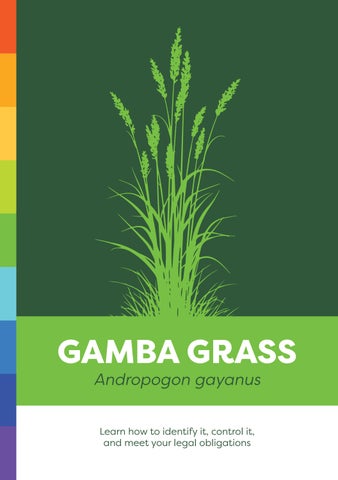
GAMBA GRASS Andropogon gayanus Learn how to identify it, control it, and meet your legal obligations
What is Gamba Grass? Where it Grows? How it Spreads? Gamba’s Life Cycle How to Spot it? Similar Species Control & Prevent Environmental Impacts Long Term Ecosystem Change
What is Gamba Grass? Gamba grass (Andropogon gayanus) is one of northern Australia’s most dangerous invasive grasses. As a perrenial, gamba grows up to 4+ m tall with tussocks up to 70 cm wide. Native to tropical Africa, it was introduced in the 1940s as a pasture species and is now a highly invasive weed across northern Queensland. Why it’s a serious problem: •
Produces up to 8 times more fuel than native grasses.
•
Creates hotter, faster, and more destructive fires.
•
Increases risk to homes and infrastructure.
•
Forms dense infestations that dominate landscapes.
•
Outcompetes native pasture.
•
Threatens native flora and fauna.
Note: the Mareeba district provides excellent growing conditions.
Where it Grows? Gamba grass is currently found in scattered populations throughout: •
Cape York Peninsula
•
Atherton Tablelands
•
Gulf of Carpentaria
•
Townsville region
•
Proserpine
Gamba grass typically occurs: •
Below altitudes of 980m.
•
In areas receiving 400–1500 mm of annual rainfall.
Photo by: Gulf Savannah NRM
How it Spreads? Gamba grass spreads quickly through a combination of natural processes and human activity. Its seeds are produced in large numbers and can be easily moved beyond the original plant. While most seeds fall close to the parent, external factors can carry them further, allowing new infestations to establish. Early detection and control are important, as small patches are much easier to contain. Natural Spread: •
Wind (including fire updrafts)
•
Water (e.g. riparian edges and floodwaters)
•
Animals (mostly birds and mammals)
Human Assistance: •
Slashers and graders
•
Vehicle movement
•
Contaminated hay
•
Historically sold as pasture species
Most seeds fall within 5 m, so small infestations can be stopped early.
Photo by: Department of Primary Industries and Regions, the Government of South Australia, (PIRSA)
Its seeds are produced in large numbers and can be easily moved beyond the original plant
GAMBA GRASS SPREADS QUICKLY THROUGH NATURAL AND HUMAN ACTIVITY.
Photo by: Timothy Neale
Life Cycle The gamba grass life cycle is heavily influenced by environmental conditions such as soil moisture. The below seasonal changes are approximate and can vary between years: •
December-March: rapid vegetative growth and seed germination.
•
April–May: flowering (can occur later).
•
May–June: seed development (seeds take approx 4-6 weeks to mature).
•
June–August: Seed set.
•
June–September: Senescence. Gamba plants dry and cure postseeding, which is later than native grasses. This increases the end of the dry season fire-risk.
Each plant can produce over 240,000 seeds per year, of which approximately 65% are viable. Seeds are short lived, with viability declining to less than 1% after 12 months.
Photo by: Megan Clark
EACH PLANT CAN PRODUCE OVER 240,000 SEEDS PER YEAR!
How to Spot it? •
Tall perennial tussock (up to 4 m).
•
Robust stems.
•
Leaves 30–85 cm long, up to 3 cm wide.
•
Distinct white midrib on leaf.
•
Leaves, stems and flower spikelets are covered in soft hairs. *hairless varieties can occur.
•
Leaves can have a purple/red tinge.
•
Fluffy, V-shaped seed head on tall stem with up to 6 groups of branches, each containing 2-18 primary branches.
•
Shallow root system spreading roughly 1 m from tussock.
Photo by: Edward Evans
Photo by: Edward Evans
Distinct white midrib on leaf
Photo by: PIRSA
Fluffy, V-shaped seed head
Photo by: PIRSA
Tall perennial tussock (up to 4 m)
Similar Species Gamba grass is often mistaken for other tall grass species, both invasive and native, making accurate identification important for effective on-ground management. Similar Species Include: •
Guinea grass (invasive)
•
Elephant (Napier) grass (invasive)
•
Thatch grass (invasive)
•
Giant spear grass (native)
Note: becoming familiar with your local species is advised, as many look superficially similar. Particular care should be taken to avoid misidentifying native species as weeds.
Invasive: Guinea grass
Photo by: Kim Starr
Invasive: Elephant grass
Photo by: Forest and Kim Starr
Invasive: Thatch grass
Photo by: Harry Rose
Photo by: iNaturalist
Native: Giant spear grass
GAMBA IS TYPICALLY TALLER, HAIRIER, AND HAS A NOTABLE WHITE MIDRIB.
Control & Prevent Effective management usually requires a combination approach. Physical Removal •
Hand-pull or dig up small plants (before seed set).
•
Mechanical removal for larger infestations.
•
Dispose of seed heads carefully.
Slashing •
Slash before seed set to avoid spreading via machinery.
•
Repeat treatments required.
•
Note: Slashing alone does not kill plants.
Grazing •
Heavy grazing can suppress growth.
•
Keep plants below 90 cm to reduce seeding and fire risk.
•
Avoid overgrazing native pasture — this may promote invasion.
Fire (use with extreme caution) •
Used strategically, fire can reduce biomass and limit seed set.
•
Fire may stimulate germination if not followed up with control.
•
Note: Late dry-season burns can be extremely dangerous.
•
Never rely on fire alone.
Photo by: Government of Western Australia
Control & Prevent Herbicide •
Glyphosate is best used during active growth, particularly early in the wet season to prevent seeding.
•
This herbicide is non-selective, so avoid overspray on other plants. Slashing or burning can be used to promote fresh growth and increase herbicide uptake.
•
Flupropanate can be selectively applied to the centre of tussocks to effectively control scattered or isolated plants.
•
Follow up treatment is required targeting regrowth and seedlings.
Note: two minor use permits allow use of these herbicides on gamba. Always follow label directions and permit requirements.
Photo by: Cook Shire Council
Glyphosate is best used during active growth, particularly early in the wet season to prevent seeding.
Photo by: Cook Shire Council
Environmental Impacts The savannah woodland surrounding Mareeba is home to many native plants and animals. Gamba poses a threat by: •
Outcompeting native grasses and other vegetation, forming dense stands that reduce biodiversity.
•
Changing ecosystem functions, altering soil nutrients and impacting water recycling.
•
Increasing fire frequency and intensity.
Although fire is a natural process shaping these ecosystems, fires fueled by gamba burn more intensely, move faster, and have a higher flame height than native grass fires. As a result, gamba fueled fires: •
Simplify habitat structure.
•
Destroy hollow logs and trees (which are shelter and den sites for animals).
•
Reduce food resources.
•
Increase predation risk for native wildlife by reducing cover.
Photo by: NT Police, Fire and Emergency Services, (NTPFES)
Australian cattle ranchers planted gamba grass from Africa to create forage. It forms dense walls of vegetation that have become a major fire hazard. NTPFES.
Gamba fires burn with up to 8 times the intensity of native grass fires
Photo by: Samantha Setterfield
Long Term Ecosystem Change Repeated hot fires can prevent native vegetation from fully recovering and promote a continuous cycle of gamba grass invasion. This transforms native woodlands into dense invasive grasslands and makes areas permanently unsuitable for native wildlife. One such victim is the already endangered northern quoll.
Photo by: Dan McKenzie / iNaturalist
Northern quolls (Dasyurus hallucatus) are the smallest of the four Australian quolls (about the size of a small cat), but don’t let their size fool you! They are still ferocious predators, skilled in both hunting and climbing.
NEED HELP?
OR WANT TO REPORT GAMBA? Contact Mareeba Shire Council Biosecurity on 1300 308 461 or the Department of Primary Industries on 13 25 23. Take action to protect your property, livestock, wildlife and the environment.
This project is funded by the Australian Government Natural Heritage Trust and delivered by Gulf Savannah NRM, a member of the Commonwealth Regional Delivery Partners panel. The information contained within this booklet is adapted from Federal and State Government sources.