gulf
OCTOBER 2026
FROM US. FOR US.
THE MAGAZINE CHEFS LOVE TO READ
volume 21, issue 9
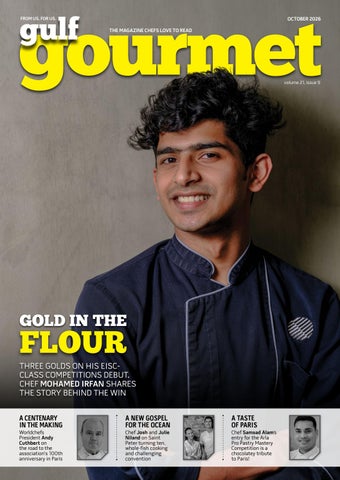
GOLD IN THE
FLOUR
THREE GOLDS ON HIS EISCCLASS COMPETITIONS DEBUT. CHEF MOHAMED IRFAN SHARES THE STORY BEHIND THE WIN A CENTENARY IN THE MAKING
Worldchefs President Andy Cuthbert on the road to the association's 100th anniversary in Paris
A NEW GOSPEL FOR THE OCEAN Chef Josh and Julie Niland on Saint Peter turning ten, whole-fish cooking and challenging convention
A TASTE OF PARIS
Chef Samsad Alam’s entry for the Arla Pro Pastry Mastery Competition is a chocolatey tribute to Paris!
president’sstation email editor@gulfgourmet.org
Dear Fellow Chefs, Members, Partners, Ladies and Gentlemen,
It is a remarkable milestone for an organisation that has connected chefs across borders and generations, and we are proud to share his thoughts on the road ahead.
As we close another month, I find myself looking back at a very busy few weeks for the Emirates Culinary Guild and, more importantly, at the people who continue to make this Guild what it is. Our EISC-Class Competitions 2026 have now come to a close. The final competition at the end of September was packed with action, talent and plenty of determination. Over the past four months, we have watched chefs, pastry chefs, bakers and other culinary professionals step forward, test themselves and find their footing on the competition floor. For me, that is one of the most rewarding parts of these competitions. The medals matter, but so does the experience of standing in front of judges, working under pressure, learning from mistakes and finding your potential. We have seen many young chefs take those first steps this season and I hope this is only the beginning of their competition journeys. The Guild continues to support opportunities that can make our industry more inclusive. We recently took part in an event organized by TOUCH, an inclusive talent management consultancy that works to build relationships, create opportunities and connect people with the hospitality industry. It was encouraging to meet the mentors and professionals helping people from different backgrounds, including women and people with special needs, find pathways into hospitality and build careers. Our national team is also preparing for another major international challenge. From 17 to 27 November, 40 chefs from the Emirates Culinary Guild will travel to
PRESIDENT’S STATION
October 2026 Gulf Gourmet
Chef Josh and Julie Niland also share about their work with whole-fish cooking and encourage chefs to look at the ocean, ingredients and waste in different ways. And for some inspiration and takeaways, read our opinion pieces.
Luxembourg for the Expogast Culinary World Cup 2026. This will be our fourth participation in the competition since 2014, with chefs from across the Emirates coming together to represent the UAE on the world stage. I would like to thank our partners FoodTech Group and Meiko, and in particular Tim Walsh and Attila PetÒ, for their continued belief in our chefs and their support of the national team. We are also pleased to highlight the Rosewood Foundation’s Rise to the Table programme, which is coming to London next year. The leadership programme is designed for emerging women in food, beverage and hospitality, and applications are now open. I encourage the talented women in our industry who meet the criteria to explore this opportunity and put themselves forward. There is plenty to discover in this issue. Our cover story features Chef Mohamed Irfan of Pullman Dubai Creek City Centre, who won three gold medals at the EISC competitions. We also speak to Worldchefs President Andy Cuthbert as the global association looks towards its landmark 100th anniversary in Paris.
I would like to thank all our partners, sponsors, marshals, supporters and members for continuing to stand behind the Emirates Culinary Guild. And to every chef who competed this season, thank you for putting yourself out there and for making the EISC-Class Competitions 2026 such a vibrant showcase of culinary talent. Past issues, upcoming events, chef spotlights and more are all waiting for you at issuu.com/gulfgourmetmagazine and visit emiratesculinaryguild.net to stay updated on guild competition and news. Check out our social media to see what chefs around the world are creating and perhaps connect with someone who inspires you. You can always share your thoughts and write to us at emiratesculinaryguild@gmail.com. The competition season may have come to an end, but there is certainly no shortage of action ahead. Luxembourg awaits, new opportunities are opening up, and there are many more young chefs finding their place in our industry. Until next month, keep learning and keep raising the standard. Culinary regards, Alan Orreal President, Emirates Culinary Guild
3
CONTENTS
October 2026 Gulf Gourmet
ggcontents
36
A Taste of Paris
03
President's Station
40
I Can Do It, Chef
05
There Is Nothing Soft About Soft Skills
42 When the Masters Leave, Who Will Take Their Place?
Friends of the Guild
44 The Chef's Brain: Designing Flavor Beyond Taste
President Alan Orreal on the close of EISC 2026, creating opportunities in hospitality, the road to Luxembourg and what lies ahead for the Guild. The skills that make us great chefs are not always the same ones that make us great leaders, writes Chef Tarryn-Leigh Green
06 10
Brands that support the Emirates Culinary Guild
13
46
Luxembourg Culinary World Cup
A 40-chef national team to represent the UAE at the Culinary World Cup 2026 in Luxembourg
16
The Quest for Shawarma Continues
The search for ultimate shawarma takes an unexpected detour when Chef Helen Morris finds an unassuming culinary gem
18
Attitude Can't Be Sous-Vide
A rough morning in the kitchen brought back an old debate of attitude versus skill for Chef Tarek Mouriess
20
Gold In The Flour
Three golds in his first attempt at the EISC-Class Competitions. Chef Mohamed Irfan of Pullman Dubai Creek City Centre shares the story behind the win
Chef Monal Malhotra recalls how a three-month trial on a revolving rooftop turned him from a young chef into a leader
Dr Carl Shi asks how culinary professionals can pass their knowledge on to the next generation
A Cenetary In The Making
Worldchefs President Andy Cuthbert speaks to Gulf Gourmet as the global association gears up for its landmark 100th anniversary in Paris
Chef Samsad Alam’s entry for the Arla Pro Pastry Mastery Competition is a chocolatey tribute to Paris!
48 49 50 52
Culinary researcher and Chef, Mohammad Ameri explores how neurogastronomy, multisensory integration, and kitchen-level design can help chefs manipulate aroma, texture, and sound
The Right Oven Starts With the Right Question
Wilhelm Tittes on why bakery equipment selection should begin with production and not with a catalogue
The Role of Bone in Steak Cookery
Sulemana A. Sadik on enhancing performance, consistency, and experience in HoReCa
The Recipe I Wish I Learned
Samer Abou Daher on why great chefs must also be prepared to lead.
Guild Meeting
Photos from the last Guild Meeting
Membership Directory
A listing of all the leading food, beverage, and equipment suppliers in the region
25 Lights, Camera, Food! EISC In Action Images and highlights from the recent EISC competition 29 Artificial Intelligence and Robots in Hospitality. Should we worry?
57 Is Dubai's Coffee Shop Boom Reaching Its Peak?
30
58
AI is getting smarter and more capable by the day. Chef Andreas Kurfurst asks if it can ever replace human touch
A New Gospel for the Ocean
Chef Josh and Julie Niland on Saint Peter turning ten, whole-fish cooking and challenging convention
gulf
OCTOBER 2026
FROM US. FOR US.
THE MAGAZINE CHEFS LOVE TO READ
As new outlets open across the city, Ismail Al Farran, Regional Franchisee Owner at Black Sheep Coffee, explains why Dubai's coffee market is entering a new era of maturity
Simon Says
Simon Martin, Executive Chef and Culinary Innovation Manager at JMM Meat Processing, shares the latest food trends that are shaping our region
CREDITS
volume 21, issue 9
EMIRATES CULINARY GUILD
EDITORIAL GOLD IN THE
FLOUR THREE GOLDS ON HIS EISCCLASS COMPETITIONS DEBUT. CHEF MOHAMED IRFAN SHARES THE STORY BEHIND THE WIN A CENTENARY IN THE MAKING
Worldchefs President Andy Cuthbert on the road to the association's 100th anniversary in Paris
4
A NEW GOSPEL FOR THE OCEAN Chef Josh and Julie Niland on Saint Peter turning ten, whole-fish cooking and challenging convention
A TASTE OF PARIS
Chef Samsad Alam’s entry for the Arla Pro Pastry Mastery Competition is a chocolatey tribute to Paris!
Andy Cuthbert Guild Coordinator +971 56 801 4089 emiratesculinaryguild@gmail.com Uwe Micheel Alan Orreal Past President President Andy Cuthbert Editor Amaresh Bhaskaran Associate Publisher amaresh@amareshbhaskaran.com +971 50 456 8161 Vahiju PC Art Director
COPYRIGHT All material appearing in Gulf Gourmet is copyright unless otherwise stated or it may rest with the provider of the supplied material. The publisher accepts no responsibility or liability for the accuracy of any information contained in the text or advertisements. Views expressed are not necessarily endorsed by the editor and publisher. WRITER CONTRIBUTOR PUBLISHED BY SALES ENQUIRY
Shreya Asopa Atim Suyatim Emirates Chefs Guild, Dubai, UAE info@gulfgourmet.org
BEYOND THE KITCHEN
October 2026 Gulf Gourmet
There Is Nothing Soft
About Soft Skills The skills that make us great chefs are not always the same ones that make us great leaders, writes Chef Tarryn-Leigh Green
W
e do not get an education in how to become parents. Considering it is arguably one of the most challenging and important jobs a human being can ever do, I have always found that slightly extraordinary. We learn as we go, drawing on instinct, experience, the people around us and, inevitably, getting plenty wrong along the way.
there is a significant difference between demanding excellence and believing that fear, aggression or humiliation are necessary to achieve it. Technical ability may get us promoted. Human ability determines what kind of leader we become once we get there.
I sometimes wonder whether we approach leadership in much the same way. We spend years educating people. At school, university, culinary college and throughout our careers, we develop knowledge and technical ability. As chefs, we learn ingredients, techniques, food safety, costing, consistency, discipline and execution. We practise our craft until we become good at it. Then, if we are good enough, we get promoted. A great Chef de Partie becomes a Sous Chef. A great Sous Chef becomes a Head Chef. Eventually, perhaps, an Executive Chef. Yet something interesting happens as we progress: the more senior we become, the less our success depends purely on our ability to cook and the more it depends on our ability to work with people. Suddenly, we are expected to lead, motivate, mentor, resolve conflict, give feedback, recognise potential, manage different personalities and communicate across cultures. At senior level, we also need to work effectively with operations,
procurement, finance, HR, marketing, suppliers and customers. But when, exactly, did somebody teach us how to do all of that? We call these abilities “soft skills”, a term I have never particularly liked because there is nothing soft about them. There is nothing soft about having a difficult conversation while allowing someone to retain their dignity. There is nothing soft about holding people accountable while still giving them the confidence to improve. It takes strength to admit when you are wrong, patience to develop someone who is not there yet, and confidence to allow talented people around you to shine. Guidance, appreciation, understanding and encouragement do not make a weak leader. In my experience, they make an effective one. That does not mean lowering standards. Kitchens are demanding environments. Standards matter. Discipline matters. Accountability absolutely matters. But
Some people seem to possess these skills naturally. Others are fortunate enough to work for exceptional leaders and absorb them along the way. Unfortunately, the opposite is also true. People who experience poor leadership can go on to repeat it, not necessarily because they intend to, but because it is the only model of leadership they have ever known. Perhaps that is where our approach to education needs to evolve. Alongside technical and commercial training, should we not also teach young chefs how to listen, mentor, negotiate, manage conflict, give constructive feedback and understand the influence they have on those around them? Because the further our careers progress, the more we realise that being right and being effective are not always the same thing. We may spend decades developing technical expertise, but the leaders we remember long after we have stopped working with them are rarely remembered simply for what they knew. We remember how they treated us, what they taught us and, perhaps most importantly, how they made us better.
■ 5
FRIENDS OF THE GUILD
October 2026 Gulf Gourmet
friends of the guild
PROFESSIONAL
6
FRIENDS OF THE GUILD
October 2026 Gulf Gourmet
7
FRIENDS OF THE GUILD
8
October 2026 Gulf Gourmet
100TH ANNIVERSARY
October 2026 Gulf Gourmet
A Centenary in the Making Worldchefs President Andy Cuthbert speaks to Gulf Gourmet as the global association gears up for its landmark 100th anniversary in Paris. He opens up about why unity, youth, and a strong international culinary community matter today more than ever!
Y
ears ago, chefs in Paris imagined an association that could outlast them. That dream has since grown into a global culinary institution, and
10
its next chapter rests with Chef Andy Cuthbert. Since taking the presidency of Worldchefs in October 2024, Chef Andy has assumed the mantle. He has been entrusted with a legacy and the
responsibility of determining where the association goes next. At the recent 2026 Newport Congress, held under the theme "Pasture, Passion,
Plate," Cuthbert says the real takeaways went beyond the catchphrase. "The most critical message to come out of Congress was around mental health, the need for fair kitchens, and the need to look after our teams far better than we have in the past. The overall messaging from Congress was one of unity and collaboration, moving toward our 100th anniversary and making sure we secure the association for the next 100 years," he says. With the 2026 Congress & Expo in Wales behind him and Paris 2028 already on the horizon, the ingredients of that next chapter are beginning to come together. In this candid exchange, Chef Andy maps out what it takes to scale an association encompassing over 100 country members into its second century.
The Worldchefs Congress will next convene in Paris, October 2028. It will mark a homecoming for the organisation. What is the historical significance of Worldchefs' upcoming 100th anniversary? At the first Congress, held from 11–14 October 1928, our then President, Francis Carton, said that if all cooks work for world peace, then we have done our job well. He also laid the foundation for what Worldchefs would become, an organisation built around apprenticeship, youth development, and the wellbeing of cooks globally. The 100th anniversary marks a point in the association's history, one that looks back on getting through so many
Too many talented chefs around the world are held back not by skill, but by opportunity
difficult times over 100 years, but also looks at 1928 itself, going back to Paris, the city where it all started. It is both a step forward in celebration and a reckoning with history.
As President, what are your primary strategic goals and foundational plans over the next two years to prepare the global network for this historic gathering in Paris? When I ran for president, my team and I spoke about securing the next 100 years for our organisation. That meant securing our office in Paris, which is our home, growing our membership, and strengthening our communication. Since then, we have made steady progress on all three fronts. Alongside this, I want to close the gap for cooks who have never had access to formal training. Too many talented chefs around the world are held back not by skill, but by opportunity, and preparing our global network for the next 100 years means reaching them too. That is why, in 2026, we are launching a series of fundamental cooking classes on our tech platform, Foodverse, in partnership with EHTL (HTI Luxembourg) and ICCA Dubai. This will give members without access to schools or government-backed training a free culinary education app, wherever they are in the world. As we prepare to gather in Paris for our centennial, I believe this is exactly the kind of legacy we should be building toward.
At the recent Congress, Worldchefs focused on the next generation through the Bill Gallagher Young Chefs Forum, while also launching the Sustainability 2.0 curriculum. How do you plan to use these youthfocused initiatives to transform young chefs from traditional line cooks into the climate-conscious, waste-reducing culinary leaders the industry desperately needs? Dr. Billy Gallagher had that vision when he launched the Young Chefs program years ago. Today it is led by Jasper
100TH ANNIVERSARY
October 2026 Gulf Gourmet
The next hundred years will be written in the passion and unity we lay down today Jek, one of our first young chefs, now chairman, guiding the next generation for Worldchefs. We also need to keep upgrading ourselves, using the technology available to us to build a stronger future for our industry. That transformation does not happen by chance. It happens by putting sustainability directly into the hands of young chefs early. When a young chef understands the cost of waste and the impact of their choices from day one, they grow into a leader who already thinks that way. We are pairing that curriculum with the Young Chefs Forum. One gives mentorship, the other gives the framework. Climate-conscious, waste-reducing practices- all of these are our joint responsibilities. We have to nurture people, and guide them using the dishes we create and the work we do to influence real change.
You stepped into the presidency with a clear vision for an open, collaborative and inclusive Worldchefs. How are you ensuring that this spirit of openness is being passed down to the next generation of leaders? The vision was clear from the very beginning when we came in as President, along with the team. I was very open about what we needed to do and how we would get it done. Collaboration and inclusiveness are what Worldchefs has, what it needs, and what it must continue to build on in the future.
11
100TH ANNIVERSARY
October 2026 Gulf Gourmet
Uniting a global community of volunteers is a meaningful task. Getting things done in Worldchefs speaks volumes about the scale and diversity of who we represent. It calls for patience and thoughtful coordination, much like steering a large vessel. With the team on board, the recently amended Articles of Association, which now form a clear guideline of what we expect from everyone, the standing rules, which are our day-to-day operational guides, and the people leading our committees and board, we are well positioned to keep communicating openly and fairly with all our Association heads. It is important that we listen and reflect before answering, that we involve people in decisions that affect the global community, and that we do not procrastinate or stagnate. Even in our culinary competitions, we look for ways to promote all our chefs and give them opportunities on the world stage. We aspire to be like the Culinary Olympics or World Cup Luxembourg, as the culinary powerhouse of competitions. We are nearly there. In 2027, we begin the first of a six-year cycle to present the world with the very best that Worldchefs has to offer, with 149 competitors across 9 new categories in the global chef competition, renamed the Worldchefs Global Championships. This will elevate our culinary community and showcase to the world what chefs stand for. We also need to translate this to the youth coming up within the Association, and also to how we bring in new members across the world. Our school outreach program, our Feed the Planet programs, our WorldChefs Without Borders programs, and our International Chefs Day programs are all very much embedded in what we do daily. The Association needs to grow globally, not just with cooks, but also with pastry chefs, butchers, bakers, the food industry as a whole, manufacturers, farmers, the entire connectivity and chain of food. As
12
One gives mentorship, the other gives the framework we said in Wales: Pasture, Passion, Plate. These principles are embedded into what we do, as we give back to society and the community while growing the Association in a structured, strategic way. Our recent work, led by our Paris office with UNESCO and other major NGOs, is exactly where we need to be. That collaboration with world-leading, best-in-class bodies is exactly the direction Worldchefs needs to keep moving in.
Chef Andy, you have walked a remarkable path from leading the Emirates Culinary Guild to now steering Worldchefs into its historic centenary chapter. When you look toward Paris 2028, what unique culinary identity do you believe the UAE delegation will bring to the global stage for the centenary? The UAE has been fortunate to be led by a visionary government. As His Highness Sheikh Mohammed bin Rashid Al Maktoum, Ruler of Dubai, Vice President and Prime Minister of the United Arab Emirates, once said, "Impossible is a word used by some people who fear to dream big." His vision, and the support of the Abu Dhabi leadership through His Highness Sheikh Zayed bin Sultan Al Nahyan, Sheikh Khalifa bin Zayed Al Nahyan, and Sheikh Mohamed bin Zayed Al Nahyan, have built a country where we have been able to thrive. The Emirates Culinary Guild was set up in 1991 by visionary chefs, leaders, and an inspiring community. We have grown the Emirates Culinary Guild, under World Association of Chef Societies International membership, into an extremely well-respected
culinary guild. We have run a successful competition program, the Emirates International Salon Culinaire, since 1991. In 2027, we mark the 29th edition of the competition. We work closely with industry partners, chefs, and supporters. Our education partner, ICCA Dubai, helps us run a scholarship program called Making Lives Happen, now in its 10th year, a fundamental give-back to the community. And with the technology now at our fingertips, including ICCA's Foodverse and ICCA Live, we have brought these innovations not only to the Emirates Culinary Guild but also to Worldchefs. We will have a UAE delegation in Paris. I am proud to have worked in this country for the past 35 years and to stand in the same place where the Association held its first Congress in 1928, marking its 100th anniversary. This will be a feather in the cap for the Emirates Culinary Guild, and a humbling personal experience for me. I think the world can learn from the UAE and what we do here. This country offers you an opportunity. All you have to do is push yourself to take it. At the Emirates Culinary Guild, we are proud of what we have achieved over the years, laying the hospitality landscape and being part of that historic journey, from a time when we saw Dubai go from a handful of hotels to around 800 hotels in Dubai alone, some with the finest hospitality operations and entrepreneurial spirit in the world. Not only expatriates, but also talented young people from the Emirates are bringing the world's gastronomic spotlight to this country. The world comes to the UAE now, and I think the greatest legacy our Emirates Culinary Guild will leave in this country is that we have been part of this remarkable journey. The next hundred years will be written in the passion and unity we lay down today.
■
CULINARY WORLD CUP
October 2026 Gulf Gourmet
UAE Culinary Team Heads to
2026 Luxembourg Culinary World Cup The Emirates Culinary Guild has partnered with FoodTech Group and Meiko to send a 40-chef national team to represent the UAE at the RAK Porcelain Culinary World Cup 2026 in Luxembourg
T
he Emirates Culinary Guild, in association with its partners Meiko and FoodTech, announces that from 17 to 27 November 2026, a team of 40 chefs from the Emirates Culinary Guild will travel to Luxembourg to compete against the best in the world at the Expogast Culinary World Cup 2026. This marks the Guild's fourth participation in the event since 2014. The team includes chefs from across the Emirates and a variety of establishments. The sponsors, FoodTech Group and Meiko, said this is an exciting time for them and noted that being associated with the Emirates Culinary Guild and its National Culinary Team, as well as being corporate members of the Guild, is an important step. They added
that motivating these young men and women to perform on the world culinary stage and represent their homeland is a special feeling for their companies. The Emirates Culinary Guild thanks Mr Tim Walsh, Managing Director of Meiko, and Mr Attila PetÒ, CEO and General Manager of FoodTech Group FZCO, for their firm belief in the team and the Guild. The competition will be held over five days, during which the team will compete in the artistic display categories, pastry art classes, and community catering alongside a
team from Emirates Flight Catering. They will demonstrate their skills and talents before judges from the World Association of Chefs' Societies. Alan Orreal, the Guild's current President and Senior Vice President of Culinary at Emirates Flight Catering, added, "It is with a sense of excitement that I can take our team, as President, to one of the world's premier culinary competitions to showcase the United Arab Emirates' gastronomic prowess. I am confident that all the hard work and commitment
13
CULINARY WORLD CUP
October 2026 Gulf Gourmet
our young men and women have put in over the past year will truly pay off, and we will see the flag of our home country fly high in Luxembourg." Past President of the Emirates Culinary Guild and team coordinator Andy Cuthbert, who is also the Worldchefs President and General Manager of Jumeirah Emirates Towers, commented, "It is with great pride that we are once again able to send a large team to highlight the outstanding work our chefs do in the United Arab Emirates and represent our country. My past 26 years as a member of the Guild have been filled with many proud moments, and I am sure our team will once again bring home gold from Luxembourg 2026."
Abel Vieilleville Team Pastry Chef
Francesco Dimonte Team Captain
Grant Marais Chef, Outside Support
Janam Maharjan Team Chef
Jegan Babu Kitchen Helper1
Jhon Martinez Team Chef
Sergio del Castillo Mora Pastry Chef, outside support
Abdulla Alsharooqi Kitchen Helper2
■
14
Bernard Charles
Dammika Herath Lead Pastry Artist
Dinesh Hashan Kinson
Halwala Priyankarage Nimesh Tharuka Luke Fernando
Jagoda Don Nilan Krishantha Lead Artist
Jayson Catapang Cueto
Kekulavalage Yasas Nawamina
Liyanage eranda Sampath kumara
Mahesha Abeywickrama
Mutuwahandi Tharishma madushanka mendis
Pathma Madushanka Kuma Hennedige
Pathum Priyankara Walpola Liyanage Artist
Shajahan Mampally
Siya Mudiyanselage thusitha Kumara Wijerathna
Udagama gedara priyankara sampath kumarasinghe
Ranasinghe Arachchige Chamidu Nishara Ranasinghe
CULINARY WORLD CUP
October 2026 Gulf Gourmet
15
THE FOOD TRAIL
October 2026 Gulf Gourmet
The Quest for Shawarma Continues The search for Ras Al Khaimah’s ultimate shawarma takes an unexpected detour when Chef Helen Morris finds an unassuming culinary gem and an irresistible Chinese feast at Back Home
I
am still searching! My quest for the ultimate shawarma in Ras Al Khaimah has not exactly been the most fruitful of culinary expeditions. I have visited a couple of places that came highly recommended as “the best shawarma in RAK,” and while neither was bad, my taste buds were left standing at the side of the road holding a little cardboard sign saying, “Is that it?” Anyway, one shawarma was tasty, absolutely, but it did not quite hit the spot in the way I believe a truly great shawarma should. I am talking about that perfect combination of juicy, wellseasoned meat, crispy edges, garlic, pickles, warmth, spice, and that slightly greasy but in the best possible way satisfaction that makes you immediately take a second one, despite knowing you probably should not. To be honest, I was so spoiled in Doha, which had more than one juicy, flavourful Shawarma. Easily the best and hard to beat. So, the quest continues. I am convinced that as the days get cooler, and I am able to venture deeper into the heart of Ras Al Khaimah city, I will eventually discover that elusive, mouthwatering, flavourpacked shawarma. When I do, believe me, you will hear about it. For now, however, the shawarma investigation is temporarily on hold – yet again. Sometimes, when you are looking for one culinary treasure, you accidentally stumble across another. Enter – Back Home. No, not the UK but the restaurant’s name. But a colleague from Hong Kong started talking about somewhere called Back
16
food, but sometimes I want something with a little more character and a stronger sense of where it comes from.
My taste buds were left standing at the side of the road holding a little cardboard sign saying, ‘Is that it? Home and highly recommended it. Not “I have heard it is good.” No. She actually eats there. Her verdict was that it's probably about as close as we'd get to the sort of Chinese food she would expect back home. Now that got my attention. Now, it is not that I dislike Chinese food. Quite the opposite. I love good Chinese food. My problem is that it is not always easy to find. Too often, dishes become heavily adapted, overly sweet, excessively sauced, or somehow reduced to the same collection of flavours wearing different hats. Sweet and sour, chilli, garlic, and soy appear in slightly different combinations, and before long, every dish begins to taste like a variation of the last one. I do not order food in Chinese restaurants back in my hometown. Unless I am prepared to pay serious money for the sort of Chinese cuisine that arrives with a tasting menu, and a wine pairing that costs more than my first car, I have often found myself slightly underwhelmed. There is nothing wrong with affordable, familiar Chinese
So, one Friday evening after work, ten of us descended upon the restaurant. A table had been booked, although, knowing chefs, “booking a table for ten” really means, “Prepare the kitchen. We are about to cause a small logistical incident.” That is exactly what happened. When you put a group of chefs around a table and give them a menu, restraint disappears remarkably quickly. Back Home is about as unassuming as a restaurant can get. There is no grand entrance, no dramatic façade and no waiter appearing from behind a curtain to explain the seventeen ingredients in the sauce. Thankfully, there is also no tiny portion sitting in the middle of a plate looking as though it needs counseling. One thing immediately caught my attention: there were a lot of Chinese diners in the restaurant. That, for me, is always a good sign. It does not guarantee perfection, of course, but it certainly makes me sit up a little straighter. It is simple, basic, and pocket-friendly. Most importantly, the food comes in abundance. This is not the sort of place where you leave wondering whether the meal was merely an elaborate appetiser. The plates arrive with confidence, and they keep arriving until the table begins to look like it has been taken over by a particularly enthusiastic Chinese banquet. The food started arriving. Not course
by course, and not in the carefully choreographed sequence of a tasting menu. It came thick and fast: plate after plate, bowl after bowl. The table gradually disappeared beneath an edible landscape of Chinese dishes. Naturally, we did what chefs do best. We ate, discussed, analysed, lots of oohs and aahs about flavours and then ate some more. A fish soup led the way, and this was a lovely introduction to what was coming. It was not simply about heat. There was spice, yes, but also layers of flavour from all the ingredients. While the vegetables kept everything fresh. It was warming, aromatic and deeply savoury. Because I had already seen the amount of food coming out of the kitchen, I sensibly kept my portion small. A decision I would later realise was completely irrelevant. One of my absolute favourites was the beef and chicken dumplings. These were beautifully constructed little parcels, packed with flavour and wonderfully juicy inside. The filling had enough seasoning to make itself known without completely overpowering the meat, and the dipping sauce was the real supporting actor. That balance of savoury, aromatic and slightly sharp flavours was just right. I ate a few more than four and considered whether it would be socially acceptable to lick the bowl. I did, of course, show some restraint. The dumplings also set the tone for the meal. They were not trying to be delicate for the sake of appearance. They were generous, juicy, and properly seasoned. Then came the sweet and sour chicken. I am a big fan of sweet and sour. I love that initial sweetness followed by the acidity coming through and hitting the back of your tongue. It is that sweet versus sour battle that makes the dish work. This version, however, was different. The chicken was beautifully cooked, with a crisp exterior that gave way to tender meat. Then came the sauce. This was not some thin, neoncoloured sweet-and-sour glaze. It was thick, glossy, sticky, and intensely flavoured, almost honey-like in its
THE FOOD TRAIL
October 2026 Gulf Gourmet
Just when I thought the kitchen had finally run out of ideas, and more importantly, we had finally run out of stomach, another dish appeared: deepfried mushrooms.
viscosity, coating the plate and clinging to the chicken. You could see the glaze. You could smell the sweetness. Then you took a bite. Wow – my life is complete. The combination of crisp chicken and sticky sauce was ridiculously good. Then came the universal chef communication system: pointing chopsticks. One person pointed at the chicken. Another nodded. Someone else pointed at it again while chewing. Nobody could speak because our mouths were full, but the message was perfectly clear: “You need to eat this.” That, I think, is one of the highest culinary compliments available. No words. Just chopsticks. After that, my memory became slightly less reliable. Dish after dish appeared. The table became a battlefield. There was Sichuan and chilli chicken, bringing that characteristic combination of chilli heat, savoury depth, and aromatic spice. There were green beans, cooked in a way that retained their bite rather than turning into green surrender. Then there were the lamb ribs. They were tender, spiced, succulent and rich, the kind of meat that makes you forget you were already full. You know you are in trouble when your stomach is saying, “Absolutely not,” but your brain is saying, “Just one more.” The brain wins. Obviously. Then came the stir-fried potatoes. These might sound simple, but they were anything but ordinary. When potatoes are cut correctly, cooked properly, and tossed with the right aromatics, they become something completely different. Please, bring me a plate of those every day of the week.
I was not expecting much. I had already eaten enough food to feed a small culinary department. But these were phenomenal. They were delicately crispy on the outside, juicy inside, properly seasoned, and completely addictive. They arrived towards the end of the meal, which was frankly unfair. These are not the end-of-meal mushrooms. These are ‘put them in a bowl, sit on the sofa’ mushrooms. Forget crisps. Forget popcorn. Give me a bowl of those, and I could happily watch three hours of questionable television without moving. The thing that really stood out about Back Home was not just the quantity. It was the flavour. The food was not trying to be fancy. It was not dressed up to impress, and it was not pretending to be something it was not. It was honest, generous, flavour-driven Chinese cooking. There were layers of spice, sweetness, acidity, savouriness, and texture. There were chilli and aromatic notes. There was crispness against tenderness, sticky against crunchy, and spicy against sweet. Most importantly, there was balance. So, while my search for the perfect Ras Al Khaimah shawarma continues, I may have accidentally discovered something else along the way. I am still not ready to declare myself a Chinese food convert, so let us not get carried away. But Back Home has certainly reminded me of something I have always believed as a chef. Do not judge a restaurant by how impressive the dining room looks. Sometimes real treasures are places that do not shout. They simply put good food on the table and let it do the talking. Although judging by the number of chopsticks pointing that evening, this food had absolutely no problem making itself understood. Here’s to more food expeditions as winter arrives.
■
17
TAREKS TAO
October 2026 Gulf Gourmet
Attitude Can't Be Sous-Vide A rough morning in the kitchen brought back an old debate of attitude versus skill for Chef Tarek Mouriess. He pauses to see again which one really makes a cook in today's time.
T
he famous line from Whiplash, “There are no two words in the English language more harmful than ‘good job’,” represents a particular idea of excellence, that greatness demands pressure, fear and relentless pushing. This article argues the opposite. Excellence does not require aggression. Whiplash shows what can happen when a leader believes it does. It happened a long time ago, in one of the kitchens I worked in. I still remember that morning because what happened stayed with me long after the function was over.
18
spat out tickets. The smell of reducing veal stock hung in the air.
You can teach technique. You cannot teach character The kitchen was already hot at 7 a.m. The function was the following day: 400 covers, with no room for error. A chef I worked with walked the line and stopped at the senior chef’s station. The printer
“How was the dish?” he asked. The senior chef, who had been there for ten years, shrugged. “Fine. The numbers are right.” But the numbers were not right. He knew the count. He knew the prep. He looked at the senior chef and said, “Check it again. I want proof before it leaves this building.” The senior chef said nothing. He ignored it. That was his mistake.
What followed was resentment. Someone went around him to complain about how he had spoken. What hurt him was not the complaint itself. It was realising that after years of teaching people, guiding them and looking after them almost like a father, he had still failed to create enough space for someone to come directly to him and say, “I did not appreciate the way you spoke to me.” That morning brought back an old question for me… ATTITUDE OR SKILL? I have spent close to four decades in professional kitchens, training under systems that could not have been more different. Discipline came first. Skill came second. You were expected to know your knife was dull before I told you. You were expected to know your sauce was not balanced before it reached the pass. Nobody handed you that awareness. You developed it because it was demanded from day one. There was an interview question that used to be asked at real hotels. The question was simple. You have two cooks. One is humble, coachable and grateful when corrected, but his execution is average. The other is technically brilliant and consistently delivers, but he is arrogant. You have to let one go. Who do you fire? I used to answer without hesitation to fire the arrogant one. Skill without humility is dangerous. A kitchen is not twelve people working alone at twelve stations. It is one nervous system. Trust runs through it like blood. You cannot establish trust with someone who believes correction does not apply to him. You can teach technique. You cannot teach character. I have kept the arrogant one because I needed the skill. I regretted it. I have also kept the humble one and watched him become the best cook on the line. The truth is, I have been both men.
Excellence does not require aggression Skill takes years to develop. So does the attitude that makes someone reliable in a kitchen. It is what you do when you are corrected. Do you argue? Do you hide mistakes? Do you repeat the same error? Do you go around the person instead of going to the person? Those behaviours tell me far more than simply calling someone’s attitude “good” or “bad”. Consistency and technique are the minimum. What concerns me is watching a chef stand in front of a dish that is wrong and not see it. A mistake you catch is a lesson. A mistake you do not see because you have become dependent on being told what to do is something else. It means you have forgotten how to look for yourself.
In those moments, you may hold it back or overthink it. But when the situation settles, come back and tell me. That conversation matters. Going around someone does not create trust. But neither does creating an environment where people are afraid to come to you. Both sides have a responsibility. Accountability still matters. But accountability that never moves down the chain does not develop anyone. It keeps everyone underneath dependent on the person at the top. If my delivery fails, I need to be able to say so. I cannot demand accountability from everyone below me while refusing to examine my own. I am not asking us to go back to fear dressed up as discipline. I lived under some of that too. It created resentment more than character. I am asking for something harder: discipline without intimidation, correction without humiliation, and enough trust for people to tell the truth in both directions. It needs contact, correction, heat and time. It needs someone to say the hard thing and someone else to hear it.
That is where good training matters. The old schools understood that discipline learned early could become self-monitoring for life. Nobody needs to stand over you checking whether your shoes are polished once you understand why it mattered.
So here is what I am asking of myself: I will own my delivery, not just my intention. I will make it safe to tell the truth.
I also take my share of the blame here. I have done the same thing I am complaining about. When I push hard under pressure, my intention is clarity. Excellence does not require aggression. I know that. I have not always lived it.
If I make that impossible, that is on me.
There have been times when you may have seen me speak in a way you did not appreciate. If you have a problem with how I spoke to you, tell me to my face. I understand that when jobs and livelihoods are at stake, you may not always feel safe enough to say it directly.
TAREKS TAO
October 2026 Gulf Gourmet
Here is what I am asking of you: if I speak to you in a way that lands wrong, tell me directly.
Since those days I have worked across several kitchens but I still remember the old days and the senior chef who did not see it and think that we all have to make our kitchens comfortable and safe enough to communicate with honesty. That is the kitchen I am also trying to build. You cannot vacuum-seal attitude and leave it. You must open the bag. You must let it breathe. You must give it heat. That is the only way it becomes something worth serving.
■
19
COVER STORY
October 2026 Gulf Gourmet
Gold in the Flour Chef Mohamed Irfan of Pullman Dubai Creek City Centre won three gold medals at the EISC class competitions in his first-ever attempt. Amaresh Bhaskaran speaks to the winner about the failures he faced, the faith in flour and in himself that made it possible 20
COVER STORY
October 2026 Gulf Gourmet
N
ot every day is a teenager entrusted with a bakery and told, in effect, to sink or swim. Chef Mohamed Irfan was, and he made mistakes at almost every turn in the beginning, before his assiduousness began to bear fruit. The tenacity pulled a frightened, self-taught teenager through a hotel industry that owed him nothing until it began, slowly, to owe him everything. Chef Irfan had no revelatory moment, no childhood pull towards baking. His entry into the trade was considerably more prosaic. Growing up in Nawalapitiya, a small village in Sri Lanka’s Central Province, Chef Irfan came from a place few people had heard of, let alone visited. The middle of three children, he had no particular plan for what came next. Baking entered the picture almost by happenstance. “My uncle ran Nizamiya Hotel & Bake House and asked me to join the bakery as an apprentice. Just when I was beginning to learn, the head baker left the job one day, abruptly, leaving me to work with very limited experience,” he says, recalling that he did not yet know how to make a basic butter cake and was left, more or less by accident, in sole charge of the ovens. “I used to call the head baker and ask, ‘Chef, how do I make this one?’ Chef Irfan recounts those early, disorienting weeks. “But mostly, I tried things myself, and if it was wrong, I would make it again.” Over several days, chasing the correct method for a single batch of butter cake, he burnt through more than 45 kilograms of batter, discarding attempt after attempt. “There was no assistant to share the load, no mixer or proper sheeter for the puff pastry, only an oven and loads of practice,” is how he sums up the two and a half years that followed. Some days, he produced more than 150 kilograms of bread; on others, he worked on pastry, entirely alone, across two branches of the business. For a teenager shouldering that much responsibility alone, the years took a
My mind was always full of bakeries. Every day I was thinking about flour. physical toll. “Sometimes I was crying, alone, at the back of the bakery. I had a responsibility, so I could not say I was not able to do the work. The bending and lifting damaged my knee badly enough to require hospital treatment. That was when I decided to pursue professional culinary training to learn the art properly,” he says. He enrolled in a short pastry and bakery
course at NEST Academy, studying by day and working bakery shifts at night, finally learning to swim in the industry. A brief stint at the Galadari Colombo hotel confirmed what he already knew. Curry and tandoor did not interest him. “My mind was always full of bakeries. Every day I was thinking about flour. I still do not even know how to make plain rice properly.” Three months later, he walked away in search of work closer to what he wanted. He joined Royal Kandyan Hotel, spending a year in the bakery and getting his first taste of professional structure. “The first time, I had zero idea of buffet production, plating, or any of it. I was just watching, trying to keep up, and picked up several skills during my nine-month tenure there,” he admits. What followed was a rapid climb through Sri Lanka’s hotel kitchens, albeit with a
21
COVER STORY
October 2026 Gulf Gourmet
few stops where the work environment did not suit him, before a walk-in interview at Cinnamon Life, then one of South Asia’s largest hotel openings. “I joined the Cinnamon Life pre-opening team, helping build the kitchen systems from scratch and learning French baking, viennoiserie, and pastries from Chef Maheel Nilanga, the head baker. I learned a lot of things, from sourdough fermentation to laminated dough.” For the first time, Chef Irfan saw that baking had its own lineage and vocabulary. Under Chef Maheel, he found the techniques behind baking, giving structure to what he had until then largely taught himself. He still laughs when he calls him ‘the super baker of my life '. Chasing broader international experience, Chef Irfan applied for a bakery position in Abu Dhabi, arriving with real optimism about what a large, high-volume five-star operation might teach him. The property served more than fifteen hundred breakfast guests a day, giving him a first-hand look at an operation of considerable scale. Over time, he realised he wanted more room to build on what he'd learned in Sri Lanka
and broaden his repertoire. His search led him to Pullman Hotel, where he joined as a Demi Chef de Partie five months ago. “I was given two days to prepare for the trial, and I brought my sourdough
starter from home. I decided not to use commercial yeast and worked with the traditional methods I had spent years refining but rarely had the opportunity to showcase. I told them I needed those two full days to do my best. They agreed, and I gave them everything I had. I want to thank Mr Nishan Silva, Regional General Manager – Dubai & Emirates North at Accor; Ms Laura Nicli, General Manager of Pullman Dubai Creek City Centre; Chef Rozairo, Executive Chef at Pullman Dubai Creek City Centre; and Chef Dammika Herath, Executive Pastry Chef at Pullman Dubai Creek City Centre. Chef Dammika was someone I had admired for a long time. One of my
There was no assistant… only an oven and loads of practice 22
COVER STORY
October 2026 Gulf Gourmet
Everything I have achieved and everything I am doing now comes down to one dream
23
COVER STORY
October 2026 Gulf Gourmet
biggest dreams was to work with him, and getting that opportunity meant a great deal to me.” So, what does your day-to-day look like now at Pullman? "Currently, I am working with the team to set up bakery production for the hotel's new all-day restaurant and lobby lounge. I have my recipes, French-leaning and Sri Lankan style, making different types of bread,” he notes with what he describes, gratefully, as complete freedom. By any reckoning, it is an unusual amount of latitude to give someone at this early stage of his career, and Irfan is candid about how rare that trust has been so
I want to make the people who supported me happy and proud
far. I still find it hard to believe how much people here actually want me to succeed. My Regional General Manager – Dubai & Emirates North at Accor, Mr Nishan Silva, and the General Manager and Executive Chefs eat my bread now when they never used to eat bread at all. I am really grateful. ” If trust is the seed, encouragement is the rain. Chef Irfan had both. Encouraged by his mentor, he entered three categories at the EISC class competitions: an artistic showpiece display, a plated dessert, and practical bakery. “I could not sleep. I was buzzing all night, equal parts excitement and nerves. I reached the bus stop hours before I needed to and kept wondering why I had waited so long to enter a competition. I practised everything over and over, from the sugar-work showpiece to the plated dessert. At that point, I just wanted to do my best and see where it would take me,” he confesses, his nervousness still evident. It took him further than he expected.
He returned with three gold medals and recognition for the quality of his work. Central to Chef Irfan's successful culinary venture was the unconditional faith of the women in his life. "The first time I came to the UAE, my girlfriend, Rifna, sold her phone and gave me the money to help me get here," he recalls, looking back at those uncertain days. "She was one of the main reasons I was even able to start this journey. "That sacrifice lit his culinary flame, along with the lifelong support of his mother, Rizana, who refused to box him in. "My mother gave me complete freedom to choose my path without conditions. She trusts me and has always supported me." It is, in the end, a fitting foundation for a career initially built on being left to figure things out for himself, except this time, with the full confidence of his family behind him. "Everything I have achieved and everything I am doing now comes down to one dream. I want to make the people who supported me happy and proud, especially my family and my girlfriend. I want to make them feel that all their sacrifices and support were worth it." Going forward, Chef Irfan nurtures the same dream as most other chefs, which is to become an Executive Chef and eventually open a restaurant of his own. "I also want to compete internationally. Next time, I will aim for the Culinary Olympics. There is so much to learn every single day in the kitchen. Nobody can say they know everything about the bakery, and I want to learn new techniques," he says. Gold, when it finally came, confirmed what Flour had been telling: that the boy who once cried alone at the back of a bakery had something worth showing the world. If the last few years are any indication, this is only the first of many medals to come.
■
24
EISC IN ACTION
October 2026 Gulf Gourmet
EISC 2026 Finishes On A High Note photo credit: Cody Cuthbert
Four months, hundreds of competitors, countless hours of preparation and some unforgettable plates later, the EISC Class Competitions 2026 came to a close. Relive the action, intensity and standout moments from the competition
W
hat began in June as a new competition format ended in September with a fitting finale. The final round of the Emirates International Salon Culinaire (EISC) Class Competitions 2026 brought chefs back to ICCA Dubai for one last opportunity to impress the judges, challenge themselves and, for many, chase that elusive gold medal. Across the final classes, the energy never dipped. Competition stations buzzed from the onset. As always, EISC
was about more than medals. Amid the intensity of competition, chefs exchanged ideas and learned from the feedback of the judging panel. First-time competitors stood shoulder to shoulder with seasoned regulars. Over four months, culinary talent from across the UAE came together to showcase their skills. Here are some of the standout moments from the final rounds, from last-minute plating to celebrations, handshakes and wellearned victories.
■
25
EISC IN ACTION
26
October 2026 Gulf Gourmet
EISC IN ACTION
October 2026 Gulf Gourmet
27
One Trusted Legacy
TWO STRENGTHS FOR YOUR KITCHEN
Great food starts with uncompromising standards. Atlantico is a seafood brand built around freshness, quality and taste. Every product is carefully selected for consistency, bringing the best of the sea from source to table. With reliable and convenient seafood solutions, Atlantico helps hotels, restaurants and professional kitchens deliver with confidence.
A DIVISION OF THE DEEP SEAFOOD COMPANY
Gourmex brings a world of quality food beyond seafood, with
a
carefully
selected
range
of
meat,
poultry,
vegetables and frozen products. Combining great taste with quality and convenience, Gourmex offers reliable and sustainable food solutions that help kitchens work with greater consistency and ease.
Two Culinary Signature Brands, Born from 40 Years of Seafood Excellence. From the House of The Deep Seafood Company. www.thedeepseafood.com |
Info@thedeepseafood.com |
+971 4 2844227
FUTURE OF HOSPITALITY
October 2026 Gulf Gourmet
Artificial Intelligence and Robots in Hospitality. Should we worry? AI is getting smarter and more capable by the day. Chef Andreas Kurfurst asks if it can ever replace human touch
W
ell, I sincerely hope not. AI and robots are more common now than ever, and they're getting smarter and more mobile every day. I do think that they are useful to an extent, but also need to be very much controlled at the same time. (The Matrix movies come to mind here.) Particularly AI. Combining and compiling information and making funny videos and graphics is one thing, but letting AI hack into other computer systems and take over is another. We should not let machines make decisions for us. Decisions should be mostly based on humanity, not just a compilation of logic, past history, or monetary values. That is what makes us "humans" human, after all. I also do think that AI makes people, especially young people, lazy and ignorant. Instead of doing the research by themselves (and therefore understanding their subject, whatever that may be), it is a lot easier to just press the AI button and print the paper. I taught at a Swiss hotel management institute, so I have seen the beginning of this behaviour. And I ask myself: what is hospitality all about, and will AI and robots eventually take over? Why do customers return to the same hotel or restaurant, even though there are maybe better and more costeffective options? One of the main reasons
given is the staff. The way customers are welcomed by individual staff members, from the doorman to the concierges, the wait staff, the housekeeping staff, etc., is something special. That smile on their faces and the genuine greetings, with your name used, are something everyone loves, no matter where you are from or how much money you have. And this is one of the things AI and robots cannot (yet) copy: the human touch. Well, maybe in another 20–30 years, once we are able to make humanoids/ androids to replace real people.
The other thing is: cooking
Yeah, because real cooking (and I mean cooking from scratch, with real, fresh ingredients, not just slapping premanufactured ingredients together) is quite a difficult and complicated task, because there are so many variables for just one dish, or a sauce, or a salad. The final look, taste, aroma, and mouthfeel depend on so many things that I think good chefs are more like magicians than just cooks. I mean, robots are good at repeating exact steps down to the smallest detail, time after time. However, assembling pre-made parts to make a car is not the same as assembling a variety of ingredients to cook a tasty meal. For each dish, one needs to consider and take a variety of actions to get a decent result:
The size of the fruit, vegetable, piece of meat, fish, or chicken. The age/ripeness of the fruit, vegetable, meat, fish, or chicken. The species and which part of it you are cooking. The quality of the spices and herbs, fresh or dry. The type of cooking method you are going to use, be it grilling, roasting, frying, baking, pan-frying, steaming, etc. All above matter and each dish needs adjusting EVERYTIME you cook, as ingredients are grown, not manufactured in a factory. Robots are able to copy and paste, work 24 hours a day, and therefore massproduce and make food cheaper, but not better. One question I asked all my new culinary students was: "Who cooks the best food in the world? You know that person." Common Answer: “ My Mother” And that is the right answer, because she is NOT a Robot.
■
29
CHEF SPOTLIGHT
October 2026 Gulf Gourmet
A New Gospel for the Ocean Chef Josh and Julie Niland are hospitality's power duo. He changed the way chefs handle fish; she scaled it into a business, and together they have spent a decade doing what everyone said couldn’t be done. As Saint Peter turns ten and their landmark book, Saint Peter: Chapter & Verse, arrives, Shreya Asopa talks to the Nilands about zero waste, whole fish and the peculiar fish eye ice cream photo credit: Christopher Pearce
T
here is one thing Chef Josh Niland will not do to a fish, and it is the thing every other kitchen in the world does first. ‘Wash it’. That single refusal, more than any accolade, is the closest thing Saint Peter has to an origin story. Over a video call that keeps cutting to the restaurant behind them, Josh and Julie Niland talk about the decade since they opened an 18-seat room in Sydney with a wager that the world was ready to see fish the way a butcher sees meat. It is, by any measure, a big year for the Nilands. Saint Peter, their acclaimed seafood restaurant, turns ten, and with that milestone comes a landmark book and a run of special one-night-only anniversary collaborations. "We did a lot of projects this year. For the anniversary, we did a series of one-night collaborations that brought some of the world's most respected chefs to our kitchen in Sydney. We had Chef Rasmus Munk, Chef Virgilio Martínez, Joan Roca, Chef Wylie Dufresne, and many more, and then there is the book, the marketing, the business," says Chef Josh, for whom busy has always been the baseline. Long before the kitchens, there was a more serious fight. Josh was eight when he was diagnosed with cancer. His childhood in Maitland was marked by months of chemotherapy and radiotherapy, and the removal of a kidney. Whatever else those years took from him, they gave him a hunger for life that never really faded. His path thereafter was itinerant, working in cafes and apprenticing locally in some
30
of Sydney’s most acclaimed restaurants as a teenager before a formative stint in Heston Blumenthal's The Fat Duck. It was at Sydney's Fish Face, under chef Stephen Hodges, that a throwaway remark changed everything. Josh was struggling to find the right garnish for a fish dish when Hodges told him, "You are overthinking it. Why do you not look at fish as meat?" He still remembers writing it down, a sepia-tinted chef training memory of a single sentence that lodged with him. That instinct to simplify never left him. "What I am trying to do constantly is simplify, strip away, and get really lean on the idea. Fish processing, even in its most basic form, is already labor-intensive. What people love about the simplicity and purity of fish has never changed." That premise has since multiplied into a small constellation of businesses. Fish Butchery, the processing kitchen turned retail brand; Catseye Pool Club on Hamilton Island; and MrNiland, the online platform selling fish weights, merchandise and the tools of the whole fish trade. Each venture is a further expression of the same conviction. "So much fish goes in the bin, and it is only for a lack of creativity and a lack of intention. I am trying to use hospitality as a conduit. The ambition is always to communicate this underlying desire to see the whole system reformed," says Chef Josh. The hallmark of good fish is, in his telling, proper handling. Dry, unwashed, aged on the hook like a haunch of venison. "Fresh is best, but you also have a moment on
CHEF SPOTLIGHT
October 2026 Gulf Gourmet
recipes become, not only ethically but economically. Anybody who starts to use more of what they purchase will end up in a better place financially."
So much fish goes in the bin, and it is only for a lack of creativity and a lack of intention. day seven, and another on day twelve, even day twenty-two," he says. The industry's resistance to the idea and its bewilderment that dry-aging fish could work has been among the hardest habits he has tried to break. Therefore, what makes the decade unprecedented is how far the whole fish thinking Chef Josh built Saint Peter on has travelled beyond his own kitchen, with chefs around the world adapting his processes. "Anything we have done over the last ten years, we have immediately documented," he says. "If I do not share it, it gets stuck with me, and I will not move on." For him, keeping an idea to himself was never really an option. His recent book, Saint Peter: Chapter & Verse, consisting of expansive essays and more than 140 recipes, was another chapter in letting it out into the world. "Writing this was a cathartic experience, one that clears your mind," he says. And watching kitchens everywhere absorb what Saint Peter has built is inspiring. "I know how valuable these processes and
The Octopus Model
Ten years on, Saint Peter has found its rightful home inside the historic Grand National Hotel, all stone, timber and, in Julie's words, a touch of Parisian flair, with the treetops of Paddington pressing against the windows. Marble, copper, terrazzo floors and timber-top tables without tablecloths sit against walls in an eggshell hush of Australian color. "We strip everything away and only put back what is necessary so that it does not overwhelm the diners. We make sure to communicate where the fish was caught, how it was handled, its cost so it correlates with the value and perceived expense of the experience," says Julie, the architect behind it all, running the business, the brand, the marketing, all of it built to be capacious enough to hold an entire ecosystem. Chef Josh is quick to give credit where Julie undersells herself. Beyond Saint Peter, she has built MrNiland. com into a substantial e-commerce business. It is a feat he credits to a certain spunkiness he insists does not come naturally to most people who have not studied business. As good concepts pitted against rising rents get swallowed by the Bermuda Triangle of competition, we ask Julie how the Saint Peter brand survived. "The broader journey has been one of editing. Start everything yourself. Carve out what works. Shed what does not so that the
31
CHEF SPOTLIGHT
October 2026 Gulf Gourmet
focus remains acutely on what gives us the most joy. That is why some venues have closed over the years. Not from failure, but from focus. But at the same time, we are not callous by any means. We are very focused on what is important," she says. "The solution," she notes, "is diversification. You need to have the linchpin, like the octopus model; you need a hospitable product, with arms reaching into the restaurant itself, education, retail, consulting and hospitality education. You cannot think only about how you are going to get through winter. There are going to be ten more winters in front of you. It would be a bit scary to have all your eggs in one basket with just one restaurant. At different stages, we have had to lean
Without provocation, you cannot really change the culture of how people see something on different arms of the business to sustain, and that is something we have been really grateful for." For young women entering culinary and entrepreneurial waters, she has a compass. "Now is the best time there has ever been to start something of your
own. The barriers that once made it feel impossible- the website, the marketing budget, the business degree- have largely dissolved. You also have AI to make things easier. The path forward is about catching up and, more and more, about tuning in to what a diner actually wants to know."
No Fish Left Behind
A common misconception is that eating less fish is the most sustainable choice. The idea, in Chef Josh's words, is ludicrous. For most round fish, he explains, fillet yield sits at 45–55 per cent, so the head and organs make up nearly half the fish. Yet they still get discarded because they don't carry the same luxury appeal. "My method leans into using less fish per portion, doubling the yield of a single catch rather than reaching for a second one. Under conventional handling, fish gets washed, poorly stored and thrown away. That literally never happens here. Nothing is going in the bin, whether it is from waste or from getting old," he says. That ethos now runs through every part of the business. Across the restaurant, hotel and fish butchery, Saint Peter employs close to 70 people, all of whom live by the same gospel. The inspiration, again, comes from meat butchery, where solutions for using a whole animal have long existed. To Chef Josh, no butcher worth his salt leaves anything behind. "We only see fish in terms of fillets. And if you carve out certain cuts within the fish, or gut a fish in the traditional manner, that can compromise other usable cuts." The problem, he argues, is that the world has chosen convenience over completeness. "We choose to eat the seven centimeters out of the middle and nothing else." Getting there, though, requires removing the friction that makes people uncomfortable with the whole fish in the first place. "Texture, aroma, unfamiliarity. Package it in a way that is comfortable, a little nostalgic, eat more of
32
it, waste less of it, and engage with parts of the fish they had previously ignored."
reaction lands somewhere between wonderment and the surreal.
Which brings him back to one of the most persistent mistakes he sees across professional kitchens worldwide. Washing the fish. "That is the one thing you will always see chefs do, no matter how loud I am," he says, visibly weary of repeating it. Water, he argues, is the fastest route to spoilage, reducing shelf life and leading to the disposal of parts that dry handling might otherwise save. What is needed, he believes, is a better education system for the industry, teaching chefs and fishmongers to dry-handle fish and understand the yield it unlocks.
"Fish eyes are so confrontational," he explains of an ingredient that leaves most diners affronted long before they have tasted it. The idea began as a fish-eye riff on a prawn cracker. Three years in, he outgrew it, but he did not want to lose the eye from the menu. "Without provocation, you cannot really change the culture of how people see something. So I picked up an optometry textbook to understand what an eye actually is. An eye is made up of a vitreous humour that carries collagen, which, when applied correctly, can thicken milk and custard so that it can perform the same way as an egg can. If a custard could be made, he realized, so could an ice cream," he elaborates.
"The technique changes the equation entirely. By doing it like that, we get a superior product which is easier to cook, and we can use all of the fish without any trepidation because there is no volatility to the smell and no textural confrontation either."
My method leans into using less fish per portion, doubling the yield of a single catch rather than reaching for a second one Eyes Wide Open
In 2025, Saint Peter climbed to No. 66 on the World's 50 Best Restaurants extended list, up from 98 the year before, the only Australian restaurant on the global cut, while Gourmet Traveller crowned it Restaurant of the Year. And if Chef Josh's whole-fish vision helped Saint Peter ride the wave of accolades, his appetite for innovation keeps the tide turning. Take the fish-eye ice cream sandwich, for instance. The crowd's
CHEF SPOTLIGHT
October 2026 Gulf Gourmet
The same search for answers extends to the way he leads. "I took a long, hard look at myself and how I was leading people. The biggest unlock is understanding who they are, what they want, why they are here." Last year, those oneon-one conversations with the team ran for more than six hours. I would jot down details about their families, the hardships they were facing, someone's mother's surgery, or remember things that mattered to them. Not because you know it will retain them, but because you genuinely care," he adds. There is little doubt that the fastest way to watch a kitchen's morale sink down is silence, or a leader too proud to admit when something is wrong. Chef Josh does not let it fester. "On days when I
33
CHEF SPOTLIGHT
October 2026 Gulf Gourmet
am not myself, I have to say, this is why I am not happy, I have had these three things happen, this still needs resolving. I make sure I tell them, so it is not a day of passive aggression." To him, good communication is what keeps dysfunction from ever taking root in a kitchen. "Chefs, broadly speaking, throughout history have not been the best communicators. So we can learn from the coaches of professional sports, conductors of great bands. Take the great things that make those people special and apply them to food."
The Current Between Them
When young Josh and Julie first crossed paths, both of them were apprentice chefs with something to prove. Julie took the first-year apprentice award. Josh took the fourth. He asked her out to celebrate. "After that," Julie says simply, "we were sort of inseparable." Josh smiles and adds, "To have somebody in your corner in difficult situations reinforces a relationship very quickly. It makes the foundation." At home, Sundays belong to Chef Josh in the kitchen. Julie handles the rest of the
week. "It is a nice thing for us to do as a family. When Josh has a day away from the restaurant, it is more of an occasion. I do all the boring cooking in the week and get the glory meals on weekends." Josh grins at that. Theirs is a family of six, with a young boy and three young girls, and a menagerie of memories at the restaurant. The days, like those of most working parents, go by in a blur of school drop-off, work and life. As the interview winds down, Julie is already mentally on her way out the door. Preschool pickup, then swimming, then dancing. "It is just busy," she says, with the certainty that comes from making peace with the pace. The children, for their part, are already showing their future interests. Their eldest is creative and artistically inclined. Lucy, the second-born, has taken after Chef Josh and developed what her mother believes is the sharpest palate of the four, happy to eat spicy food and try anything. "If they want to explore hospitality, we will obviously be excited about that, but it is not anything we have been pushing," explains Julie. Whatever they choose, they have already inherited the family's trade of looking closer at ordinary things. There is an old line about teaching a man to fish. Chef Josh's version of it goes further. Teach the industry to use the whole fish, and the ocean owes nobody an apology for what it gives. The real shift, then, is not in the sea but in the way we see it.
■
The broader journey has been one of editing. Start everything yourself. Carve out what works. Shed what does not 34
800DWTC (3982)
SCAN TO
LEARN MORE
@DWTCHospitality
PASTRY MASTERY
October 2026 Gulf Gourmet
A Taste of Paris Raised amid the sugarcane fields of Bihar, Chef Samsad Alam broke tradition to become the first chef in his family. His entry for the Arla Pro Pastry Mastery Competition is a chocolatey tribute to Paris! 36
PASTRY MASTERY
October 2026 Gulf Gourmet
M
ost chefs grow up surrounded by the smell of their grandmother's spice box or their mother's simmering curries. Chef Samsad Alam grew up surrounded by sugarcane fields. His father tilled the land in Motihari, Bihar, growing sugarcane and rice. No one in the family had ever worn chef's whites. "There is no other chef in my family. I am the first one to go abroad also," he says, still faintly amused by the thought of it. For Chef Samsad, a career in the kitchen was never part of the plan. After completing his B.Com, he briefly tried his hand at joining the Merchant Navy. It did not unfold as he had imagined, and he eventually returned home. That detour led him towards a diploma in Food & Beverage, and, for the first time, into hospitality. A year later, he set sail for Dubai, and this time the kitchen caught him. He joined Jumeirah Beach Hotel as a commis in the pastry kitchen. "I worked there for two years and learned everything from chiller temperatures and buffet setup to the day-to-day operations. They taught me from scratch," he says of the experience that gave him his foundation. The training wheels came off at SO/ Uptown Dubai, where he joined the pastry team as a commis and was promoted within a year. "It was next level there. I didn't know much at first. I watched the seniors and learned from them. They taught me how to make entremets, à la carte desserts, proper plating and a lot about French pastry. There were a lot of restaurants there, so I got to see a lot," he shares about the skills he absorbed. The next big break came when he stumbled upon a vacancy at Alsimrah Catering. "I remember Chef Mulyatna Sardiono, the Executive Chef, interviewing me and asking how to make a cheesecake and a hazelnut praline. I also prepared three or four dishes for a food trial. It went well, and I was hired."
recipe he has made a hundred times.
Master the basics before you try anything fancy, and trust the process As a Demi Chef de Partie at Alsimrah Catering, a catering and hospitality brand operating in Sharjah, UAE, as part of the Arada portfolio, Chef Samsad's day begins at 6 am sharp. "I check the menu, do production for the events, and give training to the junior team," he explains, rattling off his routine as easily as a
Training junior chefs is another part of his role. For juniors who arrive with no cooking experience, he starts with the fundamentals. “Food hygiene and safety come first, followed by basic kitchen discipline, the FIFO rule and teaching them cooking techniques.” He credits much of what he does know to watching others closely, reading up whenever he can, and taking inspiration from famous chefs. Ask him to name them, and he draws a blank. "There are a lot who inspired me. But I want to thank Executive Pastry Chef Mulyatna Sardiono, Pastry Chef Sandun Withanarachchi, Chief Head Baker
37
PASTRY MASTERY
October 2026 Gulf Gourmet
Sasidhar Dasari and CDP Mohammad Atul. They are like big brothers to me. If I have any doubt about work, I can always go to them and discuss it.” For the Arla Pro Pastry Mastery Competition, Chef Samsad has created Paris Surprise, a tribute to a city. A chocolate sponge is layered with chocolate cream, meringue and fig compote, with the silhouette of the Eiffel Tower serving as its visual inspiration. "Paris is famous in Europe, so I thought I would make a dessert for it. The pastry work is actually all about chocolate," he adds, with the fondness of someone who has found his true medium. For the cream, he reaches for Arla Pro. "The quality is very good, and it makes a real difference to the finish of the dessert.” Even as his sights are set on becoming a Pastry Chef, Chef Samsad is clear about what he still needs to learn. "To become an Executive Chef, you need to learn paperwork too, pricing, costing,
Eiffel Symphony Arla Chocolate cream
Arla Cream cheese 70% dark chocolate Arla Whipping cream (35%) Icing sugar Gelatin Cold water (for blooming) Vanilla bean paste Salt
Method
125g 100g 250g 25g 4g 20g 2.5g 1g
Bloom gelatin in cold water. Melt chocolate. Mix cream cheese, icing sugar, vanilla, and salt until smooth. Heat 100 g cream, dissolve gelatin, then combine with the cream cheese and melted chocolate. Fold in 400 g whipped cream (soft peaks).
Chocolate Fudge
Arla Unsalted butter
38
110g
The pastry work is actually all about chocolate operational details. One of the important things is knowing about new products and which ones to order," he says. The competition itself has given him a closer look at that side of the job, from understanding the product to knowing how and why to use it. His career has taken him far from the sugarcane fields of Motihari, but his family has never been far behind. His family, wife and siblings have always stood by him through the struggles and successes. His parents had watched him come home after his brief attempt at the Merchant Navy, unsure of what he would
70% dark chocolate (melted) Caster sugar Brown sugar Whole eggs Vanilla extract All-purpose flour Cocoa powder Baking powder Salt
Method
110g 140g 60g 100g 2.5g 60g 17.5g 1g 1.5g
do next. Years later, they have every reason to be proud to see him make a career in hospitality. For now, his advice to younger chefs is simple. "Learn hygiene and safety first. Master the basics before you try anything fancy, and trust the process." No one understands that better than a chef who grew up close to the soil and knows that patience is part of the work. He sees the same maxim in turning cream, chocolate and fruit into desserts that speak for themselves.
■
Zest lemon Gelatin Arla whipped cream
Method
Mix cream cheese until smooth. Add mascarpone. Fold in dissolved gelatin. Fold whipped cream. Pipe into molds.
Melt the butter and dark chocolate together and cool to 40–45°C. Blend using a hand blender on low speed for 45–60 seconds, just until the batter is smooth and glossy. Do not overmix. Pour the batter into a baking tray lined with baking paper and baked at 170C
Fig Compote
Vanilla cream cheese
Honey Roasted Fig
Arla cream cheese Mascarpone Icing sugar Vanilla bean paste
200g 120g 70g 3g
½g 5g 220g
Fresh figs Brown sugar Honey Lemon juice Vanilla
Method
125g 18g 10g 7g 1g
Combine all together and boil. Fresh figs Honey Butter Thyme
6pcs 40g 20g 1g
Orange zest
1g
Method
Marinated Fig with all ingredients and roast for 5 minutes.
Raspberry Gel
Raspberry purée Caster sugar Agar-agar Lemon juice Thyme
Method
125g 15g 2g 5g 1g
Boiled all together. Keep in chiller and hand blender.
Assembly
Spread the Raspberry gel in the plate Put Eiffel chocolate on the side Arrange cylinder on the side, pipi cream cheese cream Roasted fig on the side
Pavlova
Egg White Icing Sugar
Method
100g 200g
Whisk the Egg white and Icing sugar together till
Become thick. Pipe into the silicon mould and bake at 90C for 1 hour.
Cocoa Tuille Arla Cream Egg white T45 Icing Sugar Cocoa Powder
Method
500g 500g 550g 500g 120g
Mix all ingredients together using paddle attachment Rest the mixture overnight in the chiller. Apply in a Silpat (using the Stencil) Bake at 160 C for 3 Minutes
Passion Fruit Cremeux Passion Puree Egg yolk Egg Sugar Butter Gelatine Leaf
Method
Bloom gelatine.
1000g 600g 700g 620g 620g 9g
PASTRY MASTERY
October 2026 Gulf Gourmet
Heat purée. Whisk eggs, yolks & sugar. Temper with purée and cook to 82–84°C. Add gelatine. Blend in butter at 40–45°C. Chill overnight.
Assembly
Assemble the Eiffel Tower cake by layering Chocolate Fudge, Passion Fruit Cremeux, and Arla Chocolate Cremeux. Decorate the plate with Raspberry Gel using a stencil, then finish with piped Raspberry Gel for added texture. Fill the Pavlova shell with Fig Compote and Arla Vanilla Cream Cheese, then place it on the plate. Bake the Cocoa Tuile into a tube shape and fill it with Arla Chocolate Cremeux. Arrange all components harmoniously on the plate. Finish with an Eiffel Tower-shaped chocolate garnish, fresh figs, and micro herbs (optional) for an elegant presentation.
39
I CAN DO IT, CHEF
October 2026 Gulf Gourmet
I Can Do It, Chef Chef Monal Malhotra recalls how a three-month trial on a revolving rooftop turned him from a young chef into a leader
I
moved to Abu Dhabi from Bahrain in 1993, as a young chef. I was posted to a fine dining restaurant on a revolving rooftop, specialising in modern European cuisine. Yes, revolving. The whole restaurant turned slowly while you ate, which sounds romantic until you are the one running food up there and wondering if your table has drifted to the other side of the room. I was part of the pre-opening team. The head chef was a young British chef who had actually started his career as a draftsman. He switched to cooking once he realised that was where his real talent lay, and honestly, the kitchen's gain was some architecture firm's loss.
had to put together a new table d'hôte menu every two days. It kept pushing us to be creative, or at least kept us from repeating ourselves too obviously. About a year in, Kerry got an opportunity to move to Australia, and he left. That left the hotel with a real question: who would take over the kitchen now that the head chef was gone? My executive chef was confident in me and backed me strongly for the role. The general manager was not so sure. He was not convinced an Indian chef should be running their flagship fine dining restaurant, which is a polite way of saying he needed some convincing that I would not accidentally turn it into a curry house overnight.
Kerry and I made a formidable team, and together we built a strong team around us. He still carried the precision of a draftsman, and it showed in his plating. Every dish looked like it had been measured with a ruler, because knowing Kerry, it probably had been. I learned a lot from him. I think he learned a fair bit from me too, about running a kitchen and about my style of cooking. We complemented each other well. He brought the geometry, I brought the chaos, and somehow it worked. The restaurant was a big hit from day one. It was fully booked most days, and we usually had a waiting list.
had a fairly complex system for talking to the restaurant staff, using walkietalkies. It made us all feel a bit like air traffic control, except instead of landing planes we were trying to land a soufflé on time. Since it was a fine dining restaurant, every course had to go down separately, one at a time. No shortcuts, no sending everything up together and hoping for the best.
In the end, my executive chef's trust won out, and I was put on a threemonth trial to see how I would take the restaurant forward. I remember thinking to myself, I can do it, Chef. I relished the challenge. Over those three months, the restaurant kept growing. Regulars kept coming back, and the guest feedback stayed strongly positive. The GM never quite said he had been wrong, but he stopped looking quite so worried whenever I walked past. That period really shaped me as a chef. It changed how I built menus, how I dealt with guests, and how I managed the people working under me in the kitchen. I also grew more mature in the way I handled the restaurant manager and his staff, mostly by learning to count to ten before responding to anything said over a walkie-talkie during service. It was the period where I really grew into being a leader and a mentor, and that stayed with me for the rest of my career.
Our routine was demanding. On top of the regular à la carte menu, Kerry and I
The success of that trial led to a promotion. I was transferred to the
The operation itself was quite a challenge, since the kitchen sat above the restaurant. All the food went down through dumb waiters. We had two of them. One carried the food, the other carried back the used crockery and cutlery, and if you ever mixed up which one was which, you had a very confused waiter staring at a lift full of dirty forks where the soup was supposed to be. We
40
If someone believes in you once, they will usually keep dragging you along to their next big adventure
main kitchen after completing a year as Head Chef, to be the executive chef's assistant, looking after the main kitchen and overseeing all the other outlets as well. A year into that role, I got an offer to join Jumeirah in early 1997, as part of their pre-opening team. It came through the same executive chef who had once backed me for the head chef role at the revolving restaurant. He had since moved to Jumeirah as their pre-opening executive chef, proving that if someone believes in you once, they will usually keep dragging you along to their next big adventure too. My current executive chef also felt it was a great opportunity, and he gave me his blessing to go ahead. When I
He brought the geometry, I brought the chaos, and somehow it worked resigned, I was told I would get a ban. That was fairly standard back then. The general manager called me in after hearing I had resigned and made it very clear there was no way around it. I would get the ban, no question, delivered with the kind of finality usually
I CAN DO IT, CHEF
October 2026 Gulf Gourmet
reserved for court verdicts. But things worked out differently. A couple of days into my notice period, my executive chef resigned with immediate effect. His father had been diagnosed with a terminal illness, and he had to leave right away. The general manager asked me to hold things together until the hotel found a new executive chef. In return, I would be released to join my next hotel without a ban. Funny how absolute certainties have a way of becoming negotiable the moment someone actually needs you. I agreed. On the first of September 1997, I joined Jumeirah as part of the team opening their very first hotel. That was the start of my next adventure and also formed the next chapter of my life.
■
41
CHIT CHAT WITH CARL SHI
October 2026 Gulf Gourmet
When the Masters Leave, Who Will Take Their Place? Dr Carl Shi asks how the culinary profession can pass its knowledge and judgement to the next generation before its masters leave
A
t the Worldchefs Congress & Expo 2026 in Wales, I was inspired by the exceptional culinary skills demonstrated in the international competitions. Seeing chefs from across the world, particularly young chefs showing such enthusiasm and dedication, gave me hope for our profession. However, during the 32 interviews I conducted with senior chefs, succession emerged as a recurring concern. Their reflections prompted me to consider how culinary knowledge, professional judgement and the responsibility to teach are passed between generations. Were we providing the time, guidance and working conditions needed for that process to continue? I returned from Wales encouraged by the talent I had witnessed, but with a growing sense of urgency about how we prepare those who will carry our craft forward. My emerging findings connect culinary craftsmanship, professional ethics and identity, self-mastery and resilience, people leadership and team building, and strategic foresight and succession. I see succession as the dimension through which the others can endure. Our skills and values depend on each generation learning to practise them responsibly and teach them to others. What troubles me is how easily this responsibility can disappear from view. A poorly cooked dish receives an immediate response. A service failure becomes visible that evening. The consequences of inadequate succession may take years to emerge. My emerging framework places succession among the least visible aspects of a chef’s work, with consequences
42
The title changes immediately; judgement develops through experience extending across generations. Daily operational demands can make it easy to postpone this responsibility. A kitchen may continue serving acceptable food while becoming less capable of developing its future leaders. An experienced chef compensates for weaknesses, corrects errors before customers notice and makes difficult decisions almost instinctively. The operation appears secure while that person remains. I worry that this apparent stability can conceal how much knowledge depends on one individual being present.
Consider the judgement involved in recognising why a sauce is failing, adjusting production when demand changes or supporting a struggling colleague during service. A recipe can preserve part of that knowledge. Learning when and why to act requires explanation, practice and feedback. When an experienced chef leaves without that exchange taking place, the next person inherits responsibilities with an incomplete understanding of how to fulfil them.This concern also comes from my own observations of the industry. I have seen some young chefs promoted before their practical skills and professional knowledge have developed sufficiently to manage their new responsibilities with confidence. Rapid industry change, persistent staffing shortages and high turnover can push employers to fill senior vacancies quickly. A chef may receive a title because a position needs filling, while still needing substantial guidance to fulfil its responsibilities. The title changes immediately; judgement develops through experience. When experienced colleagues leave, newly promoted chefs may also lose the mentors who could support them. They must make decisions affecting other staff, guests and the business while still developing their own capabilities. I worry that this pressure can undermine confidence, contribute to exhaustion and further turnover, and leave even less capacity to train the next person. The risk can compound across generations. A chef whose development was hurried may have fewer opportunities to understand the
reasoning behind a practice and less confidence in teaching it. If subsequent appointments follow the same pattern, gaps can be passed on alongside skills. Several apparently successful handovers may conceal a gradual loss of knowledge. I remain deeply attached to traditional culinary training. Repetition, correction and time spent alongside an experienced chef have lasting value. However, years served alone cannot establish readiness. I would like to know whether a future sous chef can organise work, maintain standards under pressure, handle disagreement and help a junior colleague improve. Progression should follow demonstrated capability, with supervision continuing as responsibility grows. Preserving those standards also requires an honest examination of the working environment. I cannot reasonably ask young chefs to commit to a long professional journey that offers little security, respect or space for life beyond work. Resilience needs conditions in which people can recover and continue learning. A kitchen that exhausts its strongest people risks losing both future leaders and those capable of teaching them. I value the work of culinary institutes, employers and chefs’ associations. My concern is the continuity between their efforts. A student may receive sound instruction at college and enter a workplace where nobody has time to reinforce it. A young chef may leave a motivating professional event and return to a roster with no opportunity for development. We need to examine what happens between these experiences. There is also an uncomfortable commercial question. An employer pays for training today, while another business may benefit when that chef moves. I understand why this makes investment difficult. Across the profession, however, repeated reluctance to train can weaken the pool of experienced people that every employer hopes to recruit. Succession needs cooperation between organisations alongside clear responsibility within each kitchen.
Resilience needs conditions in which people can recover and continue learning I would begin by making development part of ordinary operations. Before promoting someone, I would identify the decisions they need to make independently and arrange supervised opportunities to practise them. Mentoring should have allocated time, named responsibility and regular review. Employers should recognise experienced chefs for the people they develop, giving teaching a practical place in performance discussions and workload planning. I would also encourage chefs to explain their reasoning during work. Why was this ingredient rejected? What changed the production plan? How was a difficult conversation handled? Recipes, demonstrations and written records gain value when learners can ask questions, practise and receive correction. Knowledge transmission needs a relationship through which understanding can be tested. Culinary institutes and associations could sustain that relationship across workplaces through shared expectations
CHIT CHAT WITH CARL SHI
October 2026 Gulf Gourmet
of readiness, continuing contact with graduates and mentoring links with experienced chefs. I would welcome opportunities for senior chefs to remain involved as educators when they step away from full operational responsibility. Their knowledge should have a route into the profession’s future before departure makes access difficult. Young chefs also need a voice in shaping that future. I want to understand what encourages them to stay and what makes progression achievable. Their perspectives can help us adapt our expectations and working practices. Techniques will change, and some practices deserve reconsideration. What I hope we carry forward is the capacity to judge quality, take responsibility and develop others, with enough understanding to question established methods intelligently. The interviews in Wales, together with my own observations, have made me more conscious of decisions taken before a succession problem becomes obvious. I remain seriously concerned that we can celebrate culinary excellence while allowing the conditions that reproduce it to weaken. I hope every kitchen and institution asks who is learning to carry the work forward and whether they have the support they need. By the time a kitchen discovers what it has failed to pass on, the person who could have taught it may already be gone.
■
43
THE CHEF'S BRAIN
October 2026 Gulf Gourmet
The Chef's Brain: Designing Flavor Beyond Taste Culinary researcher and Chef, Mohammad Ameri explores how neurogastronomy, multisensory integration, and kitchen-level design can help chefs manipulate aroma, texture, and sound
W
The Mouth: More Than Taste
e all think that we eat with our mouths. But the truth is that our food is processed in the brain before it ever reaches the throat. As I noted in my previous article, “The Brain Eats First,” the experience of flavor differs fundamentally from taste on the tongue. Taste consists of five basic qualities, while flavor is a multisensory symphony conducted by the brain. This article asks a practical question: if flavor is constructed in the brain, how exactly can a chef help design it?
The First Bite Is Not the Final Judgment
Imagine placing a piece of dark chocolate in your mouth. Before bitterness or sweetness becomes the dominant experience, the firmness of the chocolate under your teeth and the aroma released as it melts may draw your attention. Your brain combines temperature, texture, aroma, and taste within a very short period. Part of this integration occurs in areas such as the insular cortex. Recent findings indicate that the brain represents gustatory and retronasal olfactory information in closely related patterns within regions such as the insula, linking these inputs in the formation of a unified flavor experience (Khorisantono et al., 2025). In simple terms, there is not always a clear perceptual boundary between “tasting” and “smelling while eating”; these signals contribute together to the final experience.
44
The Nose: The Tongue's Quiet Partner
Many of us have heard the claim that “80 percent of flavor comes from smell.” Although popular, this statement is an oversimplification (Spence, 2015). What is clear is that without retronasal olfaction, our ability to identify many foods and their characteristic flavors is greatly reduced. The next time your nose is blocked while eating, notice how flat and diminished many foods seem. For a chef, this means that serving time, temperature, and even how ingredients are cut can matter, because the release of volatile compounds reaching the olfactory receptors contributes substantially to flavor perception.
The tongue identifies tastes, but the rest of the mouth also reports temperature, texture, and physical sensations. Do not underestimate texture. A soft mashed potato, even if it has essentially the same taste as a crispy fried potato, can be experienced very differently because of its texture (Verhagen & Engelen, 2006). Chemesthesis includes sensations such as the heat of chili, the cooling of mint, and the fizz of carbonated drinks. These sensations do not arise from taste receptors alone; they involve sensory pathways associated with chemical, thermal, and painful stimulation in the mouth. The spiciness of a Thai dish is therefore not simply a taste; it is a powerful sensory signal that can alter the overall food experience. Temperature is another important player. Chocolate taken directly from the refrigerator may release and convey aroma differently from chocolate at room temperature because temperature affects the release of volatile compounds.
The Eyes and Ears Taste Food Before the Tongue
Perhaps the most interesting part of the story is that the brain begins predicting the experience of food even before it enters the mouth. Vision: If a glass of orange juice is colored green, people may form expectations associated with other green-colored foods or beverages, and these expectations can influence
subsequent flavor judgments (Spence, 2015). The shape and arrangement of food can work in a similar way. Plating can influence expectations, perceived value, and overall evaluation. Hearing: Our ears also participate in the experience. Field observation (hash browns): Based on observations recorded during a work shift in a professional restaurant kitchen in Dubai, 26 plates of hash browns (grated and fried potatoes) were prepared. Half were served immediately with full crispness, while the other half were held for three minutes in a moist warmer. In the second group, although the food remained warm and its basic taste was unchanged, the high-frequency “crunch” was reduced. Of the 13 guests who received the second version, 6 returned the food without taking a bite, while 4 others described it as “stale” or “not fresh.” This observation is consistent with research demonstrating that auditory feedback can influence perceived crispness and staleness (Zampini & Spence, 2004). This was an observational kitchen experience, not a controlled experiment.
The Chef as a Designer of Perceptual Experience
The chef’s role therefore extends beyond cooking and into perceptual design. A chef is not simply a “cook,” but someone who designs sensory inputs. Field observation (main dish): During a busy evening, 20 tables ordered a signature dish at a professional restaurant in Dubai. In the observation, the dish was served under two different presentation conditions: one with the intended serving temperature and precise
Vision is not separate from flavor. Vision is part of flavor. plating, and another with a lower serving temperature and less organized plating. The ingredients, core taste, and amount of sauce were kept the same. Nine of the ten tables in the second condition returned the dish and commented that it “wasn’t like usual.” When the dishes were reheated and replated, all ten groups expressed satisfaction. This observation suggests that temperature and appearance can influence not only visual appeal but also expectation, sensory evaluation, and the overall pleasure associated with the food (Spence, 2015). The observation was not a controlled experiment, and variables such as prior expectations, service interactions, and individual differences were not systematically controlled.
Five Practical Principles for the Kitchen
Based on these findings, if you want to enhance the guest’s food experience, consider five principles: Design aroma in layers: Understand volatile compounds and how temperature affects their release. Serving temperature should be considered alongside the desired aromatic profile of the dish. Texture matters: Contrasting textures, such as a soft sauce with crisp meat, can make the eating
THE CHEF'S BRAIN
October 2026 Gulf Gourmet
experience more dynamic. Do not allow a crisp component to become unnecessarily wet or lose its intended texture. Color and plating create expectations: Use intentional, balanced presentation. Arrangement can influence expectations and perceived value. Take temperature seriously: Serving temperature should not be based only on habit. It can affect aroma release, texture, and the overall sensory experience. Preserve the crunch: If a food is intended to be crisp, protect that texture until the moment of service. The sound produced during biting can contribute to judgments of crispness and freshness.
Conclusion: Flavor Is a Relationship, Not a Property
The central lesson of good cooking can be summarized in one sentence: food enters the mouth, but flavor is born in the brain. A chef cannot directly create a flavor inside a guest’s brain. What a chef can do is create the conditions through which the guest’s brain constructs that experience. Understanding sensory science therefore gives chefs another way to think about their work: not only as the preparation of food, but as the design of an experience that may remain in a guest’s memory long after the meal is over.
Author's Note
The field observations reported in Sections 4 and 5 are based on the author's practical experience in a professional restaurant kitchen in Dubai. They are presented as illustrative observations of the practical application of scientific principles and should not be interpreted as controlled experimental research.
■
REFERENCE: > Khorisantono, P. A., Veldhuizen, M. G., & Seubert, J. (2025). Tastes and retronasal odors evoke a shared flavor-specific neural code in the human insula. Nature Communications, 16, 8252. > Shepherd, G. M. (2012). Neurogastronomy: How the Brain Creates Flavor and Why It Matters. Columbia University Press. > Spence, C. (2015). Multisensory Flavor Perception. Cell, 161(1), 24–35. > Spence, C. (2015). Just how much of what we taste derives from the sense of smell? Flavor, 4(1), 30. > Verhagen, J. V., & Engelen, L. (2006). The neurocognitive bases of human multimodal food perception: Sensory integration. Neuroscience & Biobehavioral Reviews, 30(5), 613–630. > Zampini, M., & Spence, C. (2004). The role of auditory cues in modulating the perceived crispness and staleness of potato chips. Journal of Sensory Studies, 19(5), 347–363.
45
THE RIGHT OVEN
October 2026 Gulf Gourmet
The Right Oven Starts With the Right Question Wilhelm Tittes on why bakery equipment selection should begin with production and not with a catalogue
I
spent my first decade in Dubai as part of the team that opened and renovated supermarkets. Since 2010, I have been helping bakeries choose, install and get the best from their equipment.
hours before stores open or deliveries leave the bakery. Suddenly, an oven that looked large enough on a spreadsheet can become the bottleneck of the entire operation. The opposite mistake is equally common. Buying far more capacity than you need for future growth may sound sensible, but oversized equipment brings its own consequences: higher investment, more occupied space, potentially higher energy consumption, and capital sitting idle.
When planning a new bakery, one of the first questions we often hear is: What size oven do I need? It sounds like the right question. In many cases, it is not. Before choosing an oven, mixer, prover, or refrigeration system, we first need to understand what the bakery intends to produce, how much it needs to produce, when that production needs to happen, and how the business is expected to develop. A bakery producing 5,000 pieces per day can have very different equipment requirements from another bakery producing the same number. Product weight matters. Baking time, temperature, batch size, the number of varieties, and production hours matter. And perhaps most importantly, peak demand matters. This is why good bakery planning starts with the product, not the machine. Capacity on paper is not production capacity. An oven manufacturer can tell you how many trays, racks, or square meters of baking surface an oven provides. That is useful information, but it does not tell you how many products a bakery can realistically sell every day. Imagine a bakery planning to produce
46
The objective is not to buy the biggest machine the budget allows. It is to select the right machine for the production requirement with sensible provision for growth.
Look at the bakery as a system.
Good bakery planning starts with the product, not the machine croissants, baguettes, rolls, sourdough loaves and pastry. The theoretical oven capacity might appear more than sufficient. But production does not arrive at the oven in one convenient, continuous stream. Different products require different temperatures and baking times. Some require steam. Some have short baking cycles. Others occupy the oven considerably longer. Production may also be concentrated into a few critical
The oven also cannot be considered independently. There is little benefit in installing enough oven capacity for 1,000 products per hour if the mixing, dividing, proofing, or preparation process can only supply 600. Likewise, increasing mixer capacity may simply move the bottleneck downstream. This is why we should think about production flow rather than individual machine capacities.
Start with the finished products and work backwards.
How many pieces are required? What is their weight? How many batches are necessary? How much mixing time is required? What fermentation and proofing time is involved?
THE RIGHT OVEN
October 2026 Gulf Gourmet
How quickly can products be prepared and loaded? How many people will operate the production line? And finally: during the busiest part of the day, can every stage of production keep pace with the next? Only after answering those questions does equipment capacity begin to have real meaning. The Middle East adds another dimension. Equipment selection cannot be separated from location. Having spent more than two decades working with bakery operations in this region, I have seen that equipment which is perfectly appropriate for one market may not necessarily be the best solution for another. Ambient conditions are different. Water conditions vary. Electricity and gas availability differ from project to project. Production practices and labor costs vary. Ingredient characteristics can differ. Then there is something that is sometimes overlooked entirely during purchasing: Who will support the equipment after installation? A bakery is a production business. When an essential machine stops, the cost is not simply the replacement component or technician’s time. The real cost can include lost production, disrupted deliveries, additional labor and disappointed customers. Therefore, technical support, spare-parts availability, preventive maintenance and the competence of the local service organization should be considered part of the equipment specification and not something to investigate after the purchase. Price and cost are not the same thing. This leads to another common misunderstanding. The least expensive machine to purchase is not necessarily the least expensive
A good bakery is not created by assembling a collection of impressive machines machine to own. For equipment expected to operate for many years, the calculation should include energy consumption, maintenance requirements, expected service life, spare parts, downtime and the ability of the equipment to continue meeting production requirements as the business develops. Sometimes the more expensive initial investment is the economical decision. Sometimes it is not. Good equipment selection is about understanding where investment creates value and where it does not. Allow for tomorrow but design for today. Every entrepreneur wants the new bakery to grow. Capacity planning should therefore include reasonable expansion. But there is a difference between designing for growth and buying equipment for production that may never materialize.
Modularity can sometimes be more valuable than sheer size. Can another oven be added later? Can refrigeration capacity be expanded? Does the layout permit another production line? Thinking about these questions during the initial design can save considerable expense later without requiring the entrepreneur to purchase all that capacity on day one. After many years around bakeries, one principle remains remarkably consistent: Do not begin by asking which machine you should buy. Begin by defining what you want your bakery to produce. Write down the products. Calculate realistic daily quantities. Identify peak production periods. Understand the processes behind those products. Consider the people who will operate the bakery. Understand the utilities and technical support available in your location. Then calculate the equipment. A good bakery is not created by assembling a collection of impressive machines. It is created when every part of the production process works together. And when that happens, the equipment almost disappears into the background, leaving the baker to concentrate on what ultimately matters, which is the product coming out of the oven.
■
47
MEAT WITH SULEMANA
October 2026 Gulf Gourmet
The Role of Bone in Steak Cookery Sulemana A. Sadik on enhancing performance, consistency, and experience in HoReCa
I
n professional kitchens, attention to detail separates a good dish from an exceptional one. One often overlooked factor in steak preparation is the presence of the bone. While many chefs and operators view bone-in cuts as a matter of tradition or presentation, the reality is far more technical and impactful. Understanding how bone influences heat transfer, cooking dynamics, and overall eating experience can significantly improve consistency, yield, and guest satisfaction in HoReCa operations.
The Science Behind Bone-In vs Boneless Cuts
At its core, cooking meat is about heat transfer. Muscle tissue, fat, and bone all respond differently to heat, and this directly affects how a steak cooks. Bone has higher density and lower thermal conductivity than muscle. This means: It heats more slowly than the surrounding meat. It retains heat differently during cooking. It creates temperature variation within the same cut. As a result, a bone-in steak does not cook uniformly. Instead, it develops zones of doneness, with meat closer to the bone cooking more slowly than the outer sections.
Impact on Cooking Performance in Professional Kitchens
Heat Distribution and Cooking Control: Bone acts as a natural heat buffer, slowing down heat penetration in certain areas. This allows for: Greater control during high-heat cooking methods (grilling, broiling) Reduced risk of overcooking near the bone Improved tolerance during service pressure
48
However, it also requires technique adjustments. Chefs must account for uneven cooking by: Using indirect heat zones Extending resting time Monitoring internal temperature at multiple points
Moisture Retention and Juiciness
Bone-in cuts tend to retain moisture more effectively during cooking. While the bone itself does not “add moisture,” it influences how heat moves through the meat. This results in: A juicier bite with improved texture consistency Enhanced mouthfeel For high-end HoReCa establishments, this translates directly into perceived quality and guest satisfaction.
Flavour Perception
There is ongoing debate about whether bone “adds flavour.” Technically, the bone does not infuse the meat with flavour during short cooking times. However, it contributes indirectly by: Slowing cooking, preserving natural meat flavours, and enhancing fat rendering. The result is a steak with a richer, more complex flavour profile, particularly in premium cuts such as ribeye or T-bone.
Operational Considerations for HoReCa
procedures, and clear communication. Teams must understand how the bone affects cooking time to ensure consistency during service.
Menu Positioning Bone-in steaks are often positioned as premium, signature dishes. Their visual appeal and authenticity make them ideal for steakhouses, grill-focused menus, and experiential dining.
Practical Cooking Techniques
To maximize the benefits of bone-in steaks, chefs should adopt the following practices: Use Two-Zone Cooking Start with high heat to sear, then move to indirect heat to cook evenly without burning the exterior. Monitor Internal Temperature Carefully Check multiple points, especially near and away from the bone, to ensure accurate doneness. Extend Resting Time Bone-in steaks benefit from longer resting periods, allowing heat to redistribute and juices to stabilize. Adjust Cooking Time Expect slightly longer cooking times compared to boneless cuts of similar weight.
Portioning and Yield
Bone-in steaks have higher gross weight but lower edible yield than boneless cuts. While costing and portion control require careful management, their perceived value often supports a premium price point.
Cooking Consistency Across Service In high-volume kitchens, bone-in steaks require skilled handling, standardized
By educating chefs and operators, sales professionals can help clients maximize product value and reduce inconsistencies, ultimately strengthening long-term partnerships. In a market where details matter, understanding how a steak cooks down to the role of the bone is what transforms a standard dish into a memorable dining experience.
■
The Recipe I Wish I Learned
FOOD FOR THOUGHT
October 2026 Gulf Gourmet
He poured his heart, money and name into a restaurant. Samer Abou Daher shares what it cost to watch it close Dear Chefs,
I opened Uptown and had that conversation with me.
If this is the first time we meet through Food for Thought, welcome to my table.
The Hardest Day
Eventually, I had to accept something entrepreneurs hate admitting. Uptown was not going to make it. I turned off the lights in a place where people once laughed and said goodbye to employees who trusted me. And hardest of all, I went home not knowing what to tell my wife and three kids: Where did I go wrong?
In my first column, I wrote about Power Skills: leadership, communication, emotional intelligence, negotiation, and the human skills that I believe are anything but "soft." In my second, I shared the story of Chef Bashir, my extraordinary Pizzaiolo, and a painful lesson about our responsibility as leaders to prepare our people for what comes next. This month, I want to tell you another story. Mine!
And this one still hurts. I have a confession to make.
I thought I understood the restaurant business. Then I opened a restaurant. For years, I had worked in food service. I sold to restaurants. I sat with chefs, negotiated with purchasing managers, discussed food costs, margins, products and menu ideas. I thought I knew the business. Then came Uptown Pizza & Burger. Suddenly, I was the customer, the owner. And eventually… I was the owner of a restaurant that failed.
The Dream
Opening a restaurant is incredibly emotional. You do not just invest money. You invest a piece of yourself. My team, logo, menu, recipes, equipment. You imagine queues at the door, five-star reviews. You start dreaming about location number two before location number one has even succeeded. What you do not imagine are the empty tables, the supplier payments waiting on your desk, the salaries that must be paid regardless of how many pizzas you sold and the rent that does not care whether you had a good month. Eventually, you look at the numbers and realize that passion does not pay the bills.
A full heart cannot compensate for an empty restaurant.
As a supplier, I used to walk into restaurants carrying products, presentations and sales targets. As a restaurant owner, I discovered what the person sitting opposite me was carrying. Pressure, cash flow, rent, payroll, food cost, waste, competition, and the responsibility for the livelihoods of the people working for them.
Great Food Is Not Enough
Knowing how to create great food and knowing how to build a successful restaurant are two very different skills. Before opening their dream restaurant, chefs need to become students of business too. They need menu engineering, knowing which dishes sell and which ones actually make money. They need to manage food cost, labour cost and waste. They need marketing to bring customers in and keep them coming back. They need negotiation skills to manage suppliers and costs. And perhaps most importantly, they need leadership, because success also depends on what the team can deliver without them. Before opening a restaurant, a chef must learn to read numbers as confidently as they read a recipe. Because I wish someone had sat me down before
For some time, I saw Uptown as a failure. Today, I see it differently. I lost money, but I gained something no PowerPoint or MBA classroom could teach: perspective. Success builds confidence. Failure builds perspective.
TO EVERY CHEF DREAMING OF OPENING A RESTAURANT, PLEASE KEEP DREAMING.
I'm not sharing my story to discourage you. Quite the opposite. Open that restaurant. Create that concept. But before you invest everything into your dream restaurant, invest in becoming the businessperson that dream will need. Fall in love with developing your people, and with the business behind the plate. Great food brings people through the door, but great business keeps it open. A chef opens a restaurant with culinary skills. A chef keeps it open with business and people skills. Uptown Pizza & Burger eventually closed its doors. For years, that sentence was difficult for me to say. Today, I can say it with gratitude. Because… Uptown Pizza & Burger closed its doors. But it opened my eyes. That is the strange beauty of failure. Before our next issue… Ask yourself one question: If I opened my dream restaurant tomorrow, would I know how to run the business—or only how to create the food?
■
49
GUILD MEETING
October 2026 Gulf Gourmet
The Guild Meet The ECG warmly thanks Chef Jay Williams and the Radisson Blu Dubai Deira Creek team for hosting the September Guild Meeting and bringing the Guild together for a wonderful post-summer gathering
50
GUILD MEETING
October 2026 Gulf Gourmet
51
GUILD MEETING
52
October 2026 Gulf Gourmet
newsbites
NEWSBITES
October 2026 Gulf Gourmet
Rosewood Foundation Brings Rise To The Table To London
F
ollowing a successful debut in Hong Kong, Rosewood Foundation's flagship leadership program for women in hospitality will take place in London in March 2027 from 7-13, bringing together emerging female talent from across food, beverage, and hospitality for a week of learning, mentorship and connection. Applications for the program hosted at The Chancery Rosewood are now open. Women remain significantly underrepresented in leadership across food, beverage and hospitality, with barriers to access, visibility and advancement continuing to limit career progression. Rise to the Table was created to help address these barriers by connecting emerging female talent with the skills, networks, mentorship and opportunities needed to build lasting careers. The immersive residency brings women from around the world together for leadership development, coaching, mentorship and industry dialogue, followed by a year-long mentorship with a senior Rosewood leader.
industry needs to become more inclusive and more resilient.”
Open to women from all backgrounds and countries, the program welcomes applicants with at least five years of industry experience, regardless of educational background. Chefs, bartenders, sommeliers, service professionals and aspiring leaders from across hospitality are encouraged to apply.
For Rosewood, London represents a fitting next destination. As one of the world's most influential hospitality capitals, the city offers a dynamic mix of restaurants, bars, hotels and entrepreneurial ventures. It also provides a global meeting point where participants can exchange ideas, build international networks and gain exposure to a wide range of perspectives shaping the future of hospitality.
“Rise to the Table was created from a simple belief. Championing female talent is how we shape the future of hospitality,” says Sonia Cheng, Chief Executive Officer of Rosewood Hotel Group and Chairperson of Rosewood Foundation. “As we bring the program to London, our ambition is to help women step into leadership roles and to inspire the lasting, systemic change our
“The success of our inaugural program validated the power of creating access to the right networks, skills and champions. Bringing Rise to the Table to London allows us to build on that momentum, connecting a new generation of women with confidence, community and opportunities to shape their careers and future of hospitality,” says Mehvesh Mumtaz Ahmed, Vice President of
Impact and Sustainability at Rosewood Hotel Group and Board Director of Rosewood Foundation. " During the residency, participants will engage in leadership development, professional coaching, mentorship and industry dialogue, exploring themes including personal leadership, business strategy and innovation. The yearlong mentorship journey provides continued guidance and connection, with each participant paired with a senior Rosewood leader to support their ongoing career development. Applications for the London edition are open now and close on 28 October 2026. Selected participants will take part in the London residency before embarking on the year-long mentorship program. For more information or to apply, visit: https://careers.rosewoodhotelgroup. com/risetothetable
■
53
MEMBER DIRECTORY
October 2026 Gulf Gourmet
ECG Corporate Member directory AACHI MASALA FOODS PRIVATE LIMITED Ashok S, Operations Manager T: +91 9940348619, +971 875 6383 ashok.s@aachigroup.com, www.aachigroup.com
Chefs Palette Jovana Opricovic, Foodservice Marketing Specialist, jovana.opricovic@kerry.com, Kerry, MISA Region, www.kerry.com
Agthia Group PJSC Sasha Kannan, Category Development Manager T: +971 56 177 87 86, sasha.kannan@agthia.com, www.agthia.com
Choitrams Jayadeep Paliath, Sales Manager, Horeca & Institutional Supplies M: +971 4 5473437 E: 2272, +971 56 6143947 jayadeep.paliath@choithrams.com, www.choithramsgcc.com
Al Chef Ranin Bakhitt, Marketing Manager T: +971 4 357 0320, M: +971 50 687 0224 ranin.b@alwholesale.ae, www.alcheftohome.com Al Wholesale Ranin Bakhitt, Trade Marketing Manager, M: +971 50 6870 224, ranin.b@alwholesale.ae, www.alwholesale.ae Alaska Seafood Marketing Institute (ASMI) Manjusha Jambhekar, Overseas Marketing Representative – MENAWA, T: +971 4 357 7979, M: +971 55 5333740 manjusha.m@focusmworld.com, www.alaskaseafood.org Alliance Abroad International Zama Nkabinde, Talent Acquisition Manager, M: +971 52 2339 779, znkabinde@allianceabroad.com, www.allianceabroad.com Al Nassma Chocolate LLC Martin Van Almsick, General Manager T: 06-5729838, 050 158 5240 office@al-nassma.com, al-nassma.com Alto Shaam, Inc Gabriel Estrella Talentti, Director of Sales, T: +971 4 321 9712, M: + 971 50 8531 707 gabriele@alto-shaam.com, www.alto-shaam.com Americana Foods Mohammed Nisham, Research And Development Chef, M: +971 44599905 E: 4725, +971 529206597 mnkakkengal@americana-food.com Arab Marketing and Finance, Inc. (AMFI) Simon Bakht, T: +961-1-740378 / 741223 / 751262, SBakht@amfime.com Arla Foods Rachna Amarnani, Marketing Specialist, raamy@arlafoods.com, B7 Building Digital park Dubai Silicon Oasis, Industrial Area Dubai www.ArlaPro.com, www.arlafoods.com Bakeart Specialists Bread and Bakery Products Trading LLC Imad Nehmeh, Director, M: +971 52 2278 7026, T: 35799355480 info@bakeart.ae, www.bakeart.ae Bakemart FZ LLC Syed Masood, Director of Sales Mob : +971 55 609 7526, T: +971 4 56708 masood@bakemart.ae, www.bakemart.ae Barakat Group of Company Kenneth D’Costa, Managing Director Neil Ranasinghe, Head Culinary Innovation T: +971 4 8802121 Braza Foods Lucy Mwangi, Business Development Director M: +971 58 815 2487, lucy@brazafoods.com www.brazafoods.ae
54
Concepta Ingredients General Trading Ltd. Samuel Sabará, Owner & CEO T: +971 4 552 7029, +971 55 662 1539 samuel.sabara@conceptaingredients.com, www.conceptaingredients.com Cuisine Solutions Middle East LLC FZ Juan van Huyssteen, Company GM M: +971 52 926 5628, jhuyssteen@cuisinesolutions.com, www.cuisinesolutions.com Dawn Foods B.V Lila Mebarki , Managing Director AMEAP M: +971 4 883 1757, info@Dawnfoods-ameap.com, www.dawnfoods.com Diamond Meat Processing Co.L.L.C Kamparath Suresh, Assistant General Manager Business Development, +971 50 655 4768, wnedal@siniorafood.com, www.almasadubai.com dmg events Hassan, T: +971 4 4380355, M: +971 56 8360993, aysehassan@dmgeventsme.com, www.thehotelshow.com Dubai World Trade Centre Sethu Menon, sethu.menon@dwtc.com SVP - Operations Venue Management & Business Support Department Dubai World Trade Centre Eco Choice Group of Companies Hadiba Ahadzada, Admin, hadiba@alwholesale.ae Ph: 058 254 0160, (04) 357 0320 Al Qusais Industrial Area 1 - Dubai, UAE www.ecochoicegroup.com Emirates Snack Foods Marwan Husseini / Vincent Lobo, Head of Sales – Food Service / Creative Head M: +971 56 5267 181, +971 55 3692 344 marwan.husseini@esf-uae.com vincent@esf-uae.com, www.esf-uae.com Essity Hygiene and Health AB Ozge Osmanoglu, Customer Marketing Activation Manager MEIA, M: +971 52 7571 486 ozge.osmanoglu@essity.com, www.torkmeia.com Faisal Al Nusif Trading Co. L.L.C Thomas Das, Managing Director T: 04 3391149, thomasdas@fantco.net, Web: www.fantco.net Farm Fresh Feeroz Hasan, Business Development Manager Al Quoz, P.O Box 118351, Dubai, UAE Office No : +971 4 3397279 Ext: 253 Fax: +971 4 3397262, M: +971 56 1750883
Farzana Fariborz Khadem Pour, Head of Food Service, M: +971 55 8846 293, T: +971 4 3200 101, fariborz@farzana.com, www.farzana.com Flora Food Group Lisa Blake, MENA Brand Manager M: +971 55 857 9607, +971 55 857 9607 Lisa.blake@florafg.com, www.floraprofessional.com Foodtech Group FZCO Attila Petö, CEO, M: +971 58 511 3734, attila.peto@foodtech.ae, www.foodtech.ae FSEP Catering Equipment Trading LLC Shivani Rawat, Office Manager T: +971 4 8851 610 info@fseprof.com, www.fseprof.com German Icecream Factory Boris Mueller, M: +971 50 108 9030 boris@drmuellers1969.com www.drmuellers1969.com Ginox Swiss Kitchen Tiziana Ricottone, Personal Assistant & Communications Manager, M: +971 50 5091 689, tiziana.ricottone@ginoxgroup.com, www.ginoxgroup.com Greenhouse Foodstuff Trading Edgard Abounader, UAE Sales Manager – HORECA, T: +971 4 8170000, M: +971 56 442 4608, Edgard.Abounader@greenhouseuae.com, www.greenhouseuae.com Griffith Foods Deewakar Mali, Marketing Manager, M: +971 52 838 1254, dmallick@griffithfoods.com, www.griffithfoods.com Hamid and Kumar Enterprises LLC Sunil Ahluwalia, General Manager, T: +971 4 3474712, +971 4 3474571 dry@hkfoodgroup.com, www.hkfoodgroup.com Harvey and Brockless Foodstuff Trading LLC Julie Caulton, Sales Director, T: +971 4 272 5524, +971 50 507 7539 Julie.caulton@harveyandbrockless.co.uk, www. harveyandbrockless.co.uk Here-O Donuts and Coffee, LLC Andrew Mason, CEO, T: +971 4 547 7591, +971 52 906 3574 andrew@hereodonuts.com HK Enterprises Era Jain, Marketing Manager, M: +971 4248 6000, +971 56 658 9246 era@hkfoodgroup.com, www.hkfoodgroup.com Hospitality by Dubai World Trade Centre Georg.Hessler, Director Culinary Operations, T: 04 3086571, Georg.Hessler@dwtc.com, https://www.dwtchospitality.com/en/ HUG AG Riyadh Hessian, 6102 Malters / , food-service@hug-luzern.ch, www.hug-luzern.ch, fb/hugfoodservice Distribution UAE and Oman: Aramtec, PO Box 6936, Al Quoz Industrial Area No. 1, Near Khaleej Times Office, Mob +971 507648434, www.aramtec.com
IFFCO PROFESSIONAL Bihter Sasmaz, Head of Marketing, Mob:+971 50 310 5184, bsasmaz@iffco.com, www.iffco.com Indoguna Dubai LLC / Indoguna Productions FZCO Anoop Kumar Varma, Director - Sales & Commercials, Ana Elena Saenz, Regional Business Development Manager, Mob:+971 55 573 7035, +971 58 246 9330 anoop@indoguna-dubai.ae, ana@indoguna.ae, indogunadubai.com, indogunaproductions.com
Nestle Middle East FZE Elie Lteif / Luma Karadsheh, Culinary Advisor / Commercial Development Manager, M: +971 55 4427 010, 55 3437 632 (Elie) elie.lteif@ae.nestle.com, luma.karadsheh@ae, www.nestleprofessionalmena.com Nina Pita Mario Nehmeh, Sales manager, T: +971 50 9347 930, mario@ninapita.com, www.ninapita.com
Innovation Foods FZE Viren Lakhani, +971 50 1648 049, viren@innovationfoods.ae, www.innovationfoods.ae
NRTC Group Iyad Nouneh, Marketing Manager Shantonu Nag Head- IT & Marketing M: +971 50 295 0662 +971 56 244 4780 marketingmanager@nrtcgroup.com Shantonu@ nrtcgroup.com
IRCA MEA TRADING LLC Shairra Mae Bartirzal-Periales, Trade Marketing Manager, Mob:+971 54 515 4430, shairra.bartirzal@irca.eu, www.ircagroup.com
The Pavilion Food Processing LLC Roshan, Business Head, M: +971 55 995 5039, +971 55 995 4354 roshan@pavilionfoods.com, https://pavilionfoods.com
JM FOODS LLC Rajan J.S. / Maikel Cooke / Grace Renomeron Management, T: +971 4 883 8238, sales@jmfoodgulf.com, www.jmfoodgulf.com
Peachtree Foods ME Manisha Dissanayake, Regional Sales Manager, M: +971 50 6416 139 mesales@popcakesa.co.za, www.popcakesa.co.za
Johnson Diversey Gulf Marc Robitzkat M: 050 459 4031, Off: 04 8819470 marc.robitzkat@jonhnsondiversey.com KAPP Kerem Uner, Sales and Marketing Director T: +90 53 2599 9638, kerem.uner@kapp.com.tr, www.kapp.com.tr Lakeland Dairies Anubhav Sethi, Technical Sales Manager – Middle East & Africa, M: +971 50 7859 324 Anubhav.Sethi@lakelanddairies.com https://lakelanddairies.com Lowe Refrigeration LLC Mark Wood, General Manager T: +971 4 8829440, M: +971 52 8693695 mark.wood@lowerental.com, www.lowerental.com Masterbaker Marketing FZCO Sagar Surti, CEO, sagars@uae.switzgroup.com Jayakrishnan, Sales Manager, jkrishnan@uae.switzgroup.com Ravi Bhambhani, Business Development Manager, ravib @uae.switzgroup.com Pratiba Krishnan, Marketing Manager, pratibak@ uae.switzgroup.com Meat & Livestock Australia Damon Holmes, Business Development Manager, T: +971 52169 4743, dholmes@mla.com.au, www.lambandbeef.com MEIKO Middle East FZE Jay Dhanrajani, Sales Manager T: +971 4 3415 172, jay.kumar@meiko.ae, www.meiko.ae Meyer Group Ltd Anjana Vaswani Kavasseri, General Manager, Middle East, T: +971 50 5950 772, anjana@meyeruk.com, www.meyergroup.co.uk MIWE Middle East FZE Wilhelm Tittes, General Manager office@miwe.ae, +971 4 333 1198 MKN Maschinenfabrik Kurt Neubauer GmbH & Co.KG Elias Rached, Regional Director Sales Middle East & Africa, T: +971 4 358 4000, M: +971 50 558 7477 rac@mkn-middle-east.com, www.mkn.com
Pear Bureau Northwest Nina Halal, Director M: (Lebanon) +961 3664088, (UAE) +971 58284 0008, halal@cyberia.net.lb
Taaza Group Of Companies Jeyaram S, Chief Executive Officer T: +971 50 451 4274; +971 4 2828 993 jeyar@taaza.ae, www.taaza.ae The Deep Seafood Company LLC Shibu Abdul Jabbar, Director Sales & Operations, T: +971 2 673 34 45, M: +971 55 233 66 88 shibu@thedeepseafood.com, www.thedeepseafood.com Tork Essity Hygiene and Health AB Ozge Osmanoglu, T: +971 4 551 5907, M: +971 52 757 1486 tork.meia@essity.com, www.Torkmeia.com Tramontina Saniya Sarguru, Marketing Coordinator, M: +971 54 995 8033, Tramontina.ae UAE Restaurant Group Sherine Retna, sherine@uaerg.ae Unilever Food Solutions Joanne Limoanco, Executive Chef T: +971 52 540 8305, joanne.limoanco@unilever.com, Ilim Ozgule, Arabia Marketing Lead, M: +971 58 861 9785 llim.Ozgule@unilever.com Christian Roumy, Demand Creation Lead, M: +971 56 226 6236 christian.roumy@unilever.com, www.unilever.com
Potatoes USA Victoria Hassani, Managing Director, M: +971 50 1013 541 potatoesusa@gmadubai.com, www.usapotatoes.com
UNOX Middle East DMCC Matthew Roberts, Managing Director T: +971 4 5542146, M: +971 52 304332, info.uae@unox.com, www.unox.com
RAK Porcelain Sadik Variyathodi, General Manager, M: +971 50 4868 141, +971 4 3335 474 sadik@rakrestofair.ae, www.restofair.ae
Upfield Middle East Limited FZCO Marwan Abi Daoud, Flora Professional Regional Lead Culinary Chef AMEA M: +971 50 796 6264 marwan.abidaoud@florafg.com,
Restofair RAK LLC Sadik Variyathodi, General Manager M: +971 50 4868 141, sadik@rakrestofair.ae, www.restofair.ae
USA Cheese Guild Angelique Hollister, Senior Vice President, Global Cheese Marketing, T: 703 528 3049, ahollister@usdec.org, https://www.usacheeseguild.org/
Robot Coupe Chandrakanth Pathi, Area Manager-UAE T: +971 54 4894896, pathi@robot-coupe.com, www.robot-coupe.com Ronai LLC David Sprakes, Creative Director, M: +971 50 725 9165, +971 4 341 440 www.ronai.ae Safco International Genera Trading Pankaj Chanta / Naresh Khushalani, Corporate Head Pastry & Bakery / Marketing Manager, M: +971 55 899 0183, +971 870 2000, chef.pankaj@safcointl.com/naresh@safcointl, www.safcointl.com Silal Food & Technology Aparna Joseph, Omaima Abdalla , Manager Marketing & Branding, Marketing Officer T: +971 2 614 4467, M: +971 52 650 3454 ajoseph@silal.ae, oabdalla@silal.ae, www.silal.ae Skinny Genie Miraida Kasymbekova, Sales Manager M: +971 56 177 0301 salesmanager@skinny-genie.com, www.skinny-genie.com
MEMBER DIRECTORY
October 2026 Gulf Gourmet
US Meat Export Federation Bassam Bousaleh, T: +971 50 3589197, +971 50 358 9197 Bassamb@ams-me.com USA Poultry and Egg Export Council Inc (USAPEEC) Jena Gress, Global Marketing Manager T: 14048823920, www.usapeec.org US Poultry Andrew El Halal, Marketing Manager M: (Lebanon) +961 3200332, (UAE) +971 52 135 1405 andrewh@amfi-me.com VITO AG Mark Marquez, M: 971 56 2431303 info@vito.ag, www.vito.ag Welbilt Nick Bates, Regional Corporate Chef M: +971 50 307 7526, Nick.Bates@welbilt.com Rakesh Tiwari, rakesh.tiwari@welbilt.com M: +971 56 406 1628
Sounbula Mills Karim Al Azhari, Ceo & Owner Sounbula Mills karim@sounbulamills.com
55
THE EMIRATES CULINARY GUILD
APPLICATION FORM Date of Application: ................................................. Family Name:
First Name/s:
Ms/ Mrs/ Mr/ Other:
Nationality:
Civil Status:
Date of Birth: dd/mm/yyyy
Employee/ Business Owner:
Name of Business:
Designation:
Work Address:
Email Address:
Contact Number:
Type of Membership: (please tick) SENIOR: (Above the rank of chef de partie/ senior chef de partie on executive chef’s recommendation).
AED350 joining fee/ AED150 renewal fee Includes certificate; member-pin, member medal and ECG ceremonial collar
MEMBER:
AED150 joining fee/AED75 renewal fee
(Below the rank of chef de partie 29 years old and over).
Includes certificate; member-pin, member medal and ECG ceremonial collar
YOUNG MEMBER:
Free
(under 28 years)
Includes certificate; member-pin
Declaration to be Signed by Applicant: I wish to join The Emirates Culinary Guild in collaboration with The Women’s Culinary Chapter. I have read the ECG Constitution and By-laws. I agree to be bound by the requirements of the constitution. If elected, I promise to support the Guild and its’ endeavours to the best of my abilities. Signature: ..................................................... Proposed By:
Signature: ..............................
Seconded By:
Signature: .............................. For Official Use Only
Remarks: Payment Received? Certificate Given
Pin Given
Medal & Collar Given
Approved by President:
Signature: ..............................
Approved by Chairman:
Signature: ..............................
Note: The membership is only applicable to those who are working in the UAE as professional chef or with a background related as Chef in the hotel and restaurant industry.
COFFEE CULTURE
October 2026 Gulf Gourmet
Is Dubai's Coffee Shop Boom Reaching Its Peak? As new outlets open across the city, Ismail Al Farran, Regional Franchisee Owner at Black Sheep Coffee, explains why Dubai's coffee market is entering a new era of maturity
I
t is a question worth asking, particularly for anyone who has walked into a new café opening in Dubai this month alone. Has the city reached the saturation point on coffee? Given how often a new concept appears on a street corner or inside a mall, it is a fair thing to wonder. But the reality of this market tells a more exciting story. Dubai has not reached saturation; it has reached a point where the category is maturing, and that maturity is opening up new possibilities for everyone in it. A decade ago, opening a café in this city was still a relatively novel proposition. Today, the market is dynamic and increasingly sophisticated, shaped by a customer base that has grown genuinely passionate about coffee. Consumers here are fluent in it. They know the difference between a flat white made with care and one made in a hurry, they have real opinions on bean origin and roast profile, and they are seeking more than convenience alone. That shift has raised the bar across the category in the best possible way, rewarding the brands that treat coffee as a craft rather than a commodity. What is really happening is not saturation but segmentation, and it is a sign of a healthy, evolving market. There is now room for the quick, efficient grab-and-go format alongside the slower, design-led café built for lingering, and both are thriving because they answer different needs. This trend is playing out across formats too, with kiosks serving the convenience end of the market,
Coffee has become a proxy for lifestyle
apps making ordering ahead second nature, and full dine-in spaces catering to those who want to stay and linger, often within the same brand. People are not simply buying a cup of coffee anymore; they are choosing where they want to spend twenty minutes of their day, who they want to be around while they do it, and what that choice says about how they live. Coffee has become a proxy for lifestyle, and that is a far bigger opportunity than caffeine alone ever was. This is where the next phase of growth in this category is set to come from. Community has become as important as product. The cafés doing well are the ones building a genuine sense of place, somewhere regulars return to not just for the coffee but for the atmosphere, the familiarity, and the
feeling of belonging to something. That depends on the people behind the counter, with baristas who take the time to get to know regulars and build real relationships, turning a daily order into something closer to a ritual. Wellness is playing a bigger role too, as consumers pay closer attention to what goes into their cup and expect that same standard of quality to extend across food and drink alike, with some brands and cafés now offering functional lattes, promising benefits like focus, calm, or gut health, as part of that picture. As drinkers grow more curious about coffee and more attuned to flavor profiles and caffeine levels, a growing number are exploring beyond the familiar, with Robusta offerings drawing renewed interest for their bolder character and the quality standards that a single-origin commitment tends to signal. So has Dubai reached its peak coffee shop? Not even close. What Dubai has reached is a more exciting stage of its coffee journey, one where quality, community, and experience matter as much as the coffee itself, and where there is still considerable room to grow for anyone willing to meet that standard.
■
57
CHEF SIMON SAYS…
October 2026 Gulf Gourmet
Culinary Trends Express Simon Martin, Executive Chef and Culinary Innovation Manager at JMM Meat Processing, shares the latest food trends that are shaping our region
W
elcome back to Trends Express. Without further ado, let us jump on board and see what is hot and appearing in our region. Remember, "LIKE IT, BUY IT, SNAP IT, SHARE IT."
tastes, creamy textures and provenance, while others are, to be honest, less trustworthy. In fact, counterfeit olive oil is a $16 billion business. So, let us not dwell on the bad, as our region produces some great local olive oils. They are not just for salads and dressing pasta anymore. We are now seeing olive oil in cakes, ice cream and even coffee. It almost feels like it has always been there, but perhaps it lost its way a little in the sea of nut, corn and plant oils.
They are not complicated, but just a few simple ingredients will rock your culinary planet… Wow, what a month it has been. And for those who thought it was cooling down, well, what can I say! So, what is trending in our region, I hear you say? Just take a walk among the flurry of new eating establishments popping up around the UAE. Nomad Cuisine from Almaty WHERE!, I hear you say, IS ALMATY?? Almaty is the ancient capital of Kazakhstan, once home to Kazakh nomads whose food heritage predates the Soviet era and, some say, even Islam. Kazakh eateries are popping up on street corners across the region, bringing smoked horse sausage, roasted marrow bones topped with IAZJAN (a local chilli sauce), baked river fish topped with KAYMAK (very, very thick dairy cream) and cheesecake made with SHUBAT (fermented camel milk).
Just last week, I ordered a bowl of BESHBARMAK, the national dish of slowcooked lamb in a rich onion broth, served over hand-pulled noodles. It was amazing. These foods are not only on trend but are now finding their way into retail and casual dining. The trend is growing through independent restaurants and delivery platforms across our region. Sometimes, trends have never really gone away. Some of the ingredients that are trending today are ones we take for granted. Take EXTRA VIRGIN OLIVE OIL. Some brands offer unique
Which oil do you use? Does it sing all about our region? Have you thought about a small bottle for guests instead of chocolates or fruit so as to take a piece of the region home and make memories? BRAINSTORM. Some trends are driven through geopolitics or necessity. Currently, we are all in that boat together; as you may see, the choices become fewer and prices rise. We must adapt for our customers and help them by taking them on a journey of rediscovery. A good example is the humble potato. Presently, there appears to be less choice in the market and even less processed versions as well. So, it is time to think about alternative starches to serve our customers… cassava, plantain, parsnip or even noodles. What would work for you? ☺ This month I have one thing to mention: "SPAG JOL", the Nigerian version of spaghetti bolognaise but with Scotch bonnet peppers, allspice and nutmeg to jazz it up… WOW, IT WAS AMAZING. Finally, looking at trends, our corporate partners at the Emirates Culinary Guild are also helping define the landscape with their visions. Their foresight in making their latest products available to us at our monthly meetings reflects both innovation and current market trends. Stay ahead of the curve, talk to them and try their products. Join them and us in driving the trends in our region.
■
58
Crafted by Chefs. Fueling your Success. Fresh food innovations tailored to your customers. Talk to our culinary strategists today.
Sauces • Dips • Soups • Stock Bases • Salads • Dressings • Cold Mezze Sandwiches • Ready Meals etc. Download the Barakat App
@barakatme barakatfresh.ae
Find out how we’ve changed the menu THEBURNTCHEFPROJECT.COM