gulf
JANUARY 2026
FROM US. FOR US.
THE MAGAZINE CHEFS LOVE TO READ
volume 21, issue 1
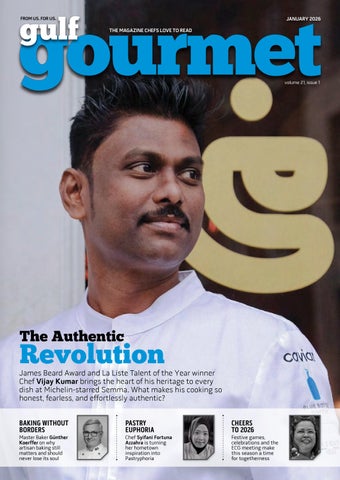
The Authentic
Revolution
James Beard Award and La Liste Talent of the Year winner Chef Vijay Kumar brings the heart of his heritage to every dish at Michelin‑starred Semma. What makes his cooking so honest, fearless, and effortlessly authentic? BAKING WITHOUT BORDERS Master Baker Günther Koerffer on why artisan baking still matters and should never lose its soul
PASTRY EUPHORIA
Chef Syifani Fortuna Azzahra is turning her hometown inspiration into Pastryphoria
CHEERS TO 2026
Festive games, celebrations and the ECG meeting make this season a time for togetherness
PRESIDENT’S STATION
January 2026 Gulf Gourmet
president’sstation email editor@gulfgourmet.org
Dear Members, Friends, and Partners, Welcome to the January issue of Gulf Gourmet. What a way to end 2025. Twenty years of Gulf Gourmet, and the year closed on an extraordinary note. Gulf Gourmet magazine was named Best in the World by the prestigious World Gourmand Award for Best Magazine. The win, belongs to every editor (past and present), every writer, photographer, writer, designer, chef, guild member, partner and reader who trusted us enough to share their stories. That trust is the real award. 2026 is rearing its bright, cherry-red head, and many of us are still snowed under with peak-season work. But amidst the hustle, it is important to spend time with loved ones and recharge. Because as the new year unfolds, we begin with fresh ideas, new energy, and a renewed commitment to shaping the industry we love. On our cover we have Chef Vijay Kumar Semma. His story shows how keeping real, soulful flavours alive while the world watches is possible. That balance between honesty and ambition runs throughout the whole magazine. You will read pieces that remind you why food matters. Günther Koerffer says baking is as much conscience as craft, a line that stuck with me. Our op-ed pieces
from industry experts invite us to start 2026 with intention instead of a list of worn-out resolutions, and to look back on 2025 with full hearts and full plates. This issue is full of curiosity and innovation, be it exploring why a legacy pizza chain is testing automation, rethinking value, imagining a world without food waste, or encouraging us to make sustainability part of the very culture of food. As we look ahead, emerging ideas and developments give a clear sense of the directions the industry is moving in. There is also joy. Our Guild Meeting, holiday pages, and the conversations that happen when people who love food gather. If there is a through-line here, it is community. Great food is not made in isolation. It is made with hands, with care, with ideas shared openly. Our partners and guilds did not just support the magazine; they helped build the pages you are holding. Our contributors did not just write stories; they taught us, argued with us, moved us. We invite you to explore past issues https://issuu.com/gulfgourmetmagazine and emiratesculinaryguild.net to stay updated on events and news. If you have not already, follow us on social media to see what chefs around the world are creating, and perhaps connect with someone who inspires you. As always, if there is something you would like to see in a future issue, send us an email. Let us know what matters to you,
what stories you want told, and what lessons you have learned along the way. If you have any questions about the events, please reach out to us at emiratesculinaryguild@gmail.com Twenty years of stories in this magazine, and we are more inspired than ever. As we look forward to 2026, I want to thank every member, corporate partner, supporter, and friend of the Emirates Culinary Guild. Your trust, collaboration, and contributions make everything we do possible. Wishing you a joyful and prosperous New Year filled with inspiration, success, and unforgettable culinary moments. Culinary regards, Alan Orreal
3
CONTENTS
January 2026 Gulf Gourmet
ggcontents 03
President's Station
President Alan Orreal thanks everyone for last year’s successes and looks forward to an exciting year of events and opportunities
06 10
Friends of the Guild
Turkey, Duck, and Delight
USAPEEC showcased the quality and versatility of U.S. turkey and duck at hotels across the UAE
ICCA Foodverse
Worldchefs officially opened the doors to its Worldchefs Community on Foodverse
14
Baking Without Borders
In a world of mass production and waste, Master Baker Günther Koerffer affirms that baking comes from conscience as much as from skill
18
The Authentic Revolution
Chef Vijay Kumar of Michelin-starred Semma talks about his James Beard win, keeping it real, and putting Southern Indian flavors on the world map
25
Breaking the Resolution Cycle
26
Rewriting the Pizza Playbook
29
A Dream Comes True
Chef Tarryn-Leigh Green explains why 2026 should begin with Intention, not Promises Why is a legacy pizza chain like Donatos betting on automation? And what makes Canadian startup Appetronix pivotal to that shift? Chef Christophe Prud’homme reflects on his new chapter marked by the opening of Gourmet Consultancy
gulf
JANUARY 2026
FROM US. FOR US.
THE MAGAZINE CHEFS LOVE TO READ
volume 21, issue 1
Spice Up Your Life
34
Sustainability on the Menu
36
A Sustainability Rhapsody
39
Rethinking Value
41
We Are Not Dead Horses
42
Pastry Mastery
46
Guild Meeting
50
Membership Directory
58
Simon Says
Revolution
James Beard Award and La Liste Talent of the Year winner Chef Vijay Kumar brings the heart of his heritage to every dish at Michelin‑starred Semma. What makes his cooking so honest, fearless, and effortlessly authentic? BAKING WITHOUT BORDERS Master Baker Günther Koerffer on why artisan baking still matters and should never lose its soul
PASTRY EUPHORIA
Chef Syifani Fortuna Azzahra is turning her hometown inspiration into Pastryphoria
CHEERS TO 2026
Festive games, celebrations and the ECG meeting make this season a time for togetherness
Chef Vivek Huria on daring to explore beyond the familiar Dr. Taghreed Aljaffal on Making Sustainability Part of Culture Chef Carl Shi shares his vision for a perfect world without food waste Sulemana A. Sadik on why Secondary Beef Cuts deserve a place on Premium Menus Some trainings make you rethink everything, writes Chef Tarek Mouriess Chef Syifani Fortuna Azzahra brings her hometown story to life for the Arla Pro Pastry Mastery competition Ho! ho! ho!… the guild members, partners, and supporters gather for a festive celebration
A listing of all the leading food, beverage, and equipment suppliers in the region Simon Martin, Executive Chef at Kerry Taste & Nutrition (Food Service), explores the emerging trends of 2026
CREDITS EMIRATES CULINARY GUILD
EDITORIAL The Authentic
A food-filled farewell to 2025, and a joyful leap into 2026, by Chef Helen Morris
33
Brands that support the Emirates Culinary Guild
12
4
30 Festive Footprints, Full Bellies, and Farewell 2025
Andy Cuthbert Guild Coordinator +971 56 801 4089 emiratesculinaryguild@gmail.com Uwe Micheel Alan Orreal Past President President Andy Cuthbert Editor Amaresh Bhaskaran Associate Publisher amaresh@amareshbhaskaran.com +971 50 456 8161 Vahiju PC Art Director
COPYRIGHT All material appearing in Gulf Gourmet is copyright unless otherwise stated or it may rest with the provider of the supplied material. The publisher accepts no responsibility or liability for the accuracy of any information contained in the text or advertisements. Views expressed are not necessarily endorsed by the editor and publisher. WRITER CONTRIBUTOR PUBLISHED BY SALES ENQUIRY
Shreya Asopa Atim Suyatim Emirates Chefs Guild, Dubai, UAE info@gulfgourmet.org
Cover photo courtesy of Semma
FRIENDS OF THE GUILD
January 2026 Gulf Gourmet
friends of the guild
PROFESSIONAL
6
FRIENDS OF THE GUILD
January 2026 Gulf Gourmet
7
FRIENDS OF THE GUILD
8
January 2026 Gulf Gourmet
TURKEY, DUCK, AND DELIGHT
January 2026 Gulf Gourmet
U.S. Poultry Promotions Highlight
Quality Duck and Turkey Across the UAE
I
n a step to emphasize the versatility of U.S. turkey and duck, the USA Poultry and Egg Export Council (USAPEEC) recently wrapped up a successful lineup of promotional events at six renowned hotels across three UAE emirates—Dubai, Abu Dhabi, and Fujairah. These included Waldorf Astoria DIFC, Crowne Plaza Yas Island, Radisson Yas Island, Miramar Al Aqah Beach Resort in Fujairah, Radisson Blu Hotel Fujairah, and Sofitel Abu Dhabi. From November 28 to December 7, 2025, the ten-day promotion invited guests to enjoy a rich array of recipes, offering the perfect setting to highlight the superior quality of U.S. poultry.
Showcasing Culinary Excellence Collaborating with the Emirates Culinary Guild (ECG), these events aimed to: Elevate Holiday Feasts: Guests enjoyed a symphony of flavors, with U.S. turkey taking center stage in dishes like Whole Roasted and Honey-Glazed Turkey, alongside other creations such as U.S. Duck à l’Orange. Unleash the Potential of U.S. Duck: Chefs skillfully incorporated U.S. duck into their buffet offerings,
10
showcasing its rich flavor profile and superior texture, captivating the palates of discerning diners. Inspire Culinary Innovation: The promotions provided a valuable platform for chefs to experience firsthand the exceptional quality of U.S. poultry, inspiring culinary creativity and encouraging the incorporation of these premium ingredients into their menus.
A Resounding Success The U.S. poultry promotions in the UAE attracted thousands of guests across participating hotels, with an
TURKEY, DUCK, AND DELIGHT
January 2026 Gulf Gourmet
estimated 4,500 attendees. Chefs praised the tenderness, flavor, and exceptional quality of U.S. turkey and duck, with many planning to feature them on their menus and others regularly including them annually in their buffet offerings due to their unique attributes, which outperform other sources of turkey. Guests responded enthusiastically, enjoying the dishes and highlighting their broad appeal. Overall, the events successfully showcased the premium quality and culinary versatility of U.S. poultry, enhancing its visibility and reputation among both chefs and consumers.
■
11
ICCA FOODVERSE
January 2026 Gulf Gourmet
Foodverse Worldchefs’ Community Now Live on Foodverse Your World. Your Voice. Your Face. On December 8, Worldchefs officially opened the doors to its Worldchefs Community on Foodverse, and a new momentum began. In the days since, chefs from across the world have been joining, national associations have started coming on board, and the Emirates Culinary Guild has taken the lead in rallying its members to build an active, connected space for the profession on Foodverse. “This marks an important chapter for Worldchefs,” says Andy Cuthbert, President of Worldchefs. “With Foodverse, we are providing our members a dynamic digital space to build their careers, stay connected, and showcase their work to a global audience. The Worldchefs Community will transform how chefs engage, learn, and participate in the new world.”
A New Home Built for Chefs Worldchefs Community, powered by Foodverse, gives chefs, educators, aspiring professionals, and enthusiasts one place to connect, learn, be discovered, and grow. It is a dedicated ecosystem where personal brands take shape, knowledge travels, and opportunities find the right talent.
12
What’s Inside
What This Means for Chefs
At the center is the Content Hub, the official stream for Worldchefs podcasts, webinars, webcasts, courses, event highlights, and program updates. Around it, members use Foodverse (FV) tools built for real progress:
Community is a career multiplier. On Foodverse, members connect with peers and mentors across borders, stay current with the wider culinary world, and grow visibility through a living profile. Competitions become engines for recognition and feedback, learning becomes a steady habit, and job discovery becomes intentional. It is a single space to showcase your craft, learn with structure, receive meaningful feedback, and build a career that travels.
FV Profile: Make your profile your identity. Showcase your expertise, experience, and achievements so the industry can discover your work. FV Learning: Application-focused development that fits real kitchen life and continuous upskilling. FV Jobs: A verified feed from 20+ global portals to help you explore the next step. FV Mentors: Guidance from seasoned professionals who know the path. FV Compete: Digital-first competitions with transparent judging and real-time scoring. FV Creator Economy and FV Loyalty: Publish, engage, and earn rewards for the value you create. “Foodverse was built with one idea: to support the people who support the culinary world. Partnering with Worldchefs brings that mission to a global community, giving the chefs of the world an ecosystem to grow, connect, and evolve,” says Sunjeh Raja, Director and CEO of the International Centre for Culinary Arts, ICCA Dubai, and Founder of Foodverse.
ICCA FOODVERSE
January 2026 Gulf Gourmet
What This Means for Brands Brands meet a high-intent audience of chefs, students, educators, and enthusiasts. Education-led engagement, competition support, and product-inapplication content help build lasting relationships that lead to real outcomes.
How to Get Started Join the Worldchefs Community on Foodverse. Set up your profile with signature dishes, certifications, and achievements. Follow mentors and peers. Apply to a competition, or share a skill you plan to master. Worldchefs Community now on Foodverse. Your World. our Voice. Your Face.
■
Community I Connection I Engagement Download the app
13
BAKING WITHOUT BORDERS
January 2026 Gulf Gourmet
Baking Without Borders In a world of mass production and waste, Master Baker Günther Koerffer affirms that baking comes from conscience as much as from skill. As he tells Amaresh Bhaskaran, artisan baking is our heritage and worth fighting for
T
o shape glass, you must first let sand lose itself in fire. Baking works the same way. Flour torn apart by water, sugar melted to its breaking point, heat undoing what the cold preserved. Creation begins in the undoing of what was whole, so that something new and delicious can take its place. What does it mean, then, to practice this undoing of art, to be an artisan in an age that mass-produces everything from ideas to pastries? For Günther Koerffer, the answer begins with a return to bread, a humble, fundamental food shared by every culture.
14
career in Germany with flour-dusted hands and a ceaseless passion to create.
Bread has always been about humanity. It belongs to everyone The former President of the European Confederation of National Bakery and Confectionery Organisations (CEBP) and honoree for the 2022 Ambassador of Taste for the Global Gastronomy®, Chef Günther Koerffer, began his baking
Since then, he has traveled far and wide, working in Tel Aviv, Jerusalem, Dubai, Canada, New York, and in Sweden, where he once baked for the royal family. Talking about the memorable moments of his life, he takes us back to the time when he worked at the Waldorf Astoria in New York City. One day, while riding the elevator, he found himself standing next to the former U.S. Secretary of State Henry Kissinger. At that moment, Kissinger had no idea that the young
BAKING WITHOUT BORDERS
January 2026 Gulf Gourmet
man beside him would later be serving him dessert that very evening. "It was one of those surreal moments for me. It felt like I was rubbing shoulders with history," he recalls with a grin. He goes on to recollect another instance when he met Arthur Rubinstein, the world-famous pianist. Rubinstein, clearly in one of his candid moods that night, was not too generous with his praise. "The executive chef looked at me in an instant and asked me to make something special for him." With barely an hour to spare, he rolled up his sleeves and made a dessert shaped like a grand piano, filled it with the finest praline, and served it. Fifteen minutes later, Rubinstein was on the phone shouting, 'Who made this dessert?!" "I had really put my heart into creating it. Still, I went and knocked on his door to apologize. Rubinstein opened the door and asked if I had ever seen a piano before. 'A grand piano lid is hinged along the flat, left side, and you've got it all wrong!' he said. The taste was fine, but the shape was completely off. Then Rubinstein broke into a smile," says Chef Günther, shaking his head and laughing at the memory of a praline piano that hit every note except the right design.
Creation begins in the undoing of what was whole, so that something new and delicious can take its place
If that story did not already win you over, he goes on to share another episode of his career. Together with a team of Swedish bakers, he created an exquisite princess cake to celebrate the
700th anniversary of his hometown. And when King Carl XVI Gustaf married Silvia Sommerlath of Germany, Chef Günther crafted the royal wedding cake.
Years later, for the wedding of their daughter, Crown Princess Victoria, he and his team once again rose to the occasion, creating a majestic 15-tier cake that stood 3.6 meters tall and weighed an astonishing 600 kilograms. Working at such a rarefied level made him acutely aware of trends, opulence, and spectacle, as well as the growing emphasis on authenticity, sustainability, and taste. That cognizance can be tasted at his confectionery café and organic sourdough bakery in Ulricehamn, Sweden. Set up in 1984 in the idyllic lakeside town, the bakery is where, alongside his son, he now serves customers loaves of organic
15
BAKING WITHOUT BORDERS
January 2026 Gulf Gourmet
sourdough, pralines, ice cream, desserts, and cakes. "It is a small, cozy operation of four people in the shop and five in the bakery. We do everything ourselves. Organic flour, organic sugar, organic cream, butter, and even chocolate. I buy wild cocoa beans from Brazil, and we make our own chocolate," he shares. Beyond baking, he sees his role as an Ambassador of Taste. More importantly, he holds the title of The president of the International Union of Bakers and Confectioners (UIBC), a role that “really opened up the world and my eyes to the incredible global passion for baking,” he
There is never shame in being corrected, only in refusing to learn says. He recalls the enormous interest in Asia for his rye sourdough, a recipe made by his grandfather Edmund in 1913. “I remember that while in Dubai, I brought samples of Edmund’s sourdough and
shared them with Chef Jürgen Ellenbeck. Today, Edmund’s legacy is spreading all over the world,” he says, expressing gratitude for the opportunity. For him, sharing knowledge has always gone hand in hand with creating it. He has never been one to chase medals or diplomas; his focus has long been on nurturing the next generation. "People of my age have gifts to offer humanity. Instead of stifling them during competition, we should support the growth of these young chefs. We are in an age where we have a certain kind of knowledge that we must pass on," says the 71-year-old, who continues to be a passionate learner. If a young baker stands up to him and says he is wrong, he does not take offense; he takes interest. "I like those people, because once, I was the same. I can tell, just by a glance or a tone, when someone's perspective holds truth. And if they are correct, I will accept it and even apologize. There is never shame in being corrected, only in refusing to learn." He judges competitions with that same fairness. "I always give honest points," he says. "But when I tell someone, 'Try it this way,' and they insist I am wrong, I listen and discuss. Because there is not just one right way to do things. Experience teaches you one truth; curiosity teaches you the rest." Mass-produced bread, he believes, has been stripped of story. But for Chef Günther, every loaf still carries a conscience. "People buy bread from supermarkets without knowing what's inside. They visit a bakery only for special occasions or celebrations. Of course, as the world grows, artisan bakeries and confectioners cannot meet all demands without the support of industry. But make sure you bake with conscience," he explains. He further adds, "We actually have too much food waste coming from the industry. If you visit a supermarket,
16
you will see miles of bread on the shelves. Customers would not choose yesterday's bread come morning; they opt for fresh loaves, leaving perfectly good bread to be discarded." It is an image he finds difficult to reconcile with a world where so many still struggle with hunger. "We throw away what others could live on. We have to put more soul into the products we make. We must remember there is a farmer behind every grain of flour," he insists. He laments that most consumers can no longer tell the difference. "With so much of it mass-produced, people think all bread is the same. They believe bread is bread. Bakers have a responsibility not only to bake, but to educate customers. To share the truth about what they are really buying." Ask Chef Günther about the state of baking today, and he does not hesitate. "The artisan baker is coming back," he says with conviction. Yet he admits it is not a simple revival. "Unfortunately, it seems to be more of a trend in the Nordic countries right now. They are not going to make a return like they have in big cities, where it is treated like fashion. In urban areas, people can easily step into an artisan
BAKING WITHOUT BORDERS
January 2026 Gulf Gourmet
People of my age have gifts to offer humanity. We must pass that knowledge on bakery and buy excellent bread. The reality is that there is still room for bakers, and for artisan confectioners too. And it will increase. But it is expensive, and we do not yet have the skilled bakers for it." Which is precisely why he has turned his attention to educating the next generation. "Right now, even in Europe, bakery schools use materials from the 1950s and 1960s. You need to be updated. We need to equip schools with the right tools to educate young talent," he shares. To bridge that gap, he created a modern resource: a multimedia book on baking, complete with QR codes linking to videos and visual guides. "This book has recipes and pictures, and it serves a purpose beyond just
traditional baking. They can learn how to temper chocolate or make a mousse. The book is now used in Malaysia, Vietnam, and Taiwan, connecting classrooms and kitchens across continents. It is about giving back to the community." His indefatigable love for artisan bakery espouses the cause of baking without politics. "Baking Without Borders is about sharing knowledge and bread. Bread has always been about humanity," he pauses, articulating what he has long felt. "It belongs to everyone. We are one big family, even in a divided world. Something as simple as bread can bring us back to the table together."
■
17
COVER STORY
January 2026 Gulf Gourmet
The Authentic Revolution “Tonight, Indian cuisine stands tall. Tamil food stands tall. My food stands tall..,” said Chef Vijay Kumar in his James Beard Awards speech. The executive chef and coowner of Michelin-starred Semma has led a metamorphosis of Southern Indian flavours, bringing snail curries, benne-style dosas, and tamarind crab to the global stage with intention, emotion, and a smile for those who once doubted him. In a conversation with Shreya Asopa, he discusses staying authentic in a world that rewards spectacle
C
urry leaves, modest and usually disregarded, are anything but inconsequential to Chef Vijay Kumar. “Many dismiss them as mere garnish,” he remarks with a knowing smile. “But in a South Indian dish, they are the heartbeat. They bring aroma, warmth, and no ostentatious spice can replicate them. They stimulate your appetite.” At Semma, his Michelin-starred restaurant in New York’s West Village, these unassuming leaves are just one of many ingredients carrying memories of his childhood and heritage. “Think about what you ate as a child…what your mother and grandmother fed you. That is the heart of cooking,” says Chef Vijay. This vision of unpretentious cooking materializes in every dish at Semma. The restaurant, whose name means fantastic in Tamil, debuted in October
18
COVER STORY
January 2026 Gulf Gourmet
Semma Interior; Photo Credit: Will Ellis
2021. Launched by the Unapologetic Foods team, with Chef Vijay and his partners Roni Mazumdar and Chintan Pandya at the helm, it diverged sharply from prevailing gastronomic trends, eschewing butter chicken and truffles in favour of humble ingredients and the unedited piquancy of home. This closeness to home even extends to how he runs his kitchen. A calm, hands-on presence, he believes people cook their best when they feel like family. “When I give advice, it should feel like your brother guiding you toward what is best. That is how you build trust and a family bond. I do get frustrated at times, but at the end of the day, it is all about family. In any family, disagreements and challenges are inevitable, but the goal is to create a space where everyone feels valued and connected.”
grew what they needed, traded with neighbours, hunted, fished, or foraged.
There is no poor man’s food or rich man’s food. It is just food… Operational consistency and culinary exactitude are non-negotiable for him, as is respect for the people behind each dish. “Give the team clarity. Let them know not only what is expected, but why. I am lucky to work with a multicultural team that understands the concept and brings it to the dishes.” For someone raised with humble means, sustainable practices came naturally. Growing up in Natham, in the Dindigul district of Tamil Nadu, Chef Vijay learned early that every ingredient mattered. His father held a government job, while his mother tended to the family farm. “What I am doing now seems to be in fashion, but my meals were always based on sustainability,” he recalls. There were no butcheries or speciality shops. His family
“When rice ran short, I foraged for snails with my grandmother and helped her cook them in tangy tamarind sauce with coconut. The smell of mud, the taste of fire… nothing was wasted. My mother and grandmothers spent hours preparing feast after feast. Even on tough days, food connected us and made me respect them more than words ever could.” At school, kids teased him for the food he brought from home. It was a small thing, but it stayed with him. “People do not realize how easily we judge. What someone eats, what they wear, the little choices,” he says. “Discrimination shows up everywhere.” He wishes for a world with more kindness, where people check themselves before pointing fingers. Food, he believes, can be a powerful catalyst for that. It is why he said in his James Beard speech, “There is no poor man’s food or rich man’s food. It is just food…” It is no surprise that many of those childhood dishes now find their way
19
COVER STORY
January 2026 Gulf Gourmet
Semma Exterior; Photo Credit: Will Ellis
Photo Credit: Eliesa Johnson
Photo Credit: Eliesa Johnson
Photo Credit: Jeff Schear
Roni Mazumdar, Chintan Pandya, and Vijay Kumar; Photo Credit: Erin lettera
20
Gunpowder Dosa; Photo Credit: Paul McDonough
COVER STORY
January 2026 Gulf Gourmet
Photo Credit: Semma
Photo Credit: Semma
Gutti Vankaya; Photo Credit: Paul McDonough
Nathai Pirattal (Snail); Photo Credit: Paul McDonough
Paniyaram; Photo Credit: Paul McDonough
21
COVER STORY
January 2026 Gulf Gourmet
onto Semma’s menu. Nathai Pirattal (snail curry), Uzhavar Santhai Poriyal (stir-fried seasonal vegetables), Kudal Varuval (goat intestines), Mulaikattiya Thaniyam (sprouted moong), Valiya Chemmeen Moilee (lobster curry), and the Gunpowder Dosa all carry the same DNA of memory, resourcefulness, and unapologetic flavour.
The Long Road to Finding His Voice When engineering school seemed financially out of reach, a teen Vijay joined the Institute of Hotel Management in Trichy. His ambitions were briefly stymied before finding a new direction. In retrospect, he says with a smile, “I guess it was all meant to happen this way.” His first break came at Chennai’s Taj Connemara, where he mastered the execution of a bustling service. Three years on a cruise liner came next. The long days at sea, with their rigid routines, left little room for creativity. Unfortunately, when his father passed away, Chef Vijay returned home to tend to family responsibilities. Not long after, a friend offered him the chance to move to the United States, and in 2007, he moved to chase the American dream. “When I first arrived, it was like stepping onto another planet.” The culture shock was immediate, amplified by a language he had not grown up speaking. “My English was functional. Not perfect, and I have an accent. But people understood me, and that was what mattered,” he recalls, a mix of trepidation and determination colouring the memory. In California, he spent thirteen years refining his craft, first leading the kitchen at San Francisco’s Dosa and later at Rasa in Burlingame. “I cooked contemporary Indian food in the initial years. You start by adapting to the market. You cannot make changes overnight. You do not shake the boat, you adapt to stay afloat,” he says, amused at his pragmatism.
22
Photo Credit: Clay Williams
People cook their best when they feel like family The clarion call to cook dishes rooted in his family’s ingredients arrived when he met Roni Mazumdar and Chintan Pandya of Unapologetic Foods. A casual conversation about the lack of good South Indian food in New York suddenly turned serious. “We should do something about that,” he said, and Semma was born. “I always wondered how long we would continue living inside someone else’s mold, apologising for our cuisine. Everyone wants to please Western tastes. But if we keep bending, nothing changes. And if nobody starts, then who will?” The industry’s vociferous dogmas were pervasive. Indian food, he explains,
was often described as too spicy, too traditional. Amid the culinary sermonising and reductive stereotypes that tried to shrink India into a handful of familiar dishes, Chef Vijay, in effect, said, hold my dosai maavu. In 2022, Semma earned its first Michelin star and has retained it since. Last year, The New York Times named it the number one restaurant in New York City on its 100 Best Restaurants list.
Rice and the Realities Behind the Spotlight When you ask Chef Vijay to pick a favourite dish from his menu, he smiles enigmatically, giving away everything and nothing at once. “Instead, I can share one of my comfort foods. Being South Indian, I could eat rice every day. All I really need is rice and a little bit of curry or sambhar to go with it, and it becomes a satisfying meal,” he says with an easy grin. His workdays are long and consuming. Celebrations, festivals, birthdays, everything blurs into the everyday
COVER STORY
January 2026 Gulf Gourmet
I always wondered how long we would continue living inside someone else’s mold, apologising for our cuisine flow of running the restaurant. “That is why I usually say I am only married to my restaurant,” he says. “You need a different muscle in this industry. Timing is everything. Miss the mark, and you miss too much.” Sacrifice, he explains, is simply part of the job, like chopping onions until your eyes sting, then showing up the next day to do it again. He has not been home in the last five years. Video calls try their best, but pixelated hugs cannot replace the real thing. Success may look loud from the outside, but there is always a story you do not see. “My dad passed away, and it has been hard,” he says quietly. His mother, sprightly in spirit, still works most of the time on their family farm. “She begins before sunrise, finishes the housework, and then steps into the fields. She refuses to let time tell her what she can or cannot do. My siblings are all busy with their own lives now. We are four siblings. Growing up, the house was always full of noise, arguments, laughter,” he recalls. Last year, brown was reborn in Mocha Mousse. Pantone, famous for its colourmatching system, selected the shade because it challenged the humble perception of the colour and asked us to recognize its sophistication. This year, it selected Cloud Dancer, a shade of white that speaks of resetting from toxicity, finding simplicity, minimalism, and a fresh beginning in a world that rarely slows. White is no stranger to chefs. The colour of the coat holds
discipline, professionalism, and the potential of creation. For Chef Vijay, this theme of simplicity fits perfectly; in his cooking, in his quintessential nature, unassuming even in front of the media or when Semma received several critical accolades. “I am always focused on cooking,” he says candidly. “Chef Chintan and Roni always supported me. I still remember when they first approached me, and I explained to them about cooking dishes straight from my childhood.” And after topping The New York Times list, La Liste's Talent of the Year, and winning the James Beard, expectations may balloon into something ridiculous. There is pressure that makes you forget sleep exists. For Chef Vijay, though, an outlier and now a self-made name, he goes the whole nine yards out of love, not out of pressure. Success, he believes, is something you borrow, not something you own. “These honours do not belong to me. They belong to my team, to my home, and
to South India. They belong to the art of cooking itself,” he says, adding he feels a great responsibility to continue pushing things forward. Before we part, he gives a few pointers to young chefs. “Do not give up. There will be days when you wonder why you are doing this at all. When the kitchen heat feels like it is cooking you from the inside out, the hours are too long, failures mount, and there are no instant results. 25 years in this industry, and I have had more than a few of those days. But I never quit. Learn from obstacles, and think about doing things better the next time. And keep going.” Chef Vijay has inspired teenagers to dream, as he did, attesting that a future can be built on authenticity. Only a handful of chefs can make you feel daring enough to be yourself. In this age of flamboyant Instagram trends, he asks young chefs to give their dreams time, give it heat, give it heart, so that one day, when you wake up, you find your efforts have turned the unexpected into Semma. Absolutely fantastic!
■
23
RAISING THE BAR
January 2026 Gulf Gourmet
Breaking the
Resolution Cycle
Chef Tarryn-Leigh Green explains why 2026 should begin with Intention, not Promises
E
very year, as the calendar flips and we usher in another New Year, many of us fall into the same ritual: setting New Year’s resolutions with earnest optimism, only to abandon them within days or weeks. We vow to ‘get healthier,’ ‘work harder, ’ or ‘finally do the thing we have always wanted,’ yet the cycle repeats with striking predictability. The well-worn saying, often attributed to Rita Mae Brown, that “insanity is doing the same thing over and over again and expecting different results, exemplifies the irony of this tradition. Popular as it is, it is not actually by Albert Einstein and originated in Brown’s 1983 novel Sudden Death through a fictional character, Jane Fulton. Despite frequent misattribution, it perfectly captures the paradox of annual resolutions that rarely yield lasting change.
physical strain, and relentless hustle, such as hospitality, food and beverage, and culinary arts. Research and anecdotal evidence alike point to the intense stress experienced by chefs and kitchen staff, with high-pressure environments, long hours, and inadequate rest contributing to poor work-life balance and stressrelated health risks. While specific global life expectancy statistics for chefs versus the general population are limited and vary in credibility, one oft-quoted figure suggests that chefs' average life expectancy may be significantly lower than the global average, with one industry source claiming an average of around 57 years. In contrast, modern global life expectancy at birth for humans in developed contexts typically ranges from the late 70s into the 80s, depending on country and socioeconomic factors.
This ritualistic setting of goals becomes a sort of cultural script: we follow it because we always have. But what if 2026 was the year we break this pattern, not with the usual list of sweeping goals, but with intentions that ground our commitments in day-to-day reality? What if we started the year by deciding how we want to live rather than what we think we should achieve?
While this chef-specific statistic should be interpreted cautiously, it underscores a broader truth that the very bodies and minds that sustain long careers are often neglected in industries that demand so much from them.
The distinction between goals and intentions matters. Goals are often outcome-focused, distant, and framed in absolute achievements: “I will lose 10 kilograms,” “I will launch that product,” or “I will double my income.” Intentions, on the other hand, are about process and presence: the intention to be more mindful of how we spend our time, to protect our mental energy, or to create space in our lives for balance. This shift is particularly urgent in professions that glorify long hours,
What is clear is that poor mental health, burnout, and physical strain are persistent issues in F&B workforces, and systemic change will require not just industry-level reforms, but individual action. For that change to stick, it has to start with how we approach the year, not with arbitrary resolutions, but with thoughtfully chosen intentions. Intentions such as being more protective of our time, pushing back when excess demands threaten our well-being, and expecting better from our employers and ourselves are transformative. They recognise that career passion and personal life are not separate silos; they are deeply intertwined, and without conscious
balance, both suffer. For longevity and happiness, we must guard against the burnout that comes from relentless grinding; rest is not optional, it is essential. So here is a challenge for 2026: discard the old model of resolutions and replace them with intentions that align with who you truly want to become. Set small, measurable daily aspirations that build confidence and momentum. Rituals that evolve week by week and month by month into substantive change. The shift from ‘I must achieve X’ to ‘I intend to act with purpose each day' is subtle but powerful. Lead your life on your terms, not according to outdated norms that prioritise productivity over well-being. Whether it is stepping into that job you have dreamed of, nurturing your health, asking someone out on a date, taking a long-overdue holiday, or seeing that concert you have always wanted to attend, take the present moment with both hands. There is no rewind button, only forward motion. Leave regrets behind and minimise new ones. Let 2026 be a year defined not by forgotten resolutions, but by intentional choices that bring you closer to the life you envision. After all, “if you simply do the thing they say you cannot do, it is already done. The sentiment of doing what others deem impossible is the first step toward real achievement. Progress does not come from intention alone, but from the courage to take the first step quietly, consistently, and on your own terms.
■
SOURCES: > Chefs, Commercial Kitchens, and Stress: Could Socio-Demographic Factors such as Personality, Age, and Gender Influence the Stress Level of a Chef? https://worldchefs.org/chefs-commercialkitchens-and-stress-could-socio-demographicfactors-such-as-personality-age-and-genderinfluence-the-stress-level-of-a-chef > https://en.wikipedia.org/wiki/Longevity
25
PIZZA PLAYBOOK
January 2026 Gulf Gourmet
Rewriting the
Pizza Playbook
Why is a legacy pizza chain like Donatos betting on automation? And what makes Canadian startup Appetronix pivotal to that shift? A closer look at the tech, economics, and emerging future of robotic food production By Shreya Asopa
I
f a robot could make Nipun Sharma’s favorite comfort food, it would be a Mexican burrito bowl. “It is messy, flavorful. You can choose your protein, guacamole, and fresh salsa. It is something you would want after a long day,” he laughs. Not that this is just a what-if. Appetronix is building fully automated kitchens capable of preparing Mexican burrito bowls, Asian noodle bowls, cookies, and pizzas. Founded by Nipun Sharma, Appetronix specializes in robotic kitchens. The company partners with restaurant brands to deploy fully autonomous kitchens. In June 2025, it teamed up with Donatos Pizza and Agápe Automation to open a robot-operated restaurant at John Glenn Columbus International Airport. The company’s ambitions have been backed by investors. Appetronix has raised over ten million dollars in total funding, including six million dollars in a recent seed-plus round led by Jim Grote, the Grote family, and AlleyCorp, marking AlleyCorp’s third investment in the startup following strong performance in previous rounds. Interestingly, Appetronix’s technology did not originate in restaurant playbooks but in industrial food factories built to produce meals on a massive scale. “The goal was to build a miniature food factory into an autonomous system designed to handle repetitive tasks. We did not start with a hammer looking for a nail,” he notes. The team envisioned the final dish and rethought the back-of-
26
Quality and consistency are the foundation of the guest experience house operations around it. “We realized it did not make sense to spend millions retrofitting a kitchen. Instead, we imagined operating like a sustainable, approachable, 24/7 vending machine.” Collin Sanders, Executive Director of NonTraditional Business at Donatos, says their nontraditional footprint with Appetronix has been an incredible experience for the brand, full of key learnings for both our automation and guest journeys. “We were able to leverage our 60-plus years of restaurant production and efficiencies and apply automation to them. While the market is getting crowded with new pizza vending machines using frozen or premade pizzas that are held for an extended period of time, Donatos, through their partnership with Appetronix, was able to produce the same pizza their guests know and love, made fresh to order in just over six minutes.” The autonomous line handles dough, sauce, cheese, and toppings with weightbased accuracy while machine vision cameras analyze each pizza for symmetry, coverage, and quality. Thermal and sensor-driven controls govern the bake cycle, ingredient levels, and sanitation,
allowing human teams to focus on creativity and hospitality. “The machine does the monotonous work; humans do the meaningful work,” says Nipun. But critics point out the vulnerabilities of such systems. Robotics requires constant tuning, preventative maintenance, and intervention when variables shift. Without a strong support infrastructure, downtime can erase the efficiency gains automation promises. Nipun does not deny the fragility, arguing instead that automation succeeds only when it is treated as an evolving system rather than a one-time installation. He points to the ecosystem behind the machines. “More than ten manufacturing partners collaborated with us, many who later invested, plus Appetronix’s in-house engineering bench. It took us a village.” That breadth of support helped Appetronix overcome skepticism when it approached The Grote Company, a sister firm to Donatos. Persuading a stalwart to adopt a young startup’s robotics was far from presumptive. “They had everybody in the world approaching them. But they saw the discipline in our engineering. They saw the team we had built, and they gave us a chance.” The surprise was not that the system worked, but how well it worked. “Jim Grote himself remarked that the pizzas tasted just like those produced in their traditional restaurants, and customers liked the taste as well,” Nipun recalls. For Donatos, the value extends beyond operational efficiency into brand protection. “Quality and consistency
PIZZA PLAYBOOK
January 2026 Gulf Gourmet
are key to the guest experience,” says Collin. “Technology will not only make us more consistent, but it also lets us meet guests where they already are, across both ordering and in-store experiences. Even so, the economic momentum behind food automation is unmistakable. Restaurant profit margins hover around a precarious 5%, and the recurring challenge of labor shortages continues to alter the quick-service landscape. Automated kitchens require high upfront costs but can cut operating expenses by up to50% through labor savings and reduced waste. For example, U.S. pilots show that robot servers leased at around $11,700 can replace two part-time workers costing about $33,000 per year, yielding roughly 80% ROI in three years, while larger robots purchased at $21,600 can return about 124% ROI. Containerized QSR kitchens, which cost thousands of dollars, offer 24/7 operation and precise portioning, generating significant operational savings. Industry analysts note that although the initial investment is higher, payback often occurs within 1–3 years in high-volume settings. Robotics, Nipun argues, offers stability. “When no orders come in between 2 p.m. and 4 p.m., we shut the system down to save energy,” he says. “When it comes to food waste, automation regulates portion control. Food waste becomes a solvable problem. With predictive AI, too, we can understand sales, factors such as weather and events, and plan inventory. Based on early pilots conducted by Appetronix, such systems can virtually eliminate kitchen waste and cut labour costs by 70-80%. Each unit, Nipun notes, can generate revenues comparable
to a traditional QSR outlet, between $750,000 and $1.5 million annually. Donatos echoes this logic. Collin sees automation as a structural advantage rather than a novelty, incorporating it into both traditional and nontraditional operations. “Anytime we can improve the quality of our associates’ work environment while enhancing the guest experience, that is a win. A great example, recently we onboarded all company stores to an artificial intelligence-based ordertaking platform. Guests who choose to call in will place their orders through an artificial intelligence platform. This allows our associates to focus on making great pizzas and our guests’ day a little better,” he says. Meanwhile, concerns about job loss are common, but reskilling programs and new technical roles in programming and system support can help offset disruptions. A PwC survey found that around 41% of Middle East workers worry automation could replace their jobs within three years. Experts, however, argue that robots generate “knock on” demand for human roles, such as training robots, monitoring systems, and providing technical
support. Globally, up to 44% of workers’ skills may be disrupted by 2028, prompting Gulf countries to launch large-scale reskilling initiatives. Nipun believes automation will ultimately enhance the value of culinary talent. “Robots may dominate standardized production, but chefs create atmosphere, celebration, and connection. Technology supports that. It does not replace it.” As Appetronix expands beyond Canada and the U.S., its immediate priority is the Middle East. In the UAE alone, the service robotics market is projected to reach about $2.5billion by 2030, growing at roughly 15 percent annually. The Donatos automation launch points to a bigger change in food automation. Legacy brands and modern robotics collab shows a space exists for heritage to tech without eroding identity. Whether such integrations endure will be decided not by spectacle, but by one of the most unforgiving metrics of all, taste. “The machines may draw attention, but the real achievement is operational discipline. People notice the taste first. The technology is invisible, but it keeps the taste consistent,” concludes Nipun.
■
REFERENCE: > Hyper Robotics. (2024). Why autonomous fast food is reshaping the future of cook-in-robot technology. Hyper Robotics.https://www.hyper-robotics.com/knowledgebase/ why-autonomous-fast-food-is-reshaping-the-future-of-cook-in-robot-technology/ > Culinary Services Group. (2024). Robotic food servers: Labor cost savings and ROI. Culinary Services Group. ( Robotic Food Servers Beneficial in Residential Healthcare Settings, Case Study - Culinary Services Group) https://culinaryservicesgroup.com/robotic-food-servers > Arab News. (2024, October). Middle East workers worry about automation – PwC survey. Arab News. (Can robots stick with humans and not take their jobs?) https://www. arabnews.com/node/2185606/business-economy > World Economic Forum. (2024, November). 3 lessons from the Middle East’s reskilling revolution. World Economic Forum. https://www.weforum.org/stories/2024/11/3lessons-from-the-middle-east-s-reskilling-revolution > Ken Research. (2024). UAE service robotics market outlook 2030. Ken Research. (https://www.kenresearch.com/uae-service-robotics-market)
27
A DREAM COMES TRUE
January 2026 Gulf Gourmet
A Dream Comes True Chef Christophe Prud’homme reflects on his new chapter marked by the opening of Gourmet Consultancy
S
ome dreams are quietly planted, nurtured over years, growing stronger with each experience, challenge, and lesson learned. For me, the realization of Gourmet Consultancy is more than a professional milestone; it is the harvest of a lifetime devoted to culinary passion, dedication, and reflection. My journey began in Normandy, France, surrounded by family, fields, and kitchens where sharing and generosity were at the heart of daily life. With my parents, siblings, and later my own family, I learned the joy of planting seeds, helping in the garden, tending to crops, and sharing the fruits at the table. These moments taught me patience, care, and the power of nurturing: lessons that would shape not only my culinary philosophy but my entire life. The farm-to-fork approach, the connection from soil to plate, became a guiding principle long before I knew it would define my career. The seeds of my journey were planted early through the values instilled by my parents: dedication, integrity, and love for one’s craft. My wife and two children have been my steadfast supporters, allowing me to pursue my path with courage and conviction. Over the years, I learned that sometimes you must choose your own road, follow your instinct, and build yourself, even when advice or obstacles suggest otherwise. It is in taking those risks, in daring to fall and then rise, that true growth and resilience emerge. From Normandy to Paris, London, Dublin, Egypt, and now Dubai, every experience added a seed to my growing garden. Rigorous training, challenging
Resilience is built through patience, reflection, and belief in your vision kitchens, leadership under pressure, and moments of reflection all contributed to the fruits of my career. Recognition, including Master Chef of France for the Middle East, Chef of the Year, Chevalier de l’Ordre du Mérite Agricole, and my role as Ambassador for Normandy. These honors are not just my achievements but the heritage, mentors, and friends who supported me along the way.
Today, Gourmet Consultancy is the culmination of decades of dedication. Every seed - heritage, travels, education, friendships, and professional experience- has grown into a vision where passion, creativity, and quality converge. It embodies the spirit of sharing I learned in my childhood: planting, nurturing, and enjoying the harvest with others. From farm to fork, from roots to table, it reflects the culmination of 35 years of globetrotting around stoves, learning, and daring to follow my own path. This dream celebrates heritage, family, reflection, and courage. It honors the joy of sharing, the wisdom of resilience, and the power of nurturing both people and ideas. A dream comes through, and it is only the beginning.
■
29
FESTIVE FOOTPRINTS
January 2026 Gulf Gourmet
Festive Footprints, Full Bellies and Farewell 2025 A food-filled farewell to 2025, and a joyful leap into 2026, by Chef Helen Morris
F
short European escape, perhaps Vienna, wandering through its glorious markets, then hopping on a train to Salzburg, because honestly, how could anyone not love Austria? Super cool sophisticated streets, classical music floating through the air, and sausages taken very, very seriously. But mid-daydream, a thought struck me - What am I doing? I am in the UK. I am heading to London. And what better way to embrace festive madness than the mighty capital itself?
irst things first, a very prosperous New Year to all the readers! May 2026 arrive fashionably early, overdeliver wildly, and fulfil all your dreams, preferably without requiring a five-year plan, a spreadsheet, or a green juice cleanse. Although we are officially welcoming the shiny, optimistic New Year, I still have some unfinished business with 2025, namely my festive escapades in the UK during December. And while December usually finds me elbow-deep in mince pies and festive markets, this year I missed something monumental, something I have not skipped in a very long time, the fabulously striking Madinat Jumeirah Festive Market. Do not ask me why, but that place makes me feel all warm and fuzzy inside, like I have been wrapped in a spice-scented cashmere blanket. It flips the festive switch instantly. I beam like a child who has just been given their first bike, minus
the tantrums and with significantly more calories. And let us not forget the hotels, dazzling to within an inch of their lives, twinkling like they have personally offended electricity bills everywhere. Tick, tick, tick. Love, love, love! But alas, due to visitors and an early exit to the UK, I had to seek my festive cheer elsewhere. I briefly contemplated a
London, I am happy to report, did not disappoint. I absolutely adore being a tourist in the Big Smoke, looking up at buildings I have never seen architecture like this before and stopping to photograph lights I have definitely photographed many times in previous years. The markets sparkled, the streets glowed, and the grand dames of hospitality, The Dorchester and The Ritz, stood proudly in their understated festive elegance. No screaming tinsel or inflatable Santas here, just refined glamour quietly whispering, “Yes, we are festive, but we are not shouting about it.” Then it was time for something a little closer to home, Manchester, where northern hospitality reigns supreme. Honestly, there is nothing like it. Random conversations with strangers, cheerful banter that escalates quickly, and charity volunteers dancing their hearts out to festive tunes like nobody is watching (even though everyone absolutely is). It is impossible not to get swept up in the joy. You arrive for a stroll, immerse yourselves in the stands and leave with a smile, a full stomach, and at least three opinions about the weather.
30
FESTIVE FOOTPRINTS
January 2026 Gulf Gourmet
As we close the chapter on 2025, let us fling open the doors to an exciting 2026 Now, let us talk about the real star of December, yes, I know, as always, the food. Because yes, there is always food. The street vendors did not come to play. First up, a classic Bratwurst because traditions matter and sausages are serious business. Then a proper British Yorkshire pudding, stuffed to the brim with pulled meat, veggies, and gravy, all heroically pressed into a wrap. An absolute hot favourite and very Instagrammable. I felt a slight pang of guilt as I noticed two vendors, one to the side and one opposite, watching my nephew's choice with longing as their queues dwindled. I avoided eye contact and focused on the dripping gravy. Then came hash browns and chicken tenders with sweet chilli sauce and Asian slaw. And honestly, hash browns are universally loved. They unite nations. They heal divides. This one did not disappoint. Add to that a ‘meat in blankets’ cheese toasty, chicken with mustard, and a glorious tartiflette, and suddenly we were waddling rather than walking through Manchester’s festive streets. For the record, these delights were shared. Mostly. Generously, Ish. London brought a slightly more sophisticated flavour to the festivities. Enter bao buns, soft, pillowy clouds of joy filled with tender meat, cucumber, and hoisin sauce. I could happily eat these every single day and never once complain. Absolute food in heaven. One of my favourite ritual stops is Fortnum & Mason, not for the towering, branded
boxes of festive treats (tempting though they are), but for the cosy little beverage bar on the lower ground floor. I sit at the counter, far from the festive frenzy, order a sparkling drink and a charcuterie platter, and sigh with deep contentment. One floor above me, chaos reigns, people negotiating their next move like it is competitive chess, racing to grab items before shelves are stripped bare. Down below? Calm, small bites, and bliss. Beyond the markets, December was filled with plenty of dining out locally and comforting home-cooked meals. As I have mentioned before, we are incredibly lucky in our hometown; we have three butchers and a bakery. It is practically a love letter to carbohydrates and protein. I spend far too much time happily perusing locally sourced meats, chatting with butchers who speak about their products with genuine pride and passion. Even better, they now have someone baking a variety of utterly succulent pies on the premises. Truly dangerous. A visit there guarantees two things: happiness and a noticeably lighter, much lighter, wallet.
So, there we are. December, I adore you. The lights, the laughter, the food, especially the food, and the joy you bring. As we close the chapter on 2025, let us fling open the doors to an exciting 2026, a year of saying yes to everything. Well… almost everything. If someone suggests a bungee jump, that is a very festive, very firm NO. Wishing you a very prosperous 2026!
■ 31
Aqua Coco Cocut Water
Alpro Cocut Drink
Andros Fruits
Pure Indulgence in Every Sip Immerse yourself in the creamy blend of Alpro Coconut Milk and refreshing Aqua Coco Coconut Water, garnished with the vibrant sweetness of Andros Fruits. A luxurious, revitalizing treat in every glass.
SPICE UP YOUR LIFE
January 2026 Gulf Gourmet
Never Settle for the
Comfort Zone Chef Vivek Huria on daring to explore beyond the familiar
I
another way to challenge myself, another way to grow.
begin this year with a series titled "Spice Up Your Life." It is written for chefs at every stage, from young chefs just starting to senior chefs who have been in the industry for years. No matter where you are, the challenge is the same. You get comfortable and settle into one role, one routine, one identity. At first, it feels safe. Over time, burnout creeps in, and you hardly notice it until it hits you hard. In this series, I want to discuss how chefs can avoid getting stuck with just one option. How can we keep growing without walking away from the profession we love? We will also talk about burnout, keeping curiosity alive and giving yourself permission to do things differently without guilt or fear. We all know the line: "When one door closes, another one opens." The real question is whether we have the courage to walk through that new door. After almost 20 years in the UAE, I recently had a moment of clarity. I realized that only about seven were spent working fulltime in hotel kitchens as an executive chef and a corporate executive chef. The rest of my career in the UAE has been in sales, marketing, entrepreneurship, and relationship building. That was never part of a master plan. It just happened because I stayed open to opportunities I did not fully understand at the time. Each challenge made me stronger and confident. I still remember that when I was considering stepping outside the kitchen, I asked my mentor, Chef Bruce Woolner, whether it was the right move. He told me, You will come out as a different person. He was right. And the truth is, each new door I have walked
Sales and marketing are harder than they look. You have to be patient, persistent, and honest. Sometimes, being honest is the best marketing strategy. I have walked into meetings where clients said no, and I let it go. It does not mean abandoning what you know. It means using your skills in new ways, applying your experience, and testing yourself in uncomfortable ways. I stood my ground, and eventually they came back to place an order.
Staying curious and open is the best way to keep moving forward through has done exactly that, helped me grow in ways I never imagined. For the past 4 years, I have been running my restaurant. It has been rewarding, but, like anything you do for a long time, it can start to feel predictable. It lulls you into thinking you no longer need to push yourself. So I decided to spice things up and bring more flavours into my life. I have recently partnered with Hearty Mart, which manufactures essential Indian spices like chilli, coriander, and turmeric. It was not a career switch. It was simply another door opening,
Most burnout comes from doing the same thing for too long without growth. Be curious and ask yourself, What else can I do? What am I missing? Maybe there is a part of you that loves teaching, consulting, managing brands, or mentoring younger chefs. I split my time between managing the spice business in the first half of the day and running my restaurant in the second half. Both keep me engaged, and I find joy in what I do. If you never explore, you will never find it. As I turn 60 this month, it has made me realise that staying curious and open is the best way to keep moving forward. In the next parts of the Spice Up Your Life series, we will look at practical steps chefs can take to stay engaged while experimenting with marketing, sales, and relationship-building. Till then, do not wait until you are exhausted or frustrated to change something. Keep testing yourself. To be continued..
■ 33
SUSTAINABILITY ON MENU
January 2026 Gulf Gourmet
Sustainability
on the Menu Dr. Taghreed Aljaffal on Making Sustainability Part of Culture
I
t is a fully booked weekend night. The pass is crowded as orders come in rapidly. The pressure is ON! In this moment, true sustainability is not a certification or a line in a policy document. It is culture. It is really how preparation has been planned, how fairly the workload is distributed and how the team communicates under stress. This is where sustainability lives and thrives, or quietly disappears. In professional kitchens, particularly in five-star operations, sustainability cannot survive as an added task on top of already tough environments. When treated as compliance, it is often the first thing sacrificed during peak service. But when sustainability becomes genuinely embedded into leadership behaviour, daily routines, and the shared values of the crew, it strengthens performance rather than slowing it down. Kitchens that last are not built on rules alone; they are built on people, systems, relationships and practices that endure pressure. In Gulf kitchens, where multinational teams operate under global luxury standards, culture becomes the only system strong enough to hold service together under pressure. True sustainability in hospitality goes beyond just being environmentally responsible. It involves creating kitchens that promote excellence, retain talent, and respect culinary identity. When sustainability becomes a part of the culture, it transforms from a mere obligation into a foundation for consistency, quality, and long-term success.
Leadership Sets the Temperature In high-pressure kitchens, leadership
34
becomes most visible when things go wrong (a delayed delivery, a broken piece of equipment, an understaffed service). Challenging times reveal whether sustainability is genuinely integrated or merely a facade for greenwashing. Teams quickly discover if the standards are consistent or negotiable during stressful situations. From an organisational perspective, leadership behaviour is one of the strongest determinants of workplace culture and staff retention. In hospitality environments, psychological safety, clarity of communication, and perceived fairness directly affect performance and error rates. In kitchens, these factors are not abstract concepts; they are experienced minute by minute at the pass. In practice, sustainable leadership is defined by calm, direct communication, especially during peak service when pressure is highest. It is never
about assigning blame or pointing fingers. Instead, it is problem-solving oriented: identifying what went wrong, understanding why it happened, and guiding the team toward a better response next time. Sustainable leaders hold their teams accountable, but they do so without public humiliation. This preserves dignity, protects psychological safety, and encourages honest conversations rather than defensive reactions. When standards remain consistent under stress, teams learn to trust the system, trust each other, and trust their own judgment. Over time, this creates a learning environment where mistakes become opportunities, not threats, and where teamwork is strengthened rather than fractured. That kind of energy does not stay in the staff room; it shows up in the food. A kitchen led with clarity and respect will always produce dishes with more confidence, more care, and more flavour. Guests can taste a kitchen’s culture, even if they cannot see what happens behind the pass. If sustainability requires extra steps, it will fail by Saturday night. High-performing kitchens integrate sustainability into existing systems rather than treating it as a separate task. Prep lists are designed to reduce overproduction. Mise en place is planned to respect time and human limits, not just speed. Station organisation minimises duplication and unnecessary movement. From a systems perspective, this approach reduces cognitive overload and human error, both of which increase waste and compromise quality. From an industry perspective, it simply makes the service run more smoothly. This is not about being ‘green.’ It is
Well-being is a Performance Strategy, not an optional Soft Concept.
about working smarter, not harder, in environments where fatigue wastes food, energy, and people.
Fairness at the Pass Is a Sustainability Issue Few topics are consistently overlooked in professional kitchens, such as fairness. However, the distribution of workload, chronic understaffing at key stations, and unrealistic expectations undermine performance long before they are reflected in cost reports. Research on job design and burnout consistently shows that an inequitable workload leads to higher turnover and more operational mistakes. In kitchens, this translates directly into inconsistency, something luxury hospitality cannot afford. Fairness is not just a management preference; it is a core pillar of ethical and sustainable kitchen culture. When invisible labour such as prep, cleaning, stock checks, breakdown and closing is acknowledged and valued, people feel seen rather than used. And when rosters are treated as strategic operational tools rather than last-minute administrative tasks, kitchens run with foresight instead of exhaustion. These practices are not soft gestures. They are ethical decisions that protect people from burnout, reduce turnover, and strengthen consistency across the brigade. A kitchen that distributes workloads fairly is one where talent is retained, trust is built, and performance improves. Sustainability that ignores people is not sustainable at all; instead, it becomes extractive, draining the very human energy that makes hospitality possible. Ethical culture is not an optional layer; it is the backbone that enables five-star kitchens to maintain excellence without compromising the well-being of the teams who bring it to life.
Cultural Identity Strengthens the Crew Five-star kitchens today are inherently multinational. When cultural knowledge
SUSTAINABILITY ON MENU
January 2026 Gulf Gourmet
Sustainability lives and thrives in how teams prepare, communicate, and perform under pressure is suppressed, kitchens lose depth. When it is respected, teams gain ownership. Organisational culture research highlights the value of tacit knowledge. The skills, instincts, and traditions people carry but are rarely written into manuals. In kitchens, this includes techniques, flavour memory, and culinary intuition shaped by heritage. A truly sustainable kitchen culture recognises the strength of the diverse culinary backgrounds working side by side behind the pass. In five-star operations, the brigade is often a blend of nationalities, traditions, techniques, and flavour memories. When teams are encouraged to contribute ideas, not just execute orders, they develop a sense of ownership that goes far beyond the job description. Heritage, when respected, becomes an operational asset: it enriches menu development, sharpens intuition, and deepens the team’s collective skillset. At the same time, professional standards ensure that creativity is channelled with discipline, consistency, and precision. This balance does not dilute excellence; it reinforces it. Kitchens that value cultural identity do not just produce technically accurate plates; they produce food with depth, confidence, and soul. In the long run, this cultural sustainability strengthens the entire operation, creating a work environment where talent grows rather than burns out and where the food reflects not just technique but the collective spirit of the team.
Well-being in professional kitchens is often misunderstood as a soft, optional concept, something nice to have if time allows. In reality, it is one of the most powerful performance strategies a luxury operation can invest in. Five-star hospitality relies on consistency: the ability to deliver excellence every night, under pressure, with no margin for error. That level of consistency cannot come from exhausted, undernourished, or mentally depleted teams. Staff meals, structured breaks, manageable shift rotations, and humane scheduling should never be treated as perks. They are operational safeguards that protect service quality. Culinary research and service-industry data consistently show that well-being reduces absence, lowers error rates, improves productivity, and stabilises team cohesion, exactly the factors that determine the success of a busy service. Kitchens that last understand that the human body and mind are the most valuable tools in the room; without them, technique collapses, and standards decline. Caring for people is not an act of generosity. It is a deliberate, strategic decision to preserve performance at the highest level. A kitchen that invests in its team’s well-being will always produce better food, better service, and better results, especially when the pressure peaks. Sustainability initiatives fail when they exist only in binders, not in behaviour. But when sustainability becomes culture, visible in leadership, embedded in routines, reflected in fairness, and reinforced through respect, it becomes resilient. In today’s hospitality landscape, resilience is the true marker of luxury. Not just flawless plates, but kitchens that retain talent, protect identity, and deliver excellence night after night. When sustainability becomes culture, kitchens do not merely survive; they thrive.
■
35
CHIT CHAT WITH CARL SHI
January 2026 Gulf Gourmet
A Sustainability Rhapsody Chef Carl Shi shares his vision for a perfect world without food waste
O
ver the past months, I have lived inside my PhD thesis. I walked through kitchens, spoke with chefs, observed operations, and analysed every layer of how food moves through a five-star hotel. My findings revealed the pressures and limitations that working chefs already know well. Yet after completing the thesis, my mind began drifting toward a different question. If we no longer focused on the problems and instead imagined the ideal solution, what would a perfect world without food waste look like? This thought stayed with me, and from it came the idea for this sustainability rhapsody, a kind of chef’s rhapsody, where imagination, tradition, and hope blend together. I picture a calm morning inside a fivestar hotel kitchen. Staff move with confidence because the entire operation is supported by training that feels natural and automatic. Every ingredient is taken in the exact quantity needed. The procurement system is directly linked to suppliers via a simple digital connection. Whenever the kitchen takes tomatoes, seafood, or poultry, the system updates instantly, and suppliers replenish only what is required. Ordering mistakes disappear. Overstocking disappears. Understocking disappears. For the first time, kitchens begin each day in precise alignment. Forecasting also changes. Instead of relying on intuition, the system draws from years of data, city events, seasons, and weather patterns. It predicts that tonight there will be 90 confirmed bookings and possibly 10-20 walk-ins. With this clarity, chefs no longer need to prepare excessive amounts just to feel safe. They cook exactly what the night requires. They respect the ingredients with both skill and discipline.
36
From here, my imagination turns to the banquet and buffet operations, which, in many hotels, are where food waste grows the fastest. In a perfect world, even a banquet operation for several hundred guests becomes a balanced system. A plated dinner for three hundred, a traditional wedding buffet, a corporate luncheon. Every buffet tray, chafing dish, platter, and garnish is monitored in real time. As soon as the system shows that a dish is no longer required, production stops immediately. The menu items that remain untouched are identified the moment service ends. Staff do not need to guess or discuss. Before the first platter returns to the kitchen, food rescue organisations already know what is available and where to collect it. Their vehicles are on the way. This is not viewed as charity. It is part of normal hospitality practice, just as hygiene checks or temperature logs are. Edible food goes directly to the people who need it. We respect the food and those who receive it. As the rhapsody unfolds, I picture an entire city connected by a single unified food system. Every hotel, restaurant,
catering company, conference centre, school canteen, hospital kitchen, and airline catering operation becomes part of the same intelligent network. What makes this vision feel realistic is that Dubai has already created the foundation for such connectivity. Dubai introduced the “Dubai Live” platform in 2025, a realtime digital system that brings together citywide operations. It integrates artificial intelligence, digital twin capabilities, and live urban analytics to monitor everything from infrastructure to population patterns. In my imagined world, this platform becomes the central nervous system for food sustainability. Surplus food, production levels, donation timing, waste collection needs, and procurement volumes appear instantly on the same live dashboard. With this support, food rescue teams follow precise routes instead of estimates. Waste management companies collect only when needed. Kitchens across the city adjust their quantities in real time because the data guiding them is transparent and shared. A system like Dubai Live gives the entire food sector something it has always lacked: the ability for every kitchen to see the whole picture. Education becomes a foundation for this world. Sustainability is not an optional topic or a once-a-year seminar. It becomes part of every child’s learning, just like mathematics and language. Young people learn how to store food properly, how to share surplus with their neighbours, and why food waste matters. Hospitality students learn the principles of the food waste hierarchy, understand redistribution priorities, and practise real decision-making during kitchen training. For working chefs and service staff, a new global requirement
appears. Every employee in any food business must pass a certification test that covers surplus handling, safe redistribution, storage methods, and the correct hierarchy of waste management. This training becomes as essential as food safety qualifications. It enters textbooks. It enters onboarding manuals. It becomes a universal expectation, no matter which country a person comes from. Government support strengthens this perfect-world vision. Dubai and Abu Dhabi are already moving toward circular economy systems and more precise waste-management regulations. In the imagined perfect world, these efforts evolve into national infrastructure, with governments providing clear frameworks, digital reporting systems, and incentives for businesses that achieve genuine reductions. Instead of responding after waste appears, policymakers work closely with industry to prevent it from happening in the first place. They guide, support, and stabilise the system, helping it mature into a culture where sustainability becomes a natural part of everyday operations. The dream grows larger as I picture the world joining this movement. Cities such as New York, London, Hong Kong, Beijing, Madrid, Sydney, and many others take part. Each city keeps its local flavour, but all share the same global commitment. Organisations, NGOs, and industry associations collaborate. A surplus-management model developed in Singapore becomes an example for hotels in New York. A new redistribution method tested in Madrid becomes training material for Beijing. Knowledge flows freely. The world no longer competes in sustainability. It collaborates. I imagine a world where governments work together to create an international standard for measuring food waste, just as HACCP once brought structure and clarity to food safety. Instead of scattered systems and inconsistent
This rhapsody is where imagination, tradition, and hope blend together reporting, there would be one unified framework recognised across all regions. Data from five-star hotels, four-star hotels, large catering companies, banquet centres, and restaurant groups would all follow the same measurement guidelines. A catering operation serving three hundred guests in Asia would report waste in the same format as one serving five hundred guests in Europe. The information becomes readable, comparable, and meaningful. For the first time, the world would have a clear benchmark. Chefs, managers, policymakers, and educators would finally be able to see where improvements are working, where challenges remain, and how different regions perform. This global standard would bring transparency to an area where we currently have none and provide the foundation for real progress. Technology companies also play a meaningful role. Large corporations that speak about social responsibility now demonstrate it through real contributions. A company such as Microsoft supports the global platform by providing secure cloud systems, multilingual interfaces, and AI models that predict consumption and guide redistribution. With this infrastructure in place, chefs, educators, suppliers, food rescue organisations, and governments can communicate on one single integrated system. The world begins to function like a global kitchen brigade, each section aware of the others, each movement coordinated. This rhapsody may sound like a dream, yet real examples already exist. Silo
CHIT CHAT WITH CARL SHI
January 2026 Gulf Gourmet
in London operates as a zero-waste restaurant with a philosophy built around “no bin.” Singapore has Treatsure, which connects hotels and buffets with customers who purchase surplus meals at reduced prices. Yindii offers surprise bags of unsold food across Asia, turning potential waste into affordable meals. Too Good To Go operates in Europe, North America, and Australia, allowing customers to recover surplus meals from bakeries, restaurants, and supermarkets. Olio builds neighbourhood sharing networks where families and businesses exchange surplus ingredients rather than throwing them away. These initiatives show that the world is already moving toward this dream, one innovative idea at a time. After decades in kitchens, I have seen enormous volumes of food discarded. Most of the time, these losses were not caused by careless people but by systems that were not built to prevent food waste. Miscommunication, forecasting errors, supplier constraints, and limited donation networks all contributed. My PhD allowed me to understand these issues deeply. Yet now, with the research behind me, I feel compelled to imagine solutions. I want to picture the world as it could be if hospitality embraced innovation, tradition, and collective responsibility. Every idea in this rhapsody already exists somewhere. What we need is connection and commitment. We need leadership, training, technology, and shared purpose across every country and every kitchen. My hope is simple. A world where chefs cook with precision, where suppliers respond with integrity, where edible food is never discarded, and where unavoidable waste is transformed into something useful. A world where children grow up understanding the value of every grain of rice. A world where sustainability is not a slogan but a genuine practice. This is my rhapsody. And I hope one day it becomes our world.
■
37
Dinner Bell Cheese
Gustodo Tatoes
Elegance in Every Bite Savor the creamy melt of Dinner Bell cheese between golden, toasted sourdough, perfectly complemented by a side of rich Gustodoro Tomato sauce for dipping. A simple, luxurious bite awaits.
MEAT WITH SULEMANA
January 2026 Gulf Gourmet
Rethinking Value Sulemana A. Sadik on why Secondary Beef Cuts deserve a place on Premium Menus
I
vide, braising, smoking, roasting, curing, and even raw applications such as tartare when validated.
n today’s competitive foodservice landscape, every operator from boutique steak houses to highvolume hotel kitchens is under pressure to deliver exceptional dining experiences while managing cost, consistency, and margin performance. As premium beef prices continue to increase globally, chefs and procurement teams are now looking beyond traditional prime cuts such as tenderloin, ribeye, and striploin. The emerging opportunity lies in secondary beef cuts that are often overlooked but incredibly rewarding when handled correctly. Cuts such as flank steak, rump cap (picanha), flat iron, brisket, short ribs, shin/shank, tri-tip, oyster blade, skirt, and bavette are stepping into the spotlight. Once perceived as ‘lesser choices,’ these cuts are now reshaping menus, culinary creativity, and cost control models across the HoReCa sector.
Unmatched Value Without Compromising Quality Secondary cuts offer exceptional value while delivering high flavour concentration and texture differentiation. Unlike tenderloin, prized for tenderness rather than taste, many secondary cuts come from well-exercised muscles, resulting in rich marbling and pronounced beefiness that diners increasingly appreciate. With the right cooking method, aging, trimming, and finishing techniques, these cuts can outperform premium cuts in terms of flavour and customer satisfaction. For example: Flat Iron is now celebrated globally as one of the most tender cuts after tenderloin. Picanha (Rump Cap) is a hero cut across
This versatility ensures chefs can develop multiple menu applications from a single cut, from tasting menus to value-driven platters.
Consumers Have Evolved — The Industry Must Follow
Brazilian churrasco concepts and is gaining fast traction in fine dining. Short Ribs slow-cooked or smoked deliver unmatched depth and texture. Bavette and skirt steak, paired with chimichurri, have become favourites in modern bistros and casual dining establishments. These cuts elevate menus not by cost reduction, but by enabling restaurants to offer signature, memorable dishes that stand apart.
Operational Benefits for the HoReCa Industry The advantages of incorporating secondary cuts go beyond flavour and price. Higher Margins: Lower raw material costs translate into stronger gross profit retention. Menu Differentiation: Creates signature dishes unique to your concept, reducing price comparison pressure. Consistency & Sustainability: Better carcass utilization supports ethical sourcing and reduces waste. Versatility: Suitable for grilling, sous
Today’s diner is informed, adventurous, and values authenticity. Secondary cuts align perfectly with modern culinary expectations: Authentic global cuisine Artisan and slow cooking methods Storytelling through provenance and utilization Premium experience without premium pricing Educating guests on cuts, cooking methods, breed, feed program, and origin enhances perceived value and strengthens menu positioning.
A Call to the Industry The opportunity is clear. As market conditions evolve, the HoReCa sector must innovate menus, rethink procurement strategy, and leverage the full carcass, not just the prime. By embracing secondary cuts, we create a more sustainable, profitable, and exciting culinary future. But more importantly, we honour the animal, respect the craft, and elevate the guest experience. It is time for chefs, purchasing teams, and culinary leaders to take a second look. Secondary cuts are not a compromise; they are an opportunity waiting to be fully realized.
■
39
TAREKS TAO
January 2026 Gulf Gourmet
We Are Not Dead Horses Some trainings make you rethink everything, writes Chef Tarek Mouriess
A
authority and more about sensitivity to what is happening beneath the surface.
s the new year starts, I find myself reflecting on something unexpected. After decades of my culinary journey, I was surprised to be invited to a leadership training program. The message was to keep the energy going, make sure the senior chefs stay engaged, and do not let us drift outside the content. Honestly, I thought most of us in that room, myself included, were only a few years away from retirement. I remember thinking, What exactly are they trying to fix now? When something new appears just as you wonder if your opportunities are fading, it makes you reconsider what this stage of life can be. Once the questions stirring within me settled, I started thinking more seriously about what that invitation actually meant. That is when my perspective shifted. Many of us come to believe that leadership development has an expiry date. You learn early, improve your skills in the middle of your career, and then you are expected to rely only on experience, like a machine that no longer needs updates. You do your job, give advice, mentor others, and keep a low profile. At least, that is the common story. Talking with my friend Hossam made me see that age does not change the need or value of learning. Leadership development is not about how long you have been working. It is about staying relevant, curious, and making an impact. Getting invited to a program at this stage is not a mistake. This is not about being trained like someone just starting. It is about staying sharp, staying involved, and keeping up with how leadership changes over time. I also have to say that I like where I am
The third element is conflict… starting with yourself. If you do not listen, you will not sense emotion. If you do not sense emotion, you will not reflect. And without reflection, conflict becomes destructive instead of developmental. Healthy leadership requires healthy internal conflict of questioning your assumptions, recognising your bias, and staying open to being challenged. Not all bias is bad, but it must be conscious and balanced, or it will blind you.
now because I have been given space. The people I work with listen, and that makes a real difference. I appreciate where I am. For me, leadership now rests on three elements. There are many other elements, but if you succeed in these three, everything else becomes easier.
The first element is listening Not polite listening. Not waitingfor-your-turn listening. Real, active listening. If you listen only to respond, you might as well take a hike. Leadership begins with listening because listening is a connection. And without connection, there is no trust, no influence, and no leadership.
The second element is emotional intelligence When you listen, you hear emotion. When you understand emotion, you understand people. Emotional intelligence is awareness. Especially at this stage, leadership is less about
One of the unexpected things I learned through this process is that learning at this stage is never one-way. The real value comes from the room itself: conversations across generations, different interpretations of the same problems, and lived experience exchanged alongside fresh ideas. As this new year begins, that is the mindset I am carrying with me. Learning does not stop because you have reached a certain age. Curiosity does not retire. Contribution does not expire, unless you decide it does. Here is my slightly irreverent New Year message, inspired by a note from my friend to us senior chefs: we are not dead horses. We are not past our time. We are not done. We are experienced, still learning, still relevant, and still capable of making an impact. And if we can laugh at ourselves along the way, all the better. That feels like a very good way to start a new year. Happy New Year to everyone! May we stay connected, curious, and full of blessings this season.
■
41
PASTRY MASTERY
January 2026 Gulf Gourmet
Creating a
Pastry Euphoria Celebrating the flavors of her hometown, Surakarta, the young and talented Pastry Chef of Emaar Arabian Ranches, Syifani Fortuna Azzahra, takes on the Arla Pro Pastry Mastery Competition with her innovative Basil Citrus Mascarpone Tart
42
PASTRY MASTERY
January 2026 Gulf Gourmet
You are currently working as a Chef de Partie Pastry at Emaar - Arabian Ranches. Walk us through your role in the kitchen. Every morning starts early for me. I begin by preparing our pastry showcase, all handcrafted by us, which is one of the signature items our guests really love. From there, the day becomes very dynamic, as we manage multiple operations simultaneously. We handle banquets, events, à la carte service, and often special, custom-designed cakes or desserts for celebrations. My responsibilities include creating custom pastry designs for events, managing cost control and reducing waste without compromising quality, and collaborating with other culinary departments to ensure smooth service across the hotel. I also conduct quality checks, ensure strict food safety and hygiene standards, and handle special requests or feedback. Another important part of my day is training and mentoring, helping junior chefs learn advanced techniques and preparing them for professional kitchen standards. I also participate in menu planning and gastronomy meetings, so we stay ahead of trends and seasonal demands. It is busy, intense, and incredibly rewarding.
The pastry kitchen is known for intense pressure, especially during peak season. How do you manage workload and lead your team effectively? Right now, I have one chef working under me, so it is just the two of us managing the tasks under the senior chefs. I plan and organize everything with a clear to-do list. I assign tasks and coordinate operations carefully. Leadership is about planning efficiently and staying calm under pressure.
Let us go back to the beginning. What was your childhood like in Surakarta, Indonesia, and how did your love for pastry begin? Growing up, I always loved baking. Food
Food has always been important in my family because it brings us together and makes us happy has always been very important in my family because it brings us together and makes us happy. I have nine siblings, and I am the sixth, right in the middle. Whenever we are together, food connects us. It is our way of celebrating and supporting one another. My passion for pastry comes from my mother. She was known as one of the best bakers in our hometown, Surakarta, in Indonesia. People would always come to our house to try her creations because she enjoyed experimenting
with new ideas and offering something different every time. I admired the way she created joy through desserts. Seeing her confidence and creativity made me want to follow in her footsteps and become a pastry chef. So, I studied at a vocational high school for three years, specializing in culinary arts. During that time, I also worked part-time in pastry at the Horizon Aziza Hotel in Surakarta, assisting senior pastry chefs with daily operations. That training gave me valuable hands-on learning experience.
How was the transition from Indonesia to the UAE? It must have been a big change. After my part-time experience in Indonesia, I received an opportunity through a connection to work in the UAE. I began working at the Hampton by Hilton in Ras Al Khaimah as a Commis 2 Pastry. I was involved in managing the pastry shop and preparing a wide range of
43
PASTRY MASTERY
January 2026 Gulf Gourmet
baked goods and desserts. It was amazing and challenging at the same time. I was only 19 when I moved, and it was a completely different culture, climate, and work environment. Everything was new to me. But I learned so much on the job. Every day was a new lesson, and I had to grow up fast. It taught me the meaning of passion, patience, and commitment.
a creative twist. Normally, crème brûlée is flavored with vanilla, but I wanted to bring in flavors that are meaningful to me and perhaps new to many people. Many varieties of citrus and fresh herbs grow widely in my hometown, so I wanted to showcase that connection. That is where the inspiration came from, combining something personal with something classic.
After two years of building your foundation in Ras Al Khaimah, your journey continued in Dubai. How did that next chapter unfold?
How can you be a chef if you are not someone who has true taste? My dish is very expressive of who I am. Not only does it look beautiful, but the taste is always remembered, creating a lasting euphoria. Pastry is not just a beautiful art that dances on a plate, but a chip between memory and taste palette.
I felt ready for a new challenge. I was offered a position as a Commis at the Paramount Midtown Hotel in Dubai. It was a chance to take the next step. It was an amazing learning journey. My pastry chef trusted me and gave me many responsibilities, and I had to keep improving myself every day. It was not easy at first, but I learned to work under pressure, be confident, and stay creative. After some time, I was promoted to Demi Chef de Partie Pastry, which was a very proud moment for me. And then I moved to my current workplace, Emaar Arabian Ranches, where I now work as a Chef de Partie Pastry.
What were some of the most valuable lessons you learned early in your career? I was always eager to learn, so I absorbed as much knowledge as possible. Every chef I worked with taught me something different, like menu planning, advanced pastry techniques, or how to build confidence in the kitchen. Always try to learn. The biggest lesson was that in this industry, you either want to do it or you do not. There is no in-between. You need strong passion and commitment. And most importantly, you do not leave the kitchen until your work is finished. That discipline stays with me even now.
Let us talk about baking trends. Are there any trends you have noticed recently in the pastry world? Yes, definitely. One trend that really stood out this year is Kunafa Chocolate.
44
Every day was a new lesson, and it taught me the meaning of passion, patience, and commitment Now we are seeing crazy, creative ideas inspired by it, like turning it into cheesecakes or even full-size cakes. People love fusion desserts right now. Recently, I have also been working more on the baking side. I am very drawn to classic French techniques. They are challenging, elegant, and I really enjoy refining them.
Every chef has ingredients they love. What are some of your favorites to work with? I really love using fresh herbs. Ingredients like lemongrass and lime leaves, even something unexpected like chili. Using them in pastry creates something totally different and exciting. I love combining flavors that surprise people.
Can you tell us about the dish you have prepared for the Arla Pro Pastry Mastery competition and the inspiration behind it? For the Arla Pro competition, I have created Basil Citrus Mascarpone Tart. It is a classic dish, but I wanted to give it
What inspires your creativity? I find inspiration in many different places. I am very drawn to visual storytelling, and I enjoy photography. I love observing how light, color, and composition work together. I also enjoy cinematography, and watching programs like Chef’s Table on Netflix has inspired me since I was in school. The way they present food and the passion behind each story always motivates me. From the Chef’s Table series, my favorite chef is Grant Achatz. His way of presenting a dish comes from a free-flowing imagination, with forms and textures that feel inventive and a balance of flavors that is both playful and precise. The concept feels completely unrestricted yet never messy. It is ambitious, confident, and honest, and his style reminds me of my own. Being a chef is truly a calling that requires consistency, discipline, and dedication. It is not easy, but that challenge is what makes it beautiful.
Where do you see yourself in the next ten years? In the future, I want to become an entrepreneur and an influencer. I want to open my own bakery and pastry shop and also build a strong platform to share my ideas, inspire young chefs, and make an impact.
■
Basil Citrus Mascarpone Tart
Method
SUGAR DOUGH (TART SHELL) Icing Sugar Arla Pro Butter Unsalted Whole Eggs Flour
Method
175g 375g 50g 575g
Combine all the ingredients until a smooth dough. Rest in the chiller before use. Put in the tart shell mould, make poke holes with a fork, then cover with rice wrapped in heat-resistant plastic to fill the tart. Bake at 175 °C for 17 minutes.
ORANGE MASCARPONE MIX Arla Pro 35 % Whip And Cook Arla Mascarpone Cheese Egg Yolk Castor Sugar Vanilla Bean Orange Zest
Method
230g 176g 41g 50g Half Stick 10g
Blend all together without foam. Pour into a ready tart shell, bake at 150°C for 10 minutes till it sets. Cool it down in the chiller.
BASIL MICROSPONGE Fresh Whole Eggs T 45 Flour Sugar Basil Leaf
Blend all ingredients with a hand blender. Fill into the esepuma gun. Pour into a paper cup that has small holes at the bottom, and bake in the microwave for 90 seconds.
BASIL LEMON CREAM
Gelatine soaked in the cold water Lemon Juice Eggs Sugar Butter Softened Fresh Basil Leaf
Method
Boil lemon juice, add sugar, pour half mix into the eggs, cook it till it gets thick. Remove from the fire and add butter and gelatin soaked. Blend it, cool it down. Blend with basil leaf.
LEMON CURD
Lemon Puree Castor Sugar Whole Eggs Egg Yolk Arla Pro Unsalted Butter Gelatine White Chocolate
Method
92g 20g 15g 5g
2pcs 40g 30g 35g 40g 40g
229g 137g 114g 172g 229g 2g 114g
Boil the lemon puree and sugar together. Pour the half-boiled mixture on top of the whole egg and egg yolk mixture. Pour it back into the saucepan and cook until thick.
PASTRY MASTERY
January 2026 Gulf Gourmet
Remove from the fire and add the chocolate and gelatin. At the end, add butter and blend with a hand blender.
BLACKCURRRENT CHILLIES GEL Blackcurrant Puree Castor Sugar Agar Agar Powder Lemon Juice Chilies Powder
Method
500g 50g 5g 10g 5g
Boil puree, add sugar with agar agar and boil again for 2 minutes. Keep it inside the chilller to get set. Blend the mixture, and add chilli powder.
WHITE MERINGUE Egg White Castor Sugar Vanilla Essence
Method
100g 200g 10ml
Double-boil together until 50°C. Whip in the KitchenAid whisk attachment till you get a peak. Spread it on the butter paper, leave it in the hot box overnight at 45°C.
MASCARPONE QUENELLE CHANTILLY Alra Pro Alra Pro 30% Alra Pro Mascarpone Cream Vanilla Bean Icing Sugar
Method
150g 75g 1g 35g
Mix all together till you get a soft peak, and put on the quenelle mould. Freeze it.
45
GUILD MEETING
January 2026 Gulf Gourmet
The Guild Meet The Emirates Culinary Guild held its year-end meeting in a festive atmosphere at the Jumeirah Emirates Towers in Dubai. We extend our sincere gratitude to our gracious hosts: Executive Chef Eric Turgeon; Roseline D'Souza, Director of Groups and Events; and Andy Cuthbert.
46
GUILD MEETING
January 2026 Gulf Gourmet
47
GUILD MEETING
48
January 2026 Gulf Gourmet
GUILD MEETING
January 2026 Gulf Gourmet
49
MEMBER DIRECTORY
January 2026 Gulf Gourmet
ECG Corporate Member directory Agthia Group PJSC Sasha Kannan, Category Development Manager Tel: +971 56 177 87 86, sasha.kannan@agthia.com, www.agthia.com Al Chef Ranin Bakhitt, Marketing Manager Tel: +971 4 357 0320, Mob: +971 50 687 0224 ranin.b@alwholesale.ae, www.alcheftohome.com Al Wholesale Ranin Bakhitt, Trade Marketing Manager, Mob: +971 50 6870 224, ranin.b@alwholesale.ae, www.alwholesale.ae Alaska Seafood Marketing Institute (ASMI) Manjusha Jambhekar, Overseas Marketing Representative – MENAWA, Tel: +971 4 357 7979, Mob: +971 55 5333740 manjusha.m@focusmworld.com, www.alaskaseafood.org Alliance Abroad International Zama Nkabinde, Talent Acquisition Manager, Mob: +971 52 2339 779, znkabinde@allianceabroad.com, www.allianceabroad.com Alto Shaam, Inc Gabriel Estrella Talentti, Director of Sales, Tel: +971 4 321 9712, Mob: + 971 50 8531 707 gabriele@alto-shaam.com, www.alto-shaam.com Americana Foods Laurent Stevenart, Plant Based Food Director, Mob: +971 52 1354 732, lstevenart@americana-food.com, www.americanafoods.com Arab Marketing and Finance, Inc. (AMFI) Simon Bakht, Tel: +961-1-740378 / 741223 / 751262, SBakht@amfime.com Arla Foods Rachna Amarnani, Marketing Specialist, raamy@arlafoods.com, B7 Building Digital park Dubai Silicon Oasis, Industrial Area Dubai www.ArlaPro.com, www.arlafoods.com Bakeart Specialists Bread and Bakery Products Trading LLC Imad Nehmeh, Director Mob : +971 52 2278 7026, Tel: 35799355480 info@bakeart.ae, www.bakeart.ae Bakemart FZ LLC Syed Masood, Director of Sales Mob : +971 55 609 7526, Tel: +971 4 56708 masood@bakemart.ae, www.bakemart.ae Barakat Group of Company Kenneth D’Costa, Managing Director Neil Ranasinghe, Head Culinary Innovation Tel: +971 4 8802121
50
Cuisine Solutions Middle East LLC FZ Juan van Huyssteen, Company GM Mob: +971 52 926 5628, jhuyssteen@cuisinesolutions.com, www.cuisinesolutions.com Dawn Foods B.V Lila Mebarki , Managing Director AMEAP Mob: +971 4 883 1757, info@Dawnfoods-ameap.com, www.dawnfoods.com Diamond Meat Processing Co.L.L.C Kamparath Suresh, Assistant General Manager Business Development, Mob: +971 50 655 4768 wnedal@siniorafood.com, www.almasadubai.com dmg events Hassan, Tel: +971 4 4380355, Mob: +971 56 8360993, aysehassan@dmgeventsme.com, www.thehotelshow.com Emirates Snack Foods Marwan Husseini / Vincent Lobo, Head of Sales – Food Service / Creative Head Mob: +971 56 5267 181, +971 55 3692 344 marwan.husseini@esf-uae.com vincent@esf-uae.com, www.esf-uae.com Essity Hygiene and Health AB Ozge Osmanoglu, Customer Marketing Activation Manager MEIA, Mob: +971 52 7571 486 ozge.osmanoglu@essity.com, www.torkmeia.com Faisal Al Nusif Trading Co. L.L.C Thomas Das, Managing Director Tel: 04 3391149, thomasdas@fantco.net, Web: www.fantco.net Farm Fresh Feeroz Hasan, Business Development Manager Al Quoz, P.O Box 118351, Dubai, UAE Office No : +971 4 3397279 Ext: 253 Fax: +971 4 3397262, Mob: +971 56 1750883 Farzana Fariborz Khadem Pour, Head of Food Service, Mob: +971 55 8846 293, Tel: +971 4 3200 101, fariborz@farzana.com, www.farzana.com Flora Professional Marwan Abidaoud, Jean Lteif, Ronica Sanchez, Nadia Lagdah, Neelam Karim, Regional Lead Culinary Chef - AMET, Culinary Chef UAE & QBOK, Food Service Sales Manager, Head of Marketing, Senior Brand Manager, Mob: +971 50 796 6264, +971 52 829 9891, +971 58 233 1463, +971 50 290 3820, +971 53 369 4190 marwan.abidaoud@florafg.com, jean.lteif@florafg.com, ronica.sanchez@florafg.com, Nadia.Lagdah@florafg.com, neelam.karim@florafg.com
Foodtech Group FZCO Attila Petö, CEO, Mob: +971 58 511 3734, attila.peto@foodtech.ae, www.foodtech.ae FSEP Catering Equipment Trading LLC Shivani Rawat, Office Manager Tel: +971 4 8851 610 info@fseprof.com, www.fseprof.com German Icecream Factory Boris Mueller, Mob: +971 50 108 9030 boris@drmuellers1969.com www.drmuellers1969.com Greenhouse Foodstuff Trading Edgard Abounader, UAE Sales Manager – HORECA, Tel: +971 4 8170000, Mob: +971 56 442 4608, Edgard.Abounader@greenhouseuae.com, www.greenhouseuae.com Ginox Swiss Kitchen Tiziana Ricottone, Personal Assistant & Communications Manager, Mob: +971 50 5091 689, tiziana.ricottone@ginoxgroup.com, www.ginoxgroup.com Hamid and Kumar Enterprises LLC Sunil Ahluwalia, General Manager, Tel: +971 4 3474712, +971 4 3474571 dry@hkfoodgroup.com, www.hkfoodgroup.com Harvey and Brockless Foodstuff Trading LLC Julie Caulton, Sales Director, Tel: +971 4 272 5524, +971 50 507 7539 Julie.caulton@harveyandbrockless.co.uk, www.harveyandbrockless.co.uk Here-O Donuts and Coffee, LLC Andrew Mason, CEO, Tel: +971 4 547 7591, +971 52 906 3574 andrew@hereodonuts.com HK Enterprises Era Jain, Marketing Manager, Mob: +971 56 6589 246, era@hkfoodgroup.com, www.hkfoodgroup.com Hospitality by Dubai World Trade Centre Georg.Hessler, Director Culinary Operations, Tel: 04 3086571, Georg.Hessler@dwtc.com, https://www.dwtchospitality.com/en/ HUG AG Riyadh Hessian, 6102 Malters / , food-service@hug-luzern.ch, www.hug-luzern.ch, fb/hugfoodservice Distribution UAE and Oman: Aramtec, PO Box 6936, Al Quoz Industrial Area No. 1, Near Khaleej Times Office, Mob +971 507648434, www.aramtec.com
IFFCO Mary Rose Lopez, Associate Customer Service Manager, Mob:+971 506719882, 065029025 / 6264 mlopez@iffco.com, www.iffco.com Indoguna Dubai LLC / Indoguna Productions FZCO Anoop Kumar Varma, Director - Sales & Commercials, Ana Elena Saenz, Regional Business Development Manager, Mob:+971 55 573 7035, +971 58 246 9330 anoop@indoguna-dubai.ae, ana@indoguna.ae, indogunadubai.com, indogunaproductions.com
MKN Maschinenfabrik Kurt Neubauer GmbH & Co.KG Elias Rached, Regional Director Sales Middle East & Africa, Tel: +971 4 358 4000, Mob: +971 50 558 7477 rac@mkn-middle-east.com, www.mkn.com Nestle Middle East FZE Elie Lteif / Luma Karadsheh, Culinary Advisor / Commercial Development Manager, Mob: +971 55 4427 010, 55 3437 632 (Elie) elie.lteif@ae.nestle.com, luma.karadsheh@ae, www.nestleprofessionalmena.com
IRCA MEA TRADING LLC Shairra Mae Bartirzal-Periales, Trade Marketing Manager, Mob:+971 54 515 4430, shairra.bartirzal@irca.eu, www.ircagroup.com
Nina Pita Mario Nehmeh, Sales manager, Tel: +971 50 9347 930, mario@ninapita.com, www.ninapita.com
JM FOODS LLC Rajan J.S. / Maikel Cooke / Grace Renomeron Management, Tel: +971 4 883 8238, sales@jmfoodgulf.com, www.jmfoodgulf.com
The Pavilion Food Processing LLC Roshan, Business Head, Mob: +971 55 995 5039, +971 55 995 4354 roshan@pavilionfoods.com, https://pavilionfoods.com
Johnson Diversey Gulf Marc Robitzkat Mob: 050 459 4031, Off: 04 8819470 marc.robitzkat@jonhnsondiversey.com KAPP Kerem Uner, Sales and Marketing Director Tel: +90 53 2599 9638, kerem.uner@kapp.com.tr, www.kapp.com.tr Kerry Taste & Nutrition MENTA Simon Martin, Executive Chef Tel: +971 52 450 0845 simon.martin@kerry.com, www.kerry.com Lowe Refrigeration LLC Mark Wood, General Manager Tel: +971 4 8829440, Mob: +971 52 8693695 mark.wood@lowerental.com, www.lowerental.com Masterbaker Marketing FZCO Sanket Shah, Sales Manager Tel: +971 4 8239 800, Mob: +971 50 4516 459 sankets@uae.switzgroup.com www.masterbakerme.com Meat & Livestock Australia Damon Holmes, Business Development Manager, Tel: +971 52169 4743, dholmes@mla.com.au, www.lambandbeef.com MEIKO Middle East FZE Jay Dhanrajani, Sales Manager Tel: +971 4 3415 172, jay.kumar@meiko.ae, www.meiko.ae Meyer Group Ltd Anjana Vaswani Kavasseri, General Manager Middle East, Tel: +971 50 5950 772, anjana@meyeruk. com, www.meyergroup.co.uk MIWE Middle East FZE Wilhelm Tittes, General Manager office@miwe.ae, +971 4 333 1198
Peachtree Foods ME Manisha Dissanayake, Regional Sales Manager, Mob: +971 50 6416 139 mesales@popcakesa.co.za, www.popcakesa.co.za Pear Bureau Northwest Nina Halal, Director Mob: (Lebanon) +961 3664088, (UAE) +971 58284 0008, halal@cyberia.net.lb Potatoes USA Victoria Hassani, Managing Director, Mob: +971 50 1013 541 potatoesusa@gmadubai.com, www.usapotatoes.com RAK Porcelain Sadik Variyathodi, General Manager, Mob: +971 50 4868 141, +971 4 3335 474 sadik@rakrestofair.ae, www.restofair.ae Restofair RAK LLC Sadik Variyathodi, General Manager Mob: +971 50 4868 141, sadik@rakrestofair.ae, www.restofair.ae Robot Coupe Chandrakanth Pathi, Area Manager-UAE Tel: +971 54 4894896, pathi@robot-coupe.com, www.robot-coupe.com Safco International Genera Trading Pankaj Chanta / Naresh Khushalani, Corporate Head Pastry & Bakery / Marketing Manager, Mob: +971 55 899 0183, +971 870 2000, chef.pankaj@safcointl.com/naresh@safcointl, www.safcointl.com Silal Food & Technology Aparna Joseph, Omaima Abdalla , Manager Marketing & Branding, Marketing Officer Tel: +971 2 614 4467, Mob: +971 52 650 3454 ajoseph@silal.ae, oabdalla@silal.ae, www.silal.ae
Skinny Genie Miraida Kasymbekova, Sales Manager Mob: +971 56 177 0301 salesmanager@skinny=genie.com, www.skinny-genie.com
MEMBER DIRECTORY
January 2026 Gulf Gourmet
Sounbula Mills Karim Al Azhari, Ceo & Owner Sounbula Mills karim@sounbulamills.com Taaza Group Companies LLC Ms. Krishna Vijith, Chief Executive Officer Tel: +971 56 2829 002; +971 4 2828 993 krishna@taaza.ae, www.taaza.ae The Deep Seafood Company LLC Shibu Abdul Jabbar, Director Sales & Operation’s Tel: +971 2 673 34 45, Mob: +971 55 233 66 88 shibu@thedeepseafood.com, www.thedeepseafood.com Tork Essity Hygiene and Health AB Ozge Osmanoglu, Tel: +971 4 551 5907, Mob: +971 52 757 1486 tork.meia@essity.com, www.Torkmeia.com Tramontina Saniya Sarguru, Marketing Coordinator, Mob: +971 54 995 8033, Tramontina.ae UNOX Middle East DMCC Matthew Roberts, Managing Director Tel: +971 4 5542146, Mob: +971 52 304332, info.uae@unox.com, www.unox.com Upfield Middle East Limited FZCO Marwan Abi Daoud, Flora Professional Regional Lead Culinary Chef AMEA Mob: +971 50 796 6264 marwan.abidaoud@florafg.com, USA Cheese Guild Angelique Hollister, Senior Vice President, Global Cheese Marketing, Tel: 703 528 3049, ahollister@usdec.org, https://www.usacheeseguild.org/ US Meat Export Federation Bassam Bousaleh, Tel: +971 50 3589197, +971 50 358 9197 Bassamb@ams-me.com USA Poultry and Egg Export Council Inc (USAPEEC) Jena Gress, Global Marketing Manager Tel: 14048823920, www.usapeec.org US Poultry Andrew El Halal, Marketing Manager Mob: (Lebanon) +961 3200332, (UAE) +971 52 135 1405 andrewh@amfi-me.com VITO AG Mark Marquez, Mob: 971 56 2431303 info@vito.ag, www.VITO.ag Welbilt Rakesh Tiwari, Mob: +971 56 406 1628, rakesh.tiwari@welbilt.com
51
THE EMIRATES CULINARY GUILD
APPLICATION FORM Date of Application: ................................................. Family Name:
First Name/s:
Ms/ Mrs/ Mr/ Other:
Nationality:
Civil Status:
Date of Birth: dd/mm/yyyy
Employee/ Business Owner:
Name of Business:
Designation:
Work Address:
Email Address:
Contact Number:
Type of Membership: (please tick) SENIOR: (Above the rank of chef de partie/ senior chef de partie on executive chef’s recommendation).
AED350 joining fee/ AED150 renewal fee Includes certificate; member-pin, member medal and ECG ceremonial collar
MEMBER:
AED150 joining fee/AED75 renewal fee
(Below the rank of chef de partie 29 years old and over).
Includes certificate; member-pin, member medal and ECG ceremonial collar
YOUNG MEMBER:
Free
(under 28 years)
Includes certificate; member-pin
Declaration to be Signed by Applicant: I wish to join The Emirates Culinary Guild in collaboration with The Women’s Culinary Chapter. I have read the ECG Constitution and By-laws. I agree to be bound by the requirements of the constitution. If elected, I promise to support the Guild and its’ endeavours to the best of my abilities. Signature: ..................................................... Proposed By:
Signature: ..............................
Seconded By:
Signature: .............................. For Official Use Only
Remarks: Payment Received? Certificate Given
Pin Given
Medal & Collar Given
Approved by President:
Signature: ..............................
Approved by Chairman:
Signature: ..............................
Note: The membership is only applicable to those who are working in the UAE as professional chef or with a background related as Chef in the hotel and restaurant industry.
The WCC is in collaboration with the Emirates Culinary Guild, which is a member of the World Association of Chef’s Societies
NEW MEMBERS
January 2026 Gulf Gourmet
newmembers
Anoop Kumar Varma, Director - Sales & Commercials, Indoguna Dubai LLC, and Ana Elena Saenz, Regional Business Development Manager, Indoguna Productions FZCO, received the membership certificate from Chef Alan Orreal, President of the ECG
Indoguna Dubai is the UAE’s trusted leader in premium food distribution, sourcing exceptional meats, seafood, poultry, and specialty products from around the world. Serving chefs, restaurants, and retailers across the nation, the company has built its reputation on quality, reliability, and innovation—ensuring that every delivery inspires culinary creativity. The strength of Indoguna Dubai lies in its backbone: Indoguna Productions. With this vertical integration, the company doesn’t just source—it creates. From concept to production to distribution, this synergy ensures unmatched consistency and the ability to deliver exclusive home brands that have become staples in the region: Carne Meats for
54
artisanal butchery, Masterpiece for culinary essentials, Yum Bites for creative snacking and ready-to-serve solutions, and Ocean Gems for responsibly sourced seafood. Together, these brands embody the company’s vision of raising food service standards in the UAE. This vision was set in motion by Helene Raudaschl, founder of Indoguna, whose entrepreneurial drive continues to power
innovation at Indoguna Productions. A decade ago, she discovered Karlo Pacheco, then the Culinary Director of Rotana, whose chef-driven expertise and hospitality background aligned seamlessly with the company’s mission. Today, Karlo leads as Managing Director of Indoguna Dubai, blending culinary insight with strategic leadership to guide the company into its next era of growth. Under Helene and Karlo’s combined leadership, Indoguna Dubai has become more than a distributor—it is a partner to the food industry. With advanced logistics, strict food safety systems, and deep market knowledge, the company consistently delivers not only products but also the confidence chefs and businesses need to succeed.)
■
NEW MEMBERS
January 2026 Gulf Gourmet
Mrs Tanja Gotthardt, Distributive Account Manager for the UAE, Qatar, Oman, and Bahrain, Dawn Foods, received the membership certificate from Chef Alan Orreal, President of the ECG, and Chef Harald Oberender, VP of Corporate ECG
For over a century, Dawn Foods has been at the heart of the global baking industry, helping bakers create moments of joy through exceptional products and expertise. Founded in 1920 in Jackson, Michigan, Dawn began with a simple yet powerful vision: to provide bakers with high-quality, great-tasting ingredients that elevate their craft. Today, that vision lives on as Dawn stands as a global leader in bakery manufacturing and ingredient solutions. Family-owned and deeply rooted in its values, Dawn Foods partners with more than 50,000 artisanal and retail bakers, foodservice operators, and manufacturers across over 100 countries. With more than 4,000 passionate team members worldwide, Dawn delivers more than ingredients —it delivers inspiration, innovation, and partnership.
Dawn’s approach is built on its Circle of Excellence, focusing on three pillars: People, Products, and Customers. The company invests in top talent, fosters collaboration, and celebrates diversity, ensuring every interaction reflects its commitment to excellence. Its product portfolio is driven by customer needs and consumer trends, offering solutions that never compromise on quality, performance, or taste. Beyond products, Dawn provides technical expertise, operational support, and market insights to help customers thrive in a competitive landscape. Guided by its core values—Passion, Progress, Relationships, Optimism, and
Integrity—Dawn Foods continues to innovate and lead the industry forward. This dedication is evident in its global expansion and regional investments. In the Middle East, Dawn has been active for more than 25 years, strengthening its presence in 2015 with the opening of a regional office and the launch of an Innovation Studio, a hub designed to support customers and enhance service levels. Today, Dawn offers a diverse mix of products sourced from its U.S. and European plants, ensuring world-class quality tailored to regional tastes. From its humble beginnings as the Dawn Donut Company to becoming a global powerhouse, Dawn Foods remains committed to inspiring bakery success every day. For more information, visit www.dawnfoods.com.
■
55
NEW MEMBERS
January 2026 Gulf Gourmet
Attila Pető, CEO - General manager, FoodTech Group FZCO, received the membership certificate from Chef Alan Orreal, President of the ECG, and Chef Harald Oberender, VP of Corporate ECG
56
FoodTech Group is a Dubai-based company dedicated to supporting the growth and development of the Middle Eastern bakery and pastry industry through reliable technology, practical expertise, and honest partnerships. Since our foundation, we have focused on bridging the gap between skilled culinary craftsmanship and the industrial standards required for consistent, high-volume production. Our portfolio covers a full spectrum of solutions — from compact artisan equipment to fully integrated industrial lines — allowing us to support businesses of every size with the same level of care and technical precision.
realities of production in this region. Climate, ingredient behavior, workflow temperatures, hygiene demands, and staff training are all factors that significantly influence output. By acknowledging these practical challenges, we design and implement solutions that are not only efficient on paper but effective in day-today operation. We take pride in offering guidance that is transparent, realistic, and tailored to the customer’s actual needs, rather than pushing unnecessary complexity or overselling capabilities.
What truly defines us is our commitment to understanding the
Becoming a supporter of the Emirates Culinary Guild reflects our belief in
the importance of the wider culinary ecosystem. The Guild’s dedication to uplifting professionals, inspiring young chefs, and promoting excellence aligns closely with our own values. For us, contributing to this community goes beyond supplying machines — it means helping create an environment where creativity and craftsmanship can flourish, whether in a small artisan bakery or a large-scale production facility. As we look ahead, our focus remains on continuous improvement: smarter integration, energy-efficient systems, streamlined workflows, and long-lasting support for every client who trusts us with their production goals. We are proud of what we have built, but even more excited for the progress still to come.
■
NEW MEMBERS
January 2026 Gulf Gourmet
Kris Gonzales, Business Development Manager; Andrew Mason, CEO; and Soren Rochefort, Executive Bakery Production Manager, Here-O Donuts and Coffee, LLC, received the membership certificate from Andy Cuthbert, Coordinator of the ECG, and Chef Harald Oberender, VP of Corporate ECG
HERE-O DONUTS & COFFEE
chef-crafted flavor creations and modern takes on classic pastries. These premium specialties reflect a refined approach to indulgence, blending creativity with technical excellence. Supported by a world-class, internationally certified facility, the brand ensures consistency, safety, and exceptional quality at every stage.
Artisanal. Local. Uncompromised. Born in the UAE, HERE-O is a homegrown bakery brand that has redefined what handcrafted means in the local food scene. Specializing in sourdough donuts, pastries, croissants, pretzels, and bagels, HERE-O creates every item by hand, using premium ingredients and timehonored techniques. This commitment to craftsmanship has become the brand’s signature. A dedication to quality that is tasted in every bite. At the heart of HERE-O is a philosophy of craft over convenience. Each dough is nurtured with patience, and every
product is shaped with purpose, resulting in baked goods that feel both elevated and genuinely comforting. The brand’s iconic sourdough donuts embody this spirit: soft, airy, balanced, and thoughtfully developed. Not your average donut by any measure. HERE-O’s menu is further elevated by
Today, HERE-O stands as an awardwinning UAE brand recognized for Best Baked Goods & Pastry, Favourite Dessert, and Favourite Delivery Service. Proudly local and relentlessly dedicated to its craft, HERE-O continues to shape the UAE’s artisanal bakery scene: “One handmade creation at a time.”
■
57
CHEF SIMON SAYS…
January 2026 Gulf Gourmet
Culinary Trends Express Simon Martin, Executive Chef at Kerry Taste & Nutrition (Food Service), explores the emerging trends of 2026, including ‘swicy’ flavors, retro revivals, AI-driven dining, and sustainable upcycling
W
Did you make a New Year’s resolution? If so, will you share it? Will you review your food and beverage menus to be ahead of the curve? 57% of Gen-Z consumers buy a small treat once a week, so make your establishment the place to go for this food-and-drink treat culture... that is here to stay. My favorite is a Sunday morning coffee with cardamom. Is your marketing department helping you drive your best food and drink items on social media? After all, deep inside, we are all secret Primadonnas and budding TikTok stars. Go ahead, post your best dish ….
elcome back to Trends Express. Without further ado, let's jump on board the "Trends Express" and see what's hot and appearing in our region. Remember, "LIKE IT, BUY IT, SNAP IT, SHARE IT." They're not complicated, but just a few simple ingredients will rock your culinary planet... Welcome to 2026, the year of the horse, where we will be riding through the trends this year. Starting with an overview of what is going on across the year. Swicy is a major player across 2026. We will also see international cuisines and beverages continue to grow. Upcycle cooking to achieve zero waste. Animal fats are returning. Both AI and social media are shaping and personalizing culinary experiences. The texture of 2026 is velvety and crunchy. Finally, retro food and drinks are being driven by our customers' desires for nostalgia and comfort. UPCYCLE COOKING…. As an industry, we are more conscious of environmentally friendly culinary establishments. But how far can we go with this weather? We are using vegetable peelings to make crispy bar snacks or fruit skins to make bespoke kombuchas. Believe it or not, banana skins make amazing vegan bacon and are also great in a Malaysian curry. Chef Douglas McMaster seems to have led this since 2014, when he opened Silo in Brighton, UK. Plates made from old plastic shopping bags, his composting machine was proudly displayed at the restaurant door, and even the toilets were flushed with waste from coffee machines. I remember
58
an amazing dish of carrots baked in compost made from orange peel from his marmalade production. The carrots had faint citrus notes with earthy, smoky overtones, simple but amazing. I am not saying jump right in; maybe taking little steps will not only improve nutrient and texture for your customers but also be more cost-effective for our industry. SWICY has gone mainstream, hot honey Ritz crackers, hot honey Jaffa cakes, Hot maple popcorn, and even spiced cola. 53% of Gen-Zs enjoy swicy. That speaks volumes. Speaking of Gen-Z, these are the future of our customer base, and three-quarters of them rely on social media for meal inspiration or to dine out. #8% of TikTok users have ordered food they have seen online. It is a generational shift in the food industry. As I write, I just saw my SPOTIFY AGE is 72… lol. Combined with these facts, some days I feel like a balloon whisk in a kitchen full of thermos blenders ☺ (What’s your Spotify age?).
Over the festive season, I have been trying not to over-indulge. However, I have managed to try Japanese-style solo dining, not just the food, but eating alone in a confined box is an enlightened experience I would recommend. The black sesame ramen seems to elevate in taste. My Retro food of the season has been trying-picked walnuts with grilled ox heart and mashed potatoes… (my childhood on a plate.) Finally, looking at trends, our corporate partners at the Emirates Culinary Guild are also helping define the landscape of trends with their visions. Their foresight to make their latest products available to us at our monthly meetings reflects both innovation and current market trends. Stay ahead of the curve, talk to them, and try their products. Join them and us in driving the trends in our region.
■
Kerry Foodservice provides custom-made solutions (coatings, sauces, beverages, etc.) and branded solutions such as Chef’s Palette and DaVinci Gourmet to global and regional chains, QSRs, and casual diners across the region.
Bob's Red Mill Oats
Rich Ribb T55 Flr
Hershey’s Chocolate Chips
A Crunch of Indulgence Baked with the finest T55 Rich Ribbon Flour, Hershey’s Chocolate Chips, and wholesome Bob's Red Mill Oats, these cookies offer a perfect mix of hearty and sweet. A treat that's simply irresistible.
FOOD SERVICE
GULF GOURMET
THE AUTHENTIC REVOLUTION
JANUARY 2026