Life, Love, and Legacy for those living with dementia— served with honor, respect, faith, and integrity.
Two stage-specific memory care neighborhoods
Thoughtfully supporting each stage of dementia with dignity and continuity
Intentionally designed living environments
Created specifically for those living with dementia, supporting safety and quality of life
Dementia-trained caregivers with 24/7 nursing
Exceptional staffing ratios for consistent, attentive, and compassionate care
5,000+ sq. ft. secure outdoor courtyard
Designed to promote calm, comfort, and peaceful daily moments
We’re Here to Help
You don’t have to make this decision alone. Whether you’re just beginning to explore options or need immediate support, our team is here to listen and guide you.
Call us today 703-256-2525
Let us help you take the next step with confidence
Schedule a private tour
Exceptional Residences.
Unparalleled 55+ Living.
Imagine a home that combines the vibrancy of city living with the security of Type A Lifecare and the warmth of a community that has been trusted for more than 40 years. That’s what you’ll nd at Mosaic by Willow Valley Communities, coming to the heart of Lancaster, PA.
This stunning 20-story high-rise will o er 146 residences designed for active adults seeking an elevated lifestyle. And just outside your door awaits a daily adventure to discover eclectic boutiques, world-class dining, and a lively arts and culture scene.
We invite you to see why so many have chosen Lancaster — and Mosaic— as their next home.
A target construction timeline has been announced, and preconstruction pricing will end soon. Inquire today: mosaiclancaster.com/guide | 888.893.1423
What’s Inside
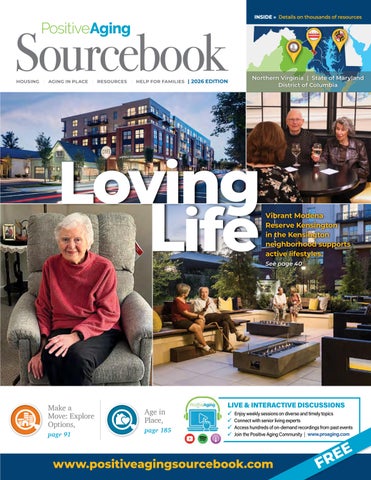
Loving Life
Whether they are coming home after moving away or choosing a new location to love for the rest of their life, Kensington residents enjoy active lifestyles with engaging peers at Modena Reserve Kensington. Lorraine Durbin, 91, determined that the charming neighborhood she called home for years would be her ideal “last stop.” Looking closely at the stairs in their expansive Potomac home convinced Paula Segal and Eric Schweitzer to move to the community, where they know their physical needs will always be met and their social lives will never be lacking. | Pages 40-43
Learn about
Your Future Starts Here
For this issue, I wanted to give readers my first-ever digital “tour” of the publication. If you scan the QR code below, I will walk you through the key aspects of this issue.
Some highlights include:
• The Table of Contents (p. 2) —This comprehensive listing allows readers to easily navigate to relevant sections.
• Journey Through Senior Living (p. 7) —A graphic element that shows a “roadmap” of senior living and provides corresponding page numbers.
• Three distinct sections —The overall organization of the publication features three sections to help older adults and their families: aging in place,
making a move, and resources.
• Feature Stories —Throughout the publication, you will find stories of real older adults and their families. These stories detail their senior living decision-making process. Our cover story profiles several individuals who were enamored with the small-town charm and high-end amenities offered at Modena Reserve Kensington (p. 40)
• Comprehensive Tables Each section includes comprehensive listings of all
the senior living options and resources in each category grouped by region. We include listings for Northern Virginia, the entire State of Maryland, and Washington, D.C. Start here to quickly sort providers.
Click the QR code and start your senior living journey today.
STEVE GURNEY | steve@proaging.com
Engage, Connect & Thrive
Assisted Living Focused on Engagement and Wellness
At Forest Hills of DC, living well is just the beginning. Discover an active community with a continuum of care.
Multiple Assisted Living care levels mean we can meet the diverse needs of residents. And Skilled Nursing is just steps away, which makes transition seamless.
Happy employees equal happy residents. Many staff members have been with us for decades.
A walkable community on Connecticut Avenue makes it easy to get around campus or visit local shops and eateries.
To learn more, visit ForestHillsDC.org or call 202-966-7623.
A Journey Through Senior Living
There’s no single path for senior living that fits everyone; journeys involve detours, intersections, and opportunities to reroute. Countless resources are available to help you navigate your journey.
Remember, you don’t have to take this trip alone!
Aging in Place
Choose to remain in your home or move to an apartment or condo that is not in a senior living community.
TRANSPORTATION (page 50)
VILLAGES (page 186)
SAFE & ACCESSIBLE HOME (page 188)
LIFE PLAN COMMUNITY/ CONTINUING CARE RETIREMENT COMMUNITY (CCRC) (page 103)
Making a Move
INDEPENDENT LIVING (page 114)
HOME CARE (page 197)
TECHNOLOGY (page 195)
ASSISTED LIVING (page 129)
When your current home is not the desired or most appropriate option to live a purposeful lifestyle.
NURSING AND REHAB (page 157)
MEMORY CARE (page 171)
ACTIVE ADULT COMMUNITIES Connect with a Real Estate Professional (page 93)
MOVING AND DOWNSIZING (page 93)
Resources
You don’t need to walk the road alone. A variety of resources are available for support and decision making.
• Health Care Support—Enlist specialized professionals to help with hearing, vision, mental, health, and disease-specific needs (page 44)
• Money Matters —Find help with managing day-to-day finances and planning ahead (page 58)
• Elder Law—Understand your legal rights and plan ahead with advance directives and wills (page 63)
• Mediation—Solve family disputes related to caregiving or retirement living (page 73)
• Aging Life Care Professionals—Make care decisions easier with professional help (page 75)
• Area Agencies on Aging—Find assistance from local governments (page 151)
• End-of-Life Support—Find the right care and advocacy at the end of life (page 182)
The Reserve Collection blends lively connection, vibrant gathering spaces, and a culinary experience featuring multiple restaurants and welcoming bars designed for variety, flavor, and fun.
Opening in early 2027 in Falls Church, Virginia, The Reserve at Falls Church will offer distinctive dining options, spirited programs, dedicated wellness spaces, and exceptional care—all within social environments that spark conversation and community.
Opening in 2028 in North Bethesda, Maryland, The Reserve Strathmore Square carries this dynamic vision forward with cultural experiences, warm hospitality, and opportunities to connect over great meals, engaging activities, and shared moments.
Planning Ahead vs. Crisis Response in Elder Care
Everyone ages. Senior care decisions are universal, but approaches to making them vary widely. The choice between proactive planning and reactive crisis management can significantly impact both the quality of care and the well-being of families. Learn more about the benefits of planning ahead and the challenges associated with crisis planning.
Benefits of Planning Ahead
Peace of Mind
Engaging in senior care planning provides peace of mind for seniors and their families. By addressing potential needs before they arise, families can feel more prepared and less anxious about the future.
For adult children in particular, senior care planning can help relieve the enormous stress that comes with having to physically take care of, or make decisions for, an aging parent. For seniors, planning ahead is a gift they can give to their children. Advance planning can also help older adults ensure that their wishes are met and that their relationship with their children does not suffer as they age.
Improved Access to Care
Early planning often results in better access to quality healthcare and support services. Many retirement living communities have long waitlists and planning ahead will ensure that the desired community and unit are available when needed. For assisted living and nursing communities, planning ahead helps
families find a community that will meet all their loved one’s care needs.
Financial Preparedness
The vast majority of long-term care costs are borne by families. Long-term care planning helps families avoid becoming a financial burden on each other. By securing long-term care insurance early and setting aside funds, families can mitigate the potentially devastating costs of elder care.
Personalized Care
Advance planning means more choices and a voice in all care decisions. If seniors avoid planning and are faced with a crisis that incapacitates them even temporarily, they may have no choices or severely limited options for care. Even a small amount of advance planning can ensure that care is tailored to specific needs and desires, enhancing overall quality of life.
Challenges of Planning Ahead Resistance to Change
Many seniors and families may resist planning for future care needs, preferring to avoid thinking about potential health declines. It can be particularly hard to initiate conversations when older adults do not want to talk about what they see as a loss of independence. It is important to start slow, but to remain dedicated to having productive conversations.
Evolving Needs
Care needs can change rapidly, potentially rendering some aspects of advance planning obsolete. It is important to remain flexible even as you plan ahead.
Complexity of Options
The sheer amount of care options available can make it difficult for families to assess and plan for future needs effectively. It is important for families to keep lines of communication open and to consider all available options.
Benefits of Crisis Response
Immediate Action
Crisis response often leads to quick decision-making and immediate action, which can be crucial in emergency situations. In the midst of a crisis, it is sometimes easier to overcome resistance to change.
Clear Needs Assessment
A crisis often clarifies the immediate care needs, making
Continued on page 15
Vibrant Senior Living...
Weather won’t disrupt your day at an Erickson Senior Living®managed community. We have seven convenient locations in the greater Maryland, Virginia, and D.C. region:
•Ashby Ponds® Ashburn, Virginia
•Charlestown® Catonsville, Maryland
•G reenspring® Springfield, Virginia
•Oak Crest® Parkville, Maryland
• Riderwood® Silver Spring, Maryland
•The Grandview℠ Bethesda, Maryland
•Woodleigh Chase® Fairfax, Virginia
For over 45 years, Broadmead has been more than a place to live — it’s been a warm and welcoming Life Plan Community where neighbors become friends, creativity flourishes, and every voice is valued. Now, we’re thrilled to invite you to be part of our next chapter: our first-ever off-site expansion, Broadmead at Ridgebrook.*
Offering 80 elegant apartment homes crafted for comfort and independence, set within 60+ acres and featuring comprehensive campus-to-campus shared amenities.
Planning Ahead vs. Crisis Response in Elder Care
Continued from page 11
it easier to determine the next steps. This may be beneficial for families who have been unable to reach compromises.
Challenges of Crisis Response Limited Options
Responding to a crisis often means fewer options for care. Families will have to select from among facilities that are actually available immediately, and these may not always be the most desirable choices in terms of location, price or services offered.
Increased Stress
Crisis situations in elder care can be extremely stressful for families, especially when dealing with hospital discharges and urgent placement decisions. Oftentimes, hospitals give families very short notice of discharge and limited options for long-term care.
Financial Strain
Without proper planning, families may face significant financial burdens when responding to an elder care crisis. Long-term care insurance or savings accounts for long-term care need to be obtained far in advance.
Fragmented Care
Crisis response often results in fragmented and uncoordinated care, as families struggle to navigate complex healthcare systems under pressure. As the elderly population continues to grow and senior healthcare systems face workforce shortages, the problems of individual families are exacerbated by a system that is not prepared to meet the demands of an older population.
Proactive planning allows for more personalized care, better financial preparation, and reduced stress on families.
Planning Means Better Care and Less Stress
The benefits of planning ahead for elder care challenges generally outweigh crisis response. Proactive planning allows for more personalized care, better financial preparation, and reduced stress on families. However, it’s important to recognize that even with the best planning, crises may still occur.
The key is to start elder care planning conversations early, involve all family members, and consider working with professionals to develop a comprehensive plan. This approach can help families navigate the complexities of elder care with greater confidence and ensure better outcomes for their loved ones.
Endless OPPORTUNITIES To Shine Every Day
Kensington Senior Living is a premier provider of assisted living, memory care and couples care throughout Greater Washington. As champions of quality and uncompromising commitment to excellence, our teams deliver lifestyles dened by loving care, professionalism, attention to detail and gracious hospitality.
With personalized assisted living and multiple tiers of memory care — all thoughtfully designed to accommodate unique preferences and needs — we enable our residents to enjoy life
to the fullest in meaningful ways that suit them best. We celebrate individuality, welcome couples, exemplify a profound desire to serve and embody the skillful expertise that, together, foster connection, build trust and promote well-being.
Let us introduce you to our comprehensive spectrum of care, personalized support, culinary mastery, enrichment programs and wellness initiatives that come with residency at all Kensington Senior Living communities. Call or visit us at a residence near you.
The Kensington Bethesda is now open and welcoming residents. Call today to schedule a visit.
Understanding Solo Aging
Embracing independence while planning for the future
Solo aging, defined as aging without the traditional support of a spouse, adult children, or close relatives, is a growing demographic reality for many individuals over age 55. Far from a negative concept, solo aging is increasingly seen as an empowering journey that emphasizes proactive planning and community engagement.
Solo aging encompasses a broad group, including those who are single, widowed, divorced, estranged from family, or whose children are unable or unwilling to provide care. The term, coined by Sara Zeff Geber, has evolved from focusing solely on childless individuals to anyone lacking a reliable support system. Even those with families are encouraged to plan for solo aging, as partners may pass away, and adult children may not be available or suitable as caregivers.
In a nation where more than 24 million adults aged 50 and older live alone, the concept of “solo aging” is reshaping how we think about later life. Far from a story of isolation, recent research reveals a vibrant community of individuals who cherish their autonomy but are acutely aware of the hurdles ahead in health, finances, and social ties. AARP’s latest survey, conducted in early 2025, dives deep into the lives of 503 single adults who are over 50 and living solo, offering a roadmap to their joys, worries, and wisdom.
Freedom and Fulfillment
For many solo agers, living alone isn’t a compromise—it’s a choice
Nearly 59 percent of solo agers describe feeling “at ease” with their solitary setup, while 56 percent feel firmly “in control,” according to a recent AARP study.
that sparks joy and self-reliance. Nearly six in 10 (59%) describe feeling “at ease” with their solitary setup, while 56 percent feel firmly “in control.” Happiness (46%), confidence (44%), and fulfillment (30%) round out the uplifting emotions that define daily life for this group, according to the AARP survey.
The freedom that comes with solo aging was precious to many of those surveyed. More than a third (35%) pinpoint autonomy as the top perk, echoing sentiments like that of an 82-year-old woman who shared: “The best thing about living alone is the freedom to do whatever you please, whenever
you want to do it.” It’s a sentiment that resonates across ages, with two in five solo agers (40%) having embraced this lifestyle for 20 years or more.
Social connections remain a cornerstone of happiness, debunking the myth of universal loneliness. Over half (51%) rate their social lives as excellent or good, fueled by simple yet profound sources of joy. Significant interests and pastimes include:
• Spending time with friends: 63%
• Hobbies and interests: 59%
• Time with family: 57%
• Staying physically active: 55%
• Religion or spirituality: 41%
• Pets: 37%
• Volunteering or helping others: 27%
• Community involvement: 22%
• Career or work: 18%
Loneliness, Health, and Financial Fears
Despite overwhelming contentment among solo agers, challenges loom large. While only one in five (22%) reports feeling lonely, it’s a potent concern—40% name loneliness and isolation as the worst part of living alone. One 57-year-old man captured it starkly: “The worst thing about living alone is being lonely when there is nothing to do and not going out with friends or family.”
Health status is currently strong—81% rate their physical health as excellent or good, and 64% say the same for mental health—but future vulnerabilities weigh heavily.
Continued on page 23
Understanding Solo Aging
Continued from page 19
The top worries include:
• Losing independence and relying on others: 68%
• Declining physical strength or stamina: 62%
• General health decline: 61%
• Cognitive issues like memory loss: 50%
• Inability to handle daily tasks (e.g., preparing meals): 49%
Finances amplify these anxieties. Just 54 percent view their current financial situation positively, with 41 percent fretting over insufficient retirement savings
and 39 percent dreading the cost of paid care. This hits harder for those 50-64 (59% concerned about retirement funds) compared to 65-plus (32%), underscoring the urgency of early planning.
Thriving Solo
The survey’s implications are clear: Solo aging can be incredible with proactive support. To combat emotional isolation, AARP recommends nurturing ties through hobbies, volunteering, or community groups.
On finances, early tools for retirement and care planning can ease uncertainty, empowering solo agers to build resilience against unexpected costs. Health-
wise, prioritizing physical activity, preventive care, and cognitive check-ins promotes long-term independence, helping many age in place successfully.
As one of the fastest-growing demographics, solo agers deserve tailored resources that honor their autonomy while addressing real risks. By listening to their voices, we can transform solo living from a potential vulnerability into a celebrated chapter of self-directed fulfillment.
This article is based on AARP’s November 2025 research report, “Living Alone: What Solo Agers Want You to Know.” For full survey details, visit aarp.org/pri/ topics/aging-experience/solo-agers. Find valuable resources, podcasts, and videos at retirementlivingsourcebook.com/solo
Exceptional Care for Seniors & Individuals with Disabilities
Powered by Purpose
Goodwin Living began with a calling and continues with a commitment to serve more, reach farther and care deeper. As a faith-based, not-for-profit organization serving Northern Virginia and D.C., our work is rooted in compassion and driven by a belief that everyone deserves the opportunity to age with dignity and purpose. From world-class health services delivered directly to people in their own homes to vibrant senior living campuses, everything we do is designed to support, honor and uplift the lives of older adults.
Goodwin Living Health delivers compassionate, world-class care wherever you call home. From our home care, rehabilitation and brain health programs to skilled home health and hospice care, our services support people at every stage of life. Consistently earning top ratings from Centers for Medicare & Medicaid Services (CMS) and other government agencies, our care reflects excellence grounded in expertise, dignity and heart.
Convenient locations in Alexandria, Falls Church and now Washington, D.C.
Our senior living campuses are built around connection, discovery and purpose, with the freedom to shape each day your way through engaging community life, modern amenities, purpose-driven activities and opportunities, and neighbors who become friends. With both lifecare and rental community options, you have financial flexibility today, along with peace of mind knowing supportive care is available if needs change.
For more information or any general questions, please reach out at any time or visit our website.
Call: 703-596-8967
Intergenerational Programs
Learning and growing together
A drive to create. A desire to learn. A yearning to be understood. There is more that unites young people and older adults than divides them.
By focusing on the commonalities between older adults and children and encouraging more exposure and understanding, intergenerational programs can build connections and help participants learn and grow at every age.
Generations United and LeadingAge teamed up with the Retirement Research Foundation to complete Intergenerational Programming in Senior Housing: From Promise to Practice, a report detailing findings from a year-long study on intergenerational programs in senior housing.
The report explains that “[i]ntergenerational practice involves bringing people together in purposeful, mutually beneficial activities that promote greater understanding and respect between generations and contribute to building more cohesive communities.”
Intergenerational programs tend to focus on shared interests and common goals. The programs typically leverage the resources that the young and the old can offer each other. Programs are designed so that both the older adults and the children or young adults stand to gain knowledge and connections.
Intergenerational programs help to reduce social isolation and increase
Most common intergenerational activities:
self-esteem and wellbeing. They also help individuals better understand and appreciate people who are not the same age as them. Ultimately, the programs help to foster good will and build strong communities.
According to the study, many retirement communities are incorporating intergenerational activities into their programs— and they are seeing positive results for both residents and youth. Retirement community efforts tend to focus on specific intergenerational activities to engage residents and young people, such as art or technology classes or events. The benefit of these short-term events is that they do not require a major commitment from either staff or participants. However, utilizing single events can make it harder for young people and older residents to form relationships. While the interaction may be positive, it is not the same as building long-term relationships.
Some of the most promising programs identified by the study included tutoring and mentoring efforts. These programs allow
retirement community residents to support young people by providing guidance and professional development opportunities.
Mentoring programs have been particularly effective for helping youth in foster care, special education students, and English
Intergenerational programs are designed so that both the older adults and the children or young adults stand to gain knowledge and connections.
as a Second Language students. Older adults can help young people improve their language and literacy skills or run after school homework clubs for youth.
While the report identified several significant challenges to implementing intergenerational programming, the benefits have the potential to far outweigh the challenges.
Grassroots Revolution
81-year-old helps others move beyond fear and research senior living
Joyce Kelly isn’t one to shy away from big questions. With a PhD in health services research and decades of experience applying rigorous protocols to complex problems, she approached her own future with the same methodical curiosity.
Married for 50 years to her husband Paul, the couple has no children—a circumstance Joyce attributes to “bad luck” but one they’ve long since embraced. Living on a wooded property overlooking the Anacostia River, they’ve thrived in their Silver Spring home for 40 years, handling gardening, cooking, and daily life with minimal outside help.
At 80, Joyce began pondering the “what ifs.” “We’re already aging in place,” she explains, “but that probably won’t be true 10 years from now.” While Paul cherishes their “big piece of property” and hopes to stay until he can leave “feet first,” Joyce envisions a move in three to five years to a local life plan community— somewhere between Gaithersburg and D.C., including spots like Silver Spring and Bethesda.
“He’s supportive of me looking and visiting,” Joyce says with a laugh, “but he sees no reason to leave our home.”
Despite Paul’s hesitancy, Joyce is moving forward. She is leveraging her research skills to demystify senior living options without overwhelming her partner.
GROUP POWER | Turning Solo Tours into Social Safaris
The catalyst was simple—a mention at her monthly women’s
After chatting with more than 100 senior living residents, Joyce has heard no regrets for moving “too soon,” only warnings against waiting for a health crisis. Their mantra? “Don’t delay. Move now.”
group of Public Health Service retirees, a circle she’s belonged to for more than 30 years. When Joyce shared plans to attend an open house at a nearby life plan community, her friends’ response surprised her: “Every woman said they wanted to join me,” she recalls.
What Joyce intended as a solo reconnaissance became a group outing. Over six months, Joyce and at least three companions attended open houses at eight communities within 20 miles of her home. These visits were possible
because life plan communities across the county offer frequent open houses; no organizing required—just show up and learn, often with resident “ambassadors” who share unfiltered insights.
These aren’t luxury tours, although Joyce reports that the food is exceptionally good. They are fearbusting expeditions. “This topic is scary, and people are avoiding it,” Joyce observes. A poll at one event confirmed her thoughts: Fear topped the list of barriers, akin to dodging a doctor’s visit to avoid unwelcome news. But banding together? “We could transform that fear into curiosity,” Joyce exclaims.
THE LIVING ROOM SUMMIT |
A Panel of Peers, Not Pitchmen Joyce’s boldest move? Hosting a “working session” in her home on healthy aging in place versus community living. Drawing from her women’s group of former Public Health Service colleagues, two neighborhood book clubs, longtime friends and neighbors, and a local listserv, she invited 55 people. Forty people showed up. The furniture was cleared to make room for folding chairs in Joyce’s living and dining rooms.
The evening’s genius lay in its panel: Four resident ambassadors from different communities, not salespeople. “It was comfortable hearing from residents,” Joyce says. One from a 2,000-resident community joked, “Big is best—if you want 250 clubs.”
Continued on page 35
Close to vibrant arts and cultural venues, such as Wolf Trap, The Alden Theatre, Capital One Hall and Lake Fairfax Park Amphitheater, The Providence brings a loving, discerning, uncompromising attention to detail to tailored Assisted Living and Memory Care.
PROVIDENCEFAIRFAX.COM 9490 Sprague Avenue Fairfax, VA 22031
Independent Living | Assisted Living Memory Care
Sophistication and design innovation surround you in The Pinnacle. North Bethesda’s Pike District offers immediate access to dynamic dining, worldclass entertainment, arts, culture and recreation.
PINNACLENORTHBETHESDA.COM
Blending urbane sophistication with adaptive, supportive service and care, The Landing in North Potomac Yard is a luxury community of great warmth and caring that ensures residents feel comfortable, secure and connected.
LANDINGALEXANDRIA.COM
2620 Main Line Blvd.
Alexandria, VA 22301
2620 Main Line Blvd. Alexandria, VA 22301
PINNACLENORTHBETHESDA.COM
11555 Old Georgetown Road North Bethesda, MD 20852
The Riviera offers a 5-Star Independent Living option that will infuse your life and lifestyle with cosmopolitan energy and sophistication. If you ever need high-quality care — you’ll find it right next door.
RIVIERAALEXANDRIA.COM 2700 Main Line Blvd. Alexandria VA 22301
Grassroots Revolution
Continued from page 31
A resident from a smaller community in Bethesda countered, “Small is cozy.”
The mix of panelists sparked lighthearted banter, easing any awkwardness. Even the ambassador from a “superior” community, initially worried about sounding elitist, diffused tension with humor.
THE REALITIES | Costs, Waitlists, and Solo Struggles
Amid the inspiration, hard truths emerged. Life plan communities are “extremely expensive,” Joyce warns. Selling their Silver Spring home would cover an entrance fee, but monthly costs hover in the thousands—less for studios, but Paul balks at drastic downsizing. Younger friends worry for widowed mothers with limited means; even pooled family resources often fall short. Sourcebook, Joyce adds, shines here, spotlighting affordable aging-in-place alternatives.
For singles—about 25 percent of Joyce’s close circle—the hurdle is emotional: Uprooting from a
cherished townhouse alone at 80 feels “overwhelming.” “When they moved in, they were in their thirties,” she notes.
Joyce now scouts tailored fits—a low-walk community for one friend, high-culture options for another, Rockville-specific spots for a third— offering to join tours as a buffer.
Progress is slow but steady. Including herself, four or five of the group members are on waitlists; larger, pricier units (with patios and extras) face 5-7 year wait lists, while one-bedrooms turn over faster. In her book clubs alone, three women moved this year: one couple to a community in Silver Spring, another to Bethesda, a third to near Baltimore.
Especially for single people, moving to a community means built-in support. Solo agers who move will no longer have to worry about how to get to doctor appointments or fit in shopping trips. Most communities offer included transportation.
DON’T DELAY | The Universal Call to Action
Across eight visits (one community, seven times), Joyce has chatted
with more than 100 residents. Their mantra? “Don’t delay. Move now.” Gardens, gyms, musicals—they are all best enjoyed when you’re “young enough and energetic enough.” Among senior living residents, Joyce has heard no regrets for moving “too soon,” only warnings against waiting for a health crisis.
For Joyce, this heightens tension with Paul: “I’m 81—how much longer do I want to risk it?” But her process replaces paralysis with possibility. “All of this—the meetings, the visits, reading resources—provides opportunities to replace fear with curiosity,” she says. It’s not about an “old age home” as a final stop; it’s owning your path.
Joyce’s journey is a reminder that aging isn’t a solo slog. Grab a friend, a book club, or a neighbor. Fear fades when curiosity leads the way. Go out and discover what senior living options have to offer with an open mind—and an open heart.
Join free, live and interactive discussions with senior living thought-leaders or listen to on-demand recordings anytime at positiveagingsourcebook.com
At Ingleside communities, we believe life should move your mind, body, and spirit. Whether it’s pursuing passions, connecting with friends, or embracing new adventures, this engaging lifestyle empowers you to live fully and freely Discover our not-for-profit, life plan communities, where every spark of inspiration becomes an opportunity to grow and create something meaningful. To learn more, contact us today!
Ingleside at Rock Creek
W ASHINGTON , DC / 202 - 407 - 9673 / WWW IRCDC ORG
Westminster at Lake Ridge
L AKE RIDGE , VA / 571 - 621 - 7238 / WWW.WLRVA . ORG
“LIVING HERE HAS GIVEN US AN OPPORTUNITY TO REMAIN ENGAGED SOCIALLY, EDUCATIONALLY, AND CULTURALLY.” Chuck and Susan, Ingleside at King Farm Residents
Loving Life
Vibrant Kensington neighborhood supports active lifestyles
There is no sure-fire shortcut to loving life—regardless of age, but choosing the right location is always a good start. As we age, location becomes even more critical to overall happiness. Inviting restaurants, bustling businesses, and friendly neighbors can make a community an ideal retirement destination. When you add in modern conveniences and charming ambience, you get a place to love life for your whole life. Kensington, MD, is exactly that type of place.
Near the heart of Kensington, right beside the historic train depot, sits Modena Reserve at Kensington, a senior living community owned by Solera Senior Living that offers extraordinary independent living, assisted living, and memory care. Modena residents enjoy engaging programs, best-in-class amenities, and exemplary service in an elegant environment that blends seamlessly into the larger Kensington community.
The onsite District Cafe at Mizell Station is owned and operated by the community. In addition to offering delicious coffees and pastries, the Cafe also hosts a rotating schedule of local artists displaying their work. Open to both residents and the general public, the Cafe serves as a natural gathering place.
A Location to Love
A staggering 73 percent of adults aged 50 and older want to remain in their communities as they age, according to AARP’s national 2024 Home and Community Preferences Survey. In fact, one of the biggest challenges facing the aging population is the lack of infrastructure necessary to allow
Propelled by an irrepressible spirit, Lorraine Durbin, 91, zips through the Modena Reserve Kensington community in her wheelchair with the gusto of a lifelong adventurer.
more people to remain in their current communities. Major hurdles include housing shortages and limited transportation options.
However, some communities are getting it right, and Kensington is one of them. AARP’s Livability Index, ranks Kensington at a 68/100, which is in the top half of communities in the U.S.
Founded in 1873, Kensington is a small, historic town that offers the best of modern living, including shopping, dining, and easy access to Washington, D.C.; Baltimore; and Annapolis. The city’s once bustling train station now hosts a year-round farmers’ market and regular concerts. In the business district, quaint streets are filled with restaurants, shops, galleries, and music venues. Just outside the commercial center of the city, beautiful Victorian homes and parks welcome visitors and residents alike.
Whether they are coming home after moving away or choosing a new location for the rest of their life, Kensington residents enjoy active lifestyles with like-minded peers. Here are just two of their many stories.
A Lifetime of Love
Propelled by an irrepressible spirit, Lorraine Durbin, 91, zips through the Modena Reserve Kensington community in her wheelchair with the gusto of a lifelong adventurer. Nicknamed “Scooter” by the staff for her self-propelled enthusiasm, Lorraine has become the community’s unofficial ambassador, befriending more than 50 residents in mere weeks after her arrival.
“Joy and curiosity... They get me through every day,” Lorraine
says with a smile that lights up the room. In January 2025, the eternally optimistic nonagenarian declared Kensington her “last stop”—a full-circle return to the Maryland neighborhood that enriched her life for over half a century.
Born in East St. Louis, Illinois, Lorraine was a standout from the start. An exceptional student, she earned two college scholarships and dreamed of various career paths. But fate had other plans. In April 1949, at just 15, she locked eyes with 18-year-old Bill Durbin,
As staunch advocates for racial equality, they faced fierce backlash after Martin Luther King Jr.’s 1968 assassination. Their home was pelted with eggs, scrawled with graffiti, and besieged by hate. Lorraine shielded her children with fierce love, half-joking that if segregationist George Wallace claimed the presidency, they’d flee to Canada or New Zealand. The family pressed on, expanding to 10—nine boys and one girl. Amid the joyful bedlam, Lorraine’s warmth and organizational wizardry turned their home into a haven of laughter and lessons.
Joy and curiosity... They get me through every day.
LORRAINE DURBIN, Modena Reserve at Kensington resident
a polite young man who, wary of their age gap, gently brushed off the initial spark. The romance deepened through letters sent across oceans, and when Bill returned from his Korean War deployment, the two were engaged. Their marriage spanned 49 years and produced a legacy of 10 children, 23 grandchildren, and 9 great-grandchildren.
Lorraine wanted a large family, and that is exactly what the couple built. In 1962, with a seventh child on the way, the Durbins moved to the suburbs in Fairview Heights, Illinois—acquiring a split-level during the era’s “white flight.” Yet, Lorraine and Bill were unswayed by prejudice.
Falling for Kensington
When Bill joined the newly formed Defense Mapping Agency in Washington, D.C., the family uprooted to a cozy Kensington, Maryland, house—chosen for its proximity to the capital’s landmarks and stellar schools. Though the space strained under 10 kids, it pulsed with energy. Lorraine dove into community life, serving two decades as an election judge at a local elementary school. She was a force in school circles, masterminding Friday-night potluck suppers for the high school band exchange program and penning tireless contributions to the PTSA newsletter.
Continued on page 42
Loving Life
Continued from page 41
Decades later, Bill suffered a fatal heart attack at 71, leaving a chasm no one could fill. Undeterred, Lorraine forged ahead. In 2005, she relocated to a top-floor Kensington apartment, where the rhythmic rumble of trains below echoed fond memories of East St. Louis. She thrived there for 14 years, selling her house to fuel a passion for travel—jetting to Egypt, Jordan, and other corners of the globe.
Later chapters brought Lorraine closer to family. She lived with her daughter and son-in-law for several years and spent time in Maryland to be close to her grandchildren. By 2023, her legacy had swelled to 42 direct descendants.
Eventually, spinal stenosis and degenerative disc disease confined Lorraine to a wheelchair. When her caregiver daughter suffered a heart attack, she knew change was imperative.
The Road to Modena
At 90, in 2024, Lorraine resolved: Kensington would be her finale. “It has to be Kensington,” she insisted, honoring 52 years woven into the community’s fabric—minus eight with her daughter.
In January 2025, Lorraine moved to Modena Reserve Kensington. Adaptable and flexible, she wasted no time embedding herself. Lectures on global cultures, infused with music from the professor’s lived experiences, captivate her. Sunday tunes and The Great Courses are staples. The dining?
“Fantastic,” she raves. Servers, some tied to Kensington families she’s known for generations, feel like kin. Grandkids touring the halls? “We’ll meet you in the bar when we visit our grandparents, and we’ll have a reunion,” they tease. Friendships have bloomed effortlessly for Lorraine, whose positive and open nature invites connections.
Paula Segal and Eric Schweitzer quickly fell in love with Kensington and its many charms. Modena Reserve Kensington offered security and comfort nestled amid shops and green spaces.
Lorraine may have selected her last stop, but her story isn’t over. She is living with her customary zeal— every day.
Stepping Into Their Future
Paula Segal and Eric Schweitzer’s move to Modena Reserve Kensington sprang not from urgency but from clear-eyed anticipation. “The stairs just glared at me one day and declared, ‘You’re done climbing us,’” Eric quips, his laughter underscoring the truth. After years in their expansive Potomac home, subtle shifts in mobility foreshadowed the need for a move.
Paula and Eric are now scripting a fresh chapter in their extraordinary 37-year marriage. Paula, a retired high school history teacher famed for her infectious passion, spent years working at Washington, D.C.’s elite Duke Ellington School of the Arts. A former urban planning expert, Eric spent decades shaping homeowners associations nationwide. Together, they decided to swap their cherished Potomac home of more than two decades for the lively, pedestrian-friendly Modena Reserve Kensington.
Armed with curiosity, they did their due diligence, poring over resources like the Positive Aging Sourcebook. Over six months, they scouted a dozen communities. Key insights emerged swiftly. Rentals screamed impermanence, and buy-in models promising 90 percent refunds felt like elaborate cons to Eric’s pragmatic eye.
Fate intervened via Paula’s book club: A member’s mother sang Modena Reserve’s praises. It hadn’t been on their list, but a single tour rewrote the script.
A Place to Belong
What enchanted Paula and Eric about this 135-apartment enclave in Kensington? Proximity, above all. “Everything’s a stroll away—or a short drive if needed,” Paula says. Far from gated exile in the countryside, Modena Reserve Kensington is nestled amid shops and green spaces and filled with interesting neighbors.
The community’s trailblazing Estate Club—offering monthly
Continued on page 84
Senior Living Resources
Offering vital assistance and support
Senior living resources include any professional or service that makes life easier for older adults and their families. Some prominent examples include elder law attorneys and aging life care professionals.
As the older adult population has grown, so have the number of professionals and services specifically dedicated to assisting older adults. Professionals who specialize in helping older adults have the expertise and the experience to make challenging situations easier.
How can senior living resources help me?
Senior living resources include professionals who can help older adults address any challenges that come along with aging.
For instance, elder law attorneys can help individuals get their affairs in order in terms of medical care, interventions and the disposition of their assets after death.
Aging life care professionals provide families with help navigating the vast and complex senior living industry. They can help seniors find appropriate care environments and mediate family conflicts.
Beyond these two professions,
and
Use our research. Sourcebook features detailed articles, checklists, featured listings and comprehensive tables in each section. Use these resources to begin your search for a professional who can help you and your family.
Comprehensive Dementia Care for Medicare Beneficiaries
According to the Centers for Medicare and Medicaid Services (CMS), dementia affected more than 6.7 million Americans in 2023. That number is projected to soar to 14 million impacted Americans by 2060. Caring for individuals with dementia often falls to unpaid family caregivers who face enormous obstacles managing the behavioral and psychological symptoms of dementia.
Dementia patients may also have multiple chronic conditions which makes caring for them even more complicated. Given the need for care and supervision around the clock, it is not surprising that dementia patient caregivers are often unable to provide long-term care in the family home.
The Guiding an Improved Dementia Experience (GUIDE) Model, launched by the Centers for Medicare & Medicaid Services (CMS) on July 1, 2024, represents a significant step forward in dementia care. This eight-year voluntary nationwide program aims to enhance the quality of life for people with dementia and reduce the strain on their unpaid caregivers.
GUIDE focuses on comprehensive, coordinated dementia care through a standardized approach. The model provides Medicare payments for a package of services including care coordination, care management, caregiver education and support, and respite services. This allows beneficiaries to remain
in their homes and communities longer, potentially avoiding premature institutionalization.
Key components of the GUIDE program include:
• Care Coordination: An interdisciplinary team creates and maintains a person-centered care plan, coordinating services with primary care providers and specialists. This helps ensure that family caregivers are not dealing with a dementia diagnosis in isolation and trying to manage care without knowledge of the disease or long-term needs.
• 24/7 Support: Beneficiaries and caregivers have round-the-clock access to care team members or navigators. Challenges will arise when caring for someone with dementia. This support gives caregivers a place to turn for advice when they are facing
specific challenges or feeling worn down.
• Caregiver Support: The program offers training, education, and support for unpaid caregivers, recognizing their crucial role in dementia care. Caregivers learn specific skills for avoiding conflict, maintaining patience, and dealing with hyper fixations (like leaving the home or going to a specific place).
• Respite Services: GUIDE provides payments for respite services, allowing caregivers temporary breaks from their responsibilities. This can help caregivers avoid dangerous burnout. These small breaks also give caregivers the time they need to take care of their own doctor appointments and other errands.
• Medication Management: Regular medication reviews and adherence support are provided.
Continued on page 47
In-Home Dementia Care Program
Services are no cost for Medicare beneficiaries
Personalized Guidance
Our Intake Nurse Navigator helps you get started with dementia and chronic disease care.
Medicare GUIDE Program
Dementia care navigation, family caregiver support and home safety and fall risk assessments.
Home Health Nursing & Therapy
Education and care for Parkinson’s, wound care, hypertension, diabetes and other chronic conditions.
72 Hours of Free In-Home Personal Care
Respite relief for family caregivers to help with daily activities and medication reminders.
Maintenance Therapy
Long-term in-home therapy to maintain function, prevent falls and slow decline
Dementia Care
Continued from page 45
Medication management can be one of the biggest challenges preventing individuals from remaining in the family home. This service ensures that medications are reviewed and schedules are followed.
Eligibility Requirements
To be eligible for GUIDE, beneficiaries must have a diagnosis of dementia, be enrolled in Medicare Parts A and B, and not be receiving Medicare hospice benefits or living
in a long-term care facility.
The GUIDE Model sets a new standard for dementia care by addressing key drivers of poor-quality care. It defines a standardized approach to care delivery, provides an alternative payment methodology, addresses unpaid caregiver needs, and offers respite services. As the program progresses, it has the potential to significantly impact the lives of hundreds of thousands of Medicare beneficiaries living with dementia and their caregivers.
By linking healthcare systems with
community-based organizations and providing structured support and resources, GUIDE aims to transform the fragmented system that many providers and patients have struggled with in the past. This innovative approach to dementia care represents a promising step towards improving outcomes and quality of life for those affected by this challenging condition.
Some information adapted from the Centers for Medicare and Medicaid Services. Visit www.cms.gov/priorities/innovation/ innovation-models/guide for additional details and updates.
PACE: Revolutionizing Senior Care with All-Inclusive Support
The Program of All-Inclusive Care for the Elderly (PACE) is an innovative healthcare model designed to help frail seniors live independently in their communities while receiving comprehensive medical and social services. PACE aims to provide coordinated, high-quality care that allows participants to age in place and avoid unnecessary hospitalizations or nursing home placements.
What is PACE?
PACE is a Medicare and Medicaid program that offers a unique approach to meeting the healthcare needs of eligible seniors. It provides a wide range of services, including medical care, social services, and long-term support, all coordinated by an interdisciplinary team of healthcare professionals.
The program operates on a capitated payment system, meaning that PACE organizations receive a fixed amount per participant to cover all necessary services. This allows providers to offer flexible, personalized care without the constraints of traditional fee-for-service models1.
Eligibility Requirements
To be eligible for PACE, individuals must meet the following criteria:
• Be 55 years of age or older
• Live in the service area of a PACE organization
As the population ages, programs like PACE may play an increasingly important role in meeting the healthcare needs of older adults.
• Be certified by their state as needing a nursing home level of care
• Be able to live safely in the community with PACE support at the time of enrollment.
While most PACE participants are dually eligible for Medicare and Medicaid, this is not a requirement. Individuals can join PACE even if they only have Medicare or choose to pay for the program privately.
Comprehensive Services
PACE offers a wide array of services to meet the diverse needs of its participants. These services include, but are not limited to:
• Primary and specialty medical care
• Prescription medications
• Adult day care
• Home health care
• Hospital and nursing home care when necessary
• Physical, occupational, and speech therapy
• Social services and counseling
• Nutritional support
• Transportation to PACE centers and medical appointments
The program’s flexibility allows it to provide additional services deemed necessary by the interdisciplinary team to improve and maintain a participant’s health.
The Interdisciplinary Team Approach
At the heart of the PACE model is the interdisciplinary team, which assesses each participant’s needs and develops a comprehensive care plan. This team typically includes:
• Primary care physicians
• Nurses
• Social workers
• Physical and occupational therapists
• Recreational therapists
• Dieticians
• Home care coordinators
• Personal care attendants
The team meets regularly to discuss each participant’s status and adjust care plans as needed, ensuring a holistic and responsive approach to healthcare.
Benefits of PACE
PACE offers several advantages for eligible seniors:
Comprehensive care: All medical, social, and long-term care services are provided under one program.
Aging in place: Participants can continue living in their communities rather than in nursing homes.
Coordinated care: The interdisciplinary team approach ensures all aspects of a participant’s health are addressed.
No out-of-pocket costs: For those eligible for both Medicare and Medicaid, there are typically no deductibles, copayments, or coverage gaps.
Flexibility: Care plans are tailored to individual needs and can be adjusted as health status changes.
Enrollment and Disenrollment
Enrollment in PACE is voluntary and can begin at any time. Once enrolled, participants receive all their care through the PACE organization, which becomes the sole source of services for Medicare and Medicaid enrollees.
Participants have the right to disenroll from the program at
any time, typically effective at the beginning of the following month. This flexibility allows individuals to choose the care that best meets their needs.
The Program of All-Inclusive Care for the Elderly represents an innovative approach to senior healthcare, offering comprehensive, coordinated services that support aging in place. For eligible seniors who value independence but require significant support, PACE can provide a valuable alternative to traditional care models. As the population ages, programs like PACE may play an increasingly important role in meeting the complex healthcare needs of older adults while promoting quality of life and community engagement.
Non-Emergency Medical Transportation
For many older adults, driving can become a challenge. Whether they no longer drive at all or only feel comfortable driving to specific locations in their neighborhood, older adults may struggle getting to medical appointments if their ability to drive is limited.
Arranging for rides from friends or family, relying on public transportation, or enlisting paid drivers can pose physical and financial challenges. But there are better options.
Non-Emergency Medical Transportation (NEMT) is a crucial service that provides safe and
appropriate transportation for individuals who need assistance getting to and from medical appointments. This service caters to individuals who are not in emergency situations.
NEMT offers benefits, including:
• Cost-effectiveness compared to emergency transportation
• Access to vital medical equipment during transit
• Increased accessibility and convenience for regular medical visits
• Enhanced safety measures tailored to patients’ needs
• Promotion of independence for elderly and disabled individuals
Providing Non-Emergency Medical Transportation throughout Virginia and the Washington DC Metro
Many vehicles used for nonemergency transportation are equipped with features such as wheelchair ramps, handrails, and ergonomically designed seats to ensure passenger comfort and safety.
Services can range from basic ambulatory transportation to wheelchair and stretcher transport.
It is estimated that 5.8 million Americans are missing or delaying healthcare due to a lack of transportation. Transportation needs for these older adults is expected to increase by 6.5 percent annually over the next five years.
Hearing is Believing
Acccording to the National Association of the Deaf (NAD), nationwide relay services were first required by the passage of the Americans with Disabilities Act (ADA) in 1990. Relay services enable people who are deaf or hard of hearing, or who have a speech impairment, to communicate via telephone with a person who can hear.
States implement their own individual programs and services vary from state to state.
How do relay services work?
Most states offer traditional relay services and other accommodations.
To make a call using relay services, users simply pick up the phone and dial 7-1-1. After dialing, users are automatically connected to a communications assistant.
It is important to note that relay service users who are experiencing an emergency should still dial 911 directly.
What types of relay services are available?
Traditional relay services are also referred to as TTY. A TTY has a keyboard, which allows the user to type their side of the conversation, and a text screen to read the other person’s responses. After the TTY user types their side of the
Have confidence in every conversation.
Do you find it difficult to use a standard phone? Do people ask you to repeat yourself during telephone conversations? Do you miss important calls because you can’t hear the phone ring? The Maryland Accessible Telecommunications (MAT) program gives Maryland residents the opportunity to apply for telecommunications equipment to independently make and receive calls. If you qualify, a skilled evaluator meets with you to determine how to make your day-to-day communications easier and more accessible. The MAT program has a variety of equipment solutions to support clearer communication, including:
• Amplified phones
• Tablets
• Visual ring signalers
• Smartphones for the Blind
For more information:
• Phones with large and/or high contrast buttons
• Captioned Telephones
• Phones for memory loss
800-552-7724 (Voice) | 410-767-7253 (TTY Direct)
410-801-9618 (Video Phone) | MDMAT.org
conversation, an operator reads the text to the other person. As the other person speaks in response, the operator types the spoken words, so the TTY user can read them on their device screen.
Using Hearing Carry-Over (HCO), users who can hear but have difficulty speaking or being understood over the telephone are able to type their side of the conversation, which is then voiced to the other participant by the operator.
Speech-to-Speech (STS) is a similar service that assists individuals who have mild to moderate difficulty speaking and can hear clearly on the phone. Users speak with their own voice or with an assistive device
Continued on page 55
Revolutionizing Dental Care
Mobile Dentistry is transforming oral health for older adults
Mobile dentistry and home visits are revolutionizing dental care for older adults, providing essential services to those who may have difficulty accessing traditional dental offices. This innovative approach brings high-quality dental care directly to seniors in the comfort of their homes, nursing and rehab centers or assisted living communities.
Mobile dental services typically operate from specially equipped vehicles or use portable equipment that can be easily transported. These setups include all the necessary tools for comprehensive dental care, allowing dentists to perform a wide range of procedures, from routine check-ups and cleanings to more complex treatments.
Dental Care at Home
One of the primary benefits of mobile dentistry is the ability to offer standard dental care services in a familiar home setting, whether that is a family home, retirement community or adult day care.
“Offering dental care at home is a great option because it
allows patients to remain in an environment where they feel comfortable,” explained Dr. Julie Cole, a dentist in Leesburg, VA, who offers mobile dental services in addition to her traditional in-office services. “Especially for patients with dementia, they tend to be way more receptive to dental care and compliant when they are in a familiar environment.”
Mobile dental services are incredibly convenient, eliminating the need for seniors to travel, which can be challenging due to mobility issues or health concerns. Mobile dentists are also able to spend more time with each patient and provide tailored care. With modern equipment, mobile dentists can offer treatments ranging from wellness exams and
cleanings to filings and denture care. Finally, mobile dental teams are able to collaborate closely with the staff at a retirement community or family members to ensure proper home care for elderly patients.
“Whenever I talk to caregivers, I emphasize that there are many things they can do in the home that can make a big difference when it comes to senior dental health,” Coe noted. “A dentist can help you identify issues or areas that need work and then you can use tools like waterpiks or flossers to ensure that you are maintaining dental care at home.”
For seniors living in long-term care facilities or those with mobility challenges, cognitive impairments, or chronic health conditions, mobile dentistry provides a crucial service. It ensures that oral health is maintained, contributing to overall well-being and quality of life. This innovative approach to dental care is not only meeting the current needs of older adults but also shaping the future of geriatric dentistry.
Low Vision Can Lead to Challenges
Everyday activities may be difficult with limited sight
Low vision is vision loss that is uncorrectable through glasses, surgeries, or medications. Low vision impacts one’s ability to complete everyday activities. One in ten people over age 80 have this issue, but many are unaware of what it is and what can be done about it.
The first signs of low vision may be trouble reading, driving (especially at night), or recognizing people’s faces. An increase in falls can also be an indicator of low vision. Different eye conditions—from agerelated macular degeneration or glaucoma to diabetic retinopathy— cause various vision challenges. However, all the conditions that cause low vision can make everyday activities more difficult!
It is important to note that, while one’s chances of low vision increase with age, permanent sight loss or going blind is not a normal part of aging.
Living with Low Vision
In the case of low vision, sight cannot improve. However, individuals can live with low vision
and continue to be active and engaged. There are strategies and tools available to help patients adjust to current vision. These supports range from magnification and environmental changes to learning how to use different senses (such as touch or hearing).
Service professionals, such as a low vision specialist, can work with patients to develop a comprehensive rehabilitation plan. This plan will be developed with the
individual’s personal goals in mind. Goals may range from regaining employment to staying safe in the home. No matter what the patient may want to do, there are hundreds of resources available to help.
Losing your sight does not mean losing your independence. There are many services, supports, and professionals available to help. With assistance in place, many people with low vision go on to live full lives.
If you or someone you know is experiencing low vision, learn more about what can be done to help. Connect with the Prevention of Blindness Society of Metropolitan Washington (POB), a nonprofit with free services and resources for people with vision loss, at (301) 951-4444.
As we age, some vision changes are normal, however others are not. Have you had . . .
• difficulty reading?
• difficulty walking down stairs?
• a hard time seeing or driving at night?
• a fall in the last year?
If you, your loved one, or clients answered “yes” to any of these questions notify your doctor and call our information and resource line at (301) 951-4444.
Treating Movement Disorders
Treatments for Parkinson’s and other disorders have improved
Movement disorders, including Parkinson’s disease and related disorders, can disrupt everyday life. Patient’s experience a wide range of symptoms—from movement difficulties to mood disorders to cognition challenges. These conditions also typically progress with time. But help is available.
The available treatments for Parkinson’s disease, essential tremor, dystonia and other movement disorders have improved dramatically during the past decade.
World-class care in the community
For decades, individuals with Parkinson’s or other movement disorders were treated primarily by general neurologists and had limited choices in terms of medicines. To see specialists, patients would have to travel to large, academic institutions. That is no longer the case.
“One of the biggest hurdles to doing well with Parkinson’s compared to doing just okay was access to specialty care,” explained Dr. Drew Falconer, Medical Director and Movement Disorders Specialist
at the Inova Parkinson’s and Movement Disorders Center. “We created an academic center in a community-based setting and all of a sudden that accessibility problem fell by the wayside.”
Dr. Falconer noted that since its founding ten years ago, the Inova Parkinson’s and Movement Disorders Center has grown dramatically. The center now employs six movement disorder specialists in six offices and treats more than 5,000 Parkinson’s patients annually.
As part of their approach to individualized care and accessible support for the community, the
A Trusted Partner Caring for Our Community
Center has expanded offerings to provide programs, resources, and support to help patients, families and friends stay engaged. The Center offers more than 100 educational, wellness and supportive programs monthly.
The evolution of treatments
In addition to being more accessible, treatments for Parkinson’s disease and related disorders have also become more advanced and reliable.
“Parkinson’s is a problem of a chemical being low, and that chemical is dopamine,” Dr. Falconer explained. “These patients are in a car driving around, and their tank of gas is empty. The gas we have to give them to fill up their tank is dopamine. It’s very much akin to your type 1 diabetics who need insulin to function.”
Traditional medications for Parkinson’s provided dopamine, but they were unable to provide consistent levels of the chemical. Patients would be left experiencing dopamine highs and lows. For instance, when patients have too
A Trusted Partner Caring for Our Community
We pride ourselves on being a nationally recognized Parkinson’s and Movement Disorders Center, anchored in the community in which we live. participants.
For programs and resources, please visit
A comprehensive Parkinson’s and Movement Disorders Center for the highest level of clinical care and for every day in between.
• IPMDC sponsors dozens of online and in-person, educational, wellness and supportive programs each month, at no cost to participants.
We pride ourselves on being a nationally recognized Parkinson’s and Movement Disorders Center, anchored in the community in which we live. IPMDC sponsors dozens of online and in-person, educational, wellness and supportive programs each month, at no cost to participants.
Whether it’s Parkinson’s, essential tremor, dystonia or another movement disorder, our experienced team of fellowship-trained specialists in neurology and neurosurgery offer patients the highest level of advanced care for these complex conditions.
• Whether it’s Parkinson’s, essential tremor, dystonia or another movement disorder, our experienced team of fellowship-trained specialists in
Offices at multiple locations across northern Virginia. Telehealth is also available.
For programs and resources, please
neurosurgery offer
For an appointment, call 571.472.4200 or visit inova.org/move
the
of advanced care for these complex conditions. OFFICES AT MULTIPLE LOCATIONS ACROSS NORTHERN VIRGINIA. TELEHEALTH IS ALSO AVAILABLE.
Offices at multiple locations across northern Virginia. Telehealth is also available.
much dopamine in their system, they may experience dyskinesia, or uncontrolled, involuntary muscle movements. New medications can deliver dopamine in more predictable and consistent ways— giving patients more symptom relief and fewer side effects.
Treatment options are expanding rapidly. There are now 25 treatments available for Parkinson’s, including 14 that have been introduced in the past 10 years and three that were released in the past six months.
If you or a loved one has been living with a movement disorder or were recently diagnosed, a specialist can develop individualized care. There is no need to rely on outdated therapies or to settle for inadequate symptom management.
Hearing is Believing
Continued from page 51
and the operator re-voices what is said, as needed. This service may be particularly helpful for people living with cerebral palsy, multiple sclerosis, and Parkinson’s disease.
Using Voice Carry-Over (VCO), people who can speak clearly but have difficulty hearing what is being said over the phone can remain connected. The relay user speaks directly to the other person. As the other person responds, an operator types the response and the VCO user reads it on the screen of their phone.
Another option for individuals who have difficulty hearing over the phone is a Captioned Telephone. A Captioned Telephone works just like a standard phone, with one
Essential Tremor vs. Parkinson’s
Essential tremor is a movement disorder in which a tremor comes out with activity. For instance, when a person is writing, their hand may begin to shake, but when they are at rest, their hand will not shake.
Dr. Falconer noted that nearly 90 percent of essential tremor patients are treated only by a primary care physician. However, he said, essential tremor responds well to newer pharmaceutical protocols—and treatments like Deep Brain Stimulation can eliminate it completely.
Neurologists and associated specialists focused on movement disorders provide treatment for:
• Parkinson’s disease
• Essential Tremor (ET)
• Dystonia, spasticity and other tone issues, including those resulting from multiple sclerosis or neurological injury
• Tic disorders
• Huntington’s disease and other hyperkinetic movement disorders
• Parkinsonisms, including multisystem atrophy (MSA), progressive supranuclear palsy (PSP) and corticobasal degeneration (CBD)
important difference: it displays captions on the device’s screen of what the other person says. For clarity, the Captioned Telephone user can read the captions while listening to the other person’s spoken words.
For Spanish speakers, Spanish Relay is available for all the aforementioned services.
For users who want to enjoy group calls or need conferencing functionality for work, Remote Conference Captioning (RCC) allows users to read captions of what all participants are saying during conference calls while they listen.
Newer services are also available. Video Relay Service (VRS) is an Internet-based system for people with video conferencing equipment
or videophones who communicate in American Sign Language. Internet Protocol Relay (IP Relay) service is an Internet-based system for people with a computer or other webenabled device who communicate using text. Finally, using captions displayed on a computer or other web-enabled device, Internet Protocol Captioned Telephone Service (IP CTS) enables people to communicate by speaking and listening to what they can hear over a telephone and reading what the other person is saying.
What are the costs for relay services?
Relay services are provided at no cost to all users. Relay services are available 24 hours a day, 365 days per year. There is no limit on the number or length of calls a user may make, and there are no set-up fees or charges for calls.
Financial Planning for Senior Healthcare
Evaluate needs and calculate options
Few things are guaranteed in the game of life. Healthcare costs just might be one of them. At some point, most people will face ongoing and potentially large healthcare costs. The odds increase dramatically with age. Answer this list of questions to financially prepare for the future.
LIFESTYLE
• Do you have a plan to get to the store and doctor appointments when you stop driving?
• Have you considered having services come to your home when you stop driving?
• Do you know how your health conditions will progress with age?
CDs, bonds, stocks, etc.) based on an increase in healthcare costs?
• Have you considered if it still makes sense to have accounts at multiple financial institutions versus simplifying or consolidating?
• Can family members access and understand your accounts to help when needed?
• Have you thought about staying in your home versus moving elsewhere as you age?
• Do you know the senior services support organizations in your community?
• Do you have a support system in place if you are caring for a loved one with Alzheimer’s Disease or another form of dementia?
CASH FLOW
• Do you have social security and if so, do you know your monthly income?
• Do you have a pension and if so, do you know your benefit income?
• Do you understand social security and pension survivor benefits?
• Do you know the direct and indirect costs of your health insurance?
• Are you saving to cover for emergency healthcare costs?
• Do you understand what Medicare will and will not pay for?
• Do you understand the three qualification areas to apply for Medicaid financial assistance?
• Do you know how your monthly income will change if one spouse dies?
TAXES
• Do you know the kinds of expenses that could be considered deductible when faced with a chronic illness?
• Have you consulted with your tax preparer to optimize deductions relating to increased healthcare costs for this year?
• Do you know how the SECURE Act affects your retirement?
FINANCIAL INSTITUTIONS
• Do you work with a financial professional?
• Do you know when to change your investment strategy (cash,
LONG TERM CARE INSURANCE (LTCI) CONTRACTS
• Do you understand what your LTCI policy will and will not pay for?
• Do you know if your policy has a maximum payout?
• Do you know your options if asked to pay a higher premium?
• Do you know the criteria for submitting a claim?
• Are you aware of the actual cost of care compared to your LTCI reimbursement amount?
PLANNING WHERE TO LIVE
• Do you plan to stay in the same area, move closer to family, or move to warmer weather?
• If you want to age in place in your home, have you had your home assessed by a healthcare professional for livability?
• If you are planning to work with an agency to provide help in the home, have you researched the hourly/daily fee?
• If you are considering moving to a retirement community, do you have an idea of the services offered and pricing models?
• Are you or your loved one in need of 24-hour care?
• Are you familiar with all of the senior housing options?
Daily Money Management
Money matters. And money matters can be complicated. Medical bills, insurance invoices, mail, bank statements, and retirement account information can pile up—and something important can easily be missed. But there are professionals who can help.
What is a Daily Money Manager?
Daily Money Managers (DMMs) are financial professionals who handle daily money matters for clients including paying bills, establishing budgets and keeping records. DMMs serve older adults, people with disabilities, busy professionals, high net worth individuals, and small businesses.
DMM services provide value in monitoring medical bills, ensuring that Medicare and other health insurance have paid their share before the client pays any balance due. Additionally, DMM assistance
in assembling papers needed for income tax preparation and in documenting medical and charitable contributions often means the client will pay lower taxes each year.
Since Daily Money Managers often work with elderly persons living in their homes, they can provide recommendations to other seniorserving professionals as needed. If they see that a client is in any way “at risk” due to impaired vision,
physical limitations, or confusion, they can make referrals to community resources, including care managers, attorneys, and accountants.
How do I find a Daily Money Manager?
Because finances are a highly personal matter, hiring a DMM is an important and individual decision. Referrals from a friend, colleague, or other professional are a good place to start.
Unlocking Peace of Mind
The purpose and benefits of long-term care insurance
As lifespans extend, so do the risks of needing extended assistance with daily living. Long-term care (LTC) services—such as in-home aides, assisted living, or nursing homes—can cost over $100,000 annually for a private room, often uncovered by Medicare or standard health insurance. Longterm care insurance (LTCI) serves as a vital tool to protect against these financial pitfalls. This article explores LTCI’s purpose, benefits, and a standout alternative—the hybrid annuity option, blending income security with care coverage.
Purpose of Long-Term Care Insurance
LTCI is designed for chronic conditions where individuals can’t manage two or more activities of daily living (ADLs), such as bathing, dressing, or eating, due to illness, injury, or dementia. It funds custodial (non-medical) care, unlike acutefocused health policies. Benefits typically activate after an elimination period, reimbursing expenses in flexible settings: home care, community programs, or facilities.
from the Centers for Medicare & Medicaid Services (CMS).
Core Benefits
LTCI offers robust safeguards:
• Wealth Preservation: Caps out-ofpocket costs, shielding retirement funds and inheritances from sixfigure drains.
• Independence and Choice: Enables preferred care environments, delaying institutionalization and reducing family burden.
• Tax Perks: Premiums are often deductible; benefits are tax-free. Inflation riders boost payouts 3-5% yearly to match rising costs.
• Spousal Protections: Shared benefits and “partnership” programs in many states align with Medicaid for asset shielding.
Without it, families face depleted savings—potentially forcing asset sales or Medicaid reliance after impoverishment. LTCI ensures care choices prioritize health and dignity over dollars, as outlined in resources
Bought early (ages 50-60), rates are lower and coverage broader, though premiums may rise in nonlevel plans.
The Annuity Hybrid
Traditional LTCI demands health underwriting, denying up to
1) For certain HomeSafe products only, excluding Massachusetts, New York, and Washington, where the minimum age is 60, and North Carolina and Texas where the minimum age is 62.
2) The borrower must meet all loan obligations, including living in the property as the principal residence and paying property charges, including property taxes, fees, hazard insurance. The borrower must maintain the home. If the homeowner does not meet these loan obligations, then the loan will need to be repaid. Finance of America is a division of Finance of America Reverse LLC which is licensed nationwide | Equal Housing Opportunity | NMLS ID # 2285 (www.nmlsconsumeraccess. org) | 8023 East 63rd Place, Suite 700 | Tulsa, OK 74133 | AZ Mortgage Banker License #0921300 | Licensed by the Department of
Protection and Innovation under the California Residential Mortgage Lending Act | Georgia Residential Mortgage Licensee #23647 |
| Massachusetts Lender/ Broker License MC2285: Finance of America Reverse LLC | Licensed by the N.J. Department of Banking and Insurance | Licensed Mortgage Banker -- NYS Department of Financial Services | Rhode Island Licensed Lender | Not all products and options are available in all states | Terms subject to change without notice | For licensing information go to: www.nmlsconsumeraccess.org
The company does not
Understanding Reverse Mortgages
Reverse mortgages are a unique financial tool available to homeowners over the age of 62. The amount of money that can be borrowed is based on the homeowner’s equity in the home. This tool allows homeowners to remain in their homes and access their equity to cover other expenses. However, it is important to fully understand the financial consequences of a reverse mortgage before taking one out.
How the Loan Works
A reverse mortgage uses a homeowner’s equity in their home to provide them with money for other purposes. It is important to remember that this is still a loan and will accrue lender fees and interest.
Reverse mortgages may use most or all of a homeowner’s equity in the home. They also may have higher fees than a home equity loan or a line of credit. The mortgage is due when the homeowner dies or moves from the home. The loan is then repaid by selling the home. The lender will recoup the amount borrowed, plus interest and fees. Depending on the amount of the loan, a homeowner or their descendents may get nothing when the home is eventually sold.
To qualify for the most common type of reverse mortgage, a Home Equity Conversion Mortgage, a homeowner must:
• be 62 or older
• live in the property as a primary residence
• have paid off a substantial amount of the mortgage
• have enough funds to pay property taxes, insurance, repairs,
and homeowner association fees
• participate in a counseling session with a counselor approved by the Department of Housing and Urban Development (HUD)
• apply and be approved by a lender, and
• not have any outstanding federal debt, like unpaid taxes.
Things to Consider
According to the U.S. Consumer Financial Protection Bureau (CFPB), it is important to have a detailed discussion with a housing counselor before selecting a reverse mortgage. HUD Counselors can provide unbiased information and guidance to help consumers avoid scams and unscrupulous lenders.
The Bureau recommends discussing the following questions with the loan counselor on your case:
• What are the upfront costs and fees in taking out a reverse mortgage?
• What will be the ongoing costs and fees of a reverse mortgage?
• How will a reverse mortgage loan af fect other people living in the home including a spouse?
• What happens if the home is sold?
• What happens when the homeowner dies?
Taking out a reverse mortgage is a serious financial decision. Consumers should carefully consider all their options.
• What happens if the homeowner has to move to a nursing home?
• How will the money from the loan proceeds be received? Is a line of credit, monthly payment or lump sum preferable?
• How will the reverse mortgage af fect any existing mortgage on the home?
• What are the homeowner’s ongoing responsibilities under a reverse mortgage loan?
• Are there other options the homeowner should consider before agreeing to a reverse mortgage?
If staying in their current home has become cost prohibitive, there are other options that homeowners can consider. Some may include waiting for a few years, refinancing, using another borrowing method like a home equity line of credit, or downsizing.
Taking out a reverse mortgage is a serious financial decision that may have long-term impacts. Consumers should carefully consider all their options before making a final decision.
Additional information is available from the Federal Trade Commission and the Consumer Financial Protection Board. Visit consumer.ftc.gov/articles/reversemortgages. To speak with someone at the CFPB, call 1-855- 411-CFPB (1-855-411-2372).
20 percent of applicants with conditions. Hybrid annuity-LTC policies often bypass this hurdle, with many offering guaranteed acceptance options and no exams. They merge annuity stability with LTC acceleration, as noted in Congressional Research Service overviews.
Deposit funds grow tax-deferred at
fixed rates. For LTC needs, access 2-3x the deposit (e.g., $100,000 yields $200,000+ over 3 years).
Unused? It provides income or a death benefit to heirs.
Key perks:
• Accessibility: Ideal for those with health concerns—broader eligibility without declinations.
• Versatility: Dual-use for retirement income or care, avoiding “use-it-or-lose-it” waste.
• Efficiency: Tax-free LTC payouts (including gains, per the
Pension Protection Act of 2006); deferred growth.
Immediate Access: Many hybrids feature day-one coverage or no elimination period for LTC benefits after qualification, enabling faster reimbursement compared to traditional policies’ common 90-day waits.
Drawbacks include upfront costs and shorter benefit pools without add-ons, but it’s simpler for cashrich planners.
Elder Law
Legal issues that affect people as they age and people with special needs are growing in number.
Elder and Special Needs Law encompasses many different fields of law. Some of these include:
• Preservation/transfer of assets seeking to avoid spousal impoverishment when one spouse enters a nursing home
• Medicaid
• Medicare claims and appeals
• Social Security and disability claims and appeals
• Supplemental and long-term health insurance issues
• Tax planning
• Disability planning, including use of durable powers of attorney, living trusts, “living wills” for financial management and health care decisions, and other means of delegating management and decisionmaking to another in case of incompetency or incapacity
• Access to health care in a managed care environment
• Conservatorships and guardianships
• Estate planning, including planning of one’s estate during life and its disposition on death through the use of trusts, wills and other planning documents
• Probate and administration of estates
• Administration and management of trusts
• Long-term care placements in nursing and life-care communities
• Nursing home issues, including questions of patients’ rights and nursing home quality
• Elder abuse and fraud recovery cases
• Housing issues, including discrimination and home equity conversions
• Age discrimination in employment
• Retirement, including public and private retirement benefits, survivor benefits and pension benefits
• Health law
• Mental health law.
Source: www.naela.org
Understanding Advance Directives
Protecting patient rights
An advance directive is a legal document that details medical and healthcare decisions that should be made on behalf of a patient if they are no longer able to make decisions. The document has two distinct parts.
The first part, sometimes called a living will, ensures that patients receive only the life-prolonging treatments they select. Lifeprolonging treatments are efforts that will not cure a terminal condition but will prolong dying. They include hydration (giving water) and nutrition (giving food) by tube, machines that breathe for
you, and other kinds of medical and surgical treatment.
Advance directives also allow patients to name an agent to act as their decision maker if they become incapacitated. This second part of an advance directive is often called a medical power
This puts a burden not only on the elderly, but their families and friends as well. PK Law Elder Law Attorneys have assisted thousands of families with their elder care planning to ensure their loved ones are properly cared for and their assets preserved to the fullest extent allowed.
• Understanding Medicaid and Medicaid Planning
• Medicaid Income & Asset Evaluations
• Wills
• Estate & Tax Planning
• Trusts
• Powers of Attorney
• Advance Directives for Healthcare
• Special Needs Trusts
• Guardianships
Want to Learn More? Go to the PK Law Learning Center to sign up for free elder law and estate planning webinars. https://pklaw.com/ideas/learning-center/
of attorney or a durable power of attorney for health care. The person named to make decisions is a “health care agent.”
What happens if I cannot give my consent for treatment?
That is where an advance directive comes in. Adults can sign an advance directive to make their choices about medical treatments known in advance. If you become incapacitated, doctors or other caregivers can use this document to deliver only the medical treatments you want. Advance directives also give patients the
Continued on page 68
Find an Elder Law Provider
Use our step-by-step guide:
STEP 1 – KNOW YOUR NEEDS
Organize and outline all the information pertinent to your situation.
If you are calling on behalf of a loved one, make sure that you have as many specific details as possible.
STEP 2 – CALL ATTORNEYS
It is not unusual to speak only to an assistant during an initial call. Here are some questions to ask this person:
How long has the attorney been in practice?
Does his or her practice emphasize a particular area of law?
How long has he or she been in this field? What percentage of his or her practice is devoted to Elder or Special Needs Law?
Is there a fee for the first consultation, and if so how much is it?
Given the nature of your problem, what information should you bring with you to the initial consultation?
STEP 3 – INITIAL
CONSULTATION
When you have found a prospective attorney, make an appointment to see him or her. After you have explained your situation, ask:
What will it take to resolve it?
Are there any alternate courses of action?
If a trial may be involved, does the attorney do trial work? If not, who does the trial work? If so, how many trials has he or she handled?
What are the advantages and disadvantages of each possibility?
How many attorneys are in the office? Who will handle the case?
Has that attorney handled matters of this kind in the past?
Is that attorney a member of the local bar association, a health advocacy committee, or trust and estates committee?
What is the estimate of the cost to resolve your problem and how long will it take?
STEP 4 – DISCUSSING FEES
There are many different ways of charging fees and each attorney will choose to work differently. Be aware of how your attorney charges. Ask:
Do you bill weekly, monthly, or upon completion of work?
Do you charge by the hour? Are there different hourly rates for work performed by attorneys, paralegals and secretaries?
Is there a flat fee for this service?
Will there be any out-of-pocket expenses (charges for copies, postage, messenger fees, court fees, deposition fees and other such costs)?
Do you require a retainer?
STEP 5 – MAKE IT A GOOD EXPERIENCE
Once you decide to hire an attorney, ask that your arrangement be put in writing. A positive and open relationship between an attorney and a client benefits everyone.
Source: National Academy of Elder Law Attorneys
ELDER LAW ATTORNEYS
Elder & Disability Law Center, The 202-452-0000
edlc.com
Farr Law Firm, PC 64 800–399–3277 farrlawfirm.com
McCandlish Lillard 66 703-273-2288 mccandlaw.com
PK Law - Pessin Katz Law, P.A. 65 410-938-8800 pklaw.com
Right Size Law PLLC 67 202-546-1536 Rightsizelaw.com
option to appoint an agent to make decisions for them if needed.
What happens if I cannot make decisions and I have no advance directive?
In Maryland, if you don’t have an advance directive—and later you can’t speak for yourself—usually your next of kin will make health care decisions for you. Even if you want your next of kin to make decisions for you, an advance directive can make things easier for your loved ones by helping to
prevent misunderstandings or arguments about your care.
How do I select a health care agent?
A health care agent can be named in an advance directive. This person has the authority to see that doctors and other health care providers give you only the type of care you want. Before naming an agent, be sure to talk with the person and confirm they are willing to accept this responsibility.
Do I need a lawyer to help me make an advance directive?
While you may want to consult an attorney, you do not need
one to prepare either type of advance directive.
To make your advance directive valid, it must be signed by you in the presence of two witnesses, who will also sign. If you name a health care agent, make sure that person is not a witness. Maryland law does not require the document to be notarized.
You should give a copy of your advance directive to your doctor, who will keep it in your medical file, and to others you trust to have it available when needed.
www.semmes.com
Elder Law Attorneys: Guiding Positive Aging with Expertise and Compassion
As we embrace the opportunities and rewards of positive aging, navigating the legal and financial landscape of later life becomes an essential part of protecting assets, well-being, and independence. From estate planning and strategies for paying for long-term care to Medicare advocacy and guardianships, elder law attorneys play a vital role in helping individuals and their loved ones age with security, confidence, and dignity.
The National Academy of Elder Law Attorneys (NAELA) represents the gold standard in this field. NAELA is a prestigious professional organization whose members demonstrate exceptional legal knowledge, ethical practice, and a deep commitment to serving individuals with special needs and older adults.
In this section of the Positive Aging Sourcebook, we proudly feature NAELA member attorneys practicing in Maryland, the District of Columbia, and Northern Virginia. These local professionals offer specialized expertise tailored to unique needs, ensuring access to trusted guidance close to home. Whether you are planning ahead or responding to immediate concerns, a NAELA member attorney can help clarify your options and guide you forward. We invite you to explore the listings below to find an advocate dedicated to supporting you and your evolving needs as you age.
For more information, visit the MD/DC chapter at mddcnaela.org or the VA chapter at vaela.org
Catherine E. Stavely Attorney At Law (410) 268-9246
Cecelia Little Hart & Hart Attorneys, Ltd (540) 375-3281 Salem hhatty.com
Ross Hart Hart & Hart Attorneys, Ltd (540) 375-3281 Salem hhatty.com
Charles G. Anthony, III Elder Law & Estate Planning Ctr SW VA(276) 629-5381 Stanleytown ElderLawSWVA.com
Samuel Pogue
Pogue Law PLLC (540) 215-3075 Staunton poguelawva.com
Nicholas Thompson Pender & Coward, PC (757) 578-9207 Virginia Beach pendercoward.com
Paul Ward
Other Regions
Jason A. Frank
Scott Engstrom
Dale M. Krause
Paul S. Ward, PC (757) 378-3537 Williamsburg paulsward.com
Jason A Frank, Attorney at Law (410) 456-4685 New Orleans, LA
Krause Financial Services (920) 330-0190 De Pere, WI krause.com
Krause Financial Services (866) 605-7437 De Pere, WI krause.com
Elder Care Mediation
Bridging family divides
Elder care mediation is a growing field that addresses conflicts involving older adults, primarily focusing on caregiving and financial issues. When family members disagree about caring for an aging older adult or how to handle financial decisions, tensions can escalate quickly. Elder care mediation involves a neutral third party, the elder care mediator, who facilitates discussions between family members, caregivers, and sometimes healthcare professionals to reach mutually acceptable solutions.
The primary goal of elder care mediation is to preserve family relationships while ensuring the best care for the aging individual. Mediators help families navigate complex issues such as living arrangements, healthcare decisions, and financial management. They create a safe space for open communication, allowing all parties to express their concerns and interests.
Finding Cost-Effective Options
One of the primary benefits of elder care mediation is its costeffectiveness. Compared to
Paula Bresnan Gibson, Esq. Founder
litigation, mediation is far cheaper. Once attorneys are involved in a family disagreement, both parties are guaranteed to spend additional time and money before reaching a resolution. Except in rare cases, families will benefit from at least trying mediation before turning to the courts to resolve disputes.
Preserving Family Relationships
When families disagree in court, the process can make reconciliation and future relationships difficult— or even impossible. Families that want to preserve—and heal—their relationships have a better chance for success if they stay out of the court system. Sitting down with a mediator can help family members find common ground and reach a decision that results in the best possible care for the elderly family member.
Empowering Older Adults
Older adults should be involved in every step of the decision making process when planning for their future care, living arrangements, and use of financial assets. While family members, including
spouses and adult children, should be consulted, a mediator ensures that the preferences of the older adult are honored.
Customizing Solutions
Elder care mediators are knowledgeable about the current state of the elder care industry. They can help families and older adults evaluate the myriad care options available—from assisted living to home care—and find the one that is right for their situation and budget. There is no one-size-fitsall approach to elder care, so it is important to find a custom solution that meets the particular needs of both the elder and their family.
Advising Not Deciding
Mediators do not make decisions for the family but rather guide the conversation towards consensus. They may involve other professionals, such as geriatric care managers or financial planners, to provide expert insight during discussions.
Elder care mediation is particularly valuable when families face disagreements about an aging parent’s care, siblings have differing opinions on financial matters, or when role-reversal emotions complicate decision-making processes.
When family communication is di cult, mediation brings people together to find solutions.
WE OFFER:
• Family meetings by phone, Zoom, or in person for those in the DMV area
• Support and guidance around legal, medical, financial, and livingarrangement decisions
• Preparation of Advance Directives, Powers of Attorney, and Wills
Schedule a complimentary consultation today: (301) 768-7060 info@gibsonmediationgroup.com | gibsonmediationgroup.com
Finding Hope and Healing
Therapy can improve mental well-being
Aging comes with unique challenges—including significant physical and psychological changes. Older adults should never feel that they have to navigate these challenges alone. Therapy can offer numerous benefits for older adults, helping them handle the difficult aspects of aging and maintain mental well-being.
Person-centered and strengthbased approaches to therapy offer significant benefits for older adults dealing with emotional distress, depression, anxiety, family stressors, grief, and bereavement. These methods focus on respecting individuality and leveraging existing strengths, leading to improved outcomes and enhanced quality of life.
Person-centered care
The person-centered care approach tailors care to each individual’s unique needs and preferences, promoting autonomy and dignity. This personalized care has been shown to reduce agitation, depression, and neuropsychiatric symptoms
in older adults, particularly those with dementia. Actively involving seniors in decisionmaking fosters a sense of control and empowerment, crucial for maintaining mental well-being.
Person-centered care is widely used in the senior care industry. It is an excellent way to combat depression because elderly patients who are allowed to make their own care decisions and maintain their independence are less likely to feel sad or overwhelmed. It is also so important to treat seniors as individuals with unique life experiences, wants and needs— rather than as one-dimensional elderly patients. Person-centered care is a simple approach with significant positive outcomes.
Strength-based therapy
Strength-based therapy complements person-centered care by focusing on an individual’s natural skills and attributes rather than solely on symptoms. This approach helps seniors develop
stronger coping mechanisms and resilience, essential for managing anxiety and depression. It encourages problem-solving skills while providing emotional support, leading to improved self-esteem and overall psychological wellbeing.
Strength-based therapy is a type of psychotherapy that helps individuals identify positive qualities and use those traits to improve their overall well-being. This type of therapy is important to help older adults focus on what they can do, and who they are, rather than on their age-related limitations or health challenges.
Therapy Options
Today, therapy is more accessible than ever, with choices including in-person, online or visiting counseling sessions. Online therapy has proven particularly beneficial for older adults facing mobility or transportation challenges. Virtual services make it possible for everyone to find a therapist regardless of their location or physical abilities.
Understand Aging Life Care™
Acting as guides and advocates for families
Aging Life Care/geriatric care management is a holistic, clientcentered approach to caring for older adults or others facing ongoing health challenges.
What is an Aging Life Care Professional?
An Aging Life Care Professional™, also known as a geriatric care manager, is a health and human services specialist who acts as a guide and advocate for families who are caring for older relatives or disabled adults. The Aging Life Care Professional is educated and experienced in any of several fields related to aging life care/
care management, including, but not limited to gerontology, nursing, social work, psychology or occupational therapy.
The Aging Life Care Professional assists clients in attaining their maximum functional potential. The individual’s independence
is encouraged, while safety and security concerns are also addressed. Aging Life Care Professionals have extensive knowledge about the costs, quality and availability of resources in their communities.
Aging Life Care Professionals are members of the Aging Life Care Association™ (ALCA) and differ from Patient Advocates, Senior Advisors, Senior Navigators and Elder Advocates. ALCA members must meet the stringent education, experience and certification requirements of the organization, and all members are required to Continued on page 77 Serving the entire Washington D.C. Metropolitan Area since 1996
Individualized Services for the Elderly and Disabled
Solving the ManagementCarePuzzle
Our team of dedicated Care Managers are Certified and hold Masters Degrees in Social Work.
Service S i nclude:
● Care Management
● Counseling/Consultation Services
● Coordination of Services & Care Providers
● Friendly Visitor/Shopping & Delivery Service
● Bill Paying, Claims Services & Entitlements
● Housing, Relocation & Downsizing
● “Plan Now, Care Later”
● Chronic Disease Management
● Pet Therapy
● Aging in Place Specialist
● Home Care Services Coordination
Phone 703.313.6114
Toll Free 888.313.6114
email gcm@geriatricare.net
www.geriatricare.com Based in Northern Virginia Stephanie i.
• Board Certified Diplomate in Clinical Social Work
• Licensed in MD and VA
• Certified Advanced Social Work Case Manager Member:
• Aging Life Care Association: past –president of Mid-Atlantic Chapter of Aging Life Care Association; 2006-2010; two consecutive terms
• National Association of Social Workers
• Va. Guardianship Assoc.
Understanding Aging Life Care
Continued from page 75
adhere to a strict code of ethics and standards of practice.
What Services do Aging Life Care Professionals Provide?
Aging Life Care Professionals provide guidance to help families ensure quality care and an optimal life for those they love through:
• Assessment and monitoring
• Planning and problem-solving
• Education and advocacy
• Family caregiver coaching
• Long-distance caregiving
Aging Life Care Professionals are engaged to assist in a variety of ways:
• Housing —helping families evaluate and select the appropriate level of housing options.
• Home care services determining the types of services that are right for a client and assisting the family to engage and monitor those services.
• Medical management attending doctor appointments; facilitating communication between doctor, client and family; and if appropriate, monitoring client’s adherence to medical orders and instructions.
• Communication —keeping family members and professionals informed as to the well-being and changing needs of the client.
• Social activities —providing opportunities for the client to engage in social, recreational or
cultural activities.
• Legal —referring to or consulting with an elder law attorney; providing expert opinions for courts in determining level of care.
• Financial — may include reviewing or overseeing bill paying or consulting with an accountant or client’s Power of Attorney.
• Entitlements —providing information on Federal and state entitlements; connecting families to local programs.
• Safety and security monitoring the client at home; recommending technologies to add to security or safety; observing changes and potential risks of exploitation or abuse.
• Long-distance care —coordinating
Continued on page 83
Standards of Practice and Code of Ethics
Aging Life Care ProfessionalsTM (also known as geriatric care managers) have varied educational and professional backgrounds with a specialized focus on issues associated with aging and disabilities. Through consultation, assessment, care coordination and advocacy, an Aging Life Care Professional works with clients and families to address challenges. The Code of Ethics and Standards of Practice were developed to guide the Aging Life Care Professional in his or her daily professional and business practices. The ethical principles at the core of the Code of Ethics are the foundation for the Standards of Practice.
THE CODE OF ETHICS PROVIDES:
Accountability to our Clients
Aging Life Care Association (ALCA) members recognize diversity in our society and embrace a multicultural approach to support the worth, dignity, potential and uniqueness of each client. The Code of Ethics acknowledges the vulnerable population we serve and makes explicit the highest
standards of practice.
Accountability to the Public
The Code of Ethics sets a national standard for the professional practice of Aging Life Care™. It defines for the public the ethical responsibilities expected of ALCA’s members and the organization’s role in maintaining the highest
standards of practice and promotion of ethical behavior.
Assistance in Reviewing Complaints
In ALCA’s Peer Review Process the Code of Ethics and Standards of Practice serve as the basis for assessing and resolving ethical
Continued on page
Our Solid Expertise - Spanning Four Decades
Family
Psychotherapy • Selection of well-vetted geriatric services
• Solutions for aging in place or moving
• Strategies for managing dementia
• Short- and long-term planning
• Coping with challenging and resistant personalities
• Serving Montgomery County and NW DC
THE CODE: Ethical Principles and Standards Integrity
An Aging Life Care Professional is honest, diligent, and accountable in the provision of service. An Aging Life Care Professional always acts in a manner that is consistent with the professional values stated in this Code.
Promoting Benefit and Avoiding Harm
An Aging Life Care Professional promotes clients’ interests, values, and welfare in order to maximize benefits and avoid harm. An Aging Life
Care Professional is aware of potential conflicts that may arise when balancing the benefits and risks of interventions being considered. An Aging Life Care Professional strives to assure that vulnerable clients’ individual choices are maximized to the greatest extent possible.
Loyalty and Responsibility
An Aging Life Care Professional is trustworthy and dependable in all aspects of both professional and business
relationships. An Aging Life Care Professional maintains confidentiality, avoids conflicts of interest, and always pursues the best interest of clients.
Respect for Clients’ Rights and Dignity
An Aging Life Care Professional treats clients with respect, as complete individuals with their own history, narrative, and unique cultural identity. An Aging Life Care Professional respects the rights of each client, including the right to privacy, and, for the vulnerable
Care Management & Life Enrichment Services
client, strives to balance client autonomy with the need for protection and safety.
Justice
An Aging Life Care Professional behaves in a just and fair way in all professional and business relationships. An Aging Life Care Professional does not promote or sanction any form of discrimination such as discrimination based on race, ethnicity, gender, religion, sexual orientation, national origin, disability, or socioeconomic status.
Standards of Practice and Code of Ethics
Continued from page 79
or business practice complaints against members in their practice of Aging Life Care.
Education of Aging Life Care Professionals
ALCA recognizes the diversity of the experience and education of its members and the needs of members for guidance in both their professional and business roles, and thus the Code of Ethics was developed to guide members in each of these roles. It states the core values and principles to current and future members, to the public, and to allied professionals.
All members of ALCA are expected to understand and behave in a manner that is consistent with the provisions of the Code of Ethics.
A Framework for Analyzing & Resolving Ethical Dilemmas
The Code of Ethics offers a framework for ethical decisionmaking when conflicts arise in either the practice or the business of Aging Life Care. It assists Aging Life Care Professionals in examining the ethical issues present in all aspects of their work by identifying what principles need to be considered and how to prioritize them when it is necessary to make a choice. It asks Aging Life Care Professionals to be aware of their own biases as they seek to resolve ethical dilemmas.
5 Things an Aging Life Care Professional™ Did Today
by Heidi L. Garvis, BS, CMC® (Certified Care Manager), Aging Life Care
1. Listened. She* listened to your concerns and began to assess your short-term and long-term needs with regard to caring for a parent. She heard that your loved one wants to age in place, but the house, the finances and her ability to care for herself has diminished.
2. Asked questions. She asked about important aspects of your life and the life of an aging loved one. How has quality of life diminished? What worries you the most? What happens when you talk about your concerns to your loved one? What motivates him/her? Who has Power of Attorney? What is the medical history? What is the financial picture?
4. Gathered information and created an emergency file. She put all the pieces of information together (doctors, medications, medical history, do not resuscitate (DNR) order, family contacts, legal contacts and other documents) and told you that she would be there for you and your loved one 24/7 when they go to the doctor or hospital.
5. Became the neutral party. She helped you and your loved one meet common goals. And most importantly, she helped you be the daughter,** instead of a harried, potentially short-tempered caregiver.
3. Created a mutually agreeable plan of care. The Aging Life Care Professional assessed the risks and needs and created a dynamic plan of care to solve problems and monitor outcomes.
EXPERTS IN CARE MANAGEMENT
• Provide
Megan Descutner MSN, RN, CMC, CDP
with clarity and peace of mind
• To reduce your stress and give
•
•
•
Understanding Aging Life Care
Continued from page 77
the care of a loved one for families that live at a distance, including crisis management. Local, costeffective resources are identified and engaged as needed.
A care plan tailored for each individual’s circumstances is prepared after a comprehensive assessment.
How do you know that you need an Aging Life Care Professional?
You may need an Aging Life Care Professional if:
• The person you are caring for has limited or no family support.
• Your family has just become involved with helping the individual and needs direction about available services.
• The person you are caring for has multiple medical or psychological issues.
• The person you are caring for is unable to live safely in his/her current environment.
• Your family is either “burned out” or confused about care solutions.
Find an Aging Life Care Professional
Use the checklist to interview professionals:
What is your area of expertise?
What certifications or licenses do you have?
What are your professional credentials?
What special training have you received?
Do you work with other professionals to provide referrals if needed?
Are you available for emergencies?
Can you provide me with references?
How long have you been working with senior clients?
Can you provide examples of other clients with situations similar to mine?
What resources will it take to handle this situation?
Are there any alternative courses of action?
• Your family has limited time and/or expertise in dealing with your loved ones’ chronic care needs.
• Your family is at odds regarding care decisions.
• The person you are caring for
Lynn Carr, a registered nurse/certified care manager, has served her clients and families for over 25 years. She helps navigate the challenges of aging and develop a roadmap to meet long-term care needs. AIA’s practice also includes advocacy and coordination with medical providers, collaboration with legal and financial advisors, locating senior housing options and much more.
Serving Anne Arundel, Queen Anne and northern Calvert counties: 410-507-0915 | allianceinaging.com
What are the advantages and disadvantages of each alternative?
Who will be working with you?
How many professionals may be involved? What about off-hours and backup?
What are your fees? (These should be provided to the consumer/responsible party in writing prior to services starting.)
How are fees computed?
How are travel time and mileage handled? How are services terminated?
How often do you bill?
Are there additional out-ofpocket fees?
is confused about his/her own financial and/or legal situation.
• Your family needs education and/or direction in dealing with behaviors associated with dementia.
• You live at a distance from your loved one.
Loving Life
Continued from page 42
previews of meals, events, and social soirees—let them dip a toe in. “It felt like home from the first hello,” Paula recalls. During shared dinners and cocktail hours, bonds sparked almost immediately.
Eric, ever the strategist, admired the community’s architecture. Now chair of Modena’s Resident
masterminded the Potomac sale. For the logistics, Eric leaned on Modena’s professional partnerships and hired the community’s white glove partner, Moyer Move Management. “Our kitchen was unpacked and humming by noon,” Eric says, awestruck. “Solo, we’d still be buried under boxes.”
Paula and Eric remain involved in the larger community. Paula moonlights as a volunteer
Everything’s a stroll away—or a short drive if needed.
PAULA SEGAL , Modena Reserve at Kensington resident
ingenuity into photography. He’s a fixture at the North Bethesda Camera Club, judging entries and snapping for the C&O Canal Trust. Eric is also Modena’s go-to lensman, curating resident photos for the newsletter.
Plan and Then Leap
For fellow trailblazers, Eric and Paula offer wise counsel. Paula advocates patience: “Ponder it once, twice, thrice. It’s a seismic shift in the soul.”
Council—a resident-driven “miniparliament”—he channels his expertise to elevate life there, from event ideas to amenity tweaks.
Downsizing and Volunteering
Using Modena’s insider network, Paula and Eric choreographed a flawless move. A staffer linked them to realtor Dennis Johnson of Long & Foster, who
barista at the National Institutes of Health, brewing comfort in teeming clinics. “It’s this adorable gig—the most rewarding thing I’ve done,” she glows. “A patient from Germany or Brazil? Their smile when you hand over that cup melts away pre-appointment jitters.”
Eric, retired since 2004, pours his
Ferretto Young Care Management Consulting is here when healthcare decisions feel overwhelming. We walk alongside you and your loved ones—offering clarity, compassion, and trusted guidance from proactive planning through complex health, including dementia, and caregiving challenges. With unbiased support and experienced advocacy, we help you feel confident in every decision you make. Contact us today for a free consultation or visit our website to learn more.
ferrettoyoung.com
Serving all of Baltimore, Carroll, Harford, Anne Arundel, and Howard Counties as your
Eric, the blueprint guy, stresses strategy: “Define your musthaves—community or creature comforts? Tour relentlessly, share lunches with locals, skip the scripted sales pitch.” Scale counts too, he notes. Eric suggests opting for intimate over immense, like a cozy liberal arts campus versus a sprawling state school—it’s intimacy that fosters roots.
Paula and Eric’s relocation to a community that felt like family from the outset is providing more opportunities to give back and build connections.They have joined the hundreds of residents at Modena Reserve Kensington who love life in Kensington, MD.
• Have a trusted guide during life’s most difficult decisions
• Receive clear, compassionate recommendations tailored to their unique situation
• Dementia education, care recommendations, and engagement
• Reduce family tension and find common ground
• Save valuable time, money, and emotional energy by avoiding unnecessary crises
JESSICA YOUNG BS, CMC President Aging Life Care Manager
Northern Virginia Older Adult Counseling 74 703-667-0752 novaolderadultcounseling.com
Baltimore and Central MD: 410-667-0266 Maryland/DC: 410-667-0266
• Individual and Family Assessments
• Caregiver Coordination and Support
• Care Plan Development and Implementation
• Facility Placement & Transition Services
• Community Liaison and Service Coordination
and South-Central PA: 717-287-9900
• Patient Advocacy
• Medical Coordination
• Family Consultation
• Consumer Education
• Crisis Intervention
• Ongoing Monitoring
• Senior Transportation
• Cognitive Screenings
Area: 610-885-8899
compassionate team of Geriatric/Aging LifeCare Managers and Educational Advocates serve family caregivers, medical professionals, and professional family advisors. For over 15 years we’ve cared for individuals who need assistance due to aging, dementia, disability, or serious illness. The Option Group helps you navigate the healthcare and education maze, advocating for services to give you peace of mind.
302-858-6449
Ellen S. Platt, MEd, CRC, CCM
Geriatric/ LifeCare Manager
Mid-Atlantic Chapter
Aging Life Care Professionals®The Experts in Aging Well
As Aging Life Care Professionals, we provide seniors with a personalized tailored plan that integrates resources and other pertinent professionals into your care plan team� Integrated planning relies upon professionals who understand the health care system and you
Healthcare and senior care can be confusing, overwhelming, and ambiguous� Our organization of health and human service professionals will provide you with advocacy, guidance, and resources by integrating these services into a meaningful plan designed to optimize your health and wellbeing
Because many of us have diverse backgrounds, we work in concert with one another to address your concerns across several health
care fields We adhere to a high code of ethics and commitment to the highest standards of care for our clients� We answer only to our clients’ best interest for their best possible quality of life� As the President of the Mid-Atlantic Chapter, I am proud to serve an organization that has upheld the gold standard of Care Management since 1986 I look forward to the future and to serving the Mid-Atlantic chapter and my community!� Visit us at aginglifecare�org� We look forward to working with you�
Rebecca Roskey-Brunner
NAME
MID-ATLANTIC CHAPTER
Mid-Atlantic Chapter
MARYLAND (continued)
Renee Delacroix
Westlake Senior Counseling (240) 204-0661
Michael DeSarno 76 Aging Well Eldercare (301) 593-5285 care-manager�com PRO
Kathryn DiFrancesco Compassionate Care for Seniors, LLC (301) 586-5098 compassionatecareforseniors �com PRO
Mary Faith Ferretto 84
Ferretto Young Care Management (410) 661-6720 ferrettoyoung�com AVP
Beverly Francis 84 Ferretto Young Care Management (410) 661-6720 ferrettoyoung�com AVP
Tracey Franz 84 Ferretto Young Care Management (410) 661-6720 ferrettoyoung com PRO
Renee Fuller 76 Aging Well Eldercare (301) 593-5285 care-manager com PRO
Betsy Groomes 84 Ferretto Young Care Management (410) 661-6720 ferrettoyoung com PRO
Lisa Smith Commonwise Home Care (434) 422-8037 commonwisehomecare com PRO
Nora Sprinkle Simply Entrust (571) 423-6505 simplyentrust com ASC
Jihan Starr
Davenport Senior Connections, LLC (571) 205-2793 dscecc com
Heather Suri Pathways in Aging (703) 634-3879 pathwaysinaging�com
Sheryl Taylor 85 LionHeart Eldercare & Consulting (703) 677-8319 lionhearteldercare�com
Brooke Templeton 81 Lighthouse Senior Care Consultants (703) 440-2273 lighthouseseniorcare com
Stephanie Thomopoulos 75 GeriatriCare Management, Inc. (703) 313-6114 geriatricare net
Heidi Travis 78 ElderTree Care Management (703) 424-7575 eldertreecare com AVP
Pat Velander 85 LionHeart Eldercare & Consulting (703) 677-8319 lionhearteldercare�com
Carrie Watson Pathways in Aging (206) 412-2745 pathwaysinaging�com
Julia Widman 82 Golden Pond Elder Care Strategies, LLC (703) 723-3737 goldenpondvirginia com
Shelle Wightman 81 Lighthouse Senior Care Consultants (703) 440-2273 lighthouseseniorcare com
Marie Woodard 77 Independent You (703) 999-3006 independentyou net AVP
Janet Yusko Independent You (703) 999-3006 independentyou�net
I’m a Seniors Real Estate Specialist® who is steeped in knowledge and experience. My unique marketing and master negotiating skills are wrapped up in kindness, honesty, and protective care. I guide you in how to sell for top dollar while supporting you with the very best resources. When it’s time to Rightsize your home, I am the Realtor® you want to call.
For your free copy of my “Rightsizing Guide”, “Market Ready Guide” or my “Senior Living Community Directory,” download them from the “Resources” section of EricStewartGroup.com or call me directly at (301) 252-1697 for a personal consultation on your real estate needs.
Housing Options
Accommodating a variety of needs, tastes and budgets
The senior living industry can seem overwhelming, but the important thing to keep in mind is that there is a housing option perfect for every person and every situation. Start here to find it.
What housing options are available and how can they help me?
Life plan communities are also known as continuing care retirement communities. These communities generally feature care options ranging from independent living to long-term nursing care on one campus. Residents can transfer to higher levels of care as needed.
For older adults who want to leave the burdens of home maintenance behind, independent living communities may be the ideal option. In addition to property upkeep, these communities also generally offer 24-hour security and activities to keep residents engaged. Most independent living communities are rental properties, although some do offer the option for residents to purchase units.
Individuals who need assistance with the activities of daily living may want to consider an assisted living community. In addition to daily assistance, these communities also offer activity programs to fit the interests of every resident.
Assisted living communities are an important option for older adults who need some level of help on a daily basis. All of these communities offer standard services including daily meals; supervision; security;
and help with the activities of daily living, or ADLs. ADLs can include assistance with bathing, dressing and toileting. Some communities also offer help with medication management; transportation services; and coordination of medical, health and dental treatments.
Finally, whether for a short-term rehabilitation or a long-term medical stay, nursing and rehabilitation centers are a vital
option.
residences for individuals who are too sick or frail to live at home. They are also ideal for short-term stays for individuals who are recovering after a surgery or an illness.
How should I find a housing option?
Use our research. Sourcebook features detailed articles, checklists, featured listings and comprehensive tables in each of our specific housing sections. Use these resources to begin your search for a community that is right for you and your family.
Moving and Downsizing
Moving can be a daunting task—no matter what your age—but it can be even more overwhelming for older adults who may be leaving a home they have lived in for decades. Luckily, the enormous growth in the senior population has led to the development of a wide variety of professional moving and real estate services designed specifically to help older adults and their families.
Senior Move Managers®, Senior Real Estate Specialists®, and Certified Senior Housing Professionals are just a few of the professionals who are specially trained to help seniors with all the challenges of moving and downsizing.
Senior Move Managers assist older adults and their families with the emotional and physical aspects of relocation. They can also help families who wish to declutter or reorganize a home to better age in place. These professionals provide a multi-faceted approach to the move process, from space planning in the beginning to
post-move support and advocacy. By addressing all aspects of the moving process, Senior Move Managers minimize the chaos and stress of moving.
From initial planning to downsizing to the physical aspects of moving, Senior Move Managers create a comprehensive plan that includes selling or disposing of unwanted items and setting up the new residence. Many Senior Move Managers are also movers. Others work closely with a reputable local moving company to complete that aspect of the job.
Senior Real Estate Specialists are Realtors who are specially trained to manage the sale of a home for consumers over the age of 50. They bring targeted knowledge, senior experience and marketing savvy to each sale. These specialists have extensive knowledge about everything from reverse mortgages and the importance of universal design to the uses of pensions, 401k accounts and IRAs in real estate transactions.
Finally, Certified Senior Housing Professionals (CSHPs) are real estate professionals who have completed extensive coursework on how best to assist older adults and their families in the home buying or selling process. CSHPs understand that late-in-life moves can be more complicated and require greater physical and emotional energy than traditional moves. They are trained to help older adults navigate the complexities of moving by addressing their fears, concerns, needs and goals. Sources: nasmm.org, seniorsrealestate.com, and seniorsrealestateinstitute.com
Moving & Downsizing for Seniors
FROM START TO FINISH
For more than 40 years, we’ve been a trusted choice for senior moving services. Our award-winning, experienced team of senior move specialists provides personalized solutions for every step of a move, eliminating the stress of navigating senior relocations. We offer a complete range of moving and downsizing services that can be tailored to meet the needs of you or your loved one.
By listening, caring, and showing respect, JK helps seniors transition easily and settle comfortably into their new homes.
Special thanks to our partner communities:
• Arbor Terrace Sudley Manor
• Ashby Ponds
• Fairmont Senior Living
• Falcons Landing
• Greenspring Village
• Heritage Hunt
• Kensington Park
• Knollwood
• Landsdowne Woods
• Leisure World
• Regency
• Suffiled Meadows
• Sunrise Senior Living
• Tribute at One Loudoun
• The Village at Orchard Ridge
• The Virginian
• Vinson Hall
• Waltonwood
• Westminster Canterbury
To-scale floor plans to visualize fit and mobility Complimentary consultation to understand your priorities Our Process at a Glance
Thoughtful downsizing and planning to move forward with clarity and care
Color-coded planning and placement systems to remove guesswork
Specialty packing and respectful handling to safely protect all your possessions
Settling-in detailed services to ensure your possessions are in a familiar place
Climate-controlled storage to provide protection, flexibility, and peace of mind
Renovations to help you age in place or maximize your home’s full resale value
Handling Your Stuff
A common refrain we hear from individuals who are considering moving or downsizing is “I’m not ready yet.” However, too often that “I’m not ready yet,” actually means “I don’t know how to handle all my stuff.” Even when an individual has a strong desire to move, they must also have a strategy for handling their possessions. Otherwise, they risk becoming overwhelmed—and stuck.
Here are a few common themes and tips for getting started.
Photos, Videos and Storytelling
Take photos or videos of your possessions. Record the stories behind the items and share what
they mean to you. Not only is this a good way to share your memories with your loved ones, it is also an opportunity for you to revisit positive memories of treasured items after they have found a new home.
Swedish Death Cleaning
Swedish death cleaning is a wellknown concept in Scandinavian culture. During this process, individuals work on eliminating unnecessary items from their homes, so their loved ones will not be burdened with the task after they pass away. This is an incredible gift to give your family members. If you are preparing to move or just
decluttering, address the boxes of papers and stacks of old dishes.
Don’t Walk the Road Alone
There are many professionals that can help with the broad task of organizing and downsizing. Senior Move Managers and Professional Organizers are the main professional designations. These professionals have special training to help you through the process of cutting clutter or preparing to move. There are also niche specialties. For instance, there are professionals that specifically focus on helping clients organize photos, since that is a main barrier people face when downsizing.
Organize, sort, pack, and clearly label prior to a move
Help distribute unwanted items with sensitivity and e iciency Aid in managing contributions to charitable organizations
Identify and arrange for transfer of the items you wish to sell Arrange for and supervise movers, unpack your belongings and help you get settled Much more!
For seniors ready to move into a new home, Interstate provides care, respect, and understanding at every step. We make the transition simple, smooth, and worry-free.
Catherine Sheeran Director of
Discover the Difference of Decluttering
Southern Belle Cleaners (SBC) utilizes the 5S Japanese workplace organization method when developing custom packages for clients—coaching clients in the art of 5S (Sort, Set in Order, Shine, Standardize, and Sustain). SBC offers judgment free decluttering services including donation delivery, junk removal, clearing walkways & deep cleaning.
Emmalyne Head
Experience rejuvenating head-to-toe wellness and embrace the vitality of LIFE® at Brooke Grove Retirement Village.
Simply Different
Exceptional independent living in an energetic and supportive community • State-of-the-art rehabilitation that inspires and restores • Assisted living that nurtures freedom of movement, choice and self-discovery • Innovative and safe memory support • Exceptional skilled nursing care •Meaningful LIFE® enrichment programming • Dedicated and compassionate staff committed to helping you get the most out of LIFE® • Walking paths and outdoor gathering spaces in a healing environment ... because what surrounds you really matters.
Life Plan Communities
Offering diverse lifestyle options
Life Plan Communities are properties offering a combination of living options for older adults. These communities offer an active lifestyle for residents, as well as a wide array of amenities and services.
Life Plan Communities were formerly known as Continuing Care Retirement Communities (CCRCs). Living options available at Life Plan Communities may include independent living, assisted living and skilled nursing services. These different levels of care are all offered on a single
Continued on page 109
Living at one of our communities — Carroll Lutheran Village and Lutheran Village at Miller’s Grant — means you’ll experience our modern approach to retirement living that has consistently led to national and local award recognition.
Our communities offer stylish living, from homes to apartments, plus services and amenities that make life easier and a team of people whose sole purpose is to add fun and discovery to life.
As Life Plan Communities, we provide the most comprehensive services and care, all aimed at helping you thrive.
Understanding Contracts
Life plan communities, also known as continuing care retirement communities (CCRCs), offer multiple levels of care all on one campus. This article can help you navigate the different contracts you may encounter as you embark on your search for a new home.
1. Type A (Life Care Agreements). Type A contracts include overall housing, residential services (amenities) and unlimited health-related services. Type A contracts provide a sense of stability, as future costs are much more predictable regardless of any changes in needed services
or care. Residents pay a much larger entrance fee compared to other contract types, but the monthly fee is flat through all levels of care.
2. Type B (Modified Agreements).
As with Type A, Type B contracts include housing and residential services. Unlike Type A, Type B does not cover all future health care needs but does offer discounted or waived rates for those services.
While Type B contracts have a lower entrance fee than Type A, should an increase in care become necessary, it would be
the resident’s responsibility to cover costs.
3. Type C (Fee-For-Service Agreements). Like both A and B, Type C contracts cover housing, residential services and health care. Residents pay a smaller entrance fee in the beginning. Then, if you don’t need to use higher levels of care, there is no additional cost to you beyond your monthly service fee for using amenities like transportation or activities. While Type C contracts will save you on up-front costs, the resident risks the potential for large costs down the road if there is a sudden need for care.
Proximity to culture matters.
Closeness to friends matters.
Before Signing a Contract
1. Consult a financial adviser. Joining a senior living community is a serious investment. Discuss the decision with your trusted financial adviser.
2. Research the organization and management. The financial stability of the community as well as the continuity of management are two essential factors to vet thoroughly.
3. Understand services covered. Asking about guaranteed services will alleviate many of those “what if ” questions: What if you get dementia? What if you become debilitated? Ask management
specific questions about what’s covered in your contract beyond care services.
4. Find out how refunds work. Signing a Life Plan Community contract is a big decision—so what if you change your mind?
5. Ask about a benevolence program. Many nonprofit Life Plan Communities offer benevolence programs if a resident exhausts his or her financial resources.
6. Make sure your voice will be heard in the future. Some communities have their own associations, and residents have the
right to be represented on boards.
7. Determine what role your family will play. Make sure your family understands the financial commitment and how your contract works. Decide if you want your family to be involved in future decision making and give them the necessary permissions.
Bayleigh Chase | Buckingham’s Choice Fairhaven | Heron Point of Chestertown
Life among friends
A health center with doors open
and with our arms even
At Falcons Landing, exceptional care doesn’t end with our healthcare. Sure, we’re recognized by U.S. News & World Report as a “Best Nursing Home for Short-Term Rehabilitation and Long-Term Care,” and yes, we offer state-ofthe-art, specialized Memory Care in a brand-new, standalone neighborhood. But look closer and you’ll also find a close-knit community of people who excel at caring. So while our healthcare is outstanding, the common bonds that unite us are what’s truly remarkable.
Life Plan Communities
Continued from page 103
campus. Residents have the option to have all their current or future healthcare needs met without ever leaving campus.
Life Plan Communities afford residents endless opportunities to remain active and involved. These communities generally appeal to young, healthy older adults. Amenities vary widely but often include swimming pools, fitness centers, gardening areas, and golf courses or putting greens. Additionally, residents have access to hundreds of clubs and activities—from art classes to
When looking at a Life Plan Community, among the easier things to assess are the physical campus and the various amenities provided by the community.
yoga classes and from drama clubs to walking groups. Residents are also very involved in the operation and management of Life Plan Communities through resident boards or councils.
Finally, Life Plan Communities are generally integrated into the larger community. With active residents, these communities can focus on giving back and acting as a socially responsible neighbor.
Life Plan Communities give older adults the freedom and security to live active, healthy lives. They are the perfect option for individuals who want to plan ahead for future care needs, while focusing on enjoying every day.
Where Living Well Comes Naturally
Westminster-Canterbury is more than just a place to live; it’s a vibrant environment filled with inspiring programs, scenic outdoor spaces, and connections with like-minded neighbors. Our Life Plan Community offers a diverse range of living options, from apartments and cottages to single-family houses, ensuring that every resident finds a home that suits their unique needs. At SVWC, you can find your ideal lifestyle that blends serenity with active living.
Choosing a Life Plan Community
Use this checklist to review options:
PHYSICAL ENVIRONMENT
Is the community clean and well maintained? Is ample parking available for residents and visitors?
Are exterior maintenance, snow removal and landscaping included in the monthly fees?
Are there multiple floor plans available?
Can residents decorate their cottages, condos or apartments according to their personal tastes?
Is the community pet friendly?
Does the community have safety features, such as handrails and grab bars?
Do individual residences include safety features, such as emergency alert and fire suppression systems?
LEVELS OF CARE
What levels of care does the community offer?
Independent living?
Assisted living?
Skilled nursing care?
Short-term rehabilitation?
Memory care?
Do residents have access to in-home care should it be needed?
FEES AND COSTS
What services are included in the monthly fee?
What services are available for an additional fee? What are the fees?
How often do resident rate increases occur?
Are there multiple contract options?
Do some contract options offer entrance fee refunds?
RESIDENT AND STAFF INTERACTION
Is the community well staffed overnight?
How does the community handle residents who need additional care and support?
Are housekeeping and laundry provided?
Source:
Do staff members undergo screenings and background checks prior to employment?
Are transportation services available?
Do caregivers positively interact with residents? What is the staff-to-resident ratio for each level of care?
DINING SERVICES
Does the dining room look and smell inviting? Are the dining room tables, chairs and linens in good condition?
Are residents allowed to invite guests for meals?
Can residents select their own meal times, or are there designated meal times?
Are three daily meals, snacks and beverages included in the monthly rate?
Can the community accommodate special dietary needs?
Is there a dietician or nutritionist involved in meal planning?
LOCATION
Is the community conveniently located for friends and family to visit?
Is the community in a safe neighborhood? Are there shopping, dining and entertainment options near the community?
Is the community near preferred medical providers?
OVERALL IMPRESSION
Does the community look and feel like a place you could call home?
Talk with residents and their family members. What do they like about the community? Can they recommend it?
Did they consider other options when searching for a community? Why did they choose this community?
District of Columbia
Maryland
Virginia
Independent Living Communities
Providing security with no home maintenance
Independent living communities are residential communities for active older adults who want an enjoyable lifestyle free of the worries of home maintenance. They are similar to any apartment, condominium or single-family development, except that they provide special services, including security. Most independent living communities are fully secured with staff members greeting and screening all visitors around the clock.
As many individuals at this stage in their lives are looking to pursue new hobbies and interests, the activities and amenities available
at a community are a major factor for potential residents. Most independent living communities provide a full range of activities such as shopping trips, outings to cultural events, organized gatherings and an array of clubs. Some communities also have tennis courts, swimming pools and other amenities.
Independent living communities typically offer a variety of meal plans. Residents also have the option of preparing their own meals.
Most independent living communities do not offer health
care services. However, some communities are affiliated with health care facilities that can provide such care when it is needed. Residents also have the option of purchasing home health care services from outside providers.
Most independent living communities are rental communities, but some are condominiums or single-family communities in which residents purchase their units or homes. Costs and services vary widely. In some communities, a monthly
NEVER RETIRE Your Zest for the Good Life
The Woodlands invites you to rethink the way you think about retirement. Here, life isn’t about what you are giving up, it’s about what’s new and what’s next. This is a place where neighbors become friends and friends become family and that’s what sets us apart.
A boutique-style independent living community where gracious dining, year-round social activities and a meticulously landscaped wooded setting provide the perfect environment for those desiring a maintenance-free, vibrant and engaging lifestyle.
Offering the best of both worlds on one sprawling, 17-acre campus, The Woodlands also invites you to discover our sister property, The Gardens—an acclaimed assisted living community that also offers memory care, adult day care and respite stays.
To arrange your discovery visit, please call us at 703-667-9801 or email: marketing@thewoodlandsccrc.com
INDEPENDENT LIVING COMMUNITIES
District of Columbia
Allen House Senior Apartments
202-397-1862
Armed Forces Retirement Home 800-422-9988
The Appleton at Spring Flats I& II 202-722-2222
Dupont Park Adventist Apartments 202-562-1363
The Fitzgerald of Palisades
Golden Rule Plaza
Hedin House Apartments
Ingleside at Rock Creek 38-39
Knollwood 202-541-0149
Residences at Thomas Circle, The
Riggs Crossing Senior Apartments
Sarah’s Circle
Seabury at Friendship Terrace
Seabury Home First® Residences
St. Mary’s Court
View at Edgewood Terrace, The 202-635-1995
Wah Luck House 202-289-5338
INDEPENDENT LIVING COMMUNITIES
Suburban DC Maryland | Includes Montgomery and Prince George’s Counties MONTGOMERY COUNTY
Andrew Kim House
Arbor Crest of Silver Spring
Arcola Towers
Asbury Methodist Village
Bauer Park Apartments
Bedford Court
Bethany House
B’nai B’rith Homecrest House 114
Bonifant at Silver Spring
INDEPENDENT LIVING COMMUNITIES
MONTGOMERY COUNTY (continued)
The Carnegie at Washingtonian Center
Charter House 301-495-1600
Churchill Senior Living
Elms at Clarksburg Village, The
The Flats at Sandy Spring
Victory Court Senior Apartments
Victory Crossing Senior Apartments 301- 236-0000
Victory Forest Senior Apartments 301-589-4030
Victory Haven Senior Apartments
Victory Oaks Senior Apartments 301-445-1445
Victory Terrace Senior Apartments
Victory Tower Senior Apartments 301-270-1858
Village at Rockville, The
Willow Manor at Cabin Branch
Willow Manor at Clopper’s Mill
301-528-4000
301-916-5277
INDEPENDENT LIVING COMMUNITIES
Suburban DC Maryland | Includes Montgomery and Prince George’s Counties
MONTGOMERY COUNTY (continued)
Willow Manor at Colesville
PRINCE GEORGE’S COUNTY
Avondale Park Apartments
Cheval Court 301-736-0685
Washington Manor
301-779-6566
at Enterprise
Apartments
Park, The
301-853-2900
Marwood Senior Apartments 301-599-1700
Mrs. Philippines Home for Senior Citizens 301-567-9537
Park View at Bladensburg 301-699-9785
Park View at Laurel 301-490-1526
Park View at Laurel II
Rainier Manor
Riderwood
301-490-9730
301-699-9795
Rollingcrest Commons 301-559-2225
Selborne House of Laurel 301-604-2635
The Sky Bridge at Town Center
St.
Trinity
Victory
Vistas
Park
Park
Pinewood
The Greens at Hammonds Lane
Pumphrey House
INDEPENDENT LIVING COMMUNITIES
Central Maryland | Includes: Anne Arundel, Baltimore City and County, Carroll, Cecil, Harford and Howard Counties
BALTIMORE CITY
Abundant Life Towers I 410-367-5433
Abundant Life Towers II
Ahepa Senior Apartments
Apostolic Towers
Arlington Estates
Basilica Place - Catholic Charities
Belvedere Green
Bowleys Garden Villa
DePaul House - Catholic Charities
Ednor II Apartments
Ednor Apartments
Epiphany House
Everall Gardens - Catholic Charities
Gallagher Mansion
Greens at Irvington Mews, The
Harry and Jeanette Weinberg Place
Harry and Jeanette Weinberg Woods
Harvey Johnson Towers
Highlandtown Plaza Co-op
John Manley House
Johnson Square Apartments
Kirkwood House Apartments
Linden Park Apartments in Bolton Hill
Monte Verde
O’Donnell Square Senior Housing
Oliver Plaza Apartments
Our Lady of Fatima I - Catholic Charities
Our Lady of Fatima II - Catholic Charities
Park Heights Place
Park View at Ashland Terrace
Park View at Coldspring
Penn-North Plaza
Polish National Alliance Senior Housing
Roland Park Place
Springwell Senior Living Community
St. Elizabeth Senior Housing
St. Joachim House - Catholic Charities
St. Mary’s Roland View Towers
The Terraces at Park Heights
INDEPENDENT LIVING COMMUNITIES
BALTIMORE CITY (continued)
Terrace
BALTIMORE COUNTY
Harry and Jeanette Weinberg Gardens
Harry and Jeanette Weinberg House
Harry and Jeanette Weinberg Terrace, The
Holy Korean Martyrs - Catholic Charities
Kessler Park - Catholic Charities
Maryland Masonic Homes
Meadows of Reisterstown I & II, The
INDEPENDENT LIVING COMMUNITIES
BALTIMORE COUNTY (continued)
Park
Park View
Park
Park
Park
Park
Park
Park
Park
Reister’s Clearing - Catholic Charities
Charles
St. Luke’s Place -
St. Marks Apts - Catholic Charities
St Elizabeth’s Hall - Stella Maris
Tabco Towers Apartments
Village Crossroads I - Catholic Charities
Village Crossroads II - Catholic Charities
Village Oaks Apartments
Walker Co-op
Warren Place Apartments
CARROLL COUNTY
Residences at the Hampstead School, The
Ridge Residences, Inc.
Ridgely House
INDEPENDENT LIVING COMMUNITIES
CARROLL COUNTY (continued)
CECIL COUNTY
HARFORD COUNTY
John’s Towers
HOWARD COUNTY
Village at Millers Grant 104
Owen Brown Place
Park View at Colonial Landing
Park View at Columbia 410-381-1118
Park View at Ellicott City 410-203-9501
Park View at Ellicott City II
Park View at Emerson
Park View at Snowden River
Selborne House of Dorsey Hall
at Vantage Point 34
INDEPENDENT LIVING COMMUNITIES
Western Maryland | Includes Allegany, Frederick, Garrett, and Washington Counties ALLEGANY COUNTY
Independent Living Communities
Continued from page 114
fee covers many services, while in others a fee-for-service system
is used. A few communities offer subsidies based on strictly defined need. To learn more, contact your local Area Agency on Aging.
Consumers should carefully research the independent living
community options in their target areas or neighborhoods. After requesting and reviewing information from communities, prospective residents should plan on-site visits to each community they are considering.
Eastern Shore of Maryland | Includes Caroline,
Southern Maryland | Includes Calvert, Charles, and St. Mary’s Counties CALVERT COUNTY
Counties
Southern Maryland | continued
COUNTY
INDEPENDENT LIVING COMMUNITIES
Hunter’s Park at Cherrydale
Lockwood/Elmwood House
Lake Anne Fellowship House 703-471-6474
Ilda’s Overlook Senior Residences 571-982-7568
Olley Glen Senior Residences
Tysons Towers Apartments
INDEPENDENT LIVING COMMUNITIES
PRINCE WILLIAM COUNTY
Potomac Woods Senior Living 703-491-9710
Quarry Station Seniors Apartments
River Run at Prince William Commons 703-878-4618
Victoria Park & The Woods Apartments
OTHER VIRGINIA
703-879-8327
Assisted Living
Offering needed assistance and rewarding activities
Assisted living communities offer a vital option for older adults who need some assistance with daily living. While the specific amenities will vary, all assisted living communities offer basic services including meals, supervision, security and help with personal care needs. For many residents, the help available at an assisted living community can allow them to continue to live their best life.
In most states, assisted living communities are registered, licensed or certified by an appropriate department or agency of the state that has a process for
issuance of initial licenses and for renewing existing licenses. This process provides basic protections for consumers.
Residents of assisted living communities are generally seniors who need some assistance with basic activities, frequently called the
activities of daily living (or ADLs). Some communities may accept residents with Alzheimer’s disease and other forms of dementia. In fact, some communities may specialize in serving individuals with specific medical conditions, including dementia. A few communities serve individuals of any age with developmental disabilities. When reviewing assisted living communities, consumers should ask about any specializations the community may have.
The services and activities provided in assisted living communities help
Continued on page 131
Affordable Assisted
Assisted living at Victory Housing is developed with your comfort, budget, and healthcare needs at the forefront. Our assisted living communities are small in size, big in heart, serving 31-45 residents. Because of our intimate design and quaint size, our staff members get to know each resident on a personal level, understanding and meeting every individual’s unique needs and personal preferences. Call now to learn about our all-inclusive pricing!
Assisted Living
Continued from page 129
to promote the quality of life and independence of the residents. One key offering is 24-hour supervision of the residents and the property. Resident safety and security is a priority at all assisted living communities.
All communities also offer three meals a day in a group dining room. However, dining options can vary dramatically in terms of the meals available and the costs associated with meal plans.
Finally, all assisted living communities offer personal care services, also known as help with the ADLs. These services include assistance with
bathing, dressing and toileting.
Other services and activities available at some assisted living communities include:
• Medication management, or assistance with selfadministration of medicine
• Coordination of services by outside health care providers
• Assistance with arranging medical, health and dental care services
• Social services
• Transportation services
• Outdoor areas for walking or gardening
• Supervision and assistance for persons with Alzheimer’s or other dementias and disabilities
• Recreational and spiritual activities
• Exercise and wellness programs
• Laundry and linen service
• Housekeeping and maintenance
• Individualized services.
While assisted living communities do provide a high level of care, it is important to consider what is not provided at these communities before selecting one. Assisted living communities are a bridge between living at home and living in a nursing home. Assisted living communities do not typically provide the level of continuous skilled nursing care found in nursing homes and hospitals. For instance, if a prospective resident needs constant care, a nursing home may be a more viable option.
Source: www.ahcancal.org
Choosing Assisted Living
Use this checklist to review options:
FEES AND COSTS
What services are included in the monthly fee?
What services are available for an additional fee? What are the fees?
How often do resident rate increases occur?
How much notice do residents receive prior to a rate increase?
DINING SERVICES
Does the dining room look and smell inviting?
Are the dining room tables, chairs and linens in good condition?
Are three daily meals, snacks and beverages included in the monthly rate?
Does the resident committee work with the dining staff to develop menus?
Can special dietary needs be accommodated?
RESIDENT AND STAFF INTERACTION
What is the staff-to-resident ratio?
Is the community well staffed overnight?
How does the community handle residents who need additional care and support?
Do staff members undergo screenings and background checks prior to employment?
Does the community have its most recent survey results posted or displayed for families to review?
Are housekeeping and laundry provided? Are transportation services available?
PHYSICAL ENVIRONMENT
Is the community clean and well maintained?
Are there multiple floor plans available?
Can residents decorate their apartments according to their personal tastes?
Is the community pet friendly?
Does the community have safety features, such as handrails and grab bars?
Do individual residences include safety features, such as emergency alert and fire suppression systems?
ACTIVITIES AND PROGRAMS
Are activities scheduled throughout the day? Are fitness classes offered?
Are there dedicated spaces for resident clubs and informal gatherings?
Does the community offer regular outings to local restaurants, theaters, museums and other destinations?
Are there outdoor spaces available for walking, gardening and recreation?
LOCATION
Is the community conveniently located for friends and family to visit?
Is the community in a safe neighborhood?
Are there shopping, dining and entertainment options near the community?
Is the community near preferred medical providers?
Source: www.whereyoulivematters.org, a senior living resource powered by the American Seniors Housing Association (ASHA)
District of Columbia
ASSISTED LIVING COMMUNITIES
Suburban DC Maryland | Includes Montgomery and
Counties
MONTGOMERY COUNTY (continued)
ASSISTED LIVING COMMUNITIES
Suburban DC Maryland | continued
Central Maryland | Includes: Anne Arundel, Baltimore City and County, Carroll, Cecil, Harford and Howard Counties
ANNE ARUNDEL COUNTY
ASSISTED LIVING COMMUNITIES
Central Maryland | Includes: Anne Arundel, Baltimore City and County, Carroll,
Counties
ASSISTED LIVING COMMUNITIES
COUNTY (continued)
CARROLL COUNTY
ASSISTED LIVING COMMUNITIES
Central Maryland | Includes: Anne Arundel, Baltimore City and County, Carroll, Cecil, Harford and Howard Counties
CARROLL COUNTY (continued)
COUNTY
ASSISTED LIVING COMMUNITIES
HARFORD COUNTY (continued)
HOWARD COUNTY
ASSISTED LIVING COMMUNITIES
Eastern Shore of Maryland | Includes Caroline, Dorchester,
Counties
Southern Maryland | Includes Calvert,
Assisted Living in Virginia
Virginia has specific laws and regulations governing assisted living communities.
According to Virginia laws, licensed assisted living communities can provide two distinct levels of care. Residential Living services provide minimal assistance with the activities of daily living, or ADLs, to older adults who have only minor physical or mental limitations. Assisted Living services include more moderate assistance for residents who may need additional help to maintain their lifestyle. Aides and companions provide assistance with ADLs, as well as help with
Continued on page 149
Get Involved and Reap Rewards
Volunteering helps residents, families and communities
Most parents are involved to some degree in the parent teacher organizations at their children’s schools. The same concept applies for senior living. When your loved one moves to a retirement community, you should make it a priority to become a part of that community. Volunteering is a great way to get involved. Give freely of your time and your talents, and you and your loved one will certainly reap the rewards.
Much like schools, senior living communities welcome volunteers from the larger community. They are especially keen to get residents’ family members involved. Volunteers often engage in friendly visiting or help out with special events or fundraising activities. Some volunteers lead discussion groups, accompany residents for walks or share a special talent. Most communities are open to ideas for potential volunteer assistance.
Benefits for Residents
According to “The Benefits of Volunteering at a Senior Living Community,” by Marissa Salvesen,
volunteers are essential to the operation of senior living communities and the well being of residents. “Volunteers can offer much-needed time and assistance, such as helping a resident organize a closet, writing cards or notes, or recording a resident’s life story; all tasks that can help families with the responsibilities of caregiving,” Salvesen explained.
Family volunteers are particularly beneficial because they are familiar with the challenges that residents might face. By giving just a few hours of time, family members can help their loved one and other residents.
Becoming a part of your loved one’s senior living community will help your loved one adjust quicker and feel more connected. Adding a regular volunteer shift to your schedule will let your loved one know that you are committed to their community and enjoy spending time with their friends.
Benefits for Families
Volunteering at your loved one’s senior living community
will help the entire family feel more connected to your older relative and their home. In addition, volunteers gain valuable experience with caregiving and learn a lot about life and our country’s shared history. Finally, family members who volunteer will gain greater peace of mind, knowing that their loved one is in a positive environment.
Young adults and even children should also be involved in volunteering at a loved one’s community. Volunteering will help young people stay connected with their older relatives and form relationships with other older adults.
Younger volunteers will learn the importance of giving back and gain an understanding of different generations.
Whether your loved one is preparing to move, or has been a senior living resident for decades, it is never too early or too late to get involved. Contact your loved one’s community today to ask about volunteer opportunities. Find Your Happy Place at AvidCare Assisted Living!
PICTURE THIS: a cozy spot right in Fairfax, VA - where care feels personal, like it’s made just for you. Helpful hands for everyday tasks, meals that hit the spot, and activities that keep things fun and engaging. Our homey spaces, from sunny rooms to welcoming gathering spots, are all about sparking smiles and good chats. And with everything rolled into one straightforward price—you can just relax and enjoy.
READY TO SEE WHAT WE’RE ALL ABOUT? Come join the family. Call (571) 667-4438
FAMILY MATTERS because nobody can care for your family
TheGardensAtFairOaks.com
When it comes to choosing an assisted living community, the most important question to ask is “how well will my loved one be cared for?” As a family owned and operated community, we cannot overstate the importance of the relationships we’ve forged over the past 24 years. At The Gardens, we never take for granted the trust that each family puts in our family. From 24-hour nursing care to enriching social activities and fine dining, we are honored to care for your loved ones as if they were our own. Because to us, they are.
Offering the best of both worlds on one sprawling, 17-acre campus, The Gardens also invites you to discover our sister property, The Woodlands—a renowned independent senior living community.
To find out more about our acclaimed assisted living, memory care, adult day care and respite stays, call 703-278-1001 or visit thegardensatfairoaks.com.
Assisted Living in Virginia
Continued from page 145
medications and arrangements for off-site medical services.
Assisted living communities provide residents with three meals and snacks every day. Meals are generally served in a congregate dining room. If a resident is ill, they can be served their meals in their rooms or in an on-site infirmary.
With the help of volunteers and activity staff, assisted living communities deliver social, recreational, and religious activities for residents. State regulations require that a certain number of
hours each week are reserved for social activities among residents.
Many assisted living facilities offer on-site facilities, amenities, and services. Certain services and facilities are typically included in the standard monthly fee that every resident pays. These include: housekeeping services, laundry services, group and individual transportation services, facility maintenance and groundskeeping, some utilities, and security services. The specific services and amenities that are included should be detailed in the residential contract.
To meet state requirements, all assisted living communities in Virginia must have administrators who are responsible for the
All assisted living communities in Virginia must have administrators who are responsible for the management
management of the home. They must also have aides and companions who provide direct assistance with ADLs to residents, maintenance and housekeeping staff, food service personnel, and activity planners.
When you choose a continuing care retirement community, you gain peace of mind should your health needs ever change. Greenspring® in Fairfax County gives you a person‑centered approach to care, and so much more, including:
• A sense of security in a setting that helps you thrive
• Integrated health and well‑being to support your mind and body
• Social opportunities, including social hours and trips
• Ease and comfort with purposefully designed features and amenities
Find Local Resources
The National Aging Network, headed by the Administration on Aging, includes 56 state Agencies on Aging, 622 Area Agencies on Aging, and more than 260 Native American aging programs. All individuals age 60 and older are eligible for services through this network. Most services are delivered on the local level by Area Agencies on Aging (AAAs).
AAAs are public or private nonprofit agencies designated by a state to address the needs and concerns of all older persons at the regional and local levels. AAAs operate in specific service areas that may include a city, county, or multi-county districts. AAA is
a general term—names of local AAAs may vary.
AAAs coordinate and offer services that help older adults remain in their homes or stay engaged in the community. Services vary widely. By making a range of supports available, AAAs make it possible for older individuals to choose the services and living arrangements that suit them best.
To help individuals find services, the federal government established the Eldercare Locator. The Eldercare Locator is a nationwide service that connects older Americans and their
caregivers with trustworthy local support resources.
Older adults and caregivers should tap into these federal, state and local resources to get the help they need to age well or to care for an aging loved one.
ASSISTED LIVING COMMUNITIES
FAIRFAX COUNTY (continued)
(continued)
REGION
PRINCE WILLIAM COUNTY
Nursing & Rehabilitation
Specialized care for individuals who need daily assistance
At a nursing care center, care is administered by professionals under the direction of a physician. Many facilities also offer subacute, respite, rehabilitation and other short-term care. Rehabilitation services can be especially helpful for individuals who are recovering from surgery, an illness or any other lifechanging event.
Who is Nursing Care for?
These communities serve as permanent residences for individuals who are too sick or frail to live at home, or as temporary facilities during a recovery period. Some residents enter a nursing care center for a short-term stay after a surgery or illness,
while others enter on a more permanent basis.
Who Pays for Nursing Care?
Medicare, Medicaid, private insurance and personal assets are all used under various
Paying for Nursing Home Care
Nursing home care can be expensive. There are many ways you can pay for nursing home care. For example, you can use your own money, you may be able to get help from your state, or you may use long-term care insurance.
Most people who enter nursing homes begin by paying for their care with out-of-pocket resources (like bank accounts and stocks). Over a period of time, you may eventually become eligible for Medicaid.
Will Medicare pay for nursing home care?
Medicare generally doesn’t cover long-term care stays in a nursing home. Even if it doesn’t cover nursing home care, you’ll need health coverage for hospital care, doctor services, and medical
circumstances to pay for services in a nursing care facility. If a facility is not certified by Medicare and Medicaid, the care will have to be paid for entirely with personal funds.
Continued on page 169
supplies while you’re in the nursing home.
Part A covers skilled care provided in a skilled nursing facility (SNF) under certain conditions for a limited time. Skilled care is nursing and therapy care that can only be safely and effectively performed by, or under the supervision of, professionals or technical personnel. It’s health care given when you need skilled nursing or skilled therapies to treat, manage, and observe your condition, and evaluate your care.
Medicare covers certain daily skilled care services on a short-term basis (up to 100 days in a benefit period). For more information on Medicare’s coverage of SNF care, visit Medicare.gov or call
Continued on page 167
District of Columbia
Counties
PRINCE GEORGE’S
Suburban DC Maryland | Includes
PRINCE GEORGE’S COUNTY (continued)
Counties
Maryland | Includes: Anne Arundel, Baltimore City and County, Carroll, Cecil, Harford and Howard Counties ANNE ARUNDEL
BALTIMORE CITY (continued)
BALTIMORE COUNTY (continued)
CARROLL COUNTY
Virginia
NURSING & REHAB CENTERS
Virginia
PRINCE WILLIAM COUNTY
VIRGINIA
Paying for Nursing Care
Continued from page 157
1-800-MEDICARE (1-800-633-4227).
Personal resources
You can use your personal money and savings to pay for nursing home care. Some insurance companies let you use your life insurance policy to pay for longterm care. Ask your insurance agent how this works.
Important: Be sure to get help before using either of these options. There are important issues you need to understand.
Help from your state (Medicaid)
Medicaid is a joint federal and state program that helps with medical costs for some people with limited income and resources. Most health care costs are covered if you qualify for both Medicare and Medicaid. Most, but not all, nursing homes accept Medicaid payment. Even if you pay outof-pocket or with long-term care insurance, you
eventually may “spend down” your assets while you’re at the nursing home, so it’s good to know whether the home will accept Medicaid.
Check with the nursing home to see if they accept people with Medicaid. Medicaid programs vary from state to state. Most often, eligibility is based on your income and personal resources. Many states have higher Medicaid income limits for nursing home residents. You may be eligible for Medicaid coverage in a nursing home even if you haven’t qualified for other Medicaid services in the past.
Sometimes you won’t be eligible for Medicaid until you’ve spent some of your personal resources on health care. Generally, even if you’re eligible for Medicaid, all of your income (except for a monthly personal needs allowance and amounts considered necessary to support your spouse and family living in the community) will go to pay your nursing home expenses and Medicaid will cover the rest. To get more information on Medicaid eligibility in your state, call your local Medicaid office. Information
Outpatient Rehabilitation
Promoting functional abilities and independence
Whether they are recovering from an injury or managing a long-term illness, older adults can turn to rehabilitation services to regain their highest possible level of independence. Top-quality physical, occupational and speech therapists work on a wide variety of injuries, diseases and disabilities, helping older adults improve overall physical and mental functioning.
Professional therapists are highly trained in the newest rehabilitative techniques and have an enormous amount of experience in the care of the geriatric population. Modern outpatient facilities use cuttingedge rehabilitation equipment and technology to maximize and expedite a patient’s recovery process.
Outpatient rehab offers significant value for older adults, providing a comprehensive approach to maintaining health and independence. This form of therapy allows seniors to receive specialized care while continuing to live at home. From help with mobility to recovering language skills, outpatient therapists are able to help older adults live their best possible lives.
There are several different types of therapy available that target different needs and specific populations.
Physical Therapy
Physical therapy plays a crucial role in improving mobility and strength for seniors. As we age, muscles can weaken and joint flexibility decreases, making daily activities challenging. Physical therapists
Modern outpatient facilities use cuttingedge rehabilitation equipment and technology.
work with older adults to enhance their physical abilities through:
• Strength training —Weight lifting exercises are particularly important for older adults because muscle tone tends to deteriorate with age. Strength training can help counteract this natural loss of muscle.
• Balance exercises —One of the number one causes of emergency room visits for older adults is falls. Balance exercises can help older adults remain steady on their feet, reducing the risks for falls.
• Stretching —Flexibility is important for balance and overall health. Regular stretching can help keep joints and muscles working optimally.
Physical therapy helps seniors maintain independence and
reduces the risk of falls and other complications. For older adults who are recovering from injuries, strokes or surgeries, physical therapy can be the difference between regaining independence and enduring a long or neverending recovery period.
Occupational Therapy
Occupational therapy focuses on helping seniors perform daily tasks and maintain their independence. Occupational therapists assist older adults in:
• Overcoming challenges in everyday activities like dressing and grooming Being capable of performing simple tasks independently can mean the difference between remaining in the family home and needing to move to a retirement community or get full time home care.
• Modifying home environments to reduce fall risks —There are simple techniques to improve the safety and functionality of the home environment. Professional therapists can make recommendations to make any home safer.
• Improving fine motor skills and upper body strength Targeted exercises can help seniors maintain their abilities and enhance their strength.
By addressing these areas, occupational therapy empowers seniors to manage their daily lives with greater confidence and autonomy.
Speech Therapy
Speech therapy is essential for older adults facing communication or swallowing difficulties. Speechlanguage pathologists work on:
• Improving speech clarity and articulation —Following a stroke or other medical event, older adults may need targeted assistance to regain their speech. Regaining language skills takes time and practice.
• Enhancing language skills, including comprehension and expression —The importance of understanding language and being able to express oneself clearly cannot be overstated. Speech therapists can work with older adults to maintain or regain their comprehension skills.
• Addressing swallowing disorders —Normal swallowing is important for both speech and eating. Specific exercises and activities can strengthen these muscles.
• Stimulating cognitive function Boredom and mental inactivity can take a toll on an older adult's brain capacity. Through activities and games, therapists can help older adults think clearer and faster.
These interventions help seniors communicate more effectively with family and caregivers, reducing the risk of social isolation and improving their overall quality of life.
Comprehensive Benefits
The combination of these therapies offers a holistic approach to senior care, addressing physical, cognitive and emotional needs. Clinicians may also hold advanced certifications in dementia care, Parkinson’s management,
lymphedema management and vestibular rehabilitation.
Outpatient therapy contributes to:
• Managing chronic conditions like arthritis, COPD, and diabetes
In addition to pharmaceutical treatments, there are many types of therapies available to help treat chronic conditions.
• Improving mental and emotional well-being Improving physical health and functionality has a positive impact on mental and emotional health.
• Enhancing overall cognitive function —Brains need exercise too, and when they get it, they function much better.
• Promoting social engagement and reducing isolation —For many seniors, outpatient therapy is a much needed opportunity to get out of the house and improve their lives.
Convenience and Flexibility
Outpatient therapy allows seniors to schedule appointments at times that suit their needs, minimizing disruption to their daily routines and social obligations. This flexibility ensures that older adults can receive essential care while maintaining their independence.
Outpatient rehabilitation providers can help clients return to living their lives to the fullest, pain free and stronger than ever. Local providers are available that offer a comprehensive approach to senior care—empowering older adults to lead more independent lives.
Information provided by VItalStrong Outpatient Rehabilitation. For more information about available services and benefits, contact VitalStrong Outpatient Rehabilitation at VitalStrongRehab.com or call 410-412-5050.
Nursing and Rehab
Continued from page 157
In general, Medicare pays for skilled nursing care following hospitalization for the same illness or condition at 100 percent of the cost for days 1 – 20. Some long-term care insurance pays for nursing care centers; insurance payments are usually a fixed amount for a specified number of qualified days.
The basic daily rate is the standard charge the nursing care center bills to all residents, which covers the fundamental services every resident receives, including rent for the room, housekeeping, meals and general nursing care. It is important to understand all the services and amenities that are not included in the basic daily rate.
What to Look for in Nursing Care
Before choosing a community, contact the Long-Term Care Ombudsman Program of your Area Agency on Aging. Ombudsman programs promote the highest quality of life and care for residents of nursing facilities and can help families and staff with inquiries and complaints.
Life, Love, and Legacy for those living with dementia— served with honor, respect, faith, and integrity.
Two stage-specific memory care neighborhoods
Thoughtfully supporting each stage of dementia with dignity and continuity
Intentionally designed living environments
Created specifically for those living with dementia, supporting safety and quality of life
Dementia-trained caregivers with 24/7 nursing
Exceptional staffing ratios for consistent, attentive, and compassionate care
5,000+ sq. ft. secure outdoor courtyard
We’re Here to Help
You don’t have to make this decision alone. Whether you’re just beginning to explore options or need immediate support, our team is here to listen and guide you.
Designed to promote calm, comfort, and peaceful daily moments Call us today 703-256-2525
Let us help you take the next step with confidence Schedule a private tour
Support for Dementia Care Partners
Adapting to meet the challenges of dementia
Few things evoke more fear than the word dementia. While there is no cure for dementia, care partners, family members, and friends can strive to optimize life for people living with dementia.
During Dementia Friendly America’s inaugural “Friendsgiving” event, renowned dementia care educator and advocate Teepa Snow delivered a heartfelt keynote—reminding attendees that supporting friends living with dementia is less about “fixing” and more about adapting, connecting, and cherishing the relationship.
Choose to Adapt
According to Dementia Friendly America, more than 11 million Americans provide unpaid care for a family member or friend living with dementia. Maintaining or establishing a relationship with a person with dementia is complicated by the fear and stigma that surround the condition. Snow emphasizes that while individuals with dementia are experiencing neurodegeneration, it is not all about loss. She encourages a focus on what is still possible.
Teepa opened her presentation with a striking collage of famous faces—Betty White, Bruce Willis, Robin Williams, Ted Turner, B. Smith, Brett Favre, Grandma Moses, and even Charles Manson—asking the audience to guess who among them had lived with dementia. The answers challenged common fears: many beloved, talented, and vibrant people have dementia, while the
one name most associated with villainy (Manson) did not.
“Dementia doesn’t turn good people bad,” Teepa emphasized. “The idea that it does is rooted in stigma and fear. Many of the people we admire on that screen either had or have dementia—and we still love and respect them.”
Teepa listed diagnoses ranging from Alzheimer’s, Lewy body, Fronto-Temporal Dementia (FTD), and Chronic Traumatic Encephalopathy (CTE) in athletes to newer forms like LATE, driving home the point: dementia is brain change, not moral failure.
Teepa introduced two key concepts:
• Neurodegeneration —parts of the brain are indeed dying or shrinking.
• Neuroplasticity —other parts can adapt, compensate, and even develop new strengths.
Maintaining a relationship with a person with dementia is complicated by the fear and stigma that surround the condition.
“It’s not all downhill,” she said. “It’s change. Some abilities fade, others emerge. Our job as friends is to meet people in that change and keep the relationship alive.”
Using dramatic before-andafter brain images and clear explanations of shrinking visual fields, depth-perception loss, and slower processing, Teepa illustrated why everyday tasks become challenging—and why rushing, correcting, or arguing rarely helps.
Practical, Positive Skills
The heart of the session was
Continued on page 172
Support for Dementia
Continued from page 171
Teepa’s live demonstration of her trademark Positive Approach to Care® techniques:
• Hand-under-Hand® guidance —a method of greeting people with dementia that accommodates their changing field of vision and turns a simple handshake into a comforting greeting that can boost connection. The care partner holds hands with the person with dementia by placing their hand under the other person’s hand.
• The 3-second rule —pausing to allow the person time to shift attention and recognize you.
• Approaching from the front , offering a friendly handshake near your smiling face, and sitting on the person’s dominant side.
• Using simple, concrete language and visual cues instead of long explanations.
In a touching role-play (with Teepa playing a person living with mid-stage dementia and volunteer “Matthew” as the friend), the audience saw both the
pitfalls of mismatched support and the magic that happens when a friend slows down, joins the person’s agenda, and offers just-right help.
“Could you do me a big favor?” Teepa suggested as a gamechanging phrase—turning a
Teepa asked a profound question:
“If the relationship is going to change anyway, is it worth adapting to keep it?” Her answer was an unequivocal yes.
potential power struggle into collaboration. People are generally more willing to participate when asked to help, rather than being told what to do.
Friendship Is Still Possible— and Still Worth It
Near the close of her keynote, Teepa asked a profound question: “If the relationship is going to change anyway, is it worth adapting to keep it?” Her answer
was an unequivocal yes.
“We don’t know who will be on which side of this equation tomorrow,” she said. “But if we build skills today—patience, flexibility, visual cueing, hand-under-hand— we create communities where people living with dementia remain valued friends, neighbors, and family members for as long as possible.”
As the session ended, participants left energized and equipped, carrying Teepa’s core message into the growing dementia-friendly movement: When brains change, relationships must change too— but with the right skills, friendship can still flourish.
Dementia Friendly America’s first Friendsgiving reminded us all how far the movement has come—and how much brighter the future can be when we choose connection over fear. As Teepa Snow so beautifully put it, “Let’s treat every moment we have together as magic… because it just might be.”
Watch the entire presentation at positiveaging.com. For more information about Snow’s work, visit teepasnow.com. Additional resources are available at dfamerica.org.
Five Little-Known Secrets to Make Dementia Caregiving Easier
Caring for a loved one with dementia is an emotional and challenging journey, but with the right strategies, it can become more manageable. Tracy Cram Perkins, a four-time dementia caregiving survivor, shares her invaluable insights on how to ease the process. From innovative memory aids to effective communication techniques, these five little-known secrets will help caregivers navigate the complexities of dementia care.
1. Use Visual and Audio Memory Aids
Memory aids can significantly reduce confusion and repetitive questioning. A simple whiteboard can be an effective tool for maintaining a daily schedule and answering frequently asked questions. For example, writing down reminders like "Doctor's appointment at 3 PM" or "Dinner at 6 PM" can provide reassurance to a person with dementia.
Additionally, memory clocks or digital devices with recorded voice reminders help keep individuals oriented to time and tasks. For those who struggle with reading, verbal reminders can serve as an alternative way to provide guidance and reassurance.
2. Create a Personalized Memory Book
A memory book filled with photos and short descriptions of significant people, places, and events can help stimulate memories and conversations. Keeping descriptions short and simple—such as "This is my cat, Tiger"—can make them easier to understand.
These books are particularly useful during moments of distress or sundowning episodes. If a loved one is confused about where they are, caregivers can use the book to help orient them in a comforting way. Memory books can also assist individuals who revert to their first language, providing a visual reference when verbal communication becomes difficult.
3. Implement Safety Strategies to Prevent Wandering
Wandering is a common and concerning behavior in dementia. To minimize the risk, caregivers can employ creative methods such as:
• Painting doors and doorframes the same color as the walls to make them less noticeable.
• Using "Do Not Enter" or restroom signs on exits to discourage wandering.
• Installing motion sensor alarms or jingle bells on doors.
• Utilizing GPS tracking devices for added security.
A particularly effective approach is disguising doorways with curtains or decals that resemble bookshelves or scenery, making them visually unappealing for a person with dementia.
4. Engage in Redirecting Techniques
Dementia often causes agitation and repetitive behaviors. Instead of correcting or arguing, caregivers Continued on page 176
Choosing a Memory Care Community
Selecting the right memory care community for a loved one with dementia is a crucial decision that requires careful consideration.
Dementia care is unique because dementia patients run a higher risk of wandering and other potentially dangerous behaviors. Often, individuals with dementia will need higher levels of care as the disease progresses. It is important to ensure that the community you select can care for your loved one both now and in the future.
By using Sourcebook, you can create a list of potential communities and narrow it down
based on factors such as location, cost and level of care provided.
When touring centers, pay close attention to the environment, staff interactions and available activities.
It is important to ensure that the community you select can care for your loved one both now and in the future.
Look for a clean, welcoming atmosphere with secured exits and easy-to-navigate layouts. Observe how staff members engage with residents and inquire about their specialized training in dementia care.
Four Maryland Locations!
Linthicum, Lutherville, Middle River, and Westminster
Animal Therapy
Interactive Live Music
Abundant Natural Light
Owners on-site Frequently
Newly Furnished Private Suites
Safe Outdoor Spaces & Raised Gardens
Specialized with Dementia-Trained Staff
Choosing Life
Sam Simon’s new memoir, Dementia Man: An Existential Journey, isn't just a personal chronicle—it's a manifesto challenging readers to rethink how society treats its aging minds. The book draws from Simon's one-man play of the same name, transforming raw vulnerability into a beacon for the millions navigating neurocognitive disorders.
An accomplished attorney, Simon landed in Ralph Nader's orbit in 1969, just after Unsafe at Any Speed rocked Detroit. Selected as one of four original "Raiders," Simon spent decades suing corporations, breaking up AT&T as lead consumer attorney, and even facing a nearcourt-martial in the Army for calling out injustices.
Yet, as Simon entered his mid-70s, his sharp mind—the tool that felled presidents and tycoons—began to falter. The memoir's heart lies
Little-Known Secrets
Continued from page 173
should validate emotions and use redirection techniques. For instance, if a loved one insists that something has been stolen, writing a "police report" together can provide a sense of resolution without confrontation.
Similarly, if a person refuses to bathe, caregivers can reframe the experience by incorporating enjoyable elements such as playing favorite music or using a shower chair for added comfort. Identifying the root cause of
in its unflinching "inside" view of cognitive erosion, a perspective that is rarely heard. Early signs included memory lapses dismissed as stress and frightening navigational blunders.
His first neurologist, after exhaustive tests, delivered the Mild Cognitive Impairment verdict with brutal finality: "There's only one road for you, Sam. You're going to get worse." No prognosis, no plan—just a hasty Aricept prescription and a front-desk shrug. "That's malpractice," Simon fumed.
Simon’s second doctor offered compassion and a PET/CT scan, confirming early-stage Alzheimer's in mid-2022. But the damage was done: a system "grossly inadequate and unprepared.”
Faced with a "terminal diagnosis," Simon could have faded into the shadows. But he recoiled. Susan, his "LovePartner™” of 59 years and self-appointed cognitive navigator, was central to his commitment to continue living life.
Art became his therapy and megaphone. Advised by theatrical friends to "write about it," Simon premiered his play in 2023, followed by this memoir. Both destigmatize the invisible: repeated conversations, dysgraphia rendering handwriting illegible, and flares of agitation.
Simon's message? Diagnosis isn't the end—it's a pivot to purpose. He concludes, "Never give up... You have gifts to give.”
The full conversation with Sam Simon is available at positiveaging.com
resistance—whether it's fear of falling, sensory issues, or modesty concerns—can help tailor a compassionate approach.
5. Utilize Music and Laughter for Emotional Connection
Music is one of the last memories to fade in dementia. Playing favorite songs from a loved one’s youth can reduce agitation and create moments of joy. Singing together can also serve as a way to engage with someone who has lost verbal communication skills.
Laughter yoga is another powerful tool. Even forced laughter can trigger real joy and help relieve
stress for both caregivers and those with dementia. Scheduling daily laughter sessions can create a more positive caregiving environment.
Conclusion
Dementia caregiving is a challenging journey, but by incorporating these five littleknown secrets, caregivers can reduce stress and create meaningful moments with their loved ones. From memory aids to redirecting techniques, these practical strategies enhance communication, promote safety, and bring joy to the caregiving experience.
Choosing a Memory Care Community
Use this checklist to review options:
STEP 1 – CALL COMMUNITIES AND ASK QUESTIONS
Are families encouraged to participate in care planning?
Do staff members communicate openly with families?
Are families informed of changes in the resident’s condition or care needs?
Is personal care and assistance provided?
Is medical care provided?
Is care personalized to meet specific resident needs, abilities and interests?
Is the staff specifically trained in dementia care?
Is there a physician and/or nurse practitioner on the premises and a registered nurse on site at all times?
What is the ratio of residents to staff?
Is staff equipped to handle challenging behaviors?
Are planned activities scheduled, and do they actually take place?
Are activities designed to meet specific needs, interests and abilities of residents?
Are activities available on the weekends or in the evenings?
Is transportation available for medical appointments or personal shopping?
Is physical, occupational, speech and recreational therapy available?
STEP 2 – VISIT COMMUNITIES AND OBSERVE
Do residents appear comfortable, relaxed and involved in activities?
Are residents well groomed, clean and dressed appropriately?
What is the rate of falls for residents?
Is the facility free of unpleasant odors?
Is there indoor space available for residents to move around freely?
Are both the indoor and outdoor areas safe, secure and monitored?
Is there a designated family visiting area?
Are the resident rooms clean and spacious? Are residents allowed to bring personal items with them, such as photos and bedding?
Is the food appetizing?
Is the dining area a pleasant environment?
Can family and friends join residents for mealtime?
Can the facility accommodate special dietary needs?
Does staff provide assistance with feeding if necessary?
STEP 3 – ASK MORE QUESTIONS AND DECIDE
Are family and friends able to participate in resident care?
What is the discharge policy? Ask about any situation or condition that would lead a resident to be discharged, including behavior changes and financial circumstances.
Is staff available to escort residents to the Emergency Room, if needed?
Is end-of-life/hospice care available on site?
Source: Information adapted from the Alzheimer’s Association. For additional assistance with care decision making, contact the Alzheimer’s Association 24/7 Helpline at 800.272.3900 or visit www.alz.org.
Maryland
BALTIMORE
Maryland
MONTGOMERY COUNTY (continued)
Brightview Fallsgrove 16-17 240-314-7194
Brightview Grosvenor 16-17 301-615-0119
Brightview West End 16-17 301-329-6099
Brooke Grove Retirement Village INSERT 301-260-2320 Sandy Spring bgf.org
Ingleside At King Farm 38-39240-398-3823 Rockville inglesideonline.org/ ingleside-king-farm
Kensington Senior Living - Bethesda 18 240-752-8600 Bethesda TheKensingtonBethesda.com
Kensington Park Senior Living 18 301-946-7700 Kensington KensingtonParkSeniorLiving.com
Marge’s Memory Care - A Winter Growth Community 126 301-774-7501 Olney wintergrowthinc.org
Modena Reserve at Kensington 43 240-998-9990 Kensington ModenaKensington.com
The Pinnacle North Bethesda 132 571-556-8682 Noeth Bethesda pinnaclenorthbethesda.com
Riderwood 12-13 844-377-9905 Silver Spring ericksonseniorliving.com/riderwood
A patient and family may turn to hospice care when the goals of patient care have switched from curing to comforting. Hospice involves a special system of supportive services, including pain and symptom management, social services, and emotional and spiritual support. Any individual of any age with a diagnosis of a terminal disease may turn to hospice.
How Do I Receive Hospice Care?
Medicare, Medicaid or private insurance generally require a prognosis of six months or less for services to be covered.
In addition to traditional medical hospices, there is a non-medical hospice program in Montgomery County that offers support for patients with a year’s prognosis or less who may choose to continue their curative treatments.
Hospice is unique in that care and support are provided to the entire family, not just the patient. A team of skilled professionals and volunteers work to serve the special needs of everyone involved.
Choice is at the center of the hospice approach — a person faced with a life-limiting illness is encouraged to
remain in control of his or her life.
As care is usually provided in one’s home, many hospice patients live out their lives in the comfort of familiar daily routines, surrounded by their treasured possessions along with family and friends.
However, hospice services may also be provided in long-term care facilities or in-patient hospice residential settings.
What Services are Provided?
Hospice team members focus primarily on managing the patient’s pain and symptoms with medication, medical supplies and equipment. Other services, such as speech and physical therapy, are available if necessary.
Capital
Goodwin
END-OF-LIFE SUPPORT
and
If managing the symptoms within the home becomes impossible, hospice providers can offer shortterm inpatient care.
While family members learn how to properly care for the patient, information and support is also available to help everyone deal
with the emotional, psychosocial and spiritual aspects of dying. Surviving loved ones will receive bereavement care and counseling from the hospice professionals.
How Do I Pay for Hospice?
Most services are fully or partially covered by Medicare, Medicaid,
private insurers or prepaid health plans. The non-medical services available in Montgomery County are free and delivered by a staff of trained volunteers.
For more information, see www.caringinfo. org or the information on hospice care at www.cancer.org
Living with Dementia
Wally Klatch is candid about his experience living with dementia—a diagnosis that has transformed his life but not his resolve to live meaningfully. Diagnosed in Israel and now residing in Colorado, Klatch aims to destigmatize dementia and spark open conversations about endof-life choices. His story underscores the possibility of purpose and agency despite diagnosis.
Originally from Indiana, Klatch built a career as a management consultant in New Jersey before moving to Jerusalem, where he raised four children over three decades. Life felt "as normal as it gets these days," until a troubling incident surfaced. "I visited a park in Israel and loved it. I called my son to share, and he said, 'Dad, we were there together two weeks ago,'" Klatch recalls. This memory lapse led to a doctor’s visit and a diagnosis of early-stage dementia.
The news hit hard. "It was a shock," Klatch admits, distinguishing it from age-related forgetfulness.
Klatch is a member of Final Exit Network, an organization
dedicated to educating and supporting those seeking choice in dying. He has turned to resources like Final Exit and The Peaceful Pill Handbook to explore practical methods for hastening his death if his condition becomes unbearable.
"Dementia destroys," he states plainly. "I’m less afraid of dying than of losing myself to dementia." His planning is meticulous, involving research into methods and suppliers, though he hasn’t yet made purchases.
Discussing his plans with his family
was daunting. In one gathering, he shared both his diagnosis and intentions. "It was tough for me to hear their reactions," he reflects, but he promised to inform them before acting, easing their concerns.
Options like medical aid in dying are often inaccessible for dementia patients due to strict eligibility criteria, such as a sixmonth prognosis. Alternatives like voluntary stopping eating and drinking (VSED) or traveling to Switzerland for assisted dying present their own challenges.
Despite the diagnosis, Klatch has experienced profound personal growth. He feels "complete" with his life and plans, waking on good days with peace.
Klatch advocates for open discussions about death, believing they enrich life. "We’d all benefit from talking openly about dying, healthy or not," he says.
Watch the ProAging podcast featuring Wally Klatch at positiveagingsourcebook. com. Learn more about Klatch’s journey at thealzheimersconversation.com.
Aging in Place Options
Never want to move? Want to receive the care and support you need in the home you love? Whether you are committed to remaining in your long-time family home or an amenity rich apartment community, there are plenty of options for aging in place. Start here to find them all.
What aging in place options are available and how can they help me?
Home care is a large and diverse field. The basic home care options include companion care, home healthcare and skilled nursing care
Companion caregivers serve as surrogate family members and may offer assistance including meal preparation, medication reminders, light housekeeping, transportation and help with exercising.
Home healthcare providers help older adults perform the activities of daily living they are no longer able to complete alone. These may include bathing, dressing, transferring, eating and toileting. Home healthcare providers may also offer some companion care services.
Skilled nursing services are prescribed by a physician and delivered by a registered nurse. This type of care may include administering injections or medications, wound care, catheter care, respiratory therapy, or other medical tasks.
Adult day care centers offer a variety of programs and amenities for older adults who need care and social opportunities during the day. Many providers offer assistance
with the activities of daily living including eating, walking, toileting and medication management. They also generally offer a diverse schedule of activities including exercise programs.
Villages are communities where residents work together to afford older adults the opportunity to remain in their homes as they age. Older adults receive volunteer support that allows them to maintain their independence. All residents benefit from enhanced multigenerational social connections.
Shepherd’s Centers of America promote aging well in the community by providing lifelong learning, volunteer service, healthy living, and community engagement opportunities for older adults. There are currently 55 community-based
• Aging in place options include home care and adult day care.
• Home care options range from occasional companion care to fulltime skilled nursing care.
Shepherd’s Centers in 17 states, including five in Northern Virginia.
How should I find an aging in place provider?
Use our research. Sourcebook features detailed articles, checklists, featured listings and comprehensive tables in each of our specific aging in place sections. Use these resources to begin your search for a provider or option that is right for you and your family.
After selecting the type of provider that best fits your wants, needs and budget, you should start calling individual companies to request additional information. Most providers can offer detailed brochures and easy-to-understand financial information.
Given all the options available, older adults and their families can easily age in the place they love—home.
What is a Village?
A Village is a community or group of people who want to live in their own homes as they get older, with all the resources needed to live active lives. A village provides many of the benefits of a traditional retirement community—all in the comfort of the family home.
Village residents maintain their independence, their friendships and multigenerational community connections. Because they work together to ensure each other’s continued health and safety, residents are able to live long, full lives in their homes.
What Does the Village Offer?
Villages offer volunteer help to their members. Volunteers
DISTRICT OF COLUMBIA
DC Villages
Capitol Hill Village
Cleveland & Woodley Park Village
Dupont Circle Village
East Rock Creek Village
Foggy Bottom West End Village
Georgetown Village
Glover Park Village
Greater Brookland Intergenerational Village
Kingdom Care Senior Village
Mount Pleasant Village
Northwest Neighbors Village
Palisades Village
Waterfront Village
MARYLAND
provide transportation to medical appointments, grocery delivery, and other specialized services as needed. Volunteers may also help with simple tasks at home.
Examples include small repairs, changing light bulbs, providing cooked meals to a sick neighbor, or offering assistance with laundry for someone who was just released from the hospital.
Villages focus on building social connections. There are organized events, large and small, that are of interest to the community. Villages may organize book clubs, walking groups, knitting clubs, guest
speaker events, group outings and so much more. Many Village events take place at a neighbor’s home; others take place at a local church, synagogue, mosque, library or community recreation center. Villages often partner with other local organizations to develop programs together.
Who Creates the Village?
Villages are created by residents of the community. The residents are people who have a vision for an improved quality of life for all. Every new Village starts with a vision and with a dedicated core of individuals ready and willing to make that vision a reality.
For more information, visit wavevillages.org or Village to Village Network - National Network: vtvnetwork.org.
202-773-0830
DCVillages.org
202-543-1778 capitolhillvillage.org
202-615-5853 CWPV.org
202-436-5252 dupontcirclevillage.net
202-656-7322 eastrockcreekvillage.org
202-333-1327 fbwe.helpfulvillage.com
202-999-8988 georgetown-village.org
202-436-5545 gloverparkvillage.org
202-658-5958 brooklandvillage.org
202-561-5594 kingdomcarevillage.org
202-573-7557 mountpleasantvillage.org
202-935-6060 nnvdc.org
202-244-3310 palisadesvillage.org
202-656-1834 dcwaterfrontvillage.org
At Home Chesapeake 410-647-1997 athomechesapeake.clubexpress.com
Potomac Community Village 240-221-1370 potomaccommunityvillage.org
Queen Anne’s at Home 410-635-4045 queenannesathome.org
Rockville Area Villages Exchange rockvillevillages.helpfulvillage.com
Silver Spring Village
Somerset Helping Hand
Town of Garrett Park Senior Committee
301-503-7401 silverspringvillage.org
301-657-3211 townofsomerset.com/2160/Helping-Hand
The Village in Howard 443-367-9043 thevillageinhoward.org
Villages of Kensington
301-509-0191 villagesofkensingtonmd.org
Village at Kentlands and Lakelands 240-449-9002 villagekentlandslakelands.org
Village of Takoma Park 301-318-1923 villageoftakomapark.com
Wyngate & Maplewood Neighbors Help Neighbors 301-388-5112 wnhn.org
VIRGINIA
Arlington Neighborhood Village
703-509-8057
ANVarlington.org At Home in Alexandria 703-231-0824 athomeinalexandria.org
The Colonial Beach Village, 540-809-1689 cbv.22443@gmail.com
Cville Village 434-218-3727 cvillevillage.org
Fairfax Village in the City 703-385-5738 fairfaxva.gov/village
Here to Stay Wintergreen 434-373-7829 heretostaywtg.org
Herndon Village Network 703-375-9439 herndonvillagenetwork.org
Lake Barcroft Village 703-354-0652 lakebarcroftvillage.org
Lake of the Woods, Living Independently in Our Comm. 855-569-5462 lowlinc.org
Mathews PATH - Mathews, VA
804-384-6937 mathewspath.org
Mount Vernon at Home 703-303-4060 mountvernonathome.org
Neighbors Helping Neighbors - Smith Mountain Lk 540-685-0646 nhn.clubexpress.com
Rapp at Home 540-937-4663 rappathome.net
Reston for a Lifetime 202-669-1244 restonforalifetime.org
Springhill Community Village 703-843-7073 springhillseniorcampus.org
Valley Village - Harrisonburg/Rockingham County 540-209-6484 valleyvillagehbg.org
Village Neighbors - Chincoteague Island 757-336-1993 village-neighbors.org
Virginia Villages Collective wavevillages.org > programs
Safe and Accessible Homes
Creating home environments that promote aging in place
According to 2018 Home and Community Preferences: A National Survey of Adults Age 18-Plus by AARP, 3 out of 4 adults age 50 and older want to stay in their homes and communities as they age. However, older adults are painfully aware of the challenges that come with aging in place. In the same study, only 59 percent of respondents anticipated being able to stay in their communities.
Unfortunately, more than half of Americans (52%) age 65 plus will need long-term care in their lifetimes, according to investment research firm Morningstar. Otherwise healthy older adults often need help recovering after a major illness or a fall. In fact, falls are the most frequent cause of injury for older adults and often lead to increased care needs. A 2015 study published in the Journal of the American Medical Association showed that about a third of older adults fall each year—and the number of falls is steadily rising.
If older adults plan to successfully age in place, they must plan ahead
Certified Aging-in-Place Specialists
Certified Aging-in-Place Specialists (CAPS) are professionals who are knowledgeable about home modifications to facilitate aging in place. They are familiar with common remodeling projects and can offer solutions to the common barriers to remaining at home.
To find a Certified Aging-in-Place Specialist in your area, call the National Association of Home Builders at 800-368-5242 or use the “Find a Certified Aging-inPlace Specialist” tool at nahb.org.
to improve the safety and function of their home environment.
Fortunately, there are a wealth of providers dedicated to helping older adults age in place. From home modification companies
to emergency response services, there are professionals who can help older adults live in their homes for a lifetime.
Use the following pages in this section to plan ahead.
AND ACCESSIBLE |
Occupational Therapists
As licensed health professionals, Occupational Therapists (OTs) help older adults find the supports they need to maximize health, safety and independence in the home environment. After performing an in-home assessment and identifying daily routines, OTs can make recommendations that will enhance both the function and safety of the home.
To learn more about occupational therapists, visit AOTA.org.
Test Your Home’s Health
1. Is there a step-free entrance into your home?
2. Is there a bedroom, full bath and kitchen on the main level?
3. Are the interior doorways at least 36” wide?
4. Are the kitchen cabinets and shelves easy for you to reach?
5. Are there secure handrails on both sides of the stairs?
6. Are your staircases and hallways well lighted?
7. Do all of your area rugs have non-slip grips to prevent tripping or slipping?
8. Do you have a shower with a step-free entry?
Grab bars reduce fall risks and can be seamlessly integrated into any design.
9. Are there nonslip strips or nonslip mats in the bathtub and/or shower?
10. Is there “blocking” (e.g. a wood stud or other solid surface) behind the bathroom walls, so grab bars can be securely installed in the bathtub, shower and toilet areas?
Excerpted from AARP’s HomeFit Guide: www.aarp.org/livable-communities/ housing/info-2020/homefit-guide
ARE YOU SAFE AT HOME?
We provide individualized design recommendations — from an Occupational Therapist’s perspective — tailored to your specific needs, goals and aesthetics. Our knowledge of disease processes, healthy aging and current design and product solutions can help you modify your home for today and anticipate your needs for the future.
www.accessiblehomesolutions.com
Minor Changes, Major Benefits
Home should be cozy, welcoming, and, above all, safe. Unfortunately, many home environments are dangerous—whether they have showers without grab bars or stairs without handrails. Greg Cantori, founder of Little Deeds, aims to change that. Little Deeds is a nonprofit organization in Maryland that specializes in helping seniors and individuals with disabilities live comfortably in their own homes by making minor changes to their living spaces.
“I want to see a grab bar in every shower, and a handrail on every set of stairs. No exceptions,” says
Cantori. “We need the world to be universally designed. We need to demand that our homes include essential safety features to prevent falls.”
Cantori sites automotive safety advancements as an example. He
notes that prior to seat belts and airbags cars were dangerous by design. Similarly, most homes are built with no thought to aging or disability. This leads to thousands of easily preventable falls every year. For older adults, falls can be extremely dangerous—leading to costly hospitalizations or longterm injuries.
Universal design is not just for older adults. All adults and children can benefit from enhanced home safety. Safe homes are universally appealing.
Access the full conversation with Cantori and other senior living podcasts at positiveagingsourcebook.com
Make Your Home Safer
Tip #1: Don’t use area rugs and check that all carpets are fixed firmly to the floor. Falls are a major risk for older adults. Often, a simple fall can lead to a long-term injury or even a hospital stay.
Tip #2: Place non-slip strips or non-skid mats on tile and wood floors or surfaces that may get wet. Stair edges and bathroom entrances are good places to consider adding these.
Tip #3: Replace handles on doors or faucets with ones that are comfortable for you to use. Many older adults struggle with arthritis in their hands, making using traditional twist doorknobs and faucets difficult. More modern lever-style handles and knobs are easier to turn or push down.
Tip #4: Install grab bars near toilets and in the tub or shower. Falls in the bathroom are a major concern. Grab bars are a simple fix. Have grab bars installed by a
qualified professional who can ensure they are anchored and able to support your weight.
Tip #5: Install a ramp with handrails to the front door. Easy entry to and from your home is essential for long-term aging in place.
Tip #6: Place light switches at the top and bottom of stairs and remember to turn on night lights. Low light can be extremely dangerous. Ensure that stairs, hallways, and entrances are well lit.
Information adapted from the National Institute on Aging: nia.nih.gov
Since 2007, we have provided comprehensive medically based assessments conducted by our in-house team of Occupational Therapists and installations by our aging-in-place trained technicians.
Our medical approach includes tailored recommendations for short-, intermediate-, and long-term solutions.
We address all aspects of Aging-in-Place to ensure a safe and supportive environment for all individuals.
Allow our dedicated team to install thoughtful modifications designed to enhance your quality of life & support your independence.
Improve your home safety with installed solutions including...
Stair lifts
Grab bars
Custom railings Thresholds
Shower modifications Entrance changes
Toilet modifications Wheelchair ramps
Make home safe! Call today!
Walk-in Bath Solutions
“We’ve lived, laughed and loved in our home for more than 30 years. I never thought our own bathroom would become the source of such worry. As Bill got older, he had trouble lifting his legs over the sides of the tub, and I was afraid he would fall and hurt himself. That’s when I called P.J. Fitzpatrick Bath Solutions. Their tub to shower conversion along with their safety package, that places handrails and even a seat in the shower, took the worry out of our day. We’re not worried anymore about not being able to stay in the home where we raised our family. Thanks PJ!” — PJ Fitzpatrick Client
FEATURED DESIGN
Kitchens can be designed to accommodate varying abilities.
FEATURED DESIGN
Railings with no gaps enhance safety.
Stairways
The optimal home would have all living areas on one level with no stairs. However, most homes in the region feature living areas on multiple levels, which makes the stairway a critical element of design. Some solutions include:
• Adequate grip rails on both sides that extend beyond the landings
• Lighting on and around the stairway
Kitchens
• Contrasting colors to provide visual cues
• Floor treads
• Chair lifts, platform lifts, elevators
Well designed kitchens can accommodate the different heights and abilities of family members or visitors to the home. Some designs and products to consider include:
• Varying counter heights
• Elevated dishwasher
• Roll-out & pull-down shelves
• Swiveling cabinet doors with lazy Susan style shelving
• Rolling carts
• Dark and light colors for visual contrast
• Pull-out countertops below ovens
• Side-by-side refrigerator
• Knee space underneath cook tops and sinks
• Front control touchpad appliances
• Heat-proof surfaces
• Eliminating sharp corners
• Additional lighting including under-cabinet lighting
• Ergonomic utensils & products
Courtesy of Schaffer Construction
Choosing the Right Durable Medical Equipment
Durable medical equipment (DME)—such as wheelchairs, walkers, hospital beds, oxygen concentrators, and braces—helps millions maintain independence and manage health conditions at home. It is essential that consumers choose DME carefully, since poor decisions can cause discomfort, reduced effectiveness, or even injury.
Medicare Coverage
Medicare Part B covers medically necessary DME prescribed by a doctor for home use. Covered items include canes, crutches, manual wheelchairs, and nebulizers. The supplier must be Medicare-enrolled and accept assignment, meaning they accept Medicare’s approved amount. Medicare will pay 80 percent of the costs of covered equipment after the deductible is met.
Medicare typically covers basic models that meet minimum standards. Upgrading to higherquality options—featuring better cushioning, adjustable
ergonomics, lightweight frames, or advanced stability—can dramatically improve comfort and prevent issues like pressure sores or falls. These enhancements may require out-of-pocket payment.
Online Providers
Amazon and other mail-order services may offer DME at low prices and include quick deliveries, but this equipment can be of questionable quality. Most online sellers aren’t registered Medicare providers, so consumers cannot
get reimbursement. There is little to no quality control, and the equipment may be substandard or lack safety features. Unsolicited shipments and billing scams also plague mail-order channels.
Local Providers
The biggest advantage of working with a reputable local supplier is proper fitting. A wheelchair that’s even slightly off in seat width or height can cause posture problems, skin breakdown, or tipping risks. Braces too loose or tight fail to support joints or cause circulation issues. Trained specialists take precise measurements and assess body mechanics, lifestyle, and home environment to ensure the equipment fits perfectly and functions optimally.
Investing time with professionals for assessment, fitting, and training leads to safer, more effective DME— and better quality of life.
Assistive Technology Can Help
We are all familiar with the “I’ve fallen and I can’t get up” commercial advertising wearable pendants that can be pressed when a person needs help. But there is so much more available today.
There are currently devices available that can visually and audibly alert individuals when it is time to take their medication.
Given the fact that approximately 40 percent of nursing home admissions are the result of individuals being unable to take medication without supervision,
these devices can help more seniors remain at home.
Sold in varying shapes and sizes, holding large to small pills, medication management devices can beep, flash, and text patients and caregivers when it is time to take a medication or text when a medication is missed.
Tracking devices are also available that allow people to be found quickly if they wander. These tracking devices can be worn as watches, placed in a shoe as an
insert, worn on a belt or worn around the neck as a pendant.
The assistive technology market also includes devices that can monitor health, sleep patterns and movement in the house. House sensors can monitor water leakage, movement in the bathroom, movement in and out of a bed or a chair, as well as the opening and closing of cabinets or doors. Finally, there are sensors that can turn off appliances if there has been no movement in a certain amount of time.
Whether you
or hospital visit.
or
• Fall detection and mobile/GPS buttons are available
• Month-to-month service and no long-term contracts
• Smartwatch available Call 703.558.6859 or email seniorhealth@vhchealth.org
In-Home Care That Preserves Your Dignity and Independence
When home is where life feels most familiar and comfortable, quality care should come to you. With a personalized care approach and compassionate caregivers you can rely on, we bring dependable support right to your doorstep.
Go Beyond Everyday In-Home Care With Our Signature Programs™
In addition to everyday care needs, our Signature Programs proactively address common challenges of life at home, including fall prevention, loneliness, and post-medical recovery. Our Care Manager can help determine whether a Signature Program is the right fit for you or your loved one.
The first days and weeks after a hospital stay are crucial to recovery. Our GoHomeWell program’s custom plan aligns with the hospital’s discharge order to help you gradually regain strength and independence at home.
One slip can result in a devastating fall that affects your loved one’s quality of life. To protect their wellbeing, our SureStep’s in-home risk assessment and custom care plan addresses fall hazards to help them safely navigate the home.
Social isolation is an unfortunate reality for many seniors living at home; fortunately, it doesn’t have to be for your loved one. Our LEAP™ program enables them to enjoy more of the things they love with a trusted, reliable companion.
Home Care
Receive assistance at home
Home care can include a wide variety of healthcare and supportive services from professional nursing and home health aide services to physical, occupational, respiratory and speech therapies. An advancing industry, home healthcare is essentially skilled nursing care and certain other forms of healthcare that you get in your home for the treatment of an illness or injury. It is an important option to consider regardless of one’s age or health conditions.
Options in Home Care
An incredibly diverse field, home care includes companion care,
home healthcare or skilled nursing care.
COMPANION CARE is provided by caregivers or companions, who serve as surrogate family members, performing many of the tasks that family members would typically complete. Assistance from companion caregivers can include meal preparation, medication reminders, laundry, light housekeeping, shopping, transportation and assistance with exercising. The overall goals of companion care providers are to ensure that the home environment
Continued on page 200
engineers, nurses, pastors, and artists.
Service Our management team includes a Advisor®, a Certified Senior Home Safety Life Care Manager, and a Registered undergo stringent vetting and SHSBethesda.com 895 . 0205 connect today!
Prince George’s County non-medical assistance that empowers seniors their independence and live their best life. are mature adults, which makes our services getting a little help from your friends.® in service? in being caregiver? today! Care Ser vices At A Glance Companionship & Socialization
Premium In-Home Care
Premium Care for Your Senior Loved One
Premium Care Our non-medical care and support services feel like getting a little help from your friends®. We hire retired professionals and match them with clients who have a compatible personality and similar interests. Our caregivers include former diplomats, lawyers, pilots, executives, professors, engineers, nurses, pastors, and artists.
“Seniors
We provide non-medical assistance that empowers seniors to maintain their independence and live their best life. Our caregivers are mature adults, which makes our services like getting a little help from your friends.®
Professional Service Our management team includes a Certified Senior Advisor®, a Certified Senior Home Safety Specialist®, an Aging Life Care Manager, and a Registered
Premium Care for Your Senior
Our non-medical care and support services We hire retired professionals and match them with personality and similar interests. Our caregivers include former executives, professors, engineers, nurses, pastors, and artists. Our management team includes a Certified Senior Advisor®, a Certified Senior Home Safety Specialist®, an Aging Life Care Manager, and a Registered Nurse. All caregivers undergo stringent vetting and
in insuring that he only sends high quality people.”
“Seniors Helping Seniors has been a godsend to our family. They are professional and knowledgeable…. I highly recommend their services.”
“Seniors Helping Seniors transformed my view of what an agency like this could be. Never previously having needed to engage with an elder care service, I was reluctant when my aging mother first needed support in her home after a hospitalization several months ago. What my family and I found was an amalgam of competence, expertise, reliability, responsiveness, warmth, and an incredibly personal touch. This has been a blessing…. Kudos and gratitude!” – Current client
Seniors Helping Seniors® - Bethesda is licensed as a residential service agency by the MD Dept. of Health and Mental Hygiene. Of=ice of Health Care Quality: License No. RSA-01512.
| Fair fax, Prince William & Loudoun Counties
Medicare and Home Care
Know the coverage options
When it comes to understanding Medicare coverage, many individuals can find themselves confused by a complex web of information. This especially applies to those who want to know if they are eligible for Medicare coverage when entering a nursing home or receiving home health care. Below is some helpful information on whether you can use your home health care benefits if you have Medicare and what services and products it will cover.
First, you can use your home health care benefits if all of the following applies to your situation.
Your doctor must prescribe that you need medical care at home and create a care plan. The care you need has to be intermittent and in the form of skilled nursing care, physical therapy, occupational therapy or speech therapy. The home health agency must be Medicare-certified and you must be homebound, or unable to leave the home unassisted.
Once you have established those requirements, it is important to understand what Medicare will actually cover, which includes the following:
• Home health aide services on a part-time or intermittent basis, as long as there is a skilled need
• Medical social services
• Certain medical supplies
• Durable medical equipment (wheelchair, walker, bedside commode, etc.)
Given the services and products that Medicare does cover, it is also valuable to take note of what is not covered. Care that is required 24 hours a day will not be covered. Other services not covered include personal care provided by home health aides such as
Continued on page 200
Medicare and Home Care
Continued from page 199
bathing and dressing, along with homemaker services like cleaning and laundry. Also not included are home-delivered meals.
If you require care that goes beyond intermittent visits for a limited amount of time, or if your needs are not covered by Medicare, an important option to consider is private duty home care. For more information on Medicare coverage, visit medicare.gov
Information Provided by Family & Nursing Care and adapted from
Home Care
Continued from page 197
remains safe and that the individual has a companion to spend time with when family is not available.
HOME HEALTHCARE is for those who are no longer able to perform all of the functions of daily living by themselves but who do not require skilled medical services. A home health aide can help with activities of daily living (ADLs), which include bathing, dressing, transferring, eating and toileting. Additional services generally include meal preparation, mobility exercises, housekeeping, laundry, medication reminders and transportation.
A home health aide can help with activities of daily living (ADLs), which include bathing, dressing, transferring, eating and toileting.
“She’s
a
www.georgetownhomecare.com
SKILLED NURSING CARE is prescribed by a physician and is administered by a registered nurse. The services provided include: administering injections and medications, wound care, IV monitoring, blood tests, catheter care, respiratory and physical therapy, feeding tube administration and more.
“She’s a fantastic caregiver. Even my cat likes her, and he hates everybody”.
fantastic caregiver. Even my cat likes her, and he hates everybody”.
At
Home Care, we believe great personal care takes a personal touch. That’s why we put so much thought
At Georgetown Home Care, we believe great personal care takes a personal touch. That’s why we put so much thought into matching each client with the right Certified Nursing Assistant (CNA). Our services are available seven days a week, ranging from a few hours a week to 24-hour care.
“She’s a fantastic caregiver. Even my cat likes her, and he hates everybody.”
At Georgetown Home Care, we believe great personal care takes a personal touch. That’s why we put so much thought into matching each client with the right Certified Nursing Assistant (CNA). Our services are available seven days a week, ranging from a few hours a week to 24-hour care.
› Assistance with personal care
› Transportation and running errands
Assistance with personal care
› Medication reminders
Transportation and running errands
› Transportation and running errands
› Light housekeeping
› Medication reminders
Medication reminders
› Meal planning and preparaton
› Light housekeeping
Light housekeeping
› Companionship
› Meal planning and preparaton
Meal planning and preparation
› Companionship Our
Companionship
Our caring, compassionate CNAs can give someone you love the help they need to keep living at home. And that means peace of mind for both you and your loved one.
Medicaid Waivers
Unique option for home-based care coverage
For millions of Americans living on limited incomes, Medicaid is an essential program. Many Americans are eligible for both Medicaid and Medicare.
What is Medicaid?
Medicaid provides health coverage for low-income Americans. Although the Federal government establishes certain parameters for all states to follow, each state administers their Medicaid program differently.
How do Medicaid and Medicare work together?
According to the Centers for Medicare and Medicaid Services, Medicaid provides health coverage to 7.2 million low-income seniors and 4.8 million people with disabilities. These individuals are referred to as “dual enrolled” or “dually eligible.”
What is a Medicaid Waiver?
Many older adults prefer to age in their homes and communities, rather than moving to a long-term care setting. Medicaid Waivers can help make this possible.
Within broad Federal guidelines, States can develop home and communitybased services waivers (HCBS Waivers) to meet the needs of income-eligible individuals who prefer to get long-term care services and supports in their home. State programs have their own names, eligibility requirements, and coverage limitations.
Planning for Care at Home
by Phyllis Mensh Brostoff CISW, CMC, Aging Life Care Association™ Member, Fellow of the Leadership Academy
If you took a poll of older adults and asked each person if they wanted to remain in their own home until the end of their life, most people would say, “of course.” That is a wonderful goal, which often takes a lot of sound planning to be successful. Anything can get in the way—accidents, illness, lack of energy, declining physical abilities—of achieving your desired independence. It is hard to give up even a little autonomy, but asking for assistance can help keep you where you want to be—in your own home.
What if You Become Homebound?
If you are recovering from an acute illness, you may be eligible for home health services that are paid for by the Medicare program. An Aging Life Care Manager™ can help you access licensed home health services by facilitating a conversation with your physician about your need for skilled nursing services, physical therapy, occupational therapy, and/ or speech therapy in your home. This is an important conversation to have with your doctor and discharge planner if you are in the hospital or a nursing facility and need to decide on and plan for services in your home once you are discharged.
However, Medicare will only pay for these services if you are “homebound.” Homebound is
defined as only leaving your home for “medical treatment or short, infrequent absences for non-
medical reasons, like attending religious services.”
You may also receive help from a home health aide under the supervision of a professional nurse or therapist. A physical or occupational therapist can evaluate your home and recommend equipment (such as grab bars in the bathroom) that will improve your safety.
Accessing services
These services must be obtained from a state licensed home health agency certified to provide Medicare-reimbursed services. They may be freestanding agencies, or they may be part of a large, hospital-based organization.
Continued on page 204
Preparing for Care at Home
Continued from page 203
Licensed home health services are usually time-limited, ending when you have met the goals of treatment and the need for the skilled care has ended.
If you have enrolled in a Medicare Advantage program, you may also have access to additional services such as home visits after a hospitalization.
Other Home Care Services
Many other care services are provided in the home but are not licensed or paid for by Medicare.
An Aging Life Care Manager
can help you understand what they can offer, access reputable services, and monitor them on an on-going basis.
Non-Medical Aides, Companions and Homemakers
There are many types of paid care giving services available— often called non-medical aides, companions and homemakers— who many people hire privately. If you do, you or your family should check at least two work-related references, develop a specific set of tasks and expectations for the caregiver, arrange to pay all appropriate taxes, and have the required insurance coverage.
Caregiver services can also be arranged through an agency.
While this may cost more per hour than hiring an aide yourself, hiring an agency assures you of coverage when the aide is sick, on vacation or quits. The agency also carries liability insurance and is responsible for all employment taxes and employee bonding.
An Aging Life Care Manager can help you find a reputable agency and get important questions answered, such as: do they check police and driver license records; do they provide supervision; how do they handle cancellations; and how long have they been in business?
Thank you to the Aging Life Care Association™ for permission to share this information. You may learn more about Aging Life Care™ at aginglifecare.org
Are you in the Metro DC or Baltimore area and looking for reliable options and solutions to meet you or a loved ones care needs? Look no further! We’ve got you covered!
Our team of experts specialize in assessing individual needs and guiding you through the many options available to you. Whether you’re considering In-Home Care or Senior Living, we provide personalized care plans and solutions tailored to fit your situation.
Home Care Without The Stress
Caregiver Shares Hard-Earned Knowledge
By Carol Hillegas
Tracy Cram Perkins never set out to write a book about caregiving for someone with dementia. But when her father expressed his wish that she share what they were living through right then, there was really no choice.
“Before I really lost my father to the fog of dementia, he made me promise him that I would find a way to help other people do what I’m doing ... that’s what put me on this track,” said Perkins.
Out of her father’s generous wish came Dementia Home Care: How to Prepare Before, During, and After.
Tracy envisions caregivers who need help grabbing up her book, skimming through the table of contents, and going straight to the pages with realistic suggestions and ideas for that kind of situation. It’s immediate help from someone who has been there with four loved ones.
She has been a caregiver for both her parents, an uncle, and an aunt, all with different types of dementia and other health issues.
What to Do with a Master Escape Artist?
Tracy’s father had always been skilled at figuring things out. That didn’t change after the family placed him into his first group home. They
Tracy has been a caregiver for both her parents, an uncle, and an aunt, all with different types of dementia and other health issues.
were soon informed that he needed a place with more security.
Fast forward through homes two, three, and four, each with higher security than the last. When the fifth home let them know he had ingeniously found his way out through a window and they would
• Specializing in Personal Care & Companionship 24-hour care and dementia
• Meal planning and preparation
• Medication reminding
• Household chores
• Overseeing activities, such as walking, to minimize the risk of accidents
• Shopping for groceries
• Bathing and grooming and general personal hygiene
• Fully customized care for each client Nursing services.
• Much more!
have to find yet another place for him, Tracy and her husband found a way to bring him to their home to live. That meant the higher level of security was now up to them.
Caregivers: Take a Daily Photo
Tracy learned from the Alzheimer’s Association to take a daily photo of your loved one each morning. That way, if they take off and become lost, you’ll know what they are wearing that day and can describe it or give the photo to police and others who are helping to find them.
She then expanded that technique to solve another challenge—getting her dad to bathe and change clothes, which he regularly resisted. She had him help her “wrap a present” for someone each night.
Unbeknownst to him, a fresh set of his own clothes was in the box.
The next morning, while he was having breakfast, she would put the wrapped present in his room. She told him it was from a loved one, and he was excited every day to open it. He wanted to put on his new present and would even agree to bathe. Once he was dressed Tracy took the daily photo of him, telling him they would send it to whichever loved one had sent the package that day. His dementia kept him from remembering the process from day to day. Genius, and fun for Dad!
Tracy shares plenty of tricks and hacks she learned for keeping her escape artist dad safe at home. Disguising exits to
“disappear”visually by using one color of paint or murals, making doors look like windows, or posting signs discouraging entry can work well in keeping loved ones from leaving their safe home. Changing how doors work by moving working doorknobs to the very top or bottom of the door or putting locks or alarms on doors and windows also proved effective.
Tracy stresses that not every trick will work for every person. Each family will figure out what works for their loved one through trial and error.
Tracy shares much more of her own hardlearned and hard-earned help in her book and on her website tracycramperkins.com. You can reach Tracy at tracy@ tracycramperkins.com.
Preparing to Age in Place
Advice from an occupational therapist
Aging well at home isn't about grand overhauls or pricey gadgets— it's about mindset shifts, early planning, and designs that work for everyone, according to Carol Chiang, an occupational therapist with 27 years of experience, mostly in home care. Chiang has distilled her frontline wisdom into a practical guide: Age in Place or Find a New Space. A long-time champion of “universal design,” Chiang’s book empowers families to turn homes into havens of independence.
Starting Now
Chiang's journey into authorship stems from the "messiness" she's
witnessed in home care: caregivers shuttling between hospitals and homes, families blindsided by recurring crises amid a looming aging epidemic.
Age in Place or Find a New Space starts with a simple but fundamental premise: planning for aging shouldn't wait until the golden years. Chiang argues that home buyers need to start contemplating accessibility when they buy their first homes. While other priorities will also factor into buying decisions, she urges new and potential homeowners to consider the long-term, especially those who
are purchasing fixer uppers.
"You're already budgeting for remodels," Chiang points out. Why not factor in layout tweaks, like wall blocking to reinforce bathroom walls to allow for future grab bars?
Universal design—making spaces welcoming for all—extends beyond seniors. "This is not something for older adults," she emphasizes. "It's welcoming to all people who might visit your house."
Incorporating Universal Design
Universal design features include wider doors (aim for 36 inches,
not the outdated 26-27), lever handles for arthritic joints, and zero-threshold entries. These aren't "senior-only"—they ease stroller
navigation, appliance deliveries, and everyday life.
In the kitchen, homeowners should consider induction cooking instead of gas. Induction stoves are eco-friendly, heat only with pots on top, and cool instantly if tampered with. They also mitigate the risk of fires, a top fear. Homes can engulf in flames in five minutes, which is less time than it would take many older adults to get out of a home. Tech solutions including auto-shutoff stoves, appcontrolled stove knobs, and even boil-over predictors can help make homes safer.
Using Occupational Therapy
Beyond home modifications, adults also need to consider
professional assistance navigating home environments. While misconceptions abound about occupational therapists (OTs), Chiang argues they are underused. At its core, OT is holistic problemsolving. It examines the "personenvironment-occupation model"— what matters to individuals, their surroundings, and daily tasks— ensuring seamless alignment.
In homes, where people spend most of their time, OTs shine. "I'm a professional problem solver," Chiang says. Clients dictate goals; she brainstorms solutions that "truly stick." Forget hospital simulations—real functionality happens in personal kitchens or bedrooms.
Continued on page 210
Preparing to Age in place
Continued from page 209
Chiang suggests that homeowners audit their "activities of daily living" (ADLs). It is essential that individuals can shower, dress, and meal-prep alone. Homeowners need to think about what will happen if they can no longer step into the shower, or can no longer stand in their kitchen to prepare meals. Thinking through daily routines and making proactive checklists can help prevent crises.
Addressing Finances
Chiang advises families to face questions about affordability head
on. The book calls on all families to ditch the silence around finances. "You can't plan if you don't talk about the money," she insists,
urging families to assess savings, retirement funds, and long-term needs early—ideally in their 20s, much like college planning.
We are always standing by to answer your questions about finding care. Gathering information about the
that your loved one
Why the urgency? Unspoken assumptions breed misconceptions that "hurt people long-term." Consider 24/7 care: It can run $240,000 a year. "Every year that I stay healthy, I basically just put $240K in my pocket," Chiang quips. "You're not making anything like that from the stock market, but you can make it by investing in yourself."
This financial candor ties directly to health choices. Healthier habits mean lower medical bills, potentially dodging expensive fixes like stair glides. Chiang emphasizes that, contrary to popular belief, stair glides or lifts aren’t inevitable. There are 80-and 90-year olds thriving in multi-story homes. In fact, some of those homeowners
credit their stairs with keeping them active.
Building a Future
Carol Chiang's Age in Place or Find a New Space isn't just a book—it's a blueprint for dignity, affordability, and joy in later years. Chiang encourages readers to start small, talk openly, and design inclusively. Whether blocking walls now or
swapping to induction tomorrow, these steps compound into freedom.
Grab a copy (or library loan) of the book, and join the conversation. Everyone can make their home into a haven—regardless of age or ability. After all, as Chiang reminds us, aging in place isn't about slowing down. It's about living fully. Hear the full discussion for FREE between Carol Chiang and Sourcebook Founder Steve Gurney.
Continuing Care at Home
Aging in place with support
Combining the amenities of a retirement community with the comforts of remaining in the family home, Continuing Care at Home (CCAH) programs offer a unique lifestyle option for older adults. CCAH is an innovative solution for older adults who wish to age in their own homes while still receiving the benefits of a continuing care retirement community (CCRC). These
programs, sometimes called "CCRCs without walls," provide a range of services designed to support seniors in maintaining their independence and quality of life.
CCAH members typically pay an entrance fee and ongoing monthly fees in exchange for a comprehensive package of services, includng:
• Annual wellness checks and care coordination,
• Home health care and personal assistance,
• Home maintenance and safety inspections,
• Transportation services,
• Meal delivery,
• Social and recreational activities, and
• Access to higher levels of care if needed.
goodwinliving.org
wesleysecurecare.org
Complimentary Registered Nurse assessment with you and your family to create your custom care plan. Assessment can be done where you are.
Trusted caregivers: screened, insured, bonded, with years of experience.
Flexible scheduling – offers both hourly and 24/7 live-in care.
Family owned and operated since 2010, licensed by the Virginia Department of Health.
At Corewood Care, our mission is to improve the way health is managed, allowing our clients to thrive and live gracefully. From household duties to skilled care, we provide home care and care management services throughout the DC Metropolitan area—Maryland, Northern Virginia, and Washington D.C.
Whether at home, the hospital, a senior living community, or elsewhere, our dedicated care team provides our clients with individualized services and flexible support.
One of the key advantages of CCAH is the flexibility it offers. Members can receive care in their own homes for as long as medically feasible, with the option to transition to facility-based care if necessary. This model provides peace of mind for both seniors and their families, knowing that
support is available as needs change over time.
CCAH programs also offer financial predictability, as they often include protection against rising healthcare costs. This can be particularly beneficial for those concerned about the potential
financial impact of long-term care needs.
As the aging population continues to grow, CCAH programs are likely to become an increasingly popular option for seniors who value both independence and security in their later years.
Advancing Care in the Home
Choosing Home Care
Use these questions to interview providers:
How long has this provider been serving the community?
How does this provider select and train its employees?
Does it protect its workers with written personnel policies, benefits packages and malpractice insurance?
Do they consult the patient’s physicians and family members?
How does the agency follow up on and resolve problems?
Does this provider include the patient and their family members in developing the plan of care?
Does this provider supply literature explaining its services, eligibility requirements, fees and funding sources? Many providers furnish patients with a detailed “Bill of Rights” that outlines the rights and responsibilities of the providers, patients and caregivers.
Is the patient’s course of treatment documented, detailing the specific tasks to be carried out by each professional caregiver?
Does this provider take time to educate family members on the care being administered to the patient?
Are patients involved in making care plan changes?
Are nurses or therapists required to evaluate the patient’s home care needs? If so, what does this entail?
Does this provider assign supervisors to oversee the quality of care patients are
receiving in their homes? If so, how often do these individuals make visits?
Who can the patient and his or her family members call with questions or complaints?
What are the financial procedures of the provider?
Does the provider furnish written statements explaining all of the costs and payment plan options associated with home care?
What procedures does this provider have in place to handle emergencies? Are its caregivers available 24 hours a day, seven days a week?
Source: Information adapated from the National Association for Home Care & Hospice (NAHC). For more information, visit www.nahc.org.
Connect with leading EXPERTS and RESOURCES in senior living at Positive Aging Community’s live and interactive discussions!
Join weekly sessions on diverse topics, and if you miss one, access hundreds of on-demand recordings in our library. www.proaging.com
& N. Fairfax Counties
703-988-1800
703-556-8983
703-982-0050
703-267-2380
HOME CARE NORTHERN VIRGINIA
Includes Arlington, Alexandria, Fairfax, Fauquier, Loudoun, Prince William and Shenandoah Area
Seniors Helping Seniors - Arlington & East Fairfax Co 198 703-883-7599
Seniors Helping Seniors - Prince Will, Culpeper, Stafford 198 703-659-0950
The Medical Team 213703-390-2300
Thrive at Home 212 703-383-9300
Visiting Angels Prince William County 703-530-8811
Top 10 Discussions of 2025
The Positive Aging Community platform hosted more than 50 live and interactive discussions in 2025, attracting more than 10,000 attendees. These sessions covered caregiving, health, solo aging, and end-of-life planning, offering practical tools and expert insights for older adults and their families.
The year's most popular discussions included strategies for dementia caregiving, addressing the unique needs of childfree solo agers, and navigating Medicare and Medicaid changes. Timely topics like aging services in the Trump era and building community support networks resonated strongly with audiences.
Other highly engaging sessions explored Swedish
death cleaning—a liberating decluttering practice—and deciding whether to age in place or relocate. Health-focused discussions covered vestibular solutions for balance issues and understanding hoarding behavior with compassion.
A standout solo aging all-stars roundtable brought together experts sharing real-life strategies for navigating later years independently with confidence.
AND THE WINNERS ARE
1. Five Little Known Secrets to Make Dementia Caregiving Easier
2. Spotlighting the Unique Needs of Childfree Solo Agers
7. Community as Family: Empowering Solo Agers to Build Their Own Support Networks
These discussions collectively reframed aging with optimism and action. Whether planning for yourself or supporting others, the top 10 sessions from 2025 demonstrate that positive aging centers on proactive choices, community building, and embracing change. All recordings remain available for those seeking hope and practical guidance for a vibrant future.
8. Age in Place or Find a New Space
9. Balance for Life: Vestibular Solutions for Older Adults
10. Understanding Hoarding: A Path to Healing and Clarity
Adult Day Care
Providing socialization and care
Adult Day Centers are an important option for family caregivers, as they offer socialization, activities, and necessary supervision to those who are socially isolated or need care and assistance.
Caregivers can feel confident that their loved one is safe and well cared for while they are at work or performing other necessary tasks. Centers offer a variety of programs and amenities, including exercise programs and a diverse schedule of engaging activities.
Assistance with the activities of daily living, including eating, walking, toileting and medication management may also be available. Additionally, many centers offer physical, speech and occupational therapies to their participants. All licensed centers provide nutritious meals and snacks on a daily basis.
Choosing a Provider
After locating nearby providers, call them to request flyers, brochures, calendars and application information.
While reviewing this information, pay careful attention to how many years the provider has been in business and their licensures and certifications. Be sure to understand the staff credentials, staff-to-participant ratio, and the medical conditions the facility and its staff are equipped to handle. Inquire about the availability of transportation to and from the program if it is necessary. The types of activities offered and the menu variety should be considered as well. Specific costs and any financial assistance that is available should be clearly outlined in the information packet.
Reviewing printed materials and asking questions over the phone can help narrow the choices, but the final decision of which Adult Day Center to use must be made in person. During the visit, staff members should be able to provide clear and easyto-understand information about the services and activities provided at the center. Checking references from individuals who are currently using this provider or have used them in the past is the final step in the decisionmaking process.
Source www.nadsa.org
AGING IN PLACE ADULT DAY CENTERS & SERVICES
BALTIMORE COUNTY (continued)
Active Day of Arbutus 410-242-8900 Arbutus
Active Day of Parkville 410-663-9501 Parkville
Active Day of Randallstown 410-922-8600 Randallstown
ADULT DAY CENTERS & SERVICES
WASHINGTON, DC
Brookland Senior Day Care
Center Care Day Treatment
Downtown Cluster’s Geriatric DC
Ingleside Engaged Day Program 38-39
Iona Wellness & Arts
MARYLAND
ALLEGANY COUNTY
Cumberland Covenant House
Evergreen Adult Day Services
George’s Creek ADC
Willow Creek Adult Center
ANNE ARUNDEL COUNTY
Active Day of Annapolis
Caring Hand Adult Day Care
Foundation Adult Day Care
Moo Goog Adult Med Day Care
202-682-8612 Washington
202-541-6150 Washington
202-347-7527 Washington
202-596-3100 Washington
202-895-9448 Washington
Active Day of Timonium 410-560-6717 Timonium
Alice Manor Adult Med Day 410-298-7255 Baltimore
Caring Hands ADC - Dundalk 410-285-7060 Dundalk
Center for Social Change 443-405-3712 Randallstown
Easter Seals AD Services 410-277-0940 Baltimore
Friends & Family AD Care 410-277-0070 Windsor Mill
Friendship Adult AMDC 410-866-3700 Baltimore
Friendship at Owings Mills 410-902-0252 Owings Mills
Happy Time Day Care Center 410-664-0056 Baltimore
Heritage Adult Enrichment 410-825-5575 Baltimore
Hong Lok Adult Medical Day 410-686-8868 Essex
Hopkins Elder Plus 410-550-7044 Baltimore
301-722-6681 Cumberland
301-777-2650 Cumberland
301-463-4085 Lonaconing
301-777-8422 Cumberland
410-573-9100 Annapolis
410-789-9850 Brooklyn
410-789-7772 Linthicum
410-987-0360 Millersville
Woods Adult Day Care Center 410-987-0360 Millersville
BALTIMORE CITY
Active Day of Baltimore
410-242-0379 Baltimore
Adult Day Care of Overlea 410-444-5800 Baltimore
Caring Hands AMDC 410-285-7060 Baltimore
Extended Family Adult Day 410-233-0048 Baltimore
Golden Days Medical Day Care 410-242-6650 Baltimore
Golden Dove Senior Med Day Ctr 410-462-3802 Baltimore
Golden Pond Adult Day Prg. 443-850-1586 Baltimore
Keswick Adult Day Center 410-662-4324 Baltimore
Levels Medical Adult Day Care 410-779-7487 Baltimore
Maryland Avenue ADC 443-873-9814 Baltimore
More Than Just Friends AMDC 667-205-1111 Baltimore
Paradise Adult Medical Day 410-483-4444 Baltimore
Ravens Med. Adult Day Care 410-225-7888 Baltimore
League For People w/ Disabilities 410-323-0500 Baltimore
St. Ann Adult Day Services
Catholic Charities BACK COVER 667-600-2680 Baltimore
Today’s Care & Family AMDC 410-319-9009 Baltimore
True Vine Adult Day Care 410-444-0204 Baltimore
BALTIMORE COUNTY
A Providence Medical ADC 410-523-1500 Baltimore
Joyful Adult Medical Day 410-601-3359 Baltimore
L.I.F.E. Adult Medical Day 410-735-5433 Arbutus
League For People w/ Disabilities 410-323-0500 Baltimore
LifeBridge Hlth Adult Day Srvs 443-426-1800 Randallstown
Lifeway Adult Medical Day 443-226-3289 Owings Mills
Maximum Day Services I & II 410-581-9150 Owings Mills
New Life Adult Medical Day 410-988-8400 Windsor Mills
Phoenix Adult Daycare Ctr 443-278-9290 Baltimore
Progress Unlimited 410-363-8550 Owings Mills
Rainbow Park Adult Care Ctr 410-517-1828 Baltimore
Renaissance AMDC 410-580-9301 Pikesville
Rob N Ness Adult Medical 410-744-8225 Catonsville
St. John Adult Medical Day 410-329-1444 Hunt Valley
Today’s Care and Family ADC 410-319-9161 Baltimore
Town Square 410-847-2150 Nottingham
Welcome Friends ADMC 410-574-5005 Essex
CALVERT COUNTY
Adult Day Care of Calvert Co. 410-535-0133 Prince Fred. Friendly Health Services 410-535-6542 Huntingtown
CAROLINE COUNTY
Caroline County Medical ADCC 410-479-8065 Denton
CARROLL COUNTY
West End Place ADCC 410-840-0406 Westminster
CECIL COUNTY
Adult Day at Union Hospital 410-392-0539 Elkton
CHARLES COUNTY
Fenwick Landing ADC 301-638-4100 Waldorf
Sagepoint Adult Day Services 301-934-6753 La Plata
ADULT DAY CENTERS & SERVICES
PRINCE
GEORGE’S COUNTY
Crescent Ridge AD Health Ctr. 301-567-1885 Oxon Hill
Helping Hands ADS - Cap Hgts 301-736-6622 Capital Hghts
Helping Hands ADS - Clinton 301-856-5553 Clinton
ADULT DAY CENTERS & SERVICES
MARYLAND (continued)
DORCHESTER COUNTY
Daybreak Adult Day Services
410-221-1900 Hurlock
Pleasant Day Medical ADC 410-228-0190 Cambridge
FREDERICK COUNTY
Daybreak Adult Day Services
Frederick Medical Day Care
HARFORD COUNTY
Active Day of Harford County
HOWARD COUNTY
Arirang Adult Medical Day
Comfort Life Care
Long Life Adult Medical Day Ctr
Rainbow Terrace ADC
301-696-0808 Frederick
301-791-5421 Frederick
410-273-2060 Abingdon
410-730-9740 Columbia
410-796-1188 Elkridge
443-276-3088 Columbia
301-725-7088 Columbia
Royal Garden Adult Medical 443-583-3777 Columbia
Winter Growth 132 410-964-9616 Columbia
Shine Senior Center
KENT COUNTY
Kent County MADC
MONTGOMERY COUNTY
Bella' s Reserve
301-310-3067 Columbia
410-778-5581 Chestertown
301-255-4240 Silver Spring
CCACC Adult Day Healthcare 301-820-7200 Gaithersburg
Easter Seals AD Services
Evergreen Adult Med Day Care
Holy Cross Medical ADC
Jasmine Medical Day Care
301-920-9700 Silver Spring
301-527-1100 Gaithersburg
301-754-7150 Silver Spring
240-364-4471 Germantown
Ingleside Engaged Day Program 38-39 240-398-3823 Rockville
Loving Care Adult Medical DC
240-477-6199 Gaithersburg
Loving Heart Adult Medical 301-309-0946 Rockville
Montgomery Adult Day Care
Plus Care
240-423-9182 Gaithersburg
240-668-3418 Rockville
Rainbow Gardens Adult DC 240-683-9010 Gaithersburg
Rainbow of Montgomery Co. 301-987-8889 Gaithersburg
Rainbow of Rockville
301-770-7676 Rockville
Washington-McLaughlin ADC 301- 613-7793 Takoma Park
Winter Growth 132 301-774-7501 Olney
Worldshine International 240-899-4898 Germantown
Joseph A. Gilmore Sr. ADC
301-808-9808 Upp. Marlboro
Maryland Care ADS 240-716-3649 Camp Springs
Success is Yours 301-534-3153 Greenbelt
We Care Adult Services 301-925-1515 Upp. Marlboro
Worldshine Care 240-542-4055 Beltsville
ST. MARY’S COUNTY
St. Mary’s Adult Med Day Care 301-373-6515 Hollywood
WASHINGTON COUNTY
Diakon Adult Day at Ravenwood 301-791-1030 Hagerstown
Easter Seals AD Services 301-745-3828 Hagerstown
Fahrney Keedy Senior Living 301-733-6284 Boonsboro
Florida Avenue MDC 301-714-1003 Hagerstown
Washington Co. HDC - ADC 301-791-5421 Hagerstown
WICOMICO COUNTY
Shady Pines AD Services 443-523-0050 Salisbury
WORCESTER COUNTY
Worcester AD Medical Srvs 410-632-0111 Snow Hill
VIRGINIA
Agape Adult Day HC I & II
703-354-6767 Chantilly/Alex
Alexandria Adult Day HC 703-746-5671 Alexandria
Arlington Adult Day Program 703-228-5340 Arlington BrightCare Center 703- 330-5836 Manassas
Eastern Loudoun Adult Day 571- 258-3232 Ashburn
Eden Senior Care Services 240- 377-6760 Fairfax Station
Evergreen Adult Day Center 703-534-5049 Annandale
Gardens ADC Program, The 147 703-278-1001 Fairfax Herndon Harbor AD Health Care 703-435-8729 Herndon
Ingleside Engaged Day Program 38-39 703-496-3400 Lake Ridge
Insight Memory Care Center 219 703-204-4664 Fairfax/Sterling
Joy Adult Day Healthcare 703-992-6688 Vienna
Lewinsville AD Health Care 703-734-1718 McLean
Lincolnia AD Health Care 703-914-0330 Alexandria
Mac Brownell AD - Loudoun Co 571-258-3402 Purcellville
Loudoun County AD - Ashburn 571-258-3232 Ashburn
Loudoun CO. AD - Leesburg 703-771-5334 Leesburg
Love Hand Adult Day 703-657-0944 Chantilly
Mt. Vernon Adult Day HC 703-704-6050 Alexandria
Prince William Adult Day 703- 792-4991 Woodbridge
Washington Senior Healthcare 703-354-4590 Alexandria
The Grass Roots Organization for the Well-being of Seniors (GROWS) is a nonprofit organization dedicated to improving the quality of life for seniors, particularly in Montgomery County, Maryland. By fostering connections between senior care professionals and providing a platform for knowledge sharing, GROWS plays a crucial role in improving the overall quality of senior care in the region.
Established in 1989, GROWS operates as a coalition of organizations and individuals committed to enhancing the lives of seniors, especially those who are frail and at-risk. The organization's mission is centered on providing leadership, education, advocacy,
and public awareness to address the needs of the aging population. Through its various initiatives, GROWS aims to assist seniors in maintaining their independence and remaining active members of their communities.
One of the key strengths of GROWS lies in its community-driven approach. The organization brings together a diverse group of professionals, including healthcare providers, social workers, and other individuals passionate about senior care. This collaborative effort allows GROWS to tackle complex issues facing seniors from multiple perspectives, leveraging the collective expertise of its members.
FINANCIAL SERVICES
Arch Financial Advisors
Kendall Capital Management
Meagan M. Sexton - Edward Jones
Northwestern Mutual
FUNERAL HOME
Sagel Bloomfield Dazansky Goldberg Funeral Care, Inc.
Positive Aging Community Champions are committed to providing real choices to older adults and their loved ones. They are the backbone of the Positive Aging Community, ensuring that older adults are heard, helped, and honored through every step of the aging process. We hope you turn to these organizations when you are seeking advice, guidance, or support.
We are pledged to the letter and spirit of U.S. policy for the achievement of equal housing opportunity throughout the nation. We encourage and support an affirmative advertising and marketing program in which there are no barriers to obtaining housing because of race, color,
or national origin.
Senior
667-600-2660
A residential community of care with personalized assistance in daily activities for adults 62 and older.
St. Ann Adult Day Services
667-600-2680
Activities, socialization and medical supervision so older adults can continue to live at home. Senior Communities
667-600-2280
Supportive, affordable apartment communities. Total of 24 locations in Maryland, home to more than 1,800 older adults.