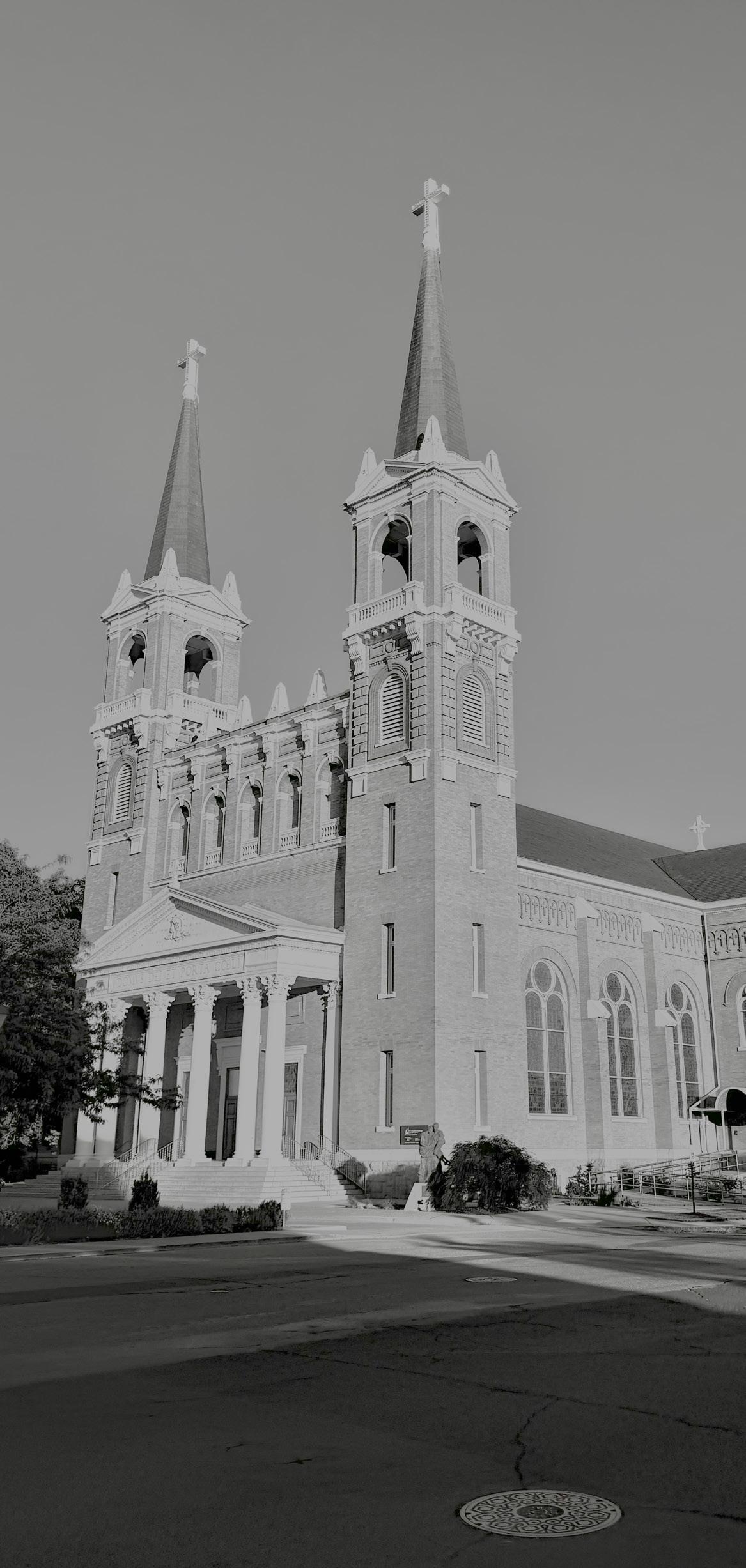
Recent racist incidents and violent rhetoric exposed what has been an ongoing campus culture GU administration refuses to confront.
By A STUDENT WHO READ THE MISSION STATEMENT
For years, Gonzaga has sold belonging. It’s in the brochures, the tours, the speeches about Jesuit values and dignity. Students are told they’re stepping into a community that will see them, protect them, and stand with them.
That promise has been exposed as empty.
Racist, violent, and dehumanizing rhetoric has spread openly through student spaces, and it has not been met with the urgency or force it demands. This is not new. Students of color have been navigating this reality for years. What is new is that it can no longer be ignored or quietly managed behind closed doors.
And while the university has taken its time, the harm has not paused.
In the weeks that have passed, more incidents have occurred. Not fewer. Not contained. More.
I chose Gonzaga because I believed their promise of belonging. The past few weeks made me realize that promise was never meant for everyone”
Students are not talking about one moment. They are living through a pattern that is continuing in real time.
The university’s response to this moment has been, plainly, bullshit. Vague statements. Performative language about community that does not match what students are actually experiencing.
And when the response is slow, unclear, or hidden, it sends a message.
Campus voices spoke clearly on racism. Administration did not.
By
Students across Gonzaga spoke with remarkable clarity in the days following the racist attack on Black Student Union members. They named the harm that had occurred and called for accountability and change.
Communities across campus denounced what had happened. Student organizations issued statements. Departments spoke openly about the fear and anger students were experiencing.
The message from students was clear: racism and violent rhetoric have no place here.
But leadership carries a different responsibility. It requires the courage to name injustice plainly and to act decisively when the dignity of members of the community is threatened. This did not happen.
Students have already made their position clear. Now the responsibility lies with leadership to do the same. This was needed over a month ago. The damage is done.
Now is the time for real action, not performative inaction.
I am really tempted to start telling tour groups the truth about what is going on here. Can we sue Gonzaga for false advertising? It is a joke.”
Silence is permission. Delay is acceptance. And “we are working on it” starts to sound like “this is something you will have to live with.”
At this point, the question is not whether racism exists at Gonzaga. That has already been made clear.
The question is whether Gonzaga is willing to confront it in a real, visible, and immediate way.
Because right now, students are being asked to continue showing up to classes, to campus, to a community that has not demonstrated it can or will protect them.
Students are missing class. Students are falling behind. Students are questioning whether they should still be here at all. That is not abstract. That is the direct impact of institutional failure.
A STUDENT WHO WON'T FORGET
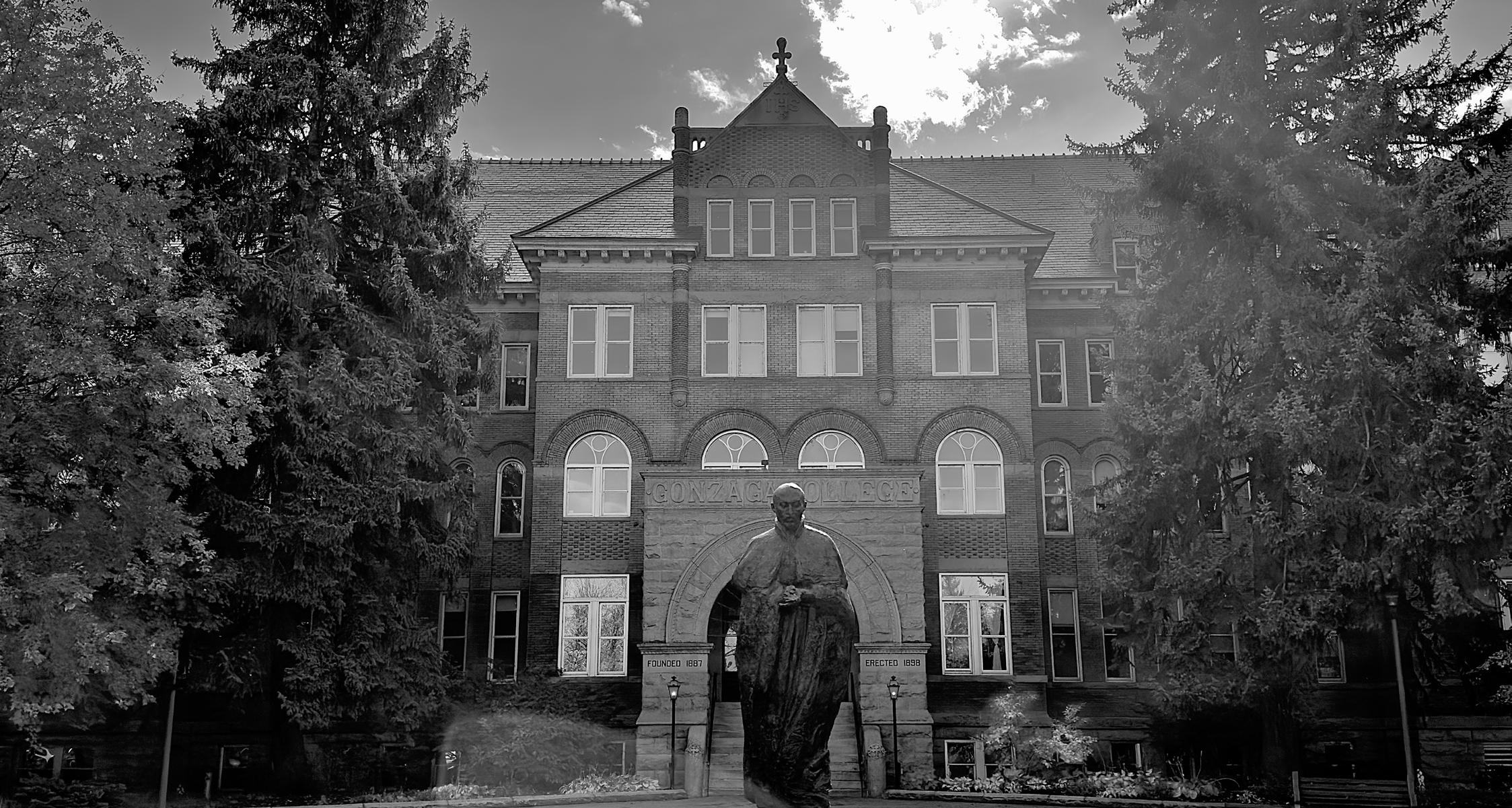
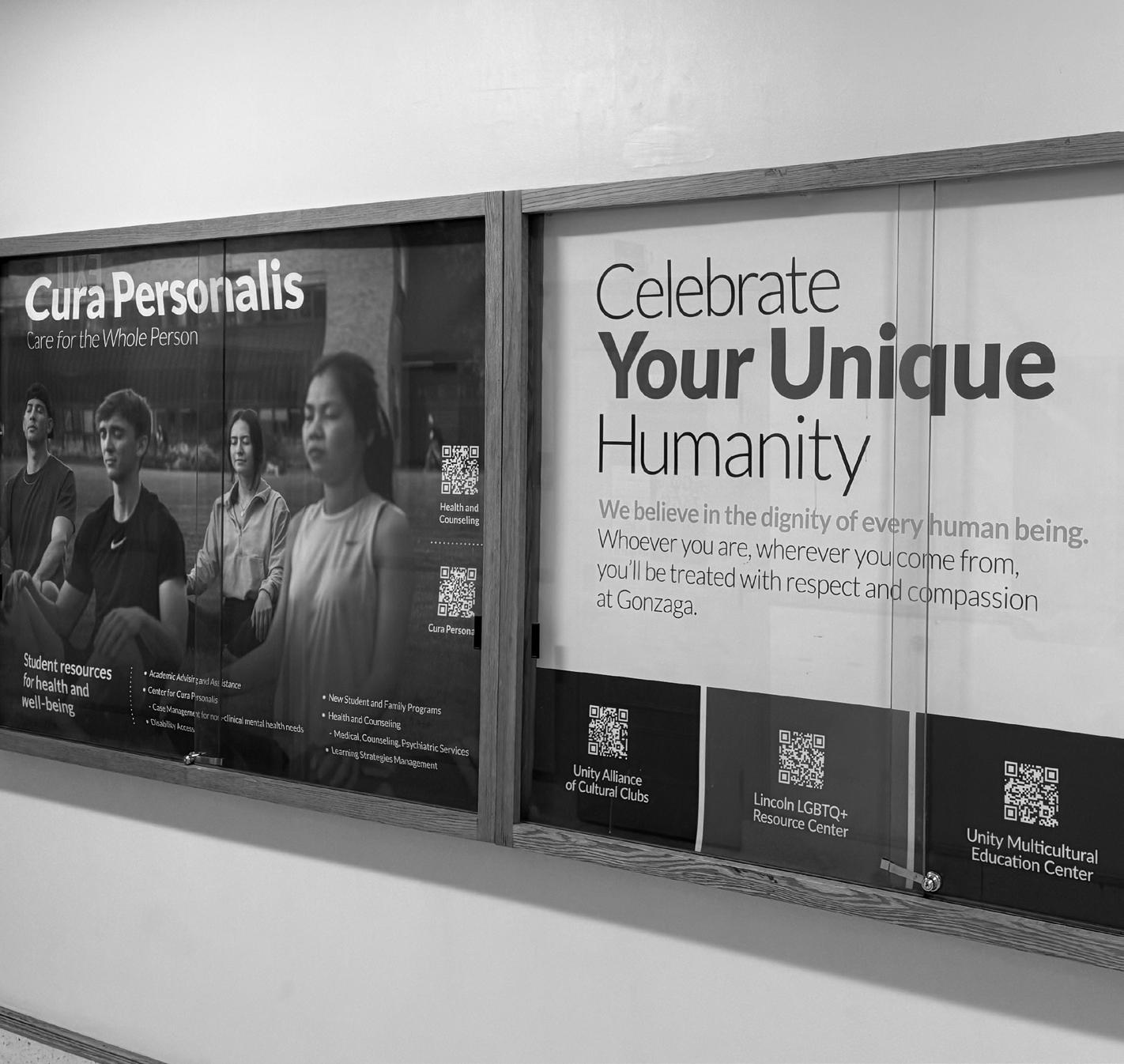
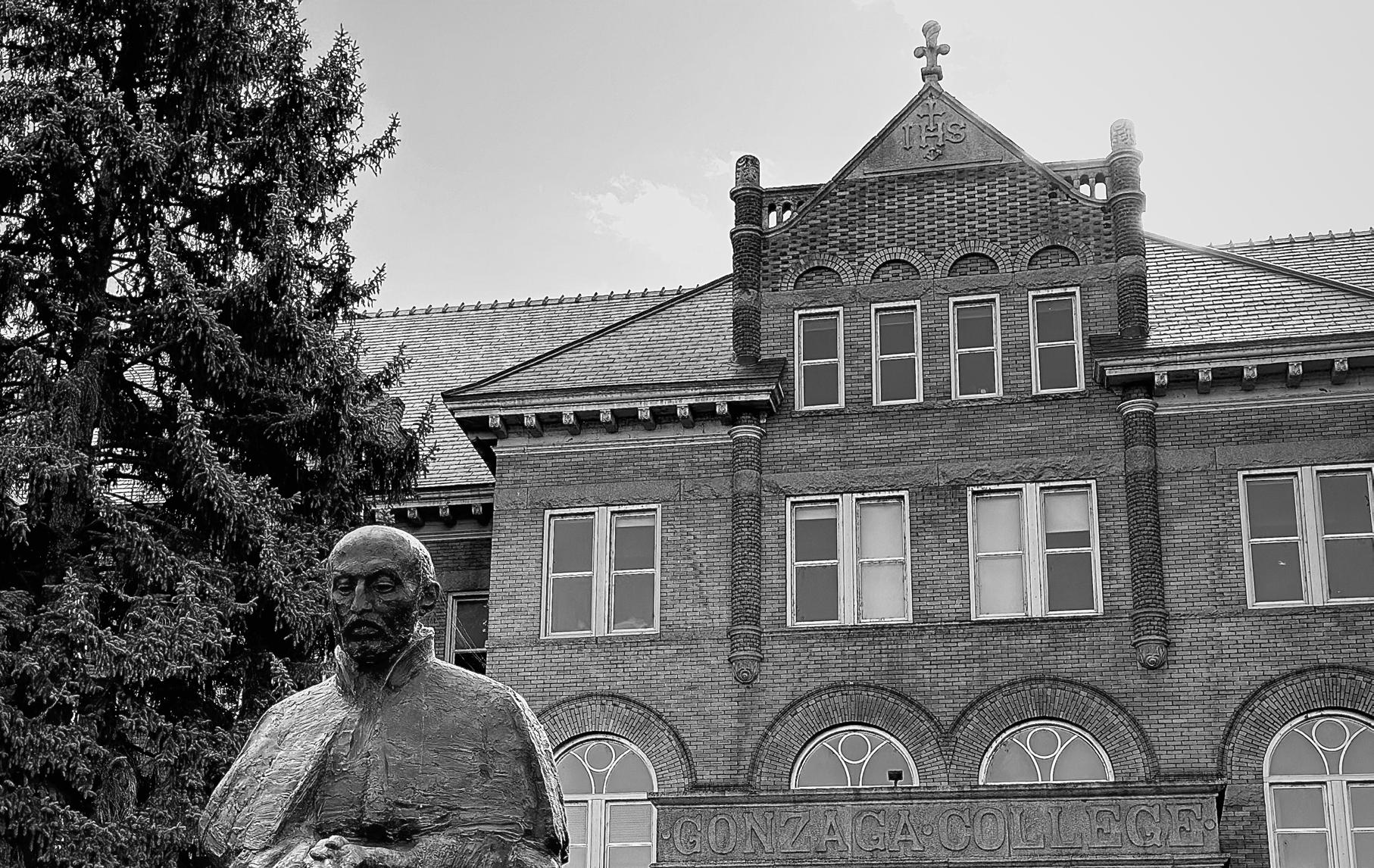
The exterior of College Hall, a central symbol of Gonzaga’s Jesuit mission and values. Inside, posters emphasize Cura Personalis and universal respect—messages contradicting student experiences. Gonzaga preaches belonging. Not our experience.
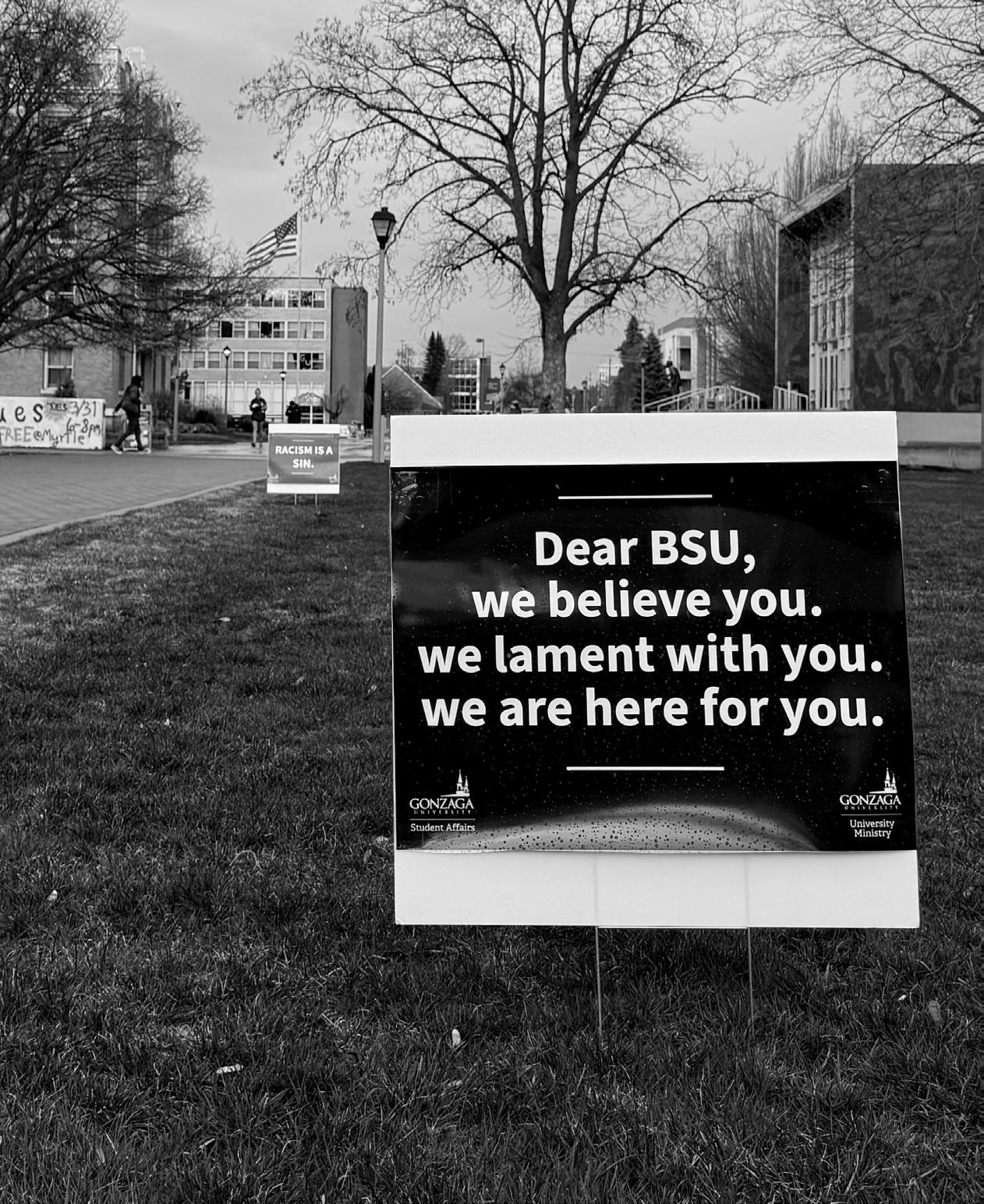
Amid administrative inaction, campus offices, departments, and student groups made support for BSU and black students visible. But is this enough?
Am I Only 3/5 Here?
At its founding, Gonzaga excluded Black students. Today, students question whether belonging has truly changed.
By A STUDENT WHO KNOWS THEIR WORTH
Yet again, I am questioning whether I truly belong at Gonzaga University.
Because this is not new. This is a pattern, one I was even warned about.
Gonzaga asks me to believe I belong here. But in moments like this, I have to ask: do you actually see me as part of this university, or just as a number?
This place did not just accidentally leave students like me out. It was built in ways that excluded us. And even when Black students were finally let in, were we ever truly supported, protected, treated equally?
Or simply allowed in?
Because that is what this moment feels like. Like I am here, but not fully valued, not fully protected, not fully seen. If I truly belonged, my safety would not feel like an afterthought.
And now, once again, we are given a statement. It says you are concerned. It says you are listening. It says you care.
But concern is not action. Words are not accountability.
Because while statements are released, harm has already been done. Threats were made. Fear is real. And what follows matters more than anything you say.
Right now, your inaction is a message. That students who spread racism and make threats are not being met with immediate consequences.
So what are we supposed to take from that?
That they belong here. That they are protected. That their actions are tolerated.
Because from where I stand, it feels like more effort is going into protecting the institution than protecting the students who were harmed.
So who are you trying to keep here?
You can talk about policy, process, limitations. But if you truly care, you find a way. You act. You do not wait while students feel unsafe on their own campus.
Justice is not convenient. Accountability is not easy. But that is exactly why it matters.
Because right now, the gap between what Gonzaga says and what Gonzaga does is impossible to ignore.
So this is the moment. Not for another statement— but for action. Immediate, visible, sustained action. Hold students accountable. Show that racism and threats have consequences. Make it clear that student safety is not negotiable. Invest in students of color showing us that we belong.
Because if that does not happen, the message has already been received.
I regret coming here. And I doubt I will be here all four years.
So much for your “no tolerance” bullshit
By A STUDENT WITH COMMON SENSE
Gonzaga proudly advertises a “zero tolerance” stance toward discrimination and harassment.
But when racism spread openly among Gonzaga students, many in the community were told the university could do little because the posts appeared on a third-party social media platform.
That explanation has left many students stunned.
The platform is not the problem. The people posting the racism are Gonzaga students. That’s the problem: Gonzaga students are harassing, threatening, and discriminating against other students.
When the university hides behind technicalities about where something happened instead of addressing what happened, it sends a clear message about
whose safety matters most.
Policies that sound strong on paper lose all credibility when they are not enforced in moments that matter.
For the students targeted by these messages, this was not an abstract policy debate. It was personal. It was threatening. It was another reminder that racism can exist openly while the institution struggles to respond.
Gonzaga students called their peers the N-word, monkeys, and criminals. They referenced “the good” of the KKK and lynching. They called out individual students by full name. “Joked” about bringing firearms into classrooms and “hunting down” individuals.
If Gonzaga truly has zero tolerance for racism and violence, this moment should have produced immediate accountability.
Instead, students watched the university treat the problem as something outside its responsibility. They watched as more dehumanizing, racist, violent posts were made by their peers.
Gonzaga has proven that there is a tolerance.
Gonzaga leadership has shown that they disapprove of this rhetoric but are not willing to stop it. They are not willing to hold those accountable. It is not worth it for them to ensure the safety of minority students on campus if it comes at an extra cost.
Get rid of the students saying these things. Get rid of the professors saying these things.
Get rid of the administrators allowing this to continue.
Present for the Game, Absent for Its Students
By A STUDENT WAITING TO FEEL SAFE
Kimmel was right. Gonzaga does not exist.
If it did, it would have acted already. Students would not be left to protect themselves.
Students would not have to prove that harm is real.
Instead, we are given statements that say everything and change nothing.
Words that sound right, but fail us when it matters most.
Promises that arrive late, and leave early.
Gonzaga knows how to show up when it benefits them.
It shows up when the lights are on. It shows up when the crowd is watching.
It shows up when there is something to celebrate.
It shows up when there is a game to win.
In those moments, there is energy. There is urgency.
There is pride.
But when students are hurting, that presence disappears.
When harm is real, that urgency disappears.
When accountability is needed, that leadership disappears.
Administration continues on as normal.
Paid to sit behind desks.
While students who pay to be here avoid theirs.
Students skipping class to feel safe. Students choosing distance over risk. Students carrying fear into spaces meant for learning.
Silence becomes the response.
Delay becomes the strategy. Distance becomes the default. And students are left to carry it.
Left to speak up.
Left to organize.
Left to take care of each other when the institution will not.
So maybe Gonzaga is not a university in the way it claims to be.
Maybe it is something that knows how to perform, but not how to act.
You say you hear us, but are you really listening?
GONZAGA STUDENT ‘28
“They always release a vague statement, attempting to sweep whatever issue or call to action under the rug. They even changed the protest policy, making it harder for us to be heard. If it’s not related to basketball, the school of business, or the school of engineering, Gonzaga does not care about it. They, administration and sometimes GSBA, constantly ignore certain departments, UACC requests (looking to potentially cut or decrease funding), and fail to provide genuine support and statements for students of color because they only care to look “good.”
WASHINGTON UNIVERSITY ALUM ‘25
“I stand with the students at Gonzaga! An attack on one is an attack on all!”
GONZAGA PROFESSOR
If students do not feel safe even attending their classes, we failed. We failed them. We failed our students to do the bare minimum.”
GONZAGA ALUM ‘24
“Gonzaga University must do better to support their underrepresented students. Silence and a statement are not acceptable. This is real pain, in person."
GONZAGA STUDENT ‘26
GONZAGA STUDENT ‘26
“There are systems in place such as the bias reports or others, but all they do is conduct these abstract investigations that ultimately don’t do anything to benefit the student population. These investigations are nebulous policies that ultimately work to make it so that the university is not held liable, but no action is taken for those hurt in 99% of cases.
GONZAGA PARENT
We know the school is a business. We know basketball is important. But how could you ignore the urgent needs of students?”
I will not say that these issues are impacting me directly as I serve as part of the dominant population. The negative experience I have is hearing the experiences and firsthand accounts of those who I am closest to. The negativity I face is by proxy, and that I cannot be proud to go here for those reasons mentioned.”
GONZAGA PROFESSOR
“Embarrassed and ashamed at the response to this crisis."
GONZAGA STUDENT ‘29
“There’s a lack of acknowledgment and change towards the racism occurring on campus, specifically in housing.
“There is a non-supportive and dismissive culture of racism from students, faculty, and admin. This apathy creates significant barriers in receiving support from existing systems and confronting overtly racist behavior through a lack of acknowledgment and failure to act. Administration has weaponized time, used language that mirrors support without meaningful action, and cultivated an environment that maintains an image of progression while enabling racist behavior without accountability over the past few decades.”
GONZAGA STUDENT ‘28
“It seems like they care more about their image than us. Giving out links to Cura Personalis is not helpful. It also feels like the basketball team is more important than the students. The president wasn’t even at the BSU dinner.”
GONZAGA STUDENT ‘29
“I find there is a lot of discrimination and sexual conduct violations that happen frequently on campus that the administration refuses to acknowledge or address.”
SPOKANE COMMUNITY MEMBER
This has been a pattern at Gonzaga for some time now. They need to be held accountable and make major changes.”
Making students like me feel like less than and underrepresented. The administration may offer resources for students of color, but resources can only do so much. I want to see real change in how students like me are represented.”
GONZAGA PARENT
“Do better Gonzaga. Be better."
and inclusion but prejudice and discrimination.”
GONZAGA ALUM ‘24
“As an alumni, I’m really disappointed to see a lack of action come from Gonzaga University where Black students have been threatened multiple times as victims of hate speech from members of the community. The Gonzaga that I knew once took a firm stance of actively reversing the past harm they’ve done to communities of color in the past but I see it quickly becoming another institution in this country that would rather appeal to the wealthy majority in its community while ignoring the minority voices calling for help. When people ask me if I would recommend Gonzaga University, I would have to paint a picture of my experience to allow them to make the decision for themselves. I’d highlight the fact that the Black professors I’ve had didn’t stay for more than two years and the ones that did were not given sought out promotions even with credentials far beyond their colleagues. I would recall professional staff at the university being more focused on asserting their power over students of color rather than listening to what they had to say. I could say that I remember enjoying sporting events, the jobs I had on campus, and leaving the city of Spokane to travel with friends I’ve bonded with during my time there but I couldn’t say I felt supported by Gonzaga University as a Black student and I wouldn’t recommend anyone going to see for themselves.”
WHITWORTH UNIVERSITY STUDENT '28
WASHINGTON STATE UNIVERSITY ALUM ‘24
“Gonzaga’s historical and current decision to uphold a racist campus climate should be made known to parents and potential students of color before they sign up to be enrolled in a dangerous environment. The unchecked racism and threats with deadly weapons directed at students of color clearly displays the administration’s stance on student preference and protection. Gonzaga is not a place of equality
WASHINGTON STATE UNIVERSITY STUDENT '28
“Gonzaga’s commitment to diversity looks good on paper. It fails in practice. Glad I did not go there.”
GONZAGA UNIVERSITY STUDENT '26
“I wish more of my professors would speak out about this. But they are scared. They fear losing their jobs for speaking out against injustice. That is a problem."
GONZAGA UNIVERSITY ALUM '23
GONZAGA
STUDENT '27
The Office of Inclusive Excellence and Chief Diversity Officer continue to fail its students. Why have there been no changes?"
“I graduated from GU believing the school was better than this. Seeing what’s happening now, it’s clear these issues were always there, just easier to ignore. It’s disappointing, but not surprising."
GONZAGA STUDENT '28
“It would have only taken an appropriate, humane response to the initial incident to avoid the situation we’re in now. Instead, the administration added to the hate, fear, and neglect students are feeling. Thanks Katia."
GONZAGA STUDENT '26
“Thank God I'm out. I never belonged. I never felt safe."
PROSPECTIVE
GU STUDENT
Damn, I had no idea that was going on over there. That's super disappointing. The fact it's happening at the Presidential level is wild.”
“Proud of Gonzaga BSU and the community supporting them. What is happening at Gonzaga is not right, and must be seen by more people.”
GONZAGA
STUDENT '26
“At least Thayne showed up and cared. Where is this new President? She's been so busy on publicity tours.”
GONZAGA PROFESSOR
“Administration is so far removed from the student body. The pain and fear following the initial incident could have been prevented. Even the communication to faculty was a failure. Why didn't we know sooner?”
GONZAGA STUDENT '27
"It is difficult for an administration of mostly white people to respond to a diversity crisis. Maybe try adding some diversity to admin and get rid of those who have been here for years and allowed Gonzaga to get to this point."
GONZAGA STUDENT '26
"Every student of color is an extra number. Another dollar. A statistic that lets Gonzaga advertise and trick more students into coming here."
GONZAGA STUDENT '27
"There is hope for change. We must keep pushing, keep talking, keep fighting."
GONZAGA STUDENT '29
“It’s official: I am transferring. Nice knowing some of you. I hope we stay in touch!”
An examen for Gonzaga University I proudly attended a Jesuit high school; I now cautiously attend a Jesuit university
By Grant Barnes ‘27
Originally written for The Black Lens, included with permission
For years, I have been formed by the same language:
Cura personalis – care for the poor and vulnerable. The dignity of every person. To be men and women with and for others.
Jesuit education does not simply transfer knowledge. It demands examination, not just of individuals, but of institutions. The Ignatian Examen is a practice of conscience — a deliberate pause to ask whether our actions reflect the values we claim.
So here is the examination:
When Black students on a Jesuit campus are called slurs to their faces, what does cura personalis require?
When discrimination, hate, and violent rhetoric spread online cloaked in anonymity, what do we do to ensure the dignity of every person?
When students calculate what spaces feel safe to exist in and where they do not, what does solidarity look like?
At Gonzaga University, right now, what does it mean to be men and women with and for others?
Many were shocked by what surfaced on the social media app Fizz: racist posts, dehumanizing language, references to violence all posted by Gonzaga University students.
But Fizz was not the disease. It was the X-ray. It did not create hostility at Gonzaga University. It revealed it.
Beneath polished mission statements and diversity banners, racism circulated comfortably enough to be joked about, minimized, and ignored.
This was not an anomaly. It was a window into how often students are told, “We can and must do better than this” as a reassurance. This has been said before, including in communication from administration to students this past week — the only visible communication from leadership to the campus so far.
Jesuit institutions pride themselves on discernment, reflection, and action. But these require honesty.
Why were professors unaware of what was reported and circulating among students?
Why are members of this campus community still unaware of what has happened and continues to unfold?
Where is the immediate action to communicate and address potential threats to student safety?
This is not simply a student problem. It is a leadership problem.
There continues to be a failure to act. A failure to communicate clearly. A failure to protect students from predictable harm — the kind of harm institutions across the country have learned too late to take seriously.
There should be outrage that posts on Fizz — a social media platform that allows users to join university-specific communities using their Gonzaga student email addresses — referenced concealed weapons in campus spaces and were not addressed with visible urgency. Outrage that some students feel their safest option is to skip class or consider withdrawing from their education. Outrage that, to this day,
new posts continue targeting students of color on campus.
Solidarity cannot stop at condemning perpetrators. It must demand institutional accountability.
So, I call on Gonzaga University to publicly acknowledge the institutional failures that allowed this environment to persist.
I call on Gonzaga University to implement new transparent crisis communication protocols so faculty, staff, and students are not left in the dark, especially when safety concerns arise.
I call on Gonzaga University to demonstrate, through action rather than messaging, that student safety is not conditional, and that students of color like me do belong here.
This should not be about optics. It is about trust. It is about cura personalis,
the very values that a Jesuit university is built on.
There is panic among students — not hypothetical fear, but real anxiety about who sits next to them in class. About whether the anonymous hostility they read reflects the person beside them.
I hope the urgency within the University matches the urgency students are feeling. I hope that any alarm among leadership is rooted not in protecting reputation, but in protecting students.
If we truly believe in forming men and women with and for others, we cannot merely stand in solidarity with those targeted by racism. We must demand justice. Demand accountability. Demand prevention. Demand leadership worthy of the Jesuit name.
From pride to concern: Letter for the community
By
Members of the Gonzaga Community,
As a GU alum and Spokane resident, I was thrilled and proud when my child was accepted and decided to attend this Jesuit university. I truly believed that this would be a place where they would feel safe and be able to have a great college experience. Unfortunately, due to the racist actions taken against members of the BSU after the incredible dinner and performances they put on a few weeks ago, my child no longer feels safe and it has had a negative impact on their mental and emotional wellbeing, and their education.
As a parent, I am outraged that this happened, concerned that it may not be fully addressed or properly handled, and of course, I am worried about the safety and wellbeing of my child and other Black students. I fear that these occurrences will continue to get worse if nothing or not enough is done to stop it. I am also concerned that students of color may not seem supported or valued at this institution currently, and that saddens me.
I believe that, at a minimum, these students deserve to feel safe and valued, especially at a place that claims to be committed to social justice.
Gonzaga parents, we need to step up and speak out! We should be able to trust that our children are safe and supported when we send them off to college, however, for many of us parents this simply isn’t so. We need to work together to make this a more secure environment for all students. We as parents need to make sure that our voices and concerns, and those of our students, are heard loud and clear. You can write letters, make calls, sign petitions, etc. We also need to step up and show support for the members of our BSU and other marginalized communities within the university. If you aren’t sure what to do, reach out and ask. You can ask your student, a member of the BSU or other cultural groups, an alumni, etc.
Alumni, I implore you to consider doing the same. Fellow Zags, you know that these behaviors go against the values our alma mater was built on and alleges to follow. Gonzaga is a Jesuit university that claims to be dedicated to social justice, diversity, inclusion, solidarity, and Cura Personalis, and we need to hold our former school to these standards and values. Don’t just sit back and wait for change! Write letters, create petitions, contact former faculty or staff that you trust, etc. Our current and future Zags need you to step up!
Spokane community members, Gonzaga is such an integral part of our small city. This town has shown so much support for our Zag athletic teams, which is wonderful. We need to do more! As a community, we need to provide support for the students who are being subjected to such deplorable treatment and stand up for them. We need to listen to them, help them heal, and show them that we care.
It has been over a month since the initial incident, and little to no action has taken place. This is unacceptable! Parents, alumni, and Spokanites, we need to stand together in solidarity with the BSU members and other Black Zags and let the administration at our beloved Gonzaga know that we expect immediate action. They need to make it clear that such behaviors will not be tolerated and they need to prove to the members of the BSU that their concerns have been heard, and that they are supported and valued. I pray that we all come together as a large community and hold Gonzaga to its declarations of its values about diversity, cultures, and caring for the whole person, and provide the BSU members with the assistance that they need to heal and move forward.