
Umatålaf 2025


Phases of
Sinåhi
Waxing Moon
Arpil 5
Pulan Gualåffon
Full Moon
April 13
Kuatto Konsiente
Waning Moon
April 21
Homhom i Pilan
New Moon
April 28
pilan Umatålaf Lunar phases sourced from timeanddate.com
Instagram: @guampedia
Facebook: Guampedia
Phone: 671.734.0217
Email: guampedia@gmail.com
Mailing Address:
303 University Drive
UOG Station, House #3
Mangilao GU 96923

A History of Mes CHamoru
The Evolution of a New Tradition
As we bring this season of celebrating our heritage, traditions, and stories as the native people of the Marianas to a close, we want to take some time to think about the origins and evolution of Mes CHamoru. What initially started as a day to commemorate the date that Magellan first landed in the Marianas has evolved into a month-long celebration of everything from CHamoru/ Chamorro language, food, and music, to deeper reflections on the resilience and perseverance of our people through many periods of hardship and struggle. In 1970, celebrations began in Guam to mark the date that Ferdinand Magellan landed in the Marianas, commemorating the moment when CHamorus/Chamorros first came into contact with the Western world. Known as “Discovery Day,” the holiday was
initially celebrated during the first Monday of March.
Over the next decade, perpetuating CHamoru/Chamorro culture became a community priority that was recognized and supported by the government. In 1974, Governor Carlos G. Camacho signed a bill, officially creating a fiveyear pilot program that was dedicated to teaching CHamoru/Chamorro language and culture. By 1980, CHamoru/ Chamorro language and culture became a mandatory subject for public elementary school students, and was also offered as an elective to public high school students.
CHamoru/Chamorro language classrooms within the public school system were often at the forefront of cultural revitalization and took on the
Continued on page 2
Guampedia is a non-profit affiliate of the University of Guam with operations funded by the Government of Guam’s Tourism Attraction Fund.
Dancers from Guma’ Nina’en Acho Latte performing at Humåtak. Photo courtesy of Joe Quinata.
Continued from page 1
important work of inspiring and empowering the next generation. Cultural pride was steadily growing, being reflected in the changing historical narrative around “Discovery Day” — the celebrations first shifted to “Chamorro Week,” and eventually the entire month of March was formally recognized as Mes CHamoru. Today, Guam Discovery Day celebrations and the re-enactment of Magellan’s landing in the village of Humåtak remain a cornerstone of the many events that unfold throughout Mes CHamoru. Discovery Day celebrations in Humåtak come alive with CHamoru/ Chamorro language chants and traditional dances dotting the shoreline.

The transformation of Mes CHamoru commemorations reflect our evolving identity as CHamoru/Chamorro people over the course of generations as well as movements to embrace the beauty of our culture while reviving and breathing life into our language and traditions.
The CHamoru/Chamorro language gives us clues and insights to how our ancestors viewed the world. For example, the many uses of the term mo’na (front) teaches us that our ancestors saw time as circular, rather than linear. This means that the past, present, and future are not one-time events, but linked together in a circle. We can learn about what our future may hold by studying and learning from our past. How do you think Mes CHamoru values and celebrations might grow and change in the coming decades?
(1) Master Storyteller, Clotilde Gould. Courtesy of Gould Family Collection. (2) Preparing leaves for weaving. Courtesy of Merle and Clara Williams

Cultural Values and Beliefs The Foundations of Culture
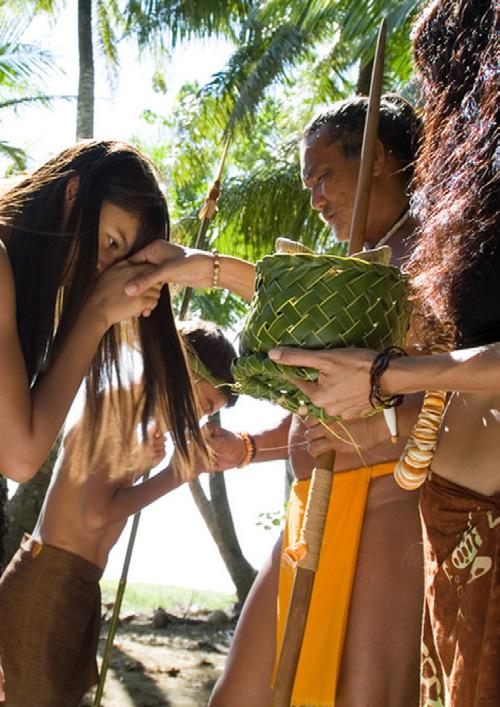

The history of Chamorros/CHamorus in the Marianas is deep and complex. Although there are many parallels with our sister islands across Pasifika and Indigenous peoples around the world, the experiences of Guahan/Guam and the
Marianas are unique. For over 3,500 years, the Chamorros/CHamorus developed cultural values and beliefs that served as the foundation for intricate social and land tenure systems, which allowed them to live in harmonious balance with the natural environment. These values and beliefs withstood the seven distinct and widely recognized eras of history, as well as three colonial powers, though their expression changed with the times. This affirms that cultures do not die, they evolve.
CHamoru/Chamorro Values
Gineftao - Generosity
Mamahlao - Humility
CHenchule’- Reciprocity
Taotaomo’na - Ancestors
Respetu - Respect
Inafa’maolek- Making Good
Many families today perpetuate and teach these values to their younger generations, yet may call them different names. Learning the ancient origins and expressions of these values can provide more insight and deep meaning, and also inspire feelings of connection to our ancient past in these modern times. Remembering the roots of our culture–our values, customs, and beliefs–will continue to help us stand firmly planted in our ancient heritage and guide our growth as a people through whatever changes come our way.


Photo courtesy of Victor Consaga
Guampedia Currents
Dr. Anne Hattori Contributes Entries
Welcome to Currents! History may be the past, but it’s always in the making. In this recurring feature, read about what’s going on at Guampedia – our current projects, new entries, plus news and announcements. Guampedia recently partnered with University of Guam professor Dr. Anne Perez Hattori to feature some of her scholarship which highlights important corners of Guam’s history. Here, we’ll share some short excerpts from Dr. Hattori’s new entries, visit Guampedia.com to get the full story!

Betel Nut: Cultural and Social Aspects
Betel nut, known to CHamorus/Chamorros as pugua, can be viewed as a rich marker of cultural and social practice that has played a key role in cultural dynamics and family relationships. Pugua played a role in ceremonial festivities surrounding birth, death, and marriage. For example, as soon as a marriage union was planned, the mother of the potential groom would arm herself with a box for betel and pay a visit to the mother of the intended bride. On arrival, she would offer some of the betel to the hostess before the hostess had time to offer her anything first, thus signaling that a marriage was to be discussed. Pugua can serve as a lens through which a variety of CHamoru/Chamorro cultural and social issues can be understood, and its treatment by various colonial officials throughout different eras of Guam history reveals tensions of cultural identity.
Click here to read more!
The 1918 Influenza Pandemic
The 1918 Influenza Pandemic was a significant historical event that impacted much of the world, and created catastrophic circumstances in Guam — although it receives little attention in our history books. In 1918, more than 900 people died in Guam, approximately 70 percent of them due to influenza. Guam’s population was estimated at 13,000 in 1918, and influenza ultimately killed more than five percent of the population — more than 90 percent of whom were native CHamorus/Chamorros. During the pandemic, Catholic priest Pale’ Román de Vera walked through the streets of Guam’s villages in search of the ill, and would ring a bell to announce his presence so villagers could call upon him to administer to the dying. Day and night, Pale’ Román rose to the challenge of ensuring that every Catholic struck with the flu received the sacraments, and was later awarded a special commendation from US President Woodrow Wilson for his heroic efforts during this tragic period of Guam history.
Click here to read more!

and
Betel nut. Courtesy of Kerri Ann Borja
Fingernail
cleanliness inspection. Photo from Don Farrell courtesy Anne Hattori.