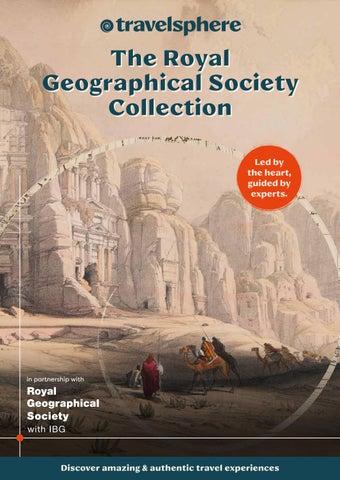
The Royal Geographical Society Collection

Led by the heart, guided by experts.
The Royal Geographical Society Collection
The Royal Geographical Society was founded in 1830 to advance geographical science, and this remains their core purpose today supporting geographical research, education, fieldwork, and expeditions.
Last year, we were delighted to unveil our partnership with the Royal Geographical Society, and it is a partnership that reflects our shared dedication to the transformative power of purposeful travel.
The Society have taken a selection of our most culturally significant journeys and provided us with exclusive access to unique historic materials from within their archive to enrich our understanding of these destinations. Due to the popularity of these tours, we have continued to add new destinations to this collection including Indonesia, Peru, Jordan, Türkiye and Greece.
By choosing a Royal Geographical Society Collection itinerary you are directly supporting the essential work of one of the world’s most important geographical bodies.

Travel in the footsteps of some of the world’s leading scientists, geographers and travellers.


‘The Jama Masjid (‘Akbars Mosque’) Photographer: W. Howe-Greene,
‘The Forum, Rome’. Photographer unknown, 1870


Here’s what you can expect from a Travelsphere tour…
RETURN FLIGHTS
On every tour, we include return flights. All tours will have a London departure and, on many tours, you’ll also be able to fly from your local airport. We also take care of all of your overseas transfers and transportation making sure you get safely from A to B.
HAND-PICKED ACCOMMODATION
At the end of each day, relax in the comfort of your accommodation, hand-picked by our team as the ideal fit for your stay. It might be in the perfect spot to explore more at leisure, somewhere a little indulgent or perhaps somewhere quite unique.


EXPERT HOLIDAY DIRECTORS
All of our tours are hosted by an expert Holiday Director who will be on hand to guide you through your chosen adventure, sharing insight and making sure you don’t miss any of the best sights.
INCREDIBLE EXPERIENCES
We do everything we can to make sure you have the holiday of a lifetime, that’s why we include so many mesmerising experiences. Uncover incredible sights, experience new cultures and taste mouth-watering cuisine.
LOCAL FLAVOURS
Indulging in local dishes is a highlight of any holiday, that’s why we make sure there are opportunities to sample authentic flavours that make your taste-buds tingle.
FREEDOM & FLEXIBILITY
Our tours have been built with freedom and flexibility in mind. Whether you choose to upgrade your flight, join one of our optional excursions, spend some time making your own discoveries or perhaps simply relaxing at your hotel –the choice is yours.
GREAT TRAVELLERS
And then there’s the rest of the group - from couples and family members to friends travelling together and even a few solo travellers too, you’ll laugh together, you’ll share stories and most importantly, you’ll create incredible memories of your time away.
GUARANTEED LOYALTY

We recognise that our success comes from listening to our customers, and we’re delighted that you’ll be rewarded with a loyalty offer when you return from your Travelsphere adventure.
‘Ejecting an intruder’. Illustration from ‘The Malay Archipelago’ by Alfred Russel Wallace, 1872
Mosque’) in Delhi’. Howe-Greene, 1930
Grand Tour of Italy

Our signature Italian itinerary takes you on an incredible journey from Venice in the north to Sicily in the south. It’s a great choice for anyone who wants to discover the best of Italy in one allencompassing adventure.
The perfectly paced itinerary takes in everything from the fascinating cities of Pisa, Florence, and Rome. Bask in the history of Pompeii, the spectacular scenery of the Sorrento Peninsula and brooding Mount Etna. You’ll stay in four-star hotels, all carefully selected so that you have a comfortable and well-located place to relax at the end of every day.
The trip includes a carefully curated mixture of guided tours, enabling you to visit and learn about the most famous and important sights, balanced with free time so that you can create the perfect adventure for you. You might choose to watch the world go by from a café, explore a museum or visit a cathedral, it really is up to you. If you prefer the convenience of having everything planned, simply ask your Holiday Director for recommendations, or join one of our exciting optional excursions.


Your holiday includes
RETURN FLIGHTS + TRANSPORTATION from London and regional airports, overseas transfers, other transportation and porterage
14 NIGHTS in 4-star hotels
24 MEALS
14 breakfasts, 1 lunch, 9 dinners and welcome drink
TRAVELSPHERE HOLIDAY DIRECTOR and Specialist Local Guide
Included highlights
• Tour the floating city of Venice
• Evening in the charming town of Treviso
• Visit the historical city of Bologna
• Taste delicious ice-cream from a famous ice-cream parlour
• View the Leaning Tower of Pisa
• Italy’s ‘art city’ Florence
• Visit the fortress town of Orvieto
• Rome and its historical sites
• Enter Montecassino Abbey
• Explore the ruins of Pompeii
• Local Tuscan produce dinner
• Typical lunch at the town of Pizzo Calabro
• Visit Taormina for views of Mount Etna
Optional experiences available
Departure dates & prices
2026 DATES FROM £3,249
4 May 18 May 1 Jun 31 Aug 7 Sep 21 Sep 5 Oct
2027
†
Pisa
Florence
Taormina
The Society’s archives comprise over 2,500 items specifically relating to the historical geography of Italy, dating from the 16th century to the present day. Highlights include an Italian astrolabe from 1500 and early maps of Italy by cartographers such as such as Antonio Lafreri and Vincenzo Coronelli.


In the footsteps of: Donald McLeish
Donald McLeish, born in London in 1879, had a passion for photography. He began work at a photographic studio before teaching photography at the Regent Street Polytechnic in Central London in 1900. Ten years later, he began work as a freelance photographer and soon carved out his reputation by supplying his photographs to journals such as the Illustrated London News, Country Life and National Geographic.
In 1916 he joined the Royal Navy Volunteer Reserve and was deployed to photograph Port Said, Egypt, where he captured some of the earliest aerial war pictures of the First World War. After the war he travelled widely, visiting large parts of Europe and the Middle East, accumulating a vast catalogue of approximately 3,000 photographs. McLeish travelled to Italy in 1920 and later in 1934, where he took a series of striking black and white photographs of the landscapes and architectural features of the country’s historical sites and cities.
In the footsteps of: Eric Newby
Eric Newby was one of the most prolific contributors to travel writing and photography in the 20th century, writing over 25 books and taking striking photographs of the people and places he encountered. His adventures began at the age of 18 when he joined the four-masted Finnish barque, Moshulu, and engaged in the 30,000 mile round-trip grain trade race between Ireland and Australia, which he vividly described in his first book, 'The Last Grain Race' (1956).
Newby served with the elite Special Boat Section during World War II. Captured during an operation off the Italian coast in 1942, he spent a year in a prisoner of war camp, before escaping. Hiding in the Po Valley, he met a young Italian-Slovenian woman named Wanda Skof, whom he later married, and who would become his equal partner on many of his later travels. His memoir of that time, 'Love and War in the Apennines' (1971) became one of his most acclaimed books. Wanda and Eric returned to Italy in 1967 when they bought a derelict farmhouse in the Apuan Alps. Newby’s humorous and affectionate account of their experience was published in ‘A small Place in Italy’ (1994).


‘Firenze (Florence)’. By Giovanni Domenico de Rossi
St Mark’s Square, Venice by Eric Newby, c.1980s
Selection of photographs of Italian subjects by Donald McLeish, various dates
Istanbul to Athens Turkish Delights & Greek Treasures

This 16-day odyssey invites you to discover two of the Mediterranean's most captivating civilizations, where ancient empires left their mark on landscapes that still echo with stories of gods, heroes, and visionaries.
Your adventure begins in Istanbul, where minarets pierce the skyline and the call to prayer mingles with the chatter of spice merchants in centuries-old bazaars. You'll trace the tragic history of Gallipoli's battlefields before standing in awe before the legendary walls of Troy, where Homer's epic tales spring to life.
Journey along Türkiye's stunning Aegean coast to Ephesus, where marble streets and towering columns reveal the grandeur of Roman Asia Minor. Cross to Greece, where island-hopping brings you to Samos before Athens welcomes you with open arms. The Acropolis rises majestically above the city, whilst further north, the gravity-defying Meteora monasteries cling to impossible rock pinnacles.
From Delphi's mystical oracle site to the Bronze Age splendours of Mycenae,
each day unveils treasures that have shaped Western civilization. Yet this journey isn't just about monuments— it's about shared meals with fellow travellers, encounters with local artisans, and those quiet moments when history feels touchably close.


Your holiday includes
RETURN FLIGHTS + TRANSPORTATION from London, overseas transfers, other transportation and porterage
15 NIGHTS in 3 & 4-star hotels
23 MEALS
15 breakfasts, 8 dinners and welcome drink
TRAVELSPHERE HOLIDAY DIRECTOR and Specialist Local Guide TRAVELSPHERE CARES
Visit Planeterra’s Cöp(m)adam social project
Included highlights
• Istanbul tour including the Blue Mosque and Topkapi Palace
• Explore the Egyptian Bazaar and Grand Bazaar
• Kumkapi Fisherman’s Village
• Gallipoli Battlefields visit
• Step back in time at Troy and it's museum
• Visit Cop(m)adam
• Explore Ayvalik and gözleme tasting
• Wander through the city of Pergamon
• Discover the highlights of Ephesus & Sirince
• Samos tour including the Eupalinos Tunnel
• Athens tour including the Acropolis and museum
• Visit the Meteora Monasteries
• Explore the archaeological site of Delphi
• Explore Mycenae, the legendary kingdom of Agamemnon
• Visit Nafplio and Epidaurus
Optional experiences available
Departure dates & prices
2026 DATES FROM £3,649
20 Sep
2027 DATES FROM £3,799
11 Apr 16 May 12 Sep
† Price of tour departing in Sep 2026 from London Single Room supplement from £1,000
FLIGHT CHOICES
Flight upgrade available
Visit TRAVELSPHERE.CO.UK for latest dates & prices. Flights and hotels are subject to change and will be confirmed within your final documentation.
Blue Mosque
Meterora monastery
Acropolis, Athens
The Society’s archives hold a varied collection of material relating to Türkiye and Greece, from 17th century maps of various Greek islands by Dutch cartographers Joan Blaeu and Petrus Schenk to the early 19th century watercolours of Istanbul by artists William Purser and Joesph Brown.


In the footsteps of: Elizabeth Wilhelmina Ness
Also known as Mrs Patrick Ness (1881–1962), Ness was an English traveller. She was one of the first female Fellows of the Royal Geographical Society, and the first woman to be elected to the RGS Council.
Ness’s husband died suddenly at sea on 19 April 1914, leaving her an independently wealthy widow. She then dedicated her life to travel. Between 1908 and 1913 she travelled extensively in Central Africa, including the Mount Kenya Region, and in 1923 she undertook a journey from Beirut across the Syrian desert to Isfahan in Persia. Ness described her travels in ‘Ten thousand miles in two continents’, published in 1929. Ness also travelled through Greece and the wider Mediterranean, photographing the sites and people she encountered. She visited Athens and also Mycenae and Tiryns, both sites popularized by Dr Heinrich Schliemann.
In 1953 she endowed the Ness Award to the Royal Geographical Society to highlight travellers, particularly those who have successfully popularised geography and the wider understanding of our world and its environments. Past award winners have included Michael Palin, Nick Danziger, Ray Mears, Rory Steward and Lemn Sissay.
In the footsteps of: Johann Ludwig Heinrich Julius Schliemann
Born on the 6th January 1822, he was a German businessman and an influential archaeologist who advocated that the Iliad of Homer reflected actual historical events. To this end he extensively excavated Troy, Mycenae and Tiryns.
Schliemann excavated nine layers of archaeological remains at the ancient site of Troy; an act that has been criticized as


Many have disagreed with his methods over time, but Schliemann was responsible for the discovery of a huge volume of ancient artefacts and fuelled a generation of interest in archaeology and a desire to learn more of the heritage of this globally important part of the world.
Watercolour of Constantinople (Istanbul) by Joseph Brown, 1850
‘Troy as it appears after the excavation of 1879’. Illustration from ‘Ilios, City and Country of the Trojans’ by Dr Henry Schliemann, 1880
Illustration from ‘Ilios, City and Country of the Trojans’ by Dr Henry Schliemann, 1880
‘Acropolis, Athens’.
‘Caryatids, Erechtheion, Athens’.
Photographer: Elizabeth Wilhelmina Ness, 1920s
Epic Wonders of the National Parks

Included highlights
• Mount Rushmore National Memorial
• The Crazy Horse Memorial
• Badlands National Park
• Wild West city of Deadwood
• Views of Devils Tower
• Battle of Little Bighorn site
• The world’s first national park, Yellowstone
• Grand Teton National Park
• Canyonlands National Park
• Arches National Park
• Mesa Verde National Park
Cameras at the ready! Encounter the most spectacular sights and scenery the USA has to offer.
Your adventure starts in Denver, Colorado and takes you through seven different states to the bright lights of Las Vegas. Throughout your journey, you will discover stunning historic sites and landmarks dedicated to those who defined the country’s history and step into the world of the ‘Wild West’.
This meticulously planned itinerary travels through no less than nine of America’s national parks. Wonder at the diversity of wildlife and see spouting geysers in Yellowstone, then take in the breath-taking grandeur of the Rocky Mountains in Grand Teton. Immerse yourself in the countries vast, rugged landscapes shaped by the dramatic power of nature over millions of years, visiting ancient cave dwellings and geological wonders.


• Monument Valley
• Navajo Tacos at Goulding’s Monument Valley
• The iconic Grand Canyon National Park
• Bryce Canyon National Park’s unique geology
• Zion Canyon National Park
• The neon-lit city of Las Vegas
• Stay on the Las Vegas Strip
Optional experiences and Las Vegas add-on available
Departure dates & prices
The Society’s archives comprise over 4,000 items specifically relating to the historical geography of the United States of America, dating from the 17th century to the present day. Highlights of the Society’s archives include the dramatic and aweinspiring sequence of original ‘mammoth plate’ prints of Yosemite Valley taken in the nineteenth century by the photographer, Carleton Watkins, and early 18th century maps of North America by cartographers such as Thomas Jefferys, Guillaume de L’Isle and Johann Baptist Homann.


In the footsteps of: Gustav Nordenskiold
Gustav Nordenskiold, a scientist and the eldest son of the Polar explorer, Baron Erik Adolf Nordenskiold, set out on a worldwide trip that he hoped would cure his tuberculosis. However, he arrived in Denver, Colorado, in June 1891, and decided to cut his world tour short to visit the cliff dwellings of the Mesa Verde. This break in his world tour became permanent and he spent several months alongside Richard Wetherill and Charles Mason (who had both visited Mesa Verde in 1888), carrying out an extensive and detailed archaeological survey of the numerous cliff dwellings. He reported his findings and detailed photographic studies in newspapers and scientific publications, including 'The Cliff Dwellers of the Mesa Verde', published in 1893.
In the footsteps of: William Henry Jackson
William Henry Jackson was an American explorer and photographer whose scenic photographs of the American West helped draw people to the region and were integral in convincing the U.S. Congress and the American public of the need to preserve the landscapes as national parks.
In 1870, Jackson became the official photographer for the United States Geological Survey of the Territories (USGS) and joined Ferdinand Hayden’s 1870 expedition to the Yellowstone River and Rocky Mountains. Following the success of this expedition, Jackson was invited to join a further eight USGS expeditions. He became one of the first to photograph Yellowstone, the Grand Tetons and the Mesa Verde region, capturing the first photographs of the Ancestral Puebloan cliff dwellings.
From the archives
'This ruin well deserves its name, for with its round towers and high walls rising out of the heaps of stones deep in the mysterious twilight of the cavern, and defying in their sheltered site the ravages of time, it resembles at a distance an enchanted castle’.
Gustav Nordenskiold, describing ‘Cliff Palace’ in his book ‘The cliff dwellers of the Mesa Verde’ (1893)

Map of Little Bighorn River showing Indian encampment and Custer battlefield. United States Geological Survey, 1908
Photographs from the United States Geological Survey of the Territories by William Henry Jackson, 1872
The 'Cliff Palace’ at Mesa Verde by Gustav Nordenskiold, 1893
Grand Tour of Canada & The Rocky Mountaineer

Your holiday includes
RETURN FLIGHTS + TRANSPORTATION
from London, overseas transfers, other transportation and porterage
15 NIGHTS in great quality hotels plus 1 night in flight
5 MEALS
3 breakfasts (B), 2 lunches (L) and welcome drink
SCENIC TRAIN
2-day rail journey on board Rocky Mountaineer in SilverLeaf Service
TRAVELSPHERE HOLIDAY DIRECTOR and Specialist Local Guide
TRAVELSPHERE CARES
Learn about Canada’s First Nations at Squamish Lil’wat Cultural Centre
Included highlights
• Quebec City, the only walled city in Canada
• Explore Montreal with the Notre-Dame Cathedral
• City tour of Ottawa, the nation’s capital
• Toronto, Canada’s premier city
• 1000 Islands sightseeing cruise
• Enjoy breathtaking views of Niagara Falls
If you want to see the sweeping grandeur of Canada in one incredible, allencompassing trip, this is the adventure for you! Travelling across the country from East to West, you’ll stop at many of its most wonderful cities, wonder at its spectacular scenery and learn about the nation’s fascinating cultural history.
Your journey will pause in Montreal, Quebec City, Ottawa, Toronto, and Vancouver, and then venture out to see the thundering waters of Niagara Falls. Feast your eyes on the wonderful wildlife, including bears, as you tour sensational Banff National Park, before setting our to see the turquoise-coloured water and jaw-dropping beauty of Lake Louise. Sit back, relax, and admire the view as you travel aboard the luxurious Rocky Mountaineer train. Before taking a ferry to Vancouver Island, where you can get up close to nature on an optional whale-watching adventure.


• Visit Niagara-on-the-Lake
• Tour of Banff National Park
• Lake Louise, one of Canada’s most beautiful sights
• Step aboard the iconic Rocky Mountaineer for a two-day journey
• Enjoy fine Canadian cuisine on board Rocky Mountaineer
• Vancouver and Stanley Park with its totem poles
• Victoria, the capital of British Columbia
• Vancouver Island’s beautiful Butchart Gardens
• Experience spectacular views of Vancouver Island from Malahat Skywalk
Optional experiences and Vancouver add-on available
Departure dates & prices
2026
11
Banff National Park
Mountaineer
The Society’s archives comprise over 7,000 items specifically relating to the historical geography of Canada, dating from the 17th century to the present day. Highlights include early maps of Canada by Guillaume de L’Isle, and maps, manuscripts, watercolours and sketches relating to the exploration of the Canadian Arctic in search of the Northwest Passage during the 19th century.


In the footsteps of: John Linton Palmer
John Linton Palmer’s naval career involved several tours of duty in the Pacific between the years 1850 and 1868. As a naval surgeon, he developed an interest in natural history and ethnography and followed in the tradition of many earlier naval surgeons to create fine and detailed observational drawings and sketches of the people and places encountered on the tour.

In the footsteps of: John Norman Collie
J. Norman Collie was a pioneering chemist and mountaineer.
In the late 1890s he joined the renowned chemist, Sir William Ramsay, as an assistant at University College London (UCL), where they conducted ground-breaking research into rare gases and where Collie made what was to be the first neon lamp. Collie also had a love of climbing and at the end of each university term he would venture to the Scottish Highlands, the Alps or the Himalayas.
In 1896 he made his first of several visits to the Canadian Rocky Mountains in search of Mount Hooker and Mount Brown, which had reportedly been sighted at a height of 15,000ft. Collie made a total of 21 first ascents, including Mount Victoria which he named after Queen Victoria, and eventually located Mount Hooker and Mount Brown at 9,000ft. Collie also explored the Columbia ice-field, the Bush river and the country between the headwaters of the Saskatchewan and the Columbia rivers.

His copiously annotated albums include sketches made in Pitcairn Island, Rapa Nui, Tahiti, China, Chile, Panama, Vancouver Island and the Bering Strait. His sketches of NorthWest Coast Indian and Inuit peoples, and their artefacts, reveals a highly developed interest in the detail of material cultures, providing a unique, pre-photographic record of the region at a very significant moment in the relations between settlers and First Peoples.
Landing Place, Fort Victoria by Palmer, 1851
Esquimalt Harbour, Vancouver by Palmer, 1851
Sketch map of the Canadian Rocky Mountains by G.P. Baker and J. Norman Collie
‘Quebec from the Citadel’. Photographer: Vincent Clarence Scott O’Connor, c.1920s
Wonders of Peru
Machu Picchu & Amazon Adventure

Follow in the footsteps of intrepid adventurers as you explore Peru, an intriguing country like nowhere you have been before.
Discover the colonial past of its capital, Lima, followed by a deep exploration of the Amazon Jungle in the Tambopata Area. Pristine rainforest hides all kinds of nature, and your hotel looks out onto one of the biggest tributaries of the mighty Amazon River. Next up is another highlight of Peru - the world-famous Inca Citadel of Machu Picchu, perched high on a mountain above a lush river valley. Following this we will make our way from the Sacred Valley to the City of Cuzco and then onwards across the Altiplano to Puno and another natural wonder - Lake Titicaca. Return to Lima after a wonderful holiday full of nature and stunning scenery.


14 days from £4,299†
Your holiday includes
RETURN FLIGHTS + TRANSPORTATION
from London, overseas transfers, other transportation and porterage
12 NIGHTS in 3 & 4-star hotels and lodges plus 1 night in flight
20 MEALS
12 breakfasts (B), 4 lunches (L), 4 dinners (D)
TRAVELSPHERE HOLIDAY DIRECTOR and Specialist Local Guide
TRAVELSPHERE CARES
Visit the Planeterra Ccaccaccollo Women’s Weaving Co-operative
Included highlights
• Guided tour of Lima, ‘City of Kings’
• Stay in the Amazon Rainforest
• Twilight jungle walk
• Go in search of wildlife at Lake Sandoval
• Enjoy the views from the Inkaterra Canopy Walkway
• Explore the ‘Lost City’ of Machu Picchu
• Cuzco walking tour
• Discover the Sacsayhuaman ruins
• Lake Titicaca with the Uros and Tequile islands
Ccaccaccollo Women’s Weaving co-operative

Departure dates & prices
2026 DATES FROM £4,299
7 Oct
2027 DATES FROM £4,299
12 May 8 Sep
† Price of tour departing in Oct 2026 from London Single Room supplement from £700
FLIGHT CHOICES
Flight upgrade available
Visit TRAVELSPHERE.CO.UK for latest dates & prices. Flights and hotels are subject to change and will be confirmed within your final documentation.
Machu Picchu
Lake Titicaca
The Society’s archives hold a varied collection of unique material relating to Peru and the Amazon basin, from over 100 stunning original watercolours by Victor Coverley-Price documenting a 1930s expedition to the Peruvian Andes, to the wireless set used by Alexander Hamilton-Rice during his exploration of the Amazon basin in the 1920s.


In the footsteps of: Henry Walter Bates
Henry Walter Bates was a keen entomologist, publishing his first scientific paper at the age of 18. In 1848 he began a joint expedition with Alfred Russel Wallace to the Amazon basin with the aim of collecting natural history specimens. After four years, Wallace left to explore the Malay Archipelago but Bates remained in the Amazon for a total of 11 years, covering more than 2,900km (1,800 miles) and collecting over 14,000 species, 8,000 of which were new to science.

On return from the Amazon, Bates began sorting his vast specimen collections and embarked on a major series of articles on Amazonia’s insect life, with particular attention to butterflies and beetles. The most important of these was the ‘Contributions to an Insect Fauna of the Amazon Valley. Lepidoptera: heliconidae’ which included his ideas on the geographical analysis of species distribution and his theories on insect mimicry. His theory, suggesting that insects mimic the colours and markings of other harmful or toxic, inedible insects to avoid being eaten by predators, was later named ‘Batesian mimicry’ and is recognised as an important contribution to the evolution of Darwinian ideas. In 1863, encouraged by Charles Darwin, Bates published an account of his expedition, titled ‘The Naturalist on the River Amazons’ (1863).
In the footsteps of: Alexander Hamilton Rice
Alexander Hamilton Rice was an American geographer, physician and explorer who specialized in the exploration of rivers. Over the period of 1907-1925 he led seven expeditions to the Amazon basin.
His first expedition in the summer of 1901 retraced the route of Francisco Orellana, the first European to travel from the Amazon headwaters to the Atlantic Ocean in 1541. Hamilton Rice examined and mapped many of the tributaries of the Amazon,


and investigated the Casiquiare Canal, the natural waterway between the Amazon and Orinoco rivers. He also carried out research into tropical diseases and conducted the first surgical operation under general anaesthetic in the Amazon. His last expedition to the region in 1924-25 was the first expedition to use a hydroplane to conduct aerial surveys and photography and the first to successfully use short-wave wireless in the field.
‘Batalão’. Photographer: Hamilton Rice Expedition, 1919-1920
‘Statue of Simón Bolívar in Lima’. Photographer: W. Howe-Greene, 1920
‘Adventure with Curl Crested Toucans’. Henry Walter Bates, 1863
Alexander Hamilton Rice, Hamilton Rice Expedition, 1919-1920. Photographer unknown
Latin Wonders of the World

Feeling adventurous then this is the itinerary for you. Over 18 action-packed days you’ll experience many thrilling highlights as you journey to Peru, Bolivia, Argentina and Brazil.
You will tour Lima, the ‘City of King’s, and Cuzco, once the capital of the Inca Empire, and discover the iconic ‘Lost City’ of Machu Picchu, nestled on a mist shrouded mountain. Marvel at the snow – capped Andes and Lake Titicaca, before heading into Bolivia, to visit the important cultural centre, La Paz. Step next into Argentina and its capital, Buenos Aires, and tour the Plaza de Mayo and Recoleta cemetery before visiting the stunning Iguacu Falls from both the Argentinian and Brazilian sides. Travel then to Brazil and the exciting city of Rio de Janeiro, relax in this vibrant city and wonder at the statue of Christ the Redeemer and luxuriate in your hotel, located on Copacabana Beach.
La Boca


18 days from £5,749†
Your holiday includes
RETURN FLIGHTS + TRANSPORTATION from London, overseas transfers, other transportation and porterage
15 NIGHTS in 3 & 4-star hotels plus 2 nights in flight
20 MEALS
15 breakfasts (B), 3 lunches (L), 2 dinners (D) and welcome drink
TRAVELSPHERE HOLIDAY DIRECTOR
TRAVELSPHERE CARES
Visit the Planeterra Ccaccaccollo Women’s Weaving Co-operative
Included highlights
• Explore ‘City of Kings’ Lima
• Tour of Cuzco
• Discover the ‘Lost City’ of Machu Picchu
• Visit the market at Pisac
• Catamaran cruise on Lake Titicaca
• Visit the Inti Wata Cultural Complex
• Tour of La Paz including Moon Valley
• Tour of Buenos Aires
• Authentic Argentinian gaucho BBQ dinner
• Iguaçu Falls from the Brazilian side
• Visit the statue of Christ the Redeemer Optional experiences and Rio de Janeiro available
Departure dates & prices
2026 DATES FROM £5,749
5 May 13 Oct 3 Nov 24 Nov
2027 DATES FROM £5,899
23 Feb 4 May 12 Oct 23 Nov
† Price
FLIGHT CHOICES
Flight upgrade available
Visit
&
Iguacu Falls
Rio de Janeiro
The Society’s archives comprise over 7,000 items specifically relating to the historical geography of South America, dating from the 17th century to the present day. Highlights include a series of striking watercolour paintings attributed to Joseph Brown, a British trader, who lived in Colombia between 1826 and 1841, and Charles Darwin's pocket sextant used on the voyage of HMS Beagle, 1831-1836.


In the footsteps of: Victor Coverley-Price

In the footsteps of: William Martin Conway
William Martin Conway began climbing whilst at university and was elected as a member of the Alpine Club in 1877. In 1892 he mapped 2,000 square miles (5,180 square km) of the Karakoram Range in the Himalayas and was knighted three years later in recognition of the achievement.
In 1898 he set out on an expedition to the Bolivian Andes where he made the first recorded ascent of Mount Illimani with two Swiss guides, Antoine Maquignaz and Louis Pellissier.
Conway's expedition helped establish some of the first reliable maps of certain regions of the Bolivian Andes, and he documented his findings in his book "The Bolivian Andes: A Record of Climbing & Exploration in the Cordillera Real in the Years 1898 and 1900."
His work in the Bolivian Andes contributed significantly to both the geographical understanding of the region and the development of high-altitude mountaineering in South America. Conway's background as an art historian and his attention to detail also meant that his expedition accounts included valuable observations about the cultural and archaeological aspects of the regions he explored.
In 1932, Victor Coverley-Price was invited by the Secretary of the Royal Geographical Society to join Professor J.W. Gregory as interpreter and artist on his forthcoming expedition to Peru. Gregory, a geologist, planned to study the geology and volcanic activities in the region and worked alongside Meta McKinnon Wood, who specialized in fossil collecting, and Mariano Tarnawiecki, a mining engineer who resided in Peru. The expedition also relied heavily on the knowledge of indigenous Peruvians to aid their travel through the unknown and difficult terrain.
Their exploration began amongst the arid landscapes of the Paracas Peninsula and the Nazca Desert on the west coast. From there, they travelled east into the high Andes towards Cuzco and the Rio Urubamba. Throughout the expedition, Coverley-Price found time to document the beauty of the landscape through a series of stunning watercolours. Whilst navigating the Rio Urubamba, their canoe capsized on the powerful Pongo de Mainique rapids and tragically, Gregory and one of the guides were swept downriver and drowned.


Selection of watercolours by Coverley-Price, 1932
‘Rio de Janeiro – Pão de Assucar (Sugarloaf Mountain)’. Photographer: T. Preisling, c.1920
Selection of lantern slides by G.A. Pope, Clements Markham and Martin Conway, various dates
Incredible India & Nepal: Culture, Wildlife & Ancient Wonders

This remarkable 18-day journey weaves through India and Nepal's most significant landscapes and cultural treasures, offering unforgettable experiences throughout. Begin your tour in Delhi's contrasting old and new quarters before travelling to Agra to witness the Taj Mahal at dawn. Watch as the morning light seemingly transforms this marble masterpiece from a cool grey to brilliant white. Experience spiritual Varanasi, where ancient Hindu rituals unfold along the sacred Ganges. Cross into Nepal to explore Kathmandu's intricate temples and stupas each telling stories of Buddhist and Hindu heritage. Discover Pokhara's mountain panoramas and venture into Chitwan National Park to search for rhinoceros and tigers. Conclude your adventure at Nagarkot with breathtaking Himalayan views - a perfect finale to this adventure spanning bustling cities, sacred sites, and wilderness sanctuaries.


18 days from £4,499†
Your holiday includes
RETURN FLIGHTS + TRANSPORTATION from London and regional airports, overseas transfers, other transportation and porterage
15 NIGHTS
in 4 & 5-star hotels and lodges plus 2 nights in flight
33 MEALS
15 breakfasts (B), 3 lunches (L), 15 dinners (D) and welcome drink
TRAVELSPHERE HOLIDAY DIRECTOR TRAVELSPHERE CARES
Visit the Salaam Baalak Trust
Included highlights
• Delhi city tour
• Agra city tour and Agra Fort
• Sunrise at Taj Mahal
• Lucknow city tour
• Varanasi & Sarnath
• Aarti ceremony
• Kathmandu city tour and Patan
• Visit Boudhanath Stupa
• Hike to the local Gurung Village of Kalabung
• Cultural evening with the Tharu people
• Jeep safaris in Chitwan National Park
• Traditional Nepalese dinner and cultural show Optional experiences available
Departure dates & prices
2026 DATES FROM £4,499 16 Oct
2027 DATES FROM £4,649
5 Feb 1 Oct
2028 DATES FROM £4,899 4 Feb 6 Oct
† Price of tour departing in Oct 2026 from London Single Room supplement from £1,200
FLIGHT CHOICES
Fly from London & Manchester Flight upgrade available
Visit TRAVELSPHERE.CO.UK for latest dates & prices. Flights and hotels are subject to change and will be confirmed within your final documentation.
Kathmandu
Chitwan National Park
Taj Mahal
Highlights of the Society’s archives relating to the historical geography of India & Nepal include over 18,000 photographs taken during the nine British Mount Everest expeditions between 1921 and 1953 and a wonderful series of photographic images by Eric Newby documenting his journey down the Ganges.
In the footsteps of: Raj Man Singh Chitrakar
Raj Man Singh Chitrakar is recognised as a pioneer in Nepalese realist artist. Between 1820 and the mid 1850s, he was commissioned by the pioneering naturalist and ethnologist and the British Resident of Kathmandu at the time, Brian Houghton Hodgson, to create illustrations of the architecture and natural history of the Kathmandu Valley.


In the footsteps of:

Guided by Hodgson, Chitrakar learned new watercolour and drawing techniques and the use of the camera obscura to apply Western concepts of lighting and perspective, capturing the subject matter in a realistic, lifelike style. His illustrations contributed to many of Hodgson’s research papers and were used as reference material by James Fergusson in his 1876 book ‘History of Indian and Eastern architecture’.
Chitrakar’s work was so accurate that his sketches and watercolours have been used in recent restoration projects in Nepal following the devastating earthquake in 2015.


should be climbed. Retiring from the Army in 1920, Noel was appointed as official photographer and filmmaker on the 1922 and 1924 Mount Everest Expeditions. Noel’s films and photography of the two expeditions and the loss of Mallory & Irvine on their summit attempt in 1924, led to great public interest in Mount Everest.

John Baptiste Lucius Noel
Before the First World War, John Noel served as a soldier with the East Yorkshire Regiment, stationed in Calcutta. In 1913, he travelled to Tibet in disguise and without permission and although he did not achieve his aim of reaching Mount Everest, Noel journeyed to within 40 miles of the mountain. In 1919, he presented a paper to the Royal Geographical Society about his travels in Tibet and suggested that Mount Everest could and
Noel lectured widely following the expeditions and partnered with lantern colourist, Frederick Raetz, who is credited with colouring the lantern slides for his Everest lectures. With funding from Harvard University, Noel set off on an expedition to India in 1929, accompanied by Raetz, and travelled to Mount Siniolchu, the Kashmir Valley and the Taj Mahal. The coloured lantern slides created from Noel’s photographs were used to illustrate his lectures to audiences across the United Kingdom and North America.

Selection of watercolours by Raj Man Singh Chitrakar
Top: ‘Doorway and latticework, Taj Mahal’. Bottom: ‘View through colonnade, Taj Mahal’. Hand-tinted lantern slides by John Noel, 1929
John Noel cinematographing, 1922 Mount Everest Expedition
The Taj Mahal. Hand tinted lantern slide by John Noel, 1929
Wonders of India & the Tiger Trail

Discover India's diverse landscapes, from historic temples built by ancient dynasties to pristine forests where magnificent Bengal tigers roam freely in their natural habitat. This tour takes you from Mumbai's vibrant streets and bustling markets to Agra to witness the iconic Taj Mahal at sunrise, visiting three renowned national parks along the way.
Experience the perfect balance of wildlife encounters combined with profound cultural experiences. Visit extraordinary temples, including the intricately carved UNESCO World Heritage temples at Khajuraho and explore the imposing Agra Fort with its spectacular red sandstone palaces and courtyards.
Venture deep into India's untamed wilderness through exciting jeep safaris and nature walks, while simultaneously learning about the traditions, customs, and communities that have shaped this country for centuries.


Your holiday includes
RETURN FLIGHTS + TRANSPORTATION from London and regional airports, overseas transfers, other transportation and porterage
13 NIGHTS in 4 & 5-star hotels and lodges plus 1 night in flight
34 MEALS
13 breakfasts (B), 8 lunches (L), 13 dinners (D) and welcome drink
TRAVELSPHERE HOLIDAY DIRECTOR
TRAVELSPHERE CARES
Visit Sheroes’ Hangout cafe in Agra
Included highlights
• Orientation tour of Mumbai
• Morning and afternoon safaris in Pench National Park
• Evening forest walk with an expert naturalist in Kanha National Park
• Morning and afternoon safaris in Kanha National Park
• Visit local village in Kanha National Park
• Morning and afternoon safaris in Bandhavgarh Tiger Reserve
• Evening barbeque with a glass of wine
• Tour of Khajuraho’s western temples
• Orchha visit including Ram Raja Temple
• Explore the UNESCO listed Agra Fort
• Enjoy sunset views of the Taj Mahal from Mehtab Bagh
• Sunrise visit to the Taj Mahal
Departure dates & prices
2026
† Price of tour departing in Nov 2026 from London Single Room supplement from £900
Fly from London, Birmingham, Edinburgh & Manchester Flight upgrade
Agra Fort
The Society’s archives hold a varied collection of material relating to India, from the early photography of Samuel Bourne to the many thousands of individual maps and sheet map series from the Survey of India mapping during the early 19th century.
From the archives


In the footsteps of: Robert Armitage Sterndale
Robert Armitage Sterndale was a British naturalist and statesman who, at the age of 17, left for India to take up an appointment with the East India Company. Sterndale worked in various posts in the financial departments in Nagpur, Calcutta and Punjab, before being appointed as Accountant General for Bombay (1884) and later Madras (1887).
During his time in India, he took a great interest in the natural world, sketching and painting his observations and publishing detailed accounts of Indian wildlife and their behaviour, including ‘Natural History of the Mammalia of India and Ceylon’ (1884) and ‘Seonee, or camp life on the Satpura Range’ (1887). His detailed observations and vivid descriptions are said to have influenced and inspired conservationists and writers in India at the time, including Rudyard Kipling’s ‘The Jungle Book’ (1894).


In the footsteps of: Fanny Bullock Workman
Fanny Bullock Workman was an explorer, travel writer, mountaineer, and vocal supporter of women’s rights. Born in 1859 in Massachusetts, she married William Hunter Workman, 12 years her senior, in 1881 and had two children. Both were keen climbers and spent much of their early years together climbing in the White Mountains in New Hampshire, summiting Mount Washington several times.
In 1897, the Workmans embarked on a grueling cycling tour of India, Burma, Java and Ceylon. The tour took two and a half years and covered over 14,000 miles. Travelling from the southern tip of India to Srinagar, the Workman’s were keen to explore the rich architecture, including the Khajuraho Hindu and Jain temples in Chhatarpur district. They published an account of their journey in ‘Through town and jungle’ (1904). Following completion of their cycle tour, the Workman’s fixed their sights on the Himalayas, completing eight expeditions in the next 14 years, with Fanny setting several new women’s altitude records.
From the archives
"...the Khandariya Mahadeo is the one, on which the builders most lavishly displayed their genius … Enthralled by the fascination, which the elaborate but perfect unity of this architectural creation in pink sandstone exercises, one is apt to overlook the painstaking care and absolute science brought to bear by the architect in the decoration as well as in the construction of such a temple."
William Hunter Workman and Fanny Bullock Workman describe the architectural wonder of the
their

Plates from ‘Popular handbook of Indian birds’ by Hugh Whistler, 1928
'A pool in the bison-jungles’, 1877
' A critical moment', 1877
Fanny Bullock Workman on ice-skates c.1910
‘Detail of Mahadeo Temple, Khajuraha’.
Khandariya Mahadeva Temple in
book ‘Through Town and Jungle’ (1904)
Japan - Land of the Rising Sun

There are few places on Earth where the contrast between traditional and modern is quite so marked as in Japan and on this adventure you'll discover many of its incredible highlights. Your journey begins in dazzling Tokyo, you’ll then pause to to take-in spell binding Mount Fuji, see the beautiful Matsumoto Castle and then visit the traditional city of Takayama. You’ll ride the famous Bullet Train to Kyoto, and spend three nights exploring this charming city before heading to Hiroshima and uncover its important history. Your journey ends in bustling Osaka, where you’ll visit Osaka Castle and have time for shopping, relaxation or to gently take in Japan’s wonderful culture.

13 days from £5,399†
Your holiday includes
RETURN FLIGHTS + TRANSPORTATION from London and regional airports, overseas transfers and other transportation
10 NIGHTS in 3 & 4-star hotels plus 2 nights in flight
14 MEALS
10 breakfasts (B), 1 lunch (L), 3 dinners (D) and welcome drink
HIGH-SPEED TRAIN journey on the iconic Bullet Train
TRAVELSPHERE HOLIDAY DIRECTOR and Specialist Local Guide
Included highlights
• Tour of Japan’s capital, Tokyo
• Hakone, gateway to Mount Fuji
• Cruise on Lake Ashi
• Cable-car ride over Owakundi Valley
• Matsumoto Castle, Japan’s oldest existing castle
• Visit a wasabi farm
• Takayama, a traditional city in the mountains
• Shirakawago visit
• Sightseeing in Kyoto including Nijo Castle
• Kinkakuji Temple
• Arashiyama and rickshaw ride through a bamboo forest
• Visit the historic city of Nara
• Hiroshima sightseeing tour and Miyajima Island
• Tour of Osaka
• Sushi-making demonstration
Departure dates & prices
2026 DATES FROM £5,399
24 Mar* 29 Mar* 5 Apr 18 Oct**
8 Nov**
2027 DATES FROM £5,699
23 Mar* 28 Mar* 4 Apr 17 Oct**
7 Nov**
*Special departure - Cherry Blossom
**Special Departure - Autumn Colours
† Price of tour departing in Nov 2026 from London
Single Room supplement from £1,320
FLIGHT CHOICES
Fly from London & Manchester
Flight upgrade available
Visit TRAVELSPHERE.CO.UK for latest dates & prices. Flights and hotels are subject to change and will be confirmed within your final documentation.
Mount Fuji
Kyoto
Highlights of the Society’s archives relating to Japan include a porcelain dish from the late Edo Period (c.1830-1843) with a pressmoulded relief map of Japan, a coloured Japanese road map by Suigashi dating from 1804 and over 100 stunning, coloured prints of Japanese life during the early twentieth century.

From the archives

In the footsteps of: Herbert Ponting
Born in England in 1870, Herbert Ponting emigrated to California in his twenties and explored various pursuits before settling on his true passion - photography. Ponting visited Japan numerous times in his early career. He immersed himself in the beauty of the country, he scaled Mount Fuji and wandered amongst Kyoto’s ancient temples and scenic landscapes. He described the city as ‘one of the most beautiful and fascinating cities’ and was captivated by the ‘seas of cherry-blossoms’ and ‘gorgeously coloured maple-trees’.

In the footsteps of: Isabella Bird
Born in 1831, Isabella Lucy Bird was one of the most famous and celebrated Victorian travel writers and one of the first women to be elected a Fellow of the Royal Geographical Society in 1892. She faced poor health throughout her childhood and was encouraged by her father and doctor to travel overseas to improve her health. She travelled widely and in 1878 she embarked on a journey to Japan. Her travels took her from Tokyo to Nikko and northwards towards Aomori on horseback. From there, she ventured “off the beaten track” to Hokkaido, where she spent time living among the Ainu people, learning about their culture and beliefs.
From the archives
‘Miyajima! Even the name is soft and pleasant to the ear, as is befitting for a queen’s; and Miyajima is easily queen of all the lovely isles which grace that fairest stretch of water in the world – the Inland Sea … As we approached, that summer evening, it seemed indeed too lovely to be real’. Herbert Ponting in his book ‘In Lotus-land Japan’ (1910).

Soon after his return from Japan, Ponting was recruited as the first ever professional photographer to embark on an Antarctic expedition, joining Robert Falcon Scott’s Terra Nova expedition (1910-1913), during which he held lectures on Japan for his crewmates.
‘Entrance to Shrine of Seventh Shôgun, Shiba, Tôkyô’. Illustration from ‘Unbeaten tracks in Japan: an account of travels in the interior, including visits to the indigenous people of Yezo and the shrines of Nikkô and Isé’ by Isabella Bird.
‘Nara, the heart of old Japan’. Illustration from Herbert Ponting’s ‘In Lotus-Land Japan’.
Herbert Ponting lecturing about Japan using lantern slides on the British Antarctic Expedition 1910-1913.
Miyajima by Herbert Ponting, circa 1906
Spirit of Indonesia: Java,
Komodo & Bali
16 days from £3,899†

Your holiday includes
RETURN FLIGHTS + TRANSPORTATION from London, overseas transfers, other transportation and porterage
13 NIGHTS
in 4 & 5-star hotels plus 2 nights in flight
24 MEALS
11 breakfasts (B), 9 lunches (L), 4 dinners (D) and welcome drink
TRAVELSPHERE HOLIDAY DIRECTOR
TRAVELSPHERE CARES
Visit the Senang Hati Foundation
Included highlights
• Explore Jakarta on a city tour
• Sample ‘Jamu,’ a traditional herbal beverage
• Visit Bandung, the “Paris of Java”
• Enjoy two scenic rail journeys
• Discover Yogyakarta on a guided tour including the Royal Palace.
• Marvel at Borobudur Temple
• Visit the mystical Prambanan Temple
• Watch the sunrise over Mount Bromo
Discover the beauty of Indonesia's captivating islands on this amazing adventure. Starting in Jakarta's busy streets and journeying to Bali's peaceful temples.
Explore the cultural centre of Java in Yogyakarta, where you’ll visit the stunning Borobudur Temple and learn how to make traditional batik. Watch the breath-taking sunrise over Mount Bromo's volcanic landscape then, head to Flores for an unforgettable experience with the famous Komodo dragons in their natural habitat. Discover one of Flores’ best kept secrets at Cunca Rami Waterfall after a gentle walk through untouched countryside and then finish your trip in Bali - an island paradise.


• Visit the island of Flores
• Hike to the Padar Island viewpoint
• Search for Komodo dragons on Komodo Island
• Visit the picturesque Cunca Rami Waterfall
• Snorkelling at Pink Beach
• Unwind in Bali
Departure dates & prices
2026 DATES FROM £3,899 17 Sep
2027 DATES FROM £3,999 14 Apr 15 Sep
† Price of tour departing in Sep 2026 from London Single Room supplement from £900
FLIGHT CHOICES
Fly from London, Birmingham, Glasgow, Manchester & Newcastle
Flight upgrade available
Visit TRAVELSPHERE.CO.UK for
Bali temple
Bandung
Borobudur Temple, Java
The Society’s archives hold unique and original material relating to the historical geography of Indonesia, dating from the 17th century to the present day. Highlights include Dutch Portolan charts thought to date from the 1670s by the cartographer J. W. Blaeu and drawings and watercolour paintings by Lucy Evelyn Cheesman, an entomologist and first female curator at London Zoo, who made eight solo expeditions to Pacific islands between 1924 and 1952.


In the footsteps of: Edith Beatrice Gibbes
Edith Beatrice Gibbes was born in London in 1879. Gibbes, described as ‘a lady whose main interests are music, gardening and travel’, she set off on a world tour in 1905-1906, visiting Australia, Tasmania, Japan and the United States of America.
In 1910 she set off on further travels to West Australia, Java, Borneo and Burma. She spent several months on the island of Java, visiting the site of Borobudur, a large Buddhist monument situated in central Java, Prambanan, the largest Shiva temple in Indonesia and also the volcanic crater of Mount Bromo.
With a keen interest in geography and travel, Gibbes was elected as a Fellow of the Royal Geographical Society in 1922. She was a prolific photographer and accumulated a vast collection of imagery during her travels. Her photographs, donated to the Royal Geographical Society in 1943, provide a valuable visual record of many parts of the world at the beginning of the twentieth century.
In the footsteps of: Foley Charles Prendergast Vereker
Foley Charles Prendergast Vereker joined the Royal Navy in December 1863, aged 13. He began service at the Royal Navy’s Pacific Station before joining the surveying branch in 1868 as Midshipman on HMS Nassau, where he charted the Magellan Strait. Vereker was an accomplished artist and compiled beautifully illustrated logbooks containing watercolours and accounts of the places he visited during his tours.
After obtaining the rank of Commander in 1881, Vereker took command of his first ship, HMS Magpie, surveying in the Sunda Strait and North-east Borneo coast. On 27 August 1883, whilst surveying off the coast of Borneo, Vereker heard the explosive volcanic eruption of Krakatoa, approximately 1,000 miles away. By October, the Nassau had reached the Sunda Strait, between the islands of Java and Sumatra, and discovered the destruction of the volcanic island.
In his logbook, Vereker describes the devastating effect on the surrounding islands and the enormous tsunamis that followed, causing the death of over 36,000 people.


‘Merah. Straits of Sunda’. Watercolour by Foley Charles Prendergast Vereker, 1883-84
‘Krakatoa. Sunda St. after the great eruption of August 1883’. Watercolour by Foley Charles Prendergast Vereker, 1883-84
Clockwise from top left: ‘Self on route for the crater’; ‘Tjandi Mendoet (Mendut temple)’; ‘Street scene in Djocyakarta (Yogyakarta)’; ‘The passa or market’, Surakarta. Photographer: Miss E B Gibbes, 1910
‘House in Boroboedor’. Photographer: Woodbury Photographers, 1880s
Jordan’s Ancient Wonders

Discover Jordan's ancient treasures and biblical sites on this unforgettable holiday. Explore the capital city, Amman before heading to Jerash, one of the largest and best-preserved Roman cities in existence.
As your journey continues, you'll visit Mount Nebo, where you can take in views of the Holy Land and the valley of the River Jordan, and the ancient fortress of Shobak. Carved into sandstone, the extraordinary city of Petra is sure to be one of the highlights of your holiday and you'll explore this UNESCO-listed site on a guided walking tour. From here, the sand dunes and desert landscapes of Wadi Rum are yours to discover as you spend a night in a Bedouin-style tent. Finally, your holiday comes to an end at the Dead Sea, where you can relax and float in the therapeutic salty water.

8 days from £2,299†
Your holiday includes
RETURN FLIGHTS + TRANSPORTATION
from London and regional airports, overseas transfers and other transportation
7 NIGHTS
6 nights in 4-star hotels and 1 night in a Desert Camp
14 MEALS
7 breakfasts (B), 2 lunches (L), 5 dinners (D) and welcome drink
TRAVELSPHERE HOLIDAY DIRECTOR and Specialist Local Guide
TRAVELSPHERE CARES
Visit Beit Khayrat cafe in Souf
Included highlights
• Panoramic tour of old and new Amman
• Tour of the preserved Roman city of Jerash
• Visit Mount Nebo and Madaba, where St George's Church houses the Mosaic Map
• Discover the ancient Shobak fortress
• Walking tour of Petra
• Explore 'Little Petra
• Wadi Rum visit
• Visit to The Dead Sea
Optional experiences available

Departure dates & prices
2026 DATES FROM £2,299
16 Apr 10 Sep 22 Oct 21 Dec*
2027 DATES FROM £2,449
15 Apr 9 Sep 14 Oct 21 Dec*
† Price of tour departing in Apr 2026 from London Single Room supplement from £820
* Festive departure
FLIGHT CHOICES
Fly from London, Manchester & Stansted Flight upgrade available
Petra
Dead Sea
Beit Khayrat cafe
The Society’s archives comprise over 500 items specifically relating to the historical geography of Jordan, dating from the early 18th century to the present day. Highlights include the photographs and archaeological sketchbooks of British diplomat, archaeologist and explorer, Getrude Bell from the early 20th century, and the stunning watercolour sketches of David Roberts, reproduced as lithographs by Louis Haghe in the lavishly produced The Holy Land, Syria, Idumea, Arabia, Egypt, and Nubia (1842-3).
In the footsteps of: Gertrude Lowthian Bell
Gertrude Bell was born in 1868 into a wealthy family of industrialists from County Durham. In 1892 she became the first woman to gain a first-class honours degree in history from Oxford.


Following this achievement, she visited her uncle, Sir Frank Lascelles, British minister in Tehran and spent much of the next decade travelling around the world. In 1899 she spent the winter learning Arabic in Jerusalem and then travelled the Middle East, visiting several archaeological sites, including Petra and Baalbek. Her experiences during this period resulted in her first book ‘The desert and the sown’.
Her love for the desert and her fascination with archaeology led her to embark on an Arabian journey in 1913, becoming the second woman (after Lady Anne Blunt) to visit Ha’il. During this journey she visited Amman, Jordan, where she documented the archaeological sites, including the remains of the Roman baths.


In the footsteps of: David Roberts
David Roberts was a Scottish artist and a prominent Orientalist painter who began his artistic career as a scenic designer and stage painter, working at the Pantheon Theatre, Edinburgh and the Theatre Royal, Glasgow before moving to London to work at the Royal Coburg Theatre (now the Old Vic).
In 1824 he made his first trip to Europe, sketching many of the monuments and cathedrals which he turned into striking watercolour and oil paintings on his return. His paintings were later exhibited at the Royal Scottish Academy. In 1830 he was elected as the President of the Society of British Artists.
Following a suggestion by fellow artist J.M.W. Turner to abandon his stage and scene painting to become a full-time artist, Roberts began a tour of Egypt, Syria and Palestine in August 1838. Throughout his journey he produced a vast number of sketches and watercolours of the landscapes, buildings and monuments of the region.
Above left: Getrude Lowthian Bell. Portrait by J. Weston & Son, c.1900. Below left: ‘The keep at Qasr-el-Azraq’, Jordan. Photographer: Gertrude Lowthian Bell, 1913
‘Ancient shore line of the north east corner of the Dead Sea’.
‘Amman citadel’. Photographs by Gertrude Bell, 1913-1914
‘Petra, showing the upper or eastern end of the valley’. Illustration from ‘The Holy Land, Syria, Idumea, Arabia, Egypt, & Nubia’
Silk Road Adventure: The Five Stans
21 days from £5,749†

Your holiday includes
RETURN FLIGHTS + TRANSPORTATION from London and regional airports, overseas transfers, other transportation and porterage
19 NIGHTS
18 nights in 3, 4 & 5-star hotels, 1 night in a yurt camp plus 1 night in flight
40 MEALS
19 breakfasts (B), 4 lunches (L) and 17 dinners (D) TRAVELSPHERE HOLIDAY DIRECTOR and Specialist Local Guides
Included highlights
• Almaty city tour
• Visit Charyn Canyon
• Kok-Jaiyk visit with traditional eagle hunting demonstration
• Karakol city tour
• Authentic dinner with a local Dungan family
• Explore the Rukh-Ordo cultural complex
• Learn how to make Borsok, a Krygyz fried bread
• Hiking excursion through the Kalmak Ashuu Gorge
• Visit the Burana Historical Complex
• Bishkek sightseeing tour
• Tashkent city tour
• Explore the highlights of Khujand
Embark on an unforgettable 21-day adventure across the legendary Five Stans of Central Asia - Kazakhstan, Kyrgyzstan, Uzbekistan, Tajikistan, and Turkmenistan. This captivating journey weaves its way through ancient Silk Road cities, breathtaking mountain landscapes, and remote desert wonders.
Travel to UNESCO World Heritage sites in Samarkand and Bukhara, watch demonstrations of eagle hunting in the mountains of Kyrgyzstan, and experience the surreal "Door to Hell" natural gas crater in Turkmenistan's desert. Along the way, connect with local cultures - you'll dine with Dungan families, learn about the art of Uzbek plov and taste traditional bread.
From soaring canyons to historic madrassahs, bustling bazaars to serene hill villages, this tour offers unparalleled glimpses into one of the most fascinating but off-thebeaten-track regions of the world, where ancient traditions thrive alongside modern Central Asian life.


• Visit the ancient city of Istaravshan
• Journey through the Shahristan Tunnel
• Discover the sights of Dushanbe
• Visit the UNESCO-listed Sarazm ruins
• Tour of Samarkand
• Wine-tasting at the renowned Khovrenko Winery
• Explore Bukhara with a visit to a local Tea House
• Learn to make plov – the Uzbek national dish
• Walking tour of Ichan Kala
• Visit “the Door to Hell” in Darvaza
• Panoramic tour of Ashgabat
• See the unique Turkmen Akhal-teke horses in Geok Tepe
Departure dates & prices
2026 DATES FROM £5,749
28 Apr 26 May 1 Sep 22 Sep
2027 DATES FROM £6,049
27 Apr 31 Aug 21 Sep
† Price of tour departing in Apr 2026 from
FLIGHT CHOICES
Fly from London, Birmingham, Edinburgh & Manchester
UZBEKISTAN KAZAKHSTAN
Kok-Jaiyk, Kyrgyzstan
Ashgabat, Turkmenistan
Uzbekistan

Highlights of the Society’s archives relating to the historical geography of Central Asia include four large watercolour paintings by Thomas Witlam Atkinson of his travels in Kazakhstan and a series of photographs taken of Afghanistan during the early 1880s by British army surgeon and photographer, Benjamin Simpson.
In the footsteps of: Thomas & Lucy Atkinson
Between the late 1840s and early 1850s Thomas and Lucy Atkinson travelled an estimated 40,000 miles, mostly on horseback, through Central Asia and Siberia.
After his first journey to Central Asia in 1847, Thomas returned to Moscow to marry Lucy Sherrard Finley, a young English governess. They departed for Central Asia a few days later, spending several months in the Urals and Altai Mountains

In the footsteps of: Isabella “Ella” Robertson Christie
Ella Christie was a pioneering Scottish explorer, gardener and author, and was one of the first women to be elected as a Fellow of the Royal Geographical Society. Born in 1861, she was the daughter of a wealthy industrialist and landowner and frequently accompanied her family on their annual summer trips to Europe. This kindled her taste for travel and adventure and in 1904, following the death of her father, Christie set off on a journey to the Far East.
Christie’s most adventurous journeys were her two expeditions to Central Asia in 1910 and 1912. With her desire to visit the lands to the east of the Caspian Sea, Christie travelled by train and carriage along the Silk Road to Khiva,
From the archives
"Here we saw a sunset over the steppe, than which I never saw anything more enchanting. The steppe was spread out like a map, the rivers looking like threads of silver…then the golden tints of the sky I try in vain to describe. Those who have not visited these regions can form no conception of the splendour of an evening scene over the steppe."
Lucy Atkinson in ‘Recollections of Tartar steppes and their inhabitants’ (1863)
before heading for the Kazakh Steppes. It was here that Lucy gave birth prematurely to a son who they named Alatau Tamchiboulac Atkinson after the Dzunguarain Alatau mountains. Alatau joined them on the remainder of their travels through the remote and inhospitable regions of Central Asia and Siberia.
Thomas documented their travels in a series of journals and produced numerous sketches and watercolours. Lucy published 'Recollections of Tartar Steppes and their inhabitants' (1863).
Thomas and Lucy’s detailed descriptions of the Kazakhs and their nomadic culture during the mid 19th century remain of great interest to historians.

and
took many photographs and kept accounts of her travels, later published in her book ‘Through Khiva to Golden Samarkand’ (1925).
Bokhara, Tashkent
Samarkand in present-day Uzbekistan. She
Frontispiece illustration from Thomas Witlam Atkinson’s book, ‘Oriental and Western Siberia’ (1858)
‘Tien Shan'. Photographer: Douglas Carruthers, 1911
‘Inside the town gate in Khiva’. Photographer: Ella Christie, 1910

‘The Columbarium Tomb with unique net-decoration’, Petra. Photographer: Donald McLeish, 1913