



What is better than the stability of a stable coin and the price increase of a meme token? $FUSD!



“
By fusing together the tokenomic model of a stable coin and adding the taxation structure of a meme token, we have been able to create the perfect win-win cryptocurrency, that benefits everyone without the risks associated with traditional crypto investing
“

FUSD is a stable coin mechanism with a strong continual growth element. FUST is the other half of this dual-token ecosystem which allows investors to earn a steady supply of FUSD just by holding a bag. The unique tokenomics completely flip the current models most investors are familiar with and create WIN-WIN outcomes every time.
Whether you are risk taker looking for x’s (FUST) or an investor looking for a stable coin (FUSD), the ecosystem offers a fresh new approach to accumulating digital wealth without the risk of getting stuck holding a worthless investment.


FUSD creates the opportunity to pair liquidity with an appreciating stable coin which delivers an ever increasing stable value.
Unlike the typical pairings with natives that are subject to extreme volatility, FUSD remains stable and grows over time. Tie that into a model where each transaction has a positive impact on the underlying native FUSD and the projects can quickly see the “value” in FUSD.




The NFT market promised ownership. It delivered illiquidity, rug pulls, and worthless JPEGs gathering dust in wallets. Liquid NFTs changes everything. Half your purchase price locks into the NFT’s liquidity pool. Forever. If the developer disappears, if the project dies, if the hype fades—your value remains. Guaranteed. Every transaction on the platform splits 5% evenly amongst all NFT holders. The more the ecosystem grows, the more your assets appreciate. Passive rewards. Automatic growth. Real value.This is how NFTs should have been built from the beginning.
9 I lliquidity Crisis
9 Value That Grows
9 Developer Protection
Traditional NFTs require finding buyers. Liquid NFTs let you cash out instantly using embedded liquidity.
Your NFT’s worth increases with locked liquidity and transaction rewards, not hype cycles.
Even if projects fail, your siloed value remains accessible. Security by design.
9 Passive Income 5% of every marketplace transaction flows to all holders. You earn whilst you sleep.


CEO | Nathan Hill Nathan@thecmccompany.com
Editor | Colin Woolley editor@cryptomag.finance
Deputy Editor | Robert Stone
Business Development| Jose Ortiz jo@CryptoMag.Finance
Art Director | Dilin Divan
Contributors
Robert Stone
Adele
Tokin Trip
Advertising Enquiries sales@cryptomag.finance
Crypto Magazine is published by the Crypto Marketing Company 71-75 Shelton Street, Covent Garden, London, United Kingdom, WC2H 9JQ
Distribution By

Telephone: 01326 319 119 7a Arwenack Street Falmouth, Cornwall TR11 3HZ office@raandollyltd.com

Welcome to Issue 11, where the speculative becomes structural.
I’m Robert Stone, Deputy Editor, and this edition arrives at a moment when cryptocurrency transitions from financial rebellion to institutional infrastructure. President Trump’s embrace of stablecoins, Chairman Bowdre’s municipal crypto framework in Miami-Dade, banks worldwide preparing Bitcoin custody services— these aren’t isolated events. They mark a fundamental shift in how power, money, and governance intersect with cryptographic reality.
The old narrative positioned crypto as an alternative to traditional finance. That framing is obsolete. When a sitting president launches a dollar-pegged stablecoin and signs the GENIUS Act into law, when major banks race to offer Bitcoin custody, when local governments build digital asset frameworks before federal mandates arrive—we’re documenting transformation, not disruption.
This issue explores that transformation from multiple angles. We examine Trump’s political calculus in making America the crypto capital. We reveal how Chairman Bowdre’s early vision in Miami created a blueprint now scaling nationally. We track Bitcoin’s original millionaires fifteen years on. We investigate MEV bots extracting millions from DeFi protocols. We confront the wallet security fundamentals that separate financial sovereignty from catastrophic loss.
But beneath the analysis runs a more fundamental question: Does institutional adoption fulfil crypto’s promise or betray it? When banks custody your Bitcoin, when governments regulate stablecoins—does this validate the revolution or co-opt it?
The ownership revolution I described in our last issue now competes with something equally powerful: the legitimisation revolution. Both forces will shape crypto’s next chapter. Understanding their collision requires moving past simplistic narratives.
Crypto Magazine exists because this space needs journalism that neither shills nor dismisses. We examine the mechanics, interrogate the incentives, and follow the money without predetermined conclusions.
Share your perspectives on this institutional shift—validation or capture?
Robert Stone Deputy
Editor editor@cryptomag.finance


10 America’s First Crypto President: From Bitcoin Sceptic to Digital Dollar Champion Volatility
Chairman Elijah Bowdre: From Visionary to Leader 20 The Biggest Crypto Giveaway in History Has Arrived
Building on Stability: USD1 and the Rise of FUSD
26 The Complete DYOR Guide: How to Research Crypto Projects Like a Pro 36 Market Caps and Tokenomics: The Numbers That Actually Matter

The Algori thm Whisperers: Inside the Secretive World of MEV Bots
From Pizza to Penthouses: Tracking Bitcoin’s First Millionaires 15 Years Later



74 Why Crypto Exists: Understanding Monetary Policy, Inflation, and the Case for Digital Money
86 Building and Preserving Your Digital Fortune Once You Have One
95 StarDawgs: The NFT Collection Aiming to Break Hollywood’s Glass Ceiling
98 The 0.1 Bitcoin Retirement Dream: Can a $10,000 Investment Secure Your Golden Years?
105 From Builders to Contenders: The Rise of BESC LLC
109 The Privacy Revolution: When Confidentiality Becomes Invisible by Design







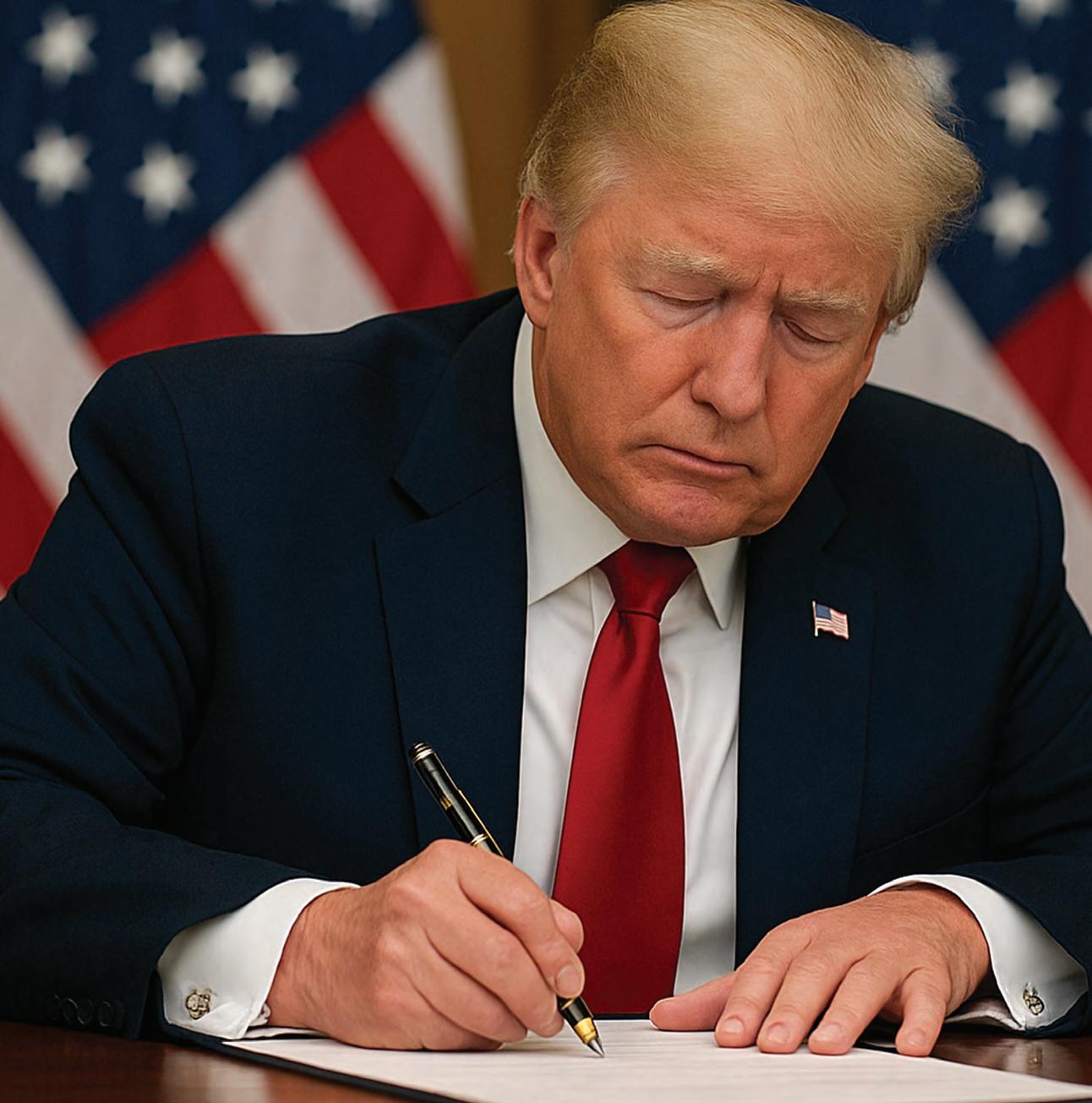
Donald Trump’s journey from cryptocurrency critic to blockchain advocate has redefined the intersection of politics and digital finance.
Donald J. Trump has done what no other U.S. president has dared to do; he’s made cryptocurrency part of his political brand, his business empire, and America’s financial future. He has always thrived on spectacle, but his latest legacy move is not about theatre; it’s about strategy. By embracing cryptocurrency not just as policy, but as personal enterprise, Trump has become the first U.S. president to weave digital assets into the fabric of American politics.
When Trump released his NFT trading cards in late 2021, the project was widely dismissed as a gimmick. However, the collection sold out within hours, generating millions of dollars and proving that the former president could mobilise not just voters, but blockchain buyers. Within two years, Trump-themed meme coins were exploding across decentralised exchanges, cementing his cultural footprint inside crypto’s most chaotic marketplace.
But those early experiments were only the opening gambit. This year, Trump made his boldest move yet, backing the launch of USD1, a fully dollar-
pegged stablecoin designed to bring U.S. currency into the digital age. Paired with the passage of the Genius Crypto Act, the project marked a watershed moment; America’s head of state, the leader of the free world, was no longer just commenting on crypto. He was building it.
Politics is about winning elections and passing laws. Statecraft is about taking those laws, policies, and tools and using them to shape the nation’s role in the world.
Crypto is no longer a niche asset — it’s a significant tool of U.S. statecraft.

For Trump, this pivot was more than a financial bet. It was a political weapon, an ideological banner, and a declaration that the United States must lead in digital finance. His personal journey - from dismissing Bitcoin in 2019 to championing stablecoins as the future of the dollar - mirrors crypto’s own evolution from fringe experiment to mainstream power player.
Trump embracing crypto was not just a financial calculation; it was a political instinct. Where many saw risk, he saw resonance. In a landscape where distrust of Washington, Wall Street, and the Federal Reserve runs deep, crypto became the perfect populist tool; a symbol of financial freedom, sovereignty, and rebellion against entrenched and outmoded elites.
In 2019, Trump famously tweeted that he was ‘not a fan of Bitcoin.’ By 2024, the calculation had shifted. Campaign rallies began to feature not just the familiar chants of ‘USA!’ but placards from supporters boasting
‘Paid in Bitcoin’ and ‘MAGA on the Blockchain’. The former president recognised the energy - and the donor base - bubbling up from crypto’s grassroots.
By re-casting crypto as a pillar of his ‘America First’ agenda, Trump reframed digital assets from fringe speculation into a patriotic cause. Stablecoins weren’t just tokens; they were weapons of economic dominance. Meme coins weren’t a joke; they were proof of cultural firepower. And when crypto donations began pouring into political action committees, it became abundantly clear that digital finance had become a new front in U.S. politics.
Trump didn’t just join the crypto movement - he turned it into a political machine.
This pivot laid the foundation for the Genius Crypto Act, (Guiding and Establishing National Innovation for U.S. Stablecoins Act) which is brand new legislation designed to cement America’s role as the global leader in digital assets.
When Trump signed the Genius Crypto Act in early 2025, it was actually more than legislation; it was a manifesto. For the first time, the United States had a clear framework

to recognise, regulate, and deploy digital assets at scale. Supporters hailed it as the most important financial law since the repeal of Glass-Steagall by Clinton in 1999, which allowed big financial institutions to re-integrate commercial and investment banking. Critics called it a reckless gamble. Either way, it marks a turning point.
At its core, the Act gave stablecoins - dollar-pegged cryptocurrencies like Trump’s own USD1- formal legal standing. Issuers would be required to hold transparent reserves, undergo regular audits, and integrate with U.S. banks. In return, stablecoins could be used for everyday payments, federal procurement, and even government benefits distribution.
The law also laid out a roadmap for cross-border crypto transactions, positioning the dollar as the world’s default digital currency. By embracing
blockchain rails, Trump sought to outpace China’s digital yuan and reclaim America’s monetary advantage in the global economy.
Perhaps most striking was the political theatre around it. Trump didn’t present the Act as a technical finance bill; he sold it as an ‘America First Digital Dollar Revolution’. Standing alongside crypto CEOs and waving a gold-embossed copy of the legislation, he cast himself not just as a president, but as the architect of a new monetary order.
If the 20th century was defined by the petrodollar, Trump wants the 21st defined by the cryptodollar.
Stablecoins & USD1 - The Heart of Trump’s Crypto Gambit
For all the spectacle of NFTs and meme coins, it is Trump’s involvement with USD1 that may prove the most consequential. Unlike the hypefueled tokens of the past, USD1 is designed to be the steady backbone of digital finance; a fully dollar-pegged stablecoin with ambitions far beyond speculative trading.
Launched through World Liberty Financial, USD1 arrived at the same moment the Genesis Act gave it legal standing. The synergy was intentional. With federal recognition, USD1 could be deployed in everyday

transactions, integrated into government contracts, and circulated globally as a secure digital extension of the U.S. dollar.
The implications were enormous. Stablecoins had already been gaining traction worldwide, offering the speed of crypto with the reliability of fiat. But Trump’s decision to tie his name and presidency to USD1 gave stablecoins a new political dimension. It wasn’t just another token; it was branded as a symbol of American dominance in the digital age.
Critics called it selfdealing, a dangerous blend of statecraft and personal business. Supporters insisted that USD1 could become a geopolitical asset, countering rivals like China’s digital yuan and reinforcing the dollar’s supremacy in global trade. Either way, the message was clear; stablecoins had moved from the margins of fintech into the very centre of U.S. monetary policy.
Trump’s embrace of digital assets didn’t just reshape markets; it reshaped politics. What began as a niche issue for libertarians and Silicon Valley entrepreneurs has become a litmus test for national power, campaign finance, and party identity.
By 2024, crypto donations were flowing into political action committees (PACs) at unprecedented levels, many of them aligned with Trump’s campaign. Supporters touted it as proof that digital

finance could fuel grassroots democracy, whilst critics warned of unchecked influence and regulatory loopholes. Either way, crypto had become a new artery of American political money.
At the state level, Trump’s vision found eager allies. Florida introduced tax incentives for crypto businesses, Texas positioned itself as the Bitcoin mining capital of the world, and Wyoming pushed forward with pioneering digital bank charters. Together, these moves built a pro-crypto map of ‘Trump territory’, where blockchain was not just tolerated but celebrated as an engine of growth and sovereignty.
The Democratic Party, long cautious on crypto, was forced to respond. Some lawmakers called for tighter oversight, while others proposed rival frameworks. But the narrative was already set; Trump had planted the flag. In the 2025 political landscape, crypto was no longer a fringe talking point; it was a frontline issue. Like it or not, Washington was forced to play catch-up.
For Trump, crypto is not just about markets or politics; it’s about governance. With the Genesis Act passed and USD1 in circulation, his administration

began laying out a blueprint for integrating blockchain directly into the machinery of the U.S. government.
The vision was sweeping. Federal payments - from procurement contracts to overseas aid - could be settled in stablecoins, ensuring faster, cheaper, and more transparent flows of money. Social programs and benefits could be distributed digitally, reducing fraud and enabling instant access to citizens. Treasury operations could
leverage blockchain for global settlements, reinforcing the dollar’s supremacy at a time when rivals were experimenting with central bank digital currencies.
Beyond finance, Trump’s allies floated the idea of blockchainbased systems for elections, identity verification, and public records, framing them as tools of autonomy and efficiency. To Trump, these weren’t abstract reforms. They were tangible expressions of his broader philosophy: decentralisation
at home, and dominance overseas.
Critics warned of blurred lines, especially with the president personally tied to USD1. Trump’s supporters argued that government adoption of crypto wasn’t about private enrichment, it was about defending America’s financial primacy in a rapidly digitalising world.
Not everyone is convinced that Trump’s crypto crusade is the future of finance. For his detractors, the president’s intertwining of public policy and personal enterprise raises red flags as glaring as the gold trim on his rally stage.
They argue that tying the presidency to USD1 creates conflicts of interest unprecedented in American history; a commander-in-chief who could directly profit from the very monetary system he regulates.
Some economists warn that stablecoins, while useful, still carry risks of liquidity crises and systemic shocks if not carefully managed. Others fear that embedding crypto into government infrastructure opens new avenues for cyber-attacks and financial instability.
Trump’s opponents also frame the move as political opportunism. They argue his pivot from crypto sceptic to crypto evangelist wasn’t born of conviction, but calculation; a way to capture donors, energise voters and build another revenue stream under the guise of national policy.
But his supporters see it differently. To them, Trump is doing what Washington has always done best: leveraging American innovation to maintain global dominance. They argue that if the U.S. doesn’t lead in digital finance, China, Russia, and other rivals will fill the void. And they point out that Trump’s policies, although controversial, have
already given the dollar a head start in the digital age.
Whether history remembers it as brilliance or folly, Trump’s crypto push has already redrawn the boundaries of American politics and finance. He is the first U.S. president to not only regulate digital assets but to embody them, blending personal enterprise, national policy, and geopolitical ambition into a single, audacious vision.
With the Genius Crypto Act as law, USD1 in circulation, and blockchain woven into the language of statecraft, Trump

Trump’s supporters argued that government adoption of crypto wasn’t about private enrichment, it was about defending America’s financial primacy in a rapidly digitalising world
has positioned himself as the architect of America’s digital monetary era. In his telling, the dollar’s destiny is no longer tied to oil, banks, or bureaucrats, but to code, cryptography, and global adoption.
Supporters hail it as a renaissance, a chance for the U.S. to seize leadership in the 21st century’s financial systems. Critics call it a dangerous experiment that risks politicising the foundations of money itself. Yet even his fiercest opponents admit the undeniable: Trump has forced the world to take crypto seriously.
Donald J. Trump may not just be remembered as the 45th and 47th president, but as America’s first crypto president.
In the end, Trump’s crypto doctrine is less about technology than power. It is the belief that the U.S. must not only adapt to the future of finance, but define it. And in his trademark style, like so many of his ventures, it is a gamble; high risk, high reward, and impossible to ignore.


In 2021, when most U.S. politicians still dismissed cryptocurrency as a fad, Miami was already charting a different course. As chairman of the Miami-Dade Cryptocurrency Task Force, Elijah John Bowdre began asking the questions others avoided: How could digital assets serve real communities? How could blockchain reduce inequality, unlock new streams of growth, and give ordinary people a stake in the financial future?
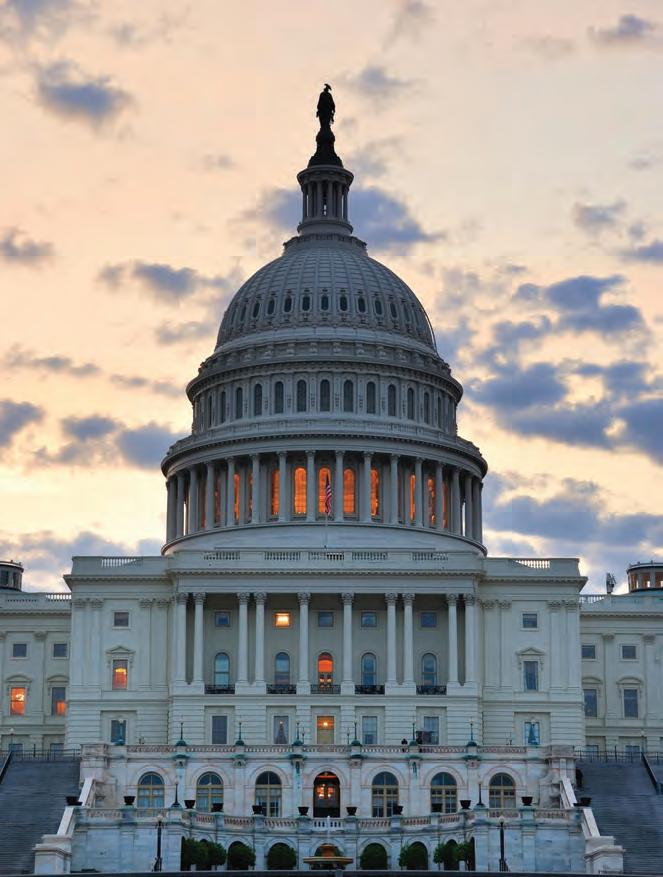
While Washington debated whether crypto should even be taken seriously, Miami-Dade County understood it was infrastructure. Under Chairman
Adele Adele60370277
Bowdre’s leadership, Miami positioned itself as a testbed for adoption, exploring municipal applications, consulting with innovators in Wyoming, and framing crypto not as a speculative gamble, but as a tool for long-term economic resilience.
Today, in 2025, the world has caught up. President Trump’s USD1 stablecoin has taken digital dollars into the mainstream. Congress has passed the GENIUS Act to regulate them at a federal level and crypto is moving from the periphery to the very heart of U.S. policy, as Trump pushes to establish a new kind of digital stability.
Long before stablecoins became the talk of Congress, Chairman Bowdre was working to prove their value at the local level. In his role as chair of the MiamiDade Cryptocurrency Task Force, he convened business leaders, technologists, and community representatives to explore how digital assets could strengthen the region’s economy.
For Chairman Bowdre, it’s never been about hype, just practicality. Could residents pay utility bills in crypto? Could local businesses tap blockchain tools to cut costs and expand markets? Could
Miami-Dade attract investment by positioning itself as the most forward-thinking county in America?
Under his guidance, the MiamiDade Digital Commission Task Force studied adoption models, from Wyoming’s pioneering legislation to global pilots in Europe and Asia. The result was a blueprint for Miami that went beyond branding the city as a ‘Crypto Capital’. It was a serious attempt to embed digital finance into both local
government and the everyday lives of ordinary people.
That early work positioned Miami as a laboratory for what digital assets could achieve in government, years before Washington or Wall Street embraced the idea. And now, as the U.S. moves to integrate stablecoins at a federal level, Chairman Bowdre’s local vision looks less like an experiment, and more like a preview of the future. An alignment with Trump’s National Vision
What Chairman Bowdre began in Miami, President Trump has scaled across the nation. When he pushed the GENIUS Act through Congress in 2025 and unveiled USD1, the first federally sanctioned stablecoin, it marked a turning point; digital dollars were no longer a local experiment, but a matter of national policy.
The parallels are clear. Bowdre treated crypto as infrastructure in Miami; a tool for efficiency, growth, and empowerment. Trump echoed that same philosophy at the federal level, harnessing stablecoins to reinforce U.S. monetary leadership. Both leaders share a conviction that digital assets are not fringe speculation, but strategic levers for financial resilience.
This alignment is more than coincidence - it reflects a broader shift. From city halls to the White House, crypto is being recognised as a pillar of the next financial era. And for Chairman Bowdre, it validates what he argued years earlier; that local innovation can shape national destiny.
The FUSD Connection
If Trump’s USD1 proved stablecoins could command global attention, Bowdre sees them as foundational to Miami’s fintech leadership in the 21st century. USDT (Tether) is liquid and globally accepted for settlements. USDC (USD

Coin) is transparent, compliant and trusted for large scale transactions. USD1 - President Trump’s stablecoin, is a digital anchor pegged to the US Dollar. And FUSD (Fused) is a next generation stabletoken merging a USDC peg with growth, well suited for public finance. FUSD’s unique tokenomics are engineered not just to preserve value, but to grow it consistently for everyday stakeholders.
A long-time advocate of broadening access to wealthbuilding tools, Chairman Bowdre supports FUSD’s model of appreciating stability. Unlike traditional stablecoins, where the upside flows to the issuer, FUSD directs growth back
to the holders themselves.
For Chairman Bowdre, that alignment is more than financial engineering; it is a matter of principle.
“Stable value shouldn’t just serve institutions,” he has argued. “It should serve people.”
That belief is why Bowdre has pledged to act as an ambassador for stable coins in municipal use. He sees them as a tool to tackle the same challenges he wrestled with on the Miami-Dade Cryptocurrency Task Force; financial exclusion, unequal access to growth, and the need for communities to share in the prosperity of the systems they support.
As an advocate of the nextgeneration appreciating stable token model, Bowdre ties his early vision to the present moment, building bridges between local communities, national policy, and a financial model that puts the investor first.
For Chairman Bowdre, the promise of crypto has never been abstract. It isn’t about speculation, memes, or market charts, it’s about real people and real challenges. In MiamiDade, that means families struggling with rising costs, small businesses trying to expand, and communities hit hardest by cycles of economic boom and bust.
Bowdre believes digital assets can help close those gaps. Stable value tokens can give residents a hedge against volatility in traditional systems. Blockchain-based tools can reduce fees for remittances, a lifeline for Miami’s immigrant families. An appreciating stabletoken like FUSD, where tangible growth benefits holders, gives everyday investors a chance to share in the upside of financial innovation, instead of the banks, issuers, or hedge funds.
This vision is practical as much as it is principled. By embedding crypto into everyday transactions, Chairman Bowdre believes that Miami could strengthen its
resilience, broaden opportunity, and serve as a model city for inclusive digital finance.
It’s a vision rooted not in ideology, but in empathy. An insistence that the next wave of financial infrastructure must be designed for the people who use it, not just the institutions that issue it.
As a passionate advocate of the benefits of crypto currency
for US Citizens, Chairman Bowdre has received a warm welcome into the distinguished alumni of contributors to Crypto Magazine, which is the world’s largest printed crypto publication, with more than 500,000 readers worldwide. Crypto Magazine will continue to champion the role digital assets can play in everyday lives, giving a global audience advanced access.
The arrangement is mutually reinforcing. Crypto Magazine gains a trusted voice at the

intersection of politics and blockchain. Chairman Bowdre gains an outlet to amplify his message that crypto should not just serve institutions and insiders, but empower communities and ordinary investors.
It is a dual stage - political and media - that will continue to position him as a thought leader and a pioneer, determined to reshape finance in a way that supports the growth and prosperity of all.

Chairman Bowdre’s story is one of consistency; a leader who saw the potential of digital assets long before they became fashionable, and who has carried that vision from committees and community incubators. In Miami, he pioneered the idea that crypto could be more than speculation; it could be infrastructure for resilience. Nationally, his philosophy has found echoes in President Trump’s push to make stablecoins part of U.S. strategy. And now, through his advocacy of FUSD, Bowdre is hoping to shape the next chapter - a model where ordinary investors share directly in the benefits of appreciating stability.
We very much look forward to his wisdom and insight as the global political landscape embraces the possibilities of digital currency.


Adele Adele60370277
Crypto has seen a decade of airdrops, incentives, loyalty schemes, and headlinegrabbing token launches, but nothing comes close to what’s about to hit the industry this January.
To celebrate the multichain launch of FUSD and FUST tokens, and the highly anticipated relaunch of the upgraded multi-chain Liquid NFT Platform, the team behind Liquid is preparing
to unleash what may be the most aggressive, ambitious, and value-packed marketing campaign the crypto space has ever witnessed.
This isn’t just another airdrop. This is a six-month wealth engine powered directly by platform revenue, and it’s going straight into the hands of one lucky participant.
And the numbers are staggering.
10% of Liquid Revenue for Six Months. Up to $1 Million Per Month. One
Yes, you read that correctly.
Liquid is giving away 10% of total platform revenue for six entire months, capped at a jaw-dropping $1,000,000 per month. For perspective: to buy that kind of revenue share through Liquid’s Genesis NFTs, you’d need to own 66 of them,
worth a combined $335,000.
Instead, someone is about to win it. For free. From a simple competition entry.
Rather than handing over a lump sum, Liquid is taking a far more strategic, bullish approach.

The winner will receive a monthly investment portfolio of 10 tokens, delivered for six months. The portfolio will include:
Major Coins including BTC & ETH - final line-up still under wraps!
Emerging Tokens, all partnered in some way with the Liquid NFT eco-system from brands like Roburna Labs, Milestone Millions, The CMC Group and BESC LLC
1 Token (or NFT) chosen personally by the winner, valued at one-tenth of the monthly portfolio
And here’s where it gets really interesting:
Liquid will buy these tokens from the open market using the revenue share. At full volume. Every month.
That means this campaign doesn’t just reward the winner; it potentially drives up to $100,000 in monthly buy pressure on each selected token, depending on platform activity.
It’s a win-win for the winner and the ecosystem.
Liquid is opening the floodgates to entries, making participation accessible to everyone in crypto - newcomers, traders, degens, builders, influencers and beyond.
Here’s how entries work:
Main Entry Methods
Buy FUSD 1 entry per $1 spent
Buy FUST 2 entries per $1 spent
Sell FUSD or FUST Yes, sells also qualify!
This is the first competition of its kind where both buys and sells generate entries, rewarding activity, not just accumulation.
Visit TheBigCryptoGiveaway.com and earn 10 free entries
Subscribe to Crypto Magazine and earn 100 free entries
Follow FUSD, FUST, and Liquid NFTs on social media to earn 10 entries per handle
Refer friends and get unlimited entries, plus a MASSIVE bonus opportunity...
Treasure hunts on partner websites - find codes to earn additional entries
Participating projects pairing FUSD liquidity will have their buys qualify too
NFT entry routes through the Liquid NFTs platform
And here’s the kicker
If you refer the winner, you earn big too.The referring wallet receives 1% of platform revenue (paid in FUSD) for six months.
That’s the kind of upside normally reserved for early investors, not competition referrers!

Liquid isn’t whispering about this giveaway. They’re going to shout it from the mountaintops.
The campaign will run across YouTube, TikTok, partner websites, social channels, and mainstream media outlets, supported by a seamless clickthrough flow that sends users directly to buy FUST and FUSD on BESC Hyperchain and BNB Chain.
To bring new users into crypto, onboard new liquidity, elevate the Liquid ecosystem, and ignite visibility across sectors far beyond the Web3 bubble.
This is crypto entering true mass-market marketing territory. Most crypto giveaways are short-term hype with no long-term value engine.
Liquid is flipping that model on its head.
Revenue fuels the prize.
The prize drives major token buys.
The buys support the ecosystem.
The ecosystem activity drives more revenue.
The cycle compoundspublicly and transparently - every month.
This is incentive engineering at its most powerful; a first-ofits-kind value loop in crypto. It’s potentially the biggest giveaway ever and could just be the catalyst for the next wave of adoption.
The competition begins in January 2026 and runs for three months. One participant will walk away with a six-month investment stream worth potentially millions.
But the real story isn’t just the prize.
It’s the scale. The ambition.
The fact that a decentralised ecosystem is willing to put real revenue on the line to ignite growth the entire industry can feel.
This isn’t a stunt. It’s a statement.
Adele Adele60370277
2025 has become the year of the stablecoin. From the State of Wyoming’s Frontier Token to Société Générale’s dollar-backed USDCV, financial institutions, state governments and even retailers are rushing to mint their own digital dollars. Yet none has captured the world’s attention like USD1; the politically charged stablecoin tied directly to President Donald J. Trump.
USD1 was launched with a bold mission: to reinforce the U.S. dollar’s dominance in a digital era. Fully backed by treasuries and cash equivalents, it offers the stability and transparency that have helped move stablecoins out of the crypto fringe and into the heart of U.S. monetary policy. For holders, it delivers what every

stablecoin promises: a dollar that moves at internet speed. But the real rewards and wealth generation flow elsewhere.
It flows to the issuer, World Liberty Financial, majorityowned by the Trump family, who capture the yield on the billions held in reserves.
It’s fair to say that USD1 has showed the world what stablecoins can do for governments and issuers, but the convenience and reassurance of stability doesn’t pay dividends to the everyday investor. And that’s where the next chapter begins.
USD1 has been the crypto lightning rod; it exploded onto
the world stage and drew the most attention, excitement, and criticism, shining the spotlight onto stablecoins as a whole. But it was hardly alone. In the wake of its launch, governments, banks, and Fortune 500 companies rushed to unveil their own digital dollars. Wyoming issued the Frontier Token (FRNT), the first state-backed stablecoin. Société Générale, one of the big four financial institutions in France, announced USDCV, a dollar-pegged token for institutional clients. In the U.S. it seems like everyone from banks to retailers are preparing to launch stablecoins under the new federal framework.
The message is clear; stablecoins are no longer experiments, they are infrastructure. They move money faster than traditional

methods, clear borders without friction, and open the door to programmable finance. And yet, across all of these launches, the model remains the same.
Holders get stability, speed and reassurance, and issuers get the yield. For everyday investors, the benefit is limited to convenience, while the real economic upside accrues to the companies behind the coins.
This is the context into which a new model emerges: a stabletoken that doesn’t just line the pockets of institutions and issuers, but directly benefits its holders.
If USD1 was the catalyst for mainstream adoption, FUSD is the evolution. Where traditional stablecoins lock value into reserves that benefit the issuer, FUSD flips the model on its head; it’s an appreciating stabletoken, engineered to be an appreciating store of value where benefits flow to the investor.
FUSD combines the stability investors expect with a steady appreciation in value, by fusing together the mint/burn tokenomics of a stabletoken with the taxation structure of
a meme or utility token. That means every buy and every sell injects liquidity directly into the smart contract and the underlying value grows. It is dollar backed 1:1 with USDC but as adoption grows, the upside doesn’t vanish into institutional pockets; it compounds directly for those who hold the token.
Just as importantly, FUSD doesn’t reject the stablecoin framework that USD1 has helped legitimise. Instead, embracing it is central to its growth plans. As an already fully-functioning multi-chain token, FUSD will add to its current liquidity pairs - ETH, BNB Chain, BESC HyperChain and Polygon - and create further pairs over time including a liquidity pair with USD1.
FUSD both supports the ethos that stablecoins are the future of money, and strategically positions itself alongside the most politically significant token in existence. The result? Holders continue to benefit from FUSD’s appreciating value while tapping into the global dominance that USD1 has unleashed.
Stablecoins have already proven their place in global finance. They are faster than bank transfers, more accessible than traditional payments, and increasingly recognised by
regulators and governments alike. USD1 showed how they could be leveraged as tools of state power. FRNT and USDCV demonstrated that states and banks are ready to issue their own. Together, these projects have cemented stablecoins as the financial backbone of Web3.
But the question has always lingered; who really benefits? Until now, the answer has been issuers and institutions, the ones earning the yield on billions parked in reserves. Holders got stability, but rarely more.
FUSD is different. By aligning stability with appreciation it ensures that growth in adoption translates into value for its community of investors. It salutes the spirit of USD1 as a catalyst for mass adoption, whilst refusing to accept a model where only the issuer wins.
Its liquidity pair with USD1 will be both symbolic and strategic; a way to honour the door USD1 opened, while offering a new path where holders share directly in the upside.
In that sense, FUSD represents more than just a token. It represents a new philosophy for digital money. One where stability and investor empowerment go hand in hand. If USD1 was the beginning of the stablecoin era, FUSD may well be the start of the stabletoken revolution!
Robert Stone @StoneOnChain

In the fast-moving world of cryptocurrency, fortunes are made and lost on the quality of research. While social media influencers shout “to the moon” and telegram groups pump the latest “gem,” professional investors quietly conduct systematic due diligence that separates legitimate projects from elaborate scams.
DYOR—Do Your Own Research— isn’t just crypto slang. It’s the difference between strategic investment and expensive gambling. Whether you’re evaluating Bitcoin, analysing the latest DeFi protocol, or investigating a promising Layer 1 blockchain, the principles remain the same: systematic analysis, healthy scepticism, and thorough verification.
As editor of this magazine, I’ve been researching crypto projects since the early days when Bitcoin Talk was the epicentre of everything that mattered in cryptocurrency. Back then, anyone who was someone in crypto would descend on those forums with their projects, whitepapers clutched in digital hands, seeking validation from a community that was equal parts brilliant and sceptical.
I remember the excitement of discovering Ethereum when Vitalik first posted about it, the heated debates over proof-ofstake versus proof-of-work, and the wild west atmosphere where a single forum post could launch or destroy a project overnight.
Those Bitcoin Talk days taught me something crucial: the fundamentals of good research haven’t changed, even as the ecosystem has exploded from a few thousand enthusiasts to a trillion-dollar market. The same red flags that appeared in 2013 altcoin announcements still appear in today’s Layer 2 launches, just dressed in more sophisticated language. The same patterns that identified legitimate innovations like Chainlink or Uniswap in their early stages still work now, but you need to know what to look for. What has changed is the sophistication of both the projects and the scams, the speed at which information moves, and the sheer volume of new projects launching daily.
I’ve watched thousands of projects come and go, seen genuine innovations emerge from unknown developers, and witnessed elaborate scams that fooled even experienced investors. I’ve made my share of mistakes—falling for projects with impressive teams but no real substance, missing obvious red flags because I got caught up in the hype, and occasionally discovering gems that everyone else
overlooked. Each experience taught me something new about separating signal from noise in this chaotic but fascinating space.
The framework I’m sharing here has been battle-tested through multiple market cycles, from the early altcoin experiments through the ICO boom, the DeFi summer, the NFT craze, and beyond. It’s saved me from countless costly mistakes and helped identify opportunities that others missed. More importantly, it’s teachable—these aren’t mystical skills available only to crypto veterans, but systematic approaches anyone can learn and apply.
This guide will teach you to research crypto projects with the rigour of a venture capitalist and the scepticism of a forensic accountant. By the end, you’ll have a framework that can save you from costly mistakes and help you identify genuine opportunities before the crowd catches on.
The Problem Statement
Every legitimate crypto project starts with a real problem. Before diving into tokenomics or technical specifications, ask fundamental questions: What problem does this project claim to solve? Is this problem
significant enough to warrant a blockchain solution? Does the solution require a new token, or could it work with existing infrastructure?
In my early days at Bitcoin Talk, I learned to identify projects that were solutions looking for problems. One project I remember claimed to revolutionise the pet food industry with blockchain technology. When pressed for details, the team couldn’t explain why pet food distribution needed immutable ledgers or why existing supply chain solutions wouldn’t work. The project raised significant funds but predictably failed within six months.
Red flag example: Projects that create tokens for problems that don’t exist or could be solved more efficiently with traditional technology. If a project’s whitepaper spends more time explaining potential returns than explaining the underlying problem, proceed with extreme caution.
Research the total addressable market for the problem being solved. Is this a billion-dollar problem or a niche issue affecting a small community? Timing matters enormously in crypto. Projects launching DeFi protocols in 2019 had very different prospects than identical projects launching in 2024.
Use tools like Google Trends, industry reports, and competitor analysis to understand market dynamics. A brilliant solution to yesterday’s problem is still a poor investment.
No crypto project exists in isolation. Map out direct competitors, indirect competitors, and potential threats from traditional industries. How does this project differentiate itself? What advantages does it have that competitors cannot easily replicate?
Strong projects often acknowledge competitors directly and explain their specific advantages. Projects that claim to have no competition either haven’t done their homework or are operating in a market too small to matter.

Understanding the underlying technology doesn’t require a computer science degree, but it does require careful reading. Key questions include: Is this project building on an existing blockchain or creating its own? What consensus mechanism does it use? How does it handle scalability, security, and decentralisation trade-offs?
For projects building on existing blockchains like Ethereum or Solana, evaluate why they chose that specific platform. For projects creating new blockchains, scrutinise their technical innovations and whether they solve real limitations of existing chains.
If the project involves smart contracts, these should

be publicly viewable and preferably audited by reputable firms. You don’t need to read Solidity code, but you should verify that contracts exist, match the project’s claims, and have been professionally audited.
Major audit firms include Trail of Bits, ConsenSys Diligence, and Quantstamp. Independent audits from multiple firms provide greater confidence than single audits or self-audits.
Active development indicates a serious project. Use GitHub to examine the project’s code repositories. Look for regular commits, multiple contributors, comprehensive documentation, and responsive issue resolution. A repository with no activity for months suggests an abandoned or stagnant project.
This lesson came hard during my early research days. I invested in a project with an impressive whitepaper and strong marketing, but I failed to check their GitHub repository. Had I looked, I would have discovered their last code commit was eight months old, and their promised “revolutionary consensus algorithm” existed only in marketing materials. The project eventually exit scammed, but the warning signs were there for anyone who bothered to look.
Compare development activity to similar projects. Healthy projects typically show consistent development velocity with periodic major updates and regular bug fixes.
Examine the project’s technical roadmap critically. Are milestones specific and measurable? Do they align with realistic timelines? Have previous milestones been met on schedule? Vague roadmaps with distant, undefined goals often indicate poor planning or intentional misdirection.
Cross-reference roadmap claims with actual development progress. Projects that consistently miss deadlines or quietly abandon promised features deserve additional scrutiny.
Research team members individually. Look for relevant experience, previous successes or failures, and current commitments. LinkedIn profiles, previous project involvement, and academic credentials all provide valuable context.
Be particularly cautious of anonymous teams unless the project has compelling reasons for anonymity and has
demonstrated competence through other means. While some legitimate projects maintain anonymity for security or philosophical reasons, this adds additional risk that should be factored into your analysis.
Examine the project’s advisors and their actual involvement. Legitimate advisors typically have relevant expertise and active engagement with the project. Be cautious of “advisor collections” that list impressive names, but have minimal actual involvement.
I’ve seen this pattern repeatedly: projects list impressive advisors who have no real connection to the project. A simple social media check often reveals that these “advisors” have never publicly mentioned the project or, in some cases, have never heard of it. Always verify advisor claims by checking their social media

activity and public statements about the project.
How are decisions made within the project? Is there a clear governance process? Are token holders involved in decisionmaking? Centralised control can enable rapid development, but it also creates risks if key individuals leave or make poor decisions.
Evaluate the project’s approach to decentralisation. Many projects start centralised and promise progressive decentralisation. Assess whether they have concrete plans and timelines for transferring control to the community.
Research the project’s funding sources and investor profile. Reputable institutional investors often conduct their own due diligence, providing additional validation. However, celebrity endorsements or influencer backing should be treated with scepticism unless accompanied by substantial technical and business analysis.
Examine funding terms if available. Projects that have raised excessive amounts relative to their development stage may face pressure to deliver unrealistic returns, potentially leading to rushed launches or pivot decisions.
Understand the total token supply, circulating supply, and emission schedule. How many tokens exist? How many will exist in the future? Are there mechanisms for burning tokens or controlling inflation?
Excessive token inflation can erode value over time, while fixed supplies may create artificial scarcity. Look for thoughtful tokenomics that align with the project’s longterm sustainability rather than short-term price appreciation.
What specific functions does the token serve within the project’s ecosystem? Can these functions be performed only with this specific token, or are there alternatives? The strongest tokens have multiple compelling use cases that create sustained demand.
Be sceptical of tokens whose primary utility is governance voting, unless the governance decisions have a meaningful economic impact. Many governance tokens trade primarily on speculation rather than utility demand.
How are tokens distributed among different stakeholders? What percentage goes to the
team, investors, treasury, and public? Are there vesting schedules that prevent massive dumps? Heavily concentrated ownership creates risks of market manipulation and governance centralisation.
Look for fair distribution mechanisms and reasonable vesting schedules that align team incentives with long-term project success.
Analyse the project’s revenue model and sustainability. How does the project generate value? Are transaction fees, staking rewards, or other mechanisms economically viable long-term? Projects that depend entirely on new user growth without underlying value creation often resemble pyramid schemes.
During the ICO boom, I evaluated dozens of projects with tokens that served no real purpose beyond fundraising. Teams would create elaborate tokenomics documents explaining complex staking mechanisms and governance features, but the fundamental question remained unanswered: why does this need a token at all? The strongest projects I’ve discovered over the years have tokens that are genuinely necessary for their core functionality, not just fundraising vehicles.
Strong projects typically have multiple revenue streams and
clear paths to self-sustainability without depending on continuous token price appreciation.
Examine the project’s social media presence across multiple platforms. Look for organic engagement rather than artificial metrics. Real communities ask technical questions, discuss use cases, and provide constructive feedback. Bot-driven communities tend to focus on price predictions and hype.
Monitor social sentiment using tools like Sentiment Trader or Social Blade. However, remember that social media can be gamed, so treat these metrics as supporting evidence rather than primary indicators.
For platform projects, evaluate the developer ecosystem.

How many applications are being built on the platform? Are there developer tools, documentation, and support programs? Growing developer activity often precedes mainstream adoption.
Check developer forums, documentation quality, and third-party integrations. Thriving developer ecosystems create network effects that enhance project value.
Research the project’s partnerships and integrations. Are these genuine business partnerships or marketing announcements? Real partnerships typically involve technical integration, shared development, or mutual business benefits.
Verify partnership claims by checking partner websites and public statements. Many projects exaggerate the significance of partnerships or list tentative discussions as confirmed relationships.
For launched projects, analyse actual usage metrics. Daily active users, transaction volume, total value locked, and other on-chain metrics provide objective measures of adoption. Compare these metrics to similar projects and track trends over time.


Be cautious of vanity metrics that can be easily gamed. Focus on metrics that indicate real economic activity and user engagement.
Review all available security audits carefully. Professional audits should identify potential vulnerabilities and confirm their resolution. Multiple audits from different firms provide greater confidence than single audits.Pay attention to audit timing relative to code changes. Audits become less relevant as code evolves, so recent audits of current code are more valuable than old audits of previous versions.
Research the project’s security history. Have there been hacks, exploits, or other security incidents? How did the team respond? While past incidents don’t disqualify projects, they provide insights into team competence and crisis management capabilities.
Evaluate whether previous security issues have been addressed systematically or just patched superficially.
Consider regulatory risks in relevant jurisdictions. Some
projects operate in legal grey areas or could face future regulatory challenges. Research the regulatory environment for similar projects and the project’s approach to compliance.
Projects with proactive legal strategies and compliance frameworks typically face lower regulatory risks than those that ignore legal considerations entirely.
Assess technical risks specific to the project’s architecture. New consensus mechanisms, experimental cryptography, or complex economic models may introduce unforeseen risks. Cutting-edge technology often offers advantages but comes with higher technical risk.
Consider your own risk tolerance and diversification when evaluating hightechnical-risk projects.
Be extremely wary of projects that emphasise returns over utility, promise guaranteed profits, or use high-pressure sales tactics. Legitimate projects focus on building technology and solving problems, not generating shortterm price appreciation.
Celebrity endorsements, influencer partnerships, and aggressive social media marketing often indicate projects prioritising hype over substance.
Closed-source code, lack of technical documentation, or teams that cannot discuss their technology coherently all indicate potential problems. Legitimate technical teams can explain their innovations clearly and provide detailed documentation.
One pattern I noticed during the ICO era that persists today is that teams often speak in buzzwords without being able to explain their technology in simple terms. I once interviewed a team claiming to use “quantum-resistant blockchain sharding with AIoptimised consensus.” When I asked them to explain how their consensus mechanism actually worked, they gave me marketing speak about “revolutionary algorithms” but couldn’t describe a single technical detail. Their project raised millions but never delivered a working product.
Be cautious of projects that claim revolutionary breakthroughs without peer review or academic validation. Most genuine innovations build incrementally on existing knowledge.
Unsustainable tokenomics, excessive team allocations, or economic models that depend entirely on new user growth often indicate Ponzi-like structures. Be particularly cautious of projects offering extremely high yields without clear value creation mechanisms.
Projects that cannot explain how they generate value or sustain promised returns should be avoided regardless of their marketing sophistication.
Centralised control without decentralisation plans, lack of transparency in decisionmaking, or teams that dismiss community feedback often indicate poor governance structures that could lead to arbitrary or harmful decisions.
Anonymous teams making major decisions without community input create additional risks that should factor into your analysis.
Etherscan, BscScan, and similar block explorers provide transaction histories, contract interactions, and token distributions. Use these tools to verify project claims and
analyse on-chain activity.
Advanced tools like Nansen, Dune Analytics, and The Graph provide sophisticated on-chain analysis capabilities for deeper research.
GitHub provides code repositories, development activity, and issue tracking.
CryptoMiso and Electric Capital Developer Reports analyse development activity across projects.
Use these tools to assess development velocity, code quality, and team responsiveness to community feedback.
CoinGecko and CoinMarketCap provide basic market data, but tools like TokenTerminal, DeFiPulse, and L2Beat offer more sophisticated financial and usage analytics.
For DeFi projects, tools like DeBank, Zapper, and APY.vision provide portfolio tracking and

yield analysis capabilities.
LunarCrush and Sentiment Trader analyse social media sentiment and engagement. Discord and Telegram analysis tools can help assess community quality and engagement levels.
Remember that social metrics can be gamed, so use them as supporting evidence rather than primary research tools.
Develop a standardised checklist that covers all major research areas. This ensures consistent evaluation across different projects and helps prevent emotional decisionmaking.
Assign weighted scores to different criteria based on your investment priorities. Technical innovation might be more important for some investors, while others prioritise team experience or market opportunity.
Maintain detailed research notes for each project you evaluate. Include sources, reasoning, and specific concerns or strengths identified during research.

Track your research predictions against actual outcomes to improve your analytical skills over time. Understanding where your analysis was right or wrong enhances future research quality.
Initial research is just the beginning. Establish processes for monitoring ongoing developments, team updates, competitive changes, and market evolution.
Set specific triggers that would prompt additional research or reconsideration of your initial conclusions. Projects evolve continuously, and your understanding should evolve with them.
Integrate research conclusions with position sizing and risk management decisions. Higherrisk projects merit smaller allocations regardless of their potential upside.
Consider correlation risks when building a portfolio. Projects that appear independent may face similar regulatory,
technical, or market risks that could affect multiple positions simultaneously.
Apply your research framework to current projects you’re considering. Work through each section systematically, documenting findings and sources.
Compare your independent analysis with community sentiment and expert opinions. Significant divergences often indicate either overlooked factors or market inefficiencies worth investigating further.
Study failed projects that initially appeared promising. What warning signs were missed? How did the research community react? What information was available but ignored?
Some of my most valuable learning experiences came from analyzing my research failures. I once invested in a
project with an impressive technical team and solid use case, but I failed to notice that their token distribution heavily favored early investors with no vesting requirements. When the project launched, early investors immediately dumped their tokens, crashing the price despite the project’s technical merit. The warning signs were there in the tokenomics, but I was too focused on the technology to notice the economic red flags.
Analysing failures provides valuable lessons that improve future research quality and helps identify patterns that indicate potential problems.
Crypto moves rapidly, and research skills must evolve with the ecosystem. Follow security researchers, technical analysts, and experienced investors who share detailed analysis publicly.
Participate in research communities where experienced analysts share methodologies and discuss emerging trends. Learning from others’ experiences accelerates your own skill development.
DYOR isn’t just about avoiding scams—it’s about developing the analytical skills to identify genuine opportunities before they become apparent to

everyone else. The framework outlined here provides systematic approaches to evaluating crypto projects, but remember that research is a skill that improves with practice and experience.
The crypto space rewards those who combine healthy scepticism with genuine curiosity. Question everything, verify claims independently, and always remember that even thorough research cannot
eliminate all risks. The goal is making informed decisions with clearly understood tradeoffs, not finding risk-free opportunities that don’t exist.
Looking back on over a decade of researching crypto projects, from those early Bitcoin Talk discussions to today’s sophisticated DeFi protocols, I’ve learned that the most successful investors aren’t necessarily the smartest or the luckiest—they’re the
most disciplined. They follow systematic research processes, learn from their mistakes, and resist the emotional extremes that drive most crypto market cycles.
Start with small positions while you develop confidence in your research abilities. Track your analyses against outcomes, learn from both successes and failures, and gradually increase position sizes as your skills improve.
Most importantly, remember that the best research in the world is worthless without proper risk management. No single investment, regardless of how thoroughly researched, should represent a life-changing loss if it fails completely.
The crypto ecosystem needs more informed participants who make decisions based on careful analysis rather than hype and speculation. By developing these research skills, you not only improve your own investment outcomes but also contribute to a more rational and sustainable crypto market for everyone.
The tools and frameworks are available. The information is accessible. The only question is whether you’re willing to do the work that separates successful investors from those who simply got lucky during bull markets and gave it all back during the inevitable downturns.

Most crypto investors obsess over price movements while completely ignoring the mathematical foundations that determine whether those prices make any sense. They’ll debate whether Ethereum will hit $5,000 while having no idea what Ethereum’s market capitalization actually represents, or why a coin with a billion tokens can’t realistically reach $1,000 per token.
This isn’t just academic knowledge, understanding market caps and tokenomics is the difference between making informed investment decisions and falling for elaborate mathematical illusions designed
Robert Stone @StoneOnChain
to separate you from your money. After over a decade of evaluating crypto projects, I’ve seen brilliant technologies fail because of terrible tokenomics, and complete garbage succeed temporarily because they understood how to manipulate these numbers.
As someone who believes deeply in individual financial sovereignty and the power of decentralized systems to liberate people from centralized monetary control, I’ve learned that tokenomics represents either the path to genuine economic freedom or the most sophisticated financial trap ever devised. The difference lies in understanding what these
numbers actually mean and how they’re designed to work— or work against you.
The crypto space is filled with projects that talk about “democratizing finance” while creating token structures that benefit insiders at the expense of retail investors. Understanding tokenomics helps you identify which projects genuinely align with libertarian principles of fair distribution and individual empowerment, versus those that simply use freedom-oriented marketing to disguise old-fashioned wealth extraction schemes.
This isn’t just about making money, though understanding
these concepts will dramatically improve your investment outcomes. It’s about recognizing which projects are building the financial infrastructure for a more free and equitable future, and which ones are simply replicating traditional financial exploitation with blockchain technology.
Market capitalization equals price per token multiplied by total supply. Everyone knows this formula, but most people fundamentally misunderstand what it represents. When someone says “Bitcoin has a market cap of $800 billion,” they’re not saying that $800 billion worth of money has been invested in Bitcoin, or that you could sell all Bitcoin for $800 billion.

Market cap represents the theoretical value if every single token could be sold at the current market price—which is mathematically impossible. It’s a useful metric for comparison, but treating it as “total invested money” or “total value” leads to catastrophic misunderstandings about how crypto markets actually work.
I learned this lesson painfully during the 2017 ICO boom when I watched a project’s market cap “increase” by $500 million in a single day on less than $2 million in trading volume. The price moved from $0.50 to $5.00 per token, not because hundreds of millions in new money flowed in, but because there were so few sellers that small buy orders pushed the price dramatically higher.
When the inevitable crash came, that same “market cap” evaporated just as quickly, but now investors were stuck holding tokens they couldn’t sell at anywhere near the theoretical market cap price. The market cap was always an illusion based on the last trade price, not a reflection of actual market depth or liquidity.
This is why you can see altcoins with “billion-dollar market caps” that crash 90% on relatively small selling pressure. The market cap was never real in any meaningful economic sense—it was just
the mathematical result of multiplying a temporarily inflated price by the total token supply.
Most price tracking websites show multiple market cap figures that tell completely different stories about a project’s valuation. Circulating market cap uses only tokens currently available for trading. Total supply market cap includes all tokens that exist but might be locked or unavailable. Fully diluted market cap assumes all possible tokens have been created and are trading.
These differences can be enormous. A project might show a $100 million circulating market cap while having a $2 billion fully diluted market cap, meaning 95% of the tokens haven’t entered circulation yet. When those tokens unlock—through vesting schedules, staking rewards, or team allocations—the circulating supply will increase dramatically, likely crushing the price unless demand increases proportionally.
I’ve seen countless retail investors get excited about projects with “low market caps” based on circulating supply, only to watch their investments get diluted as locked tokens entered circulation. Always check the fully diluted market
cap and token unlock schedule before making investment decisions.
Comparing market caps across different crypto projects seems logical but often leads to flawed conclusions. Saying “Project X has half the market cap of Project Y, so it has more upside potential” ignores fundamental differences in tokenomics, utility, and distribution that make such comparisons meaningless.
A DeFi protocol with tokens that generate fees might justify a higher market cap than a governance token with no cash flows. A project with wide token distribution might sustain higher valuations than one with concentrated ownership. A utility token with real demand might deserve premium valuations compared to pure speculation tokens.
Market cap provides a starting point for analysis, but treating it as the primary

valuation metric leads to poor investment decisions. Focus on understanding what drives demand for specific tokens and whether the tokenomics support sustainable value creation.
Bitcoin’s fixed 21 million supply cap represents one extreme of token design—absolute scarcity that creates deflationary pressure as demand increases. This appeals to libertarian sensibilities because it prevents arbitrary supply manipulation by centralized authorities, but it also creates challenges for projects that need flexible monetary policy.
Ethereum transitioned from an inflationary model to potentially deflationary through EIP-1559, which burns a portion of transaction fees. This creates interesting dynamics where network usage directly affects token supply, aligning user activity with token holder interests in ways that traditional monetary systems cannot achieve.
Some projects use inflationary models to fund development, reward network participants, or maintain price stability. The key question isn’t whether inflation is inherently good or bad, but whether the inflation
serves legitimate purposes and whether token holders understand and consent to the monetary policy.
Avoid projects that can arbitrarily change their monetary policy without clear governance processes. Sound money requires predictable rules that cannot be changed on political whims or insider interests.
Understanding when and how new tokens enter circulation is crucial for predicting price movements and assessing long-term value. Bitcoin’s emission schedule is programmed into the protocol and decreases over time through halvings, creating predictable scarcity increases.
Many newer projects have complex emission schedules with team allocations, investor unlocks, ecosystem incentives, and staking rewards all releasing tokens at different times. I always create a timeline showing when major unlock events occur and how they’ll affect circulating supply.
One project I analyzed looked attractive until I mapped out their token unlocks. Over the following 18 months, circulating supply would triple as team and investor tokens vested. Even if the project succeeded technically, token holders
would face massive dilution that made positive price performance nearly impossible.
Pay special attention to cliff unlocks where large quantities of tokens become available simultaneously. These events often trigger significant selling pressure as insiders take profits or diversify their holdings.
Token burning permanently removes tokens from circulation, potentially creating deflationary pressure that benefits remaining holders. However, not all burn mechanisms are created equal, and some are pure marketing gimmicks designed to create temporary price pumps.
Effective burn mechanisms tie token destruction to real economic activity. Binance’s quarterly BNB burns based on exchange profits create genuine deflationary pressure tied to business performance. Ethereum’s EIP-1559 burns correlate with network usage, aligning token scarcity with actual demand for blockspace.
Be skeptical of arbitrary burn schedules or burns funded by team tokens rather than real revenue. These create temporary supply reduction but don’t address fundamental tokenomics if the underlying project doesn’t generate real value or demand.
Some projects announce massive burn percentages to generate excitement, but if the burned tokens were never in circulation anyway, the economic impact is zero. Always verify that burns affect actual circulating supply, not just theoretical totals.
How tokens are initially distributed reveals enormous amounts about a project’s true intentions and long-term sustainability. Projects where teams and founders control the majority of tokens face inherent conflicts between enriching insiders and creating value for the broader community.
During the ICO era, I evaluated projects where teams allocated 60-70% of tokens to themselves and early investors, leaving retail participants to fight over scraps while taking all the risk. These distribution models are fundamentally extractive and antithetical to the decentralized, democratizing principles that attracted many of us to crypto in the first place.

Look for projects with reasonable team allocations (typically 10-20%) subject to multi-year vesting schedules that align team incentives with long-term success. Teams that refuse to vest their tokens or demand excessive allocations are signaling that they view the project as a quick wealth extraction opportunity rather than a long-term commitment.
Institutional investor participation can provide validation and resources, but it can also create problematic dynamics for retail participants. VCs typically receive tokens at significant discounts to public prices and may have different time horizons and risk tolerances than community members.
Large VC allocations can create selling pressure when funds distribute tokens to their limited partners or take profits to return capital. This isn’t necessarily bad, but retail investors should understand they’re buying tokens that institutions acquired much cheaper.
Some projects structure multiple funding rounds with different prices, creating complex dynamics where early investors have dramatically lower cost bases than public participants. Transparency about funding terms helps

assess whether current prices provide reasonable riskadjusted returns.
Be particularly wary of projects with concentrated institutional ownership combined with low float—small amounts of selling can dramatically impact prices when few tokens are available for public trading.
The strongest projects allocate significant portions of tokens to community development, ecosystem growth, and user incentives. This creates network effects where token distribution helps build the user base needed for project success.
Airdrop strategies can effectively distribute tokens to genuine users while building community engagement. However, many airdrops are gamed by sophisticated actors who create multiple accounts to capture larger allocations, undermining the democratizing intent. This has always been a
serious problem in crypto since the beginning.
Liquidity mining and yield farming programs can bootstrap network usage but often attract mercenary capital that leaves once incentives decrease. Evaluate whether these programs create genuine long-term value or just temporary activity that disappears when rewards end.
The best community incentive programs identify and reward behaviors that create lasting value for the network— development contributions, governance participation, longterm usage, or network security provision.
“Fair launch” projects attempt to distribute tokens more equitably by avoiding premines, team allocations, or investor sales. While appealing philosophically, these models create their own challenges around funding development and incentivizing creators.
Some fair launch projects struggle with sustainability because teams lack token incentives to continue development once initial enthusiasm wanes. Others face governance challenges when no clear leadership structure exists to guide evolution.
Premines aren’t inherently problematic if they’re transparent, reasonably sized, and properly vested. The key is ensuring that premined tokens serve legitimate purposes rather than enriching insiders at community expense.
Evaluate fair launch claims carefully—some projects claim fair launches while giving insiders advance notice, better mining equipment, or other advantages that undermine the fairness principle.
Pure governance tokens face a fundamental challenge: voting rights alone rarely justify significant economic value unless the governance decisions have meaningful financial impact. Many governance tokens trade purely on speculation rather than actual utility demand.
Effective governance tokens control valuable resources like protocol fees, treasury funds, or

upgrade decisions that directly affect token holder wealth. MakerDAO’s MKR token accrues value because governance decisions affect the stability and profitability of the DAI system, creating real economic stakes for voters.
Be sceptical of governance tokens where the main decisions involve spending other people’s money (token holders) rather than managing shared resources that benefit all participants. These often become vehicles for insiders to extract value through “governance” decisions.
Look for governance systems with skin in the game—where bad decisions cost governance token holders real money, creating incentives for thoughtful decision-making rather than political theatre.
The strongest utility tokens provide access to services or networks that become more valuable as more people use them. Ethereum’s ETH is required for transaction fees and smart contract execution, creating demand that scales with network usage.
Utility tokens work best when the token is necessary for core functionality rather than artificially required. Some projects force token usage through smart contracts when
traditional payment methods would be more efficient, creating artificial utility that doesn’t enhance user experience.
Network effect utility tokens can create powerful positive feedback loops where increased usage drives token demand, higher prices attract more development and users, and the cycle continues. However, these same dynamics can work in reverse during downturns.
Evaluate whether the token utility is genuinely necessary or whether it’s just a way to capture value from users who would prefer alternative payment methods.
Tokens that generate fees or cash flows from real economic activity represent some of the strongest value propositions in crypto. These create measurable returns that can be evaluated using traditional financial metrics like price-toearnings ratios.

DeFi protocols often distribute trading fees, lending interest, or other revenues to token holders, creating cash flow streams that justify valuations. However, verify that these cash flows come from real economic activity rather than circular token incentives.
Some projects promise fee distributions but actually pay token holders with newly minted tokens rather than real revenue. This creates the illusion of cash flows while actually just diluting the token supply.
Calculate the actual yield rates and compare them to alternative investments after accounting for token price volatility and potential regulatory risks.
Proof-of-stake networks require token holders to stake their holdings to participate in network security, creating demand pressure as staked tokens are removed from circulation. This can create positive supply/demand dynamics for successful networks.
However, staking rewards often come from inflation rather than real economic value, meaning stakers maintain their percentage ownership while non-stakers get diluted. The real return depends on network
adoption and fee generation, not just the nominal staking rate.
Some projects offer artificially high staking rewards to incentivize participation, but these high rates are often unsustainable without genuine economic value creation. Calculate the real returns after accounting for token inflation and potential price impacts.
Consider the opportunity cost of staking, locked tokens can’t be traded, used in DeFi, or deployed elsewhere. Staking only makes sense when the total return (rewards plus potential price appreciation) exceeds alternatives.
NVT ratios attempt to apply price-to-earnings style analysis to crypto networks by comparing market capitalisation to transaction volume. Like traditional valuation metrics, NVT works best for mature networks with stable usage patterns.
High NVT ratios might indicate overvaluation or network optimisation (more value transferred per transaction). Low ratios could signal undervaluation or network inefficiency. Context matters enormously, comparing NVT across different types
of networks often produces misleading conclusions.
I’ve found NVT most useful for tracking single networks over time rather than comparing different projects. Sudden NVT spikes often coincide with speculative bubbles, while sustained ratio improvements can indicate growing network efficiency.
Be careful with NVT calculations during periods of rapid growth or decline when transaction volumes might not reflect sustainable usage patterns.
High token velocity (frequent trading/spending) can suppress prices even for useful tokens because each token serves multiple transactions. Successful money systems often require mechanisms that encourage holding rather than immediate spending.
Bitcoin benefits from HODLing culture and scarcity psychology that reduces velocity. Many altcoins struggle with high velocity as users immediately sell rewards or payments, creating constant selling pressure.
Some projects attempt to reduce velocity through staking requirements, governance participation, or time-locked incentives. These mechanisms
can be effective but may also reduce token utility for actual usage.
Monitor on-chain metrics that indicate HODLing vs trading behaviour. Networks with growing numbers of longterm holders often show more price stability and sustainable growth.
Metcalfe’s Law suggests network value grows proportionally to the square of active users. While not literally accurate for crypto networks, it highlights how user growth can create exponential value increases.
Growing active addresses, increasing transaction counts, and expanding developer activity all suggest network effects taking hold. However, distinguish between real users and artificial activity from bots, airdrops, or yield farming.
Network effects create powerful moats for successful protocols but can also lead to winnertake-most dynamics where second-place networks struggle despite technical superiority. First-mover advantages matter enormously in crypto.
Track user retention and engagement metrics, not just total user counts. Networks that retain users over time demonstrate stronger value

propositions than those with high churn rates.
Traditional financial analysis requires adaptation for crypto projects that often lack revenue, profits, or traditional business metrics. Focus on metrics that indicate real value creation and user adoption.
Revenue-generating protocols can be evaluated using modified cash flow analysis, adjusting for token emissions and protocolspecific factors. Growing revenues with sustainable unit economics indicate strong fundamentals.
For platform tokens, developer activity, ecosystem growth, and total value locked provide better fundamental indicators than traditional financial metrics. These suggest whether the platform is building sustainable competitive advantages.
Always verify that growth metrics reflect real adoption rather than artificial incentives. Sustainable growth typically shows consistent patterns over extended periods rather than sudden spikes tied to specific campaigns.
Projects with extremely high token inflation rates often struggle to maintain value as new token creation outpaces demand growth. Annual inflation rates above 10-20% require extraordinary adoption growth to offset dilution effects.
Some DeFi projects launch with 1000%+ APY rewards funded by massive token emissions. While these can attract initial users, they’re unsustainable without transitioning to fee-based rewards from real economic activity.
Calculate the inflation-adjusted returns for any high-yield opportunities. A 500% APY means nothing if token inflation is 2000% annually and price declines correspondingly.
Avoid projects that cannot explain how they’ll transition from inflation-funded rewards to sustainable economics. These often represent shortterm extraction schemes rather than long-term value creation.
Projects with unclear token distribution, complex vesting schedules, or hidden allocations create information asymmetries that favor insiders over public participants. Transparency should be a fundamental requirement for any token evaluation.
Be suspicious of projects that refuse to disclose team allocations, investor terms, or future emission schedules. This information is essential for making informed investment decisions and shouldn’t be considered proprietary.
Some projects use complex legal structures or multitoken systems to obscure actual ownership and control. If you can’t understand who controls what tokens when, you probably shouldn’t invest.
Legitimate projects provide clear documentation of all token
allocations, vesting schedules, and distribution mechanisms. Complexity often hides unfavourable terms rather than serving legitimate purposes.
Token models that depend entirely on new users buying tokens to pay returns to existing users represent Ponzilike structures that inevitably collapse. These models can sustain themselves temporarily but lack fundamental value creation.
Common warning signs include promises of guaranteed returns, referral bonuses for recruiting new users, and economic models that break down if user growth slows. Sustainable tokenomics require real value creation beyond just token price appreciation.
Many yield farming protocols during DeFi summer exhibited Ponzi-like characteristics where high yields came from token emissions rather than
real economic activity. When token prices declined, the whole system collapsed.
Focus on projects that generate value from real economic activity—transaction fees, lending spreads, productive assets—rather than just token speculation and recruitment.
Projects where teams control majority token supplies or can unilaterally change economic rules create centralization risks that contradict crypto’s decentralizing mission. These structures enable extraction and manipulation by insiders.
Multisig wallets controlling large token supplies should require multiple independent signers with transparent governance processes. Single points of control create risks even with good intentions.
Some projects promise decentralisation “over time” while maintaining centralised control during

early phases. Evaluate whether decentralisation plans are specific and credible or just marketing rhetoric.
True decentralisation requires distributing not just tokens but also development control, governance authority, and network infrastructure across independent participants.
Well-designed token systems create game-theoretic incentives where individual rational behaviour leads to collective benefits. This requires careful consideration of how different participants will respond to various incentive structures.
Successful projects align user incentives with network health through mechanisms like staking slashing (penalties for bad behaviour), fee burning (network usage benefits all token holders), and development funds (sustainable improvement financing).
Poor mechanism design can create perverse incentives where rational individual behaviour undermines network value. Common examples include governance tokens with no economic stakes, leading to apathetic voting or misaligned voting.
Study how existing successful networks handle common challenges like the tragedy of the commons, free rider problems, and coordination failures. These lessons inform better tokenomics design.
Tokens can serve as coordination mechanisms that help distributed groups reach consensus on shared goals without a central authority. This creates value beyond just speculative trading.
Bitcoin serves as a Schelling point for “digital gold” believers—a natural coordination point where people converge without explicit coordination. Network effects strengthen these coordination dynamics over time.
Some governance tokens attempt to create coordination around specific visions or values, but this requires genuine alignment rather than just financial incentives. Values-based coordination
often proves more durable than purely economic arrangements.
Evaluate whether projects have genuine coordination problems that tokens help solve or whether token governance is just theatre around predetermined outcomes.
Token prices can influence network fundamentals through various feedback loops, creating reflexive dynamics where perception affects reality. Rising prices might attract developers, users, and attention that actually improve network value.
However, reflexivity works both ways—declining prices can trigger negative spirals where reduced attention leads to less development, fewer users, and further price declines. These dynamics can overwhelm fundamental analysis during extreme periods.
Understanding reflexive dynamics helps explain why crypto markets experience

such extreme cycles. Technical fundamentals matter, but psychological and social factors drive much of the volatility.
Focus on projects with strong enough fundamentals to survive negative reflexive cycles and potentially benefit from positive ones during market upswings.
Layer 2 solutions and crosschain bridges introduce complex tokenomics considerations around value capture, security models, and network effects. These systems often involve multiple tokens with intricate relationships.
Some Layer 2s introduce their own tokens while depending on Layer 1 security, creating questions about where value ultimately accrues. Others attempt to inherit Layer 1 tokenomics while adding their own value capture mechanisms.
Cross-chain bridges often require specialised tokens for security and governance, but their value depends heavily on the adoption of connected networks. These create complex interdependencies that are difficult to analyse.
Evaluate multi-layer token systems by understanding the specific value proposition and necessity of each token rather than assuming complexity equals innovation.
Begin every tokenomics analysis by clearly defining the project’s value proposition and explaining how tokens contribute to that value creation. If you can’t explain why the token is necessary for the project’s success, it’s probably not a good investment.
Create a standardised checklist covering supply dynamics, distribution analysis, utility assessment, and value accrual mechanisms. This ensures consistent evaluation across different projects and prevents emotional decision-making.
Map out all token unlock events and emission schedules on a timeline showing how circulating supply will change over your investment timeframe. Factor these changes into your price expectations and position sizing decisions.

Calculate multiple valuation metrics and compare them to similar projects while accounting for differences in market conditions, development stage, and competitive positioning.
Integrate tokenomics analysis with broader risk assessment covering technical, regulatory, competitive, and team-related factors. Poor tokenomics can doom even technically excellent projects while great tokenomics can’t save fundamentally flawed concepts.

Consider correlation risks when building a portfolio—many projects with similar tokenomics models might face similar challenges during market stress or regulatory changes.
Position size based on total risk assessment rather than just upside potential. Projects with experimental tokenomics or unproven value accrual mechanisms merit smaller allocations regardless of theoretical returns.
Maintain detailed records of your analysis and track outcomes to improve your evaluation skills over time.
Understanding where your analysis was right or wrong enhances future decisionmaking.
Tokenomics can change through governance proposals, protocol upgrades, or team decisions. Establish monitoring processes for projects in your

portfolio to track significant changes that might affect your investment thesis.
Set specific triggers that would prompt position reevaluation— governance proposals affecting token supply, major ecosystem changes, or sustained changes in usage metrics.
Market conditions affect how tokenomics impact prices. Models that work in bull markets might fail during bear markets when speculative demand disappears and fundamental value becomes more important.
Stay informed about tokenomics innovations and experiments across the broader crypto ecosystem. Successful mechanisms pioneered by one project often get adopted by others, while failed experiments provide valuable lessons.
Understanding market caps and tokenomics is essential for anyone serious about participating in the crypto ecosystem as more than just a speculator. These concepts determine which projects can sustain value creation over time versus those designed primarily for wealth extraction.
As the crypto space matures, I expect tokenomics analysis to become increasingly important for separating legitimate innovations from elaborate financial engineering designed to benefit insiders. The projects that survive multiple cycles will likely be those with sound tokenomics that align participant incentives and create genuine value.
The libertarian promise of crypto, financial sovereignty, censorship resistance, and
permissionless participation depends partly on having fair and transparent tokenomics that empower users rather than exploit them. Understanding these systems helps you support projects that advance these principles while avoiding those that undermine them.
This knowledge also protects against the inevitable scams and unsustainable schemes that flourish during bull markets when people stop thinking critically about numbers that seem too good to be true. Mathematical literacy is a form of self-defence in financial markets.Most importantly, understanding tokenomics helps you participate more effectively in the governance and development of projects you support. Informed participants make better decisions that benefit entire communities rather than just short-term traders.
The tools and frameworks exist to analyse these systems rigorously. The information is available to anyone willing to research carefully. The only question is whether you’ll invest the time to understand the mathematical foundations of your investments or continue treating crypto markets like casinos where luck matters more than knowledge.
Your future financial sovereignty may depend on making that choice correctly.


Robert Stone @StoneOnChain
arcus checks his portfolio as his flight touches down in Lisbon. The numbers are excellent. His early Bitcoin investment has grown enough that he hasn’t needed a traditional job in three years. More importantly, Portugal’s crypto-friendly tax policies mean he can live comfortably here for the next few months without worrying about capital gains.
“I’m not just travelling,” he explains over coffee in Príncipe Real. “I’m optimising my entire existence around cryptocurrency and tax efficiency. My office is my laptop, my salary is my portfolio, and my HR
department is a team of international tax lawyers.”
Marcus represents a new breed of digital nomad— one enabled not by remote work or freelancing, but by cryptocurrency wealth. These “crypto nomads” are leveraging digital fortunes and favourable international tax laws to create a lifestyle that would have been impossible just a decade ago.
Unlike traditional digital nomads who work while travelling, crypto nomads have largely decoupled earning from location. I include myself among their number, but I
initially started as an online entrepreneur and founded a marketing agency for crypto companies in early 2012. Our crypto wealth is stored on blockchains accessible from anywhere with an internet connection, and our “work” often involves managing portfolios, participating in decentralised finance protocols, or running crypto-related businesses that operate across borders. These days, as a member of the editorial staff at Crypto Magazine, my employer is based in London, England, and I live in New Mexico.
The beauty of crypto wealth is that it’s truly borderless,” says my friend Sarah Chen, who’s been living nomadically since cashing
out her Ethereum holdings in 2021. “I can access my money from a beach in Bali or a café in Berlin. Traditional banking would make this lifestyle much more complicated.”
The numbers driving this movement are substantial. Countries like Portugal, Malta, and Singapore have created favourable regulatory environments for cryptocurrency, while others like Germany exempt crypto gains from taxes after holding for a year. These policy differences create arbitrage opportunities that crypto nomads exploit by timing their residency changes.
A loose circuit has emerged among crypto nomads, centred around countries with favourable policies. Portugal’s Non-Habitual Resident program offers tax exemptions for new residents. Malta’s blockchainfriendly regulations and EU passport access make it attractive for Europeans. Dubai’s zero capital gains tax has drawn many from highertax jurisdictions.
In Asia, Singapore’s clear crypto guidelines and territorial tax system appeal to nomads from the region, while countries like Malaysia and Thailand offer visa programs targeting digital workers. The pattern is clear: crypto nomads follow the regulatory winds.

“We have our own conferences, Telegram groups, and informal networks,” says Alex Thompson, who organises meetups for crypto nomads in various cities. “It’s like a parallel society of people who’ve opted out of traditional employment and traditional tax obligations.”
Successful crypto nomads operate with military precision when it comes to tax compliance. Most employ specialised accounting firms that track their movements across jurisdictions using GPS data and travel documentation. Day-counting becomes an obsession—staying 182 days or fewer in most countries to avoid tax residency.
“I use three different apps to track my location,” explains one nomad who manages an eightfigure portfolio. “Automatic GPS logging, manual check-ins, and photo documentation with
timestamps. When tax season comes, I need ironclad proof of where I was every single day.”
The most sophisticated nomads maintain what advisors call “tax residency nowhere” status— carefully avoiding becoming a tax resident in any high-tax country while establishing minimal ties to low-tax jurisdictions for reporting purposes.
The crypto nomad community operates largely through encrypted messaging platforms and private forums. Telegram groups serve as real-time resource exchanges, where members share everything from visa requirements to accountant recommendations.
“It’s like having a global support network,” explains Thompson. “Someone in Bangkok will post about a regulatory change, and
within hours, nomads planning to go there know about it.”
Annual conferences have emerged as crucial networking events. “Nomad Summit” gatherings in cities like Lisbon, Dubai, and Singapore draw hundreds of participants who share compliance strategies and investment opportunities.
While tax optimisation drives much of the movement, crypto nomads cite other benefits. The decentralised nature of blockchain technology aligns philosophically with a locationindependent lifestyle. Many are also entrepreneurs building crypto-related businesses that naturally operate across borders.
“I’m not just avoiding taxes,” insists David Park, who founded a DeFi protocol while living between Seoul, London, and San Francisco. “I’m positioning myself in the ecosystem where innovation is happening. Crypto doesn’t respect borders, so why should crypto entrepreneurs?”
The lifestyle also offers protection against local economic instability. When regulations change or markets crash in one country, crypto nomads can simply move.
The lifestyle isn’t without challenges. Constant movement can be isolating, and many crypto nomads struggle with building meaningful relationships while constantly relocating. The stress of managing compliance across multiple jurisdictions takes a toll.
“You’re always three months away from having to move again,” admits former crypto nomad Rachel Kim, who recently settled permanently in Portugal. “The paperwork, the visas, the tax filings—it becomes exhausting. You spend more time managing your lifestyle than living it.”
Banking remains complicated despite crypto’s borderless nature. Many nomads maintain accounts in multiple countries and face scrutiny from financial


institutions that are suspicious of crypto wealth and irregular travel patterns.
There’s also the psychological pressure of tying lifestyle to portfolio performance. Several nomads describe anxiety during market downturns, when falling crypto values threaten their ability to maintain their lifestyle.
“When Bitcoin dropped to $16,000, I genuinely didn’t know if I could afford to keep travelling,” recalls one nomad who requested anonymity.
The crypto nomad phenomenon is creating ripple effects in destination countries. Popular nomad cities like Lisbon and Dubai are experiencing housing pressure as crypto-wealthy migrants drive up rental prices. Local communities sometimes

resent the influx of tax refugees who contribute little to local tax bases.
“They’re using our infrastructure, our legal systems, our quality of life, but not contributing proportionally through taxes,” argues Portuguese economist Ana Silva. “It’s a form of regulatory arbitrage that benefits individuals but may not benefit the societies that host them.”
Some countries are reconsidering their cryptofriendly policies. Portugal recently announced plans to tax crypto gains for new residents, potentially ending its appeal as a nomad destination.

As crypto markets mature and regulatory frameworks solidify, the golden age of crypto nomadism may be ending. Countries are coordinating more effectively on tax policy, and automatic information exchange agreements are making it harder to hide wealth across borders.
“The regulatory arbitrage opportunities are shrinking,” predicts tax lawyer Linda Rodriguez. “Countries are getting smarter about these strategies and closing loopholes.”
Yet crypto nomads aren’t disappearing—they’re evolving. Some are transitioning from pure tax optimisation to building businesses that create value in their host countries. Others are investing
in citizenship by investment programs for more permanent solutions.
“The first wave was about exploiting differences between old and new money systems,” Thompson reflects. “The next wave will be about building the infrastructure for a truly borderless economy.”
As Marcus packs up his laptop in Lisbon, preparing for his next move to Singapore, he acknowledges the uncertainty ahead. “Maybe this lifestyle has an expiration date,” he admits. “But right now, I’m living in the gap between the old world and the new one. And that gap is still pretty comfortable.”
The crypto nomad phenomenon may be temporary, but it’s revealing something permanent: how digital wealth is reshaping the relationship between money, mobility, and sovereignty in the 21st century.

The trade executes in 0.00013 seconds. In that fraction of a heartbeat, $847,000 changes hands, an arbitrage opportunity disappears, and somewhere in a nondescript server farm outside Chicago, Jake Morrison’s algorithm has just earned him another $23,400.
Jake doesn’t even notice. He’s focused on his screens, monitoring seventeen different blockchain networks simultaneously, watching for the patterns that only his mathematical models can detect. His algorithms execute thousands of such trades daily, generating profits that most traditional Wall Street traders can only dream of.
Welcome to the secretive world of MEV – Maximum Extractable Value – where a small group
Robert Stone @StoneOnChain
of algorithmic traders are harvesting millions of dollars from the inefficiencies of decentralised finance. They call themselves “searchers,” but they might be better described as the apex predators of the crypto ecosystem.
MEV represents the crypto equivalent of high-frequency trading, but with a twist that makes it both more profitable and more controversial than anything seen in traditional finance. Where HFT firms compete on speed, MEV searchers compete on intelligence – the ability to predict and profit from other people’s transactions before they’re even confirmed on the blockchain.
“It’s like being able to see into the future,” explains Dr. Sarah Kim, a former quantitative researcher at Two Sigma who now runs one of the most successful MEV operations. “We can see transactions sitting in the mempool, waiting to be processed, and we can calculate exactly how those transactions will affect prices across dozens of different markets. Then we can position ourselves to profit from those changes.”
The profits are staggering. According to research firm Flashbots, MEV searchers extracted over $6.7 billion in value from Ethereum alone in 2023. That’s more than the GDP of some small countries, harvested from mathematical inefficiencies that exist for mere seconds at a time.
To understand MEV, imagine you’re standing in line at a coffee shop and you can hear everyone’s order before they place it. Someone ahead of you orders the last chocolate croissant, but you know that the person behind you really wants it and is willing to pay double. You could buy the croissant yourself and immediately resell it for a profit.
MEV works similarly, but instead of croissants, searchers are trading cryptocurrencies, and instead of a coffee shop line, they’re monitoring the blockchain’s mempool – the queue of transactions waiting to be processed.
“Every transaction that’s submitted to the blockchain sits in the mempool for a few seconds before it gets included in a block,” explains Marcus Chen, a former Goldman Sachs quantitative analyst who now operates MEV bots full-time. “During that time, it’s visible to everyone, but most people don’t know how to interpret what they’re seeing.”
Marcus’s algorithms can analyse thousands of pending transactions per second, identify profitable opportunities, and execute trades that extract value from price inefficiencies before the original transactions are even processed.
The simplest form of MEV is arbitrage – profiting from price differences between different exchanges. When the same asset trades at different prices on different platforms, MEV bots can buy low on one exchange and sell high on another, pocketing the difference.
But MEV arbitrage operates at a speed and scale that human traders can’t match. Marcus’s systems monitor prices across 47 different decentralised exchanges simultaneously, with algorithms that can detect arbitrage opportunities worth as little as $3 and execute trades within milliseconds.
“Last week, we executed 14,732 arbitrage trades,” Marcus says,

pulling up his dashboard. “The average profit per trade was $127, but some individual trades made over $50,000. The key is volume and speed – we’re not making huge profits on individual trades, but we’re making thousands of trades per day.”
The arbitrage opportunities exist because decentralised finance is fragmented across hundreds of different protocols and exchanges. Unlike traditional finance, where prices are generally synchronised across major exchanges, DeFi markets often operate independently, creating constant arbitrage opportunities.
More controversial are MEV strategies that profit from other users’ misfortune. When leveraged positions in DeFi protocols become undercollateralized, they can be “liquidated” – forcibly closed with penalty fees. MEV bots compete to be the first to execute these liquidations, earning substantial fees in the process.
“Liquidations are where the real money is,” admits David Park, whose MEV operation specialises in monitoring lending protocols. “When someone’s position becomes liquidatable, there’s usually a 5-15% penalty fee involved.

On a million-dollar position, that’s $50,000-$150,000 in profit for whoever executes the liquidation first.”
David’s algorithms monitor over 200,000 leveraged positions across dozens of DeFi protocols, calculating in realtime which positions are at risk of liquidation. When market volatility increases, his bots are often the first to execute liquidations, capturing the penalty fees.
“People get upset about liquidation MEV, but we’re providing a necessary service,” David argues. “These protocols need liquidators to maintain solvency. If positions weren’t liquidated quickly, the entire system could become unstable.”
The most controversial MEV strategy is “sandwiching” – a practice that critics argue is essentially frontrunning retail traders. When MEV bots detect a large pending transaction that
will move the price of an asset, they can place their own trades immediately before and after that transaction, profiting from the price movement they know is coming.
“Sandwiching is where MEV gets ethically murky,” acknowledges Dr. Kim. “You’re essentially inserting yourself into someone else’s trade and extracting value from their transaction. It’s profitable, but it directly costs other users money.”
Here’s how it works: Alice submits a transaction to buy $100,000 worth of a token. Bob’s MEV bot sees this pending transaction and immediately submits its own buy order for the same token, with a higher gas fee to ensure it gets processed first. This pushes up the token’s price. Alice’s transaction then executes at the higher price, followed immediately by Bob’s sell order, which profits from the temporary price increase that Alice’s transaction created.
“The retail trader ends up paying more for their tokens, and the MEV searcher captures the difference,” explains Dr. Kim. “It’s like if someone could cut in line ahead of you at the store and buy all the items you wanted, then immediately resell them to you at a higher price.”
Success in MEV requires sophisticated technical infrastructure that rivals anything found on Wall Street. Top MEV operations spend millions of dollars on custom hardware, network optimisation, and algorithm development.
Jake Morrison’s Chicago operation occupies an entire floor of a data centre, with direct fibre connections to major Ethereum nodes and custom ASIC chips designed specifically for blockchain analysis.
“Latency is everything,” Jake explains, walking through his server room. “If we’re even a few milliseconds slower than our competitors, we lose the trade. We’ve optimised everything from our network connections to our algorithm execution to squeeze out every possible microsecond.”
The technical complexity goes far beyond simple speed optimisation. Modern MEV operations use machine learning to predict transaction patterns, game theory to

optimise bidding strategies, and advanced cryptography to hide their own trading strategies from competitors.
“We’re essentially building predictive models for human behaviour,” explains Lisa Chen, Jake’s head of algorithm development. “We’re trying to predict not just what prices will do, but what other traders will do, what other MEV searchers will do, and how all of these interactions will play out across multiple blockchain networks simultaneously.”
One of the most fascinating aspects of MEV is how searchers compete with each other. Since blockchain transactions are processed in order of the gas fees paid, MEV bots often engage in “gas auctions” where they bid against each other for the right to execute profitable trades.
“Sometimes we’ll identify a $10,000 arbitrage opportunity, but by the time the auction is over, we’ve paid $9,500 in gas fees to win it,” Marcus explains. “The profit margins can be extremely thin, but the volume makes up for it.”
These gas auctions can spiral out of control. During periods of high market volatility, MEV bots have been known to pay gas fees of over $500,000 for a single transaction – more than most people make in a year.
“I’ve seen bots pay $2 million in gas fees to capture a $2.1 million MEV opportunity,” says Dr. Kim.
“At that point, you’re basically paying the miners most of the profit just for the privilege of executing the trade.”
All of this MEV activity has created an unexpected revenue stream for blockchain miners and validators. The high gas fees that MEV searchers pay to prioritise their transactions have become a significant source of income.
“MEV searchers are some of our best customers,” admits Tom Rodriguez, who operates a large Ethereum mining pool. “They consistently pay premium gas fees, and they’re doing thousands of transactions per day. It’s probably 20-30% of our total revenue.”
This has created an interesting economic dynamic where MEV searchers are essentially subsidising blockchain security. The high fees they pay help make mining more profitable, which encourages more miners to participate, making the network more secure.


Not all MEV activity is benign. Some searchers engage in practices that most observers consider predatory or manipulative.
“Toxic MEV” encompasses strategies such as deliberately causing liquidations through manipulated oracle prices, exploiting bugs in smart contracts, or executing more sophisticated sandwich attacks that can cost retail traders substantial amounts of money.
“There’s definitely a dark side to the MEV ecosystem,” admits David Park. “Some searchers will do anything for profit, including things that actively harm other users. It gives the whole space a bad reputation.”
The most extreme example occurred in early 2024, when a group of MEV searchers discovered a bug in a popular DeFi protocol that allowed them to extract $47 million in user funds. While technically legal, the incident highlighted how MEV expertise can be used to exploit rather than optimise.
Regulators around the world are beginning to pay attention to MEV, though they’re struggling to understand exactly how to approach it. The practice exists in a gray area between legitimate arbitrage and market manipulation.

“Traditional market manipulation rules don’t really apply to MEV because blockchain transactions are public and the markets are permissionless,” explains former CFTC commissioner Brian Foster. “But that doesn’t mean all MEV activity is socially beneficial.”
Some proposed solutions include transaction privacy pools that would hide pending transactions from searchers, or protocol-level mechanisms that would distribute MEV profits to users rather than allowing searchers to capture them.
While anyone can theoretically participate in MEV, the space is increasingly dominated by wellfunded professional operations. The top ten MEV searchers are estimated to capture over 70% of all MEV profits.
“It’s becoming like highfrequency trading in traditional finance,” observes Dr. Kim. “The barriers to entry are
getting higher, and the most sophisticated players are crowding out smaller competitors.”
Flash Boys Capital, one of the largest MEV operations, reportedly generates over $100 million per year in MEV profits. The firm employs former Wall Street quants, PhD mathematicians, and blockchain developers, and operates infrastructure that costs millions of dollars to maintain.
“We’re seeing the professionalisation of MEV,” says Marcus. “The days when someone could run a simple
arbitrage bot from their laptop and make serious money are mostly over. Now you need serious capital and serious technology to compete.”
MEV has attracted significant attention from academic researchers, who see it as a fascinating case study in mechanism design and market microstructure.
“MEV represents a new class of economic phenomenon,” explains Dr. Tim Roughgarden, a computer science professor at Columbia who studies MEV. “It’s emerging from the interaction between blockchain technology and financial markets in ways that we couldn’t have predicted.”
Research papers on MEV topics are being published at an increasingly rapid pace, covering a wide range of topics, from the game theory of gas auctions to the welfare effects of various MEV strategies.

“From an academic perspective, MEV is incredibly rich,” says Dr. Roughgarden. “It combines computer science, economics, and game theory in novel ways. We’re discovering new types of market behaviour that didn’t exist before blockchains.”
As blockchain technology evolves, so does MEV. The transition to Proof of Stake consensus mechanisms is changing how MEV extraction works, while new technologies like privacy coins and zeroknowledge proofs could eliminate many current MEV opportunities.
“Ethereum’s move to Proof of Stake has completely changed the MEV landscape,” explains Jake. “Instead of competing on gas fees, we now have to build relationships with validators and develop new strategies for transaction ordering.”
Some blockchain projects are experimenting with

mechanisms that would eliminate MEV entirely, either by making transactions private until they’re confirmed or by distributing MEV profits back to users.
“There’s an ongoing arms race between MEV searchers and protocol developers,” says Dr. Kim. “Every time protocols implement new anti-MEV measures, searchers find new ways to extract value. It’s constantly evolving.”
The broader question surrounding MEV is whether it’s beneficial or harmful to the crypto ecosystem. Supporters argue that MEV searchers provide valuable services like arbitrage and liquidations that help keep markets efficient.
“MEV searchers are basically the market makers of DeFi,” argues Marcus. “We provide liquidity, we correct price inefficiencies, and we help protocols maintain stability. The fact that we profit from it doesn’t make it illegitimate.”
Critics contend that MEV extraction represents a hidden tax on all DeFi users, making transactions more expensive and markets less fair.
“Every time a retail trader gets sandwiched, that’s value being extracted from ordinary users and transferred to sophisticated algorithms,” says blockchain

researcher Dr. Elena Petrov. “It’s making DeFi less accessible to regular people.”
Behind the algorithms and profit margins are real people whose lives have been transformed by MEV success. But the high-stakes world of MEV extraction takes its toll.
“I haven’t taken a real vacation in three years,” admits Jake. “The markets never sleep, and if you’re not watching, you’re losing money. I’ve made more money than I ever thought possible, but I’m not sure it’s been worth the stress.”
Marcus describes a similar experience: “I check my bots every few hours, even when I’m sleeping. I’ve woken up at 3 AM because I got an alert about unusual market activity. It’s incredibly lucrative, but it’s also incredibly demanding.”
The pressure extends beyond individual stress. Several MEV
searchers describe strained relationships with family and friends who don’t understand their work.
“Try explaining to your spouse that you made $200,000 today by running algorithms that most people would consider exploitative,” says David. “It’s not easy dinner conversation.”
Perhaps the most interesting aspect of MEV is the ethical questions it raises about automated profit extraction in financial markets.
“Are we providing a valuable service, or are we parasites?” reflects Dr. Kim. “I go back and forth on this question. Some of what we do clearly benefits the ecosystem, but some of it is harder to justify.”
The question becomes particularly acute when MEV profits come directly at the expense of retail users who lack the technical sophistication to protect themselves.
“I’ve probably taken money from thousands of people who
“Try explaining to your spouse that you made $200,000 today by running algorithms that most people would consider exploitative,
don’t even know what MEV is,” admits Marcus. “Sometimes I wonder if that makes me complicit in making DeFi less fair.”
As our conversation winds down, Jake pulls up his realtime monitoring dashboard. Hundreds of MEV opportunities are flashing across the screen, each representing potential profits measured in seconds or milliseconds.
“Five years ago, none of this existed,” he reflects. “Ten years from now, it might not exist again. We’re living in this unique moment where the technology is sophisticated enough to make this possible, but not sophisticated enough to prevent it.”
His algorithms continue their work, scanning, calculating, and

executing trades at superhuman speed. In the time we’ve been talking, they’ve generated over $15,000 in profits from opportunities that lasted less than a second each.
“People ask me if I feel guilty about MEV,” Jake says, watching another profitable trade execute. “The honest answer is that I’m not sure. I’m building mathematical models to extract value from inefficiencies in nascent financial systems. Whether that makes me a market maker or a parasite probably depends on your perspective.”
As I leave Jake’s operation, one thing is clear: MEV represents a new frontier in the relationship between technology and finance. The algorithm whisperers have created a machine that can extract value from the slightest inefficiencies in decentralised markets, generating enormous profits in the process.
Whether this represents the future of finance or a temporary arbitrage opportunity that will eventually be eliminated remains to be seen. But for now, in server farms around the world, the algorithms continue their work, whispering secrets to each other in the language of mathematics and profit.
The extraction never stops, and neither do the questions about what it all means for the future of money.

The pizza cost $25. The tip for the delivery driver was maybe three dollars. For programmer Laszlo Hanyecz, it was just a simple experiment to prove that Bitcoin could work as real money. He sent 10,000 bitcoins to a stranger on the internet who agreed to order him two Papa John’s pizzas.
Today, those bitcoins would be

worth over $600 million.
“Do I regret it? That’s like asking if I regret breathing,” Laszlo once said, from his home office in Jacksonville, Florida, surrounded by computer screens and mining equipment. “That transaction helped establish Bitcoin as a currency. Without transactions like that, Bitcoin might never have gained real-world value.”
May 22, 2010 – now celebrated as “Bitcoin Pizza Day” –marked one of the first realworld transactions using cryptocurrency.
But it was just the beginning of a story that would create a new class of millionaires, many of whom are still grappling with the implications of their early digital fortune.
Robert Stone @StoneOnChain
Bitcoin’s first adopters were mostly cryptography enthusiasts, libertarian idealists, and programmers who were fascinated by the technical possibilities of digital money. Very few imagined they were positioning themselves to become some of the wealthiest people on the planet.
“I thought Bitcoin was an technicalinteresting experiment,”
explained Hal Finney shortly before he died in 2014, speaking via text-to-speech software from his home in California, where he was battling ALS. “The idea that it would be worth thousands of dollars per

coin seemed impossible. I was hoping it might reach dollar parity someday.”
Hal was the recipient of the first Bitcoin transaction, sent by Satoshi Nakamoto himself in January 2009. He mined Bitcoin on his home computer for months, accumulating thousands of coins that he largely forgot about until Bitcoin’s price began climbing in 2011.
“My wife thought I was wasting electricity,” Hal recalled. “She kept asking me to turn off
the computer because it was making too much noise and heating up the house. If I’d listened to her, we’d be a lot poorer today.”
Erik Voorhees discovered Bitcoin in 2011 when it was trading at around $30, and so did I, by the way. As a libertarian-minded entrepreneur, he was immediately drawn to the idea of currency that existed outside government control. I also had the same idea, and soon I was

doing professional writing for the very first crypto companies.
“I put $1,000 into Bitcoin when people thought I was crazy,” Erik said from his penthouse office in Panama City. “My friends were telling me I was throwing money away on internet funny money. My family was worried I was getting involved in something illegal.”
Erik’s $1,000 investment, if held to today, would be worth over $20 million. But Erik didn’t just buy and hold – he became one of Bitcoin’s most prominent advocates, founding multiple cryptocurrency companies and helping to build the infrastructure that made Bitcoin usable for millions of people.
“The money was never the point,” Erik insists. “I believed in Bitcoin’s mission to separate money from state. The wealth was a side effect of being right about something important.”
Back in 2009 and 2010, Bitcoin mining could be done profitably on ordinary home computers. Many early adopters set up small mining operations, often accumulating hundreds or thousands of bitcoins without really thinking about their potential future value.
Charlie Shrem was a college student when he started mining

Bitcoin in his dorm room. “I had this old Dell desktop that I kept running 24/7,” Charlie remembers. “My roommate complained about the noise and the heat, but I was making maybe 50 bitcoins a day back then.”
Charlie’s mining operation was modest by today’s standards – just a few graphics cards running in his dorm room. But over the course of several months, he accumulated over 5,000 bitcoins. When he sold most of them in 2017, Charlie became one of the youngest Bitcoin millionaires.
“College was expensive, and my parents weren’t wealthy,” Charlie explains when he is asked. “When Bitcoin hit $1,000, I started selling small amounts to pay for tuition. When it hit $10,000, I paid off my student loans. When it hit $20,000, I bought a house.”
Some early Bitcoin adopters held onto their coins through multiple boom and bust cycles, driven by philosophical conviction rather than financial calculation.
Roger Ver, often called “Bitcoin Jesus” for his evangelical promotion of cryptocurrency, invested heavily in Bitcoin when it was trading for pennies. He used his wealth from previous business ventures to buy tens of thousands of bitcoins, becoming one of the largest individual holders.
“I didn’t buy Bitcoin to get rich,” Roger says from his home in Tokyo. “I bought it because I
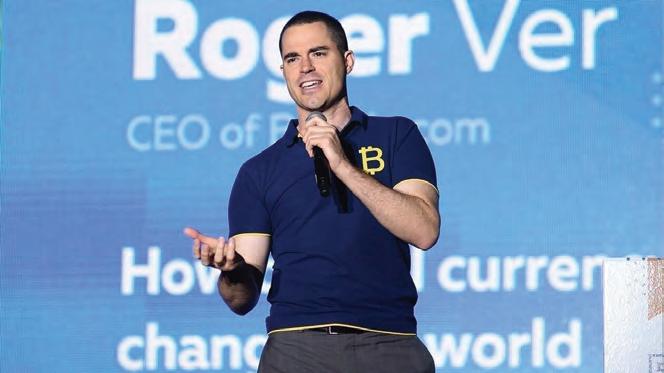
believe cryptocurrency can make the world more free and prosperous. The wealth was a bonus.”
Roger’s conviction was tested through multiple market crashes, including the 2017-2018 bear market that saw Bitcoin lose over 80% of its value. While many investors panicked and sold, Roger held most of his position.
“I’ve been through four major Bitcoin crashes,” Roger reflects. “Each time, people said Bitcoin was dead. Each time, I bought more. It’s not about the price movements – it’s about the long-term vision.”
Not every early Bitcoin story has a happy ending. James Howells, a British IT worker, accidentally threw away a hard drive containing 7,500 bitcoins in 2013. The drive is somewhere in a Welsh landfill, along with what would now be worth over $450 million.
“I had two identical hard drives,” James explains via video call from Newport, Wales. “One was blank, one had my Bitcoin wallet on it. I threw away the wrong one during an office cleanup. I didn’t realise my mistake until Bitcoin started making headlines.”
James has spent years trying to convince local authorities to let him search the landfill,

even offering to share half the recovered bitcoins with the city. So far, officials have refused, citing environmental concerns.
“People ask if I’m depressed about it,” James says. “Some days, yes. But I try to focus on the fact that I was smart enough to get involved with Bitcoin early. That insight has served me well in other investments.”
Many early Bitcoin adopters used their newfound wealth to build companies and infrastructure around cryptocurrency. Cameron and Tyler Winklevoss, the twins famous for their legal battle
with Mark Zuckerberg over Facebook, became Bitcoin billionaires after investing their settlement money in cryptocurrency.
“People thought we were crazy for putting so much money into Bitcoin,” Tyler recalls from the Gemini exchange offices in New York. “We’d already been through one major technology bet with Facebook. We understood that being early to transformative technology can be life-changing.”
The Winklevoss twins bought their first bitcoins in 2012, when the price was around $100. They’ve since become major figures in the cryptocurrency industry, founding the Gemini exchange and advocating for regulatory clarity.

“Bitcoin validated our thesis about the future of finance,” Cameron adds. “We saw it as digital gold before most people understood what that meant.”
Bitcoin wealth has created a new generation of cryptophilanthropists who are using their digital fortunes to fund various causes. Pine, the anonymous operator of the famous Pineapple Fund, donated over $55 million worth of Bitcoin to educational and healthcare initiatives before closing the fund in 2018.
“Wealth brings responsibility,” Pine explained in their final message before shutting down the fund. “I got lucky by being early to Bitcoin. The least I can do is use that luck to help other people.”

Pine’s approach to cryptophilanthropy was distinctive. Rather than converting Bitcoin to cash for donations, they often donated the cryptocurrency directly, helping recipient organisations learn to manage and use digital assets.
“Teaching nonprofits to accept cryptocurrency donations creates a multiplier effect,” Pine wrote on the Pineapple Fund website. “They learn about the
technology, they can access a new donor base, and they help legitimise cryptocurrency for mainstream use.”
Some early Bitcoin millionaires have gone to great lengths to maintain their privacy and anonymity. “John” (who asked me not to use his real name) was an early Bitcoin miner who accumulated over 50,000 bitcoins between 2009 and 2011.
“I never wanted to be public about my Bitcoin holdings,” John explains via encrypted messaging. “I’ve seen what happens to people when everyone knows they’re wealthy. It changes every relationship you have.”
John still lives in the same modest house he owned before Bitcoin made him wealthy, drives a 2015 Honda Civic, and works a regular job as a software engineer. Only his immediate family knows about his cryptocurrency holdings.
“Money changes people, and it changes how people treat you,” John says. “I’ve tried to keep my life as normal as possible despite having hundreds of millions of dollars in Bitcoin.”
Living through Bitcoin’s extreme volatility has been psychologically challenging for many early adopters. Dr. Sarah

Chen, a former physician who became a Bitcoin millionaire, describes the experience as “emotional torture.”
“I’ve watched my net worth swing by millions of dollars in a single day,” Dr. Chen explains from her home in San Francisco. “In 2017, I was worth over $50 million on paper. In 2018, that dropped to $8 million. In 2020, it was back over $40 million. The volatility is unlike anything most people can imagine.”
Dr. Chen has developed strategies for managing the psychological impact of extreme wealth volatility, including meditation, therapy, and maintaining detailed records of her financial goals.
“You have to separate your identity from your net worth,” she advises. “Otherwise, you’ll go crazy watching the price charts.”
Not all Bitcoin millionaires are true believers. Michael Novogratz, a former Wall Street executive who became a cryptocurrency billionaire, maintains a pragmatic view of Bitcoin’s prospects.
“Bitcoin is a fascinating experiment, but it’s still an experiment,” Novogratz says from his New York office. “I’ve made a lot of money from it, but I’m not delusional about the risks. Cryptocurrency could still fail.”
Novogratz has diversified his wealth beyond cryptocurrency, investing in traditional assets and startup companies. He views his Bitcoin holdings as a hedge against monetary debasement rather than a sure bet.
“I keep significant Bitcoin holdings because I think there’s

a chance that digital currency becomes the future of money,” Novogratz explains. “But I also keep plenty of traditional investments because I might be wrong.”
Some early Bitcoin adopters struggle with “what if” scenarios about decisions they made years ago. David Marcus (no relation to the Libra executive) sold most of his Bitcoin holdings in 2013 to buy a house.
“I had about 800 bitcoins that I’d mined in 2010 and 2011,” David explains from his home in Portland. “When Bitcoin hit $400, I sold 600 of them to buy a house for my family. At the time, it seemed like a smart move – I’d turned electricity and computer time into a real asset.”
David still owns 200 bitcoins, worth millions of dollars today.
But he can’t help calculating that if he’d held all 800, he’d be worth over $48 million instead of about $12 million.
“I try not to think about it too much,” David says. “I made a rational decision with the information I had at the time. And I still ended up wealthy beyond anything I ever imagined.”
Bitcoin wealth has complicated family dynamics for many early adopters. Janet Rodriguez discovered that her late husband had been mining Bitcoin in their garage for years when she found his laptop after his death in 2019.
“I thought he was just playing with computers,” Janet recalls from her home in Phoenix.
“He was always interested in technology, but I never paid attention to what he was working on. After he died, I

found files showing he had over 3,000 bitcoins.”
Janet had to learn about cryptocurrency from scratch while grieving her husband’s death. With help from their adult children, she eventually gained access to the Bitcoin wallet and discovered she was suddenly worth over $180 million.
“It’s bittersweet,” Janet says. “The money can’t bring him back, but I know he’d be proud that his hobby ended up providing for our family for generations.”
Second-generation Bitcoin wealth is creating new challenges and opportunities. Alex Kim inherited 1,500 bitcoins from his father, who died in a car accident in 2020.
“My dad was always telling me about Bitcoin, but I thought it was just a phase,” Alex explains from his college apartment at MIT. “He kept saying I should learn about cryptocurrency, but I was more interested in video games and sports.”
Alex is now 22 years old and worth over $90 million. He’s using his inheritance to fund cryptocurrency research and development projects while finishing his computer science degree.
“I feel responsible for continuing my father’s vision,”
Alex says. “He believed cryptocurrency could change the world. I’m trying to help make that happen.”
Bitcoin’s early association with illegal activities created some controversial millionaires. Ross Ulbricht, founder of the Silk Road dark web marketplace, accumulated enormous Bitcoin wealth before his arrest in 2013.
“Ross was probably one of the largest individual Bitcoin holders at one point,” says a former federal investigator who worked on the Silk Road case. “The government seized over 170,000 bitcoins from various Silk Road-related addresses. That’s worth over $10 billion today.”
Other early Bitcoin adopters made fortunes through less clearly illegal but ethically questionable activities,

including money laundering operations and pyramid schemes.
The association between early Bitcoin wealth and criminal activity has created ongoing stigma for some legitimate early adopters.
“People assume anyone who got rich from Bitcoin early must have been doing something illegal,” says one early adopter who requested anonymity. “The truth is that most of us were just nerds who thought the technology was cool.”
Some Bitcoin millionaires were initially sceptical of cryptocurrency before becoming believers. Tim Draper, the venture capitalist, was dismissive of Bitcoin until he started researching it seriously in 2013.
“I thought Bitcoin was fake money used by criminals,” Draper admits from his Silicon Valley office. “Then I spent time understanding the technology and realised it was potentially the most important financial innovation in history.”
Draper bought 30,000 bitcoins at a government auction in 2014, paying about $19 million for cryptocurrency that would later be worth over $1.8 billion.
“The best investments come from changing your mind about
something important,” Draper reflects. “I was wrong about Bitcoin initially, but I was willing to admit my mistake and act on new information.”
Bitcoin wealth has funded innovation across many industries. Naval Ravikant, an early Bitcoin investor and successful entrepreneur, has used his cryptocurrency gains to fund dozens of startup companies.
“Bitcoin wealth is different from traditional wealth because it comes from understanding technological change,” Naval explains. “That same understanding helps identify other transformative technologies worth investing in.”
Naval’s portfolio includes companies working on artificial intelligence, biotechnology, and space exploration – all funded partially with Bitcoin profits.
“Cryptocurrency wealth tends to be concentrated among people who understand technology deeply,” Naval observes. “That creates interesting possibilities for funding technological development.”
Some Bitcoin millionaires have become political activists, using their wealth to promote
cryptocurrency adoption and oppose government overreach in financial markets.
“Bitcoin wealth gives you the freedom to speak truth to power,” says one activist who requested anonymity due to security concerns. “When you don’t depend on traditional financial institutions for your wealth, you can afford to challenge traditional power structures.”
Several Bitcoin millionaires have funded legal challenges to cryptocurrency regulations, political campaigns for pro-crypto candidates, and educational initiatives about monetary policy.
The stress of managing extreme wealth while navigating cryptocurrency’s wild volatility has led some Bitcoin millionaires to step back from active involvement in the space.
“I made my money and got out,” explains Mark, a former Bitcoin trader who sold most of his holdings in 2017. “The constant price watching, the community drama, the regulatory uncertainty – it was too much stress. I took my profits and moved on to other things.”
Mark now invests in real estate and traditional stock markets, maintaining only a small Bitcoin position for “entertainment value.”

“I’m grateful for what Bitcoin did for me financially,” Mark says. “But I don’t miss the daily emotional rollercoaster of being heavily invested in cryptocurrency.”
Many Bitcoin millionaires remain convinced that they’re still early adopters of technology that will eventually transform the global financial system.
“We’re living through the most important monetary revolution in human history,” argues Andreas Antonopoulos, a Bitcoin educator and early adopter. “The wealth that early adopters have accumulated is nothing compared to the value that will be created as cryptocurrency achieves mass adoption.”
Andreas has used his Bitcoin wealth to fund educational initiatives and maintain independence as a cryptocurrency educator and speaker.
“My goal was never to get rich,” Andreas says. “My goal was to help build a more open and inclusive financial system. The wealth was a side effect of being useful to that mission.”
Managing Bitcoin wealth presents unique practical challenges. Unlike traditional investments, cryptocurrency holdings can’t be easily managed by conventional wealth management firms.
“Most financial advisors don’t understand cryptocurrency,” explains Jennifer, a Bitcoin millionaire who worked as an investment banker before discovering crypto. “You can’t just call Merrill Lynch and ask them to manage your Bitcoin portfolio.”
Bitcoin millionaires have had to become their own wealth managers, learning about custody solutions, tax planning, and estate planning without much professional help.
“I’ve become an expert in Bitcoin custody solutions, tax optimisation strategies, and cryptocurrency inheritance planning,” Jennifer says. “These weren’t skills I thought I’d need when I bought my first Bitcoin.”
Extreme Bitcoin wealth comes with extreme security responsibilities. Several early adopters have been targeted by criminals who believe they hold large amounts of cryptocurrency.
“I’ve had to change my lifestyle completely,” explains Robert,
a Bitcoin millionaire who now lives under an assumed name. “I was doxxed by someone online who figured out how much Bitcoin I owned. After that, I started getting threats and had to hire security.”
Many Bitcoin millionaires have invested heavily in physical security, operational security, and digital security measures to protect both their wealth and their safety. “When people know you have hundreds of millions of dollars in cryptocurrency, you become a target,” Robert warns. “The security costs are significant, but they’re necessary.”
Bitcoin wealth has created new models for philanthropy and charitable giving. The Pineapple Fund, operated by an anonymous Bitcoin millionaire, donated over $55 million worth of cryptocurrency to various charities before closing in 2018.
“Suddenly having wealth that you didn’t really earn through traditional work creates a moral obligation,” the Pineapple Fund operator explained in their final message. “I was lucky to be early to Bitcoin. The right thing to do was share that luck with people who need help.”
Other Bitcoin millionaires have struggled with how to give away wealth that exists primarily in digital form.
“Traditional charities don’t know how to accept Bitcoin donations,” explains one wealthy early adopter. “You end up having to convert to cash first, which creates tax complications and defeats some of the purpose of having cryptocurrency wealth.”
As Bitcoin approaches its 16th anniversary, early adopters are beginning to think about legacy and succession planning. Unlike traditional wealth, cryptocurrency holdings can be permanently lost if private keys are not properly transferred.
“I worry about what happens to my Bitcoin when I die,” admits Peter, an early adopter now in his 70s. “My children understand the basics, but cryptocurrency custody is complex. One mistake could make millions of dollars disappear forever.”
Several Bitcoin millionaires have established elaborate inheritance planning structures, including multisignature wallets, time-locked transactions, and detailed instructions for their heirs.
“Estate planning for cryptocurrency is still primitive,” explains estate attorney Michelle Wong, who specialises in digital assets. “We’re making it up as we go along, because the legal and technical frameworks are still evolving.”
Perhaps the most interesting aspect of Bitcoin wealth is its psychological impact on the people who possess it. Unlike inherited wealth or wealth from traditional businesses, Bitcoin fortunes often feel abstract and unreal to their owners.
“It doesn’t feel like real money,” admits Carlos, who became a millionaire when Bitcoin crossed $50,000. “It’s just numbers on a screen. I know intellectually that I’m wealthy, but it doesn’t change how I think about myself or my life.”
Therapists who work with newly wealthy individuals report that cryptocurrency millionaires face unique psychological challenges.
“Traditional wealth is often tied to something tangible – a business, real estate, stock in companies that make real products,” explains Dr. Patricia Miller, a therapist who specialises in wealth psychology. “Bitcoin wealth can feel more abstract, which can make it harder to integrate into your sense of identity.”
Despite their wealth, many Bitcoin millionaires remain connected to the cryptocurrency community that formed around the technology’s early development.

“The Bitcoin community became like family,” explains Lisa, an early adopter who now runs a cryptocurrency investment fund. “We went through the early years together, when everyone thought we were crazy. That created bonds that wealth can’t break.”
Annual gatherings like the Bitcoin Conference and smaller meetups provide opportunities for early adopters to reconnect and discuss their shared experience.
“There’s something unique about Bitcoin wealth because we all went through the same journey together,” Lisa reflects. “We remember when Bitcoin was worth pennies, when people said it would never work, when it seemed like we might lose everything. That shared experience creates a special kind of community.”
As Bitcoin matures and potentially moves toward mainstream adoption, early millionaires are thinking about their role in the cryptocurrency ecosystem’s future.
“We have a responsibility to help Bitcoin succeed,” argues Erik Voorhees. “We benefited enormously from being early adopters. Now we need to help build the infrastructure and institutions that will make cryptocurrency accessible to everyone.”

Some early adopters are investing their Bitcoin wealth in cryptocurrency companies, educational initiatives, and regulatory advocacy efforts.
“The money was never the end goal,” Erik continues. “It was always about building a better financial system. The wealth gives us the resources to continue that work.”
The Gratitude
Despite the challenges and complexities that come with extreme Bitcoin wealth, most early adopters express gratitude for their good fortune.
“I was a computer programmer making $50,000 a year,” reflects Laszlo Hanyecz, the man who bought those famous pizzas.
“Now I have more money than I ever dreamed of, all because I got interested in an experimental digital currency. It’s surreal, but I’m grateful.”
Laszlo continues to work as a programmer, not because he needs the money, but because he enjoys the work. His Bitcoin wealth has given him the freedom to pursue projects he’s passionate about rather than jobs he needs for financial security.
“The best thing about Bitcoin wealth is the freedom it
provides,” Laszlo says. “Freedom to work on interesting problems, freedom to take risks, freedom to help other people. That’s more valuable than the money itself.”
As Bitcoin continues its evolution from experimental digital currency to potential global money, its early millionaires remain both beneficiaries and stewards of one of the most important technological developments in financial history. Their stories offer insights into how transformative technology can create both enormous opportunity and enormous responsibility.
From pizza to penthouses, from garage mining operations to global businesses, the journey of Bitcoin’s first millionaires illustrates the unpredictable ways that technological innovation can reshape individual lives and entire economies.
Their legacy will be measured not just in the wealth they accumulated, but in the world they helped build – one transaction, one block, one revolutionary idea at a time. Freedom to work on interesting problems, freedom to take risks, freedom to help other people. That’s more valuable than the money itself.
Robert Stone @StoneOnChain

Money is arguably humanity’s greatest social technology.
More than the wheel, fire, or agriculture, money enabled complex civilisations by solving the fundamental problem of economic coordination. Yet for most people, money remains a mystery—a force that shapes their lives but operates beyond their understanding or control.
To truly understand why cryptocurrency matters, you must first understand what money is, how it has evolved, and why our current
monetary system creates the problems that Bitcoin and other cryptocurrencies were designed to solve. This isn’t just crypto history—it’s human history, told through the lens of how we store and transfer value.
The story of money is the story of trust, power, and the endless human search for sound ways to preserve wealth across time and space. Cryptocurrency represents the latest chapter in this ancient story, but to appreciate its significance, we need to start at the beginning.
Imagine you’re a wheat farmer in ancient Mesopotamia. You need tools, but the blacksmith doesn’t want your wheat— he needs meat. The cattle herder wants your wheat but has no tools to offer. This is the “double coincidence of wants” problem that makes barter inefficient for complex societies.
Without a common medium of exchange, economic development stagnates. Complex specialisation becomes impossible when every transaction requires finding someone who has what you want and wants what you have.
Early civilisations solved this problem by agreeing on common mediums of exchange. Cattle, shells,
salt, and eventually precious metals became money because they possessed certain characteristics: durability, divisibility, portability, and scarcity.
Gold and silver emerged as superior forms of money because they were durable, could be divided into small units, were relatively portable, and couldn’t be easily counterfeited or created in unlimited quantities. For thousands of years, precious metals provided monetary stability across different civilisations.
As economies grew more complex, carrying physical gold became impractical. Banks began issuing paper receipts backed by gold deposits—the first “paper money.” These notes were essentially IOUs that could be redeemed for actual gold, combining the convenience of paper with the trust of precious metals.
This system worked as long as people trusted that banks

actually held the gold they claimed to hold and would honour redemption requests. When that trust broke down— through wars, bank failures, or government intervention— monetary crises followed.
In 1971, President Richard Nixon made a decision that would reshape the global economy: he “temporarily” suspended the convertibility of dollars to gold. This temporary measure became permanent, ushering in the era of fiat currency—money backed not by precious metals, but by government decree and trust.
For the first time in history, all major currencies became purely fiat, meaning their value depended entirely on government promises and public confidence. This represented humanity’s greatest monetary experiment, the results of which we’re still experiencing today.
Modern economies are managed by central banks that control money supply, interest rates, and credit conditions. The Federal Reserve, European Central Bank, Bank of Japan, and other central banks wield enormous power over economic conditions through
their monetary policy decisions.
Central banks operate on the theory that they can “manage” economic cycles by expanding the money supply during recessions and contracting it during inflationary periods. This requires constant intervention in markets that were previously governed by natural supply and demand dynamics.
Most people believe governments print money, but the reality is more complex. In fractional reserve banking systems, commercial banks create money by making loans. When a bank loans you $100,000 for a house, it doesn’t transfer that money from other depositors—it creates new money electronically and requires you to pay it back with interest.
This process means that most money exists as digital entries in banking databases, not physical cash. The money supply expands every time banks make loans and contracts when loans are repaid. Central banks influence this process by setting reserve requirements and interest rates, but they don’t directly control the total money supply.
Since the 2008 financial crisis, central banks have engaged

in unprecedented monetary expansion through “quantitative easing”—purchasing government bonds and other securities with newly created money. This injects liquidity into financial systems but also dramatically increases the money supply.
Some economists now advocate for Modern Monetary Theory (MMT), which suggests governments with sovereign currencies can spend unlimited amounts without traditional fiscal constraints. Whether this theory proves correct will determine the future of fiat monetary systems.
Central banks use interest rates as their primary tool for economic management. Low rates encourage borrowing and investment but can fuel asset bubbles and inflation. High rates cool overheated
economies but can trigger recessions and unemployment.
This system requires central bankers to predict complex economic interactions and time their interventions perfectly. The track record of such predictions is mixed at best, leading many to question whether centralised monetary management is superior to market-based alternatives.
Inflation erodes purchasing power over time, effectively taxing savers who hold cash. While moderate inflation is often presented as beneficial for economic growth, it disproportionately hurts people on fixed incomes and those who cannot invest in inflationhedging assets.
Consider this: a dollar in 1971 (when the gold standard ended) has the purchasing power of about 15 cents today. This represents an 85% devaluation over fifty years—wealth destruction that would be considered criminal if done by private actors but is accepted as usual when done by central banks.
When central banks expand the money supply, the new
money doesn’t distribute evenly throughout the economy. It typically flows first to financial institutions, large corporations, and asset markets before reaching ordinary consumers. This creates a “Cantillon effect” where those closest to money creation benefit at the expense of those furthest away.
Asset price inflation often outpaces wage growth, making housing, stocks, and other investments less affordable for younger generations. This contributes to widening wealth inequality as asset owners benefit from monetary expansion while wage earners see their purchasing power decline.
Central banks are supposed to operate independently from political pressure, but reality is more complex. Politicians face electoral pressure to stimulate short-term economic growth, often leading to requests for looser monetary policy regardless of long-term consequences.
The 2008 financial crisis and COVID-19 pandemic demonstrated how quickly monetary independence can erode during crises. Central banks became de facto financiers of government spending programs, blurring lines between monetary and fiscal policy.

Low-interest-rate policies punish savers and retirees who depend on fixed-income investments. When central bank rates fall below inflation rates, “real” interest rates become negative, meaning savers lose purchasing power even while earning nominal returns.
This forces individuals into riskier investments to maintain their purchasing power, creating asset bubbles and systemic financial risks as everyone chases yield in increasingly speculative markets.
In our interconnected global economy, one country’s monetary policy affects all others. Competitive devaluations, where countries weaken their currencies to boost exports, create “currency wars” that destabilise
international trade and investment.
Developing countries are particularly vulnerable to monetary policy changes in major economies. When the Federal Reserve adjusts rates, it can trigger capital flight from emerging markets, causing currency crises and economic instability far from U.S. borders.
Gold’s Limitations in the
Many investors turn to gold as protection against fiat currency debasement, and for a good reason—gold has maintained purchasing power across millennia while every fiat currency in history has eventually failed. However, gold has limitations in our digital economy.
Physical gold is difficult to store securely, expensive to transport, and impossible to
divide for small transactions. Digital gold certificates reintroduce counterparty risk, while gold ETFs may not actually hold the physical metal they claim to represent.
Austrian economists like Ludwig von Mises and Friedrich Hayek predicted many problems with fiat currencies decades before they became apparent. They argued that sound money required separation from government control and return to marketbased monetary systems.
Hayek specifically wrote about the “denationalisation of money,” proposing that private currencies could compete with government-issued money. This theoretical framework provided intellectual groundwork for cryptocurrency development decades later.
Before Bitcoin, creating digital scarcity seemed impossible. Digital files could be copied infinitely, making digital money vulnerable to the “doublespending problem”—how do you prevent someone from spending the same digital money twice?
The cypherpunk movement of the 1990s and early 2000s included cryptographers and computer scientists working on
digital privacy and monetary alternatives. Projects like DigiCash, Hashcash, and Bit Gold attempted to solve digital money problems but couldn’t achieve the breakthrough that Bitcoin eventually provided.
The 2008 financial crisis exposed the fragility of centralised financial systems. Major banks failed, governments bailed out “too big to fail” institutions with taxpayer money, and central banks began unprecedented monetary expansion.
Public trust in financial institutions reached historic lows as people realised that privatised profits and socialised losses characterised modern banking. This crisis created fertile ground for alternative monetary systems that didn’t depend on trust in centralised institutions.
Bitcoin’s anonymous creator, Satoshi Nakamoto, solved the double-spending problem through a combination of cryptographic proof, distributed consensus, and economic incentives. The blockchain creates an immutable ledger that makes counterfeiting or double-

spending mathematically impossible without controlling the majority of network computing power.
For the first time in history, digital scarcity became possible without trusted third parties. Bitcoin transactions require no banks, governments, or other intermediaries—just mathematical proof and network consensus.
Bitcoin’s protocol fixes the total supply at 21 million coins, with new coins created at a predictable, decreasing rate through mining rewards. This creates deflationary money that becomes scarcer over time, the opposite of inflationary fiat currencies.
Bitcoin’s monetary policy is written in code and cannot be changed without consensus from network participants. Unlike central bank policies
that change based on political pressure or economic theories, Bitcoin’s rules remain constant and predictable.
Permissionless and Borderless
Bitcoin transactions require no permission from authorities and work identically whether you’re sending money across the street or across the world. This creates a global monetary system that operates 24/7 without regard for national borders, banking hours, or political restrictions.
This has profound implications for financial inclusion, allowing anyone with internet access to participate in the global economy without requiring traditional banking infrastructure or meeting institutional requirements.
Resistance to Censorship and Seizure
Properly secured Bitcoin holdings cannot be frozen, seized, or blocked by authorities without the owner’s private keys. This creates a form of money that provides protection against financial censorship, asset forfeiture, and authoritarian control.
While this capability can be misused, it also provides crucial protection for dissidents, journalists, and ordinary citizens in authoritarian regimes where financial censorship is common.

Bitcoin: Programmable
Ethereum and other blockchain platforms extended Bitcoin’s innovations by adding programmable smart contracts. This enables complex financial applications that operate automatically without intermediaries—decentralised finance (DeFi) that replicates traditional banking services without banks.
Smart contracts can create lending protocols, automated market makers, insurance systems, and other financial primitives that operate through code rather than institutions. This represents a fundamental reimagining of how economic systems could work.
Governments are developing their own digital currencies that combine digital
convenience with governmental control. CBDCs could enable unprecedented surveillance and control over economic activity, including programmable money that expires or can only be spent on approved purchases.
While CBDCs share some technological similarities with cryptocurrencies, they represent the opposite philosophical approach— increased rather than decreased governmental control over money.
Stablecoins and the Dollar Bridge
Stablecoins attempt to combine crypto convenience with fiat stability by maintaining pegs to traditional currencies. USDC, USDT, and other dollar-pegged tokens have become crucial infrastructure for the crypto ecosystem, enabling global dollar transactions without conventional banking.
However, stablecoins inherit the monetary policy of their underlying currencies, meaning

dollar-pegged stablecoins remain subject to Federal Reserve decisions and U.S. inflation rates.
The crypto space has spawned thousands of alternative monetary experiments, from privacy-focused coins like Monero to algorithmic stablecoins that attempt to maintain purchasing power without government backing.
While most of these experiments will likely fail, they represent valuable research into alternative monetary systems and provide optionality if current approaches prove inadequate.
Most developed countries face unsustainable debt burdens that can only be resolved through inflation, default, or dramatic fiscal reform. Total global debt has reached levels that would have been considered impossible just decades ago, while ageing populations increase spending pressures.
This creates pressure for monetary authorities to maintain low interest rates and high inflation to reduce debt burdens in real terms—a form
of stealth default that hurts savers and creditors while benefiting debtors.
The U.S. dollar’s role as global reserve currency provides enormous advantages but also creates vulnerabilities as other countries seek alternatives. China’s digital yuan, Russia’s gold accumulation, and various bilateral trade agreements denominated in local currencies all represent challenges to dollar dominance.
Cryptocurrency provides a neutral alternative that doesn’t favour any particular nation, potentially offering a path for international trade that doesn’t depend on any single country’s monetary policy.
Beyond cryptocurrencies, technological innovations are disrupting traditional finance through mobile payments, peer-to-peer lending, robo-advisors, and other fintech applications. These technologies reduce the need for traditional banking intermediaries and increase financial system efficiency.
Cryptocurrency represents the most radical end of this technological disruption, potentially eliminating the need for central banking altogether
by providing market-based alternatives to centralised monetary management.
Money is valuable partly because others accept it— network effects determine which monetary systems succeed. Bitcoin benefits from being first and having the largest network, but other cryptocurrencies compete by offering different features or serving different use cases.
The ultimate winners will likely be determined by which systems best balance security, convenience, stability, and adoption. Competition between monetary systems could drive innovation and efficiency in ways that centralised systems cannot match.
Understanding monetary policy helps individuals make better financial decisions. When central banks signal inflationary policies, holding cash becomes costly while real assets like real estate, stocks, commodities, or cryptocurrencies may preserve purchasing power better.
However, this forces individuals to become active investors rather than simple savers, creating complexity and risk that previous generations didn’t

face when savings accounts provided positive real returns.
Cryptocurrency enables geographic diversification of wealth that was previously available only to the very wealthy. Instead of depending entirely on your home country’s currency and political stability, you can hold money that isn’t subject to any single government’s decisions.
This becomes increasingly important as political polarisation increases and governments become more likely to use financial systems for political control through sanctions, asset freezes, and other coercive measures.
Cryptocurrency enables true financial self-sovereignty for those willing to learn proper security practices. Self-custody means you control your money directly without depending on banks, governments, or other intermediaries that could fail or restrict access.
However, self-custody requires taking responsibility for security, backup, and recovery that financial institutions traditionally provided. This trade-off between control and convenience won’t appeal to everyone.
Many people approach cryptocurrency as an investment seeking returns, but its more profound significance lies in providing a monetary alternative to fiat currencies. This distinction affects how you think about position sizing, time horizons, and risk management.
If cryptocurrencies succeed as monetary systems rather than just speculative investments, their value could increase dramatically while traditional financial assets become less relevant. This potential suggests that small allocations to cryptocurrencies could provide asymmetric protection against monetary system failure.
Cryptocurrency volatility makes it difficult to use as dayto-day money for most people. Wild price swings create uncertainty for merchants, employees, and anyone planning future expenses or income in crypto terms.
This volatility likely decreases as markets mature and adoption increases, but the transition period could last years or decades. Until volatility decreases, cryptocurrencies function more as digital gold than digital cash for most users.
Bitcoin’s security and decentralisation come at the cost of transaction throughput and energy consumption. While layer-two solutions and alternative cryptocurrencies
address some scalability issues, trade-offs between security, decentralisation, and efficiency remain challenging.
Environmental concerns about cryptocurrency mining have sparked legitimate discussions about energy use. However, many argue that securing monetary systems justifies energy consumption and that crypto mining increasingly uses renewable energy sources.
Governments worldwide are still determining how to regulate cryptocurrencies, creating uncertainty for users and businesses. Regulatory approaches range from complete bans to embracing innovation, with most countries still developing coherent frameworks.
Hostile regulation could limit cryptocurrency adoption in specific jurisdictions, though the global and decentralised nature of cryptocurrencies makes comprehensive suppression difficult.
Using cryptocurrencies safely requires understanding concepts like private keys, seed phrases, transaction fees, and smart contract risks that are foreign to most people. Poor user experience and high learning curves limit mainstream adoption.
However, user interfaces continue improving, and institutional custody solutions provide familiar banking-like experiences for those who prefer not to manage their own keys.
Rather than one system replacing another entirely, the future likely includes multiple monetary systems serving different purposes. National fiat currencies might continue for taxes and local transactions, while cryptocurrencies serve international trade, savings, and situations requiring censorship resistance.
This monetary diversity could provide benefits similar to biodiversity, with different systems offering different advantages and providing backup options if any single system fails.
Central banks may adapt to cryptocurrency competition by improving their own policies and technologies. CBDCs, more transparent monetary policy, and better crisis management could help central banks remain relevant in an increasingly competitive monetary landscape.
Alternatively, central banks might become less important

as private monetary systems prove more effective at providing the services people need from money.
Cryptocurrency technology continues evolving rapidly, with improvements in scalability, privacy, programmability, and user experience. Second and third-generation cryptocurrencies address many first-generation limitations, while layer-two solutions expand capabilities without compromising base layer security.
These technological improvements make cryptocurrency more practical for everyday use while maintaining the core benefits of decentralisation and censorship resistance.
Cryptocurrency could enable unprecedented global monetary integration by providing common standards that work across all countries and political
systems. This could reduce transaction costs, eliminate currency risk for international trade, and enable economic coordination that transcends national boundaries.
Such integration could boost global economic growth by reducing friction in international commerce, though it might also reduce individual countries’ abilities to use monetary policy for local financial management.
Understanding monetary history and policy isn’t just an academic exercise; it’s essential for navigating an era of monetary experimentation and potential transformation. The decisions made about money in the coming decades will shape economic opportunity and individual freedom for generations.
Cryptocurrency represents humanity’s attempt to create money that serves users rather than controllers, that
operates by mathematical rules rather than political decisions, and that enables economic participation without requiring permission from intermediaries. Whether this experiment succeeds depends partly on technical development but mostly on whether enough people understand why it matters and choose to participate.
The current monetary system has served some purposes well, enabling economic growth and global integration that have improved living standards for billions of people. However, its limitations—inflation, inequality, financial exclusion, and political manipulation— have become increasingly apparent and costly.
Cryptocurrency offers potential solutions to these problems, but it also introduces new challenges and uncertainties. Like any powerful technology, it can be used for both beneficial and harmful purposes, and its ultimate impact depends on how societies choose to implement and regulate it.

The future of money is being written now, through the choices made by individuals, businesses, developers, and governments around the world
The most important thing to understand is that money is not a natural force like gravity—it’s a human institution that can be changed if enough people decide current arrangements aren’t working. Cryptocurrency provides tools for that change, but using those tools effectively requires understanding both what we’re changing from and what we’re changing to.
The future of money is being written now, through the choices made by individuals, businesses, developers, and governments around the world. Understanding this history and these choices empowers you to participate in shaping

that future rather than simply accepting whatever outcomes others decide for you.
Whether cryptocurrency ultimately succeeds or fails, the monetary system we have ten years from now will be different from what we have today. The only question is whether those changes will increase or decrease your economic freedom and opportunity. The answer depends partly on forces beyond your control, but also on your own understanding and choices.
Your money is your stored time and energy—how that wealth is preserved and transferred matters enormously for your life outcomes. Understanding these systems and alternatives ensures you can make informed decisions that protect and grow your wealth regardless of what monetary changes lie ahead.
The future of money is the future of economic freedom. Understanding cryptocurrency means understanding your options in that future.

Robert Stone @StoneOnChain

Cryptocurrency wealth creation has entered a new phase. What began as experimental investments in Bitcoin, Ethereum, and other digital assets has evolved into substantial portfolios requiring sophisticated management strategies. Whether your wealth came from early Bitcoin purchases, successful altcoin trades, DeFi yields, or blockchain entrepreneurship, the transition from accumulation to preservation demands fundamentally different approaches.
The challenge extends beyond protecting what you’ve built— it’s about optimising growth
while managing risks that didn’t exist in traditional finance.
Cryptocurrency wealth brings unique opportunities and threats that require specialised knowledge, careful planning, and strategic thinking about the future of digital assets.
The foundation of cryptocurrency wealth management extends far beyond storing coins on a hardware wallet. Substantial holdings require sophisticated security architectures that balance protection,
accessibility, and operational efficiency.
Multi-signature configurations become critical as your holdings grow. A 2-of-3 multisig setup allows you to distribute signing authority across multiple devices and locations while maintaining transaction capability even if one key is compromised. This might involve keeping one key on a hardware wallet you carry, another in a bank safety deposit box, and a third with a trusted family member or solicitor.
Geographic distribution of security infrastructure provides protection against localised

threats. Store hardware wallets and recovery phrases across multiple secure locations— different banks, separate properties, or even different regions. The goal is to ensure no single event can compromise your entire portfolio, whether that’s a natural disaster, theft, or legal seizure.
Consider implementing tiered security based on holding amounts. Keep frequently accessed funds in hot wallets for daily operations, mediumterm holdings in standard hardware wallets, and the bulk of your wealth in cold storage systems that require multiple steps to access. This approach balances convenience with security while limiting exposure during routine transactions.
Professional custody solutions have emerged for high-networth individuals who want institutional-grade security without sacrificing selfsovereignty. These services often combine multi-party computation, hardware security modules, and insurance coverage while keeping you in control of your assets.
Advanced security planning includes duress scenarios. Consider the case of a cryptocurrency investor who was targeted by criminals who had researched his social media posts about his digital asset holdings. When confronted at gunpoint and forced to transfer his cryptocurrency, he was able to access a decoy wallet containing $50,000 worth of Bitcoin. This substantial sum satisfied the attackers but represented only 2% of his actual holdings. The criminals believed they had successfully extracted his wealth and departed, never realising that his primary holdings worth over £2 million remained safely stored in separate wallets with different access methods.
Some hardware wallets support exactly this scenario through hidden partitions activated by different PIN codes, allowing you to reveal different portfolios depending on the circumstances. While $50,000 was a painful loss, proper duress planning saved him from losing his entire fortune and potentially his life.
Effective cryptocurrency portfolio management requires moving beyond simple buyand-hold strategies towards sophisticated allocation frameworks that account for risk, correlation, and return characteristics across different digital assets.
The core-satellite approach provides a robust framework for crypto portfolios. Maintain substantial positions in established cryptocurrencies like Bitcoin and Ethereum as your core holdings, then allocate smaller percentages to promising but riskier assets in satellite positions. This structure captures the stability of proven networks while maintaining exposure to potentially explosive growth opportunities.
Sector diversification within cryptocurrency helps reduce concentration risk while maintaining crypto exposure. Consider allocations across different blockchain ecosystems, DeFi protocols, layer-2 solutions, and emerging sectors like decentralised storage or computing networks. Each sector responds differently to market conditions and technological developments.
Risk-adjusted position sizing becomes crucial as your portfolio grows. Consider
the Kelly Criterion or similar mathematical frameworks for determining optimal position sizes based on your conviction level and the asset’s volatility. This prevents any single investment from threatening your overall wealth, regardless of how promising it appears.
Rebalancing strategies help maintain target allocations while systematically capturing gains from outperforming assets. Set specific thresholds— perhaps 25% deviation from target weights—that trigger rebalancing actions. This forces you to sell high and buy low while maintaining your desired risk profile.
The 80/20 rule often provides a sensible starting framework for wealth preservation: maintain your core cryptocurrency positions while allocating a smaller percentage to other investments that provide different risk profiles and return characteristics. This might include traditional assets like property and equities, or alternative investments that generate ongoing income.
Sophisticated tax management can significantly impact your long-term wealth accumulation. Most tax jurisdictions offer legitimate strategies for optimising cryptocurrency tax burdens while maintaining
full compliance with local regulations.
Tax-loss harvesting provides immediate benefits during volatile periods. Strategically realise losses to offset gains, potentially saving substantial amounts in capital gains taxes. However, be aware of wash sale rules in your jurisdiction that might limit your ability to immediately repurchase the same assets.
Long-term holding strategies often provide substantial tax advantages. Most developed countries offer preferential tax rates for assets held longer than specified periods—typically one year in the UK and US. Planning your disposal timeline around these thresholds can dramatically reduce your effective tax rate.
Like-kind exchanges, where legally available, allow you to swap one cryptocurrency for another without triggering immediate tax consequences. While regulations vary by jurisdiction and continue evolving, these strategies can help you rebalance portfolios while deferring tax obligations.
Pension schemes offer powerful tax advantages in many countries. Self-invested personal pensions (SIPPs) in the UK, self-directed IRAs in the US, and similar structures elsewhere can often hold cryptocurrency investments, providing tax-deferred or tax-free growth within legal frameworks designed for longterm wealth building.
Consider the timing of major transactions around tax years and personal income fluctuations. Strategic planning around when to realise gains can help you optimise tax brackets and take advantage of annual allowances or lowerincome periods.
Professional tax advice becomes essential once holdings reach substantial levels. Tax laws around cryptocurrency continue evolving rapidly, and strategies that worked in previous years might not remain optimal. Regular consultations with qualified professionals help ensure you’re taking advantage of all available opportunities while avoiding compliance issues.


For substantial cryptocurrency holdings, strategic thinking about residency and citizenship can provide significant tax advantages and increased personal freedom. This doesn’t necessarily mean abandoning your home country, but rather creating options that enhance your financial flexibility.
Many countries now offer residency programmes that can dramatically reduce tax burdens on cryptocurrency gains.
Portugal’s Non-Habitual Resident programme provides significant tax advantages for foreignsourced income, including cryptocurrency gains realised before establishing Portuguese residency. Malta maintains sophisticated approaches to cryptocurrency taxation with generally favourable treatment for capital gains.
The UAE has become increasingly popular, particularly Dubai and Abu
Dhabi, which offer golden visa programmes and maintain zero tax on capital gains for individuals. However, recent corporate tax introductions may affect crypto holders who generate income through trading or DeFi activities.
For those seeking maximum tax efficiency, certain Caribbean nations offer citizenship by investment programmes alongside zero capital gains taxation. Countries like St. Lucia, Dominica, and Antigua offer citizenship for donations ranging from £75,000 to £150,000, providing not just tax benefits but also increased global mobility.
The key insight is that these programmes are designed for legitimate wealth holders seeking legal tax optimisation. They’re not about hiding assets but about positioning yourself in jurisdictions that welcome cryptocurrency wealth and provide favourable legal frameworks for digital asset management.
Cryptocurrency wealth faces unique risks that extend beyond market volatility. Comprehensive risk management addresses operational, technological, regulatory, and personal security threats that could jeopardise your holdings.
Counterparty risk management becomes essential if you’re using any services beyond pure self-custody. Even reputable exchanges, lending platforms, and DeFi protocols carry risks that can result in total loss. The FTX collapse demonstrated how quickly seemingly solid platforms can disappear. Implement strict limits on funds held with third parties—many experts recommend no more than 5-10% of total holdings on any external platform.
Smart contract risk assessment requires ongoing vigilance in the DeFi space. New protocols offer attractive yields but often carry significant smart contract risks, economic attack vectors, and governance vulnerabilities. Due diligence processes should include code audits, team backgrounds, economic modelling, and historical performance analysis.
Regulatory risk monitoring helps you anticipate and prepare for changing legal landscapes. The European
Union’s recent anti-money laundering package specifically targets cryptocurrency firms with enhanced due diligence requirements. These regulations create a “single rule book” across all 27 EU nations, demonstrating how quickly regulatory environments can shift.
Personal security considerations become essential as your crypto wealth grows. Avoid publicising your holdings, be cautious about social media activity, and consider the security implications of your lifestyle choices. Some cryptocurrency holders have become targets for physical attacks, kidnapping, and extortion.
Insurance options for cryptocurrency continue expanding. Coverage now exists for custody losses, smart contract failures, and even certain types of hacks. However, read policies carefully—many exclude common scenarios or require specific custody arrangements.
Generating sustainable income from cryptocurrency holdings provides cash flow for expenses while potentially compounding your wealth over time. However, yield generation strategies require careful risk assessment and understanding of the underlying mechanisms.
DeFi lending protocols offer some of the most straightforward income opportunities. Platforms like Aave, Compound, and similar protocols allow you to lend various cryptocurrencies for competitive yields. However, assess the protocols’ security records, governance structures, and economic models before committing significant funds.
Liquidity provision in decentralised exchanges can generate trading fees and liquidity mining rewards. Providing liquidity to trading pairs earns a percentage of transaction fees, though you face impermanent loss risk if the relative prices of paired assets change significantly.
Staking opportunities exist across numerous proof-ofstake networks. Ethereum staking, Cardano delegation, Solana validation, and countless other networks offer staking rewards for helping secure their blockchain networks. These opportunities often provide more predictable returns than DeFi yield farming.
Covered call strategies using cryptocurrency options can generate income from existing holdings. Selling covered calls against your cryptocurrency positions generates premium income while potentially limiting upside if the underlying asset appreciates significantly.
Consider building cryptocurrency businesses that generate operational income rather than just investment returns. This might include running blockchain infrastructure, developing DeFi applications, or providing services to the growing crypto economy.
For larger cryptocurrency holdings, sophisticated legal structures can provide additional protection layers while optimising tax efficiency and estate planning outcomes.
Offshore trusts in jurisdictions like the Cook Islands or Nevis

can provide asset protection benefits while maintaining some level of privacy. However, most developed countries have implemented reporting requirements for offshore trusts, and the structures must be established before any legal threats emerge to provide meaningful protection.
Private foundations, particularly in Panama or Liechtenstein, offer alternative structures that can be especially useful for families planning to transfer cryptocurrency wealth across generations. These structures can provide tax benefits while ensuring that digital asset holdings remain under family control rather than being subject to inheritance taxes.
Professional team assembly becomes crucial for managing substantial cryptocurrency wealth. Accountants with cryptocurrency specialisation become essential for tax compliance, record-keeping, and strategic planning.
Ensure your accountant stays current with rapidly evolving regulations and understands the tax implications of various cryptocurrency activities beyond simple buy-and-hold strategies.
Legal counsel should include both traditional estate planning expertise and emerging cryptocurrency law specialisation. The intersection of these fields continues evolving rapidly, requiring

professionals who understand both domains and can navigate the regulatory uncertainties.
Investment advisors who understand cryptocurrency can help with portfolio construction, risk management, and strategic planning. However, be selective—many traditional advisors dismiss cryptocurrency entirely, while crypto-only advisors might lack broader financial planning expertise.
Cryptocurrency’s unique properties create both opportunities and challenges for estate planning that traditional assets don’t present. The irreversible nature of blockchain transactions means mistakes cannot be corrected, while the technical complexity can make inheritance complicated.
Comprehensive documentation becomes essential for crypto estate planning. Maintain detailed records of all
holdings, wallet addresses, private keys, seed phrases, exchange accounts, and access procedures. However, this documentation must be stored securely to prevent theft while remaining accessible to designated beneficiaries.
Multi-signature inheritance structures can provide sophisticated solutions for transferring crypto wealth. Set up multi-sig wallets where family members or trusted advisors hold keys, with specific instructions for how signatures should be combined after your death or incapacitation.
Education and gradual responsibility transfer help ensure successful wealth transition. Family members who will inherit cryptocurrency holdings need an understanding of basic security principles, wallet management, and the importance of maintaining private key security.
Trust structures can provide sophisticated estate planning benefits while maintaining family control
over cryptocurrency holdings. However, these structures must be carefully designed to avoid triggering unwanted tax consequences or regulatory scrutiny.
The biggest mistake cryptocurrency holders make is waiting until they need to implement protective strategies before beginning the planning process. Quality legal structures, residency programmes, and citizenship applications can take 12-18 months to complete, and establishing genuine connections to new jurisdictions requires time.
Political and regulatory changes can happen remarkably quickly, as recent events have demonstrated repeatedly. Countries that seem stable and friendly towards cryptocurrency can implement hostile policies with little warning, while beneficial programmes can be suspended or modified on short notice.
The current environment provides particular urgency for action. Cryptocurrency price appreciation across Bitcoin, Ethereum, and the broader market has created enormous unrealised gains for longterm holders. Simultaneously, governments worldwide face budget pressures that make
wealthy individuals increasingly attractive targets for taxation.
Social and political dynamics driving regulatory hostility show no signs of abating. As wealth inequality increases and economic conditions deteriorate for average citizens, governments face mounting pressure to demonstrate action against perceived “easy money” gains. Cryptocurrency millionaires represent particularly attractive targets because their wealth appears sudden and unearned to politicians and voters struggling with inflation.
Balancing privacy desires with regulatory compliance requirements becomes increasingly important as cryptocurrency holdings grow and attract attention from tax authorities and other institutions.
Blockchain analysis has become sophisticated enough that
determined investigators can now trace most cryptocurrency transactions. However, legitimate privacy tools like coin mixing services, privacy coins, or layer-2 solutions can provide reasonable privacy while remaining legal in most jurisdictions.
Regulatory compliance varies significantly between jurisdictions and continues evolving rapidly. Stay informed about reporting requirements, tax obligations, and restrictions on cryptocurrency activities in your location. This includes understanding rules around different types of cryptocurrency activities, from simple holding to DeFi participation.
Professional compliance assistance might be necessary for larger holdings or complex situations involving multiple jurisdictions, business activities, or advanced DeFi strategies. The cost of professional help is minor compared to the potential consequences of inadvertent non-compliance.





The ultimate goal of cryptocurrency wealth management should be creating sustainable systems that protect and grow your wealth regardless of future market conditions, technological changes, or regulatory developments.
Diversification beyond cryptocurrency becomes more critical as holdings grow, but this doesn’t mean abandoning crypto entirely. Consider allocations to property, traditional securities, commodities, and other asset classes that provide different risk and return characteristics.
Technology risk management acknowledges that cryptocurrency technology continues evolving rapidly. Quantum computing, new consensus mechanisms, regulatory changes, or superior technologies could threaten existing cryptocurrencies. Maintain flexibility to adapt your holdings as the technological landscape evolves.

Continuous learning and adaptation remain essential in the rapidly evolving cryptocurrency space. Markets, technologies, regulations, and opportunities continue changing, requiring ongoing education and strategy refinement.
Focus on building systems and processes rather than trying to optimise every decision. Sustainable wealth management comes from consistently executing sound strategies over long periods rather than making brilliant individual choices.
The cryptocurrency revolution has created unprecedented opportunities for individual

wealth creation, but preserving and growing that wealth requires sophisticated management approaches. By implementing comprehensive strategies across security, portfolio management, tax optimisation, risk management, and strategic planning, you can build sustainable systems that protect your digital fortune while positioning for continued growth in the evolving cryptocurrency ecosystem.
The key is acting proactively rather than reactively. The best time to implement protective strategies is when you don’t need them yet, not when circumstances force your hand. Whether that means establishing additional residency options, diversifying into traditional assets, or simply upgrading your security infrastructure, taking action now provides options and flexibility that become invaluable as your wealth grows and the landscape continues evolving.
In the wake of the NFT boom - and the equally rapid bust that followed - few projects have stayed the course. Even fewer have grown. StarDawgs, however, has quietly positioned itself as an outlier; a Web3 project built slowly, carefully, and with the ambition of becoming something much larger than a digital collectable.
Developed over six years under Reel Vision Entertainment, StarDawgs introduces a cast of hyper-realistic, full-body 3D characters. Dogs, yes, but they’re rendered with the obsessive precision of a high-end animation studio. Each belongs to one of seven breeds, with male and female versions, and holds one of


Adele Adele60370277

six entertainment ‘jobs’, from crew and security to actors, directors, and producers. The rarest tier, the Superstars, comes with an almost unbelievable perk; a guaranteed role in a forthcoming film.
Hold a Superstar with a jewelled microphone, and that role even becomes a speaking part.
Those bold promises are backed by someone capable of delivering on them: Darcy Donavan.
A former Ms. Nashville, Tennessee, turned actress, producer, recording artist, author and Web3 entrepreneur, Donavan has spent years working at the intersection of entertainment and blockchain. Known widely as the ‘Crypto Queen’, she has been featured by ABC News, Forbes, FinTech and more for her work bridging two worlds that rarely understand each other. She also co-owns Income Island,

a fast-growing metaverse platform where StarDawgs NFTs serve as player identities.
Donavan’s entertainment background gives StarDawgs something unusual in the NFT space: genuine industry infrastructure. Rather than chasing hype, the team focused on building relationships - with actors, athletes, musicians, sponsors, and studio partners - long before the public saw a single rendered Dawg.
That long view is woven into the utilities attached to each NFT. Instead of the typical Discord access and a vague reference to future rewards, StarDawgs holders are invited to red-carpet premieres, set visits, professional photoshoots, and behind-thescenes experiences. Some will shadow directors. Some may pitch film ideas directly. Others will join productions as crew or talent. Holders also receive periodic ETH rewards, though Donavan insists these are meant as a bonus, not the heart of the project.
StarDawgs also integrates into Income Island, which Donavan

calls ‘Web3’s Hollywood backlot’. There, Dawgs function as avatars in a metaverse designed around entertainment, social connection, and branded experiences.
While many NFT ventures lost impetus after the 2021 crash, StarDawgs doubled down. Rendering the collection took over a year on its own. Production partnerships took even longer, but now that patience is translating into momentum. The collection is minting, and the team is deep in development on a $30 million romantic comedy; backed by A-list actors, directors, and crew, the movie is moving through pre-production, with StarDawgs and everything it stands for threaded into the project itself.
Meanwhile, the team is steadily onboarding actors, athletes,
musicians, and sponsors to broaden the StarDawgs universe and increase value for early supporters. It’s a strategy that feels out of step with typical Web3 behaviour; deliberate rather than explosive, relationship-driven rather than hype-driven.
What emerges is something larger than an NFT collection. StarDawgs has already been testing whether blockchain projects can evolve into full entertainment franchises, offering fans a new pathway into Hollywood. Not as passive viewers, but as participants with real opportunities and, occasionally, actual screen time.
In a market crowded with abandoned promises, StarDawgs stands out for one simple reason: it keeps showing up. And in doing so, it is carving out a model for how Web3 and Hollywood can build the future of storytelling together, with ten films released theatrically over the last three years, putting holders into some of these films, along with their red carpet events, StarDawgs keeps delivering.



Robert Stone @StoneOnChain

In a small apartment in Bangkok, 32-year-old software developer Somchai Nguyen checks his phone for the daily Bitcoin prwice. The number he’s watching isn’t $100,000 or even $50,000 – it’s the value of exactly 0.1 Bitcoin, roughly $6,500 today. Like millions of young professionals across the developing world, Somchai believes this modest amount of cryptocurrency could be his ticket to early retirement.
Half a world away in São Paulo, 45-year-old teacher Maria Santos laughs at the same idea. “0.1 Bitcoin for retirement?
That’s a nice dream,” she says,
calculating that at current prices, such an investment represents nearly three months of her salary. “But maybe my son, if he starts now...”
The “0.1 Bitcoin retirement” has become one of the most debated concepts in global cryptocurrency communities. As traditional pension systems crumble and inflation erodes savings worldwide, a growing number of people are asking whether a small Bitcoin investment today could provide financial freedom tomorrow.
The answer, according to financial analysts who’ve run
the numbers, depends heavily on three factors: your age, your location, and your willingness to believe in Bitcoin’s long-term growth trajectory.
The question isn’t emerging in a vacuum. Across the world, traditional retirement systems are under unprecedented stress. In Japan, the ageing population has created a retirement funding gap that could reach $450 billion by 2030. European pension systems are buckling under demographic pressure, with some countries facing benefit cuts of 20-30% over the next decade.
In developing nations, the situation is even more dire. According to the World Bank, fewer than 40% of working-age people in emerging economies have access to any formal retirement savings system. For these populations, the idea of accumulating wealth through cryptocurrency represents not just an investment opportunity,
but potentially their only path to financial security in old age.
“We’re seeing a global shift in how people think about retirement planning,” explains Dr. Jennifer Wu, a development economist at the London School of Economics who studies cryptocurrency adoption in emerging markets. “Traditional advice about 401(k) s and pension funds simply doesn’t apply to most of the world’s population. People are looking for alternatives.”
To understand whether 0.1 Bitcoin could realistically fund retirement, financial planners have developed models that account for different scenarios across age groups and geographic regions. The calculations reveal a stark generational divide.
Take 30-year-old Michael from Toronto. If Bitcoin maintains a 30% annual growth rate – admittedly an aggressive assumption based on its historical performance – his 0.1 Bitcoin investment could theoretically allow him to retire at age 51 with an annual income equivalent to $100,000 in today’s purchasing power.
The math works like this: 0.1 Bitcoin growing at 30% annually for 21 years would be worth approximately $6.2 million in nominal terms. Assuming 7% annual inflation
and withdrawing 4% per year (a standard retirement planning rule), this would provide about $100,000 annually in today’s purchasing power.
For 40-year-old Jennifer in London, the timeline extends to age 61 – still early retirement by conventional standards. But for 50-year-old Jason in Sydney, the numbers become less appealing: he’d need to work until 71. And 60-year-old Amy in New York? The model suggests she’d have to work until 80, making the strategy effectively useless for her situation.
The 0.1 Bitcoin retirement strategy looks more promising in countries with lower costs of living. In Thailand, where Somchai lives, the equivalent purchasing power of $100,000 annually would provide a very comfortable lifestyle –enough for a nice apartment, healthcare, travel, and leisure activities.
“In Bangkok, you can live very well on $2,000-3,000 per
month,” Somchai explains. “If 0.1 Bitcoin could eventually provide that kind of income, it’s absolutely worth the investment. It’s actually more than most people here make while working.”
This cost-of-living arbitrage has led to the emergence of “Bitcoin retirement migration” – young professionals from expensive Western cities planning to retire early in countries where their cryptocurrency gains will stretch further.
Jake Martinez, a 28-yearold software engineer in San Francisco, has built his entire financial plan around this concept. “I’m accumulating Bitcoin while earning Silicon Valley wages, but I plan to retire in Portugal or Mexico, where the cost of living is much lower,” he explains. “0.1 Bitcoin might not be enough to retire in San Francisco, but it could be plenty for a comfortable life in Lisbon.”
Nowhere is the 0.1 Bitcoin retirement concept being tested more thoroughly than

in Africa, where traditional financial infrastructure is limited but mobile phone adoption is ubiquitous. In countries like Nigeria, Kenya, and South Africa, young professionals are increasingly viewing Bitcoin as their primary retirement vehicle.
“Banks here offer maybe 2-3% annual returns, but inflation is running at 15-20%,” explains Adebayo Okonkwo, a 26-yearold digital marketer in Lagos. “Bitcoin might be volatile, but at least it has the potential for real returns. 0.1 Bitcoin is about $6,500 – that’s a year’s salary for many people here, but if it could mean early retirement, it’s worth the sacrifice.”
African governments have taken notice. Some, like Nigeria, have embraced cryptocurrency as a hedge against currency devaluation. Others, like Kenya, are developing regulatory frameworks that could make Bitcoin-based retirement planning more mainstream.
The African Development Bank has commissioned studies on cryptocurrency’s role in retirement planning, recognising that for many Africans, digital assets might be their only realistic path to accumulated wealth.
Latin American Laboratory
Latin America, with its history of currency crises and

hyperinflation, has become another testing ground for Bitcoin retirement strategies. In Argentina, where the peso has lost over 90% of its value against the dollar in the past decade, Bitcoin adoption has exploded.
“My grandfather’s peso savings became worthless three times in his lifetime,” says 33-year-old economist Carlos Rodriguez in Buenos Aires. “My generation isn’t going to make that mistake. We’re saving in Bitcoin, not pesos.”
Carlos has been accumulating Bitcoin for five years and now holds 0.3 BTC. His goal is early retirement by age 45, when he plans to move to Uruguay, which has more favourable cryptocurrency regulations and a lower cost of living.
“0.1 Bitcoin might be enough for someone starting today,” Carlos reflects. “But given Latin American history with
currency devaluation, I want a bigger buffer. Bitcoin isn’t just my retirement plan – it’s my hedge against my government destroying my savings.”
In Asia’s developed economies, the 0.1 Bitcoin retirement concept is meeting more scepticism but also more sophisticated analysis.
Singapore, South Korea, and Hong Kong have robust traditional financial systems, making Bitcoin seem like a risky addition rather than a necessary alternative.
“In Singapore, we have a strong pension system and stable currency,” explains Lin Wei, a 29-year-old financial analyst. “Bitcoin is part of my portfolio, but not my entire retirement strategy. 0.1 Bitcoin is interesting, but I’d rather have 0.1 Bitcoin plus traditional investments.”
However, even in these developed Asian markets, younger investors are increasingly interested in cryptocurrency’s potential. The key difference is that they’re viewing Bitcoin as portfolio diversification rather than a complete replacement for traditional retirement planning.
Europe presents a complex picture for Bitcoin retirement planning. Northern European countries with strong social safety nets make individual retirement planning less urgent, while Southern European countries facing pension crises make alternative strategies more appealing.
In Germany, 35-year-old engineer Klaus Weber has been studying the 0.1 Bitcoin retirement concept but remains sceptical. “Our pension system still works, and we have strong worker protections,” he says. “But I’m watching what happens in Greece and Italy. Maybe Bitcoin is insurance against political instability.”
Conversely, in Greece, where pension benefits have been cut repeatedly, Bitcoin adoption among young professionals is growing rapidly. “The government has already stolen our parents’ retirement once,” says 31-year-old Athens resident Sophia Papadopoulos. “Bitcoin can’t be confiscated the same way.”
Financial advisors worldwide are quick to point out the risks in the 0.1 Bitcoin retirement strategy. The most obvious is Bitcoin’s volatility – while the cryptocurrency has averaged impressive returns over its 15-year history, it has also experienced multiple 80%+ crashes.
“Anyone planning retirement around 0.1 Bitcoin needs to understand that they could lose 80% of their investment in a matter of months,” warns Dr. Michael Thompson, a retirement planning specialist at Cambridge University. “Bitcoin might go to $1 million per coin, or it might go to zero. Betting your entire retirement on either scenario is probably unwise.”
The 30% annual growth assumption used in many Bitcoin retirement calculations is also controversial. While Bitcoin has achieved this performance historically, many analysts argue that as the cryptocurrency matures and becomes more mainstream, growth rates will necessarily slow.
“Bitcoin returning 30% annually forever would eventually make it worth more than all the money in the world,” points out economist Dr. Sarah Kim. “At some point, growth has to moderate. The question is when and how much.”
Government regulation represents another major uncertainty in Bitcoin retirement planning. China’s ban on cryptocurrency transactions effectively eliminated Bitcoin retirement strategies for 1.4 billion people. Similar regulatory crackdowns could occur anywhere.
“We’re one regulatory decision away from Bitcoin becoming much less useful as a retirement tool,” warns legal expert Professor David Martinez at Columbia Law School. “Governments that feel threatened by cryptocurrency adoption could easily make Bitcoin-based retirement planning impractical or illegal.”
Conversely, regulatory clarity could accelerate Bitcoin adoption for retirement planning. El Salvador’s recognition of Bitcoin as legal tender has made cryptocurrency retirement strategies more viable for its citizens. Similar moves by other countries could further legitimize the approach.
For 0.1 Bitcoin retirement strategies to work globally, the cryptocurrency ecosystem needs better infrastructure. Currently, buying, storing, and eventually spending Bitcoin requires technical knowledge
that many potential retirees lack.
“My 70-year-old father can manage his traditional retirement accounts, but asking him to secure a Bitcoin wallet with seed phrases and hardware devices isn’t realistic,” observes tech entrepreneur Lisa Chen in Taiwan. “For Bitcoin retirement to go mainstream, it needs to become as easy to use as a bank account.”
Companies worldwide are working on this challenge. From simplified custody solutions to Bitcoin-backed retirement accounts that integrate with existing financial systems, the infrastructure is gradually improving.
Despite the risks and challenges, early examples of successful Bitcoin retirement are beginning to emerge. Roger, a 41-year-old former software engineer in the Netherlands (who requested anonymity), retired in 2023 after accumulating 2.1 Bitcoin over seven years.
“I didn’t start with a plan to retire on Bitcoin,” Roger explains. “I just kept buying small amounts and holding through the ups and downs. When Bitcoin hit $60,000, I realised I had enough to retire modestly.”
Roger’s experience suggests that while 0.1 Bitcoin might be

sufficient for some scenarios, most successful Bitcoin retirees have accumulated significantly more. His 2.1 Bitcoin provides about $126,000 annually at a 4% withdrawal rate – enough for a comfortable retirement in many countries.
Research reveals significant gender differences in Bitcoin retirement planning worldwide. Men are roughly four times more likely than women to hold Bitcoin, and this gap is reflected in retirement planning strategies.
“The gender gap in cryptocurrency is a real problem for retirement equality,” observes Dr. Jennifer Wu. “If Bitcoin becomes a major retirement vehicle and women are excluded, it could exacerbate existing retirement security disparities.”
Some countries are addressing this through education programs. Rwanda’s
central bank has launched cryptocurrency literacy programs specifically targeting women, recognising that digital assets could play an important role in retirement security for populations with limited access to traditional financial services.
The 0.1 Bitcoin retirement concept reveals stark generational differences in financial planning approaches. Older generations, who lived through periods of stable growth in traditional assets, remain sceptical of cryptocurrency-based retirement strategies.
“I’ve never owned a stock that went down 80% in six months,” says 58-year-old retiree Frank Morrison in Melbourne. “Bitcoin might make some people rich, but it’s not a retirement plan –it’s gambling.”
Younger generations, who have witnessed multiple traditional financial crises and limited
economic opportunities, are more willing to embrace Bitcoin’s risks in exchange for its potential rewards.
“My generation can’t afford houses, student loans will never be paid off, and Social Security probably won’t exist when we retire,” says 24-year-old college graduate Amy Rodriguez in Mexico City. “Traditional retirement planning doesn’t work for us anyway. Bitcoin at least offers hope.”
Recognising global interest in Bitcoin retirement planning, several organisations have developed calculators and planning tools specifically for this purpose. These tools enable users to input their age, savings rate, expected Bitcoin growth, and retirement goals, helping them determine whether strategies like the 0.1 Bitcoin retirement might work for their situation.
The most sophisticated tools account for geographic differences in cost of living, local tax implications, and currency volatility. They’ve become popular educational resources, even among people who ultimately decide against Bitcoin-heavy retirement strategies.
“The calculators are useful even if you don’t believe in Bitcoin,” notes financial planner Maria Santos in Brazil. “They help
people think about retirement planning in general – how much they need to save, how investment returns affect outcomes, how inflation impacts purchasing power over time.”
One overlooked aspect of Bitcoin retirement planning is taxation, which varies dramatically by country. Some nations, like Portugal and Germany, offer favourable tax treatment for long-term cryptocurrency holdings. Others, like the United States, treat Bitcoin sales as capital gains events, potentially creating significant tax burdens for retirees.
“In the U.S., if you retire on Bitcoin, every transaction to fund your living expenses is a taxable event,” explains tax attorney David Chen in New York. “That creates recordkeeping nightmares and potentially large tax bills. It’s not as simple as just accumulating 0.1 Bitcoin and retiring.”
Countries with more favourable cryptocurrency tax policies
are becoming destinations for Bitcoin retirement migration, creating new forms of tax arbitrage that governments are still learning to address.
Bitcoin’s energy consumption has become a factor in retirement planning discussions, particularly among environmentally conscious younger investors. Some potential Bitcoin retirees are grappling with the ethical implications of relying on a system that consumes significant amounts of electricity for their financial security.
“I want to retire early, but not at the cost of contributing to climate change,” explains 29-year-old environmental scientist Dr. Green in Sweden. “I’m watching developments in renewable energy Bitcoin mining, but it’s definitely a consideration in my planning.”
This has led to interest in alternative cryptocurrency retirement strategies based

on more energy-efficient blockchain networks, though none have Bitcoin’s track record or adoption level.
Financial planners have developed several scenarios for how Bitcoin retirement strategies might evolve over the coming decades:
The Mainstream Scenario: Bitcoin becomes widely accepted, regulatory frameworks stabilize, and cryptocurrency retirement planning becomes as common as 401(k) contributions. In this scenario, 0.1 Bitcoin retirement strategies could become viable for middleclass workers worldwide.
The Bubble Scenario: Bitcoin’s price eventually crashes permanently, making cryptocurrency retirement strategies worthless. Early adopters lose their investments, and the concept becomes a cautionary tale.
The Niche Scenario: Bitcoin maintains value but remains a
specialised asset class. Some people successfully retire on Bitcoin holdings, but it never becomes a mainstream retirement strategy.
The Revolution Scenario: Bitcoin becomes the dominant global money, replacing traditional currencies and financial systems. In this scenario, Bitcoin retirement planning becomes the only retirement planning.
Ultimately, the 0.1 Bitcoin retirement concept represents a massive global experiment in alternative financial planning. Millions of people worldwide are making investment decisions based on the belief that a relatively small amount of cryptocurrency today could provide financial freedom tomorrow.
Whether this experiment succeeds or fails will have profound implications for the future of money, retirement planning, and economic inequality. For the young

software developer in Bangkok, the teacher in São Paulo, and millions of others around the world, Bitcoin represents hope for a different kind of financial future.
“Maybe 0.1 Bitcoin will be enough to retire on, maybe it won’t,” reflects
Somchai as he checks the price one more time.
“But at least it gives me the possibility of financial freedom. Traditional saving and investing in my country doesn’t offer that same possibility.”
As Bitcoin continues its volatile journey toward either mainstream adoption or eventual obsolescence, the 0.1 Bitcoin retirement dream remains one of the most intriguing questions in global finance: Can a $10,000 investment today really secure financial freedom tomorrow?
The answer depends on whom you ask, where they live, and how much faith they have in the future of digital money. For now, it remains an experiment that millions are willing to try, even as billions more watch skeptically from the sidelines.
The only certainty is that the outcome will help define the future of money for generations to come.
Adele60370277
Abuilder’s mindset, backed by federal compliance and engineered for the future; BESC LLC is positioning itself as the new benchmark for how digital finance should work.
BESC LLC is not a new kid on the block; they’ve been quietly building for years, but development has gathered pace over the last few months. The component parts have come together to form a comprehensive crypto
ecosystem with an ambitious plan to compete with the likes of Binance and Coinbase, combining technical innovation with full federal compliance. They have the mindset of a builder and the discipline of a bank, and they’re emerging as the next serious contender for the top tier of global exchanges.
At the core of BESC’s rise are two founders who embody the word driven. Brian Nicholls, CEO and his COO Chris - known to millions online as prolific YouTuber @cryptokingdom78are both self-made businessmen, with fortunes amassed in construction and tech. Together, they form an unusual and
formidable leadership team: a mix of real-world business acumen, discipline, and an almost obsessive commitment to quality.
Their ambition is clear: to build a billion-dollar financial technology company that stands shoulder to shoulder with the biggest names in crypto. And they’re backing that ambition with something rare in the industry: infrastructure and compliance

If BESC is the brand, BESC HyperChain is its foundationand its masterstroke.
It’s a blockchain engineered for speed, predictability, and U.S. regulatory readiness. Transactions achieve instant finality, meaning the moment a transaction hits a block, it’s complete. There’s no waiting, no risk of reversals - an essential feature for payment networks, exchanges, and compliant on-chain services.
Transaction costs are predictable and low - typically between $0.20 and $0.50allowing real-world applications to run sustainably without gasfee volatility. Under the hood, the chain operates with CEXgrade infrastructure - multiple validators, sentry nodes, and both public and private RPC layers to guarantee uptime and resilience. The entire network has been fully audited by CERTIK, confirming its security and robustness.
In its first month, HyperChain processed over 100,000 transactions. Developers, attracted by BESC’s clear intention to support and encourage innovation, brought projects ranging from meme tokens to launch platforms. Established projects in gaming and the metaverse are onboarding at a rapid pace, and large-scale enterprises, including tokenised real estate and on-chain insurance services, are preparing to go live.
It’s a clear signal that HyperChain is not just
functional, it’s thriving. The ease and simplicity of the onboarding process, often a barrier to the adoption of new tech, is paying dividends. The BESC Bridge enables seamless in-house token movement between Ethereum, Binance Smart Chain, and HyperChain, while the CrossPort Bridge takes interoperability further, allowing movement between a vast range of blockchains and tokens.

BESC’s expansion into a full ecosystem wasn’t a marketing strategy. When the founders couldn’t find the tools or infrastructure they needed, they built their own; a pattern that now defines the company’s culture.
In an industry defined by regulatory grey zones, BESC LLC has chosen the opposite route. The company is one of only four centralised exchanges licensed to operate in all 50 U.S. states, giving it the rare distinction of full national accessibility. It holds active registrations with the U.S. Department of the Treasury (FinCEN) under the Bank Secrecy Act as a Money Services Business (MSB) and
the Nationwide Multistate Licensing System (NMLS)
These accreditations aren’t afterthoughts; they’re the foundation of BESC’s model, signalling a clear intent to play on a global stage. Where others are scrambling to retrofit compliance, BESC built it in from day one, ensuring transparency, accountability, and readiness for the next era of U.S. crypto regulation. With funding in place to facilitate multi-million-dollar withdrawals from the outset, trading has already commenced in a meticulously controlled release of features.
In the biggest challenge to the established players, both trading fees and listing fees are significantly cheaper than those of any other Tier 1 centralised exchange. Delivering value is a founding principle of the business. With the same relentless determination to be different, BESC Exchange, in a single stroke, opens up the possibility of a T1 CEX listing to projects where this has never felt achievable before.
















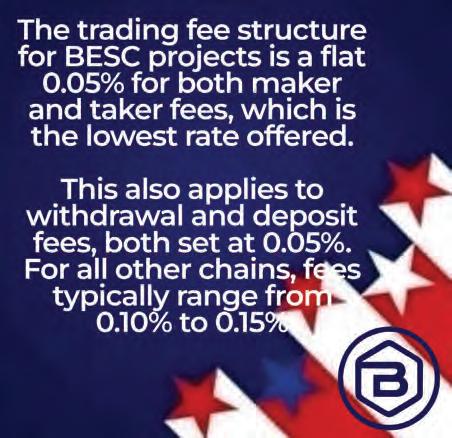
Alongside the centralised exchange sits MoneyXPro - a DEX where users can trade perpetual futures and spot markets directly from their wallets; no intermediaries, no custodians, no KYC. With deep-pooled liquidity, configurable leverage, and onchain transparency, MoneyXpro bridges the gap between DeFi freedom and professional-grade trading.
MoneyXpro delivers highly competitive yields for liquidity providers and stakers alike. You’ll find the same on BESCswap, a yield farming DEX that offers farming pairs with ETH, BNB, FUSD, FUST & MSMIL, as well as its native stable, BUSDT.
With a native wallet soon to join the suite of utilities, onchain prediction markets built into Consensus Bet Bot and
BESC Casino with over 1000 games already live, the team have all bases covered. Every component exists for a reason. As the team puts it: “If we couldn’t find it, we built it.”
Ask what drives them, and they’ll tell you: everything.

BESC LLC’s obsession with quality isn’t a marketing line; it’s a discipline that runs through every product decision, every audit, every deployment.
Their target is unambiguous: a billion-dollar business built on integrity, innovation, and relentless execution. And if their trajectory so far is any indicator, it’s not a matter of if; it’s when.

The old adage says you can’t have fast, affordable, and flawless all at once. BESC’s architecture tears up the rule book, achieving all three through precision engineering and total control of its own technology stack.
In a space crowded with hype and half-finished ideas, BESC stands out for doing the hard things properly. Whether it can rewrite the rulebook remains to be seen - but it’s already proving there’s a better way to build.

Privacy in blockchain has always been the elephant in the room that nobody wants to talk about. We built this revolutionary financial system on the principle of transparency, then acted surprised when people weren’t comfortable conducting their entire financial lives in public. It’s like building a bank with glass walls and wondering why customers hesitate to make deposits.
After over a decade in this space, watching the evolution from Bitcoin’s pseudonymous beginnings to today’s sophisticated DeFi protocols, I’ve come to believe that privacy isn’t just a nice-tohave feature—it’s the missing piece that will determine whether blockchain technology achieves true mass adoption or remains a niche tool for crypto enthusiasts and financial degenerates.
STAYING SECURE STAYING SECURE
As someone who deeply believes in individual sovereignty and the libertarian promise of cryptocurrency, I’ve watched with growing concern as our transparent ledgers created new forms of financial surveillance that would make central bankers jealous. We escaped traditional banking’s opacity only to create a system where every transaction, every balance, and every financial decision gets broadcast to the world. This isn’t liberation— it’s financial exhibitionism disguised as innovation.
But there’s a revolution brewing in blockchain privacy that goes far beyond the mixing services and zero-knowledge proofs that dominate current discussions. We’re approaching a future where privacy won’t be something users have to actively seek or understand—it will be woven so seamlessly
into the fabric of blockchain applications that people will forget privacy was ever a problem in the first place.
Take out your phone right now and open your banking app. Would you be comfortable showing your account balance and transaction history to everyone in the room? Of course not. Yet that’s precisely what happens every time you interact with a public blockchain. Your wallet balance, spending patterns, income sources, and transaction history are all permanently recorded on a ledger that anyone can examine.
This creates a paradox at the heart of blockchain adoption. The transparency that makes blockchains trustworthy also
makes them unsuitable for most real-world financial use cases. No business wants its cash flows public. No individual wants their salary, savings, and spending habits visible to competitors, criminals, or nosy neighbours.
The current state of blockchain privacy resembles the early internet before HTTPS became standard. Websites functioned, but transmitting sensitive information required users to actively seek out secure solutions that most people didn’t understand or trust. The breakthrough came when encryption became invisible— users didn’t need to understand cryptography to benefit from secure connections.
We need the same transformation for blockchain privacy. Instead of requiring users to become privacy experts or jump through complicated hoops to protect their financial information, privacy should be the default state that works automatically in the background.
Current privacy solutions in crypto primarily rely on zeroknowledge proofs, which work well for specific use cases but create fundamental limitations that prevent broad adoption. Most ZK privacy systems focus on hiding transaction traces—
making it impossible to connect sender to receiver—while leaving amounts and balances visible.
This approach resembles using an anonymising proxy to access public websites. You can hide your identity, but the content remains visible to anyone watching. For many privacy use cases, this gets the problem precisely backwards. People often care more about hiding their financial position than their identity, especially in business contexts where identity verification is required anyway.
More importantly, ZK privacy systems typically break composability—the ability for different protocols to work seamlessly together. A private token created with zeroknowledge proofs can prove certain properties about itself, but it can’t easily interact with other DeFi protocols without revealing the information it was designed to hide.
This is like having encrypted email that can only send encrypted messages to other users of the exact same encryption system. It provides privacy within a closed loop but fails to integrate with the broader ecosystem that users actually want to access.
The emerging solution that promises to solve both the privacy and composability problems simultaneously is fully homomorphic encryption (FHE). Unlike zero-knowledge proofs that hide who did what, FHE hides the content of transactions while keeping the trace visible.
Think of it as the difference between Signal and a traditional anonymising service. With traditional anonymisers, you hide your identity, but the content you’re accessing remains visible to various
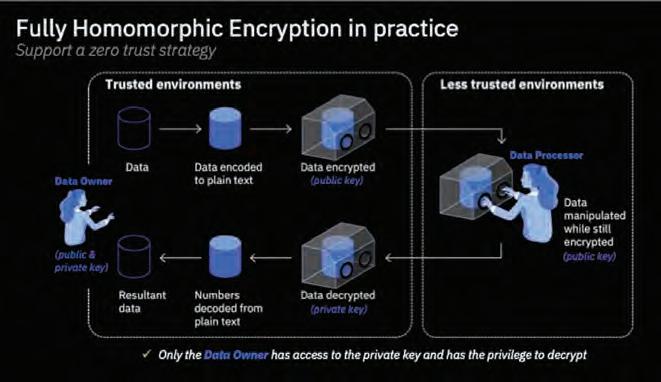

parties. With Signal, your identity in the conversation is known to participants, but the content remains encrypted even as it passes through public infrastructure.
FHE enables computation directly on encrypted data, meaning smart contracts can perform complex operations on private information without ever decrypting it. This seemingly impossible feat—computing on data you can’t see—opens entirely new possibilities for blockchain applications.
A lending protocol could assess creditworthiness using encrypted income data without ever seeing the actual numbers. A trading platform could execute orders based on encrypted amounts while maintaining perfect price discovery. A prediction market could aggregate encrypted bets while keeping individual positions private until resolution.
Most importantly, these privacy-preserving operations
compose naturally with each other. Encrypted tokens can flow through encrypted DEX trades into encrypted lending positions without breaking privacy at any step in the process.
One of the strongest arguments for FHE-based privacy is that it actually makes compliance easier rather than harder. Traditional privacy solutions that hide transaction traces create regulatory nightmares because they make it impossible to conduct basic due diligence or satisfy anti-money laundering requirements.
When a privacy system hides who sent money to whom, every user becomes potentially compliant or noncompliant, and there’s no way to distinguish between legitimate privacy seekers and money launderers. This forces regulators to treat all privacy users as suspicious, creating adversarial relationships that harm adoption.
FHE takes a different approach. Transaction traces remain visible—regulators can see that Alice sent money to Bob at a specific time—but the amounts and balances stay encrypted. This enables sophisticated compliance systems to be built directly into smart contracts without compromising user privacy.
A regulated stablecoin could automatically enforce spending limits, geographic restrictions, or sanctions compliance while keeping user balances private. A DeFi protocol could implement sophisticated risk management based on encrypted user data without exposing individual positions to competitors or bad actors.
This compliance-friendly approach to privacy aligns with libertarian principles not because it placates regulators, but because it provides a sustainable path to financial sovereignty that can’t be easily banned or restricted.
Understanding why privacy matters requires understanding the broader trajectory of blockchain adoption. The technology has evolved through distinct phases, each unlocking new categories of applications.
The first wave focused on simple money movements— sending and receiving
cryptocurrency. Bitcoin proved that digital scarcity was possible and that value could be transferred without traditional intermediaries. This wave created the foundation but remained limited to relatively simple use cases.
The second wave introduced programmable finance through smart contracts. Ethereum enabled lending, trading, derivatives, and complex financial instruments to operate without traditional financial intermediaries. This wave created the DeFi ecosystem but remained largely experimental and accessible only to cryptonative users.
The third wave, just beginning now, will bring public infrastructure onchain. Identity systems, land registries, corporate records, capital raising, tax collection, and government services will gradually migrate to blockchain-based systems that provide transparency, efficiency, and resistance to corruption.
But none of these waves can reach their full potential without solving the privacy problem. You can’t have mainstream adoption of blockchain payments when every transaction is public. You can’t have sophisticated financial markets when trading strategies are visible to competitors. And you certainly can’t have government services
on-chain without protecting citizen privacy.
Privacy isn’t just another feature—it’s the prerequisite for blockchain technology to fulfil its promise of replacing traditional institutions with transparent, efficient, and incorruptible alternatives.
The path to widespread blockchain adoption runs through payments, and the path to private payments runs through confidential stablecoins. Stablecoins have already proven themselves as superior payment rails for many use cases, offering the speed and efficiency of digital transactions with the stability of traditional currencies.
But current stablecoins suffer from the same privacy problems as other blockchain applications. Using USDC for business payments is like conducting all your banking through public announcements—technically
functional but practically unacceptable for most serious use cases.
Confidential stablecoins solve this problem by enabling the same privacy expectations that users have with traditional bank accounts while maintaining all the advantages of blockchain technology. Businesses can conduct private transactions, individuals can receive salaries without exposing their income, and merchants can accept payments without revealing their revenue streams.
The technology to create confidential stablecoins exists today. Existing stablecoins can be wrapped in privacypreserving protocols that encrypt balances and transaction amounts while keeping the underlying assets and transaction traces visible for compliance purposes.
More advanced implementations could integrate privacy directly into the stablecoin issuance process, enabling seamless on-ramps and off-ramps that maintain


confidentiality from fiat deposit through on-chain usage to final redemption.
What makes FHE-based privacy particularly exciting is how it enables entirely new categories of financial applications that were impossible with either traditional transparent blockchains or previous privacy solutions.
Consider confidential trading. Current blockchain-based trading suffers from maximum extractable value (MEV) problems, where sophisticated actors can front-run trades by observing pending transactions. Large traders face additional challenges when their positions become public, making it impossible to implement institutional-scale strategies without massive market impact.
Confidential trading protocols could accept encrypted orders, match them using homomorphic computation, and execute resulting trades without revealing individual strategies or positions. This would enable traditional market makers, hedge funds, and institutional traders to operate on-chain without exposing their alpha to competitors.
Similar innovations become possible across DeFi.
Confidential lending could assess creditworthiness using encrypted income and asset data. Confidential insurance could price policies based on private risk factors. Confidential derivatives could enable sophisticated hedging strategies without revealing positions to counterparties.
These applications compose naturally because they all operate on encrypted data
using the same underlying cryptographic system. A user could receive an encrypted salary, trade it confidentially on a DEX, lend part of it privately, and use the remainder for confidential payments—all while maintaining privacy throughout the entire flow.
The most ambitious vision for blockchain privacy extends far beyond financial applications. As public infrastructure gradually moves on-chain, privacy becomes essential for protecting citizen rights and enabling legitimate government functions.
Imagine identity systems that prove citizenship or credentials without revealing personal information. Land registries that establish property rights without exposing ownership details to criminals. Corporate registries that enable due diligence without revealing strategic information to competitors.
These systems would combine the transparency and incorruptibility of blockchain technology with the privacy protections that citizens expect from modern institutions. Citizens could prove their voting eligibility without revealing their political preferences. Businesses could demonstrate compliance without exposing trade secrets. Governments could
provide services efficiently without creating surveillance infrastructure.
This vision aligns perfectly with libertarian principles of limited, transparent government that respects individual privacy. Instead of choosing between accountability and privacy, blockchain technology could provide both simultaneously.
The ultimate goal of privacy innovation is to make privacy invisible to end users. Just as modern internet users benefit from HTTPS encryption without needing to understand cryptographic protocols, future blockchain users should get privacy protection automatically without thinking about it.
This requires privacy to be built into applications by default rather than offered as optional features that most users won’t understand or enable. When you send a confidential stablecoin payment, the encryption should happen automatically. When you trade on a confidential DEX, the privacy should be seamless. When you interact with confidential government services, the protection should be transparent.
Users won’t need to become privacy experts or make complex security decisions.
They’ll simply use applications that happen to be private by design, just as they currently use websites that happen to be encrypted by default.
This transformation will mark the true maturation of blockchain privacy. Success won’t be measured by the sophistication of cryptographic protocols or the enthusiasm of privacy advocates, but by how completely the privacy infrastructure disappears into the background of normal digital life.
We’re still in the early stages of this privacy revolution. Current implementations can handle basic use cases like confidential transfers and simple smart contract interactions, but they’re not yet ready for the complex, high-throughput applications that will define mainstream adoption.
The path forward requires
solving scalability challenges, improving user interfaces, building developer tools, and creating an ecosystem of applications that demonstrate privacy’s value proposition. It also requires educating users, businesses, and regulators about why privacy enhances rather than threatens legitimate use cases.
Most importantly, it requires a philosophical commitment to privacy as a fundamental feature rather than an optional add-on. Just as the early internet community understood that encryption was essential for sensitive applications, the blockchain community must embrace privacy as a prerequisite for mainstream adoption.
The technical pieces are falling into place. FHE is becoming practical for real-world applications. Developer tools are improving rapidly. The first generation of privacypreserving applications


is launching on testnets and preparing for mainnet deployment.
Looking ahead, I envision a fundamental shift in how we think about blockchain transparency.
Instead of transparency being the default with privacy as a special case, privacy should become the default with selective transparency for specific purposes.
This doesn’t mean abandoning the transparency that makes blockchains valuable. It means evolving toward systems that provide transparency where it serves legitimate purposes— regulatory compliance, audit trails, governance processes— while protecting privacy where it serves individual and business needs.
requires not just the ability to control your money, but the ability to keep your financial life private from those who would use that information against you.
We built blockchain technology to free people from the control of traditional financial institutions. Adding ubiquitous privacy will complete that mission by freeing people from the surveillance that comes with current blockchain systems.

The result would be a blockchain infrastructure that feels familiar to users coming from traditional systems while providing all the advantages of decentralisation, programmability, and global accessibility that drew us to crypto in the first place.
This vision isn’t just about better technology—it’s about fulfilling the original promise of cryptocurrency as a tool for individual financial sovereignty. True sovereignty
The privacy revolution is just beginning, but its endpoint is clear: a world where privacy is so seamlessly integrated into blockchain applications that users forget it was ever a problem. When that day arrives, we’ll know that blockchain technology has truly matured from an experimental tool for crypto enthusiasts into the foundation for a freer and more private digital economy.
The only question is how quickly we can build that future.

X: @PotcakeNFT
Location: The Bahamas
Occupation: Saving stray island dogs throughout The Bahamas with digital collectables, art, music, & community!
Please provide a brief introduction about yourself for the readers.
I’m Matthew Matlack, founder of Potcake Rescue — a missiondriven initiative dedicated to saving and supporting Royal Bahamian Potcakes, the island dogs of The Bahamas. What began as a short film has evolved into a comprehensive rescue, education, and cultural preservation project that combines storytelling, art, and
technology to create a lasting impact in the real world.
How did you first get involved in crypto?
My introduction to crypto came through exploring how blockchain could improve transparency in charitable work. I wasn’t drawn to trading or speculation — my focus has always been on how these tools can strengthen trust, build communities, and deliver
measurable results in support of our mission.
What was the reason you invested in crypto?
Rather than investing in the traditional sense, I’ve used Web3 tools like NFTs to fund rescue operations, art collaborations, and educational programs. It’s a way to connect directly with supporters, show exactly where funds go, and give them something meaningful in return.
Do you remember what your first purchase/ investment was?
The first blockchain asset I acquired was tied to a Web3 community I believed in — a project where ownership meant access, collaboration, and shared purpose. That experience helped shape how I designed Potcake Rescue’s NFTs.
What benefits do you think cryptocurrencies bring to finance and the future of digital economies?
The most significant benefits are transparency, speed, and borderless access. For nonprofits like ours, it means we can receive support instantly from anywhere in the world, track funds on-chain, and ensure that impact is verifiable.
Where do you see the industry heading within the next decade?
We’ll see Web3 become more utility-focused, with

mainstream adoption driven by real-world use cases, such as charity, supply chain tracking, ticketing, and creative ownership. It will be less about hype and more about solving everyday problems.
Which altcoin do you think will be the most notable by the end of 2025?
The “most notable” for me would be any project proving that blockchain can drive real-world change, especially in areas like conservation, humanitarian aid, or education.
CEX or DEX (Centralized Exchanges or Decentralized)?
Each has its place. For our supporters who are new to crypto, CEX platforms can be easier to navigate. For transparency and autonomy, DEX platforms align more closely with Web3’s original vision.
Do you think shitcoins/ meme tokens benefit the industry? Will there still be a place for them in the future?
Meme tokens have attracted many people to the space, but long-term value comes from projects with a purpose. If meme coins evolve to include real-world impact or community benefits, they’ll have staying power.
What are your thoughts on your plans for crypto?
For Potcake Rescue, the plan is to continue developing ways to utilise blockchain as a bridge between supporters and impact. That means growing our NFT community, integrating more real-time rescue updates on-chain, and showing the world that crypto can be a force for good.
What are some brief words of advice for someone just starting in crypto?
Start by finding communities and projects that align with your values. Don’t chase quick profits — look for purpose, utility, and transparency. When you connect with something you believe in, the learning process is more rewarding and sustainable.
You’ve collaborated with artists from The Bahamas for your NFT collections. Why is showcasing local culture an essential part of your mission?
Partnering with Bahamian artists isn’t just a stylistic choice — it’s at the heart of Potcake Rescue’s mission to preserve and honour the roots of the Royal Bahamian Potcake. By featuring authentic Bahamian artwork in our NFT collections, we celebrate and elevate local culture, helping our audience connect emotionally with

the dogs we serve and the place they come from. We’re supporting Bahamian artists directly, creating opportunities they might not otherwise have. Foster a deeper narrative: each NFT isn’t merely digital art, it’s a piece of Bahamian heritage,
telling a story of resilience, island life, and community. This cultural integration enriches our storytelling, turning our supporters into cultural ambassadors who champion both animal welfare and Bahamian creativity.
What has been one of the most impactful rescue stories funded through your Web3 efforts so far?
One that stands out is Raven’s— now fondly known as “Emmy.” She came to Abaco Shelter with a litter of pups, and thanks to their dedication and care, all of her puppies were adopted into loving homes. Once Raven was spayed and treated for heartworm, she patiently waited for her own forever family, always calm and affectionate despite her serious expression.
Abaco Shelter found her an adopter in New Jersey, but once she arrived, it became clear the match wasn’t the right fit—her energy level around cats and small dogs created stress. This wasn’t a failure, just a reminder that adoption compatibility is complex.
Thanks to Abaco Shelter’s quick coordination and our ability to provide financial and logistical support, their network partner, The Sanctuary at Haafsville, stepped in immediately. They gave Raven her fresh start, and today she’s thriving with a family who adores her. This story is a testament to the tireless, hands-on work Abaco Shelter does every day. Potcake Rescue’s role is to support them—through funding, awareness, and resources—so that when a situation changes, there’s always a safety net for dogs like Raven.

Could you please provide a brief introduction about yourself for the readers?
My name is DeSci Validator, a pseudonym I use for digital security. I am an academic and researcher in Natural Sciences, focused on creating opportunities for students and young scientists. Entering the blockchain showed me that it is not only about finance, but also about trust and transparency. Today, I merge my academic background with my role as a CratD2C validator, using rewards to support young innovators.
How did you first get involved in crypto?
I entered crypto in December 2024, initially just learning about it as a personal exploration, not an investment. What I didn’t expect was that
X: @DeSciValidator
Age: 36
Location: Latin America
Occupation: Academic and researcher in Natural Sciences, and blockchain validator.
Robert Stone @StoneOnChain
this small step would lead me, only months later, to become deeply involved when I found in CratD2C the opportunity to officially join the industry as a validator.
What was the reason you invested in crypto?
I invested in crypto to find a decentralised, non-bureaucratic way to support my work as an academic. Traditional science funding is fraught with

limitations, and blockchain is a potential solution. With CratD2C, I realised I could not only invest but also validate and dedicate part of the rewards to supporting students and young scientists.
Do you remember what your first purchase/ investment was?
My first purchase was in March 2025, just a few tokens on a centralised exchange, nothing significant. The real turning point came on April 28, when I bought my first CRAT coins during the presale. It wasn’t easy; I had to rely on loans and sacrifices until May. Finally, on June 8, 2025, I officially joined CratD2C as a validator, transitioning from a curious observer to an active participant with both academic and social purposes.

What benefits do you think cryptocurrencies bring to finance and the future of digital economies?
The greatest benefit of cryptocurrencies is decentralisation, giving users control and reducing bureaucratic dependence. This enables fast, transparent transactions and financial access where traditional systems fail. What inspires me most is blockchain’s ability to create real utility. CratD2C showed this by focusing on e-commerce and real-world assets. Personally, I chose to
connect that vision with my work as a validator, directing part of it toward academic and social research projects.
Where do you see the industry heading within the next decade?
In a decade, blockchain will be seamlessly integrated into daily life, providing an invisible infrastructure that supports commerce, payments, logistics, health, education, and science. Like the internet today, people will use it without thinking about how it works. The most successful projects will be those linking blockchain to real-
world assets and needs. For me, CratD2C embodies this path and provides a foundation to drive projects with academic and social impact.
Which altcoin do you think will be the most notable by the end of 2025?
Many altcoins have potential, with established ones likely to remain strong. Yet, emerging projects with clear value can also gain attention. I see $CRAT, the native coin of CratD2C SmartChain, as a standout. It’s not trying to be “just another coin,” but part of an ecosystem centred on e-commerce and real-world assets. That practical utility gives it a unique position among altcoins that could rise in prominence by the end of 2025.
or
Both CEXs and DEXs have their place. CEXs provide simplicity and quick liquidity, making them an easy entry point for newcomers. DEXs embody the original spirit of decentralisation, giving users greater control. I use both, but as a validator, I value DEXs more since they reflect autonomy and participation, central to projects like CratD2C. Within its ecosystem, CratSwap V3 DEX shows how the network integrates decentralised solutions for its users.
CratD2C showed this by focusing on e-commerce and real-world assets. Personally, I chose to connect that vision with my work as a validator, directing part of it toward academic and social research projects
Do you think shitcoins/ meme tokens benefit the industry? Will there still be a place for them in the future?
Meme tokens attract massive attention and often serve as a first gateway into crypto. Yet they also bring volatility and, at times, distrust among those looking for serious projects. They will continue to exist, but in a secondary role. Long-term stability and credibility will come from projects with real purpose and tangible utility. From my perspective, initiatives like CratD2C demonstrate a significantly stronger path for the industry’s growth.
What are your closing thoughts on your plans for crypto?
My immediate plan is to strengthen my role as a CratD2C validator, expanding the community and building trust with delegators. At the same time, I aim to develop

initiatives where blockchain supports academic and scientific projects, especially for students and young researchers. I also want to act as a regional ambassador, showing that blockchain can drive not only finance but also innovation and social progress.
What are some brief words of advice for someone just starting out in crypto?
My advice is to start with education and not get carried away by quick-profit promises or passing trends. Choose projects with real purpose and strong communities; that’s why I trusted CratD2C.
Seek guidance from experienced people you genuinely trust; never trust lightly in crypto. Above all, start small and never risk more than you can afford to lose. I began with just a few coins, and that experience taught me more than any theory. Patience, longterm vision, and an open mind are essential.
Are there any people you would like to highlight who have inspired or supported you during your short journey in blockchain?
In addition to my early validator friends, whom I do not know in person but who embody the Cratdian Spirit of community (the fourth pillar of any ecosystem), I want to highlight a few individuals. One of them is known by the pseudonym N.E.O., who encouraged me at a key moment; thank you, my friend I also want to recognise Dr. Sammy, whose determination with his team turned what once seemed unreachable into reality, inspiring many of us.
And finally, PEP, a friend geographically distant yet very close, who tirelessly educates people about crypto to promote prosperity. These experiences taught me that blockchain builds not only technological networks but also human ones, based on trust and collaboration.

Could you please provide a brief introduction about yourself for the readers?
I’m a digital/AI artist who loves telling stories through my collections. I enjoy creating things that haven’t been seen before. I create one-of-a-kind collections that have their own world. My art is about imagination and worldbuilding as well as about the visuals.
How did you first get involved in crypto?
I learned about cryptocurrency and NFTs through people I

Name: ArtiFi
X: @ArtFi
Age: 26
Location: United Kingdom
Occupation: Digital/AI Artist
@StoneOnChain

knew. It took some time to fully understand what was happening in the blockchain world, but I enjoy learning new things, and the more I learned about it, the more I wanted to be involved.
What was the reason you invested in crypto?
For me, it was a mix of curiosity and opportunity. I liked the idea of learning about something that was new to me. I also like experimenting, both creatively and financially.
Do you remember what your first purchase/ investment was?
I don’t remember the exact first coin I bought, but it was a small step into the space. It wasn’t about making huge moves right away — more about learning, testing and building confidence.
What benefits do you think cryptocurrencies bring to finance and the future of digital economies?
Personally, I think crypto opens doors to independence and ownership in ways we haven’t seen before. It allows artists, creators and everyday people to be part of something without traditional middlemen. It feels like a step toward more freedom and creativity in digital economies.
Where do you see the industry heading within the next decade?
I believe we will see crypto and NFTs become more natural parts of people’s lives. It will just be another way people invest, collect and interact with art, culture, and technology. It really does open up lots of new opportunities.
Which altcoin do you think will be the most notable by the end of 2025?
Ethereum will probably stay strong because of how much it powers in the NFT space, but I also think we’ll see some surprises — projects that bring new utility or unique communities could easily rise by then, like XRP is currently doing.
CEX or DEX (Centralized Exchanges or Decentralized)?
I can see the benefits of both. CEXs are easy and accessible, while DEXs give you more control. For me, it depends on

the situation; however, I usually lean more towards CEXs.
Do you think shitcoins/ meme tokens benefit the industry? Do you think there will still be a place for them in the future?
I think they do add something — even if it’s just attention and fun. They bring people into crypto who might not have looked at it otherwise. In time, I think the serious projects will lead the way, but there will always be a place for meme culture.
What are your thoughts on your plans for crypto?
For me, crypto is tied to creativity. I want to keep growing as an artist, creating collections that tell stories in new ways. My latest collection, Project Luminari, is on Liquid NFTs, a unique new marketplace, and it gave me the chance to build an entire world with its own style and lore. Moving forward, I plan to continue pushing myself with projects that are both visionary and approachable to collectors.
What are some brief words of advice for someone just starting out in crypto?
Start small, stay curious. It could be collecting NFTs or investing in coins. Take your time; the crypto/NFT universe is vast, with a wealth

of information to learn and explore. Take your time and conduct your own research.
makes Project Luminari stand out in the NFT space?
For me, Project Luminari is special, for many reasons, but mainly because it combines art, lore and worldbuilding into one experience. I wanted to create something that shows what I’m capable of as an artist by designing my own unique style, building a cast of characters, and placing them in a universe that feels alive and has a story. It’s not just about images on the blockchain; it’s about giving collectors a piece of a story they can connect with.


Please give me a quick introduction about yourself for the readers.
Hi, I’m Delli - you’ll find me on X with my Sunday name - Adele60370277. I have a coaching & consultancy business, having spent years working in Leadership Development & Organisational Change. I also built (and recently sold) a handbag accessory business. I love writing - I used to be a blogger
but now I mainly write for this magazine. People fascinate me, but I’m a classic introvert and honestly, I prefer dogs.
How did you first get involved in crypto?
A freak accident. The boss of someone I’m close to launched a shitcoin and I got a bit carried away with myself. It ultimately failed (of course it did) but by that time I was well in the hole, as mad as a wasp and
determined not to take the losses lightly. I wanted to be part of turning it around, and that’s really where my crypto journey began.
I was lucky enough to meet Nathan Hill (now good friend and crypto mentor) and together with his business partner Colin Woolley (Editor of Crypto Magazine) and Drew (CEO of Milestone Millions and Game2Crypto, also now a good friend and crypto mentor) we
took the failed shitcoin and over the following 18 months created something amazing. Most of our OG community have had both their fortunes and their faith restored through the transition to something completely new (which you can read about in issue 09 of The Crypto Magazine, Koda; Death of a Shitcoin) and together we are now the proud co-founders of FUSD.
What was the reason you invested in crypto?
I have quite an addictive personality, and when I’m in, I’m all in. I fell hook, line, and sinker for the hype; I drank every drop of Kool-Aid and was utterly convinced I was going to be the next crypto billionaire. I even made a spreadsheet projecting forward gains based on my first week (which happened to be a week of God candles) and started planning how I was going to spend it all. Whatever face you’re pulling now, I guarantee I’m pulling it too. I was so naïve!

Do you remember what your first purchase/ investment was?
Yes, the slow rug I mentioned above, but I don’t really regret it; I learned a lot. I didn’t know the difference between a meme coin and a utility token. I didn’t understand the crypto landscape or its seasons. I’d certainly never moved in circles where more people than you can shake a stick at were waiting to rob you blind. And yet, it turns out I found my tribe here and now - albeit with a few battle scarsI’m living the Web3 dream.

What benefits do you think cryptocurrencies bring to finance and the future of digital economies?
Crypto’s exciting because it puts money back in people’s hands. It makes moving value around as simple as sending a text, which is huge for anyone shut out of traditional banking. And beyond the tech, it’s really about freedom and inclusion - it’s important to break down barriers so money works for people everywhere, not just for those plugged into the old system.
I’m especially encouraged to see more rigour and infrastructure being built around digital finance. I see stablecoins as the bridge between traditional finance and De-Fi. They bring the familiarity of a dollar while still living on-chain, which makes De-Fi more usable and less volatile. Our new breed of appreciating Stable tokenFUSD - is engineered to bring both stability AND growth. And that’s huge.
Outside of stables there’s still a very murky world, but equally De-Fi is a great playground for creativity. The space is so open and fast-moving, new ideas can go from concept to reality quickly, and the best ones will reshape how we think about finance altogether.
Where do you see the industry heading within the next decade?
I see crypto woven into the fabric of everyday life. We’ll move value as easily as information, with stable digital currencies underpinning global trade, and De-Fi powering services we haven’t even imagined yet. Just like the internet made our world feel smaller and more accessible, I think crypto will make economies feel more open and connected; as I look around, some of the projects being built today are definitely the architects of that.
Which altcoin do you think will be the most notable by the end of 2025?
Well, I have to back our own project, right? I happen to
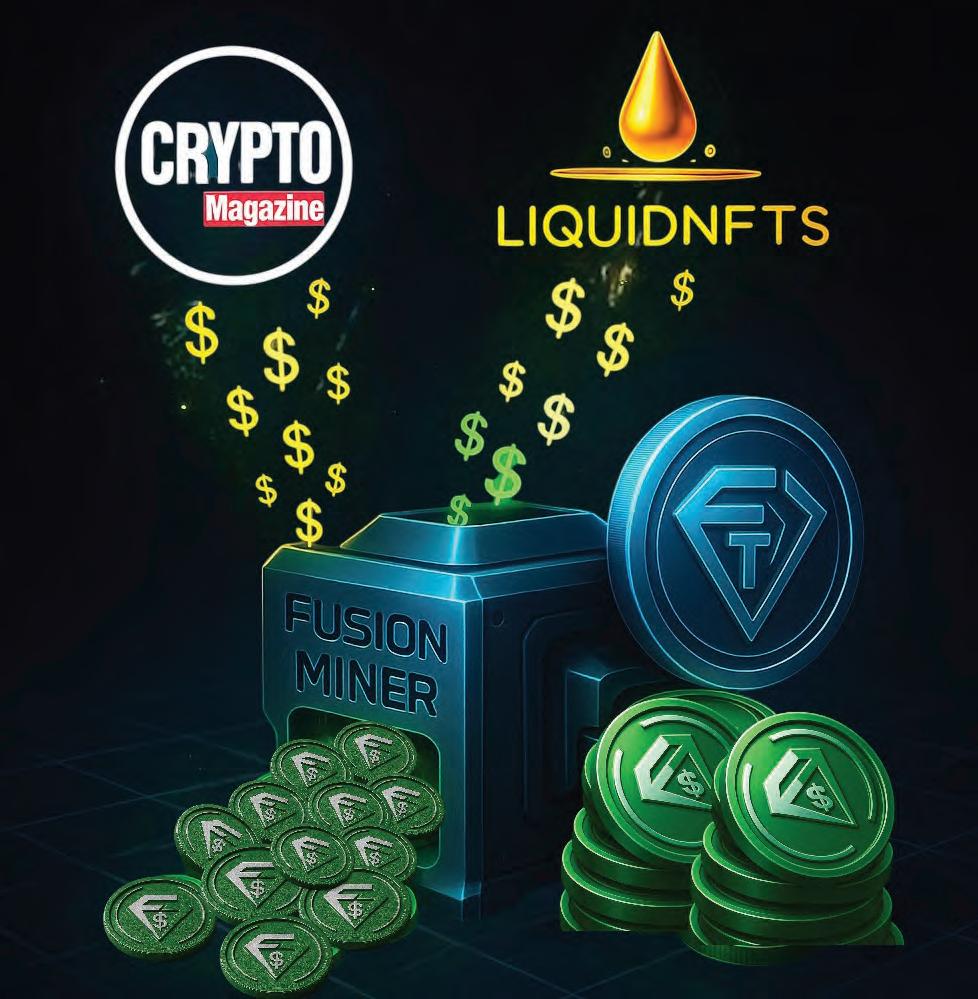
think it’s really special. I’ve already talked about FUSD our appreciating stable token (and you can read about that more widely throughout this edition and the last two magazines) but the other token in our dual-token ecosystem is FUST - very different but equally exciting.
It’s an altcoin with typical tokenomics and a phenomenal

utility which rewards holders with a steady supply of free FUSD. The rewards are funded through a combination of taxes, arbitrage activity and following a recent company merger, a proportion of the revenue generated from The Crypto Magazine and Liquid NFT platform.
The external RWA revenue makes this a completely self-sustaining ecosystem where sells on the FUST chart support buys on the FUSD chart, which rewards holders with an appreciating stable token. There’s a beautiful synergy between the two elements, so for me this is the stand-out project of 2025!
Do you have any preferences for CEX or DEX? (Centralised Exchanges or Decentralised)?
Great question - can I pick both? It’s a minefield to be fair - a great CEX can be the difference between a project scaling successfully or not. There are some absolute bandits out there waiting to charge extortionate fees, manipulate market makers in their favour to generate fake volume and dump your tokens at the first opportunity. They’ll kill you, so choosing the right one is critical.
FUST and FUSD will be listing with BESC, a brand new Tier 1 CEX fully licensed to operate across the USA and globally and we’re very excited to see the impact this partnership will have on our project.
On a personal level, I’ve grown my overall portfolio through decentralized liquidity pool farming on the BESC DEX, and their MoneyXpro platform has also presented a lot of really great passive income opportunities which, as I flirt
with the idea of stepping off the corporate hamster wheel and spending more time doing the things I love, is infinitely appealing.
Do you think shitcoins/ meme tokens benefit the industry? Do you think there will still be a place for them in the future?
Yes, memecoins have their place. They never held appeal for me until I was asked to create the art and animations for $BERNIE (BERNIECOIN.FUN) and now I’ve somehow adopted him as some kind of furry child. They can be a lot of uncomplicated fun with the right team and the fact that $BERNIE pays rewards in $FUSD helps!


Tell me some closing thoughts on your plans for crypto.
Choose, invest, HODL, relax, enjoy.
Lastly, what are some brief words of advice for someone just starting out in crypto?
The best advice I’d give anyone (and if you read my piece in the last magazine about catching the crypto feels you’ll already know my thoughts) is to invest in teams, not just projects. Identifying a team with grit, determination, skill and integrity is the key to getting this right and escaping without too many skinned knees. Crypto does have some absolute gems, but the people behind the curtain are everything!
fusdcrypto.com
bescexchange.com
moneyxpro.com
bescswap.com

The Casino Model: Chips, KYC, and Rewards
Let’s break it down.
You walk into a casino with fiat currency. You hand it over at the cashier, and in exchange you get chips. These chips:
Have no value outside the casino. Walk across the street to another casino, and those chips are worthless.
Function everywhere inside. Blackjack tables, roulette, poker, slots — even drinks, tips, and buffets can be paid for with chips.
Crypto is at a crossroads. Every week we see debates about regulation, decentralization, user freedom, and government oversight. But in reality, the model for how Know Your Customer (KYC) could and should work in crypto has existed for decades — and it’s hiding in plain sight inside every casino on the Las Vegas strip.
Tokin Trip @TripVoxel
Tie into reward structures.
Casinos incentivize you to keep playing by tracking your chip usage through a rewards card system. The more you spend, the more benefits you unlock: free rooms, free meals, VIP status.
Now here’s the crucial piece: when you cash in and cash out, you KYC. If your winnings hit certain thresholds, the casino doesn’t just suggest taxes — it automatically deducts and reports them. You sign the forms, the IRS gets its cut, and the system is compliant without breaking the immersion of gambling.
The chips themselves don’t need regulation. The cashier, the entry/exit points, and the reporting process are what’s regulated.
Sound familiar? It should. This is exactly the structure crypto needs.
Instead of reinventing the wheel, the crypto industry should adopt this model:
Tokens = Casino Chips. They work in closed ecosystems like metaverses, DeFi platforms,
or company networks. They don’t need to be regulated individually; they need structured on- and off-ramps.
Exchanges or Projects Themselves offering On Boarding = Casino Cashiers. This is where KYC happens, where taxes are calculated, where user verification ensures compliance. Not inside the games, apps, or metaverses themselves.
Rewards = Tiered Crypto Benefits. Just like casinos incentivize players with free nights and buffets, crypto platforms can build tiered rewards for engagement: fee discounts, staking bonuses, or access to premium features.
By aligning with a system regulators already understand — and one that already works at global scale — crypto can achieve mainstream adoption
without gutting its core value of decentralized functionality.
Here’s the kicker: users don’t even need to know they’re using crypto.
Think about onboarding. Today, people are trained to complete CAPTCHAs to prove they’re human. What if, instead of selecting bicycles or traffic lights, users were given 12 random words to arrange in the right order?
That’s not just a CAPTCHA — that’s a recovery phrase. A natural introduction to blockchain security without ever needing to say “wallet” or “private key.” At the end, the system congratulates them:
“This is your recovery phrase. If you ever lose your password, email, or 2FA, this phrase will

recover your account. Store it somewhere safe.”
No friction. No crypto jargon. Just a familiar web process hiding a revolutionary wallet creation.

The lesson here is simple: the path to regulation and adoption isn’t to fight the system or wait for governments to invent new frameworks. It’s to look at what already works. Casinos have been running tokenized economies internationally for decades. Their systems for KYC, tax handling, and rewards have already proven themselves scalable and regulator-friendly.
Crypto doesn’t need to mimic Wall Street. It needs to mimic Las Vegas.
Because at the end of the day, users don’t care if the chips are plastic or blockchain-based. What they care about is the experience, the rewards, and the trust that when they cash out, everything is handled smoothly.
And if crypto gets that right, adoption isn’t just possible — it’s inevitable.


This exclusive collection of only 500 NFTs offer each holder a share of 15% of the platforms revenue